US English


7 Senior Fire Engineer - Structural CV Templates with Example
By Ria · Last Updated On 22 October 2026
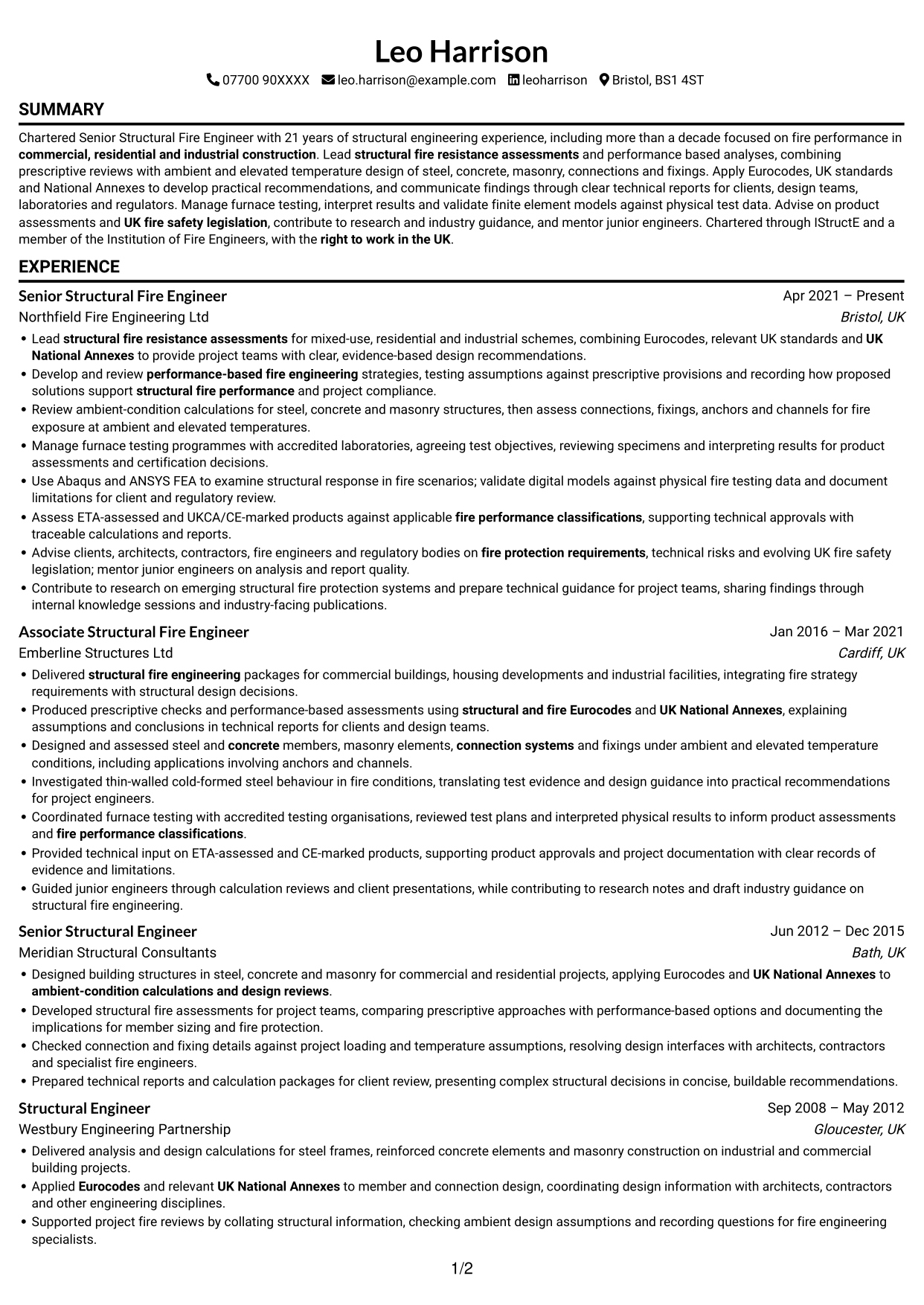
CV example — page 1

This guide shows you how to create a Senior Fire Engineer - Structural CV that presents your technical judgement and evidence clearly. You will learn how to organise relevant information so that recruiters can quickly understand your structural fire engineering work.

A strong CV for this role connects structural design knowledge with fire resistance assessments and practical project decisions. Focus on evidence such as prescriptive and performance-based assessments, testing, technical reports and the use of Eurocodes and UK National Annexes.

Explore the example presented in 7 layouts, compare the PNG image previews, and open a preferred example in the editor to customise it. The guidance also covers ATS readability, useful CV sections and role-specific terms such as furnace testing, Abaqus, ANSYS, fire fixings and product assessments.

What Makes a Great Senior Fire Engineer - Structural CV in 2026

A strong CV makes structural fire assessments, design experience and technical decisions easy to scan. Use clear bullet points to show your contribution and the outcome.

Include relevant terms such as Eurocodes, performance-based assessment, furnace testing, FEA and product approval. Add figures only when you can support them with evidence.

Note: CV examples are for educational purposes only. Use only information that accurately reflects your experience and qualifications. References to real organisations do not imply affiliation or endorsement.

#1 Simple One Column Format CV Example

The Simple One Column Format keeps the CV in one reading column, a practical choice for a direct route through detailed technical experience.
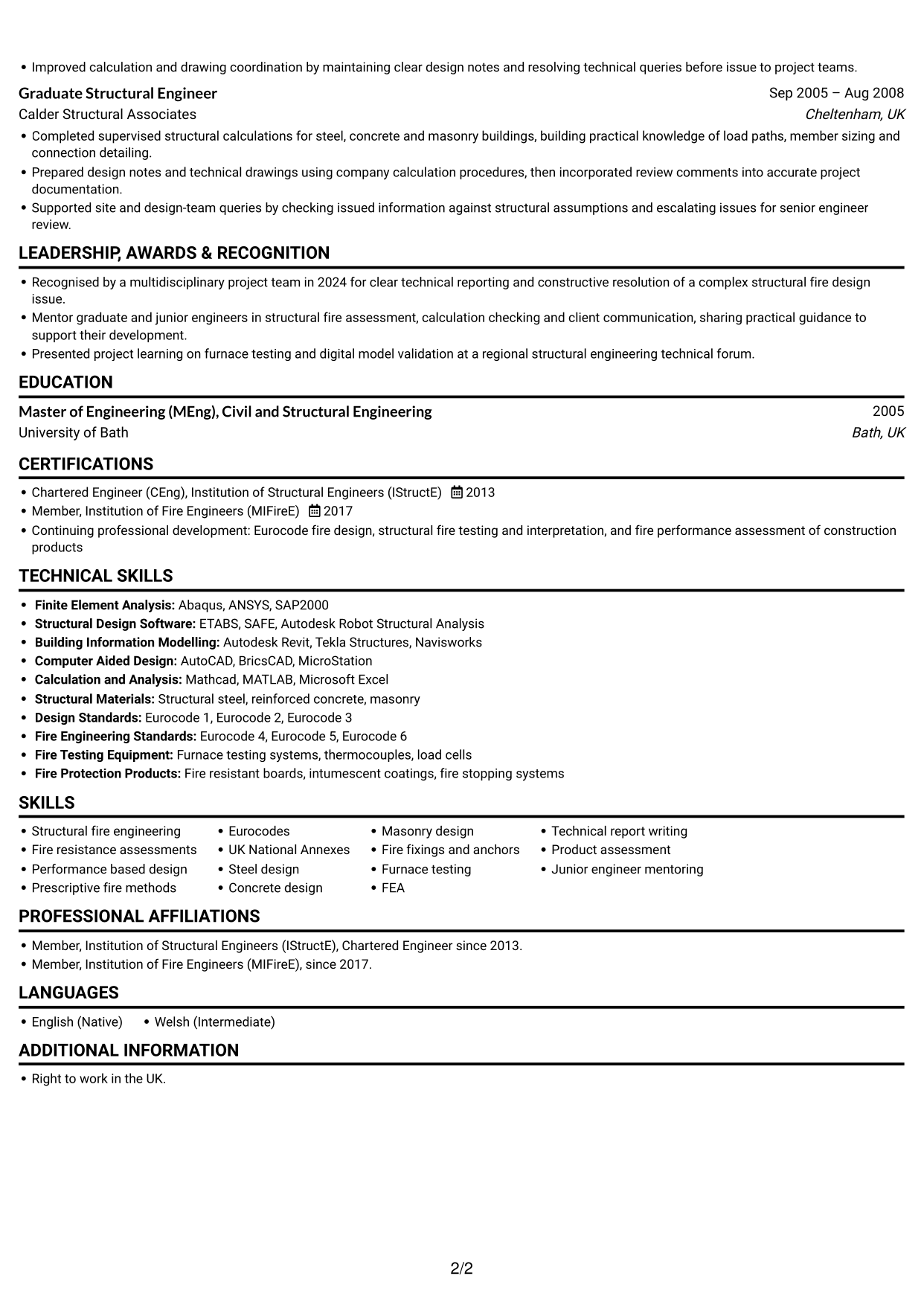
 
CV example — page 1   CV example — page 2

Why This Format Works

  • A single reading column gives ATS and recruiters a straightforward text sequence.
  • Clear section order helps reviewers trace career progression across successive engineering roles.
  • Experience bullets remain in one stream, keeping technical achievements linked to each role.

Best For

  • ATS-friendly text order
  • Sequential career histories
  • Detailed role-by-role experience
  • Technical reports and credentials
  • Readers preferring linear review

CV Keywords

  • Chartered Engineer (CEng), Institution of Structural Engineers (IStructE)
  • Member, Institution of Fire Engineers (MIFireE), since 2017.
  • structural fire engineering
  • structural fire resistance assessments
  • performance-based fire engineering
  • Prescriptive fire methods
  • ambient-condition calculations and design reviews
  • Eurocodes
  • structural and fire Eurocodes
  • UK National Annexes
  • UK standards
  • Technical report writing
  • commercial, residential and industrial construction
  • right to work in the UK
  • Designed and assessed steel and concrete members, masonry elements
See all keywords
 

#2 Simple Two Column Format CV Example

The Simple Two Column Format places CV content in two columns, giving readers a compact way to distinguish career history from supporting sections.
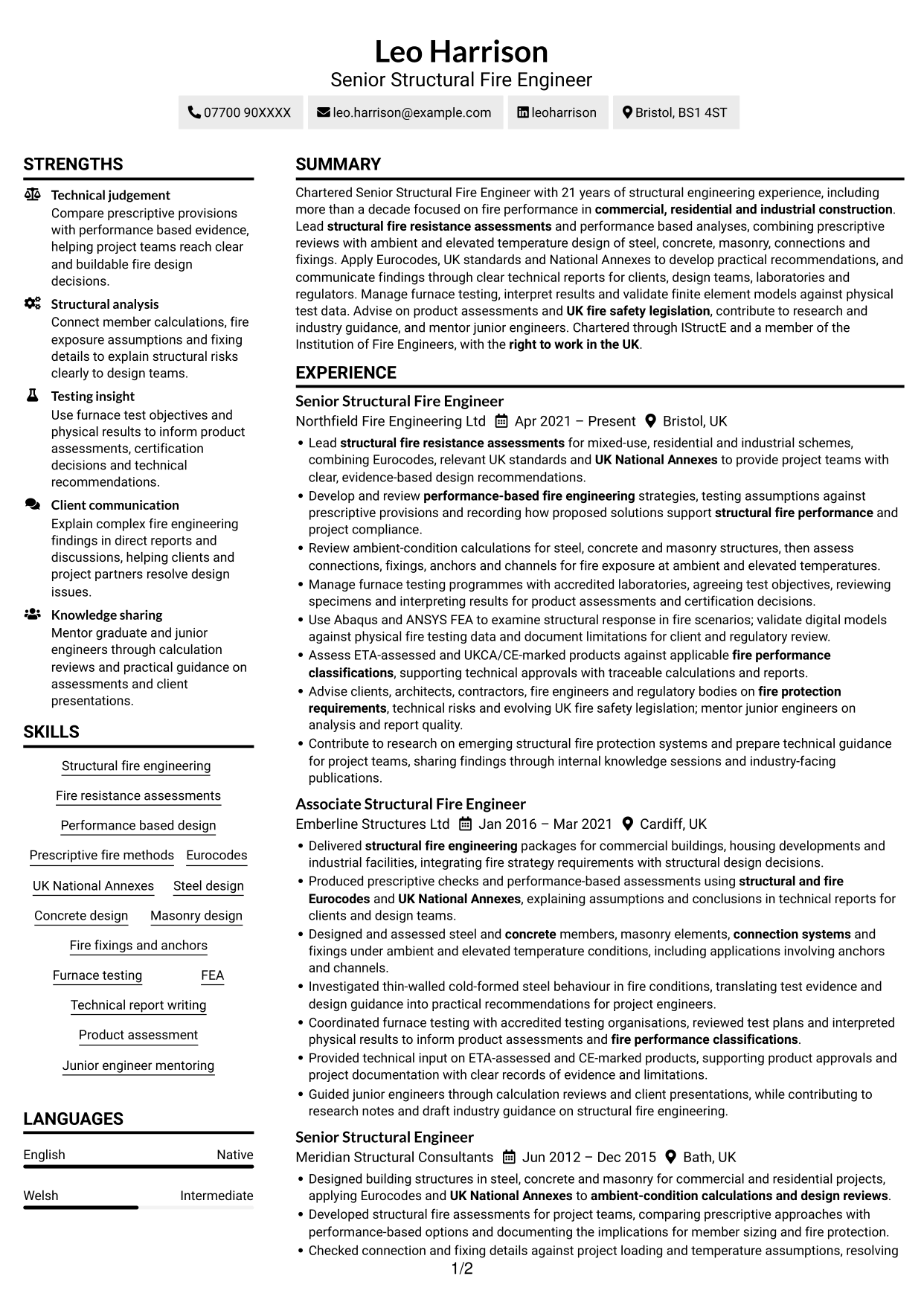
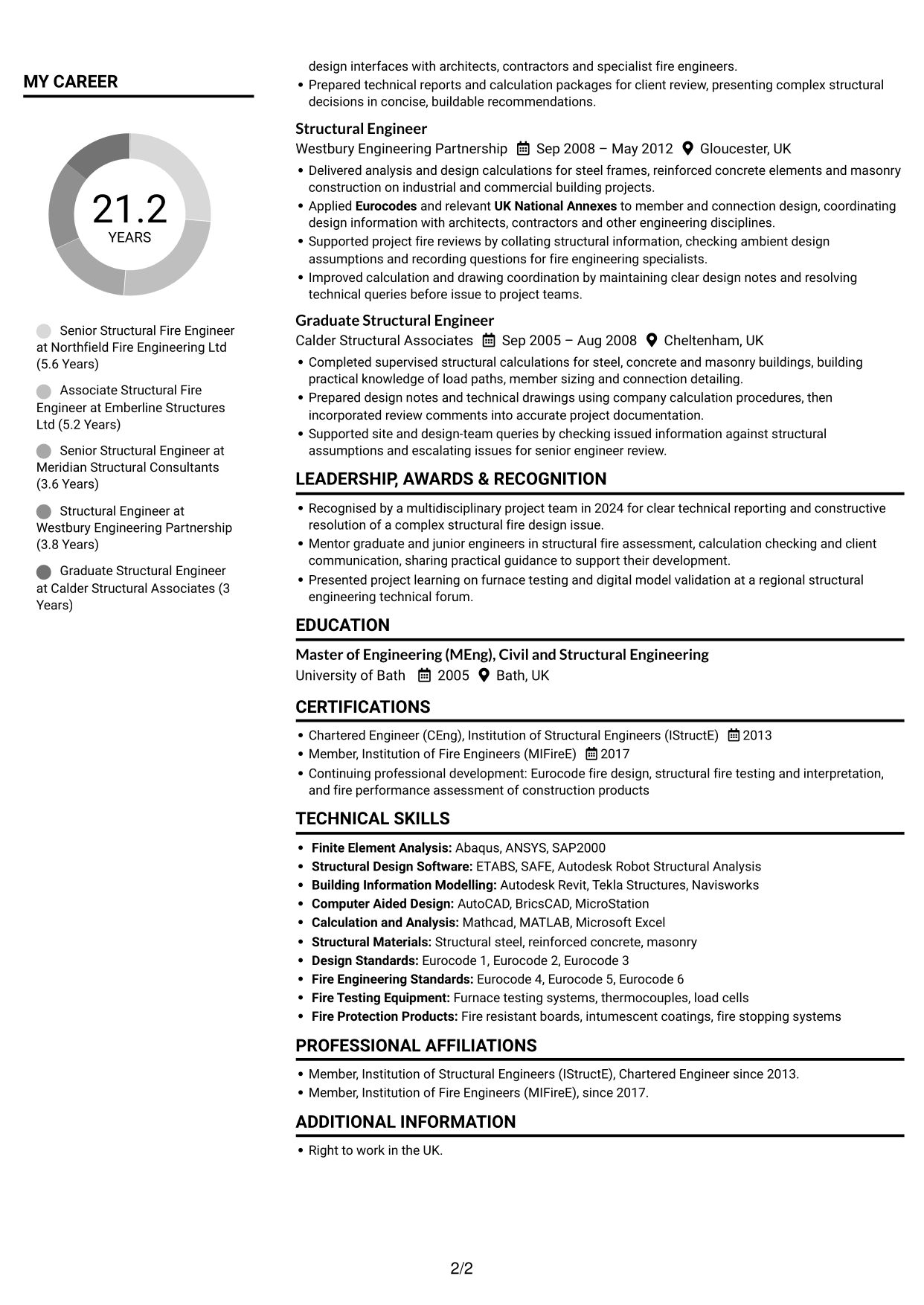
 
CV example — page 1   CV example — page 2

Why This Format Works

  • Two columns can distinguish career history from supporting sections without breaking role-based reading.
  • Experience bullets remain grouped by position, preserving context for each achievement.
  • Separate content areas give education and credentials room beside the career record.

Best For

  • Side-by-side section review
  • Compact supporting details
  • Career history with credentials
  • CVs with varied section content
  • Readers comparing related information

#3 Plain One Column with Shaded Labels CV Example

The Plain One Column with Shaded Labels format keeps content in one column, a practical choice for readers who prefer a steady sequence.
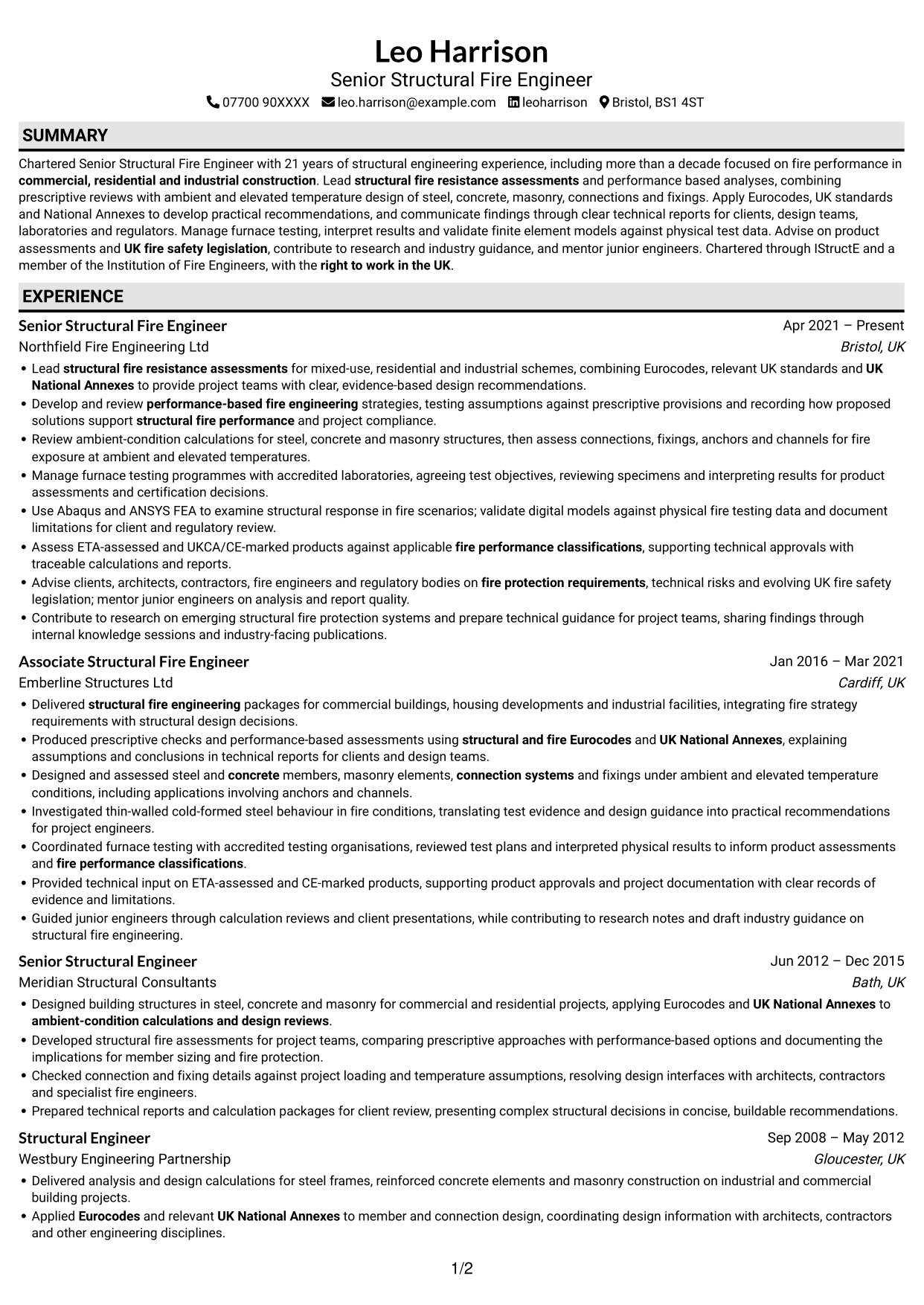
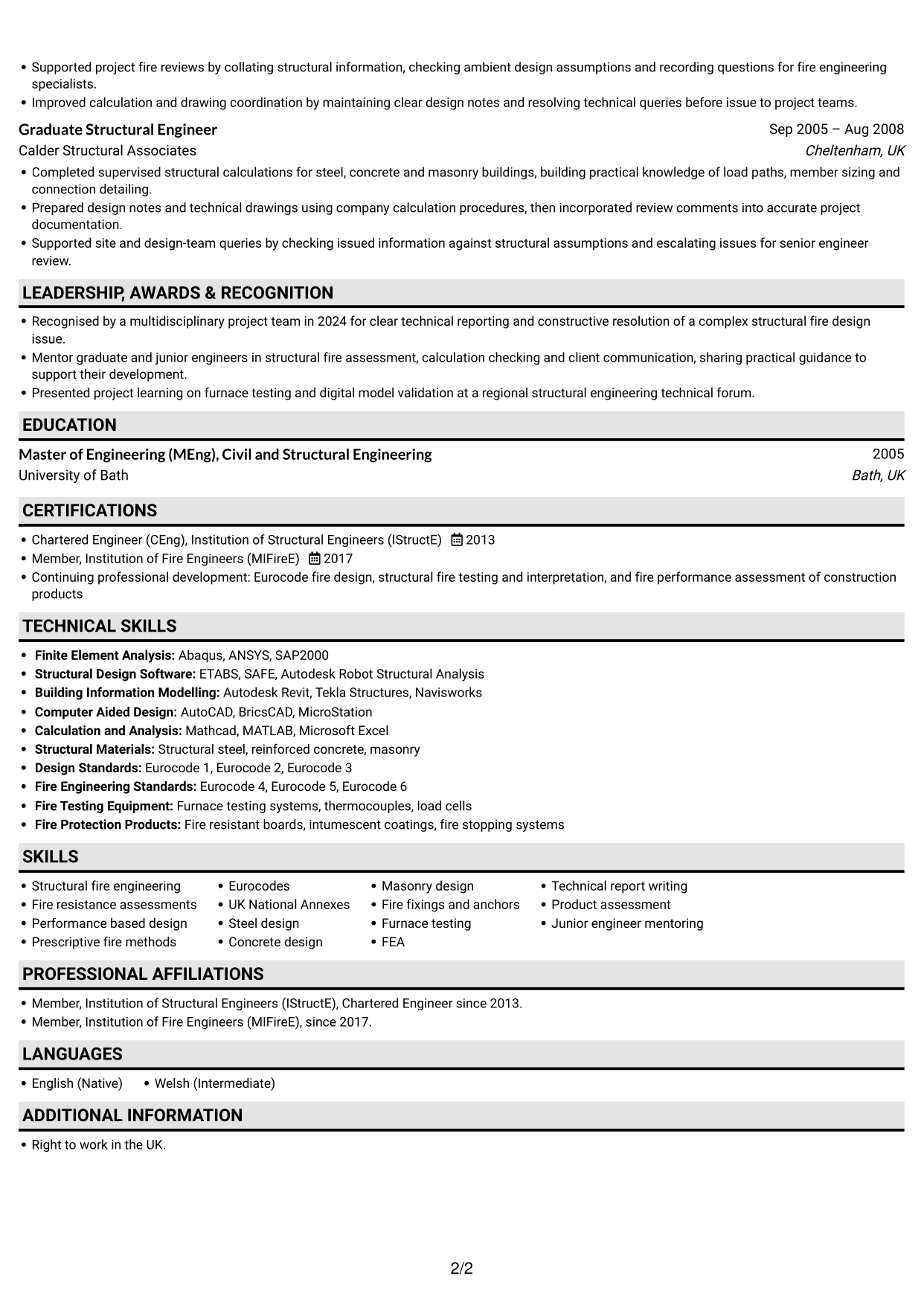
 
CV example — page 1   CV example — page 2

Why This Format Works

  • One continuous text column gives parsing tools a clear sequence of CV sections.
  • A consistent reading order helps reviewers follow experience from one role to the next.
  • Role-by-role entries make career development straightforward to trace.

Best For

  • Continuous text review
  • Straightforward ATS parsing
  • Role-by-role career detail
  • Readers following career development
  • CVs with several sections
 

#4 One Column Format with Photo Right CV Example

The One Column Format with Photo Right combines a single-column CV with a photo, a practical choice for readers who want a personal visual element.
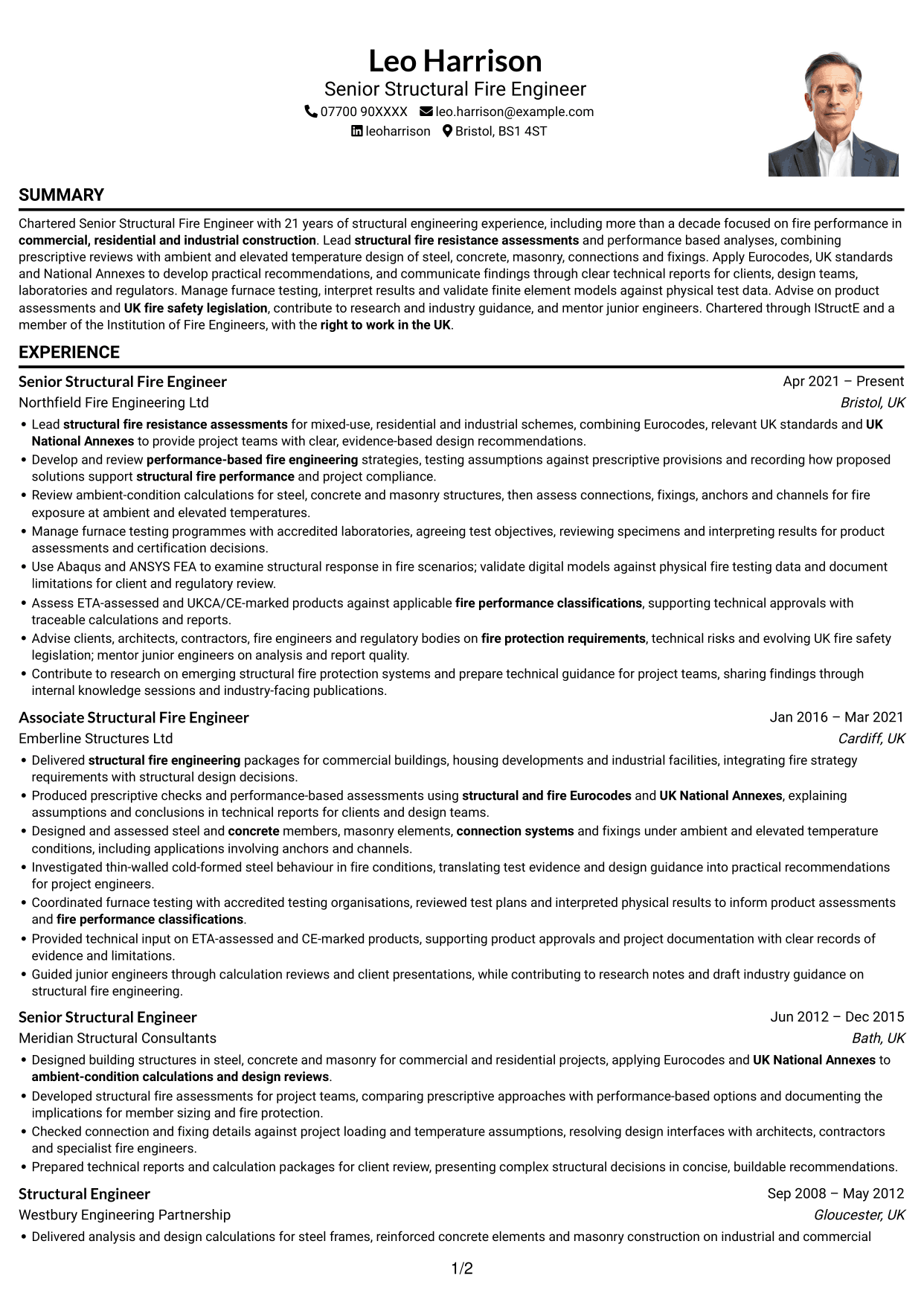
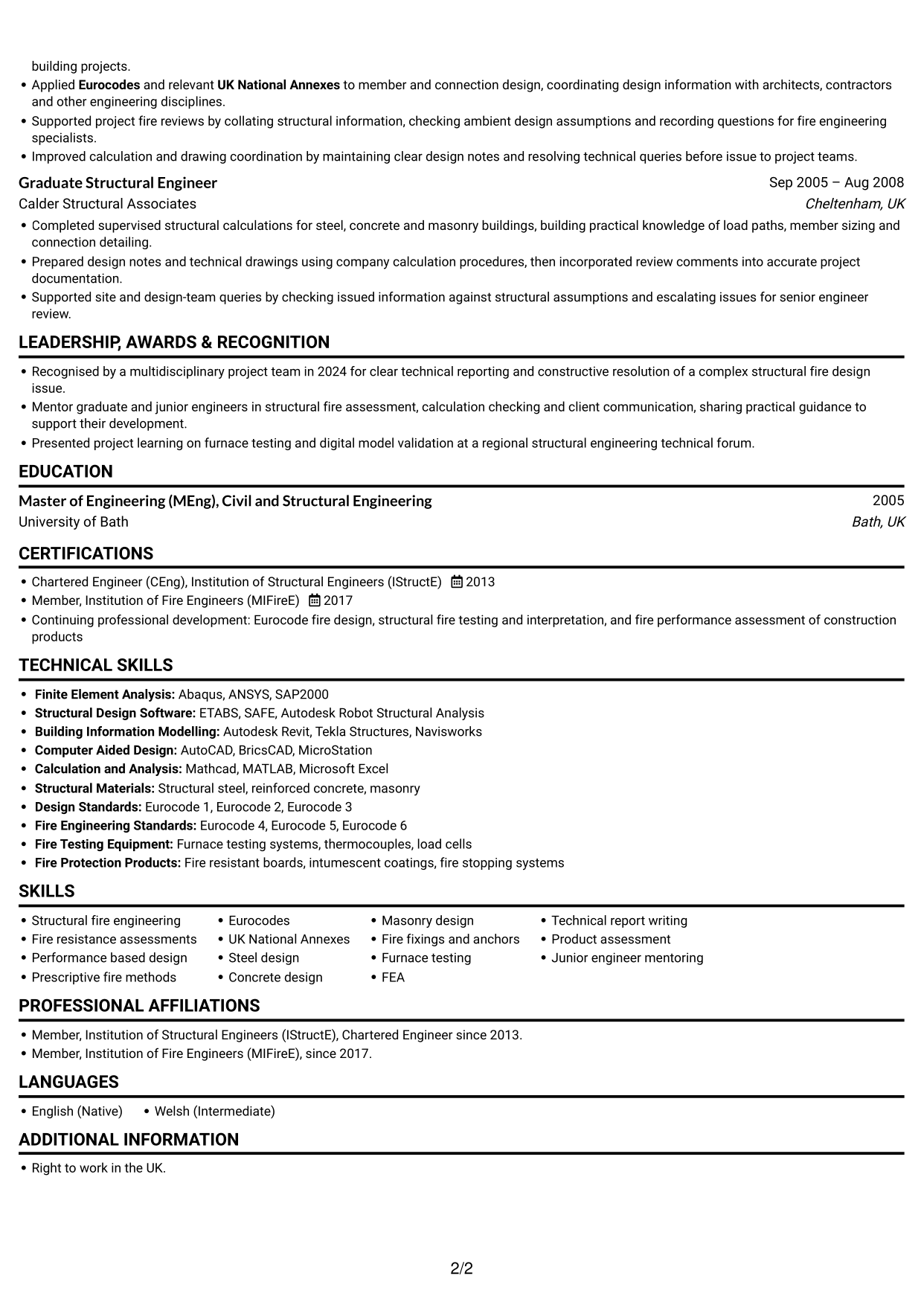
 
CV example — page 1   CV example — page 2

Why This Format Works

  • One-column text keeps experience and supporting details in a familiar reading order.
  • Role-by-role entries show career progression without requiring readers to switch between columns.
  • An included photo adds a personal visual element while leaving the text in one column.

Best For

  • Single-column reading preference
  • Photo-inclusive CVs
  • Linear career histories
  • Readers seeking a personal visual element
  • Experience with supporting details
 

#5 Clean Two Column Sidebar Format CV Example

The Clean Two Column Sidebar Format uses two columns, offering reviewers a side-by-side view of CV sections.
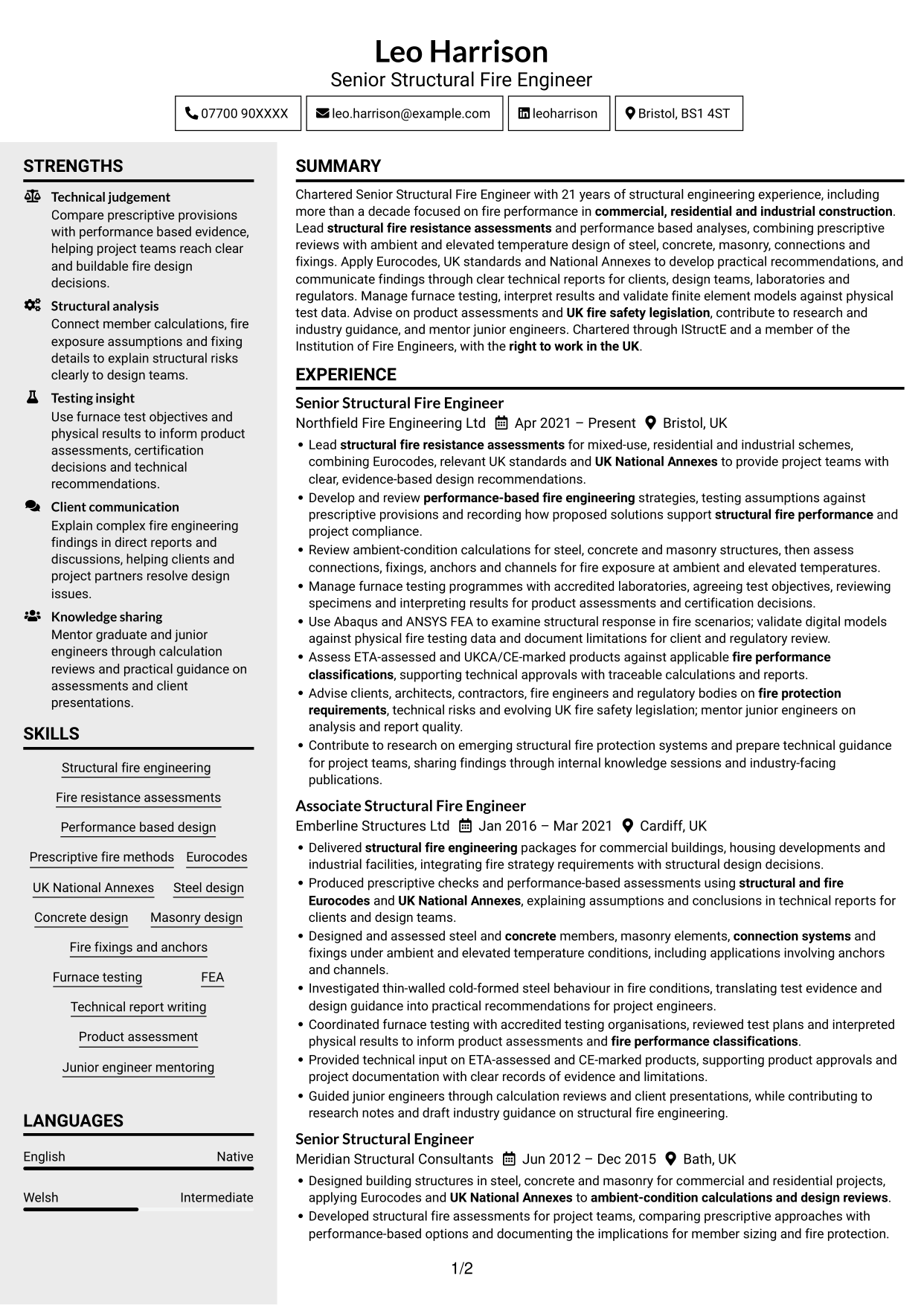
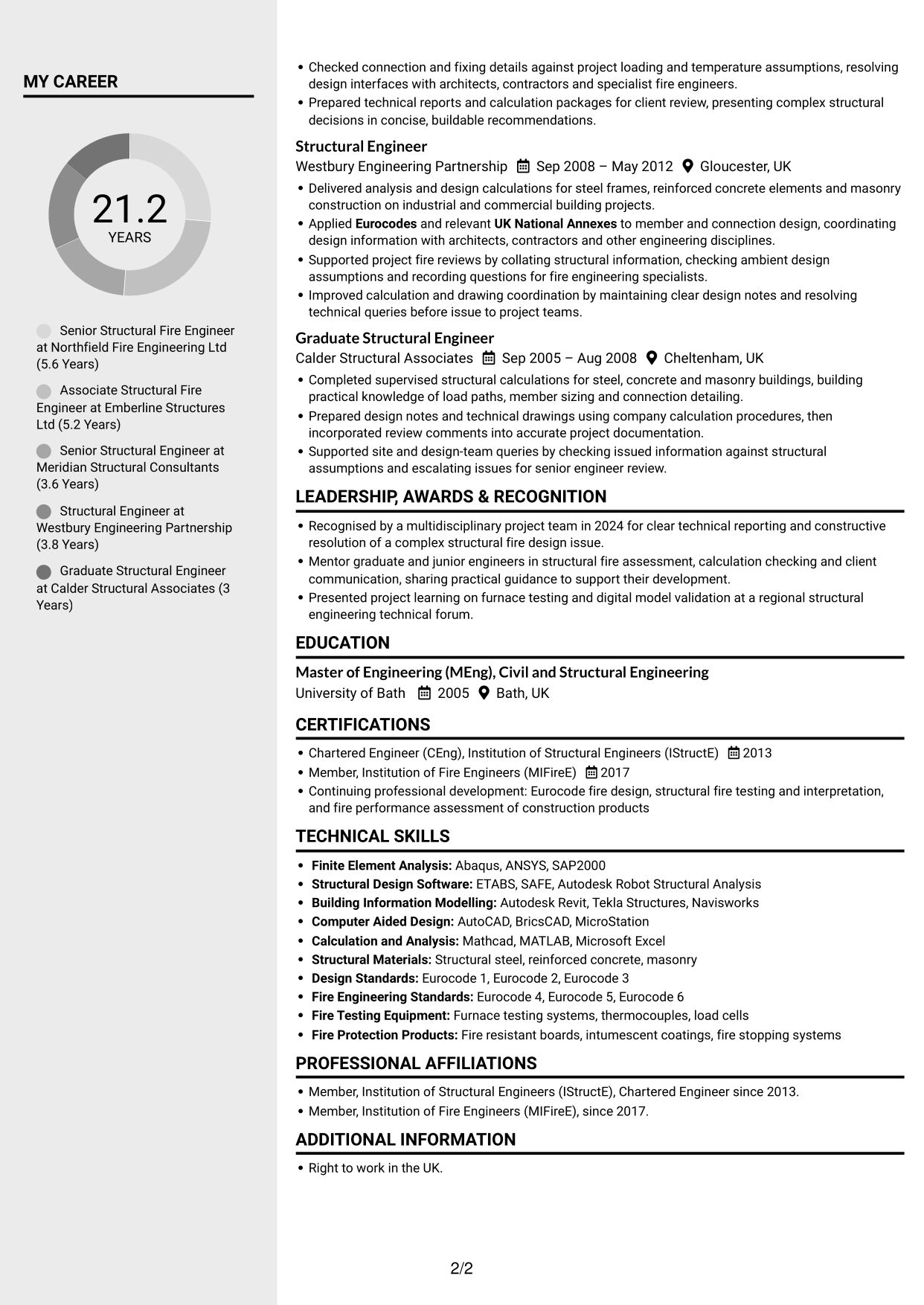
 
CV example — page 1   CV example — page 2

Why This Format Works

  • Two-column organisation can keep experience distinct from supporting CV sections.
  • Readers can compare career entries with supporting details across the same view.
  • Role-based bullets keep each achievement attached to its relevant position.

Best For

  • Side-by-side section navigation
  • Experience with supporting details
  • CVs combining career and education sections
  • Readers comparing qualifications
  • Grouped role-based achievements


#6 Two Column Format CV Example

The Two Column Format places content in paired columns, useful when readers need to refer across separate CV sections.
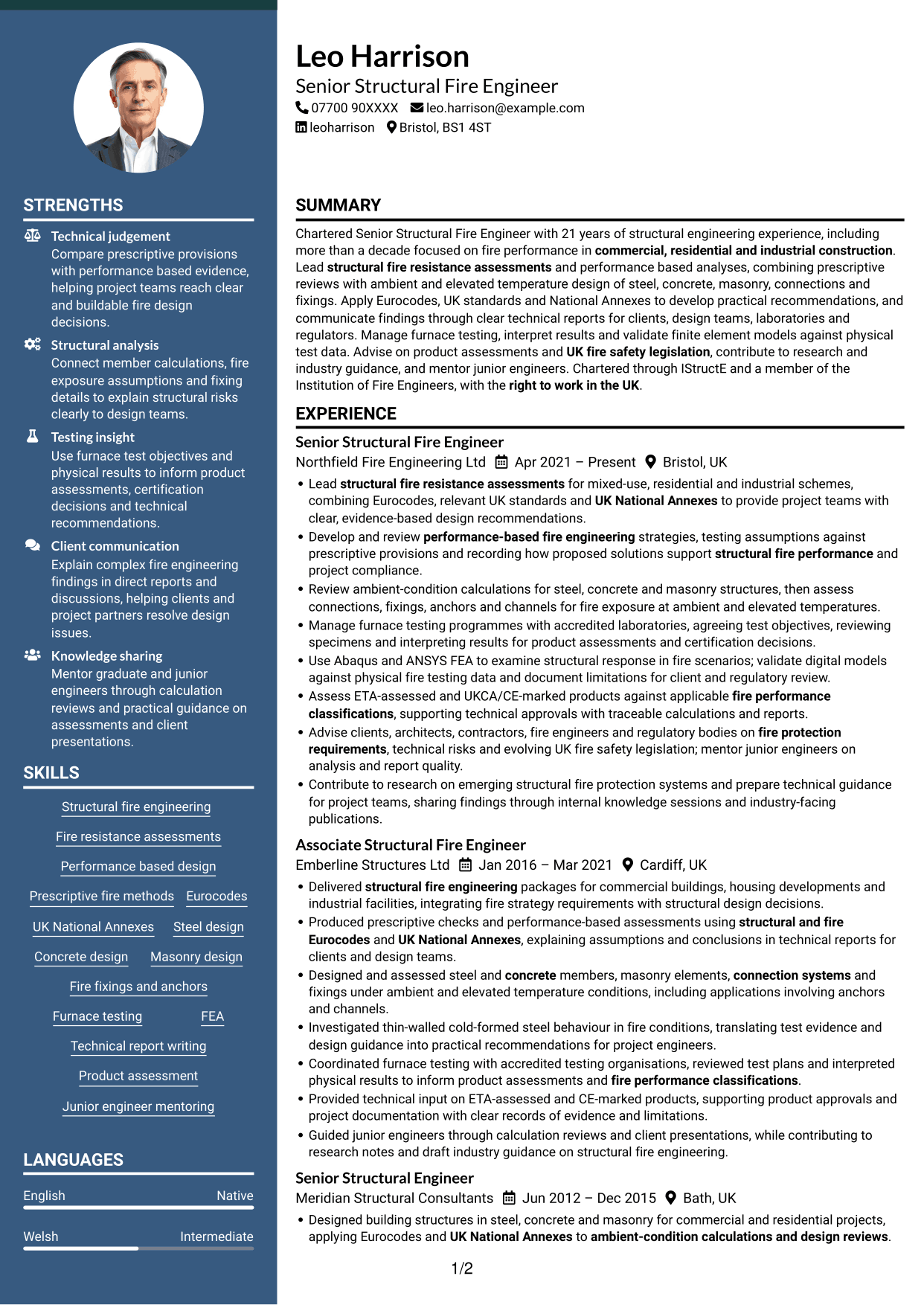
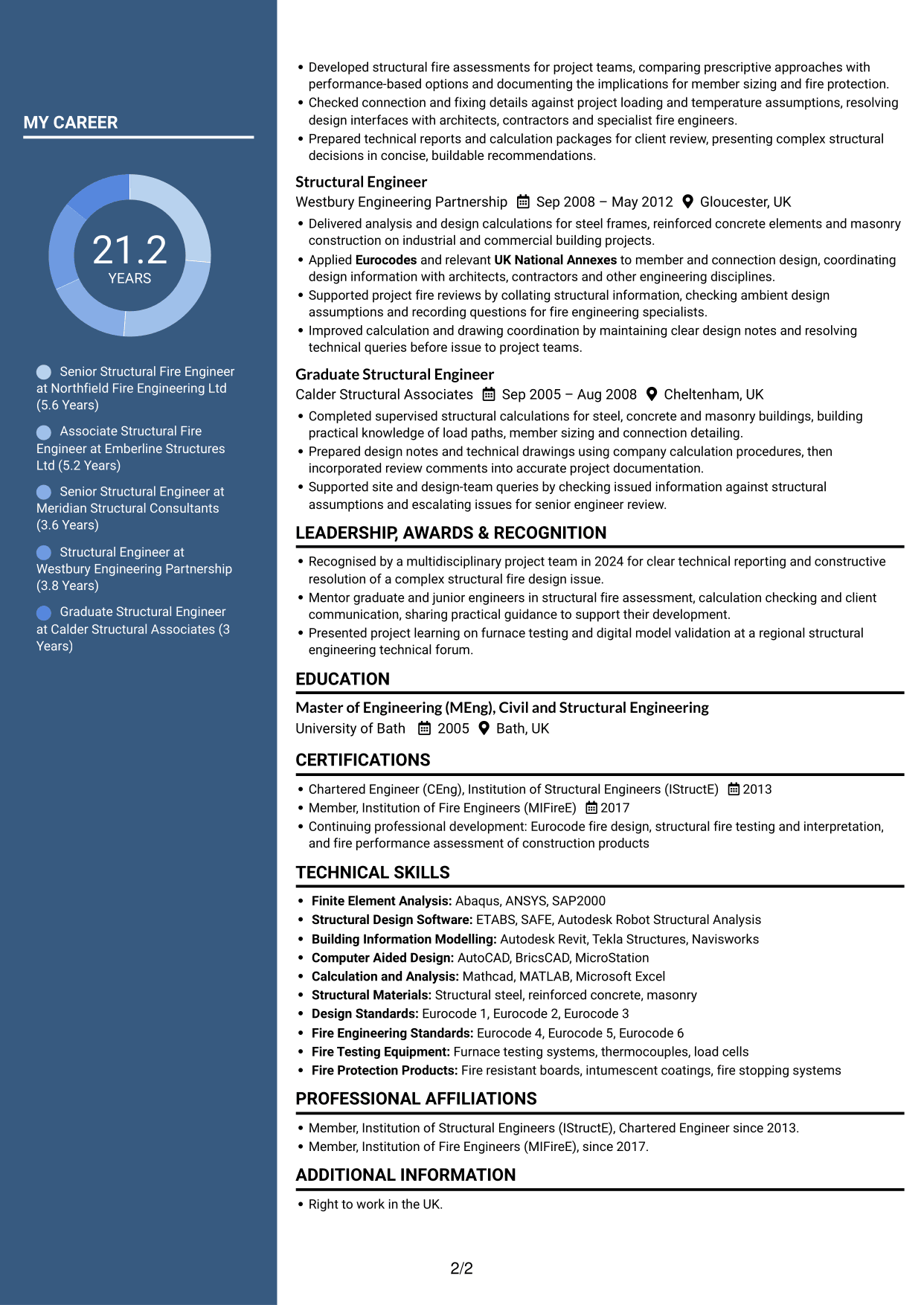
 
CV example — page 1   CV example — page 2

Why This Format Works

  • Paired columns make separate CV sections visible together during a review.
  • Career entries remain easy to trace when recruiters move between experience and credentials.
  • Role-based bullet groups preserve context around technical achievements and responsibilities.

Best For

  • Paired section reference
  • Experience and credential review
  • CVs with several information areas
  • Readers checking role details
  • Career histories with technical content
 

#7 Photo Header Two Column Format CV Example

The Photo Header Two Column Format combines a photo with two columns, giving the CV a clear visual identity alongside grouped content.
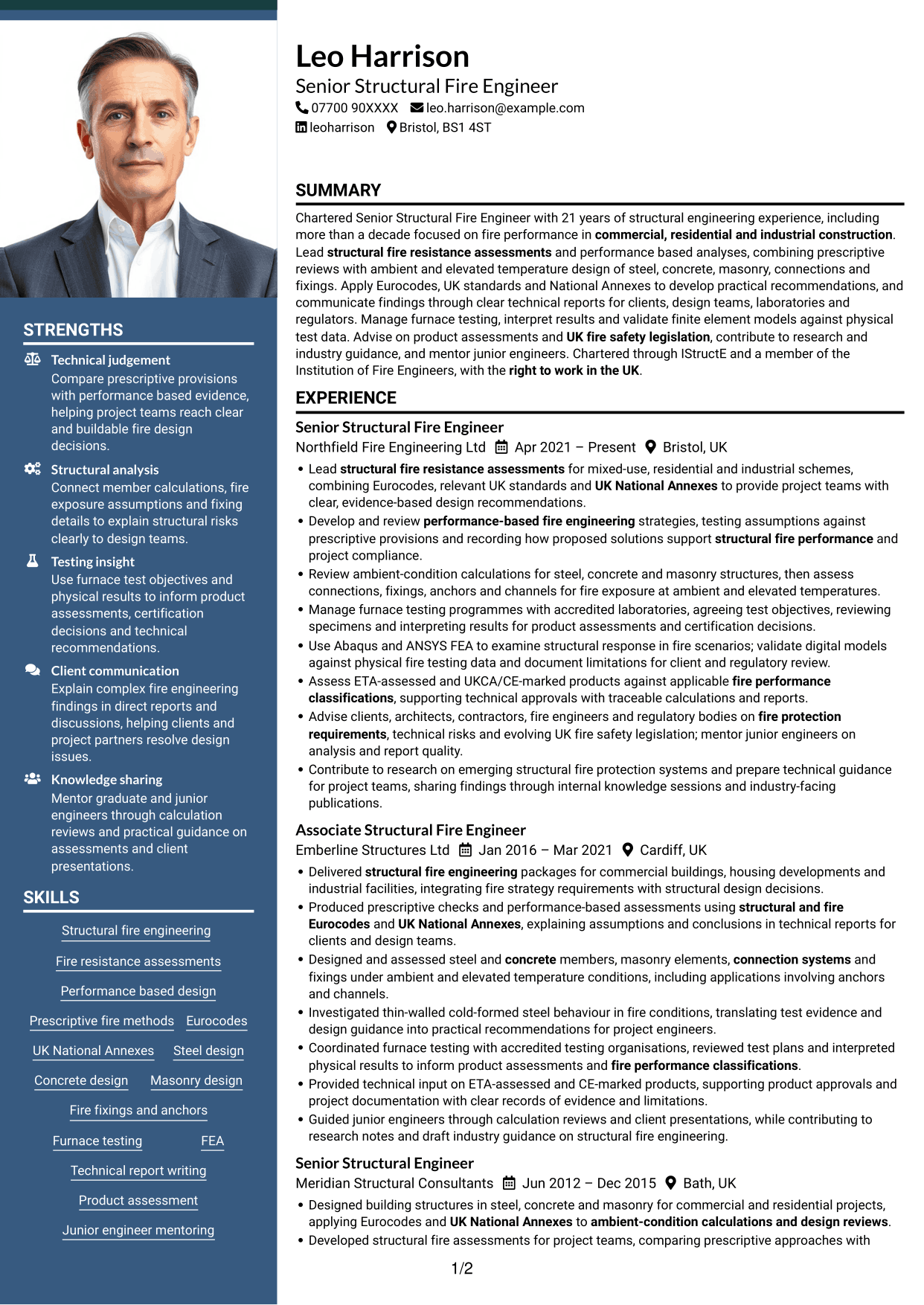
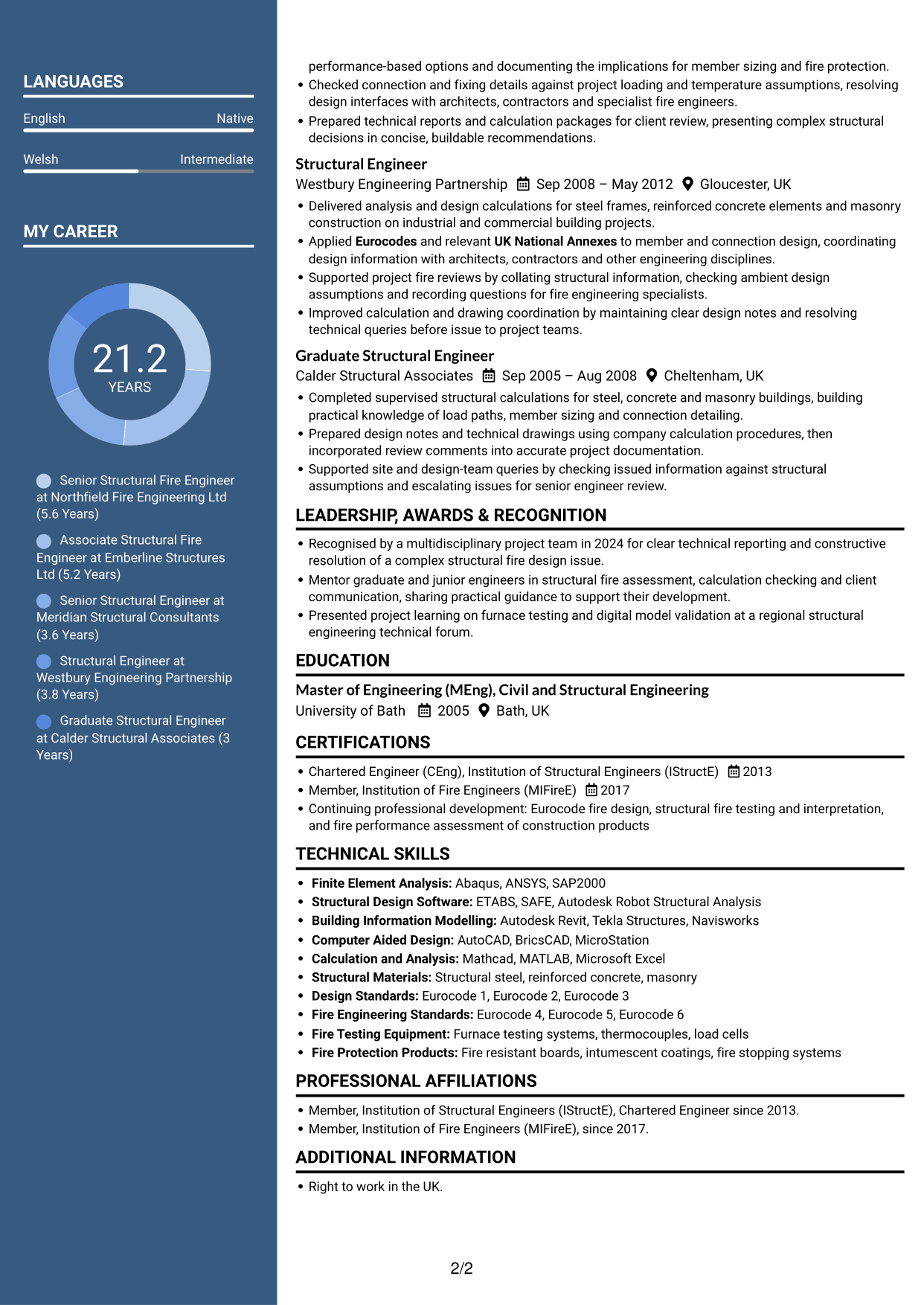
 
CV example — page 1   CV example — page 2

Why This Format Works

  • Two columns separate CV content areas, while the included photo adds a visual point of identity.
  • Career entries can sit alongside supporting sections, giving readers a broader view of qualifications.
  • Grouped role bullets keep progression clear within the two-column body.

Best For

  • Two-column section organisation
  • Photo-inclusive CVs
  • Career entries with supporting sections
  • Readers who prefer grouped content
  • CVs needing a personal visual element


Why Build Your Senior Fire Engineer - Structural CV with ResumeInMinutes

ResumeInMinutes helps you organise structural fire engineering experience, skills and qualifications in a clear CV. Compare PNG image previews, then open an example in the editor to customise its content and layout.

  • Clear CV layouts
  • Readable section structure
  • Space for role-specific keywords
  • Organised skills and experience
  • PNG image previews
  • CV customisation in the editor

Choose a format that makes your assessment work and technical evidence easy to follow. Keep the focus on structural fire performance, sound analysis and practical recommendations.


See Also


Frequently Asked Questions

Are these Senior Fire Engineer - Structural CV templates ATS-friendly?

The examples use clear headings and sections that are easy to scan. Include relevant terms naturally, such as structural fire resistance assessments, Eurocodes, UK National Annexes, furnace testing and FEA.

Are these separate CV examples or different layouts of one example?

This page shows one role-focused CV example in different layouts. Compare the PNG image previews, then open an example in the editor to customise it.

What should a Senior Fire Engineer - Structural CV include?

Include a focused summary, relevant experience, education, professional memberships and skills. Show evidence of structural fire assessments, ambient and elevated temperature design, technical reports, testing and product assessments.

Which CV layout works well for this role?

Choose a layout with clear headings and a logical order for experience, skills, qualifications and education. A simple structure helps readers and applicant tracking systems find key details.

How can I show structural fire engineering achievements on my CV?

Write concise bullet points that explain the assessment, your contribution and the result. Add supported details about testing, model validation, design recommendations or project outcomes where relevant.

Should I include a photo on my CV?

For UK applications, a photo is usually not needed. Use the space for relevant experience, skills and evidence of your work instead.

ATS Score 95%

How we calculate this score

  • Keywords: 60% of the total. AI extracts keywords from your job description. If you do not provide one, a standard job description for the title matching your CV is used. This is not a match to a specific vacancy.
  • Text-based CV: 20%. The text CV assessed here receives 100 for this part.
  • CV quality: 20%. We start at 100 and subtract points for issues found by our CV checks, down to a minimum of zero.
  • Keyword coverage = round(100 × confirmed matches ÷ total keywords). Exact matches and supported equivalents verified by AI receive full credit; unsupported keywords receive none. Live text checks use the saved equivalents and do not request a new AI review. Without keywords, no overall ATS score is available.
  • Final score = 60% of keyword coverage + 20% of the text score + 20% of the quality score, rounded to a whole number. Without keywords, no overall ATS score is available.

What this score means

Our scores are estimates, not employer ratings. They may contain errors and do not guarantee accurate parsing, a ranking, an interview, or a job. Check your document against the employer’s requirements. You are responsible for relying on this score.

Terms and Conditions

Score weights: Keywords 60% · Text based CV 20% · CV quality 20%

Keyword coverage: 36 of 39 (92%) · CV quality: 100%

CV quality 100% · Weight 20% · Issues (0)

Details
  • ✓Name present: Leo Harrison
  • ✓Email format: leo.harrison@example.com
  • ✓Phone format: 07700 90XXXX
  • ✓Experience 1: Job title: Senior Structural Fire Engineer
  • ✓Experience 1: Company name: Northfield Fire Engineering Ltd
  • ✓Experience 1: Work location: Bristol, UK
  • ✓Experience 1: Employment dates: Apr 2021 – Present
  • ✓Experience 1: Description or achievements: Present
  • ✓Experience 2: Job title: Associate Structural Fire Engineer
  • ✓Experience 2: Company name: Emberline Structures Ltd
  • ✓Experience 2: Work location: Cardiff, UK
  • ✓Experience 2: Employment dates: Jan 2016 – Mar 2021
  • ✓Experience 2: Description or achievements: Present
  • ✓Experience 3: Job title: Senior Structural Engineer
  • ✓Experience 3: Company name: Meridian Structural Consultants
  • ✓Experience 3: Work location: Bath, UK
  • ✓Experience 3: Employment dates: Jun 2012 – Dec 2015
  • ✓Experience 3: Description or achievements: Present
  • ✓Experience 4: Job title: Structural Engineer
  • ✓Experience 4: Company name: Westbury Engineering Partnership
  • ✓Experience 4: Work location: Gloucester, UK
  • ✓Experience 4: Employment dates: Sep 2008 – May 2012
  • ✓Experience 4: Description or achievements: Present
  • ✓Experience 5: Job title: Graduate Structural Engineer
  • ✓Experience 5: Company name: Calder Structural Associates
  • ✓Experience 5: Work location: Cheltenham, UK
  • ✓Experience 5: Employment dates: Sep 2005 – Aug 2008
  • ✓Experience 5: Description or achievements: Present
  • ✓No placeholder fields
  • ✓No repeated achievement bullets
  • ✓No empty bullets

No issues found by the current checks.

Text Based CV 100% · Weight 20%

Parsed text
Leo Harrison
07700 90XXXX
leo.harrison@example.com
leoharrison
Bristol, BS1 4ST
SUMMARY
Chartered Senior Structural Fire Engineer with 21 years of structural engineering experience, including more than a decade focused on fire performance in commercial, residential and industrial construction. Lead structural fire resistance assessments and performance based analyses, combining prescriptive reviews with ambient and elevated temperature design of steel, concrete, masonry, connections and fixings. Apply Eurocodes, UK standards and National Annexes to develop practical recommendations, and communicate findings through clear technical reports for clients, design teams, laboratories and regulators. Manage furnace testing, interpret results and validate finite element models against physical test data. Advise on product assessments and UK fire safety legislation, contribute to research and industry guidance, and mentor junior engineers. Chartered through IStructE and a member of the Institution of Fire Engineers, with the right to work in the UK.
EXPERIENCE
Senior Structural Fire Engineer
Apr 2021 – Present
Northfield Fire Engineering Ltd
Bristol, UK
Lead structural fire resistance assessments for mixed-use, residential and industrial schemes, combining Eurocodes, relevant UK standards and UK National Annexes to provide project teams with clear, evidence-based design recommendations.
Develop and review performance-based fire engineering strategies, testing assumptions against prescriptive provisions and recording how proposed solutions support structural fire performance and project compliance.
Review ambient-condition calculations for steel, concrete and masonry structures, then assess connections, fixings, anchors and channels for fire exposure at ambient and elevated temperatures.
Manage furnace testing programmes with accredited laboratories, agreeing test objectives, reviewing specimens and interpreting results for product assessments and certification decisions.
Use Abaqus and ANSYS FEA to examine structural response in fire scenarios; validate digital models against physical fire testing data and document limitations for client and regulatory review.
Assess ETA-assessed and UKCA/CE-marked products against applicable fire performance classifications, supporting technical approvals with traceable calculations and reports.
Advise clients, architects, contractors, fire engineers and regulatory bodies on fire protection requirements, technical risks and evolving UK fire safety legislation; mentor junior engineers on analysis and report quality.
Contribute to research on emerging structural fire protection systems and prepare technical guidance for project teams, sharing findings through internal knowledge sessions and industry-facing publications.
Associate Structural Fire Engineer
Jan 2016 – Mar 2021
Emberline Structures Ltd
Cardiff, UK
Delivered structural fire engineering packages for commercial buildings, housing developments and industrial facilities, integrating fire strategy requirements with structural design decisions.
Produced prescriptive checks and performance-based assessments using structural and fire Eurocodes and UK National Annexes, explaining assumptions and conclusions in technical reports for clients and design teams.
Designed and assessed steel and concrete members, masonry elements, connection systems and fixings under ambient and elevated temperature conditions, including applications involving anchors and channels.
Investigated thin-walled cold-formed steel behaviour in fire conditions, translating test evidence and design guidance into practical recommendations for project engineers.
Coordinated furnace testing with accredited testing organisations, reviewed test plans and interpreted physical results to inform product assessments and fire performance classifications.
Provided technical input on ETA-assessed and CE-marked products, supporting product approvals and project documentation with clear records of evidence and limitations.
Guided junior engineers through calculation reviews and client presentations, while contributing to research notes and draft industry guidance on structural fire engineering.
Senior Structural Engineer
Jun 2012 – Dec 2015
Meridian Structural Consultants
Bath, UK
Designed building structures in steel, concrete and masonry for commercial and residential projects, applying Eurocodes and UK National Annexes to ambient-condition calculations and design reviews.
Developed structural fire assessments for project teams, comparing prescriptive approaches with performance-based options and documenting the implications for member sizing and fire protection.
Checked connection and fixing details against project loading and temperature assumptions, resolving design interfaces with architects, contractors and specialist fire engineers.
Prepared technical reports and calculation packages for client review, presenting complex structural decisions in concise, buildable recommendations.
Structural Engineer
Sep 2008 – May 2012
Westbury Engineering Partnership
Gloucester, UK
Delivered analysis and design calculations for steel frames, reinforced concrete elements and masonry construction on industrial and commercial building projects.
Applied Eurocodes and relevant UK National Annexes to member and connection design, coordinating design information with architects, contractors and other engineering disciplines.
Supported project fire reviews by collating structural information, checking ambient design assumptions and recording questions for fire engineering specialists.
Improved calculation and drawing coordination by maintaining clear design notes and resolving technical queries before issue to project teams.
Graduate Structural Engineer
Sep 2005 – Aug 2008
Calder Structural Associates
Cheltenham, UK
Completed supervised structural calculations for steel, concrete and masonry buildings, building practical knowledge of load paths, member sizing and connection detailing.
Prepared design notes and technical drawings using company calculation procedures, then incorporated review comments into accurate project documentation.
Supported site and design-team queries by checking issued information against structural assumptions and escalating issues for senior engineer review.
LEADERSHIP, AWARDS & RECOGNITION
Recognised by a multidisciplinary project team in 2024 for clear technical reporting and constructive resolution of a complex structural fire design issue.
Mentor graduate and junior engineers in structural fire assessment, calculation checking and client communication, sharing practical guidance to support their development.
Presented project learning on furnace testing and digital model validation at a regional structural engineering technical forum.
EDUCATION
Master of Engineering (MEng), Civil and Structural Engineering
2005
University of Bath
Bath, UK
CERTIFICATIONS
Chartered Engineer (CEng), Institution of Structural Engineers (IStructE)
2013
Member, Institution of Fire Engineers (MIFireE)
2017
Continuing professional development: Eurocode fire design, structural fire testing and interpretation, and fire performance assessment of construction products
TECHNICAL SKILLS
Finite Element Analysis: Abaqus, ANSYS, SAP2000
Structural Design Software: ETABS, SAFE, Autodesk Robot Structural Analysis
Building Information Modelling: Autodesk Revit, Tekla Structures, Navisworks
Computer Aided Design: AutoCAD, BricsCAD, MicroStation
Calculation and Analysis: Mathcad, MATLAB, Microsoft Excel
Structural Materials: Structural steel, reinforced concrete, masonry
Design Standards: Eurocode 1, Eurocode 2, Eurocode 3
Fire Engineering Standards: Eurocode 4, Eurocode 5, Eurocode 6
Fire Testing Equipment: Furnace testing systems, thermocouples, load cells
Fire Protection Products: Fire resistant boards, intumescent coatings, fire stopping systems
SKILLS
Structural fire engineering
Fire resistance assessments
Performance based design
Prescriptive fire methods
Eurocodes
UK National Annexes
Steel design
Concrete design
Masonry design
Fire fixings and anchors
Furnace testing
FEA
Technical report writing
Product assessment
Junior engineer mentoring
PROFESSIONAL AFFILIATIONS
Member, Institution of Structural Engineers (IStructE), Chartered Engineer since 2013.
Member, Institution of Fire Engineers (MIFireE), since 2017.
LANGUAGES
English (Native)
Welsh (Intermediate)
ADDITIONAL INFORMATION
Right to work in the UK.

Matched keywords (36)

  • Chartered Engineer (CEng), Institution of Structural Engineers (IStructE)Original keyword in JD: Chartered Engineer (CEng) through IStructE OR ICE OR equivalent institution
  • Member, Institution of Fire Engineers (MIFireE), since 2017.Original keyword in JD: Institution of Fire Engineers membership (IFireE) OR equivalent fire engineering qualification
  • structural fire engineering
  • structural fire resistance assessments
  • performance-based fire engineering
  • Prescriptive fire methodsOriginal keyword in JD: Prescriptive fire engineering methodologies
  • ambient-condition calculations and design reviewsOriginal keyword in JD: Ambient-condition structural design
  • Eurocodes
  • structural and fire Eurocodes
  • UK National Annexes
  • UK standards
  • Technical report writing
  • commercial, residential and industrial construction
  • right to work in the UK
  • Designed and assessed steel and concrete members, masonry elementsOriginal keyword in JD: Steel, concrete and masonry design
  • connection systems and fixingsOriginal keyword in JD: Connections and fixing systems
  • assess connections, fixings, anchors and channels for fire exposure at ambient and elevated temperatures.Original keyword in JD: Fire design of fixings, anchors and channels
  • Designed and assessed steel and concrete members, masonry elements, connection systems and fixings under ambient and elevated temperature conditionsOriginal keyword in JD: Structural design at elevated temperatures
  • fire protection requirements
  • structural fire performance
  • furnace testing
  • Manage furnace testing programmes with accredited laboratories, agreeing test objectives, reviewing specimens and interpreting results for product assessments and certification decisions.Original keyword in JD: Physical fire test interpretation
  • Coordinated furnace testing with accredited testing organisationsOriginal keyword in JD: Accredited laboratories and testing organisations
  • Manage furnace testing programmes with accredited laboratories, agreeing test objectives, reviewing specimens and interpreting results for product assessments and certification decisions.Original keyword in JD: Testing and certification
  • Assess ETA-assessed and UKCA/CE-marked products against applicable fire performance classifications, supporting technical approvals with traceable calculations and reports.Original keyword in JD: Technical approvals and product assessments
  • ETA-assessed and UKCA/CE-marked productsOriginal keyword in JD: ETA-assessed products
  • UKCA/CE-marked products
  • fire performance classifications
  • FEAOriginal keyword in JD: Finite Element Analysis (FEA)
  • AbaqusOriginal keyword in JD: Abaqus OR ANSYS OR similar platforms
  • thin-walled cold-formed steel behaviour in fire
  • validate digital models against physical fire testing dataOriginal keyword in JD: Digital model validation against physical fire testing data
  • contributing to research notes and draft industry guidance on structural fire engineering.Original keyword in JD: Structural fire engineering research
  • prepare technical guidance for project teams, sharing findings through internal knowledge sessions and industry-facing publications.Original keyword in JD: Technical publications and industry guidance
  • UK fire safety legislation
  • mentor junior engineers.Original keyword in JD: Mentoring junior engineers

Missing keywords (3)

  • Client-facing communication
  • Structural fire testing programmes
  • Technical innovation and emerging systems
Disclaimer: All names, images, contact information, employment histories, achievements, security clearances, military credentials, and other qualifications shown in this content are fictional and used for illustrative purposes only. Any resemblance to actual persons, living or deceased, is purely coincidental.

CV and cover letter examples and recommendations in this article reflect general best practices and professional experience and are provided for guidance only. Results may vary based on role, industry, region, and hiring organisation.

Content Accuracy and Verification: To the fullest extent permitted by applicable law, we do not represent or warrant that CV or cover letter guidance, examples, recommendations, or related information are accurate, complete, current, error-free, or suitable for any particular purpose. You are responsible for independently reviewing and verifying the information before relying on it.

ATS and Cover Letter Scores: ATS scores are estimates calculated using our own formula, informed by publicly available guidance on CV formatting and keyword matching. They are not scores issued or endorsed by an ATS provider or employer. Cover letter scores are also our own assessments. Parsing, weighting, screening criteria, and results vary between systems, employers, job descriptions, and document formats. No score guarantees successful parsing, a particular ranking, an interview, or employment. Use scores as general guidance and independently check your documents against the employer’s requirements. To the fullest extent permitted by applicable law, we accept no liability for errors in scores or parsing, or losses arising from reliance on these assessments. Nothing in this notice excludes liability or limits consumer rights that cannot lawfully be excluded or limited.

Terms and Conditions
 
> JP 1 1
PDF Footer and Margins Setup
The margins are applied to the document, and the footer appears in both the preview and the PDF

Footer Font Settings

Are you applying for a specific job
so we can tailor your CV to it?
Are you applying for a specific job
so we can tailor your cover letter to it?

Your data stays private and is never used for training.Privacy Policy

Type your details as text to generate a personalised CV Type your details as text to generate a personalised cover letter
Website link found! Ready to create CV from:

Your data stays private and is never used for training.Privacy Policy

Drag the into the box to verify you're human.
Drop here

My CVs

Showing {number_of_files} files (out of {total_of_all_files} total)
Name File Type Last Modified: Description:

Rename File

Filename already exists!

Delete Files

Warning: This action is irreversible. Once you click submit, the files will be permanently deleted.

Heading text
Upload From Computer Upload
Select From Existing
LinkedIn
Drag & Drop files anywhere in this tab, or

Uploaded Files

Delete Name Last Updated Use This File
Select this to use the file for generating your CV and cover letter. Only one source—uploaded file, selected file, or LinkedIn text—can be used.

My Files

CVs or cover letters you create will appear here. No files available yet.
Delete Name Last Updated Use This File
Select this to use the file for generating your CV and cover letter. Only one source—uploaded file, selected file, or LinkedIn text—can be used.

Add LinkedIn Profile PDF

You can download your LinkedIn profile as a PDF by opening linkedin.com in a web browser, clicking your profile photo, selecting the “More” or “Resources” button, and choosing “Save to PDF.” You can then attach the PDF using the Upload From Computer tab.

Paste Your LinkedIn Profile Text

If you have copied the LinkedIn profile text, paste it below. See how to copy your profile from LinkedIn

Select this to use the LinkedIn profile text for generating your CV and covering letter. Only one source—uploaded file, selected file, or LinkedIn text—can be used.

Try these controls

<
>