US English


7 Senior Research Associate - Liver Cancer Bioinformatics CV Templates with Example
By Ria · Last Updated On 19 October 2026
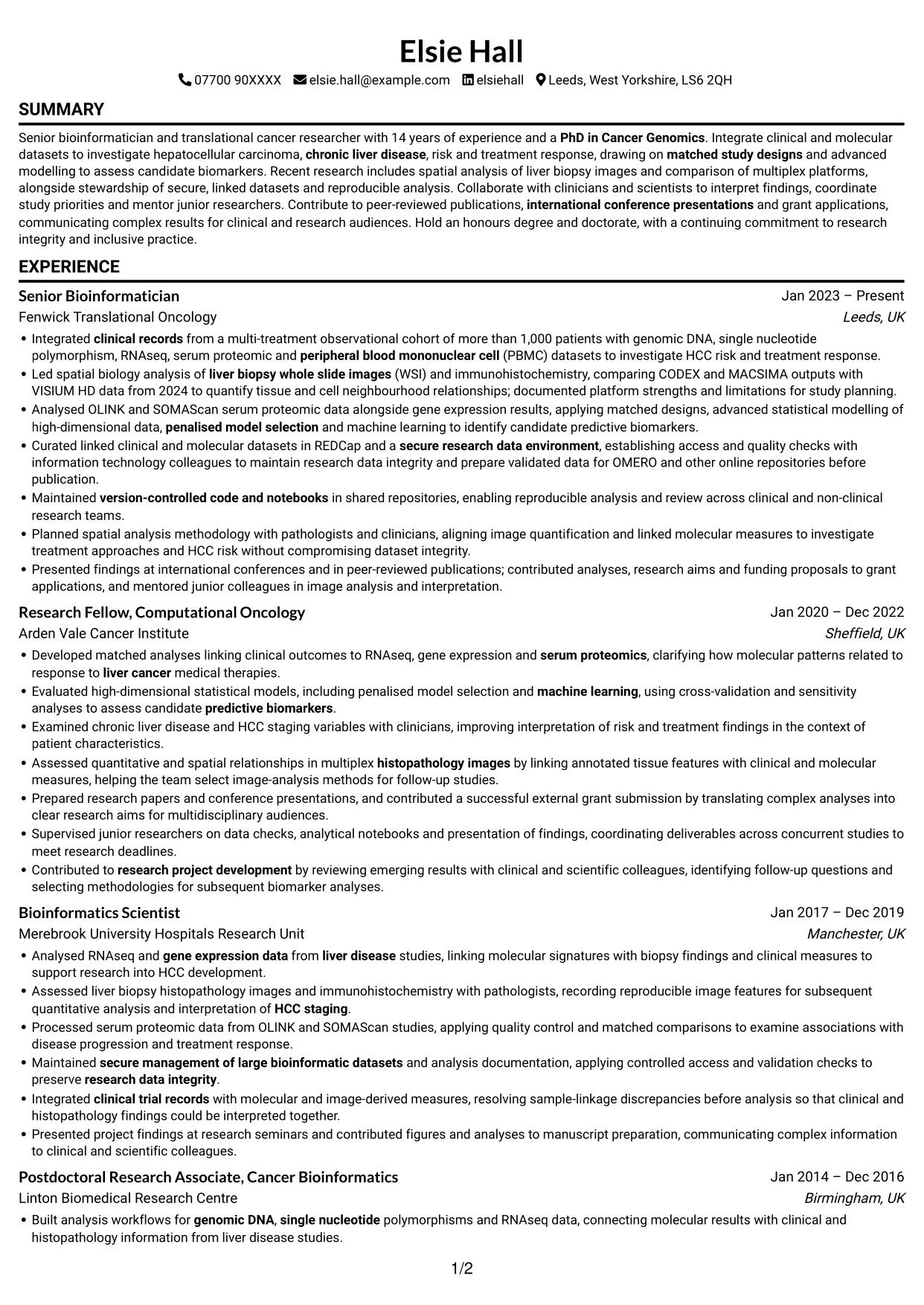
CV example — page 1

This guide shows you how to create a clear, focused CV for a Senior Research Associate - Liver Cancer Bioinformatics role. It explains how to present relevant evidence so readers can quickly understand your research contribution.

A strong CV for this role brings together clinical and molecular research, biomarker analysis and spatial biology. Clear sections and specific bullet points help show how you handle complex datasets, protect data quality and share findings with research teams.

Explore the example in 7 layouts, compare the PNG image previews, and open a preferred version in the editor to customise it. The guide also covers ATS readability and role-relevant terms, including HCC, matched study designs, RNAseq, serum proteomics, penalised model selection, machine learning and spatial platforms such as MACSIMA, VISIUM HD and CODEX.

What Makes a Great Senior Research Associate - Liver Cancer Bioinformatics CV in 2026

A strong CV makes your research methods, dataset work and findings easy to scan. Use clear experience bullets to show how your analyses support HCC risk or treatment response research.

Include relevant terms such as RNAseq, OLINK or SOMAScan, REDCap, OMERO and spatial image analysis where they match your experience. Add measurable results only when you can support them.

Note: CV examples are for educational purposes only. Use only information that accurately reflects your experience and qualifications. References to real organisations do not imply affiliation or endorsement.

#1 Simple One Column Format CV Example

The Simple One Column Format keeps the CV in one vertical reading path, giving reviewers a direct route through its sections.
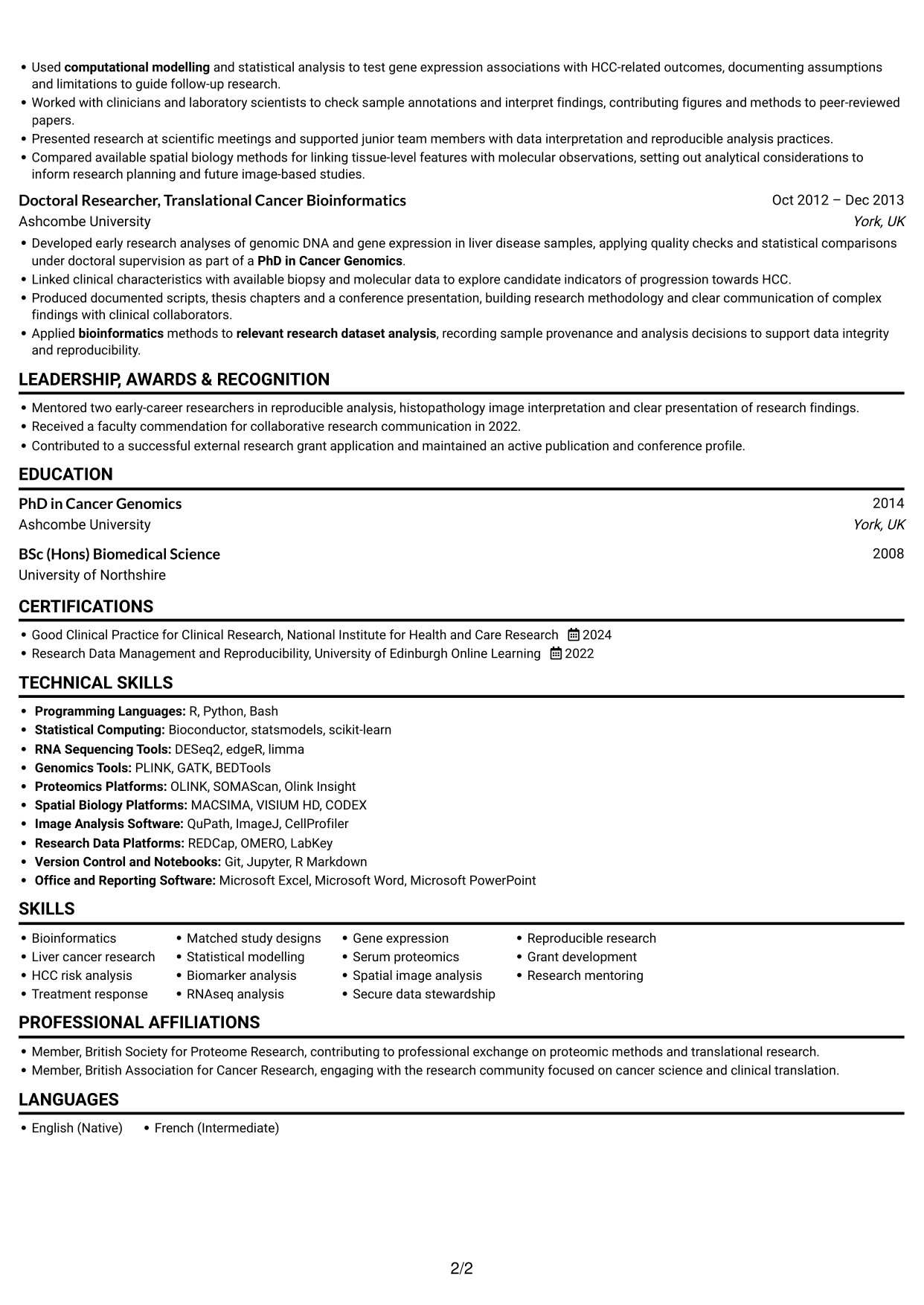
 
CV example — page 1   CV example — page 2

Why This Format Works

  • Career history follows a single reading path, making progression straightforward to trace.
  • Education and credentials remain within the same sequence as experience.
  • One-column organisation gives longer research entries room for clear line-by-line reading.

Best For

  • Chronological career histories
  • Detailed role entries
  • Education alongside experience
  • Direct top-to-bottom review
  • Text-led CV presentation

CV Keywords

  • PhD in Cancer Genomics
  • honours degree
  • Bioinformatics
  • relevant research dataset analysis
  • matched study designs
  • advanced statistical modelling of high-dimensional data
  • penalised model selection
  • machine learning
  • RNAseq analysis
  • Analysed RNAseq and gene expression data from liver disease studies
  • serum proteomics
  • OLINK
  • secure management of large bioinformatic datasets
  • liver cancer
  • hepatocellular carcinoma
See all keywords
 

#2 Simple Two Column Format CV Example

The Simple Two Column Format divides the CV into two reading areas, helping reviewers distinguish career details from supporting information.
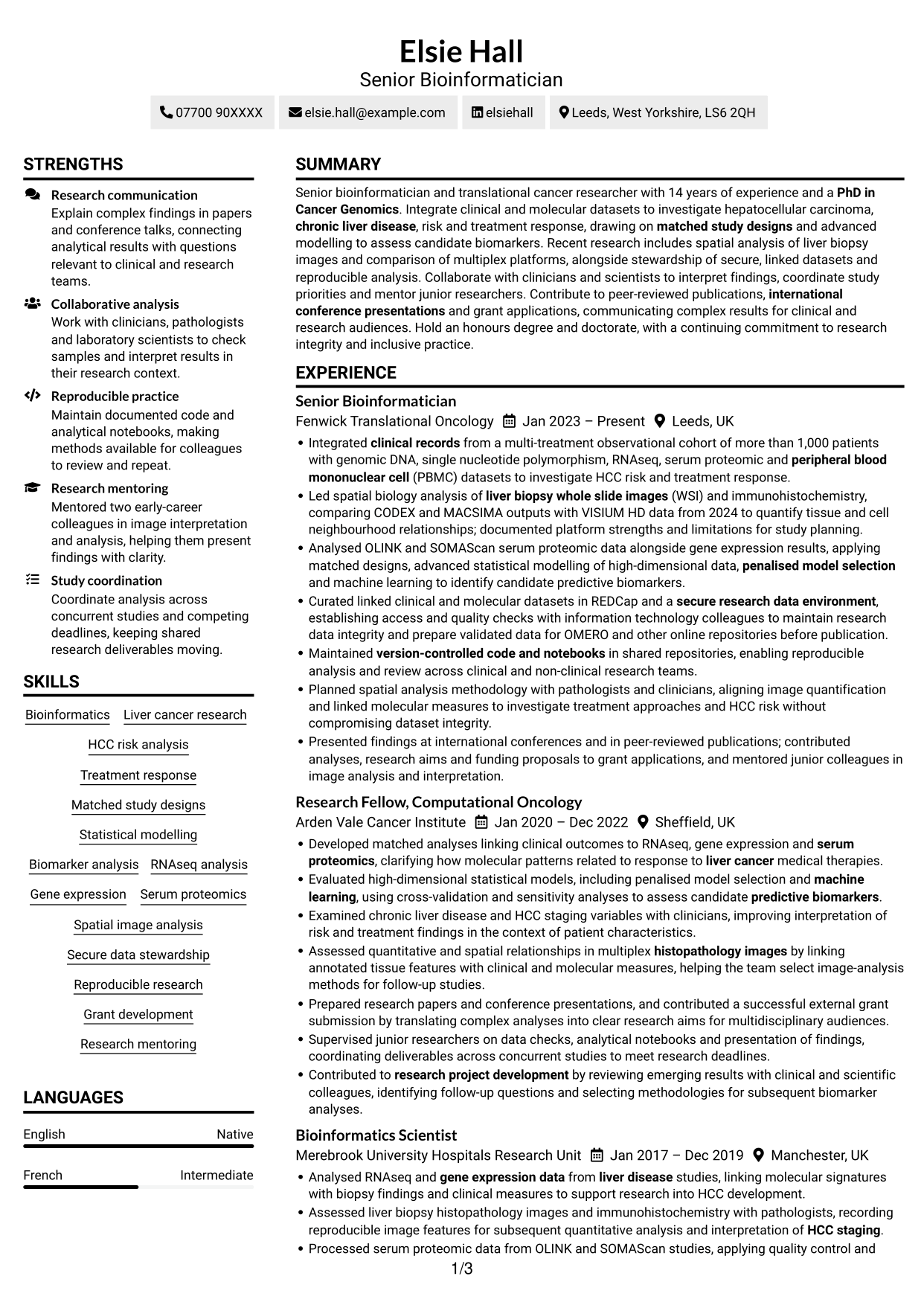
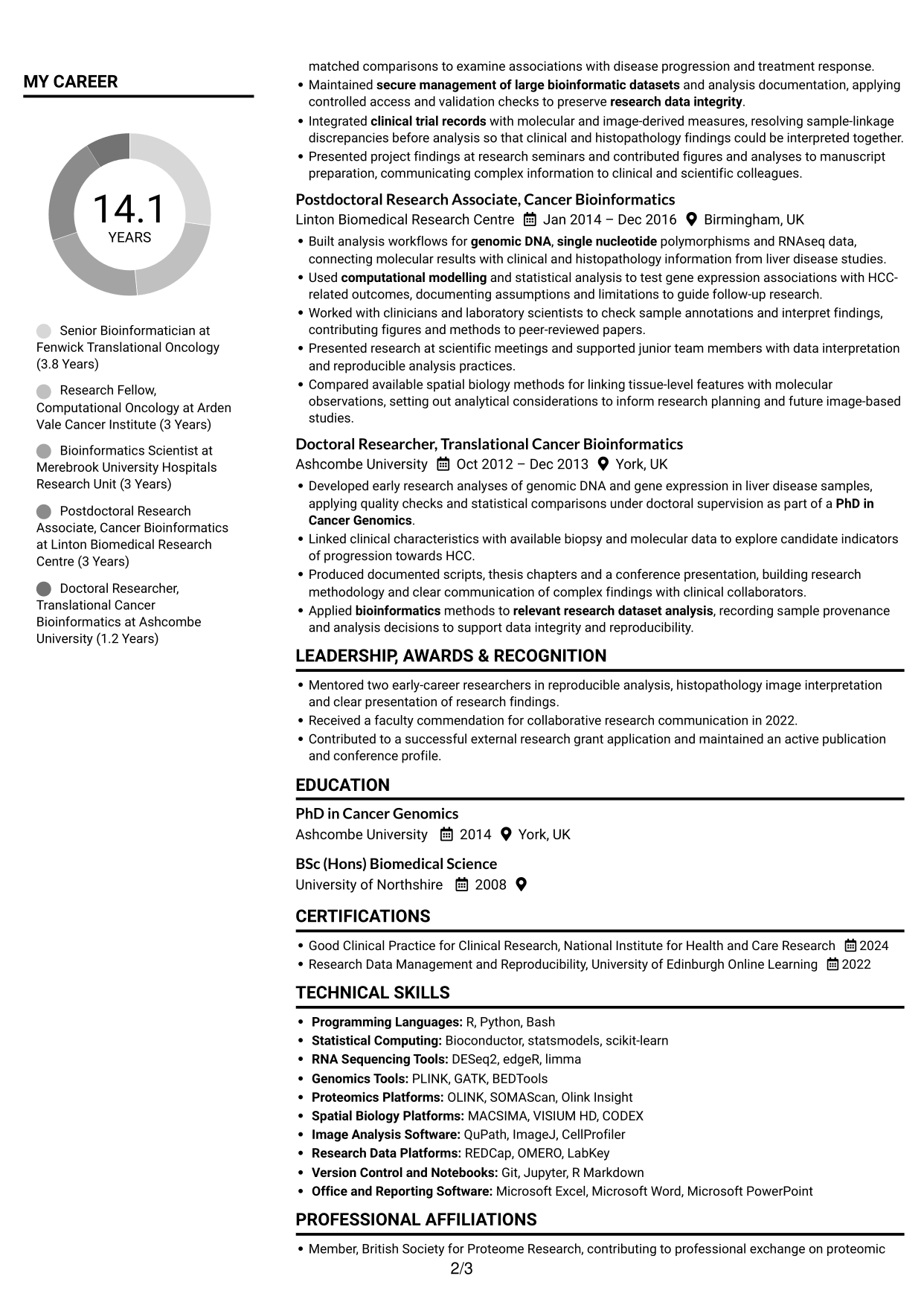
 
CV example — page 1   CV example — page 2

Why This Format Works

  • Two reading areas can distinguish career history from supporting sections.
  • A visible column division helps reviewers return to education and credentials quickly.
  • Parallel content space suits concise skills and qualifications beside fuller experience.

Best For

  • Compact skills lists
  • Career and education content
  • Concise supporting details
  • Side-by-side section review
  • CVs with several content groups

#3 Plain One Column with Shaded Labels CV Example

The Plain One Column with Shaded Labels Format uses one vertical content path, a straightforward choice for following experience and qualifications in sequence.
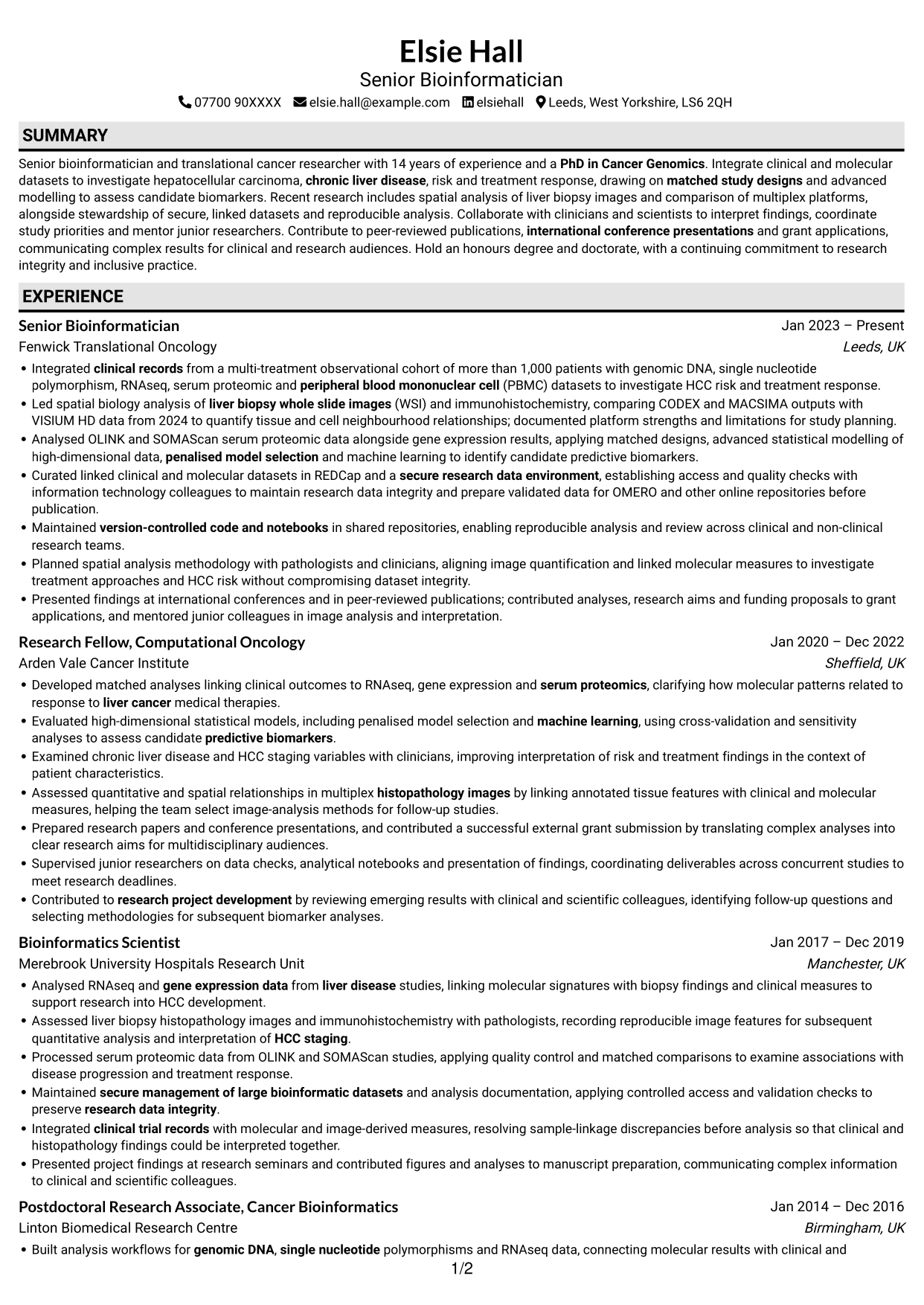
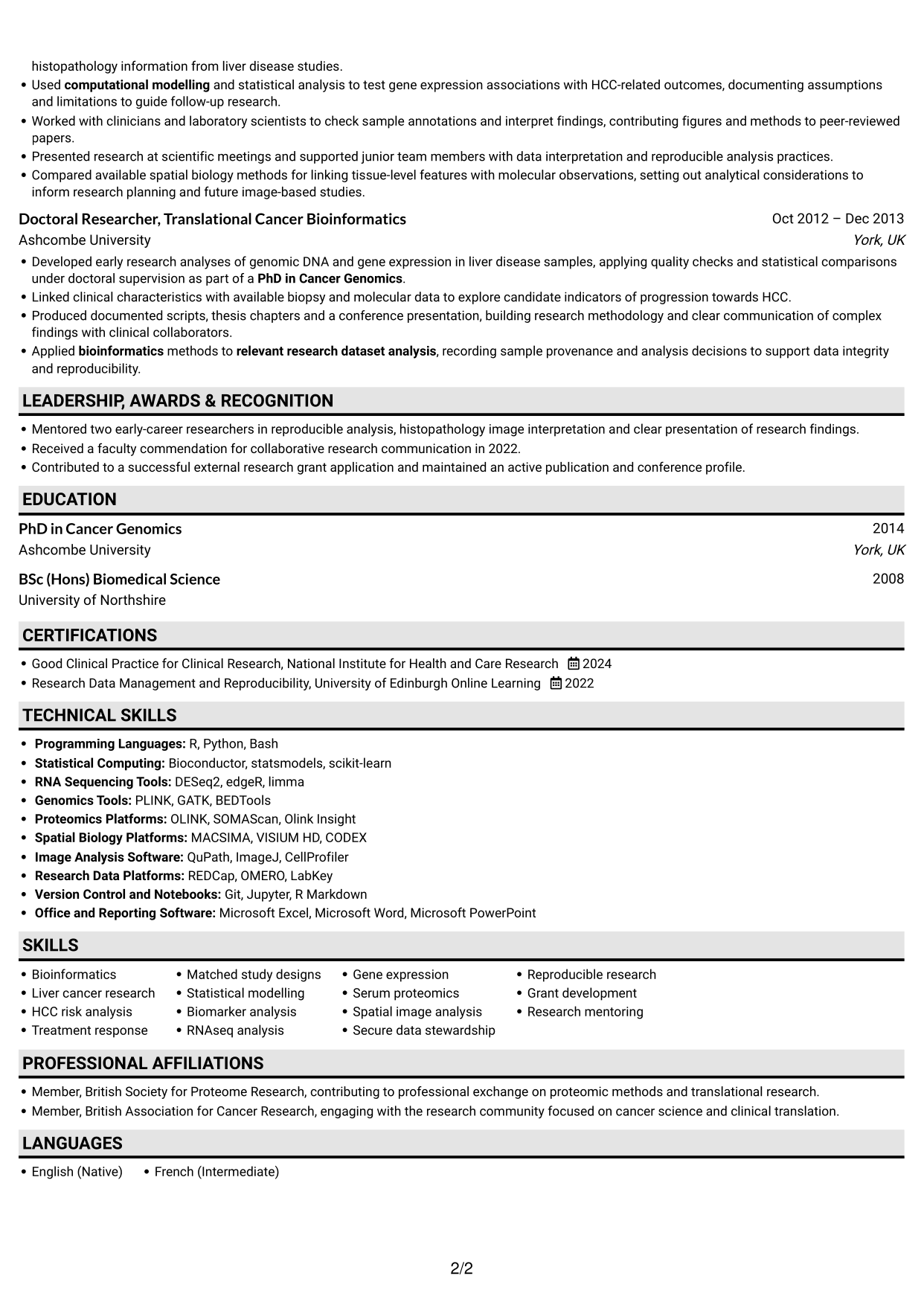
 
CV example — page 1   CV example — page 2

Why This Format Works

  • Career entries stay in one sequence, helping reviewers follow changes in responsibility over time.
  • Education and professional credentials share the same top-to-bottom review path.
  • Single-column reading avoids competing content areas when entries need careful attention.

Best For

  • Sequential work records
  • Detailed role descriptions
  • Single-path review
  • Education and qualifications
  • Text-centred CVs
 

#4 One Column Format with Photo Right CV Example

The One Column Format with Photo Right pairs a single CV reading path with a portrait on the right, keeping the body in sequence while adding a visual identifier.
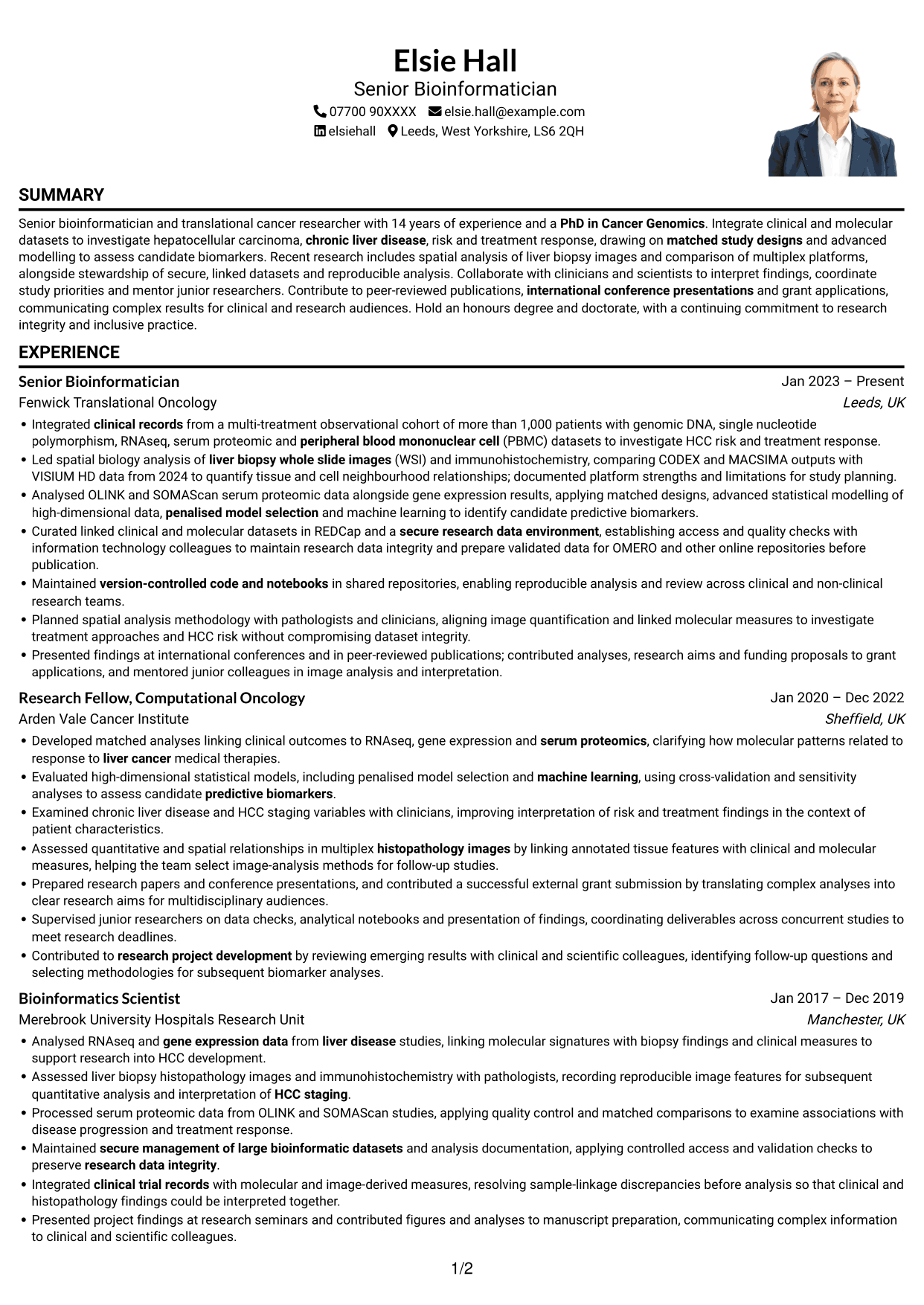
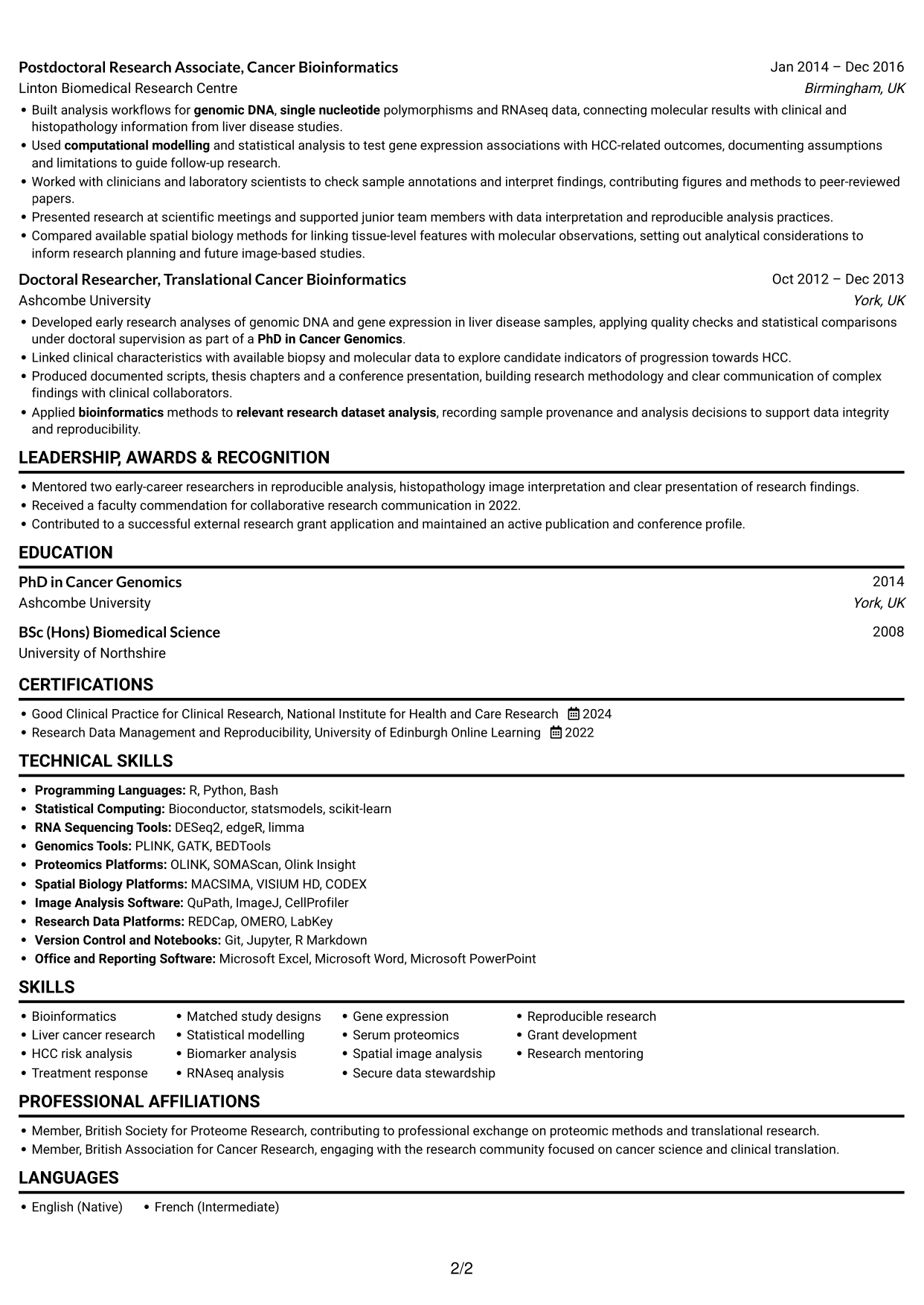
 
CV example — page 1   CV example — page 2

Why This Format Works

  • One continuous body column keeps experience entries in a familiar reading order.
  • Education and credentials follow the same path as the career record.
  • The right-side portrait adds a visual identifier without replacing written evidence.

Best For

  • CVs with a portrait
  • Linear career histories
  • Text-led evidence
  • Sequential education records
  • Clear vertical review
 

#5 Clean Two Column Sidebar Format CV Example

The Clean Two Column Sidebar Format places a sidebar beside the main CV area, offering a compact way to keep supporting details apart from career history.
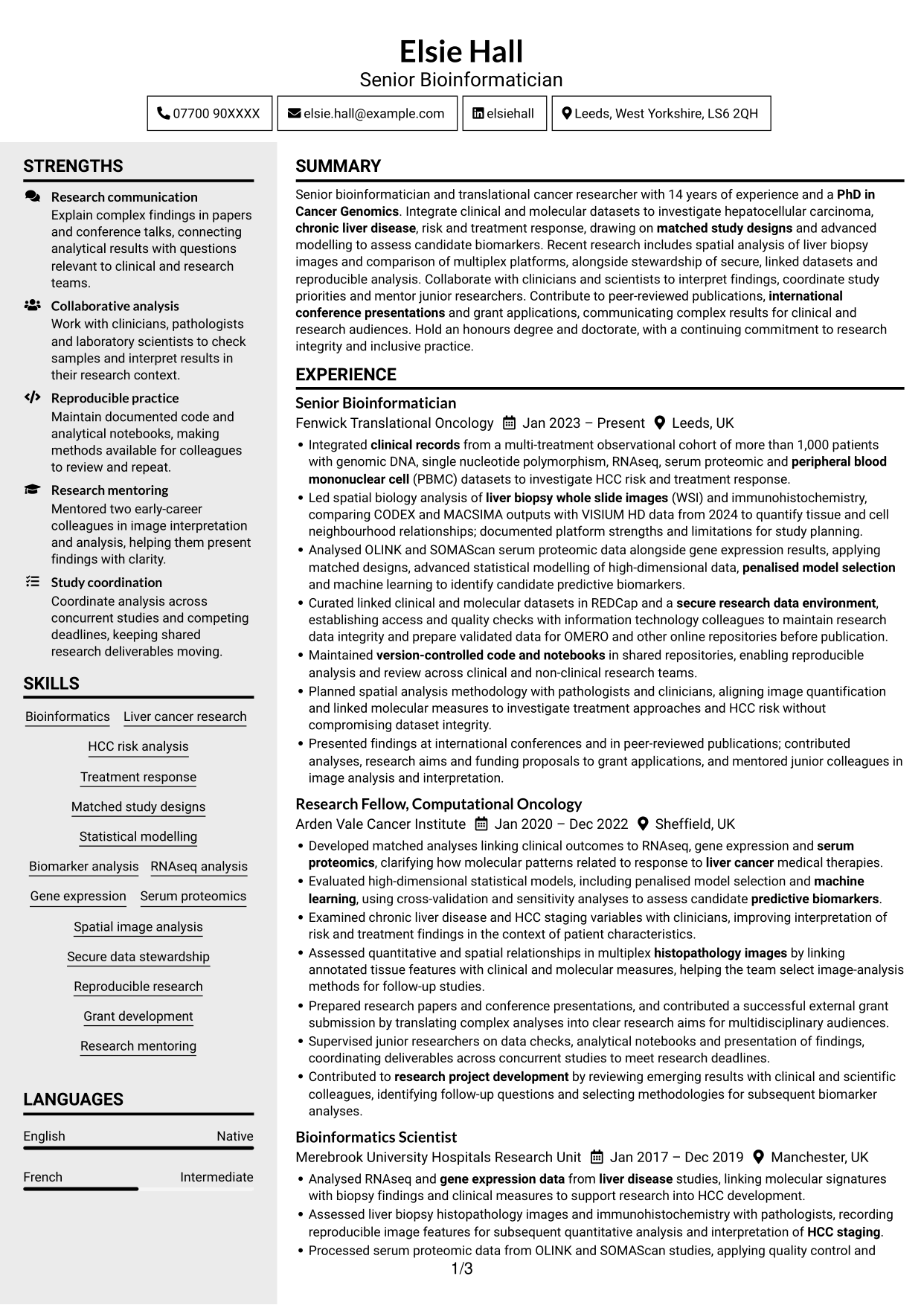
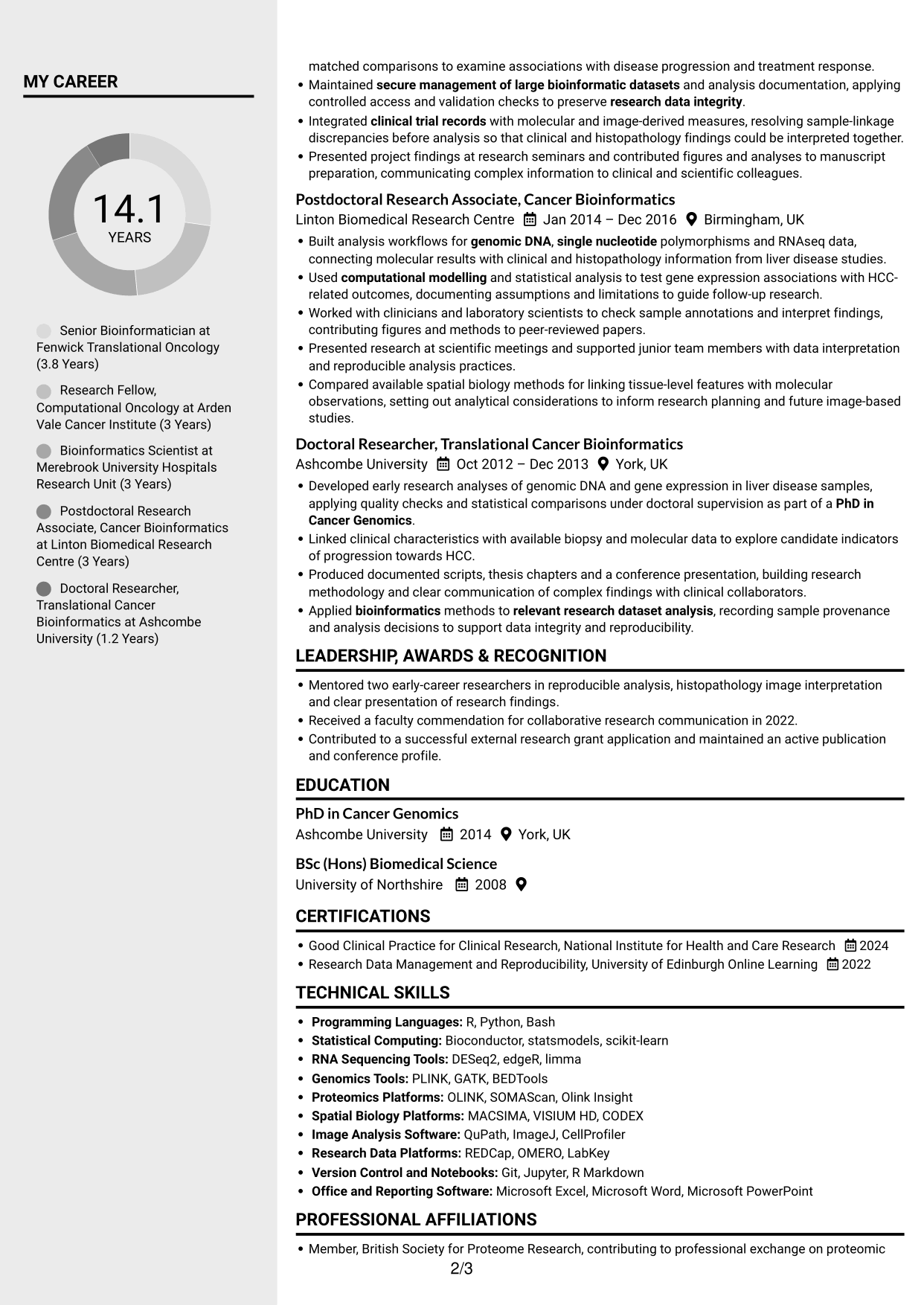
 
CV example — page 1   CV example — page 2

Why This Format Works

  • The sidebar gives brief supporting sections a distinct place beside career detail.
  • The main reading area can retain room for fuller experience and achievement entries.
  • Separate areas help reviewers locate skills without interrupting the career sequence.

Best For

  • Readers who prefer a sidebar
  • CVs with distinct content groups
  • Mixed-length information
  • Compact supporting material
  • Quick reference to qualifications


#6 Two Column Format CV Example

The Two Column Format places CV content in parallel areas, a useful choice when career detail and supporting sections need distinct reading space.
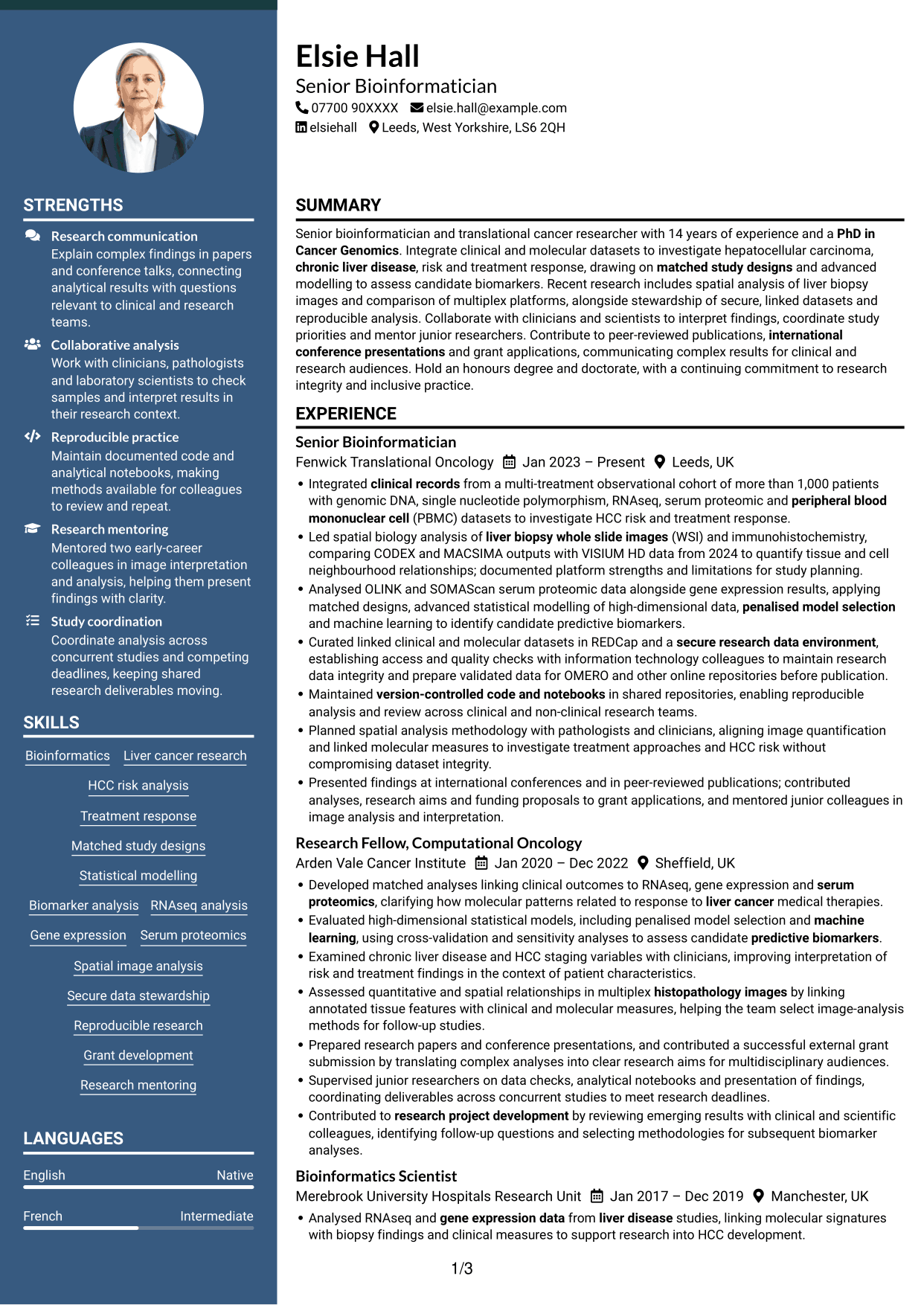
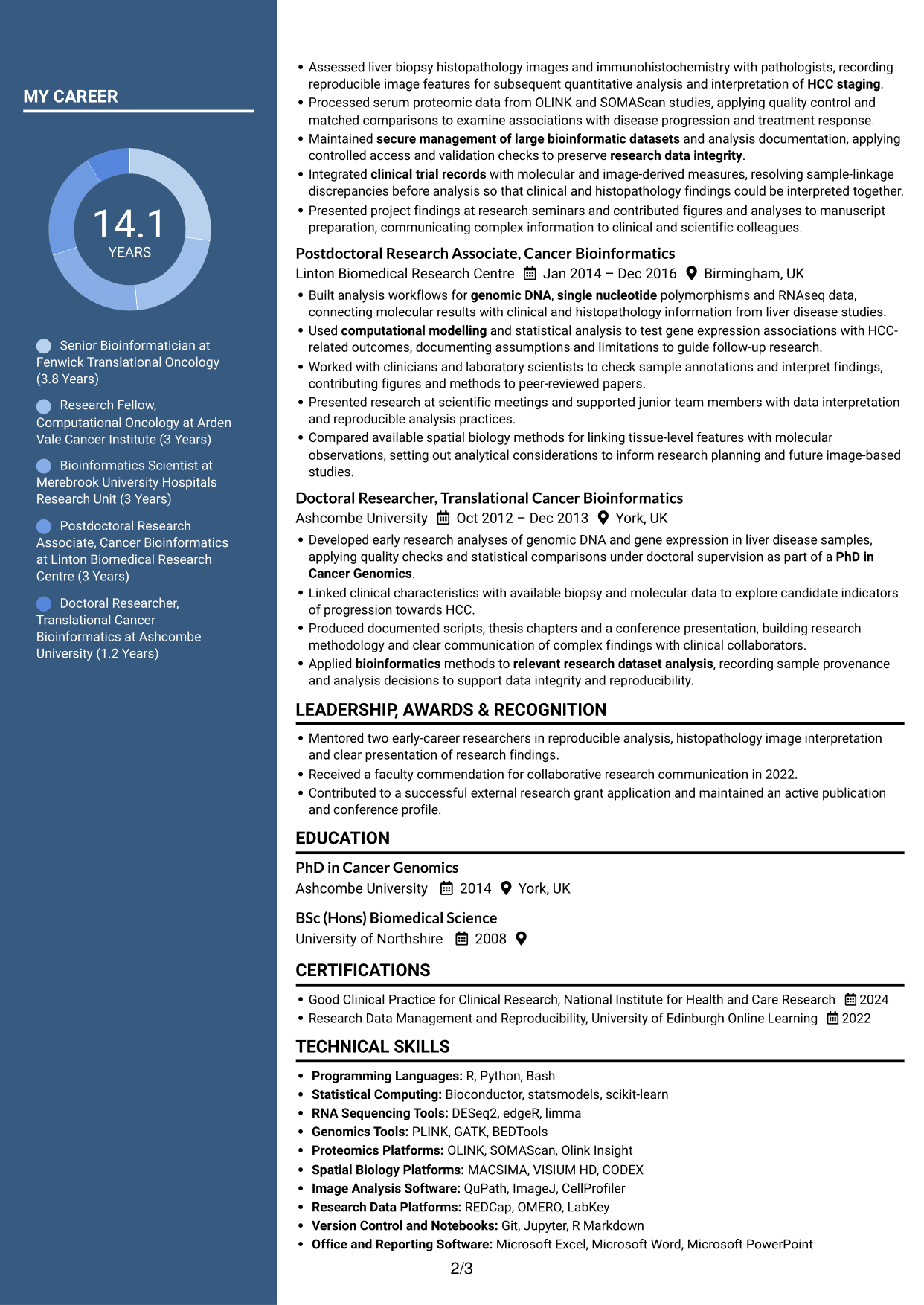
 
CV example — page 1   CV example — page 2

Why This Format Works

  • Two content areas keep experience and qualifications visually distinct.
  • Reviewers can move between career detail and education without losing section context.
  • Skills and credentials can sit apart from fuller achievement descriptions.

Best For

  • Side-by-side section comparison
  • Distinct career and qualification records
  • Several content categories
  • Compact supporting information
  • At-a-glance section navigation
 

#7 Photo Header Two Column Format CV Example

The Photo Header Two Column Format combines a header portrait with two content columns, pairing a visual identifier with compact section organisation.
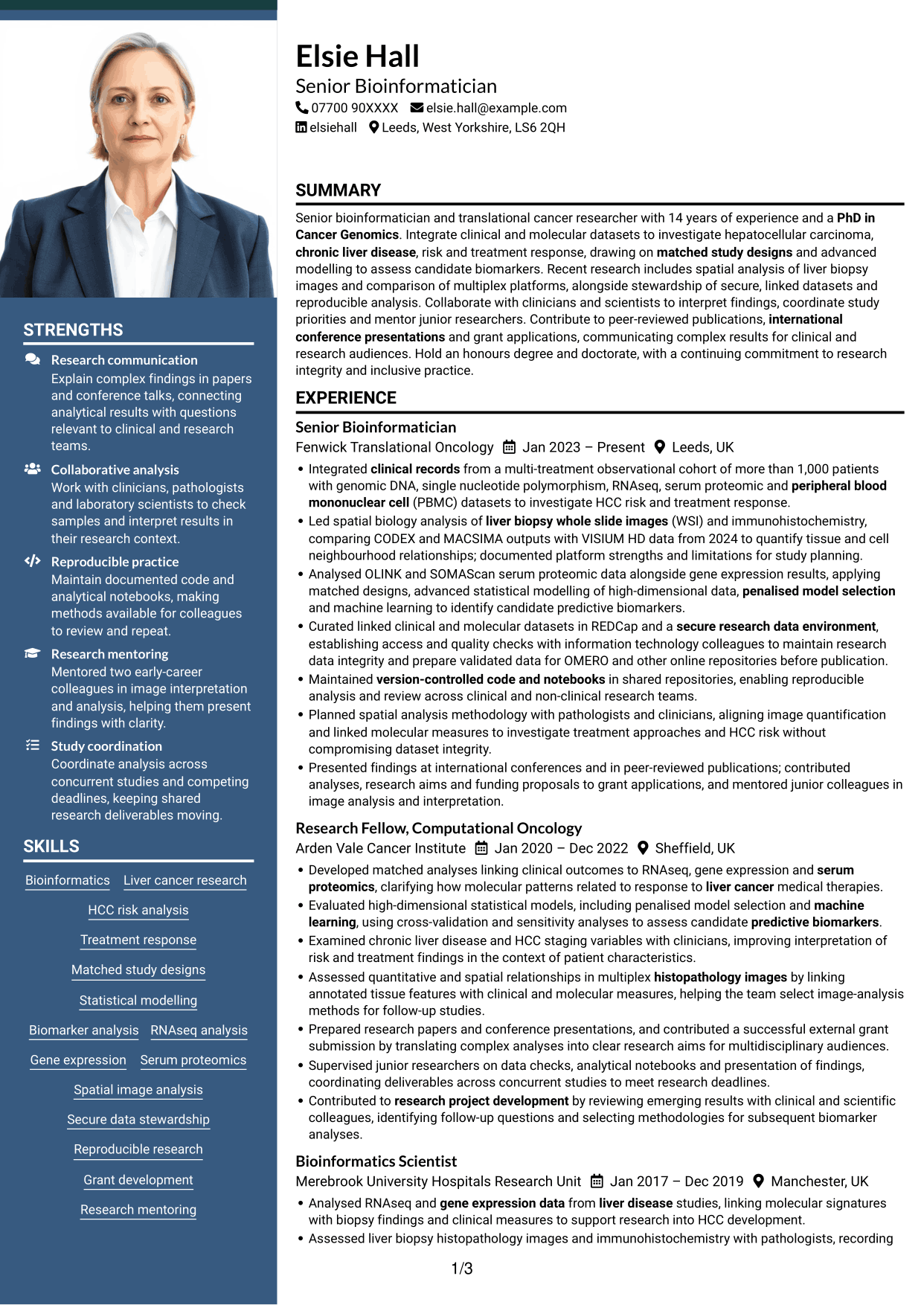
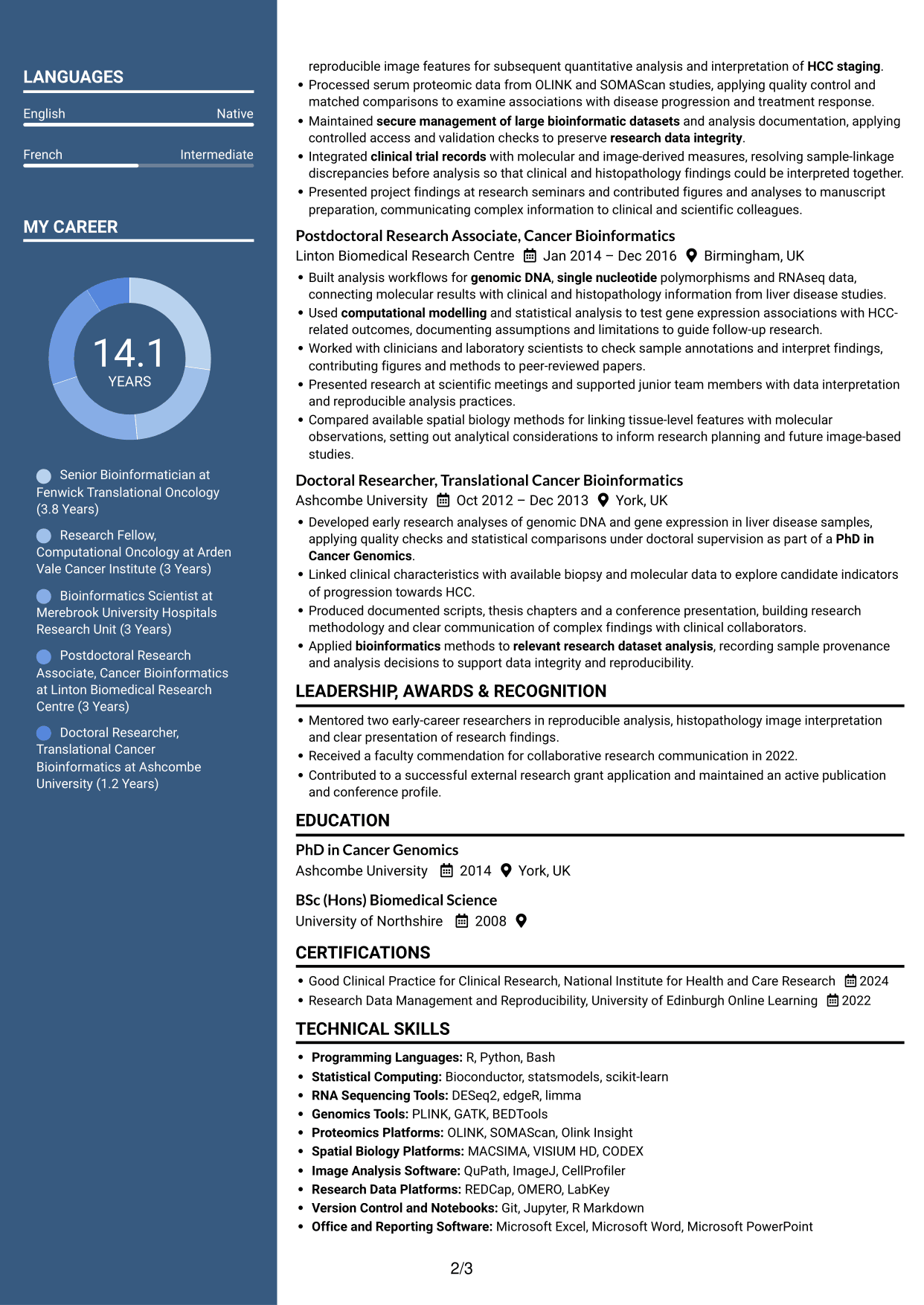
 
CV example — page 1   CV example — page 2

Why This Format Works

  • Two body columns can separate career history from supporting qualifications for quick reference.
  • Distinct content areas help reviewers scan experience and education without merging sections.
  • The header portrait offers a visual choice, while written content carries the evidence.

Best For

  • Portrait-led header preference
  • Two-area CV organisation
  • Separate qualification sections
  • Dense professional information
  • Quick review across sections


Why Build Your Senior Research Associate - Liver Cancer Bioinformatics CV with ResumeInMinutes

ResumeInMinutes lets you compare CV image previews and open an example in the editor to customise its content and layout. Use a clear structure to organise research experience, technical skills, education and publications.

  • Distinct CV layouts
  • Clear, readable section structure
  • Space for role-specific keywords
  • Organised skills and experience
  • PNG image previews
  • CV customisation in the editor

Choose a format that makes your research evidence easy to follow. Keep the focus on clinical and molecular data, sound analysis, reproducible work and clear research outcomes.


See Also


Frequently Asked Questions

Are these Senior Research Associate - Liver Cancer Bioinformatics CV templates ATS-friendly?

The examples use clear headings and sections that are easy to scan. Include relevant terms naturally, such as HCC, RNAseq, matched study designs, serum proteomics and spatial biology, when they reflect your experience.

Are these separate CV examples or different layouts of one example?

This page shows one role-focused CV example in different layouts. Compare the PNG image previews, then open an example in the editor to customise it.

What should a Senior Research Associate - Liver Cancer Bioinformatics CV include?

Include a focused summary, relevant research experience, skills and education. Describe your work with clinical and molecular datasets, statistical methods, biomarker analysis, spatial images, data stewardship and research outputs where relevant.

Which CV layout works well for this role?

Choose a layout with clear headings and a simple order for experience, skills and education. A readable structure helps reviewers find key research methods and evidence quickly.

How can I show research achievements on my CV?

Write concise bullet points that explain the research task, your contribution and the result. Use supported figures where available, and name the datasets or methods that help explain the work.

Should I include a photo on my CV?

For UK applications, a photo is usually not needed. Use the space for relevant research experience, skills and results instead.

ATS Score 98%

How we calculate this score

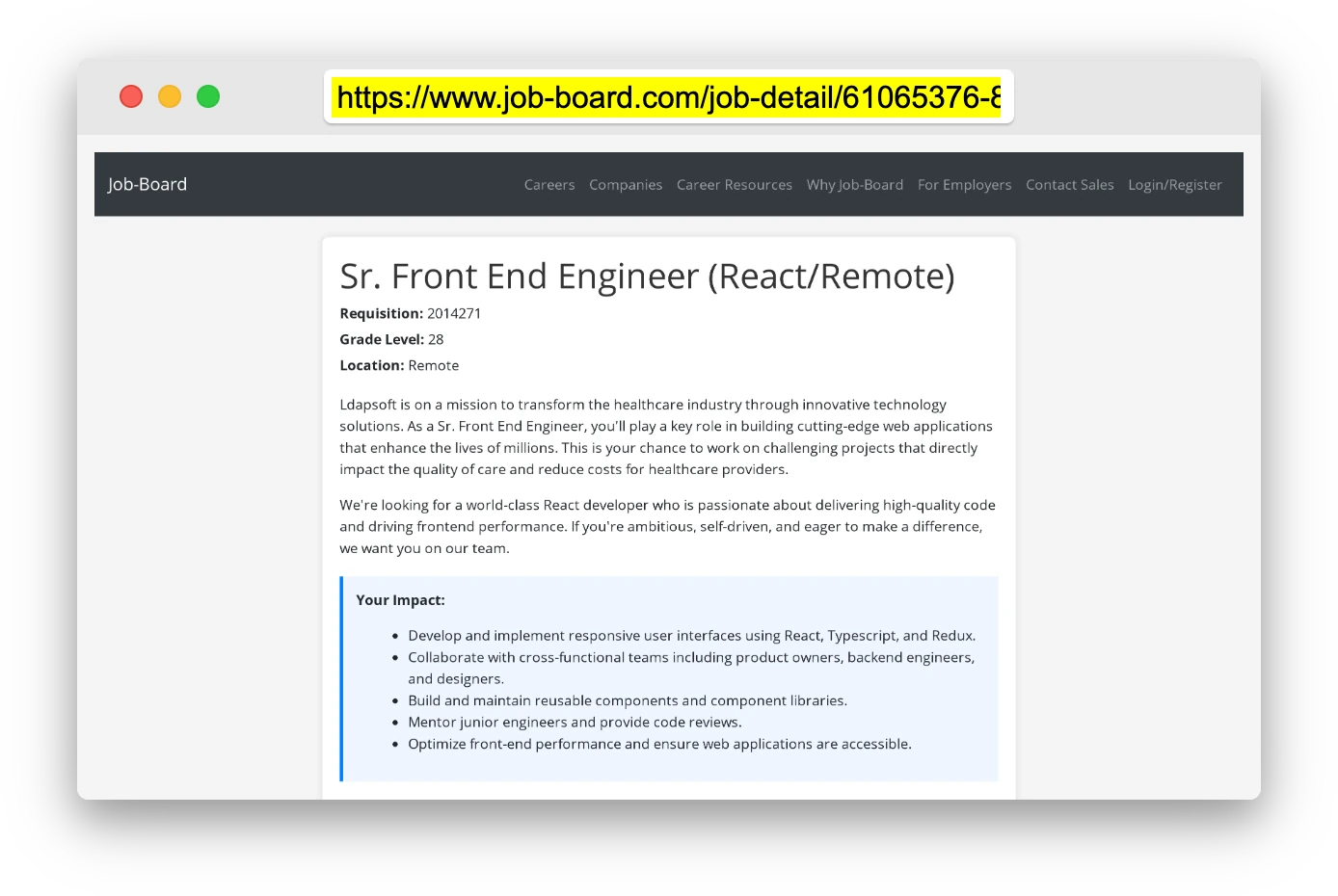
  • Keywords: 60% of the total. AI extracts keywords from your job description. If you do not provide one, a standard job description for the title matching your CV is used. This is not a match to a specific vacancy.
  • Text-based CV: 20%. The text CV assessed here receives 100 for this part.
  • CV quality: 20%. We start at 100 and subtract points for issues found by our CV checks, down to a minimum of zero.
  • Keyword coverage = round(100 × confirmed matches ÷ total keywords). Exact matches and supported equivalents verified by AI receive full credit; unsupported keywords receive none. Live text checks use the saved equivalents and do not request a new AI review. Without keywords, no overall ATS score is available.
  • Final score = 60% of keyword coverage + 20% of the text score + 20% of the quality score, rounded to a whole number. Without keywords, no overall ATS score is available.

What this score means

Our scores are estimates, not employer ratings. They may contain errors and do not guarantee accurate parsing, a ranking, an interview, or a job. Check your document against the employer’s requirements. You are responsible for relying on this score.

Terms and Conditions

Score weights: Keywords 60% · Text based CV 20% · CV quality 20%

Keyword coverage: 48 of 50 (96%) · CV quality: 100%

CV quality 100% · Weight 20% · Issues (0)

Details
  • ✓Name present: Elsie Hall
  • ✓Email format: elsie.hall@example.com
  • ✓Phone format: 07700 90XXXX
  • ✓Experience 1: Job title: Senior Bioinformatician
  • ✓Experience 1: Company name: Fenwick Translational Oncology
  • ✓Experience 1: Work location: Leeds, UK
  • ✓Experience 1: Employment dates: Jan 2023 – Present
  • ✓Experience 1: Description or achievements: Present
  • ✓Experience 2: Job title: Research Fellow, Computational Oncology
  • ✓Experience 2: Company name: Arden Vale Cancer Institute
  • ✓Experience 2: Work location: Sheffield, UK
  • ✓Experience 2: Employment dates: Jan 2020 – Dec 2022
  • ✓Experience 2: Description or achievements: Present
  • ✓Experience 3: Job title: Bioinformatics Scientist
  • ✓Experience 3: Company name: Merebrook University Hospitals Research Unit
  • ✓Experience 3: Work location: Manchester, UK
  • ✓Experience 3: Employment dates: Jan 2017 – Dec 2019
  • ✓Experience 3: Description or achievements: Present
  • ✓Experience 4: Job title: Postdoctoral Research Associate, Cancer Bioinformatics
  • ✓Experience 4: Company name: Linton Biomedical Research Centre
  • ✓Experience 4: Work location: Birmingham, UK
  • ✓Experience 4: Employment dates: Jan 2014 – Dec 2016
  • ✓Experience 4: Description or achievements: Present
  • ✓Experience 5: Job title: Doctoral Researcher, Translational Cancer Bioinformatics
  • ✓Experience 5: Company name: Ashcombe University
  • ✓Experience 5: Work location: York, UK
  • ✓Experience 5: Employment dates: Oct 2012 – Dec 2013
  • ✓Experience 5: Description or achievements: Present
  • ✓No placeholder fields
  • ✓No repeated achievement bullets
  • ✓No empty bullets

No issues found by the current checks.

Text Based CV 100% · Weight 20%

Parsed text
Elsie Hall
07700 90XXXX
elsie.hall@example.com
elsiehall
Leeds, West Yorkshire, LS6 2QH
SUMMARY
Senior bioinformatician and translational cancer researcher with 14 years of experience and a PhD in Cancer Genomics. Integrate clinical and molecular datasets to investigate hepatocellular carcinoma, chronic liver disease, risk and treatment response, drawing on matched study designs and advanced modelling to assess candidate biomarkers. Recent research includes spatial analysis of liver biopsy images and comparison of multiplex platforms, alongside stewardship of secure, linked datasets and reproducible analysis. Collaborate with clinicians and scientists to interpret findings, coordinate study priorities and mentor junior researchers. Contribute to peer-reviewed publications, international conference presentations and grant applications, communicating complex results for clinical and research audiences. Hold an honours degree and doctorate, with a continuing commitment to research integrity and inclusive practice.
EXPERIENCE
Senior Bioinformatician
Jan 2023 – Present
Fenwick Translational Oncology
Leeds, UK
Integrated clinical records from a multi-treatment observational cohort of more than 1,000 patients with genomic DNA, single nucleotide polymorphism, RNAseq, serum proteomic and peripheral blood mononuclear cell (PBMC) datasets to investigate HCC risk and treatment response.
Led spatial biology analysis of liver biopsy whole slide images (WSI) and immunohistochemistry, comparing CODEX and MACSIMA outputs with VISIUM HD data from 2024 to quantify tissue and cell neighbourhood relationships; documented platform strengths and limitations for study planning.
Analysed OLINK and SOMAScan serum proteomic data alongside gene expression results, applying matched designs, advanced statistical modelling of high-dimensional data, penalised model selection and machine learning to identify candidate predictive biomarkers.
Curated linked clinical and molecular datasets in REDCap and a secure research data environment, establishing access and quality checks with information technology colleagues to maintain research data integrity and prepare validated data for OMERO and other online repositories before publication.
Maintained version-controlled code and notebooks in shared repositories, enabling reproducible analysis and review across clinical and non-clinical research teams.
Planned spatial analysis methodology with pathologists and clinicians, aligning image quantification and linked molecular measures to investigate treatment approaches and HCC risk without compromising dataset integrity.
Presented findings at international conferences and in peer-reviewed publications; contributed analyses, research aims and funding proposals to grant applications, and mentored junior colleagues in image analysis and interpretation.
Research Fellow, Computational Oncology
Jan 2020 – Dec 2022
Arden Vale Cancer Institute
Sheffield, UK
Developed matched analyses linking clinical outcomes to RNAseq, gene expression and serum proteomics, clarifying how molecular patterns related to response to liver cancer medical therapies.
Evaluated high-dimensional statistical models, including penalised model selection and machine learning, using cross-validation and sensitivity analyses to assess candidate predictive biomarkers.
Examined chronic liver disease and HCC staging variables with clinicians, improving interpretation of risk and treatment findings in the context of patient characteristics.
Assessed quantitative and spatial relationships in multiplex histopathology images by linking annotated tissue features with clinical and molecular measures, helping the team select image-analysis methods for follow-up studies.
Prepared research papers and conference presentations, and contributed a successful external grant submission by translating complex analyses into clear research aims for multidisciplinary audiences.
Supervised junior researchers on data checks, analytical notebooks and presentation of findings, coordinating deliverables across concurrent studies to meet research deadlines.
Contributed to research project development by reviewing emerging results with clinical and scientific colleagues, identifying follow-up questions and selecting methodologies for subsequent biomarker analyses.
Bioinformatics Scientist
Jan 2017 – Dec 2019
Merebrook University Hospitals Research Unit
Manchester, UK
Analysed RNAseq and gene expression data from liver disease studies, linking molecular signatures with biopsy findings and clinical measures to support research into HCC development.
Assessed liver biopsy histopathology images and immunohistochemistry with pathologists, recording reproducible image features for subsequent quantitative analysis and interpretation of HCC staging.
Processed serum proteomic data from OLINK and SOMAScan studies, applying quality control and matched comparisons to examine associations with disease progression and treatment response.
Maintained secure management of large bioinformatic datasets and analysis documentation, applying controlled access and validation checks to preserve research data integrity.
Integrated clinical trial records with molecular and image-derived measures, resolving sample-linkage discrepancies before analysis so that clinical and histopathology findings could be interpreted together.
Presented project findings at research seminars and contributed figures and analyses to manuscript preparation, communicating complex information to clinical and scientific colleagues.
Postdoctoral Research Associate, Cancer Bioinformatics
Jan 2014 – Dec 2016
Linton Biomedical Research Centre
Birmingham, UK
Built analysis workflows for genomic DNA, single nucleotide polymorphisms and RNAseq data, connecting molecular results with clinical and histopathology information from liver disease studies.
Used computational modelling and statistical analysis to test gene expression associations with HCC-related outcomes, documenting assumptions and limitations to guide follow-up research.
Worked with clinicians and laboratory scientists to check sample annotations and interpret findings, contributing figures and methods to peer-reviewed papers.
Presented research at scientific meetings and supported junior team members with data interpretation and reproducible analysis practices.
Compared available spatial biology methods for linking tissue-level features with molecular observations, setting out analytical considerations to inform research planning and future image-based studies.
Doctoral Researcher, Translational Cancer Bioinformatics
Oct 2012 – Dec 2013
Ashcombe University
York, UK
Developed early research analyses of genomic DNA and gene expression in liver disease samples, applying quality checks and statistical comparisons under doctoral supervision as part of a PhD in Cancer Genomics.
Linked clinical characteristics with available biopsy and molecular data to explore candidate indicators of progression towards HCC.
Produced documented scripts, thesis chapters and a conference presentation, building research methodology and clear communication of complex findings with clinical collaborators.
Applied bioinformatics methods to relevant research dataset analysis, recording sample provenance and analysis decisions to support data integrity and reproducibility.
LEADERSHIP, AWARDS & RECOGNITION
Mentored two early-career researchers in reproducible analysis, histopathology image interpretation and clear presentation of research findings.
Received a faculty commendation for collaborative research communication in 2022.
Contributed to a successful external research grant application and maintained an active publication and conference profile.
EDUCATION
PhD in Cancer Genomics
2014
Ashcombe University
York, UK
BSc (Hons) Biomedical Science
2008
University of Northshire
CERTIFICATIONS
Good Clinical Practice for Clinical Research, National Institute for Health and Care Research
2024
Research Data Management and Reproducibility, University of Edinburgh Online Learning
2022
TECHNICAL SKILLS
Programming Languages: R, Python, Bash
Statistical Computing: Bioconductor, statsmodels, scikit-learn
RNA Sequencing Tools: DESeq2, edgeR, limma
Genomics Tools: PLINK, GATK, BEDTools
Proteomics Platforms: OLINK, SOMAScan, Olink Insight
Spatial Biology Platforms: MACSIMA, VISIUM HD, CODEX
Image Analysis Software: QuPath, ImageJ, CellProfiler
Research Data Platforms: REDCap, OMERO, LabKey
Version Control and Notebooks: Git, Jupyter, R Markdown
Office and Reporting Software: Microsoft Excel, Microsoft Word, Microsoft PowerPoint
SKILLS
Bioinformatics
Liver cancer research
HCC risk analysis
Treatment response
Matched study designs
Statistical modelling
Biomarker analysis
RNAseq analysis
Gene expression
Serum proteomics
Spatial image analysis
Secure data stewardship
Reproducible research
Grant development
Research mentoring
PROFESSIONAL AFFILIATIONS
Member, British Society for Proteome Research, contributing to professional exchange on proteomic methods and translational research.
Member, British Association for Cancer Research, engaging with the research community focused on cancer science and clinical translation.
LANGUAGES
English (Native)
French (Intermediate)

Matched keywords (48)

  • PhD in Cancer GenomicsOriginal keyword in JD: PhD in a relevant research field
  • honours degree
  • Bioinformatics
  • relevant research dataset analysis
  • matched study designs
  • advanced statistical modelling of high-dimensional data
  • penalised model selection
  • machine learning
  • RNAseq analysis
  • Analysed RNAseq and gene expression data from liver disease studiesOriginal keyword in JD: Gene expression analysis
  • serum proteomics
  • OLINKOriginal keyword in JD: OLINK OR SOMAScan
  • secure management of large bioinformatic datasets
  • liver cancer
  • hepatocellular carcinomaOriginal keyword in JD: Hepatocellular carcinoma (HCC)
  • treatment approaches
  • predictive biomarkers
  • spatial biology analysis
  • Assessed quantitative and spatial relationships in multiplex histopathology imagesOriginal keyword in JD: Quantitative and spatial relationship analysis
  • Integrated clinical trial records with molecular and image-derived measuresOriginal keyword in JD: Clinical and molecular data integration
  • computational modelling
  • Built analysis workflows for genomic DNAOriginal keyword in JD: Genomic DNA analysis
  • Built analysis workflows for genomic DNA, single nucleotide polymorphismsOriginal keyword in JD: Single nucleotide polymorphism analysis
  • Integrated clinical records from a multi-treatment observational cohort of more than 1,000 patients with genomic DNA, single nucleotide polymorphism, RNAseq, serum proteomic and peripheral blood mononuclear cell (PBMC) datasets to investigate HCC risk and treatment response.Original keyword in JD: Peripheral blood mononuclear cell (PBMC) analysis
  • Led spatial biology analysis of liver biopsy whole slide images (WSI)Original keyword in JD: Whole slide image (WSI) analysis
  • immunohistochemistry
  • Assessed liver biopsy histopathology imagesOriginal keyword in JD: Liver biopsy histopathology image assessment
  • chronic liver disease
  • HCC staging
  • medical therapies
  • comparing CODEX and MACSIMA outputs with VISIUM HD data from 2024 to quantify tissue and cell neighbourhood relationshipsOriginal keyword in JD: Spatial technology evaluation
  • MACSIMA
  • VISIUM HD
  • CODEX
  • OMERO
  • secure research data environmentOriginal keyword in JD: Secure research data environments
  • clinical trial records
  • REDCap
  • version-controlled code and notebooks
  • Reproducible research
  • identifying follow-up questions and selecting methodologies for subsequent biomarker analysesOriginal keyword in JD: Research planning and methodology selection
  • research project development
  • research data integrity
  • Collaborate with clinicians and scientists to interpret findingsOriginal keyword in JD: Multidisciplinary collaboration
  • mentored junior colleagues in image analysis and interpretationOriginal keyword in JD: Mentoring junior colleagues
  • Contribute to peer-reviewed publicationsOriginal keyword in JD: Research writing and publications
  • contributed analyses, research aims and funding proposals to grant applicationsOriginal keyword in JD: Grant applications and funding proposals
  • international conference presentations

Missing keywords (2)

  • Clear communication of complex information
  • High-content multiplex histopathology image analysis
Disclaimer: All names, images, contact information, employment histories, achievements, security clearances, military credentials, and other qualifications shown in this content are fictional and used for illustrative purposes only. Any resemblance to actual persons, living or deceased, is purely coincidental.

CV and cover letter examples and recommendations in this article reflect general best practices and professional experience and are provided for guidance only. Results may vary based on role, industry, region, and hiring organisation.

Content Accuracy and Verification: To the fullest extent permitted by applicable law, we do not represent or warrant that CV or cover letter guidance, examples, recommendations, or related information are accurate, complete, current, error-free, or suitable for any particular purpose. You are responsible for independently reviewing and verifying the information before relying on it.

ATS and Cover Letter Scores: ATS scores are estimates calculated using our own formula, informed by publicly available guidance on CV formatting and keyword matching. They are not scores issued or endorsed by an ATS provider or employer. Cover letter scores are also our own assessments. Parsing, weighting, screening criteria, and results vary between systems, employers, job descriptions, and document formats. No score guarantees successful parsing, a particular ranking, an interview, or employment. Use scores as general guidance and independently check your documents against the employer’s requirements. To the fullest extent permitted by applicable law, we accept no liability for errors in scores or parsing, or losses arising from reliance on these assessments. Nothing in this notice excludes liability or limits consumer rights that cannot lawfully be excluded or limited.

Terms and Conditions
 
> JP 1 1
PDF Footer and Margins Setup
The margins are applied to the document, and the footer appears in both the preview and the PDF

Footer Font Settings

Are you applying for a specific job
so we can tailor your CV to it?
Are you applying for a specific job
so we can tailor your cover letter to it?

Your data stays private and is never used for training.Privacy Policy

Type your details as text to generate a personalised CV Type your details as text to generate a personalised cover letter
Website link found! Ready to create CV from:

Your data stays private and is never used for training.Privacy Policy

Drag the into the box to verify you're human.
Drop here

My CVs

Showing {number_of_files} files (out of {total_of_all_files} total)
Name File Type Last Modified: Description:

Rename File

Filename already exists!

Delete Files

Warning: This action is irreversible. Once you click submit, the files will be permanently deleted.

Heading text
Upload From Computer Upload
Select From Existing
LinkedIn
Drag & Drop files anywhere in this tab, or

Uploaded Files

Delete Name Last Updated Use This File
Select this to use the file for generating your CV and cover letter. Only one source—uploaded file, selected file, or LinkedIn text—can be used.

My Files

CVs or cover letters you create will appear here. No files available yet.
Delete Name Last Updated Use This File
Select this to use the file for generating your CV and cover letter. Only one source—uploaded file, selected file, or LinkedIn text—can be used.

Add LinkedIn Profile PDF

You can download your LinkedIn profile as a PDF by opening linkedin.com in a web browser, clicking your profile photo, selecting the “More” or “Resources” button, and choosing “Save to PDF.” You can then attach the PDF using the Upload From Computer tab.

Paste Your LinkedIn Profile Text

If you have copied the LinkedIn profile text, paste it below. See how to copy your profile from LinkedIn

Select this to use the LinkedIn profile text for generating your CV and covering letter. Only one source—uploaded file, selected file, or LinkedIn text—can be used.

Try these controls

<
>