US English


7 Agentic Solution Architect Resume Templates with Example
By Ria · Last Updated On October 21, 2026
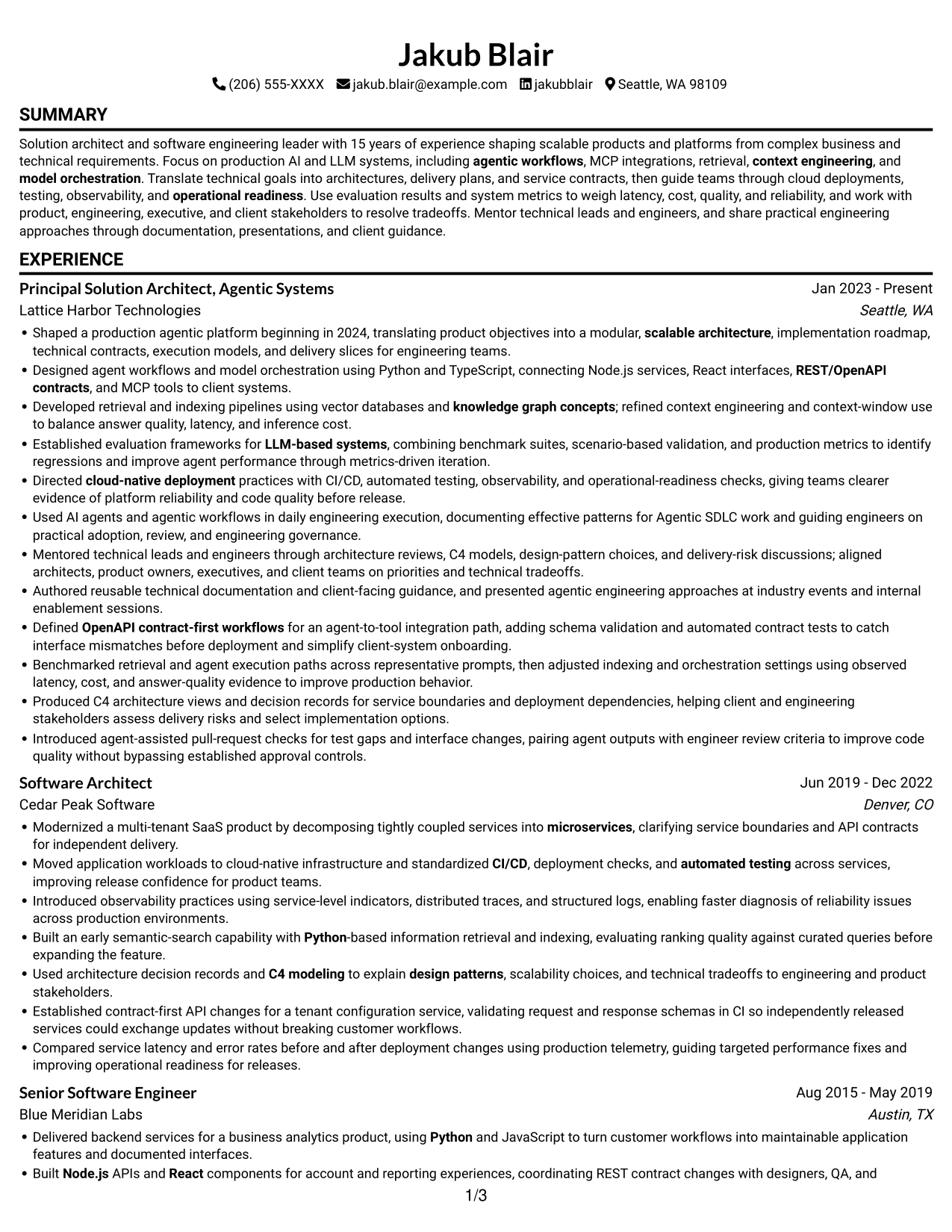
Resume example — page 1

This guide shows you how to create an Agentic Solution Architect resume that presents your architecture work clearly and makes key evidence easy to find. You will learn how to organize your experience and choose a format that supports a focused, readable resume.

An effective resume for this role connects business needs with production-ready agentic systems. Show how you shape architectures, workflows, technical contracts, and delivery plans, then support your claims with clear outcomes and evidence.

The example is presented in 7 resume layouts. The guide also explains how to highlight relevant terms such as MCP tools, retrieval and indexing, context engineering, model orchestration, evaluation frameworks, and cloud-native delivery.

What Makes a Great Agentic Solution Architect Resume in 2026

A strong resume uses clear headings, focused experience bullets, and a skills section that is easy to scan. It connects architecture decisions to delivery, reliability, and system quality.

Include relevant terms such as agentic workflows, MCP integration, retrieval architecture, context engineering, model orchestration, and LLM evaluation. Support them with specific evidence, such as benchmarks, production metrics, or contract testing.

Note: Resume examples are for educational purposes only. Use only information that accurately reflects your experience and qualifications. References to real organizations do not imply affiliation or endorsement.

#1 Simple One Column Format Resume Example

The Simple One Column Format keeps resume content in one vertical stream, giving reviewers a direct path through experience, skills, and education.
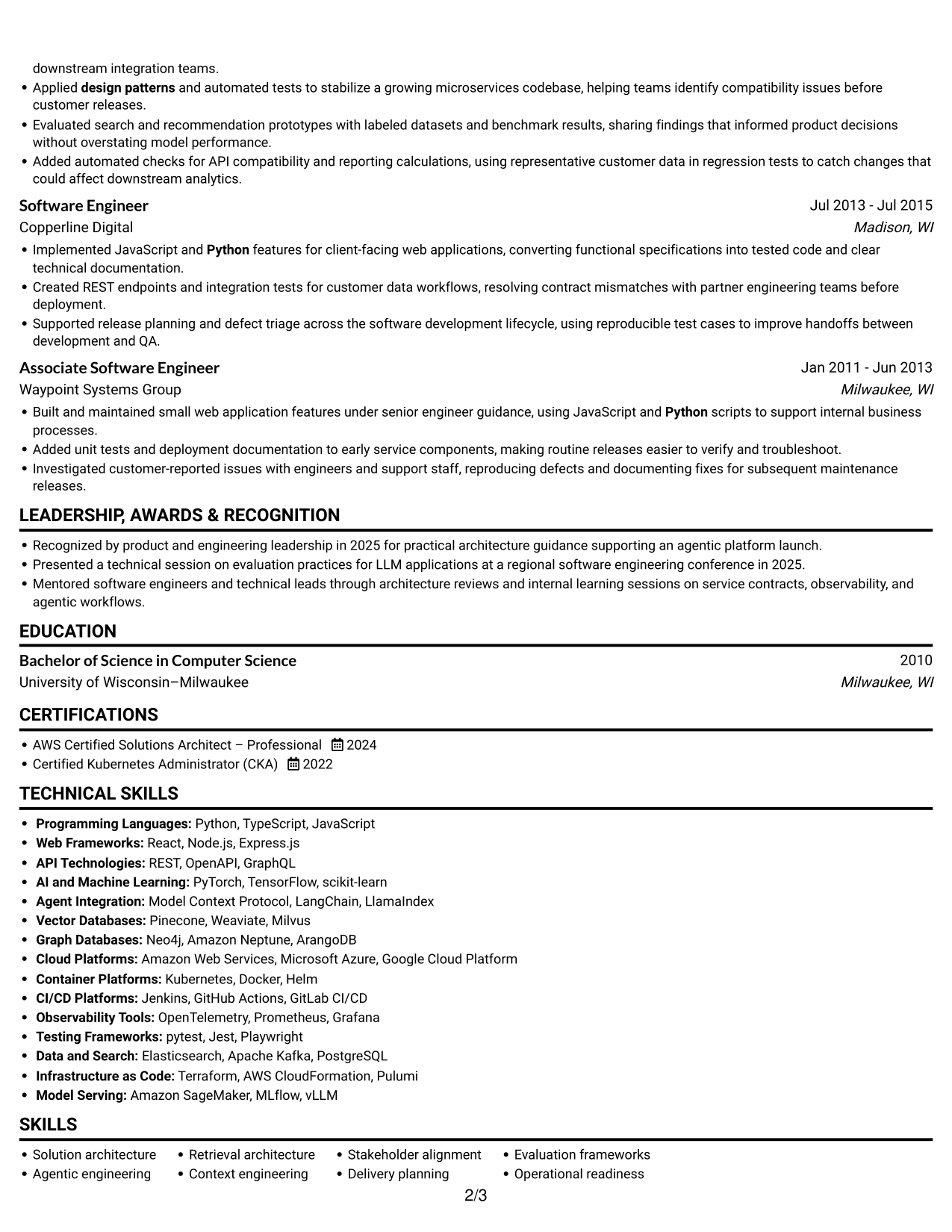
 
Resume example — page 1   Resume example — page 2

Why This Format Works

  • Experience entries follow one clear sequence, making career progression easy to trace.
  • Skills, education, and certifications fit into the same straightforward section order.
  • One content stream gives ATS tools a simpler route through resume text.

Best For

  • Straightforward ATS text parsing
  • Single-path career histories
  • Chronological experience review
  • Compact skills and credential sections
  • Resumes with clear section order

Resume Keywords

  • Shaped a production agentic platform beginning in 2024, translating product objectives into a modular, scalable architecture
  • a modular, scalable architecture
  • Python
  • TypeScript
  • React
  • Node.js
  • REST/OpenAPI contracts
  • OpenAPI
  • MCP tools
  • vector databases
  • Developed retrieval and indexing pipelines using vector databases and knowledge graph concepts
  • knowledge graph concepts
  • cloud-native deployment
  • CI/CD
  • observability
See all keywords
 

#2 Simple Two Column Format Resume Example

The Simple Two Column Format uses two columns to give resume sections a compact, side-by-side reading arrangement.
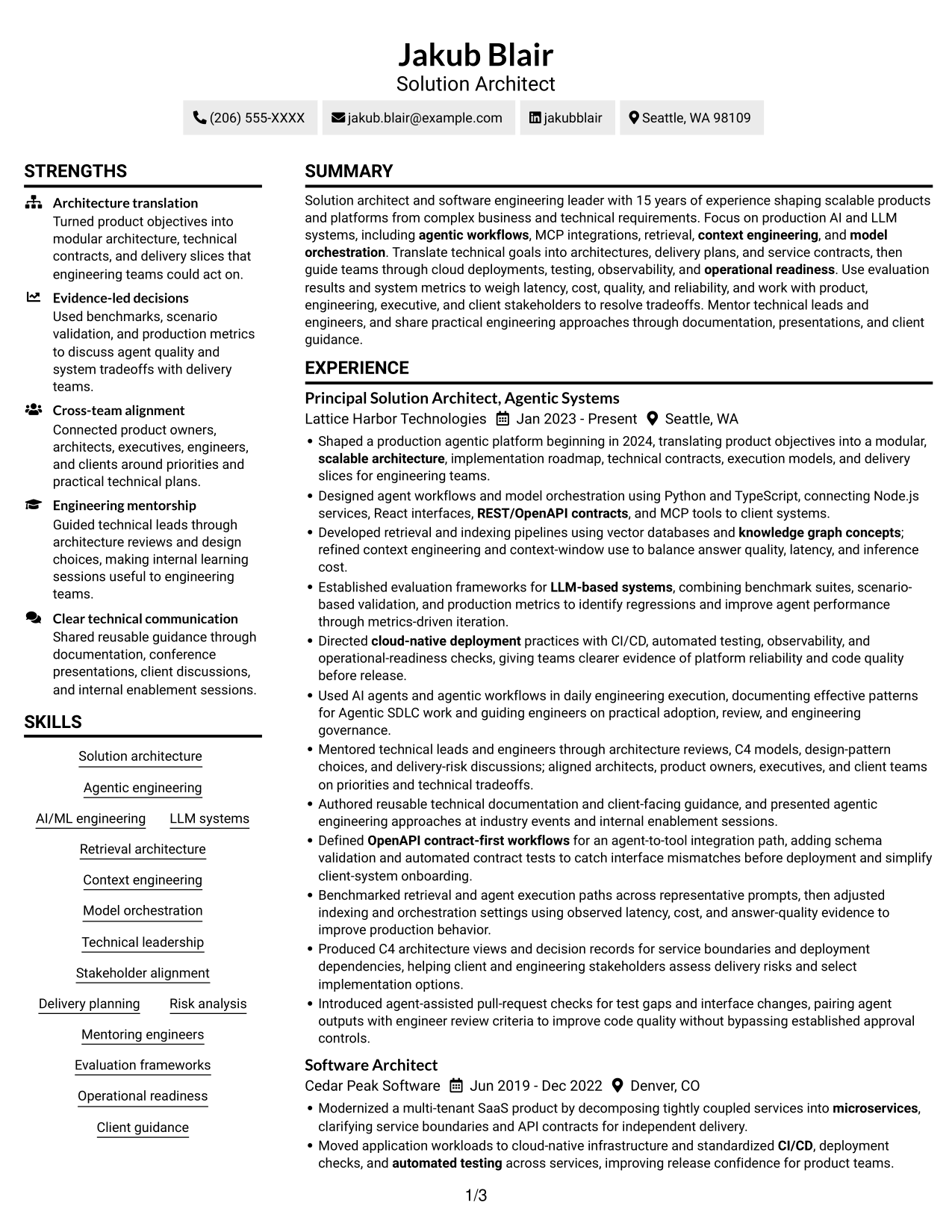
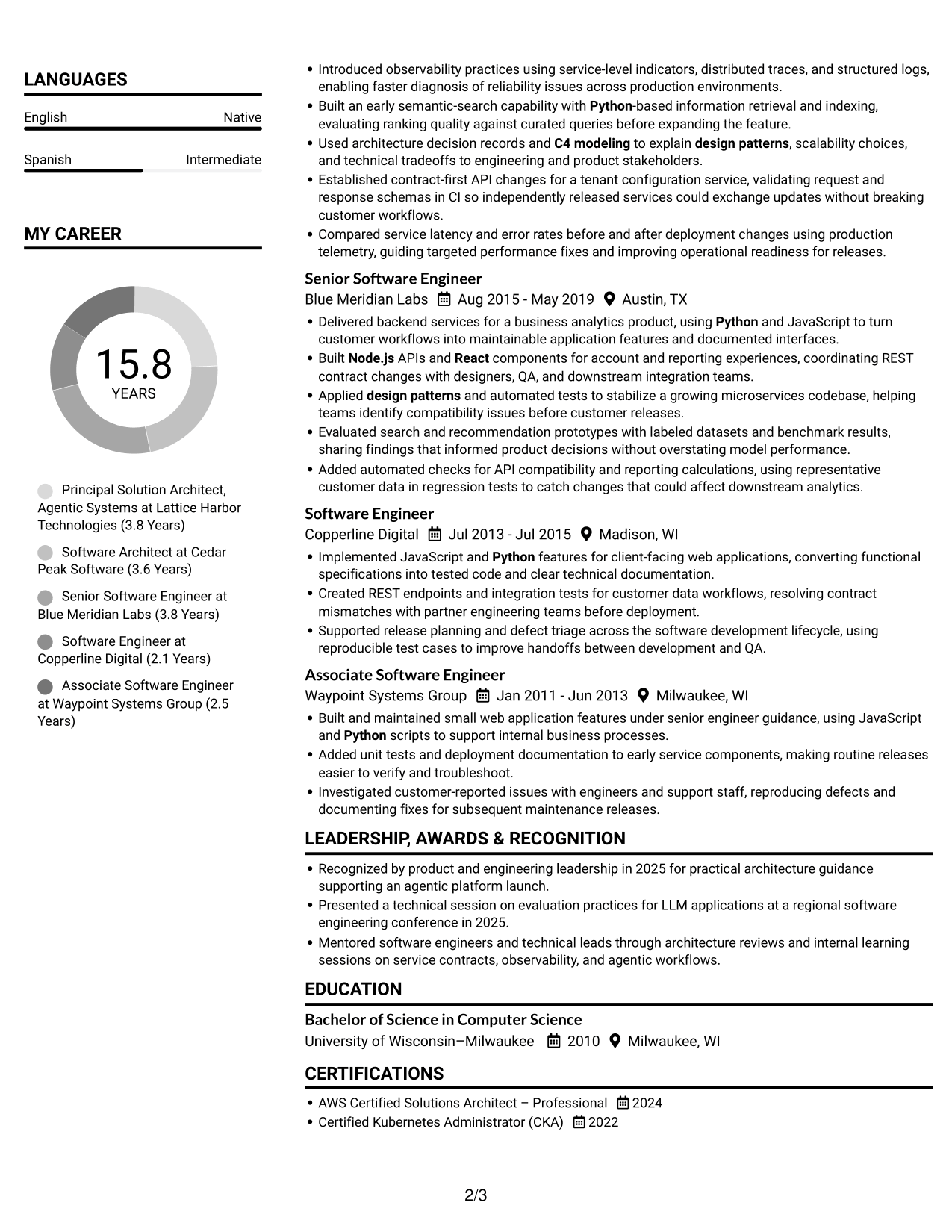
 
Resume example — page 1   Resume example — page 2

Why This Format Works

  • Side-by-side sections help reviewers compare career history with supporting details while preserving its sequence.
  • Separate column areas can help distinguish skills and credentials from work history.
  • Two-column organization gives extensive resume sections a compact way to share space.

Best For

  • Side-by-side resume sections
  • Career histories with supporting details
  • Quick comparison of experience and skills
  • Several sections sharing page width
  • Readers who prefer parallel scanning

#3 Plain One Column with Shaded Labels Resume Example

The Plain One Column with Shaded Labels format presents the resume in one vertical stream, giving reviewers a direct route through its sections.
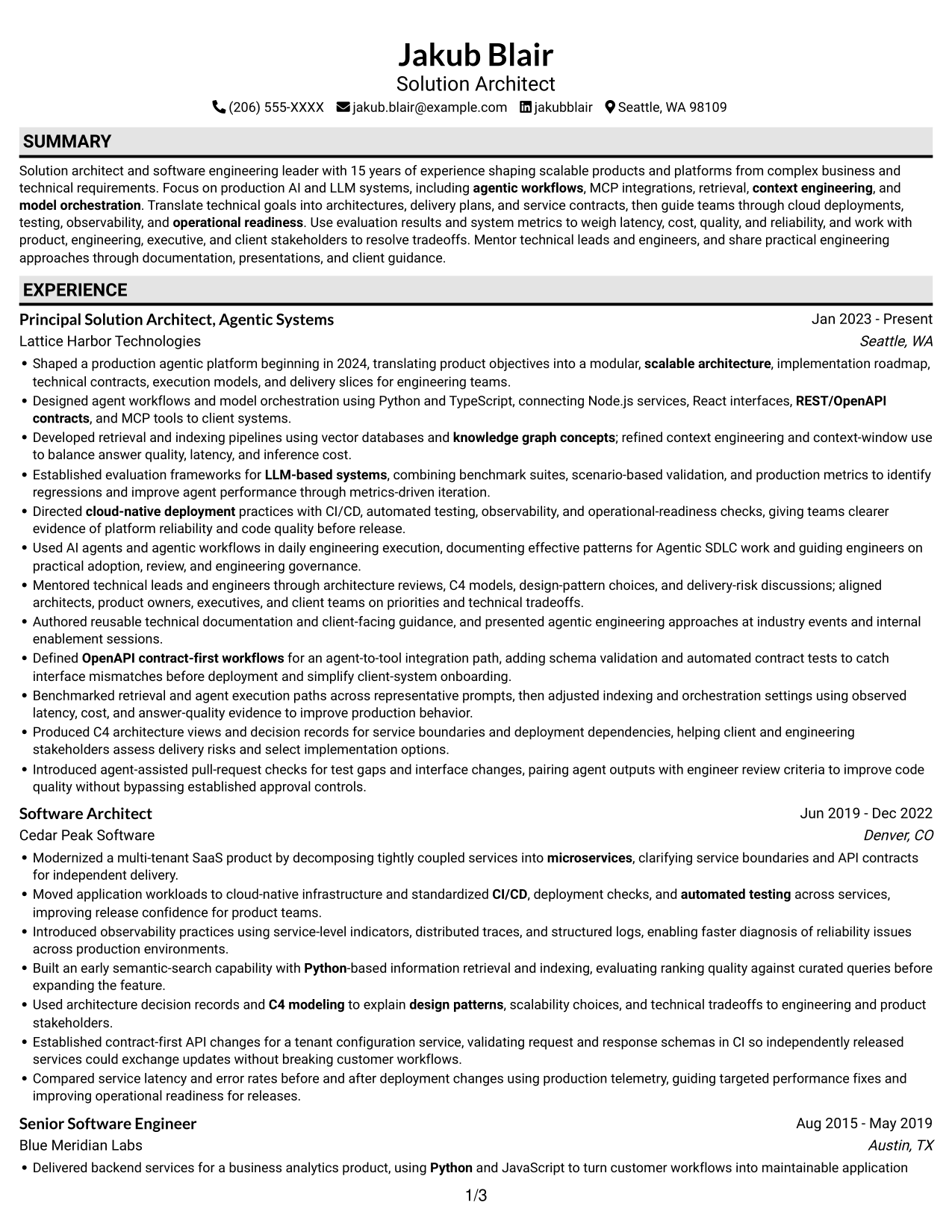
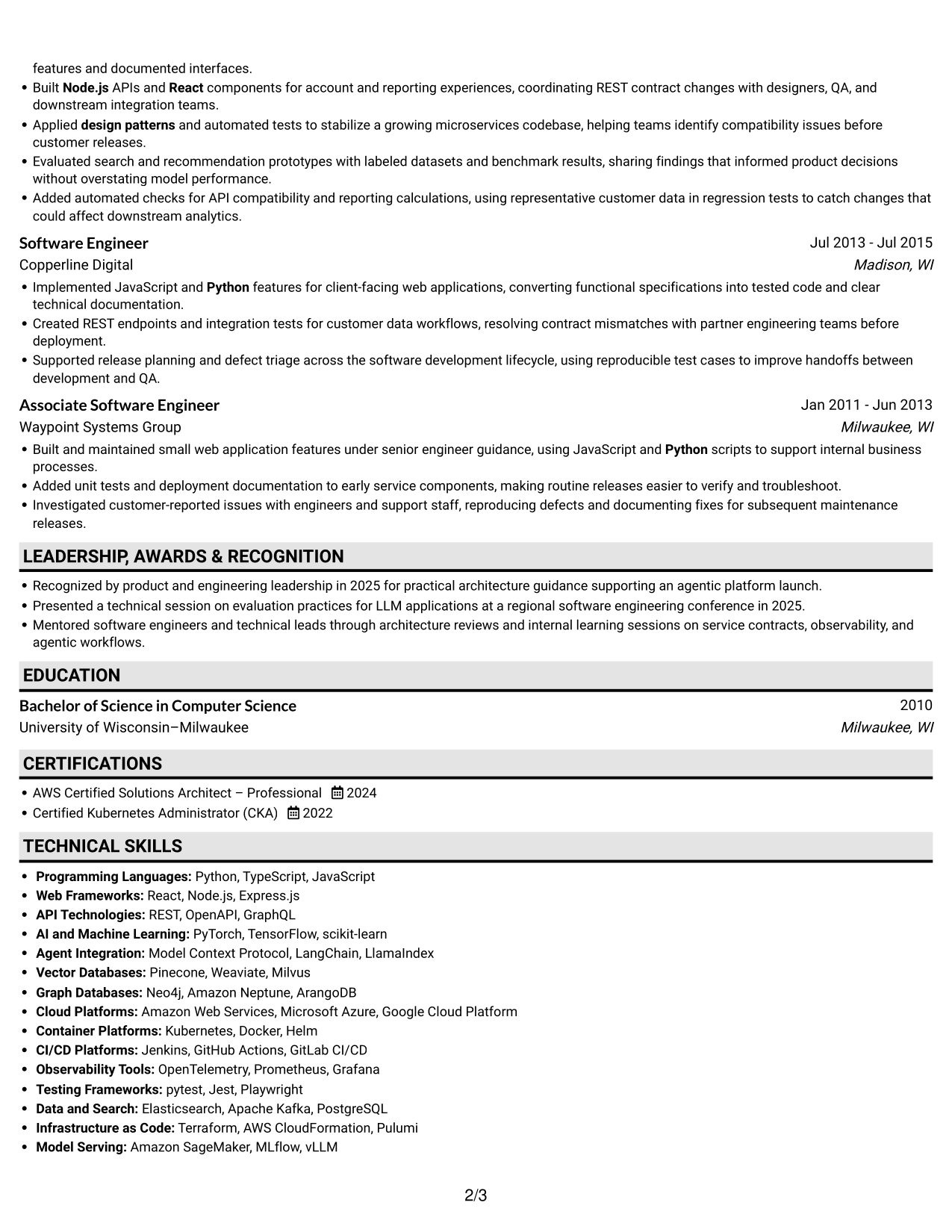
 
Resume example — page 1   Resume example — page 2

Why This Format Works

  • A continuous text path suits ATS review of experience, education, and skills.
  • Work history stays together, helping reviewers trace career progression in sequence.
  • Education and certifications remain part of the same flow as the work history.

Best For

  • Continuous work-history sequences
  • Resumes with several distinct sections
  • Direct section-to-section review
  • ATS-focused text structure
  • Education and credentials within one flow
 

#4 One Column Format with Photo Right Resume Example

The One Column Format with Photo Right keeps resume content in one vertical stream and includes a photo for readers who prefer a visible portrait.
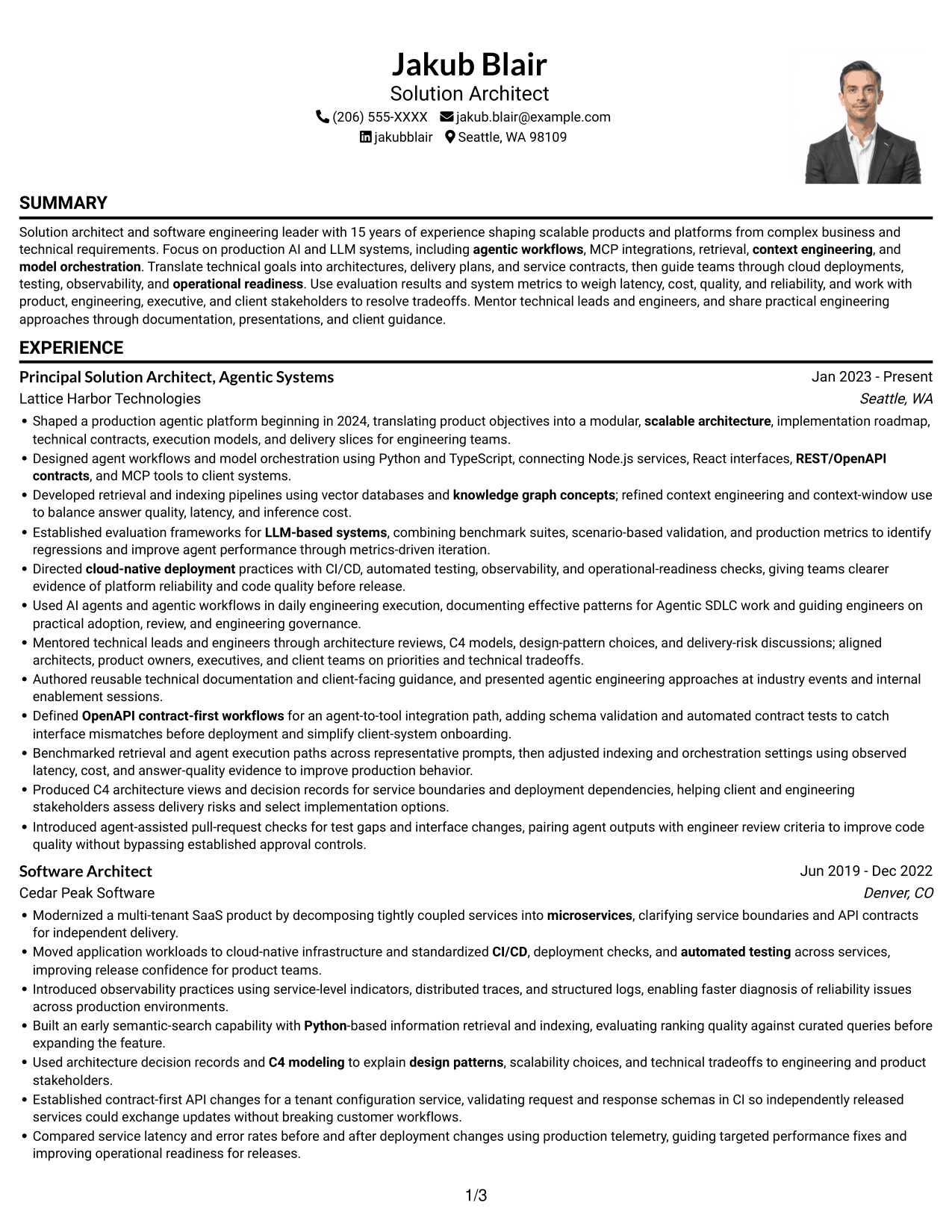
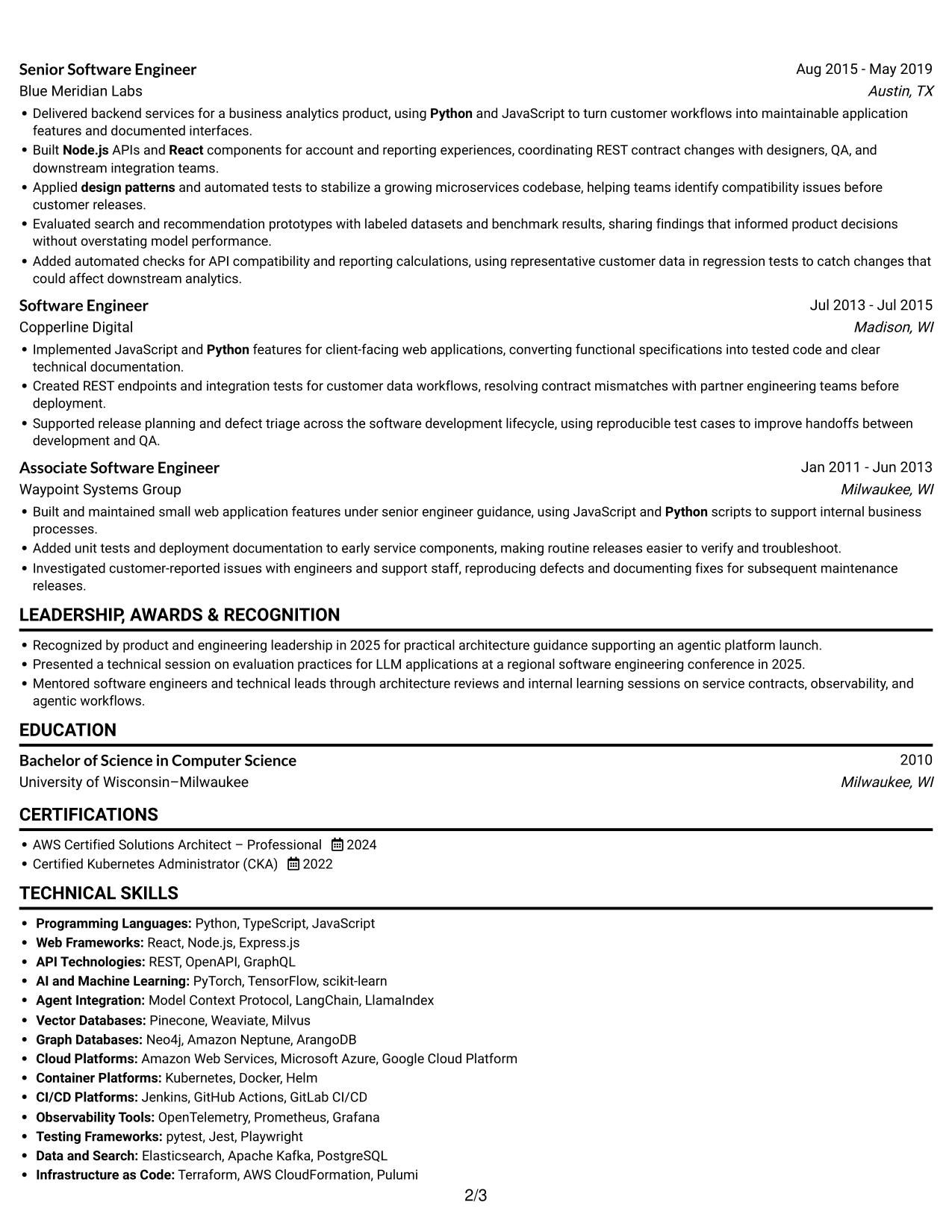
 
Resume example — page 1   Resume example — page 2

Why This Format Works

  • One vertical content path keeps experience and education in a predictable reading order.
  • Skills and credentials stay within the same section sequence as career history.
  • The included photo adds a visible personal image without changing the resume's text flow.

Best For

  • Visible portrait on a resume
  • One-column text flow
  • Career histories with several roles
  • Section-by-section ATS review
  • Integrated skills and credential sections
 

#5 Clean Two Column Sidebar Format Resume Example

The Clean Two Column Sidebar Format uses two columns to give resume sections separate areas for a parallel review.
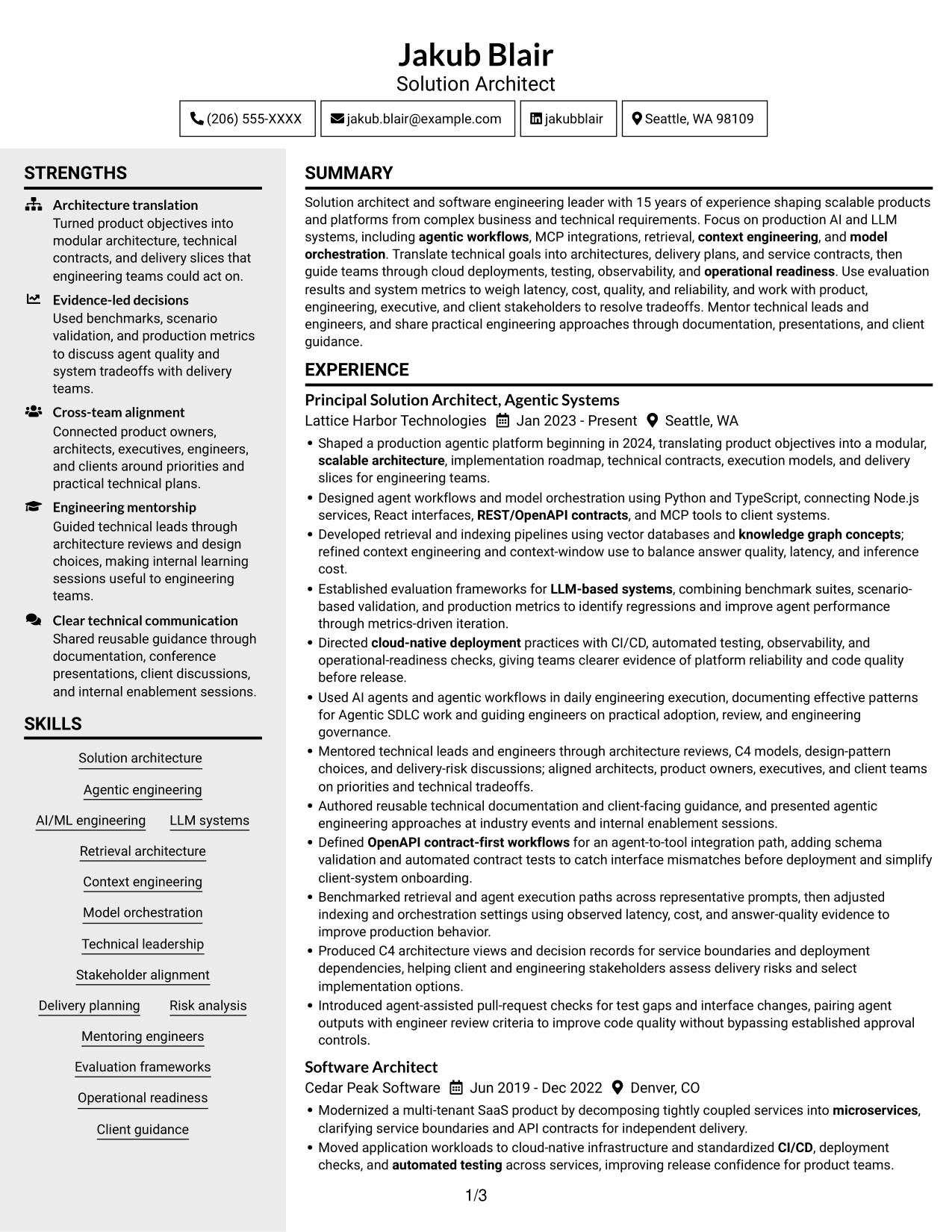
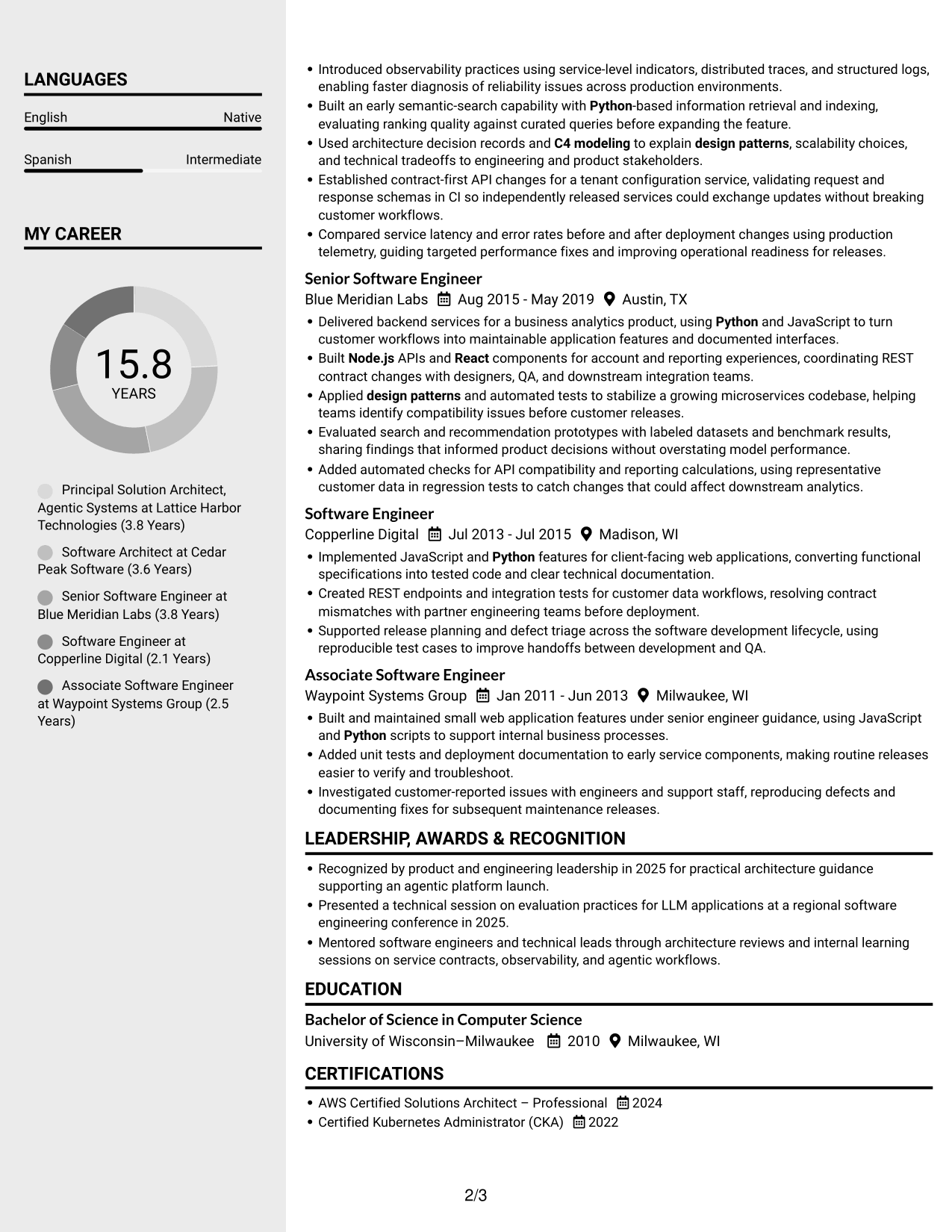
 
Resume example — page 1   Resume example — page 2

Why This Format Works

  • Two-column reading lets reviewers move between career history and supporting resume sections.
  • Distinct column areas can separate skills and credentials from work history.
  • The paired columns let resume content share space without forming one long text stream.

Best For

  • Parallel review of resume sections
  • Career history beside supporting information
  • Dense content with distinct section areas
  • Skills and credentials in separate areas
  • Readers who prefer sidebar-style organization


#6 Two Column Format Resume Example

The Two Column Format arranges resume content in two columns, giving reviewers a parallel way to move among sections.
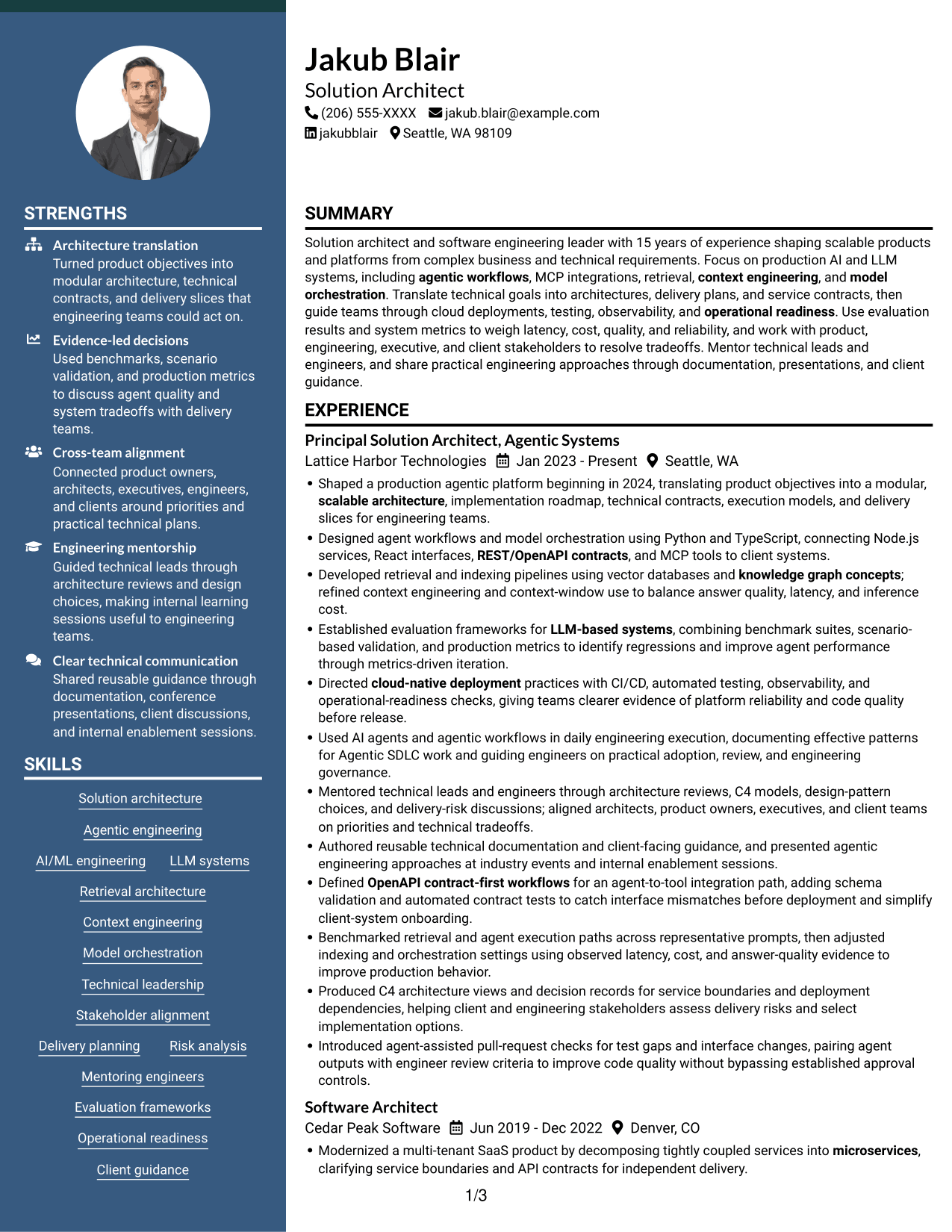
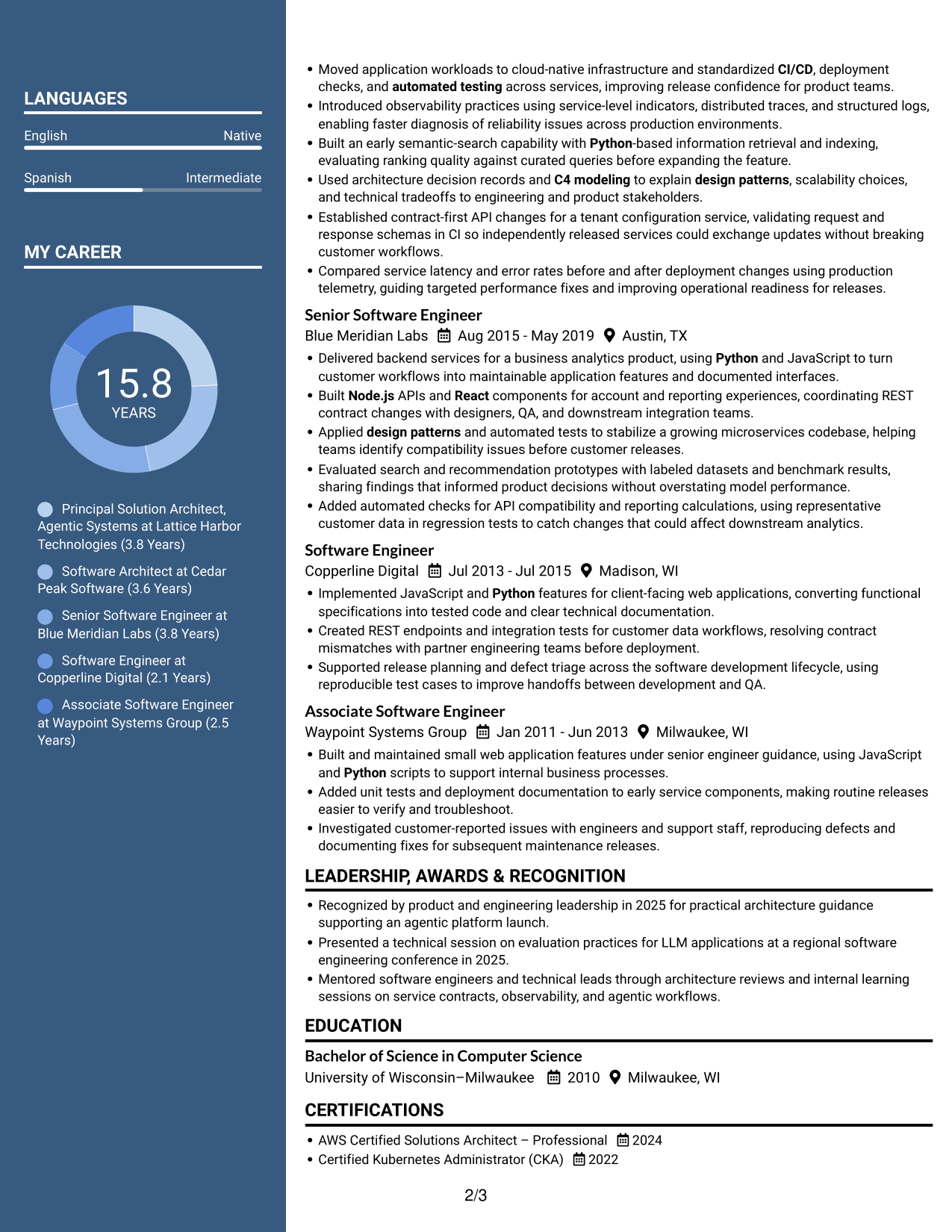
 
Resume example — page 1   Resume example — page 2

Why This Format Works

  • Two columns let reviewers scan resume sections in parallel while keeping each area distinct.
  • Career history can remain easy to trace alongside supporting qualifications.
  • Skills, education, and certifications can appear as separate section groups.

Best For

  • Parallel section review
  • Compact content arrangement
  • Resumes with broad skills and experience sections
  • Career progression with supporting details
  • Readers accustomed to two-column documents
 

#7 Photo Header Two Column Format Resume Example

The Photo Header Two Column Format combines a two-column resume body with a photo for readers who want a portrait and compact sections.
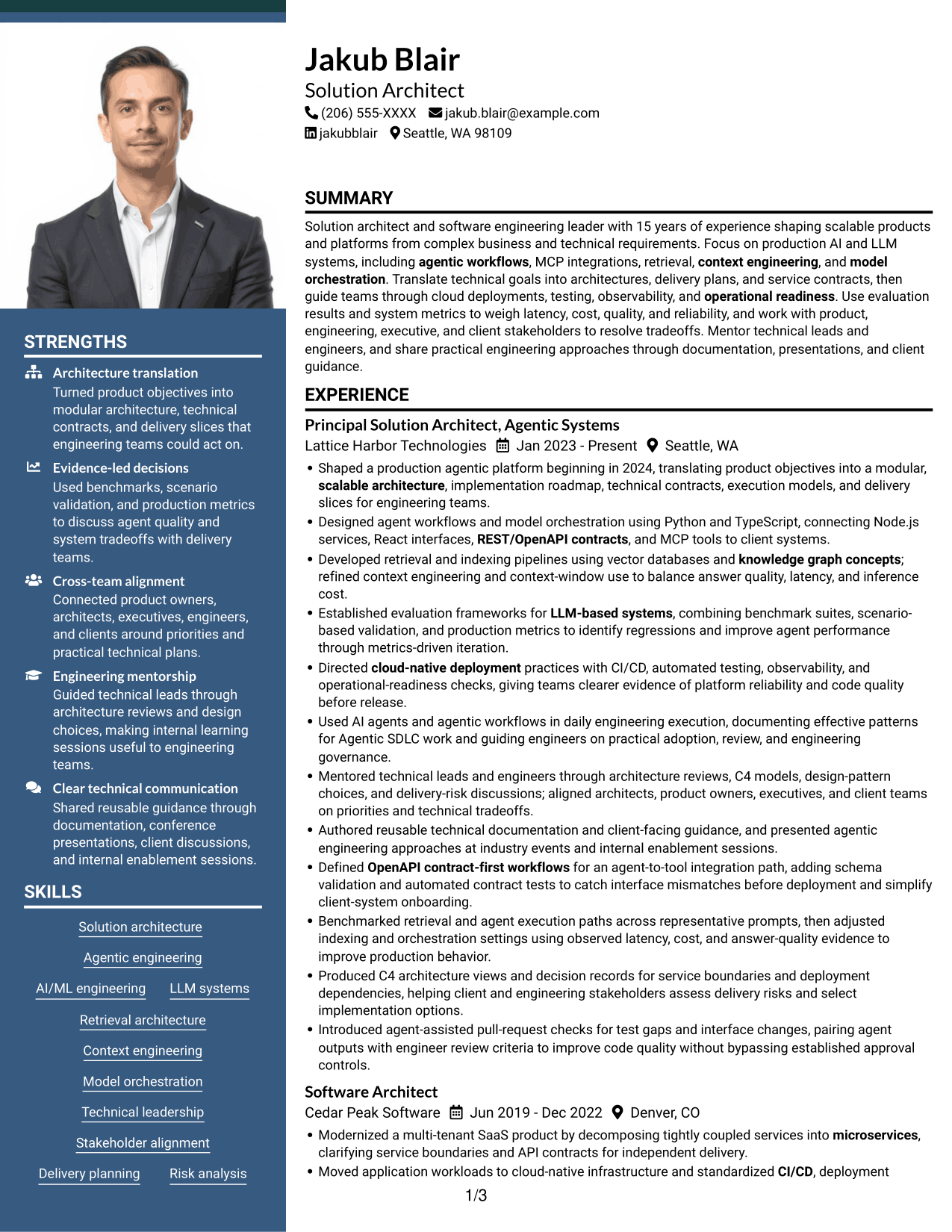
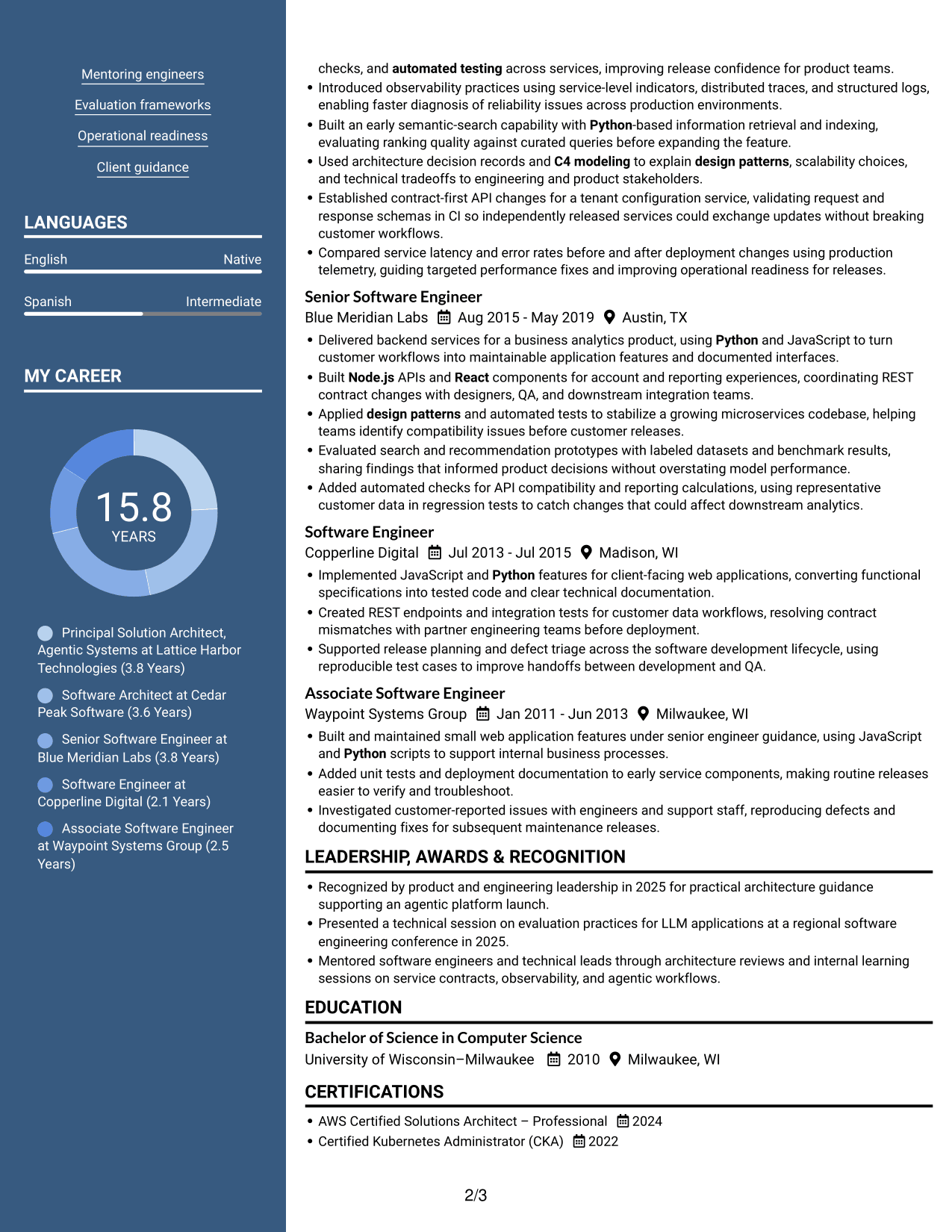
 
Resume example — page 1   Resume example — page 2

Why This Format Works

  • The two-column body gives career history and supporting sections distinct reading areas.
  • Reviewers can move between work history and other resume sections without following one long column.
  • An included photo adds a visible portrait while text remains organized in its sections.

Best For

  • Photo-inclusive two-column resumes
  • Career histories with multiple supporting sections
  • Resume content needing two distinct reading areas
  • Readers comparing experience with credentials
  • Visible portrait alongside structured resume content


Why Build Your Agentic Solution Architect Resume with ResumeInMinutes

ResumeInMinutes lets you compare resume image previews and open an example in the editor. Use the structure as a starting point, then adapt the sections and details to match your own experience.

  • Multiple resume layouts
  • Clear section structure
  • Role-focused keywords
  • Experience and skills organization
  • Resume image previews
  • Editor customization

For an Agentic Solution Architect resume, give priority to architecture scope, agent workflows, technical contracts, evaluation results, and the decisions that improved system quality or delivery.


See Also


Frequently Asked Questions

Are these Agentic Solution Architect resume templates ATS-friendly?

The layouts use recognizable resume sections and headings. For stronger ATS alignment, use relevant terms such as agentic workflows, MCP tools, retrieval architecture, context engineering, and LLM evaluation where they accurately describe your experience.

Do the previews show different resumes?

The previews show one Agentic Solution Architect resume example in different layouts. Compare the image previews to see which structure best presents the information.

What should an Agentic Solution Architect resume include?

Include a focused summary, relevant skills, experience, education, and certifications. Use concise bullets to show architecture decisions, agent and retrieval systems, technical contracts, evaluation work, and measurable results.

Which resume format works well for an Agentic Solution Architect?

A clear, single-column format is often easy for people and applicant tracking systems to scan. Choose a layout that gives your experience, technical skills, and achievements clear headings and enough space.

How should I show agentic systems experience on my resume?

Describe the system or workflow you worked on, your role in its design or delivery, and the evidence used to assess results. Mention relevant tools and methods, such as MCP integration, vector databases, benchmarking, or production metrics, when they apply.

Should I include a photo on my resume?

Include a photo only when it is customary or expected in your country, region, or industry. For U.S. applications, a resume without a photo is generally the safer choice.

ATS Score 99%

How we calculate this score

  • Keywords: 60% of the total. AI extracts keywords from your job description. If you do not provide one, a standard job description for the title matching your resume is used. This is not a match to a specific vacancy.
  • Text-based resume: 20%. The text resume assessed here receives 100 for this part.
  • Resume quality: 20%. We start at 100 and subtract points for issues found by our resume checks, down to a minimum of zero.
  • Keyword coverage = round(100 × confirmed matches ÷ total keywords). Exact matches and supported equivalents verified by AI receive full credit; unsupported keywords receive none. Live text checks use the saved equivalents and do not request a new AI review. Without keywords, no overall ATS score is available.
  • Final score = 60% of keyword coverage + 20% of the text score + 20% of the quality score, rounded to a whole number. Without keywords, no overall ATS score is available.

What this score means

Our scores are estimates, not employer ratings. They may contain errors and do not guarantee accurate parsing, a ranking, an interview, or a job. Check your document against the employer’s requirements. You are responsible for relying on this score.

Terms and Conditions

Score weights: Keywords 60% · Text based resume 20% · Resume quality 20%

Keyword coverage: 48 of 49 (98%) · Resume quality: 100%

Resume quality 100% · Weight 20% · Issues (0)

Details
  • ✓Name present: Jakub Blair
  • ✓Email format: jakub.blair@example.com
  • ✓Phone format: (206) 555-XXXX
  • ✓Experience 1: Job title: Principal Solution Architect, Agentic Systems
  • ✓Experience 1: Company name: Lattice Harbor Technologies
  • ✓Experience 1: Work location: Seattle, WA
  • ✓Experience 1: Employment dates: Jan 2023 - Present
  • ✓Experience 1: Description or achievements: Present
  • ✓Experience 2: Job title: Software Architect
  • ✓Experience 2: Company name: Cedar Peak Software
  • ✓Experience 2: Work location: Denver, CO
  • ✓Experience 2: Employment dates: Jun 2019 - Dec 2022
  • ✓Experience 2: Description or achievements: Present
  • ✓Experience 3: Job title: Senior Software Engineer
  • ✓Experience 3: Company name: Blue Meridian Labs
  • ✓Experience 3: Work location: Austin, TX
  • ✓Experience 3: Employment dates: Aug 2015 - May 2019
  • ✓Experience 3: Description or achievements: Present
  • ✓Experience 4: Job title: Software Engineer
  • ✓Experience 4: Company name: Copperline Digital
  • ✓Experience 4: Work location: Madison, WI
  • ✓Experience 4: Employment dates: Jul 2013 - Jul 2015
  • ✓Experience 4: Description or achievements: Present
  • ✓Experience 5: Job title: Associate Software Engineer
  • ✓Experience 5: Company name: Waypoint Systems Group
  • ✓Experience 5: Work location: Milwaukee, WI
  • ✓Experience 5: Employment dates: Jan 2011 - Jun 2013
  • ✓Experience 5: Description or achievements: Present
  • ✓No placeholder fields
  • ✓No repeated achievement bullets
  • ✓No empty bullets

No issues found by the current checks.

Text Based Resume 100% · Weight 20%

Parsed text
Jakub Blair
(206) 555-XXXX
jakub.blair@example.com
jakubblair
Seattle, WA 98109
SUMMARY
Solution architect and software engineering leader with 15 years of experience shaping scalable products and platforms from complex business and technical requirements. Focus on production AI and LLM systems, including agentic workflows, MCP integrations, retrieval, context engineering, and model orchestration. Translate technical goals into architectures, delivery plans, and service contracts, then guide teams through cloud deployments, testing, observability, and operational readiness. Use evaluation results and system metrics to weigh latency, cost, quality, and reliability, and work with product, engineering, executive, and client stakeholders to resolve tradeoffs. Mentor technical leads and engineers, and share practical engineering approaches through documentation, presentations, and client guidance.
EXPERIENCE
Principal Solution Architect, Agentic Systems
Jan 2023 - Present
Lattice Harbor Technologies
Seattle, WA
Shaped a production agentic platform beginning in 2024, translating product objectives into a modular, scalable architecture, implementation roadmap, technical contracts, execution models, and delivery slices for engineering teams.
Designed agent workflows and model orchestration using Python and TypeScript, connecting Node.js services, React interfaces, REST/OpenAPI contracts, and MCP tools to client systems.
Developed retrieval and indexing pipelines using vector databases and knowledge graph concepts; refined context engineering and context-window use to balance answer quality, latency, and inference cost.
Established evaluation frameworks for LLM-based systems, combining benchmark suites, scenario-based validation, and production metrics to identify regressions and improve agent performance through metrics-driven iteration.
Directed cloud-native deployment practices with CI/CD, automated testing, observability, and operational-readiness checks, giving teams clearer evidence of platform reliability and code quality before release.
Used AI agents and agentic workflows in daily engineering execution, documenting effective patterns for Agentic SDLC work and guiding engineers on practical adoption, review, and engineering governance.
Mentored technical leads and engineers through architecture reviews, C4 models, design-pattern choices, and delivery-risk discussions; aligned architects, product owners, executives, and client teams on priorities and technical tradeoffs.
Authored reusable technical documentation and client-facing guidance, and presented agentic engineering approaches at industry events and internal enablement sessions.
Defined OpenAPI contract-first workflows for an agent-to-tool integration path, adding schema validation and automated contract tests to catch interface mismatches before deployment and simplify client-system onboarding.
Benchmarked retrieval and agent execution paths across representative prompts, then adjusted indexing and orchestration settings using observed latency, cost, and answer-quality evidence to improve production behavior.
Produced C4 architecture views and decision records for service boundaries and deployment dependencies, helping client and engineering stakeholders assess delivery risks and select implementation options.
Introduced agent-assisted pull-request checks for test gaps and interface changes, pairing agent outputs with engineer review criteria to improve code quality without bypassing established approval controls.
Software Architect
Jun 2019 - Dec 2022
Cedar Peak Software
Denver, CO
Modernized a multi-tenant SaaS product by decomposing tightly coupled services into microservices, clarifying service boundaries and API contracts for independent delivery.
Moved application workloads to cloud-native infrastructure and standardized CI/CD, deployment checks, and automated testing across services, improving release confidence for product teams.
Introduced observability practices using service-level indicators, distributed traces, and structured logs, enabling faster diagnosis of reliability issues across production environments.
Built an early semantic-search capability with Python-based information retrieval and indexing, evaluating ranking quality against curated queries before expanding the feature.
Used architecture decision records and C4 modeling to explain design patterns, scalability choices, and technical tradeoffs to engineering and product stakeholders.
Established contract-first API changes for a tenant configuration service, validating request and response schemas in CI so independently released services could exchange updates without breaking customer workflows.
Compared service latency and error rates before and after deployment changes using production telemetry, guiding targeted performance fixes and improving operational readiness for releases.
Senior Software Engineer
Aug 2015 - May 2019
Blue Meridian Labs
Austin, TX
Delivered backend services for a business analytics product, using Python and JavaScript to turn customer workflows into maintainable application features and documented interfaces.
Built Node.js APIs and React components for account and reporting experiences, coordinating REST contract changes with designers, QA, and downstream integration teams.
Applied design patterns and automated tests to stabilize a growing microservices codebase, helping teams identify compatibility issues before customer releases.
Evaluated search and recommendation prototypes with labeled datasets and benchmark results, sharing findings that informed product decisions without overstating model performance.
Added automated checks for API compatibility and reporting calculations, using representative customer data in regression tests to catch changes that could affect downstream analytics.
Software Engineer
Jul 2013 - Jul 2015
Copperline Digital
Madison, WI
Implemented JavaScript and Python features for client-facing web applications, converting functional specifications into tested code and clear technical documentation.
Created REST endpoints and integration tests for customer data workflows, resolving contract mismatches with partner engineering teams before deployment.
Supported release planning and defect triage across the software development lifecycle, using reproducible test cases to improve handoffs between development and QA.
Associate Software Engineer
Jan 2011 - Jun 2013
Waypoint Systems Group
Milwaukee, WI
Built and maintained small web application features under senior engineer guidance, using JavaScript and Python scripts to support internal business processes.
Added unit tests and deployment documentation to early service components, making routine releases easier to verify and troubleshoot.
Investigated customer-reported issues with engineers and support staff, reproducing defects and documenting fixes for subsequent maintenance releases.
LEADERSHIP, AWARDS & RECOGNITION
Recognized by product and engineering leadership in 2025 for practical architecture guidance supporting an agentic platform launch.
Presented a technical session on evaluation practices for LLM applications at a regional software engineering conference in 2025.
Mentored software engineers and technical leads through architecture reviews and internal learning sessions on service contracts, observability, and agentic workflows.
EDUCATION
Bachelor of Science in Computer Science
2010
University of Wisconsin–Milwaukee
Milwaukee, WI
CERTIFICATIONS
AWS Certified Solutions Architect – Professional
2024
Certified Kubernetes Administrator (CKA)
2022
TECHNICAL SKILLS
Programming Languages: Python, TypeScript, JavaScript
Web Frameworks: React, Node.js, Express.js
API Technologies: REST, OpenAPI, GraphQL
AI and Machine Learning: PyTorch, TensorFlow, scikit-learn
Agent Integration: Model Context Protocol, LangChain, LlamaIndex
Vector Databases: Pinecone, Weaviate, Milvus
Graph Databases: Neo4j, Amazon Neptune, ArangoDB
Cloud Platforms: Amazon Web Services, Microsoft Azure, Google Cloud Platform
Container Platforms: Kubernetes, Docker, Helm
CI/CD Platforms: Jenkins, GitHub Actions, GitLab CI/CD
Observability Tools: OpenTelemetry, Prometheus, Grafana
Testing Frameworks: pytest, Jest, Playwright
Data and Search: Elasticsearch, Apache Kafka, PostgreSQL
Infrastructure as Code: Terraform, AWS CloudFormation, Pulumi
Model Serving: Amazon SageMaker, MLflow, vLLM
SKILLS
Solution architecture
Agentic engineering
AI/ML engineering
LLM systems
Retrieval architecture
Context engineering
Model orchestration
Technical leadership
Stakeholder alignment
Delivery planning
Risk analysis
Mentoring engineers
Evaluation frameworks
Operational readiness
Client guidance
PROFESSIONAL AFFILIATIONS
Member of the Association for Computing Machinery, engaging with a professional community focused on computing practice and research.
Member of the IEEE Computer Society, participating in a professional community for software engineering and computing.
LANGUAGES
English (Native)
Spanish (Intermediate)

Matched keywords (48)

  • Shaped a production agentic platform beginning in 2024, translating product objectives into a modular, scalable architectureOriginal keyword in JD: Software architecture
  • a modular, scalable architectureOriginal keyword in JD: Scalable solution design
  • Python
  • TypeScriptOriginal keyword in JD: TypeScript OR JavaScript
  • React
  • Node.js
  • REST/OpenAPI contractsOriginal keyword in JD: REST service contracts
  • OpenAPI
  • MCP toolsOriginal keyword in JD: MCP tool integration
  • vector databases
  • Developed retrieval and indexing pipelines using vector databases and knowledge graph conceptsOriginal keyword in JD: Retrieval architectures
  • knowledge graph concepts
  • cloud-native deployment
  • CI/CD
  • observability
  • automated testing
  • AI/ML engineering
  • LLM-based systems
  • agentic workflows
  • Developed retrieval and indexing pipelinesOriginal keyword in JD: Retrieval and indexing strategies
  • context engineering
  • evaluation frameworks
  • model orchestration
  • microservices
  • C4 modeling
  • design patterns
  • Defined OpenAPI contract-first workflows for an agent-to-tool integration pathOriginal keyword in JD: Contract-first engineering
  • Used AI agents and agentic workflows in daily engineering executionOriginal keyword in JD: AI agents in engineering execution
  • Agentic SDLC
  • execution models
  • technical contracts
  • Delivery planning
  • engineering governance
  • operational readiness
  • Introduced agent-assisted pull-request checks for test gaps and interface changes, pairing agent outputs with engineer review criteria to improve code qualityOriginal keyword in JD: Code quality practices
  • Benchmarked retrieval and agent execution paths across representative promptsOriginal keyword in JD: Performance benchmarking
  • combining benchmark suites, scenario-based validation, and production metrics to identify regressions and improve agent performance through metrics-driven iterationOriginal keyword in JD: Metrics-driven improvement
  • using observed latency, cost, and answer-quality evidence to improve production behaviorOriginal keyword in JD: Evidence-based judgment
  • aligned architects, product owners, executives, and client teams on priorities and technical tradeoffsOriginal keyword in JD: Technical tradeoff analysis
  • helping client and engineering stakeholders assess delivery risks and select implementation optionsOriginal keyword in JD: Delivery risk management
  • Stakeholder alignment
  • aligned architects, product owners, executives, and client teams on priorities and technical tradeoffsOriginal keyword in JD: Cross-functional communication
  • Technical leadership
  • Mentored technical leads and engineersOriginal keyword in JD: Mentoring technical leads and engineers
  • improve agent performance through metrics-driven iterationOriginal keyword in JD: Agent performance optimization
  • platform reliability
  • presented agentic engineering approaches at industry events and internal enablement sessionsOriginal keyword in JD: Technical presentations
  • internal enablement

Missing keywords (1)

  • Client-facing thought leadership
Disclaimer: All names, images, contact information, employment histories, achievements, security clearances, military credentials, and other qualifications shown in this content are fictional and used for illustrative purposes only. Any resemblance to actual persons, living or deceased, is purely coincidental.

Resume and cover-letter examples and recommendations in this article reflect general best practices and professional experience and are provided for guidance only. Results may vary based on role, industry, region, and hiring organization.

Content Accuracy and Verification: To the fullest extent permitted by applicable law, we do not represent or warrant that resume or cover-letter guidance, examples, recommendations, or related information are accurate, complete, current, error-free, or suitable for any particular purpose. You are responsible for independently reviewing and verifying the information before relying on it.

ATS and Cover-Letter Scores: ATS scores are estimates calculated using our own formula, informed by publicly available guidance on resume formatting and keyword matching. They are not scores issued or endorsed by an ATS provider or employer. Cover-letter scores are also our own assessments. Parsing, weighting, screening criteria, and results vary between systems, employers, job descriptions, and document formats. No score guarantees successful parsing, a particular ranking, an interview, or employment. Use scores as general guidance and independently check your documents against the employer’s requirements. To the fullest extent permitted by applicable law, we accept no liability for errors in scores or parsing, or losses arising from reliance on these assessments. Nothing in this notice excludes liability or limits consumer rights that cannot lawfully be excluded or limited.

Terms and Conditions
 
> JP 1 1
PDF Footer and Margins Setup
The margins are applied to the document, and the footer shows up in the preview and the PDF

Footer Font Settings

Are you applying for a specific job
so we can tailor your resume to it?
Are you applying for a specific job
so we can tailor your cover letter to it?

Your data stays private and is never used for training.Privacy Policy

Type your details as text to generate a personalized resume Type your details as text to generate a personalized cover letter
Website link found! Ready to create resume from:

Your data stays private and is never used for training.Privacy Policy

Drag the into the box to verify you're human.
Drop here

My Resumes

Displaying {number_of_files} files (out of {total_of_all_files} total)
Name File Type Last Modified: Description:

Rename File

Filename already exists!

Delete Files

Warning: This action is irreversible. Once you click submit, the files will be permanently deleted.

Heading text
Upload From Computer Upload
Select From Existing
LinkedIn
Drag & Drop files anywhere in this tab, or

Uploaded Files

Delete Name Last Updated Use This File
Select this to use the file for generating your resume and cover letter. Only one source—uploaded file, selected file, or LinkedIn text—can be used.

My Files

Resumes or cover letters you create will appear here. No files available yet.
Delete Name Last Updated Use This File
Select this to use the file for generating your resume and cover letter. Only one source—uploaded file, selected file, or LinkedIn text—can be used.

Add LinkedIn Profile PDF

You can download your LinkedIn profile as a PDF by opening linkedin.com in a web browser, clicking your profile photo, selecting the “More” or “Resources” button, and choosing “Save to PDF.” You can then attach the PDF using the Upload From Computer tab.

Paste Your LinkedIn Profile Text

If you have copied the LinkedIn profile text, paste it below. See how to copy your profile from LinkedIn

Select this to use the LinkedIn profile text for generating your resume and cover letter. Only one source—uploaded file, selected file, or LinkedIn text—can be used.

Try these controls

<
>