33 Associate .NET Developer: Craft Web Apps with C#, SQL Resume Templates with Example 2026 (ATS-Optimized)
This guide shows you how to build an Associate .NET Developer: Craft Web Apps with C#, SQL resume that is clear, focused, and easy to adapt. You will learn how to organize technical evidence and compare professional resume formats presented in 33 layouts.
A strong resume for this role connects web application development to practical results. Use clear sections, concise bullet points, relevant keywords, and evidence from C#, .NET, ASP.NET Core, SQL Server, REST APIs, testing, debugging, and software delivery work.
The examples below show how to present a focused summary, experience, projects, education, certifications, and technical skills in ATS-friendly formats. They also explain how to make details such as Entity Framework Core, T-SQL, xUnit, Moq, Git, Visual Studio, and Azure DevOps easy to find during a quick resume review.
What Makes a Great Associate .NET Developer Resume in 2026
Effective resumes for an Associate .NET Developer are keyword-focused, evidence-based, and built for fast review. The goal is to show how the candidate designs, develops, tests, maintains, and supports web applications through organized sections and specific proof.
- Write a focused summary that names the target role and connects C#, .NET, web development, SQL, and analytical problem solving.
- Describe experience with strong action verbs, showing work on features, REST API endpoints, data access, testing, debugging, and release support.
- List technical skills in readable groups, including ASP.NET Core, ASP.NET MVC, SQL Server, T-SQL, Entity Framework Core, JavaScript, HTML, CSS, Git, and Azure DevOps.
- Use projects to demonstrate application design, REST APIs, validation, database work, testing, role-based workflows, and reliable troubleshooting.
Resume content should use scannable sections instead of long paragraphs. For this role, useful ATS keywords include C#, .NET, ASP.NET Core, SQL Server, T-SQL, web applications, REST APIs, Entity Framework Core, stored procedures, unit testing, integration testing, debugging, source control, code review, and Agile development. Match these terms to accurate evidence rather than adding keywords without context.
The resume examples below use an evidence-first approach so formatting supports role-specific clarity, ATS matching, and fast review for Associate .NET Developer work involving C#, web applications, SQL, testing, and production support.
#1 Simple One Column Format Resume Example
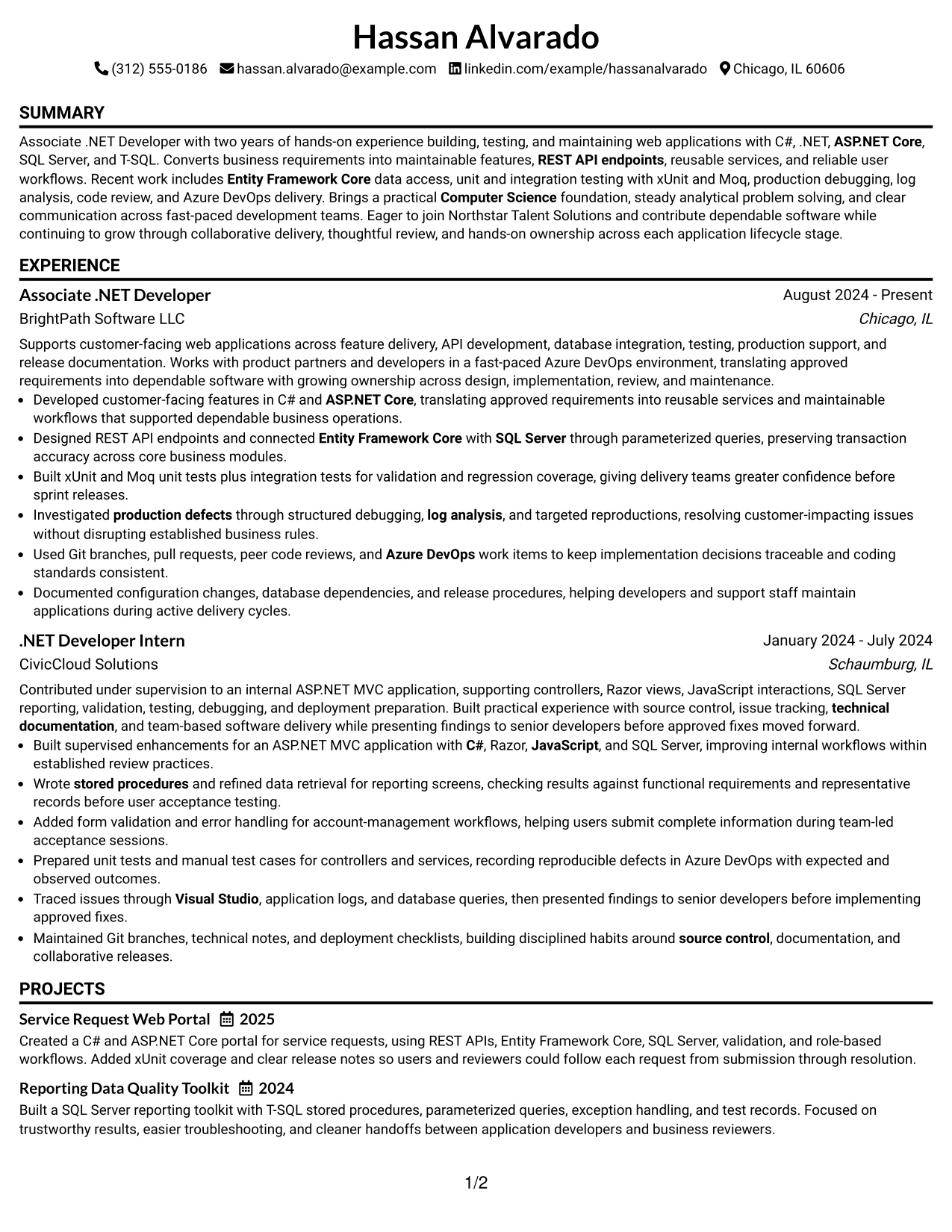
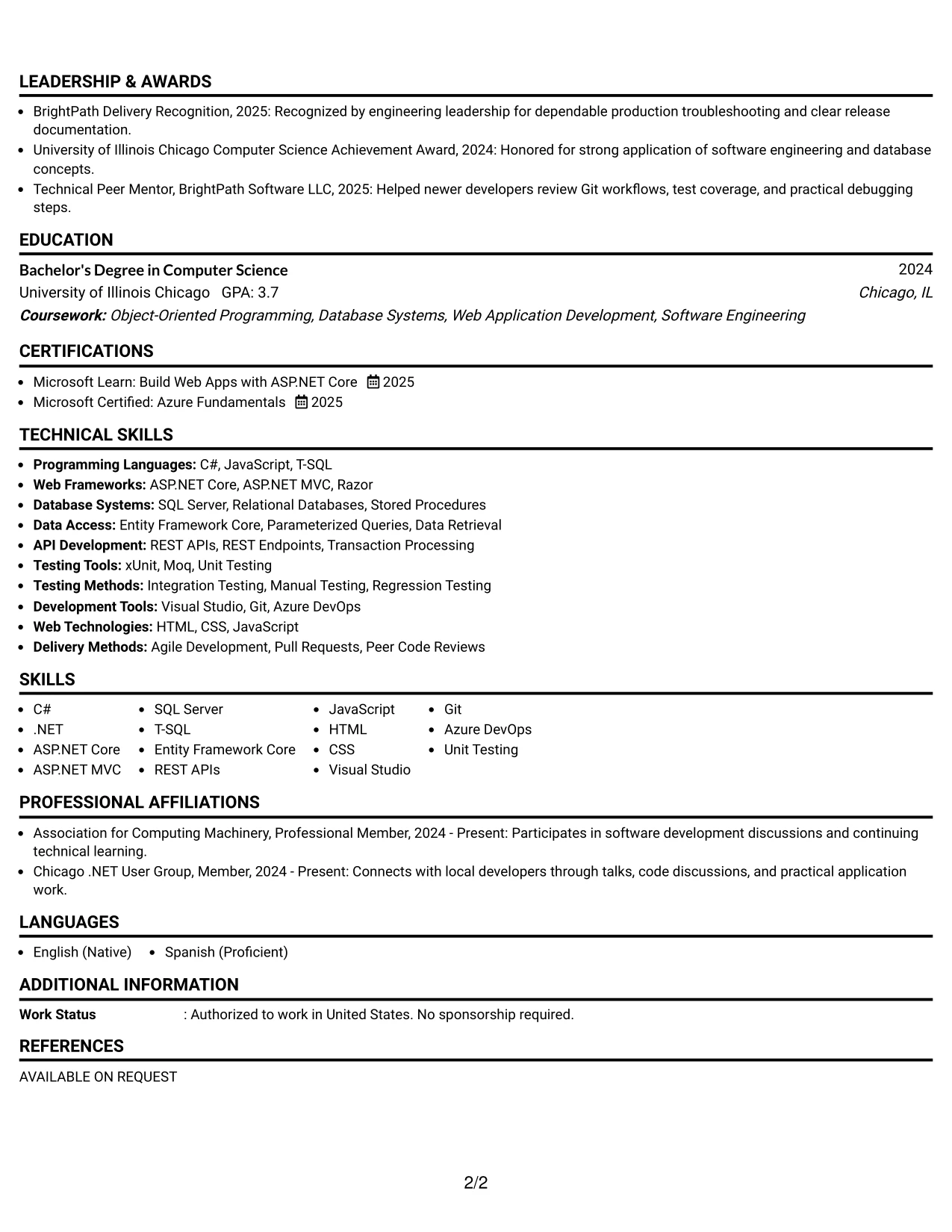
The Simple One Column Format presents the resume in a direct top-to-bottom order. A recruiter can move from the Associate .NET Developer summary to experience, projects, education, certifications, and skills without changing reading paths.
Clear section headings and compact bullet points make the document easy to scan and parse. The experience area can emphasize C#, ASP.NET Core, REST API endpoints, SQL Server, testing, debugging, and documented delivery work, while projects add useful evidence of practical application development.
#1 Why the Simple One Column Format Works for a Resume
- A single reading path supports fast recruiter scanning.
- Standard section order helps ATS software identify resume content.
- The summary places the target role and core technologies near the top.
- Bullets give each achievement a clear starting point.
- Experience can show both application delivery and production debugging.
- Projects provide space for REST APIs, Entity Framework Core, and SQL Server evidence.
- Education and certifications remain easy to find near the end.
#1 Best For
- Applicants who want a straightforward, one-page reading path.
- Resumes that need strong ATS parsing with familiar section order.
- Candidates presenting several related technologies without visual clutter.
- Documents where experience bullets should receive the most attention.
- Applications that combine professional work, projects, education, and certifications.
- Readers who prefer clear headings over decorative design.
- Technical resumes that need keywords to remain visible during a quick scan.
#2 Plain One Column with Shaded Labels Resume Example
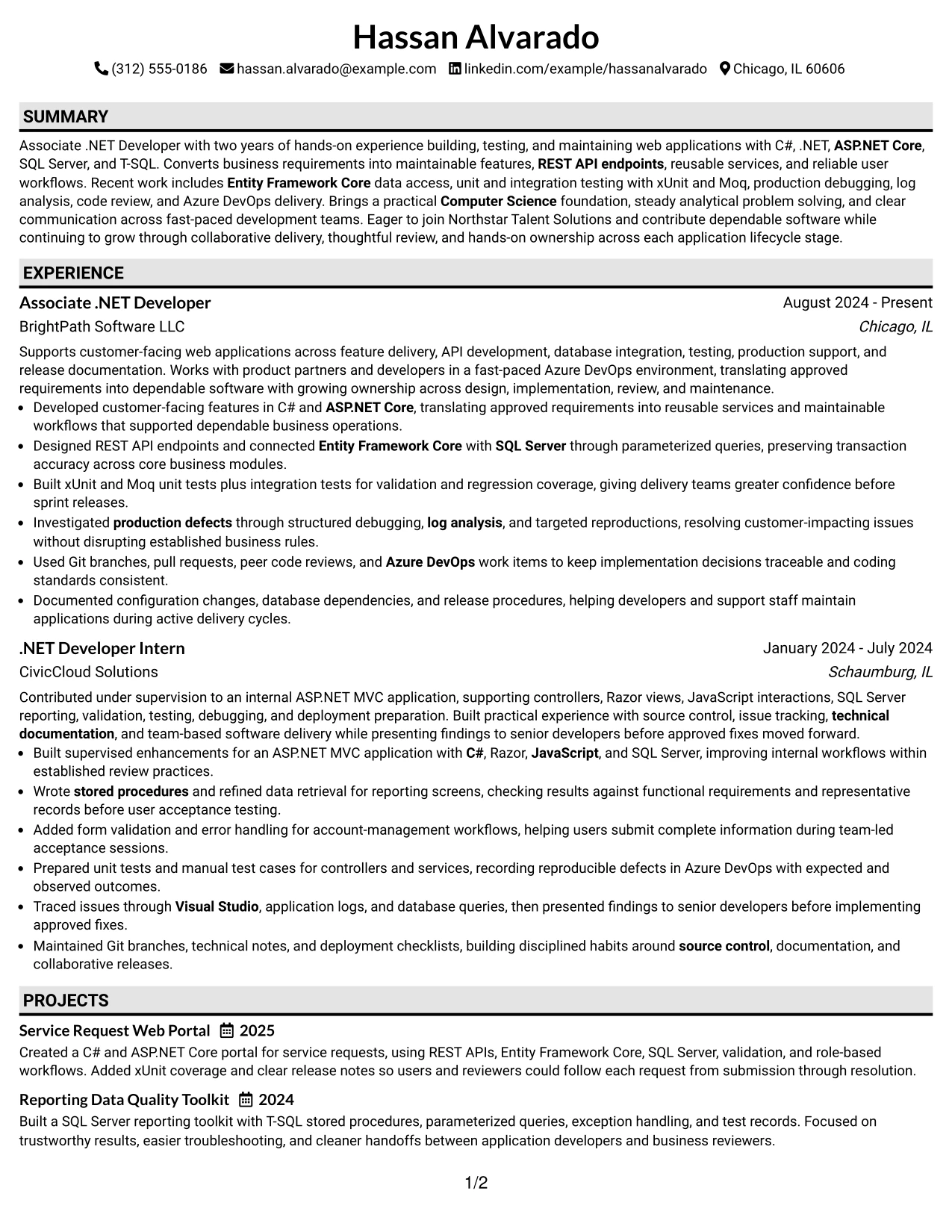
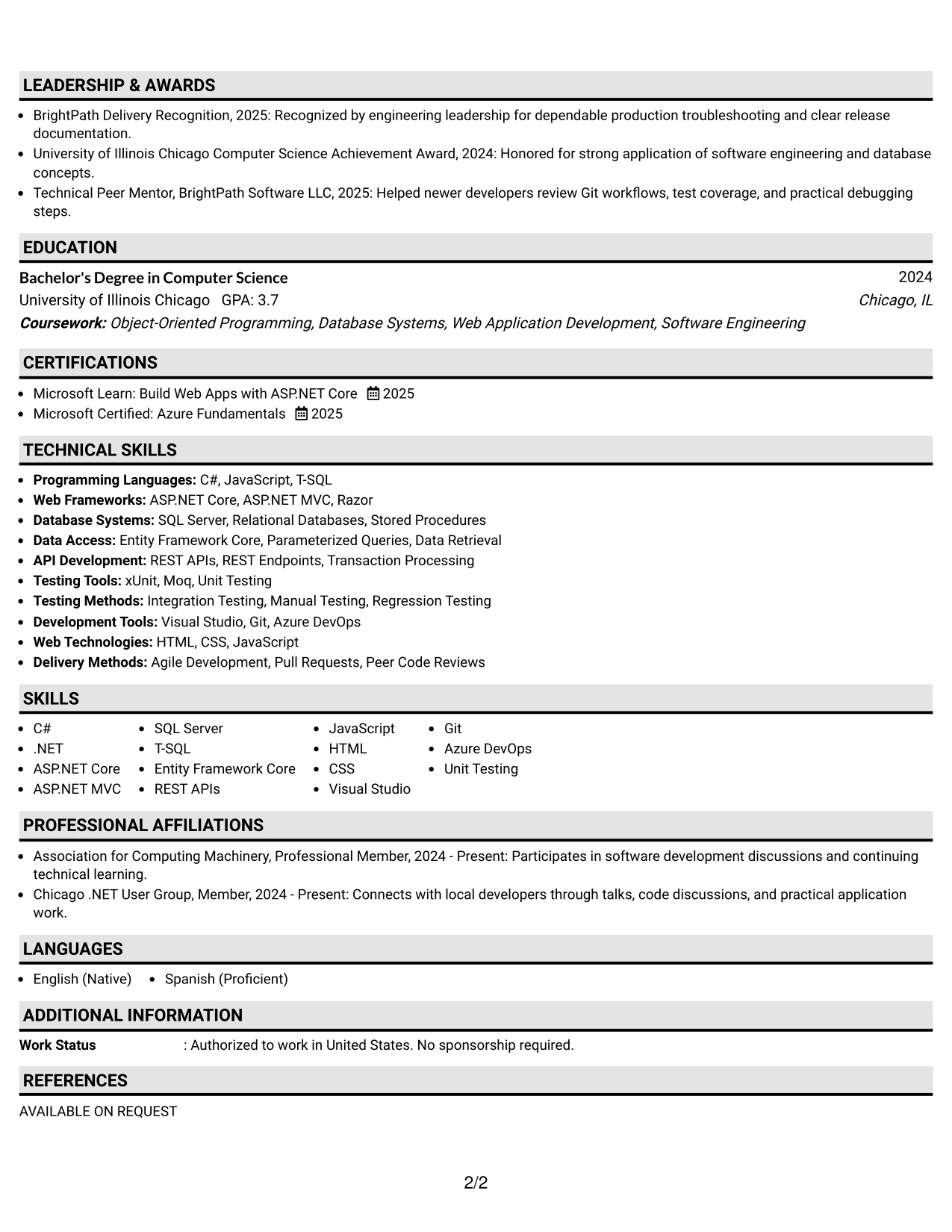
Recruiters move through this resume from the labeled summary and experience sections to skills, projects, education, and certifications. Shaded labels separate each content group while keeping the reading order familiar and easy to follow.
That structure supports a resume with strong content volume. Detailed bullets can cover REST API development, parameterized SQL queries, xUnit and Moq testing, production defect analysis, and source control without forcing important evidence into narrow columns.
#2 Why the Plain One Column with Shaded Labels Works for a Resume
- Shaded labels make section changes visible during a fast review.
- The one-column structure keeps dates, employers, and bullets aligned.
- ATS systems can read the content in a conventional sequence.
- Longer experience entries have room for complete action-and-result statements.
- Technical skills can be grouped without competing with work history.
- Projects can show applied development beyond the main employment section.
- Education and certifications receive clear, separate labels.
#2 Best For
- Resumes with detailed work history and several supporting sections.
- Applicants who need room for six or more bullets in a role.
- Documents where visual labels should guide scanning without adding complexity.
- Candidates combining technical tools, testing methods, and delivery practices.
- Applications that require a readable text-first structure.
- Resumes that benefit from clear separation between projects and employment.
- Readers who want more content detail while keeping one consistent column.
#3 One Column Format with Photo Right Resume Example
Evidence receives priority in this one-column resume: recent development work, testing coverage, database integration, and project results appear in a clear vertical sequence. The right-side photo area adds a visual contact point without interrupting the main content path.
The layout can present C# and ASP.NET Core experience first, followed by REST APIs, SQL Server, debugging, projects, education, and certifications. Strong bullets keep the resume useful for both human review and ATS-oriented keyword checks.
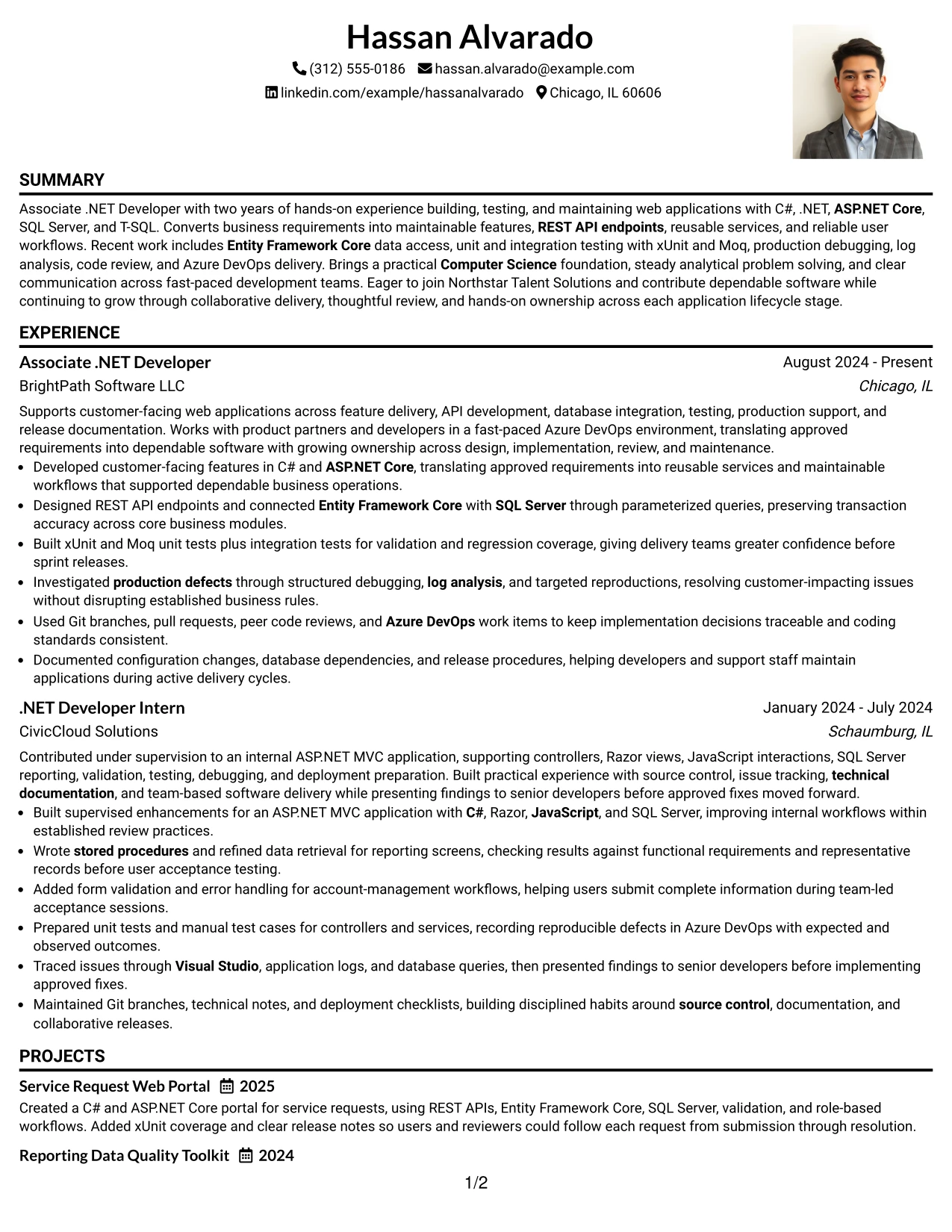
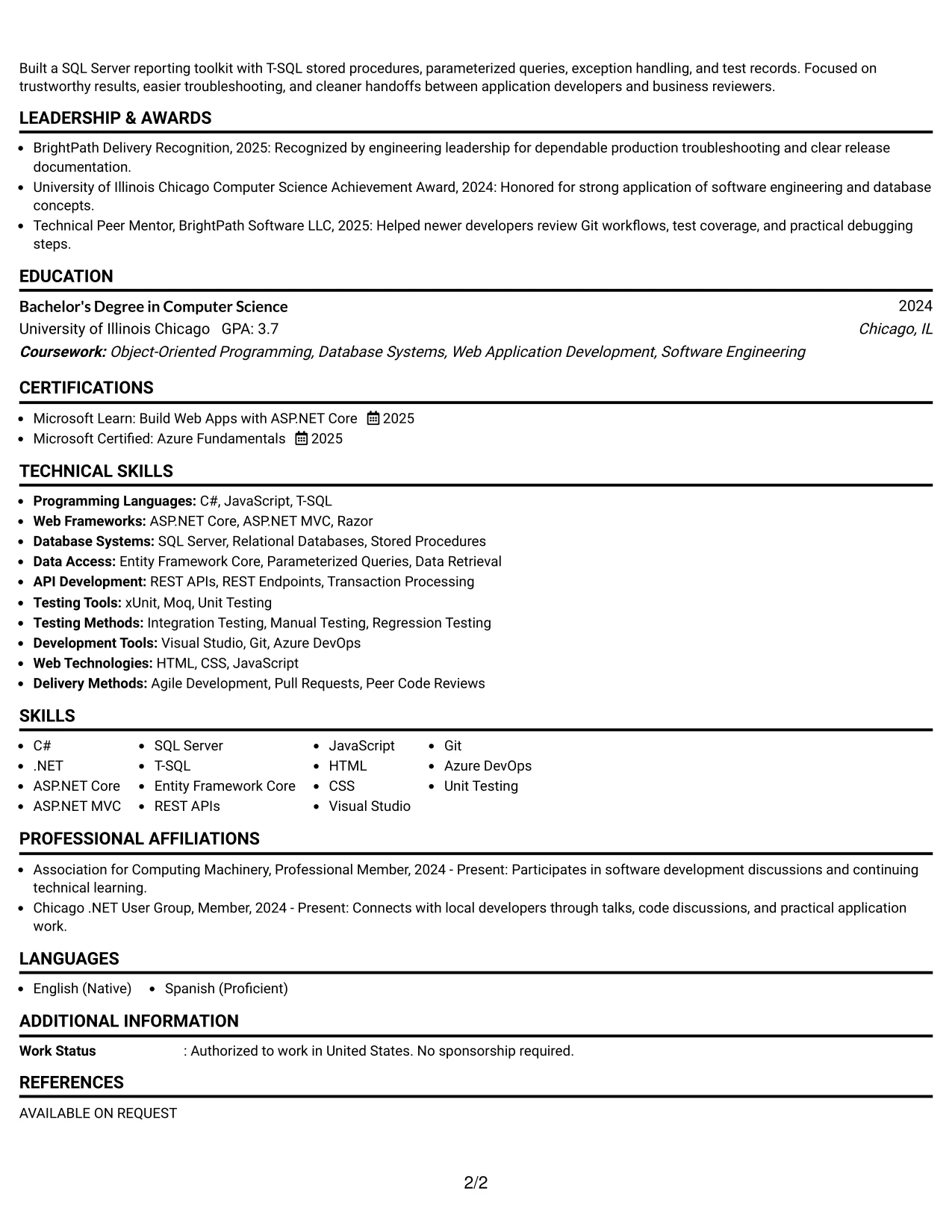
#3 Why the One Column Format with Photo Right Works for a Resume
- Recent experience remains the strongest visual and content priority.
- A vertical structure supports predictable ATS reading.
- The right-side photo area adds visual identity while leaving the text column open.
- Bullets can connect technical actions to dependable application delivery.
- Projects offer a second source of evidence for web application skills.
- A dedicated skills section keeps tools easy to locate.
- Education and certifications support the technical foundation without crowding experience.
#3 Best For
- Applicants who want evidence-led presentation with a visible personal contact point.
- Resumes where recent work should appear before supporting details.
- Candidates with project examples that reinforce professional experience.
- Applications using a focused one-column evidence sequence.
- Documents that need technical keywords to remain in the main text flow.
- Readers who value a clear distinction between experience and credentials.
- Professional resumes where a photo is appropriate for the application context.
#4 Clean Two Column Sidebar Format Resume Example
Content is balanced between a focused main column and a compact sidebar. The main area can carry the summary, experience, and project bullets, while the sidebar holds skills, tools, education, certifications, or contact details for quick reference.
This arrangement suits an application review that rewards both technical evidence and fast navigation. A recruiter can find C#, .NET, SQL Server, Entity Framework Core, testing tools, and Azure DevOps in the sidebar, then verify those keywords in detailed experience bullets.
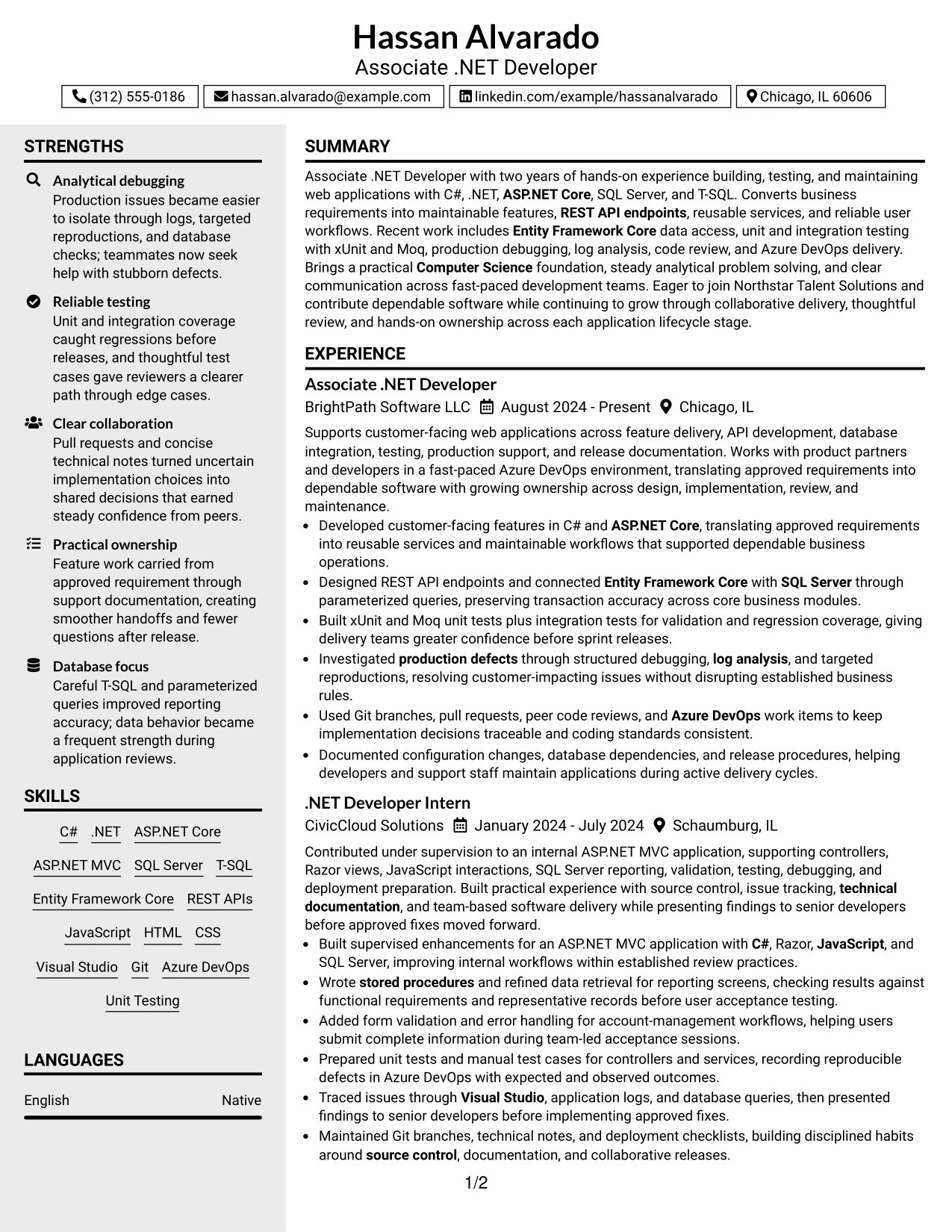
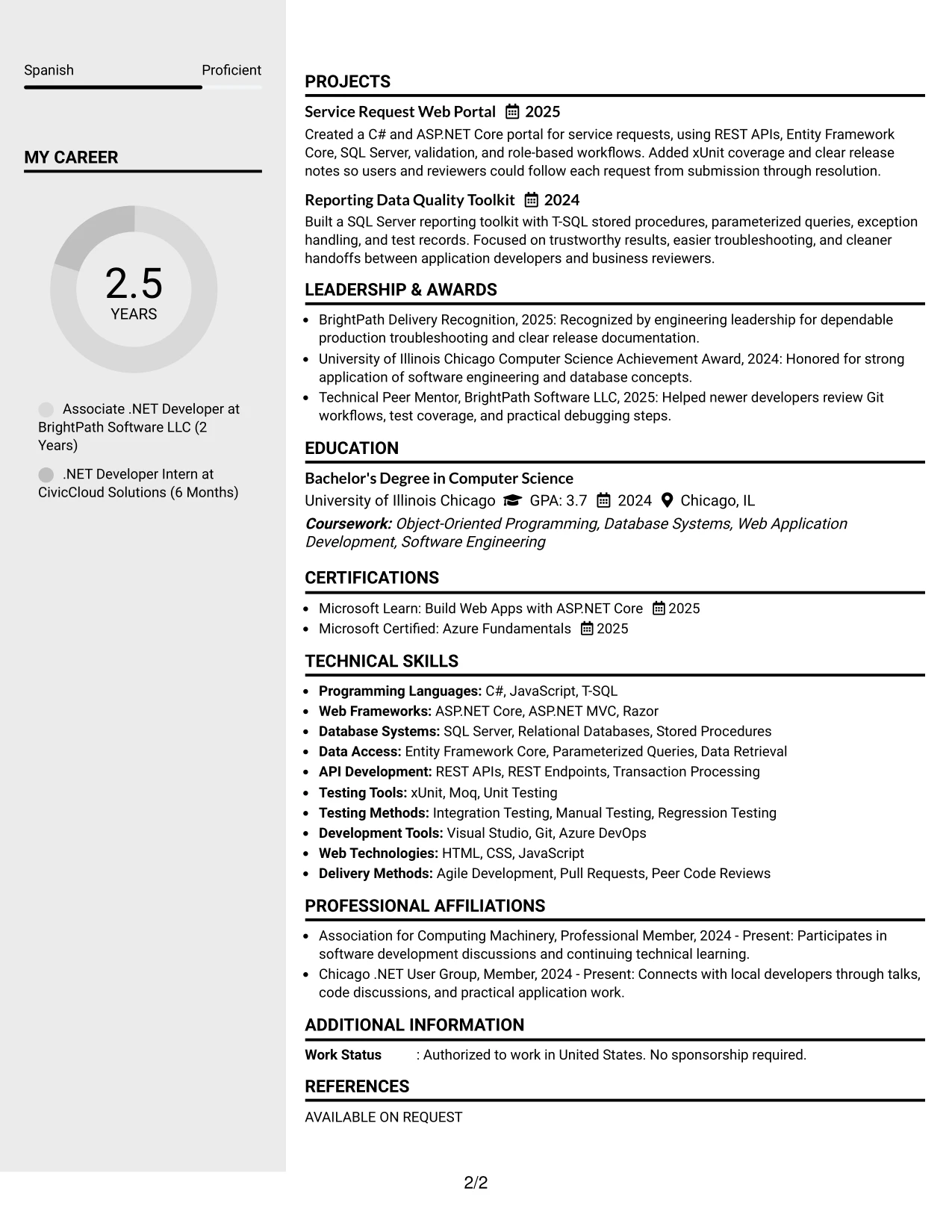
#4 Why the Clean Two Column Sidebar Format Works for a Resume
- The main column protects space for detailed achievement bullets.
- The sidebar keeps skills and credentials visible during a quick review.
- Two visual zones separate evidence from reference information.
- Repeated keywords can appear naturally in both skills and experience.
- Projects can add proof without making the main work history feel crowded.
- Clear bullet styling supports readable technical accomplishments.
- The structure can present a concise summary before deeper application evidence.
#4 Best For
- Applications where a recruiter needs quick access to skills and credentials.
- Resumes pairing detailed experience with a compact reference sidebar.
- Candidates with enough evidence to support a strong main content column.
- Documents that need tools and certifications visible without lengthy descriptions.
- Technical applications reviewed in both visual and ATS-oriented ways.
- Applicants who want projects separated from, but close to, employment history.
- Readers who scan reference details first and achievements second.
#5 Two Column Format Resume Example
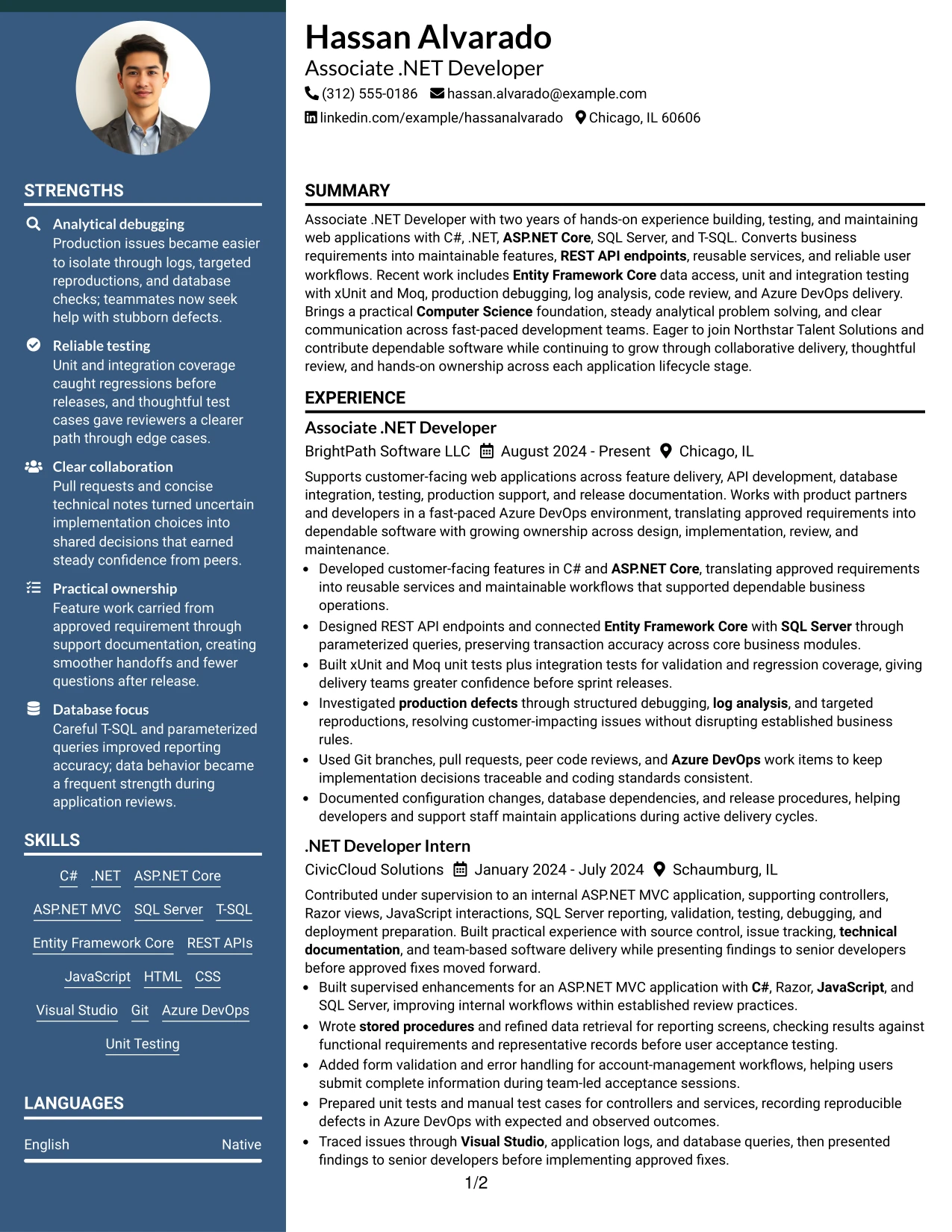
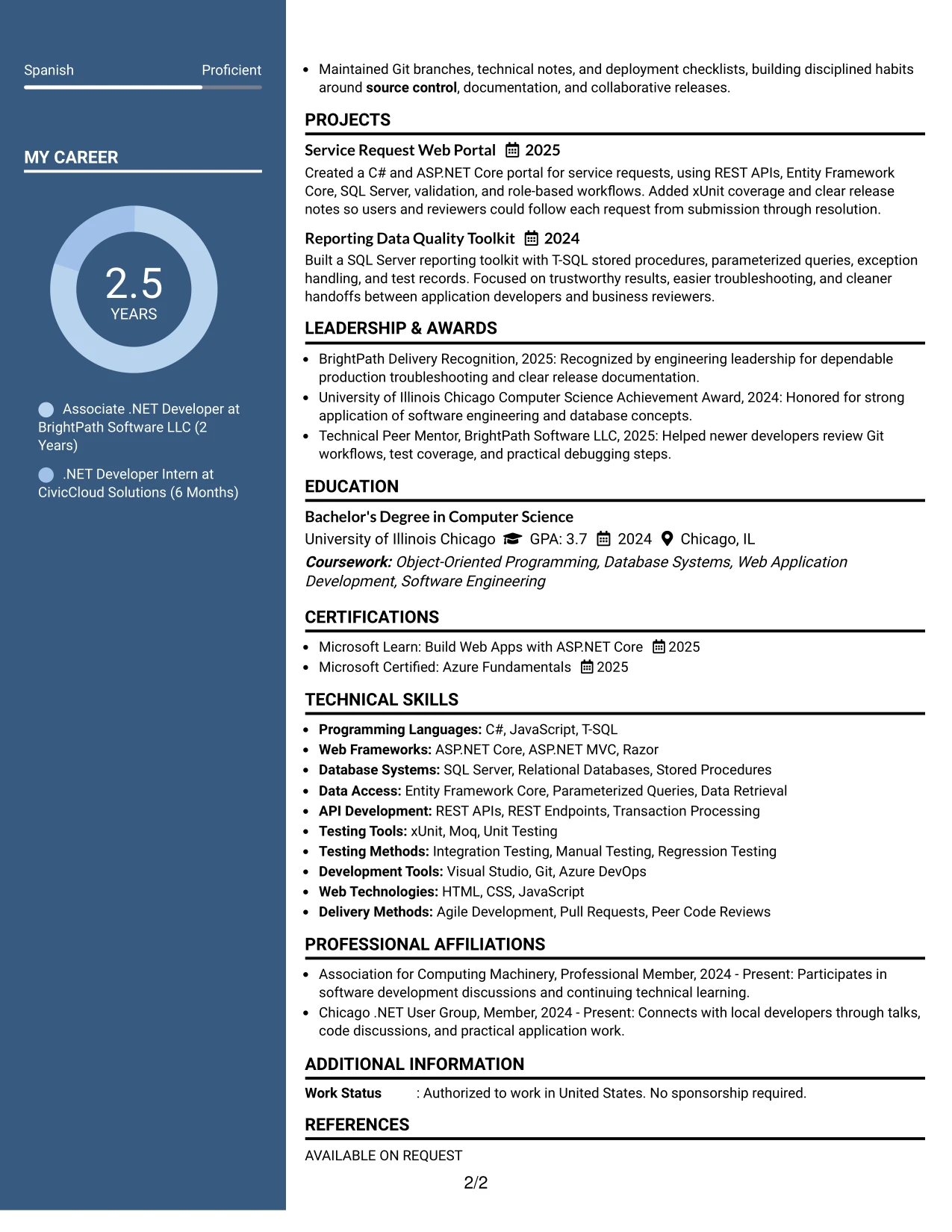
For an application that combines technical depth with quick review, the Two Column Format creates a useful division of space. One column can carry employment and project evidence, while the other organizes skills, education, certifications, and supporting details.
The visual fit is strongest when each column has a clear job. Detailed bullets can show feature development, REST endpoints, SQL Server data access, testing, and production troubleshooting; compact sections can keep the supporting keywords easy to find.
#5 Why the Two Column Format Works for a Resume
- Separate columns reduce competition between experience and supporting details.
- A compact skills area makes technical keywords easy to locate.
- The experience column can retain complete, measurable-looking action statements without inventing metrics.
- Projects can sit beside or below employment evidence in a controlled hierarchy.
- Education and certifications remain visible without taking over the page.
- The format supports a strong balance of text and white space.
- Clear column roles help readers understand where to look for each fact.
#5 Best For
- Resumes that need both detailed evidence and compact reference information.
- Applicants with a balanced mix of experience, projects, and technical skills.
- Documents where education and certifications should remain visible on page one.
- Candidates who want related tools grouped apart from longer work bullets.
- Applications reviewed quickly but supported by substantial technical content.
- Resumes that benefit from controlled white space around dense information.
- Readers comfortable comparing a main evidence area with a supporting column.
#6 Photo Header Two Column Format Resume Example
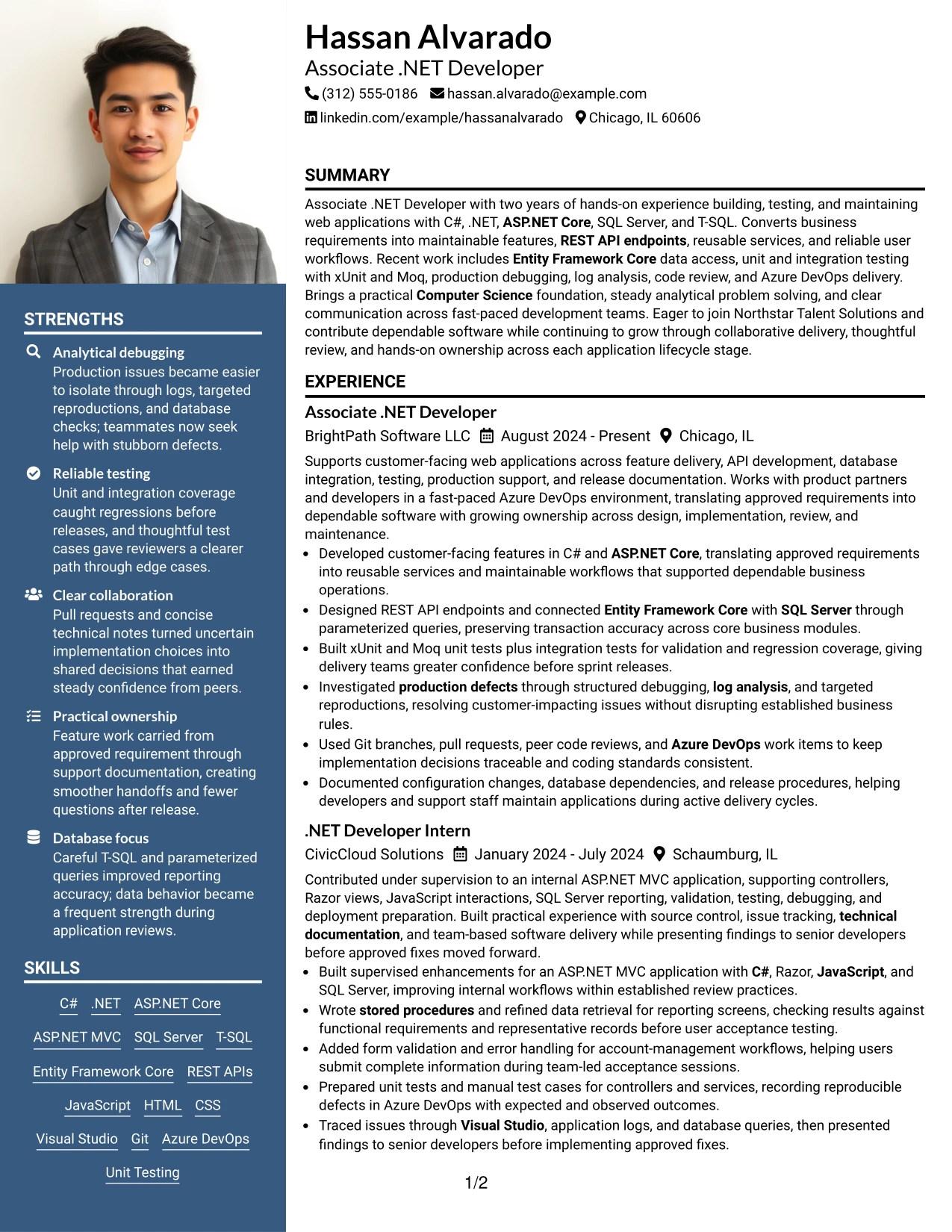
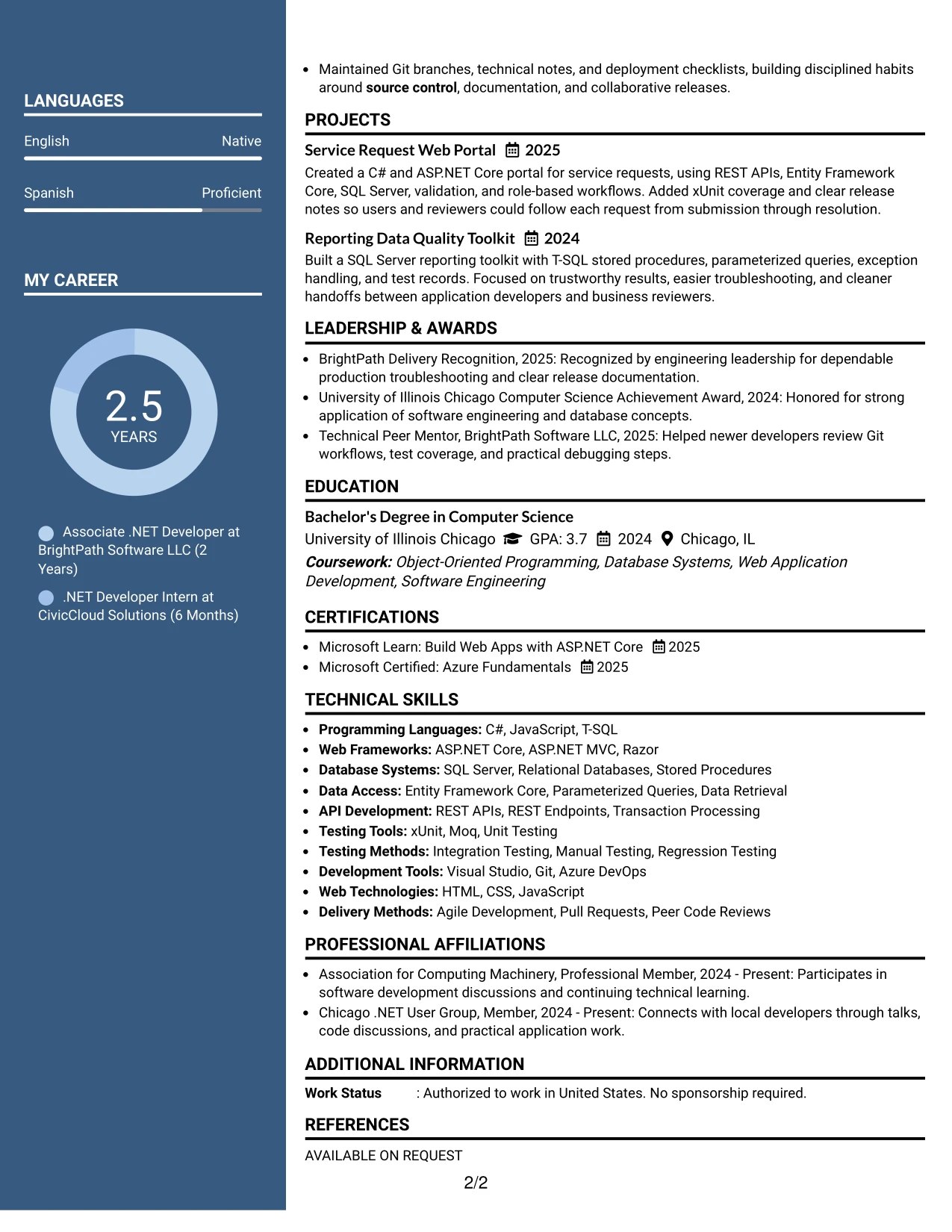
A restrained hierarchy gives the resume a polished first impression, with the photo header establishing identity before the reader reaches the two-column content. The page can then separate detailed experience from compact skills, education, projects, and certifications.
That division supports role alignment when the resume must connect a target title with specific evidence. C#, .NET, ASP.NET Core, SQL Server, REST APIs, unit testing, debugging, Git, and Azure DevOps can appear as focused keywords alongside bullets that explain how those tools were used.
#6 Why the Photo Header Two Column Format Works for a Resume
- The header makes contact information and the target role immediately visible.
- Two columns distinguish detailed work evidence from supporting facts.
- A photo can add a formal identity element when appropriate for the application.
- Grouped skills help connect the target role to specific technologies.
- Experience bullets show how tools were applied, not only listed.
- Projects can reinforce role alignment with additional development evidence.
- The hierarchy keeps credentials accessible without weakening the work history.
#6 Best For
- Applications where a photo header is suitable and professionally expected.
- Applicants who want the target role and contact details emphasized at the top.
- Resumes aligning a broad technical toolkit with focused experience evidence.
- Candidates with projects that strengthen the connection between skills and delivery.
- Documents needing a clear split between employment details and credentials.
- Visual reviews where identity, role, and technical fit should appear together.
- Readers who prefer a polished header followed by structured two-column content.
#7 Simple Two Column Format Resume Example
The Simple Two Column Format divides the resume into two practical lanes without adding visual noise. The primary area can present the summary, experience, and projects, while the secondary area keeps skills, education, certifications, and contact information easy to check.
This structure supports fast scanning and clean keyword placement. Detailed bullets can explain C# feature work, REST API endpoints, Entity Framework Core, SQL Server, testing, debugging, and Git workflows while the second column provides a compact technology reference.
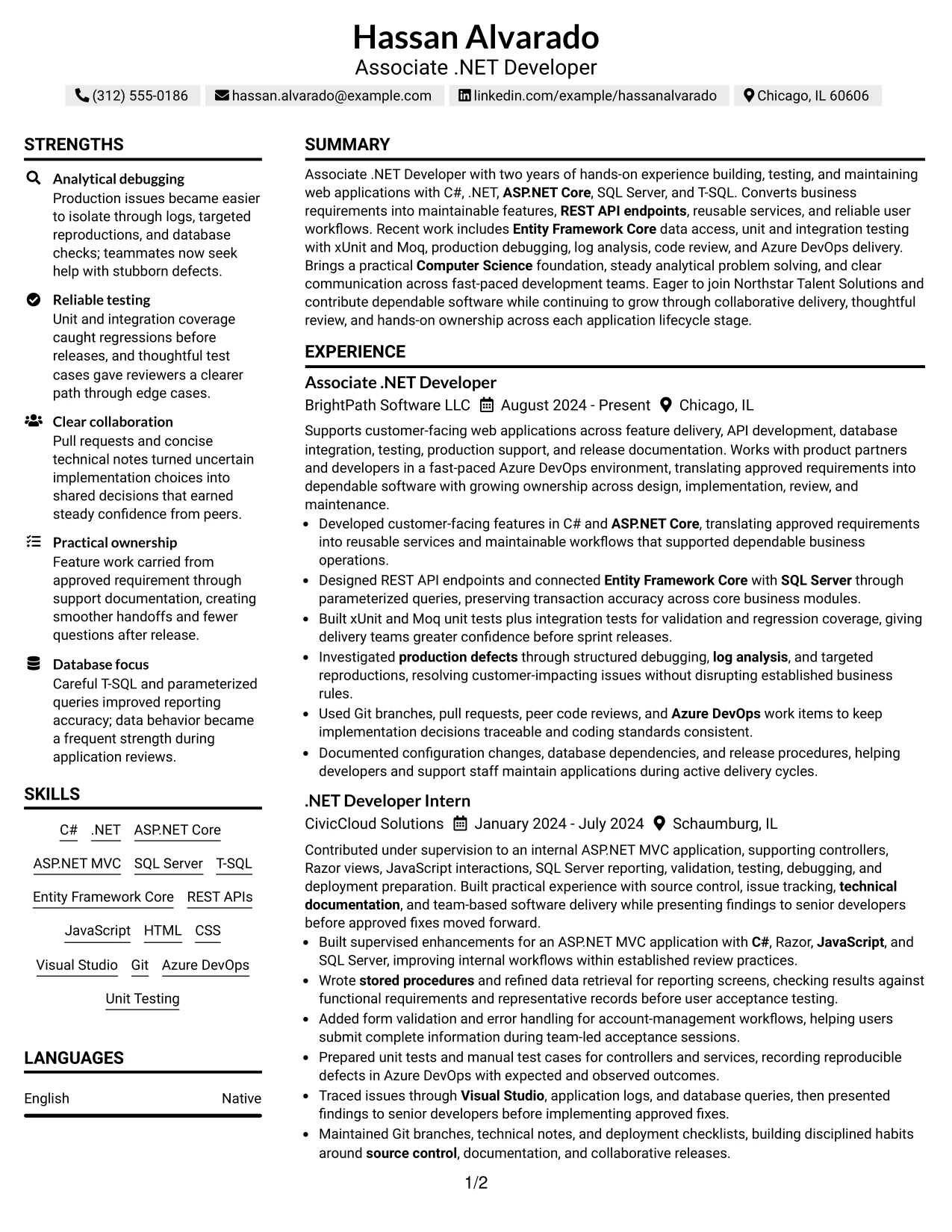
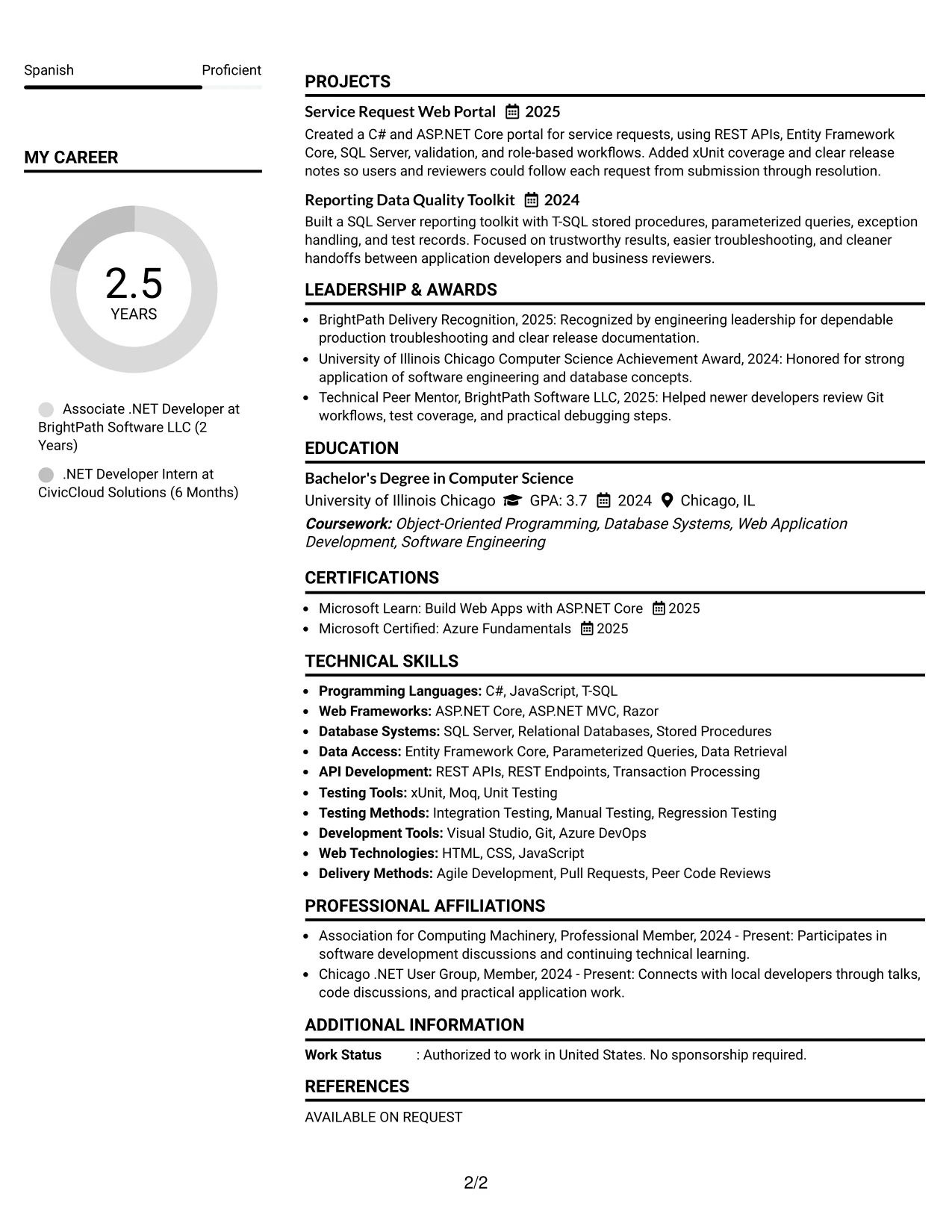
#7 Why the Simple Two Column Format Works for a Resume
- Two clear lanes shorten the search for important resume facts.
- The main lane gives experience and projects enough room for useful detail.
- The supporting lane keeps technologies grouped and readable.
- Simple styling reduces distractions during recruiter and ATS review.
- Bullets can show actions, tools, and delivery outcomes in a familiar structure.
- Education and certifications stay available without interrupting the experience sequence.
- The format works well when the resume must be concise but not sparse.
#7 Best For
- Applicants seeking a practical two-column structure with minimal decoration.
- Resumes that need a separate home for tools and technical skills.
- Candidates presenting experience and projects as the central evidence.
- Applications where quick keyword checks matter alongside human review.
- Documents with concise education and certification details.
- Readers who prefer simple visual separation instead of heavy design elements.
- Technical resumes that need efficient use of page space.
#8 Text/Fang Style Resume Example
Readers move through this text-led resume in a steady sequence, beginning with the summary and continuing through experience, projects, skills, education, and certifications. The one-column flow keeps every section in view and gives technical bullets room to explain the work.
A content-rich version can include application features, API design, database queries, test coverage, debugging methods, code review, and release documentation. Text-first organization also keeps important ATS terms connected to the evidence that supports them.
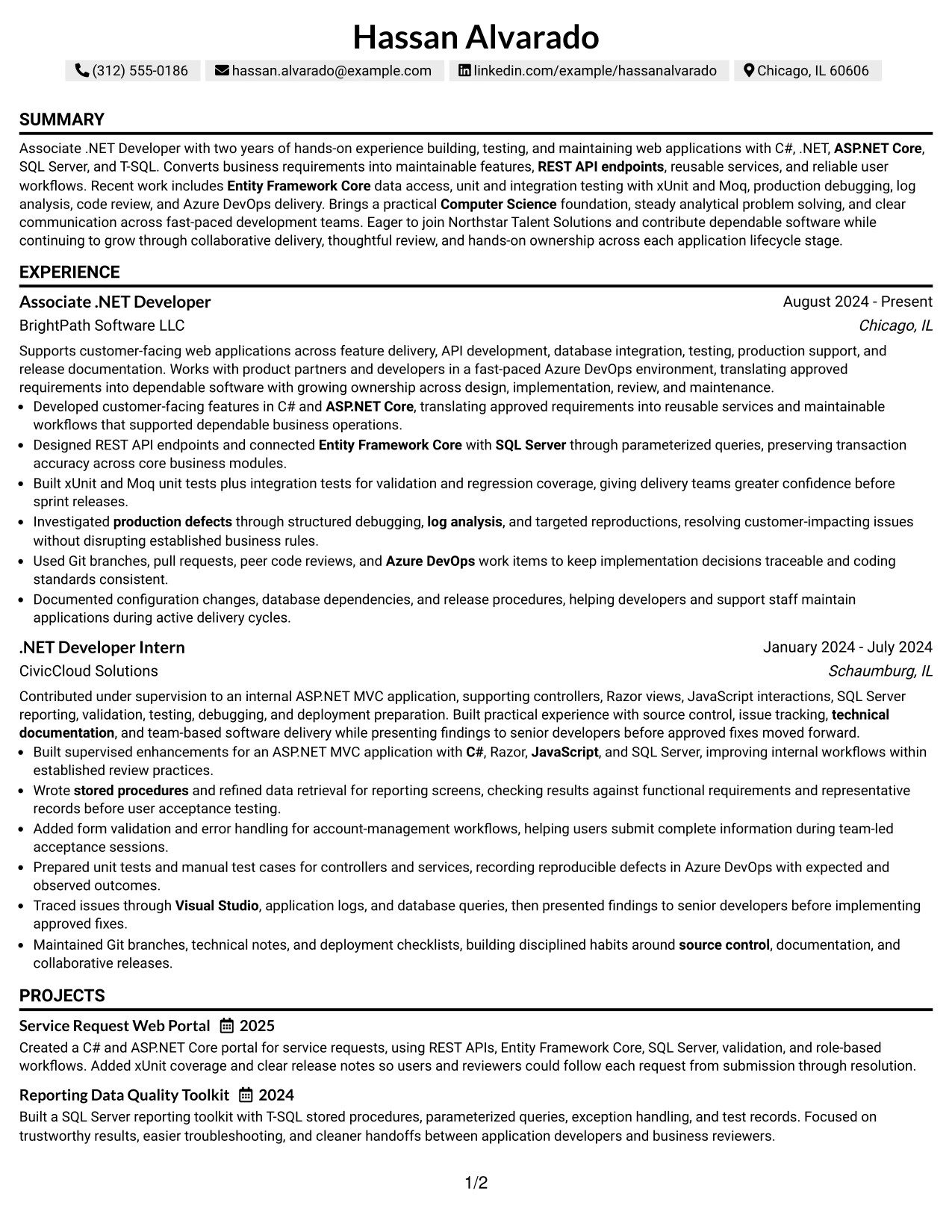
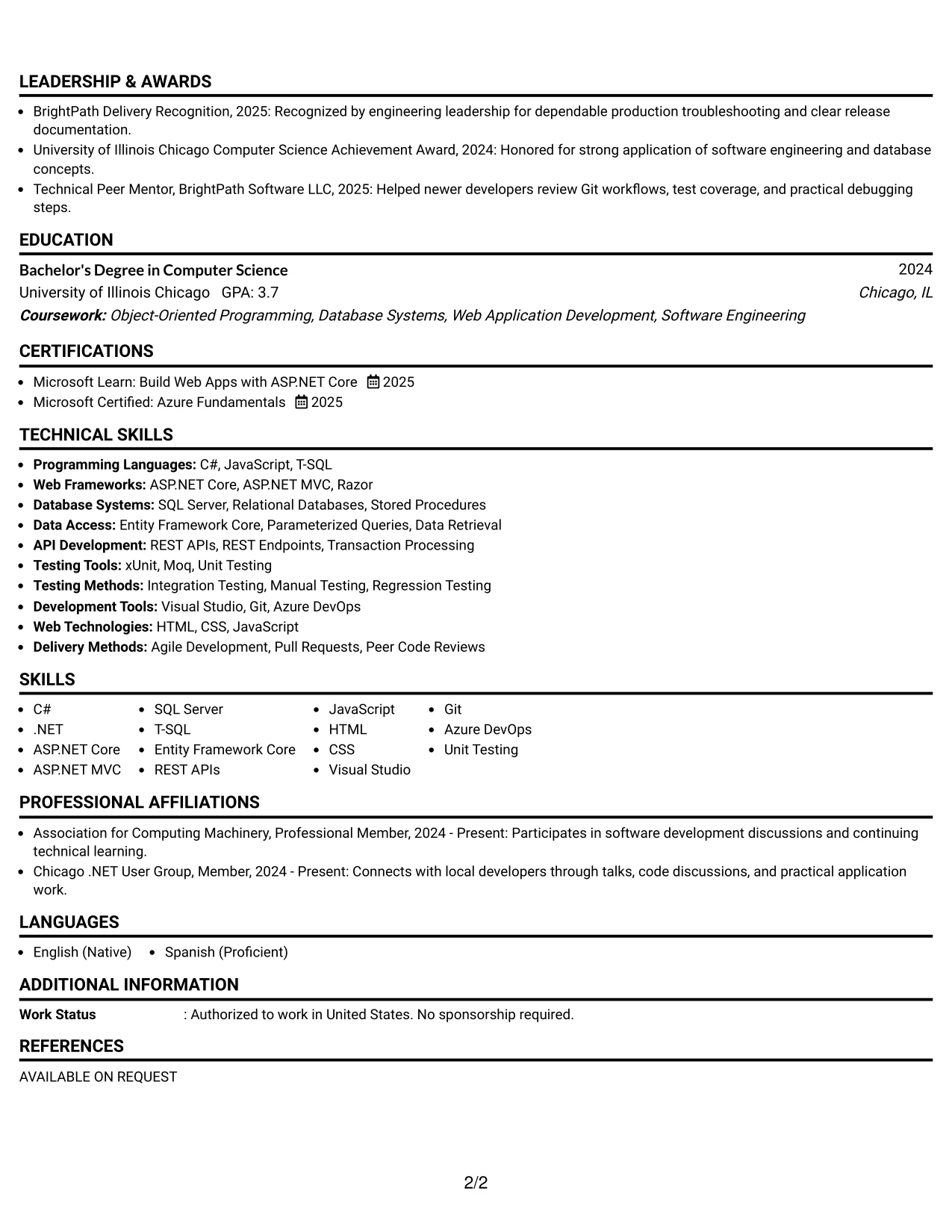
#8 Why the Text/Fang Style Works for a Resume
- The text-led flow keeps the review path predictable.
- One column gives complex technical details enough horizontal space.
- Experience bullets can include tools, methods, and application context.
- Projects extend the evidence without competing with the main employment section.
- Skills remain searchable when paired with supporting work examples.
- Standard headings help ATS systems interpret each resume section.
- The format supports a detailed record without relying on decorative elements.
#8 Best For
- Resumes that depend on written evidence more than visual decoration.
- Applicants with several technical projects or detailed responsibilities.
- Candidates who need room to explain testing, debugging, and database work.
- Applications where ATS readability is a primary presentation need.
- Documents with a substantial skills list that should remain searchable.
- Readers who prefer a continuous, text-focused review experience.
- Technical resumes requiring clear context around tools and methods.
#9 One Column Boxed Contact Header Format Resume Example
The strongest evidence begins below a boxed contact header that quickly identifies the candidate, target role, location, and contact details. From there, a one-column structure gives experience, projects, skills, education, and certifications a clear downward sequence.
This format works especially well when technical proof needs to be easy to verify. Bullets can connect C#, ASP.NET Core, SQL Server, REST APIs, xUnit, Moq, production debugging, and Azure DevOps to specific responsibilities rather than leaving them as isolated keyword lists.
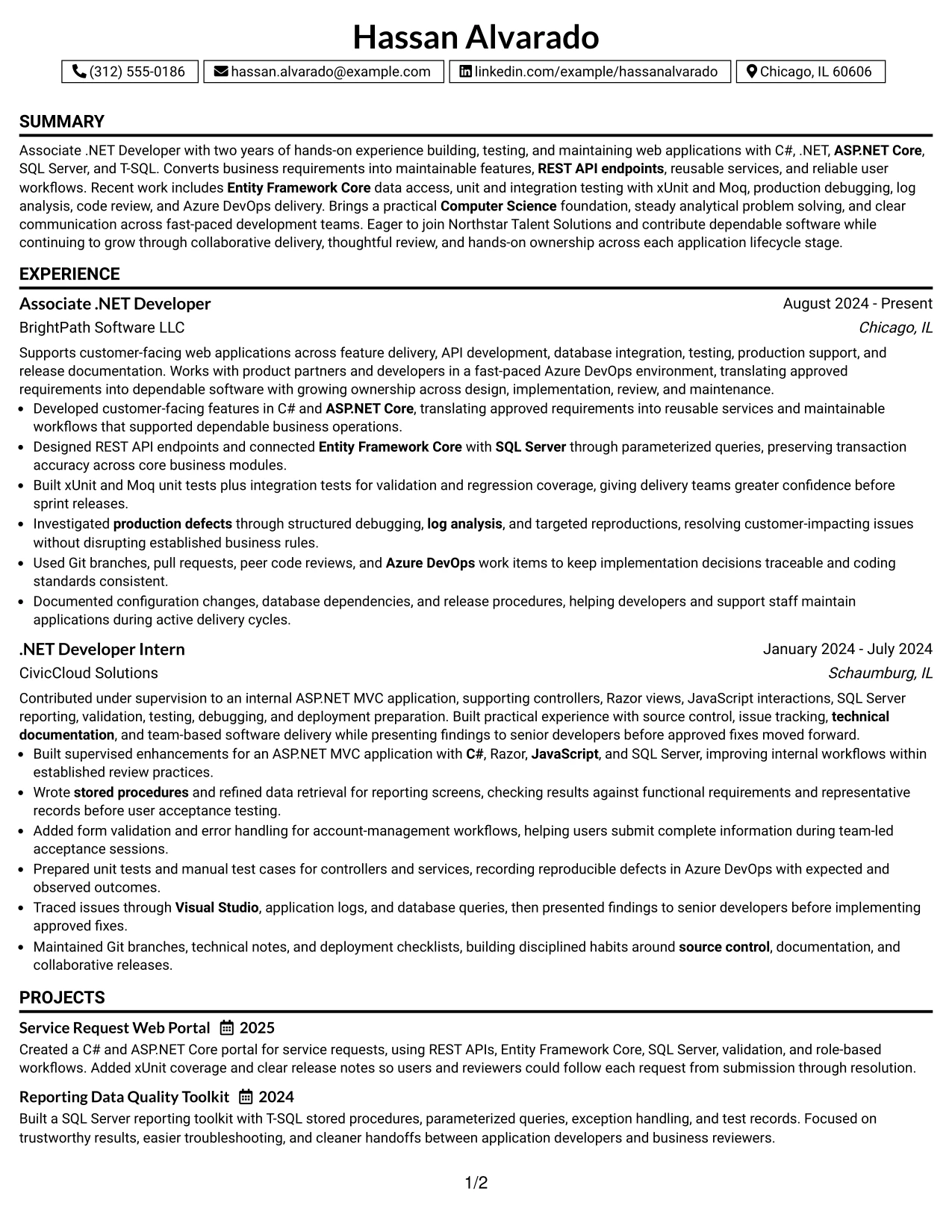
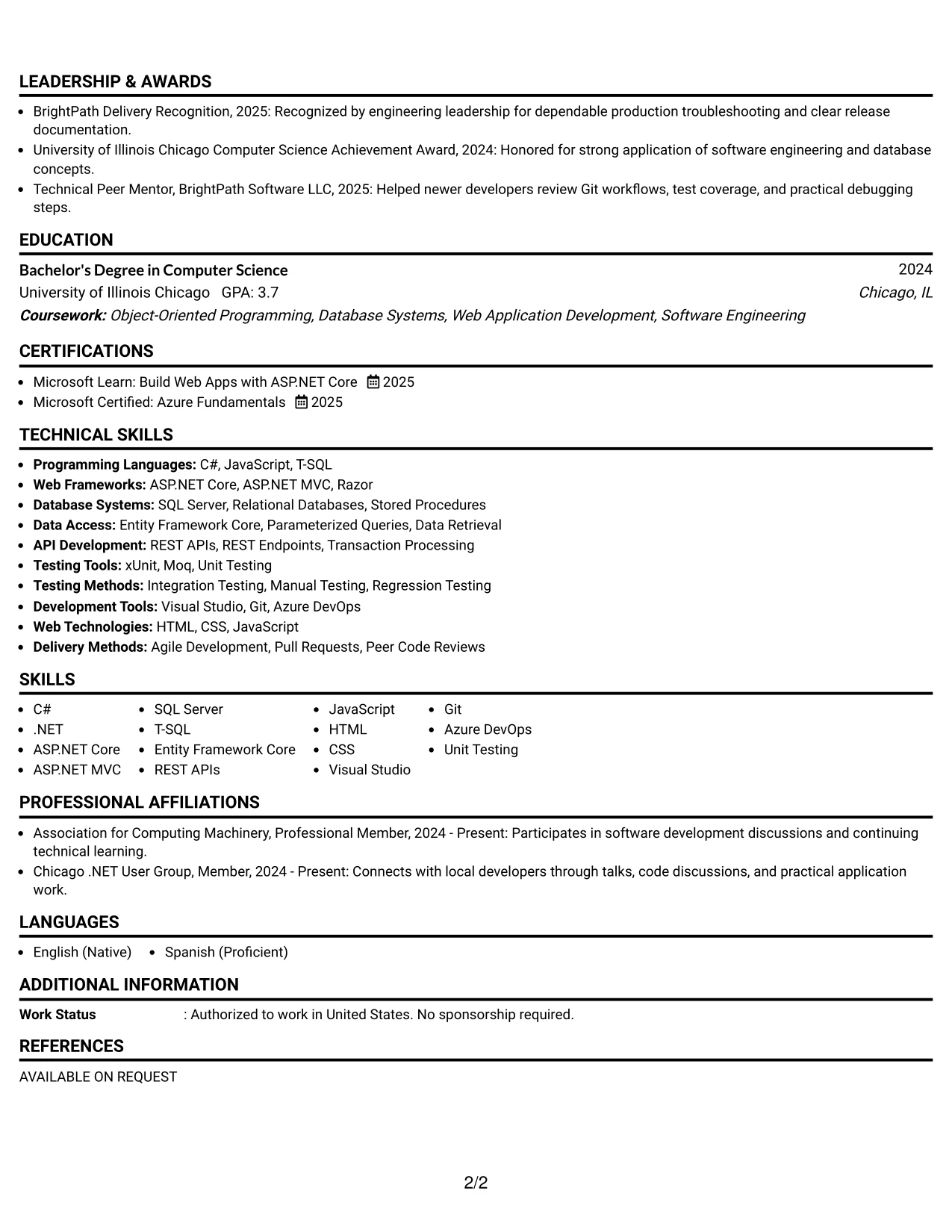
#9 Why the One Column Boxed Contact Header Format Works for a Resume
- The boxed header separates contact facts from professional evidence.
- A clear target role supports immediate role identification.
- One-column reading keeps experience and project details in sequence.
- Technical keywords appear beside the work that demonstrates them.
- Bullets make testing, debugging, and API contributions easy to verify.
- A dedicated skills area supports quick tool matching.
- The lower sections provide a clean place for education and certifications.
#9 Best For
- Applications where contact details and target role must be unmistakable.
- Applicants who want the evidence section to start immediately below the header.
- Resumes matching technical keywords to specific work examples.
- Candidates with projects that add useful proof after employment history.
- Documents needing a strong text path for ATS and recruiter review.
- Readers who value a defined contact block above a conventional resume body.
- Professional presentations that benefit from a structured, contained header.
#10 Plain Two Column Format Resume Example
A balanced page can help an application reviewer compare detailed experience with compact supporting information. The Plain Two Column Format places work history and projects in one area, while skills, education, certifications, and contact details occupy the other.
For this Associate .NET Developer resume, the layout keeps the target role connected to evidence in C#, .NET, SQL Server, ASP.NET Core, REST APIs, testing, and debugging. A concise keyword block can strengthen ATS matching without replacing accomplishment-focused bullets.
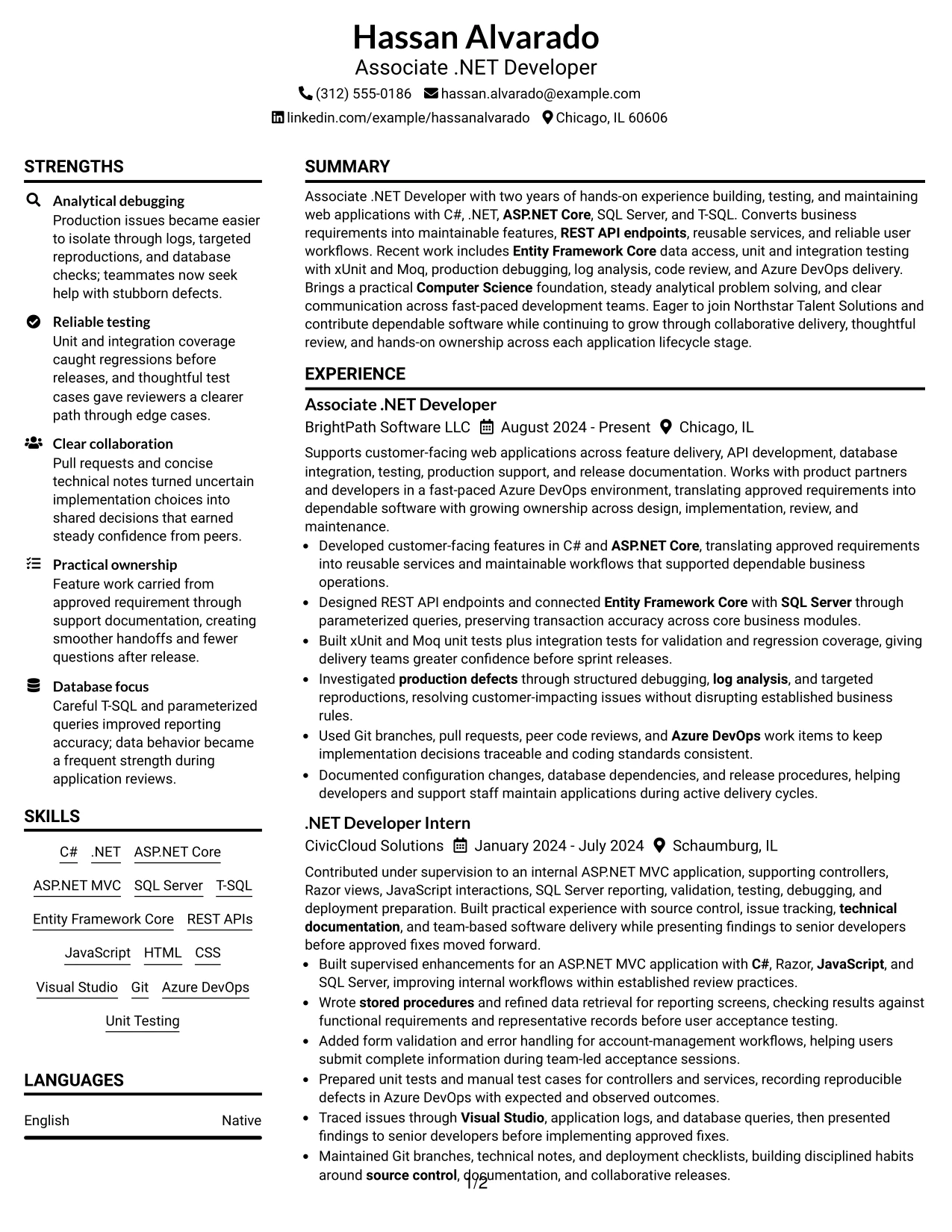
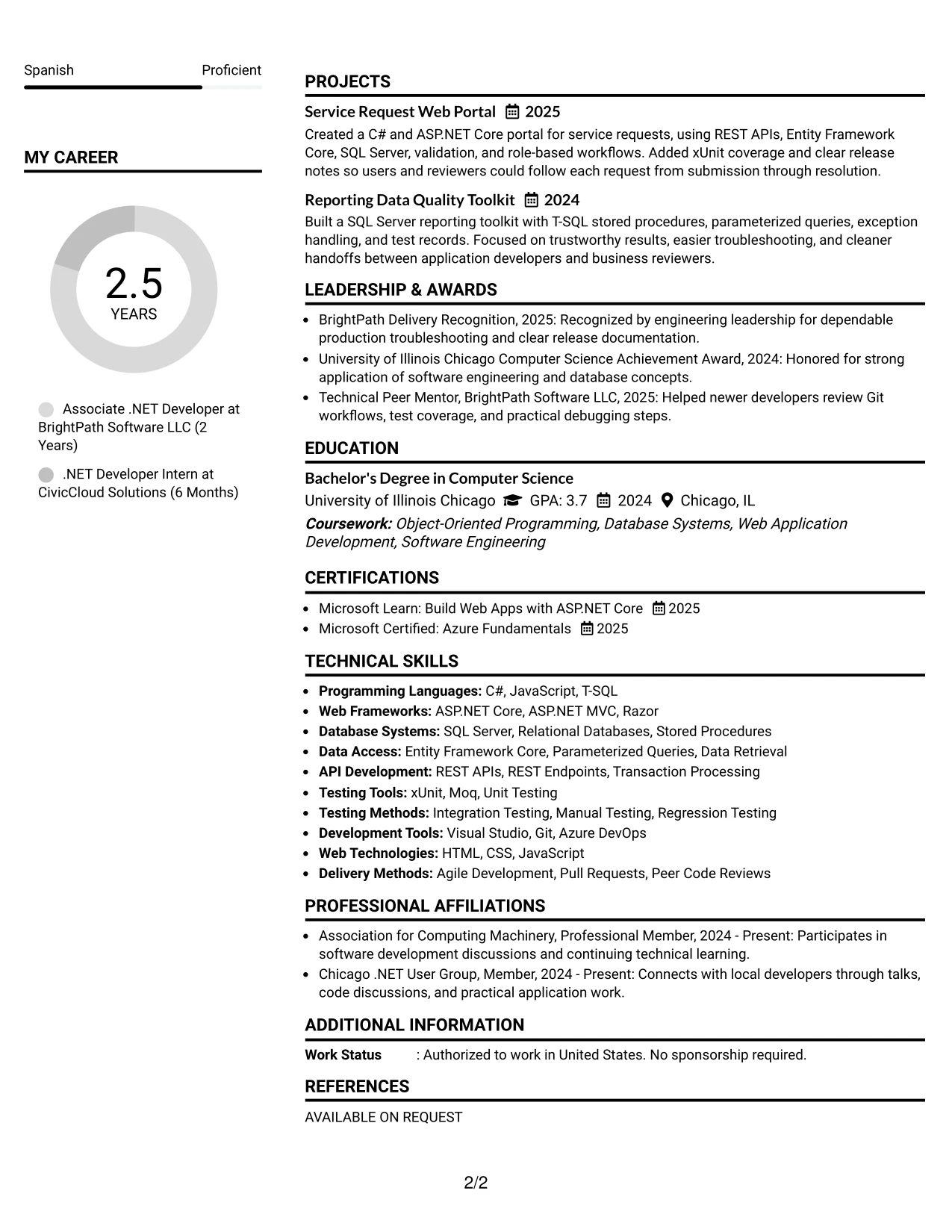
#10 Resume Snapshot
- Two-column structure balances experience with supporting credentials.
- Core technologies include C#, .NET, ASP.NET Core, SQL Server, and REST APIs.
- Testing evidence includes xUnit, Moq, unit testing, and integration testing.
- Education includes a 2024 Bachelor of Science in Computer Science.
#10 Why the Plain Two Column Format Works for a Resume
- Balanced columns make dense information easier to organize.
- The main content area protects space for detailed experience bullets.
- A supporting column keeps skills and education visible during scanning.
- The plain presentation supports ATS-friendly text structure.
- Projects can reinforce experience without creating a crowded page.
- Certifications add current learning evidence in a defined location.
- The format helps readers compare role requirements with documented skills.
#10 Resume Keywords
- Associate .NET Developer
- C#
- SQL
- ASP.NET Core
- SQL Server
- T-SQL
- Entity Framework Core
- REST APIs
- xUnit
- Moq
- Unit Testing
- Integration Testing
- Debugging
- Azure DevOps
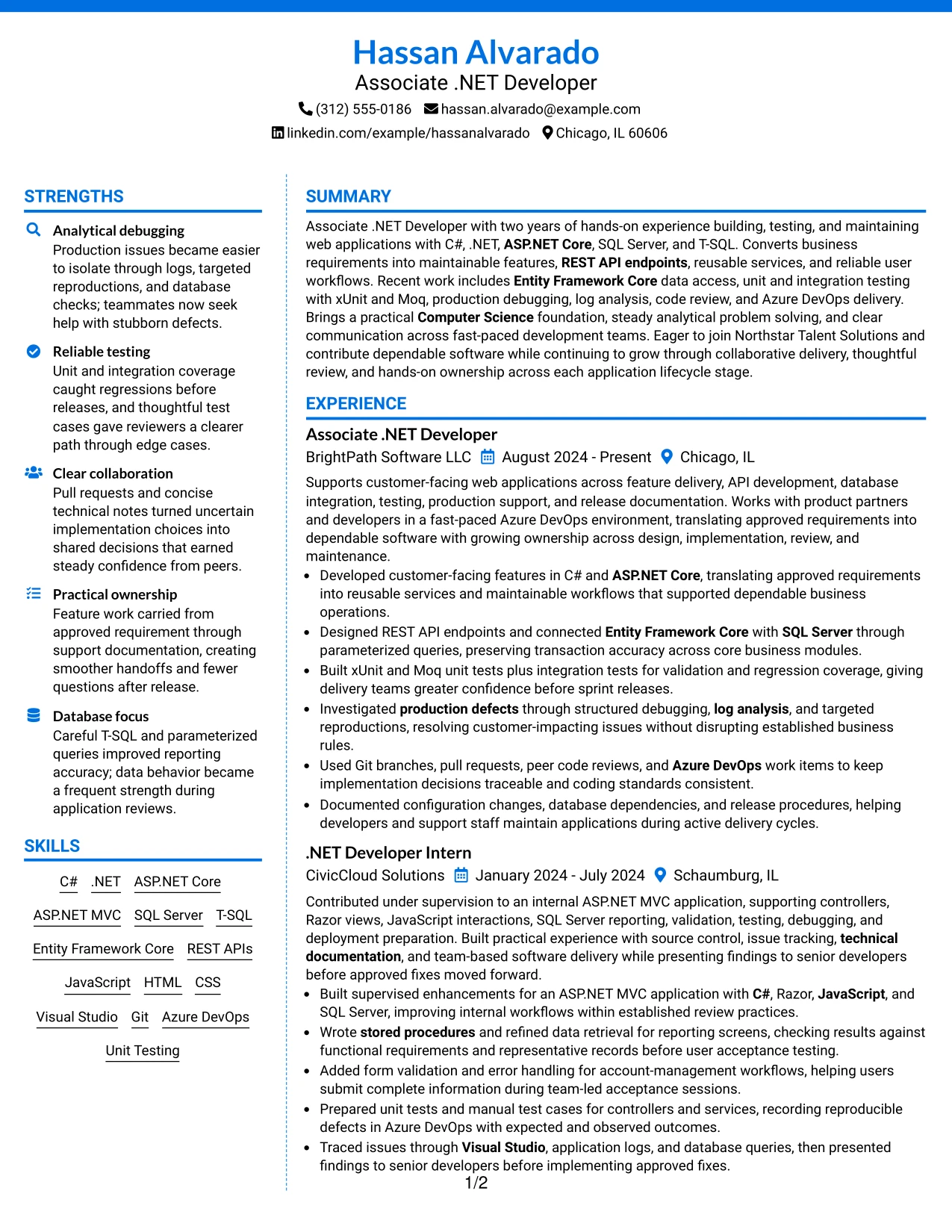
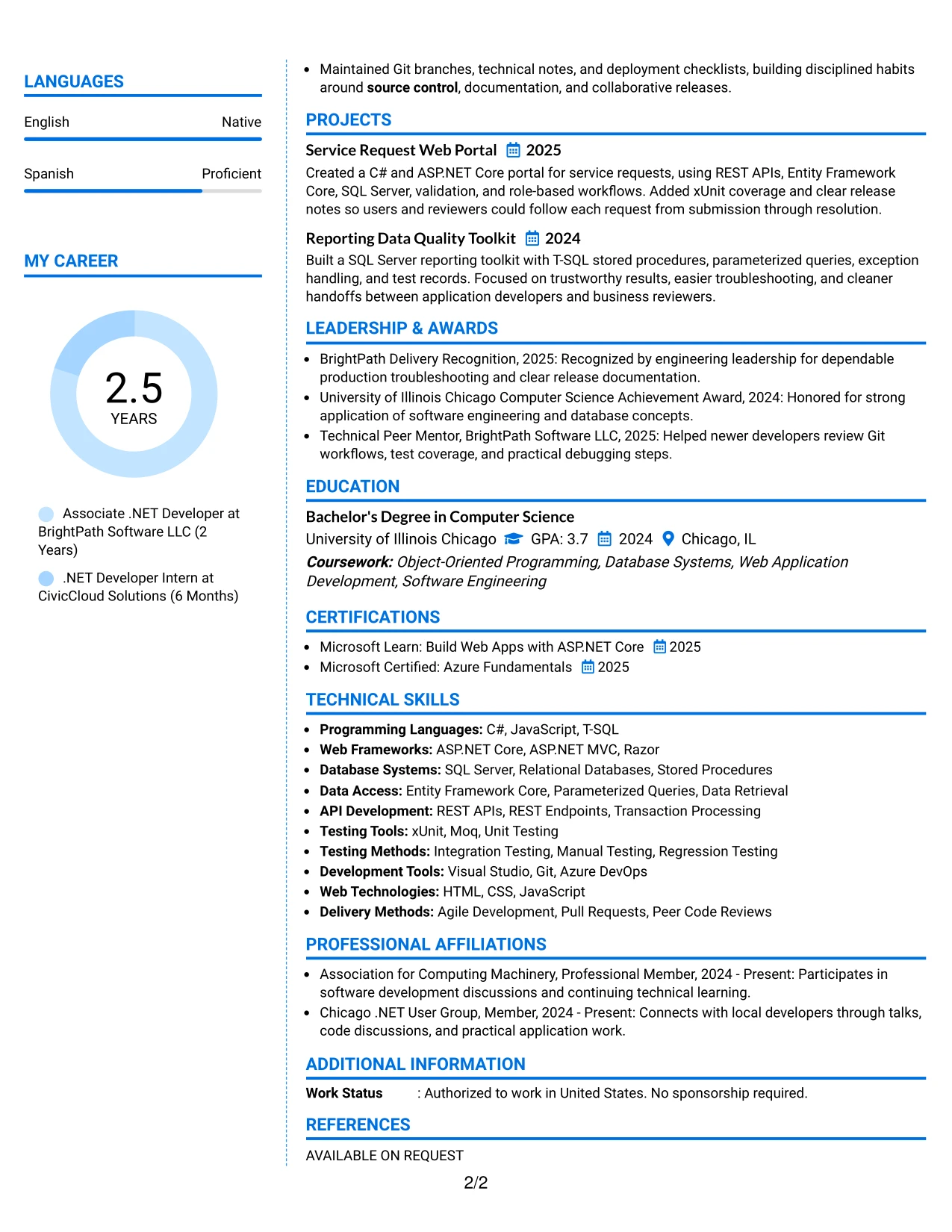
#11 Colored Two Column Format Resume Example
In a practical application review, the Colored Two Column Format uses controlled color to separate information without hiding the evidence. One column can carry the summary, employment history, and projects, while the other presents skills, education, certifications, and supporting details.
The visual fit is strongest when color supports hierarchy rather than competing with content. A recruiter can quickly locate C#, ASP.NET Core, SQL Server, REST APIs, testing tools, Git, and Azure DevOps, then review bullets that show development, troubleshooting, and release support.
#11 Why the Colored Two Column Format Works for a Resume
- Color can guide attention to sections while preserving a clear text hierarchy.
- Two columns separate proof of experience from quick-reference details.
- The main area gives application and project bullets room to develop evidence.
- A skills grouping makes technical keywords easy to find.
- Consistent headings support both visual review and ATS interpretation.
- Education and certifications remain distinct from employment history.
- Controlled visual contrast helps the resume stand out without reducing readability.
#11 Best For
- Applications where modest color can improve section navigation.
- Applicants wanting a polished layout with clearly separated information zones.
- Candidates combining detailed experience with a broad technical skills list.
- Documents that need projects and credentials visible without taking over the page.
- Technical resumes reviewed for both visual clarity and keyword coverage.
- Readers who benefit from color-supported hierarchy but still need plain text access.
- Presentations where visual fit should reinforce, not replace, documented evidence.
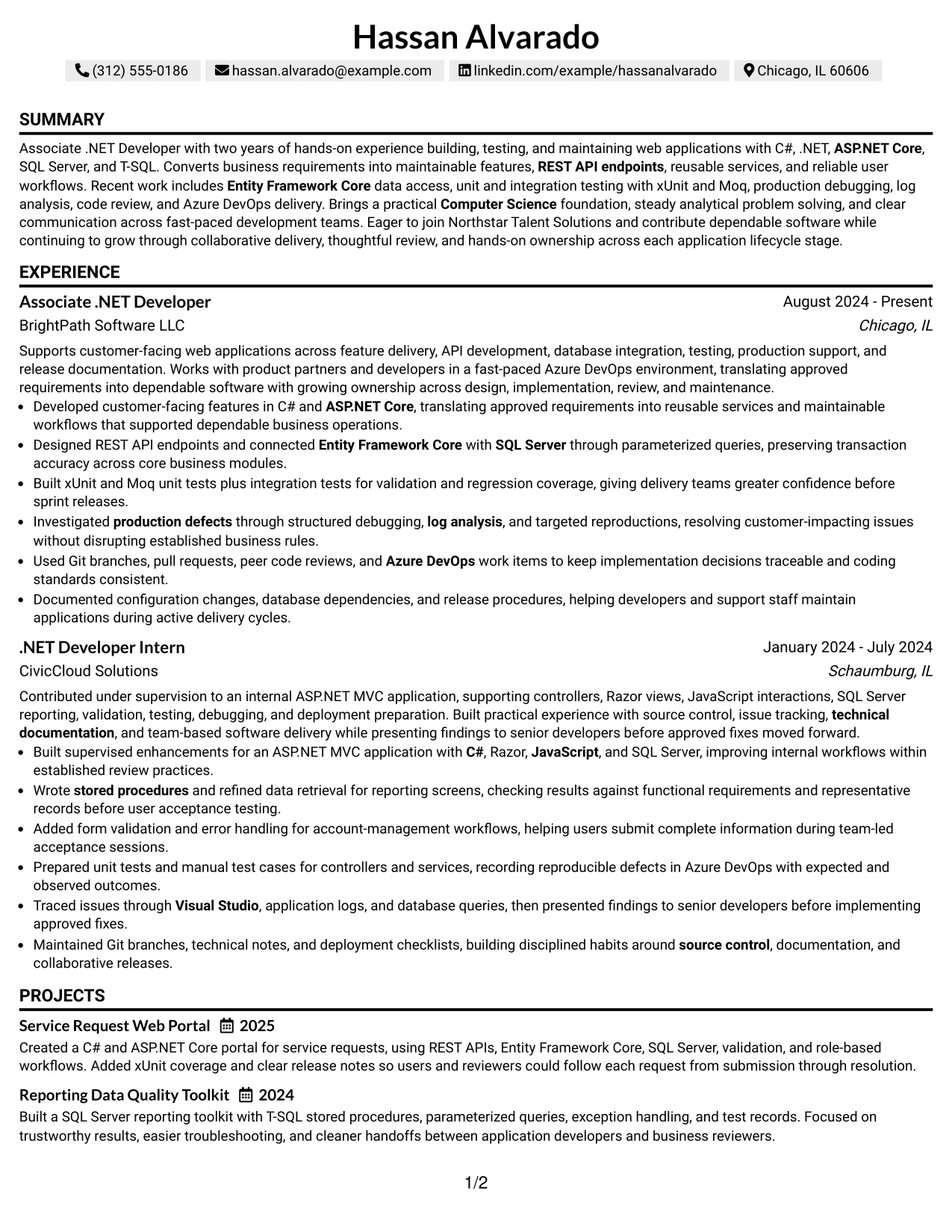
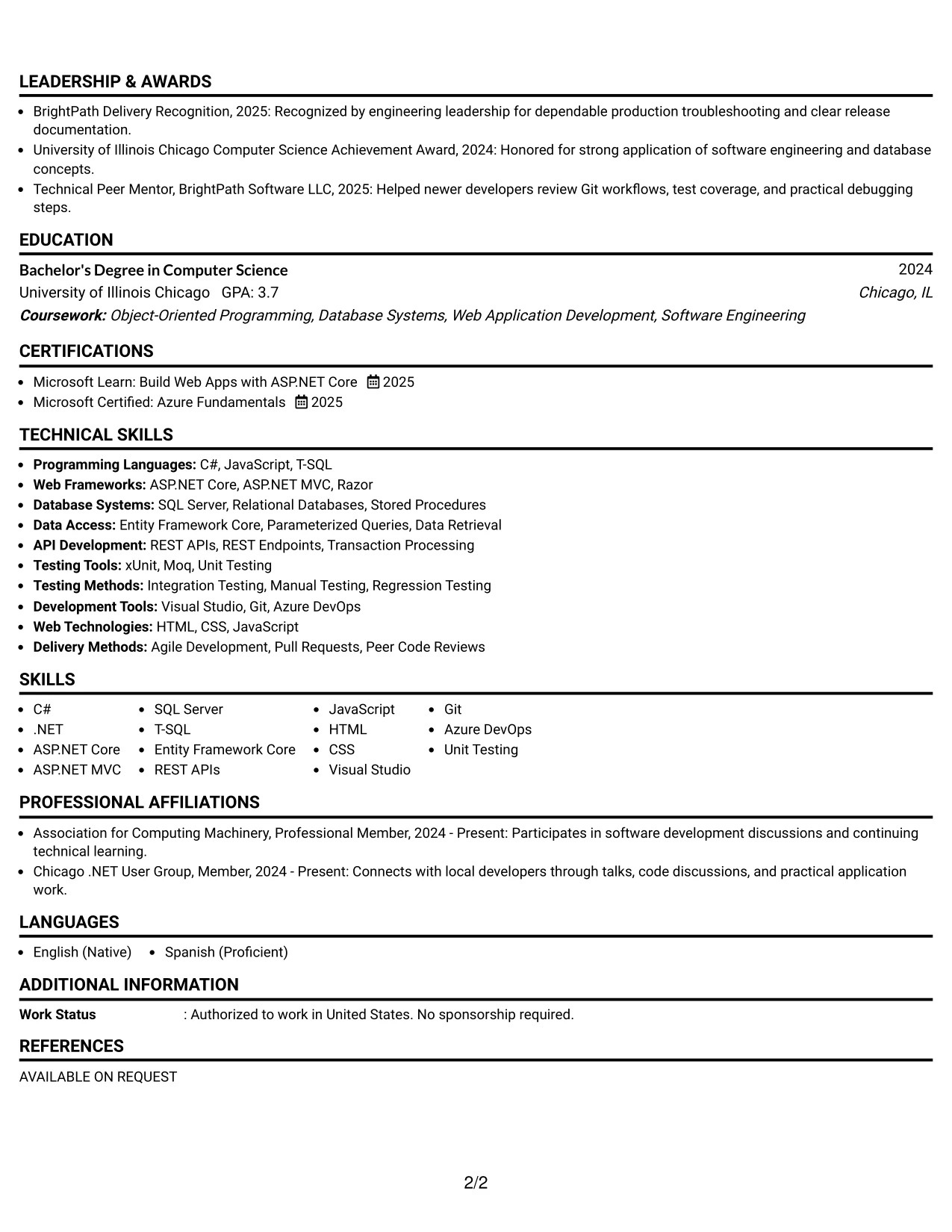
#12 One Column Shaded Contact Header Format Resume Example
A restrained visual hierarchy gives the contact header clear focus before the reader reaches the resume content. The single-column structure then presents Hassan Alvarado's Associate .NET Developer experience, education, projects, certifications, and skills in a direct order.
Shaded labels separate major resume sections without competing with technical evidence. C#, ASP.NET Core, SQL Server, REST APIs, testing, debugging, and Azure DevOps remain easy to find for both quick review and ATS parsing.
Why the One Column Shaded Contact Header Format Works for a Resume
- A centered contact header makes the name, location, phone, email, and LinkedIn details easy to locate.
- One-column reading supports a reliable top-to-bottom scan on a screen or printed page.
- Shaded section labels create visible breaks between the summary, experience, education, projects, certifications, and skills.
- Standard headings and simple text flow help ATS tools identify resume sections accurately.
- Full-width experience bullets give technical achievements enough room for clear action and result statements.
- The format keeps C#, .NET, ASP.NET Core, SQL Server, and REST APIs visible without crowding the page.
- A balanced presentation supports a candidate with hands-on development experience and a Computer Science degree.
Best For
- Applicants who want a direct one-column presentation for software development roles.
- Resumes that need strong alignment between a target title, summary, and technical skills.
- Candidates with several technical sections that benefit from full-width detail.
- Readers who prefer a calm visual hierarchy with clear section boundaries.
- ATS-conscious applications that require conventional headings and linear content.
- Resumes combining professional experience, projects, education, and certifications.
- Candidates who want measurable or evidence-based bullets to remain prominent.
- Applications reviewed on both desktop screens and standard printed pages.
#13 Boxed Contact Header with Job Title Format Resume Example
The Boxed Contact Header with Job Title Format places the target role beside the contact information, creating an immediate point of reference. From there, the one-column resume moves through the summary, experience, education, projects, certifications, and skills in a predictable sequence.
A compact box adds emphasis without hiding the evidence beneath it. Recruiters and ATS tools can quickly connect Associate .NET Developer, C#, .NET, web applications, SQL Server, testing, and debugging to the detailed resume bullets.
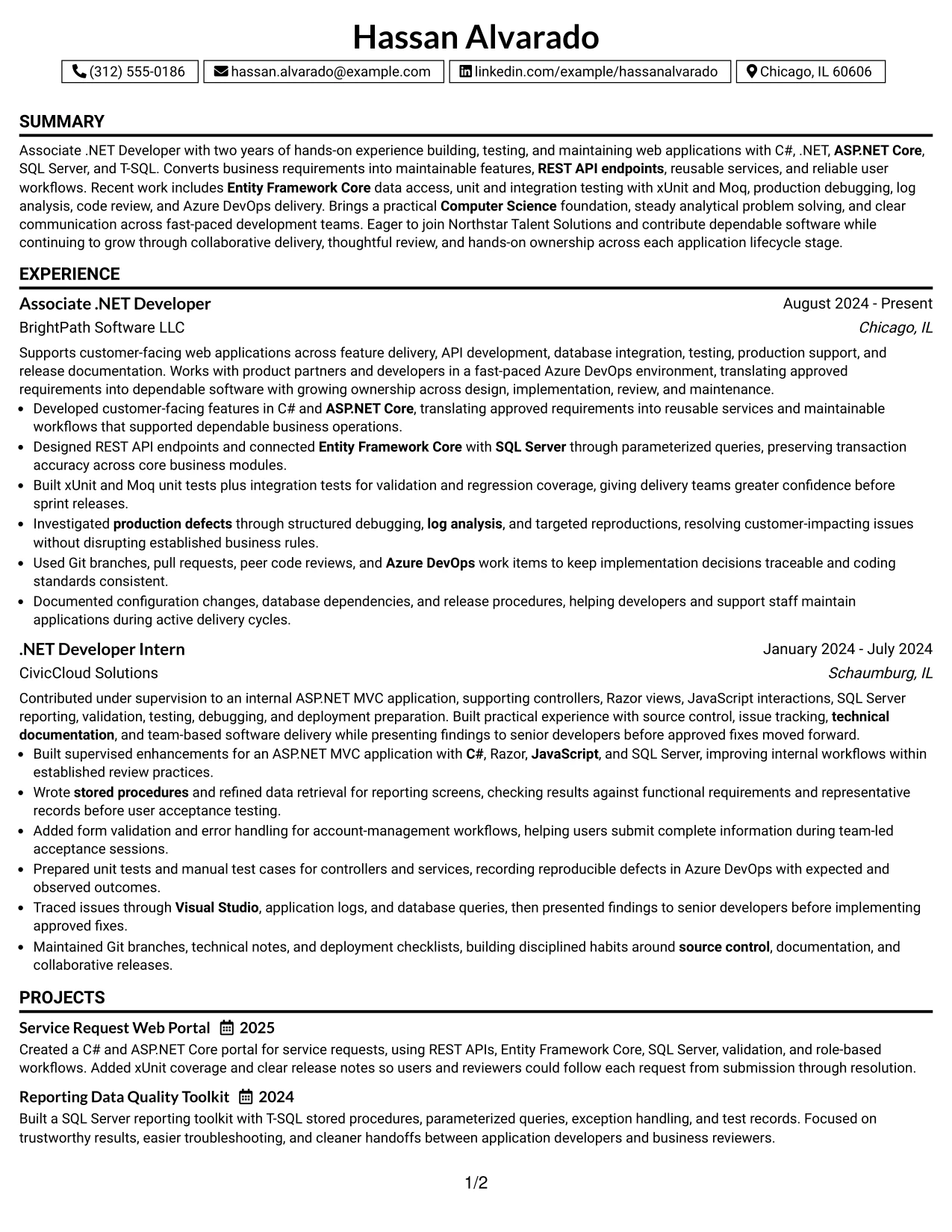
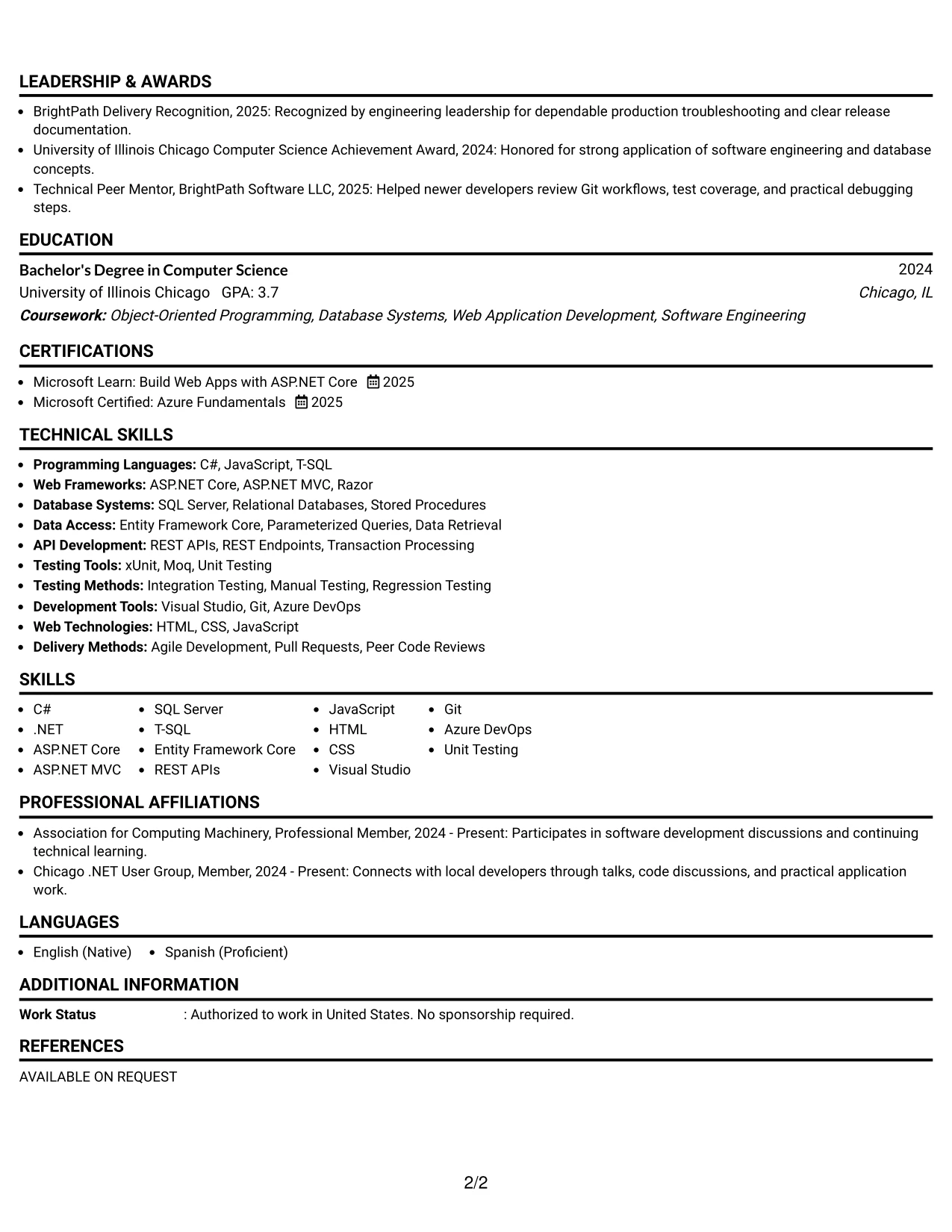
Why the Boxed Contact Header with Job Title Format Works for a Resume
- The boxed header establishes the target role before the reader scans the body.
- A visible job title helps connect the professional summary to the selected position.
- The one-column structure keeps dates, employers, education, and projects in a consistent reading path.
- Clear section labels support quick navigation during an initial resume review.
- Conventional text placement reduces the risk of important keywords being missed by ATS software.
- Experience bullets can explain API development, database work, testing, and production debugging without narrow columns.
- The format gives technical content a polished frame while keeping the resume professional and readable.
Best For
- Applications where the target role should be visible at the top of page one.
- Resumes that need a clear connection between the headline and technical evidence.
- Candidates who want a structured format for detailed work history.
- ATS-focused submissions using familiar sections and straightforward text order.
- Readers who scan by role title, employer, dates, and skill terms.
- Documents that include projects alongside professional experience.
- Applicants who need room for testing, database, API, and debugging bullets.
- A polished resume that remains simple to review and print.
#14 Stylish Two Column Designer Format Resume Example
Readers can move from the sidebar's compact profile details and skills to the main column's experience and project evidence. This two-column arrangement helps organize Hassan Alvarado's technical toolkit while preserving space for detailed C# and .NET achievements.
The sidebar can carry contact details, education, certifications, or grouped tools, while the wider column holds action-led bullets. Used carefully, the design supports content volume without weakening keyword visibility for ASP.NET Core, SQL Server, T-SQL, REST APIs, and testing.
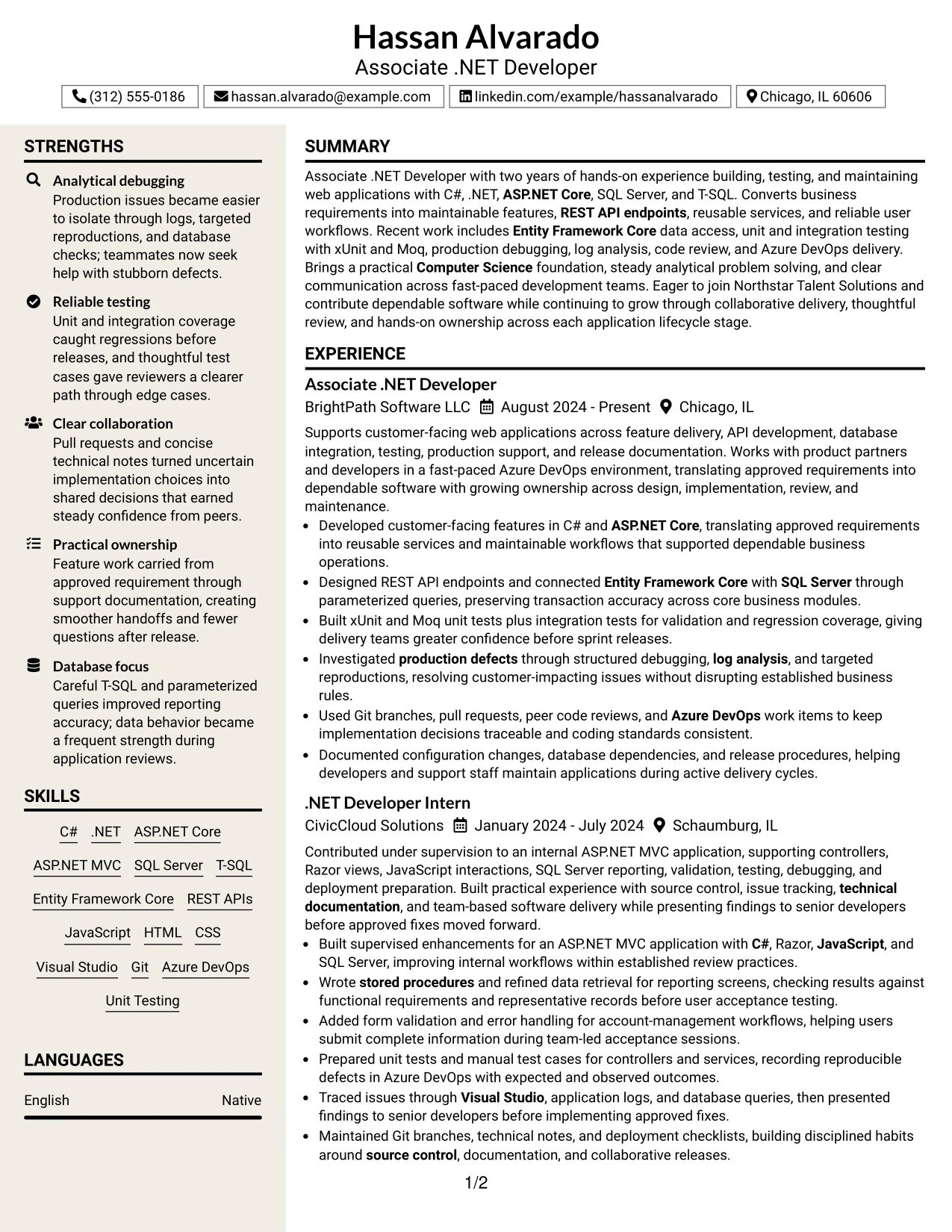
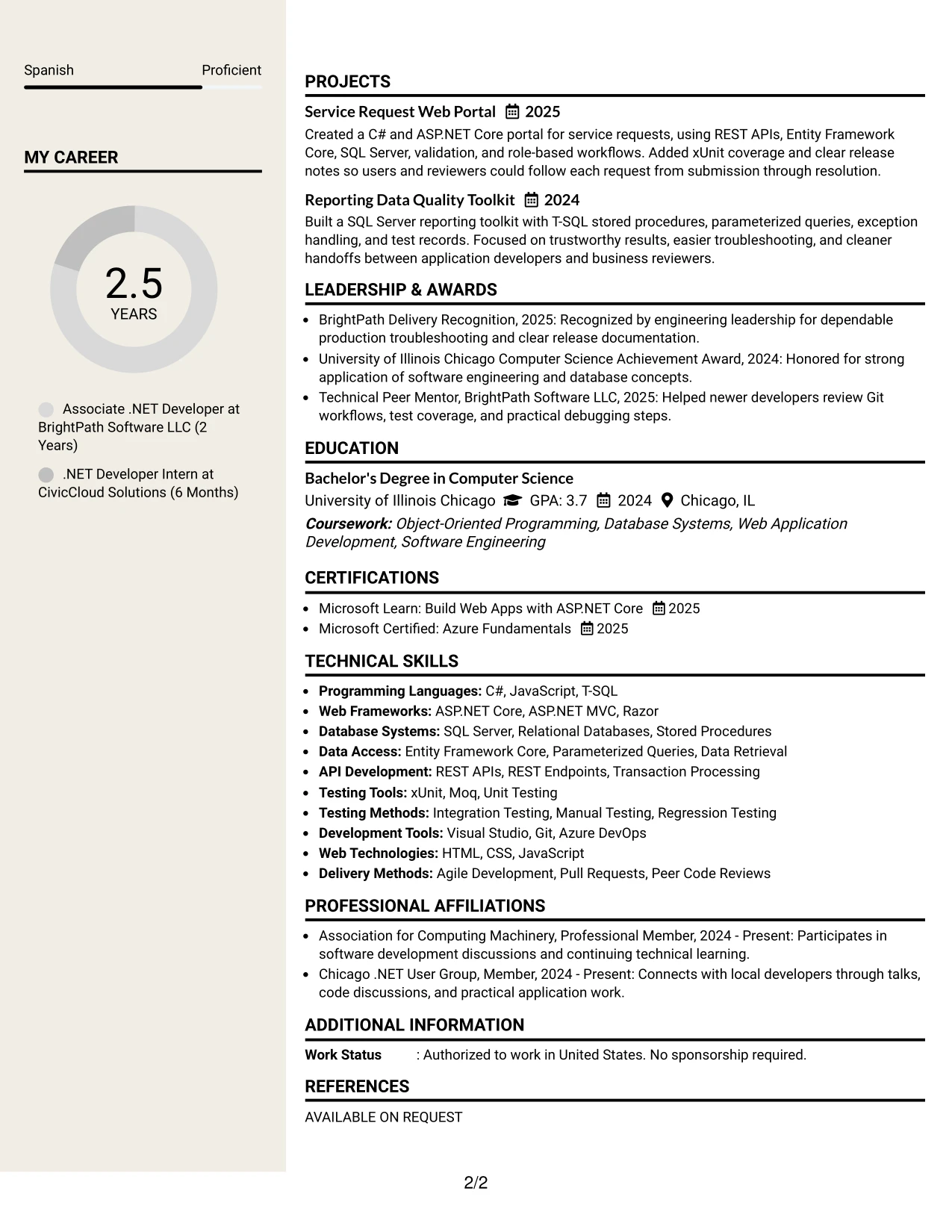
Why the Stylish Two Column Designer Format Works for a Resume
- A sidebar gives high-value skills and contact details a dedicated scanning zone.
- The wider main column provides room for experience bullets and project descriptions.
- Grouped technologies can be organized as C#, ASP.NET Core, SQL Server, testing tools, and delivery tools.
- Two-column separation reduces long uninterrupted blocks of text.
- Clear visual contrast helps readers distinguish supporting information from career evidence.
- The main column can show REST endpoint work, Entity Framework Core, debugging, and release documentation in detail.
- Consistent headings and readable text still give ATS systems a clear content sequence when the file is exported correctly.
Best For
- Resumes with a broad technical skills inventory and detailed experience bullets.
- Applicants who need a sidebar for tools, certifications, education, or contact details.
- Candidates presenting both professional work and substantial project evidence.
- Readers who benefit from separating quick facts from achievement-focused content.
- Applications where compact organization can reduce unnecessary page length.
- Portfolios or resume packages that need a stronger visual identity than a basic one-column page.
- Technical candidates whose main column must preserve room for implementation details.
- Careful PDF applications where the two-column order remains readable after export.
#15 Modern Icon Format Resume Example
Production debugging, tested releases, and maintainable web features receive priority in this resume presentation. Those evidence types show how technical skills were used, rather than leaving C#, .NET, SQL Server, and ASP.NET Core as a disconnected list.
Small visual markers guide the eye toward contact details and section changes, while the one-column body keeps the evidence in a familiar order. Strong bullets can connect REST APIs, Entity Framework Core, xUnit, Moq, Azure DevOps, and application support to specific work.
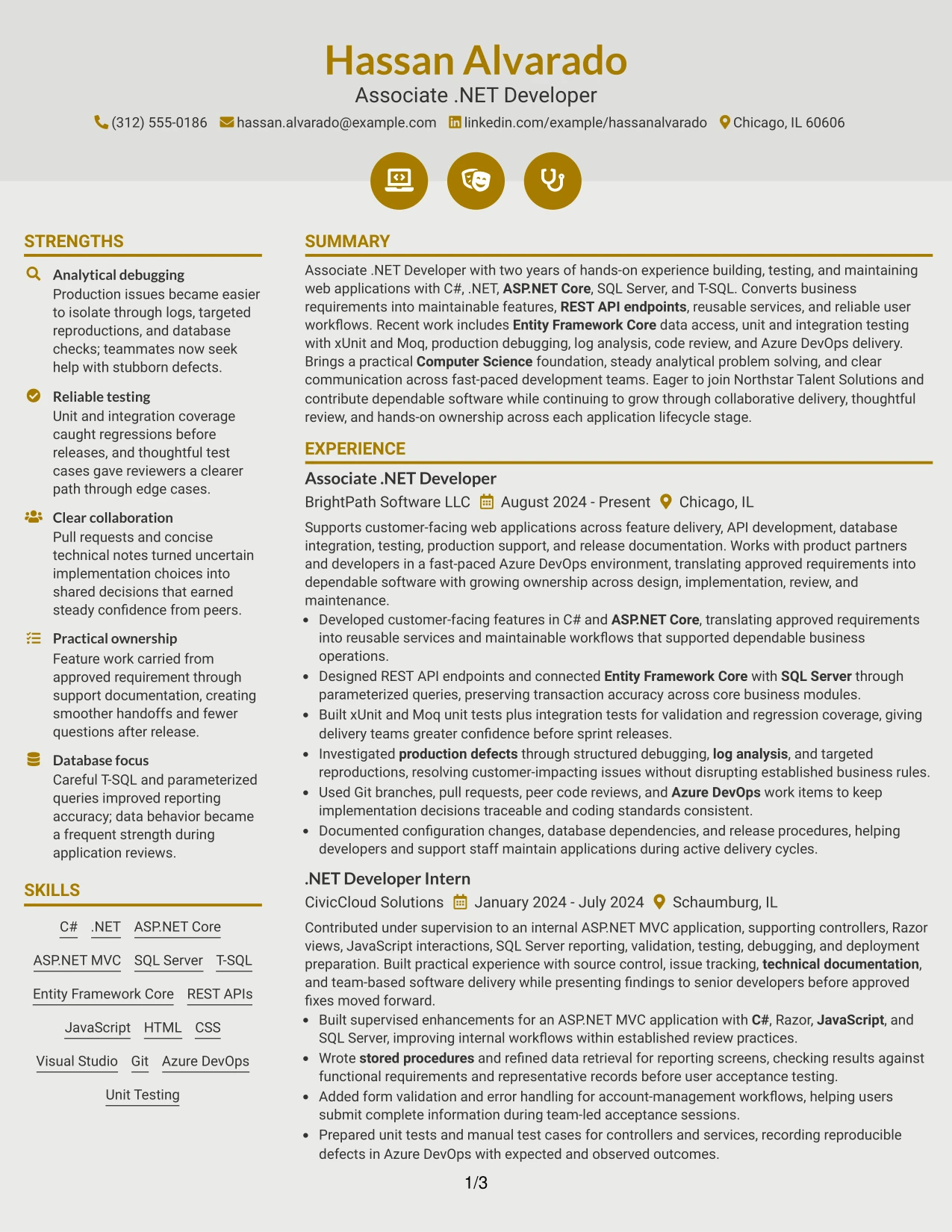
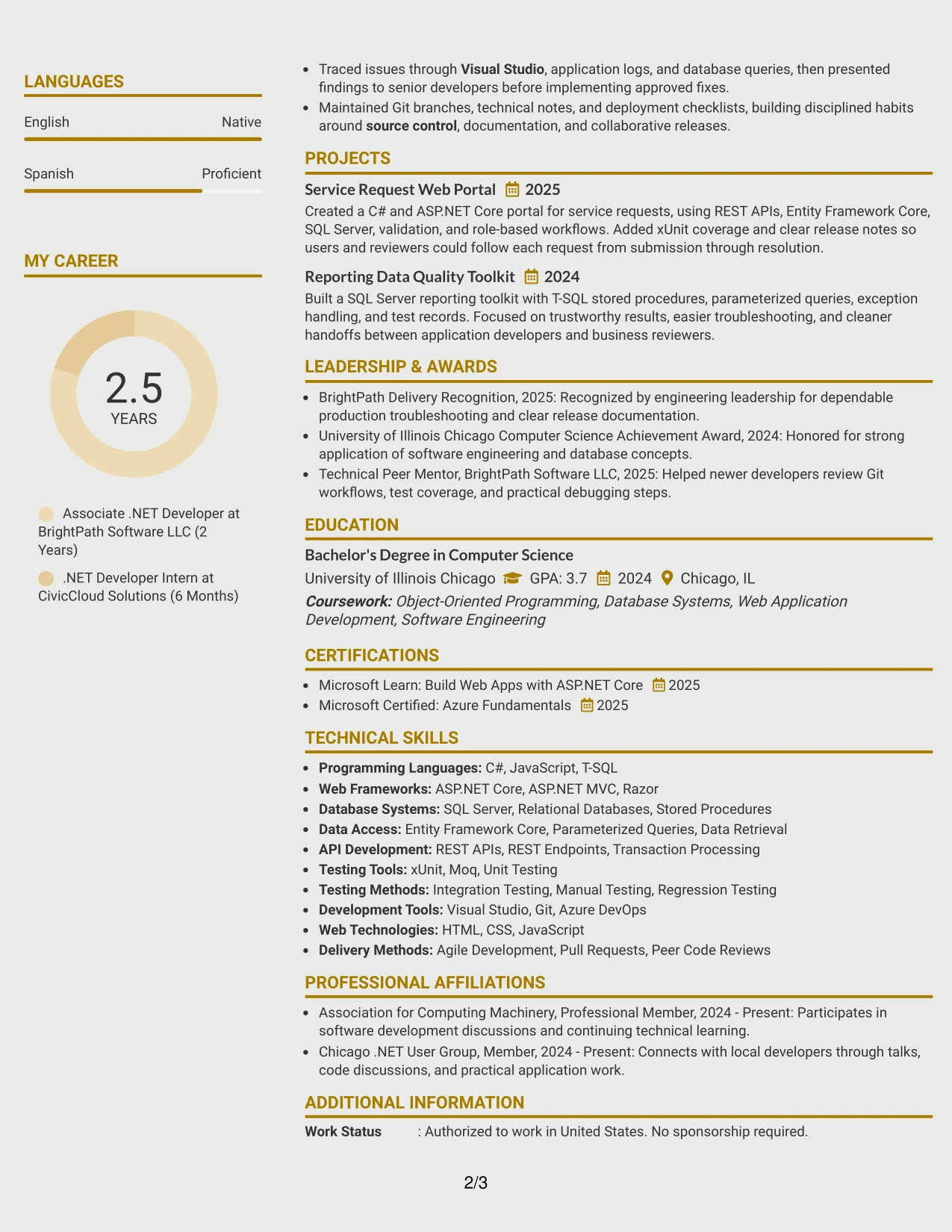
Why the Modern Icon Format Works for a Resume
- Evidence-led bullets show what the candidate built, tested, maintained, and fixed.
- Icon accents help readers locate contact information and major sections quickly.
- The one-column flow keeps work history and education easy to follow.
- Technical keywords remain close to the experience that proves their use.
- Project entries can reinforce REST APIs, SQL Server, validation, and release documentation.
- Testing and debugging evidence adds substance beyond a tools-only skills section.
- Moderate visual detail creates interest without replacing standard resume content.
Best For
- Resumes that need to connect technical tools with practical evidence.
- Applicants highlighting testing, debugging, maintenance, and release responsibilities.
- Candidates with projects that extend the proof shown in professional experience.
- Readers who like light visual guidance but still expect conventional resume sections.
- Applications where skills should be supported by action-led bullet points.
- Technical resumes that combine APIs, databases, frameworks, and delivery tools.
- Candidates presenting a balanced mix of development and production support work.
- Digital resume submissions where small navigation cues improve scanning.
#16 Plain Professional Layout with Job Title & Shaded Labels Resume Example
Balanced spacing gives the resume enough room for detailed evidence while keeping the page efficient for an application review. The job title appears early, and shaded labels divide the summary, experience, projects, education, certifications, and skills.
This plain professional layout fits a practical submission for an Associate .NET Developer opening. It supports clear bullets about C# features, REST endpoints, SQL Server data access, unit and integration testing, production defects, and collaborative delivery.
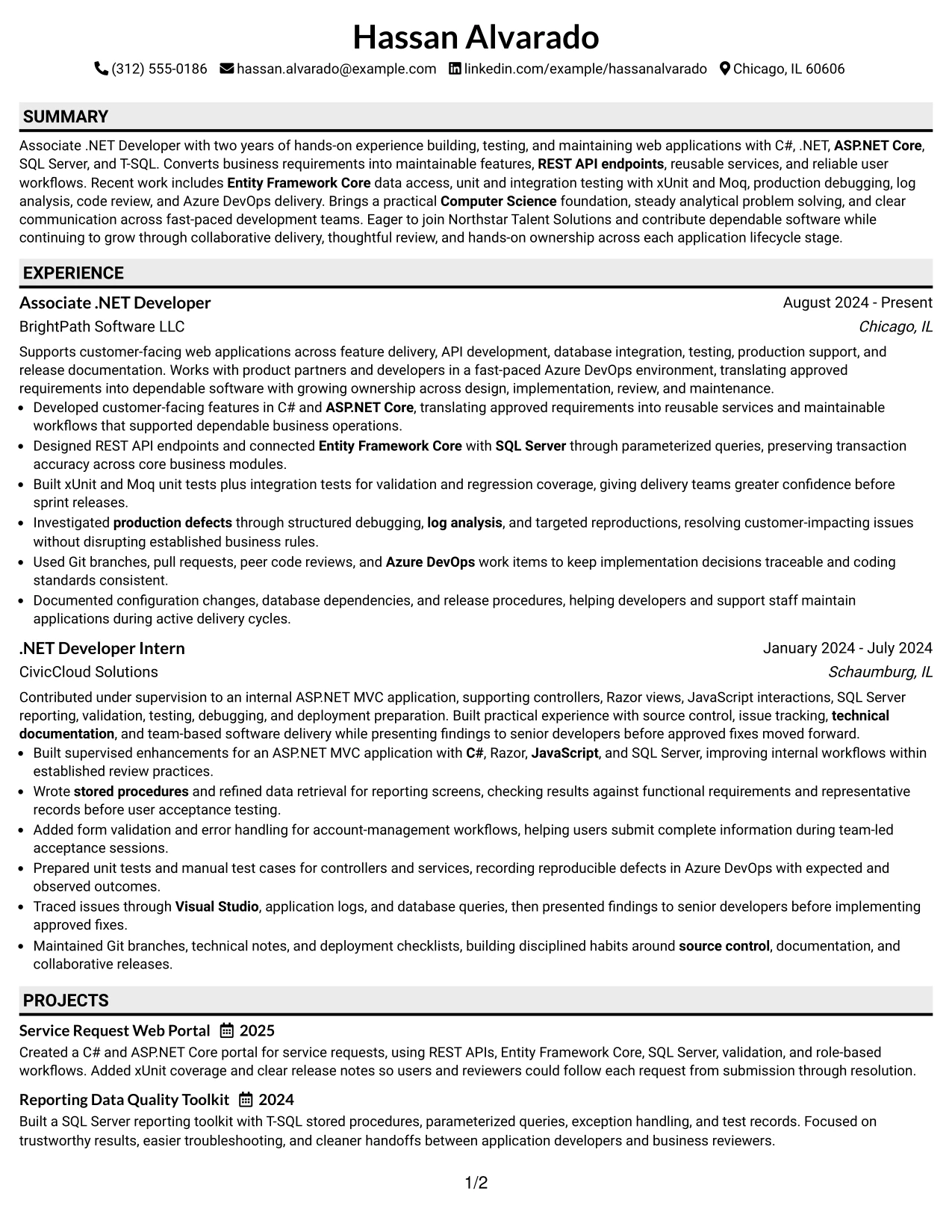
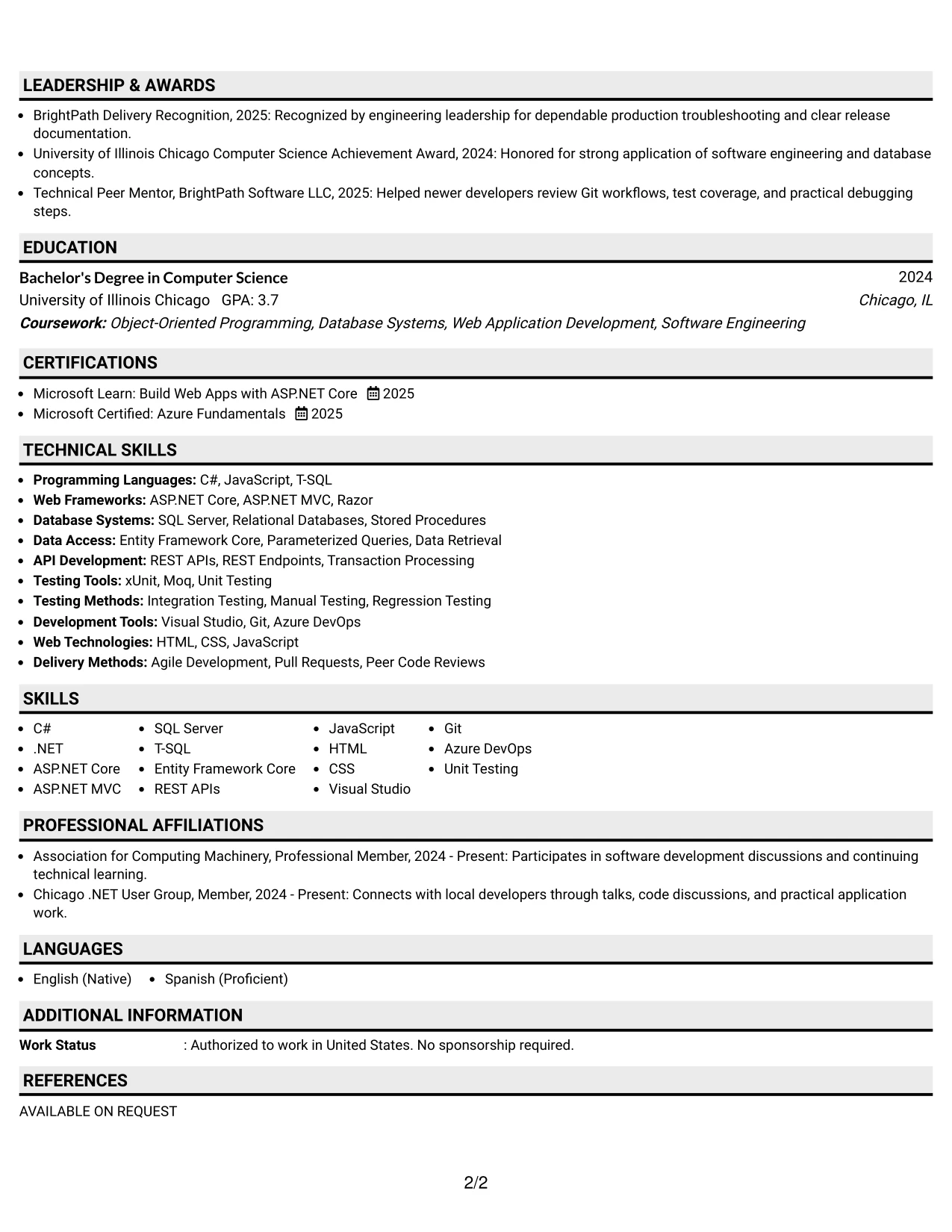
Why the Plain Professional Layout with Job Title & Shaded Labels Works for a Resume
- The early job title makes the document's application context clear.
- Shaded labels separate sections without adding visual clutter.
- Consistent spacing lets readers scan employers, dates, and bullets with less effort.
- Full-width lines provide room for technical details and measurable evidence when available.
- Conventional section order supports ATS parsing and recruiter review.
- The format can show experience, projects, education, certifications, and skills without confusing hierarchy.
- A plain presentation keeps attention on implementation, testing, debugging, and delivery work.
Best For
- Job applications that call for a formal and easy-to-review resume.
- Candidates who want the target role stated clearly near the contact details.
- Resumes with several work bullets that need comfortable line spacing.
- ATS-friendly submissions using standard headings and a linear content structure.
- Readers who value evidence over decorative design.
- Applicants combining recent experience with a Computer Science education.
- Technical resumes that must present projects and certifications without crowding.
- Applications submitted as conventional PDF or text-readable documents.
#17 Classic One Column Resume Format Resume Example
For a practical application, a familiar one-column resume makes the review path immediate: contact details, target role, summary, experience, projects, education, certifications, and skills. The structure fits the documented background in C#, ASP.NET Core, SQL Server, and web application development.
Classic formatting gives each section a dependable place and lets achievement bullets carry the detail. It is especially useful when the resume must show two years of development experience, internship work, technical projects, and a Computer Science degree without visual distractions.
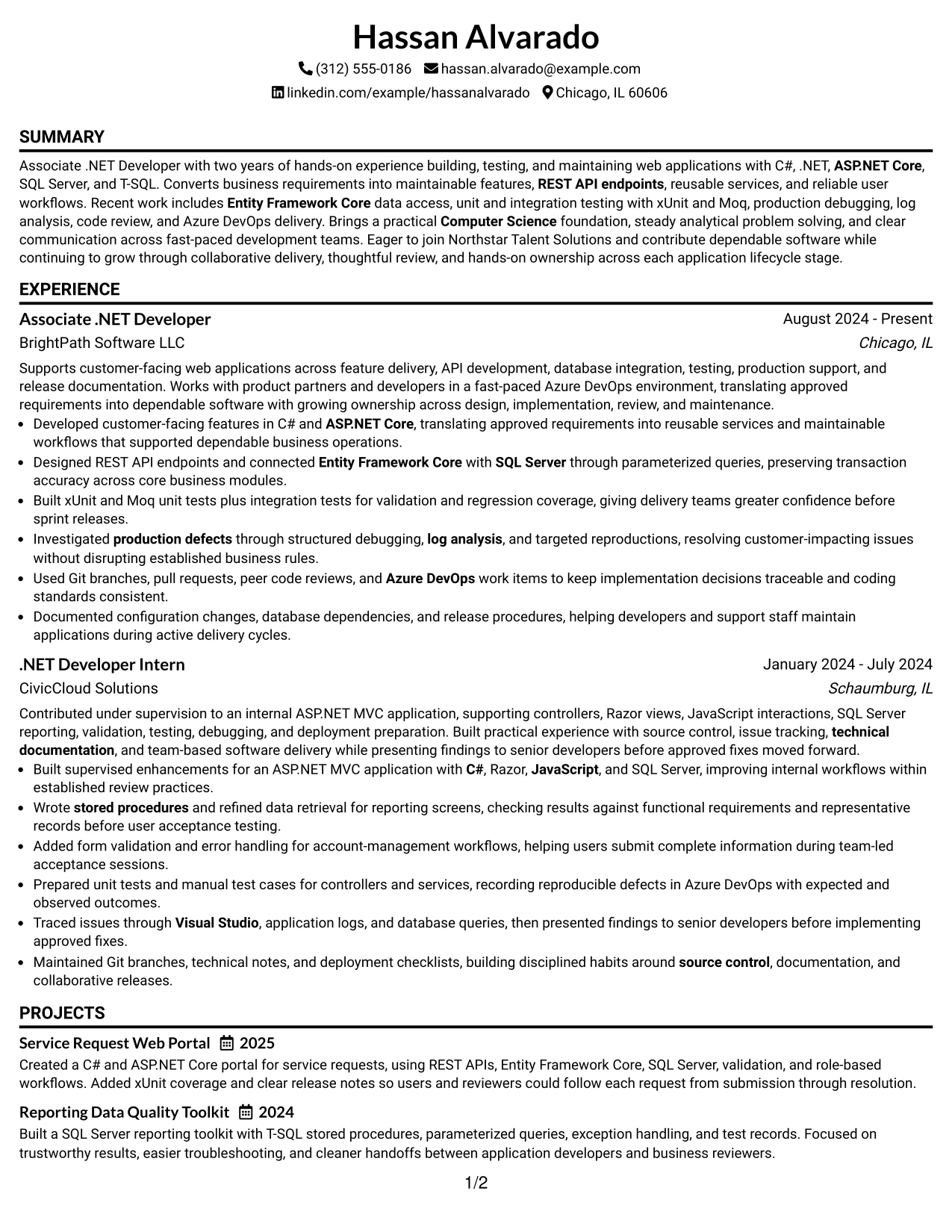
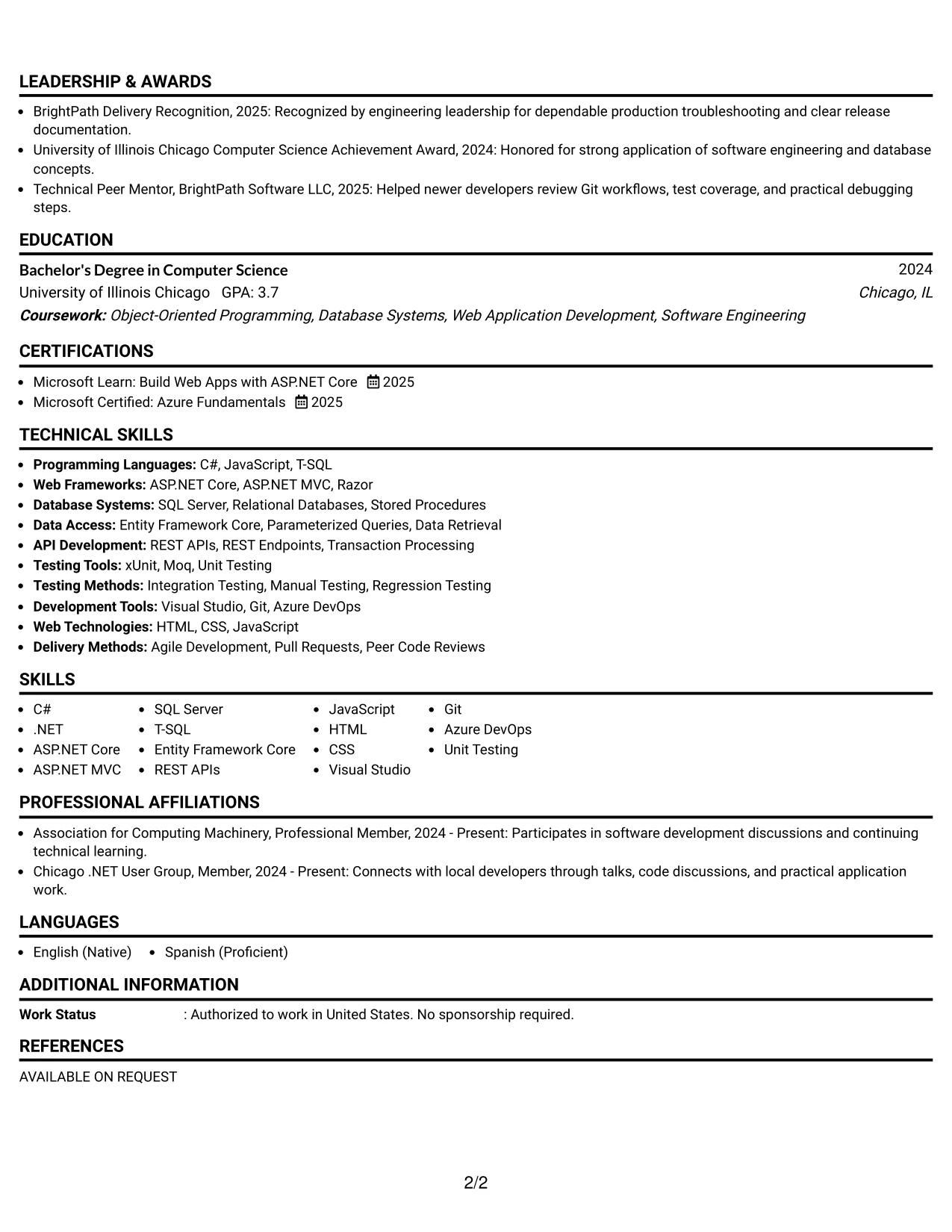
Why the Classic One Column Resume Format Works for a Resume
- A familiar sequence lets readers find employment history and education quickly.
- One column keeps dates, job titles, employers, and bullets aligned in a simple path.
- Standard headings improve machine recognition during ATS screening.
- The summary can mirror the target role and priority terms without taking over the page.
- Projects add proof of C#, ASP.NET Core, REST APIs, Entity Framework Core, and SQL Server use.
- Education and certifications remain visible without competing with experience.
- Classic styling supports clear, credible presentation for a technical application.
Best For
- Standard job applications that favor familiar resume organization.
- Candidates who want experience and education reviewed in a straightforward order.
- Applicants with a focused technical history rather than many unrelated sections.
- ATS submissions where predictable headings and text flow matter.
- Resumes that include both internship contributions and current development work.
- Readers who prefer evidence-rich bullets over decorative elements.
- Applications requiring projects, certifications, and skills alongside employment history.
- Candidates seeking a dependable format for online and printed review.
#18 One Column Format with Photo Resume Example
A restrained visual hierarchy combines a prominent contact area with a single-column content path and a professional photo. The photo remains secondary; the resume still leads with the target role, summary, development experience, projects, education, certifications, and skills.
That balance can present Hassan Alvarado's web application work without letting the image replace technical proof. C#, .NET, ASP.NET Core, SQL Server, REST APIs, testing, debugging, and Azure DevOps should remain visible as searchable text and evidence-led bullets.
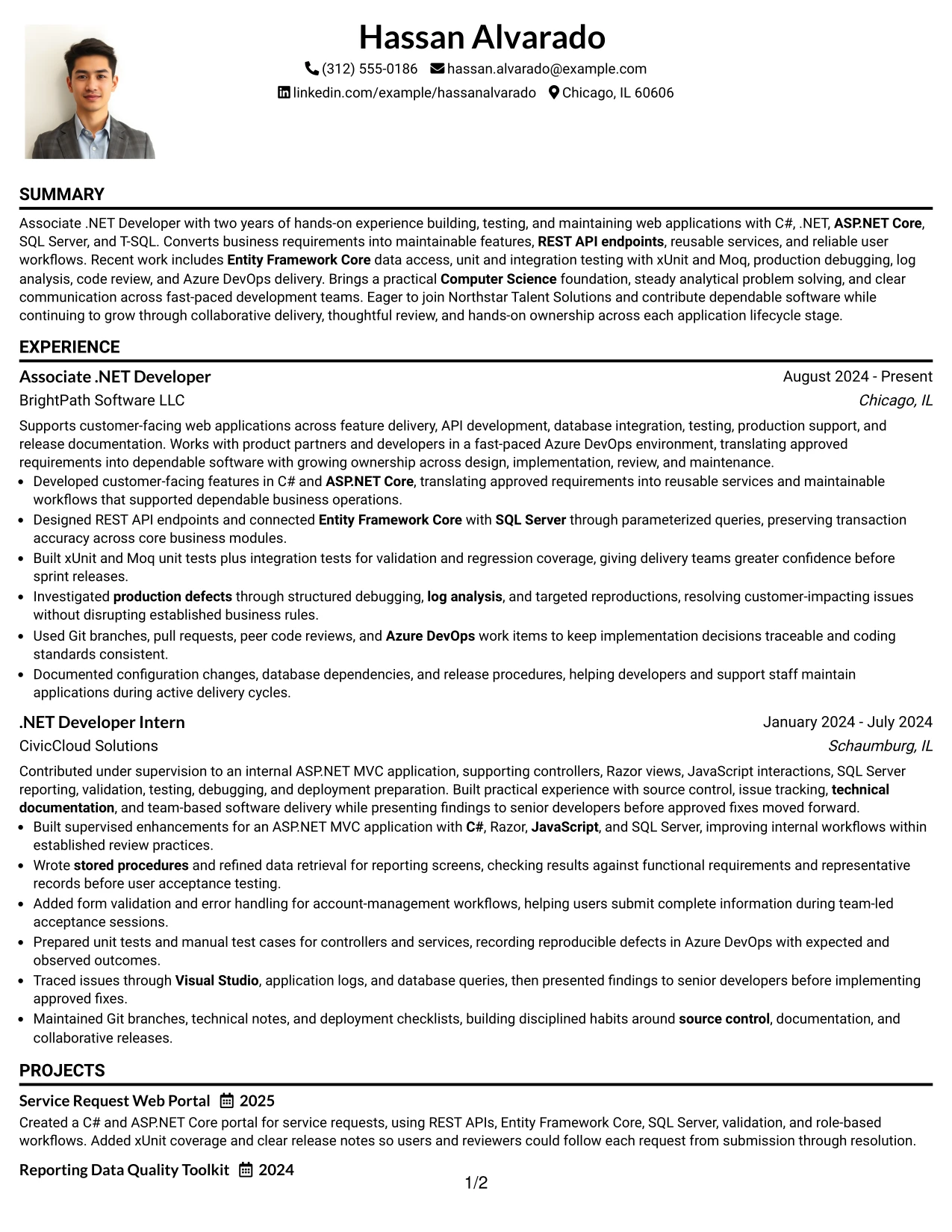
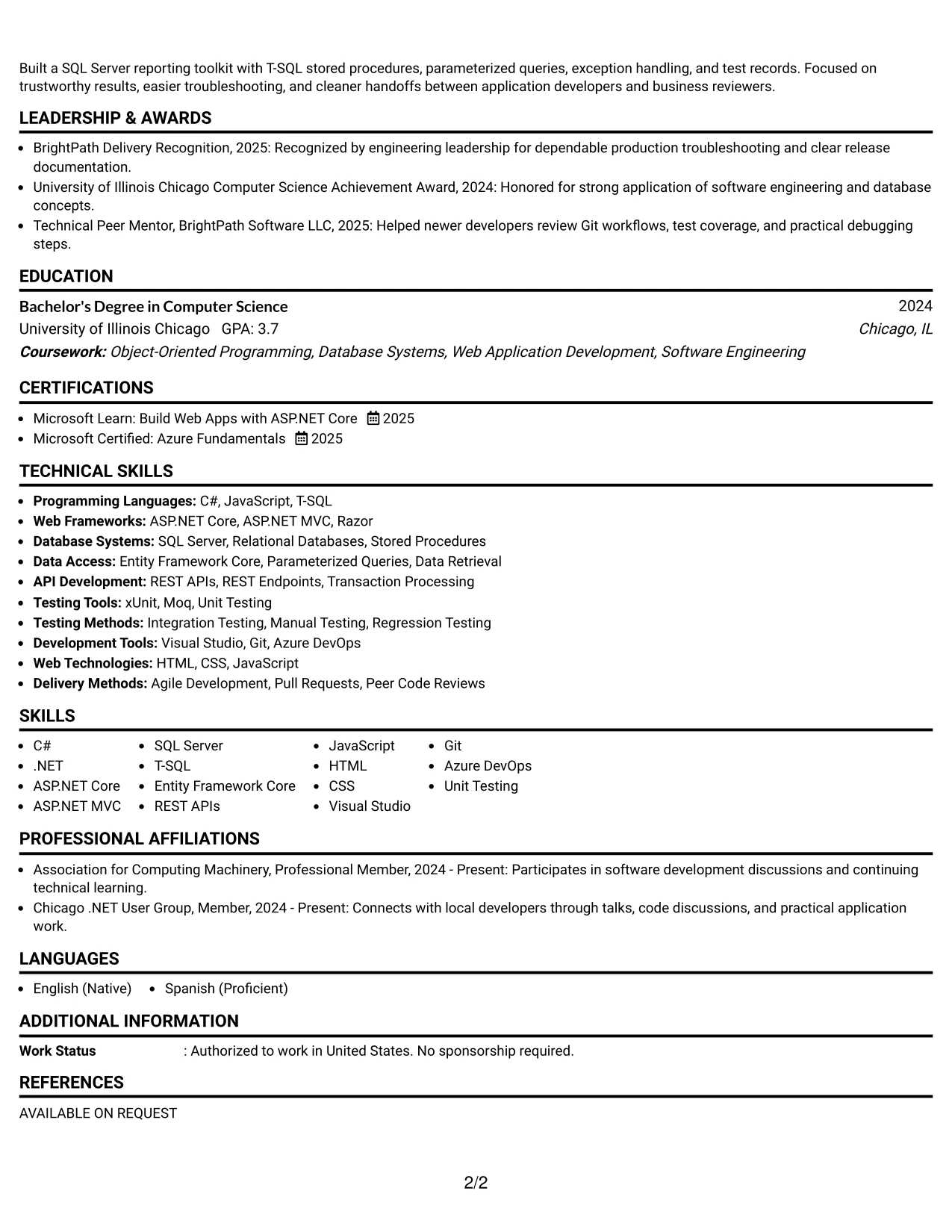
Why the One Column Format with Photo Works for a Resume
- The photo creates a clear visual anchor in formats where a professional image is appropriate.
- One-column reading keeps the career story and technical evidence easy to follow.
- The contact area can hold the name, location, phone, email, and LinkedIn details together.
- Standard section labels support scanning and ATS-readable text.
- Experience bullets keep the focus on features, APIs, data access, testing, and production support.
- Projects and certifications can strengthen the evidence without breaking the main reading path.
- The format works best when the image is polished, relevant, and secondary to qualifications.
Best For
- Applications in settings where a professional photo is accepted or expected.
- Candidates who want personal presentation paired with a conventional resume structure.
- Resumes that need a single reading path for experience, projects, and education.
- Applicants with enough technical evidence to keep the photo from carrying the page.
- Readers who prefer clear section order with a defined visual entry point.
- Digital resume profiles where a professional image can support recognition.
- Technical candidates presenting development, testing, and database work in full-width bullets.
- Carefully tailored applications that confirm local norms before including an image.
#19 Minimal Header Format Resume Example
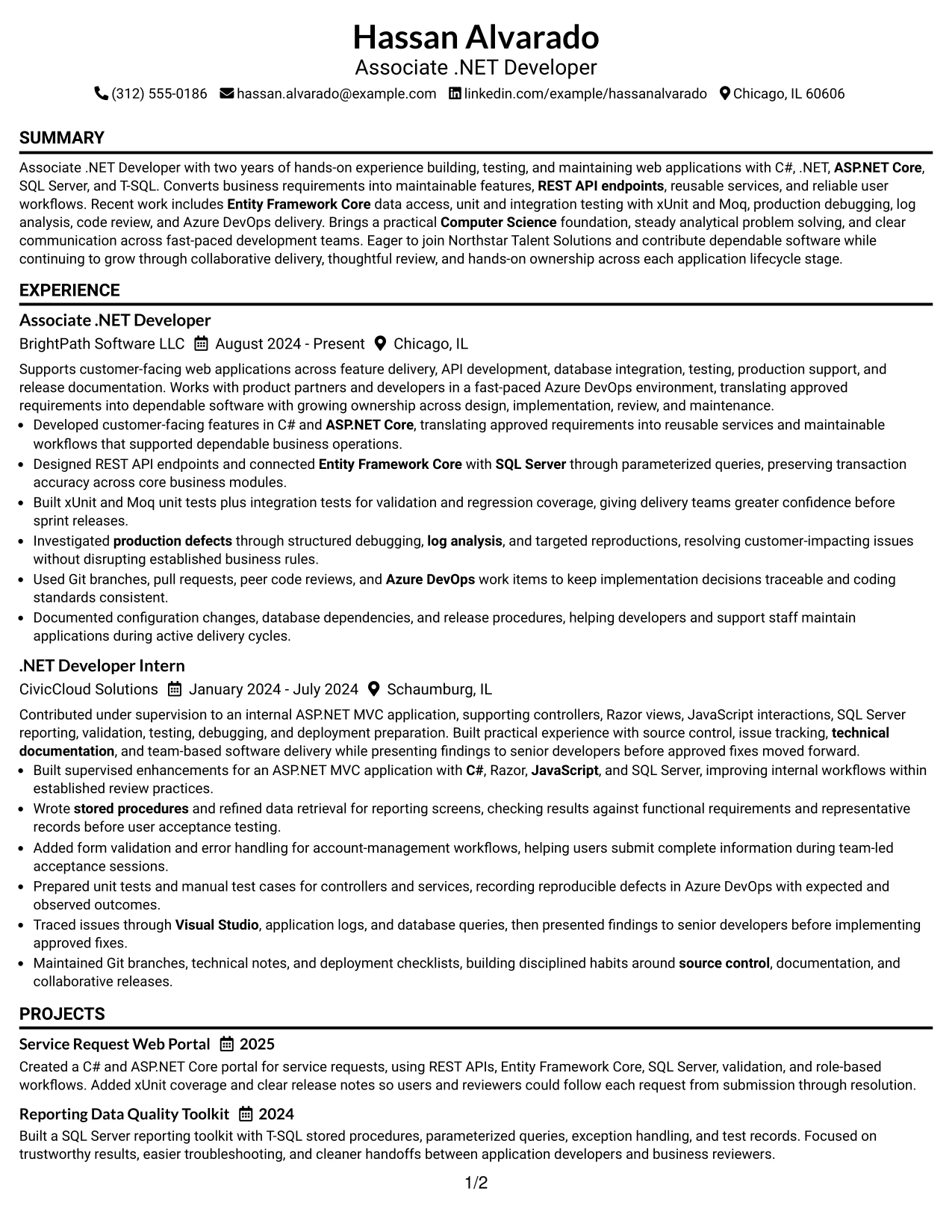
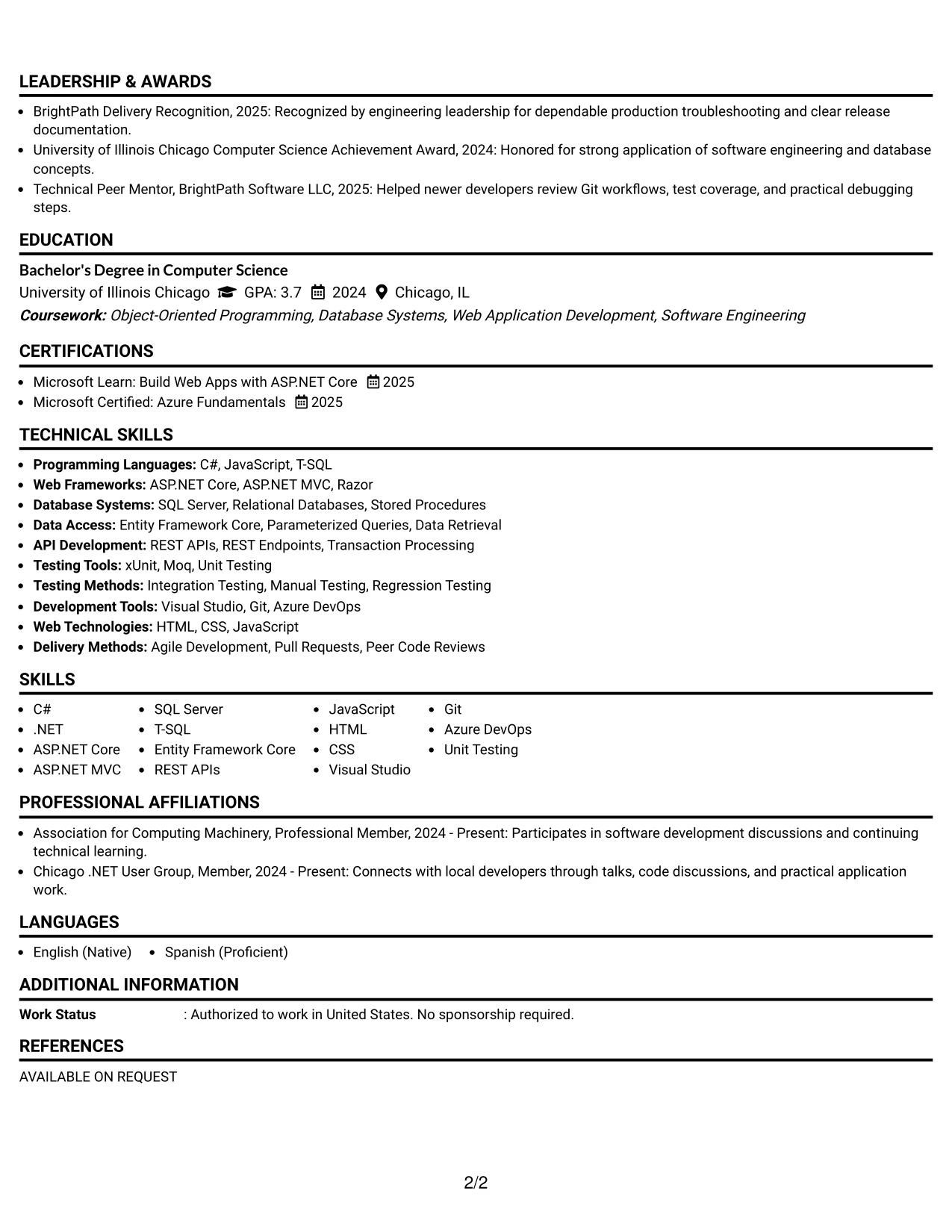
The Minimal Header Format starts with only the contact and role information needed to identify the document, then gives the resume content most of the page. Its clean one-column structure supports a quick path from the Associate .NET Developer summary to experience, projects, education, certifications, and skills.
Less header decoration leaves more room for searchable terms and strong bullets. The resume can therefore show C#, .NET, ASP.NET Core, SQL Server, T-SQL, REST APIs, unit testing, integration testing, debugging, Git, and Azure DevOps in a direct format.
Why the Minimal Header Format Works for a Resume
- A compact header lets the reader reach qualifications quickly.
- One-column organization keeps the content sequence predictable.
- Minimal decoration reduces distractions during recruiter and ATS scanning.
- The summary can place the target role and core technical terms near the top.
- Experience bullets have room to explain development, testing, data access, and defect resolution.
- Projects and certifications can appear as supporting evidence without an oversized design.
- Simple formatting is easy to update as tools, responsibilities, and achievements grow.
Best For
- Applicants who want qualifications to begin close to the top of the page.
- ATS-conscious resumes with a focused set of standard sections.
- Candidates who prefer minimal visual treatment and strong written evidence.
- Documents that need room for detailed technical bullets within one column.
- Readers who scan quickly for role, skills, employers, and dates.
- Resumes combining current work, internship experience, and selected projects.
- Applications where easy editing and future updates are important.
- Technical submissions that must remain clear across common PDF viewers.
#20 Modern Full Background Two Column Format Resume Example
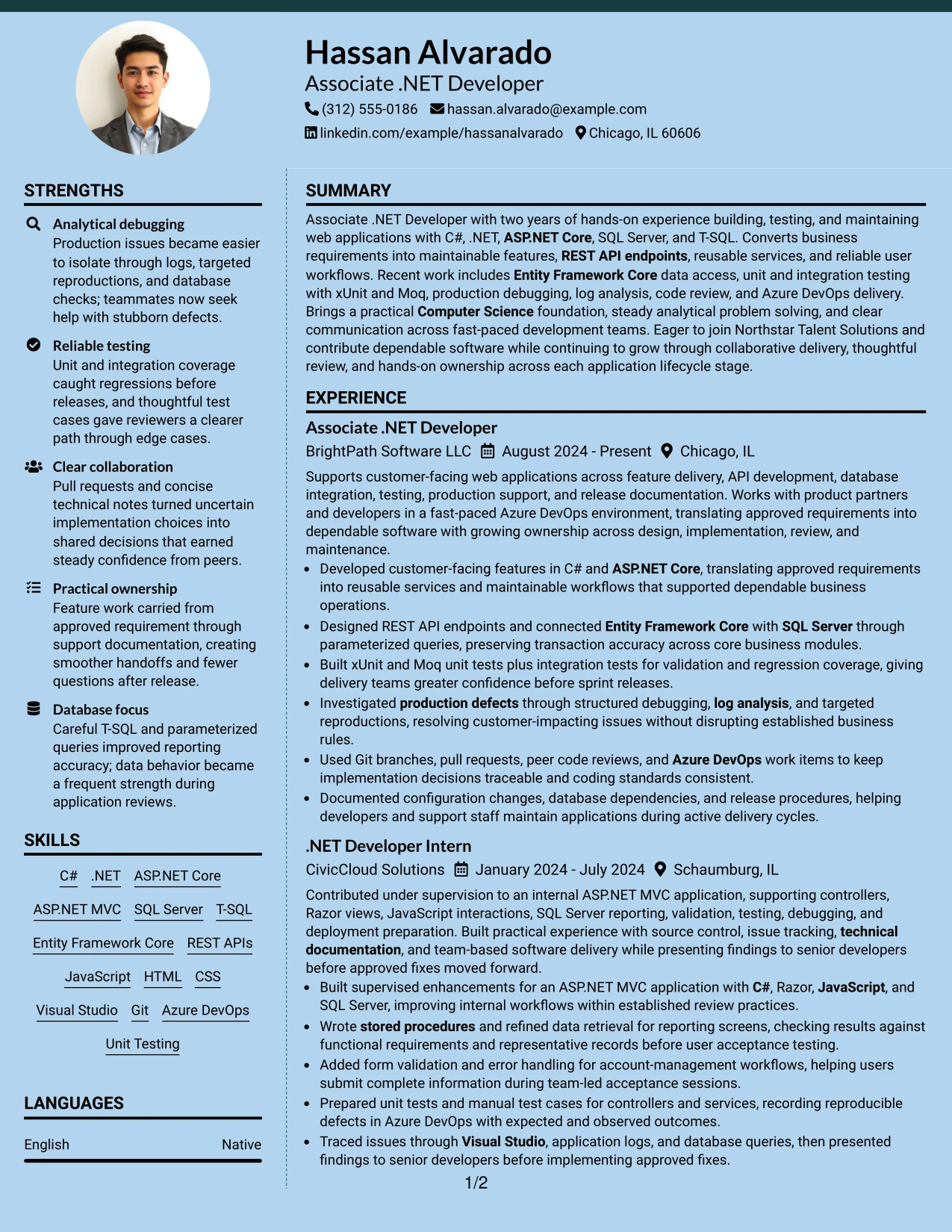
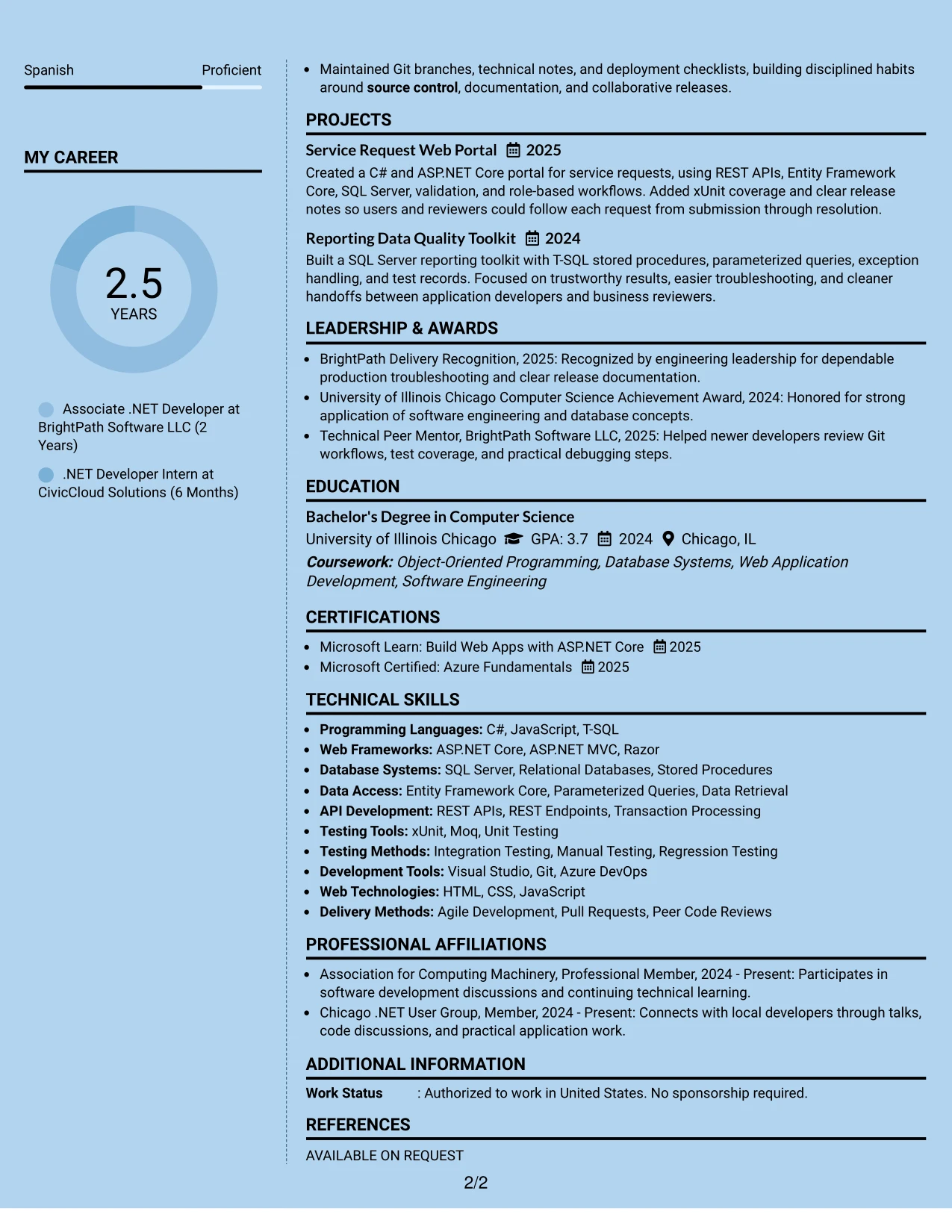
Readers can begin with the compact column for contact details, skills, education, and certifications, then move into the broader column for experience and projects. Hassan Alvarado's document uses that split to show both a defined technical toolkit and detailed application work.
A full-background treatment gives the page a modern visual frame, while the content still needs disciplined hierarchy. The main evidence remains in readable bullets covering C#, ASP.NET Core, REST APIs, SQL Server, testing, debugging, and Azure DevOps.
Why the Modern Full Background Two Column Format Works for a Resume
- Two columns separate quick-reference details from longer career evidence.
- A dedicated skills area can group frameworks, databases, APIs, testing tools, and delivery tools.
- The main column preserves space for experience and project descriptions.
- A full-background design creates a strong visual frame around otherwise structured resume content.
- Clear contrast between columns helps readers move from keywords to supporting evidence.
- Projects can reinforce the same technical areas shown in professional experience.
- Name and contact details remain prominent while the body carries the qualification proof.
Best For
- Applicants with enough content to benefit from a deliberate two-column split.
- Resumes that need separate spaces for skills, education, certifications, and experience.
- Candidates presenting projects as an important part of their technical evidence.
- Readers who like a modern visual frame with a clearly organized content hierarchy.
- Applications where the main column must preserve detailed development bullets.
- Technical profiles with grouped tools such as frameworks, databases, testing, and source control.
- Candidates who want quick-reference keywords visible beside deeper evidence.
- Digital PDF submissions that preserve contrast and column order during review.
#21 Dark Mode Two Column Format Resume Example
Testing, debugging, and dependable application delivery receive priority in this evidence-focused presentation. A dark visual treatment frames the two-column structure, while the resume content must still prove work with C#, .NET, ASP.NET Core, SQL Server, REST APIs, xUnit, Moq, and Azure DevOps.
The supporting column can organize skills, education, certifications, and contact details. The main column can then carry experience and project bullets that explain feature delivery, data access, regression coverage, production defect resolution, and release documentation.
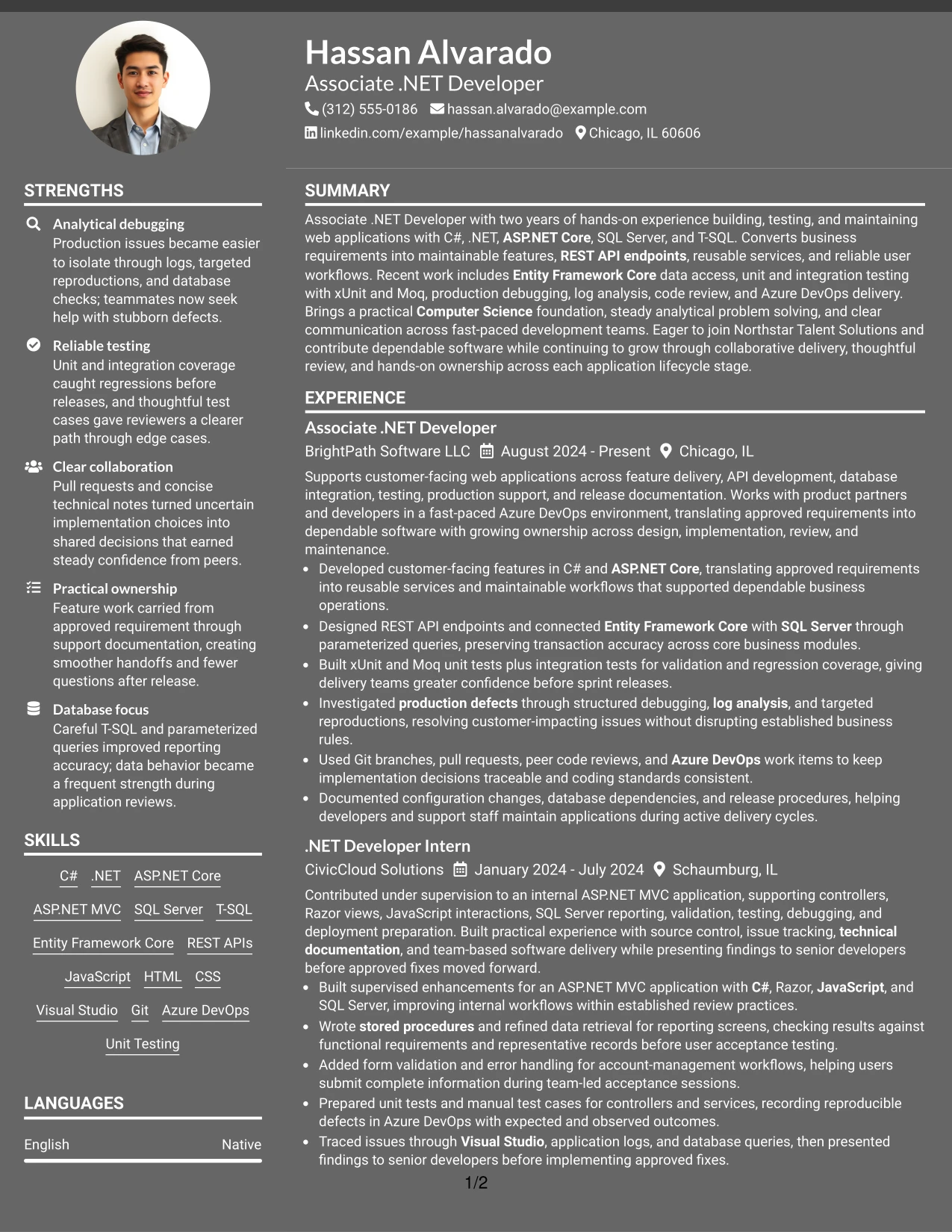
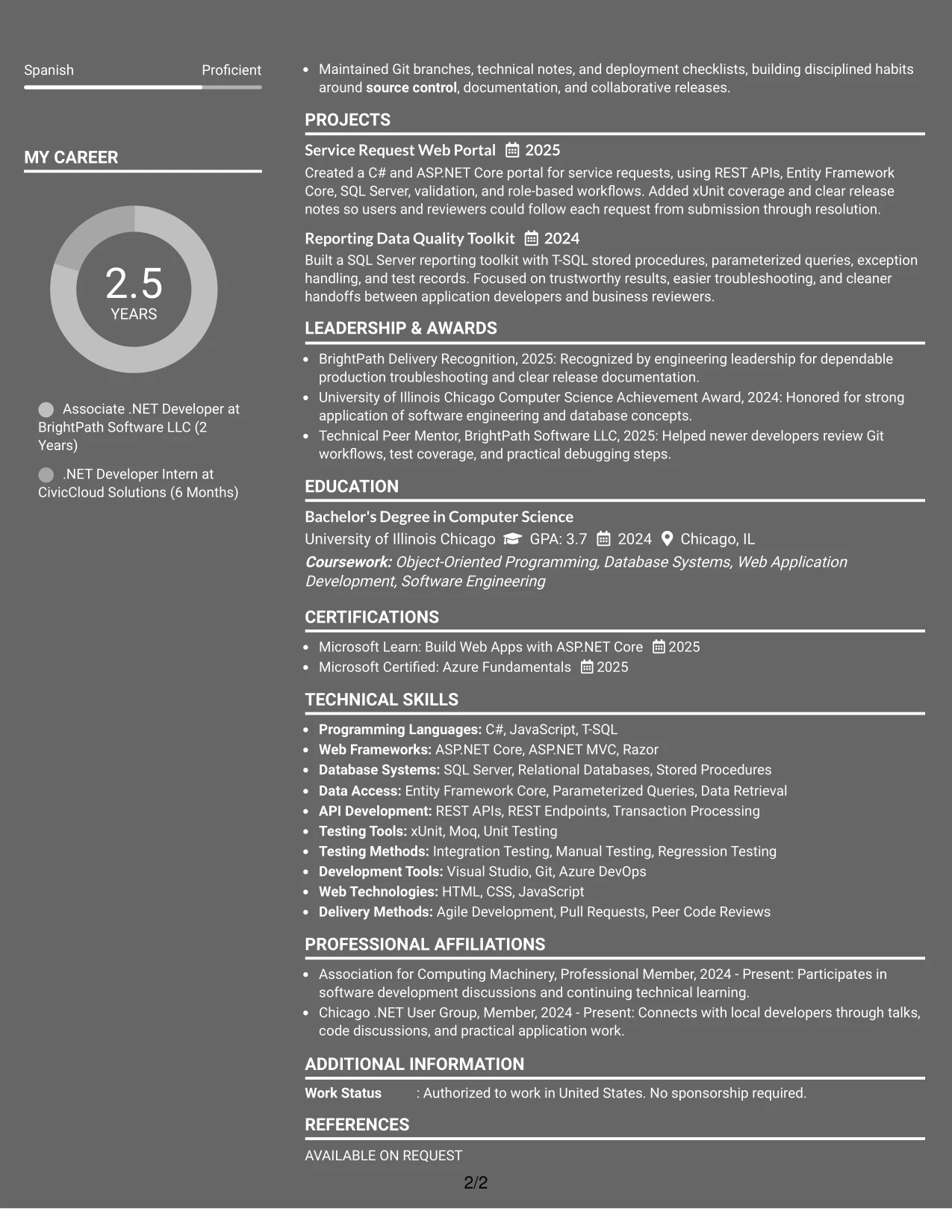
Why the Dark Mode Two Column Format Works for a Resume
- Evidence-led experience bullets remain the main qualification signal.
- The two-column structure separates supporting facts from detailed work history.
- A dark theme creates a distinct visual identity for a digital resume.
- Skills can be grouped so tools such as C#, SQL Server, xUnit, and Git are easy to find.
- The main column gives projects and professional experience enough room for context.
- Testing and debugging statements show dependable delivery beyond a simple skills list.
- Strong contrast and restrained section labels are essential for readable exported text.
Best For
- Digital applications where a distinctive visual identity is useful.
- Candidates whose strongest proof comes from testing, troubleshooting, and delivery work.
- Resumes with a substantial skills sidebar and detailed main-column evidence.
- Applicants presenting projects alongside professional software development experience.
- Readers who want technical keywords available at a glance.
- Applications that can preserve accessible contrast in the final PDF.
- Candidates emphasizing reliability, code review, source control, and release support.
- Carefully checked documents where dark styling does not reduce text readability.
#22 Dark Mode Box Header Format Resume Example
Balanced spacing keeps the dark visual treatment from overpowering the resume's practical application needs. A boxed header identifies the target role and contact details, while the one-column body gives the summary, experience, projects, education, certifications, and skills a clear sequence.
The result is a focused presentation for an Associate .NET Developer application. Conventional text remains central, with evidence covering C# and ASP.NET Core features, REST endpoints, SQL Server, unit and integration testing, debugging, code review, and technical documentation.
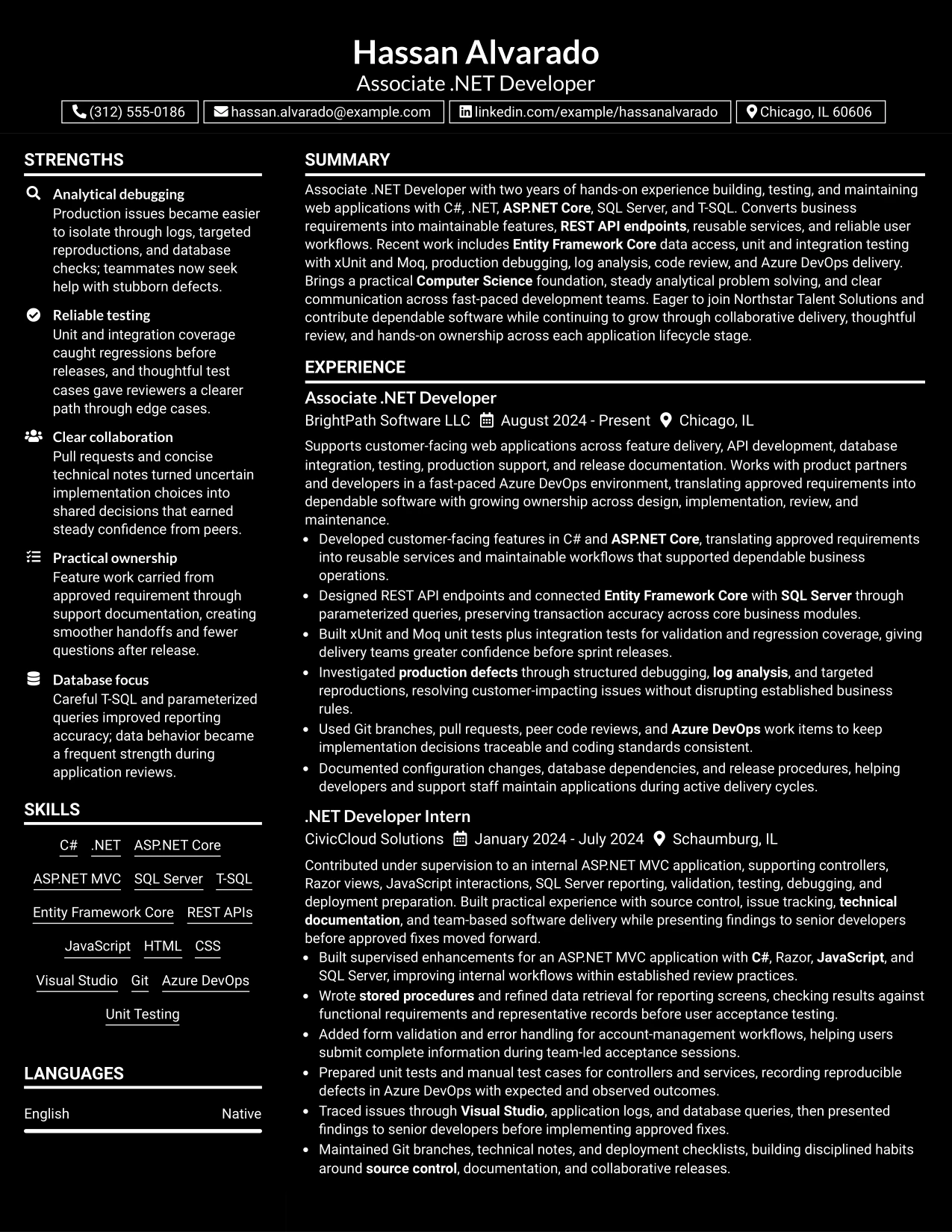
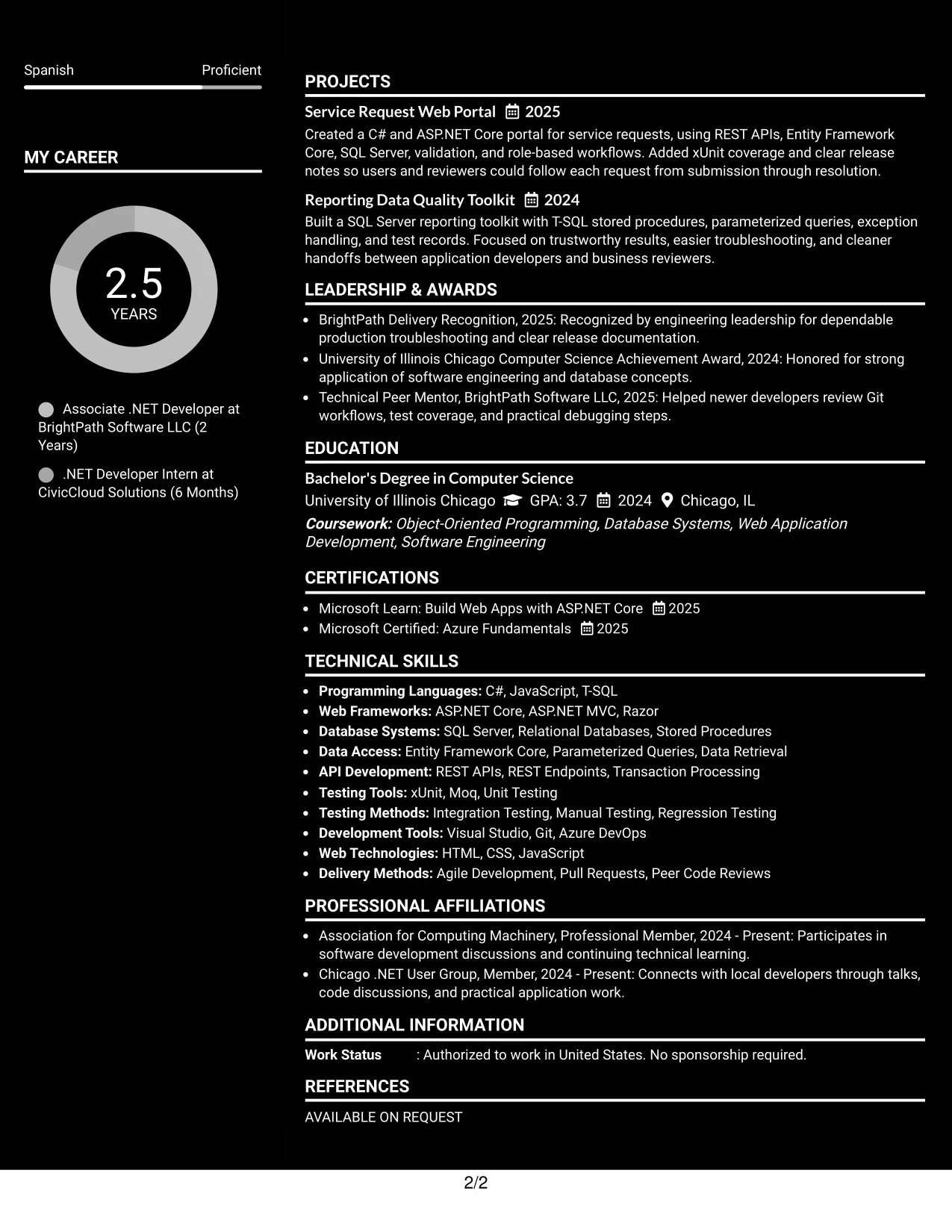
Why the Dark Mode Box Header Format Works for a Resume
- A boxed header creates a defined starting point for the role and contact information.
- One-column spacing keeps every section in a stable review order.
- The dark treatment adds distinction while the body remains focused on resume evidence.
- Standard headings help connect the summary, experience, projects, education, and skills.
- Full-width bullets can explain development tasks, testing methods, database work, and support activity.
- Keywords stay in searchable text instead of being placed only in decorative elements.
- The format works when contrast, font size, and exported accessibility are checked carefully.
Best For
- Applications that need a memorable header without a complex page structure.
- Candidates who want the target role clearly separated from the body content.
- Resumes with full-width bullets covering development, testing, and maintenance.
- Readers who prefer one-column navigation with a stronger visual starting point.
- Digital submissions where a dark accent can support professional presentation.
- ATS-aware documents that keep role terms and technical skills in standard text.
- Applicants combining experience, projects, education, and certifications in one path.
- Candidates willing to verify contrast and readability before sending the final file.
#23 Elegant Full Background Two Column Format Resume Example
For an Associate .NET Developer resume, a two-column structure creates a practical review path: core skills and tools can sit beside experience, education, and projects. The full background adds polish while the white content areas keep C#, .NET, SQL Server, ASP.NET Core, and testing details easy to find.
The resume should still lead with a focused summary and strong experience bullets. REST API endpoints, Entity Framework Core, xUnit, Moq, production debugging, and Azure DevOps give the content clear technical weight. Short sections help the reader move from qualifications to evidence without losing the document's ATS value.
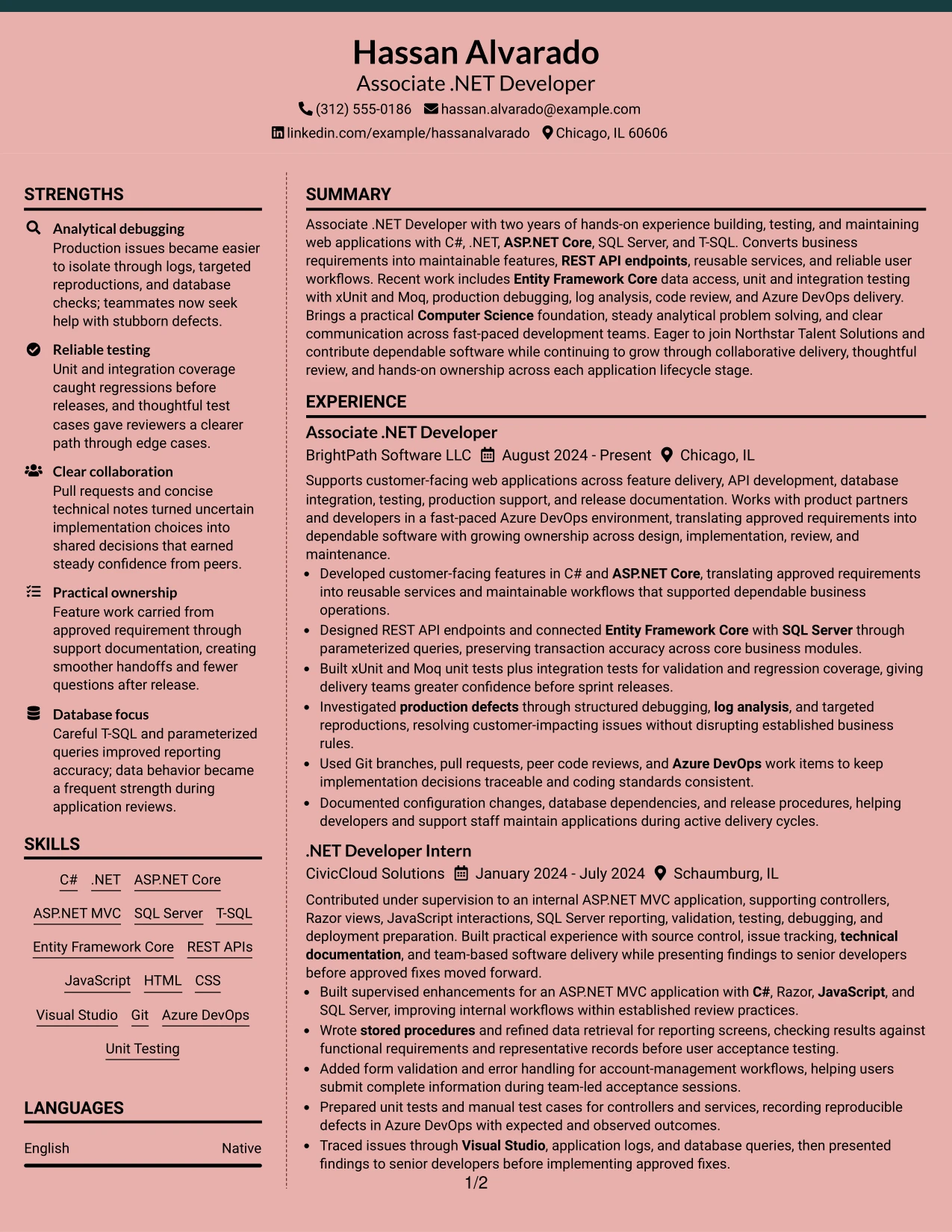
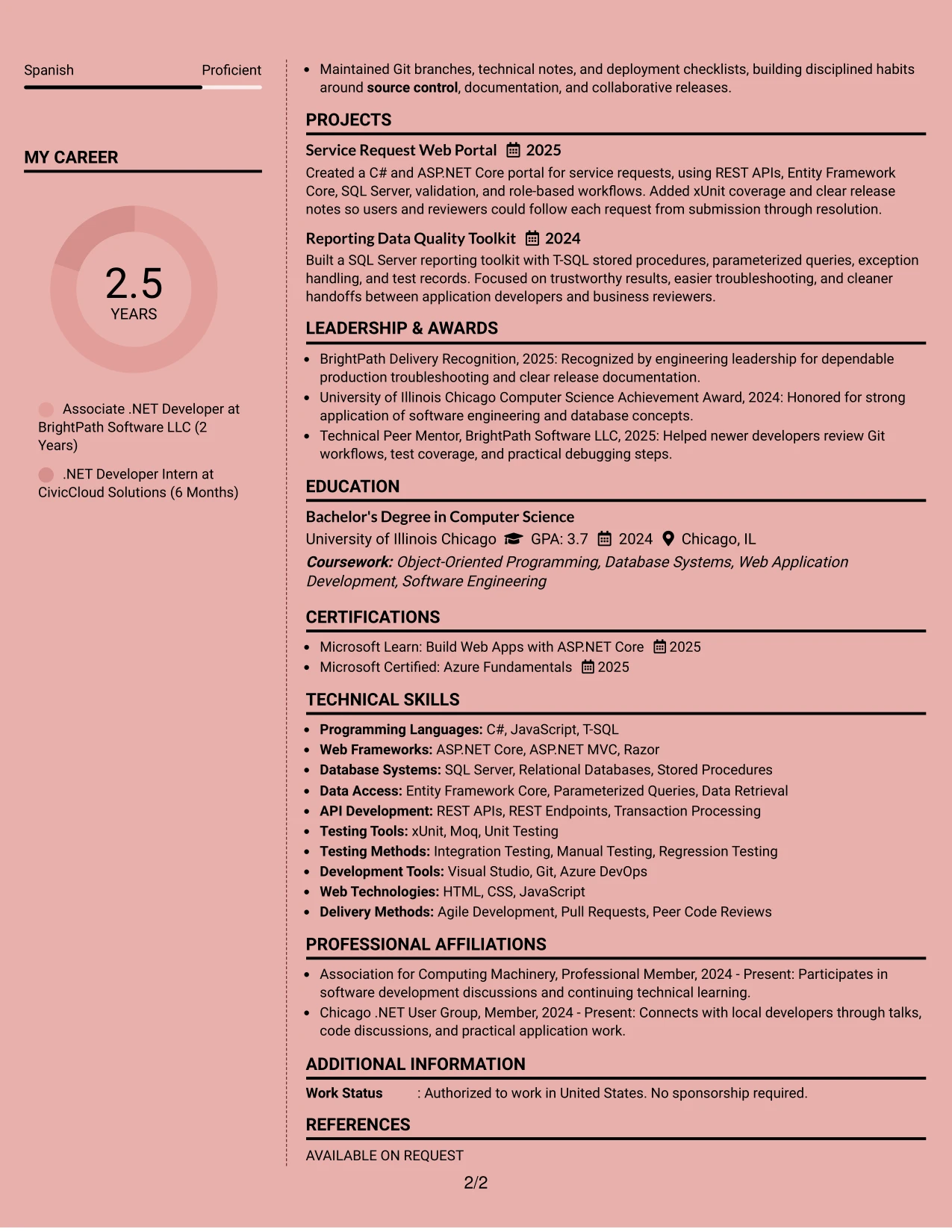
Why the Elegant Full Background Two Column Format Works for a Resume
- Two columns separate skills and tools from detailed work history.
- A strong visual frame gives the resume a polished, organized presence.
- Compact skill blocks make C#, .NET, SQL Server, and ASP.NET Core easy to scan.
- Experience bullets can show both software delivery and production support.
- Projects fit naturally beside education and certifications without crowding the main page.
- Clear section hierarchy supports quick review of testing, APIs, databases, and debugging.
- Simple text blocks preserve useful keywords for ATS parsing and recruiter searches.
Best For
- Resumes that need clear separation between technical skills and experience.
- Applicants with several tools, frameworks, and testing methods to organize.
- Applications where a polished two-column presentation supports fast visual review.
- Documents that combine professional experience with projects and education.
- Candidates who want measurable results and technical evidence to stand out in bullets.
- Resume content that benefits from a compact sidebar for certifications or memberships.
- Readers who need to compare tools with the work that used them.
#24 Creative Two Tone Format Resume Example
A restrained visual hierarchy gives this resume a confident technical impression without competing with the evidence. The two-tone treatment can distinguish headings from body content, helping C#, .NET, ASP.NET Core, SQL Server, REST APIs, and testing terms remain visible during a quick review.
Strong resume content drives the design. The summary frames two years of experience, while concise bullets explain feature delivery, database access, regression coverage, defect resolution, and release documentation. Projects and certifications add proof of continued technical growth without turning the page into a keyword wall.
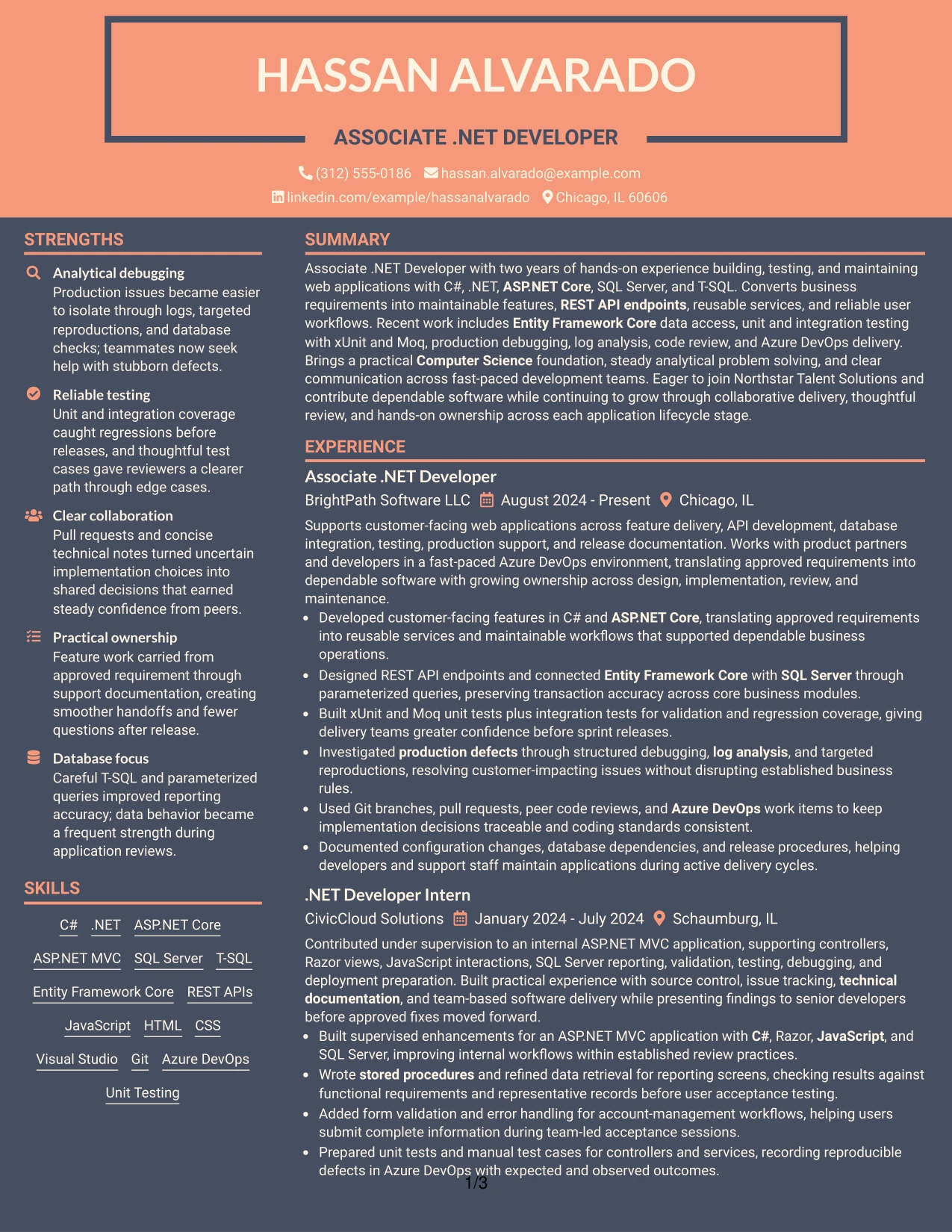
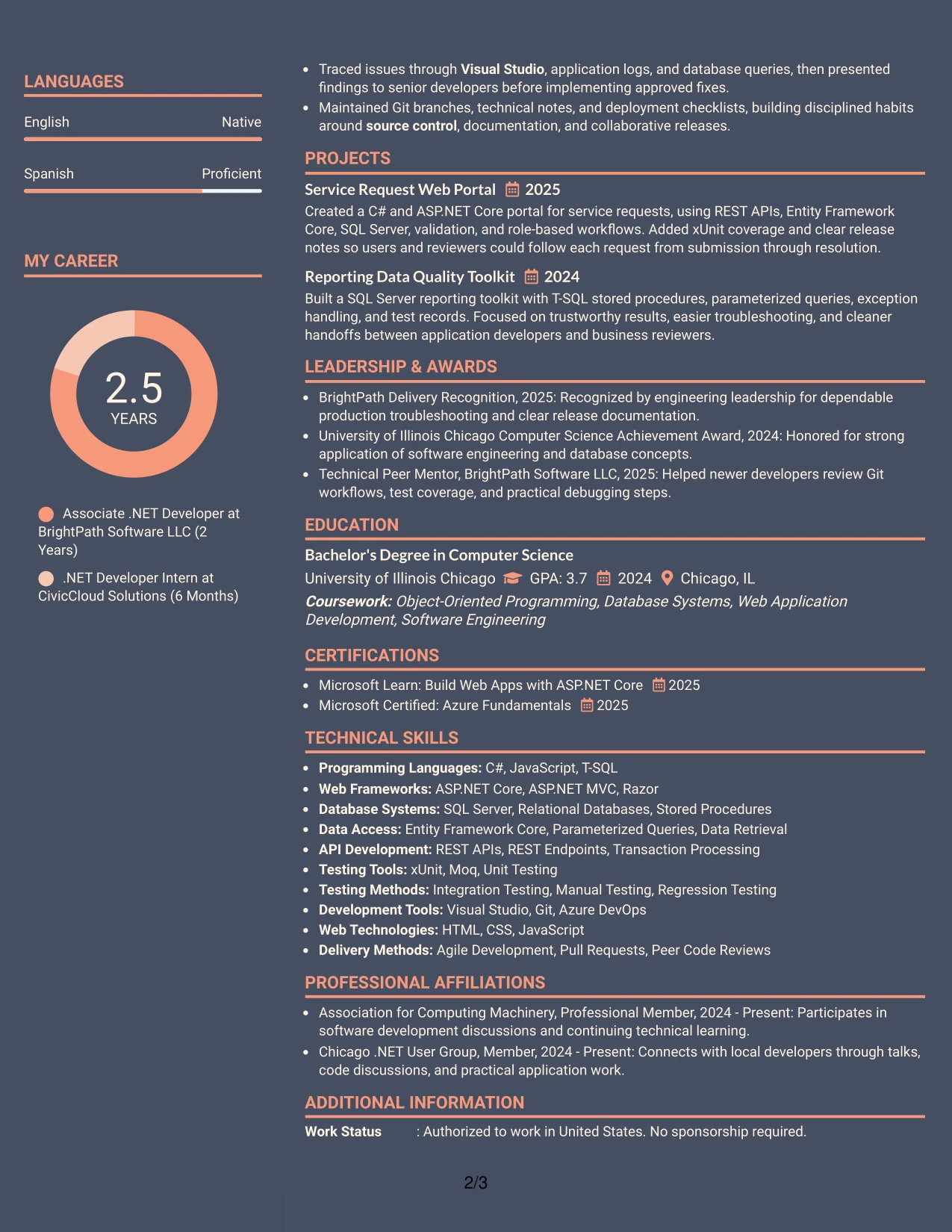
Why the Creative Two Tone Format Works for a Resume
- Two visual tones create section boundaries without requiring heavy decoration.
- A single-column flow keeps the professional summary and experience easy to follow.
- Technical keywords can appear in predictable headings and skill groups.
- Bullets give each achievement room to explain the action and result.
- Projects can reinforce application development and database experience.
- Education and certifications remain visible as supporting qualifications.
- The design adds personality while keeping the resume readable and ATS-conscious.
Best For
- Technical resumes that need a modern look with controlled visual contrast.
- Applications where one-column reading is more important than dense side-by-side content.
- Candidates presenting both workplace projects and independent technical work.
- Documents that need clear separation between summary, skills, experience, and education.
- Readers who prefer a steady top-to-bottom review of evidence.
- Resumes with enough detail to benefit from strong heading contrast.
- Applicants seeking a distinctive format that still keeps professional information central.
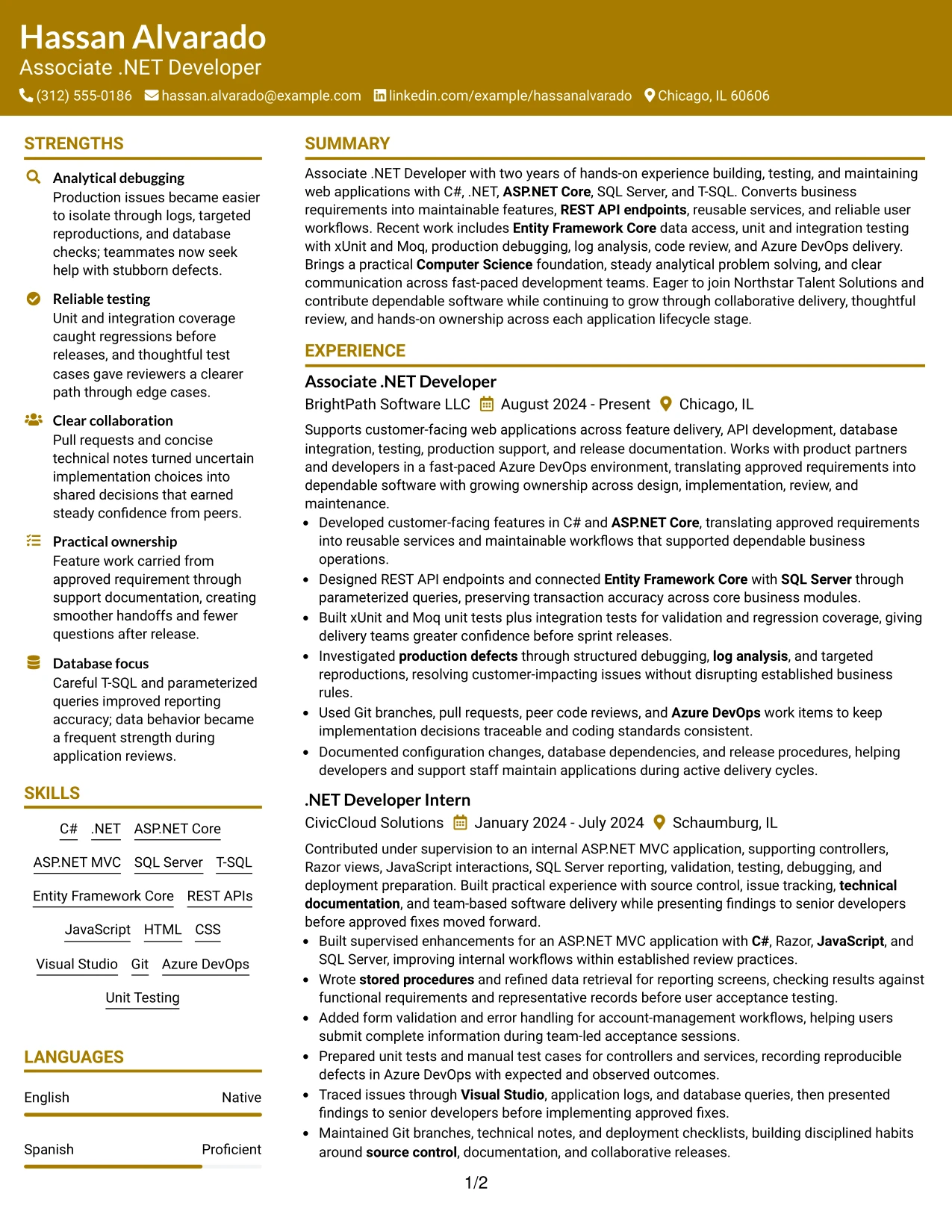
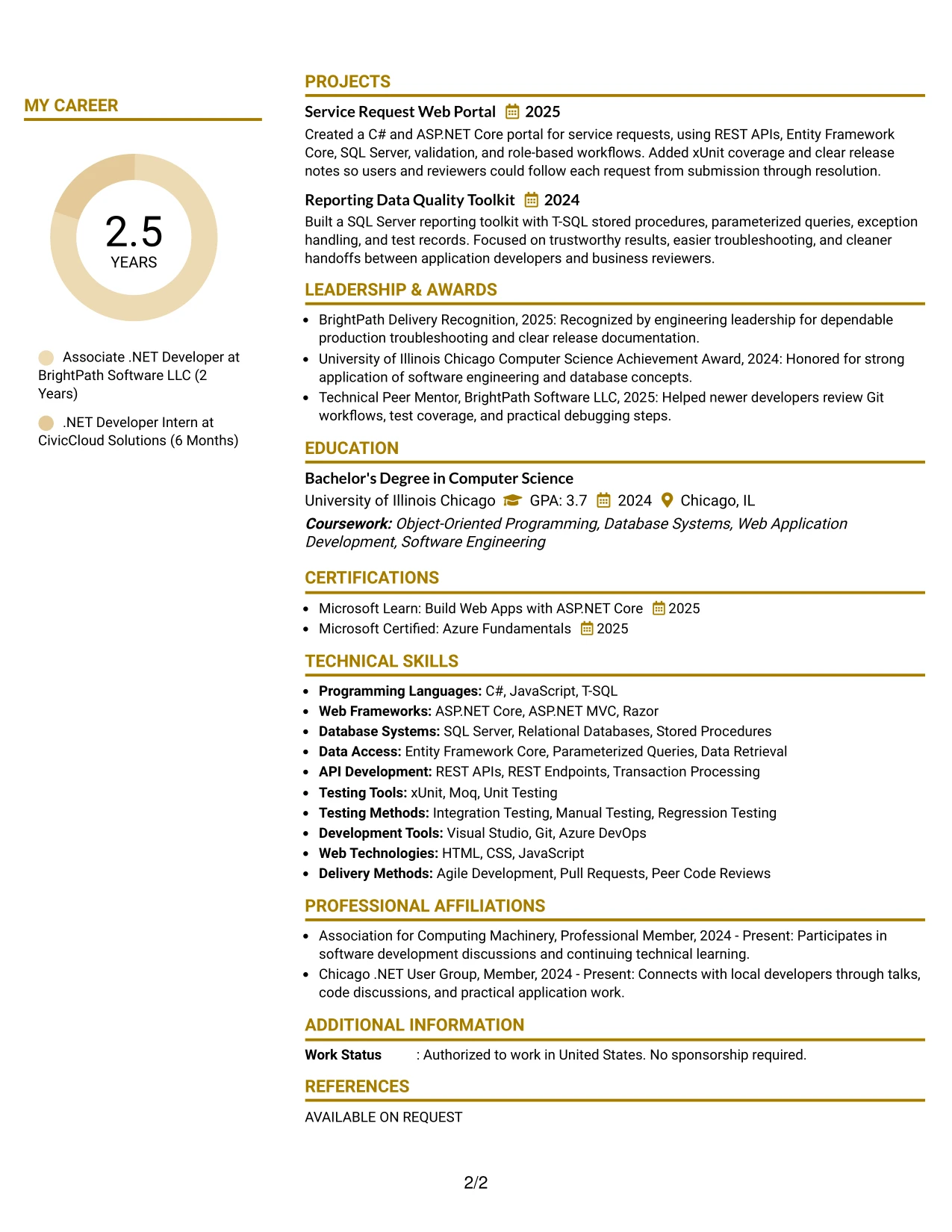
#25 Bold Color Header Professional Format Resume Example
The Bold Color Header Professional Format places the resume's identity and target role at the top, then moves directly into a structured summary, skills, and experience record. That opening structure makes the Associate .NET Developer focus clear before the reader reaches detailed evidence.
Use the main body for achievement-led bullets rather than broad claims. C# and ASP.NET Core feature work, REST API design, parameterized SQL Server queries, xUnit and Moq testing, and production defect resolution show what the candidate can deliver. Education, certifications, and projects then support the technical story.
Why the Bold Color Header Professional Format Works for a Resume
- A prominent header establishes the target role immediately.
- The single-column structure supports predictable ATS parsing.
- Bold section labels help readers locate skills, experience, projects, and education.
- Bullets can emphasize development, testing, maintenance, and troubleshooting results.
- A focused summary connects technical tools with practical delivery work.
- Certifications and projects provide additional evidence below the employment record.
- The format gives visual energy while keeping resume content professional and direct.
Best For
- Resumes that need the target role to be unmistakable at first glance.
- Applicants who want a strong opening area followed by a simple review sequence.
- Documents designed for ATS-friendly section order and standard text extraction.
- Candidates with technical achievements that need prominent, readable bullets.
- Applications where skills should support, not replace, detailed experience.
- Resumes combining work history with relevant projects and formal education.
- Readers who scan headings first and return to evidence for closer review.
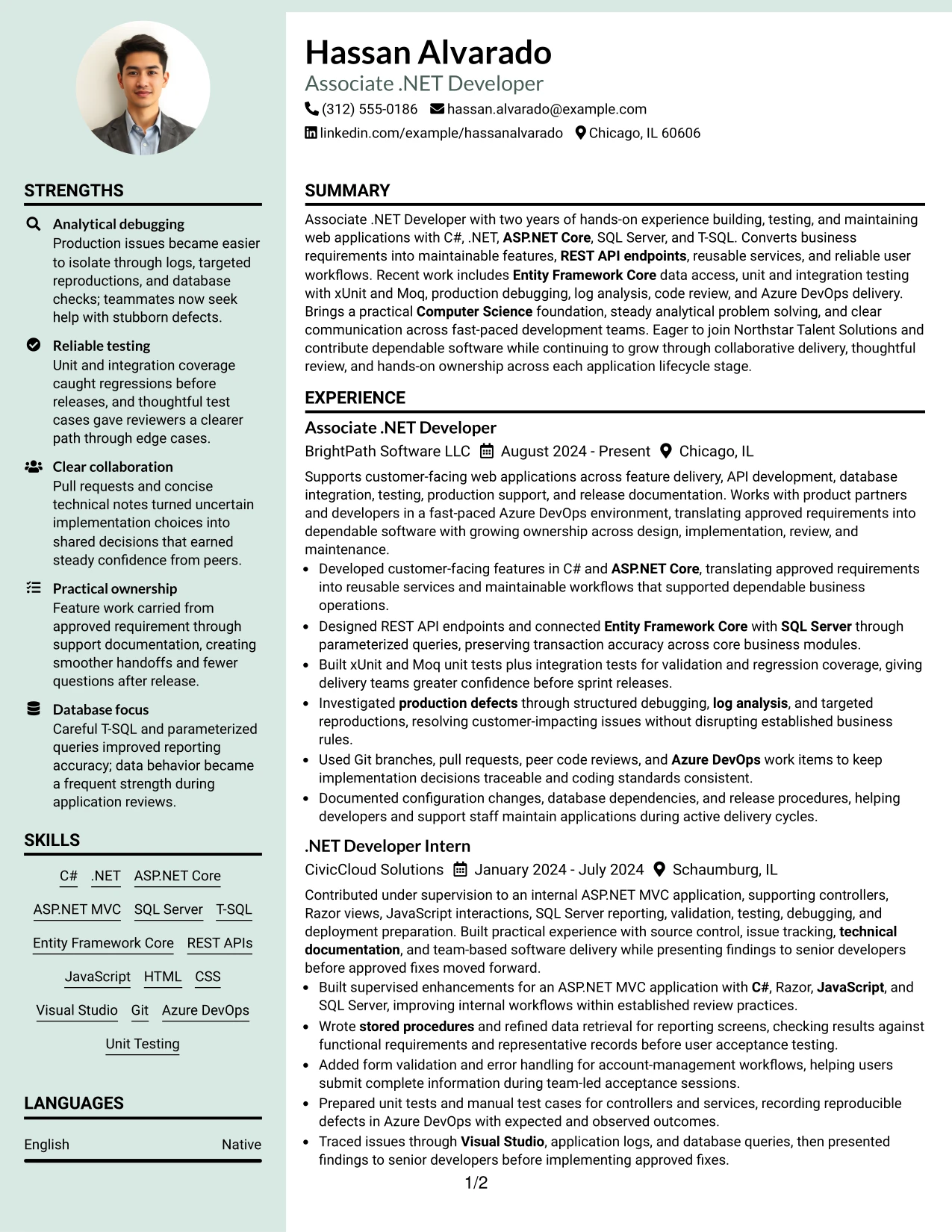
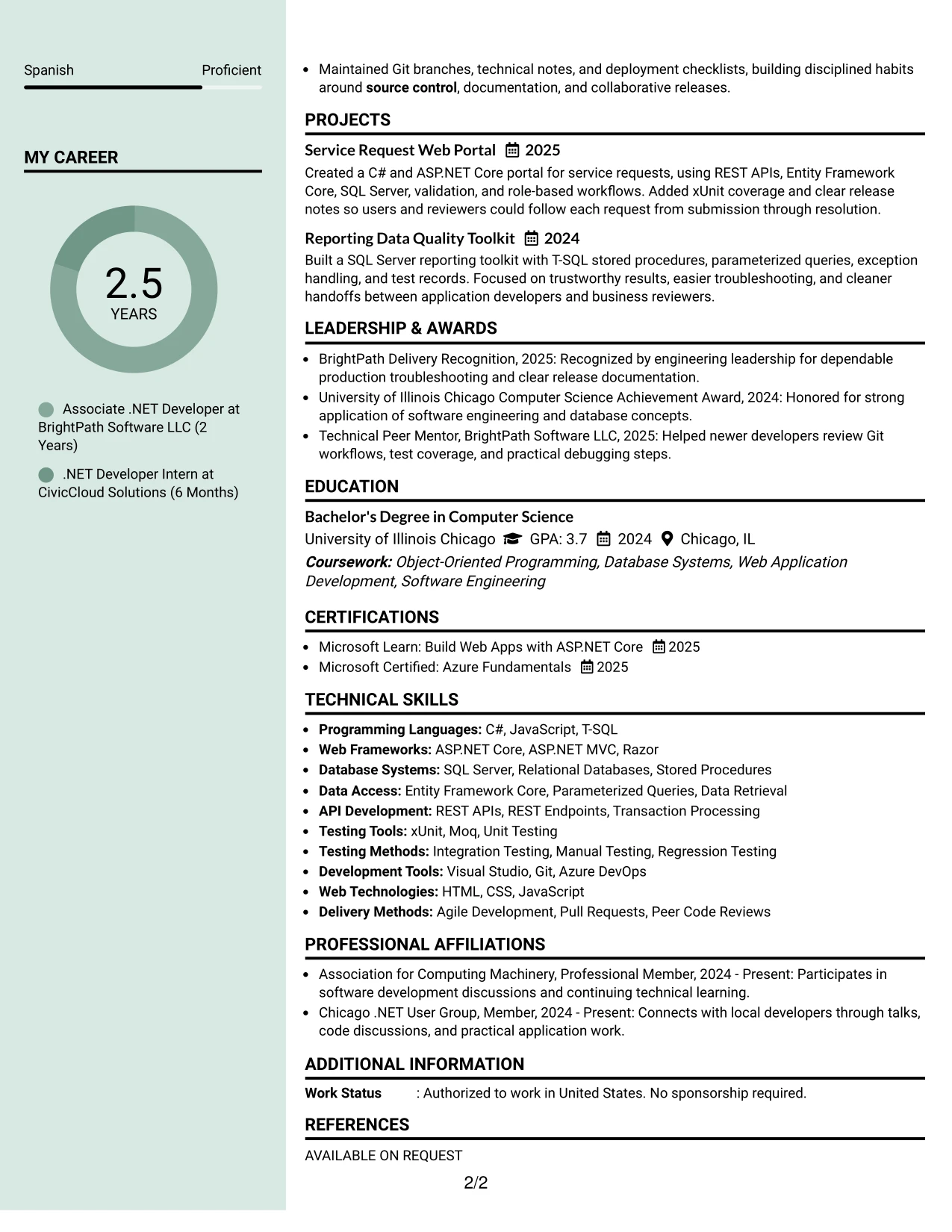
#26 Photo Header Color Sidebar Format Resume Example
Readers can start with the header, move through the color sidebar for contact details and key skills, then continue into the main column for experience and projects. That route keeps the resume's Associate .NET Developer focus visible while giving technical keywords a dedicated place.
The main content should carry the proof: reusable C# services, ASP.NET Core workflows, REST endpoints, SQL Server data access, automated tests, and structured debugging. A photo header can support the visual identity, but it should never replace the summary, accomplishment bullets, education, or certifications that establish professional credibility.
Why the Photo Header Color Sidebar Format Works for a Resume
- A sidebar gives contact details and high-value skills a consistent home.
- The main column preserves space for detailed experience and project bullets.
- Color cues help readers move between quick facts and supporting evidence.
- The header makes the target role easy to identify during initial review.
- Technical tools can be grouped without interrupting the work-history narrative.
- Projects, education, and certifications can follow the strongest experience evidence.
- The layout supports a substantial resume while maintaining a clear visual route.
Best For
- Resumes with enough experience and projects to benefit from a main content column.
- Applicants who want skills and contact details separated from accomplishment bullets.
- Applications where a photo is appropriate to the document's intended presentation.
- Candidates balancing technical evidence with a polished personal header.
- Documents that need room for tools, certifications, education, and project details.
- Readers who review a sidebar first and then examine supporting work history.
- Resumes requiring visible content grouping without a dense two-column body.
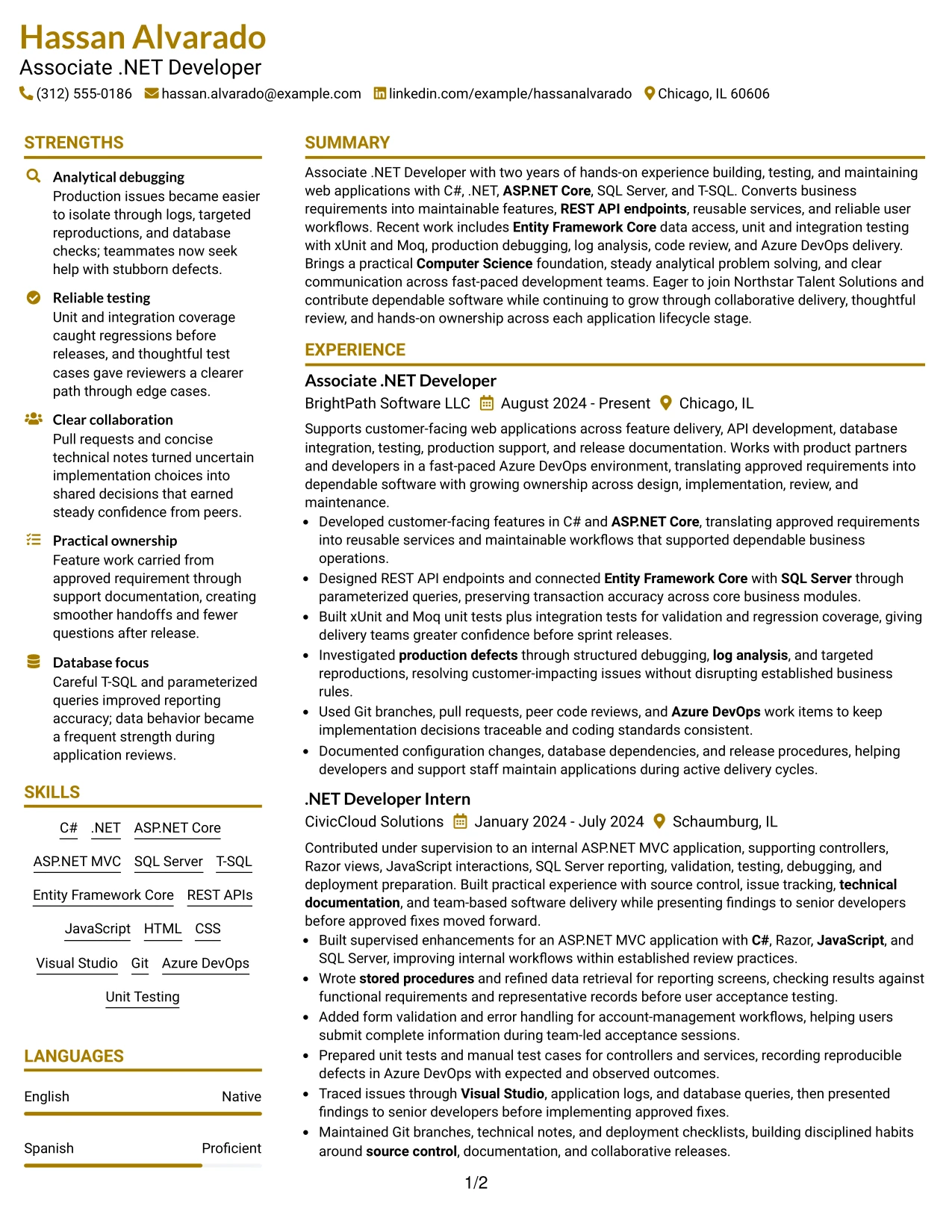
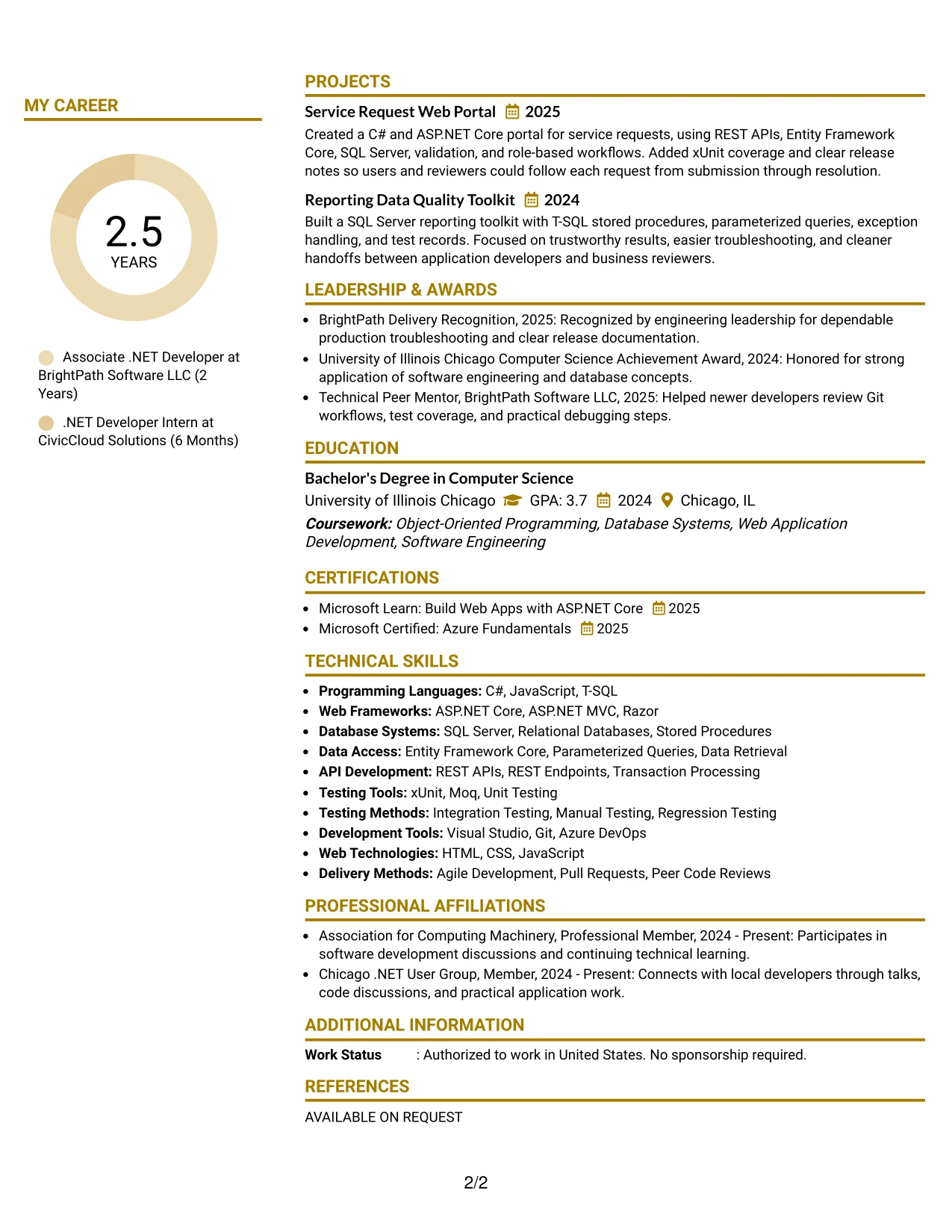
#27 Top Left Header Color Accent Format Resume Example
Production evidence deserves priority on this resume: feature delivery, reliable API work, database accuracy, test coverage, and defect resolution should appear in the strongest bullets. The Top Left Header Color Accent Format supports that focus by placing the role and summary first, then giving the evidence a clean, readable sequence.
Each experience bullet should connect a technical action to its value. Examples include translating requirements into maintainable C# features, building REST API endpoints, using Entity Framework Core with SQL Server, and investigating production issues through logs and targeted reproductions. Projects, education, and certifications can reinforce the same capabilities.
Why the Top Left Header Color Accent Format Works for a Resume
- The upper-left starting point makes the target role and summary highly visible.
- A single-column body gives achievement bullets consistent reading width.
- Color accents distinguish sections without hiding important text.
- Technical evidence appears in a natural order from skills to experience.
- Testing and debugging results can receive clear emphasis in the work history.
- Projects support the professional record instead of competing with it.
- Standard headings and text blocks help maintain ATS readability.
Best For
- Resumes where recent development evidence should lead the review.
- Applicants who want a clear top-left entry point for role and summary information.
- Documents that rely on concise bullets to explain technical decisions and results.
- Candidates presenting API, database, testing, and debugging work in one flow.
- Applications that need projects and certifications to reinforce employment evidence.
- Readers who value a calm page with small visual cues and strong text hierarchy.
- Resumes where standard parsing and quick evidence review are both priorities.
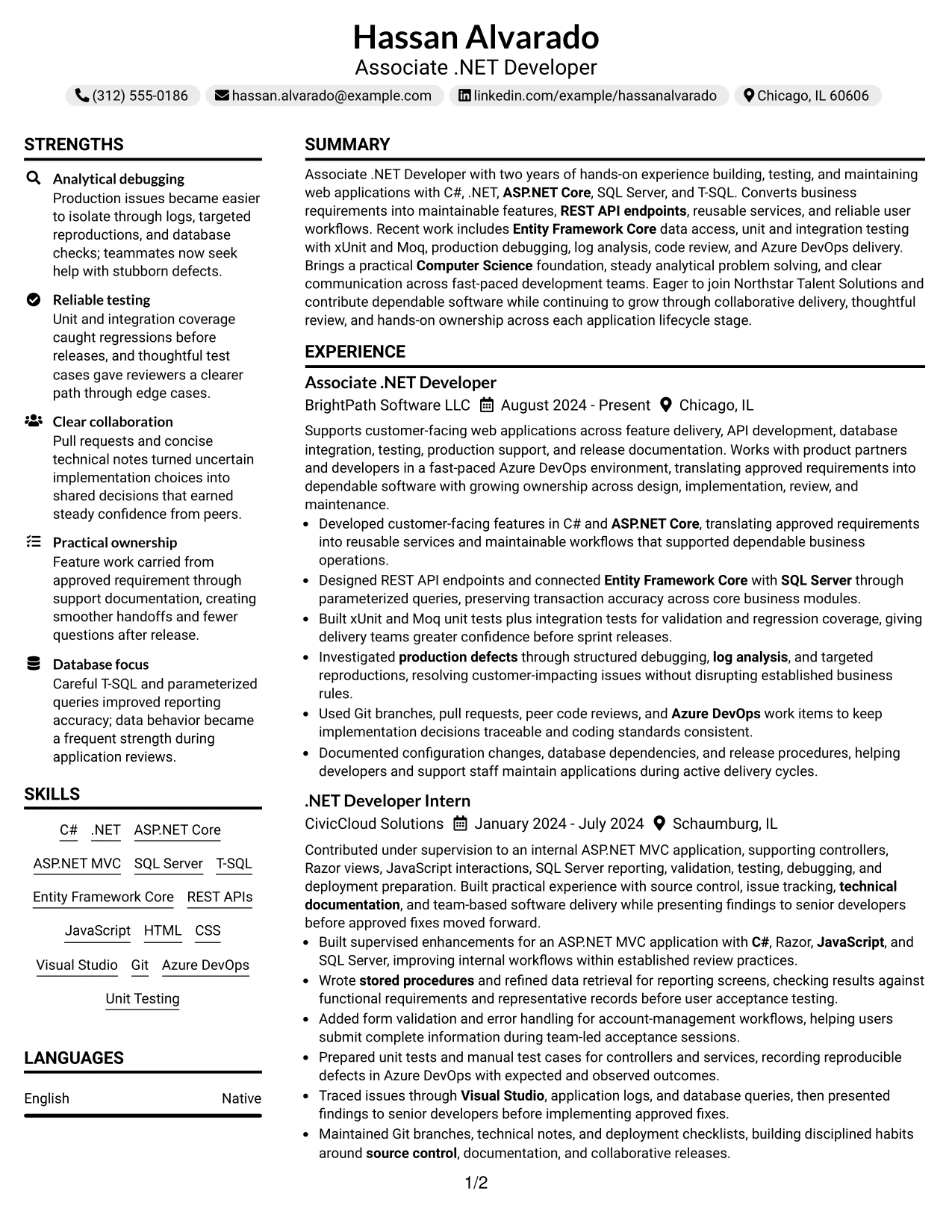
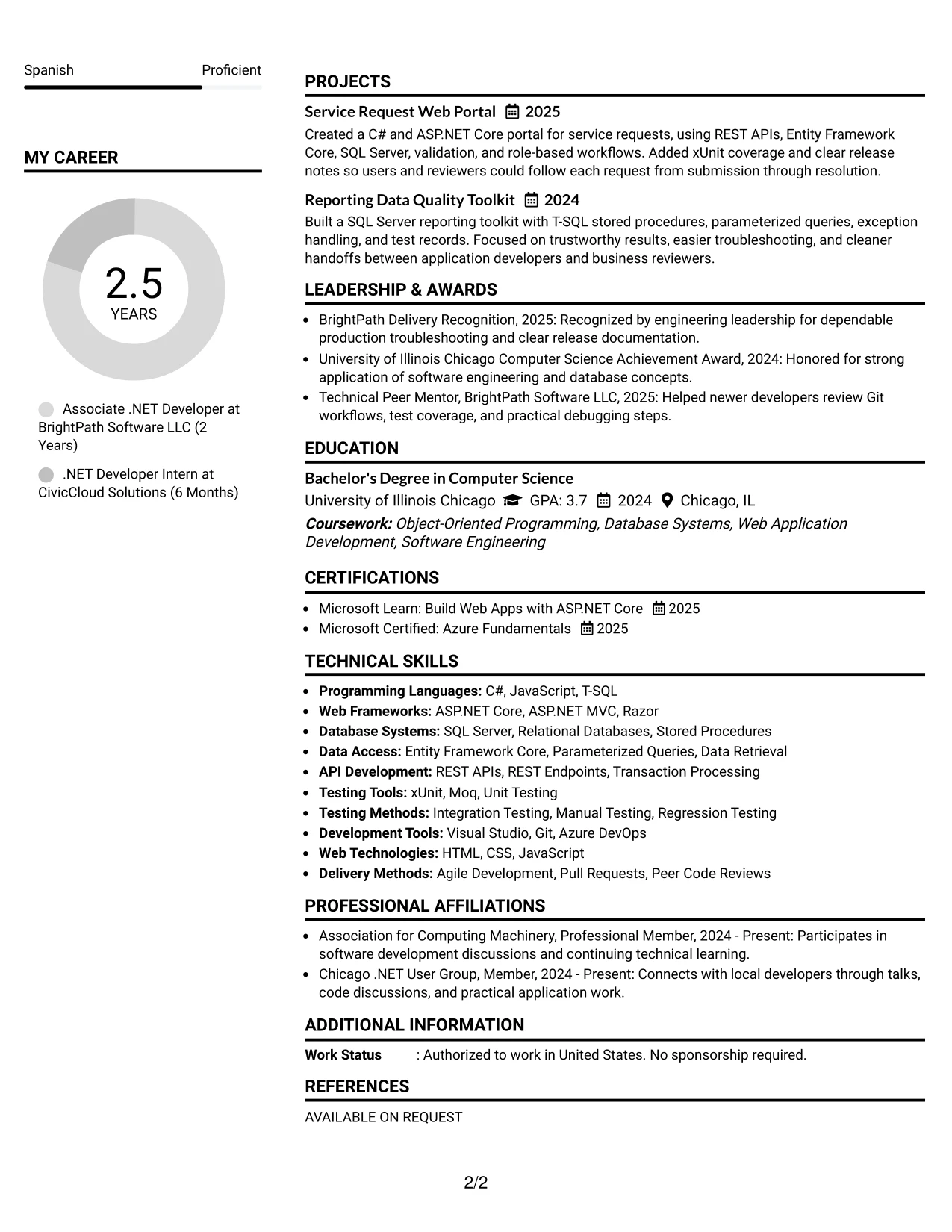
#28 Centered Header Classic Two Column Format Resume Example
Balanced content distribution lets the reader take in the centered header, then compare a compact skills area with the detailed work record. The classic two-column format gives the resume room for C#, .NET, SQL Server, ASP.NET Core, testing tools, projects, and education while keeping each section distinct.
A centered header adds order, while bullet-led experience supplies momentum. The resume can show feature development, REST API work, Entity Framework Core, production debugging, code reviews, and release documentation in a measured sequence. That balance is especially useful when the application requires both technical range and specific evidence.
Why the Centered Header Classic Two Column Format Works for a Resume
- A centered header creates a formal starting point without taking over the page.
- Two columns balance compact skills with fuller experience descriptions.
- Bullets make technical actions and outcomes easier to compare.
- Projects can occupy a supporting column while employment remains prominent.
- Education and certifications fit into the structure without excessive repetition.
- The format handles a broad tool list while preserving readable section grouping.
- A classic hierarchy supports both quick scanning and careful technical review.
Best For
- Resumes that need balanced space for skills, experience, projects, and education.
- Applicants presenting a broad technical toolkit alongside focused work evidence.
- Applications that benefit from a formal header and a traditional information order.
- Candidates who want project details visible without pushing experience too far down.
- Documents with several supporting sections, including certifications or memberships.
- Readers who compare a compact skills column with detailed achievement bullets.
- Resume reviews that require both fast scanning and deeper evidence checking.
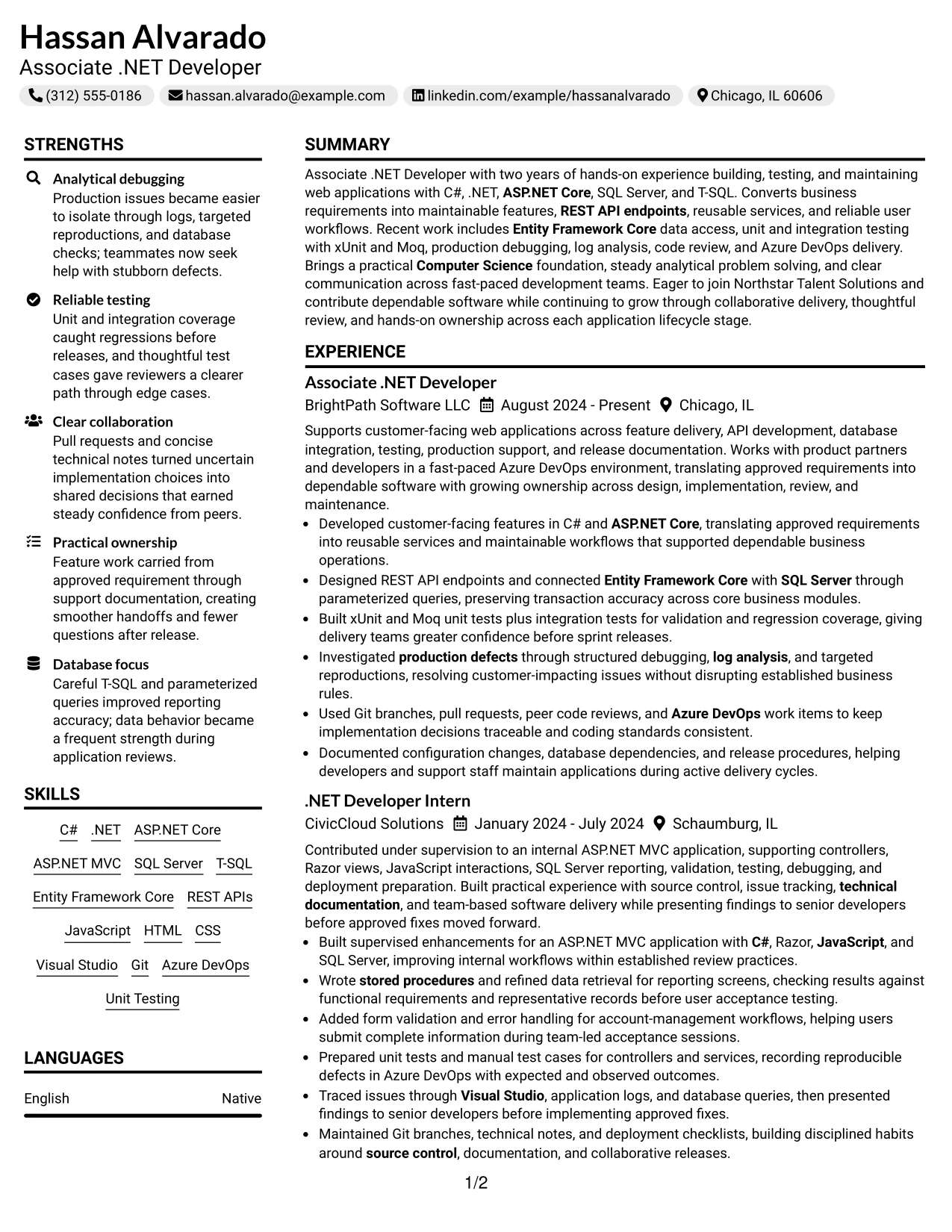
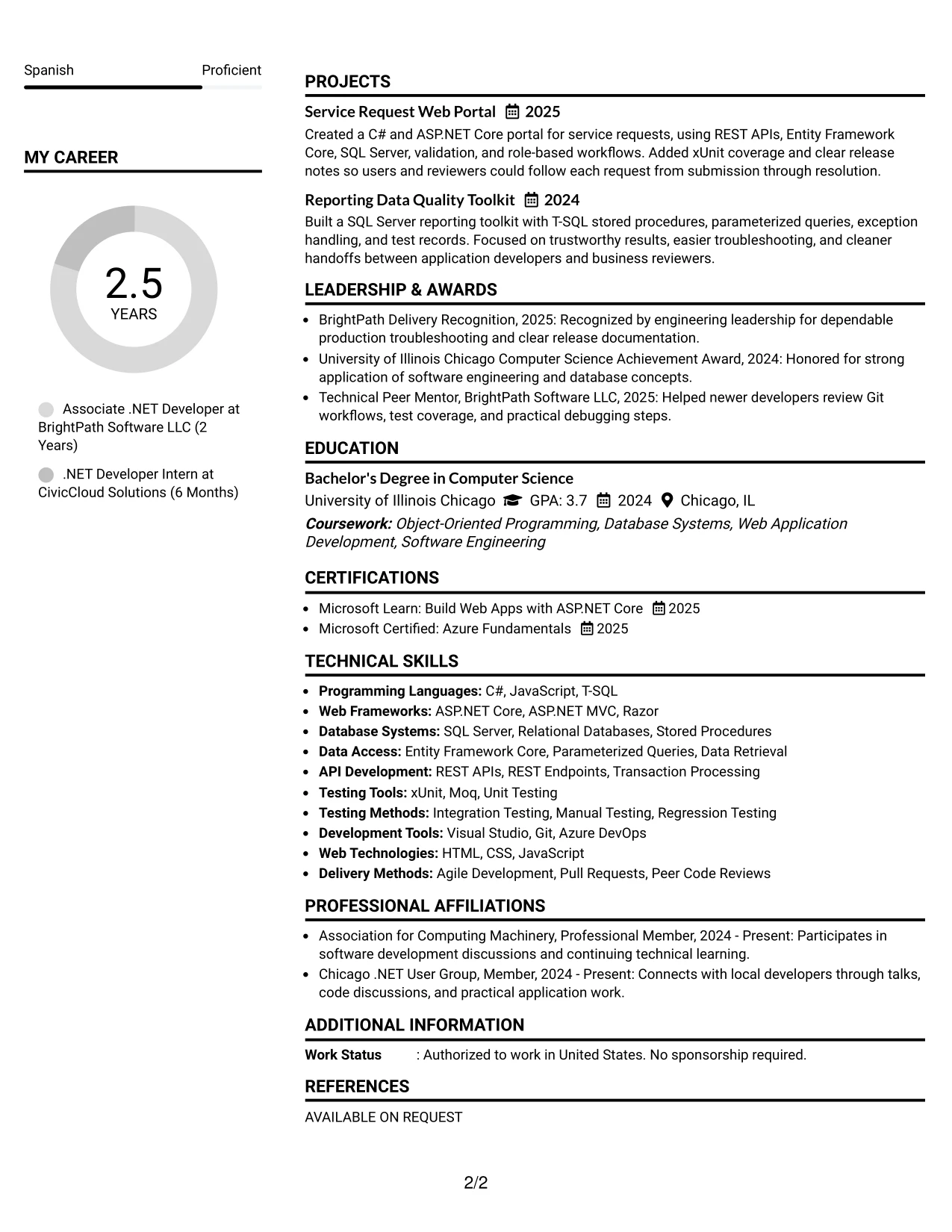
#29 Left Aligned Header Clean Two Column Format Resume Example
A practical application review benefits from a direct path: the left-aligned header identifies the role, the supporting column groups skills and education, and the main column presents experience and projects. This clean two-column format keeps the resume easy to navigate while giving technical evidence enough room to make an impact.
The structure suits a resume that must show both range and proof. C#, ASP.NET Core, REST APIs, SQL Server, xUnit, Moq, Git, and Azure DevOps can appear in focused skill groups, while bullets explain feature delivery, testing, debugging, code review, and documentation. The result is efficient without feeling compressed.
Why the Left Aligned Header Clean Two Column Format Works for a Resume
- A left-aligned header starts the review in a familiar reading position.
- The two-column design separates quick qualifications from detailed evidence.
- Clean spacing keeps tools and frameworks easy to locate.
- The main column supports longer bullets for development and maintenance work.
- Projects can demonstrate application building and database skills beside experience.
- Education and certifications remain visible without disrupting the career narrative.
- The restrained structure supports professional presentation and ATS-friendly text.
Best For
- Resumes that need a familiar starting point and efficient two-column organization.
- Applicants separating technical skills from detailed accomplishment bullets.
- Applications with projects that deserve visibility alongside employment history.
- Candidates who want strong readability without a highly decorative design.
- Documents combining tools, testing methods, education, and certifications.
- Readers who move from the header to quick facts before reviewing experience.
- Resume content that needs compact organization while preserving useful detail.
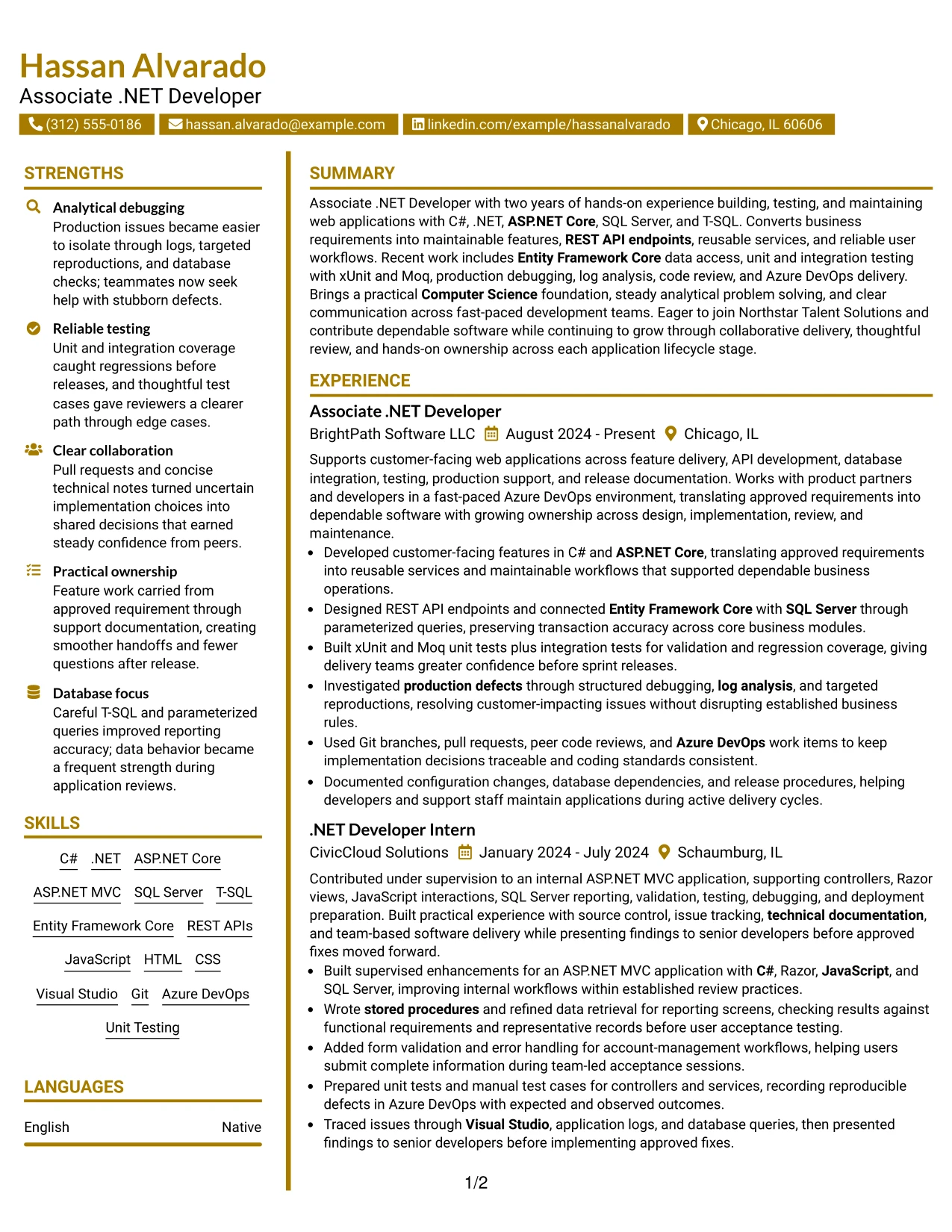
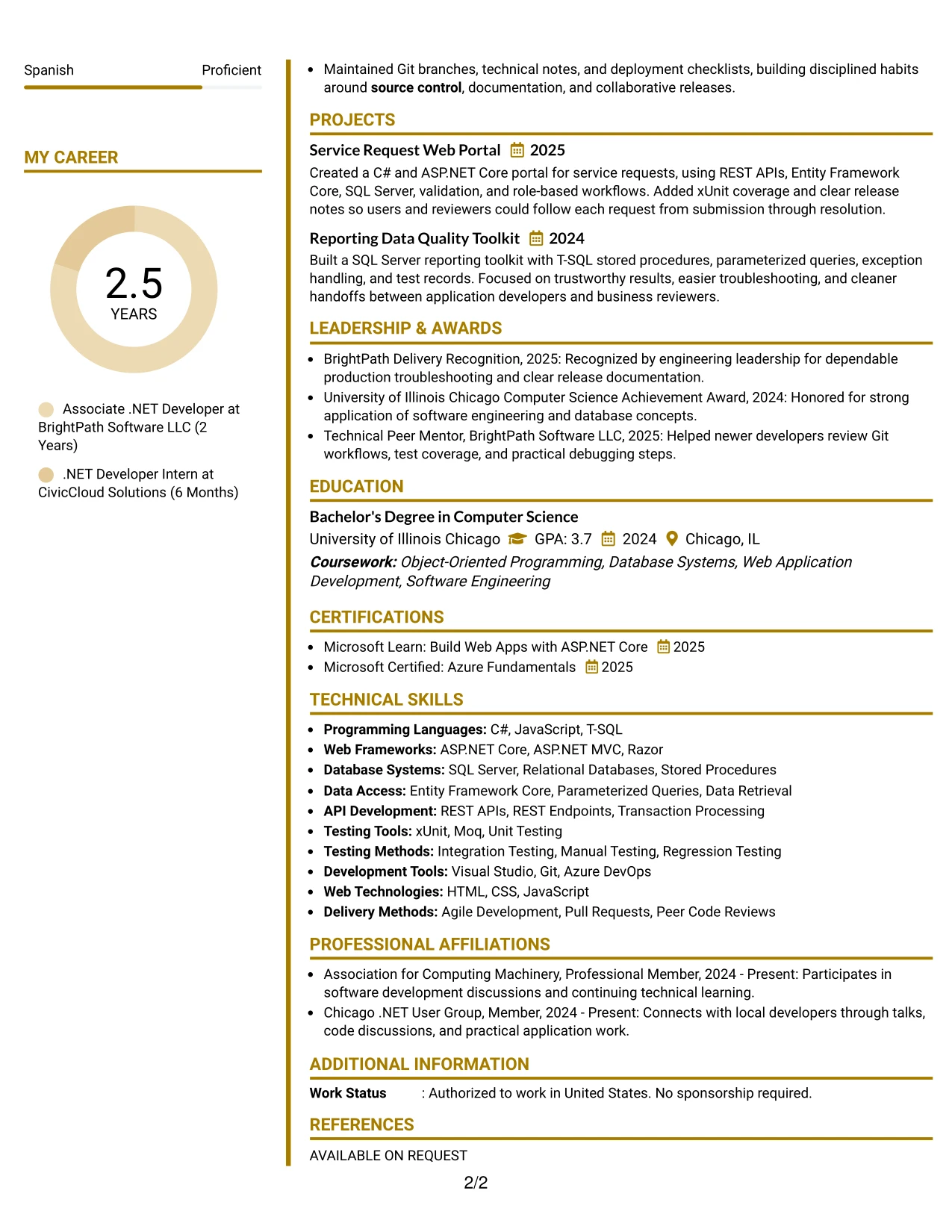
#30 Accent Divider Modern Two Column Format Resume Example
A modern review begins with the evidence that proves delivery: maintainable features, REST APIs, accurate database access, test coverage, and resolved production defects. Hassan Alvarado's resume can use that evidence to give the Associate .NET Developer target a clear and credible center of gravity.
Accent dividers then guide the reader through skills, experience, projects, education, and certifications. Square bullet markers add rhythm to technical details without replacing substance. C#, ASP.NET Core, Entity Framework Core, SQL Server, xUnit, Moq, and Azure DevOps remain visible as searchable terms and as tools connected to real work.
Why the Accent Divider Modern Two Column Format Works for a Resume
- Divider lines create clear boundaries between related resume sections.
- Two columns let technical skills stay visible while experience carries detail.
- Modern markers make bullets easy to follow during a fast scan.
- The format supports evidence from feature work, testing, debugging, and releases.
- Projects can add technical depth without overwhelming the employment section.
- Education and certifications can sit in a defined supporting area.
- The design gives a current impression while preserving practical resume mechanics.
Best For
- Resumes that need a modern structure for software delivery evidence.
- Applicants who want technical skills visible beside detailed experience.
- Applications where divider lines can clarify several related content groups.
- Candidates presenting projects, testing work, and production support in one document.
- Documents that benefit from visually distinct bullet sections without heavy decoration.
- Readers who scan for tools first and then verify them in achievement bullets.
- Resume layouts that need contemporary presentation with dependable ATS structure.
#31 Shaded Labels Clean Two Column Format Resume Example
The Shaded Labels Clean Two Column Format uses clear content blocks to organize the resume before the reader studies each bullet. Labels can guide attention to skills, experience, projects, education, and certifications, making the document's information architecture easy to understand from the first scan.
Within that structure, the strongest details should remain specific. C# and ASP.NET Core feature work, SQL Server queries, Entity Framework Core, REST endpoints, xUnit and Moq tests, production debugging, and Git-based reviews show practical capability. Shaded labels add orientation; the evidence earns attention.
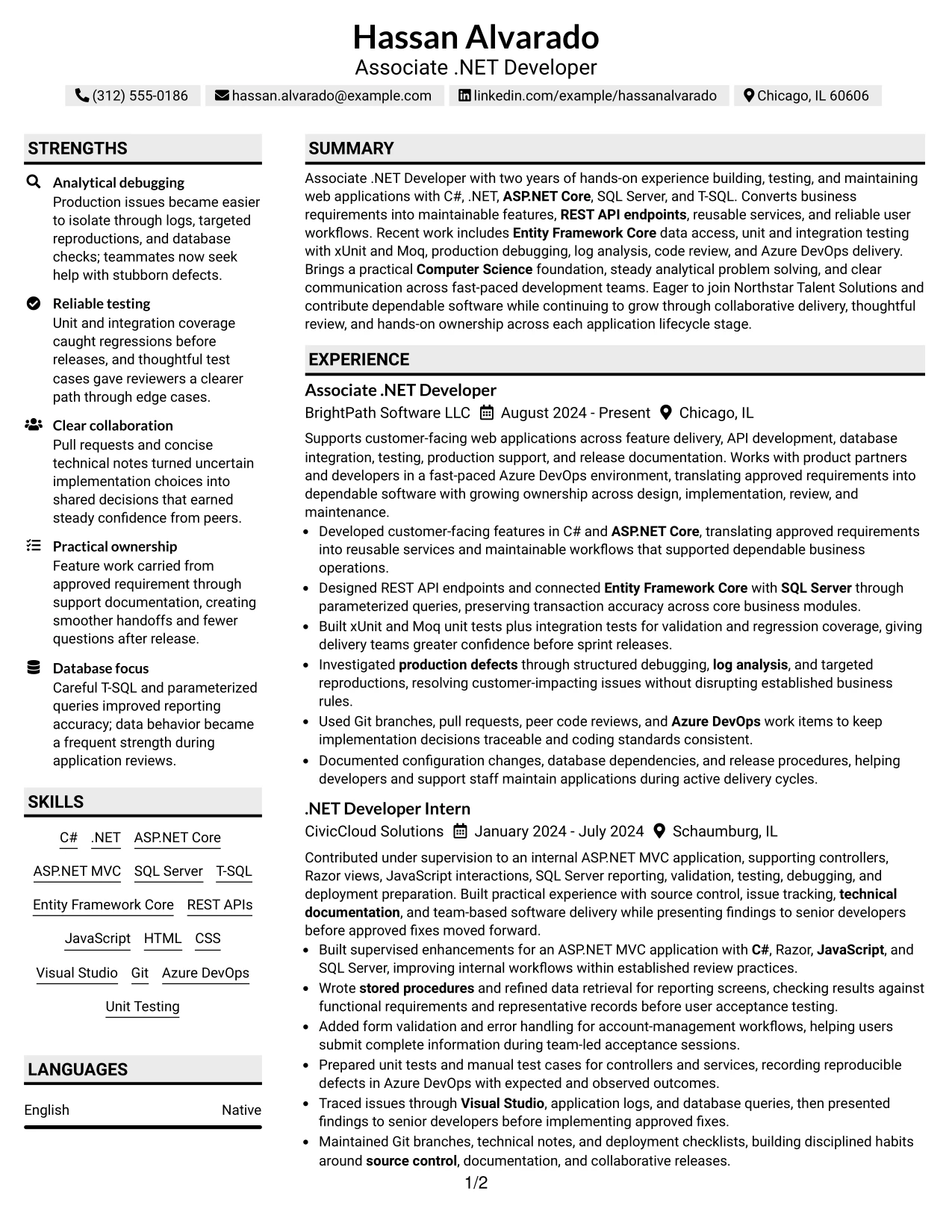
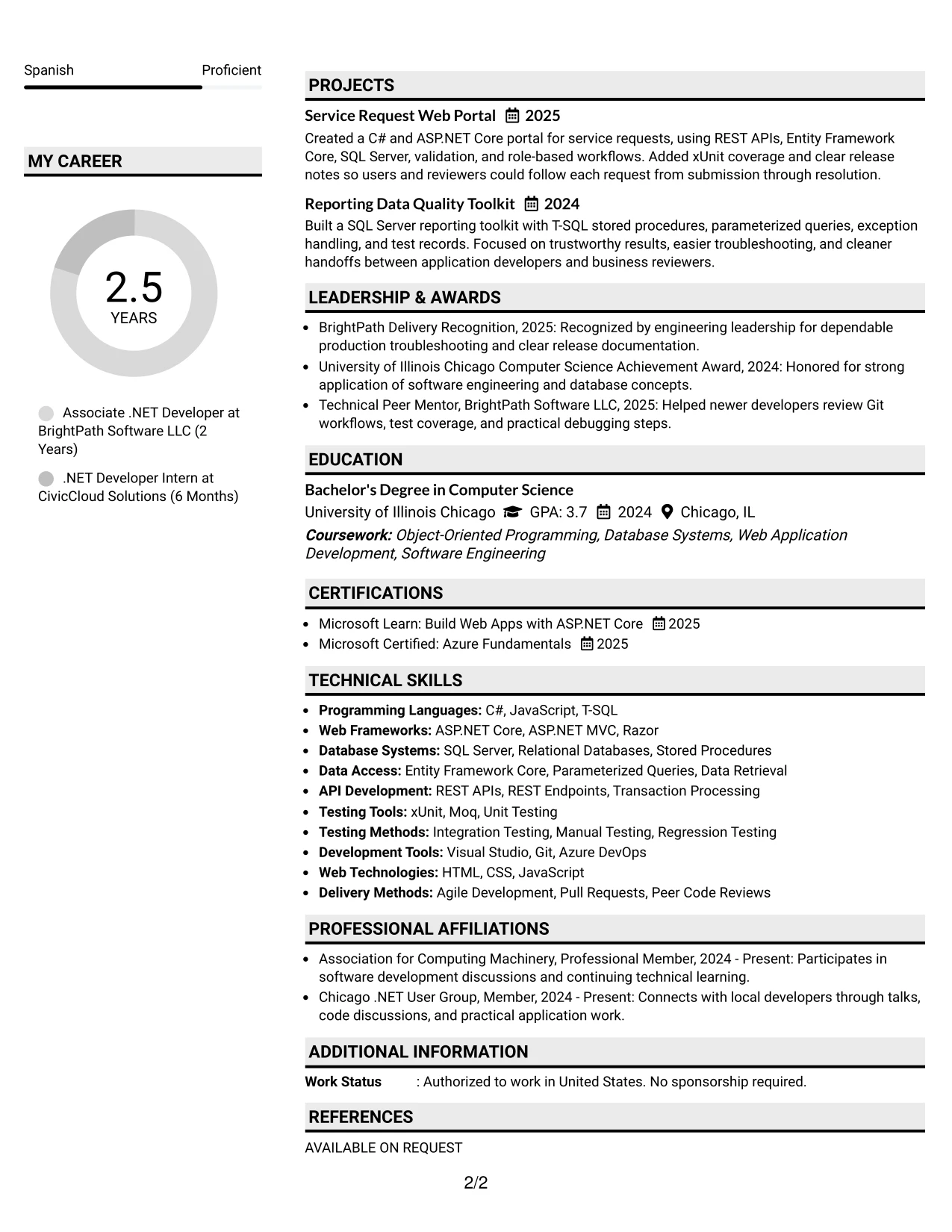
Why the Shaded Labels Clean Two Column Format Works for a Resume
- Shaded labels make major resume sections easy to identify.
- Two columns organize supporting qualifications beside detailed experience.
- Centered labels provide visual anchors without lengthy text.
- Bullets can connect tools with the work completed using them.
- Projects add proof of application and database work in a controlled space.
- Education and certifications remain easy to find during a quick review.
- Consistent labels support scanning while standard content supports ATS extraction.
Best For
- Resumes that need highly visible labels for quick section recognition.
- Applicants organizing many technical skills without burying work history.
- Applications where a clean two-column grid improves information retrieval.
- Candidates with projects and education that need defined supporting spaces.
- Documents built around concise bullets and clearly grouped evidence.
- Readers who prefer visual anchors before reading detailed accomplishments.
- Resume content requiring orderly presentation across skills, experience, and credentials.
#32 Photo Header Color Accent International Format Resume Example
Readers can begin at the photo header, confirm the target role and contact details, then follow the color accents through skills, experience, projects, education, and certifications. This single-column route gives a substantial technical resume a clear sequence while preserving space for relevant keywords.
The content should remain the main reason to continue reading. C#, .NET, ASP.NET Core, SQL Server, T-SQL, REST APIs, testing, debugging, and Azure DevOps should appear in context through focused bullets. A photo header can support a broader personal presentation when appropriate, but it should not distract from measurable results or technical proof.
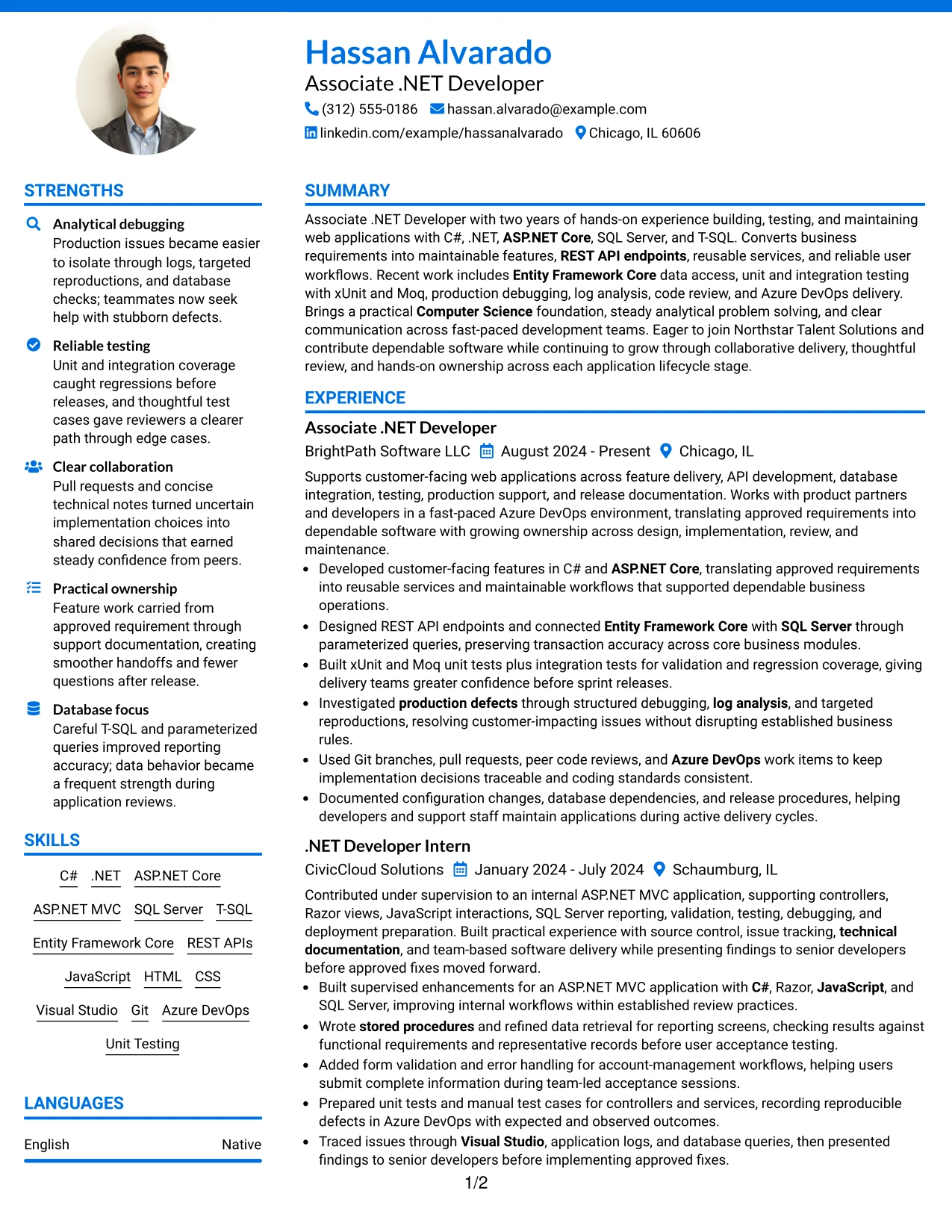
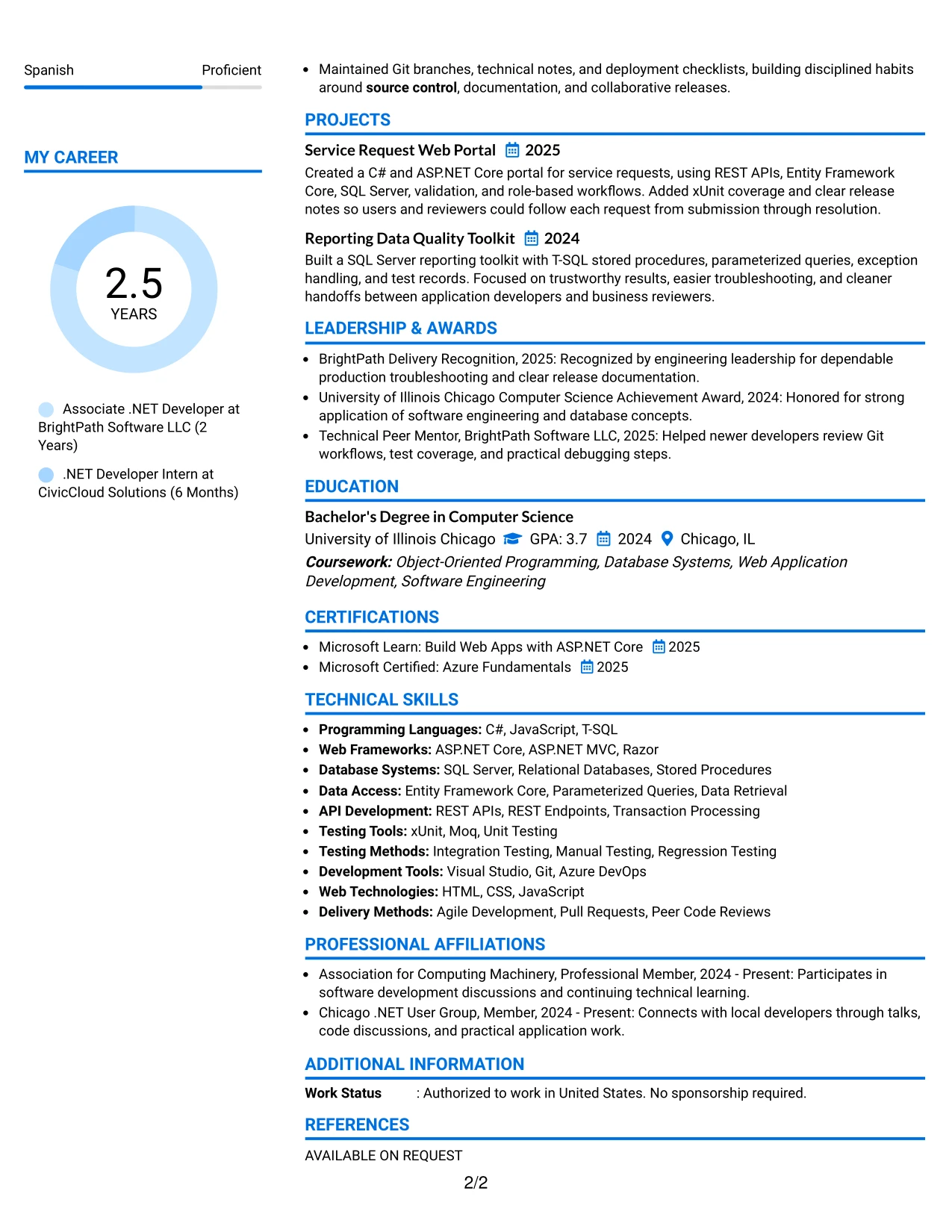
Why the Photo Header Color Accent International Format Works for a Resume
- The header combines personal identification with an immediately visible target role.
- A single-column sequence supports a broad set of resume sections.
- Color accents help readers move from summary to evidence and credentials.
- The format gives experience bullets enough width for complete technical details.
- Projects and certifications can follow the work record in a logical order.
- Skills remain searchable when listed in clear, standard groups.
- The design supports a polished presentation while keeping the content reviewable.
Best For
- Resumes intended for settings where a photo is suitable and professionally expected.
- Applicants with several sections that need a clear top-to-bottom path.
- Applications requiring room for skills, experience, projects, and credentials.
- Candidates who want color cues without giving up detailed technical bullets.
- Documents that present international or cross-border professional information clearly.
- Readers who prefer one-column flow with visible section transitions.
- Resumes where visual identity supports, but does not replace, evidence.
#33 Large Profile Photo International Two Column Format Resume Example
The strongest evidence should lead the review: web application development, REST API design, SQL Server data access, automated testing, and structured production debugging establish the resume's value quickly. The large profile header supports that identity, while the two-column structure gives the evidence and supporting qualifications separate, readable spaces.
Use the main column for experience and project results, then place skills, education, certifications, and affiliations in the supporting column. C#, .NET, ASP.NET Core, Entity Framework Core, xUnit, Moq, Git, and Azure DevOps can be grouped for quick access. The large profile area should frame the resume, never overwhelm its technical substance.
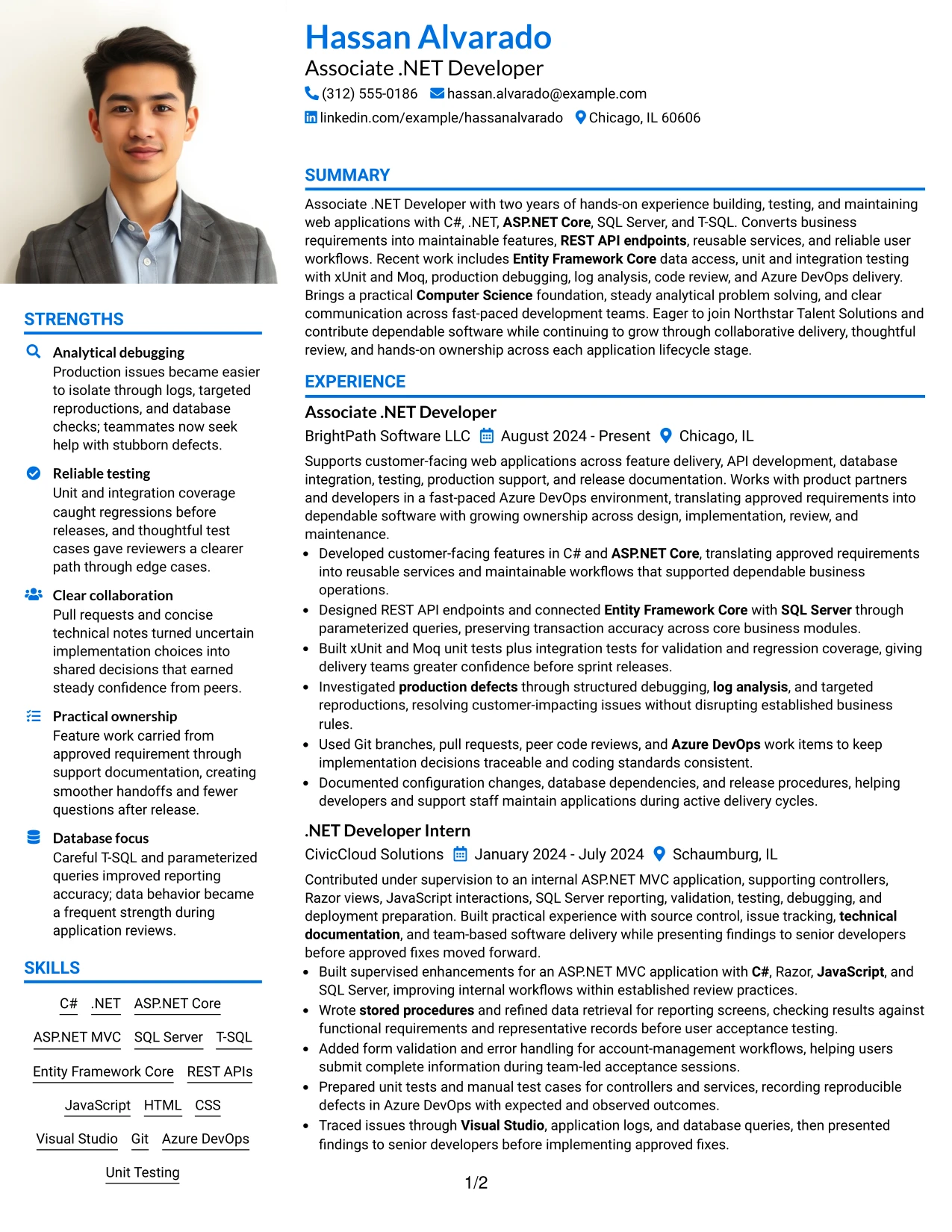
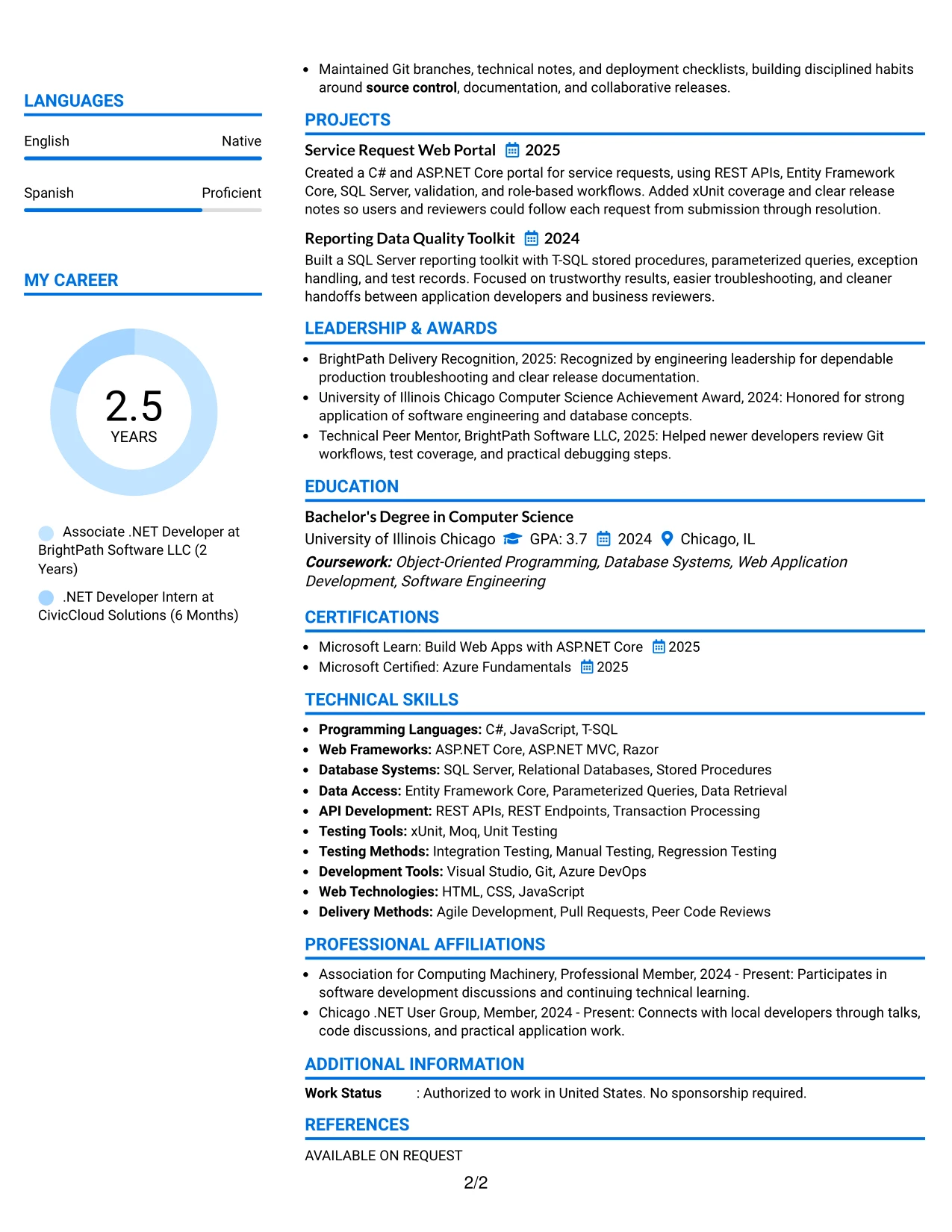
Why the Large Profile Photo International Two Column Format Works for a Resume
- The large profile area creates a clear visual identity at the top of the document.
- Two columns divide detailed evidence from supporting qualifications.
- The main column provides room for complete experience and project bullets.
- A supporting column can group skills, education, certifications, and affiliations.
- Technical keywords remain easy to locate when grouped under clear labels.
- The format suits a resume with multiple evidence types and a broad content volume.
- A strong visual opening can work alongside disciplined ATS-readable text.
Best For
- Resumes intended for contexts where a prominent photo is appropriate.
- Applicants with substantial experience and project evidence to distribute across columns.
- Applications that need separate spaces for technical skills and detailed results.
- Candidates presenting professional history alongside education, certifications, and affiliations.
- Documents requiring a strong personal header and a structured evidence area.
- Readers who want quick access to qualifications before reviewing full work history.
- Resume layouts that support international presentation without sacrificing technical detail.
Why Build Your Associate .NET Developer Resume with ResumeInMinutes
ResumeInMinutes helps you turn application development work, technical projects, education, certifications, and tools into a structured resume that is easy to scan and customize for an Associate .NET Developer position.
- ATS-friendly resume layouts
- Clear technical section structure
- Keyword-focused resume content
- Projects and skills organization
- Free PDF resume previews
- Resume customization support
Build a resume that makes C#, ASP.NET Core, SQL Server, REST APIs, testing, debugging, code review, and delivery practices easy to verify. A clean format gives each achievement room to support your technical value without hiding important details.
See Also
- 33 Front End Web Applications Developer - Mid-Level JavaScript Resume Templates with Example 2026 (ATS-Optimized)
- 33 Software Engineer Web Developer Resume Templates with Example 2026 (ATS-Optimized)
- 33 Web Developer Intern Resume Templates with Example 2026 (ATS-Optimized)
- 33 Entry Level .NET Developer Resume Templates with Example 2026 (ATS-Optimized)
- 33 Junior .NET Developer Resume Templates with Example 2026 (ATS-Optimized)
- 33 Lead .NET Developer Resume Templates with Example 2026 (ATS-Optimized)
- 33 Mid-Level .NET Developer Resume Templates with Example 2026 (ATS-Optimized)
- 33 AI Automation Engineer / Full-Stack Developer Resume Templates with Example 2026 (ATS-Optimized)
- 30+ Associate .NET Developer: Craft Web Apps with C#, SQL Cover Letter Templates with Example 2026
- 30+ Front End Web Applications Developer - Mid-Level JavaScript Cover Letter Templates with Example 2026
Frequently Asked Questions
Are these Associate .NET Developer resume templates ATS-friendly?
Yes. The templates use readable headings, clean section order, and space for role-specific keywords such as C#, .NET, ASP.NET Core, SQL Server, REST APIs, Entity Framework Core, testing, and debugging.
Are these 33 different resumes?
No. The guide presents one Associate .NET Developer resume example in different layouts and design themes so you can compare formatting without changing the core content.
What should an Associate .NET Developer resume include?
Include a targeted summary, technical skills, professional experience, projects, education, certifications, and achievement-focused bullets. Show accurate evidence of C#, web application development, SQL, APIs, testing, debugging, and source control.
Can I download the resume templates as PDFs?
Yes. Each resume style provides a free PDF download so you can review the format and choose a layout that keeps your technical experience easy to scan.
Which resume style works best for an Associate .NET Developer?
A simple one-column layout or a well-organized two-column layout usually works well. Choose a format with clear headings, consistent spacing, readable fonts, and no design elements that interfere with ATS parsing.
How can I show technical results when my resume has limited metrics?
Describe the feature, tool, problem, and result clearly. You can show value through reliable transaction processing, test coverage, defect resolution, improved data retrieval, clearer release procedures, or stronger traceability when those claims are accurate.
Should I include a photo on my resume?
Include a photo only when it is customary or required in your country, region, or industry. For U.S. applications, a no-photo resume is generally the safer choice.
Can I customize these resume templates?
Yes. ResumeInMinutes allows you to adjust the resume text, section order, layout, design style, and PDF format for your Associate .NET Developer application.