7 Attorney - Constitutional and Government Litigation Resume Templates with Example
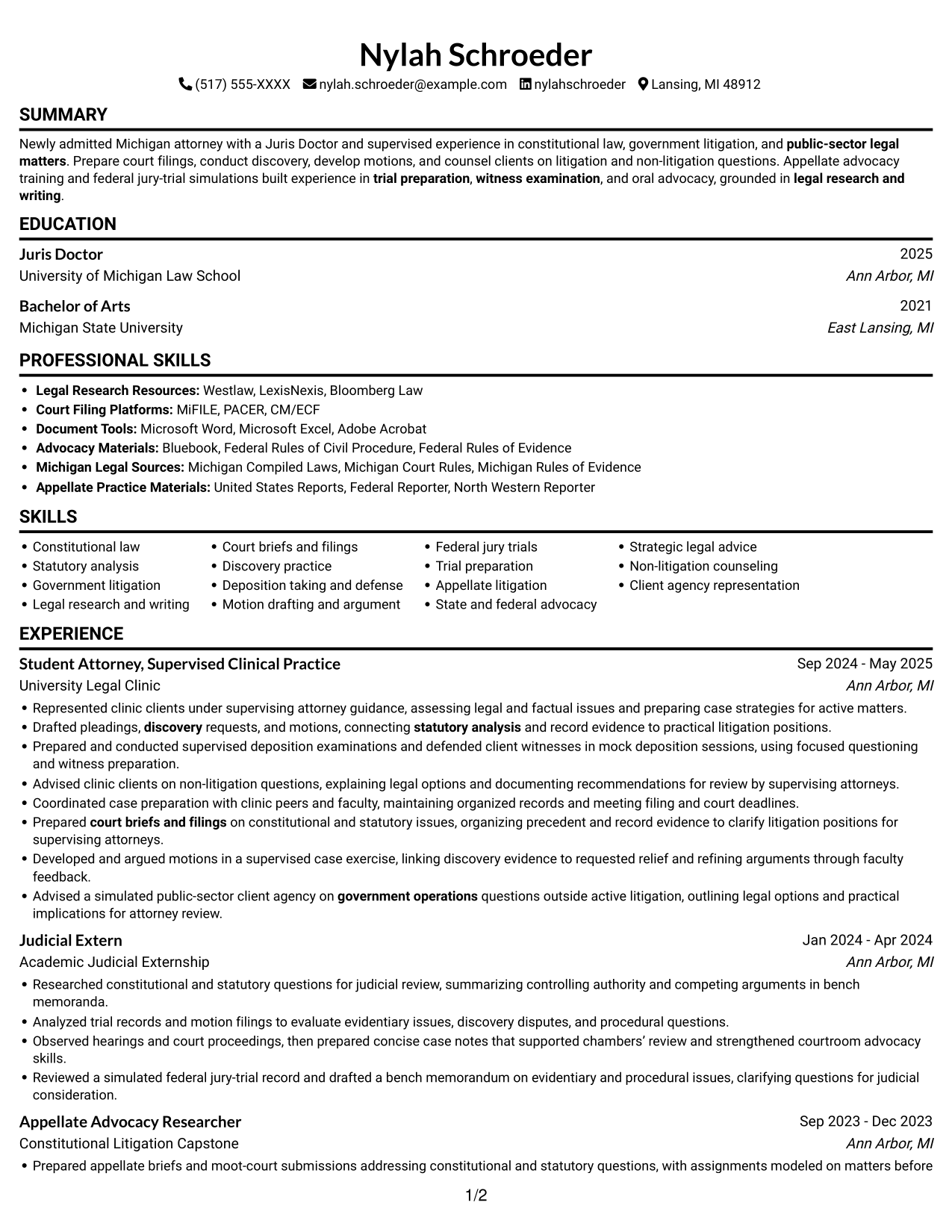
This guide shows you how to build an Attorney - Constitutional and Government Litigation resume with clear evidence of legal analysis, advocacy, and public-sector work. You will learn how to organize relevant experience and choose a layout that makes your qualifications easy to review.
For this role, connect constitutional and statutory analysis to specific work such as court filings, discovery, motions, deposition practice, appellate advocacy, and client counseling. Use accurate bullet points to distinguish supervised legal work, judicial research, and trial simulations, and include relevant tools or court procedures when they support your experience.
The guide presents one Attorney - Constitutional and Government Litigation resume example in 7 layouts. Compare the image previews to see how each presentation handles section order and visual emphasis, then open an example in the editor to customize it.
What Makes a Great Attorney - Constitutional and Government Litigation Resume in 2026
A strong resume makes legal work easy to assess through clear sections, focused bullet points, and accurate descriptions of responsibility. It shows how research, filings, discovery, motion practice, and advocacy relate to constitutional and government matters.
Use terms that match your documented work, such as constitutional law, statutory analysis, government litigation, appellate briefs, depositions, and non-litigation counseling. Add measurable results only when you can support them, and list relevant court platforms or legal research tools by name.
Note: Resume examples are for educational purposes only. Use only information that accurately reflects your experience and qualifications. References to real organizations do not imply affiliation or endorsement.
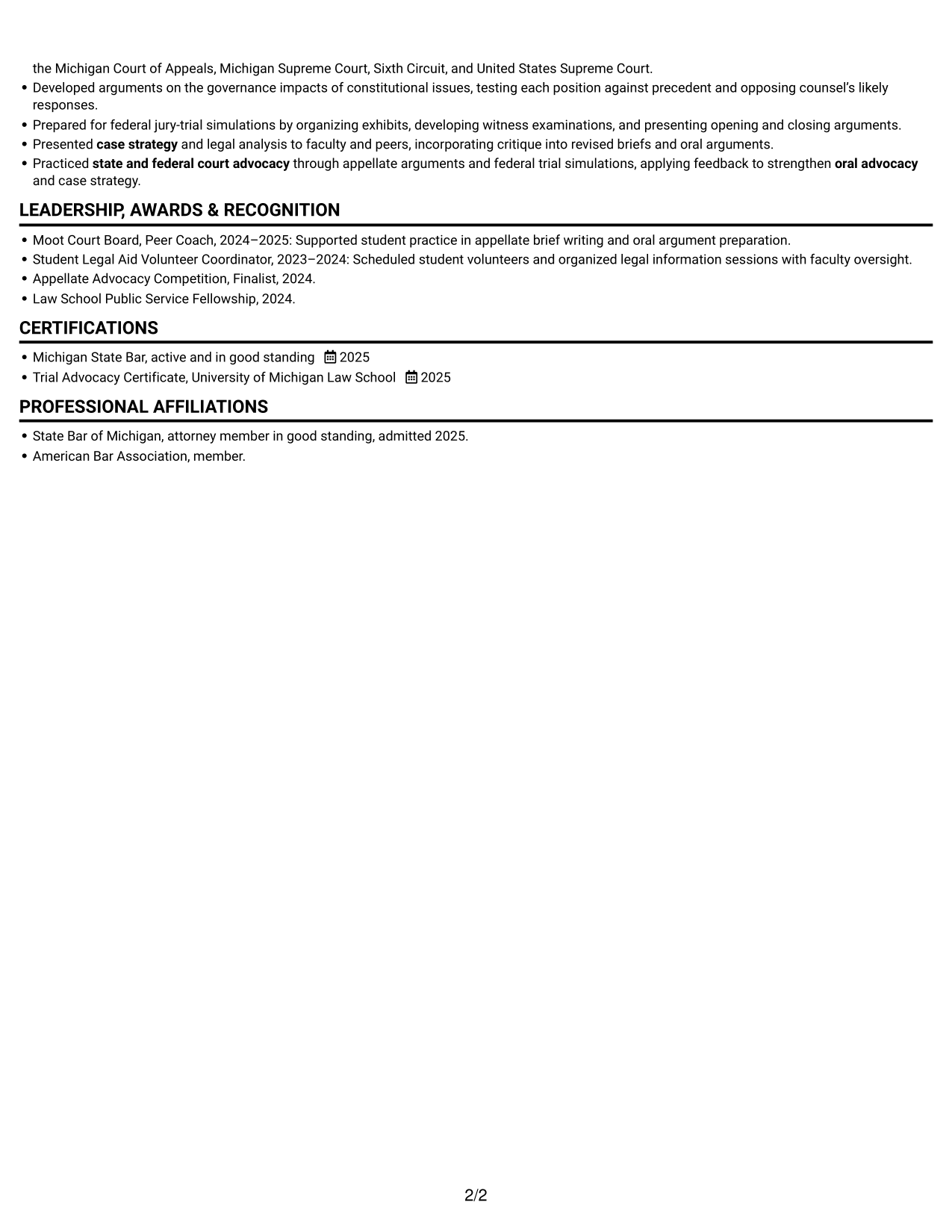
#1 Simple One Column Format Resume Example
The Simple One Column Format keeps every section on one vertical path, making the resume’s reading order straightforward.
Why This Format Works
- Experience entries remain in a steady sequence, supporting a clear review of legal work.
- Full-width text gives detailed case work room to stay readable.
- Education and bar credentials remain easy to locate in the same reading path.
Best For
- Single-path recruiter review
- Detailed experience descriptions
- Chronological work history
- Text-first document presentation
- Several credential sections
Resume Keywords
- State Bar of Michigan, attorney member in good standing
- constitutional law
- Statutory analysis
- government litigation
- legal research and writing
- Court briefs and filings
- discovery
- Deposition taking and defense
- Motion drafting and argument
- Federal jury trials
- trial preparation
- Appellate litigation
- state and federal court advocacy
- Strategic legal advice
- Non-litigation counseling
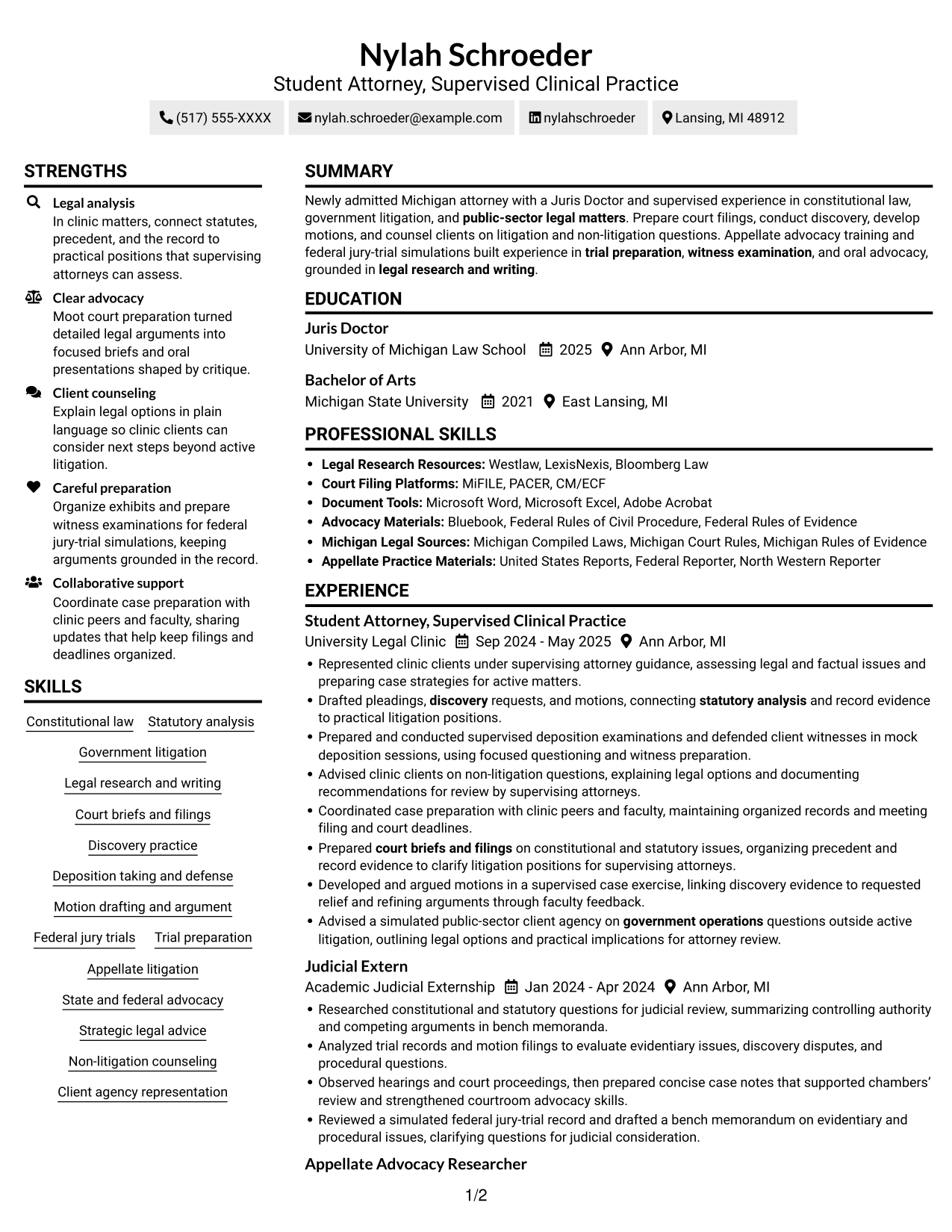
#2 Simple Two Column Format Resume Example
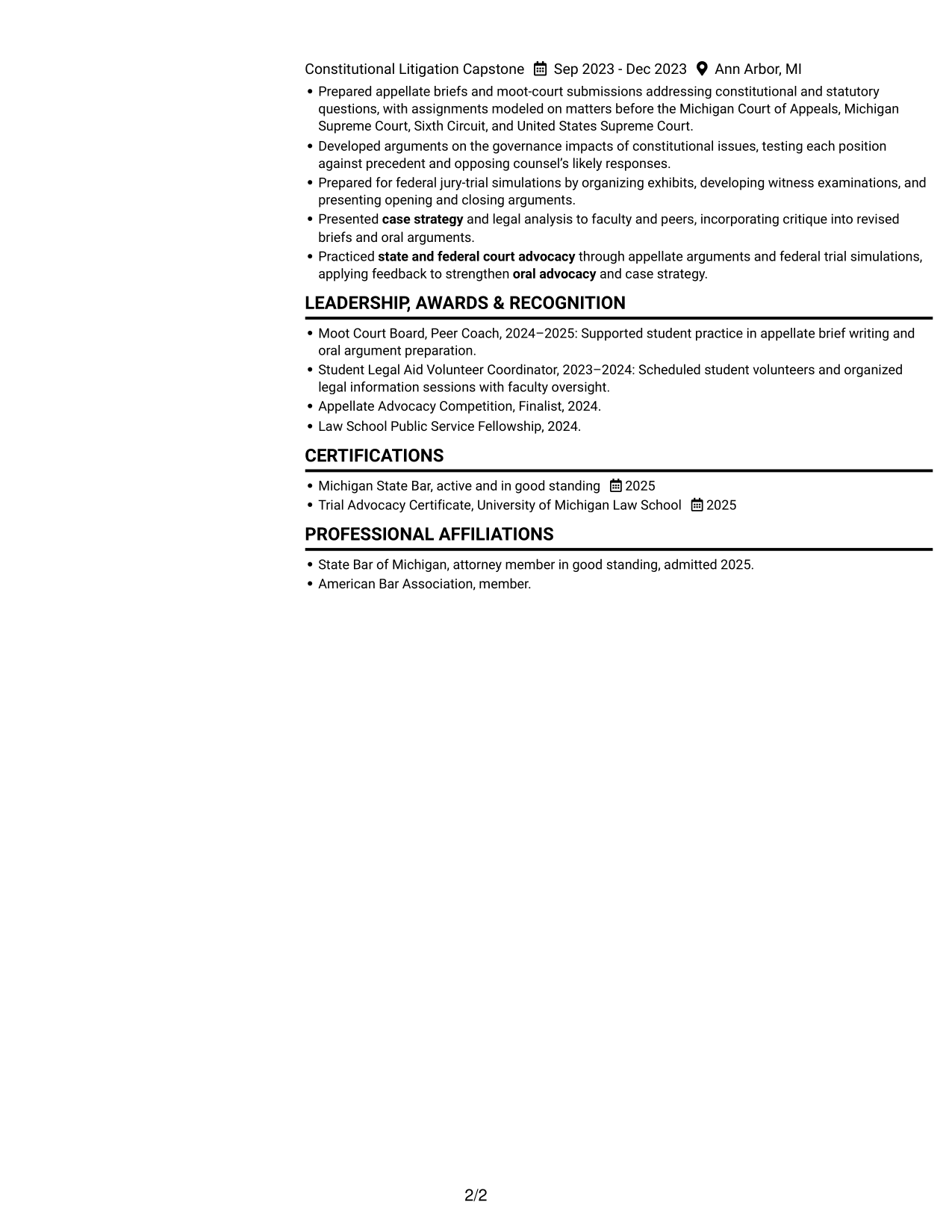
The Simple Two Column Format places resume content in two reading areas, helping reviewers scan related sections side by side.
Why This Format Works
- Two reading areas let reviewers scan resume sections without following one long column.
- Experience details can sit apart from education and other supporting information.
- Skills and credentials remain distinct categories within the compact document layout.
Best For
- Side-by-side section review
- Separate content groups
- Compact supporting information
- Distinct skills and education areas
- Resumes with varied section types
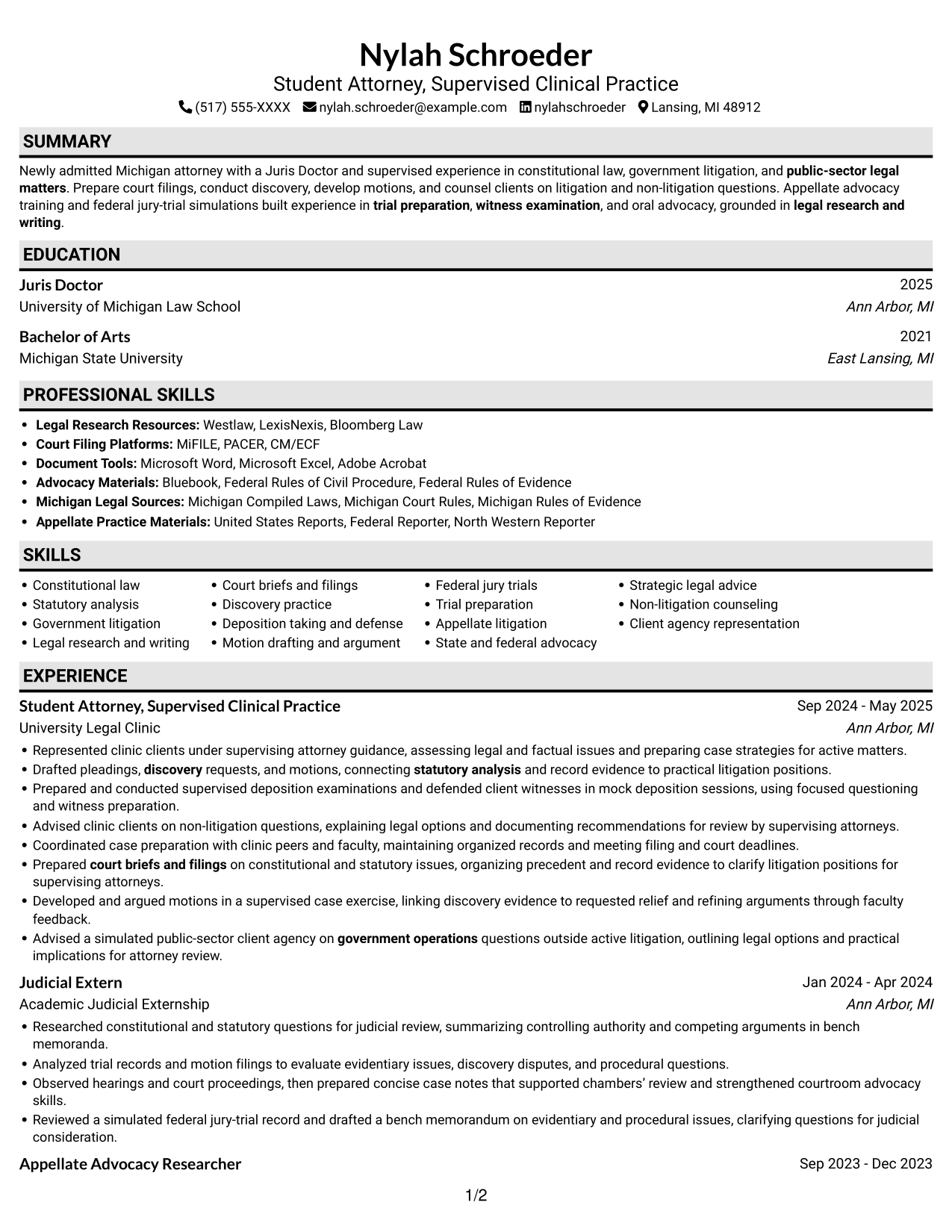
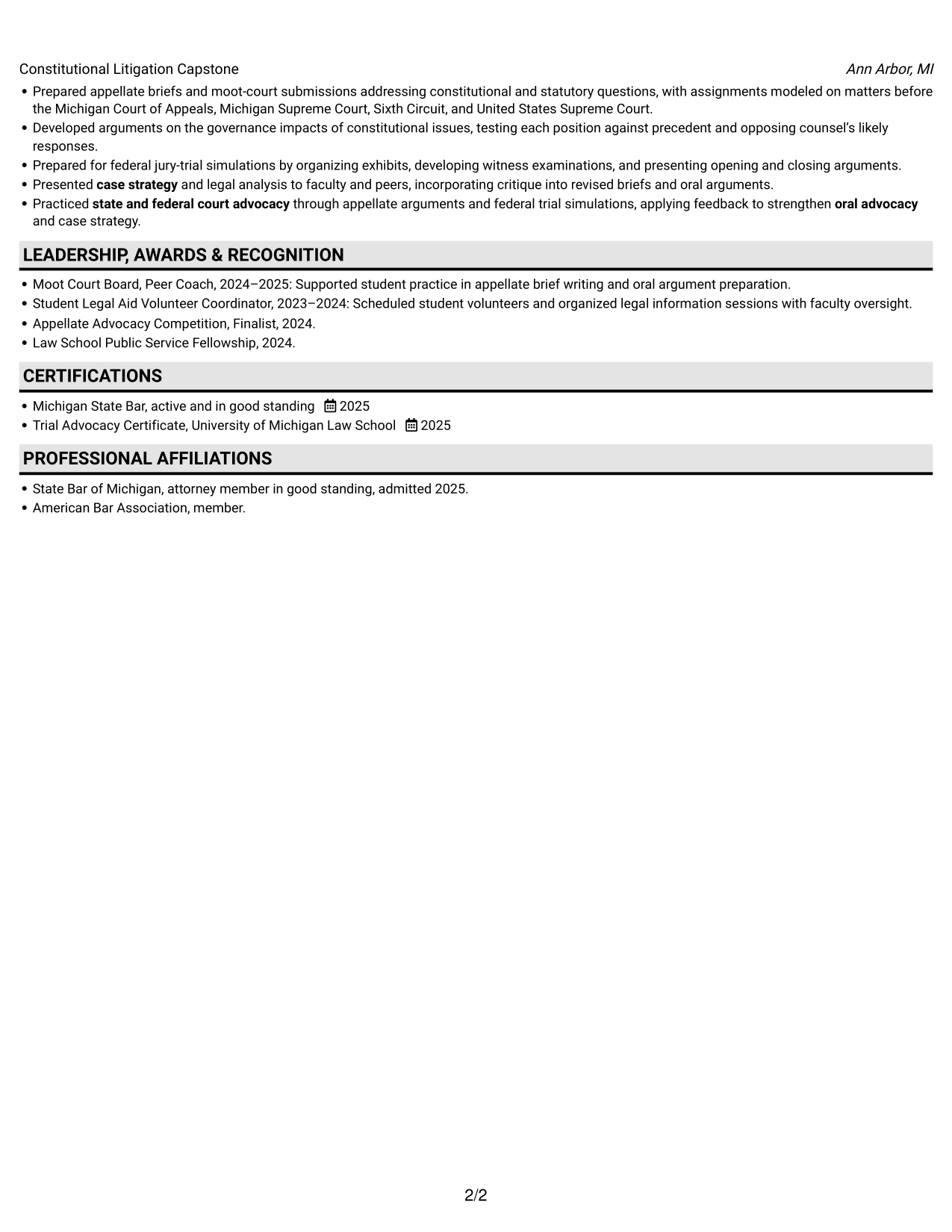
#3 Plain One Column with Shaded Labels Resume Example
The Plain One Column with Shaded Labels format keeps sections in a vertical sequence, offering a direct route through the resume.
Why This Format Works
- Continuous vertical reading keeps experience and education in a familiar order.
- Broad text lines support full descriptions of supervised legal work.
- Separate resume sections remain part of one clear navigation path.
Best For
- Straightforward section sequence
- Longer experience entries
- Linear resume review
- Text-led application materials
- Multiple credential categories
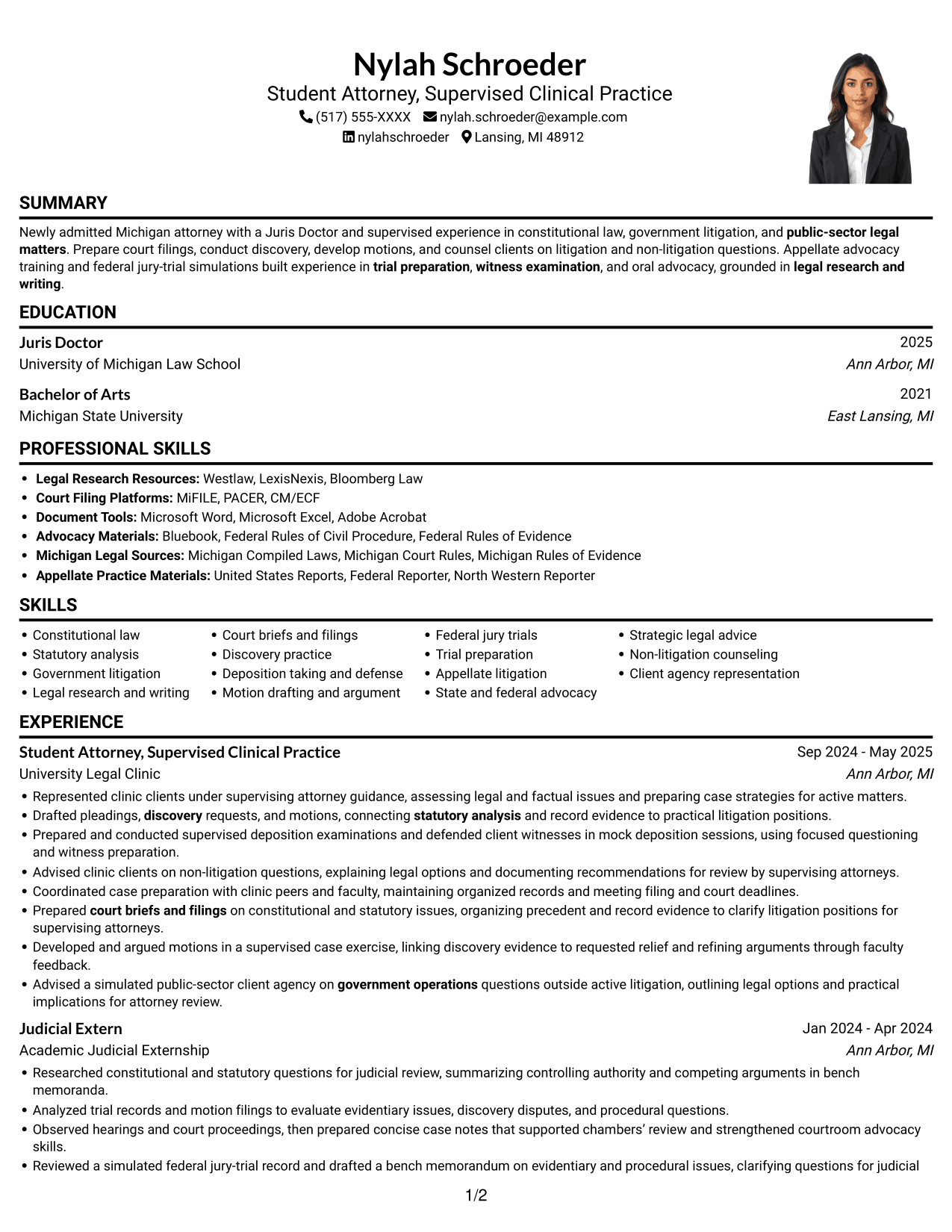
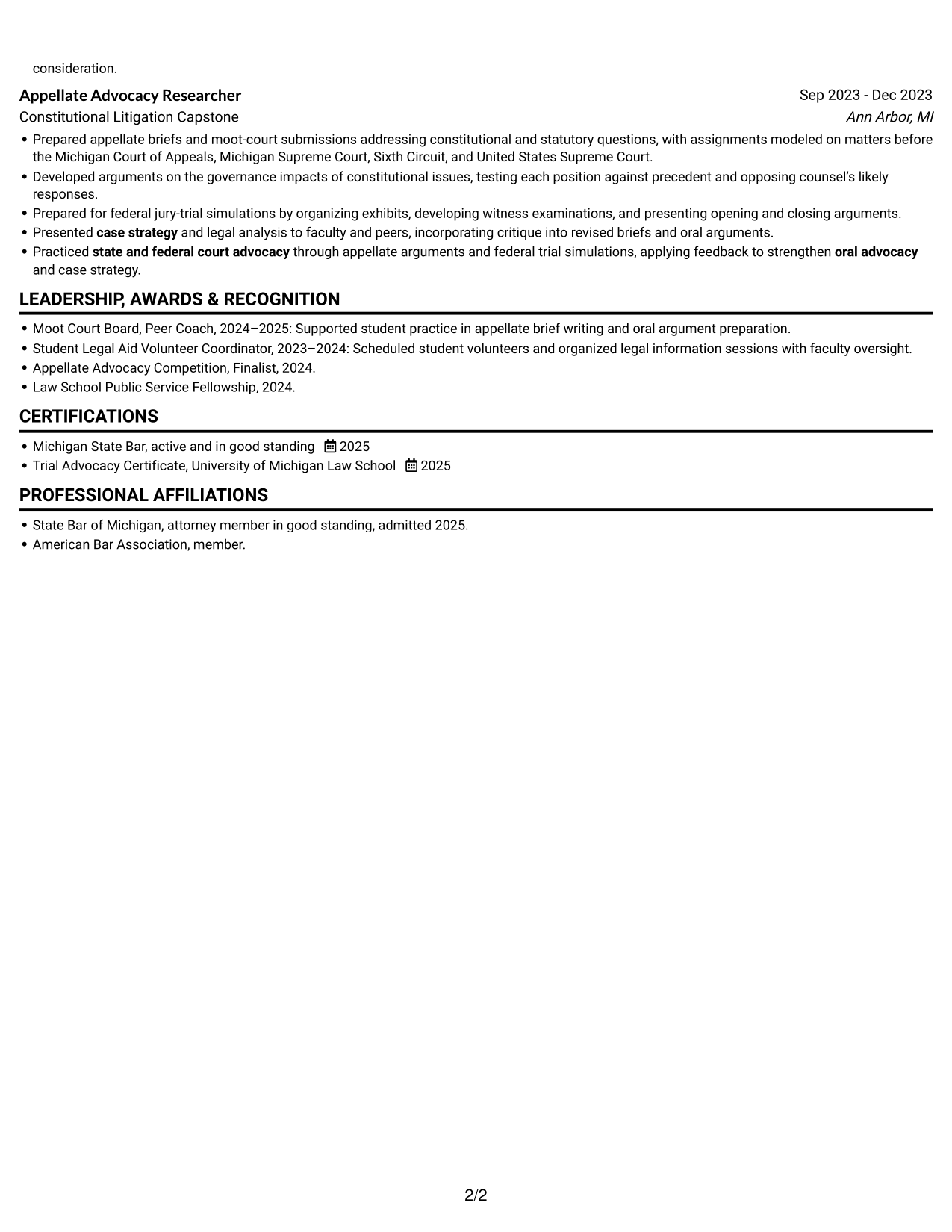
#4 One Column Format with Photo Right Resume Example
The One Column Format with Photo Right pairs a single reading path with a portrait on the right, preserving direct text flow while adding a visual element.
Why This Format Works
- Single-column text keeps experience details together in a direct reading order.
- Role entries have room for complete descriptions of supervised legal work.
- Education and bar credentials stay easy to locate among resume sections.
Best For
- Resume with a right-side portrait
- Single-path recruiter review
- Detailed experience descriptions
- Chronological work history
- Text and portrait balance
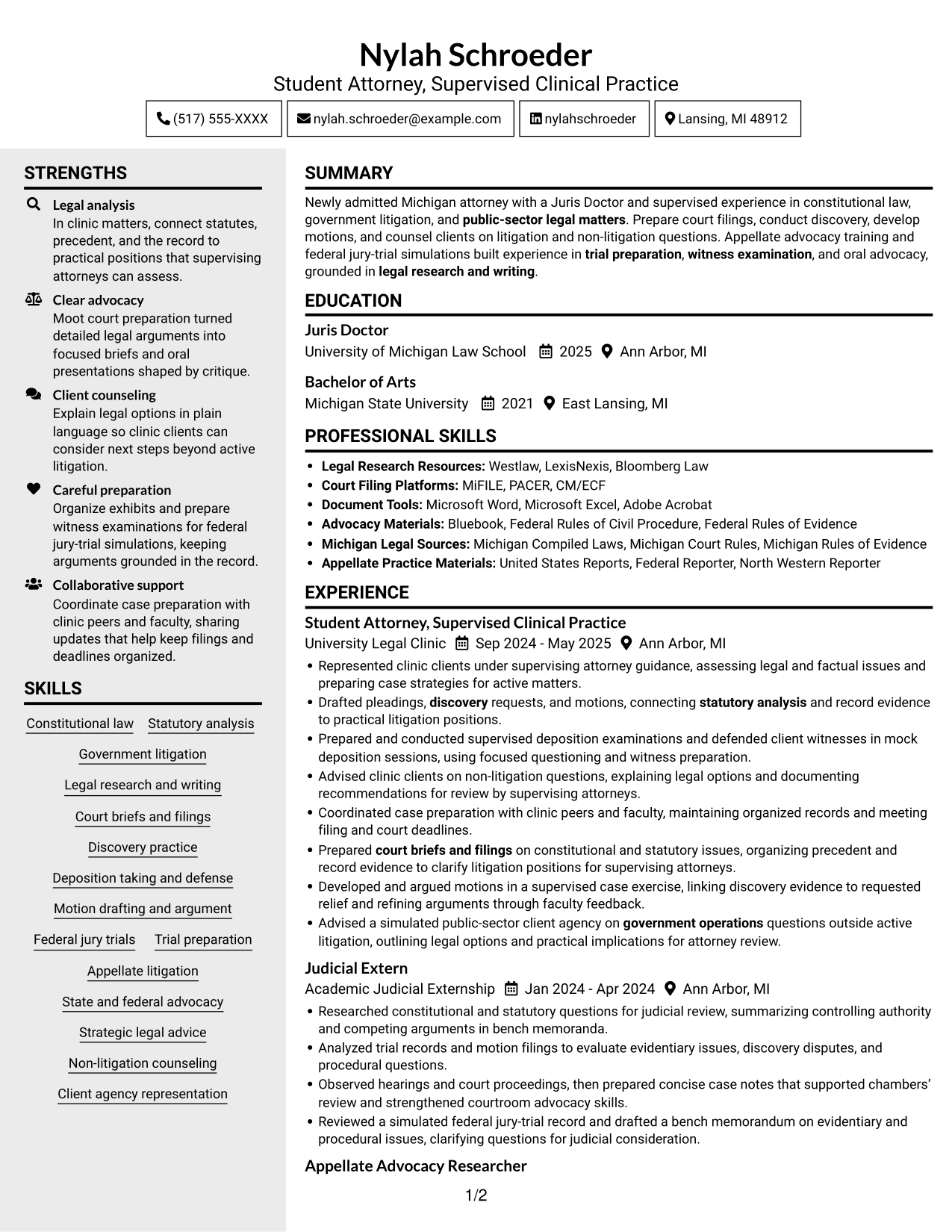
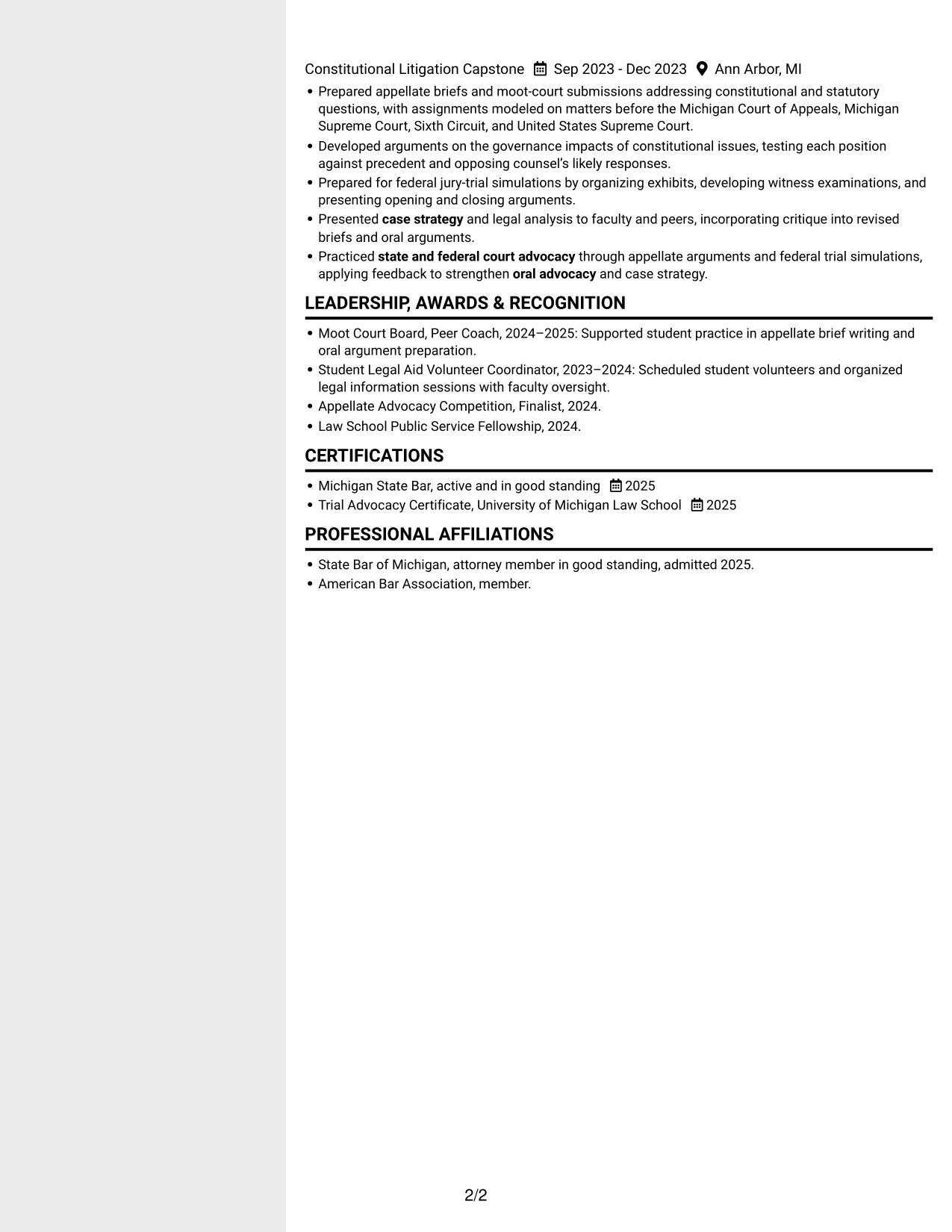
#5 Clean Two Column Sidebar Format Resume Example
The Clean Two Column Sidebar Format uses two reading areas to give resume sections a compact, organized presentation.
Why This Format Works
- Separate reading areas help reviewers locate experience and supporting resume sections.
- Skills and education can remain distinct from detailed role entries.
- Shorter credential sections can be reviewed without interrupting work-history reading.
Best For
- Compact resume sections
- Separate information groups
- Skills and education categories
- Detailed work-history descriptions
- Quick section navigation
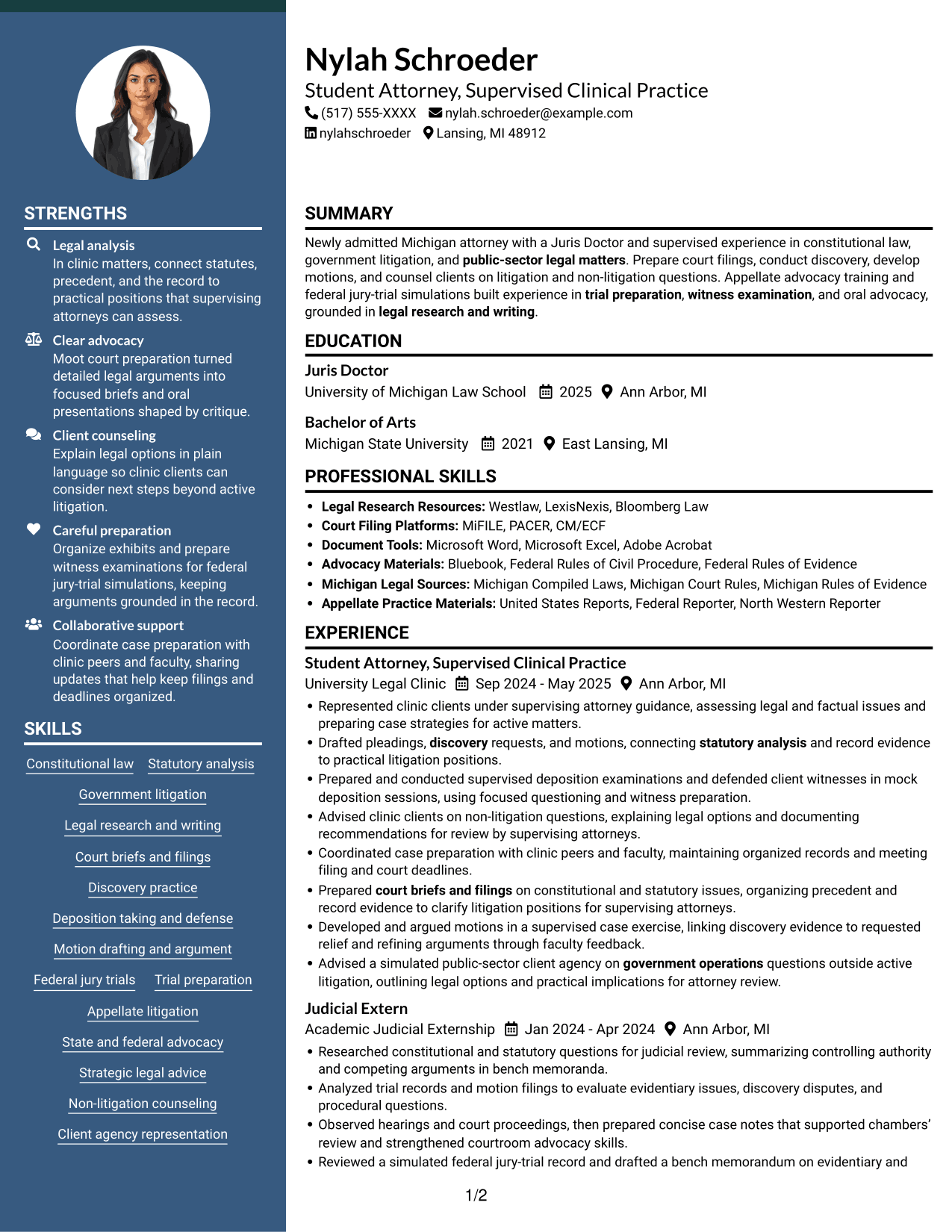
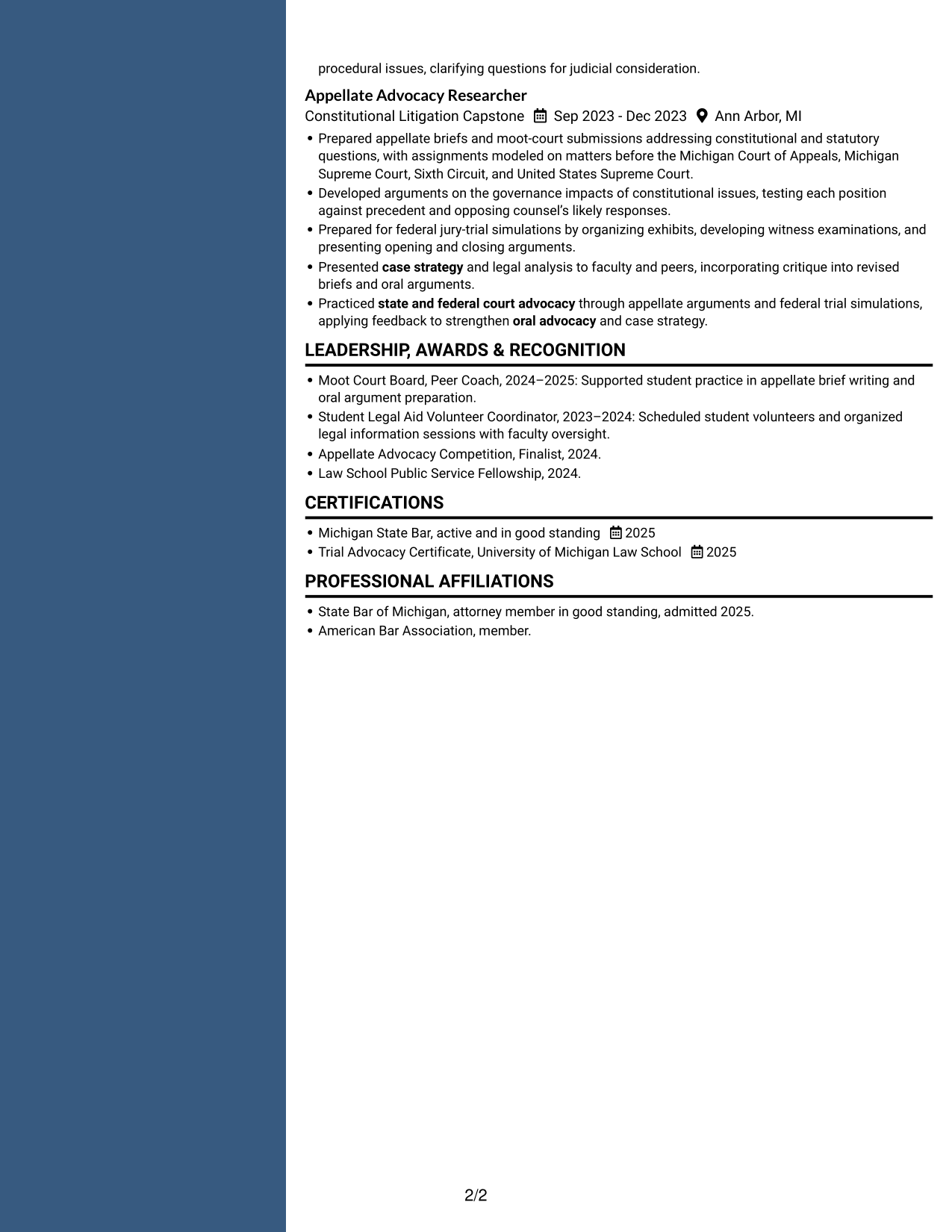
#6 Two Column Format Resume Example
The Two Column Format places resume sections in parallel areas, giving reviewers a compact way to move among different content groups.
Why This Format Works
- Paired columns let reviewers move between experience details and supporting sections.
- Distinct content groups help readers locate career history and credentials.
- Skills can be reviewed apart from detailed descriptions of legal work.
Best For
- Parallel section review
- Compact resume organization
- Career history with supporting details
- Distinct skills and credentials
- Readers comparing content groups
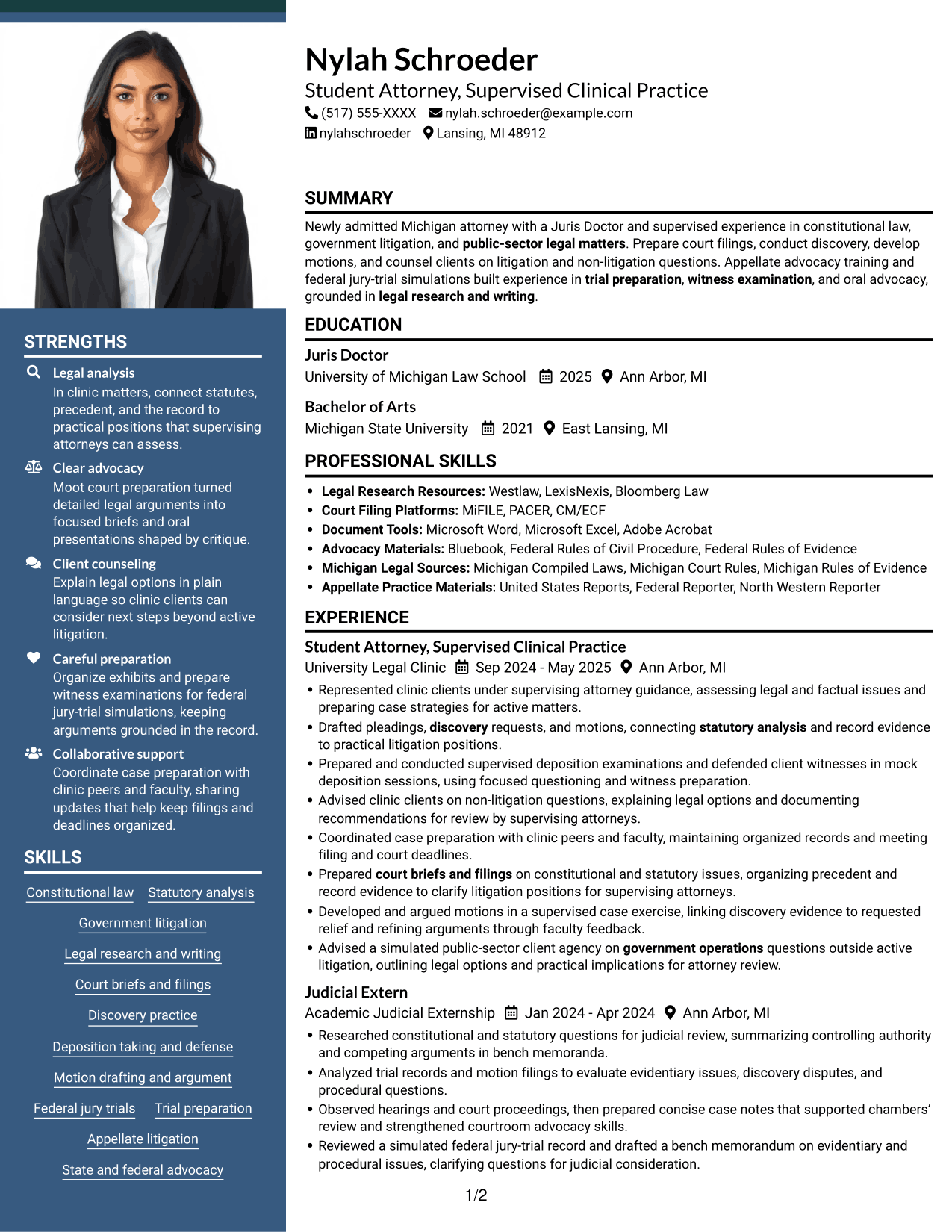
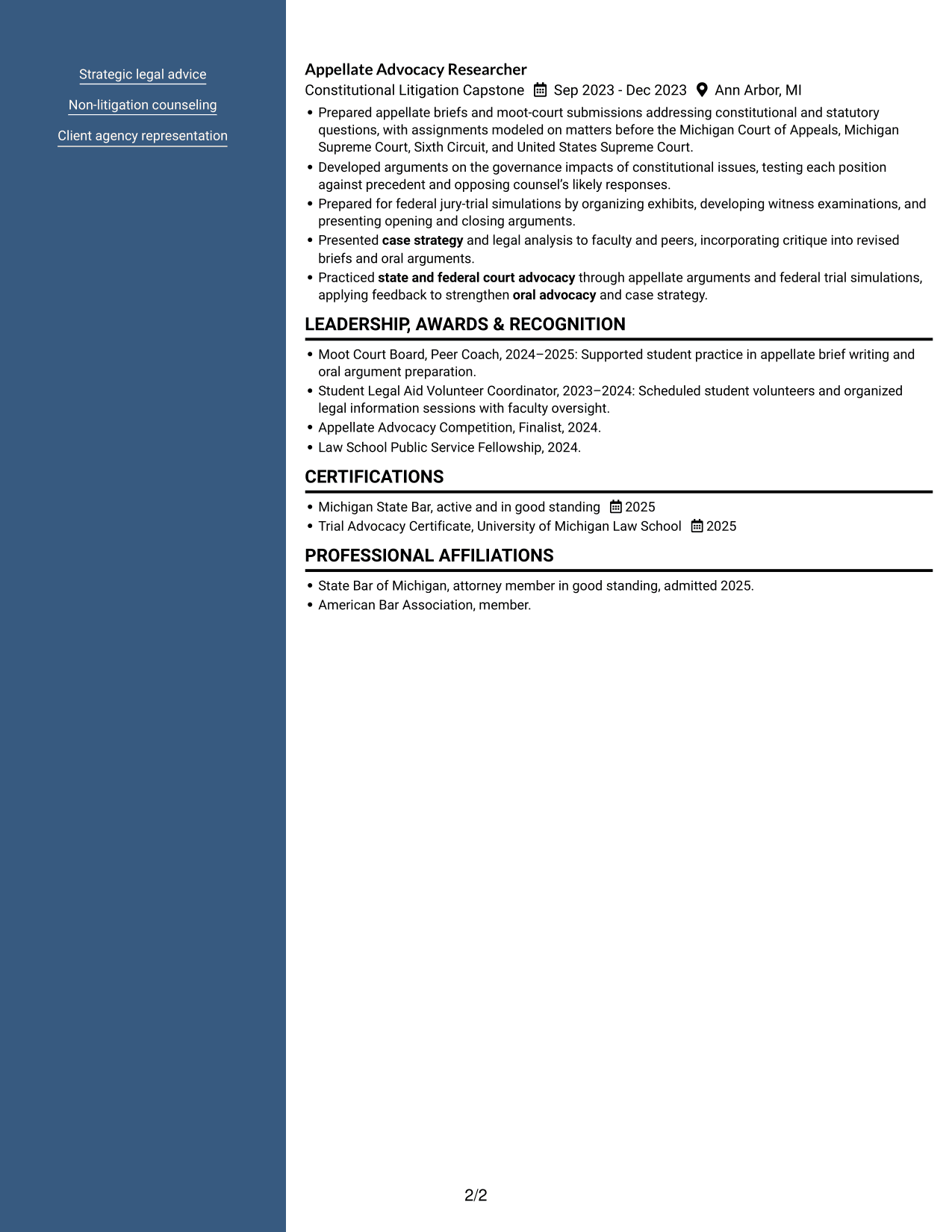
#7 Photo Header Two Column Format Resume Example
The Photo Header Two Column Format pairs a header portrait with two resume reading areas, combining a visual identification choice with compact section navigation.
Why This Format Works
- Parallel reading areas make experience and education sections easier to locate.
- Distinct content groups help reviewers move between role history and credentials.
- Skills can be reviewed apart from detailed descriptions of legal work.
Best For
- Portrait in the resume header
- Two-column section review
- Compact resume content
- Separate experience and education areas
- Visual identification with text
Why Build Your Attorney - Constitutional and Government Litigation Resume with ResumeInMinutes
ResumeInMinutes helps you organize legal experience, education, bar admission, certifications, and skills in a resume that is easy to scan and edit. Use the image previews to compare the layouts, then open a version in the editor to make changes.
- Clear resume section structure
- ATS-aware formatting
- Legal keyword organization
- Experience and skills presentation
- Image previews for comparison
- Editor access for customization
Keep each entry accurate and specific to your legal work. Separate supervised practice, academic research, and simulated advocacy so reviewers can understand the setting and scope of each contribution.
See Also
- 7 Deputy Attorney General II/III - Civil Litigation Resume Templates with Example
- 7 Assistant Attorney General - Special Prosecutions Resume Templates with Example
- 7 Assistant Attorney General - Tax & Public Finance Resume Templates with Example
- 7 Assistant County Attorney V - Affordable Housing Development and Finance Resume Templates with Example
- 7 Claims Adjuster - Attorney Represented Injury Resume Templates with Example
- 7 Deputy City Attorney - Health and Human Services Resume Templates with Example
- 7 Deputy City Attorney II/III - Employment/Labor Relations Resume Templates with Example
- 7 Deputy City Attorney II/III - Transactional Resume Templates with Example
- 7 Attorney - Constitutional and Government Litigation Cover Letter Templates with Example
- 7 Deputy City Attorney - Health and Human Services Cover Letter Templates with Example
Frequently Asked Questions
How can I make an Attorney - Constitutional and Government Litigation resume ATS-friendly?
Use standard section headings, a clear reading order, and concise bullet points. Include role-related terms such as constitutional law, statutory analysis, government litigation, discovery, motion practice, appellate briefs, and client counseling when they accurately describe your background.
What should this attorney resume include?
Include a focused summary, legal experience, education, bar admission, relevant certifications, and skills. Describe court filings, research, discovery, motions, advocacy, and counseling with clear details about your role and level of supervision.
How should I describe supervised legal work and simulations?
Name the setting and state what you did. Identify supervised clinic work as supervised, and describe moot court or jury-trial exercises as simulations rather than presenting them as actual court cases.
Which resume layout works well for this legal role?
A simple layout with clear headings and a consistent section order is often easy for both people and applicant tracking systems to read. Choose a design that gives enough space to relevant legal work without crowding the page.
Which skills and keywords may be useful?
Use accurate terms related to your work, such as constitutional and statutory analysis, legal research and writing, discovery, deposition practice, motion drafting, trial preparation, appellate advocacy, and strategic legal advice. Include specific tools or court filing platforms you have used.
Should I include a photo on my resume?
For U.S. legal applications, a resume without a photo is generally the safer choice. Focus the available space on your qualifications and legal experience.