7 Clinical Claims Investigator - Payment Integrity Resume Templates with Example
This guide shows you how to build a clear, focused Clinical Claims Investigator - Payment Integrity resume. It explains how to present relevant evidence so reviewers can quickly understand your claims review and coding work.
Learn how to organize clinical review experience, credentials, education, and skills, and how to use concise bullet points to explain payment recommendations. Guidance also covers ATS terms such as prepayment claims, CPT, HCPCS, modifiers, ICD-10-CM/PCS, and Evaluation and Management coding.
The example is presented in 7 layouts so you can compare image previews and choose a clear way to organize your resume. You can open an example in the editor to view or customize it.
What Makes a Great Clinical Claims Investigator - Payment Integrity Resume in 2026
A strong resume makes medical record review, coding knowledge, and payment integrity decisions easy to scan. Clear sections and focused bullets help show how the evidence supports a claim recommendation.
Use relevant terms such as CPT, HCPCS, modifiers, ICD-10-CM/PCS, Evaluation and Management coding, reimbursement policies, and fraud, waste, and abuse review. Add specific results or workload measures only when you can support them.
Note: Resume examples are for educational purposes only. Use only information that accurately reflects your experience and qualifications. References to real organizations do not imply affiliation or endorsement.
#1 Plain Two Column Format Resume Example
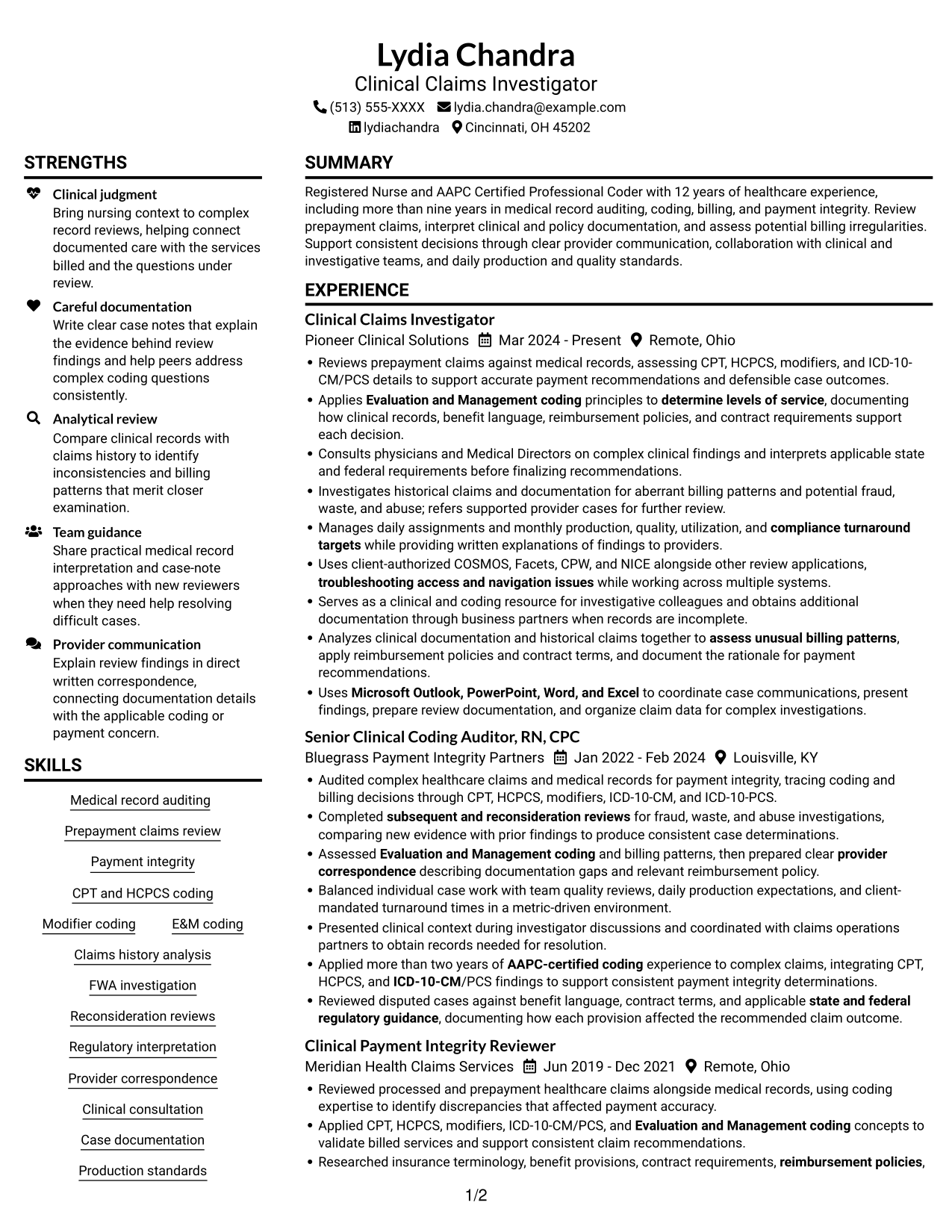
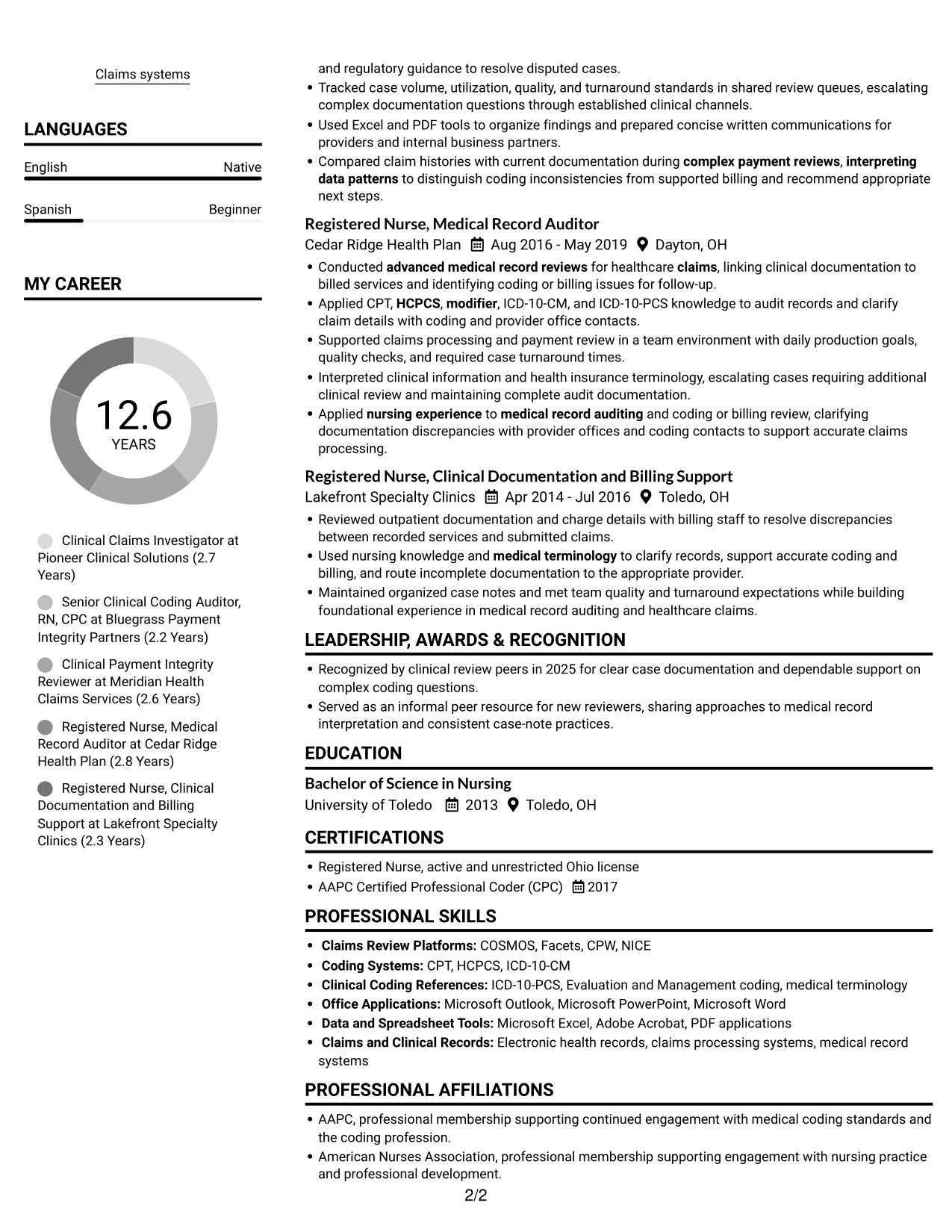
The Plain Two Column Format uses two columns to let reviewers scan career history alongside supporting resume sections.
Resume Snapshot
- Healthcare experience: 12 years
- Medical record auditing, coding, billing, and payment integrity: more than nine years
- Credentials: Registered Nurse and AAPC Certified Professional Coder (CPC)
- Education: Bachelor of Science in Nursing, University of Toledo, 2013
Why This Format Works
- Career history can sit apart from supporting sections, giving reviewers distinct areas to scan.
- Skills and education stay distinct from detailed career history during a focused review.
- Grouped resume sections make education and credentials easier to locate during review.
Best For
- Career histories spanning several roles
- Side-by-side review of experience and credentials
- Skills and education beside work history
- Resumes with several supporting sections
- Readers who prefer two-column organization
Resume Keywords
- Bachelor of Science in Nursing
- AAPC Certified Professional Coder
- more than two years of AAPC-certified coding experience
- Applied more than two years of AAPC-certified coding experience to complex claims, integrating CPT, HCPCS, and ICD-10-CM/PCS findings
- Applied nursing experience to medical record auditing and coding or billing review
- Conducted advanced medical record reviews for healthcare claims
- Applied CPT, HCPCS, modifier, ICD-10-CM, and ICD-10-PCS knowledge to audit records
- HCPCS coding
- Modifier coding
- Prepayment claims review
- payment recommendations
- Evaluation and Management coding
- determine levels of service
- Analyzes clinical documentation and historical claims together
- state and federal regulatory guidance
#2 Simple One Column Format Resume Example
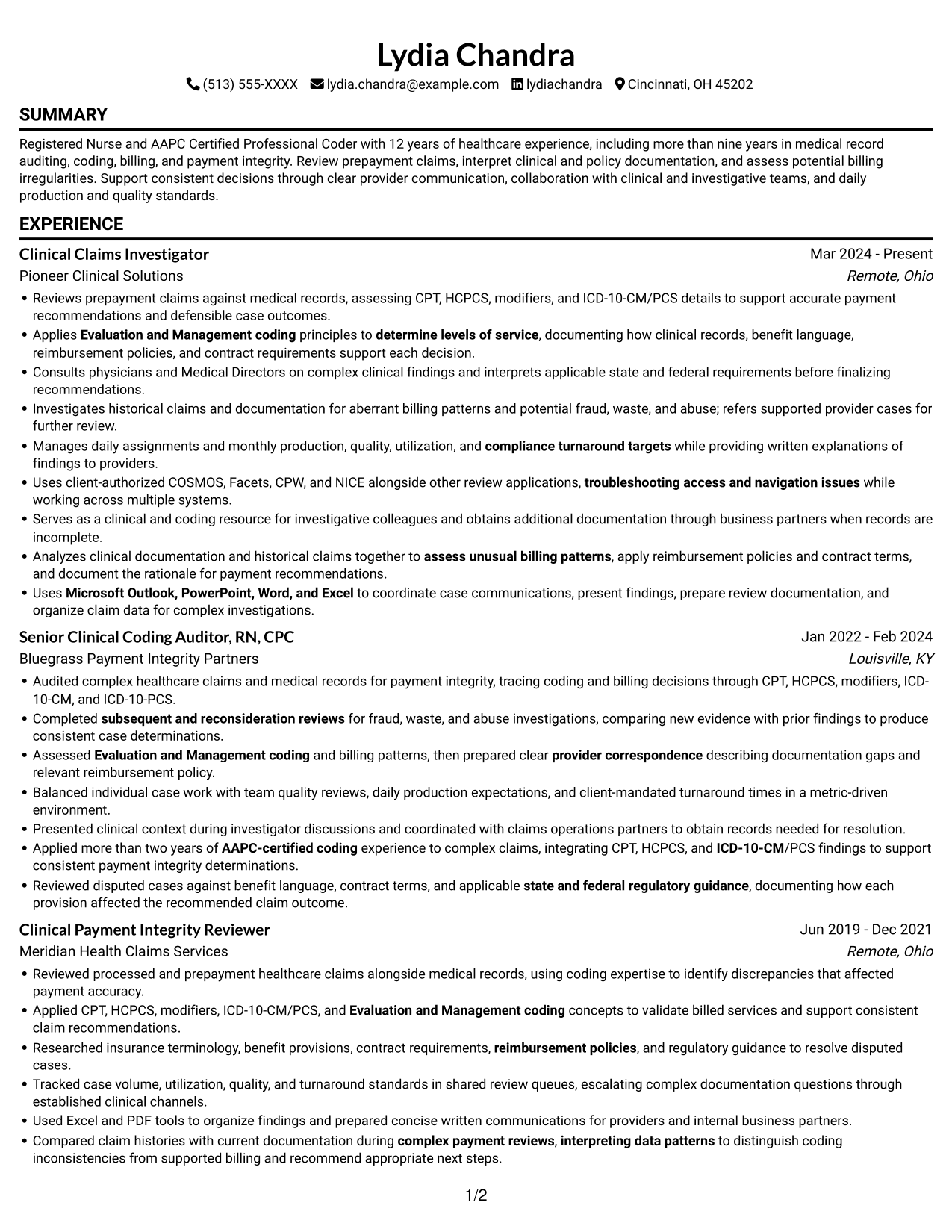
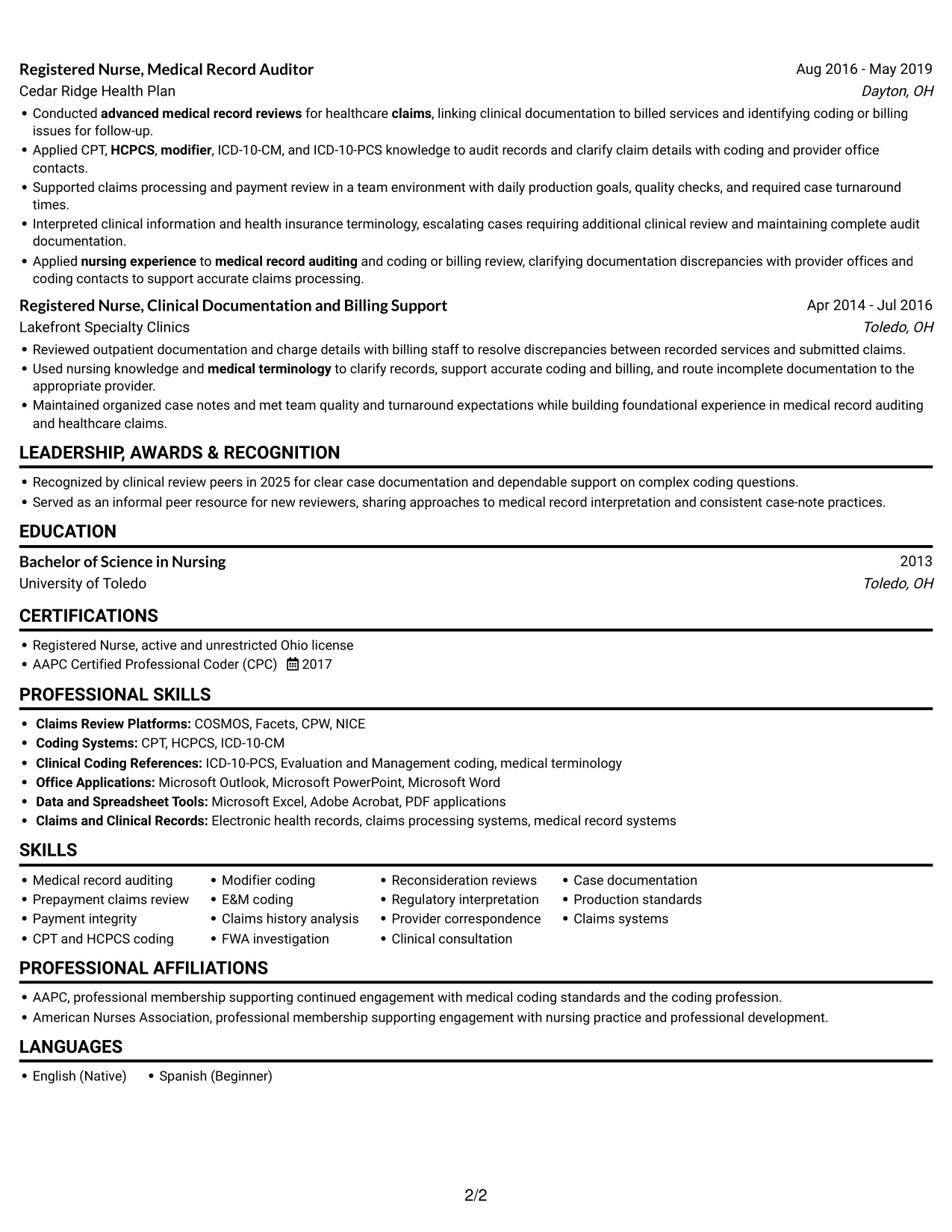
The Simple One Column Format keeps content in one vertical stream, so reviewers can follow the resume from section to section in sequence.
Why This Format Works
- A single vertical path lets reviewers follow roles in sequence without switching columns.
- Experience details stay together, helping readers compare responsibilities across career progression.
- Skills, education, and certifications can follow the same straightforward reading path.
Best For
- Chronological career histories
- Resumes with detailed role descriptions
- Straightforward section-by-section review
- Skills and credentials in one reading path
- Readers who prefer a vertical layout
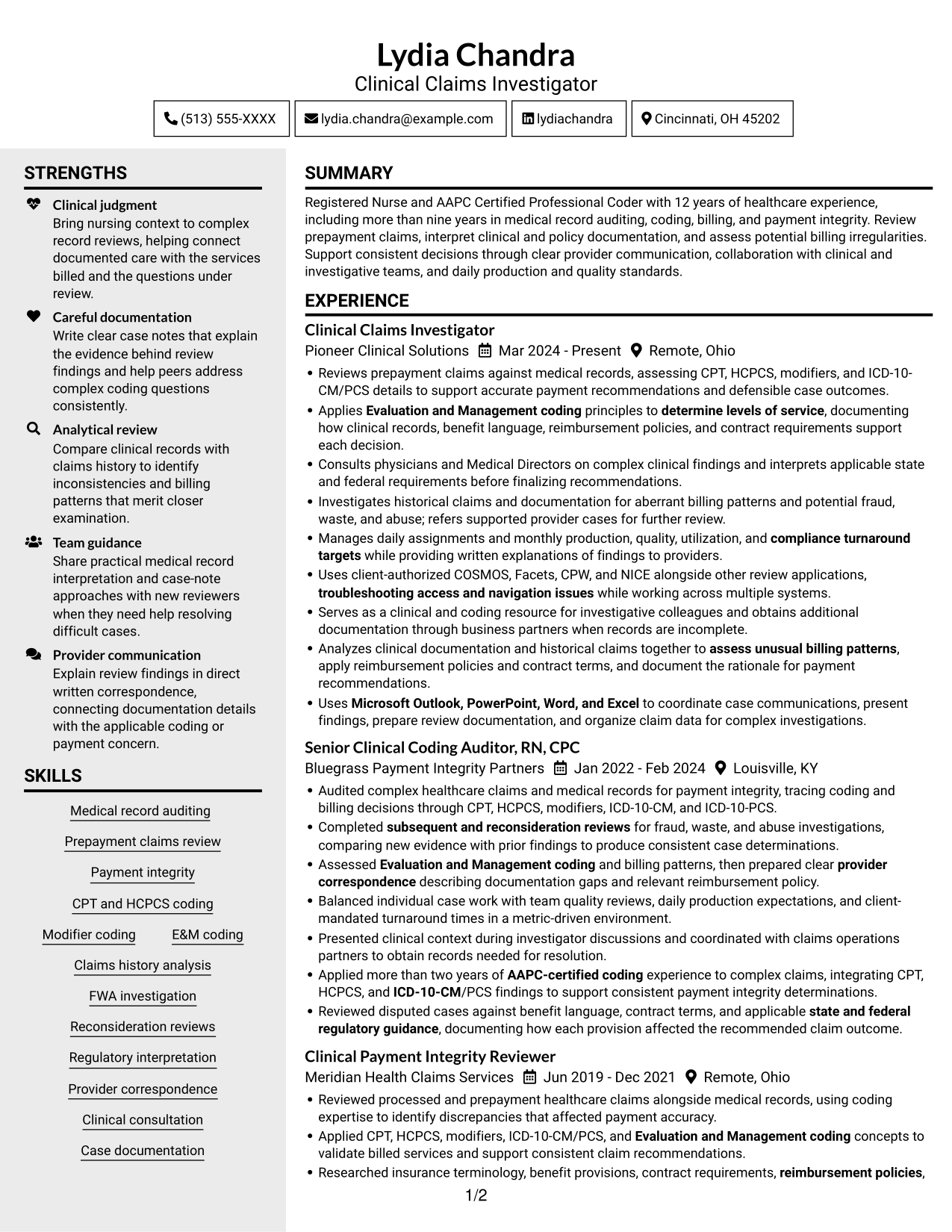
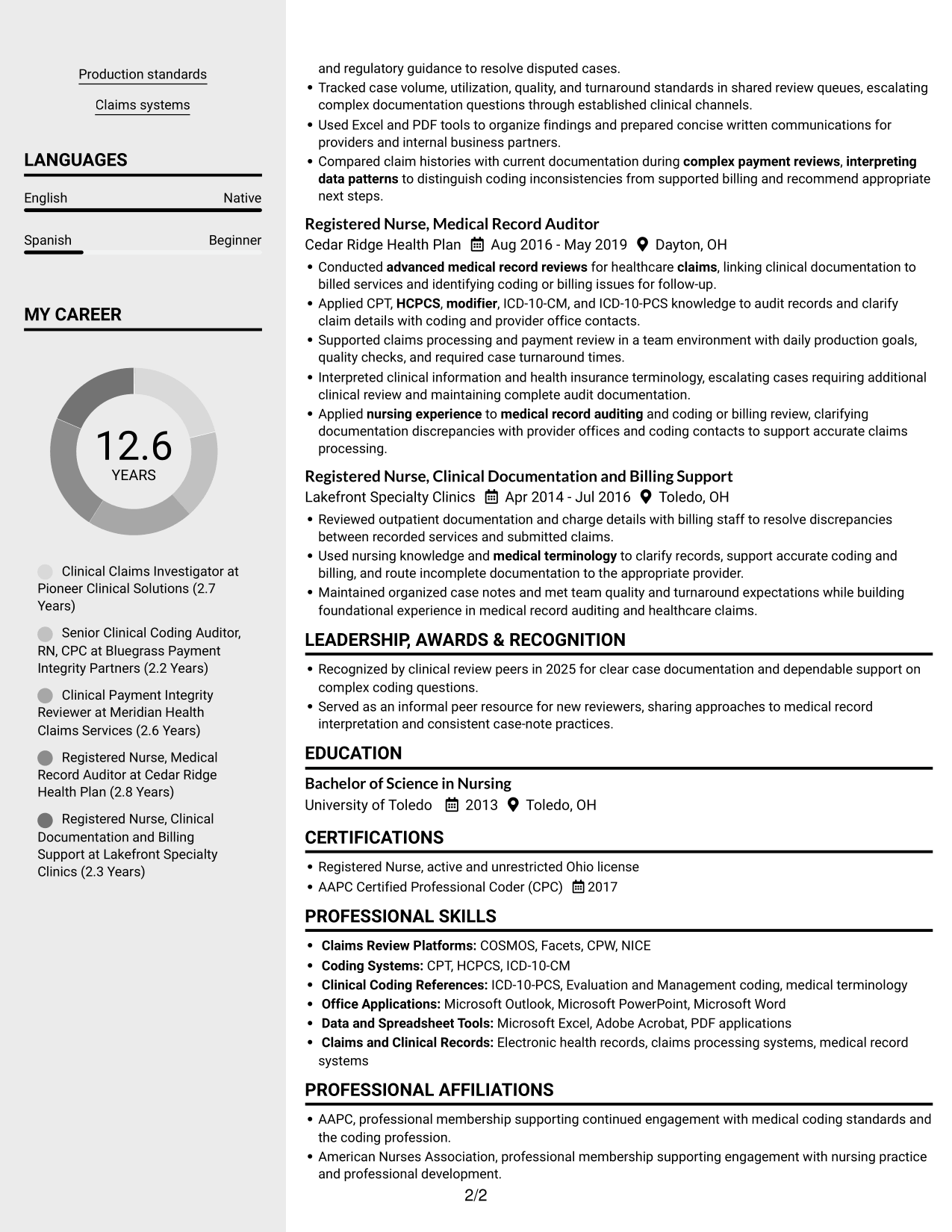
#3 Clean Two Column Sidebar Format Resume Example
The Clean Two Column Sidebar Format places resume content in two columns, giving supporting details a distinct place beside career history.
Why This Format Works
- Career history and supporting sections occupy distinct areas for an orderly scan.
- Readers can locate education and credentials without reviewing every experience detail.
- The two-column structure lets reviewers move between skills and experience while keeping section context.
Best For
- Resumes with distinct content areas
- Career histories paired with supporting details
- Reviewers comparing experience and qualifications
- Skills and education alongside career information
- Readers who prefer a sidebar structure
#4 Two Column Format Resume Example
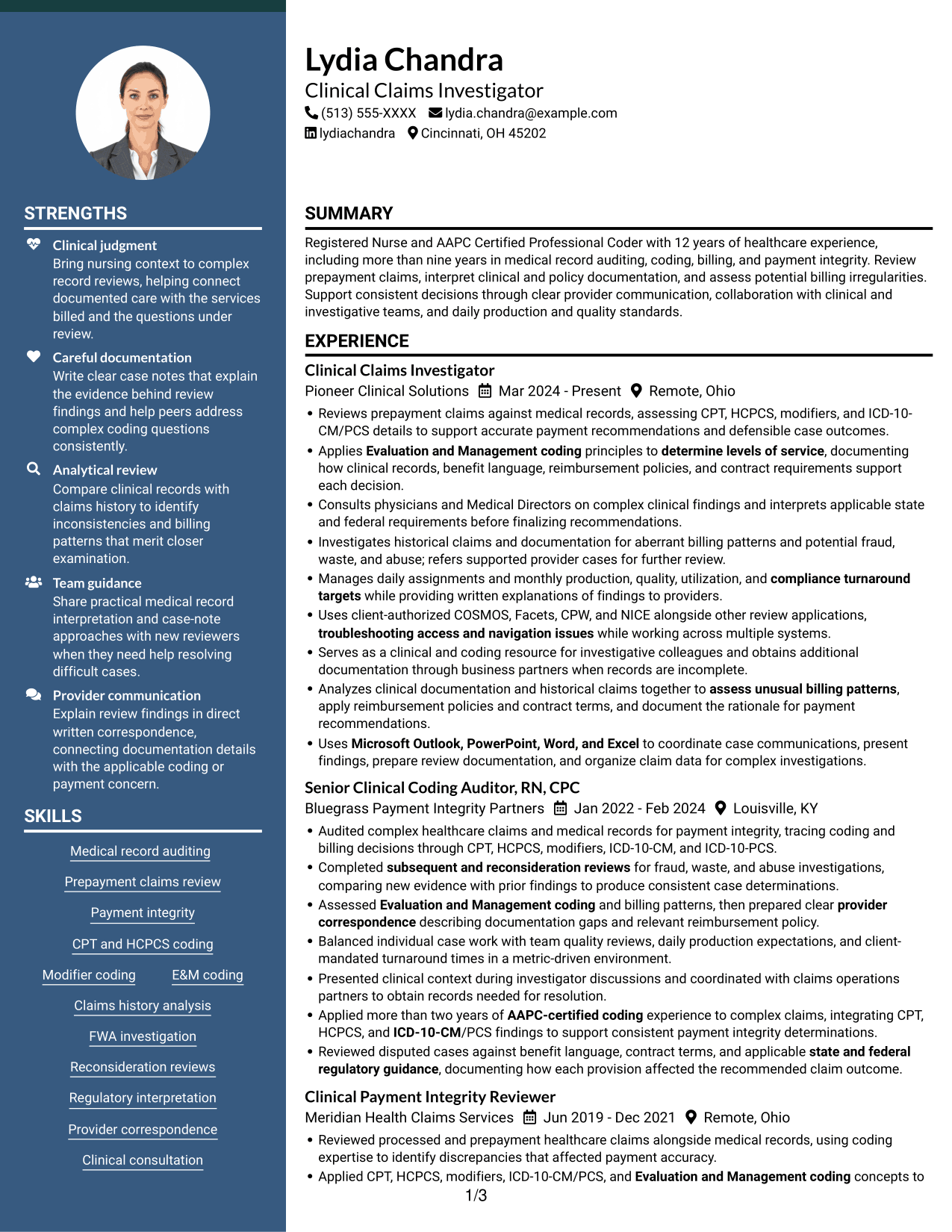
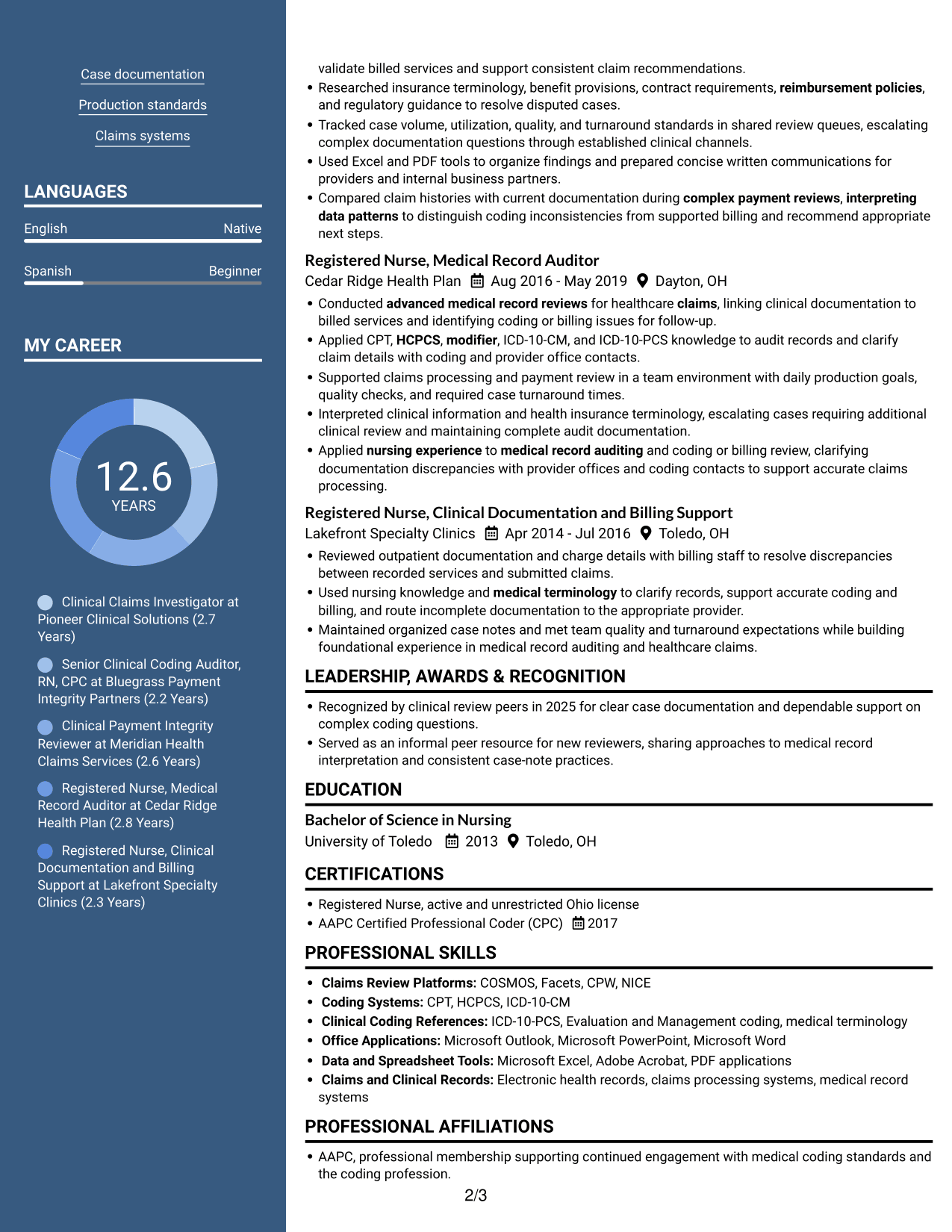
The Two Column Format presents resume content across two columns, allowing reviewers to move between experience and supporting sections.
Why This Format Works
- Separate columns give career history and supporting sections clear places in the resume.
- Reviewers can check education and certifications without reading every job entry.
- Parallel content areas help readers compare skills with the broader career record.
Best For
- Parallel review of work history and qualifications
- Resumes with several experience entries
- Education and certifications alongside work history
- Readers scanning distinct resume sections
- Applications with varied supporting details
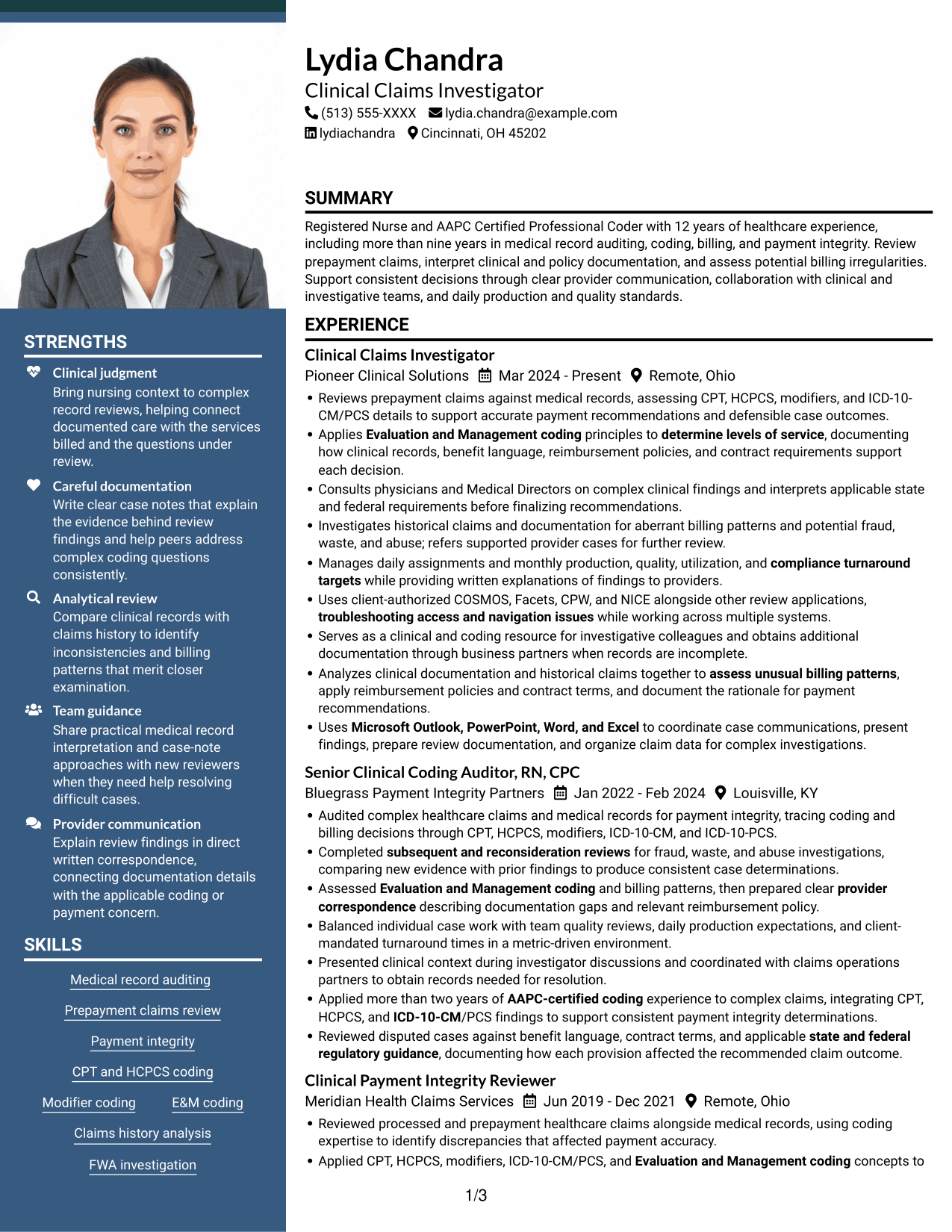
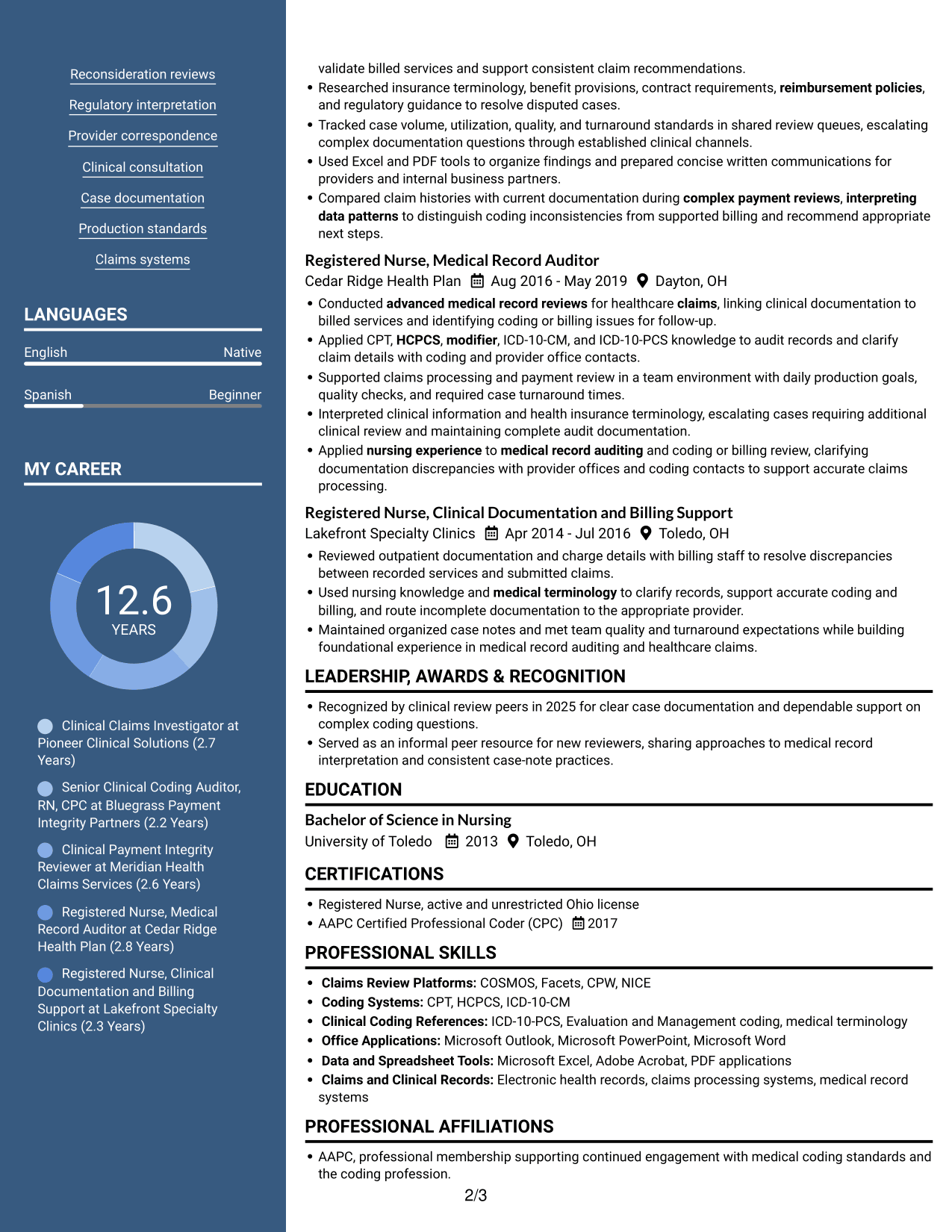
#5 Photo Header Two Column Format Resume Example
The Photo Header Two Column Format pairs a photo header with two columns, combining a personal visual element with organized resume content.
Why This Format Works
- Career history and supporting sections occupy separate areas for easier navigation.
- The two-column reading order helps reviewers move between experience and credentials.
- Education and skills remain easy to distinguish from detailed job entries.
Best For
- Photo header presentation
- Two-column section organization
- Career histories with several supporting sections
- Readers who prefer a visual profile element
- Resumes balancing experience details with credentials
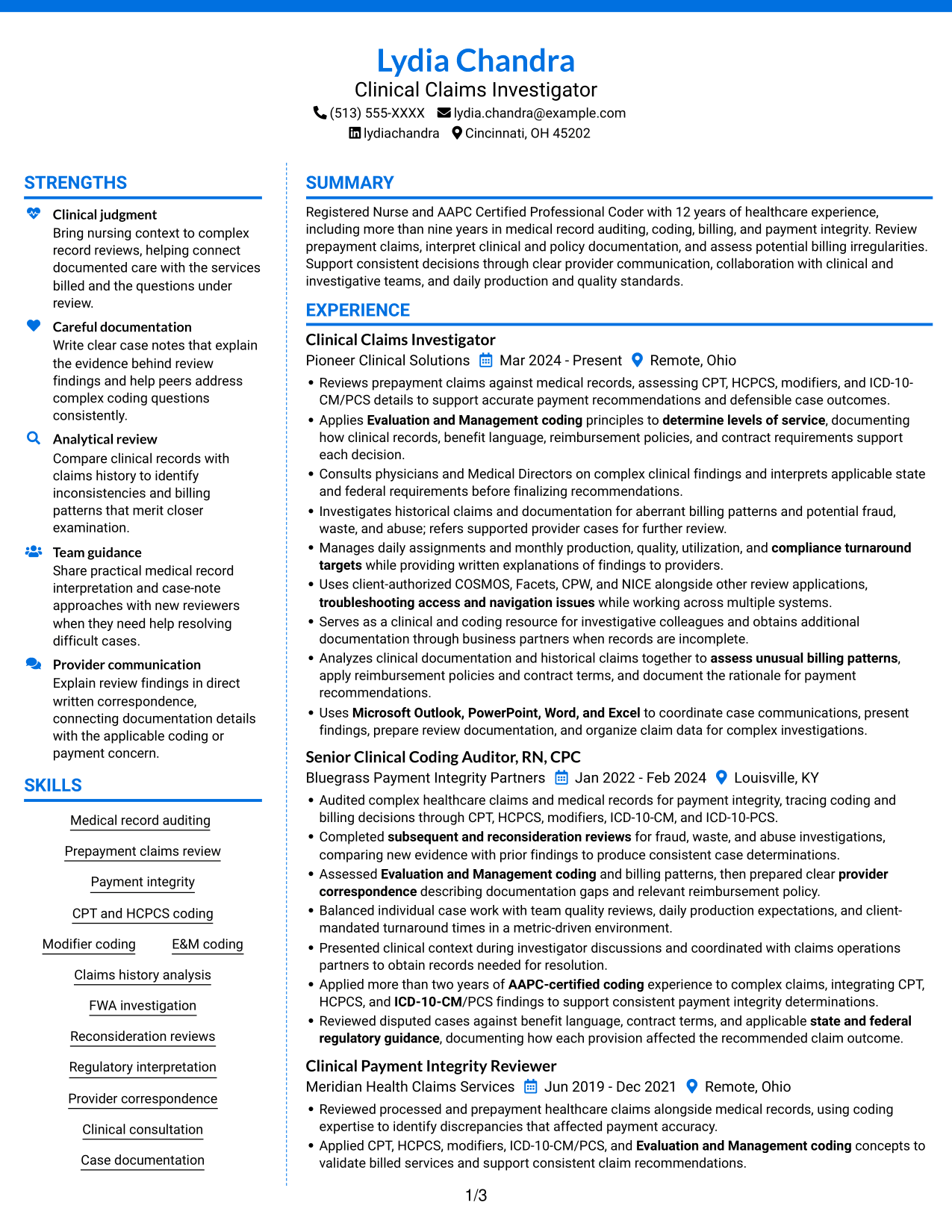
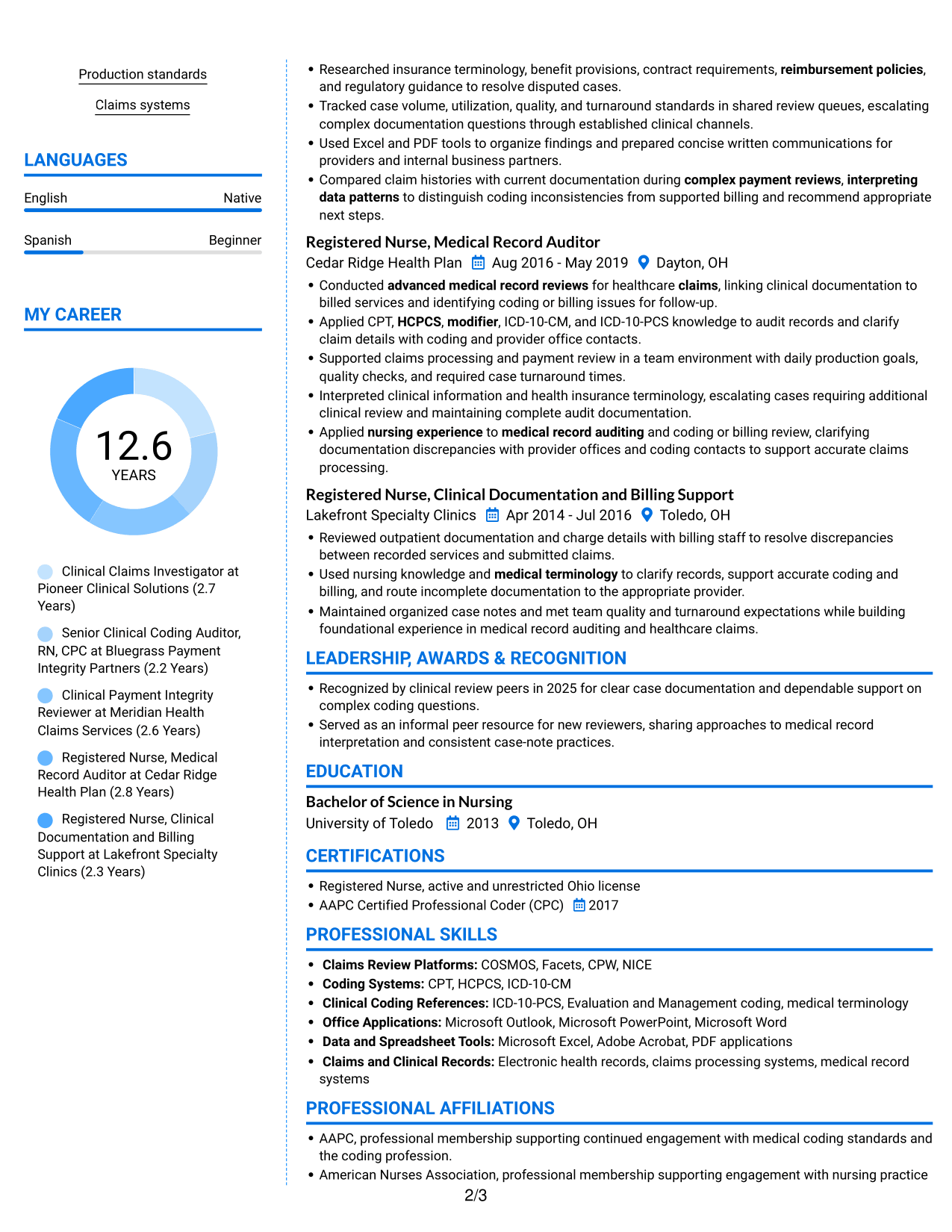
#6 Colored Two Column Format Resume Example
The Colored Two Column Format uses two columns to separate career history from supporting resume sections for side-by-side review.
Why This Format Works
- Career history can be reviewed beside supporting content, keeping resume sections distinct.
- Two columns give readers a direct way to locate skills and education.
- Separate content areas help reviewers return to credentials while checking experience.
Best For
- Side-by-side career and supporting information
- Resumes with grouped skills and education
- Readers scanning distinct content areas
- Career histories with several roles
- Applications requiring clear section separation
#7 Stylish Two Column Designer Format Resume Example
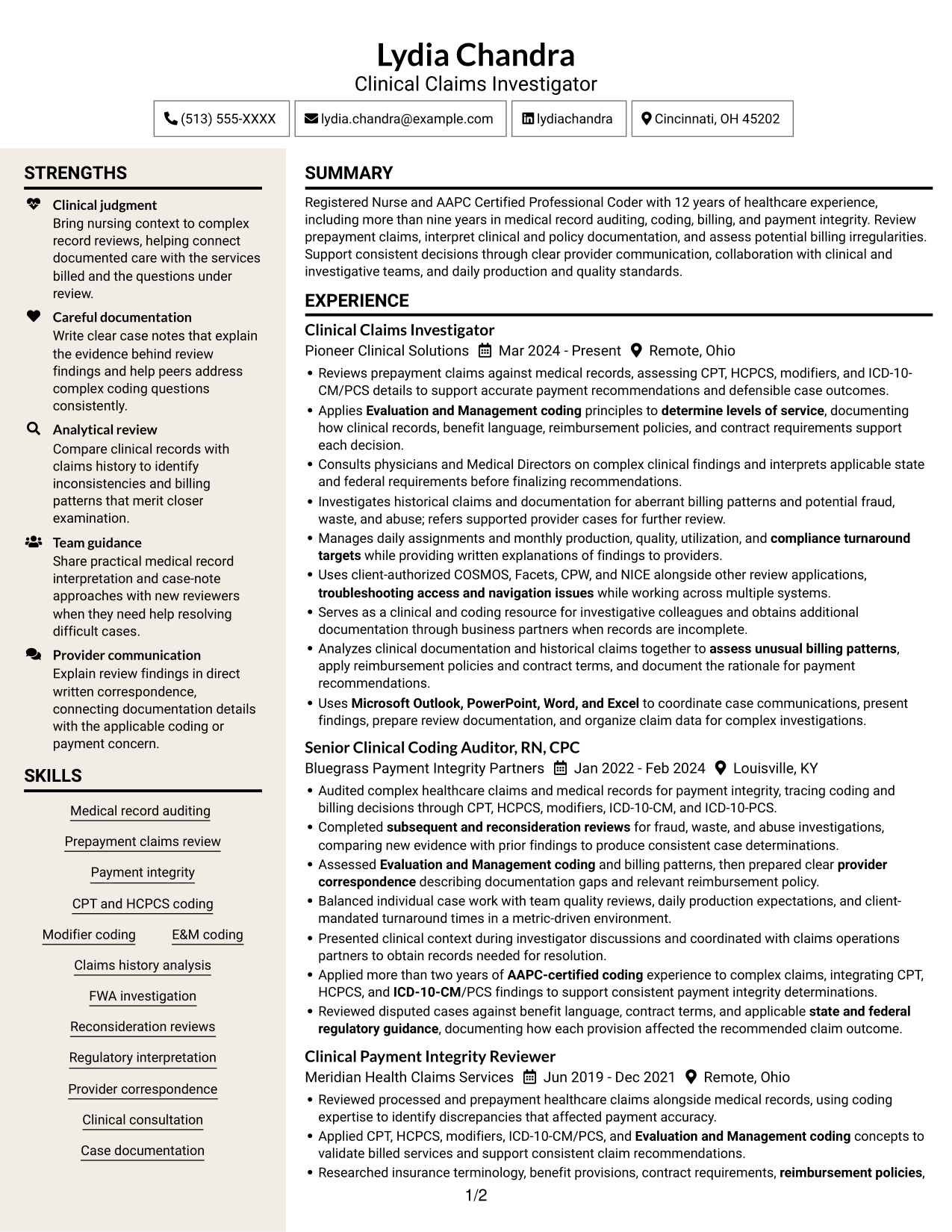
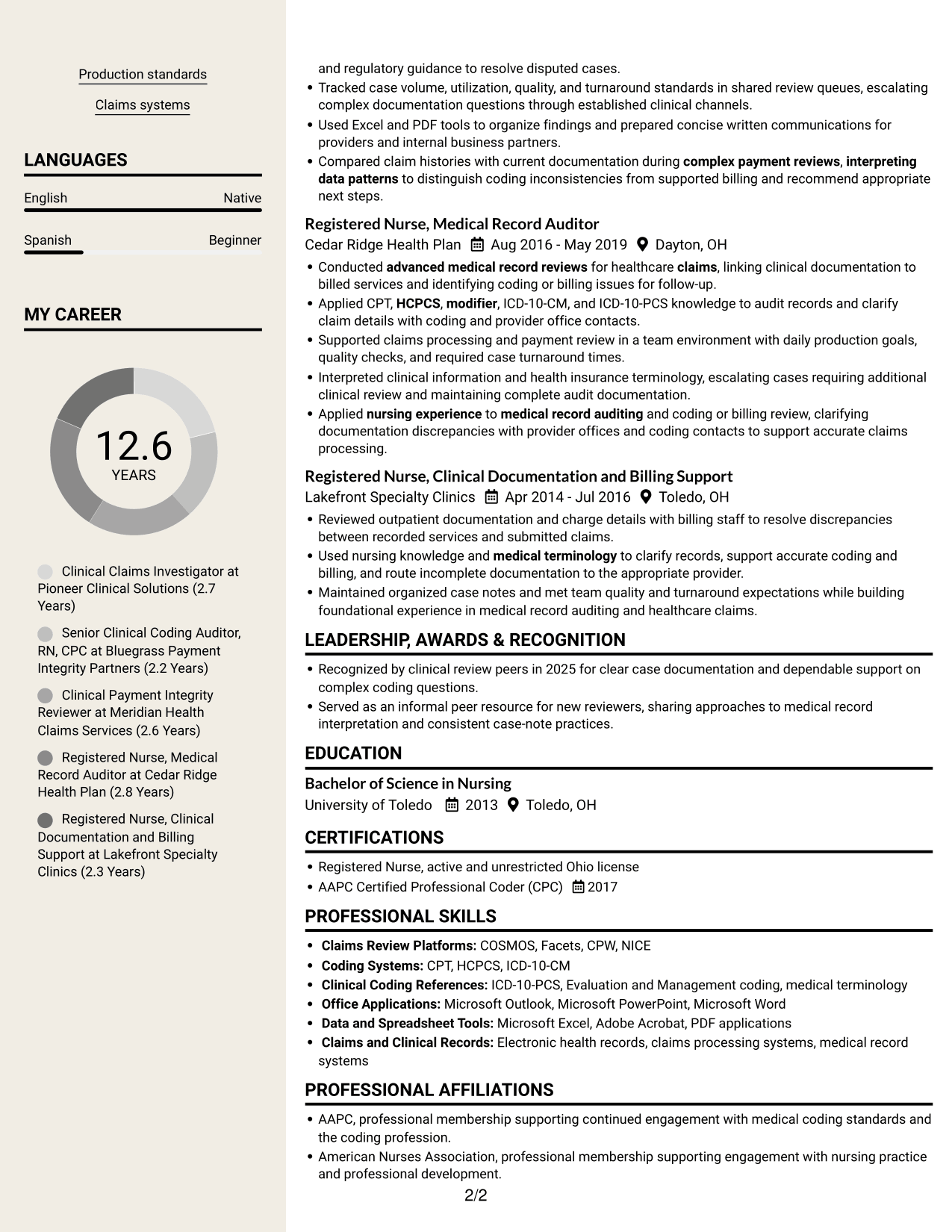
The Stylish Two Column Designer Format uses two columns, helping readers compare career history and supporting details within the same resume view.
Why This Format Works
- Career history and supporting details sit in parallel areas for a clear scan.
- Readers can find education and certifications without moving through every job description.
- Two-column reading keeps skills visible alongside the broader record of experience.
Best For
- Readers preferring parallel content areas
- Career histories with detailed experience
- Resumes combining skills and credentials
- Side-by-side review of experience and education
- Applications with several distinct resume sections
Why Build Your Clinical Claims Investigator - Payment Integrity Resume with ResumeInMinutes
ResumeInMinutes helps you organize clinical review experience, coding skills, credentials, and education in a resume that is easy to read and adapt. Compare image previews, then open an example in the editor to view or customize its layout.
- Resume layout options
- Clear section structure
- Role-focused keyword guidance
- Organized skills and credentials
- Image previews for comparison
- Resume customization in the editor
Use the guidance to present claims review, clinical documentation, coding, and payment integrity work with clear evidence and concise bullet points.
See Also
- 7 Accounts Payable Assistant - Claims Payments Resume Templates with Example
- 7 Accounts Payable Coordinator I - Claims Payments Resume Templates with Example
- 7 Payment Operations Senior Associate - Claims and Revenue Cycle Resume Templates with Example
- 7 Civil Rights - Case Investigator Resume Templates with Example
- 7 Court Investigator - Probate and Family Court Resume Templates with Example
- 7 Crime Scene Investigator - Forensic Evidence Processing Resume Templates with Example
- 7 Health Professions Investigator - Unit 2 Resume Templates with Example
- 7 Occupational Safety Compliance Investigator 3 Resume Templates with Example
- 7 Clinical Claims Investigator - Payment Integrity Cover Letter Templates with Example
- 7 Accounts Payable Assistant - Claims Payments Cover Letter Templates with Example
Frequently Asked Questions
Are these Clinical Claims Investigator - Payment Integrity resume templates ATS-friendly?
The examples use recognizable resume sections and role-related terms, including prepayment claims, CPT, HCPCS, modifiers, ICD-10-CM/PCS, and Evaluation and Management coding. Use accurate keywords that match your own experience.
Do the previews show separate resume examples?
The previews show the same example in different layouts. Compare the image previews to see how the content and sections are arranged.
What should a Clinical Claims Investigator - Payment Integrity resume include?
Include a focused summary, relevant work experience, education, licenses or coding certifications, and skills. Highlight medical record auditing, claims review, coding, policy interpretation, and clear case documentation when these reflect your background.
Which resume layout works well for payment integrity roles?
A simple layout with clear headings and readable sections makes experience and coding skills easier to scan. Choose an arrangement that keeps your work history and relevant qualifications easy to find.
How can I show the impact of claims review work?
Describe the records or claims reviewed, the coding or policy issue assessed, and the result or recommendation. Include numbers only when they are accurate and supported by your work history.
Should I include a photo on my resume?
For most U.S. applications, a resume without a photo is a practical choice. Follow local norms if you are applying in a region where photos are expected.