33 Clinical Sales Lead Resume Templates with Example 2026 (ATS-Optimized)
This guide shows you how to build a Clinical Sales Lead resume that is clear, focused, and easy to adapt. You will learn how to present clinical credibility and sales impact so recruiters can assess your value quickly.
Strong resume content connects OR and procedural workflows to customer-facing results. Use focused sections and evidence around clinical discovery, workflow assessments, product demonstrations, executive presentations, pilot evaluations, and implementation handoffs.
The examples below show a complete Clinical Sales Lead resume in multiple ATS-optimized formats. They also explain how to use keywords such as Epic OpTime, Cerner SurgiNet, implant documentation, supply chain systems, AI, computer vision, and enterprise health system sales without making the resume difficult to scan.
What Makes a Great Clinical Sales Lead Resume in 2026
A strong Clinical Sales Lead resume is direct, evidence-based, and built for quick review. It should show clinical credibility, consultative sales ability, workflow knowledge, and clear ownership of customer evaluations.
Use short achievement bullets and relevant terms such as OR workflows, clinical discovery, product demonstrations, executive presentations, implant documentation, Epic OpTime, and implementation handoffs.
The examples shown below are intentionally detailed to demonstrate a range of experiences, skills, accomplishments and relevant keywords. We prefer detailed resumes as they provide more context to the hiring managers and also help the ATS systems identify relevant qualifications and score your resume better for a match. But the length of a resume is an individual choice. If you want a one page resume, just keep the most relevant experience and information for the job. Note: Resume examples are created for educational purposes; references to real organizations do not imply affiliation or endorsement.
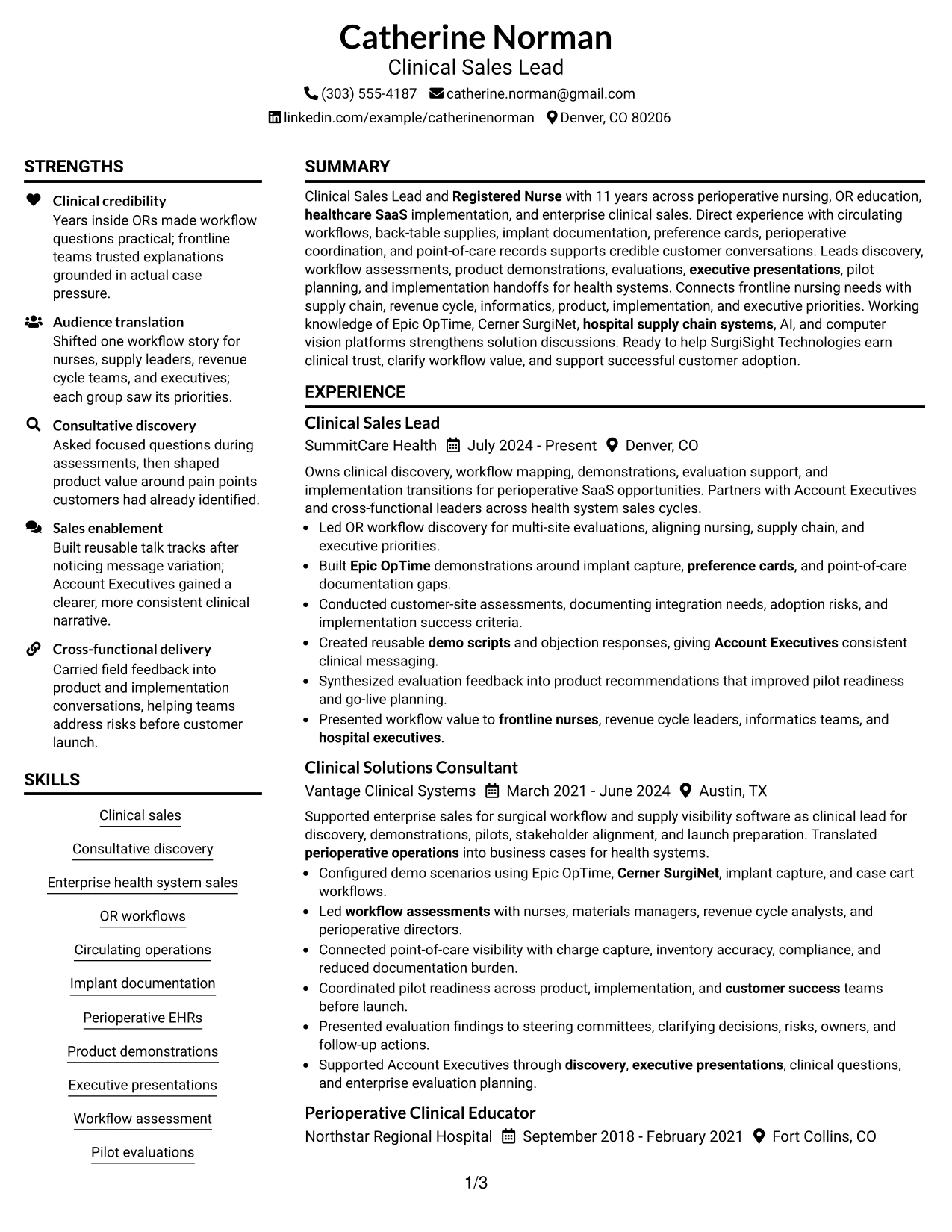
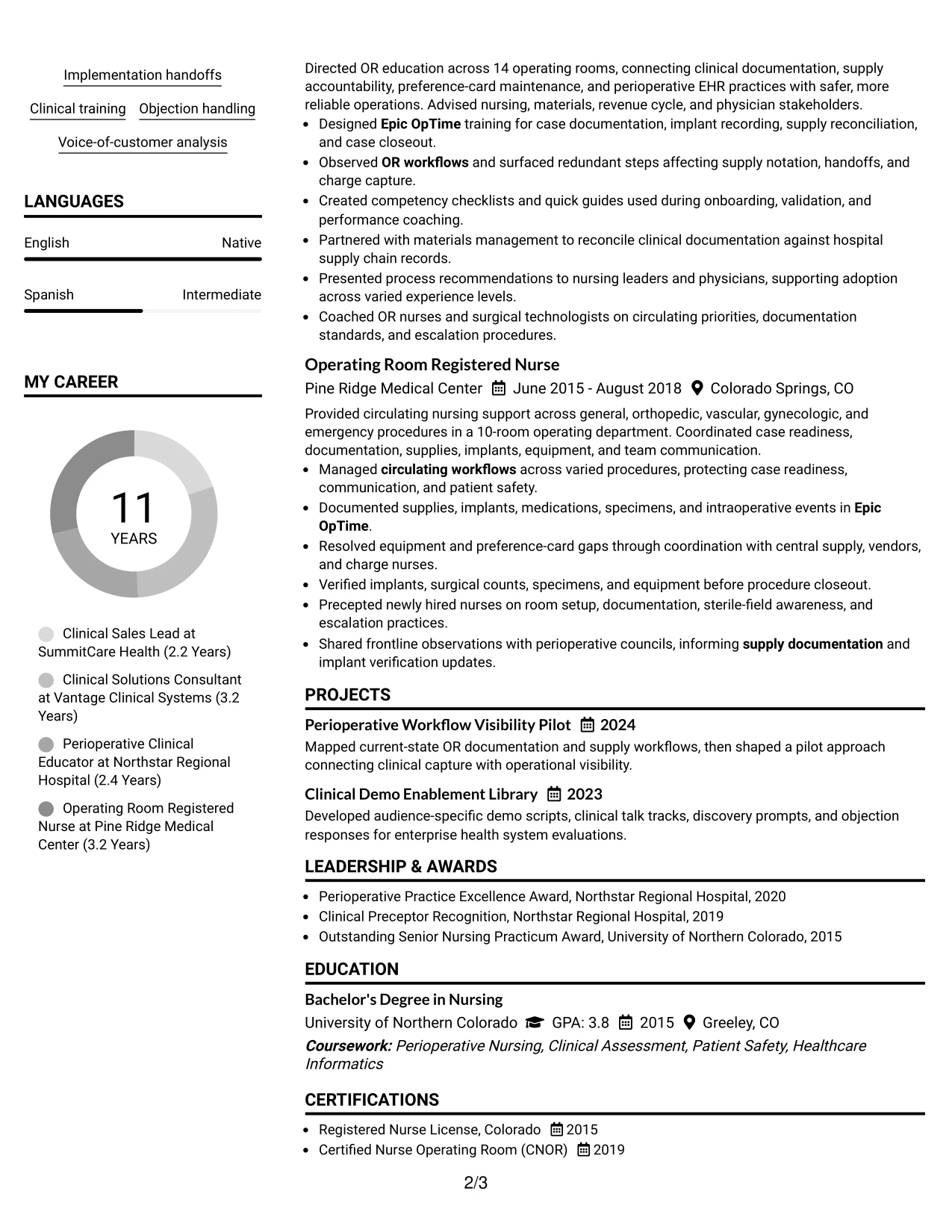
#1 Plain Two Column Format Resume Example
Plain Two Column Format gives the resume a clear split between core experience and supporting details. The main column can carry the professional summary, work history, projects, and measurable results, while the narrower column keeps education, certifications, skills, and tools easy to find.
For a Clinical Sales Lead resume, this structure supports fast review without hiding important clinical and sales evidence. It gives ATS-friendly text a strong hierarchy and lets keywords such as Epic OpTime, workflow assessment, enterprise sales, and implementation handoffs appear in logical sections.
Resume Snapshot
- Clinical Sales Lead and Registered Nurse with 11 years across perioperative nursing, clinical education, healthcare SaaS, and enterprise sales.
- Experience leading discovery, workflow assessments, product demonstrations, evaluations, executive presentations, and implementation handoffs.
- Working knowledge of Epic OpTime, Cerner SurgiNet, hospital supply chain systems, AI, and computer vision platforms.
- CNOR certification, active Colorado Registered Nurse license, and willingness to travel 25-50% for customer-site work.
Why the Plain Two Column Format Works for a Resume
- The two-column hierarchy separates high-value experience from supporting qualifications.
- The main column gives work history enough space for detailed achievement bullets.
- A focused sidebar makes certifications, education, tools, and core skills quick to scan.
- Clear section labels help ATS systems and recruiters locate relevant terms.
- The structure supports both clinical evidence and commercial responsibilities without crowding the page.
- Projects such as Perioperative Workflow Visibility Pilot and Clinical Demo Enablement Library can sit beside the employment record without losing context.
Resume Keywords
- Clinical Sales Lead
- AI
- computer vision
- Hospital
- Account Executives
- discovery
- evaluations
- Executive presentations
- Workflow assessment
- customer-site
- demo scripts
- clinical talk tracks
- Objection handling
- OR workflows
- circulating workflows
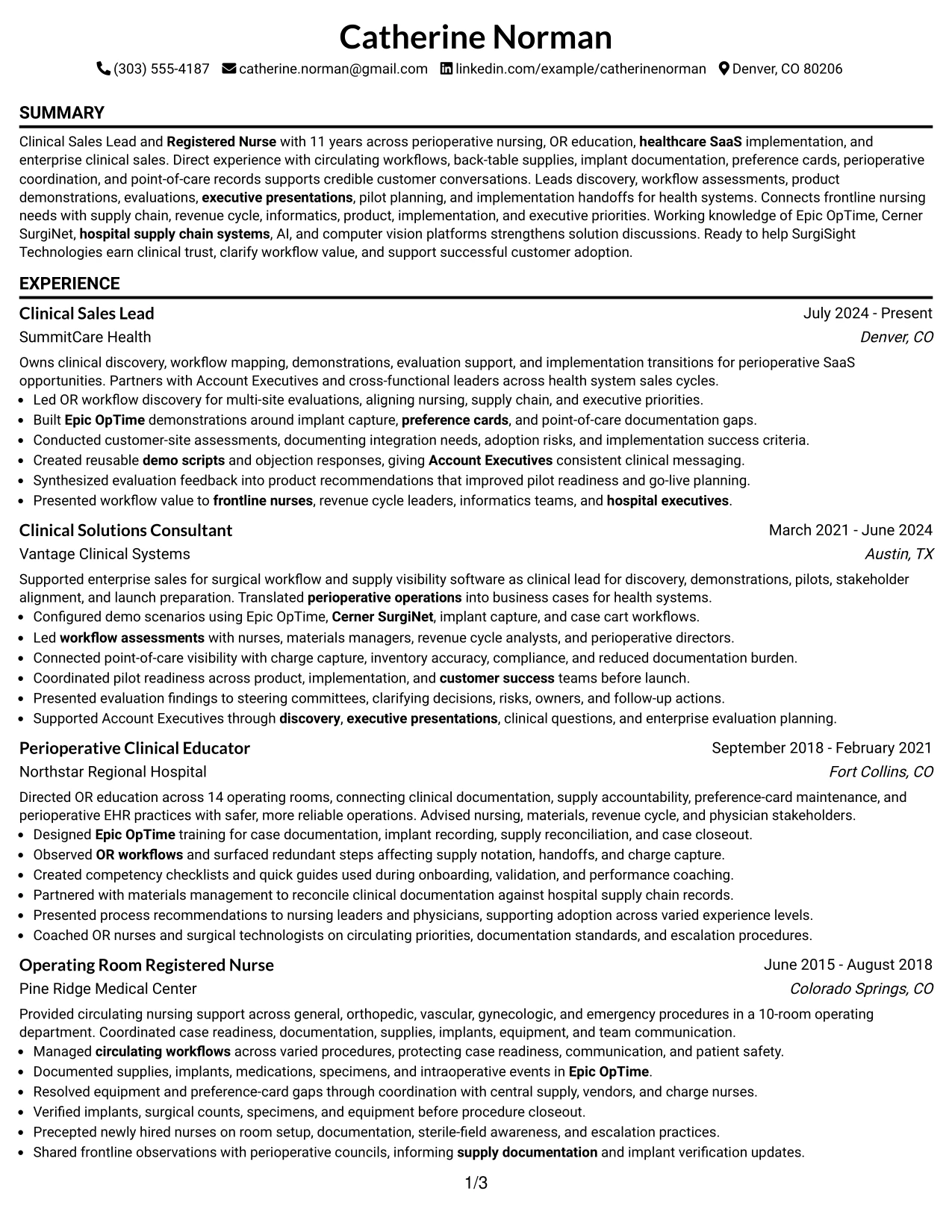
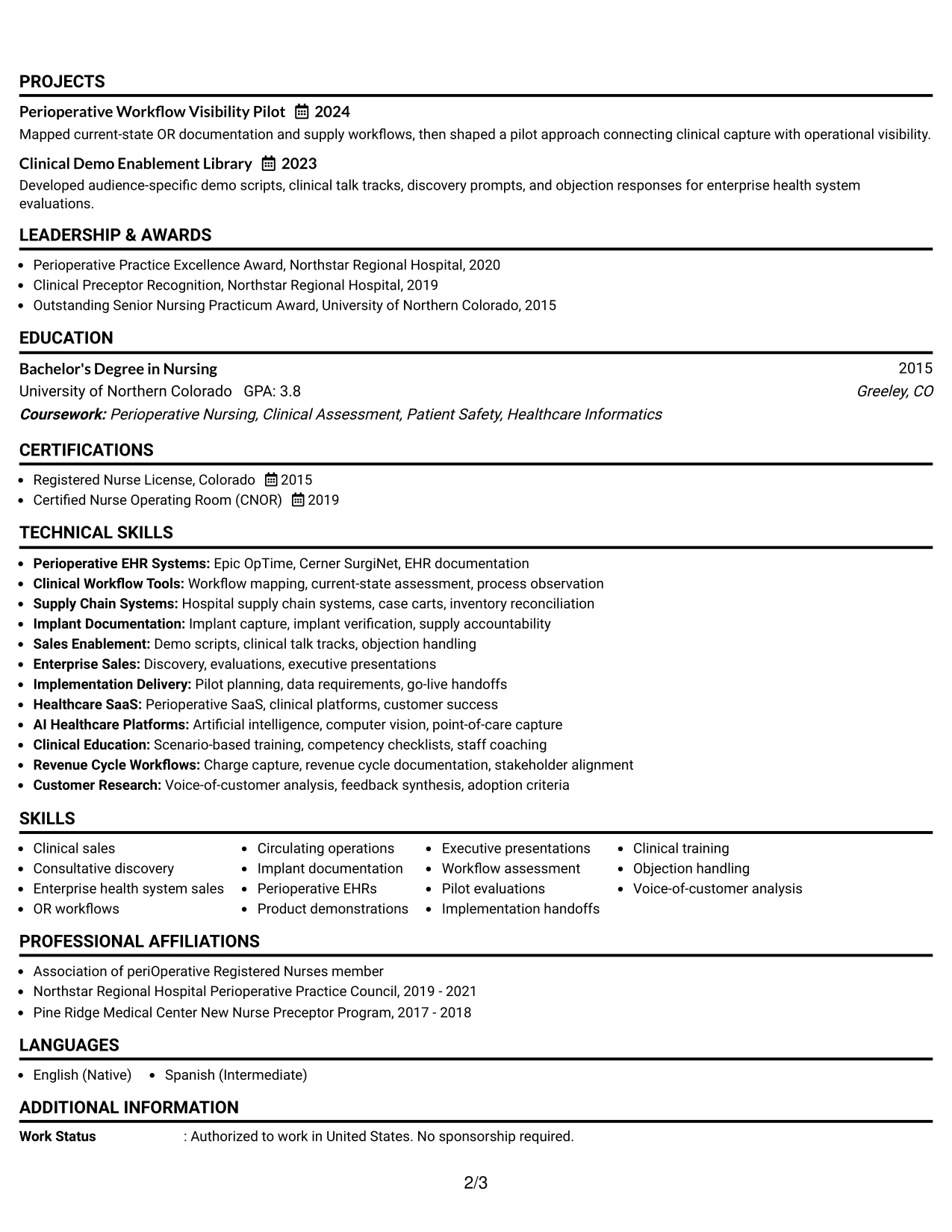
#2 Simple One Column Format Resume Example
A recruiter moves from the summary to experience, then through education, certifications, projects, and skills in one direct path. Simple One Column Format removes side-to-side movement, so each role and result appears in a predictable reading order.
That flow works well when the resume carries substantial detail. Clinical discovery, OR workflow knowledge, executive presentations, product demonstrations, and implementation work can receive full bullet treatment while remaining easy for ATS software to parse.
Why the Simple One Column Format Works for a Resume
- One reading path keeps dates, employers, titles, and bullets connected.
- Full-width sections give complex workflow and sales responsibilities room to breathe.
- The format handles four employment entries without forcing important bullets into narrow columns.
- Skills and technology terms can follow the experience section in a clean keyword block.
- Projects and awards can be added without breaking the document's sequence.
- Consistent spacing helps recruiters compare responsibilities and results across roles.
Best For
- Resumes with several detailed roles that need full-width bullet space
- Candidates combining clinical, education, implementation, and sales experience
- Applications where ATS parsing and straightforward section order matter most
- Documents that need a complete skills and technology inventory
- Readers who prefer a single top-to-bottom review path
- Resumes with projects, awards, affiliations, and certifications beyond the work history
- Applications that require clear separation of employer, title, location, and dates
#3 Clean Two Column Sidebar Format Resume Example
The strongest evidence should appear first: direct OR experience, clinical workflow knowledge, customer-facing sales work, and results tied to adoption or operational value. Clean Two Column Sidebar Format gives that evidence the wider column while keeping credentials and keywords visible in a compact sidebar.
This balance helps a reviewer connect hands-on perioperative experience with healthcare SaaS responsibilities. Bullets can show workflow assessments, executive presentations, pilot planning, and voice-of-customer work, while the sidebar reinforces Epic OpTime, CNOR, and supply chain knowledge.
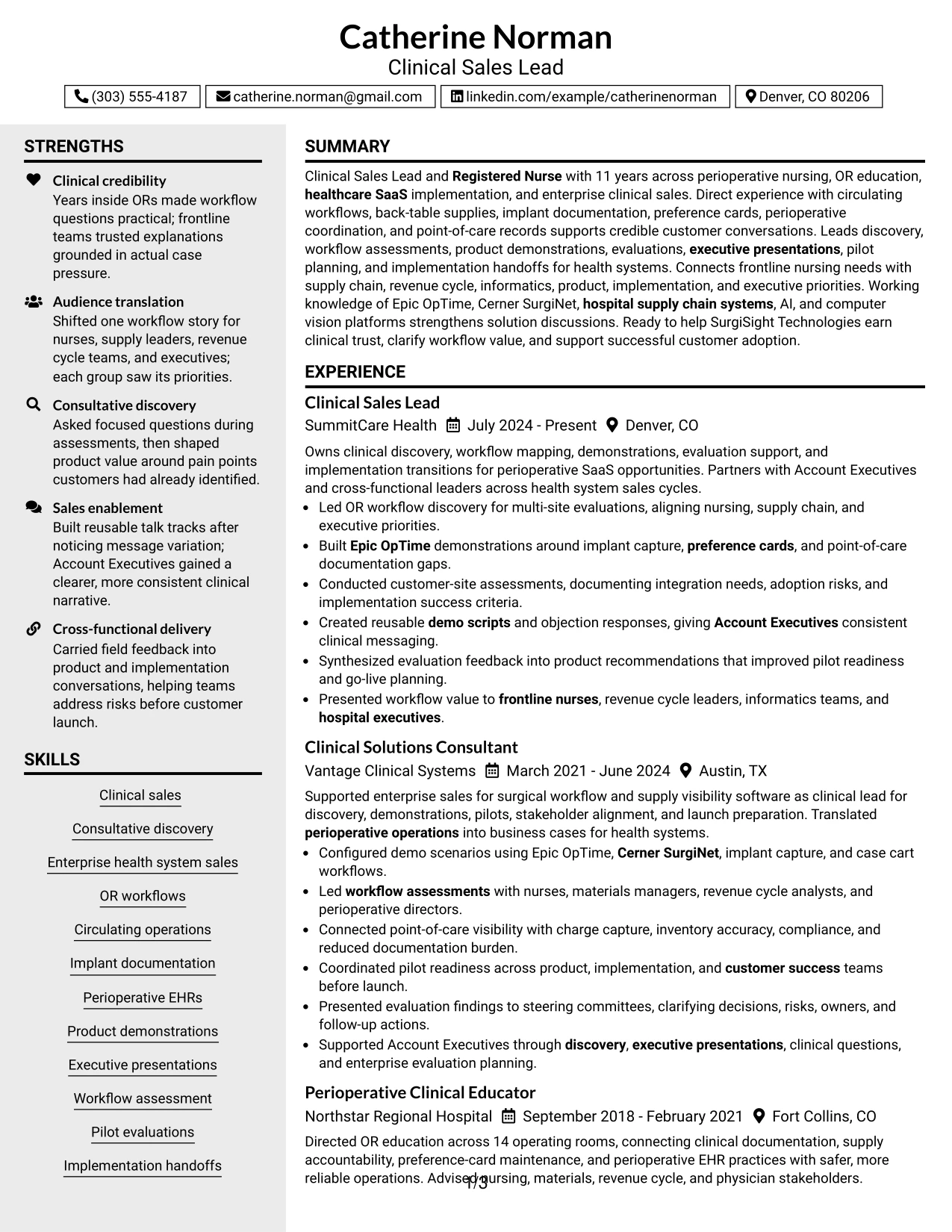
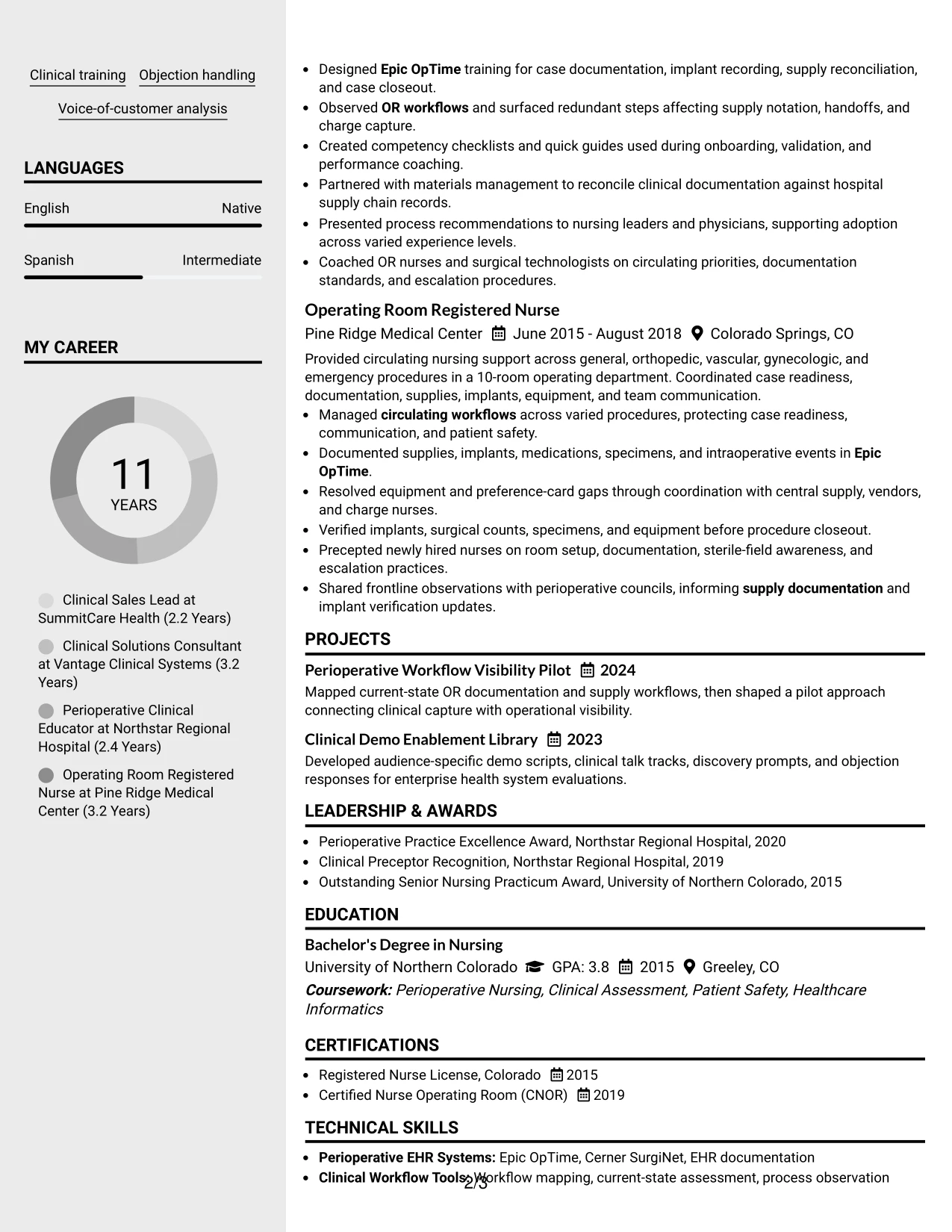
Why the Clean Two Column Sidebar Format Works for a Resume
- The wider evidence area supports detailed accomplishment bullets instead of short task lists.
- A sidebar keeps certifications, education, and technical systems available during the first scan.
- The format makes the connection between OR knowledge and clinical sales work easy to follow.
- Bullets can show how workflow findings informed product, implementation, or customer decisions.
- Distinct sections prevent important keywords from being buried inside long paragraphs.
- The layout supports both clinical credibility and cross-functional commercial evidence.
Best For
- Resumes that must prove hands-on workflow knowledge before listing supporting credentials
- Candidates with strong evidence across both customer-facing and operational work
- Applications where certifications and systems should remain visible beside experience
- Documents that need room for outcome-focused bullets and project details
- Readers comparing clinical credibility with sales-cycle responsibilities
- Resumes presenting workflow assessments, pilot readiness, and implementation evidence
- Applications where a focused skills sidebar improves first-pass review
#4 Two Column Format Resume Example
Content is balanced between a detailed experience area and a focused supporting column. Two Column Format lets the resume show the full progression from Operating Room Registered Nurse to Perioperative Clinical Educator, Clinical Solutions Consultant, and Clinical Sales Lead without making education, certifications, or skills compete for space.
For this application, the arrangement supports quick comparison between clinical responsibilities and commercial contributions. A reviewer can see circulating operations, implant documentation, discovery, demonstrations, executive presentations, and implementation handoffs in one organized page structure.
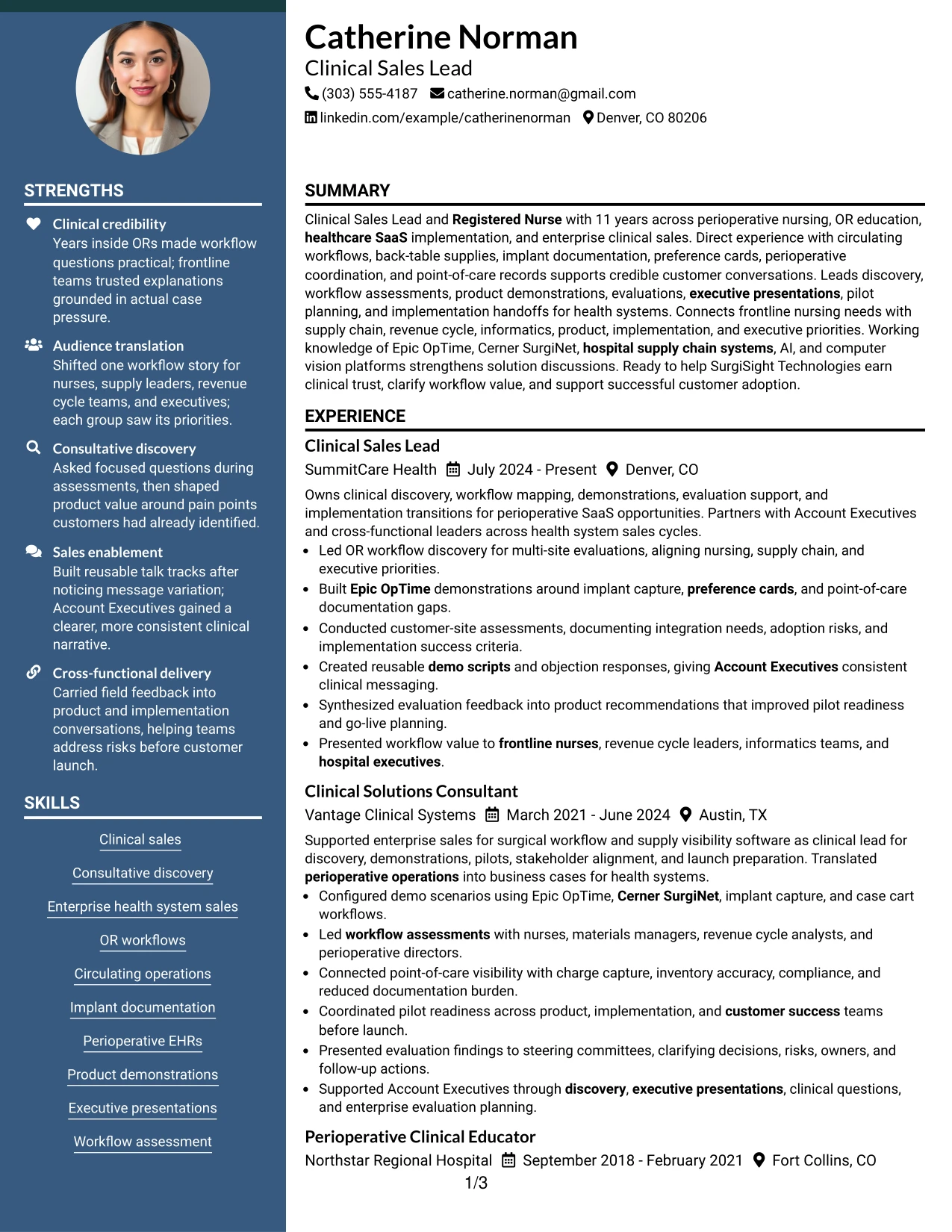
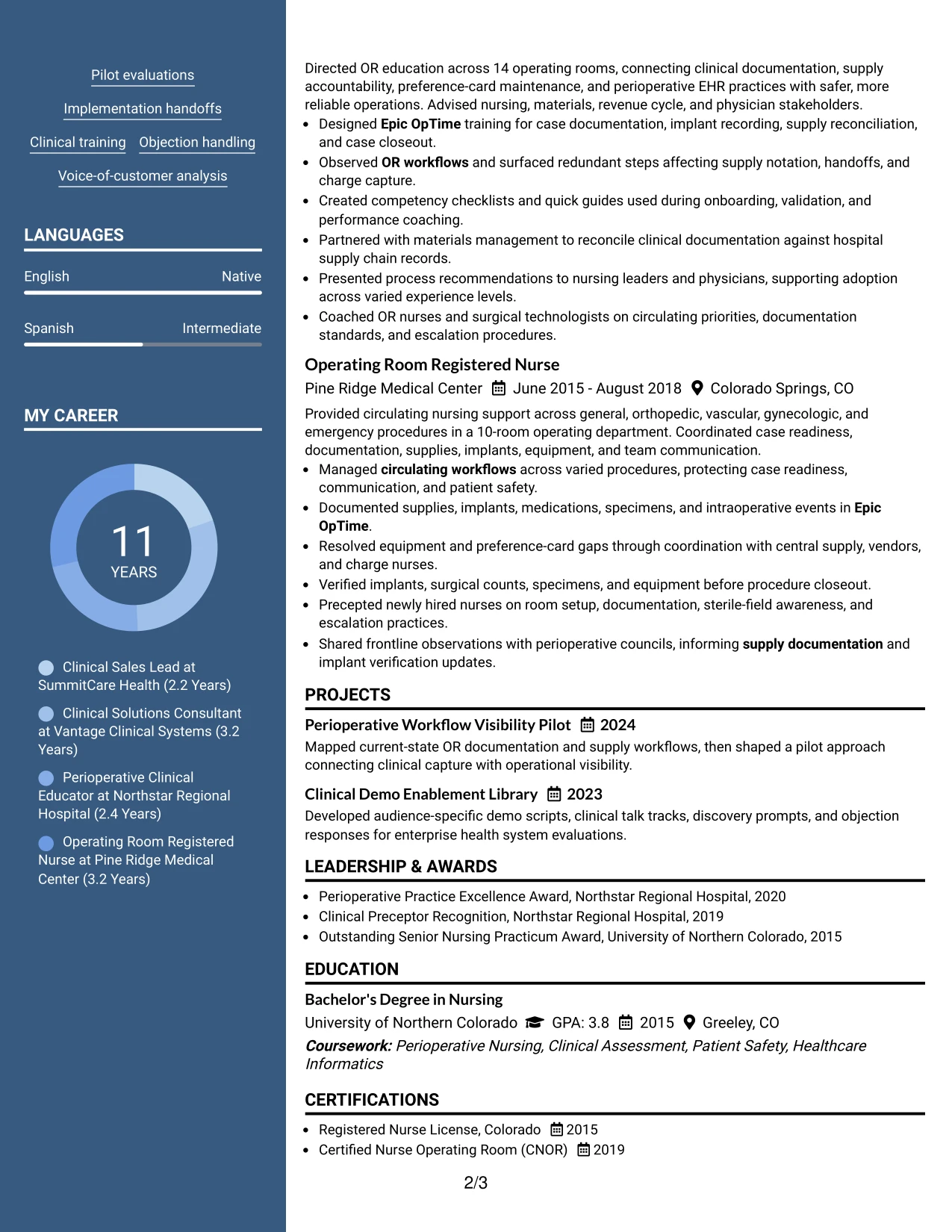
Why the Two Column Format Works for a Resume
- The format shows career progression without giving every section the same visual weight.
- The main area can hold role-specific bullets with clear dates and employer names.
- The supporting column keeps CNOR, Registered Nurse licensure, education, and systems easy to locate.
- The structure suits a resume that crosses nursing, education, SaaS, and sales functions.
- Separate columns reduce repetition between the summary, skills, and employment sections.
- The layout can place project work near experience so applied evidence remains visible.
- A balanced page supports review by clinical, commercial, and implementation stakeholders.
Best For
- Applications that connect direct care experience with healthcare technology work
- Resumes showing a clear move from clinical operations into customer-facing responsibilities
- Candidates who need separate space for experience and credential information
- Health system applications where clinical and business evidence must appear together
- Documents with a mix of employment history, projects, certifications, and technical systems
- Readers who need to compare workflow knowledge with sales-cycle contributions
- Resumes where a balanced page is more useful than a long uninterrupted experience list
#5 Photo Header Two Column Format Resume Example
When a resume is being reviewed for a customer-facing role, the top section must establish identity, role focus, and professional direction quickly. Photo Header Two Column Format creates a strong visual entry point, then uses the two-column body to separate experience from credentials, skills, and tools.
The format can present clinical sales achievements, OR workflow knowledge, and health technology experience in a polished structure. The photo header should be used only when appropriate for the application context and local hiring norms; the written content must still carry the evidence.
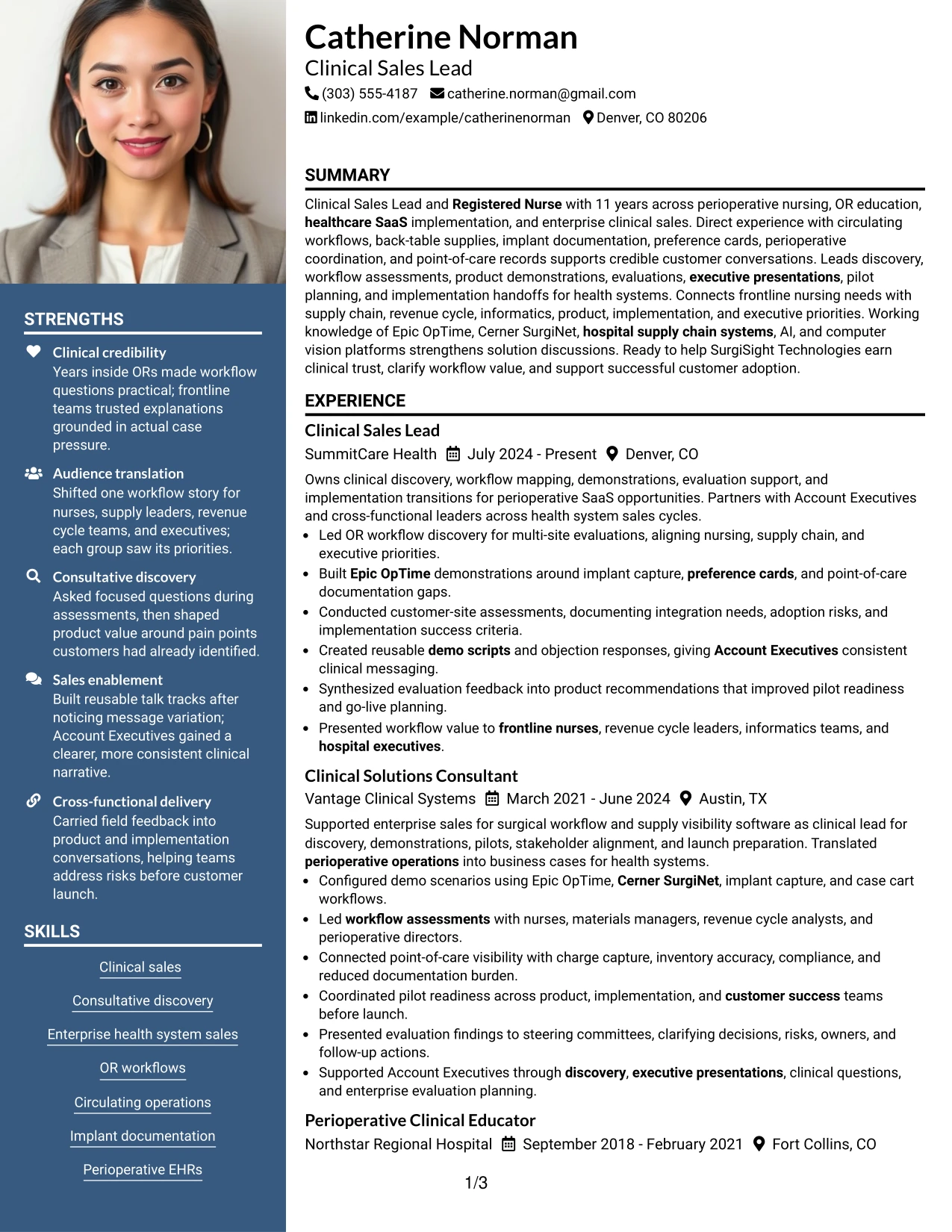
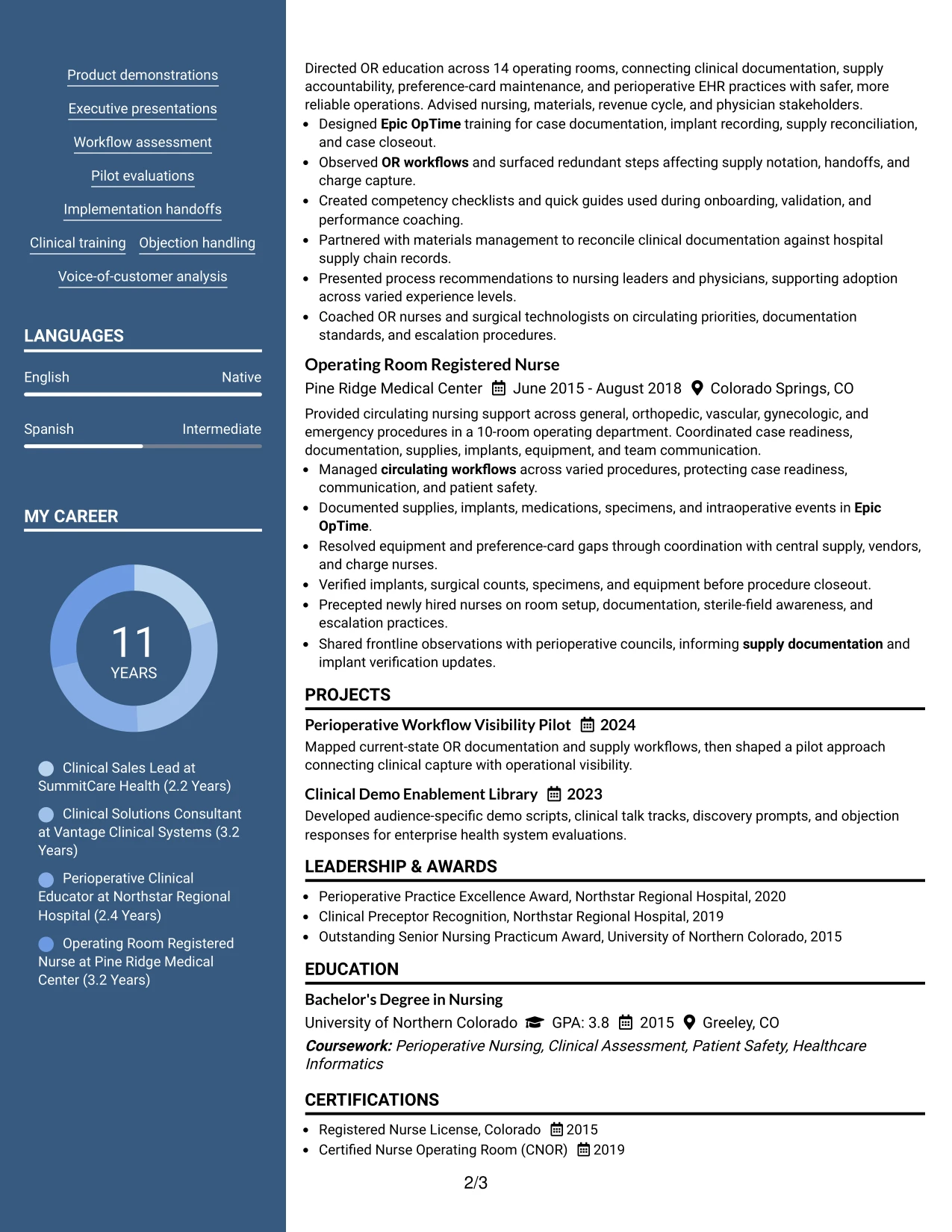
Why the Photo Header Two Column Format Works for a Resume
- The header gives the name and target role immediate visual priority.
- Two columns allow detailed experience to sit beside certifications, education, and skills.
- The structure supports a polished presentation for customer-facing work and professional networking.
- The main section can show discovery, demonstrations, workflow assessments, and pilot support as distinct evidence.
- The sidebar keeps Epic OpTime, Cerner SurgiNet, CNOR, and implementation terms easy to scan.
- A strong header can help the document feel intentional while the body remains organized for review.
- The format works best when the application setting accepts visual personal branding.
Best For
- Customer-facing applications where a polished personal brand supports the written evidence
- Professional networking situations where identity and role focus need quick recognition
- Resumes that need a prominent header plus a structured experience section
- Candidates combining clinical authority with enterprise presentation responsibilities
- Documents with enough experience detail to benefit from a supporting credentials column
- Applications where visual hierarchy can distinguish summary, experience, and technical qualifications
- Use cases where photo inclusion is appropriate under the relevant hiring norms
#6 Colored Two Column Format Resume Example
A restrained visual hierarchy gives the resume a clear professional identity while keeping the evidence easy to review. Colored Two Column Format uses emphasis to guide attention toward the target role, recent experience, and high-value capabilities without replacing standard section labels or readable text.
For a Clinical Sales Lead application, the strongest alignment appears in clinical discovery, OR and procedural workflows, product demonstrations, executive presentations, and voice-of-customer work. The second column can hold certifications, systems, skills, and travel details that support the primary evidence.
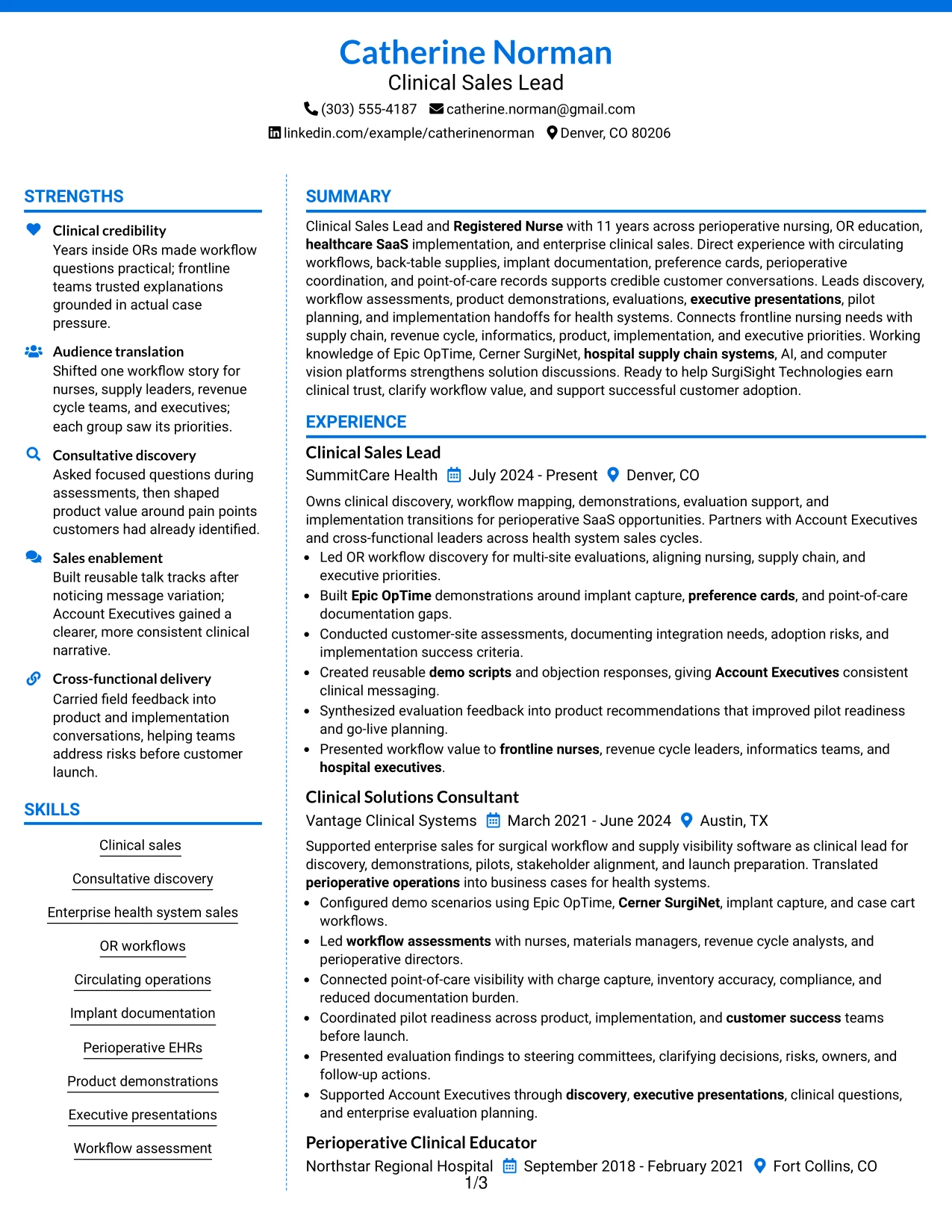
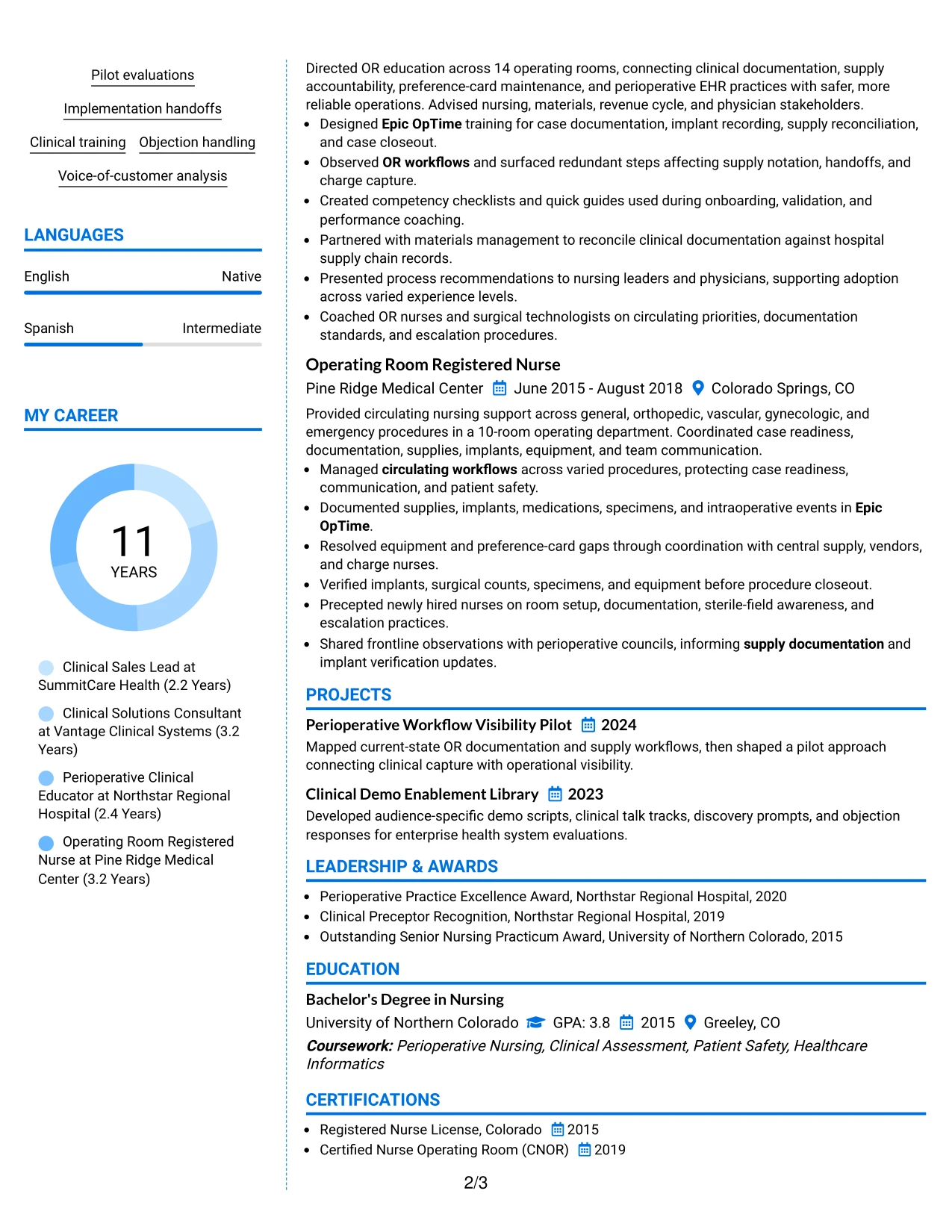
Why the Colored Two Column Format Works for a Resume
- Controlled color emphasis helps the target role and section hierarchy stand out.
- The two-column structure keeps experience separate from supporting qualifications.
- The resume can show clinical and commercial alignment without relying on decorative claims.
- A focused sidebar makes systems, certifications, and core skills available during scanning.
- Readable bullets preserve ATS-friendly content beneath the visual treatment.
- Recent clinical sales work can receive more space than older nursing responsibilities.
- The layout supports a professional presentation for health technology and health system audiences.
Best For
- Applications where restrained visual emphasis should reinforce, not replace, strong evidence
- Customer-facing resumes that need a clear target role at the top
- Candidates matching clinical workflow knowledge to healthcare technology responsibilities
- Documents that benefit from a visible skills and systems column
- Readers scanning for discovery, demonstrations, and executive presentation experience
- Resumes that need visual separation between current work and supporting credentials
- Applications where professional color can improve navigation without reducing readability
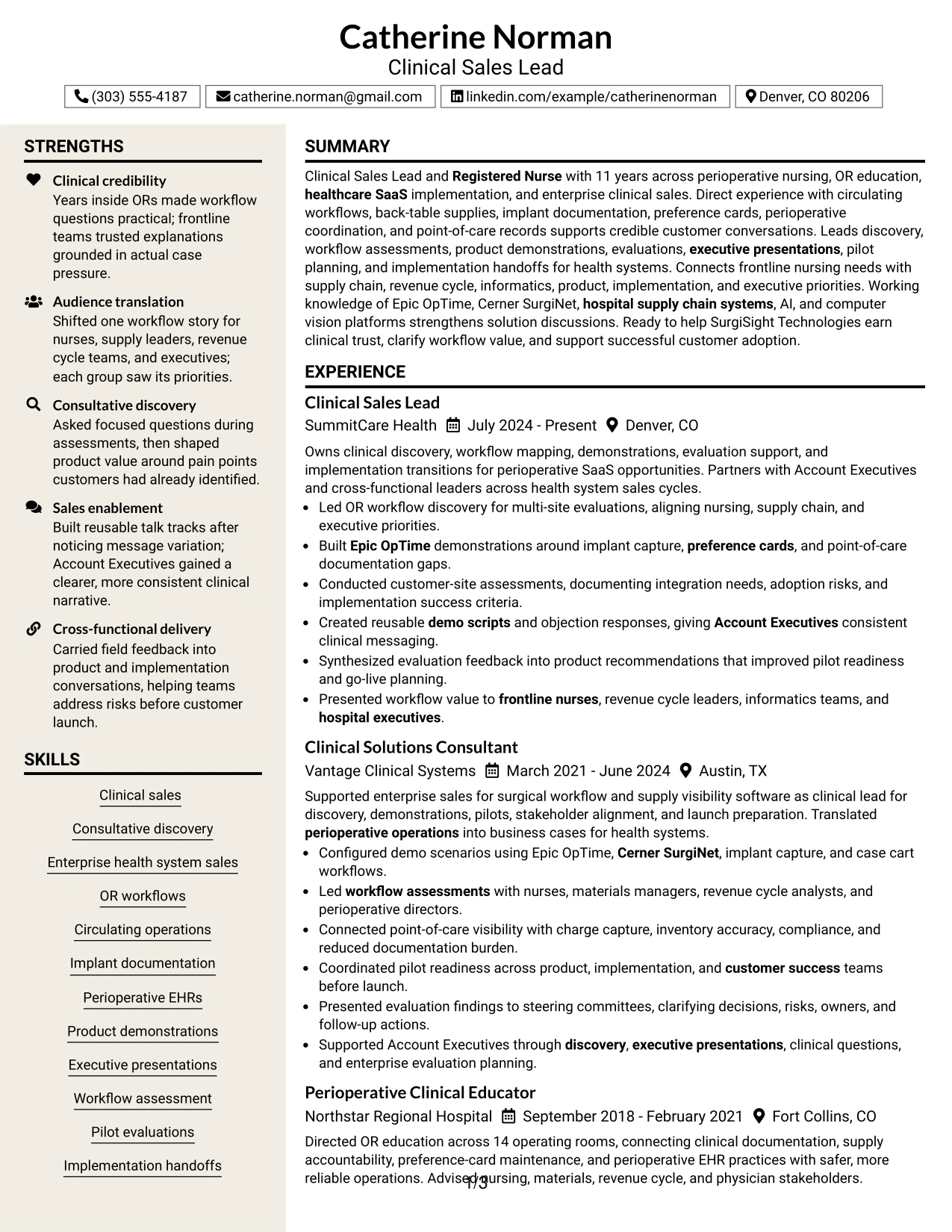
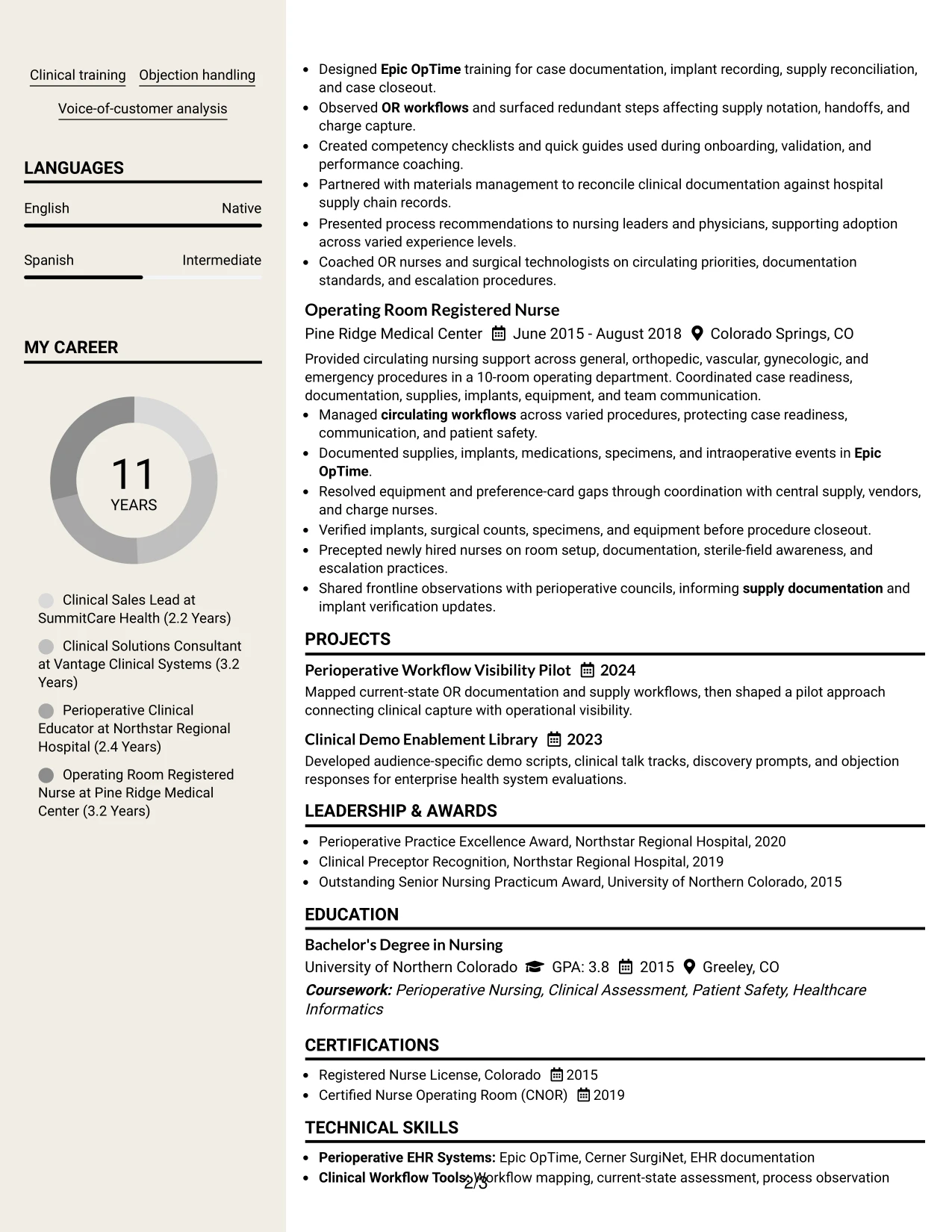
#7 Stylish Two Column Designer Format Resume Example
Stylish Two Column Designer Format organizes the resume into a strong evidence column and a compact reference column. The design can make the document feel polished, but the structure still depends on direct job titles, dates, action bullets, skills, certifications, and measurable or observable results.
That approach fits a resume with several kinds of proof. Clinical work establishes OR credibility, SaaS and sales roles show customer-facing execution, and projects demonstrate reusable enablement and workflow visibility work. The layout keeps those proof points distinct instead of blending them together.
Why the Stylish Two Column Designer Format Works for a Resume
- The design gives the resume a clear visual structure without removing standard resume sections.
- The evidence column provides space for detailed bullets and career progression.
- A compact reference area can group education, certifications, systems, and selected skills.
- Project entries add proof of applied work beyond routine job duties.
- The format separates clinical experience from sales enablement evidence while showing their connection.
- Strong section labels help both human reviewers and ATS tools interpret the content.
- The design supports a polished document when the content remains concise and specific.
Best For
- Resumes that need a polished structure for a multi-function professional background
- Candidates presenting clinical operations, education, SaaS, and sales evidence together
- Applications where project work deserves a visible place beside employment history
- Documents that benefit from a dedicated reference area for systems and credentials
- Readers who scan for proof before reviewing the complete career story
- Resumes with reusable enablement materials, workflow pilots, or implementation contributions
- Professional applications where visual design should support clear section navigation
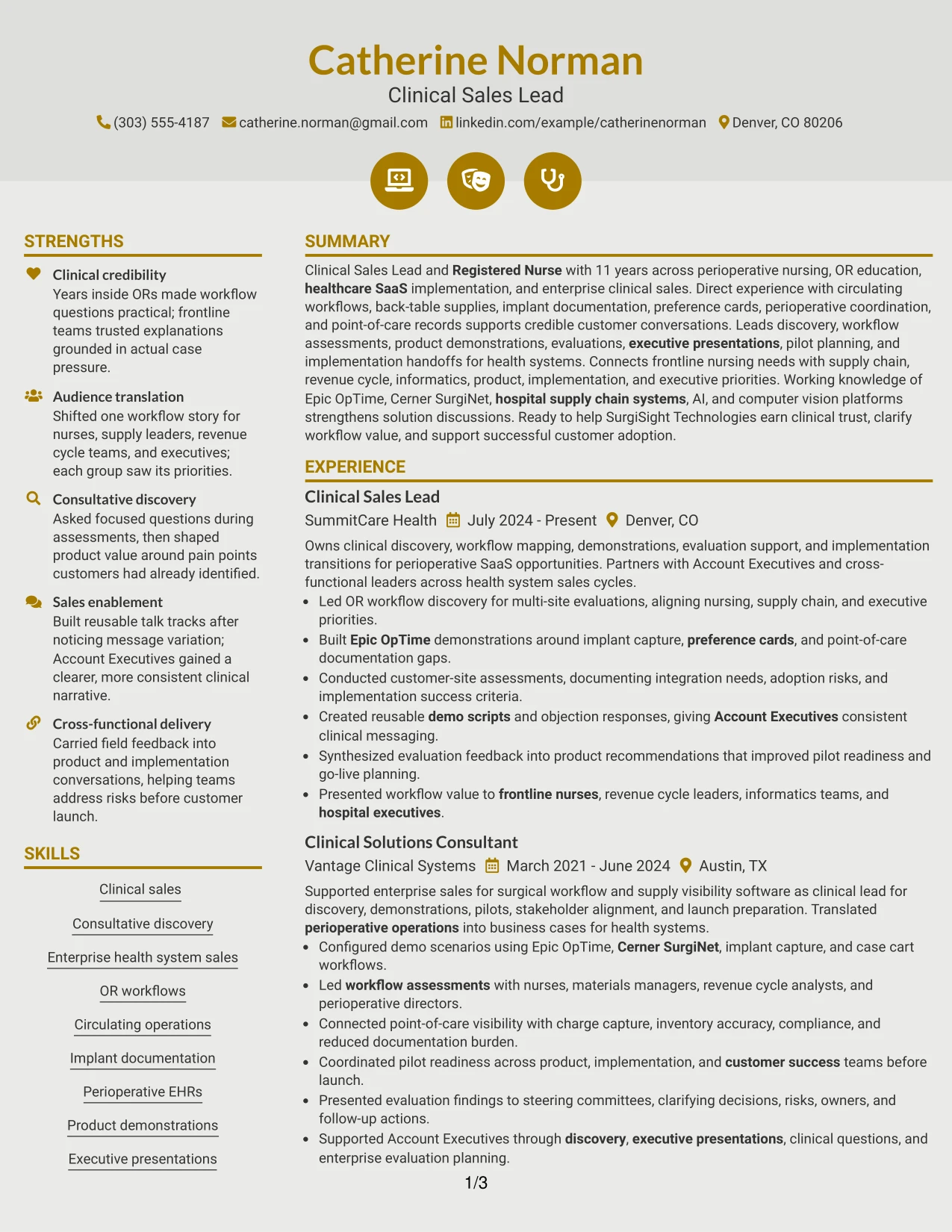
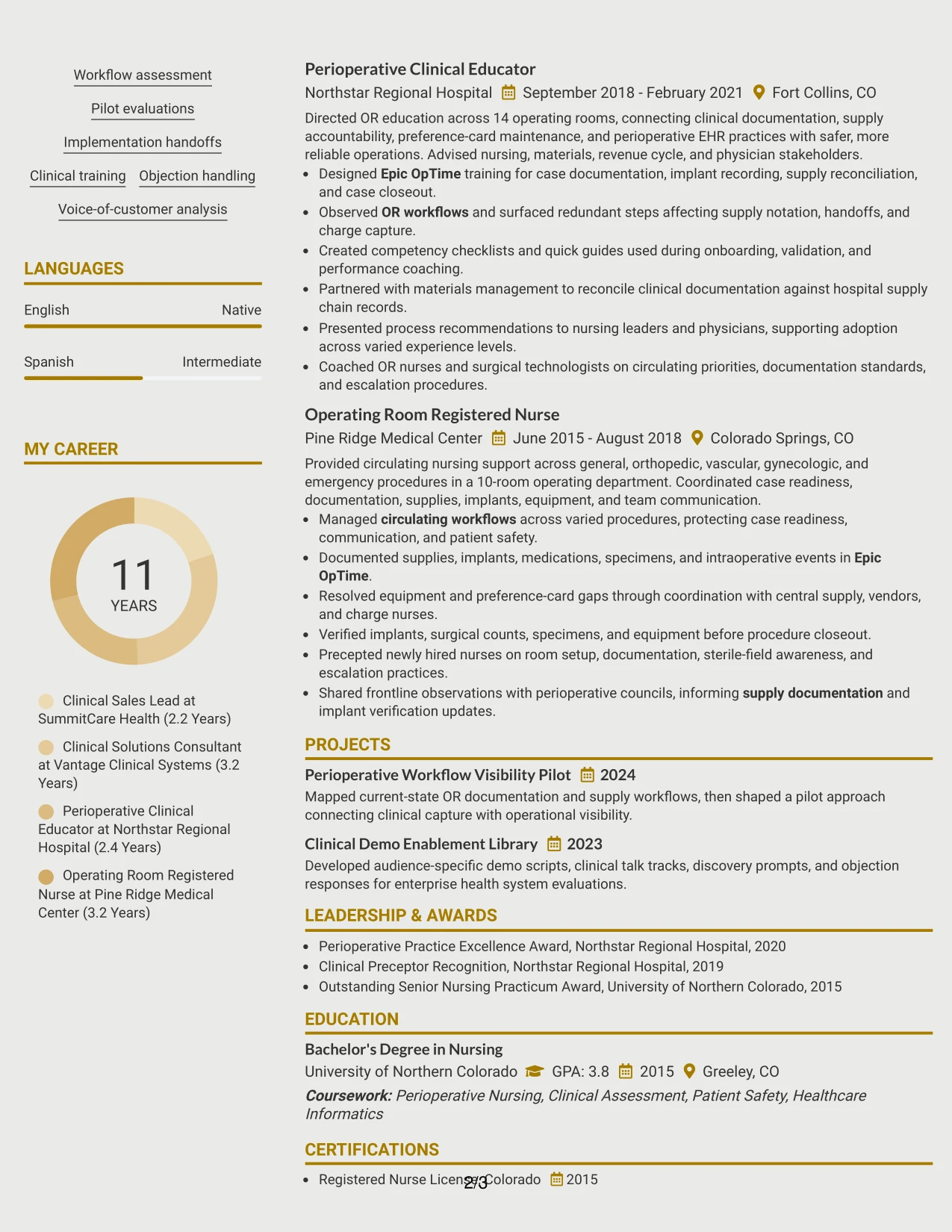
#8 Modern Icon Format Resume Example
A recruiter moves from one clearly marked section to the next, using visual cues to locate experience, skills, education, certifications, and projects. Modern Icon Format keeps the document in one column, so the visual markers support navigation without splitting related content across separate reading paths.
The format is useful when the resume contains a broad mix of clinical and commercial terms. Experience bullets can cover discovery, workflow mapping, demonstrations, and implementation handoffs, while later sections collect Epic OpTime, Cerner SurgiNet, AI, computer vision, and supply chain systems.
Why the Modern Icon Format Works for a Resume
- Visual section markers help readers locate major resume categories quickly.
- One-column flow keeps each role's dates, title, employer, and bullets together.
- The format can hold a broad technical skills inventory without a narrow sidebar.
- Projects and affiliations remain easy to add after the main experience record.
- The structure supports clear scanning of clinical, sales, and implementation language.
- Icons can guide the eye, while text labels preserve standard resume meaning.
- A consistent vertical rhythm helps readers review a detailed background without losing sequence.
Best For
- Resumes with many sections that need clear visual signposts
- Candidates carrying a broad mix of clinical, sales, technology, and training content
- Applications where one-column order is important for ATS and human review
- Documents with substantial skills, systems, projects, certifications, and affiliations
- Readers who benefit from quick section recognition during a first scan
- Resumes that need full-width bullets for discovery, workflow, and implementation evidence
- Applications where light visual cues improve navigation without changing content priority
#9 Modern Full Background Two Column Format Resume Example
The most relevant evidence receives priority: clinical workflow expertise, customer-facing presentations, health system sales support, and successful handoff planning. Modern Full Background Two Column Format gives that evidence a strong page structure while preserving a separate area for credentials and keywords.
This design can show how nursing experience supports consultative sales rather than treating the career history as unrelated jobs. Bullets can connect OR observations, implant documentation, supply visibility, evaluation planning, and customer feedback to product and implementation decisions.
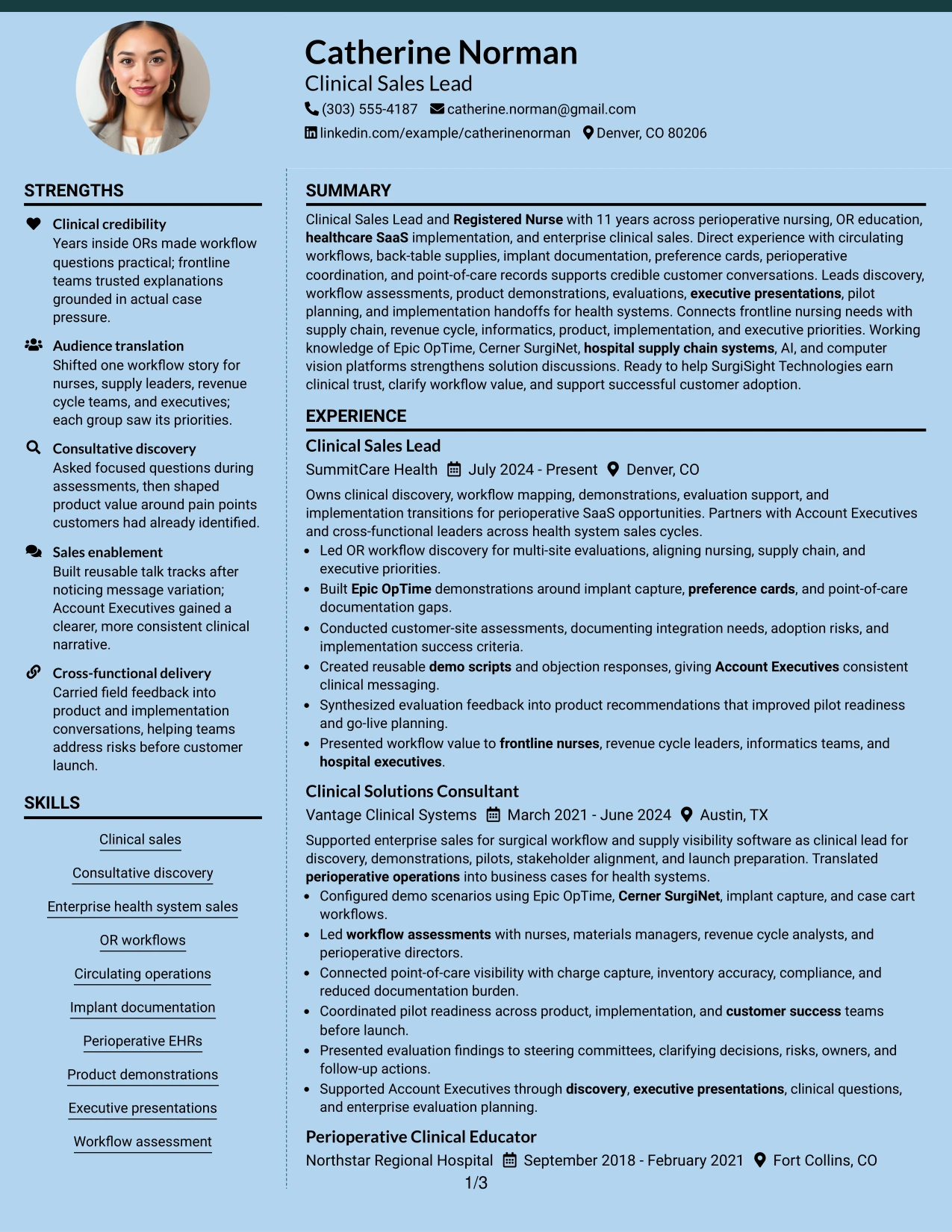
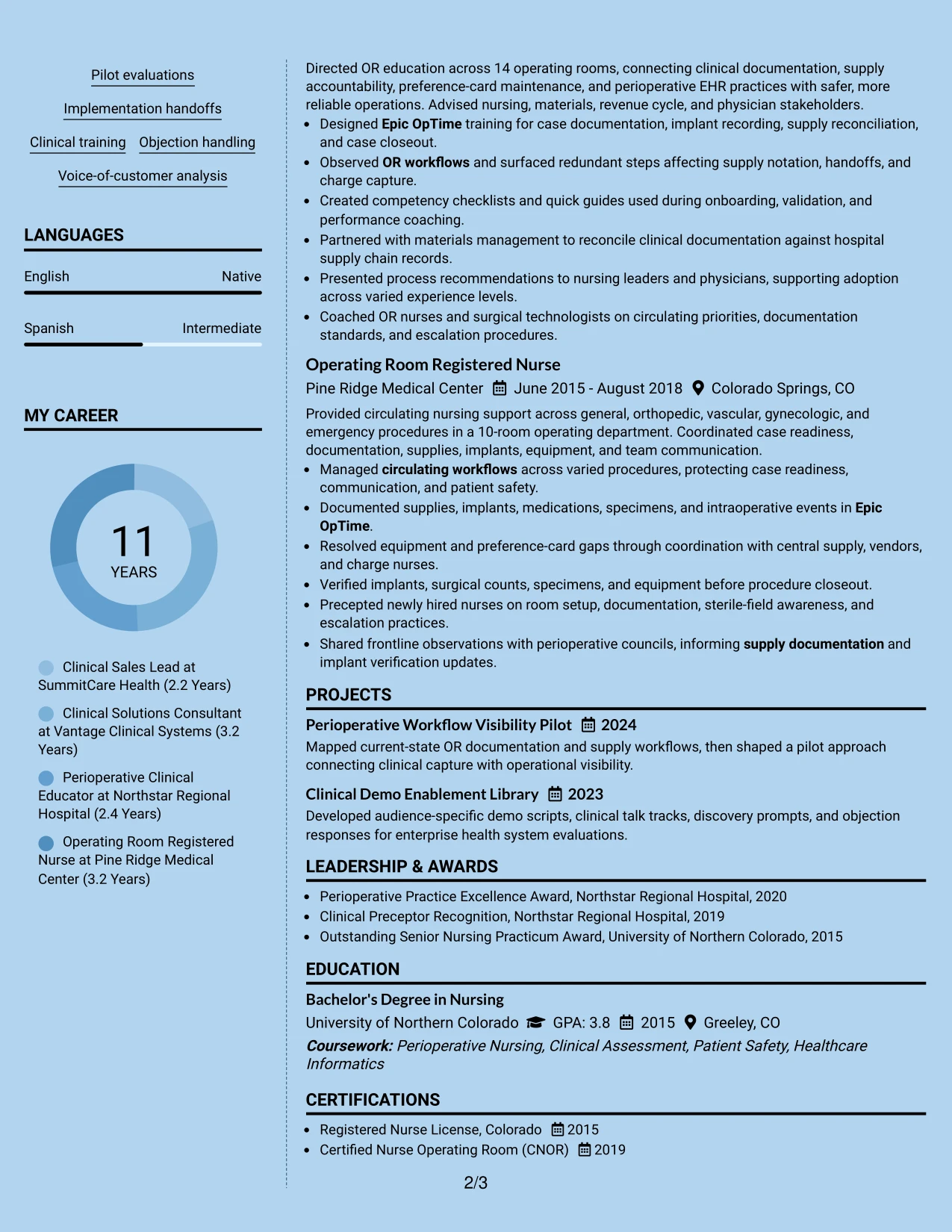
Why the Modern Full Background Two Column Format Works for a Resume
- The full-page treatment gives the resume a unified visual field while columns preserve order.
- The primary area can prioritize recent clinical sales and solutions consulting evidence.
- A secondary area keeps CNOR, nursing licensure, education, and systems visible.
- The format supports bullets that connect workflow observations to business and adoption needs.
- Project work can reinforce the experience record without competing with the summary.
- Strong contrast between sections helps a reviewer find target-role keywords quickly.
- The layout presents a coherent bridge from bedside operations to health technology sales.
Best For
- Applications where the strongest proof comes from workflow knowledge and customer-facing delivery
- Candidates explaining a direct bridge between clinical operations and health technology sales
- Resumes that need a unified presentation for experience, projects, and credentials
- Documents with substantial evidence about evaluations, pilots, and implementation planning
- Readers looking for clinical credibility alongside enterprise sales-cycle support
- Applications where background context helps explain a change in functional focus
- Resumes that benefit from strong section contrast while keeping the content structured
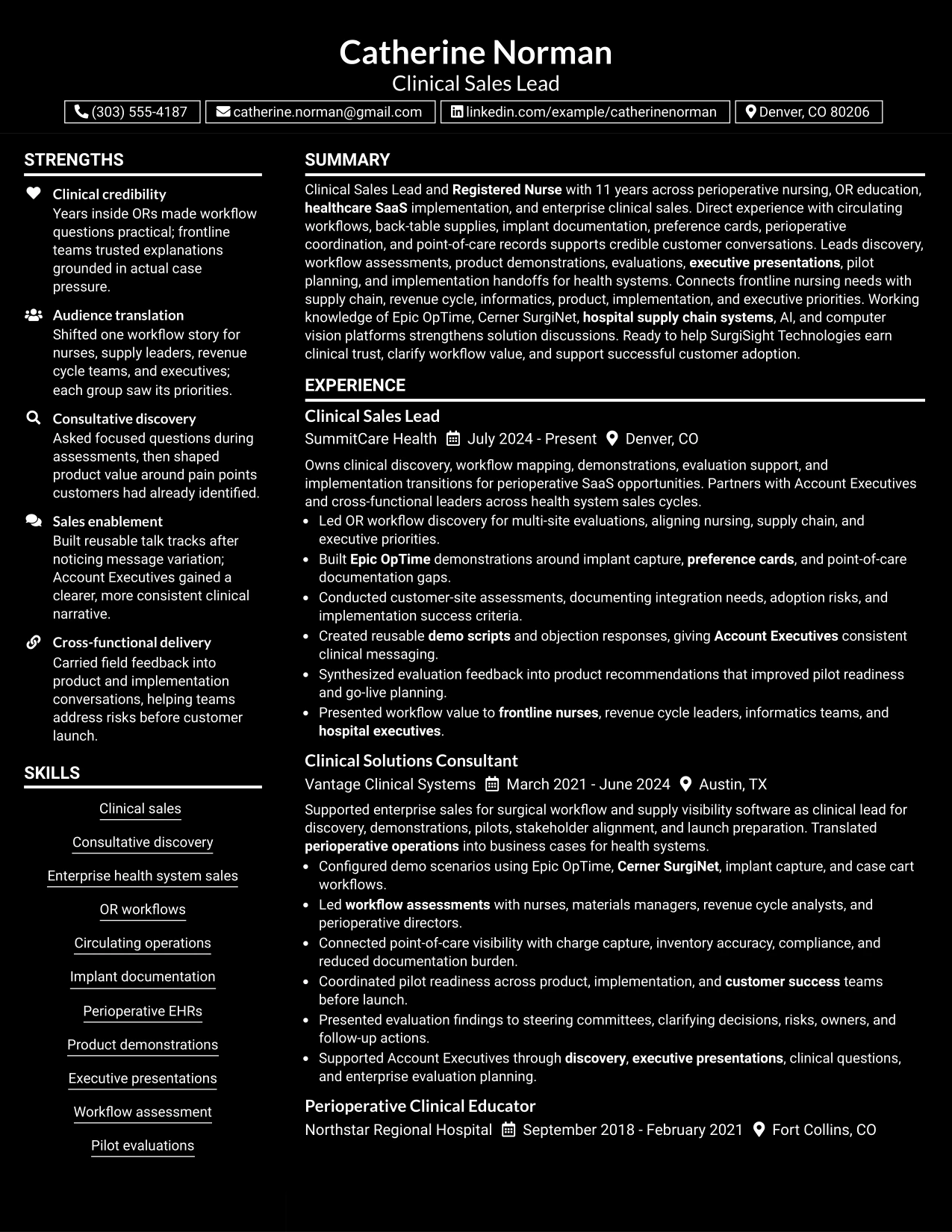
#10 Dark Mode Two Column Format Resume Example
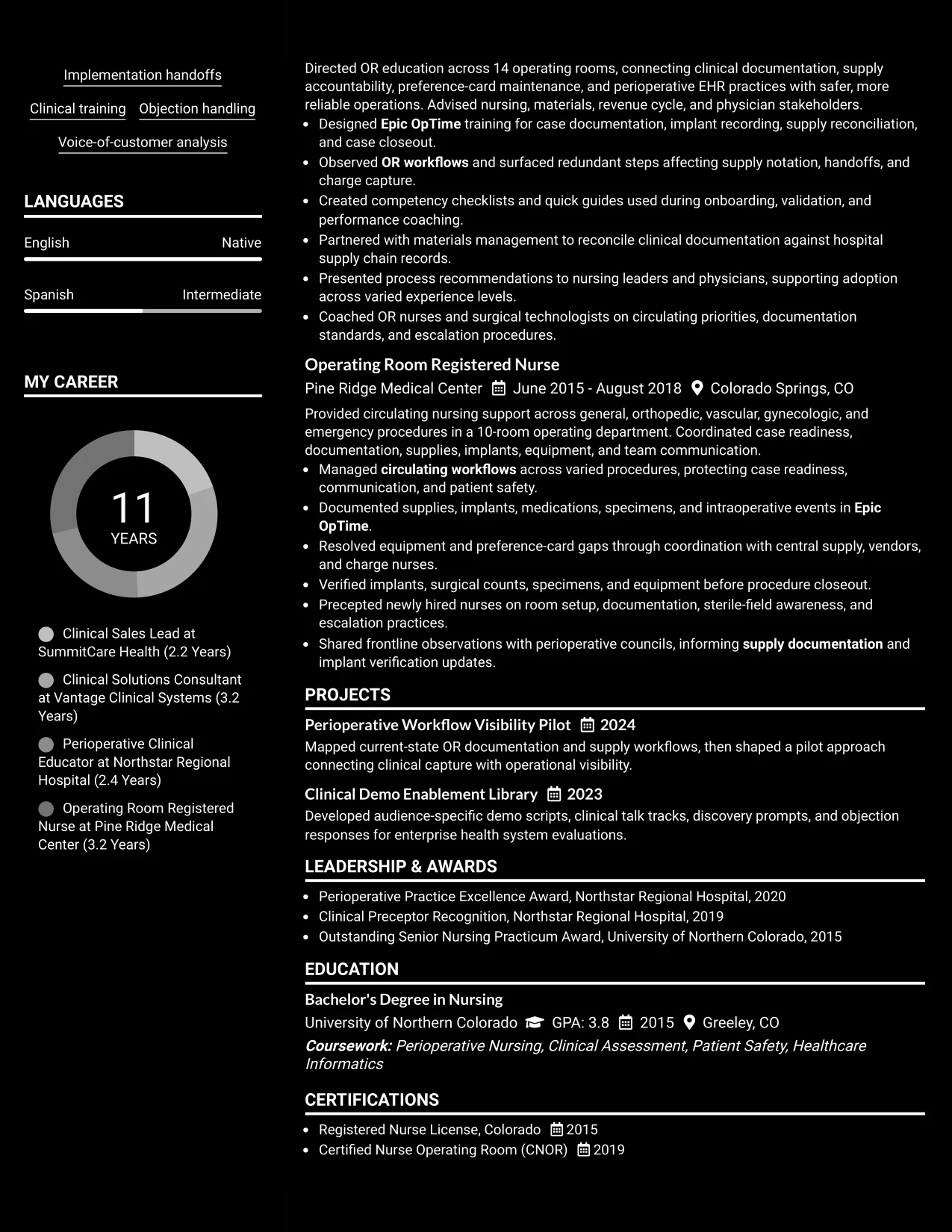
Content is distributed between a detailed experience column and a supporting qualifications column, with each area given a clear job. Dark Mode Two Column Format can present Catherine Norman's clinical sales progression with enough room for workflow evidence while keeping certifications, systems, and skills available during review.
The dark visual treatment should remain controlled so contrast does not reduce readability or ATS usefulness. Strong bullets still do the work: discovery, executive presentations, product demonstrations, OR assessments, pilot readiness, and cross-functional implementation support.
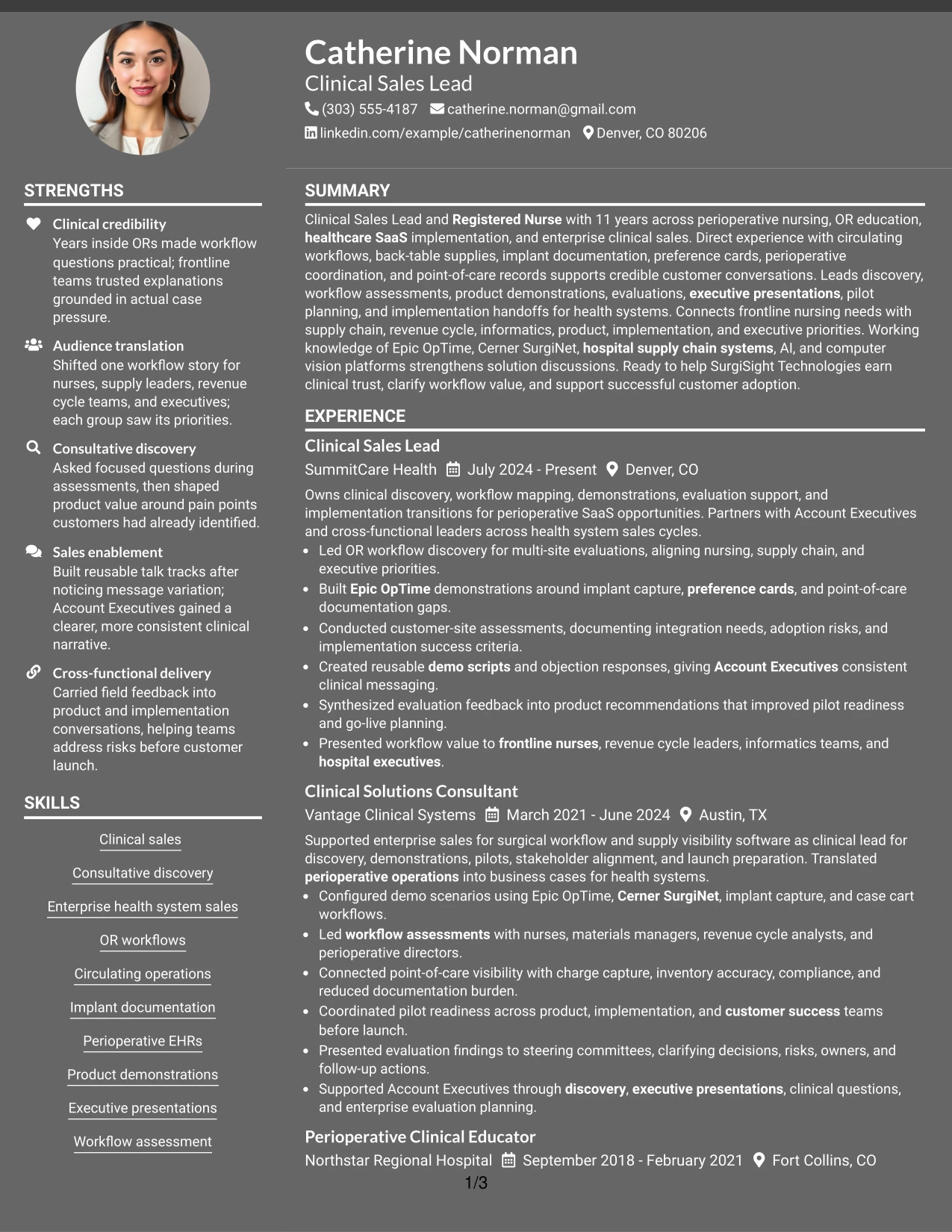
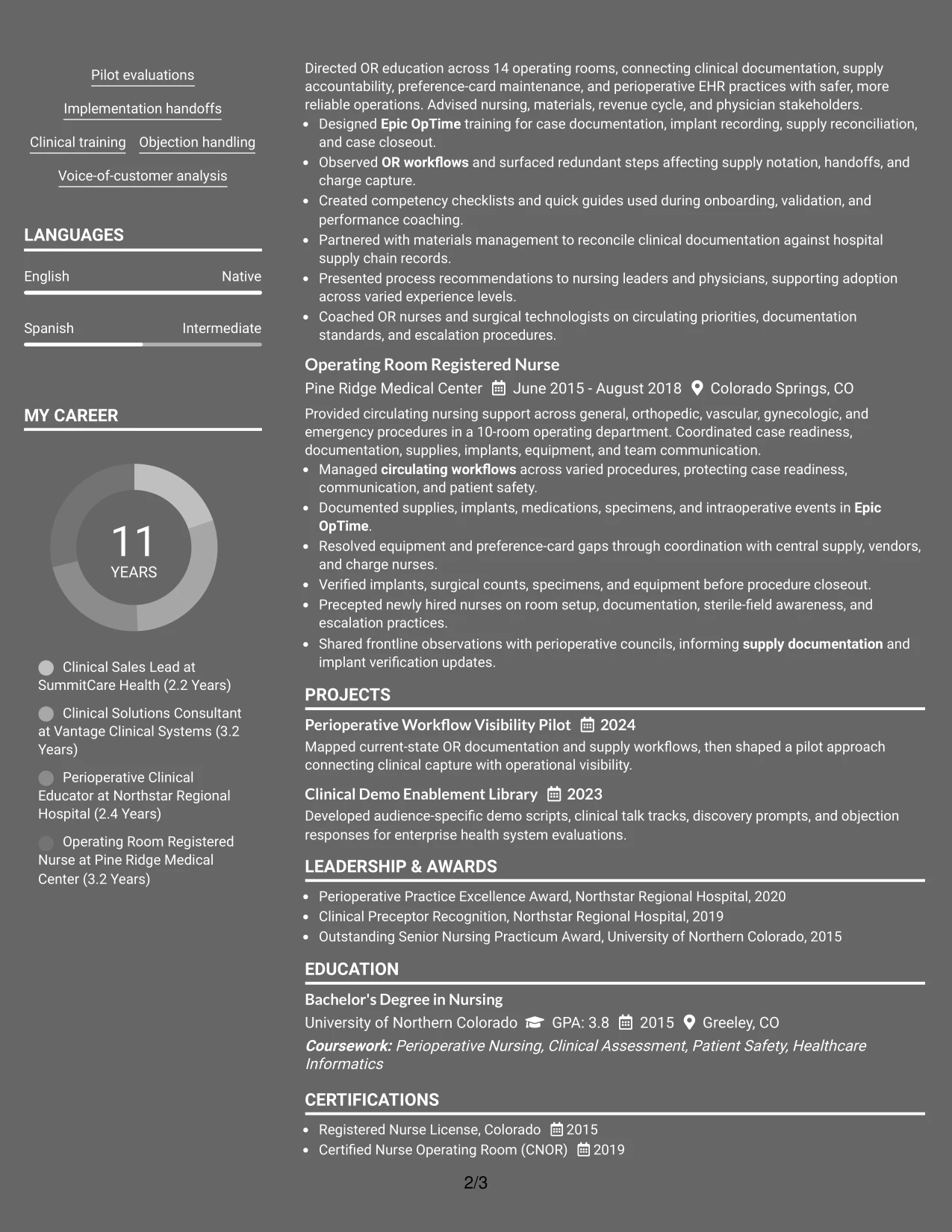
Why the Dark Mode Two Column Format Works for a Resume
- Two-column distribution gives detailed experience and supporting qualifications separate space.
- The format can highlight the current Clinical Sales Lead role without minimizing earlier clinical work.
- A secondary area keeps skills, systems, certifications, and travel information easy to find.
- High-contrast text and clear labels are essential for readable resume scanning.
- The structure supports a long career record without turning every section into a dense block.
- Projects can add evidence of workflow visibility and demo enablement beyond employment bullets.
- The design presents a deliberate application document while preserving standard resume mechanics.
Best For
- Customer-facing applications where a confident visual presentation supports strong evidence
- Resumes with a clear current role and several relevant earlier positions
- Candidates who need to balance detailed experience with a compact qualification record
- Documents presenting executive presentations, demos, assessments, and implementation support
- Applications where visual distinction helps the resume stand out during manual review
- Resumes with projects and technical systems that need space outside the experience column
- Use cases where dark styling can remain high contrast, restrained, and easy to scan
#11 Dark Mode Box Header Format Resume Example
A practical application resume needs an immediate title, a focused summary, and a clean sequence of evidence. Dark Mode Box Header Format places emphasis on the header, then keeps the rest of the document in one column so experience, projects, skills, education, and certifications remain connected.
For the Clinical Sales Lead target, the opening content can quickly state OR credibility, clinical sales experience, and health technology knowledge. Later bullets should add proof through workflow assessments, customer-site demonstrations, executive presentations, voice-of-customer analysis, and implementation handoffs.
Why the Dark Mode Box Header Format Works for a Resume
- The boxed header gives the target role and professional summary immediate priority.
- One-column organization keeps the career record in a straightforward review sequence.
- The format provides room for complete bullets instead of compressing evidence into narrow blocks.
- Skills and technology terms can follow experience without being separated from their context.
- Projects offer a clear place to show workflow visibility and demo enablement work.
- A strong header can distinguish the document while standard labels protect usability.
- The structure works well when clarity and professional presentation must coexist.
Best For
- Applications needing a strong target-role header and a direct experience sequence
- Candidates whose clinical credibility should be stated before detailed commercial evidence
- Resumes with several roles that need full-width bullets and clear date order
- Documents combining employment history with projects, certifications, and technical systems
- Readers who prefer a single path from summary through experience and qualifications
- Customer-facing applications where a polished header supports a practical resume structure
- Use cases where visual emphasis belongs at the top rather than throughout every section
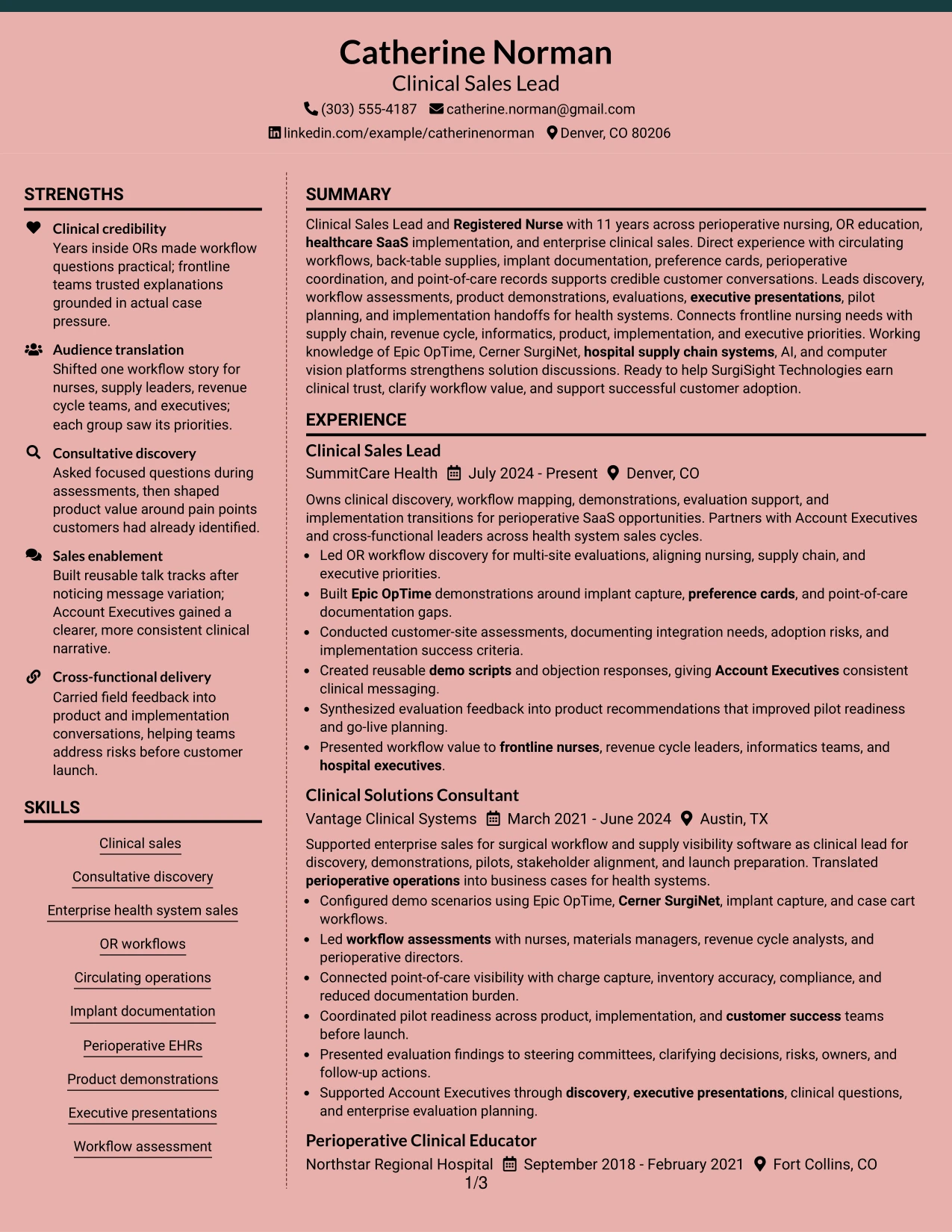
#12 Elegant Full Background Two Column Format
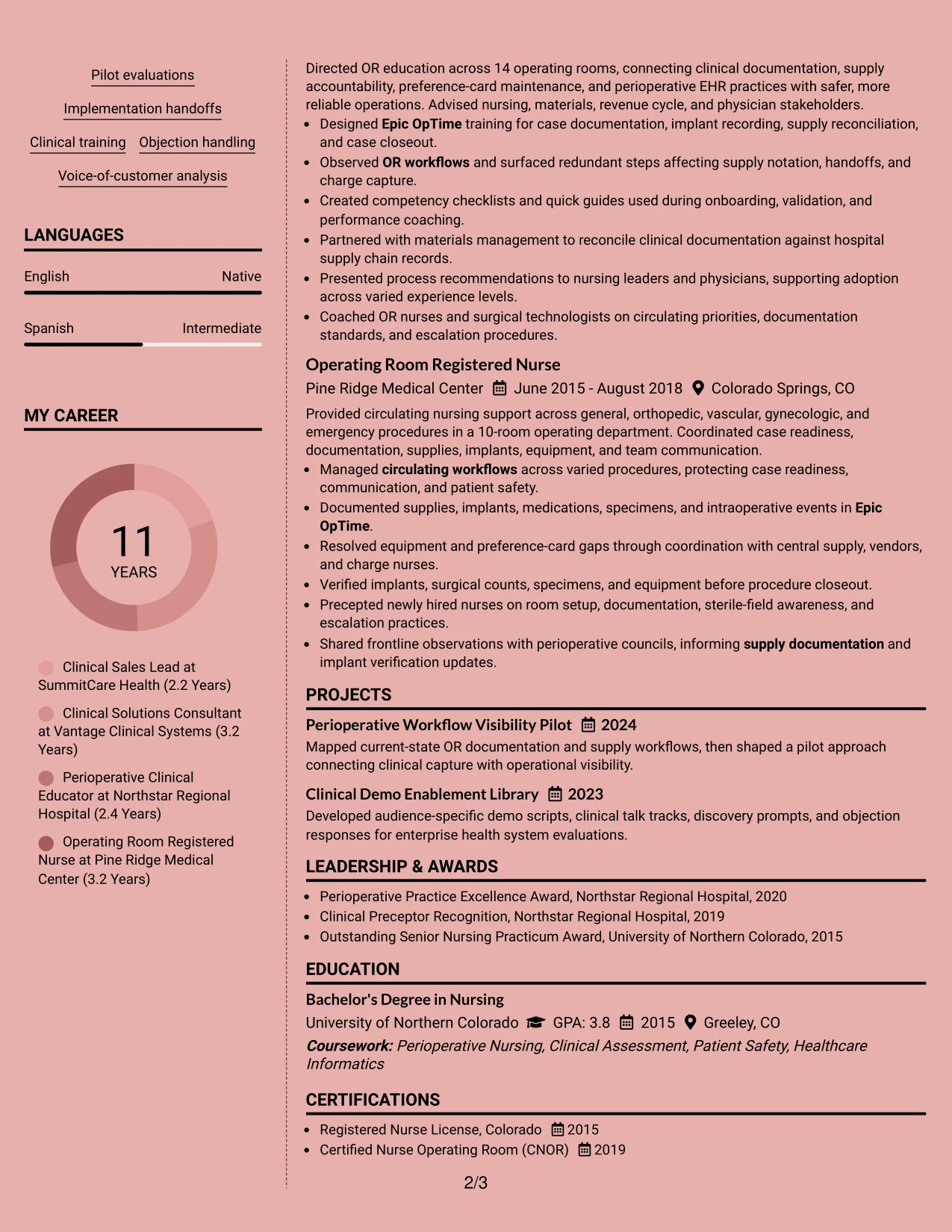
A restrained visual hierarchy gives this resume a polished, credible impression before the reader reaches the details. The two-column structure separates core skills and certifications from the career history, keeping clinical sales, OR workflows, Epic OpTime, and enterprise health system sales easy to find.
The main column gives space to discovery, workflow assessments, demonstrations, evaluations, and implementation handoffs. Short bullet points keep the evidence direct, while the secondary column supports fast review of credentials, tools, education, awards, and professional affiliations.
#12 Why the Elegant Full Background Two Column Format Works for a Resume
- Creates a clear split between supporting qualifications and detailed experience.
- Makes high-value keywords visible without crowding the work history.
- Gives each role room for focused achievement bullets.
- Supports quick review of Epic OpTime, Cerner SurgiNet, and supply chain systems.
- Keeps education, certifications, and awards easy to locate.
- Provides space for projects such as workflow visibility and demo enablement.
- Uses a polished structure while keeping the text readable for ATS review.
#12 Best For
- Resumes that need a strong skills-and-experience hierarchy.
- Professionals presenting clinical credibility alongside commercial responsibilities.
- Applications where certifications and technical systems deserve a dedicated scan area.
- Career histories with several related roles that need clear separation.
- Readers who want fast access to both keywords and supporting evidence.
- Resumes combining customer-facing work, workflow knowledge, and implementation duties.
- Candidates who need a polished look without sacrificing text-based organization.
#13 Creative Two Tone Format
The Creative Two Tone Format uses one continuous column, so the reader moves from the professional summary into skills, experience, education, and certifications in a natural order. The color contrast adds separation without breaking the sequence of resume evidence.
That structure works well when the strongest story depends on connected experience. Clinical sales leadership can lead into clinical solutions consulting, perioperative education, and operating room nursing, with bullets that show discovery, demonstrations, workflow mapping, training, and customer feedback.
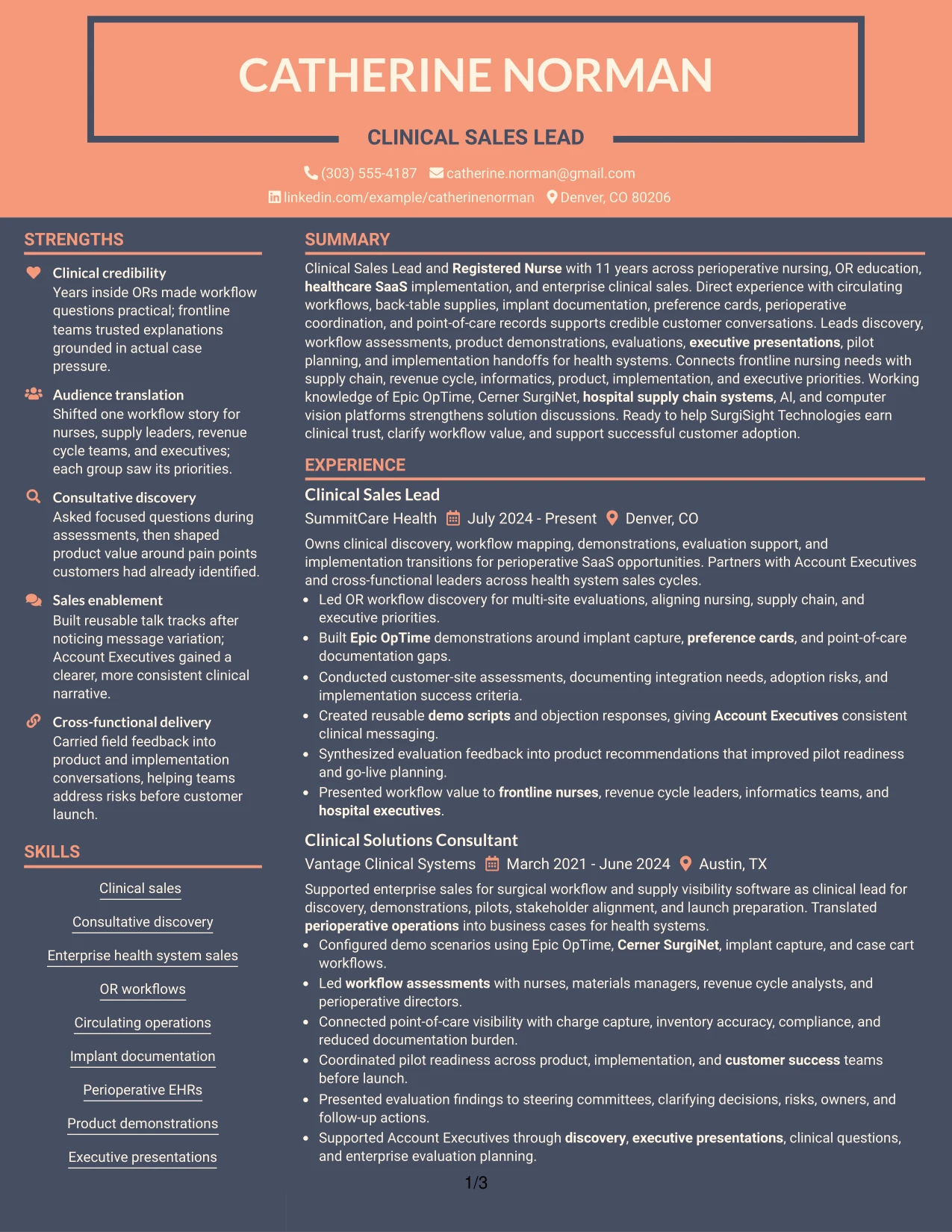
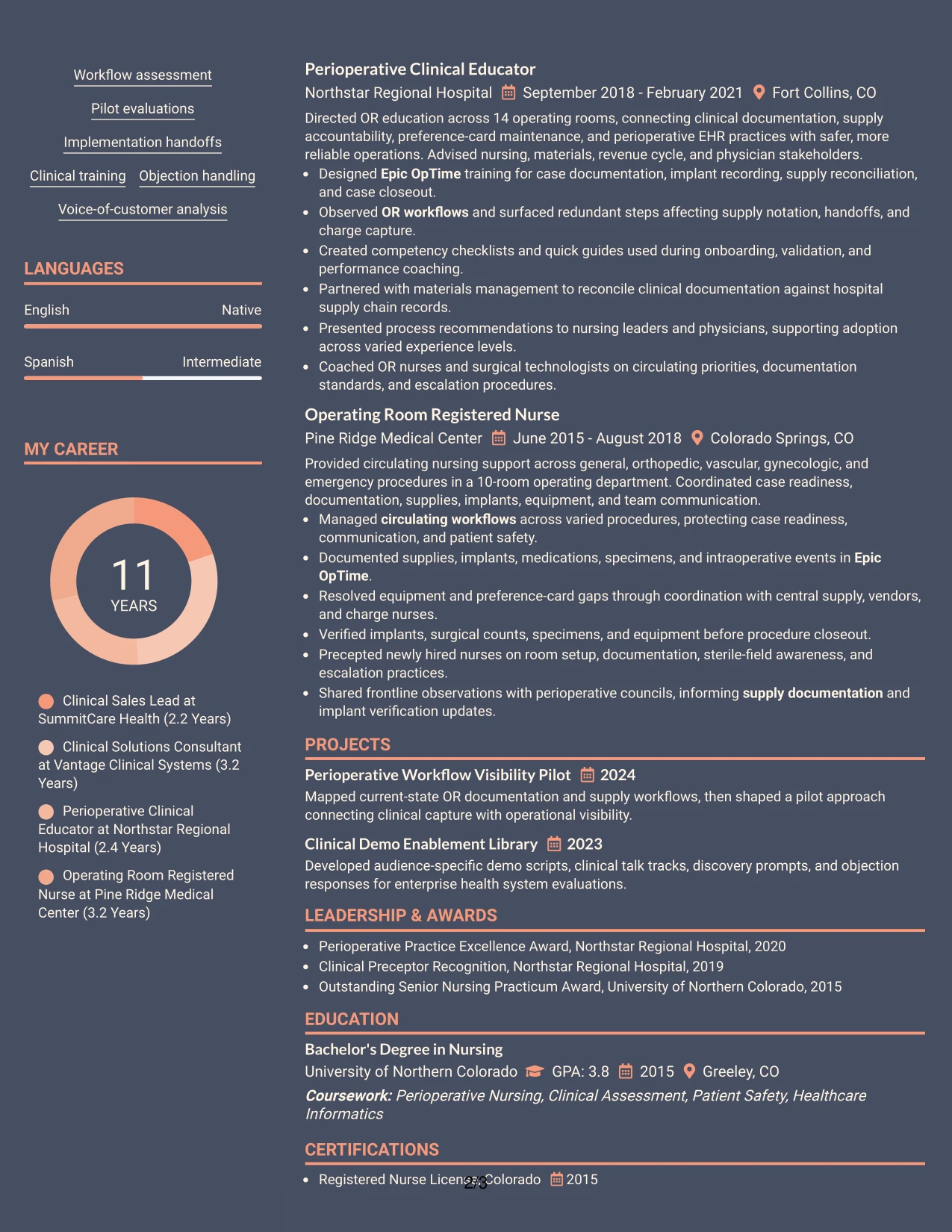
#13 Why the Creative Two Tone Format Works for a Resume
- Presents the resume in one predictable reading path.
- Uses visual contrast to distinguish sections without hiding content.
- Keeps related career progression easy to follow.
- Allows technical keywords to sit close to the experience that supports them.
- Gives projects and certifications a clear place after the work history.
- Supports ATS-friendly text flow and familiar section labels.
- Helps measurable responsibilities and operational evidence stand out through short bullets.
#13 Best For
- Resumes that benefit from a single, uninterrupted review path.
- Career stories where earlier clinical work supports later customer-facing responsibilities.
- Applications requiring clear movement from summary to experience to credentials.
- Readers who prefer strong section separation without a split-page structure.
- Documents with several related systems, workflows, and stakeholder groups to explain.
- Professionals who need space for both projects and detailed role bullets.
- Resume submissions where visual interest should remain controlled and easy to scan.
#14 Minimal Header Format
Recruiter review starts with the centered header, then moves down through the summary, skills, experience, education, and certifications. That simple path prevents contact details and the target role from competing with the evidence that follows.
The one-column format gives this resume room for a substantial career history without adding visual distractions. Detailed bullets can show enterprise discovery, executive presentations, OR workflow knowledge, pilot planning, and the transition from clinical operations to healthcare SaaS.
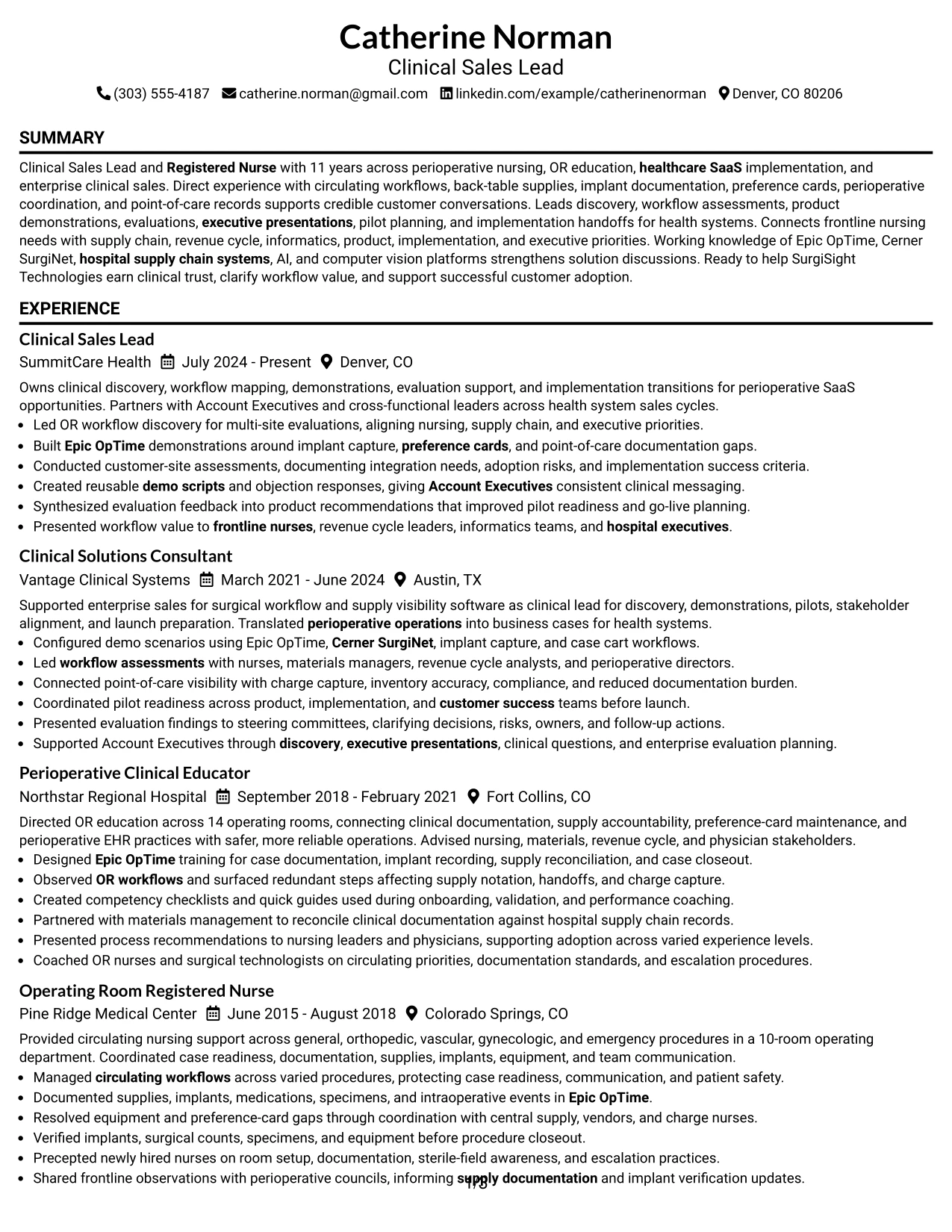
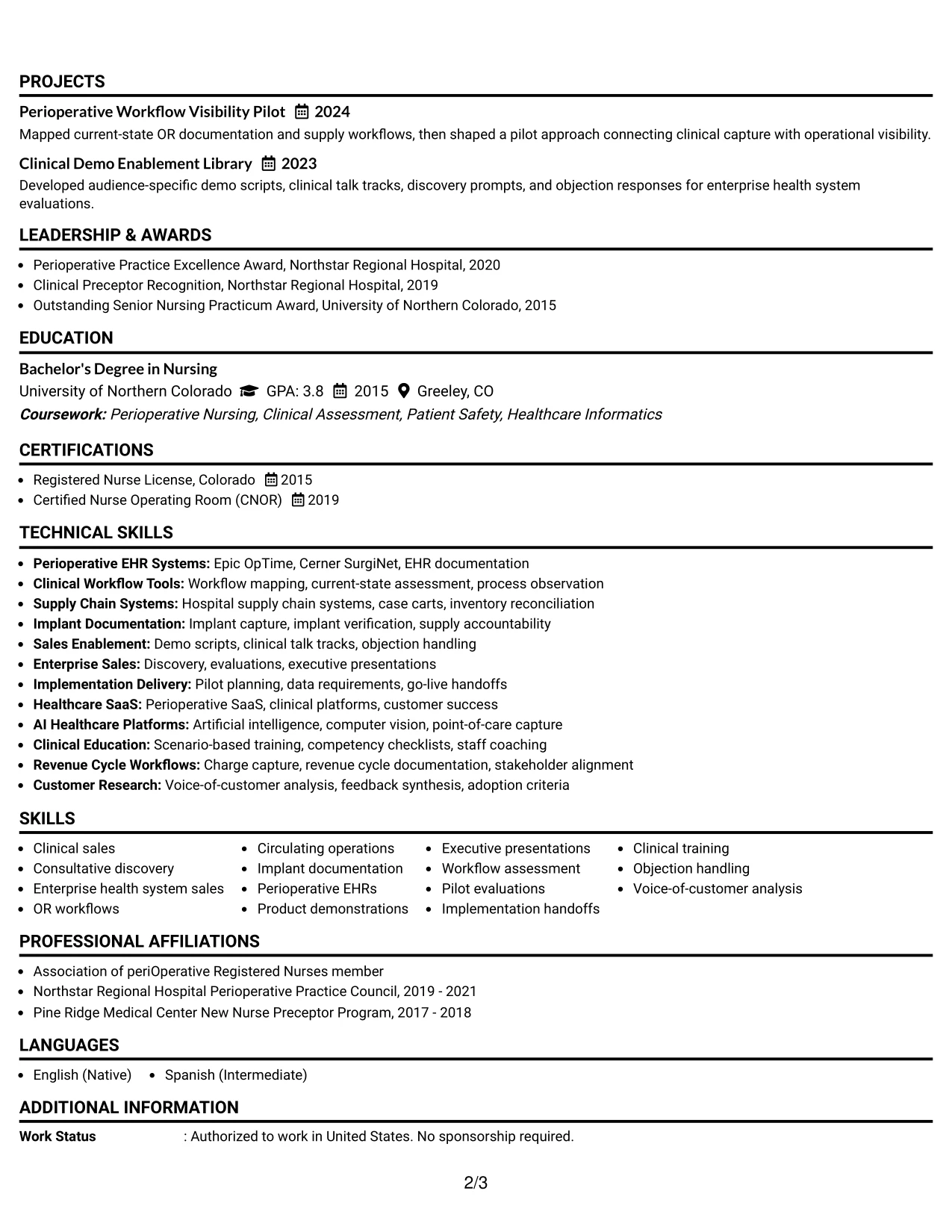
#14 Why the Minimal Header Format Works for a Resume
- Places the target role and contact information in an obvious starting point.
- Keeps the full career history in one consistent column.
- Handles several positions without forcing narrow text areas.
- Makes long-form bullets easier to read from left to right.
- Supports a complete skills section with systems and workflow terms.
- Leaves room for education, certifications, awards, and affiliations.
- Uses familiar hierarchy that supports both ATS parsing and human review.
#14 Best For
- Resumes with a substantial work history and many relevant bullets.
- Applications that require a complete record of experience in one reading path.
- Professionals who need room for technical systems and stakeholder responsibilities.
- Documents where readable text volume matters more than decorative elements.
- Readers reviewing experience, projects, and credentials in sequence.
- ATS submissions that benefit from standard section order and strong text flow.
- Candidates presenting a broad combination of clinical, sales, and implementation evidence.
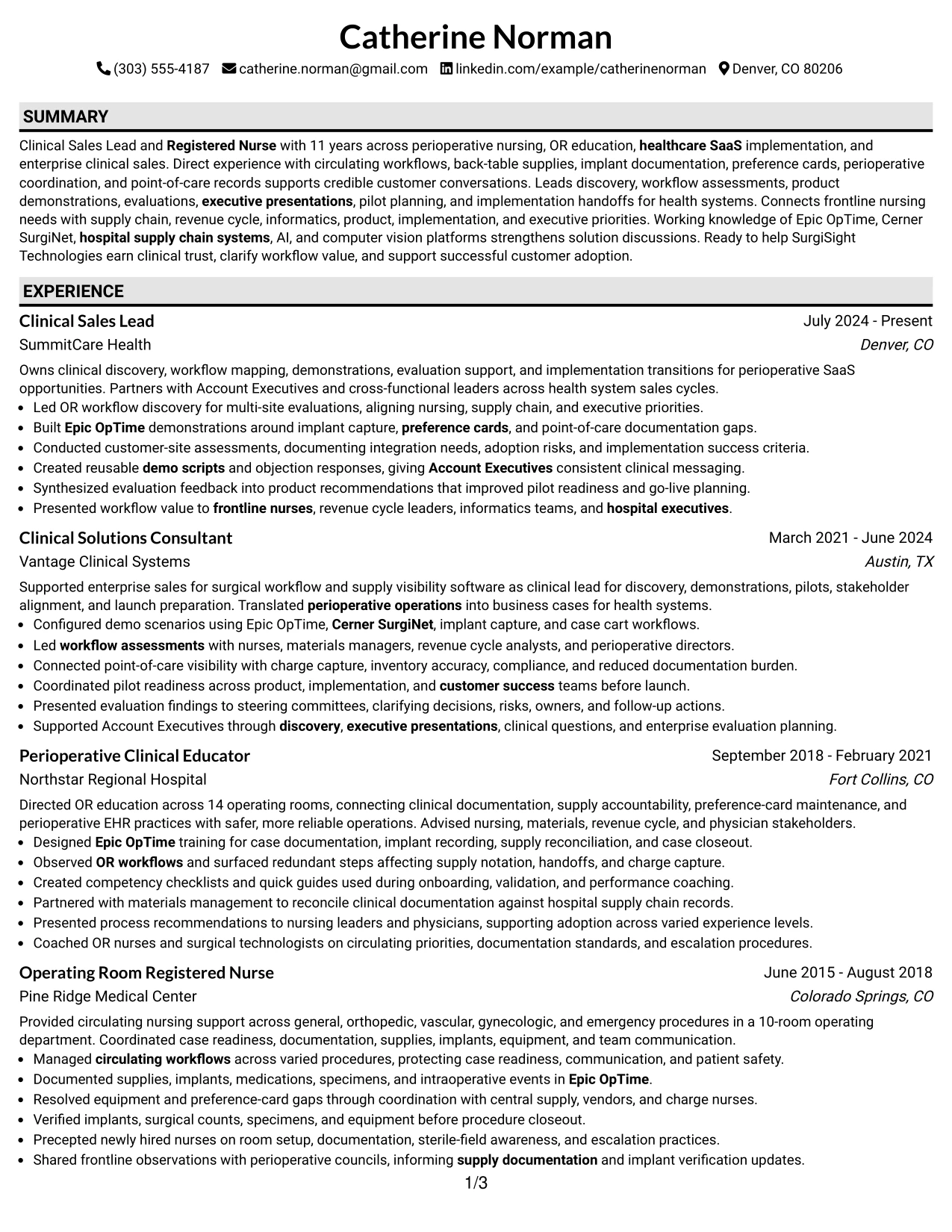
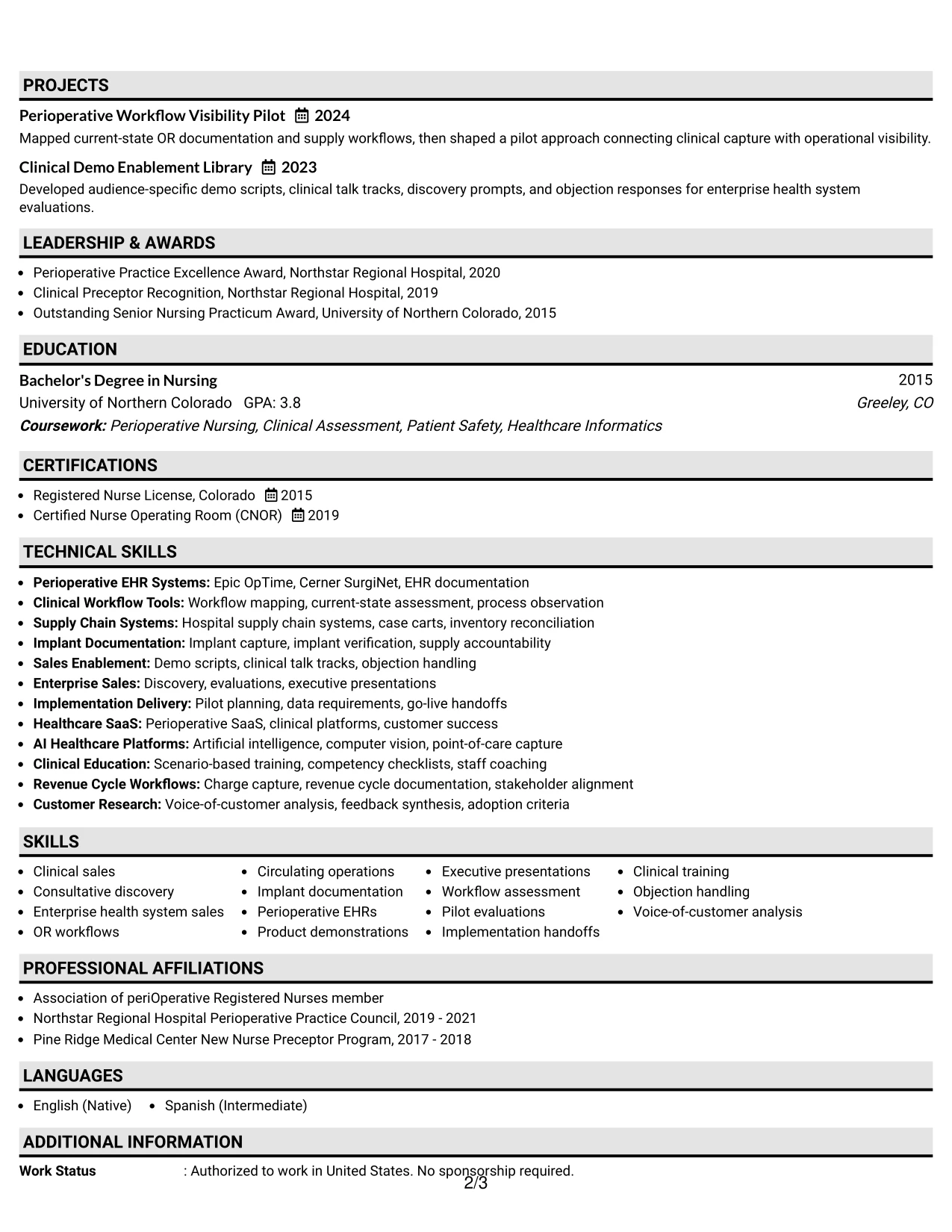
#15 Plain One Column with Shaded Labels
Workflow assessments, product demonstrations, and customer-facing results receive priority in this resume. Shaded labels then mark each section, helping the reader separate clinical sales evidence from education, certifications, projects, and affiliations.
The plain one-column design keeps every bullet in the same visual lane. That makes it easier to connect responsibilities to supporting tools such as Epic OpTime, Cerner SurgiNet, hospital supply chain systems, and AI-enabled healthcare platforms.
#15 Why the Plain One Column with Shaded Labels Works for a Resume
- Puts relevant evidence near the top of each experience entry.
- Uses shaded labels to identify sections without complex formatting.
- Keeps achievement bullets aligned for fast comparison across roles.
- Supports detailed descriptions of workflow, sales, and implementation work.
- Makes systems and certifications easy to find during keyword review.
- Provides a straightforward structure for projects and professional activities.
- Reduces visual noise while preserving clear content hierarchy.
#15 Best For
- Resumes where evidence and role responsibilities should lead the presentation.
- Applications that need clear separation between experience, skills, and credentials.
- Professionals with detailed workflow or process bullets to explain.
- Readers comparing related accomplishments across multiple positions.
- Documents that must present technical systems without a crowded design.
- ATS-focused submissions using standard headings and consistent text blocks.
- Candidates whose strongest proof comes from practical operations and customer work.
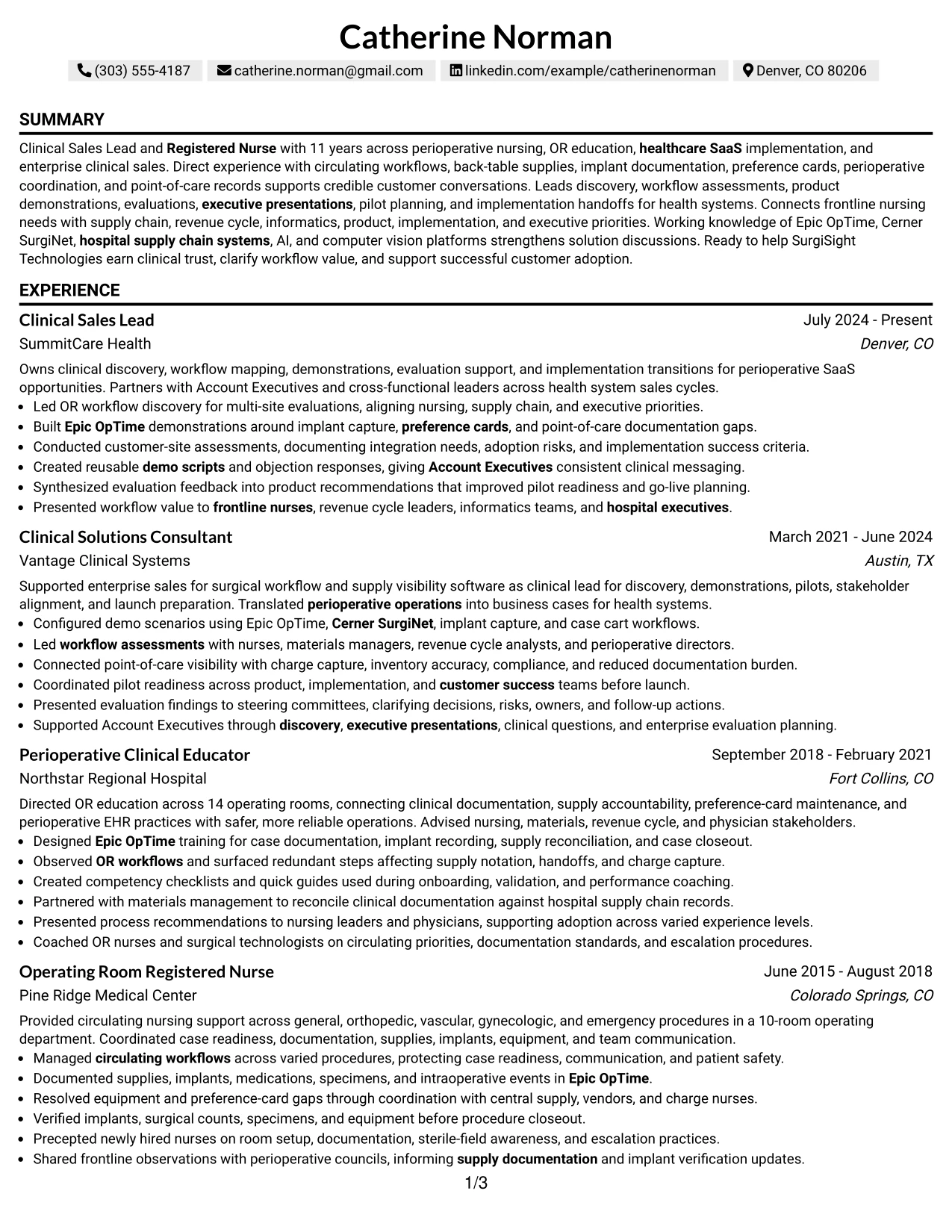
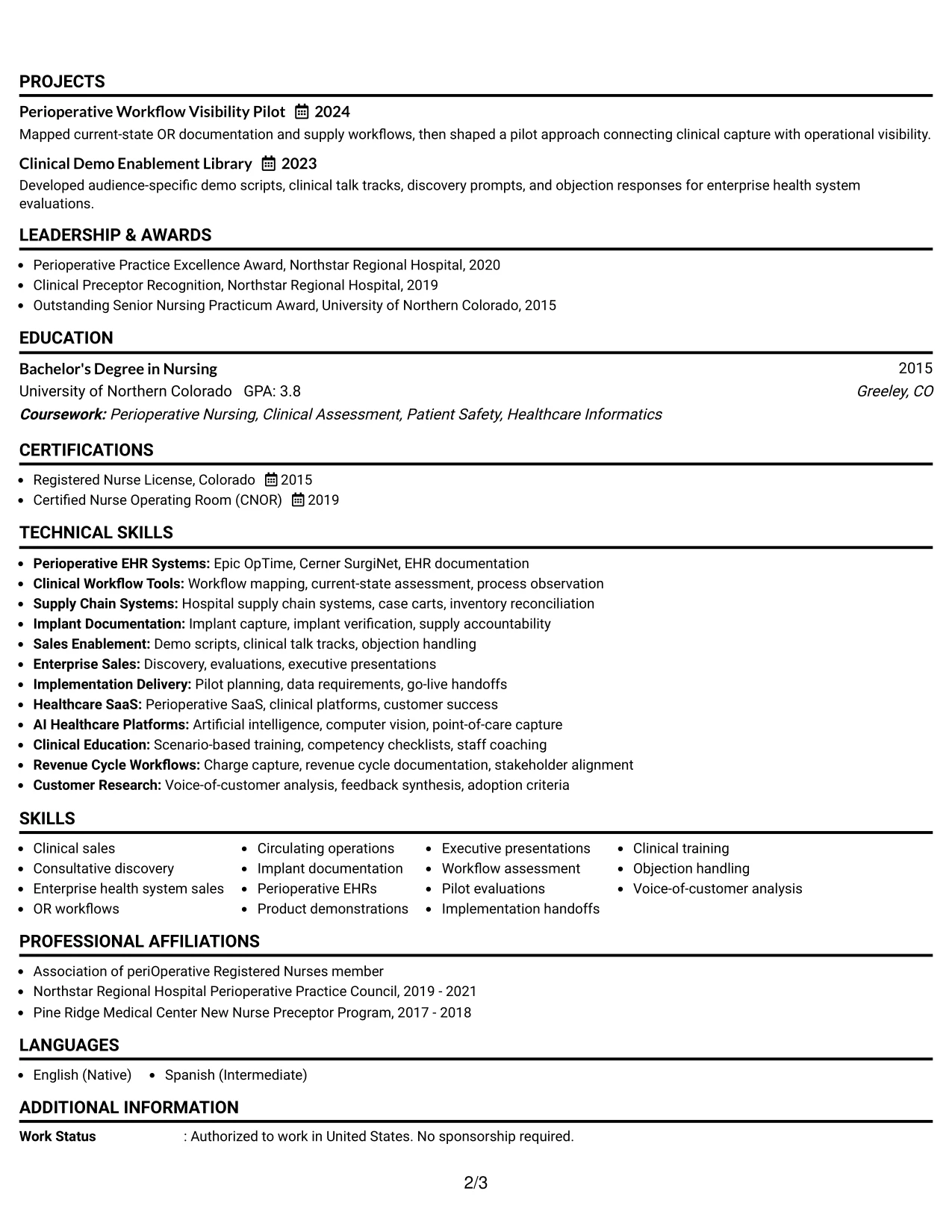
#16 Text/Fang Style
Content is balanced between a focused professional summary, detailed experience, and supporting qualifications. The Text/Fang Style gives the resume a formal text structure while keeping each section compact enough for steady review.
This format fits an application that must explain both customer-facing work and clinical depth. Experience bullets can cover sales cycles, workflow assessments, product demonstrations, training, supply documentation, and implementation handoffs without forcing those details into a narrow sidebar.
#16 Why the Text/Fang Style Works for a Resume
- Balances detailed work history with supporting credentials.
- Keeps the summary focused on role alignment and core value.
- Provides room for both customer-facing and clinical evidence.
- Allows tools and systems to appear beside the work they support.
- Keeps projects, awards, and affiliations available without overwhelming experience.
- Uses compact text blocks that support efficient review.
- Presents technical language in a familiar, readable resume structure.
#16 Best For
- Applications that need context around complex workflow responsibilities.
- Professionals combining clinical operations with sales or consulting work.
- Resumes that must explain tools alongside the processes where they were used.
- Readers who value complete evidence but prefer compact formatting.
- Documents with projects that reinforce the main career history.
- Candidates presenting a practical bridge between frontline work and technology adoption.
- Submissions where balanced detail matters more than a highly visual design.
#17 Bold Color Header Professional Format
For a role that may be reviewed across sales, clinical, and implementation teams, the top of the resume must establish the application context quickly. The bold color header identifies the target role and key contact details, while the body turns to proof.
A single column then gives each position enough room for direct bullets. The resume can connect clinical credibility to discovery, executive presentations, voice-of-customer analysis, product demonstrations, and customer-site workflow assessments.
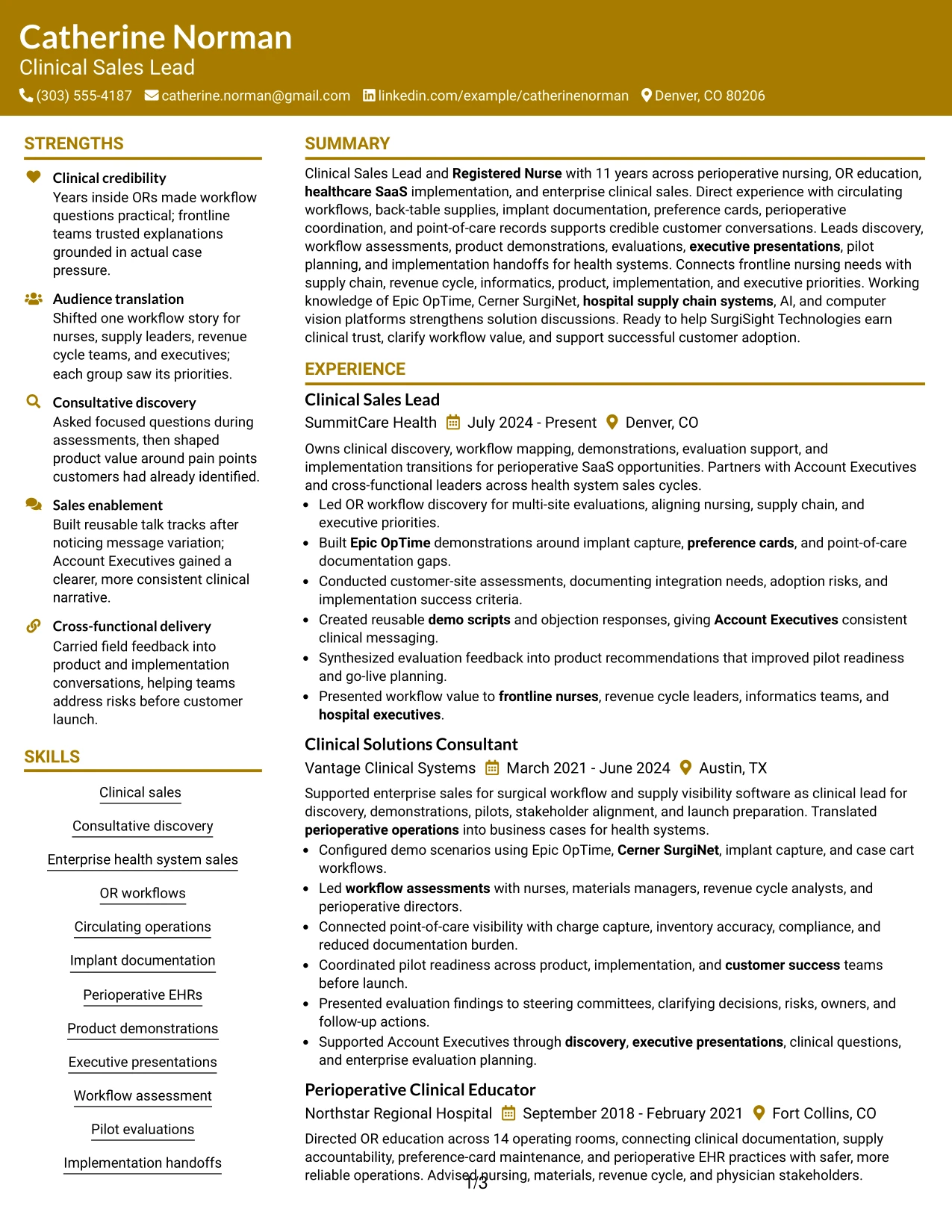
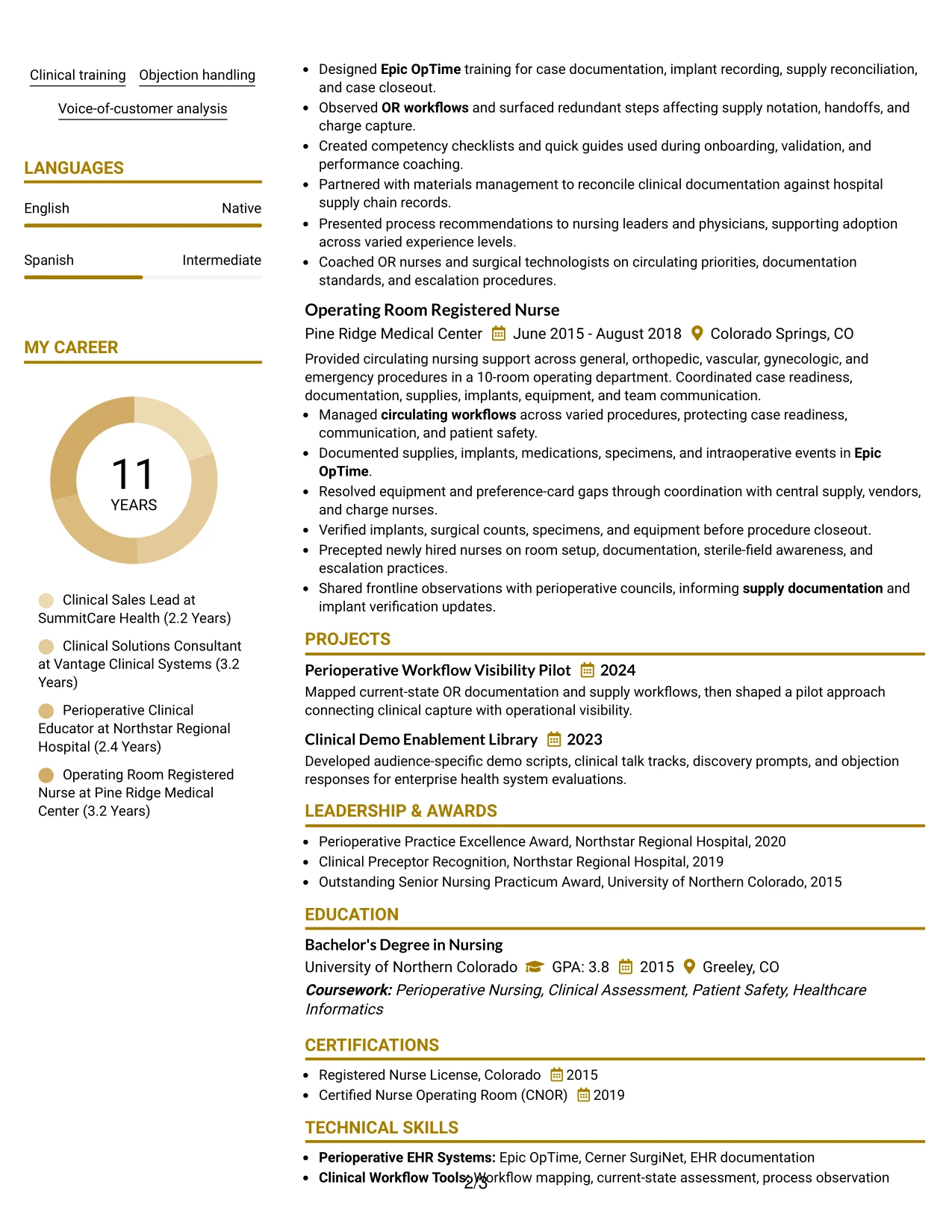
#17 Why the Bold Color Header Professional Format Works for a Resume
- Makes the target role visible at the first point of review.
- Creates a strong entry point without taking space from the evidence.
- Keeps experience bullets in a familiar one-column structure.
- Supports clear connections between clinical knowledge and sales activity.
- Gives technical systems and stakeholder groups room in the skills section.
- Makes projects and certifications easy to add below the main work history.
- Combines professional emphasis with ATS-readable text organization.
#17 Best For
- Resumes that need immediate role identification at the top.
- Applications reviewed by teams with different priorities and vocabulary.
- Professionals translating operational knowledge into customer-facing value.
- Documents that need a confident visual entry without a multi-column body.
- Readers scanning for demonstrations, assessments, presentations, and feedback work.
- Candidates with a mix of clinical, commercial, and implementation evidence.
- Submissions where a distinct header helps the resume stand out while staying readable.
#18 Photo Header Color Sidebar Format
A restrained visual hierarchy combines a photo header with a color sidebar, giving the resume a distinct presentation while keeping the main career evidence readable. The top area can establish the target role and contact details, while the sidebar groups skills, systems, and credentials.
The main column should carry the strongest proof: clinical discovery, workflow mapping, demonstrations, executive presentations, pilot evaluations, and customer feedback. Used selectively, the photo supports a more personal presentation without replacing the text needed for ATS review or recruiter scanning.
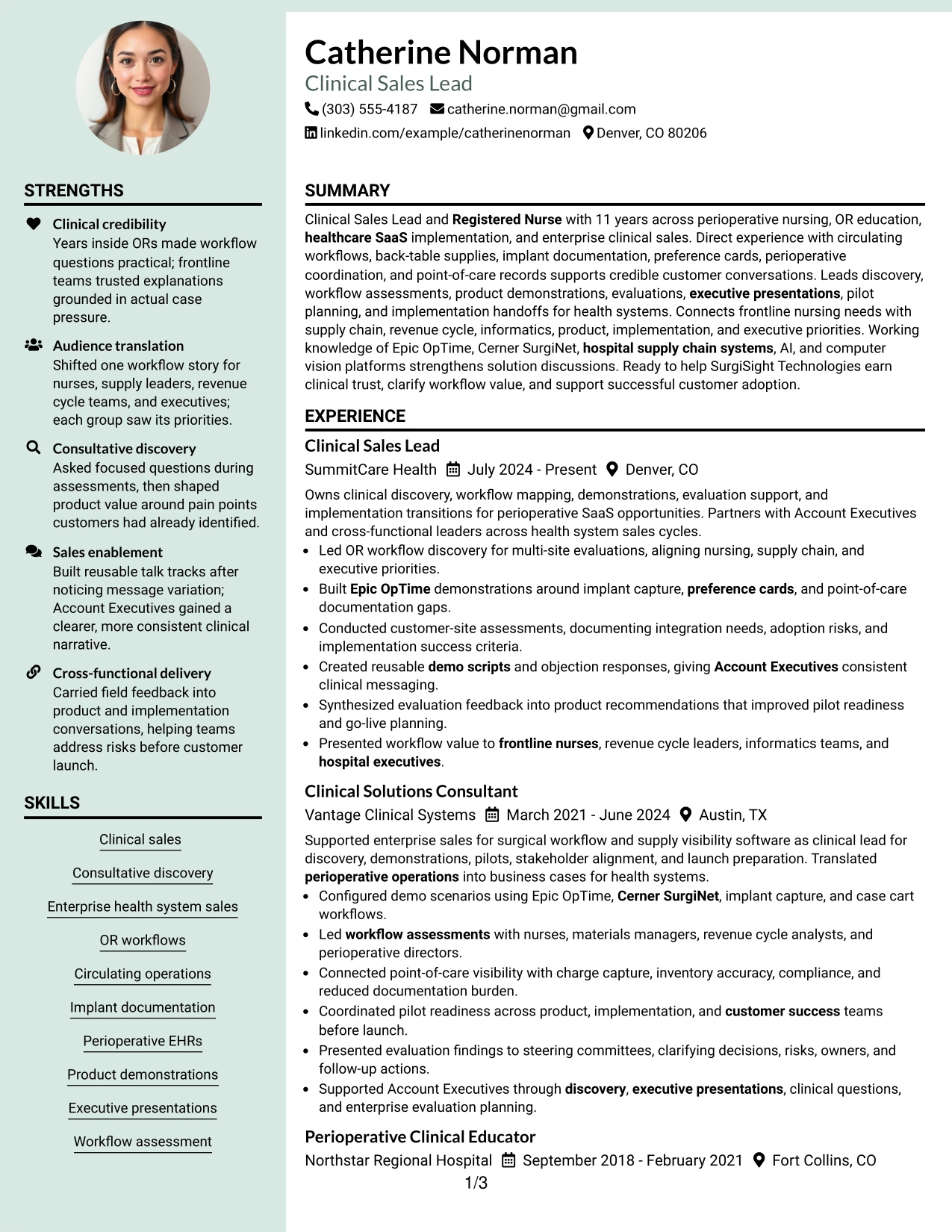
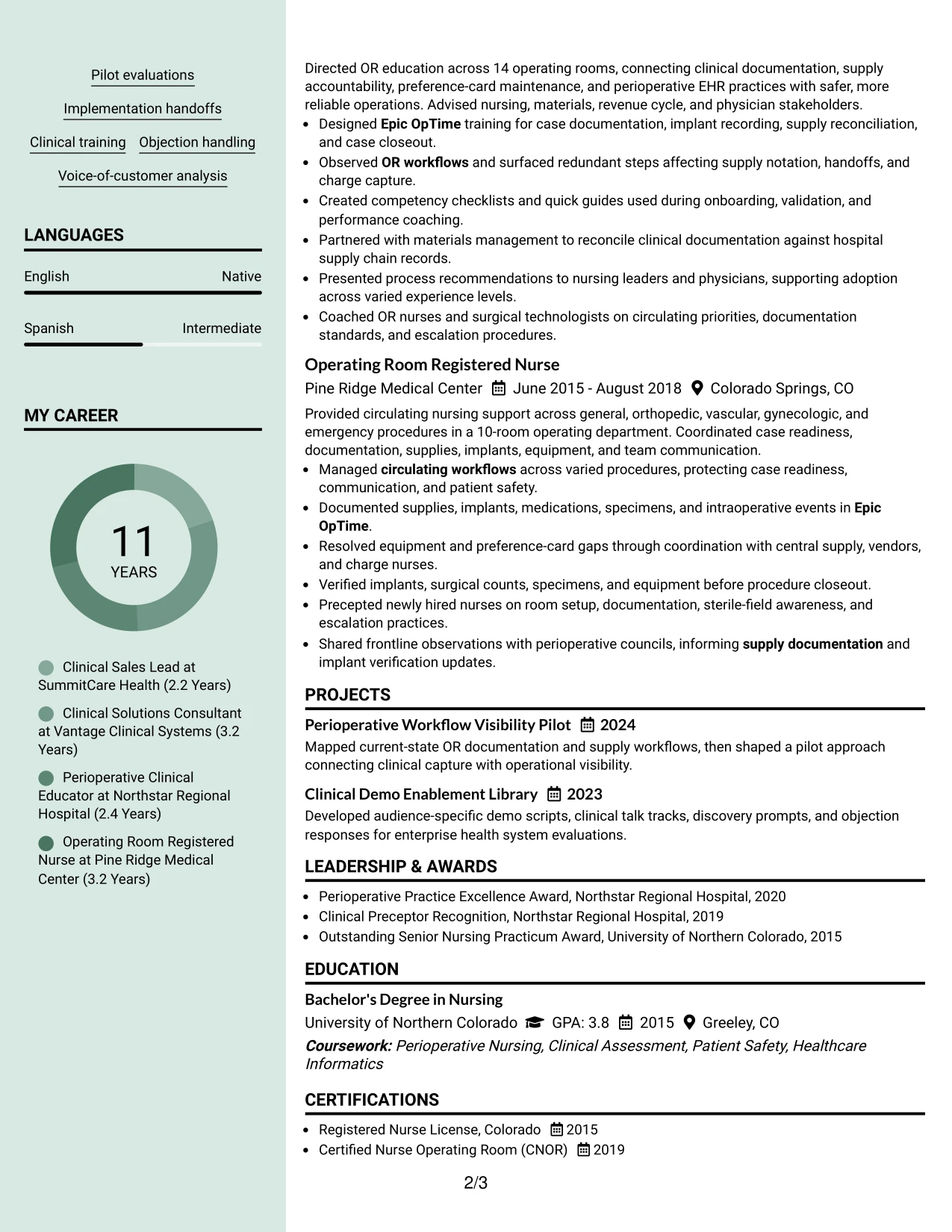
#18 Why the Photo Header Color Sidebar Format Works for a Resume
- Creates a recognizable header for a customer-facing professional profile.
- Uses the sidebar for compact skills, systems, and certification details.
- Keeps substantial experience bullets in the wider main column.
- Supports a clear link between clinical knowledge and commercial work.
- Provides space for projects and implementation evidence without crowding the header.
- Allows the photo to support presentation while the text carries qualification proof.
- Preserves distinct sections for education, awards, and professional activities.
#18 Best For
- Resumes where a polished personal presentation supports a customer-facing application.
- Professionals who want a sidebar for skills and credentials beside detailed experience.
- Applications that benefit from clear separation between visual identity and evidence.
- Documents with enough experience detail to require a wider main content area.
- Readers scanning for clinical workflow, sales, and implementation qualifications.
- Candidates using a photo where the application context and local norms support it.
- Resumes that need visible projects and certifications without interrupting career history.
#19 Top Left Header Color Accent Format
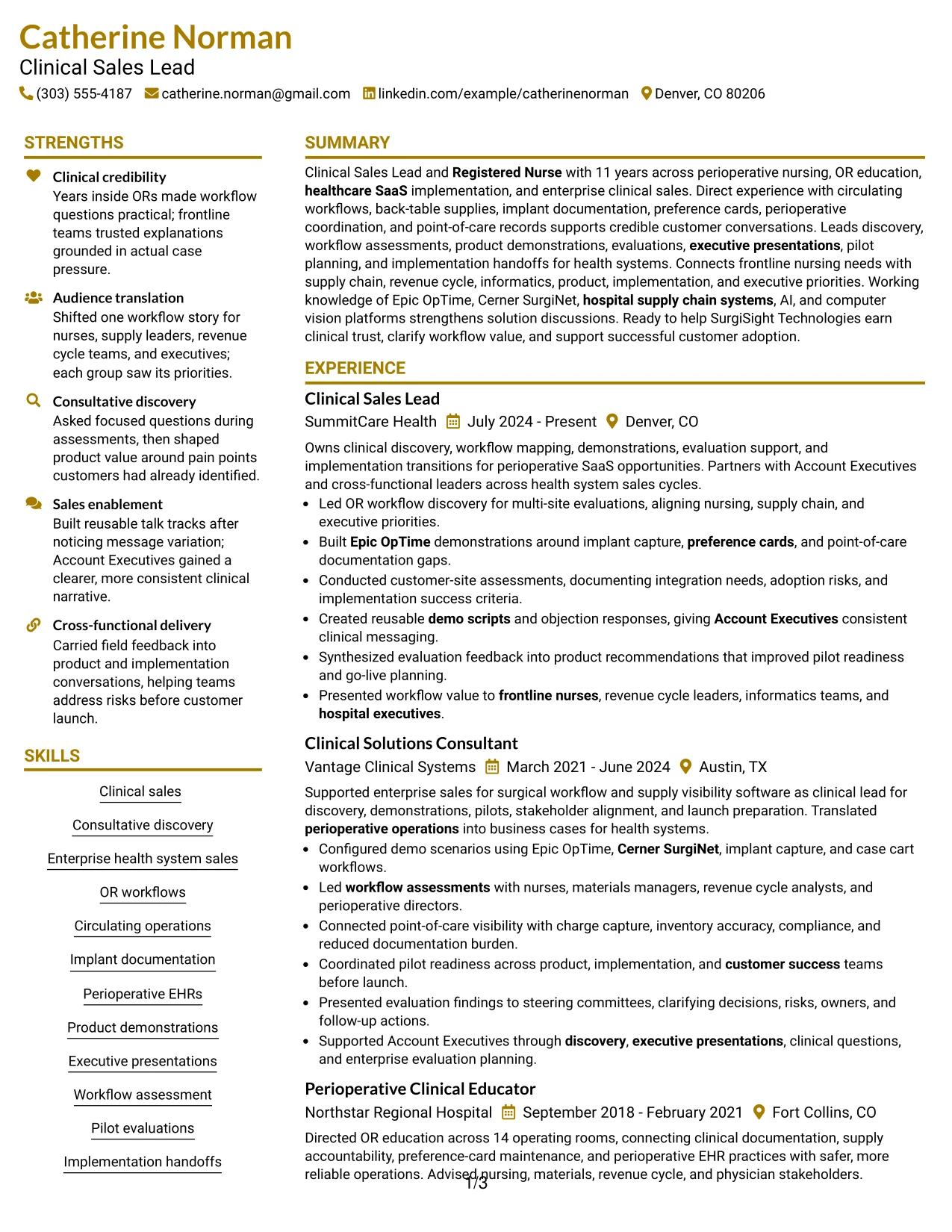
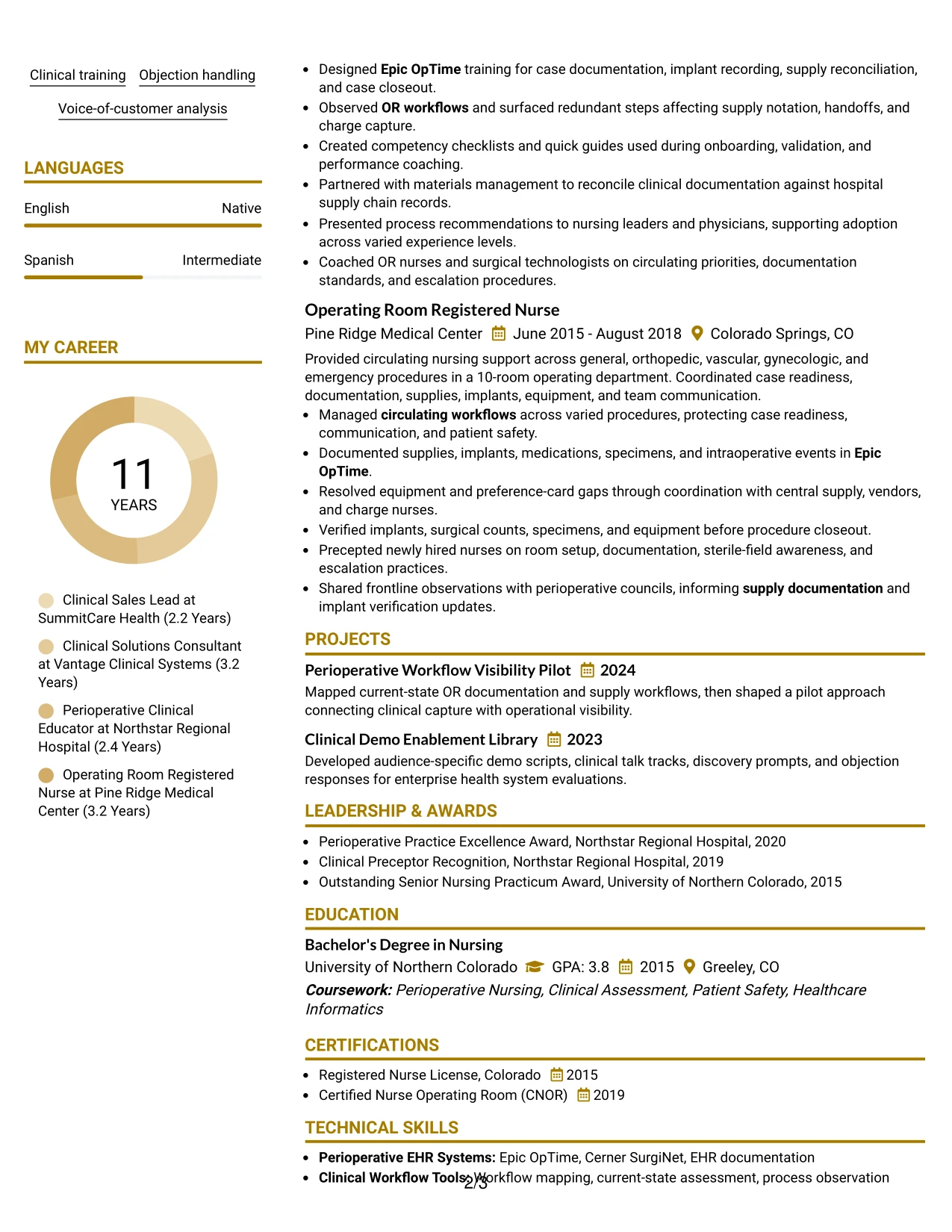
The Top Left Header Color Accent Format starts with a direct identity block, then moves through the resume in a familiar top-to-bottom order. The accent adds section distinction, but the reader remains focused on the summary, skills, experience, projects, and credentials.
That structure supports a clear scan of the evidence behind a Clinical Sales Lead application. Bullets can show OR workflow knowledge, customer discovery, demonstrations, executive communication, product feedback, and implementation readiness without competing columns.
#19 Why the Top Left Header Color Accent Format Works for a Resume
- Puts the target role and contact details in a familiar top-left position.
- Keeps the reading order simple for both people and ATS tools.
- Uses color accents to separate sections without interrupting text flow.
- Gives work history enough room for specific evidence bullets.
- Supports a focused skills section with systems and workflow keywords.
- Allows projects and certifications to follow the main career story.
- Makes customer-facing and clinical qualifications easy to compare.
#19 Best For
- Resumes that need standard navigation with a modest visual accent.
- Applications where fast top-left identification supports review speed.
- Professionals presenting related experience across clinical and technology settings.
- Documents that need room for detailed evidence in a single column.
- Readers scanning for workflow, demonstration, presentation, and implementation terms.
- ATS submissions that benefit from conventional order and text placement.
- Candidates who want a clean presentation without a plain or overly decorative page.
#20 Centered Header Classic Two Column Format
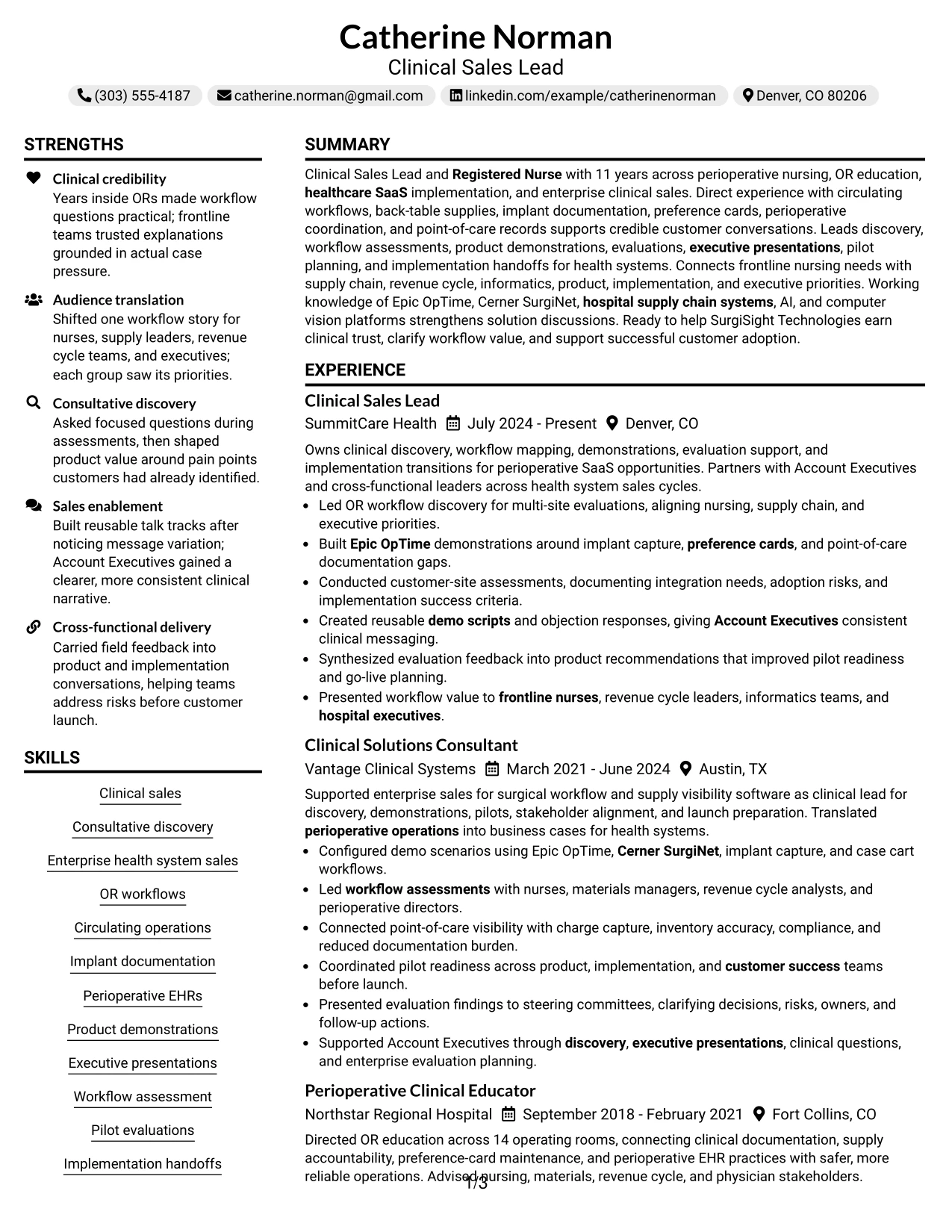
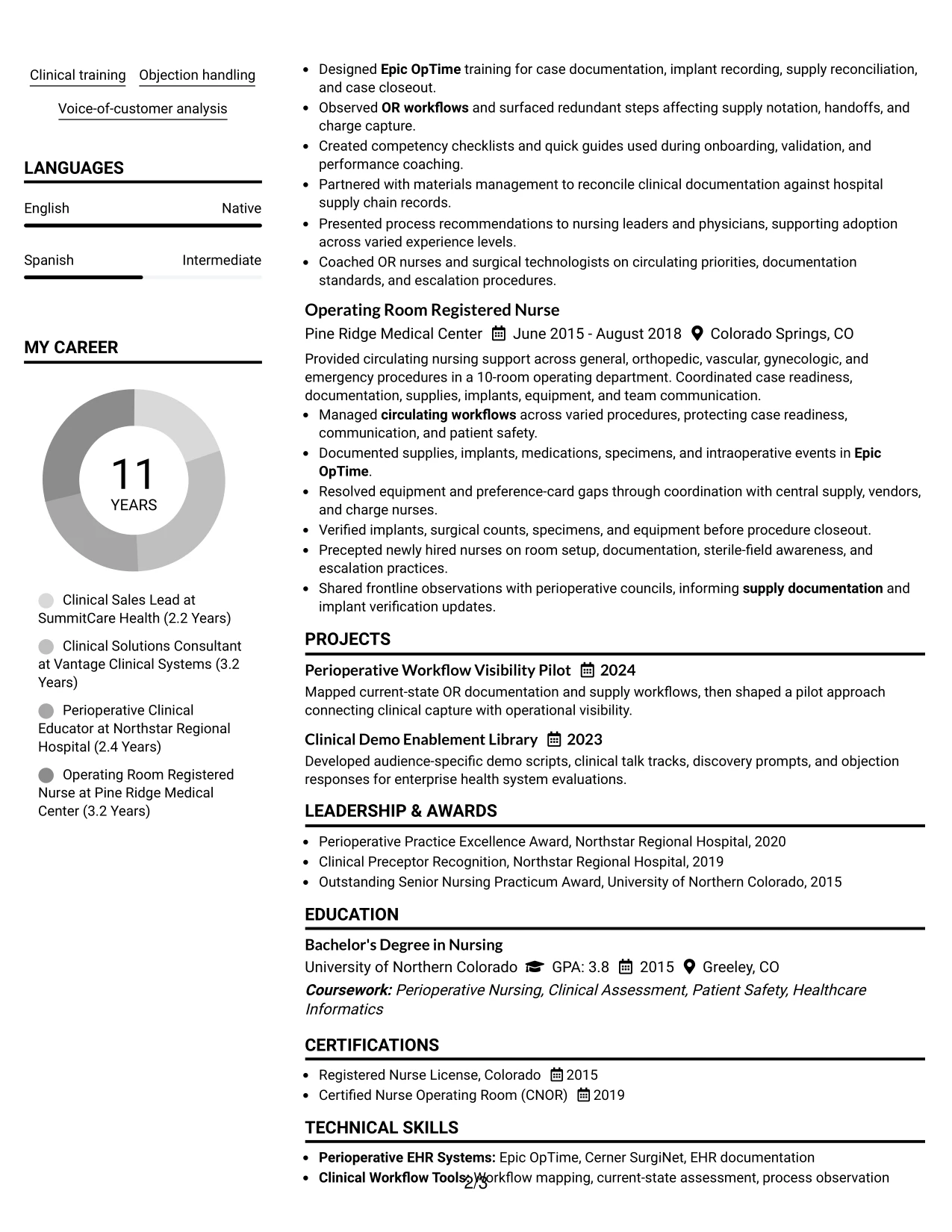
The reader starts at the centered header, then can move through the summary and experience while using the second column for supporting details. This classic two-column approach helps Catherine Norman present a full career history without making skills, certifications, education, or awards difficult to find.
Bulleted experience entries keep the main column evidence-based. The supporting column can carry Epic OpTime, Cerner SurgiNet, supply chain systems, CNOR, Registered Nurse credentials, projects, and affiliations, creating a compact but complete review path.
#20 Why the Centered Header Classic Two Column Format Works for a Resume
- Creates a balanced starting point with centered identity and contact details.
- Gives the main column room for detailed experience bullets.
- Places skills, certifications, and education in a quick-reference area.
- Supports a complete career history without excessive page width.
- Makes projects and awards visible without interrupting role descriptions.
- Helps readers compare evidence with the systems and credentials behind it.
- Uses bullets and familiar headings that support ATS and human scanning.
#20 Best For
- Resumes with substantial experience and a wide range of supporting credentials.
- Applications where technical systems should remain visible beside career evidence.
- Professionals combining direct clinical work, education, consulting, and sales.
- Readers who need both detailed bullets and a compact qualification summary.
- Documents with projects, awards, and affiliations that deserve dedicated space.
- Candidates who want a balanced page rather than a single dense text column.
- Clinical Sales Lead applications requiring clear coverage of workflow and enterprise sales terms.
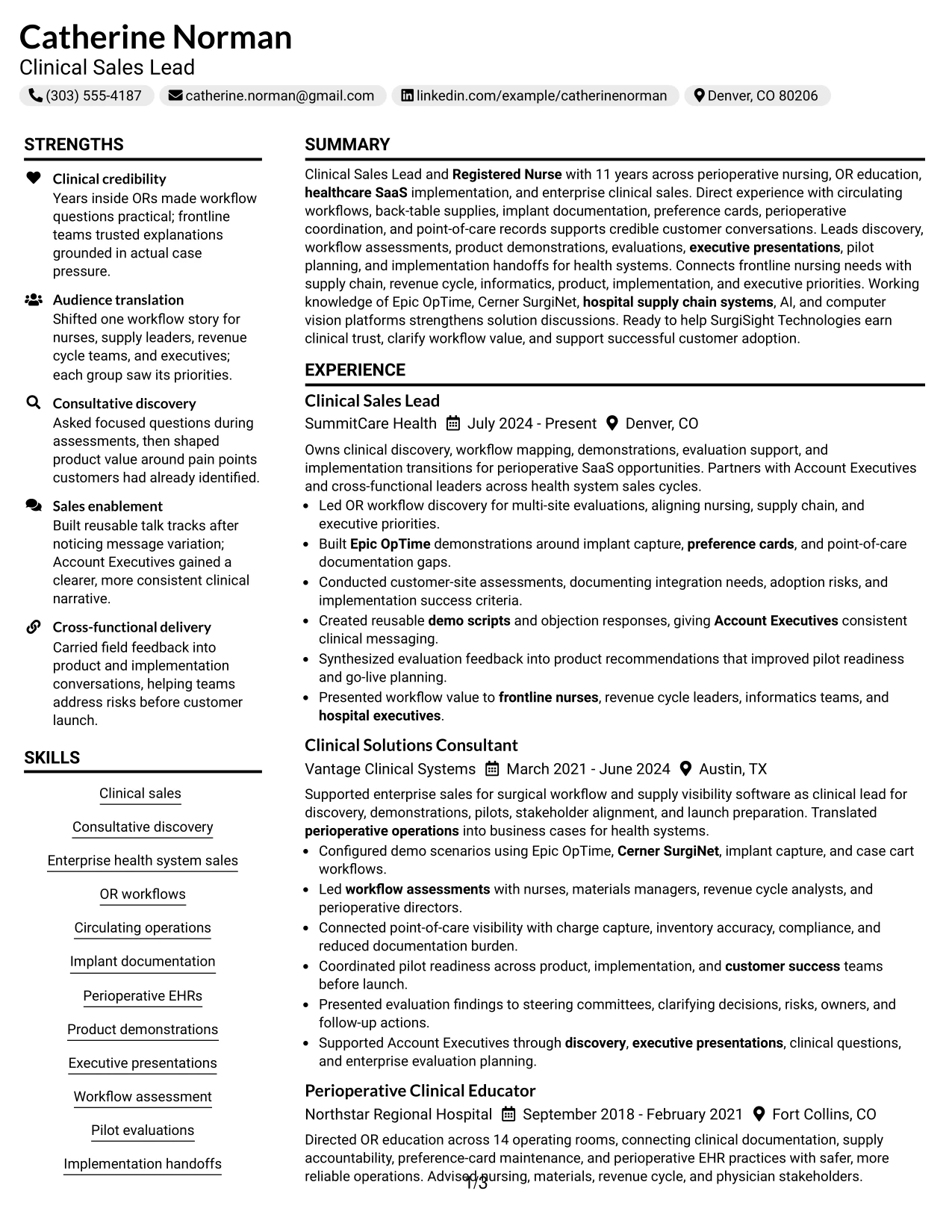
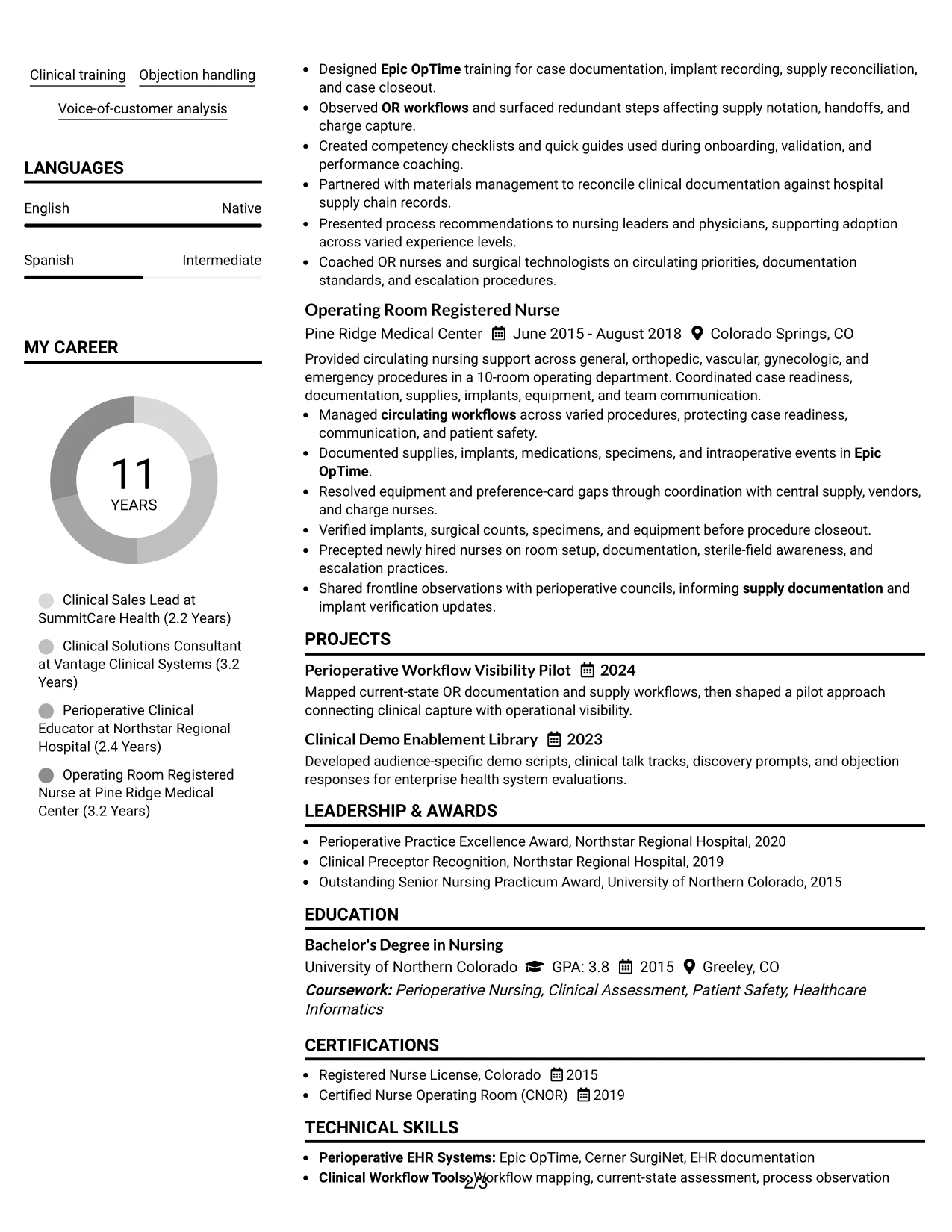
#21 Left Aligned Header Clean Two Column Format
Workflow evidence receives priority in this clean two-column structure. The left-aligned header gets the reader into the document quickly, while the main column can show discovery, demonstrations, assessments, presentations, and implementation work in concise bullets.
A secondary column handles skills, systems, certifications, education, projects, and affiliations. This division keeps the practical evidence connected to the supporting qualifications, including OR operations, implant documentation, perioperative EHRs, and healthcare SaaS.
#21 Why the Left Aligned Header Clean Two Column Format Works for a Resume
- Places the identity block in a familiar left-aligned position.
- Gives priority to workflow and customer-facing evidence.
- Keeps supporting systems and credentials available in a separate scan area.
- Allows experience bullets to remain focused and readable.
- Connects clinical operations to healthcare SaaS and enterprise sales work.
- Provides room for projects, awards, and affiliations without crowding experience.
- Uses clean spacing and standard text sections for reliable review.
#21 Best For
- Resumes where practical workflow evidence should lead the page.
- Applications needing a clear split between experience and supporting qualifications.
- Professionals with several systems, certifications, and projects to present.
- Readers who scan the main column first and verify credentials second.
- Documents that must show clinical operations alongside technology experience.
- Candidates with detailed bullets that need a wide, uncluttered reading area.
- Submissions requiring a clean structure for both ATS terms and human review.
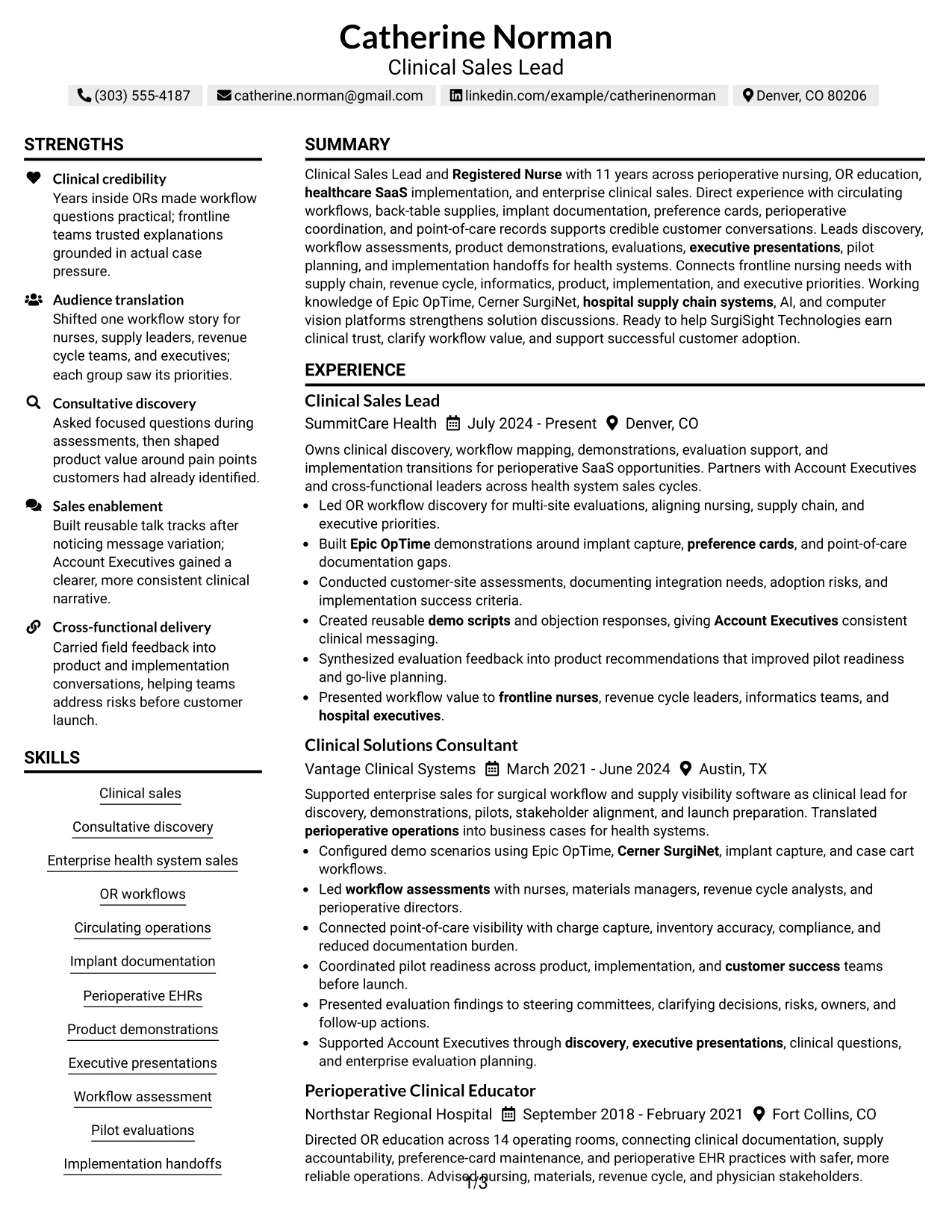
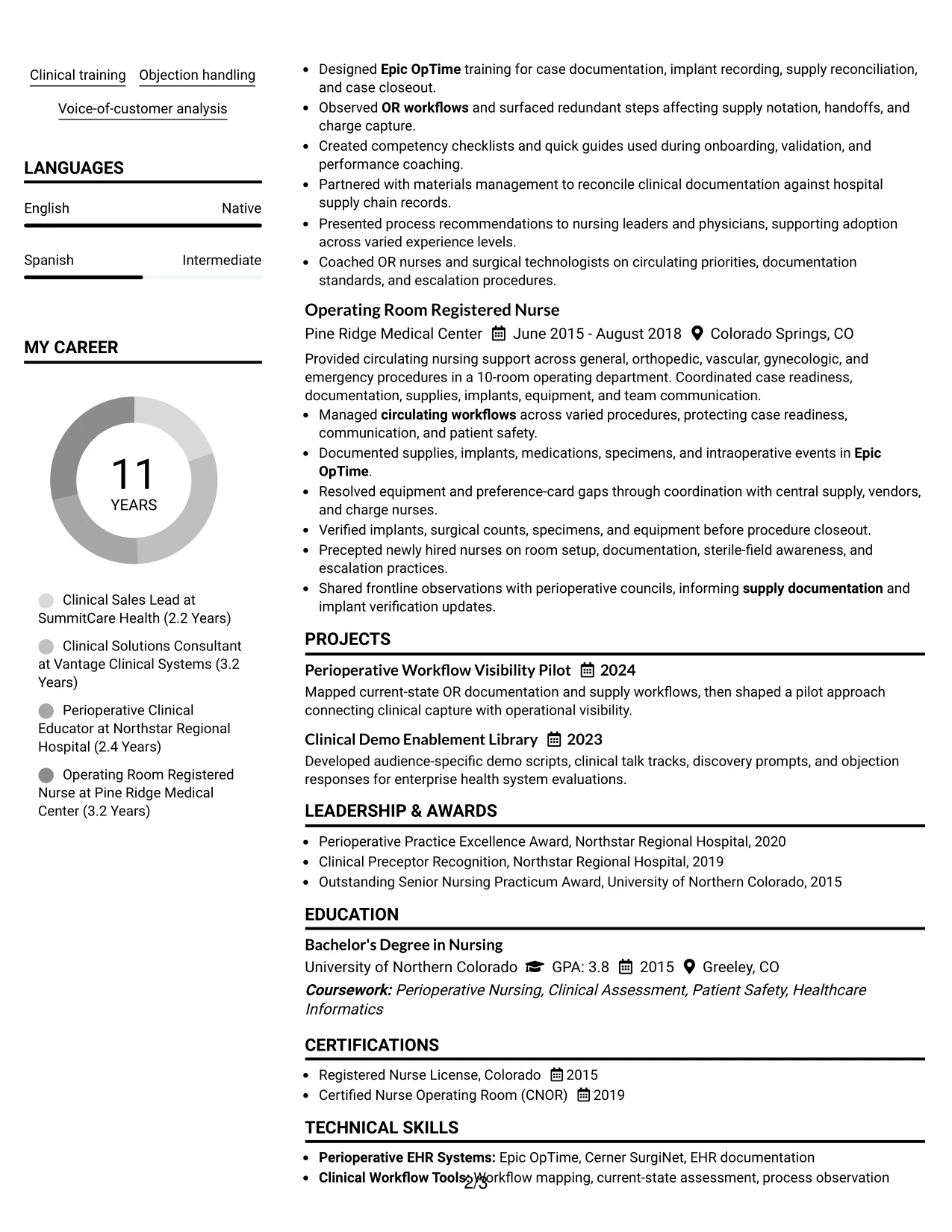
#22 Simple Two Column Format
Content is distributed evenly between detailed experience and quick-reference qualifications. The Simple Two Column Format keeps the page practical: one side carries role evidence, while the other organizes skills, systems, education, certifications, projects, and affiliations.
That balance suits an application requiring both clinical depth and commercial range. The resume can show circulating operations, supply and implant documentation, consultative discovery, product demonstrations, executive presentations, pilot evaluations, and implementation handoffs without allowing one category to dominate.
#22 Why the Simple Two Column Format Works for a Resume
- Balances experience detail with compact supporting information.
- Keeps a broad skills list from interrupting the career timeline.
- Makes clinical and commercial qualifications visible at the same time.
- Provides dedicated space for systems, certifications, and education.
- Supports projects that reinforce workflow assessment and demo enablement.
- Keeps bullets short enough for efficient scanning across roles.
- Offers a practical structure for ATS terms and human review.
#22 Best For
- Applications that require both detailed work history and quick-reference skills.
- Professionals moving between clinical operations, education, consulting, and sales.
- Resumes with many relevant systems, certifications, and supporting projects.
- Readers who need to compare role evidence with qualifications at a glance.
- Documents presenting both customer-facing responsibilities and technical workflows.
- Candidates who want balanced page density without a complex visual design.
- Clinical and healthcare technology applications where organization supports credibility.
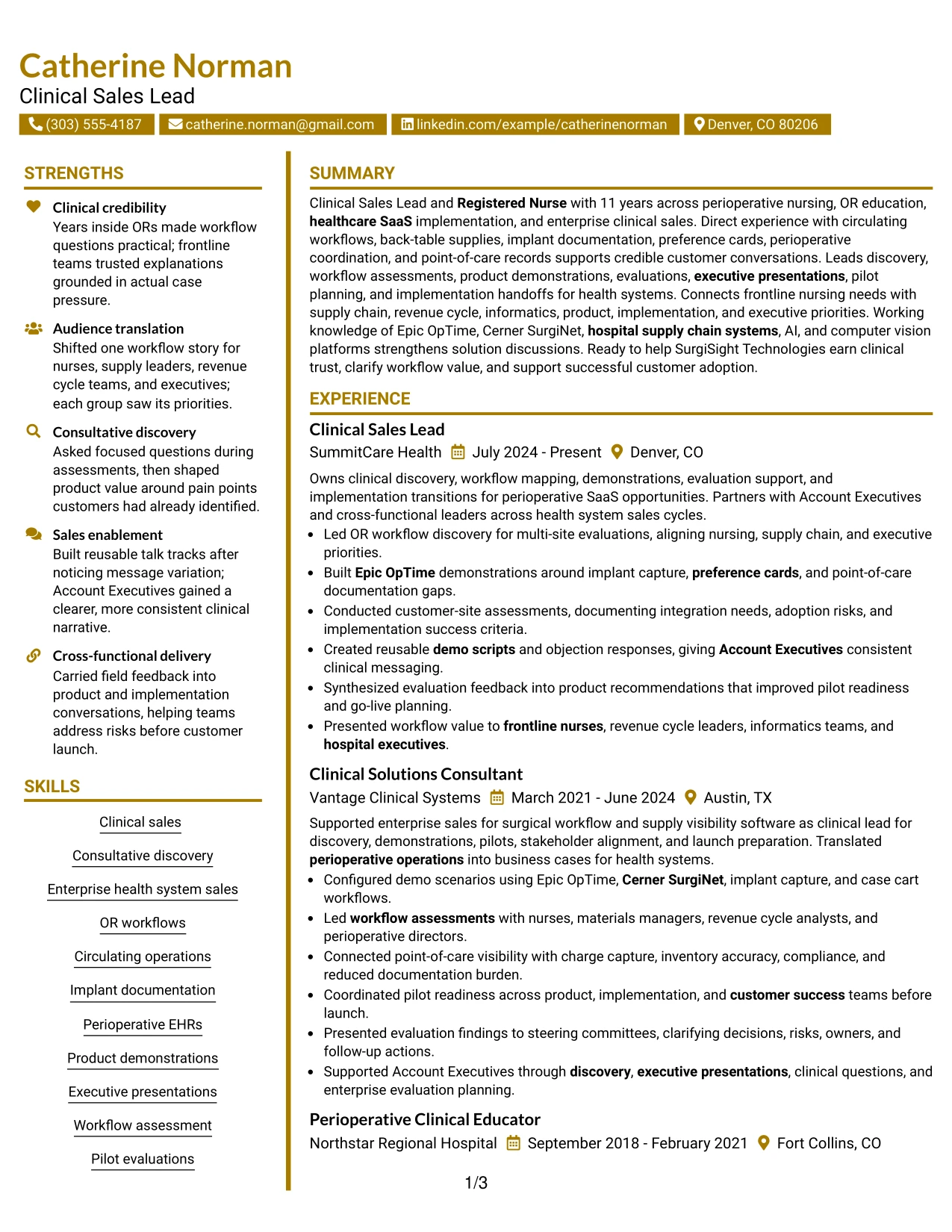
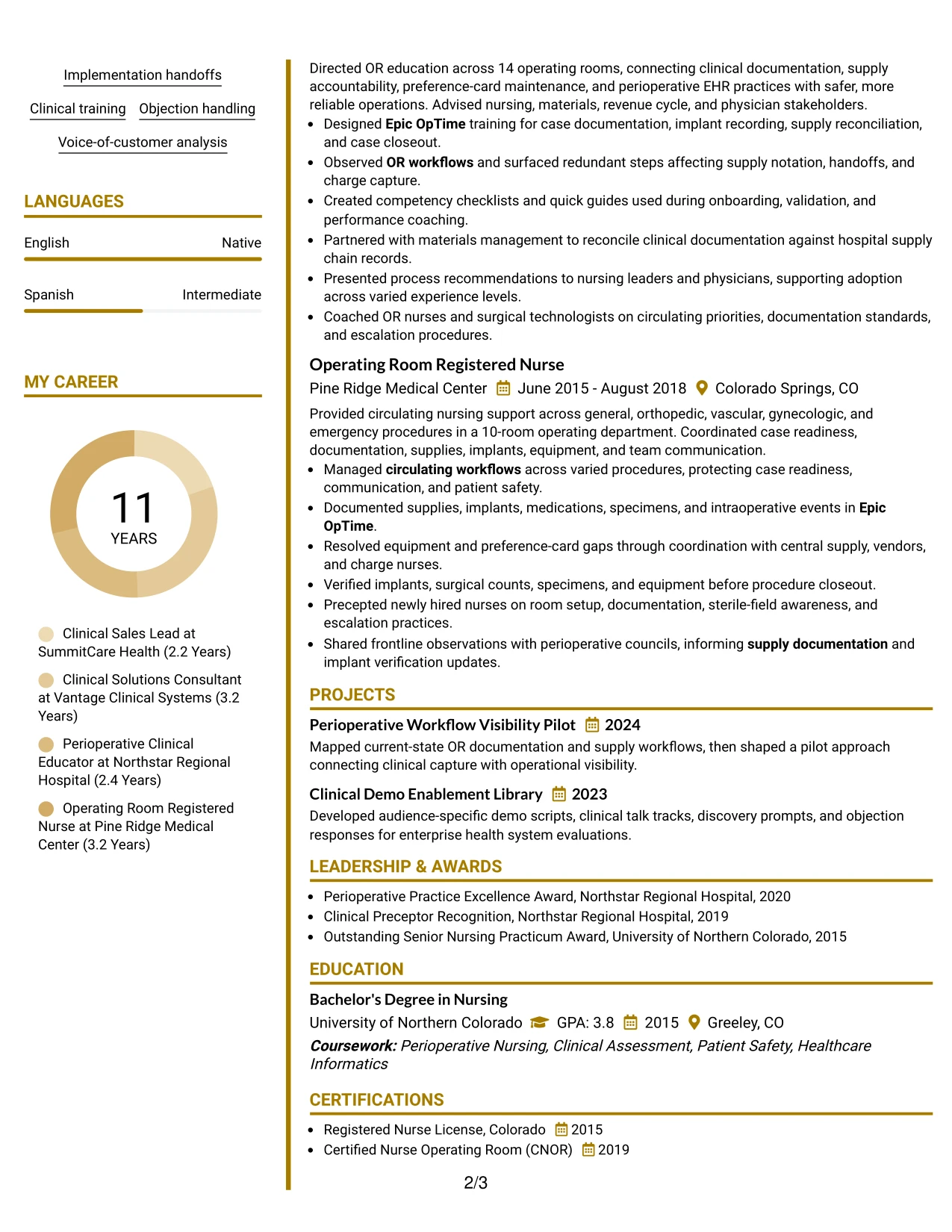
#23 Accent Divider Modern Two Column Format Resume Example
A practical choice for a Clinical Sales Lead resume that must support fast review and clear comparison. The two-column structure separates contact details and supporting skills from the main summary, experience, projects, education, and certifications. Accent dividers give each section a firm boundary without distracting from the evidence.
Use the wider column for achievement-focused bullets covering clinical discovery, workflow assessments, product demonstrations, enterprise evaluations, and implementation handoffs. Keep tools and keywords such as Epic OpTime, Cerner SurgiNet, implant documentation, and AI-enabled platforms in compact supporting areas. The result is organized, readable, and useful for both recruiter review and ATS keyword checks.
Why the Accent Divider Modern Two Column Format Works for a Resume
- Two columns create a clear split between core experience and supporting qualifications.
- Accent dividers make summary, experience, education, and certifications easy to locate.
- The main column gives measurable space to detailed achievement bullets and project evidence.
- A compact skills area keeps clinical sales and workflow keywords visible without repeating full work history.
- Short labels help readers find Epic OpTime, Cerner SurgiNet, supply systems, and implementation experience quickly.
- The format supports a strong professional summary without pushing important experience too far down the page.
- Clean section boundaries can improve scanning while preserving a focused, modern presentation.
Best For
- Resumes that need clear separation between detailed experience and supporting skills.
- Candidates presenting both clinical credibility and customer-facing sales work.
- Applications where workflow, software, and implementation keywords must remain easy to find.
- Professionals with several relevant projects, certifications, or leadership activities to organize.
- Readers who prefer a structured two-column path through a resume.
- Documents that need strong bullet evidence without making the page feel crowded.
- Health technology applications that benefit from visible tools and stakeholder keywords.
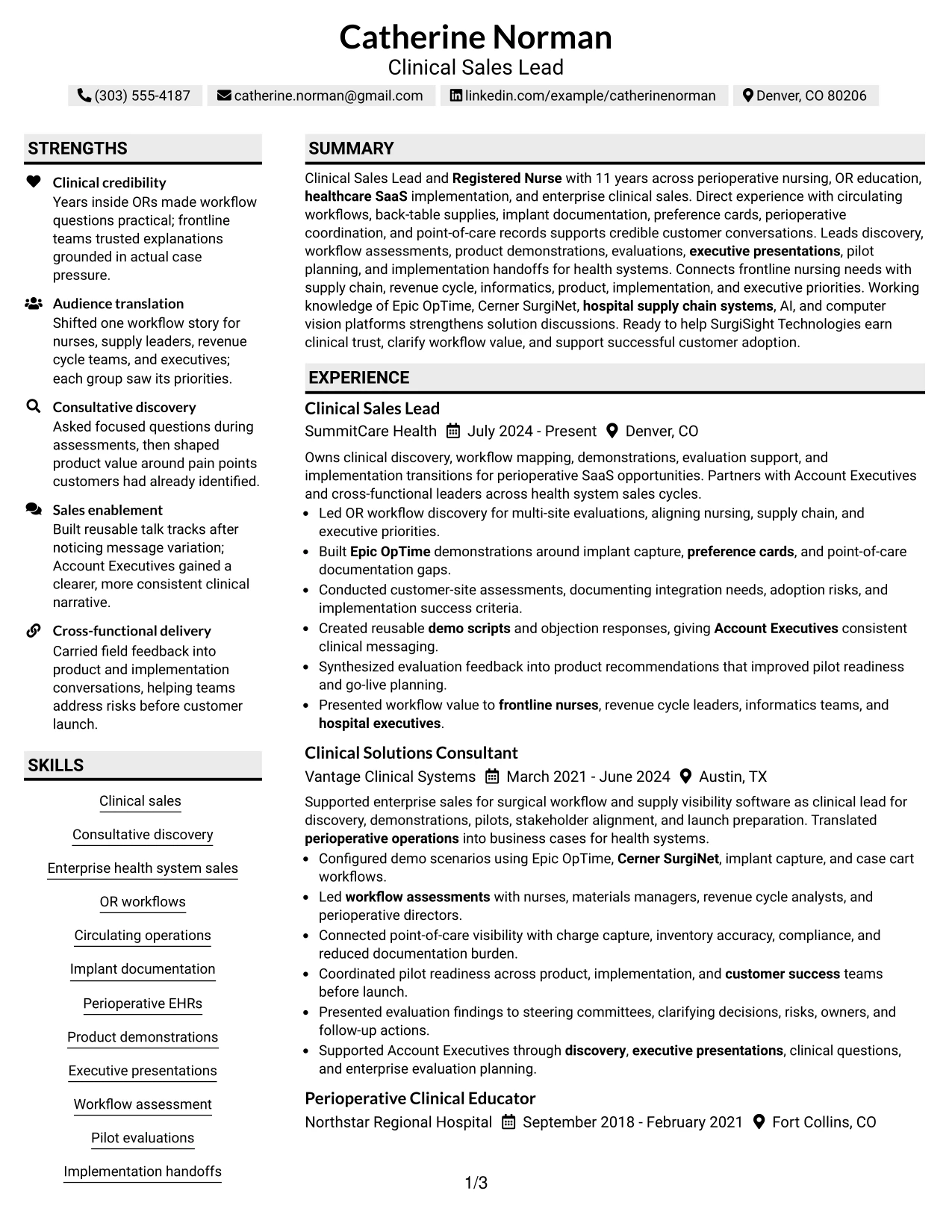
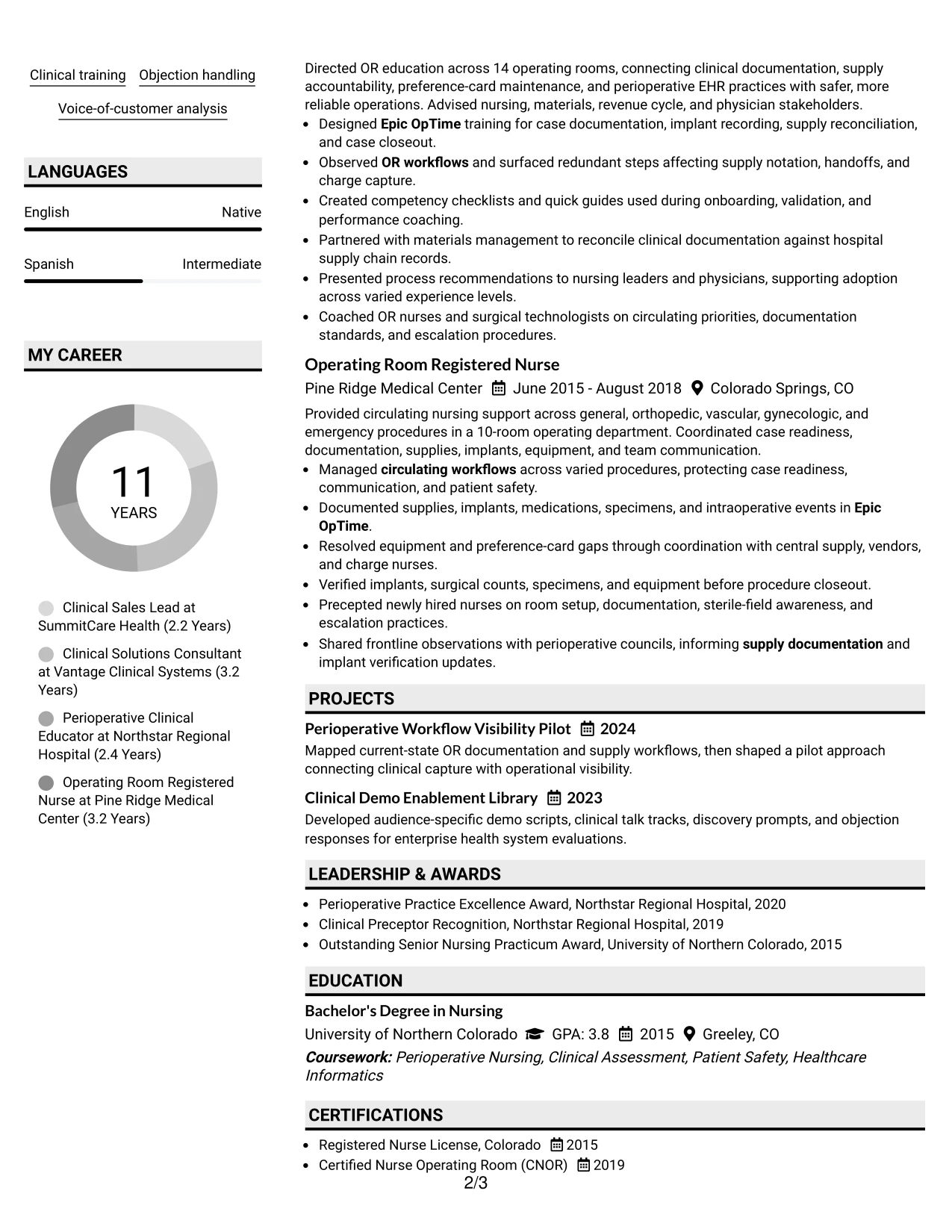
#24 Shaded Labels Clean Two Column Format Resume Example
A restrained visual hierarchy helps the reader recognize the resume's professional focus before reviewing the details. Shaded labels mark sections such as Summary, Experience, Skills, Education, and Certifications, while the two-column arrangement keeps supporting information close at hand.
The content aligns well with a Clinical Sales Lead search because it can place enterprise sales, OR workflow knowledge, and customer-facing presentation work near the top. Bullets should lead with actions and outcomes, while shaded labels guide the eye toward evidence such as workflow mapping, pilot evaluations, voice-of-customer analysis, and cross-functional delivery.
Why the Shaded Labels Clean Two Column Format Works for a Resume
- Shaded labels create consistent section markers that support quick recruiter scanning.
- The two-column design places skills and systems near the experience they support.
- A clean hierarchy gives the professional summary enough prominence without overpowering the work history.
- Experience bullets can show discovery, demonstrations, assessments, and implementation work in a logical order.
- Keyword-rich labels make clinical workflow and enterprise sales qualifications easier to identify.
- The format balances visual structure with enough room for detailed professional evidence.
- Simple shading adds distinction while keeping the resume focused on qualifications rather than decoration.
Best For
- Applicants whose target role combines domain knowledge with consultative selling.
- Resumes that must connect software tools to the workflows where they are used.
- Professionals who need a clear place for clinical credentials, systems, and sales capabilities.
- Applications reviewed by readers who scan section labels before reading every bullet.
- Documents with varied stakeholder experience, from frontline teams to executives.
- Candidates who want a polished two-column structure without a heavy visual treatment.
- Roles where alignment with discovery, demonstrations, evaluations, and implementation is central.
#25 Photo Header Color Accent International Format Resume Example
The Photo Header Color Accent International Format places the professional identity and contact details at the front, followed by a single-column sequence of summary, experience, education, certifications, and skills. Color accents help distinguish sections while the vertical order keeps the document easy to follow from top to bottom.
For this resume, the opening summary can establish 11 years across perioperative nursing, OR education, healthcare SaaS implementation, and enterprise clinical sales. The experience section should then prove that claim through workflow assessments, demonstrations, executive presentations, clinical training, and implementation transitions. Skills and systems can close the document with searchable terms.
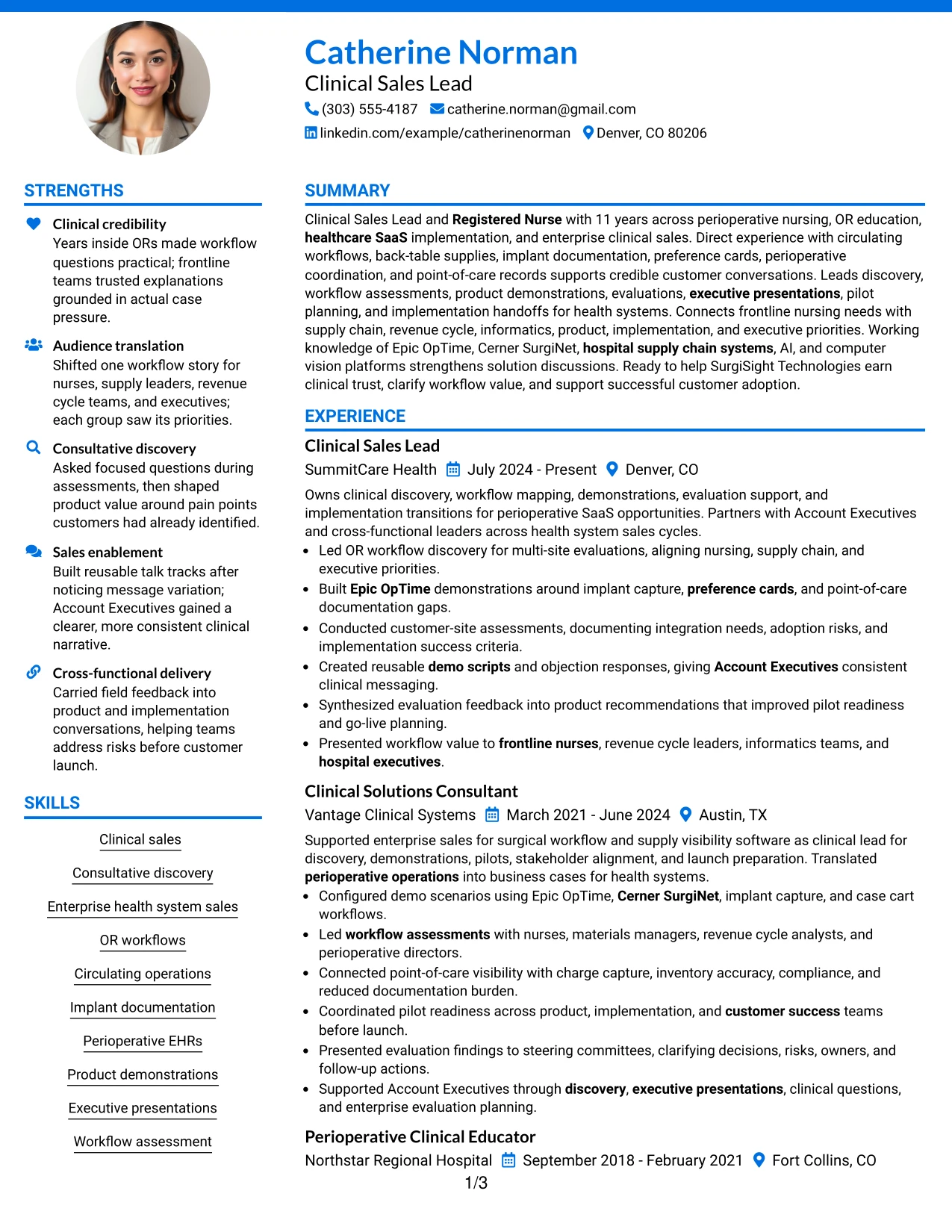
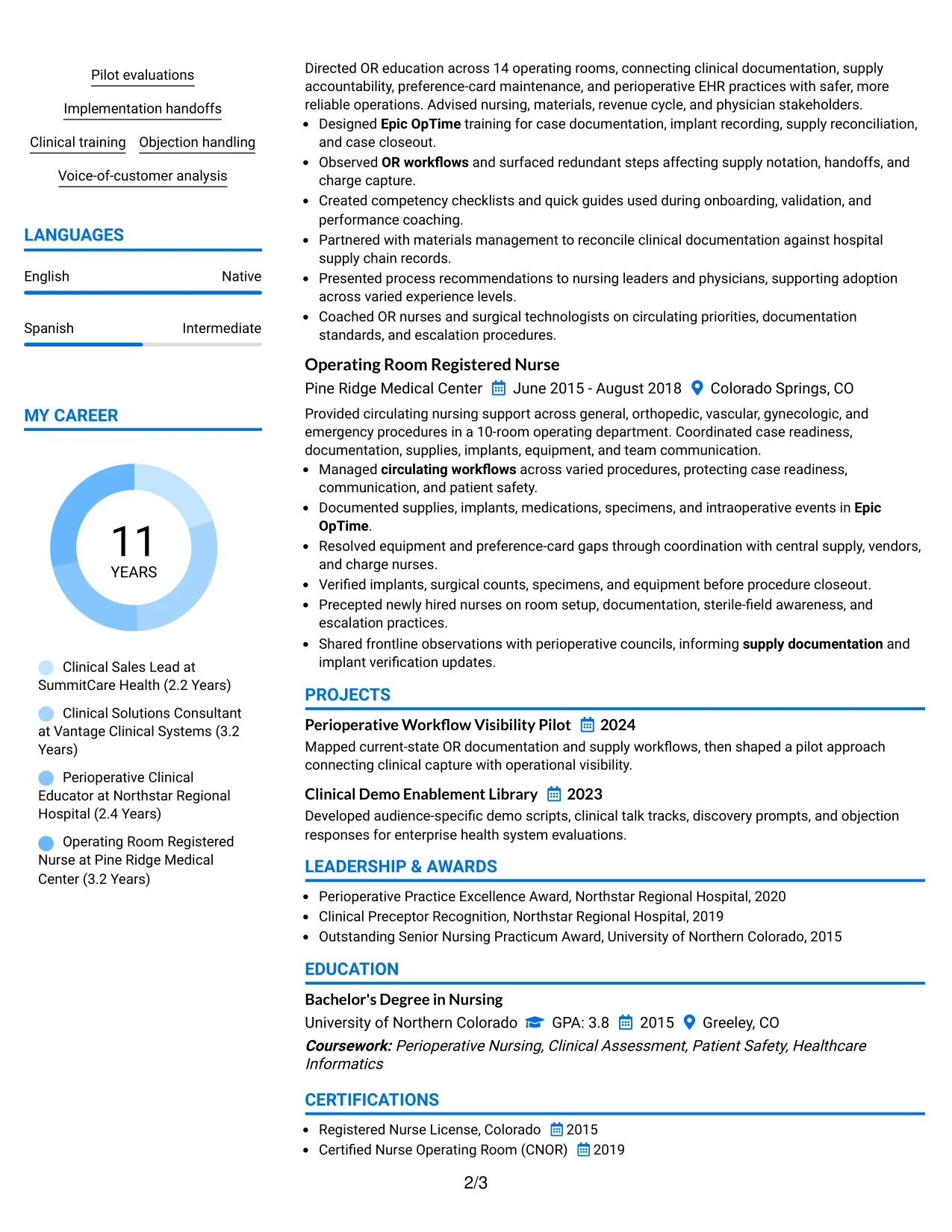
Why the Photo Header Color Accent International Format Works for a Resume
- A single-column flow gives the summary and career history a clear reading order.
- The header places the role title and contact details where they can be found immediately.
- Color accents separate major sections without interrupting the evidence sequence.
- Detailed bullets can show progression from operating room nursing to clinical sales leadership.
- The format provides room for credentials such as Registered Nurse and CNOR.
- A dedicated skills area supports keywords including Epic OpTime, Cerner SurgiNet, and computer vision.
- The structure works well when the resume needs to present a complete professional story in one path.
Best For
- Resumes that need a complete career narrative in a single, continuous sequence.
- Professionals moving from clinical practice into healthcare technology or sales.
- Applications where certifications and clinical background strengthen commercial credibility.
- Documents that require room for detailed bullets across several related positions.
- Readers who prefer to review summary, experience, education, and skills from top to bottom.
- International or cross-border applications that benefit from a clearly ordered professional profile.
- Candidates whose systems knowledge and customer-facing work need equal visibility.
#26 Large Profile Photo International Two Column Format Resume Example
Readers can move from the profile header into a focused summary, then choose the detailed experience column or the supporting skills and credentials column. That navigation suits a resume with substantial evidence across clinical practice, education, SaaS implementation, and enterprise sales.
The two-column body can carry a high volume of relevant content without losing section order. The main area should hold workflow discovery, demonstrations, assessments, stakeholder presentations, and pilot planning. The secondary area can group Epic OpTime, Cerner SurgiNet, supply chain systems, certifications, education, awards, and professional activities.
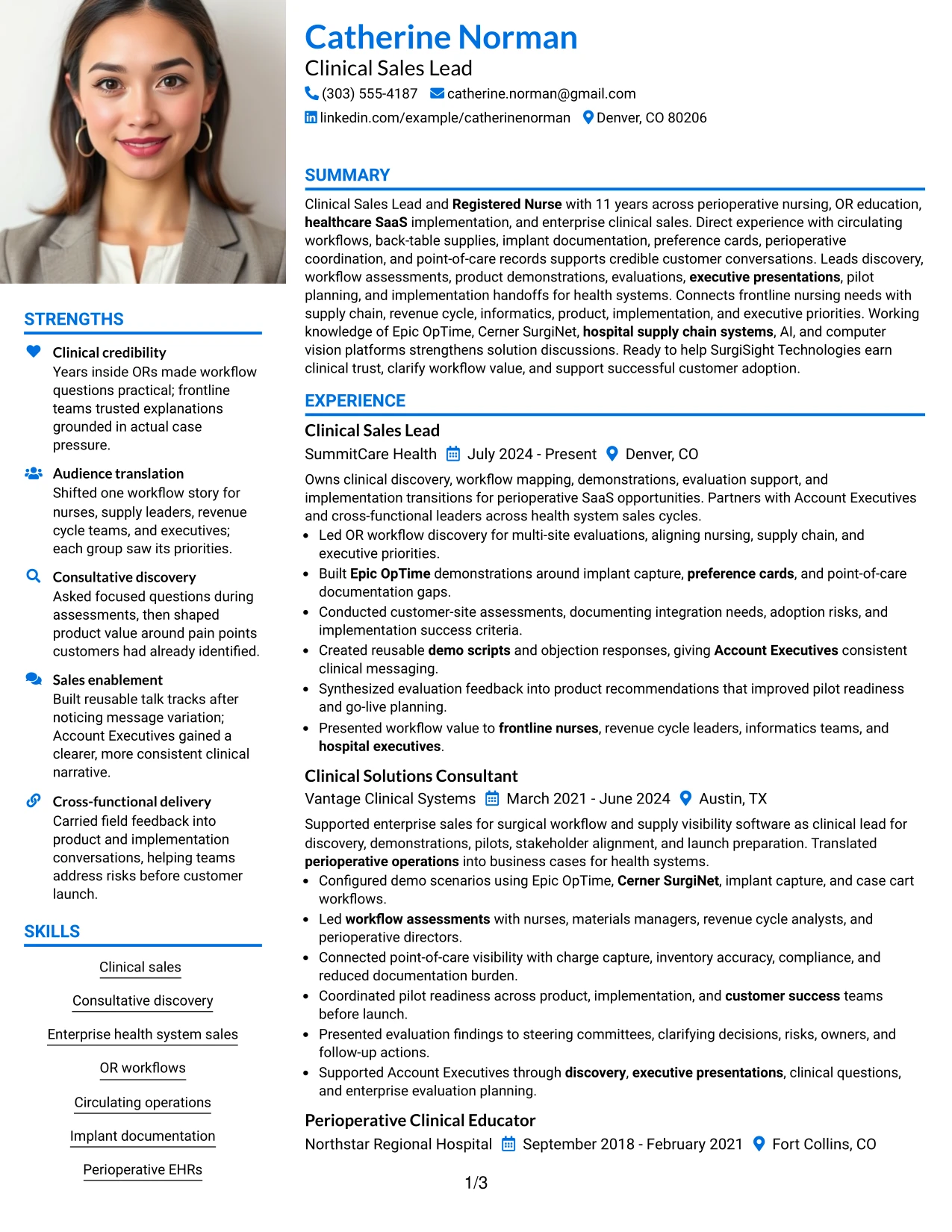
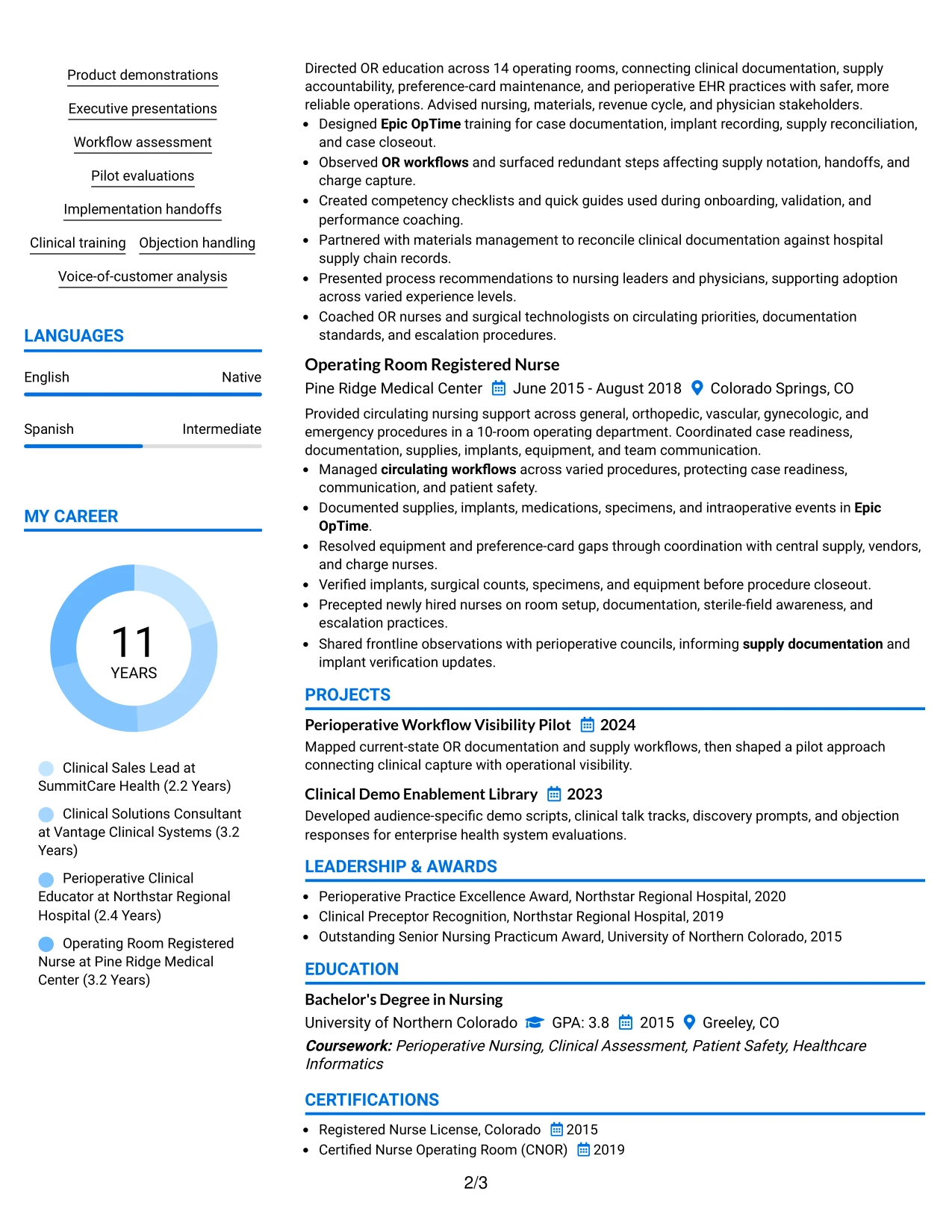
Why the Large Profile Photo International Two Column Format Works for a Resume
- Two columns give a substantial work history and supporting qualifications separate, readable homes.
- The main column can carry multiple roles without compressing achievement bullets too heavily.
- A secondary column keeps systems, certifications, awards, and activities available for quick review.
- The profile header establishes identity and professional direction before the detailed content begins.
- The format supports a career path that combines direct clinical work with customer-facing technology roles.
- Grouped keywords help readers connect workflow experience to software and implementation responsibilities.
- The structure can present broad evidence while maintaining a clear visual route through the document.
Best For
- Professionals with several connected roles and a broad set of supporting qualifications.
- Resumes that must show both direct operating room experience and enterprise sales work.
- Applications requiring room for systems, certifications, awards, activities, and projects.
- Documents where detailed evidence belongs in one column and quick-reference facts in another.
- Candidates presenting a substantial transition from clinical operations to healthcare SaaS.
- Readers who need to compare experience depth with tools and credentials at a glance.
- International applications that benefit from a strong profile area and organized content volume.
#27 One Column Format with Photo Resume Example
The strongest evidence receives priority: clinical credibility, customer-facing workflow expertise, and results-oriented sales support. A single column keeps those points in sequence, beginning with the summary and moving through experience, projects, education, certifications, and skills.
Each role should use concise bullets that prove the target value. The resume can show OR workflow knowledge, implant and supply documentation, product demonstrations, executive presentations, and implementation handoffs without making the reader switch between columns. A focused skills section reinforces the same evidence with searchable terms.
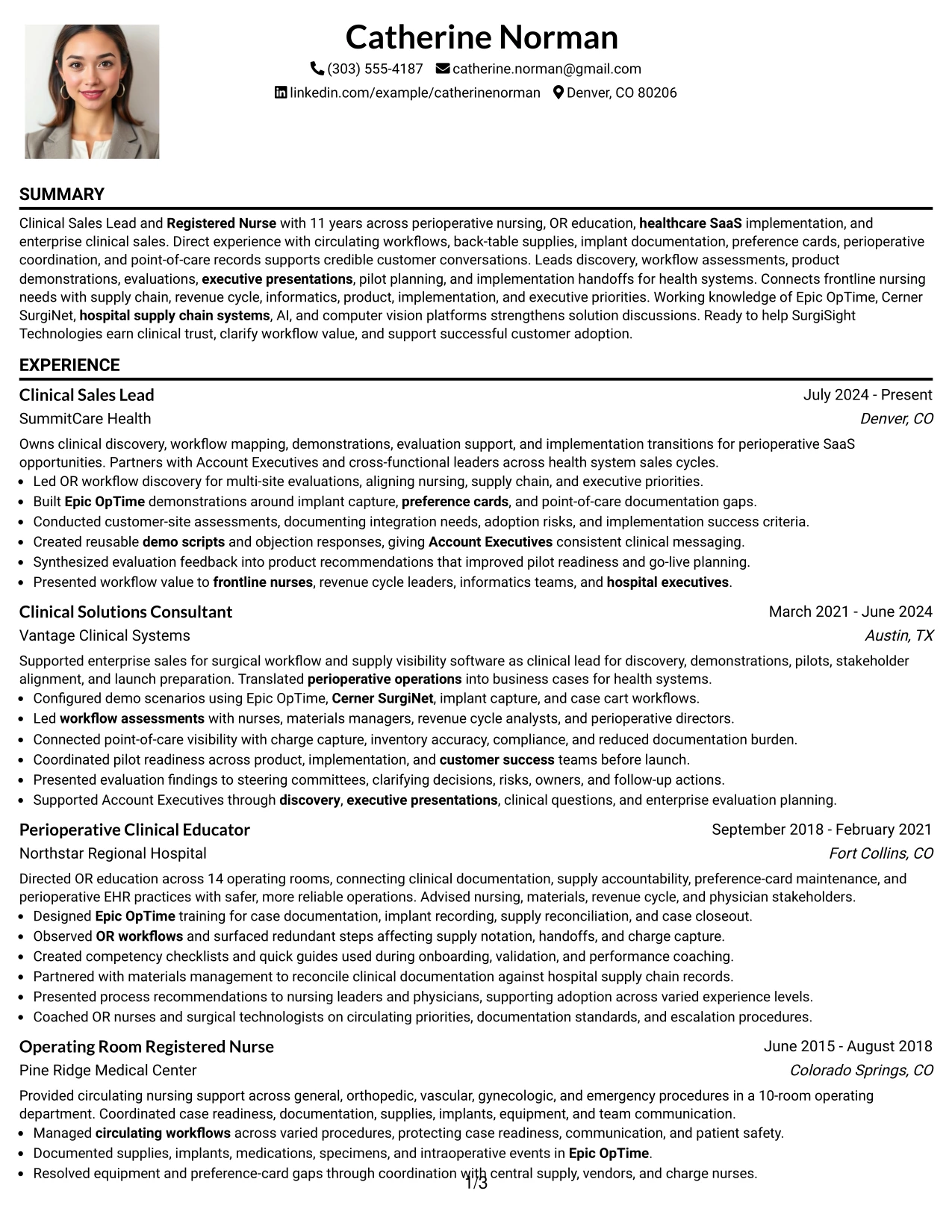
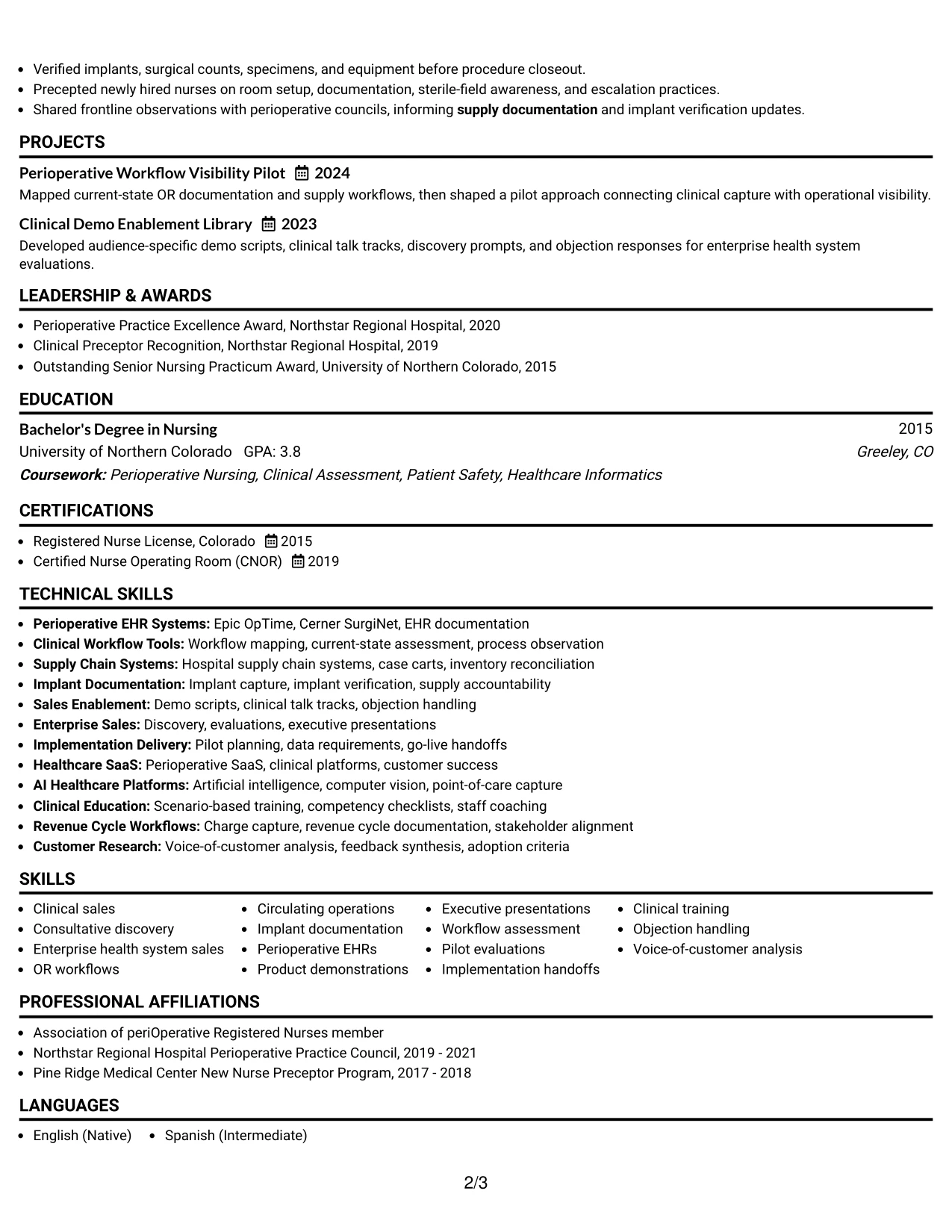
Why the One Column Format with Photo Works for a Resume
- A single column gives the most important evidence a predictable place in the reading order.
- The summary can quickly connect clinical experience with consultative sales capability.
- Bullets remain aligned from one role to the next, making progression easy to compare.
- Projects can add proof of workflow visibility and sales enablement beyond formal job titles.
- Education and certifications remain visible without competing with the work history.
- A skills section can reinforce exact systems and workflow terms used in the experience bullets.
- The format supports a direct review of qualifications from opening profile through supporting details.
Best For
- Candidates whose strongest advantage is a clear blend of clinical and commercial evidence.
- Resumes built around action-focused bullets rather than dense narrative blocks.
- Applications where projects provide useful proof of workflow or enablement work.
- Readers who want one uninterrupted path through experience and credentials.
- Professionals who need to show role progression without a complex page structure.
- Documents that must keep certifications and systems visible after the main career history.
- Customer-facing roles where credibility is established through specific workflow examples.
#28 One Column Format with Photo Right Resume Example
Content is balanced across a clean single-column body, while the right-side profile area gives the header a distinct visual anchor. That balance leaves the main reading path open for the summary, experience, projects, education, certifications, and skills.
The resume should use the open body for evidence that matters in a customer-facing clinical sales application. Strong bullets can cover current-state assessments, OR observations, stakeholder alignment, product demonstrations, pilot readiness, and voice-of-customer feedback. Contact information and profile details remain separate from the proof of performance.
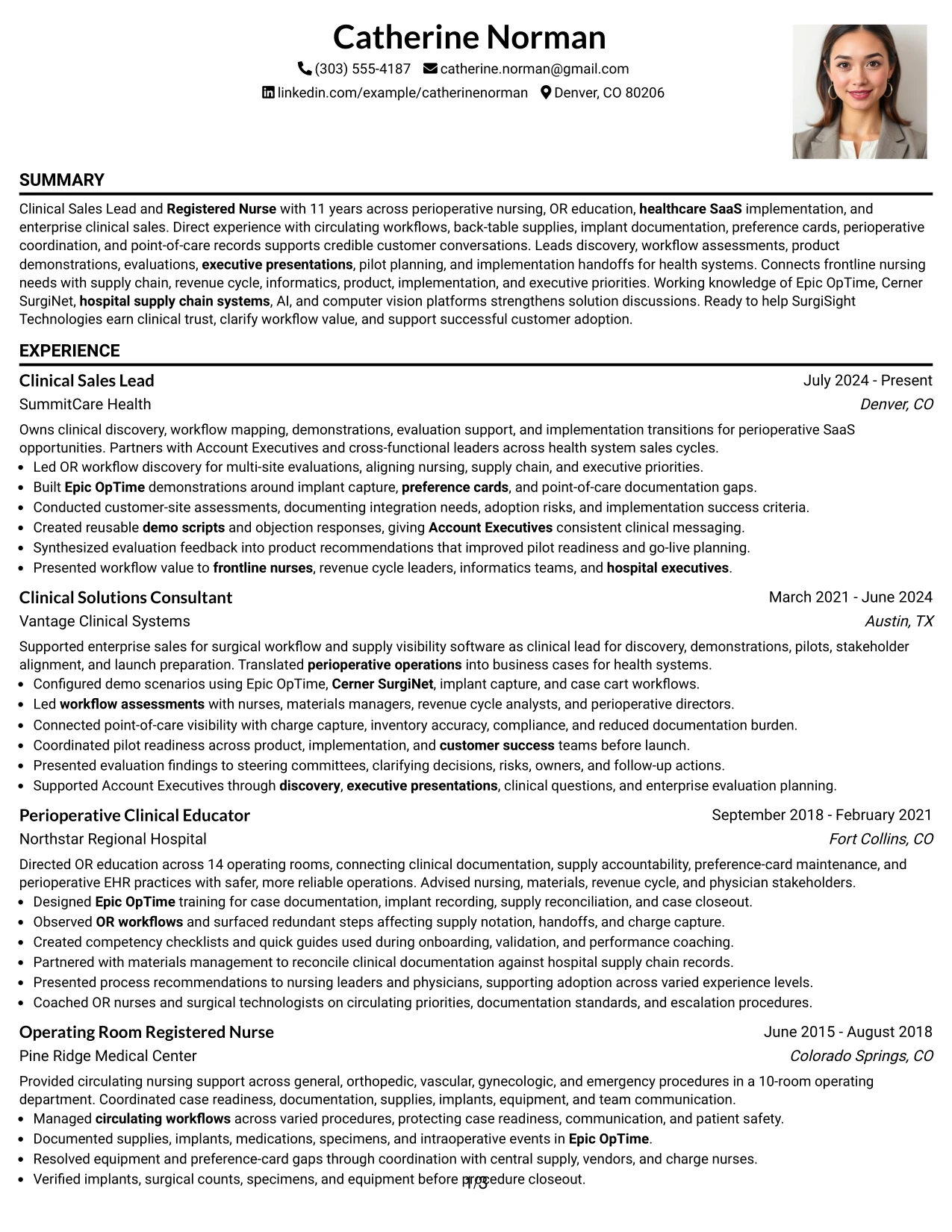
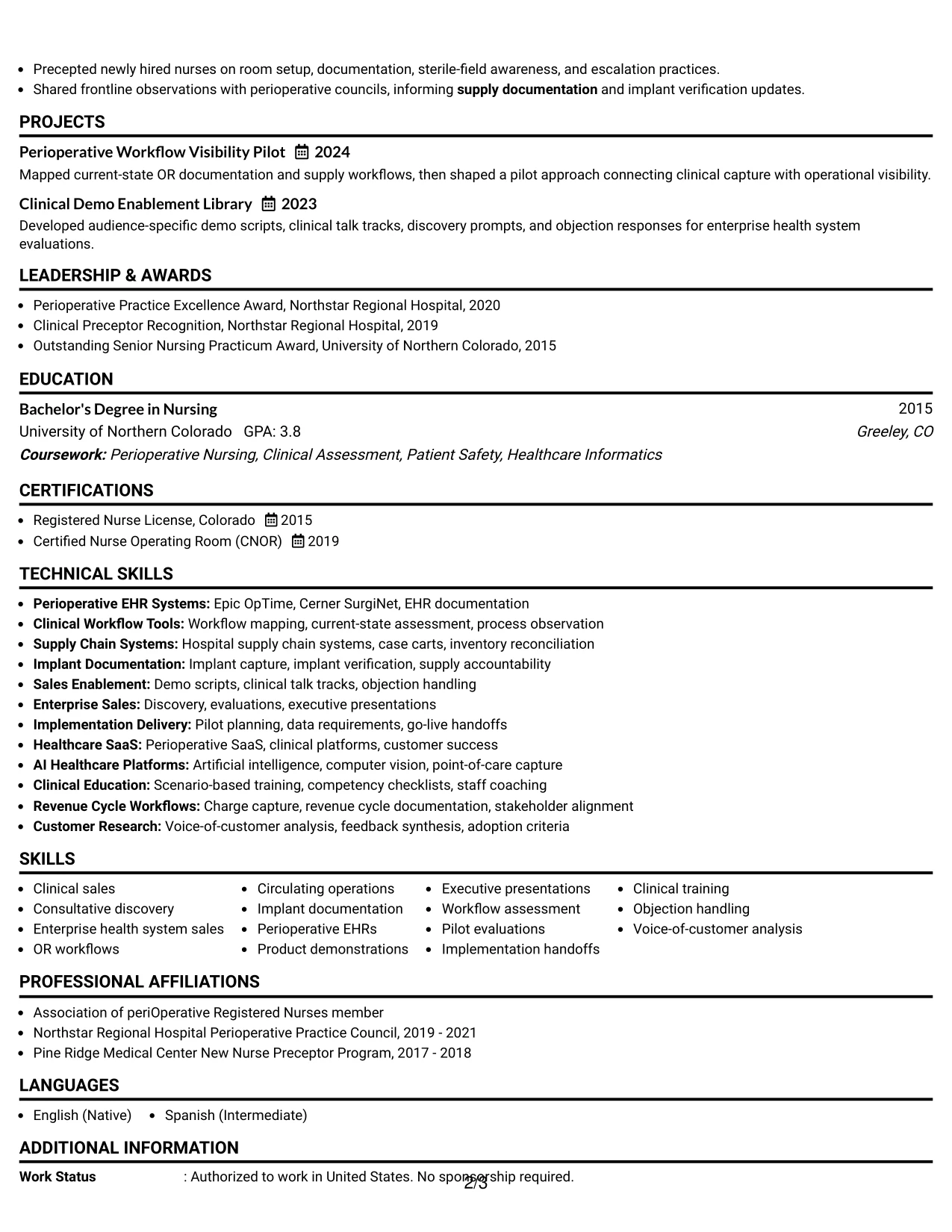
Why the One Column Format with Photo Right Works for a Resume
- The single-column body protects the reading order for detailed experience bullets.
- A right-side profile area adds visual balance without breaking the main evidence path.
- The structure leaves room for a substantial summary and several connected roles.
- Projects can demonstrate workflow visibility and reusable clinical sales enablement.
- Skills and technology terms can follow the experience section in a clear closing block.
- The format separates identity details from the qualifications that support the target role.
- It suits resumes that need a polished presentation while keeping professional evidence central.
Best For
- Applications where a clean body should carry most of the professional evidence.
- Professionals with several roles that need full-width bullets for clarity.
- Resumes pairing clinical workflow knowledge with demos, evaluations, and implementation work.
- Candidates who want visual balance without dividing experience across two text columns.
- Documents that include projects, awards, certifications, and skills after a detailed career history.
- Readers who value a straightforward review path with a distinct profile area.
- Customer-facing healthcare technology roles that require both credibility and presentation polish.
#29 One Column Boxed Contact Header Format Resume Example
For a practical application, the boxed contact header should identify the target role and key contact details immediately, then move into a direct sequence of summary, experience, projects, education, certifications, and skills. The box creates a clear starting point without taking attention away from the work history.
This format is effective when the resume must make clinical sales qualifications easy to verify. Place the strongest bullets near the top of each position, covering discovery, workflow mapping, demonstrations, executive presentations, and implementation handoffs. Use the final sections for Epic OpTime, Cerner SurgiNet, CNOR, Registered Nurse status, and related keywords.
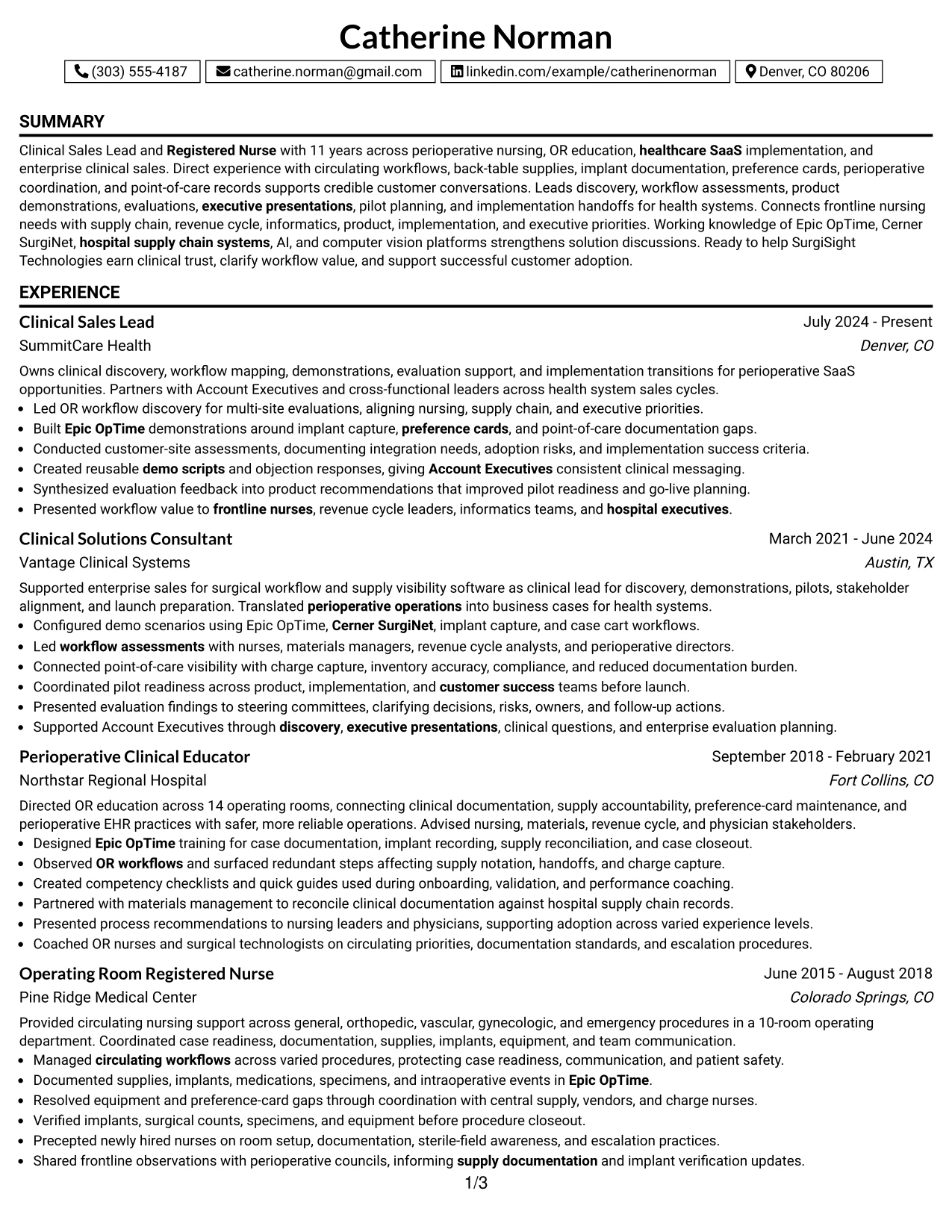
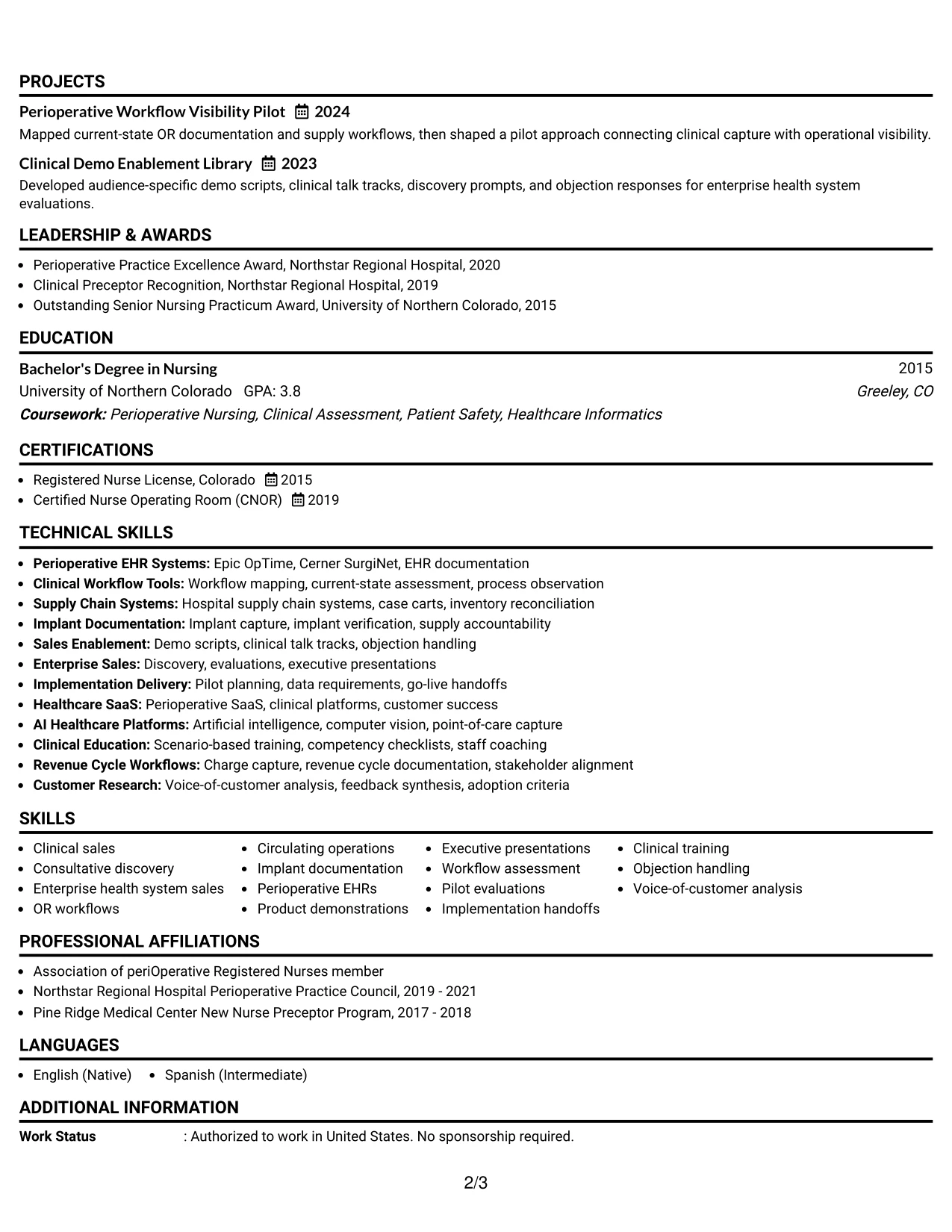
Why the One Column Boxed Contact Header Format Works for a Resume
- The boxed header makes contact information and the target role easy to locate.
- A single-column structure supports reliable ATS parsing and consistent recruiter scanning.
- The summary can connect 11 years of clinical and commercial experience in a compact opening.
- Full-width bullets provide space for specific workflow and stakeholder evidence.
- Projects can show applied work beyond standard employment entries.
- Credentials and systems can be listed in clear sections without competing with the career history.
- The design keeps visual structure simple while giving the resume a polished starting point.
Best For
- ATS-conscious applications that still need a distinct, professional contact header.
- Resumes with strong full-width achievement bullets across several positions.
- Candidates who want to state the target role clearly at the top of the page.
- Applications combining clinical practice, healthcare SaaS, and enterprise sales evidence.
- Documents that include projects and certifications alongside a detailed employment record.
- Readers who prefer a direct top-to-bottom review with minimal visual distraction.
- Roles where specific workflow keywords must remain easy for systems and people to scan.
#30 One Column Shaded Contact Header Format Resume Example
A muted visual hierarchy gives this resume a calm, professional first impression. The shaded contact header establishes the target role and contact details, while consistent section treatment guides the reader through the summary, experience, projects, education, certifications, and skills.
The content should align directly with the Clinical Sales Lead position. Lead with evidence of OR and procedural workflow knowledge, customer-facing discovery, product demonstrations, executive presentations, and cross-functional implementation work. Short bullets and clear section labels keep Catherine Norman's qualifications easy to review without relying on decorative elements.
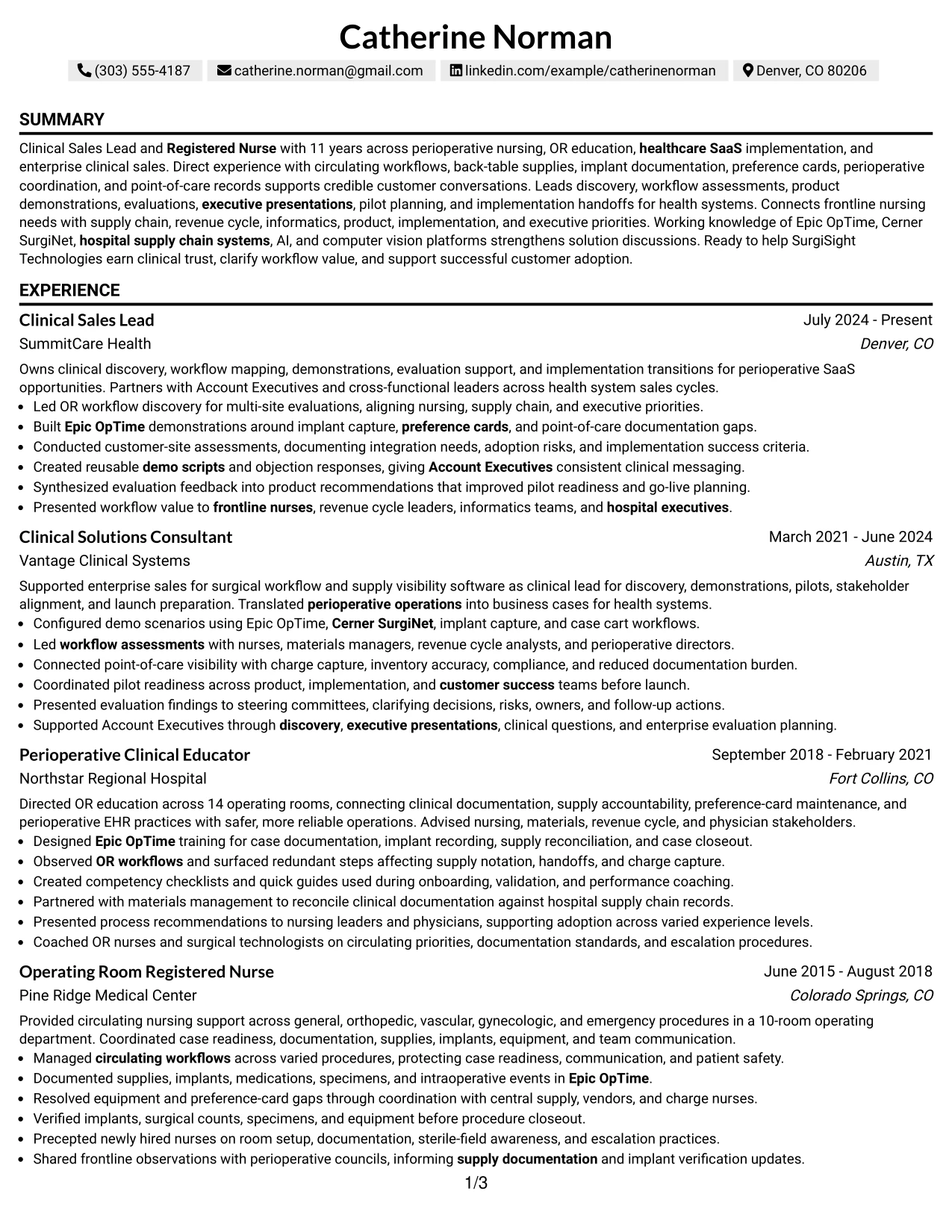
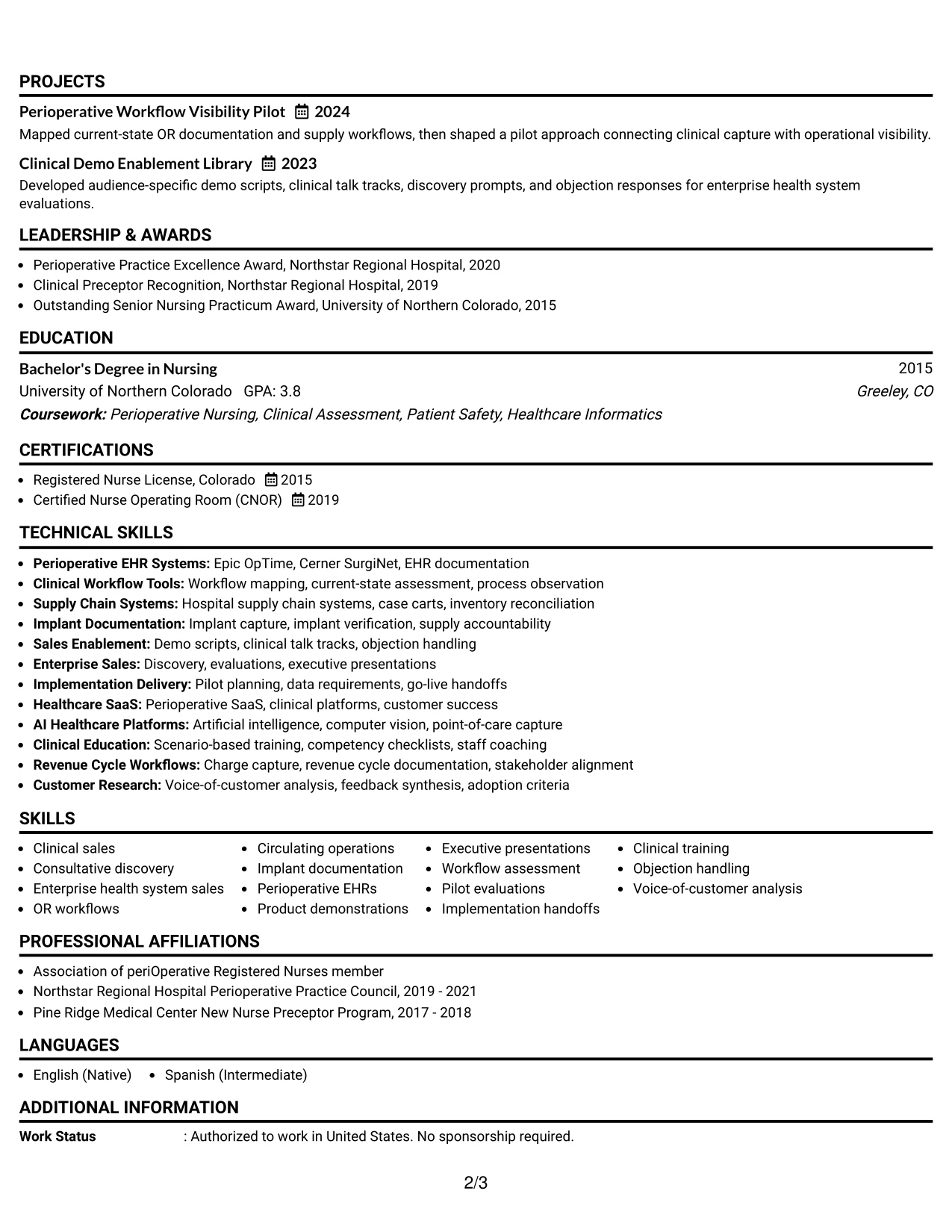
Why the One Column Shaded Contact Header Format Works for a Resume
- A shaded header separates contact details from the qualifications that follow.
- The one-column sequence keeps the professional story easy to scan from top to bottom.
- Clear labels support direct comparison of experience, projects, education, and certifications.
- The format gives clinical workflow evidence enough room to remain specific and credible.
- Skills can reinforce the same role alignment with Epic OpTime, Cerner SurgiNet, and supply systems.
- A restrained hierarchy works well for a resume reviewed by both ATS tools and people.
- The layout presents a polished profile without allowing visual treatment to overshadow substance.
Best For
- Applicants who need a professional, restrained format for a focused target role.
- Resumes matching clinical workflow expertise to consultative sales responsibilities.
- Documents where one-column scanning should take priority over complex visual organization.
- Professionals presenting customer discovery, demos, evaluations, and implementation work together.
- Applications that require visible alignment with nursing, supply chain, and revenue cycle audiences.
- Candidates who want section labels to guide review without adding visual clutter.
- Healthcare technology resumes that need strong keywords and credible evidence in equal measure.
#31 Boxed Contact Header with Job Title Format Resume Example
The boxed contact header with job title makes the document's purpose clear before the reader reaches the experience section. Below it, the resume can move through a focused summary, detailed employment history, projects, education, certifications, and skills in a consistent single-column order.
That order supports a strong keyword and evidence strategy. The summary should introduce clinical credibility and enterprise sales experience. Employment bullets can then support it with discovery, workflow assessments, demonstrations, pilot evaluations, executive presentations, and implementation handoffs. Skills and credentials provide a concise final check against the role requirements.
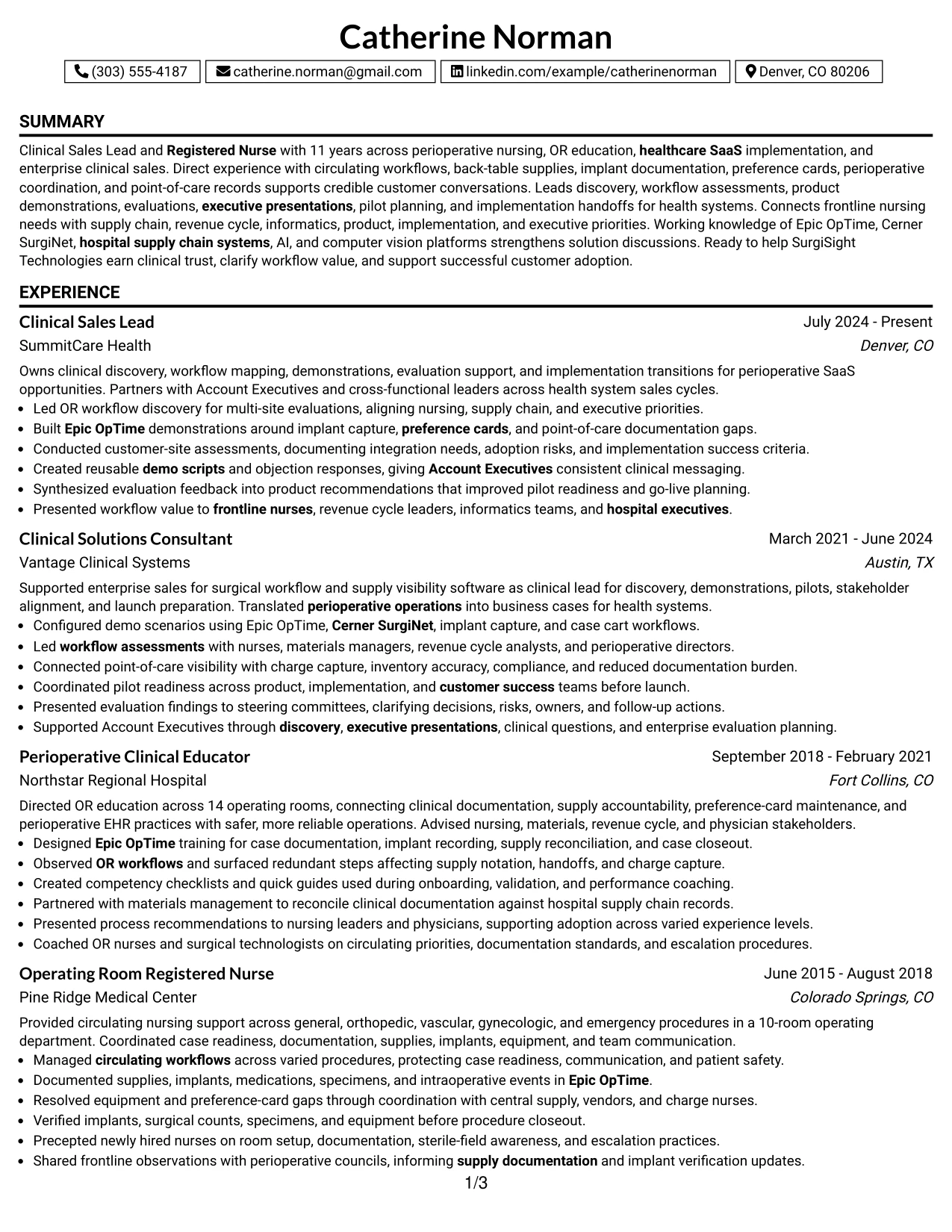
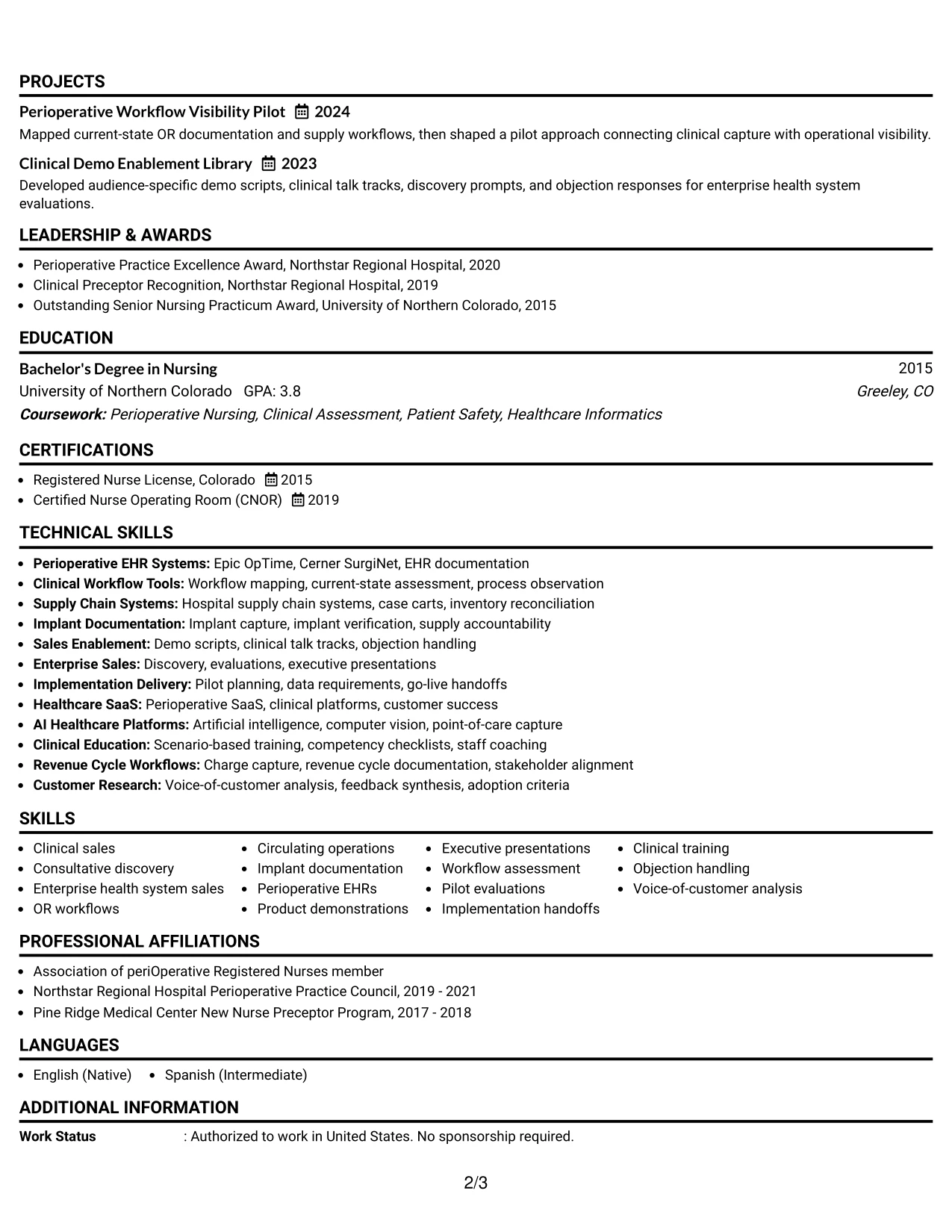
Why the Boxed Contact Header with Job Title Format Works for a Resume
- The job title in the header gives immediate context for the rest of the resume.
- The boxed treatment creates a clear starting point without fragmenting the page.
- A single column supports consistent ATS reading across all major sections.
- The summary and experience bullets can build a direct case for clinical sales leadership.
- Projects add evidence of workflow visibility and demo enablement capabilities.
- Skills, systems, and credentials remain easy to verify at the end of the document.
- The structure helps readers connect role alignment, career history, and technical keywords.
Best For
- Targeted applications where the desired role should be unmistakable at first glance.
- Resumes that depend on a strong summary followed by detailed employment evidence.
- Professionals with projects that reinforce sales, workflow, or implementation capabilities.
- Documents requiring clean ATS sequencing across summary, experience, and skills.
- Candidates who want one-column readability with a more defined header.
- Applications where clinical credentials and software systems support the target position.
- Readers who value direct labeling and quick confirmation of role alignment.
#32 Plain Professional Layout with Job Title and Shaded Labels Resume Example
Readers can begin with the job title and summary, then move through each shaded section in a steady top-to-bottom path. That route makes it easy to review role alignment first, followed by recent experience, earlier clinical work, projects, education, certifications, and skills.
The plain professional layout gives the resume room for content volume without adding unnecessary design pressure. Use the experience section to connect perioperative nursing, clinical education, healthcare SaaS, and enterprise sales. Keep bullets specific about workflow mapping, customer assessments, demos, stakeholder presentations, voice-of-customer analysis, and go-live planning.
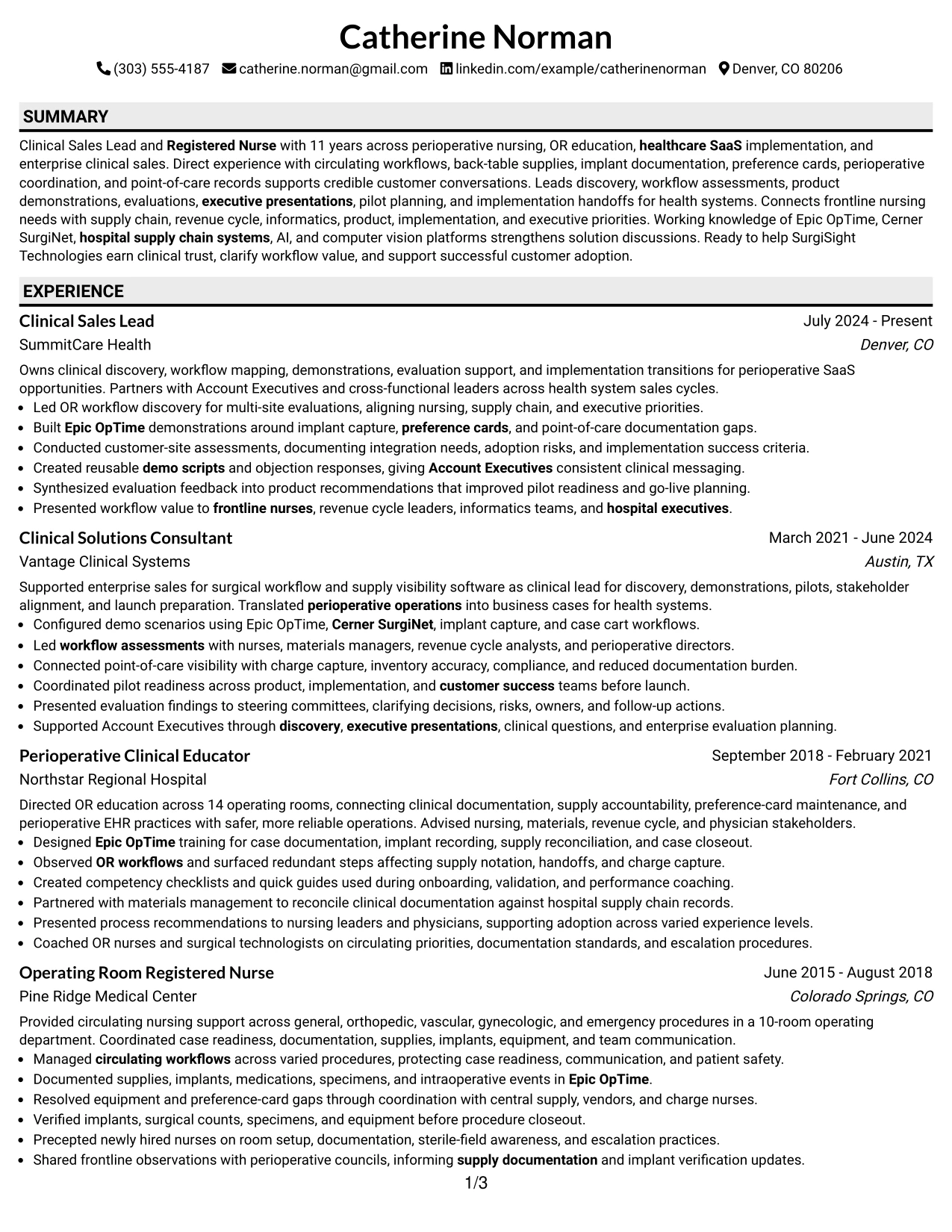
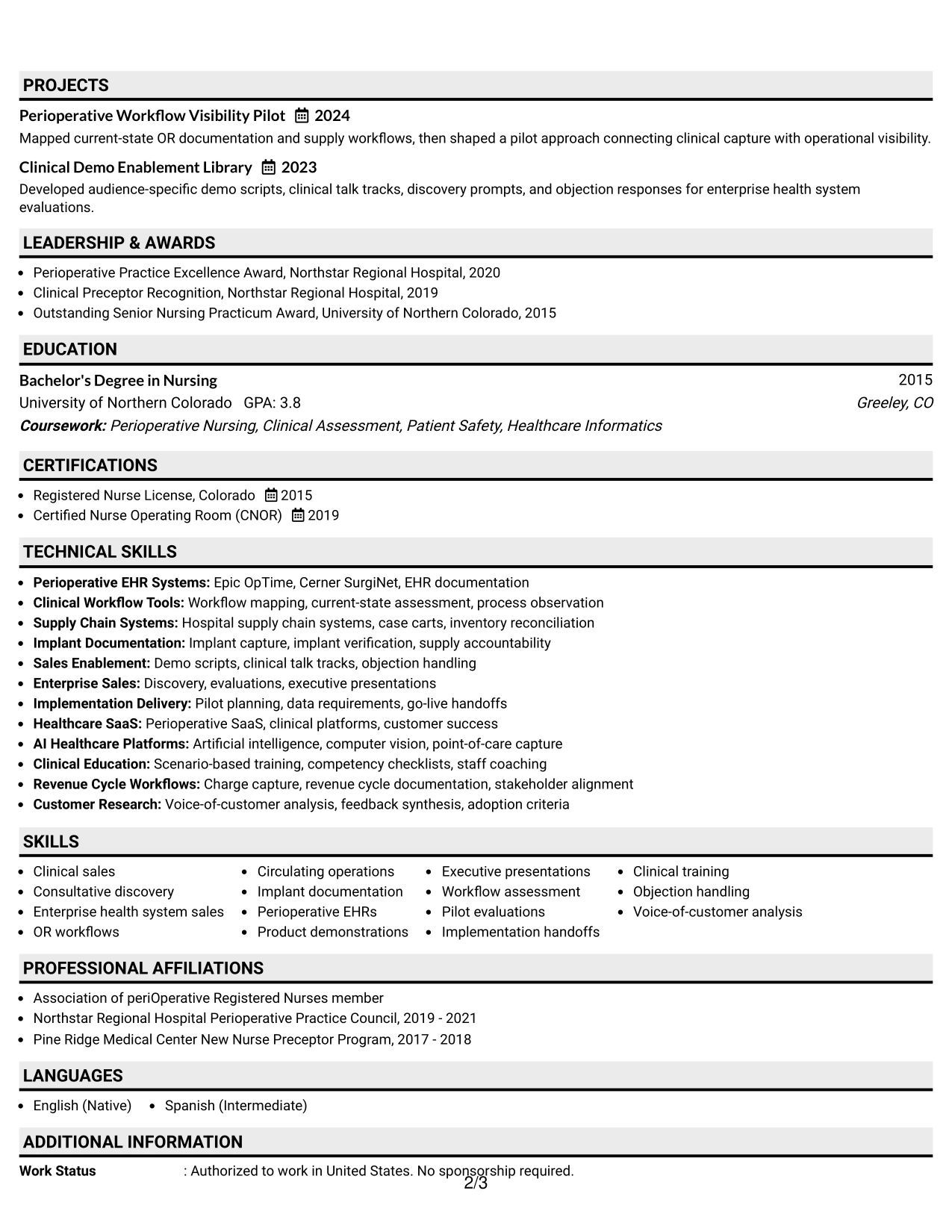
Why the Plain Professional Layout with Job Title and Shaded Labels Works for a Resume
- The reader gets a clear route from target role to summary and then to supporting evidence.
- Shaded labels separate sections while keeping the overall presentation simple.
- The format can hold a broad career history without relying on narrow columns.
- Recent clinical sales work can appear first, with earlier nursing experience adding credibility.
- Projects and technical skills can expand the evidence without interrupting the employment sequence.
- Keyword placement remains natural across summaries, bullets, and dedicated skills sections.
- The layout supports detailed content while preserving a professional, readable appearance.
Best For
- Professionals with a broad but connected career history to explain clearly.
- Resumes that need space for several roles, projects, and supporting credentials.
- Applications combining healthcare SaaS, clinical education, and direct patient-care experience.
- Readers who want a plain, reliable review path with visible section labels.
- Candidates whose strongest evidence comes from detailed bullets rather than visual design.
- Documents that must include workflow, software, stakeholder, and implementation keywords.
- Roles where content volume matters more than a highly stylized presentation.
#33 Classic One Column Resume Format Resume Example
The evidence comes first: a focused summary, strong recent achievements, and a career history that shows progression from operating room nursing to clinical sales leadership. A classic one-column structure keeps every section in the same reading path and gives each bullet a clear place.
This format works especially well when credibility depends on specific proof. Include workflow assessments, product demonstrations, executive presentations, pilot evaluations, clinical training, and implementation handoffs in the experience section. Follow with projects, education, certifications, awards, activities, and a keyword-rich skills section.
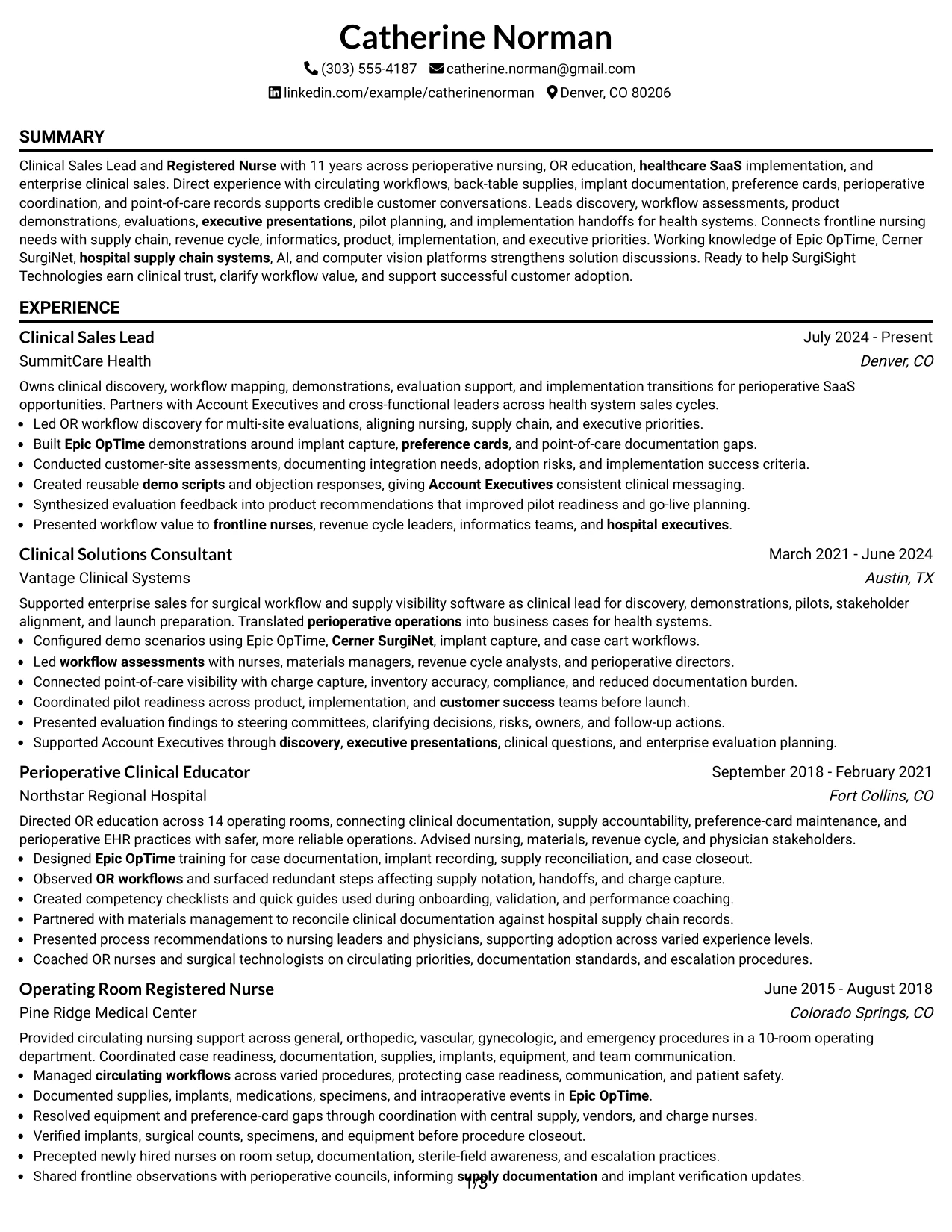
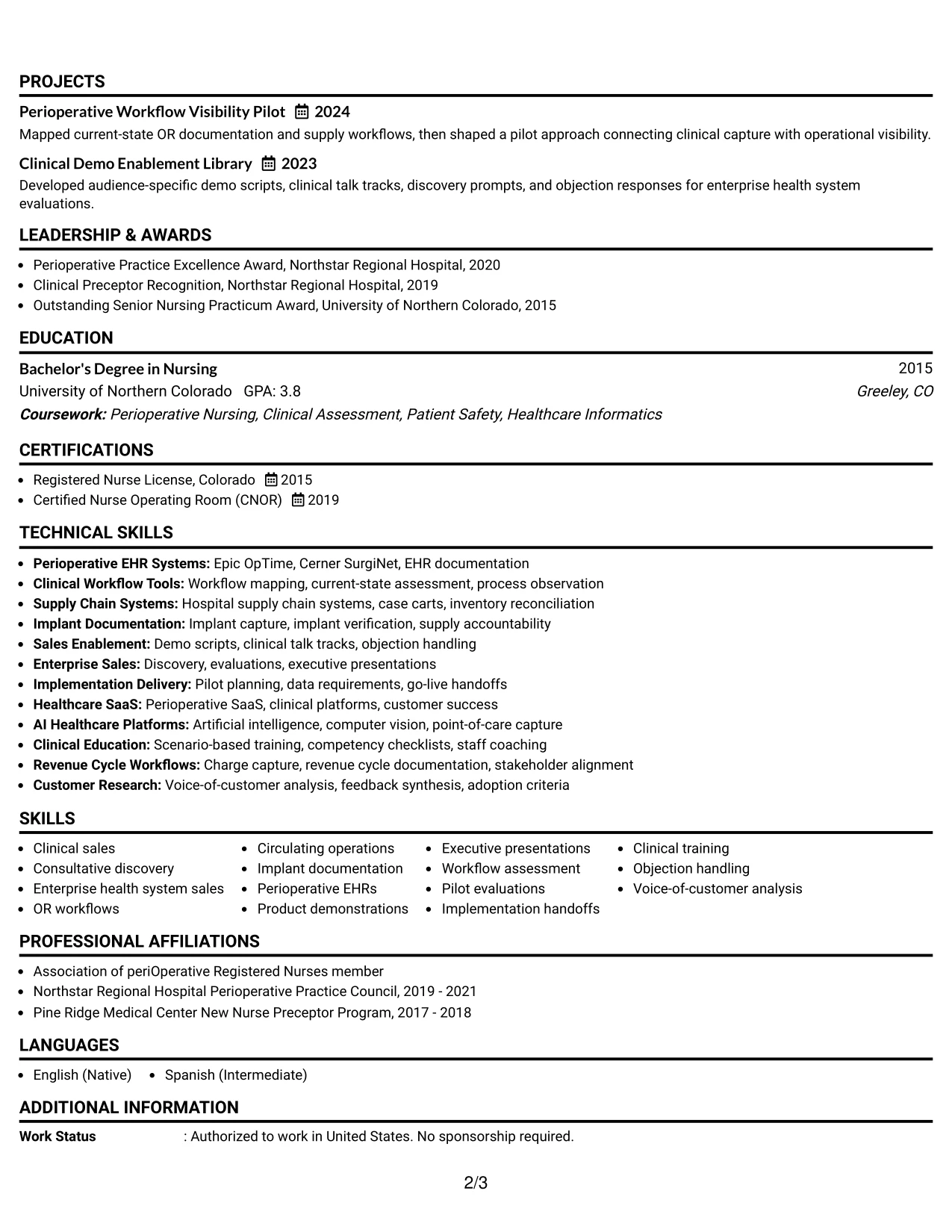
Why the Classic One Column Resume Format Works for a Resume
- A classic sequence puts summary and recent experience at the center of the review.
- One-column alignment makes dates, roles, employers, and bullets easy to compare.
- The format gives earlier operating room experience a clear place in the progression.
- Specific evidence can show both clinical credibility and customer-facing sales capability.
- Projects and awards add supporting proof without competing with the core employment record.
- Education, CNOR, Registered Nurse status, and systems knowledge remain easy to locate.
- A familiar structure supports ATS parsing and straightforward human review.
Best For
- Applications that value clear evidence over elaborate visual treatment.
- Candidates showing progression from direct clinical work into healthcare technology sales.
- Resumes that need reliable ATS parsing and familiar section order.
- Professionals using detailed bullets to prove workflow, presentation, and implementation ability.
- Documents with projects, awards, activities, and credentials that need orderly placement.
- Readers who want to compare career history without navigating multiple columns.
- Targeted roles where clinical credibility and role-specific keywords must appear together.
Why Build Your Clinical Sales Lead Resume with ResumeInMinutes
ResumeInMinutes helps you turn clinical workflow knowledge, healthcare SaaS work, sales support, and implementation experience into a resume that is organized and easy to review.
- ATS-friendly resume formats
- Clear section hierarchy
- Clinical sales keyword guidance
- Organized skills and tools sections
- Free PDF resume previews
- Resume customization support
Use the formats to present discovery work, workflow mapping, demos, customer-site assessments, voice-of-customer analysis, clinical training, and cross-functional delivery with less wasted space.
See Also
- 7 Clinical Sales Representative - Monarch Resume Templates with Example
- 33 Ambulatory Clinical Pharmacist Resume Templates with Example 2026 (ATS-Optimized)
- 33 Applied AI Engineer, Clinical Informatics Resume Templates with Example 2026 (ATS-Optimized)
- 7 Assistant Clinical Professor - Food and Nutrition Resume Templates with Example
- 7 Clinical Administrative Coordinator - PA Program Resume Templates with Example
- 33 Clinical Customer Care Staff Pharmacist Resume Templates with Example 2026 (ATS-Optimized)
- 33 Clinical Data Analyst Resume Templates with Example 2026 (ATS-Optimized)
- 7 Clinical Dietitian II, Pediatric Keto Program Resume Templates with Example
- 30+ Ambulatory Clinical Pharmacist Cover Letter Templates with Example 2026
- 30+ Applied AI Engineer, Clinical Informatics Cover Letter Templates with Example 2026
Frequently Asked Questions
Are these Clinical Sales Lead resume templates ATS-friendly?
Yes. They use readable headings, standard resume sections, and role-specific keywords such as OR workflows, clinical discovery, product demonstrations, and implementation handoffs.
Are these various resumes?
No. This guide presents one Clinical Sales Lead resume example in distinct formats and design styles.
What should a Clinical Sales Lead resume include?
Include a focused summary, clinical sales experience, OR and procedural workflow knowledge, skills, tools, education, licenses, certifications, projects, and measurable evidence from evaluations or implementations.
Can I download the resume templates as PDFs?
Yes. Each resume design offers a free PDF download so you can review the layout and choose a format for your Clinical Sales Lead application.
Which resume style is best for a Clinical Sales Lead position?
A clean one-column or simple two-column layout is usually the safest choice. It keeps clinical experience, sales results, keywords, and technical tools easy for recruiters and ATS software to scan.
How should I show clinical experience on a Clinical Sales Lead resume?
Connect clinical work to customer value. Describe circulating workflows, implant and supply documentation, workflow assessments, training, demos, stakeholder presentations, and the decisions or improvements they supported.
Should I include Epic OpTime and Cerner SurgiNet?
Include them when you have real working knowledge. Place these systems in the skills or tools section and support them with experience bullets that show how you used perioperative documentation workflows.
Can I customize these resume templates?
Yes. You can update the resume text, sections, format, design style, and PDF layout to match your Clinical Sales Lead experience and the role requirements.