30+ Cloud Performance Engineer Cover Letter Templates with Example 2026
This practical guide helps you create a focused Cloud Performance Engineer cover letter that connects your technical judgment to the employer’s operational needs. You will learn how to present your value clearly and make the reader’s decision easier.
A strong letter for this role does more than name PostgreSQL and Azure experience. It explains how you analyze workloads, improve database performance, make sound capacity decisions, reduce operational risk, and work with engineering teams when results matter.
The guide includes one proven Cloud Performance Engineer cover letter example and shows how the document is presented in 33 layouts. You will see how to write an effective opening, select evidence for the body, explain motivation and employer alignment, and close with professional confidence.
What Makes a Great Cloud Performance Engineer Cover Letter in 2026
Strong cover letters in 2026 are specific, evidence-based, and tailored to the employer’s performance challenges. The most persuasive letters usually connect three areas:
- PostgreSQL and Azure database performance expertise
- Data-driven workload analysis, tuning, and capacity decisions
- Clear communication, documentation, and cross-team collaboration
Rather than repeating a work history, an effective letter explains:
- Why the candidate is interested in the Cloud Performance Engineer position
- How telemetry, statistical thresholds, and performance testing support practical decisions
- How post-mortem analysis, automation, and documentation can improve team execution
For this role, useful job-specific language includes PostgreSQL, Azure databases, Azure Monitor, Query Store, workload analysis, SQL tuning, index optimization, performance testing, monitoring, capacity planning, capacity management, PowerShell, automation, incident post-mortems, and technical documentation. Use these terms only when the letter can connect them to relevant evidence and a clear business or operational need.
The example below shows how a persuasive cover letter can move from role interest to measurable technical fit, then to a direct statement of how the candidate would support the employer’s team.
The featured example follows a focused progression from opening interest to role-specific evidence and a professional close, which readers can adapt while choosing a presentation suited to the employer and communication context.
#1 Cover Letter Example: Text/Fang Style
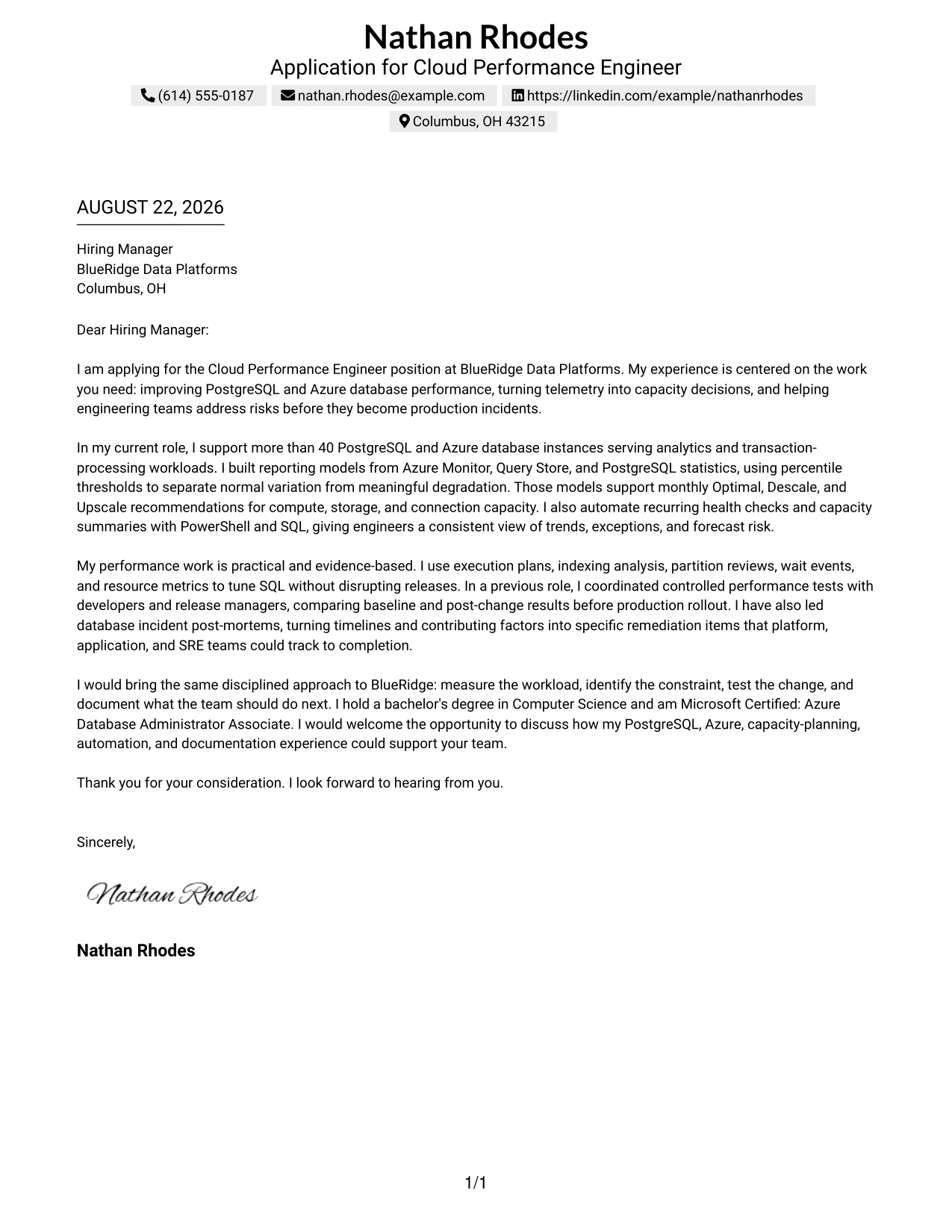
The Text/Fang Style gives the cover letter a direct, centered structure. It places the application purpose first, then builds a clear case through relevant experience, evidence, and employer fit. For Nathan Rhodes, the opening connects five years of PostgreSQL and Azure database performance work to BlueRidge Data Platforms' needs.
The letter moves from motivation to proof and then to a practical closing. It highlights reporting models, percentile thresholds, capacity recommendations, SQL tuning, performance testing, post-mortem leadership, automation, and technical documentation without making the reader search for the main message.
Cover Letter Snapshot
- Target role: Cloud Performance Engineer at BlueRidge Data Platforms
- Core value: PostgreSQL and Azure database performance improvement
- Evidence: 40+ database instances, capacity recommendations, and automated health checks
- Closing message: disciplined analysis, testing, documentation, and risk mitigation
Why This Cover Letter Works
- The opening names the target role and company immediately, so the reader understands the purpose of the letter.
- The first body paragraph mirrors the employer's priorities: performance analysis, capacity decisions, and proactive risk control.
- Specific evidence, such as 40+ database instances and percentile thresholds, gives the claims weight.
- The letter explains how telemetry becomes an action, including Optimal, Descale, and Upscale recommendations.
- Technical detail is used selectively to show credibility without turning the letter into a list of tools.
- The closing connects the candidate's experience with the team's likely operating needs and invites further discussion.
- The centered one-column presentation supports a steady reading path from motivation to evidence to fit.
Relevant Keywords for This Cover Letter
- Cloud Performance Engineer
- PostgreSQL
- Azure databases
- performance tuning
- capacity planning
- Optimal / Descale / Upscale
- performance testing
- technical documentation
#2 Cover Letter Example: Two Column Format
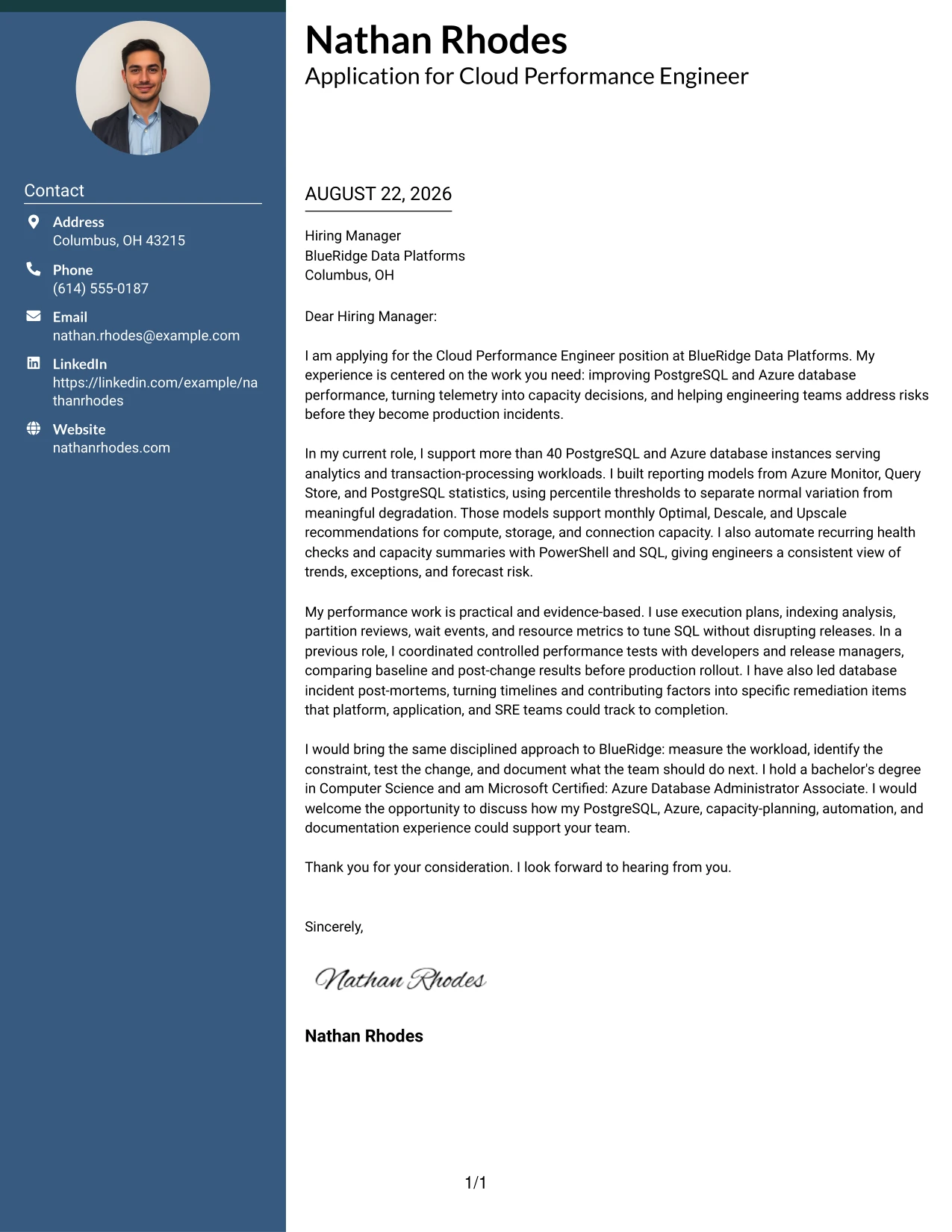
Recruiters can move through this Two Column Format by scanning the key message in one area and then reading the supporting explanation in the other. That division helps the letter present motivation, technical evidence, and employer fit without creating a long uninterrupted page. The structure suits an application that must show both database depth and clear communication.
Why This Cover Letter Works
- The two-column organization lets the reader locate the application purpose and supporting proof quickly.
- Short content blocks make the letter easier to review during an initial hiring pass.
- The main narrative can explain motivation while the supporting area reinforces PostgreSQL and Azure experience.
- Capacity planning and performance testing can be separated from the explanation of collaboration and documentation.
- The format supports a useful balance between technical specificity and readable prose.
- A concise closing can remain visually distinct from the evidence that precedes it.
- The structure is strong when the letter must communicate several related qualifications without repeating them.
Best For
- Applicants who need to present technical evidence beside a concise motivation statement
- Letters that combine database performance work with collaboration and documentation strengths
- Applications with several related proof points that benefit from visual separation
- Readers who prefer to scan key qualifications before reading the full explanation
- A measured comparison of current responsibilities and the employer's stated needs
- Cover letters that need room for both analytical detail and a direct closing
- Applications where a clear two-part reading path can improve review speed
#3 Cover Letter Example: Photo Header Two Column Format
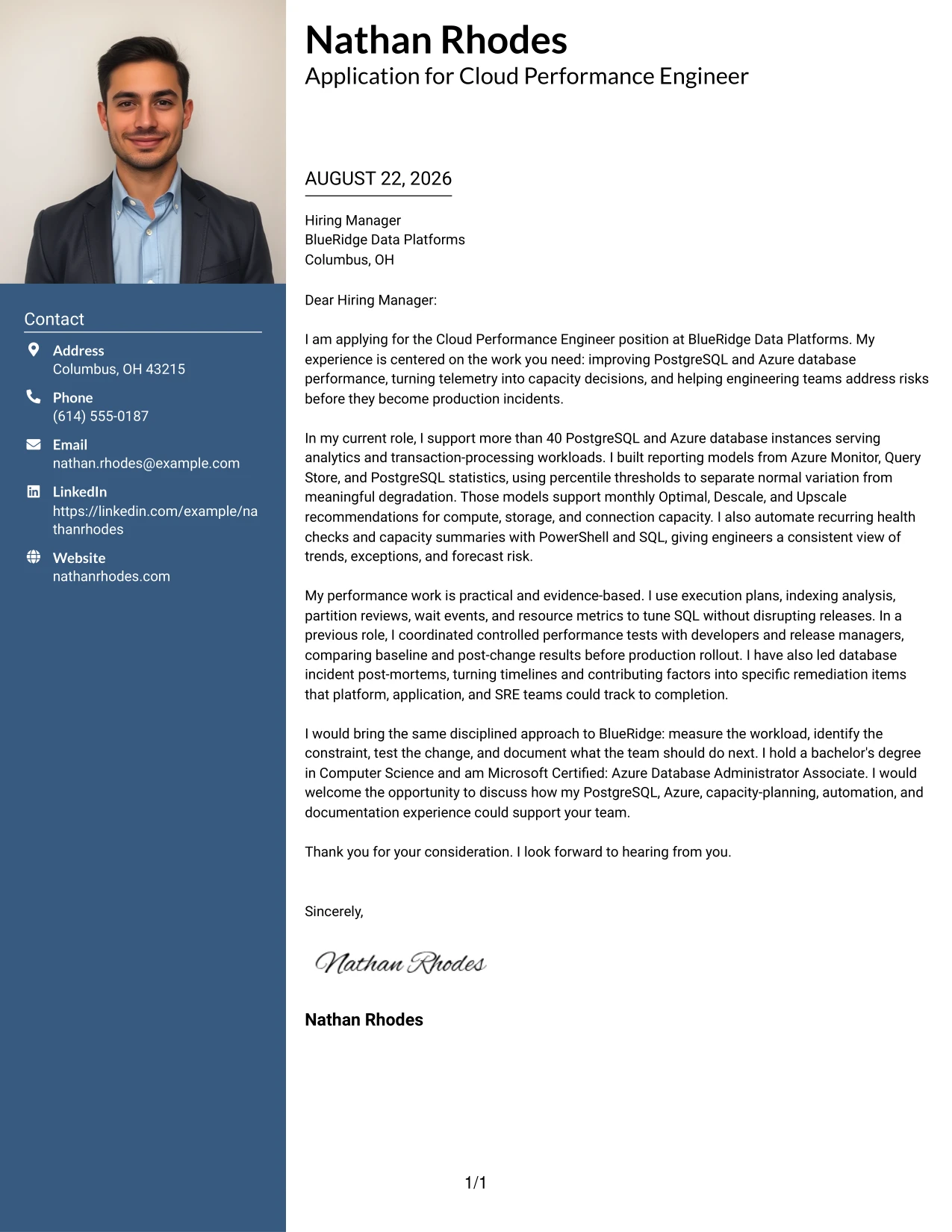
Evidence receives priority in this Photo Header Two Column Format. The letter can lead with the strongest match—PostgreSQL and Azure database performance—then use the second column to clarify capacity decisions, incident learning, and team communication. Any visual header should remain secondary to the written case for fit.
Why This Cover Letter Works
- The format gives the employer's essential requirements a prominent place near the start of the letter.
- A two-column structure separates core performance evidence from supporting collaboration and communication points.
- The letter can show how workload analysis leads to tuning, capacity action, and risk mitigation.
- Post-mortem experience adds proof that the candidate can improve systems after an incident, not only react to symptoms.
- The visual header can create a clear identity while the body remains focused on professional substance.
- Technical examples such as execution plans and resource metrics support a credible, evidence-based tone.
- The closing can return attention to BlueRidge Data Platforms and the value the candidate can contribute.
Best For
- Applicants whose strongest case depends on concrete performance evidence
- Letters that need to distinguish database tuning from incident and capacity responsibilities
- Applications where a two-part layout helps compare technical proof with team impact
- Candidates presenting several forms of evidence, such as metrics, testing, and post-mortems
- Readers who want the main qualification visible before reviewing the full narrative
- A polished presentation where written evidence must remain the central focus
- Cloud database applications that require both platform depth and practical risk management
#4 Cover Letter Example: Simple One Column Format
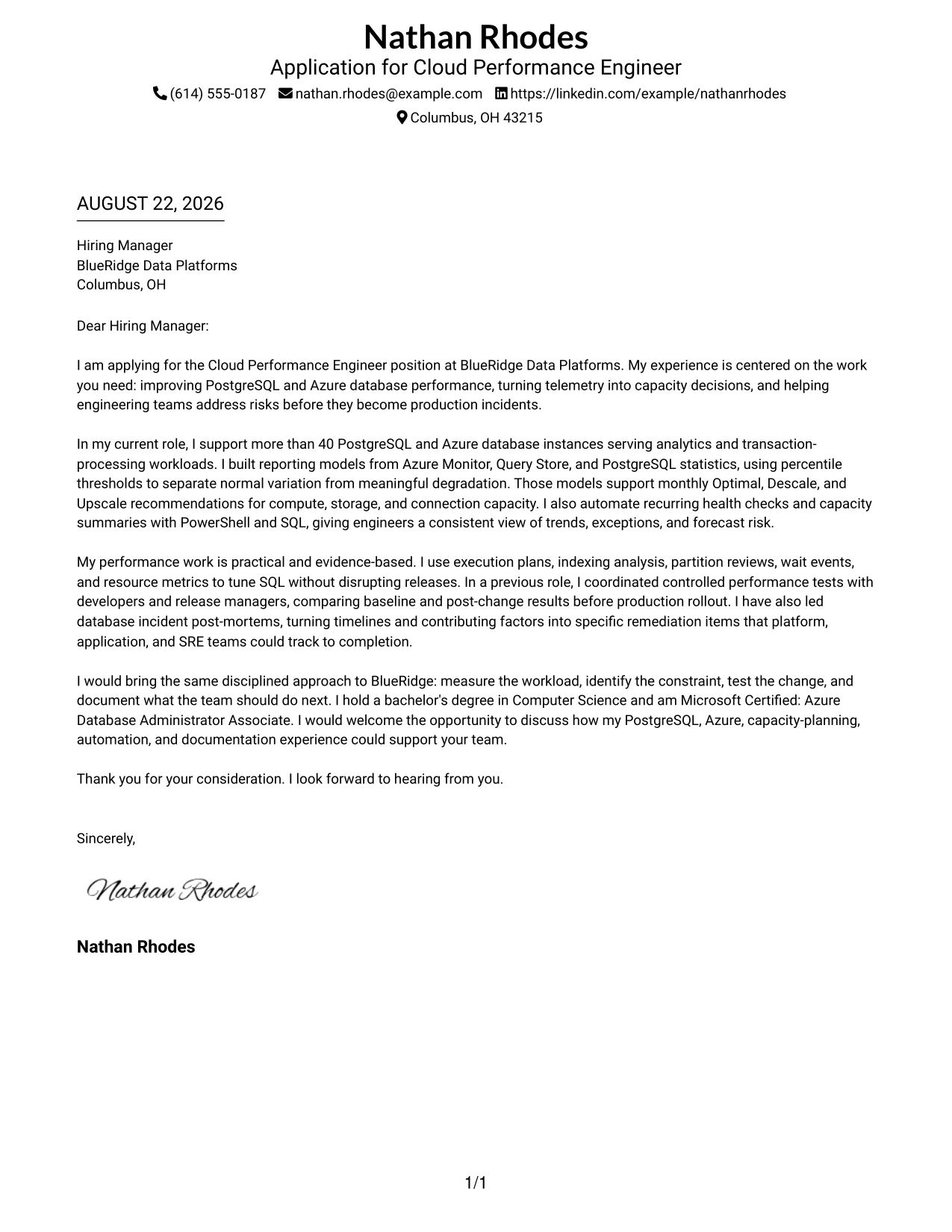
Content is balanced in the Simple One Column Format so the reader receives one clear message at a time. The letter can open with interest in BlueRidge Data Platforms, develop the match through performance engineering evidence, and close with a focused statement of contribution. Its restrained structure keeps the persuasive sequence easy to follow.
Why This Cover Letter Works
- A single reading path keeps the motivation and evidence connected from beginning to end.
- The opening can address the employer directly instead of spending space on decorative elements.
- The body has room to explain the relationship between monitoring, tuning, capacity planning, and risk mitigation.
- The letter can use one or two strong examples rather than presenting disconnected claims.
- Simple spacing helps the reader understand where the argument begins, develops, and concludes.
- The format supports a professional tone for a full-time, six-month application.
- A direct closing makes the next step clear and reinforces interest in the company.
Best For
- Applications that need a direct, conventional communication path
- Cover letters where the employer values clear explanation over visual variety
- Letters built around one connected argument from motivation to contribution
- Applicants who want technical evidence to remain easy to read in a single column
- Short application materials that benefit from controlled spacing and strong sequence
- Situations where a formal presentation supports a focused employer message
- Role applications requiring a clear close after several technical examples
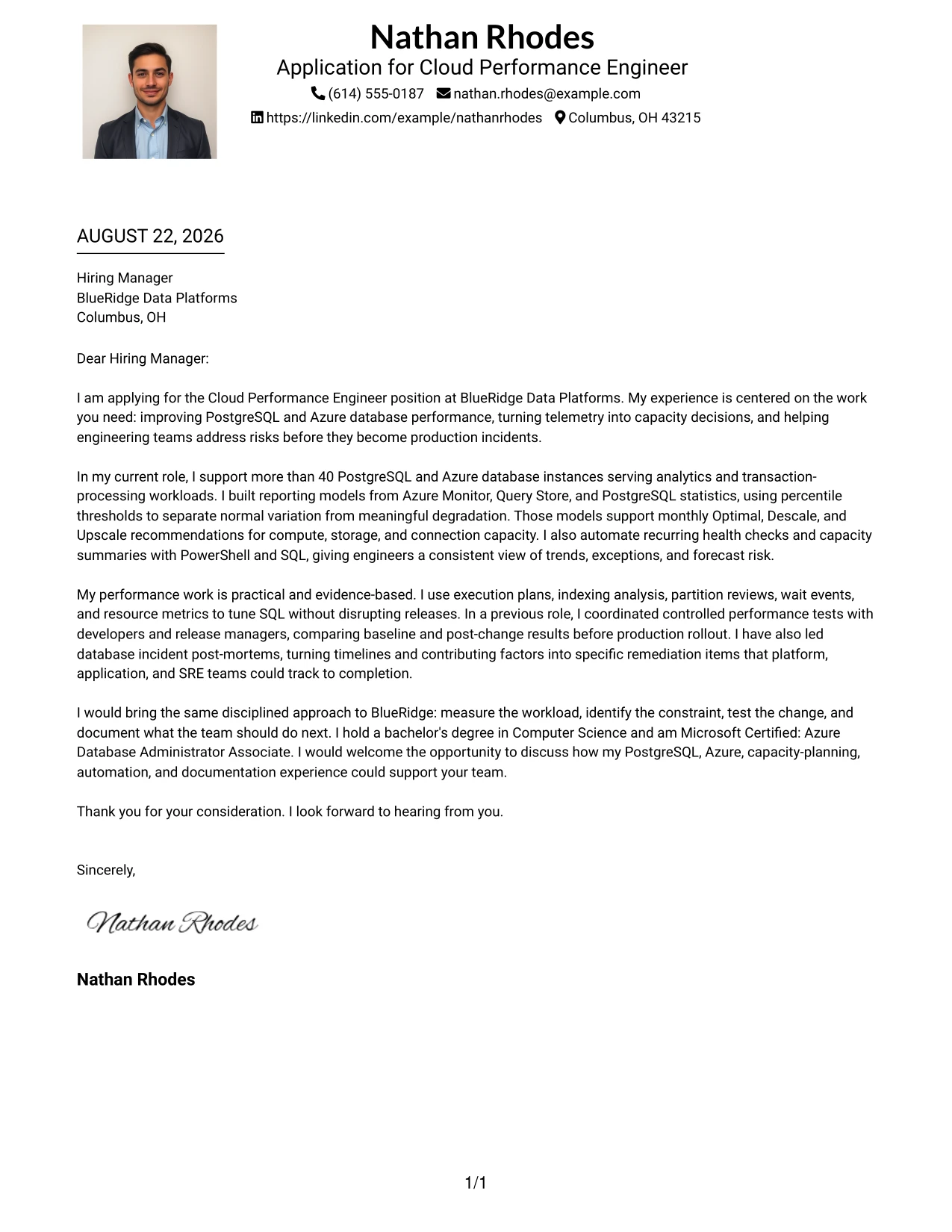
#5 Cover Letter Example: One Column Format with Photo
A practical application need comes first in this One Column Format with Photo: the letter must quickly show why the candidate fits the Cloud Performance Engineer opening. The one-column flow supports a complete explanation of PostgreSQL and Azure work, while the visual header can add personal presentation without competing with the evidence.
Why This Cover Letter Works
- The opening quickly links the candidate's experience to the responsibilities listed by BlueRidge Data Platforms.
- A single column gives the body enough continuity to explain a technical process from measurement through remediation.
- The letter can present capacity recommendations and tuning work as connected examples of judgment.
- Performance testing and release coordination demonstrate care before production changes are made.
- Post-mortem leadership shows that the candidate can turn incidents into continuous improvement.
- The visual header offers a personal introduction while the text remains the main basis for evaluation.
- The final paragraph can combine education, certification, and employer fit in a compact close.
Best For
- Applicants who want a personal visual introduction with a continuous written narrative
- Applications where technical evidence needs uninterrupted explanation
- Letters that connect workload measurement, testing, and production readiness
- Candidates balancing platform expertise with a clear statement of motivation
- Review settings where a polished header can support recognition without dividing the body
- Applications that require a compact closing with education and professional credentials
- Readers who prefer one-column letters with a distinct opening presentation
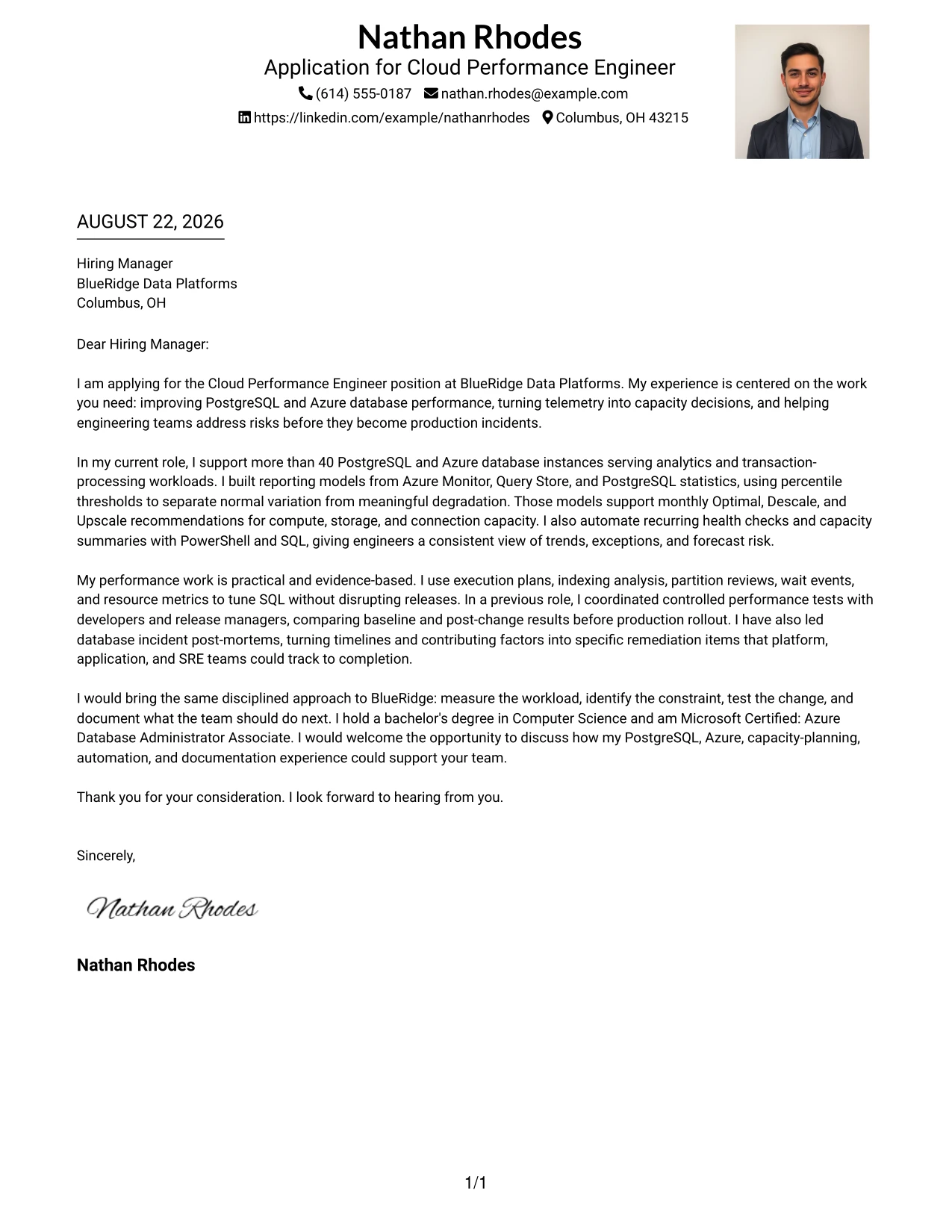
#6 Cover Letter Example: One Column Format with Photo Right
The restrained visual impression of this One Column Format with Photo Right keeps the reader's attention on the role match. The text can present a disciplined sequence: interest in BlueRidge, evidence from PostgreSQL and Azure environments, examples of analysis and automation, and a closing focused on contribution. The right-side visual element should support that hierarchy rather than interrupt it.
Why This Cover Letter Works
- The visual hierarchy leaves the written case for the role in the leading position.
- The one-column body supports a calm explanation of complex performance work.
- The letter can connect reporting models and statistical thresholds to actionable capacity decisions.
- Examples of SQL tuning and controlled tests show how the candidate manages change responsibly.
- Incident post-mortems add evidence of ownership, follow-through, and continuous improvement.
- The right-side visual treatment can distinguish the document while preserving a professional communication tone.
- The closing gives the employer a clear summary of skills and a reason to continue the conversation.
Best For
- Applicants seeking a polished presentation with a clearly secondary visual element
- Letters where role alignment should remain the strongest visual message
- Technical applications that need a steady one-column explanation
- Candidates showing a sequence from monitoring to decision to documented action
- Readers who value visual distinction without a divided narrative
- Applications that combine independent analysis with cross-team follow-through
- Cover letters needing a professional close after detailed evidence
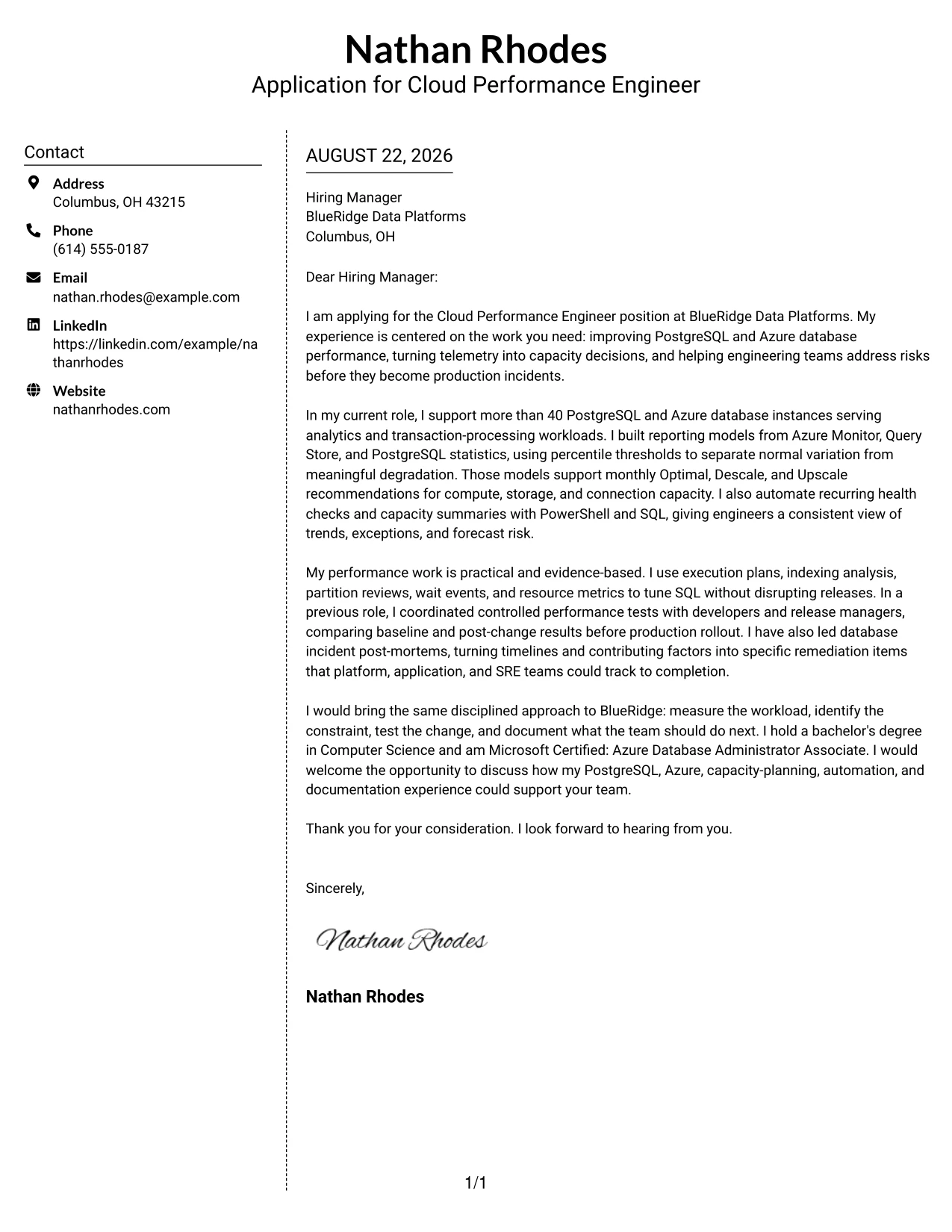
#7 Cover Letter Example: Simple Two Column Format
The Simple Two Column Format organizes the letter into a clear main argument and supporting points. That structure can introduce the application purpose, explain the candidate's performance engineering approach, and make related evidence easy to locate. The result is a practical presentation for a letter that must be concise but still persuasive.
Why This Cover Letter Works
- The format separates the central motivation from supporting qualifications without weakening the connection between them.
- A concise side area can reinforce PostgreSQL, Azure, monitoring, and capacity planning experience.
- The main column can explain the candidate's method for finding constraints and testing improvements.
- The letter can give post-mortem work its own place as proof of continuous improvement.
- Short supporting blocks help the reader compare the application with the job responsibilities.
- A simple design keeps attention on communication quality rather than visual complexity.
- The closing can summarize fit without repeating every technical example.
Best For
- Applications needing a straightforward division between message and supporting proof
- Letters that contain several technical examples but need a simple presentation
- Applicants who want key qualifications visible beside a fuller explanation
- Readers who scan first and then return to the main argument
- Cover letters balancing platform work with communication and knowledge sharing
- Situations where two columns improve organization without creating a decorative feel
- Applications that need a concise conclusion after separated evidence blocks
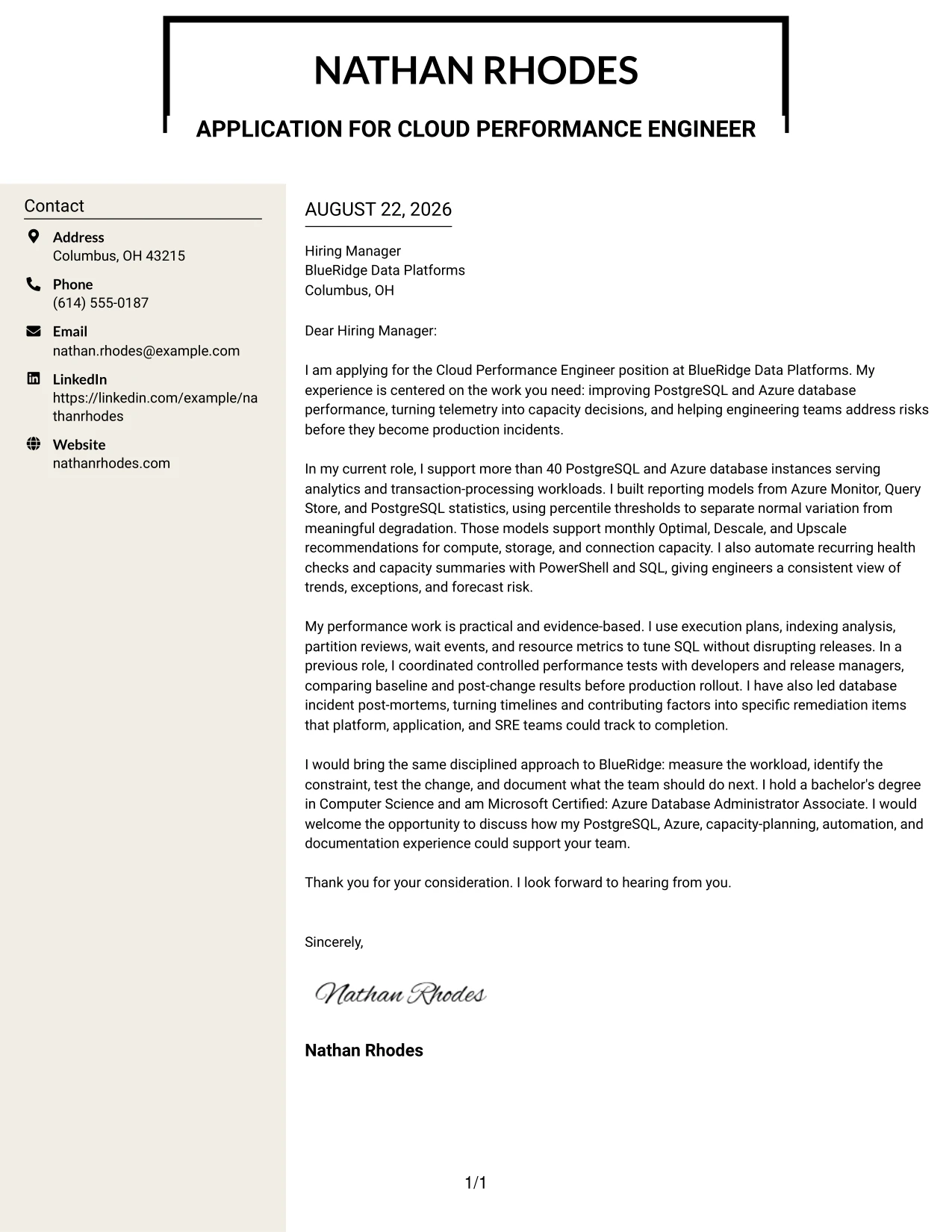
#8 Cover Letter Example: Stylish Two Column Designer Format
Readers can first identify the key message in the sidebar and then move into the fuller explanation in this Stylish Two Column Designer Format. That path is useful when the letter must carry substantial evidence, including workload analysis, capacity decisions, testing, automation, and documentation, while keeping the opening and closing easy to find.
Why This Cover Letter Works
- The sidebar gives the reader an immediate orientation before the detailed letter begins.
- The main area can develop a persuasive explanation of database performance work without crowding the opening.
- The format supports a larger evidence set, including tuning, capacity management, monitoring, and incident review.
- A separate area can emphasize communication strengths such as documentation and knowledge sharing.
- The letter can show both technical depth and the ability to turn findings into team action.
- Clear visual grouping reduces the risk that important supporting evidence will be buried in long paragraphs.
- The closing remains easy to locate because the format establishes strong navigation points.
Best For
- Applicants with several distinct evidence categories to present in one letter
- Applications combining technical analysis, operational decisions, and team communication
- Readers who benefit from a sidebar summary before reviewing detailed proof
- Letters that need room for monitoring, testing, automation, and documentation examples
- Candidates explaining a repeatable method rather than a single isolated achievement
- Situations where visual grouping helps a high-volume letter remain readable
- Applications requiring a prominent closing after a broad evidence set
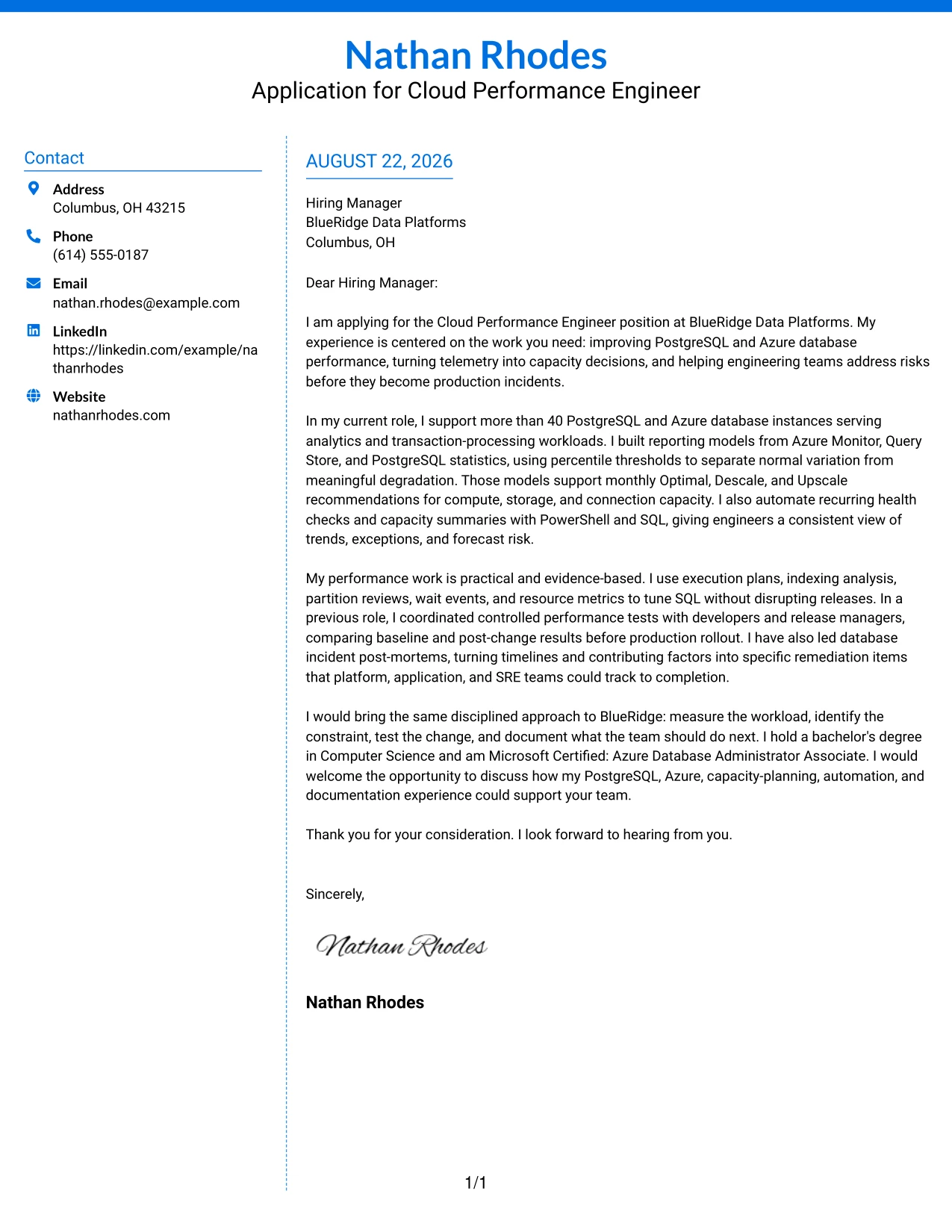
#9 Cover Letter Example: Colored Two Column Format
The strongest evidence should appear first in this Colored Two Column Format. The letter can lead with the match between the role and the candidate's PostgreSQL and Azure experience, then use the second area to support that claim with capacity planning, performance testing, post-mortems, and documentation. Color should guide attention while the written argument remains professional.
Why This Cover Letter Works
- The format makes the primary qualification visible before secondary context.
- A second column can hold supporting examples without taking focus from the main application message.
- The letter can show a full performance cycle: measure workloads, identify constraints, test changes, and document results.
- Capacity recommendations provide direct evidence of judgment and practical resource management.
- Post-mortem experience demonstrates a commitment to prevention and continuous improvement.
- A controlled color treatment can mark sections and improve navigation without replacing written clarity.
- The closing can bring the evidence back to BlueRidge's need for proactive, data-driven engineering.
Best For
- Applications where one central qualification should lead the reader's review
- Letters that need to distinguish primary evidence from supporting examples
- Applicants presenting a complete process from analysis through documented action
- Readers who value quick visual orientation before examining details
- Cover letters combining capacity judgment with performance and incident evidence
- Professional applications where color can improve navigation in a controlled way
- Situations requiring a strong employer-focused close after detailed proof
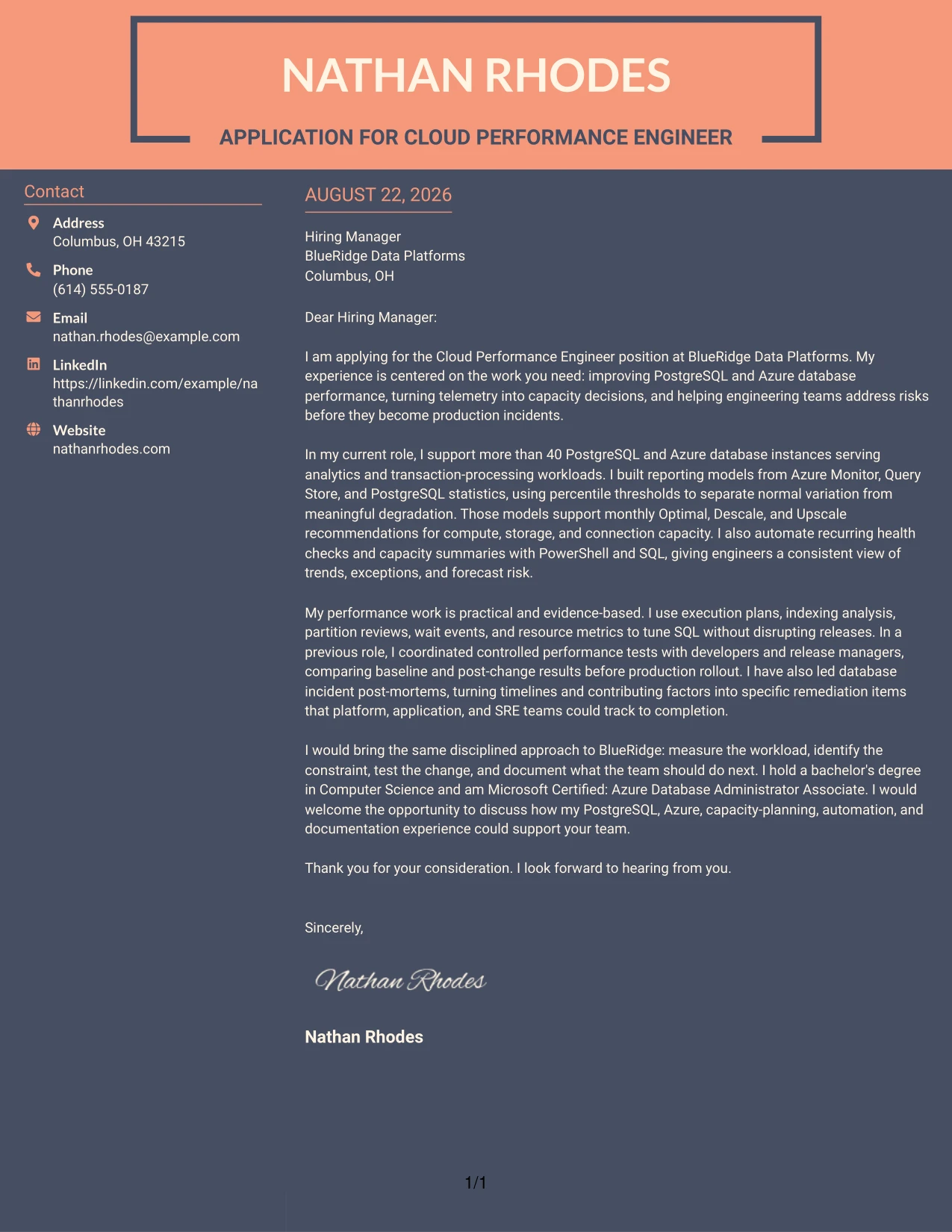
#10 Cover Letter Example: Creative Two Tone Format
A practical review need guides the Creative Two Tone Format: the employer should understand the candidate's value quickly, then see enough proof to trust the claim. Nathan Rhodes can use the letter to connect database performance, capacity management, automation, and documentation to BlueRidge Data Platforms' responsibilities. The two-tone treatment should separate ideas while keeping the message focused.
Why This Cover Letter Works
- The opening can state the target role and strongest point of alignment without delay.
- A two-tone structure creates a natural distinction between motivation and supporting evidence.
- The body can explain how monitoring and statistical thresholds inform capacity decisions.
- Automation examples show an effort to make recurring analysis consistent and useful to engineering teams.
- The letter can connect technical work with communication through runbooks, reports, and knowledge sharing.
- The creative treatment adds identity while the content remains grounded in documented experience.
- A focused closing converts the visual impression into a clear invitation to discuss fit.
Best For
- Applications needing a clear distinction between motivation and evidence
- Applicants who want a memorable presentation without losing a direct message
- Letters explaining recurring analysis, capacity decisions, and operational follow-through
- Readers who benefit from grouped content rather than one uninterrupted block
- Candidates connecting technical work with reporting and knowledge sharing
- Professional settings where a restrained creative element can support recognition
- Applications that need a concise employer-focused close
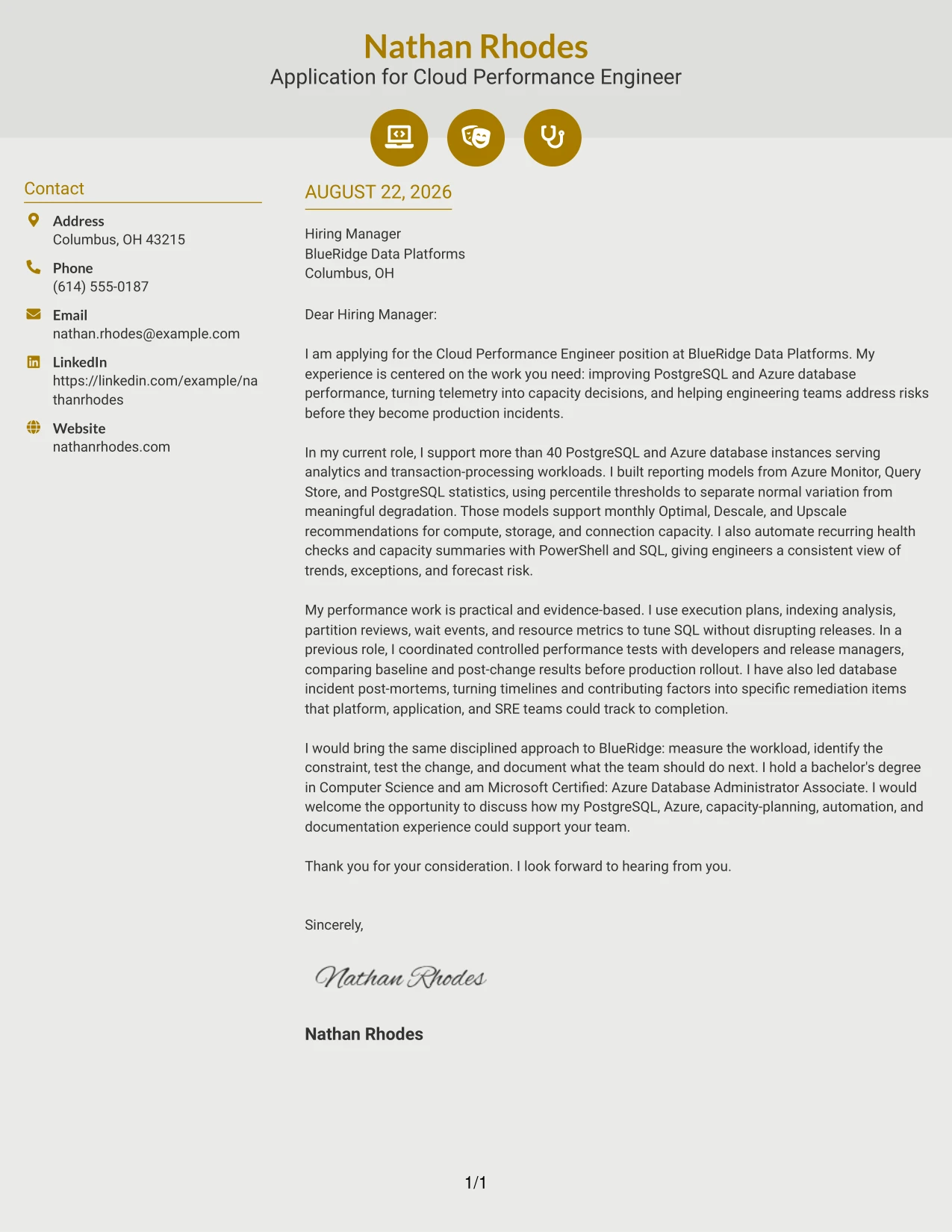
#11 Cover Letter Example: Modern Icon Format
A modern application benefits from a clear visual entry point, and the Modern Icon Format provides one without changing the letter's purpose. The content can introduce the Cloud Performance Engineer application, connect PostgreSQL and Azure experience to the employer's needs, and use short, well-grouped evidence to support motivation, communication style, and fit.
Why This Cover Letter Works
- The opening gives the reader a quick reason to continue with the application.
- Small visual markers can guide attention to evidence while the prose carries the persuasion.
- The letter can show how monitoring, workload analysis, and performance testing support sound decisions.
- Capacity planning and automation demonstrate a forward-looking approach to operational risk.
- Post-mortems and documentation provide evidence of accountability beyond technical troubleshooting.
- The format supports a modern presentation while keeping the tone suitable for a professional employer.
- The closing can restate interest and make the candidate's potential contribution easy to remember.
Best For
- Applicants who want a modern presentation with clear visual signposts
- Letters that need to group several related qualifications without long headings
- Candidates showing both technical analysis and operational accountability
- Readers who appreciate quick orientation before reading supporting details
- Applications connecting monitoring, testing, capacity planning, and documentation
- Professional communications that need visual distinction without a divided layout
- Cover letters ending with a concise, memorable statement of contribution
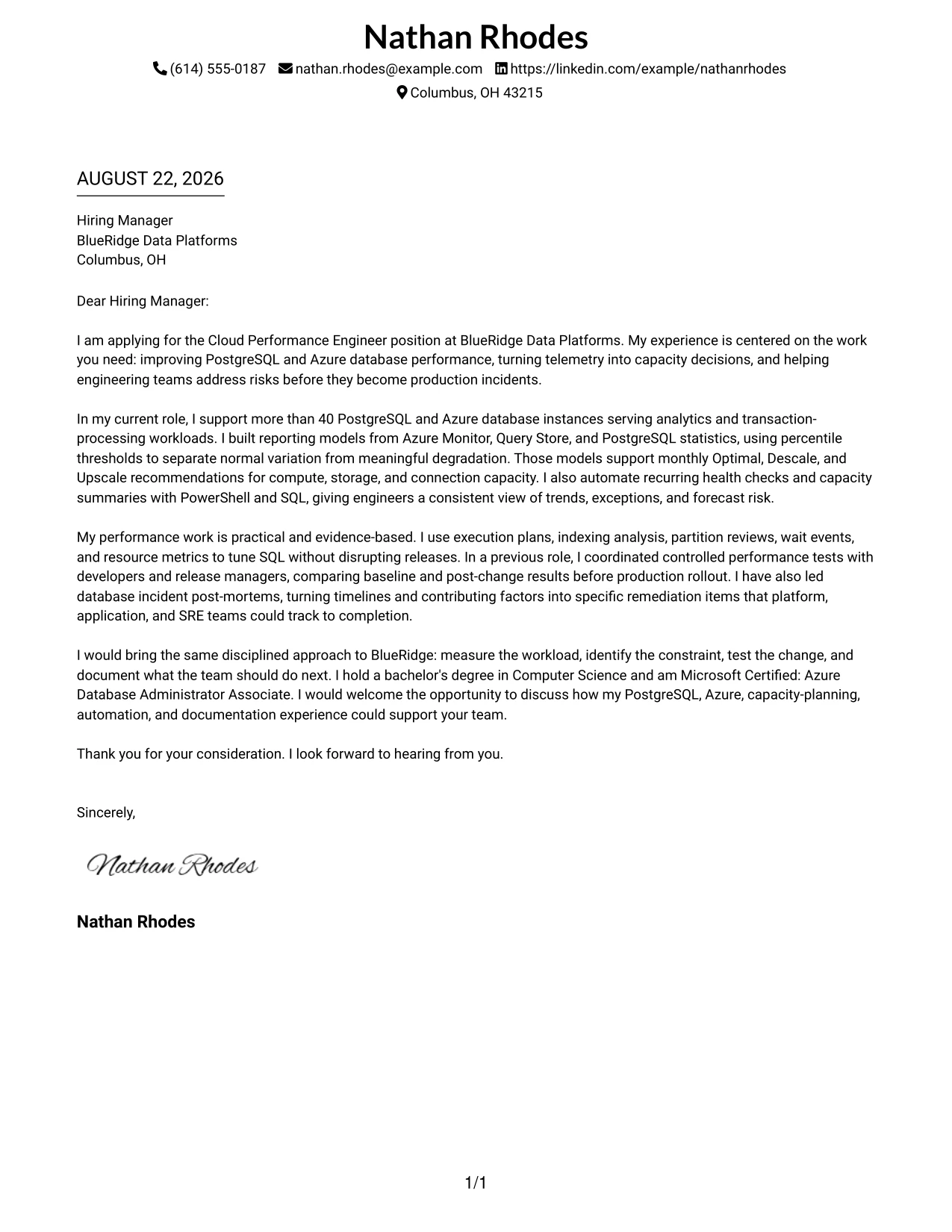
#12 Cover Letter Example: Minimal Header Format
A restrained visual hierarchy keeps attention on the reason for applying, the strongest PostgreSQL and Azure database evidence, and the closing connection to BlueRidge Data Platforms. The simple header gives the letter a direct, professional tone while one-column reading supports a clear progression from motivation to proof, team fit, and next steps.
Why This Cover Letter Works
- The opening states the Cloud Performance Engineer role and connects the application to BlueRidge's database performance needs.
- The first body paragraph presents relevant scale through responsibility for more than 40 PostgreSQL and Azure database instances.
- Reporting models, percentile thresholds, and capacity recommendations provide concrete evidence of analytical judgment.
- The second body paragraph explains how execution plans, indexing, partition reviews, and resource metrics support practical tuning decisions.
- Post-mortem leadership shows that the candidate can turn incidents into tracked improvement work.
- The final paragraph links technical experience with the company's needs for testing, automation, documentation, and risk control.
- The quiet header and single reading path keep the persuasive message easy to follow without distracting design elements.
Best For
- Applicants who want the opening motivation and role match to receive immediate attention.
- Letters that need a direct one-column path from interest to evidence and closing.
- Applications where technical details must remain readable without competing visual panels.
- Candidates presenting several connected examples of analysis, testing, and operational improvement.
- Professional communication that benefits from a calm and formal first impression.
- Letters addressed to a hiring manager when clarity is more important than visual variety.
- Applications that need a clean balance between detailed evidence and a concise closing request.
#13 Cover Letter Example: Clean Two Column Sidebar Format
The format separates contact and supporting details from the main letter, helping a reader move quickly between context and argument. That structure gives the application room to show motivation, database performance evidence, and collaboration examples while keeping the central narrative focused on the Cloud Performance Engineer opportunity.
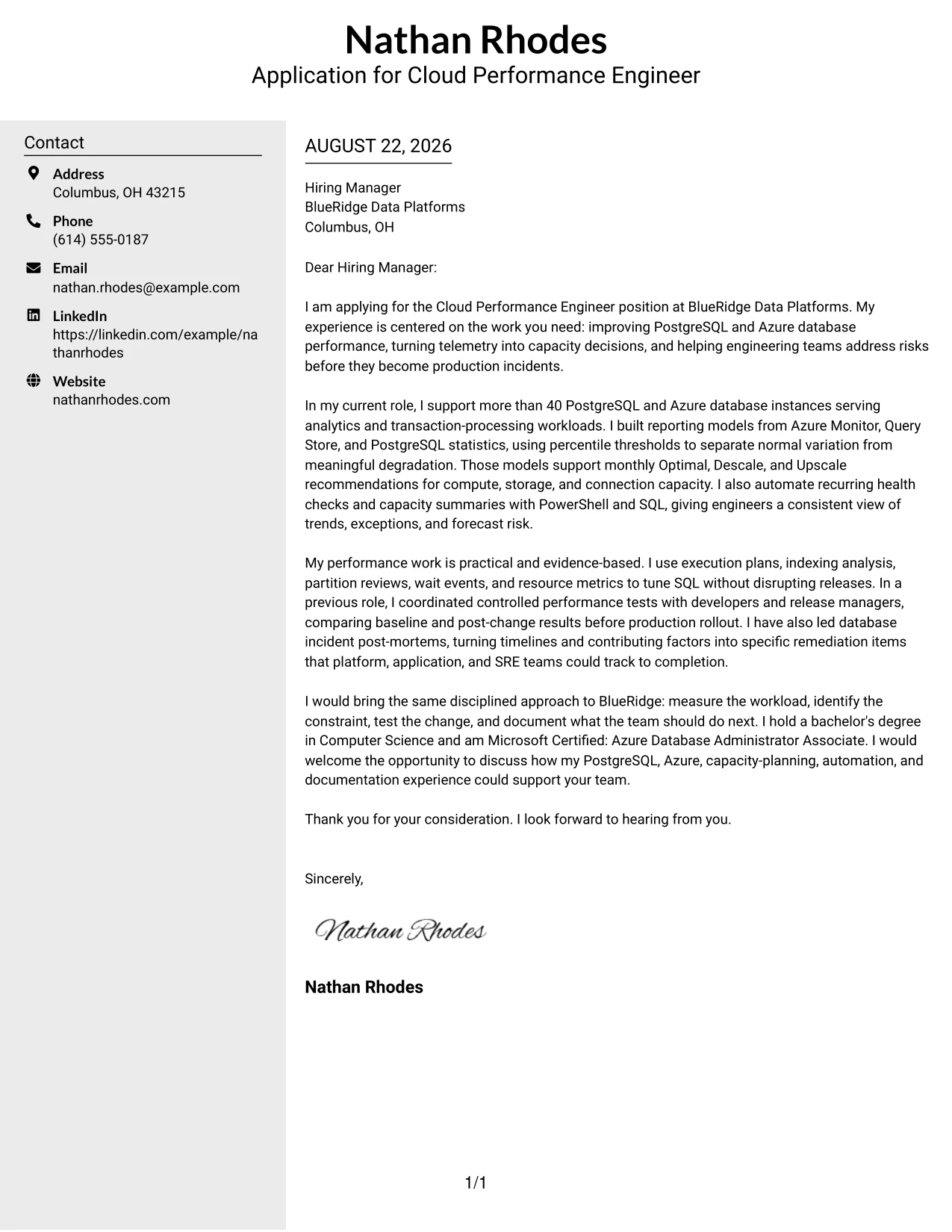
Why This Cover Letter Works
- The sidebar can make contact information and application context easy to locate before the reader enters the main argument.
- The introduction directly connects the candidate's experience with PostgreSQL, Azure, telemetry, and capacity decisions.
- A separate visual area supports quick orientation while the main column carries the persuasive body.
- The letter uses the 40-plus-instance responsibility as a strong early proof point rather than burying it near the close.
- Technical evidence is explained in context, including percentile thresholds and Optimal, Descale, and Upscale recommendations.
- Examples of working with developers, release managers, platform teams, and SRE stakeholders strengthen the collaboration case.
- The closing returns to BlueRidge's needs and gives the reader a clear reason to continue the conversation.
Best For
- Applications with enough supporting context to benefit from a distinct side area.
- Readers who scan contact details first and then review the main argument in sequence.
- Letters combining operational evidence with several short explanations of team collaboration.
- Candidates who need to present technical scope without making the main paragraphs feel crowded.
- Situations where visual separation can distinguish application details from persuasive content.
- Professional letters that must support both quick review and a fuller reading.
- Applications where related evidence can be grouped without interrupting the central narrative.
#14 Cover Letter Example: Plain Two Column Format
Recruiters can follow the letter from the opening statement to the evidence paragraphs and then to the fit-focused close, with the two columns helping separate ideas without adding visual noise. This is useful for a detailed application that must explain performance engineering work, capacity planning, and communication ability in a controlled amount of space.
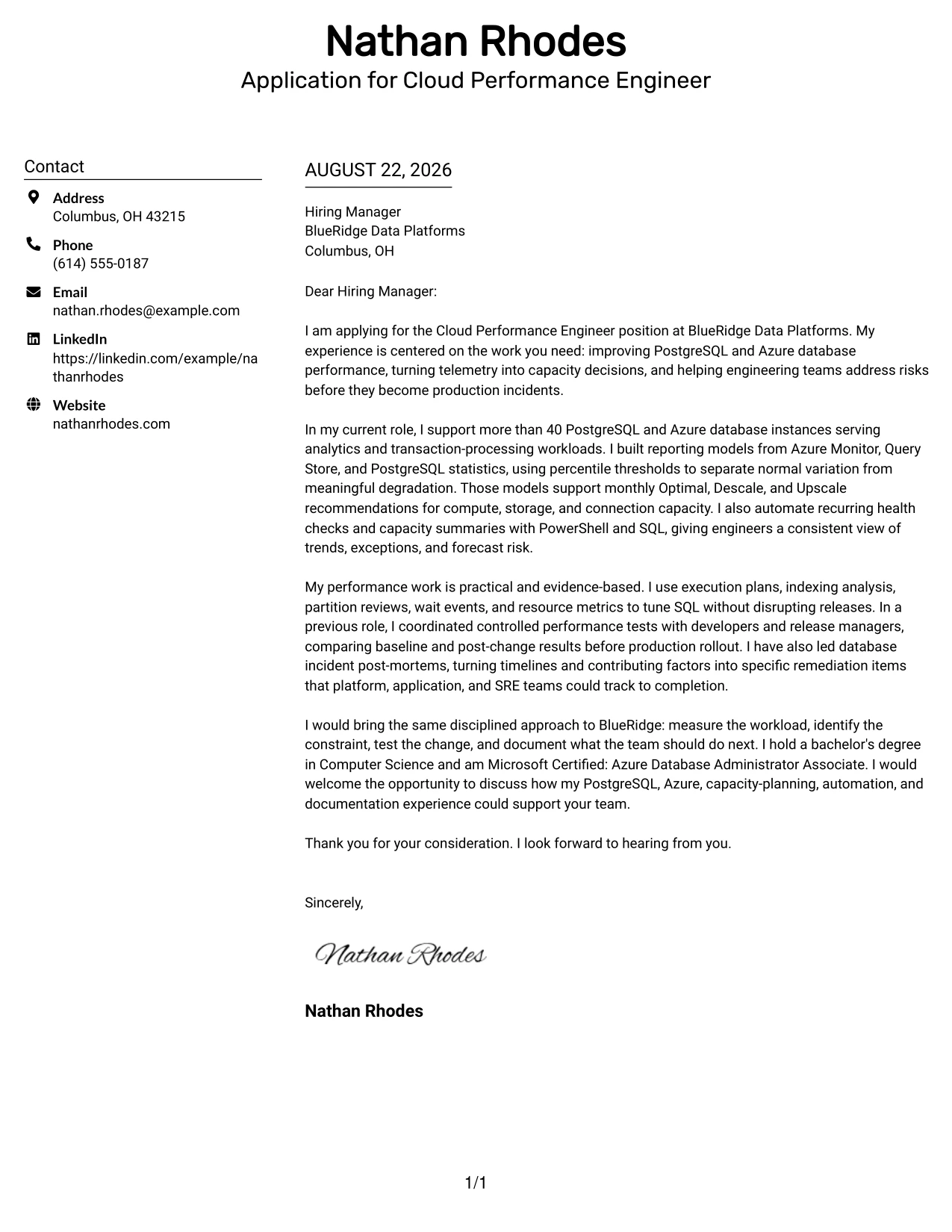
Why This Cover Letter Works
- The opening identifies the role and gives three clear reasons for the application: performance improvement, capacity decisions, and risk reduction.
- The two-column organization can divide supporting context from the main message while preserving a professional tone.
- The letter includes substantial evidence without relying on a long list of disconnected claims.
- Azure Monitor, Query Store, and PostgreSQL statistics show how the candidate builds conclusions from operational data.
- Performance testing and baseline comparisons demonstrate care before production changes are released.
- Post-mortem work and documentation support the claim of continuous improvement rather than presenting tuning as a one-time task.
- The final paragraph combines degree, certification, technical scope, and a specific invitation to discuss contribution.
Best For
- Letters with several evidence paragraphs that need stronger spatial organization.
- Applications where the reader may alternate between quick scanning and detailed review.
- Candidates explaining both technical investigation and the business effect of capacity choices.
- Communication that requires room for tools, methods, and team outcomes without excessive visual decoration.
- Professional applications that need a balanced presentation of evidence and motivation.
- Letters for roles where documentation and knowledge sharing are as important as technical execution.
- Readers who value a straightforward layout while reviewing a moderately detailed case for fit.
#15 Cover Letter Example: Modern Full Background Two Column Format
The strongest evidence should arrive early: more than 40 database instances supported, reporting models built from telemetry, and clear capacity actions based on percentile thresholds. A full-background two-column presentation can frame that evidence with a modern hierarchy while the letter explains how those results connect to BlueRidge's need for reliable PostgreSQL and Azure performance.
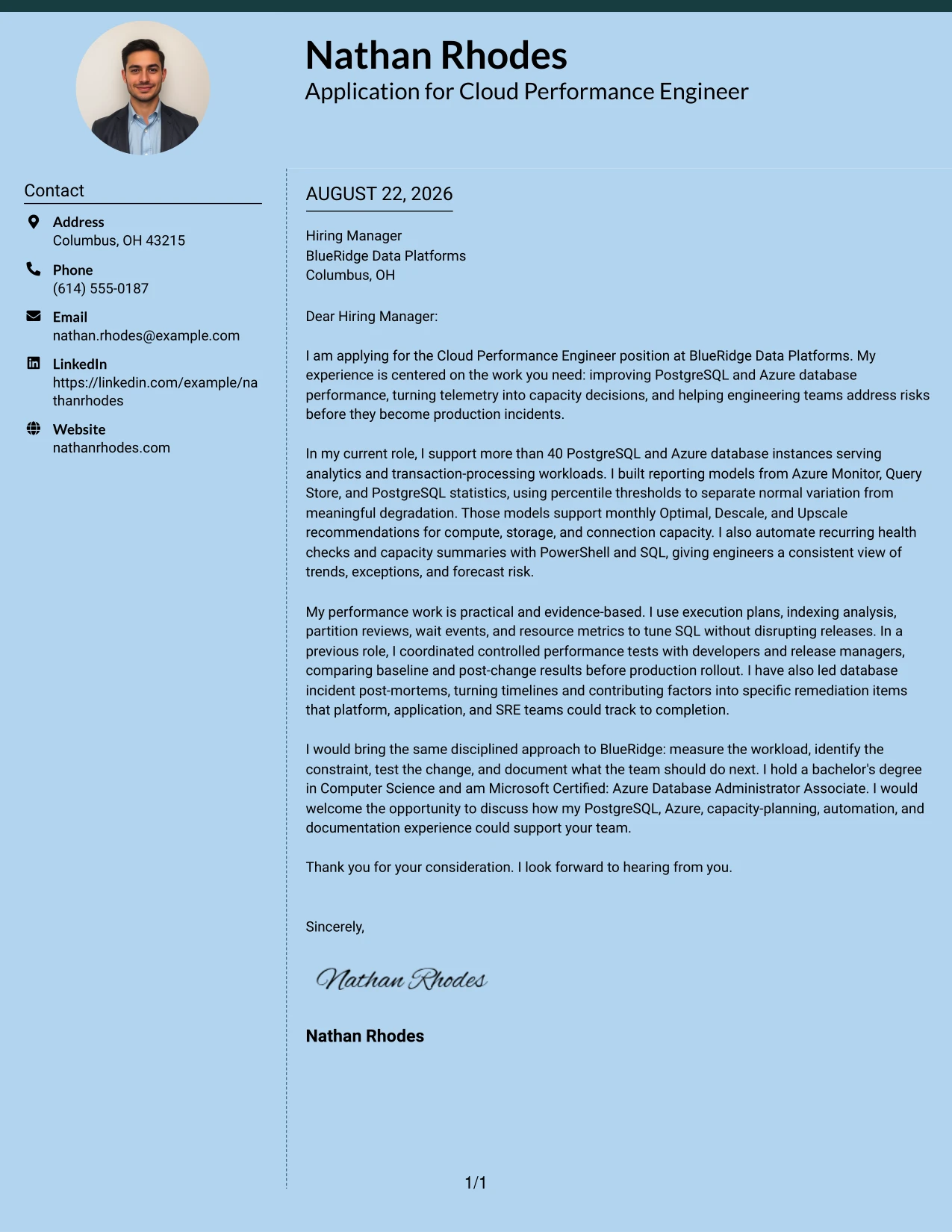
Why This Cover Letter Works
- The first sentence makes the application relevant by naming the performance, capacity, and risk work the employer needs.
- Early evidence gives the reader a reason to trust the claims before the letter moves into methods and collaboration.
- The layout can give the main proof a strong visual position while keeping contact and context distinct.
- Capacity recommendations are specific, including compute, storage, and connection capacity decisions.
- The technical paragraph shows disciplined validation through execution plans, indexing analysis, partition reviews, and controlled tests.
- Incident post-mortems add evidence of ownership after problems occur, not only during planned optimization.
- The closing converts the evidence into a forward-looking contribution to BlueRidge's team.
Best For
- Applications where the most persuasive evidence should appear before supporting details.
- Letters that need a modern presentation for data-rich technical experience.
- Candidates showing measurable responsibility, analytical methods, and operational follow-through together.
- Situations where a two-part structure can distinguish proof from context.
- Communication that benefits from visible emphasis on capacity, reliability, and risk decisions.
- Applications requiring a confident tone while retaining specific technical explanations.
- Letters where the visual frame should support a strong argument without replacing it.
#16 Cover Letter Example: Dark Mode Two Column Format
Balanced spacing gives each part of the application a defined job: the opening establishes interest, the body proves technical judgment, and the close confirms fit. In a dark two-column presentation, that balance can create a confident setting for evidence about PostgreSQL tuning, Azure monitoring, capacity management, and post-mortem leadership.
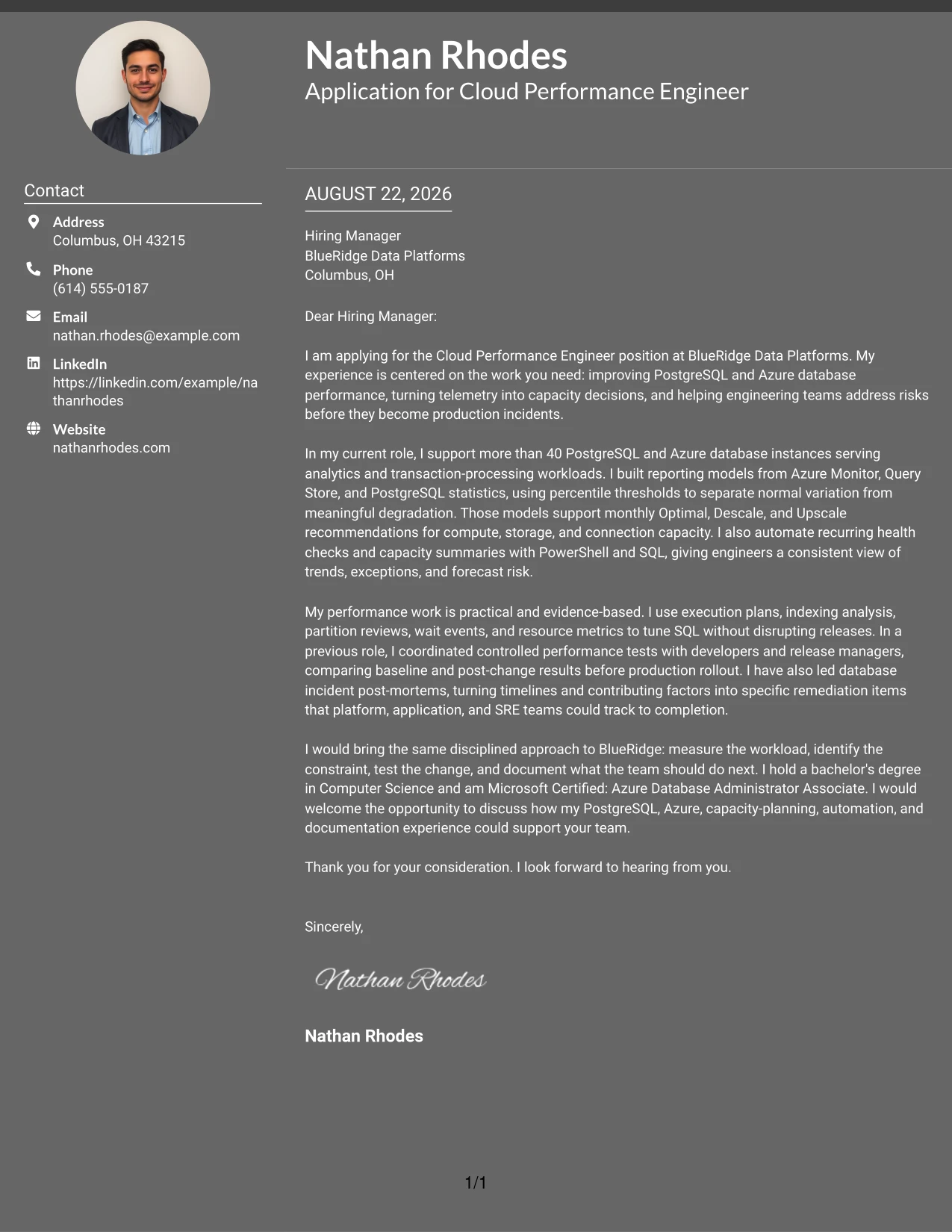
Why This Cover Letter Works
- The opening is brief and purposeful, making the employer's needs the center of the application.
- Separate areas can organize application context and the main persuasive narrative without repeating information.
- The letter proves capacity-management ability through Optimal, Descale, and Upscale recommendations.
- Monitoring evidence is concrete because it names Azure Monitor, Query Store, PostgreSQL statistics, and percentile thresholds.
- The tuning paragraph explains a repeatable method rather than claiming broad technical ability without support.
- Incident reviews and tracked remediation items show responsibility for improvement after production events.
- The closing brings together technical skills, education, certification, and willingness to discuss team contribution.
Best For
- Applications that need a confident visual frame around a clear technical argument.
- Letters where spacing should prevent dense operational evidence from feeling overwhelming.
- Candidates connecting monitoring, tuning, capacity decisions, and incident learning in one story.
- Professional communication intended for digital review with distinct content zones.
- Situations where a strong presentation can support, but not overshadow, detailed proof.
- Letters that need to move from immediate role fit to tested methods and future contribution.
- Applications with enough content to justify two balanced areas without unnecessary repetition.
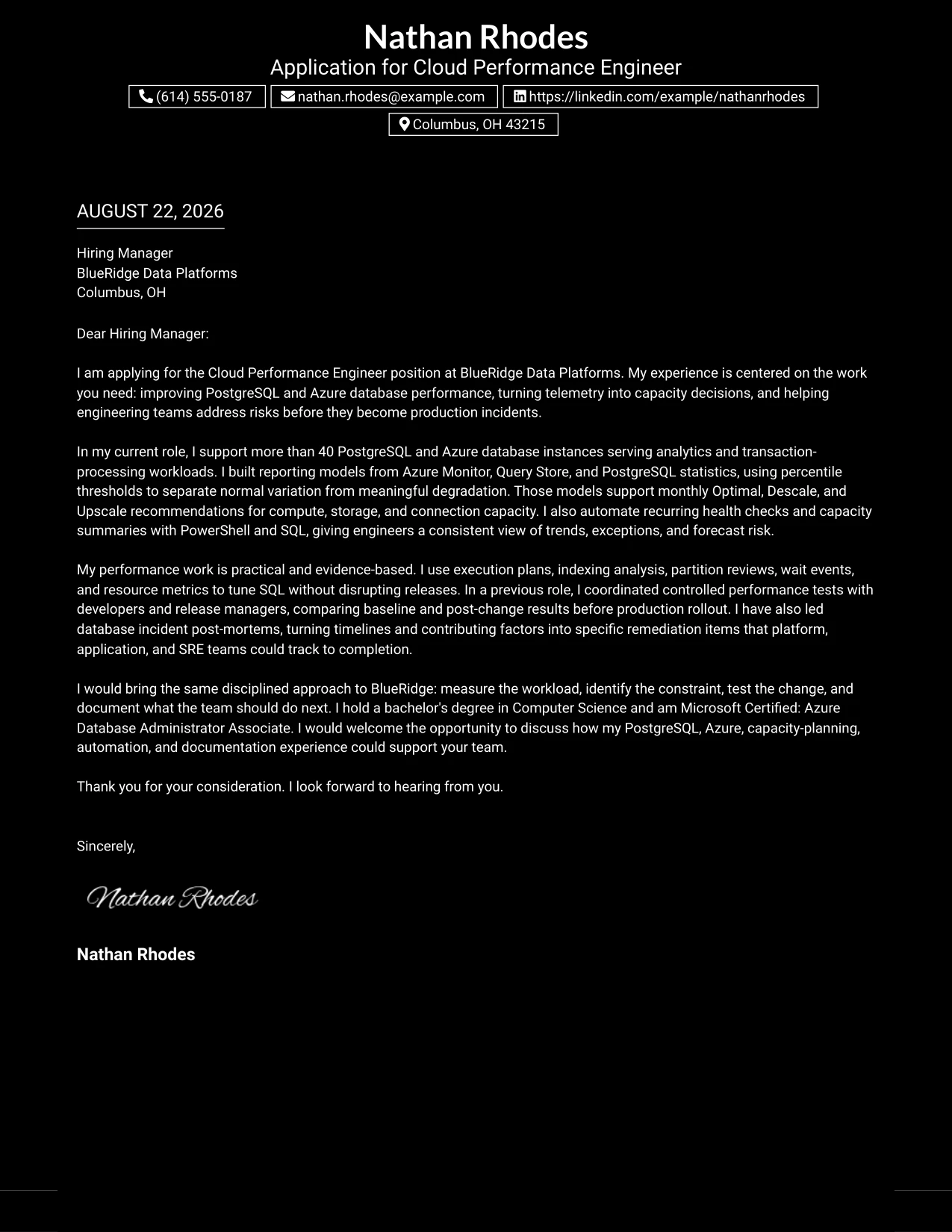
#17 Cover Letter Example: Dark Mode Box Header Format
For a practical job application, the reader needs to identify the role, understand the candidate's strongest proof, and see a clear next step without searching through the page. A boxed header can establish that context immediately, while the one-column letter develops the case through database tuning, capacity recommendations, post-mortem work, and team communication.
Why This Cover Letter Works
- The header creates a clear starting point for the application and keeps the recipient and role context easy to identify.
- The opening quickly links the candidate's background to BlueRidge's PostgreSQL and Azure database responsibilities.
- The body uses a logical sequence: current scope, analytical methods, performance testing, incident learning, and future contribution.
- The letter gives concrete scale through support for more than 40 database instances.
- Automation with PowerShell and SQL shows that the candidate improves recurring review work, not only individual incidents.
- The communication examples make technical knowledge relevant to application owners, developers, release managers, and support teams.
- The closing is direct and courteous, with a clear invitation to discuss fit.
Best For
- Applications where role and recipient details should be obvious at the first glance.
- Letters that need a firm visual entry point before a detailed one-column argument.
- Candidates presenting a clear sequence of responsibility, evidence, and intended contribution.
- Digital applications where strong section boundaries can improve orientation.
- Communication that must feel organized and decisive without using a complex page structure.
- Letters with several technical examples that need a steady reading order.
- Professional settings where a polished header can reinforce readiness for a focused conversation.
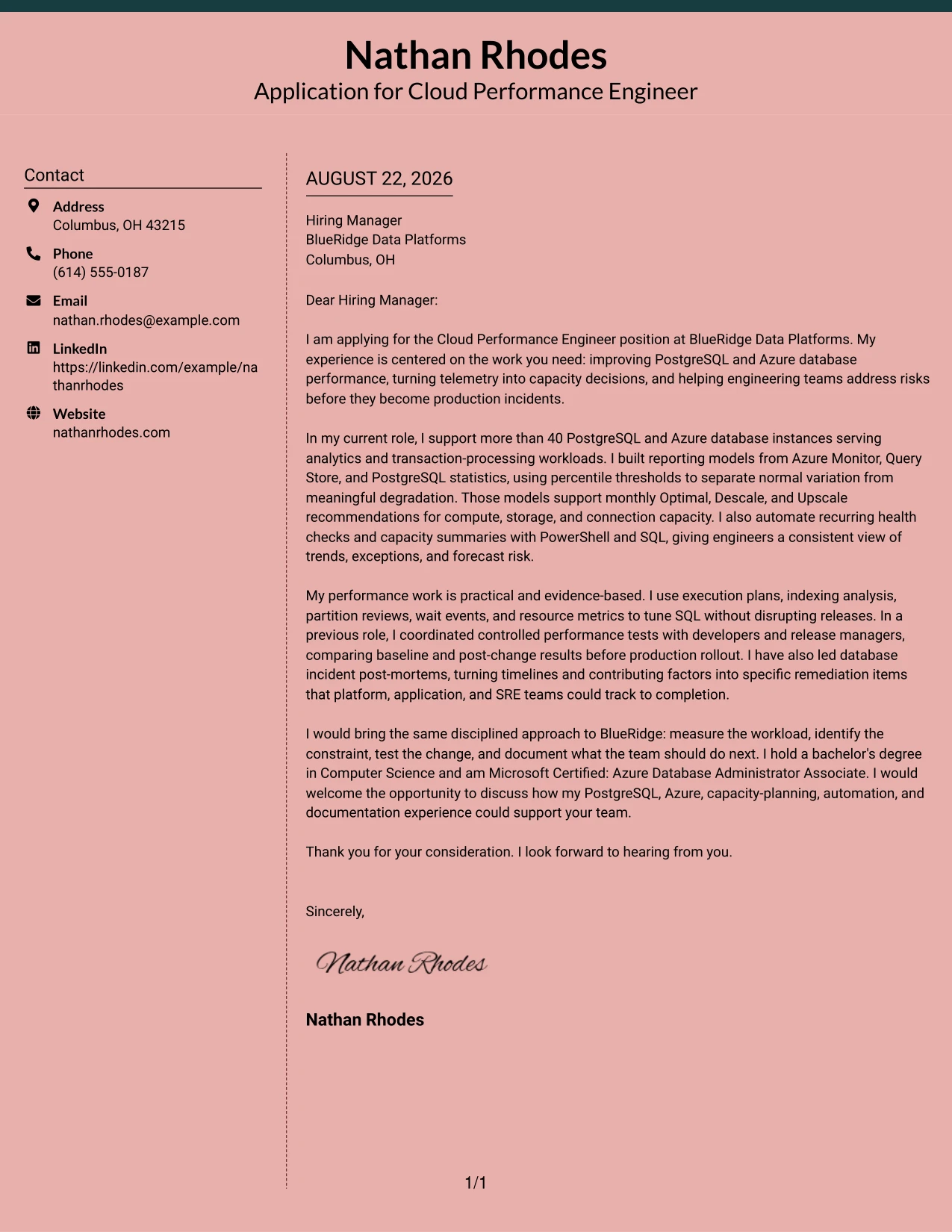
#18 Cover Letter Example: Elegant Full Background Two Column Format
A polished, restrained hierarchy helps the letter communicate confidence without taking attention away from the evidence. The two-column structure can pair a concise statement of motivation with a fuller explanation of database reliability, workload analysis, performance testing, and the collaborative habits that support BlueRidge's work.
Why This Cover Letter Works
- The opening presents a clear professional motive tied to improving performance and preventing production risk.
- The format can give the reader a quick context area while preserving room for a detailed central argument.
- Current responsibility across analytics and transaction-processing workloads makes the experience relevant to varied database demands.
- Workload profiles and percentile thresholds show that recommendations are based on evidence rather than assumption.
- The letter explains how tuning decisions are validated before release, which supports a careful and reliable communication style.
- Post-mortem analysis and documentation show that lessons are shared across platform, application, and SRE teams.
- The close combines qualifications with a forward-looking statement about supporting BlueRidge's team.
Best For
- Applications that need a refined presentation for a serious, evidence-led message.
- Letters pairing a concise motivation statement with a fuller account of relevant work.
- Candidates showing both technical depth and careful communication with multiple teams.
- Situations where visual calm can reinforce reliability and sound judgment.
- Professional applications that need to present several related examples without a crowded appearance.
- Letters where the employer should see practical methods as well as overall role alignment.
- Readers who prefer a polished structure that supports close review of the argument.
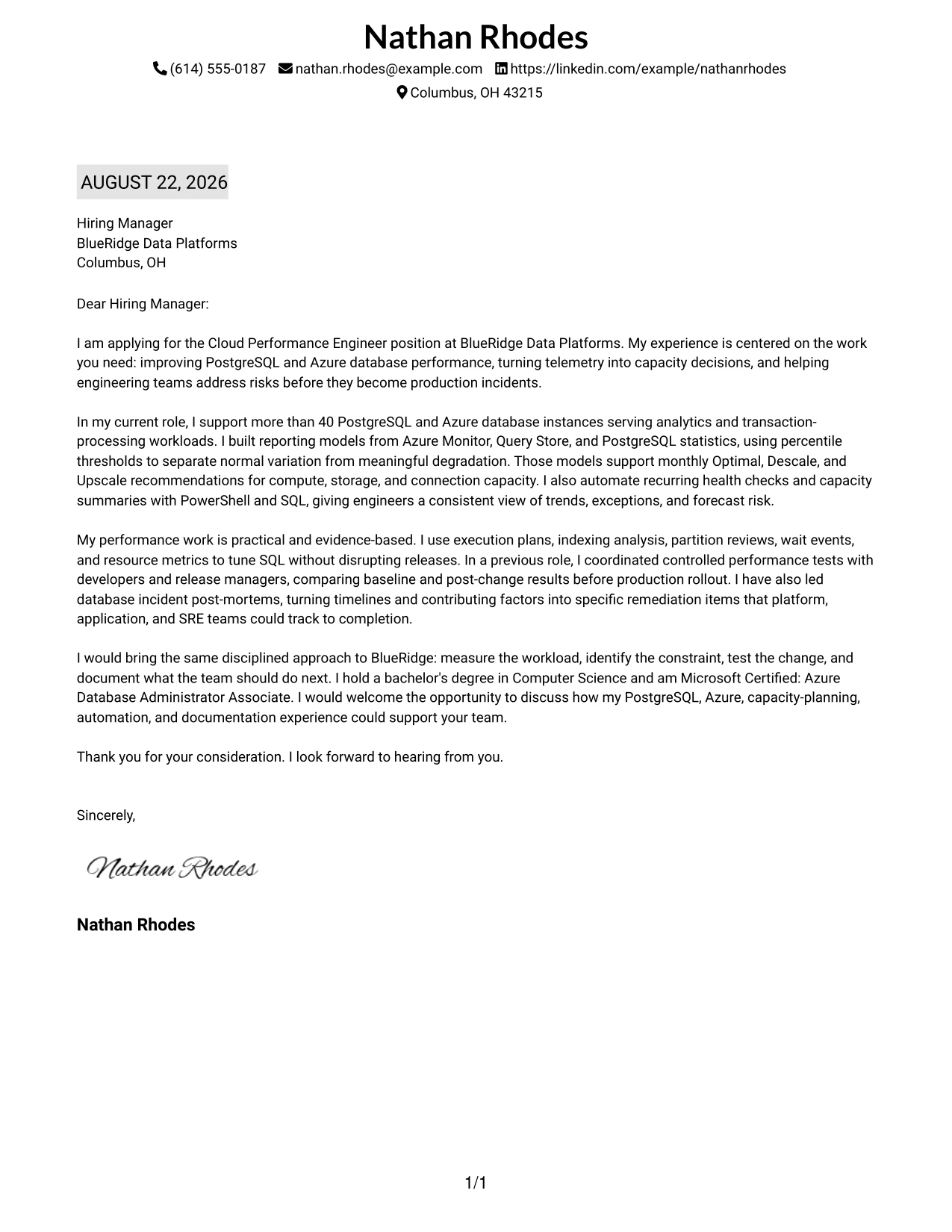
#19 Cover Letter Example: Plain One Column with Highlighted Date
A single-column letter with a visible date creates a familiar record of the application and keeps every paragraph in one dependable sequence. That straightforward structure suits a message that must explain current performance ownership, earlier testing and incident work, and the specific value the candidate could bring to BlueRidge.
Why This Cover Letter Works
- The dated structure gives the application a clear point of reference while leaving the message easy to read.
- The opening states the role and immediately identifies the match between experience and responsibilities.
- A one-column sequence keeps the evidence connected from current database scope to prior performance testing and post-mortems.
- The letter uses concrete tools and methods to support its claims, including Query Store, EXPLAIN, and resource metrics.
- The capacity paragraph demonstrates judgment across compute, storage, and connection-pool changes.
- The closing connects the candidate's Computer Science degree and Azure certification to the requested qualifications.
- The plain presentation keeps the employer's attention on motivation, proof, and fit rather than decoration.
Best For
- Applications that benefit from a clear dated record and a traditional reading sequence.
- Letters where the full argument should be reviewed from top to bottom without side areas.
- Candidates with enough evidence to fill a complete narrative but no need for complex grouping.
- Formal submissions that need visible application context and straightforward organization.
- Communication that should make methods and qualifications easy to locate in order.
- Letters connecting current responsibilities with earlier examples of testing and incident response.
- Readers who value familiar presentation and direct explanation over visual effects.
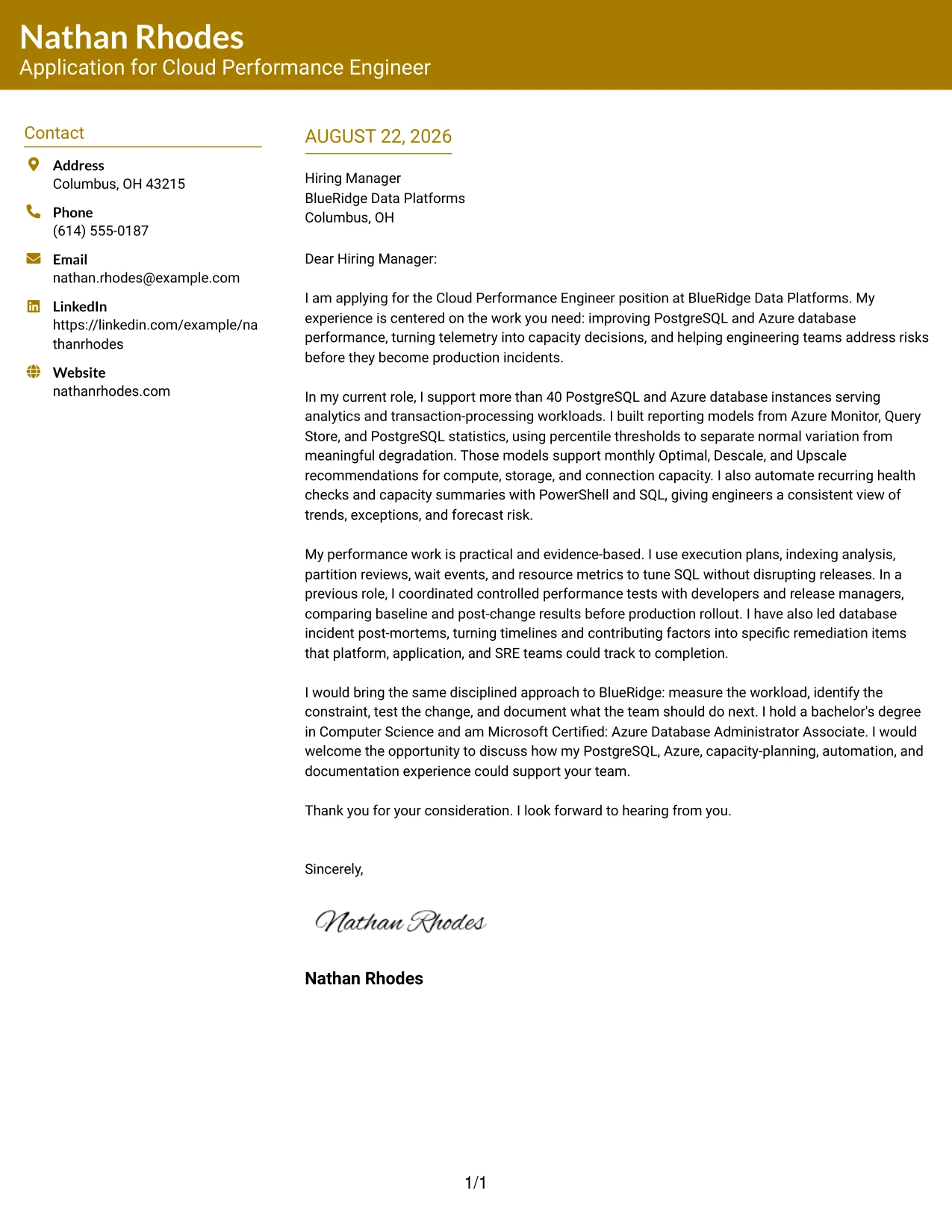
#20 Cover Letter Example: Bold Color Header Professional Format
The reader first encounters the application context, then moves through a focused account of performance ownership, analytical methods, and employer fit. A bold header can make that route easy to recognize, while the letter itself remains professional and evidence-led. It gives Nathan Rhodes room to explain how PostgreSQL and Azure experience supports BlueRidge's capacity and reliability goals.
Why This Cover Letter Works
- The prominent header makes the applicant and application context easy to identify before the argument begins.
- The opening is specific about BlueRidge's needs rather than relying on a general statement of interest.
- The letter presents current scope, including responsibility for more than 40 database instances, as central evidence.
- Reporting models and statistical thresholds show an ability to turn telemetry into actionable decisions.
- The performance paragraph balances technical depth with release awareness and collaboration.
- The final body paragraph explains how documentation, automation, and capacity planning would transfer to the employer's work.
- The close is concise and gives the hiring manager a natural reason to continue the discussion.
Best For
- Applications that need a strong first point of orientation before detailed reading.
- Letters with enough content to benefit from a clear professional header and steady body flow.
- Candidates who want current responsibility and analytical evidence to lead the message.
- Digital submissions where role, applicant, and recipient context should stand out quickly.
- Communication that combines technical specificity with a polished employer-facing tone.
- Applications where a single column can keep a persuasive narrative connected from start to finish.
- Letters that need to show both immediate contribution and readiness for a follow-up discussion.
#21 Cover Letter Example: Photo Header Color Sidebar Format
The evidence should lead the reader's judgment: this application shows database scale, data-driven capacity decisions, tested tuning methods, and post-mortem ownership. A color sidebar and photo header can then add a personal point of recognition while the main letter explains how that evidence fits BlueRidge's Cloud Performance Engineer role.
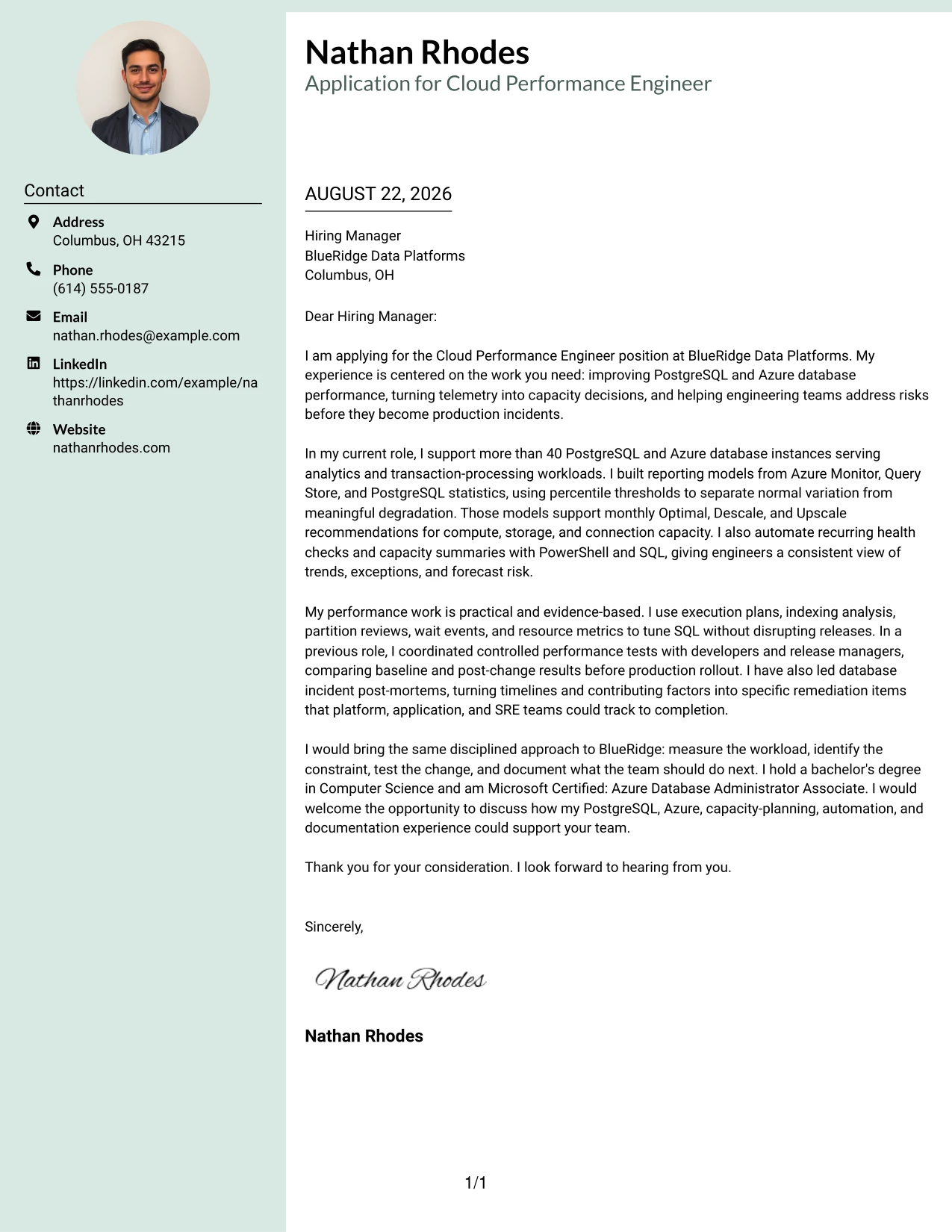
Why This Cover Letter Works
- The opening keeps the professional case ahead of visual elements by naming the employer's core performance needs.
- A photo header can support personal recognition when it is appropriate for the application context and presented professionally.
- The sidebar can hold contact or application details while the main text develops the evidence.
- Support for 40-plus PostgreSQL and Azure database instances gives the employer a clear measure of operating scope.
- The letter explains the reasoning behind capacity actions instead of presenting Optimal, Descale, and Upscale as unexplained labels.
- Controlled tests, execution-plan analysis, and incident reviews demonstrate a disciplined improvement cycle.
- The closing combines technical fit, communication ability, degree, and Azure certification in a direct invitation to talk.
Best For
- Applications where personal recognition is appropriate alongside a strong evidence-led message.
- Letters needing a distinct area for contact details while the main column carries the argument.
- Candidates presenting technical scale, testing discipline, and operational ownership together.
- Digital submissions where a color accent can help readers separate context from proof.
- Communication that must show both individual presence and clear professional substance.
- Applications with several evidence types that benefit from visual grouping rather than long uninterrupted text.
- Letters for employers open to a more personal presentation while still expecting rigorous technical detail.
#22 Cover Letter Example: Top Left Header Color Accent Format
Even spacing lets the application move from practical interest to technical proof and then to a clear request for conversation. A top-left header and restrained color accent can guide that progression without making the letter feel crowded, which suits an application built around workload analysis, capacity planning, automation, and knowledge sharing.
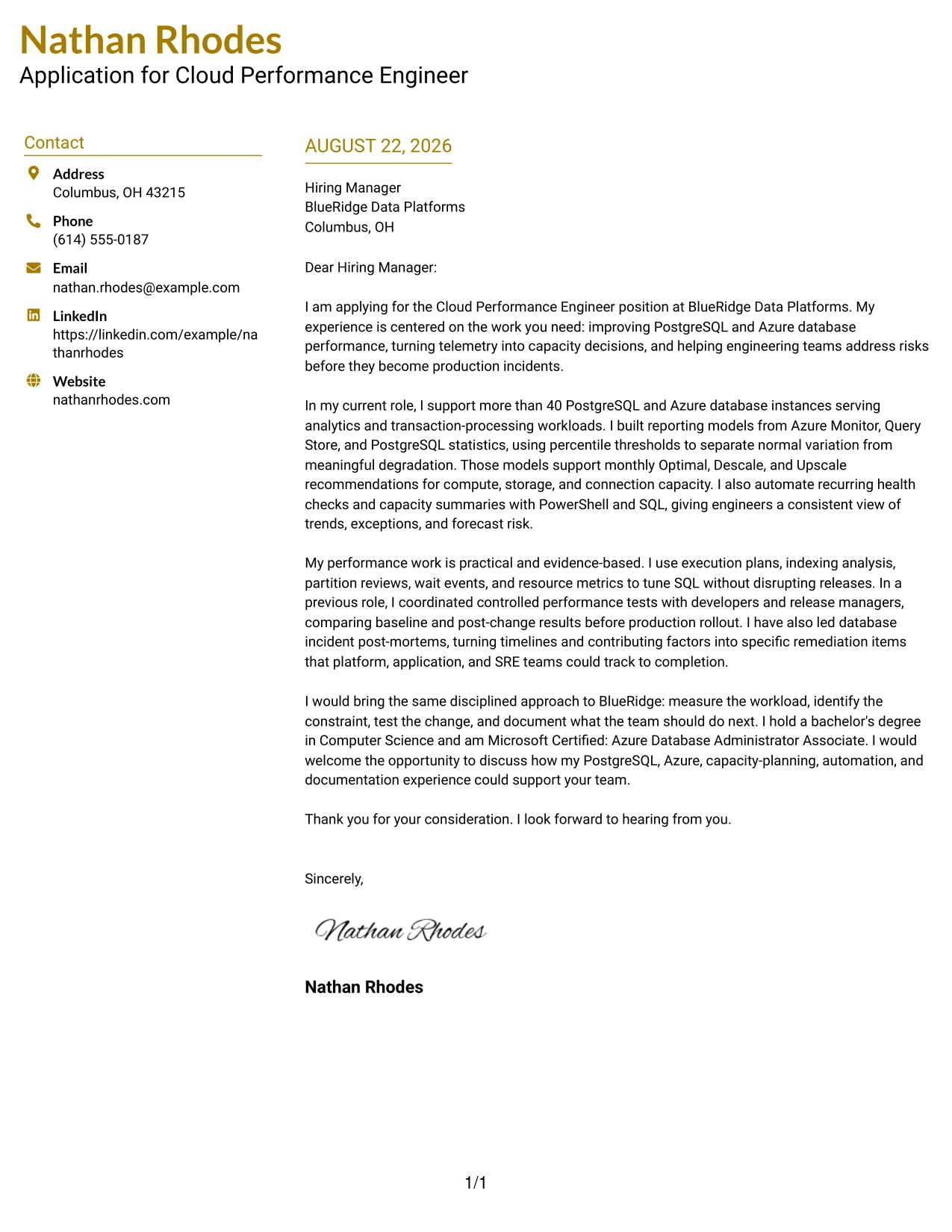
Why This Cover Letter Works
- The top-left starting point gives the reader a natural entry into the role, employer, and reason for applying.
- The opening frames the candidate as someone who improves performance and addresses risk before incidents occur.
- The body develops that claim through reporting models, statistical thresholds, and capacity recommendations.
- Technical methods such as execution-plan review and indexing analysis make the performance claims credible.
- The letter includes automation and documentation, showing value beyond individual database investigations.
- Knowledge sharing and cross-team post-mortems support the employer's need for clear collaboration and continuous improvement.
- The close is balanced: it confirms qualifications while asking for a focused discussion about contribution.
Best For
- Applications needing a clear upper-left entry point and a measured professional tone.
- Letters that should guide the reader through motivation, proof, and closing in a steady order.
- Candidates combining technical investigation with automation, documentation, and team learning.
- Situations where a small color accent can improve orientation without dominating the message.
- Communication that must remain easy to scan while still explaining several methods and outcomes.
- Applications where the employer values practical risk reduction and clear follow-through.
- Letters that need a focused closing request after a well-balanced case for fit.
#23 Cover Letter Example: Centered Header Classic Two Column Format
For an application that must present technical fit quickly, the Centered Header Classic Two Column Format gives the letter a clear starting point and balanced reading path. The centered contact area establishes a professional first impression, while the two-column structure can separate recipient details from the main message. The letter should then connect experience with PostgreSQL and Azure database performance, capacity decisions, automation, and risk reduction. That direct structure helps BlueRidge Data Platforms see both motivation and practical value without searching through dense text.
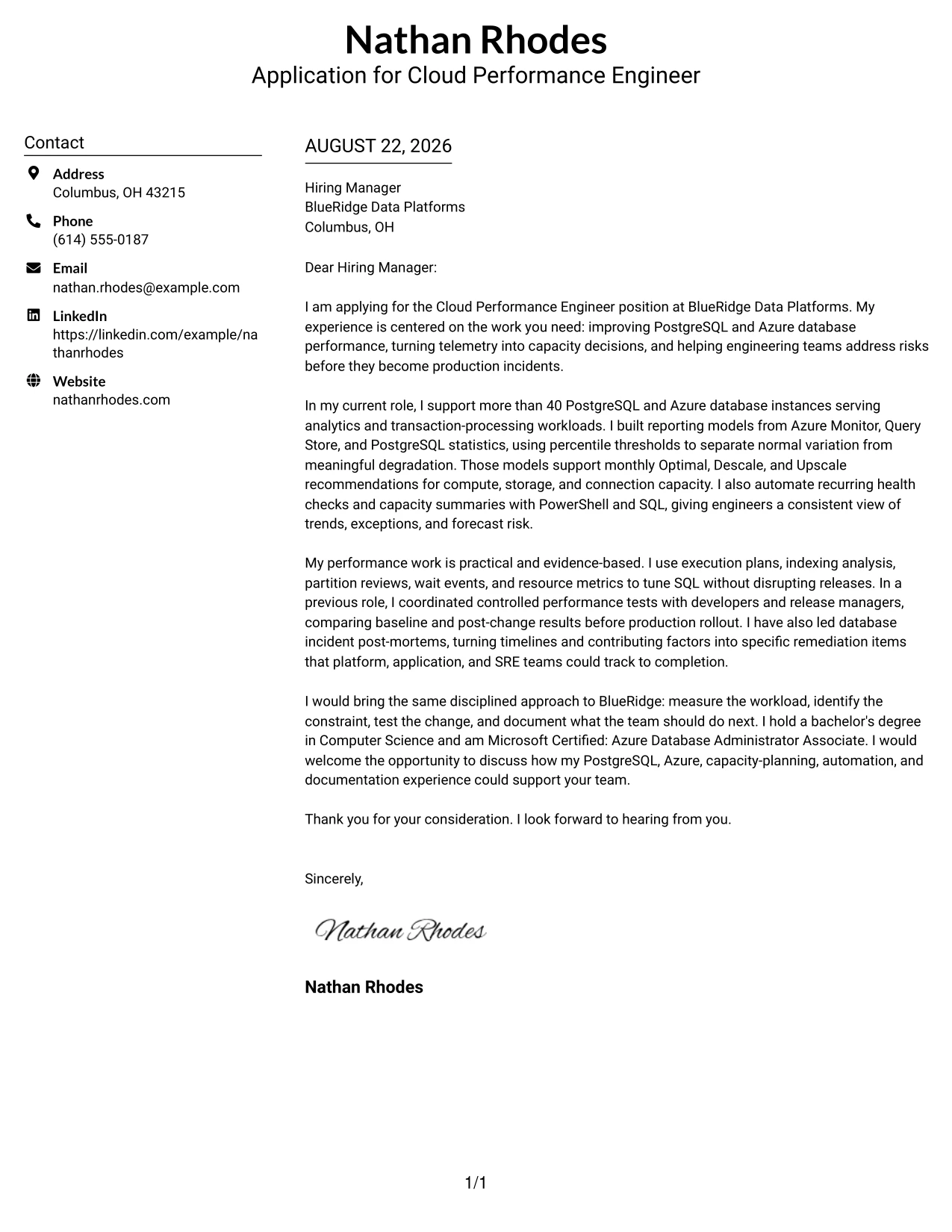
Why This Cover Letter Works
- The centered header makes the sender's contact details easy to locate.
- Two-column organization creates visual balance before the reader reaches the main message.
- The opening names the Cloud Performance Engineer position and connects it to relevant work.
- The body uses reporting models and percentile thresholds as evidence of analytical judgment.
- Capacity recommendations show an ability to turn telemetry into practical decisions.
- The closing links PostgreSQL, Azure, automation, and documentation experience to the employer's needs.
- The tone is focused and professional, which supports a technical role that requires clear communication.
Best For
- Applications that benefit from a balanced two-column presentation.
- Letters where contact and recipient details should be easy to scan.
- Technical roles that require a concise connection between evidence and employer needs.
- Candidates who need to present several related performance themes without creating a long letter.
- Readers who prefer clear visual separation between introductory details and persuasive content.
- Applications that combine operational judgment with strong written communication.
- Letters that must show both direct motivation and practical fit in limited space.
#24 Cover Letter Example: Left Aligned Header Clean Two Column Format
A restrained visual hierarchy lets the recruiter move from contact details to the greeting and then into the evidence with little distraction. The Left Aligned Header Clean Two Column Format supports that progression while keeping the letter orderly and easy to follow. Its simple presentation suits an application that must explain why experience with Azure Monitor, Query Store, SQL tuning, and capacity planning matches the employer's stated priorities. The result is a direct message about contribution, not decoration.
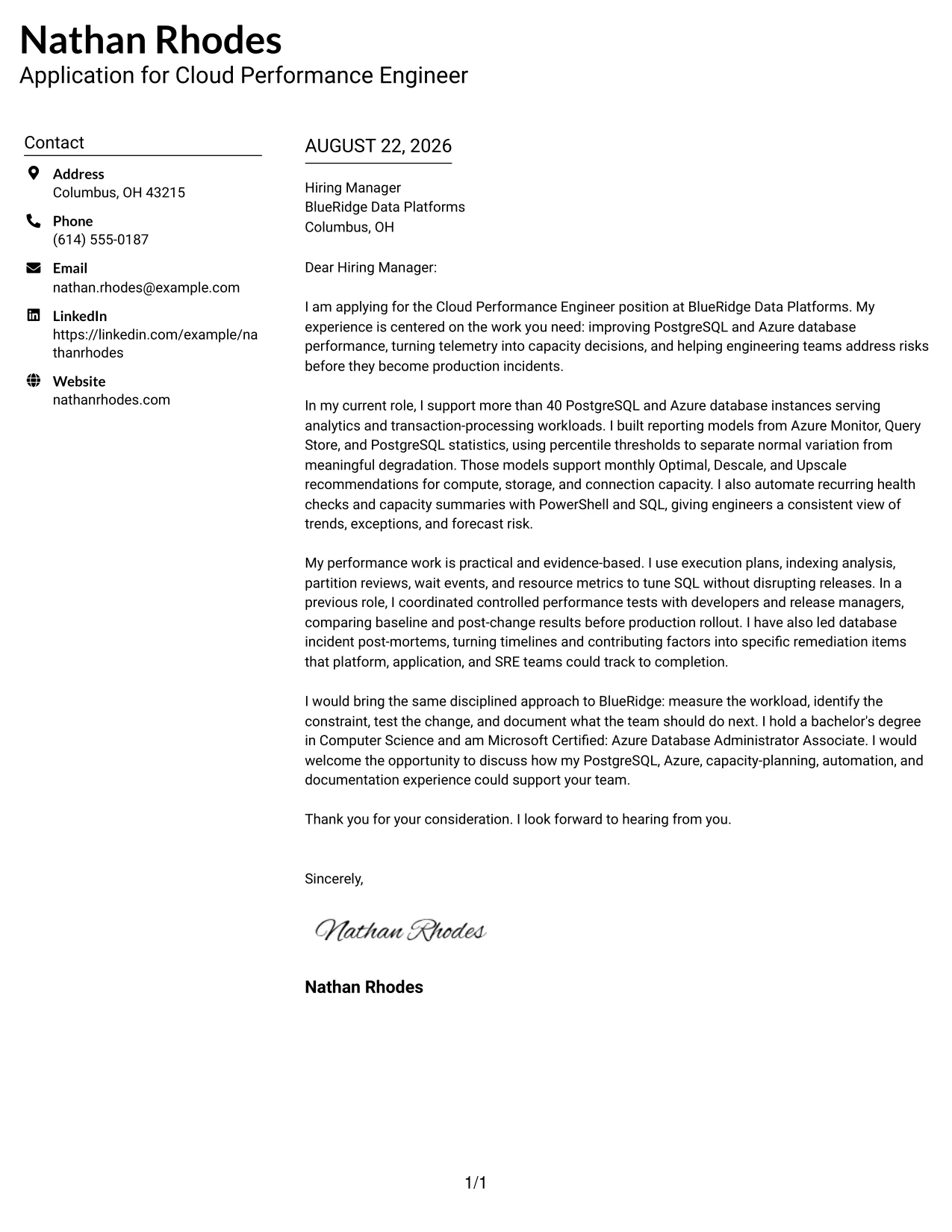
Why This Cover Letter Works
- Left alignment creates a familiar starting point for professional correspondence.
- The clean two-column arrangement supports quick review of sender and recipient information.
- The first paragraph states interest in BlueRidge Data Platforms and shows clear role alignment.
- Specific tools and methods make the performance work credible rather than general.
- The letter explains how monitoring data leads to Optimal, Descale, and Upscale recommendations.
- Controlled testing and post-mortem work demonstrate careful follow-through.
- The final paragraph gives the employer a clear reason to continue the conversation.
Best For
- Applications reviewed by readers who value a familiar, low-distraction format.
- Roles where the letter must align several technical requirements with proven work.
- Candidates presenting monitoring, tuning, and planning experience in one focused narrative.
- Employers seeking evidence of collaboration across engineering and application teams.
- Letters that need a clear visual route from greeting to qualifications to closing.
- Professional communication where simple formatting reinforces precision and reliability.
- Applications that benefit from separating contact information from the main argument.
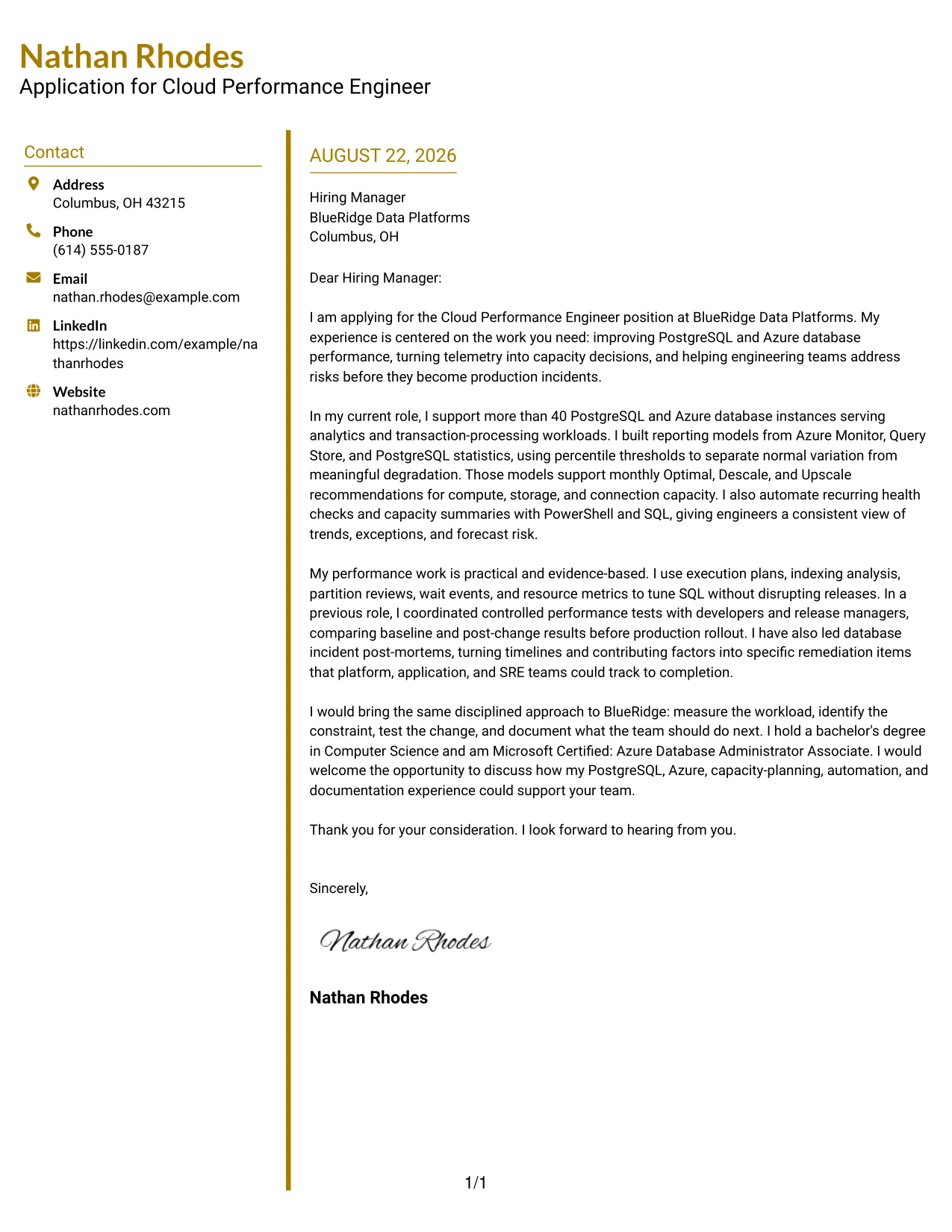
#25 Cover Letter Example: Accent Divider Modern Two Column Format
The Accent Divider Modern Two Column Format gives the cover letter a defined structure: contact details, recipient information, opening, supporting evidence, and closing each have a clear place. A modest divider can signal movement from one part of the argument to the next without interrupting the professional tone. That organization is useful here because the letter must connect database tuning, capacity management, performance testing, and incident improvement to one persuasive case for fit.
Why This Cover Letter Works
- The format creates visible transitions between administrative details and the persuasive message.
- A two-column arrangement keeps the page organized while preserving room for complete paragraphs.
- The introduction states the target role and the employer's performance priorities.
- The middle of the letter gives priority to measurable decision methods, including thresholds and workload data.
- Technical examples show how execution plans and indexes support careful tuning.
- Post-mortem leadership adds evidence of continuous improvement beyond routine analysis.
- The closing turns the details into a forward-looking invitation to discuss contribution.
Best For
- Letters that need clear stages from introduction through evidence to closing.
- Applications with several technical themes that must remain connected.
- Readers who benefit from visual dividers between supporting points.
- Candidates explaining a process that moves from measurement to testing to action.
- Roles where capacity management and performance improvement need equal attention.
- Professional letters that require modern organization without an informal appearance.
- Applications where a compact two-column structure helps control information density.
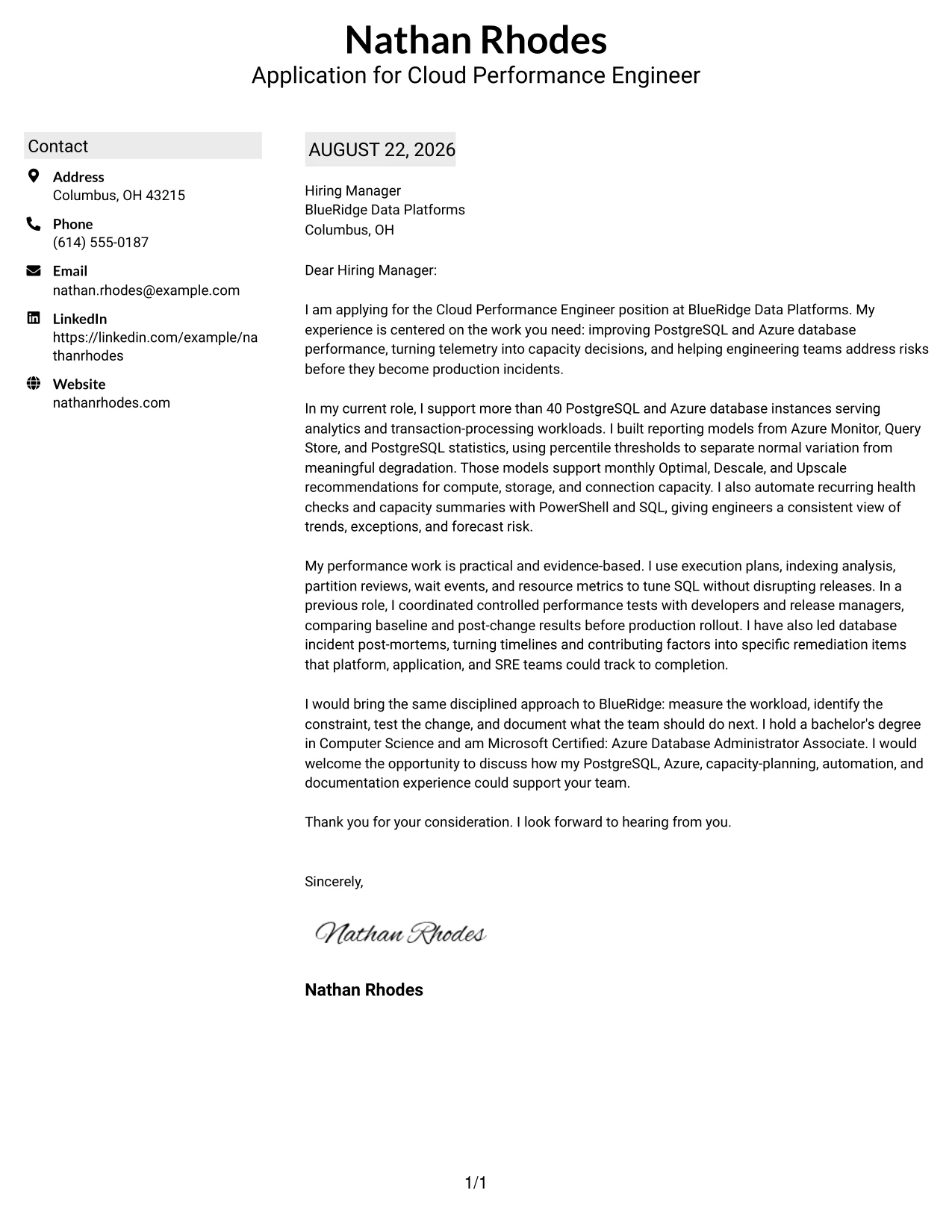
#26 Cover Letter Example: Shaded Labels Clean Two Column Format
Readers can move through this letter by following the labeled contact and recipient areas into the main argument, then toward the closing. The Shaded Labels Clean Two Column Format makes those transitions visible while preserving a professional, compact page. This is especially effective when the message includes several evidence points: database monitoring, statistical thresholds, capacity recommendations, performance testing, and documentation. Each point can support the larger claim that the candidate makes disciplined, data-based decisions.
Why This Cover Letter Works
- Shaded labels help the reader identify key administrative information quickly.
- The two-column structure adds order without making the letter feel crowded.
- The opening establishes direct interest in the employer and the target position.
- The body provides enough detail to show depth across PostgreSQL and Azure environments.
- Statistical thresholds explain how normal variation is separated from actionable degradation.
- Examples of testing and incident review show that recommendations are checked and tracked.
- The closing reinforces communication, documentation, and collaboration as part of technical performance work.
Best For
- Letters with several supporting details that need visible organization.
- Applications where readers may review the page quickly before reading closely.
- Candidates balancing technical evidence with a strong communication message.
- Roles that combine monitoring, capacity planning, and operational follow-through.
- Documents that need a compact structure but still require full explanatory paragraphs.
- Employers who value clear labels and predictable information placement.
- Applications where a two-column page helps prevent the evidence from becoming repetitive.
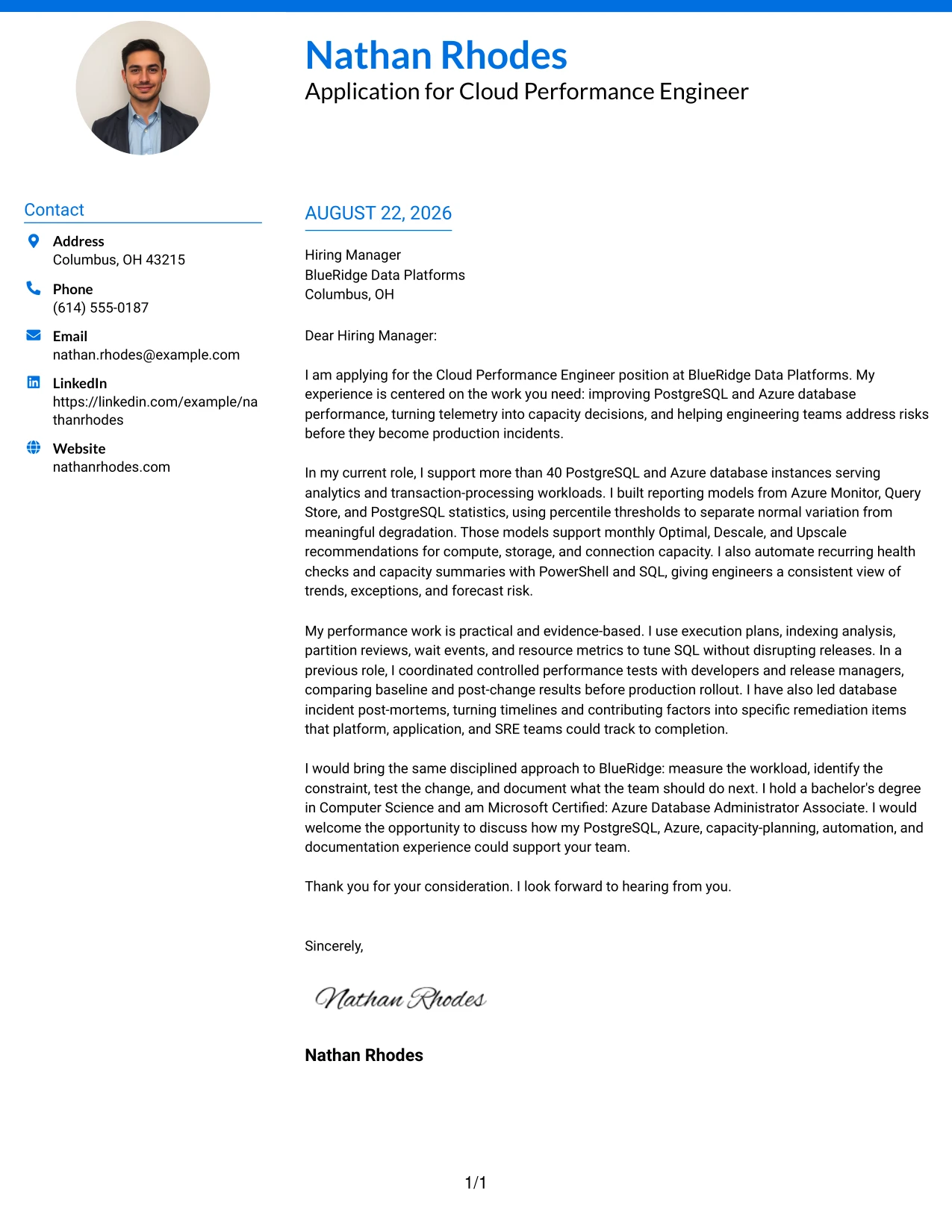
#27 Cover Letter Example: Photo Header Color Accent International Format
The strongest evidence should lead the reader into the letter's argument: experience improving PostgreSQL and Azure database performance, making capacity recommendations, and reducing operational risk. The Photo Header Color Accent International Format places that evidence within a single-column message with a more personal visual introduction. Used thoughtfully, the photo and color accents can make the letter memorable, while the written content must still carry the case through specific methods, collaboration examples, and a clear reason for interest in BlueRidge Data Platforms.
Why This Cover Letter Works
- A single-column reading path keeps the persuasive message in a natural sequence.
- The photo header can add personal presence when it suits the employer and local hiring context.
- Color accents distinguish the header from the evidence without replacing written substance.
- The opening connects the applicant's motivation to the employer's database performance needs.
- The letter gives concrete evidence through workload analysis, thresholds, and capacity actions.
- Testing and post-mortem examples show care before and after production changes.
- The close combines technical fit with a direct invitation to discuss the role.
Best For
- Applications where a personal visual introduction is appropriate for the employer.
- Letters that should keep all persuasive content in one continuous reading path.
- Candidates whose strongest case depends on detailed technical evidence.
- Employer contexts where memorable presentation can support, but not replace, substance.
- Applications combining database performance work with clear stakeholder communication.
- Letters that need a distinct header while maintaining a formal body.
- Situations where evidence, motivation, and employer fit should unfold in one sequence.
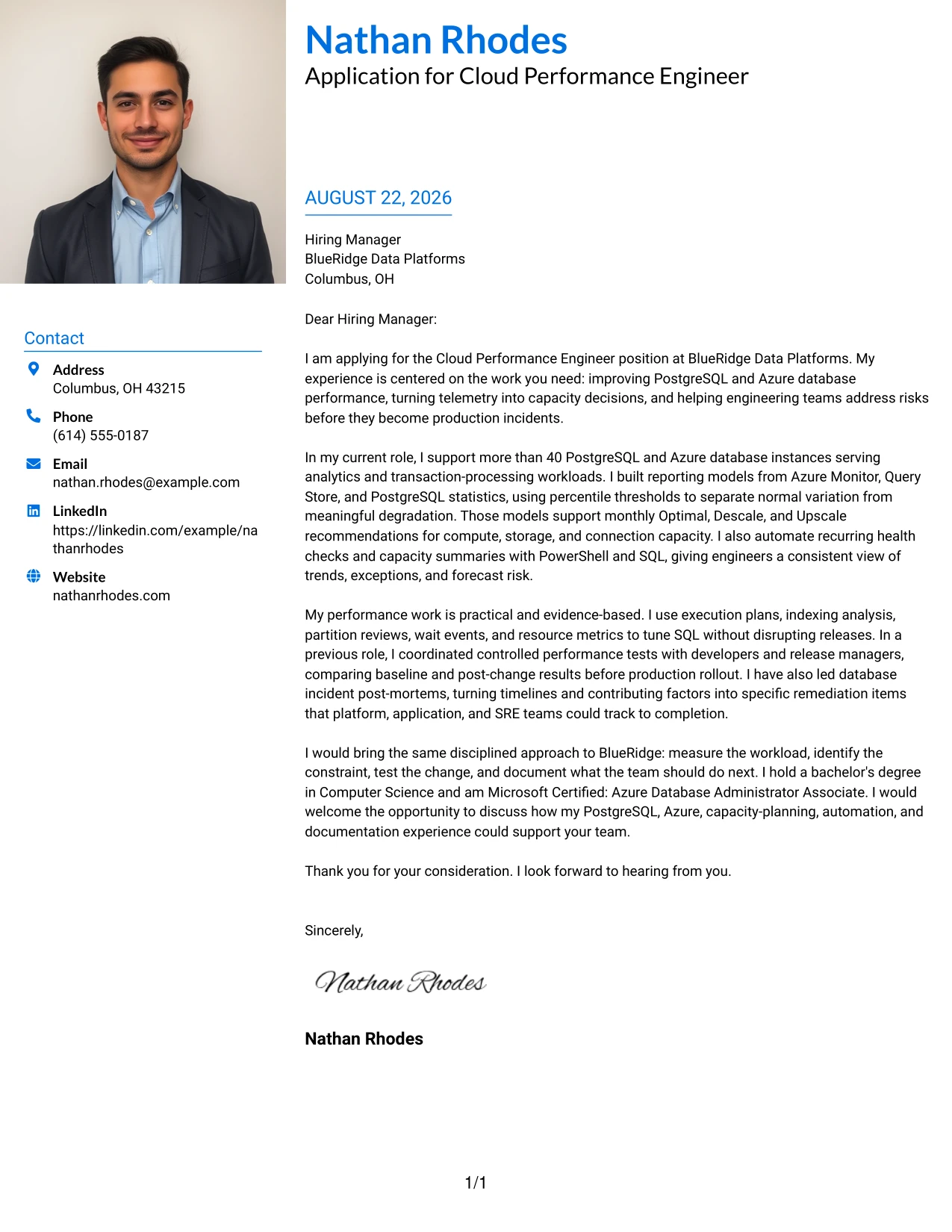
#28 Cover Letter Example: Large Profile Photo International Two Column Format
Balanced distribution matters when a cover letter includes a strong visual introduction and a detailed technical case. The Large Profile Photo International Two Column Format gives the profile area greater weight while reserving a separate path for the written message. That space can help the letter present motivation, database performance evidence, and employer fit without forcing every point into a narrow paragraph. The technical content should remain specific enough to show how PostgreSQL, Azure, monitoring, and capacity planning experience would transfer to the role.
Why This Cover Letter Works
- The larger profile area creates a clear personal entry point to the application.
- Two columns separate visual identity from the written case for employment.
- The message can move from motivation to evidence without competing with contact details.
- The letter connects more than 40 supported database instances to the employer's scale and performance needs.
- Capacity reviews and automated health checks show practical ownership of recurring decisions.
- Performance tests and post-mortems demonstrate disciplined improvement and collaboration.
- The closing keeps the presentation grounded in specific value for the employer.
Best For
- Applications where a larger visual profile is acceptable and useful.
- Letters that need separate space for identity details and a substantial written argument.
- Candidates with enough relevant evidence to support a complete, focused narrative.
- Employer settings that welcome a more personal international-style presentation.
- Roles requiring both independent analysis and collaboration across technical teams.
- Applications where capacity decisions and performance methods need room for explanation.
- Readers who prefer a defined split between profile information and persuasive content.
#29 Cover Letter Example: One Column Boxed Contact Header Format
For a practical application that should read like a focused business letter, the One Column Boxed Contact Header Format keeps every element on one steady path. The boxed contact area separates essential details from the greeting, while the body can make a direct case for the Cloud Performance Engineer position. This approach suits a message built around clear evidence: Azure and PostgreSQL experience, data-driven capacity choices, SQL tuning, automation, and communication with platform and application teams.
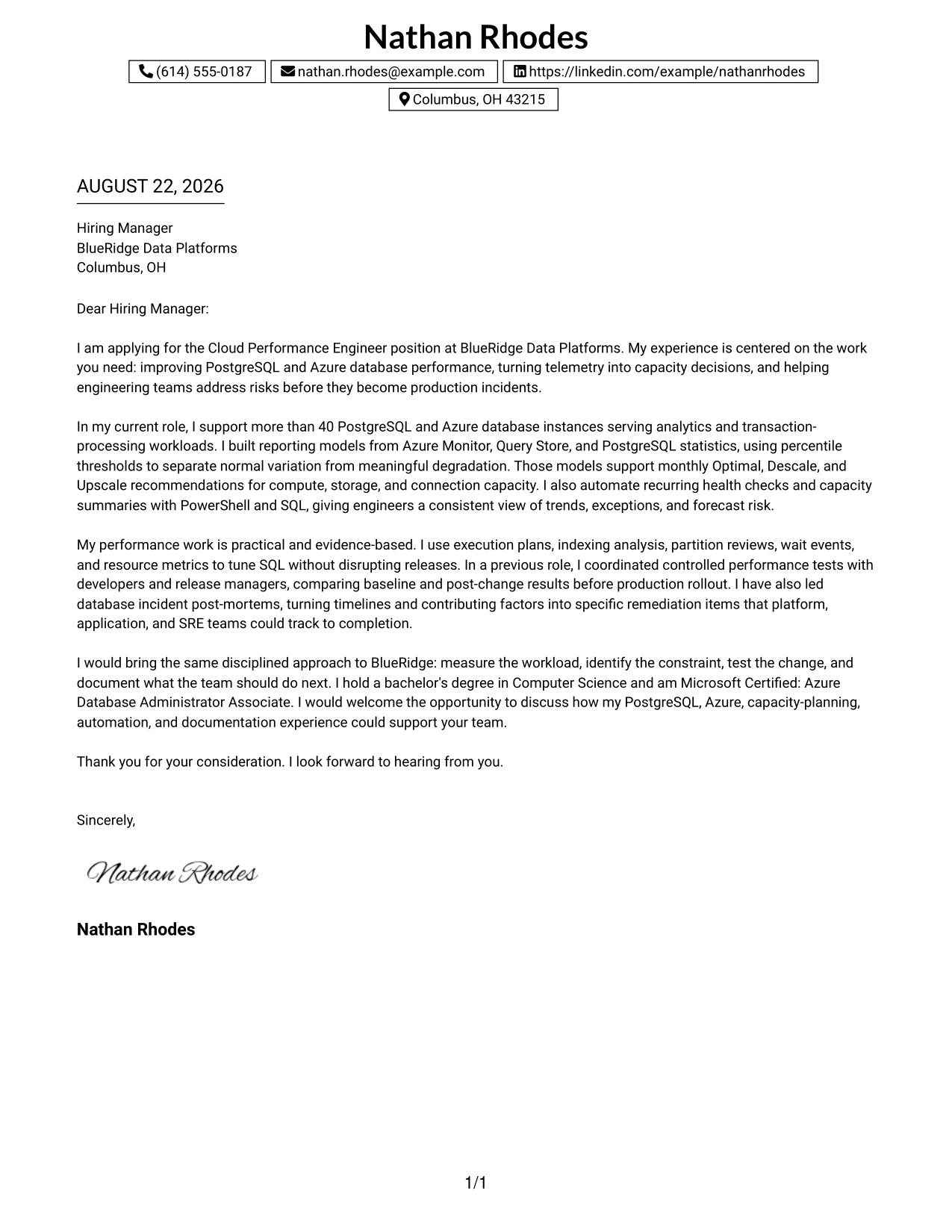
Why This Cover Letter Works
- The one-column flow follows the natural order of professional correspondence.
- The boxed header makes contact information distinct without taking over the page.
- The opening quickly states interest and identifies the employer's core needs.
- The body explains technical work in connected paragraphs rather than isolated fragments.
- Capacity recommendations show judgment across compute, storage, and connection resources.
- The letter includes collaboration and documentation, not only technical methods.
- The closing is concise and leaves the reader with a clear next step.
Best For
- Applications that call for a traditional, easy-to-read business letter.
- Readers who prefer one continuous path from contact details to closing.
- Candidates presenting a connected story across database performance responsibilities.
- Letters where a boxed header should provide structure without adding visual complexity.
- Roles that require both technical analysis and clear communication with stakeholders.
- Applications needing room for complete paragraphs and a measured persuasive tone.
- Hiring processes where straightforward presentation supports efficient review.
#30 Cover Letter Example: One Column Shaded Contact Header Format
A quiet visual hierarchy helps the reader recognize the applicant's focus before reviewing the supporting details. The One Column Shaded Contact Header Format uses a shaded contact area to frame a direct, single-column letter. That format is well suited to a role-alignment message: the application can move from interest in BlueRidge Data Platforms to evidence of PostgreSQL and Azure database work, then explain how monitoring, capacity planning, and post-mortem leadership match the position.
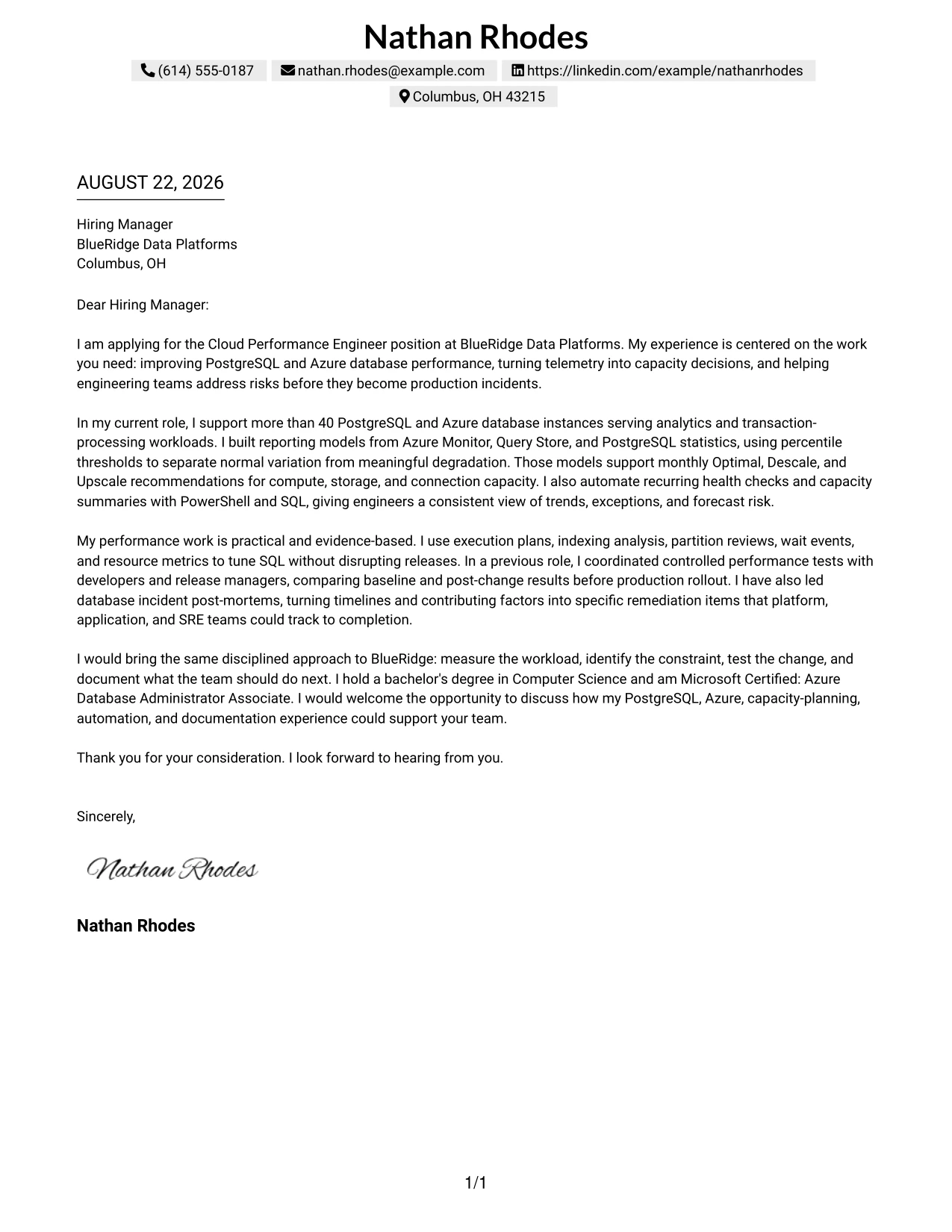
Why This Cover Letter Works
- The shaded header creates separation while keeping the page restrained.
- A single column supports a natural progression through the letter's argument.
- The opening makes the employer and position immediately clear.
- The evidence is chosen to match the responsibilities rather than list unrelated abilities.
- Reporting models and thresholds demonstrate a disciplined approach to performance analysis.
- Post-mortem leadership shows commitment to prevention and continuous improvement.
- The final paragraph connects qualifications to a specific contribution at the employer.
Best For
- Applications where restrained formatting should support a strong role-alignment message.
- Readers who want the letter to follow a familiar single-column sequence.
- Candidates matching several listed responsibilities with closely related evidence.
- Technical employers that value clarity more than decorative presentation.
- Letters connecting monitoring and capacity planning to practical business decisions.
- Applications that need a distinct contact area but a simple persuasive body.
- Situations where the final paragraph should make employer fit especially explicit.
#31 Cover Letter Example: Boxed Contact Header with Job Title Format
The Boxed Contact Header with Job Title Format organizes the letter around a clear label for the opportunity, followed by a focused narrative. Its boxed header can identify the sender and position before the reader reaches the opening. That structure is useful when the letter must quickly connect a target role with a sequence of proof: workload analysis, tuning, capacity recommendations, testing, incident review, and knowledge sharing. The content remains persuasive because each example answers an employer need.
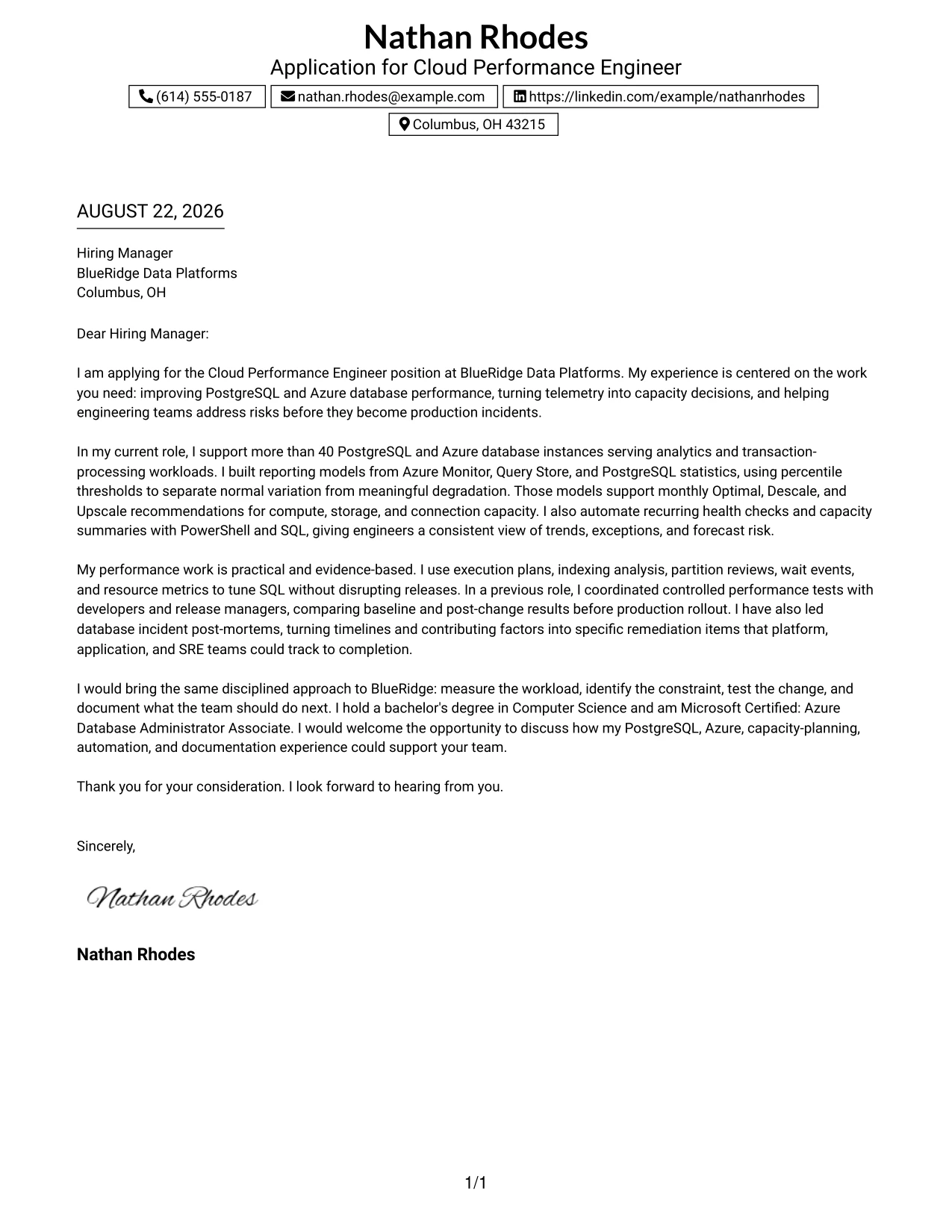
Why This Cover Letter Works
- The job title in the header gives the application immediate context.
- A boxed contact area keeps administrative details separate from the message.
- The format supports a clean one-column argument from motivation to fit.
- The letter uses current database ownership to establish relevant scope.
- Specific analysis methods make the performance claims credible and reviewable.
- Testing and incident work show that the candidate can improve systems with care.
- Knowledge sharing and documentation broaden the case beyond individual technical work.
Best For
- Applications where the position title should be visible before the letter is read.
- Readers who value strong signposting at the top of a document.
- Candidates organizing several forms of evidence under one clearly named opportunity.
- Roles where technical analysis must be linked to implementation and follow-through.
- Letters that need to show both production responsibility and team enablement.
- Hiring contexts where a compact one-column layout supports fast orientation.
- Applications that benefit from a header that frames the entire persuasive message.
#32 Cover Letter Example: Plain Professional Layout with Job Title & Shaded Date
The reader moves through this letter in a familiar business sequence: dated application, recipient details, greeting, reason for writing, evidence, and closing. The Plain Professional Layout with Job Title & Shaded Date supports that order with minimal visual interruption. It is a strong choice for a detailed message because the body can explain how reporting models, performance testing, capacity management, and technical documentation would support BlueRidge Data Platforms without competing with decorative elements.
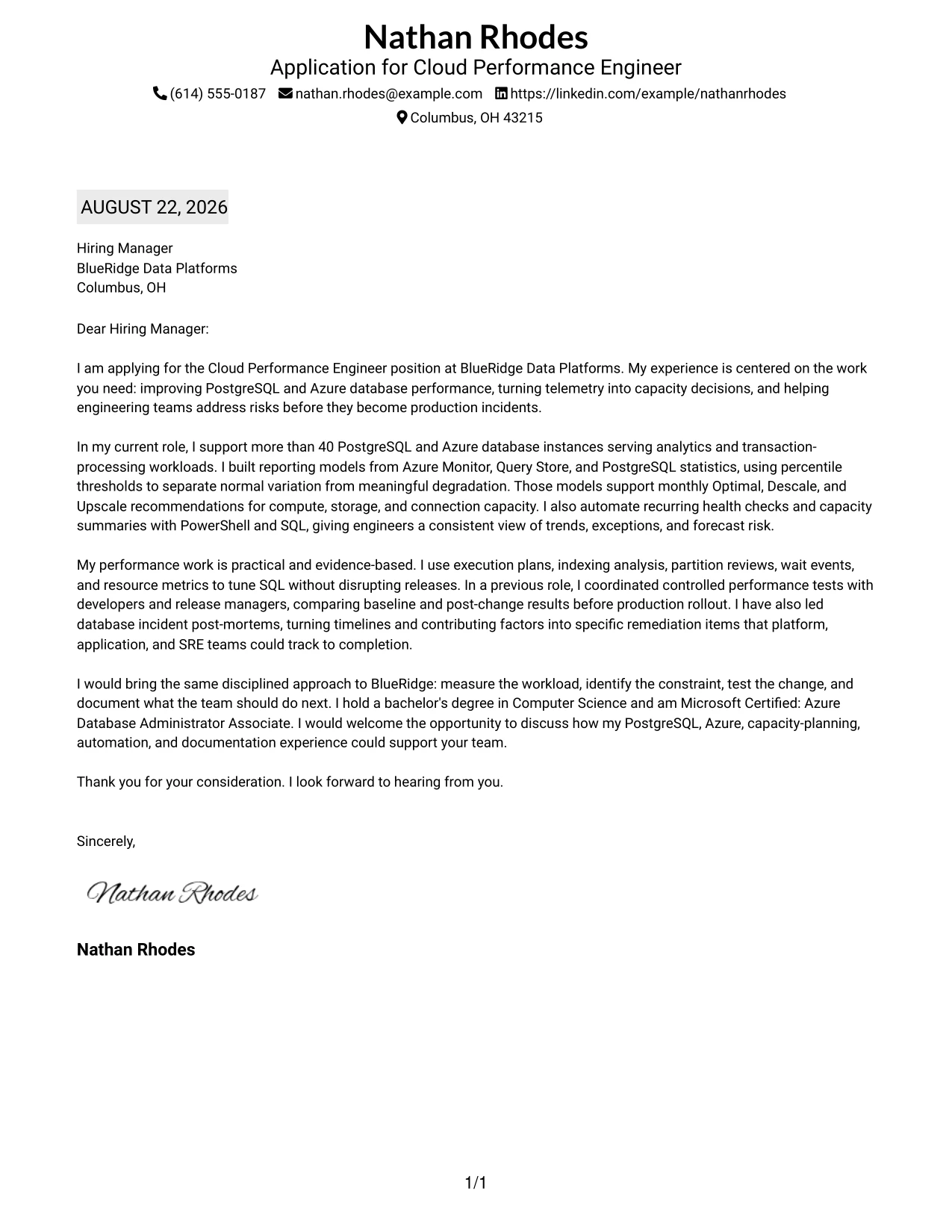
Why This Cover Letter Works
- The dated, professional sequence gives the letter an established business format.
- The job title keeps the purpose of the application visible.
- A single-column layout leaves room for complete explanations.
- The opening connects the candidate's experience directly to the listed responsibilities.
- The middle paragraphs combine technical evidence with examples of teamwork and release discipline.
- The letter explains capacity choices as decisions supported by data and forecasts.
- The closing is respectful, concise, and focused on a future discussion.
Best For
- Applications that benefit from a conventional business-letter structure.
- Letters with enough evidence to require complete paragraphs rather than short notes.
- Readers who expect the date, recipient, and job title to be easy to identify.
- Candidates explaining a broad scope across analysis, testing, and capacity work.
- Roles where documentation and collaboration should appear alongside technical depth.
- Hiring processes that favor plain presentation and efficient reading.
- Applications where a single-column page gives the argument room to develop.
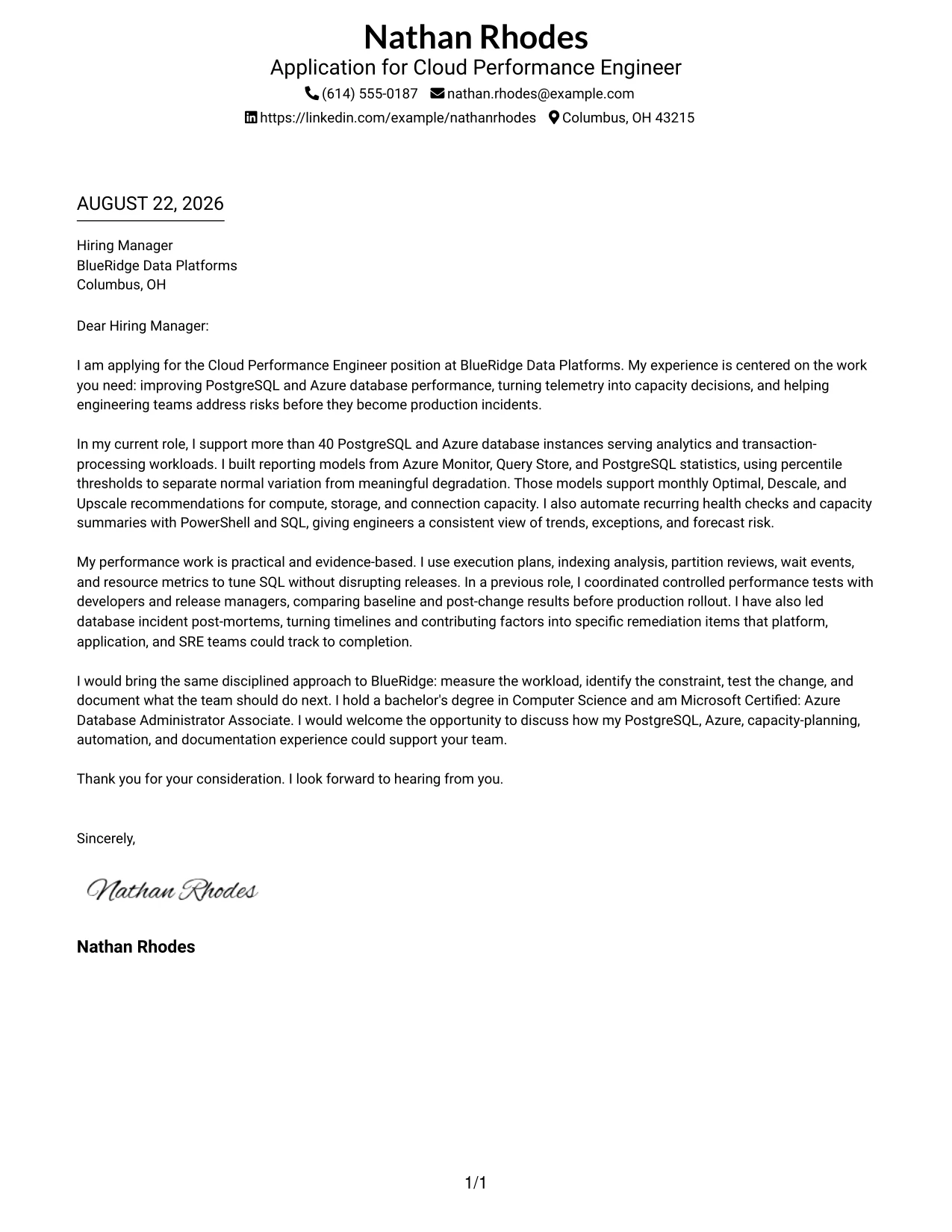
#33 Cover Letter Example: Two-Line Contact Header with Underlined Date Format
The opening evidence deserves immediate attention: the application brings five years of experience improving PostgreSQL and Azure database reliability, response times, and capacity utilization. The Two-Line Contact Header with Underlined Date Format gives that evidence a formal frame while keeping the message in a clean single-column sequence. A two-line contact header and underlined date establish order, allowing the letter to focus on motivation, measurable methods, and the practical value the candidate could bring to BlueRidge Data Platforms.
Why This Cover Letter Works
- The two-line contact header presents essential details in a compact form.
- The underlined date adds a clear business reference point.
- The one-column structure keeps the evidence easy to follow.
- The opening uses five years of relevant experience to establish immediate credibility.
- The body explains thresholds, tuning, testing, and capacity recommendations as connected practices.
- Incident post-mortems and documentation show a commitment to lasting improvement.
- The final paragraph combines qualifications, motivation, and a clear request for discussion.
Best For
- Applications where relevant experience should appear early in the argument.
- Readers who prefer a formal letter with compact contact information.
- Candidates presenting a substantial evidence base in a controlled single-column format.
- Roles where analysis, testing, and capacity decisions must be explained together.
- Letters that need a clear date and professional document sequence.
- Hiring contexts that value technical depth supported by concise communication.
- Applications where a focused closing should bring evidence and motivation together.
Why Use ResumeInMinutes for a Cloud Performance Engineer Cover Letter
ResumeInMinutes helps you shape a targeted cover letter without starting with a blank page. You can organize technical evidence around the employer’s priorities and present your reasoning in a clear, professional format.
- Professional writing styles
- Clean, readable formatting
- Job-description-based customization
- Fast cover letter generation
- Professional templates
- PDF download support
Whether you need to emphasize PostgreSQL tuning, Azure monitoring, Optimal / Descale / Upscale recommendations, performance testing, or post-mortem leadership, you can build a letter that gives each point a clear purpose.
See Also
- 33 Cloud Performance Engineer Resume Templates with Example 2026 (ATS-Optimized)
- 7 Senior GPU Performance Software Engineer Resume Templates with Example
- 33 Software Engineer, Performance Engineering Resume Templates with Example 2026 (ATS-Optimized)
- 33 Thermal Systems Engineer For Performance Optimization (Modeling/Simulation) Resume Templates with Example 2026 (ATS-Optimized)
- 33 AI/ML Engineer Intern, Cloud & Developer Infra Resume Templates with Example 2026 (ATS-Optimized)
- 33 Applied AI Research Engineer - Production ML & Cloud Resume Templates with Example 2026 (ATS-Optimized)
- 33 Associate Cloud Engineer Resume Templates with Example 2026 (ATS-Optimized)
- 33 Azure Cloud Engineer Resume Templates with Example
- 30+ Software Engineer, Performance Engineering Cover Letter Templates with Example 2026
- 30+ AI/ML Engineer Intern, Cloud & Developer Infra Cover Letter Templates with Example 2026
Frequently Asked Questions
What should a Cloud Performance Engineer cover letter include?
Include a direct opening, evidence of PostgreSQL and Azure database work, examples of workload analysis and tuning, capacity-planning judgment, collaboration, and a closing that connects your value to the employer’s needs.
How should I describe PostgreSQL and Azure experience?
Focus on the decisions and results behind the tools. Explain how you used monitoring data, Query Store, PostgreSQL statistics, execution plans, or resource metrics to identify constraints and guide a practical improvement.
Should I mention Optimal, Descale, and Upscale recommendations?
Yes, when those decisions are relevant to your experience and the job description. Briefly explain how you used workload evidence, thresholds, forecast demand, or budget controls to recommend the right capacity action.
How can I show that I am data-driven?
Describe the evidence you reviewed and how it changed your recommendation. Examples include latency, throughput, CPU, memory, storage, connection metrics, wait events, percentile thresholds, baseline comparisons, and post-change testing.
Should a Cloud Performance Engineer cover letter mention post-mortems?
Yes. A concise post-mortem example can show that you investigate incidents carefully, identify contributing factors, assign corrective actions, and help teams prevent similar problems.
How important are documentation and knowledge sharing?
They are important because performance work must be repeatable. Mention runbooks, tuning records, reporting models, incident documentation, or team guidance when they show how your analysis helps others act with confidence.
Can I customize these Cloud Performance Engineer cover letter templates?
Yes. Customize the opening, evidence, motivation, employer connection, tone, layout, and PDF format for the specific Cloud Performance Engineer opportunity.