30+ CyberSecurity Risk Analyst Cover Letter Templates with Example 2026
This practical guide helps you create a CyberSecurity Risk Analyst cover letter that connects your risk judgment to the employer’s business needs. You will learn how to present relevant evidence clearly and make your application easier for a hiring team to evaluate.
A strong letter for this role should show how you identify inherent and residual risk, explain findings, and move treatment plans forward. It should also connect your experience with frameworks such as the NIST Cybersecurity Framework, SOC 2, and ISO 27001 to the way technology and business stakeholders make decisions.
In this guide, you will see one focused CyberSecurity Risk Analyst cover letter example, learn how to write an effective opening, choose evidence for the body, explain your motivation and employer alignment, and close with professional interest. The example is presented in 33 different styles and themes so you can choose a format that fits the employer and communication context.
What Makes a Great CyberSecurity Risk Analyst Cover Letter in 2026
Effective letters for this role are specific, evidence-based, and focused on business impact. The strongest examples usually connect three areas:
- Enterprise cyber risk assessments that distinguish inherent from residual risk
- Risk treatment, remediation tracking, and clear leadership reporting
- Communication with technology, legal, privacy, audit, and business stakeholders
Rather than repeating a career history, the body of the letter should explain:
- Why the applicant is interested in the CyberSecurity Risk Analyst role
- How assessment and control review experience matches the employer’s needs
- How technical findings become practical decisions, treatment plans, and follow-up actions
Useful role-specific evidence may include work with the NIST Cybersecurity Framework, SOC 2, ISO 27001, security risk registers, risk management information systems, internal and external audits, vulnerability and risk assessments, M&A due diligence, and enterprise risk appetite. Mention only the standards, tools, and responsibilities you can support with real examples.
The templates below show how one focused CyberSecurity Risk Analyst cover letter can communicate role fit, motivation, company alignment, and professional judgment in different presentation styles.
The featured example follows a focused progression from role interest to relevant risk evidence, business impact, and a professional close, giving readers a structure they can adapt while choosing a presentation suited to the employer and communication context.
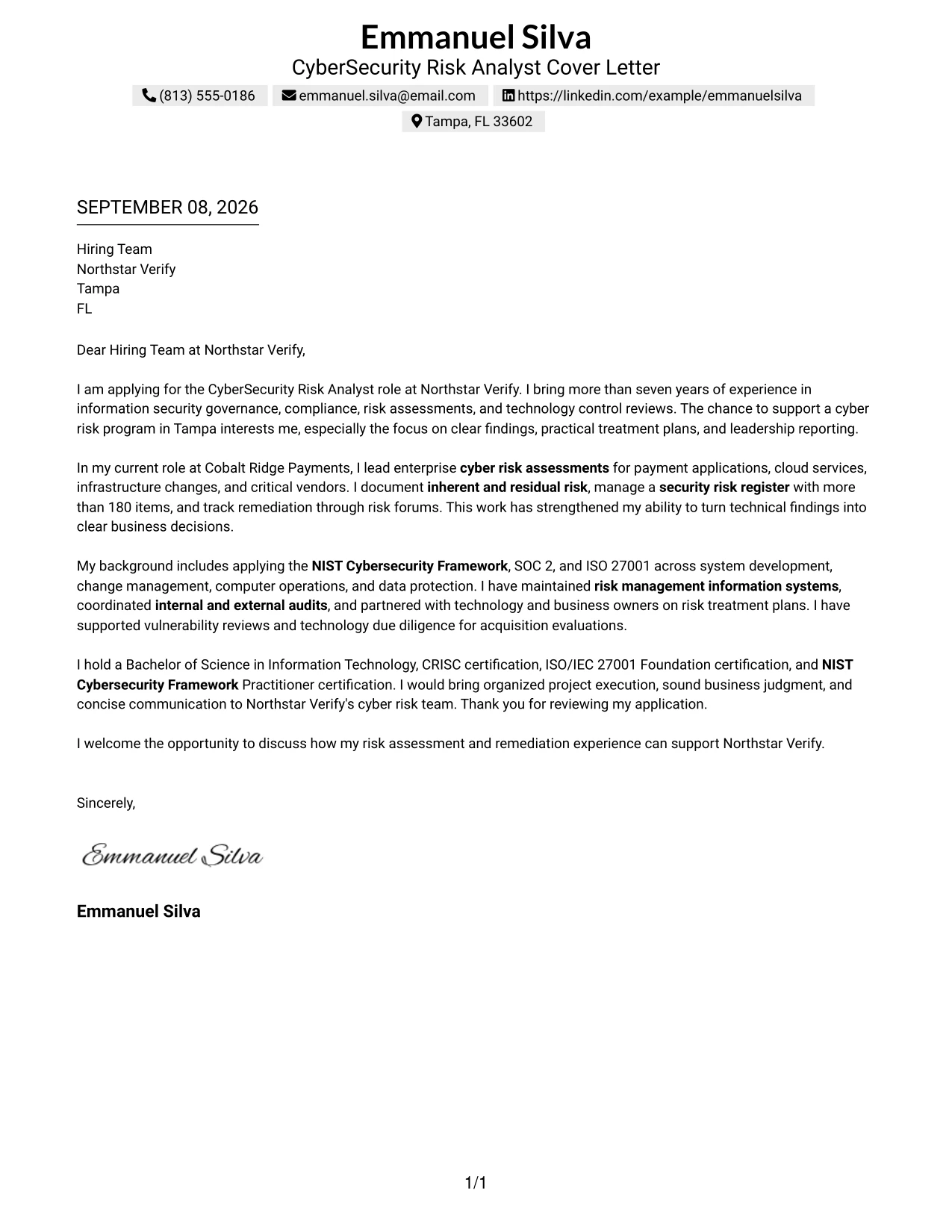
#1 Text/Fang Style Cover Letter Example
Text/Fang Style gives the letter a direct, centered structure. The opening states the target role and motivation, while the body moves quickly to evidence that Northstar Verify can use: enterprise assessments, risk treatment, leadership reporting, and control frameworks.
Emmanuel Silva's letter connects current responsibilities to the employer's needs without adding unrelated detail. It shows how technical findings become business decisions, then closes with relevant credentials and a clear invitation to continue the discussion.
Cover Letter Snapshot
- Opening motivation for the CyberSecurity Risk Analyst role at Northstar Verify
- Evidence from enterprise cyber risk assessments and a risk register with more than 180 items
- Alignment with NIST Cybersecurity Framework, SOC 2, and ISO 27001
- Closing reference to risk assessment, remediation, and communication experience
Why This Cover Letter Works
- The opening names the role and company, so the reader understands the purpose immediately.
- Motivation is tied to Northstar Verify's focus on clear findings, practical treatment plans, and leadership reporting.
- The body uses recent evidence instead of broad claims about cybersecurity ability.
- The risk register example gives the letter a clear scale indicator without overwhelming the reader.
- Framework experience is connected to the work rather than presented as a separate keyword list.
- The tone is concise and business-focused, which supports the role's communication requirements.
- The closing reinforces fit and invites a useful next conversation.
Key CyberSecurity Risk Analyst Keywords
- cyber risk assessments
- inherent and residual risk
- security risk register
- NIST Cybersecurity Framework
- SOC 2
- ISO 27001
- risk treatment plans
- technology due diligence
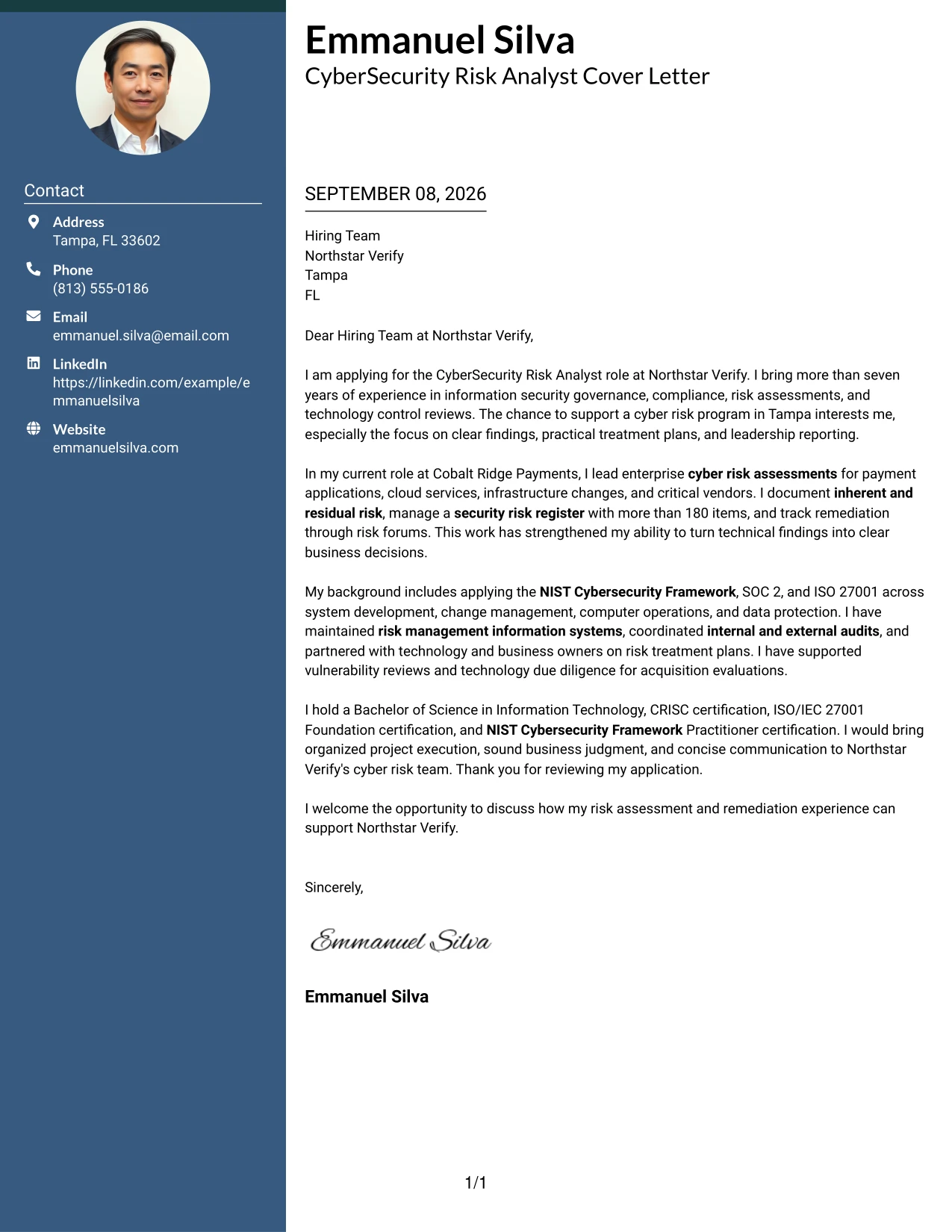
#2 Two Column Format Cover Letter Example
Readers can move from the main letter to supporting details with little effort. A two-column structure can place contact information, selected strengths, or a short fit summary beside the persuasive body, while the opening and closing remain easy to follow. For this application, the strongest content is the connection between risk assessments, remediation progress, and Northstar Verify's cyber risk program.
Why the Two Column Format Works for a Cover Letter
- The main column can carry the opening, evidence, motivation, and closing in a natural order.
- A narrower column can surface frameworks, certifications, or focus areas without interrupting the letter's argument.
- Separated content areas help a hiring team locate role alignment quickly.
- The format can support several evidence points while keeping each paragraph short.
- The structure works well when the letter must connect technical risk work with business communication.
- Clear visual boundaries make the relationship between experience and employer needs easier to review.
- The design can present a complete letter without making the page feel text-heavy.
Best For
- Cover letters that need a clear main argument plus a compact supporting summary
- Applications with several relevant frameworks or credentials to reference briefly
- Readers who prefer to review motivation and evidence in a defined sequence
- Letters that connect technical assessment work with business-facing decisions
- Applications where audit, remediation, and reporting experience all need space
- One-page communication that benefits from separated content zones
- Roles requiring both organized project execution and concise stakeholder communication
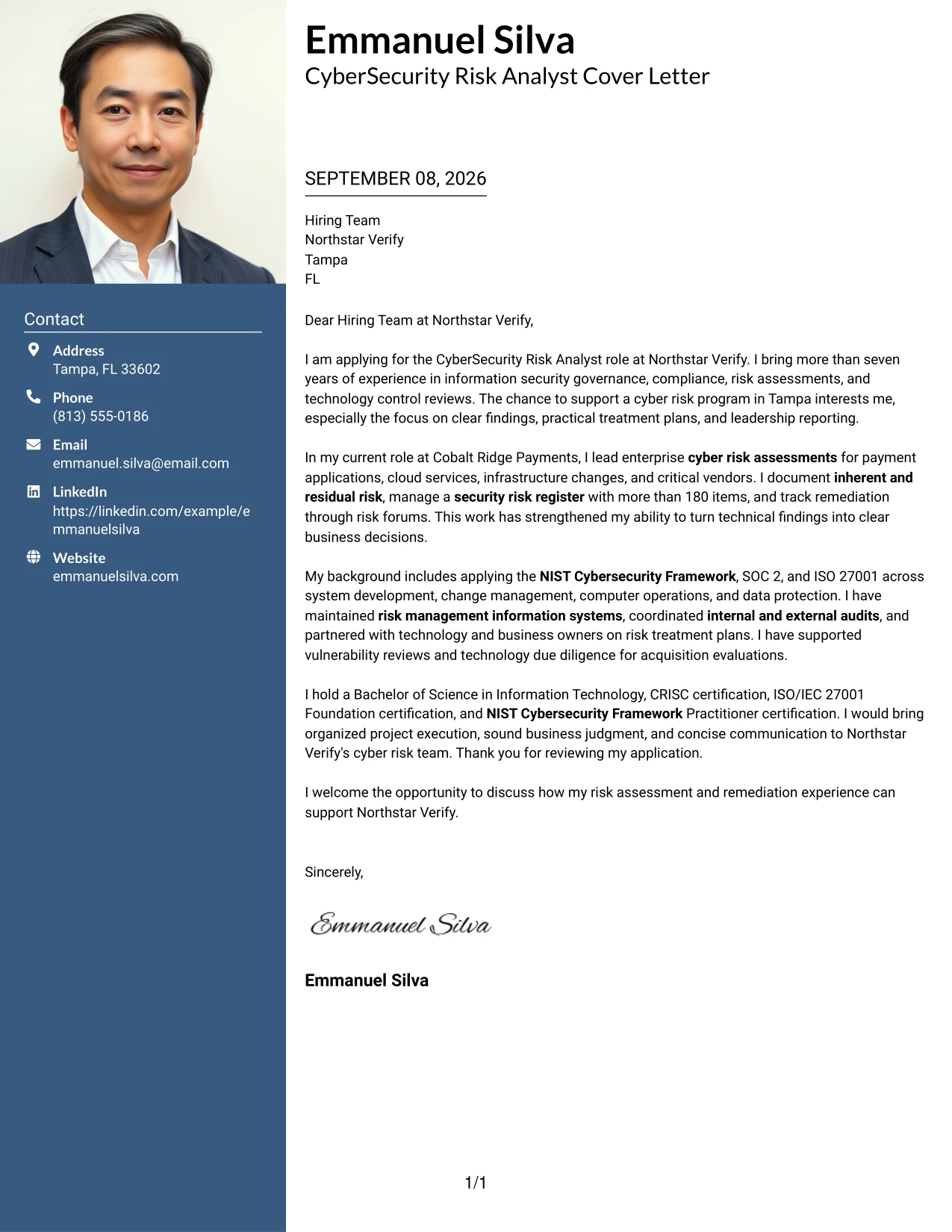
#3 Photo Header Two Column Format Cover Letter Example
The strongest evidence should lead the reader: enterprise cyber risk assessments, risk treatment planning, risk register administration, and leadership reporting. A photo header can add a personal introduction, while the two-column body separates the persuasive message from concise supporting details. Used carefully, it keeps the human connection visible without taking attention away from the evidence.
Why the Photo Header Two Column Format Works for a Cover Letter
- The opening area creates a clear introduction before the reader reaches the detailed message.
- A photo can support a more personal first impression when it fits the employer's culture and application context.
- The main column gives assessment evidence enough space to show relevant scope and judgment.
- The secondary column can summarize frameworks, certifications, or communication strengths.
- Two distinct reading paths help balance personal introduction with professional proof.
- The format can make a detailed risk story feel more approachable and organized.
- Evidence remains persuasive because visual elements are kept separate from the core argument.
Best For
- Applications where a personal introduction supports an otherwise technical message
- Letters that need to balance relationship-building with detailed risk evidence
- Candidates with several assessment examples that benefit from separate supporting notes
- Employer contexts where a polished personal presentation is appropriate
- Cover letters combining leadership communication with control and compliance knowledge
- Readers who want a quick summary before reviewing the full narrative
- Applications where visual identity can reinforce a confident, organized introduction
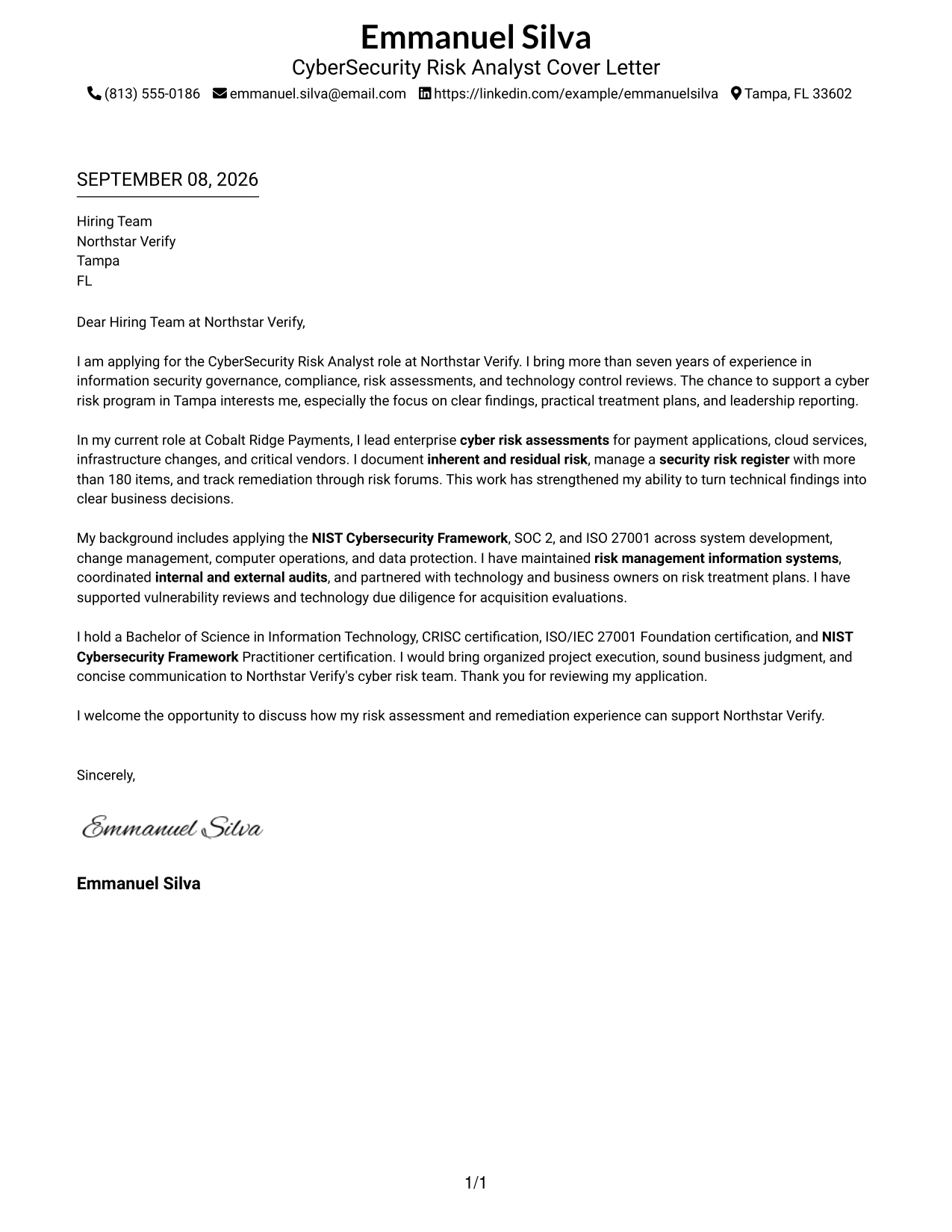
#4 Simple One Column Format Cover Letter Example
Balanced spacing gives each part of the application a fair share of attention. A simple one-column letter can introduce motivation, explain two or three relevant examples, and close with employer fit in a steady sequence. That approach suits this application because the evidence is strong enough to persuade without visual complexity.
Why the Simple One Column Format Works for a Cover Letter
- A single reading path keeps the opening, evidence, and closing in logical order.
- Even spacing helps the reader pause between motivation, experience, and fit.
- The format supports a professional tone for a regulated and risk-focused business setting.
- Short paragraphs can explain technical work in language that business stakeholders understand.
- The structure makes it easy to tailor the message to Northstar Verify's stated responsibilities.
- A restrained presentation keeps attention on judgment, outcomes, and communication.
- The letter can remain focused while still covering assessments, treatment, audits, and reporting.
Best For
- Applications that need a direct, traditional reading sequence
- Letters where motivation and employer fit should appear before supporting detail
- Technical roles that require plain explanations for nontechnical decision-makers
- One-page applications with a focused set of relevant examples
- Situations where the applicant wants the message to feel steady and easy to follow
- Roles involving risk findings, remediation updates, and leadership communication
- Employers that value clarity over decorative presentation
#5 One Column Format with Photo Cover Letter Example
A practical application need comes first: the letter must introduce the applicant clearly and then prove fit through relevant risk work. This one-column format keeps the message unified, while the photo creates a visible personal entry point. The body can then move from motivation to assessment experience, frameworks, and a confident close.

Why the One Column Format with Photo Works for a Cover Letter
- The photo gives the opening a personal point of recognition before the reader begins the message.
- One-column flow keeps motivation and evidence connected rather than split across competing areas.
- The format supports a clear explanation of enterprise assessment and remediation experience.
- A consistent vertical structure helps the reader follow the argument from interest to fit.
- The design can present a polished introduction for an employer where personal connection matters.
- The body remains suitable for explaining technical work in concise business language.
- A focused close can reinforce readiness without competing with the visual introduction.
Best For
- Applications where a personal introduction is useful alongside a formal business message
- Letters that need one continuous narrative from interest through closing
- Roles requiring trust, judgment, and clear communication with several stakeholder groups
- Candidates presenting a focused set of risk and compliance examples
- Employer settings where a polished personal presentation is welcomed
- Applications that benefit from a visible introduction before technical evidence
- One-page letters that need a unified structure with a stronger personal opening
#6 One Column Format with Photo Right Cover Letter Example
A restrained visual hierarchy lets the reader see the applicant's professional identity without losing the message. With the photo placed to the right, the opening can lead with interest in the role and the body can build toward evidence such as risk assessments, treatment plans, audits, and leadership metrics. The result supports a clear link between personal presentation and role alignment.
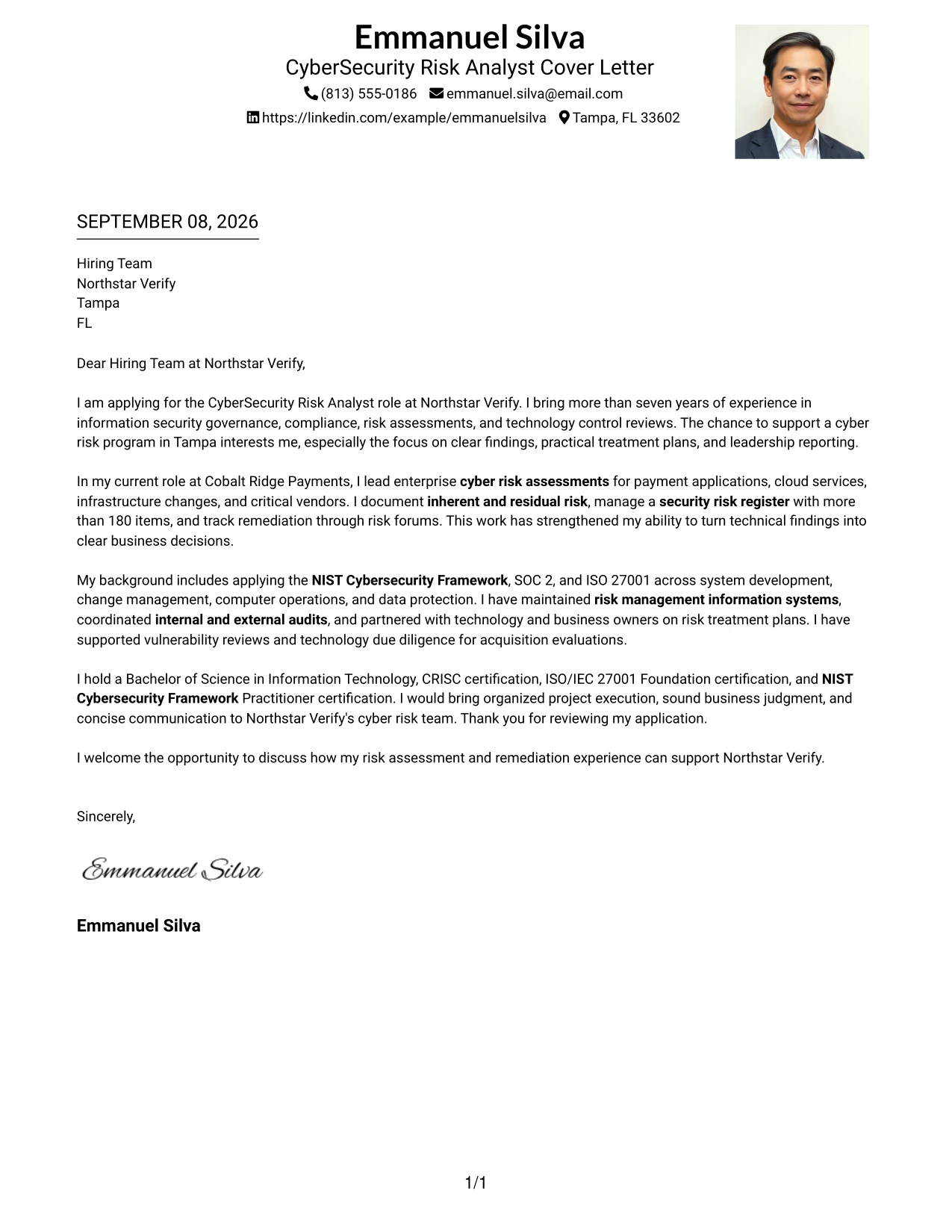
Why the One Column Format with Photo Right Works for a Cover Letter
- Right-side placement keeps the primary reading path focused on the written argument.
- The visual balance can make the header feel personal while leaving the body available for evidence.
- The format supports a measured tone for a role involving risk judgment and stakeholder trust.
- A one-column narrative helps connect motivation with specific responsibilities from the posting.
- The design can highlight communication strength without making the letter feel overly informal.
- Assessment, audit, and reporting examples can be presented in a clear progression.
- The closing remains easy to find because the page has one consistent text flow.
Best For
- Applications where written role alignment should remain the main visual priority
- Letters that benefit from a personal introduction placed outside the main text path
- Professional settings where trust and sound judgment are central to the message
- Applicants connecting assessment work to audit, treatment, and reporting duties
- One-page narratives that need a clear progression from interest to evidence
- Readers who prefer a stable text column with limited visual interruption
- Applications seeking a polished balance between identity and business-focused communication
#7 Simple Two Column Format Cover Letter Example
The format separates the persuasive letter from compact supporting information. One column can carry motivation, evidence, and the closing request, while the other can highlight the frameworks, risk activities, or communication strengths most relevant to the employer. This division helps a reader scan the application without losing the narrative.
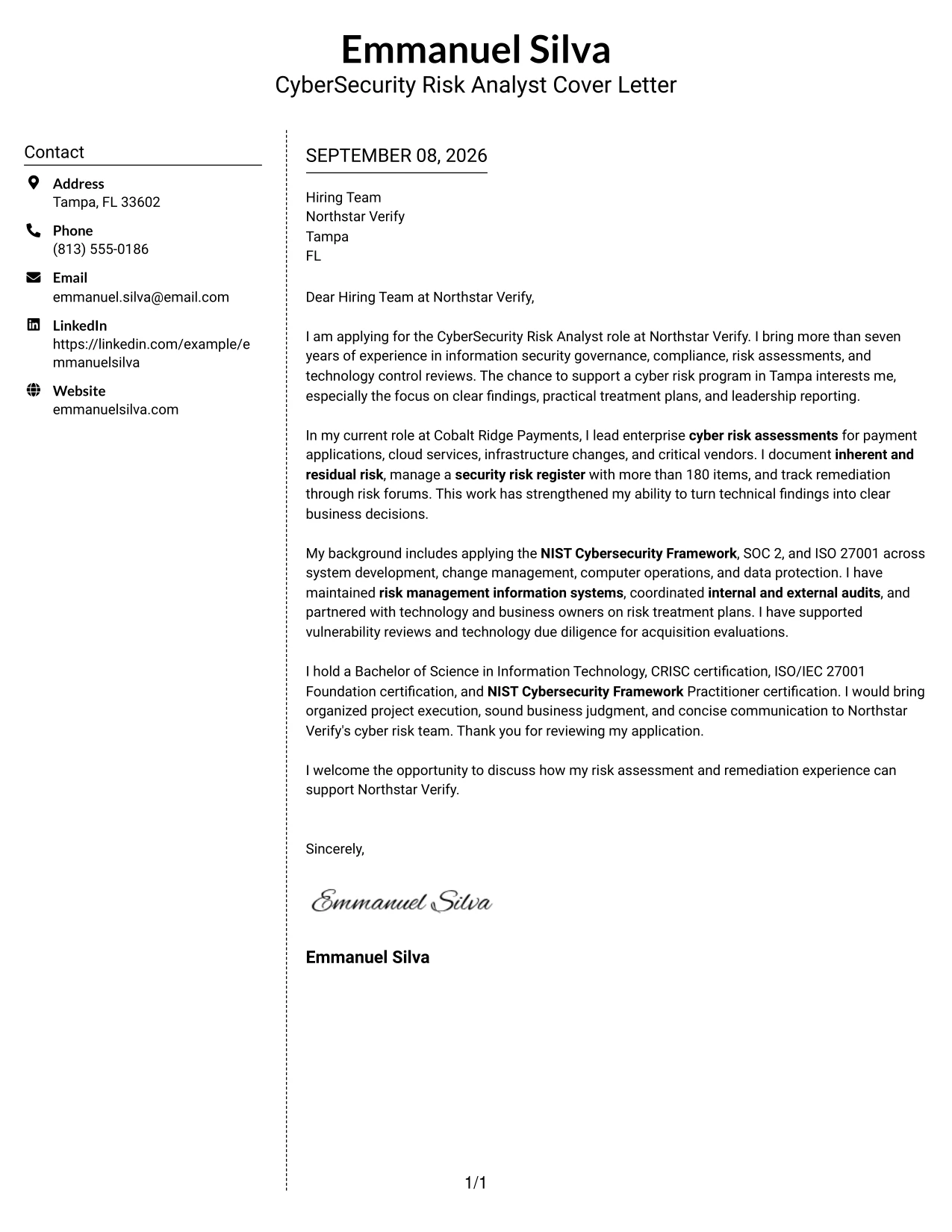
Why the Simple Two Column Format Works for a Cover Letter
- The two columns create a clear distinction between the letter's argument and its supporting proof.
- A simple structure keeps navigation easy for readers reviewing several applications.
- The main narrative can explain why the role and company are a strong match.
- A supporting area can reinforce assessment, audit, and remediation themes in short phrases.
- The format helps prevent a long list of qualifications from interrupting the opening message.
- Defined sections make it easier to tailor evidence to the employer's responsibilities.
- The presentation stays practical and professional while allowing more information than a narrow single-column letter.
Best For
- Letters that need a persuasive narrative beside a concise evidence summary
- Applications with multiple related risk activities to organize without repetition
- Readers who scan supporting information before reading the full explanation
- Roles where frameworks and stakeholder work both need visible emphasis
- One-page documents requiring clear separation between message and proof
- Applications that benefit from square, orderly information groupings
- Candidates who want a structured presentation without a highly decorative design
#8 Stylish Two Column Designer Format Cover Letter Example
Recruiters can move between a prominent main message and a designed sidebar that holds supporting context. That arrangement is useful when the letter must cover motivation, enterprise risk work, framework knowledge, and communication strengths without making every point a full paragraph. The design adds structure, but the persuasive case still comes from relevant evidence.
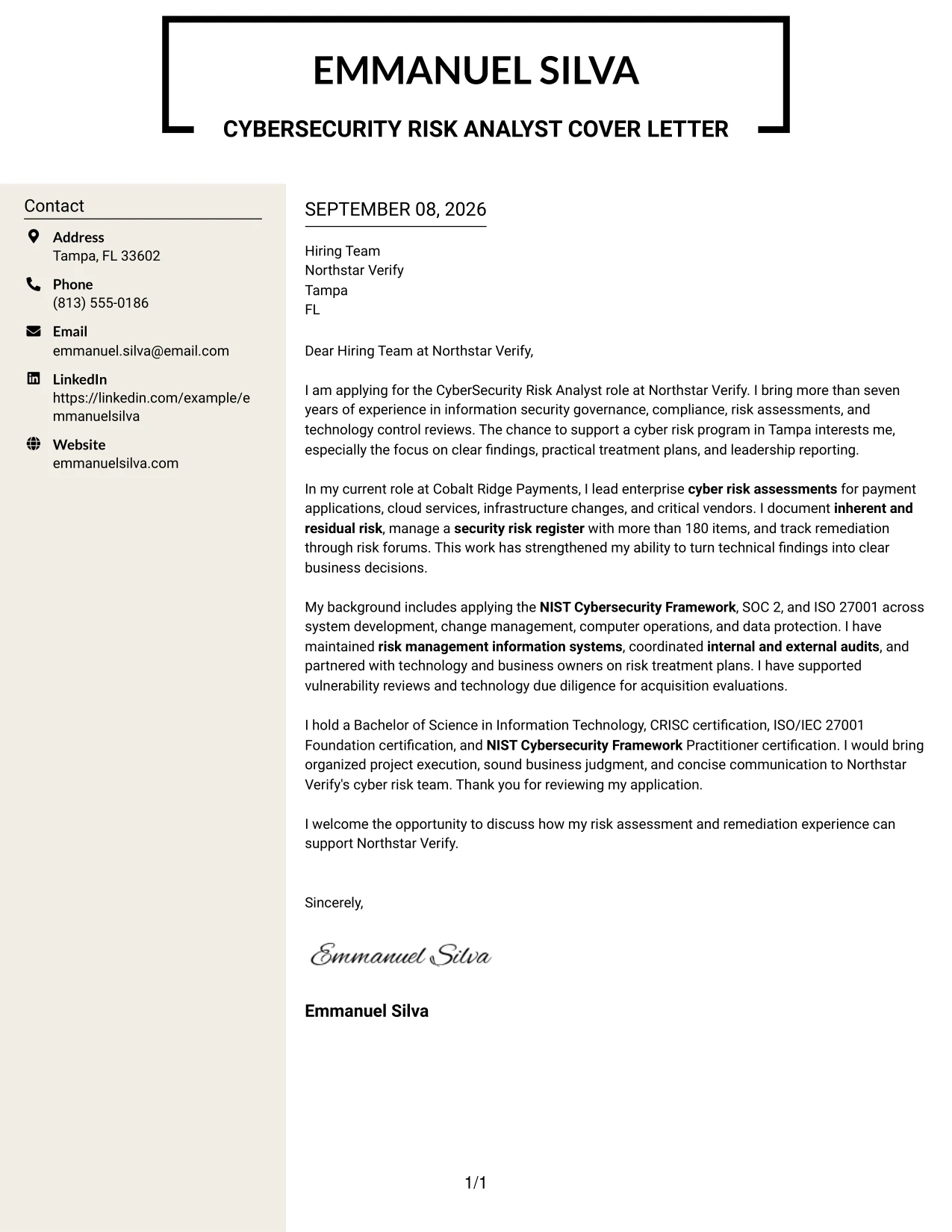
Why the Stylish Two Column Designer Format Works for a Cover Letter
- A strong primary column gives the opening and closing enough room to sound natural.
- The sidebar can hold concise supporting themes such as risk treatment, audits, and reporting.
- Distinct areas help readers compare employer needs with the evidence offered in the letter.
- The design can carry more content while keeping paragraphs from becoming dense.
- A visible hierarchy guides attention from motivation to proof and then to the requested next step.
- The format suits communication that must be both technically accurate and easy to review.
- A polished structure can show organization before the reader reaches the details of the application.
Best For
- Applications with a larger amount of relevant supporting context
- Letters that combine a personal argument with several short evidence themes
- Readers who move between a main narrative and quick reference details
- Roles requiring organized communication across technology and business groups
- Applications where risk, audit, and reporting content must coexist clearly
- One-page letters that need stronger visual separation than a basic two-column page
- Candidates presenting broad experience without turning the letter into a full career history
#9 Colored Two Column Format Cover Letter Example
The evidence should receive priority, with color used to guide the reader toward the most relevant parts of the case. A colored sidebar can distinguish employer fit, while the main column explains assessment scope, remediation work, and communication with leadership. This creates a useful balance between quick review and persuasive detail.
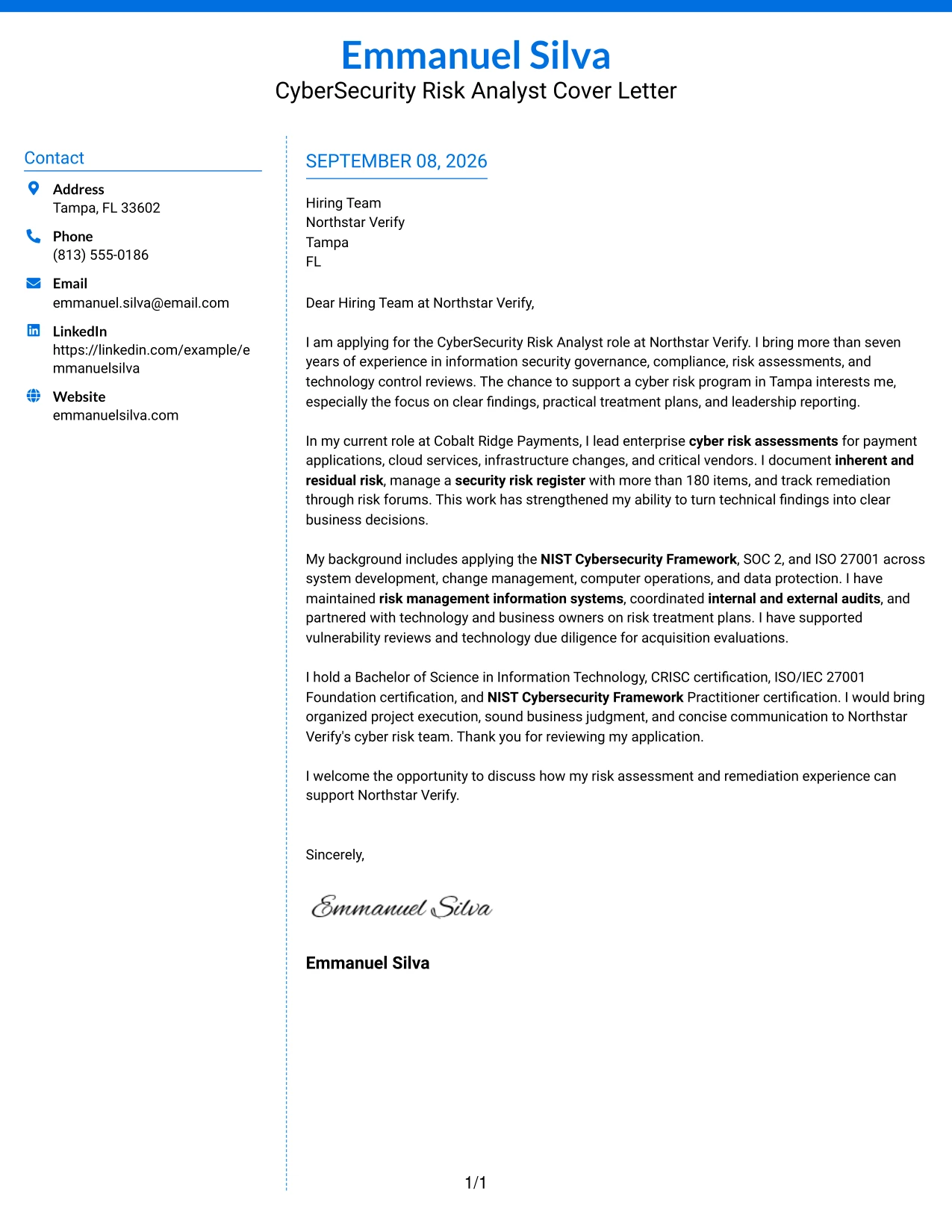
Why the Colored Two Column Format Works for a Cover Letter
- The main column can lead with the strongest evidence instead of a general career summary.
- Color creates a clear visual marker for supporting fit information without changing the message's tone.
- The format can separate technical responsibilities from business impact and motivation.
- Readers can locate key themes quickly, then return to the fuller explanation for context.
- Two columns allow several evidence types without forcing them into one crowded paragraph.
- The structure supports a clear connection between risk identification, treatment, and reporting.
- A controlled color treatment adds distinction while leaving credibility with the written content.
Best For
- Applications where the strongest evidence should appear early and remain easy to find
- Letters separating technical risk work from motivation and employer fit
- Readers who use visual markers to navigate supporting information
- Roles requiring clear explanation of findings, decisions, and remediation progress
- Applications with several evidence categories that need visible organization
- One-page communication that must feel distinct without losing professional restraint
- Candidates showing both analytical work and practical business judgment
#10 Creative Two Tone Format Cover Letter Example
The page needs to support a practical application without letting design replace substance. A two-tone treatment can separate the introduction from the body and give the close a clear visual endpoint. For this role, the message should still center on enterprise assessments, risk treatment, framework application, and useful reporting to leadership.
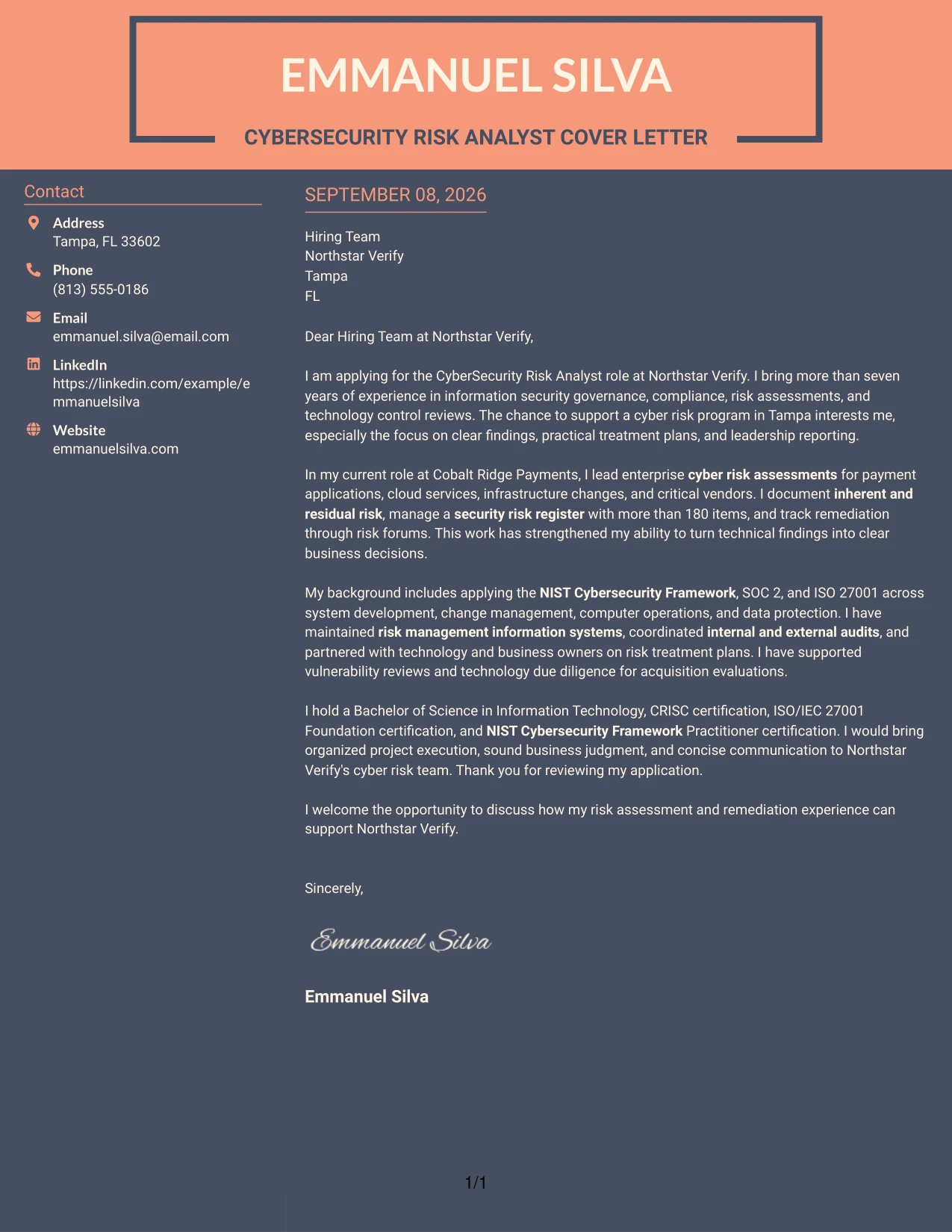
Why the Creative Two Tone Format Works for a Cover Letter
- Two visual tones can mark the transition from interest in the role to proof of fit.
- The structure gives the opening and closing clear positions on the page.
- A focused narrative can explain technical risk work in direct, business-friendly language.
- The design supports a memorable presentation while keeping the application easy to read.
- The format can give equal attention to motivation, relevant experience, and employer needs.
- Evidence about assessments, audits, and remediation can be grouped without losing context.
- A restrained creative treatment shows presentation awareness while preserving a professional message.
Best For
- Applications that need a clear transition between introduction and supporting evidence
- Letters for employers open to a distinctive but controlled presentation
- Roles where communication style matters as much as technical knowledge
- One-page messages with a small number of strong, relevant examples
- Applications that need motivation and employer fit to remain visibly connected
- Readers who value a memorable structure but still need fast comprehension
- Candidates presenting organized risk work through a polished business narrative
#11 Modern Icon Format Cover Letter Example
A practical application should make the message easy to enter and easy to remember. Small icons can guide the reader through motivation, relevant evidence, and the closing request, while the one-column flow keeps the argument intact. Used with restraint, the format gives clear visual cues to a letter built around risk assessment and business impact.
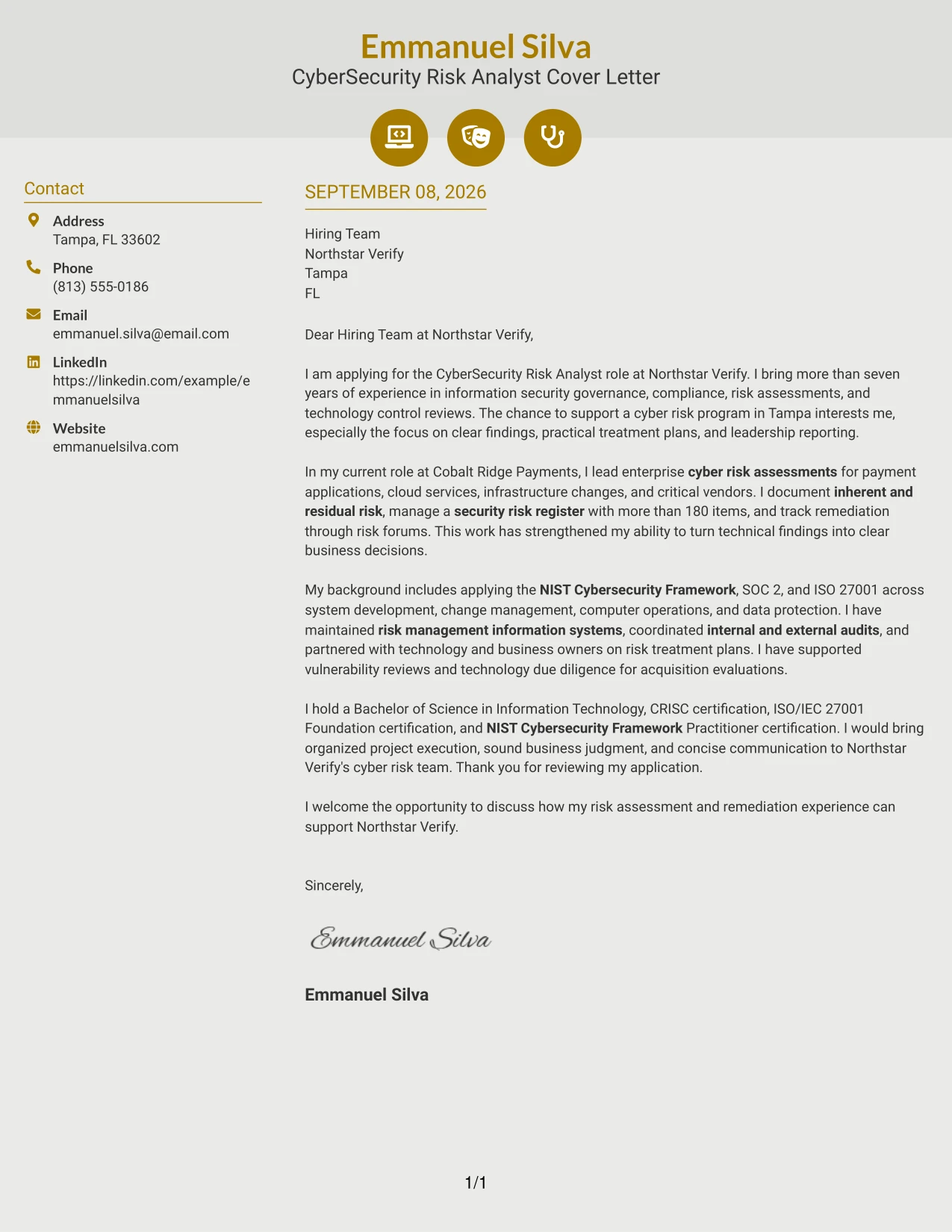
Why the Modern Icon Format Works for a Cover Letter
- Icons can mark key transitions without replacing the written explanation.
- A single column keeps the persuasive message in a natural reading order.
- Visual cues help readers locate motivation, evidence, and the requested next step.
- The format can make several short paragraphs feel connected rather than repetitive.
- Assessment and remediation examples remain clear because each point has room for context.
- A modern structure can support concise communication for a role with broad stakeholder contact.
- The design adds recognition while the actual fit is established through experience and judgment.
Best For
- Applications that benefit from light visual guidance between letter sections
- Readers who want to locate motivation and evidence quickly
- One-page letters built from several concise, connected points
- Roles where modern communication supports a business-focused message
- Applications presenting risk assessment and remediation as linked steps
- Candidates who want a current presentation without using a complex page structure
- Employer settings that value clarity, organization, and easy review
#12 Cover Letter Example — Minimal Header Format
A restrained visual hierarchy keeps attention on the reason for applying, the evidence of fit, and the requested next step. For the CyberSecurity Risk Analyst role, the letter connects more than seven years in cybersecurity risk with enterprise assessments, risk register administration, NIST, SOC 2, ISO 27001, and practical remediation planning. Its simple presentation supports a direct message: the candidate can identify inherent and residual risk, explain business impact, and help Northstar Verify move treatment decisions forward.
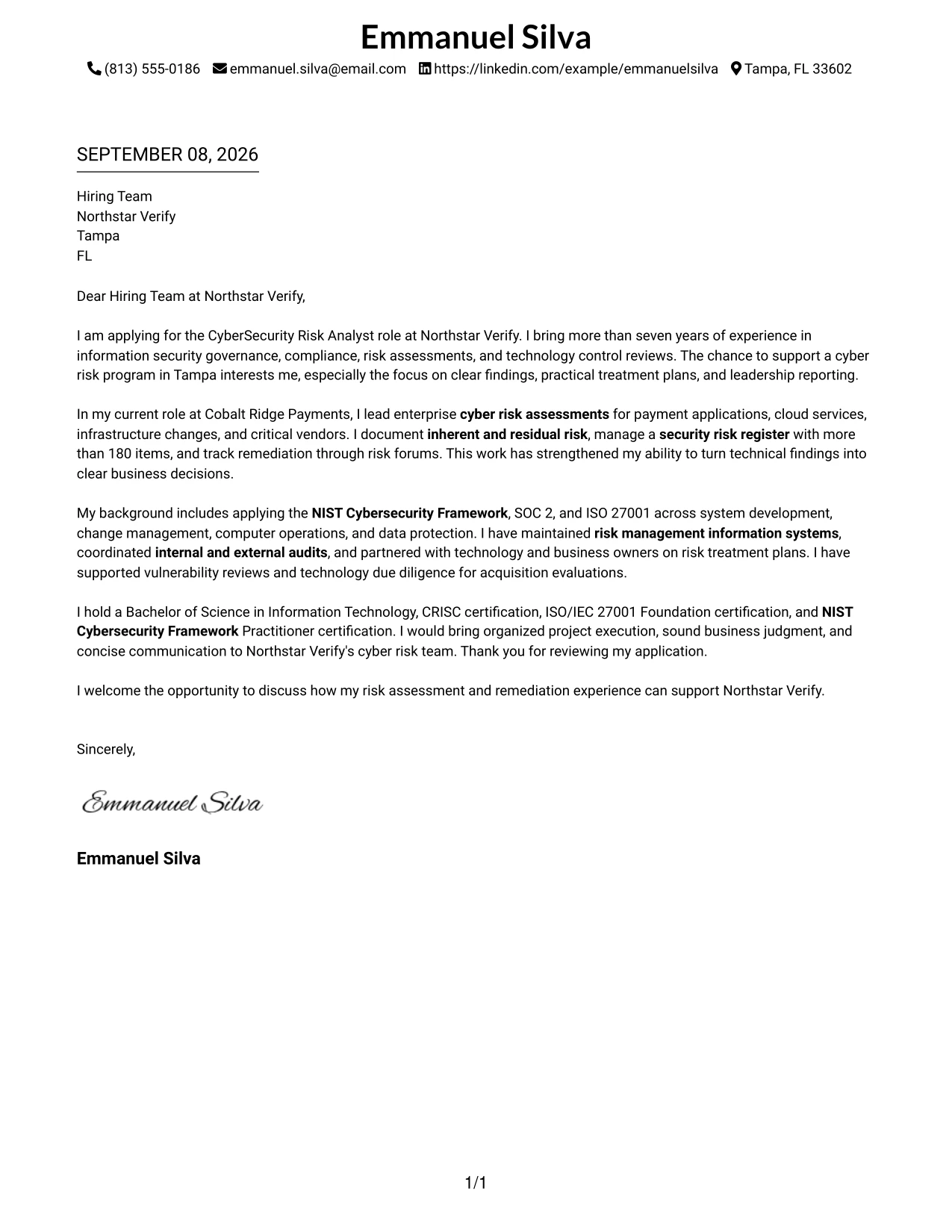
Why This Cover Letter Works
- The opening names the target role and gives a clear reason for interest in Northstar Verify.
- The first body paragraph leads with current enterprise assessment work and measurable scope through a risk register with more than 180 items.
- Inherent and residual risk are presented as decision-making evidence, not just technical terms.
- The next paragraph connects NIST, SOC 2, and ISO 27001 experience to the role's framework expectations.
- Audit coordination, vulnerability reviews, and technology due diligence show range across the employer's preferred work.
- The letter explains how findings become treatment plans, leadership reports, and follow-up actions.
- The closing is concise and invites a discussion about supporting the company's cyber risk team.
Best For
- Applicants who want the letter's main message to stand out without visual distractions
- Applications that need a clear link between motivation and role requirements
- Readers who prefer a fast path from the opening to supporting evidence
- Letters that must explain risk findings in business terms
- Professionals presenting several related frameworks in a compact narrative
- One-page applications where concise communication is important
- Roles that require organized reporting and practical stakeholder communication
#13 Cover Letter Example — Clean Two Column Sidebar Format
The two-column structure separates contact and supporting details from the main persuasive message. That division lets a reader scan the letter's purpose, risk assessment evidence, framework knowledge, and closing without losing the narrative. The content aligns the candidate's experience with Northstar Verify's needs, including enterprise cyber risk assessments, risk treatment plans, risk management information systems, audit support, and leadership reporting.
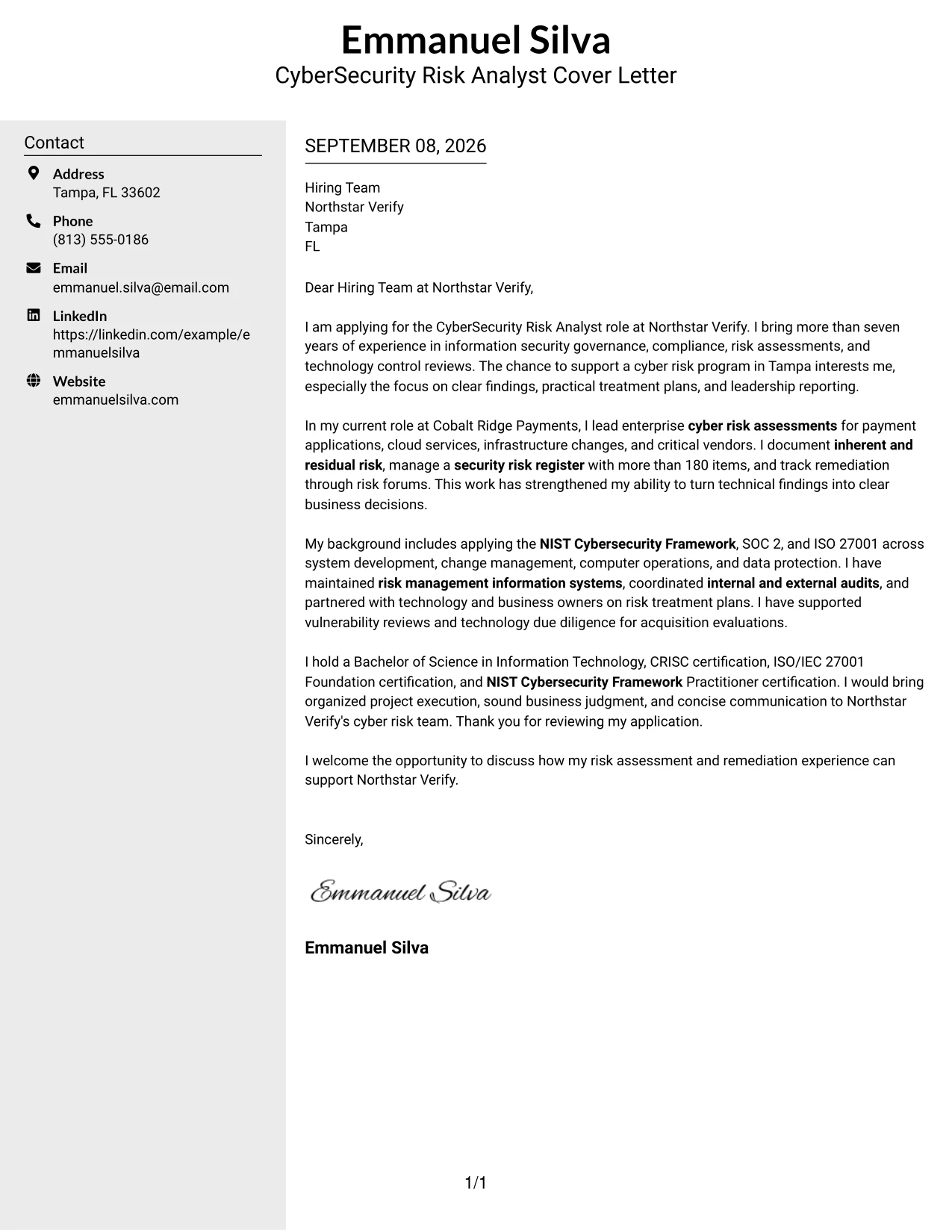
Why This Cover Letter Works
- The main column carries a logical application story from interest to evidence to next step.
- The sidebar creates a separate place for contact and supporting application details.
- Short visual zones make the letter easier to review during an early screening pass.
- The experience discussion focuses on outcomes such as clearer business decisions and tracked remediation.
- Framework experience is tied directly to the employer's stated NIST, SOC 2, and ISO 27001 requirements.
- The letter balances technical scope with communication and business judgment.
- The closing reinforces fit without adding a second summary of the document.
Best For
- Applications that benefit from clear separation between contact details and letter content
- Readers who scan before deciding which paragraphs to read closely
- Candidates with several supporting qualifications but a focused central message
- Letters that need visible structure without breaking the persuasive flow
- Applications combining technical evidence with leadership communication
- One-page correspondence where side content can reduce pressure on the main column
- Roles requiring both organized program administration and stakeholder alignment
#14 Cover Letter Example — Plain Two Column Format
Readers can move from the greeting to the reason for applying, then through specific evidence and the closing in a steady sequence. The two-column presentation gives the letter room to discuss assessment leadership, control reviews, audit coordination, vulnerability reviews, and due diligence while keeping each idea easy to locate. The result is a practical case for fit with Northstar Verify's cyber risk responsibilities.
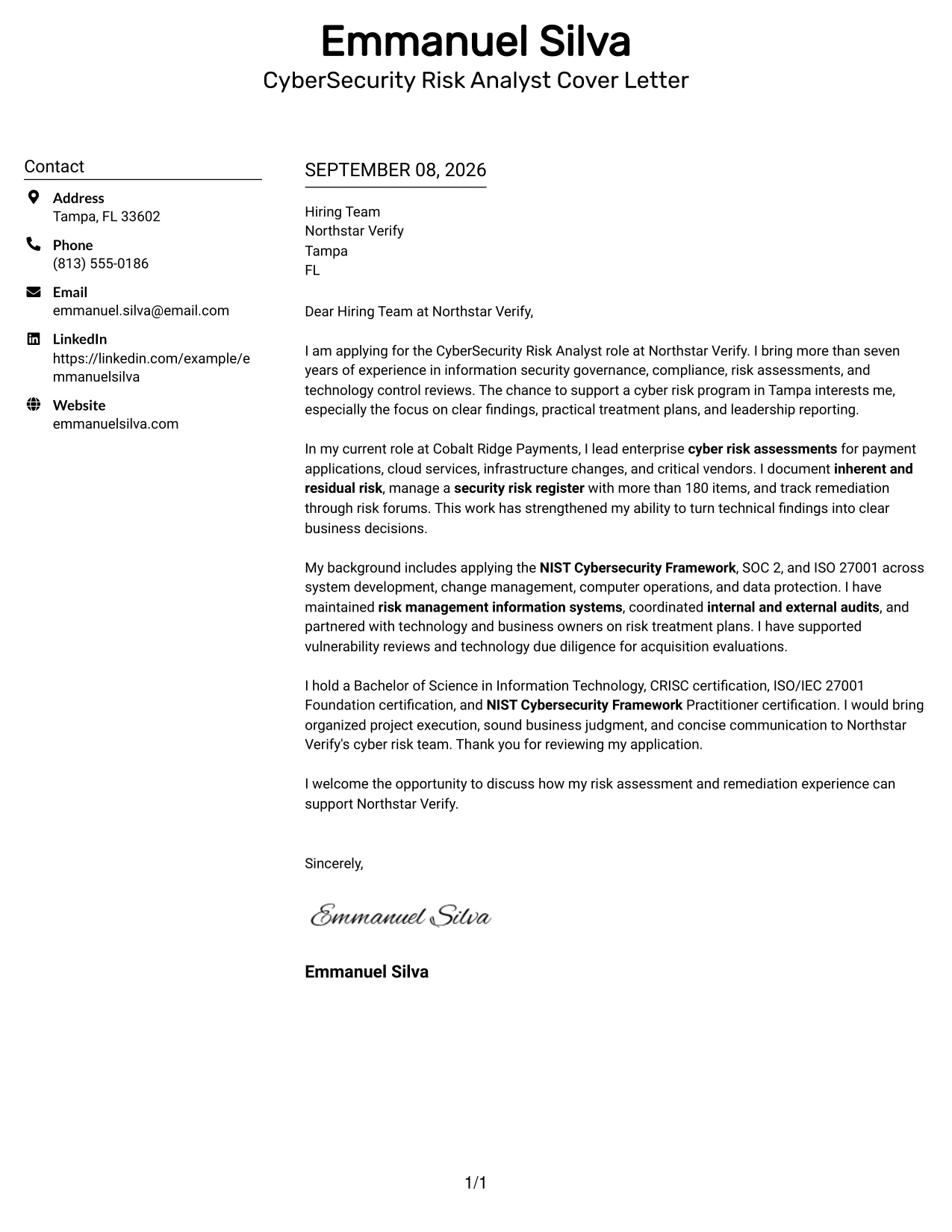
Why This Cover Letter Works
- The reader sees the application purpose before reaching supporting detail.
- Separate content areas help prevent a long experience paragraph from becoming difficult to follow.
- The letter uses current work to establish direct relevance to enterprise risk assessments.
- Specific control areas show understanding of system development, change management, computer operations, and data protection.
- The risk register example adds scale and accountability to the narrative.
- Audit and due diligence evidence supports the preferred qualifications in the job description.
- The final paragraph returns to communication, judgment, and the value the candidate can bring.
Best For
- Letters with several evidence areas that need orderly placement
- Applicants who need to explain both current responsibilities and broader supporting experience
- Readers who value a calm, functional presentation over decorative design
- Applications where technical topics must remain easy to track across the page
- Candidates describing assessment, audit, and remediation work in one letter
- Situations where a balanced layout supports a fuller but still focused explanation
- Roles that call for clear documentation and organized project execution
#15 Cover Letter Example — Modern Full Background Two Column Format
The strongest evidence receives priority: enterprise cyber risk assessments, a risk register with more than 180 open and accepted items, and treatment plans tied to risk appetite. A modern two-column background supports that evidence by giving the letter a clear visual order while the writing explains how findings become decisions, milestones, and leadership metrics. This makes the application relevant to Northstar Verify's need for both analysis and program administration.
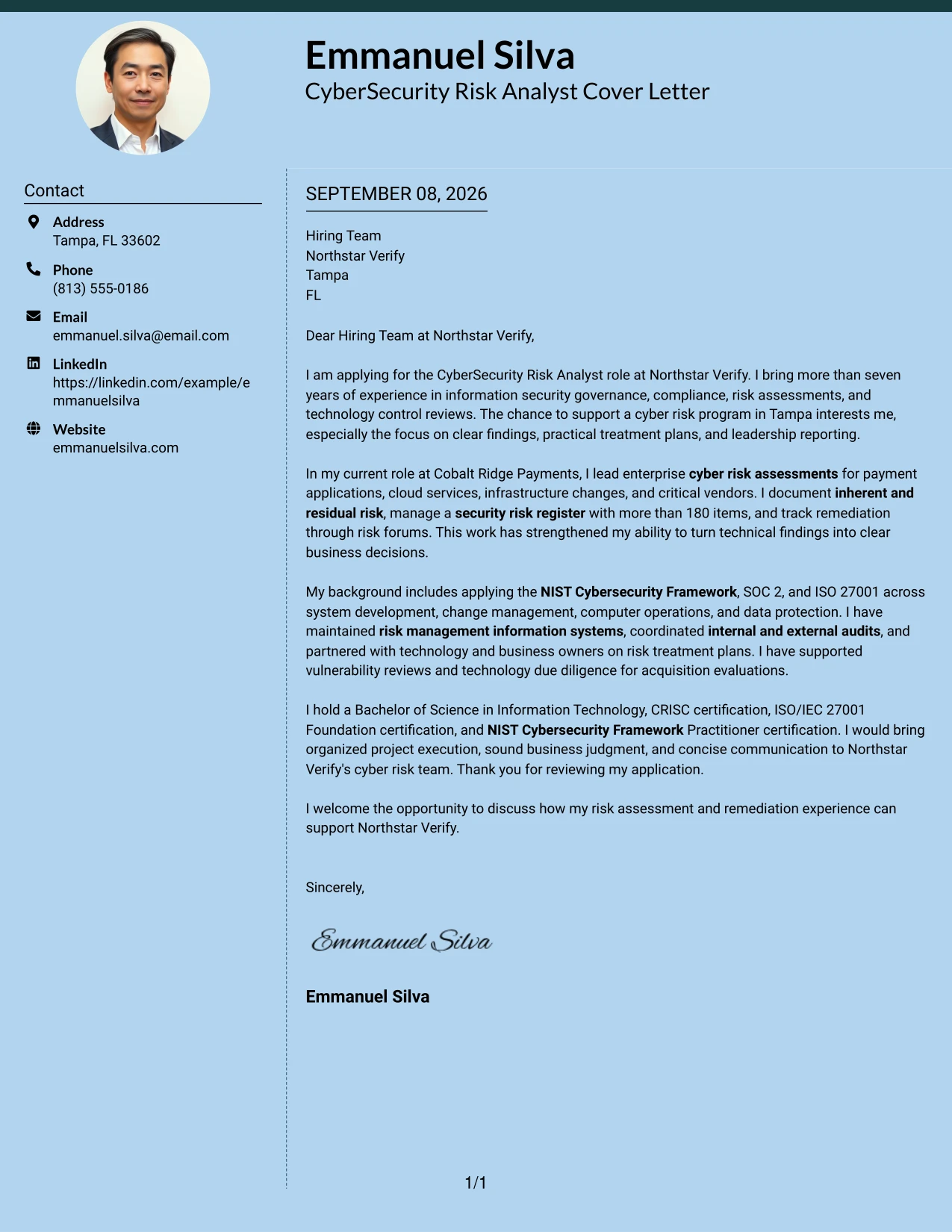
Why This Cover Letter Works
- The opening evidence is closely matched to the employer's core responsibilities.
- The risk register scope gives the reader a concrete view of program ownership.
- Inherent and residual risk show analytical depth and support for executive review.
- Treatment plans are described through owners, milestones, acceptance criteria, and evidence requirements.
- NIST, SOC 2, and ISO 27001 are presented as working frameworks used in assessments.
- Metrics and leadership reporting demonstrate follow-through after findings are issued.
- The visual balance keeps strong evidence prominent without making the letter feel crowded.
Best For
- Applications where measurable scope should appear early in the message
- Candidates presenting a mix of assessment ownership and program governance
- Letters that need to distinguish analysis from remediation follow-through
- Readers looking for evidence of risk decisions tied to business tolerance
- Applications with several standards that must be connected to real work
- Professionals who need room to discuss metrics and leadership visibility
- Roles where evidence volume matters more than a highly personal narrative
#16 Cover Letter Example — Dark Mode Two Column Format
Balanced content distribution helps the letter handle both technical evidence and business context. One area can carry the application narrative, while the other supports the reader's understanding of frameworks, audits, risk treatment, and reporting. The result is a focused application for Northstar Verify that shows the candidate can work with technology and business owners and communicate decisions clearly.
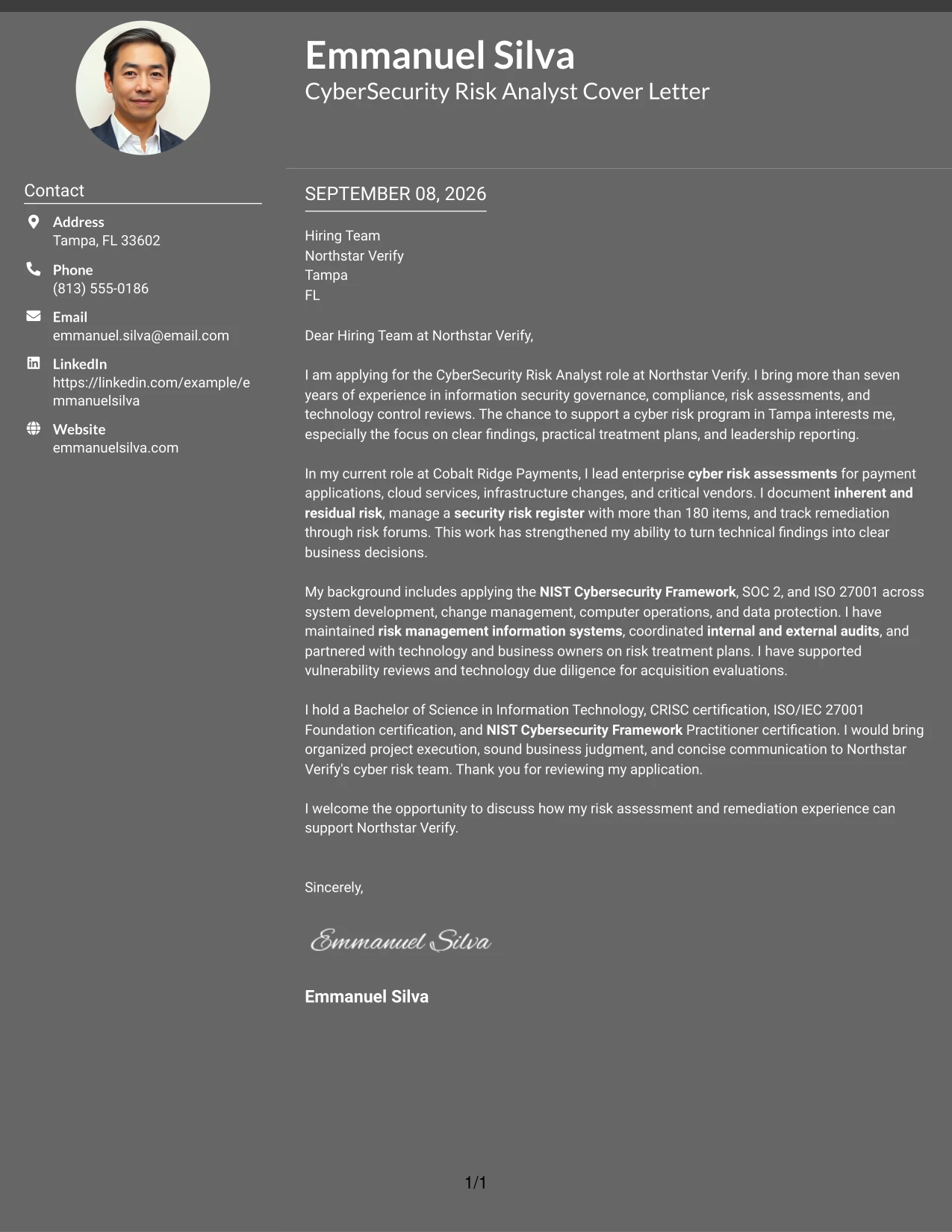
Why This Cover Letter Works
- The letter gives equal weight to technical risk work and stakeholder communication.
- The two-column balance supports a clear transition from experience to employer fit.
- Risk treatment is explained as collaboration with technology and business owners.
- Audit work and vulnerability reviews add evidence beyond assessment activity.
- The message connects technical deficiencies to business impact and decision options.
- The framework discussion supports the job's stated maturity and standards requirements.
- The closing keeps the application focused on productive next steps.
Best For
- Applications that must balance technical detail with business explanation
- Readers comparing evidence and communication fit at the same time
- Candidates with experience across assessments, audits, and treatment activities
- Letters where side-by-side organization improves comparison of related themes
- Applications for teams that work across technology, legal, privacy, and business groups
- Professionals who want a controlled, modern presentation for a serious message
- Roles requiring both risk analysis and collaborative project execution
#17 Cover Letter Example — Dark Mode Box Header Format
A practical application need comes first: a hiring team should understand the candidate's fit quickly and then find credible support for that claim. The boxed header establishes a strong entry point, while the single-column letter develops experience in enterprise assessments, risk register management, control frameworks, audits, and remediation reporting. The format suits a direct message about helping Northstar Verify identify risk and move issues toward resolution.
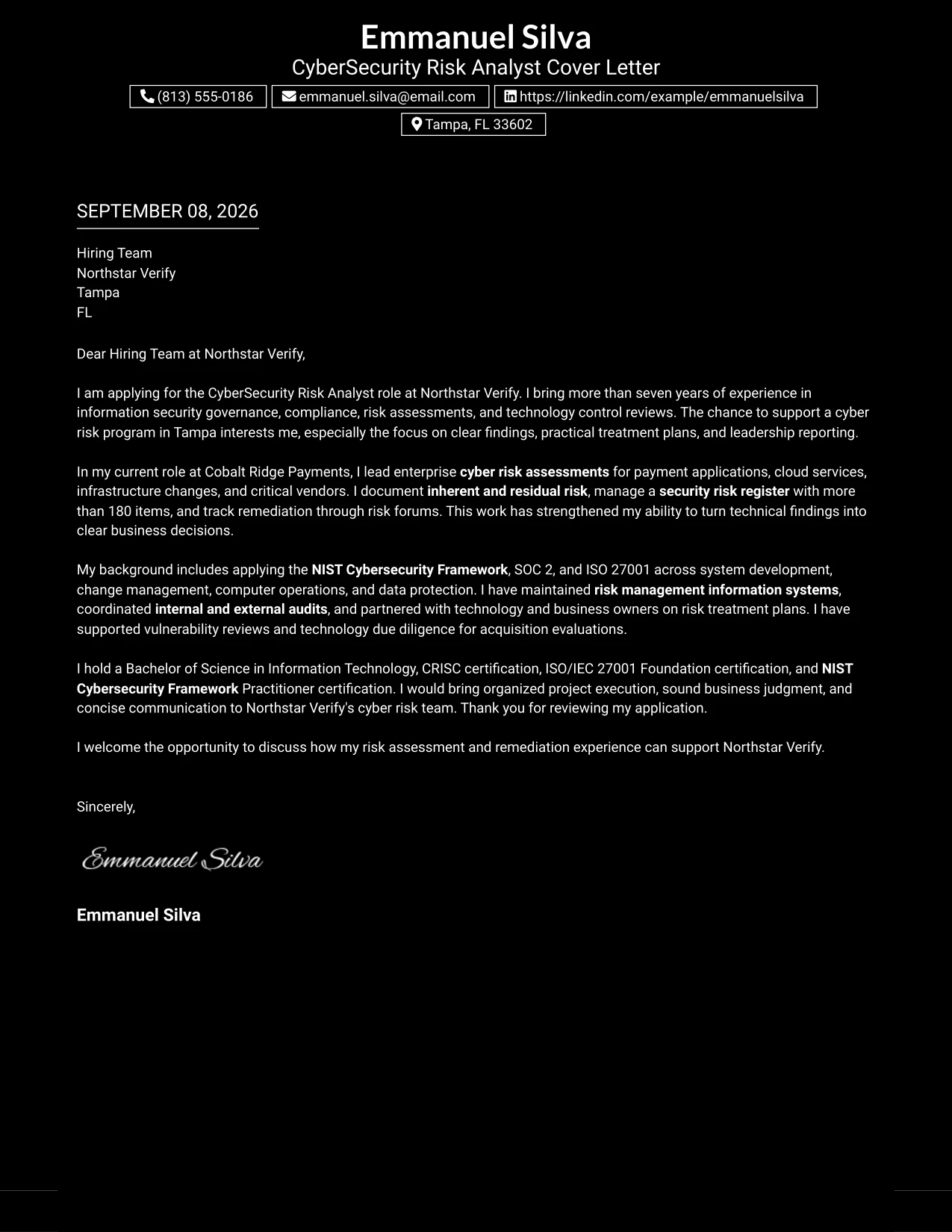
Why This Cover Letter Works
- The strong header makes the application purpose easy to identify.
- The single-column flow keeps the persuasive argument in a natural reading order.
- Current assessment leadership provides immediate evidence of role alignment.
- The risk register example shows ownership of open items, target dates, and escalation.
- Framework experience is supported by actual control review and evidence-mapping work.
- The letter includes both findings and the actions needed after findings are reported.
- The closing invites discussion without repeating every qualification.
Best For
- Applications that need a strong first point of orientation
- Readers reviewing letters in a quick, sequential pass
- Candidates with a clear central case for fit and limited need for side content
- Professional correspondence that benefits from a firm visual entry
- Letters focused on moving from identified issues to resolution
- Applications where one-column reading supports a direct communication style
- Roles involving risk registers, remediation tracking, and executive updates
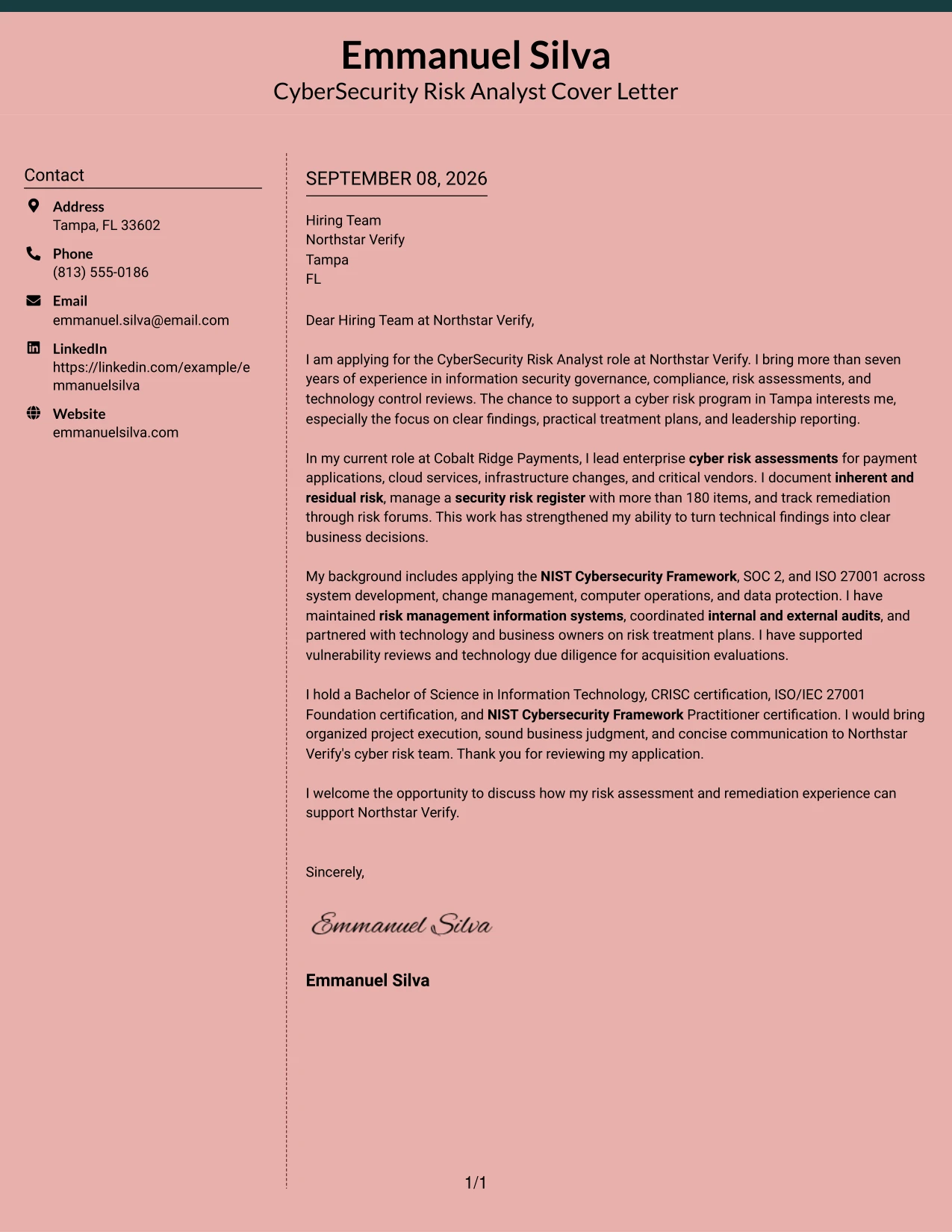
#18 Cover Letter Example — Elegant Full Background Two Column Format
A restrained visual hierarchy gives the application a composed and credible tone before the evidence begins. The two-column arrangement then connects motivation to relevant experience without making the letter feel crowded. Its message is specific: the candidate has led assessments, translated findings for leadership, supported audits and due diligence, and built treatment plans that fit enterprise risk appetite.
Why This Cover Letter Works
- The opening expresses interest in the company's work without relying on a generic statement.
- The letter presents experience as a sequence of business contributions.
- Leadership communication is supported by examples of findings, metrics, and decision options.
- Due diligence experience adds relevance to a stated responsibility in the job description.
- The framework discussion remains connected to assessment and control review work.
- The tone is confident but measured, which supports sound business judgment.
- The final invitation creates a clear next step for the hiring team.
Best For
- Applications that need a polished but restrained communication style
- Readers assessing professional judgment as well as technical capability
- Candidates connecting motivation with several related forms of evidence
- Letters where a balanced two-column presentation supports a composed tone
- Applications involving leadership briefings, audits, and business decisions
- Professionals who want technical depth without an overly dense page
- Roles where employer fit depends on clear, credible explanation
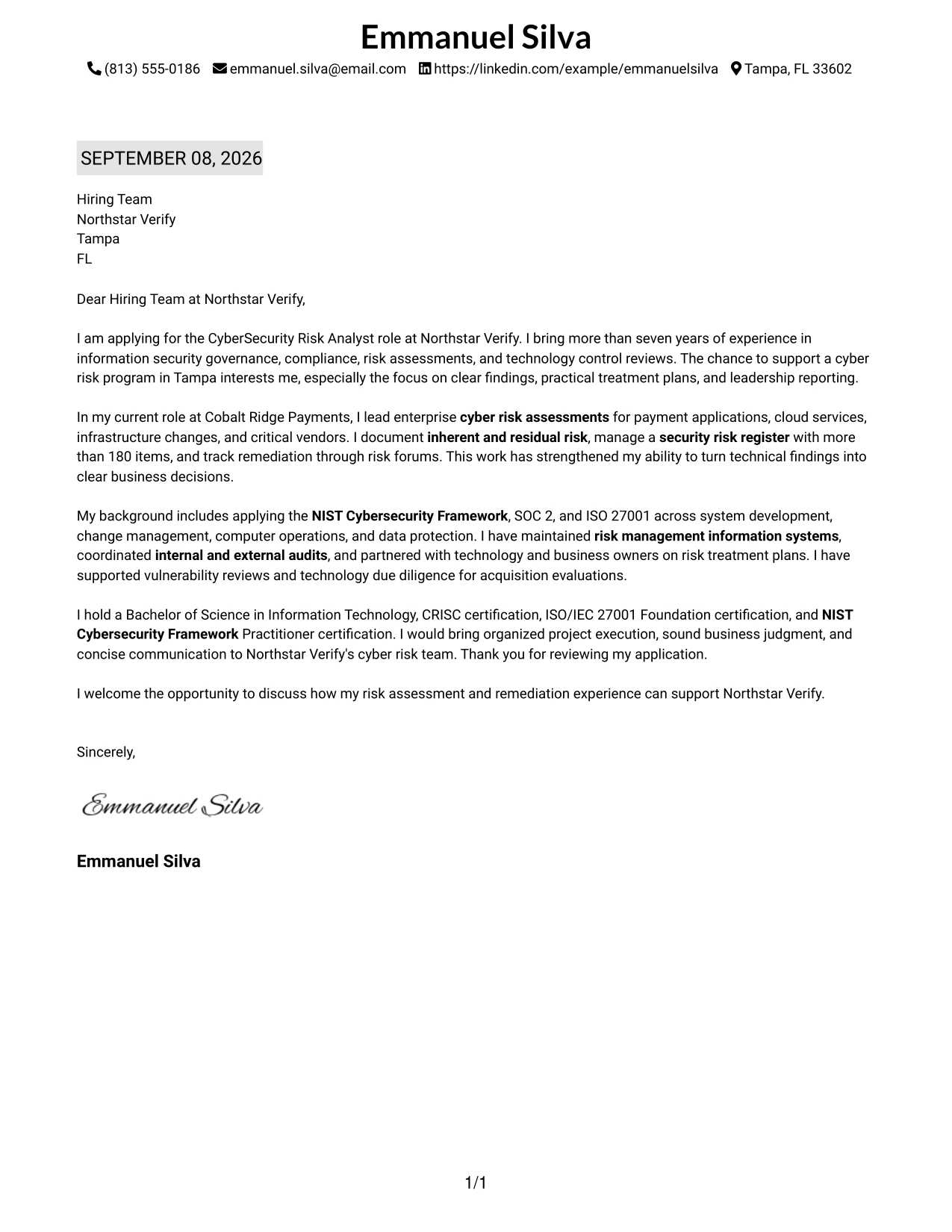
#19 Cover Letter Example — Plain One Column with Highlighted Date
The single-column structure gives the letter a familiar application sequence, while the highlighted date helps the reader place the correspondence quickly. That clarity supports a focused case built from current assessment leadership, risk register governance, framework application, audit coordination, and remediation reporting. The format keeps the argument easy to follow from the first sentence through the invitation to discuss fit.
Why This Cover Letter Works
- The familiar sequence reduces effort for a reader reviewing many applications.
- The date treatment adds useful context without competing with the message.
- The opening states the target role, experience level, and reason for interest.
- Evidence moves from current responsibilities to broader framework and audit experience.
- The letter gives the risk register a concrete scope through more than 180 items.
- The closing links the candidate's experience to Northstar Verify's cyber risk team.
- Every paragraph supports persuasion rather than repeating document details.
Best For
- Applications that benefit from a familiar one-column reading path
- Readers who need immediate date and correspondence context
- Candidates presenting a clear progression from current work to supporting evidence
- Letters where chronology and message order should remain obvious
- Professional applications requiring a traditional, easy-to-review presentation
- Applications with enough evidence for a full narrative but no need for side content
- Roles where consistent documentation and follow-up are central to the work
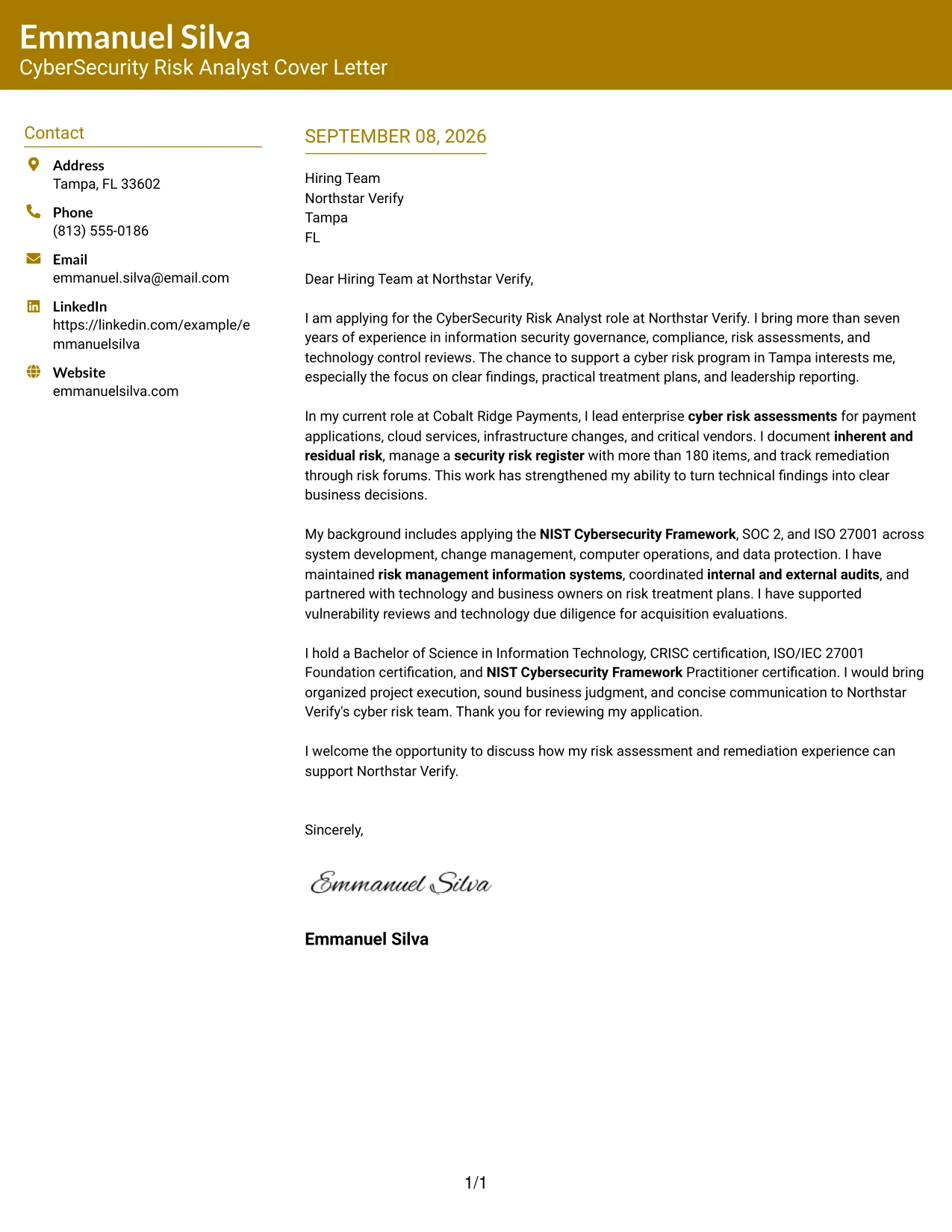
#20 Cover Letter Example — Bold Color Header Professional Format
Readers can identify the application purpose immediately, then follow a clear path from relevant experience to employer fit. The bold header gives the letter a confident entry, while the professional body explains how Emmanuel Silva has led enterprise assessments, administered risk records, supported audits, and translated findings into treatment decisions. The structure keeps the content volume manageable and the argument focused on business impact.
Why This Cover Letter Works
- The header gives quick context before the reader enters the main argument.
- The opening connects motivation for Northstar Verify with directly relevant experience.
- The body uses current work to establish ownership of assessments and remediation visibility.
- Framework knowledge is shown through application to control expectations and reviews.
- Audit, vulnerability, and acquisition due diligence experience widens the evidence base.
- The letter presents communication as a work outcome through leadership briefings and business-impact explanations.
- The closing is professional and specific about the value of a follow-up conversation.
Best For
- Applications that need an immediate professional point of orientation
- Readers who prefer a clear, linear review of a moderately detailed letter
- Candidates with several evidence areas that still need one central narrative
- Letters where a strong header can separate contact context from persuasive content
- Applications combining governance, assessment, and remediation experience
- Professionals who want a confident presentation without an informal tone
- Roles requiring concise reports and communication with leadership
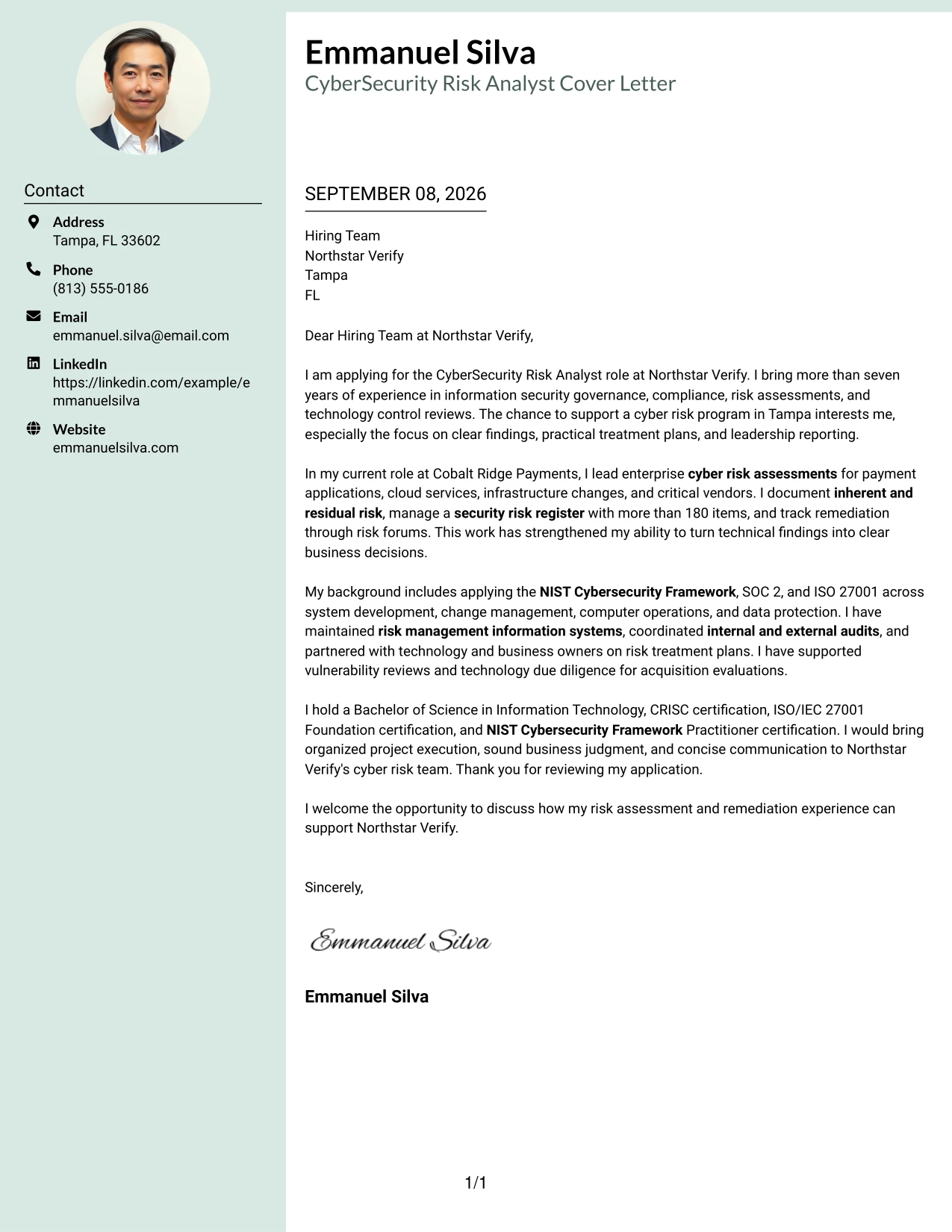
#21 Cover Letter Example — Photo Header Color Sidebar Format
The most important evidence remains central: enterprise risk assessments, framework-based control reviews, tracked remediation, and clear leadership reporting. A color sidebar and photo header add a human point of recognition, while the letter's wording keeps the focus on role alignment and business results. Used appropriately, the presentation helps introduce the candidate as a credible communicator who can connect technical risk with practical action.
Why This Cover Letter Works
- The opening makes the target role and reason for applying clear.
- The visual identity supports recognition while the written case remains evidence-led.
- Current work shows direct experience with applications, cloud services, infrastructure changes, and vendors.
- The letter explains how control frameworks guide consistent assessment work.
- Risk treatment plans show collaboration, ownership, milestones, and evidence requirements.
- Leadership metrics and external auditor communication demonstrate follow-through.
- The close maintains a professional tone and invites a focused discussion.
Best For
- Applications where a recognizable personal presentation supports the written message
- Readers who value a clear visual identity alongside strong evidence
- Candidates who need to connect assessment work with stakeholder trust
- Letters combining technical control knowledge and concise leadership communication
- Applications with varied evidence across vendors, infrastructure, audits, and remediation
- Professionals using a color sidebar to separate contact context from the main case
- Roles where credibility depends on both analysis and interpersonal communication
#22 Cover Letter Example — Top Left Header Color Accent Format
Balanced spacing gives the letter room to state motivation, present evidence, and close with a clear invitation. The top-left header and color accent create structure without taking attention away from the message. This approach fits an application that must explain assessment leadership, NIST and related standards, risk management systems, audit support, and practical treatment of findings for Northstar Verify.
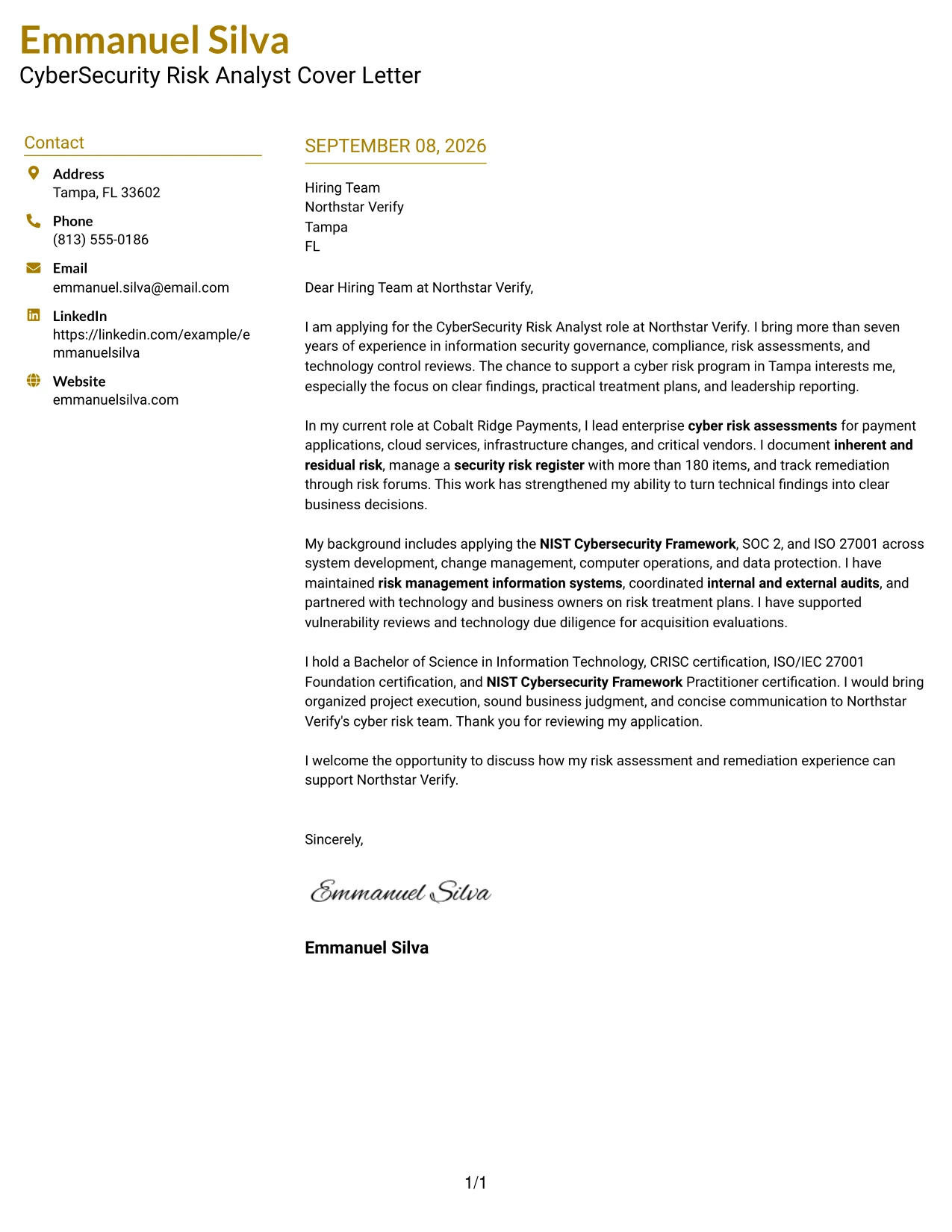
Why This Cover Letter Works
- The open spacing makes the application purpose easy to identify.
- The color accent provides hierarchy while preserving a professional communication tone.
- The letter leads with experience that directly matches enterprise assessment responsibilities.
- Framework knowledge is connected to control reviews across several technology processes.
- Risk management system administration supports the employer's program responsibilities.
- The message explains how findings are documented, prioritized, and reported to leadership.
- The final invitation gives the hiring team a clear reason to continue the conversation.
Best For
- Applications needing a calm layout with clear separation between ideas
- Readers who prefer generous spacing and a simple communication path
- Candidates explaining assessment, framework, and reporting work in measured detail
- Letters where a small visual accent should support rather than dominate the message
- Applications focused on practical risk treatment and leadership visibility
- Professionals presenting organized evidence without a dense or highly segmented page
- Roles requiring careful documentation, prioritization, and follow-through
#23 Cover Letter Example: Centered Header Classic Two Column Format
For an application that needs quick review, the Centered Header Classic Two Column Format gives the cover letter a clear contact area and an orderly reading path. The letter can open with interest in Northstar Verify, then connect enterprise cyber risk assessments, risk register ownership, NIST, SOC 2, ISO 27001, audit coordination, and treatment planning to the CyberSecurity Risk Analyst role. Its balanced structure keeps motivation, evidence, and employer fit easy to follow without making the message feel crowded.
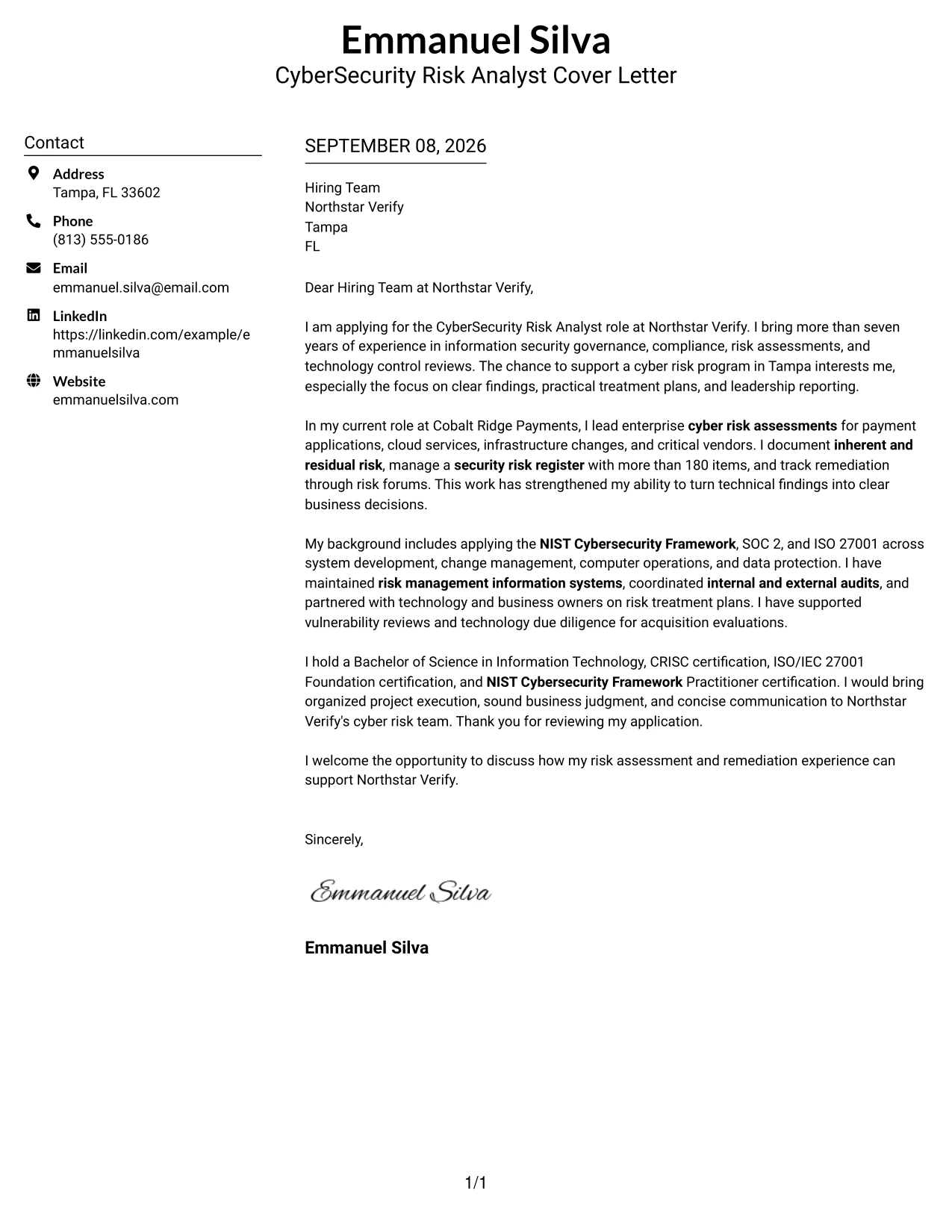
Why This Cover Letter Works
- The centered header creates a clear first point of contact.
- Two columns can separate contact details from application content without interrupting the letter’s message.
- The opening links the candidate’s interest to Northstar Verify’s cyber risk work.
- The middle of the letter gives priority to enterprise assessments, inherent and residual risk, and remediation progress.
- Framework experience is presented as support for the employer’s requirements, not as a disconnected list.
- The closing reinforces communication, business judgment, and readiness to discuss fit.
- The format supports a professional tone while keeping the letter visually organized.
Best For
- Applicants who want a strong visual starting point before the recruiter reads the message.
- Cover letters that need separate spaces for contact details and persuasive content.
- Applications with several related evidence points that must remain easy to distinguish.
- Readers who prefer a balanced structure rather than a long uninterrupted page.
- Candidates connecting current responsibilities to a closely matched target role.
- Professional messages that need a polished presentation without decorative distractions.
#24 Cover Letter Example: Left Aligned Header Clean Two Column Format
A restrained visual hierarchy lets the reader move from the applicant’s contact details to the greeting, motivation, evidence, and closing with little effort. The Left Aligned Header Clean Two Column Format supports a direct case for the CyberSecurity Risk Analyst opening by showing how risk assessments, more than 180 risk register items, audit work, and treatment plans match Northstar Verify’s needs. The clean presentation leaves room for a confident but measured communication style.
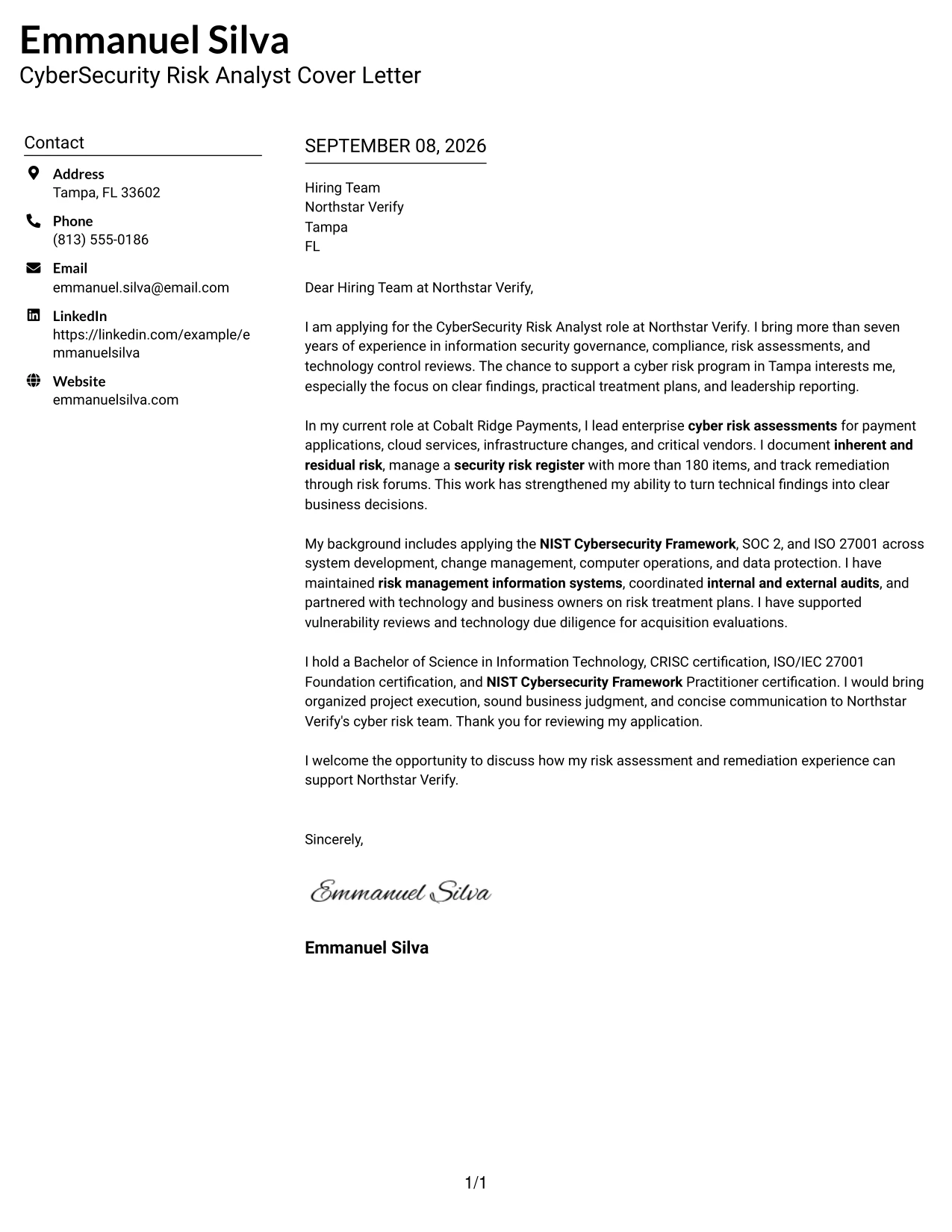
Why This Cover Letter Works
- Left alignment gives the letter a natural reading flow.
- The clean header keeps attention on the application rather than visual decoration.
- The opening explains why the Tampa opportunity and Northstar Verify’s work are relevant.
- The body connects practical risk ownership to the employer’s assessment and reporting responsibilities.
- Evidence from payments, health systems, consulting, and municipal services shows breadth without losing focus.
- The language translates technical work into business decisions and leadership visibility.
- The closing creates a clear invitation for further discussion.
Best For
- Applicants who want a direct, understated communication style.
- Cover letters where employer fit should appear early and remain visible.
- Messages that compare several areas of responsibility without using dense blocks of text.
- Applications reviewed by readers who value orderly alignment and plain language.
- Candidates whose strongest evidence comes from cross-functional risk work.
- Professional settings where a clean presentation supports credibility.
#25 Cover Letter Example: Accent Divider Modern Two Column Format
The Accent Divider Modern Two Column Format separates the letter into clear visual stages, so the opening, supporting evidence, and closing are easy to locate. That structure helps the application present a focused argument: the candidate can identify inherent and residual risk, manage remediation, apply NIST Cybersecurity Framework, SOC 2, and ISO 27001 practices, and communicate findings to leadership. The modern dividers add pace while keeping the message centered on employer needs.
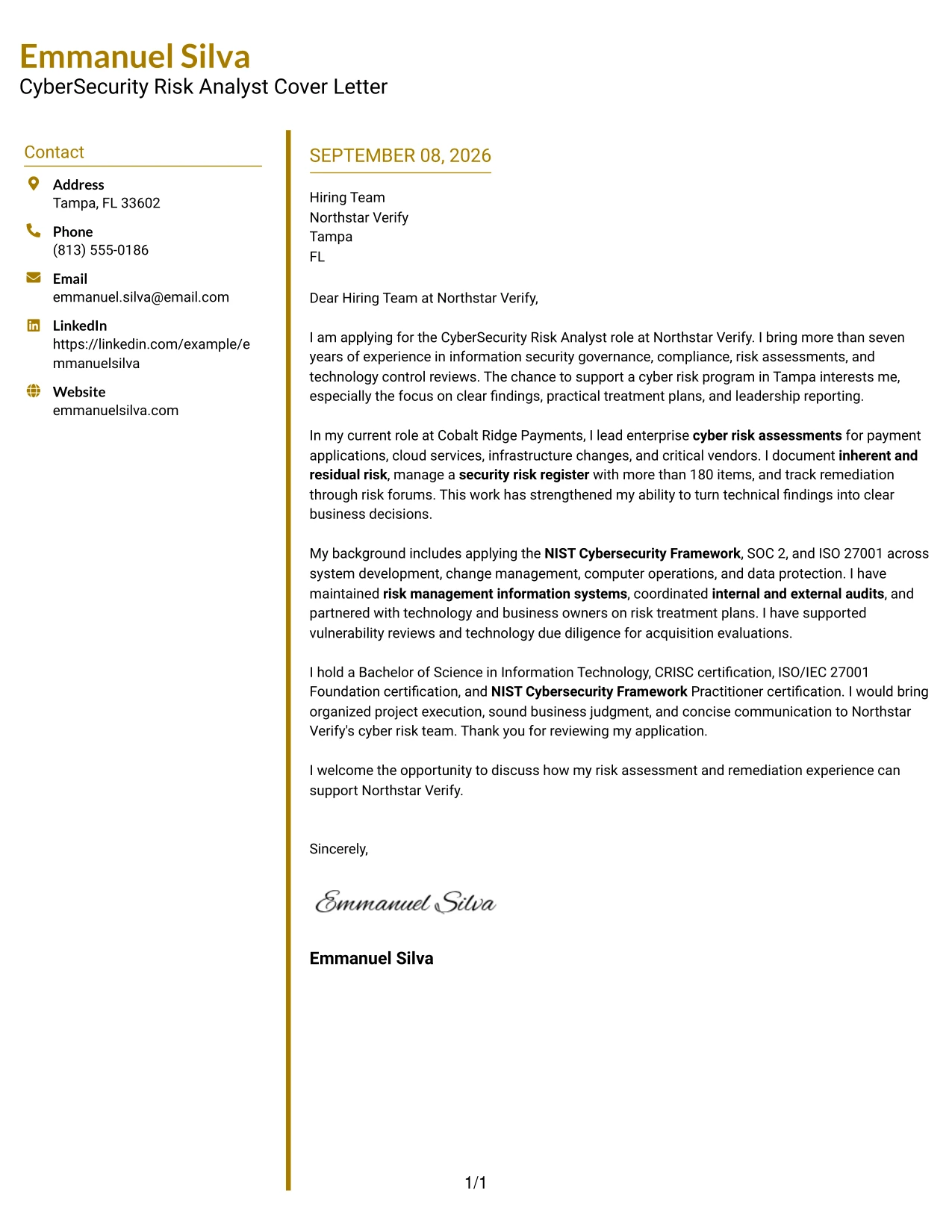
Why This Cover Letter Works
- Dividers make the letter’s main communication stages easy to scan.
- The opening can state motivation and role fit without delaying the central message.
- A dedicated evidence area supports a concise account of assessments, audits, and risk treatment.
- The structure helps related framework experience stay connected to practical work.
- Visual separation reduces the chance that important findings or outcomes will be missed.
- The final section can close with confidence and a clear next step.
- Modern accents add distinction without replacing substance.
Best For
- Applicants who need visible separation between motivation, evidence, and closing.
- Cover letters with several proof points that benefit from clear grouping.
- Readers who scan first and return for detail after locating the main sections.
- Applications that must show both technical understanding and business communication.
- Candidates presenting a mix of assessment, remediation, audit, and reporting experience.
- Professional documents that need a current look while preserving a formal tone.
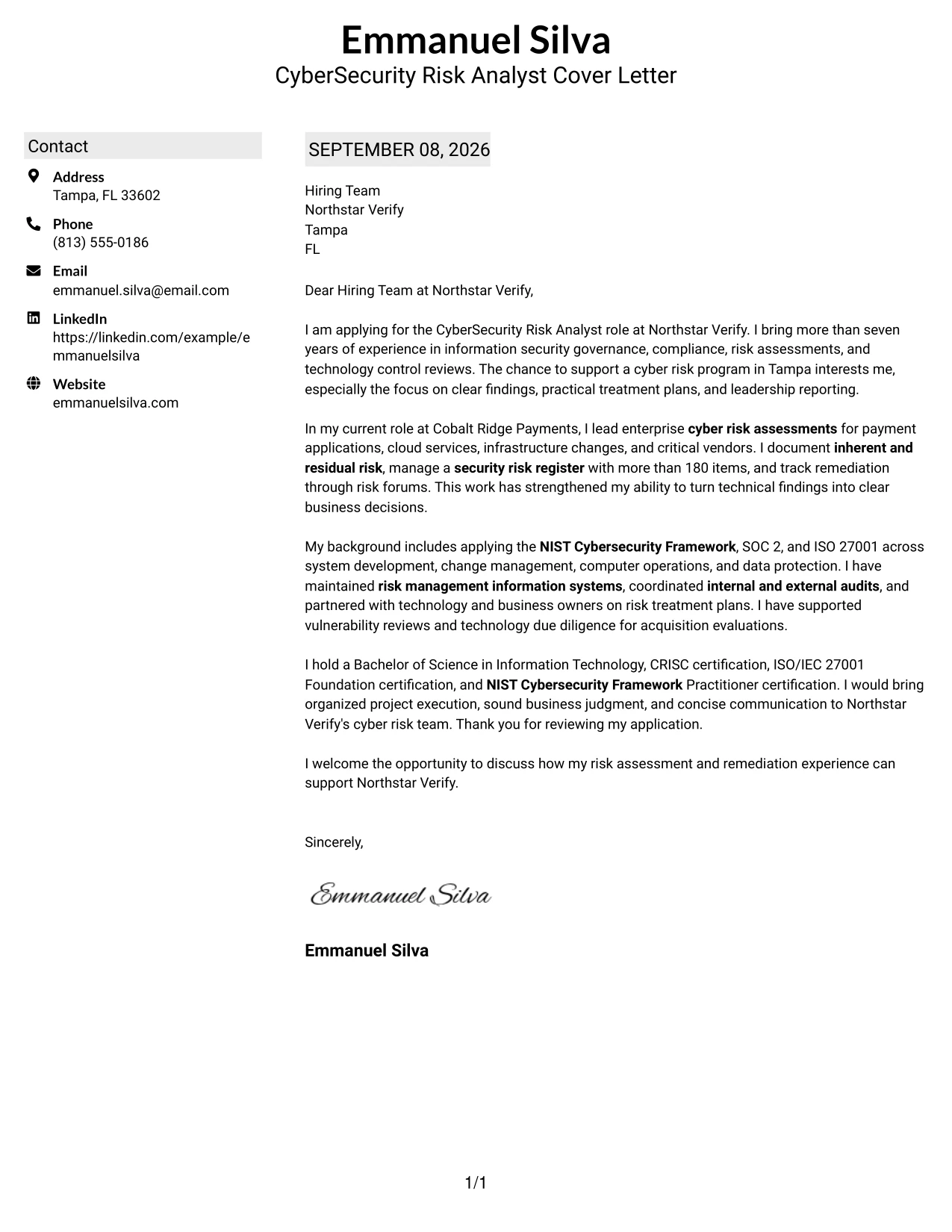
#26 Cover Letter Example: Shaded Labels Clean Two Column Format
Readers can move through the Shaded Labels Clean Two Column Format by using its labeled areas as signposts for motivation, relevant evidence, and closing intent. This is useful for a detailed application to Northstar Verify because the letter can show experience with enterprise assessments, risk management information systems, vulnerability reviews, internal and external audits, and due diligence in a controlled sequence. The layout gives substantial content room while keeping each point connected to the role.
Why This Cover Letter Works
- Shaded labels tell the reader what type of information follows.
- The opening can establish interest in Northstar Verify before moving to qualifications.
- The main content can group assessment and risk treatment evidence in a logical order.
- Labels help explain how audit and due diligence experience supports the target responsibilities.
- A two-column structure provides room for detail without making the letter feel unstructured.
- The format supports precise, business-focused language.
- The closing remains easy to find after a fuller explanation of fit.
Best For
- Applicants with a broad evidence base that needs clear grouping.
- Cover letters combining assessment, audit, vulnerability, and due diligence experience.
- Readers who use labels to locate the part of a message they need first.
- Applications where content volume is higher than a short introductory note.
- Candidates explaining several forms of risk work without repeating the same point.
- Professional communications that need structure but not a highly decorative design.
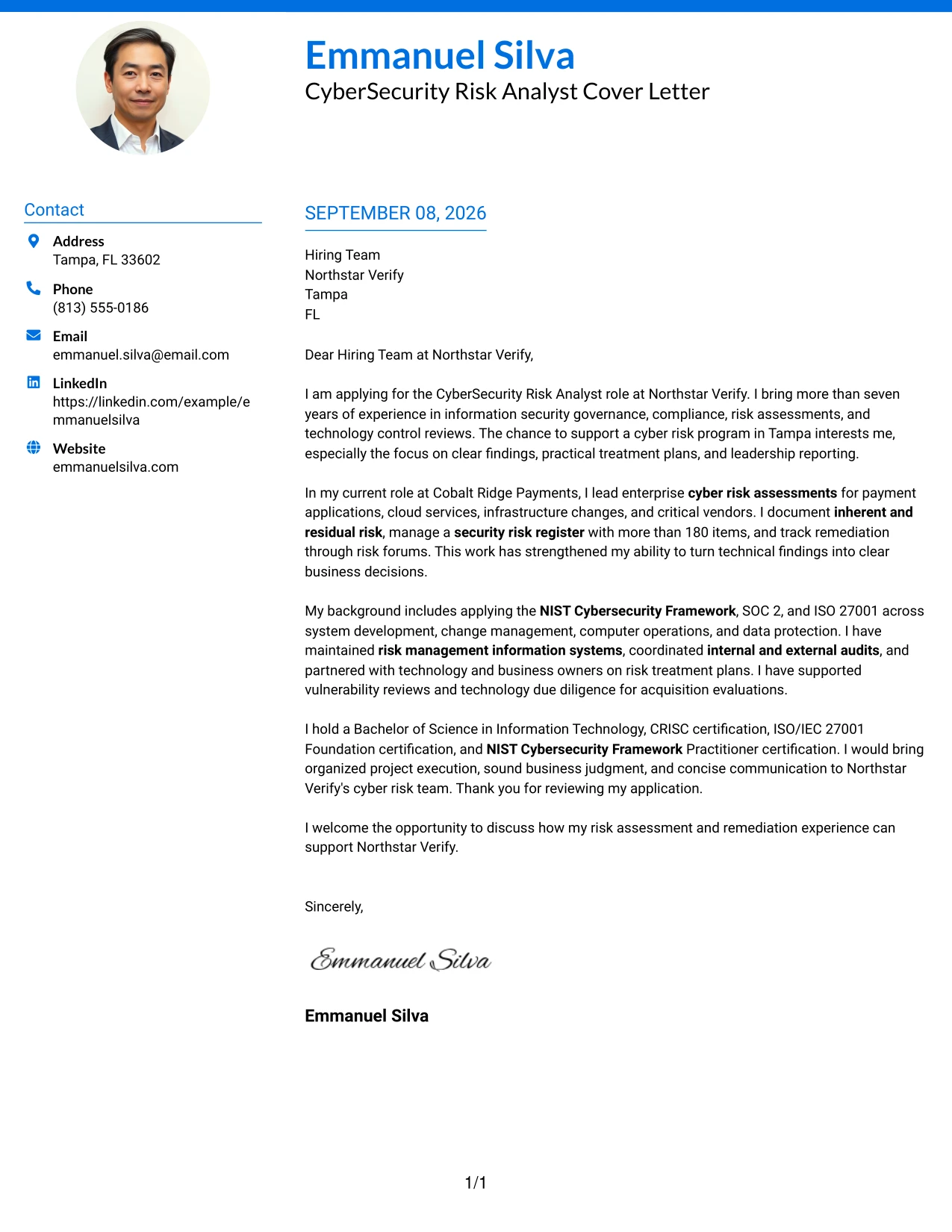
#27 Cover Letter Example: Photo Header Color Accent International Format
The strongest evidence should lead the case: the application demonstrates more than seven years in cybersecurity risk, enterprise assessments, risk registers, treatment planning, and leadership reporting. The Photo Header Color Accent International Format gives that evidence a prominent single-column presentation, while the photo and color accents create a more personal first impression. Used carefully, the format can combine motivation, technical credibility, and employer fit without weakening the direct business case.
Why This Cover Letter Works
- The opening can put the most relevant risk experience before supporting detail.
- A single-column flow keeps the persuasive argument continuous.
- The photo header creates a personal introduction for settings where that presentation is appropriate.
- Color accents can distinguish the greeting, evidence, and closing without changing their meaning.
- The letter connects framework knowledge to assessments, remediation, and leadership decisions.
- The format supports a confident international-style presentation while preserving clear English.
- The closing can return attention to the employer’s needs and the candidate’s contribution.
Best For
- Applicants who want a personal introduction alongside a strong evidence-led message.
- Applications where a single-column reading flow supports a continuous argument.
- Candidates presenting substantial experience across governance, compliance, and risk assessment.
- Professional settings that welcome a more personal visual introduction.
- Cover letters that need room for detailed evidence without side-by-side text.
- Readers who value a clear progression from proof of ability to employer fit.
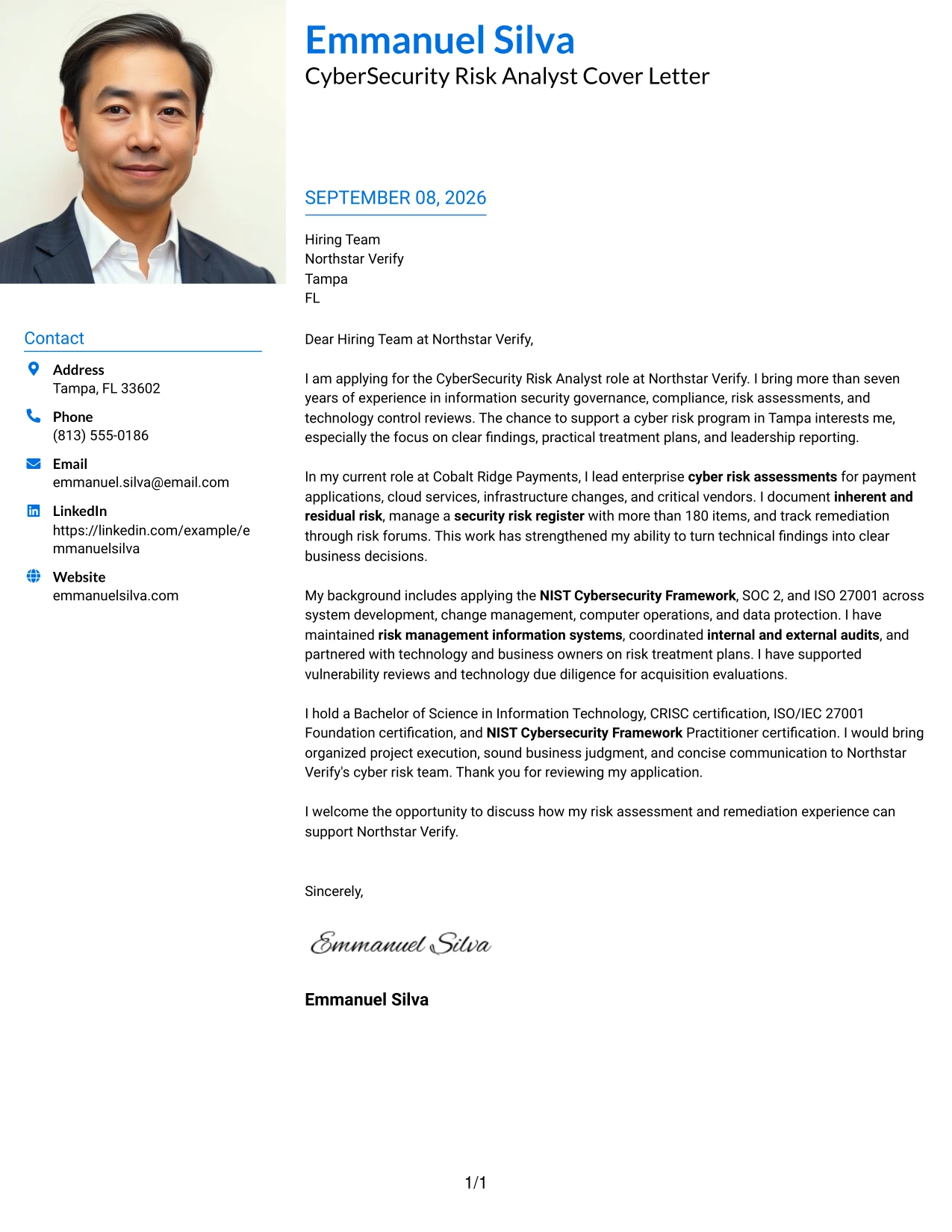
#28 Cover Letter Example: Large Profile Photo International Two Column Format
Content balance matters when an application combines a personal introduction with substantial professional evidence. The Large Profile Photo International Two Column Format places the visual introduction in one area and the persuasive letter content in another, allowing motivation, experience, and fit to remain distinct. For this application, the written case can emphasize enterprise cyber risk assessments, NIST, SOC 2, ISO 27001, remediation visibility, and concise stakeholder communication.
Why This Cover Letter Works
- The two-column balance separates personal presentation from the main written argument.
- A larger photo gives the header a clear identity in contexts where that choice is suitable.
- The opening can explain interest in Northstar Verify without competing with later evidence.
- The content column can build a focused case around assessments, treatment, and reporting.
- Framework knowledge is tied to the employer’s work instead of presented as isolated credentials.
- The format supports readable transitions between experience, fit, and closing intent.
- The final message can remain professional even with a more prominent visual header.
Best For
- Applicants who want personal presentation and written evidence to share the page.
- Applications where two-column balance helps separate introduction from qualifications.
- Candidates with several strong examples that need a dedicated reading area.
- Professional contexts that accept a prominent visual identity.
- Cover letters linking motivation to detailed risk and compliance experience.
- Readers who prefer distinct content zones rather than one long text stream.
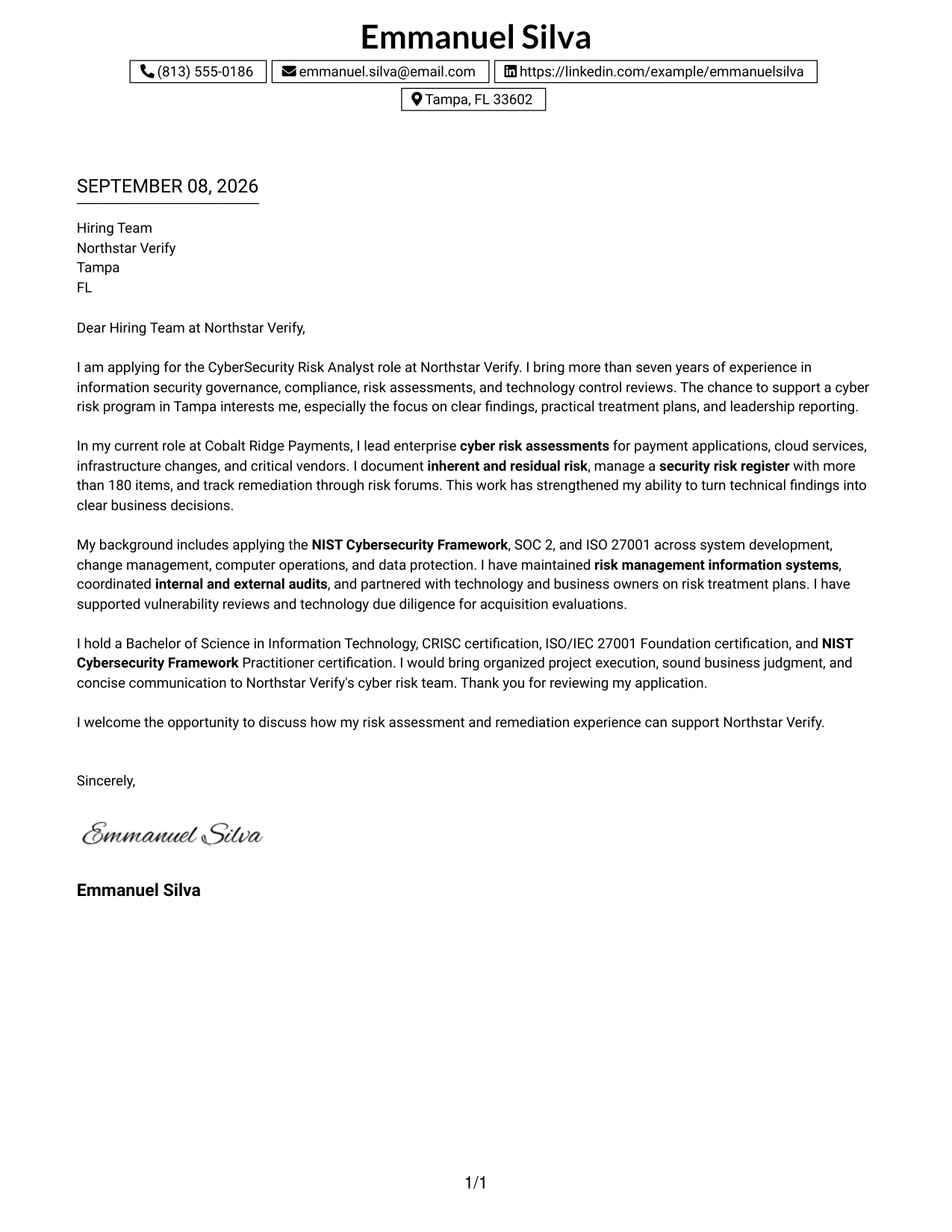
#29 Cover Letter Example: One Column Boxed Contact Header Format
A practical application benefits from a single, uninterrupted message, and the One Column Boxed Contact Header Format provides that path from contact details to closing. The letter can make a focused argument for the CyberSecurity Risk Analyst role by opening with interest in Northstar Verify, then presenting risk assessment leadership, risk register administration, audit coordination, vulnerability reviews, and clear treatment plans in a natural sequence. The boxed header adds definition without taking attention from the words.
Why This Cover Letter Works
- The one-column flow keeps the reader moving through one connected argument.
- The boxed contact area makes sender and recipient details easy to confirm.
- The opening links the opportunity to the candidate’s motivation and relevant background.
- The body can develop one evidence point at a time without side-by-side competition.
- The format supports clear transitions from technical work to business impact.
- The closing remains visible and direct after the supporting explanation.
- Its restrained structure suits a professional application with substantial content.
Best For
- Applicants who want a straightforward letter with no divided reading path.
- Cover letters that need a clear beginning, middle, and closing.
- Applications where contact details should be prominent but compact.
- Candidates explaining risk work in a logical sequence rather than grouped columns.
- Readers who prefer continuous prose and simple navigation.
- Professional messages that need visual definition without extra design elements.
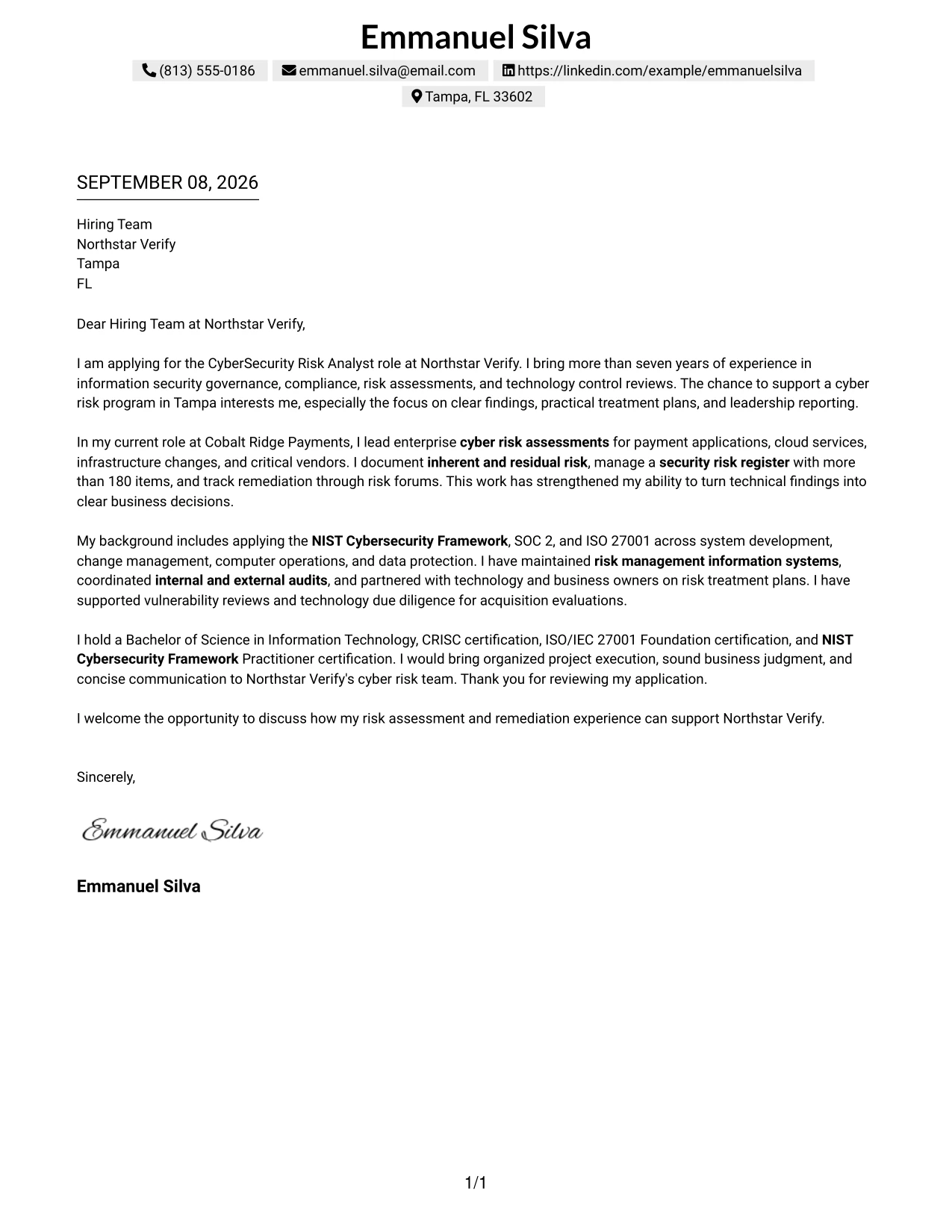
#30 Cover Letter Example: One Column Shaded Contact Header Format
A calm visual hierarchy helps the reader focus on the relationship between the applicant’s experience and the employer’s needs. The One Column Shaded Contact Header Format uses a shaded contact area and a continuous letter body to present motivation, role alignment, and evidence in a measured order. The message can show how enterprise assessments, risk treatment, audit work, and leadership reporting prepare the candidate to support Northstar Verify’s cyber risk program.
Why This Cover Letter Works
- The shaded header creates a clear starting point without overpowering the letter.
- A continuous body supports a direct explanation of motivation and fit.
- The first paragraph can connect Tampa-based interest with Northstar Verify’s work.
- Evidence can move from current responsibilities to broader assessment and audit experience.
- The letter presents business judgment as part of effective risk communication.
- The format leaves the closing easy to locate and act on.
- A restrained layout supports credibility when the content already carries strong evidence.
Best For
- Applicants seeking a composed and professional first impression.
- Cover letters where employer alignment should develop in a steady sequence.
- Candidates whose evidence spans current work and earlier related roles.
- Readers who prefer one-column documents with a visible contact starting point.
- Applications that need space for both motivation and detailed proof.
- Professionals who want a clear presentation without heavy visual treatment.
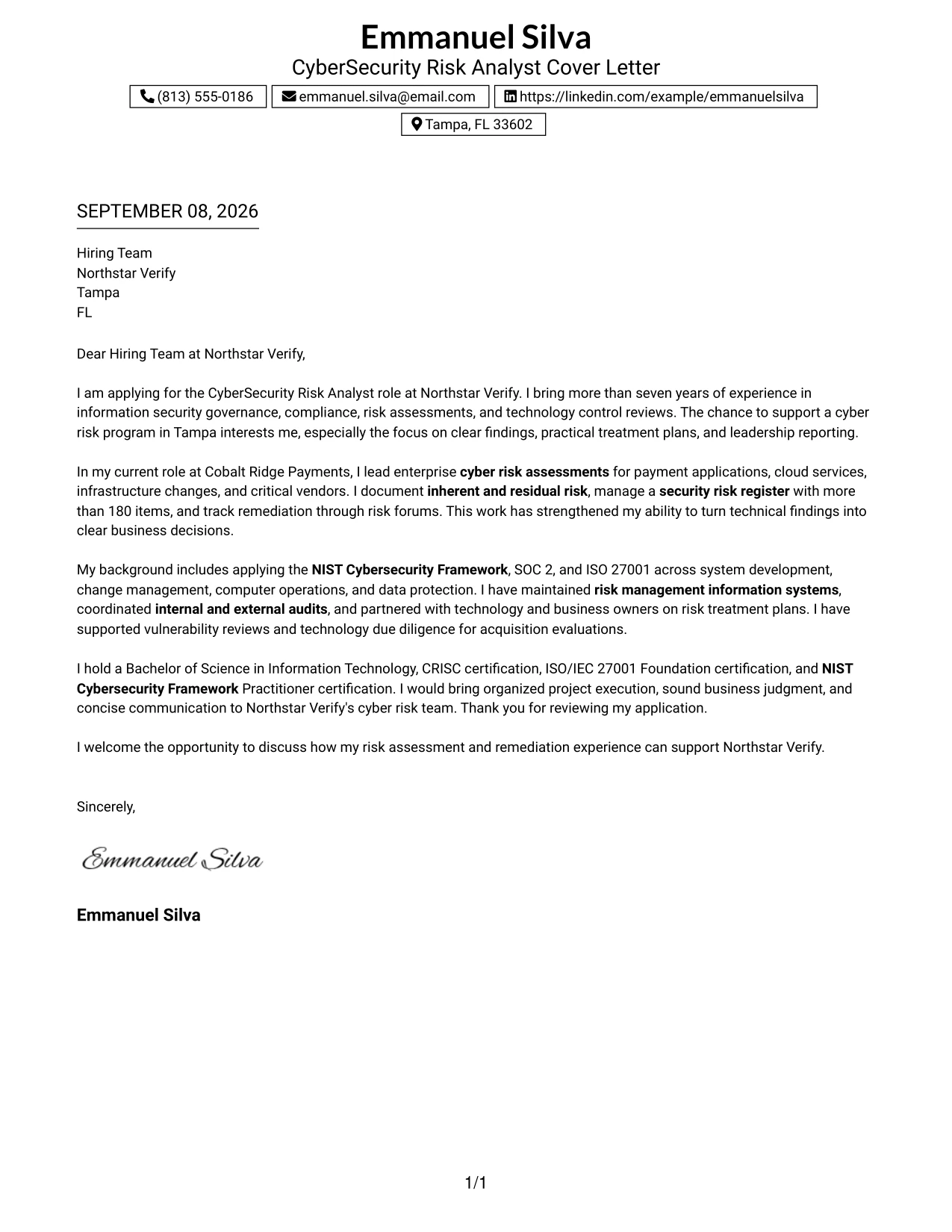
#31 Cover Letter Example: Boxed Contact Header with Job Title Format
The Boxed Contact Header with Job Title Format makes the target role visible before the reader reaches the supporting argument. From there, the letter can follow a simple structure: explain interest in Northstar Verify, present evidence from cyber risk assessments and remediation work, and close with a clear statement of contribution. The visible title helps frame details such as risk register administration, NIST, SOC 2, ISO 27001, and due diligence as relevant proof rather than unrelated background.
Why This Cover Letter Works
- The job title gives the letter an immediate purpose.
- The boxed header separates identification details from the persuasive message.
- The opening can state motivation before moving into evidence.
- The body can connect risk assessment and remediation experience directly to role responsibilities.
- Frameworks and standards appear in context, alongside practical work.
- The structure supports a concise, confident closing.
- The format helps the reader confirm role alignment throughout the letter.
Best For
- Applicants who want the target position identified at the top.
- Applications where role alignment must be obvious during a quick review.
- Candidates presenting several qualifications that all support one defined position.
- Readers who value a clear title before entering the main text.
- Cover letters that need a simple sequence from interest to evidence to closing.
- Professional documents where strong labeling improves navigation.
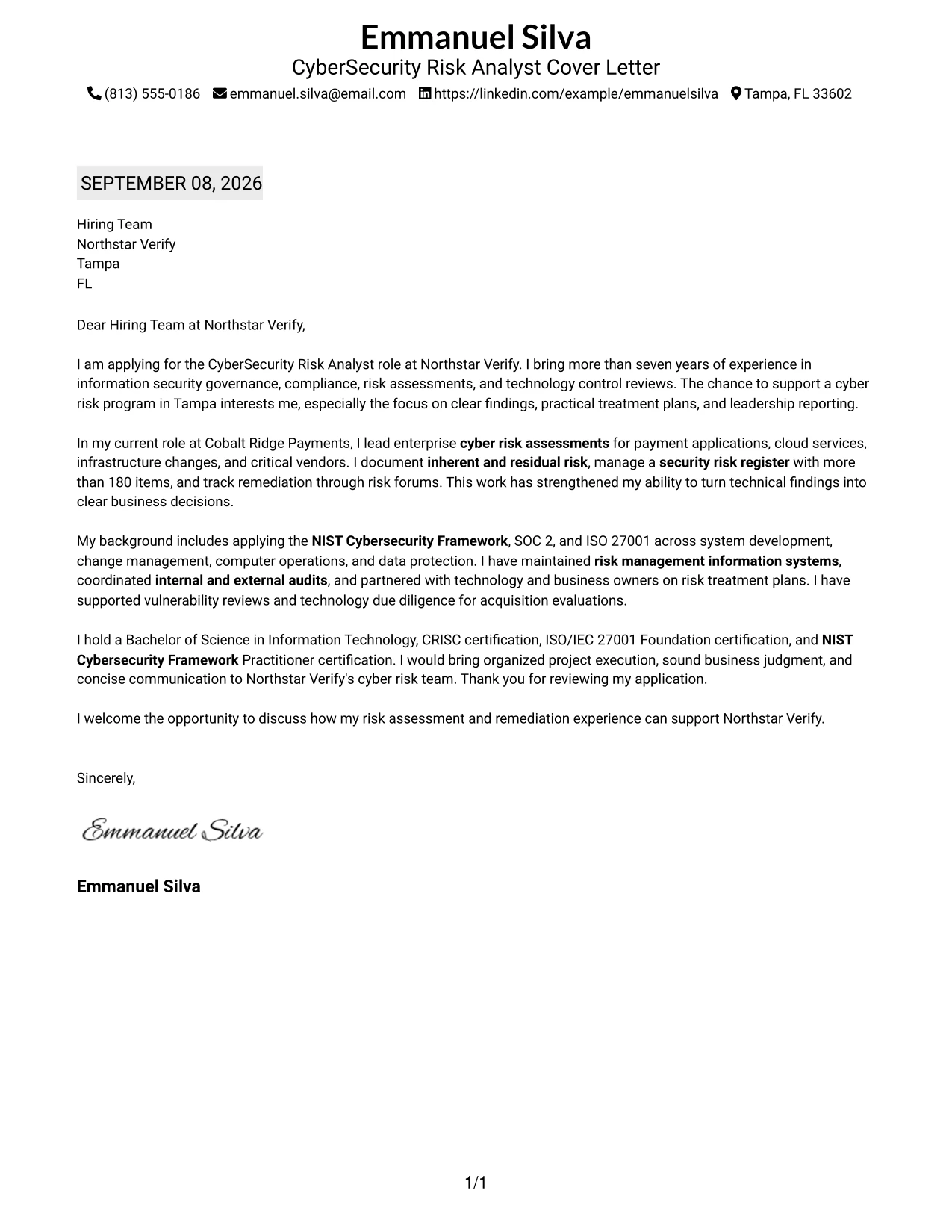
#32 Cover Letter Example: Plain Professional Layout with Job Title & Shaded Date
The reader can review this plain professional letter in a familiar order: date and contact information first, followed by motivation, relevant evidence, and the closing. The job title and shaded date provide useful orientation while leaving most of the page for substance. That space supports a detailed but controlled explanation of enterprise assessments, risk management information systems, audit coordination, risk treatment, metrics, and stakeholder communication.
Why This Cover Letter Works
- The familiar order reduces effort for the reader.
- The shaded date and visible job title provide immediate application context.
- The opening can state interest without using design language to carry the message.
- The body has room to explain assessment, treatment, and reporting experience in full sentences.
- Detailed evidence remains connected to the responsibilities at Northstar Verify.
- The plain treatment supports a serious, business-focused communication style.
- The closing can summarize fit without competing with visual elements.
Best For
- Applicants who prefer a traditional and highly readable letter structure.
- Cover letters with enough evidence to require comfortable writing space.
- Applications reviewed by readers who value familiar date and contact placement.
- Candidates explaining several responsibilities through complete, connected sentences.
- Messages that need room for metrics, systems, audits, and stakeholder work.
- Professional settings where clarity is more important than visual novelty.
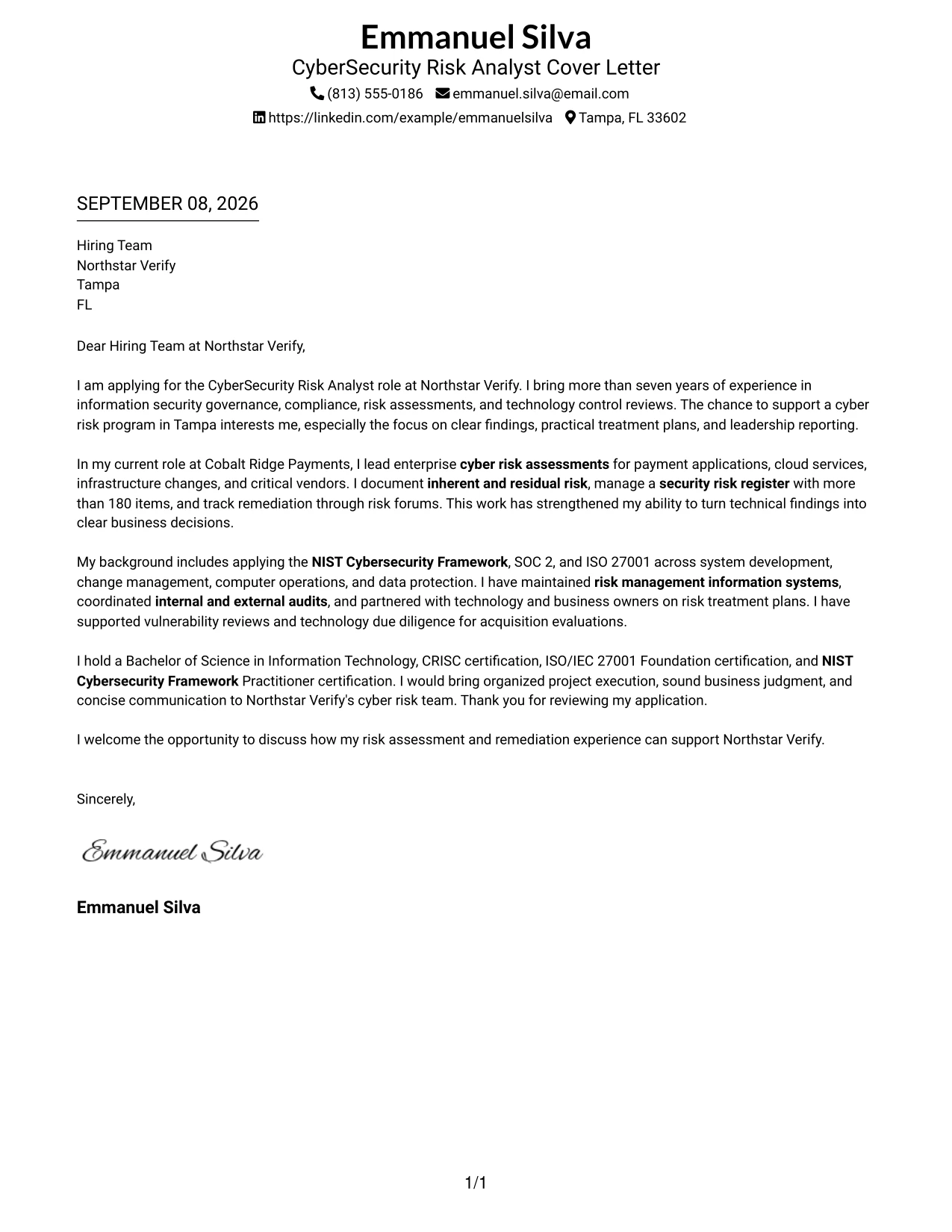
#33 Cover Letter Example: Two-Line Contact Header with Underlined Date Format
The strongest evidence can appear early in a letter that uses the Two-Line Contact Header with Underlined Date Format. A direct opening can state interest in Northstar Verify, followed by proof of more than seven years in cybersecurity risk, enterprise assessments, risk registers, control reviews, audits, and due diligence. The underlined date and compact contact header keep the document orderly while the written argument does the work of showing motivation and fit.
Why This Cover Letter Works
- The compact header leaves more attention for the evidence.
- An early statement of experience gives the reader a reason to continue.
- The letter can connect current responsibilities to Northstar Verify’s assessment and reporting needs.
- Risk register and remediation work demonstrate ownership beyond observation.
- Audit, vulnerability, and due diligence examples broaden the case without changing its focus.
- The underlined date adds a clear document marker without visual excess.
- The closing can reinforce readiness for a conversation about contribution.
Best For
- Applicants who want evidence to appear near the start of the letter.
- Cover letters with a compact contact area and a substantial written case.
- Candidates whose strongest fit comes from several related risk responsibilities.
- Readers who prefer clear document markers and direct prose.
- Applications that need to balance detailed proof with a restrained presentation.
- Professional messages where experience should carry more weight than decoration.
Why Use ResumeInMinutes for a CyberSecurity Risk Analyst Cover Letter
ResumeInMinutes helps applicants turn role requirements and relevant risk experience into a clear, tailored cover letter without starting from a blank page.
- Professional writing styles
- Clean, readable formatting
- Job-description-based customization
- Focused cover letter generation
- Professional templates
- Cover letter PDF support
Use the role details to emphasize risk assessments, control frameworks, risk register ownership, audit coordination, treatment planning, metrics, and communication with decision-makers. Then adjust the wording and presentation to match the employer’s expectations.
See Also
- 33 CyberSecurity Risk Analyst Resume Templates with Example 2026 (ATS-Optimized)
- 33 Analyst - Cybersecurity Operations Resume Templates with Example 2026 (ATS-Optimized)
- 33 Cybersecurity Analyst Intern - Hands-on Security Resume Templates with Example 2026 (ATS-Optimized)
- 33 Cybersecurity Analyst Resume Templates with Example 2026 (ATS-Optimized)
- 33 Cybersecurity Analyst – Tier 2 Resume Templates with Example 2026 (ATS-Optimized)
- 33 Junior Cybersecurity Analyst Resume Templates with Example 2026 (ATS-Optimized)
- 33 Senior Cybersecurity Analyst Resume Templates with Example 2026 (ATS-Optimized)
- 33 Senior Cybersecurity Power BI Reporting Analyst Resume Templates with Example 2026 (ATS-Optimized)
- 30+ Analyst - Cybersecurity Operations Cover Letter Templates with Example 2026
- 30+ Cybersecurity Analyst Cover Letter Templates with Example 2026
Frequently Asked Questions
What should a CyberSecurity Risk Analyst cover letter include?
Include a direct opening, evidence of cyber risk assessments, relevant frameworks such as NIST, SOC 2, or ISO 27001, experience with remediation and risk treatment, and a closing that shows clear interest in the role.
How should I show risk assessment experience in the letter?
Describe the types of applications, services, infrastructure, or vendors assessed. Explain how you documented inherent and residual risk, communicated findings, and helped owners agree on treatment or acceptance decisions.
Should I mention risk registers and risk management information systems?
Yes, when they are relevant to your background. Explain how you maintained records, assigned owners, tracked due dates, supported approvals, or reported issue status and treatment progress.
How can I connect my cover letter to the employer?
Refer to the employer’s stated priorities, such as enterprise assessments, audit support, M&A due diligence, risk metrics, or treatment plans aligned with risk appetite. Then connect each priority to evidence you can discuss.
Should I mention NIST, SOC 2, and ISO 27001?
Mention the frameworks you have actually used and briefly explain how you applied them. For example, you might connect them to control reviews, evidence mapping, audit preparation, or remediation planning.
What tone works best for a CyberSecurity Risk Analyst cover letter?
Use a direct, measured, and professional tone. Focus on sound judgment, clear communication, practical risk decisions, and the business impact of your work instead of making broad claims.
Can I customize these cover letter templates?
Yes. Customize the opening, evidence, motivation, employer alignment, closing, layout, and PDF presentation for the specific CyberSecurity Risk Analyst application.