33 Data Solutions Architect Resume Templates with Example 2026 (ATS-Optimized)
This guide shows you how to build a clear, focused Data Solutions Architect resume that presents architecture decisions, delivery work, and business value with precision. You will learn how to organize your evidence and compare professional resume formats.
Strong resumes for this role connect client discovery with solution architecture, Snowflake platform design, data pipelines, reporting, APIs, and application delivery. They also use concise bullet points to show scope, ownership, governance, and measurable results where the document supports them.
Below, you’ll find a complete Data Solutions Architect resume example presented in 33 ATS-friendly resume layouts. The examples provide practical guidance for choosing sections, placing role-specific keywords, and preparing a readable PDF resume.
What Makes a Great Data Solutions Architect Resume in 2026
Effective resumes in 2026 are structured, evidence-based, and easy to scan. They show how architecture work connects business requirements with reliable platforms, reporting, secure integrations, and delivery leadership.
Use keywords such as Snowflake architecture, SQL, Python, dbt, Fivetran, Airflow, semantic layers, certified datasets, KPI frameworks, REST, OAuth, RBAC, data governance, lineage, observability, Power BI, Sigma, React, FastAPI, Git, and CI/CD when they accurately reflect your background.
The examples shown below are intentionally detailed to demonstrate a range of experiences, skills, accomplishments and relevant keywords. We prefer detailed resumes as they provide more context to the hiring managers and also help the ATS systems identify relevant qualifications and score your resume better for a match. But the length of a resume is an individual choice. If you want a one page resume, just keep the most relevant experience and information for the job.
#1 Simple One Column Format Resume Example
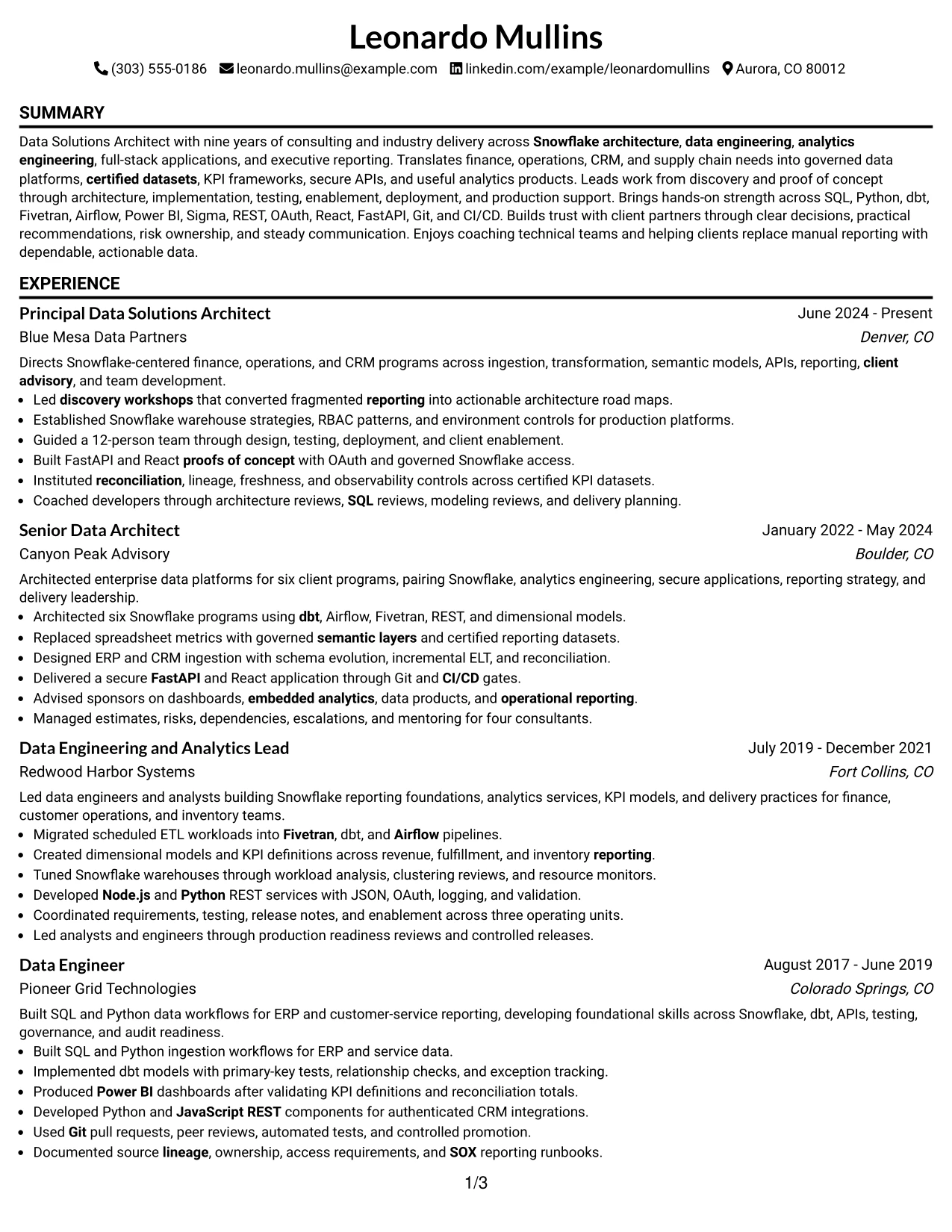
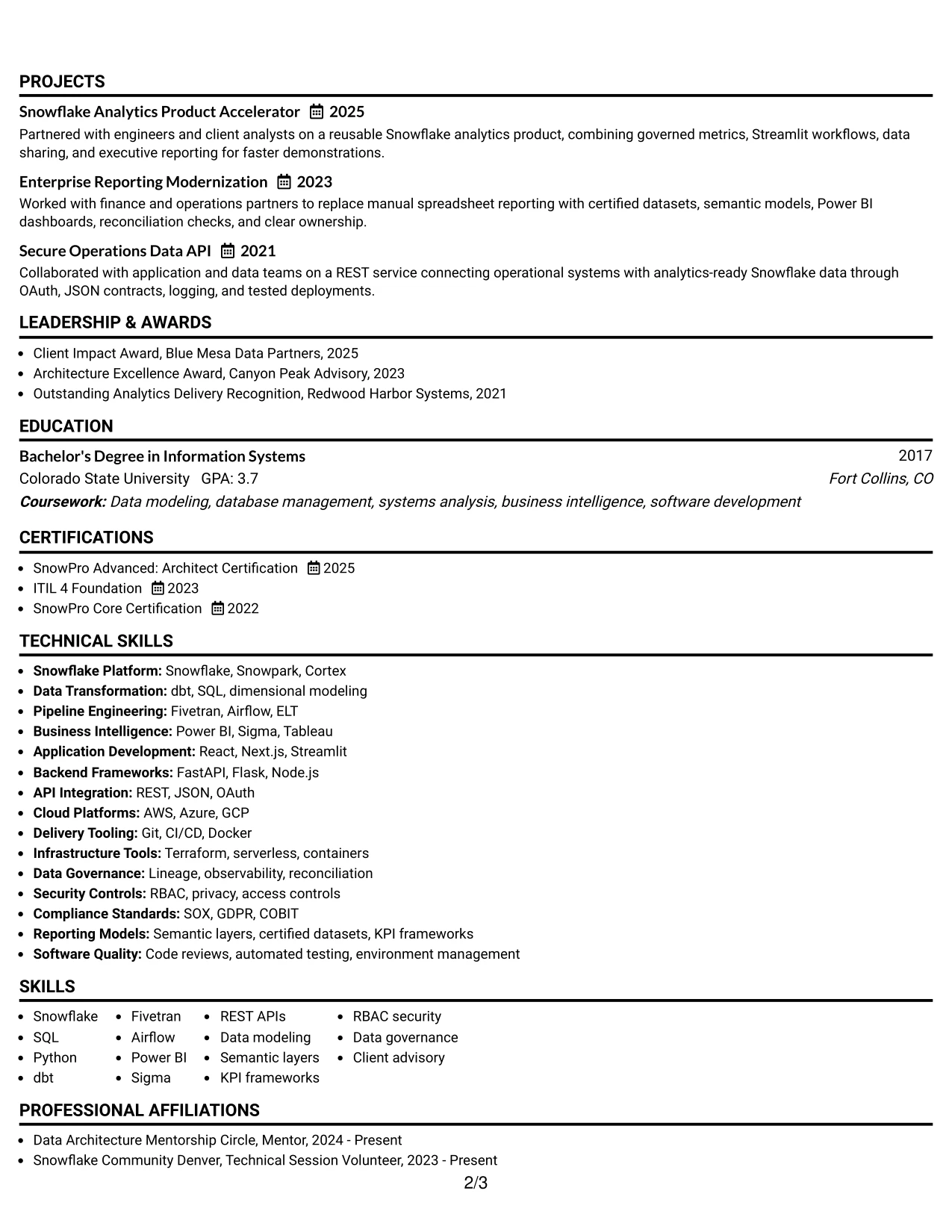
Simple One Column Format gives the resume a direct reading path. The professional summary leads into experience, education, certifications, projects, and skills without side panels competing for attention. For this Data Solutions Architect resume, the first screen can show the target role, nine years of experience, Snowflake architecture, and client delivery strengths.
A single content stream also supports reliable ATS parsing. Clear headings and concise bullets make it easy to find SQL, Python, dbt, Fivetran, Airflow, Power BI, Sigma, REST, OAuth, React, FastAPI, Git, and CI/CD. The experience section can then connect those keywords to architecture decisions, team leadership, governed datasets, and production delivery.
Why the Simple One Column Format Works for a Resume
- Creates one predictable path from the summary to the most recent experience.
- Keeps the Data Solutions Architect title and core Snowflake experience easy to find.
- Gives achievement bullets enough width for technical detail and business context.
- Supports ATS parsing with standard headings and a simple reading order.
- Separates tools from results instead of hiding important keywords in a sidebar.
- Makes projects, certifications, and education easy to review after experience.
- Works well when the resume must present architecture, delivery, and coaching in equal measure.
Best For
- Readers who want a straightforward top-to-bottom review.
- Resumes that need strong ATS readability and standard section order.
- Candidates with several technical areas that need full-width descriptions.
- Applications where project details support the main experience history.
- Documents that connect tools to measurable or clearly stated delivery outcomes.
- Professionals presenting both hands-on work and team leadership.
- Resume versions that may be printed or viewed on smaller screens.
Resume Keywords
- Data Solutions Architect
- Snowflake architecture
- data engineering
- analytics engineering
- BI
- reporting
- client advisory
- Data modeling
- SQL
- Python
- JavaScript
- dbt
- Power BI
- Sigma
- Tableau
#2 Plain One Column with Shaded Labels Resume Example
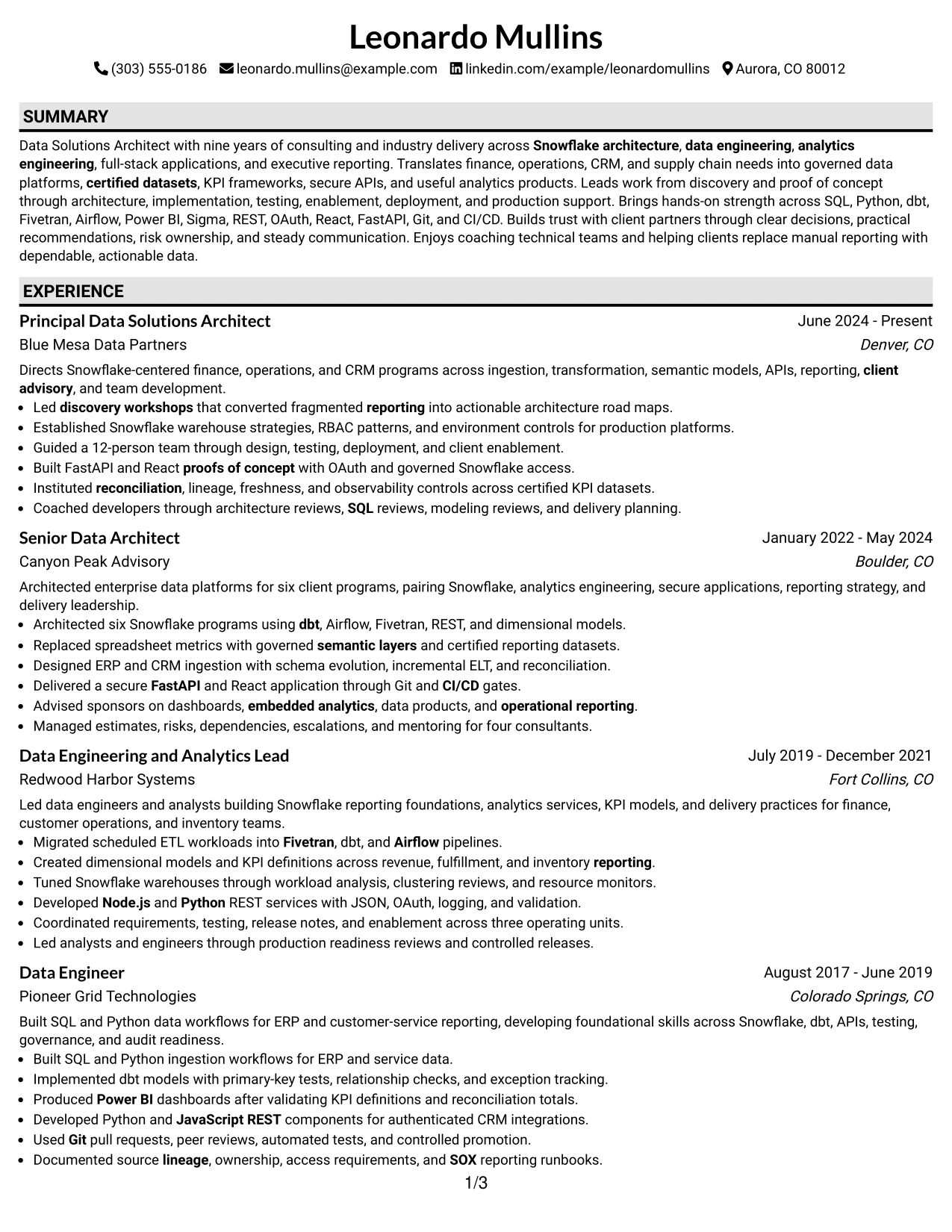
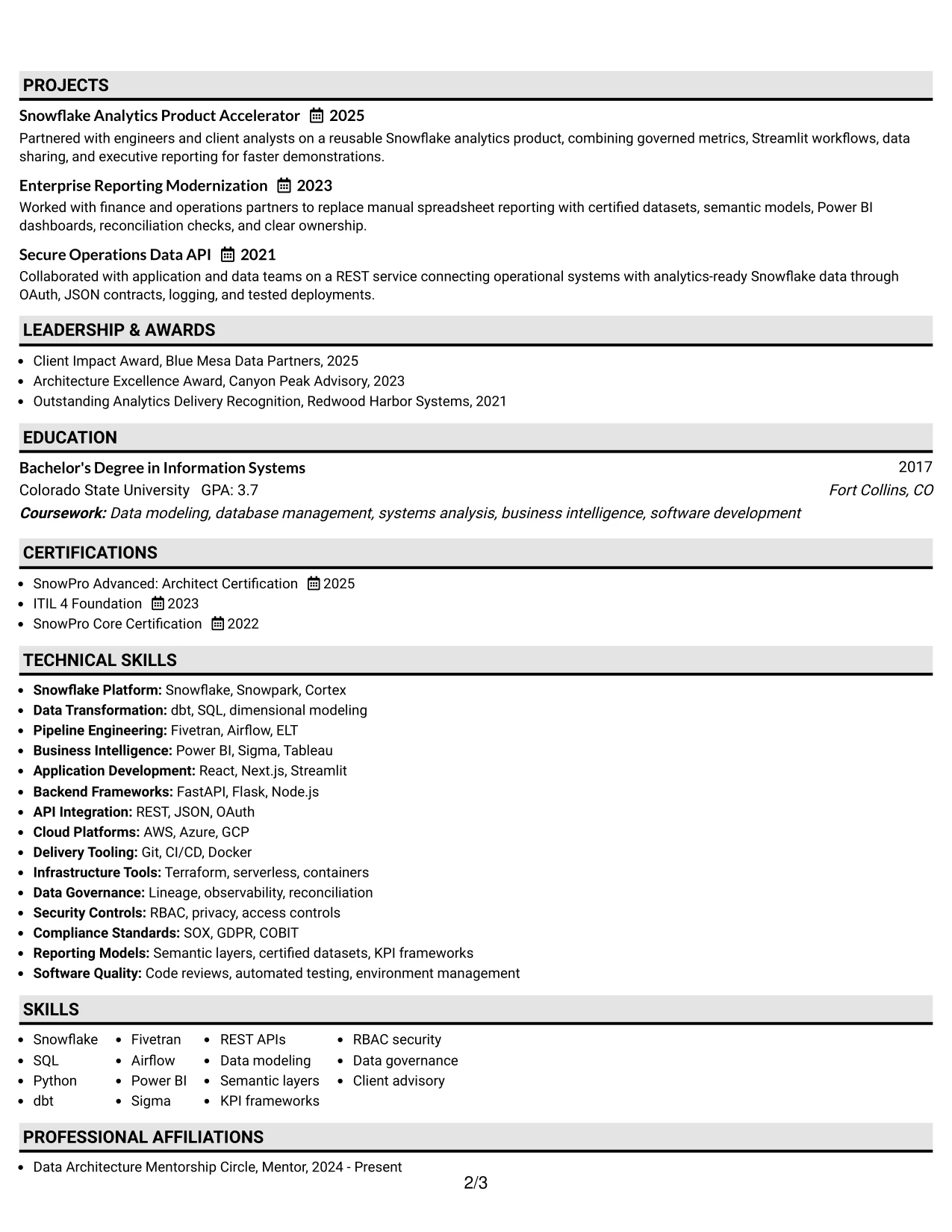
A recruiter moves through this resume by following the shaded section labels from summary to experience, projects, education, certifications, and skills. That visual signposting helps separate a broad technical background into manageable parts without breaking the document into columns. The opening area quickly establishes Data Solutions Architect, client delivery, Snowflake, and analytics expertise.
The format has room for substantial content while preserving a calm reading rhythm. Detailed bullets can show discovery workshops, warehouse strategy, RBAC, ingestion, semantic layers, APIs, testing, and production support. Each label gives ATS-friendly structure, while the bullets provide the evidence behind the resume keywords.
Why the Plain One Column with Shaded Labels Format Works for a Resume
- Shaded labels help readers locate major resume sections quickly.
- A full-width body supports detailed architecture and delivery bullets.
- The layout keeps four roles readable without forcing narrow text blocks.
- Standard section names remain clear for ATS parsing.
- Projects can add proof of Snowflake analytics and secure API work.
- Certifications and compliance knowledge receive visible, separate placement.
- The format balances content volume with a clear visual hierarchy.
Best For
- Resumes with multiple roles and a substantial technical skills section.
- Applications that need detailed bullets without a dense two-column page.
- Readers who benefit from strong visual markers between resume sections.
- Documents combining experience, projects, certifications, and professional activities.
- Candidates who need space to show both architecture scope and implementation detail.
- Resume versions with many relevant keywords that still require easy scanning.
- Professionals whose work spans data platforms, reporting, applications, and advisory delivery.
#3 One Column Format with Photo Right Resume Example
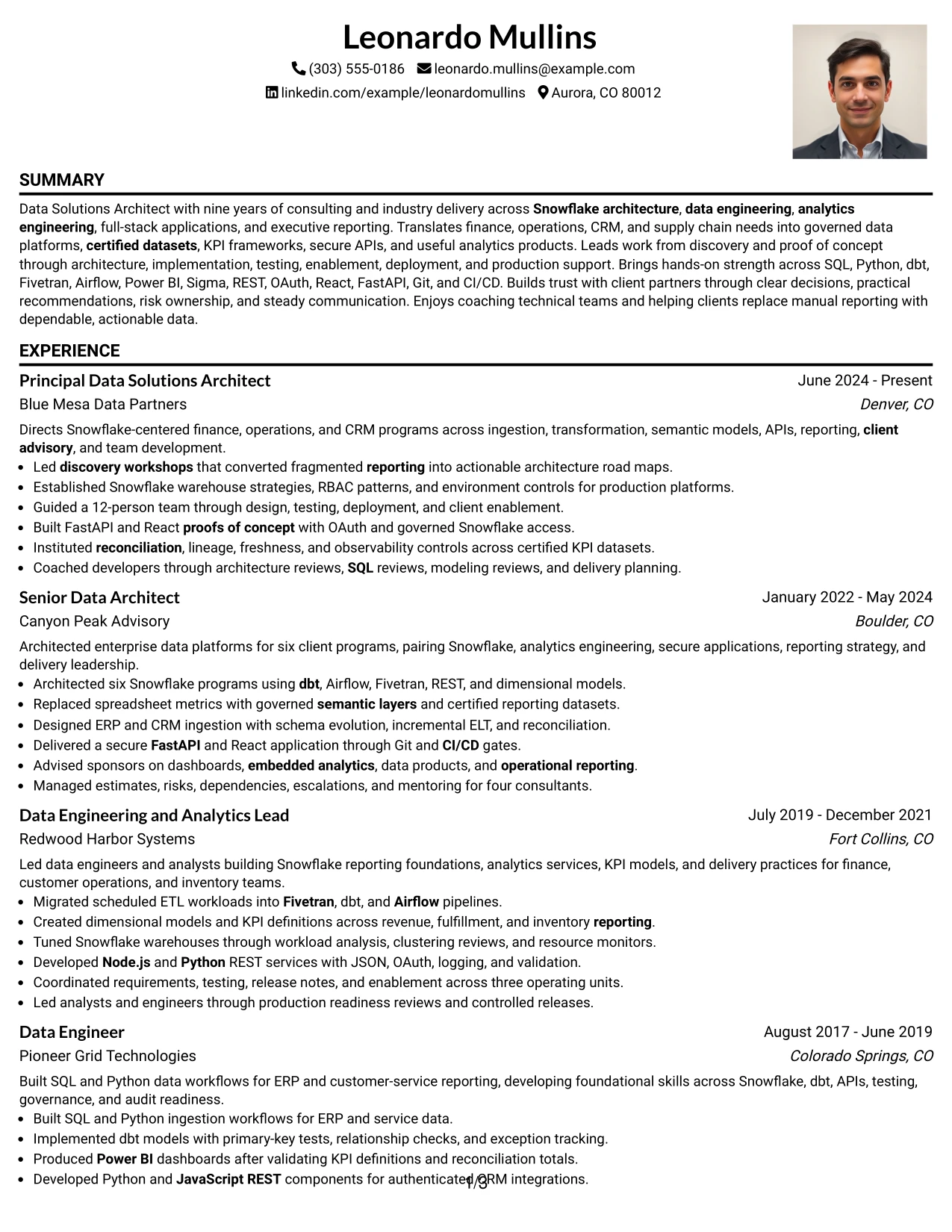
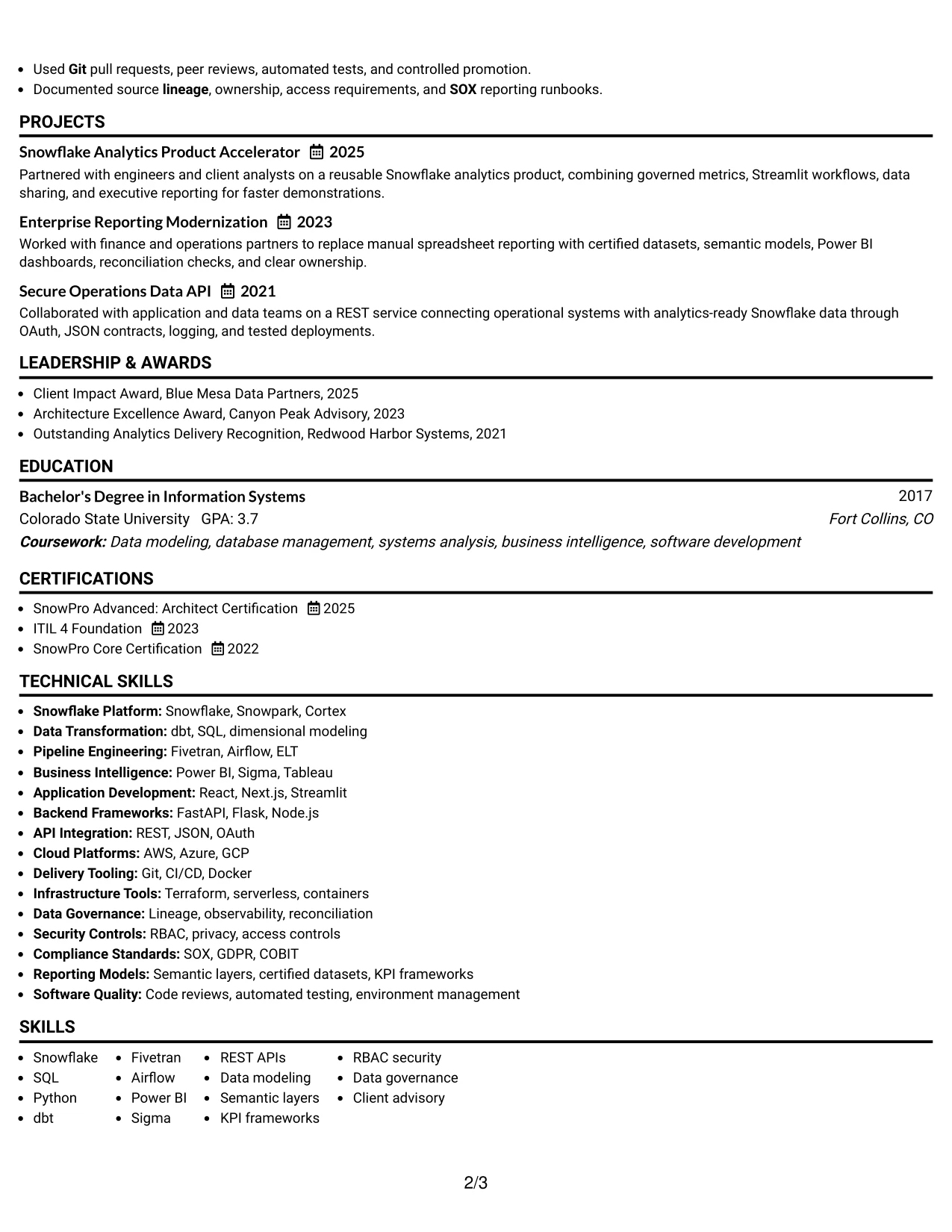
Evidence receives priority in this resume, beginning with the summary and continuing through recent architecture work. A right-side photo area adds a defined visual anchor, while the main column keeps the professional proof in focus. The document can present Snowflake architecture, certified datasets, KPI frameworks, secure APIs, and team coaching before moving to earlier engineering experience.
The one-column flow gives each bullet enough width to explain a decision and its result. Recent work can highlight a 12-person delivery team, six client programs, FastAPI and React proofs of concept, reconciliation, lineage, freshness, and observability. The photo should remain secondary to the text so technical evidence stays easy to scan.
Why the One Column Format with Photo Right Works for a Resume
- Places the strongest career evidence in the main reading column.
- Keeps the current architecture role prominent near the top.
- Uses the right-side photo area as a restrained visual anchor.
- Allows technical bullets to retain useful context and readable line length.
- Shows both platform decisions and hands-on application delivery.
- Makes certifications and projects available without disrupting experience flow.
- Supports a polished presentation while keeping resume content primary.
Best For
- Resumes where recent achievements should dominate the first review.
- Candidates who want a personal visual element beside a text-led structure.
- Documents needing full-width bullets for architecture and implementation evidence.
- Applications that combine consulting delivery with technical ownership.
- Professionals presenting proofs of concept, platform controls, and team guidance.
- Resume readers who prefer a single main narrative with a defined visual anchor.
- Versions where projects and certifications reinforce, rather than lead, the experience section.
#4 Clean Two Column Sidebar Format Resume Example
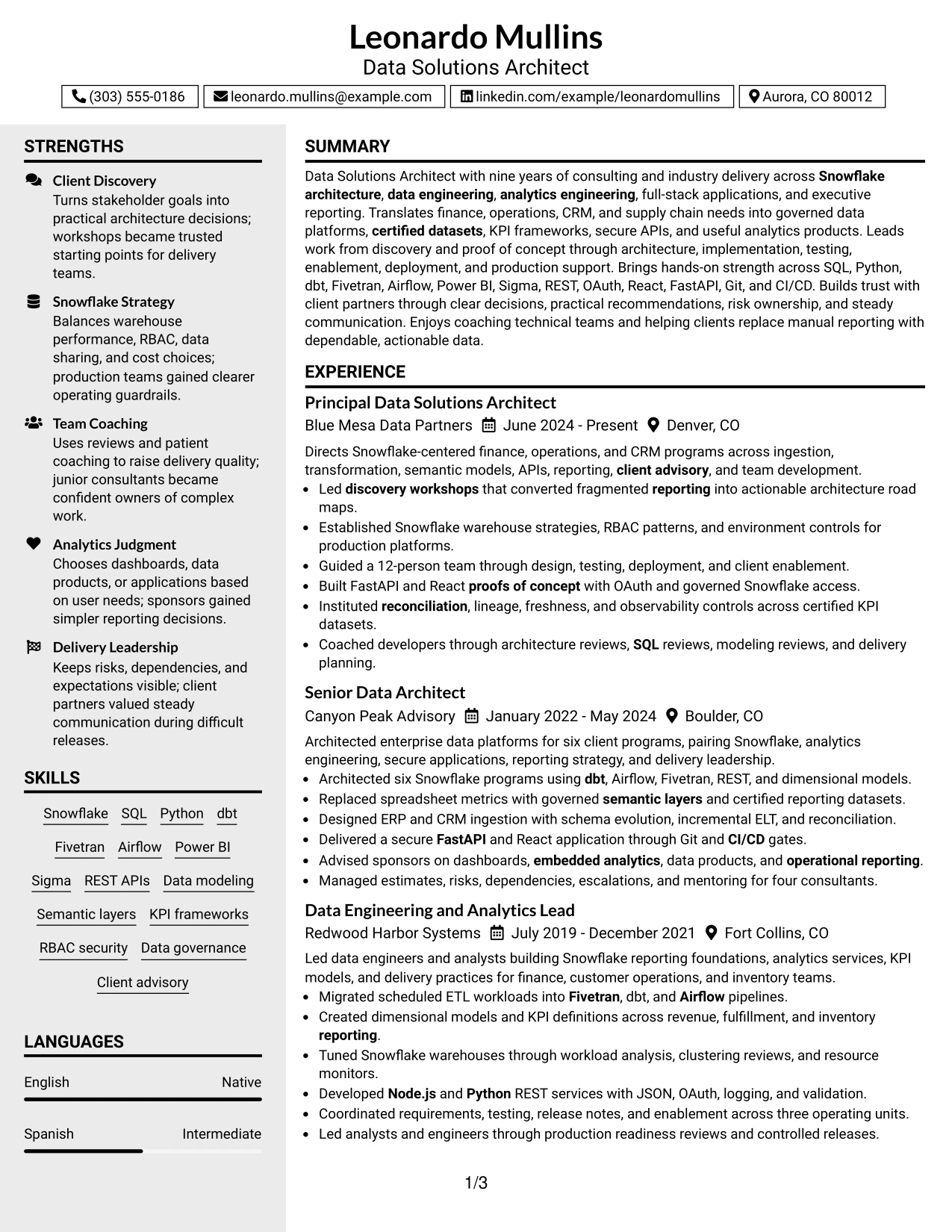
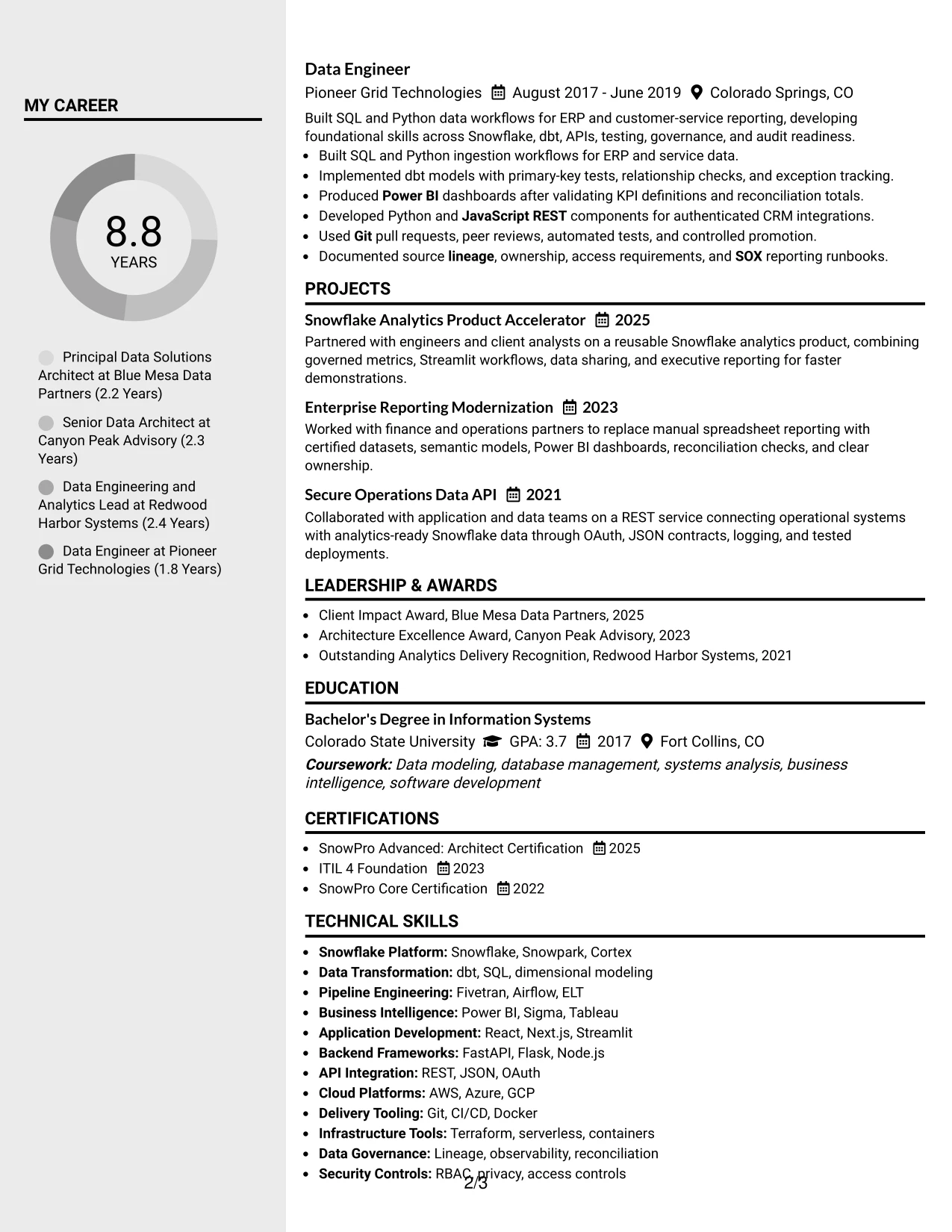
Content is balanced between a wide experience area and a compact sidebar. The main column can carry architecture achievements, delivery scope, and technical bullets, while the sidebar groups skills, certifications, education, and contact details. This makes the resume practical for a Data Solutions Architect application that asks for both hands-on depth and client-facing leadership.
The sidebar should hold short, scannable facts rather than complete achievements. In the main column, bullets can explain Snowflake warehouse strategies, ERP and CRM ingestion, semantic layers, APIs, and testing. The separation helps readers compare the candidate's technical toolkit with the evidence of applying it across finance, operations, CRM, and supply chain programs.
Why the Clean Two Column Sidebar Format Works for a Resume
- Gives experience bullets the wider column and keeps them readable.
- Groups skills and certifications where technical reviewers can find them quickly.
- Creates a useful distinction between evidence and supporting qualifications.
- Allows contact and education details to use space efficiently.
- Supports a clear comparison of tools and the work completed with them.
- Keeps project and leadership details from crowding the main experience story.
- Offers a professional structure for client-facing architecture applications.
Best For
- Applications that need a clear split between experience and supporting facts.
- Resumes with a broad skills inventory and several relevant certifications.
- Readers who scan the sidebar first for tools, credentials, or education.
- Documents where the main column must preserve detailed achievement bullets.
- Professionals combining client advisory, architecture, and implementation work.
- Resume versions that need compact contact information without losing evidence space.
- Candidates presenting technical breadth alongside a focused career narrative.
#5 Two Column Format Resume Example
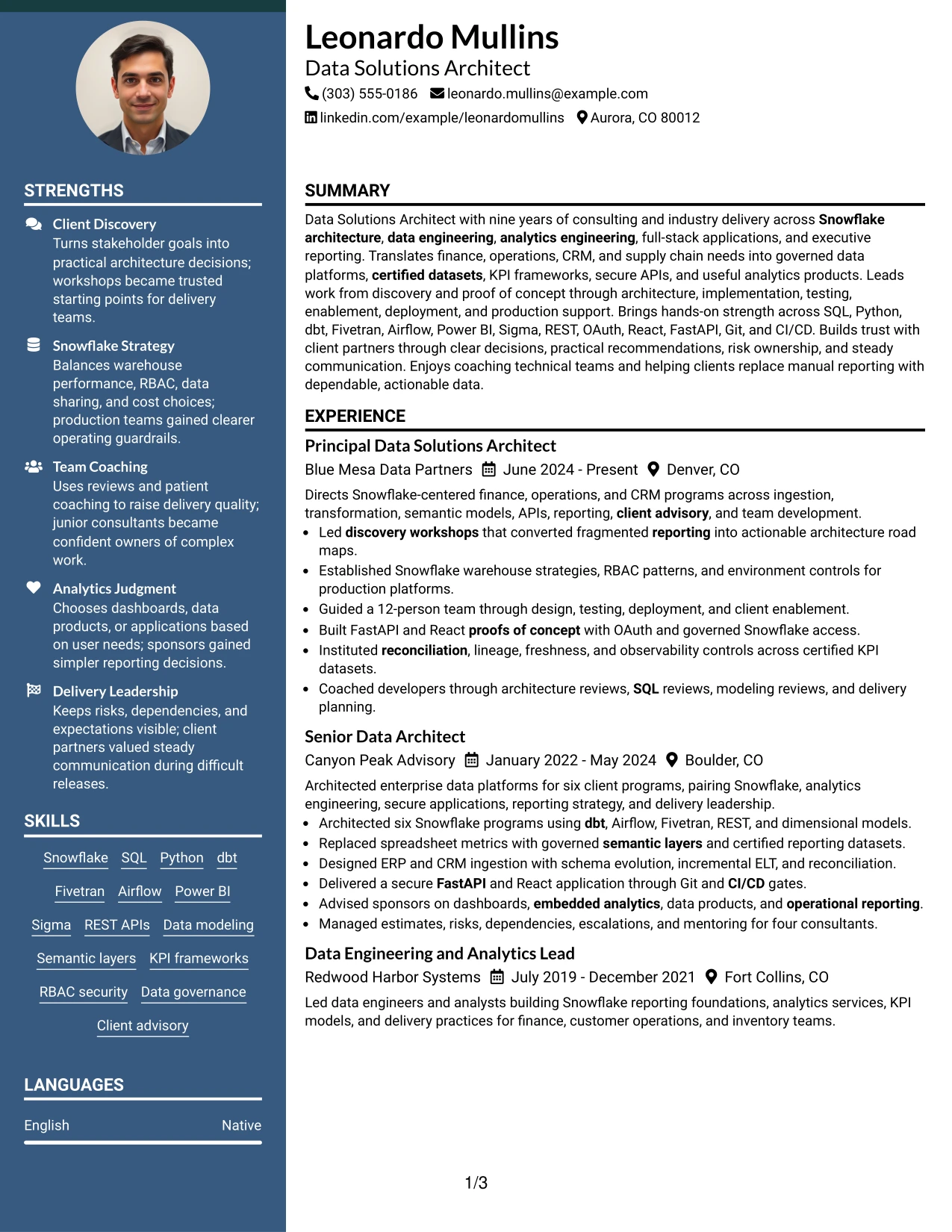
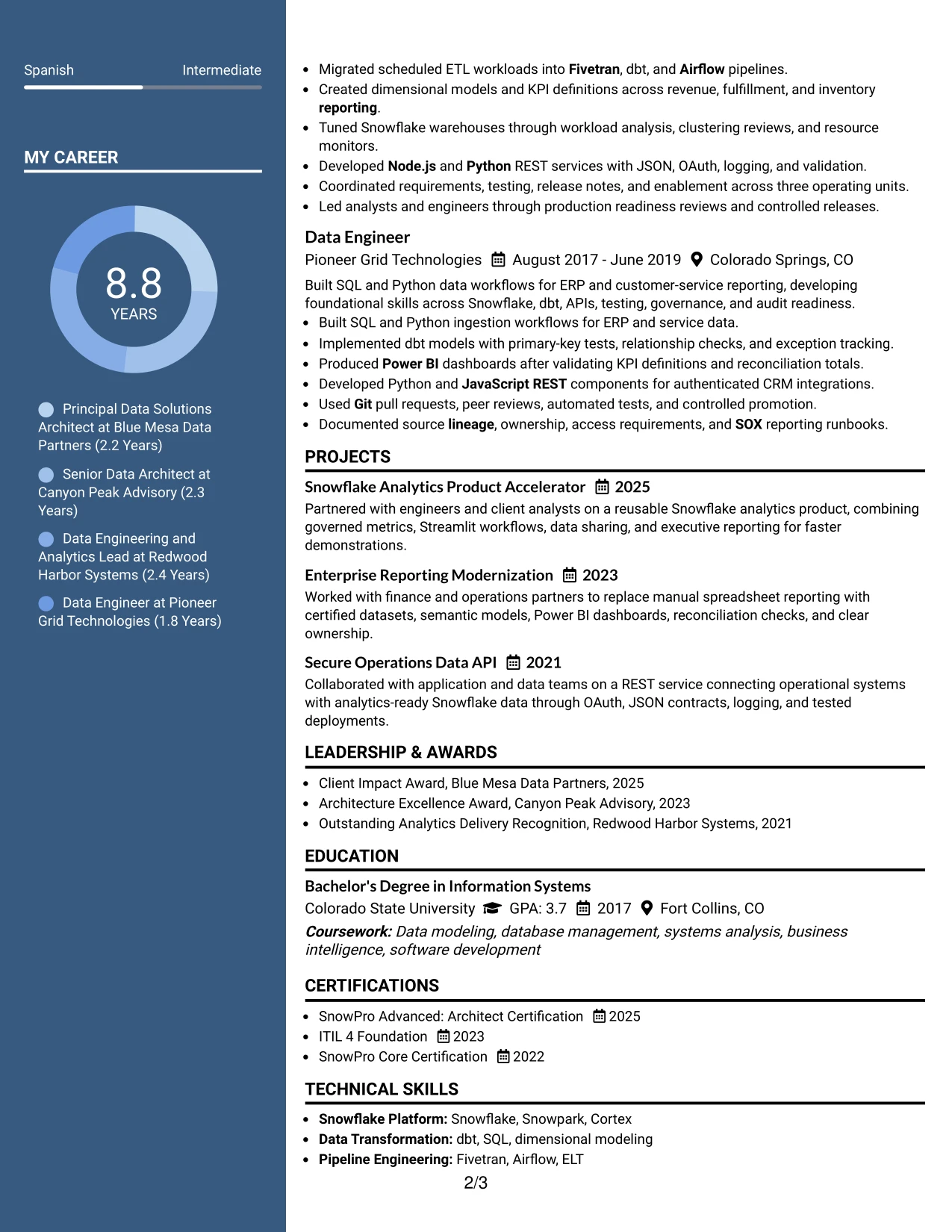
For a practical application, this Two Column Format helps a reviewer assess technical range and delivery results at the same time. One column can organize skills, certifications, education, and selected projects; the other can carry the summary and professional experience. That structure fits a resume built around Snowflake architecture, data engineering, analytics, and full-stack applications.
The design works best when each column has a clear job. Short keyword groups can show SQL, Python, dbt, Power BI, Sigma, REST, OAuth, FastAPI, React, Git, and CI/CD. Wider experience bullets can then explain six client programs, a 12-person team, secure proofs of concept, governed reporting, and production controls.
Why the Two Column Format Works for a Resume
- Lets technical keywords sit beside the experience that proves them.
- Uses space efficiently for skills, certifications, projects, and education.
- Keeps the professional history prominent without making supporting sections feel hidden.
- Supports quick comparison between architecture scope and implementation capability.
- Creates room for selected projects that reinforce the target role.
- Works well when a resume must show both consulting judgment and technical depth.
- Provides a compact structure while preserving clear section hierarchy.
Best For
- Resumes that must show technical breadth and career evidence together.
- Applications with several tools, certifications, and relevant project examples.
- Readers who want fast access to skills before reviewing detailed experience.
- Documents where selected projects add useful proof without a separate portfolio.
- Professionals balancing client advisory, platform architecture, and software delivery.
- Resume versions that need efficient use of page space with clear grouping.
- Candidates whose strongest presentation comes from pairing keywords with outcomes.
#6 Photo Header Two Column Format Resume Example
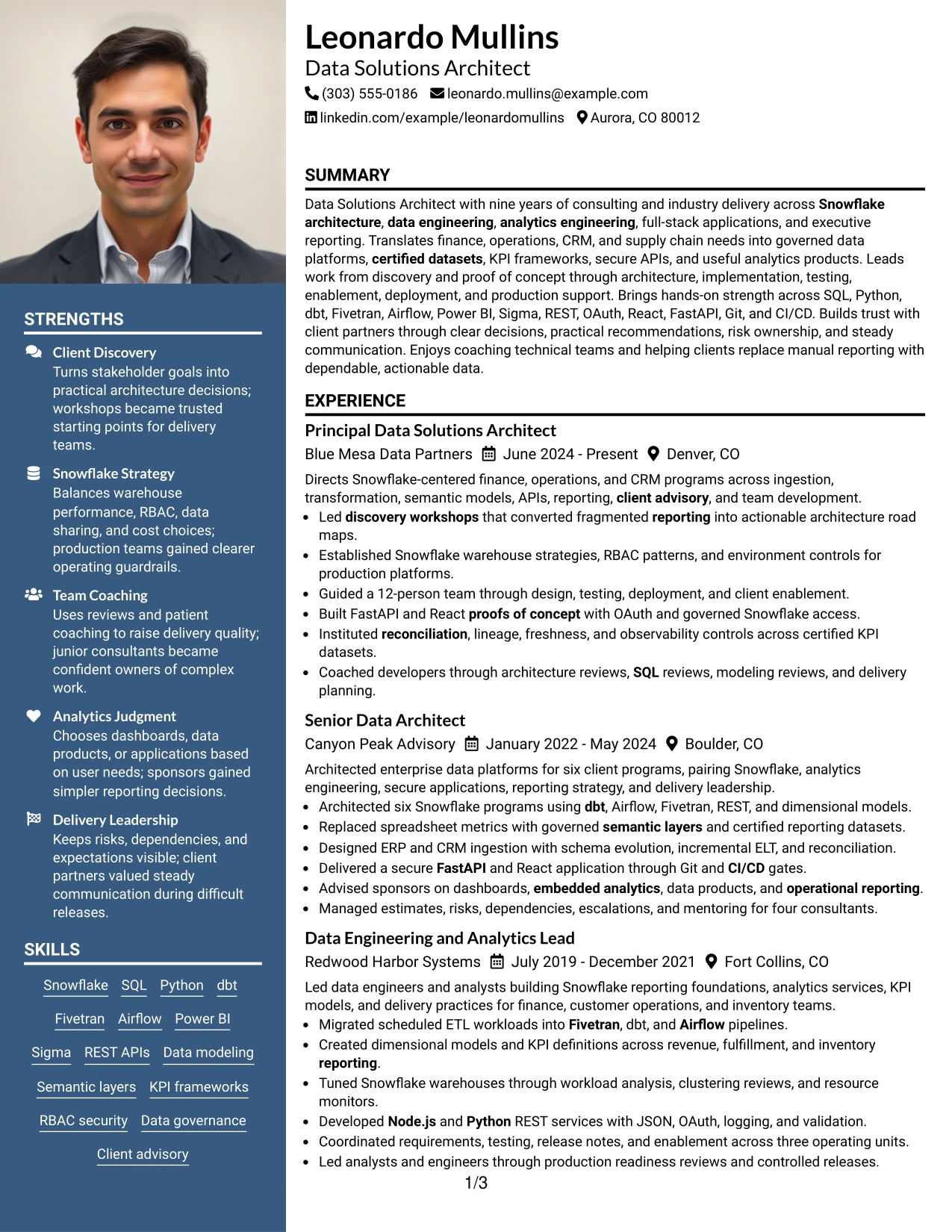
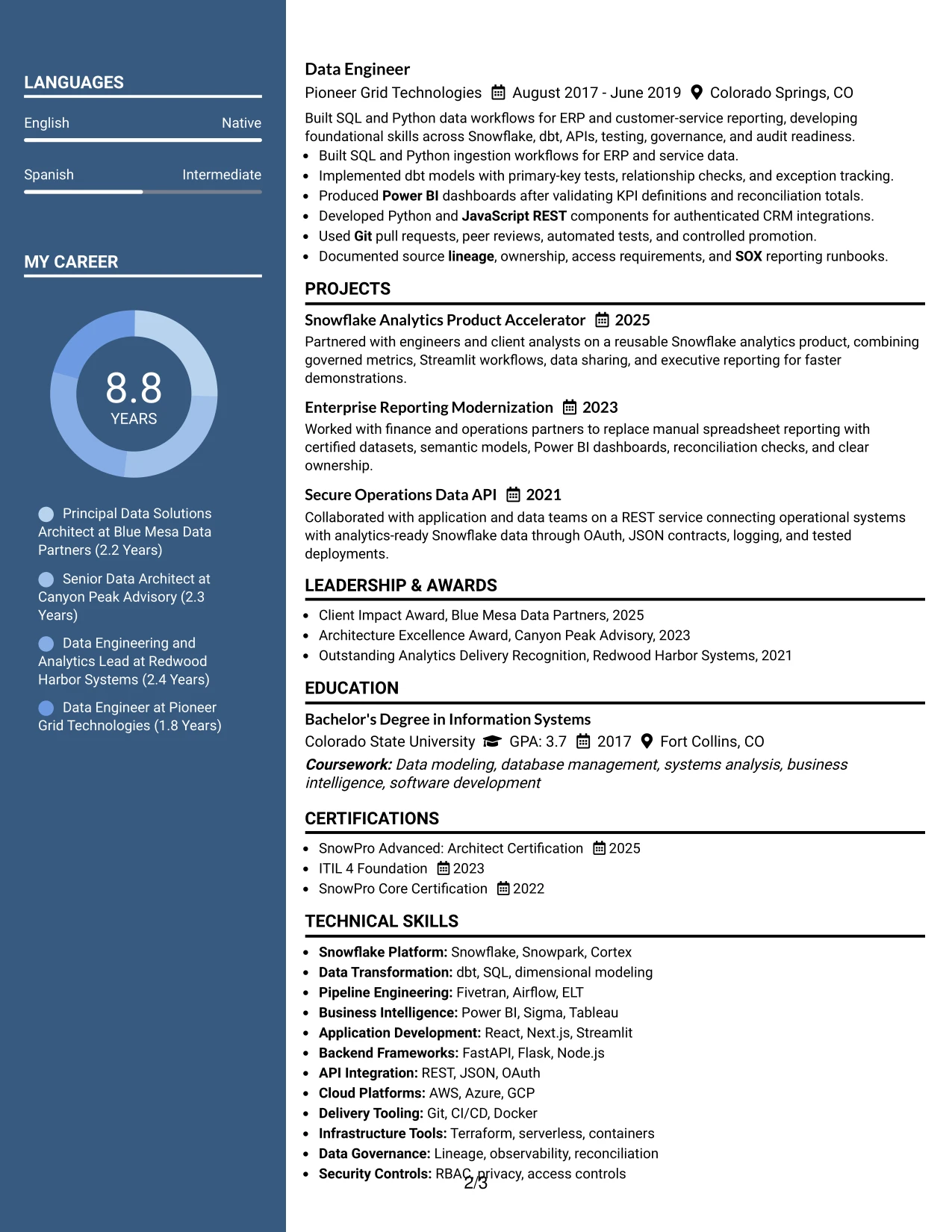
A restrained visual hierarchy places the contact area and photo in the header, then divides the resume into two useful content zones. The design keeps the Data Solutions Architect title and summary visible at the top while giving experience and technical qualifications separate space. The result can feel personal without weakening the document's professional evidence.
One column may carry experience and projects, while the other presents skills, certifications, education, and leadership. This arrangement makes it easier to connect Snowflake strategy, data modeling, BI, APIs, and governance with client discovery, delivery planning, team coaching, and production support. The photo should support the header, not compete with the resume's achievements.
Why the Photo Header Two Column Format Works for a Resume
- Creates a clear first impression through a defined header area.
- Keeps the target role and summary visible before the two-column detail begins.
- Separates career evidence from skills and credentials for faster review.
- Provides room for projects and leadership activities without a long single stream.
- Supports a balanced presentation of architecture and application work.
- Keeps technical keywords easy to locate in a dedicated content area.
- Uses the photo as a supporting header element rather than the main focus.
Best For
- Resumes where a strong header should establish identity and role quickly.
- Candidates who want experience and qualifications in distinct review zones.
- Applications that combine technical architecture with client relationship work.
- Documents with enough project and leadership content to justify two columns.
- Professionals presenting platform strategy alongside full-stack delivery.
- Readers who prefer a structured visual overview before detailed bullets.
- Resume versions where a personal header element fits the intended presentation.
#7 Simple Two Column Format Resume Example
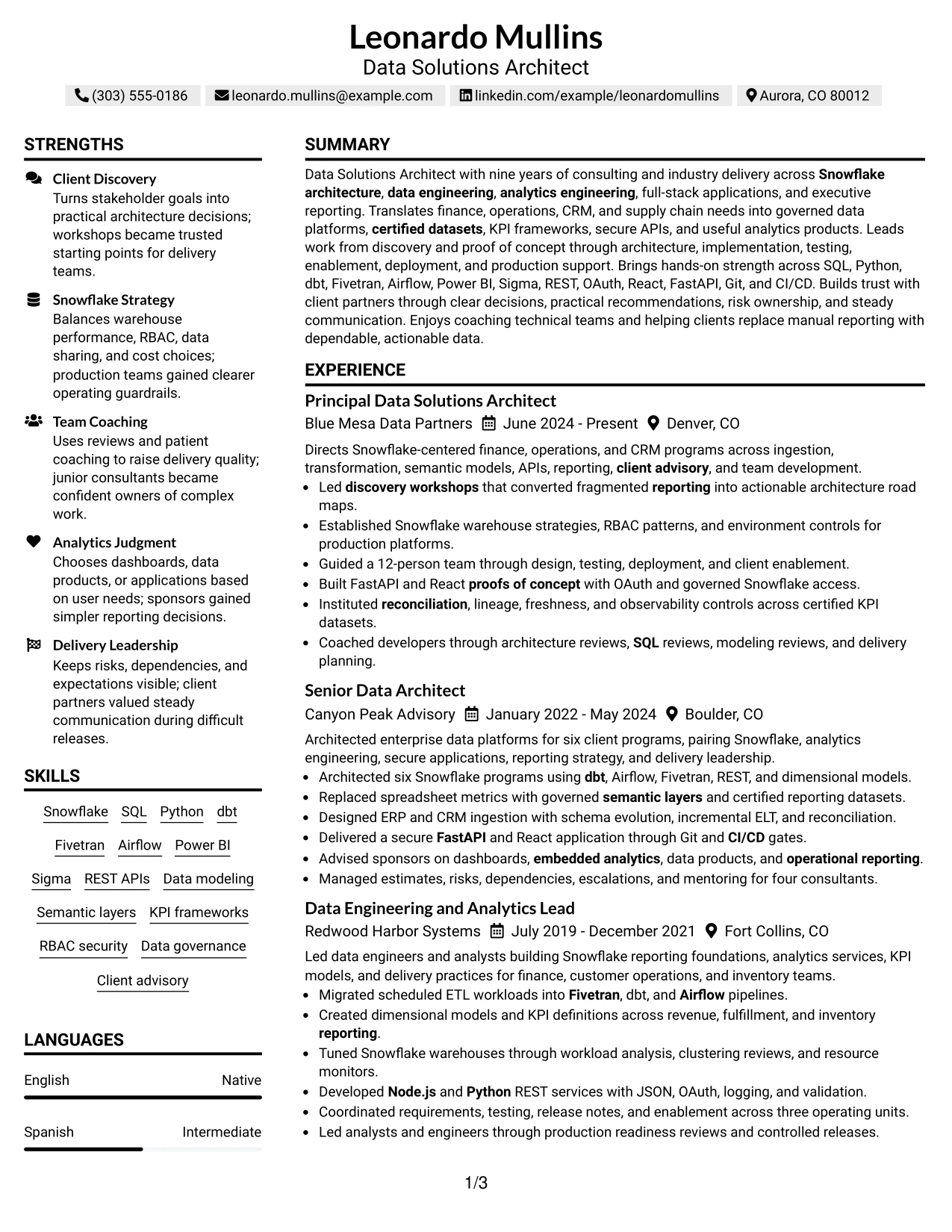
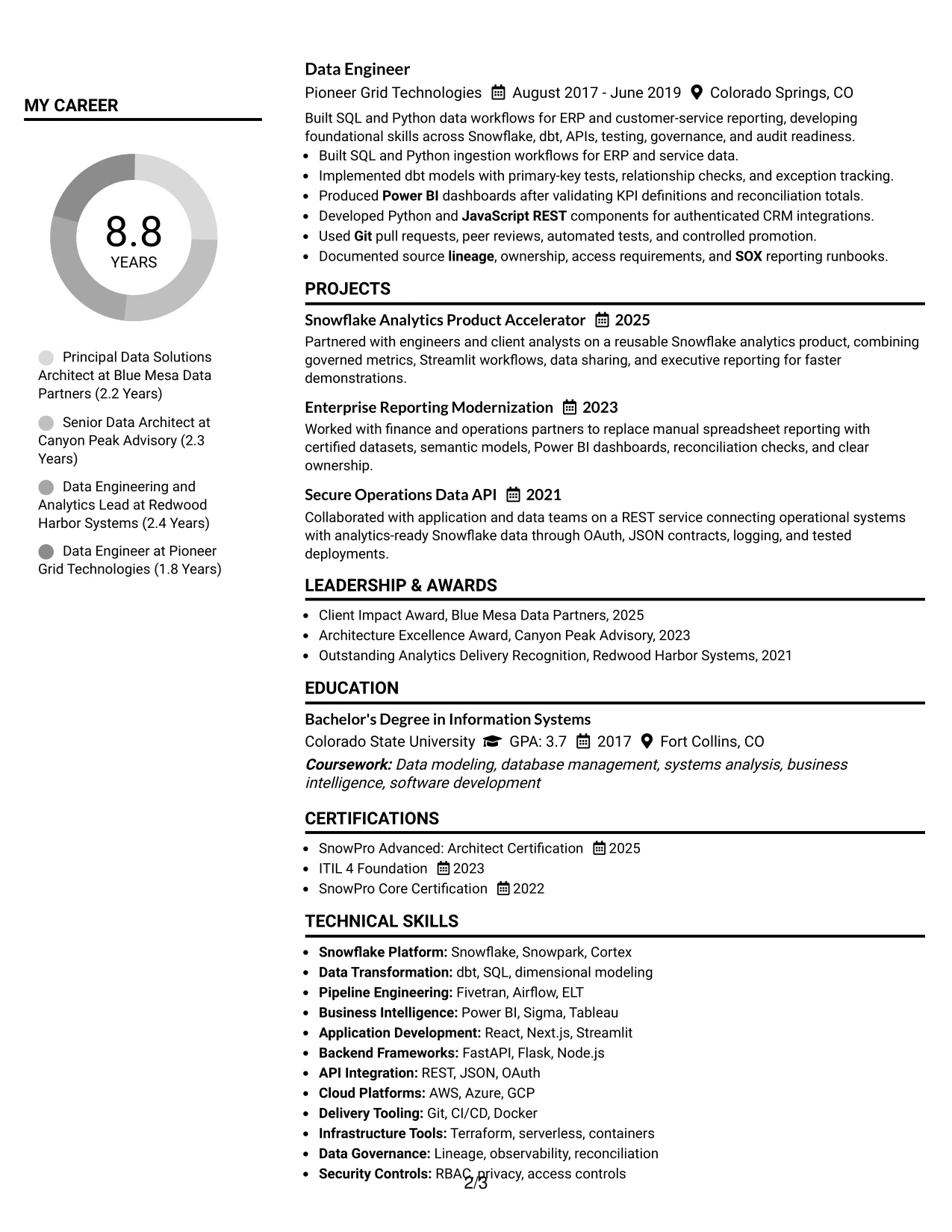
Simple Two Column Format organizes the resume into two clean tracks without adding visual clutter. The primary track can hold the summary and experience, while the supporting track groups skills, education, certifications, projects, and activities. This makes the document easy to scan while preserving the full story of architecture leadership and hands-on delivery.
The format is especially useful when each bullet must remain short and evidence-led. Readers can quickly find Snowflake, SQL, Python, dbt, Fivetran, Airflow, Power BI, Sigma, REST, OAuth, and FastAPI, then review bullets showing warehouse strategy, reporting modernization, secure applications, testing, and governance. Consistent headings also help automated systems read the document.
Why the Simple Two Column Format Works for a Resume
- Creates two clearly defined areas with little visual distraction.
- Keeps the main experience track easy to follow from recent to earlier roles.
- Makes skills and certifications visible without interrupting achievement bullets.
- Supports short, consistent bullets that are quick to scan.
- Leaves room for projects and activities that strengthen credibility.
- Uses familiar headings that support ATS processing.
- Presents architecture leadership and technical execution in a balanced way.
Best For
- Resumes needing two information zones without a decorative layout.
- Readers who scan experience first and qualifications second.
- Applications with concise bullets and a well-defined skills list.
- Documents that include projects, certifications, and professional activities.
- Professionals who want a clean bridge between technical and leadership evidence.
- Resume versions designed for quick digital review.
- Candidates who need structure but do not want side content to dominate.
#8 Text/Fang Style Resume Example
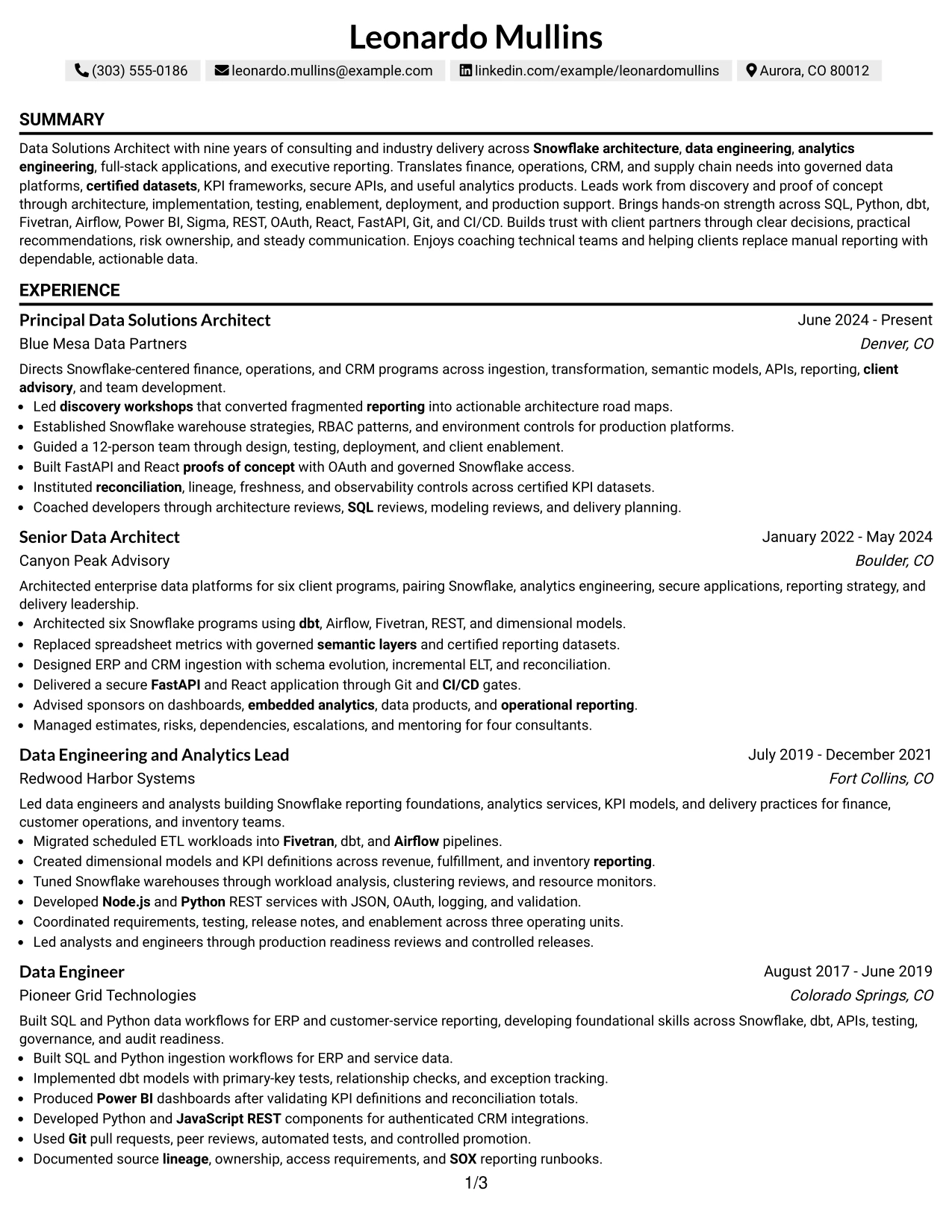
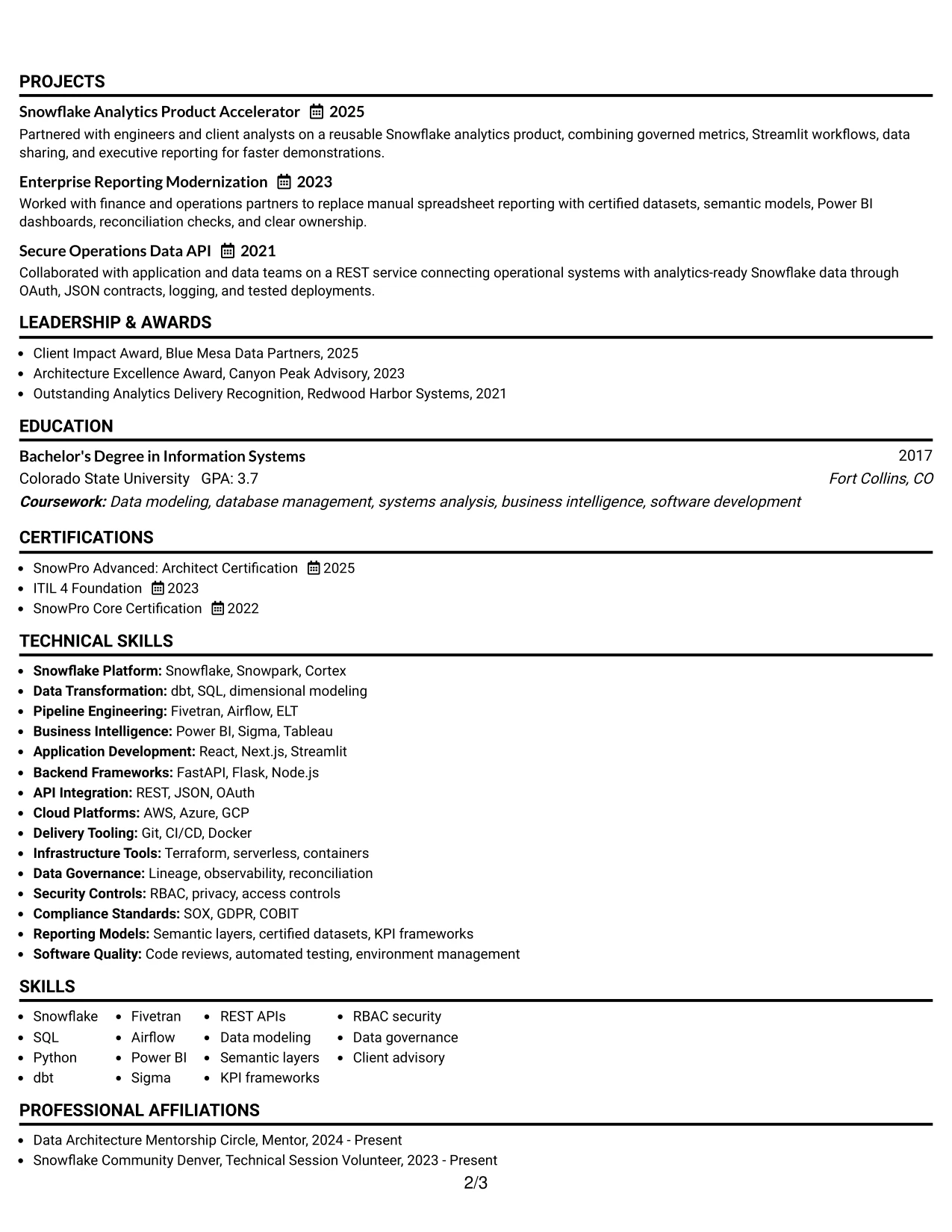
Readers move through this text-led resume in a steady sequence, with the summary introducing the scope of work and the experience section carrying the main evidence. Projects, education, certifications, and skills follow as supporting proof. That order suits a Data Solutions Architect resume with a long technical history and several connected specialties.
The generous text area allows bullets to explain systems, decisions, and delivery stages without excessive compression. It can show discovery through production support, including Snowflake, dbt, Fivetran, Airflow, semantic layers, certified datasets, REST APIs, OAuth, React, FastAPI, and CI/CD. Careful headings keep the detail navigable rather than overwhelming.
Why the Text/Fang Style Works for a Resume
- Provides a text-led review path for detailed professional history.
- Gives complex architecture bullets enough room for context.
- Keeps related tools close to the work where they were applied.
- Supports a complete account of discovery, delivery, testing, and enablement.
- Allows projects to add technical proof after the experience section.
- Makes certifications and governance knowledge easy to verify.
- Works well when content depth matters more than decorative elements.
Best For
- Resumes with extensive technical scope that needs careful explanation.
- Applications where architecture decisions require more than short keyword bullets.
- Readers who prefer a traditional text-first review experience.
- Documents linking multiple delivery stages across several roles.
- Professionals with projects that provide additional implementation evidence.
- Resume versions where content depth is the main presentation strength.
- Candidates who need space for platforms, frameworks, controls, and reporting work.
#9 One Column Boxed Contact Header Format Resume Example
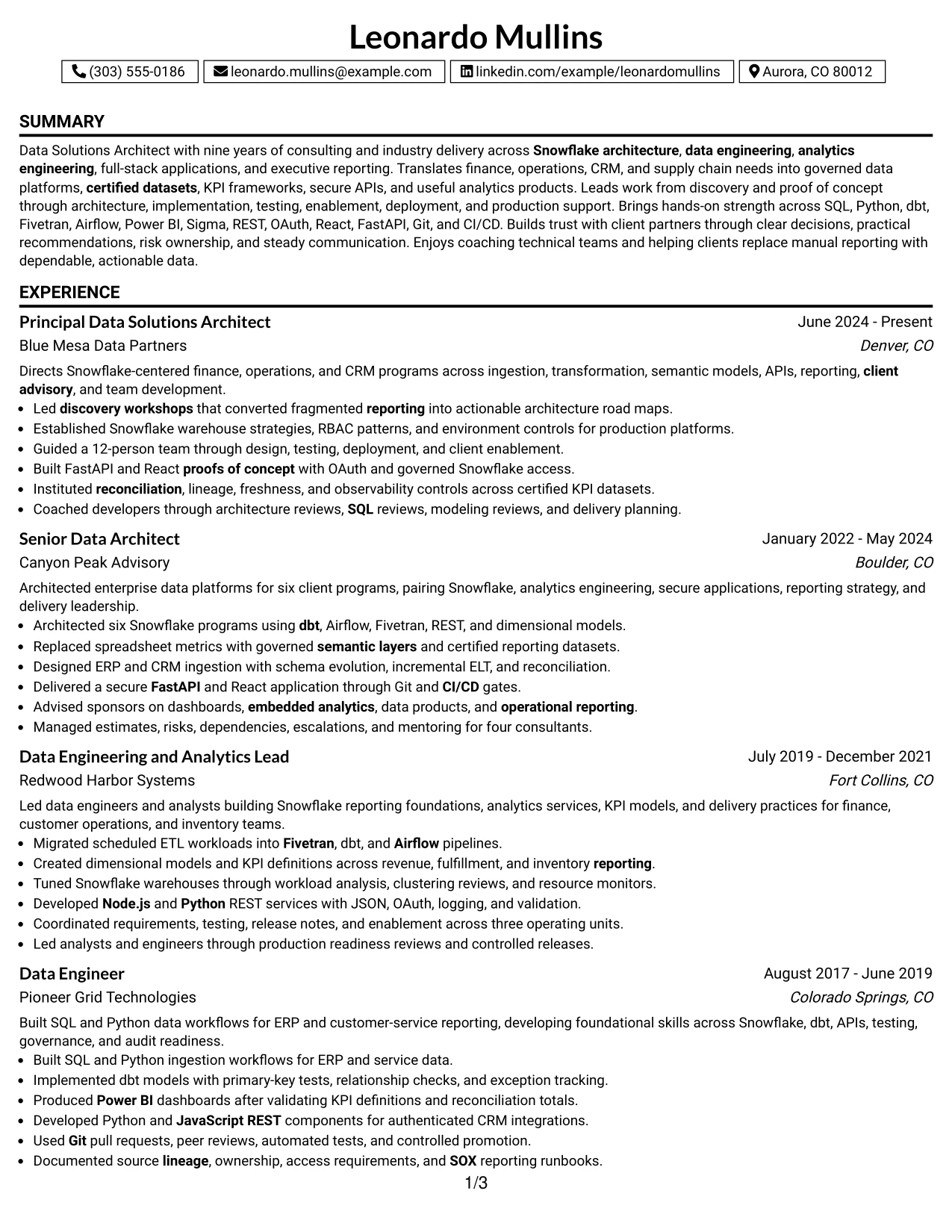
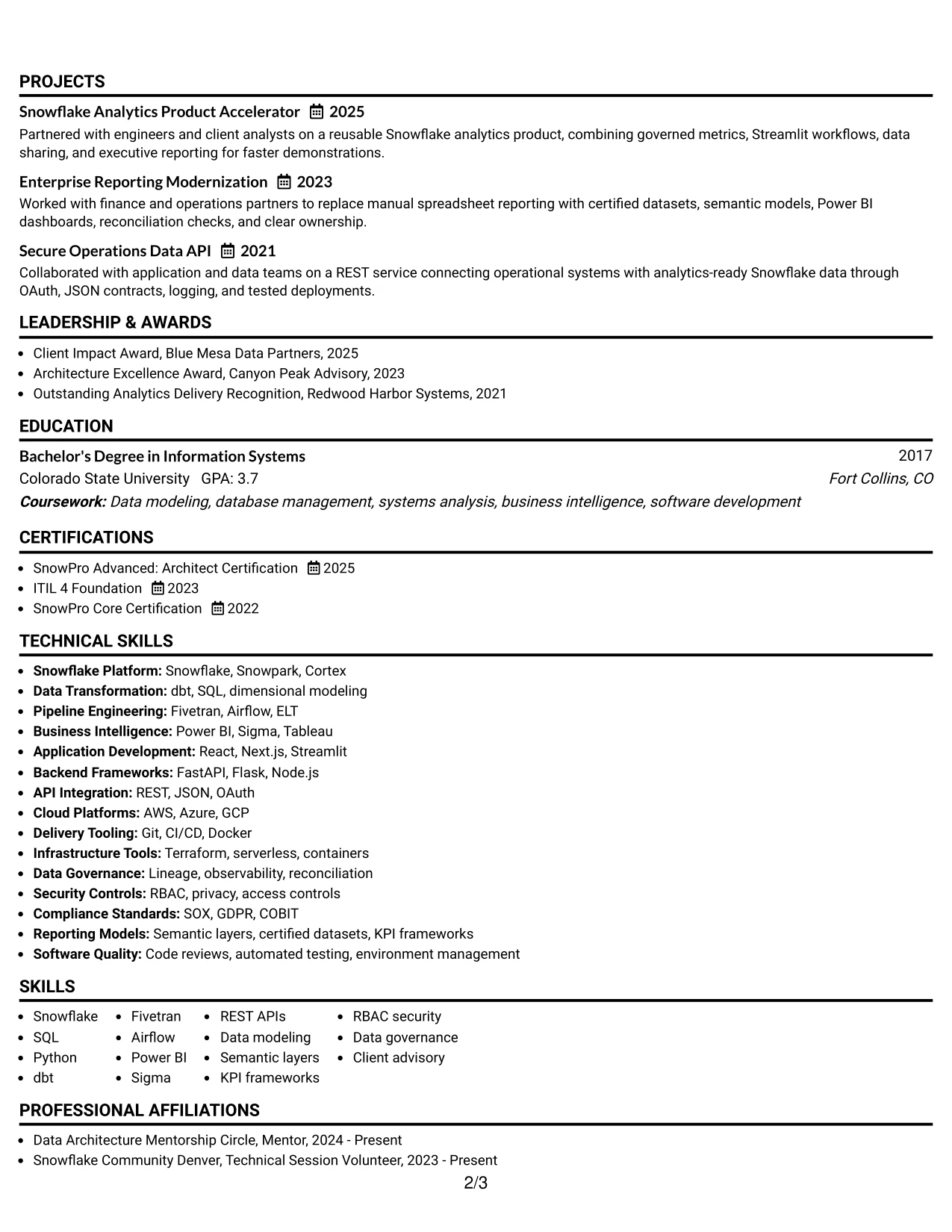
The strongest evidence starts below a boxed contact header, where the role, summary, and recent achievements can receive immediate attention. The header keeps contact details separate from the professional story, so the first substantive section can focus on Data Solutions Architect scope, Snowflake architecture, and client delivery.
A single column then presents experience in a familiar order, followed by projects, education, certifications, and skills. Full-width bullets can connect six client programs, a 12-person team, governed KPI datasets, FastAPI and React proofs of concept, and production controls. The boxed header adds definition while the body remains readable and ATS-friendly.
Why the One Column Boxed Contact Header Format Works for a Resume
- Separates contact details from the evidence recruiters need to assess.
- Makes the target role and summary the first substantive content.
- Uses full-width bullets for architecture, delivery, and technical results.
- Keeps the career timeline simple and ATS-readable.
- Provides a clear place for projects and certifications after experience.
- Supports strong proof such as team size, client programs, and control practices.
- Adds visual definition without disrupting the resume's reading order.
Best For
- Resumes that need a distinct contact area and a focused body.
- Applications where the summary should lead directly into recent evidence.
- Documents with detailed bullets across architecture and engineering roles.
- Readers who value a conventional timeline with clear section boundaries.
- Professionals showing secure applications, governed data, and reporting outcomes.
- Resume versions that need a polished header while retaining ATS simplicity.
- Candidates whose strongest proof comes from experience and selected projects.
#10 Plain Two Column Format Resume Example
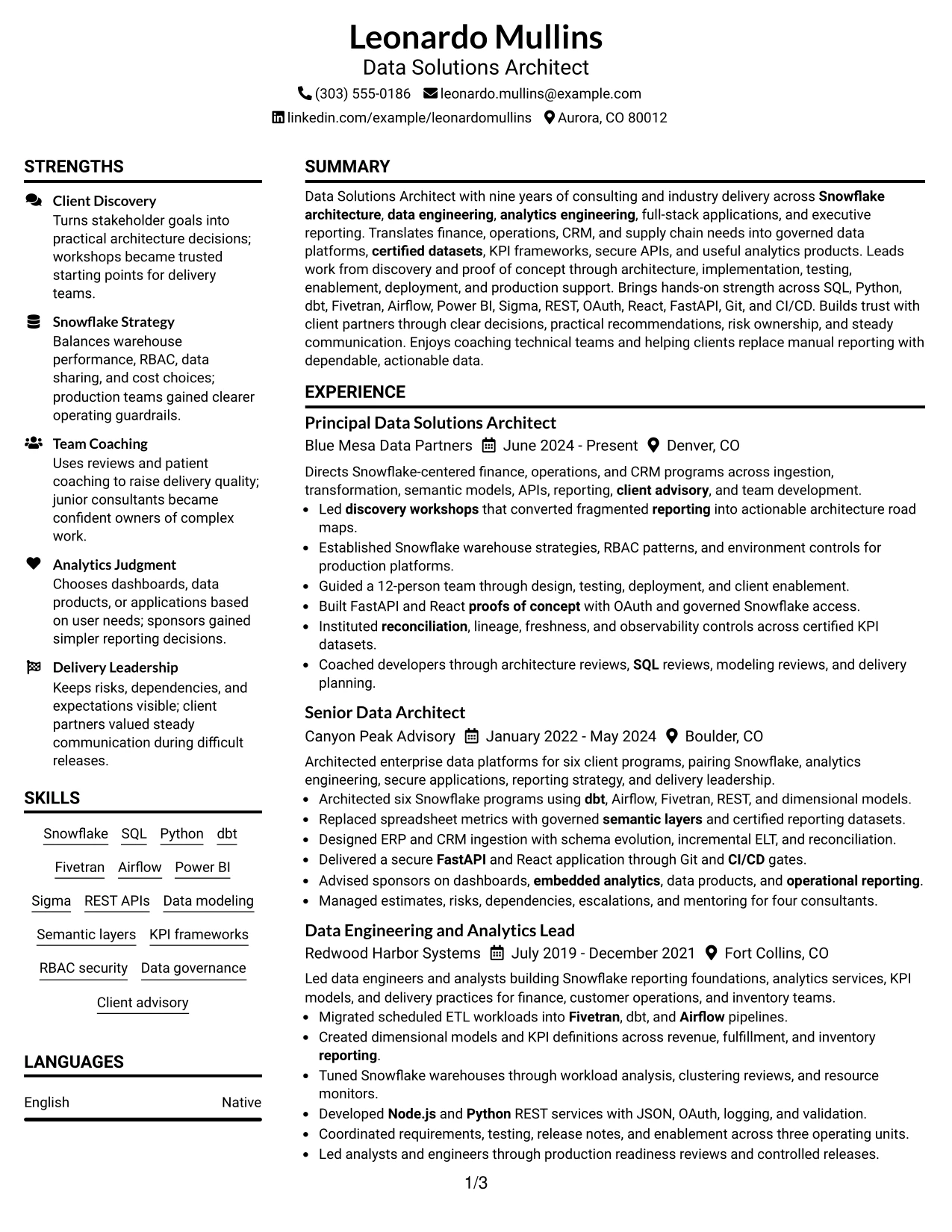
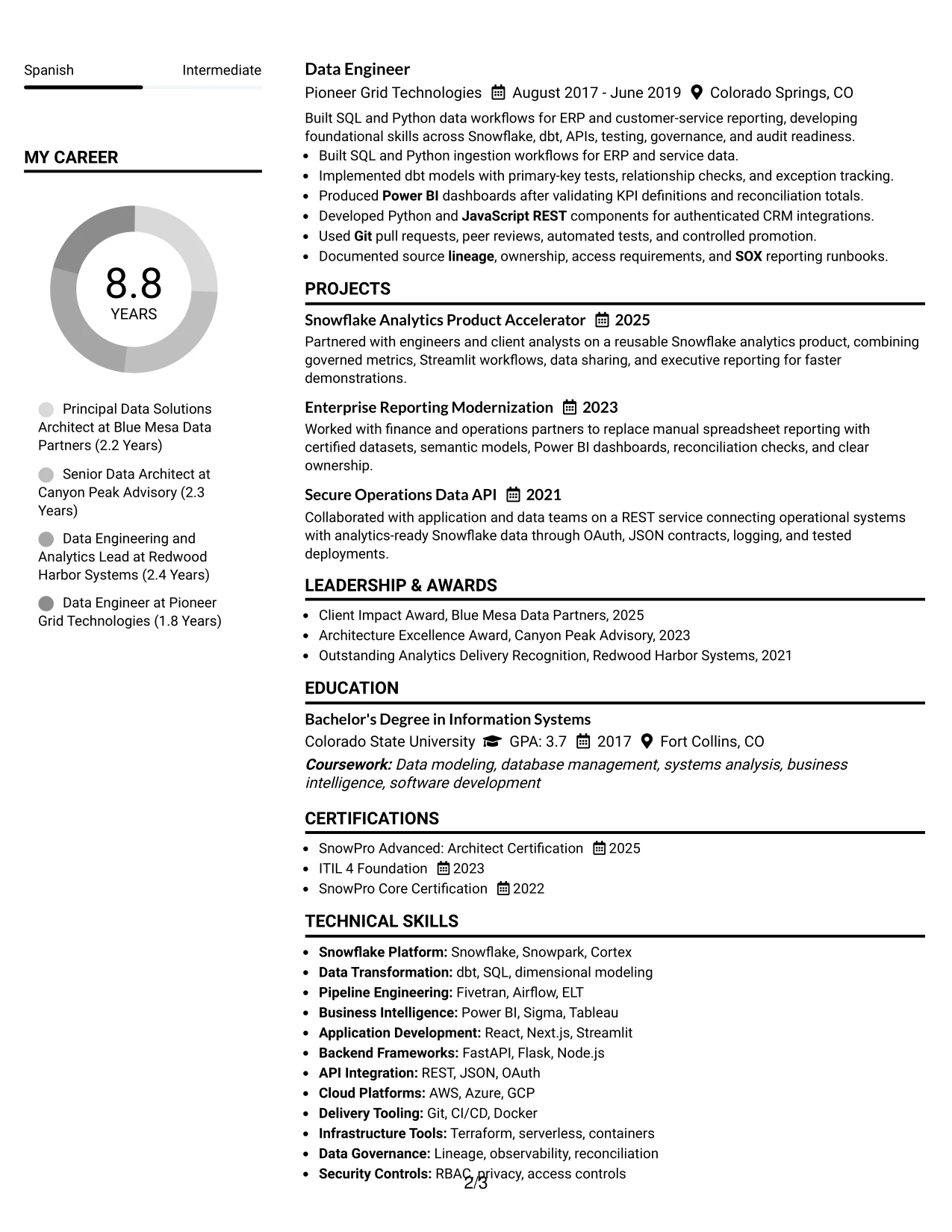
Content is balanced across two plain columns so a reviewer can compare the career story with supporting qualifications at a glance. The main area can feature the summary and experience, while the second area holds skills, certifications, education, projects, and selected activities. For Leonardo Mullins, that structure keeps the Data Solutions Architect focus connected to Snowflake, analytics, APIs, and delivery leadership.
A short resume snapshot can reinforce the most relevant facts before the detailed sections begin. The snapshot may point to nine years of experience, SnowPro Advanced: Architect Certification, six client programs, and leadership of a 12-person team. A keyword section then gives ATS and human reviewers a concise set of terms tied to the target role.
Resume Snapshot
- Nine years across consulting and industry data delivery.
- SnowPro Advanced: Architect Certification earned in 2025.
- Six client programs architected at Canyon Peak Advisory.
- Guided a 12-person delivery team through design, testing, deployment, and enablement.
Why the Plain Two Column Format Works for a Resume
- Balances a detailed experience column with compact supporting information.
- Puts the resume snapshot near the top for quick qualification review.
- Connects keywords to evidence instead of presenting an isolated tool list.
- Keeps certifications and education visible without taking over the page.
- Gives projects a clear place to support the main career narrative.
- Uses plain formatting that is easy to scan and generally ATS-friendly.
- Works well for a role requiring architecture, engineering, reporting, and advisory range.
#11 Colored Two Column Format Resume Example
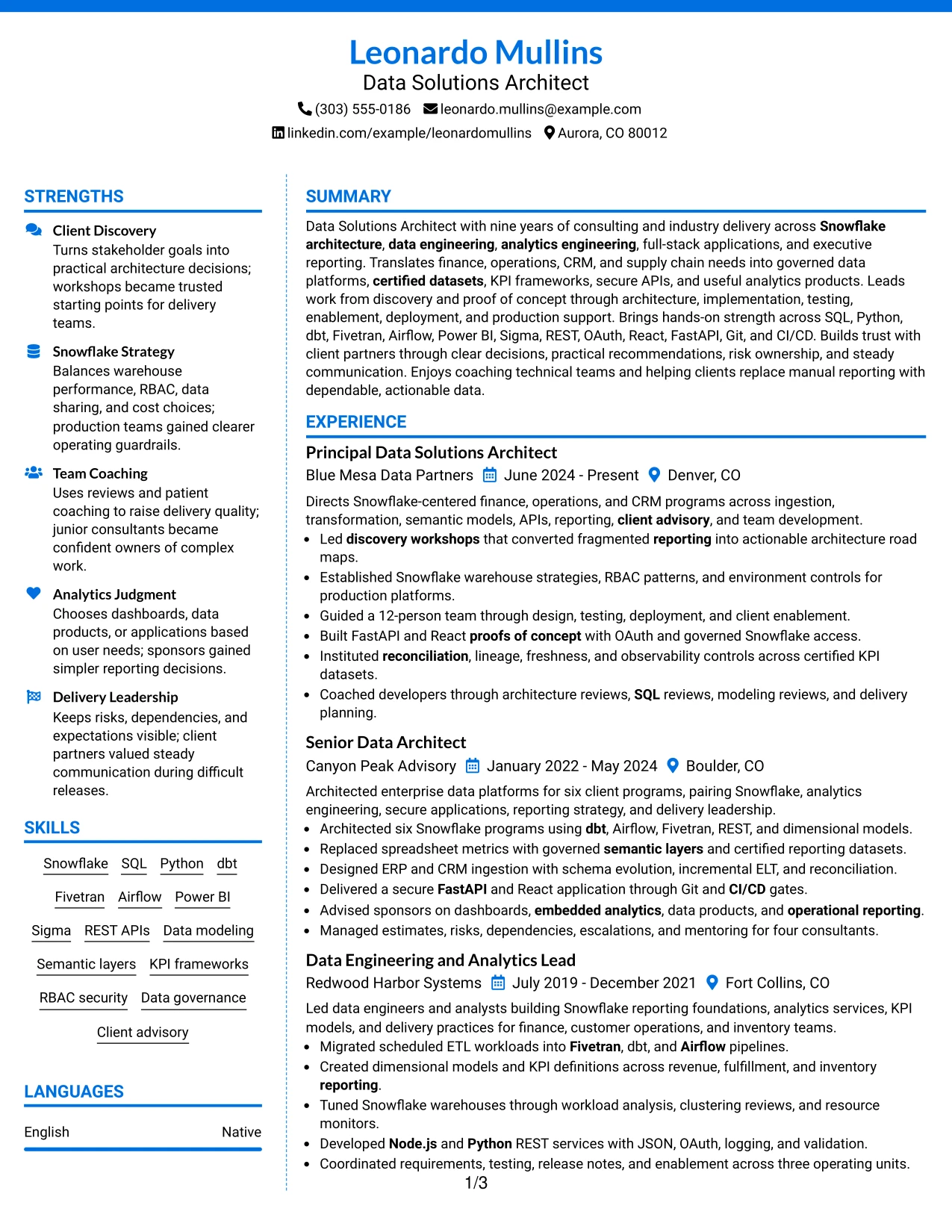
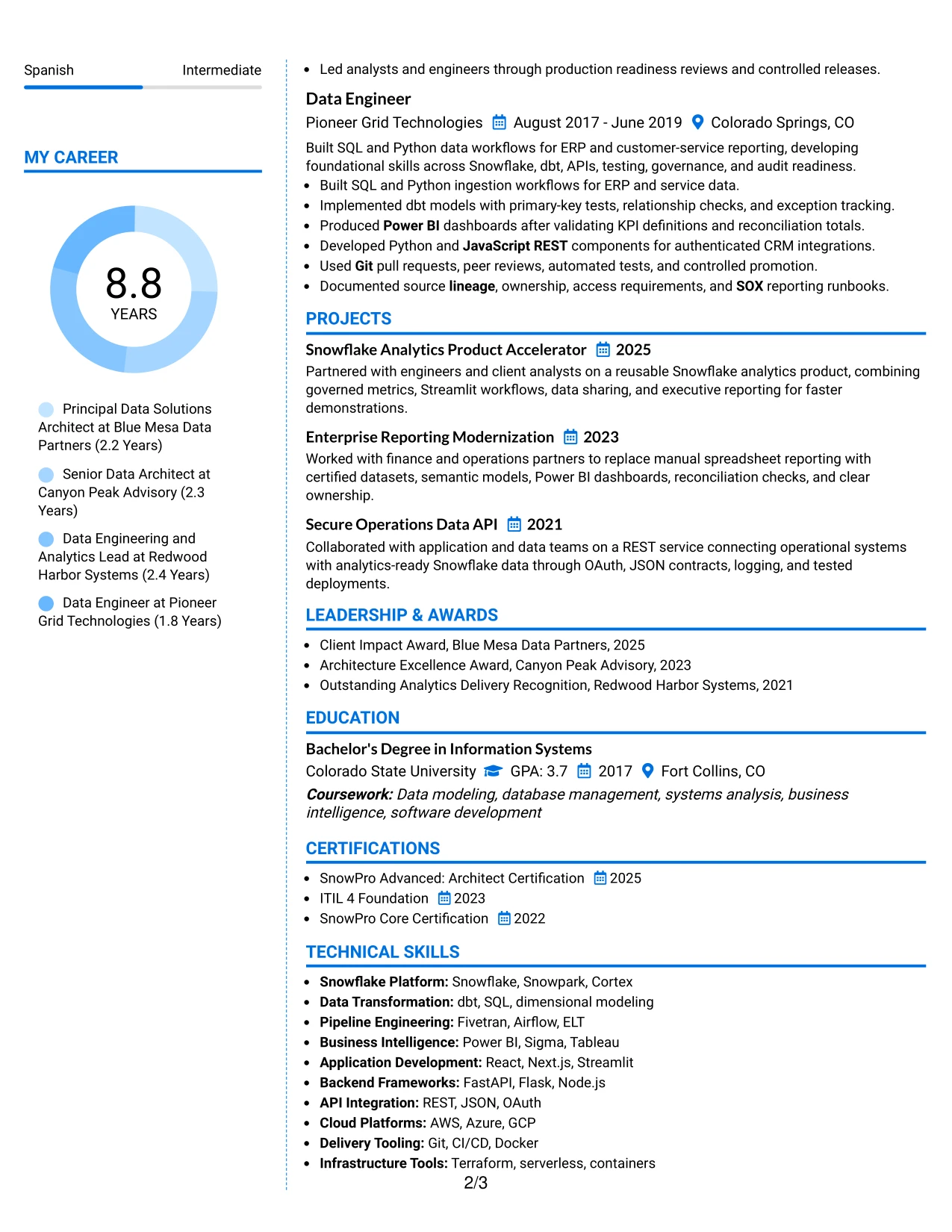
For applications that benefit from quick visual grouping, Colored Two Column Format separates the main career narrative from supporting qualifications with controlled color cues. The color should guide the eye to experience, skills, certifications, and projects without replacing clear headings. The resume can therefore present Data Solutions Architect scope while retaining strong technical and ATS-readable content.
The main column can carry architecture and delivery results, while the colored sidebar gathers Snowflake, SQL, Python, dbt, BI, API, governance, and compliance terms. Experience bullets then add the proof: discovery workshops, warehouse strategy, secure applications, semantic layers, reconciliation, lineage, observability, and coaching. Consistent spacing keeps the visual treatment professional.
Why the Colored Two Column Format Works for a Resume
- Uses color to distinguish information groups without changing the reading order.
- Keeps detailed experience in the larger column for stronger evidence review.
- Makes technical skills and certifications easy to locate in the sidebar.
- Supports a quick scan of architecture, application, and governance strengths.
- Gives projects and activities a defined place beside the career timeline.
- Maintains clear headings so visual styling does not obscure ATS content.
- Creates a polished presentation for a client-facing architecture application.
Best For
- Resumes that need visual grouping while keeping experience prominent.
- Applications where technical qualifications should be visible at first glance.
- Documents with enough supporting sections to benefit from a colored sidebar.
- Professionals presenting architecture, software delivery, and governance together.
- Readers who appreciate visual cues but still need standard resume navigation.
- Resume versions intended to look polished in digital presentation.
- Candidates whose evidence is strongest when grouped by both role and capability.
#12 One Column Shaded Contact Header Format Resume Example
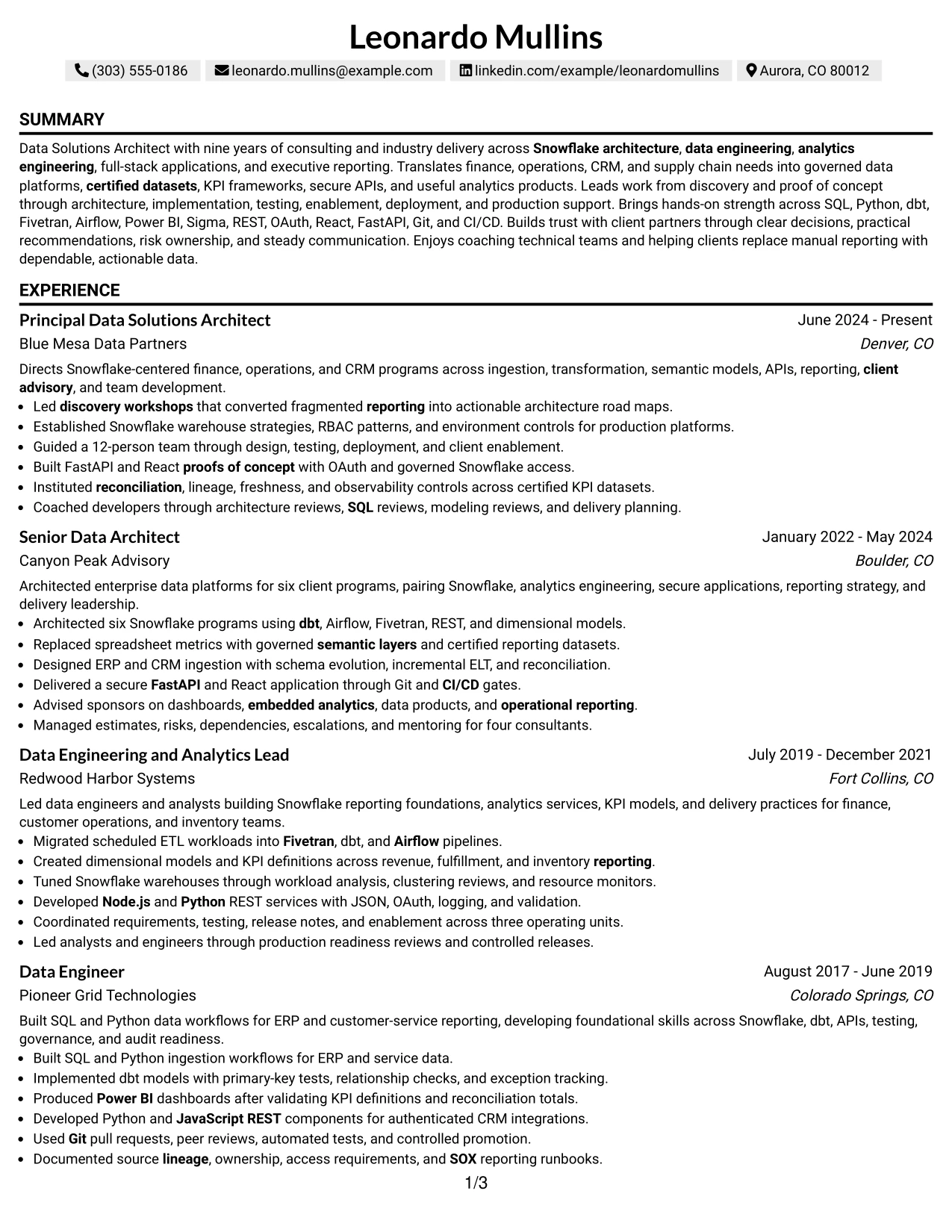
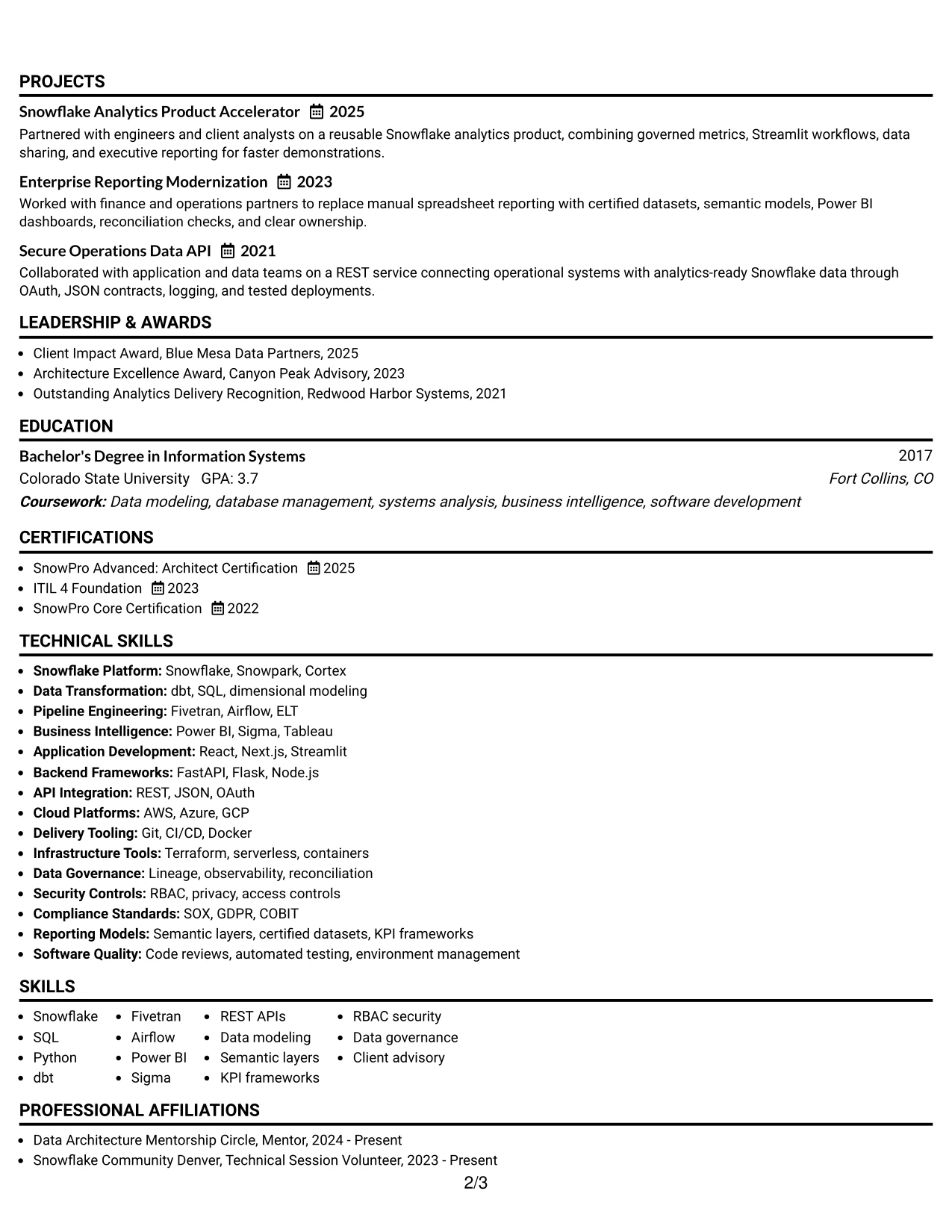
A restrained visual hierarchy gives the resume a calm, professional starting point. The shaded contact header separates the name, Data Solutions Architect title, and contact details from the main content without adding visual clutter.
The single-column flow keeps the professional summary, experience, projects, education, certifications, and skills in a clear order. Strong keywords such as Snowflake architecture, SQL, Python, dbt, and client advisory remain easy for both ATS tools and human reviewers to find.
Why the One Column Shaded Contact Header Format Works for a Resume
- The shaded header gives contact details a clear starting point.
- A one-column structure supports reliable ATS parsing.
- The professional summary quickly presents nine years of relevant experience.
- Separate experience entries make architecture and delivery work easy to follow.
- Project entries add evidence of analytics products, reporting modernization, and secure APIs.
- The skills section creates a compact keyword base for Snowflake, SQL, Python, dbt, and BI tools.
- Certifications and education remain visible without competing with recent experience.
Best For
- Applicants who want a calm, traditional presentation with clear role alignment.
- Resumes that need dependable one-column ATS reading.
- Professionals presenting a summary before detailed career evidence.
- Documents with several technical skills that need a clean keyword section.
- Applications where project work should support the main experience history.
- Candidates who want certifications and education to stay easy to locate.
- Resume reviews that reward straightforward section order over decorative elements.
#13 Boxed Contact Header with Job Title Format Resume Example
The format begins with a boxed contact area that clearly states the target title and organizes essential contact details. That strong top block helps a reviewer confirm the resume's direction before moving into the professional summary and work history.
Consistent labels then divide experience, projects, education, certifications, and skills. The simple hierarchy supports fast scanning while preserving detailed evidence such as six client programs, a 12-person delivery team, reconciliation controls, and secure FastAPI and React applications.
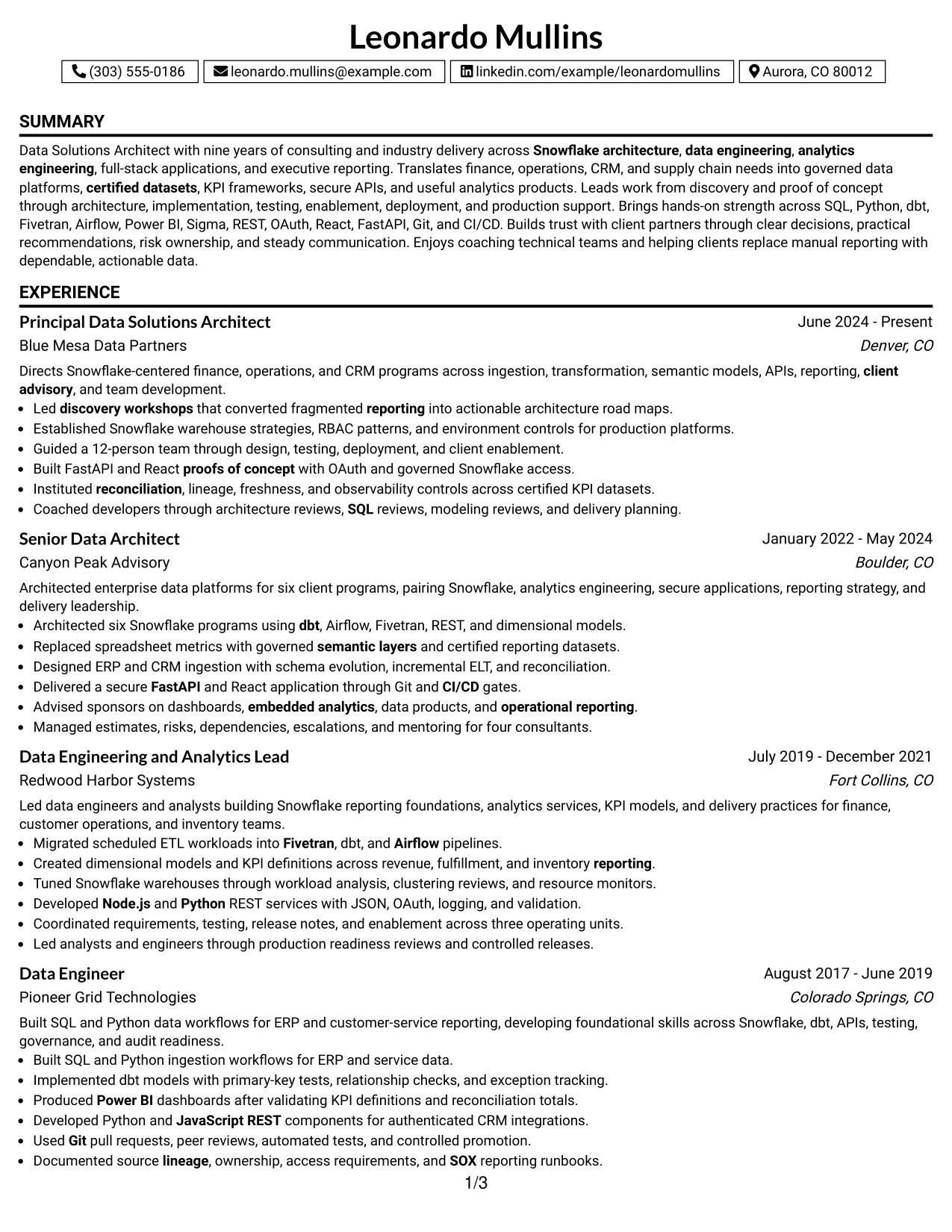
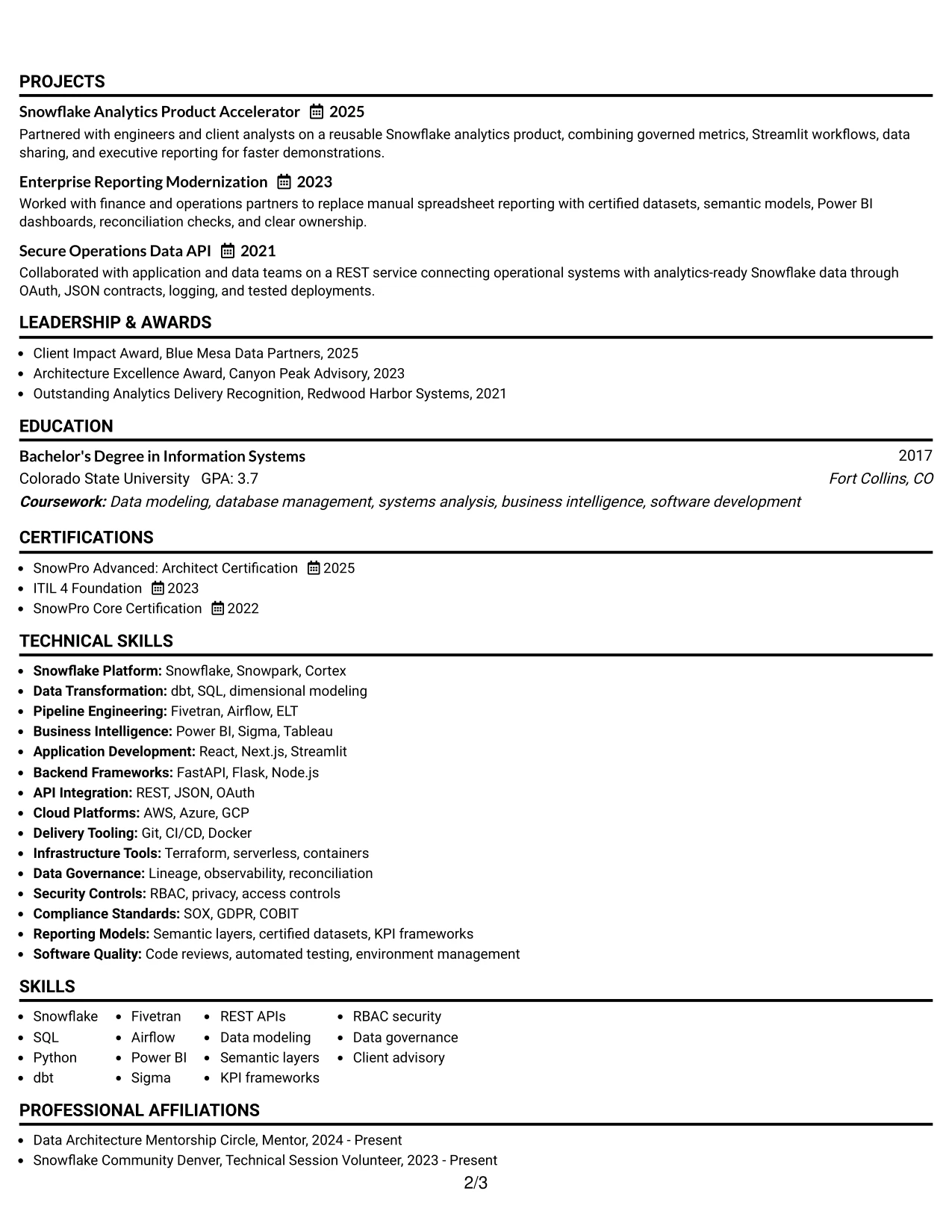
Why the Boxed Contact Header with Job Title Format Works for a Resume
- The boxed header makes the target role visible at the top of the page.
- A dedicated title line reinforces alignment with Data Solutions Architect requirements.
- Clear labels help readers move quickly between major resume sections.
- Short bullet points keep technical accomplishments easy to scan.
- The experience section shows progression from data engineering to architecture leadership.
- Projects provide additional proof of reporting modernization and application delivery.
- Skills and certifications support keyword matching without interrupting the career timeline.
Best For
- Resumes that need the target title to stand out immediately.
- Applications where reviewers scan headings before reading details.
- Documents with a mix of architecture, engineering, reporting, and application work.
- Candidates who need labeled sections to organize varied technical evidence.
- ATS-conscious resumes using standard section names and readable bullet points.
- Professional histories that benefit from a visible progression across roles.
- Applications where projects and certifications need distinct places in the structure.
#14 Stylish Two Column Designer Format Resume Example
Readers can start with the main column for the summary and experience, then use the side column to confirm skills, certifications, education, and supporting details. This navigation pattern gives a long technical career room to breathe without making every section compete for the same width.
The two-column design is useful here because the resume includes architecture, data engineering, BI, APIs, governance, projects, awards, and leadership activities. The main column carries achievement-rich bullets, while the sidebar groups high-value keywords such as Snowflake, dbt, Airflow, Power BI, REST, OAuth, and CI/CD.
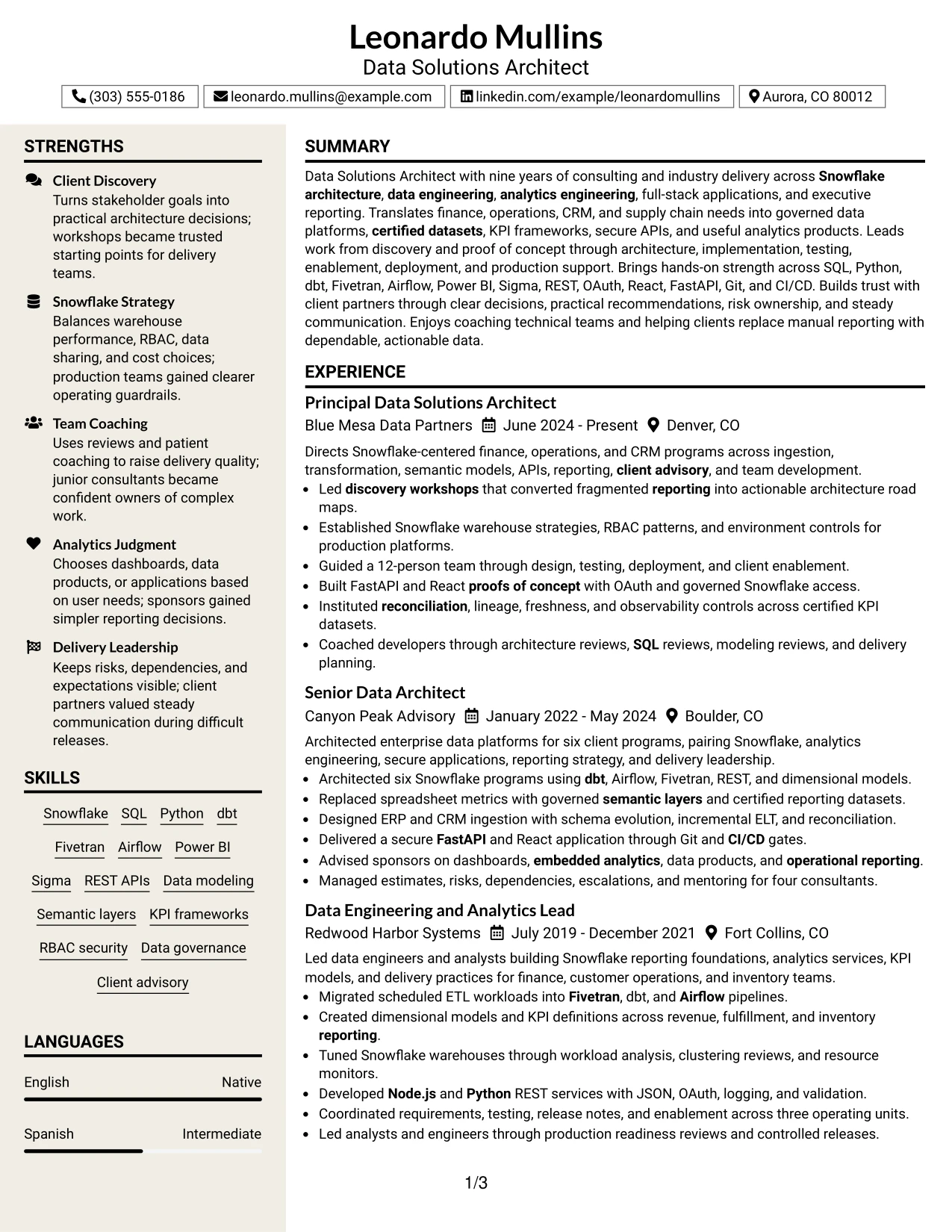
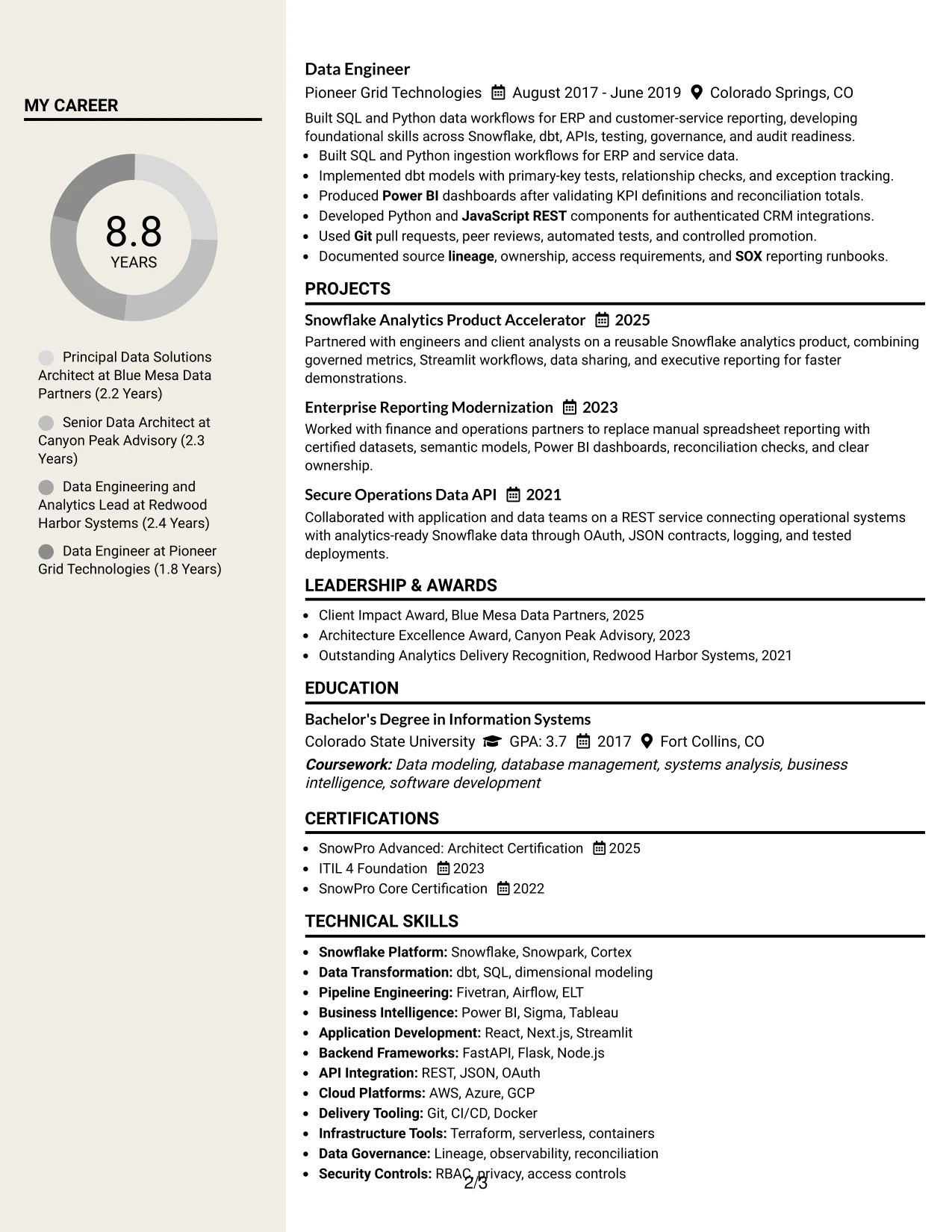
Why the Stylish Two Column Designer Format Works for a Resume
- The main column protects detailed experience bullets from excessive compression.
- The side column groups skills and credentials for quick reference.
- Two-column navigation reduces the visual length of a broad technical profile.
- Project work can sit apart from employment history while remaining easy to find.
- Awards and mentoring activities add leadership evidence without disrupting chronology.
- Grouped tools make the relationship between platforms, frameworks, and delivery methods clearer.
- The structure supports a substantial resume while keeping major sections distinct.
Best For
- Professionals with broad evidence across platforms, applications, reporting, and governance.
- Resumes that need a dedicated sidebar for skills and credentials.
- Applications where detailed experience bullets require more room than a compact summary.
- Candidates combining client delivery, team leadership, and hands-on technical work.
- Documents with projects, awards, and activities that should remain visible.
- Readers who prefer a quick reference column beside chronological evidence.
- Content-rich resumes that still need clear separation between primary and supporting information.
#15 Modern Icon Format Resume Example
The strongest evidence receives priority: architecture decisions, governed data delivery, measurable scope, and technical leadership. Icons can guide the eye toward sections, but the resume's credibility comes from specific bullets such as leading a 12-person team, architecting six client programs, and building secure applications.
A single-column structure keeps those results in a dependable reading order. The summary establishes the role, experience bullets show delivery, projects demonstrate applied work, and skills and certifications reinforce the technical keywords needed for a Data Solutions Architect search.
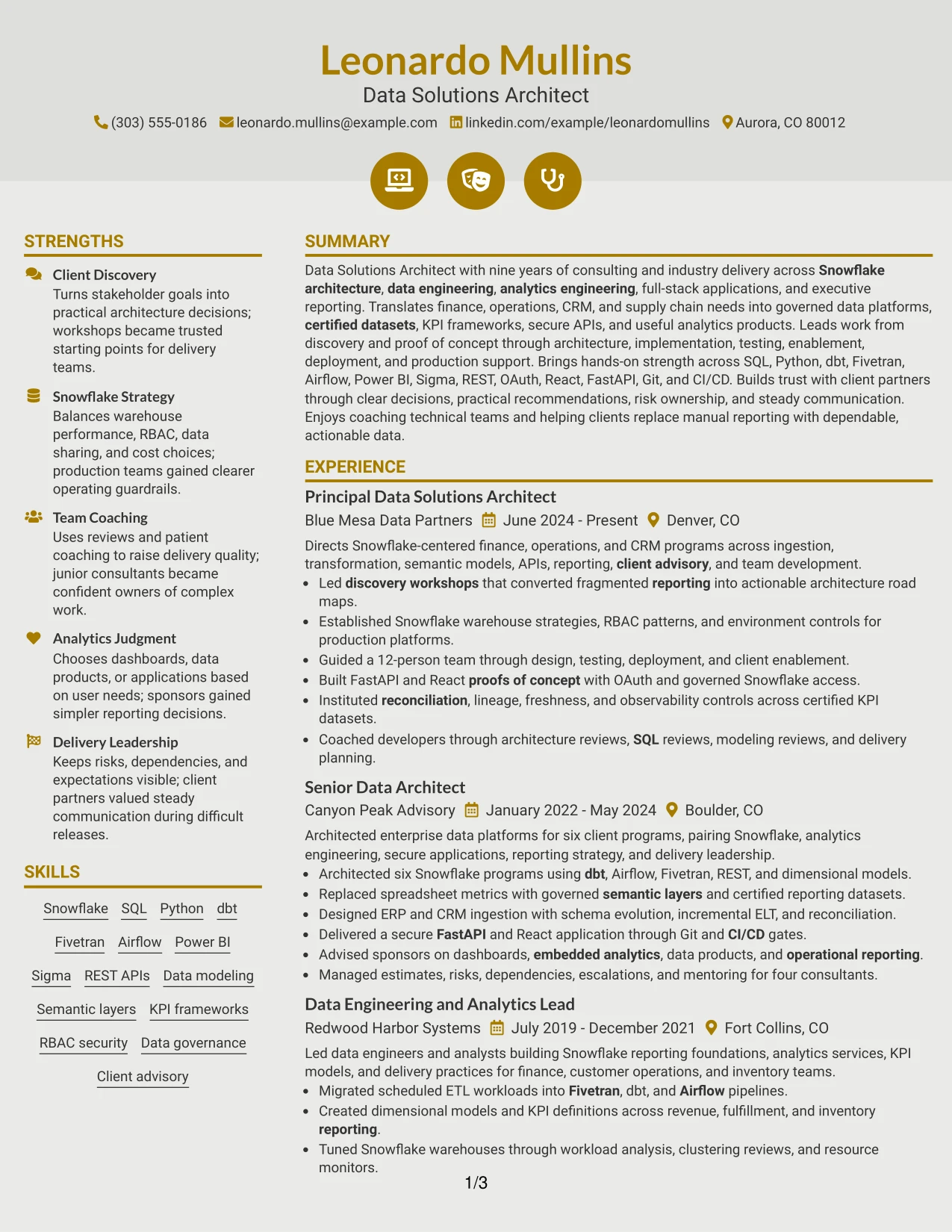
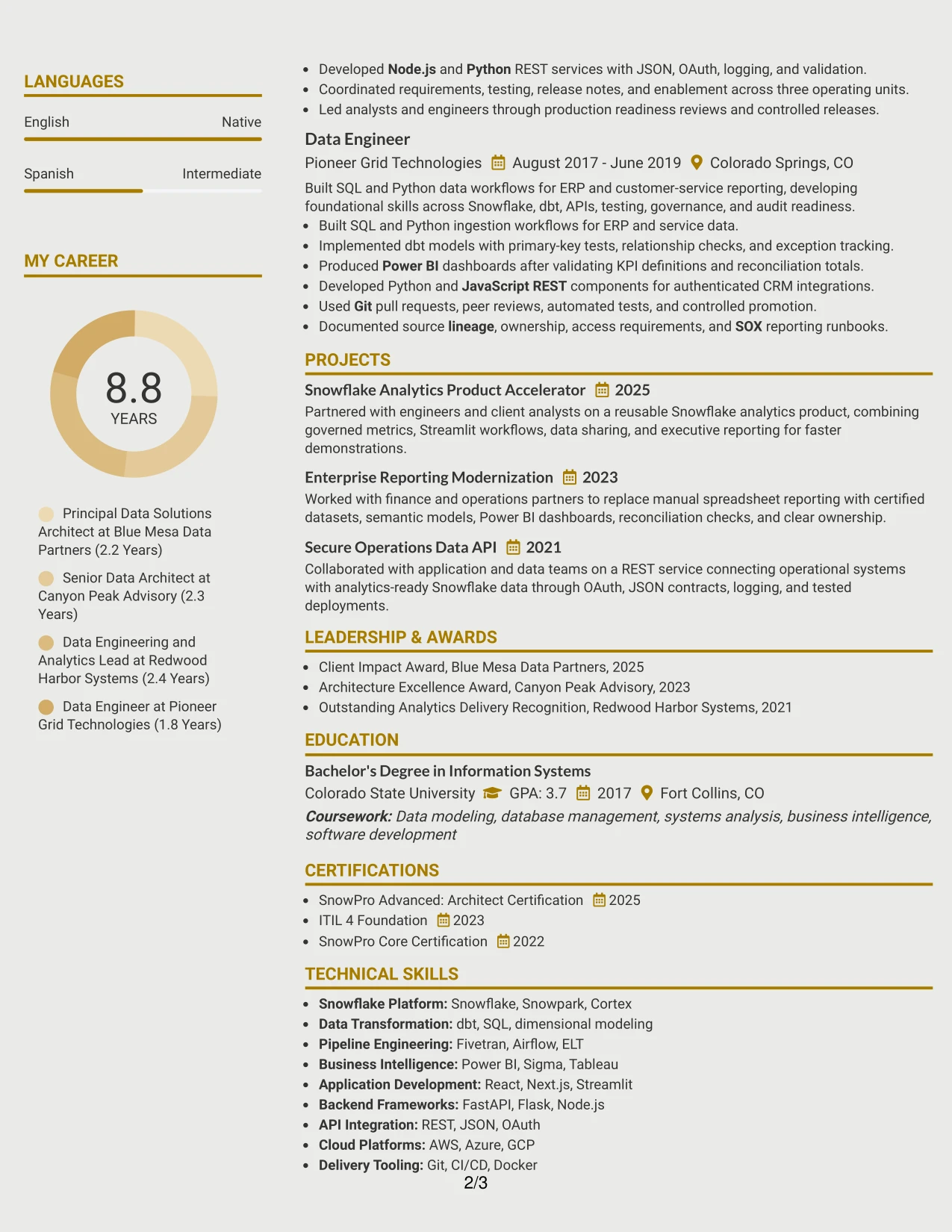
Why the Modern Icon Format Works for a Resume
- The visual markers help separate sections without replacing standard text headings.
- Evidence-led bullets keep accomplishments more important than decoration.
- Team scope and client-program count provide useful scale in the experience section.
- Technical tools appear alongside the work they supported.
- Projects show practical use of Streamlit, data sharing, semantic models, and OAuth.
- Certifications strengthen the Snowflake architecture focus.
- The one-column order remains friendly to ATS parsing and quick review.
Best For
- Resumes that need achievement bullets to remain the main visual focus.
- Candidates with clear scope evidence, such as team size or program count.
- Applications where tools should be connected to specific delivery outcomes.
- Professionals adding projects to demonstrate applied technical capability.
- Documents that use light visual cues but still need conventional section text.
- Technical profiles balancing architecture decisions with hands-on implementation.
- Resume readers who want evidence first and supporting keywords second.
#16 Plain Professional Layout with Job Title and Shaded Labels Resume Example
Content is balanced through a simple header, shaded section labels, and consistent spacing between entries. That balance gives the resume a professional tone while leaving enough room for detailed architecture, data platform, reporting, and application bullets.
The layout fits a practical application in which reviewers need to compare requirements with evidence. Snowflake warehouse strategy, RBAC, data pipelines, semantic layers, REST APIs, testing, governance, and client advisory appear in an orderly sequence rather than as an unstructured tool list.
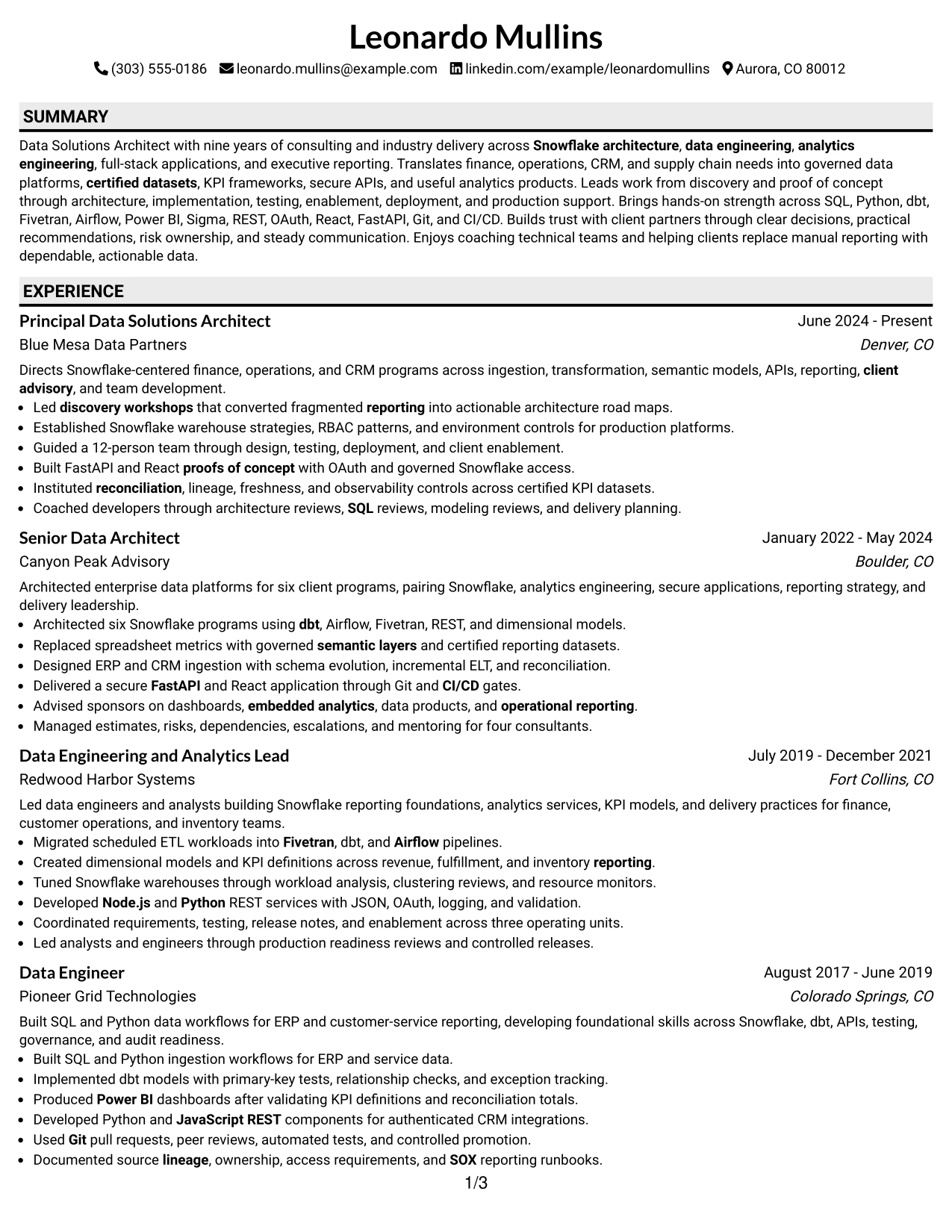
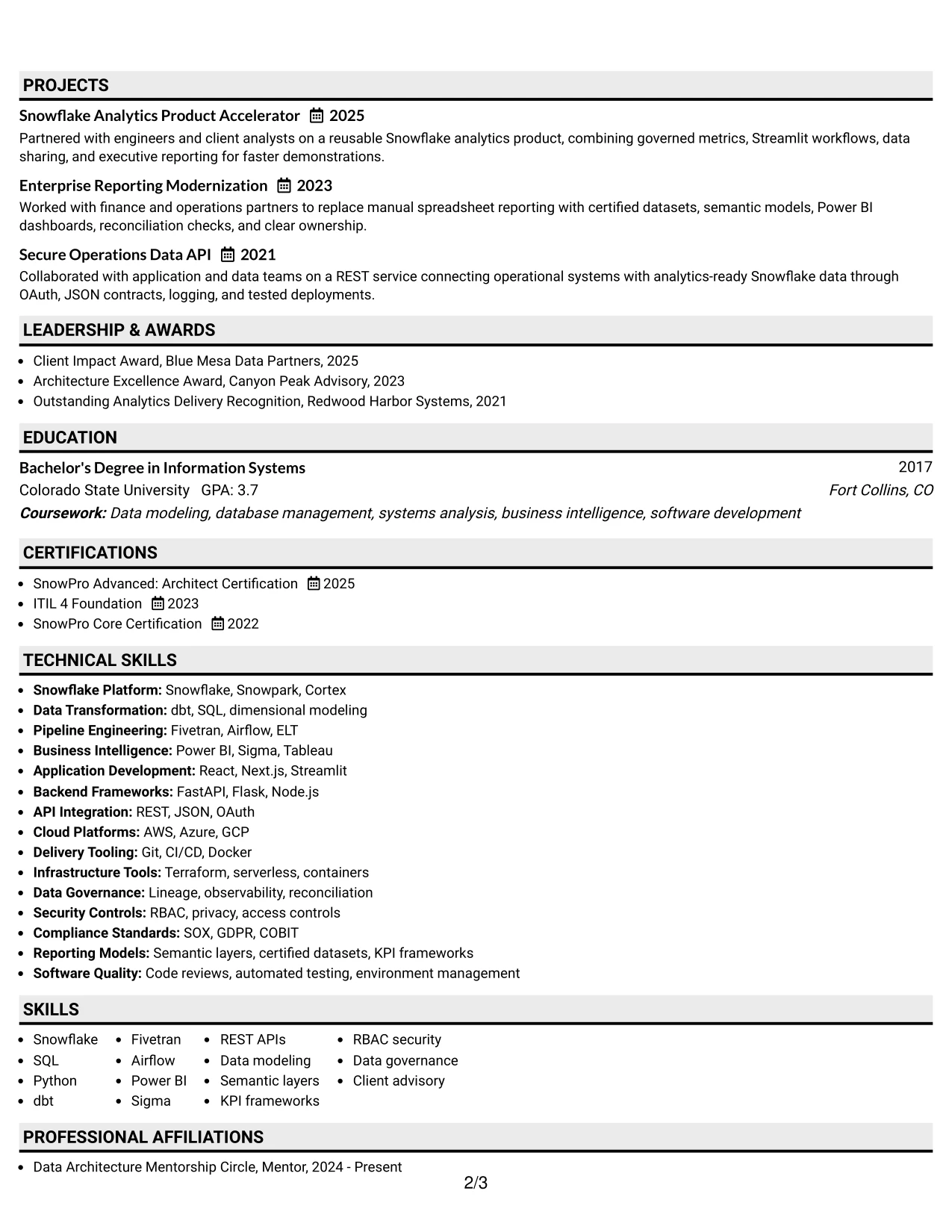
Why the Plain Professional Layout with Job Title and Shaded Labels Works for a Resume
- Shaded labels make each resume section easy to locate.
- The job title near the top provides immediate application context.
- Consistent spacing supports comfortable reading across several roles.
- Bullets connect technical methods to architecture and delivery responsibilities.
- The experience section reflects discovery, implementation, testing, enablement, and support.
- Projects add focused examples beyond the employment timeline.
- The plain presentation keeps ATS-relevant terms in readable text.
Best For
- Applications that call for a polished but restrained professional document.
- Resumes needing clear section labels for fast requirement matching.
- Candidates with detailed delivery responsibilities across several employers.
- Documents where architecture and implementation evidence should share equal weight.
- Job searches that benefit from a visible title and conventional reading order.
- Professionals presenting technical governance alongside software and data work.
- Review processes where readability matters more than visual experimentation.
#17 Classic One Column Resume Format Resume Example
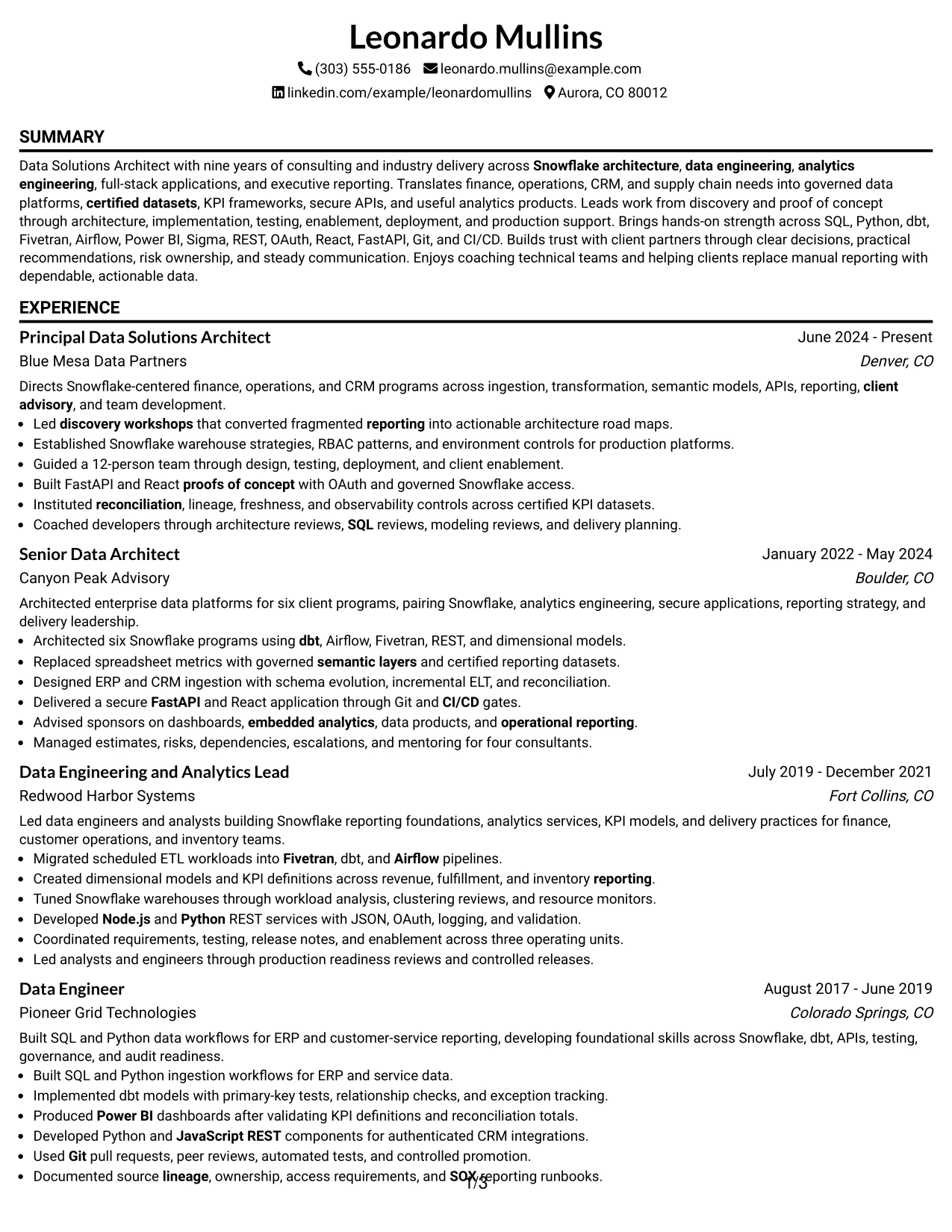
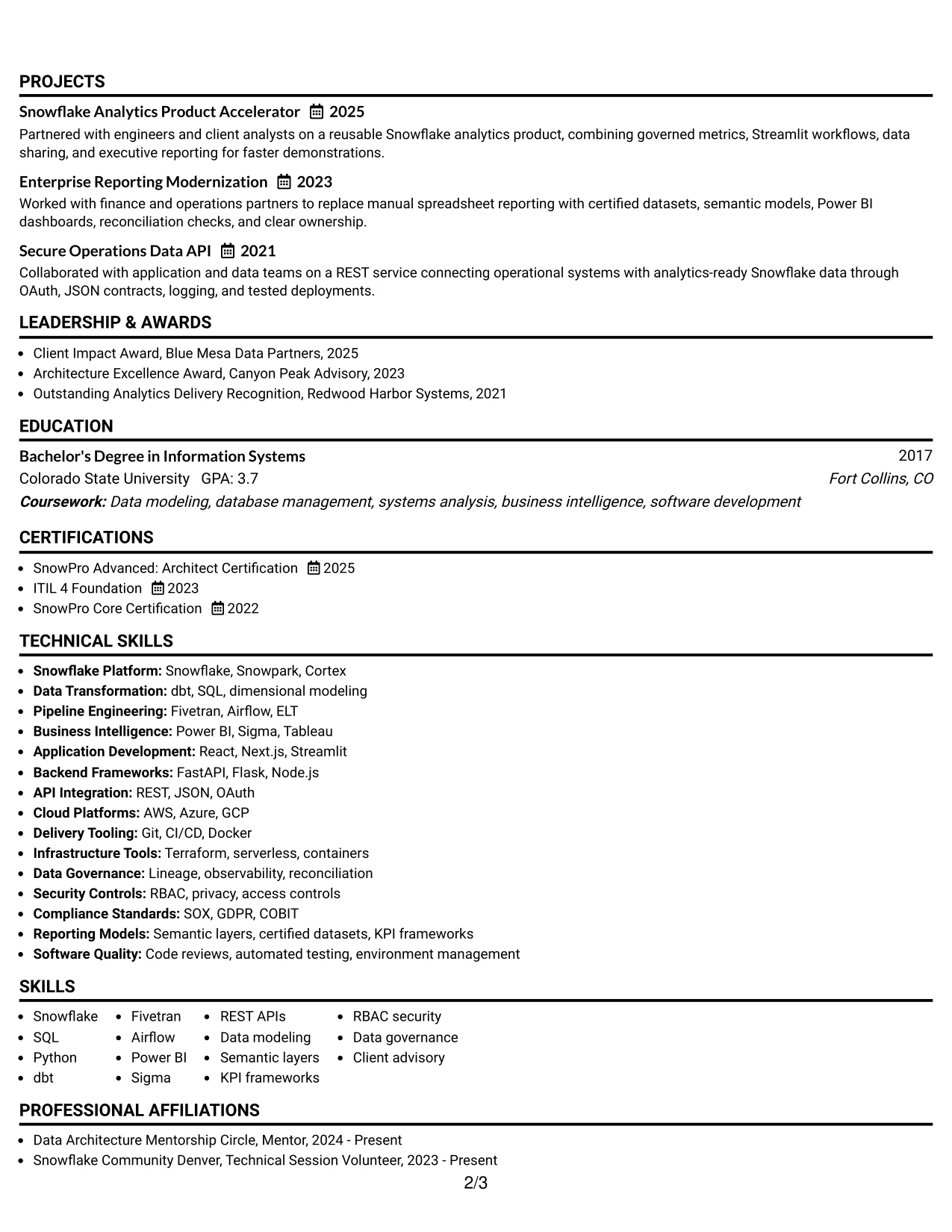
For a practical resume review, a classic one-column format keeps the full career story in one uninterrupted path. A reviewer can move from the summary to recent architecture leadership, then through earlier data engineering work, projects, education, certifications, and skills.
That sequence suits a profile with nine years of progressive experience. It gives detailed bullets room to show discovery workshops, production platform standards, six client programs, reporting modernization, data quality controls, and coaching without forcing key evidence into narrow side panels.
Why the Classic One Column Resume Format Works for a Resume
- One-column reading supports familiar resume review habits.
- Reverse chronology makes recent architecture leadership prominent.
- Detailed bullets show both technical depth and delivery ownership.
- Projects provide concise evidence of product, reporting, and API work.
- Education and certifications are easy to locate near the end.
- A broad skills list remains searchable and readable.
- The classic structure is well suited to ATS processing and printed review.
Best For
- Traditional application systems that favor a familiar resume structure.
- Professionals showing steady progression across related technical roles.
- Documents with enough experience detail to fill a complete primary column.
- Candidates who want chronology to explain increasing responsibility.
- Applications where projects should supplement, not overshadow, work history.
- Resume reviews involving both automated screening and human comparison.
- Job seekers who value broad compatibility across industries and employers.
#18 One Column Format with Photo Resume Example
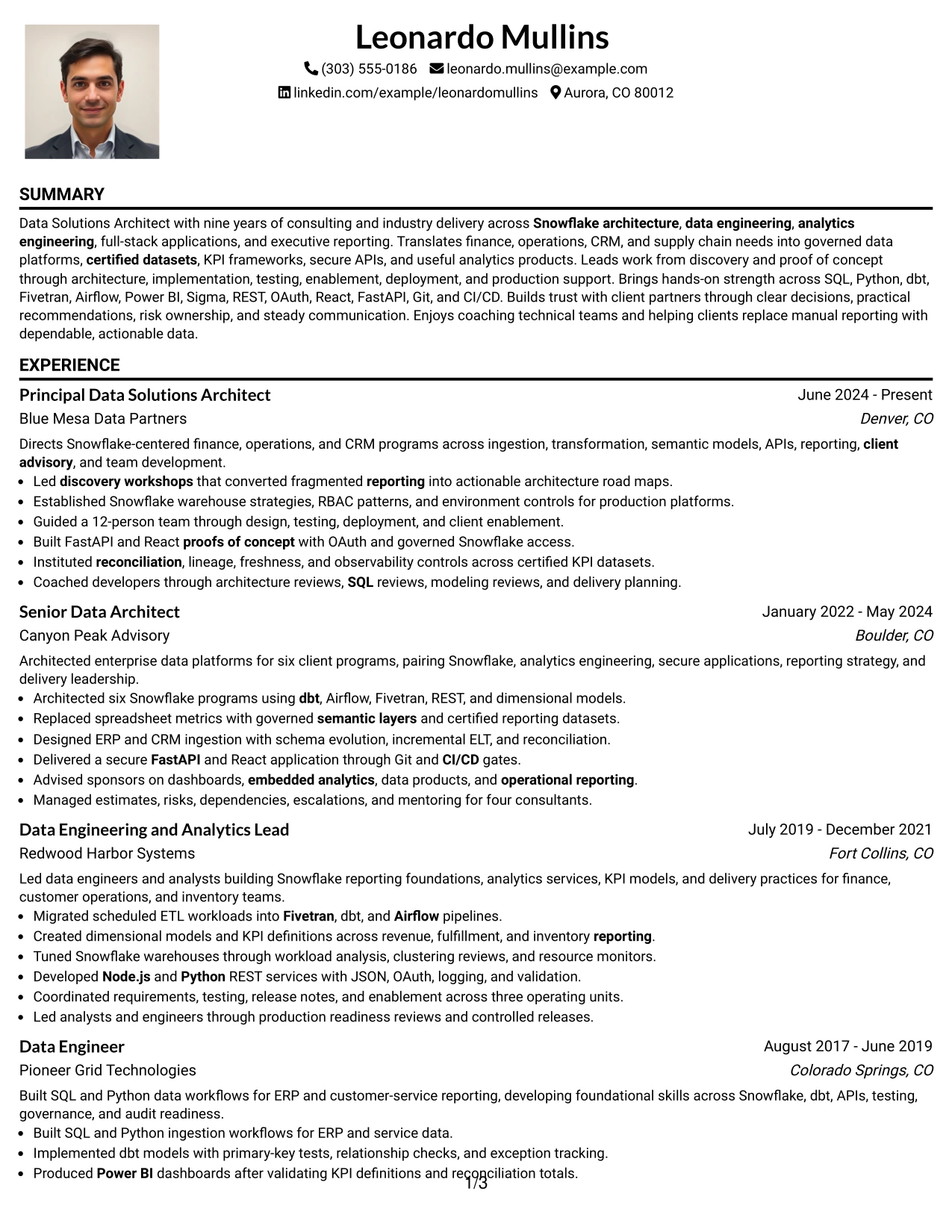
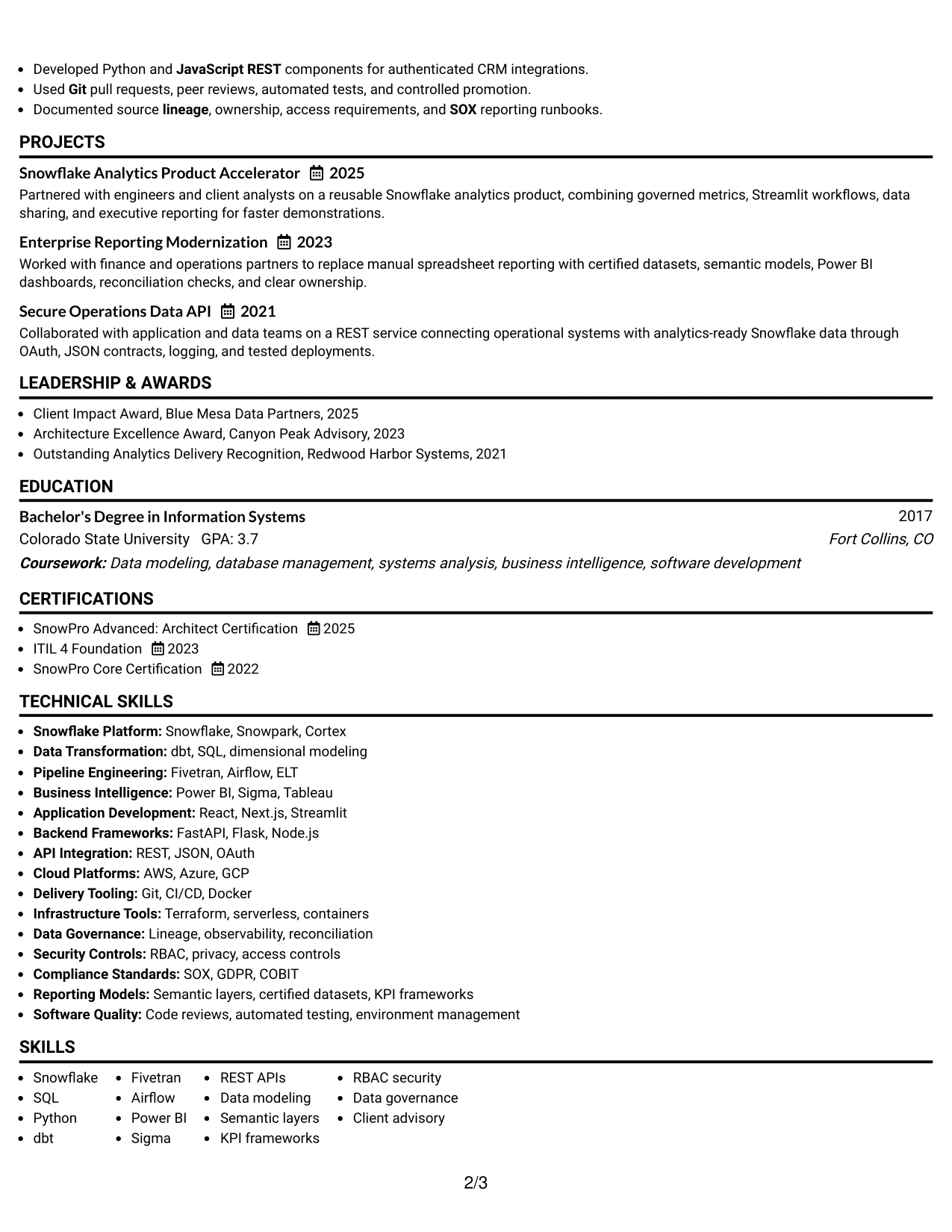
A restrained visual impression combines a prominent photo area with a focused one-column resume structure. The photo can support personal recognition in settings where it is appropriate, while the written content remains responsible for showing architecture scope, technical capability, and delivery results.
The main column keeps the summary, experience, projects, certifications, education, and skills in a familiar sequence. For this profile, the written evidence should stay prominent: Snowflake architecture, secure APIs, governed datasets, reporting platforms, team coaching, and client advisory.
Why the One Column Format with Photo Works for a Resume
- The photo area creates a distinct personal header when appropriate for the application context.
- A one-column structure keeps the resume easy to read from top to bottom.
- The summary connects the target role with architecture and delivery strengths.
- Experience bullets provide detailed evidence of technical and consulting work.
- Projects demonstrate reporting modernization and secure application delivery.
- Skills and certifications reinforce Snowflake and data platform keywords.
- The written sections remain strong enough to stand on their own during ATS review.
Best For
- Applications in contexts where a professional photo is accepted and useful.
- Candidates who want personal recognition without giving up a conventional resume flow.
- Resumes that need one uninterrupted column for substantial experience detail.
- Client-facing professionals presenting both technical depth and advisory work.
- Documents with projects and certifications that require clear supporting sections.
- Applications where a distinct header helps the resume feel more personal.
- Review settings that combine visual introduction with evidence-led content.
#19 Minimal Header Format Resume Example
The format structure is intentionally quiet: a minimal header introduces the target title and contact details, then the resume moves directly into useful evidence. With fewer visual distractions, a reviewer can focus on the summary, recent architecture work, technical projects, and supporting credentials.
Standard section order makes the document easy to scan and parse. The experience bullets show architecture standards, ingestion patterns, semantic layers, APIs, reporting, governance, and team development, while the skills section captures the related platforms and methods.
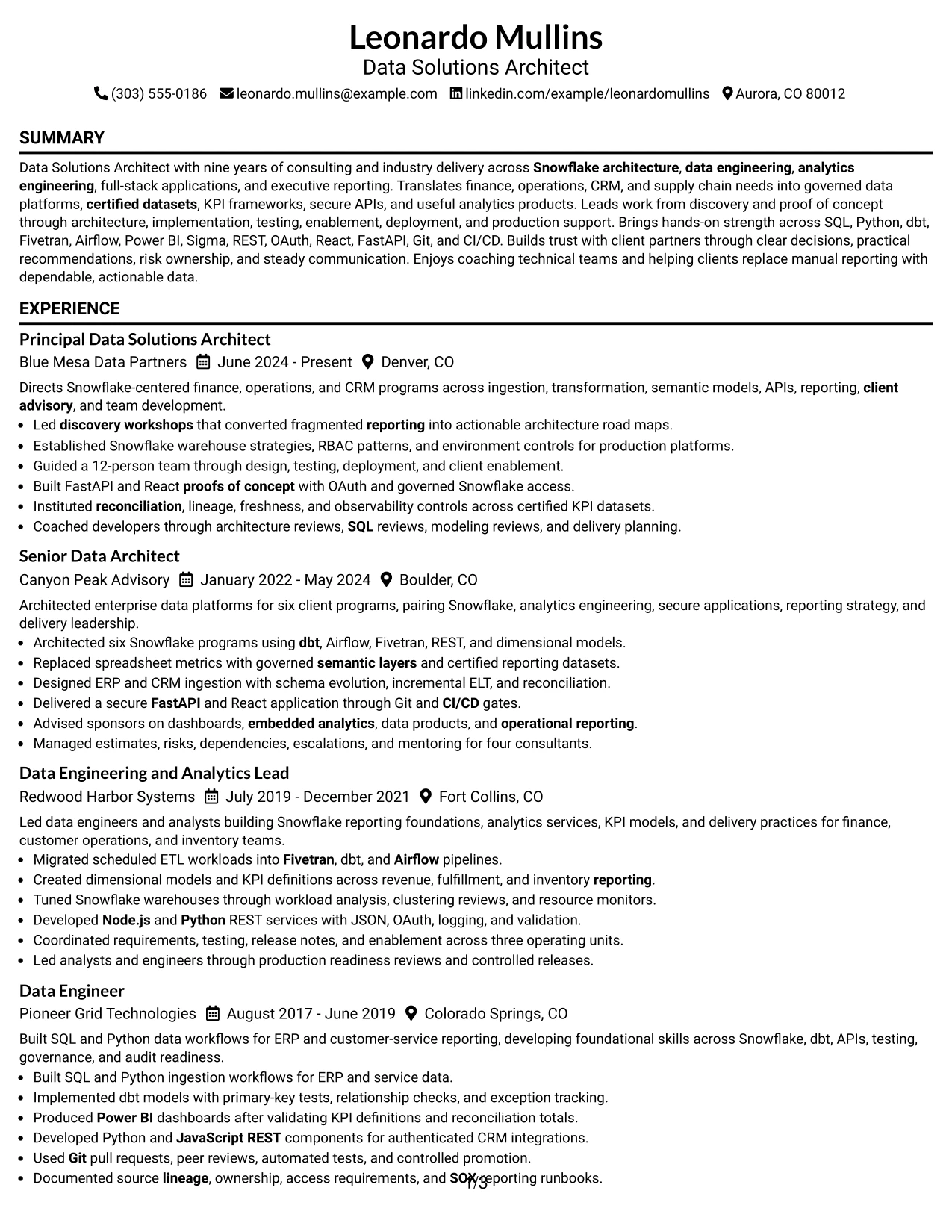
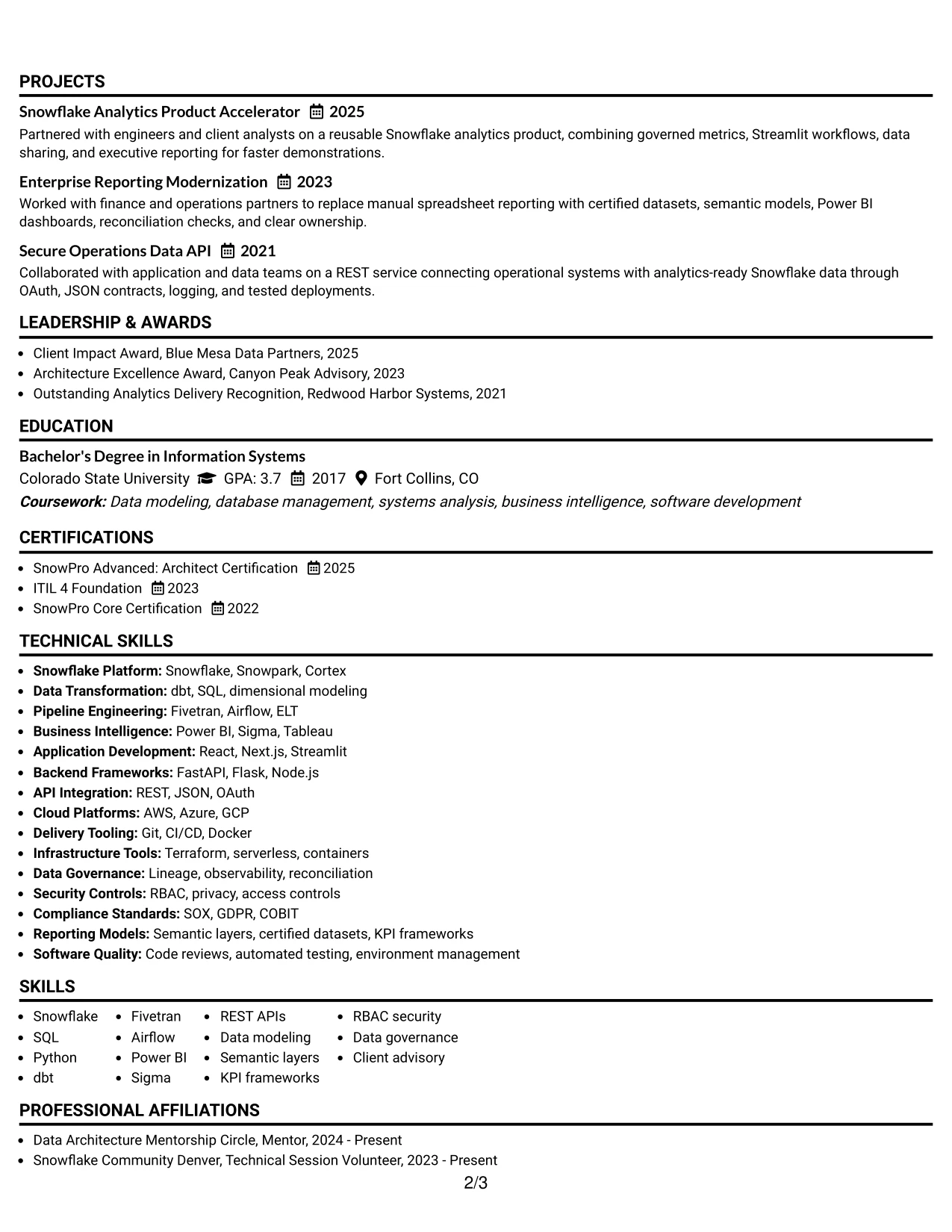
Why the Minimal Header Format Works for a Resume
- The minimal header gives the top of the page a clean starting point.
- Standard headings help ATS tools identify resume sections.
- The summary provides a concise role and capability overview.
- Recent experience appears before secondary information.
- Bullets present architecture decisions and delivery work in compact form.
- Projects add targeted evidence without creating a crowded page.
- The skills section supports keyword review with familiar text labels.
Best For
- Resumes where maximum space should go to experience and accomplishments.
- Applications using automated systems that favor simple document structure.
- Professionals who prefer understated presentation over visual decoration.
- Candidates with a clear target title and focused career narrative.
- Documents that need compact headers and efficient section transitions.
- Technical applications requiring many keywords without a crowded design.
- Reviewers who want to reach substantive evidence quickly.
#20 Modern Full Background Two Column Format Resume Example
A reviewer can use the main column for the professional summary and detailed experience, then scan the supporting column for skills, certifications, education, projects, and leadership. This route through the document makes a high-volume technical profile easier to navigate.
The full-background treatment creates a strong visual frame, while the two-column organization keeps the content functional. Leonardo Mullins's resume can use the main area for Snowflake programs, client delivery, and team leadership, with supporting keywords and credentials grouped beside it.
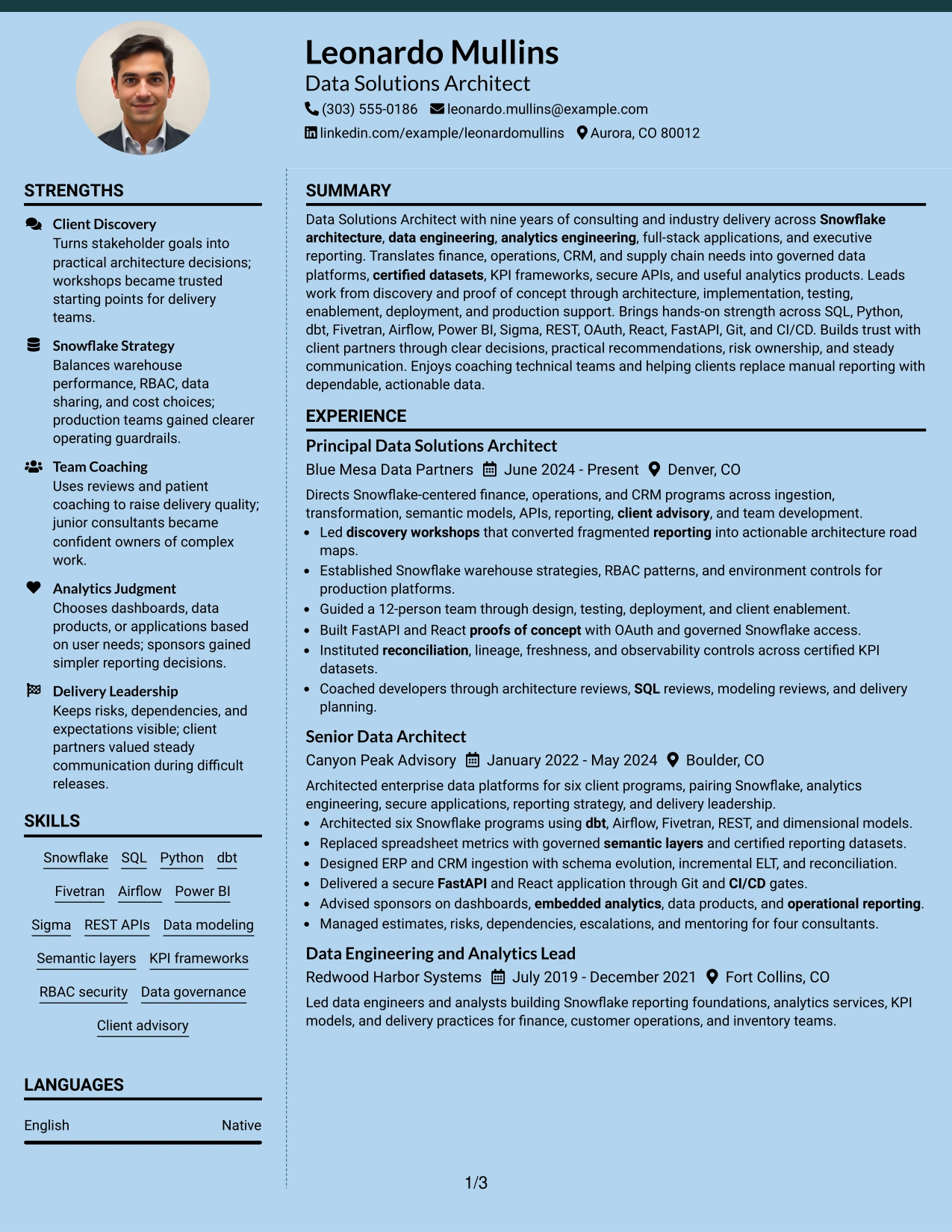
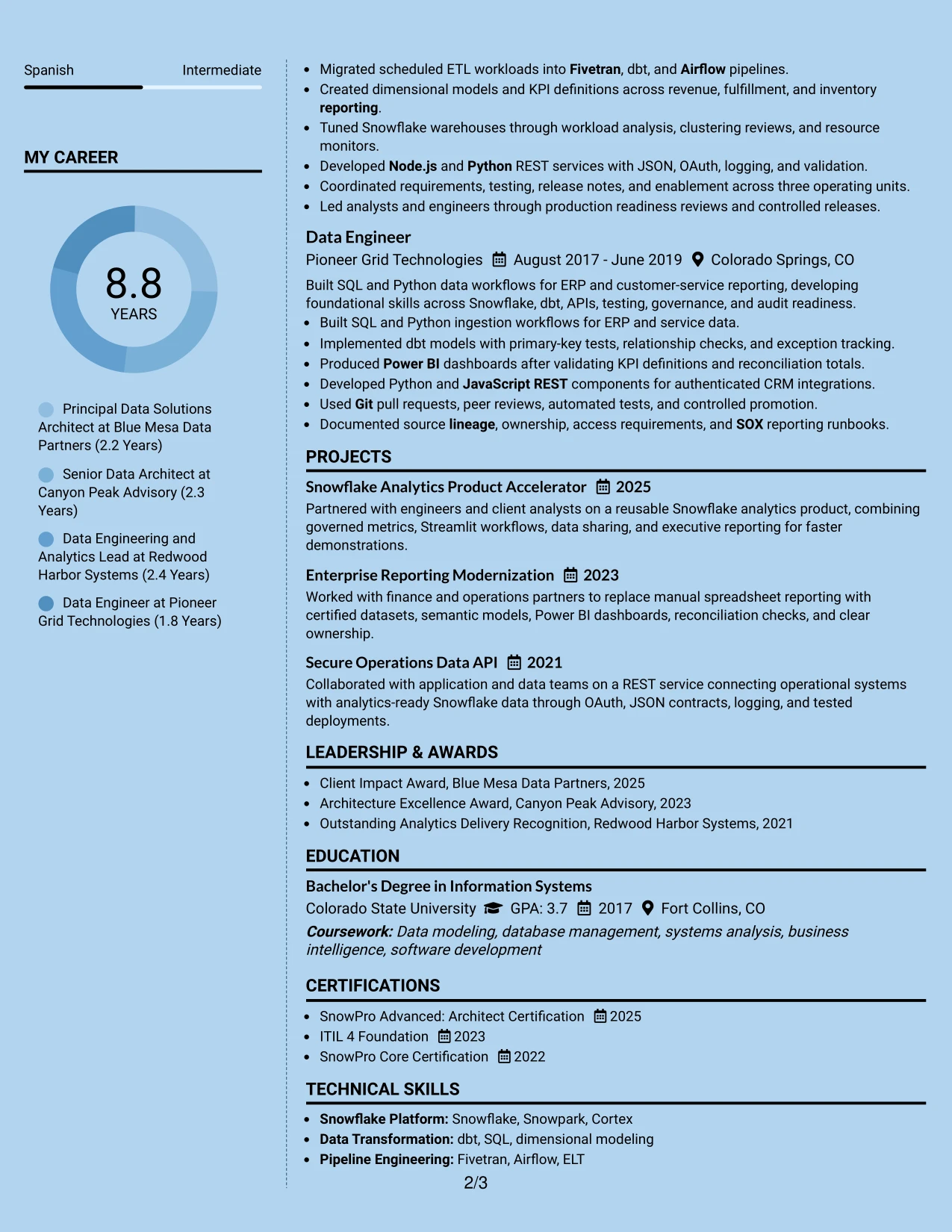
Why the Modern Full Background Two Column Format Works for a Resume
- The main column gives career evidence enough space for complete bullets.
- The supporting column gathers skills and credentials for quick scanning.
- The two-column route helps separate core experience from additional proof.
- Projects can be reviewed without interrupting the employment sequence.
- Leadership activities and awards add context in a compact supporting area.
- The strong background treatment gives the document a defined visual identity.
- Standard text sections preserve useful ATS and human-review structure.
Best For
- Content-rich resumes that need a strong distinction between primary and supporting information.
- Professionals combining architecture delivery with many platforms and credentials.
- Applications where projects and leadership activities should remain visible beside experience.
- Candidates who want a modern frame around a conventional evidence structure.
- Documents needing a dedicated area for technical keywords and certifications.
- Readers who scan the main career story before checking supporting qualifications.
- Resume layouts suited to substantial content without using multiple pages of narrow text.
#21 Dark Mode Two Column Format Resume Example
Evidence leads the review: architecture scope, governed data platforms, secure application work, and leadership results should stand out before decorative treatment. A two-column dark mode format can support that priority when contrast remains strong and the text is easy to read.
The main column can carry the summary and chronological experience, while the secondary column groups skills, certifications, projects, and awards. This arrangement gives the resume room to show Snowflake, dbt, Fivetran, Airflow, Power BI, REST, OAuth, data governance, and delivery leadership.
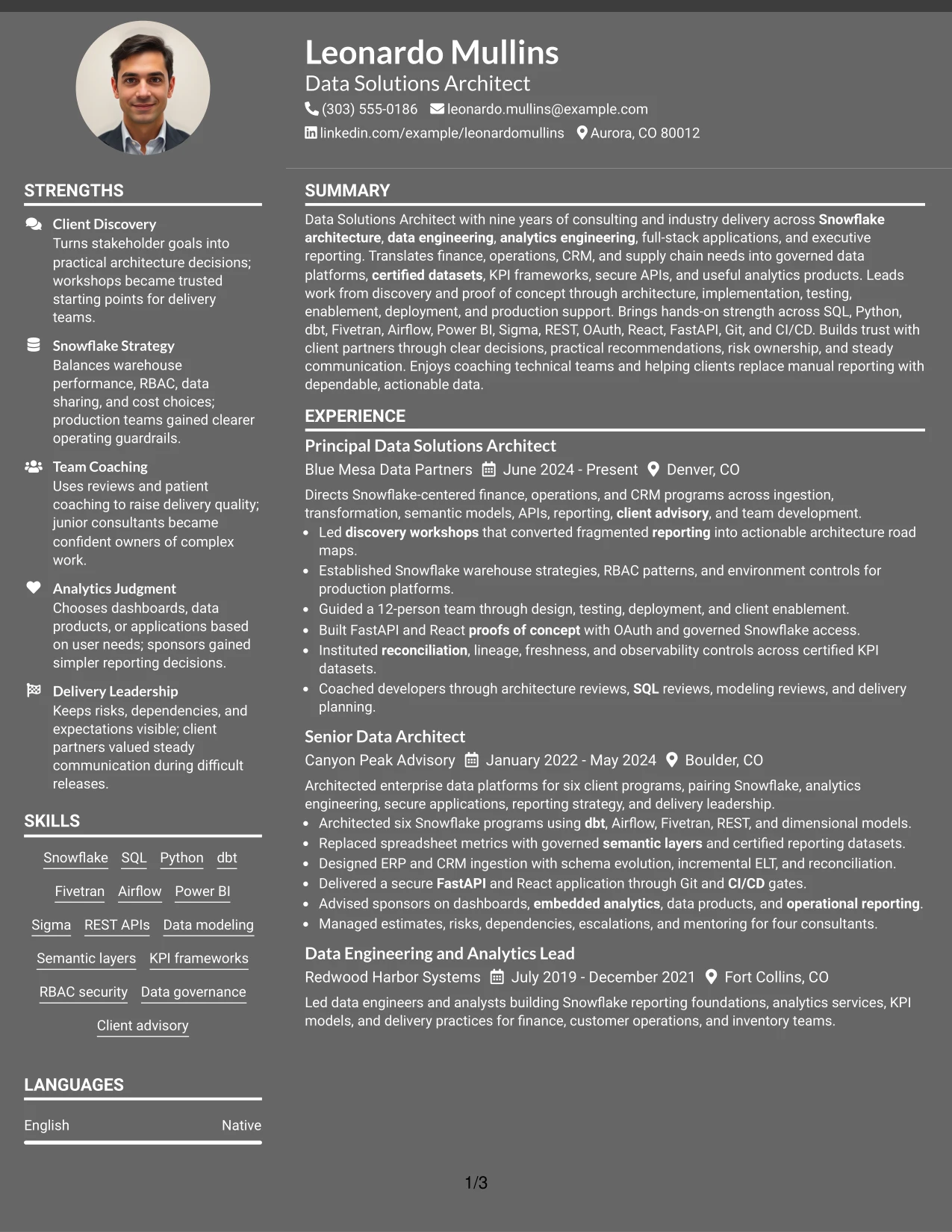
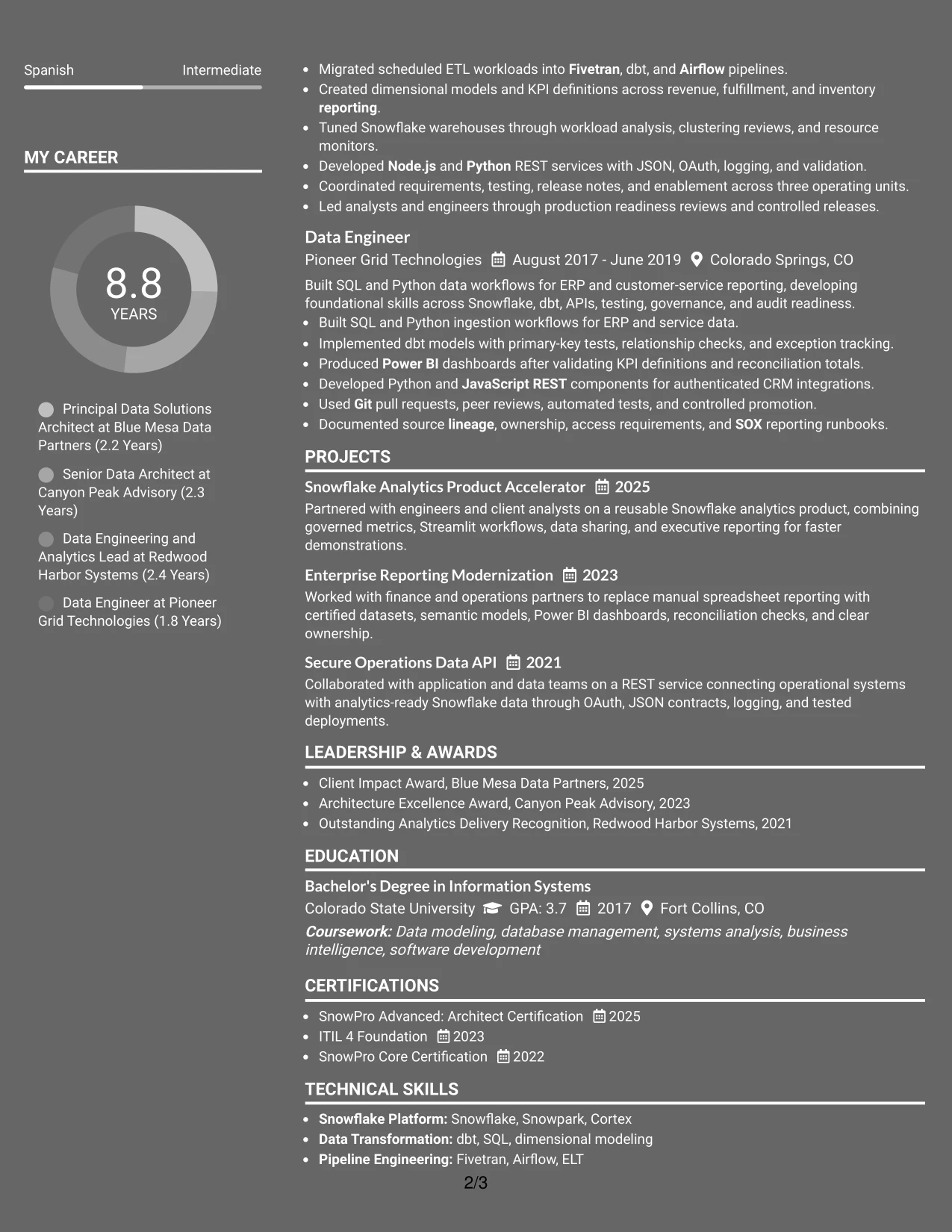
Why the Dark Mode Two Column Format Works for a Resume
- The main column keeps achievement evidence in the primary reading path.
- A secondary column makes technical keywords available at a glance.
- Contrast can distinguish headings and sections when text remains accessible.
- The format supports a substantial mix of architecture and engineering evidence.
- Projects show applied work with analytics products and secure APIs.
- Certifications and awards strengthen technical credibility in a compact area.
- Two-column grouping prevents supporting details from crowding the career timeline.
Best For
- Resumes where technical evidence needs a prominent primary reading path.
- Professionals with enough experience and projects to benefit from two-column grouping.
- Applications that allow a distinctive visual treatment while retaining clear text.
- Candidates separating detailed accomplishments from a high-density skills area.
- Documents that need credentials, awards, and projects visible without long section breaks.
- Reviewers comfortable with modern presentation and strong information hierarchy.
- Technical profiles where platform breadth must be available for quick comparison.
#22 Dark Mode Box Header Format Resume Example
Balanced spacing keeps the dark presentation from overwhelming the content. A boxed header establishes the target title and contact details, while clear gaps between sections give the summary, experience, projects, education, certifications, and skills room to remain readable.
This application-focused structure works well for a Data Solutions Architect resume that must show both technical range and client delivery. The page can connect Snowflake strategy, data pipelines, semantic layers, APIs, reporting, governance, risk management, and team mentoring without making the evidence feel compressed.
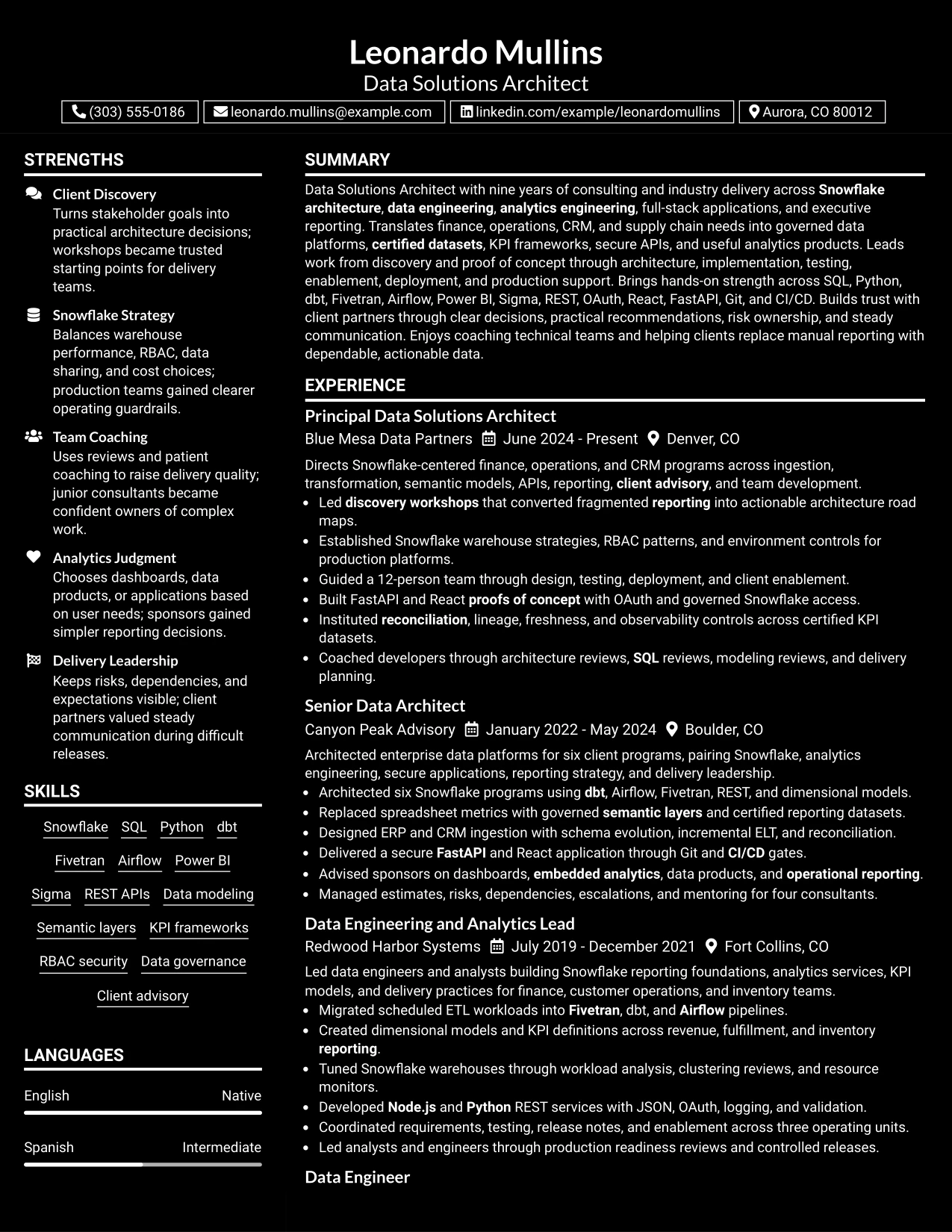
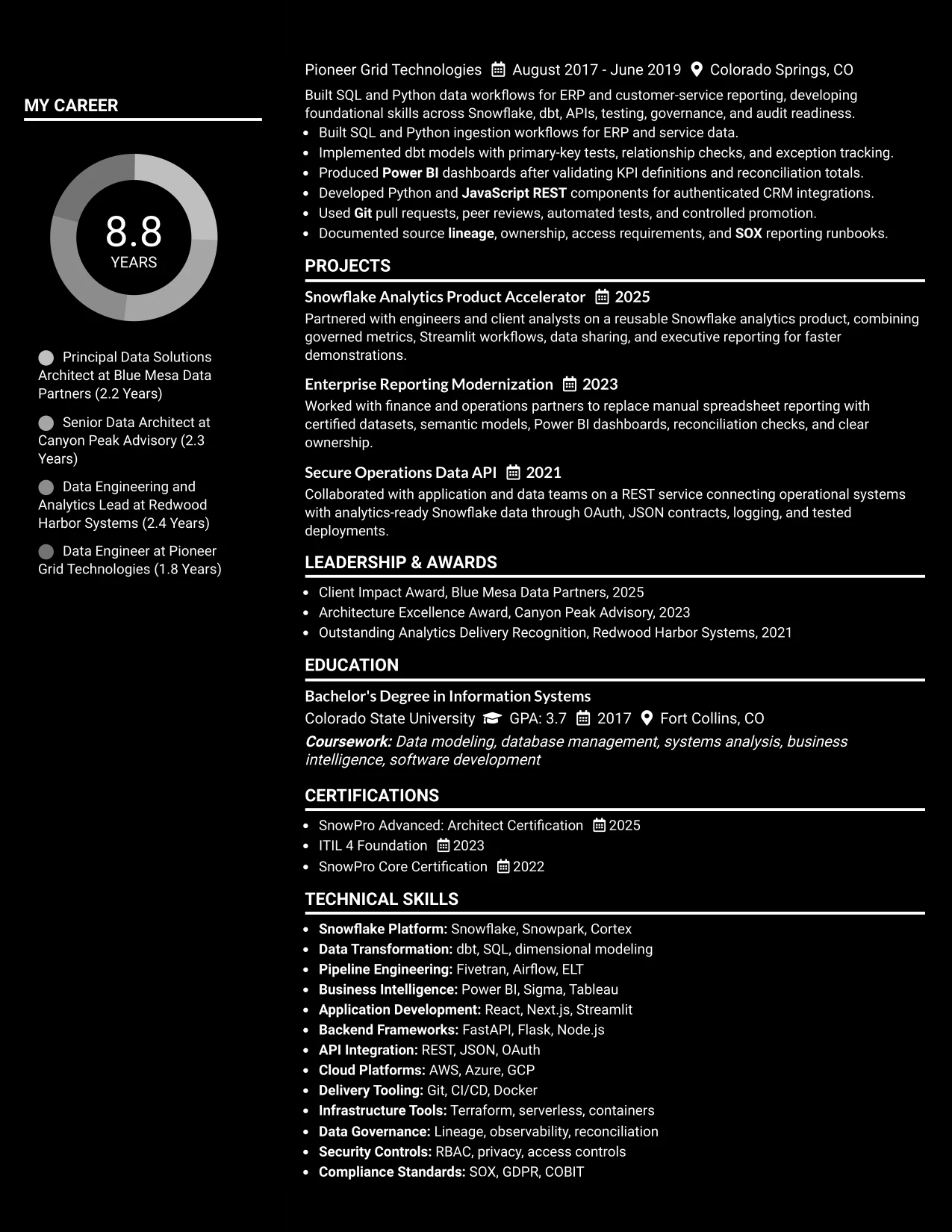
Why the Dark Mode Box Header Format Works for a Resume
- The boxed header establishes the target role before the detailed content begins.
- Balanced spacing improves reading against a darker visual background.
- A clear summary connects technical capability with client delivery.
- Experience bullets show architecture, implementation, testing, and enablement.
- Projects provide focused examples of analytics products and reporting modernization.
- Skills and certifications support requirement matching in an organized final section.
- The structure keeps a distinctive appearance while preserving familiar resume mechanics.
Best For
- Applications that permit a modern visual style with strong section separation.
- Resumes needing a prominent title and contact block without a complex layout.
- Professionals balancing technical breadth with client-facing delivery responsibilities.
- Documents where generous spacing can improve readability across dense content.
- Candidates presenting architecture, governance, reporting, and application evidence together.
- Review settings that value a memorable presentation alongside standard resume sections.
- Technical resumes that need projects and credentials to remain easy to find.
#23 Elegant Full Background Two Column Format Resume Example
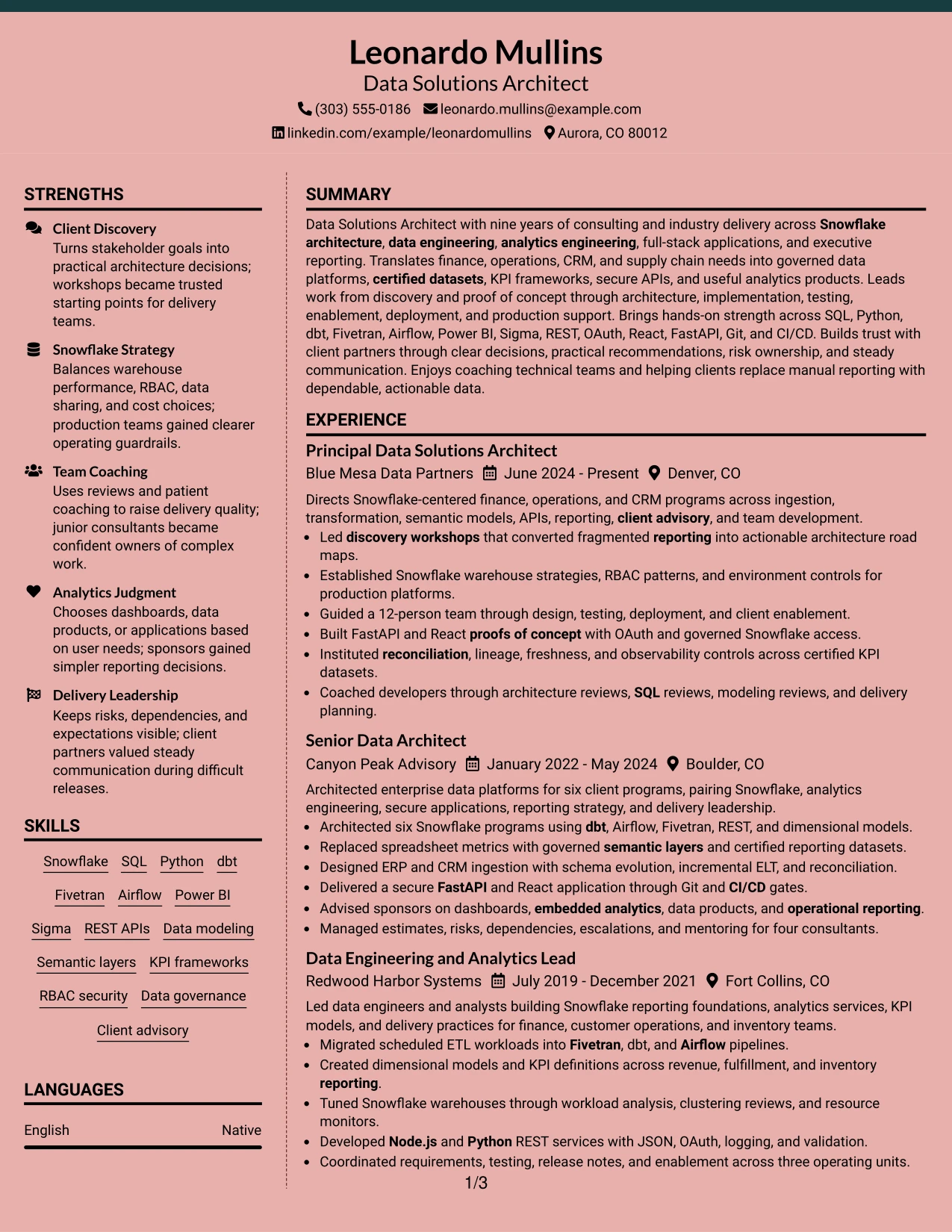
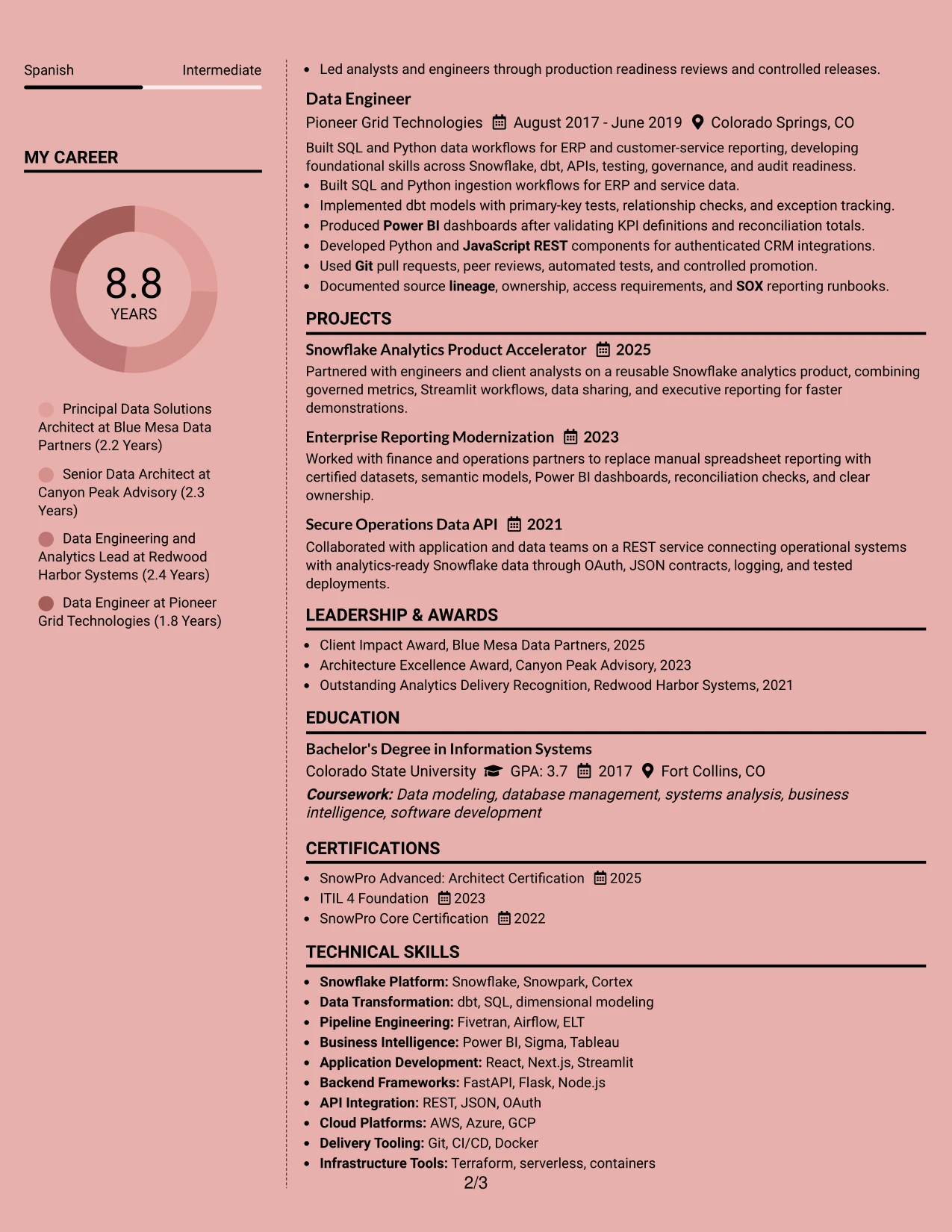
For a consulting resume that must show both technical depth and delivery leadership, this format creates a useful visual balance. Two columns can place contact details, certifications, and core skills beside a longer experience section without making the document feel crowded.
The resume can lead with the Data Solutions Architect title and a focused summary, then move into Snowflake architecture, data engineering, APIs, reporting, and client advisory work. Short bullets keep achievements such as guiding a 12-person team and building governed KPI datasets easy to find.
#23 Why the Elegant Full Background Two Column Format Works for a Resume
- Two columns separate quick-reference details from the main career history.
- A strong summary gives the target role and nine years of experience clear priority.
- Skills such as Snowflake, SQL, Python, dbt, and Power BI are easy to scan.
- Experience bullets show architecture, delivery, coaching, and production support in a compact space.
- Certifications, including SnowPro Advanced: Architect, can sit in a dedicated supporting area.
- The format gives projects and awards room without weakening the experience hierarchy.
- Clear section labels help readers locate education, certifications, skills, and leadership activities quickly.
#23 Best For
- Resumes that need to balance a substantial experience record with supporting credentials.
- Candidates combining architecture decisions, hands-on development, and team leadership.
- Applications where recruiters need a quick skills panel and a detailed work history.
- Technical resumes with several tools, platforms, certifications, and governance terms.
- Consulting applications that benefit from showing both client work and delivery evidence.
- Documents that include projects, awards, and community activities alongside employment history.
- Readers who prefer a structured two-column path through dense professional information.
#24 Creative Two Tone Format Resume Example
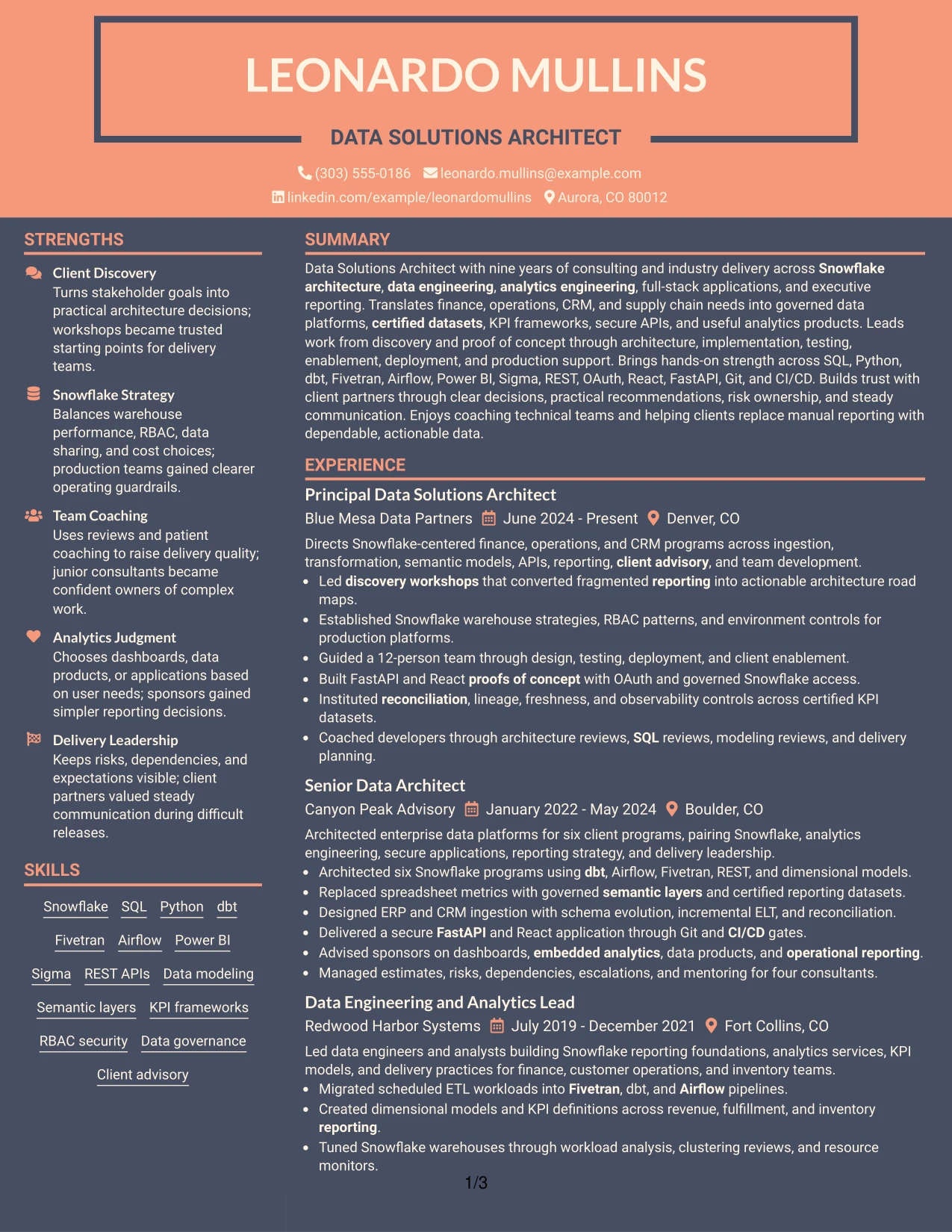
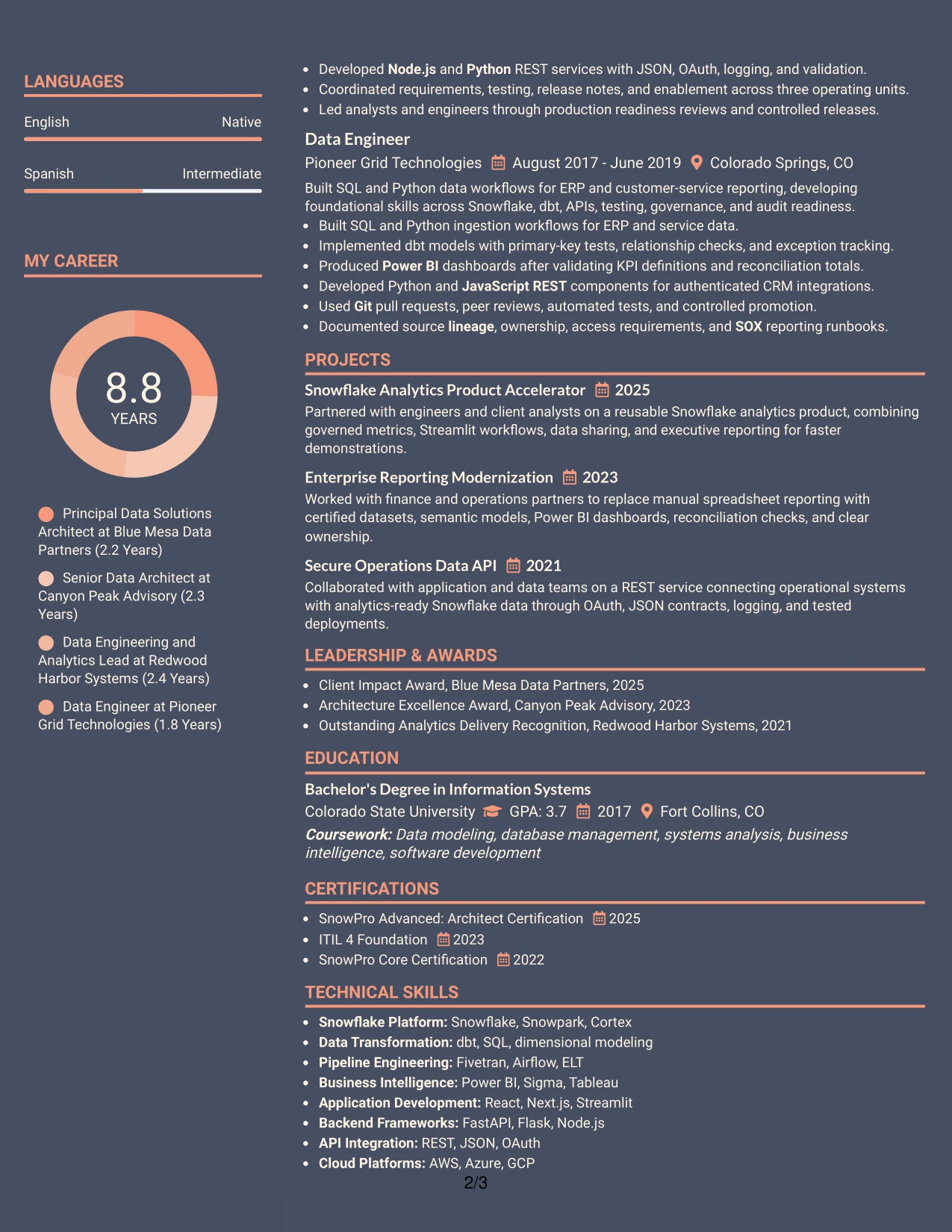
A restrained visual contrast gives the resume a clear identity while keeping the content professional. The single-column structure supports a natural top-to-bottom review, so the summary, experience, projects, education, and certifications follow a familiar order.
The content can use the color change to distinguish section headings from evidence. That keeps technical keywords such as Snowflake, dbt, Fivetran, REST, OAuth, and Power BI visible while the bullets explain how those tools supported reporting modernization, secure applications, and client delivery.
#24 Why the Creative Two Tone Format Works for a Resume
- A single reading path makes the career story simple to follow.
- Two restrained tones can distinguish headings from detailed evidence without distracting from the text.
- The summary connects architecture, data engineering, analytics, and applications in one concise entry point.
- Keyword-rich skills remain visible for searches involving Snowflake, SQL, Python, and dbt.
- Project entries can show practical work such as reporting modernization and a secure data API.
- Bullets explain responsibilities and outcomes instead of presenting tools as an unconnected list.
- The format supports a professional technical resume with a small amount of visual distinction.
#24 Best For
- Applicants who want a polished resume with more visual character than a plain text layout.
- Technical professionals whose experience spans platforms, applications, analytics, and advisory work.
- Applications reviewed by people who value a clear narrative from summary through projects.
- Resumes that need one-column consistency across experience, education, certifications, and awards.
- Candidates presenting several related technologies under a coherent professional focus.
- Documents that should feel distinctive while remaining easy to print and read.
- Role searches where practical recommendations and delivery outcomes matter as much as technical terms.
#25 Bold Color Header Professional Format Resume Example
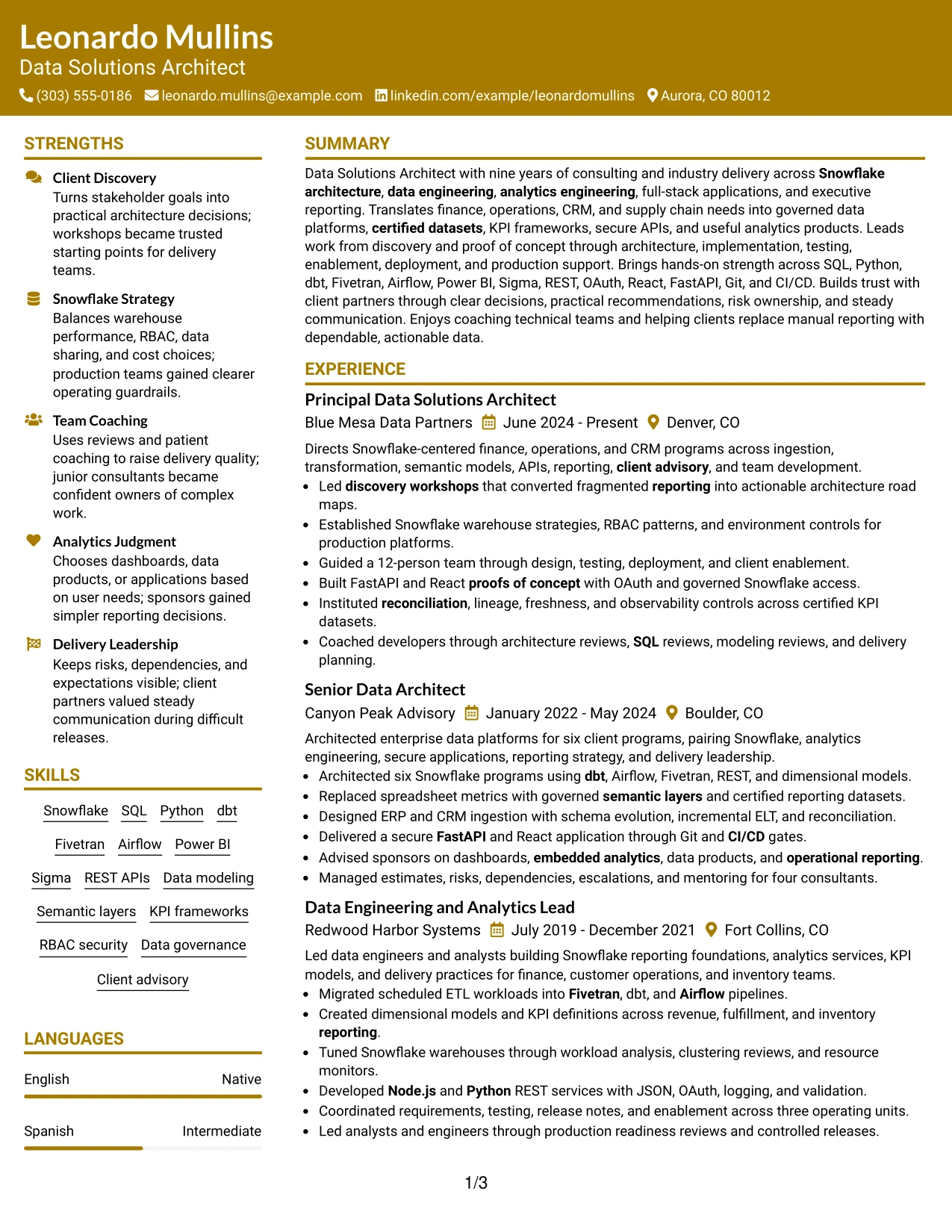
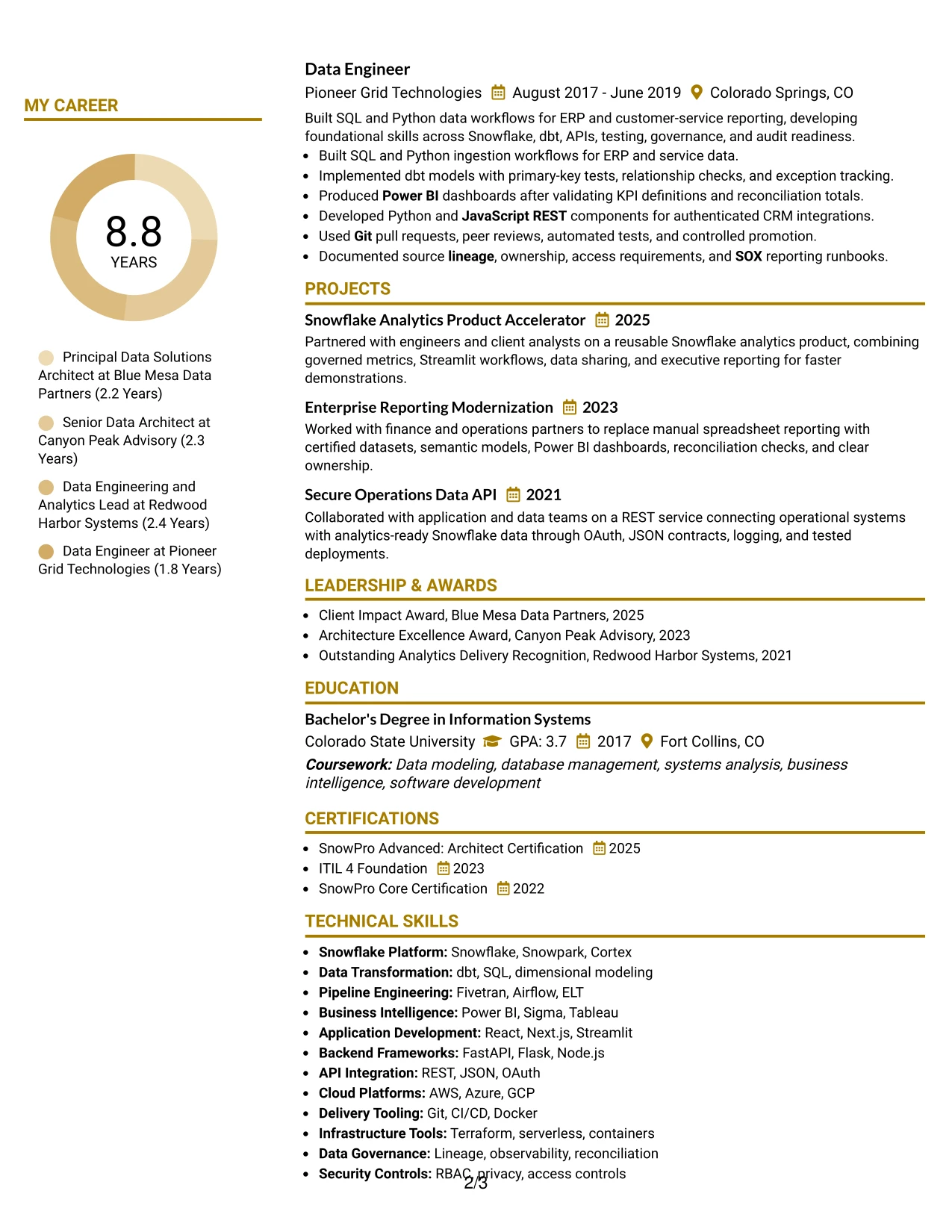
The Bold Color Header Professional Format puts the resume's identity and target position at the top, then uses a direct section sequence below. That structure makes the first screen useful: the reader can see the Data Solutions Architect focus, summary, strongest skills, and recent role before reviewing earlier experience.
A clear hierarchy also helps the document carry a large set of relevant terms without becoming a keyword block. Snowflake architecture, RBAC, dimensional modeling, semantic layers, APIs, testing, and CI/CD can appear in focused sections, while bullets provide evidence from four roles and three projects.
#25 Why the Bold Color Header Professional Format Works for a Resume
- The prominent header makes the target role immediately clear.
- A logical section order supports fast review from summary to recent experience and skills.
- Strong keywords can be grouped instead of repeated across every bullet.
- Recent work receives attention while earlier roles still show career progression.
- Project descriptions add evidence of Streamlit workflows, certified datasets, and OAuth-secured APIs.
- Bullets connect technical choices to delivery, governance, testing, and user needs.
- The format works well when the resume must be both visually confident and information-rich.
#25 Best For
- Resumes that need a strong first-screen introduction for rapid recruiter review.
- Professionals with a clear target title and a wide but related technical toolkit.
- Applications where skills must be easy to locate without replacing achievement bullets.
- Candidates with four or more roles who need visible chronology and progression.
- Documents that combine employment history with selected projects and certifications.
- Technical searches using both architecture terms and implementation terms.
- Readers who want prominent section hierarchy before entering detailed work examples.
#26 Photo Header Color Sidebar Format Resume Example
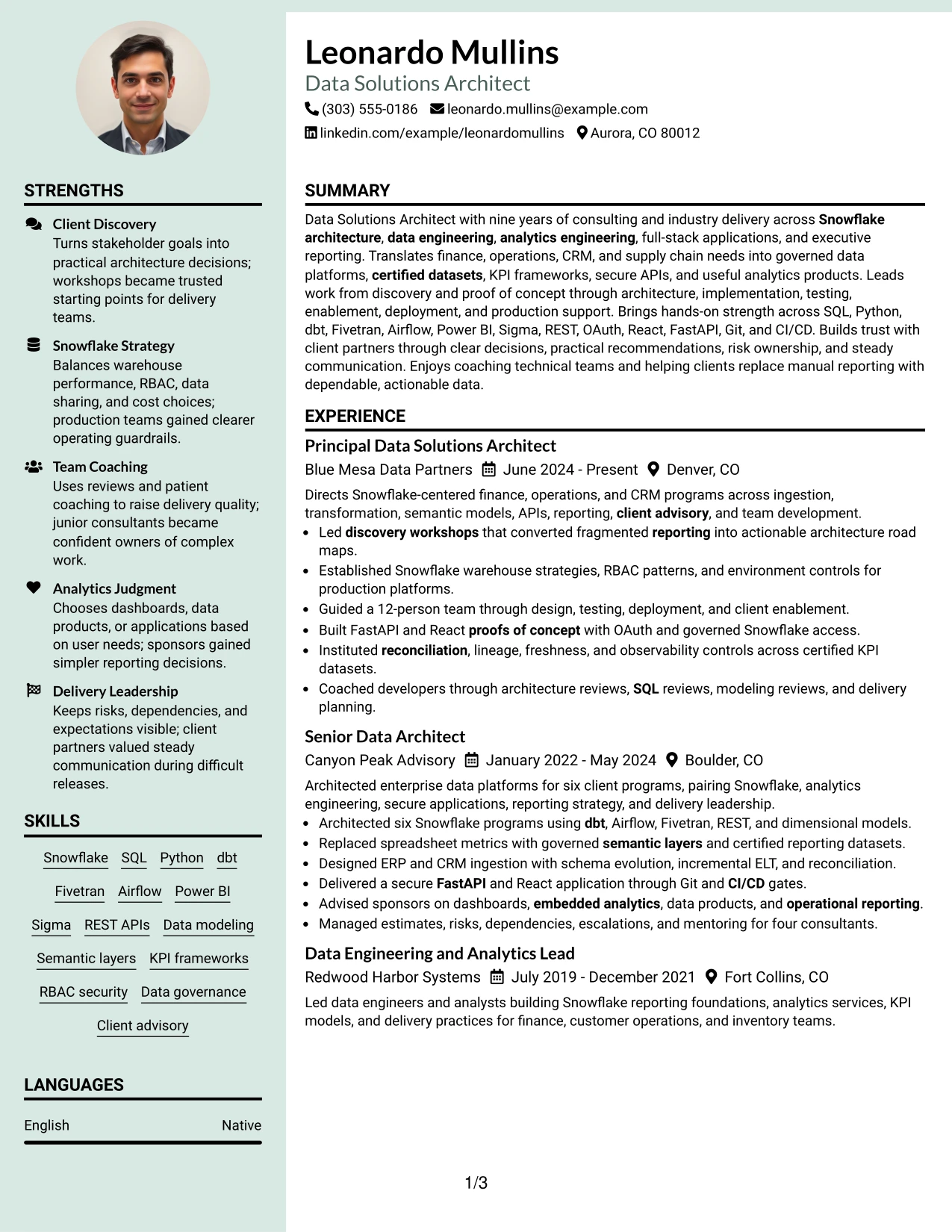
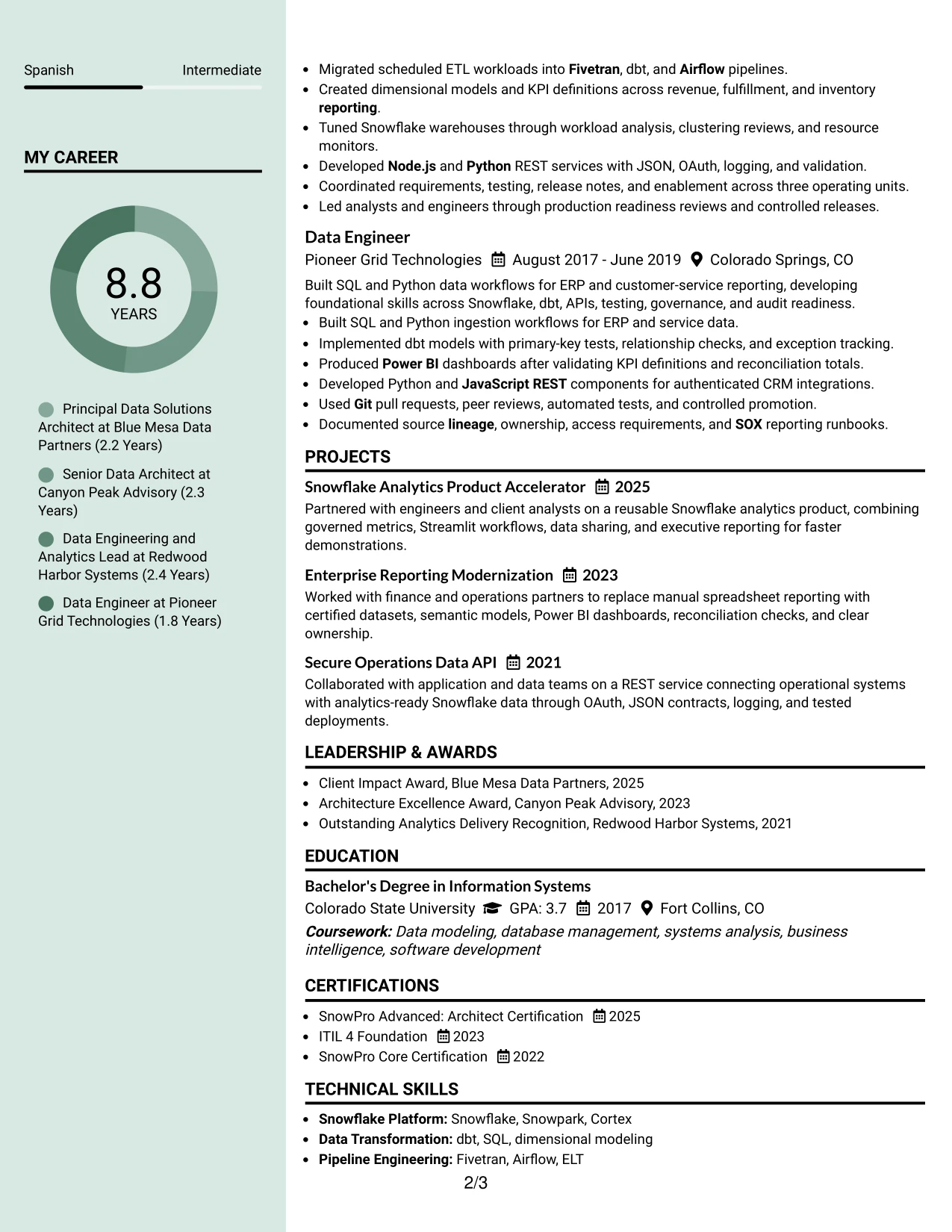
As a reader moves down the page, the color sidebar provides a steady guide between the profile header and the detailed resume content. The main column can carry the summary and experience, while the sidebar gathers contact details, skills, certifications, and selected supporting information.
That distribution is useful for a broad technical record. The main section can explain Snowflake programs, ingestion patterns, semantic layers, secure APIs, and team leadership; the sidebar can keep SnowPro certifications, ITIL 4 Foundation, tools, and governance topics available for quick reference.
#26 Why the Photo Header Color Sidebar Format Works for a Resume
- The sidebar creates a quick-reference area for skills and credentials.
- The main column has enough room for detailed achievement bullets and project descriptions.
- A visible header supports a clear professional identity and contact block.
- Technical terms can be grouped by platform, pipeline, reporting, application, and governance areas.
- The layout accommodates both architecture decisions and hands-on implementation evidence.
- Certifications and awards remain visible without interrupting the employment timeline.
- The format suits a resume that must present high content volume in a controlled structure.
#26 Best For
- Professionals with extensive technical experience and many supporting credentials.
- Applications where a quick skills-and-certifications panel improves review speed.
- Resumes that need long achievement bullets without giving up compact summary details.
- Candidates combining client advisory, architecture, development, and delivery leadership.
- Documents with several projects, awards, affiliations, and technical categories.
- Roles requiring both broad platform knowledge and proof of production implementation.
- Readers who prefer a strong main narrative supported by a separate reference column.
#27 Top Left Header Color Accent Format Resume Example
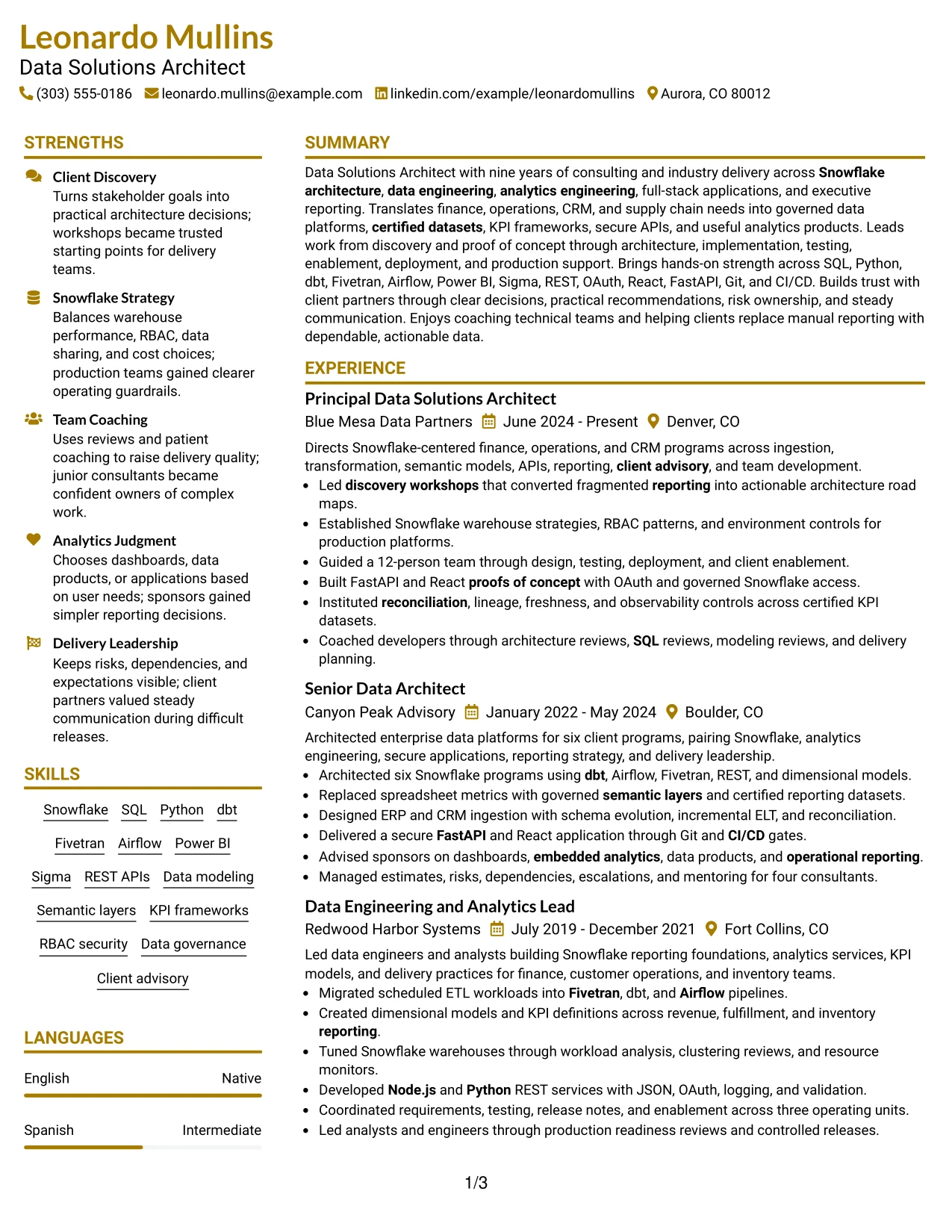
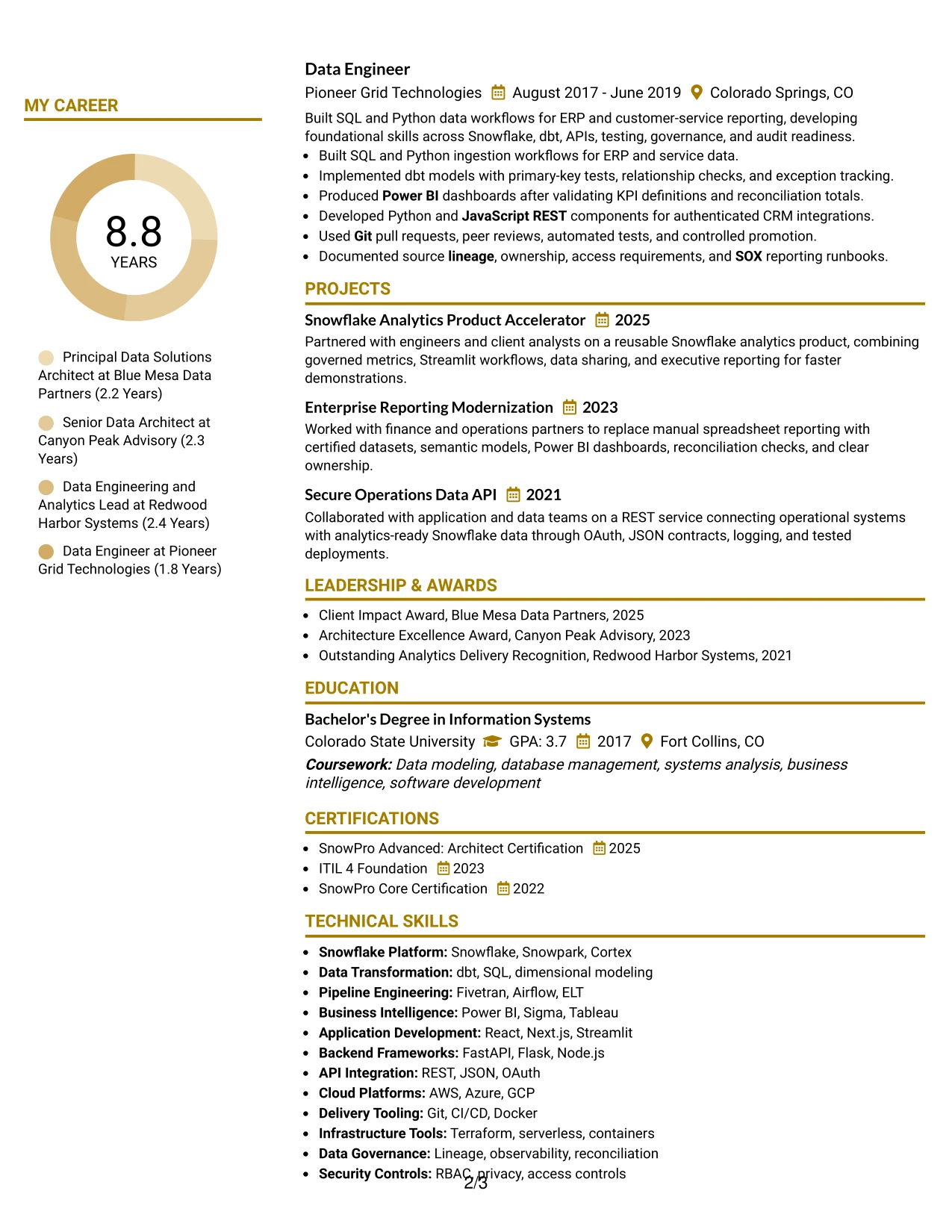
Architecture and delivery evidence receive priority in this resume presentation. The upper-left header establishes the target role, while the content below can quickly show Snowflake platform work, data pipeline design, reporting modernization, and secure application delivery.
The color accent adds direction without taking space from the evidence. Each experience bullet can state a clear action, such as establishing RBAC patterns, migrating ETL workloads, or instituting reconciliation and lineage controls, followed by the business or delivery context.
#27 Why the Top Left Header Color Accent Format Works for a Resume
- The top-left starting point gives the target role immediate visibility.
- Achievement bullets can lead with architecture actions and implementation decisions.
- The format supports evidence from both senior architecture work and earlier engineering roles.
- Technical keywords appear in context through Snowflake, dbt, Airflow, REST, and Power BI examples.
- Projects can reinforce the main evidence without competing with professional experience.
- Certifications provide a concise signal of platform knowledge and operational standards.
- The accent creates visual direction while leaving most of the page for readable content.
#27 Best For
- Resumes where architecture decisions should appear before secondary background details.
- Candidates who need to show technical evidence across several stages of a career.
- Applications that depend on action-led bullets and clear implementation language.
- Documents with a focused set of projects that support, rather than repeat, work history.
- Professionals presenting governance, security, reporting, and delivery evidence together.
- Technical searches where contextual keywords are more useful than a long isolated skills list.
- Reviewers who scan from the upper-left corner for role, summary, and recent achievements.
#28 Centered Header Classic Two Column Format Resume Example
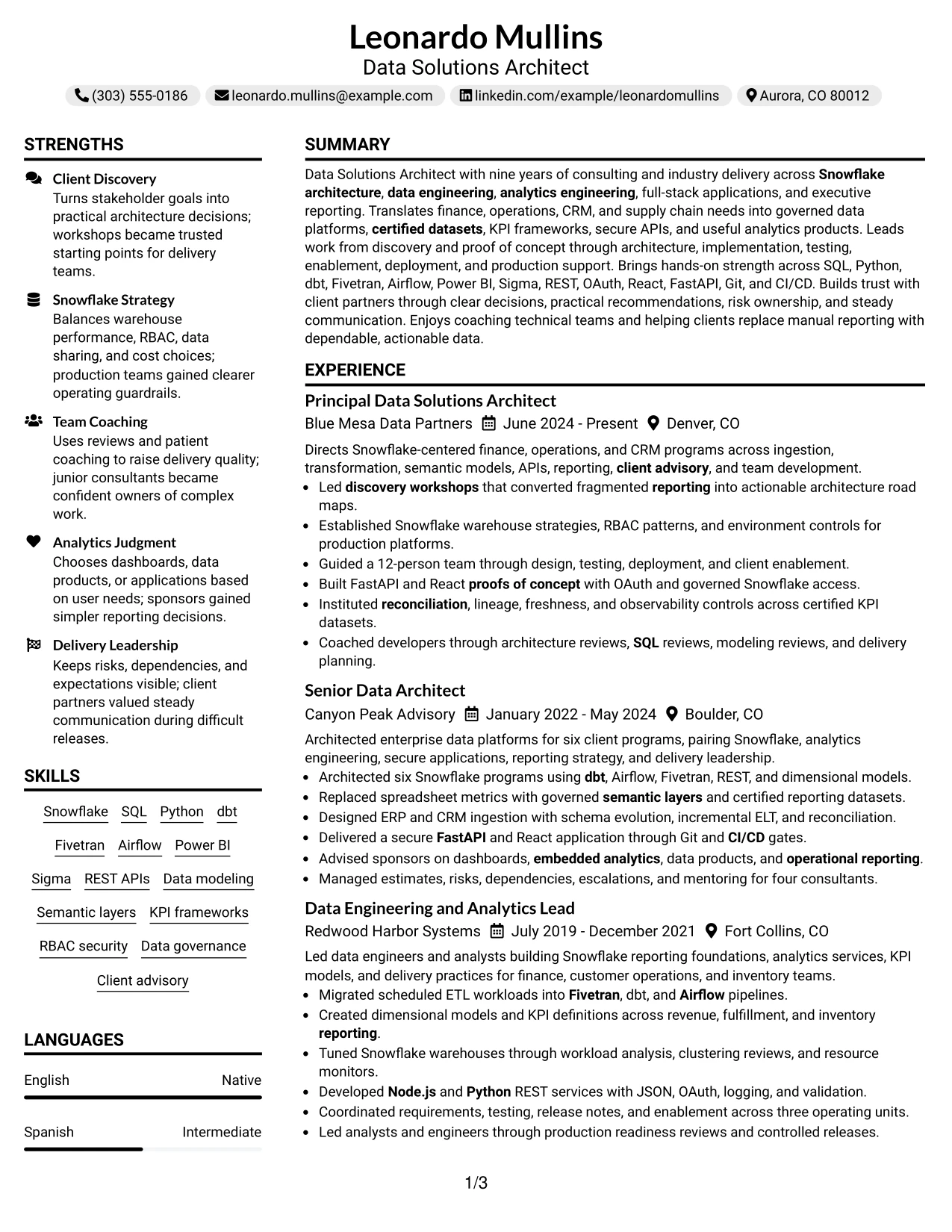
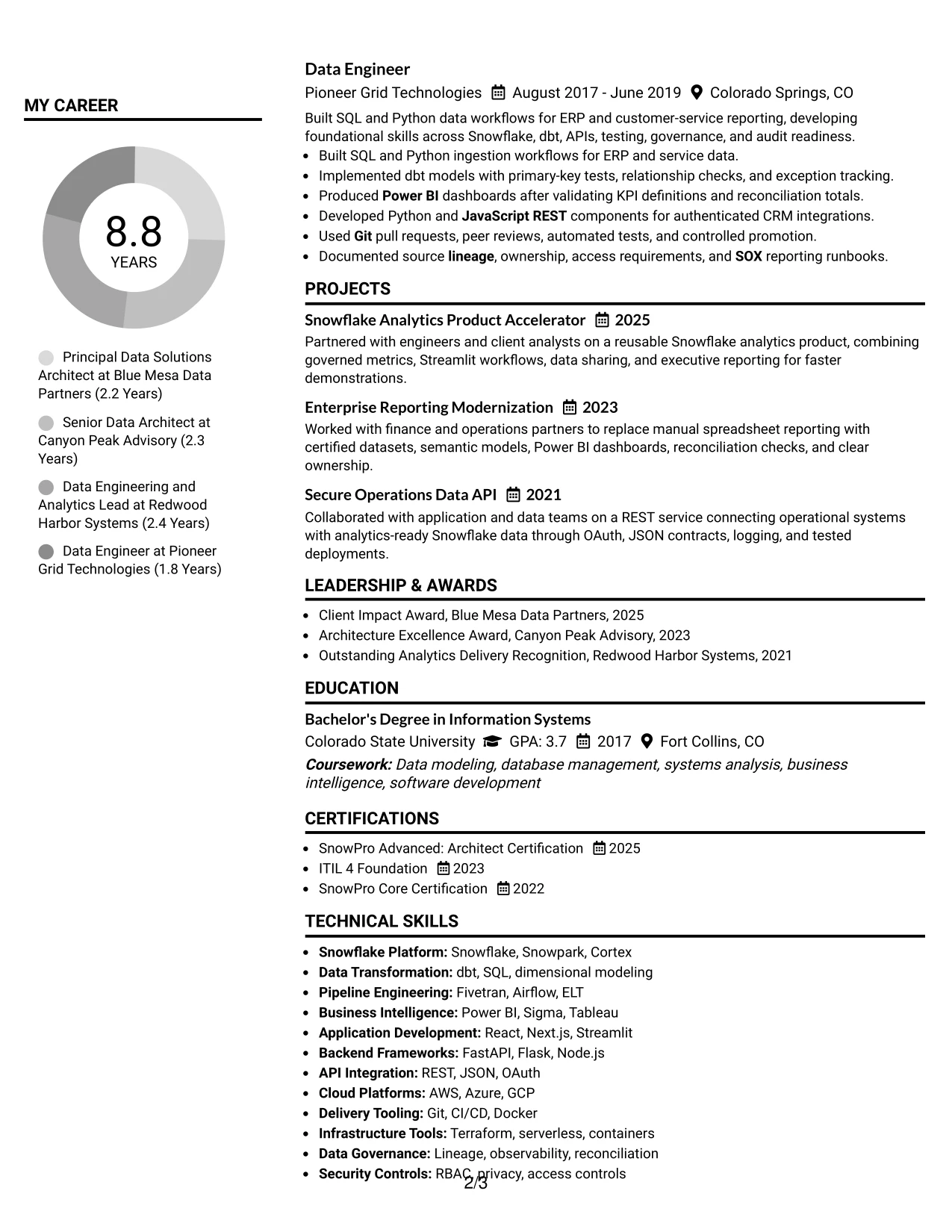
Content can be balanced between a central introduction and two focused information paths. One column may hold skills, certifications, education, and affiliations, while the other gives experience and project bullets the space needed to explain delivery results.
That balance fits a resume with both breadth and depth. The document can show nine years of work across Snowflake architecture, consulting, data engineering, analytics products, APIs, and reporting while keeping education, awards, and community leadership easy to locate.
#28 Why the Centered Header Classic Two Column Format Works for a Resume
- A centered header creates a calm entry point for the title and summary.
- Two columns divide detailed evidence from supporting qualifications.
- Experience bullets can retain useful context instead of being reduced to tool names.
- Skills and certifications remain accessible during a quick technical review.
- Projects provide additional proof of data products, reporting modernization, and secure integrations.
- The structure supports a broad consulting record without making every section compete for attention.
- Education, awards, and leadership activities can be included in a compact supporting column.
#28 Best For
- Applications that need a balanced presentation of experience and supporting qualifications.
- Candidates with a wide technical scope plus projects that demonstrate applied judgment.
- Resumes reviewed in both detailed and quick-scan settings.
- Professionals who want education, certifications, and affiliations visible but not dominant.
- Documents with enough experience to benefit from a separate skills and credential area.
- Consulting applications that combine client work, solution design, and delivery leadership.
- Readers who prefer centered introductions followed by clearly separated information groups.
#29 Left Aligned Header Clean Two Column Format Resume Example
For a practical application, this format lets the reader start with the role and summary at the left edge, then move through clearly separated columns. The design supports fast orientation while preserving room for detailed experience, projects, skills, education, and certifications.
The clean structure is especially useful for a technical resume with many related keywords. Snowflake, SQL, Python, dbt, Fivetran, Airflow, Power BI, Sigma, REST, OAuth, and CI/CD can be organized around the evidence that shows how they were used.
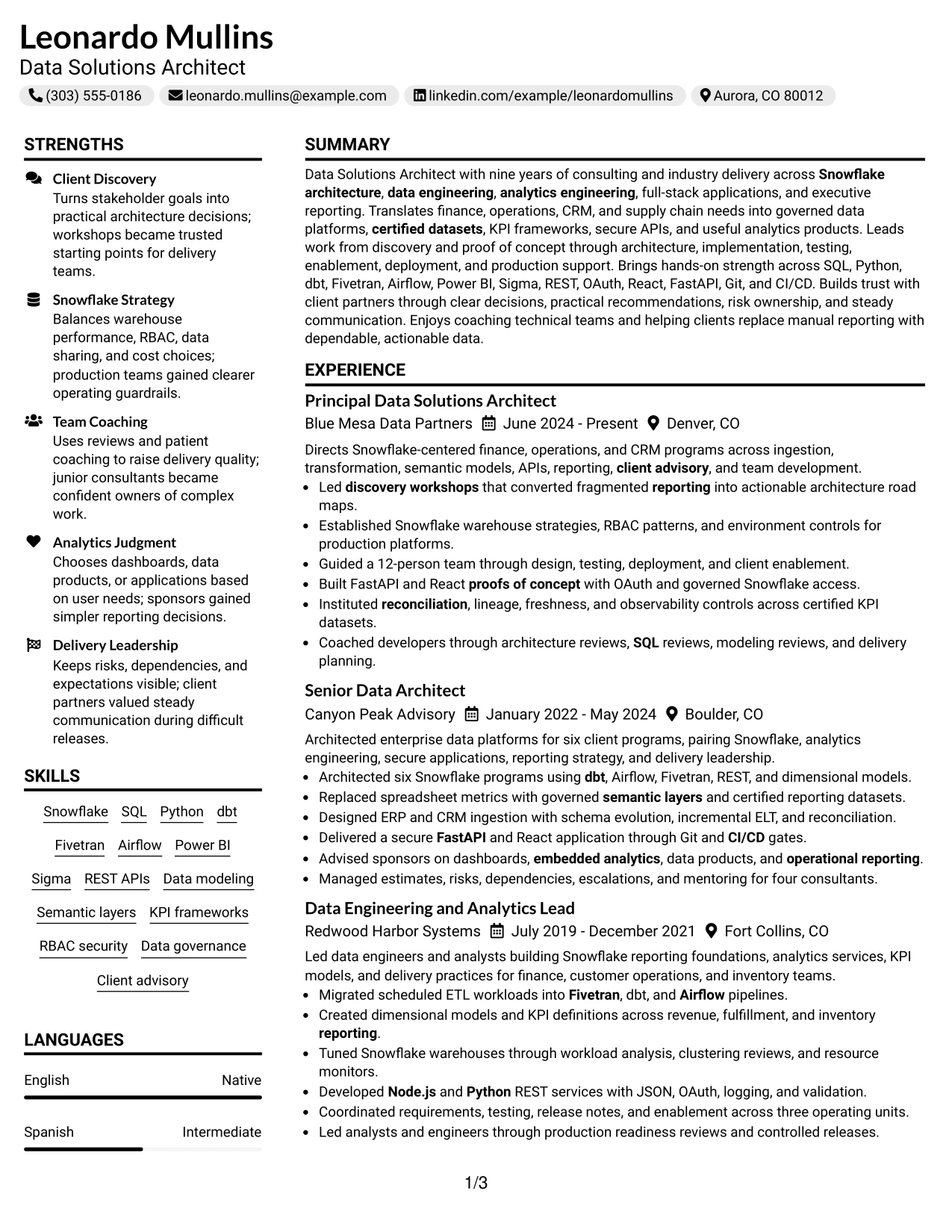
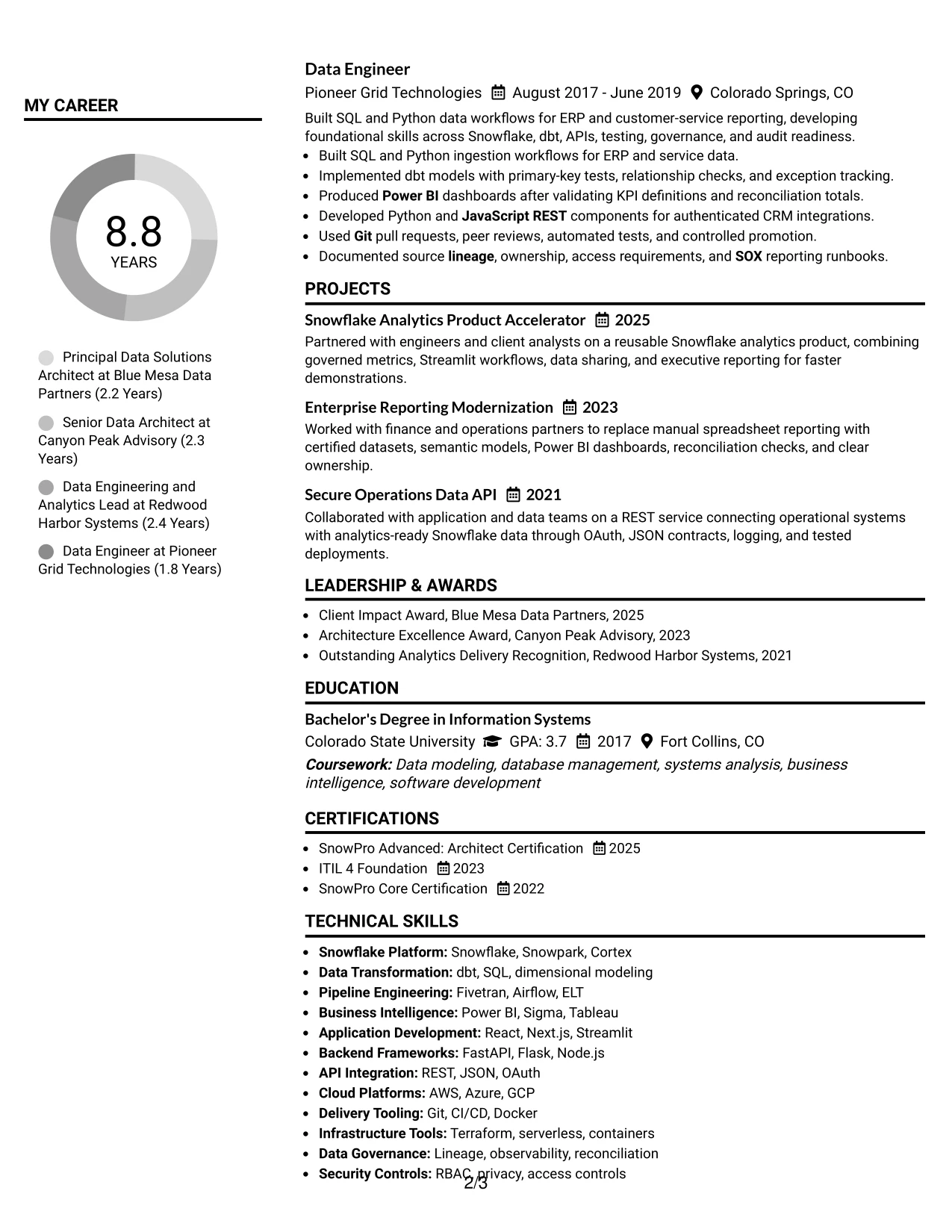
#29 Why the Left Aligned Header Clean Two Column Format Works for a Resume
- Left alignment supports familiar scanning and consistent section starts.
- Two columns make a large technical skills inventory easier to organize.
- The main work history can carry detailed bullets without hiding credentials.
- A focused summary connects client needs, governed platforms, and analytics products.
- Projects show practical application of Streamlit, data sharing, semantic models, and APIs.
- The format keeps dates, employers, titles, and achievements visually distinct.
- A clean presentation supports both digital review and careful human reading.
#29 Best For
- Technical applications that require a familiar, low-distraction reading path.
- Professionals with many tools that need grouping beside, rather than inside, work bullets.
- Resumes combining consulting delivery with hands-on platform and application work.
- Candidates who want projects and certifications available without extending every experience entry.
- Documents where dates and employers must remain easy to compare across roles.
- Applications with strong keyword requirements and a need for clear evidence of use.
- Reviewers who value practical organization over decorative design.
#30 Accent Divider Modern Two Column Format Resume Example
A modern, restrained hierarchy guides the reader from Leonardo Mullins's role focus into the evidence that supports it. Accent dividers can separate experience, projects, skills, and credentials while two columns keep the page orderly.
The format suits a resume that must connect architecture with execution. Bullets can show discovery workshops, Snowflake warehouse strategy, certified datasets, FastAPI and React proofs of concept, performance reviews, and coaching without losing the visual distinction between major sections.
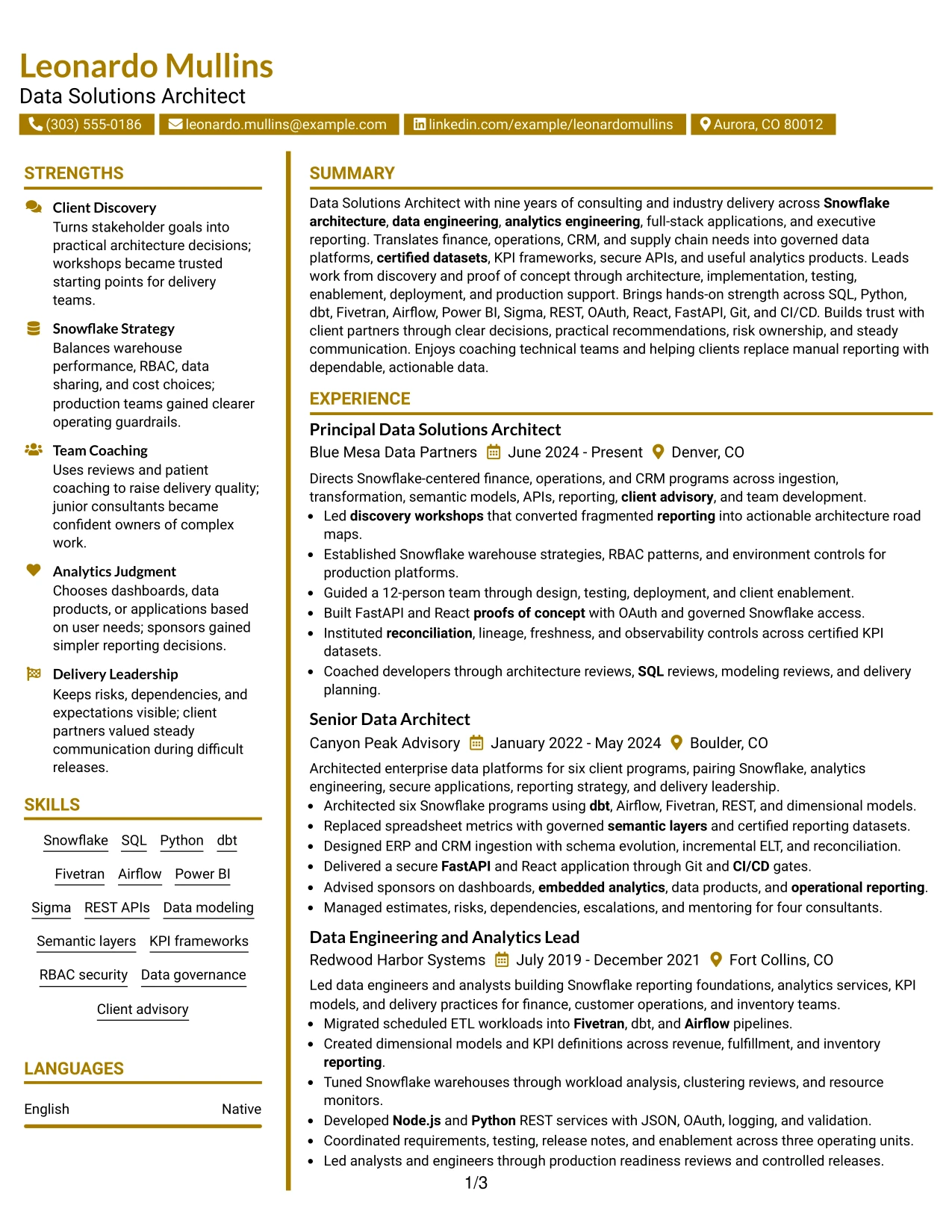
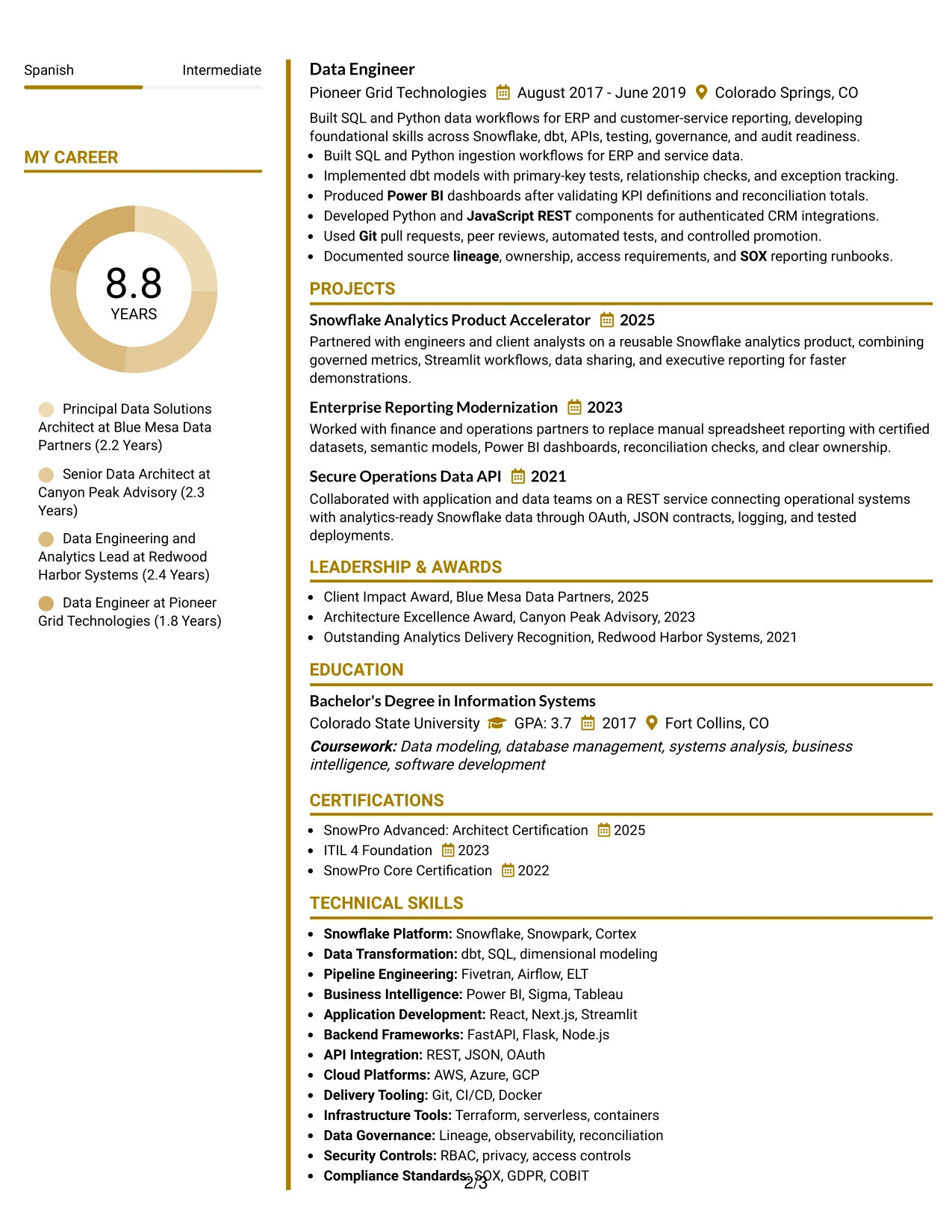
#30 Why the Accent Divider Modern Two Column Format Works for a Resume
- Accent dividers mark transitions between major resume sections.
- Two columns let technical keywords and supporting credentials remain close to the main evidence.
- The summary can establish architecture, consulting, and full-stack scope before the timeline begins.
- Bullets show decisions, actions, and delivery responsibilities in a modern but readable structure.
- Projects extend the evidence with analytics products, reporting modernization, and secure APIs.
- Awards and mentoring activities add leadership signals without taking over the page.
- The layout supports a polished application while keeping the content easy to scan.
#30 Best For
- Resumes seeking a modern presentation without sacrificing clear employment chronology.
- Candidates whose work crosses architecture, analytics, software, and client delivery.
- Applications where section dividers help readers move between evidence categories.
- Professionals with supporting projects and leadership activities that deserve visible placement.
- Documents that need a compact technical reference area beside detailed achievements.
- Consulting searches requiring proof of discovery, recommendations, implementation, and coaching.
- Readers who respond well to clear visual breaks and concise, action-focused bullets.
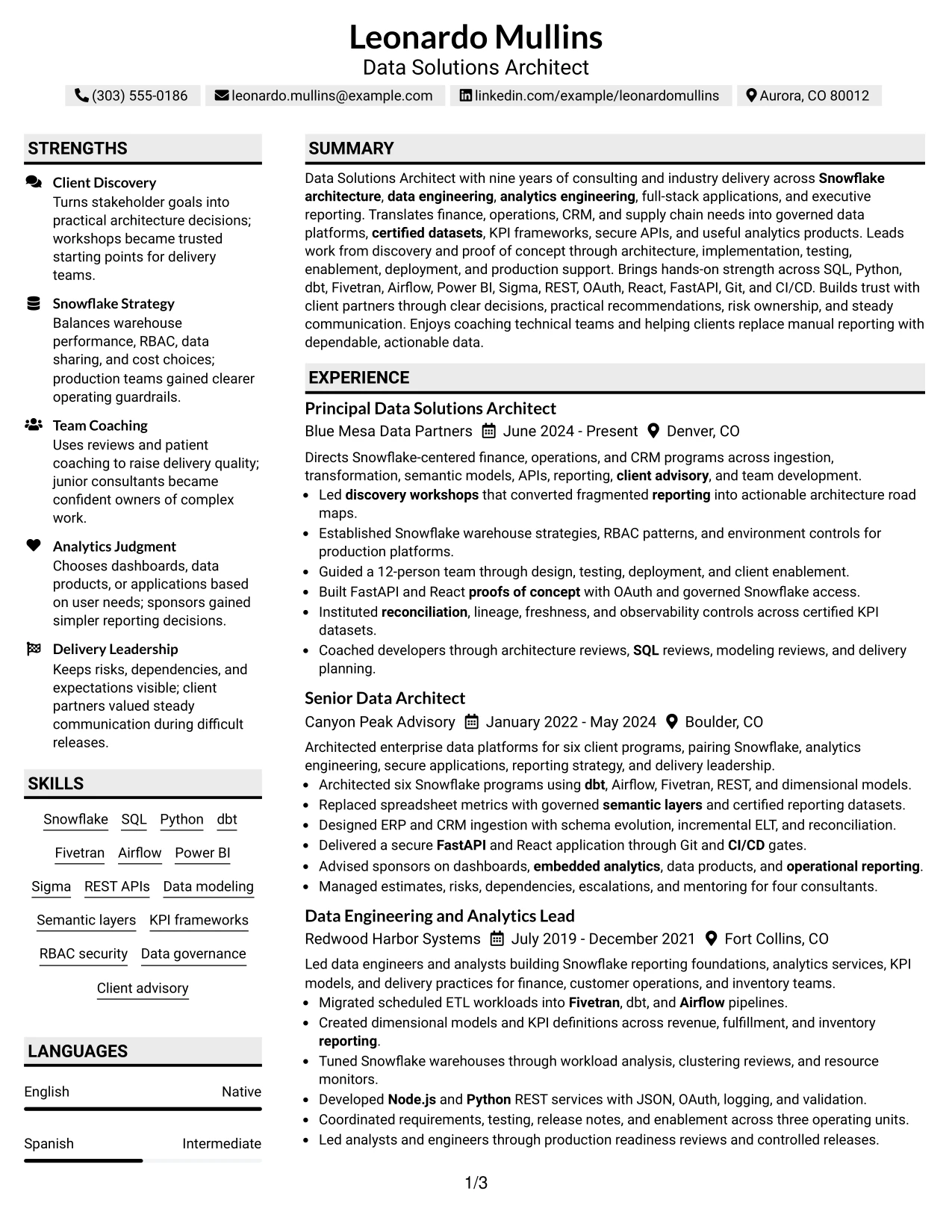
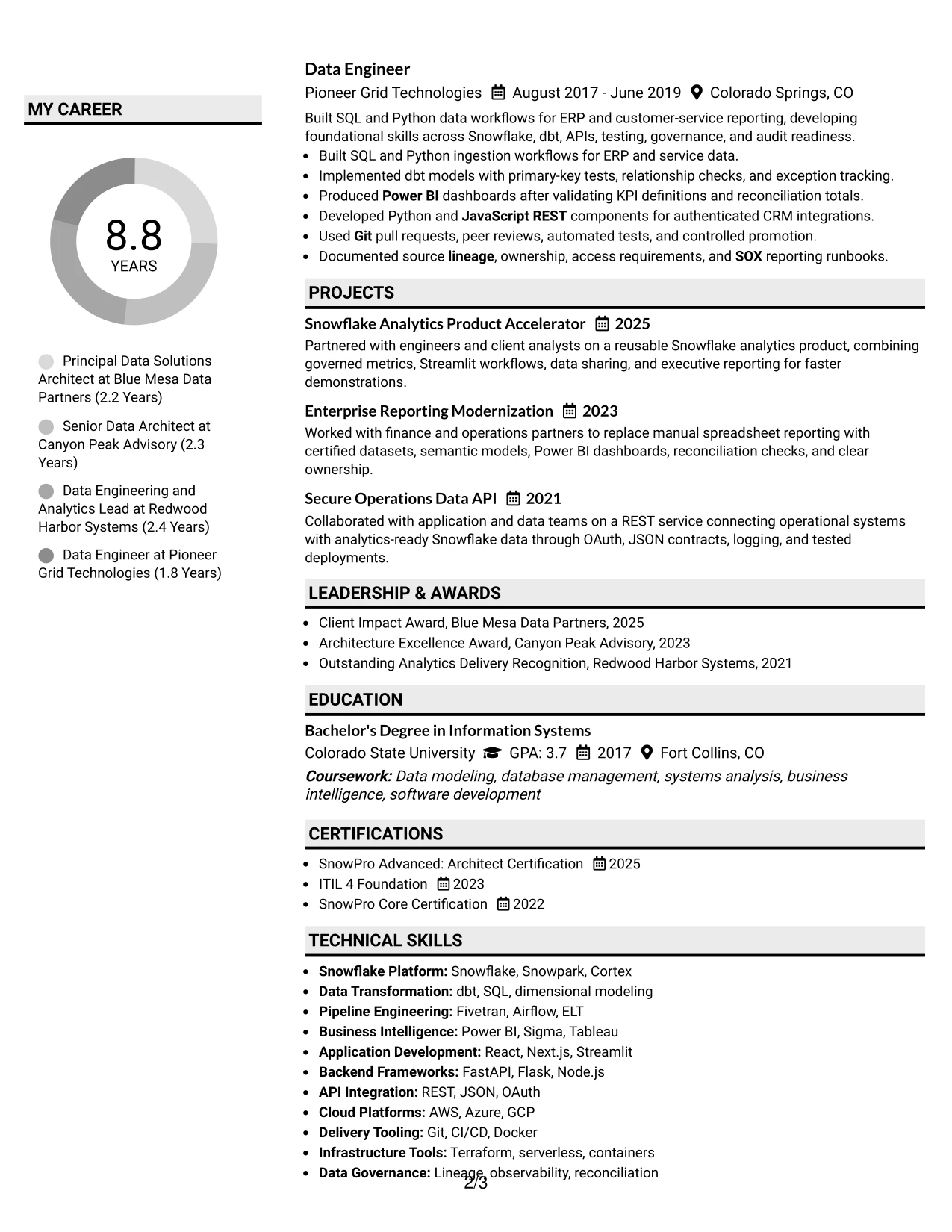
#31 Shaded Labels Clean Two Column Format Resume Example
Shaded labels give each resume section a clear signpost, while the two-column structure distributes information with care. The format can place skills, education, certifications, and awards in a compact reference area and reserve the larger column for experience and projects.
This organization helps a reader compare evidence quickly. The work history can detail six client programs, data-quality controls, reporting models, REST services, and team mentoring, while the labels make SnowPro credentials, ITIL, governance, and core tools easy to find.
#31 Why the Shaded Labels Clean Two Column Format Works for a Resume
- Shaded labels make section boundaries visible during a fast review.
- The two-column structure separates reference information from career evidence.
- A detailed experience column can show scope, delivery phases, and technical decisions.
- Skills can be grouped into platforms, transformation, reporting, APIs, and governance.
- Education and certifications have a defined location rather than being buried at the end.
- Projects and awards can support credibility without interrupting the role sequence.
- The clean design keeps a high-information resume readable and navigable.
#31 Best For
- Resumes with many sections that benefit from strong visual labels.
- Professionals needing to present technical breadth beside detailed career achievements.
- Applications where certifications and governance knowledge should be easy to verify.
- Candidates with multiple client programs, projects, and supporting distinctions.
- Documents that must show both hands-on work and leadership responsibilities.
- Technical searches where grouped skills improve keyword discovery.
- Readers who prefer clear section markers and a controlled two-column arrangement.
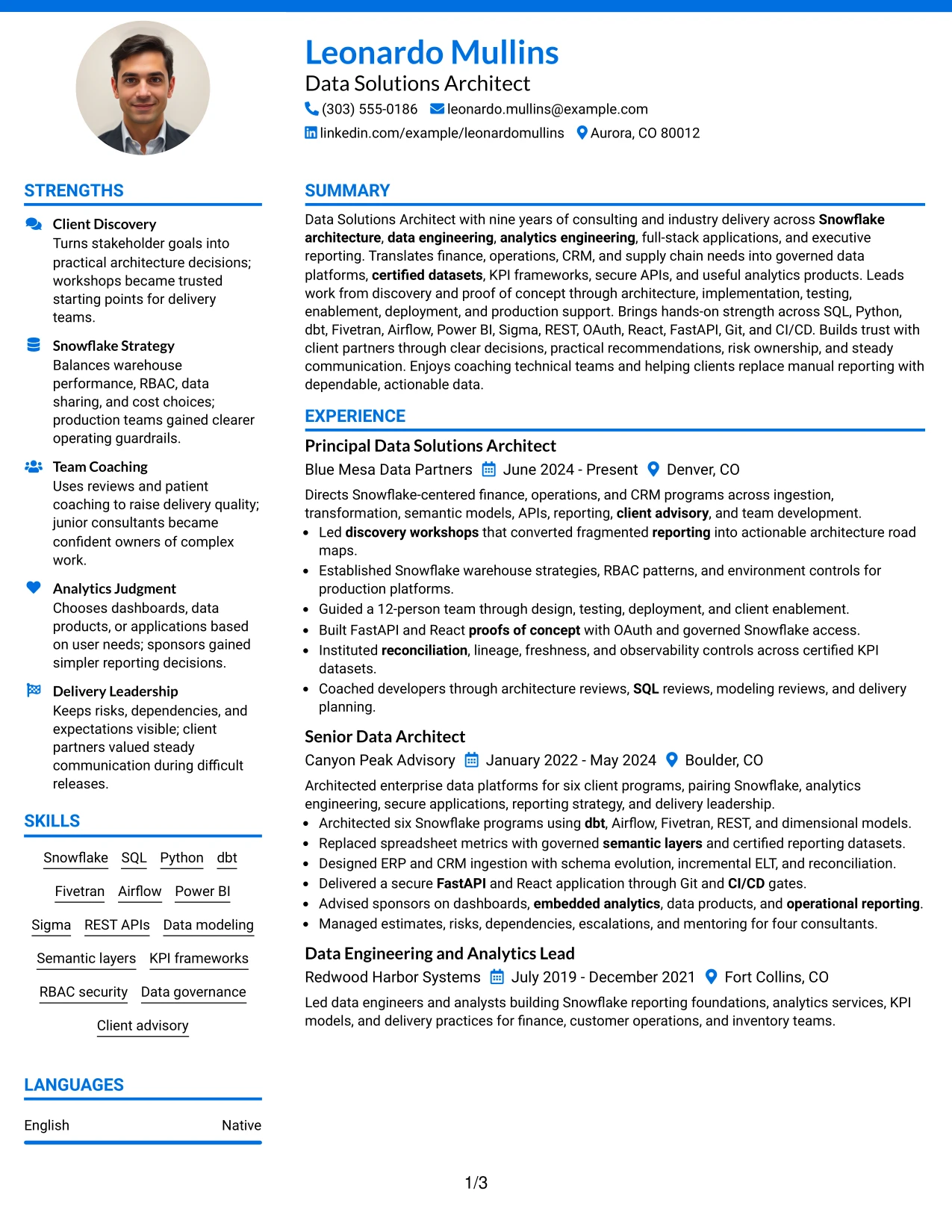
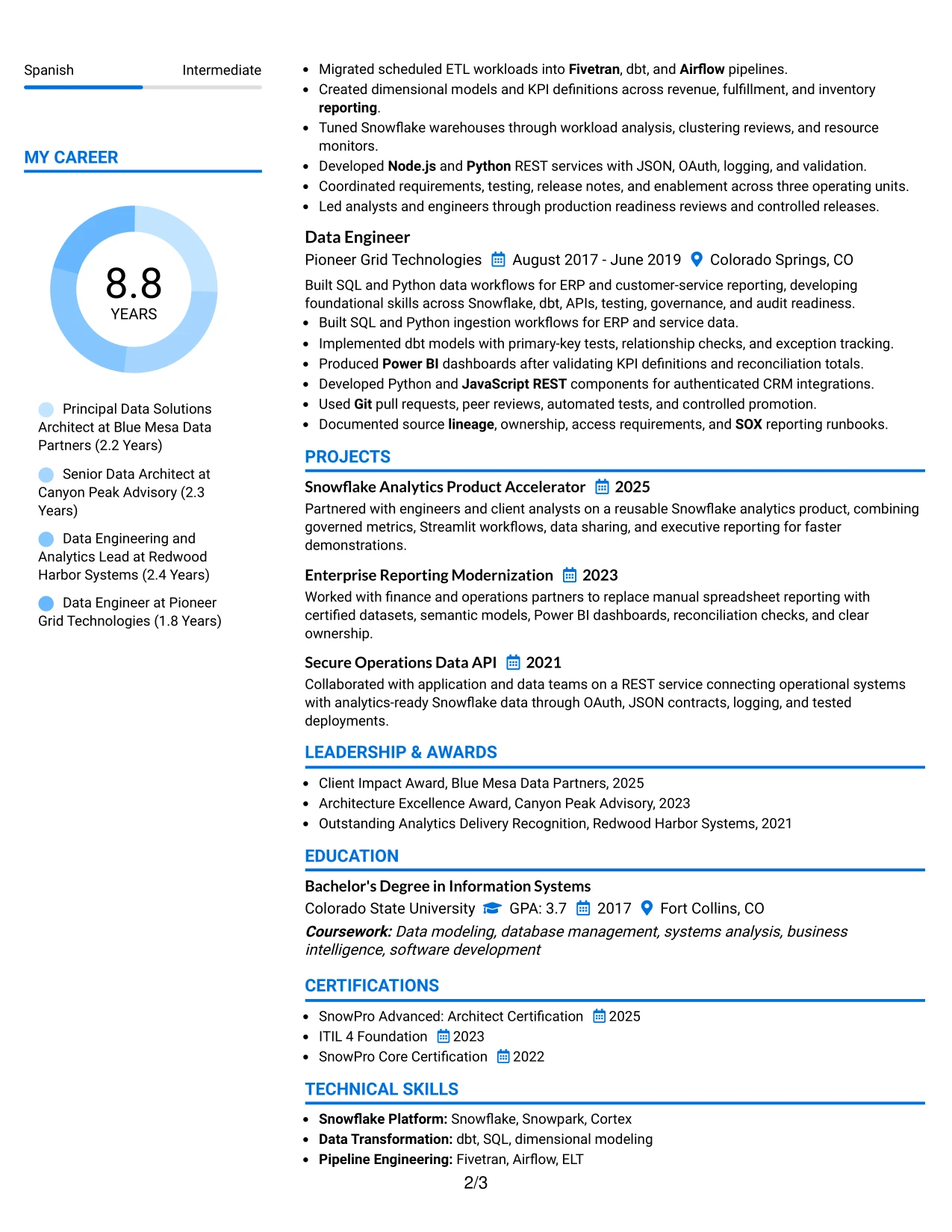
#32 Photo Header Color Accent International Format Resume Example
Reader navigation begins with a clear header, then moves through the summary, experience, skills, and supporting sections in a consistent order. The color accents help separate these areas, while a professional portrait can support a polished profile presentation when appropriate for the application and region.
The resume has enough space for a detailed technical record. It can present Snowflake architecture, data pipelines, Power BI and Sigma reporting, secure APIs, client advisory, certifications, projects, and language information without reducing the experience bullets to vague summaries.
#32 Why the Photo Header Color Accent International Format Works for a Resume
- A clear header gives the reader an immediate starting point and contact reference.
- Color accents help separate a long professional summary from the work timeline.
- The main content area supports detailed bullets across architecture, engineering, and applications.
- A dedicated skills area can surface Snowflake, SQL, Python, dbt, and BI platforms quickly.
- Certifications and projects add evidence beyond the employment section.
- Language information can be included in a defined supporting area when relevant.
- The format supports a full professional profile while maintaining a predictable reading order.
#32 Best For
- Applications where a polished profile presentation is appropriate for the target market.
- Professionals with substantial experience and several categories of technical evidence.
- Resumes that need room for tools, certifications, projects, awards, and languages.
- Candidates whose work spans client advisory, platform design, reporting, and application delivery.
- Documents reviewed across regions where a structured profile and language section may help.
- Applications requiring detailed bullets rather than a short skills-only presentation.
- Readers who prefer color cues to guide a longer, information-rich resume.
#33 Large Profile Photo International Two Column Format Resume Example
Strong evidence should lead the review: the summary, recent architecture work, and measurable scope establish value before the reader reaches supporting details. A larger professional portrait gives the header a distinct profile presence, while two columns create room for both career history and credentials.
The main column can explain discovery through production support, including warehouse strategy, ingestion, semantic layers, APIs, reporting, and team coaching. A supporting column can hold skills, certifications, education, awards, affiliations, and languages so the technical story remains complete but easy to navigate.
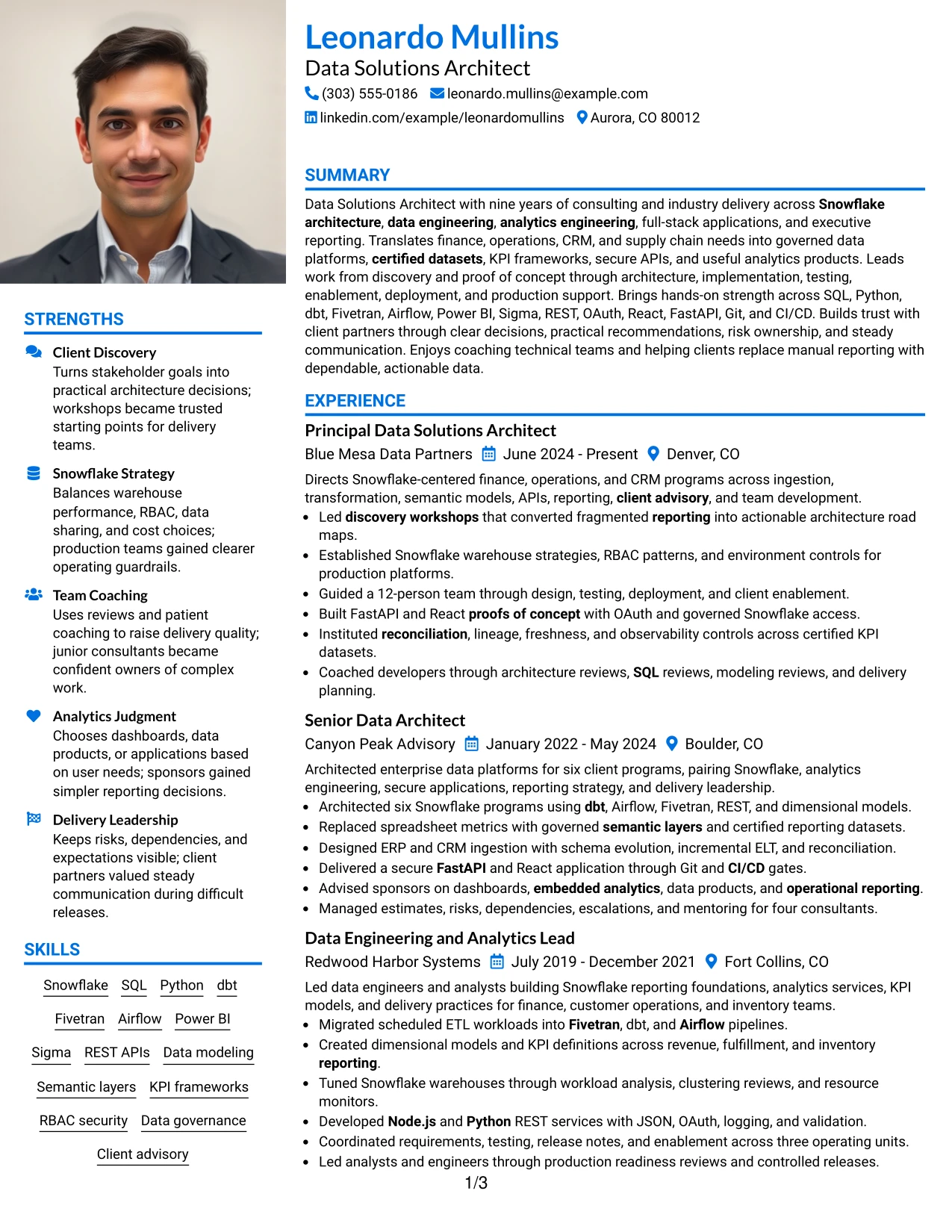
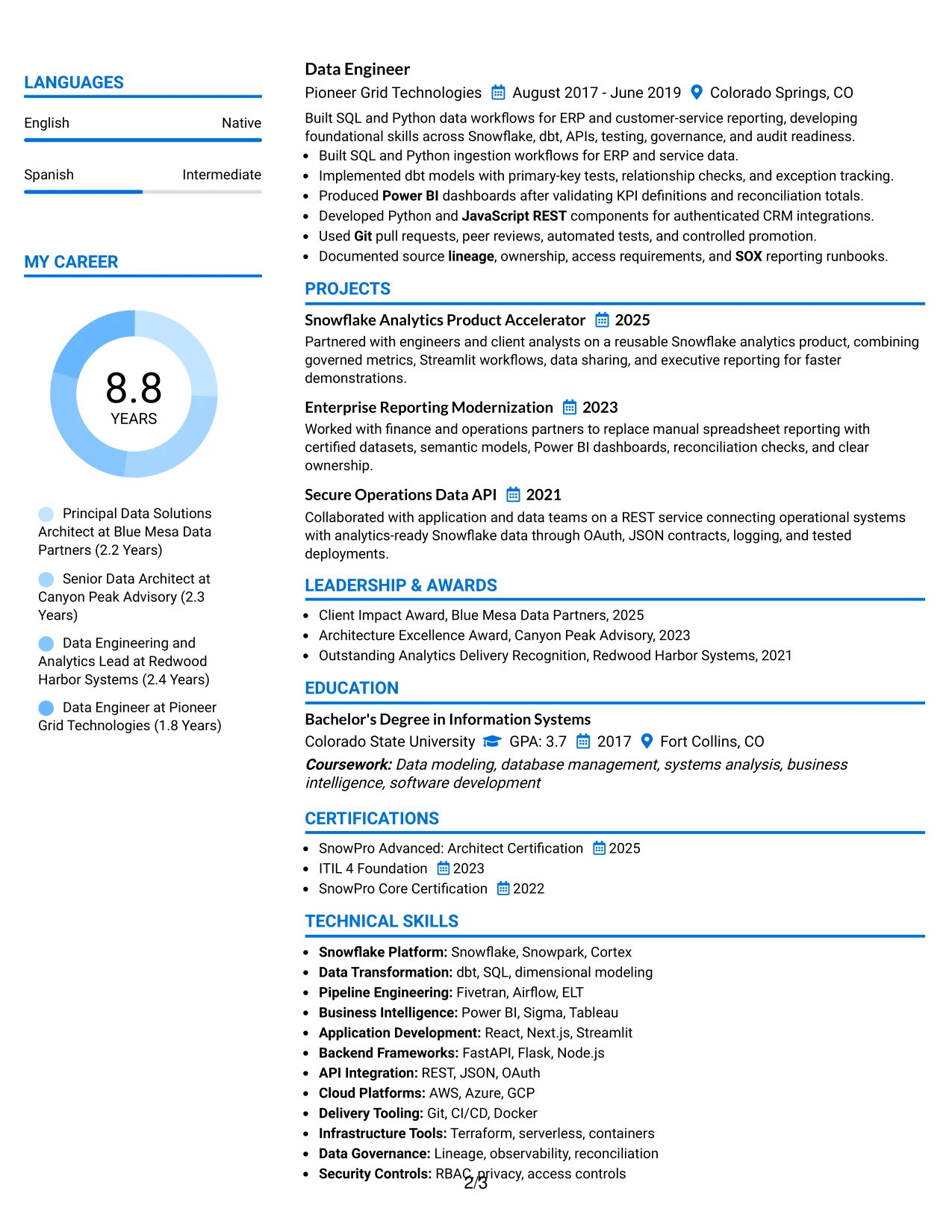
#33 Why the Large Profile Photo International Two Column Format Works for a Resume
- The summary and recent achievements receive priority before secondary details.
- Two columns accommodate a substantial work history and a broad credential set.
- The larger header area creates a strong professional profile introduction.
- Experience bullets can show architecture scope, implementation work, and delivery ownership.
- A supporting column keeps skills, certifications, education, and languages easy to review.
- Projects and awards add evidence of applied solutions and recognized impact.
- The format suits a complete profile when presentation and information volume both matter.
#33 Best For
- Applications where a prominent professional profile is suitable for the audience and region.
- Candidates who need to lead with architecture evidence and still include broad supporting details.
- Resumes with extensive experience, certifications, projects, awards, and affiliations.
- Professionals combining technical delivery with coaching, advisory work, and stakeholder leadership.
- Documents that benefit from a dedicated column for languages and other profile information.
- Roles where proof of platform decisions, secure delivery, and business reporting should appear early.
- Readers who want strong evidence first, followed by an organized reference panel.
Why Build Your Data Solutions Architect Resume with ResumeInMinutes
ResumeInMinutes helps you turn complex architecture work into a resume with clear hierarchy and focused evidence. You can present client advisory, technical delivery, team leadership, certifications, projects, and tools without making the document difficult to review.
- ATS-friendly section structure
- Keyword-focused resume content
- Architecture and delivery organization
- Skills, tools, and certification sections
- Free PDF resume previews
- Resume customization support
Use the formats to make your experience easier to follow, from discovery workshops and proofs of concept to Snowflake design, data quality controls, secure APIs, reporting models, production support, and technical coaching.
See Also
- 33 AI/ML Solutions Architect Resume Templates with Example 2026 (ATS-Optimized)
- 33 AI Solutions Architect Resume Templates with Example 2026 (ATS-Optimized)
- 7 Client Solution Architect Resume Templates with Example
- 7 Senior HR Systems Solutions Architect (Workday) Resume Templates with Example
- 7 Senior Solution Architect, Traffic Infrastructure ASE Resume Templates with Example
- 33 Thermal Architect - Thermal Management Solutions Resume Templates with Example 2026 (ATS-Optimized)
- 33 Advisory Data Architect-Senior Manager Resume Templates with Example 2026 (ATS-Optimized)
- 33 Architect, Data Science Resume Templates with Example 2026 (ATS-Optimized)
- 30+ Data Solutions Architect Cover Letter Templates with Example 2026
- 30+ AI/ML Solutions Architect Cover Letter Templates with Example 2026
Frequently Asked Questions
Are these Data Solutions Architect resume templates ATS-friendly?
Yes. The templates use clean headings and readable sections that support ATS parsing. Match keywords such as Snowflake architecture, data modeling, SQL, Python, dbt, APIs, governance, and reporting to your actual experience.
Are these different resumes?
No. The guide uses one Data Solutions Architect resume example shown in multiple layouts and design themes, so you can compare presentation without changing the underlying evidence.
What should a Data Solutions Architect resume include?
Include a focused summary, professional experience, technical skills, education, certifications, projects, and relevant leadership or activities. Describe architecture scope, platforms, integrations, reporting solutions, governance, and delivery outcomes.
Can I download the resume templates as PDFs?
Yes. Each resume style provides a free PDF download so you can review the format and choose a layout that presents your Data Solutions Architect experience clearly.
Which resume style is best for a Data Solutions Architect?
A clean one-column or simple two-column format usually works well because it makes technical keywords, career history, and achievements easy to scan. Avoid design elements that may interfere with ATS parsing.
How should I show architecture achievements on my resume?
Start each bullet with a clear action and explain the result or scope. Mention details such as Snowflake platforms, client programs, delivery teams, certified datasets, reconciliation controls, performance work, or secure applications when supported by your experience.
Should I include a photo on my resume?
Include a photo only when it is customary or expected in your country, region, or industry. For U.S. applications, a no-photo resume is generally the safer option.
Can I customize these resume templates?
Yes. ResumeInMinutes allows you to edit the resume text, sections, layout, design style, and PDF format for your Data Solutions Architect application.