7 Entry-Level Geotechnical Engineer - Field Investigations Cover Letter Templates with Example
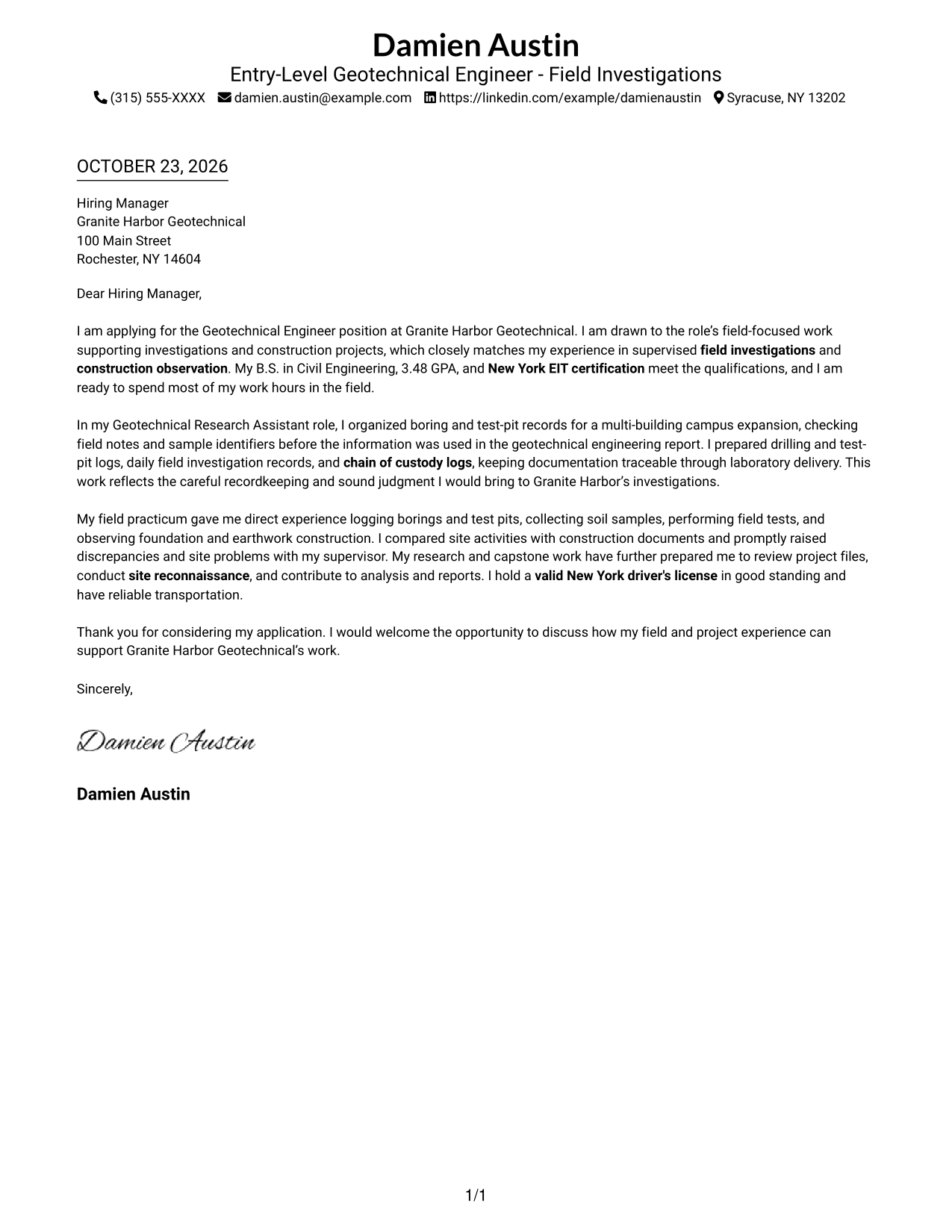
This practical guide to the Entry-Level Geotechnical Engineer - Field Investigations cover letter presents seven layouts to help you show role fit through clear, job-focused writing.
What Makes a Great Entry-Level Geotechnical Engineer - Field Investigations Cover Letter in 2026
A strong letter explains your interest in field investigations and connects relevant field and construction observation experience to the role. A clear opening and closing help the reader follow your case.
Support your claims with specific evidence, such as logging borings and test pits, maintaining chain of custody records, or reporting site issues. Show how your careful documentation and judgment can support the employer's field work.
The featured Entry-Level Geotechnical Engineer - Field Investigations example follows a focused progression from opening to evidence and closing, which you can adapt while choosing a presentation suited to the employer and communication context.
#1 Simple One Column Format Cover Letter Example
The Simple One Column Format keeps sender details in the header and gives the letter one direct reading path.
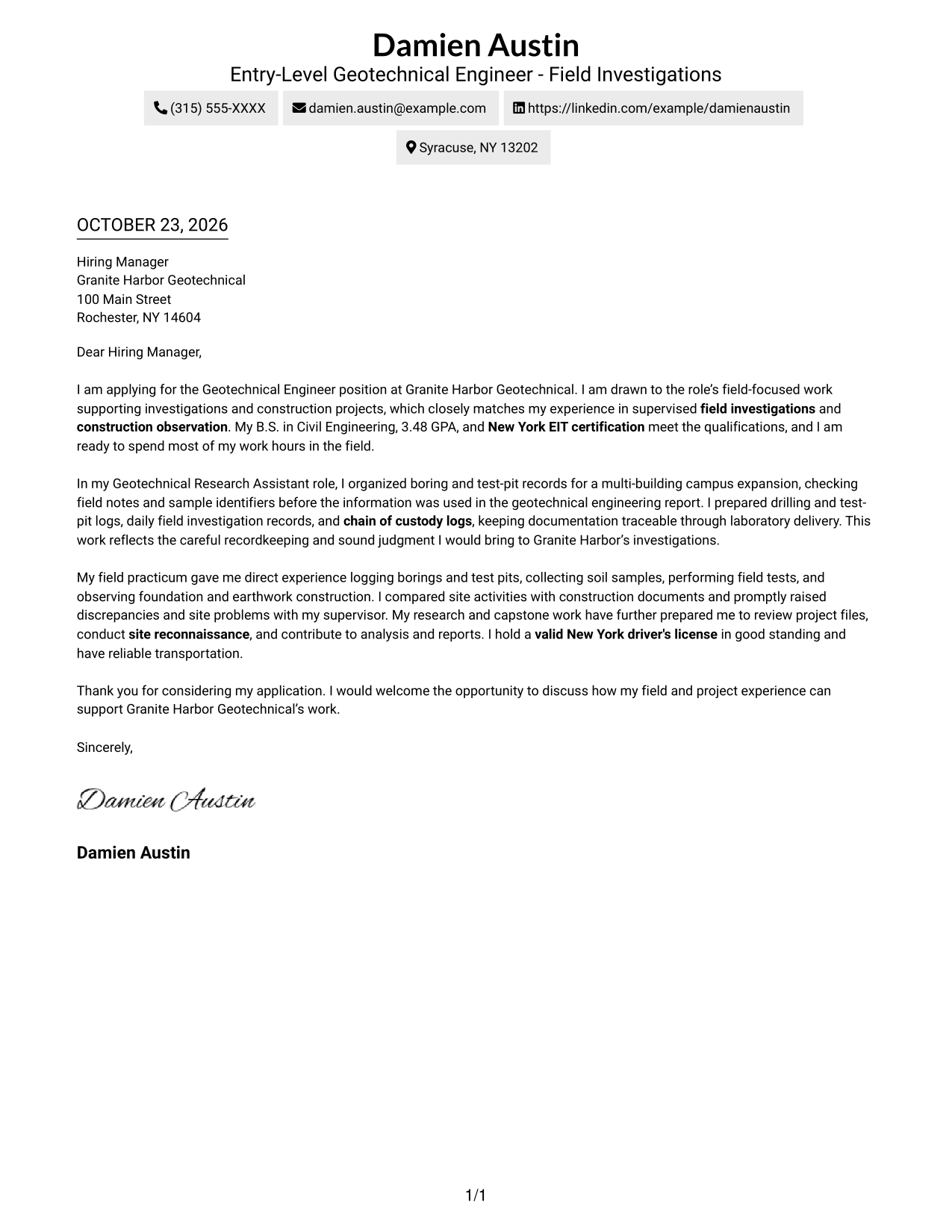
Why This Format Works
- Sender details remain easy to locate without competing with the letter's message.
- The uninterrupted body lets reviewers follow motivation, evidence, and closing in sequence.
- Full-width paragraphs suit a letter that needs room for a complete case.
Best For
- Single-column letter layouts
- Sender details in the header
- One continuous persuasive case
- Direct reading order
- Cover letters without a portrait
#2 Two Column Format Cover Letter Example
The Two Column Format places contact details beside one uninterrupted letter body, separating practical information from the case for fit.
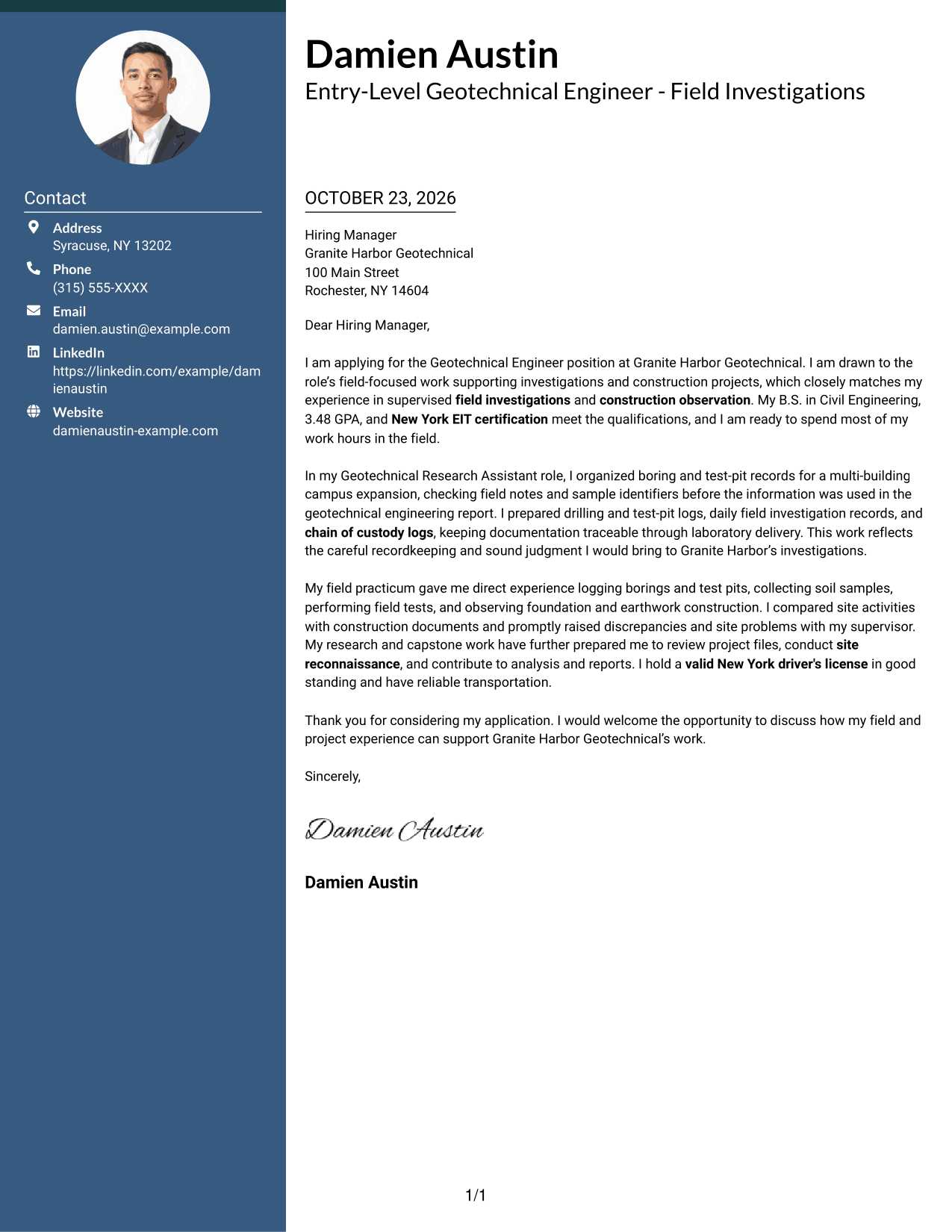
Why This Format Works
- Contact information has its own place, so it does not interrupt the letter's argument.
- One body keeps opening, evidence, and closing together in a clear sequence.
- Its text-only presentation suits readers who prefer a letter without a photo.
Best For
- Side-by-side contact and letter placement
- Uninterrupted paragraph-based arguments
- Text-only cover letter design
- Quick access to sender details
- Letters with one central message
#3 Photo Header Two Column Format Cover Letter Example
The Photo Header Two Column Format combines a photo and contact sidebar with one continuous letter body, keeping personal details distinct from the message.
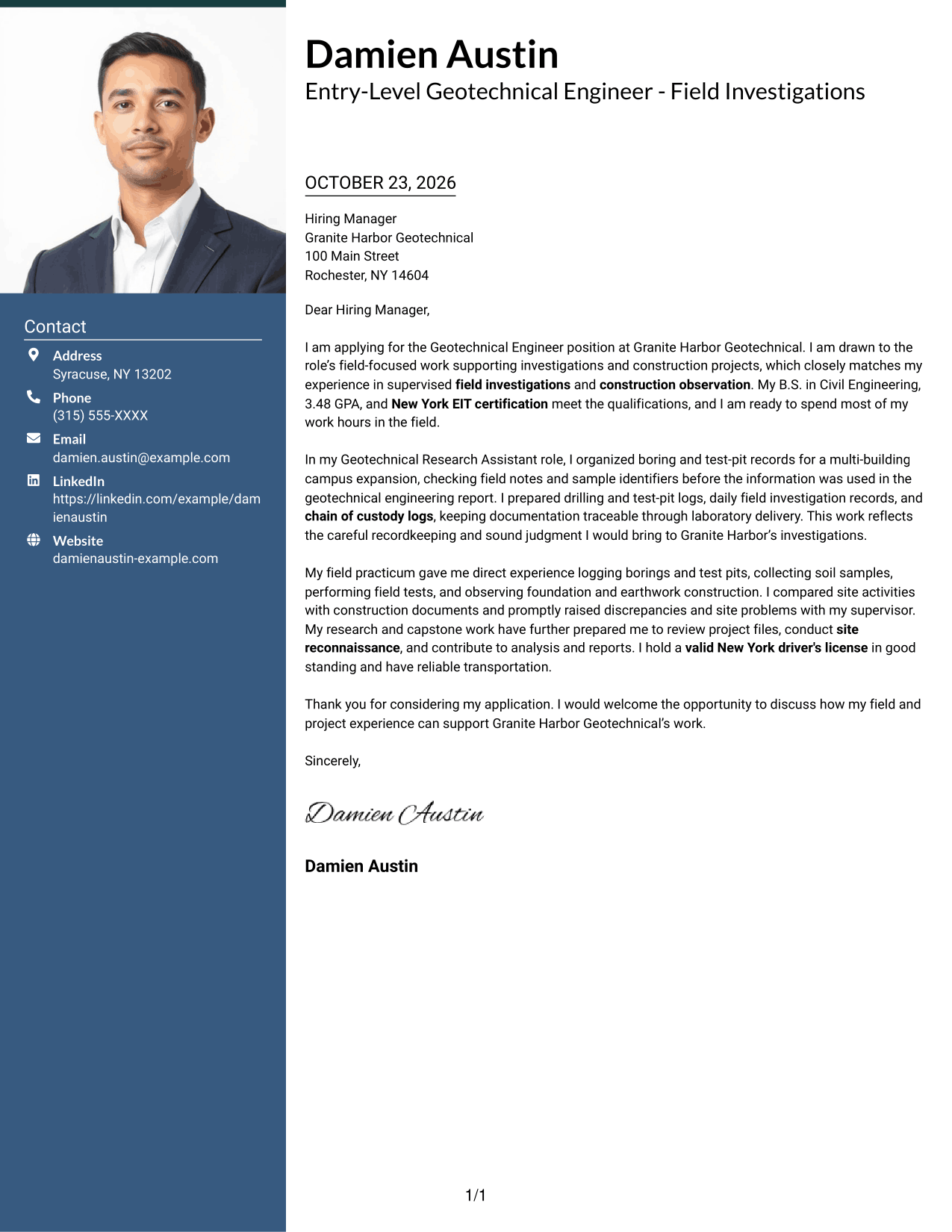
Why This Format Works
- A dedicated contact sidebar keeps practical details apart from the persuasive paragraphs.
- The single letter body carries the opening, supporting case, and closing in order.
- The portrait adds a visible personal element for readers who prefer a photo.
Best For
- Portrait-inclusive cover letter design
- Side-by-side contact information
- One-body letter structure
- Paragraph-led supporting evidence
- Readers who prefer a visible portrait
#4 One Column Format with Photo Cover Letter Example
The One Column Format with Photo keeps sender details in the header and the letter in one body, with a photo for readers who prefer one.
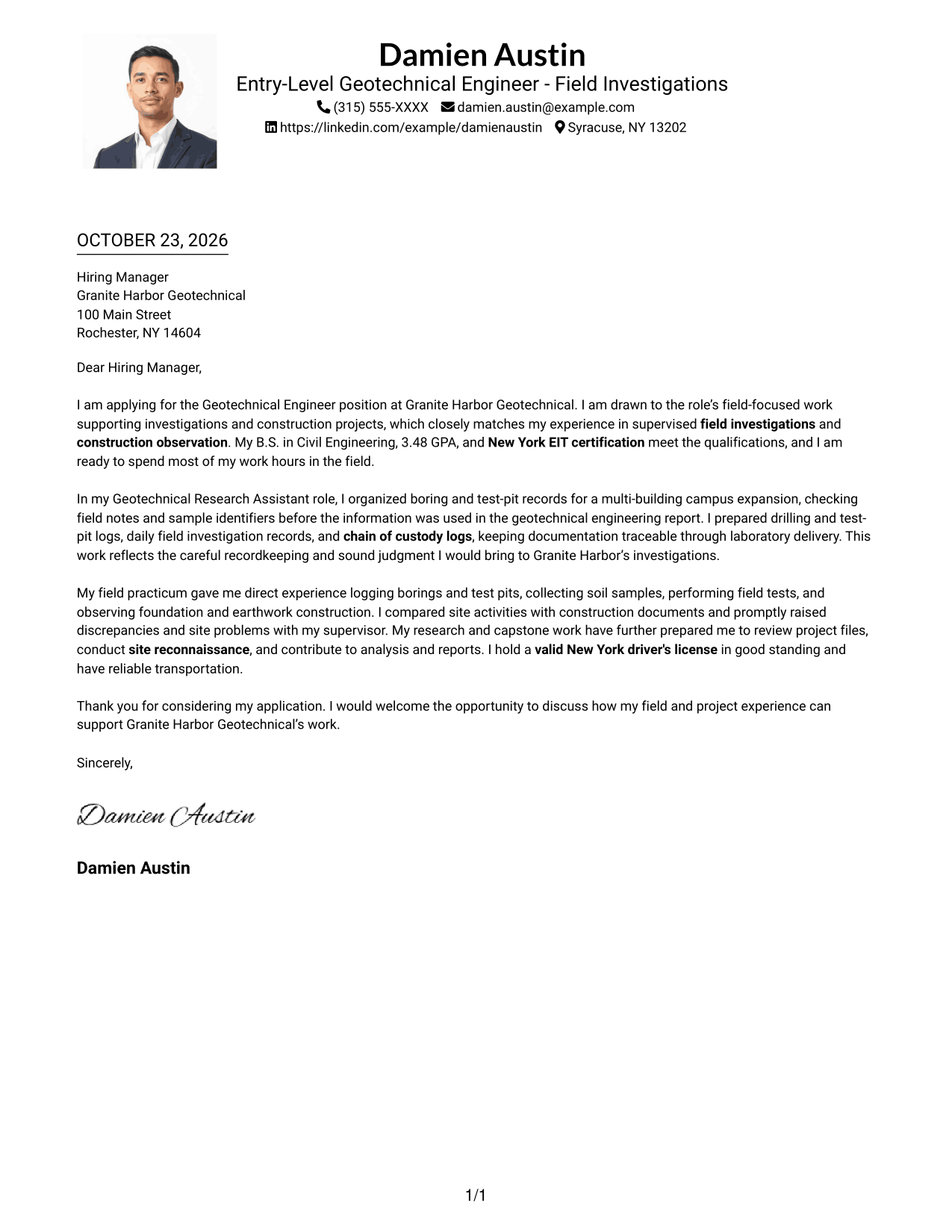
Why This Format Works
- One column gives the letter a direct path from opening through closing.
- Header contact details stay distinct from the paragraphs making the case.
- The photo adds a personal visual choice without changing how the argument reads.
Best For
- One-column letter layouts
- A portrait within the design
- Header-based sender details
- A direct reading path
- Photo-inclusive personal presentation
#5 Simple Two Column Format Cover Letter Example
With the Simple Two Column Format, a contact sidebar sits beside the full letter, so practical details stay separate from its argument.
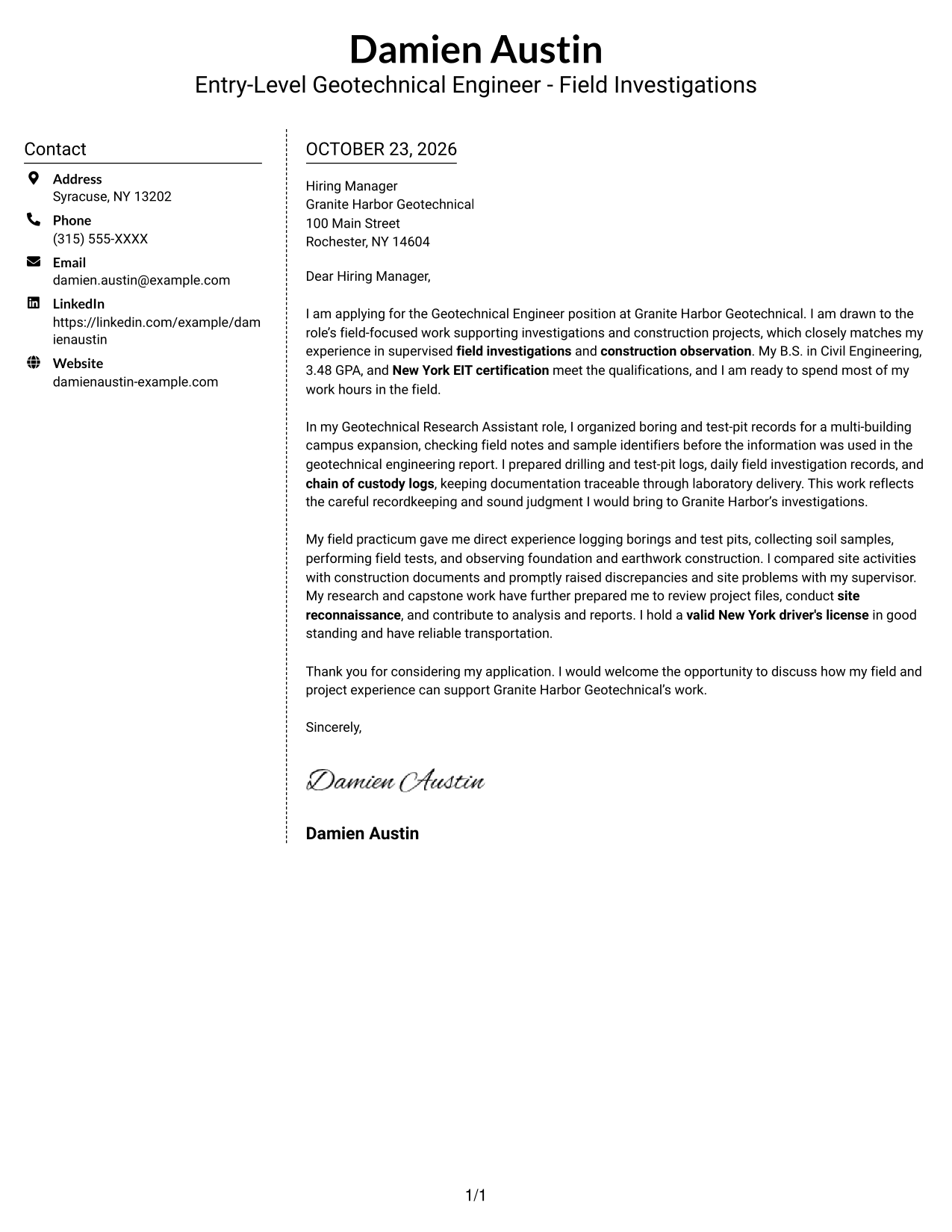
Why This Format Works
- Contact details sit apart from the message, leaving the letter's full argument intact.
- Readers can follow the evidence in one body rather than across parallel text columns.
- The text-only page suits readers who want contact cues without a portrait.
Best For
- A separate contact sidebar
- A single-body letter argument
- Text-only page preference
- Side-by-side document organization
- Paragraph-based persuasion
#6 Modern Icon Format Cover Letter Example
The Modern Icon Format uses visual cues for contact details in a sidebar beside the uninterrupted letter body.
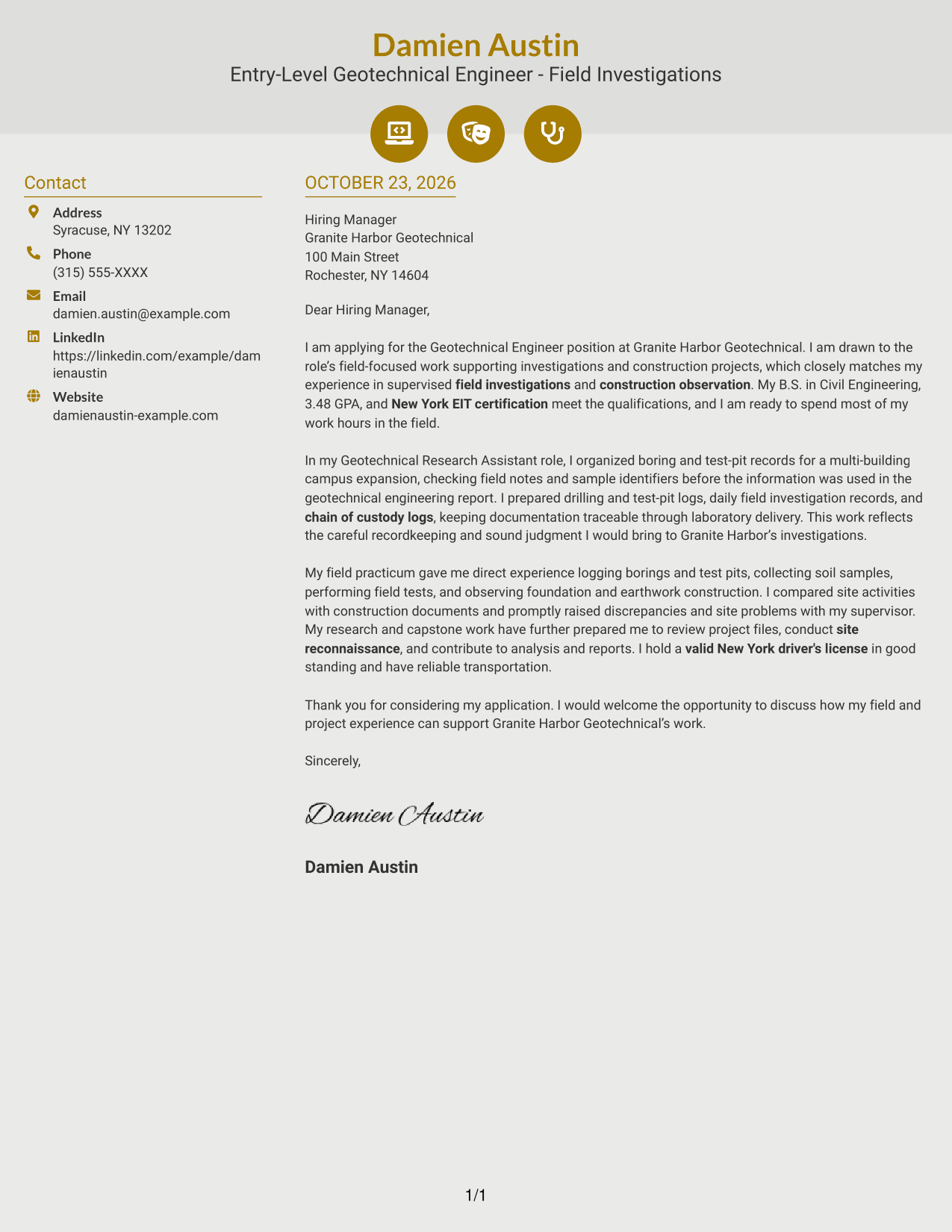
Why This Format Works
- Icons cue contact details, helping readers locate practical information in the sidebar.
- An uninterrupted body leaves motivation, evidence, and closing to read as one letter.
- The text-only page suits readers who want contact cues without a portrait.
Best For
- Contact details marked with icons
- A sidebar beside the letter
- Continuous paragraph-based writing
- Quick location of sender information
- A cover letter without a portrait
#7 Creative Two Tone Format Cover Letter Example
The Creative Two Tone Format places a contact sidebar beside the full letter body, giving practical details their own place while keeping the message together.
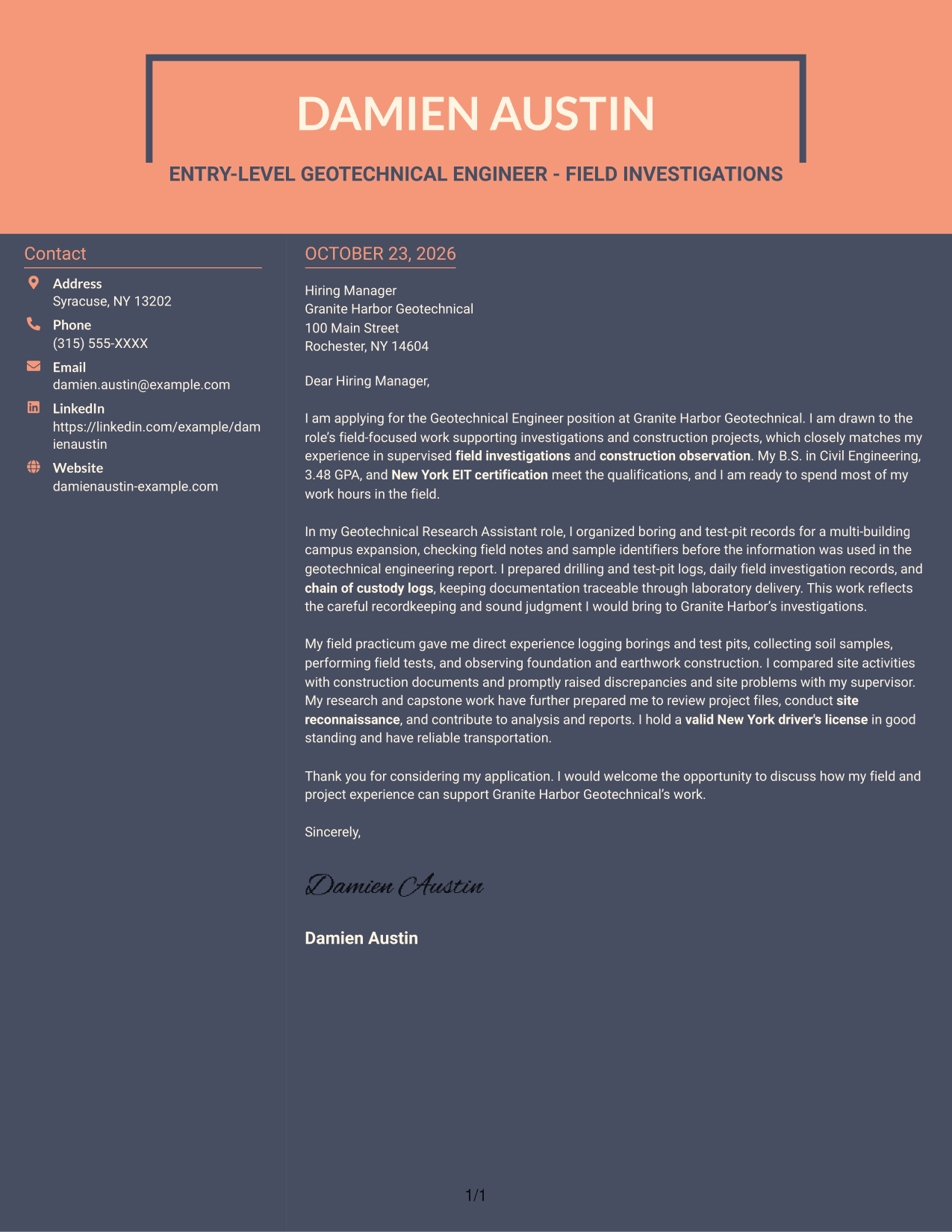
Why This Format Works
- Separate placement makes sender details easy to check without breaking the letter's flow.
- Opening, evidence, and closing remain in one body for a connected argument.
- The photo-free page suits readers who prefer a text-led design.
Best For
- Contact sidebar beside the letter
- A continuous written argument
- Two-column page organization
- Text-led visual preference
- Sender details apart from the message
Why Use ResumeInMinutes for an Entry-Level Geotechnical Engineer - Field Investigations Cover Letter
ResumeInMinutes lets you review cover letter image previews and open an example in the editor. Use the guidance here to connect field evidence, role interest, and employer needs in a clear letter.
- Image previews of letter layouts
- Examples you can view in the editor
- Cover letter structure guidance
- Role-focused writing advice
- Clear presentation choices
- Support for tailoring your message
Use the example to shape a focused opening, present relevant investigation and construction observation evidence, and close with a clear expression of interest.
See Also
- 7 Entry-Level Geotechnical Engineer - Field Investigations Resume Templates with Example
- 7 Entry-Level Geotechnical Engineer - Rail Resume Templates with Example
- 7 Entry-Level Geotechnical Engineer Resume Templates with Example
- 33 Geotechnical Engineer Resume Templates with Example 2026 (ATS-Optimized)
- 7 Transportation Engineer Licensed Specialist - Senior Geotechnical Engineer Resume Templates with Example
- 7 Entry-Level Environmental Engineer, Scientist, or Geologist - Site Investigation and Remediation Resume Templates with Example
- 33 Entry Level Field Engineer Resume Templates with Example 2026 (ATS-Optimized)
- 7 Field Applications Engineer Resume Templates with Example
- 7 Entry-Level Geotechnical Engineer Cover Letter Templates with Example
- 7 Entry-Level Geotechnical Engineer - Rail Cover Letter Templates with Example
Frequently Asked Questions
What should an Entry-Level Geotechnical Engineer - Field Investigations cover letter include?
Show why the field-focused role interests you, then give relevant evidence such as boring and test-pit logging, soil sampling, field testing, construction observation, and accurate field records. Close by stating how you hope to contribute.
Are these different cover letters?
The guide presents one role-focused cover letter example in several layouts. Compare the image previews to see how the presentation changes while the letter's core message stays focused on the job.
How can I show evidence of good field judgment?
Describe a specific task, the records or site conditions you checked, and how you communicated an issue or finding to a supervisor or project team. Keep the example accurate and focused on your contribution.
How should I connect my experience to the employer's needs?
Choose details that match the role, such as field investigation records, chain of custody logs, construction document review, or report support. Explain briefly how those skills can help the employer complete field and project work.
Should I use a photo on my cover letter?
Use a photo only if it is common or expected in your location or field. For U.S. applications, a no-photo cover letter is usually a safe choice.