US English


7 Entry-Level Landscape Architect / Ecological Restoration Designer Resume Templates with Example
By Ria · Last Updated On October 21, 2026
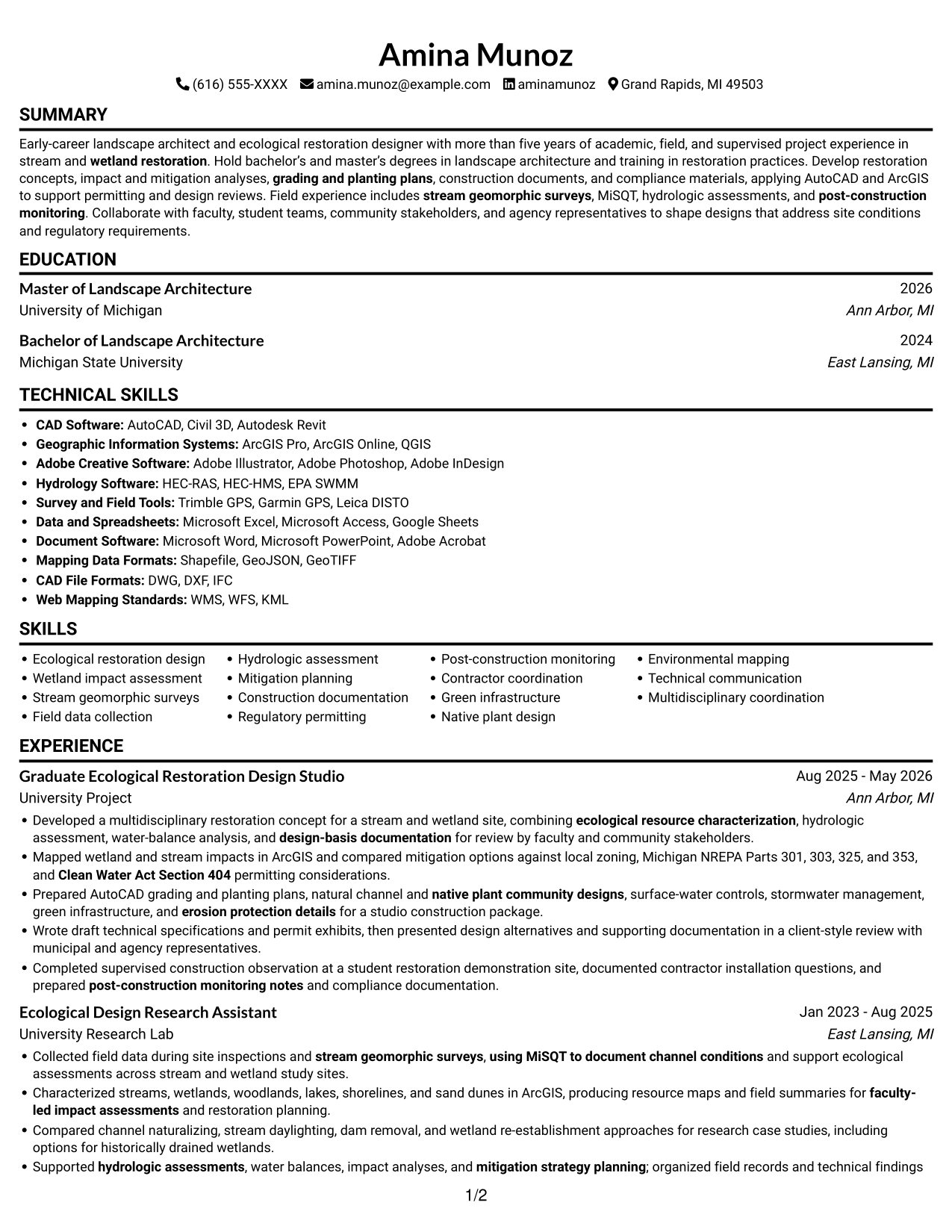
Resume example — page 1

This guide shows you how to create an Entry-Level Landscape Architect / Ecological Restoration Designer resume that presents your experience clearly. You will learn how to organize relevant evidence and choose a format that is easy to review.

A strong resume connects field work and design work to the needs of the role. Highlight stream and wetland assessments, restoration planning, construction documents, and clear project results where they apply.

The example is presented in 7 layouts, so you can compare how different designs organize the same resume content. You will also find guidance on ATS readability and role-specific terms such as MiSQT, AutoCAD, ArcGIS, hydrologic assessment, and permitting.

What Makes a Great Entry-Level Landscape Architect / Ecological Restoration Designer Resume in 2026

A strong resume uses clear section headings and focused bullets to show how field observations lead to restoration plans, design documents, and project support. Keep education, experience, skills, and certifications easy to find.

Use accurate terms from your work, such as wetland impact assessment, stream geomorphic surveys, MiSQT, mitigation planning, AutoCAD, and post-construction monitoring. Add specific results when you can support them with evidence.

Note: Resume examples are for educational purposes only. Use only information that accurately reflects your experience and qualifications. References to real organizations do not imply affiliation or endorsement.

#1 Simple One Column Format Resume Example

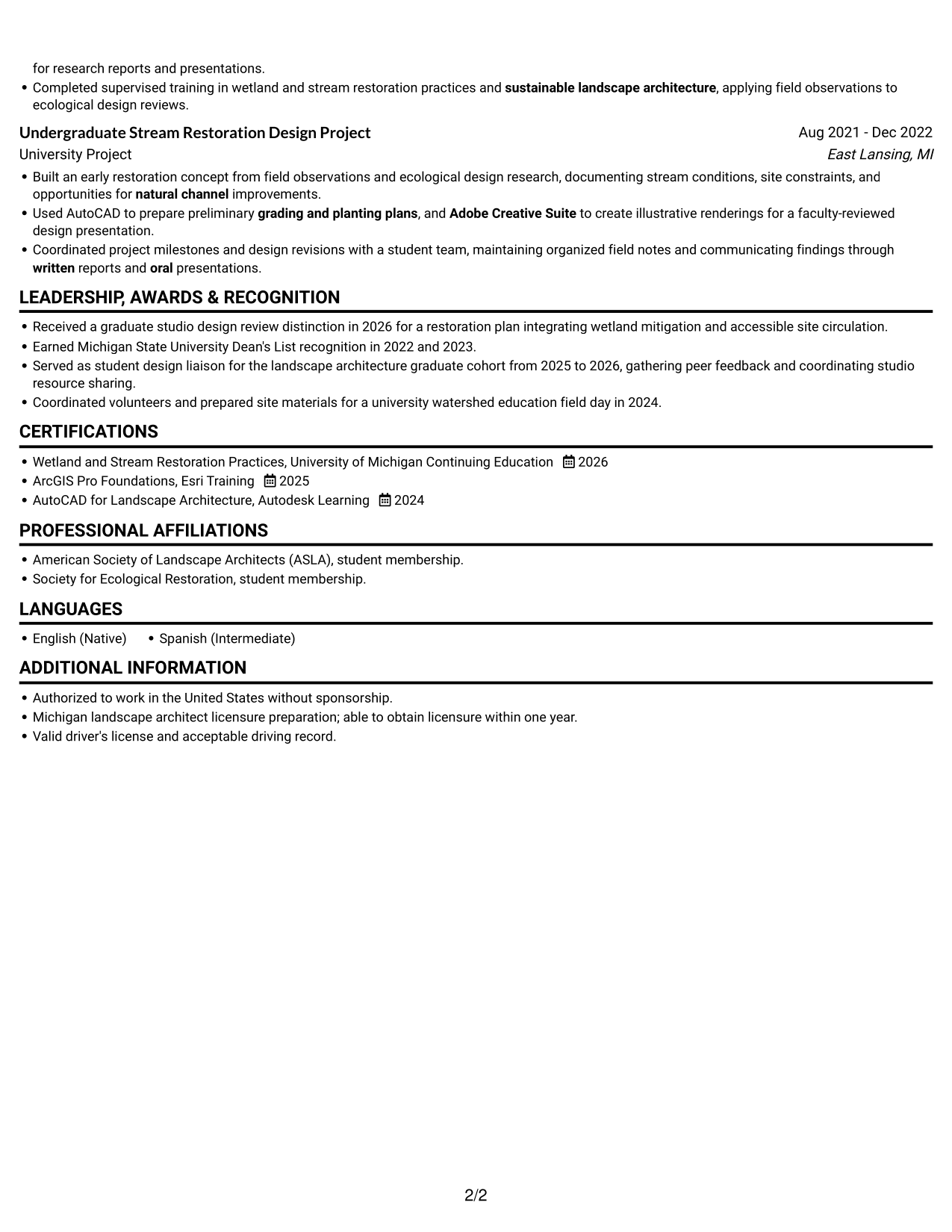
The Simple One Column Format keeps resume content in one reading path, a practical choice for reviewers who prefer a straightforward scan.
 
Resume example — page 1   Resume example — page 2

Why This Format Works

  • Experience bullets can show project work from assessment through design and documentation.
  • Education and training remain easy to locate as separate resume sections.
  • Full-width lines leave room for detailed project methods and outcomes.

Best For

  • Straightforward resume review
  • Detailed project descriptions
  • Education alongside applied work
  • Several technical skill areas
  • Academic and supervised project evidence

Resume Keywords

  • Bachelor of Landscape Architecture
  • Michigan landscape architect licensure preparation; able to obtain licensure within one year.
  • more than five years of academic, field, and supervised project experience in stream and wetland restoration
  • Wetland impact assessment
  • Ecological restoration design
  • Prepared AutoCAD grading and planting plans, natural channel and native plant community designs, surface-water controls, stormwater management, green infrastructure, and erosion protection details for a studio construction package.
  • construction observation
  • AutoCAD
  • Master of Landscape Architecture
  • Wetland and Stream Restoration Practices, University of Michigan Continuing Education
  • stream geomorphic surveys
  • using MiSQT to document channel conditions
  • Collected field data during site inspections
  • ecological resource characterization
  • hydrologic assessments
See all keywords
 

#2 Simple Two Column Format Resume Example

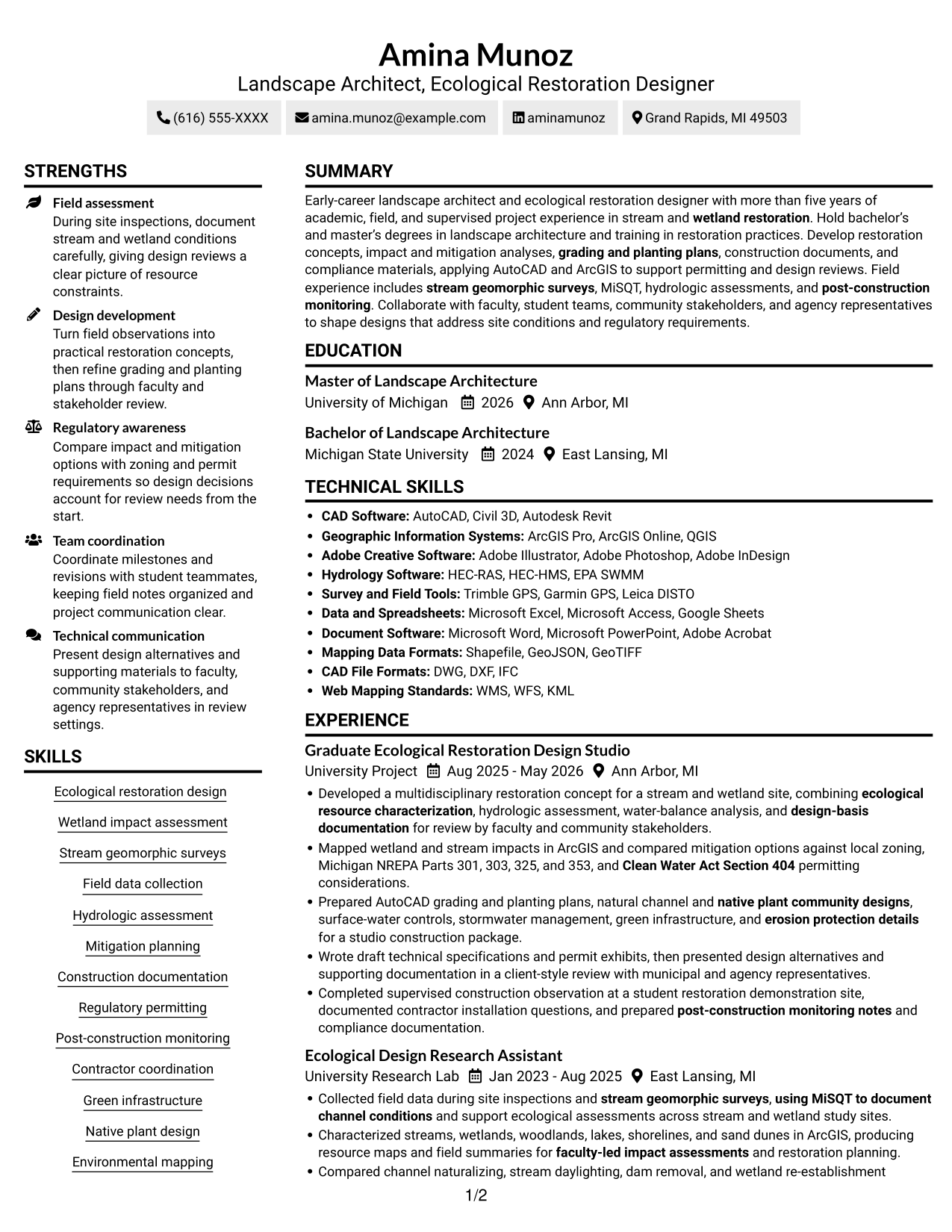
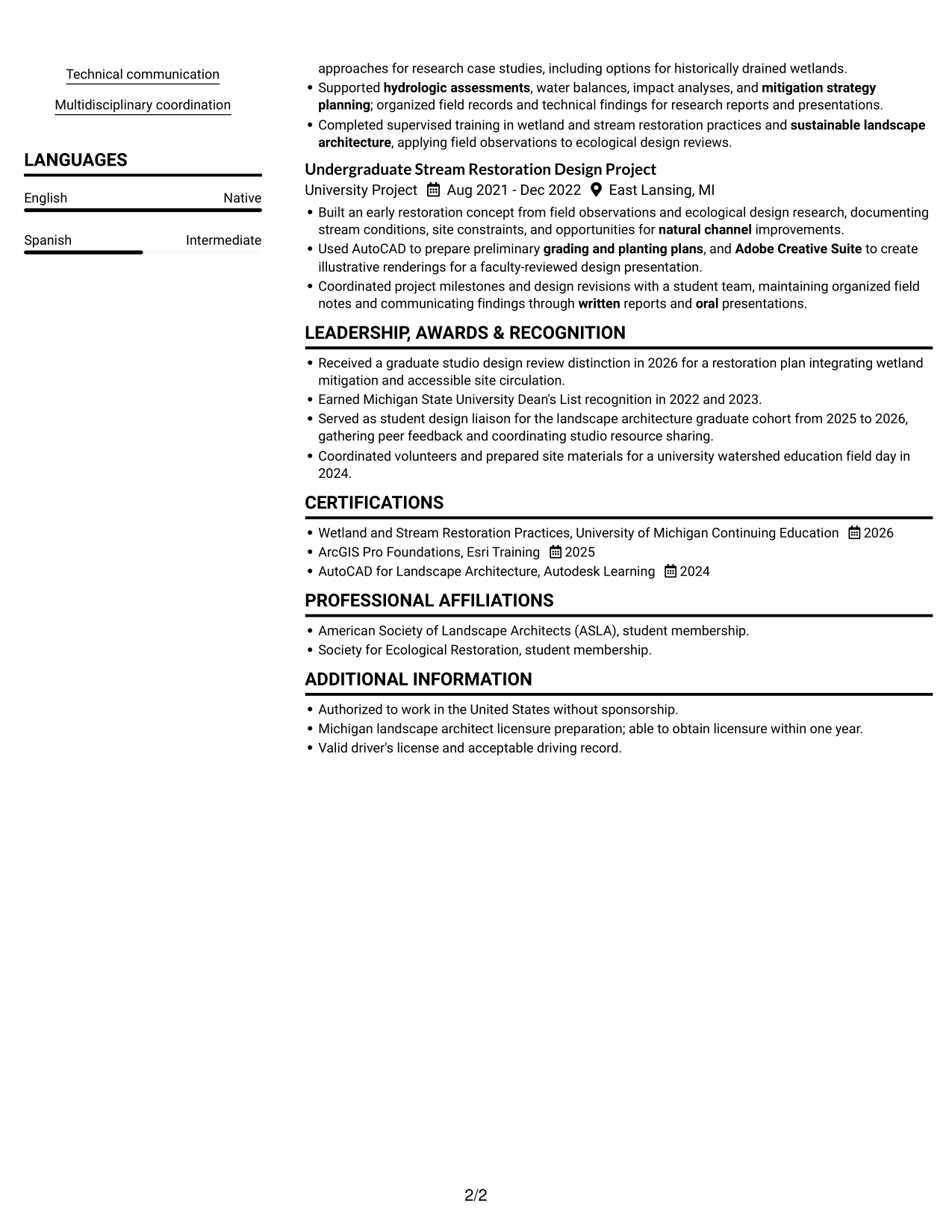
The Simple Two Column Format organizes resume information in parallel areas, giving reviewers a clear way to scan detailed experience and supporting qualifications.
 
Resume example — page 1   Resume example — page 2

Why This Format Works

  • Separate content areas help distinguish project history from other resume sections.
  • Project bullets can retain detail without extending every section into one long block.
  • Reviewers can move between education, credentials, and experience as needed.

Best For

  • Parallel content organization
  • Detailed experience with supporting sections
  • Education and credentials in the same resume
  • Several types of project evidence
  • Readers who prefer divided content areas

#3 Plain One Column with Shaded Labels Resume Example

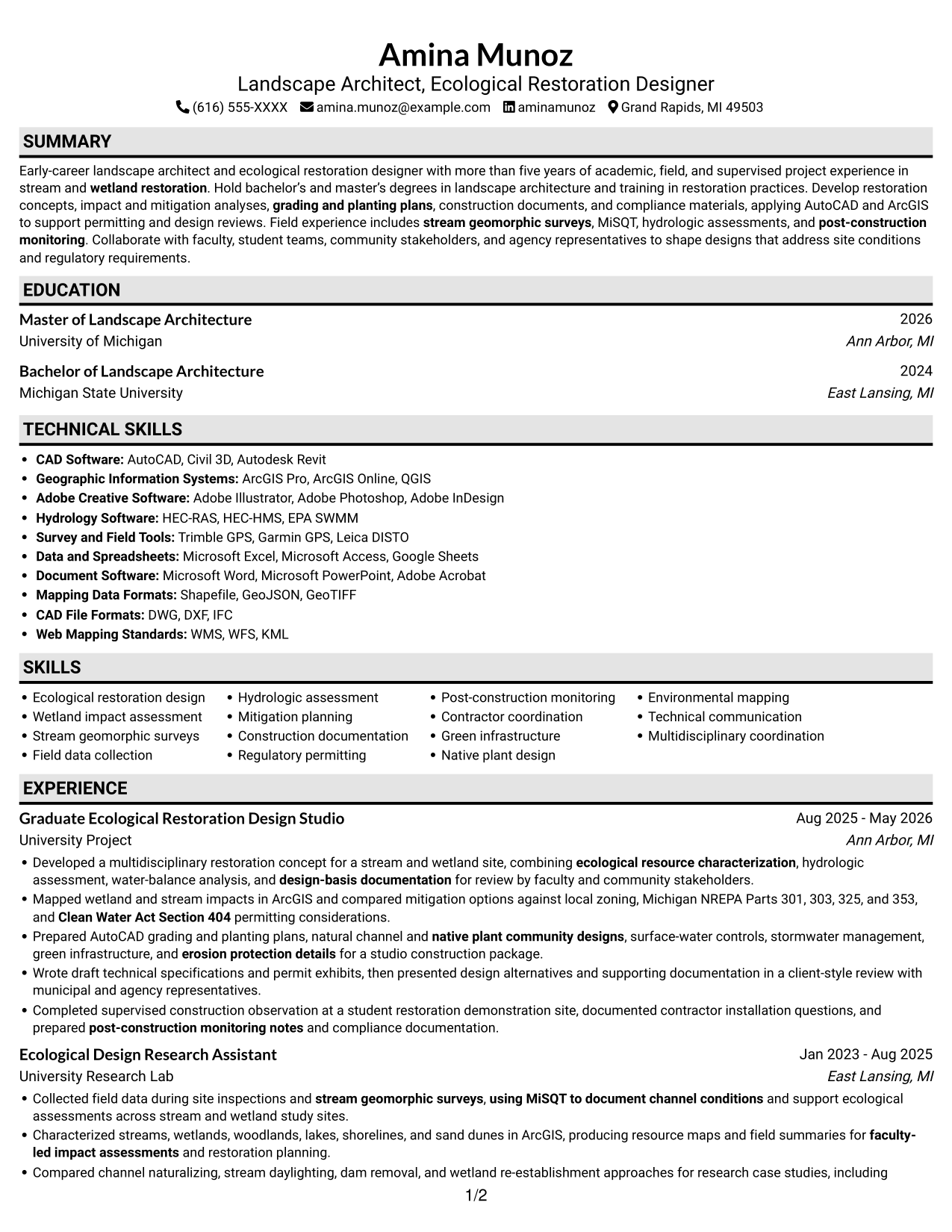
The Plain One Column with Shaded Labels format keeps the resume in a single reading path, suited to readers who want project details and qualifications together.
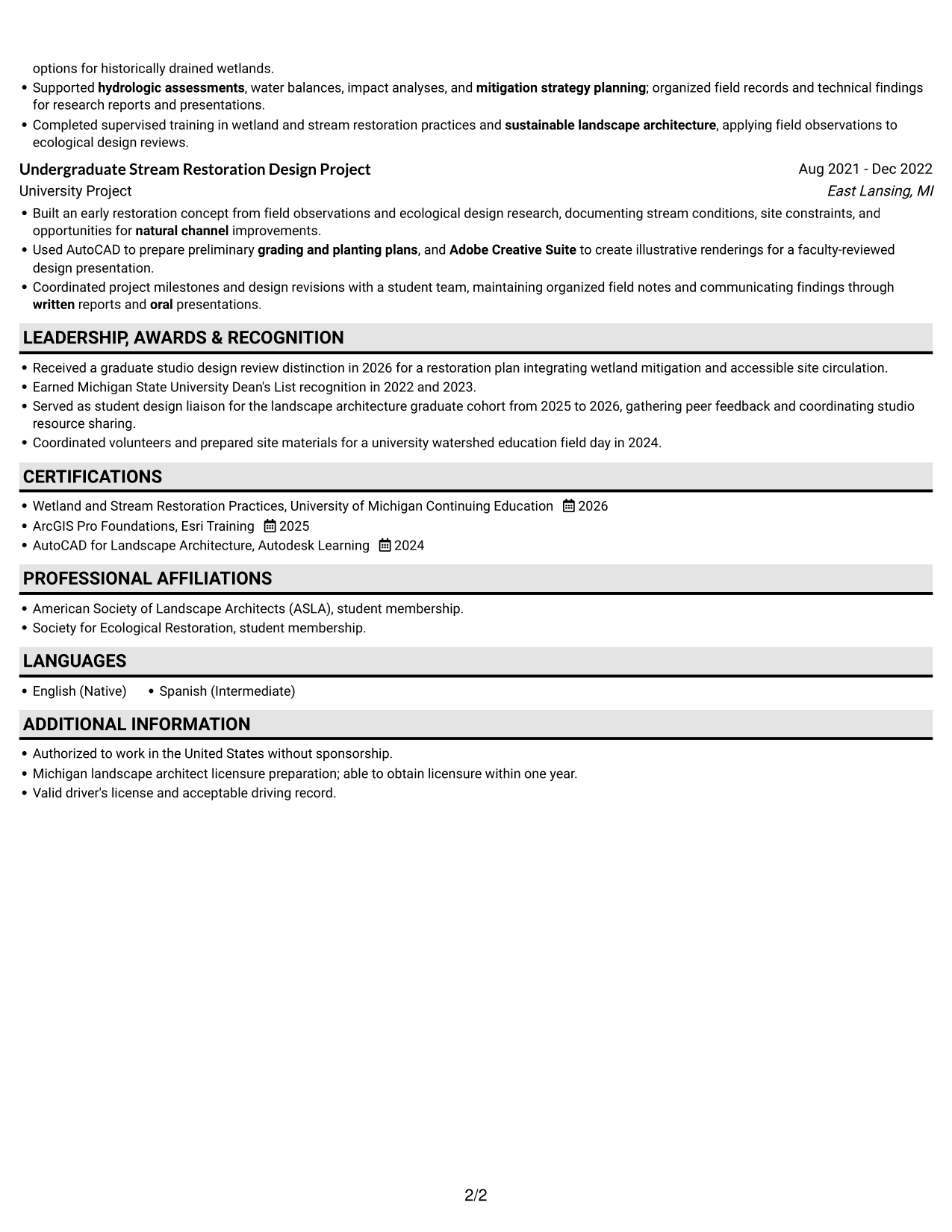
 
Resume example — page 1   Resume example — page 2

Why This Format Works

  • A single-column body lets reviewers follow experience without switching between content areas.
  • Project descriptions have room to explain methods, plans, and documentation.
  • Education and credentials can remain distinct from the longer experience entries.

Best For

  • One-direction resume reading
  • Detailed project descriptions
  • Experience entries with several stages
  • Separate education and credentials sections
  • Technical content with supporting qualifications
 

#4 One Column Format with Photo Right Resume Example

The One Column Format with Photo Right places the photo to the right of a single-column resume, keeping written sections together while giving the image a defined place.
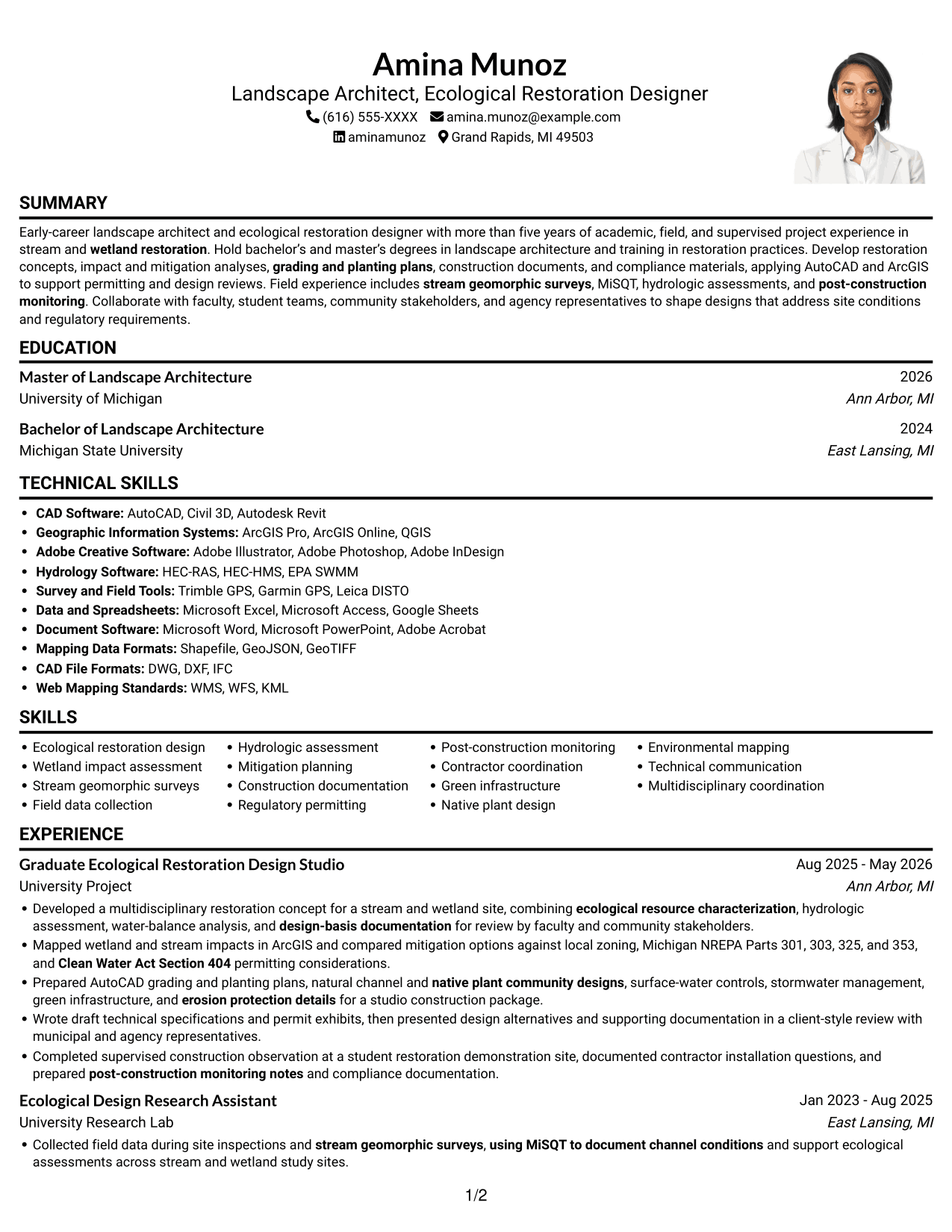
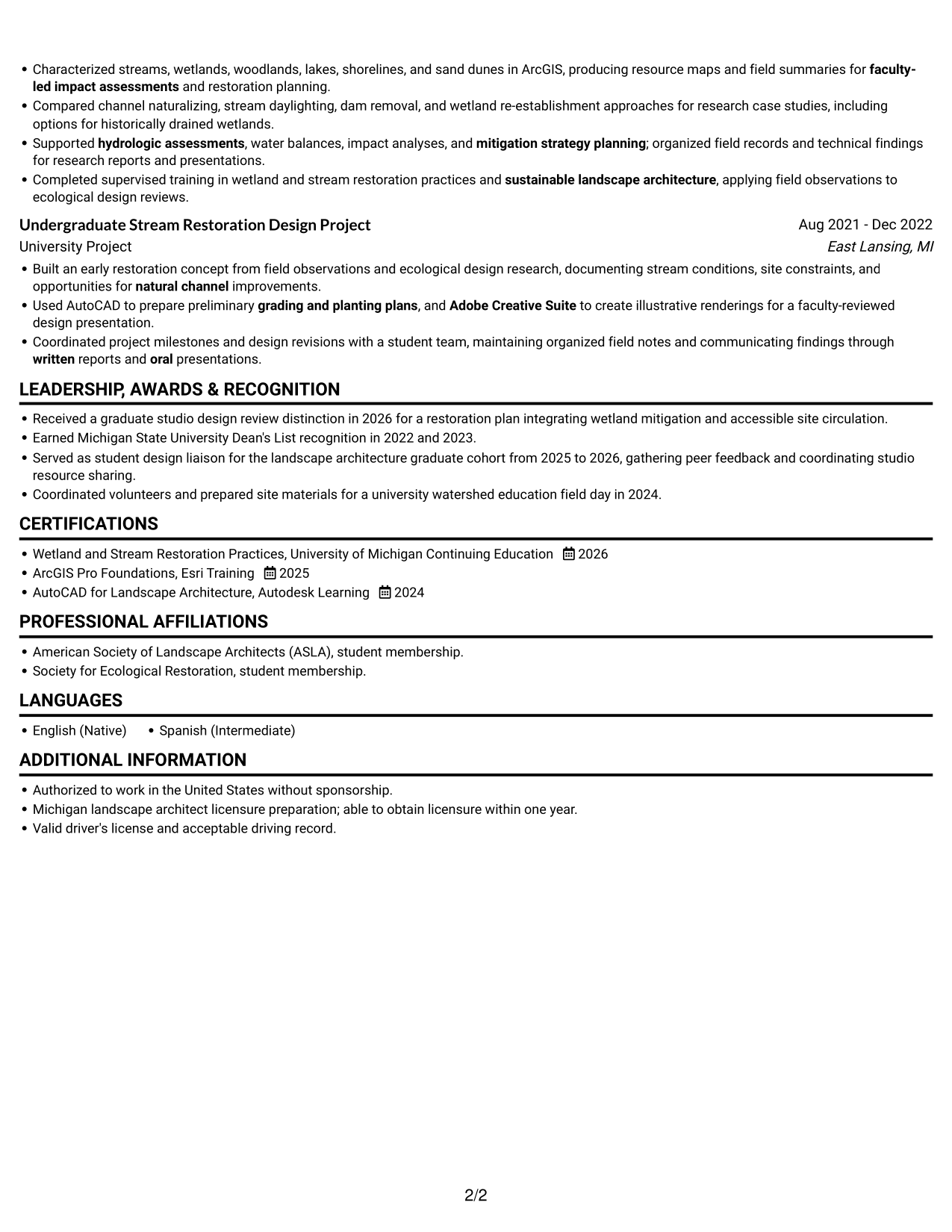
 
Resume example — page 1   Resume example — page 2

Why This Format Works

  • The single-column body gives longer project entries room to remain readable.
  • Reviewers can follow experience, education, and training in one consistent direction.
  • The photo stays visually separate from the written qualifications and evidence.

Best For

  • Single-path resume reading
  • A resume that includes a photo
  • Longer project entries
  • Experience and education in one flow
  • Written qualifications kept together
 

#5 Clean Two Column Sidebar Format Resume Example

The Clean Two Column Sidebar Format uses a two-column arrangement to give different resume sections distinct areas, useful when the document combines detailed experience with supporting information.
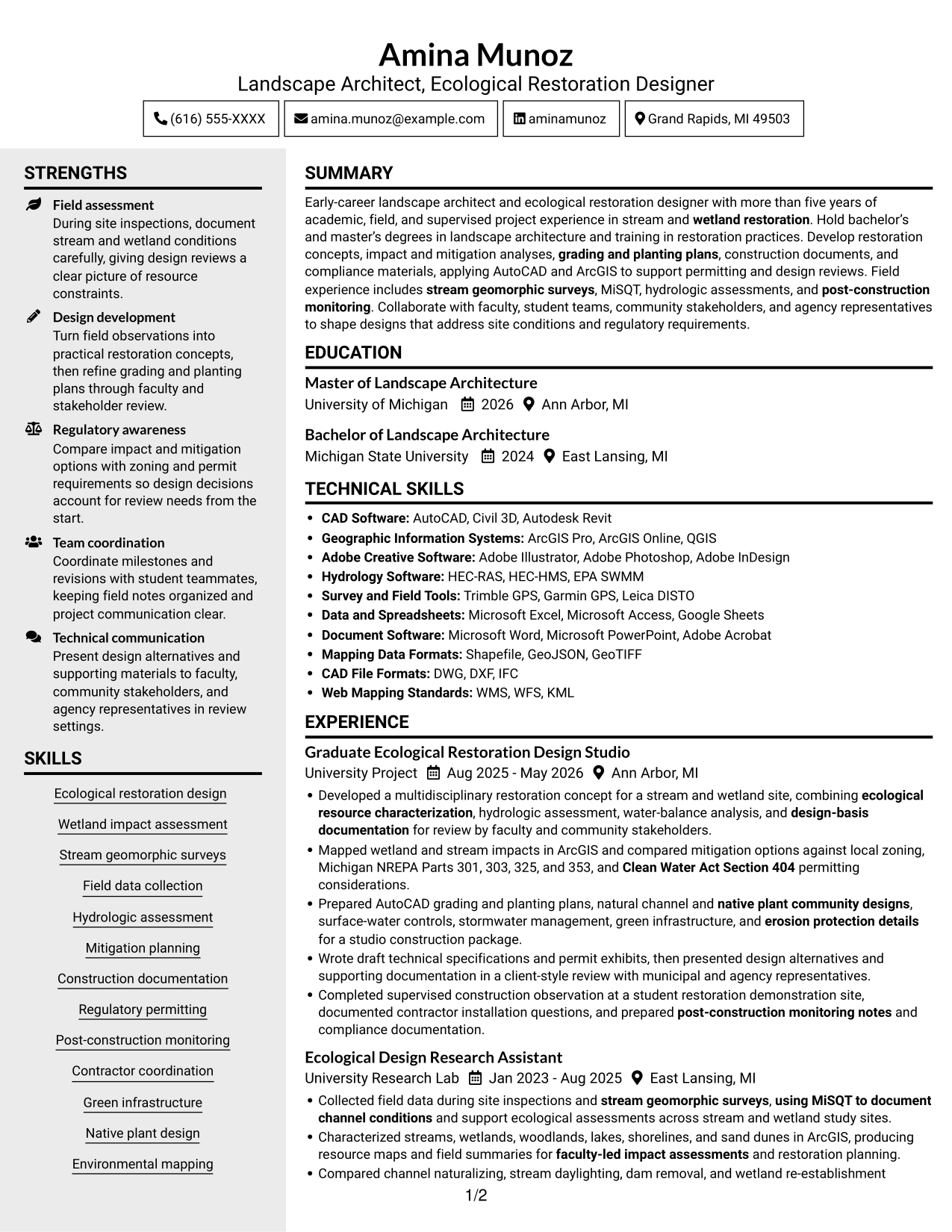
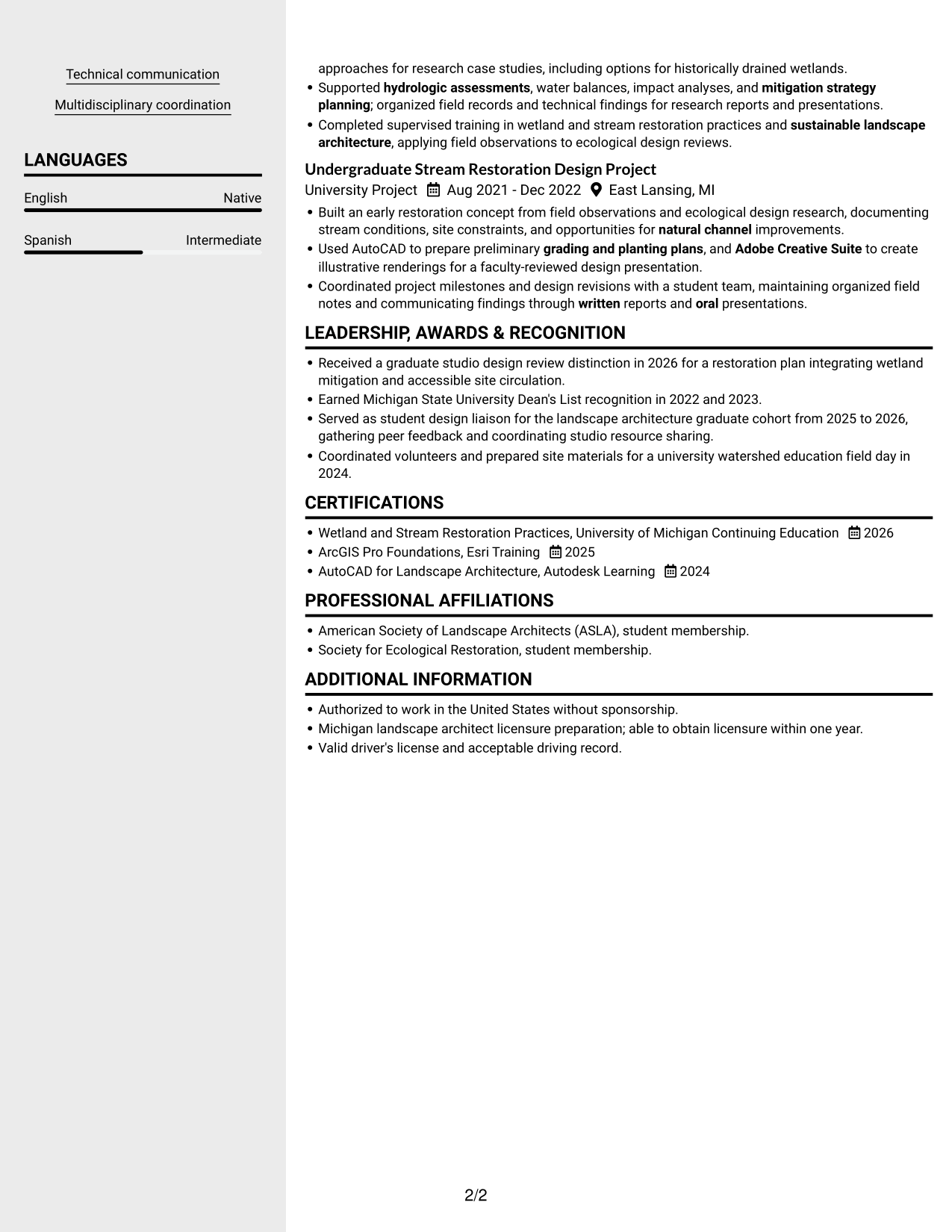
 
Resume example — page 1   Resume example — page 2

Why This Format Works

  • Separate areas help reviewers find experience and supporting sections without blending them together.
  • The two-column reading order makes room for both project detail and qualifications.
  • Education and credentials can stay easy to distinguish from experience bullets.

Best For

  • Resume content divided into two areas
  • Detailed project history with supporting information
  • Multiple education and credential entries
  • A mix of experience and technical sections
  • Readers who prefer clearly separated content


#6 Two Column Format Resume Example

The Two Column Format separates resume content into parallel areas, offering a compact way to present project history alongside other qualifications.
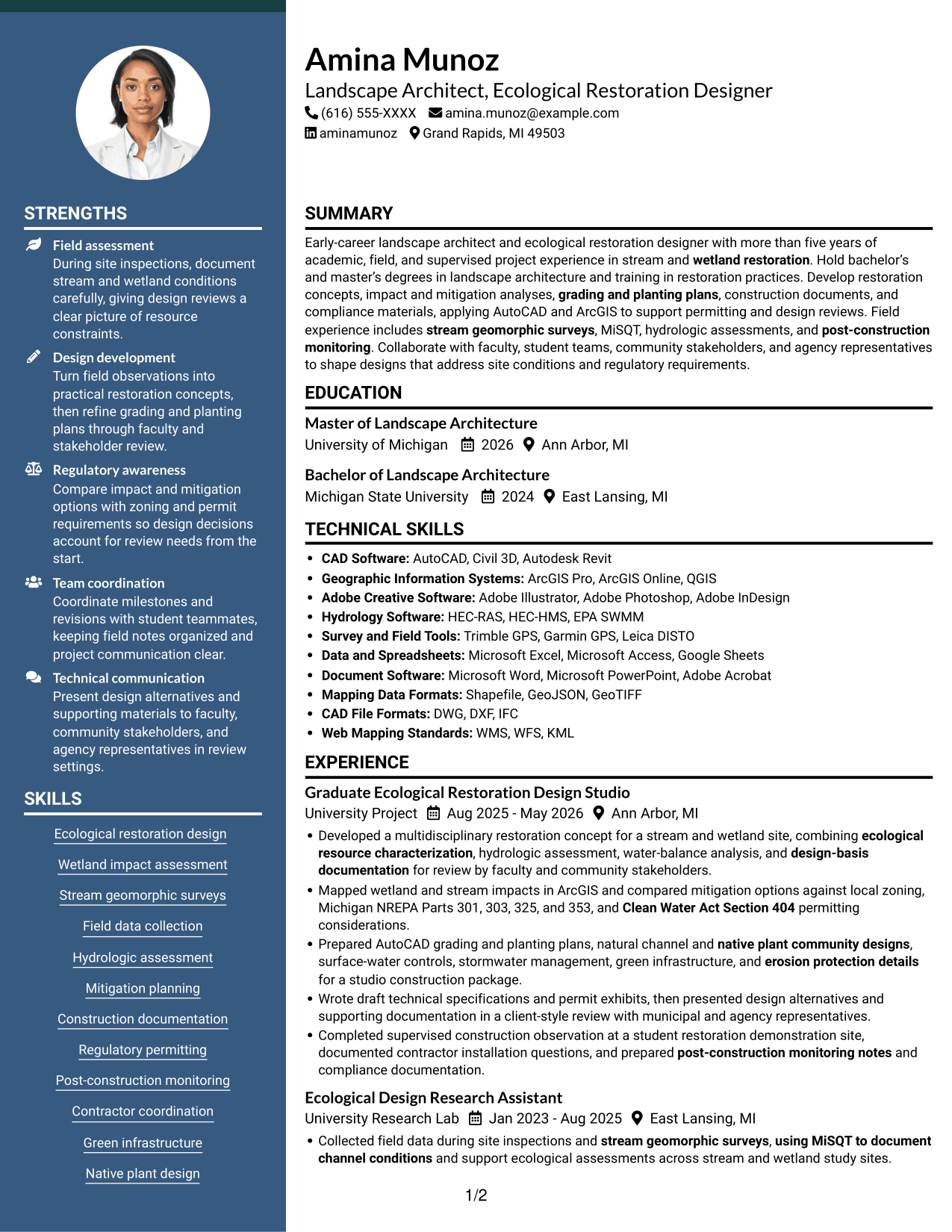
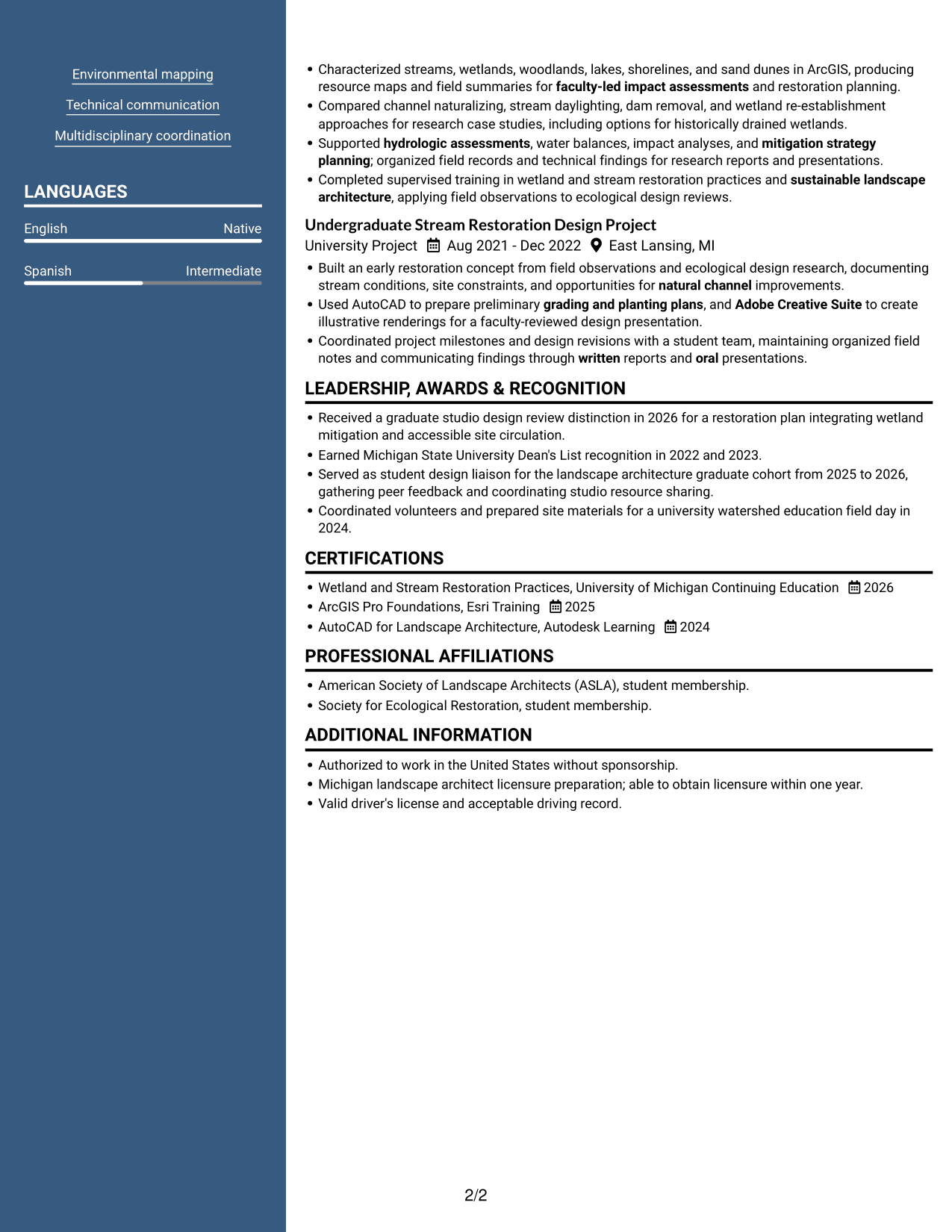
 
Resume example — page 1   Resume example — page 2

Why This Format Works

  • Parallel content areas give project experience and supporting sections distinct visual boundaries.
  • Reviewers can scan technical qualifications without losing the context of experience.
  • Education and training remain easy to distinguish from project descriptions.

Best For

  • Parallel resume sections
  • Project history with supporting qualifications
  • Several technical and academic sections
  • Experience entries with supporting details
  • Readers who scan by content area
 

#7 Photo Header Two Column Format Resume Example

The Photo Header Two Column Format combines a photo in the header with two-column resume content, giving the image a clear place above the divided sections.
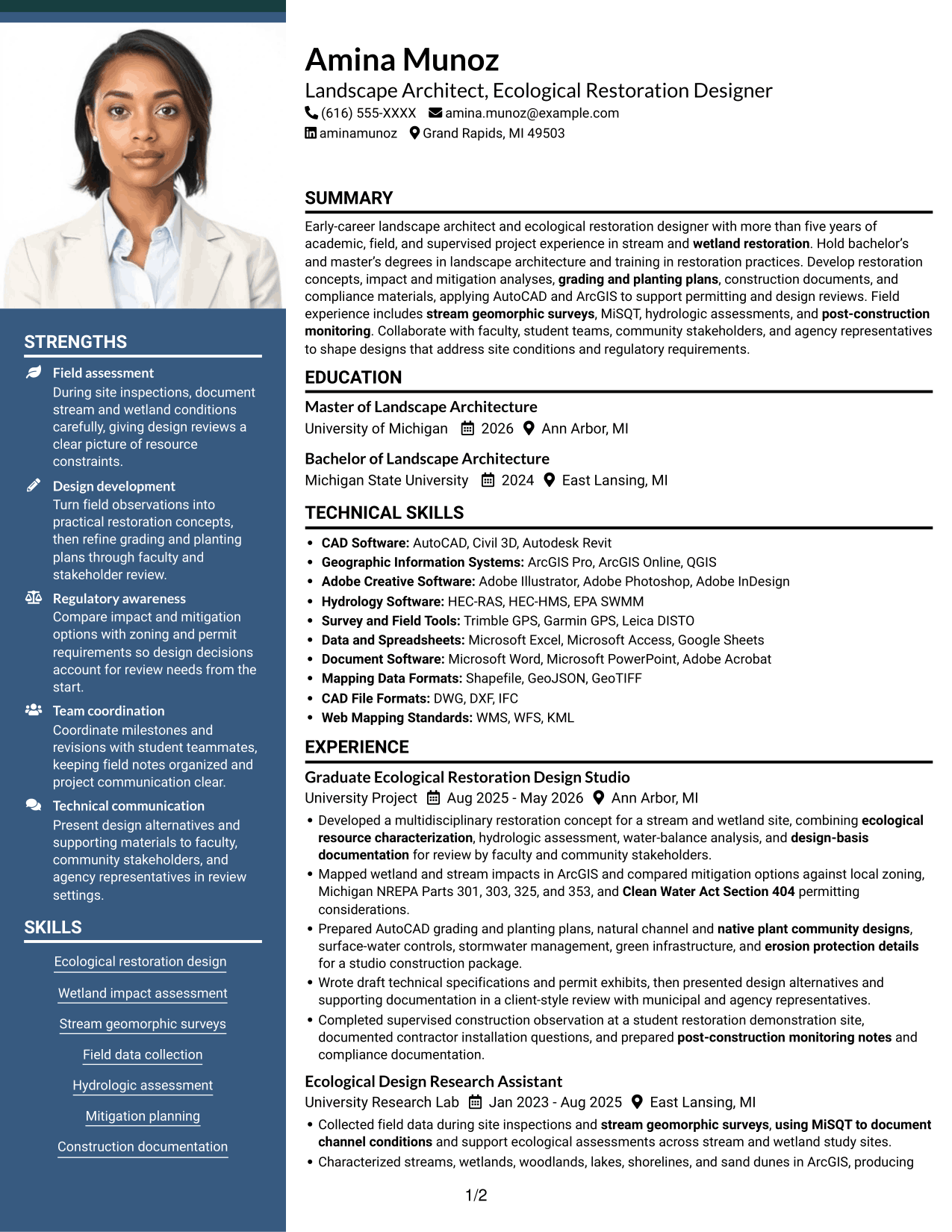
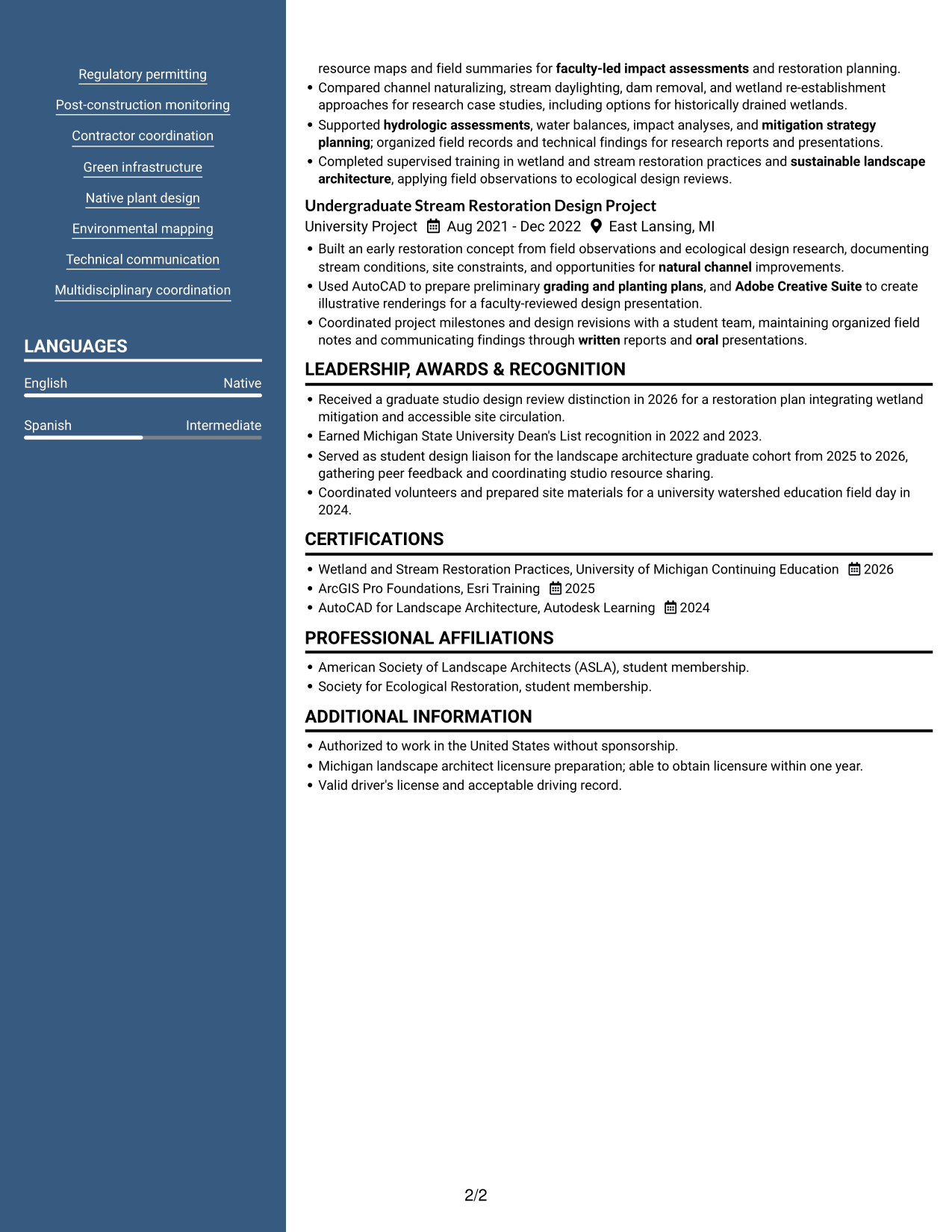
 
Resume example — page 1   Resume example — page 2

Why This Format Works

  • Two-column organization gives experience and supporting sections separate areas for review.
  • The header photo stays apart from the written project evidence and qualifications.
  • Parallel sections let reviewers compare education and experience without following one long text block.

Best For

  • Two-column resume organization
  • A photo in the header
  • Experience paired with supporting sections
  • Several education and credential details
  • Readers who prefer divided content and a clear header


See Also


Frequently Asked Questions

Are these Entry-Level Landscape Architect / Ecological Restoration Designer resume templates ATS-friendly?

The examples use readable sections and familiar resume headings. For stronger ATS matching, include relevant terms that accurately reflect your background, such as wetland impact assessment, stream geomorphic surveys, MiSQT, AutoCAD, ArcGIS, and construction documentation.

Does this guide show one resume in different layouts?

Yes. The examples let you compare different presentations of a resume, so you can choose a layout that makes your qualifications easy to scan.

What should an Entry-Level Landscape Architect / Ecological Restoration Designer resume include?

Include a focused summary, education, relevant experience or projects, technical skills, and certifications. Show field assessments, restoration design tasks, permitting support, construction documents, and monitoring work when they match your experience.

How can I show ecological restoration experience clearly?

Use concise bullets that explain the task, your contribution, and the result. For example, describe how you collected field data, mapped resources in ArcGIS, prepared grading and planting plans in AutoCAD, or documented monitoring and compliance.

Which resume format works well for this role?

Choose a clean layout with familiar headings and a clear reading order. A straightforward one-column design is easy to scan, while a simple two-column design can also work if important details remain easy to find.

Should I include a photo on my resume?

For U.S. applications, a resume without a photo is generally the safer choice. Use a photo only when it is expected in your location or field.

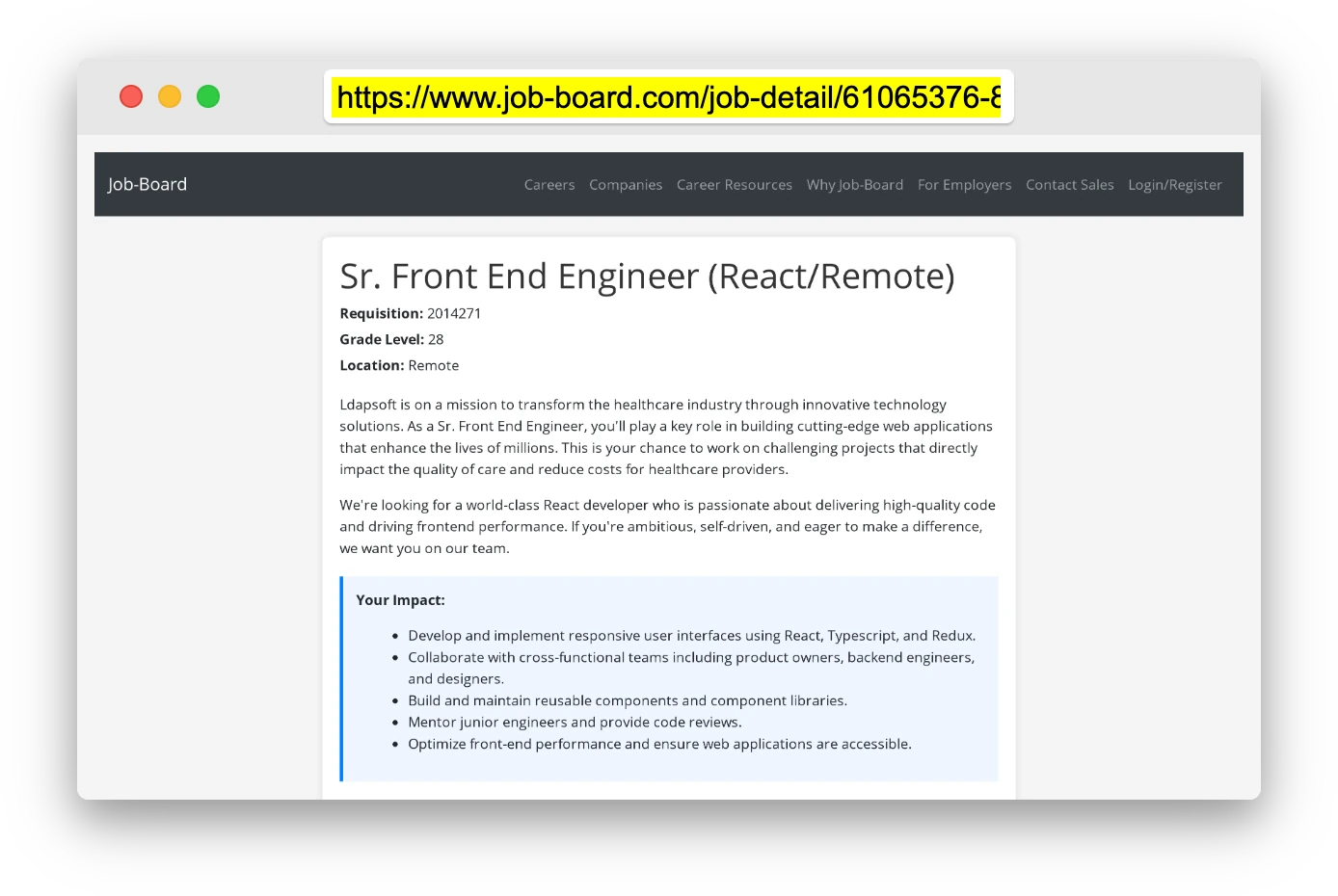
ATS Score 95%

How we calculate this score

  • Keywords: 60% of the total. AI extracts keywords from your job description. If you do not provide one, a standard job description for the title matching your resume is used. This is not a match to a specific vacancy.
  • Text-based resume: 20%. The text resume assessed here receives 100 for this part.
  • Resume quality: 20%. We start at 100 and subtract points for issues found by our resume checks, down to a minimum of zero.
  • Keyword coverage = round(100 × confirmed matches ÷ total keywords). Exact matches and supported equivalents verified by AI receive full credit; unsupported keywords receive none. Live text checks use the saved equivalents and do not request a new AI review. Without keywords, no overall ATS score is available.
  • Final score = 60% of keyword coverage + 20% of the text score + 20% of the quality score, rounded to a whole number. Without keywords, no overall ATS score is available.

What this score means

Our scores are estimates, not employer ratings. They may contain errors and do not guarantee accurate parsing, a ranking, an interview, or a job. Check your document against the employer’s requirements. You are responsible for relying on this score.

Terms and Conditions

Score weights: Keywords 60% · Text based resume 20% · Resume quality 20%

Keyword coverage: 43 of 47 (91%) · Resume quality: 100%

Resume quality 100% · Weight 20% · Issues (0)

Details
  • ✓Name present: Amina Munoz
  • ✓Email format: amina.munoz@example.com
  • ✓Phone format: (616) 555-XXXX
  • ✓Experience 1: Job title: Graduate Ecological Restoration Design Studio
  • ✓Experience 1: Company name: University Project
  • ✓Experience 1: Work location: Ann Arbor, MI
  • ✓Experience 1: Employment dates: Aug 2025 - May 2026
  • ✓Experience 1: Description or achievements: Present
  • ✓Experience 2: Job title: Ecological Design Research Assistant
  • ✓Experience 2: Company name: University Research Lab
  • ✓Experience 2: Work location: East Lansing, MI
  • ✓Experience 2: Employment dates: Jan 2023 - Aug 2025
  • ✓Experience 2: Description or achievements: Present
  • ✓Experience 3: Job title: Undergraduate Stream Restoration Design Project
  • ✓Experience 3: Company name: University Project
  • ✓Experience 3: Work location: East Lansing, MI
  • ✓Experience 3: Employment dates: Aug 2021 - Dec 2022
  • ✓Experience 3: Description or achievements: Present
  • ✓No placeholder fields
  • ✓No repeated achievement bullets
  • ✓No empty bullets

No issues found by the current checks.

Text Based Resume 100% · Weight 20%

Parsed text
Amina Munoz
(616) 555-XXXX
amina.munoz@example.com
aminamunoz
Grand Rapids, MI 49503
SUMMARY
Early-career landscape architect and ecological restoration designer with more than five years of academic, field, and supervised project experience in stream and wetland restoration. Hold bachelor’s and master’s degrees in landscape architecture and training in restoration practices. Develop restoration concepts, impact and mitigation analyses, grading and planting plans, construction documents, and compliance materials, applying AutoCAD and ArcGIS to support permitting and design reviews. Field experience includes stream geomorphic surveys, MiSQT, hydrologic assessments, and post-construction monitoring. Collaborate with faculty, student teams, community stakeholders, and agency representatives to shape designs that address site conditions and regulatory requirements.
EDUCATION
Master of Landscape Architecture
2026
University of Michigan
Ann Arbor, MI
Bachelor of Landscape Architecture
2024
Michigan State University
East Lansing, MI
TECHNICAL SKILLS
CAD Software: AutoCAD, Civil 3D, Autodesk Revit
Geographic Information Systems: ArcGIS Pro, ArcGIS Online, QGIS
Adobe Creative Software: Adobe Illustrator, Adobe Photoshop, Adobe InDesign
Hydrology Software: HEC-RAS, HEC-HMS, EPA SWMM
Survey and Field Tools: Trimble GPS, Garmin GPS, Leica DISTO
Data and Spreadsheets: Microsoft Excel, Microsoft Access, Google Sheets
Document Software: Microsoft Word, Microsoft PowerPoint, Adobe Acrobat
Mapping Data Formats: Shapefile, GeoJSON, GeoTIFF
CAD File Formats: DWG, DXF, IFC
Web Mapping Standards: WMS, WFS, KML
SKILLS
Ecological restoration design
Wetland impact assessment
Stream geomorphic surveys
Field data collection
Hydrologic assessment
Mitigation planning
Construction documentation
Regulatory permitting
Post-construction monitoring
Contractor coordination
Green infrastructure
Native plant design
Environmental mapping
Technical communication
Multidisciplinary coordination
EXPERIENCE
Graduate Ecological Restoration Design Studio
Aug 2025 - May 2026
University Project
Ann Arbor, MI
Developed a multidisciplinary restoration concept for a stream and wetland site, combining ecological resource characterization, hydrologic assessment, water-balance analysis, and design-basis documentation for review by faculty and community stakeholders.
Mapped wetland and stream impacts in ArcGIS and compared mitigation options against local zoning, Michigan NREPA Parts 301, 303, 325, and 353, and Clean Water Act Section 404 permitting considerations.
Prepared AutoCAD grading and planting plans, natural channel and native plant community designs, surface-water controls, stormwater management, green infrastructure, and erosion protection details for a studio construction package.
Wrote draft technical specifications and permit exhibits, then presented design alternatives and supporting documentation in a client-style review with municipal and agency representatives.
Completed supervised construction observation at a student restoration demonstration site, documented contractor installation questions, and prepared post-construction monitoring notes and compliance documentation.
Ecological Design Research Assistant
Jan 2023 - Aug 2025
University Research Lab
East Lansing, MI
Collected field data during site inspections and stream geomorphic surveys, using MiSQT to document channel conditions and support ecological assessments across stream and wetland study sites.
Characterized streams, wetlands, woodlands, lakes, shorelines, and sand dunes in ArcGIS, producing resource maps and field summaries for faculty-led impact assessments and restoration planning.
Compared channel naturalizing, stream daylighting, dam removal, and wetland re-establishment approaches for research case studies, including options for historically drained wetlands.
Supported hydrologic assessments, water balances, impact analyses, and mitigation strategy planning; organized field records and technical findings for research reports and presentations.
Completed supervised training in wetland and stream restoration practices and sustainable landscape architecture, applying field observations to ecological design reviews.
Undergraduate Stream Restoration Design Project
Aug 2021 - Dec 2022
University Project
East Lansing, MI
Built an early restoration concept from field observations and ecological design research, documenting stream conditions, site constraints, and opportunities for natural channel improvements.
Used AutoCAD to prepare preliminary grading and planting plans, and Adobe Creative Suite to create illustrative renderings for a faculty-reviewed design presentation.
Coordinated project milestones and design revisions with a student team, maintaining organized field notes and communicating findings through written reports and oral presentations.
LEADERSHIP, AWARDS & RECOGNITION
Received a graduate studio design review distinction in 2026 for a restoration plan integrating wetland mitigation and accessible site circulation.
Earned Michigan State University Dean's List recognition in 2022 and 2023.
Served as student design liaison for the landscape architecture graduate cohort from 2025 to 2026, gathering peer feedback and coordinating studio resource sharing.
Coordinated volunteers and prepared site materials for a university watershed education field day in 2024.
CERTIFICATIONS
Wetland and Stream Restoration Practices, University of Michigan Continuing Education
2026
ArcGIS Pro Foundations, Esri Training
2025
AutoCAD for Landscape Architecture, Autodesk Learning
2024
PROFESSIONAL AFFILIATIONS
American Society of Landscape Architects (ASLA), student membership.
Society for Ecological Restoration, student membership.
LANGUAGES
English (Native)
Spanish (Intermediate)
ADDITIONAL INFORMATION
Authorized to work in the United States without sponsorship.
Michigan landscape architect licensure preparation; able to obtain licensure within one year.
Valid driver's license and acceptable driving record.

Matched keywords (43)

  • Bachelor of Landscape ArchitectureOriginal keyword in JD: Bachelor's degree in Landscape Architecture OR Natural Resource Management OR Ecology OR related field
  • Michigan landscape architect licensure preparation; able to obtain licensure within one year.Original keyword in JD: Michigan landscape architect license OR ability to obtain within one year
  • more than five years of academic, field, and supervised project experience in stream and wetland restorationOriginal keyword in JD: Professional ecological design experience
  • Wetland impact assessmentOriginal keyword in JD: Wetland impact assessments
  • Ecological restoration design
  • Prepared AutoCAD grading and planting plans, natural channel and native plant community designs, surface-water controls, stormwater management, green infrastructure, and erosion protection details for a studio construction package.Original keyword in JD: Construction plans and technical specifications
  • construction observation
  • AutoCAD
  • Master of Landscape ArchitectureOriginal keyword in JD: Master's or other advanced degree in Landscape Architecture OR Natural Resource Management OR Ecology OR related field
  • Wetland and Stream Restoration Practices, University of Michigan Continuing EducationOriginal keyword in JD: Wetland and stream restoration training
  • stream geomorphic surveys
  • using MiSQT to document channel conditionsOriginal keyword in JD: Michigan stream quantification tool (MiSQT)
  • Collected field data during site inspectionsOriginal keyword in JD: Field data collection and site inspections
  • ecological resource characterizationOriginal keyword in JD: Environmental resource characterization
  • hydrologic assessments
  • water balances
  • faculty-led impact assessmentsOriginal keyword in JD: Resource impact assessment
  • mitigation strategy planningOriginal keyword in JD: Mitigation strategy development
  • design-basis documentation
  • natural channelOriginal keyword in JD: Natural stream channel design
  • wetland restoration
  • native plant community designsOriginal keyword in JD: Native plant community design
  • grading and planting plans
  • stormwater management
  • surface-water controls
  • Green infrastructure
  • erosion protection detailsOriginal keyword in JD: Erosion protection plans
  • permitting
  • Michigan NREPA Parts 301, 303, 325, and 353
  • Clean Water Act Section 404
  • Contractor coordination
  • post-construction monitoring
  • prepared post-construction monitoring notes and compliance documentationOriginal keyword in JD: Compliance documentation and reporting
  • ArcGIS
  • Adobe Creative Suite
  • sustainable landscape architecture
  • Developed a multidisciplinary restoration concept for a stream and wetland siteOriginal keyword in JD: Multidisciplinary project coordination
  • presented design alternatives and supporting documentation in a client-style review with municipal and agency representatives.Original keyword in JD: Client and permitting agency communication
  • municipal and agency representativesOriginal keyword in JD: Public official communication
  • Coordinated project milestones and design revisions with a student teamOriginal keyword in JD: Interpersonal skills
  • communicating findings through written reports and oral presentationsOriginal keyword in JD: Oral and written communication
  • Authorized to work in the United States without sponsorship.Original keyword in JD: U.S. work authorization without sponsorship
  • Valid driver's license and acceptable driving record

Missing keywords (4)

  • Organization
  • Attention to detail
  • 5+ years of professional ecological design experience
  • Fast-paced, client-driven environment
Disclaimer: All names, images, contact information, employment histories, achievements, security clearances, military credentials, and other qualifications shown in this content are fictional and used for illustrative purposes only. Any resemblance to actual persons, living or deceased, is purely coincidental.

Resume and cover-letter examples and recommendations in this article reflect general best practices and professional experience and are provided for guidance only. Results may vary based on role, industry, region, and hiring organization.

Content Accuracy and Verification: To the fullest extent permitted by applicable law, we do not represent or warrant that resume or cover-letter guidance, examples, recommendations, or related information are accurate, complete, current, error-free, or suitable for any particular purpose. You are responsible for independently reviewing and verifying the information before relying on it.

ATS and Cover-Letter Scores: ATS scores are estimates calculated using our own formula, informed by publicly available guidance on resume formatting and keyword matching. They are not scores issued or endorsed by an ATS provider or employer. Cover-letter scores are also our own assessments. Parsing, weighting, screening criteria, and results vary between systems, employers, job descriptions, and document formats. No score guarantees successful parsing, a particular ranking, an interview, or employment. Use scores as general guidance and independently check your documents against the employer’s requirements. To the fullest extent permitted by applicable law, we accept no liability for errors in scores or parsing, or losses arising from reliance on these assessments. Nothing in this notice excludes liability or limits consumer rights that cannot lawfully be excluded or limited.

Terms and Conditions
 
> JP 1 1
PDF Footer and Margins Setup
The margins are applied to the document, and the footer shows up in the preview and the PDF

Footer Font Settings

Are you applying for a specific job
so we can tailor your resume to it?
Are you applying for a specific job
so we can tailor your cover letter to it?

Your data stays private and is never used for training.Privacy Policy

Type your details as text to generate a personalized resume Type your details as text to generate a personalized cover letter
Website link found! Ready to create resume from:

Your data stays private and is never used for training.Privacy Policy

Drag the into the box to verify you're human.
Drop here

My Resumes

Displaying {number_of_files} files (out of {total_of_all_files} total)
Name File Type Last Modified: Description:

Rename File

Filename already exists!

Delete Files

Warning: This action is irreversible. Once you click submit, the files will be permanently deleted.

Heading text
Upload From Computer Upload
Select From Existing
LinkedIn
Drag & Drop files anywhere in this tab, or

Uploaded Files

Delete Name Last Updated Use This File
Select this to use the file for generating your resume and cover letter. Only one source—uploaded file, selected file, or LinkedIn text—can be used.

My Files

Resumes or cover letters you create will appear here. No files available yet.
Delete Name Last Updated Use This File
Select this to use the file for generating your resume and cover letter. Only one source—uploaded file, selected file, or LinkedIn text—can be used.

Add LinkedIn Profile PDF

You can download your LinkedIn profile as a PDF by opening linkedin.com in a web browser, clicking your profile photo, selecting the “More” or “Resources” button, and choosing “Save to PDF.” You can then attach the PDF using the Upload From Computer tab.

Paste Your LinkedIn Profile Text

If you have copied the LinkedIn profile text, paste it below. See how to copy your profile from LinkedIn

Select this to use the LinkedIn profile text for generating your resume and cover letter. Only one source—uploaded file, selected file, or LinkedIn text—can be used.

Try these controls

<
>