33 Entry Level Sales Representative Resume Templates with Example 2026 (ATS-Optimized)
This guide shows you how to build an Entry Level Sales Representative resume that is clear, focused, and easy to adapt. You will learn how to present your sales evidence so recruiters can quickly see your customer value and readiness to follow a structured sales process.
Strong resumes for this role connect customer discovery, consultative selling, presentations, negotiation, objection handling, and follow-up planning to clear results. They also use concise bullet points to show how you worked with homeowners, explained energy-efficient remodeling solutions, documented customer information, and applied coaching.
Below, you’ll find an Entry Level Sales Representative resume example presented in 33 ATS-friendly resume layouts. Compare the formats to choose a professional design, then use the section guidance to strengthen your summary, experience, skills, education, certifications, and projects.
What Makes a Great Entry Level Sales Representative Resume in 2026
Effective resumes are focused, evidence-based, and easy to scan. They show communication, customer discovery, presentations, needs analysis, and follow-through through specific actions and measurable details.
Use keywords such as consultative selling, energy-efficient remodeling, negotiation, objection handling, CRM documentation, product knowledge, customer relationships, follow-up planning, and performance goals when they accurately reflect your background.
The examples shown below are intentionally detailed to demonstrate a range of experiences, skills, accomplishments and relevant keywords. We prefer detailed resumes as they provide more context to the hiring managers and also help the ATS systems identify relevant qualifications and score your resume better for a match. But the length of a resume is an individual choice. If you want a one page resume, just keep the most relevant experience and information for the job. Note: Resume examples are created for educational purposes; references to real organizations do not imply affiliation or endorsement.
#1 Simple One Column Format Resume Example
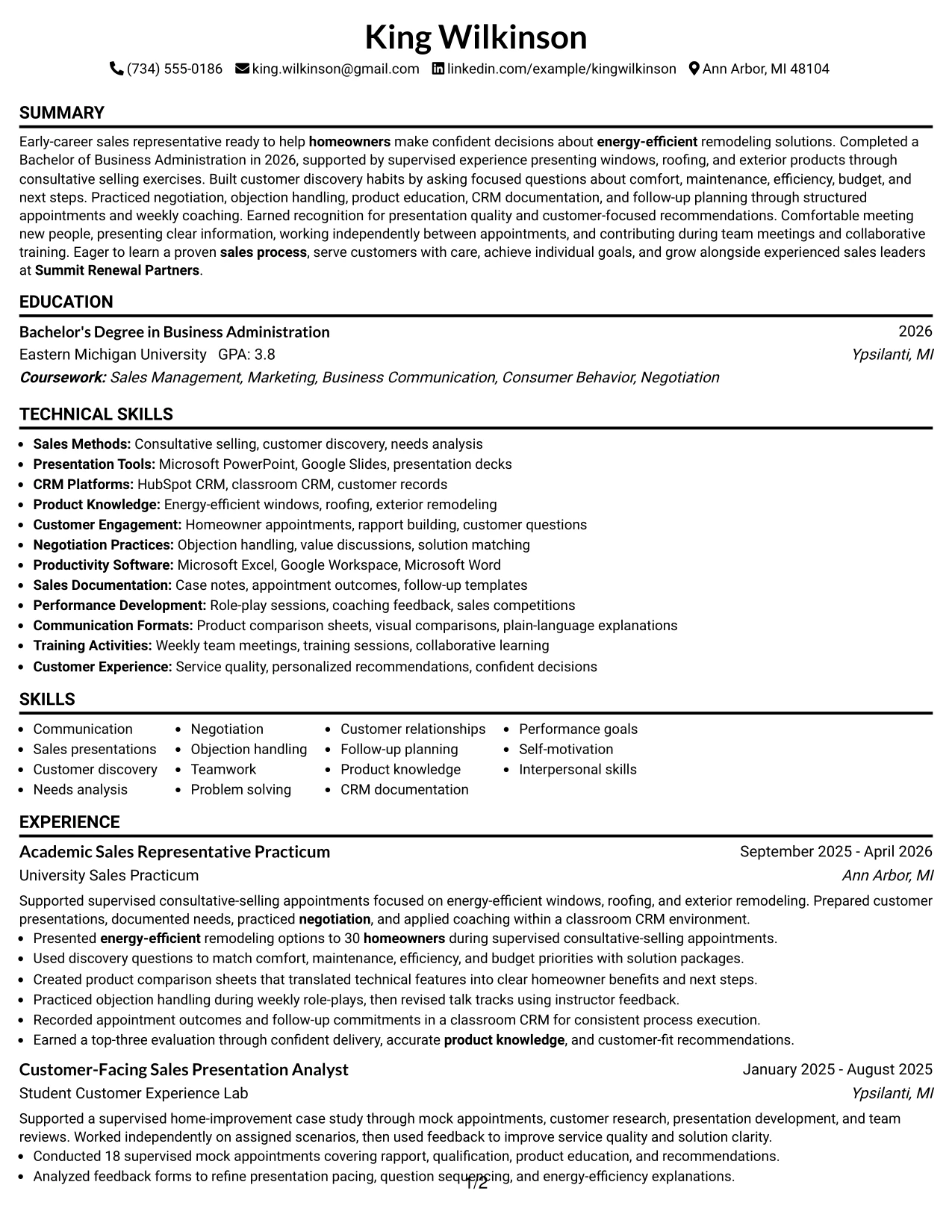
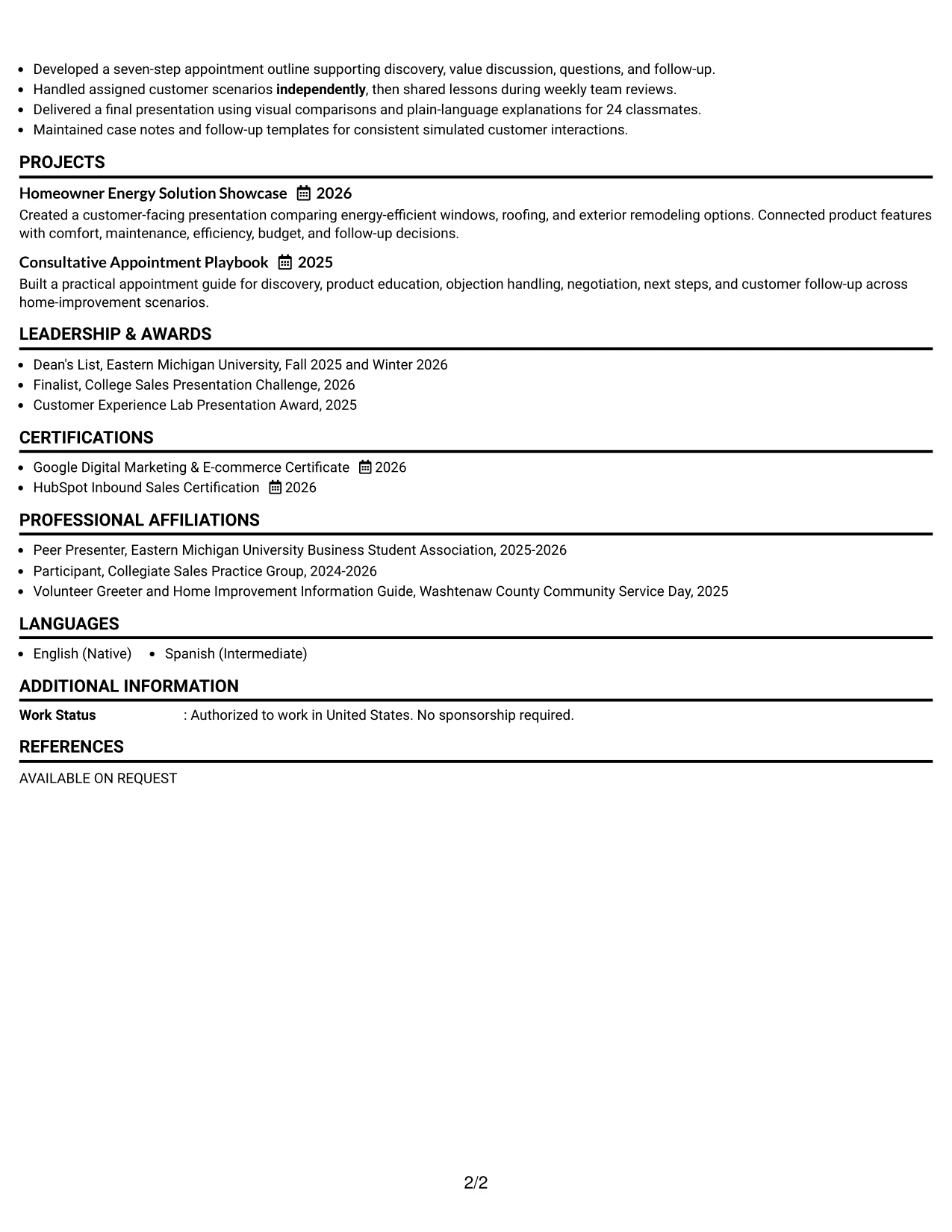
Simple One Column Format presents the resume in a direct sequence: contact details, summary, experience, education, certifications, projects, and skills. King Wilkinson’s customer-facing practice, presentation work, and sales training can be reviewed without moving between separate panels.
For an Entry Level Sales Representative application, this structure gives strong space to consultative selling, homeowner presentations, customer discovery, CRM documentation, and measurable practice results. It also keeps keywords and achievement bullets easy to find during a quick review or ATS scan.
Why the Simple One Column Format Works for a Resume
- A single reading path helps recruiters scan the summary and recent experience quickly.
- Full-width bullets give the 30 homeowner presentations and 18 mock appointments enough context.
- The summary can connect energy-efficient remodeling knowledge with customer-focused sales skills.
- Education and certifications remain visible without competing with experience entries.
- A consistent hierarchy supports ATS parsing for sales, communication, negotiation, and CRM terms.
- Project descriptions can show practical evidence when formal employment history is limited.
- The open structure makes measurable results and recognition easy to locate.
Best For
- Resumes that need a clear top-to-bottom review path.
- Candidates combining practicum work, projects, education, and certifications.
- Applications where ATS parsing and standard section order matter.
- Experience bullets that need room for context, tools, and results.
- Readers who prefer one-column documents on smaller screens.
- Resumes with several relevant sections but limited formal employment history.
- Job searches that require both searchable keywords and human-readable detail.
#2 Plain One Column with Shaded Labels Resume Example
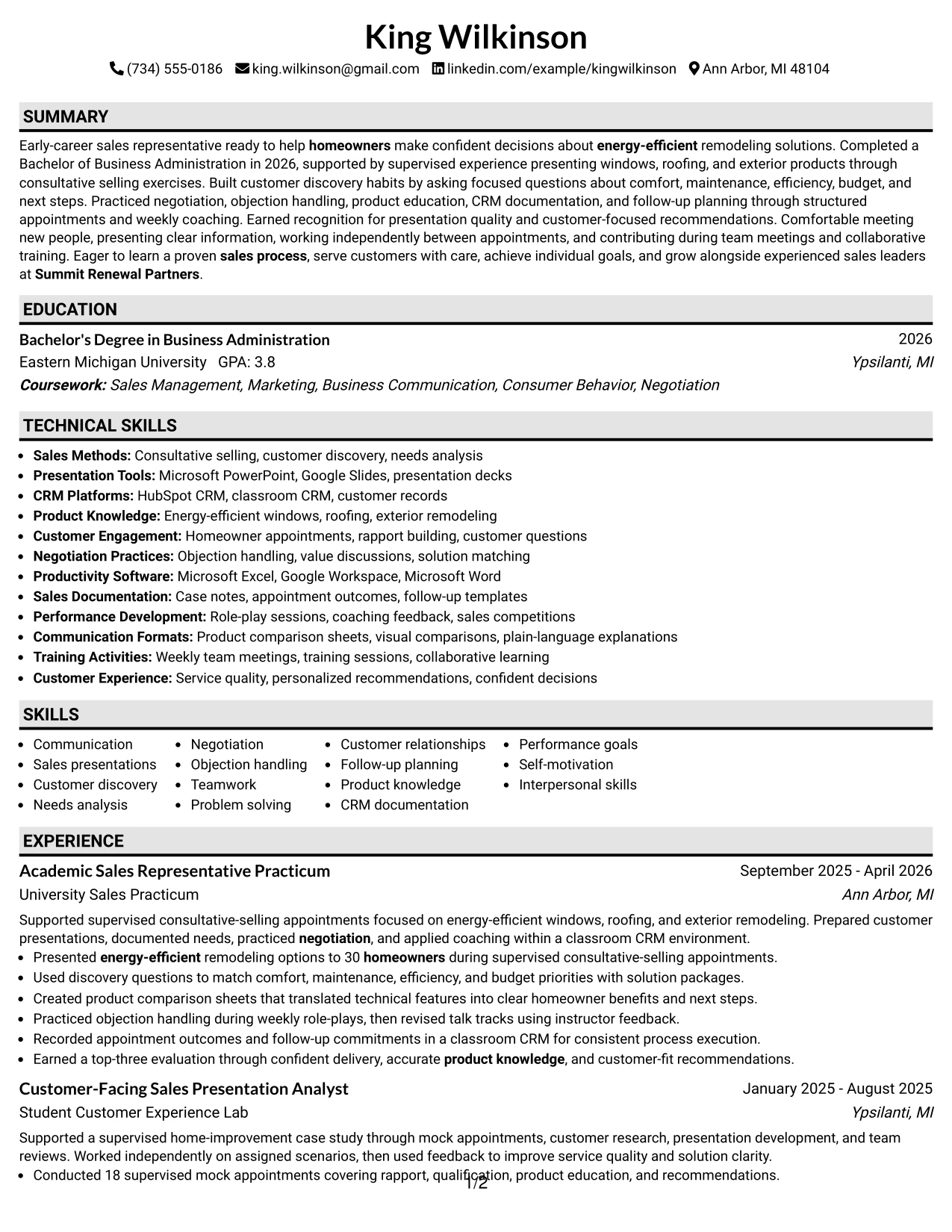
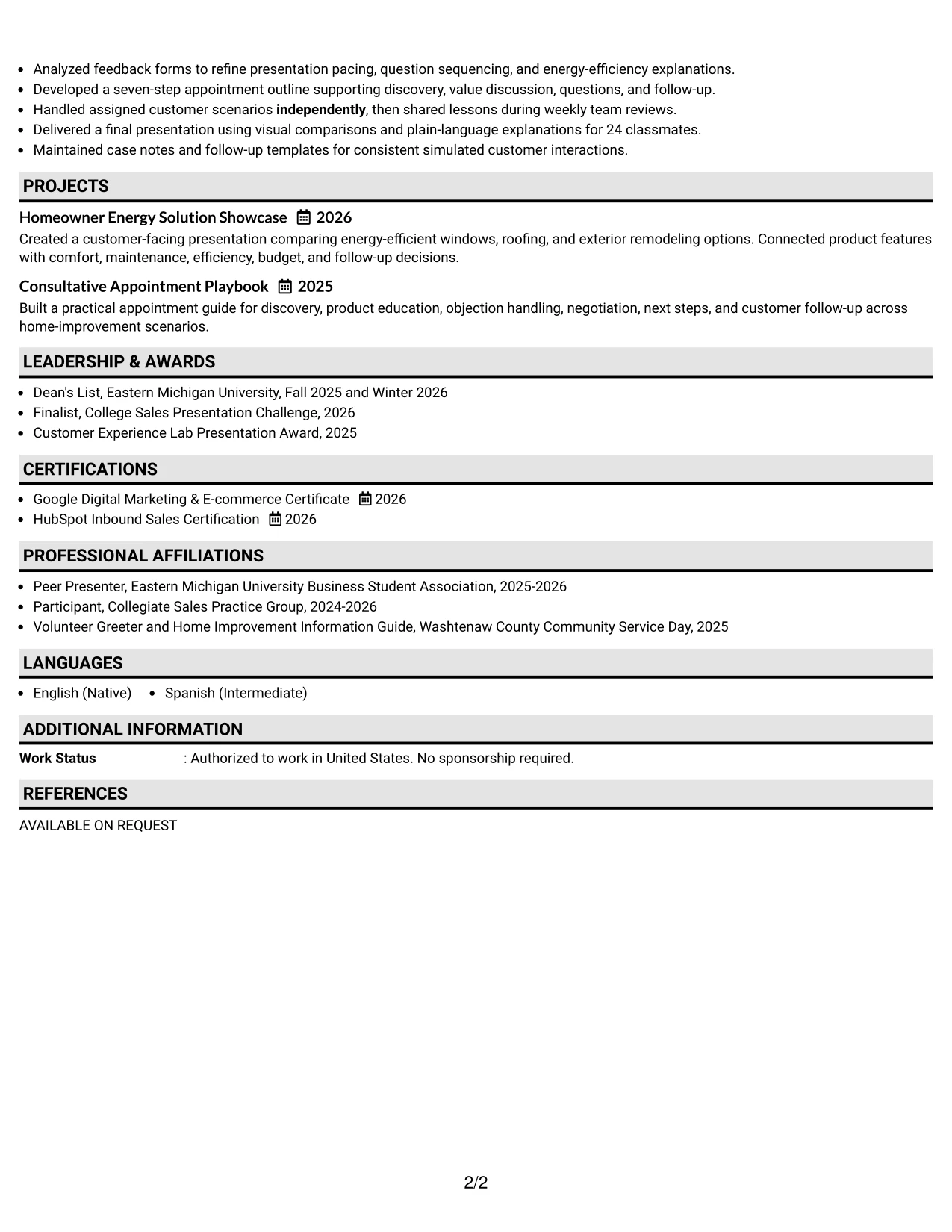
Readers move from the professional summary into clearly labeled sections, then continue through experience, education, projects, certifications, and skills. Shaded labels make each transition visible while the single column keeps the document easy to follow.
This format supports a detailed sales resume without creating visual competition between sections. It can give customer discovery, product presentations, objection handling, HubSpot CRM, and supervised appointment results enough room to support the target role.
Why the Plain One Column with Shaded Labels Works for a Resume
- Visible labels help a reader locate experience and skills without searching the page.
- The one-column flow keeps dates, titles, organizations, and bullets in a predictable order.
- Shaded section markers separate content while preserving ATS-friendly text structure.
- Longer project and practicum descriptions can remain readable.
- The format supports a strong summary followed by evidence rather than a crowded opening.
- Certifications and awards can be added without breaking the document’s rhythm.
- Repeated labels make a multi-section early-career resume feel organized.
Best For
- Resumes with several content categories that need strong visual signposts.
- Applicants who want detailed bullets without using a sidebar.
- Documents that include education, projects, awards, activities, and certifications.
- ATS-conscious applications requiring familiar headings and linear content.
- Readers who scan by section before reviewing individual bullets.
- Candidates presenting supervised work alongside academic achievements.
- Applications where consistent labeling improves document navigation.
#3 One Column Format with Photo Right Resume Example
The strongest evidence receives priority: supervised homeowner presentations, discovery questions, product comparisons, CRM records, and recognition for presentation quality. A full-width content column keeps those results together, while the right-side photo area adds a controlled visual point in the header.
Experience bullets can show both activity and capability, such as presenting to 30 homeowners, conducting 18 mock appointments, and revising talk tracks through coaching. The resume still needs clear headings and standard text so the visual element does not distract from sales keywords.
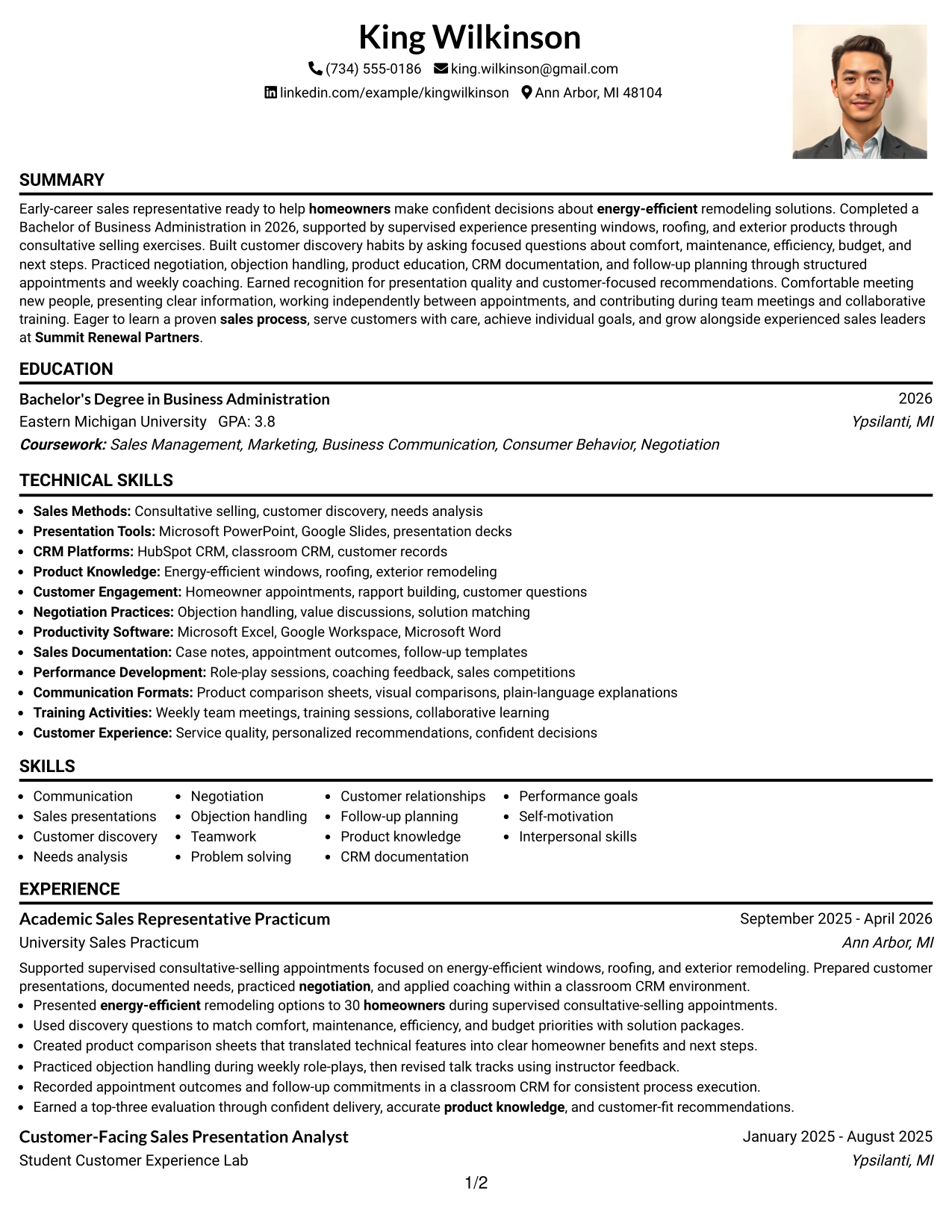
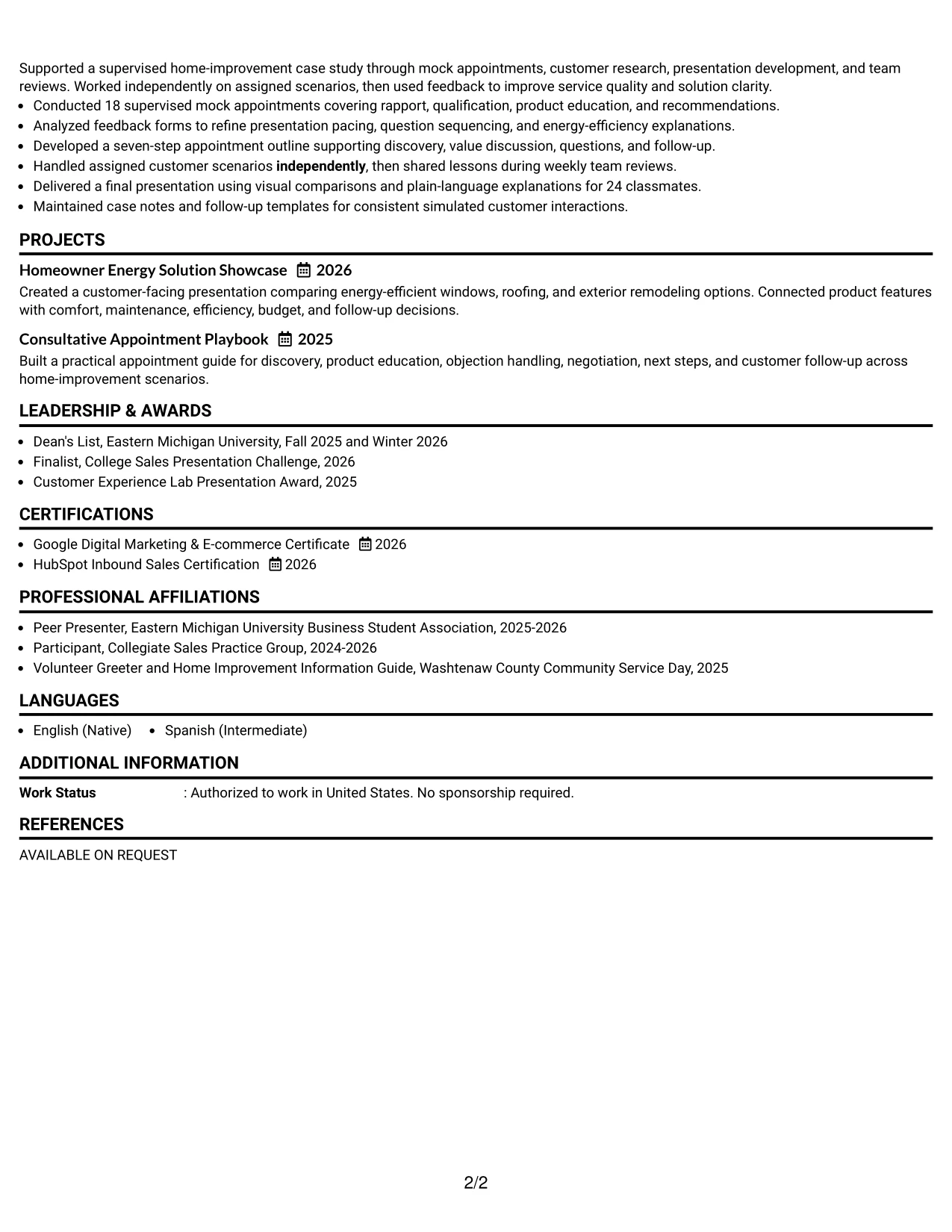
Why the One Column Format with Photo Right Works for a Resume
- The wide content area gives achievement bullets priority over decorative elements.
- A right-side photo can create a balanced header when a visual introduction is appropriate.
- Full-width experience entries support detailed customer-facing evidence.
- Numbers such as 30 homeowners and 18 appointments stand out in a linear review.
- The format keeps sales methods, tools, and product knowledge in one searchable sequence.
- Projects can reinforce practical preparation for energy-efficient remodeling conversations.
- Clear section headings preserve usability for both human review and ATS processing.
Best For
- Resumes where evidence-rich experience should remain the main visual focus.
- Applicants who want a distinctive header while keeping one-column content.
- Presentations, practicum work, and projects that need full-width bullets.
- Applications reviewed both visually and through standard resume sections.
- Documents that benefit from a clear distinction between profile and evidence.
- Candidates with strong customer-facing examples but limited traditional employment.
- Roles where polished presentation supports, but does not replace, readable content.
#4 Clean Two Column Sidebar Format Resume Example
Content is balanced between a main evidence area and a compact sidebar for contact details, skills, tools, certifications, or education. The main column can carry practicum bullets and project results, while the sidebar keeps supporting information available at a glance.
For an Entry Level Sales Representative application, this division helps separate customer-facing proof from searchable terms such as consultative selling, negotiation, HubSpot CRM, and follow-up planning. The layout supports quick review without hiding the details behind dense blocks.
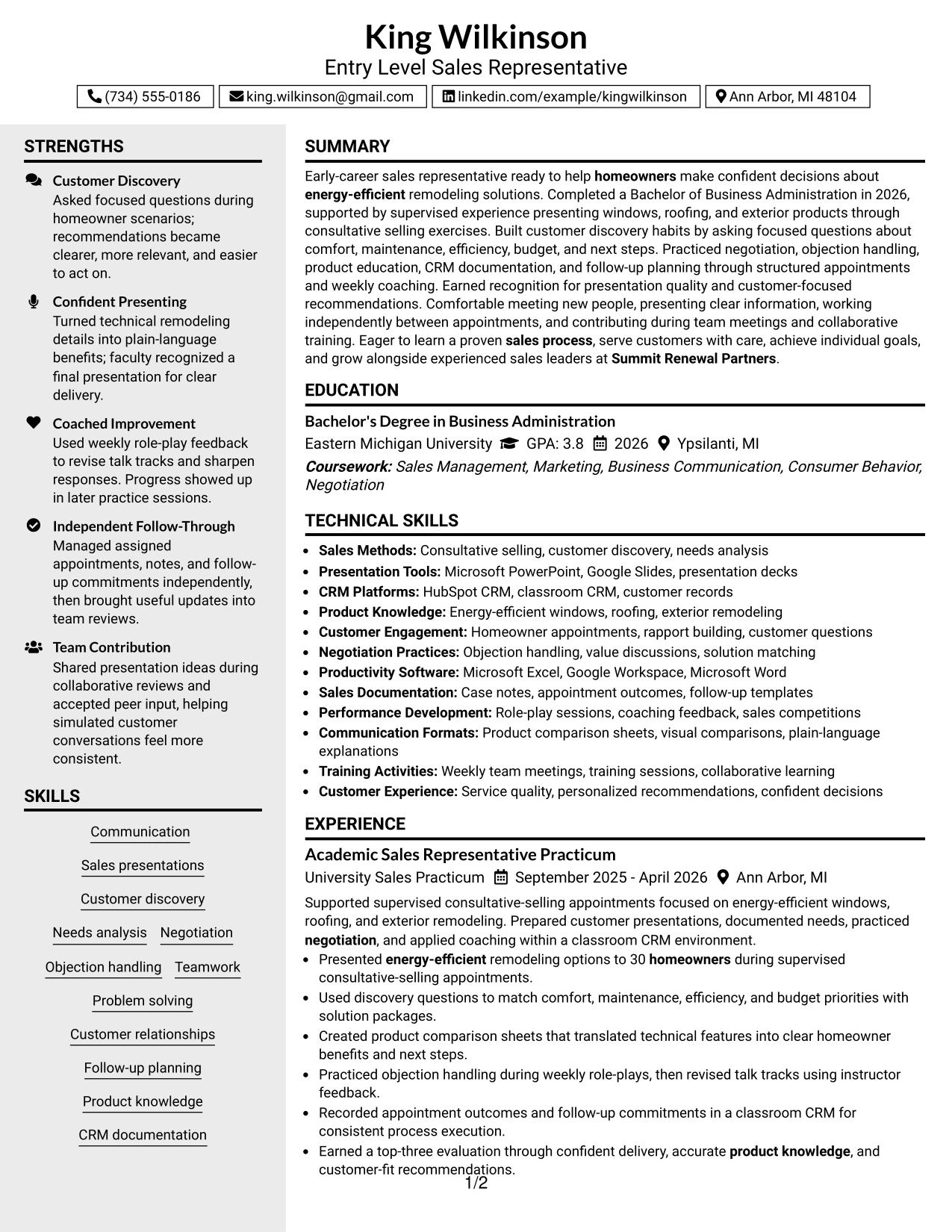
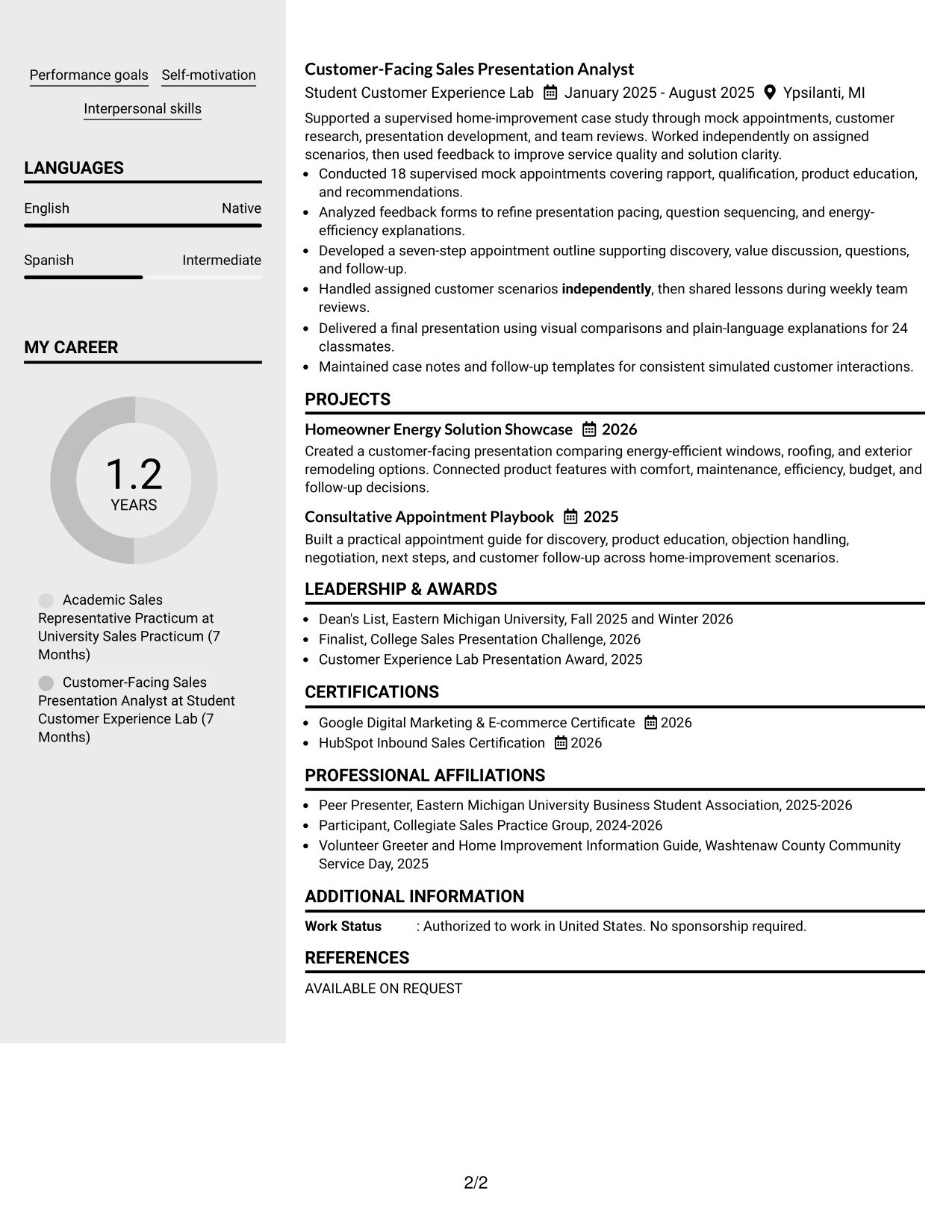
Why the Clean Two Column Sidebar Format Works for a Resume
- The main column gives experience bullets the space needed to show action and outcome.
- A sidebar groups skills and tools for fast qualification checks.
- Two visual zones reduce repeated scanning across unrelated information.
- The format can place certifications and education near the evidence they support.
- A compact skills area keeps core sales keywords visible near the top.
- Project details can remain in the main column instead of being reduced to a list.
- Clean separation helps a reader understand both capability and supporting credentials.
Best For
- Applications where a recruiter needs skills and experience visible together.
- Resumes with a focused evidence column and a compact qualification area.
- Candidates organizing tools, certifications, and education beside work examples.
- Documents intended for quick desktop review with clear visual grouping.
- Job searches that require both keyword visibility and detailed accomplishment bullets.
- Applicants balancing academic projects with supervised customer-facing practice.
- Resumes that benefit from separating supporting facts from core evidence.
#5 Two Column Format Resume Example
For a practical application, the Two Column Format can place the professional summary and experience in one area while grouping skills, education, certifications, and projects in another. This arrangement helps a reviewer compare sales evidence with the qualifications that support it.
The resume can show presentation practice, customer discovery, negotiation, and product knowledge without making every section compete for the same vertical space. Careful ordering remains important so the main column leads with the strongest relevant evidence.
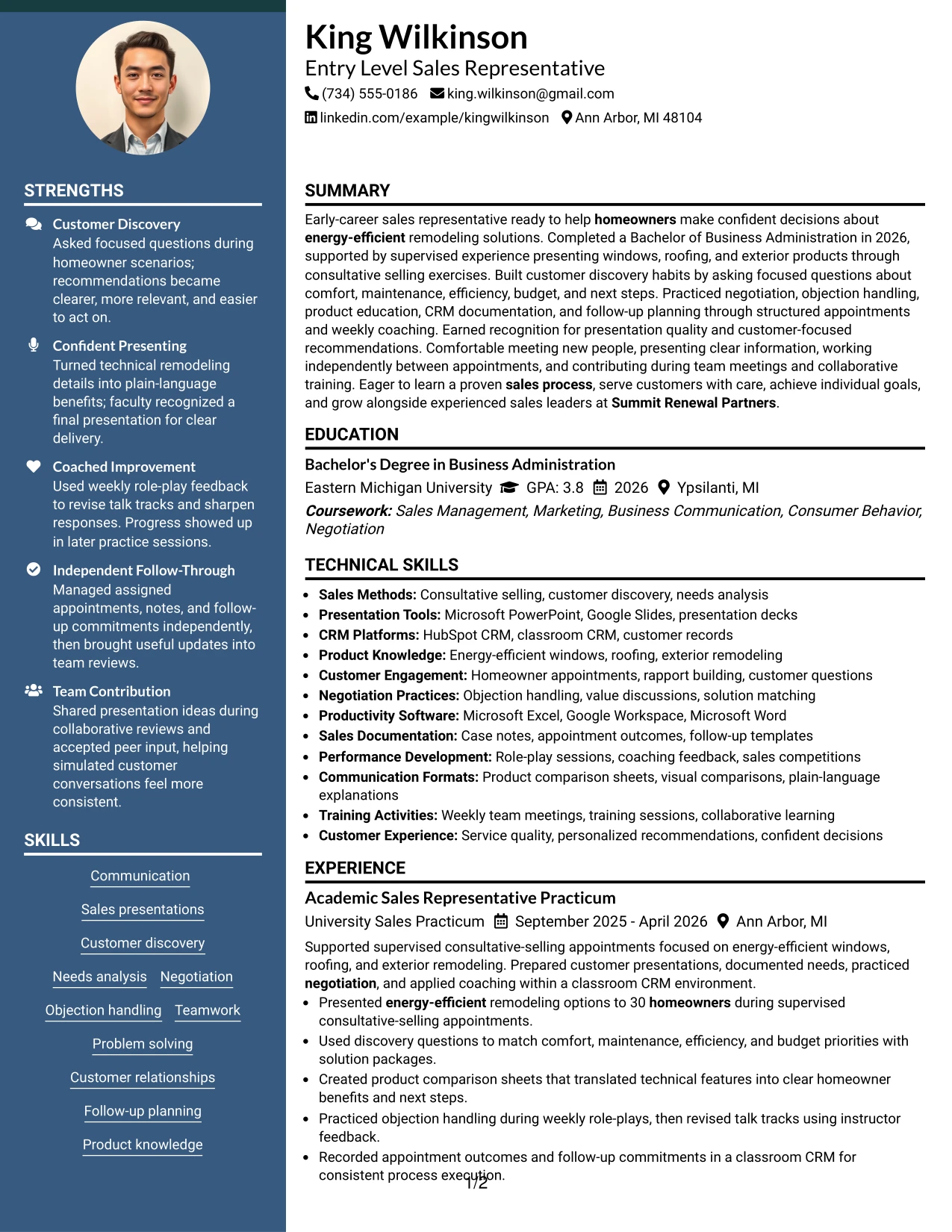
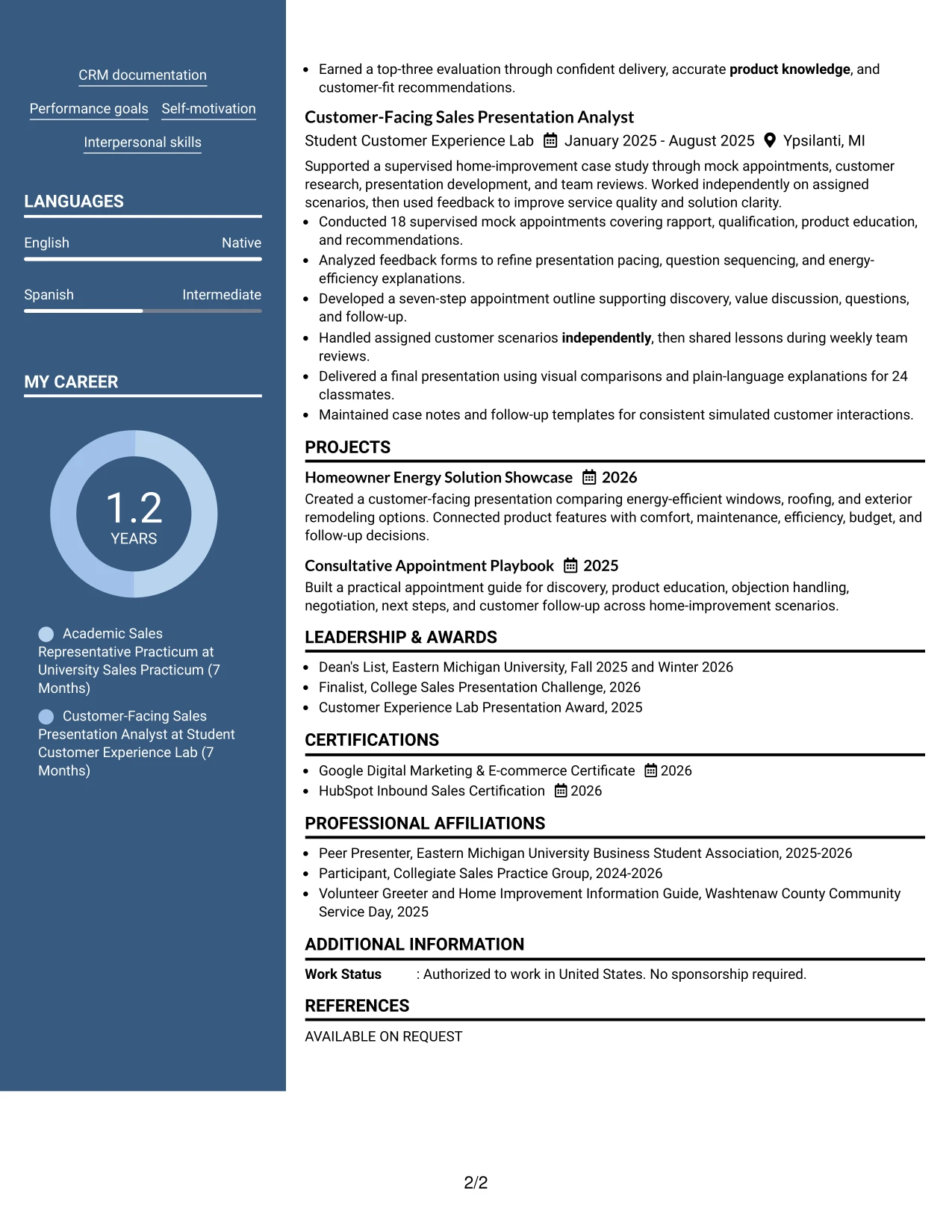
Why the Two Column Format Works for a Resume
- A two-column structure supports efficient comparison between evidence and qualifications.
- The main area can emphasize supervised appointments and customer recommendations.
- The secondary area keeps skills, certifications, and education easy to locate.
- Separate zones can reduce the height of a resume with many relevant sections.
- Project content can support experience without interrupting the primary work history.
- The format gives presentation tools and CRM knowledge a visible, organized location.
- A clear hierarchy prevents visual balance from weakening the order of importance.
Best For
- Resumes that need to present evidence and qualifications side by side.
- Candidates with several supporting sections but a focused experience history.
- Applications where skills, tools, and certifications must be visible early.
- Readers who compare a summary of capabilities with detailed proof.
- Documents that need efficient use of page space without removing useful content.
- Applicants combining academic projects with customer-facing practice.
- Visual presentations that remain structured around standard resume sections.
#6 Photo Header Two Column Format Resume Example
A restrained visual hierarchy can introduce the resume with contact details, a concise summary, and a photo header before guiding the reader into two organized content areas. The visual opening should remain secondary to the evidence that follows.
One column can feature customer-facing experience and projects, while the other highlights skills, education, certifications, and sales tools. That structure aligns the document with a role requiring presentations, customer relationships, independent follow-through, teamwork, and continued training.
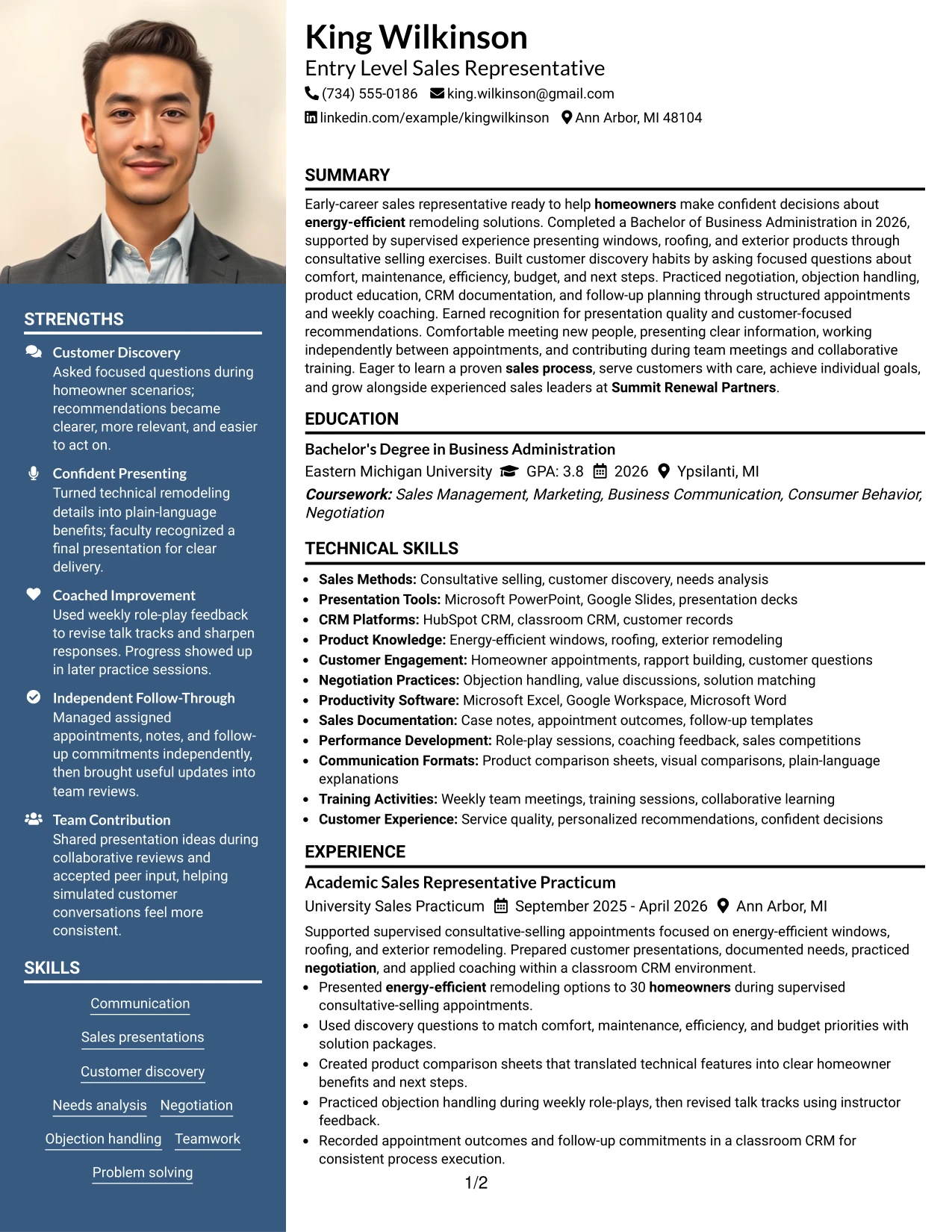
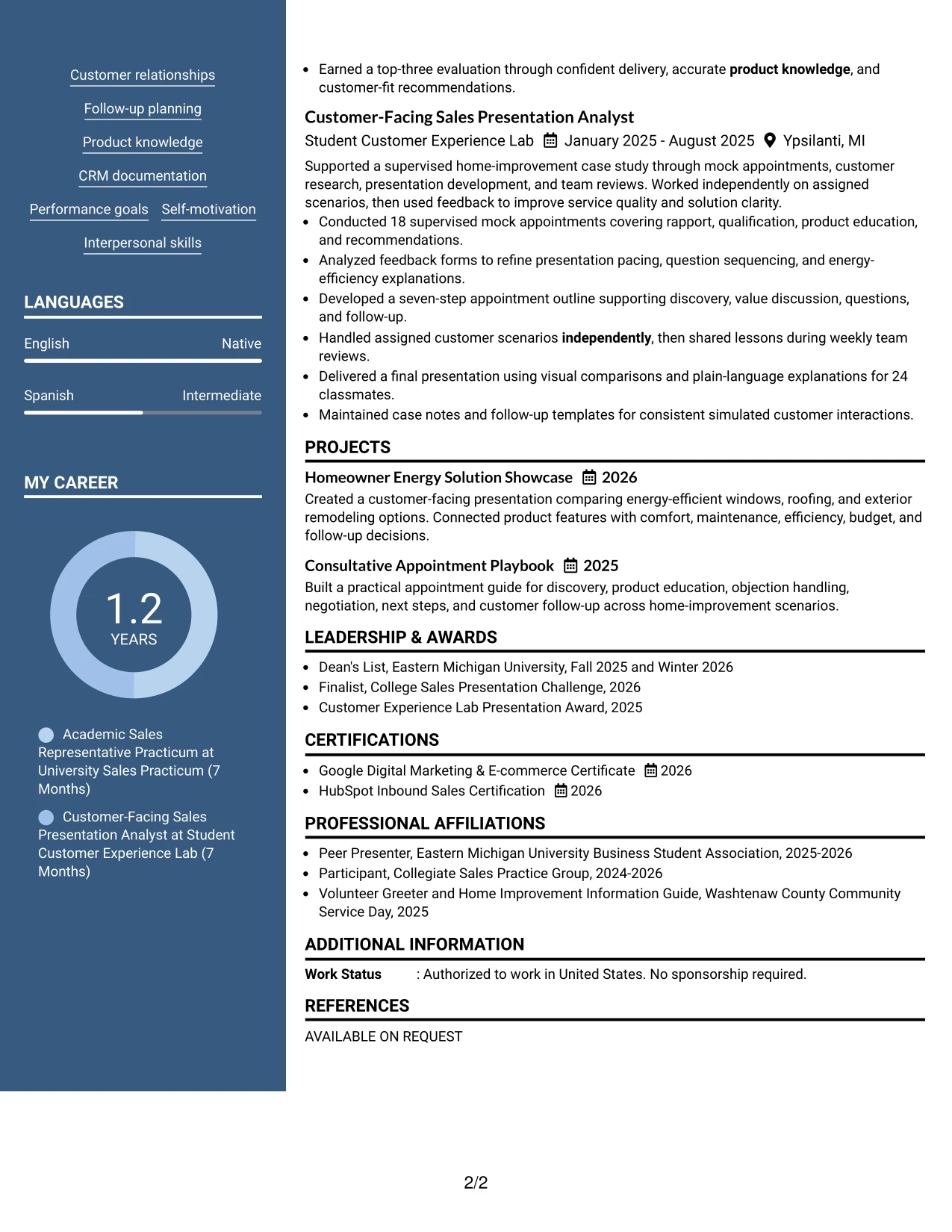
Why the Photo Header Two Column Format Works for a Resume
- The header creates a clear first view without taking space from detailed evidence.
- Two columns distinguish experience from supporting qualifications.
- The summary can connect customer service, presentations, and sales-process habits.
- A dedicated skills area keeps communication, negotiation, and CRM terms easy to scan.
- Experience bullets can show both independent work and collaborative learning.
- Projects and certifications reinforce readiness for structured sales training.
- The format supports a polished presentation while retaining clear resume hierarchy.
Best For
- Resumes where a polished visual introduction supports a structured review.
- Applicants who want experience and qualifications separated into two readable areas.
- Documents with a concise profile, practical projects, and several supporting credentials.
- Applications that value clear presentation alongside searchable sales terminology.
- Candidates showing both independent follow-through and team participation.
- Readers who prefer a defined header before reviewing detailed sections.
- Roles where a professional visual impression should complement strong evidence.
#7 Simple Two Column Format Resume Example
Simple Two Column Format divides the resume into an evidence-focused area and a supporting information area. Experience and projects can carry the main narrative, while skills, education, certifications, awards, and tools remain easy to scan in a consistent secondary column.
This organization helps present a developing sales record with enough detail to show customer discovery, presentations, objection handling, and follow-up habits. It also makes recognition such as the College Sales Presentation Challenge finalist result easier to connect with the related skills.
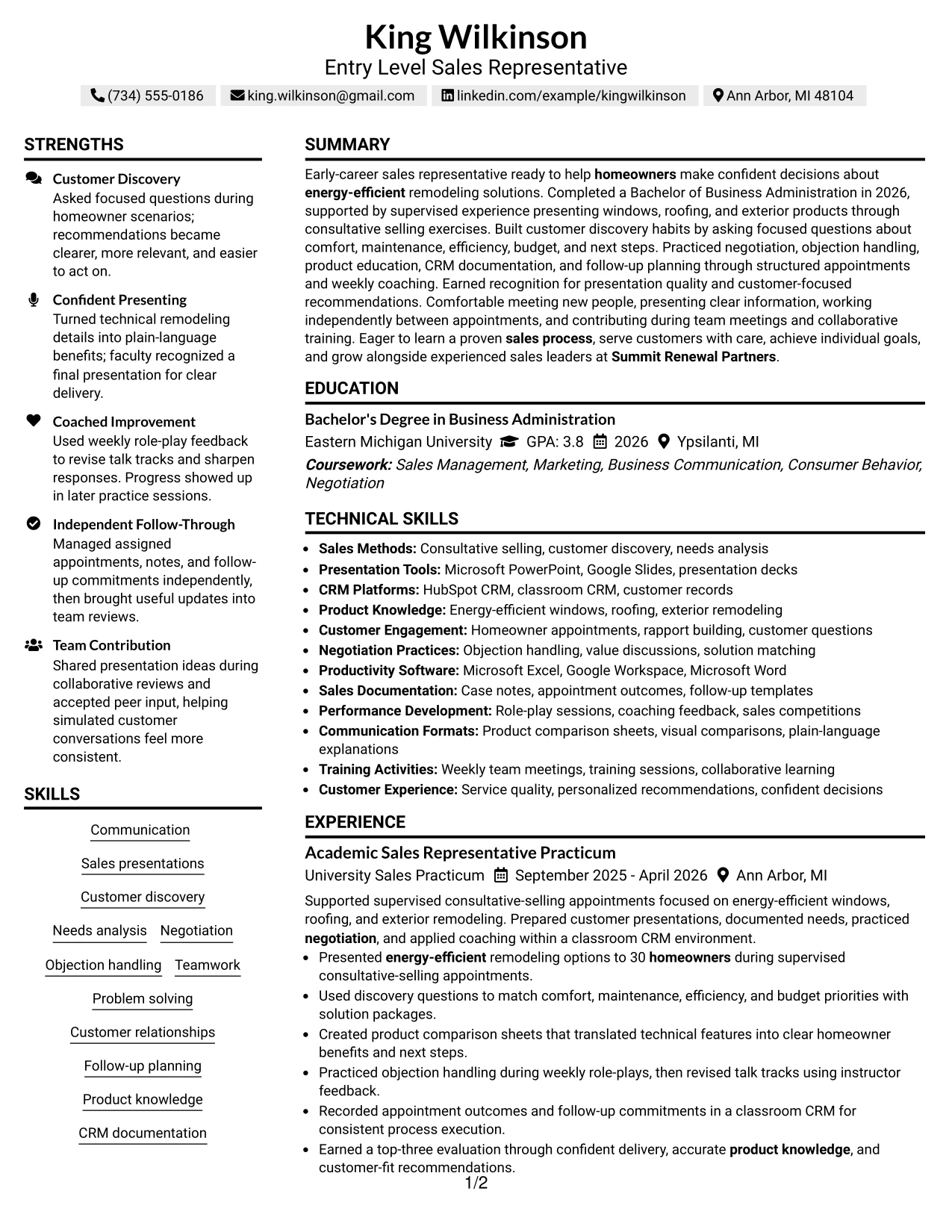
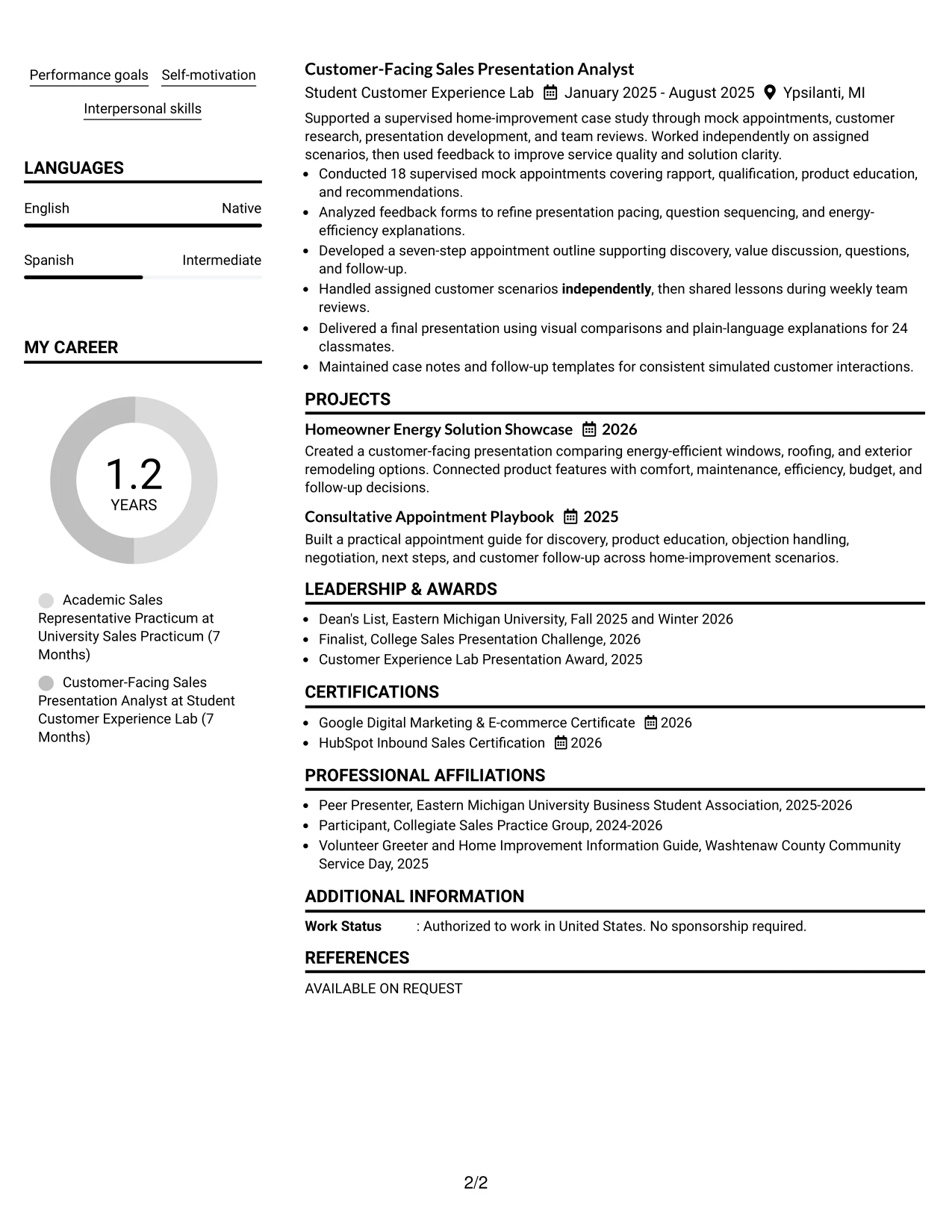
Why the Simple Two Column Format Works for a Resume
- The main column protects achievement bullets from being compressed.
- The supporting column gives skills and credentials a stable location.
- Two-column grouping helps readers distinguish evidence from qualification lists.
- Awards can appear near education without interrupting experience chronology.
- The layout supports concise project descriptions beside detailed practicum work.
- Common section headings remain readable for ATS and human review.
- A simple visual system keeps attention on customer results and sales preparation.
Best For
- Resumes that need separate spaces for evidence and supporting details.
- Applicants organizing awards, certifications, activities, and skills efficiently.
- Documents with strong bullets that should not be reduced for lack of space.
- Readers who want quick access to qualifications beside work history.
- Candidates whose projects and practicum work provide important evidence.
- Applications where clean structure matters more than decorative design.
- Resume versions that need consistent scanning across multiple sections.
#8 Text/Fang Style Resume Example
Readers can move through the document in a steady sequence, using strong text hierarchy to locate the summary, experience, education, projects, certifications, and skills. Text/Fang Style favors readable content blocks over visual complexity, which supports careful review of each sales bullet.
The format gives supervised work room to explain the action, customer need, sales method, and result. That is useful for showing product education, energy-efficiency explanations, role-play improvement, appointment notes, and customer-focused recommendations.
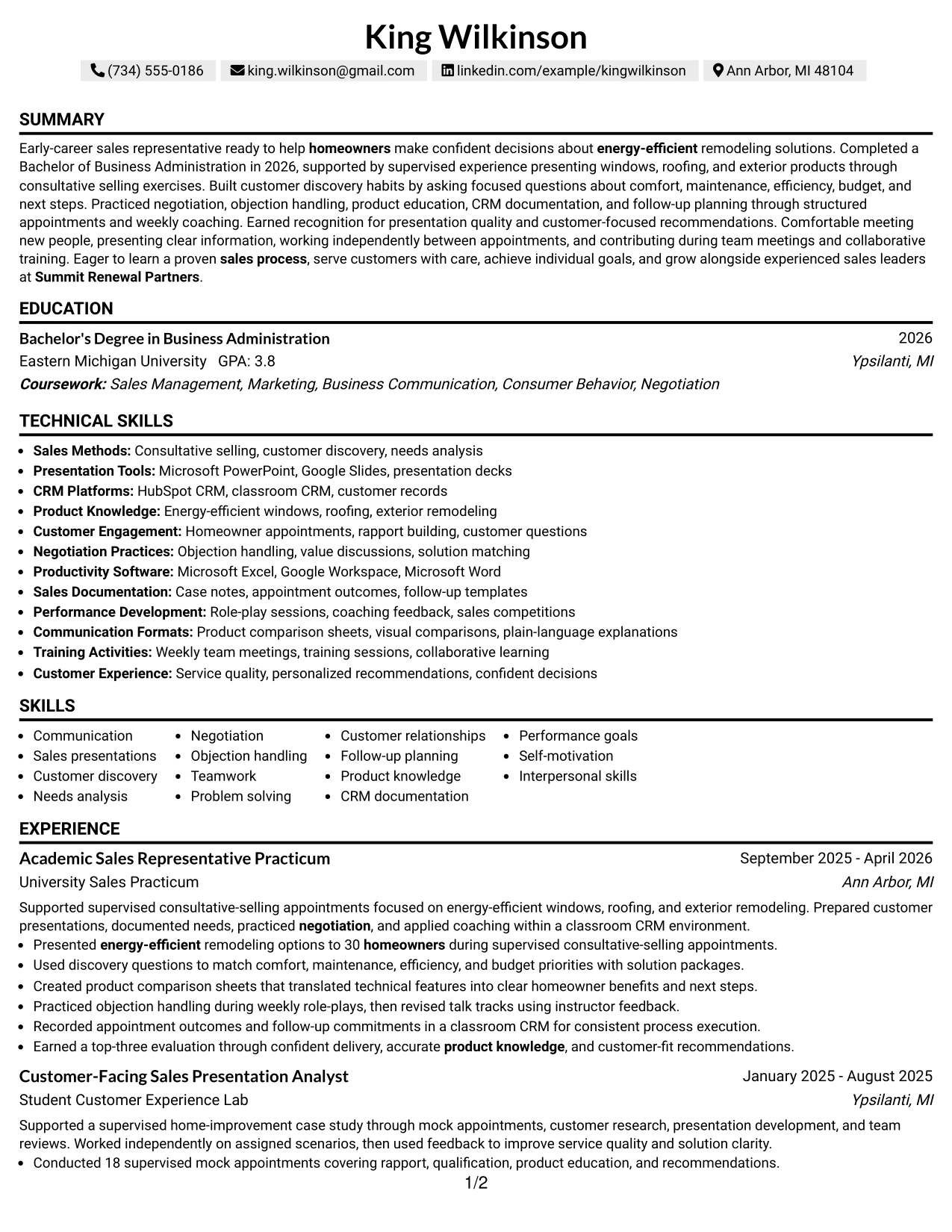
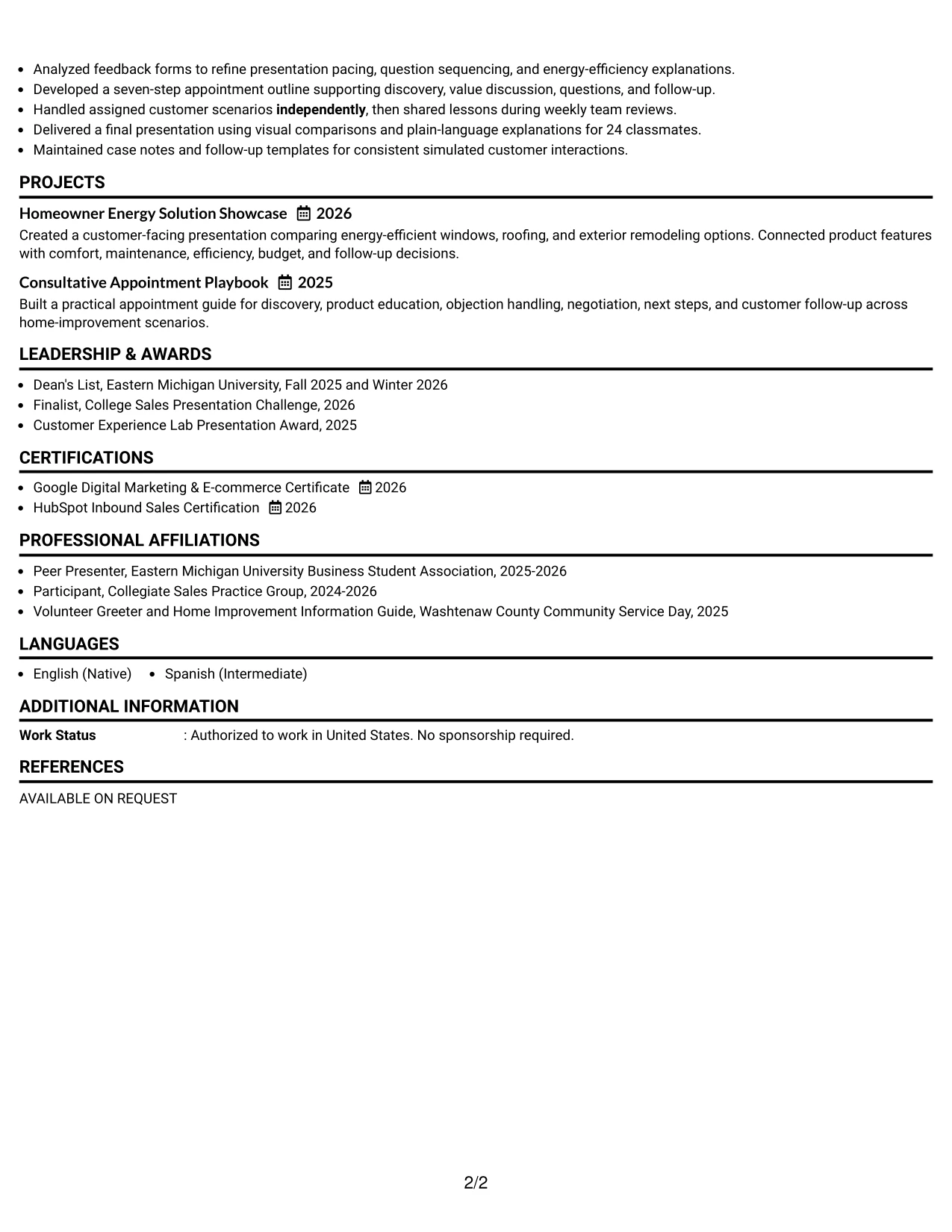
Why the Text/Fang Style Works for a Resume
- A text-led hierarchy keeps the review focused on qualifications and evidence.
- Readable blocks allow bullets to explain sales actions without excessive compression.
- The sequence supports a clear connection between summary, experience, and skills.
- Customer-facing practice can be described with enough detail to show method.
- Projects provide additional proof of product knowledge and follow-up planning.
- Certifications remain easy to find within a standard section order.
- Simple text treatment supports reliable parsing and consistent recruiter scanning.
Best For
- Resumes where detailed written evidence is more important than decoration.
- Applicants explaining practicum work, projects, and supervised appointments.
- Applications that depend on readable bullets and familiar section sequencing.
- Readers who review each qualification closely rather than scanning only headings.
- Documents with customer examples that need action, method, and result together.
- Candidates using certifications and projects to strengthen a developing work history.
- ATS-conscious resume versions with a calm, text-centered presentation.
#9 One Column Boxed Contact Header Format Resume Example
Evidence receives the first serious review after a boxed contact header establishes the resume’s identity and target role. The one-column body can then lead with the summary and move into customer-facing experience, projects, education, certifications, and skills.
This arrangement gives presentation results, discovery methods, and process habits a clear place below the header. The document can feature 30 homeowner presentations, 18 supervised mock appointments, CRM documentation, and a top-three evaluation without scattering those details across the page.
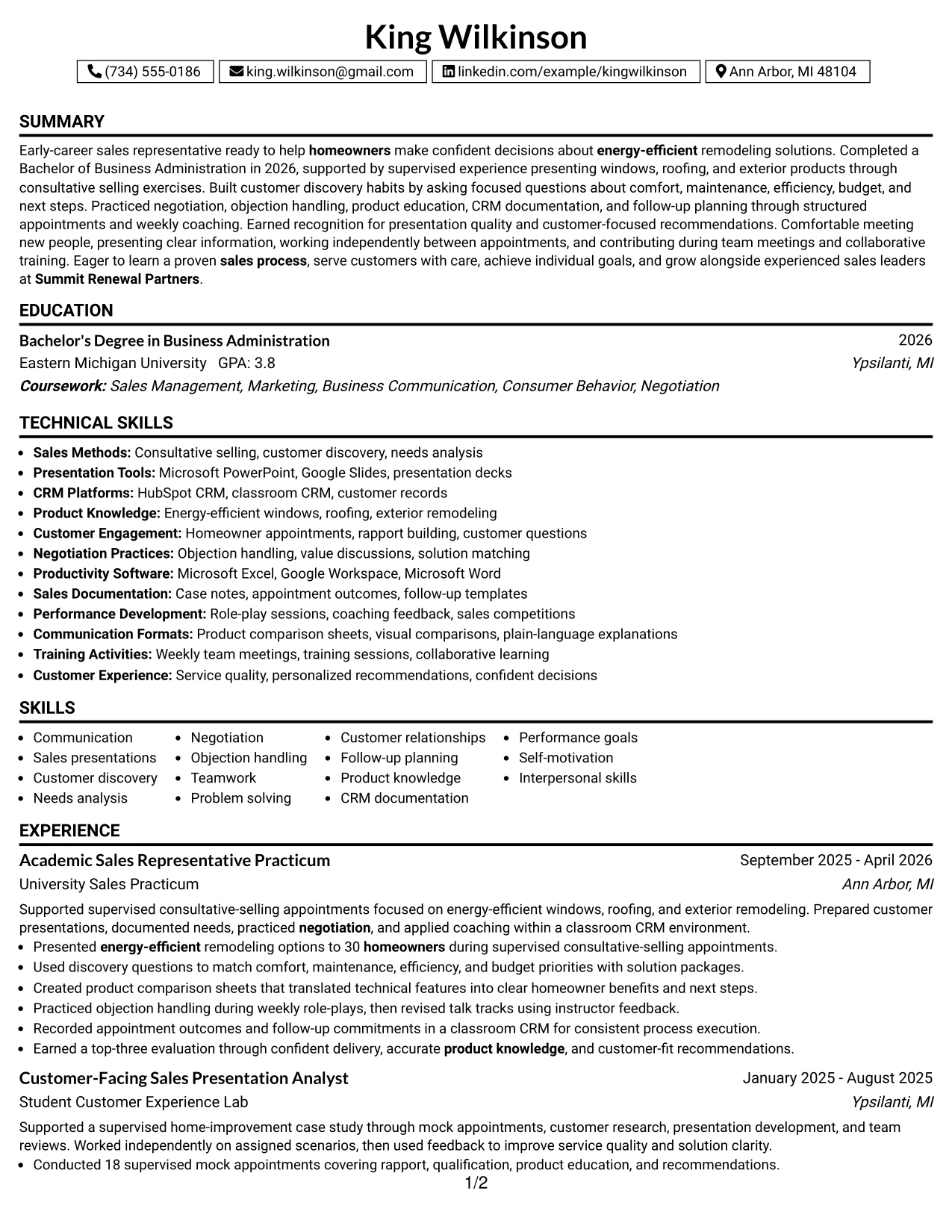
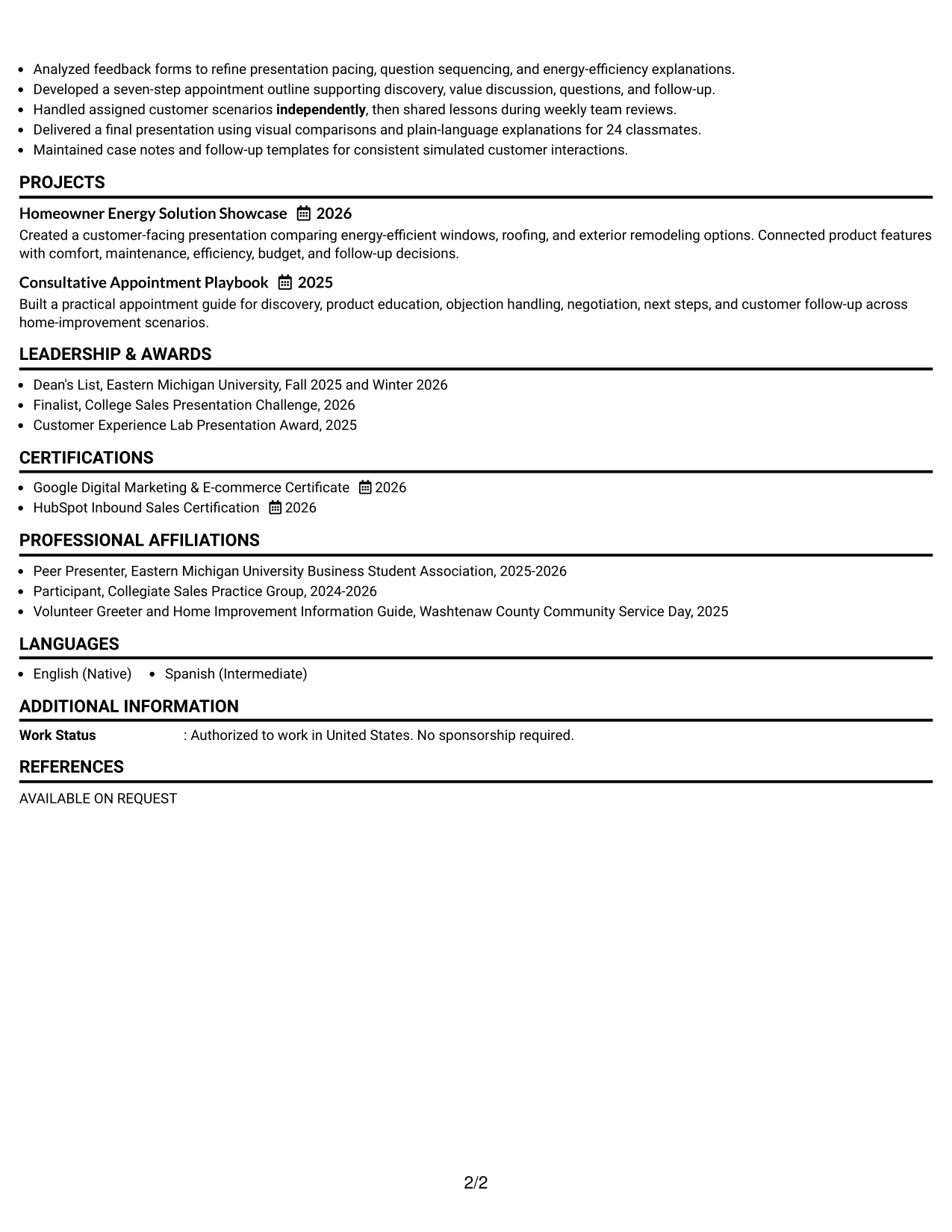
Why the One Column Boxed Contact Header Format Works for a Resume
- The boxed header makes contact information and the target role easy to identify.
- A single body column keeps achievement evidence in chronological context.
- The layout provides room for numbers and recognition to stand out in bullets.
- Experience can lead naturally into projects that reinforce product knowledge.
- Skills and certifications remain searchable in familiar sections.
- The format avoids side-panel compression for longer customer-facing descriptions.
- A strong header-to-evidence transition supports fast initial qualification.
Best For
- Resumes that need a clear contact and target-role starting point.
- Applicants whose strongest proof appears in detailed experience bullets.
- Documents featuring measurable practice, awards, and project outcomes.
- Applications where one-column chronology improves review accuracy.
- Candidates who want a defined header without a sidebar.
- Readers who identify the target role first, then evaluate supporting evidence.
- Resume versions that combine a polished contact area with ATS-friendly body content.
#10 Plain Two Column Format Resume Example
Content is balanced between a primary experience area and a supporting qualification area, with enough structure for a concise resume review. King Wilkinson’s supervised sales practice, education, certifications, and tools can be presented without letting any single section overwhelm the page.
A four-point resume snapshot can highlight the target role, energy-efficient remodeling focus, presentation volume, and CRM practice. The keyword section should then reinforce terms such as consultative selling, customer discovery, negotiation, product presentations, and HubSpot CRM.
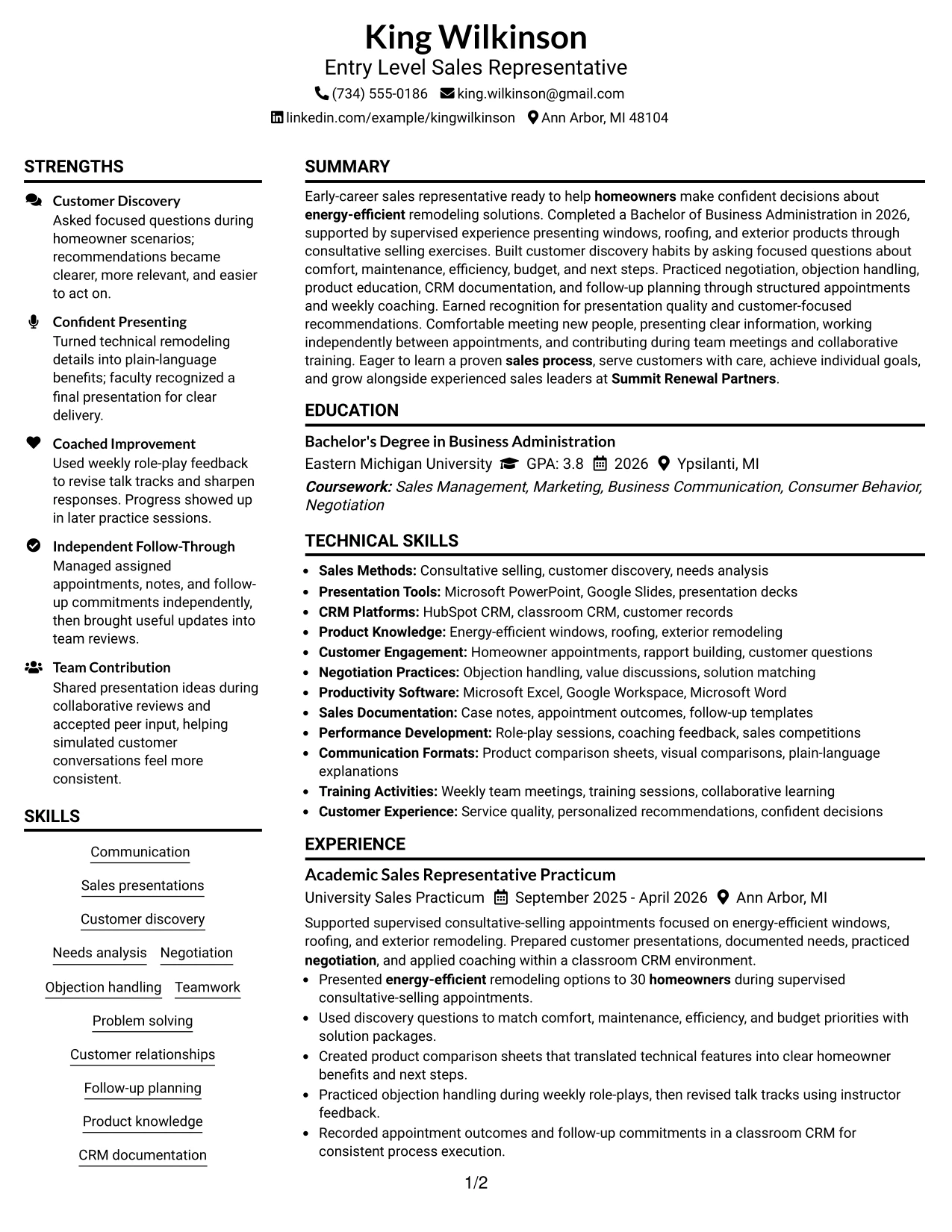
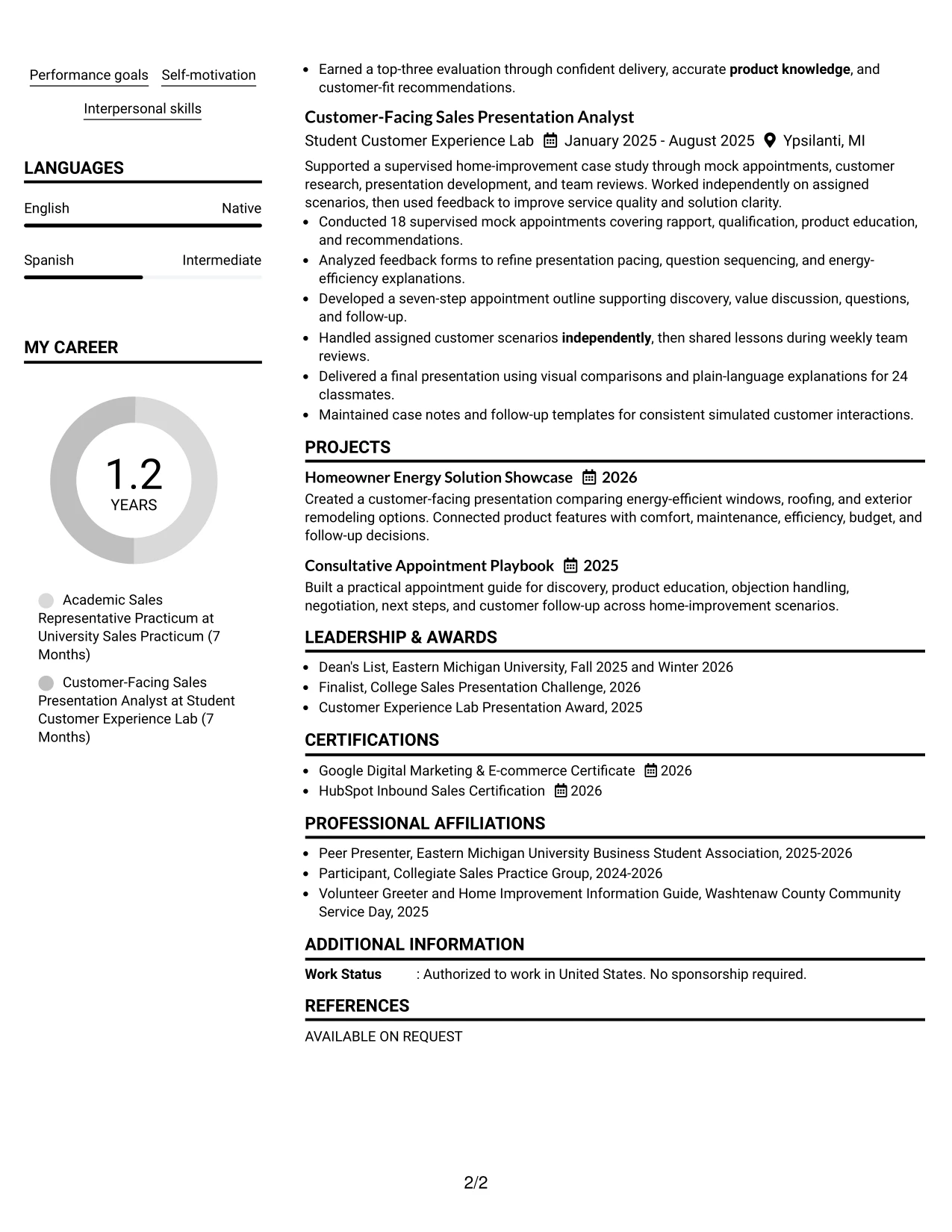
Resume Snapshot
- Entry Level Sales Representative focused on homeowner conversations and energy-efficient remodeling.
- 30 homeowner presentations and 18 supervised mock appointments.
- Bachelor of Business Administration completed in 2026.
- Consultative selling, negotiation, product presentations, and HubSpot CRM.
Why the Plain Two Column Format Works for a Resume
- Two columns distribute experience and supporting qualifications with clear balance.
- The snapshot gives a recruiter four fast facts before detailed review.
- A keyword block can strengthen alignment with the target sales role.
- The experience area retains space for measurable bullets and customer examples.
- Education and certifications can sit beside, rather than below, practical evidence.
- Plain styling supports readability across digital and printed resume reviews.
- The structure helps connect tools and skills to the experience that demonstrates them.
Resume Keywords
- Entry Level Sales Representative
- Consultative selling
- Customer discovery
- Needs analysis
- Product presentations
- Objection handling
- Negotiation
- HubSpot CRM
#11 Colored Two Column Format Resume Example
For a practical application, Colored Two Column Format can separate core experience from supporting qualifications while using restrained color to guide the eye. The main area can feature customer-facing practice and project evidence; the secondary area can hold skills, education, certifications, and awards.
Color should clarify hierarchy rather than replace resume substance. Used carefully, it helps a reader move from the summary to presentation results, customer discovery, negotiation, follow-up planning, and the tools that support consistent sales-process execution.
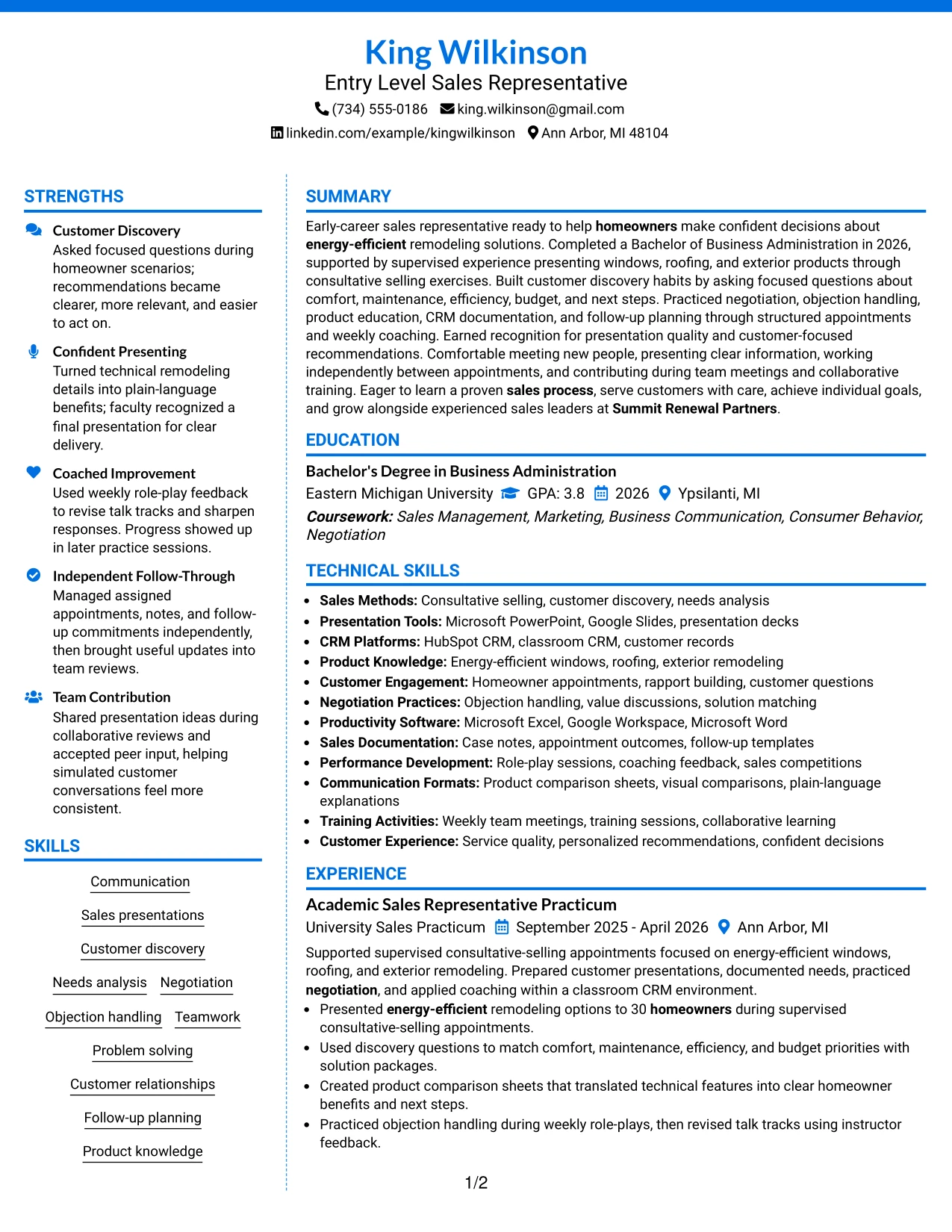
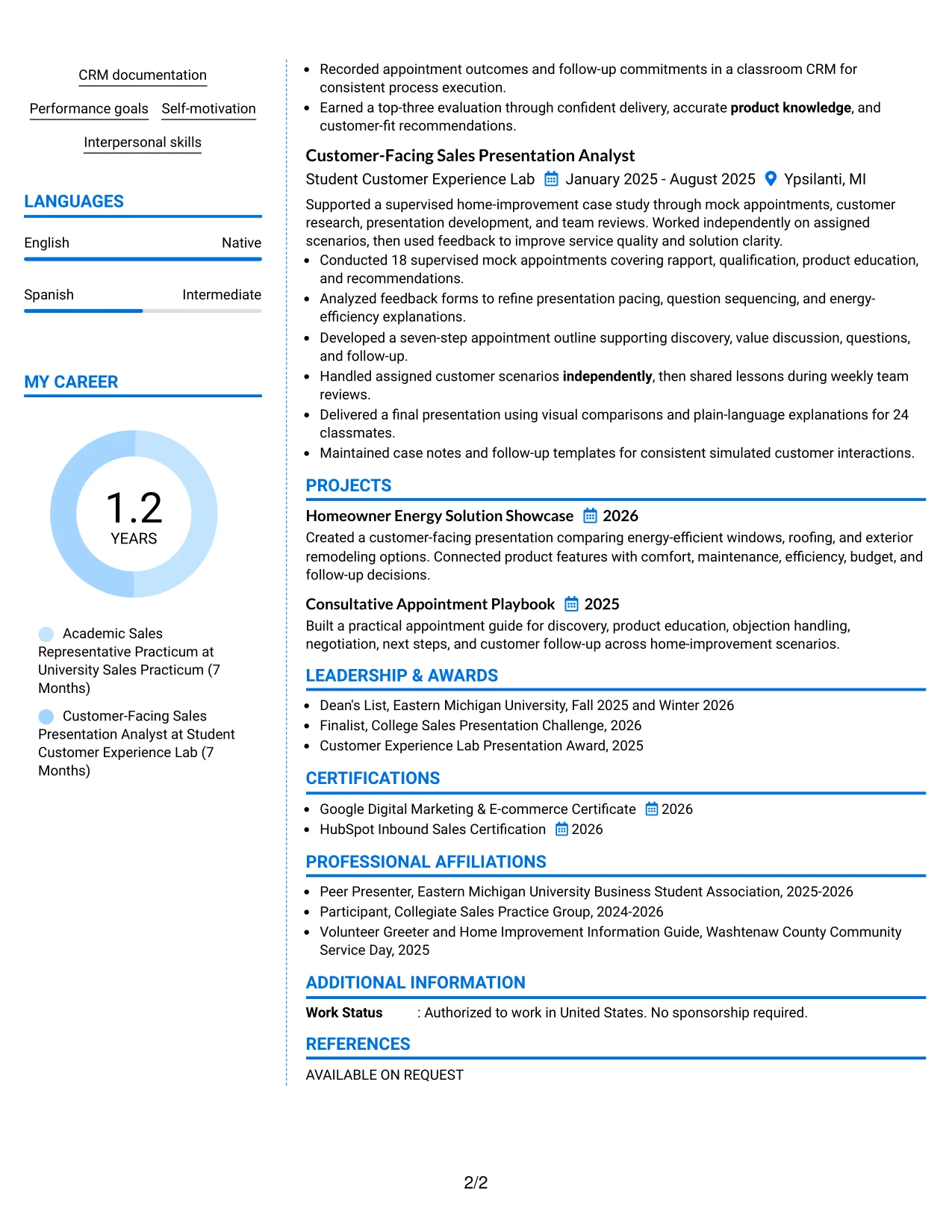
Why the Colored Two Column Format Works for a Resume
- Color-coded areas help distinguish evidence from supporting information.
- The main column can give customer-facing bullets appropriate space and emphasis.
- The secondary column keeps sales skills and certifications easy to locate.
- Projects can reinforce product knowledge without interrupting the experience sequence.
- Awards and activities can be grouped without competing with core evidence.
- A restrained palette can improve navigation while preserving professional readability.
- The format supports both visual review and clear, searchable resume content.
Best For
- Resumes that need visual guidance between core evidence and qualifications.
- Applicants using projects, awards, and certifications to support practical experience.
- Documents where restrained color improves section recognition.
- Applications reviewed quickly across experience, skills, and education areas.
- Candidates who want a distinctive layout without sacrificing readable bullets.
- Readers who benefit from clear grouping of tools and customer-facing results.
- Resume versions that pair visual organization with standard searchable content.
#12 One Column Shaded Contact Header Format Resume Example
A restrained visual hierarchy gives the contact details and target role a clear starting point. The single-column structure then guides the reader through the summary, experience, education, certifications, projects, and skills without competing side panels.
For an Entry Level Sales Representative resume, this format keeps customer discovery, consultative selling, presentations, CRM documentation, and measurable practice results easy to find. It supports direct alignment with Summit Renewal Partners while keeping the document simple for ATS parsing.
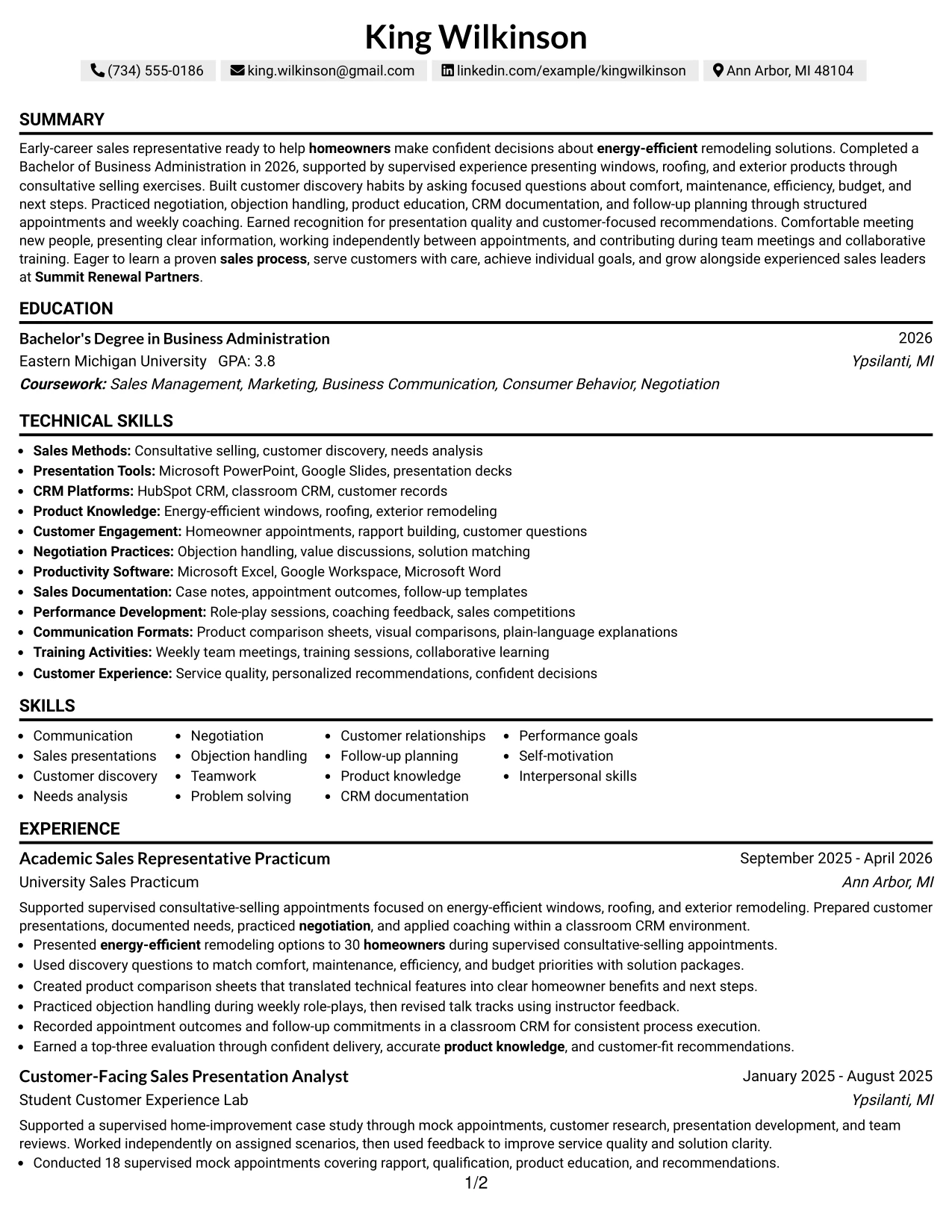
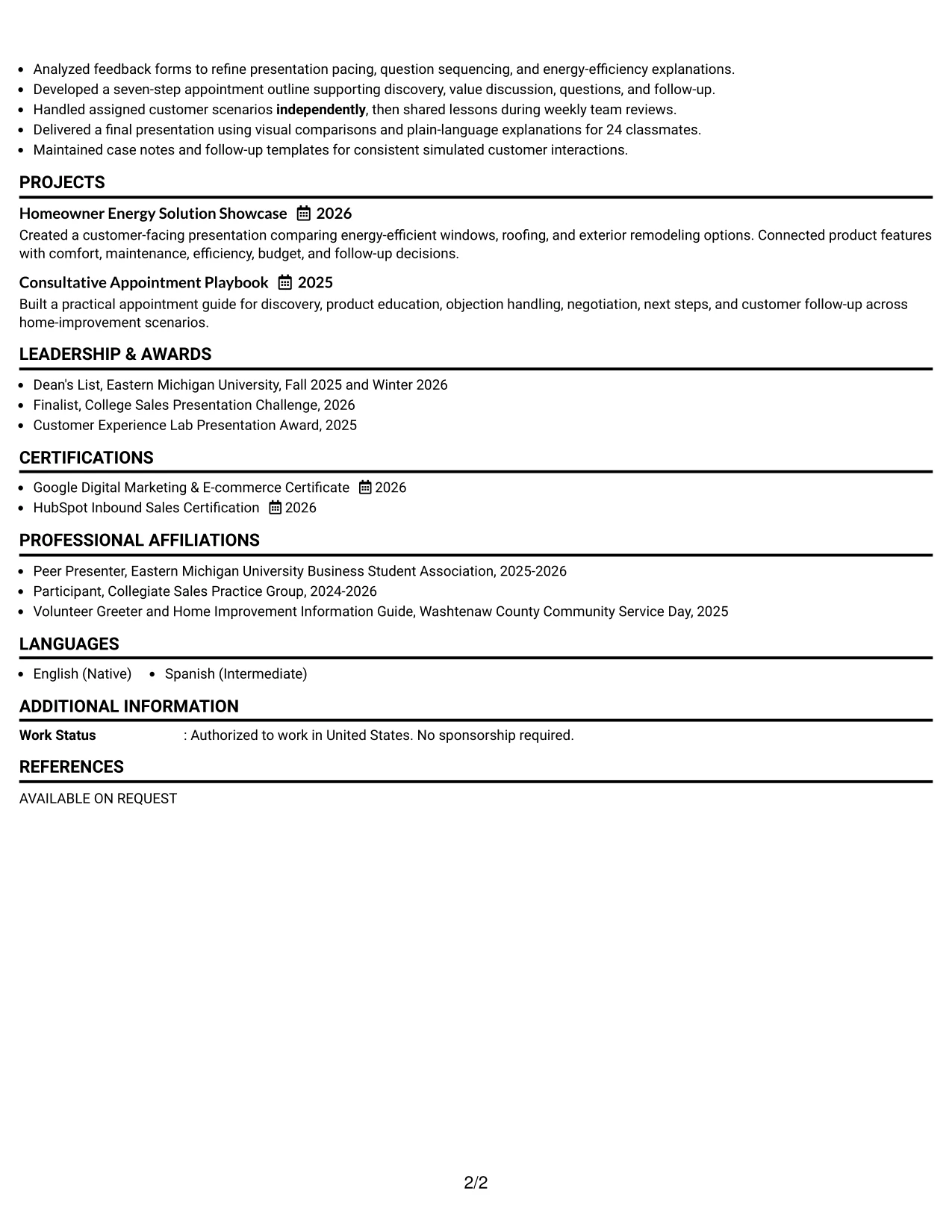
Why the One Column Shaded Contact Header Format Works for a Resume
- The shaded header separates contact information from the main resume content.
- A single reading path supports reliable ATS parsing.
- The summary can connect energy-efficient remodeling experience with the target role.
- Experience bullets can lead with evidence such as 30 homeowner participants and 18 mock appointments.
- Skills remain easy to scan when grouped by sales methods, tools, and customer engagement.
- Education, certifications, awards, and activities fit into a logical sequence.
- The clean hierarchy helps reviewers locate communication, negotiation, and follow-up strengths quickly.
Best For
- Applicants who want a direct match between the summary and a specific sales opening.
- Resumes that need one uninterrupted reading path from profile through skills.
- Candidates presenting supervised experience, projects, and education as connected evidence.
- Applications where ATS readability is more important than decorative design.
- Professionals who need room for several concise achievement bullets.
- Job searches that require clear contact details and location information at the top.
- Resumes combining customer-facing practice with certifications and academic awards.
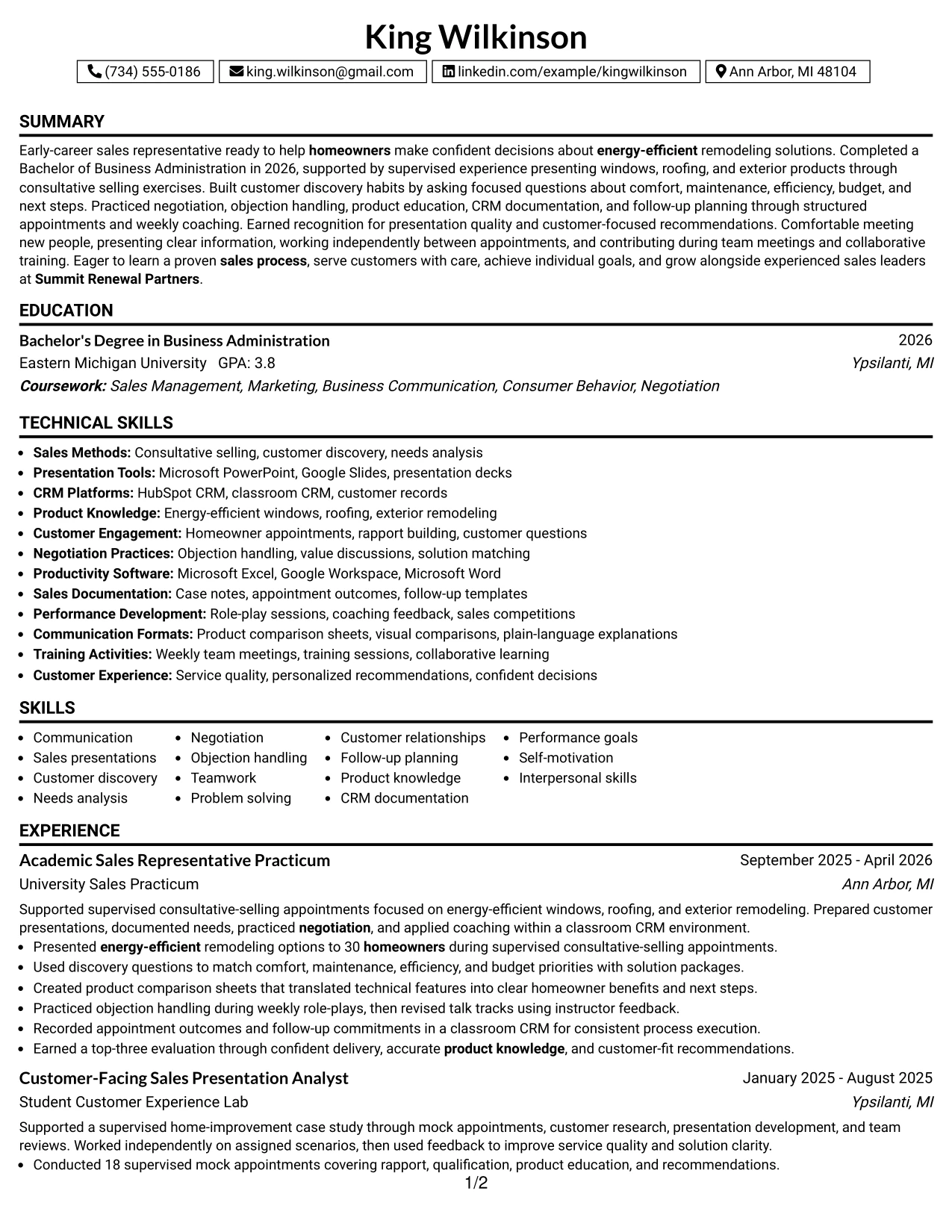
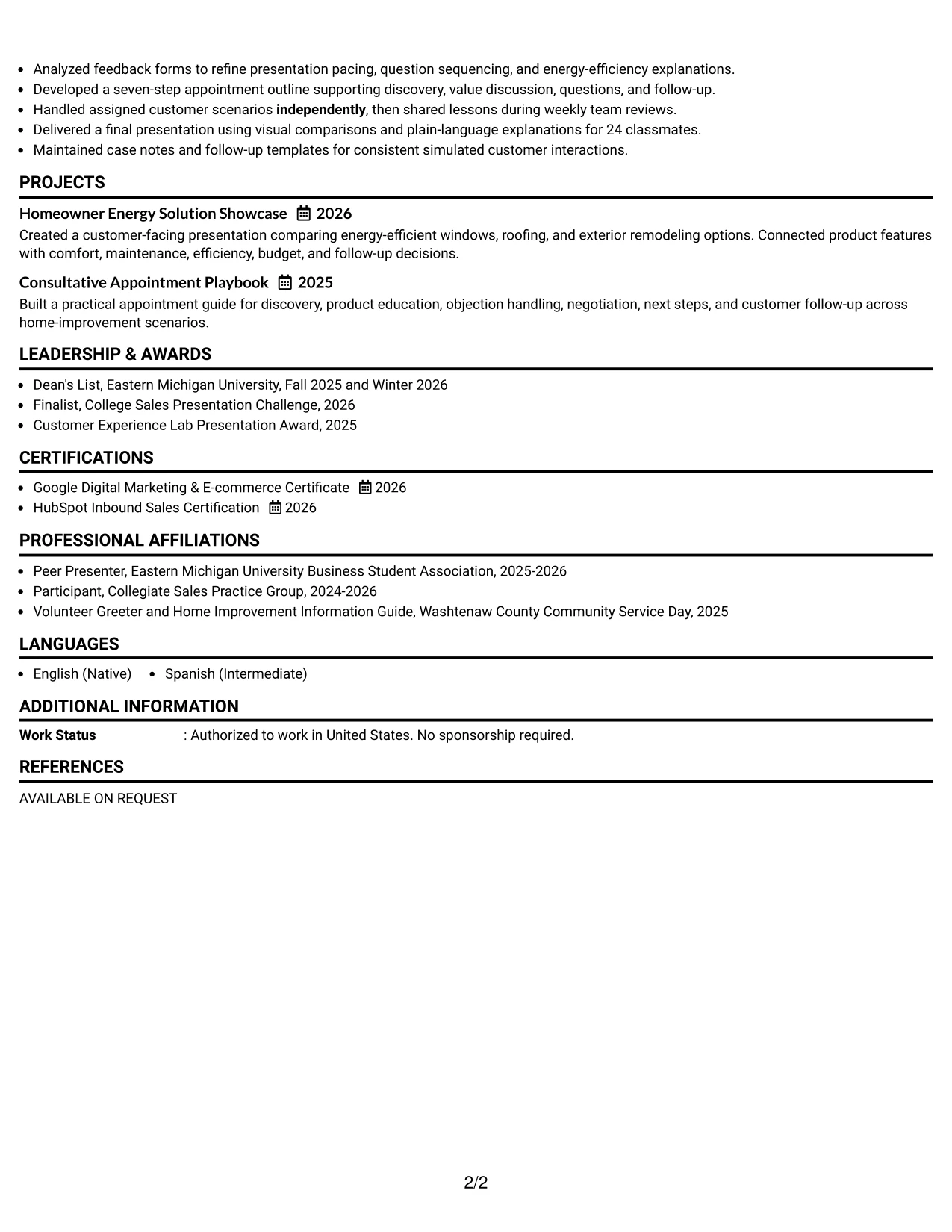
#13 Boxed Contact Header with Job Title Format Resume Example
The format begins with a boxed contact area that states the job title before the reader reaches the main content. That structure creates an immediate link between the resume and the application while preserving a straightforward sequence of sections.
The body can present the professional summary, experience, projects, education, certifications, and skills in clearly labeled blocks. For this sales resume, boxed labels help surface customer discovery, product presentations, negotiation, and performance-based goals during a quick review.
Why the Boxed Contact Header with Job Title Format Works for a Resume
- The job title appears early and reinforces role alignment.
- The boxed contact area creates a strong visual entry point without disrupting ATS-friendly text.
- Section labels make experience, education, projects, and certifications easy to locate.
- A single column keeps reading order predictable across digital and printed reviews.
- Bullets can emphasize customer-facing evidence instead of broad claims.
- The structure supports keywords such as personalized solutions, sales process, and product knowledge.
- The format leaves enough space for both practical training and academic credentials.
Best For
- Applicants tailoring the top of a resume to one clearly defined opening.
- Documents that need prominent section labels for fast recruiter navigation.
- Candidates with related projects that should sit near formal experience.
- Applications where a strong title match should appear before detailed evidence.
- Resumes balancing sales achievements, education, and certifications in one column.
- Job seekers who want visual organization without complex graphics or sidebars.
- Documents that must remain easy to read when converted to a PDF.
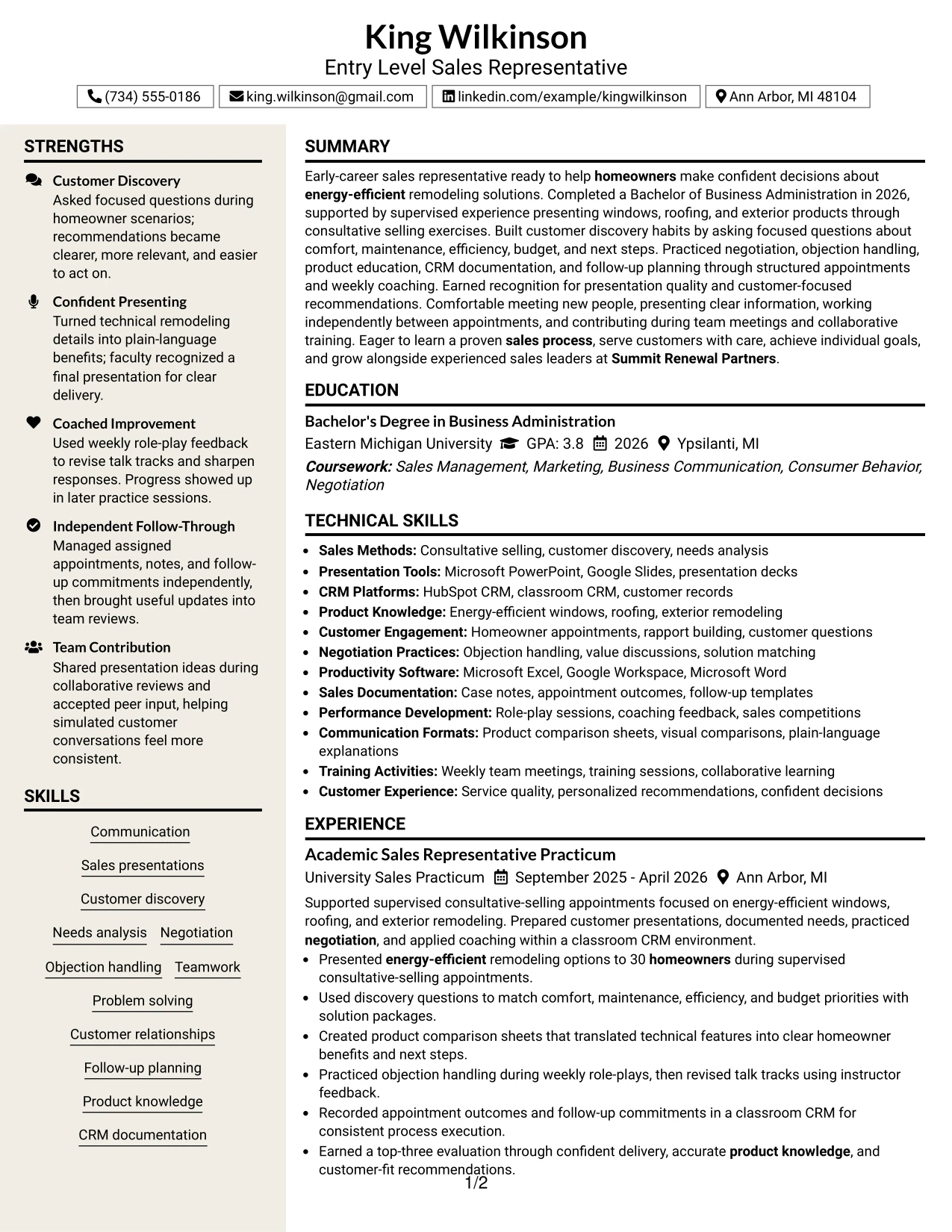
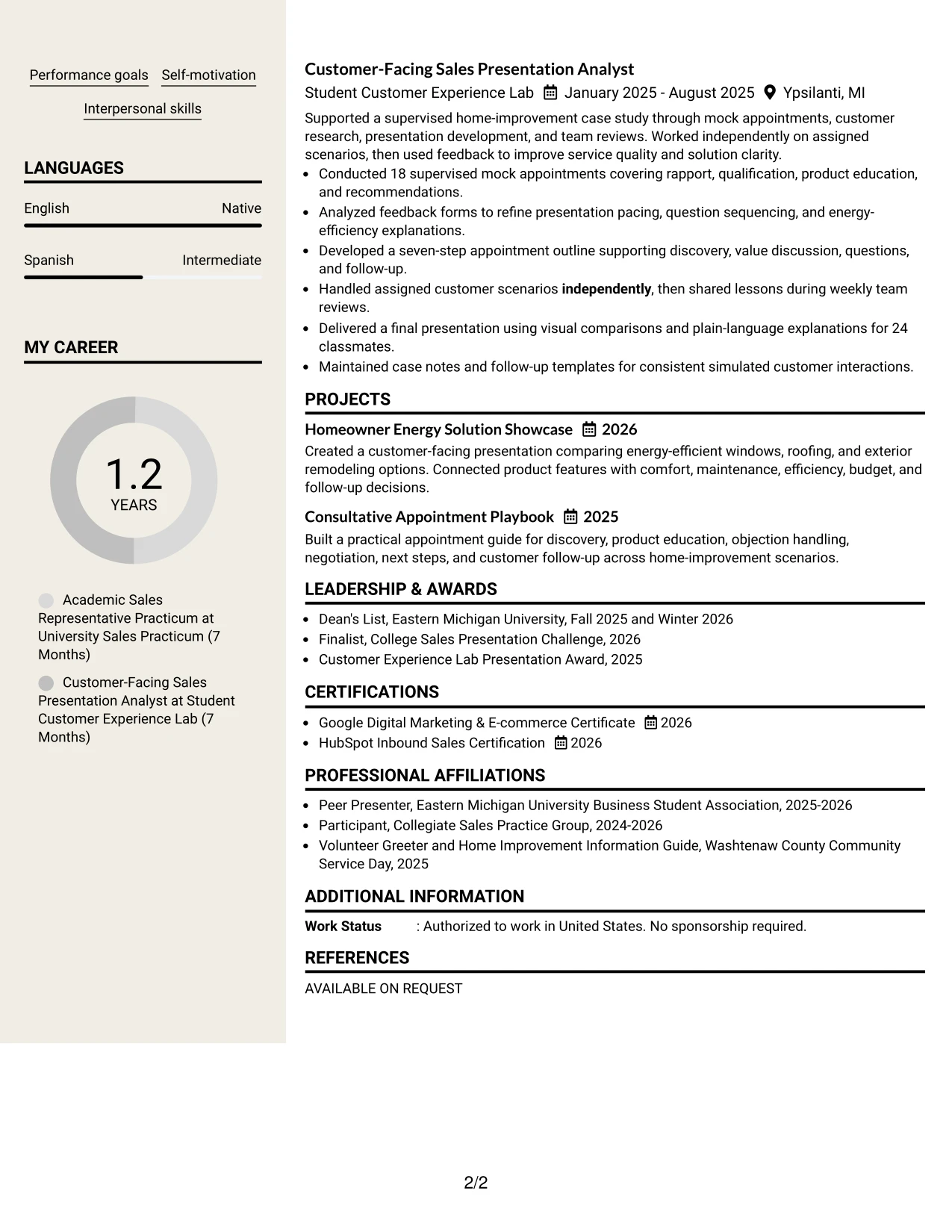
#14 Stylish Two Column Designer Format Resume Example
Readers can move from a compact sidebar of skills and contact details to the wider evidence area containing the summary and experience. This navigation separates quick-reference information from the bullets that prove capability.
The two-column design gives the resume room to show consultative selling, customer discovery, presentation tools, projects, certifications, and supervised appointments. Careful grouping keeps the visual style useful rather than allowing the sidebar to hide important ATS keywords.
Why the Stylish Two Column Designer Format Works for a Resume
- The sidebar provides fast access to skills, certifications, and contact details.
- The wider column gives experience bullets enough room for context and results.
- Separate content zones help distinguish tools from accomplishments.
- The layout can show both practicum experience and customer-facing projects without crowding one list.
- Keywords remain visible when skills use standard text labels.
- The format supports a strong summary followed by evidence-rich work sections.
- Consistent spacing helps reviewers compare multiple appointment and presentation examples.
Best For
- Resumes with enough relevant content to justify two clearly separated information zones.
- Applicants who need a quick-reference skills area beside detailed experience.
- Candidates combining projects, certifications, awards, and supervised work.
- Applications where presentation tools and sales methods should be visible at a glance.
- Documents that benefit from a compact sidebar and a fuller evidence column.
- Job seekers who want visual distinction while keeping bullets readable.
- Resumes with varied evidence that needs grouping rather than one long list.
#15 Modern Icon Format Resume Example
The strongest evidence receives priority: supervised appointments, customer recommendations, presentation results, and documented follow-through. The modern visual markers then help the reader locate supporting sections without replacing the text-based proof.
This format can organize sales methods, CRM documentation, education, certifications, projects, and awards around a focused experience section. Its icons should remain secondary to searchable terms such as objection handling, negotiation, HubSpot CRM, and energy-efficient remodeling.
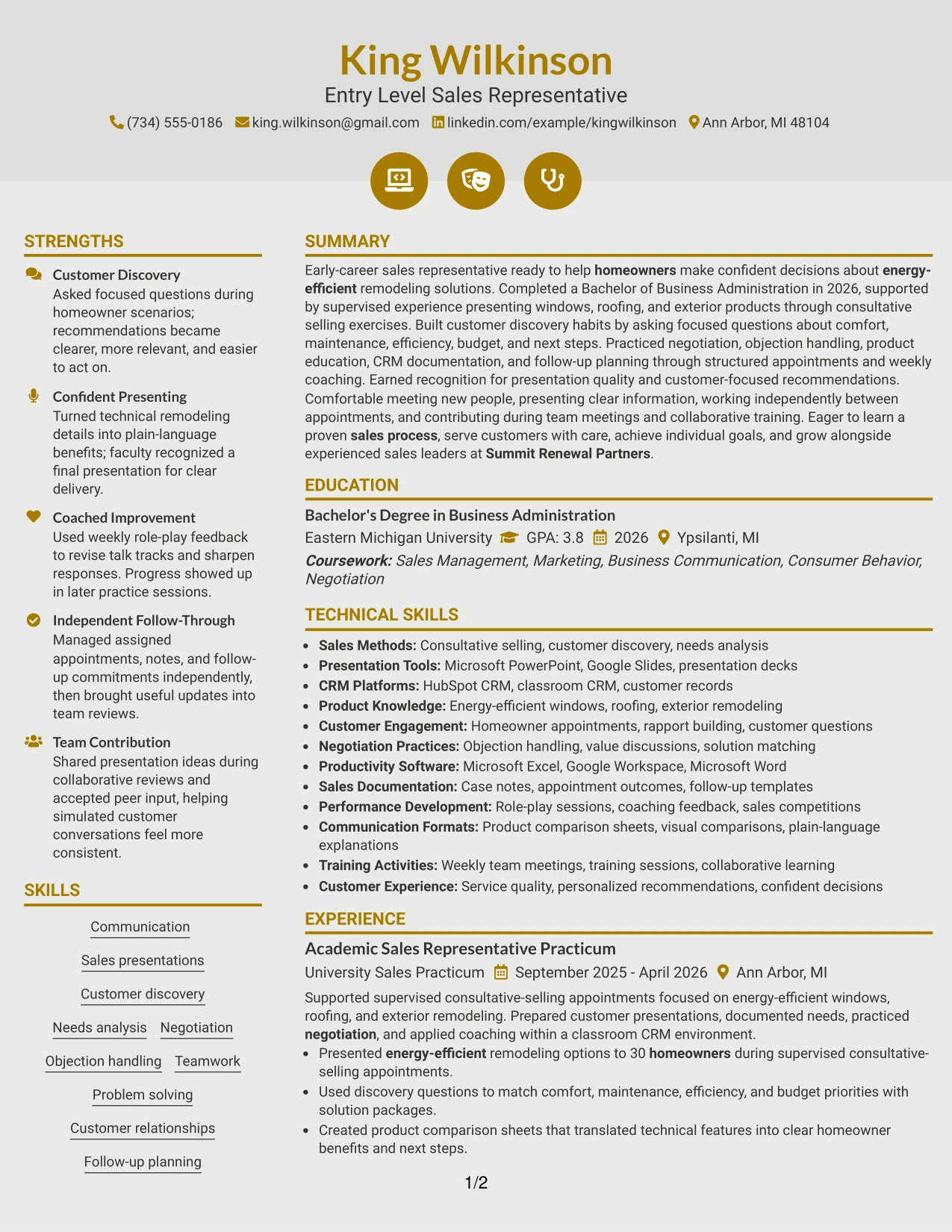
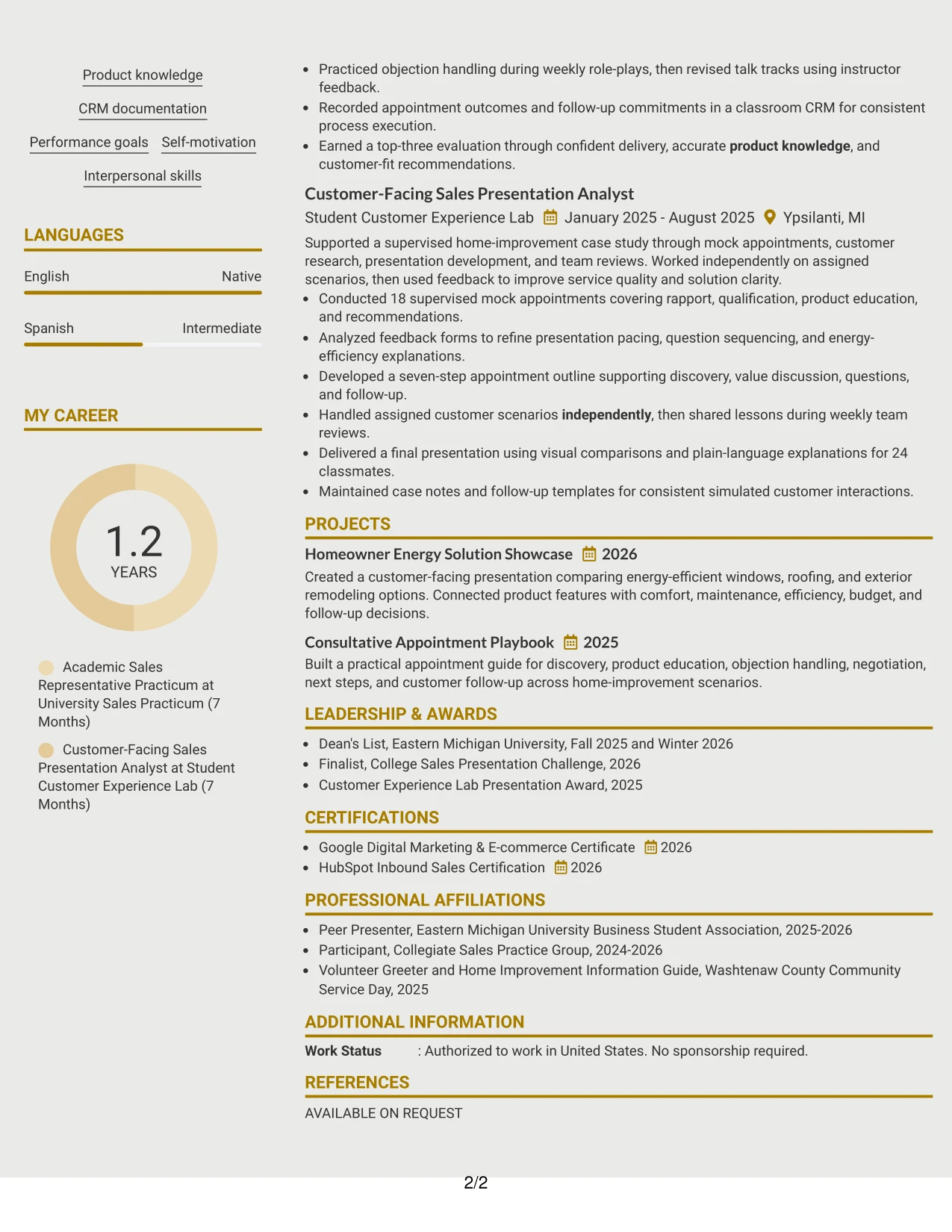
Why the Modern Icon Format Works for a Resume
- Achievement bullets remain the main proof of readiness.
- Visual markers help separate sections without carrying meaning by themselves.
- The layout can highlight 30 homeowner participants and 18 mock appointments.
- Skills and tools can be grouped so keywords remain easy to scan.
- Project entries add evidence of product education and solution matching.
- Certifications and awards support the summary without interrupting the experience story.
- Text-first content keeps the resume more dependable for ATS review.
Best For
- Applicants whose strongest asset is specific evidence from supervised practice.
- Resumes that need to distinguish achievements, tools, education, and projects quickly.
- Candidates using metrics, evaluation results, or completed presentations to show readiness.
- Applications where modern styling should support, not replace, written keywords.
- Documents with several short supporting sections that benefit from clear visual markers.
- Job seekers who want a current presentation while retaining conventional resume content.
- Resumes that connect customer scenarios to measurable practice outcomes.
#16 Plain Professional Layout with Job Title and Shaded Labels Resume Example
Balanced spacing gives the header, summary, and evidence sections enough room to work independently. Shaded labels create order while the plain presentation keeps attention on the resume content rather than decoration.
This application-focused layout suits a document that must connect a business degree, supervised sales practice, certifications, and customer-facing projects. It makes the path from job title to relevant keywords clear for both ATS systems and human reviewers.
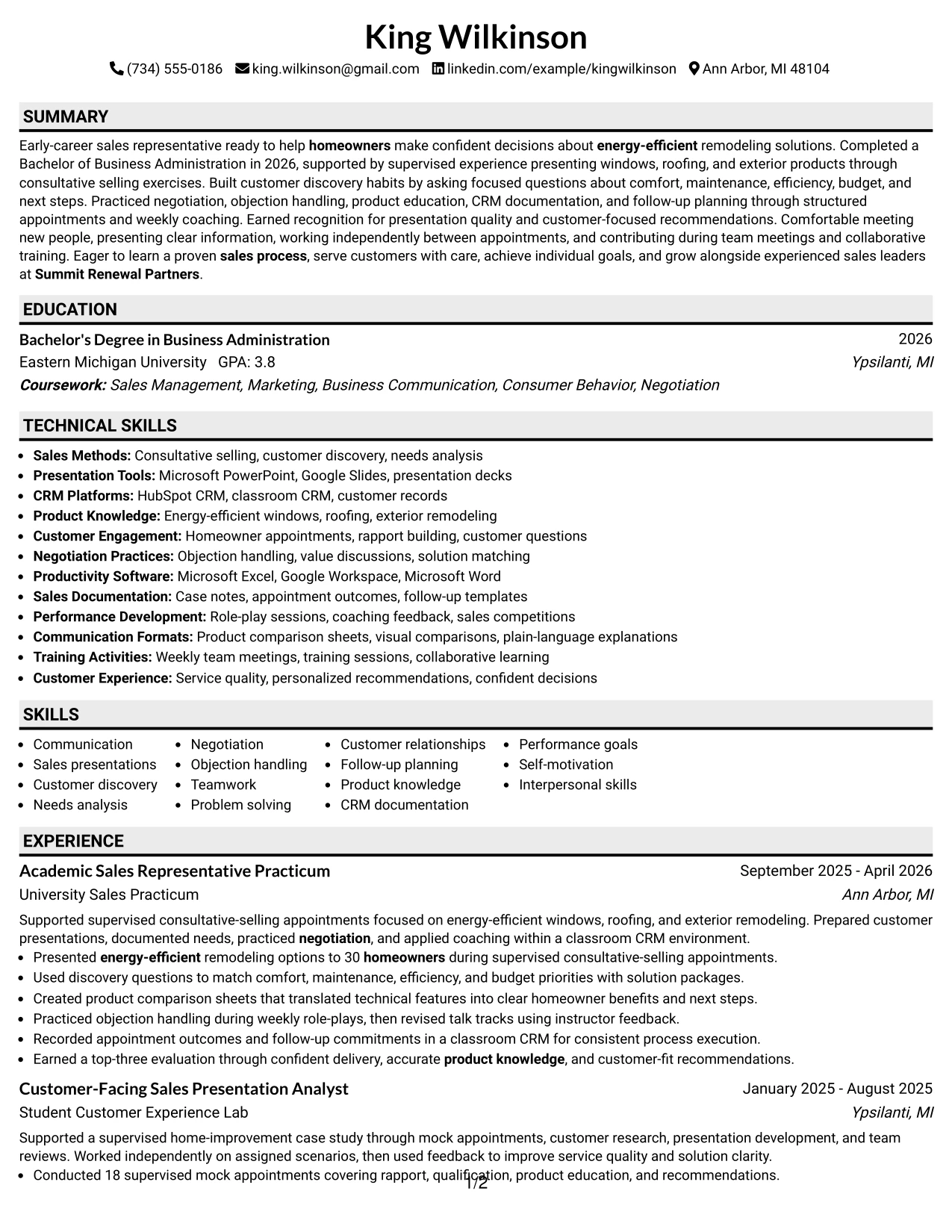
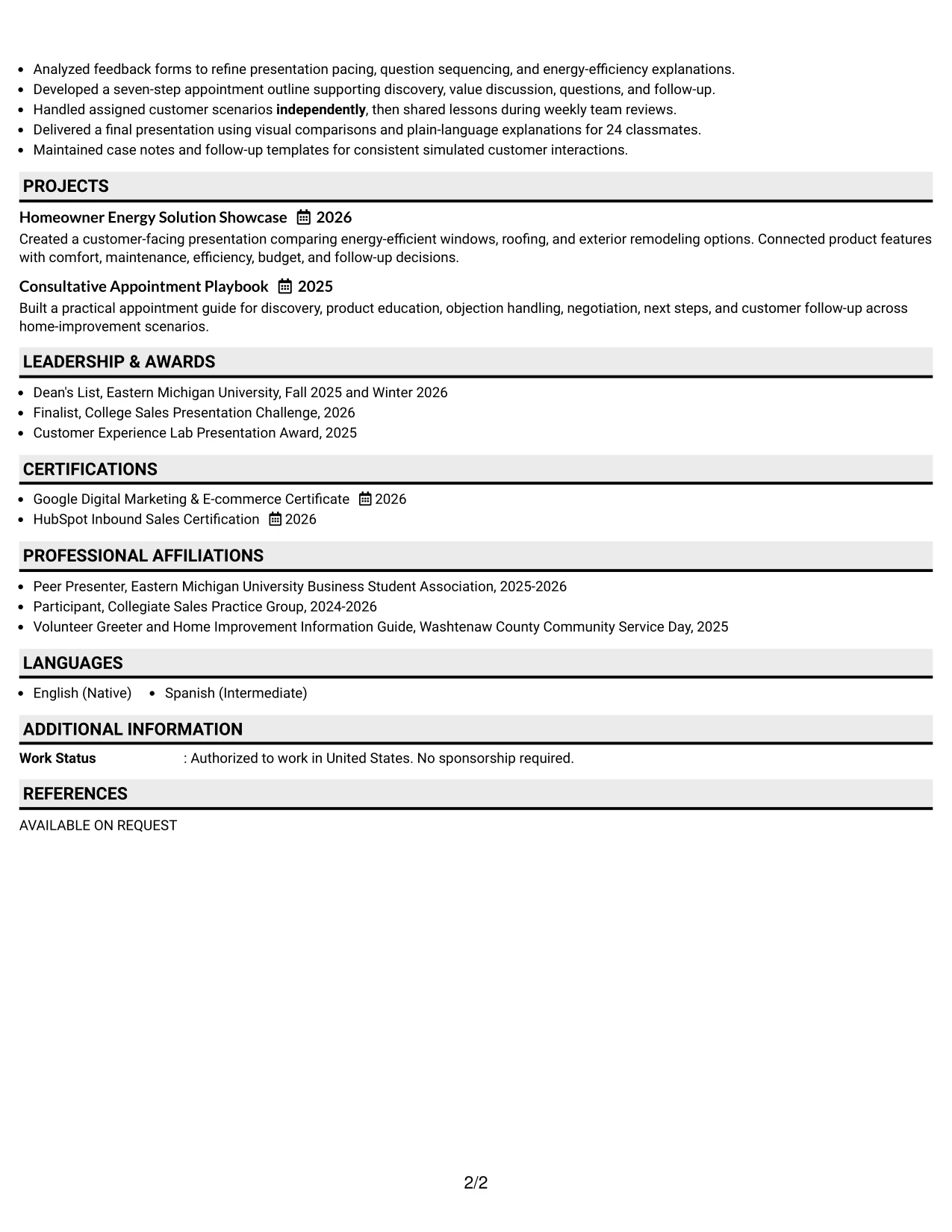
Why the Plain Professional Layout with Job Title and Shaded Labels Works for a Resume
- The job title establishes the application context immediately.
- Shaded labels divide the resume into predictable sections.
- Balanced white space prevents skills and experience bullets from merging together.
- The summary can mirror the role's focus on homeowners and personalized solutions.
- Education and certifications receive clear placement without overpowering experience.
- Bullets can show coaching, independent follow-through, and team contribution.
- The restrained design supports both digital scanning and printed review.
Best For
- Applications that need a professional link between the document and one target role.
- Resumes presenting academic preparation alongside practical customer-facing work.
- Candidates who want clear labels without a heavily designed appearance.
- Documents reviewed in systems where simple section order supports parsing.
- Job searches requiring visible training, certifications, and product knowledge.
- Applicants who need balanced space for experience, projects, and awards.
- Resumes where readable evidence should take priority over visual effects.
#17 Classic One Column Resume Format Resume Example
For an entry-level sales application, a classic one-column resume offers a familiar review path: contact details, summary, experience, education, certifications, projects, and skills. That order lets relevant training support the experience section instead of competing with it.
The format fits a record that includes a Bachelor of Business Administration, supervised appointments, presentation awards, and CRM practice. Standard headings and concise bullets make communication, needs analysis, negotiation, and follow-up planning easy to evaluate.
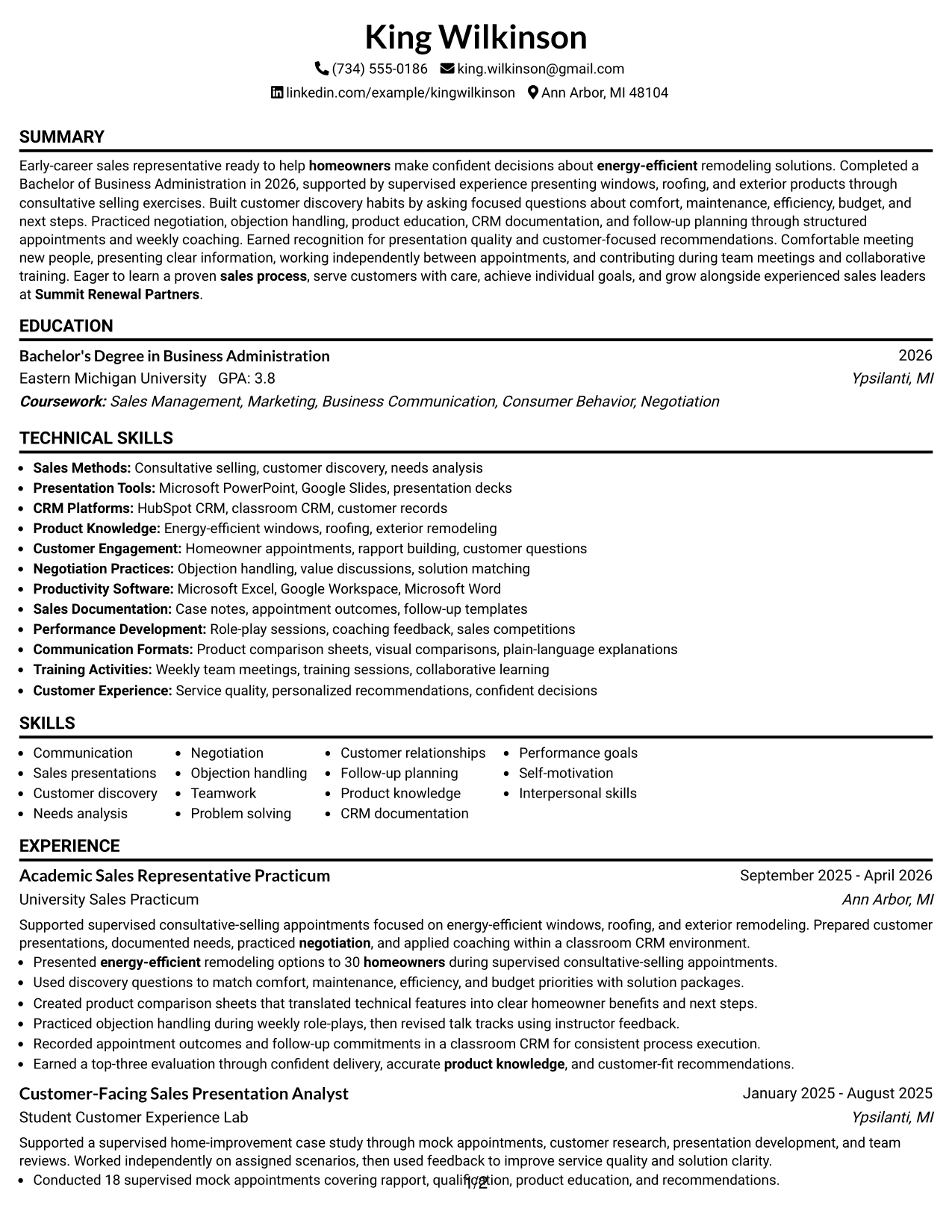
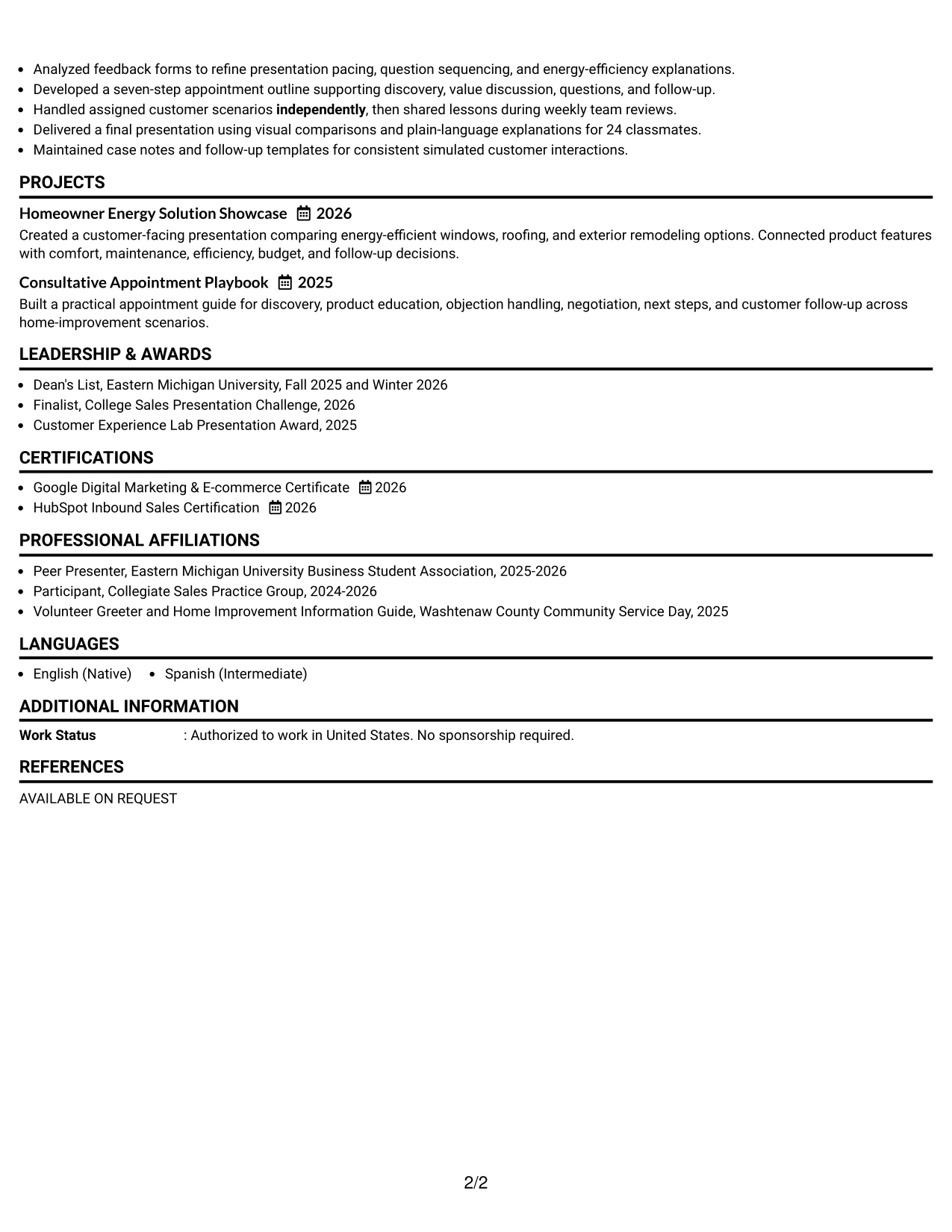
Why the Classic One Column Resume Format Works for a Resume
- The familiar sequence reduces effort during a first review.
- Standard section headings support ATS recognition.
- Experience bullets can show both responsibilities and outcomes.
- Academic training adds context for consultative selling and negotiation.
- Projects provide useful proof when formal employment history is limited.
- Awards and certifications strengthen the evidence without taking over the page.
- A consistent one-column format keeps every section in the intended reading order.
Best For
- Applicants entering sales with academic and supervised experience to present clearly.
- Resumes submitted through traditional application portals and ATS platforms.
- Candidates who want experience, education, and projects in one familiar sequence.
- Applications where standard headings improve fast comparison across documents.
- Job seekers with awards or certifications that support, rather than replace, experience.
- Documents that need reliable readability in print, PDF, and online review.
- Resumes emphasizing steady evidence over visual experimentation.
#18 One Column Format with Photo Resume Example
A polished visual presentation can create a memorable first impression when a photo is appropriate for the application context. The one-column structure still keeps the resume's main job clear: present the summary, customer-facing evidence, education, certifications, and skills in a logical order.
For this sales profile, the format can support a people-focused presentation while the content proves readiness through homeowner scenarios, product explanations, feedback cycles, and CRM practice. The photo should remain secondary to searchable role keywords and achievement bullets.
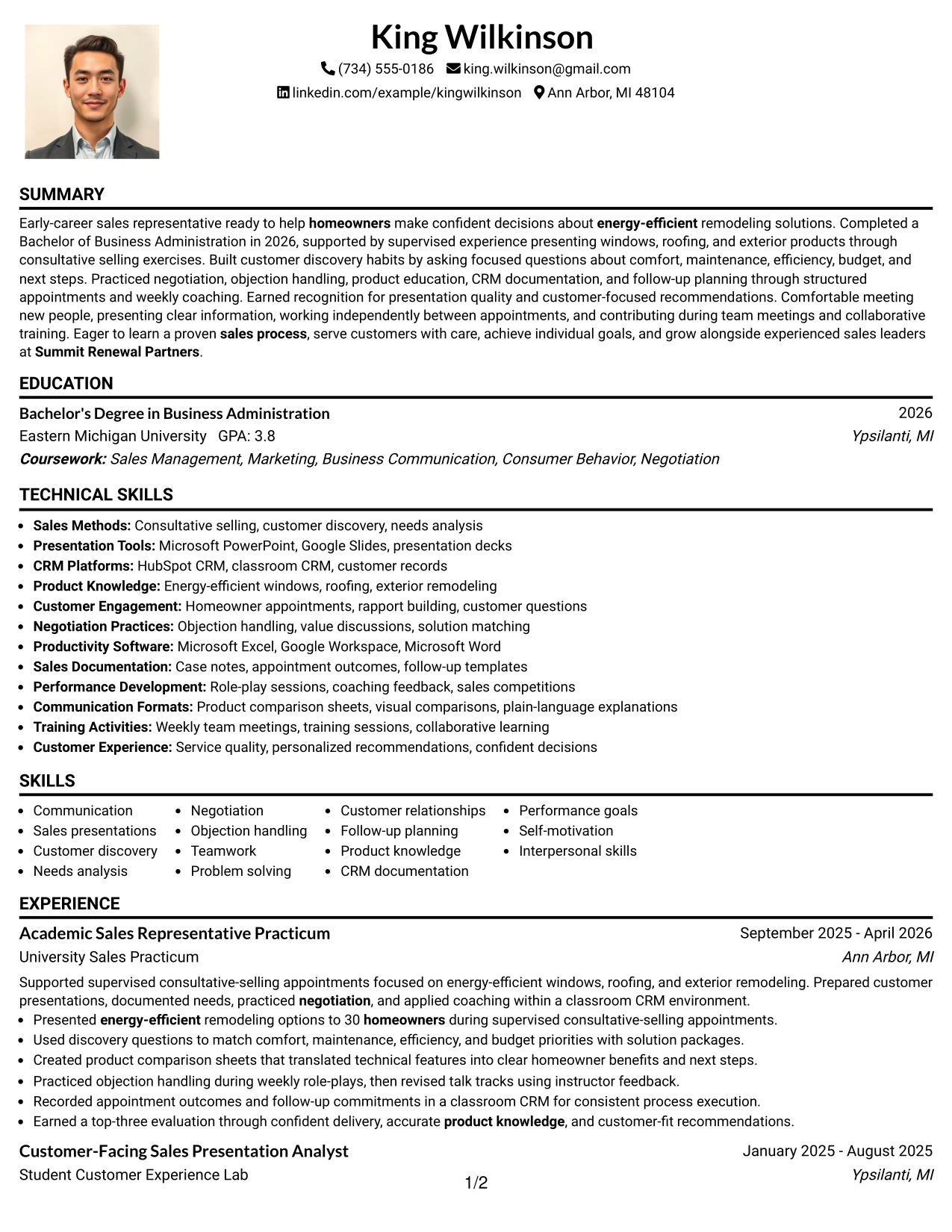
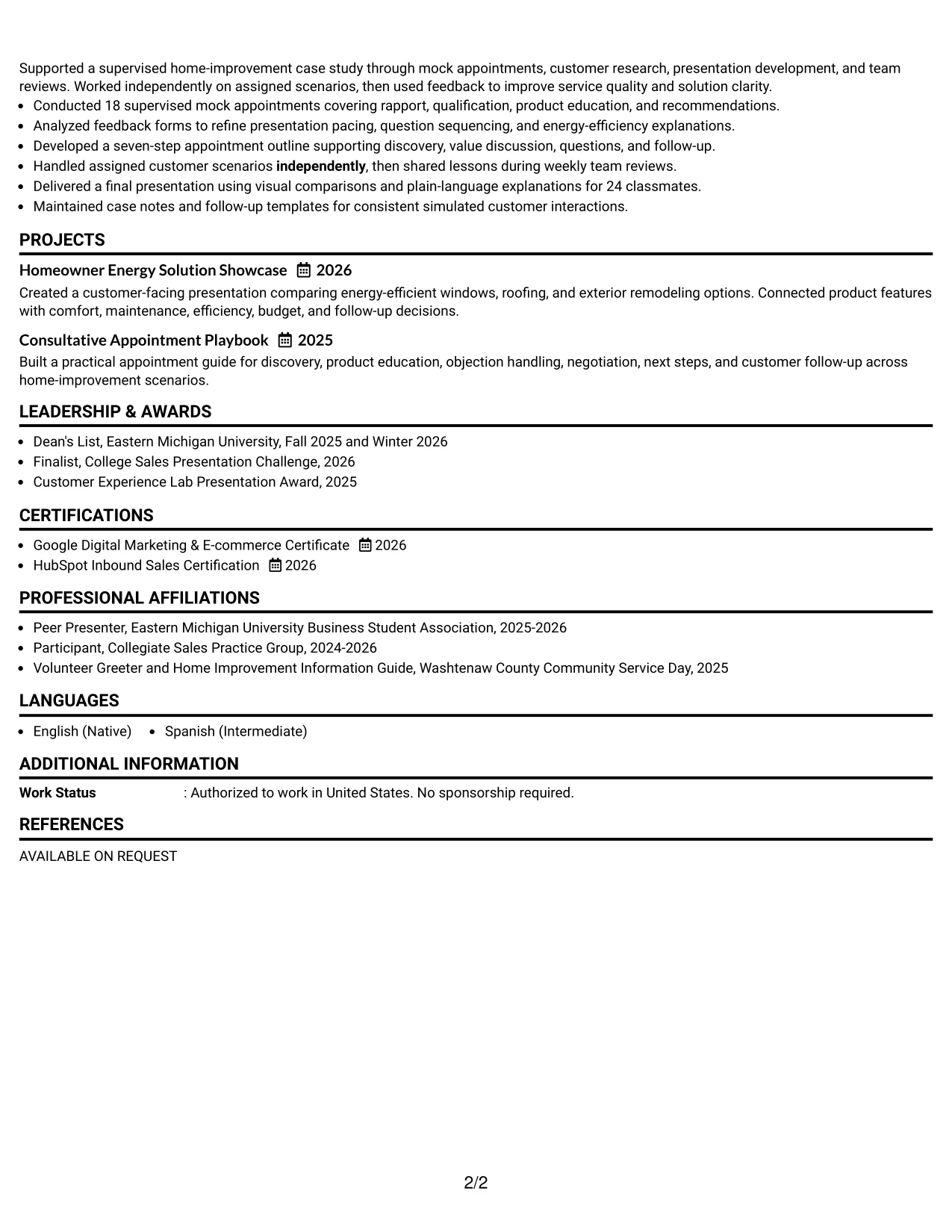
Why the One Column Format with Photo Works for a Resume
- The photo can support a polished presentation in contexts where it is accepted.
- A single content path keeps experience and skills easy to follow.
- The summary can connect interpersonal strengths with homeowner appointments.
- Presentation results and supervised practice provide stronger evidence than appearance alone.
- Certifications and education remain visible in the same central structure.
- Standard keywords support digital review when the file is parsed.
- The layout keeps customer discovery, negotiation, and follow-up close to the main experience story.
Best For
- Applications in settings where including a professional photo is accepted and useful.
- Applicants who want a people-focused visual presentation alongside strong written evidence.
- Resumes with one main experience path and several concise supporting sections.
- Candidates whose work includes frequent presentations and customer interaction.
- Documents that need a central sequence for summary, experience, education, and skills.
- Job seekers who can keep the photo professional and secondary to qualifications.
- Applications where visual polish complements, but does not replace, ATS-ready text.
#19 Minimal Header Format Resume Example
The minimal header establishes contact details and the target role without using visual elements that distract from the body. After that opening, the reader can scan the summary, experience, projects, education, certifications, and skills in a clean sequence.
This format is effective for an entry-level sales resume because it gives practical evidence room to lead. Metrics, presentation recognition, customer discovery, CRM documentation, and the business degree can appear as connected proof rather than scattered keywords.
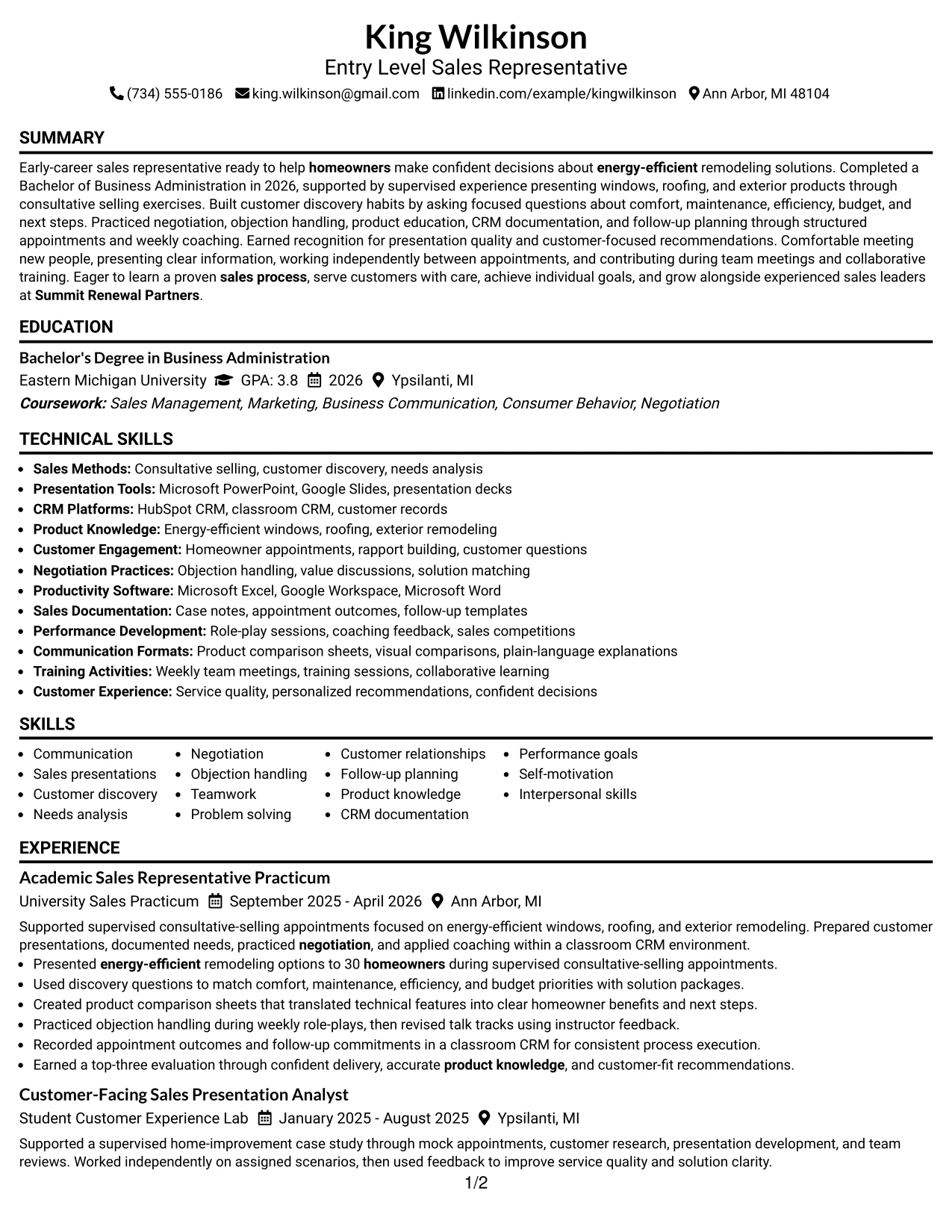
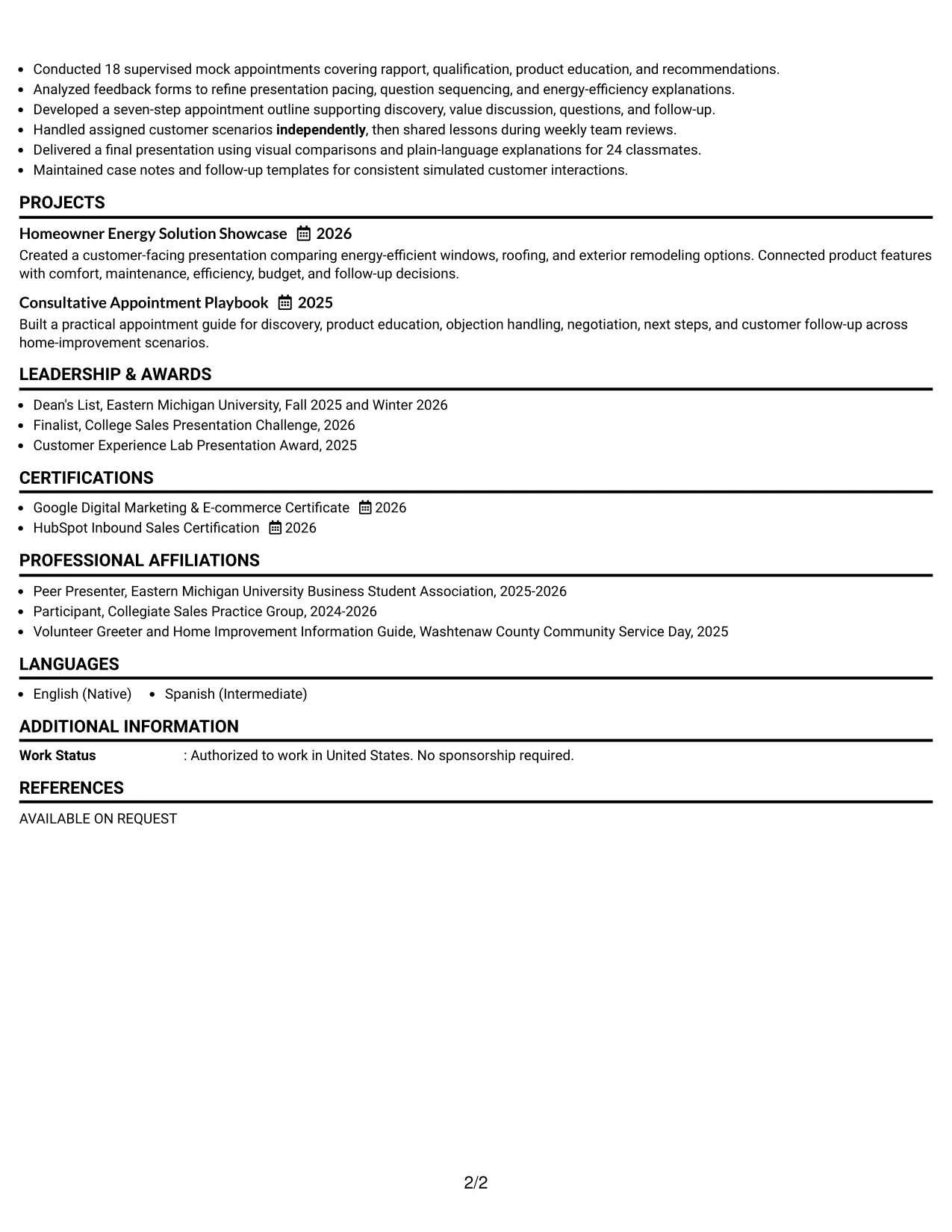
Why the Minimal Header Format Works for a Resume
- A quiet header keeps attention on qualifications.
- The simple structure supports dependable ATS parsing.
- The summary can quickly state the target role and customer focus.
- Concise bullets make 30 participants, 18 appointments, and a top-three evaluation visible.
- Projects add depth without requiring a complex visual system.
- Education and certifications remain easy to locate near the supporting evidence.
- The format creates a professional impression through clarity and consistency.
Best For
- Applicants who want the content to create the visual impact.
- Resumes requiring a clean top section and a straightforward body.
- Candidates with metrics that should stand out through bullet writing.
- Applications where simple formatting reduces parsing risk.
- Job seekers presenting practical training, projects, and academic credentials together.
- Documents intended for easy editing as experience develops.
- Resumes that need a polished result without decorative layout features.
#20 Modern Full Background Two Column Format Resume Example
Readers can use one column for quick-reference skills, certifications, and contact details, then move to the broader column for the summary and evidence. That division helps a detailed resume feel navigable while keeping related information together.
The format gives space to present supervised sales practice, projects, awards, education, and tools without forcing every item into one narrow stream. For King Wilkinson's application, the main column can prioritize homeowner presentations and solution matching while the secondary column reinforces CRM, communication, and training keywords.
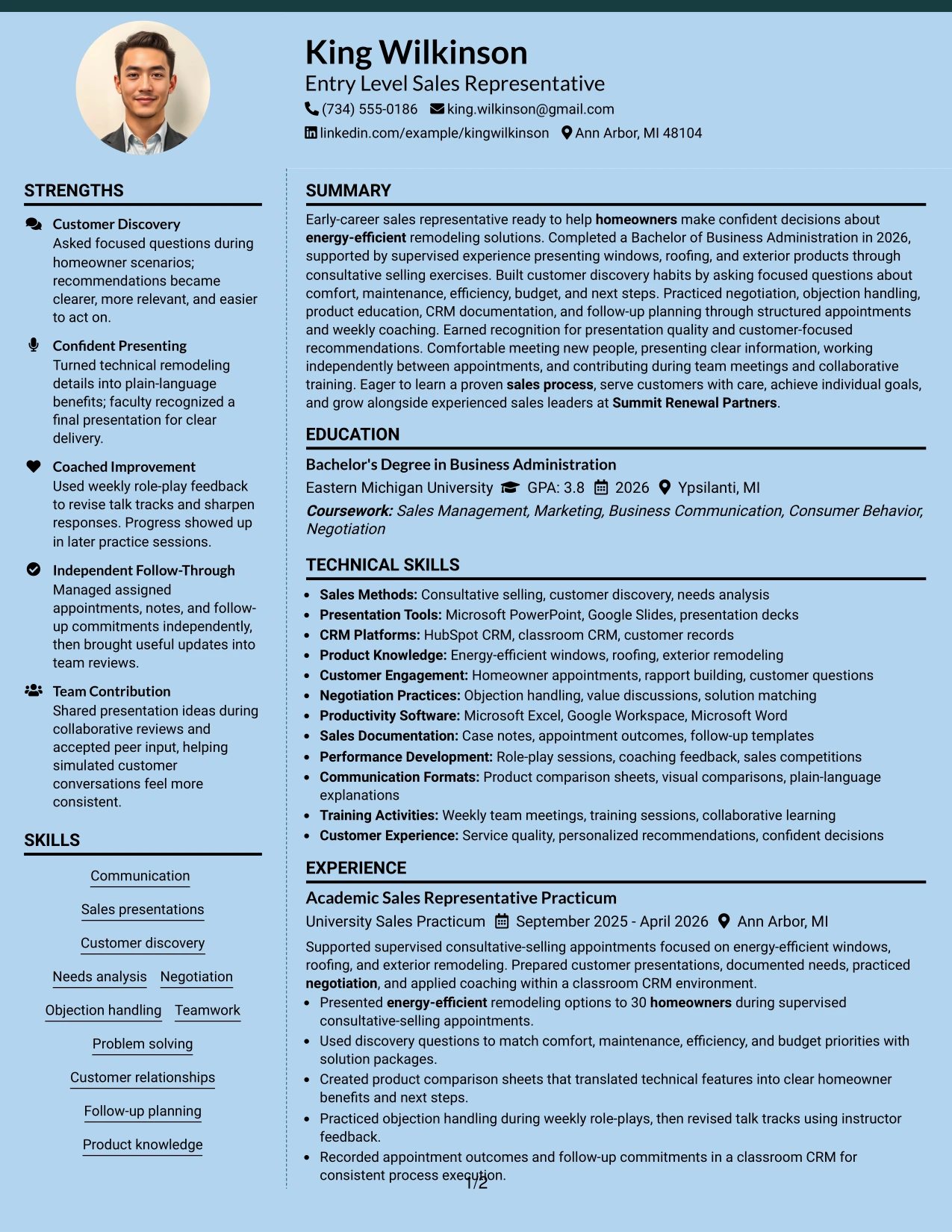
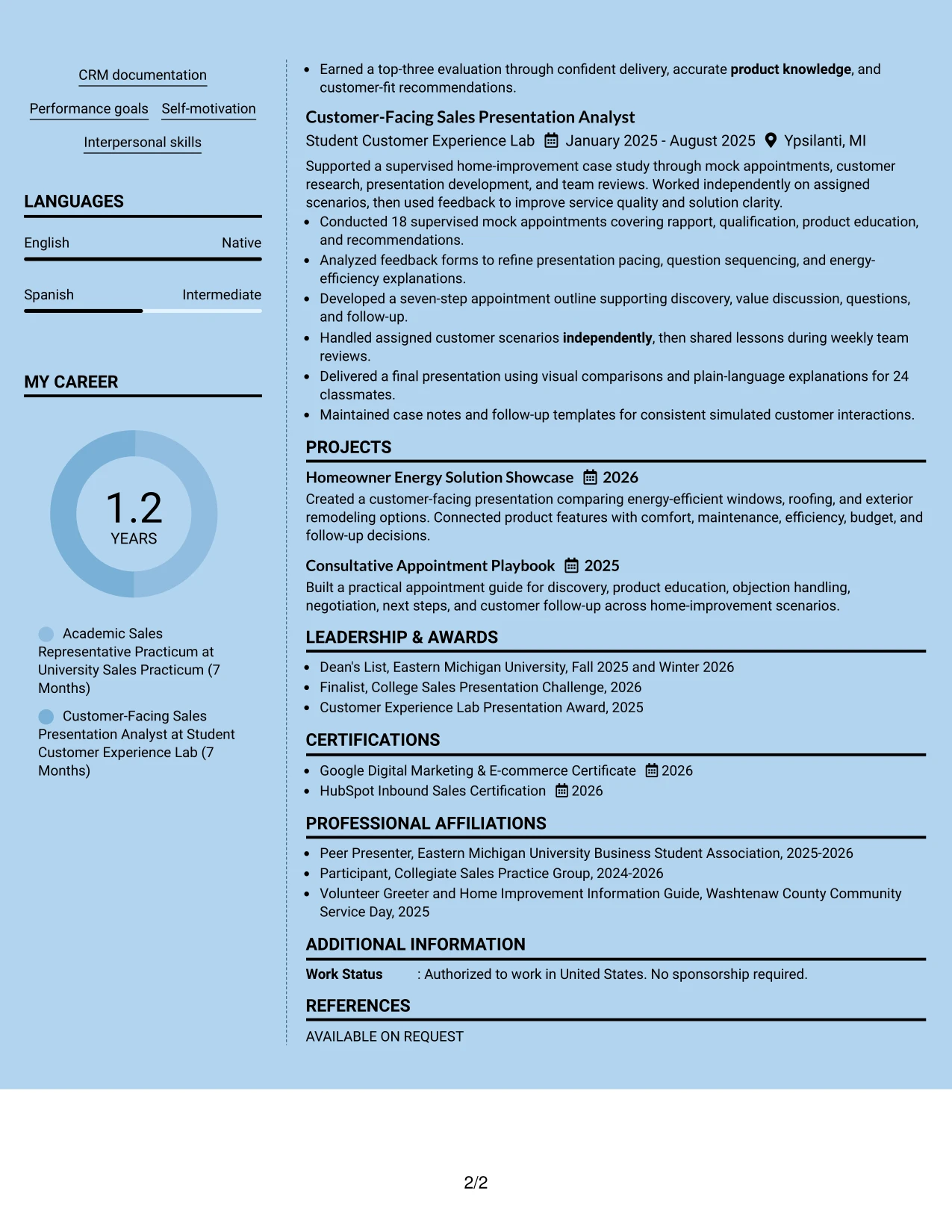
Why the Modern Full Background Two Column Format Works for a Resume
- Two columns create a clear difference between quick facts and detailed proof.
- The full background treatment gives the page a cohesive modern identity.
- The main column can carry the summary and achievement-rich experience bullets.
- A secondary column can group skills, certifications, languages, and activities.
- Projects have room to support the home-remodeling product focus.
- The structure helps a reader review several evidence types without losing the main story.
- Text hierarchy can preserve ATS value despite the more visual presentation.
Best For
- Resumes with enough material to divide into quick-reference and evidence zones.
- Applicants who need skills and certifications visible beside detailed experience.
- Candidates presenting projects, activities, awards, and education together.
- Applications where a modern presentation supports a substantial content volume.
- Job seekers who want customer-facing achievements to occupy the widest reading area.
- Documents that benefit from grouped tools, methods, and supporting credentials.
- Resumes for readers comfortable navigating a visually organized two-column page.
#21 Dark Mode Two Column Format Resume Example
Evidence should lead the review: homeowner presentations, discovery questions, product comparisons, appointment notes, and recognition for presentation quality. A two-column structure can then place these results beside a compact skills and certification area.
The dark visual treatment creates a distinct presentation, but the resume still needs strong contrast, readable text, and standard keywords. When those basics are protected, the format can show consultative selling, negotiation, CRM documentation, projects, education, and awards in a memorable but organized way.
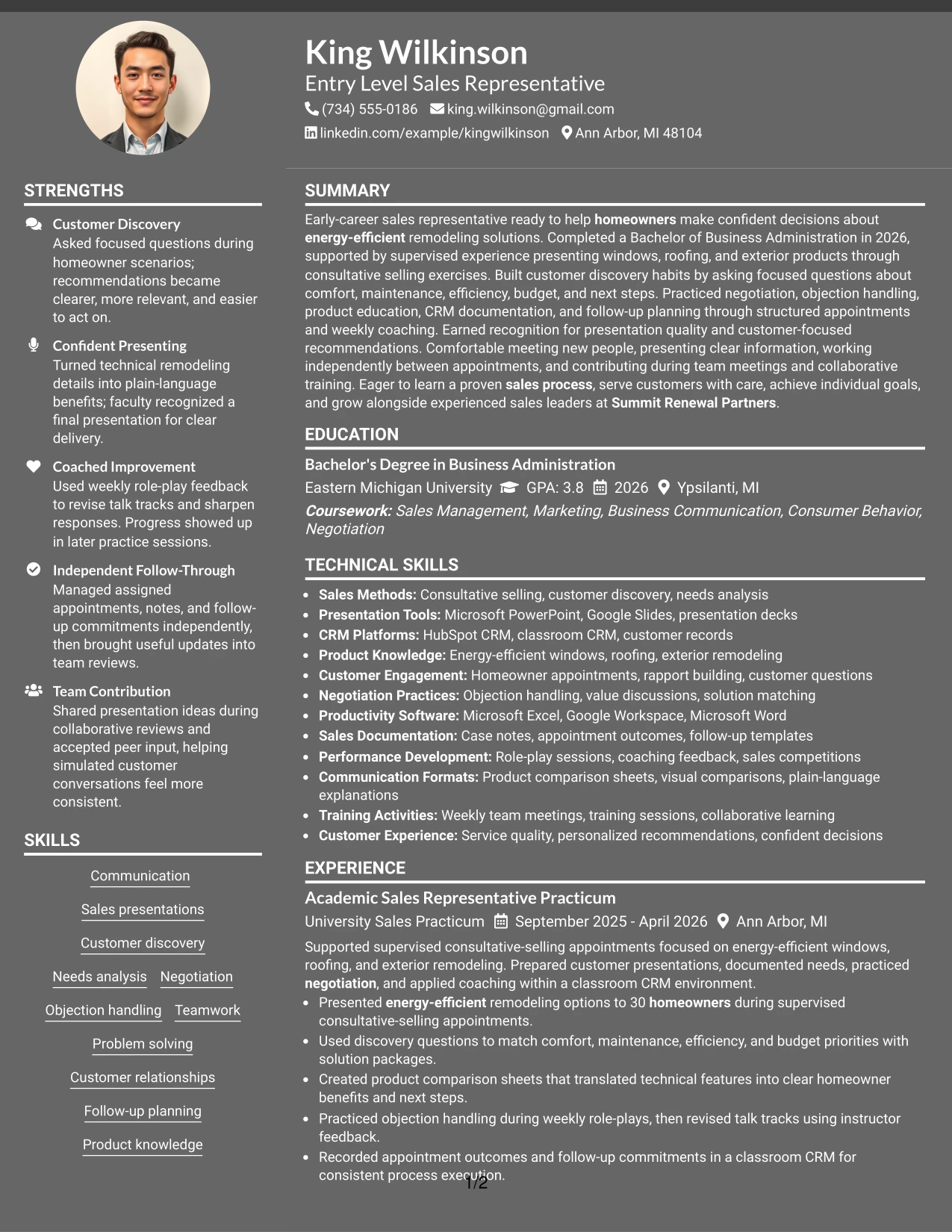
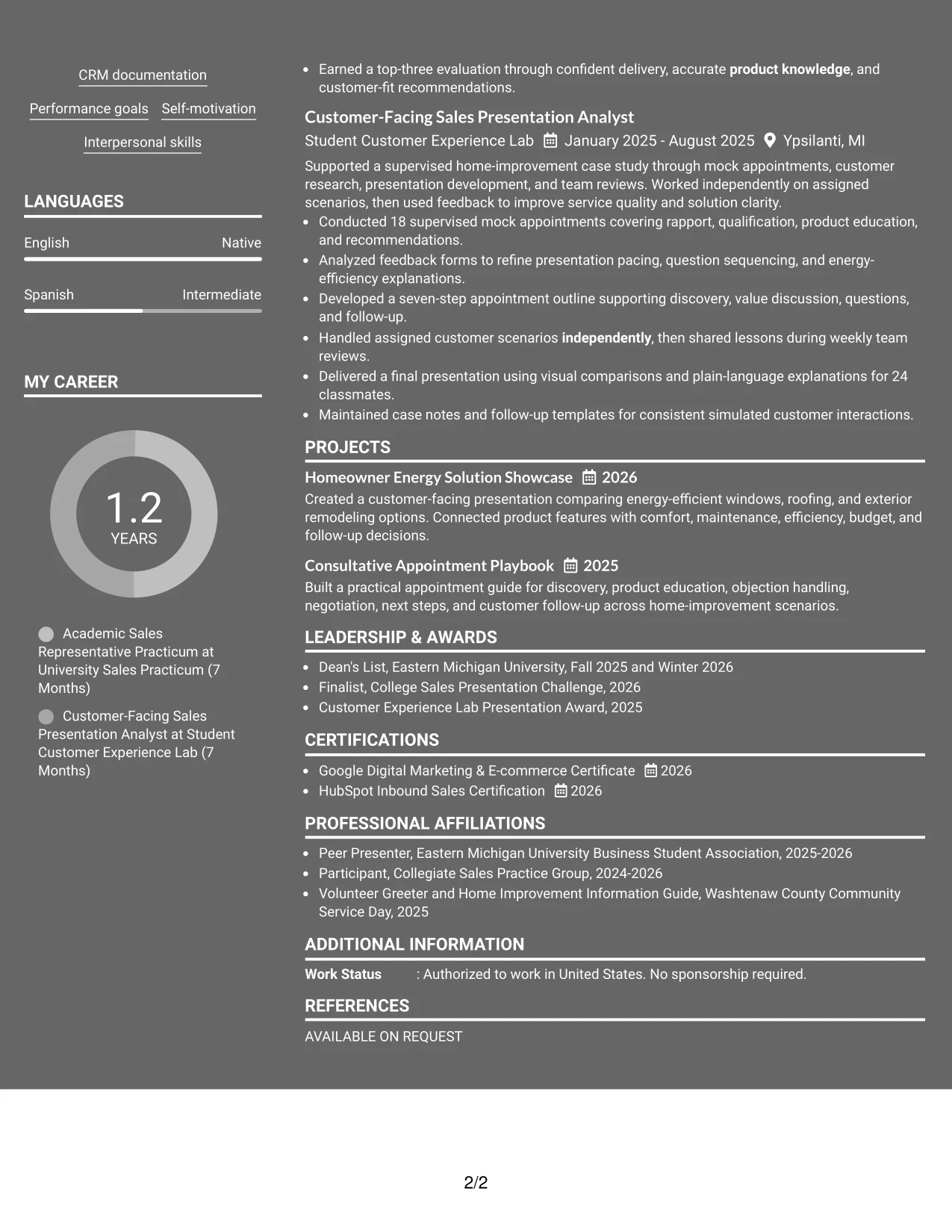
Why the Dark Mode Two Column Format Works for a Resume
- Achievement evidence remains central despite the stronger visual treatment.
- Two columns separate detailed experience from quick-reference qualifications.
- High contrast and readable text protect usability.
- The layout can feature customer discovery and product presentations in the main column.
- Skills, certifications, and tools can remain visible in a compact supporting area.
- Projects and awards add evidence of initiative and presentation ability.
- Standard wording preserves important ATS keywords and search value.
Best For
- Applicants whose evidence is strong enough to carry a distinctive visual presentation.
- Resumes needing separate areas for achievement bullets and supporting credentials.
- Candidates with presentation awards, projects, and certifications to organize compactly.
- Applications where a modern look is acceptable and text contrast can remain clear.
- Job seekers who want customer-facing results to dominate the main content area.
- Documents that require grouped sales methods, tools, and communication strengths.
- Resumes reviewed by people who value visual distinction without sacrificing readability.
#22 Dark Mode Box Header Format Resume Example
Balanced spacing gives the dark header and the main resume sections separate roles. The boxed header identifies the application quickly, while the body leaves room for a summary, experience bullets, projects, education, certifications, and skills.
This format can work for a sales resume when contrast remains strong and the content stays concise. The page should use its space to emphasize homeowner needs analysis, personalized recommendations, negotiation practice, customer experience, and follow-up execution.
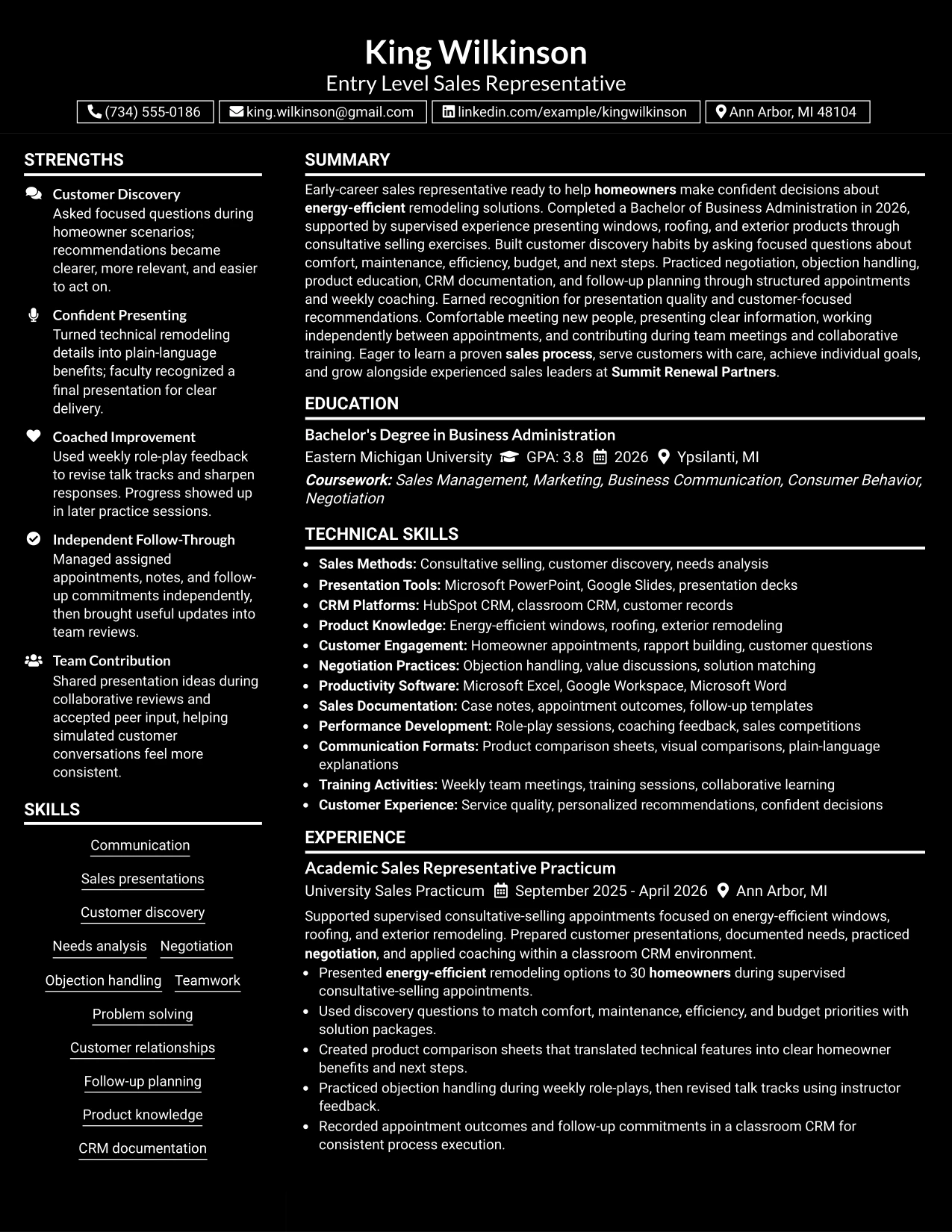
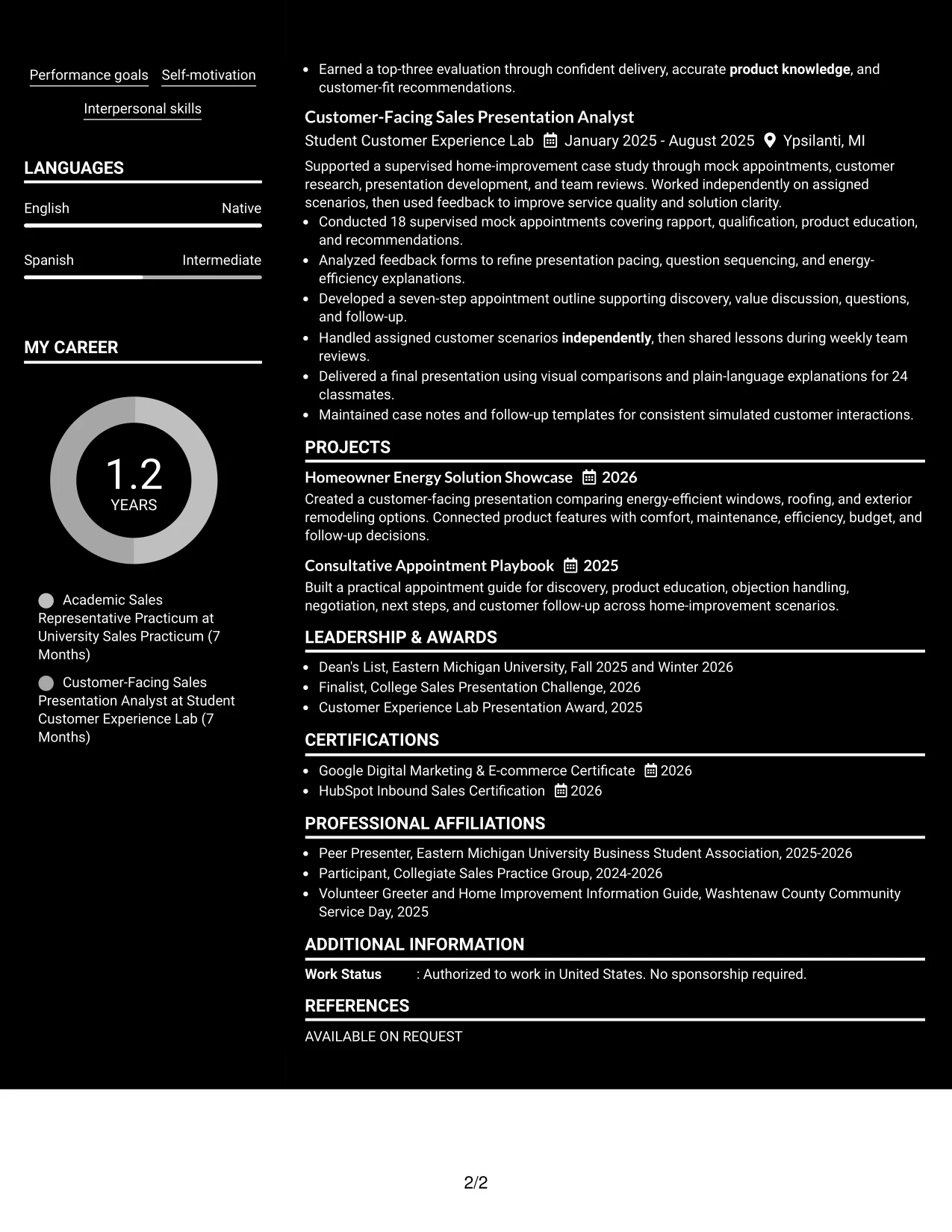
Why the Dark Mode Box Header Format Works for a Resume
- The boxed header creates a defined starting point for the application.
- Balanced spacing keeps the darker visual treatment from overwhelming the content.
- A clear body hierarchy supports fast review of experience and skills.
- Bullets can connect customer needs with personalized recommendations.
- Projects and certifications fit into labeled supporting sections.
- The format can highlight communication, negotiation, and problem-solving without repeating them excessively.
- Readable contrast and conventional wording support digital resume use.
Best For
- Applications that benefit from a distinctive header and a structured body.
- Applicants who need clear space for customer-facing experience and supporting projects.
- Candidates presenting skills, certifications, and education beside concise achievements.
- Job searches where a modern visual identity is appropriate but content must stay direct.
- Documents that need the target role and contact details to stand out immediately.
- Resumes emphasizing personalized recommendations and customer experience evidence.
- Job seekers who want stronger visual separation without using a two-column layout.
#23 Elegant Full Background Two Column Format Resume Example
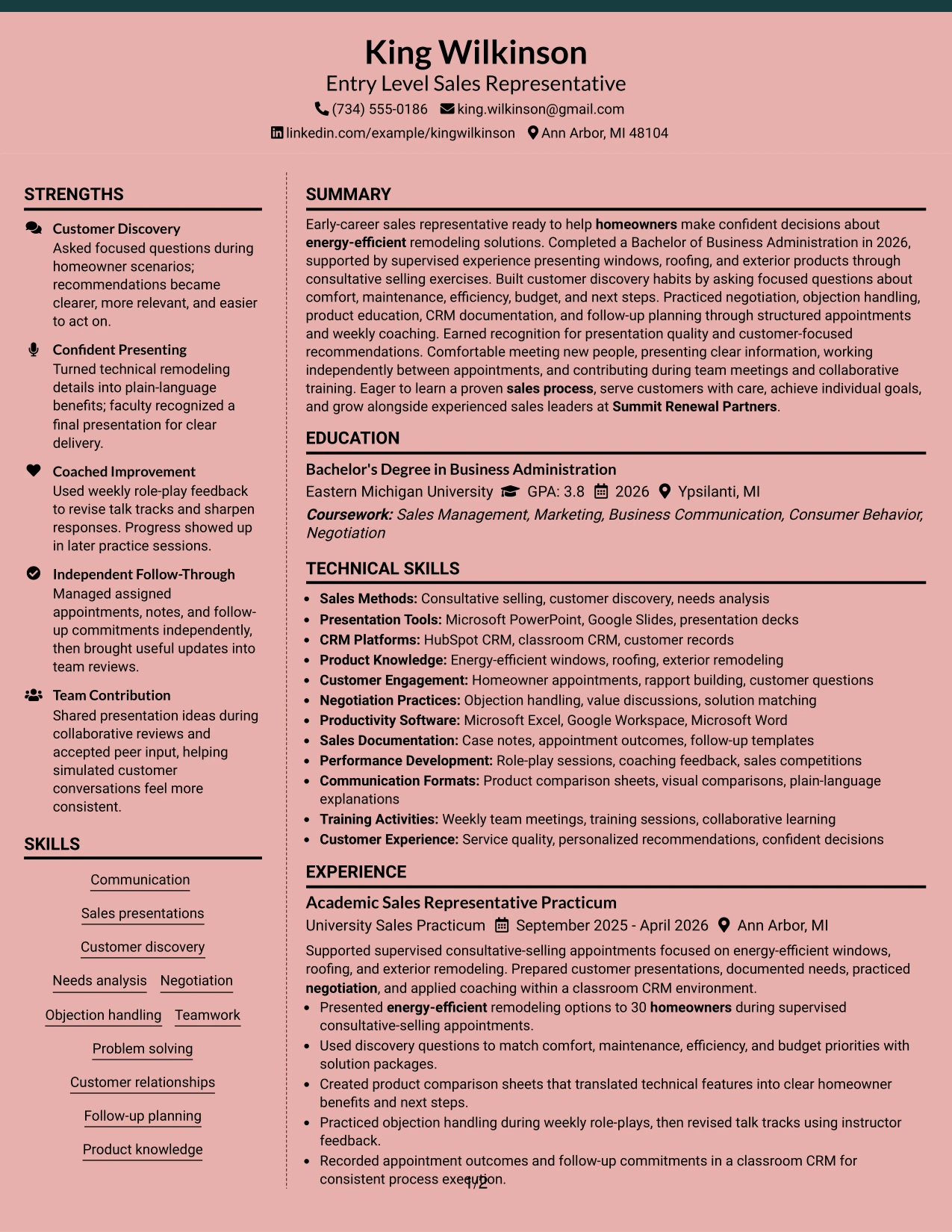
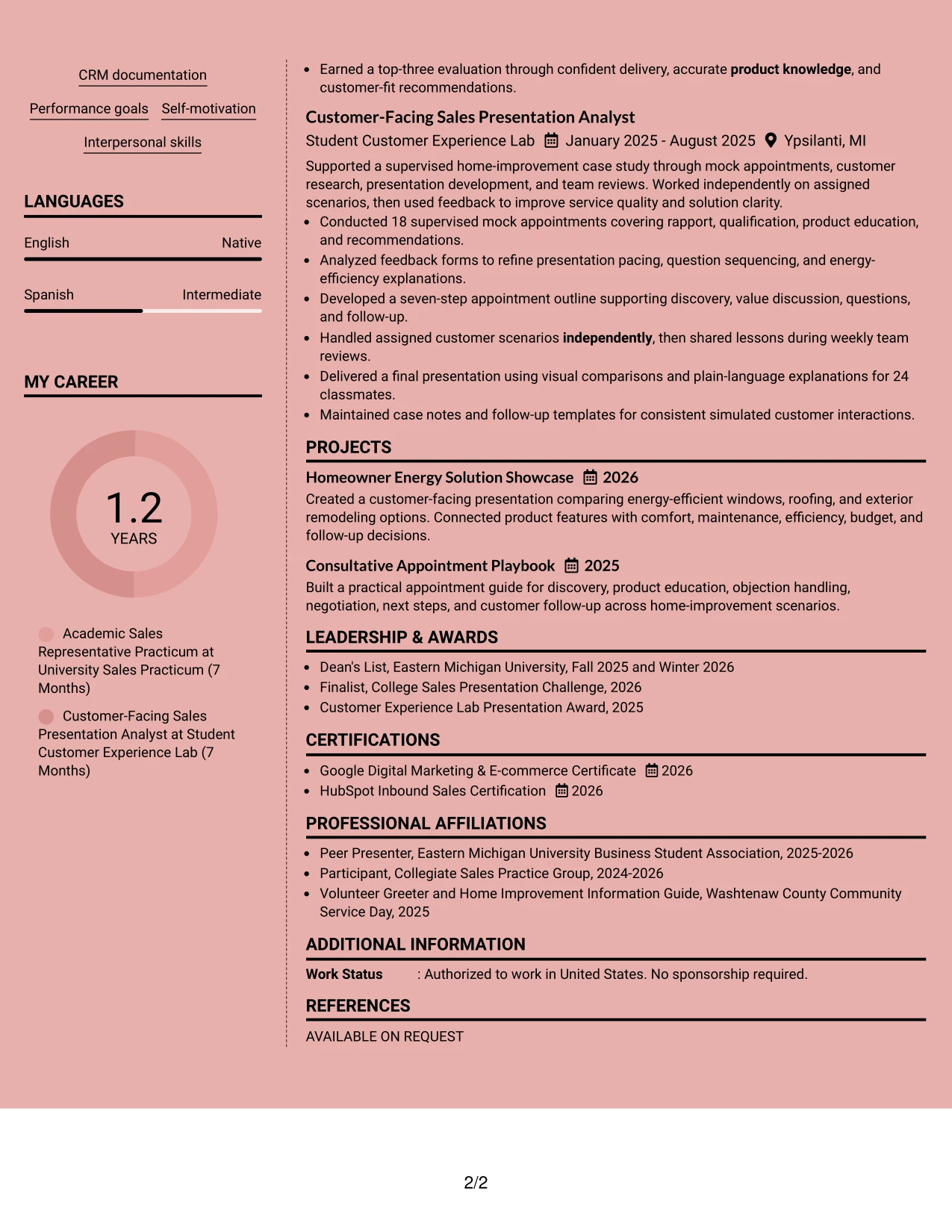
For an Entry Level Sales Representative application, this two-column design helps separate quick-scan details from supporting resume content. The main area can present supervised sales experience, homeowner presentations, measurable appointment activity, and education, while the narrower column groups skills, certifications, and tools.
The full background treatment adds visual polish without changing the resume's evidence hierarchy. Clear headings and compact bullets keep consultative selling, customer discovery, negotiation, CRM documentation, and presentation results easy to find during a recruiter review.
Why the Elegant Full Background Two Column Format Works for a Resume
- Two columns create a practical split between core experience and supporting qualifications.
- The main content area gives measurable results such as 30 homeowner participants and 18 supervised appointments enough space.
- A dedicated skills area makes customer discovery, needs analysis, negotiation, and objection handling easy to scan.
- Education and certifications remain visible without interrupting the experience timeline.
- Short bullet points support fast review and preserve important action verbs.
- The structure can include projects, tools, awards, and activities without creating a long visual block.
- Clear section hierarchy helps both human reviewers and ATS systems locate standard resume content.
Best For
- Applicants who need a balanced two-column presentation for experience and supporting qualifications.
- Resumes that combine supervised work, education, certifications, projects, and awards.
- Candidates who want presentation results and appointment activity to receive strong visual emphasis.
- Applications where skills and CRM tools should be visible beside the experience section.
- Readers who prefer a polished design with clear separation between primary and secondary information.
- Resumes with several relevant sections that still need a controlled, readable page structure.
- Candidates who want a professional visual format while keeping standard headings and keyword-rich bullets.
#24 Creative Two Tone Format Resume Example
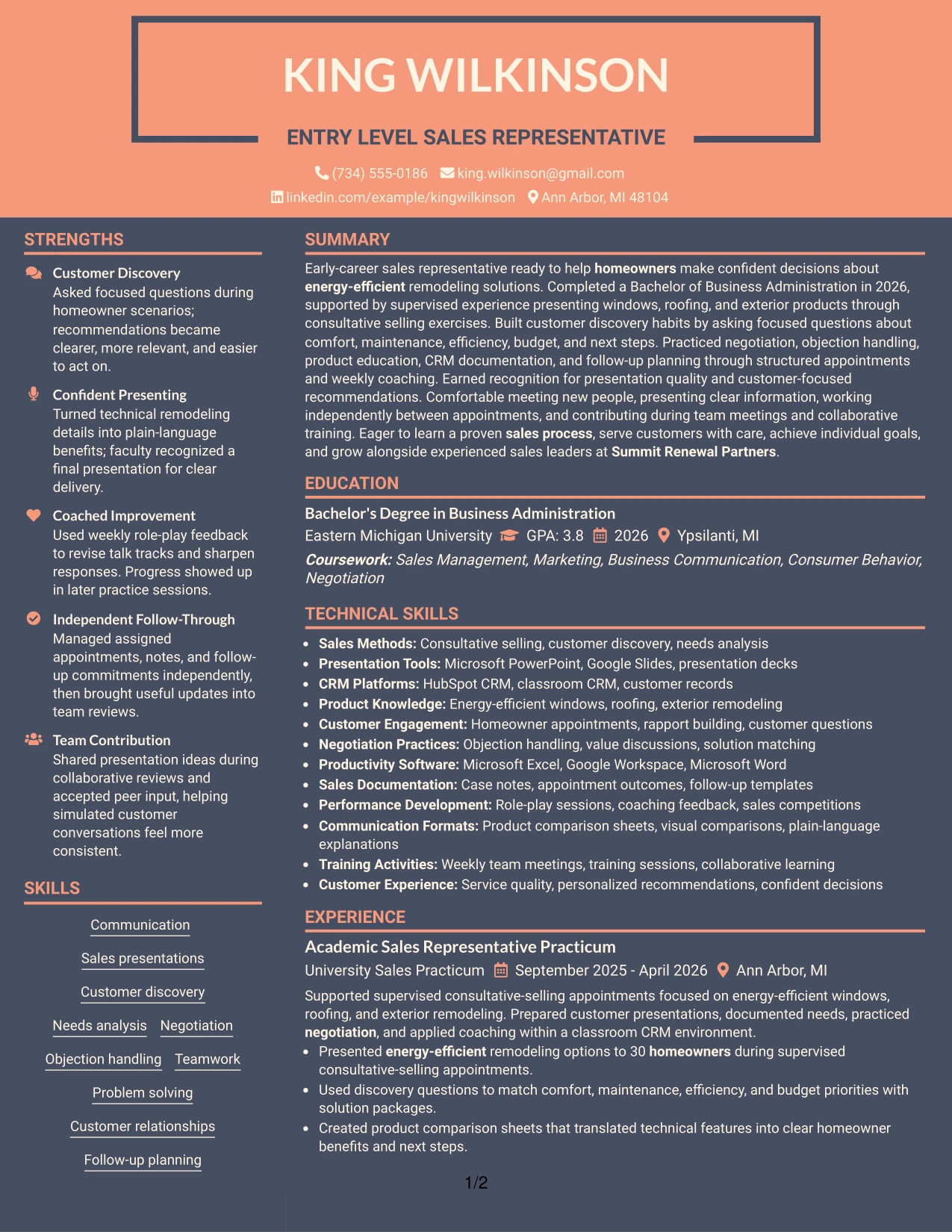
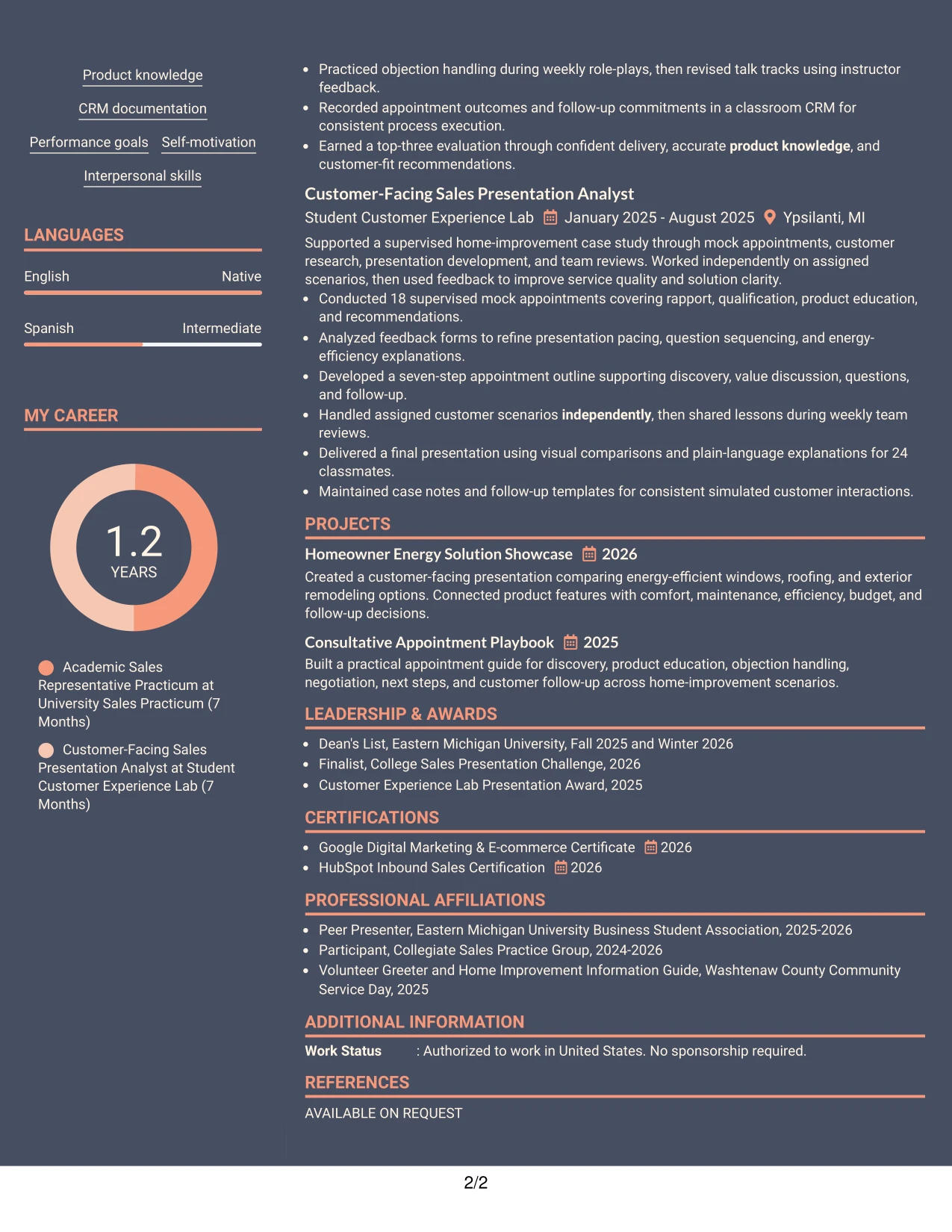
A restrained color contrast gives this resume a clear visual identity while keeping the content professional and easy to review. The single-column flow places the summary, experience, education, certifications, skills, and projects in a direct sequence for an Entry Level Sales Representative application.
The two-tone treatment can distinguish headings from body content without competing with the evidence. Strong bullets can highlight energy-efficient remodeling presentations, customer discovery, follow-up planning, and the top-three presentation evaluation in a way that remains readable in print and on screen.
Why the Creative Two Tone Format Works for a Resume
- A single-column structure supports a predictable top-to-bottom review.
- Two controlled colors help readers identify sections without replacing standard resume headings.
- The format gives experience bullets a clear path from supervised appointments to measurable outcomes.
- Skills can be grouped into sales methods, customer engagement, tools, and documentation.
- Education and certifications remain easy to locate for roles that value a bachelor's degree and sales training.
- The design supports concise project descriptions that add evidence without duplicating experience bullets.
- Readable spacing helps preserve ATS-friendly text while adding modest visual distinction.
Best For
- Applicants who want a modern visual signal while keeping the resume's reading order simple.
- Resumes where the summary and experience should lead directly into education and certifications.
- Candidates presenting a mix of customer-facing practice, academic projects, and sales credentials.
- Applications that benefit from clear separation between sales methods and software tools.
- Readers who value a polished design but need every section to remain easy to locate.
- Resumes that use concise bullets to connect customer needs with recommendations and next steps.
- Candidates seeking a distinctive format that remains appropriate for a structured sales process.
#25 Bold Color Header Professional Format Resume Example
The Bold Color Header Professional Format places the resume's identity and target role at the top, then moves into a conventional sequence of summary, experience, education, and skills. That structure lets a recruiter confirm the target, scan recent evidence, and find supporting qualifications without searching across the page.
Bold headers create strong section landmarks, while the body should stay focused on specific actions and results. For this resume, that means giving priority to 30 homeowner presentations, 18 mock appointments, product comparison sheets, CRM records, and coaching-based improvement.
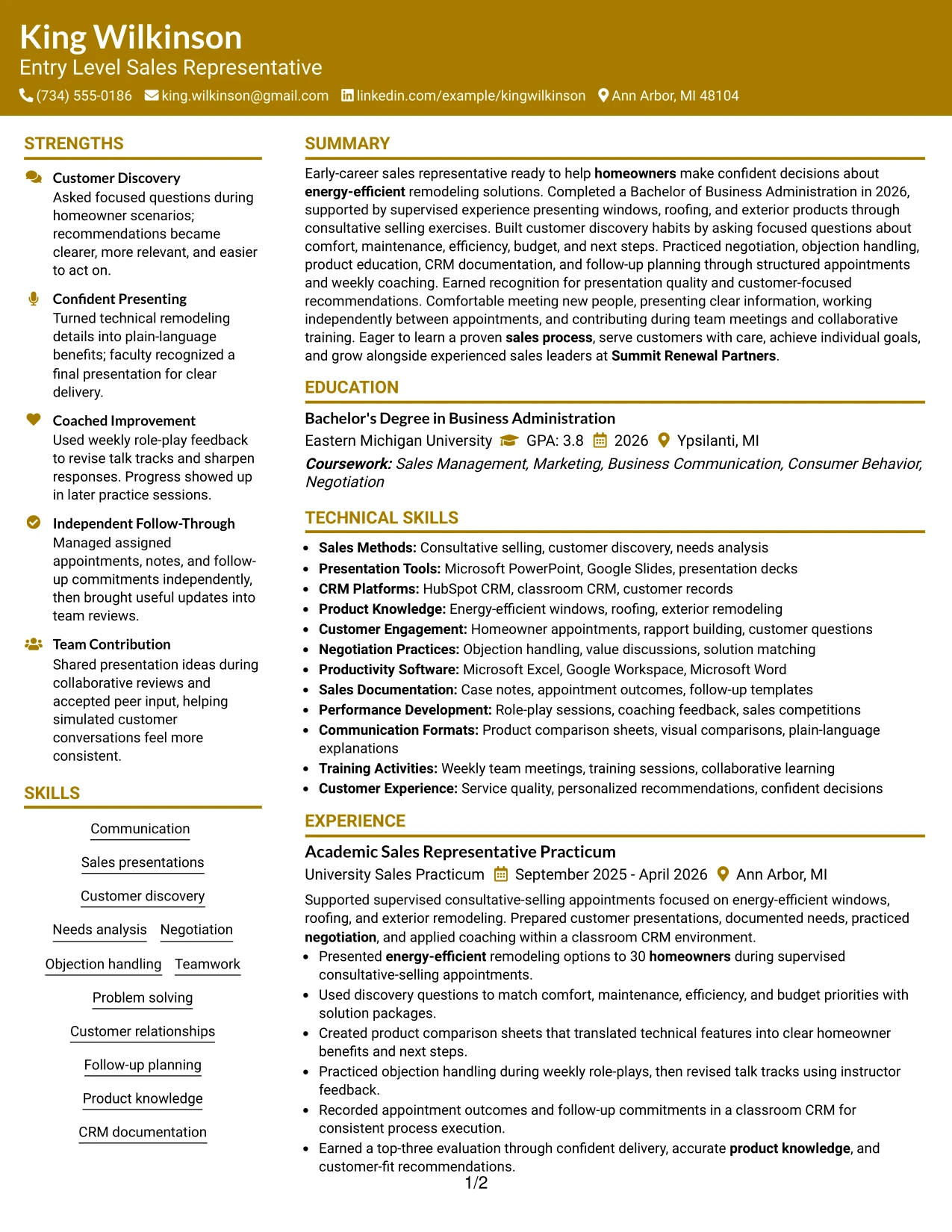
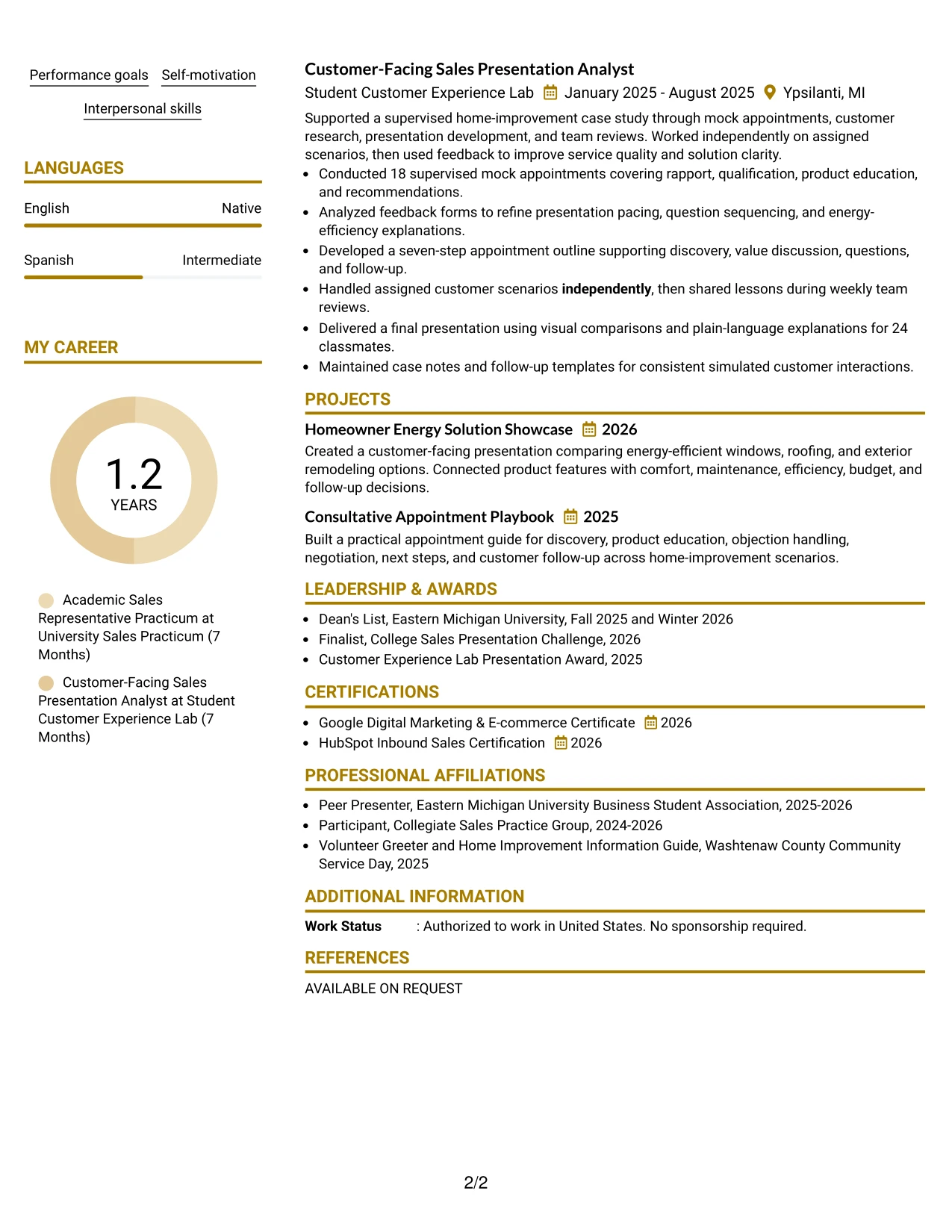
Why the Bold Color Header Professional Format Works for a Resume
- A prominent header makes the target role and contact details immediately visible.
- Strong section labels help readers move quickly from the summary to experience and education.
- The format supports standard chronological experience entries with clear employer, title, location, and dates.
- Bullets can foreground appointment volume, presentation work, and customer-focused recommendations.
- Skills and certifications can be placed in compact sections that support keyword matching.
- A clear hierarchy reduces the risk that important evidence is hidden in decorative elements.
- The professional structure works well when ATS parsing and human scanning both matter.
Best For
- Applicants who want the target role and contact details identified at the first glance.
- Resumes that depend on clear chronological experience entries and standard section labels.
- Candidates with measurable practice activity that should stand out in concise bullet points.
- Applications where ATS-friendly organization is more important than complex visual effects.
- Readers who scan for sales presentations, customer discovery, negotiation, and CRM documentation.
- Resumes that need a strong top section followed by a reliable evidence sequence.
- Candidates combining a business degree with certifications and supervised customer-facing work.
#26 Photo Header Color Sidebar Format Resume Example
Recruiters can move from the photo header and contact area into the summary, then continue through experience, education, skills, and certifications in a controlled path. The sidebar can hold compact details, while the main column gives customer-facing evidence enough room to remain specific.
For this Entry Level Sales Representative resume, the format can balance a professional visual introduction with practical proof: energy-efficient product presentations, needs analysis, objection handling, follow-up commitments, and recognition for presentation quality. The photo should remain secondary to readable content and resume keywords.
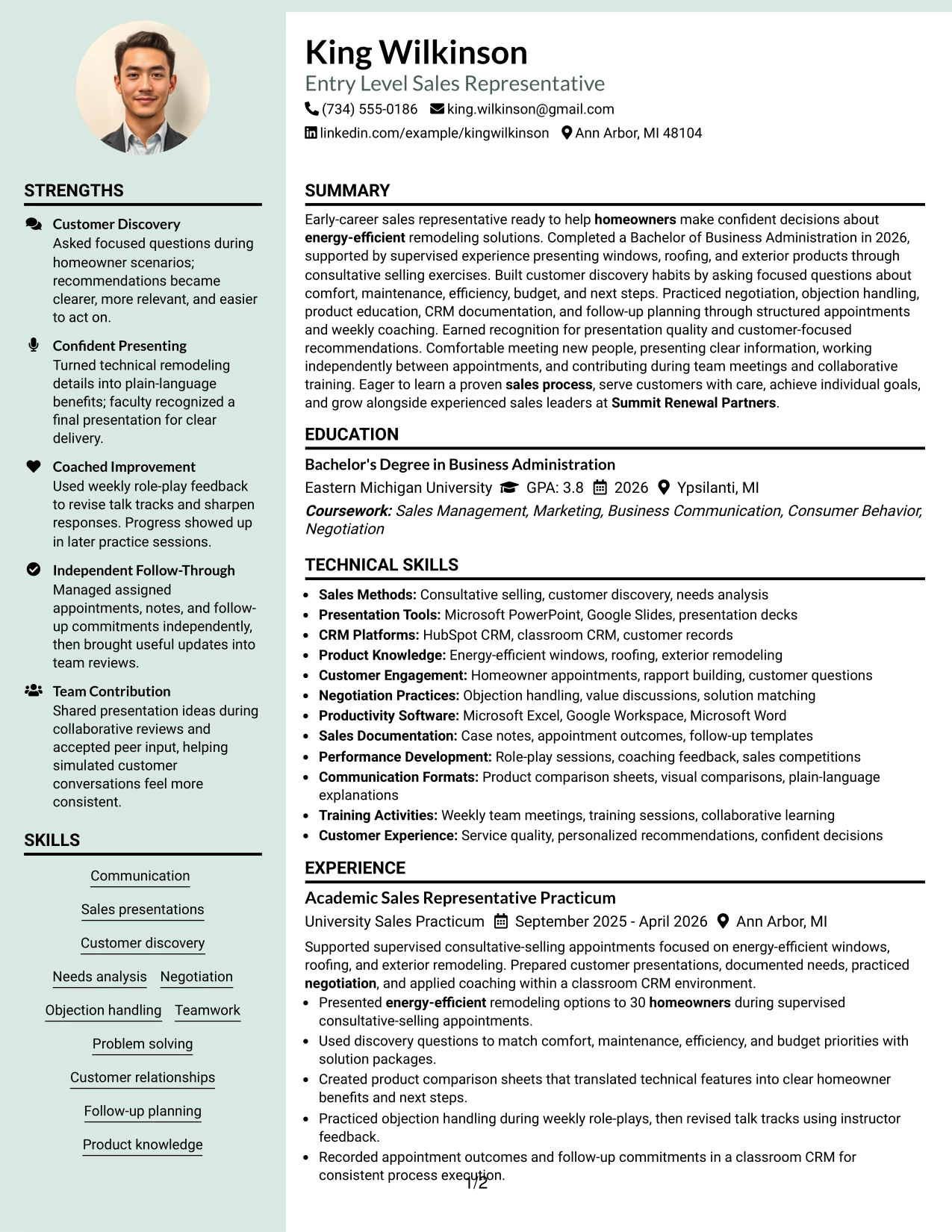
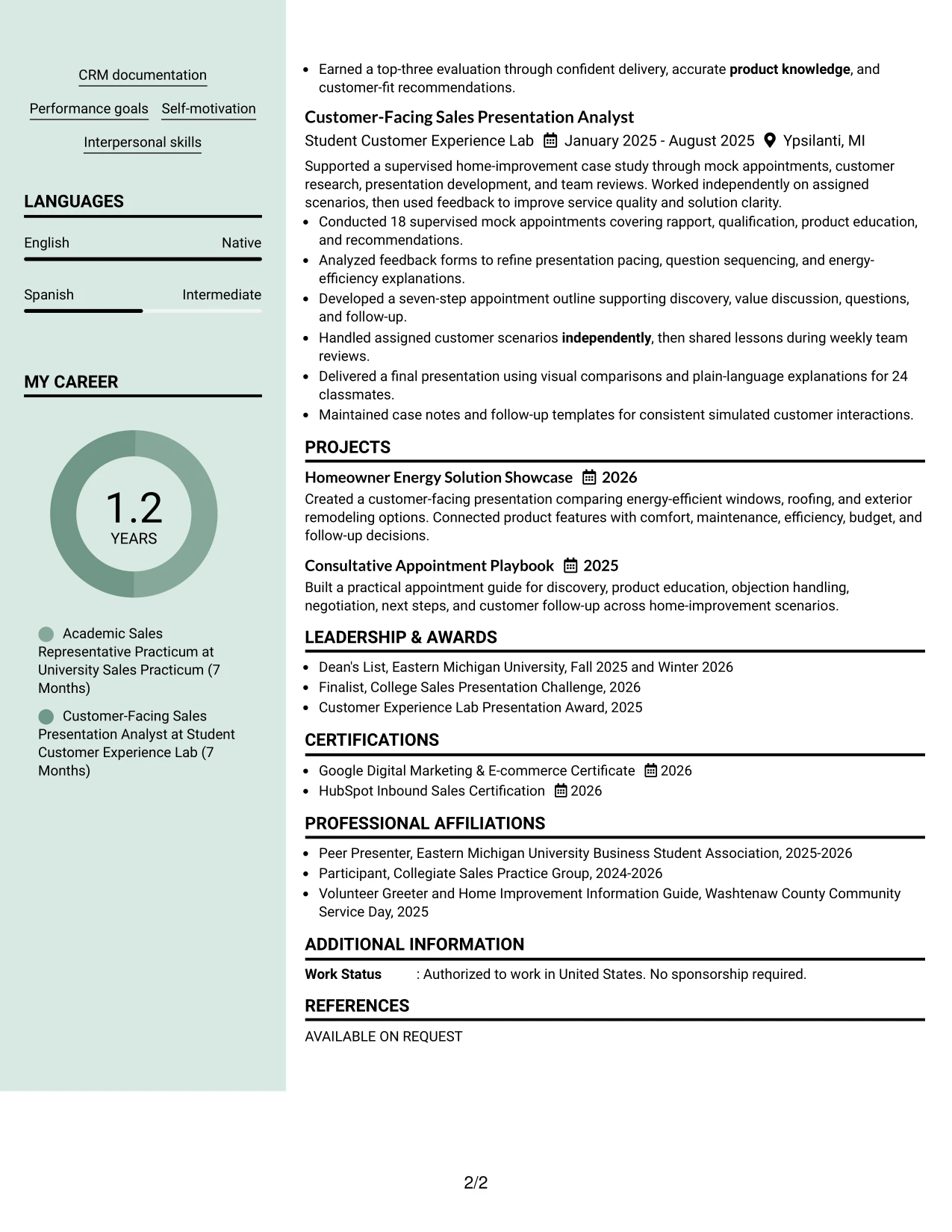
Why the Photo Header Color Sidebar Format Works for a Resume
- A clear reader path connects the header, summary, experience, and supporting sections.
- The sidebar can group contact details, skills, certifications, and tools in a compact area.
- The main column provides room for bullets that explain customer discovery and solution matching.
- A photo header adds visual identity while the written evidence remains the hiring document's core.
- The structure can show supervised work without making the resume feel crowded.
- Education, awards, and projects can fit into supporting blocks with clear labels.
- Standard keywords such as sales process, communication, negotiation, and customer experience remain searchable when kept as text.
Best For
- Applicants who want a photo-supported presentation with a clearly separated main content area.
- Resumes that need room for detailed experience bullets alongside compact supporting information.
- Candidates balancing customer-facing practice, education, certifications, and project work.
- Applications where a sidebar can group sales methods, tools, and documentation terms.
- Readers who prefer a guided path from professional identity to evidence and qualifications.
- Resumes with enough content to benefit from a main column and a concise information panel.
- Candidates who want visual distinction without reducing space for measurable appointment results.
#27 Top Left Header Color Accent Format Resume Example
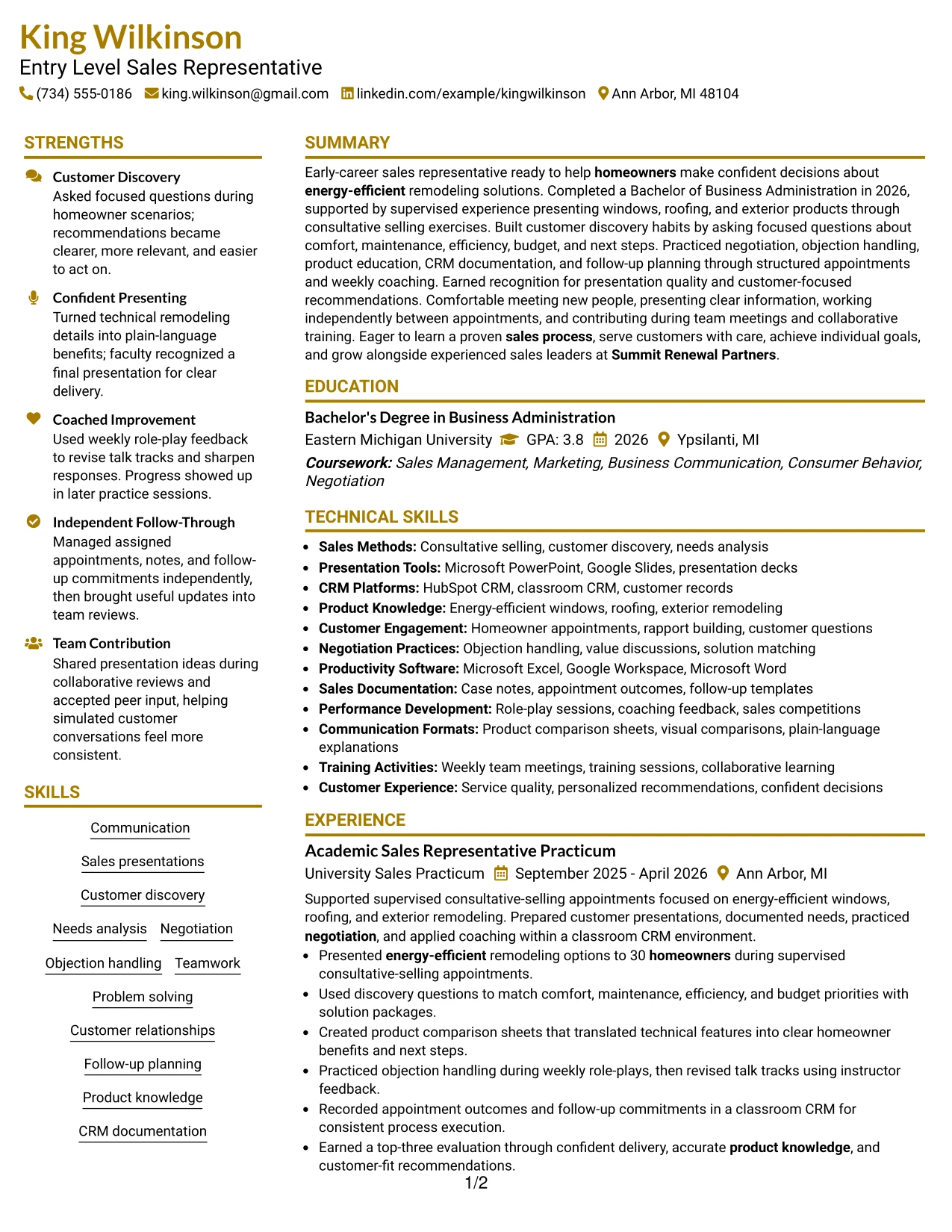
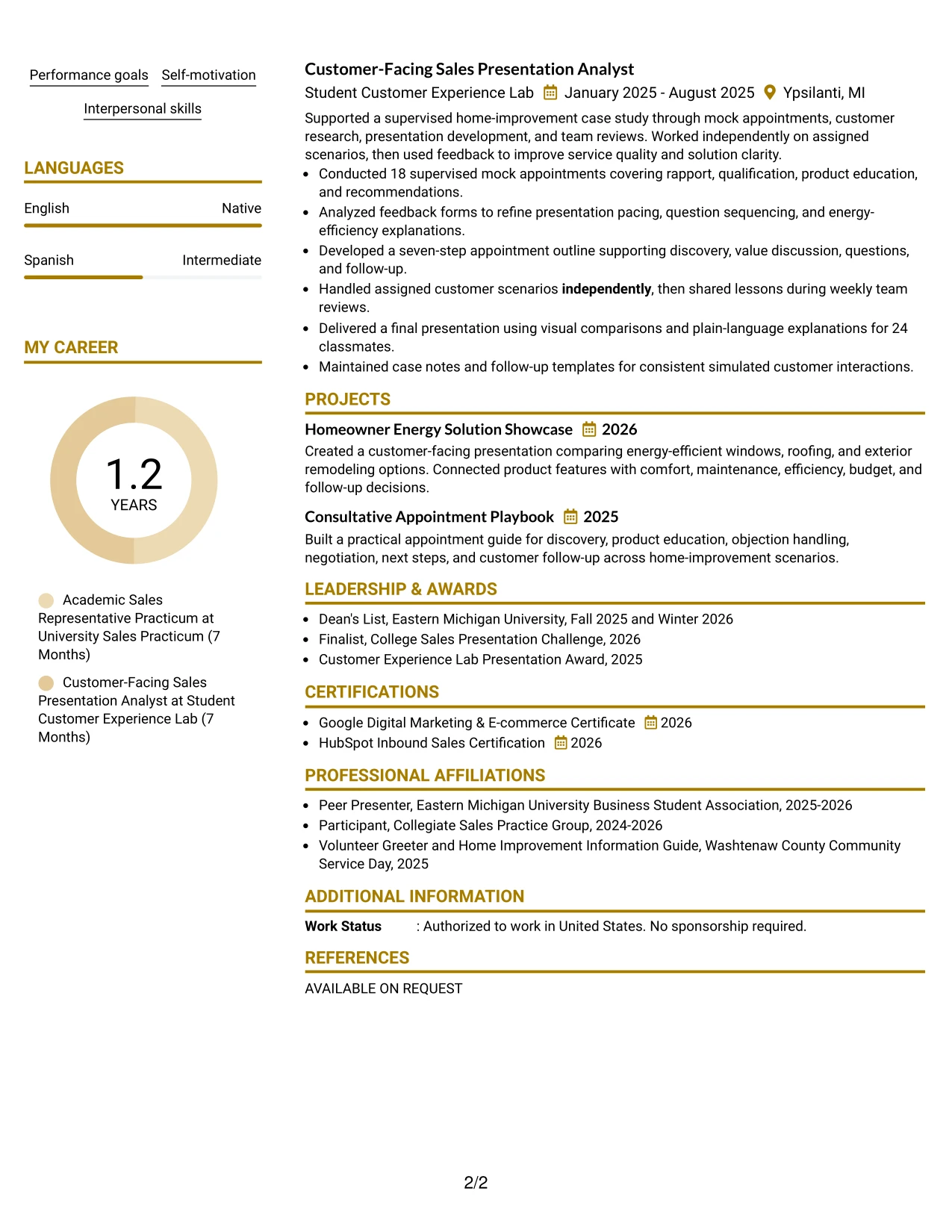
The strongest evidence receives priority near the top: supervised homeowner presentations, customer discovery, product recommendations, and clear performance results. A top-left header then anchors the target role and contact details before the resume moves into experience, education, certifications, and skills.
The color accent adds order to the page without taking attention away from the proof. Bullets can show how the resume applied discovery questions, translated technical features into benefits, documented appointments in a CRM, and earned a top-three evaluation.
Why the Top Left Header Color Accent Format Works for a Resume
- The top-left header gives the target role and contact information a strong starting point.
- Early placement of relevant evidence helps reviewers assess fit before reaching supporting sections.
- Experience bullets can connect actions, customer needs, and outcomes in a compact format.
- The layout gives measurable details such as 30 participants and 18 appointments a clear place.
- Skills and tools can reinforce the evidence instead of appearing as an unrelated keyword list.
- Education, certifications, awards, and projects can follow in a logical review order.
- A restrained accent supports visual navigation while keeping text accessible to ATS systems.
Best For
- Applicants whose strongest proof comes from presentations, appointments, and customer recommendations.
- Resumes that should surface relevant evidence before secondary qualifications.
- Candidates using measurable activity to show readiness for a structured sales process.
- Applications where technical product information must be connected to customer benefits.
- Readers who scan the first third of a resume before deciding whether to continue.
- Resumes that need clear separation between achievement bullets and supporting keywords.
- Candidates who want a focused format with visual guidance but no complex navigation.
#28 Centered Header Classic Two Column Format Resume Example
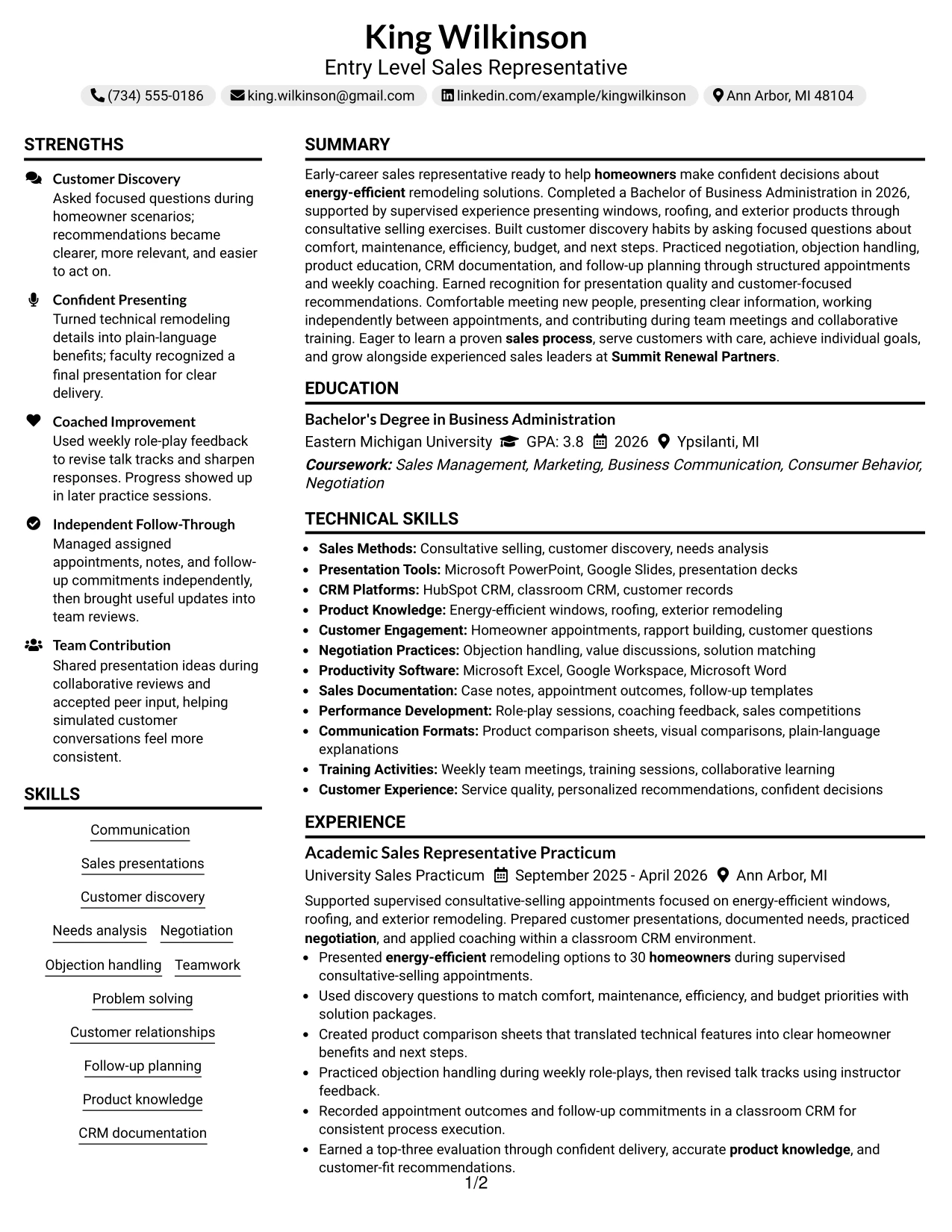
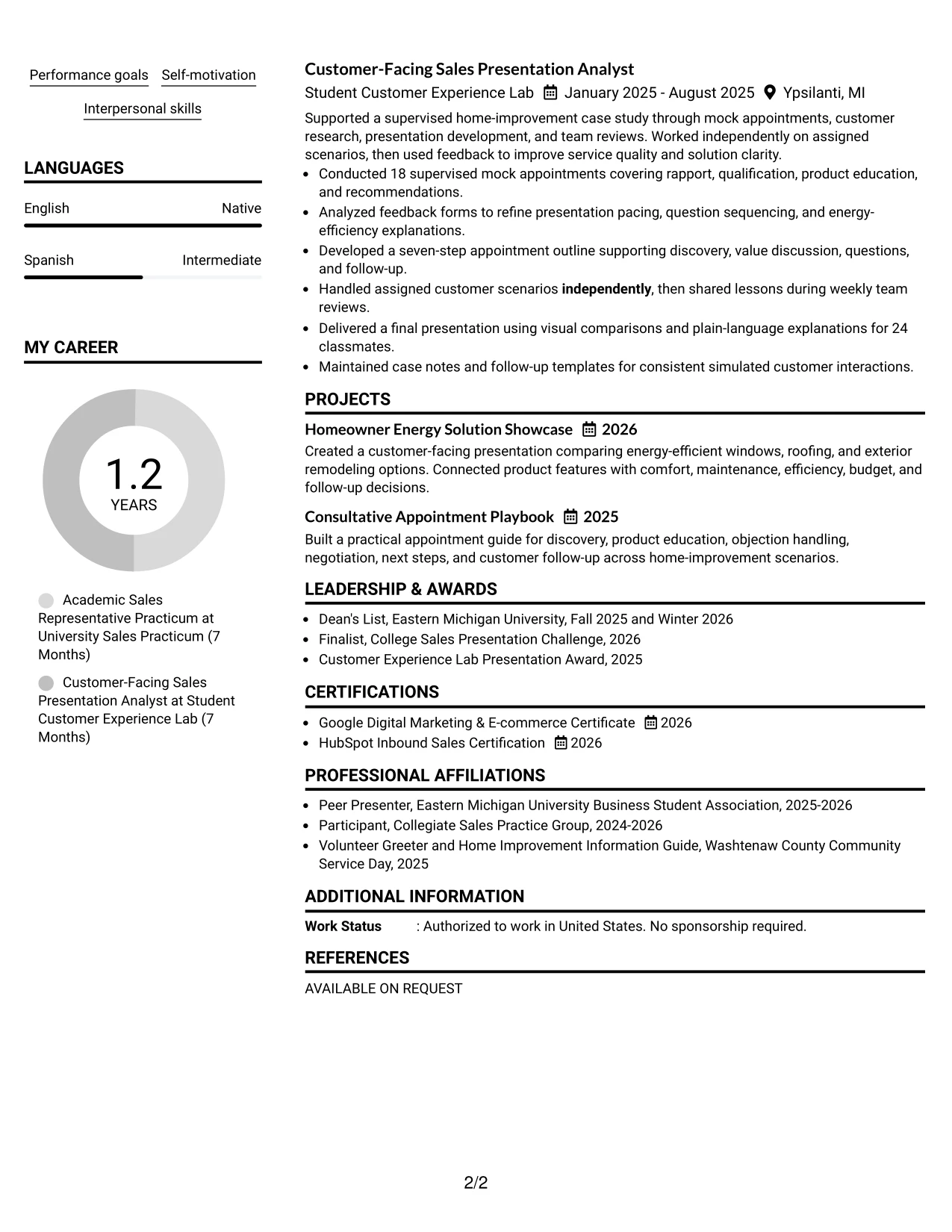
Balanced content distribution gives the resume a calm, organized review experience. A centered header establishes the document's identity, while two columns can place experience and projects alongside skills, education, certifications, awards, and activities for an Entry Level Sales Representative application.
The classic structure is useful when the resume contains several evidence types. One area can show appointment work and presentation results; the other can support them with consultative selling, HubSpot CRM, business education, sales certifications, and performance-based activities.
Why the Centered Header Classic Two Column Format Works for a Resume
- Two columns distribute substantial content without forcing every section into one long stream.
- The centered header gives contact information and the target role a balanced visual starting point.
- Experience bullets can remain detailed while supporting sections stay easy to scan.
- Projects provide additional evidence of product education, objection handling, and follow-up planning.
- Education and certifications can sit beside experience without losing their importance.
- A classic layout supports standard resume keywords and readable bullet formatting.
- The design fits applications that require both a quick overview and enough detail for careful review.
Best For
- Applicants with several relevant sections that need balanced page space.
- Resumes combining experience evidence with projects, awards, activities, and certifications.
- Candidates who want presentation and appointment results beside a compact skills area.
- Applications where education and training should remain visible during an initial scan.
- Readers who prefer centered contact information and a familiar two-column structure.
- Resumes that need room for both customer-facing achievements and technical tools.
- Candidates presenting a broad set of supervised sales evidence without a crowded single column.
#29 Left Aligned Header Clean Two Column Format Resume Example
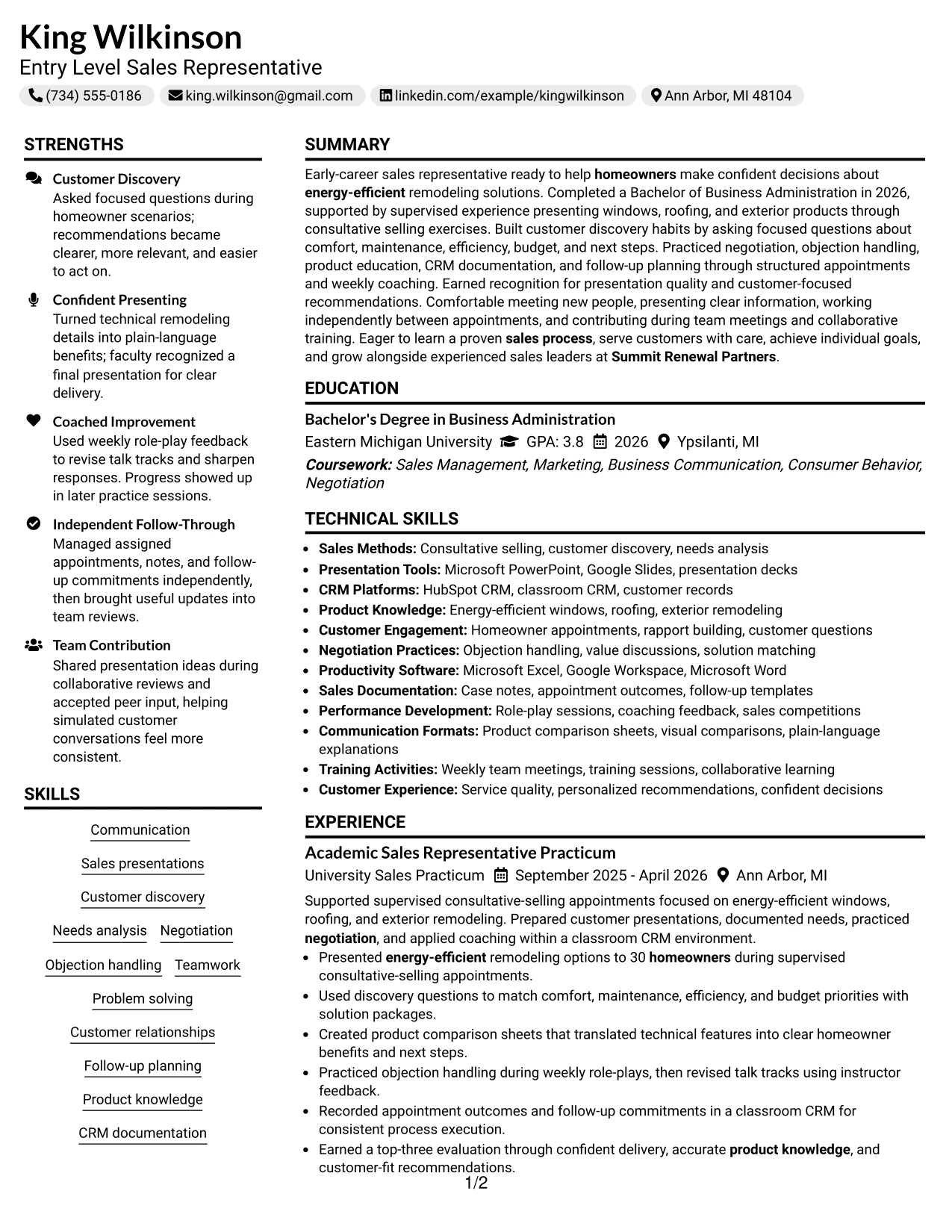
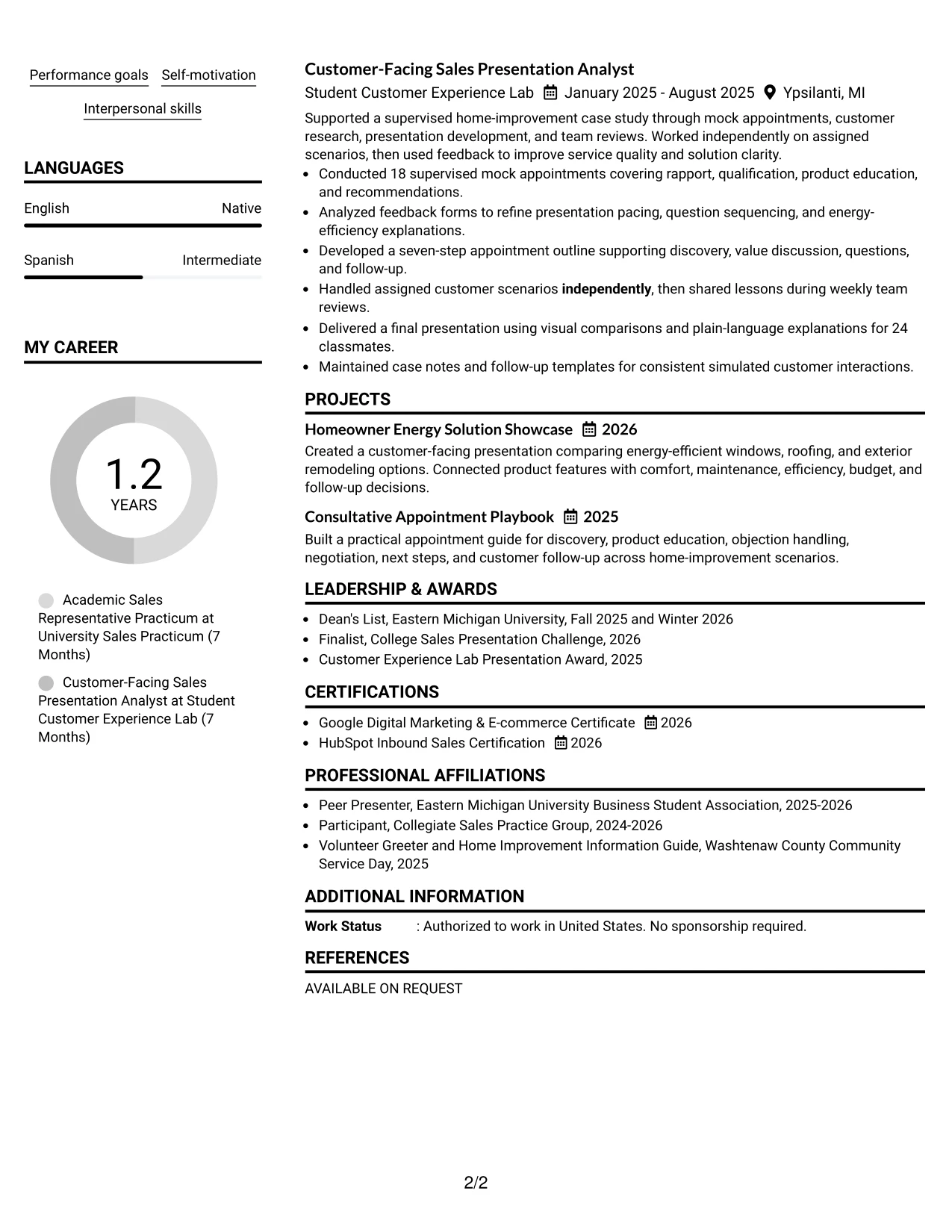
For a resume reviewed quickly, a left-aligned header and clean two-column structure make the next section easy to predict. The main column can carry the summary and experience bullets, while the secondary column organizes skills, certifications, education, awards, and tools for an Entry Level Sales Representative application.
This arrangement supports a direct visual fit for a candidate with both practical training and academic evidence. It can show customer discovery, solution matching, product presentations, and CRM documentation in the main story while keeping supporting keywords available for scanning.
Why the Left Aligned Header Clean Two Column Format Works for a Resume
- Left alignment creates a consistent reading edge for headings, dates, and bullet points.
- Two columns keep core experience distinct from supporting qualifications.
- The main column can explain supervised appointments and customer recommendations with useful detail.
- The secondary column can group skills, software, certifications, awards, and education.
- Clean spacing helps reviewers distinguish separate roles and training activities.
- The format supports keywords without turning the resume into a dense skills block.
- Simple visual rules help the document remain readable across screen and print review.
Best For
- Applicants who want a predictable left-to-right reading pattern with two-column organization.
- Resumes where the main experience story needs more space than supporting sections.
- Candidates who need skills, tools, certifications, and education visible at the same time.
- Applications that combine customer-facing practice with structured academic preparation.
- Readers who prefer clean spacing and clear alignment over decorative visual elements.
- Resumes that use concise bullets to connect product knowledge with customer needs.
- Candidates seeking a polished layout for both quick screening and detailed review.
#30 Accent Divider Modern Two Column Format Resume Example
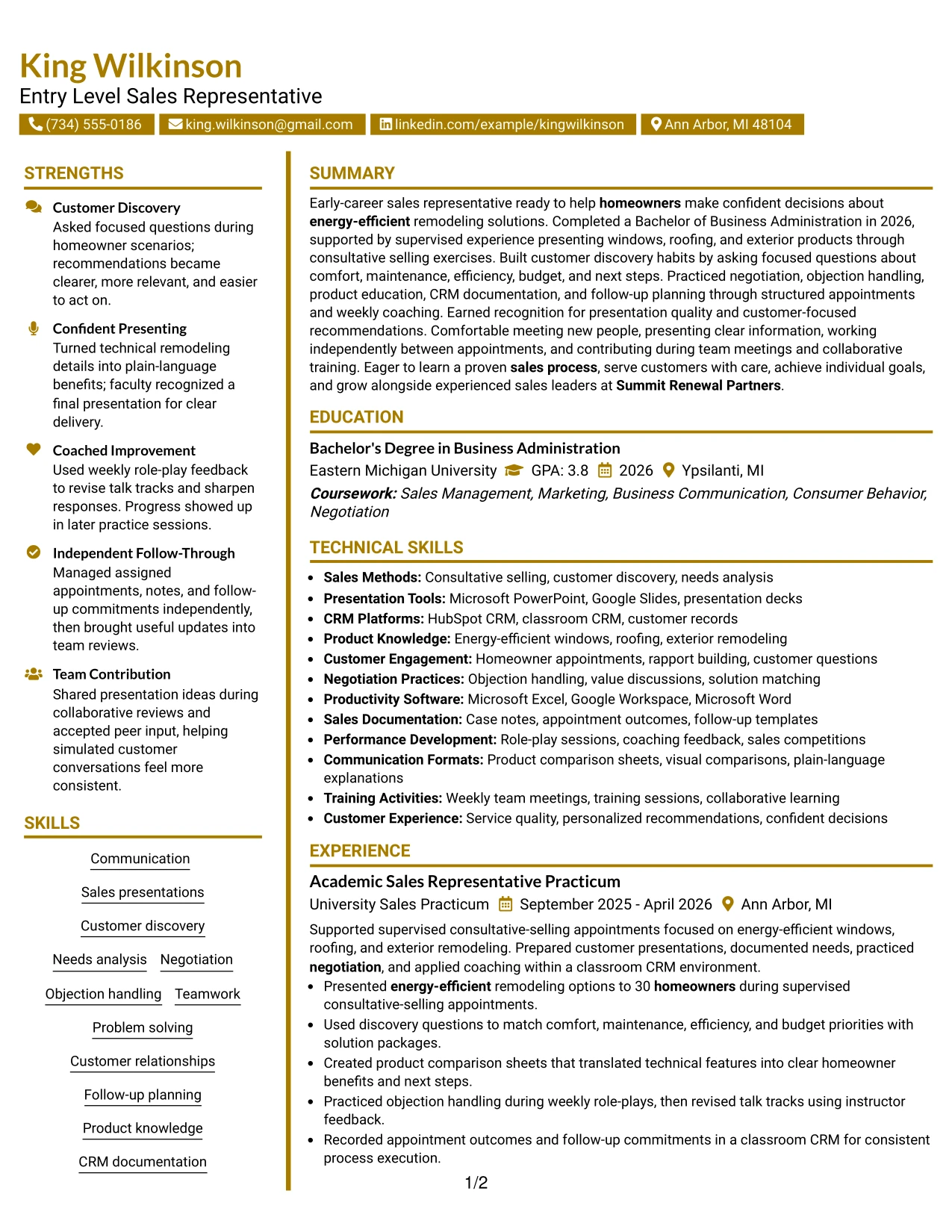
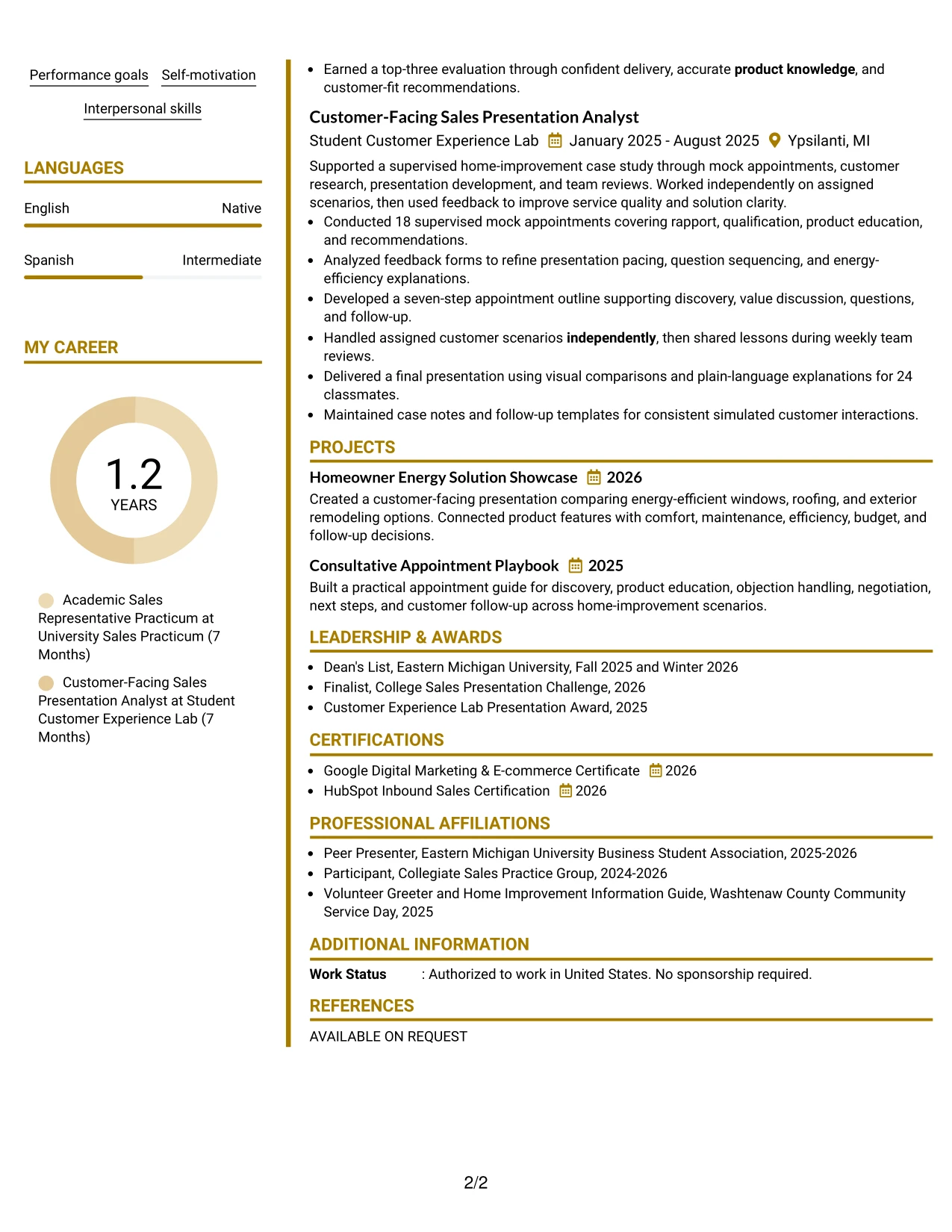
Distinctive evidence such as supervised homeowner presentations, customer discovery, and presentation recognition should be easy to locate before a reader reviews secondary details. Accent dividers help separate those evidence groups while two columns keep the resume compact and orderly.
The modern treatment supports a focused sales resume without hiding the underlying chronology. It can present experience and project work in one area, then place skills, certifications, education, awards, and activities in the other, giving the target role a clear and relevant evidence trail.
Why the Accent Divider Modern Two Column Format Works for a Resume
- Accent dividers separate resume sections without relying on long blocks of text.
- Two columns allow primary experience and supporting qualifications to work together.
- The format can highlight 30 homeowner participants and 18 supervised appointments as concrete evidence.
- Project entries add proof of product comparison, appointment planning, and follow-up knowledge.
- Skills remain connected to the experience that demonstrates them.
- Modern spacing supports quick scanning while preserving dates, titles, and organization names.
- The structure gives a polished presentation to a resume built around measurable practice and coaching.
Best For
- Applicants who want section separation that makes relevant evidence easy to find.
- Resumes with both experience bullets and project entries that should remain distinct.
- Candidates showing appointment volume, presentation quality, and coached improvement.
- Applications where a modern layout should still preserve chronology and standard resume fields.
- Readers who scan for sales methods first and verify education or certifications afterward.
- Resumes that need a compact way to present activities and awards without weakening experience.
- Candidates who want visual energy while keeping customer-focused proof central.
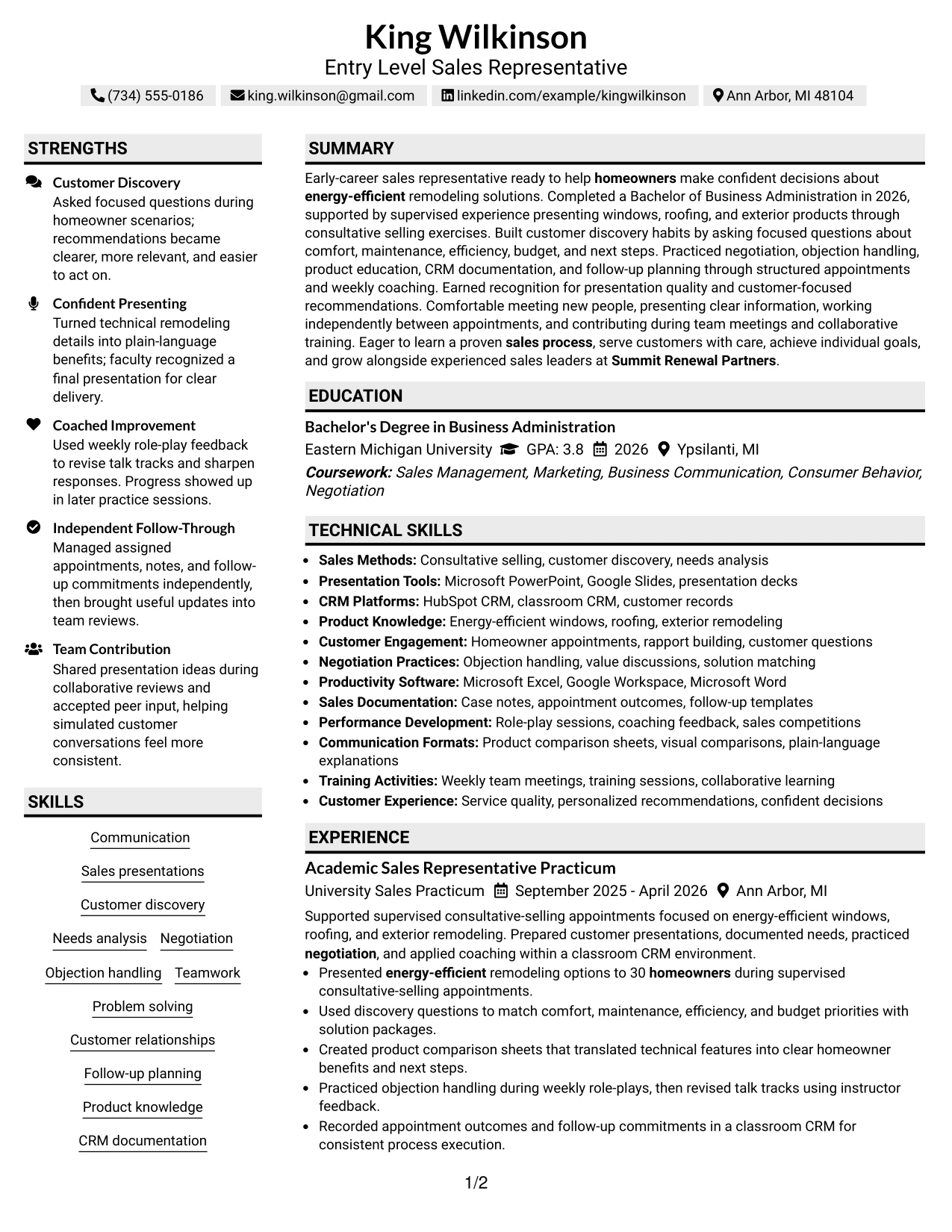
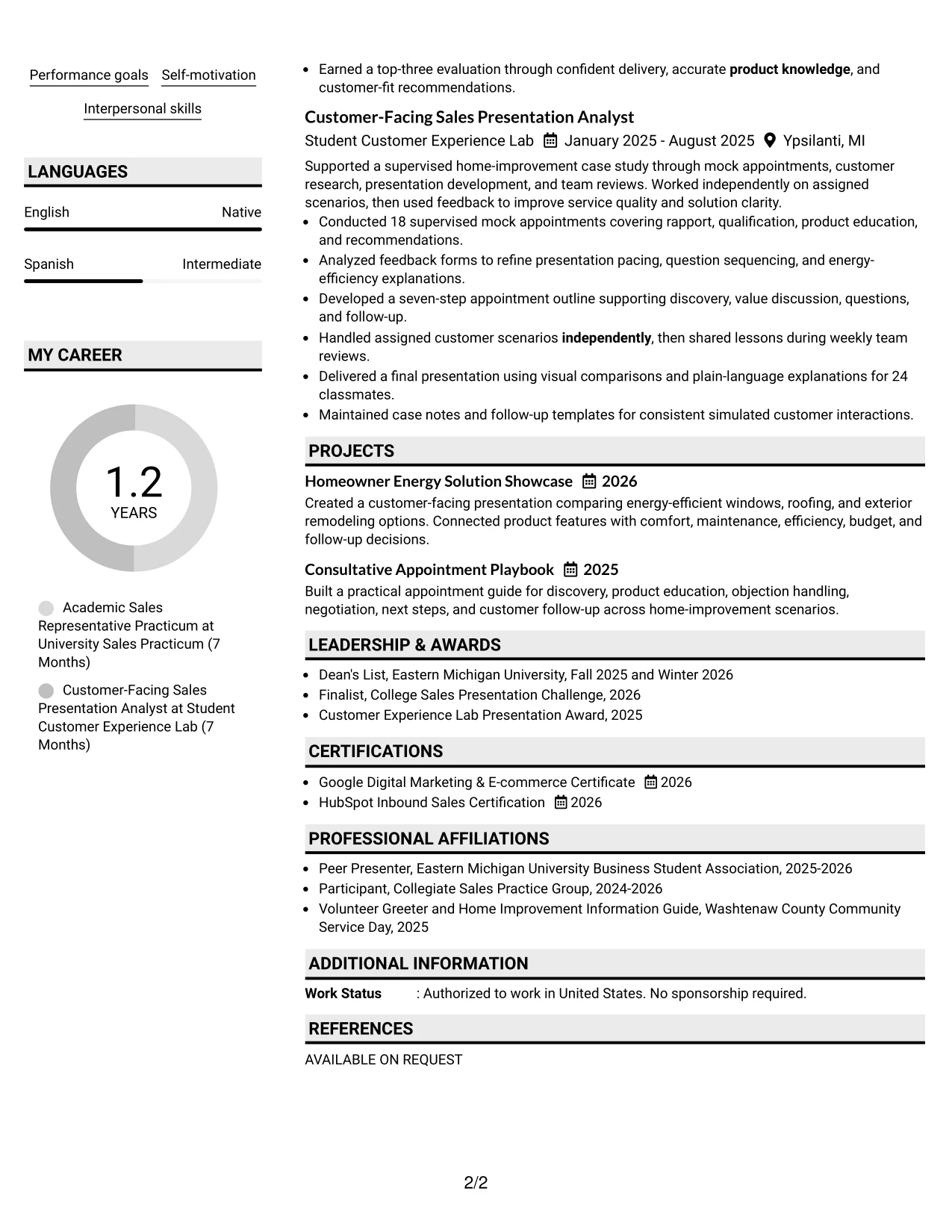
#31 Shaded Labels Clean Two Column Format Resume Example
Shaded labels create a clear map of the resume's sections, from the professional summary and experience to education, certifications, projects, and skills. In a two-column structure, the labels help readers identify the purpose of each block before reviewing its details.
That organization suits an Entry Level Sales Representative resume with varied evidence. Experience bullets can document product presentations, discovery questions, negotiation practice, and CRM habits, while the adjacent column preserves keywords for tools, credentials, awards, and performance development.
Why the Shaded Labels Clean Two Column Format Works for a Resume
- Shaded labels make each section easy to identify during a rapid scan.
- Two columns give experience room while keeping supporting details visible.
- Standard labels help ATS systems and human reviewers interpret the resume structure.
- Bullets can show how customer needs led to personalized solution recommendations.
- Skills and tools can be grouped under clear categories rather than scattered across the page.
- Education, certifications, and awards remain accessible without competing with experience.
- The clean format supports a consistent review of dates, organizations, titles, and results.
Best For
- Applicants who want every resume section identified by a strong visual label.
- Resumes with multiple evidence categories that need clear separation and quick navigation.
- Candidates who need to show sales presentations, customer discovery, and CRM habits together.
- Applications where skills and credentials should support, not replace, experience bullets.
- Readers who value predictable organization during ATS and human review.
- Resumes combining academic preparation, supervised practice, awards, and activities.
- Candidates who want a clean two-column design with strong information boundaries.
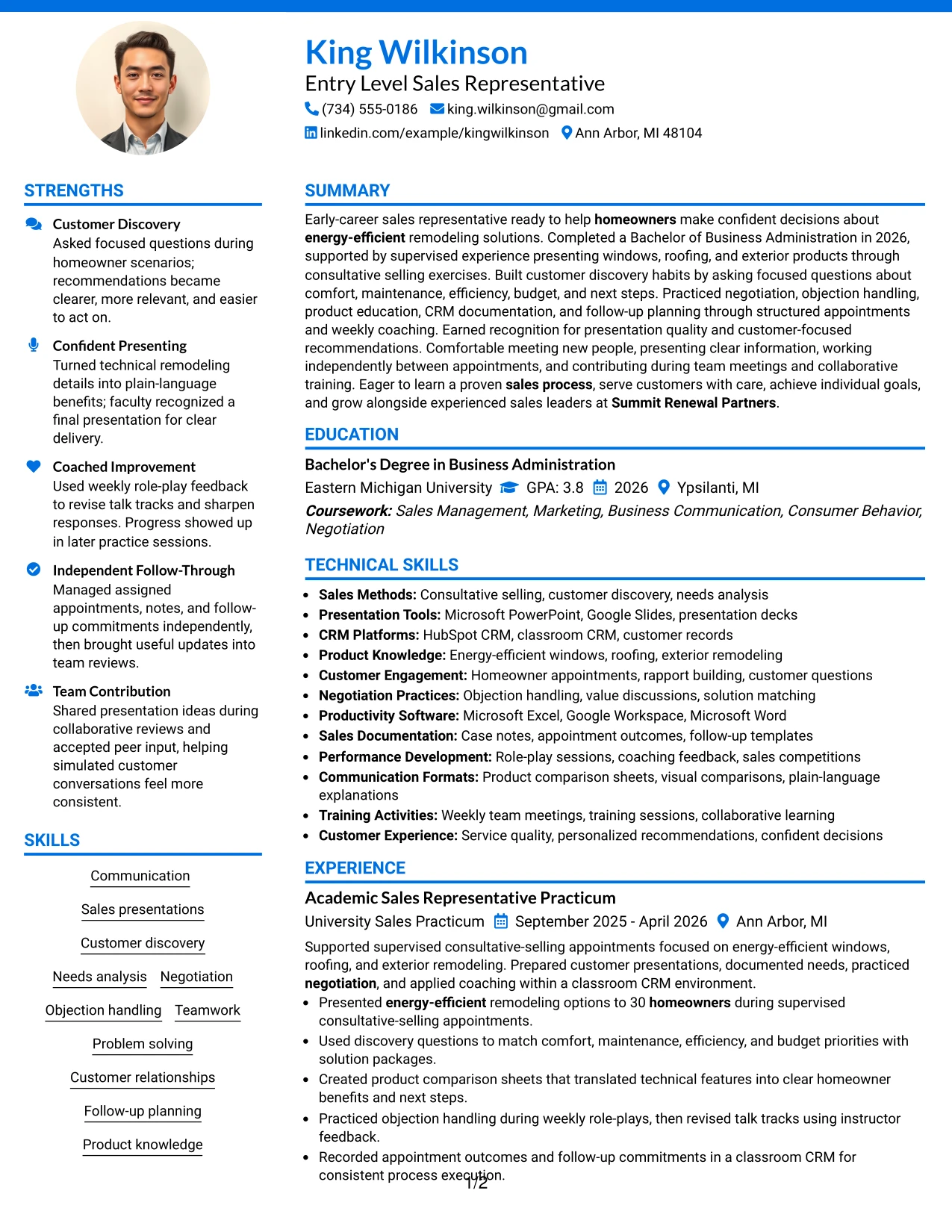
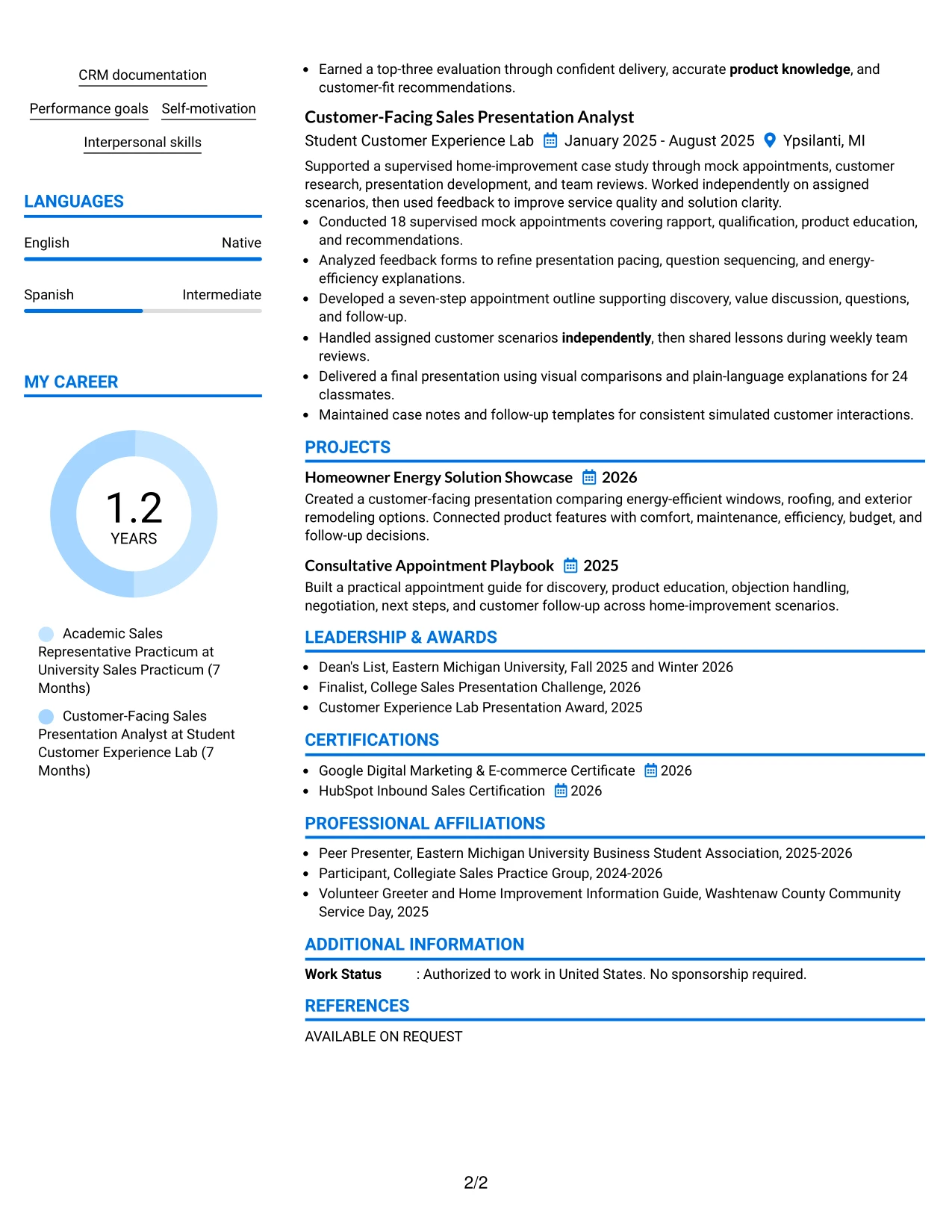
#32 Photo Header Color Accent International Format Resume Example
Readers can begin with the photo header and contact details, then move through the summary, experience, education, certifications, and skills in a clear vertical sequence. Color accents distinguish sections while leaving enough room for detailed bullets about customer-facing practice and sales training.
For this resume, the format can present energy-efficient remodeling knowledge, customer discovery, negotiation, follow-up planning, and bilingual language information in an organized way. The photo should support the professional presentation, while keywords and measurable evidence remain the primary content.
Why the Photo Header Color Accent International Format Works for a Resume
- A guided sequence makes the resume easy to review from identity through qualifications.
- The photo header creates a clear visual entry point without replacing written evidence.
- Color accents help separate experience, skills, education, and certifications.
- The single-column structure gives customer-facing bullets room to explain actions and results.
- Language information can be presented as a distinct qualification when relevant to the application.
- Tools such as HubSpot CRM, PowerPoint, Excel, and Google Workspace can be listed clearly.
- Standard headings and text preserve keyword visibility for sales process and customer experience terms.
Best For
- Applicants who want a photo-supported resume with a direct, section-by-section reading path.
- Resumes that need enough vertical space for detailed customer-facing bullets.
- Candidates presenting language information alongside sales training and education.
- Applications where color can distinguish sections without creating a complex page structure.
- Readers who want contact details, experience, and qualifications in one clear column.
- Resumes combining product knowledge, presentation practice, certifications, and software tools.
- Candidates who want visual identity while keeping measurable results and keywords prominent.
#33 Large Profile Photo International Two Column Format Resume Example
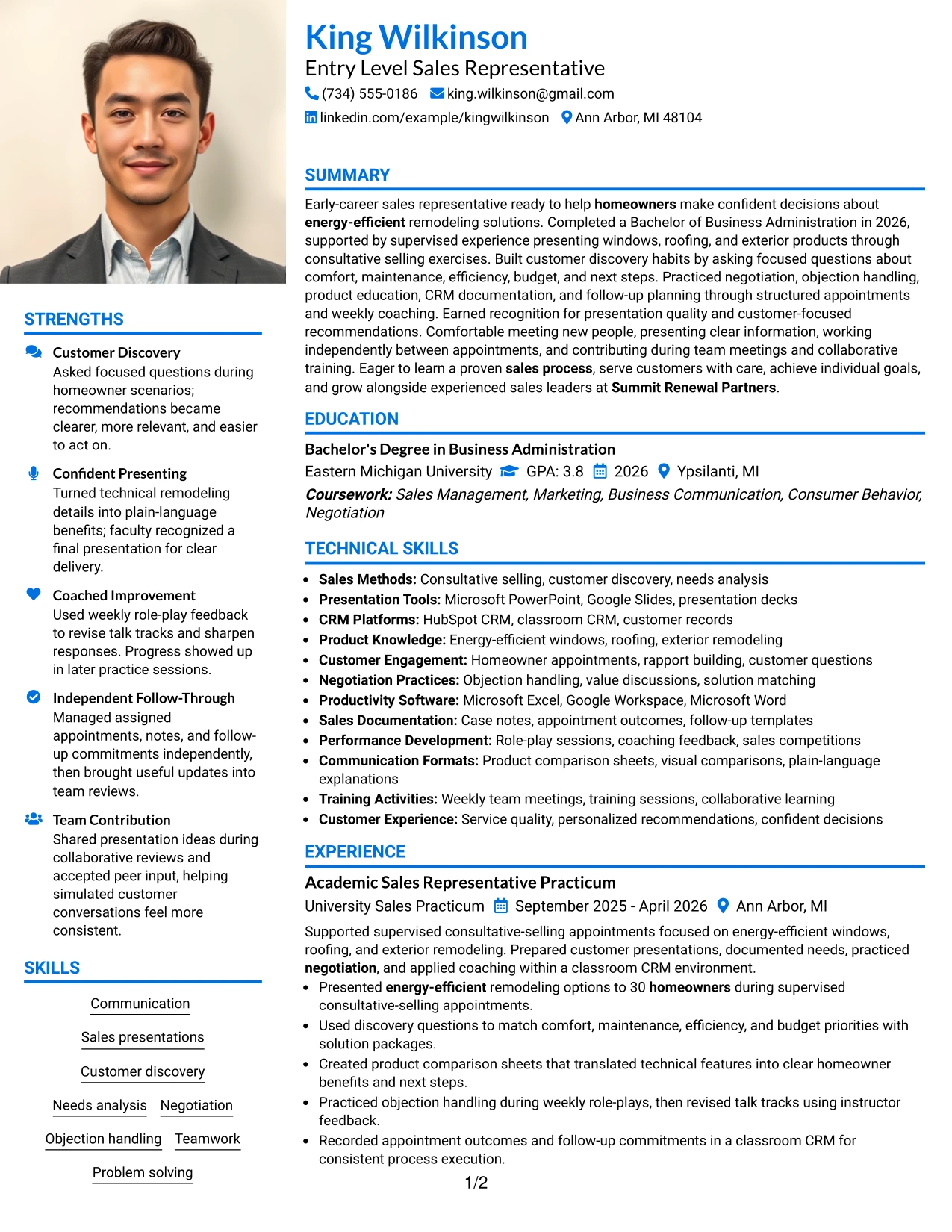
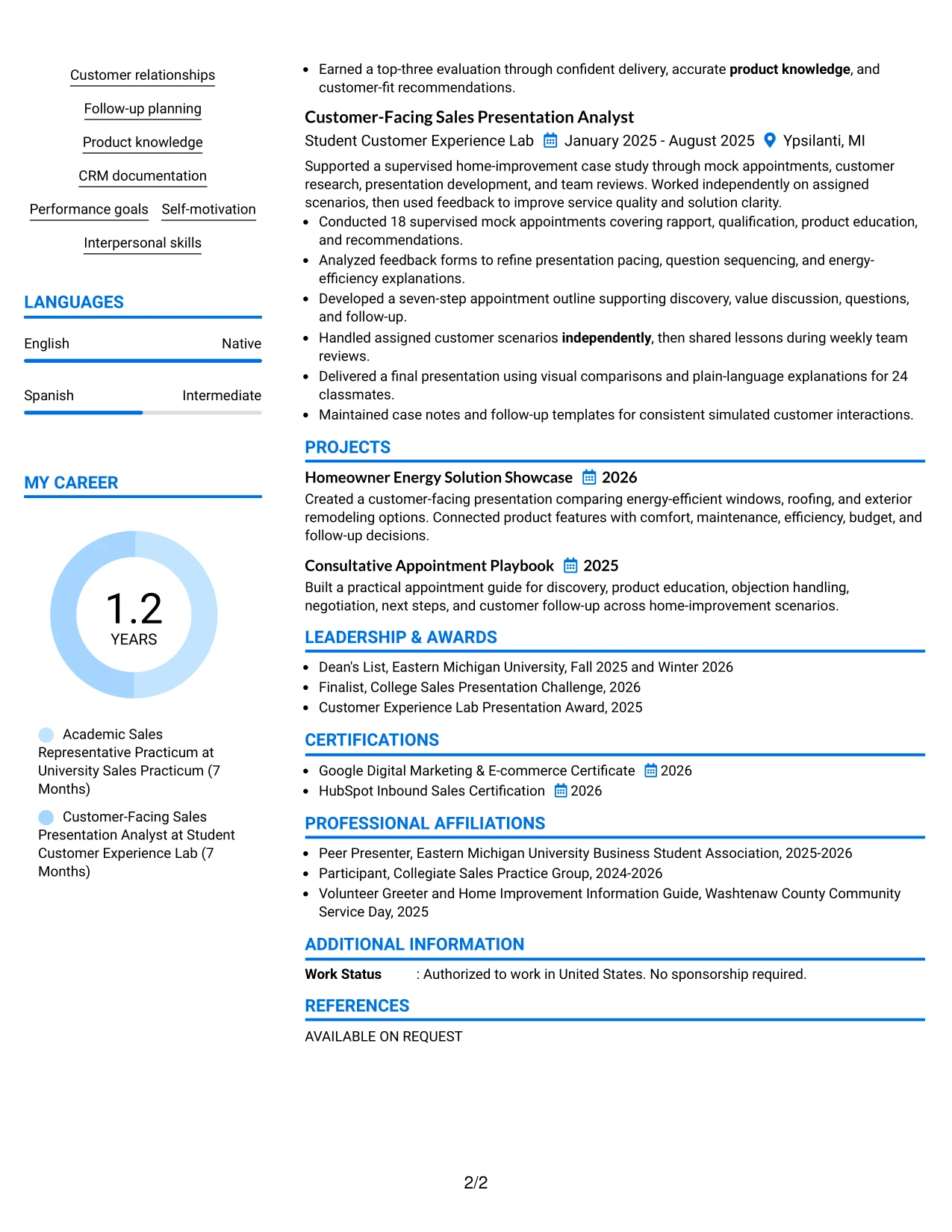
The strongest evidence should lead the review: homeowner presentations, customer discovery, solution recommendations, and documented follow-up. A large profile photo establishes the visual header, while the two-column structure gives the resume space to present experience on one side and education, certifications, skills, tools, awards, and language information on the other.
This format can support a broad but focused sales profile. The main evidence remains grounded in 30 homeowner participants, 18 supervised appointments, product comparison work, role-play feedback, and a top-three evaluation; the secondary column organizes the keywords that reinforce those results.
Why the Large Profile Photo International Two Column Format Works for a Resume
- Evidence-first organization places customer-facing results before supporting details.
- The large profile photo creates a strong visual identity at the top of the document.
- Two columns provide room for both detailed experience and a broad qualification set.
- The format can show appointment volume, presentation quality, and coaching-based improvement clearly.
- A secondary column can group languages, certifications, software, skills, awards, and activities.
- Projects can add proof of product education, negotiation practice, and follow-up planning.
- Clear headings and text-based keywords keep the resume useful for both visual review and ATS screening.
Best For
- Applicants who want a photo-supported layout with a strong evidence-first presentation.
- Resumes that need to display detailed experience beside many supporting qualifications.
- Candidates combining customer-facing practice with certifications, projects, awards, and languages.
- Applications where presentation results and appointment activity should be prominent immediately.
- Readers who want a visually distinctive profile with a practical two-column information structure.
- Resumes that benefit from a dedicated space for tools, sales methods, and documentation terms.
- Candidates presenting a broad set of relevant evidence without compressing every section into one column.
Why Build Your Entry Level Sales Representative Resume with ResumeInMinutes
ResumeInMinutes helps you turn presentations, customer-facing practice, projects, education, certifications, and supervised sales experience into a structured resume that is simple to scan and customize.
- ATS-friendly section structure
- Sales keyword organization
- Achievement-focused bullet points
- Skills and tools organization
- Free PDF resume previews
- Resume customization support
Build a resume that presents customer discovery, product presentations, energy-efficient home remodeling knowledge, CRM documentation, and coached improvement with the clarity needed for a sales role.
See Also
- 33 Entry Level Sales/Business Development Resume Templates with Example 2026 (ATS-Optimized)
- 33 Junior Digital Sales Representative Resume Templates with Example 2026 (ATS-Optimized)
- 30+ Inbound Sales Representative Cover Letter Templates with Example 2026
- 33 Emergency Services Sales Representative Resume Templates with Example 2026 (ATS-Optimized)
- 30+ Entry Level Sales Associate Cover Letter Templates with Example 2026
- 33 Sales Representative - Laboratory Automation Resume Templates with Example 2026 (ATS-Optimized)
- 33 Remote Insurance Sales Representative Resume Templates with Example 2026 (ATS-Optimized)
- 33 Sales Representative - Medical Products Resume Templates with Example 2026 (ATS-Optimized)
- 30+ Emergency Services Sales Representative Cover Letter Templates with Example 2026
- 33 Call Center Representative Resume Templates with Example 2026 (ATS-Optimized)
Frequently Asked Questions
Are these Entry Level Sales Representative resume templates ATS-friendly?
Yes. The templates use clear headings, readable sections, and relevant terms such as consultative selling, customer discovery, product presentations, negotiation, CRM documentation, and follow-up planning.
Are these 33 different resumes?
No. This guide features one Entry Level Sales Representative resume example displayed in 33 different layouts and design themes.
What should an Entry Level Sales Representative resume include?
Include a focused summary, sales experience or practical training, measurable presentation or customer results, relevant skills, tools, education, certifications, projects, and activities that support customer-facing work.
Can I download the resume templates as PDFs?
Yes. Each resume style provides a free PDF download so you can preview the format and select a layout that presents your sales qualifications clearly.
Which resume style is best for an Entry Level Sales Representative?
A clean one-column or straightforward two-column resume usually works well because it supports fast scanning and clear ATS parsing. Choose a layout that gives your summary, experience, skills, and achievements enough space.
Can I create a strong resume with limited formal sales experience?
Yes. Use supervised appointments, presentations, customer-facing projects, role-play practice, sales competitions, team activities, and measurable examples of feedback or performance to show your readiness.
Should I include a photo on my resume?
Include a photo only when it is customary or expected in your country, region, or industry. For U.S. applications, a no-photo resume is generally the safer choice.
Can I customize these resume templates?
Yes. ResumeInMinutes allows you to modify the resume text, layout, design style, and PDF format for your Entry Level Sales Representative application.