US English


7 Escalation Manager - Cloud Infrastructure Resume Templates with Example
By Ria · Last Updated On October 23, 2026
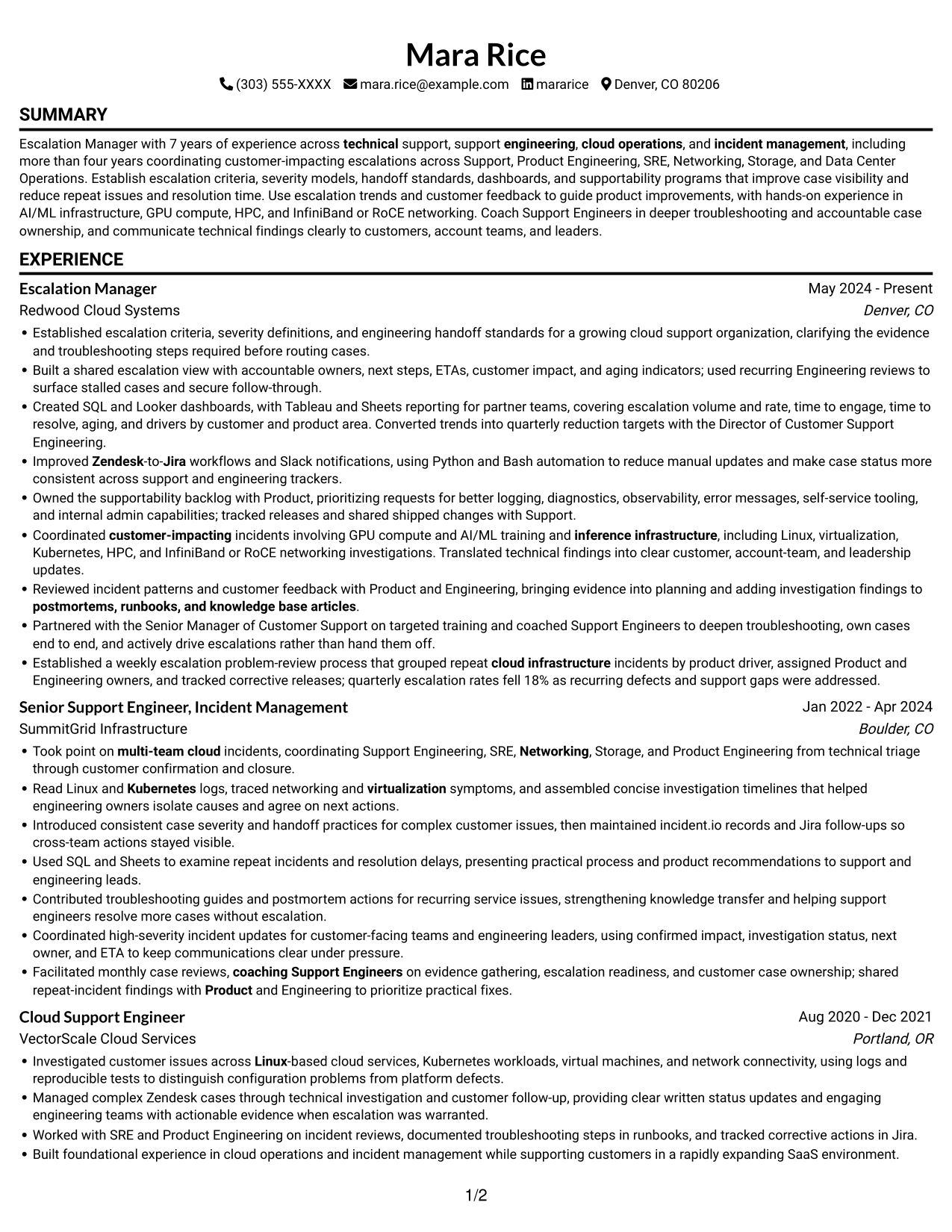
Resume example — page 1

This guide shows you how to build an Escalation Manager - Cloud Infrastructure resume that makes your impact clear. Learn how to organize your evidence, choose a useful format, and help reviewers find your results quickly.

Strong resumes for this role connect technical investigations with business outcomes. Show how you manage case ownership, coordinate engineering teams, improve support processes, and use incident data to reduce repeat issues and resolution time.

Compare one resume example in 7 layouts through image previews, then open an example in the editor. The guide also explains how to present skills such as Linux, Kubernetes, SQL, Zendesk, Jira, and incident management with clear evidence.

What Makes a Great Escalation Manager - Cloud Infrastructure Resume in 2026

A strong resume makes ownership, coordination, and results easy to scan. Use clear sections and focused bullets to show how you move customer-impacting incidents from triage through resolution.

Include relevant terms such as escalation criteria, severity definitions, engineering handoffs, incident response, and supportability. Back them with specific tools and outcomes, such as SQL dashboards, Zendesk-to-Jira workflow improvements, or a measured drop in repeat escalations.

Note: Resume examples are for educational purposes only. Use only information that accurately reflects your experience and qualifications. References to real organizations do not imply affiliation or endorsement.

#1 Simple One Column Format Resume Example

The Simple One Column Format keeps the resume in one reading path, helping reviewers follow its sections in order.
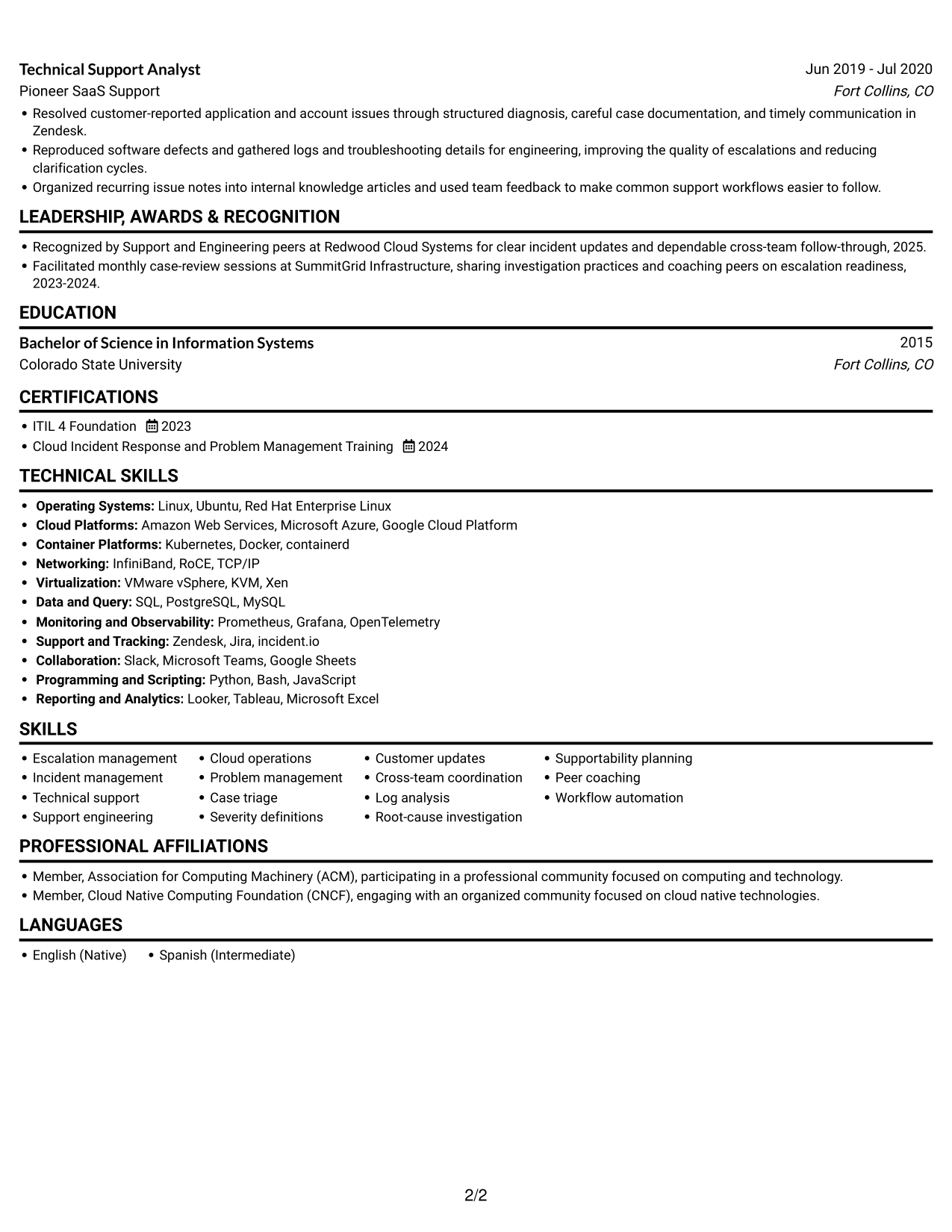
 
Resume example — page 1   Resume example — page 2

Why This Format Works

  • Career history follows a single reading path, helping reviewers track progression.
  • Skills and credentials remain easy to locate within the same content flow.
  • Separate resume sections help distinguish achievements, education, and work history.

Best For

  • Linear resume reading
  • Chronological career histories
  • Clearly separated resume sections
  • Detailed work histories
  • ATS-focused document structure

Resume Keywords

  • 7 years of experience across technical support, support engineering, cloud operations, and incident management
  • more than four years coordinating customer-impacting escalations across Support, Product Engineering, SRE, Networking, Storage, and Data Center Operations
  • Escalation management
  • Took point on multi-team cloud incidents, coordinating Support Engineering, SRE, Networking, Storage, and Product Engineering from technical triage through customer confirmation and closure.
  • cloud infrastructure
  • Linux
  • Networking
  • virtualization
  • Kubernetes
  • Log analysis
  • Established escalation criteria, severity definitions
  • engineering handoff standards for a growing cloud support organization, clarifying the evidence and troubleshooting steps required before routing cases.
  • coordinating Support Engineering, SRE, Networking, Storage, and Product Engineering
  • Coordinated customer-impacting incidents involving GPU compute and AI/ML training and inference infrastructure
  • Owned the supportability backlog with Product
See all keywords
 

#2 Simple Two Column Format Resume Example

The Simple Two Column Format places resume content in two parallel areas, helping reviewers take in related information at a glance.
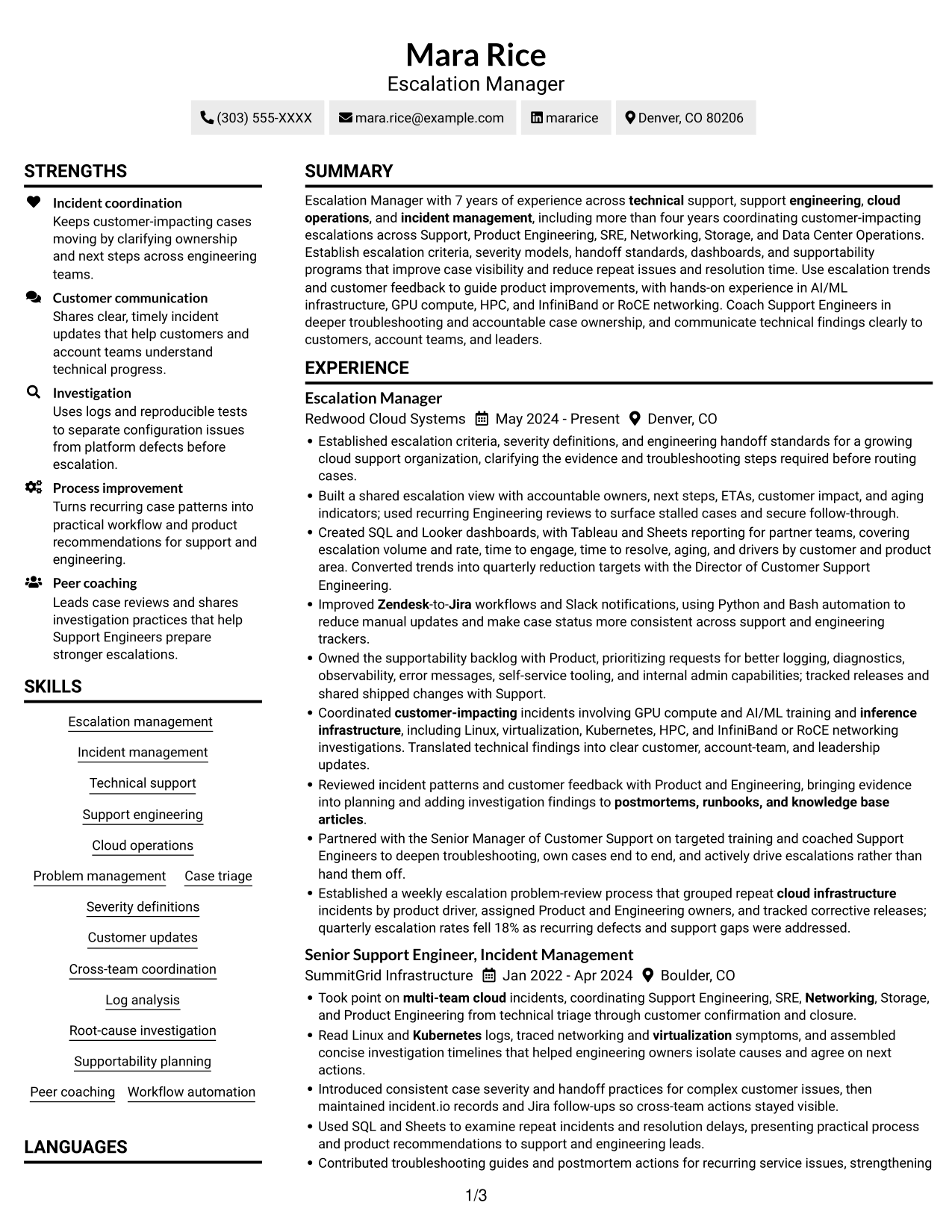
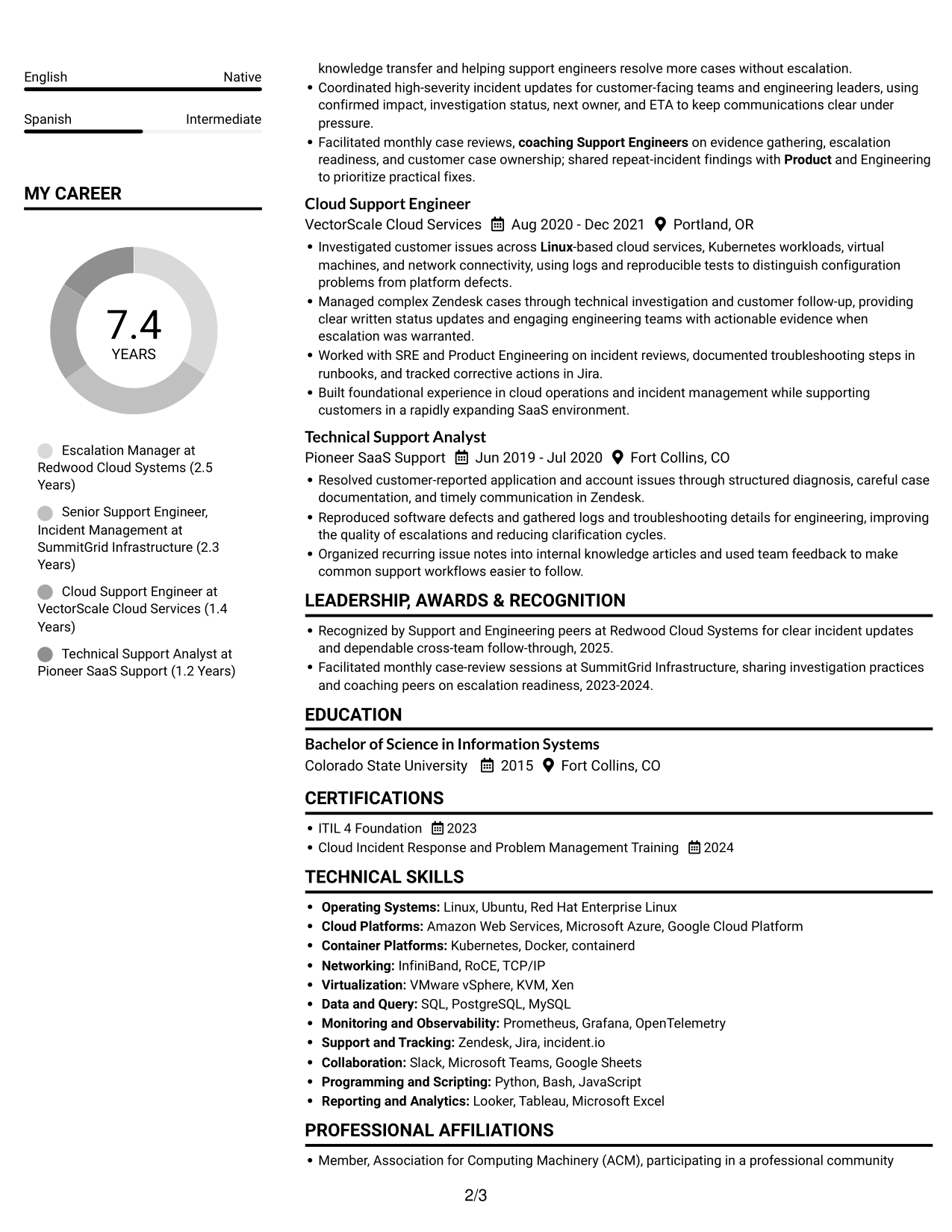
 
Resume example — page 1   Resume example — page 2

Why This Format Works

  • Parallel content areas let reviewers compare career history with supporting details.
  • A clear reading order helps reviewers follow experience and education.
  • The divided layout gives skills and credentials their own visual space.

Best For

  • Parallel resume content
  • Quick comparisons across sections
  • Compact supporting details
  • Visible skills and credentials
  • Career histories with varied sections

#3 Plain One Column with Shaded Labels Resume Example

Plain One Column with Shaded Labels combines a single reading path with shaded section labels, making each part of the resume easier to locate.
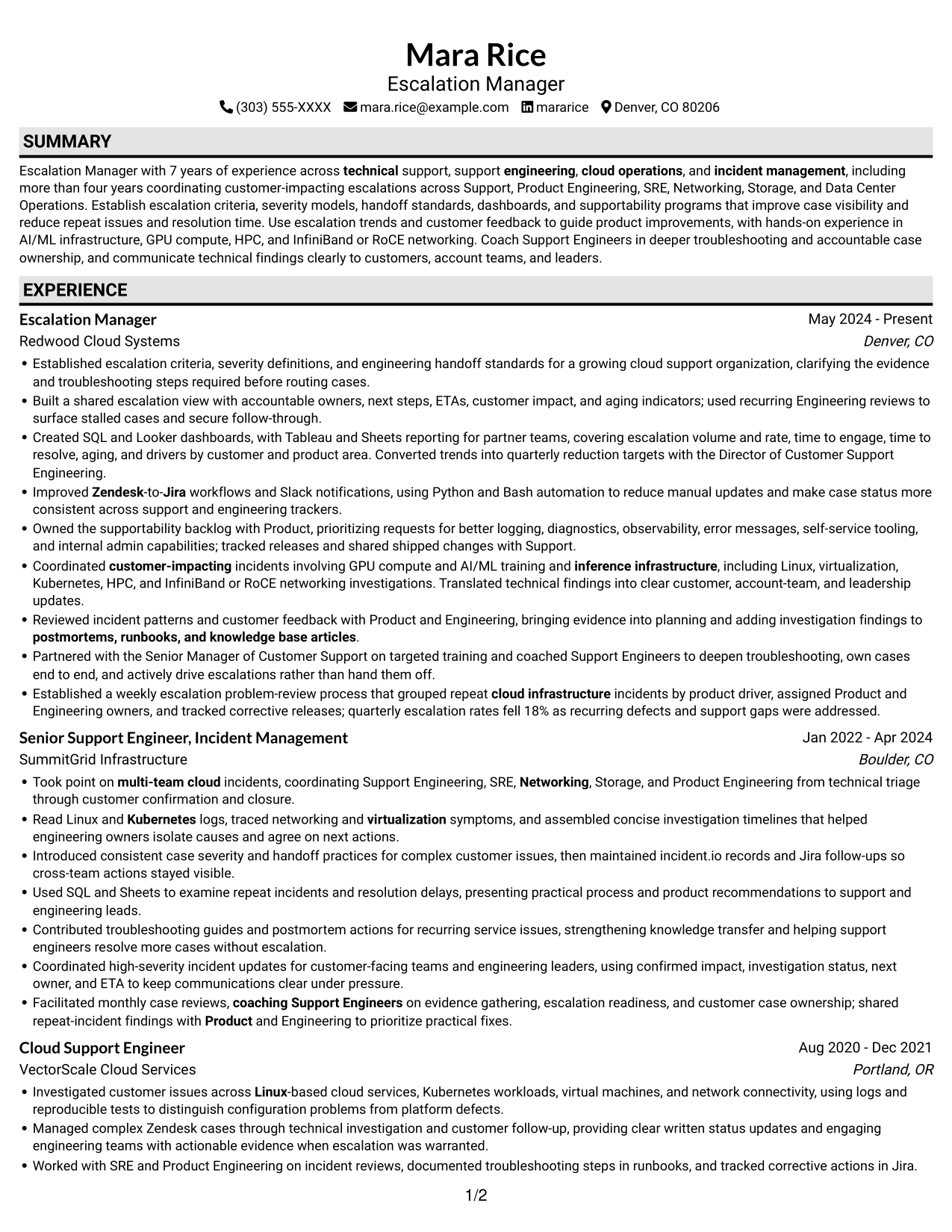
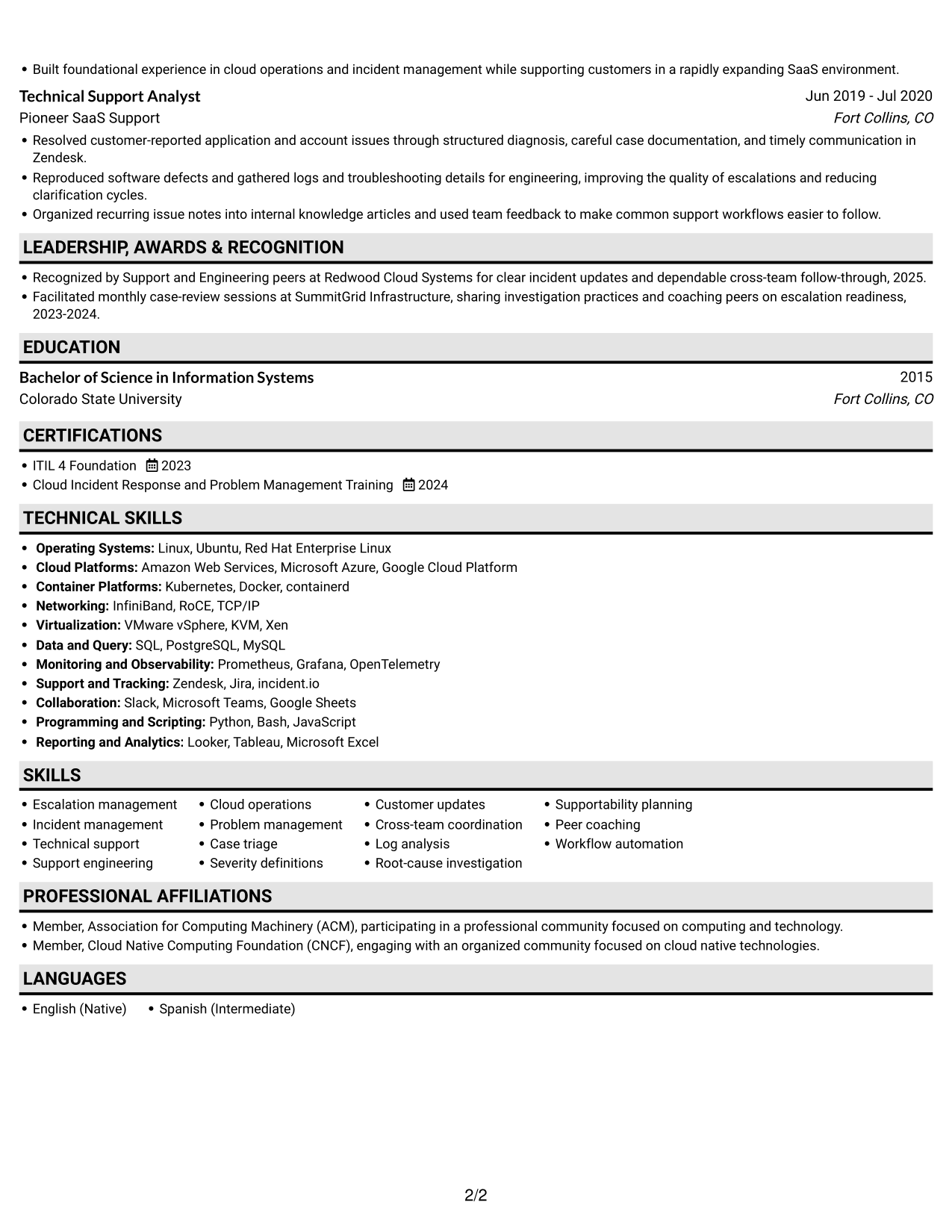
 
Resume example — page 1   Resume example — page 2

Why This Format Works

  • Shaded labels mark section changes without breaking the resume's reading order.
  • A single content path helps reviewers follow career progression from role to role.
  • Distinct section markers make education and credentials easier to spot.

Best For

  • Clearly marked resume sections
  • Linear career progression
  • Fast section lookup
  • Chronological work histories
  • Education and credentials in one flow
 

#4 One Column Format with Photo Right Resume Example

One Column Format with Photo Right pairs a right-side photo with a single reading path, adding a personal visual element without dividing the resume content.
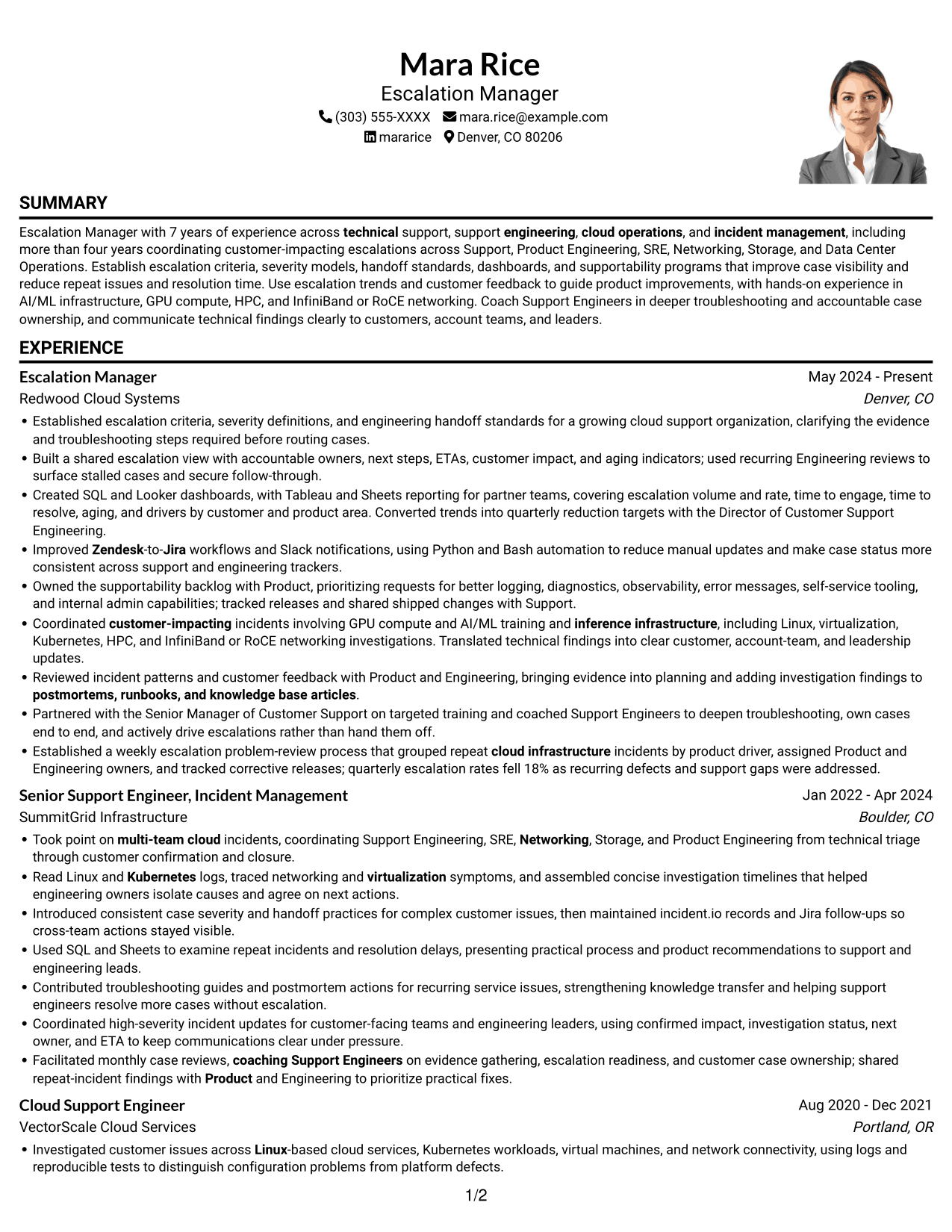
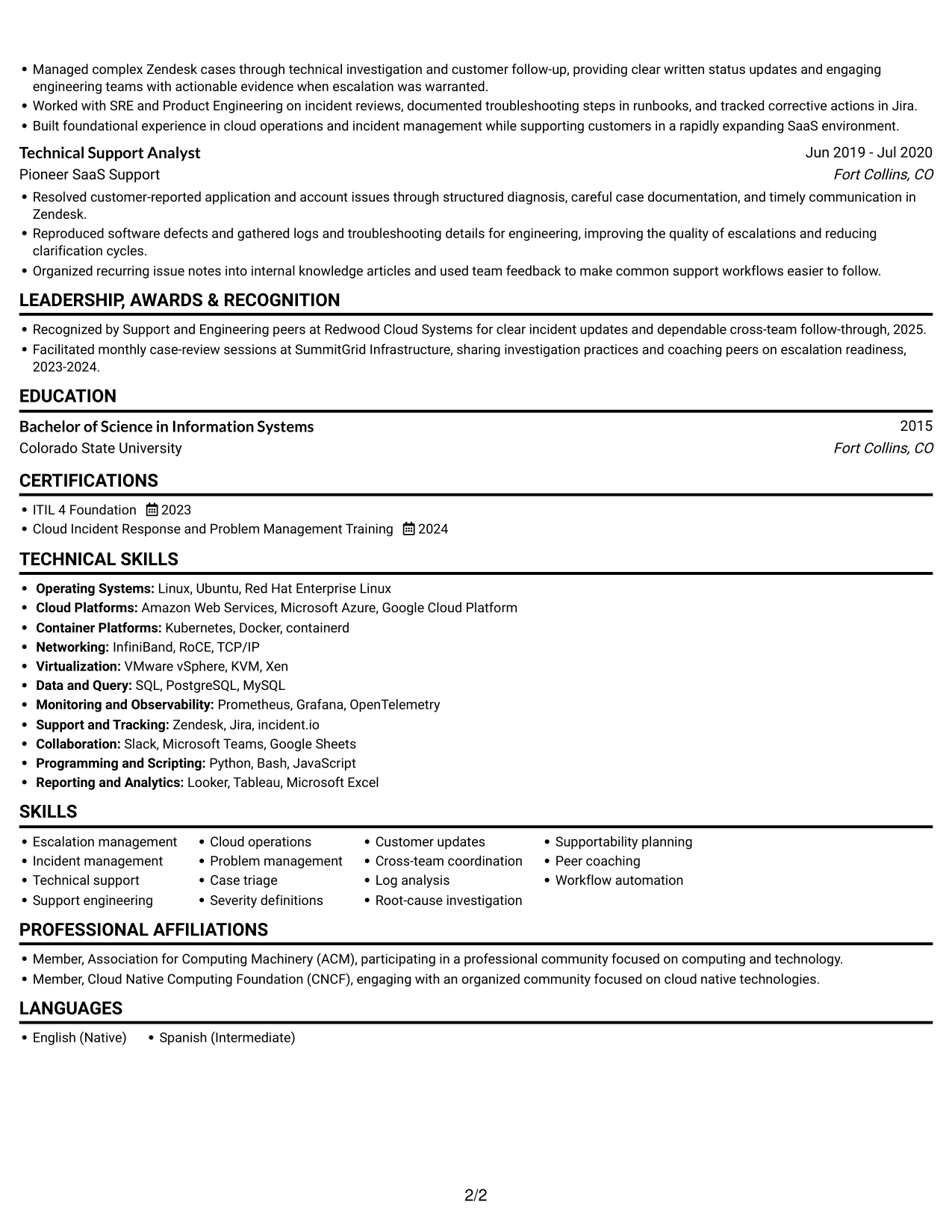
 
Resume example — page 1   Resume example — page 2

Why This Format Works

  • The single content path keeps experience and education in a consistent order.
  • A clear sequence helps reviewers follow achievements across successive roles.
  • Separate resume sections keep skills, credentials, and work history distinct.

Best For

  • Right-side photo preference
  • One-path resume reading
  • Chronological work histories
  • Distinct resume sections
  • Personal visual presentation
 

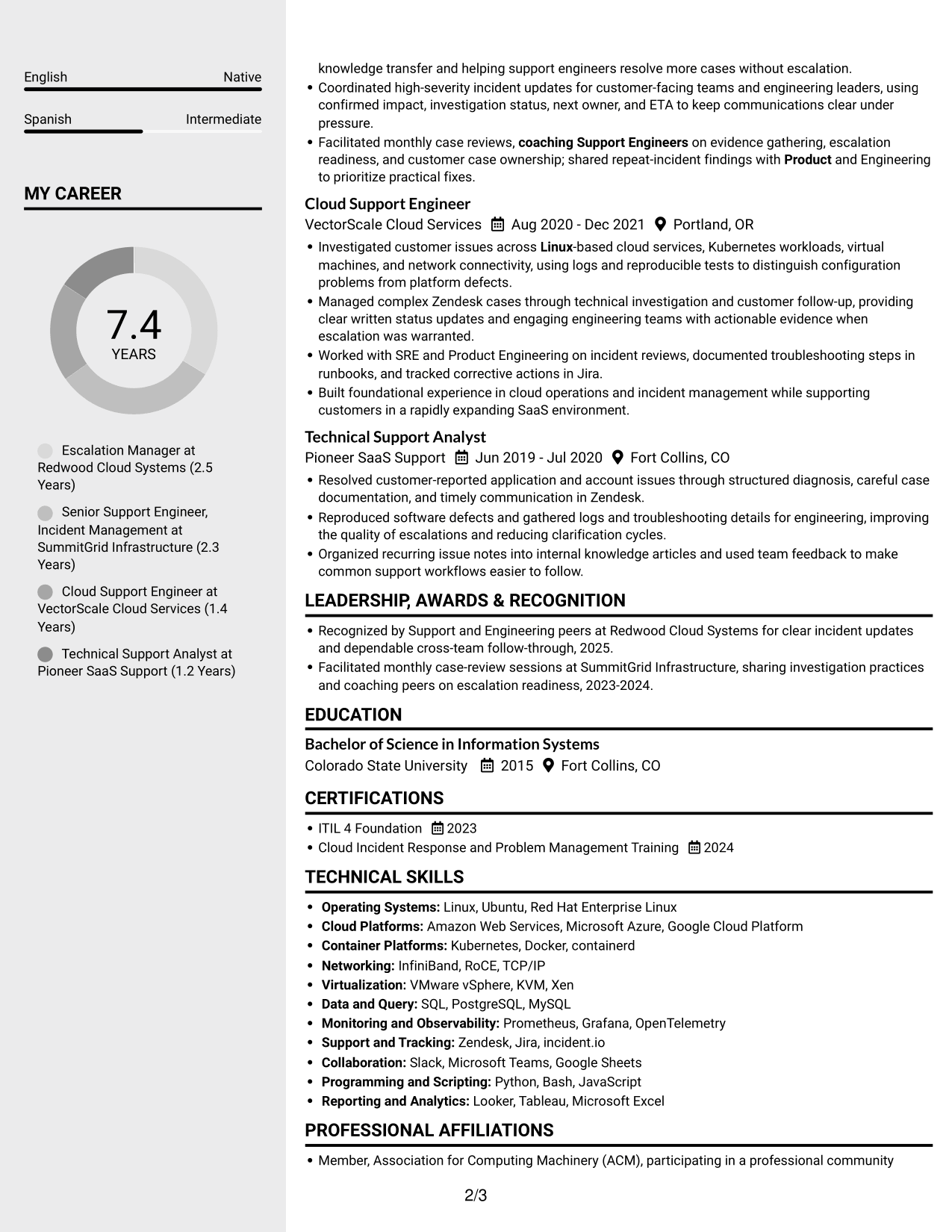
#5 Clean Two Column Sidebar Format Resume Example

Clean Two Column Sidebar Format sets a sidebar beside the main resume area, giving supporting information a separate place from career history.
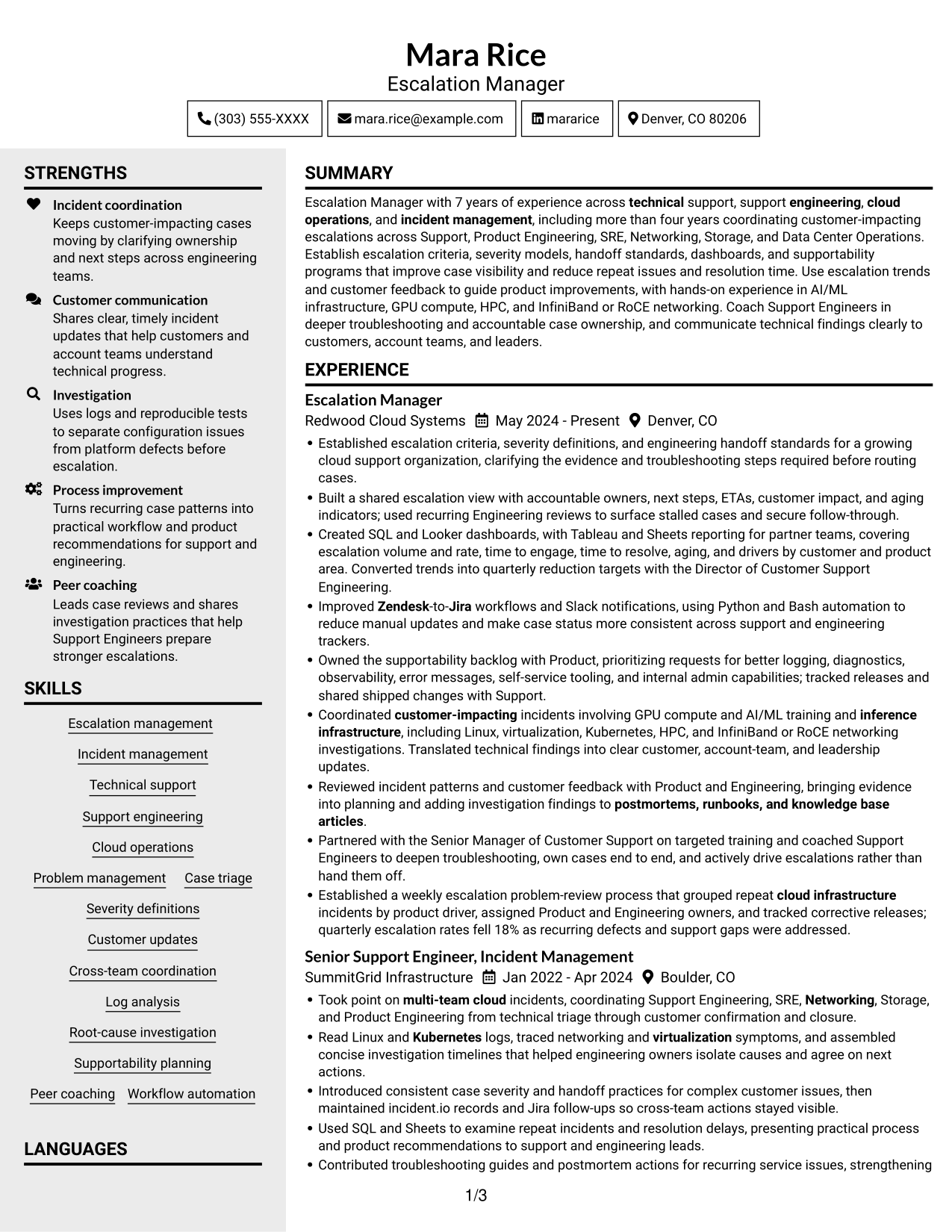
 
Resume example — page 1   Resume example — page 2

Why This Format Works

  • The sidebar separates supporting details from the main career record.
  • Reviewers can follow experience in one area and find other sections nearby.
  • Two content areas make skills and credentials easier to locate apart from work history.

Best For

  • Sidebar-based information grouping
  • Career history beside supporting details
  • Quick access to credentials
  • Compact resume sections
  • Distinct skills and experience areas


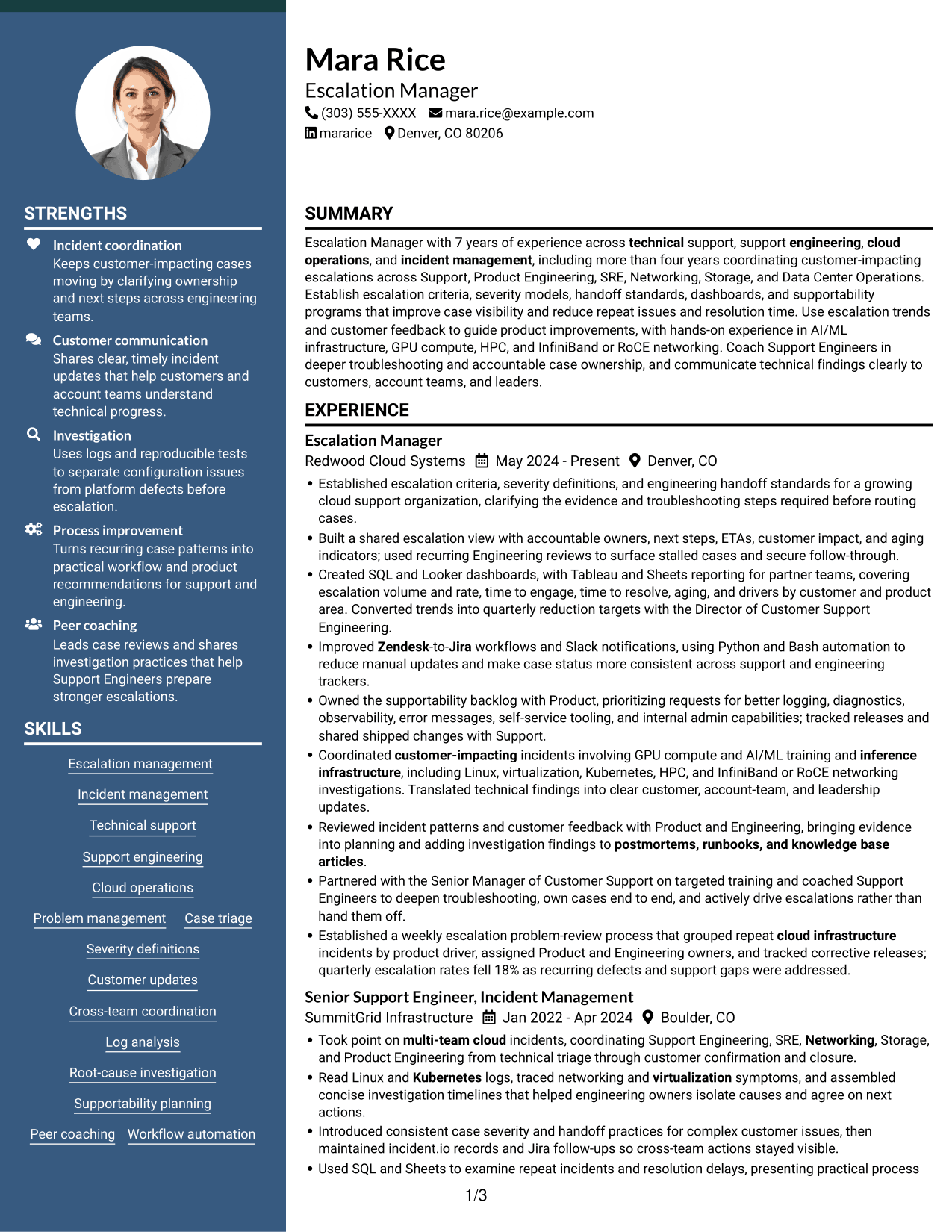
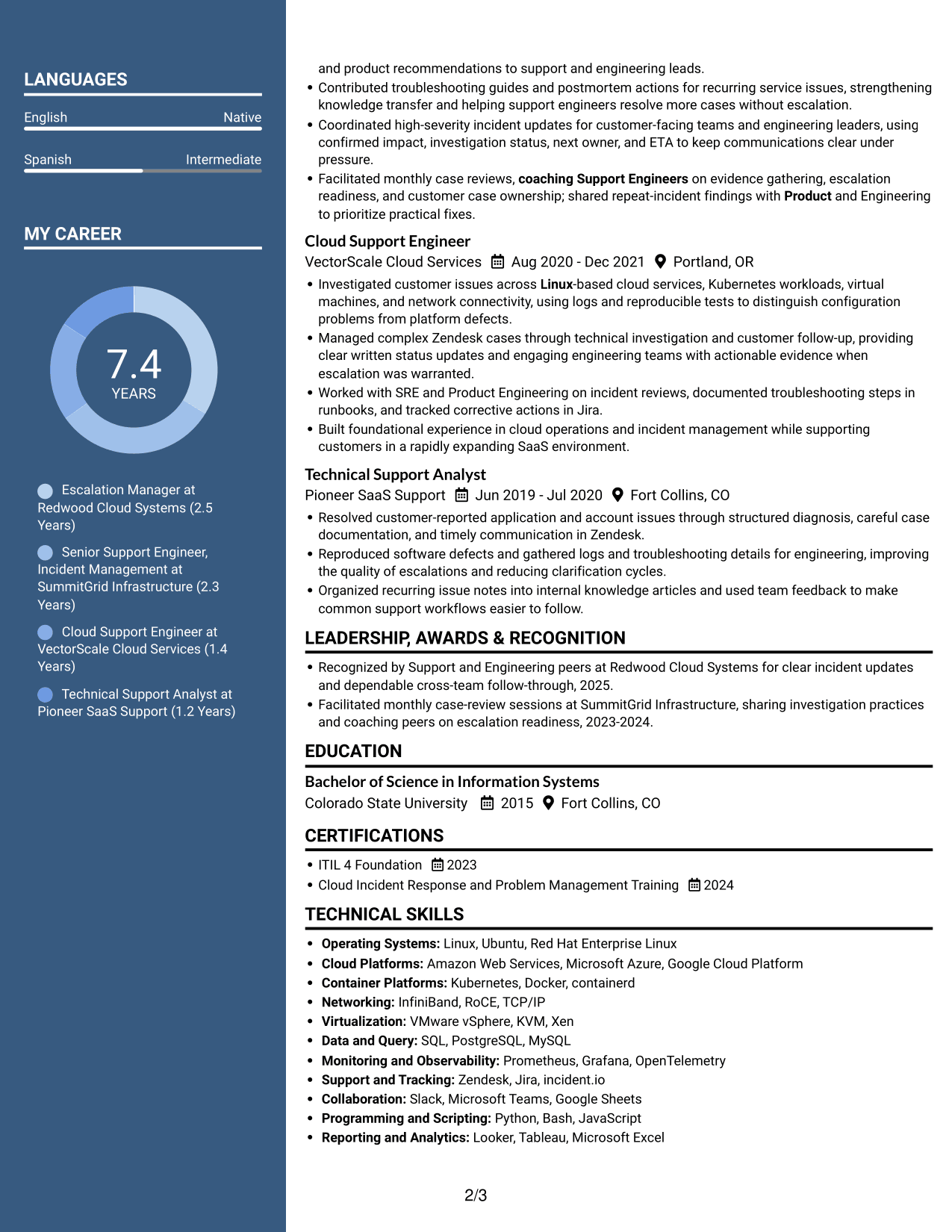
#6 Two Column Format Resume Example

The Two Column Format organizes the resume across two content areas, offering a balanced view of career history and supporting sections.
 
Resume example — page 1   Resume example — page 2

Why This Format Works

  • Two content areas let reviewers locate career details and supporting sections separately.
  • The layout can keep education and credentials visible beside work history.
  • A divided reading surface helps distinguish skills from employment details.

Best For

  • Two-area resume organization
  • Career details with supporting sections
  • Visible education and credentials
  • Skills beside work history
  • Resumes with varied content
 

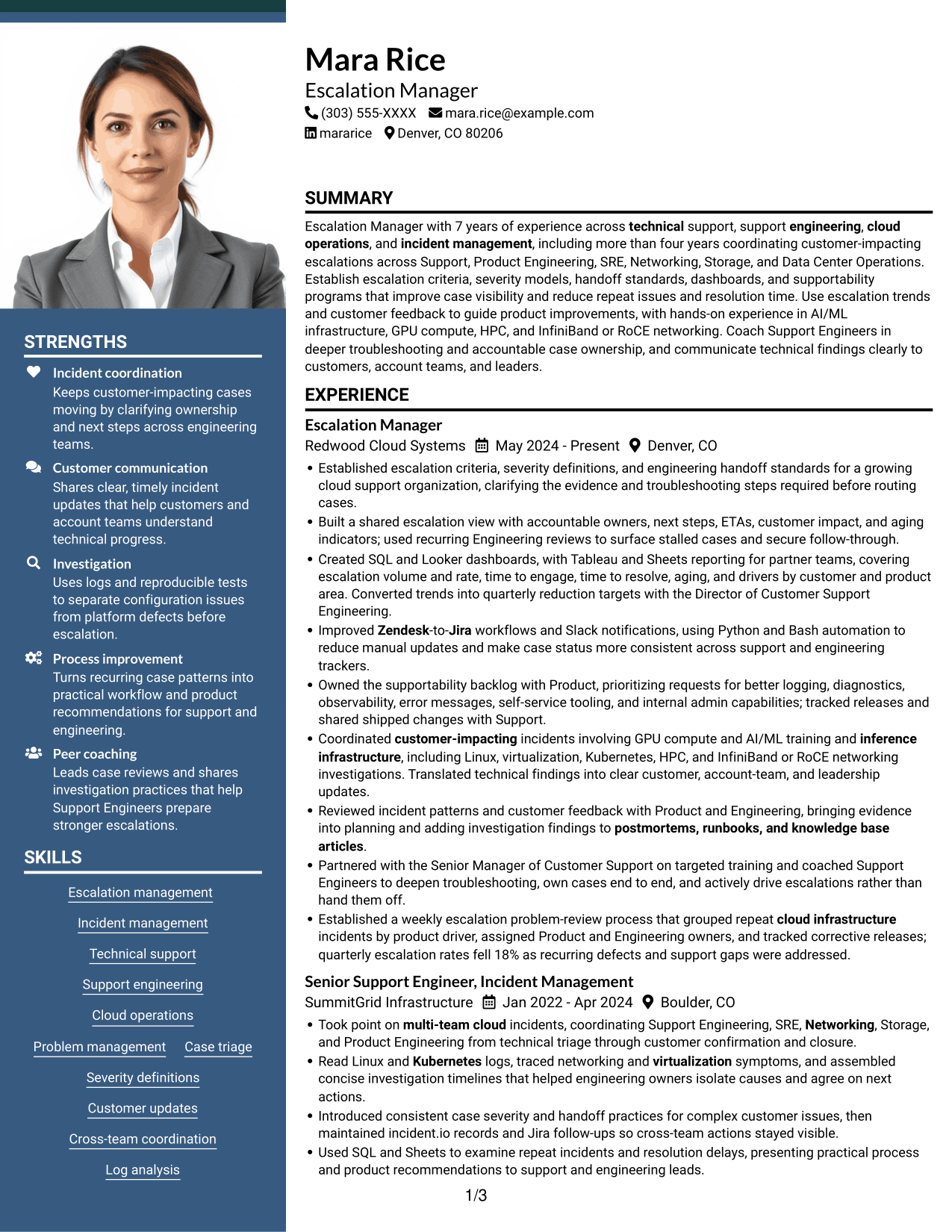
#7 Photo Header Two Column Format Resume Example

Photo Header Two Column Format places a photo in the header above two content areas, giving the resume a distinct top section and divided body.
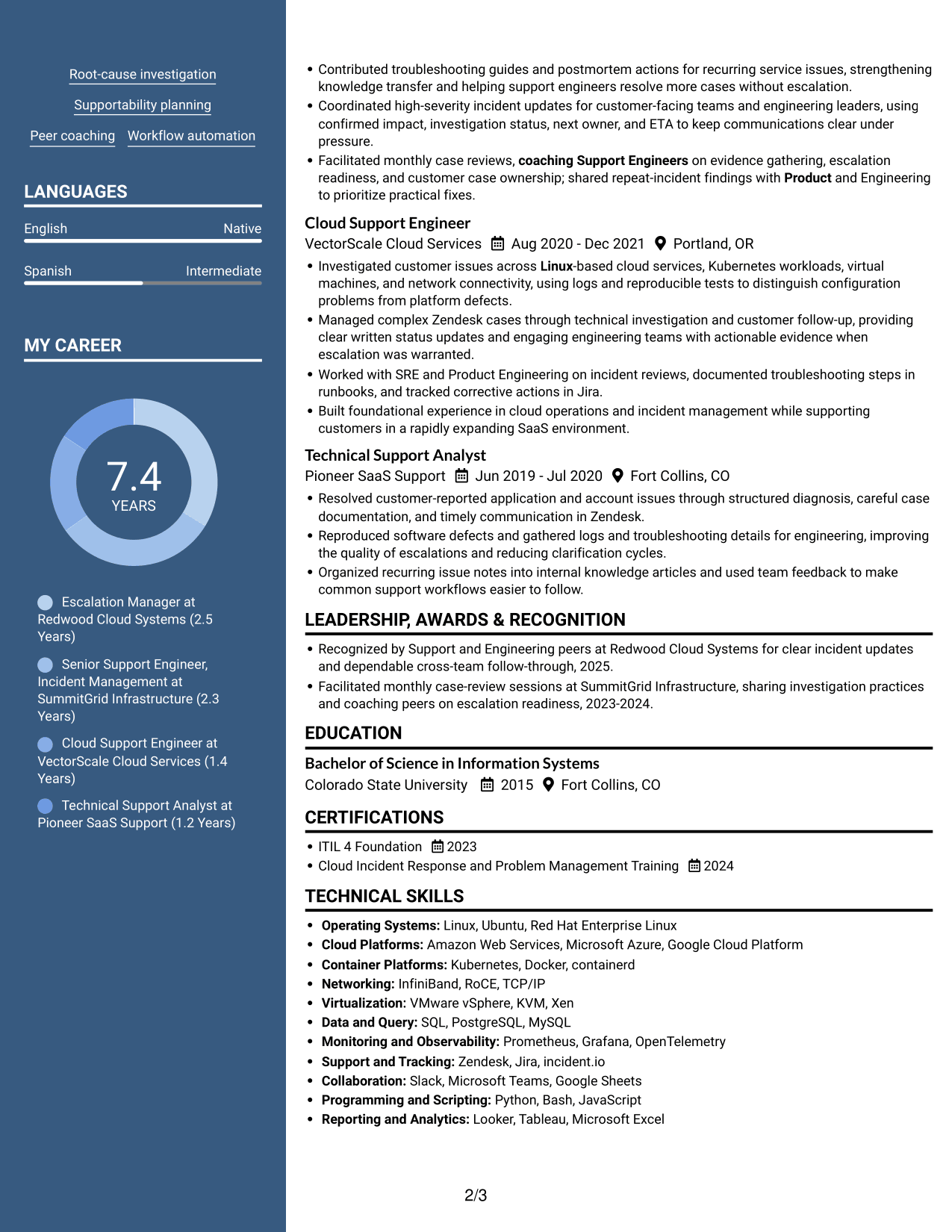
 
Resume example — page 1   Resume example — page 2

Why This Format Works

  • The two-area body gives career history and supporting details separate space.
  • Reviewers can scan work experience while locating education and credentials nearby.
  • The header photo adds a personal visual element without replacing section content.

Best For

  • Photo in the resume header
  • Two-area content organization
  • Career history with supporting details
  • Visible education and credentials
  • Personal visual presentation


Why Build Your Escalation Manager - Cloud Infrastructure Resume with ResumeInMinutes

ResumeInMinutes helps you organize technical experience, incident results, skills, and certifications into a resume that is easy to review and customize.

  • ATS-friendly section structure
  • Clear experience and achievement bullets
  • Relevant keyword guidance
  • Skills and tools organization
  • Image previews for layout comparison
  • Resume customization in the editor

Use the example to present escalation ownership, cross-team incident work, supportability improvements, and technical investigation skills. Focus each bullet on the action, the scope of the work, and its result.


See Also


Frequently Asked Questions

Are these Escalation Manager - Cloud Infrastructure resume templates ATS-friendly?

The layouts use clear sections and readable headings. For stronger ATS matching, use role-relevant terms such as escalation management, incident response, Linux, Kubernetes, SQL, Zendesk, and Jira where they accurately describe your experience.

Does this guide show one resume in different layouts?

Yes. It presents one Escalation Manager - Cloud Infrastructure resume example in several layout options, so you can compare how the same information appears in each design.

What should an Escalation Manager - Cloud Infrastructure resume include?

Include a focused summary, relevant experience, technical skills, education, and certifications. Use concise bullets to show incident coordination, engineering handoffs, dashboard reporting, supportability work, and measurable improvements.

Which resume style works well for this role?

A clean layout with familiar headings helps reviewers find your experience and results. Choose a format that keeps work history, skills, and measurable outcomes easy to scan, and avoid design elements that make text harder to read.

How can I show the impact of escalation work?

Describe the problem, the steps you took, and the result. Where supported by your records, include measures such as escalation rate, time to engage, time to resolve, case age, or repeat-incident reduction.

Should I include a photo on my resume?

Include a photo only if it is customary or expected in your country, region, or industry. For U.S. applications, a no-photo resume is generally the safer choice.

ATS Score 92%

How we calculate this score

  • Keywords: 60% of the total. AI extracts keywords from your job description. If you do not provide one, a standard job description for the title matching your resume is used. This is not a match to a specific vacancy.
  • Text-based resume: 20%. The text resume assessed here receives 100 for this part.
  • Resume quality: 20%. We start at 100 and subtract points for issues found by our resume checks, down to a minimum of zero.
  • Keyword coverage = round(100 × confirmed matches ÷ total keywords). Exact matches and supported equivalents verified by AI receive full credit; unsupported keywords receive none. Live text checks use the saved equivalents and do not request a new AI review. Without keywords, no overall ATS score is available.
  • Final score = 60% of keyword coverage + 20% of the text score + 20% of the quality score, rounded to a whole number. Without keywords, no overall ATS score is available.

What this score means

Our scores are estimates, not employer ratings. They may contain errors and do not guarantee accurate parsing, a ranking, an interview, or a job. Check your document against the employer’s requirements. You are responsible for relying on this score.

Terms and Conditions

Score weights: Keywords 60% · Text based resume 20% · Resume quality 20%

Keyword coverage: 33 of 38 (87%) · Resume quality: 100%

Resume quality 100% · Weight 20% · Issues (0)

Details
  • ✓Name present: Mara Rice
  • ✓Email format: mara.rice@example.com
  • ✓Phone format: (303) 555-XXXX
  • ✓Experience 1: Job title: Escalation Manager
  • ✓Experience 1: Company name: Redwood Cloud Systems
  • ✓Experience 1: Work location: Denver, CO
  • ✓Experience 1: Employment dates: May 2024 - Present
  • ✓Experience 1: Description or achievements: Present
  • ✓Experience 2: Job title: Senior Support Engineer, Incident Management
  • ✓Experience 2: Company name: SummitGrid Infrastructure
  • ✓Experience 2: Work location: Boulder, CO
  • ✓Experience 2: Employment dates: Jan 2022 - Apr 2024
  • ✓Experience 2: Description or achievements: Present
  • ✓Experience 3: Job title: Cloud Support Engineer
  • ✓Experience 3: Company name: VectorScale Cloud Services
  • ✓Experience 3: Work location: Portland, OR
  • ✓Experience 3: Employment dates: Aug 2020 - Dec 2021
  • ✓Experience 3: Description or achievements: Present
  • ✓Experience 4: Job title: Technical Support Analyst
  • ✓Experience 4: Company name: Pioneer SaaS Support
  • ✓Experience 4: Work location: Fort Collins, CO
  • ✓Experience 4: Employment dates: Jun 2019 - Jul 2020
  • ✓Experience 4: Description or achievements: Present
  • ✓No placeholder fields
  • ✓No repeated achievement bullets
  • ✓No empty bullets

No issues found by the current checks.

Text Based Resume 100% · Weight 20%

Parsed text
Mara Rice
(303) 555-XXXX
mara.rice@example.com
mararice
Denver, CO 80206
SUMMARY
Escalation Manager with 7 years of experience across technical support, support engineering, cloud operations, and incident management, including more than four years coordinating customer-impacting escalations across Support, Product Engineering, SRE, Networking, Storage, and Data Center Operations. Establish escalation criteria, severity models, handoff standards, dashboards, and supportability programs that improve case visibility and reduce repeat issues and resolution time. Use escalation trends and customer feedback to guide product improvements, with hands-on experience in AI/ML infrastructure, GPU compute, HPC, and InfiniBand or RoCE networking. Coach Support Engineers in deeper troubleshooting and accountable case ownership, and communicate technical findings clearly to customers, account teams, and leaders.
EXPERIENCE
Escalation Manager
May 2024 - Present
Redwood Cloud Systems
Denver, CO
Established escalation criteria, severity definitions, and engineering handoff standards for a growing cloud support organization, clarifying the evidence and troubleshooting steps required before routing cases.
Built a shared escalation view with accountable owners, next steps, ETAs, customer impact, and aging indicators; used recurring Engineering reviews to surface stalled cases and secure follow-through.
Created SQL and Looker dashboards, with Tableau and Sheets reporting for partner teams, covering escalation volume and rate, time to engage, time to resolve, aging, and drivers by customer and product area. Converted trends into quarterly reduction targets with the Director of Customer Support Engineering.
Improved Zendesk-to-Jira workflows and Slack notifications, using Python and Bash automation to reduce manual updates and make case status more consistent across support and engineering trackers.
Owned the supportability backlog with Product, prioritizing requests for better logging, diagnostics, observability, error messages, self-service tooling, and internal admin capabilities; tracked releases and shared shipped changes with Support.
Coordinated customer-impacting incidents involving GPU compute and AI/ML training and inference infrastructure, including Linux, virtualization, Kubernetes, HPC, and InfiniBand or RoCE networking investigations. Translated technical findings into clear customer, account-team, and leadership updates.
Reviewed incident patterns and customer feedback with Product and Engineering, bringing evidence into planning and adding investigation findings to postmortems, runbooks, and knowledge base articles.
Partnered with the Senior Manager of Customer Support on targeted training and coached Support Engineers to deepen troubleshooting, own cases end to end, and actively drive escalations rather than hand them off.
Established a weekly escalation problem-review process that grouped repeat cloud infrastructure incidents by product driver, assigned Product and Engineering owners, and tracked corrective releases; quarterly escalation rates fell 18% as recurring defects and support gaps were addressed.
Senior Support Engineer, Incident Management
Jan 2022 - Apr 2024
SummitGrid Infrastructure
Boulder, CO
Took point on multi-team cloud incidents, coordinating Support Engineering, SRE, Networking, Storage, and Product Engineering from technical triage through customer confirmation and closure.
Read Linux and Kubernetes logs, traced networking and virtualization symptoms, and assembled concise investigation timelines that helped engineering owners isolate causes and agree on next actions.
Introduced consistent case severity and handoff practices for complex customer issues, then maintained incident.io records and Jira follow-ups so cross-team actions stayed visible.
Used SQL and Sheets to examine repeat incidents and resolution delays, presenting practical process and product recommendations to support and engineering leads.
Contributed troubleshooting guides and postmortem actions for recurring service issues, strengthening knowledge transfer and helping support engineers resolve more cases without escalation.
Coordinated high-severity incident updates for customer-facing teams and engineering leaders, using confirmed impact, investigation status, next owner, and ETA to keep communications clear under pressure.
Facilitated monthly case reviews, coaching Support Engineers on evidence gathering, escalation readiness, and customer case ownership; shared repeat-incident findings with Product and Engineering to prioritize practical fixes.
Cloud Support Engineer
Aug 2020 - Dec 2021
VectorScale Cloud Services
Portland, OR
Investigated customer issues across Linux-based cloud services, Kubernetes workloads, virtual machines, and network connectivity, using logs and reproducible tests to distinguish configuration problems from platform defects.
Managed complex Zendesk cases through technical investigation and customer follow-up, providing clear written status updates and engaging engineering teams with actionable evidence when escalation was warranted.
Worked with SRE and Product Engineering on incident reviews, documented troubleshooting steps in runbooks, and tracked corrective actions in Jira.
Built foundational experience in cloud operations and incident management while supporting customers in a rapidly expanding SaaS environment.
Technical Support Analyst
Jun 2019 - Jul 2020
Pioneer SaaS Support
Fort Collins, CO
Resolved customer-reported application and account issues through structured diagnosis, careful case documentation, and timely communication in Zendesk.
Reproduced software defects and gathered logs and troubleshooting details for engineering, improving the quality of escalations and reducing clarification cycles.
Organized recurring issue notes into internal knowledge articles and used team feedback to make common support workflows easier to follow.
LEADERSHIP, AWARDS & RECOGNITION
Recognized by Support and Engineering peers at Redwood Cloud Systems for clear incident updates and dependable cross-team follow-through, 2025.
Facilitated monthly case-review sessions at SummitGrid Infrastructure, sharing investigation practices and coaching peers on escalation readiness, 2023-2024.
EDUCATION
Bachelor of Science in Information Systems
2015
Colorado State University
Fort Collins, CO
CERTIFICATIONS
ITIL 4 Foundation
2023
Cloud Incident Response and Problem Management Training
2024
TECHNICAL SKILLS
Operating Systems: Linux, Ubuntu, Red Hat Enterprise Linux
Cloud Platforms: Amazon Web Services, Microsoft Azure, Google Cloud Platform
Container Platforms: Kubernetes, Docker, containerd
Networking: InfiniBand, RoCE, TCP/IP
Virtualization: VMware vSphere, KVM, Xen
Data and Query: SQL, PostgreSQL, MySQL
Monitoring and Observability: Prometheus, Grafana, OpenTelemetry
Support and Tracking: Zendesk, Jira, incident.io
Collaboration: Slack, Microsoft Teams, Google Sheets
Programming and Scripting: Python, Bash, JavaScript
Reporting and Analytics: Looker, Tableau, Microsoft Excel
SKILLS
Escalation management
Incident management
Technical support
Support engineering
Cloud operations
Problem management
Case triage
Severity definitions
Customer updates
Cross-team coordination
Log analysis
Root-cause investigation
Supportability planning
Peer coaching
Workflow automation
PROFESSIONAL AFFILIATIONS
Member, Association for Computing Machinery (ACM), participating in a professional community focused on computing and technology.
Member, Cloud Native Computing Foundation (CNCF), engaging with an organized community focused on cloud native technologies.
LANGUAGES
English (Native)
Spanish (Intermediate)

Matched keywords (33)

  • 7 years of experience across technical support, support engineering, cloud operations, and incident managementOriginal keyword in JD: 5+ years in technical support, support engineering, escalation management, incident management, or SRE/operations in cloud, infrastructure, or SaaS
  • more than four years coordinating customer-impacting escalations across Support, Product Engineering, SRE, Networking, Storage, and Data Center OperationsOriginal keyword in JD: 2+ years managing escalations or incidents involving multiple engineering teams
  • Escalation management
  • Took point on multi-team cloud incidents, coordinating Support Engineering, SRE, Networking, Storage, and Product Engineering from technical triage through customer confirmation and closure.Original keyword in JD: Multi-team incident management
  • cloud infrastructure
  • Linux
  • Networking
  • virtualization
  • Kubernetes
  • Log analysis
  • Established escalation criteria, severity definitionsOriginal keyword in JD: Escalation criteria and severity definitions
  • engineering handoff standards for a growing cloud support organization, clarifying the evidence and troubleshooting steps required before routing cases.Original keyword in JD: Engineering-ready case handoffs
  • coordinating Support Engineering, SRE, Networking, Storage, and Product EngineeringOriginal keyword in JD: Cross-functional coordination
  • Coordinated customer-impacting incidents involving GPU compute and AI/ML training and inference infrastructureOriginal keyword in JD: Customer-impacting incident response
  • Owned the supportability backlog with ProductOriginal keyword in JD: Supportability backlog management
  • shared repeat-incident findings with Product and Engineering to prioritize practical fixes.Original keyword in JD: Product feedback and prioritization
  • Created SQL and Looker dashboards, with Tableau and Sheets reporting for partner teams, covering escalation volume and rate, time to engage, time to resolve, aging, and drivers by customer and product area.Original keyword in JD: Escalation dashboards and reporting
  • SQLOriginal keyword in JD: SQL OR Looker OR Tableau OR Sheets OR comparable reporting tools
  • Zendesk
  • JiraOriginal keyword in JD: Jira OR incident.io
  • Slack
  • Workflow automation
  • supporting customers in a rapidly expanding SaaS environment.Original keyword in JD: Fast-paced, rapid-growth organizations
  • GPU compute
  • HPCOriginal keyword in JD: High-performance computing (HPC)
  • InfiniBandOriginal keyword in JD: InfiniBand OR RoCE networking
  • AI/ML training and inference infrastructure
  • Support EngineerOriginal keyword in JD: Support Engineer OR SRE experience
  • Established a weekly escalation problem-review processOriginal keyword in JD: Escalation or problem management function development
  • PythonOriginal keyword in JD: Python OR Bash scripting
  • ITILOriginal keyword in JD: ITIL OR incident and problem management certification
  • coaching Support Engineers
  • postmortems, runbooks, and knowledge base articles

Missing keywords (5)

  • Process improvement
  • Escalation intake, triage, routing, and closure
  • Customer and executive communications under pressure
  • Influence without authority
  • Escalation volume and resolution-time reduction
Disclaimer: All names, images, contact information, employment histories, achievements, security clearances, military credentials, and other qualifications shown in this content are fictional and used for illustrative purposes only. Any resemblance to actual persons, living or deceased, is purely coincidental.

Resume and cover-letter examples and recommendations in this article reflect general best practices and professional experience and are provided for guidance only. Results may vary based on role, industry, region, and hiring organization.

Content Accuracy and Verification: To the fullest extent permitted by applicable law, we do not represent or warrant that resume or cover-letter guidance, examples, recommendations, or related information are accurate, complete, current, error-free, or suitable for any particular purpose. You are responsible for independently reviewing and verifying the information before relying on it.

ATS and Cover-Letter Scores: ATS scores are estimates calculated using our own formula, informed by publicly available guidance on resume formatting and keyword matching. They are not scores issued or endorsed by an ATS provider or employer. Cover-letter scores are also our own assessments. Parsing, weighting, screening criteria, and results vary between systems, employers, job descriptions, and document formats. No score guarantees successful parsing, a particular ranking, an interview, or employment. Use scores as general guidance and independently check your documents against the employer’s requirements. To the fullest extent permitted by applicable law, we accept no liability for errors in scores or parsing, or losses arising from reliance on these assessments. Nothing in this notice excludes liability or limits consumer rights that cannot lawfully be excluded or limited.

Terms and Conditions
 
> JP 1 1
PDF Footer and Margins Setup
The margins are applied to the document, and the footer shows up in the preview and the PDF

Footer Font Settings

Are you applying for a specific job
so we can tailor your resume to it?
Are you applying for a specific job
so we can tailor your cover letter to it?

Your data stays private and is never used for training.Privacy Policy

Type your details as text to generate a personalized resume Type your details as text to generate a personalized cover letter
Website link found! Ready to create resume from:

Your data stays private and is never used for training.Privacy Policy

Drag the into the box to verify you're human.
Drop here

My Resumes

Displaying {number_of_files} files (out of {total_of_all_files} total)
Name File Type Last Modified: Description:

Rename File

Filename already exists!

Delete Files

Warning: This action is irreversible. Once you click submit, the files will be permanently deleted.

Heading text
Upload From Computer Upload
Select From Existing
LinkedIn
Drag & Drop files anywhere in this tab, or

Uploaded Files

Delete Name Last Updated Use This File
Select this to use the file for generating your resume and cover letter. Only one source—uploaded file, selected file, or LinkedIn text—can be used.

My Files

Resumes or cover letters you create will appear here. No files available yet.
Delete Name Last Updated Use This File
Select this to use the file for generating your resume and cover letter. Only one source—uploaded file, selected file, or LinkedIn text—can be used.

Add LinkedIn Profile PDF

You can download your LinkedIn profile as a PDF by opening linkedin.com in a web browser, clicking your profile photo, selecting the “More” or “Resources” button, and choosing “Save to PDF.” You can then attach the PDF using the Upload From Computer tab.

Paste Your LinkedIn Profile Text

If you have copied the LinkedIn profile text, paste it below. See how to copy your profile from LinkedIn

Select this to use the LinkedIn profile text for generating your resume and cover letter. Only one source—uploaded file, selected file, or LinkedIn text—can be used.

Try these controls

<
>