
US English


7 Full Stack Data Scientist - AI/ML Platform Engineering Resume Templates with Example
By Ria · Last Updated On October 12, 2026
Resume Example Page 1

This practical guide shows you how to build a Full Stack Data Scientist - AI/ML Platform Engineering resume that makes your engineering impact easy to review. Learn how to organize platform, data, and model work so recruiters can quickly see its value.

For this role, connect your Python data pipelines, Kubernetes services, model lifecycle work, and secure releases to clear results. The examples also show how to present tools such as Airflow, MLflow, Helm, GitLab CI, Argo CD, Terraform, and observability systems.

The guide presents one role-focused example in 7 resume layouts, with notes to help you compare formats and choose a clear, ATS-readable structure.

What Makes a Great Full Stack Data Scientist - AI/ML Platform Engineering Resume in 2026

A strong resume uses clear sections, focused skills, and concise bullets to show how data and machine learning systems move into reliable service. Put relevant experience, projects, education, and certifications where readers can find them quickly.

Use accurate keywords such as Python, production data pipelines, Kubernetes, MLOps, model serving, GitOps, observability, and DevSecOps. Support them with specific evidence, such as platform reach, repeatable releases, secure controls, or improved incident visibility.

The examples shown below are intentionally detailed to demonstrate a range of experiences, skills, accomplishments and relevant keywords. We prefer detailed resumes as they provide more context to the hiring managers and also help the ATS systems identify relevant qualifications and score your resume better for a match. But the length of a resume is an individual choice. If you want a one page resume, just keep the most relevant experience and information for the job. Note: Resume examples are for educational purposes only. Use only information that accurately reflects your experience and qualifications. References to real organizations do not imply affiliation or endorsement.

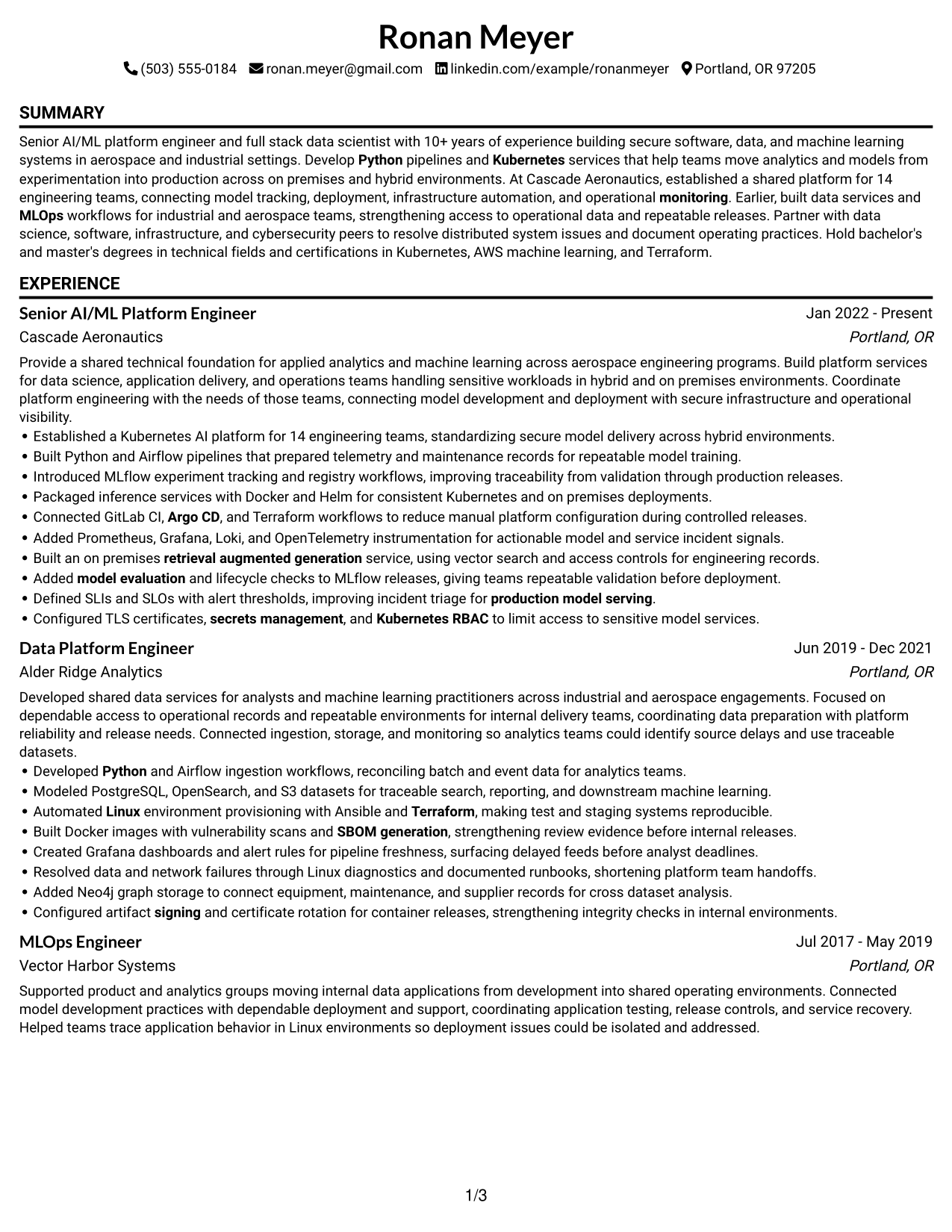
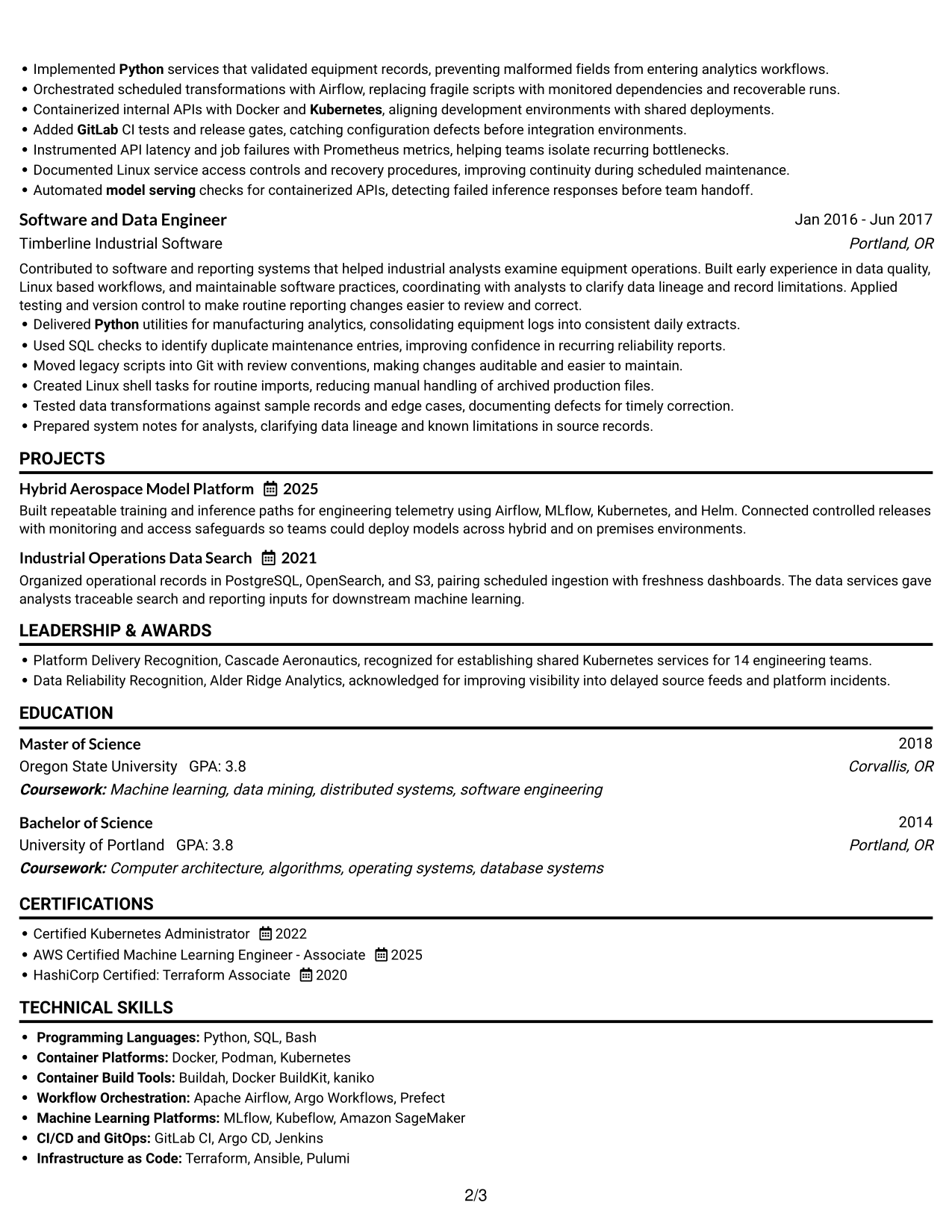
#1 Simple One Column Format Resume Example

The Simple One Column Format keeps all resume sections in one vertical reading path, so recruiters can follow experience, skills, and education in order.
 
Resume Example Page 1   Resume Example Page 2

Why This Format Works

  • The single reading path keeps career progression and experience easy to follow.
  • Separate section headings help reviewers locate skills, education, and credentials quickly.
  • A continuous body gives achievement bullets room to remain in sequence.

Best For

  • Linear review of career history
  • ATS text-order checks
  • Resumes with several section types
  • Quick scans of skills and education
  • Content needing a familiar reading flow

Resume Keywords

  • Python
  • Production data pipelines
  • Workflow Orchestration
  • Kubernetes
  • CI/CD
  • MLOps
  • model serving
  • retrieval augmented generation
  • Linux
  • monitoring
  • Logging
  • Alerting
  • GitOps
  • Helm
  • GitLab
See all keywords
 

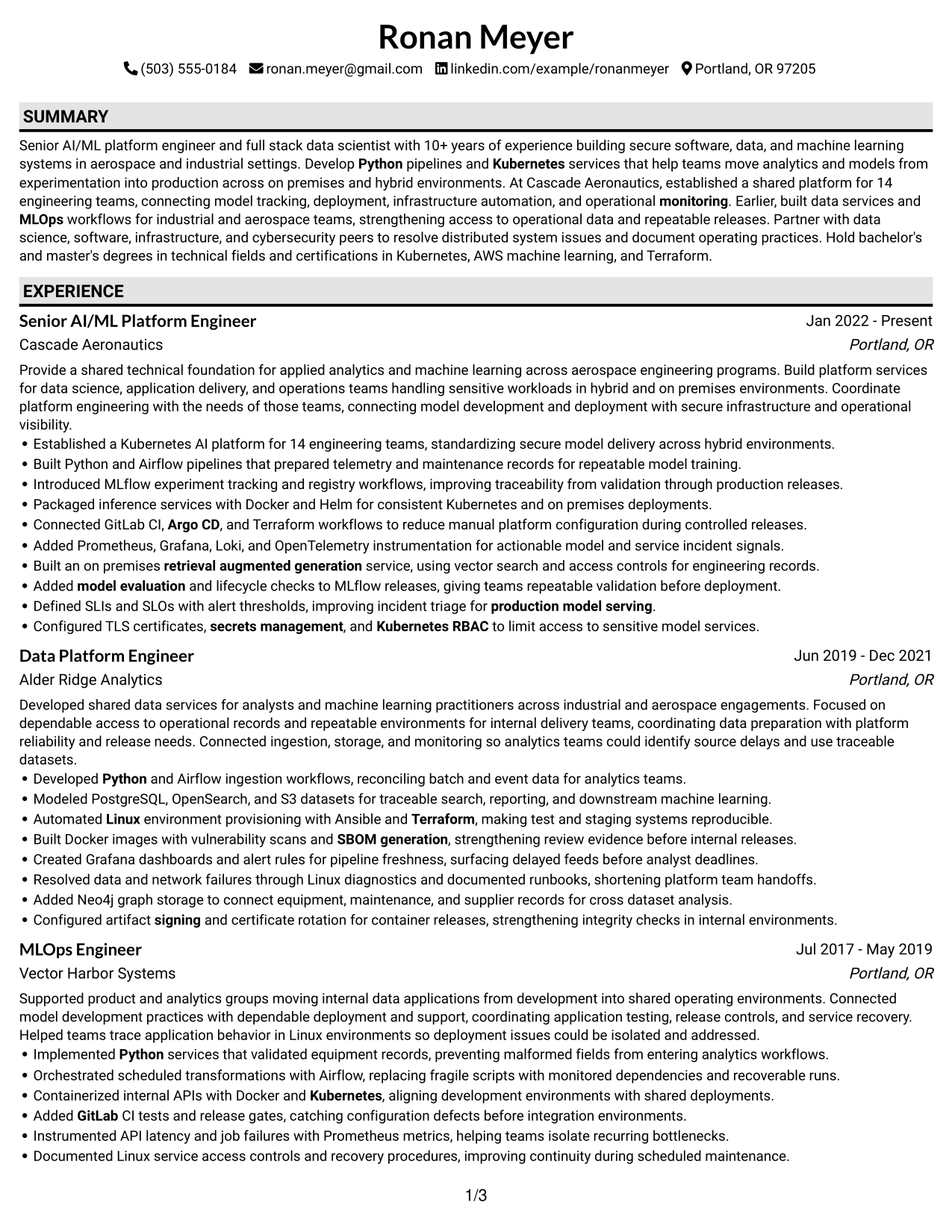
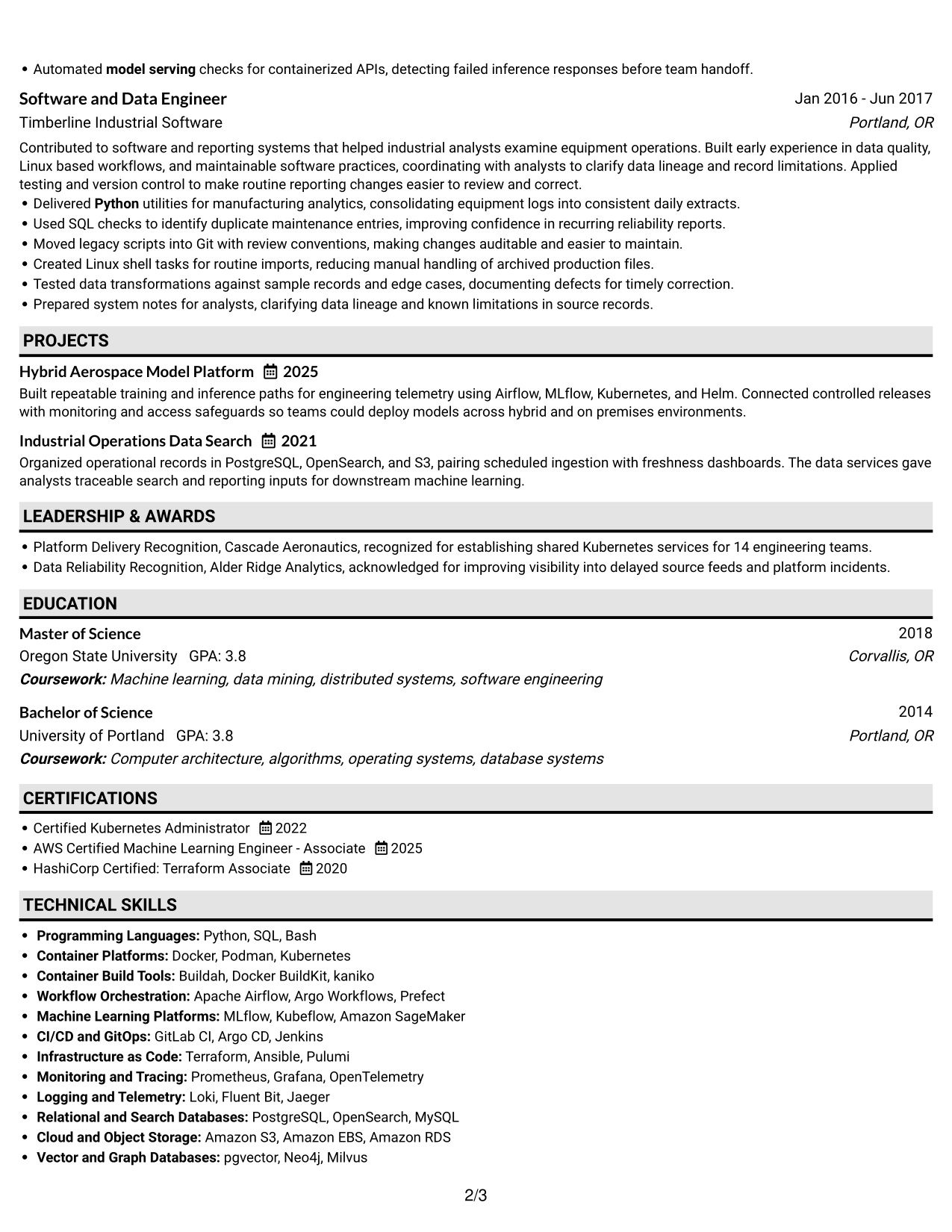
#2 Plain One Column with Shaded Labels Resume Example

With shaded labels marking section breaks, the Plain One Column with Shaded Labels format helps recruiters move through resume content without losing the main reading flow.
 
Resume Example Page 1   Resume Example Page 2

Why This Format Works

  • Shaded labels mark section changes, making experience and education easier to distinguish.
  • The vertical reading order lets recruiters trace career progression without switching between columns.
  • Clear section breaks keep skills and credentials separate from achievement bullets.

Best For

  • Visually marked section changes
  • Role-by-role resume review
  • Section-heavy resumes with short labels
  • Clear distinction between education and work history
  • Readers navigating continuous text
 

#3 One Column Format with Photo Right Resume Example

The One Column Format with Photo Right places a photo beside a single-column text flow, keeping the resume's experience and supporting sections in a clear sequence.
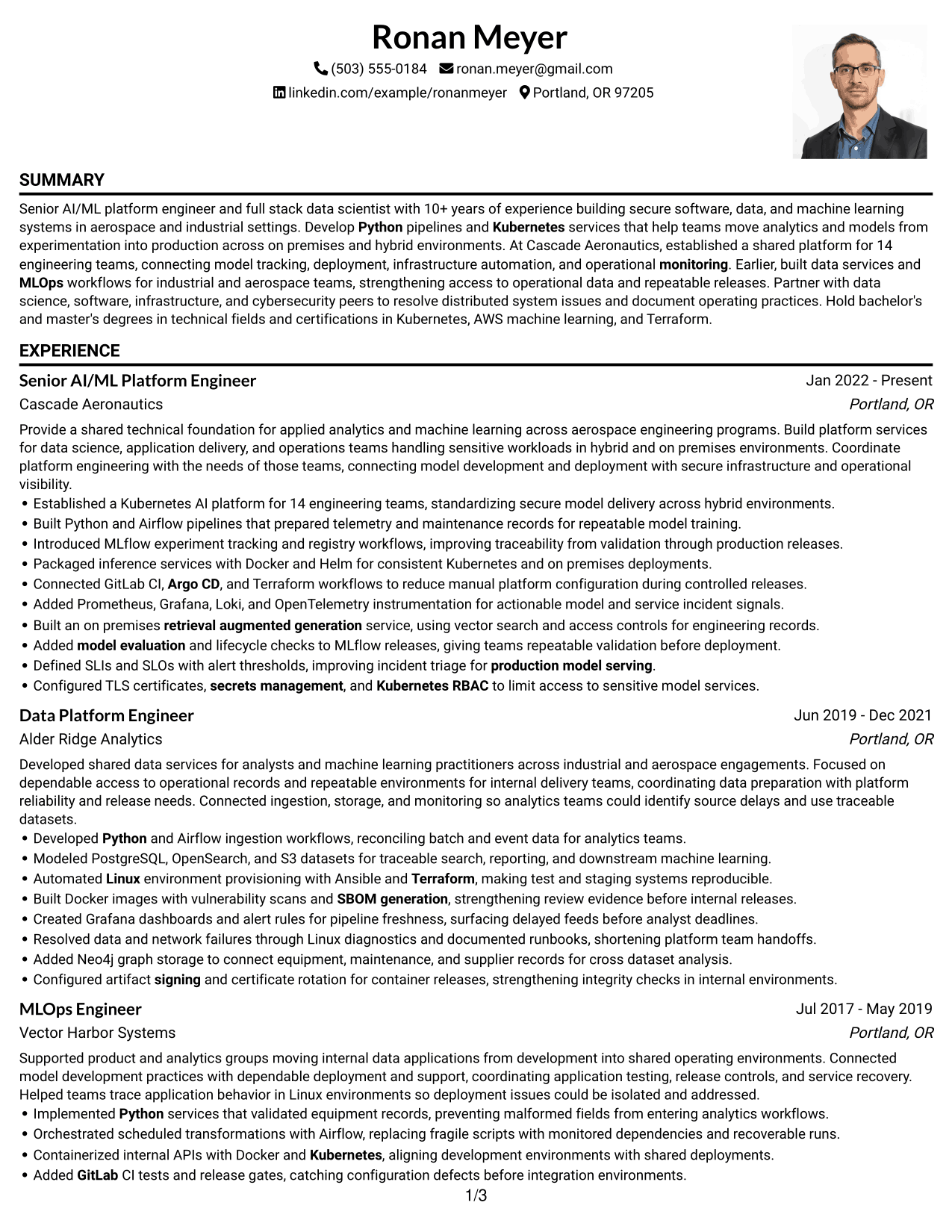
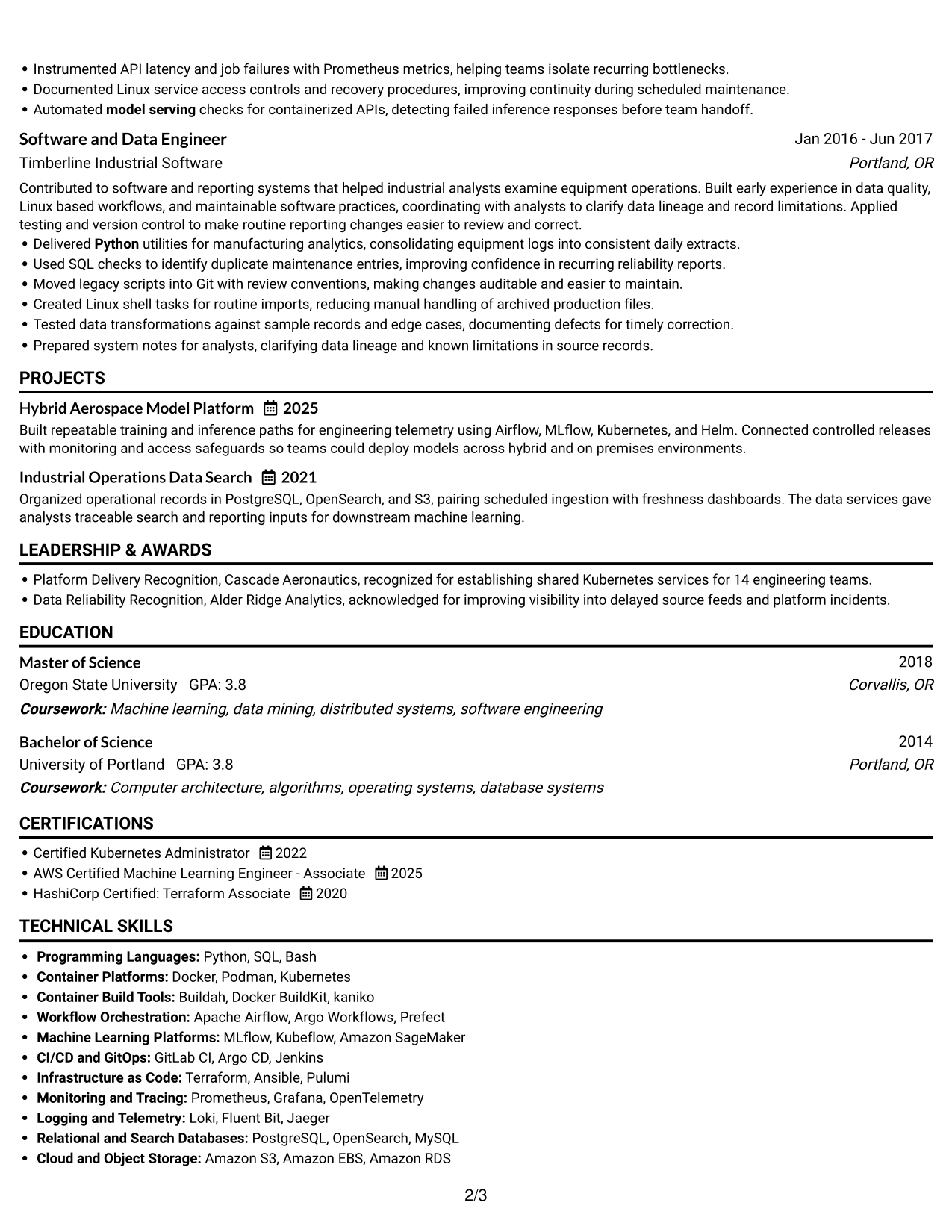
 
Resume Example Page 1   Resume Example Page 2

Why This Format Works

  • The right-side photo sits apart from the text path for experience review.
  • Role entries stay in sequence, helping readers follow career progression.
  • Separate headings guide quick moves between skills, education, and credentials.

Best For

  • Resume presentation with a photo
  • Single-path review of experience
  • Role history alongside supporting sections
  • Section-by-section skills and education scans
  • A visually identified resume header
 

#4 Clean Two Column Sidebar Format Resume Example

Clean Two Column Sidebar Format splits the resume body into two areas, giving recruiters a way to scan section groups while following the main work history.
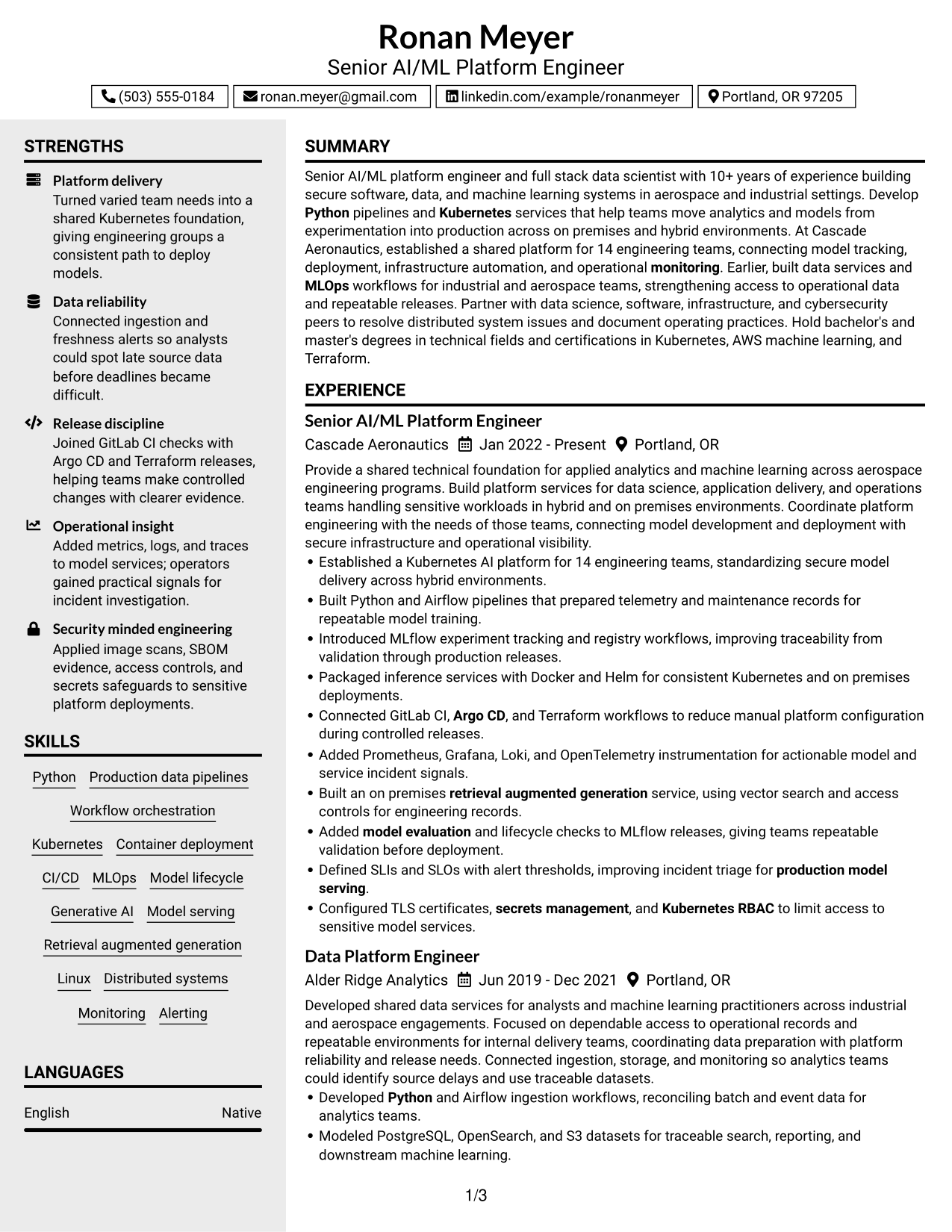
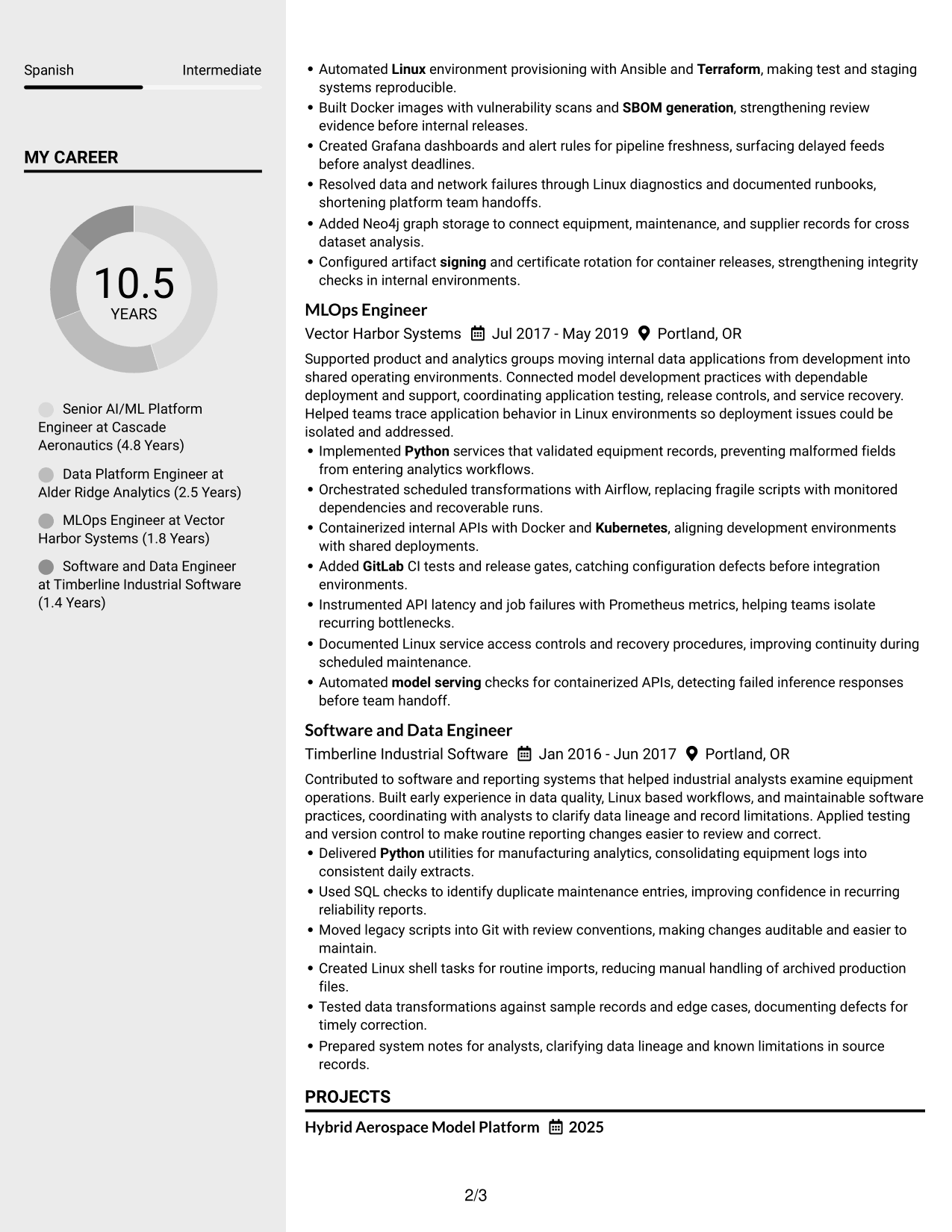
 
Resume Example Page 1   Resume Example Page 2

Why This Format Works

  • Two body areas let reviewers scan resume sections separately from the experience sequence.
  • The main reading flow keeps career progression clear across successive roles.
  • Distinct sections help skills and education stand apart from achievement bullets.

Best For

  • Separate scanning of primary and supporting content
  • Detailed career history with grouped sections
  • Review of skills alongside experience
  • Distinct education and credential sections
  • Readers switching between resume content areas


#5 Two Column Format Resume Example

The Two Column Format uses separate body columns to make a broad set of resume sections easier for recruiters to scan and compare.
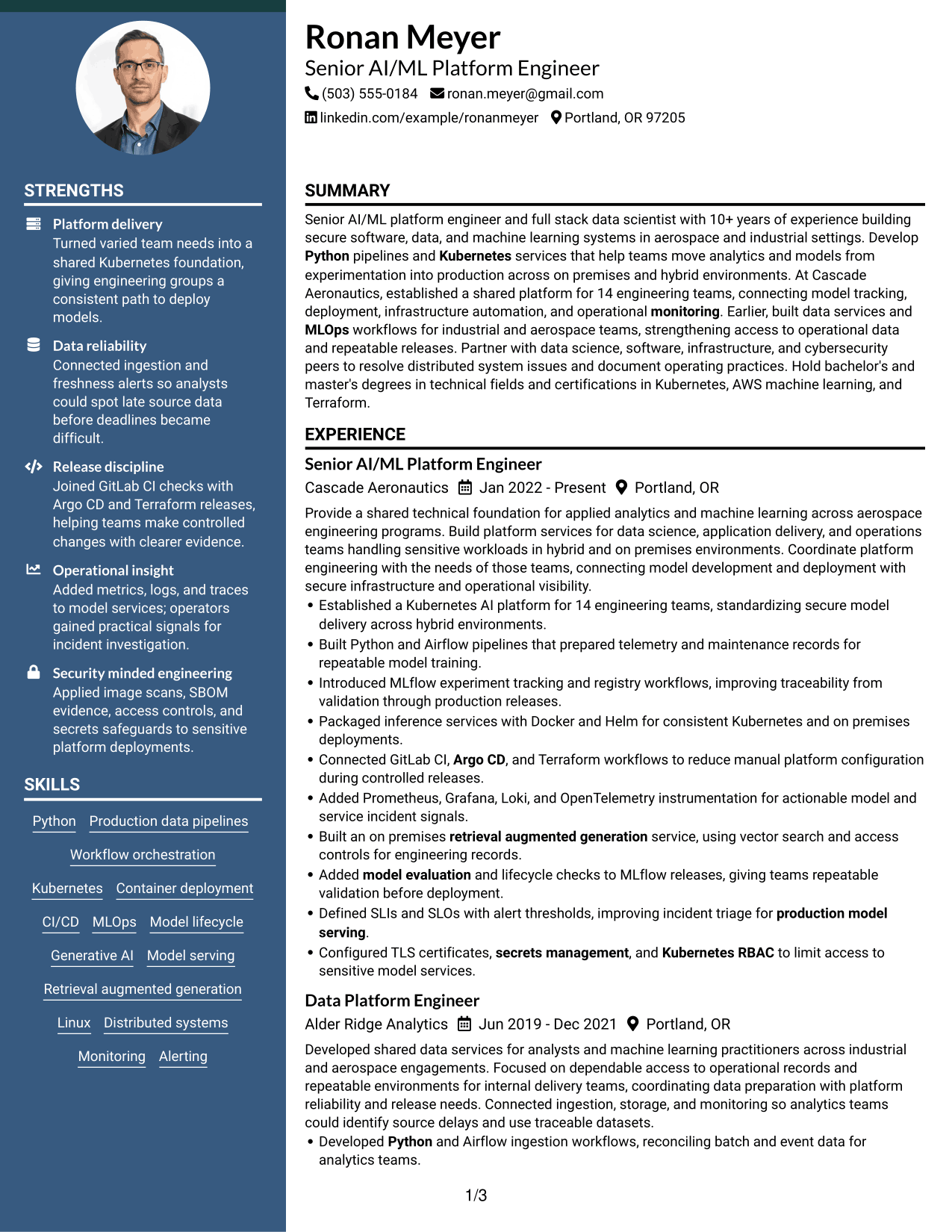
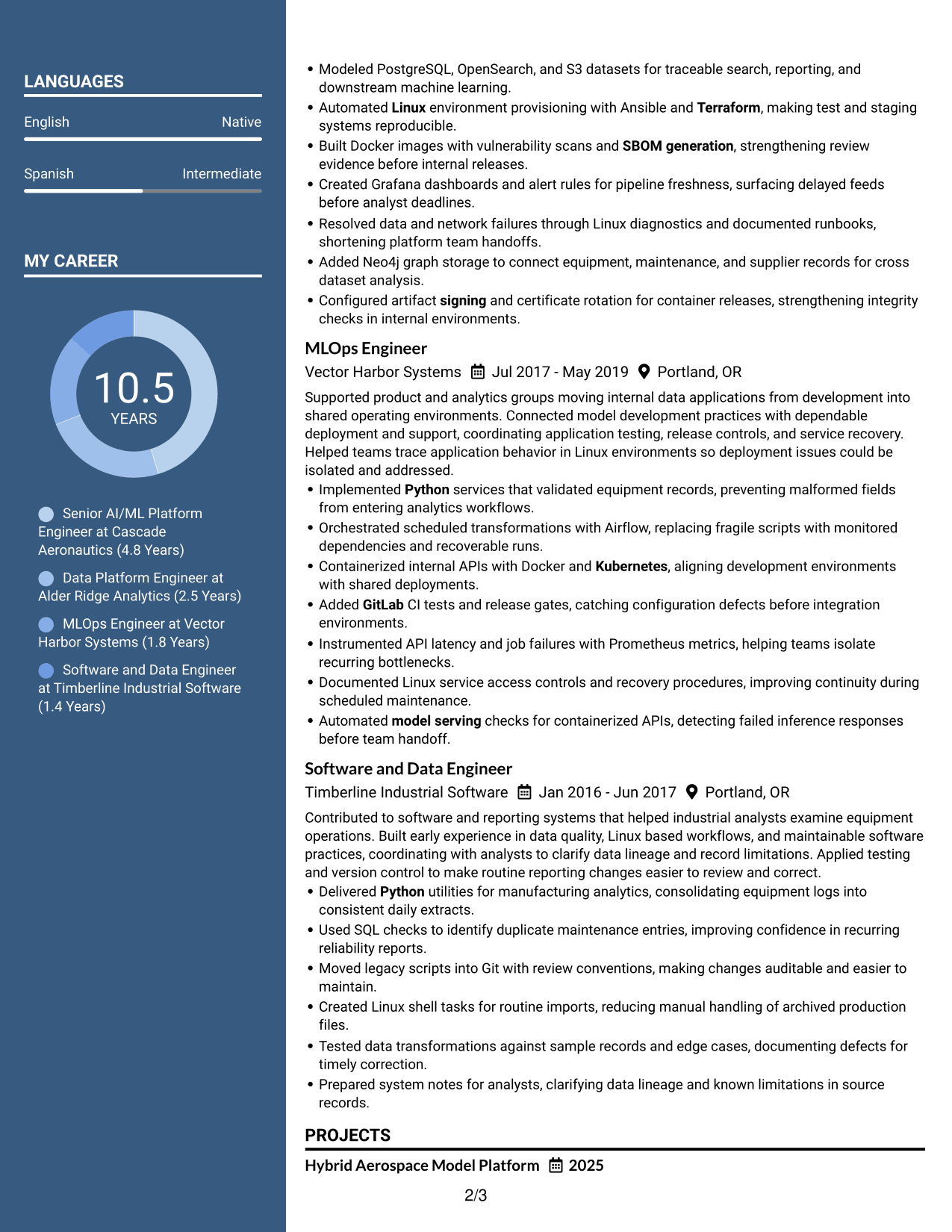
 
Resume Example Page 1   Resume Example Page 2

Why This Format Works

  • Separate body areas help reviewers find skills without losing the experience sequence.
  • Clear reading order keeps career history distinct from supporting credentials.
  • Grouped content makes education and project details easier to locate.

Best For

  • Resumes with several content categories
  • Separate scanning areas for section groups
  • Quick movement between skills and experience
  • Projects presented alongside work history
  • Readers who compare related sections
 

#6 Photo Header Two Column Format Resume Example

Photo Header Two Column Format combines a photo header with a two-column resume body, separating the visual header from the sections recruiters review.
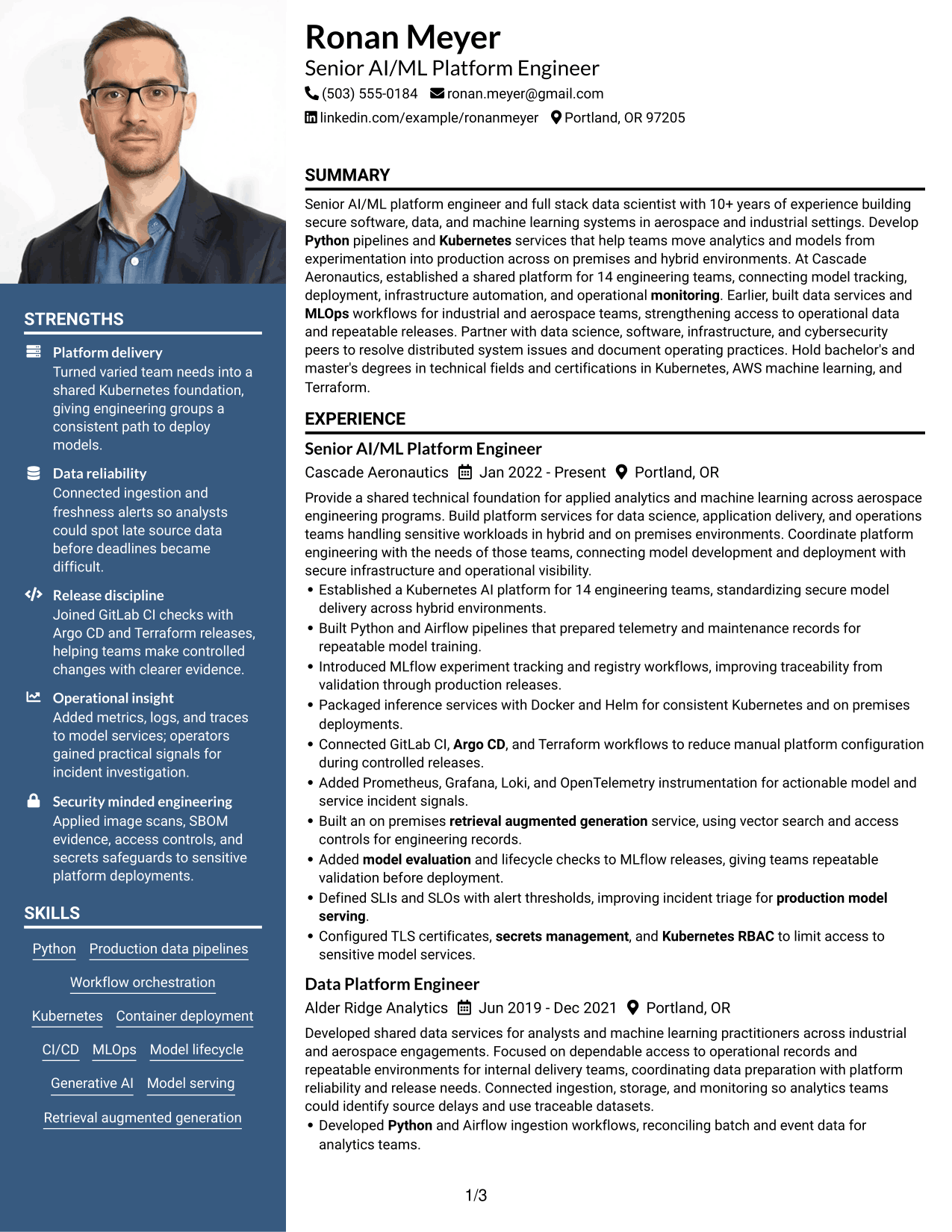
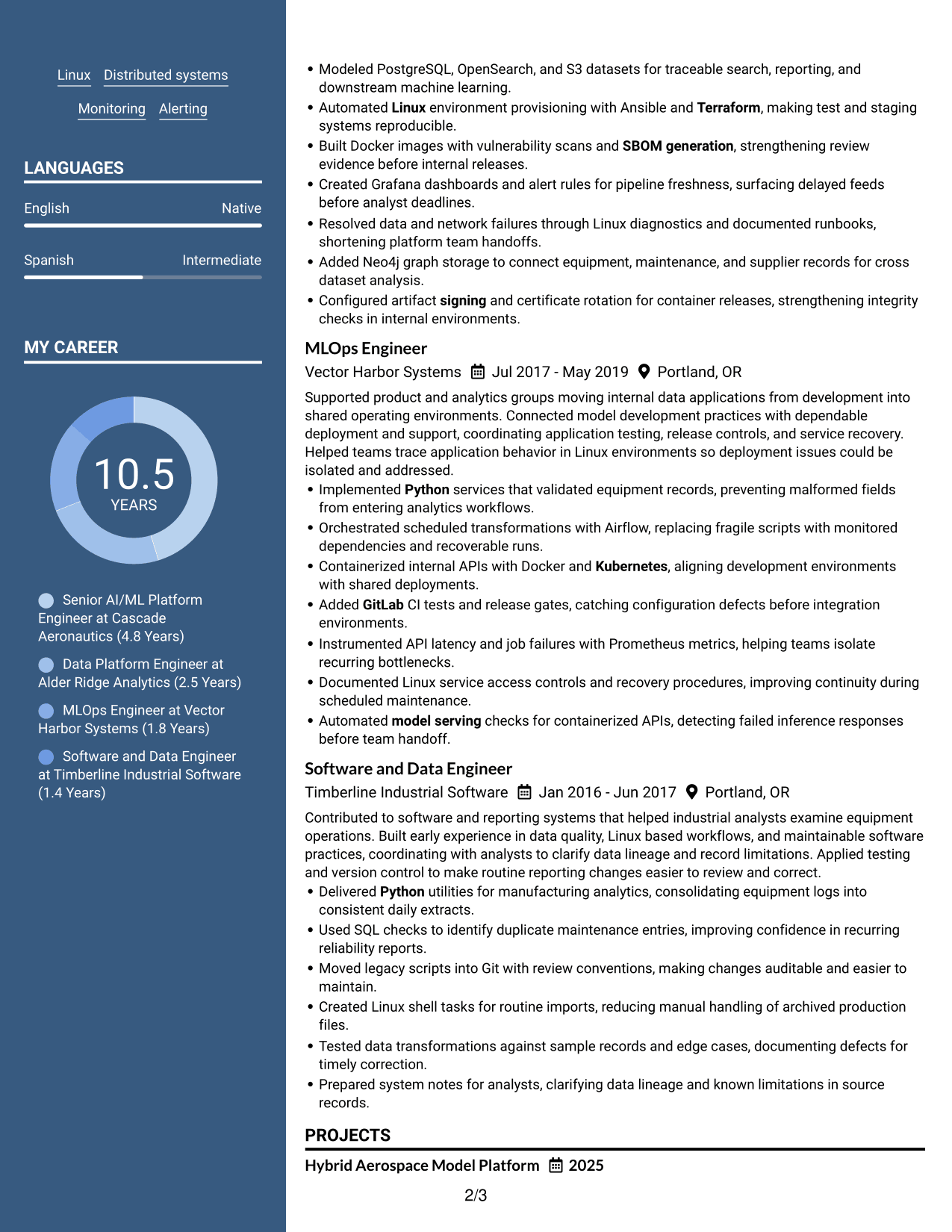
 
Resume Example Page 1   Resume Example Page 2

Why This Format Works

  • Separate body columns help reviewers move between career history and supporting sections.
  • The photo header remains distinct from the experience and education content below.
  • Column separation gives skills and project details clear visual areas.

Best For

  • Resumes with a photo header
  • Two-column content review
  • A clear break between header and resume body
  • Experience paired with supporting sections
  • Readers seeking a visual identifier
 

#7 Simple Two Column Format Resume Example

Simple Two Column Format keeps a two-column body easy to navigate, with a straightforward visual split between resume content areas.
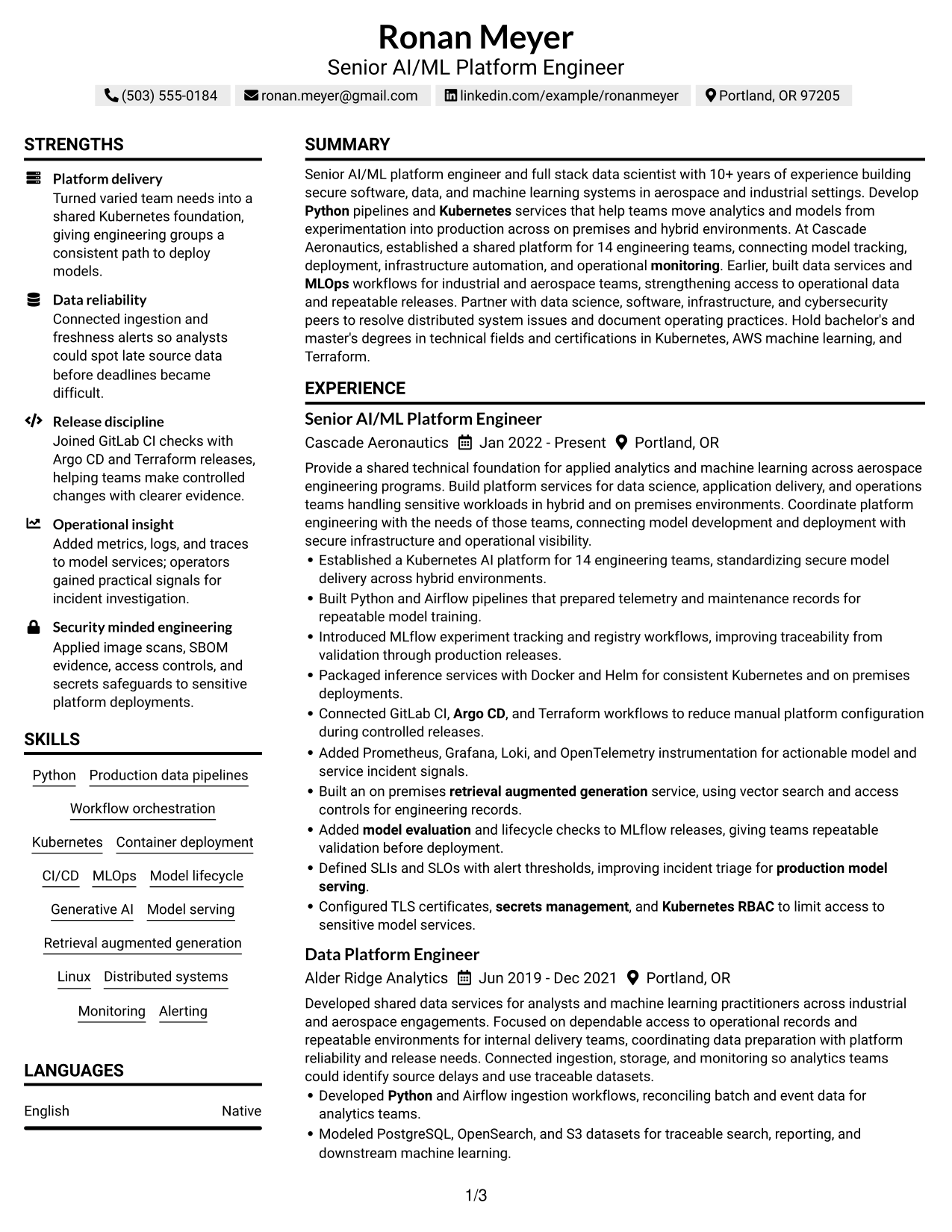
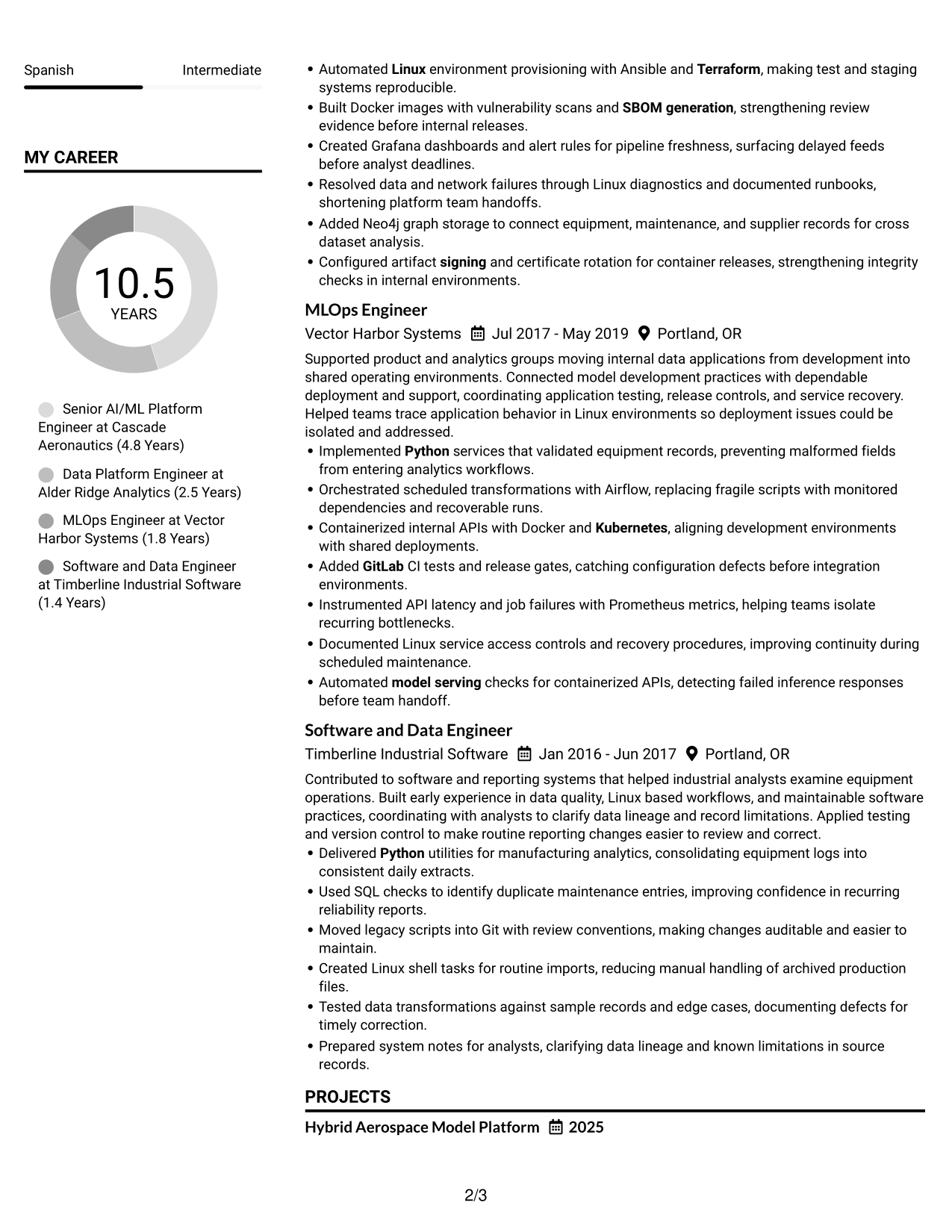
 
Resume Example Page 1   Resume Example Page 2

Why This Format Works

  • The split body helps reviewers scan section groups without interrupting role-by-role progression.
  • Separate content areas make education and credentials easier to locate.
  • A clear column division keeps skills distinct from achievement bullets.

Best For

  • Simple navigation across two columns
  • Resume with career history and education
  • Quick scanning of skills and experience
  • Content groups needing visual separation
  • Readers who prefer divided reading areas


Why Build Your Full Stack Data Scientist - AI/ML Platform Engineering Resume with ResumeInMinutes

ResumeInMinutes helps you arrange technical skills, platform experience, projects, education, and certifications in a resume that is easy to scan and update.

  • ATS-friendly section structure
  • Clear skills and tools organization
  • Focused experience bullets
  • Project and certification sections
  • Free PDF resume previews
  • Resume customization support

Use the editor to highlight relevant pipeline, Kubernetes, MLOps, and security work, then check that each section supports your target Full Stack Data Scientist - AI/ML Platform Engineering role.


See Also


Frequently Asked Questions

Are these Full Stack Data Scientist - AI/ML Platform Engineering resume templates ATS-friendly?

The formats use clear headings and sections that support ATS review. Match relevant terms, such as Python, production data pipelines, Kubernetes, MLflow, CI/CD, and monitoring, to the evidence in your resume.

Are these separate resume examples?

No. The guide shows one role-focused resume example in several visual layouts.

What should a Full Stack Data Scientist - AI/ML Platform Engineering resume include?

Include a focused summary, technical skills, experience, education, and relevant projects or certifications. Use concise bullets to show data pipeline work, model deployment, platform operations, security controls, and measurable results.

Can I download the resume templates as PDFs?

Yes. You can preview the resume format as a PDF and choose a layout that presents your experience clearly.

Which resume style works well for this role?

A clean one-column format is easy to scan and can help ATS tools read your sections in order. A simple two-column design can also work when skills remain easy to find and the page stays uncluttered.

How can I show platform engineering results on my resume?

Write bullets that name the work, tools, and outcome. For example, describe a Kubernetes platform, an Airflow pipeline, or monitoring changes, then include a verified result such as the teams supported or a change in release or incident handling.

Should I include a photo on my resume?

Include a photo only if it is expected in your country or field. For U.S. applications, a resume without a photo is generally the safer choice.

Can I customize these resume templates?

Yes. You can edit the resume text and layout, then save a PDF version tailored to the Full Stack Data Scientist - AI/ML Platform Engineering role.


ATS score 84%

How we calculate this score

  • Keywords: 60% of the total. AI extracts keywords from your job description. If you do not provide one, a standard job description for the title matching your resume is used. This is not a match to a specific vacancy.
  • Text-based resume: 20%. The text resume assessed here receives 100 for this part.
  • Resume quality: 20%. We start at 100 and subtract points for issues found by our resume checks, down to a minimum of zero.
  • Keyword coverage = 100 × (confirmed matches + 0.8 × possible matches) ÷ total keywords, rounded and capped at 100. Possible matches still need checking. Saved generation audits use their saved keyword percentage.
  • Final score = 60% of keyword coverage + 20% of the text score + 20% of the quality score, rounded to a whole number. Without keywords, no overall ATS score is available.

What this score means

Our scores are estimates, not employer ratings. They may contain errors and do not guarantee accurate parsing, a ranking, an interview, or a job. Check your document against the employer’s requirements. You are responsible for relying on this score.

Terms and Conditions

Score weights: Keywords 60% · Text based resume 20% · Resume quality 20%

Keywords: 29 matched + 10 possible of 50 (74%) · Resume quality: 100%

Resume quality 100% · Weight 20% · Issues (0)

Details
  • ✓Name present: Ronan Meyer
  • ✓Email format: ronan.meyer@gmail.com
  • ✓Phone format: (503) 555-0184
  • ✓Experience 1: Job title: Senior AI/ML Platform Engineer
  • ✓Experience 1: Company name: Cascade Aeronautics
  • ✓Experience 1: Work location: Portland, OR
  • ✓Experience 1: Employment dates: Jan 2022 - Present
  • ✓Experience 1: Description or achievements: Present
  • ✓Experience 2: Job title: Data Platform Engineer
  • ✓Experience 2: Company name: Alder Ridge Analytics
  • ✓Experience 2: Work location: Portland, OR
  • ✓Experience 2: Employment dates: Jun 2019 - Dec 2021
  • ✓Experience 2: Description or achievements: Present
  • ✓Experience 3: Job title: MLOps Engineer
  • ✓Experience 3: Company name: Vector Harbor Systems
  • ✓Experience 3: Work location: Portland, OR
  • ✓Experience 3: Employment dates: Jul 2017 - May 2019
  • ✓Experience 3: Description or achievements: Present
  • ✓Experience 4: Job title: Software and Data Engineer
  • ✓Experience 4: Company name: Timberline Industrial Software
  • ✓Experience 4: Work location: Portland, OR
  • ✓Experience 4: Employment dates: Jan 2016 - Jun 2017
  • ✓Experience 4: Description or achievements: Present
  • ✓No placeholder fields
  • ✓No repeated achievement bullets
  • ✓No empty bullets

No issues found by the current checks.

Text Based Resume 100% · Weight 20%

Parsed text
Ronan Meyer
(503) 555-0184
ronan.meyer@gmail.com
linkedin.com/example/ronanmeyer
Portland, OR 97205
SUMMARY
Senior AI/ML platform engineer and full stack data scientist with 10+ years of experience building secure software, data, and machine learning systems in aerospace and industrial settings. Develop Python pipelines and Kubernetes services that help teams move analytics and models from experimentation into production across on premises and hybrid environments. At Cascade Aeronautics, established a shared platform for 14 engineering teams, connecting model tracking, deployment, infrastructure automation, and operational monitoring. Earlier, built data services and MLOps workflows for industrial and aerospace teams, strengthening access to operational data and repeatable releases. Partner with data science, software, infrastructure, and cybersecurity peers to resolve distributed system issues and document operating practices. Hold bachelor's and master's degrees in technical fields and certifications in Kubernetes, AWS machine learning, and Terraform.
EXPERIENCE
Senior AI/ML Platform Engineer
Cascade Aeronautics
Jan 2022 - Present
Portland, OR
Provide a shared technical foundation for applied analytics and machine learning across aerospace engineering programs. Build platform services for data science, application delivery, and operations teams handling sensitive workloads in hybrid and on premises environments. Coordinate platform engineering with the needs of those teams, connecting model development and deployment with secure infrastructure and operational visibility.
Established a Kubernetes AI platform for 14 engineering teams, standardizing secure model delivery across hybrid environments.
Built Python and Airflow pipelines that prepared telemetry and maintenance records for repeatable model training.
Introduced MLflow experiment tracking and registry workflows, improving traceability from validation through production releases.
Packaged inference services with Docker and Helm for consistent Kubernetes and on premises deployments.
Connected GitLab CI, Argo CD, and Terraform workflows to reduce manual platform configuration during controlled releases.
Added Prometheus, Grafana, Loki, and OpenTelemetry instrumentation for actionable model and service incident signals.
Built an on premises retrieval augmented generation service, using vector search and access controls for engineering records.
Added model evaluation and lifecycle checks to MLflow releases, giving teams repeatable validation before deployment.
Defined SLIs and SLOs with alert thresholds, improving incident triage for production model serving.
Configured TLS certificates, secrets management, and Kubernetes RBAC to limit access to sensitive model services.
Data Platform Engineer
Alder Ridge Analytics
Jun 2019 - Dec 2021
Portland, OR
Developed shared data services for analysts and machine learning practitioners across industrial and aerospace engagements. Focused on dependable access to operational records and repeatable environments for internal delivery teams, coordinating data preparation with platform reliability and release needs. Connected ingestion, storage, and monitoring so analytics teams could identify source delays and use traceable datasets.
Developed Python and Airflow ingestion workflows, reconciling batch and event data for analytics teams.
Modeled PostgreSQL, OpenSearch, and S3 datasets for traceable search, reporting, and downstream machine learning.
Automated Linux environment provisioning with Ansible and Terraform, making test and staging systems reproducible.
Built Docker images with vulnerability scans and SBOM generation, strengthening review evidence before internal releases.
Created Grafana dashboards and alert rules for pipeline freshness, surfacing delayed feeds before analyst deadlines.
Resolved data and network failures through Linux diagnostics and documented runbooks, shortening platform team handoffs.
Added Neo4j graph storage to connect equipment, maintenance, and supplier records for cross dataset analysis.
Configured artifact signing and certificate rotation for container releases, strengthening integrity checks in internal environments.
MLOps Engineer
Vector Harbor Systems
Jul 2017 - May 2019
Portland, OR
Supported product and analytics groups moving internal data applications from development into shared operating environments. Connected model development practices with dependable deployment and support, coordinating application testing, release controls, and service recovery. Helped teams trace application behavior in Linux environments so deployment issues could be isolated and addressed.
Implemented Python services that validated equipment records, preventing malformed fields from entering analytics workflows.
Orchestrated scheduled transformations with Airflow, replacing fragile scripts with monitored dependencies and recoverable runs.
Containerized internal APIs with Docker and Kubernetes, aligning development environments with shared deployments.
Added GitLab CI tests and release gates, catching configuration defects before integration environments.
Instrumented API latency and job failures with Prometheus metrics, helping teams isolate recurring bottlenecks.
Documented Linux service access controls and recovery procedures, improving continuity during scheduled maintenance.
Automated model serving checks for containerized APIs, detecting failed inference responses before team handoff.
Software and Data Engineer
Timberline Industrial Software
Jan 2016 - Jun 2017
Portland, OR
Contributed to software and reporting systems that helped industrial analysts examine equipment operations. Built early experience in data quality, Linux based workflows, and maintainable software practices, coordinating with analysts to clarify data lineage and record limitations. Applied testing and version control to make routine reporting changes easier to review and correct.
Delivered Python utilities for manufacturing analytics, consolidating equipment logs into consistent daily extracts.
Used SQL checks to identify duplicate maintenance entries, improving confidence in recurring reliability reports.
Moved legacy scripts into Git with review conventions, making changes auditable and easier to maintain.
Created Linux shell tasks for routine imports, reducing manual handling of archived production files.
Tested data transformations against sample records and edge cases, documenting defects for timely correction.
Prepared system notes for analysts, clarifying data lineage and known limitations in source records.
PROJECTS
Hybrid Aerospace Model Platform
2025
Built repeatable training and inference paths for engineering telemetry using Airflow, MLflow, Kubernetes, and Helm. Connected controlled releases with monitoring and access safeguards so teams could deploy models across hybrid and on premises environments.
Industrial Operations Data Search
2021
Organized operational records in PostgreSQL, OpenSearch, and S3, pairing scheduled ingestion with freshness dashboards. The data services gave analysts traceable search and reporting inputs for downstream machine learning.
LEADERSHIP & AWARDS
Platform Delivery Recognition, Cascade Aeronautics, recognized for establishing shared Kubernetes services for 14 engineering teams.
Data Reliability Recognition, Alder Ridge Analytics, acknowledged for improving visibility into delayed source feeds and platform incidents.
EDUCATION
Master of Science
Oregon State University
GPA: 3.8
2018
Corvallis, OR
Coursework: Machine learning, data mining, distributed systems, software engineering
Bachelor of Science
University of Portland
GPA: 3.8
2014
Portland, OR
Coursework: Computer architecture, algorithms, operating systems, database systems
CERTIFICATIONS
Certified Kubernetes Administrator
2022
AWS Certified Machine Learning Engineer - Associate
2025
HashiCorp Certified: Terraform Associate
2020
TECHNICAL SKILLS
Programming Languages: Python, SQL, Bash
Container Platforms: Docker, Podman, Kubernetes
Container Build Tools: Buildah, Docker BuildKit, kaniko
Workflow Orchestration: Apache Airflow, Argo Workflows, Prefect
Machine Learning Platforms: MLflow, Kubeflow, Amazon SageMaker
CI/CD and GitOps: GitLab CI, Argo CD, Jenkins
Infrastructure as Code: Terraform, Ansible, Pulumi
Monitoring and Tracing: Prometheus, Grafana, OpenTelemetry
Logging and Telemetry: Loki, Fluent Bit, Jaeger
Relational and Search Databases: PostgreSQL, OpenSearch, MySQL
Cloud and Object Storage: Amazon S3, Amazon EBS, Amazon RDS
Vector and Graph Databases: pgvector, Neo4j, Milvus
Security and Image Scanning: Trivy, Cosign, HashiCorp Vault
SKILLS
Python
Production data pipelines
Workflow orchestration
Kubernetes
Container deployment
CI/CD
MLOps
Model lifecycle
Generative AI
Model serving
Retrieval augmented generation
Linux
Distributed systems
Monitoring
Alerting
PROFESSIONAL AFFILIATIONS
Member, Association for Computing Machinery (ACM), professional community for computing research and practice.
Member, IEEE Computer Society, professional association supporting computer engineering and software development communities.
LANGUAGES
English (Native)
Spanish (Intermediate)
ADDITIONAL INFORMATION
Work Status
: Authorized to work in United States. No sponsorship required.
REFERENCES
AVAILABLE ON REQUEST

Matched keywords (29)

  • Python
  • Production data pipelines
  • Workflow Orchestration
  • Kubernetes
  • CI/CD
  • MLOps
  • model serving
  • retrieval augmented generation
  • Linux
  • monitoring
  • Logging
  • Alerting
  • GitOps
  • Helm
  • GitLab
  • Argo CD
  • Infrastructure as Code
  • Graph Databases
  • Object Storage
  • model evaluation
  • Defined SLIs and SLOs with alert thresholds, improving incident triage for production model serving.Original keyword in JD: SLIs/SLOs
  • secrets management
  • Configured TLS certificates, secrets management, and Kubernetes RBAC to limit access to sensitive model services.Original keyword in JD: Certificate management
  • RBAC
  • SBOM generation
  • Configured artifact signing and certificate rotation for container releases, strengthening integrity checks in internal environments.Original keyword in JD: Image signing
  • TerraformOriginal keyword in JD: Terraform OR OpenTofu OR Pulumi
  • Ansible
  • OpenTelemetry

Missing keywords (11)

  • DevSecOps
  • NoSQL databases
  • Search technologies
  • Analytical storage
  • Incident response
  • Root cause analysis
  • Observability
  • Least privilege
  • Vulnerability scanning
  • High-assurance environments
  • U.S. Person eligibility

Possible matches (10)

  • Containerized application deployment80% credit: 1.60 percentage points of 2.00 possible.
  • Machine learning infrastructure80% credit: 1.60 percentage points of 2.00 possible.
  • Model lifecycle management80% credit: 1.60 percentage points of 2.00 possible.
  • Generative AI platform engineering80% credit: 1.60 percentage points of 2.00 possible.
  • Distributed systems troubleshooting80% credit: 1.60 percentage points of 2.00 possible.
  • Production data platforms80% credit: 1.60 percentage points of 2.00 possible.
  • Relational databases80% credit: 1.60 percentage points of 2.00 possible.
  • Vector databases80% credit: 1.60 percentage points of 2.00 possible.
  • AWS data and machine learning services80% credit: 1.60 percentage points of 2.00 possible.
  • Defense and aerospace80% credit: 1.60 percentage points of 2.00 possible.
Disclaimer: All names, images, contact information, employment histories, achievements, security clearances, military credentials, and other qualifications shown in this content are fictional and used for illustrative purposes only. Any resemblance to actual persons, living or deceased, is purely coincidental.

Resume and cover-letter examples and recommendations in this article reflect general best practices and professional experience and are provided for guidance only. Results may vary based on role, industry, region, and hiring organization.

Content Accuracy and Verification: To the fullest extent permitted by applicable law, we do not represent or warrant that resume or cover-letter guidance, examples, recommendations, or related information are accurate, complete, current, error-free, or suitable for any particular purpose. You are responsible for independently reviewing and verifying the information before relying on it.

ATS and Cover-Letter Scores: ATS scores are estimates calculated using our own formula, informed by publicly available guidance on resume formatting and keyword matching. They are not scores issued or endorsed by an ATS provider or employer. Cover-letter scores are also our own assessments. Parsing, weighting, screening criteria, and results vary between systems, employers, job descriptions, and document formats. No score guarantees successful parsing, a particular ranking, an interview, or employment. Use scores as general guidance and independently check your documents against the employer’s requirements. To the fullest extent permitted by applicable law, we accept no liability for errors in scores or parsing, or losses arising from reliance on these assessments. Nothing in this notice excludes liability or limits consumer rights that cannot lawfully be excluded or limited.

Terms and Conditions
 
> JP 1 1
PDF Footer and Margins Setup
The margins are applied to the document, and the footer shows up in the preview and the PDF

Footer Font Settings

Are you applying for a specific job
so we can tailor your resume to it?
Are you applying for a specific job
so we can tailor your cover letter to it?
Type your details as text to generate a personalized resume Type your details as text to generate a personalized cover letter
Website link found! Ready to create resume from:
Drag the into the box to verify you're human.
Drop here

My Resumes

Displaying {number_of_files} files (out of {total_of_all_files} total)
Name File Type Last Modified: Description:

Rename File

Filename already exists!

Delete Files

Warning: This action is irreversible. Once you click submit, the files will be permanently deleted.

Heading text
Upload From Computer Upload
Select From Existing
LinkedIn
Drag & Drop files anywhere in this tab, or

Uploaded Files

Delete Name Last Updated Use This File
Select this to use the file for generating your resume and cover letter. Only one source—uploaded file, selected file, or LinkedIn text—can be used.

My Files

Resumes or cover letters you create will appear here. No files available yet.
Delete Name Last Updated Use This File
Select this to use the file for generating your resume and cover letter. Only one source—uploaded file, selected file, or LinkedIn text—can be used.

Add LinkedIn Profile PDF

You can download your LinkedIn profile as a PDF by opening linkedin.com in a web browser, clicking your profile photo, selecting the “More” or “Resources” button, and choosing “Save to PDF.” You can then attach the PDF using the Upload From Computer tab.

Paste Your LinkedIn Profile Text

If you have copied the LinkedIn profile text, paste it below. See how to copy your profile from LinkedIn

Select this to use the LinkedIn profile text for generating your resume and cover letter. Only one source—uploaded file, selected file, or LinkedIn text—can be used.

Try these controls

<
>


