
US English


7 Hardware Reliability Engineer - Optical Inter-Satellite Link (OISL) Resume Templates with Example
By Ria · Last Updated On October 15, 2026
Resume example — page 1

This guide shows you how to build a clear, focused resume for a Hardware Reliability Engineer - Optical Inter-Satellite Link (OISL) role. It explains how to organize relevant evidence so recruiters can quickly assess reliability work across optical hardware development, qualification, and manufacturing.

Strong resumes connect reliability methods to the work they support. Use concise bullets to show how FMEA, fault tree analysis, root cause investigation, testing, and data analysis informed design or qualification decisions.

The same role-focused resume example appears in 7 layouts. Compare the image previews, then open an example in the editor to review or customize its structure.

What Makes a Great Hardware Reliability Engineer - Optical Inter-Satellite Link (OISL) Resume in 2026

A strong resume uses clear section headings, concise experience bullets, and a focused skills section. It links reliability work to hardware risks, verification plans, test results, and corrective actions.

Include relevant terms such as FMEA, fault tree analysis, Weibull analysis, HALT, HASS, ALT, reliability demonstration testing, Python, and MATLAB. Support these keywords with examples of analysis, qualification, or design improvements.

Note: Resume examples are for educational purposes only. Use only information that accurately reflects your experience and qualifications. References to real organizations do not imply affiliation or endorsement.

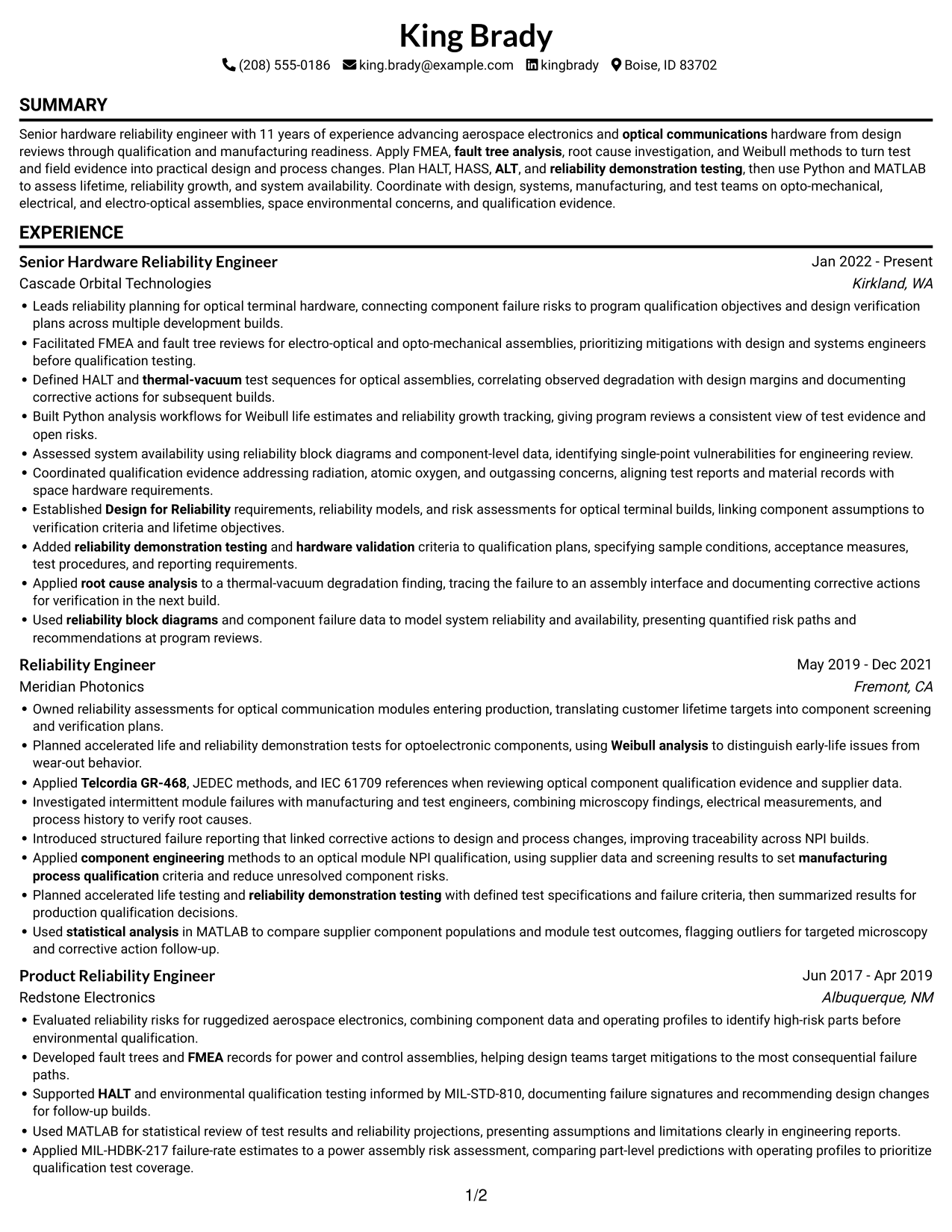
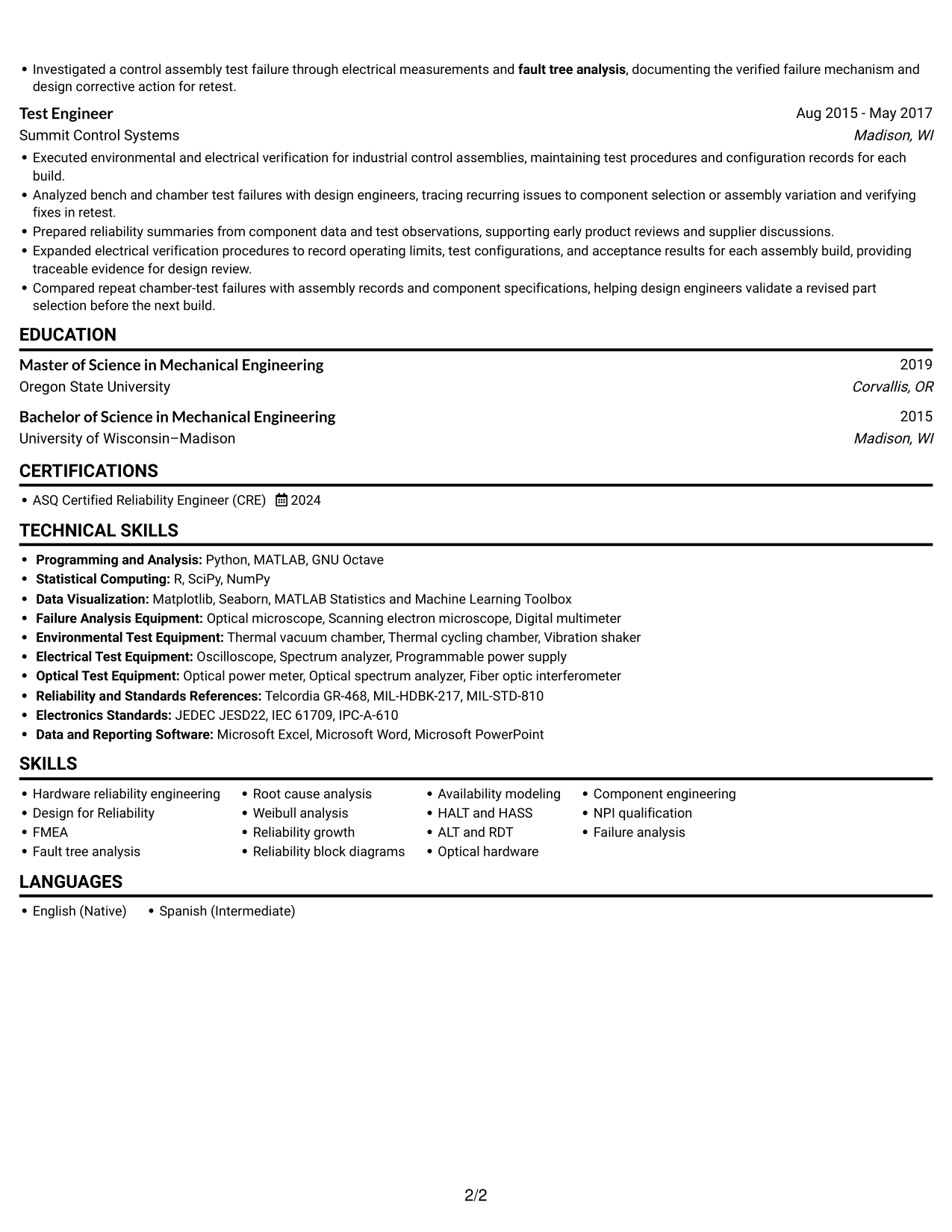
#1 Simple One Column Format Resume Example

The single-column body gives every resume section one direct reading path, which suits a straightforward review of experience and credentials.
 
Resume example — page 1   Resume example — page 2

Why This Format Works

  • A single text path gives ATS software a familiar way to read section content.
  • Career details appear in one sequence, helping reviewers follow progression across roles.
  • Experience bullets have the full body width for context and measurable results.

Best For

  • ATS-oriented submissions
  • Linear experience review
  • Detailed accomplishment bullets
  • Combined education and credentials
  • Photo-free applications

Resume Keywords

  • Hardware reliability engineering
  • Design for Reliability
  • reliability demonstration testing
  • ALT
  • HALT
  • HASS
  • Weibull analysis
  • statistical analysis
  • reliability block diagrams
  • FMEA
  • fault tree analysis
  • root cause analysis
  • hardware validation
  • Python
  • optical communications
See all keywords
 

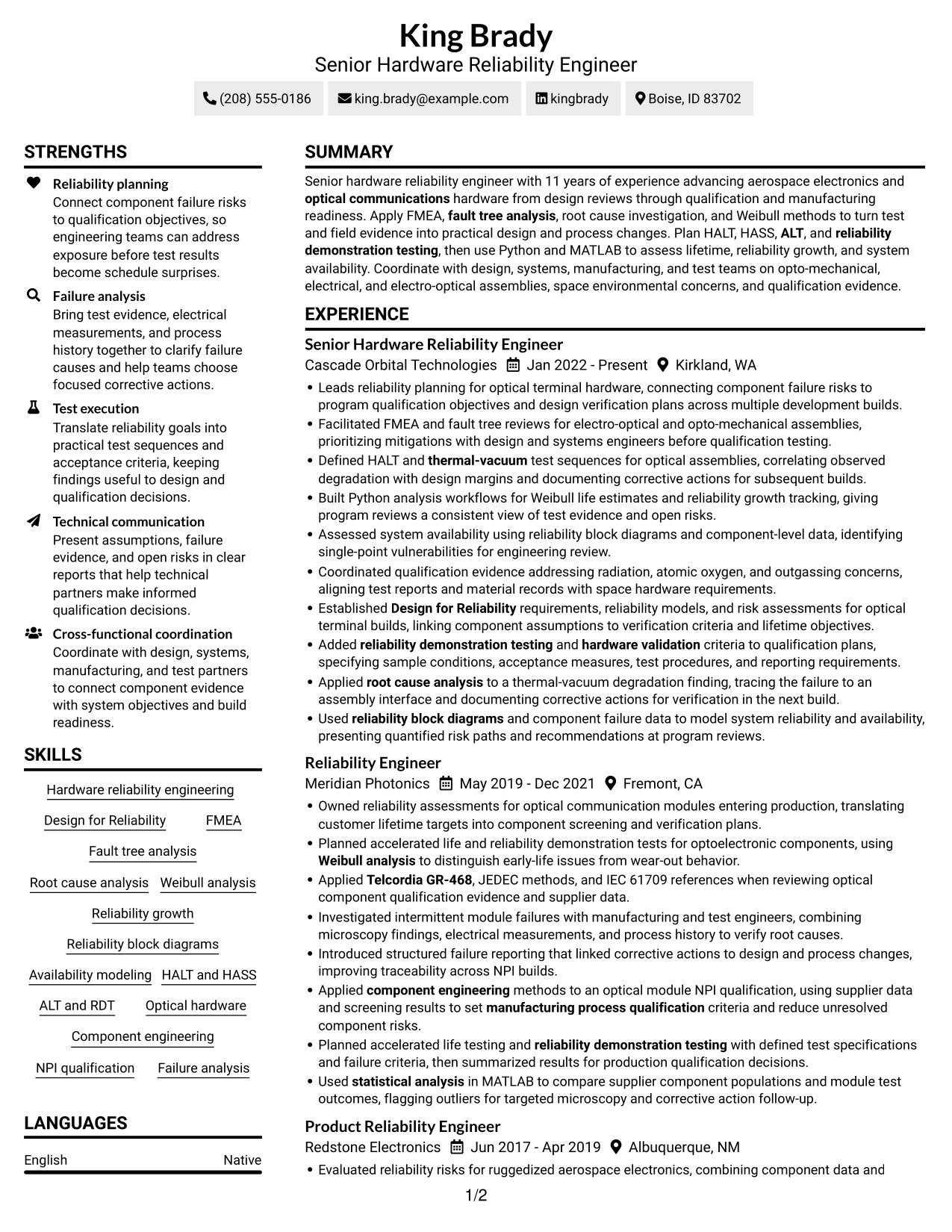
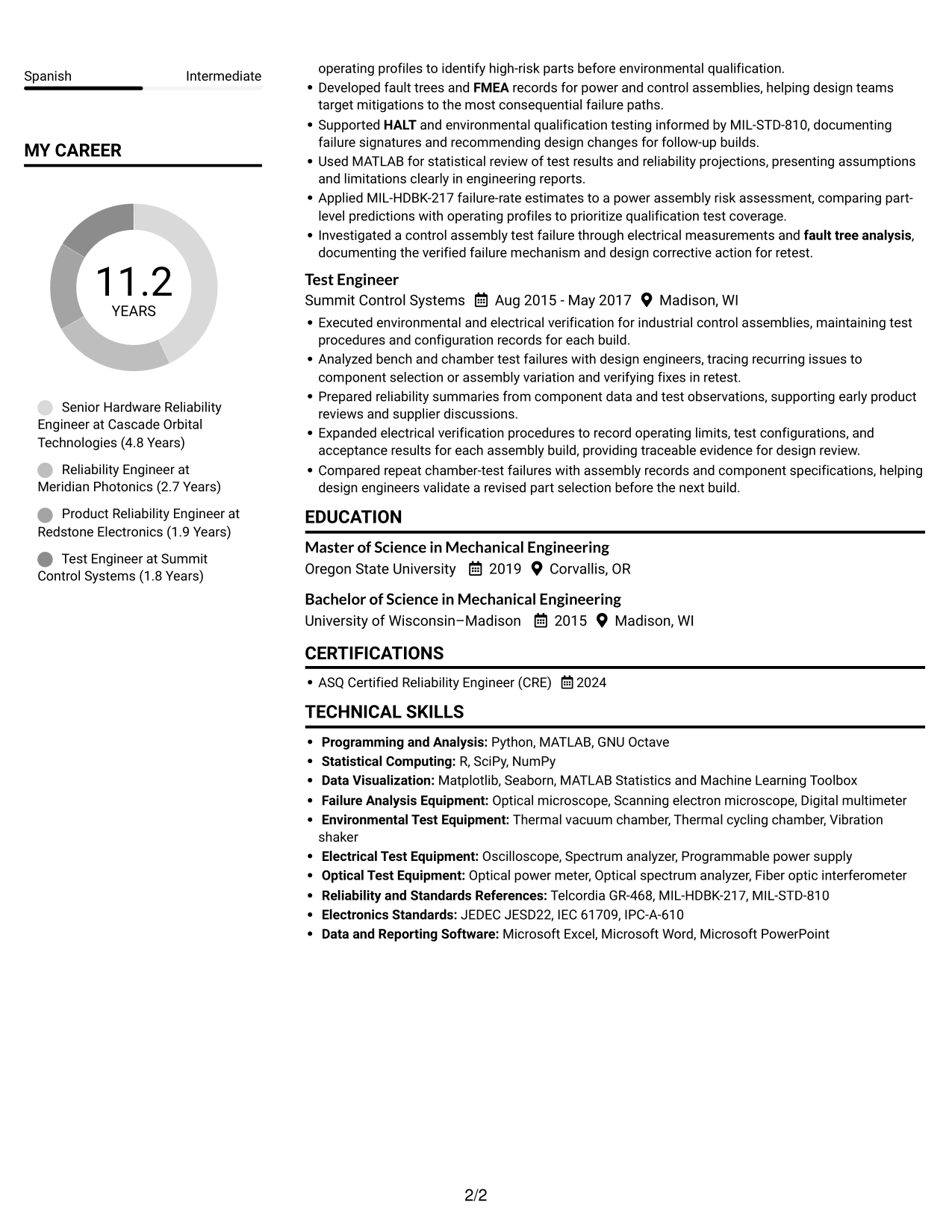
#2 Simple Two Column Format Resume Example

The two-column body gives resume content separate areas, helping reviewers move between experience and supporting details.
 
Resume example — page 1   Resume example — page 2

Why This Format Works

  • Two-column body areas give experience and supporting sections distinct places in the reading order.
  • Technical skills can remain easy to locate beside the resume's work history.
  • Parallel areas help reviewers compare qualifications while scanning detailed experience bullets.

Best For

  • Parallel section organization
  • Quick skills and experience review
  • Compact technical information
  • Resumes with varied sections
  • Photo-free presentation

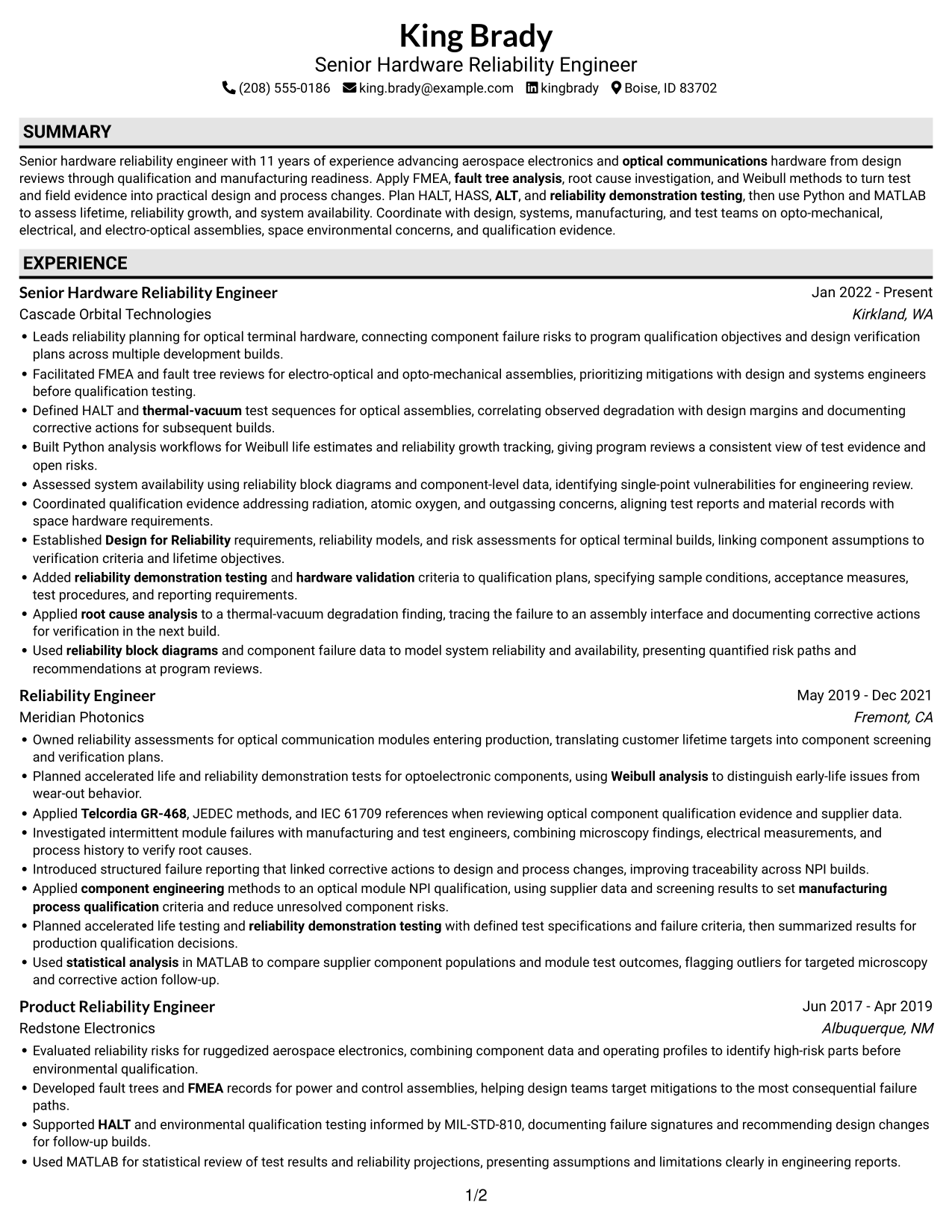
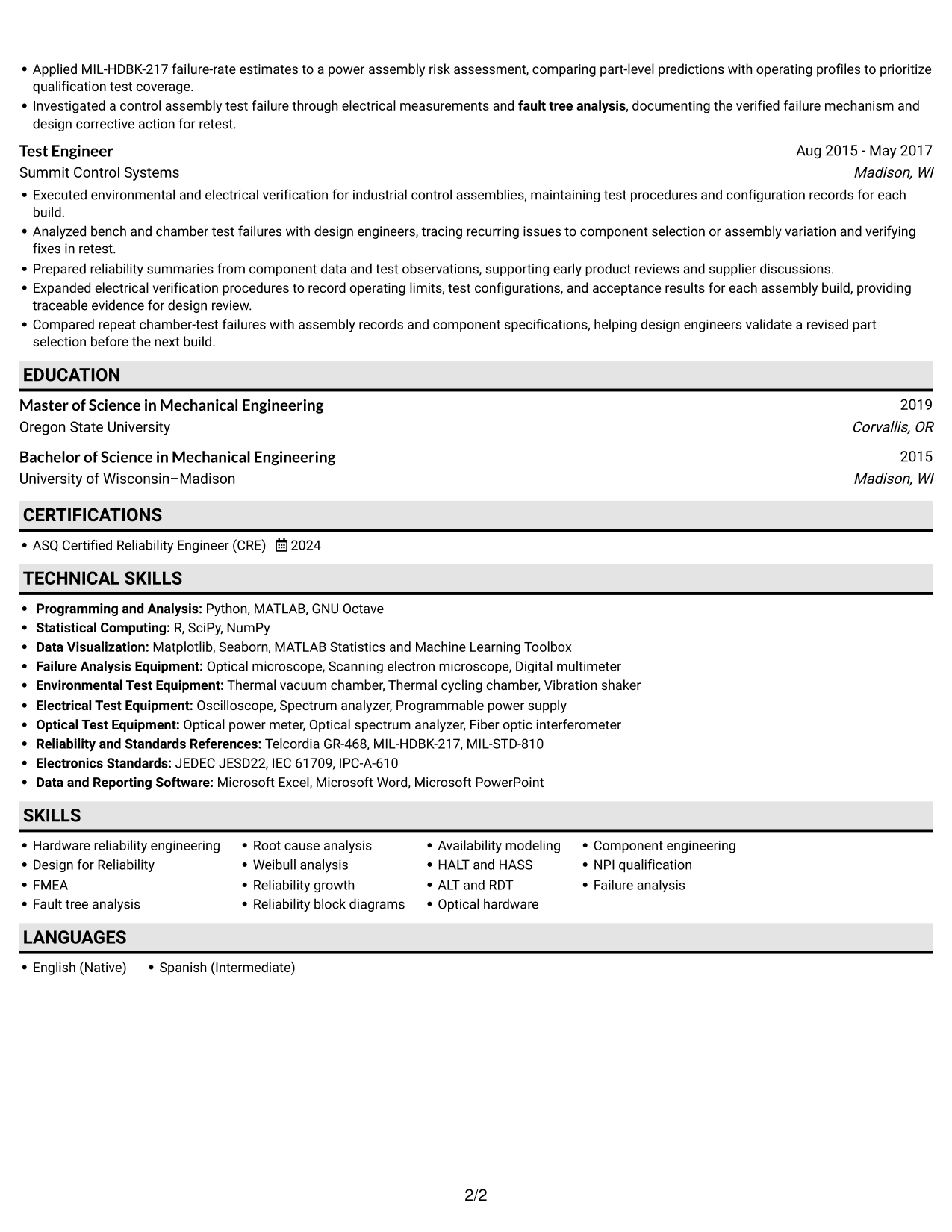
#3 Plain One Column with Shaded Labels Resume Example

A single-column body keeps sections in one reading order, making it practical for reviewers who prefer a direct resume scan.
 
Resume example — page 1   Resume example — page 2

Why This Format Works

  • A single-column sequence keeps education, credentials, and experience within one continuous scan.
  • Broad text lines allow accomplishments to retain context alongside their measurable results.
  • One reading path makes section order straightforward for a quick resume review.

Best For

  • Direct section-by-section review
  • Full-context accomplishment bullets
  • Education and credential details
  • Linear career history
  • Photo-free applications
 

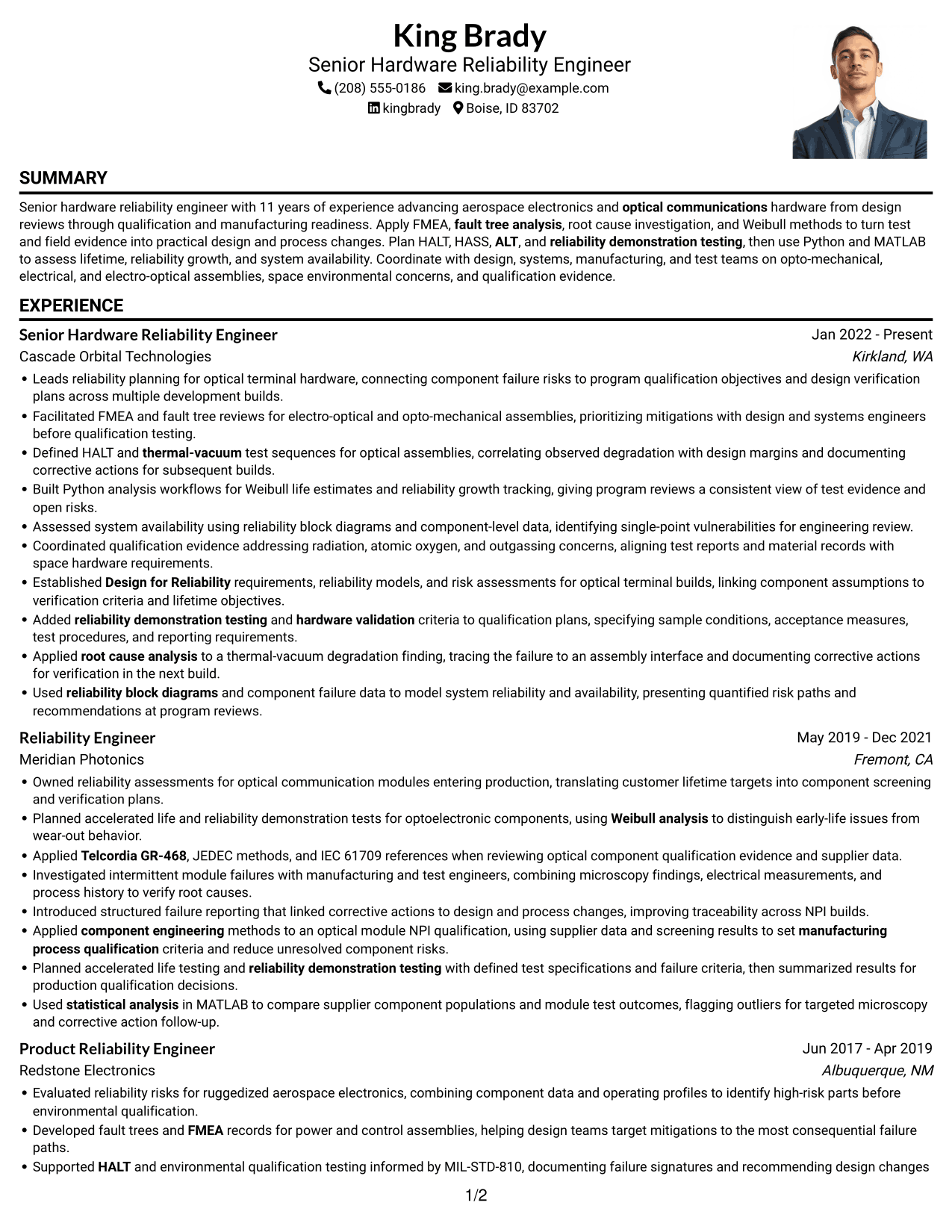
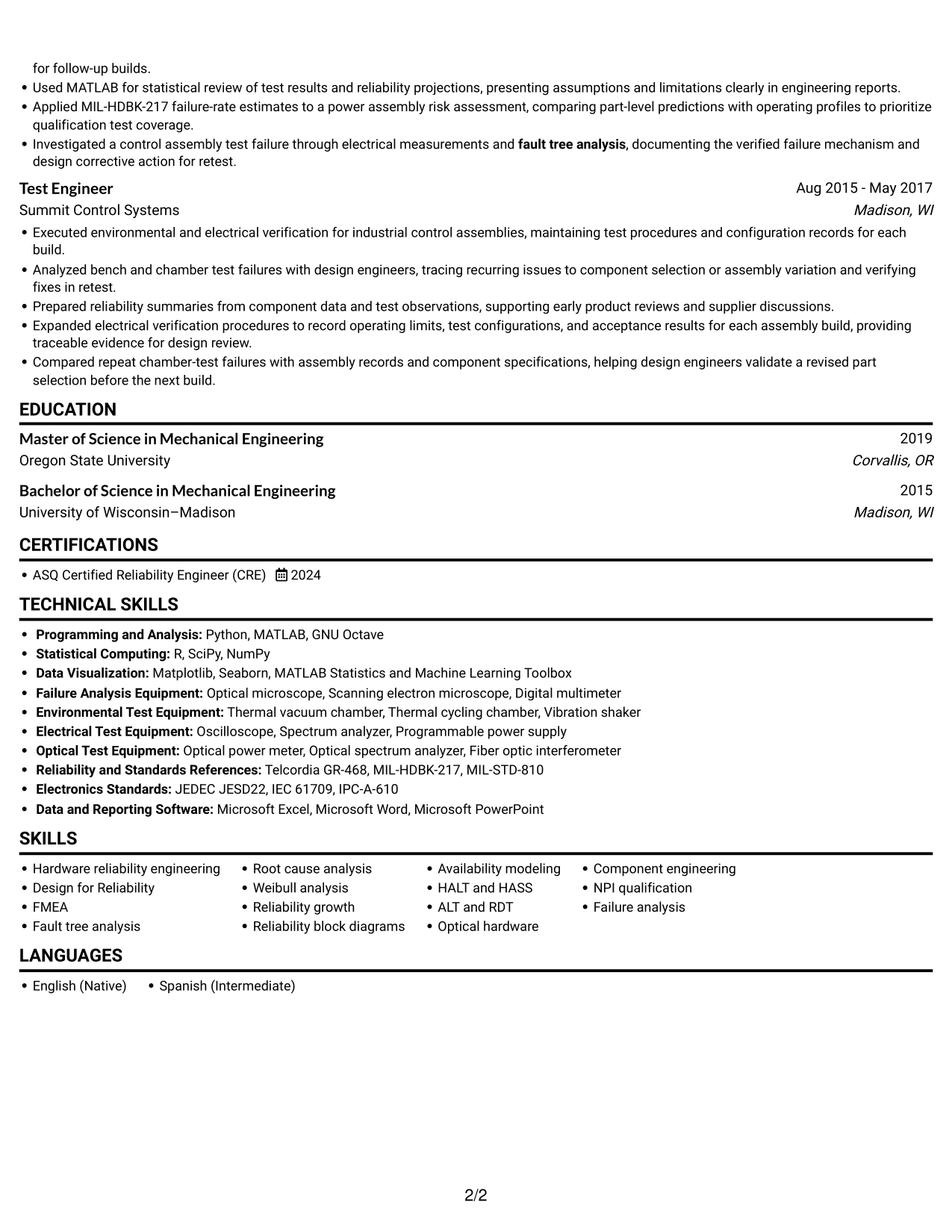
#4 One Column Format with Photo Right Resume Example

The single-column body includes a photo, a visual choice for resumes where a portrait is part of the requested presentation.
 
Resume example — page 1   Resume example — page 2

Why This Format Works

  • The portrait adds a visual identity cue while the body keeps a single reading column.
  • Role history stays in one sequence, making career progression easy to trace.
  • Full-width experience entries can present context and outcomes together.

Best For

  • Portrait-inclusive applications
  • Single-column section order
  • Career progression review
  • Detailed experience entries
  • Visual identity preference
 

#5 Clean Two Column Sidebar Format Resume Example

The two-column body divides resume content into separate areas, offering a clear way to scan experience and related details.
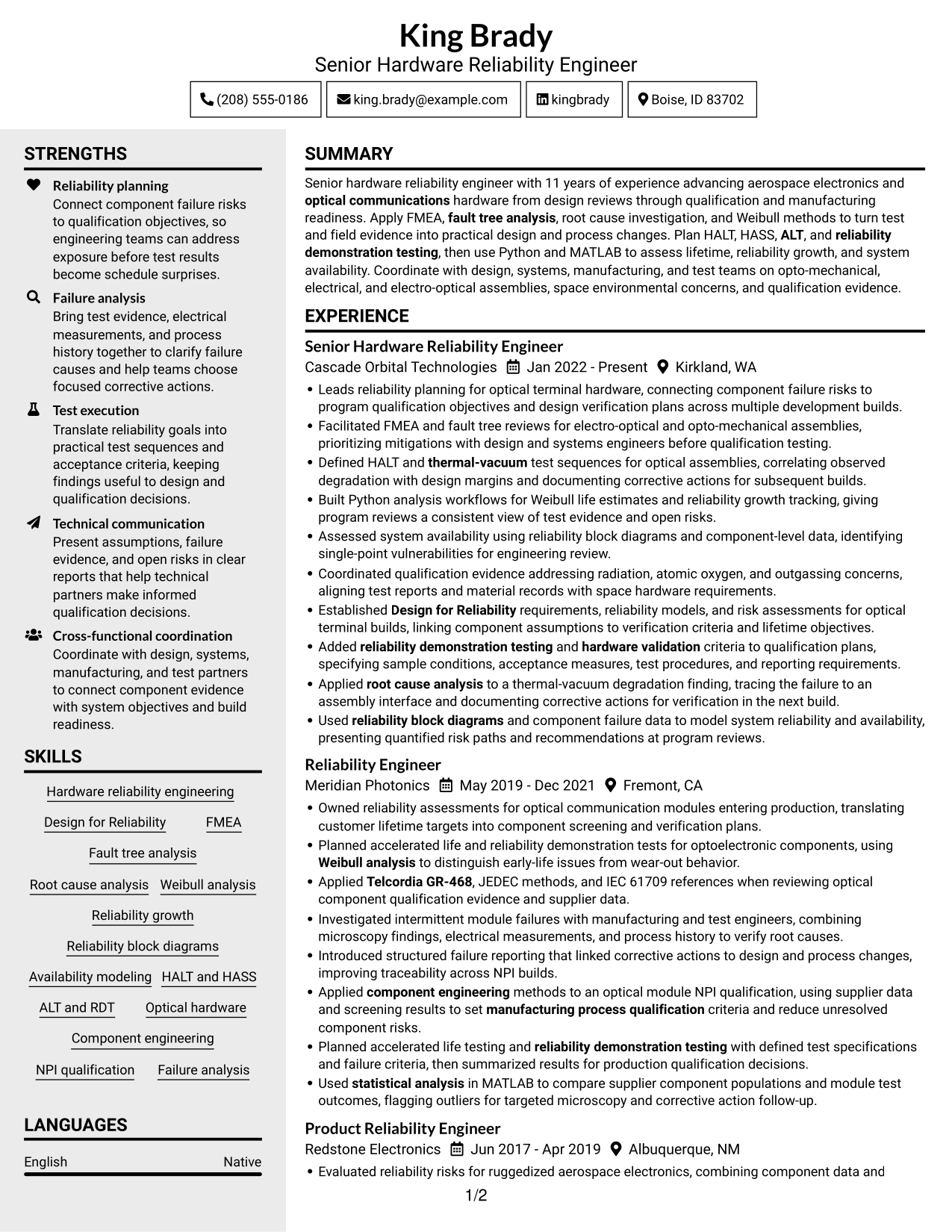
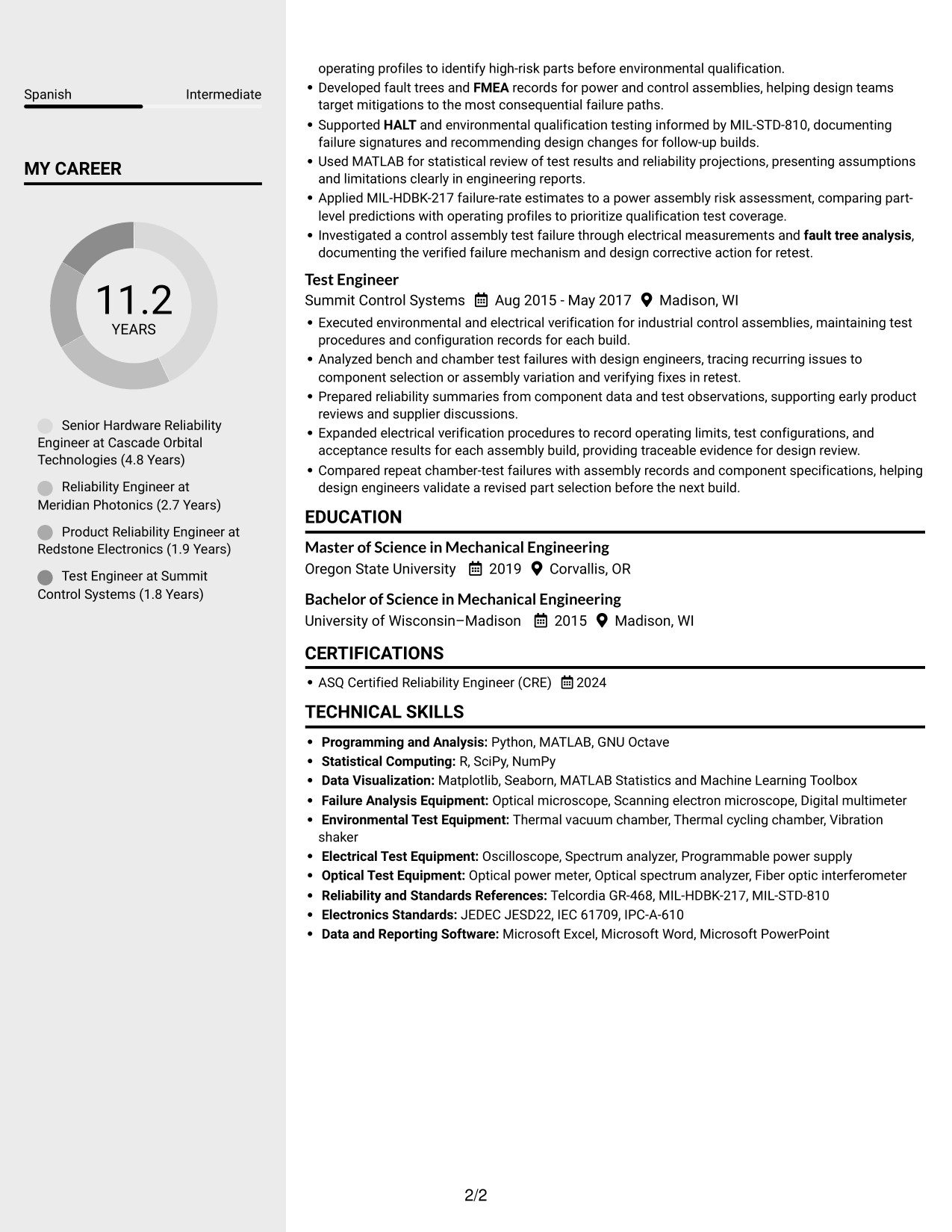
 
Resume example — page 1   Resume example — page 2

Why This Format Works

  • Two-column organization lets reviewers move between experience and supporting sections without a long vertical scan.
  • Distinct areas can keep technical skills visible alongside detailed career history.
  • Education and credentials remain easy to locate in the parallel reading structure.

Best For

  • Separate resume content areas
  • Skills beside career history
  • Compact supporting information
  • Education and credential sections
  • Photo-free document needs


#6 Two Column Format Resume Example

The two-column body creates parallel reading areas, a useful choice when reviewers need to scan several resume sections efficiently.
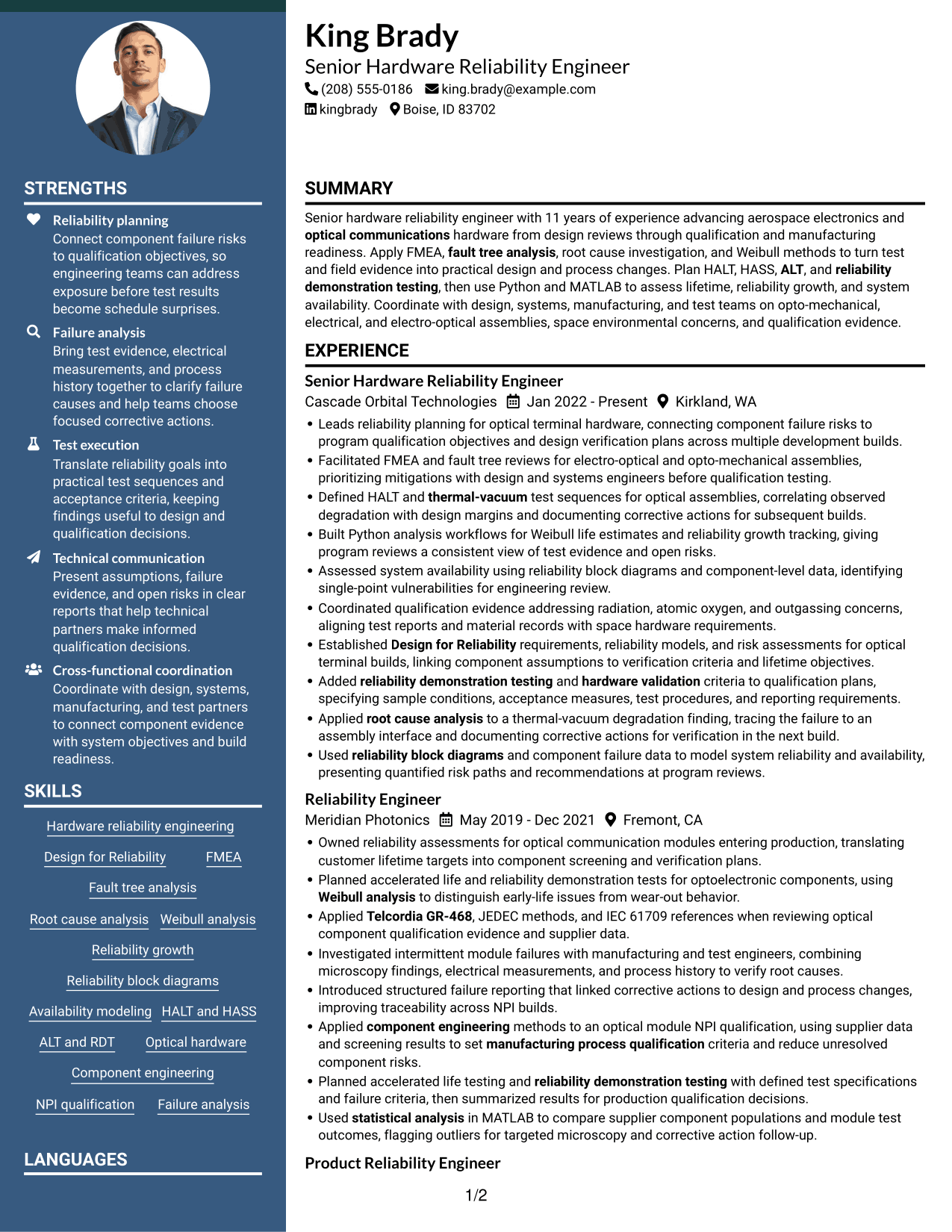
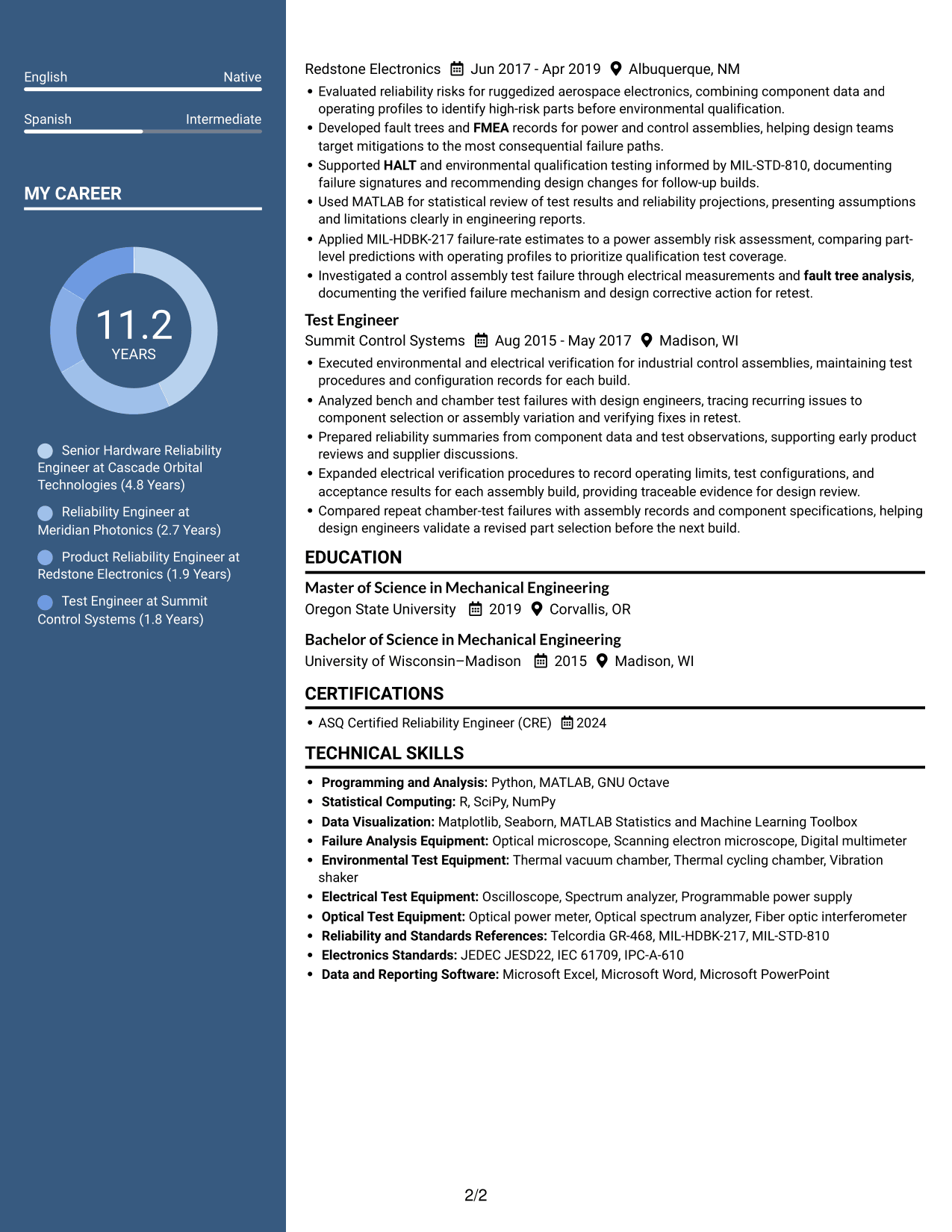
 
Resume example — page 1   Resume example — page 2

Why This Format Works

  • Paired columns offer a compact way to review experience beside other resume sections.
  • Separate reading areas help technical skills stand apart from accomplishment detail.
  • Reviewers can move through education and credentials without losing the work-history thread.

Best For

  • Parallel resume sections
  • Compact content organization
  • Skills and achievement review
  • Education alongside work history
  • Photo-free layouts
 

#7 Photo Header Two Column Format Resume Example

The two-column body pairs separate resume content areas with a photo, offering both a divided reading structure and a visual identity cue.
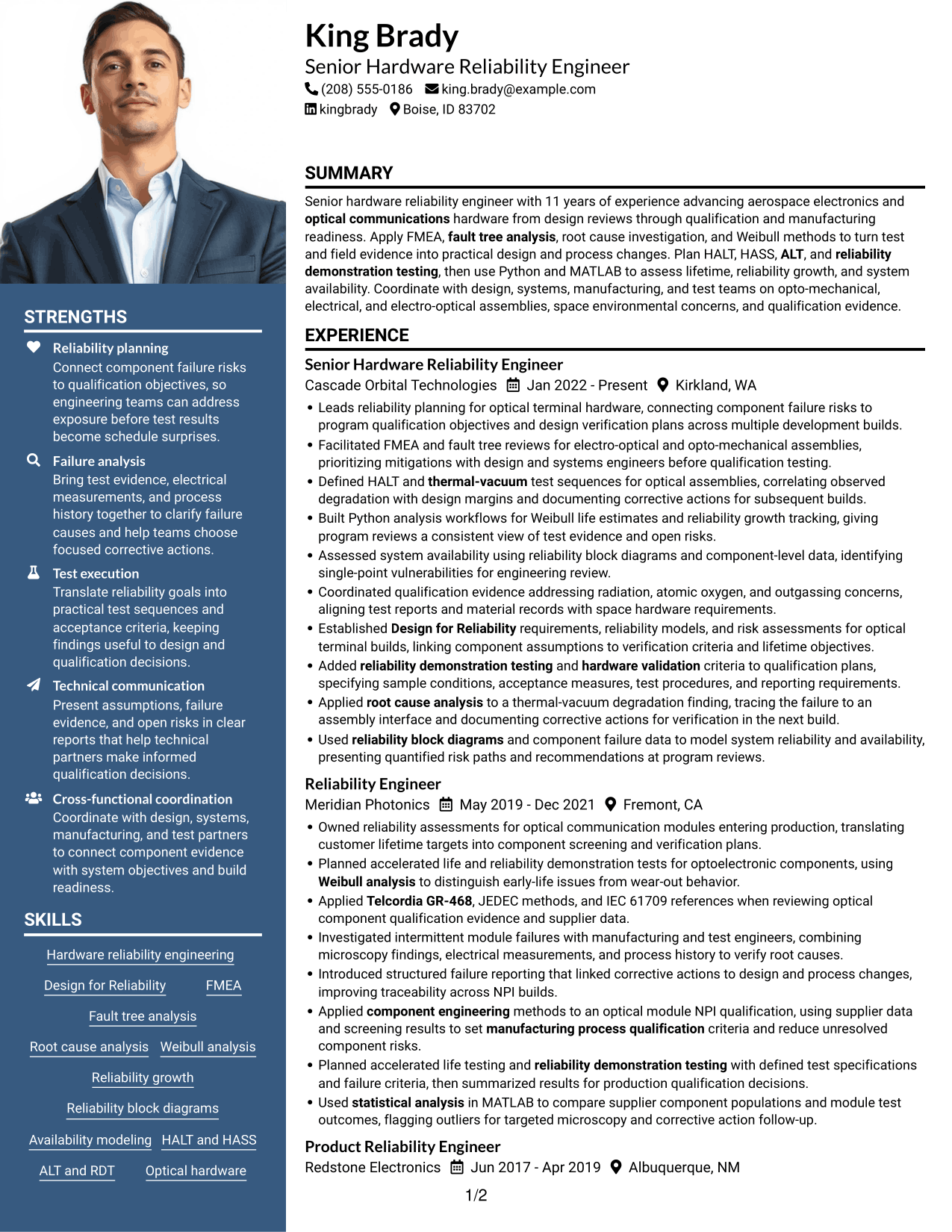
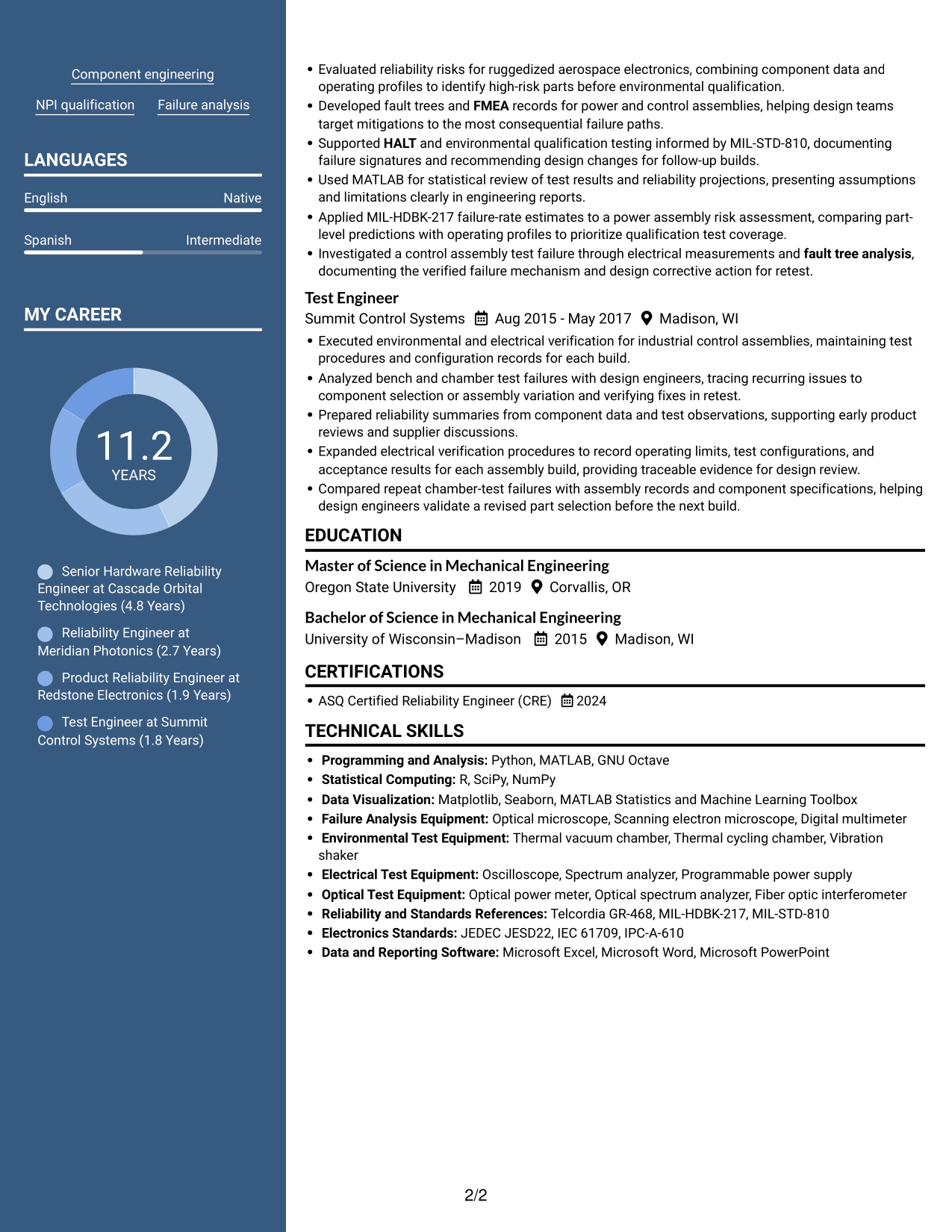
 
Resume example — page 1   Resume example — page 2

Why This Format Works

  • Two-column body organization separates resume content, while the photo adds a visible identity cue.
  • Parallel areas let reviewers locate skills and education apart from experience details.
  • Career history remains grouped for review while supporting sections have their own reading area.

Best For

  • Photo-inclusive resume presentation
  • Two-column section organization
  • Separate skills and experience
  • Career history with supporting details
  • Visual identity preference


Why Build Your Hardware Reliability Engineer - Optical Inter-Satellite Link (OISL) Resume with ResumeInMinutes

ResumeInMinutes lets you review image previews and open an example in the editor. Use the structure to organize reliability experience, technical skills, education, and certifications in a format that is easy to scan.

  • ATS-friendly section structure
  • Clear experience and skills sections
  • Space for reliability methods and tools
  • Focused keyword organization
  • Image previews for layout comparison
  • Resume customization in the editor

Use specific bullets to explain the problem, the method used, and the result. Where available, include measurable evidence such as test outcomes, reliability estimates, or resolved risks.


See Also


Frequently Asked Questions

Are these Hardware Reliability Engineer - Optical Inter-Satellite Link (OISL) resume layouts ATS-friendly?

Use clear headings, standard resume sections, and readable text to support applicant tracking system parsing. Add relevant terms such as FMEA, Weibull analysis, HALT, Python, and reliability demonstration testing where they accurately describe your work.

Does the guide show different resumes or different layouts?

It shows one role-focused resume example in different layouts. Compare the image previews to see how section order and page design affect readability.

What should an OISL hardware reliability engineer resume include?

Include a focused summary, relevant experience, technical skills, education, and certifications. Describe work with optical hardware, reliability analysis, qualification testing, failure investigation, and manufacturing readiness when supported by your experience.

How can I show reliability engineering results on my resume?

Write bullets that name the reliability method, the hardware or risk involved, and the action taken. Add verified measures or outcomes, such as a life estimate, a resolved failure cause, or a change to a qualification plan.

Which technical skills are useful to list for this role?

List skills that match your experience, such as FMEA, fault tree analysis, root cause analysis, Weibull analysis, reliability block diagrams, HALT, HASS, ALT, Python, MATLAB, and relevant aerospace or electronics standards.

Should I include a photo on my resume?

For U.S. applications, a no-photo resume is generally the safer choice. Use the space for relevant reliability skills, experience, education, and certifications.


ATS Score 92%

How we calculate this score

  • Keywords: 60% of the total. AI extracts keywords from your job description. If you do not provide one, a standard job description for the title matching your resume is used. This is not a match to a specific vacancy.
  • Text-based resume: 20%. The text resume assessed here receives 100 for this part.
  • Resume quality: 20%. We start at 100 and subtract points for issues found by our resume checks, down to a minimum of zero.
  • Keyword coverage = 100 × (confirmed matches + 0.8 × possible matches) ÷ total keywords, rounded and capped at 100. Possible matches still need checking. Saved generation audits use their saved keyword percentage.
  • Final score = 60% of keyword coverage + 20% of the text score + 20% of the quality score, rounded to a whole number. Without keywords, no overall ATS score is available.

What this score means

Our scores are estimates, not employer ratings. They may contain errors and do not guarantee accurate parsing, a ranking, an interview, or a job. Check your document against the employer’s requirements. You are responsible for relying on this score.

Terms and Conditions

Score weights: Keywords 60% · Text based resume 20% · Resume quality 20%

Keywords: 23 matched + 12 possible of 38 (86%) · Resume quality: 100%

Resume quality 100% · Weight 20% · Issues (0)

Details
  • ✓Name present: King Brady
  • ✓Email format: king.brady@example.com
  • ✓Phone format: (208) 555-0186
  • ✓Experience 1: Job title: Senior Hardware Reliability Engineer
  • ✓Experience 1: Company name: Cascade Orbital Technologies
  • ✓Experience 1: Work location: Kirkland, WA
  • ✓Experience 1: Employment dates: Jan 2022 - Present
  • ✓Experience 1: Description or achievements: Present
  • ✓Experience 2: Job title: Reliability Engineer
  • ✓Experience 2: Company name: Meridian Photonics
  • ✓Experience 2: Work location: Fremont, CA
  • ✓Experience 2: Employment dates: May 2019 - Dec 2021
  • ✓Experience 2: Description or achievements: Present
  • ✓Experience 3: Job title: Product Reliability Engineer
  • ✓Experience 3: Company name: Redstone Electronics
  • ✓Experience 3: Work location: Albuquerque, NM
  • ✓Experience 3: Employment dates: Jun 2017 - Apr 2019
  • ✓Experience 3: Description or achievements: Present
  • ✓Experience 4: Job title: Test Engineer
  • ✓Experience 4: Company name: Summit Control Systems
  • ✓Experience 4: Work location: Madison, WI
  • ✓Experience 4: Employment dates: Aug 2015 - May 2017
  • ✓Experience 4: Description or achievements: Present
  • ✓No placeholder fields
  • ✓No repeated achievement bullets
  • ✓No empty bullets

No issues found by the current checks.

Text Based Resume 100% · Weight 20%

Parsed text
King Brady
(208) 555-0186
king.brady@example.com
kingbrady
Boise, ID 83702
SUMMARY
Senior hardware reliability engineer with 11 years of experience advancing aerospace electronics and optical communications hardware from design reviews through qualification and manufacturing readiness. Apply FMEA, fault tree analysis, root cause investigation, and Weibull methods to turn test and field evidence into practical design and process changes. Plan HALT, HASS, ALT, and reliability demonstration testing, then use Python and MATLAB to assess lifetime, reliability growth, and system availability. Coordinate with design, systems, manufacturing, and test teams on opto-mechanical, electrical, and electro-optical assemblies, space environmental concerns, and qualification evidence.
EXPERIENCE
Senior Hardware Reliability Engineer
Jan 2022 - Present
Cascade Orbital Technologies
Kirkland, WA
Leads reliability planning for optical terminal hardware, connecting component failure risks to program qualification objectives and design verification plans across multiple development builds.
Facilitated FMEA and fault tree reviews for electro-optical and opto-mechanical assemblies, prioritizing mitigations with design and systems engineers before qualification testing.
Defined HALT and thermal-vacuum test sequences for optical assemblies, correlating observed degradation with design margins and documenting corrective actions for subsequent builds.
Built Python analysis workflows for Weibull life estimates and reliability growth tracking, giving program reviews a consistent view of test evidence and open risks.
Assessed system availability using reliability block diagrams and component-level data, identifying single-point vulnerabilities for engineering review.
Coordinated qualification evidence addressing radiation, atomic oxygen, and outgassing concerns, aligning test reports and material records with space hardware requirements.
Established Design for Reliability requirements, reliability models, and risk assessments for optical terminal builds, linking component assumptions to verification criteria and lifetime objectives.
Added reliability demonstration testing and hardware validation criteria to qualification plans, specifying sample conditions, acceptance measures, test procedures, and reporting requirements.
Applied root cause analysis to a thermal-vacuum degradation finding, tracing the failure to an assembly interface and documenting corrective actions for verification in the next build.
Used reliability block diagrams and component failure data to model system reliability and availability, presenting quantified risk paths and recommendations at program reviews.
Reliability Engineer
May 2019 - Dec 2021
Meridian Photonics
Fremont, CA
Owned reliability assessments for optical communication modules entering production, translating customer lifetime targets into component screening and verification plans.
Planned accelerated life and reliability demonstration tests for optoelectronic components, using Weibull analysis to distinguish early-life issues from wear-out behavior.
Applied Telcordia GR-468, JEDEC methods, and IEC 61709 references when reviewing optical component qualification evidence and supplier data.
Investigated intermittent module failures with manufacturing and test engineers, combining microscopy findings, electrical measurements, and process history to verify root causes.
Introduced structured failure reporting that linked corrective actions to design and process changes, improving traceability across NPI builds.
Applied component engineering methods to an optical module NPI qualification, using supplier data and screening results to set manufacturing process qualification criteria and reduce unresolved component risks.
Planned accelerated life testing and reliability demonstration testing with defined test specifications and failure criteria, then summarized results for production qualification decisions.
Used statistical analysis in MATLAB to compare supplier component populations and module test outcomes, flagging outliers for targeted microscopy and corrective action follow-up.
Product Reliability Engineer
Jun 2017 - Apr 2019
Redstone Electronics
Albuquerque, NM
Evaluated reliability risks for ruggedized aerospace electronics, combining component data and operating profiles to identify high-risk parts before environmental qualification.
Developed fault trees and FMEA records for power and control assemblies, helping design teams target mitigations to the most consequential failure paths.
Supported HALT and environmental qualification testing informed by MIL-STD-810, documenting failure signatures and recommending design changes for follow-up builds.
Used MATLAB for statistical review of test results and reliability projections, presenting assumptions and limitations clearly in engineering reports.
Applied MIL-HDBK-217 failure-rate estimates to a power assembly risk assessment, comparing part-level predictions with operating profiles to prioritize qualification test coverage.
Investigated a control assembly test failure through electrical measurements and fault tree analysis, documenting the verified failure mechanism and design corrective action for retest.
Test Engineer
Aug 2015 - May 2017
Summit Control Systems
Madison, WI
Executed environmental and electrical verification for industrial control assemblies, maintaining test procedures and configuration records for each build.
Analyzed bench and chamber test failures with design engineers, tracing recurring issues to component selection or assembly variation and verifying fixes in retest.
Prepared reliability summaries from component data and test observations, supporting early product reviews and supplier discussions.
Expanded electrical verification procedures to record operating limits, test configurations, and acceptance results for each assembly build, providing traceable evidence for design review.
Compared repeat chamber-test failures with assembly records and component specifications, helping design engineers validate a revised part selection before the next build.
EDUCATION
Master of Science in Mechanical Engineering
2019
Oregon State University
Corvallis, OR
Bachelor of Science in Mechanical Engineering
2015
University of Wisconsin–Madison
Madison, WI
CERTIFICATIONS
ASQ Certified Reliability Engineer (CRE)
2024
TECHNICAL SKILLS
Programming and Analysis: Python, MATLAB, GNU Octave
Statistical Computing: R, SciPy, NumPy
Data Visualization: Matplotlib, Seaborn, MATLAB Statistics and Machine Learning Toolbox
Failure Analysis Equipment: Optical microscope, Scanning electron microscope, Digital multimeter
Environmental Test Equipment: Thermal vacuum chamber, Thermal cycling chamber, Vibration shaker
Electrical Test Equipment: Oscilloscope, Spectrum analyzer, Programmable power supply
Optical Test Equipment: Optical power meter, Optical spectrum analyzer, Fiber optic interferometer
Reliability and Standards References: Telcordia GR-468, MIL-HDBK-217, MIL-STD-810
Electronics Standards: JEDEC JESD22, IEC 61709, IPC-A-610
Data and Reporting Software: Microsoft Excel, Microsoft Word, Microsoft PowerPoint
SKILLS
Hardware reliability engineering
Design for Reliability
FMEA
Fault tree analysis
Root cause analysis
Weibull analysis
Reliability growth
Reliability block diagrams
Availability modeling
HALT and HASS
ALT and RDT
Optical hardware
Component engineering
NPI qualification
Failure analysis
LANGUAGES
English (Native)
Spanish (Intermediate)

Matched keywords (23)

  • Hardware reliability engineering
  • Design for Reliability
  • reliability demonstration testingOriginal keyword in JD: Reliability Demonstration Testing (RDT)
  • ALTOriginal keyword in JD: Accelerated Life Testing (ALT)
  • HALTOriginal keyword in JD: Highly Accelerated Life Testing (HALT)
  • HASSOriginal keyword in JD: Highly Accelerated Stress Screening (HASS)
  • Weibull analysis
  • statistical analysis
  • reliability block diagrams
  • FMEAOriginal keyword in JD: Failure Mode and Effects Analysis (FMEA)
  • fault tree analysisOriginal keyword in JD: Fault Tree Analysis (FTA)
  • root cause analysisOriginal keyword in JD: Root Cause Analysis (RCA)
  • hardware validation
  • PythonOriginal keyword in JD: Python OR MATLAB OR Equivalent Scripting Tools
  • optical communicationsOriginal keyword in JD: Optics OR Optoelectronics OR Optical Communications
  • component engineering
  • NPIOriginal keyword in JD: New Product Introduction (NPI)
  • manufacturing process qualification
  • thermal-vacuum
  • atomic oxygen
  • outgassing
  • Telcordia GR-468Original keyword in JD: Telcordia GR-468 OR MIL-HDBK-217 OR MIL-STD-810 OR JEDEC OR IEC 61709
  • Master of Science in Mechanical EngineeringOriginal keyword in JD: Bachelor's Degree OR Master's Degree in Electrical, Materials, Mechanical, or Related Engineering

Missing keywords (3)

  • Technical communication
  • Radiation Effects
  • U.S. Export Control Eligibility

Possible matches (12)

  • Reliability Requirements and Models80% credit: 2.11 percentage points of 2.63 possible.
  • Reliability Verification Planning80% credit: 2.11 percentage points of 2.63 possible.
  • Reliability Risk Assessment80% credit: 2.11 percentage points of 2.63 possible.
  • Reliability Growth Modeling80% credit: 2.11 percentage points of 2.63 possible.
  • System Reliability and Availability Modeling80% credit: 2.11 percentage points of 2.63 possible.
  • Hardware Failure Analysis80% credit: 2.11 percentage points of 2.63 possible.
  • Corrective Action Resolution80% credit: 2.11 percentage points of 2.63 possible.
  • Component and Assembly Qualification80% credit: 2.11 percentage points of 2.63 possible.
  • Test Plans, Specifications, and Reports80% credit: 2.11 percentage points of 2.63 possible.
  • Opto-Mechanical, Electrical, and Electro-Optical Hardware80% credit: 2.11 percentage points of 2.63 possible.
  • Aerospace Hardware Reliability80% credit: 2.11 percentage points of 2.63 possible.
  • Optical Communications Hardware Reliability80% credit: 2.11 percentage points of 2.63 possible.
Disclaimer: All names, images, contact information, employment histories, achievements, security clearances, military credentials, and other qualifications shown in this content are fictional and used for illustrative purposes only. Any resemblance to actual persons, living or deceased, is purely coincidental.

Resume and cover-letter examples and recommendations in this article reflect general best practices and professional experience and are provided for guidance only. Results may vary based on role, industry, region, and hiring organization.

Content Accuracy and Verification: To the fullest extent permitted by applicable law, we do not represent or warrant that resume or cover-letter guidance, examples, recommendations, or related information are accurate, complete, current, error-free, or suitable for any particular purpose. You are responsible for independently reviewing and verifying the information before relying on it.

ATS and Cover-Letter Scores: ATS scores are estimates calculated using our own formula, informed by publicly available guidance on resume formatting and keyword matching. They are not scores issued or endorsed by an ATS provider or employer. Cover-letter scores are also our own assessments. Parsing, weighting, screening criteria, and results vary between systems, employers, job descriptions, and document formats. No score guarantees successful parsing, a particular ranking, an interview, or employment. Use scores as general guidance and independently check your documents against the employer’s requirements. To the fullest extent permitted by applicable law, we accept no liability for errors in scores or parsing, or losses arising from reliance on these assessments. Nothing in this notice excludes liability or limits consumer rights that cannot lawfully be excluded or limited.

Terms and Conditions
 
> JP 1 1
PDF Footer and Margins Setup
The margins are applied to the document, and the footer shows up in the preview and the PDF

Footer Font Settings

Are you applying for a specific job
so we can tailor your resume to it?
Are you applying for a specific job
so we can tailor your cover letter to it?
Type your details as text to generate a personalized resume Type your details as text to generate a personalized cover letter
Website link found! Ready to create resume from:
Drag the into the box to verify you're human.
Drop here

My Resumes

Displaying {number_of_files} files (out of {total_of_all_files} total)
Name File Type Last Modified: Description:

Rename File

Filename already exists!

Delete Files

Warning: This action is irreversible. Once you click submit, the files will be permanently deleted.

Heading text
Upload From Computer Upload
Select From Existing
LinkedIn
Drag & Drop files anywhere in this tab, or

Uploaded Files

Delete Name Last Updated Use This File
Select this to use the file for generating your resume and cover letter. Only one source—uploaded file, selected file, or LinkedIn text—can be used.

My Files

Resumes or cover letters you create will appear here. No files available yet.
Delete Name Last Updated Use This File
Select this to use the file for generating your resume and cover letter. Only one source—uploaded file, selected file, or LinkedIn text—can be used.

Add LinkedIn Profile PDF

You can download your LinkedIn profile as a PDF by opening linkedin.com in a web browser, clicking your profile photo, selecting the “More” or “Resources” button, and choosing “Save to PDF.” You can then attach the PDF using the Upload From Computer tab.

Paste Your LinkedIn Profile Text

If you have copied the LinkedIn profile text, paste it below. See how to copy your profile from LinkedIn

Select this to use the LinkedIn profile text for generating your resume and cover letter. Only one source—uploaded file, selected file, or LinkedIn text—can be used.

Try these controls

<
>


