33 Lead Penetration Tester Resume Templates with Example 2026 (ATS-Optimized)
This guide shows you how to build a clear, focused Lead Penetration Tester resume that presents your assessment work and technical value with precision. You will learn how to organize evidence so recruiters can review your qualifications quickly and compare professional formats.
Strong resume content connects penetration testing experience to business risk. Emphasize scope and rules of engagement, network and application assessments, Active Directory attack paths, cloud and Microsoft 365 testing, client reporting, remediation validation, and the tools used to support reliable findings.
Below, you will find one Lead Penetration Tester resume example presented in 33 ATS-optimized layouts. The examples explain how to position experience, projects, certifications, technical skills, and keywords such as Kali Linux, Burp Suite, Nmap, Nessus, Metasploit, BloodHound, Python, PowerShell, and OWASP practices.
What Makes a Great Lead Penetration Tester Resume in 2026
A strong Lead Penetration Tester resume is evidence-based, technically specific, and easy to scan. It shows how testing was scoped, findings were validated, risk was explained, and remediation was confirmed.
Use concise bullets and relevant keywords such as Active Directory, API security, authenticated testing, proof-of-exploit evidence, red team, purple team, SIEM telemetry, OSCP, and OWASP Top 10 for LLM Applications.
The examples shown below are intentionally detailed to demonstrate a range of experiences, skills, accomplishments and relevant keywords. We prefer detailed resumes as they provide more context to the hiring managers and also help the ATS systems identify relevant qualifications and score your resume better for a match. But the length of a resume is an individual choice. If you want a one page resume, just keep the most relevant experience and information for the job.
#1 Plain Two Column Format Resume Example
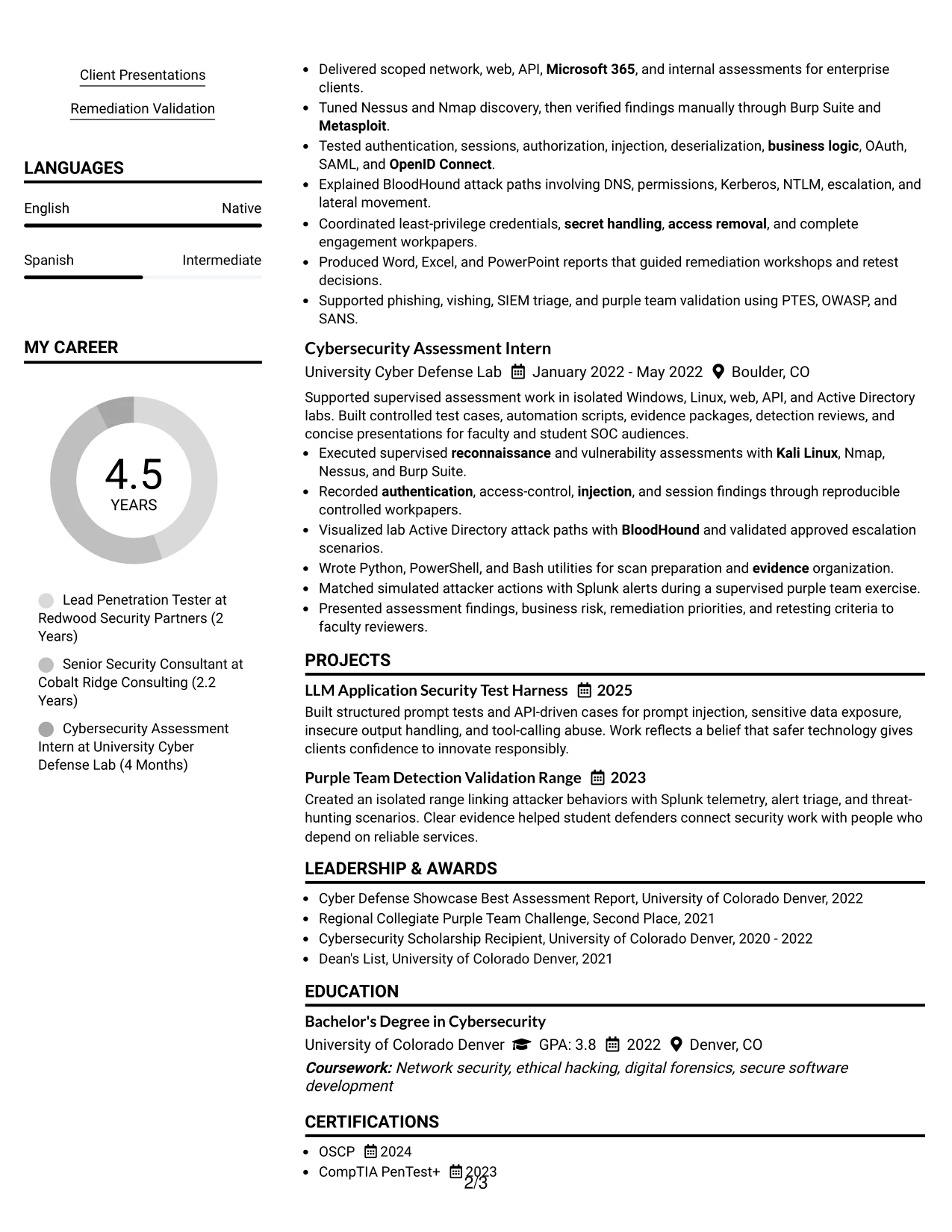
The Plain Two Column Format separates core experience from supporting details, helping readers scan the resume in a clear sequence. Yuan Gilbert’s summary and professional history can occupy the wider column, while skills, certifications, education, and tools remain easy to find in the narrower column.
This structure supports ATS-friendly section labels and compact keyword placement without crowding the experience bullets. It gives detailed evidence, such as Active Directory attack paths, LLM application testing, and remediation reporting, enough room to remain specific and readable.
Resume Snapshot
- Lead Penetration Tester with more than four years of consulting assessment experience
- Network, web, API, Active Directory, cloud, Microsoft 365, and wireless testing
- Kali Linux, Burp Suite, Metasploit, Nmap, Nessus, BloodHound, Python, PowerShell, and Bash
- OSCP, CompTIA PenTest+, AWS Cloud Practitioner, and Microsoft security certification
Why the Plain Two Column Format Works for a Resume
- The wider content area supports detailed achievement bullets and reproducible testing evidence.
- The secondary column keeps skills, certifications, education, and languages visible during a quick review.
- Clear section hierarchy helps ATS tools identify experience, skills, and credentials.
- Short keyword groups can reinforce penetration testing, Active Directory, cloud, and API security terms.
- The format balances technical depth with fast recruiter scanning.
- The structure works well when a resume must show both broad tool coverage and detailed client deliverables.
Resume Keywords
- Lead Penetration Tester
- Penetration Testing
- security assessments
- Active Directory
- Web Application Testing
- Cloud Security
- Microsoft 365
- reconnaissance
- Kali Linux
- Nessus
- Tenable
- Nmap
- Burp Suite
- Metasploit
- BloodHound
#2 Simple One Column Format Resume Example
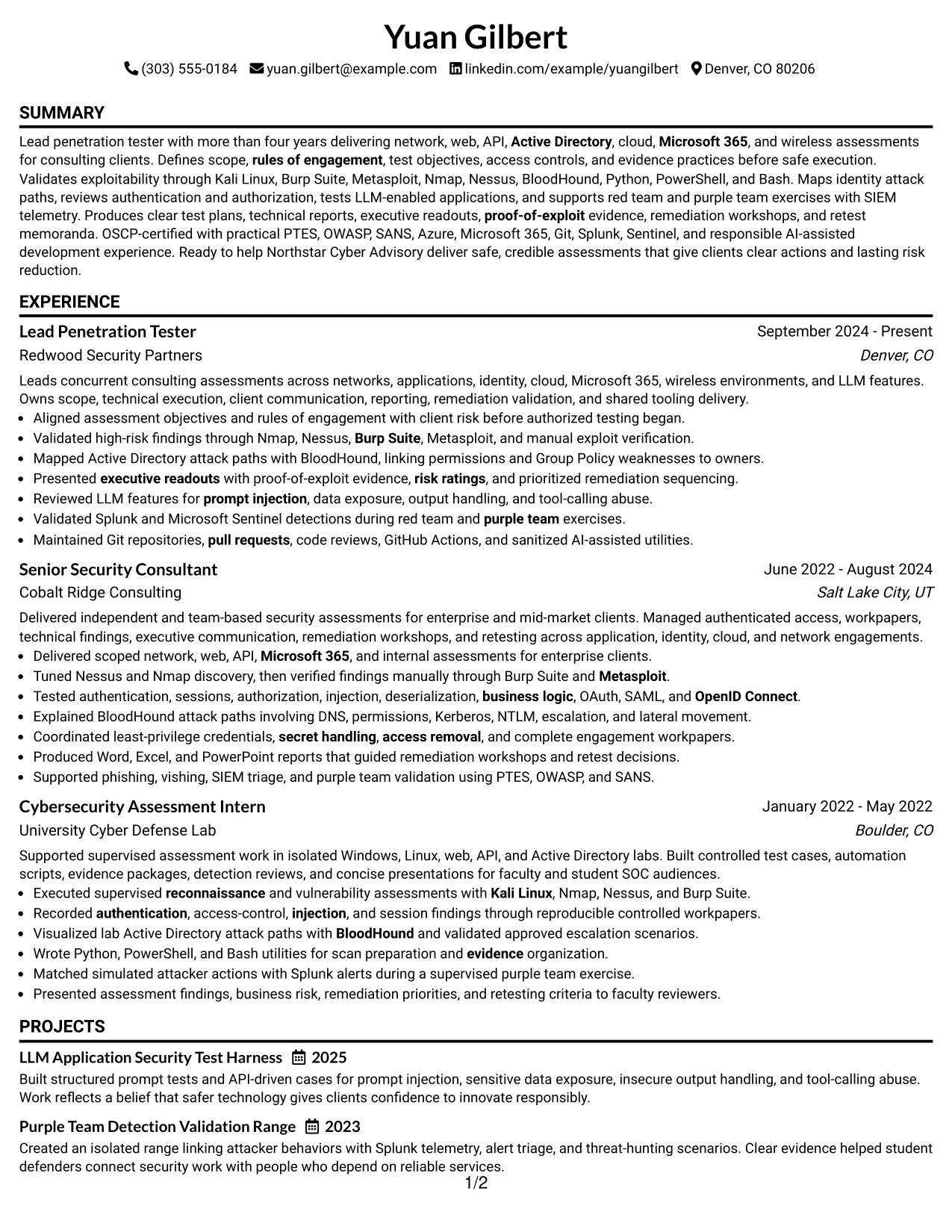
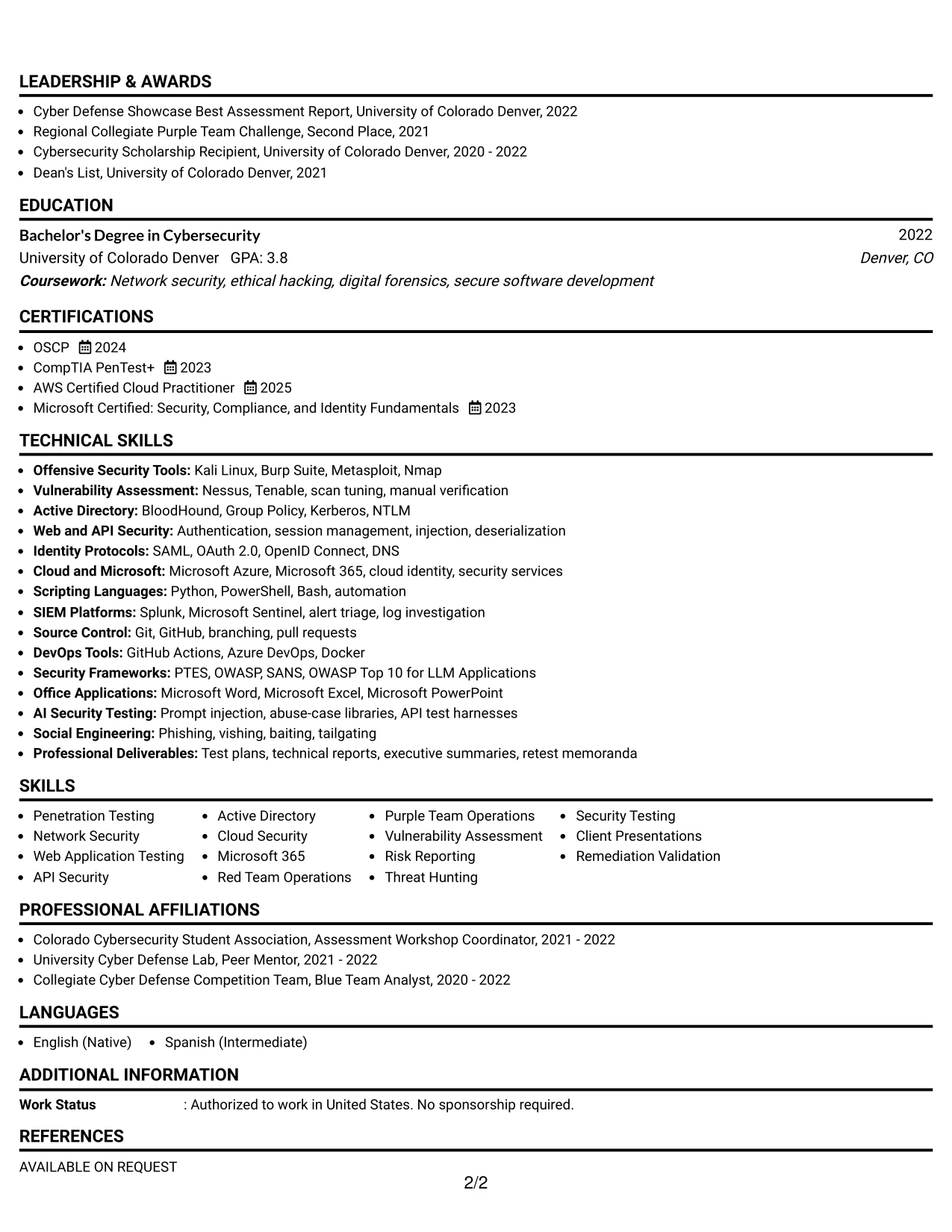
Readers move from the summary into experience, projects, education, certifications, and skills in one uninterrupted path. That order makes the resume easy to review on a screen and straightforward for ATS systems to parse.
The single column gives each role enough width for technical bullets and evidence. It can present concurrent assessments, testing methods, client deliverables, and retesting work without forcing important details into narrow side areas.
Why the Simple One Column Format Works for a Resume
- A single reading path reduces visual switching during an initial resume review.
- Full-width bullets can include tools, methods, findings, and remediation actions in one line of thought.
- Standard section order supports reliable ATS parsing and keyword matching.
- Professional experience receives enough space for multiple assessment types and client deliverables.
- Projects can follow experience without competing with a sidebar.
- Education and certifications remain easy to locate near the end of the document.
Best For
- Resumes with several detailed experience bullets per position
- Applicants who need full-width space for technical testing methods
- ATS-focused submissions using conventional section order
- Documents that combine consulting work, projects, certifications, and education
- Readers who prefer one direct path from summary to evidence
- Applications requiring clear separation between experience and supporting qualifications
- Resumes that must remain readable when viewed on a narrow screen
#3 Clean Two Column Sidebar Format Resume Example
Validated findings and practical remediation guidance receive priority in this format. The main column can show exploit verification, attack path analysis, reporting, and retesting, while the sidebar summarizes the tools and methods behind that evidence.
The clean sidebar gives technical reviewers quick access to skills without interrupting the evidence trail. It is well suited to a resume that must connect security findings with reproducible steps, risk ratings, and remediation owners.
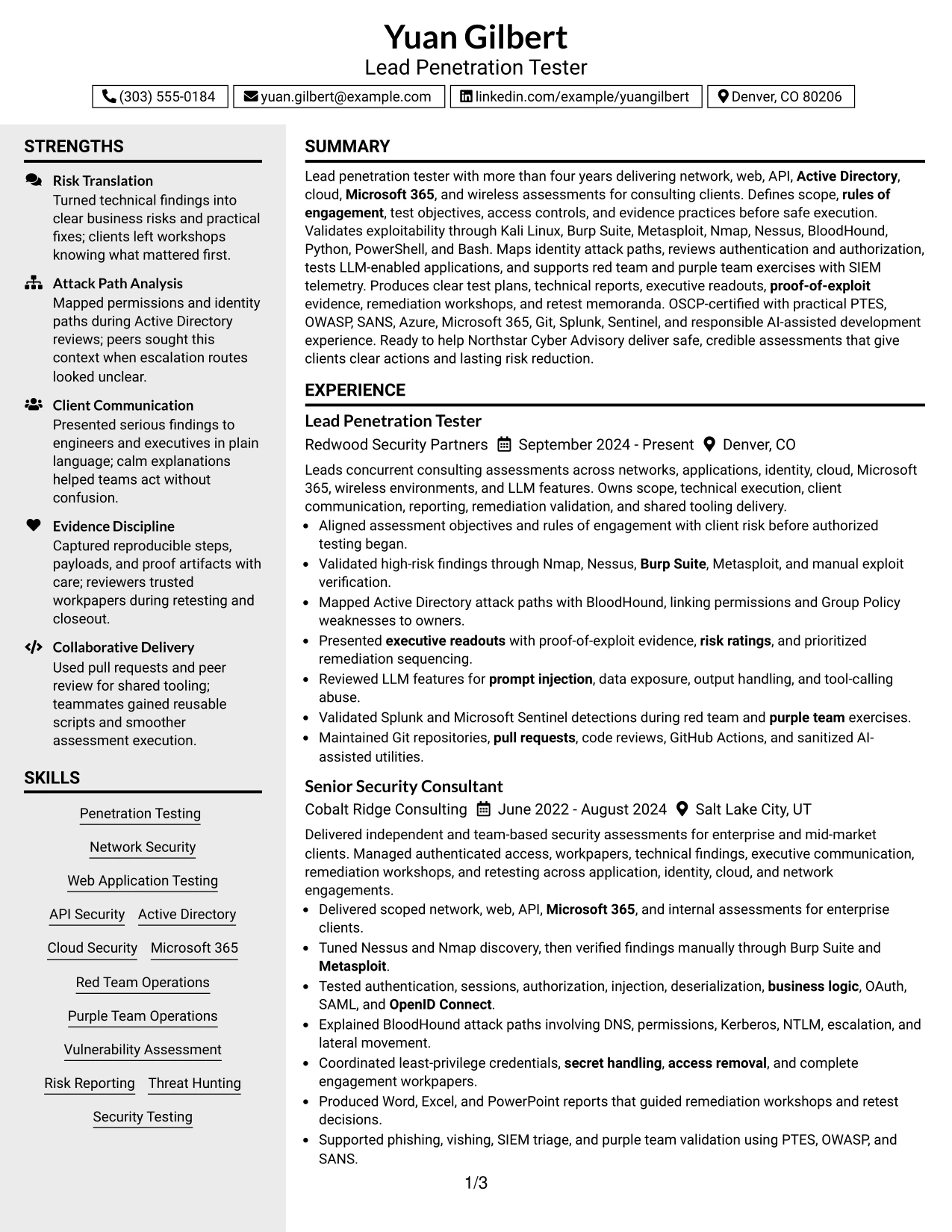
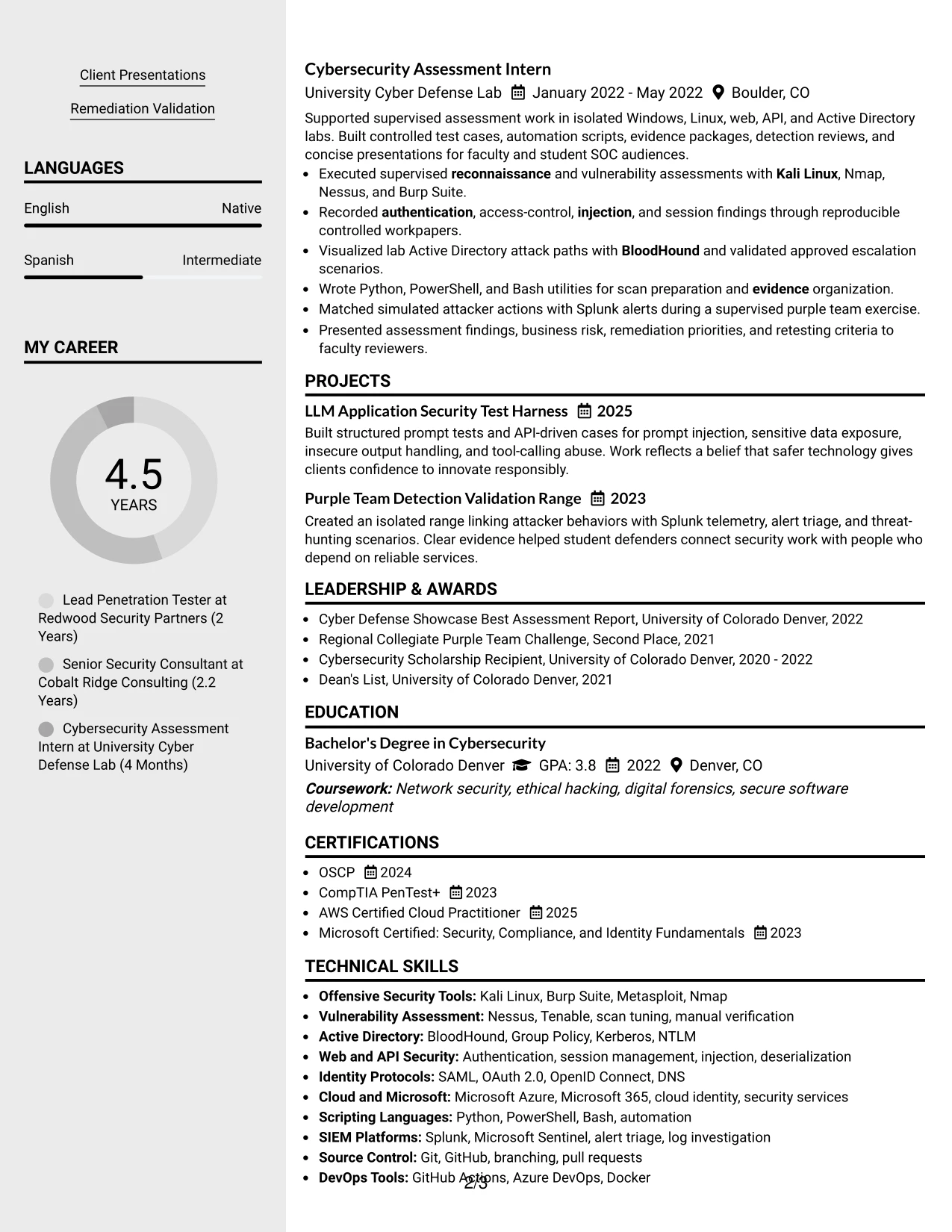
Why the Clean Two Column Sidebar Format Works for a Resume
- The main column gives high-value assessment evidence visual priority.
- A compact sidebar can group tools, protocols, frameworks, and certifications for quick reference.
- Bulleted experience entries make exploitability validation and remediation work easy to compare.
- The format separates proof of work from the keyword inventory that supports ATS matching.
- Attack path analysis and retesting details can remain prominent instead of being reduced to a skills list.
- Clean spacing supports review of both technical depth and professional deliverables.
Best For
- Resumes where validated findings should lead the reader’s review
- Candidates presenting proof-of-exploit evidence alongside tool coverage
- Applications that need a focused sidebar for protocols and frameworks
- Documents combining technical reports with remediation workshops and retesting
- Security professionals whose strongest evidence is delivered through concise bullets
- Resumes that benefit from separating assessment results from supporting skills
- Review settings where technical readers need fast access to testing methods
#4 Two Column Format Resume Example
Content is balanced between detailed experience and compact qualification groups. One column can carry consulting assessments, client presentations, and remediation results, while the other organizes skills, certifications, education, and professional activities.
That distribution supports applications that require broad coverage without making every section compete for the same space. The resume can show network, web, API, identity, cloud, and Microsoft 365 work while preserving a clear visual hierarchy.
Why the Two Column Format Works for a Resume
- The format distributes technical evidence and supporting qualifications across two readable areas.
- A dedicated column can surface certifications and frameworks early in the review.
- Experience bullets have enough room to connect testing activity with business risk.
- The layout supports broad assessment coverage without creating a long, dense skills block.
- Projects and activities can be included without weakening the employment history.
- Separate columns help readers compare hands-on tools with client-facing outcomes.
- The structure works for applications that value both technical range and organized reporting.
Best For
- Applications requiring a balanced view of experience and qualifications
- Resumes covering several assessment environments without excessive length
- Candidates combining client delivery with projects, certifications, and activities
- Submissions where skills must remain visible beside detailed work history
- Documents that need room for both technical evidence and executive reporting
- Readers comparing testing coverage with frameworks and credentials
- Resume reviews that reward organized presentation across multiple security domains
#5 Photo Header Two Column Format Resume Example
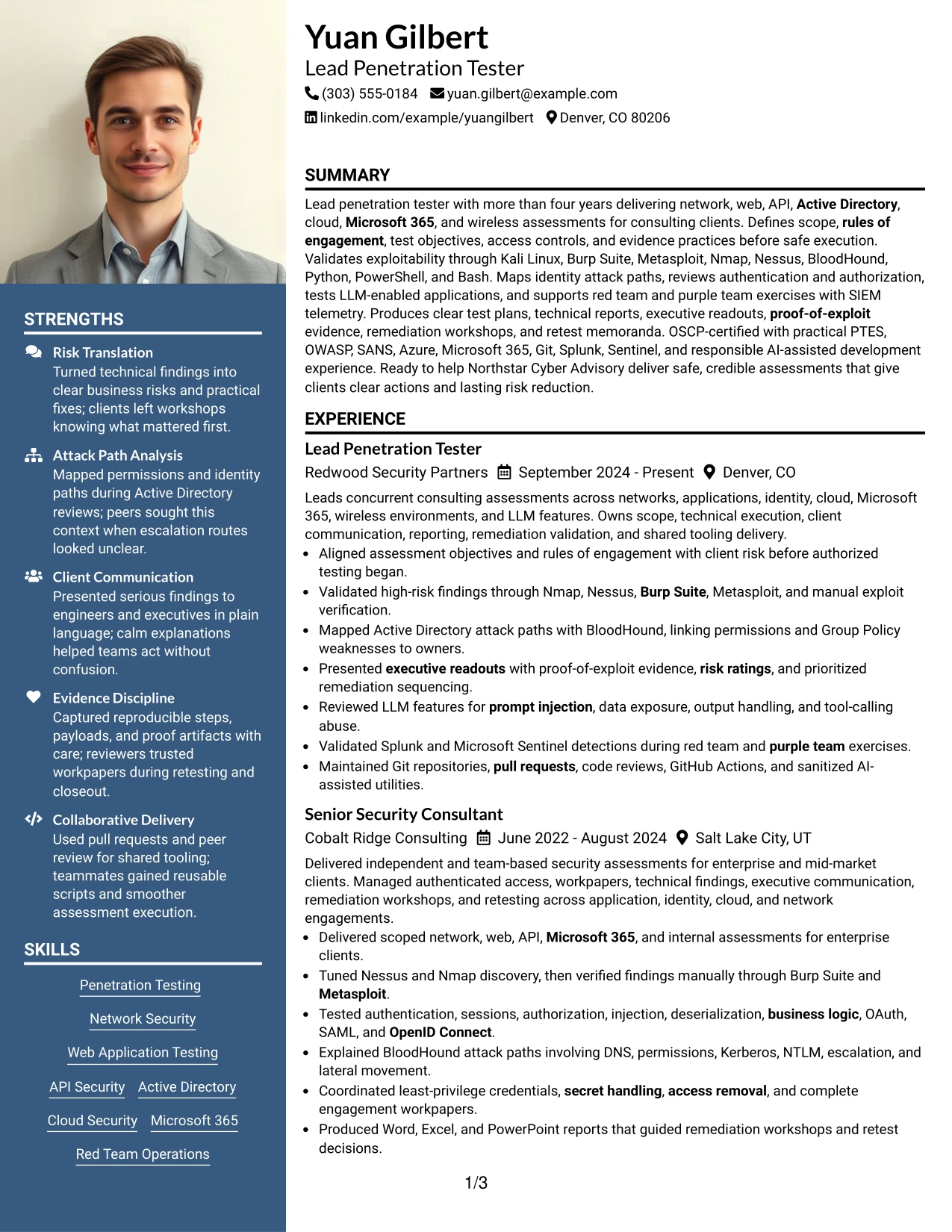
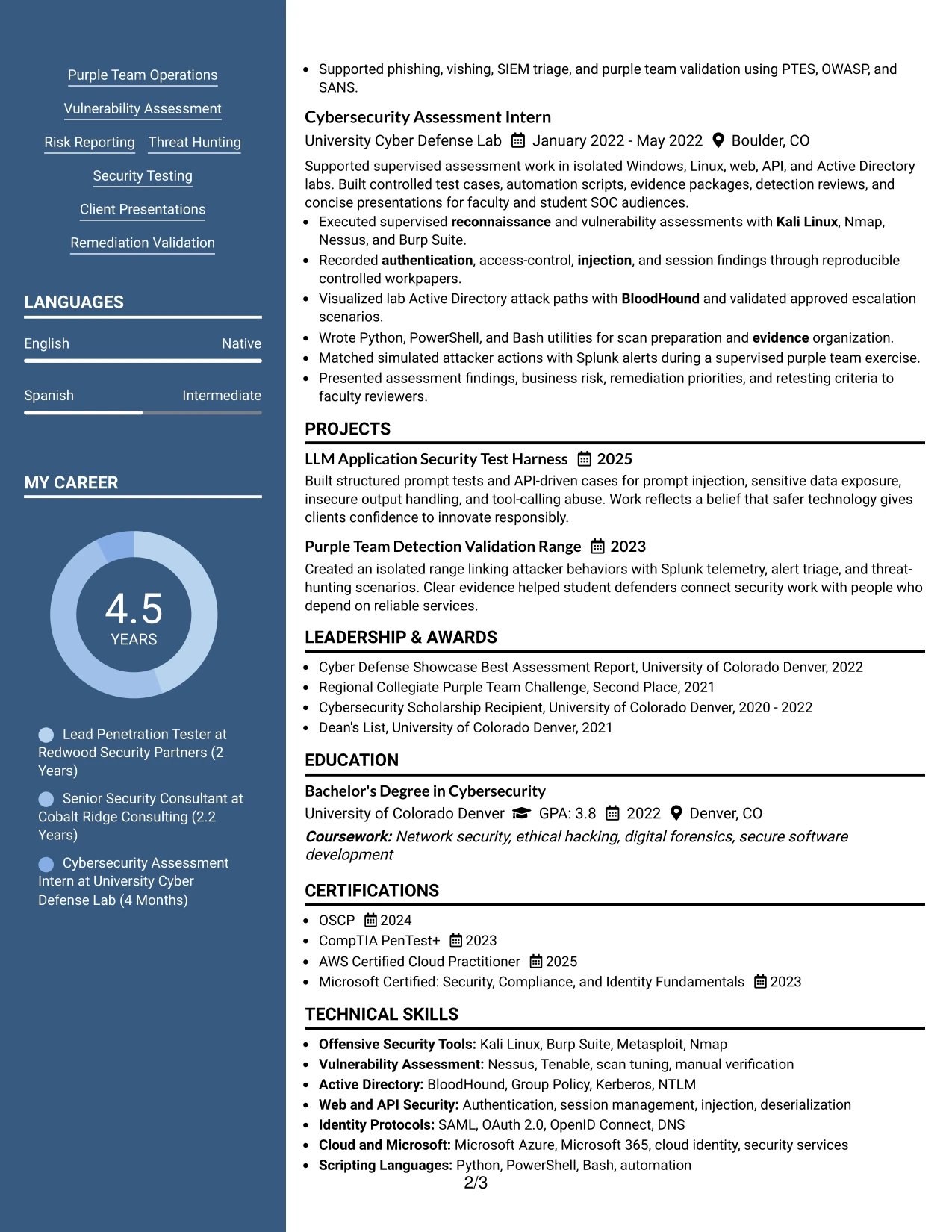
For an application context that permits a professional photo, the header can create a strong first visual anchor while the two-column body organizes technical evidence and supporting qualifications. The resume should still keep the name, target role, contact details, and core keywords prominent for ATS review.
The larger header area can introduce the document cleanly, while the columns separate assessment history from tools, certifications, education, and projects. Because photo expectations vary by country and employer, this format should be used only when a photo is appropriate for the specific application.
Why the Photo Header Two Column Format Works for a Resume
- The header creates a clear identity area before the reader reaches the experience section.
- Two columns keep detailed assessment work separate from skills and credentials.
- The layout can present a professional photo without replacing text-based role and keyword information.
- A wide body area supports evidence about exploitability, reporting, and remediation validation.
- The supporting column can group tools such as Nmap, Burp Suite, BloodHound, and Nessus.
- The format gives projects and certifications a defined place without crowding the work history.
- It suits applications where visual presentation is accepted and the document will be reviewed by people as well as ATS software.
Best For
- Applications in regions or sectors where a professional photo is accepted
- Candidates seeking a strong header before detailed technical evidence
- Resumes that need separate areas for experience and supporting credentials
- Documents combining consulting assessments with projects and certifications
- Print or presentation settings where the header benefits from visual emphasis
- Applicants who can provide a consistent professional photo and clear text hierarchy
- Applications where the visual format supports, but does not replace, ATS-readable content
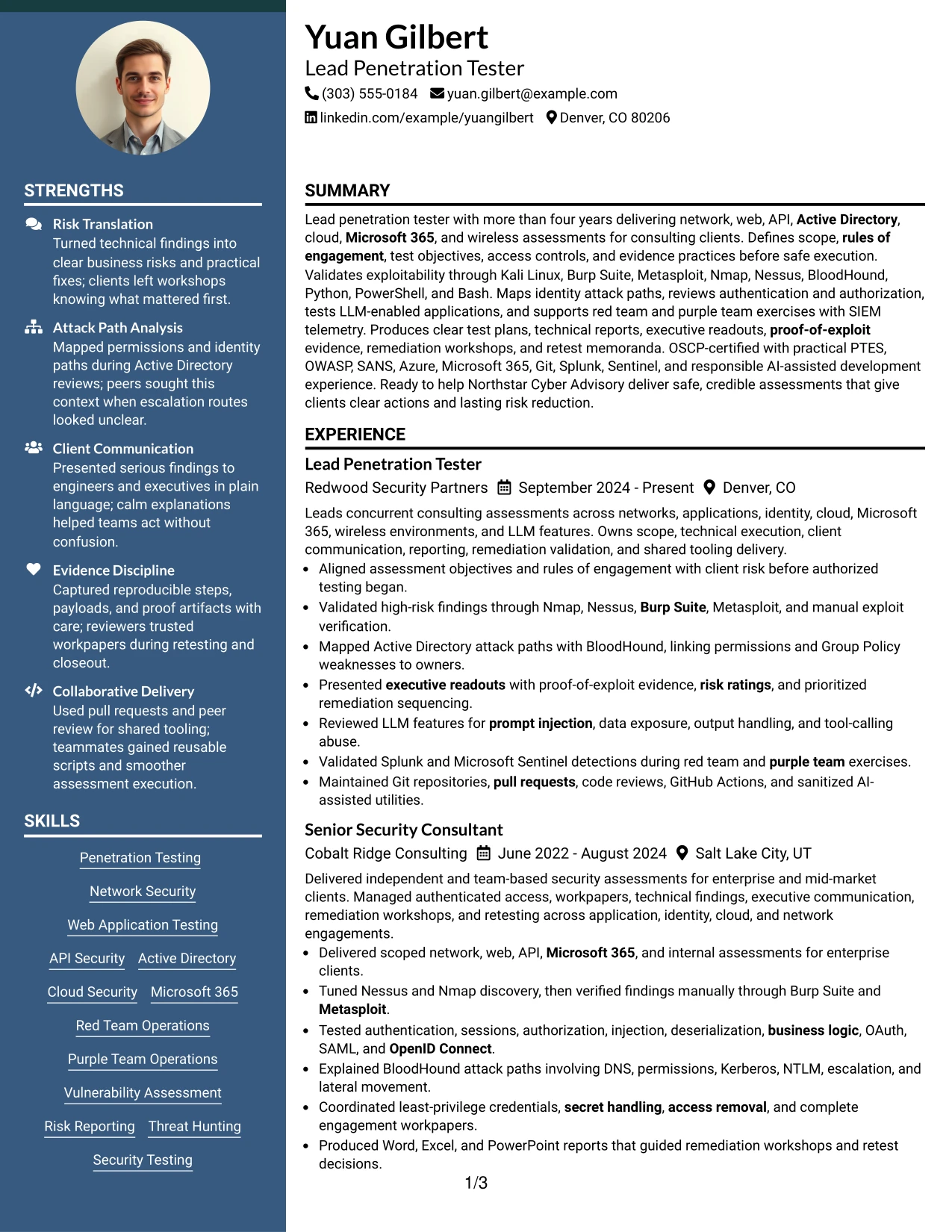
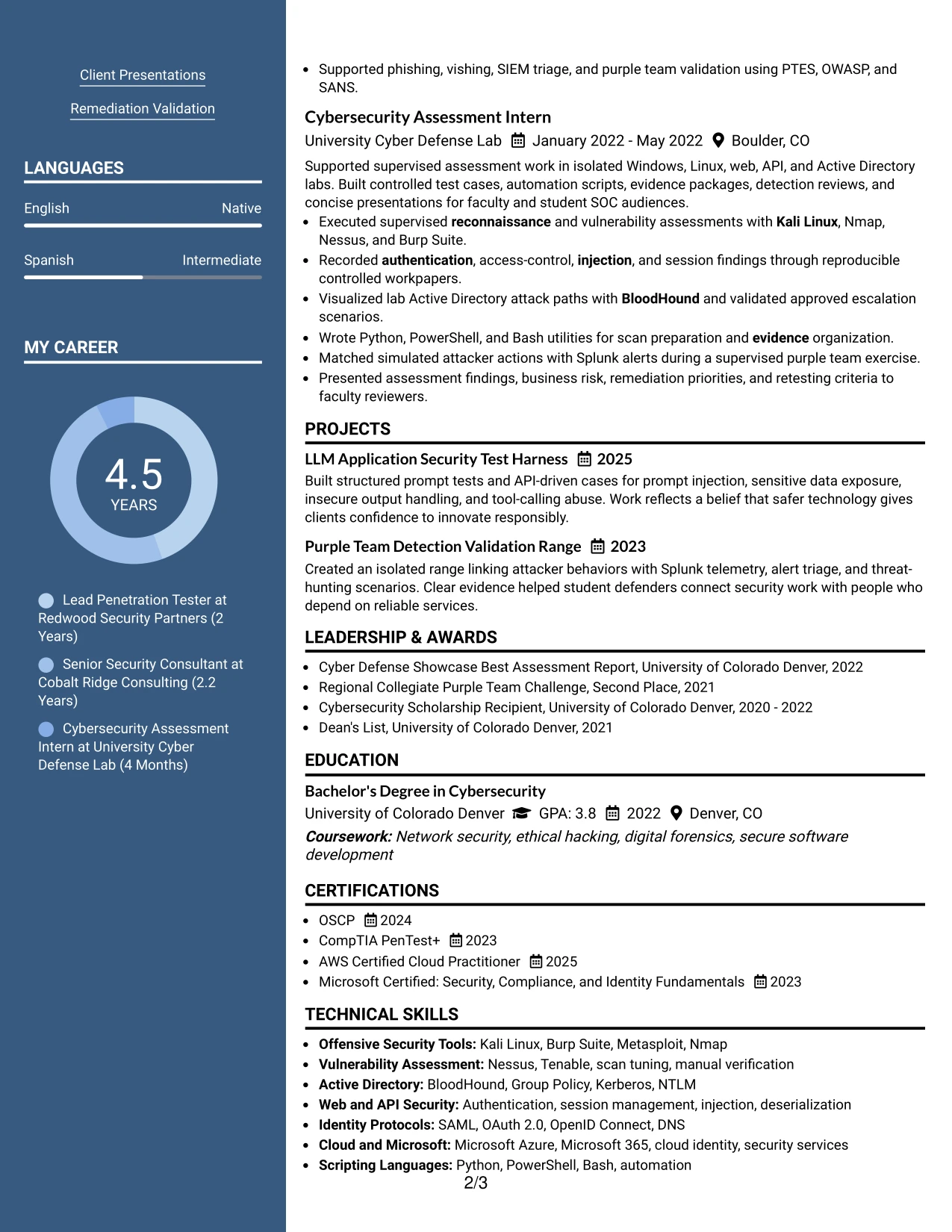
#6 Colored Two Column Format Resume Example
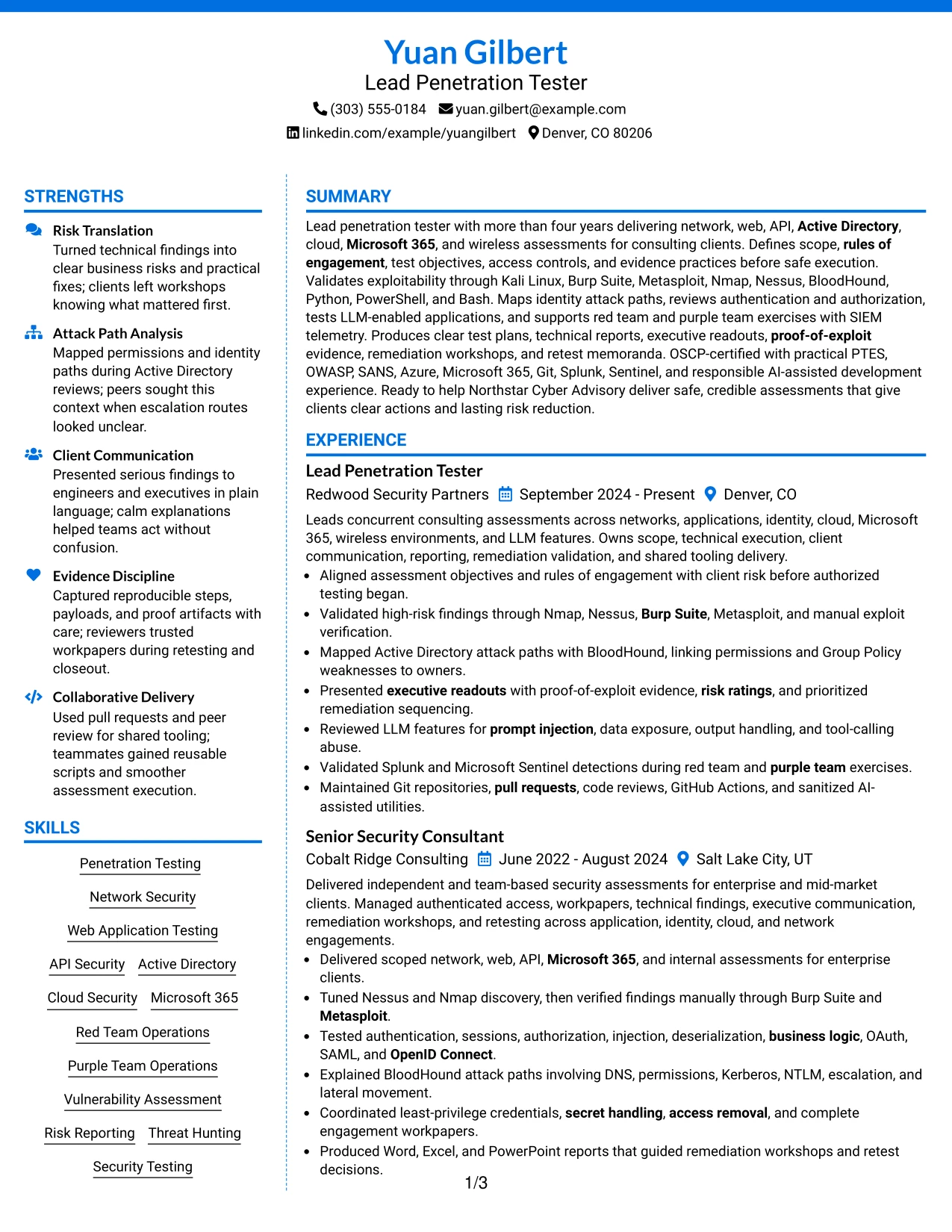
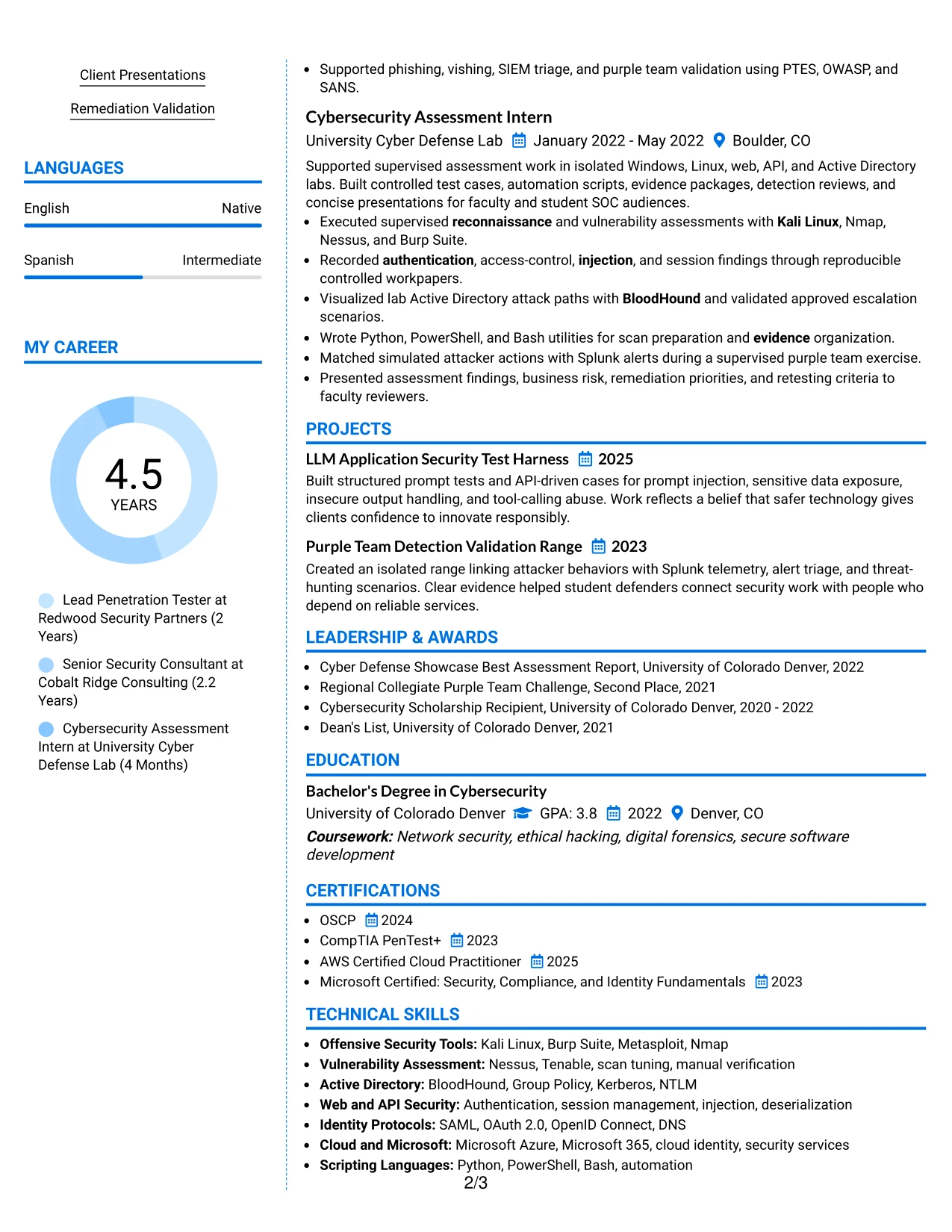
A restrained color hierarchy gives the resume a polished visual character while keeping technical content central. Color can distinguish the summary, experience, skills, and credentials, but the text remains responsible for communicating assessment scope, tools, findings, and results.
The two-column arrangement supports a focused experience narrative beside a structured skills area. Consistent headings help readers locate Active Directory testing, API security, SIEM validation, certifications, and professional deliverables without relying on decorative elements.
Why the Colored Two Column Format Works for a Resume
- Controlled color creates section landmarks without weakening text-based hierarchy.
- The main column can emphasize consulting outcomes, testing evidence, and client communication.
- The sidebar keeps technical keywords visible for both human review and ATS matching.
- Consistent labels help organize tools, protocols, certifications, and frameworks.
- The format aligns well with a role requiring both hands-on testing and clear reporting.
- Color can distinguish projects or certifications while preserving a professional tone.
- The two-column structure provides a clear relationship between capabilities and documented experience.
Best For
- Resumes that need visual distinction while retaining a professional structure
- Candidates presenting technical work alongside a compact keyword group
- Applications where clear role alignment matters more than decorative design
- Documents that benefit from color-coded section landmarks
- Readers who scan for tools, certifications, and evidence in parallel
- Submissions combining hands-on assessment with client-facing reporting
- Professionals wanting a polished format that remains text-led and ATS-conscious
#7 Stylish Two Column Designer Format Resume Example
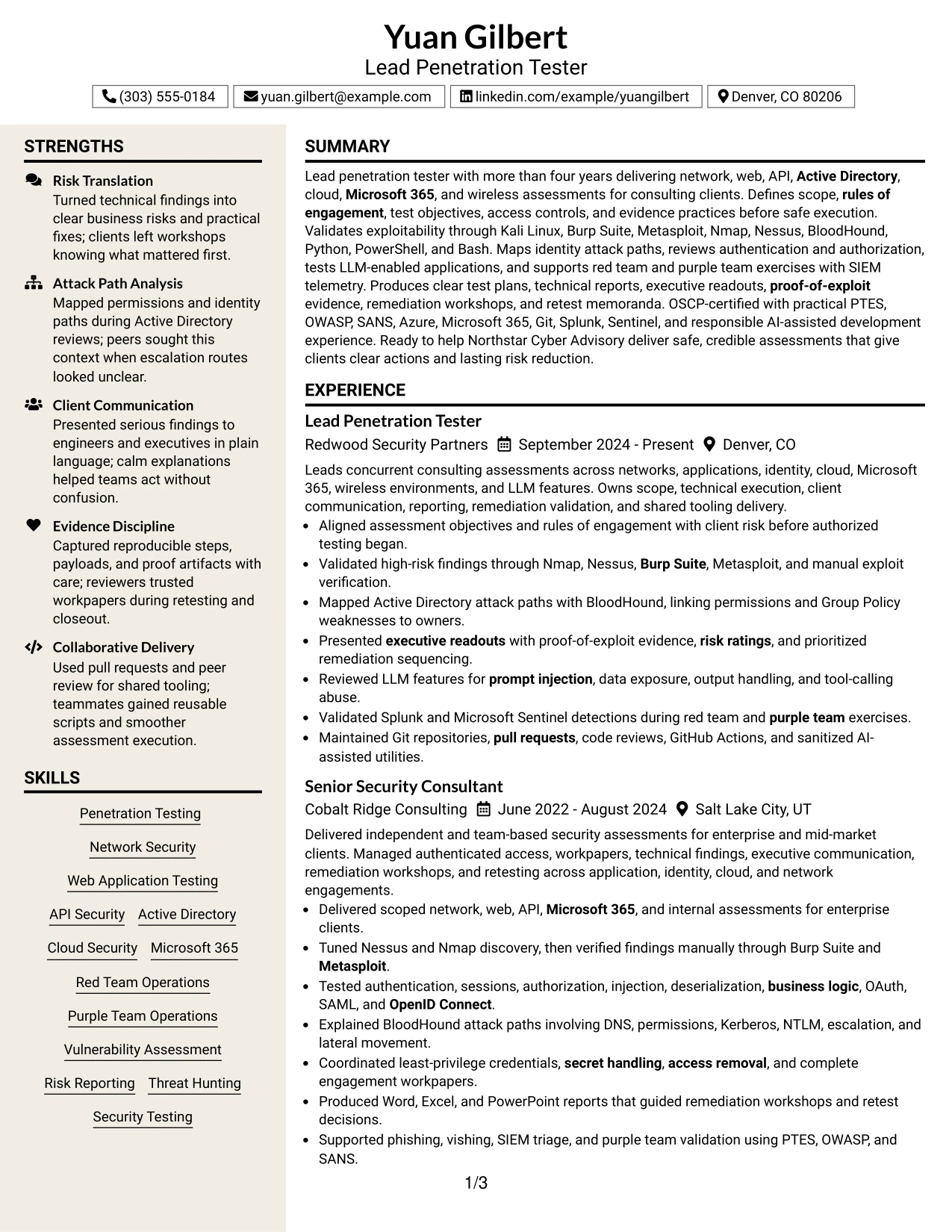
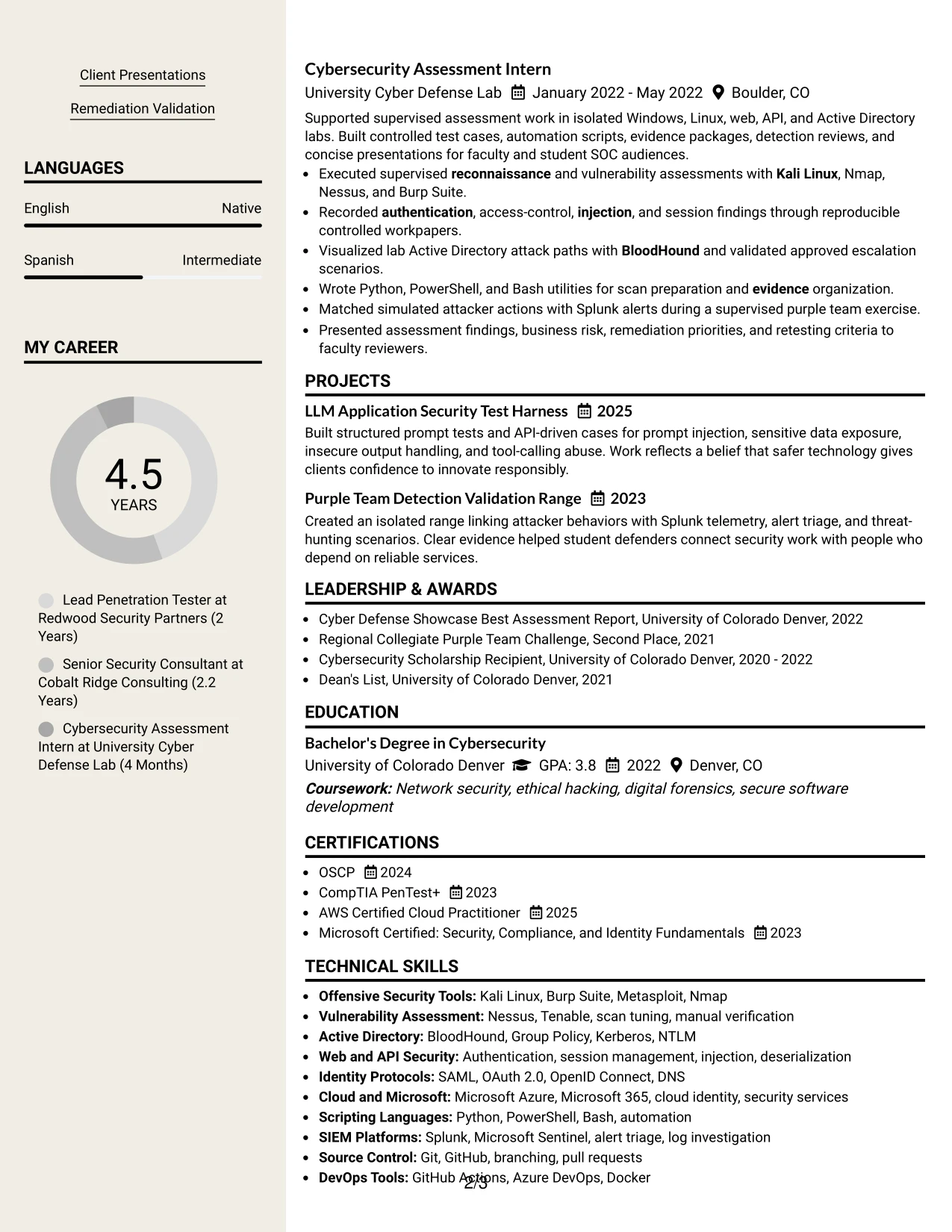
The Stylish Two Column Designer Format uses distinct section markers to organize experience, skills, projects, and credentials. Its design remains useful when the content is disciplined: technical bullets should lead with actions, name relevant tools, and show the resulting risk or remediation value.
A strong primary column can hold employment history and project evidence, while the secondary area carries frameworks, certifications, languages, and core tools. This creates visual structure without reducing the detail needed for penetration testing and security assessment work.
Why the Stylish Two Column Designer Format Works for a Resume
- Distinct section markers help readers move quickly between evidence and qualification groups.
- The main column supports action-led bullets with tools, methods, and assessment outcomes.
- The secondary column can consolidate frameworks, certifications, languages, and core skills.
- Projects receive visible placement without displacing the employment history.
- The format supports a polished presentation while keeping technical terms searchable.
- Consistent visual cues make repeated assessment categories easier to compare.
- It works best when design elements reinforce hierarchy rather than carry meaning by themselves.
Best For
- Resumes that need a designed appearance with clear information hierarchy
- Candidates using projects to reinforce professional assessment evidence
- Applications where tools, frameworks, and certifications need a dedicated area
- Documents with varied evidence types, including reports, retesting, and detection validation
- Readers who value quick visual landmarks during a detailed review
- Professionals presenting both technical execution and collaborative delivery
- Submissions that require style without sacrificing searchable resume text
#8 Modern Icon Format Resume Example
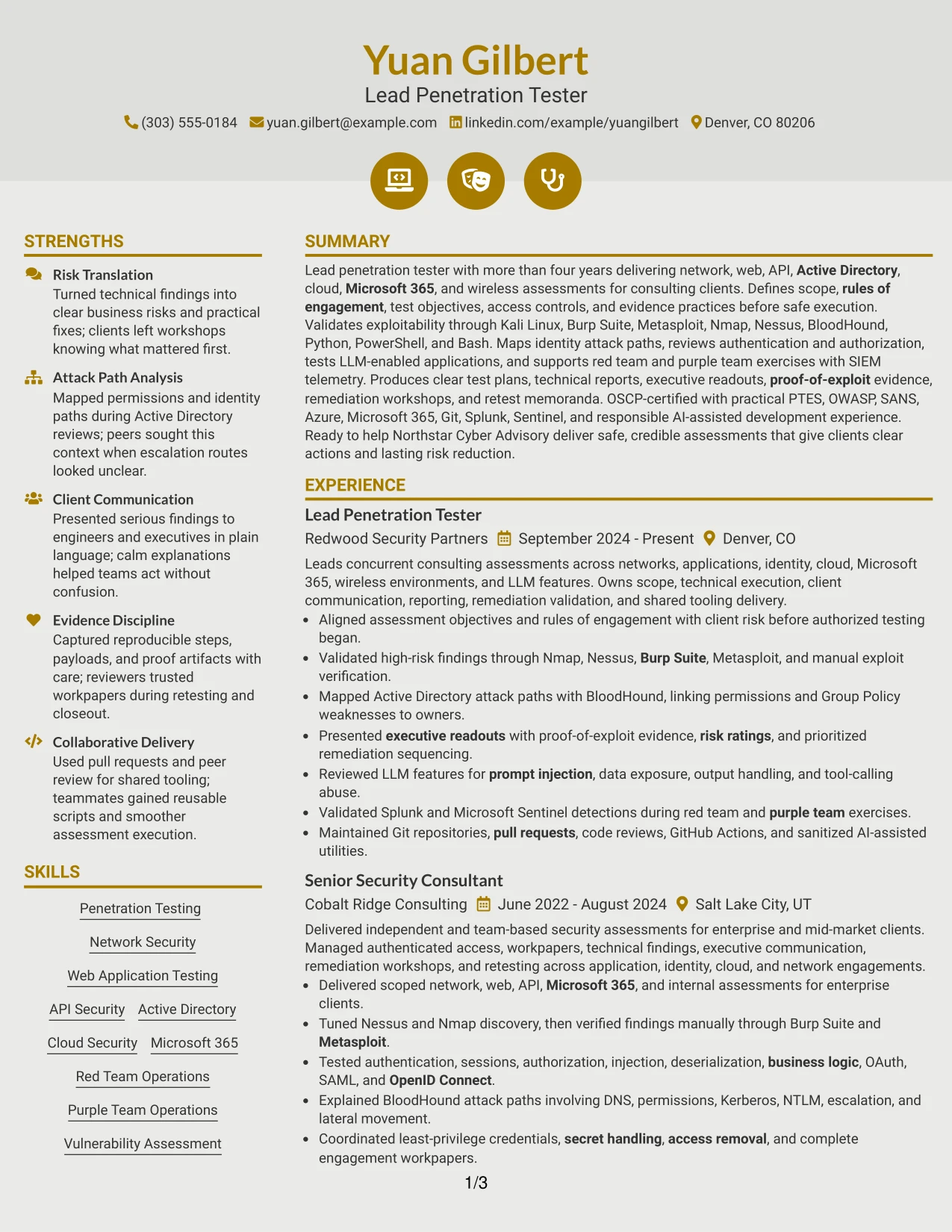
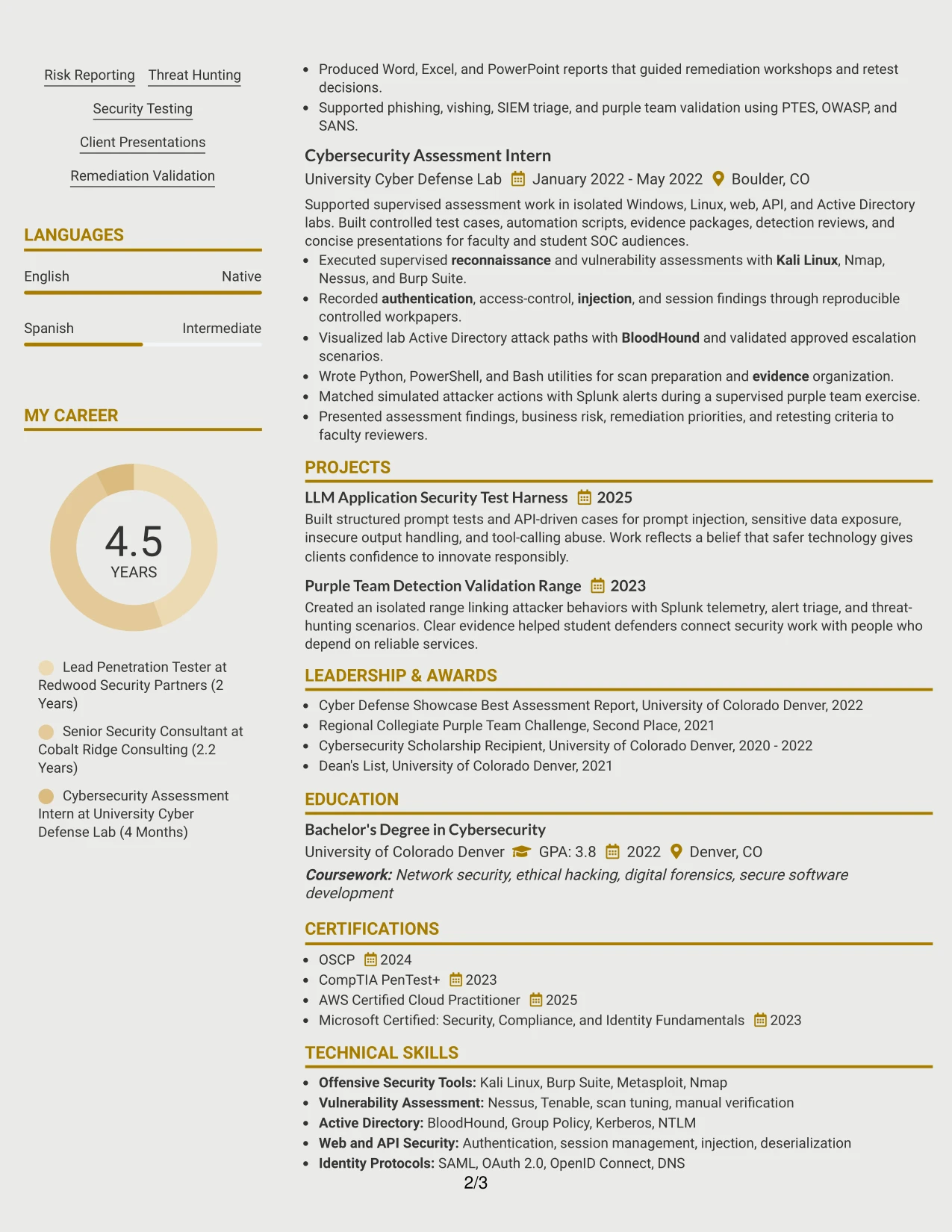
Readers can move through the Modern Icon Format by following clearly marked sections from summary to experience, projects, education, certifications, and skills. Icons may help identify sections, but the written headings and keywords must remain clear for ATS parsing.
The single-column design provides broad width for technical bullets, project descriptions, and professional deliverables. It is especially useful when the resume needs to show assessment range, scripting, SIEM work, LLM security testing, and client communication in one continuous document.
Why the Modern Icon Format Works for a Resume
- A single column gives detailed bullets consistent width from start to finish.
- Simple icons can guide navigation while written headings preserve ATS readability.
- The structure supports a substantial skills and tools section without a narrow sidebar.
- Projects can explain structured prompt testing and API-driven test harnesses in full sentences.
- Employment history remains the central evidence source rather than being reduced to keywords.
- Certifications and education can follow naturally after technical experience.
- The format suits resumes that need to present broad coverage in a modern but readable way.
Best For
- Resumes with high content volume across experience, projects, and skills
- Candidates who need full-width space for technical project descriptions
- Applications requiring clear presentation of tools and security frameworks
- Documents that combine LLM testing, SIEM work, scripting, and assessment delivery
- Readers who prefer visual section cues with conventional text labels
- ATS-conscious submissions using icons only as secondary navigation aids
- Professionals whose evidence spans several testing environments and deliverable types
#9 Modern Full Background Two Column Format Resume Example
Validated assessment evidence should lead the review, with the visual background serving only as a controlled setting. The main column can present exploitability checks, attack paths, client reports, and remediation validation, while the second column holds tools, certifications, and frameworks.
A two-column structure makes it possible to show both breadth and proof. Clear text contrast remains essential so terms such as BloodHound, Nessus, OWASP, SIEM telemetry, and retesting remain readable to people and ATS systems.
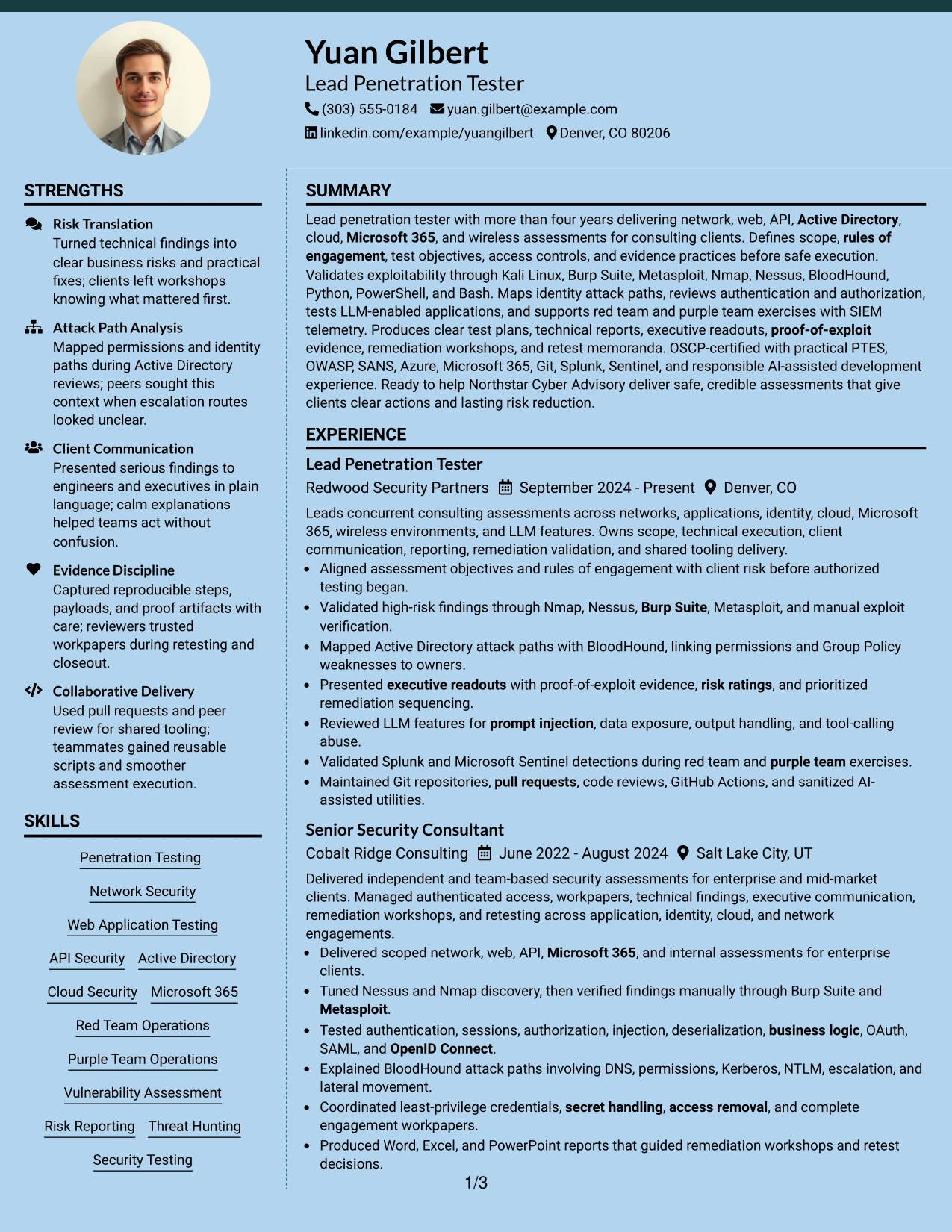
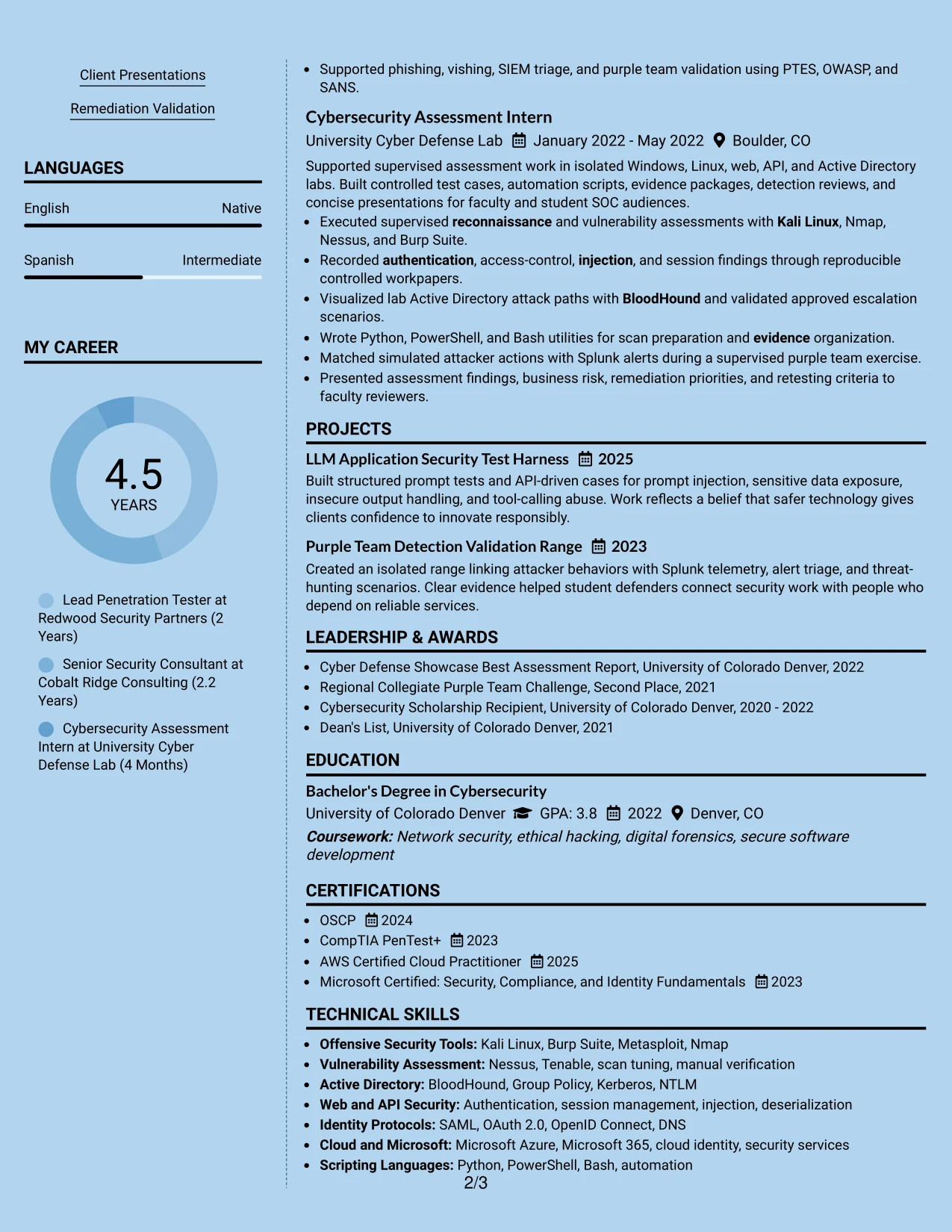
Why the Modern Full Background Two Column Format Works for a Resume
- The main column gives verified technical evidence the strongest reading position.
- A secondary column keeps tools, frameworks, certifications, and protocols available at a glance.
- Strong contrast supports text readability over a full background treatment.
- The layout can connect findings to proof-of-exploit evidence and remediation actions.
- Two columns help show both assessment breadth and detailed validation work.
- Clear section labels reduce the risk that visual styling will obscure ATS-relevant content.
- The format works when a modern appearance is needed but evidence remains the primary measure.
Best For
- Resumes where validated assessment evidence must remain the visual priority
- Candidates pairing exploit verification with a broad security toolset
- Applications that need clear separation between work history and credentials
- Documents using modern styling while preserving strong text contrast
- Readers reviewing proof-of-exploit artifacts, risk ratings, and retesting
- Professionals who need to show both technical range and evidence discipline
- Submissions where visual design is acceptable only when it supports ATS-readable content
#10 Dark Mode Two Column Format Resume Example
Content is distributed between a detailed experience column and a compact qualification column, creating a balanced review path. Yuan Gilbert’s resume can place assessment execution, client reporting, and remediation evidence in the main area while keeping tools, certifications, and frameworks easy to scan.
Dark styling should remain secondary to readable text and standard section labels. Used carefully, the format presents a confident professional profile while preserving keywords such as Active Directory, Burp Suite, Python, Microsoft Sentinel, and OWASP Top 10 for LLM Applications.
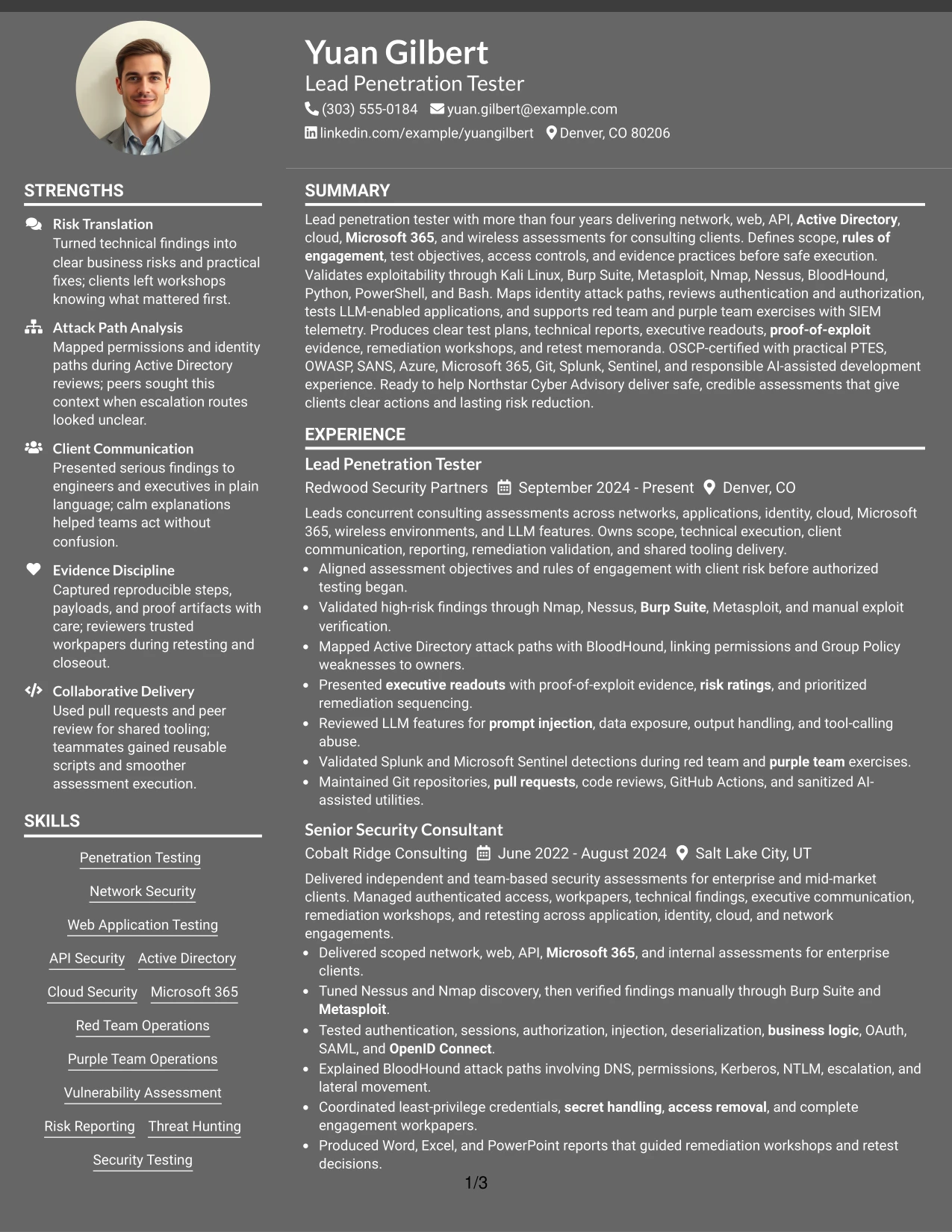
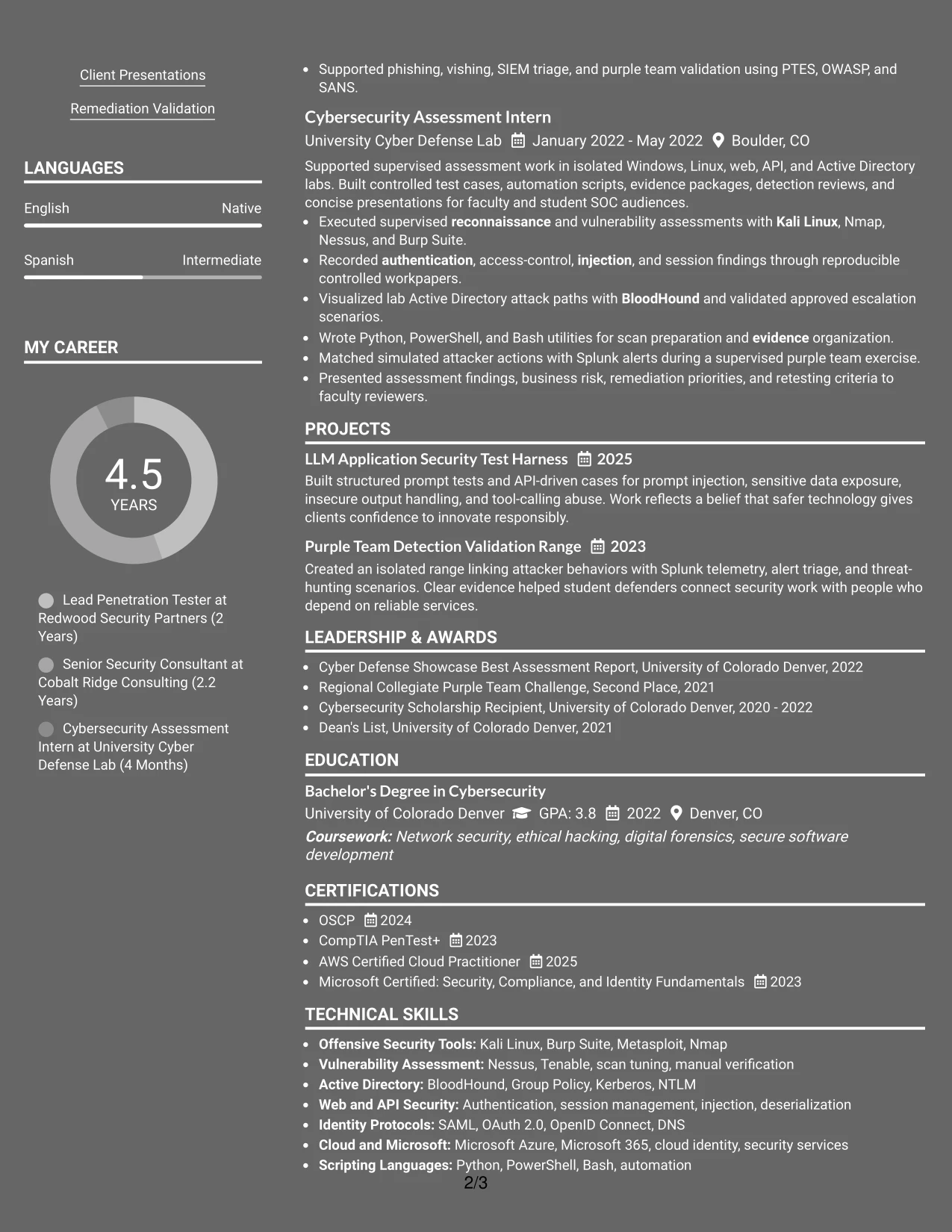
Why the Dark Mode Two Column Format Works for a Resume
- The two-column balance prevents extensive technical content from becoming one dense block.
- The main area can show assessment ownership, reporting, and remediation validation in context.
- The supporting area keeps high-value tools and certifications visible during scanning.
- Dark styling creates a distinctive presentation when contrast and accessibility are protected.
- Standard labels preserve ATS recognition for experience, skills, education, and certifications.
- The format can separate client-facing evidence from technical keyword coverage.
- It supports a polished resume for applications that accept a more modern visual treatment.
Best For
- Applications that permit a modern visual treatment with strong contrast
- Candidates balancing detailed consulting evidence with compact qualifications
- Resumes that need a separate area for tools, frameworks, and certifications
- Documents presenting client reporting alongside hands-on testing methods
- Readers who scan in two passes: outcomes first, technical coverage second
- Professionals seeking a distinctive format without removing standard resume sections
- Submissions where accessibility and ATS readability remain design requirements
#11 Dark Mode Box Header Format Resume Example
A practical application for this format is a polished resume presentation where section boxes guide the reader through a substantial technical record. The single-column structure can show experience, projects, certifications, education, and skills in a controlled order without narrowing the evidence.
Boxed headers add visual separation, while the content should still lead with clear actions and credible proof. Technical bullets can cover reconnaissance, exploit validation, attack path mapping, scripting, SIEM review, client presentations, and retesting with enough width for context.
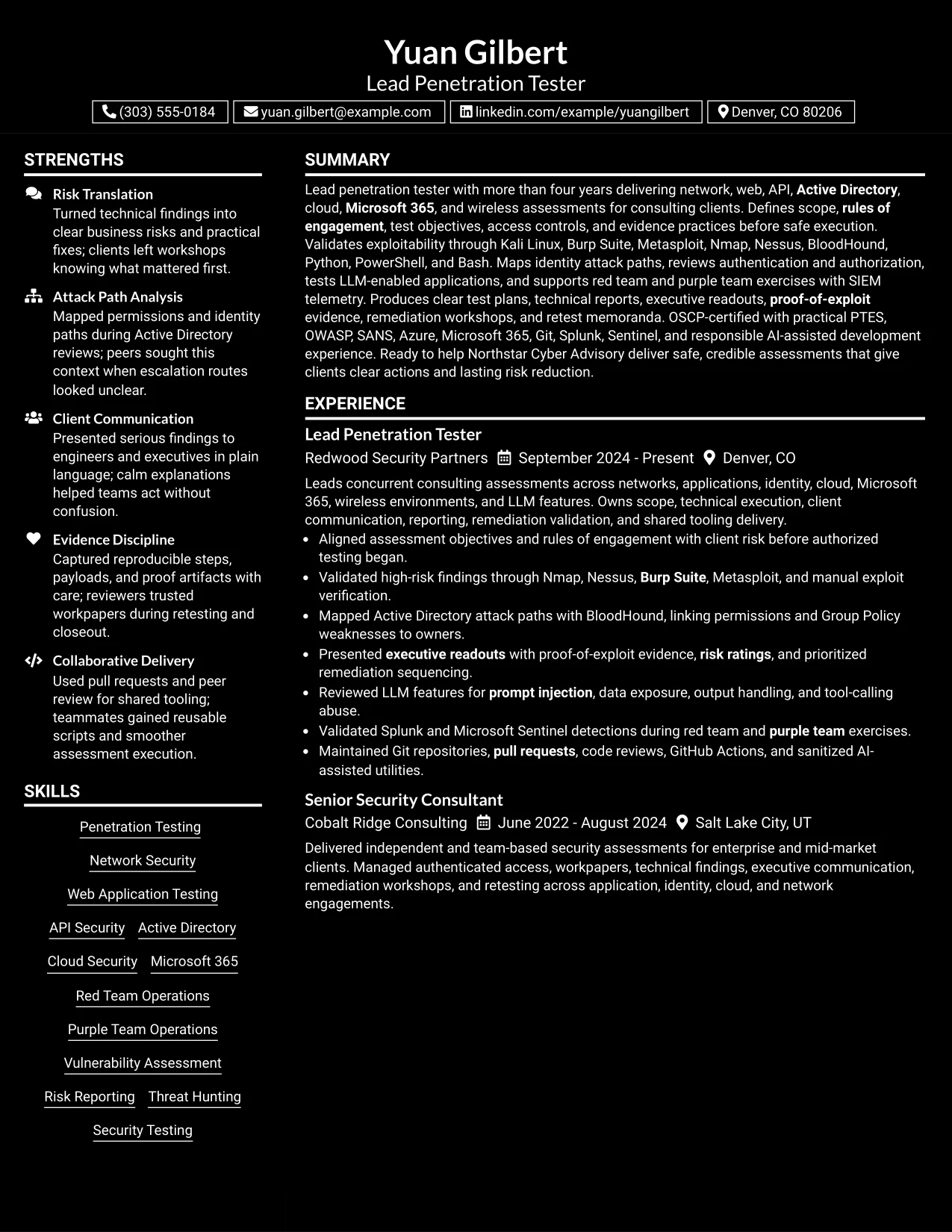
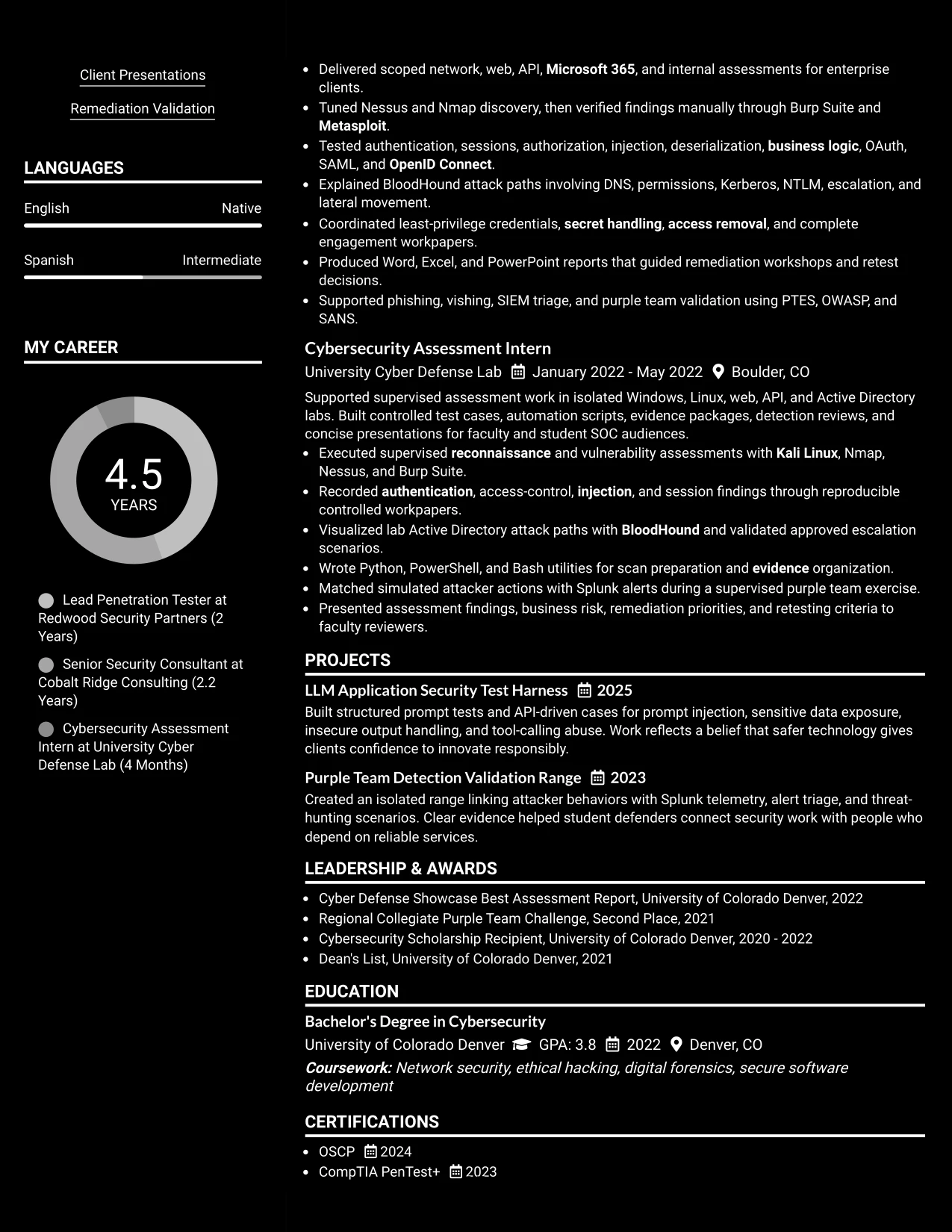
Why the Dark Mode Box Header Format Works for a Resume
- Boxed headers create clear landmarks across a full-width resume.
- The single-column body gives technical bullets space for methods, tools, and outcomes.
- Dark styling can support a polished presentation when text contrast remains strong.
- Projects and certifications can be placed in the same clear sequence as experience.
- Standard section names help ATS tools identify skills, education, and employment history.
- The format supports detailed evidence about client presentations, retesting, and remediation.
- It works well when the resume needs a modern surface but conventional content organization.
Best For
- Applications favoring a polished single-column presentation with clear section boxes
- Candidates needing full-width space for complex assessment evidence
- Resumes that combine employment history, projects, credentials, and technical skills
- Readers who benefit from strong visual landmarks between content groups
- Documents presenting reconnaissance, exploit validation, and retesting in sequence
- Professionals using modern styling while preserving standard ATS-readable sections
- Submissions where visual fit matters but evidence and readability remain central
#12 Elegant Full Background Two Column Format
A restrained visual hierarchy gives the resume a polished first impression while keeping the content professional and easy to assess. The two-column structure separates core skills and certifications from detailed experience, education, and projects.
For a Lead Penetration Tester resume, this organization creates room for technical keywords such as Active Directory, Burp Suite, BloodHound, Python, and OWASP without weakening the evidence in the work history. It also supports quick review of assessment scope, reporting work, and remediation results.
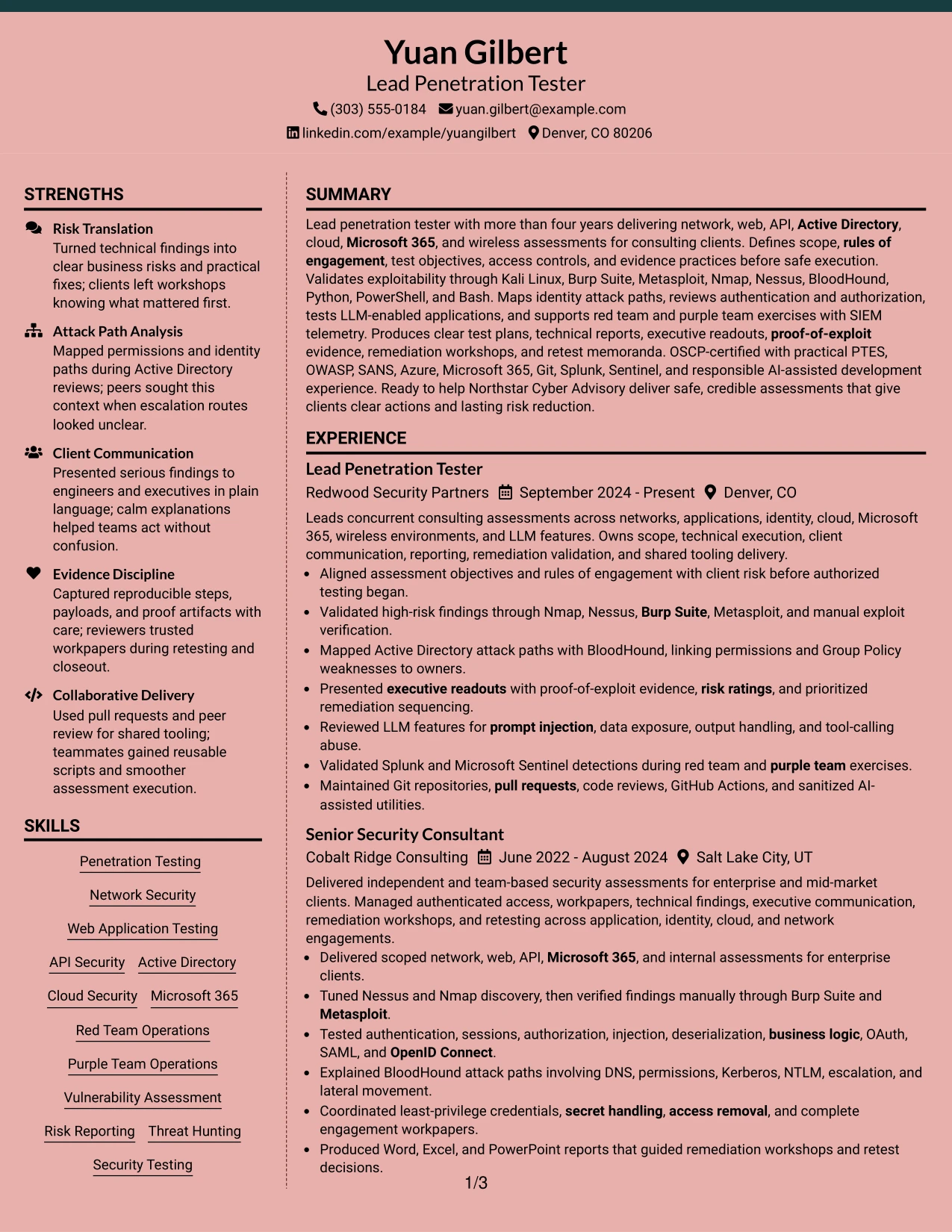
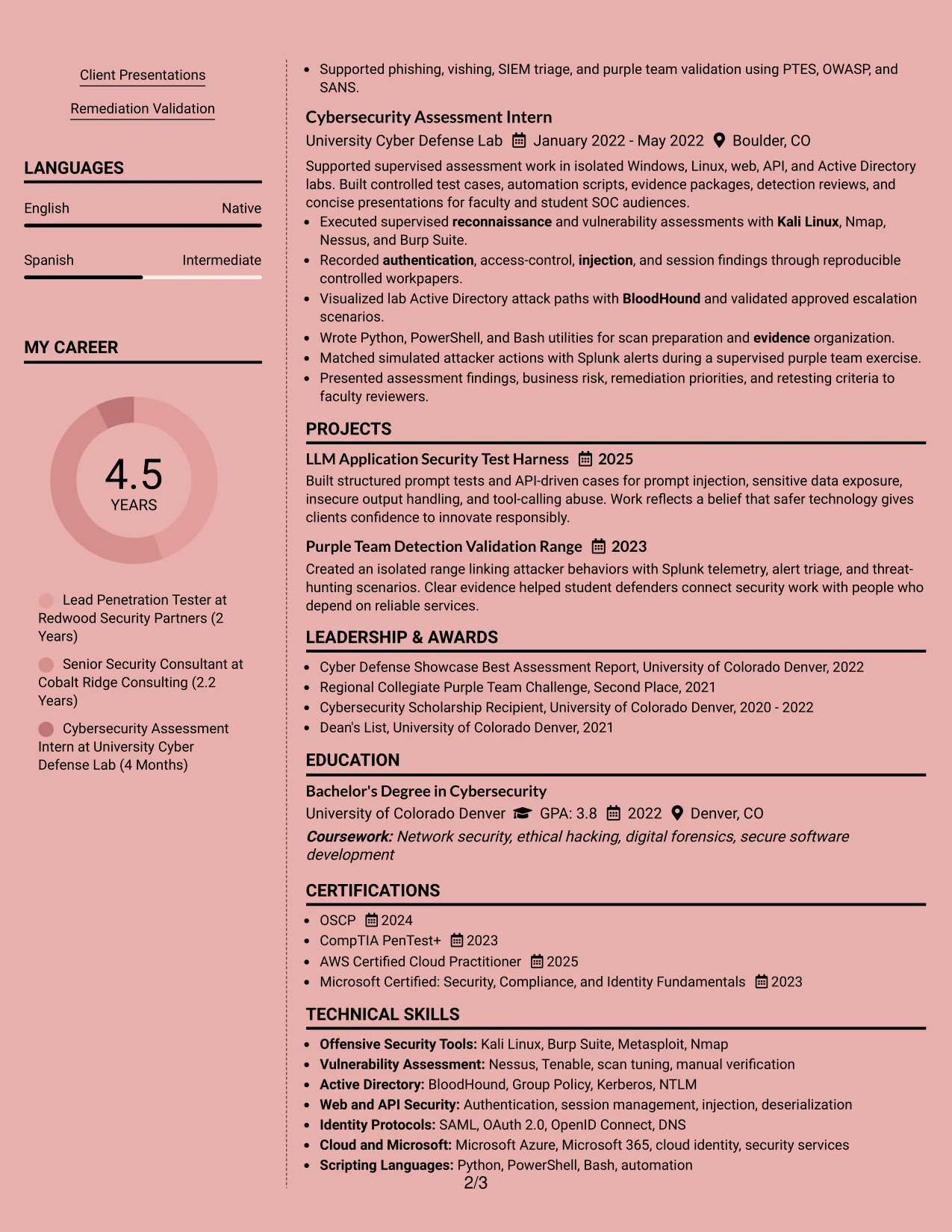
Why the Elegant Full Background Two Column Format Works for a Resume
- Two columns divide supporting details from the main career evidence.
- The visual hierarchy helps readers find the target role and summary quickly.
- A focused skills area can hold tools, frameworks, protocols, and platforms.
- Experience bullets can show testing scope, exploit validation, and client reporting.
- Certifications and education remain visible without taking attention from recent work.
- The structure supports keyword coverage for network, web, API, cloud, and Microsoft 365 testing.
- The polished design adds distinction while keeping the resume focused on measurable professional evidence.
Best For
- Resumes that need a clear split between technical skills and detailed experience.
- Candidates with several security tools, frameworks, and certifications to organize.
- Applications where recruiters need to scan assessment domains before reading full bullets.
- Professional services resumes that combine client delivery, reporting, and technical execution.
- Documents that must present both broad testing coverage and focused remediation evidence.
- Candidates who want a refined visual structure without sacrificing resume section hierarchy.
- Roles where ATS-friendly keywords need a dedicated, easy-to-find skills area.
#13 Creative Two Tone Format
The Creative Two Tone Format uses one-column sequencing with a controlled color contrast between headings and content. That structure keeps the reading path direct, so a reviewer can move from the summary to experience, skills, education, certifications, and projects without switching between columns.
The resume can present penetration testing keywords in a natural order while preserving detailed bullets about exploit validation, attack path analysis, LLM security testing, and executive reporting. The visual change between sections adds identity without replacing evidence with decoration.
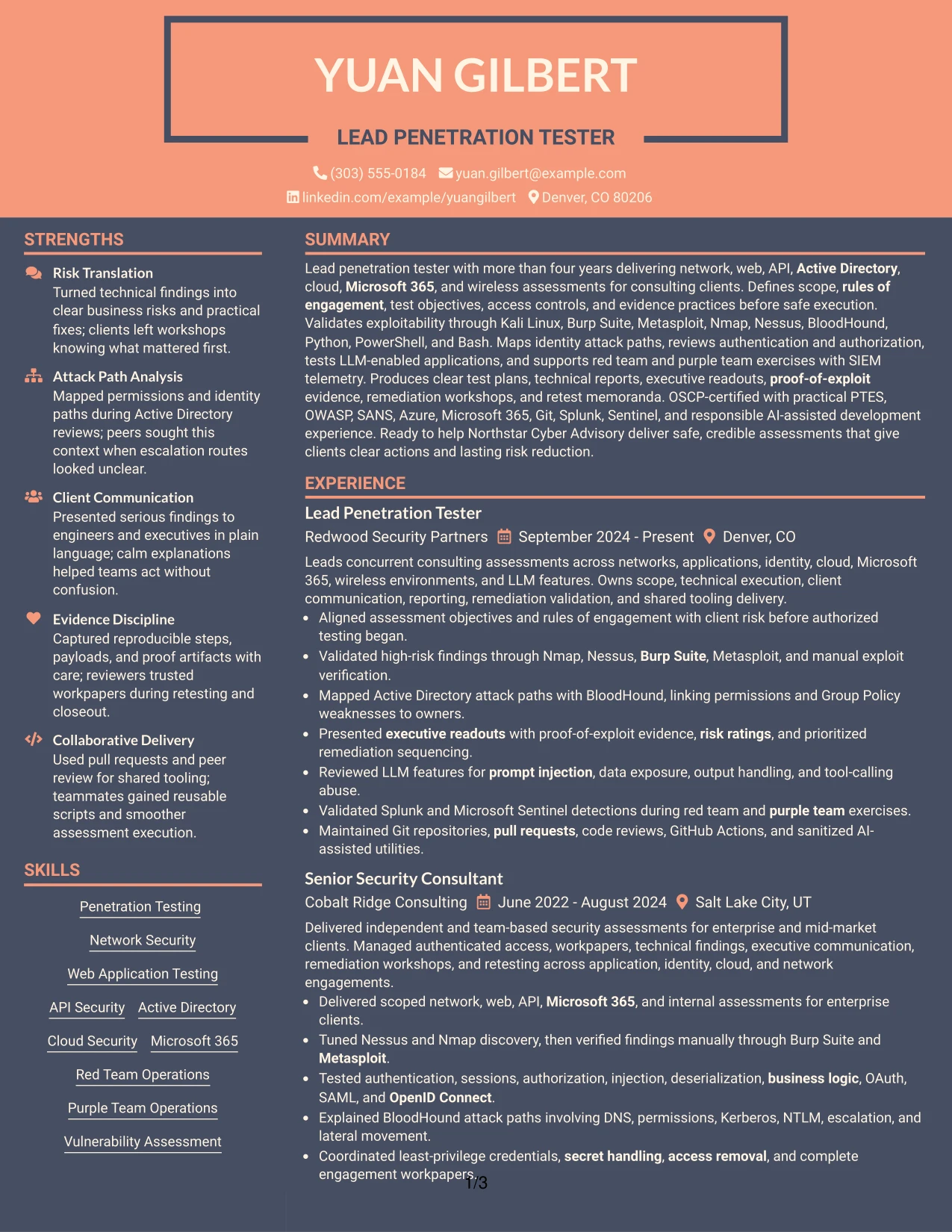
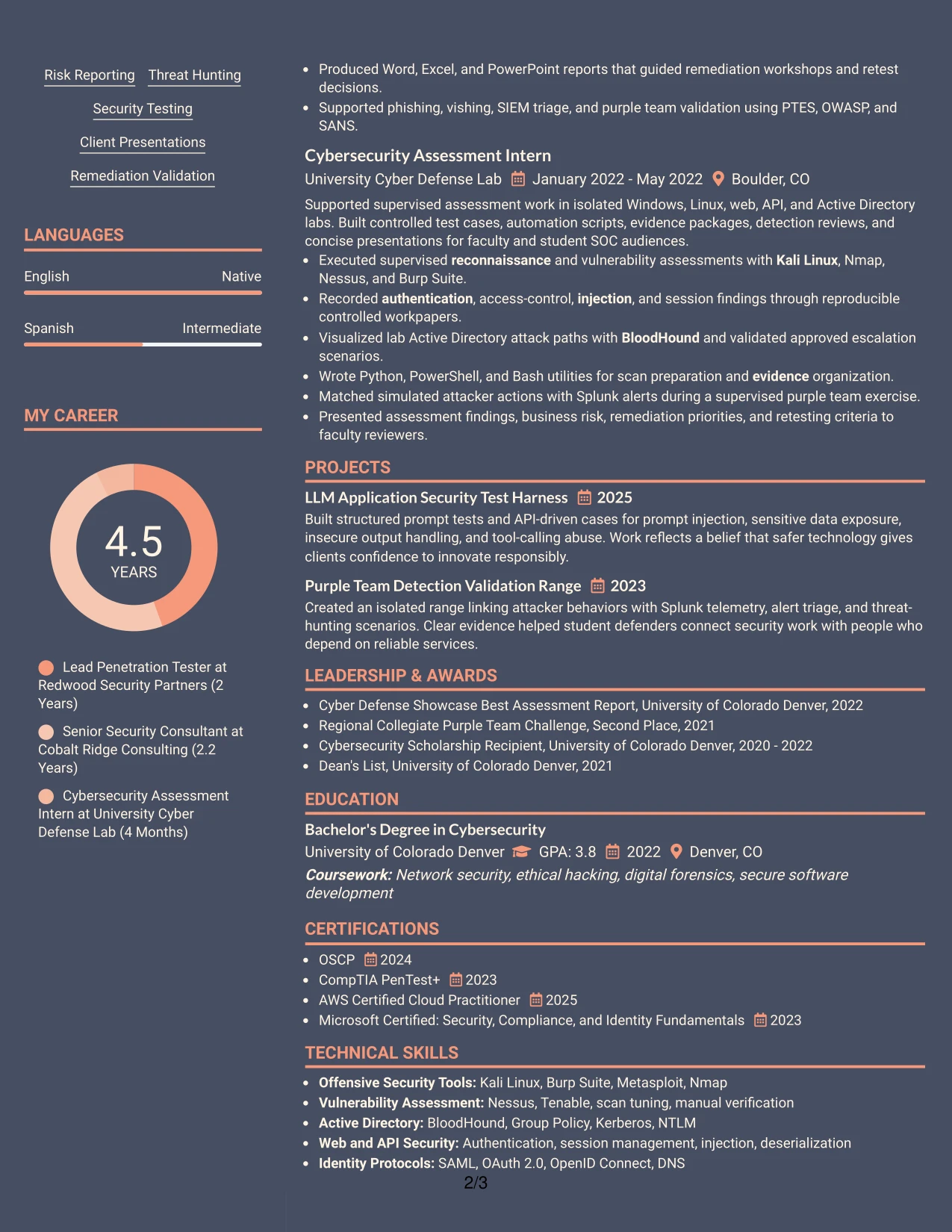
Why the Creative Two Tone Format Works for a Resume
- A single reading path reduces friction during an initial resume scan.
- Two restrained tones distinguish headings from supporting content.
- Section order makes the professional summary and recent experience easy to locate.
- Full-width bullets provide space for tools, methods, and technical findings.
- The format supports detailed project entries without crowding the main work history.
- A visible skills section can carry ATS terms such as Nessus, Nmap, and Metasploit.
- The design gives a creative touch while retaining conventional resume organization.
Best For
- One-column resumes that need a strong, uninterrupted reading sequence.
- Applications where clear section labels matter more than dense visual elements.
- Candidates presenting technical experience alongside selected security projects.
- Resumes that include long tool lists and need full-width space for readable grouping.
- Job searches that benefit from a distinctive accent while retaining standard sections.
- Documents reviewed on screens where consistent left-to-right flow improves scanning.
- Candidates who want visual separation between content areas without using a sidebar.
#14 Minimal Header Format
A recruiter or reviewer can start with the centered header, then move through the summary, experience, skills, education, projects, and certifications in a clean vertical sequence. Nothing competes with the professional title or the first evidence-rich bullets.
That direct navigation suits a Lead Penetration Tester resume with several assessment areas and tools. Full-width sections give space to describe network, web, API, Active Directory, cloud, Microsoft 365, and AI-enabled application testing in a controlled order.
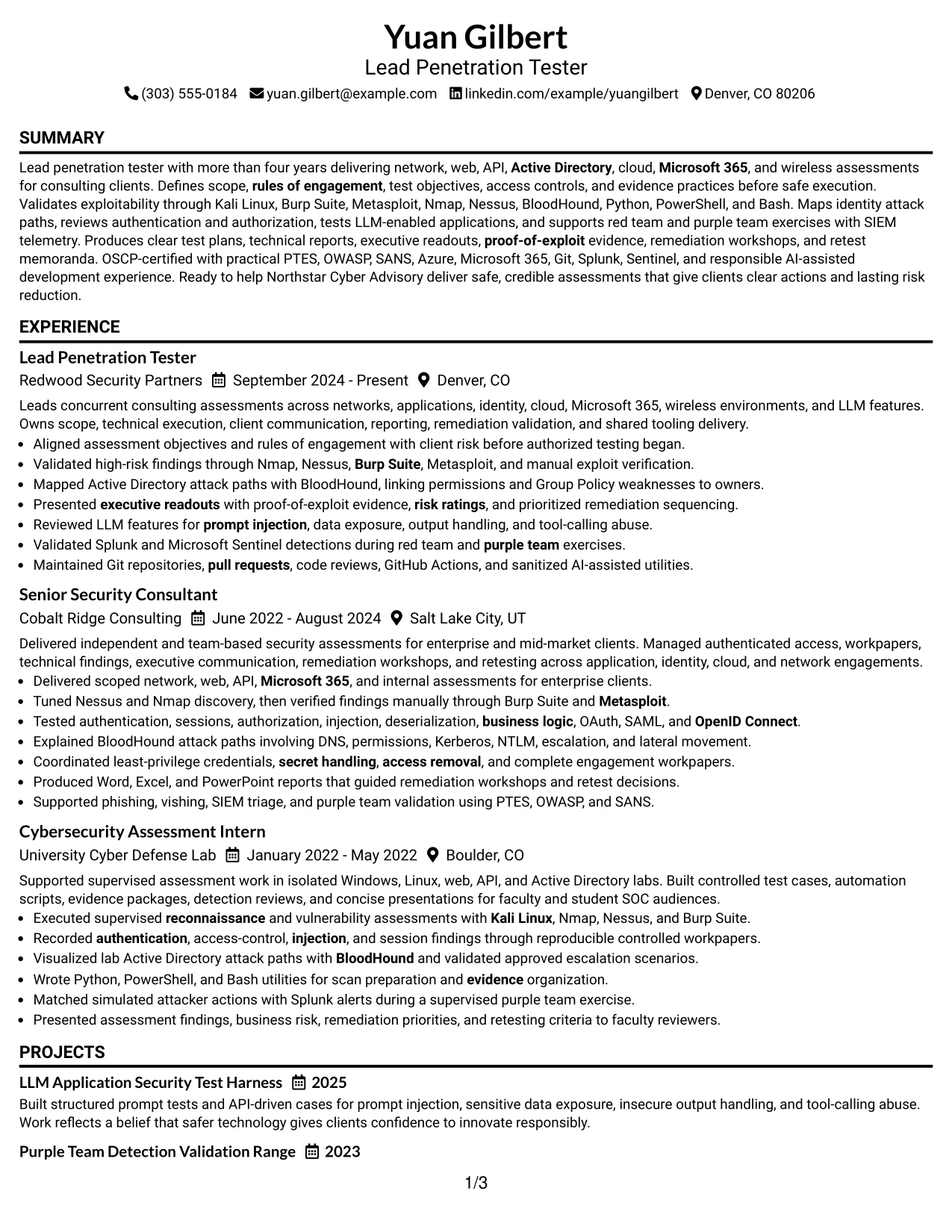
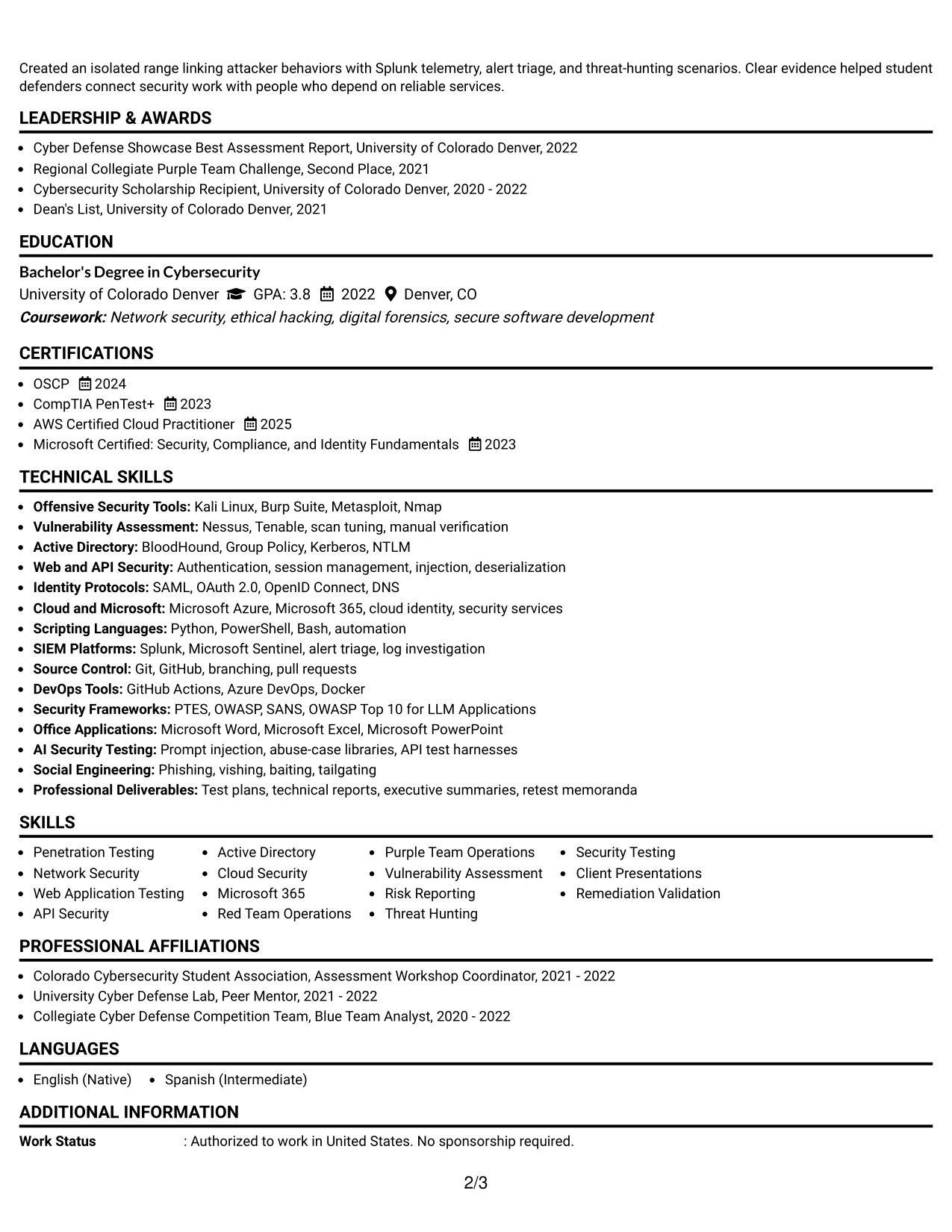
Why the Minimal Header Format Works for a Resume
- The centered header establishes the target role before the detailed content begins.
- A simple vertical sequence supports fast recruiter scanning.
- Full-width experience bullets can include scope, methods, and outcomes.
- Technical skills remain easy to locate without a crowded side panel.
- Education and certifications receive clear labels and consistent spacing.
- The design works well for ATS parsing because content follows a conventional order.
- Minimal styling keeps attention on testing evidence, reporting, and remediation work.
Best For
- Resumes that need a clean, low-distraction presentation from top to bottom.
- Candidates with substantial experience bullets that require full page width.
- Applications where conventional section order supports both ATS review and human scanning.
- Documents covering several assessment types without adding a dense sidebar.
- Professionals who want the role title and summary to anchor the review.
- Resumes that include projects, certifications, and skills alongside multiple positions.
- Screen-first applications where generous spacing improves content discovery.
#15 Plain One Column with Shaded Labels
Validated findings, reproducible evidence, and prioritized remediation receive the strongest emphasis in this resume structure. Shaded labels mark each section clearly, while the one-column body gives technical bullets enough room to explain methods, tools, and review results.
For this Lead Penetration Tester application, the format supports evidence from client assessments, Active Directory attack path work, LLM application testing, SIEM validation, and retesting. The labels make it easier to distinguish experience, skills, projects, education, and certifications.
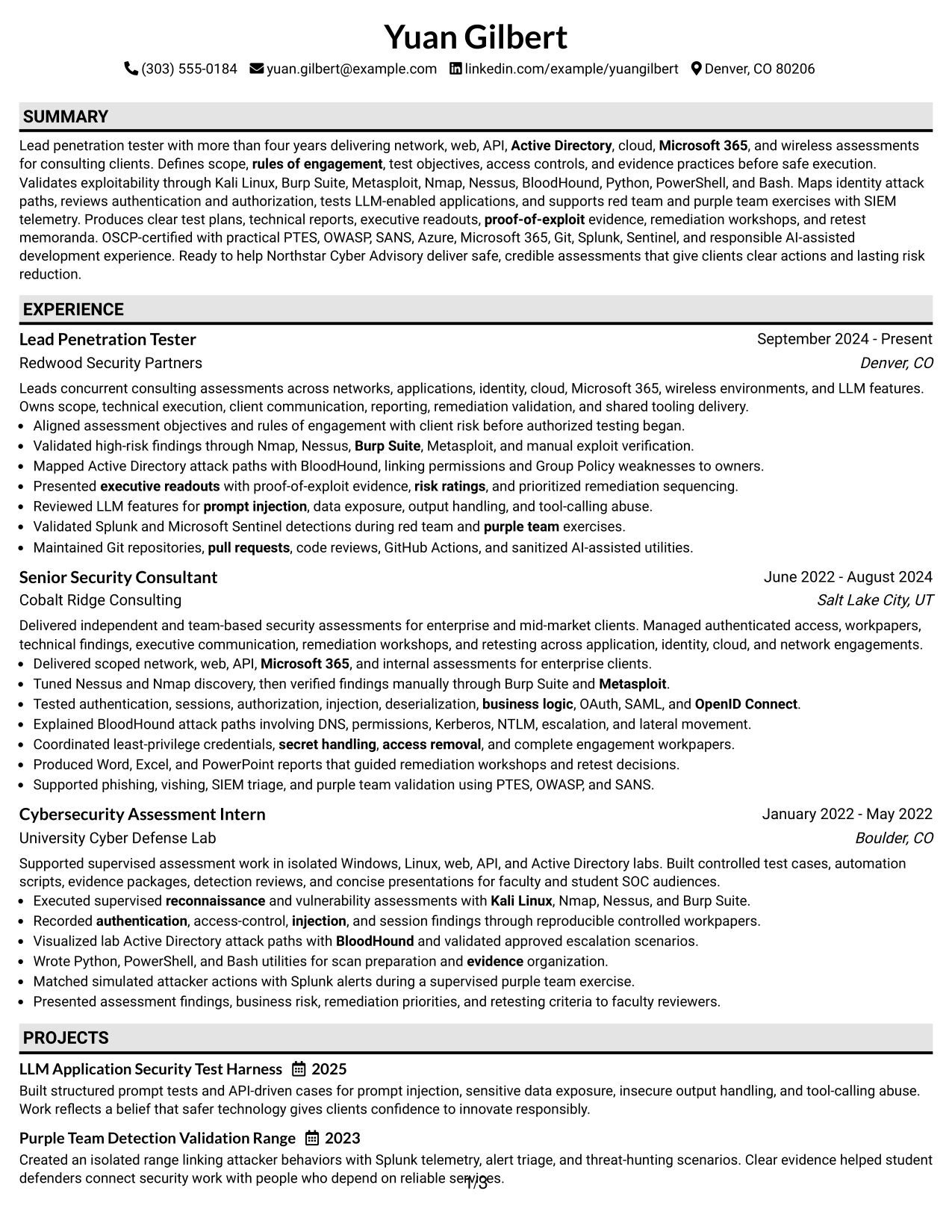
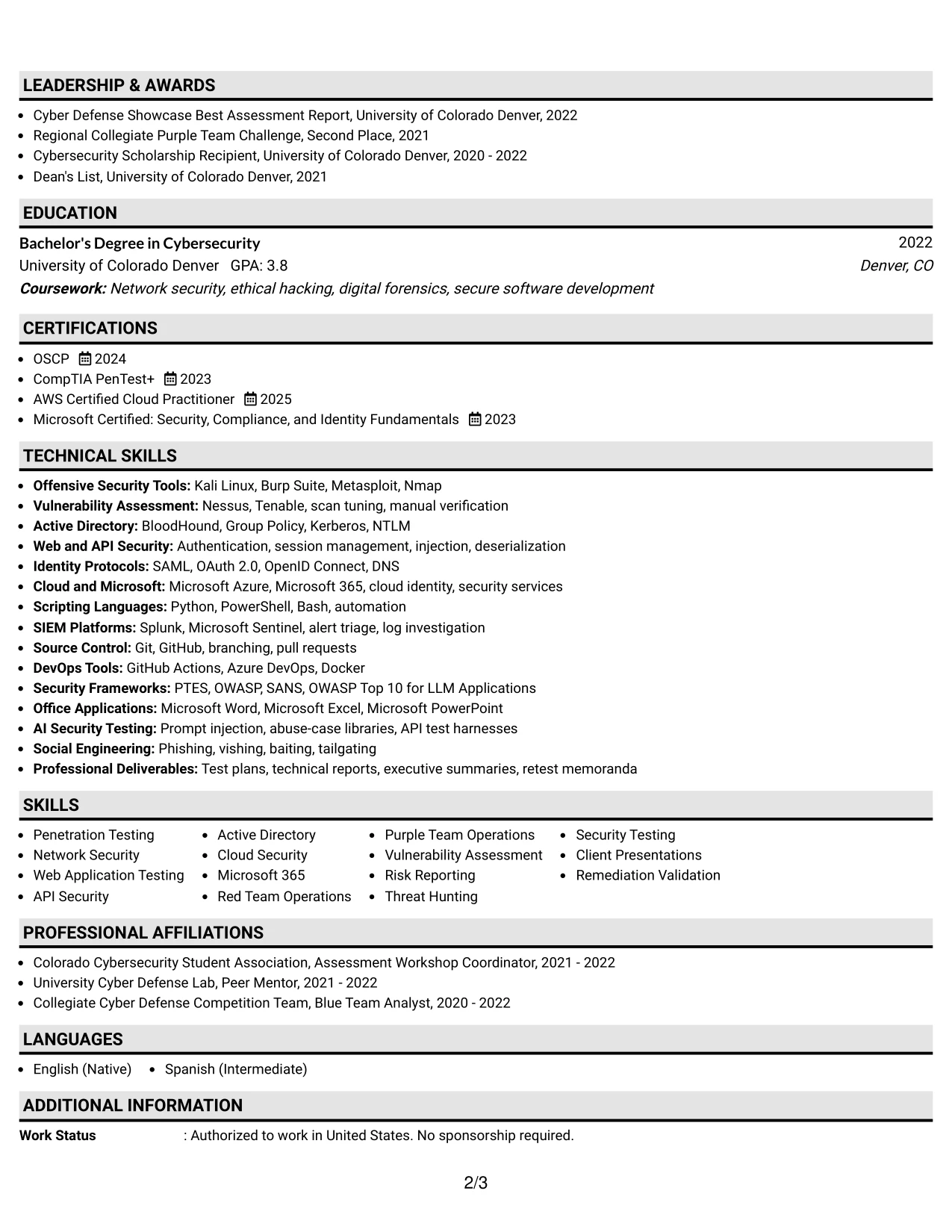
Why the Plain One Column with Shaded Labels Works for a Resume
- Shaded labels create clear boundaries between major resume sections.
- One-column bullets keep proof, method, and result together.
- The layout gives reproducible testing steps room to remain specific.
- Technical tools can be tied directly to assessment evidence rather than listed alone.
- Reporting and executive presentation work can appear beside the findings they explain.
- Project and certification sections remain easy to identify during a focused review.
- A plain visual system supports ATS readability and dependable information retrieval.
Best For
- Evidence-led resumes where technical proof should remain central.
- Candidates who need room for detailed assessment bullets and remediation notes.
- Applications that value clear separation between experience, skills, projects, and credentials.
- Documents with several testing methods that must be connected to specific results.
- Professionals presenting workpapers, proof-of-exploit evidence, and retesting activity.
- ATS-conscious applications that benefit from simple labels and standard sequencing.
- Readers who prefer practical content over decorative resume elements.
#16 Text/Fang Style
Content is balanced through consistent text blocks, measured spacing, and a straightforward one-column structure. The result gives the summary, employment history, skills, projects, education, and certifications enough room to remain readable without creating visual crowding.
This application context is useful for a Lead Penetration Tester resume that must connect technical depth with consulting delivery. Bullets can show concurrent assessments, client communication, risk translation, tooling, and retesting while the skills section reinforces the required keywords.
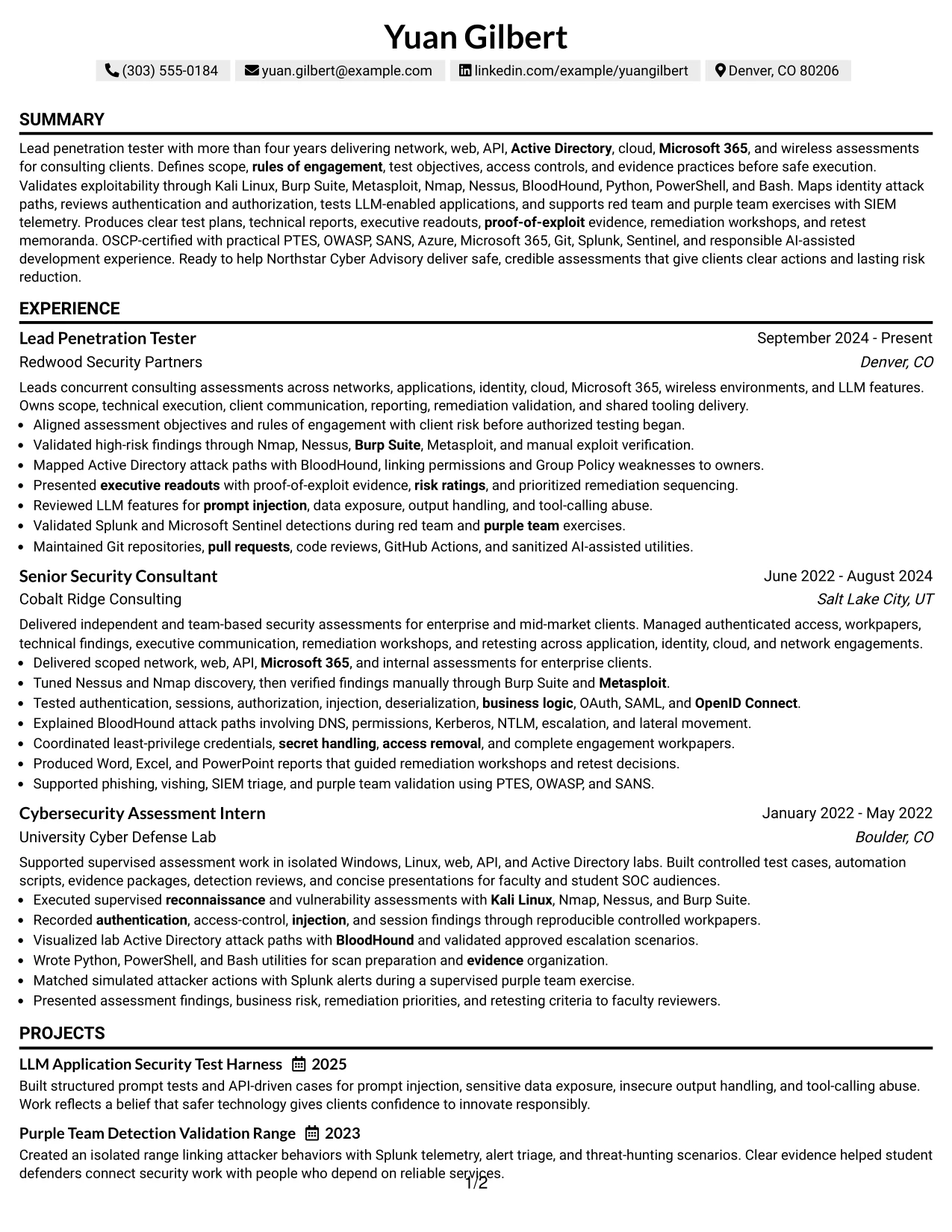
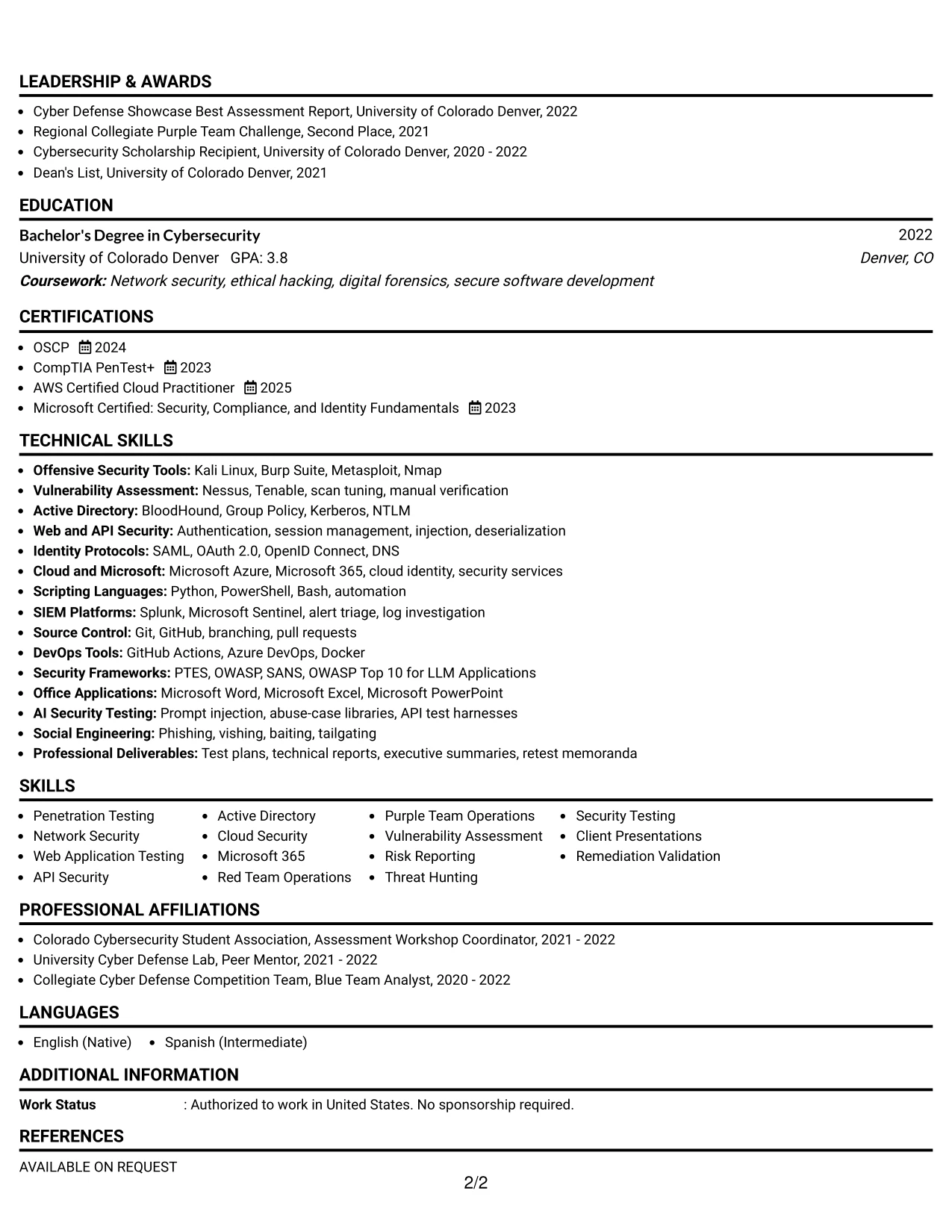
Why the Text/Fang Style Works for a Resume
- Consistent spacing helps readers compare roles and dates quickly.
- The one-column structure keeps consulting responsibilities in a logical sequence.
- Text blocks can explain both technical execution and client-facing delivery.
- The format accommodates tools, protocols, frameworks, and platforms without a compressed sidebar.
- Project entries can add evidence of automation and LLM security testing.
- Education and certifications remain part of the same dependable reading flow.
- A balanced page supports detailed content while avoiding unnecessary visual noise.
Best For
- Consulting applications that require both technical detail and delivery context.
- Resumes with several roles that need consistent treatment across dates and bullets.
- Candidates combining client assessments, internal tooling, and security projects.
- Documents where readable text density matters more than decorative design.
- Applications that must show methods, reporting, and validation in one continuous flow.
- Professionals with broad skills who need room to group related technologies.
- Review processes that reward clear chronology and steady section spacing.
#17 Bold Color Header Professional Format
A practical application needs immediate role recognition and a clear path to the strongest qualifications. The bold color header provides that anchor, while the one-column body keeps the summary, experience, skills, education, projects, and certifications in a familiar order.
For a Lead Penetration Tester resume, the format gives high-value evidence a professional setting without hiding technical detail. Bullets can connect Kali Linux, Burp Suite, BloodHound, SIEM telemetry, and remediation guidance to actual assessment responsibilities.
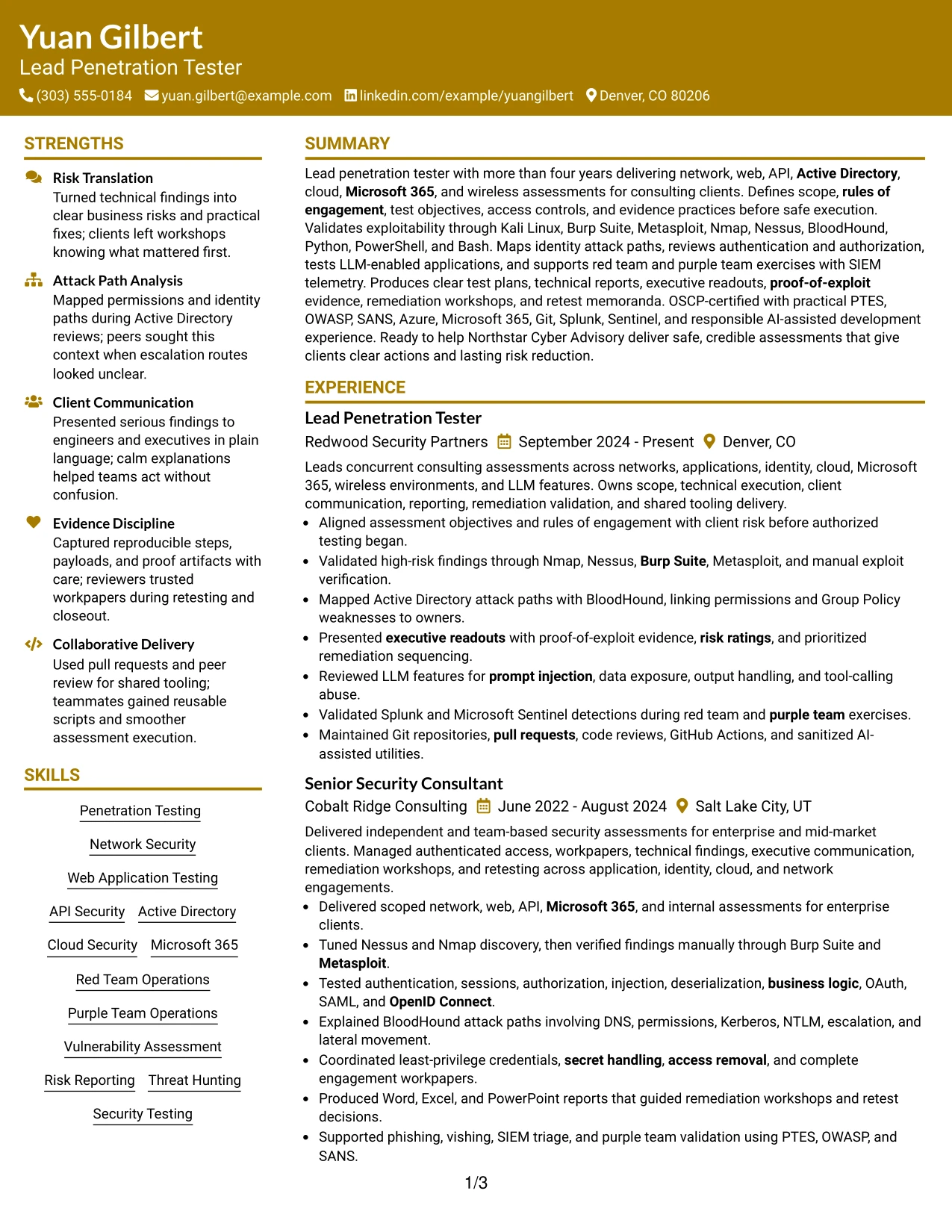
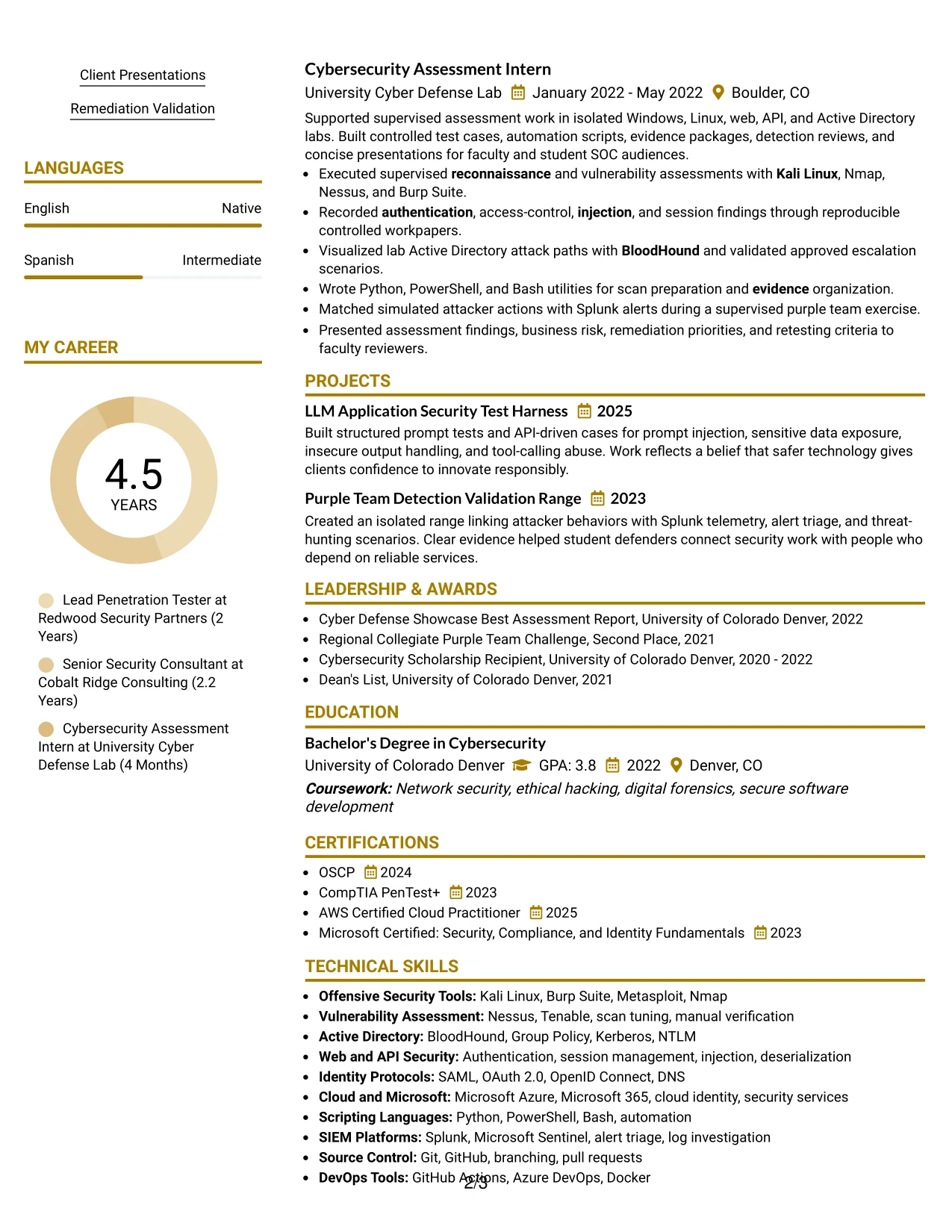
Why the Bold Color Header Professional Format Works for a Resume
- The strong header makes the target role visible at the start of review.
- One-column sequencing supports predictable recruiter and ATS navigation.
- Professional color emphasis separates the identity area from detailed content.
- Experience bullets can connect tools to testing actions and client outcomes.
- The skills section can reinforce required technologies without interrupting chronology.
- Projects and certifications add depth while staying within a familiar structure.
- The format balances a confident presentation with evidence-based resume content.
Best For
- Applications that need a confident header without a complex page structure.
- Candidates whose recent experience should remain the main visual focus.
- Resumes combining technical tools with executive reporting and client workshops.
- Professional services submissions where polished presentation supports credibility.
- Documents that need a visible role title and quick access to core skills.
- Candidates presenting both assessment delivery and shared tooling contributions.
- Screening processes that benefit from conventional one-column organization.
#18 Photo Header Color Sidebar Format
A restrained visual hierarchy combines a compact header area with a color sidebar, giving the resume a recognizable profile while preserving a clear content path. The main body can carry detailed experience, projects, education, and certifications, while the sidebar groups supporting skills and contact information.
For this Lead Penetration Tester application, the structure can separate broad technical coverage from evidence-rich work history. Network, web, API, Active Directory, cloud, Microsoft 365, LLM, and purple team experience remain visible without forcing every keyword into the opening summary.
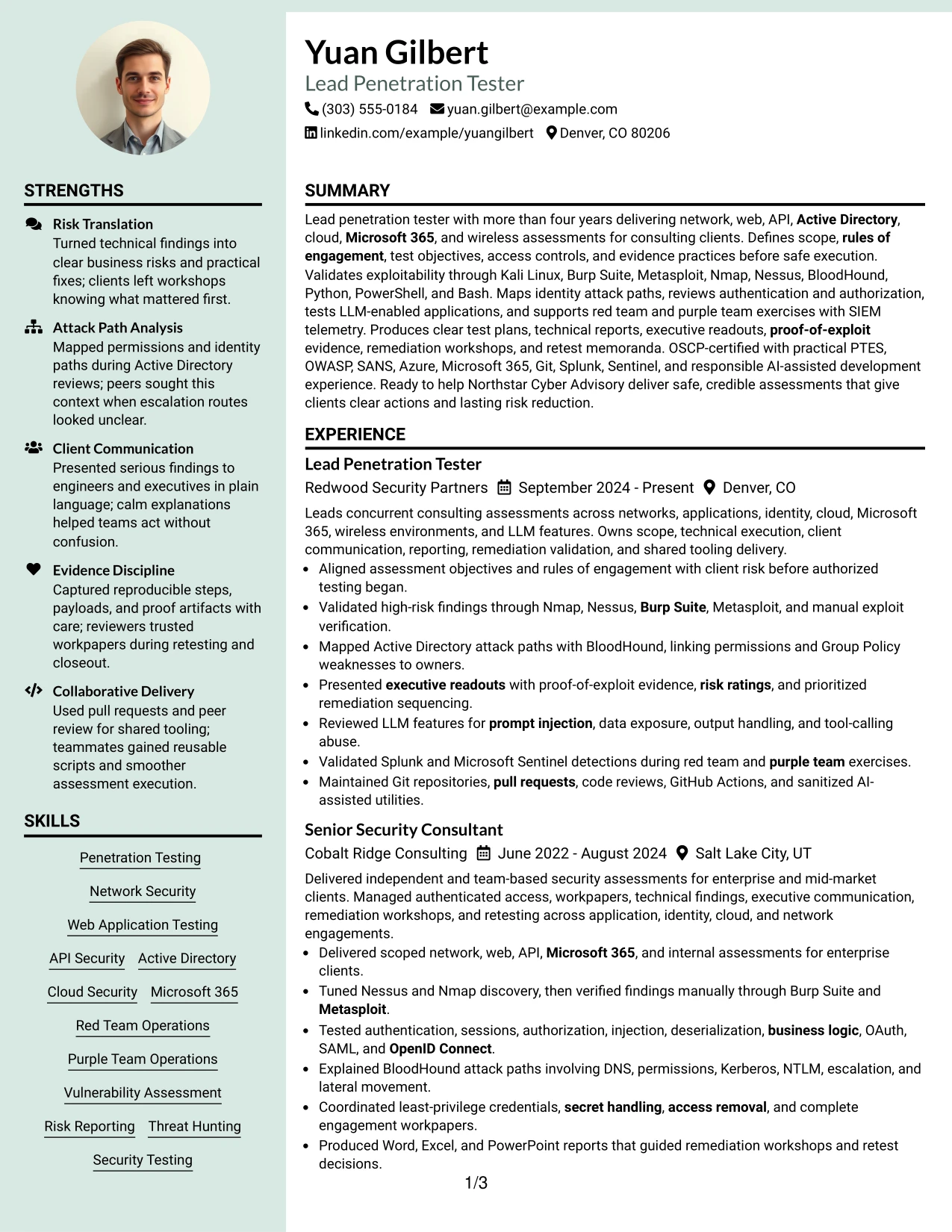
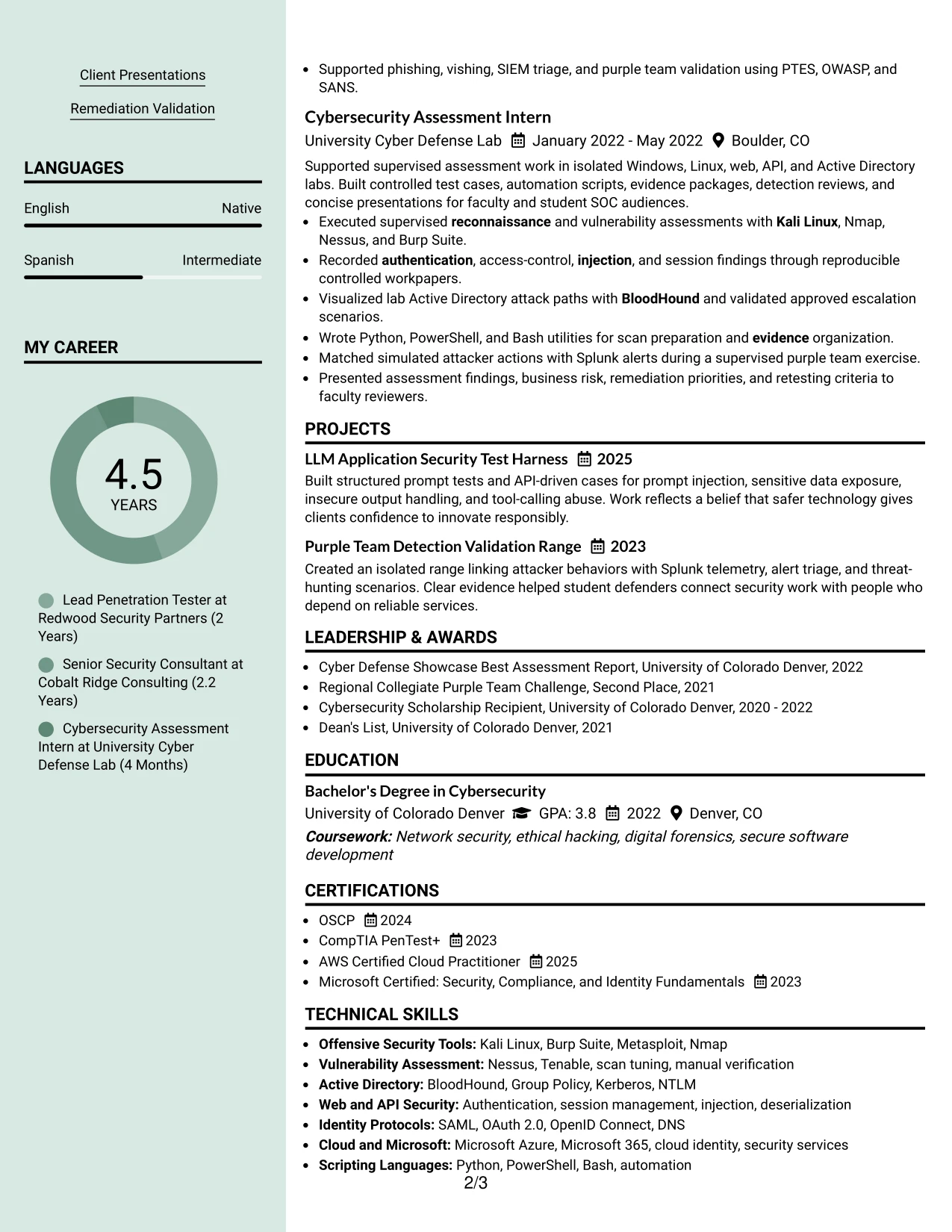
Why the Photo Header Color Sidebar Format Works for a Resume
- The header creates immediate role and identity recognition.
- A sidebar can group contact details, skills, tools, and certifications efficiently.
- The main content area preserves space for detailed experience bullets.
- Color separation helps readers distinguish supporting data from career evidence.
- The structure supports broad technical coverage without making the work history feel crowded.
- Projects can add focused proof of automation and LLM application testing.
- The format offers a polished presentation while retaining clear resume section hierarchy.
Best For
- Resumes that benefit from a distinct profile area and organized supporting details.
- Candidates with broad tools and frameworks that fit well in a compact sidebar.
- Applications where the main column must preserve room for detailed client work.
- Professionals combining assessment delivery, projects, certifications, and technical skills.
- Documents that need quick access to contact, skills, and credential information.
- Candidates seeking a polished presentation for consulting and security advisory roles.
- Screen-based reviews where color blocks help readers locate supporting sections.
#19 Top Left Header Color Accent Format
The Top Left Header Color Accent Format places the role and contact details at the start of a conventional one-column structure. From there, the reader can scan the summary, experience, skills, projects, education, and certifications in a stable sequence.
That arrangement gives a Lead Penetration Tester resume a clear entry point while preserving space for technical evidence. The content can show exploit validation, client reporting, attack path analysis, AI security testing, and shared tooling without relying on dense visual effects.
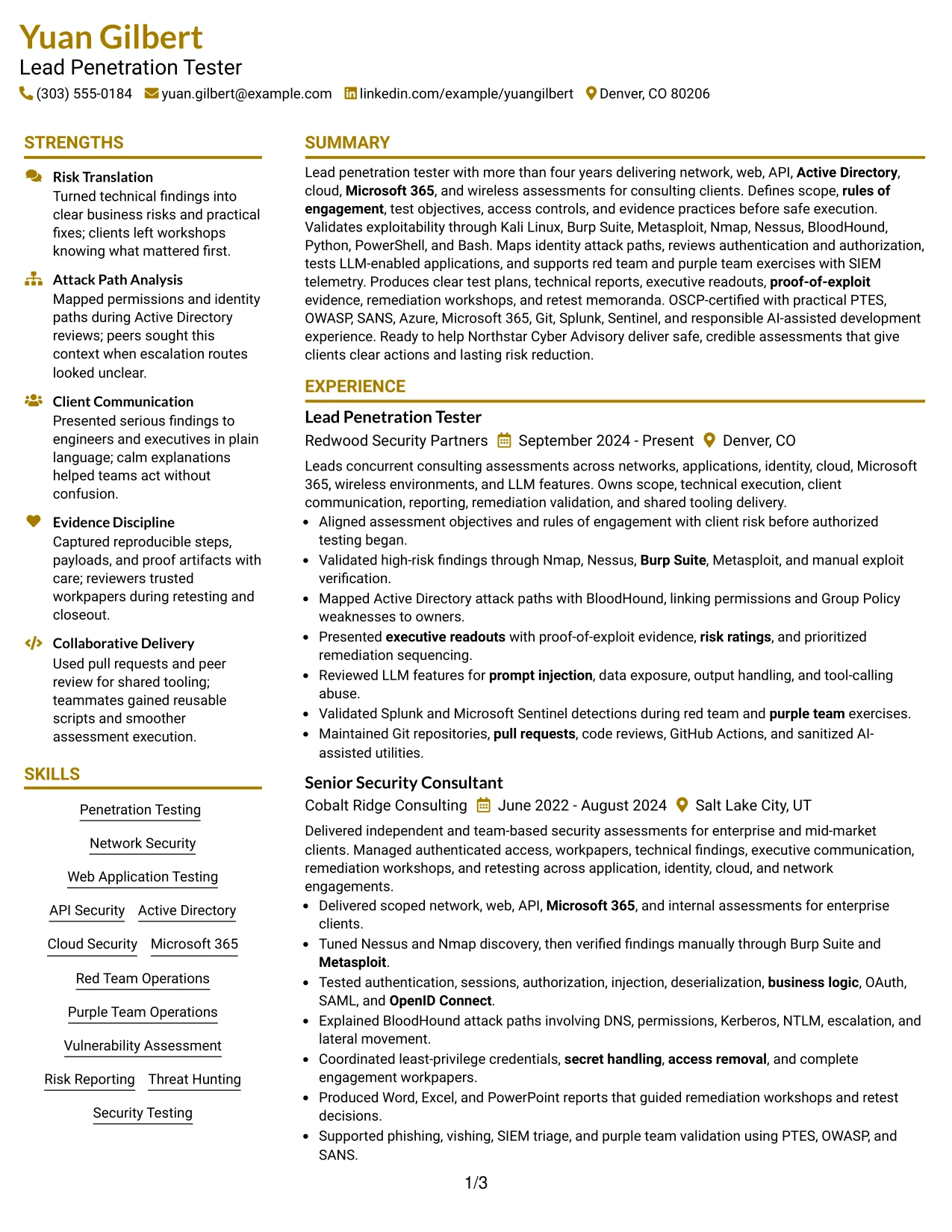
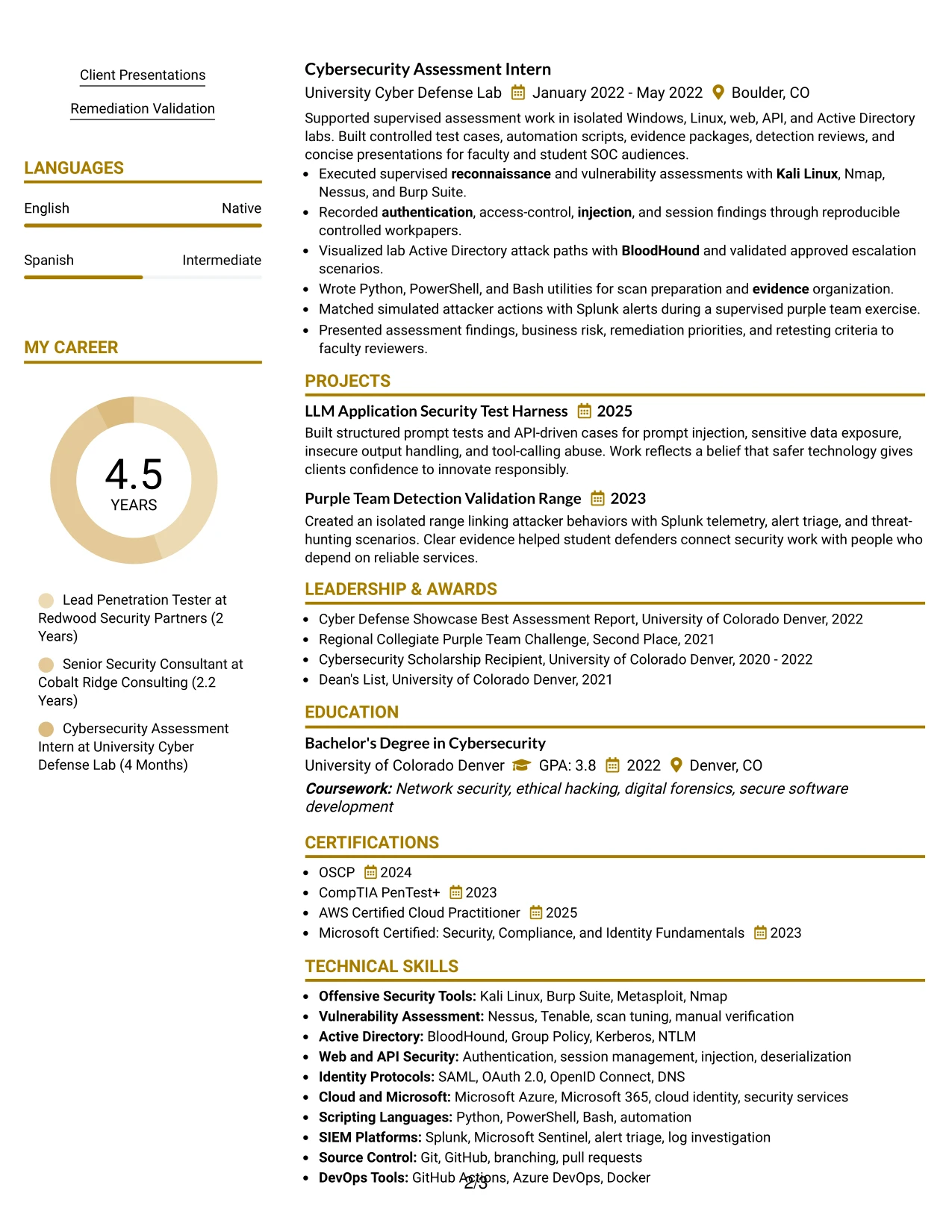
Why the Top Left Header Color Accent Format Works for a Resume
- A top-left header follows a familiar reading pattern.
- The accent helps the identity area stand out without disrupting ATS structure.
- One-column sections support direct comparison of roles and dates.
- Full-width bullets can explain testing actions, evidence, and remediation guidance.
- The skills section remains available for tools, protocols, frameworks, and platforms.
- Projects and certifications can be added without competing with employment history.
- The format keeps visual distinction subordinate to clear professional content.
Best For
- Resumes that need a recognizable header and standard reading order.
- Candidates who want a subtle accent rather than a highly styled page.
- Applications with detailed work history that benefits from full-width bullets.
- Documents balancing technical skills, project evidence, and professional experience.
- Professionals whose strongest qualifications should appear near the top and remain easy to find.
- ATS-aware submissions using familiar headings and predictable section flow.
- Screening environments where restrained design supports quick information retrieval.
#20 Centered Header Classic Two Column Format
A reviewer can begin at the centered header, confirm the target role, and then move through two organized content areas. One side can hold skills, certifications, education, and projects, while the other gives experience bullets enough room to show assessment scope and results.
The classic two-column design suits the resume's broad technical coverage without losing chronology. It supports quick comparison of tools and credentials with evidence involving network, web, API, Active Directory, cloud, Microsoft 365, SIEM, and LLM testing.
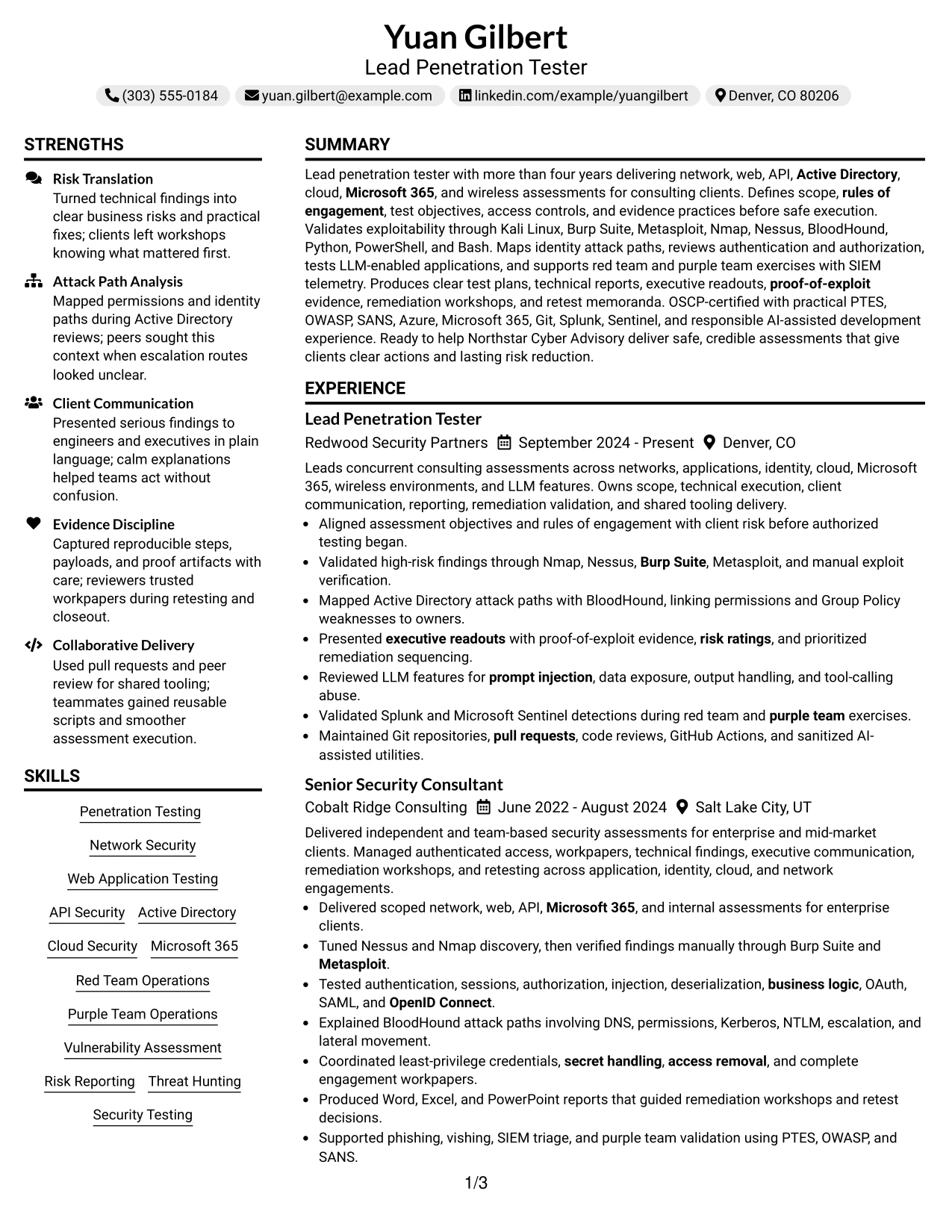
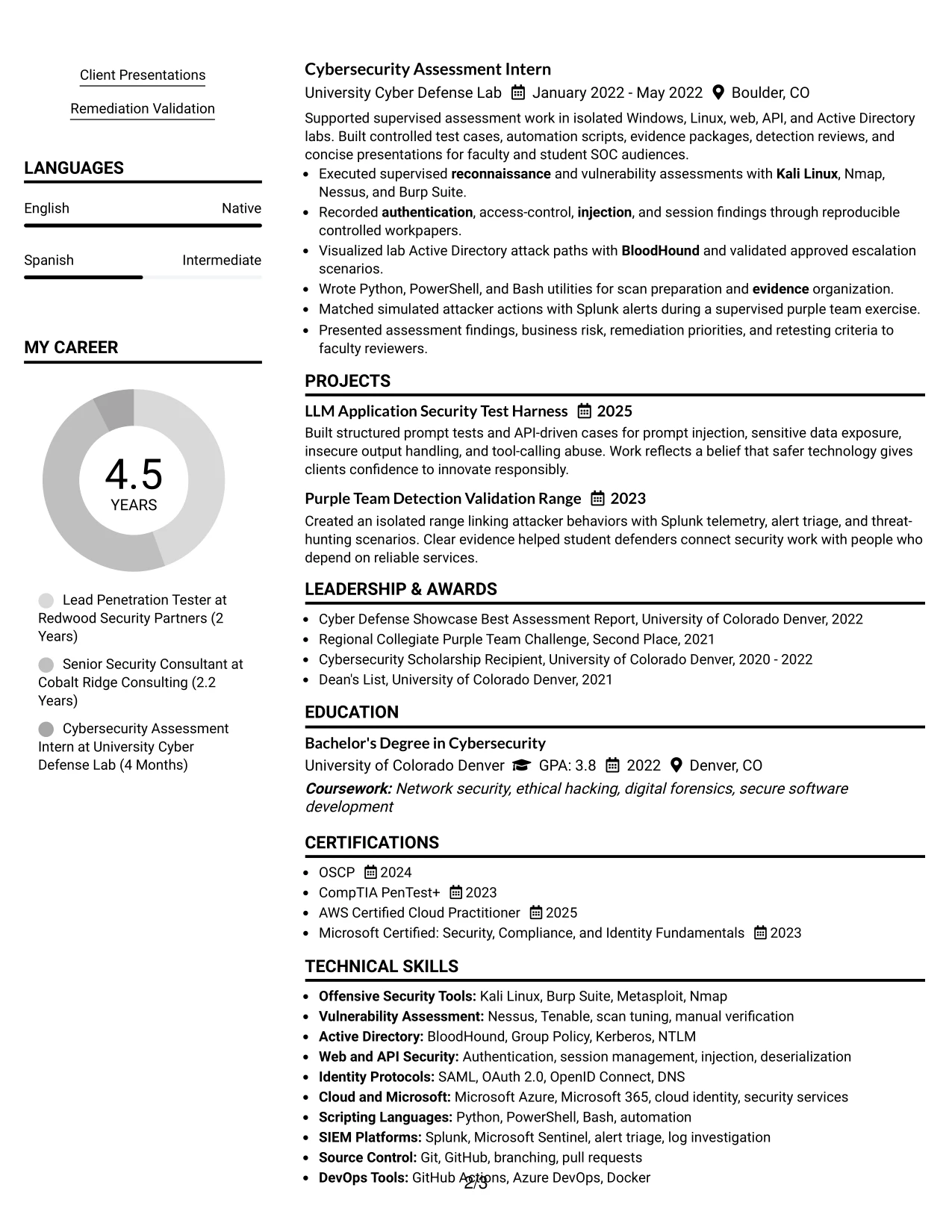
Why the Centered Header Classic Two Column Format Works for a Resume
- The centered header gives the document a balanced starting point.
- Two columns organize supporting qualifications beside detailed work history.
- Bullets can present assessment scope and remediation evidence in a focused area.
- Skills and certifications remain visible during an initial scan.
- Projects provide additional proof of automation and detection validation.
- The structure supports a substantial keyword set without creating a long uninterrupted page.
- Classic spacing and bullets make the format familiar to both recruiters and ATS tools.
Best For
- Resumes with enough supporting content to justify a two-column information split.
- Candidates who need skills and credentials visible beside several detailed roles.
- Applications where projects can strengthen, rather than interrupt, the work history.
- Professionals presenting broad assessment coverage across infrastructure and applications.
- Documents reviewed by readers who compare tools, certifications, and experience in parallel.
- Candidates who want a centered identity area with a traditional professional structure.
- Role submissions that need efficient use of page space without reducing bullet clarity.
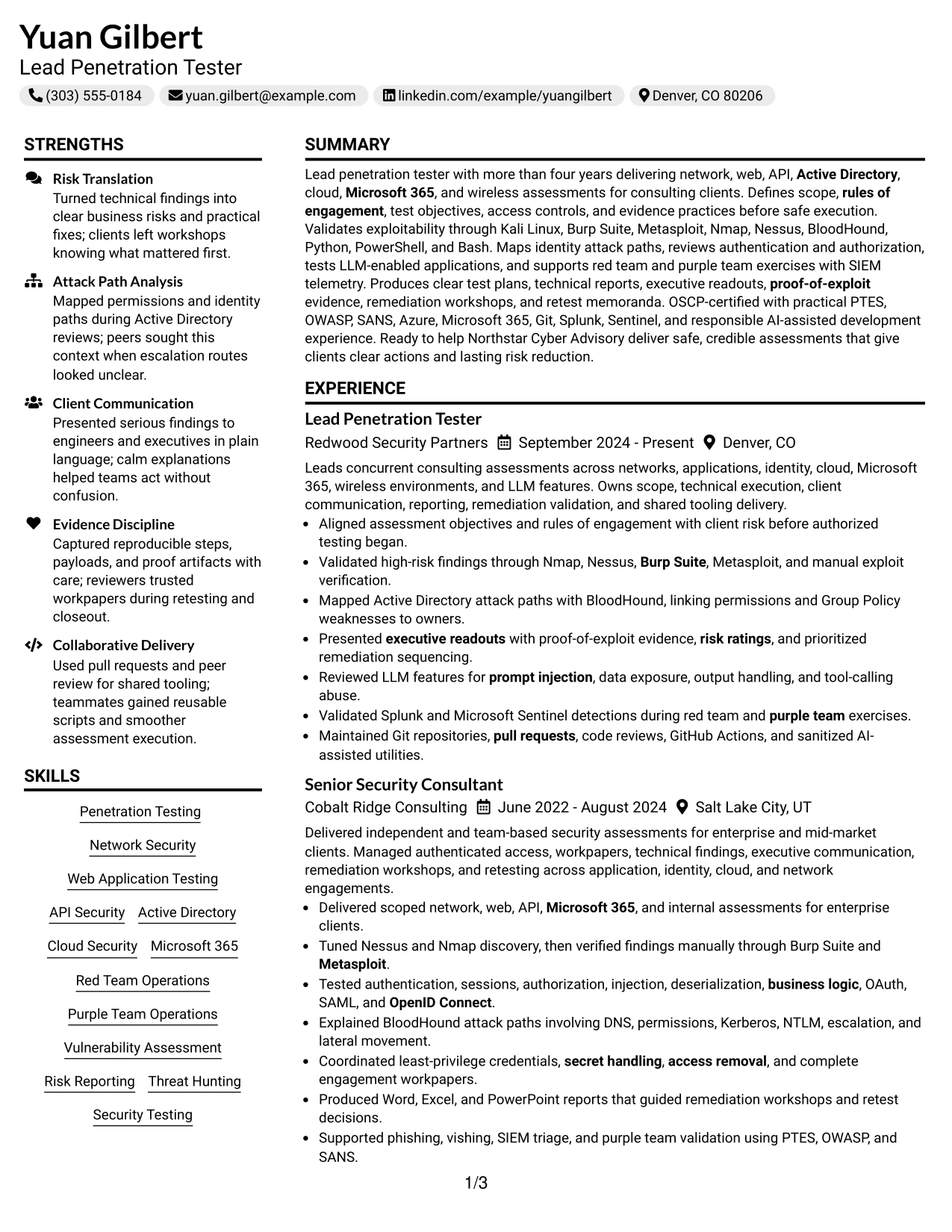
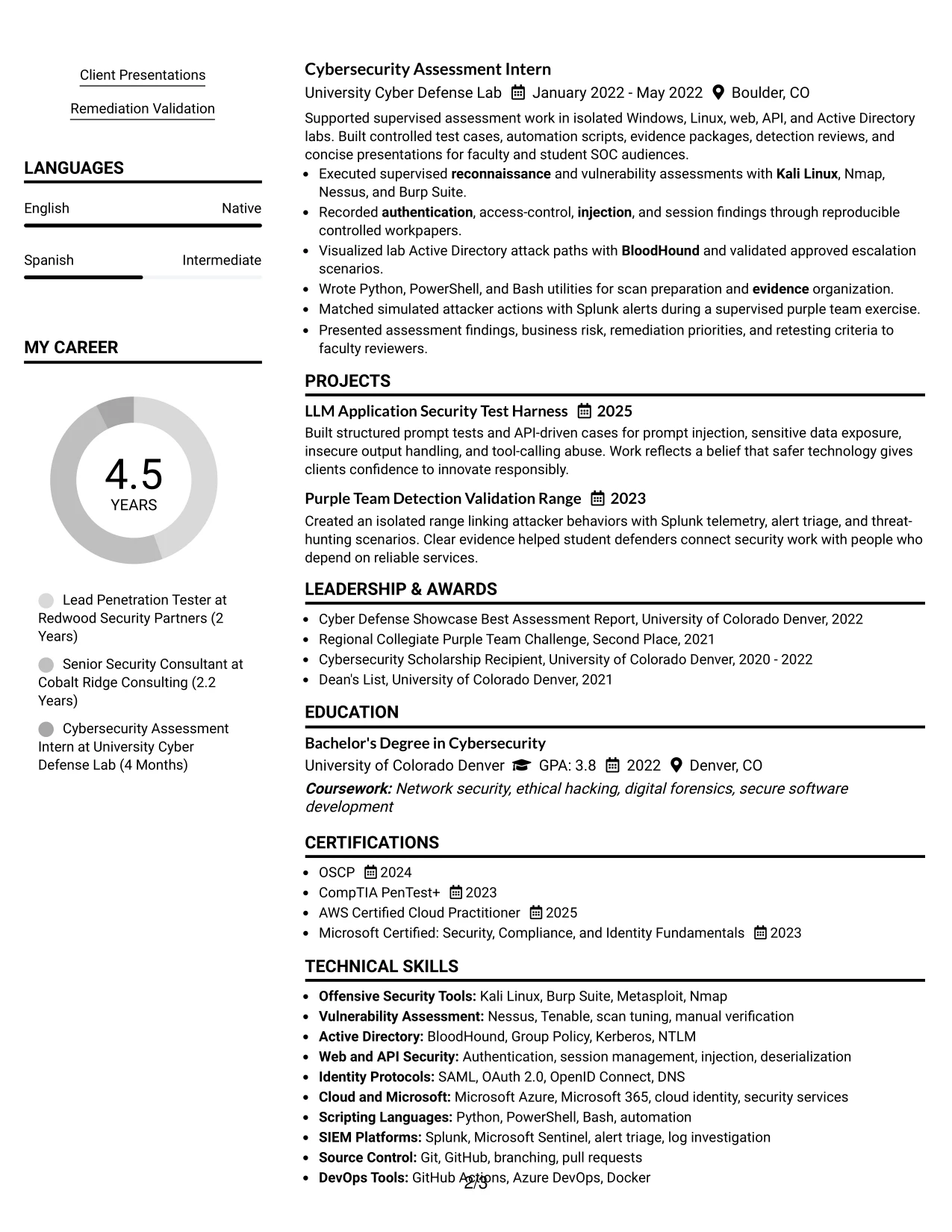
#21 Left Aligned Header Clean Two Column Format
Reproducible testing work, validated findings, and clear remediation guidance form the evidence core of this resume layout. The left-aligned header leads into two clean columns, allowing detailed experience to sit beside skills, projects, education, and certifications.
For a Lead Penetration Tester resume, that division helps connect technical methods with consulting outcomes. A reviewer can see tools such as Nessus, Nmap, Burp Suite, Metasploit, and BloodHound while also finding proof of reporting, executive readouts, detection validation, and retesting.
Why the Left Aligned Header Clean Two Column Format Works for a Resume
- The left-aligned header supports fast recognition of the role and contact details.
- Two columns place supporting qualifications close to the main evidence.
- The experience area can preserve detailed bullets about testing and remediation.
- Skills can list tools and protocols without taking space from work history.
- Projects add focused evidence of automation and security testing methods.
- Education and certifications remain visible for qualification review.
- Clean alignment supports readable scanning and consistent ATS interpretation.
Best For
- Evidence-heavy resumes that need a clean separation of proof and supporting details.
- Candidates with technical tools, certifications, and projects to show beside experience.
- Applications where remediation, reporting, and retesting should remain prominent.
- Professionals presenting both hands-on testing and structured consulting deliverables.
- Documents that need efficient two-column organization without decorative clutter.
- Readers comparing technical coverage with education and credential information.
- ATS-conscious submissions that still benefit from compact page organization.
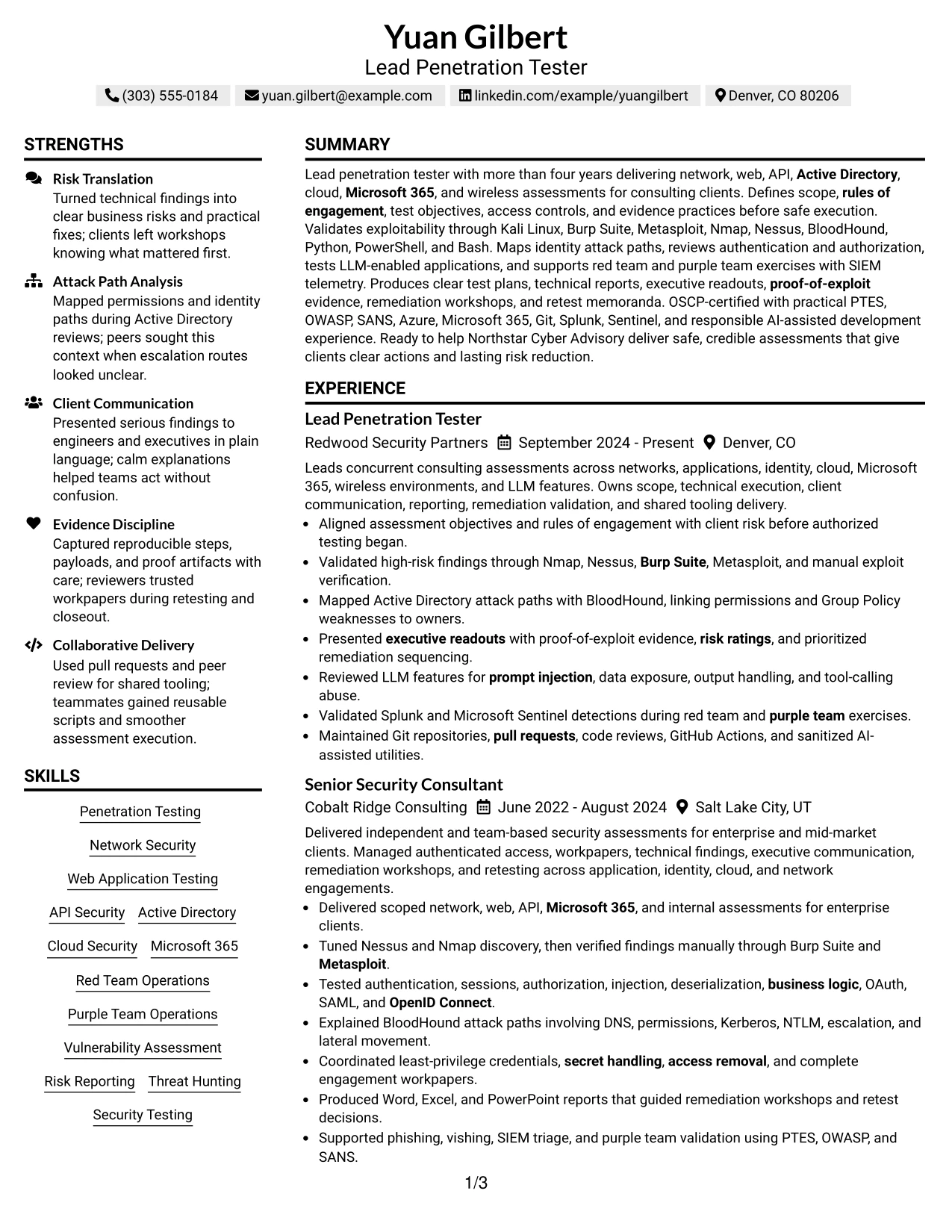
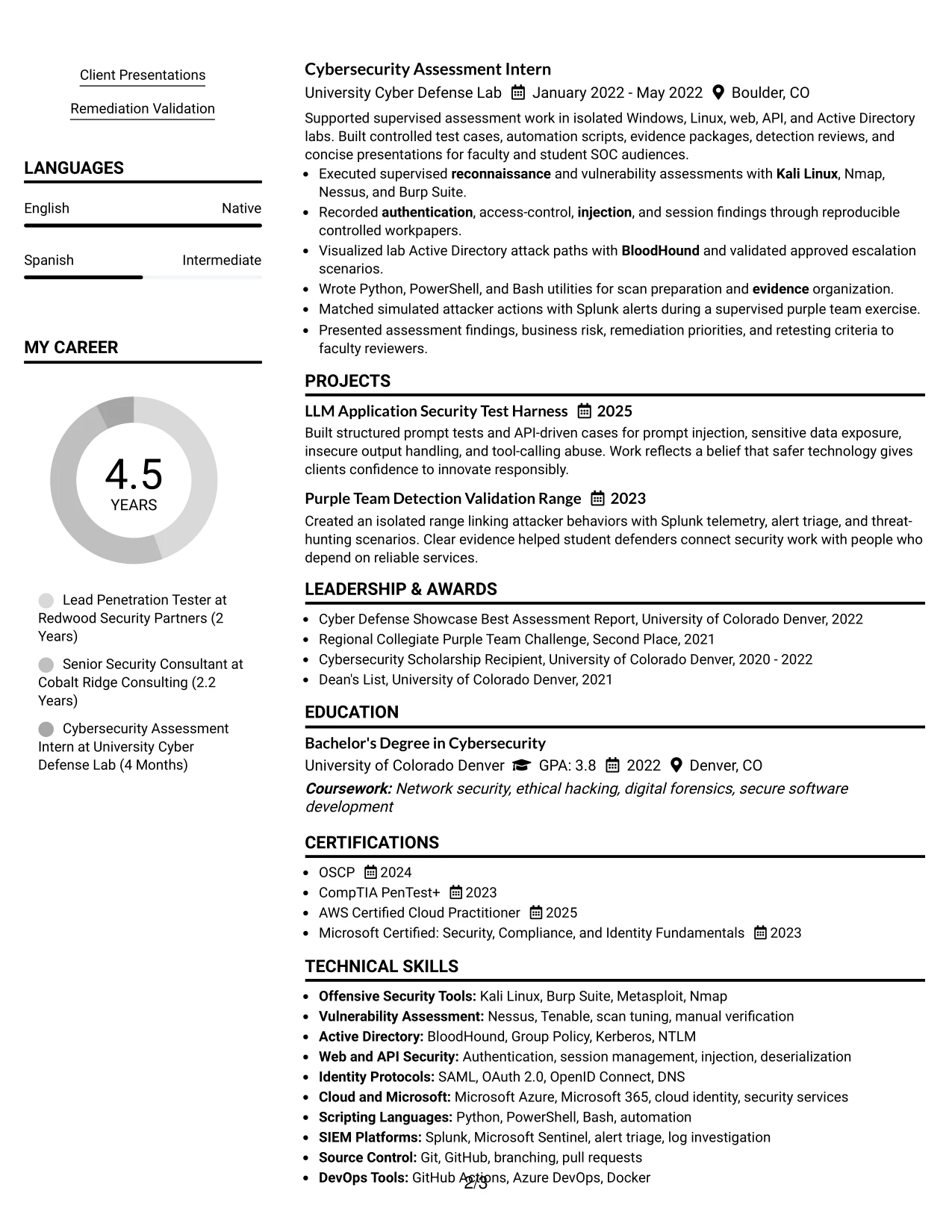
#22 Simple Two Column Format
Space is balanced between the main career record and supporting qualifications. A simple two-column structure can place experience and achievement bullets in one area while grouping skills, projects, education, and certifications in the other.
That organization works well for a Lead Penetration Tester resume with a wide assessment scope. It keeps network, web, API, identity, cloud, Microsoft 365, LLM, red team, and purple team evidence available without making the page feel overloaded.
Why the Simple Two Column Format Works for a Resume
- Balanced columns make broad content easier to review in limited space.
- The main column can carry chronological experience and detailed bullets.
- The supporting column can group tools, skills, education, projects, and certifications.
- Simple visual treatment keeps the focus on testing evidence and outcomes.
- The structure supports both technical keywords and client-facing deliverables.
- Projects can demonstrate automation, detection validation, and LLM security testing.
- Clear separation helps readers find relevant information without excessive navigation.
Best For
- Resumes that need compact organization for a broad set of qualifications.
- Candidates combining several assessment domains with substantial technical tooling.
- Applications where experience should remain prominent beside concise supporting sections.
- Professionals presenting projects and certifications without extending every section vertically.
- Documents that benefit from straightforward grouping rather than decorative complexity.
- Screen-based reviews where balanced columns improve content discovery.
- Candidates who need a practical format for skills, evidence, and consulting delivery.
#23 Accent Divider Modern Two Column Format
For a Lead Penetration Tester application, a two-column structure helps separate contact details, skills, certifications, and education from the main evidence. Accent dividers guide the reader from the summary into consulting experience, assessment results, projects, and remediation work.
The format supports fast review without reducing technical detail. Short bullets can feature Active Directory attack paths, LLM security testing, SIEM validation, client reporting, and reusable tooling while keeping the page organized for both human readers and ATS parsing.
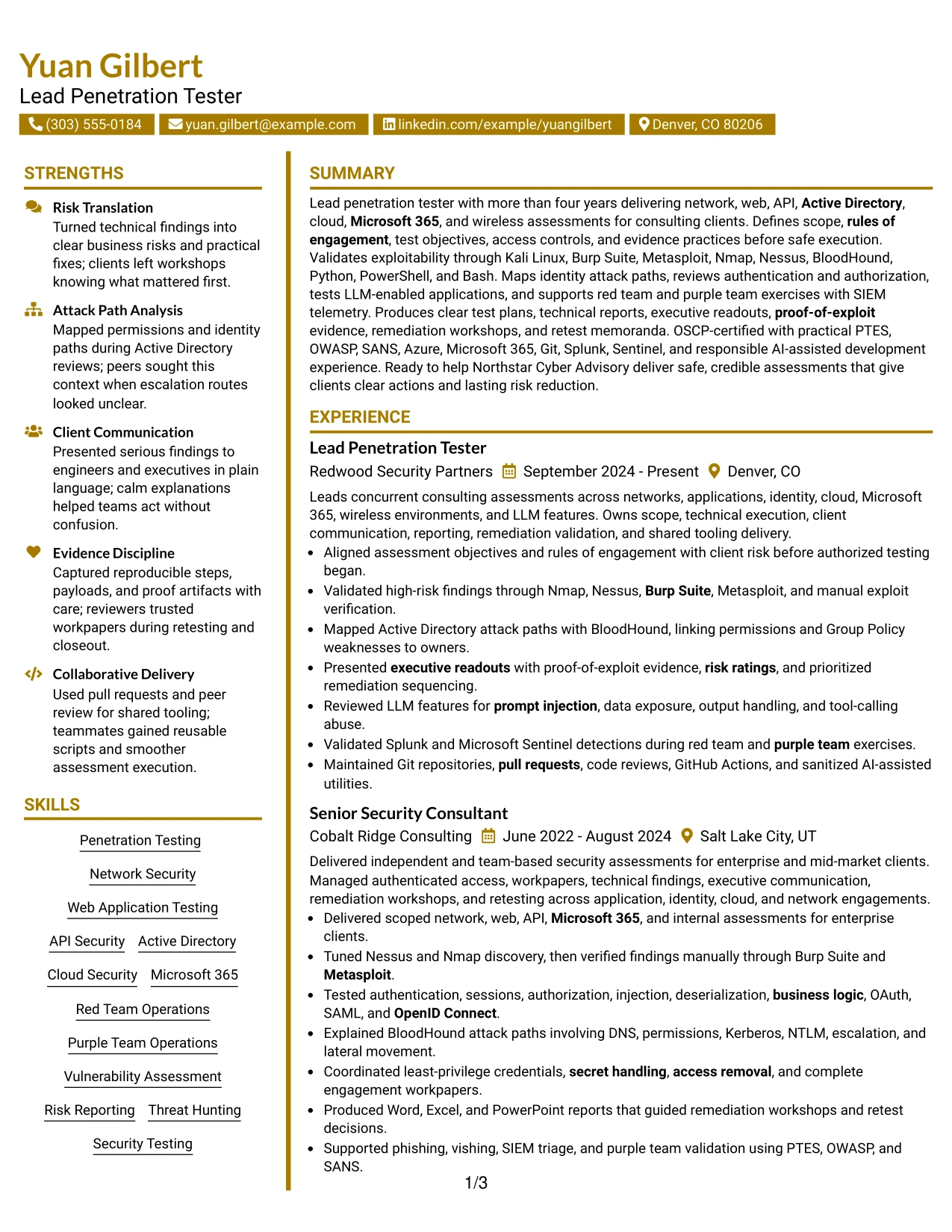
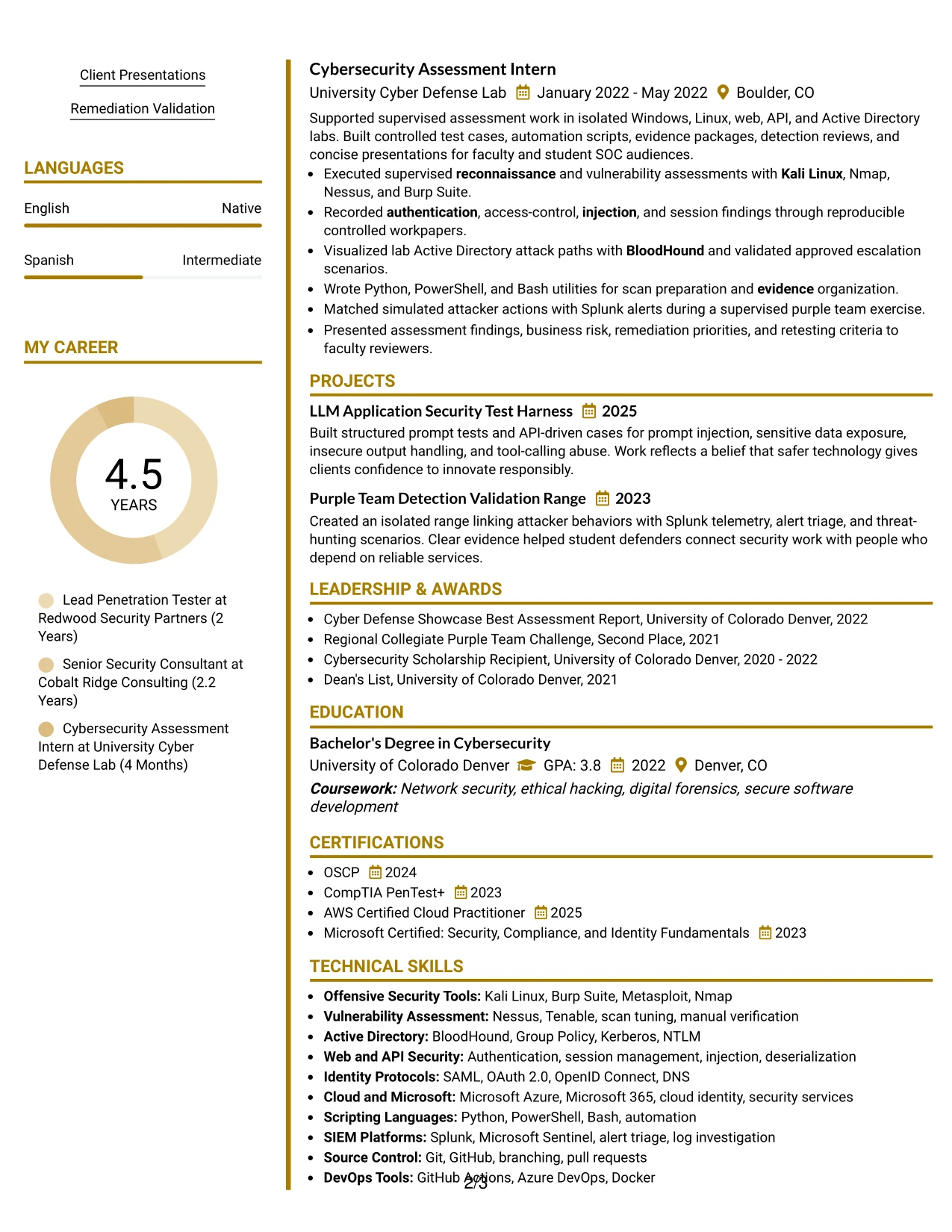
Why the Accent Divider Modern Two Column Format Works for a Resume
- Accent dividers create clear boundaries between resume sections without adding heavy visual elements.
- The two-column structure gives skills, certifications, and education a compact home beside detailed experience.
- A focused summary can connect four-plus years of assessment work to the target role quickly.
- Bullets provide space for tools such as Burp Suite, Nmap, Nessus, Metasploit, and BloodHound.
- Separate areas can show both technical evidence and client-facing results, including executive readouts and remediation guidance.
- The structure supports project entries for LLM application testing and purple team detection validation.
- Consistent section labels help ATS systems and recruiters find penetration testing, Active Directory, cloud, and Microsoft 365 keywords.
Best For
- Readers who need a clear split between technical skills and detailed experience.
- Resumes that combine consulting delivery, projects, certifications, and education.
- Candidates with a broad toolset that needs compact, organized presentation.
- Applications where short evidence bullets must remain easy to scan.
- Roles requiring both hands-on testing and executive communication.
- Documents that need a modern accent while retaining a professional structure.
#24 Shaded Labels Clean Two Column Format
A restrained visual hierarchy makes the resume feel precise and controlled, which suits a role built around authorized testing, evidence protection, and risk-based reporting. Shaded labels distinguish the summary, experience, skills, certifications, and education without competing with the content.
The clean two-column arrangement aligns the document with consulting review needs. It can place tools, frameworks, and credentials in a quick-reference area while reserving the wider section for validated findings, attack path analysis, reports, retesting, and client presentations.
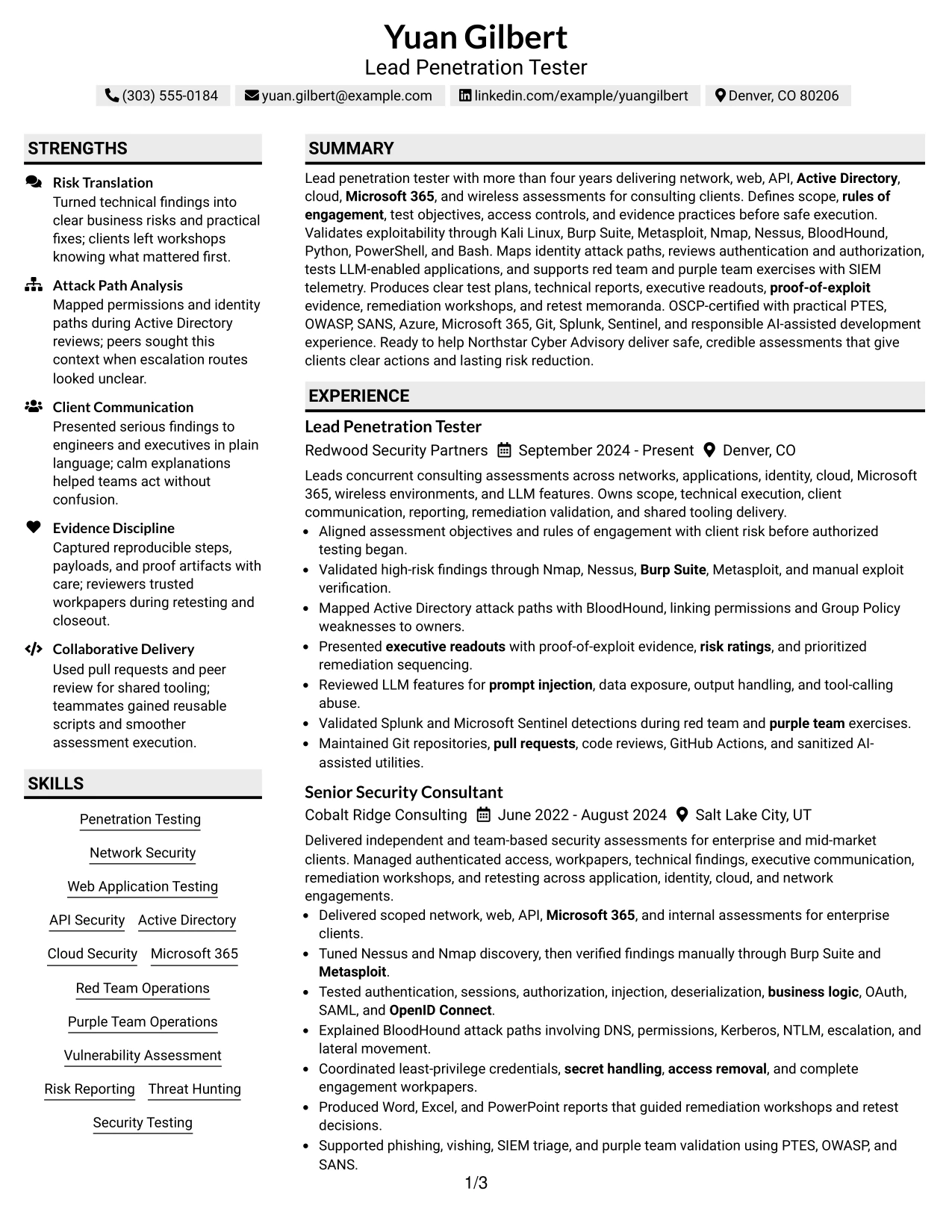
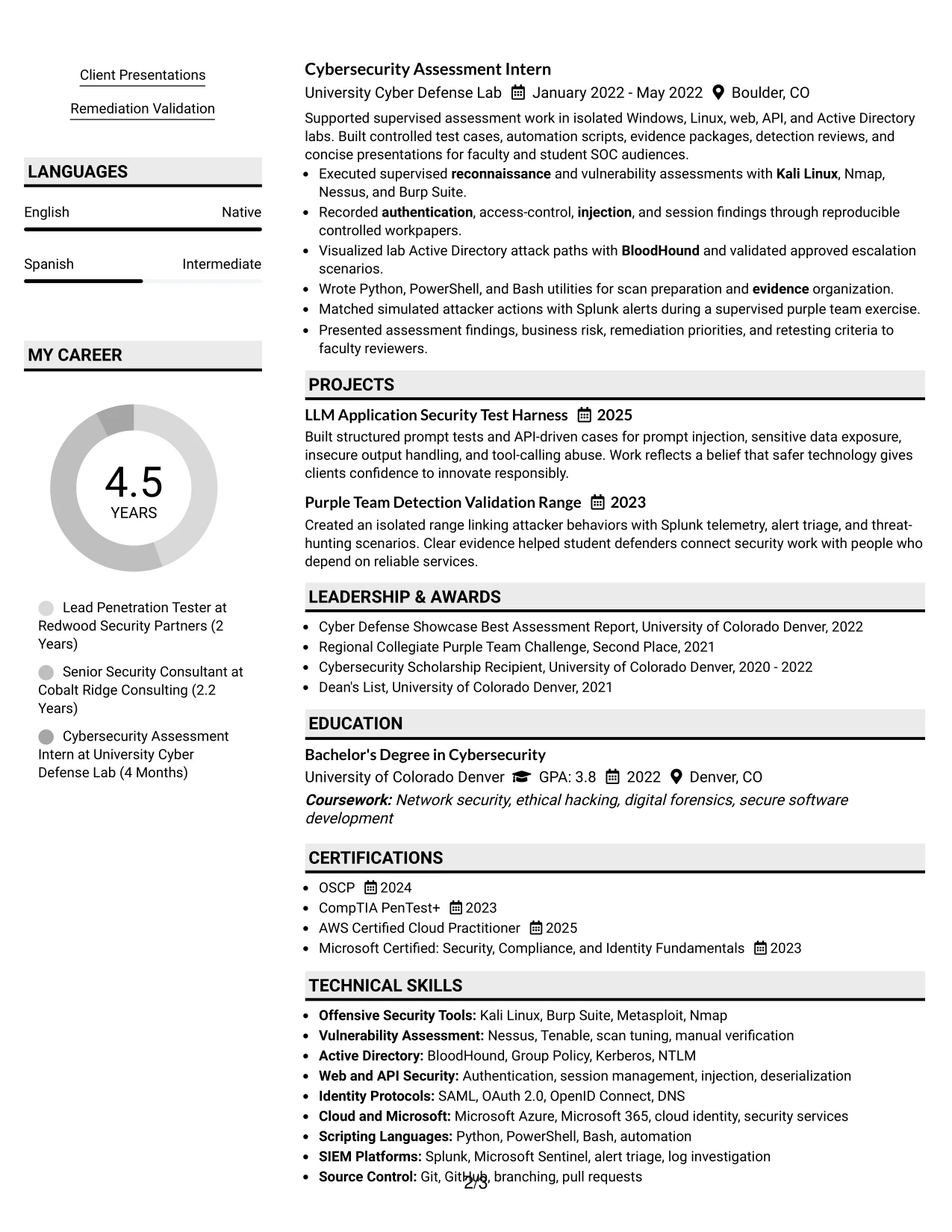
Why the Shaded Labels Clean Two Column Format Works for a Resume
- Shaded labels make section changes visible during a quick recruiter scan.
- A clean two-column grid balances dense technical keywords with readable accomplishment bullets.
- The format keeps credentials such as OSCP and CompTIA PenTest+ easy to locate.
- The main column can show scope definition, exploit validation, reporting, and remediation sequencing.
- A supporting column can group Python, PowerShell, Bash, Git, Azure, Splunk, and Microsoft Sentinel.
- Simple square bullets support reproducible evidence without making the page feel crowded.
- Clear hierarchy helps preserve ATS-friendly section recognition while adding visual polish.
Best For
- Resumes for consulting environments with both delivery and communication requirements.
- Candidates who need a visible place for certifications and technical tools.
- Documents with substantial evidence but limited space for repeated explanations.
- Readers who prefer labeled sections and predictable information grouping.
- Applications that require a polished format without distracting graphics.
- Professionals presenting network, web, API, identity, cloud, and Microsoft 365 work together.
#25 Photo Header Color Accent International Format
The format places the professional identity, target title, and contact information in a prominent header before moving into a single-column reading path. A restrained color accent and photo can support a polished personal presentation while the resume remains focused on evidence and keywords.
That sequence works well for a document with varied assessment coverage. Experience bullets can show network, web, API, Active Directory, cloud, Microsoft 365, wireless, and LLM testing, followed by projects, certifications, education, and supporting skills.
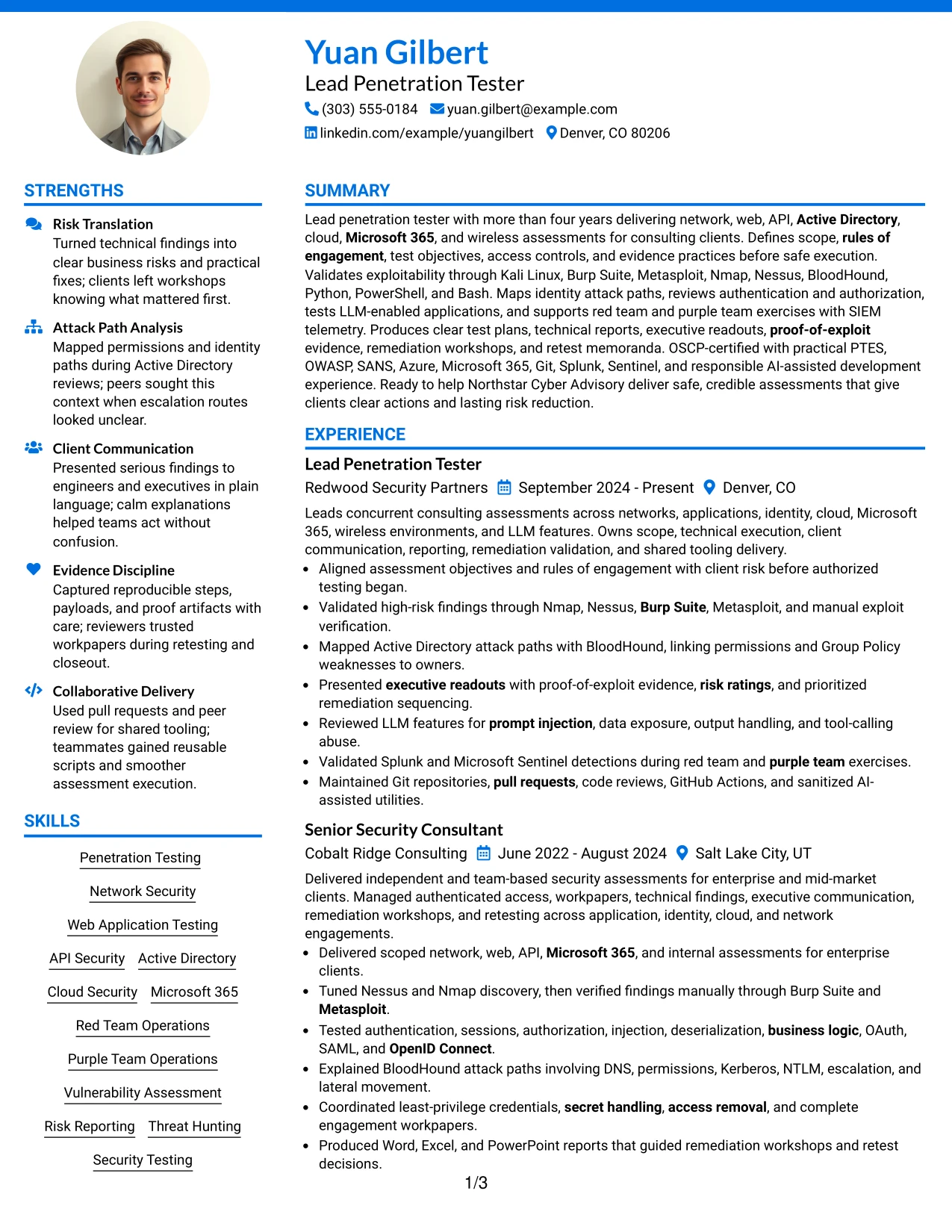
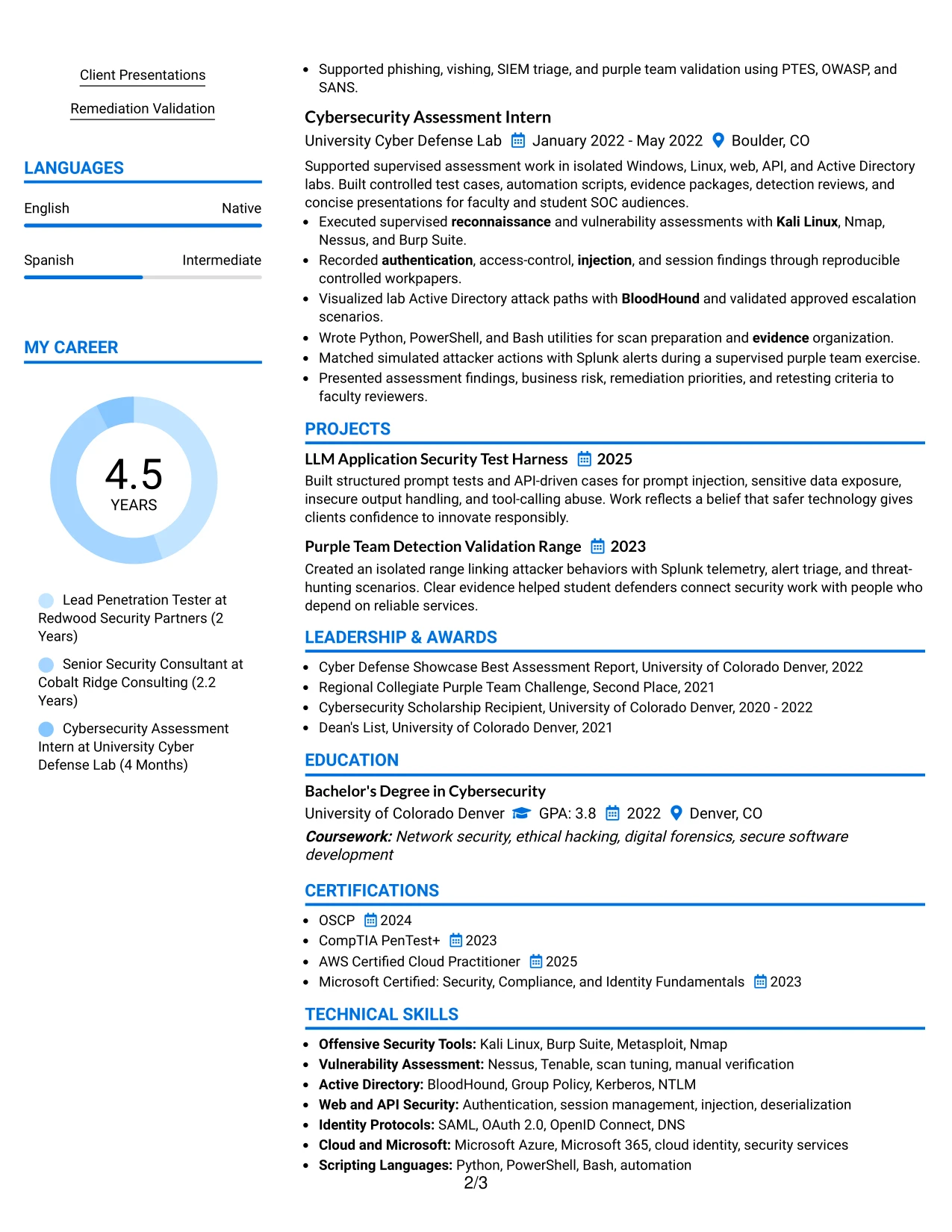
Why the Photo Header Color Accent International Format Works for a Resume
- A prominent header establishes the target role and contact details before technical content begins.
- The single-column flow keeps experience bullets in a natural chronological sequence.
- A photo can add a personal presentation element when appropriate for the application context.
- Color accents distinguish sections while leaving the evidence easy to read.
- The layout gives broad assessment coverage room to appear without forcing a dense sidebar.
- Projects and certifications can follow experience in a clear sequence for international or client-facing applications.
- Standard section labels and repeated keywords support recruiter scanning and ATS review.
Best For
- Applications where a polished personal header is appropriate for the market or organization.
- Resumes that need one uninterrupted path through consulting experience.
- Candidates presenting several assessment types under a single professional identity.
- Documents that combine client work, technical projects, certifications, and education.
- Readers who value visible hierarchy before reviewing detailed evidence.
- Roles involving client presentations, executive readouts, and cross-functional communication.
#26 Large Profile Photo International Two Column Format
Recruiters move from the large profile header into two coordinated reading paths: one for identity, skills, certifications, and education, and another for experience and project evidence. This navigation helps a detailed resume remain approachable even when it covers several security domains.
The two-column design can carry substantial content without losing hierarchy. It supports concise bullets on rules of engagement, manual exploit verification, identity attack paths, AI application risks, detection validation, client deliverables, and tooling workflows.
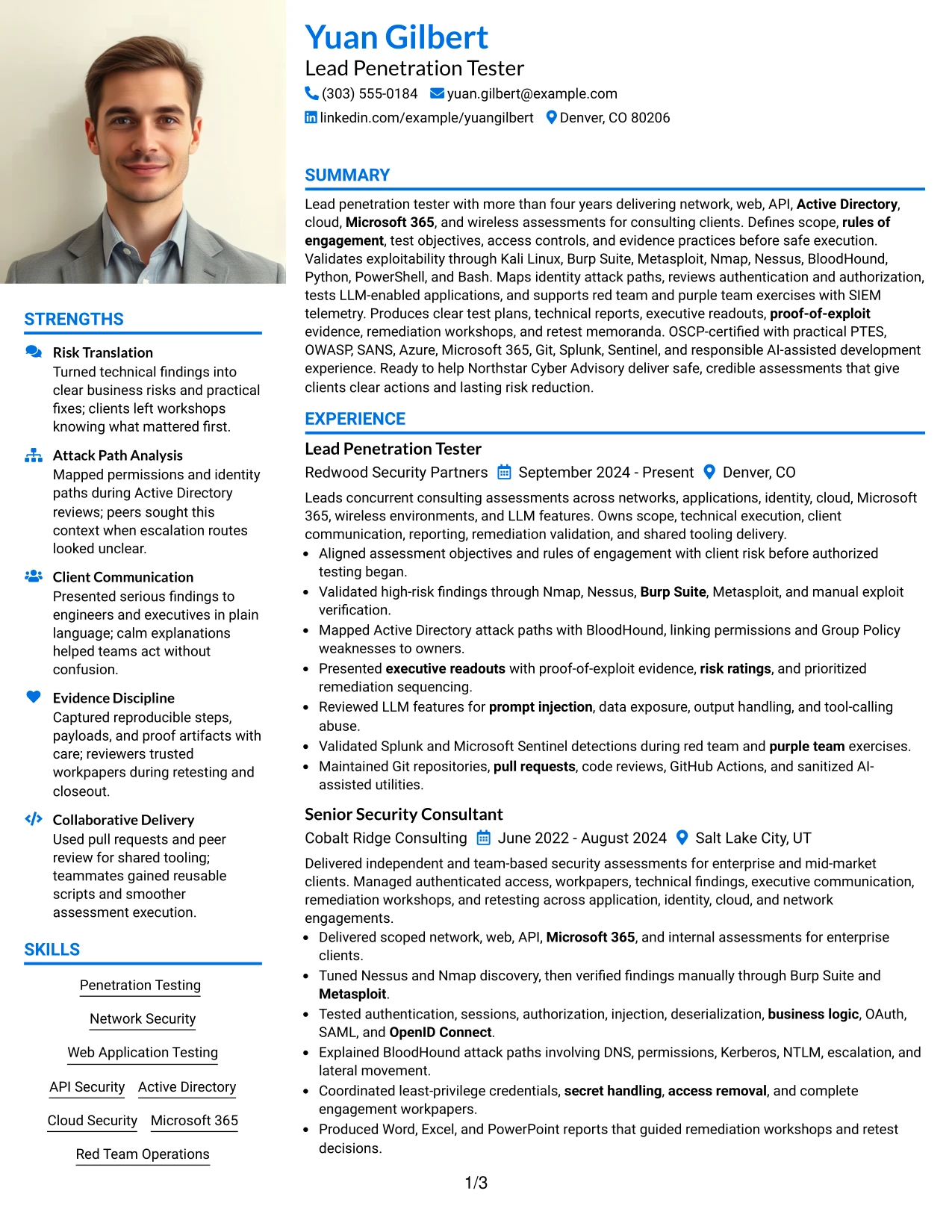
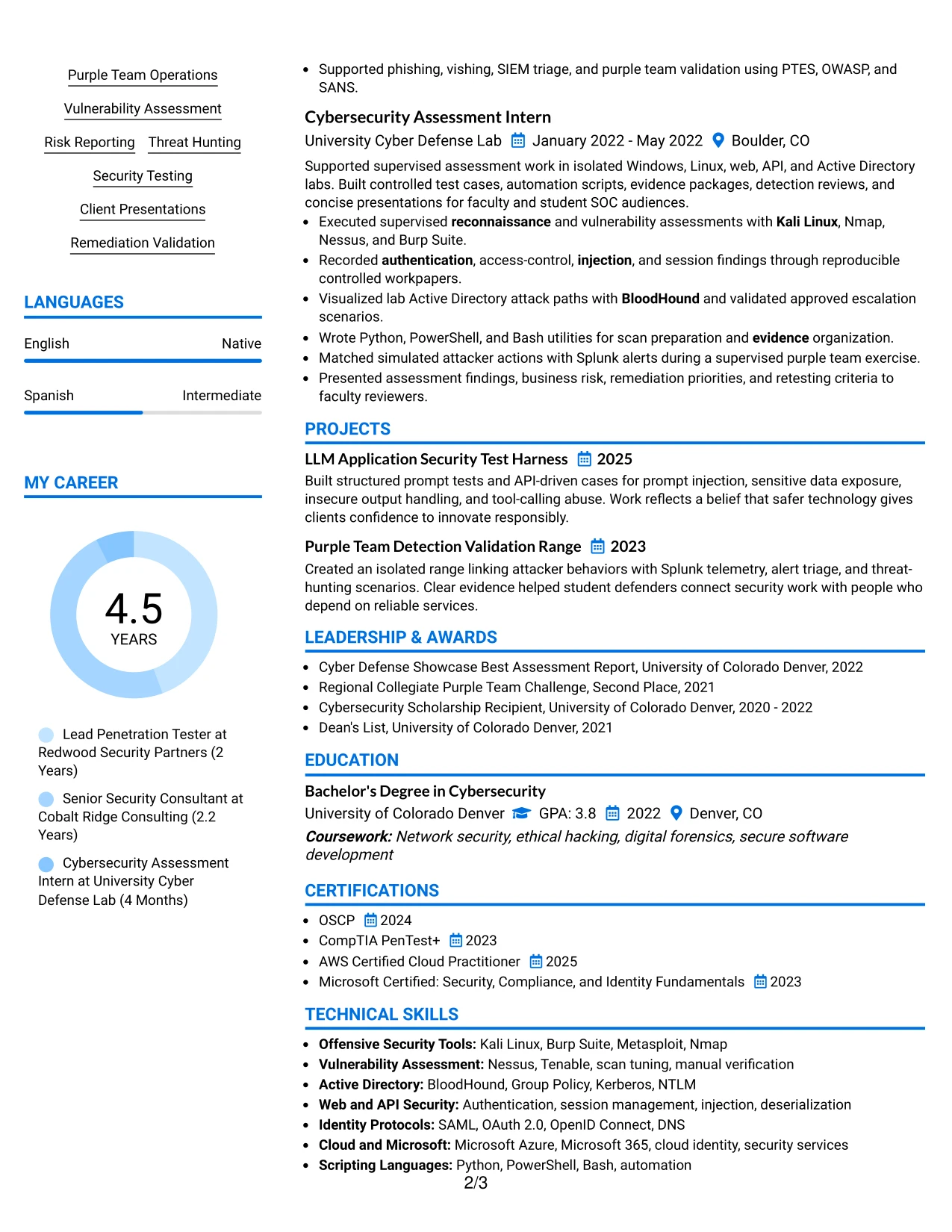
Why the Large Profile Photo International Two Column Format Works for a Resume
- The large profile area makes the professional identity easy to recognize at the start of review.
- Two columns separate quick-reference credentials from longer experience evidence.
- The photo creates a strong personal header when that presentation is suitable for the application.
- The layout accommodates a broad skills inventory without pushing experience too far down the page.
- Experience bullets can retain technical specificity while the secondary column holds certifications and education.
- Projects can show structured prompt testing and API-driven cases without interrupting employment history.
- Consistent headings help readers locate rules of engagement, retesting, SIEM, and remediation content.
Best For
- Resumes with high content volume across assessment work, projects, and credentials.
- Applications where a prominent personal presentation is accepted and useful.
- Candidates combining technical delivery with extensive tools and frameworks.
- Documents that need separate areas for quick facts and detailed engagement evidence.
- Readers who want to compare skills and certifications while reviewing experience.
- Client-facing roles where identity, presentation, and technical credibility all matter.
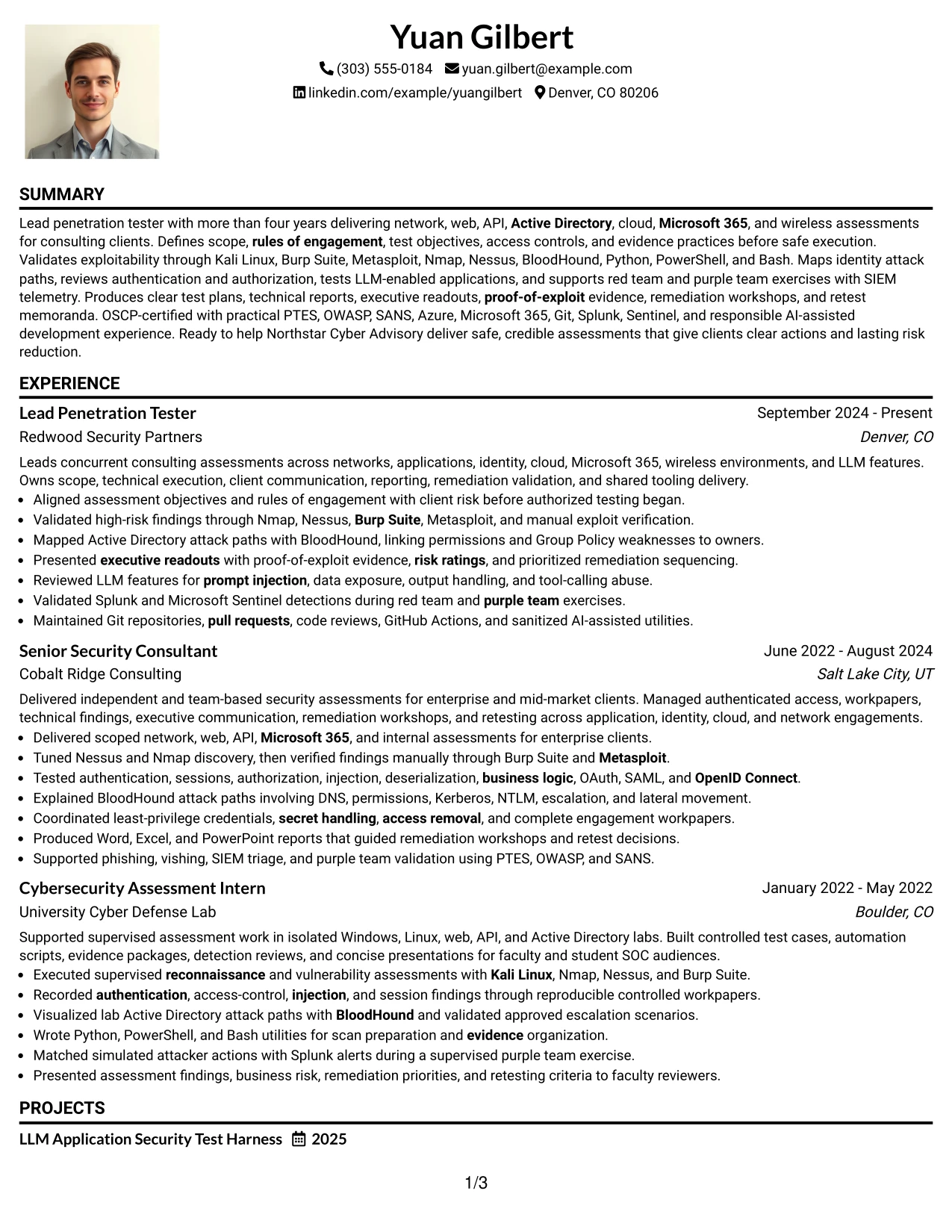
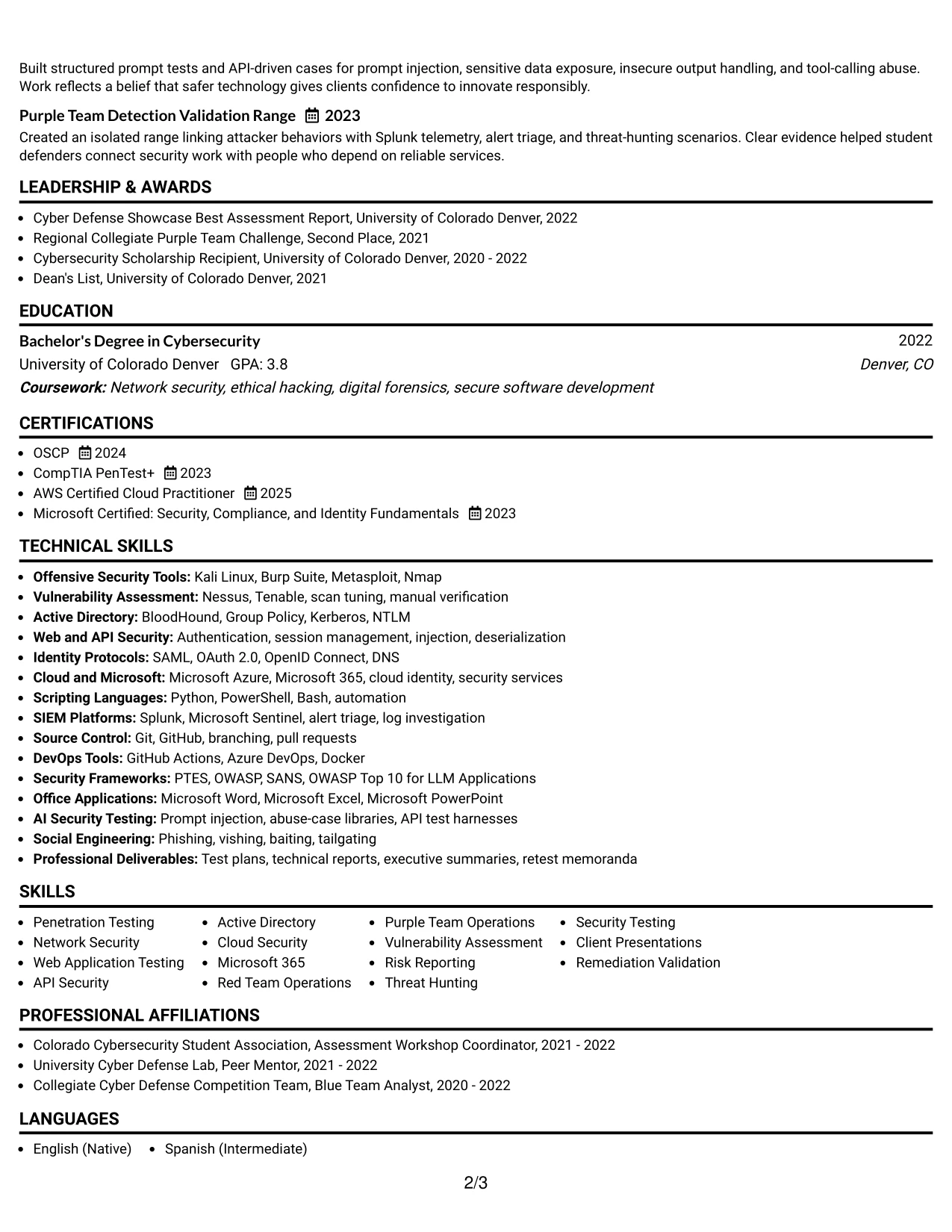
#27 One Column Format with Photo
Evidence receives priority from the first section, with the summary and experience placed in a direct one-column sequence. The photo and centered header establish identity, while the body gives each assessment, finding, project, certification, and education entry enough room to stand on its own.
This format is effective when the resume must show complete engagement coverage rather than compressing information into a sidebar. Bullets can explain exploitability, proof artifacts, attack paths, risk ratings, remediation recommendations, retesting, and client communication in a logical order.
Why the One Column Format with Photo Works for a Resume
- A one-column structure gives evidence bullets the full page width.
- The header and photo make contact information and professional identity easy to locate.
- Chronological experience can be reviewed without jumping between separate content areas.
- Longer bullets can explain reproduction steps, proof-of-exploit evidence, and remediation owners.
- Projects can show technical depth in LLM testing and purple team validation.
- Certifications and education remain visible after the core experience instead of being buried in a sidebar.
- The linear structure supports ATS extraction of job titles, dates, tools, and section headings.
Best For
- Resumes where detailed achievement bullets are more important than compact visual grouping.
- Candidates documenting several engagement types with distinct evidence.
- Applications that benefit from a strong personal header and uninterrupted reading order.
- Documents with projects that need enough space for methods and outcomes.
- Readers who prefer chronological review from summary through certifications.
- Roles requiring clear proof of testing, reporting, and remediation validation.
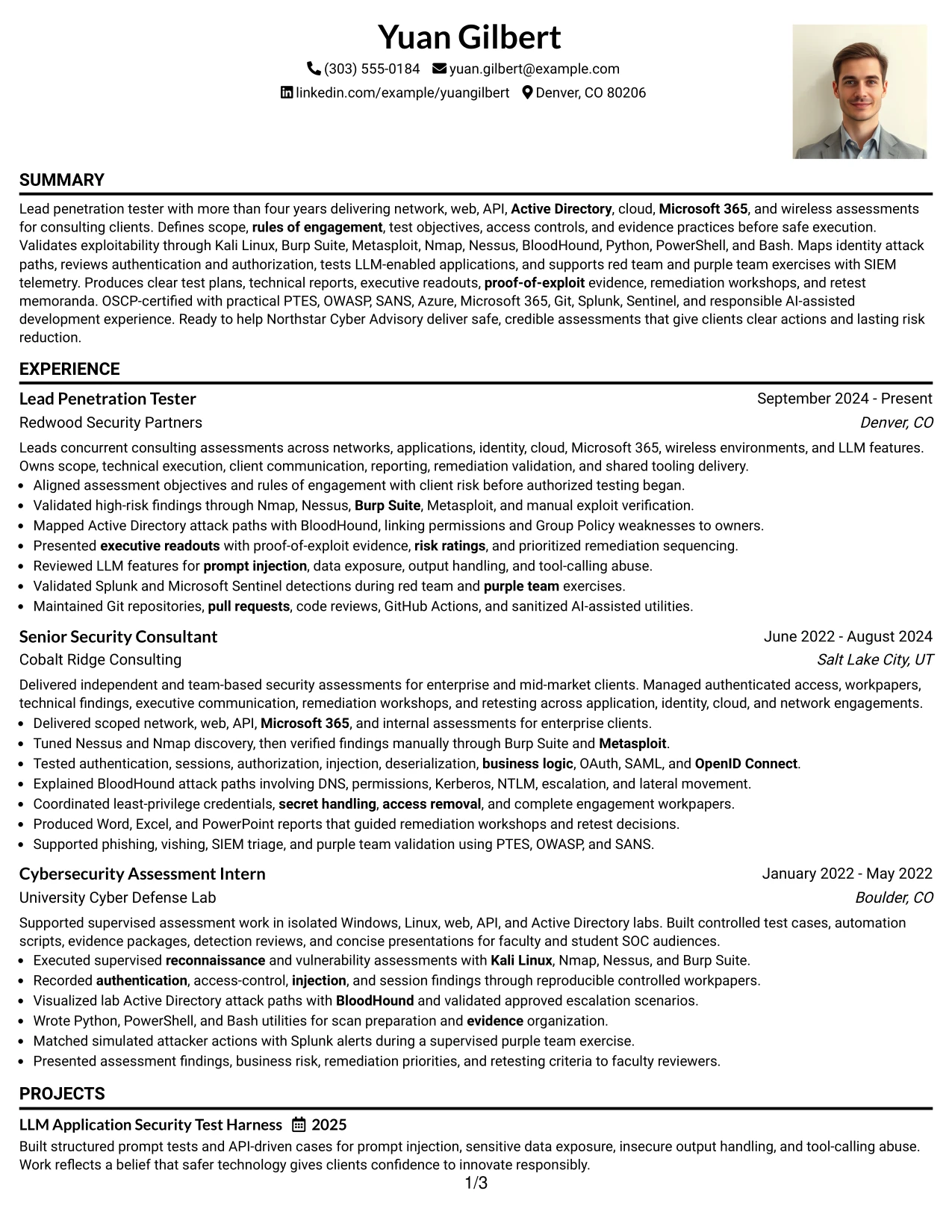
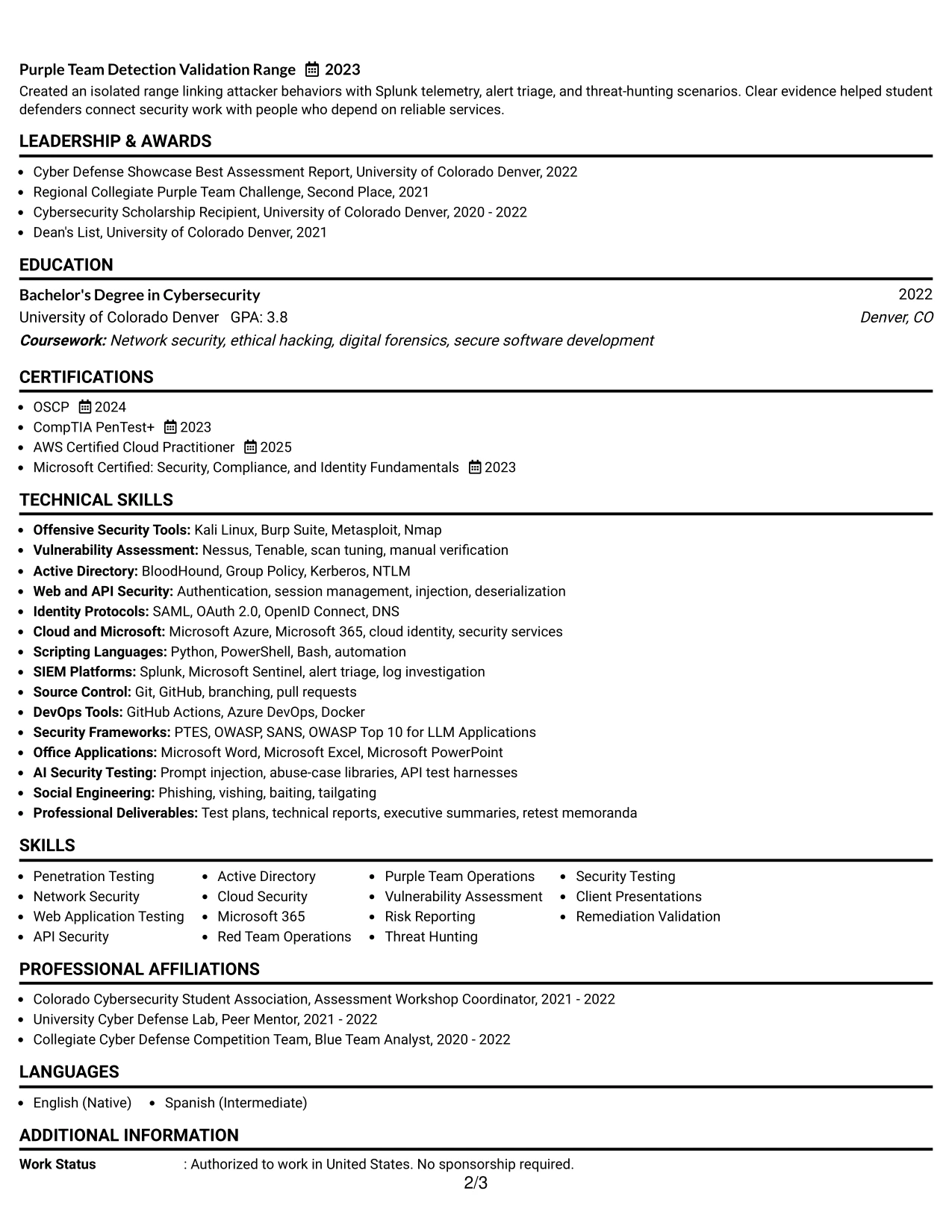
#28 One Column Format with Photo Right
Balanced spacing keeps the centered resume content readable while the photo sits to the right of the header rather than competing with the main evidence. The application context is clear: the document presents a polished identity first, then moves through summary, experience, projects, skills, and credentials.
The one-column body gives technical bullets a consistent left edge and predictable rhythm. That makes it easier to show concurrent consulting assessments, authenticated testing, BloodHound analysis, LLM risk review, SIEM telemetry, reporting, and retesting without visual congestion.
Why the One Column Format with Photo Right Works for a Resume
- Right-aligned photo placement preserves the main reading line for the professional title and contact details.
- A single content column keeps technical bullets aligned and easy to follow.
- The layout offers balanced presentation without splitting related experience across panels.
- Wide text lines can support complete statements about tools, methods, and remediation outcomes.
- Projects and certifications can appear in sequence after experience for a practical review path.
- The format supports a polished application where personal presentation matters but evidence remains central.
- Clear spacing improves scanning of dates, employers, job titles, and assessment categories.
Best For
- Applications needing a polished header with a contained personal presentation.
- Resumes with detailed bullets that should remain in one aligned reading stream.
- Candidates showing multiple client assessment categories under each role.
- Documents where projects and credentials follow experience in a deliberate sequence.
- Readers who value balanced spacing and clear chronological movement.
- Roles that combine authorized testing, reporting, and stakeholder discussions.
#29 One Column Boxed Contact Header Format
For a consulting resume, a boxed contact header creates a firm starting point for the target title, location, phone, email, and professional link. The single-column body then gives the summary and experience a straightforward path, making assessment scope and results easy to evaluate.
The format suits evidence-rich content that must remain orderly. Each role can use concise bullets for network and application testing, Active Directory analysis, client deliverables, social engineering support, detection validation, scripting, and remediation confirmation.
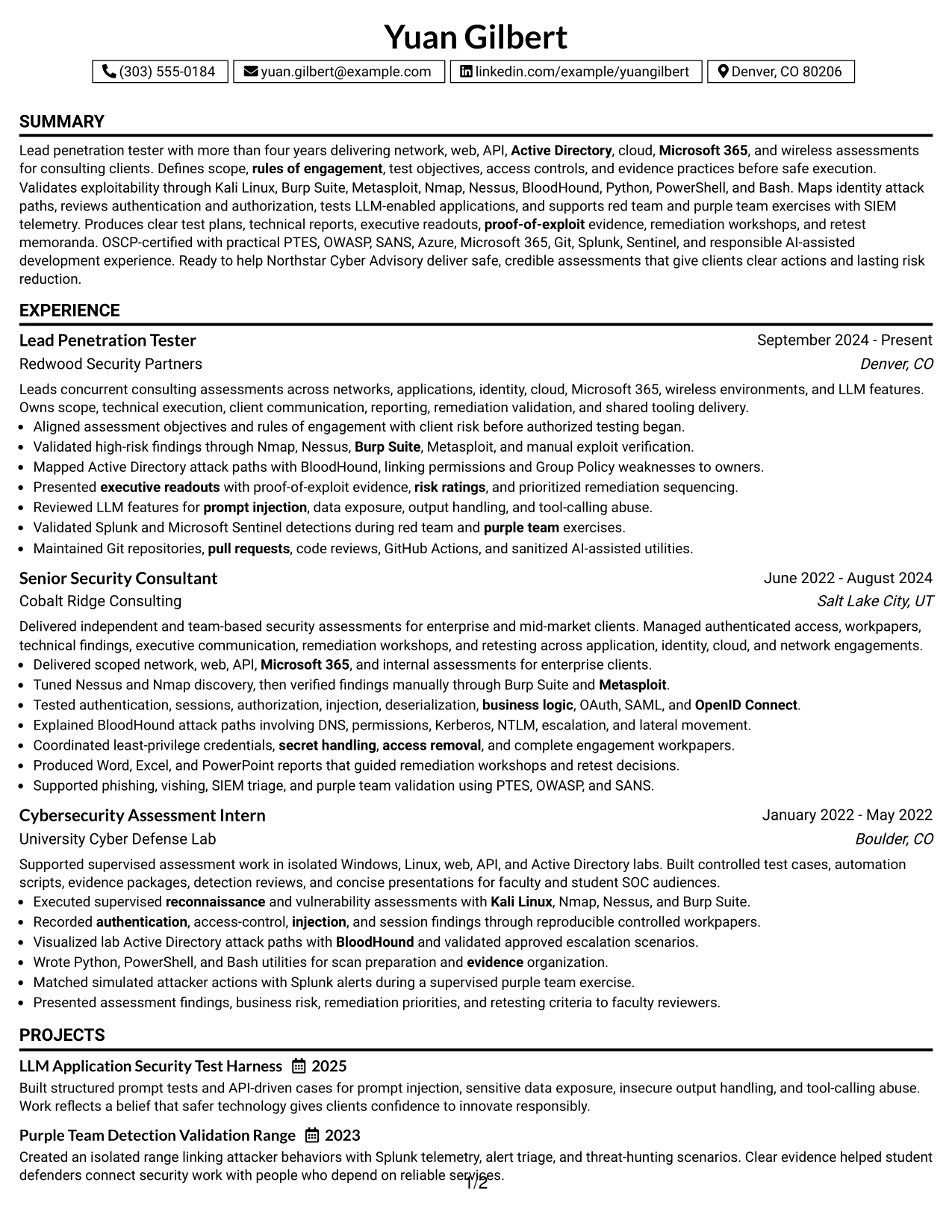
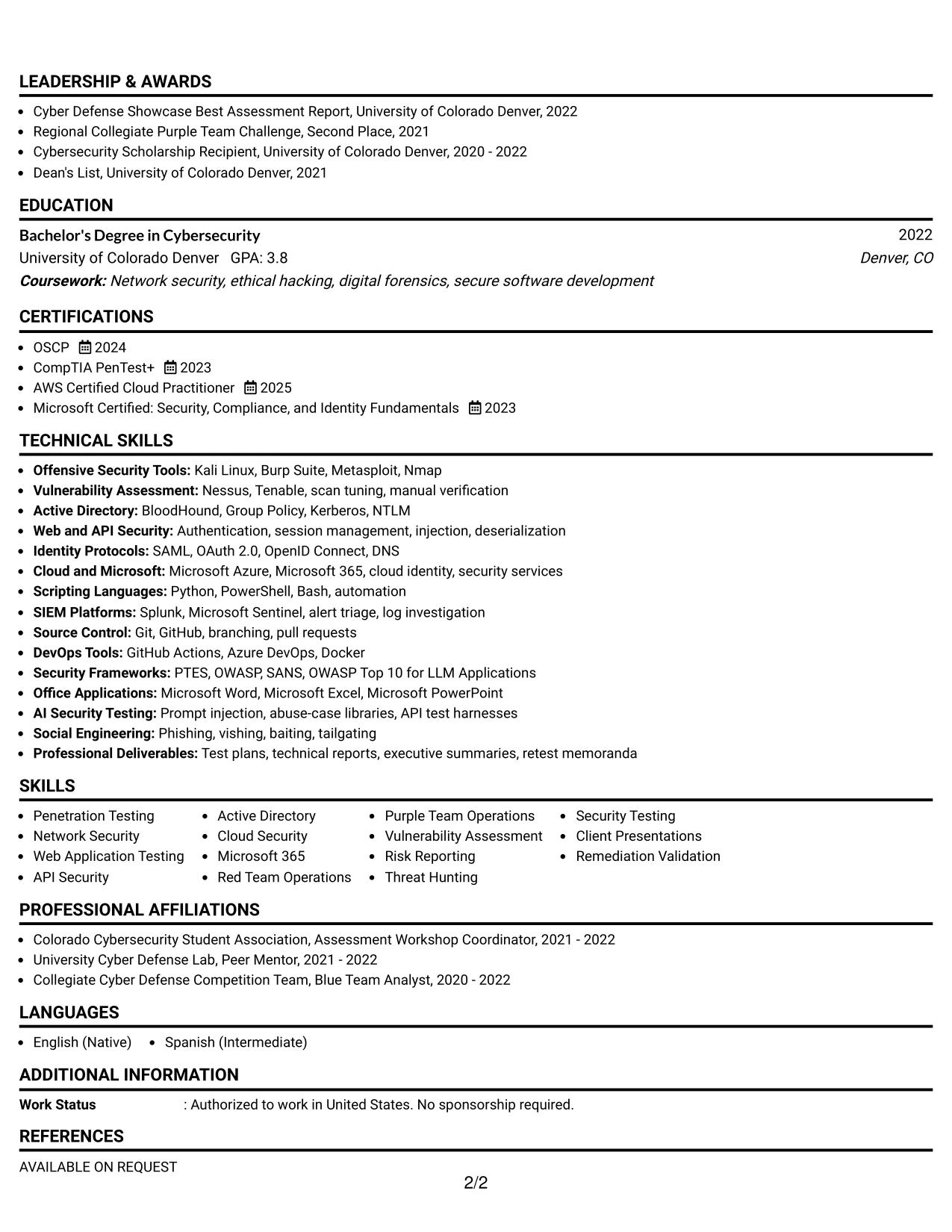
Why the One Column Boxed Contact Header Format Works for a Resume
- The boxed header groups essential contact information in one visible area.
- A one-column body prevents important findings from being hidden in a narrow side panel.
- The format creates a clear transition from professional summary to chronological experience.
- Bullets can preserve technical terms while keeping each result easy to scan.
- Skills and certifications can follow experience without disrupting the main evidence sequence.
- The structure supports projects that demonstrate automation, prompt testing, or detection validation.
- A restrained box adds visual definition while maintaining a professional, ATS-readable page.
Best For
- Resumes that need an especially clear contact and target-title area.
- Candidates presenting detailed consulting work in a chronological format.
- Documents where technical bullets need full-width readability.
- Applications combining assessments, client deliverables, projects, and certifications.
- Readers who prefer a strong starting point and a simple page flow.
- Roles where evidence, documentation, and remediation follow-through must be easy to verify.
#30 One Column Shaded Contact Header Format
A shaded contact header gives the resume a calm, controlled visual entry before the reader reaches the summary and work history. For Yuan Gilbert, the format can present the Lead Penetration Tester title clearly, then organize assessment coverage, tools, certifications, education, projects, and supporting activities in one sequence.
The page remains focused on professional evidence rather than decoration. Well-spaced bullets can connect exploit validation, rules of engagement, proof-of-exploit reporting, LLM application review, SIEM-based detection work, and prioritized remediation to the requirements of a consulting role.
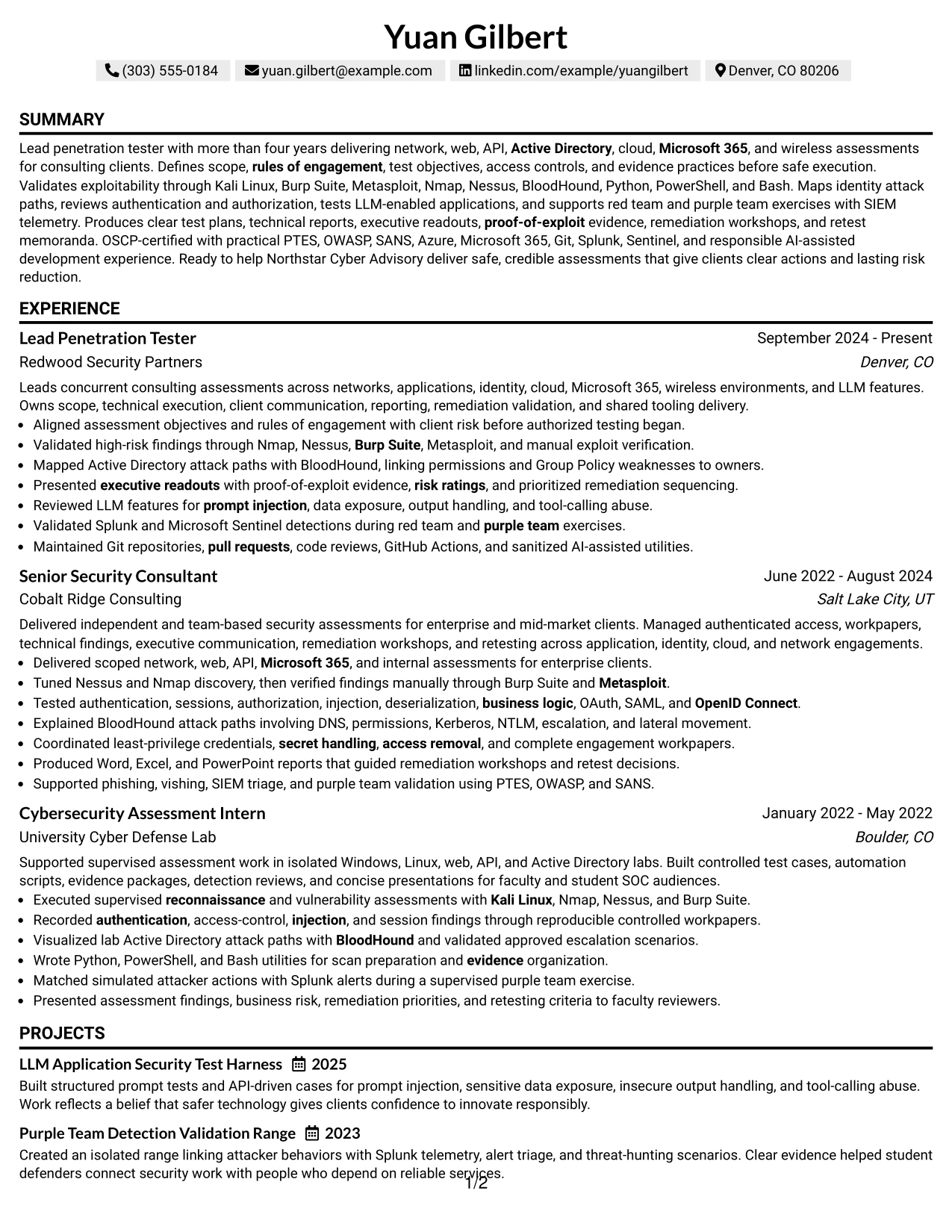
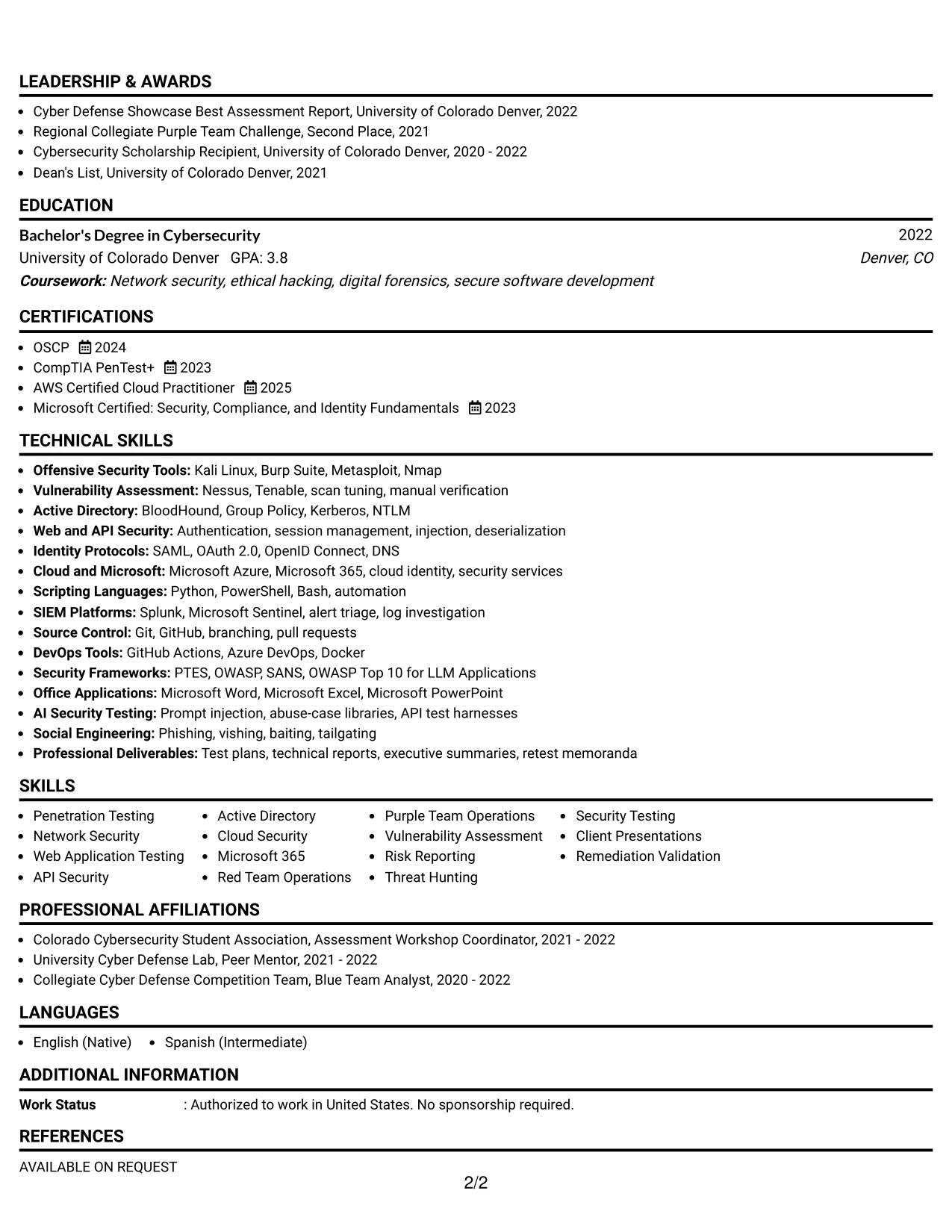
Why the One Column Shaded Contact Header Format Works for a Resume
- The shaded header gives the name, target title, and contact details a distinct but restrained position.
- One-column sequencing supports a complete review of consulting experience.
- The format makes it easy to connect assessment methods with documented results.
- Shaded labels can separate experience, projects, skills, certifications, and education without heavy graphics.
- The body has enough width for clear statements about exploitability, evidence, and remediation.
- A consistent hierarchy supports both ATS parsing and human review of technical keywords.
- The design presents a polished profile while keeping content volume manageable.
Best For
- Applications that benefit from a controlled and professional first impression.
- Candidates with a broad security background presented in one chronological stream.
- Resumes where role title and contact details should be immediately visible.
- Documents combining client assessments with projects, awards, and certifications.
- Readers who prefer subtle section emphasis instead of strong visual decoration.
- Roles requiring both technical evidence and clear risk translation.
#31 Boxed Contact Header with Job Title Format
The boxed contact header and prominent job title establish the resume's purpose before the reader enters the experience section. That format gives the target role immediate context and creates a clear frame for the summary, assessment history, technical skills, projects, certifications, and education.
A single-column structure keeps evidence in sequence and supports detailed bullets. The document can show scope definition, authenticated testing, manual verification, Active Directory attack paths, client readouts, red team and purple team support, and shared tooling without forcing the reader to switch columns.
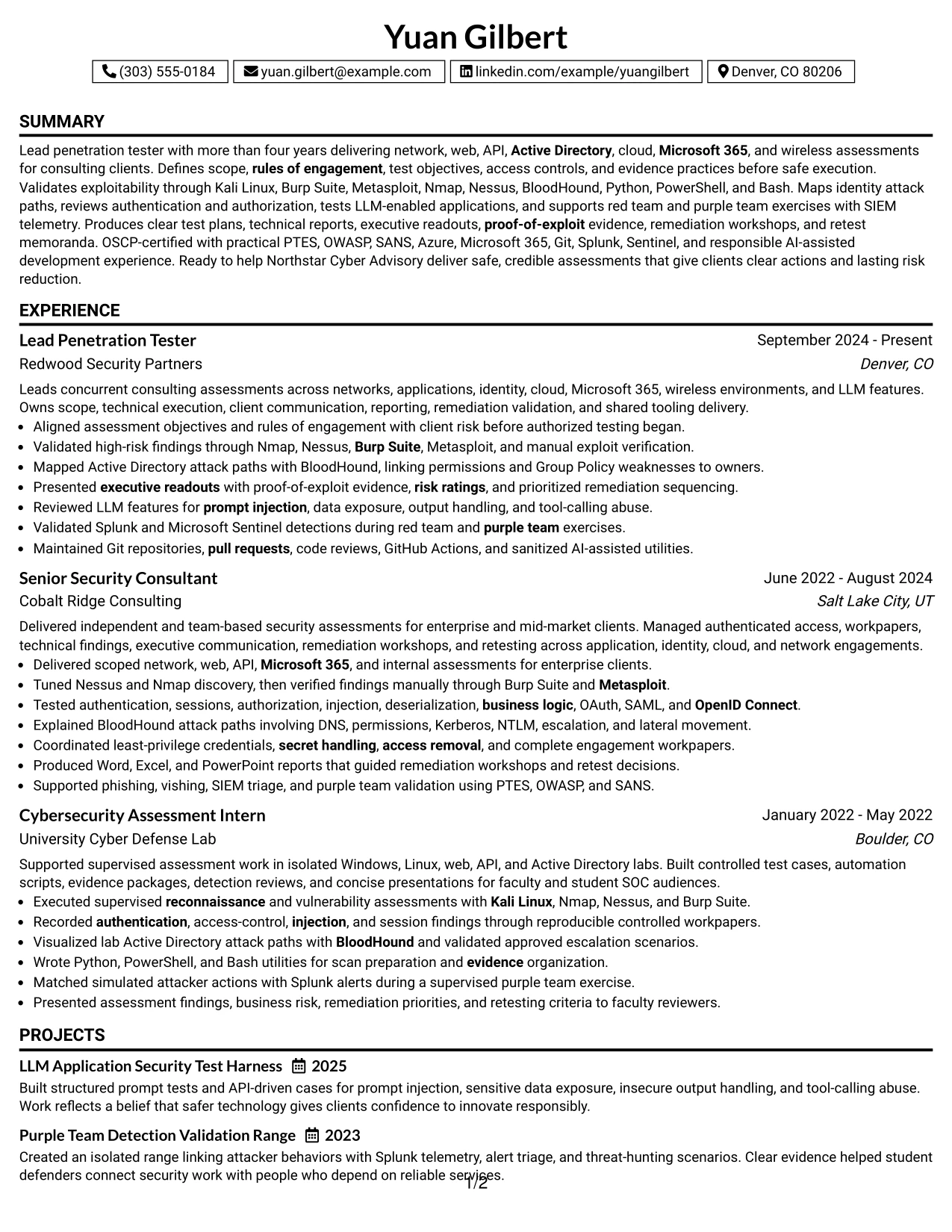
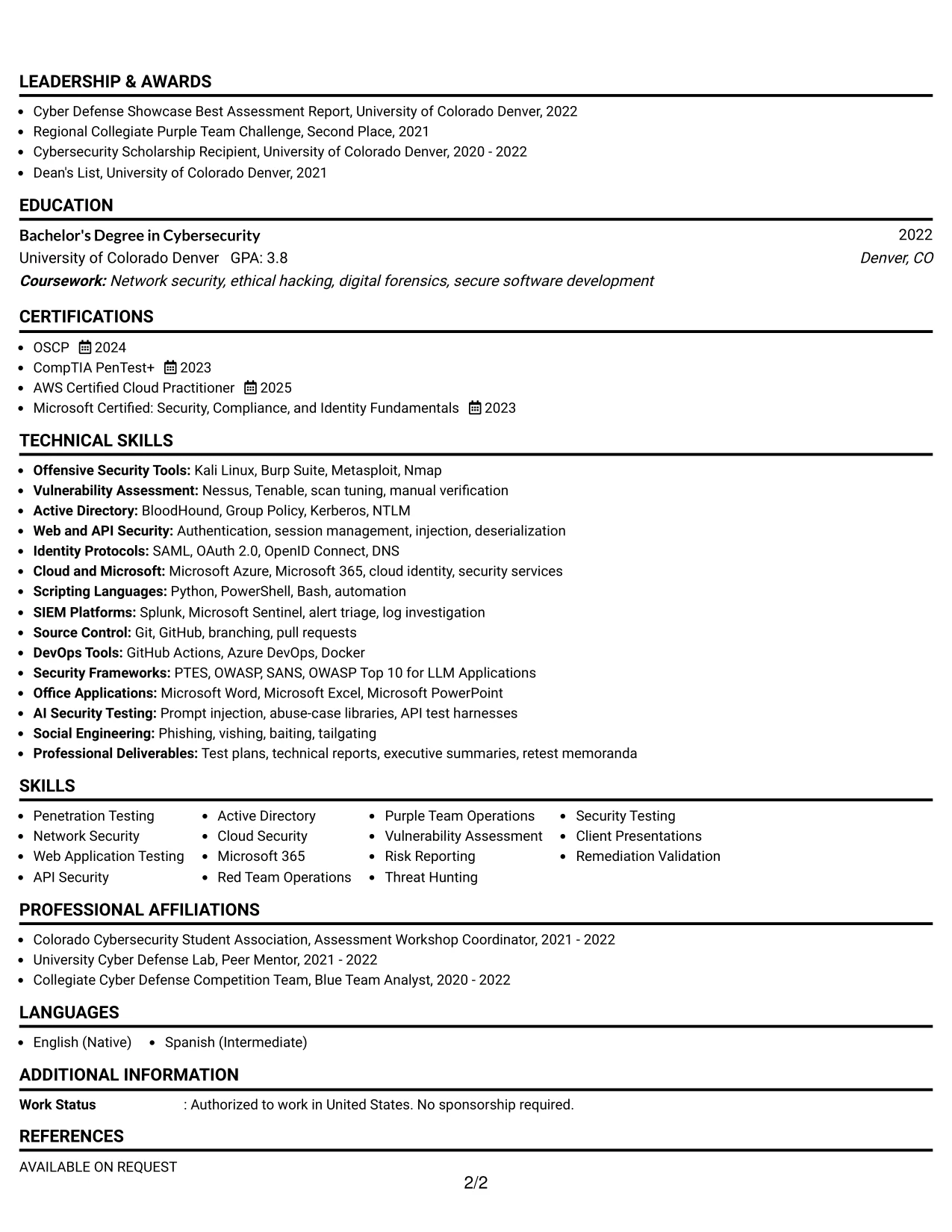
Why the Boxed Contact Header with Job Title Format Works for a Resume
- The job title is visible at the top, helping reviewers confirm role alignment immediately.
- A boxed contact area separates personal details from the substantive resume content.
- The one-column format supports a predictable review from summary to experience and credentials.
- Bullets can show both technical execution and client-facing deliverables in the same role.
- Projects provide a natural place for LLM testing and detection validation evidence.
- The layout keeps tools, frameworks, and certifications searchable without overwhelming the header.
- Standard section order supports ATS parsing and quick verification of dates and employers.
Best For
- Applications where the target job title should be unmistakable at first review.
- Candidates whose experience needs a straightforward chronological presentation.
- Documents with several technical and client-facing bullets under each position.
- Resumes that include projects requiring brief but specific technical explanations.
- Readers who value a defined contact area and a simple content path.
- Roles where scope, execution, reporting, and retesting all need visible proof.
#32 Plain Professional Layout with Job Title & Shaded Labels
Readers move from the clearly stated job title and summary into shaded, labeled sections that organize the evidence. The plain professional treatment keeps attention on consulting experience, while the labels make skills, projects, certifications, education, and activities easy to locate.
The single-column format offers room for substantial content without adding visual noise. It can present detailed bullets on network, web, API, cloud, Microsoft 365, wireless, and identity testing alongside reporting, SIEM validation, automation, and responsible AI-assisted development.
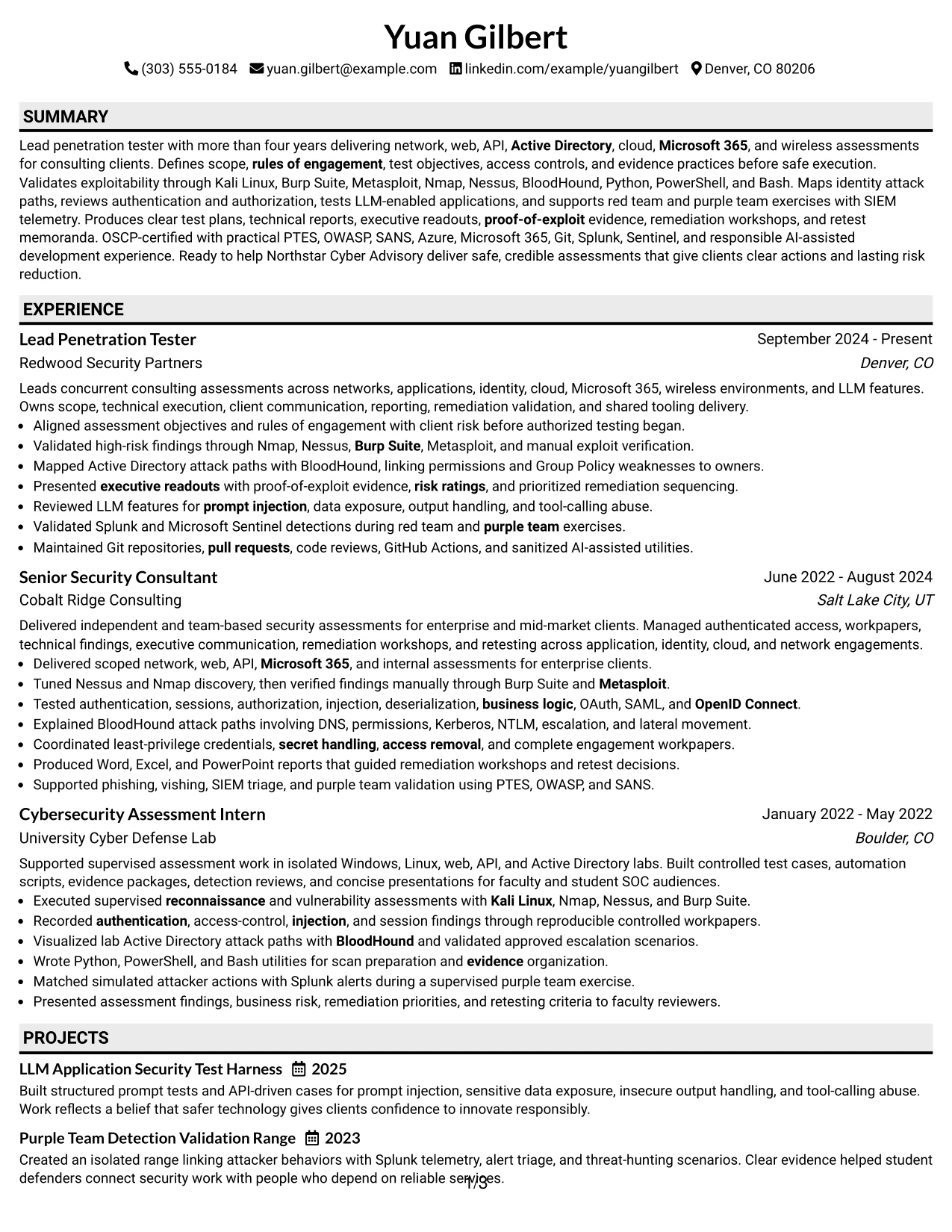
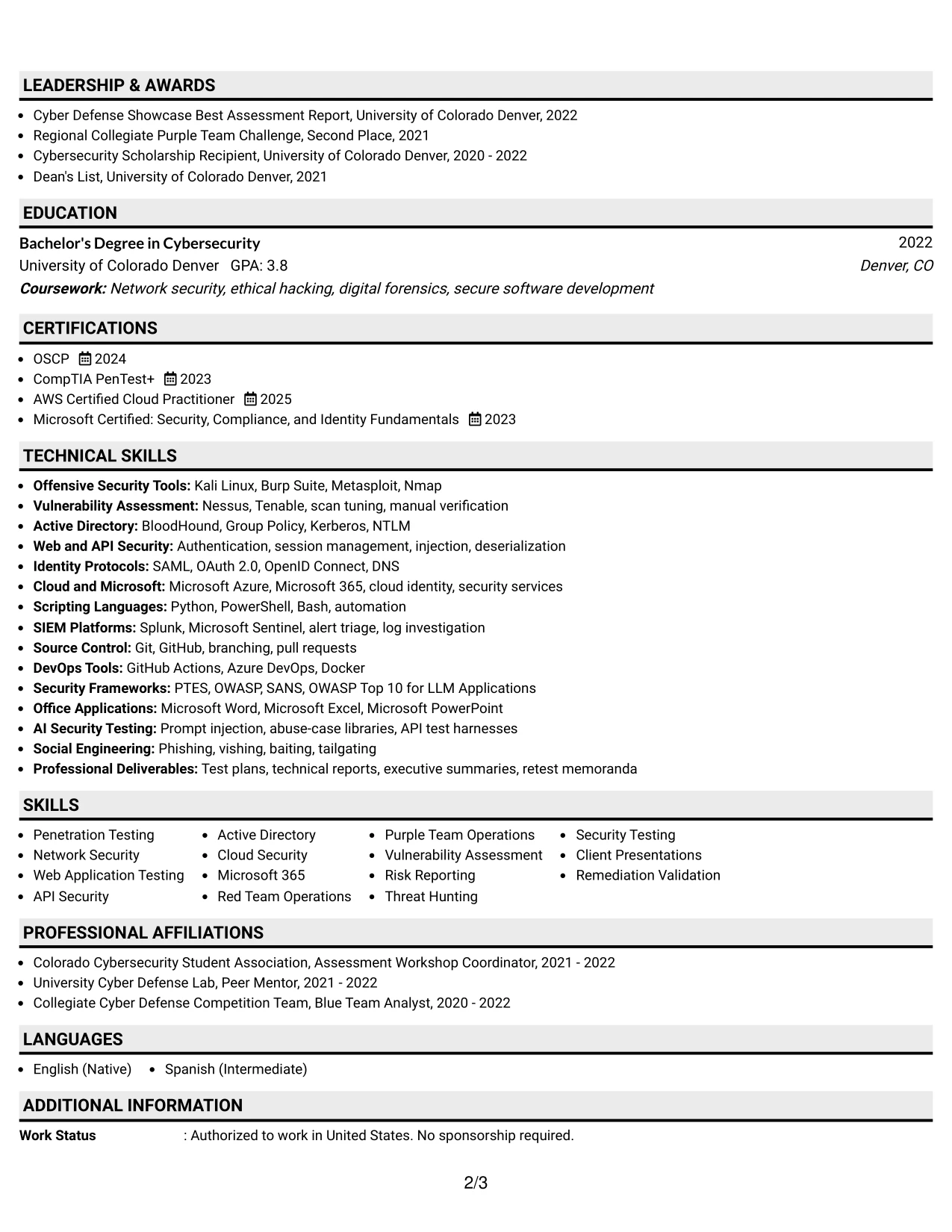
Why the Plain Professional Layout with Job Title & Shaded Labels Works for a Resume
- The job title gives immediate context before the reader reaches detailed history.
- Shaded labels create reliable navigation through a longer one-column resume.
- The plain treatment keeps technical evidence more prominent than decoration.
- A spacious body supports multiple assessment domains and complete work descriptions.
- Skills and tools can be grouped clearly without weakening the chronological experience section.
- Projects, certifications, and education remain easy to find during a fast review.
- The structure supports ATS-friendly headings and direct keyword matching.
Best For
- Resumes with high content volume that need clear section navigation.
- Candidates covering network, application, identity, cloud, and Microsoft 365 work.
- Applications where a plainly professional presentation supports credibility.
- Documents that need room for tools, frameworks, projects, and certifications.
- Readers who review job title, summary, and evidence in a top-to-bottom order.
- Roles requiring both technical breadth and detailed professional services documentation.
#33 Classic One Column Resume Format
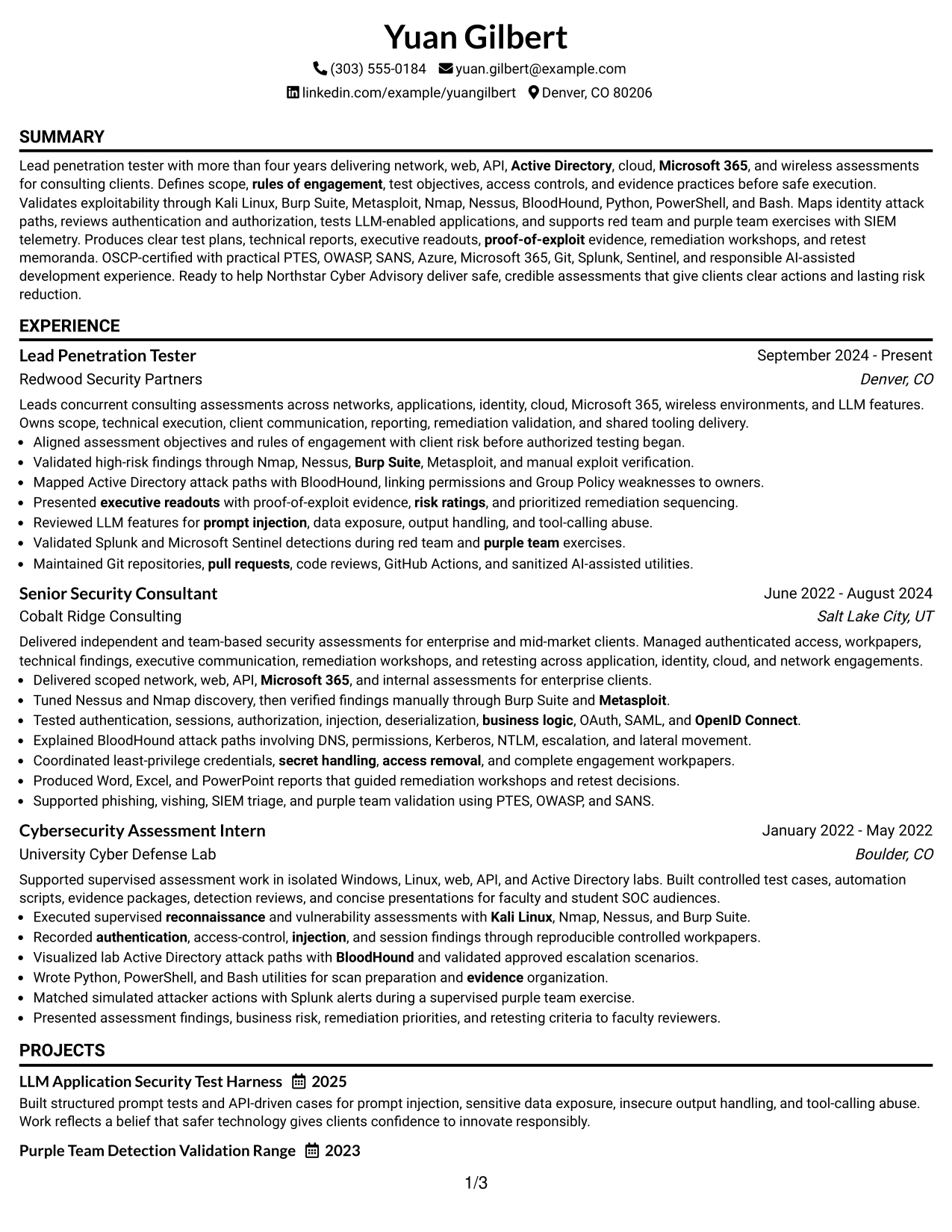
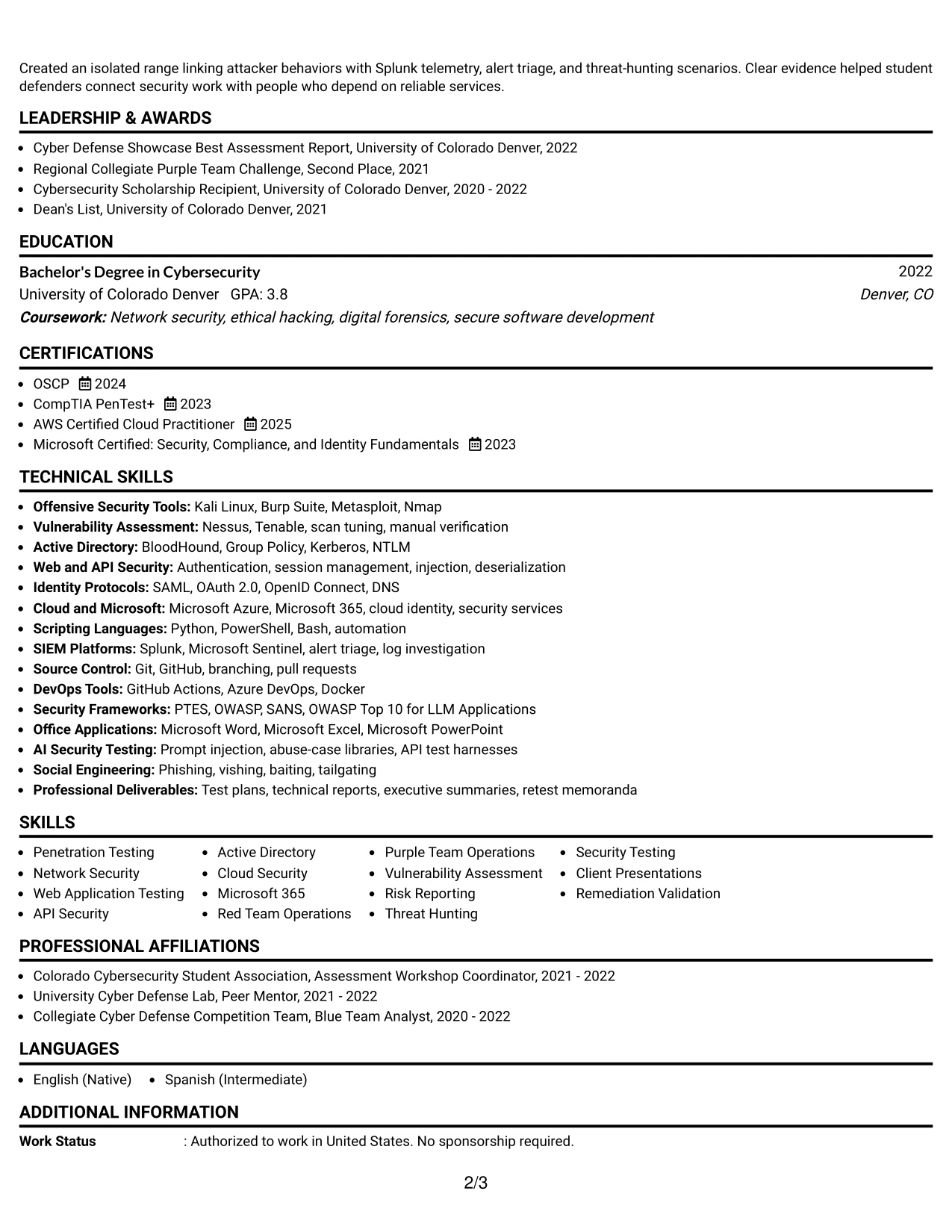
Assessment evidence receives the strongest emphasis, with the summary leading directly into experience bullets that show scope, methods, findings, and results. A classic one-column structure keeps the resume conservative and easy to review across consulting, technical, and ATS workflows.
The format supports a complete record of penetration testing without visual distractions. It gives space to describe exploit validation, Active Directory attack paths, API and web testing, LLM risks, executive reporting, remediation workshops, retesting, certifications, projects, and education in a familiar sequence.
Why the Classic One Column Resume Format Works for a Resume
- The familiar structure lets reviewers find summary, experience, education, and skills quickly.
- Full-width bullets provide room for reproducible evidence and practical remediation guidance.
- Chronological ordering makes career progression and assessment ownership easy to follow.
- Technical keywords can appear naturally in role descriptions rather than being isolated in a sidebar.
- Projects can add focused proof of LLM security testing and purple team detection work.
- Certifications such as OSCP and CompTIA PenTest+ remain visible in a standard section.
- The conservative format is highly compatible with ATS parsing and professional services review.
Best For
- Applications that favor a familiar and highly readable resume structure.
- Candidates whose strongest case depends on detailed assessment evidence.
- Documents submitted through ATS platforms or formal consulting workflows.
- Readers who want direct access to experience, certifications, and skills.
- Resumes combining technical testing with reporting and remediation outcomes.
- Roles where clear chronology and reproducible work matter more than visual novelty.
Why Build Your Lead Penetration Tester Resume with ResumeInMinutes
ResumeInMinutes helps security professionals turn technical assessments, client deliverables, tools, certifications, and remediation work into a structured resume that supports both ATS parsing and fast human review.
- Clear resume formats
- ATS-friendly section structure
- Role-specific security keywords
- Organized tools and skills presentation
- Focused project and certification sections
- Free PDF resume previews
Use the layouts to present assessment scope, exploit validation, attack path analysis, reporting, executive communication, scripting, and security frameworks in a way that makes your contribution and professional impact easy to evaluate.
See Also
- 33 Associate Penetration Tester Resume Templates with Example 2026 (ATS-Optimized)
- 33 Entry-Level Penetration Tester Resume Templates with Example 2026 (ATS-Optimized)
- 33 Junior Penetration Tester Resume Templates with Example 2026 (ATS-Optimized)
- 33 Penetration Tester Intern Resume Templates with Example 2026 (ATS-Optimized)
- 33 Penetration Tester Resume Templates with Example 2026 (ATS-Optimized)
- 33 Penetration Tester, VP Resume Templates with Example 2026 (ATS-Optimized)
- 33 Senior IT Penetration Tester Resume Templates with Example 2026 (ATS-Optimized)
- 33 Senior Penetration Tester Resume Templates with Example 2026 (ATS-Optimized)
- 30+ Associate Penetration Tester Cover Letter Templates with Example 2026
- 30+ Entry-Level Penetration Tester Cover Letter Templates with Example 2026
Frequently Asked Questions
Are these Lead Penetration Tester resume templates ATS-friendly?
Yes. They use readable headings, standard resume sections, and relevant terms such as penetration testing, Active Directory, API security, OSCP, and remediation validation.
Are these various resumes?
No. The guide presents one Lead Penetration Tester resume example in distinct layouts and design styles.
What should a Lead Penetration Tester resume include?
Include a focused summary, assessment experience, technical skills, tools, certifications, education, projects, client deliverables, and bullets that show validated findings, risk translation, and remediation results.
Can I download the resume templates as PDFs?
Yes. Each design provides a free PDF download so you can review the layout and choose a format that supports clear ATS parsing.
Which resume style is best for a Lead Penetration Tester position?
A simple one-column or restrained two-column format is usually effective. It keeps technical keywords, assessment scope, certifications, and achievements easy for ATS tools and recruiters to find.
How can I show impact without inventing metrics?
Describe the assessment scope, finding severity, evidence produced, stakeholders reached, remediation guidance, and retesting performed. Use specific outcomes only when they are supported by your experience.
Should I include penetration testing tools on my resume?
Yes. List tools you have used in relevant context, such as Kali Linux, Burp Suite, Nmap, Nessus, Metasploit, BloodHound, Splunk, Microsoft Sentinel, Python, PowerShell, and Bash.
Can I customize these resume templates?
Yes. You can adjust the resume text, section emphasis, skills, projects, certifications, and layout to match your Lead Penetration Tester experience and target requirements.