US English


7 Machine Learning and Artificial Intelligence Engineering Intern - Edge Machine Learning Resume Templates with Example
By Ria · Last Updated On October 24, 2026
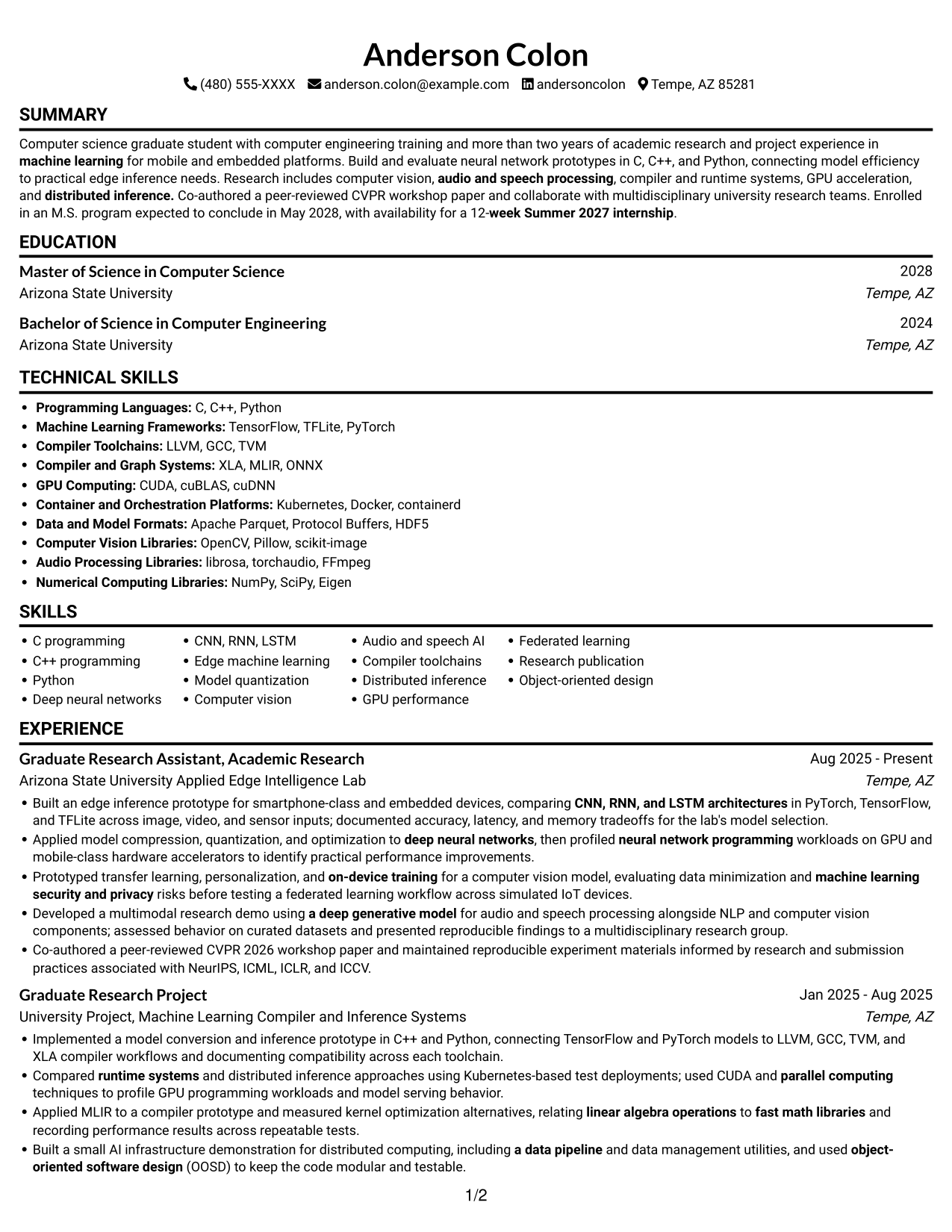
Resume example — page 1

This guide shows you how to create a focused resume for a Machine Learning and Artificial Intelligence Engineering Intern - Edge Machine Learning role. It explains how to present relevant evidence clearly and choose a format that helps readers review your work.

For this role, connect machine learning methods to edge devices and practical software work. Highlight relevant skills such as C, C++, Python, TensorFlow, TFLite, PyTorch, model compression, quantization, compiler systems, GPU acceleration, and distributed inference when they match your experience.

The resume example is presented in 7 layouts. Compare the image previews to see how section order and spacing affect readability, then open an example in the editor to view or customize it.

What Makes a Great Machine Learning and Artificial Intelligence Engineering Intern - Edge Machine Learning Resume in 2026

A strong resume uses clear sections, direct bullet points, and relevant evidence of machine learning work. It makes technical skills, research, projects, and education easy to find.

Use accurate keywords such as edge inference, CNN, RNN, LSTM, CUDA, MLIR, and quantization where your experience supports them. Add results, such as model accuracy, latency, or memory comparisons, when you have measured them.

Note: Resume examples are for educational purposes only. Use only information that accurately reflects your experience and qualifications. References to real organizations do not imply affiliation or endorsement.

#1 Simple One Column Format Resume Example

A single-column body keeps every section on one vertical reading path, a practical choice for following a detailed resume from top to bottom.
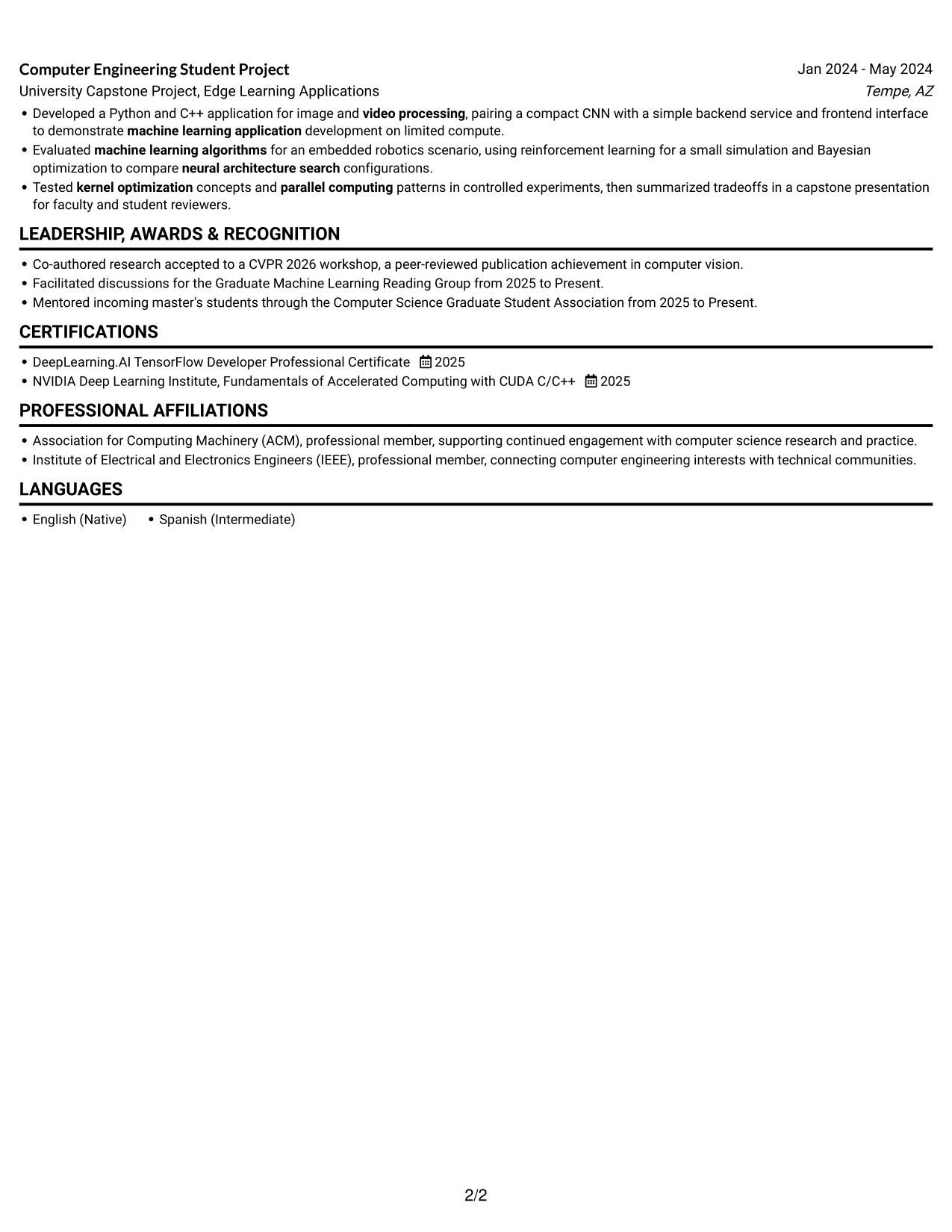
 
Resume example — page 1   Resume example — page 2

Why This Format Works

  • One vertical reading path helps reviewers follow experience dates and education in sequence.
  • Project descriptions remain part of the same clear progression as related experience.
  • Technical skills and credentials appear within a consistent scan from top to bottom.

Best For

  • Linear section-by-section reading
  • Chronological experience records
  • Detailed project entries
  • Multiple education records
  • Skills and credentials together

Resume Keywords

  • Computer science
  • C
  • with availability for a 12-week Summer 2027 internship.
  • Deep neural networks
  • machine learning algorithms
  • CNN, RNN, and LSTM architectures
  • PyTorch
  • neural network programming
  • machine learning for mobile and embedded platforms.
  • model compression
  • quantization
  • Applied model compression, quantization, and optimization to deep neural networks, then profiled neural network programming workloads on GPU and mobile-class hardware accelerators to identify practical performance improvements.
  • Implemented a model conversion and inference prototype in C++ and Python, connecting TensorFlow and PyTorch models to LLVM, GCC, TVM, and XLA compiler workflows
  • parallel computing
  • AI infrastructure
See all keywords
 

#2 Simple Two Column Format Resume Example

A two-column body presents resume information in parallel areas, helping reviewers locate several sections without losing the document's overall order.
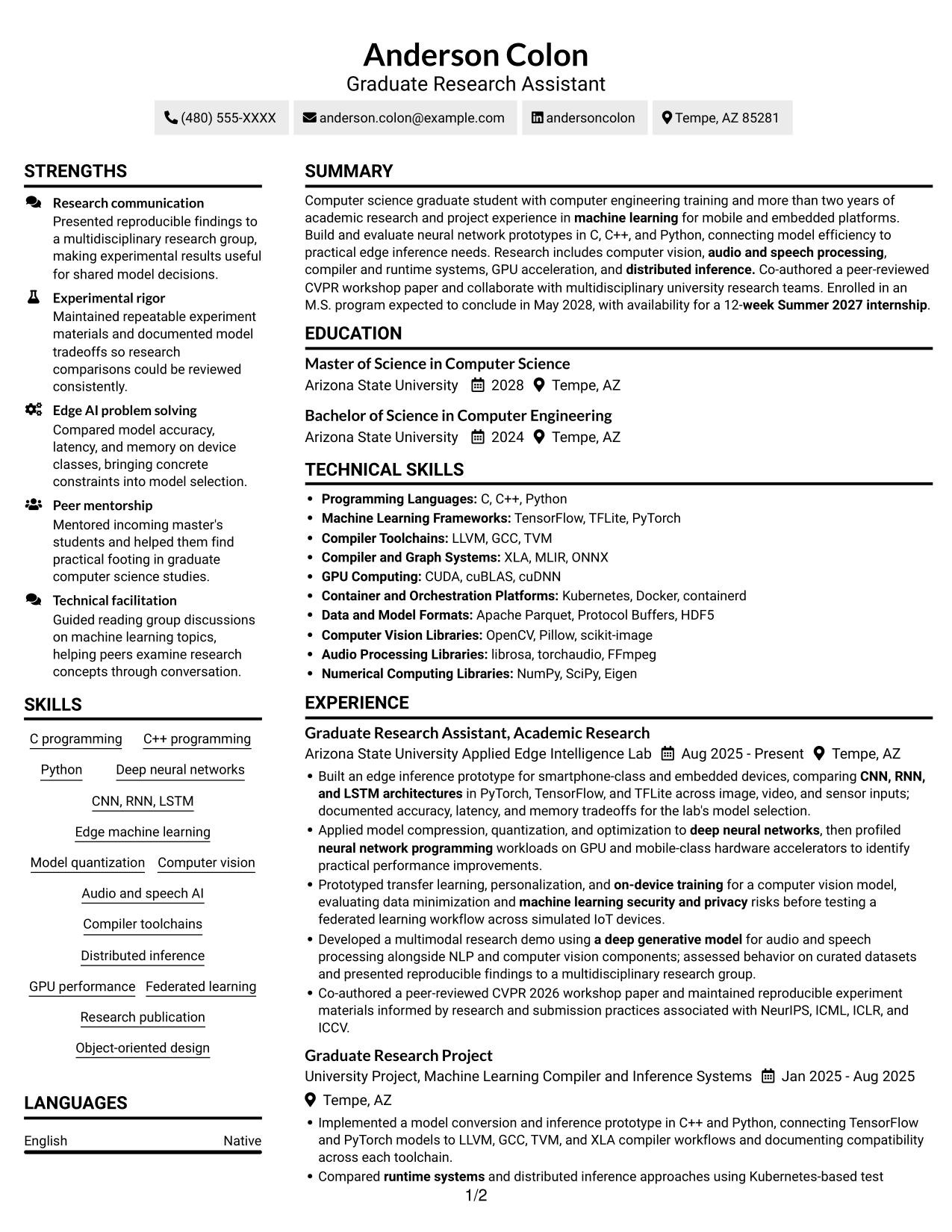
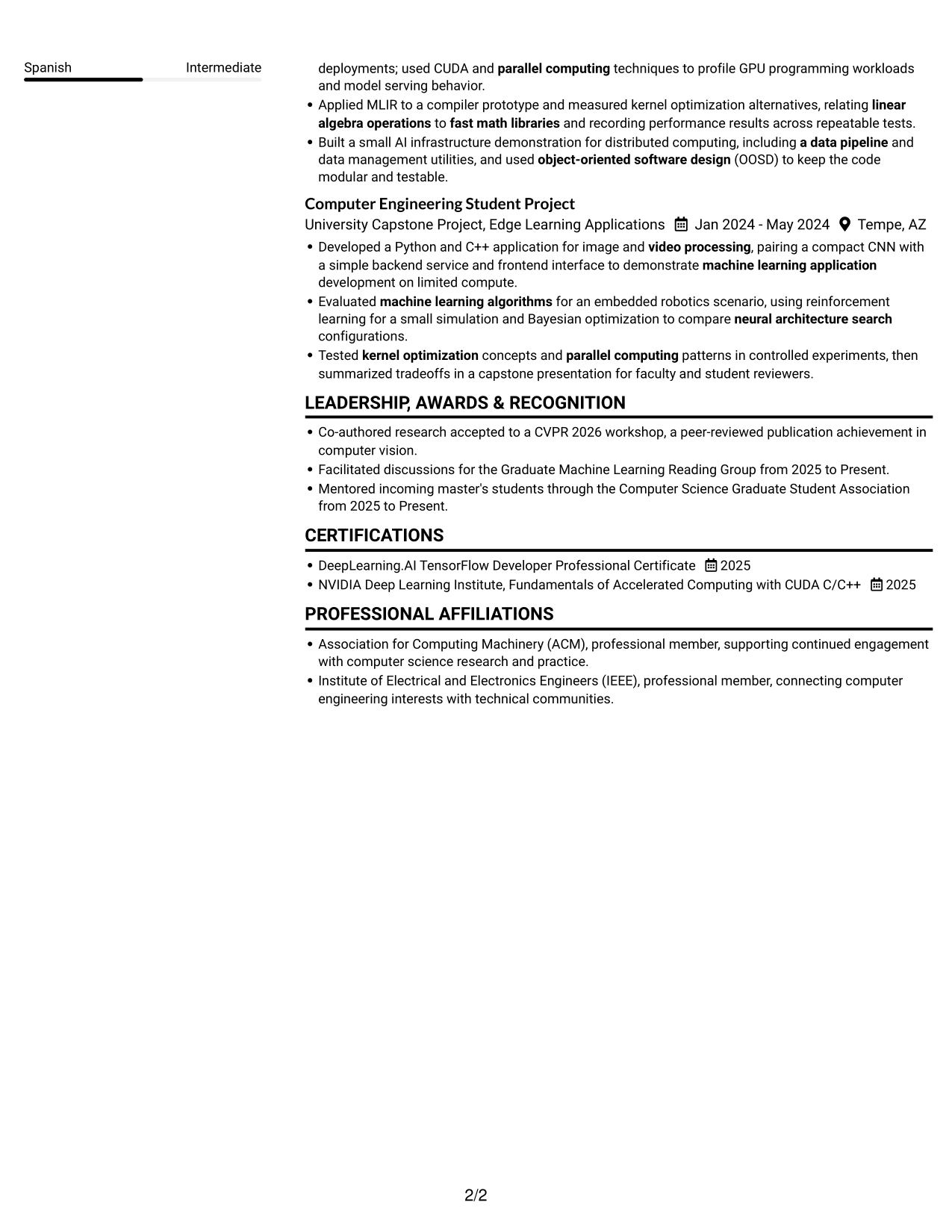
 
Resume example — page 1   Resume example — page 2

Why This Format Works

  • Two content columns let reviewers distinguish experience from supporting resume information at a glance.
  • Separate reading areas help education and project details remain easy to locate.
  • Experience entries can retain their sequence while other resume sections occupy a parallel area.

Best For

  • Parallel resume content areas
  • Quick section lookup
  • Experience with supporting details
  • Dense technical skill inventories
  • Several project and education entries

#3 Plain One Column with Shaded Labels Resume Example

A one-column body gives the resume a direct vertical reading route, useful when a reviewer prefers to move through sections in sequence.
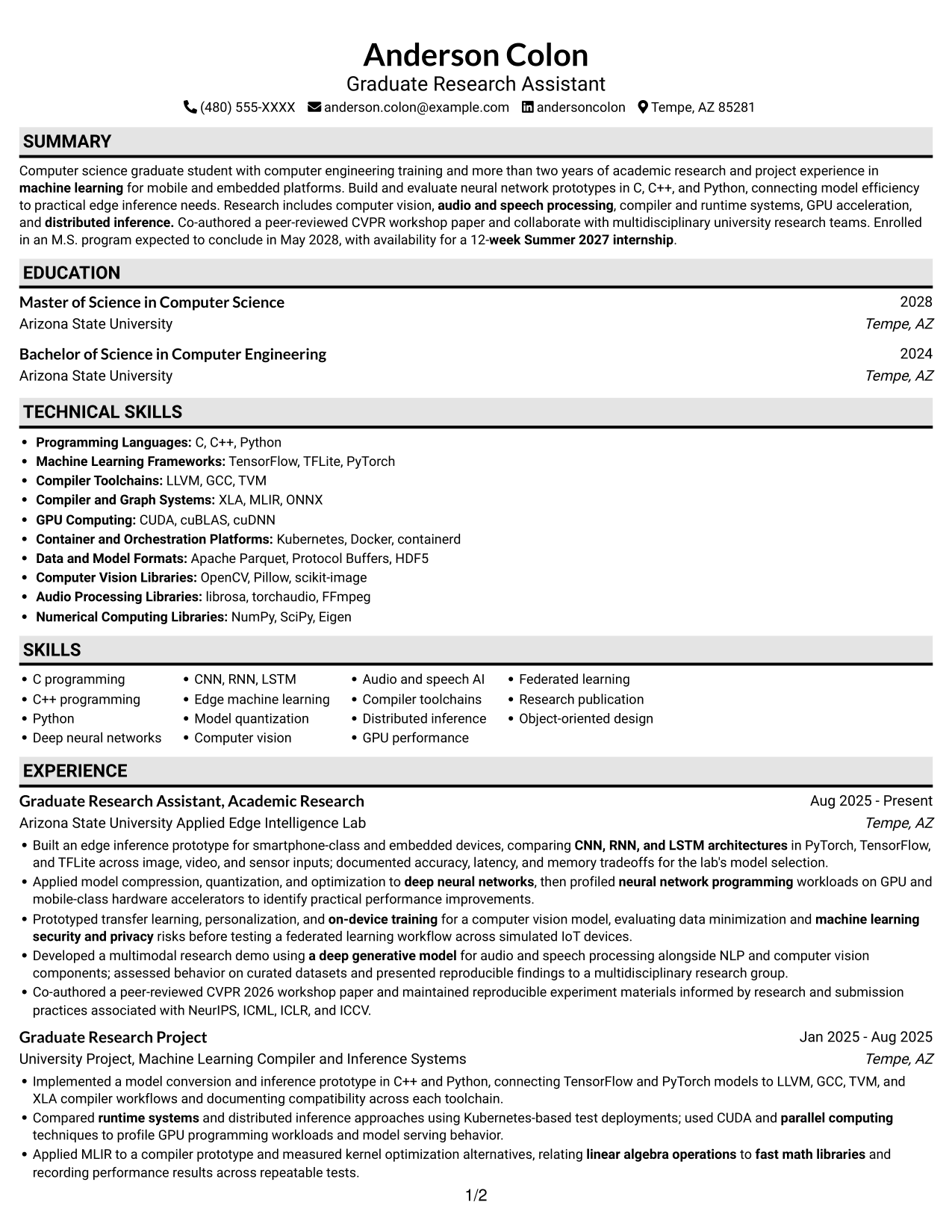
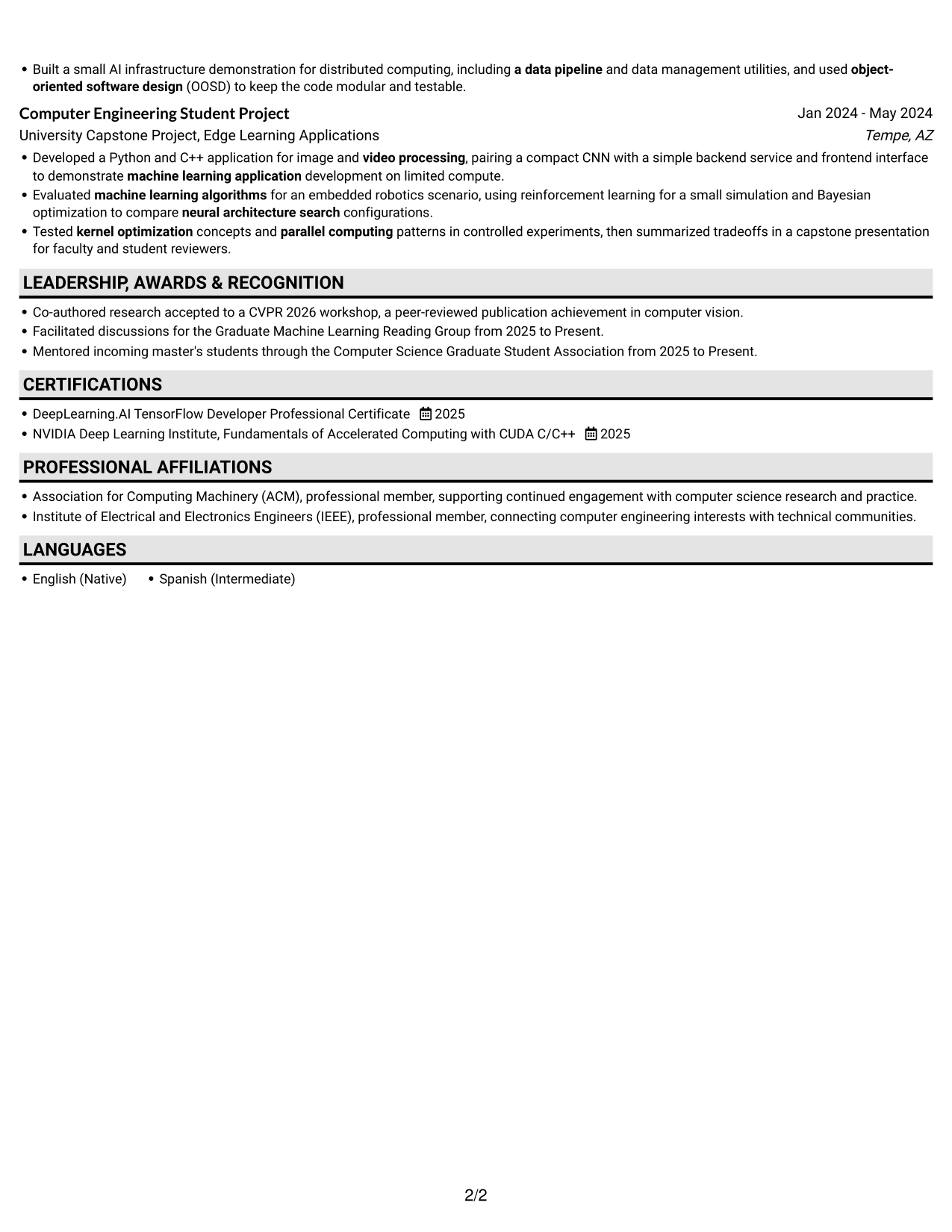
 
Resume example — page 1   Resume example — page 2

Why This Format Works

  • One vertical path lets reviewers follow education and experience without switching between columns.
  • Sequential sections keep project descriptions connected to the wider career record.
  • Technical skills and credentials remain part of one continuous review path.

Best For

  • Sequential experience review
  • Long-form project descriptions
  • Detailed skill categories
  • Multiple credentials and education entries
  • Single-path content review
 

#4 One Column Format with Photo Right Resume Example

A photo on the right adds a visible portrait beside the one-column resume, pairing a personal image with a direct content-reading path.
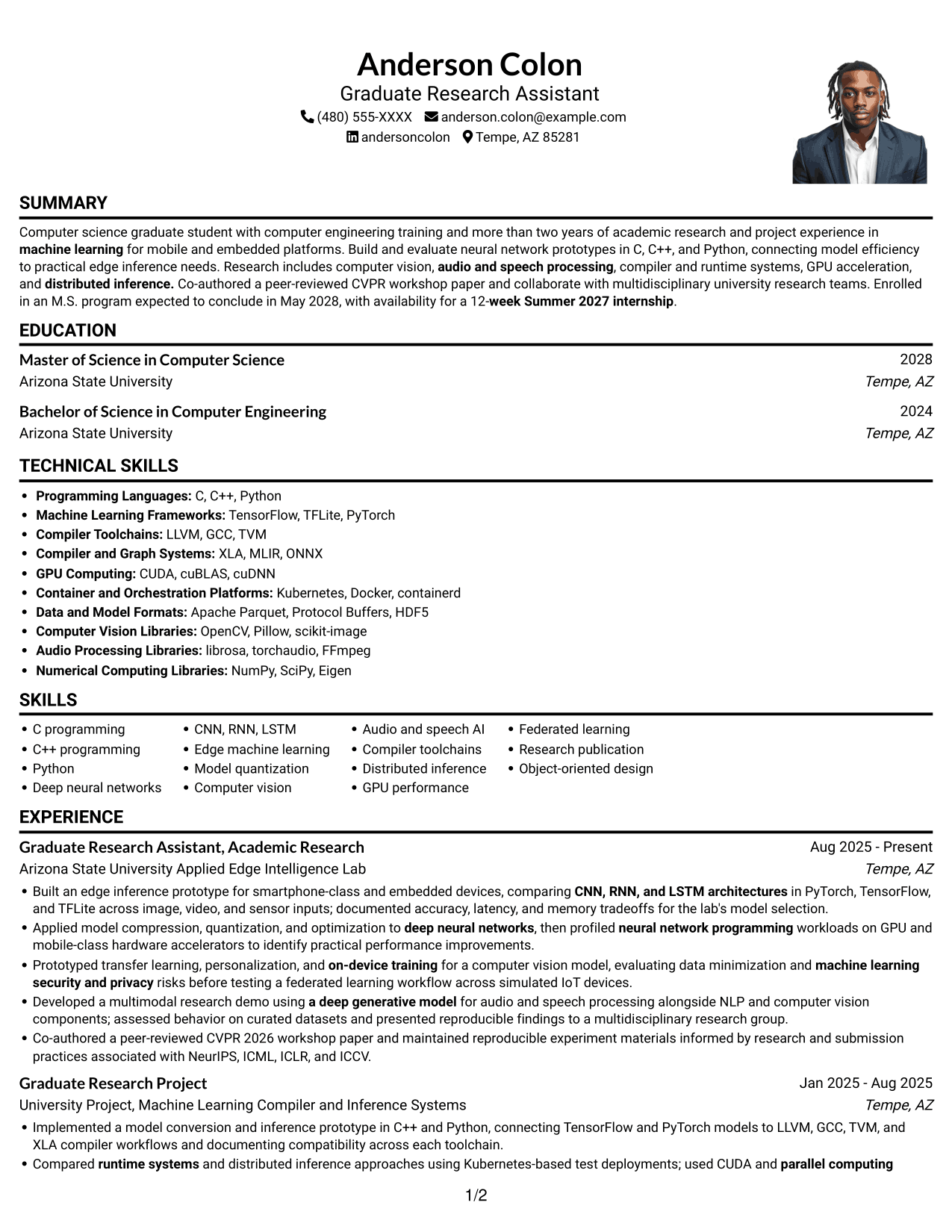
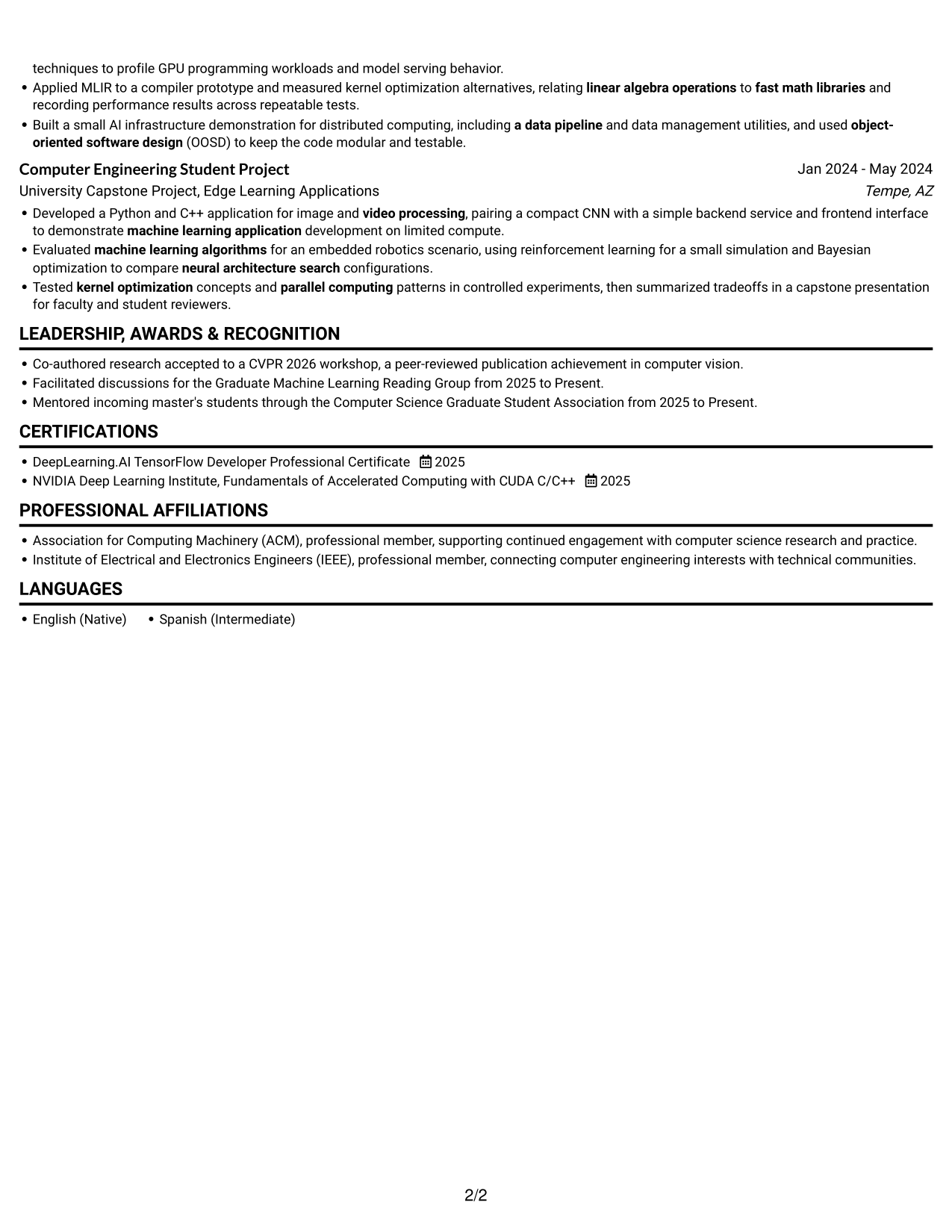
 
Resume example — page 1   Resume example — page 2

Why This Format Works

  • One-column reading keeps experience and education in a direct top-to-bottom sequence.
  • Project entries and credentials remain within the same straightforward review path.
  • An adjacent portrait adds a visual point of identification without changing section order.

Best For

  • Resume reviews that include a portrait
  • One-direction section review
  • Detailed project records
  • Broad technical skill sections
  • Education and experience in one sequence
 

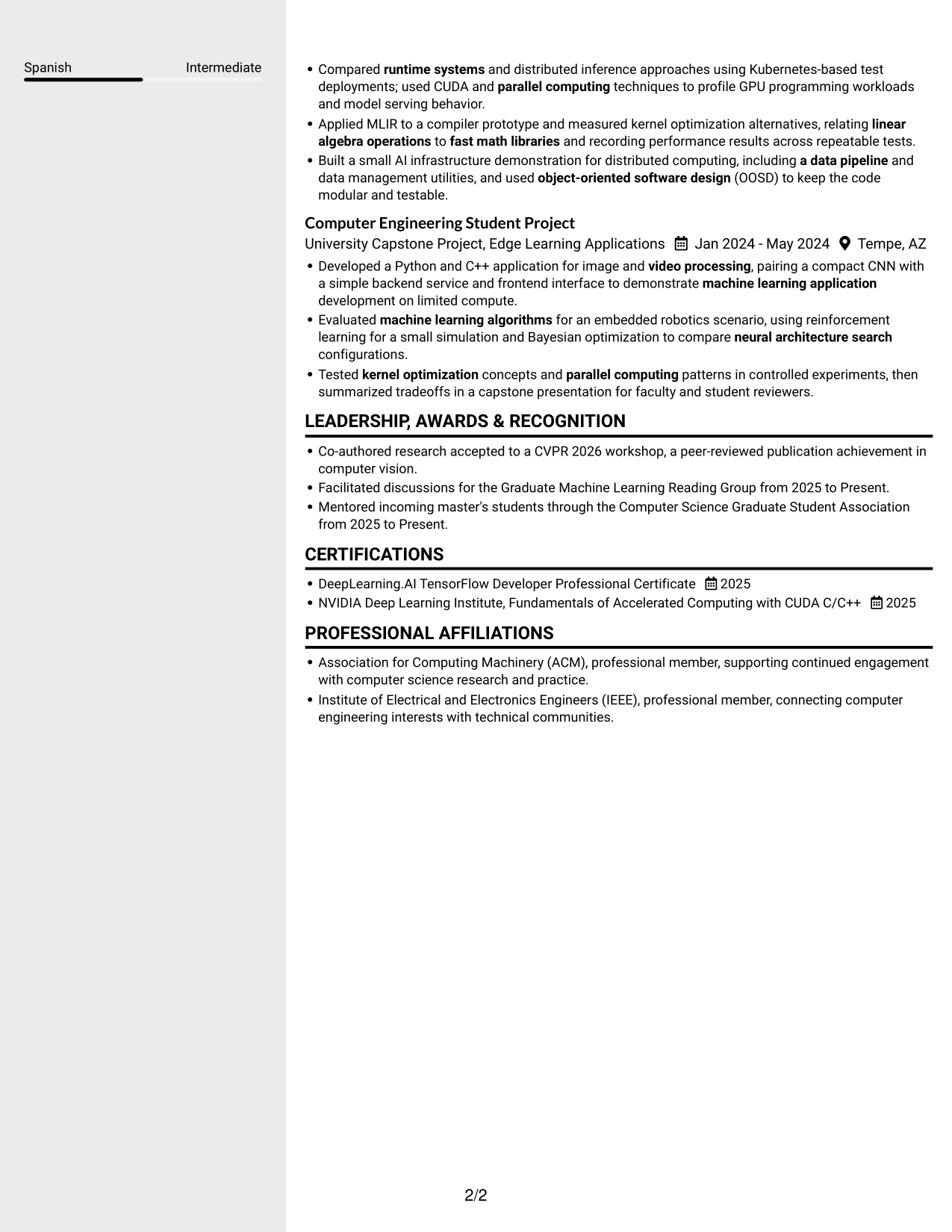
#5 Clean Two Column Sidebar Format Resume Example

The two-column sidebar layout gives resume content separate reading areas, a useful choice when readers want to move between experience and supporting details.
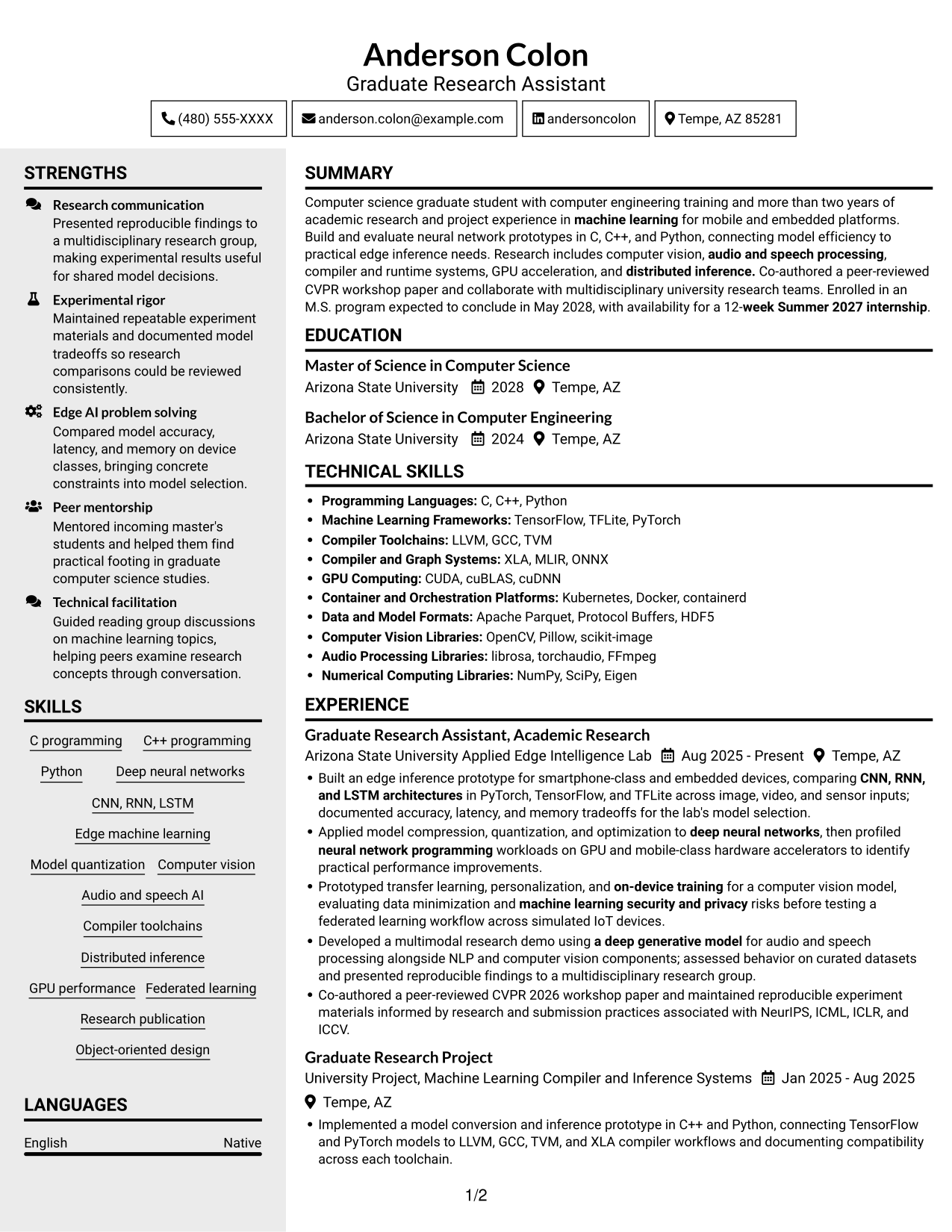
 
Resume example — page 1   Resume example — page 2

Why This Format Works

  • Parallel columns separate the main reading area from supporting resume details.
  • Experience dates remain easy to trace while readers locate other sections beside them.
  • Skills, education, and credentials can be reviewed as distinct resume categories.

Best For

  • Side-by-side content organization
  • Fast lookup across sections
  • Experience with supporting details
  • Broad skills inventories
  • Projects and credentials in one resume


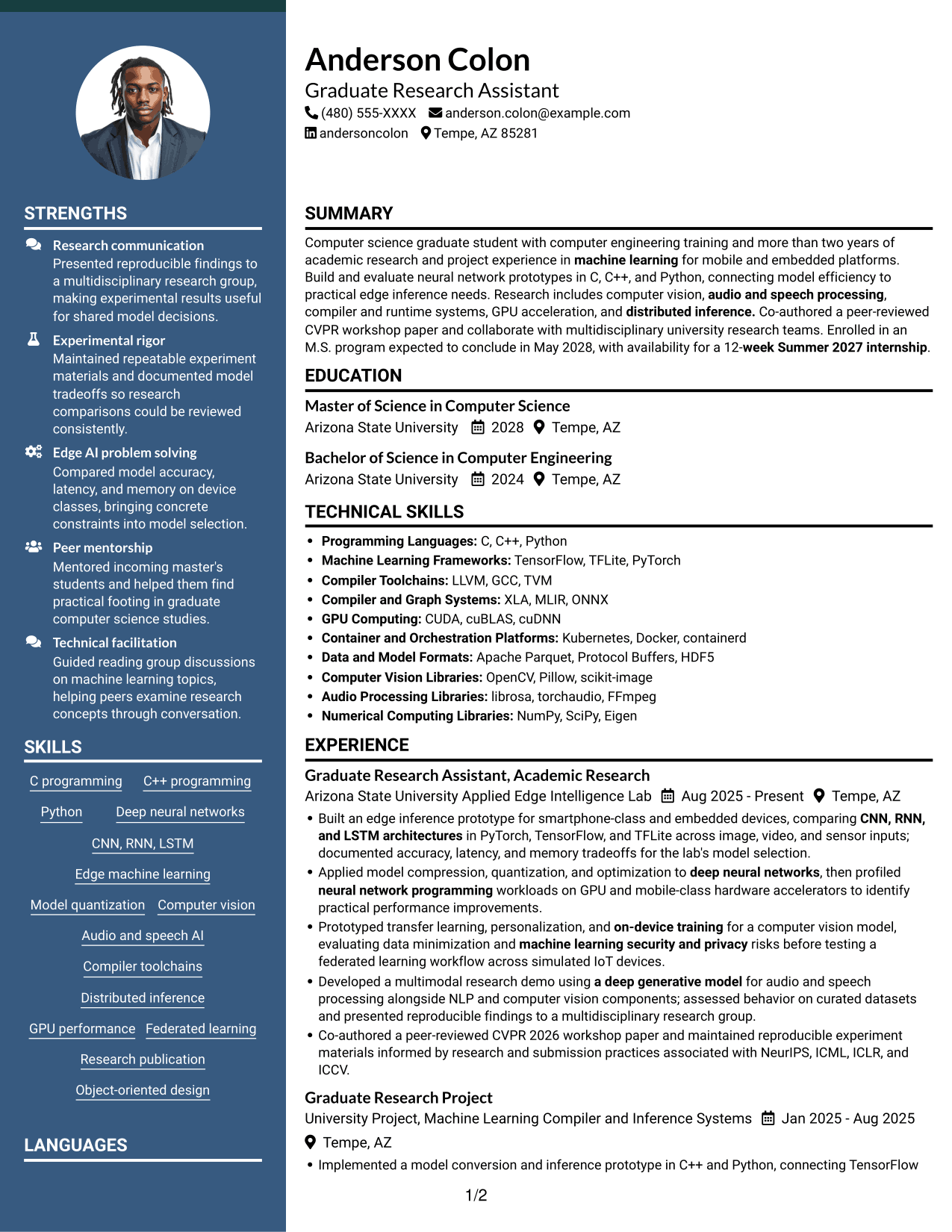
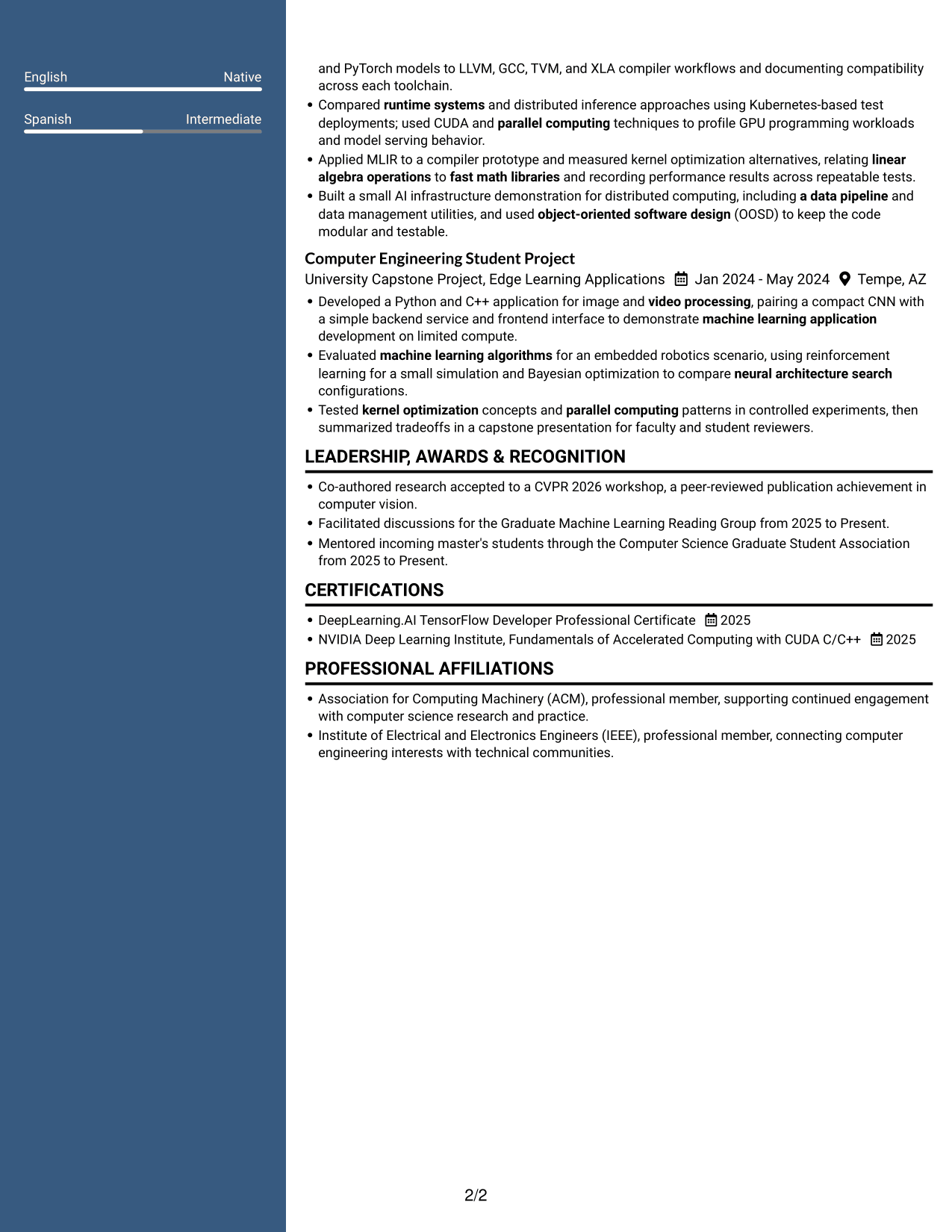
#6 Two Column Format Resume Example

Two body columns provide a parallel way to review resume sections, which can help readers compare experience with related information.
 
Resume example — page 1   Resume example — page 2

Why This Format Works

  • Two parallel areas help reviewers move between experience and supporting resume sections.
  • Project and education details remain distinct without adding another reading sequence.
  • Separate column space gives technical skills a clear place in the resume hierarchy.

Best For

  • Two-area document organization
  • Quick comparisons across sections
  • Experience with related details
  • Long technical skills inventories
  • Multiple project and education entries
 

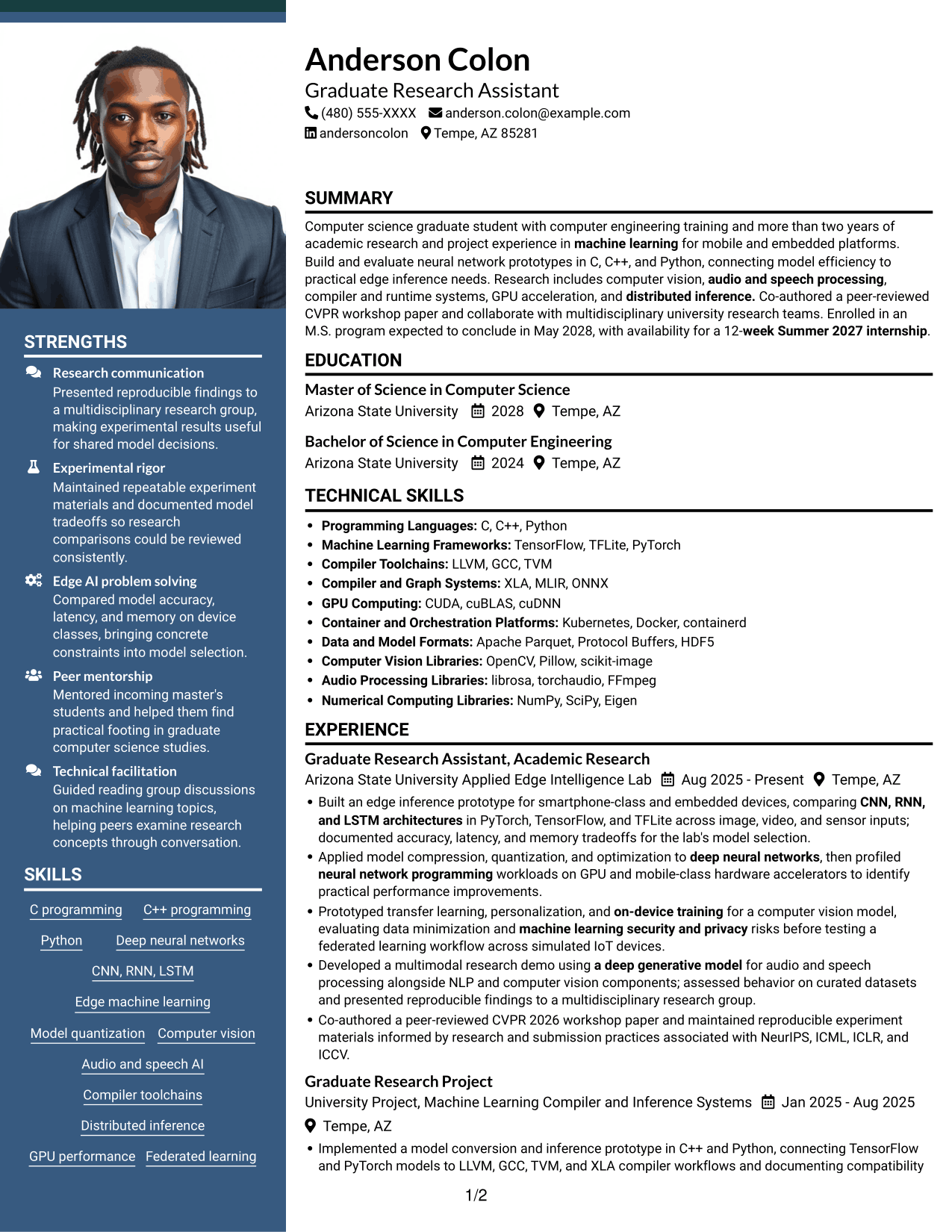
#7 Photo Header Two Column Format Resume Example

A photo in the header sits above a two-column resume body, combining a visible portrait with parallel content areas.
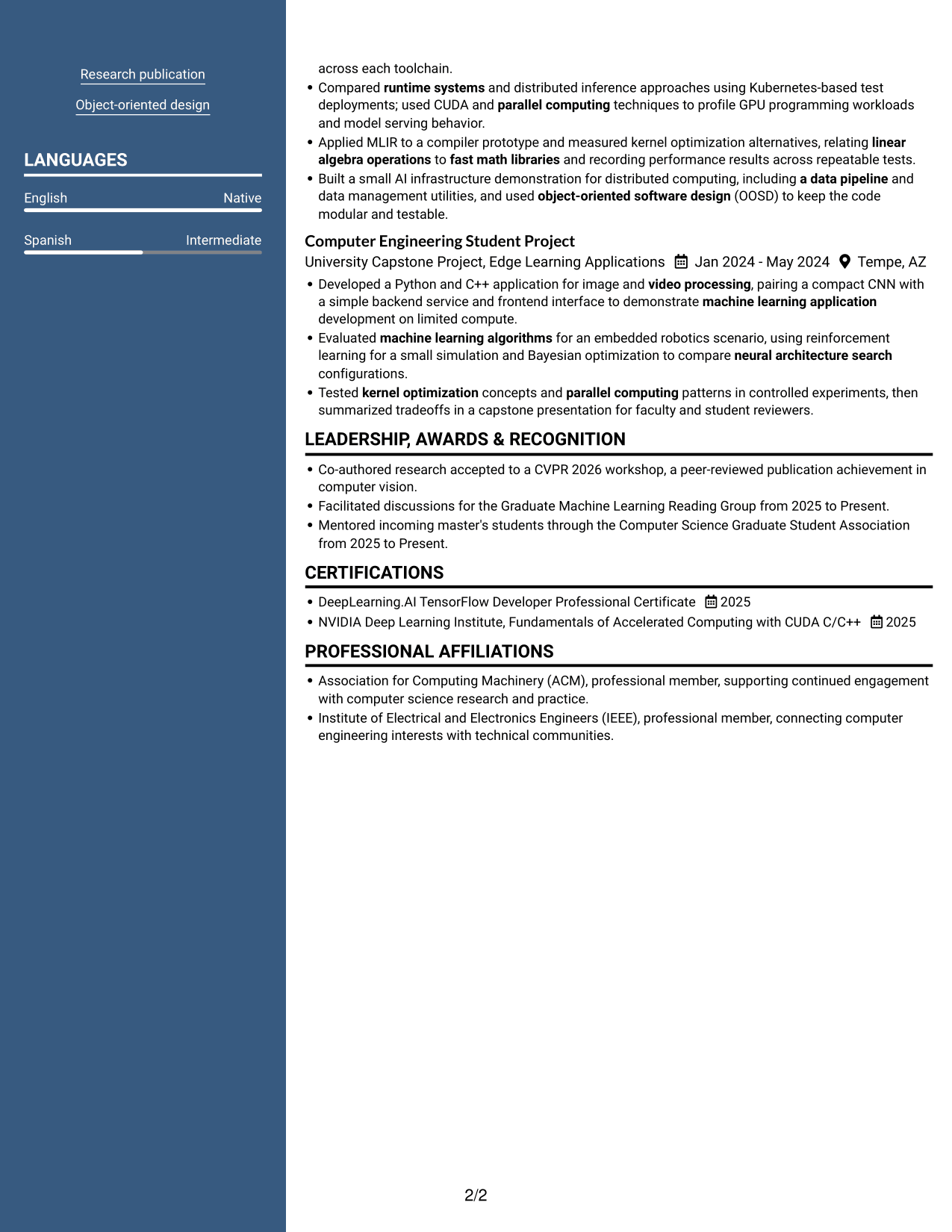
 
Resume example — page 1   Resume example — page 2

Why This Format Works

  • Two-column body areas help reviewers locate experience and related resume sections efficiently.
  • Section separation keeps education and project details distinct during a quick review.
  • The header photo adds a visible portrait while the body preserves its two-column reading order.

Best For

  • Photo-led resume headers
  • Two-column content review
  • Section lookup across parallel areas
  • Experience with supporting resume sections
  • Large skills and education sections


Why Build Your Edge Machine Learning Intern Resume with ResumeInMinutes

ResumeInMinutes lets you view a resume example in the editor and customize its content. Use the structure to organize your technical skills, education, research, and project evidence for easy review.

  • Clear resume section structure
  • ATS-aware formatting guidance
  • Role-focused keyword guidance
  • Skills and project organization
  • Image previews for layout comparison
  • Resume customization in the editor

Use the example as a starting point, then check that each skill, tool, and achievement you include is accurate and supported by your experience.


See Also


Frequently Asked Questions

Are these edge machine learning intern resume examples ATS-friendly?

The examples use organized sections and readable headings. Include relevant terms such as C++, Python, TensorFlow, PyTorch, edge inference, and model optimization when they accurately describe your work. No format can guarantee a particular ATS result.

What can I learn from the resume previews?

The image previews help you compare section order, spacing, and visual structure. You can open an example in the editor to view or customize it.

What should an edge machine learning intern resume include?

Include a concise summary, education, relevant research or projects, technical skills, and experience. Add certifications or publications when relevant, and use bullets to describe your contribution and any measured results.

Which resume format works well for this role?

A clear one-column format can make headings and experience easy to scan. Choose a layout that keeps technical skills and project evidence readable, and check that the text remains easy to follow.

How can I show relevant work if I have limited industry experience?

Use research, coursework, and personal or university projects that relate to edge machine learning. Explain what you built, which tools you used, and what you tested or learned.

Should I include a photo on my resume?

For U.S. applications, a resume without a photo is generally the safer choice. Follow local norms if you are applying in another country.

ATS Score 98%

How we calculate this score

  • Keywords: 60% of the total. AI extracts keywords from your job description. If you do not provide one, a standard job description for the title matching your resume is used. This is not a match to a specific vacancy.
  • Text-based resume: 20%. The text resume assessed here receives 100 for this part.
  • Resume quality: 20%. We start at 100 and subtract points for issues found by our resume checks, down to a minimum of zero.
  • Keyword coverage = round(100 × confirmed matches ÷ total keywords). Exact matches and supported equivalents verified by AI receive full credit; unsupported keywords receive none. Live text checks use the saved equivalents and do not request a new AI review. Without keywords, no overall ATS score is available.
  • Final score = 60% of keyword coverage + 20% of the text score + 20% of the quality score, rounded to a whole number. Without keywords, no overall ATS score is available.

What this score means

Our scores are estimates, not employer ratings. They may contain errors and do not guarantee accurate parsing, a ranking, an interview, or a job. Check your document against the employer’s requirements. You are responsible for relying on this score.

Terms and Conditions

Score weights: Keywords 60% · Text based resume 20% · Resume quality 20%

Keyword coverage: 44 of 46 (96%) · Resume quality: 100%

Resume quality 100% · Weight 20% · Issues (0)

Details
  • ✓Name present: Anderson Colon
  • ✓Email format: anderson.colon@example.com
  • ✓Phone format: (480) 555-XXXX
  • ✓Experience 1: Job title: Graduate Research Assistant, Academic Research
  • ✓Experience 1: Company name: Arizona State University Applied Edge Intelligence Lab
  • ✓Experience 1: Work location: Tempe, AZ
  • ✓Experience 1: Employment dates: Aug 2025 - Present
  • ✓Experience 1: Description or achievements: Present
  • ✓Experience 2: Job title: Graduate Research Project
  • ✓Experience 2: Company name: University Project, Machine Learning Compiler and Inference Systems
  • ✓Experience 2: Work location: Tempe, AZ
  • ✓Experience 2: Employment dates: Jan 2025 - Aug 2025
  • ✓Experience 2: Description or achievements: Present
  • ✓Experience 3: Job title: Computer Engineering Student Project
  • ✓Experience 3: Company name: University Capstone Project, Edge Learning Applications
  • ✓Experience 3: Work location: Tempe, AZ
  • ✓Experience 3: Employment dates: Jan 2024 - May 2024
  • ✓Experience 3: Description or achievements: Present
  • ✓No placeholder fields
  • ✓No repeated achievement bullets
  • ✓No empty bullets

No issues found by the current checks.

Text Based Resume 100% · Weight 20%

Parsed text
Anderson Colon
(480) 555-XXXX
anderson.colon@example.com
andersoncolon
Tempe, AZ 85281
SUMMARY
Computer science graduate student with computer engineering training and more than two years of academic research and project experience in machine learning for mobile and embedded platforms. Build and evaluate neural network prototypes in C, C++, and Python, connecting model efficiency to practical edge inference needs. Research includes computer vision, audio and speech processing, compiler and runtime systems, GPU acceleration, and distributed inference. Co-authored a peer-reviewed CVPR workshop paper and collaborate with multidisciplinary university research teams. Enrolled in an M.S. program expected to conclude in May 2028, with availability for a 12-week Summer 2027 internship.
EDUCATION
Master of Science in Computer Science
2028
Arizona State University
Tempe, AZ
Bachelor of Science in Computer Engineering
2024
Arizona State University
Tempe, AZ
TECHNICAL SKILLS
Programming Languages: C, C++, Python
Machine Learning Frameworks: TensorFlow, TFLite, PyTorch
Compiler Toolchains: LLVM, GCC, TVM
Compiler and Graph Systems: XLA, MLIR, ONNX
GPU Computing: CUDA, cuBLAS, cuDNN
Container and Orchestration Platforms: Kubernetes, Docker, containerd
Data and Model Formats: Apache Parquet, Protocol Buffers, HDF5
Computer Vision Libraries: OpenCV, Pillow, scikit-image
Audio Processing Libraries: librosa, torchaudio, FFmpeg
Numerical Computing Libraries: NumPy, SciPy, Eigen
SKILLS
C programming
C++ programming
Python
Deep neural networks
CNN, RNN, LSTM
Edge machine learning
Model quantization
Computer vision
Audio and speech AI
Compiler toolchains
Distributed inference
GPU performance
Federated learning
Research publication
Object-oriented design
EXPERIENCE
Graduate Research Assistant, Academic Research
Aug 2025 - Present
Arizona State University Applied Edge Intelligence Lab
Tempe, AZ
Built an edge inference prototype for smartphone-class and embedded devices, comparing CNN, RNN, and LSTM architectures in PyTorch, TensorFlow, and TFLite across image, video, and sensor inputs; documented accuracy, latency, and memory tradeoffs for the lab's model selection.
Applied model compression, quantization, and optimization to deep neural networks, then profiled neural network programming workloads on GPU and mobile-class hardware accelerators to identify practical performance improvements.
Prototyped transfer learning, personalization, and on-device training for a computer vision model, evaluating data minimization and machine learning security and privacy risks before testing a federated learning workflow across simulated IoT devices.
Developed a multimodal research demo using a deep generative model for audio and speech processing alongside NLP and computer vision components; assessed behavior on curated datasets and presented reproducible findings to a multidisciplinary research group.
Co-authored a peer-reviewed CVPR 2026 workshop paper and maintained reproducible experiment materials informed by research and submission practices associated with NeurIPS, ICML, ICLR, and ICCV.
Graduate Research Project
Jan 2025 - Aug 2025
University Project, Machine Learning Compiler and Inference Systems
Tempe, AZ
Implemented a model conversion and inference prototype in C++ and Python, connecting TensorFlow and PyTorch models to LLVM, GCC, TVM, and XLA compiler workflows and documenting compatibility across each toolchain.
Compared runtime systems and distributed inference approaches using Kubernetes-based test deployments; used CUDA and parallel computing techniques to profile GPU programming workloads and model serving behavior.
Applied MLIR to a compiler prototype and measured kernel optimization alternatives, relating linear algebra operations to fast math libraries and recording performance results across repeatable tests.
Built a small AI infrastructure demonstration for distributed computing, including a data pipeline and data management utilities, and used object-oriented software design (OOSD) to keep the code modular and testable.
Computer Engineering Student Project
Jan 2024 - May 2024
University Capstone Project, Edge Learning Applications
Tempe, AZ
Developed a Python and C++ application for image and video processing, pairing a compact CNN with a simple backend service and frontend interface to demonstrate machine learning application development on limited compute.
Evaluated machine learning algorithms for an embedded robotics scenario, using reinforcement learning for a small simulation and Bayesian optimization to compare neural architecture search configurations.
Tested kernel optimization concepts and parallel computing patterns in controlled experiments, then summarized tradeoffs in a capstone presentation for faculty and student reviewers.
LEADERSHIP, AWARDS & RECOGNITION
Co-authored research accepted to a CVPR 2026 workshop, a peer-reviewed publication achievement in computer vision.
Facilitated discussions for the Graduate Machine Learning Reading Group from 2025 to Present.
Mentored incoming master's students through the Computer Science Graduate Student Association from 2025 to Present.
CERTIFICATIONS
DeepLearning.AI TensorFlow Developer Professional Certificate
2025
NVIDIA Deep Learning Institute, Fundamentals of Accelerated Computing with CUDA C/C++
2025
PROFESSIONAL AFFILIATIONS
Association for Computing Machinery (ACM), professional member, supporting continued engagement with computer science research and practice.
Institute of Electrical and Electronics Engineers (IEEE), professional member, connecting computer engineering interests with technical communities.
LANGUAGES
English (Native)
Spanish (Intermediate)

Matched keywords (44)

  • Computer scienceOriginal keyword in JD: Current bachelor's, master's, or Ph.D. enrollment in Computer Engineering OR Computer Science OR Electrical Engineering OR a related field
  • COriginal keyword in JD: C OR C++ OR Python (1+ year of experience)
  • with availability for a 12-week Summer 2027 internship.Original keyword in JD: Availability for an 11- to 14-week Summer 2027 internship
  • Deep neural networks
  • machine learning algorithms
  • CNN, RNN, and LSTM architectures
  • PyTorchOriginal keyword in JD: TensorFlow OR TFLite OR PyTorch
  • neural network programming
  • machine learning for mobile and embedded platforms.Original keyword in JD: Mobile and embedded machine learning
  • model compression
  • quantization
  • Applied model compression, quantization, and optimization to deep neural networks, then profiled neural network programming workloads on GPU and mobile-class hardware accelerators to identify practical performance improvements.Original keyword in JD: Machine learning performance optimization
  • Implemented a model conversion and inference prototype in C++ and Python, connecting TensorFlow and PyTorch models to LLVM, GCC, TVM, and XLA compiler workflowsOriginal keyword in JD: Compiler frameworks
  • parallel computing
  • AI infrastructure
  • distributed inference.Original keyword in JD: Inference systems
  • distributed computing
  • runtime systems
  • GPU programming
  • CUDA
  • Kubernetes
  • MLIR
  • linear algebra operations
  • fast math libraries
  • Deep Learning
  • reinforcement learning
  • neural architecture search
  • kernel optimization
  • Bayesian optimization
  • on-device training
  • transfer learning
  • personalization
  • Federated learning
  • machine learning security and privacy
  • a deep generative modelOriginal keyword in JD: Deep generative models
  • audio and speech processing
  • NLPOriginal keyword in JD: Natural language processing
  • computer vision
  • image and video processing
  • a data pipelineOriginal keyword in JD: Machine learning data pipelines
  • data management
  • Developed a Python and C++ application for image and video processing, pairing a compact CNN with a simple backend service and frontend interface to demonstrate machine learning application development on limited compute.Original keyword in JD: Backend and frontend application development
  • Co-authored a peer-reviewed CVPR 2026 workshop paperOriginal keyword in JD: Peer-reviewed research publications
  • object-oriented software design

Missing keywords (2)

  • Expected degree completion November 2027 or later
  • Wireless communication
Disclaimer: All names, images, contact information, employment histories, achievements, security clearances, military credentials, and other qualifications shown in this content are fictional and used for illustrative purposes only. Any resemblance to actual persons, living or deceased, is purely coincidental.

Resume and cover-letter examples and recommendations in this article reflect general best practices and professional experience and are provided for guidance only. Results may vary based on role, industry, region, and hiring organization.

Content Accuracy and Verification: To the fullest extent permitted by applicable law, we do not represent or warrant that resume or cover-letter guidance, examples, recommendations, or related information are accurate, complete, current, error-free, or suitable for any particular purpose. You are responsible for independently reviewing and verifying the information before relying on it.

ATS and Cover-Letter Scores: ATS scores are estimates calculated using our own formula, informed by publicly available guidance on resume formatting and keyword matching. They are not scores issued or endorsed by an ATS provider or employer. Cover-letter scores are also our own assessments. Parsing, weighting, screening criteria, and results vary between systems, employers, job descriptions, and document formats. No score guarantees successful parsing, a particular ranking, an interview, or employment. Use scores as general guidance and independently check your documents against the employer’s requirements. To the fullest extent permitted by applicable law, we accept no liability for errors in scores or parsing, or losses arising from reliance on these assessments. Nothing in this notice excludes liability or limits consumer rights that cannot lawfully be excluded or limited.

Terms and Conditions
 
> JP 1 1
PDF Footer and Margins Setup
The margins are applied to the document, and the footer shows up in the preview and the PDF

Footer Font Settings

Are you applying for a specific job
so we can tailor your resume to it?
Are you applying for a specific job
so we can tailor your cover letter to it?

Your data stays private and is never used for training.Privacy Policy

Type your details as text to generate a personalized resume Type your details as text to generate a personalized cover letter
Website link found! Ready to create resume from:

Your data stays private and is never used for training.Privacy Policy

Drag the into the box to verify you're human.
Drop here

My Resumes

Displaying {number_of_files} files (out of {total_of_all_files} total)
Name File Type Last Modified: Description:

Rename File

Filename already exists!

Delete Files

Warning: This action is irreversible. Once you click submit, the files will be permanently deleted.

Heading text
Upload From Computer Upload
Select From Existing
LinkedIn
Drag & Drop files anywhere in this tab, or

Uploaded Files

Delete Name Last Updated Use This File
Select this to use the file for generating your resume and cover letter. Only one source—uploaded file, selected file, or LinkedIn text—can be used.

My Files

Resumes or cover letters you create will appear here. No files available yet.
Delete Name Last Updated Use This File
Select this to use the file for generating your resume and cover letter. Only one source—uploaded file, selected file, or LinkedIn text—can be used.

Add LinkedIn Profile PDF

You can download your LinkedIn profile as a PDF by opening linkedin.com in a web browser, clicking your profile photo, selecting the “More” or “Resources” button, and choosing “Save to PDF.” You can then attach the PDF using the Upload From Computer tab.

Paste Your LinkedIn Profile Text

If you have copied the LinkedIn profile text, paste it below. See how to copy your profile from LinkedIn

Select this to use the LinkedIn profile text for generating your resume and cover letter. Only one source—uploaded file, selected file, or LinkedIn text—can be used.

Try these controls

<
>