33 ML & Cloud Infrastructure Engineer Intern Resume Templates with Example 2026 (ATS-Optimized)
This guide shows you how to build an ML & Cloud Infrastructure Engineer Intern resume that is clear, focused, and easy to adapt. You will learn how to present technical evidence so recruiters can quickly assess your ability to support data, training, and evaluation infrastructure.
Strong resumes for this role connect tools to outcomes. They show how Python, AWS, Docker, Kubernetes, Terraform, Ray, Spark, CI/CD, observability, and experiment tracking were used to create repeatable systems, improve evaluation, or make technical work easier to operate.
The complete ML & Cloud Infrastructure Engineer Intern resume example is presented in 33 ATS-friendly layouts. Use the examples to compare section order, bullet-point density, skills placement, project treatment, and formats that support fast, accurate resume review.
What Makes a Great ML & Cloud Infrastructure Engineer Intern Resume in 2026
Effective resumes in 2026 are evidence-first, keyword-aligned, and built for rapid technical review. The goal is not to list every tool. The goal is to show how your work helped a team build, test, monitor, or improve an infrastructure workflow.
- Use a focused summary that names the target role and connects your strongest infrastructure skills to robotics, machine learning, or cloud work.
- Describe experience and projects with action verbs, clear ownership, and measurable scope, such as records processed, scenarios replayed, or researchers supported.
- Group technical skills into useful categories, including programming, cloud platforms, containers, infrastructure as code, distributed computing, CI/CD, and observability.
- Write bullets that explain the result of the work, such as repeatable experiments, clearer failure recovery, faster data selection, stronger test coverage, or better pipeline visibility.
Resume content should use scannable sections rather than long explanations. For this role, relevant keyword alignment may include Python, AWS, GCP, Docker, Kubernetes, Terraform, Ray, Spark, GitHub Actions, GPU clusters, data pipelines, evaluation infrastructure, Prometheus, Grafana, MLflow, pytest, experiment tracking, and robotics evaluation. Place these terms next to evidence that shows how they were applied.
The resume examples below use an evidence-first approach so formatting supports role-specific clarity, ATS matching, and fast review of infrastructure ownership, technical skills, project scope, and measurable results for an ML & Cloud Infrastructure Engineer Intern.
#1 Simple One Column Format Resume Example
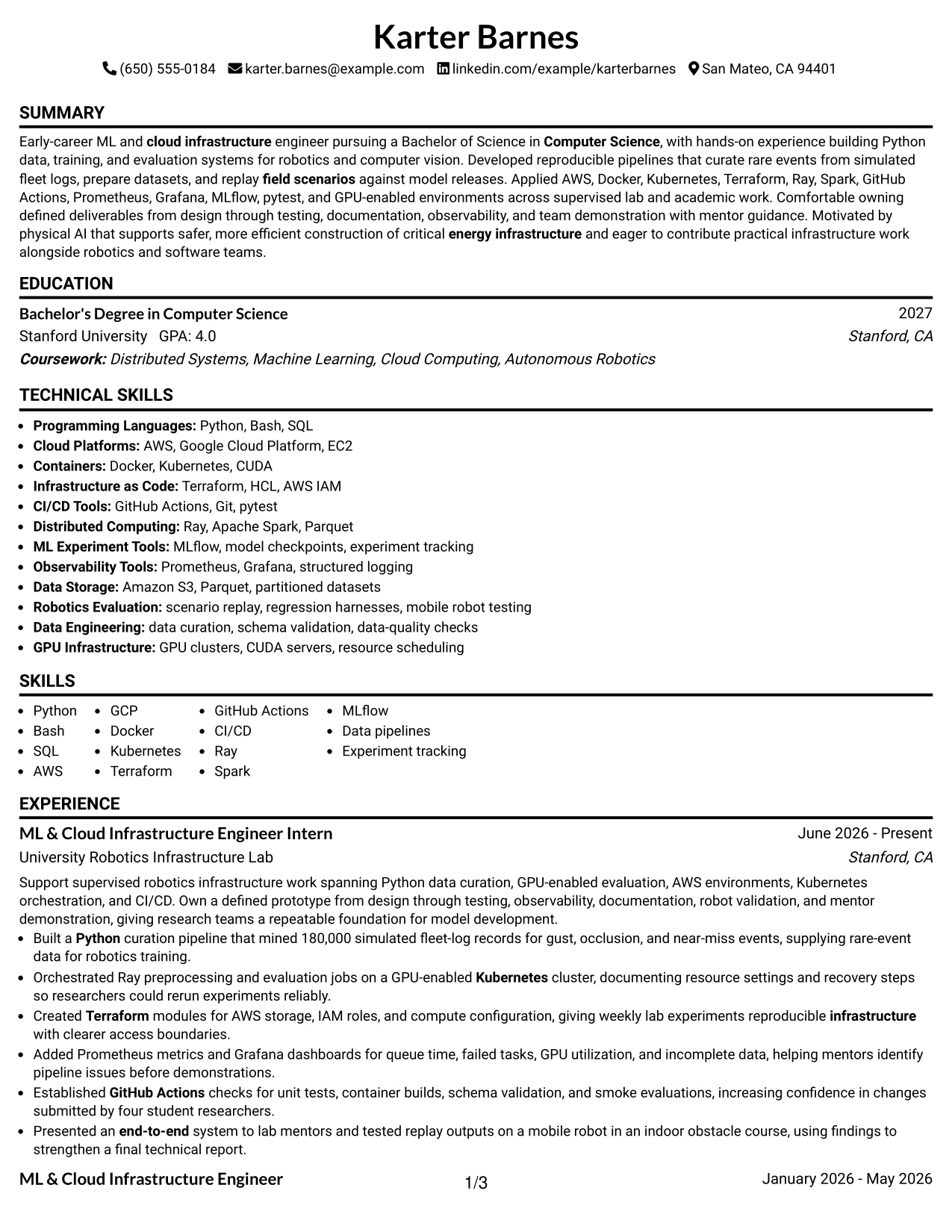
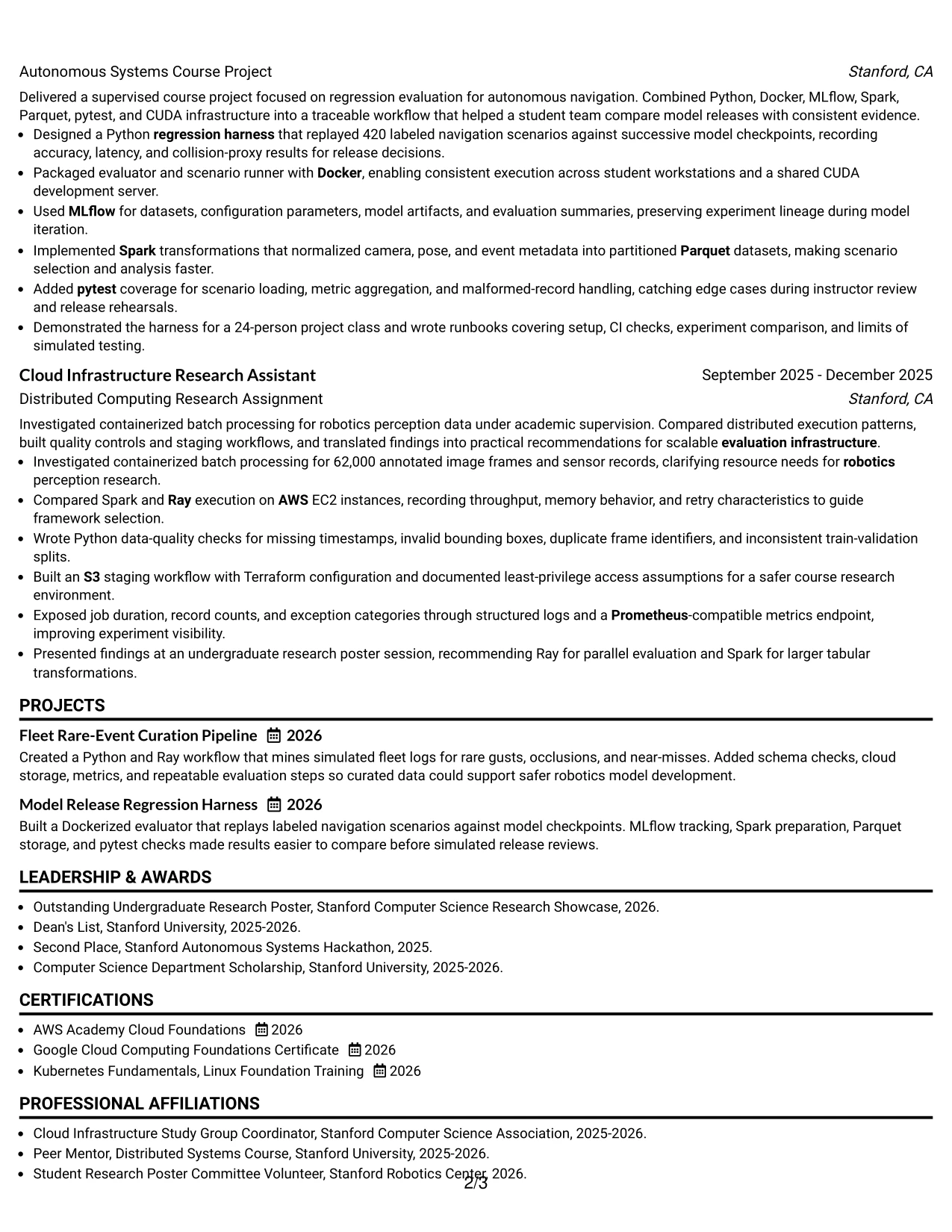
The Simple One Column Format places the contact header, summary, experience, projects, education, certifications, and skills in one clear vertical path. Karter Barnes’s resume uses this structure to move from a focused ML & Cloud Infrastructure Engineer Intern summary into evidence such as 180,000 fleet-log records, GPU-enabled Kubernetes work, and repeatable evaluation systems.
A single column supports fast scanning and reliable ATS parsing. Short achievement bullets keep Python, AWS, Ray, Spark, Terraform, observability, and ML experiment tooling visible without splitting related evidence across separate areas.
Why the Simple One Column Format Works for a Resume
- A single reading path helps recruiters find the target role and summary quickly.
- Clear section hierarchy separates experience, projects, education, certifications, and skills.
- Achievement bullets connect technical work to measurable evidence, including 180,000 records and 420 scenarios.
- The structure gives ATS tools a predictable order for reading keywords.
- Tools such as AWS, Kubernetes, Terraform, Ray, Spark, and MLflow remain easy to locate.
- Project details can sit below experience without competing with the main work history.
- The format supports a focused resume while preserving useful technical depth.
Best For
- Applicants who want one-column readability from top to bottom.
- Resumes that need strong ATS parsing and predictable section order.
- Technical candidates with several tools that must remain easy to scan.
- Documents where experience bullets should receive more space than visual elements.
- Applications that combine internships, academic projects, and research work.
- Candidates presenting measurable pipeline, testing, or evaluation evidence.
- Readers reviewing a resume on a narrow screen or in a plain-text workflow.
#2 Plain One Column with Shaded Labels Resume Example
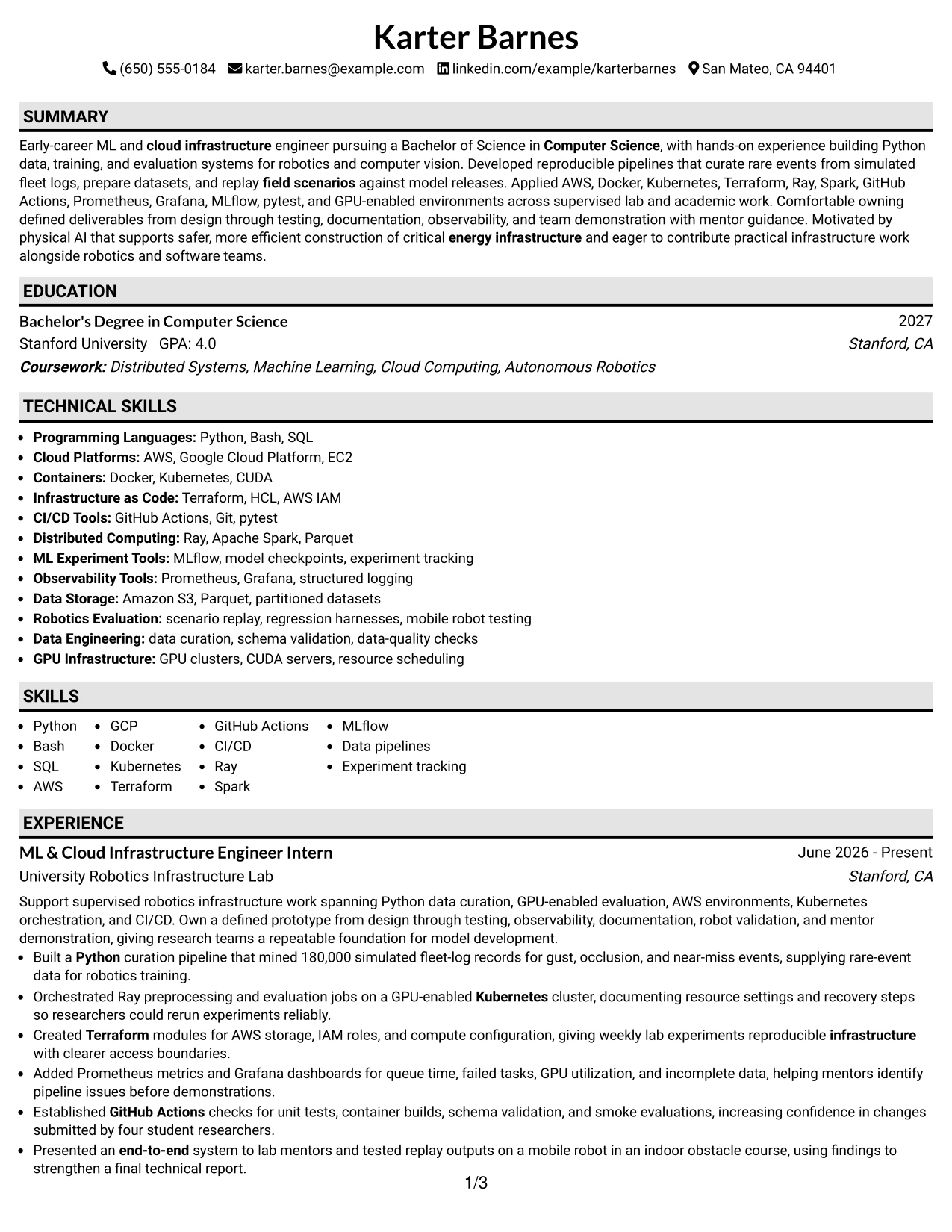
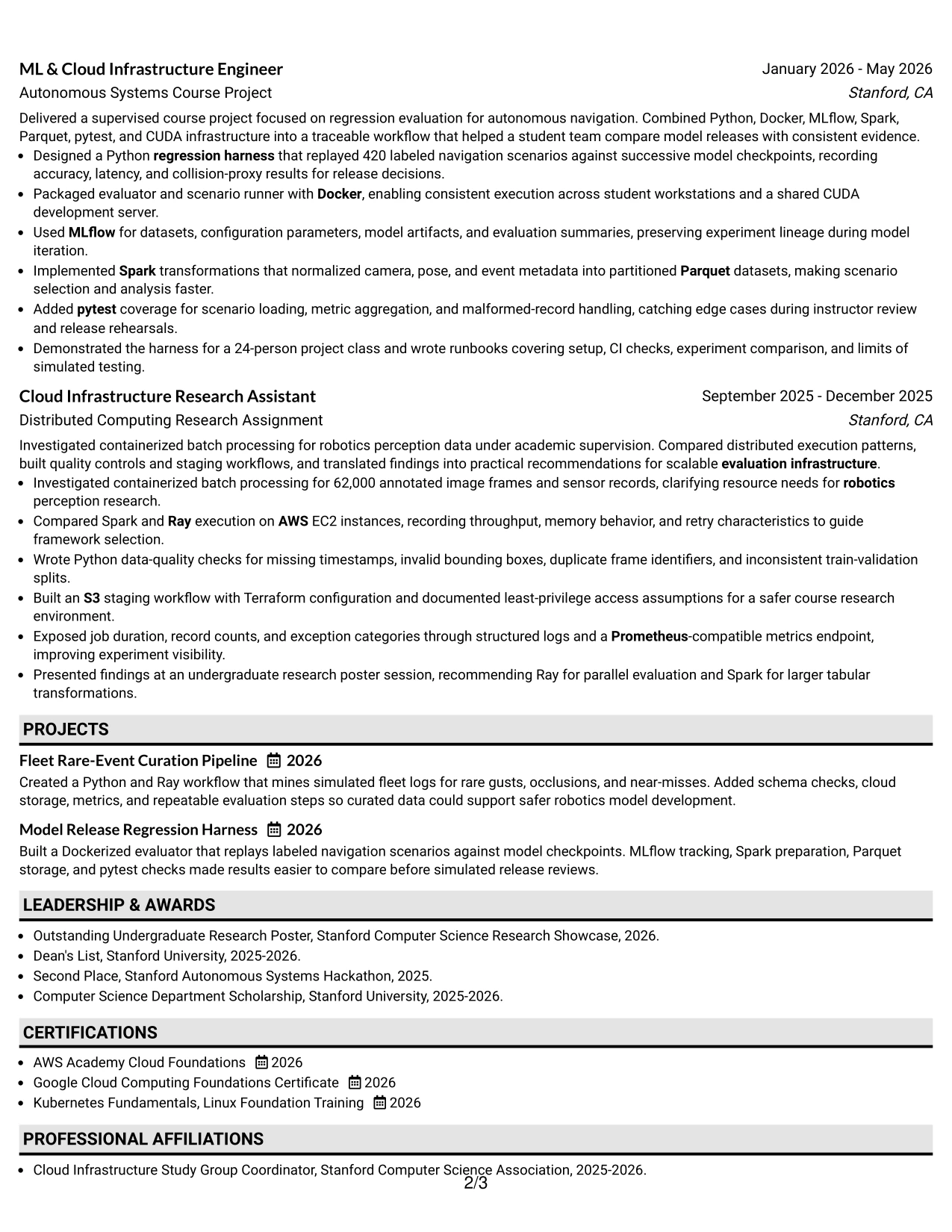
Recruiters move down the page through labeled sections, using the shaded headings as checkpoints for summary, experience, projects, education, and skills. The resume gives each part a clear boundary while keeping evidence such as Python pipelines, AWS infrastructure, and mobile robot testing in one sequence.
The plain one-column design handles substantial content without making the page feel crowded. Compact labels support quick navigation, while bullets preserve the results, tools, and scope needed for an ML & Cloud Infrastructure Engineer Intern application.
Why the Plain One Column with Shaded Labels Works for a Resume
- Shaded labels act as visual signposts during a fast resume review.
- One-column ordering keeps the career story and project evidence easy to follow.
- Separate headings prevent skills, certifications, and education from blending together.
- Bullets can show scope through figures such as 62,000 image frames and four student researchers.
- The layout supports ATS-friendly text because content stays in a simple document flow.
- Technical keywords remain near the evidence that proves their use.
- The format gives academic and internship experience enough room without adding a second reading path.
Best For
- Resumes with several sections that benefit from strong visual labels.
- Applicants who need to present high content volume in a controlled order.
- Documents combining work history, research assignments, and academic projects.
- Readers who scan by section before deciding which bullets to read closely.
- ATS-focused applications that still need modest visual separation.
- Candidates with many cloud, data, testing, and orchestration keywords.
- Resumes that must remain readable when printed or viewed without color-dependent meaning.
#3 One Column Format with Photo Right Resume Example
Evidence receives priority before the supporting visual element: the summary and experience bullets establish technical scope, then the right-side photo adds a personal identification point without interrupting the main content path. The resume highlights Python, Ray, Kubernetes, Terraform, and evaluation work through direct results and defined deliverables.
A one-column evidence flow gives projects, education, certifications, and skills room to remain searchable. The photo-right treatment can add visual balance, while the resume still depends on clear bullets such as replaying 420 scenarios and monitoring GPU utilization.
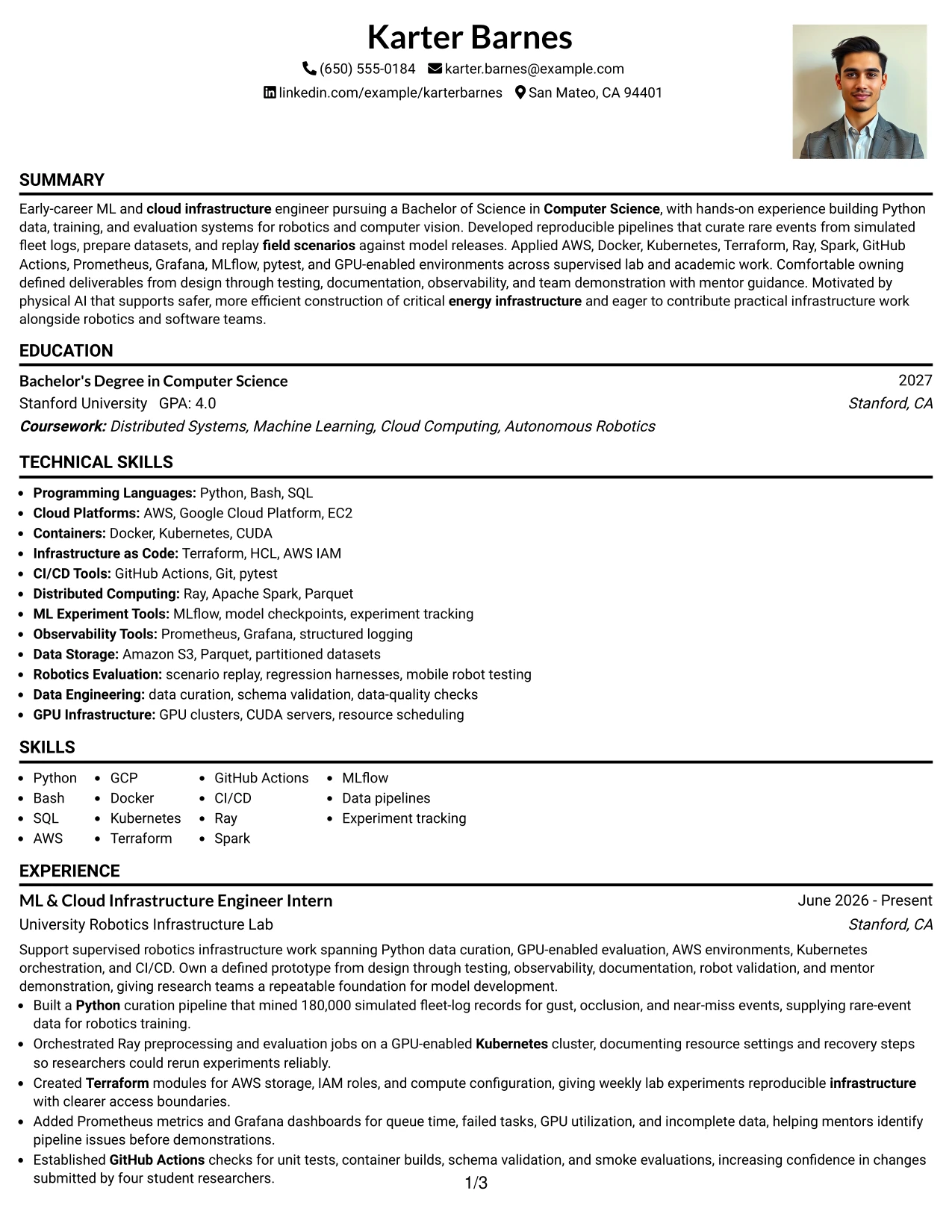
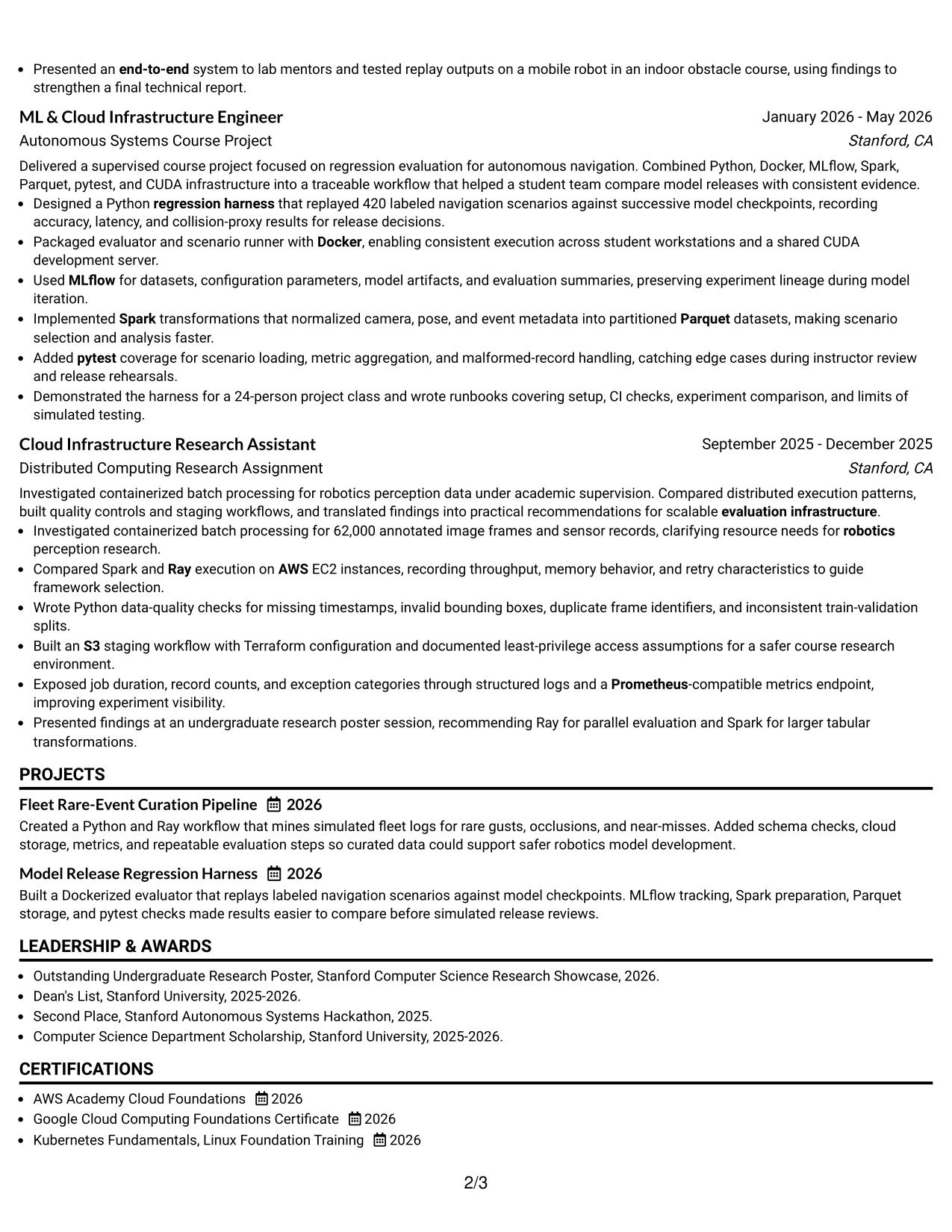
Why the One Column Format with Photo Right Works for a Resume
- The main column keeps measurable work evidence ahead of decorative information.
- A right-side photo creates a distinct header area without dividing the resume body.
- One-column hierarchy supports quick review of experience, projects, and education.
- Bullets show practical infrastructure outcomes instead of listing tools without context.
- The format leaves space for cloud, orchestration, testing, and observability keywords.
- A dedicated skills section can reinforce terms already demonstrated in experience.
- The photo placement preserves a clean content path for readers reviewing the resume.
Best For
- Applicants who want evidence-led content with a defined visual identity.
- Resumes where a right-side photo is appropriate for the intended application context.
- Candidates who need one-column space for detailed project and experience bullets.
- Documents that balance technical keywords with a recognizable header area.
- Readers who prefer to review achievements before scanning the full skills list.
- Applications requiring clear sections for tools, education, and certifications.
- Resumes that use measured results to support infrastructure and evaluation claims.
#4 Clean Two Column Sidebar Format Resume Example
Content is balanced between a main evidence area and a compact sidebar. The main column can carry the summary, experience, and project bullets, while the sidebar groups skills, education, certifications, and contact details for quick reference.
This Clean Two Column Sidebar Format suits an application that needs both technical depth and rapid keyword access. The main area can explain Terraform modules, Ray jobs, and CI checks; the sidebar can make AWS, Docker, Kubernetes, Prometheus, and MLflow visible at a glance.
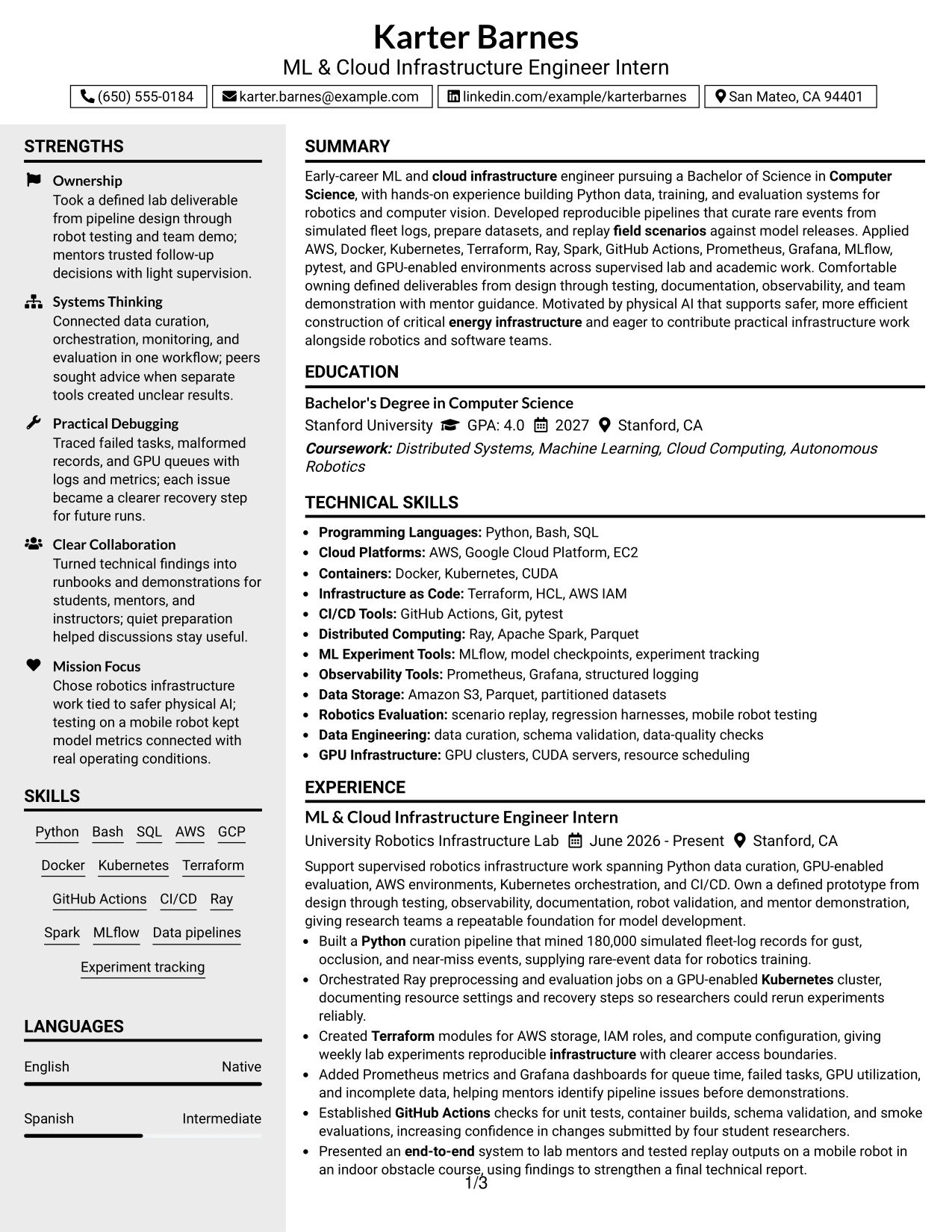
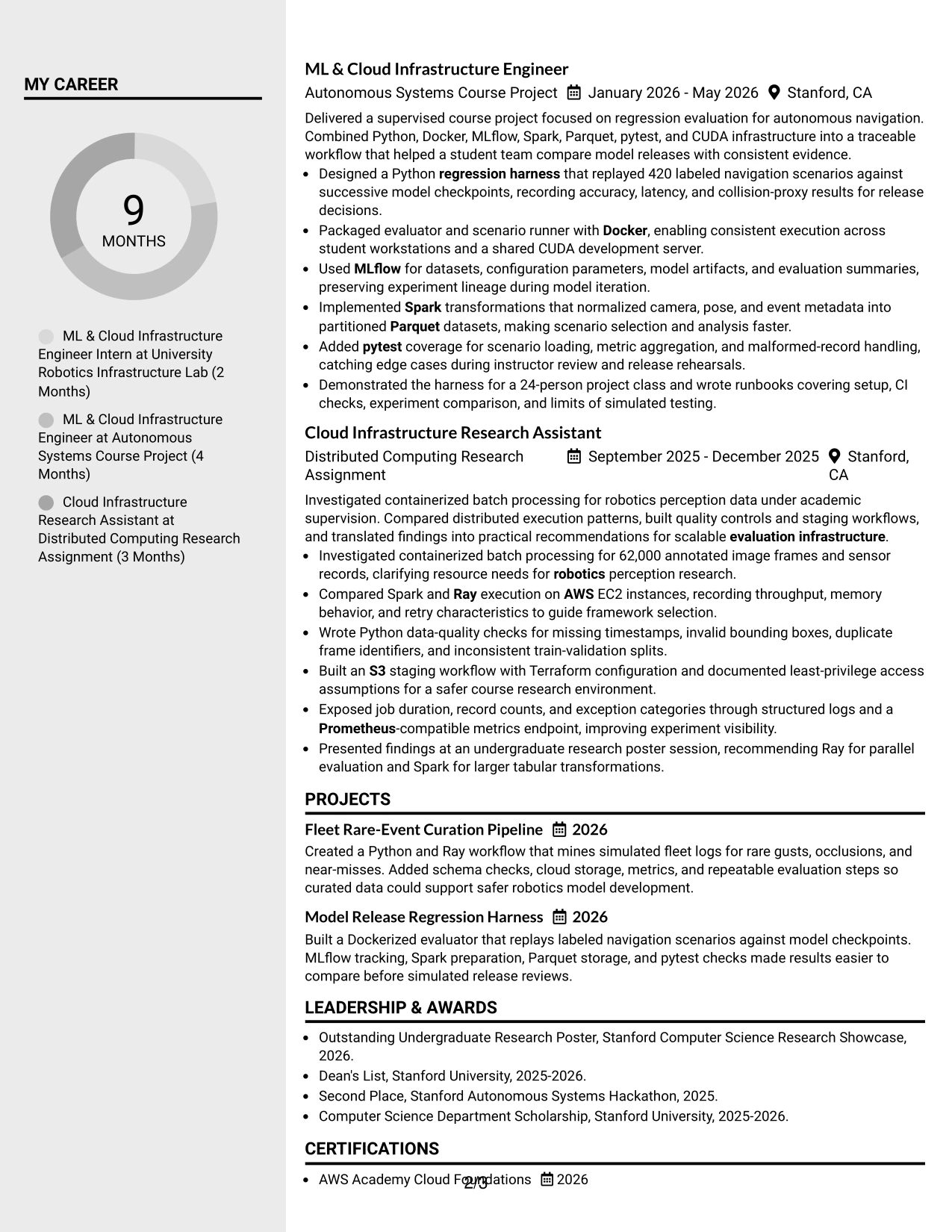
Why the Clean Two Column Sidebar Format Works for a Resume
- The main column protects space for achievement bullets and project outcomes.
- A sidebar gathers contact details, skills, education, and certifications in one scan zone.
- Two-column balance reduces repeated movement through long supporting sections.
- Technical tools can be found quickly without removing their supporting evidence.
- The layout gives research and internship work enough room for clear scope statements.
- Short sidebar entries help readers compare keywords with the experience section.
- A clean hierarchy keeps the document useful for both human review and ATS preparation.
Best For
- Applications that need detailed evidence beside a compact skills area.
- Resumes with a clear split between accomplishments and supporting information.
- Readers who scan technical keywords first and then inspect related bullets.
- Candidates combining internships, research, projects, and certifications.
- Documents where contact details and education should stay visible without using main-column space.
- Applications that benefit from quick comparison of tools and demonstrated results.
- Two-page or information-rich resumes that need stronger page balance.
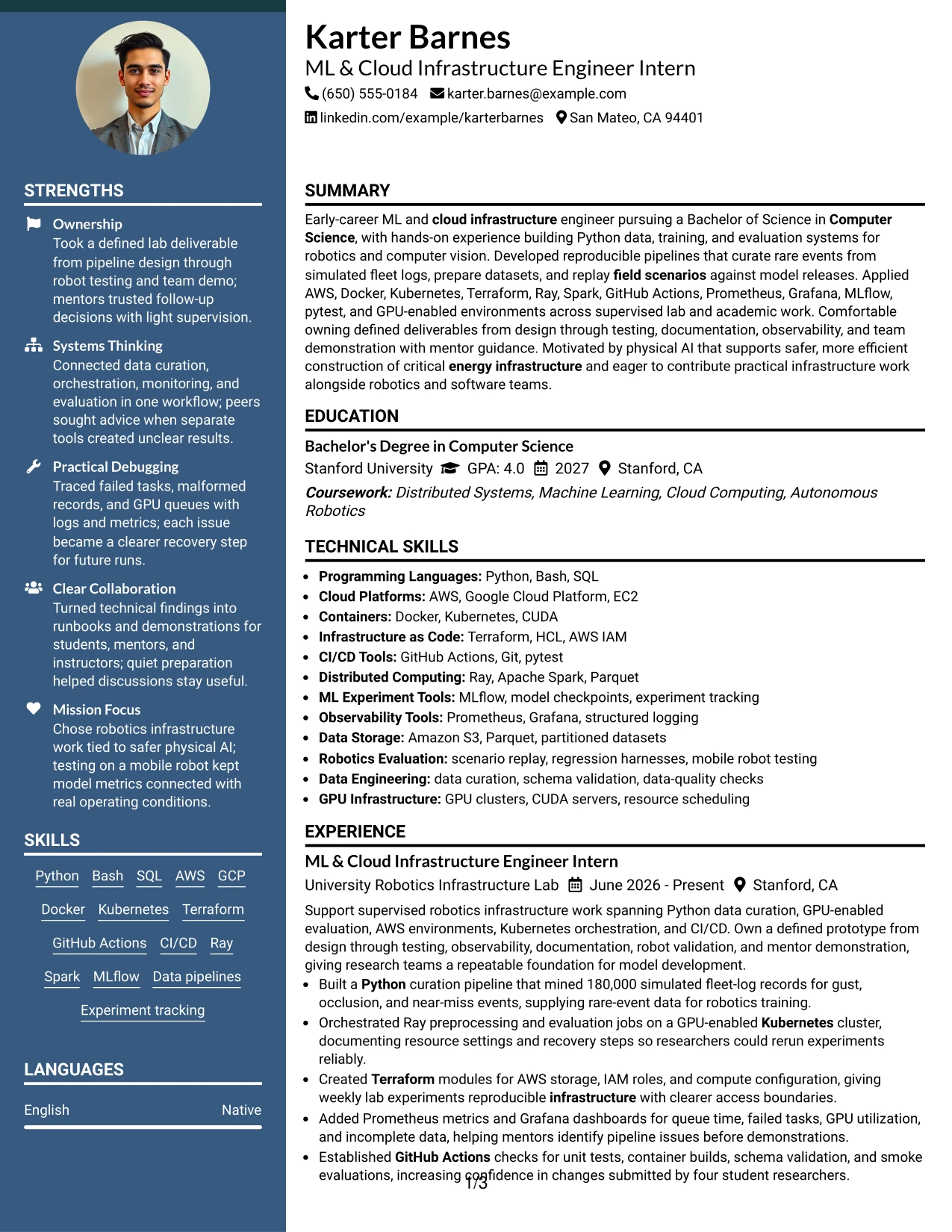
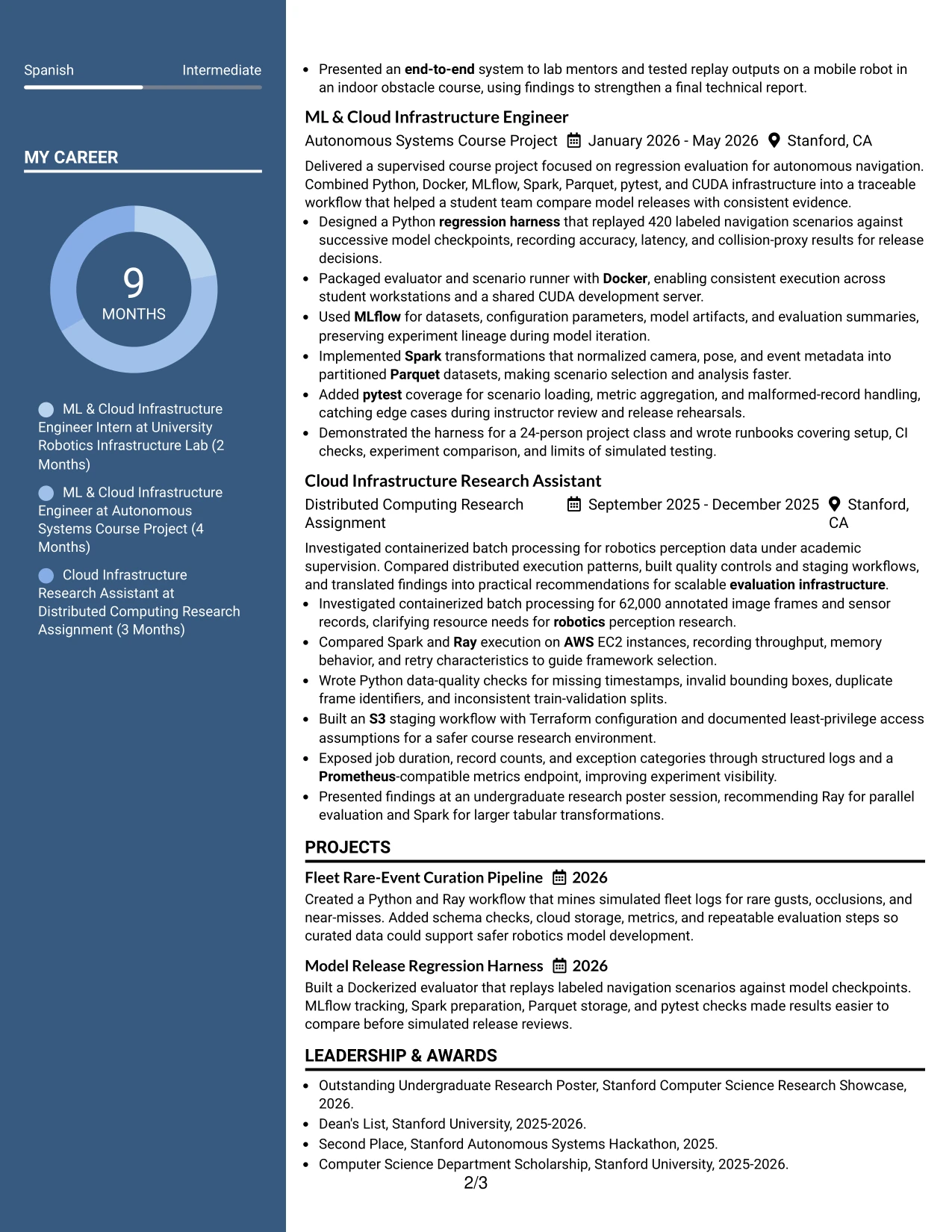
#5 Two Column Format Resume Example
For an application that values infrastructure, data systems, and evaluation evidence, a two-column structure separates the detailed work record from supporting categories. Experience and projects can occupy the wider area, while skills, education, certifications, and activities stay organized in a narrower column.
The format creates visual variety without weakening the resume’s evidence. Related technologies such as Spark, Parquet, Docker, pytest, Prometheus, and Grafana can appear in the supporting column while bullets explain how they were used in repeatable workflows.
Why the Two Column Format Works for a Resume
- A wider content area gives experience bullets room to explain action and result.
- A supporting column keeps skills and credentials available during a quick review.
- The split makes dense technical information easier to group by function.
- Projects can show system scope while the side column reinforces relevant tools.
- Education and certifications remain visible without taking attention from experience.
- The format supports a polished presentation for a focused technical application.
- Clear grouping helps readers connect Spark, Parquet, Docker, and testing evidence to actual work.
Best For
- Applicants who need to show technical breadth without a long single-column list.
- Resumes where project evidence and supporting credentials have different space needs.
- Readers who compare a skills group with detailed experience bullets.
- Candidates presenting cloud, data, testing, and monitoring work together.
- Applications that benefit from a balanced page rather than a purely linear layout.
- Documents with enough evidence for a main column and concise supporting details.
- Resumes that need visible education and certifications alongside practical work.
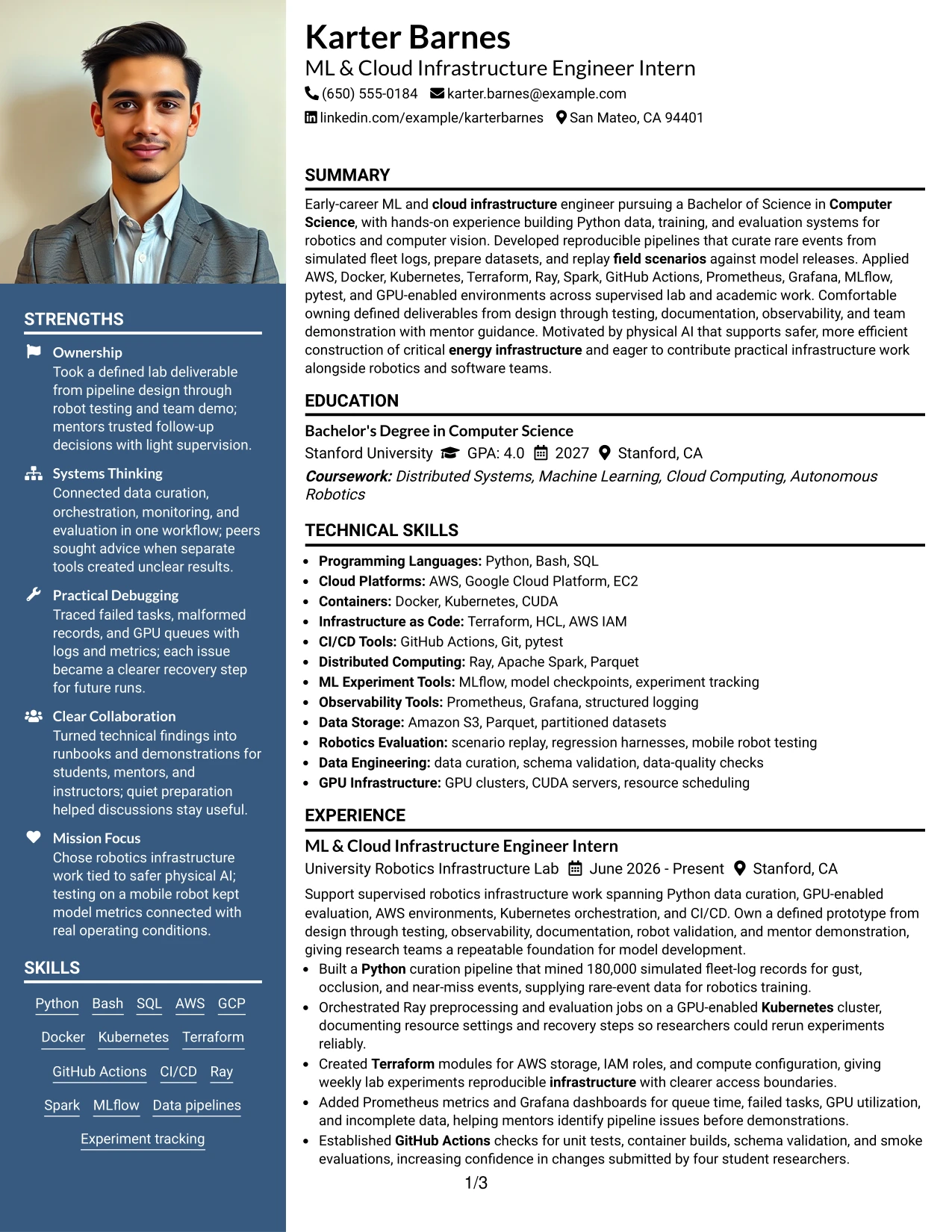
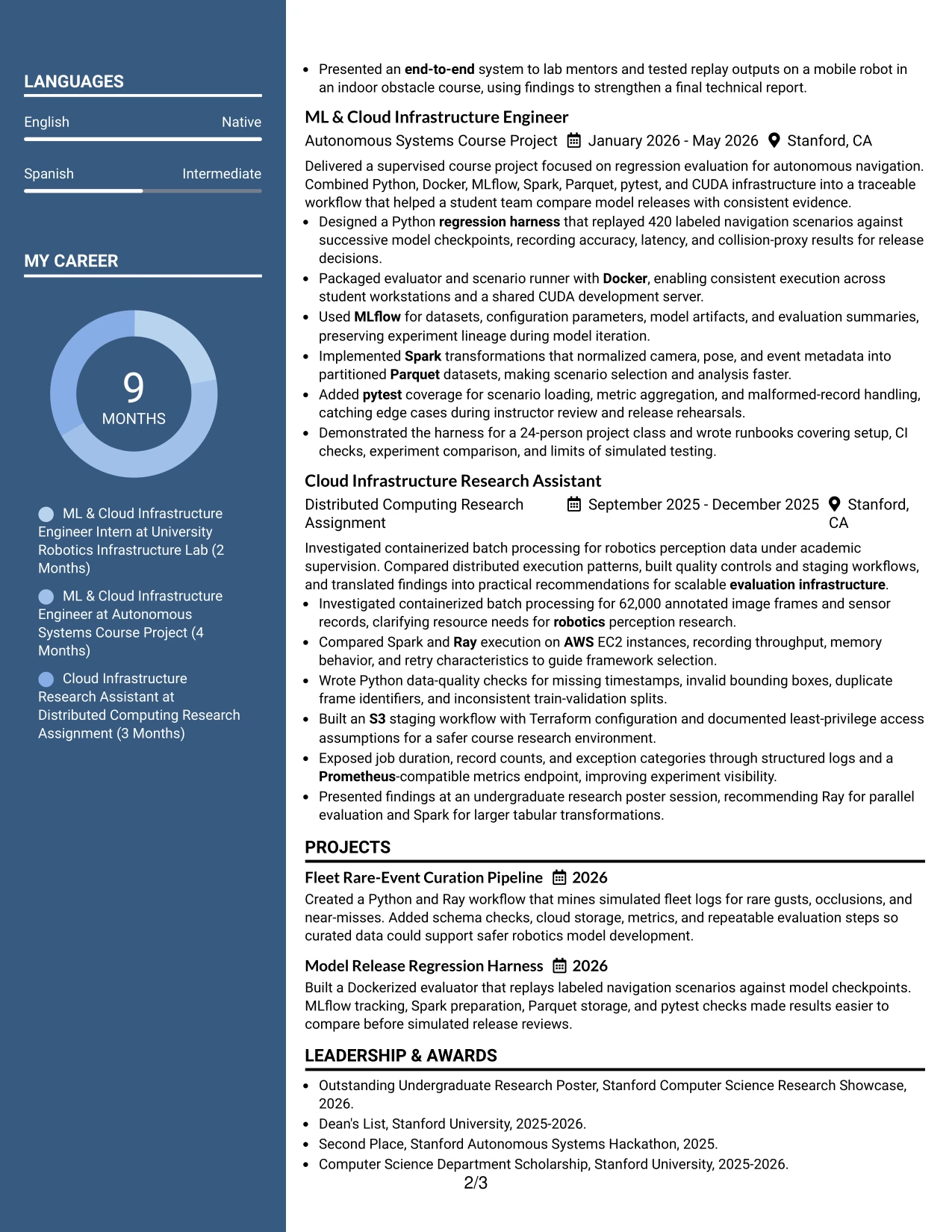
#6 Photo Header Two Column Format Resume Example
A restrained visual hierarchy starts with the photo header, then directs attention to two organized content areas. The main column can present the summary, experience, and project results, while the secondary column keeps skills, education, certifications, and activities easy to locate.
The Photo Header Two Column Format supports a clear role connection without replacing evidence with design. For this ML & Cloud Infrastructure Engineer Intern resume, bullets can show ownership of AWS, Kubernetes, CI/CD, and observability work, while the header and columns create a consistent first impression.
Why the Photo Header Two Column Format Works for a Resume
- The header establishes identity before the reader enters the detailed sections.
- Two columns separate major achievements from compact qualification groups.
- The main area can show ownership, testing, and infrastructure outcomes in full bullets.
- The secondary area keeps skills and certifications visible throughout the review.
- A photo header gives the document a distinct presentation when appropriate for the application.
- The structure supports a direct link between role requirements and demonstrated tools.
- Clear spacing prevents the visual header from competing with measurable evidence.
Best For
- Applications where a photo header is suitable and a polished first impression matters.
- Applicants who need detailed achievements beside concise supporting information.
- Resumes connecting a target role with clearly grouped cloud and ML infrastructure evidence.
- Readers who want identity, role focus, and key qualifications available early.
- Candidates balancing technical projects with education, certifications, and activities.
- Documents that need two-column organization without hiding important experience bullets.
- Presentation-focused applications where visual structure supports, but does not replace, proof.
#7 Simple Two Column Format Resume Example
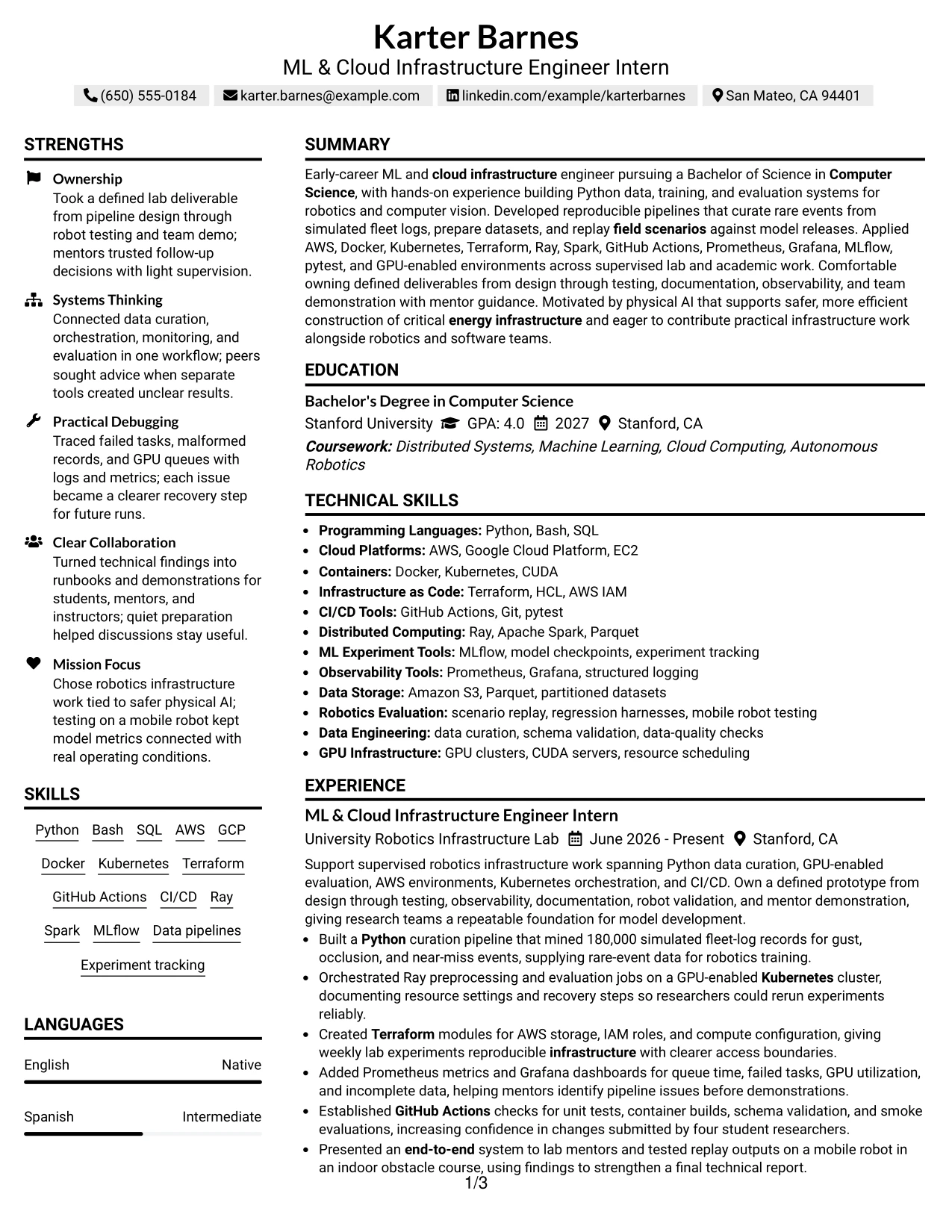
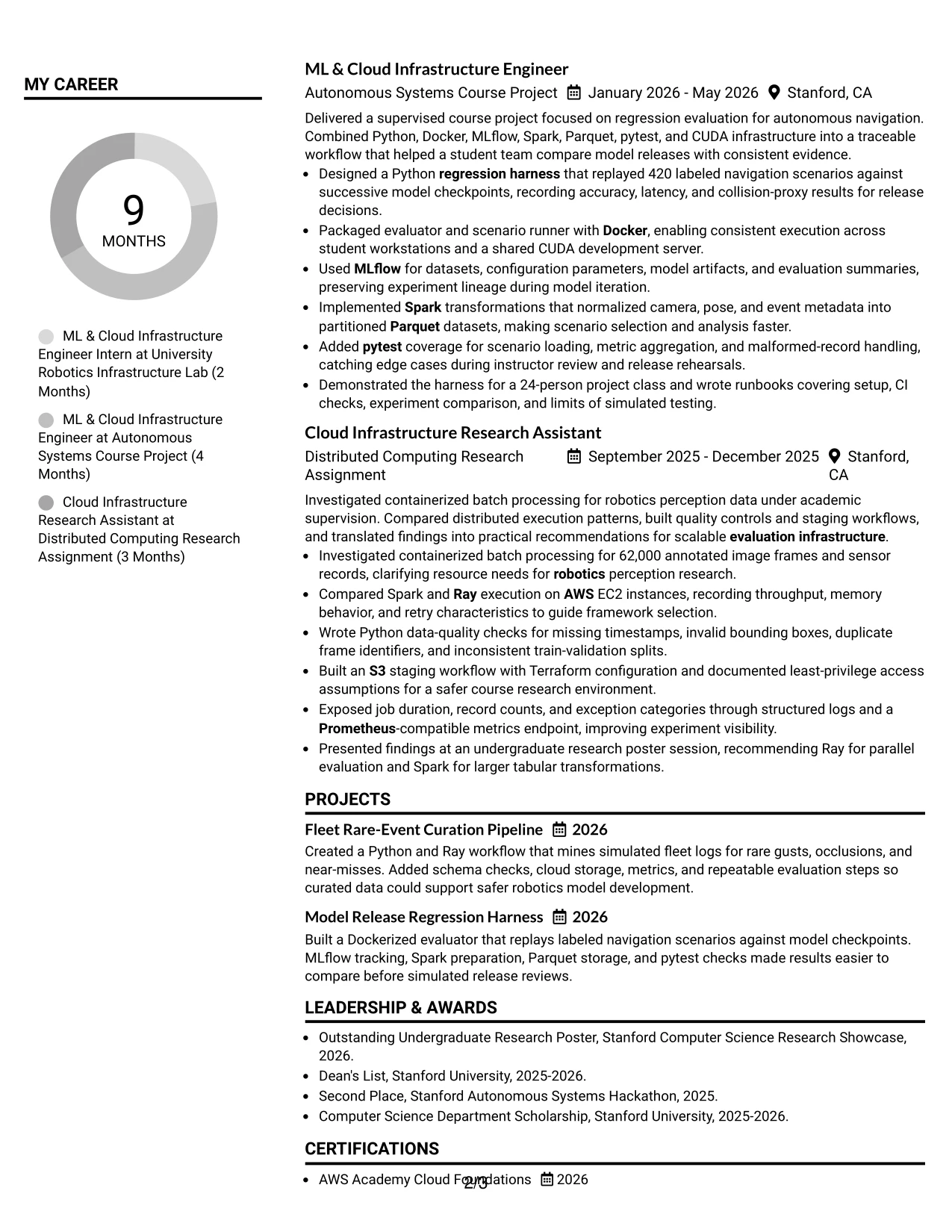
The Simple Two Column Format places core evidence in one area and supporting details in another, using a direct hierarchy rather than heavy decoration. Experience and projects can show the work behind the claims, while skills, education, certifications, and activities remain easy to scan.
Simple grouping is useful when the resume must show both technical range and proof of execution. Bullets can connect Python, GitHub Actions, Terraform, Ray, and MLflow to specific systems, tests, and demonstrations instead of presenting them as an isolated keyword list.
Why the Simple Two Column Format Works for a Resume
- Two clear areas shorten the search for skills and credentials.
- The primary area can carry detailed bullets with scope, action, and result.
- The secondary area supports compact lists for education, certifications, and tools.
- Simple styling keeps the hierarchy readable while preserving useful content volume.
- Related technologies can be grouped without separating them from their demonstrated use.
- Project and experience sections remain distinct for accurate resume review.
- The format supports both human scanning and careful ATS keyword checking when text order is tested.
Best For
- Resumes needing a straightforward split between evidence and supporting details.
- Applicants with technical tools that fit well into grouped skill categories.
- Readers who scan the main achievements and then verify qualifications.
- Documents combining academic work, internships, projects, and certifications.
- Candidates who want two-column organization without a strongly decorative design.
- Applications where measurable outcomes should remain the central proof.
- Resumes that need compact sections while keeping project details readable.
#8 Text/Fang Style Resume Example
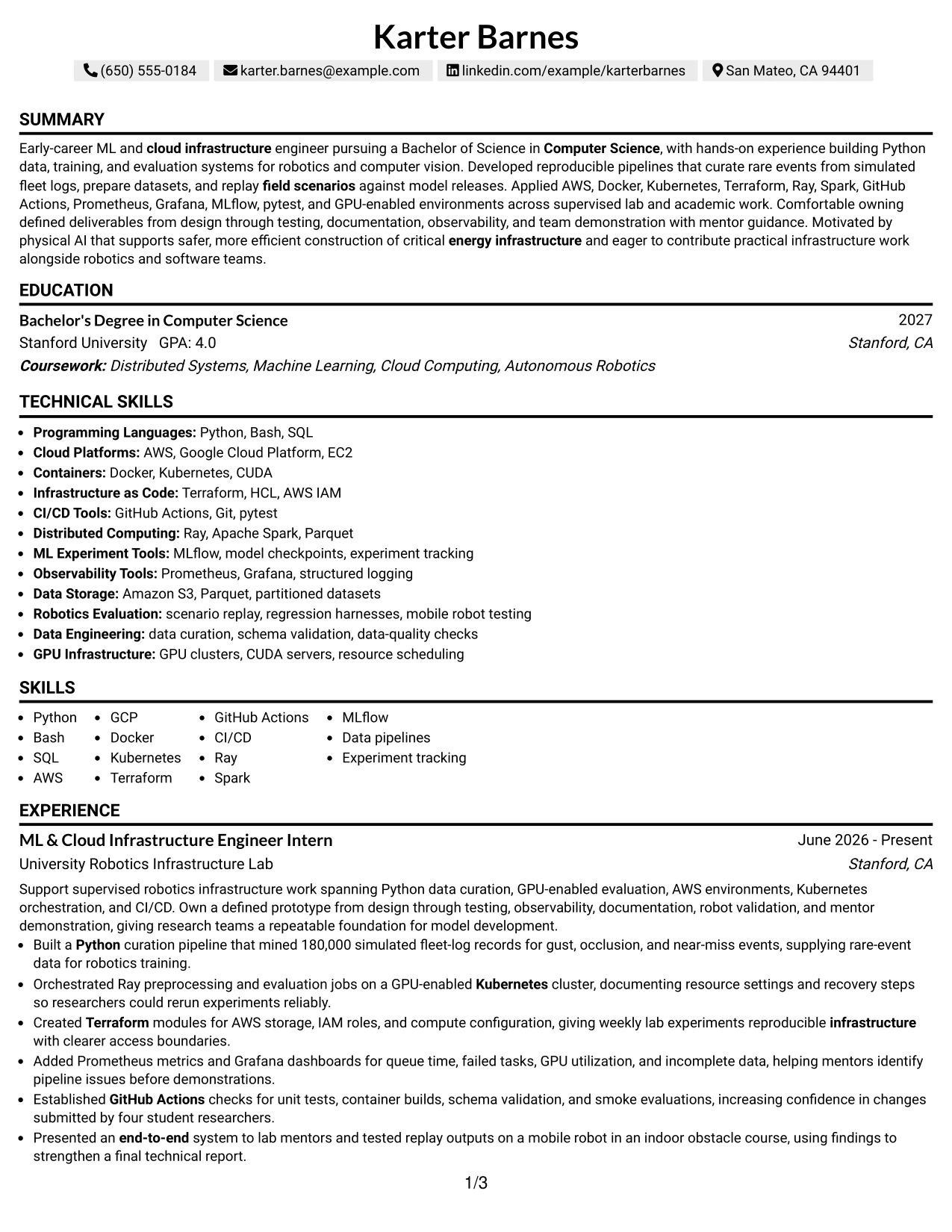
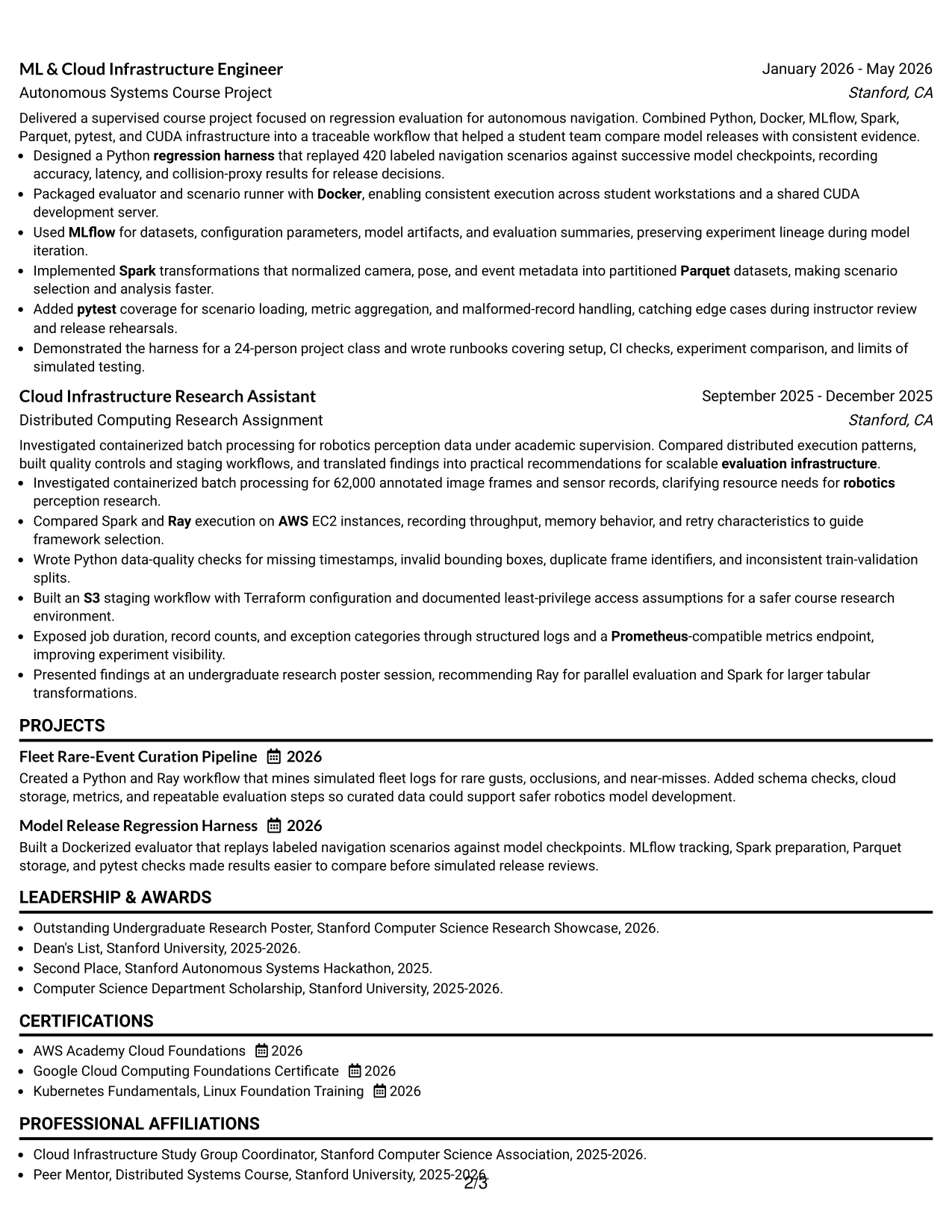
Readers can move through the Text/Fang Style resume in a steady vertical sequence, using strong text hierarchy to distinguish the summary, experience, projects, education, and skills. The structure gives technical bullets room to explain how systems were built, tested, documented, and demonstrated.
This approach is useful for a content-rich resume because it emphasizes wording over visual effects. Evidence such as 180,000 simulated records, 62,000 image frames, and 420 navigation scenarios can remain prominent alongside the tools used to process and evaluate them.
Why the Text/Fang Style Works for a Resume
- A steady reading order supports detailed resume review from summary to skills.
- Text hierarchy separates sections without adding complex layout elements.
- Content-rich bullets can include scale, tools, testing, and operating context.
- Numbers such as 180,000, 62,000, and 420 give the experience section clear evidence.
- The format keeps project and research descriptions easy to compare.
- Plain structure supports careful ATS parsing and text extraction.
- Technical terms remain useful because each major tool can be tied to a task or result.
Best For
- Applicants with substantial project, research, and internship content.
- Resumes where written evidence matters more than visual decoration.
- Readers who prefer a continuous path through detailed technical work.
- Candidates showing several datasets, evaluation systems, or infrastructure workflows.
- Applications that require clear ATS-readable text and conventional section order.
- Documents that need space for methods, tools, limitations, and results.
- Resumes where measurable scope should stand out through precise wording.
#9 One Column Boxed Contact Header Format Resume Example
Evidence comes first in the main body, while the boxed contact header gives the reader an immediate reference point for the target role and contact details. Below it, the one-column sequence can present the summary, experience, projects, education, certifications, and skills without competing side panels.
The boxed header adds separation at the top, but the resume remains focused on proof. Bullets can show reproducible AWS infrastructure, GPU-enabled evaluation, data-quality checks, and team demonstrations, with keywords placed in both the skills section and their supporting achievements.
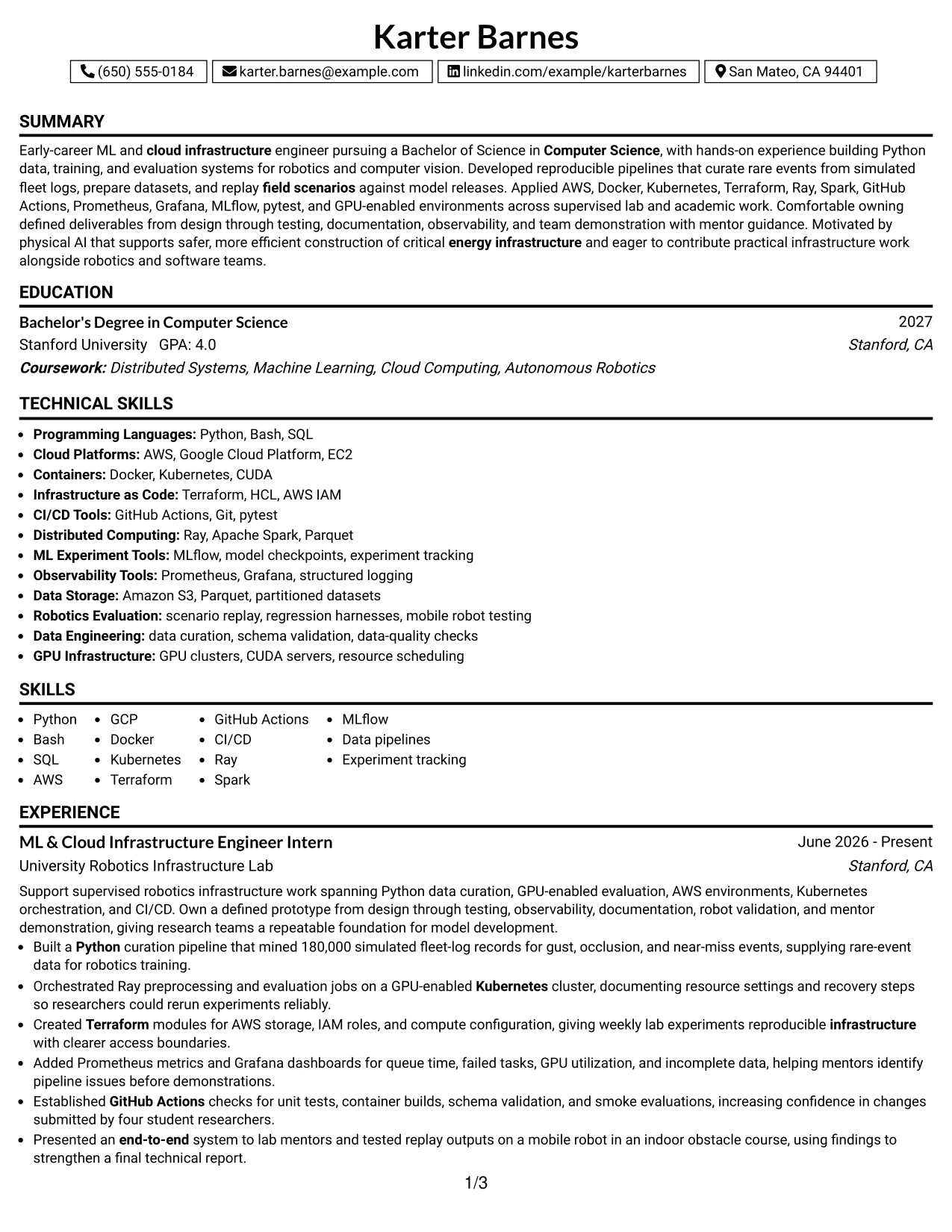
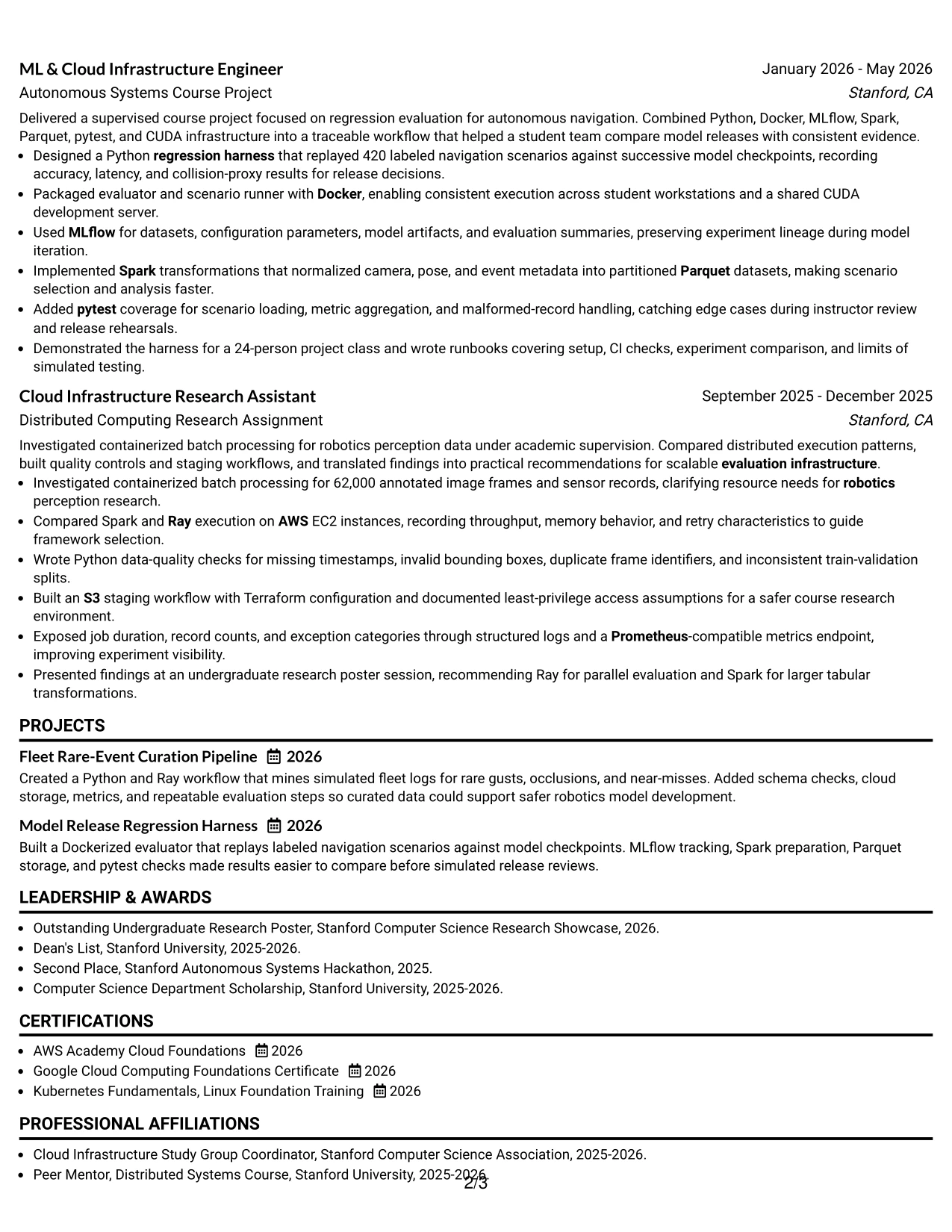
Why the One Column Boxed Contact Header Format Works for a Resume
- The contact box makes identity and contact details easy to find.
- A single body column keeps evidence in a familiar review order.
- Experience bullets can carry technical scope without narrow text blocks.
- Projects and research remain distinct from education and certifications.
- Repeated keywords are supported by both skills lists and achievement bullets.
- The format provides visual separation without relying on complex graphics.
- A strong evidence hierarchy helps readers judge capability from completed work.
Best For
- Applicants who want a distinct contact area above a conventional resume body.
- Documents where evidence should remain the main decision point.
- Readers who prefer one-column scanning after reviewing contact details.
- Candidates with project and research work that needs full-width bullet space.
- Applications requiring visible technical keywords and clear supporting proof.
- Resumes that need a modest visual anchor without a sidebar.
- Documents balancing a clean header with detailed infrastructure results.
#10 Plain Two Column Format Resume Example
Content is balanced across two plain columns so an application reviewer can compare core experience with supporting qualifications. The resume can place the summary, experience, and projects in the primary area while keeping education, certifications, activities, and skills compact and visible.
Karter Barnes’s resume snapshot can surface the target role, computer science degree, Python and cloud infrastructure strengths, and measurable robotics evaluation work before the reader reaches the full bullets. A focused keyword section then reinforces terms that match the role without replacing evidence.
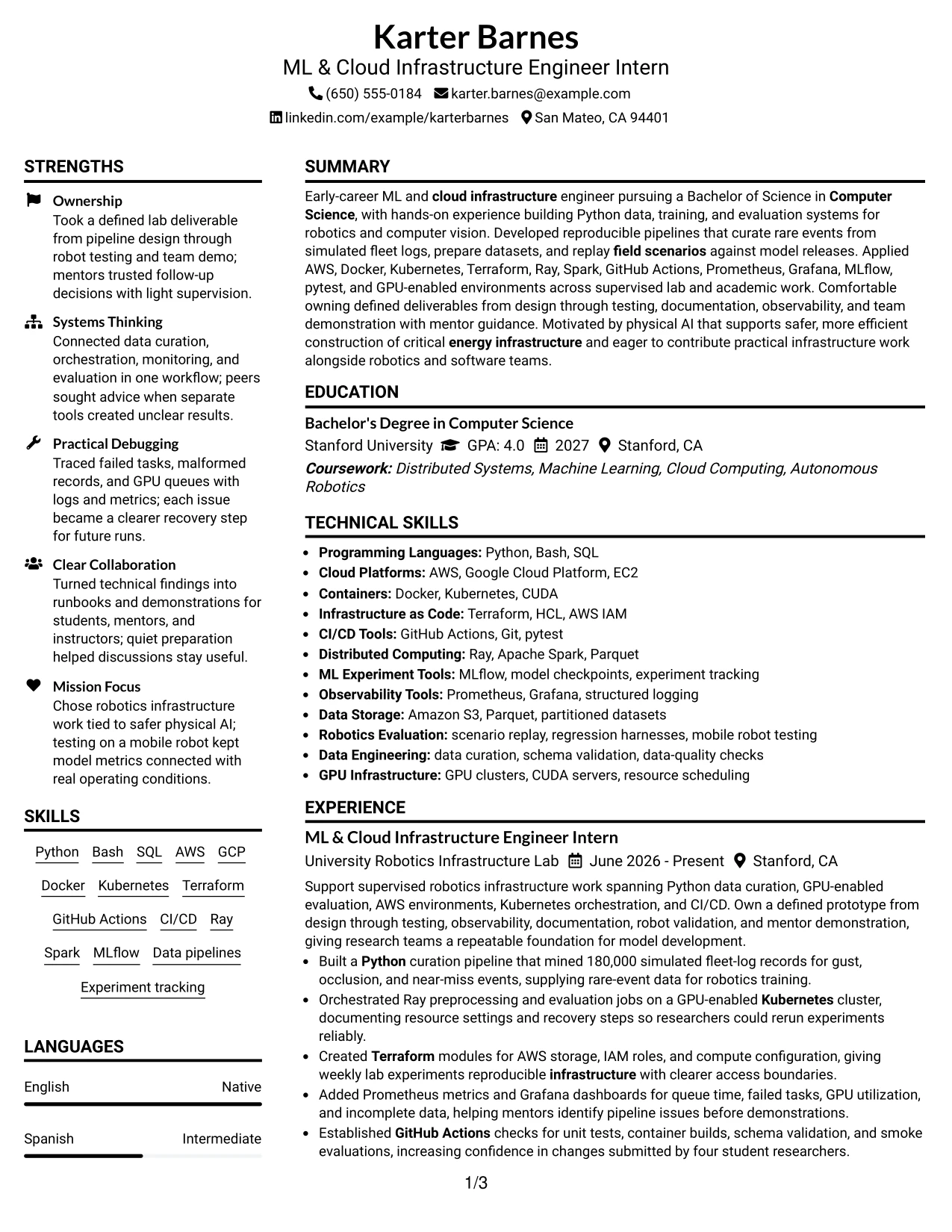
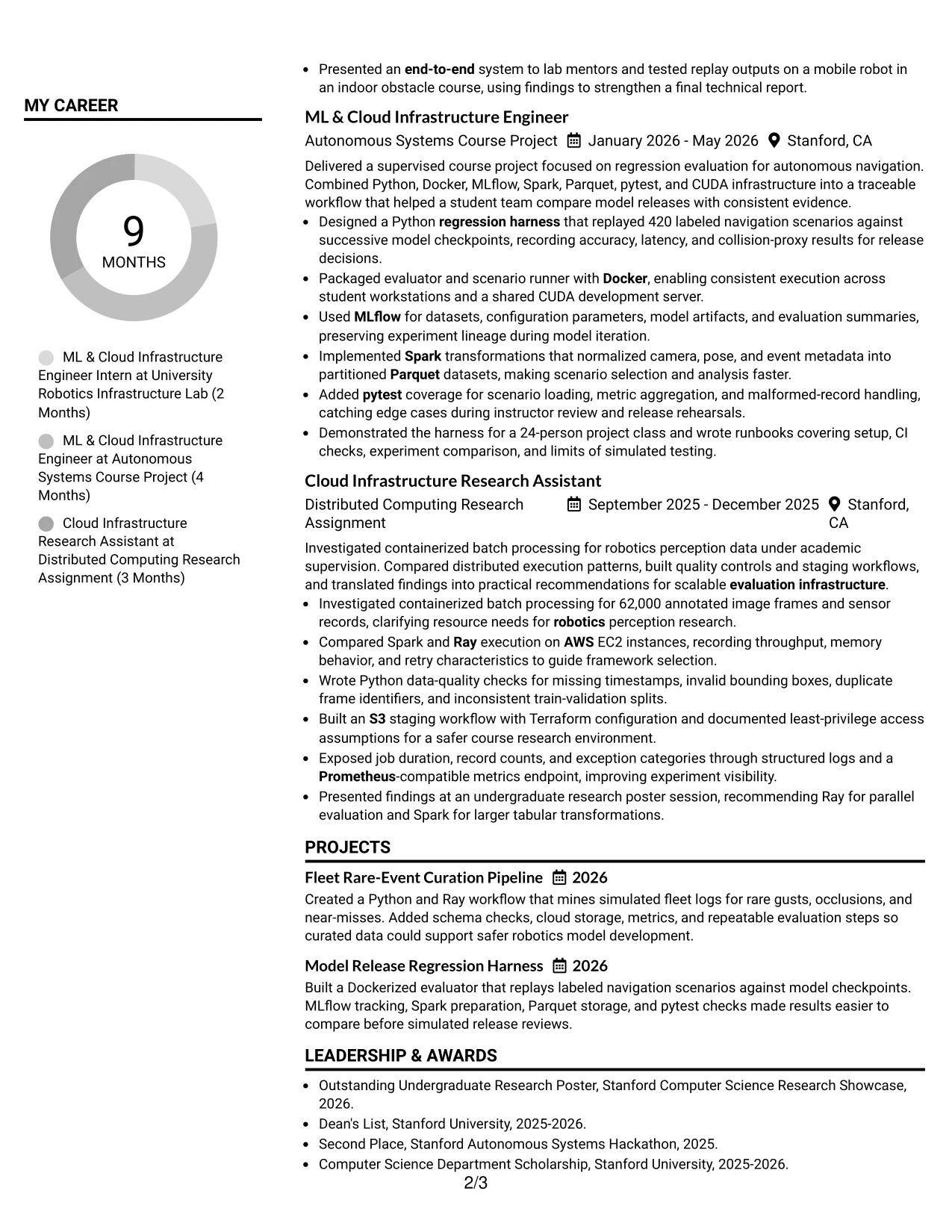
Resume Snapshot
- Target role: ML & Cloud Infrastructure Engineer Intern
- Education: Bachelor’s Degree in Computer Science, Stanford University, 2027
- Core tools: Python, AWS, GCP, Docker, Kubernetes, Terraform, Ray, Spark, MLflow
- Evidence: 180,000 fleet-log records curated and 420 navigation scenarios replayed
Why the Plain Two Column Format Works for a Resume
- Two balanced areas let reviewers see the role focus and supporting details together.
- The snapshot provides a fast summary before deeper experience review.
- Experience and projects retain enough space for measurable technical evidence.
- Education, certifications, and activities can stay visible without crowding the main column.
- A keyword block reinforces Python, AWS, Kubernetes, Ray, Spark, and Terraform.
- Plain styling keeps the content easy to read and suitable for ATS testing.
- The format supports a practical application review from summary to proof.
Resume Keywords
- ML & Cloud Infrastructure Engineer Intern
- Python
- AWS
- GCP
- Docker
- Kubernetes
- Terraform
- Ray
- Spark
- MLflow
- CI/CD
- Prometheus
- Grafana
- data pipelines
- robotics evaluation
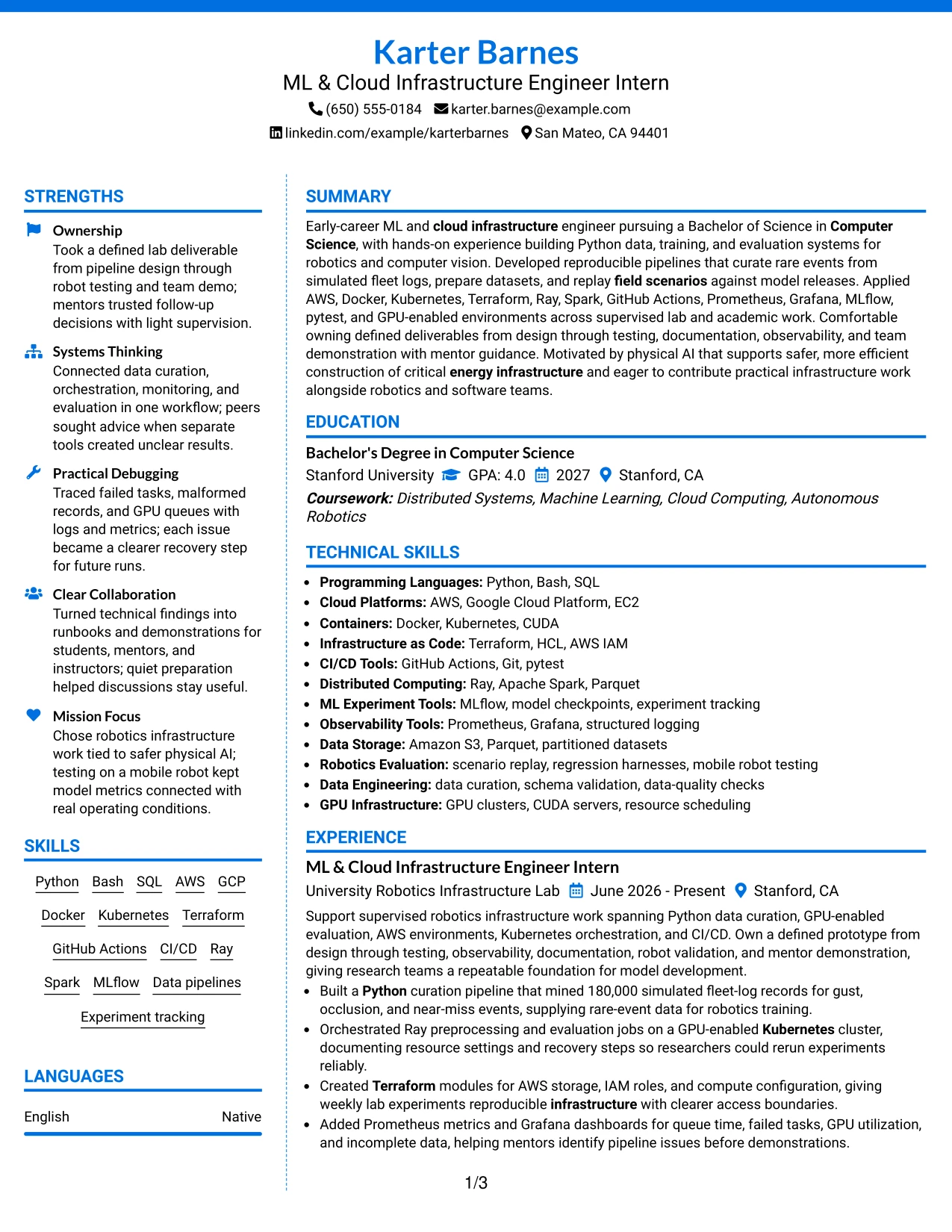
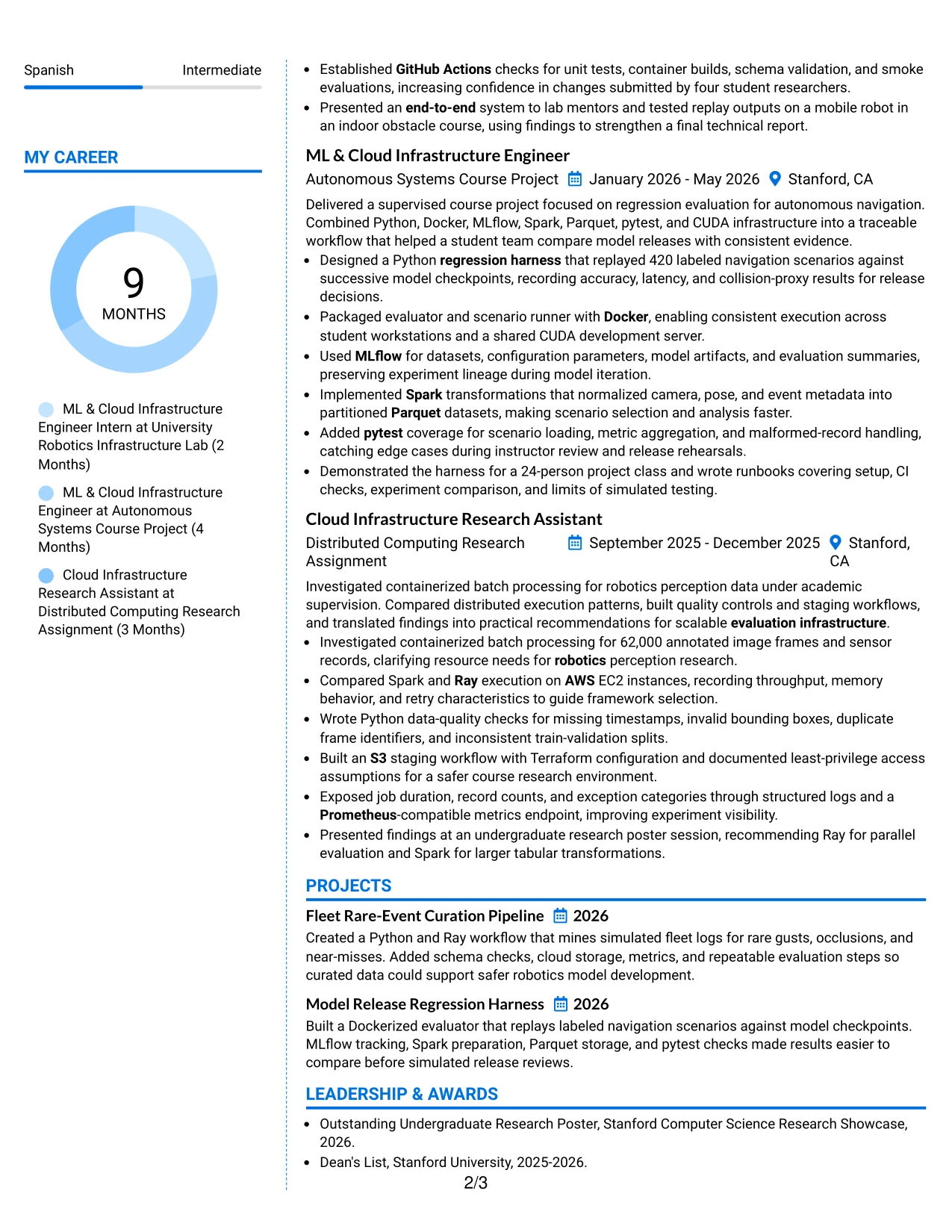
#11 Colored Two Column Format Resume Example
For an application that needs quick comparison between technical evidence and supporting qualifications, the Colored Two Column Format uses restrained color to define the hierarchy. The main area can carry experience and project results, while the secondary area groups skills, education, certifications, and activities.
Color should guide attention, not carry meaning by itself. Text still explains the work: Python curation, Ray orchestration, Terraform infrastructure, Prometheus monitoring, GitHub Actions checks, and testing on a mobile robot. That balance keeps the visual treatment useful during a detailed resume review.
Why the Colored Two Column Format Works for a Resume
- Color creates section boundaries that can speed up visual navigation.
- The main column preserves room for complete accomplishment bullets.
- A supporting column groups skills, education, certifications, and activities.
- Text labels keep the resume understandable when color is reduced or removed.
- Technical tools are stronger when paired with pipeline, testing, or monitoring evidence.
- The layout supports a focused role application without hiding academic projects.
- Balanced columns make a detailed technical resume easier to review at a glance.
Best For
- Applicants who want light color to support, rather than dominate, resume structure.
- Documents comparing detailed achievements with compact qualification groups.
- Readers who scan by visual section and then verify evidence in the main column.
- Candidates presenting cloud infrastructure, data systems, and robotics evaluation together.
- Applications where skills and certifications should remain visible beside experience.
- Resumes that need a polished layout while keeping text as the source of meaning.
- Documents that benefit from clear grouping without adding a third content area.
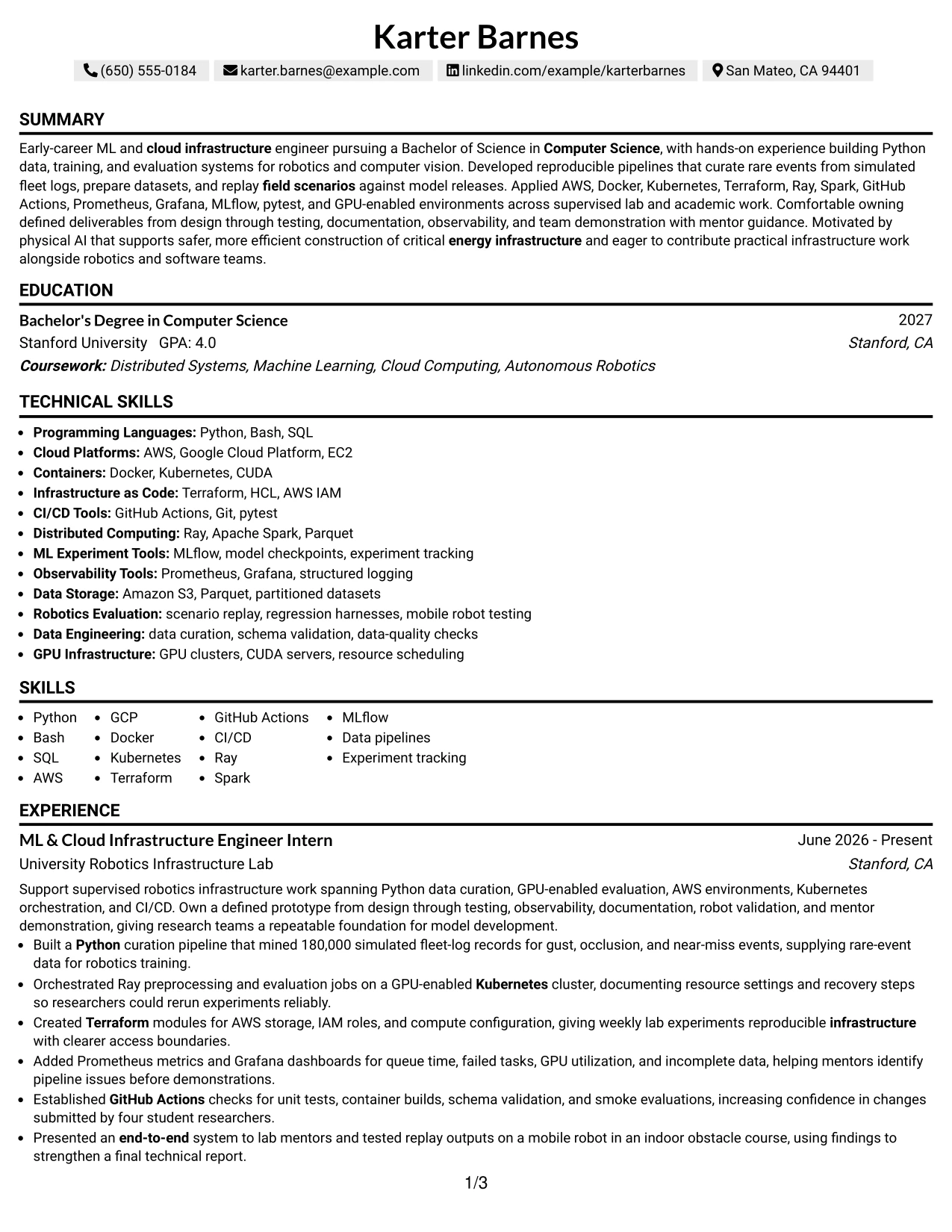
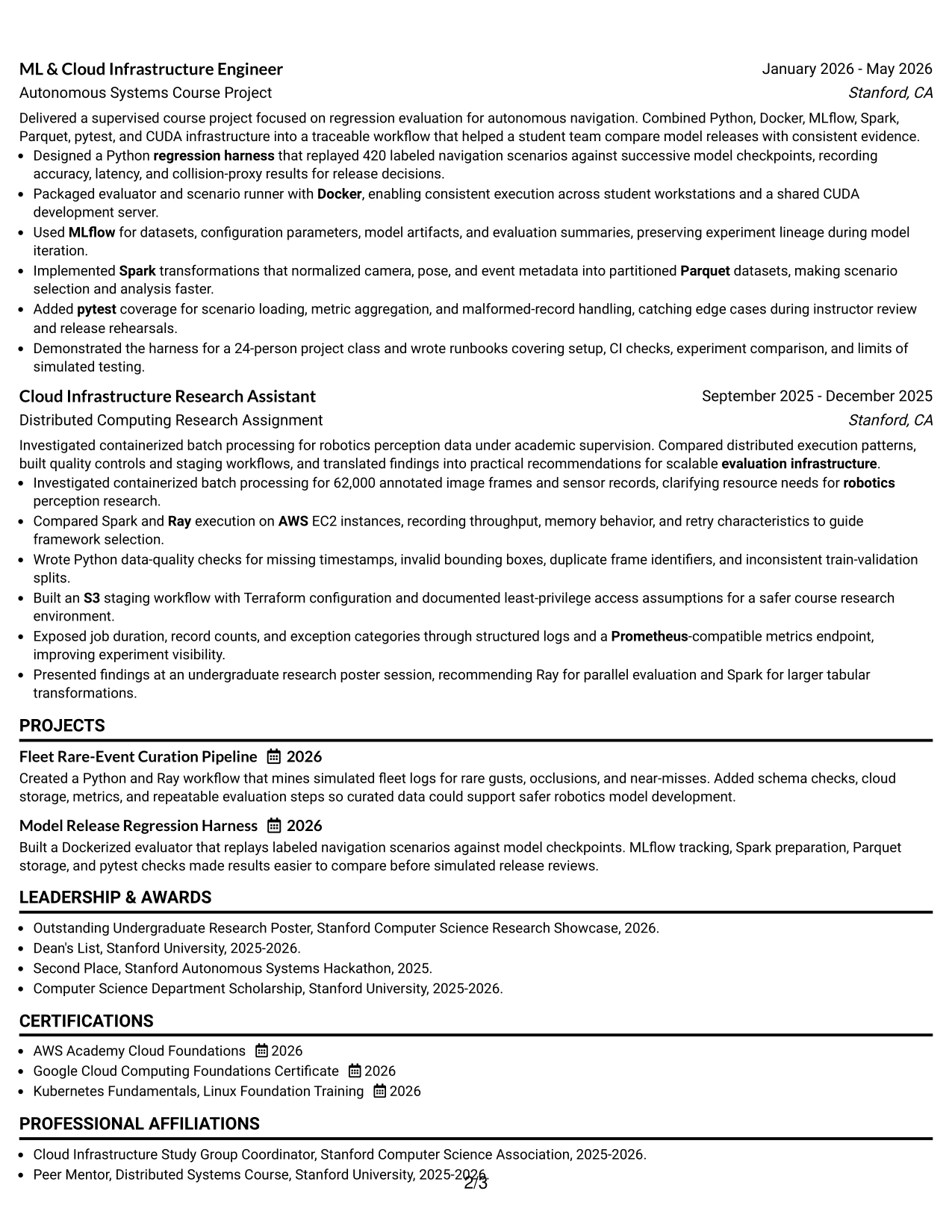
#12 One Column Shaded Contact Header Format Resume Example
A restrained visual hierarchy gives the resume a clear professional signal before the reader reaches the technical evidence. The centered contact header keeps Karter Barnes's target role, location, and contact details easy to confirm, while the single-column flow supports a direct review of Python, cloud infrastructure, robotics evaluation, and education.
For an ML & Cloud Infrastructure Engineer Intern application, this format keeps the evidence in a logical order: summary, experience, projects, education, certifications, and skills. Shaded labels separate sections without competing with results such as processing 180,000 fleet-log records, replaying 420 scenarios, and supporting GPU-enabled evaluation.
Why the One Column Shaded Contact Header Format Works for a Resume
- A single reading path helps reviewers move from the professional summary to experience without searching across panels.
- The shaded contact header gives the target role and contact details a strong starting point.
- Clear section breaks make AWS, Kubernetes, Ray, Spark, Terraform, and observability terms easier to scan.
- Full-width bullets provide room for measurable evidence, including 180,000 records and 420 navigation scenarios.
- The format supports ATS parsing because experience, education, and skills remain in a straightforward sequence.
- Project details can show how data pipelines connect with model evaluation and release decisions.
- A compact visual treatment keeps technical content central while still giving the page a polished finish.
Best For
- Applicants who need one uninterrupted reading path for experience and projects
- Resumes that must present technical keywords in a predictable ATS-friendly order
- Defined project work that benefits from full-width achievement bullets
- Applications where summary, education, certifications, and skills need equal access
- Readers comparing infrastructure ownership with measurable pipeline results
- Early-career candidates combining academic work with supervised technical experience
- Role-focused resumes that need a clear target title near the contact details
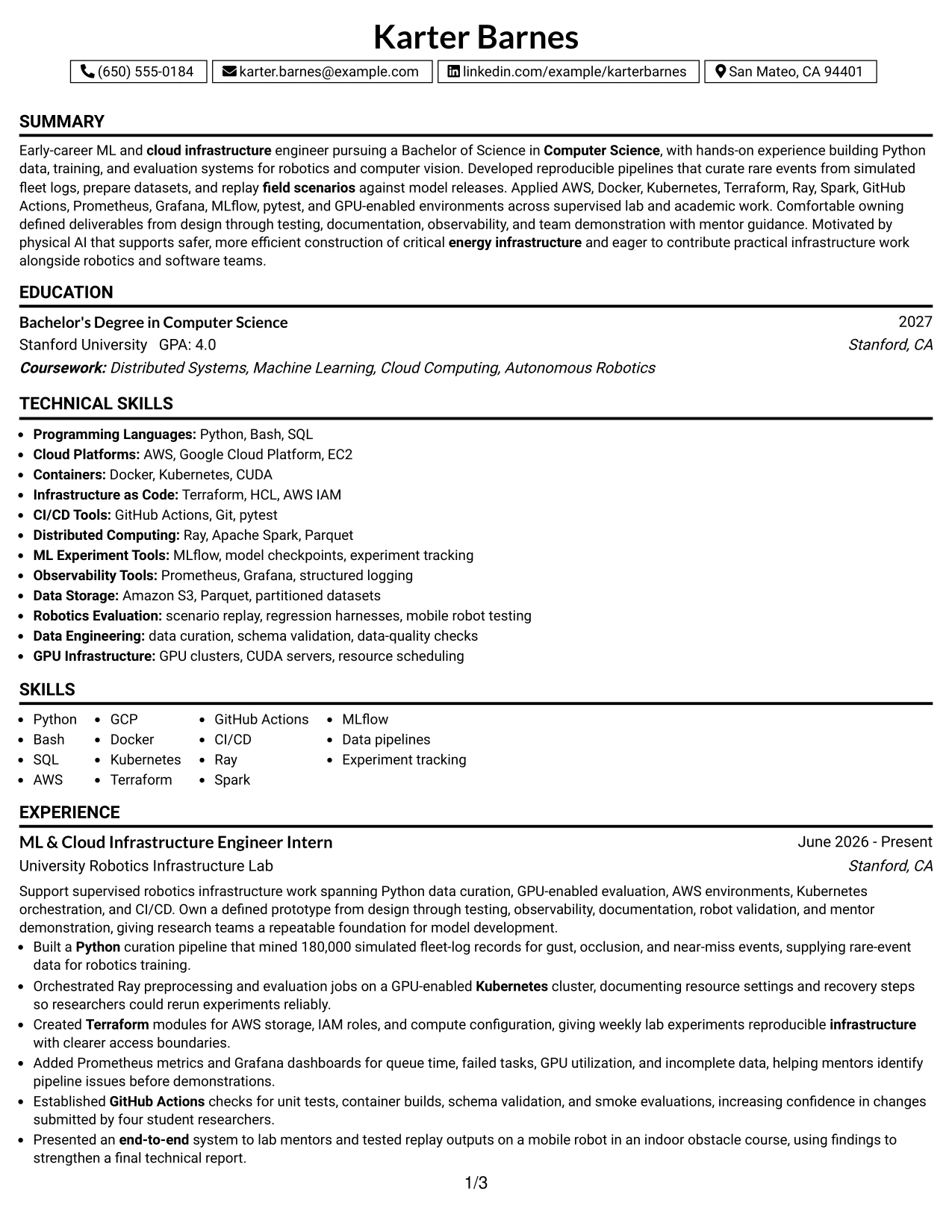
#13 Boxed Contact Header with Job Title Format Resume Example
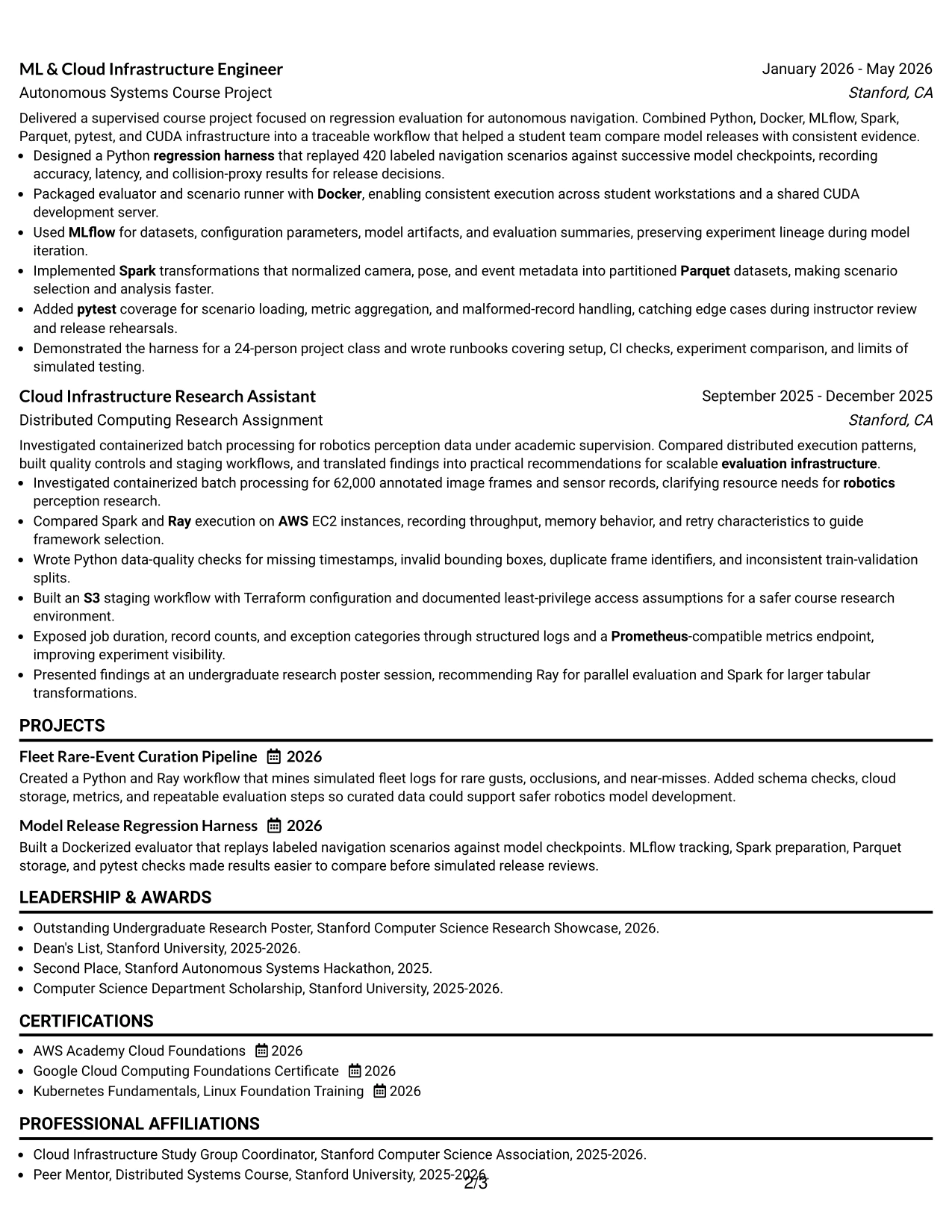
The Boxed Contact Header with Job Title Format organizes the resume around an immediate match between the target role and the supporting evidence. A contained header separates contact information from the body, so the reader can confirm the ML & Cloud Infrastructure Engineer Intern focus before reviewing Python systems, cloud platforms, and robotics projects.
The body then uses labeled sections to create a reliable scan pattern. Experience bullets carry the strongest proof: Ray jobs on Kubernetes, Terraform modules for AWS, Prometheus and Grafana monitoring, GitHub Actions checks, and testing on a mobile robot. Education and certifications reinforce the technical foundation without interrupting the results.
Why the Boxed Contact Header with Job Title Format Works for a Resume
- The boxed header isolates the target role and contact information at the top of the page.
- A visible job title helps align the resume with the role being reviewed.
- Labeled sections create predictable search points for experience, projects, education, and skills.
- One-column structure gives ATS systems a clean order for reading dates, employers, and bullets.
- The format leaves enough width for action, tool, and outcome statements in each bullet.
- Technical evidence stays prominent through terms such as Terraform, Kubernetes, Ray, and MLflow.
- The design adds structure without using visual elements that could distract from qualifications.
Best For
- Applications that need the target role confirmed before detailed review begins
- Resumes with several technical sections that benefit from strong section labels
- ATS-conscious documents using a simple one-column content order
- Candidates presenting both supervised work and university projects
- Review processes where tools and measurable outputs must be found quickly
- Technical resumes that need a defined visual boundary around contact details
- Readers comparing role alignment across experience, projects, and certifications
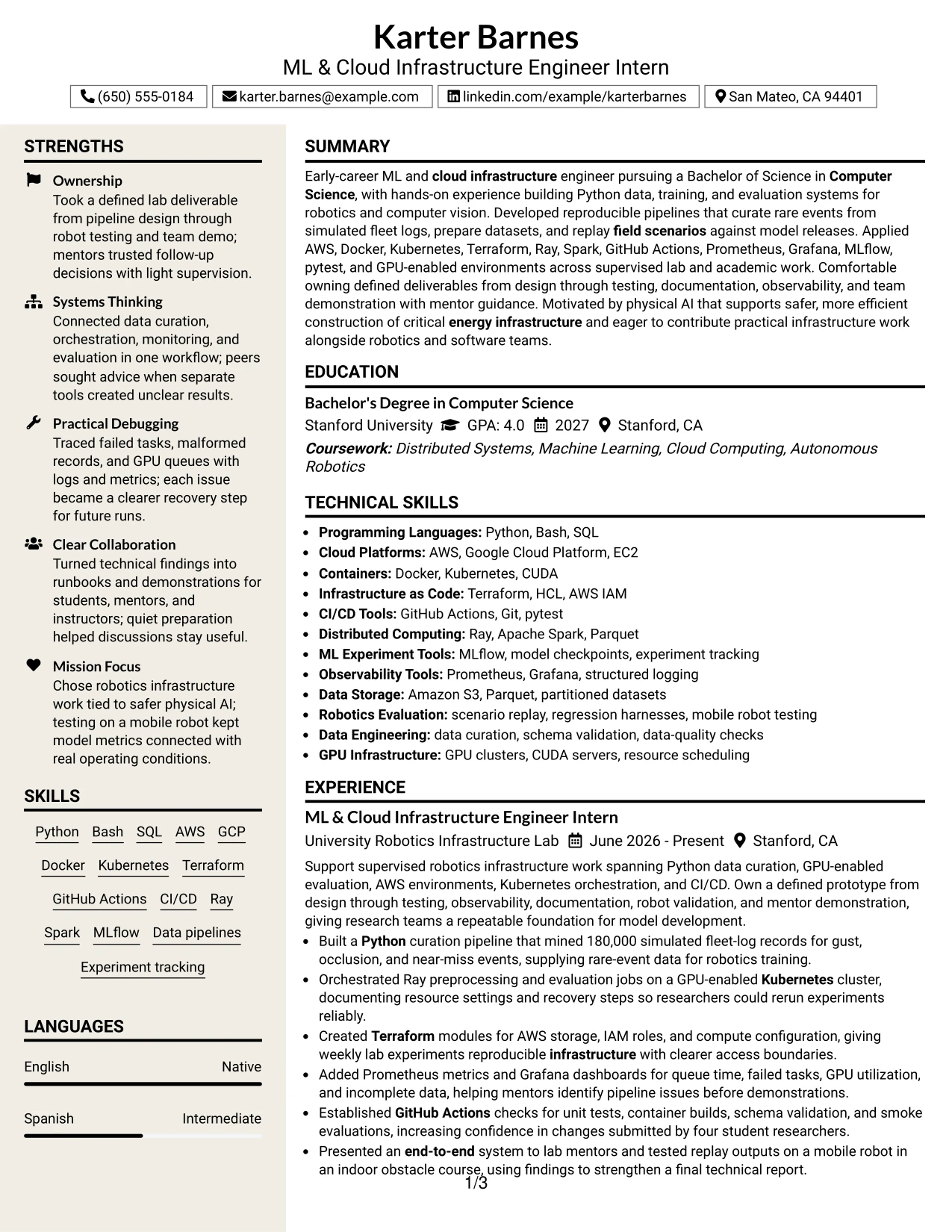
#14 Stylish Two Column Designer Format Resume Example
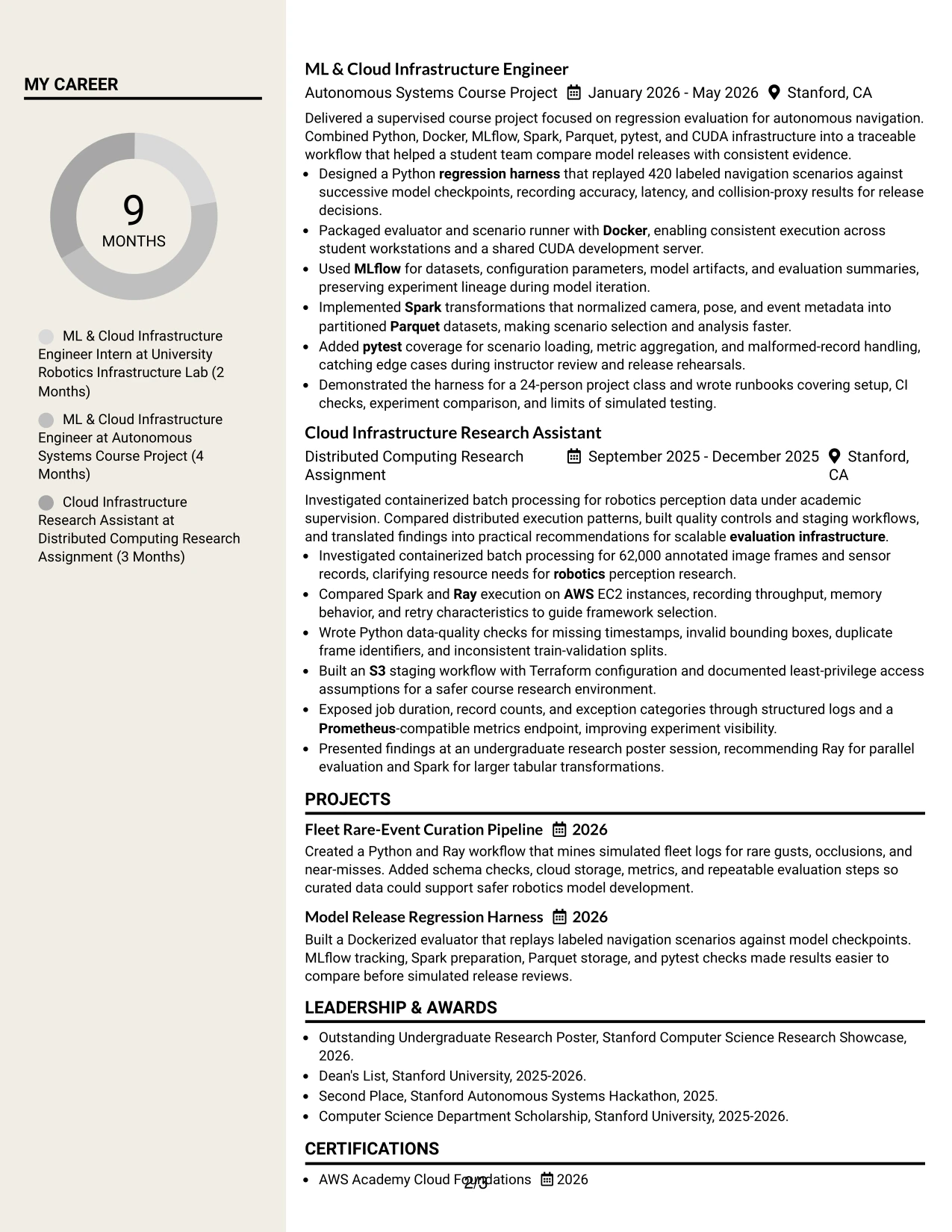
Recruiters can move through the right column for the career story and use the left sidebar for fast qualification checks. That split supports a dense technical resume: experience and projects can carry detailed results, while skills, education, certifications, and contact information stay visible as reference points.
The two-column structure is useful when the document must show both breadth and depth. Full-width space in the main column can explain the 180,000-record curation pipeline, 420-scenario regression harness, and 62,000-frame research assignment. The sidebar can group Python, AWS, Docker, Kubernetes, Spark, Ray, and monitoring tools for quick comparison.
Why the Stylish Two Column Designer Format Works for a Resume
- The main column gives experience bullets enough room to explain technical decisions and outcomes.
- A sidebar keeps skills, education, certifications, and contact information available during the full review.
- Two visual zones help separate evidence from reference information.
- The format can carry several projects without forcing every section into a narrow line.
- Grouped tools make cloud, container, distributed computing, and observability keywords easy to locate.
- Detailed bullets can preserve scope, such as 180,000 records, 420 scenarios, and 62,000 image frames.
- The design provides visual variety while maintaining a clear hierarchy between primary and secondary content.
Best For
- Resumes with enough technical material to justify separate evidence and reference areas
- Applications where skills must remain visible beside detailed experience
- Project-heavy documents that need room for scope, tools, and results
- Readers who review a main career story while checking qualifications in parallel
- Candidates combining internships, course projects, research, and certifications
- Documents that need to show both infrastructure breadth and evaluation depth
- Portfolio-linked applications where projects require more context than a compact list
#15 Modern Icon Format Resume Example
Strong evidence receives priority in this resume format: pipeline scope, infrastructure choices, testing practice, and measurable evaluation results. Small visual markers can guide the eye to sections, but the written bullets remain responsible for proving capability through Python systems, AWS configuration, Kubernetes orchestration, and model release testing.
That balance works well for technical screening. The resume can show how a curation pipeline mined rare events, how Ray and Spark supported different workloads, and how monitoring exposed queue time, failed tasks, and GPU use. Projects, education, certifications, and skills then provide supporting context around the results.
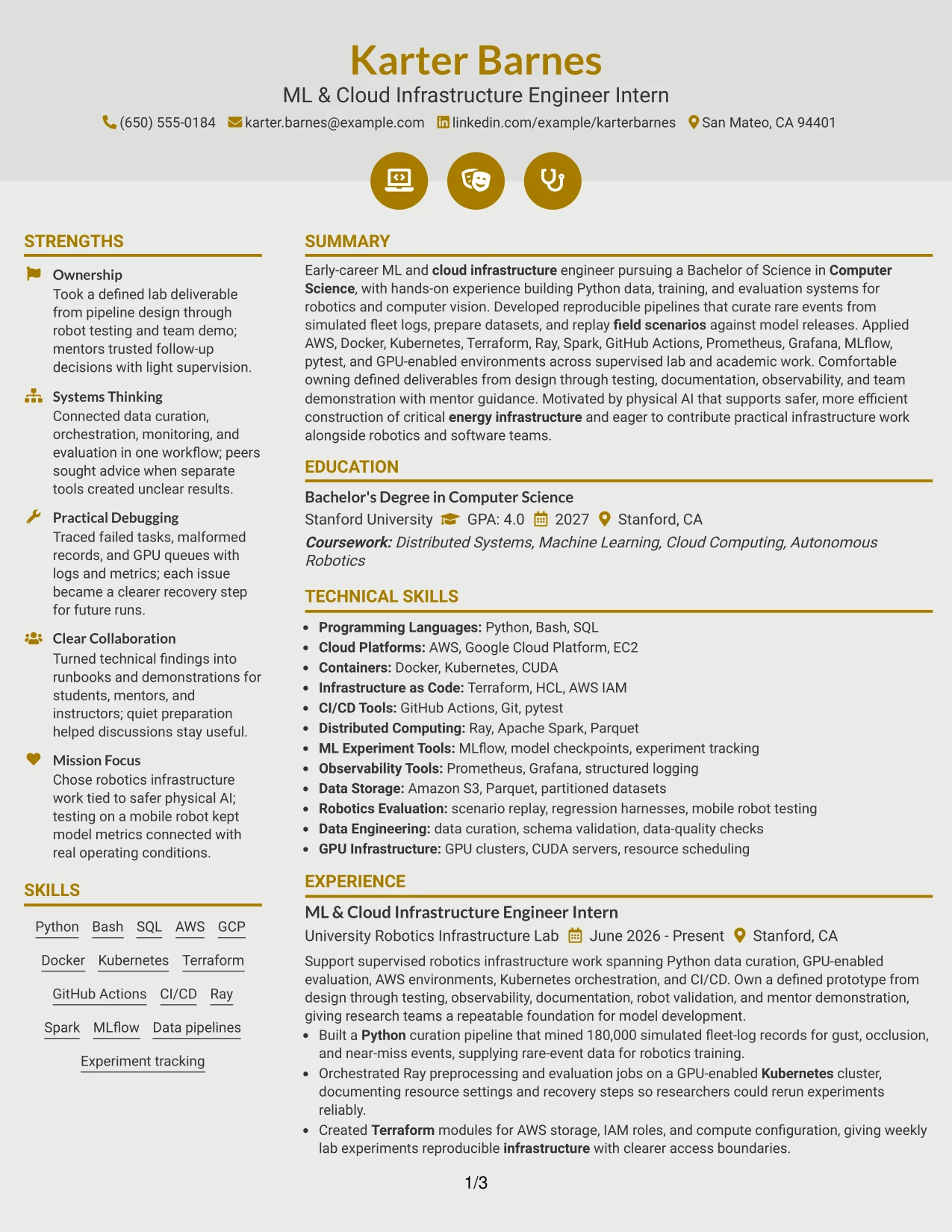
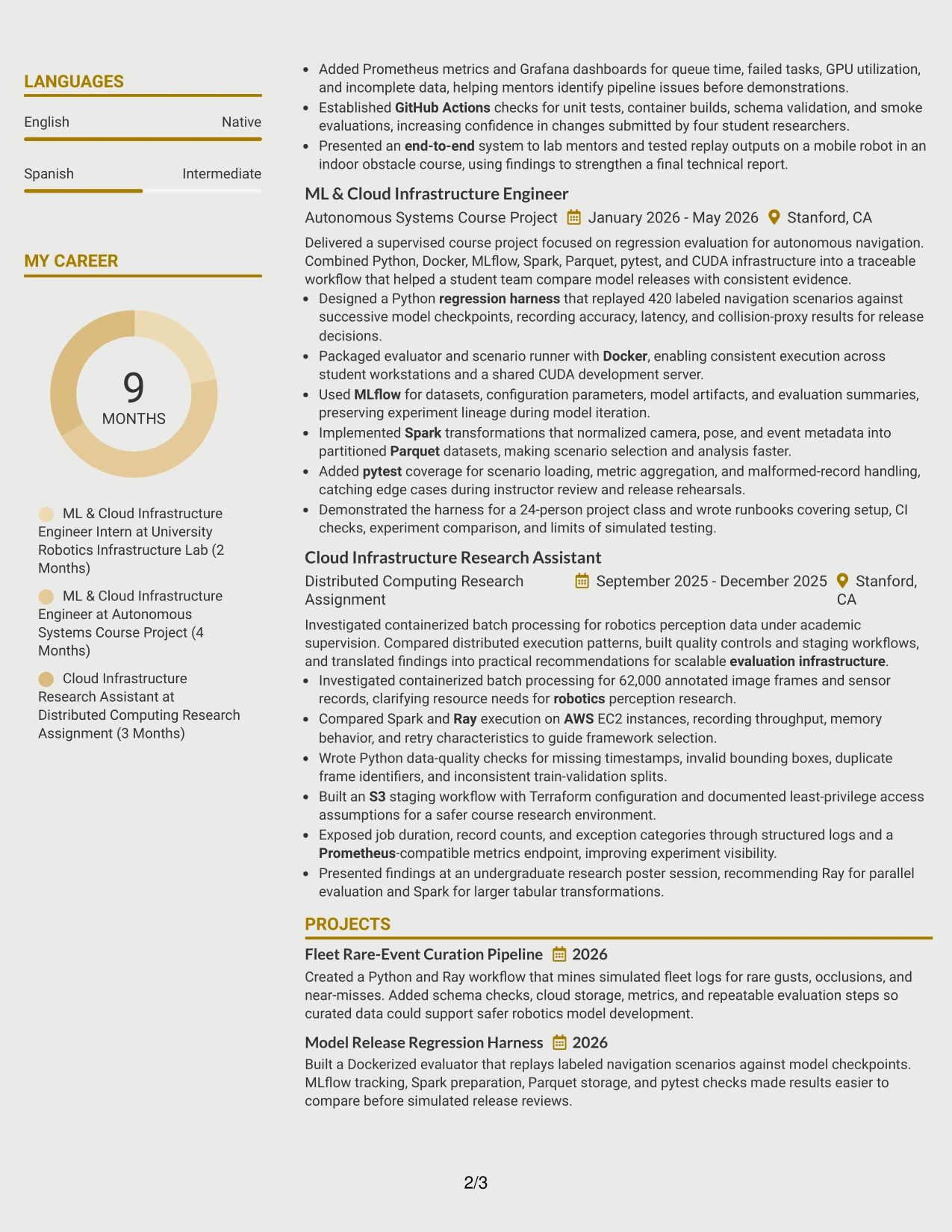
Why the Modern Icon Format Works for a Resume
- The strongest accomplishments remain readable because icons support navigation rather than replace text.
- Visual markers help separate experience, projects, skills, education, and certifications.
- Short sections can surface Python, AWS, Docker, Ray, Spark, and Terraform during a quick scan.
- Bullets preserve measurable proof, including 180,000 records and 420 labeled scenarios.
- The format can show both infrastructure construction and evaluation discipline.
- Clear grouping helps reviewers connect observability tools with pipeline reliability.
- A modern treatment signals organization while keeping ATS-readable wording in the content.
Best For
- Resumes where measurable project evidence should stand out first
- Technical applications that need quick visual cues between several resume sections
- Candidates showing a mix of infrastructure building, testing, and evaluation work
- Documents that benefit from grouped tools without reducing bullet detail
- Readers who scan for outcomes before reviewing supporting education
- Applications where projects and experience must be distinguished clearly
- Resume reviews that reward concise evidence supported by recognizable section markers
#16 Plain Professional Layout with Job Title & Shaded Labels Resume Example
Content is balanced across a clear header, labeled sections, and full-width experience bullets. The plain professional treatment keeps attention on the application need: showing that defined infrastructure deliverables were taken from design through testing, documentation, observability, and demonstration.
Shaded labels make the resume easy to review for a technical internship. They separate the summary from experience, projects, education, certifications, and skills, while the bullets connect tools to business-relevant outcomes such as repeatable experiments, clearer failure recovery, and traceable model comparisons.
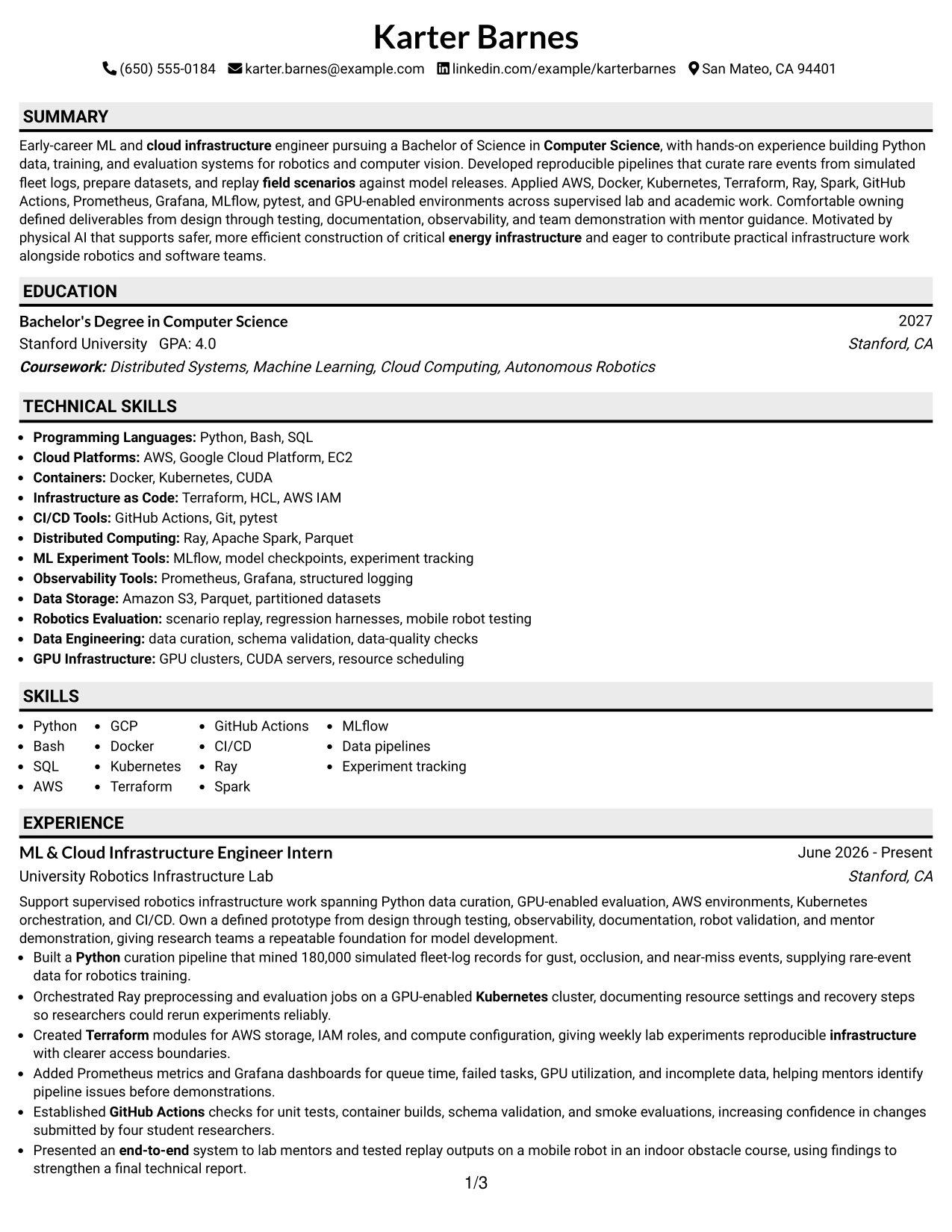
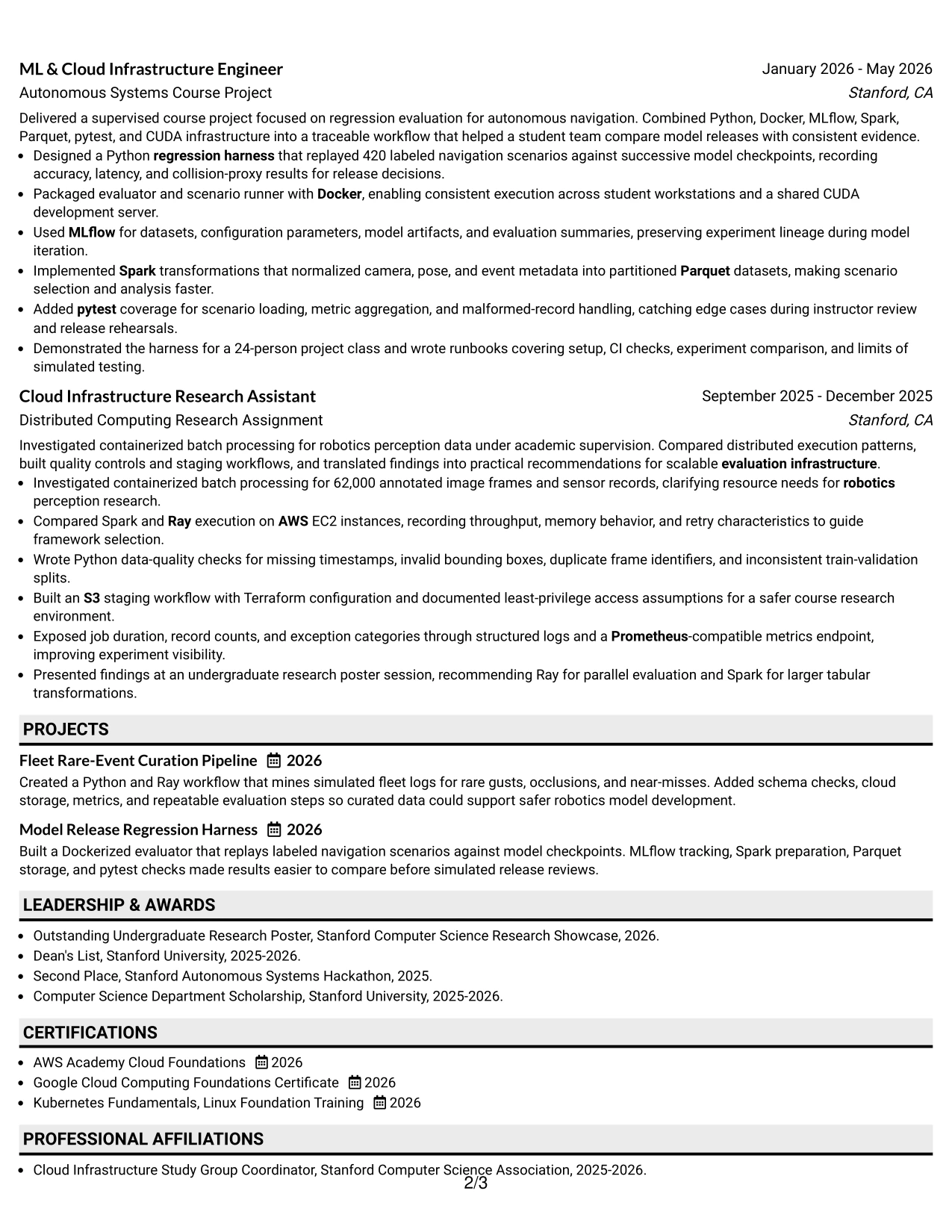
Why the Plain Professional Layout with Job Title & Shaded Labels Works for a Resume
- The job title appears early, helping the document match the intended opportunity.
- Full-width sections give technical bullets room to connect tools with results.
- Shaded labels divide the page without creating complex reading paths.
- The straightforward structure supports ATS extraction of dates, employers, and skills.
- Experience bullets can show ownership from design through testing and demonstration.
- Projects can add evidence without overpowering the internship experience section.
- A restrained layout keeps attention on repeatability, monitoring, testing, and measurable scope.
Best For
- Internship applications where defined deliverables need clear presentation
- Resumes reviewed for ownership, testing, documentation, and follow-through
- Candidates who want a practical format for academic and lab experience
- Documents requiring reliable ATS reading across several standard sections
- Applications where the target title should be visible before the summary
- Technical resumes that need generous space for outcome-focused bullets
- Reviewers comparing infrastructure work with project and education evidence
#17 Classic One Column Resume Format Resume Example
For a practical application, a classic one-column resume offers a dependable way to present qualifications in the order most reviewers expect. The format places the professional summary, experience, projects, education, certifications, and skills on one continuous page path, making the document suitable for standard application systems.
The structure gives each achievement room to carry an action, a technical method, and a result. Examples include curating rare events from 180,000 records, running evaluation jobs on a GPU-enabled Kubernetes cluster, tracking experiments with MLflow, and comparing Spark and Ray on AWS EC2.
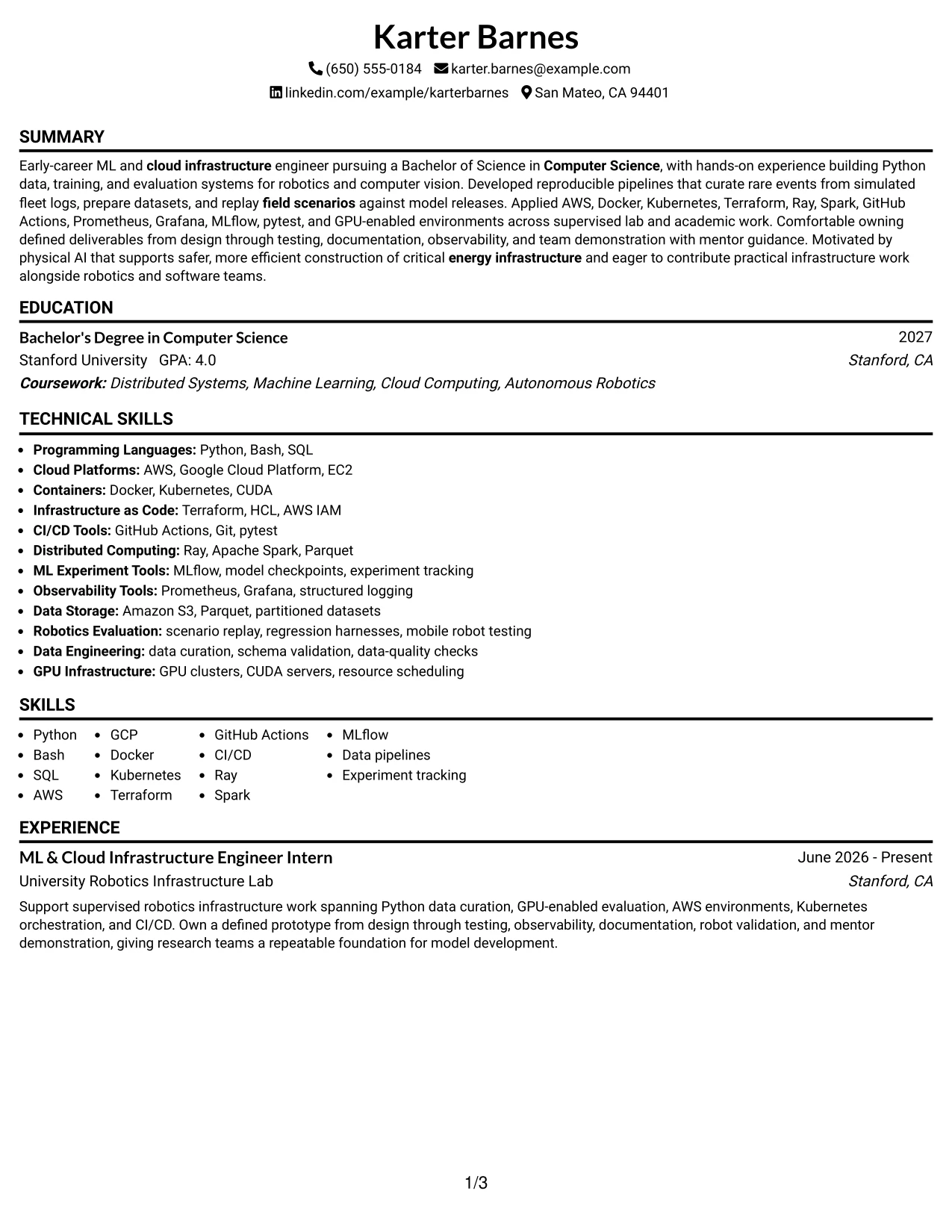
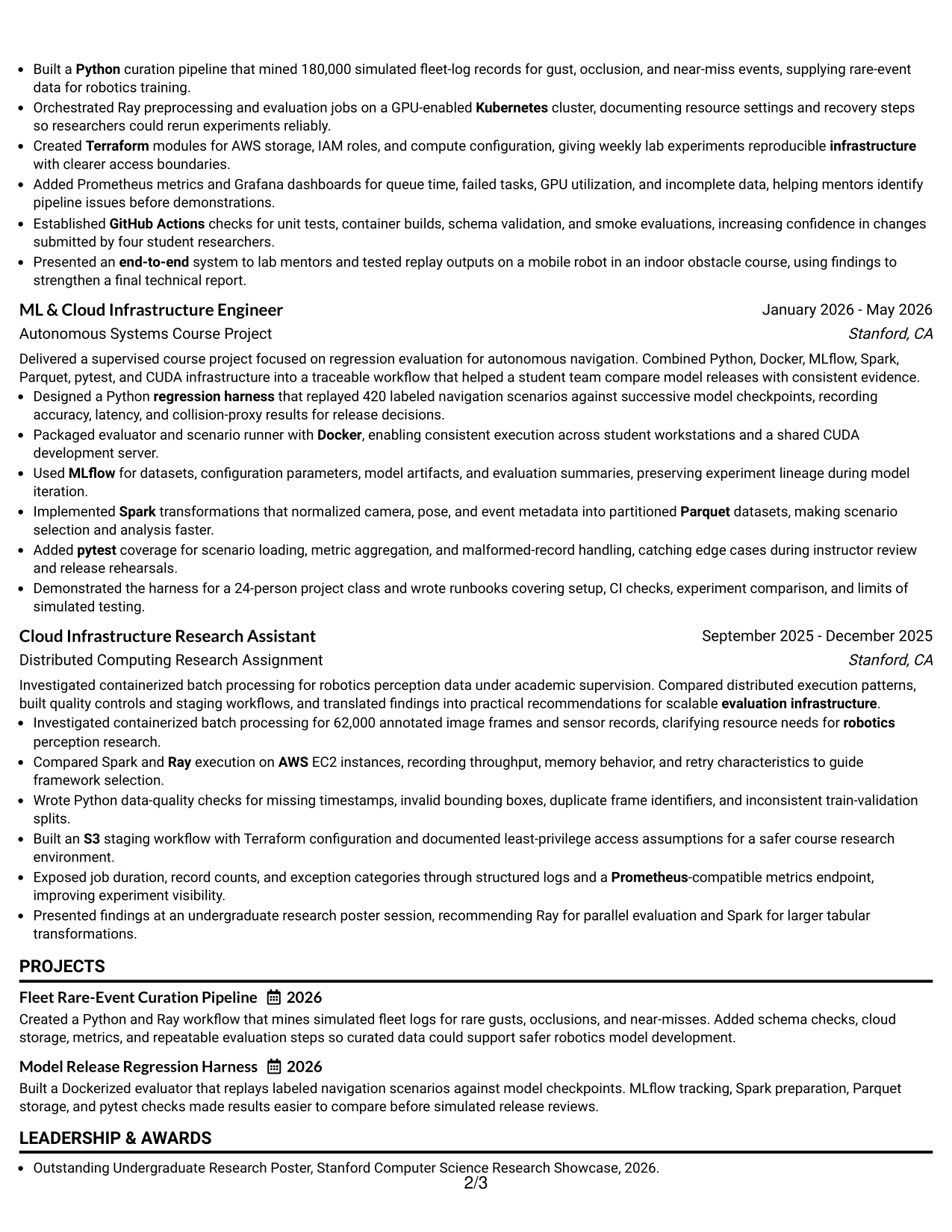
Why the Classic One Column Resume Format Works for a Resume
- A familiar sequence reduces the time needed to locate experience and education.
- One column supports reliable ATS parsing and consistent date recognition.
- Full-width bullets can explain infrastructure work without narrow text blocks.
- The format handles a summary, three technical roles, projects, certifications, and skills cleanly.
- Measured scope gives reviewers evidence beyond a list of tools.
- A classic hierarchy keeps academic work connected to practical technical outcomes.
- The page remains focused on qualifications rather than decorative design.
Best For
- Standard online applications that favor familiar resume structures
- Candidates needing a dependable format for internships and academic experience
- Documents where experience should appear before supporting project detail
- ATS-focused submissions with conventional headings and chronological entries
- Reviewers who compare tools, outcomes, and education in a single flow
- Resumes that need room for detailed bullets without sidebar limits
- Applications where clear qualification evidence matters more than visual novelty
#18 One Column Format with Photo Resume Example
A restrained visual character combines a prominent contact area with a single-column reading path and a professional photo. The photo should remain secondary to the target role, summary, and technical evidence, while the page uses its main space to present Python systems, cloud infrastructure, robotics evaluation, and education.
The one-column sequence supports a complete review of experience and projects. Strong proof includes a rare-event pipeline, Ray evaluation on Kubernetes, Terraform-based AWS environments, monitoring with Prometheus and Grafana, and a Dockerized regression harness. The photo is most useful only when the application context permits it and a consistent personal presentation adds value.
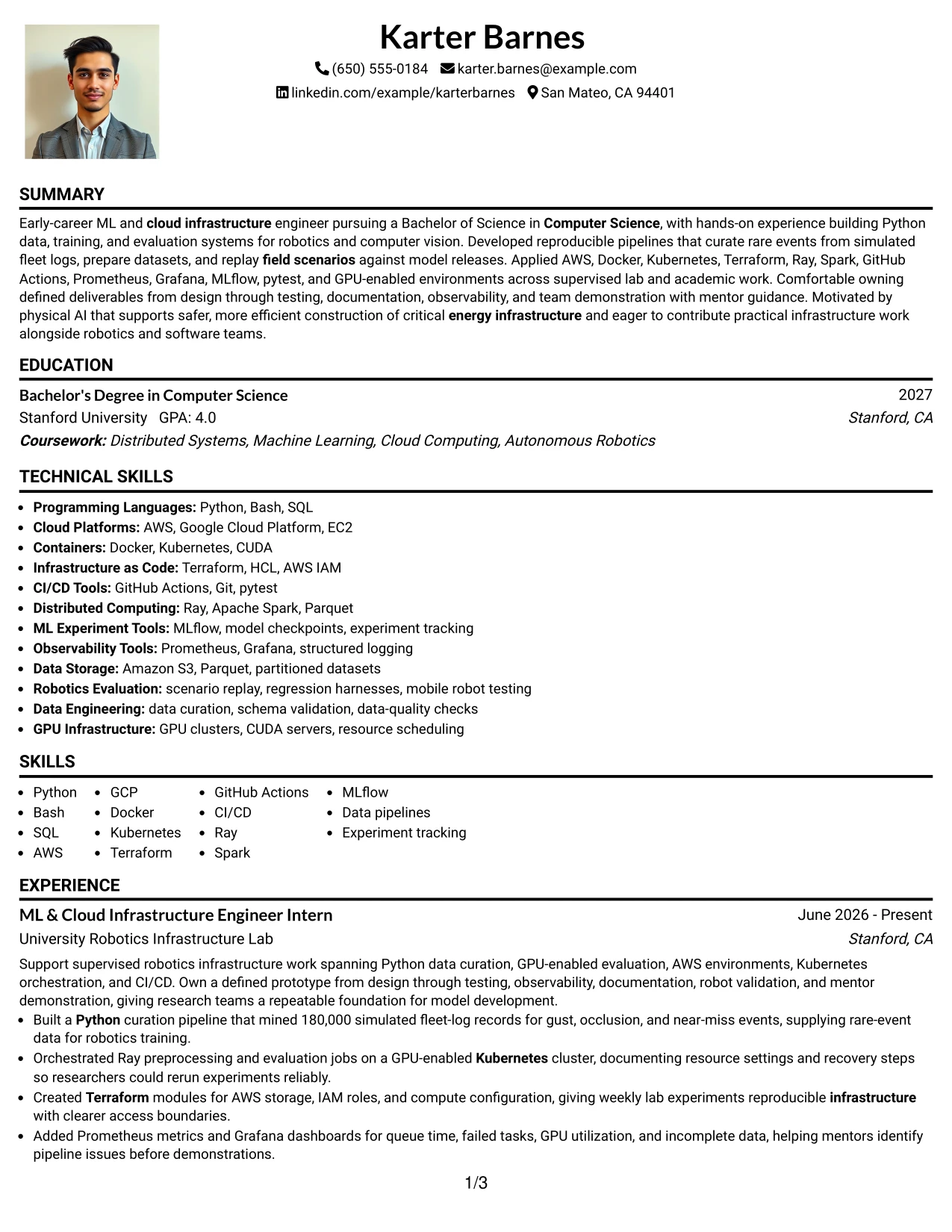
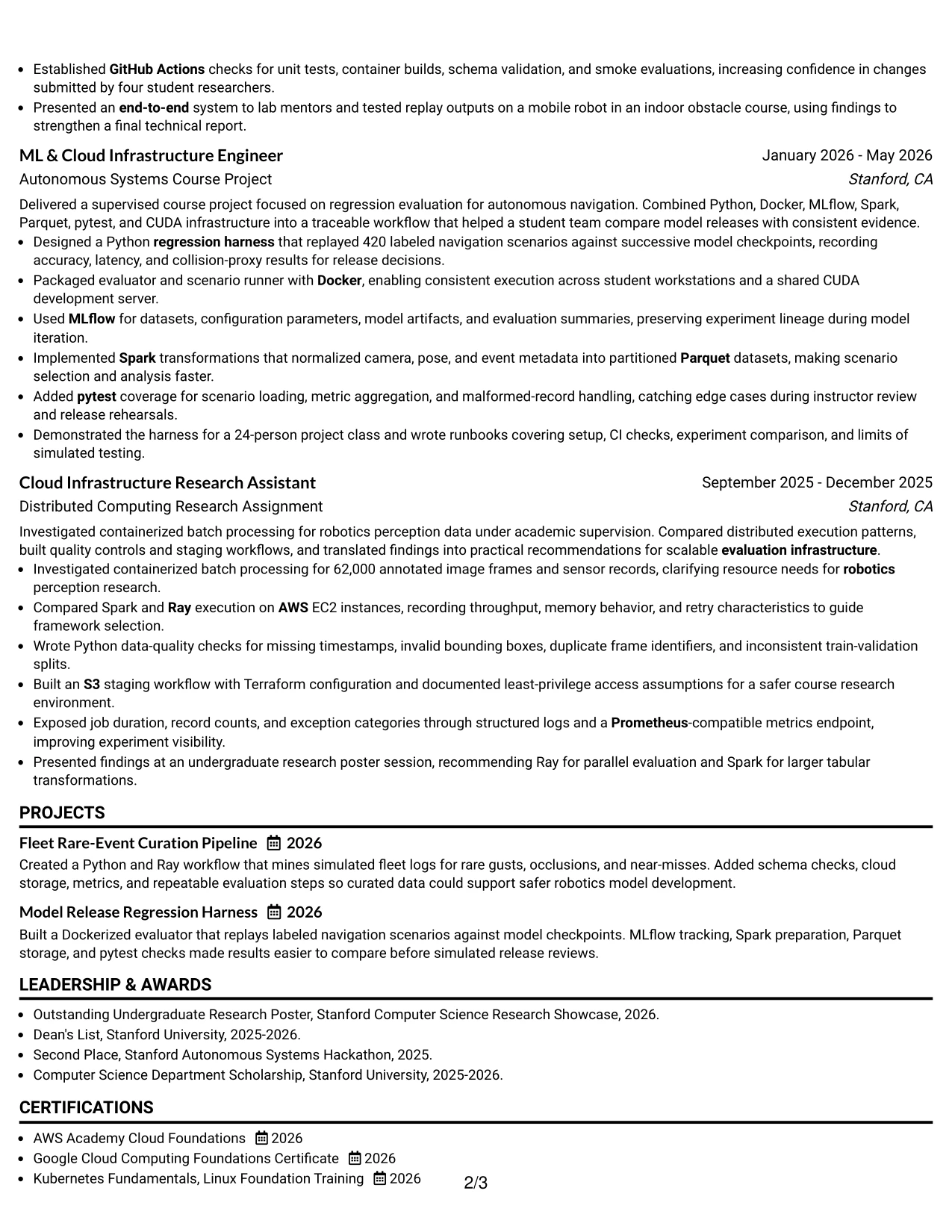
Why the One Column Format with Photo Works for a Resume
- A professional photo creates a defined visual entry point when the application context supports one.
- The single-column body keeps technical evidence easy to follow after the header.
- The photo remains subordinate to measurable accomplishments and relevant keywords.
- Full-width bullets provide space for infrastructure scope and evaluation outcomes.
- Standard sections help ATS tools and reviewers find experience, projects, and skills.
- The format supports a polished personal presentation without changing the evidence hierarchy.
- A consistent header can connect contact details, target role, and professional identity.
Best For
- Applications where a professional photo is accepted and adds useful context
- Candidates who want personal presentation paired with a conventional content flow
- Resumes requiring full-width space for technical project descriptions
- Role-focused documents that place the target title beside clear contact details
- Readers who prefer a direct path from summary to experience and projects
- Applications where visual identity matters but evidence must remain primary
- Candidates presenting structured lab, course, and research work in one sequence
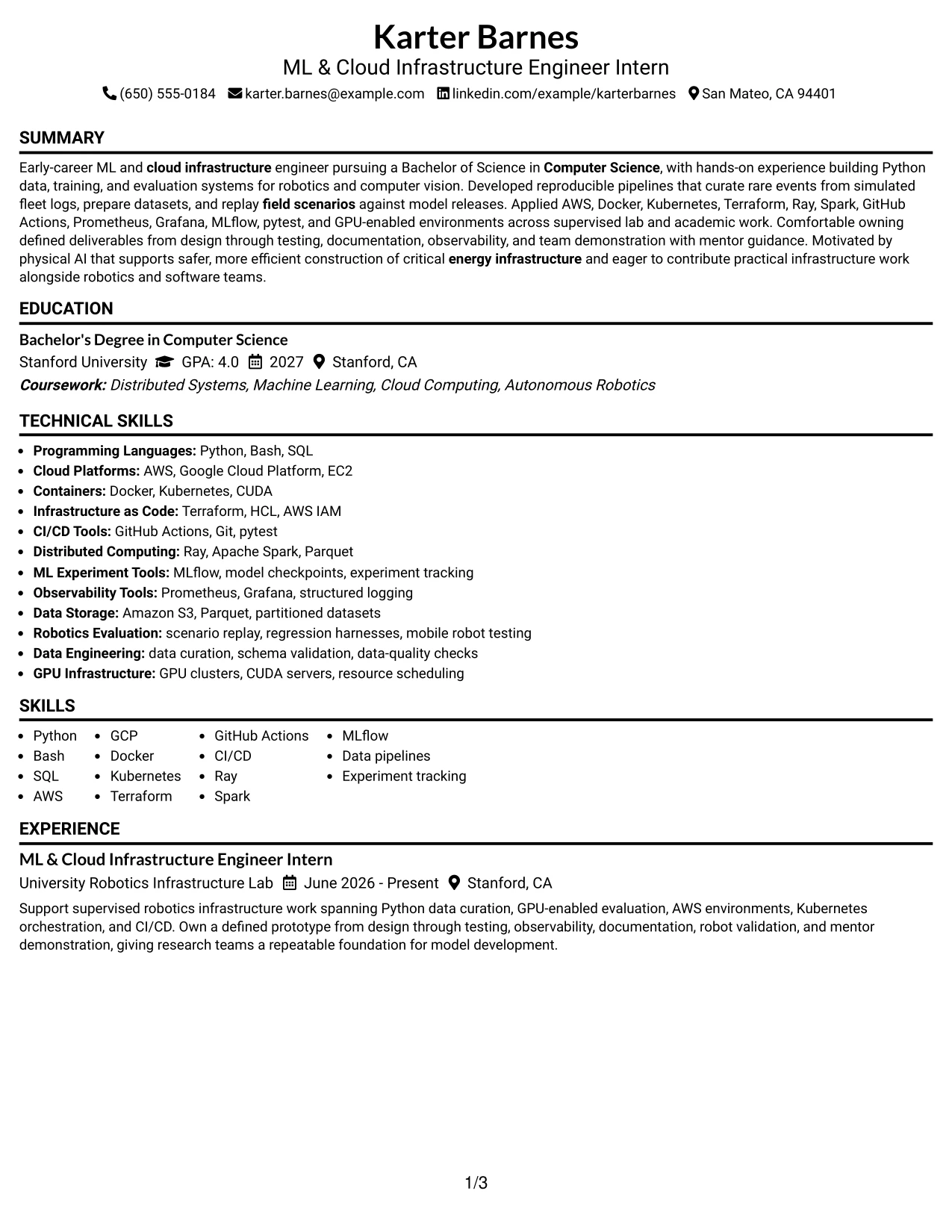
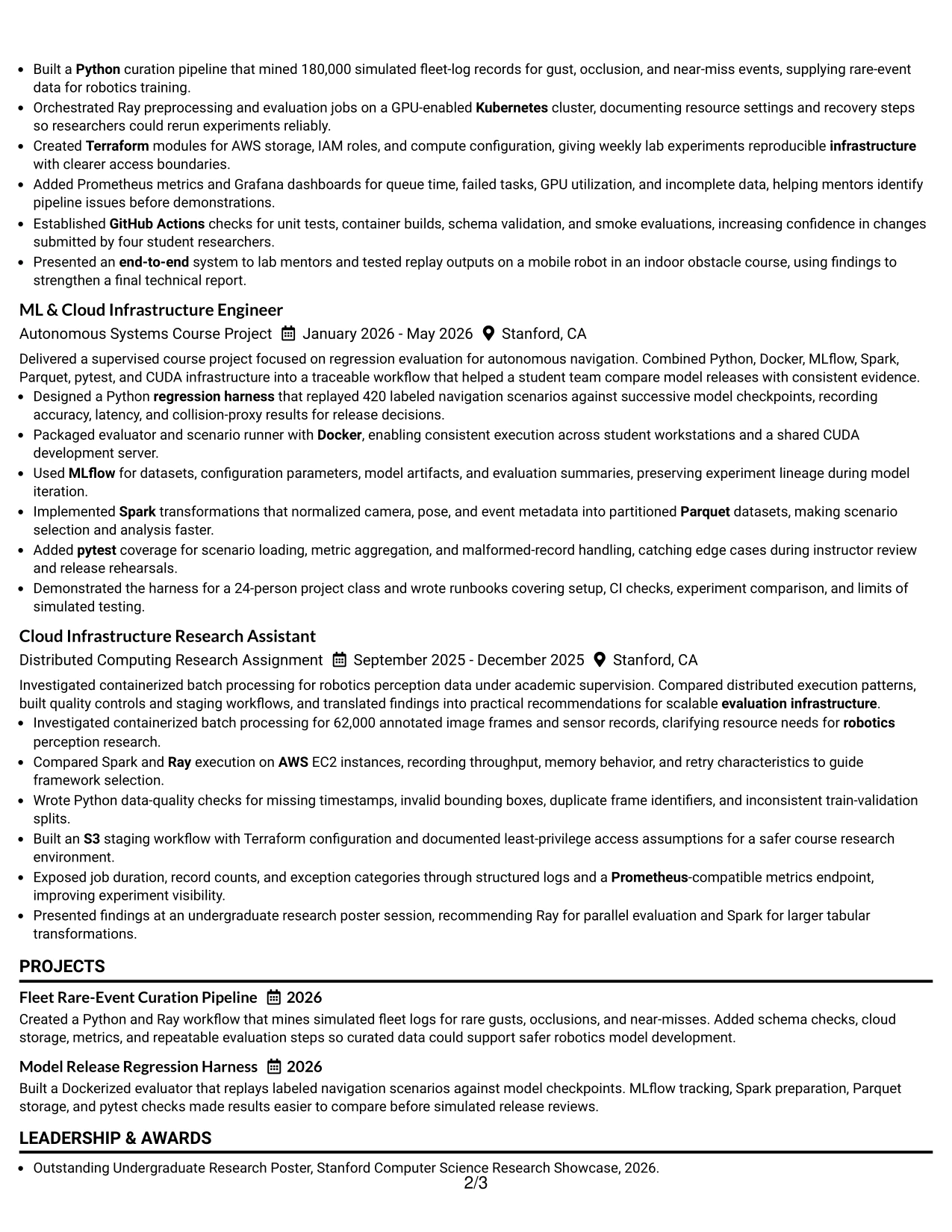
#19 Minimal Header Format Resume Example
The Minimal Header Format starts with only the information needed to identify and route the application, then gives the resume body most of the page. This structure creates a fast path from the target role to the professional summary, technical experience, projects, education, certifications, and skills.
A reduced header is especially useful when the evidence must carry the review. The content can show Python development, AWS and GCP familiarity, containerized workflows, CI/CD checks, data-quality controls, and experiment tracking without visual competition. Results such as 180,000 records and 420 replayed scenarios remain easy to find.
Why the Minimal Header Format Works for a Resume
- A compact header lets reviewers reach qualifications quickly.
- The simple structure supports clean ATS reading of contact details and target role.
- More page space remains available for experience and project bullets.
- Minimal decoration keeps technical keywords visible during a fast scan.
- The format can present education and certifications without crowding the evidence.
- Measurable scope gives the resume stronger proof than tool names alone.
- A quiet header works well when the content needs to make the main impression.
Best For
- Fast-moving application reviews where contact details should not dominate
- ATS submissions needing a clean header and conventional content order
- Candidates whose strongest value is in detailed technical evidence
- Resumes with multiple projects that need additional body space
- Readers who scan for role, experience, tools, and results in that order
- Applications combining university credentials with hands-on infrastructure work
- Documents where a restrained header supports a focused professional presentation
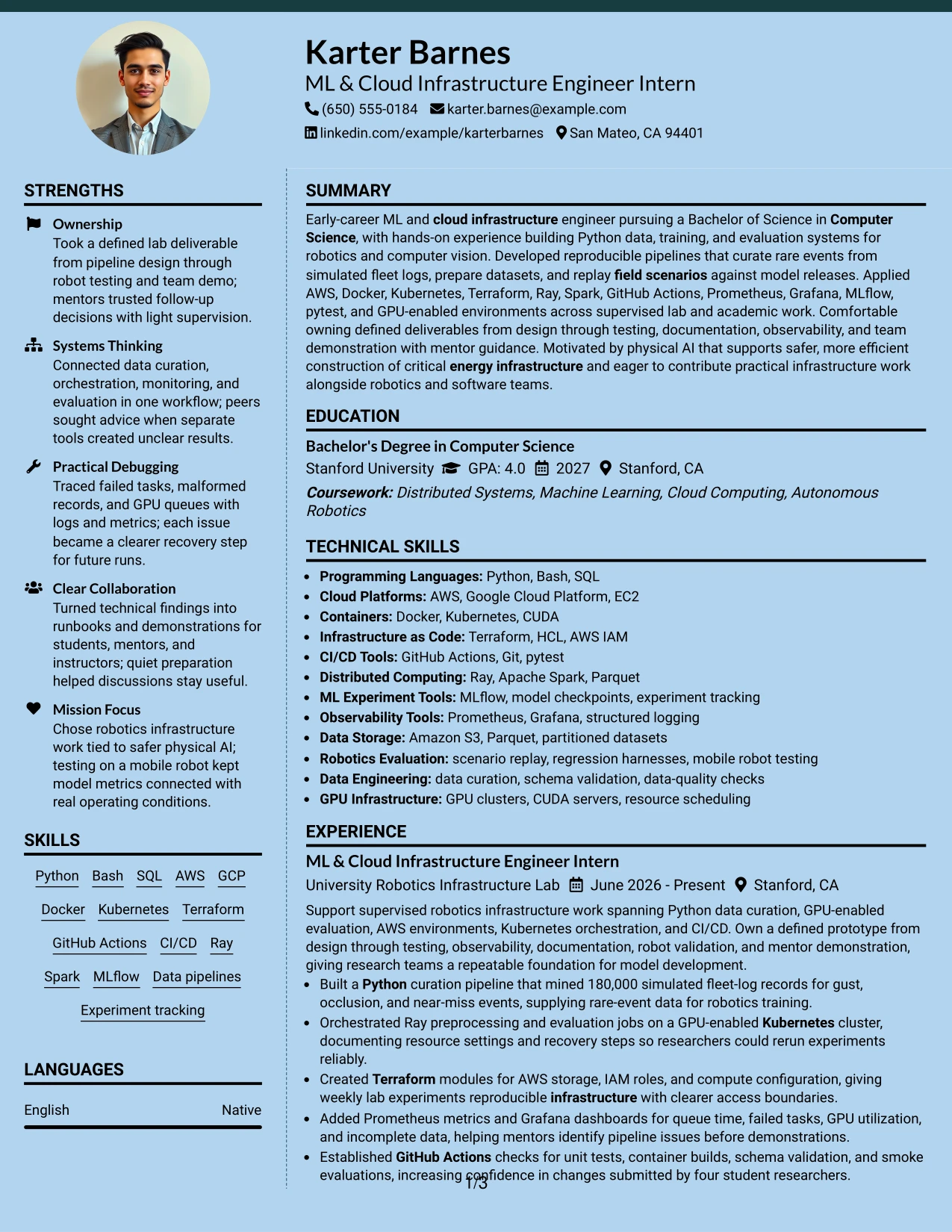
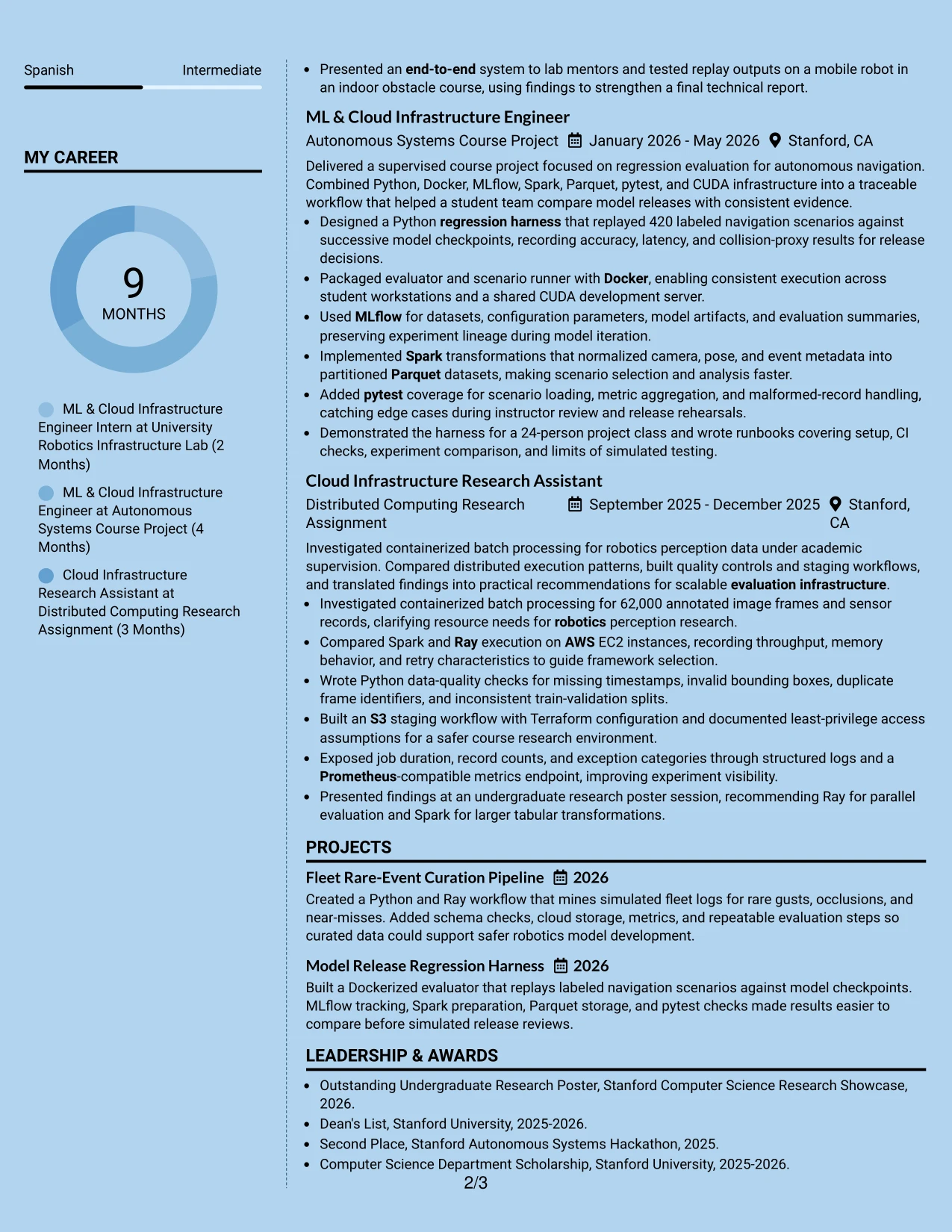
#20 Modern Full Background Two Column Format Resume Example
Recruiters can use the side column to confirm contact details, education, certifications, and core tools while the main column carries the evidence of delivery. That navigation pattern suits a resume with several related projects, allowing the reader to connect Karter Barnes's summary with infrastructure experience, robotics evaluation, and measurable pipeline scope.
The full-background treatment adds a modern visual frame, but the content should still lead the review. The main column can detail Ray orchestration, AWS and Terraform work, monitoring, CI/CD, and robot validation. A supporting column can group Python, Docker, Kubernetes, Spark, MLflow, Prometheus, and Grafana for quick qualification checks.
Why the Modern Full Background Two Column Format Works for a Resume
- The main column protects space for detailed experience and project evidence.
- The side column keeps skills, education, and certifications visible during a full-page scan.
- Two-column navigation helps separate proof of delivery from qualification references.
- The format can handle several infrastructure tools without turning the main story into a list.
- Measured outcomes remain in the primary reading area where they receive more attention.
- A modern background treatment creates hierarchy while preserving clear section grouping.
- The structure works well for resumes that need both technical depth and quick qualification checks.
Best For
- Documents with substantial experience and project content needing a primary column
- Applications where skills and education should remain visible beside detailed evidence
- Candidates presenting related infrastructure projects across lab and coursework settings
- Readers who review achievements while checking tools in a separate area
- Resumes that need to show technical breadth without shortening every bullet
- Portfolio-oriented applications where projects require room for scope and methods
- Modern submissions that still need a practical separation of evidence and reference data
#21 Dark Mode Two Column Format Resume Example
Evidence leads the review in this format, with the main column suited to accomplishments and the secondary column suited to rapid qualification checks. The contrast can distinguish technical experience from skills, education, and certifications, while the text still needs to show how infrastructure work improved repeatability, monitoring, testing, and evaluation.
A two-column structure gives the resume room to connect tools with use cases. The primary area can explain rare-event curation, GPU-enabled Kubernetes jobs, Spark transformations, and model release regression. The secondary area can group AWS, GCP, Docker, Terraform, Ray, MLflow, Prometheus, Grafana, and pytest for faster screening.
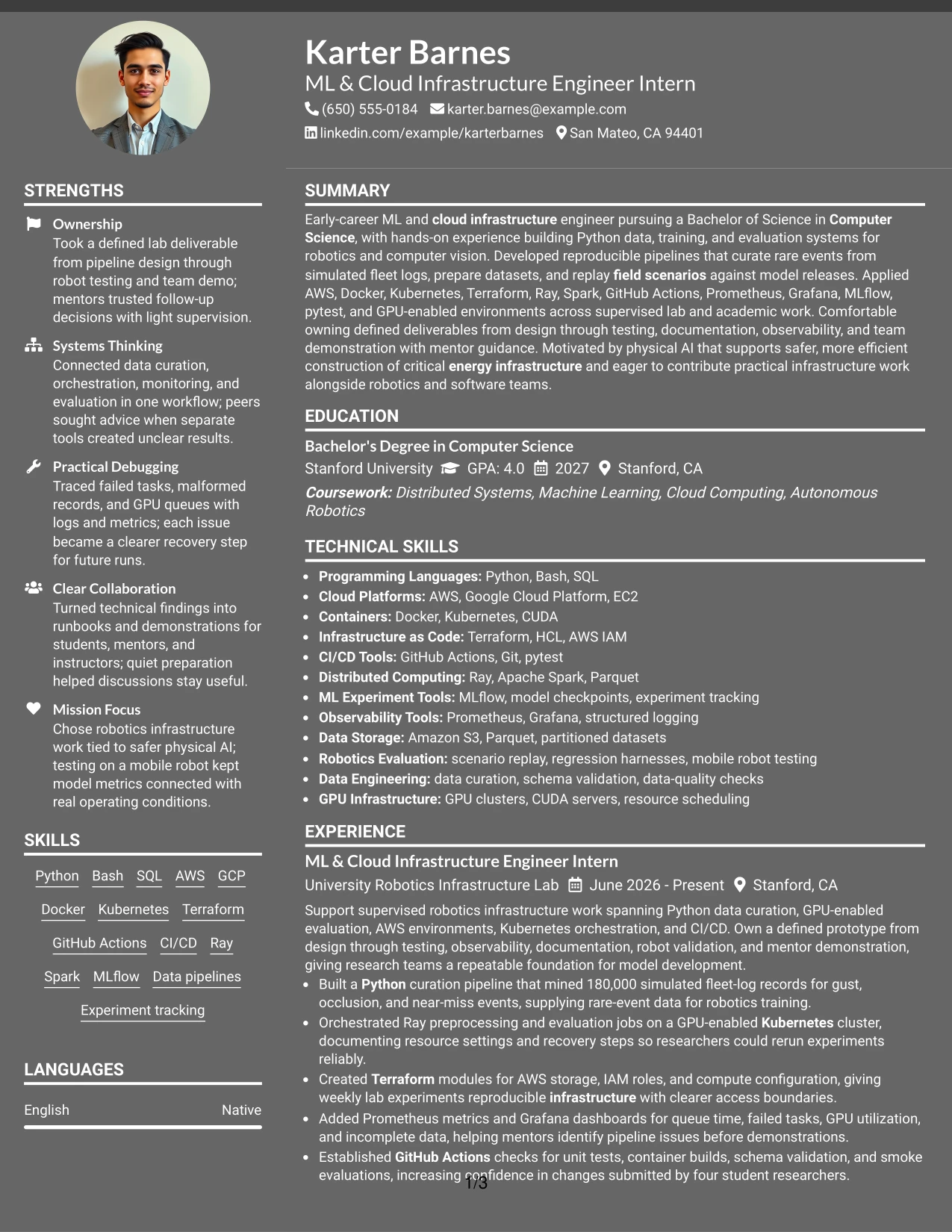
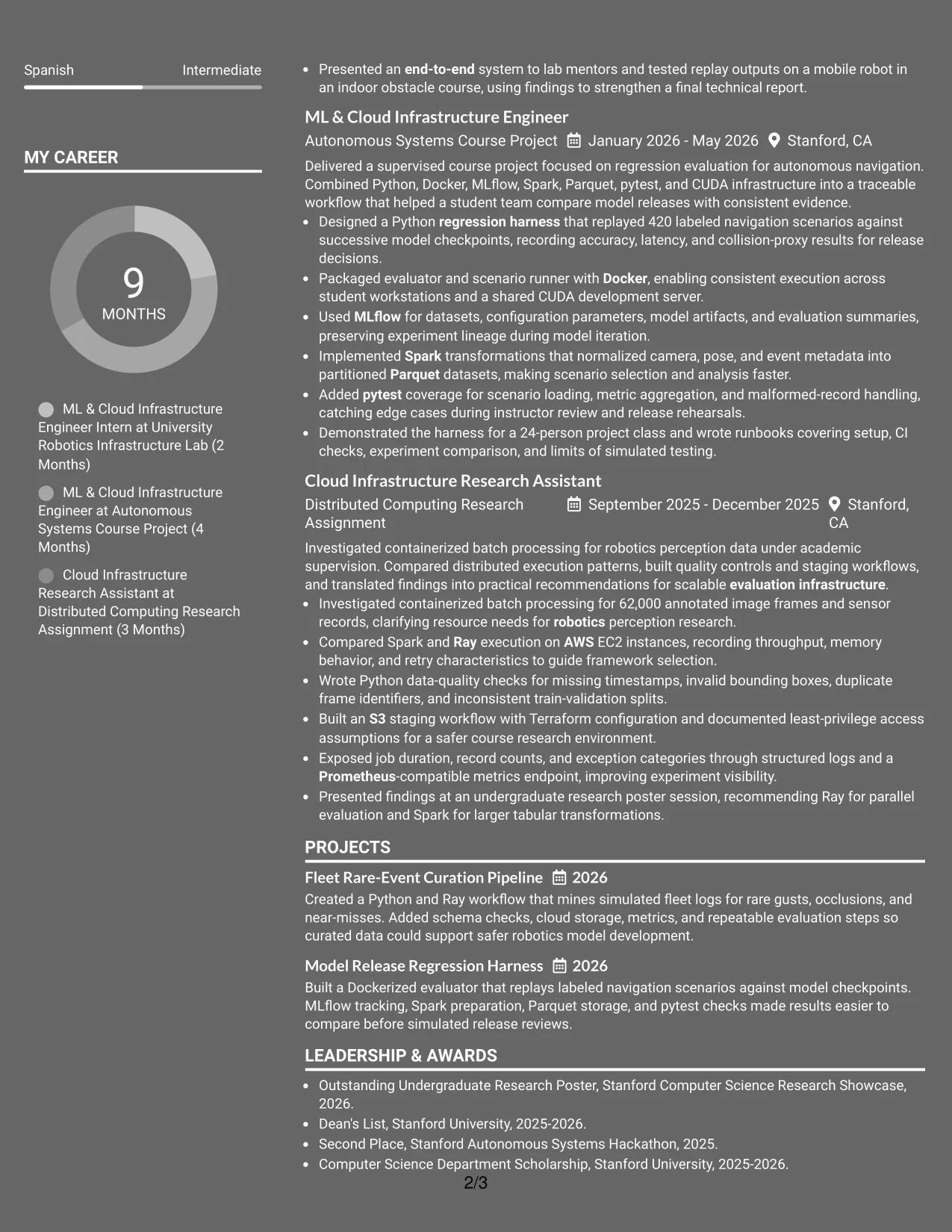
Why the Dark Mode Two Column Format Works for a Resume
- The primary column gives outcome-focused bullets the strongest reading position.
- A secondary column supports fast checks of skills, education, and certifications.
- Contrast between areas can help distinguish evidence from supporting information.
- The layout accommodates both infrastructure construction and model evaluation work.
- Technical tools remain grouped so reviewers can verify platform coverage quickly.
- Fuller experience entries can preserve scope and testing detail.
- The format creates a strong visual hierarchy while keeping the resume content organized.
Best For
- Resumes where major accomplishments should receive the first visual emphasis
- Technical applications that need a separate area for tools and qualifications
- Candidates with enough evidence to support a detailed primary column
- Readers comparing platform knowledge with delivered infrastructure work
- Project portfolios that include both data systems and evaluation workflows
- Documents that benefit from clear contrast between career evidence and reference content
- Modern applications where visual distinction must still support rapid resume scanning
#22 Dark Mode Box Header Format Resume Example
Balanced spacing gives the resume a strong boxed entry area without allowing the header to overwhelm the page. The format can place the target role, contact details, and summary in a compact top block, then distribute experience, projects, education, certifications, and skills through a controlled one-column structure.
That balance supports an application review focused on practical delivery. Bullets can show the 180,000-record curation pipeline, repeatable AWS infrastructure, Prometheus monitoring, GitHub Actions validation, and a 420-scenario regression harness. The dark visual treatment should frame those results, not replace clear section labels or ATS-readable text.
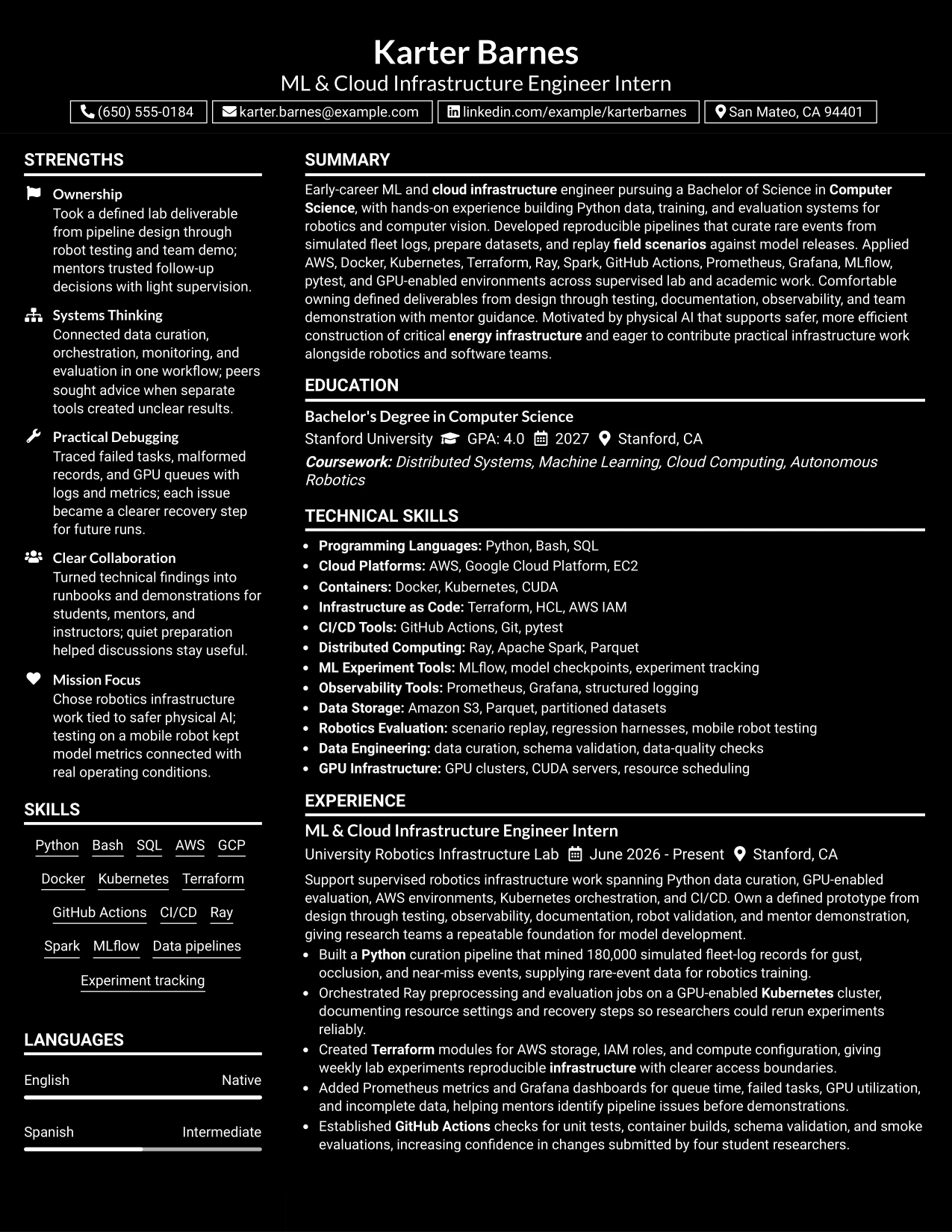
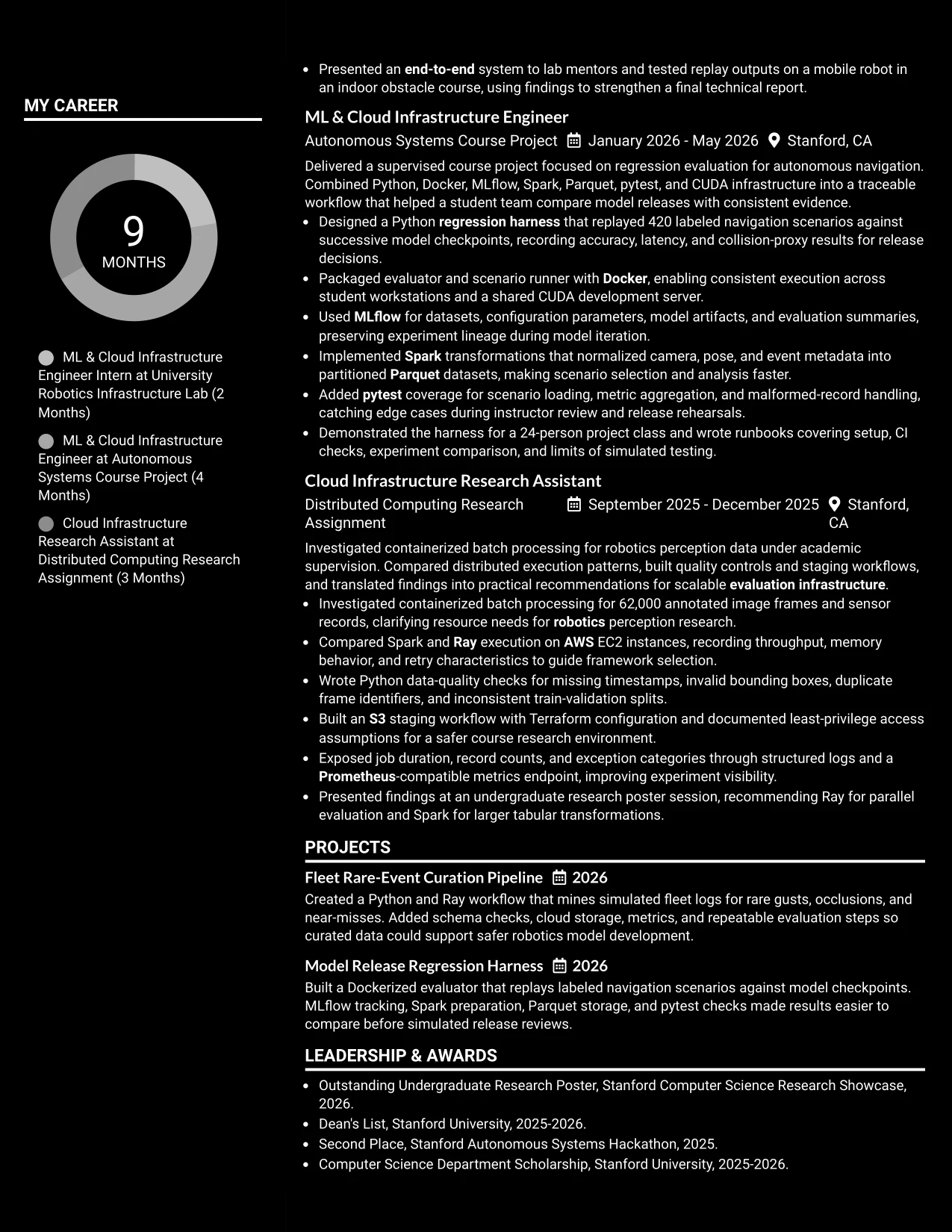
Why the Dark Mode Box Header Format Works for a Resume
- The boxed header gives the target role and contact details a clear starting boundary.
- One-column spacing keeps experience and projects in a dependable review order.
- A controlled visual hierarchy prevents the dark treatment from competing with results.
- Full-width bullets can connect technical actions with scope and operational value.
- Section labels help reviewers locate skills, education, certifications, and projects.
- The structure supports ATS-friendly content when headings and dates remain conventional.
- The format presents a polished application while keeping evidence and readability central.
Best For
- Applications needing a strong top block before a conventional resume body
- Candidates who want a distinctive frame around clear technical evidence
- ATS-conscious documents using standard sections inside a modern presentation
- Reviews focused on defined deliverables, testing, and operational readiness
- Resumes with measurable pipeline and evaluation work that needs full-width space
- Readers who prefer a single sequence after checking the contact and role block
- Technical applications where visual polish should support, not replace, qualification proof
#23 Elegant Full Background Two Column Format
For an ML & Cloud Infrastructure Engineer Intern resume, this two-column design gives technical evidence a clear place without making the page feel crowded. A strong summary and education block can sit beside skills, certifications, and tools, while the main column carries project and experience bullets.
The elegant full-background treatment supports a polished technical presentation while keeping the content practical. Short bullets can show Python, AWS, Kubernetes, Terraform, Ray, observability, and measurable evidence such as processing 180,000 simulated fleet-log records or replaying 420 navigation scenarios.
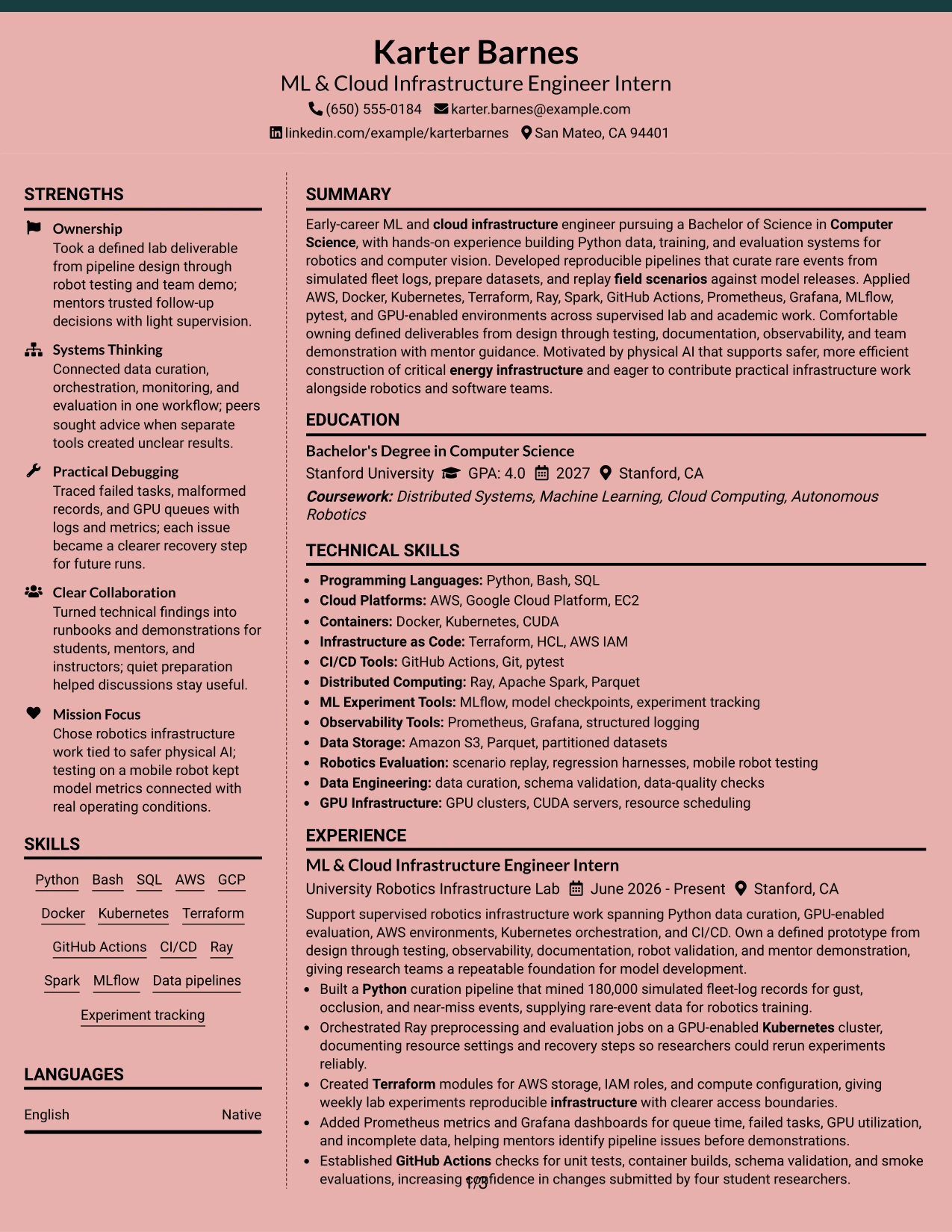
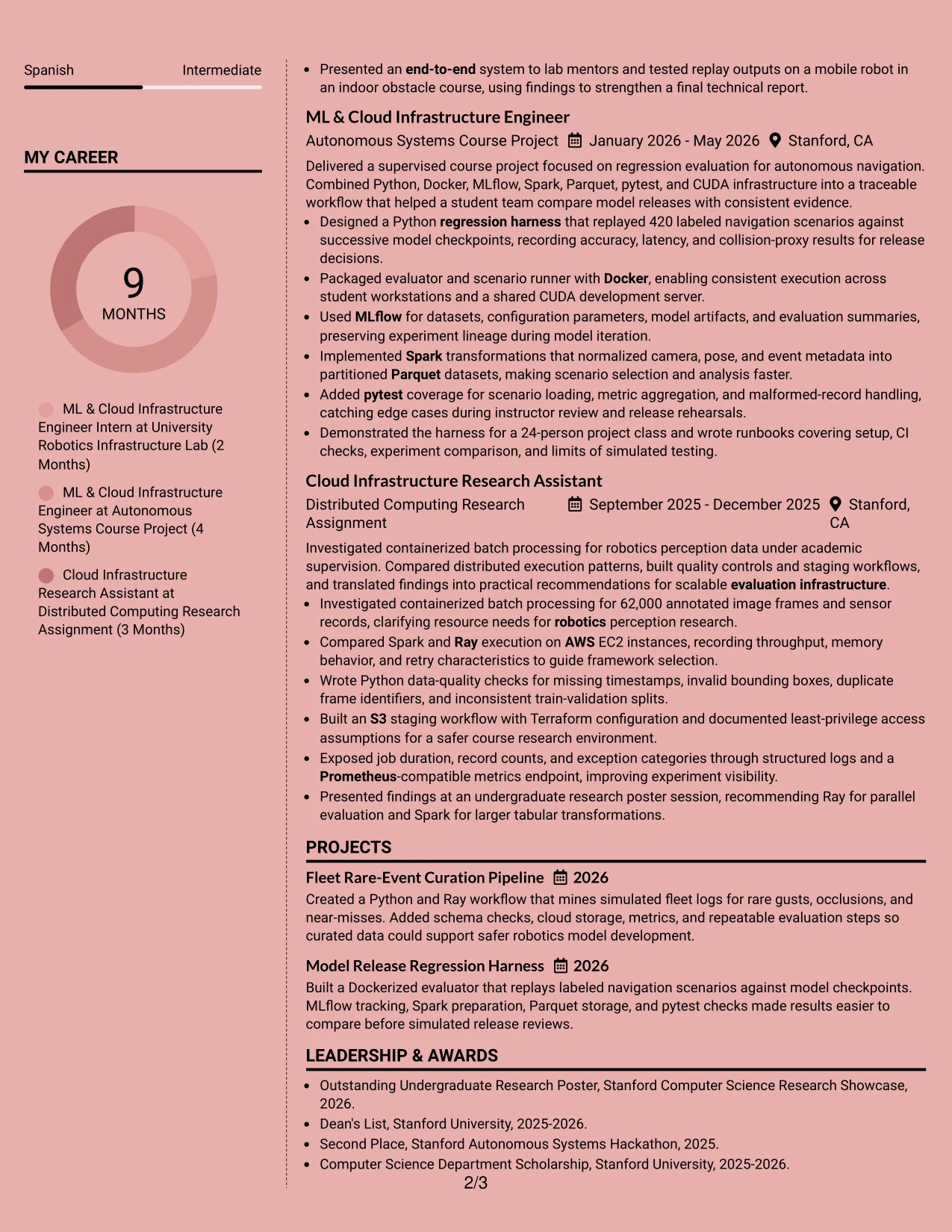
Why This Format Works for a Resume
- Two columns separate core experience from supporting qualifications.
- A clear hierarchy helps recruiters find the summary, education, and experience quickly.
- Compact skills and certification areas preserve space for achievement bullets.
- The main content area supports detailed infrastructure, data, and evaluation work.
- Short bullet points make technical evidence easier to scan.
- Numbers such as 180,000 records and 420 scenarios make results more credible.
- The structure can balance ATS-friendly text with a polished visual presentation.
Best For
- Resumes that need separate areas for experience and technical skills.
- Candidates presenting both academic projects and supervised work.
- Applications where tools, certifications, and education must remain visible beside results.
- Readers who prefer a quick scan followed by deeper project evidence.
- Technical resumes with several related platforms, frameworks, and infrastructure methods.
- Early-career applications that need to show ownership through defined deliverables.
- Documents that benefit from a polished look without long blocks of text.
#24 Creative Two Tone Format
A restrained visual hierarchy helps a technical resume stand out while keeping performance evidence easy to judge. The two-tone treatment can distinguish section labels from the body, guiding attention from the summary to experience, projects, skills, and education.
For this ML & Cloud Infrastructure Engineer Intern application, the creative element works best when it supports proof rather than replacing it. Bullets can connect Python pipelines, Ray jobs, GPU-enabled Kubernetes, MLflow, and CI/CD checks to outcomes such as repeatable experiments, traceable model comparisons, and robot validation.
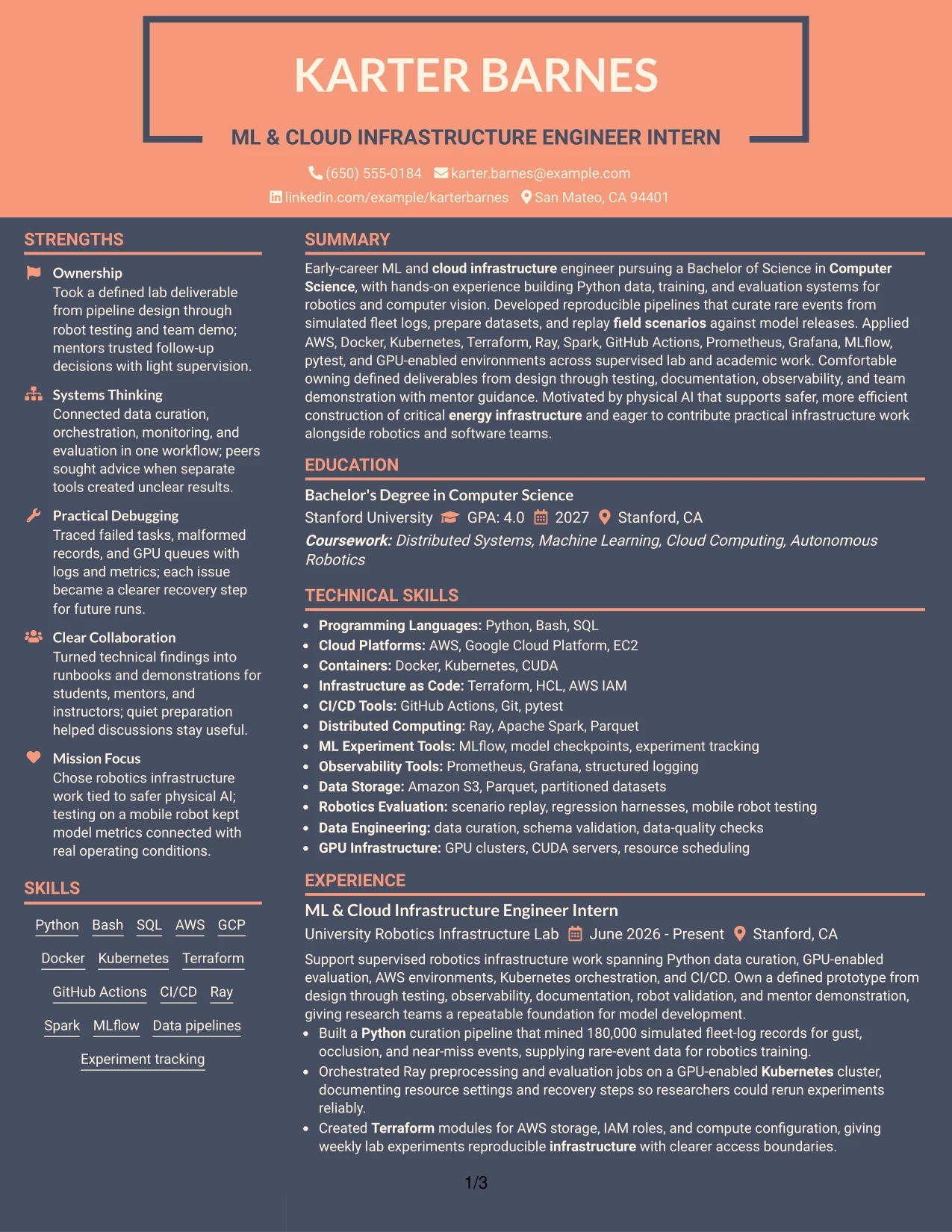
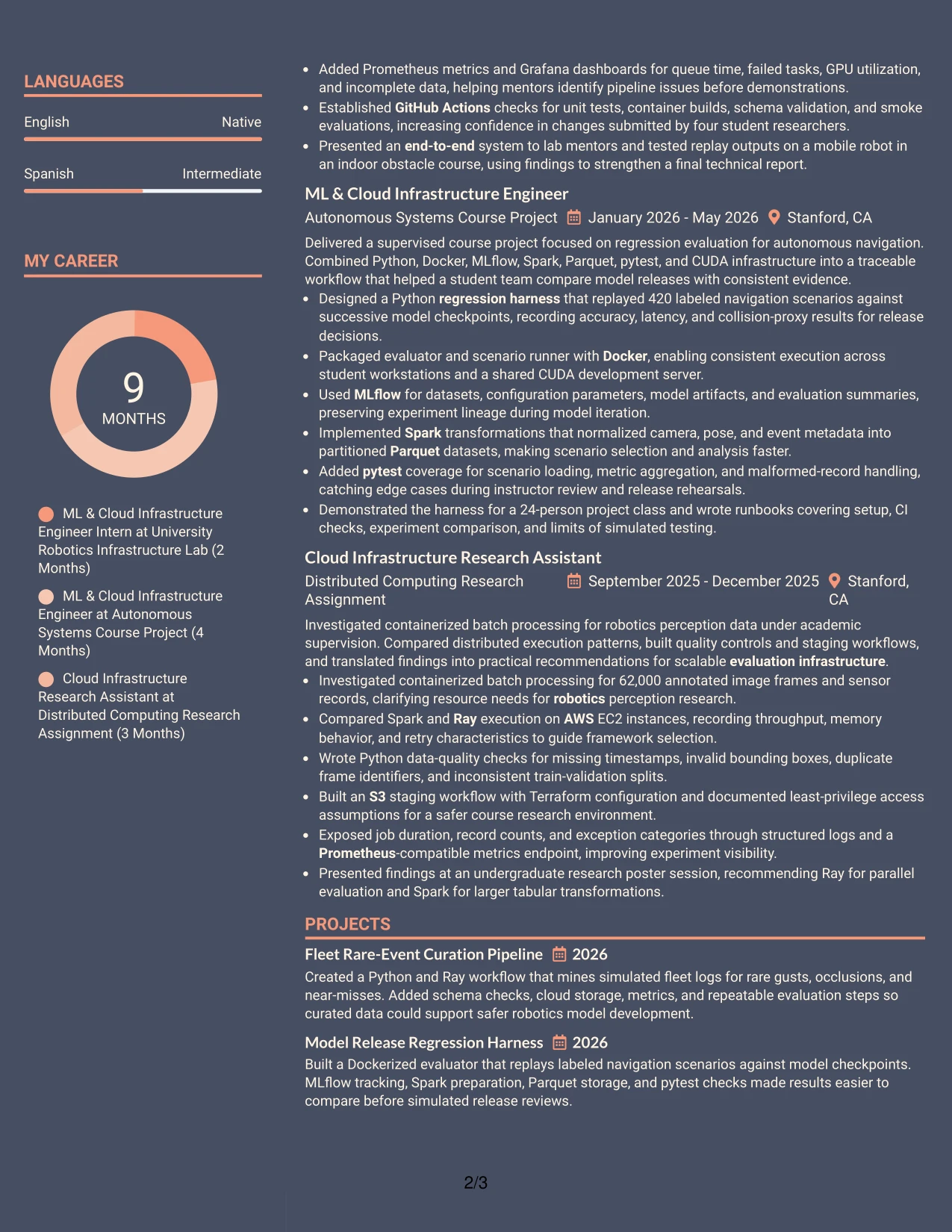
Why This Format Works for a Resume
- Two visual tones create section separation without adding complex navigation.
- The single-column flow keeps experience evidence in a natural reading order.
- A restrained accent can draw attention to role titles and measurable results.
- Technical keywords remain close to the bullets that prove their use.
- Project entries can show how tools supported training and evaluation work.
- The format gives education and certifications a clear supporting position.
- Readable spacing helps reviewers assess ownership, testing, and observability quickly.
Best For
- Technical candidates who want a distinct look with a controlled visual system.
- Single-column resumes where project evidence should receive steady attention.
- Applications that combine software, cloud, data, and machine learning keywords.
- Readers who review documents from top to bottom rather than jumping between columns.
- Candidates who need a modern presentation without reducing keyword clarity.
- Resumes where section accents should support, not compete with, achievement bullets.
- An ML & Cloud Infrastructure Engineer Intern resume with closely related technical themes.
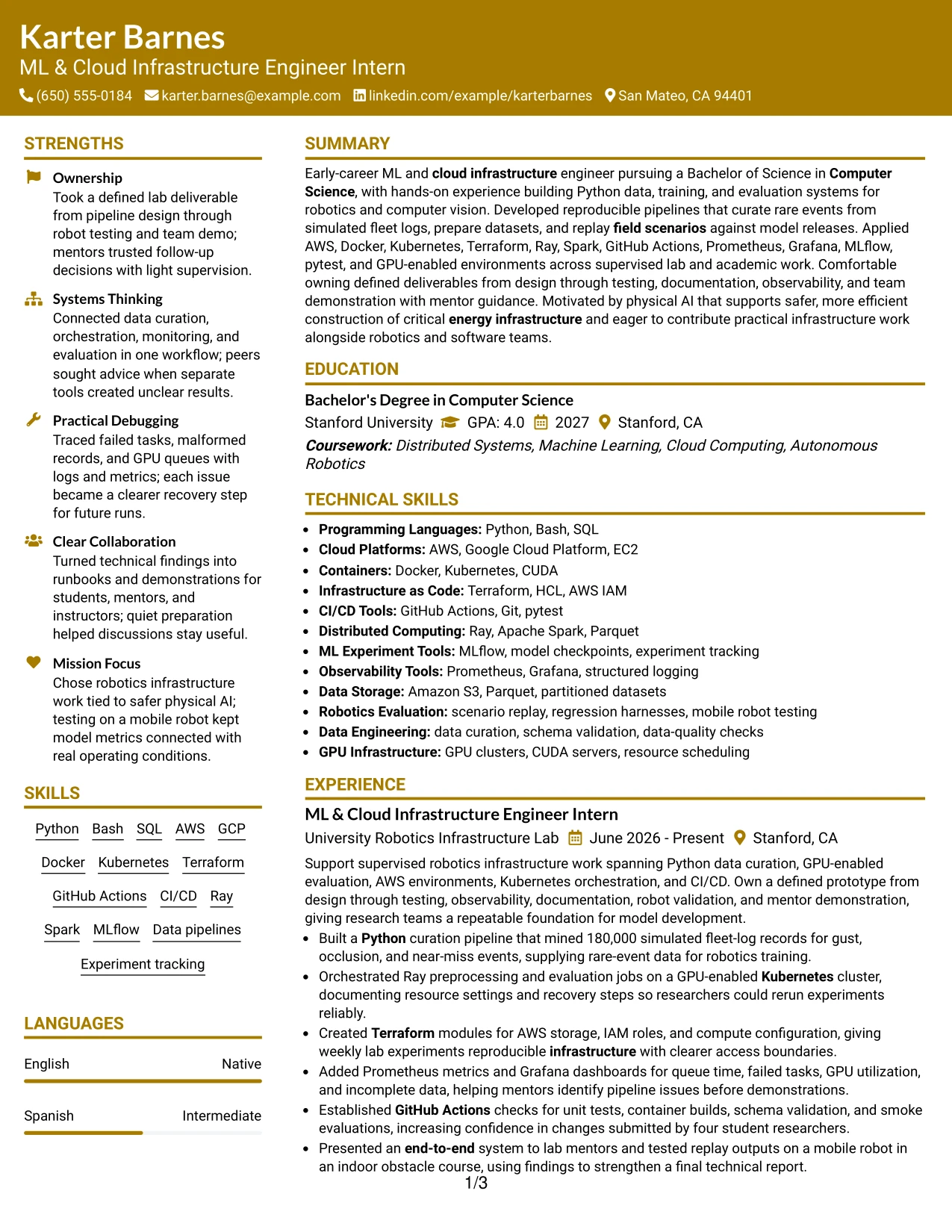
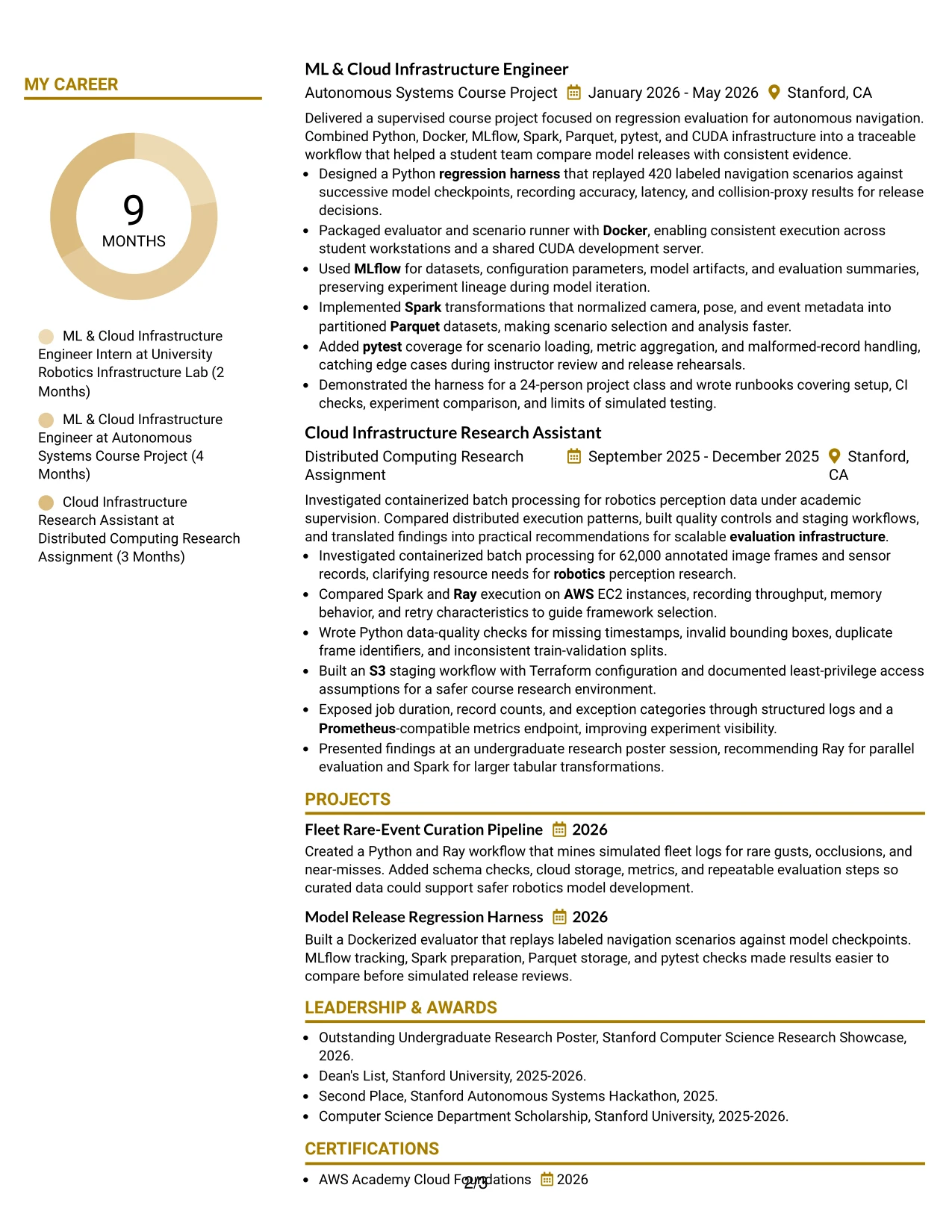
#25 Bold Color Header Professional Format
The format name describes a strong header followed by a direct, professional resume structure. The header can establish the target role and contact details, then lead into a summary, experience, projects, education, skills, and certifications in a predictable order.
That structure is useful for a technical internship resume because it places the highest-value evidence near the top. Experience bullets can show a Python curation pipeline, AWS infrastructure, Terraform modules, GitHub Actions checks, Prometheus dashboards, and testing on a mobile robot.
Why This Format Works for a Resume
- A bold header makes the target role visible during an initial scan.
- The professional sequence supports fast review by section.
- A strong summary can connect cloud infrastructure with robotics evaluation.
- Experience bullets have room for tools, actions, and business-relevant outcomes.
- Projects can reinforce evidence that is not fully covered in employment history.
- Skills and certifications remain easy to locate for keyword checks.
- The format supports a confident presentation without relying on decorative detail.
Best For
- Resumes that need the target role and professional summary to stand out immediately.
- Candidates whose strongest proof appears in experience and project bullets.
- Applications reviewed quickly for required cloud, container, and CI/CD terms.
- Documents that need a clear path from summary to measurable technical results.
- Early-career candidates combining coursework, research, and internship evidence.
- Readers who value a conventional order with a stronger visual entry point.
- Technical applications where professionalism and keyword visibility must work together.
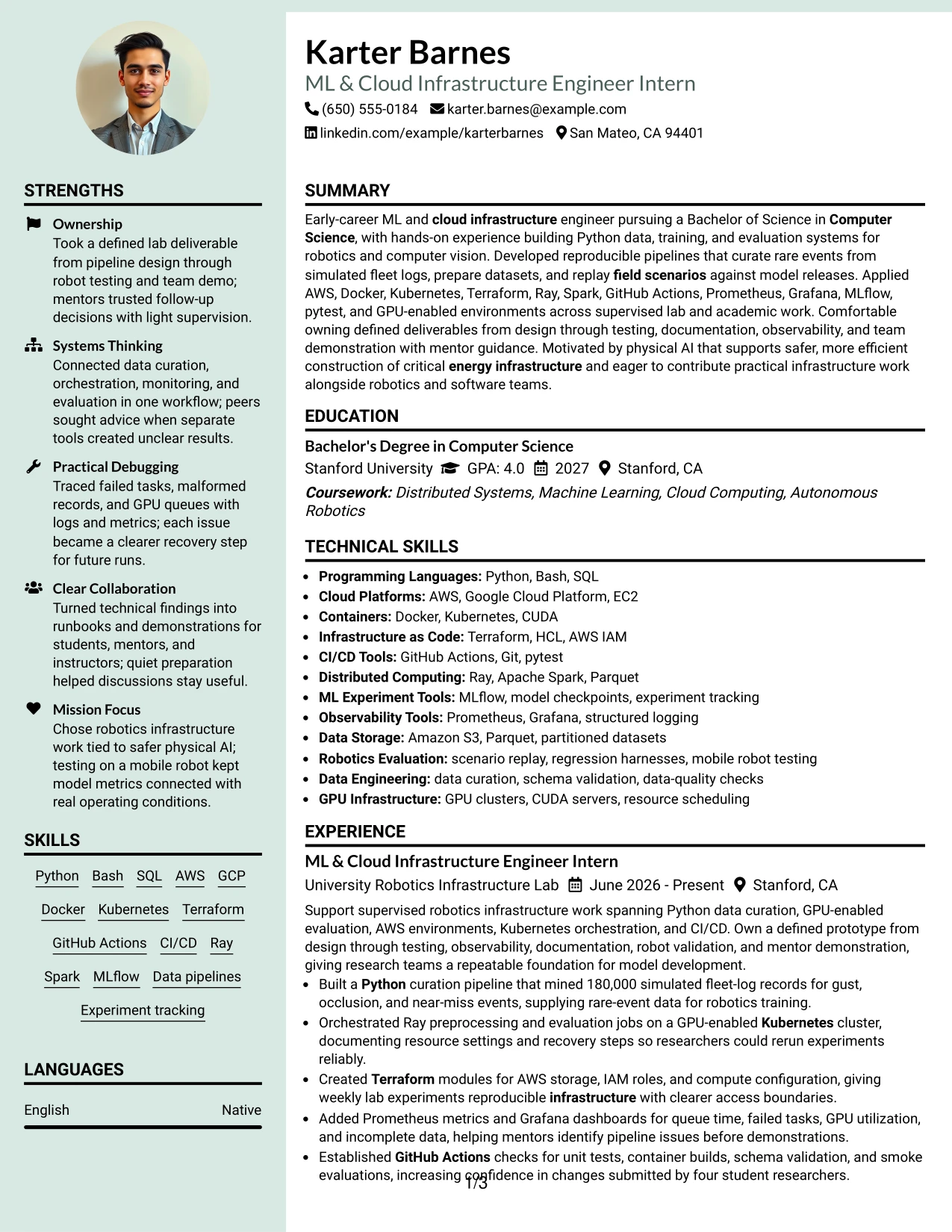
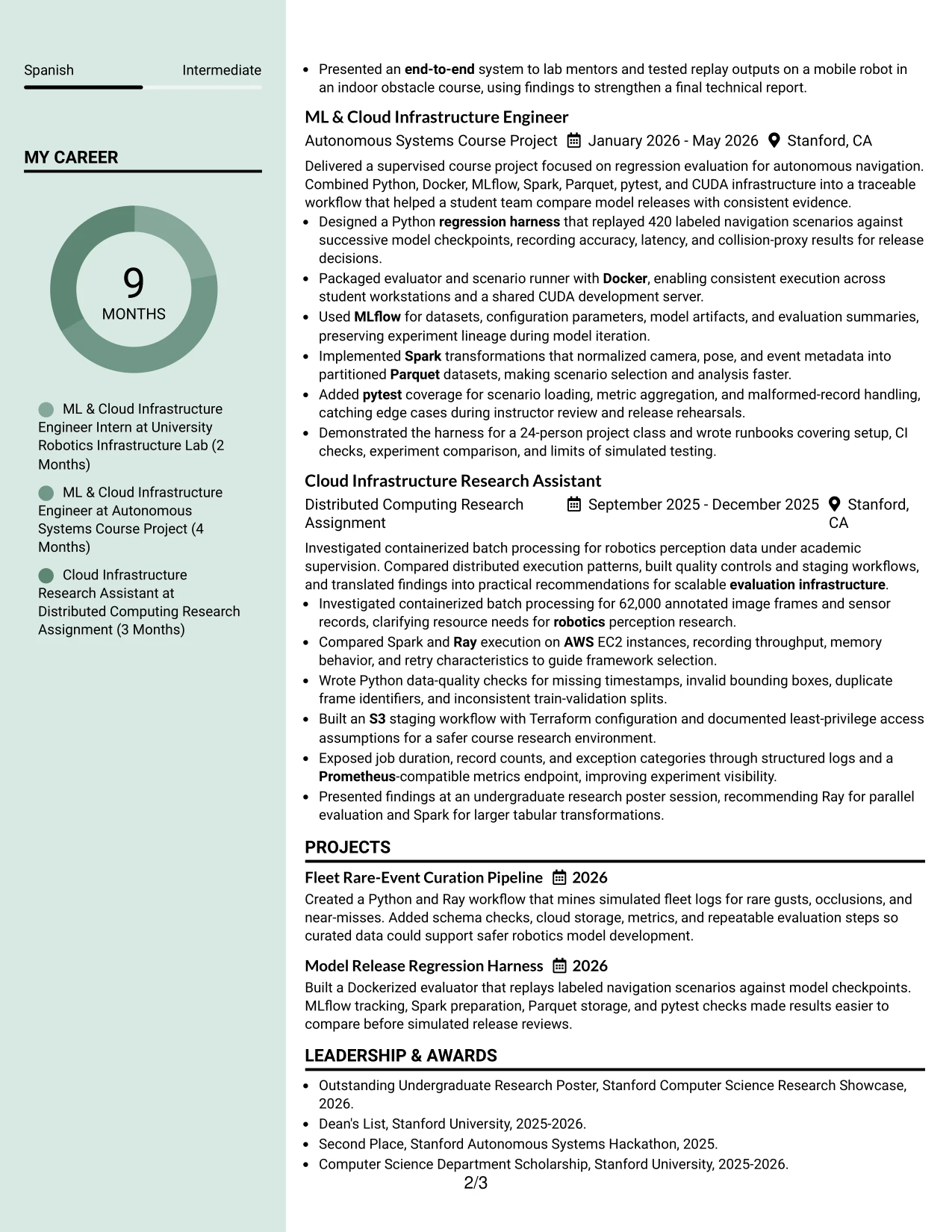
#26 Photo Header Color Sidebar Format
Recruiters can move from the header and summary into the color sidebar, then continue through the main experience and project sections. The sidebar can hold contact details, skills, certifications, and education, leaving the wider content area for infrastructure results and technical bullets.
The color treatment gives a long technical record a clear visual route. For this application, the main area can explain Ray orchestration, AWS and Terraform work, Spark transformations, MLflow tracking, and monitoring, while the sidebar keeps supporting keywords available during a quick review.
Why This Format Works for a Resume
- The header establishes the target role before the detailed review begins.
- A sidebar groups contact information, education, skills, and certifications.
- The wider main area supports several achievement-focused experience entries.
- Color cues help readers return to key sections during a longer scan.
- Technical tools can remain visible without interrupting the results narrative.
- Project and research work can be added without losing the main hierarchy.
- A profile photo area may support a personal presentation when appropriate for the application.
Best For
- Resumes with enough technical content to benefit from a dedicated sidebar.
- Candidates who need skills and certifications visible beside detailed experience.
- Applications where projects, research, and internship work all require space.
- Readers who scan supporting qualifications before reviewing full achievement bullets.
- Documents that use a profile photo area only when the application context supports it.
- Technical professionals presenting cloud, data, and evaluation work in one page.
- Applications that need a strong visual route through a substantial content set.
#27 Top Left Header Color Accent Format
Evidence of infrastructure ownership receives priority in this resume structure. A top-left header can identify the target role, followed by a summary and bullets that show what was built, how it was tested, and what changed as a result.
The color accent adds direction without taking attention away from proof. Strong entries can connect 180,000 simulated records, 62,000 annotated frames, GPU utilization monitoring, recovery procedures, and four student researchers to practical infrastructure outcomes.
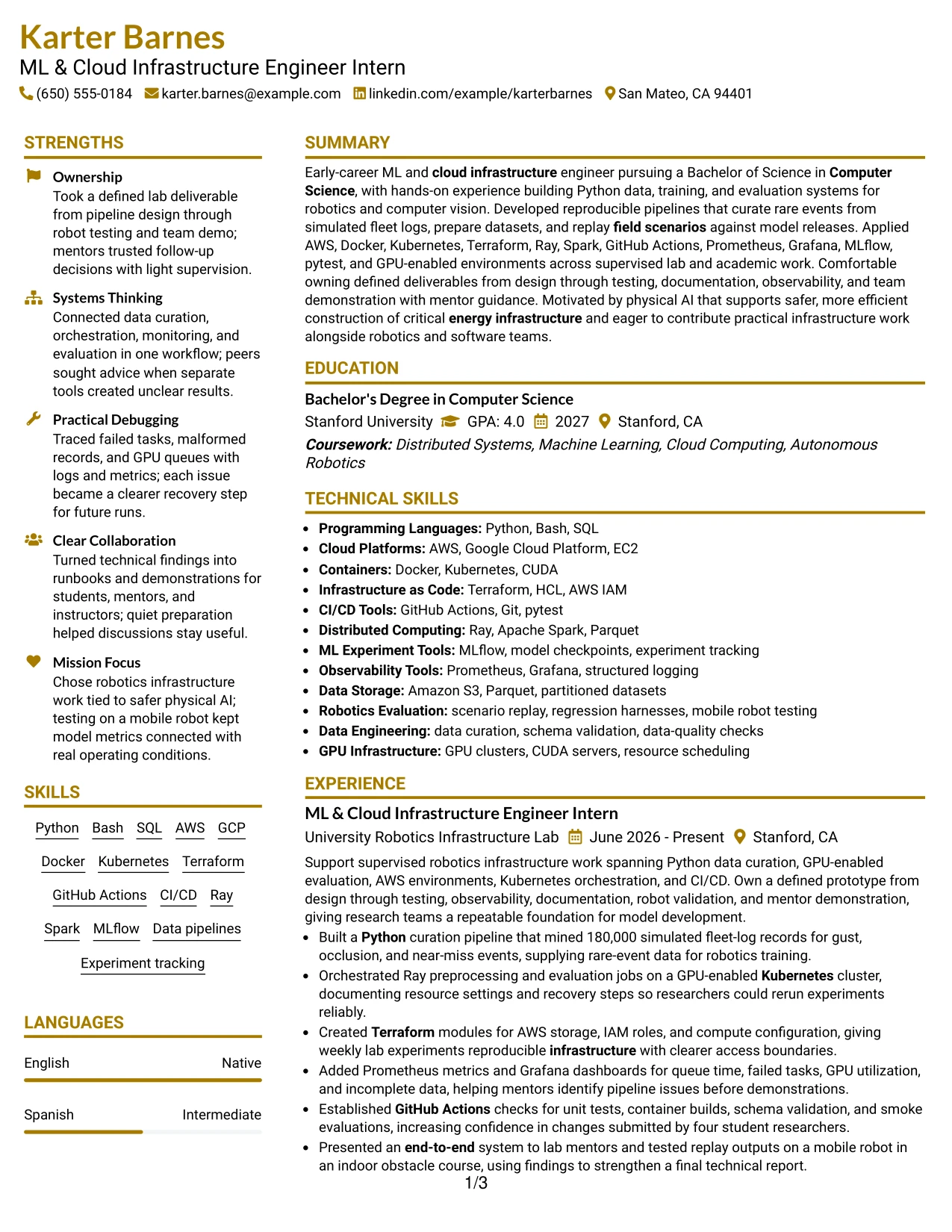
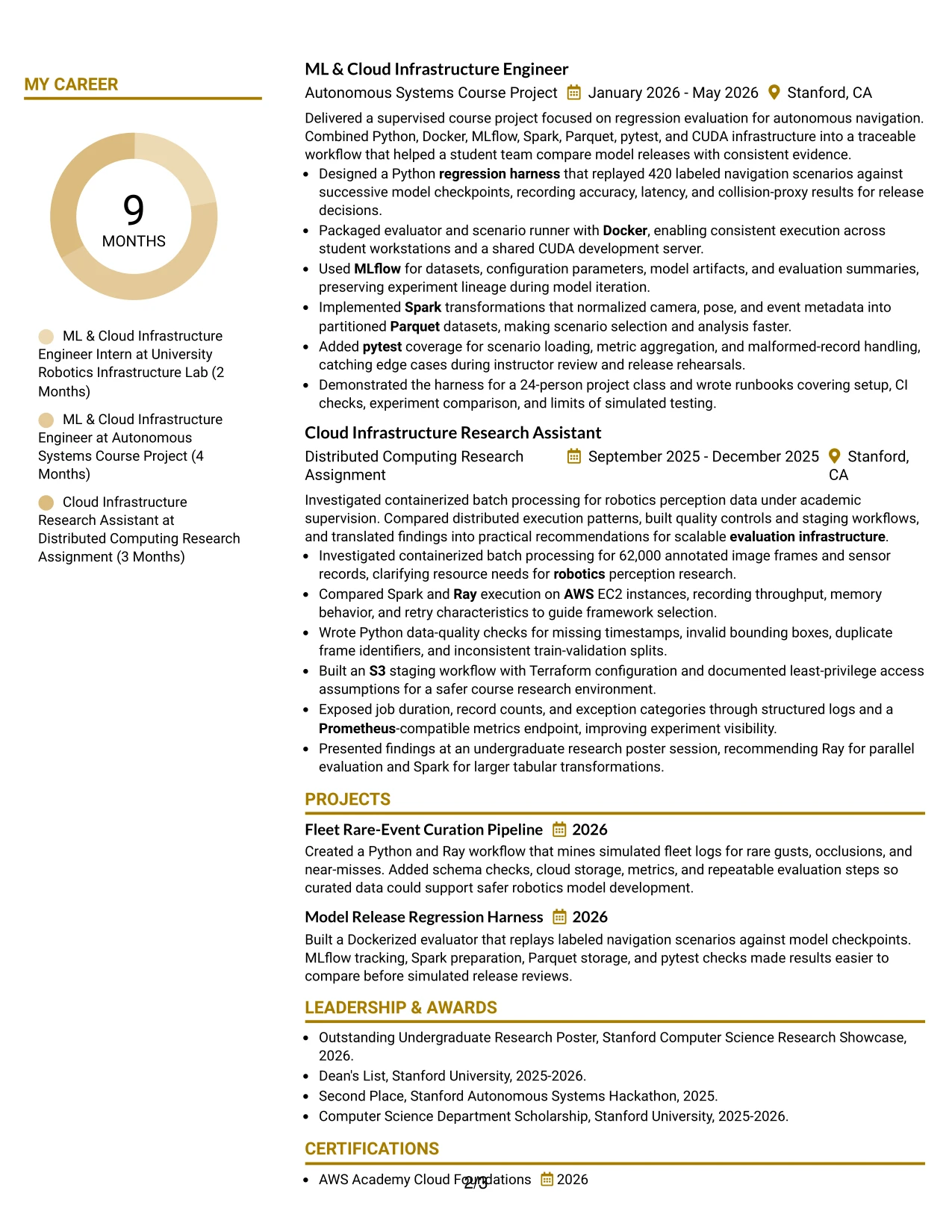
Why This Format Works for a Resume
- The top-left starting point makes the role and summary easy to find.
- Achievement bullets can lead with actions and follow with measurable evidence.
- The structure supports clear links between infrastructure work and outcomes.
- Technical keywords appear in context instead of sitting in an isolated list.
- Research assignments can add scale, comparison, and recommendation evidence.
- A focused accent guides attention while preserving a professional reading path.
- The format is well suited to resumes where proof matters more than decoration.
Best For
- Candidates whose strongest qualification is evidence of building working systems.
- Applications that value measurable datasets, test coverage, and operating signals.
- Resumes with project bullets that need to show action, scale, and result together.
- Readers who want proof of ownership near the top of each experience entry.
- Technical applications where research comparisons support practical recommendations.
- Documents that need a focused accent but should keep evidence visually dominant.
- Candidates showing infrastructure work through logs, metrics, recovery steps, and demos.
#28 Centered Header Classic Two Column Format
Balanced content distribution lets the reader compare the resume summary and experience with supporting skills, education, projects, and certifications. A centered header gives the page a formal starting point, while the two-column body keeps related information close together.
This classic structure fits an application that combines academic preparation with practical infrastructure work. The primary column can carry outcome-led bullets, while the secondary column surfaces Python, AWS, Docker, Kubernetes, Terraform, Ray, Spark, MLflow, and observability terms.
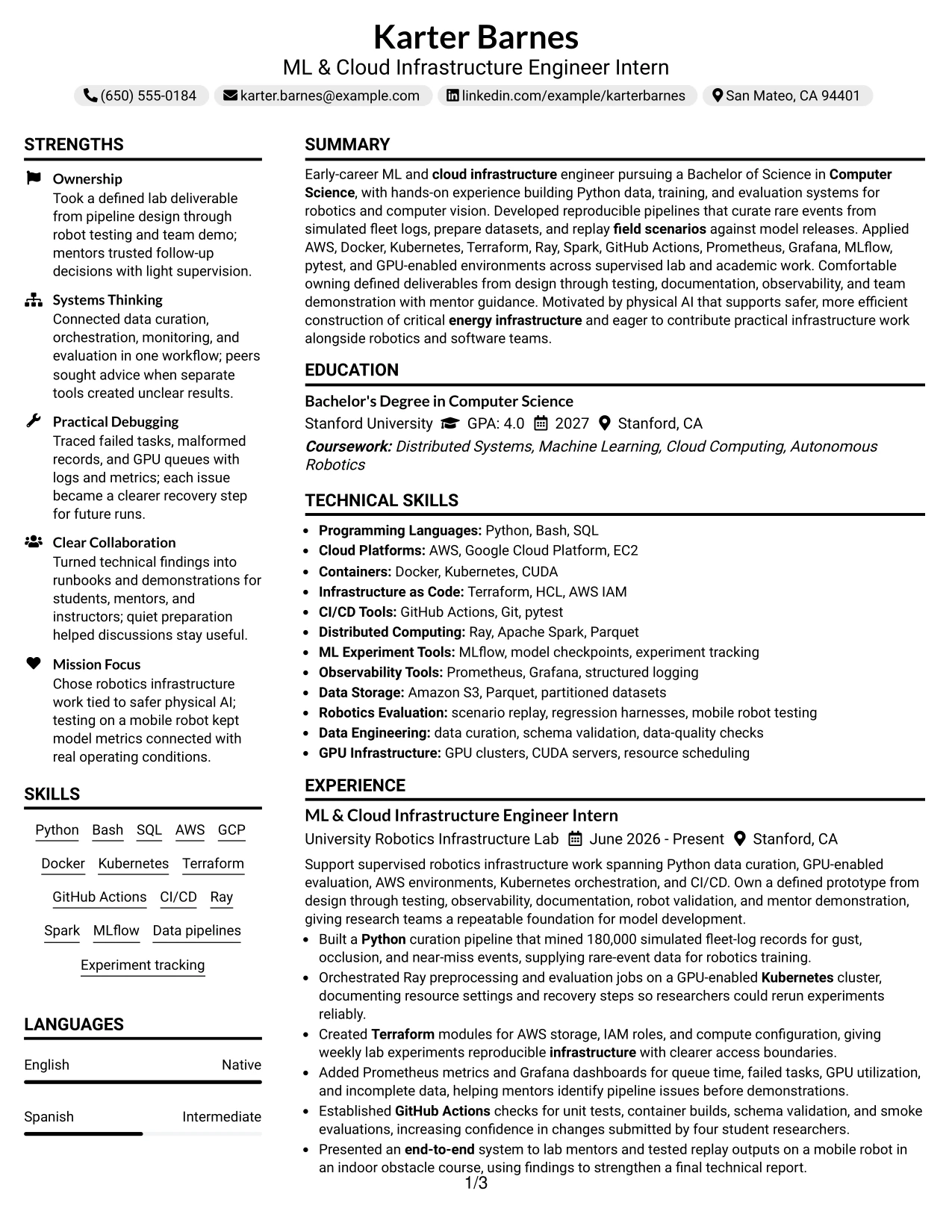
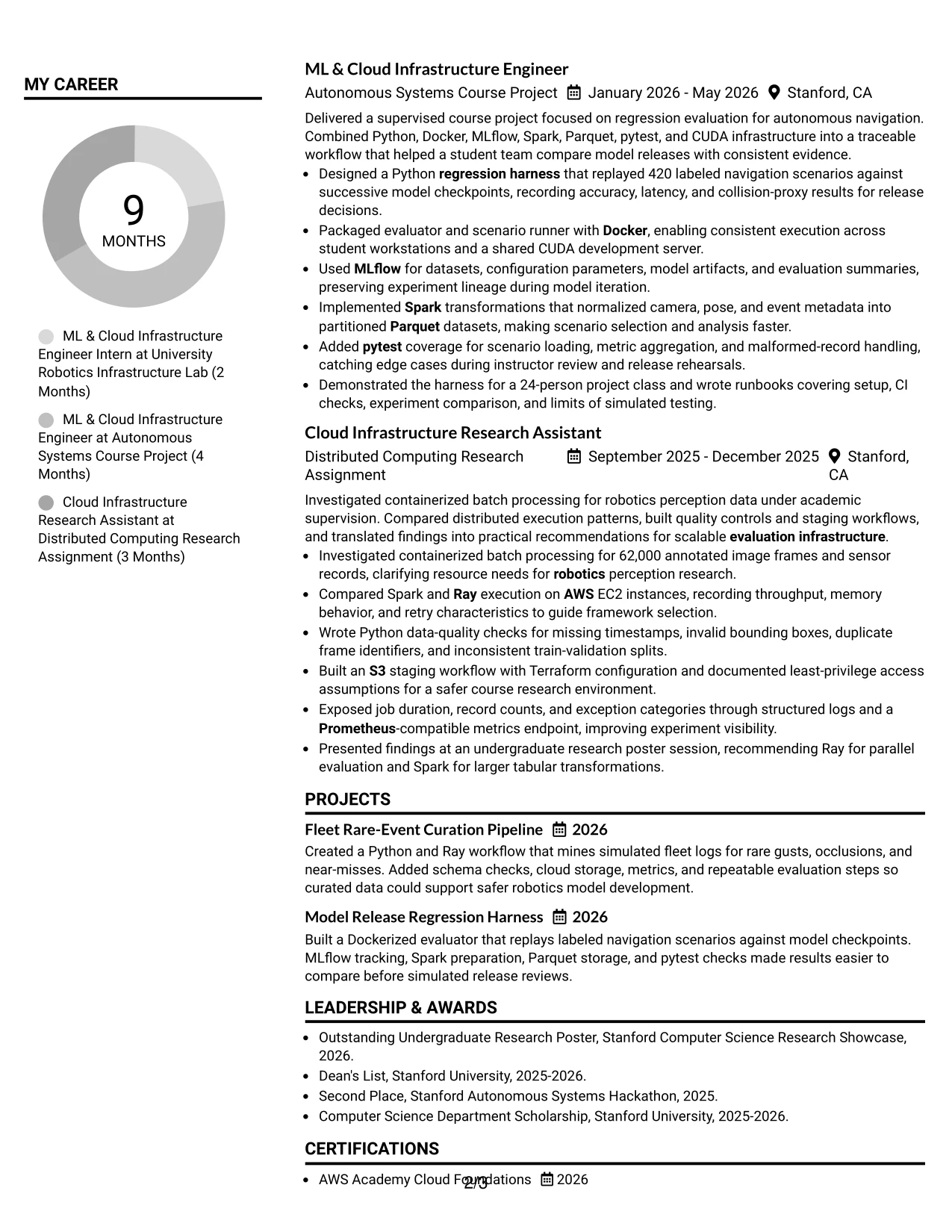
Why This Format Works for a Resume
- The centered header gives contact details and the target role a stable starting point.
- Two columns distribute content without forcing every section into one long stream.
- The main column can present detailed experience and project achievements.
- The supporting column keeps education, skills, and certifications easy to check.
- A classic hierarchy helps readers understand academic and practical evidence together.
- Bullets can retain metrics such as 420 scenarios and 24 project participants.
- The format suits applications that value both clear organization and traditional presentation.
Best For
- Resumes combining university education with practical systems work.
- Candidates who need a formal header and efficient two-column organization.
- Applications where skills and certifications should stay visible during experience review.
- Readers who compare supporting qualifications with detailed project evidence.
- Documents with several short sections that would create excess length in one column.
- Technical internship applications requiring both academic preparation and applied results.
- Candidates who prefer balanced presentation over a heavily stylized layout.
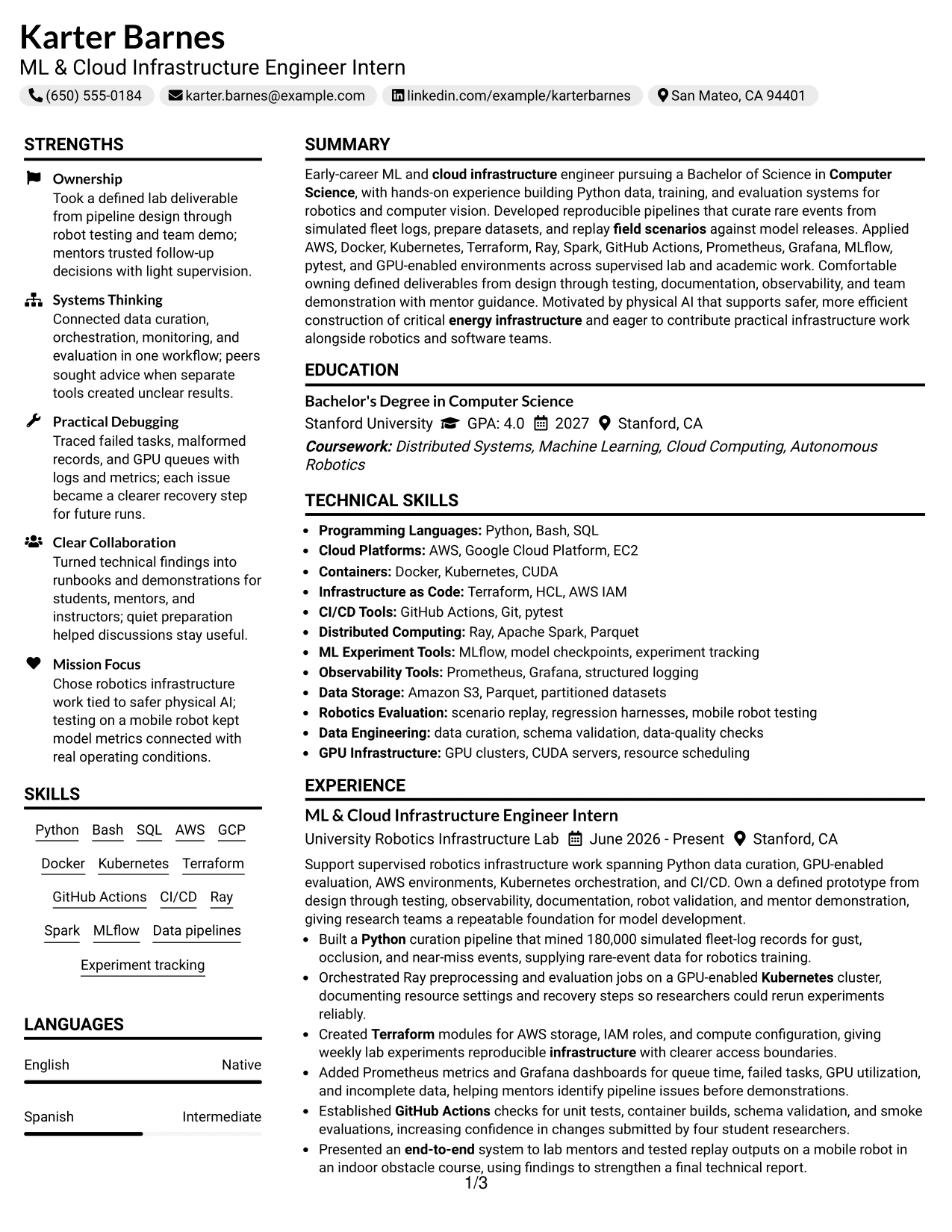
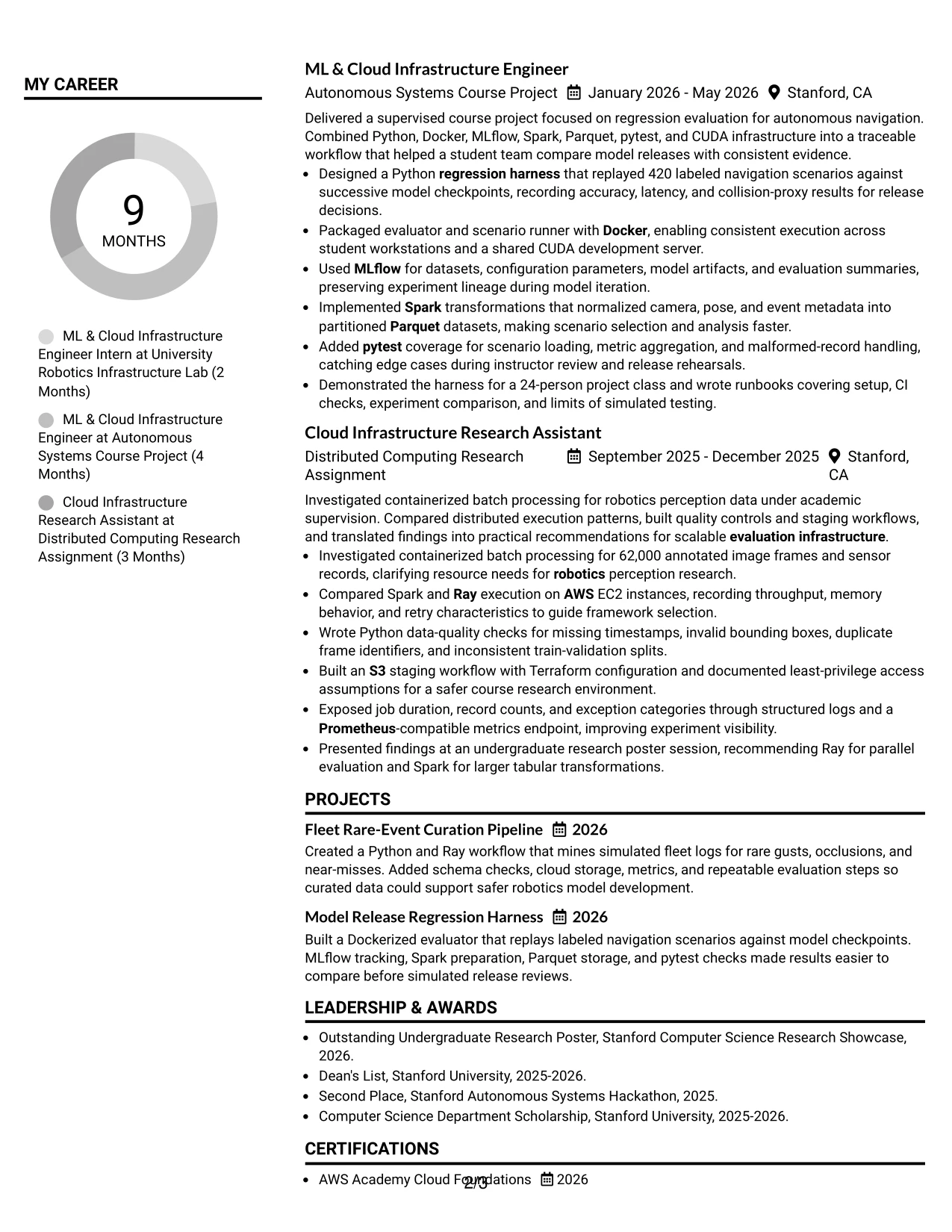
#29 Left Aligned Header Clean Two Column Format
A practical application resume needs to make relevant evidence easy to reach, and the left-aligned header starts that process with minimal visual delay. The two-column body can place experience and projects in the larger area while grouping skills, education, certifications, and activities in a compact companion column.
Clean spacing supports a direct review of the candidate's contribution. Bullets can show ownership from design through testing, documentation, observability, and demonstration, with supporting details such as AWS IAM, S3, EC2, Parquet, pytest, and GitHub Actions nearby.
Why This Format Works for a Resume
- A left-aligned header follows the natural scan path of most resume readers.
- Two columns help separate results from supporting qualification details.
- Clean spacing keeps dense technical content from becoming difficult to read.
- The main column can show ownership across design, testing, and demonstration.
- The secondary column can hold keywords without weakening the experience narrative.
- Projects and research can be added while preserving section boundaries.
- The layout supports a direct presentation for an in-person Bay Area internship application.
Best For
- Resumes that need a direct, efficient entry point for quick review.
- Candidates separating achievement bullets from tools, education, and certifications.
- Applications with several technical sections but limited space for repetition.
- Readers who prefer aligned headings and predictable movement through the page.
- Documents where project and research evidence should remain distinct from employment history.
- Internship applications requiring clear proof of end-to-end ownership.
- Candidates using a practical two-column layout for cloud and data infrastructure work.
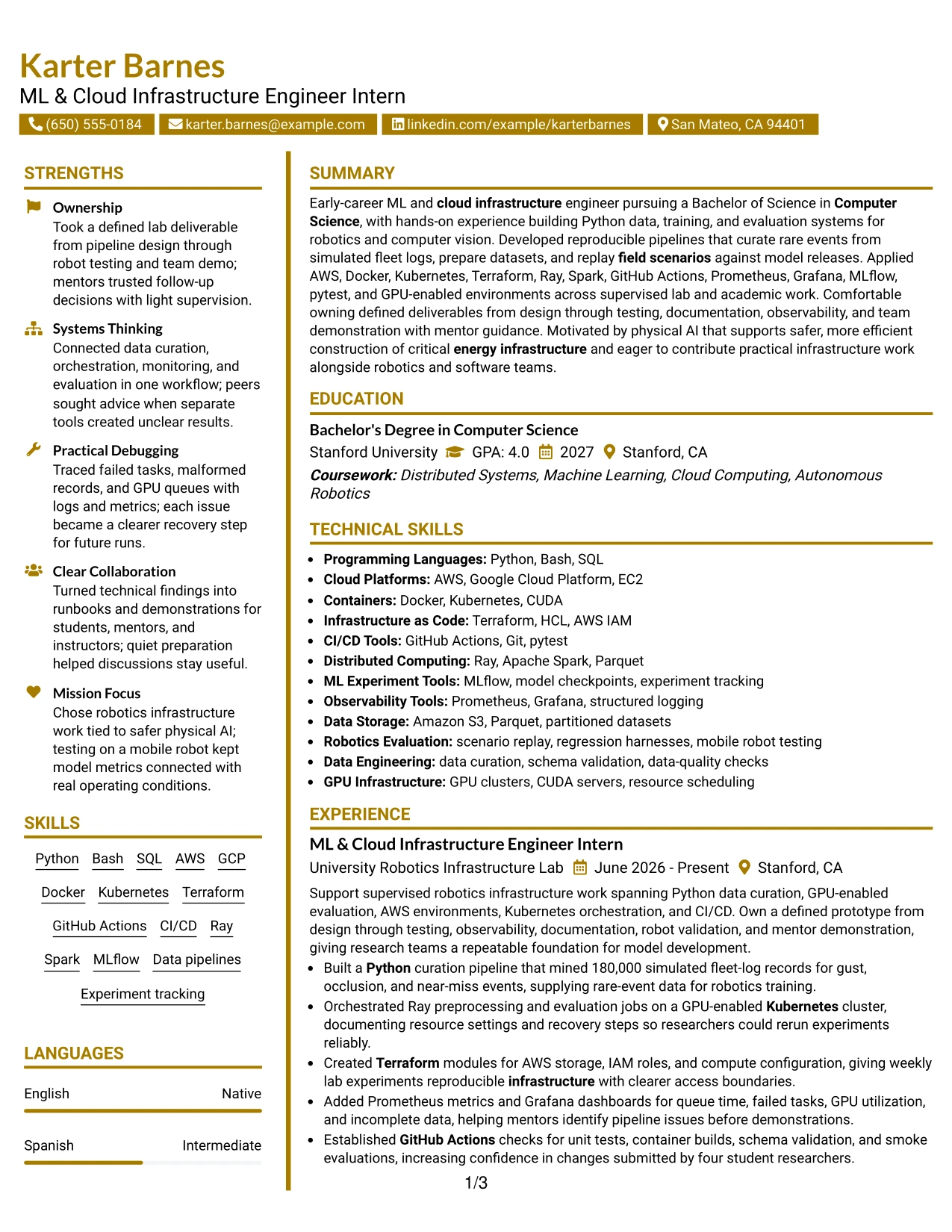
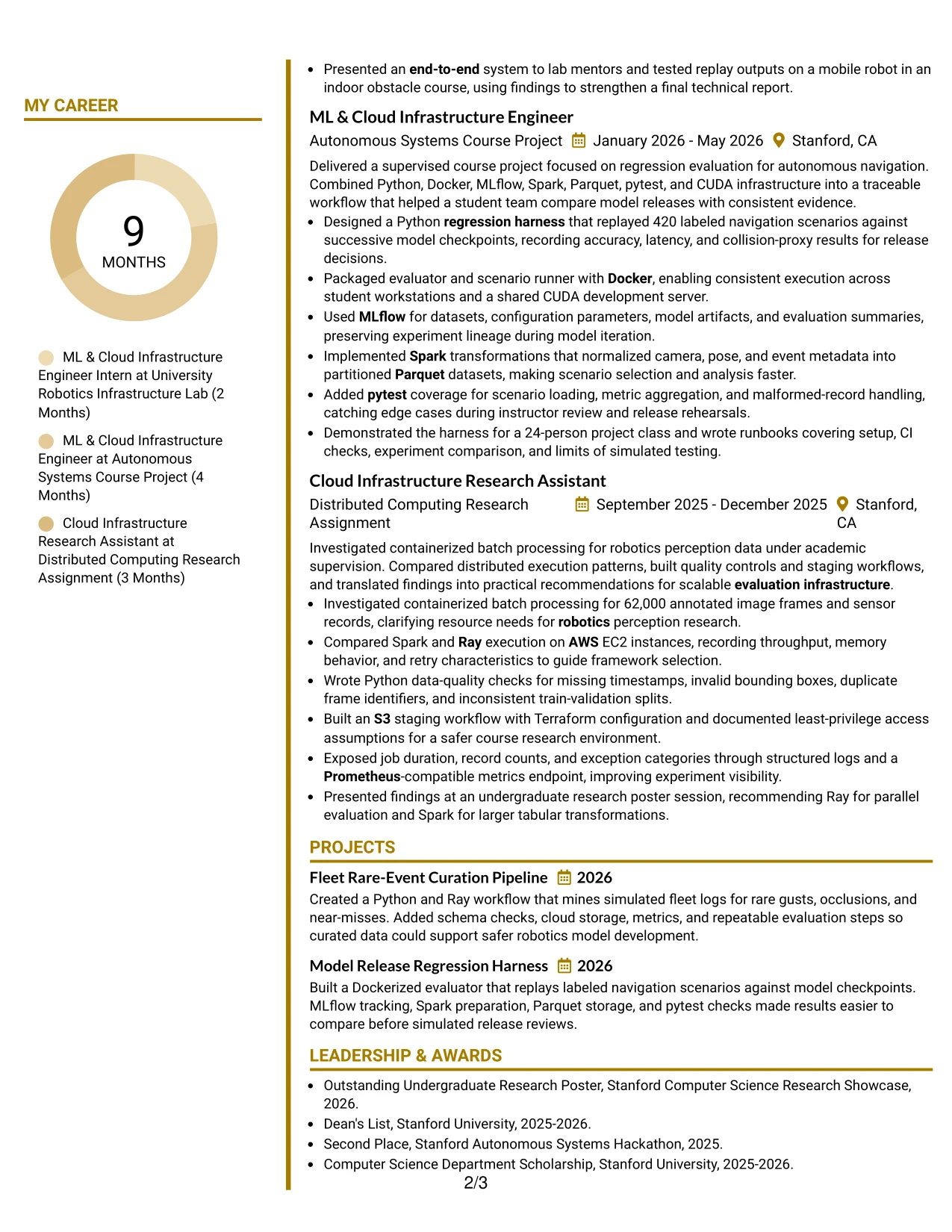
#30 Accent Divider Modern Two Column Format
Modern role alignment depends on showing a clear connection between technical tools and the systems they support. Accent dividers can separate experience, projects, skills, and education so the reader sees that connection without losing the overall sequence.
Karter Barnes's resume evidence fits this approach because it links data curation, orchestration, monitoring, evaluation, and robot testing. The two-column arrangement can keep the tool set visible while the main bullets explain repeatability, traceability, failure recovery, and model-release decisions.
Why This Format Works for a Resume
- Accent dividers clarify where one evidence group ends and another begins.
- The two-column structure connects tools with the work they enabled.
- A modern hierarchy supports cloud, machine learning, and robotics keywords together.
- Experience bullets can explain both implementation and operational impact.
- Project sections can show repeatable evaluation rather than only coursework titles.
- The layout gives research findings a clear place beside applied infrastructure work.
- A defined visual system helps readers judge role alignment quickly.
Best For
- Technical candidates whose work crosses data, cloud, machine learning, and robotics.
- Applications that need related tools grouped without hiding the results they support.
- Readers who value clear visual boundaries between experience and project evidence.
- Resumes presenting both operational signals and model-evaluation outcomes.
- Candidates with several connected infrastructure stages to explain in limited space.
- Modern technical applications where role alignment should be visible from the structure.
- Documents that benefit from dividers between evidence categories rather than long paragraphs.
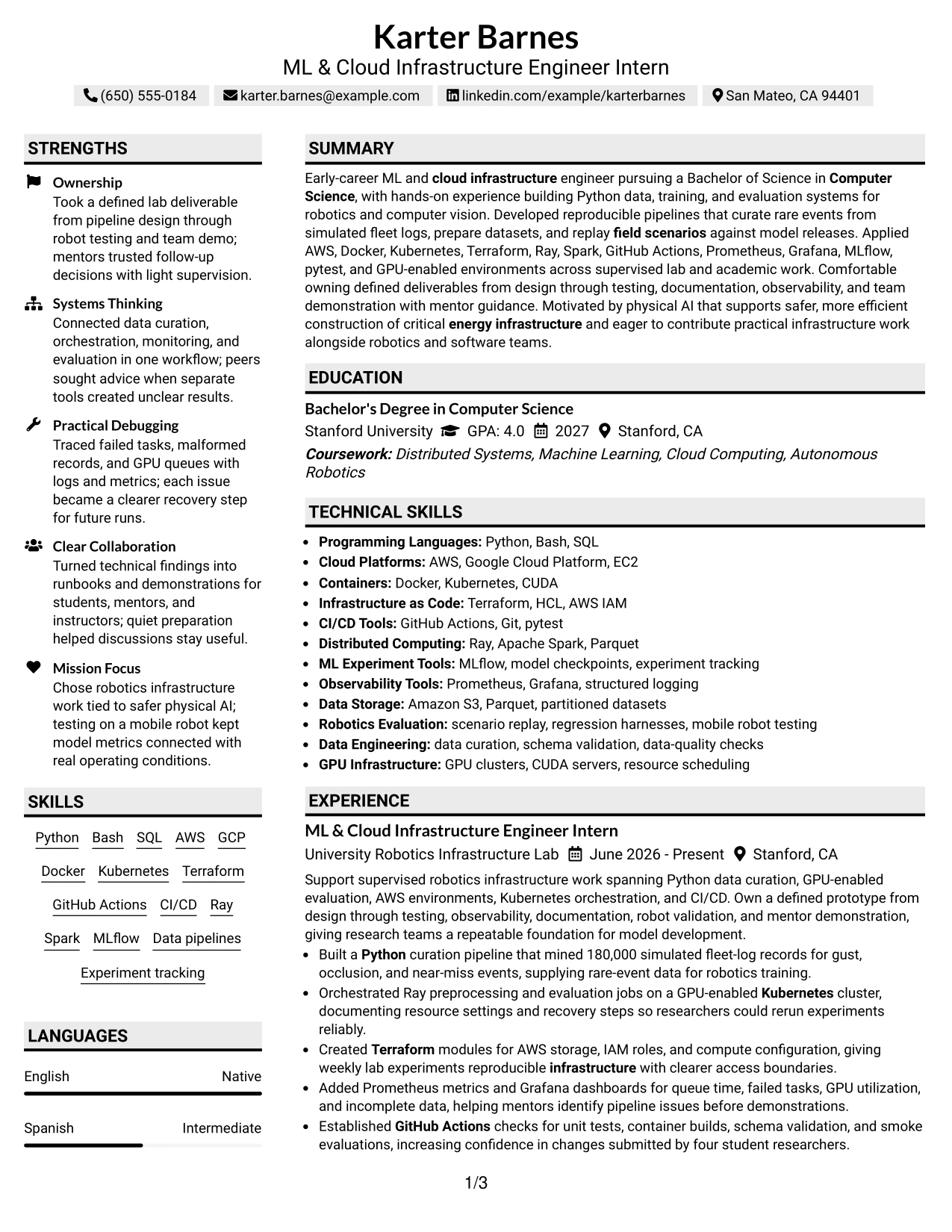
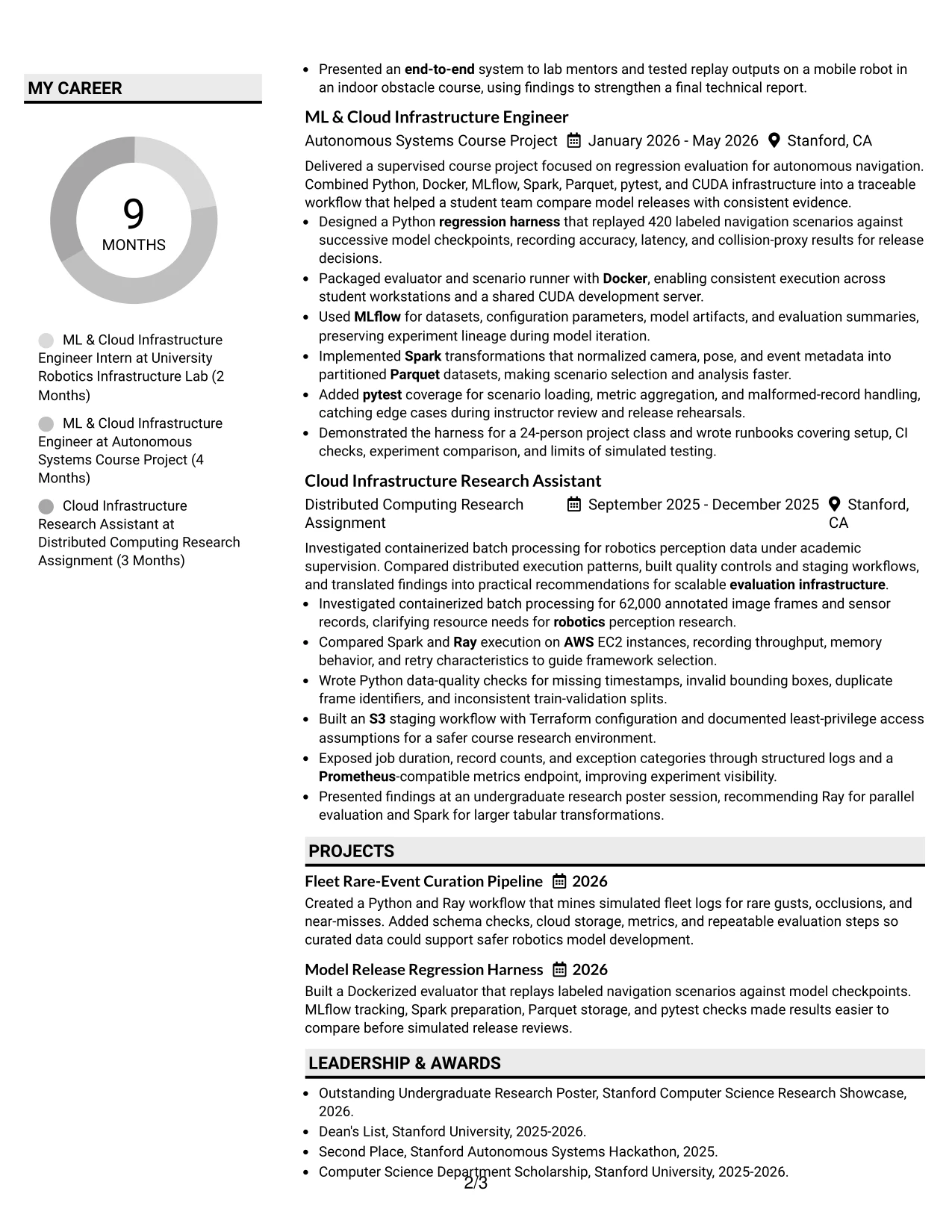
#31 Shaded Labels Clean Two Column Format
Clear labels organize the resume into predictable evidence groups: summary, experience, projects, education, skills, and certifications. The shaded label treatment gives each section a visible boundary, while the two-column structure keeps the page compact and readable.
For an ML and cloud infrastructure application, that organization makes it easier to verify both capability and results. Experience bullets can carry the main proof, while labeled supporting areas surface Python, AWS, GCP, Docker, Kubernetes, Ray, Spark, Terraform, MLflow, Prometheus, and Grafana.
Why This Format Works for a Resume
- Shaded labels make section boundaries obvious during a fast scan.
- Two columns reduce unused space while preserving a clear hierarchy.
- The main content area supports detailed achievement bullets.
- Labeled skills and certifications help automated and human keyword checks.
- Projects can be reviewed as evidence rather than as a separate visual block.
- Education and activities remain easy to find without competing with experience.
- The clean structure supports technical detail without making the page feel overloaded.
Best For
- Resumes with many distinct sections that need strong visual labels.
- Candidates who want skills, projects, and education easy to locate at a glance.
- Applications reviewed through both ATS keyword checks and human scanning.
- Readers comparing technical evidence across experience and academic projects.
- Documents where a clean two-column system must handle substantial content volume.
- Candidates organizing cloud, data, testing, and observability work by evidence type.
- Applications that benefit from labels instead of decorative graphics or dense prose.
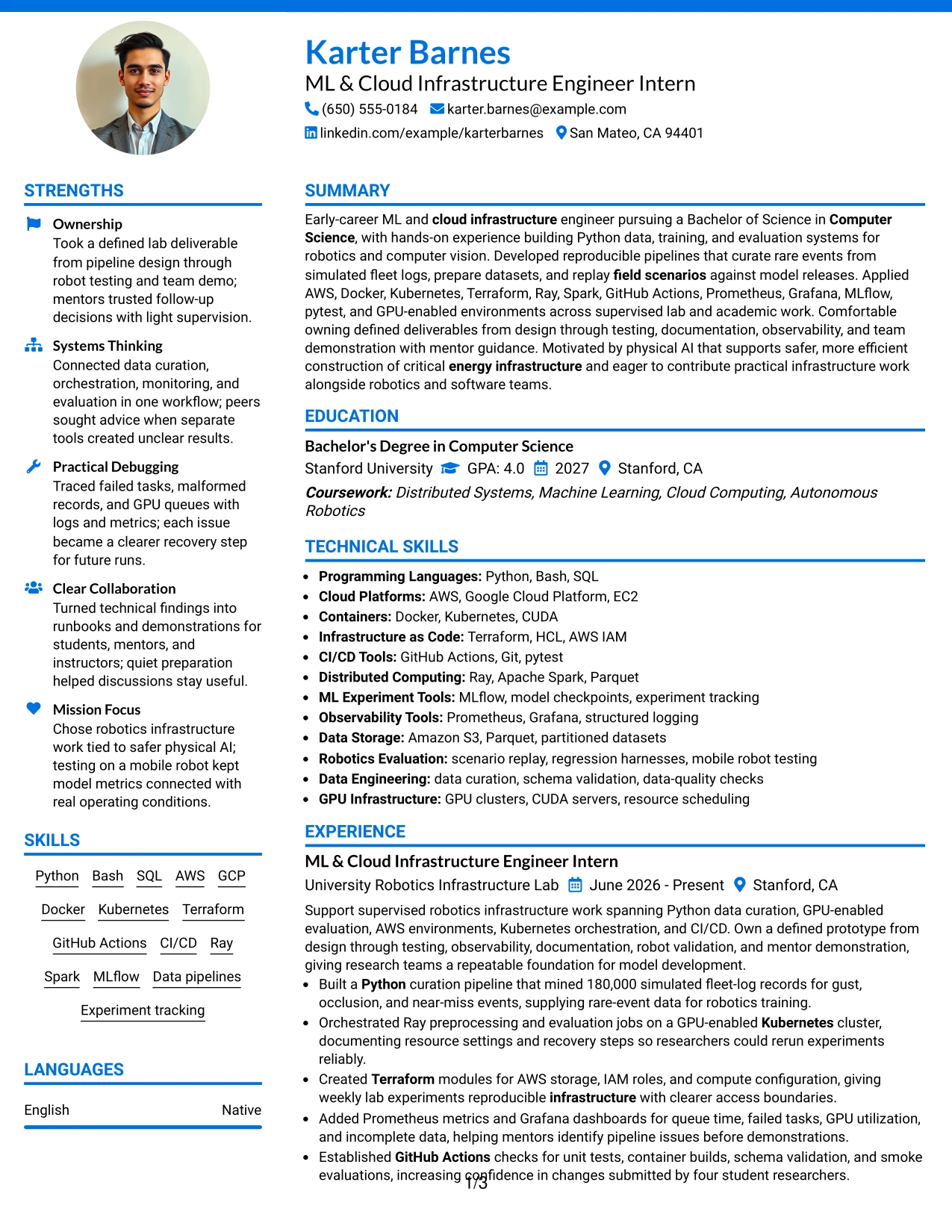
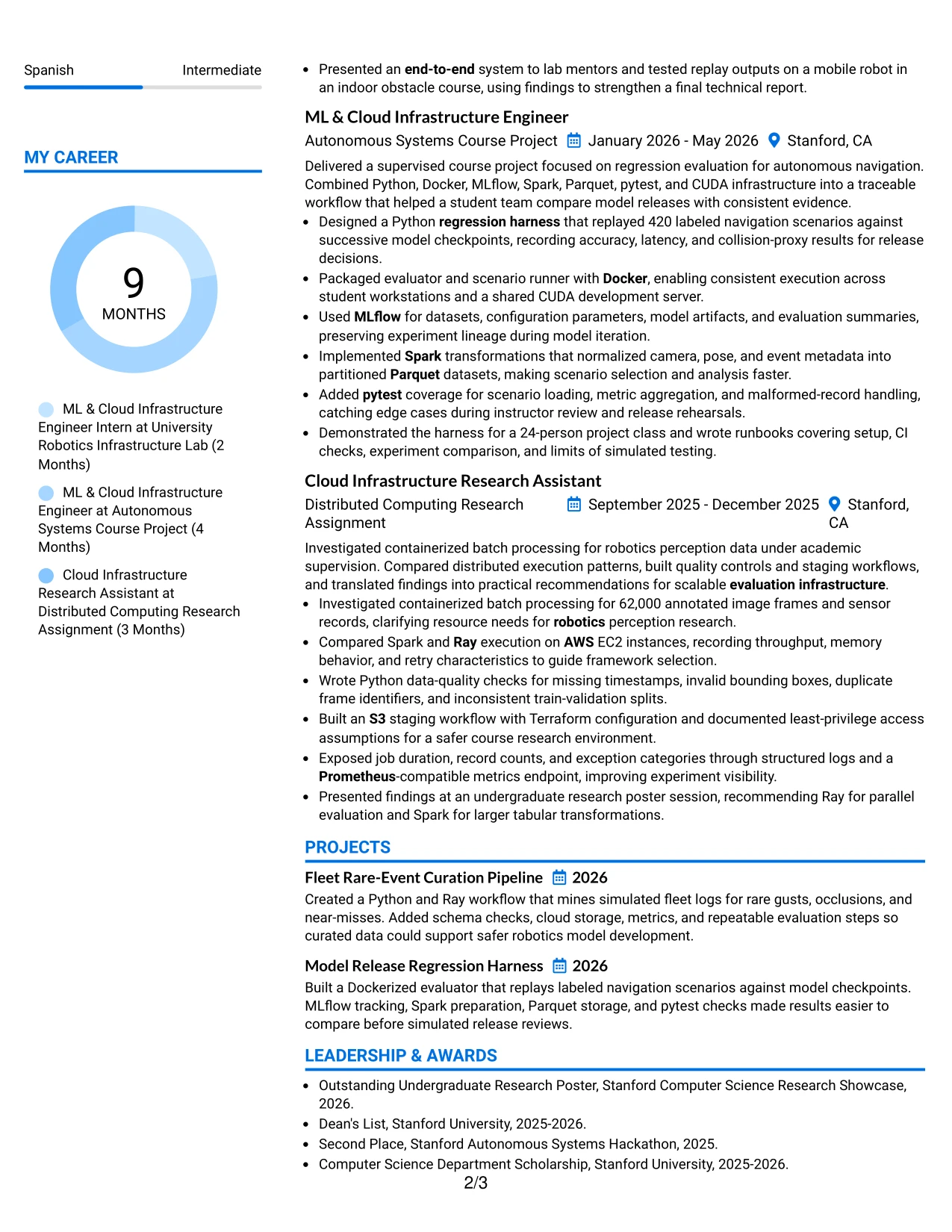
#32 Photo Header Color Accent International Format
Readers can start with the header and summary, use the accent colors to locate major sections, and then review experience, projects, skills, education, and certifications in sequence. This navigation pattern works well when a resume includes technical work, academic preparation, and additional language information.
The format can present a broad professional profile without weakening the evidence. The main content should still prioritize Python systems, AWS and GCP services, containerization, CI/CD, distributed processing, ML experiment tracking, observability, and measurable testing results. A profile photo area may be included when appropriate for the application and local resume norms.
Why This Format Works for a Resume
- Color accents give readers clear landmarks across a content-rich page.
- The header and summary establish the target role before detailed evidence.
- Experience and projects can carry the strongest technical results.
- Skills, certifications, education, and languages remain easy to locate.
- The structure supports a broad profile without turning the resume into a list of keywords.
- A profile photo area can support international presentation when the application context permits it.
- Measured outcomes keep the visual treatment connected to real contribution.
Best For
- Resumes presenting technical experience alongside education and language information.
- Candidates applying in settings where a profile photo area may be customary or accepted.
- Applications with enough content to need visible section landmarks.
- Readers who scan the header, summary, and evidence in a guided sequence.
- Documents combining cloud infrastructure, distributed systems, and robotics evaluation.
- Candidates who need certifications and languages to remain accessible without crowding experience.
- Internationally oriented applications that still require clear technical keyword placement.
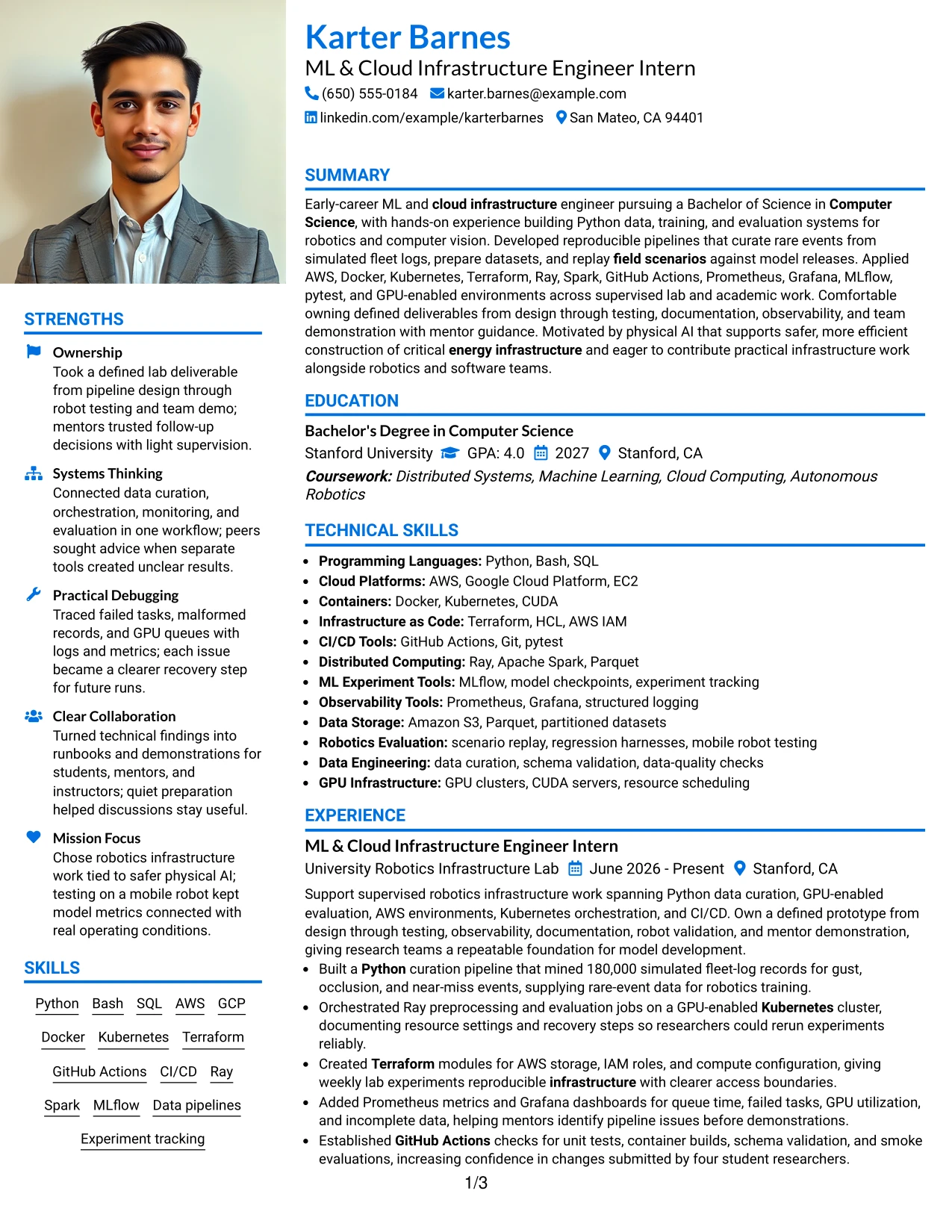
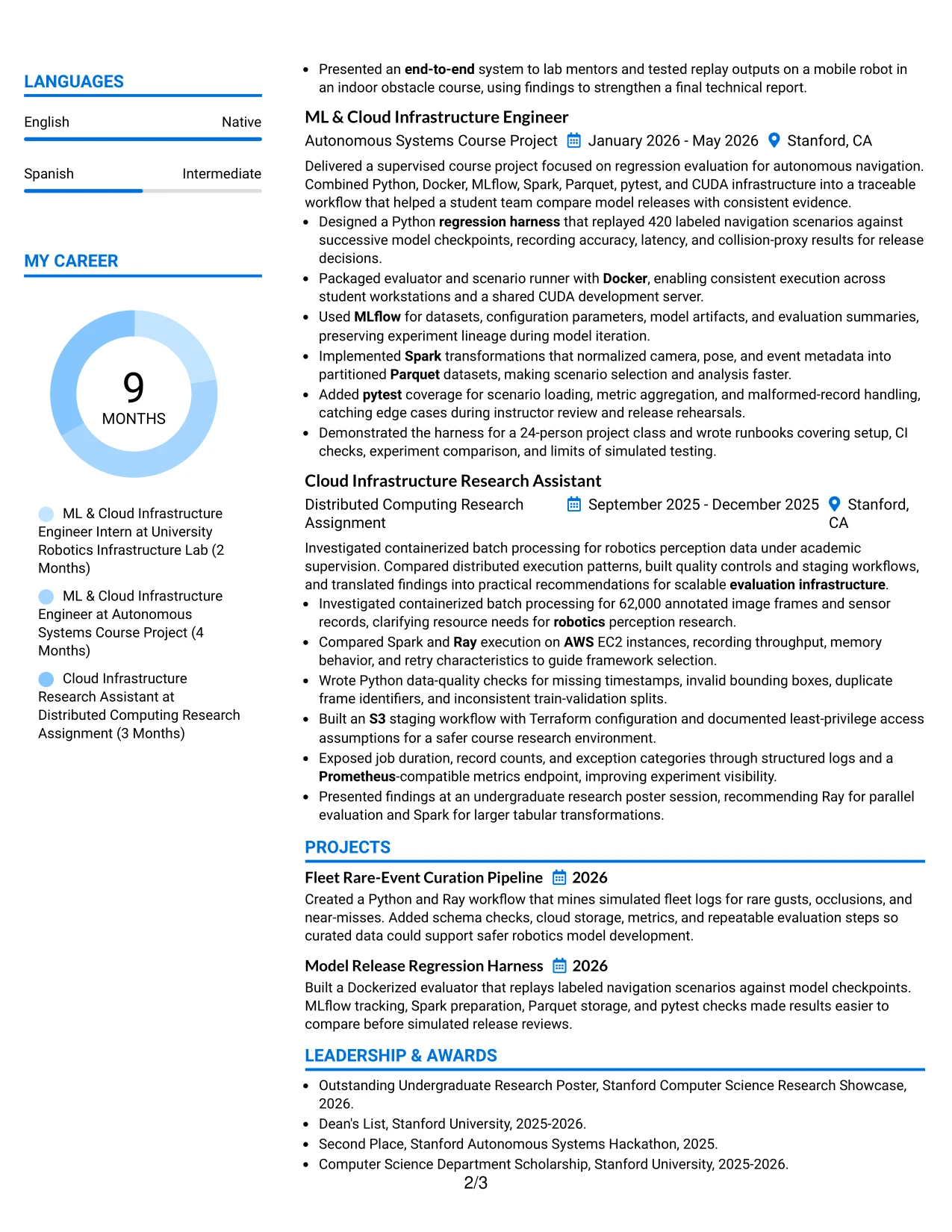
#33 Large Profile Photo International Two Column Format
Evidence of technical contribution should lead the review, with the summary and strongest experience bullets placed where they receive immediate attention. A two-column structure can then distribute projects, education, skills, certifications, and languages while a large profile photo area establishes the visual identity of the page.
For this resume, the evidence includes a Python pipeline processing 180,000 records, Ray jobs on GPU-enabled Kubernetes, Terraform-based AWS environments, and a regression harness for 420 scenarios. Those facts should remain more prominent than the visual element, with concise bullets showing repeatability, monitoring, testing, and robot validation. A large profile photo area should be used only when suitable for the application context.
Why This Format Works for a Resume
- The structure can place measurable infrastructure results before supporting details.
- Two columns make room for projects, education, skills, certifications, and languages.
- A large profile photo area creates a strong international presentation when appropriate.
- Technical evidence remains central through concise, outcome-led bullets.
- The layout can show both academic preparation and applied systems work.
- Tools such as Ray, Kubernetes, Terraform, MLflow, and Prometheus stay easy to find.
- The visual hierarchy helps distinguish core results from supplementary information.
Best For
- Applications where a large profile photo area is accepted and useful for context.
- Candidates with strong measurable evidence that should lead the page.
- Resumes combining technical experience with projects, education, and language details.
- Readers who need a clear split between primary achievements and supporting qualifications.
- International applications requiring a prominent personal presentation alongside credentials.
- Documents with enough content to benefit from two-column distribution.
- Technical candidates who can support visual presentation with concrete infrastructure results.
Why Build Your ML & Cloud Infrastructure Engineer Intern Resume with ResumeInMinutes
ResumeInMinutes helps you turn infrastructure projects, coursework, research, tools, and technical experience into a resume that is structured for both ATS parsing and practical review. You can make the connection between what you built, how you tested it, and the value it created easy to see.
- ATS-friendly resume layouts
- Clear technical section structure
- Role-specific keyword organization
- Project and skills presentation
- Free PDF resume previews
- Resume customization support
Use the format that gives your strongest evidence the most space. A well-organized resume can make Python development, cloud configuration, containerized services, GPU workflows, distributed processing, monitoring, testing, and robotics validation easier to evaluate without adding unnecessary detail.
See Also
- 33 Cloud Engineer - Cloud Native Infrastructure Resume Templates with Example 2026 (ATS-Optimized)
- 33 Principal Cloud Infrastructure Engineer Resume Templates with Example 2026 (ATS-Optimized)
- 7 Systems Engineer - Infrastructure & Cloud Platforms Resume Templates with Example
- 33 AI/ML Engineer Intern, Cloud & Developer Infra Resume Templates with Example 2026 (ATS-Optimized)
- 33 Applied AI Research Engineer - Production ML & Cloud Resume Templates with Example 2026 (ATS-Optimized)
- 33 Associate Linux Engineer - Pharmaceutical R&D Infrastructure Resume Templates with Example 2026 (ATS-Optimized)
- 33 Azure Infrastructure Engineer Resume Templates with Example 2026 (ATS-Optimized)
- 33 Infrastructure/Networking Engineer II Resume Templates with Example 2026 (ATS-Optimized)
- 30+ ML & Cloud Infrastructure Engineer Intern Cover Letter Templates with Example 2026
- 30+ Principal Cloud Infrastructure Engineer Cover Letter Templates with Example 2026
Frequently Asked Questions
Are these ML & Cloud Infrastructure Engineer Intern resume templates ATS-friendly?
Yes. The templates use readable headings, consistent sections, and role-specific terms such as Python, AWS, Kubernetes, Terraform, Ray, Spark, CI/CD, GPU infrastructure, observability, and ML experiment tooling.
Are these different resumes?
No. The guide uses one ML & Cloud Infrastructure Engineer Intern resume example shown through different layouts and design themes, so you can compare presentation without changing the core evidence.
What should an ML & Cloud Infrastructure Engineer Intern resume include?
Include a role-focused summary, education, relevant experience, projects, technical skills, certifications, and achievement-based bullets. Show evidence of Python development, cloud or container infrastructure, data systems, testing, monitoring, and evaluation when applicable.
Can I download the resume templates as PDFs?
Yes. Each resume style provides a free PDF download so you can review the format and choose a layout that presents your technical evidence clearly.
Which resume style is best for an ML & Cloud Infrastructure Engineer Intern?
A clean one-column layout is usually a strong choice because it supports ATS parsing and keeps technical experience easy to scan. A simple two-column format can also work when skills and certifications remain readable and the main experience section retains enough space.
How can I show infrastructure ability when my experience is academic?
Use course projects, research assignments, lab work, and personal projects as evidence. Explain the system you built, the tools you used, the scale or test conditions, your ownership, and the result. Specific details such as records processed, scenarios replayed, tests added, or dashboards created are useful when accurate.
Should I include a photo on my resume?
Include a photo only when it is customary or required in your country, region, or industry. For U.S. applications, a no-photo resume is generally the safer option.
Can I customize these resume templates?
Yes. ResumeInMinutes allows you to adjust the resume text, section order, layout, design style, and PDF format for your ML & Cloud Infrastructure Engineer Intern application.