33 Penetration Tester, VP Resume Templates with Example 2026 (ATS-Optimized)
This guide shows you how to build a clear, focused Penetration Tester, VP resume for senior security assurance work. You will learn how to organize your evidence, present leadership scope, and compare professional resume formats.
A strong resume for this role connects assessment delivery with business risk. It should present experience with web, mobile, API, infrastructure, and cloud testing, along with threat modeling, secure code review, remediation validation, executive reporting, and team leadership.
The examples explain how to use ATS-friendly headings, targeted keywords, concise bullet points, and measurable business context. They also show how to present tools such as Burp Suite, Nmap, Metasploit, Nessus, Kali Linux, AWS, Azure, ServiceNow, and Jira without making the document difficult to scan.
What Makes a Great Penetration Tester, VP Resume in 2026
Strong resumes for this role are risk-focused, technically credible, and easy for senior readers to scan. They connect penetration testing, security assurance, stakeholder leadership, and remediation outcomes.
Use keywords such as manual exploitation, threat modeling, secure code review, cloud security, vulnerability management, executive reporting, and remediation validation where they accurately match your evidence.
The examples shown below are intentionally detailed to demonstrate a range of experiences, skills, accomplishments and relevant keywords. We prefer detailed resumes as they provide more context to the hiring managers and also help the ATS systems identify relevant qualifications and score your resume better for a match. But the length of a resume is an individual choice. If you want a one page resume, just keep the most relevant experience and information for the job.
#1 Plain Two Column Format Resume Example
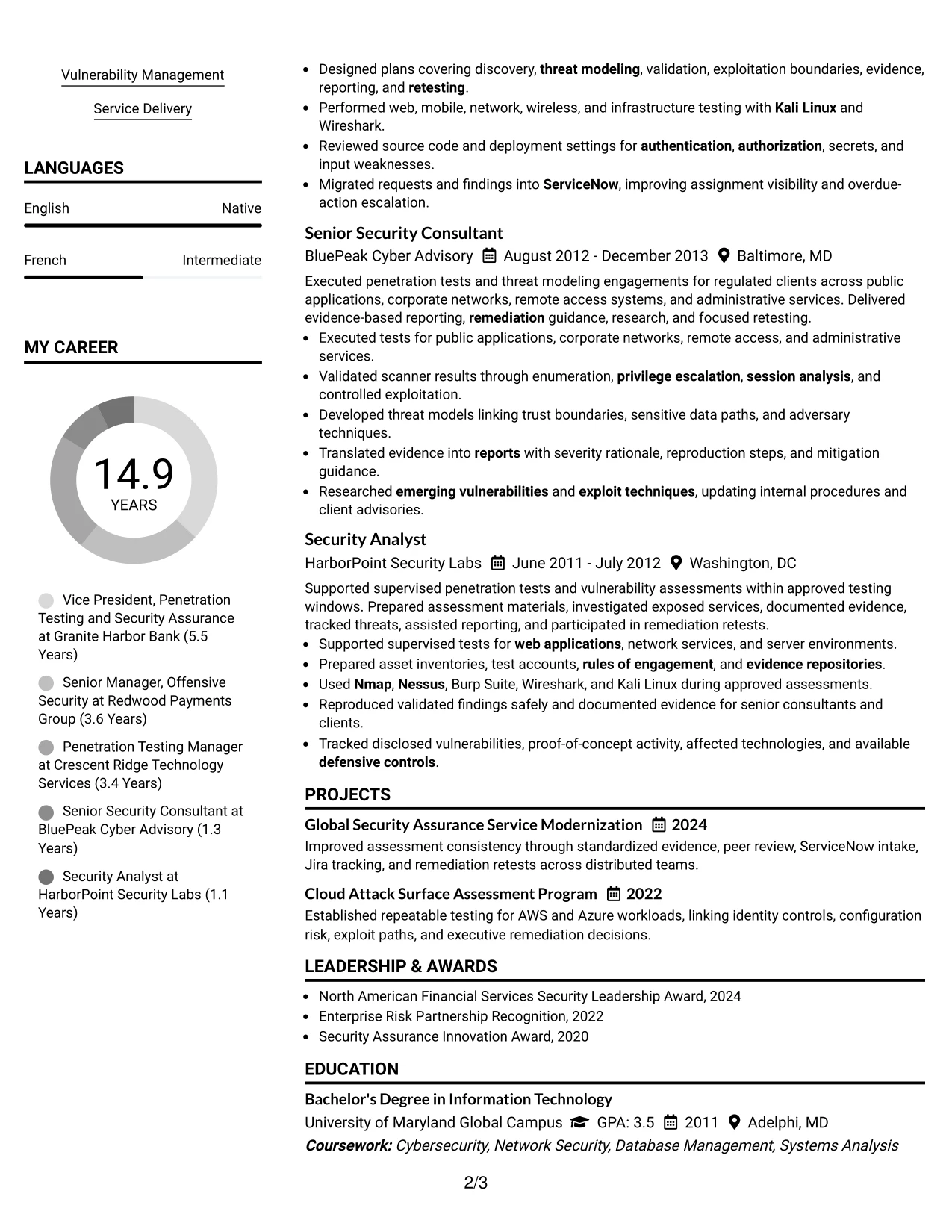
The Plain Two Column Format places contact details and supporting information in one clear column while giving the main column room for the professional summary, experience, projects, and education. For Ivan Obrien, this structure can separate leadership scope and technical tools from detailed penetration testing achievements.
The balanced columns help readers locate keywords quickly without losing the evidence behind them. Short bullet points can show risk-based testing, manual exploitation, executive reporting, remediation validation, and team leadership in a format that remains easy for applicant tracking systems to read.
Resume Snapshot
- Vice President-level penetration testing and security assurance experience
- Web, mobile, API, cloud, infrastructure, and secure code review coverage
- CISSP, OSCP, AWS Certified Security – Specialty, and GWAPT credentials
- Burp Suite, Nmap, Metasploit, Nessus, Kali Linux, AWS, Azure, ServiceNow, and Jira
Why the Plain Two Column Format Works for a Resume
- The main column gives work history enough space for detailed achievement bullets.
- A supporting column can group certifications, technical skills, and professional activities.
- Two visual zones make dense technical information easier to scan.
- Clear section labels help readers find experience, education, projects, and credentials.
- Short bullets keep complex assessment work understandable during an initial review.
- The structure supports keyword visibility while preserving measurable or outcome-based evidence when available.
Resume Keywords
- Penetration Testing
- code review
- web applications
- Infrastructure
- security assurance services
- automated assessment
- vulnerabilities
- remediation
- threat modeling
- emerging vulnerabilities
- Risk Management
- Burp Suite
- Nmap
- Metasploit
- Nessus
#2 Simple One Column Format Resume Example
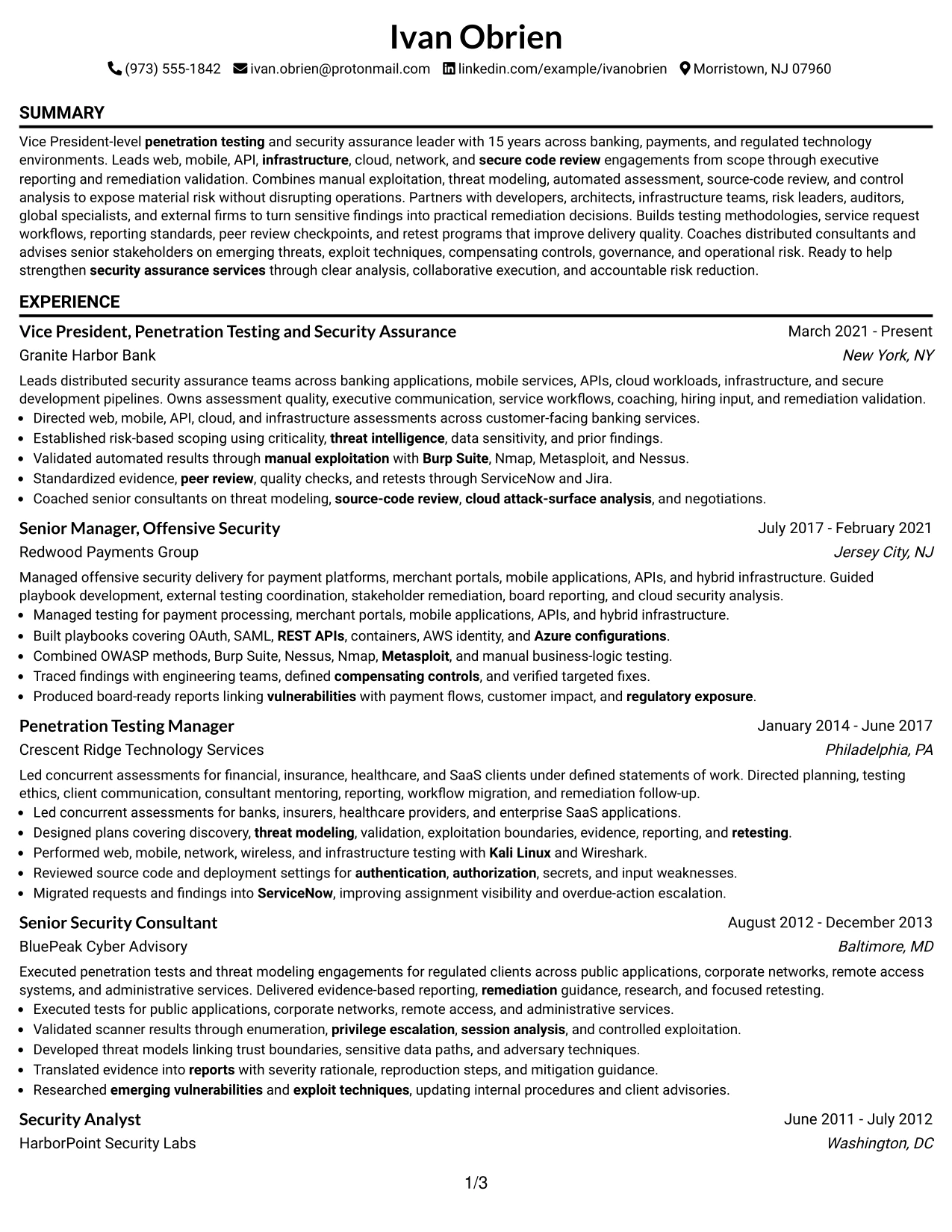
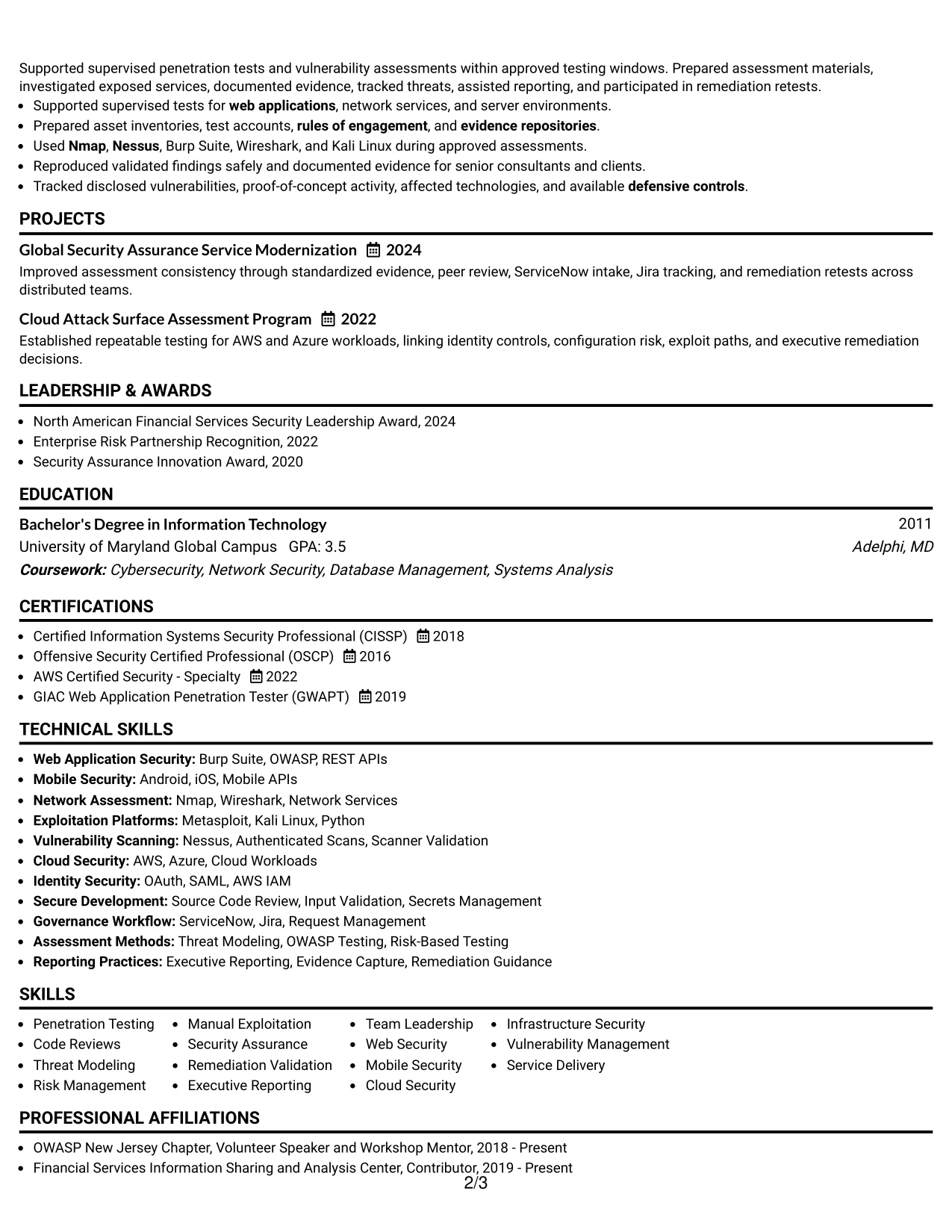
A recruiter moves from the header to the summary, then through experience, skills, certifications, projects, and education in one uninterrupted path. The Simple One Column Format makes that sequence especially useful for a resume with substantial leadership history and many technical assessment areas.
Each role can carry several focused bullets without competing with a side panel. The result supports consistent ATS parsing and gives readers a straightforward way to review testing scope, tools, stakeholder work, reporting practices, and progression across 15 years.
Why the Simple One Column Format Works for a Resume
- A single reading path reduces the chance that important experience will be overlooked.
- Full-width bullets provide room for clear context around complex security assessments.
- Chronological experience remains easy to follow from the earliest role to the current position.
- ATS-friendly section order supports reliable parsing of skills, tools, and credentials.
- The format handles a substantial employment history without forcing text into narrow columns.
- Consistent spacing creates a calm review experience for both people and screening systems.
Best For
- Resumes with a substantial chronological work history
- Technical roles that require full-width achievement bullets
- Documents with many tools, platforms, and security methods to organize
- Applicants who want a direct path from summary to experience and credentials
- ATS-focused applications where predictable section order matters
- Resumes that need room for detailed project and remediation evidence
- Professionals presenting leadership scope alongside hands-on assessment work
#3 Clean Two Column Sidebar Format Resume Example
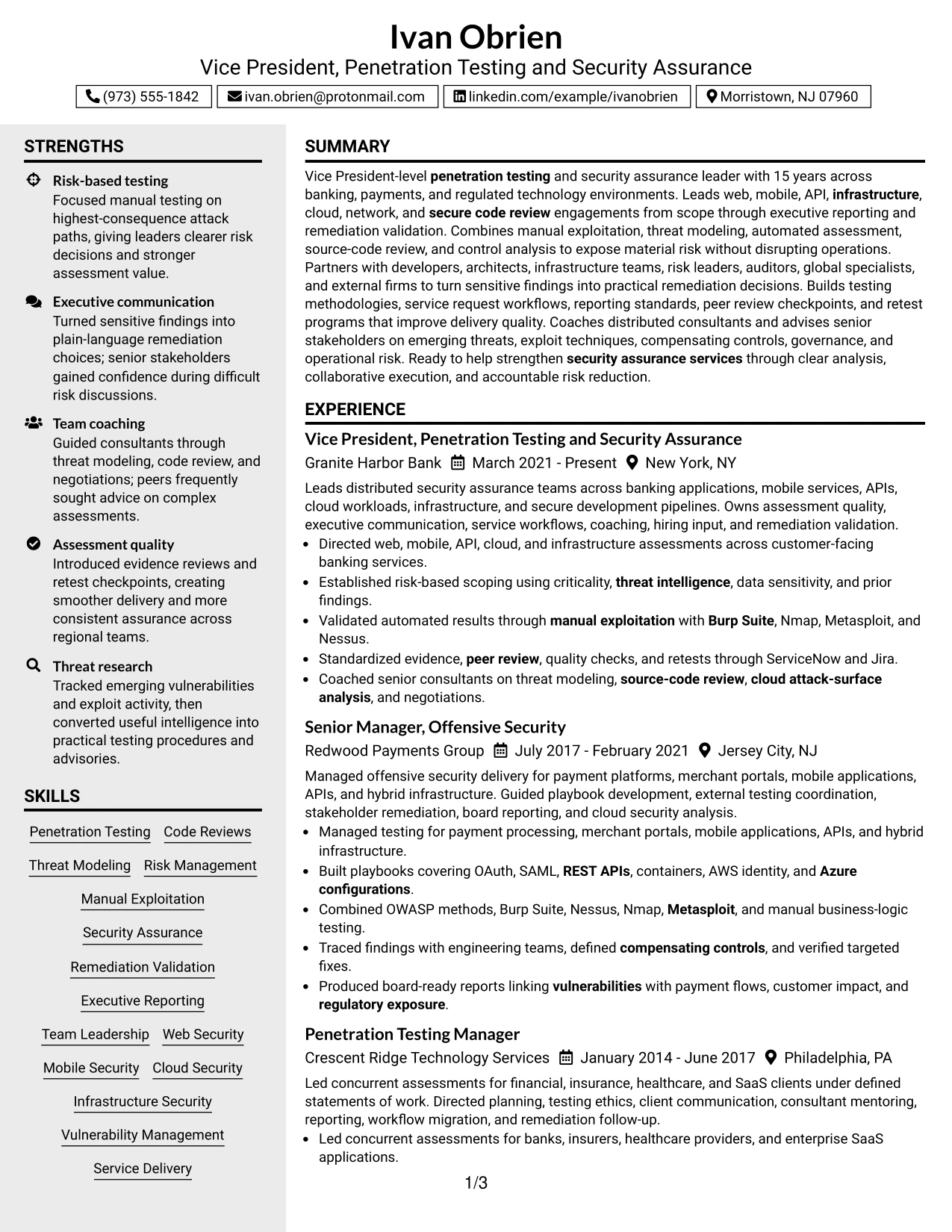
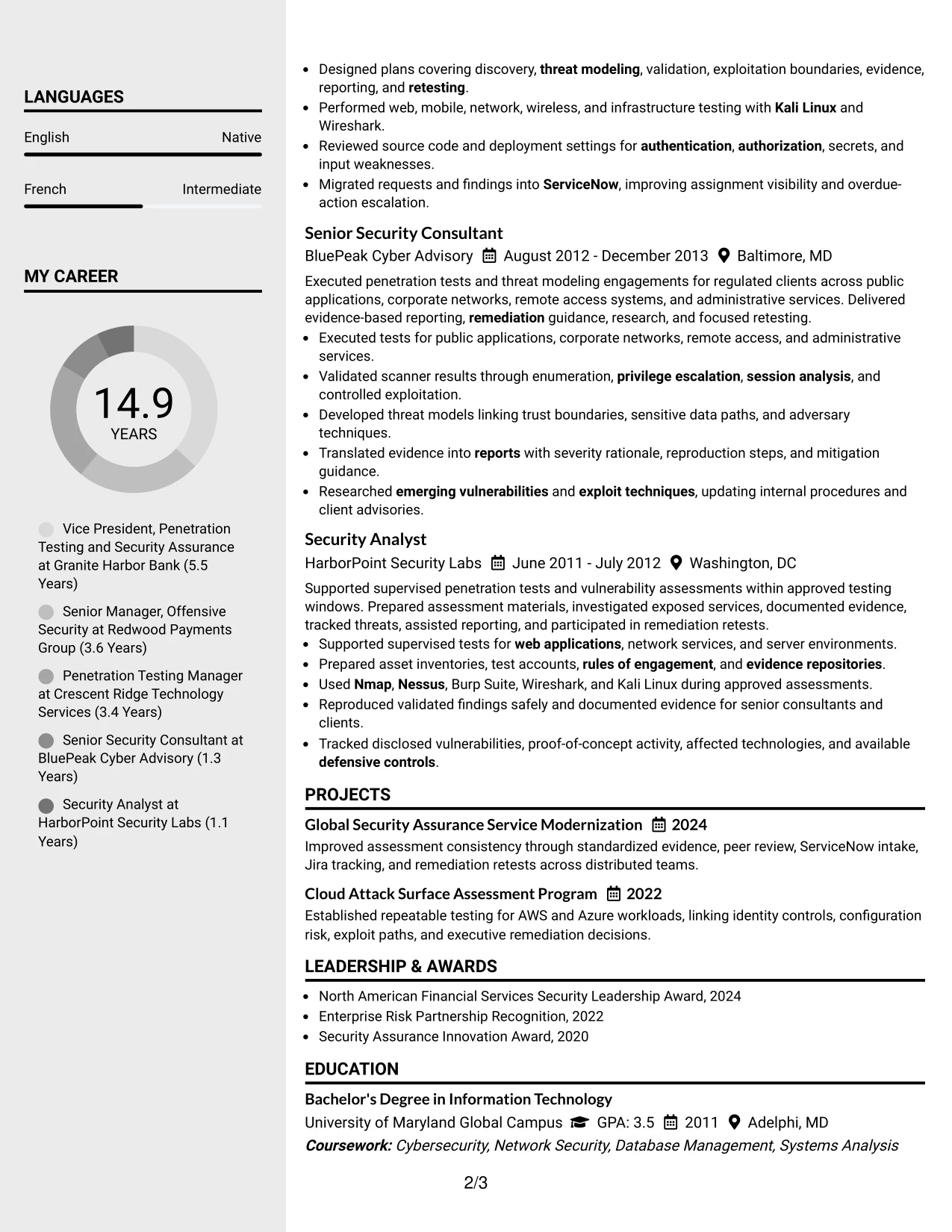
Evidence receives priority in this Clean Two Column Sidebar Format: assessment scope, validated findings, remediation work, and leadership outcomes should occupy the larger reading area. A compact sidebar can hold tools, certifications, skills, and affiliations without taking attention away from the work record.
For this resume, the design supports a useful distinction between what was tested and how the work was performed. Bullets can describe manual validation, threat modeling, source-code review, and executive reporting, while the sidebar reinforces the technical vocabulary used throughout the document.
Why the Clean Two Column Sidebar Format Works for a Resume
- The wider content area gives evidence-based bullets visual priority.
- A sidebar keeps tools and credentials visible without interrupting work history.
- The format separates testing outcomes from supporting technical inventory.
- Concise sections help readers compare assessment scope across different roles.
- A clean hierarchy supports quick review of vulnerabilities, controls, and remediation work.
- The arrangement gives leadership and hands-on testing evidence equal access to attention.
Best For
- Resumes where validated findings and remediation work should lead the review
- Professionals combining hands-on testing with security assurance leadership
- Documents that need a compact place for tools and certifications
- Applications requiring clear separation between evidence and supporting skills
- Readers comparing assessment scope across several positions
- Resumes that present technical reports, threat models, and code reviews as core evidence
- Candidates whose strongest proof comes from detailed work bullets
#4 Two Column Format Resume Example
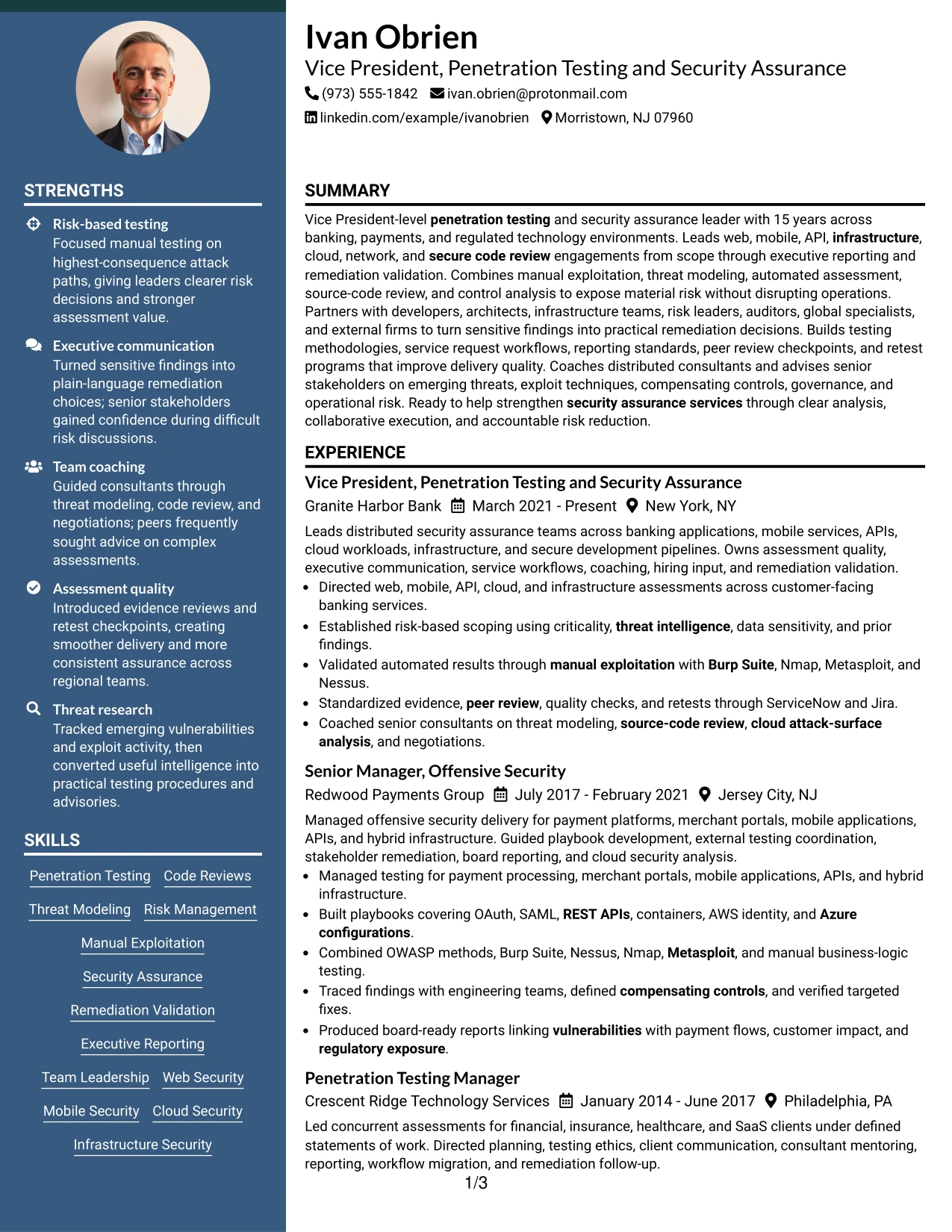
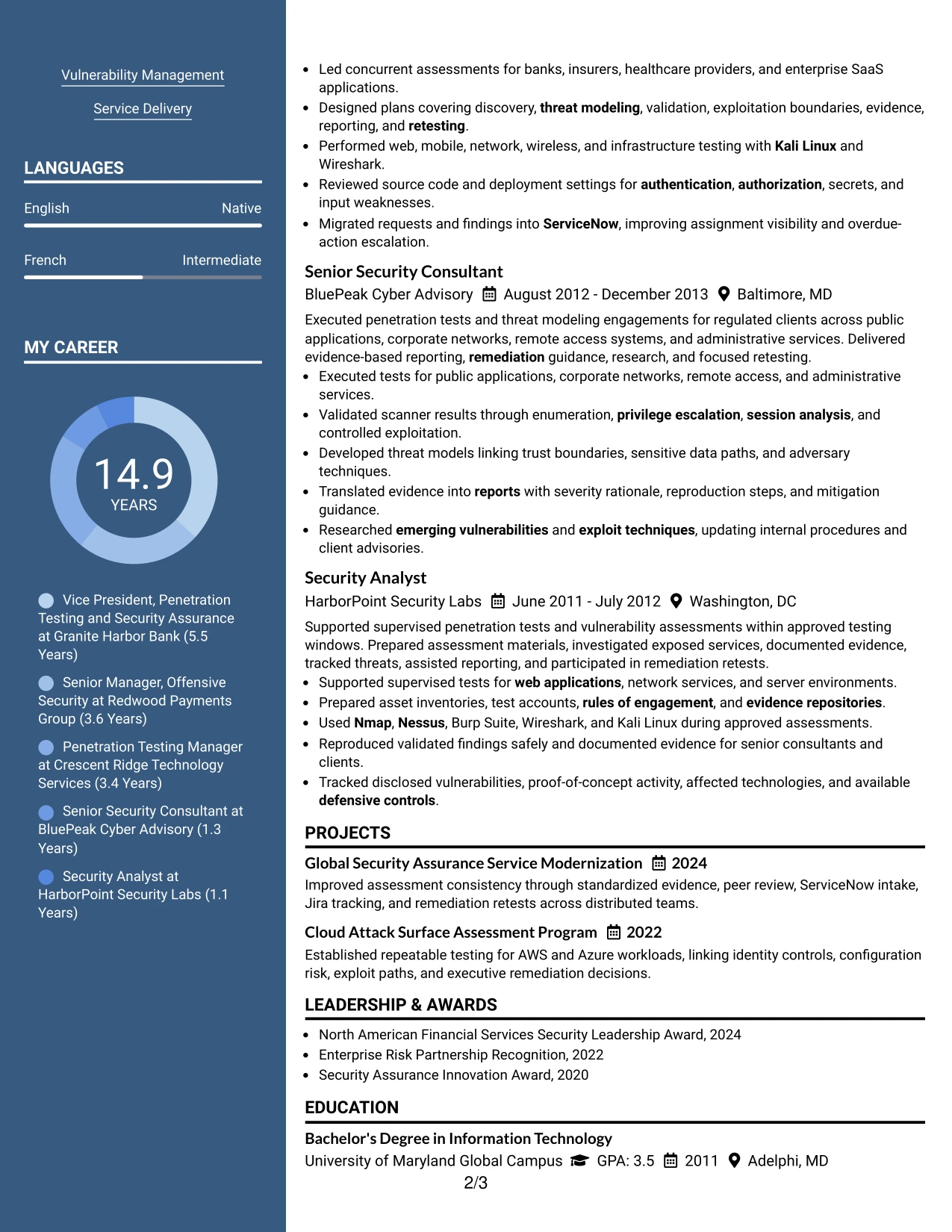
Content is balanced between a focused profile area and a detailed experience area in this Two Column Format. That distribution works well when the resume must present executive communication, technical depth, certifications, projects, and a long work history without making any one section feel crowded.
The primary column can carry role descriptions and results, while the secondary column organizes skills, credentials, awards, and affiliations. This gives a reviewer quick access to application-relevant keywords and enough context to understand assessment planning, stakeholder collaboration, and risk decisions.
Why the Two Column Format Works for a Resume
- Balanced columns allow leadership evidence and technical details to share the page.
- The main area supports bullets about assessment execution, reporting, and remediation.
- A supporting area keeps certifications, awards, and affiliations easy to locate.
- The structure works well for applications that value both individual delivery and team leadership.
- Grouped skills can mirror job requirements such as cloud, mobile, API, and infrastructure testing.
- Projects can add evidence of service modernization and cloud attack-surface assessment.
- Clear spacing helps prevent a long career history from becoming visually dense.
Best For
- Applications that combine hands-on assessments with service leadership
- Resumes needing separate areas for experience and supporting credentials
- Professionals presenting projects alongside formal employment history
- Documents that must show both technical breadth and stakeholder influence
- Applications where cloud, mobile, API, and infrastructure coverage should be easy to find
- Resumes with awards, affiliations, and certifications that strengthen credibility
- Readers who need a quick overview before reviewing detailed achievement bullets
#5 Photo Header Two Column Format Resume Example
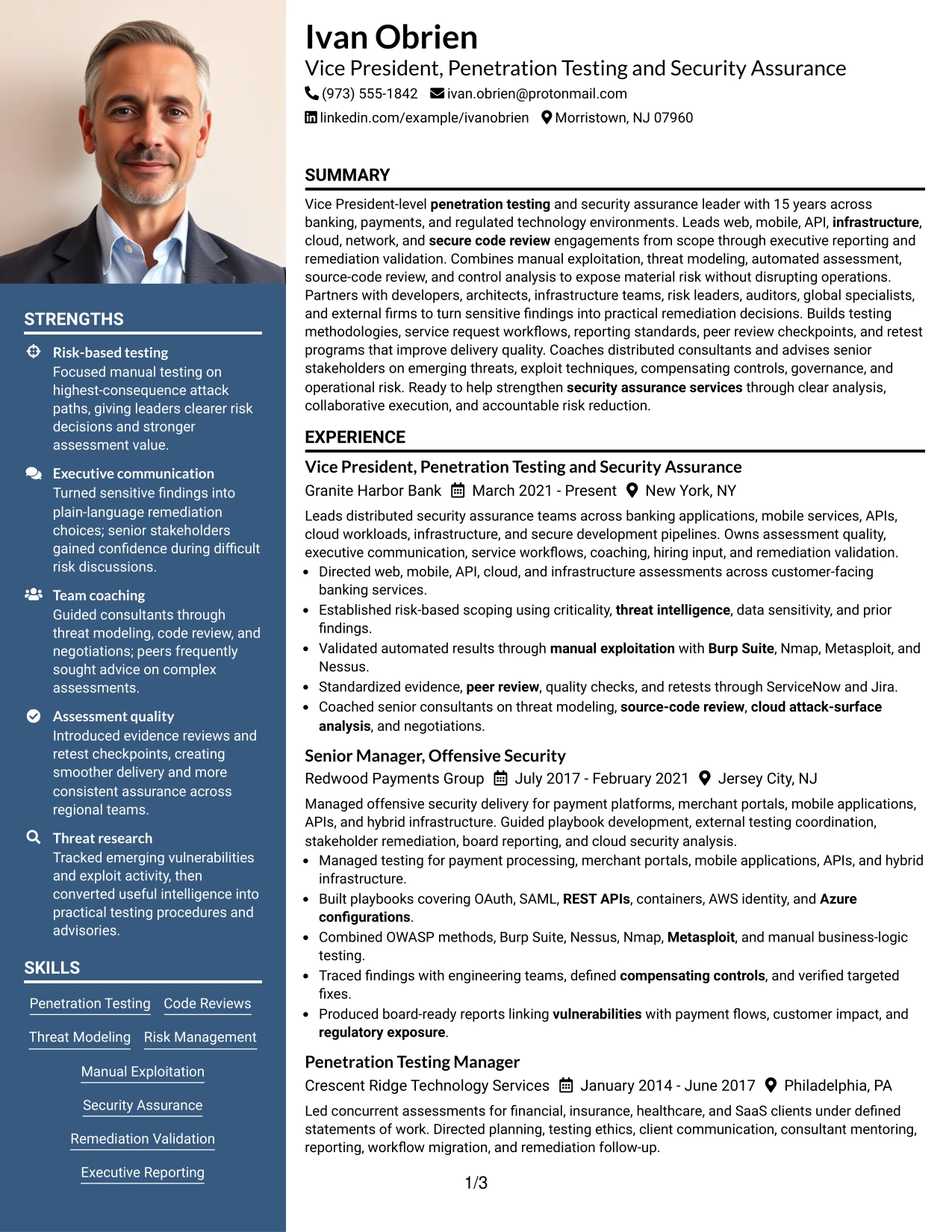
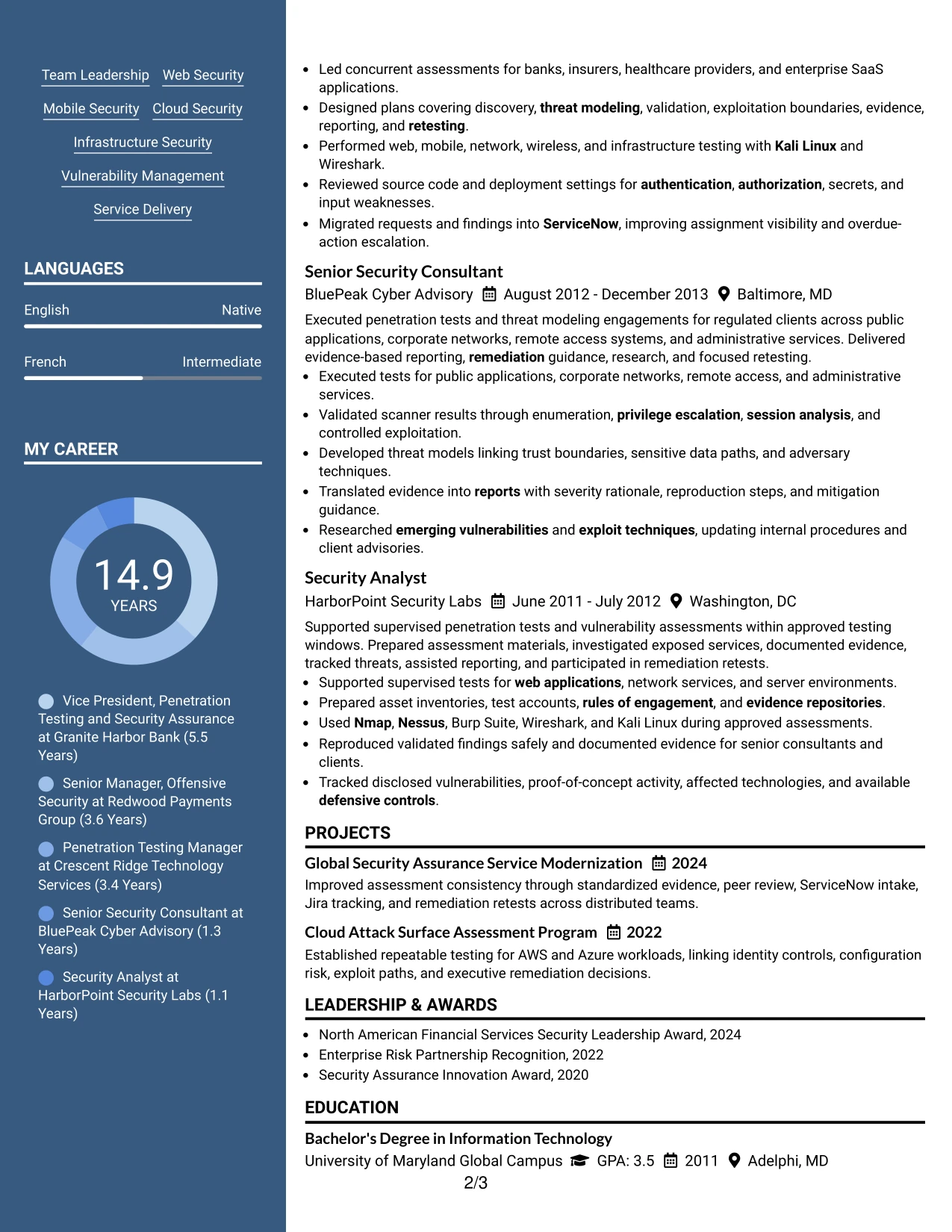
For applications that allow a more personal visual introduction, the Photo Header Two Column Format can place the candidate's identity and contact details in a prominent header before dividing the resume into two content areas. The photo should be used only when appropriate for the application, region, and employer requirements; it should never replace strong evidence or affect ATS readability.
The two-column body can give detailed experience room on one side and organize certifications, tools, projects, or affiliations on the other. For this resume, the arrangement can present security assurance leadership, assessment methods, and technical platforms while keeping the page visually organized.
Why the Photo Header Two Column Format Works for a Resume
- A prominent header creates a clear identity area before the technical content begins.
- The two-column body separates detailed experience from supporting qualifications.
- A photo can be optional and should follow the employer's application norms.
- The structure gives certifications and tools a defined place without crowding achievement bullets.
- A strong header helps contact details and professional links remain easy to locate.
- The format can present a polished leadership profile while retaining technical depth.
- Readable section hierarchy keeps the document useful for human review and ATS processing.
Best For
- Applications where a photo is accepted and adds appropriate personal context
- Professionals seeking a polished leadership presentation with technical substance
- Resumes that need a distinct header for identity and contact information
- Documents balancing extensive experience with a compact qualifications area
- Applications where certifications and tools need strong visual visibility
- Candidates presenting a blend of executive reporting and hands-on assessment work
- Print or PDF submissions where a structured visual introduction is suitable
#6 Colored Two Column Format Resume Example
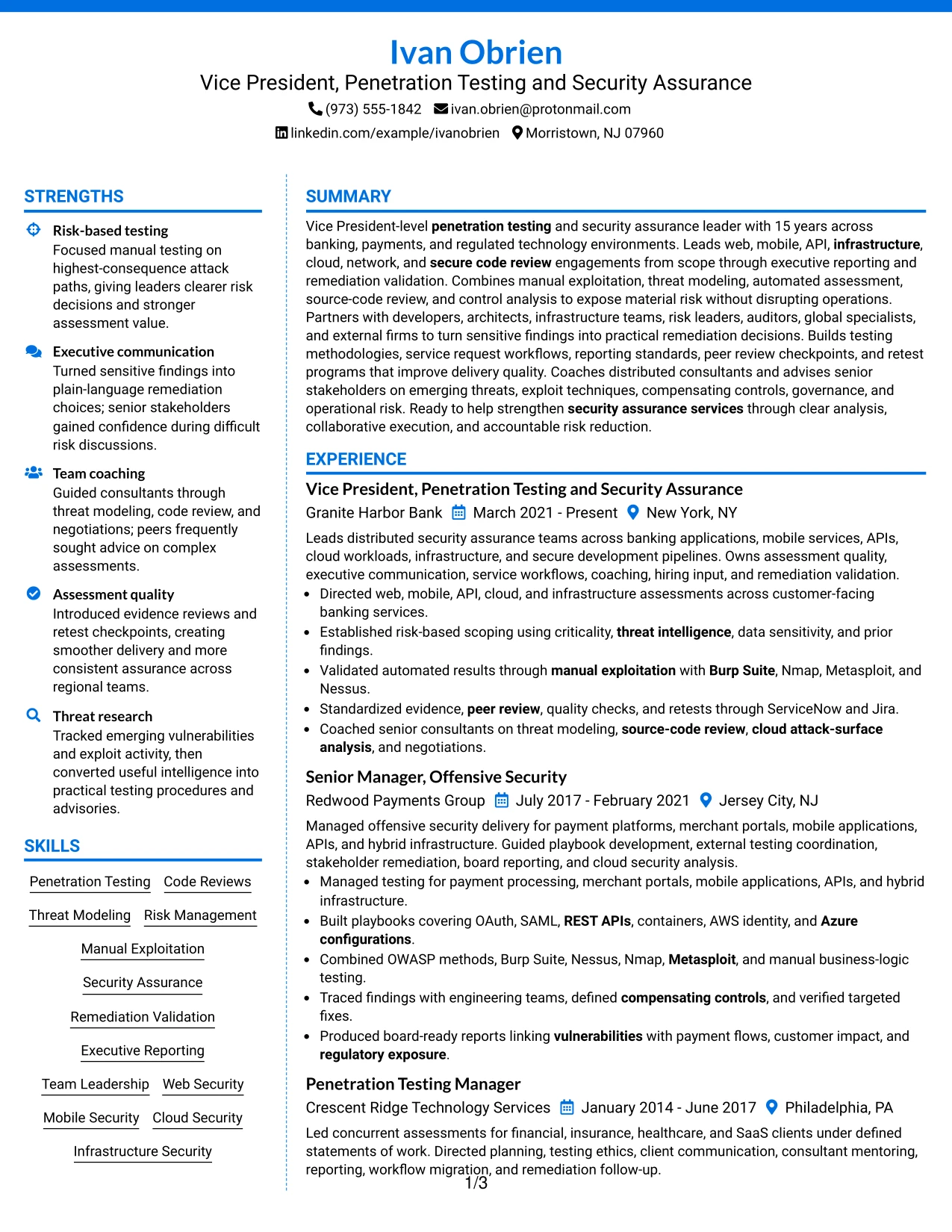
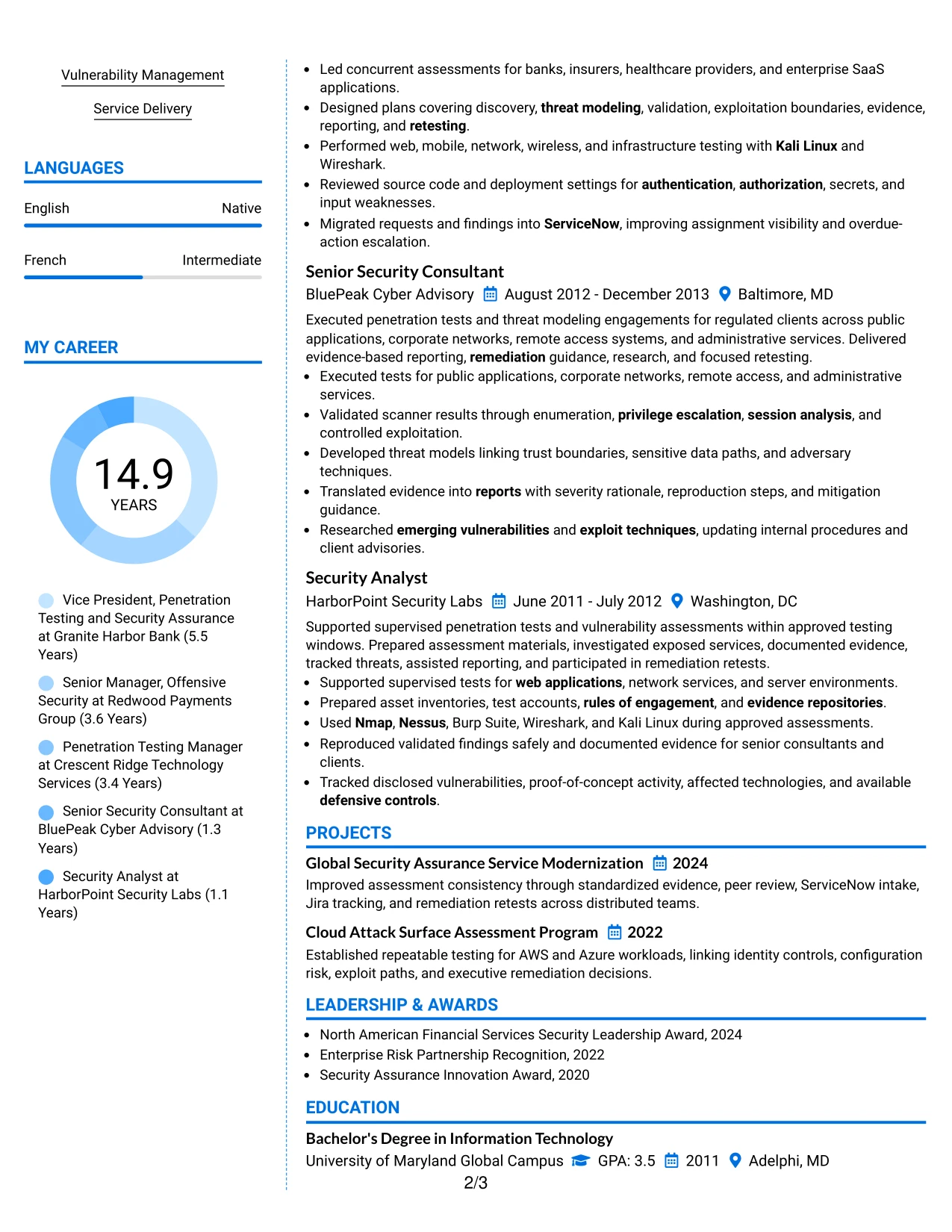
The restrained visual hierarchy of the Colored Two Column Format uses color to distinguish sections while keeping the content professional and readable. Color should support navigation, not compete with the resume's evidence, especially when the document presents sensitive technical findings and senior-level responsibilities.
A central sidebar can group skills, certifications, and tools, while the main area explains assessment delivery, threat modeling, remediation validation, and stakeholder advice. The result aligns a clear visual system with the role's need for both technical credibility and sound risk judgment.
Why the Colored Two Column Format Works for a Resume
- Controlled color helps readers recognize section boundaries quickly.
- The main column preserves space for detailed experience and security assurance evidence.
- A centered sidebar can group tools, certifications, and technical methods.
- The format supports a professional presentation without relying on decorative elements.
- Color-coded hierarchy can guide attention from summary to experience and credentials.
- The design keeps risk communication and technical delivery equally visible.
- Consistent spacing helps the resume remain readable when viewed on screen or in print.
Best For
- Professionals who want a modest visual distinction between resume sections
- Applications where technical credibility should remain more important than decoration
- Documents organizing tools and certifications beside detailed leadership evidence
- Resumes that need quick navigation across testing methods and work history
- Candidates presenting both risk judgment and hands-on security delivery
- Digital submissions where subtle color can improve section recognition
- Readers who prefer a structured resume with a clear central sidebar
#7 Stylish Two Column Designer Format Resume Example
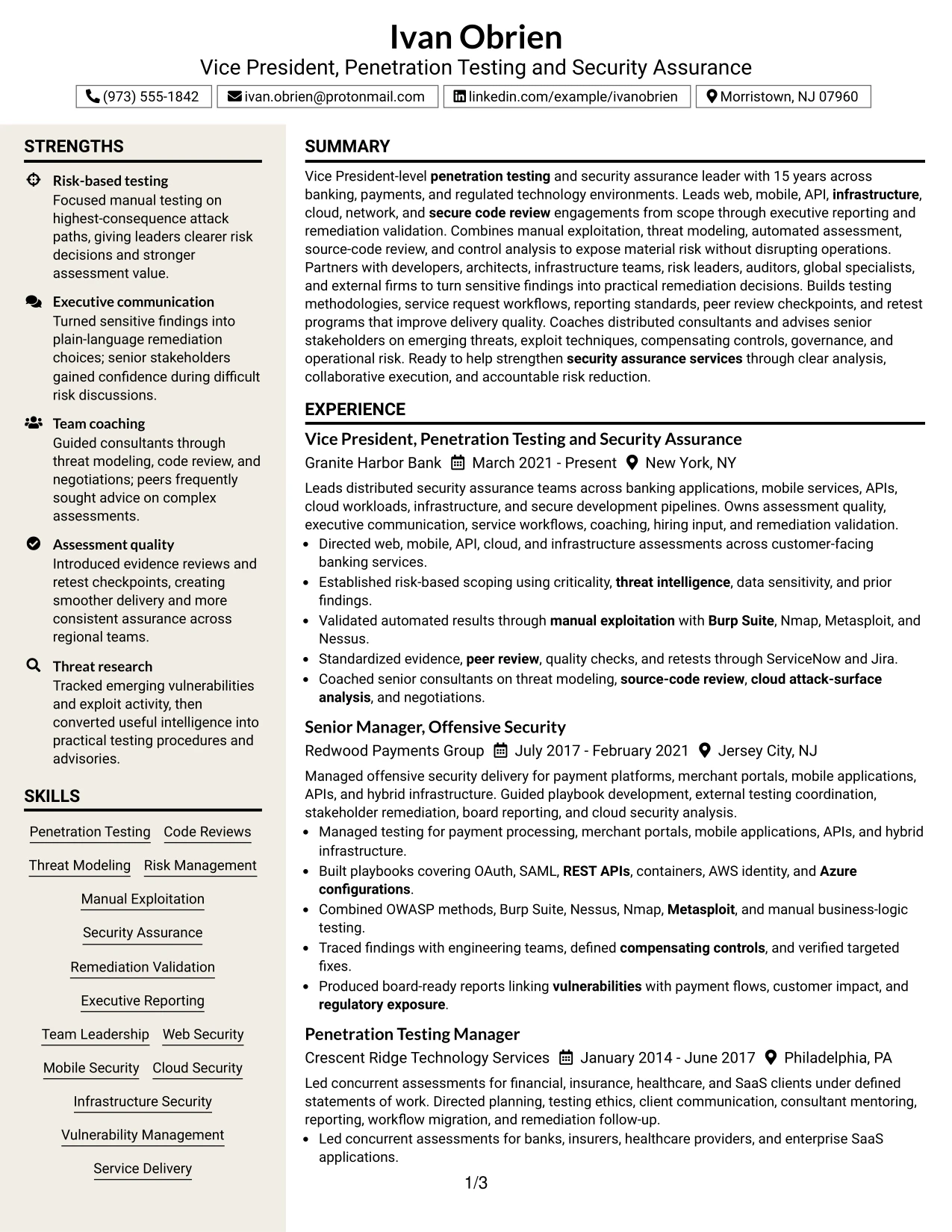
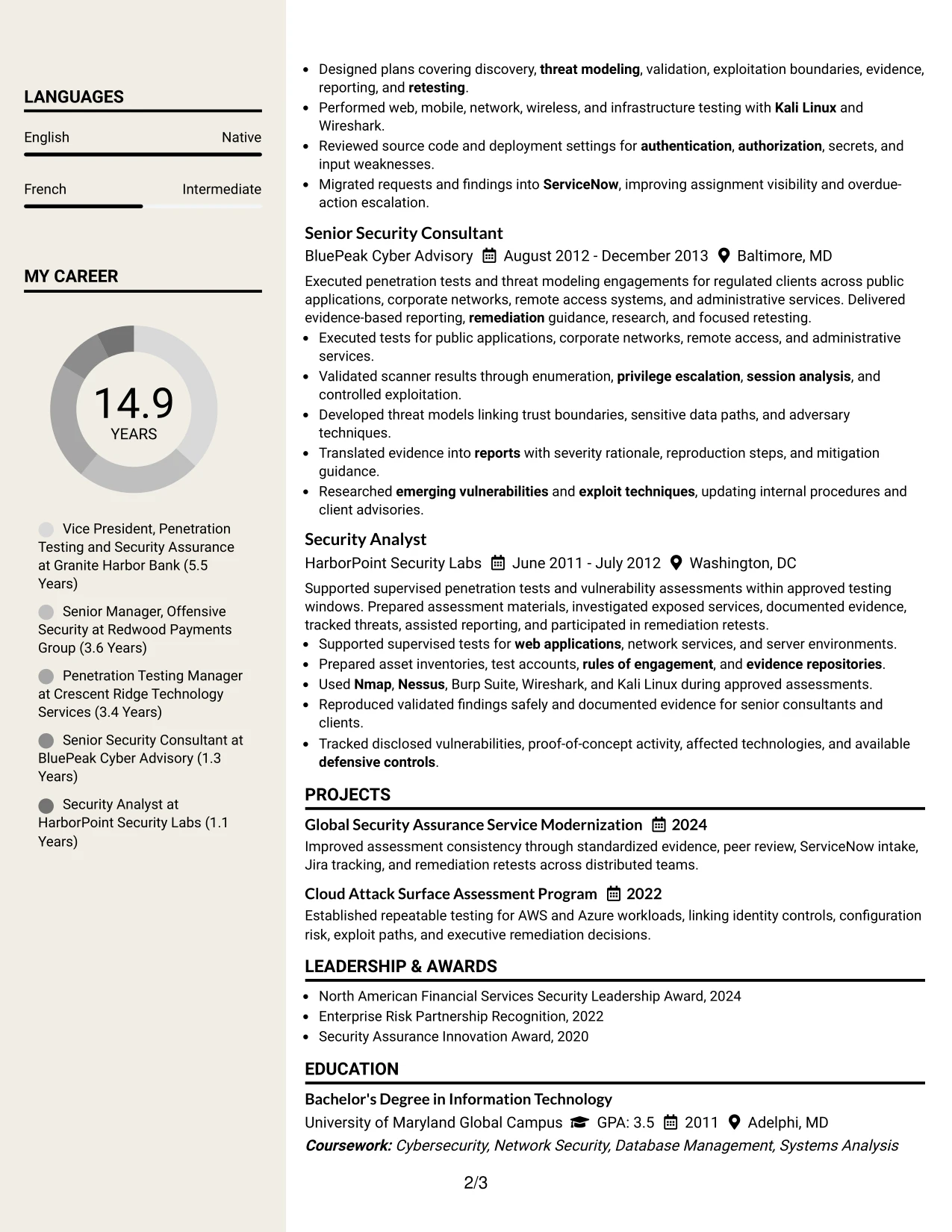
The Stylish Two Column Designer Format creates a deliberate structure: the larger content area carries the career record, while a compact sidebar supports navigation with concise qualification groups. Its design can add visual polish without changing the resume's evidence-first order.
Detailed bullets should remain the center of the page. They can show complex assessment planning, manual testing, source-code review, reporting, and coaching, while the sidebar provides quick confirmation of certifications, tools, projects, and professional activities.
Why the Stylish Two Column Designer Format Works for a Resume
- The larger column keeps career evidence more prominent than decorative styling.
- Square-style section markers can help readers move through a long document.
- A sidebar provides quick access to certifications, tools, and affiliations.
- The design supports concise bullets with strong action verbs and clear outcomes.
- Visual grouping makes projects and awards easier to distinguish from employment history.
- The format can show technical breadth without giving every skill equal visual weight.
- Consistent markers create a predictable scan pattern across complex information.
Best For
- Resumes that need visual polish while keeping work evidence dominant
- Professionals with several technical areas to group into compact categories
- Documents using projects, awards, and affiliations as supporting proof
- Applications where readers benefit from clear markers between resume sections
- Candidates presenting complex assessments through concise, action-led bullets
- Resumes that combine coaching responsibilities with individual technical delivery
- Digital documents where structured visual cues improve navigation
#8 Modern Icon Format Resume Example
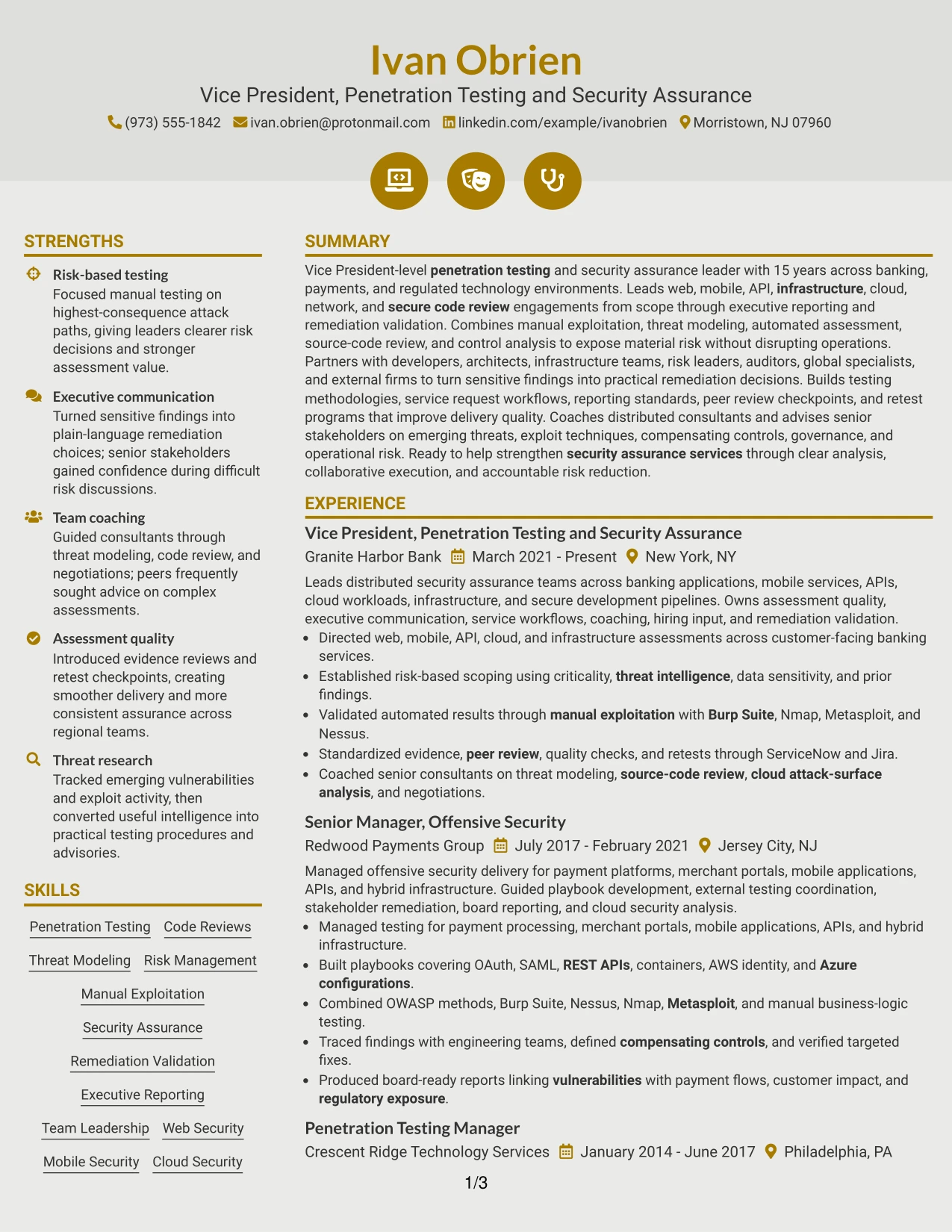
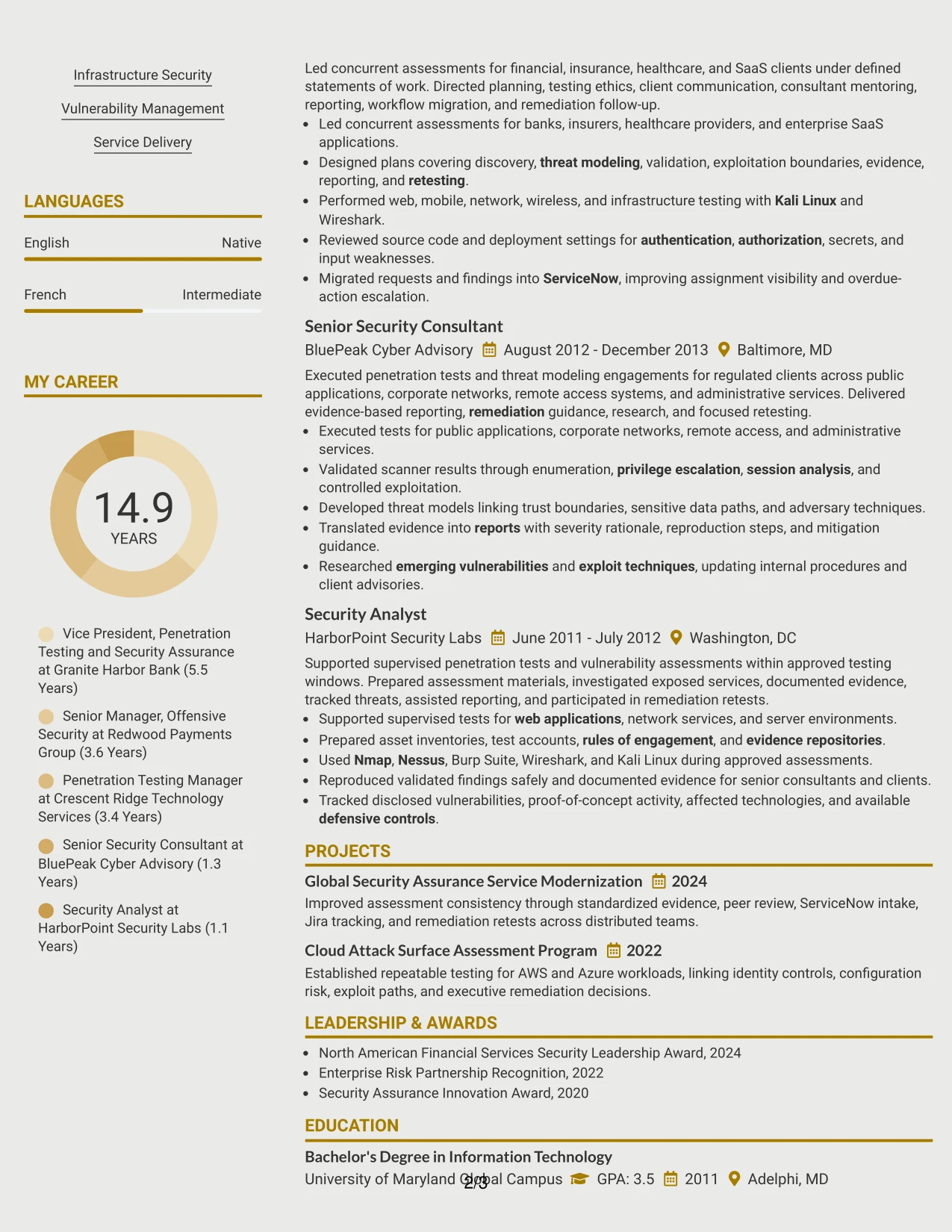
Readers move through the Modern Icon Format in a single column, using small visual markers to distinguish sections such as experience, skills, certifications, projects, and education. The linear structure keeps a broad technical record accessible while the icons provide light navigation support.
This format can handle detailed penetration testing work when each bullet carries one clear point. The resume can connect web, mobile, API, cloud, infrastructure, and secure development experience with tools, methods, reporting practices, and leadership evidence in a consistent sequence.
Why the Modern Icon Format Works for a Resume
- A single column gives every major section a consistent place in the reading order.
- Icons can guide navigation without replacing descriptive section labels.
- Full-width bullets allow clear explanations of testing methods and findings.
- The format supports a broad skills inventory without forcing narrow text blocks.
- Projects and certifications can follow experience in a natural sequence.
- Consistent visual cues help readers return to specific sections during later review.
- The layout is well suited to digital viewing when spacing and contrast remain accessible.
Best For
- Resumes with many sections that need a consistent single-column order
- Technical professionals presenting a broad assessment and tool inventory
- Documents that benefit from light visual cues beside standard headings
- Applications requiring detailed bullets for testing, reporting, and remediation
- Readers reviewing projects, certifications, and education after work history
- Digital resumes where section markers support quick return visits
- Candidates who want modern presentation without a multi-column reading path
#9 Modern Full Background Two Column Format Resume Example
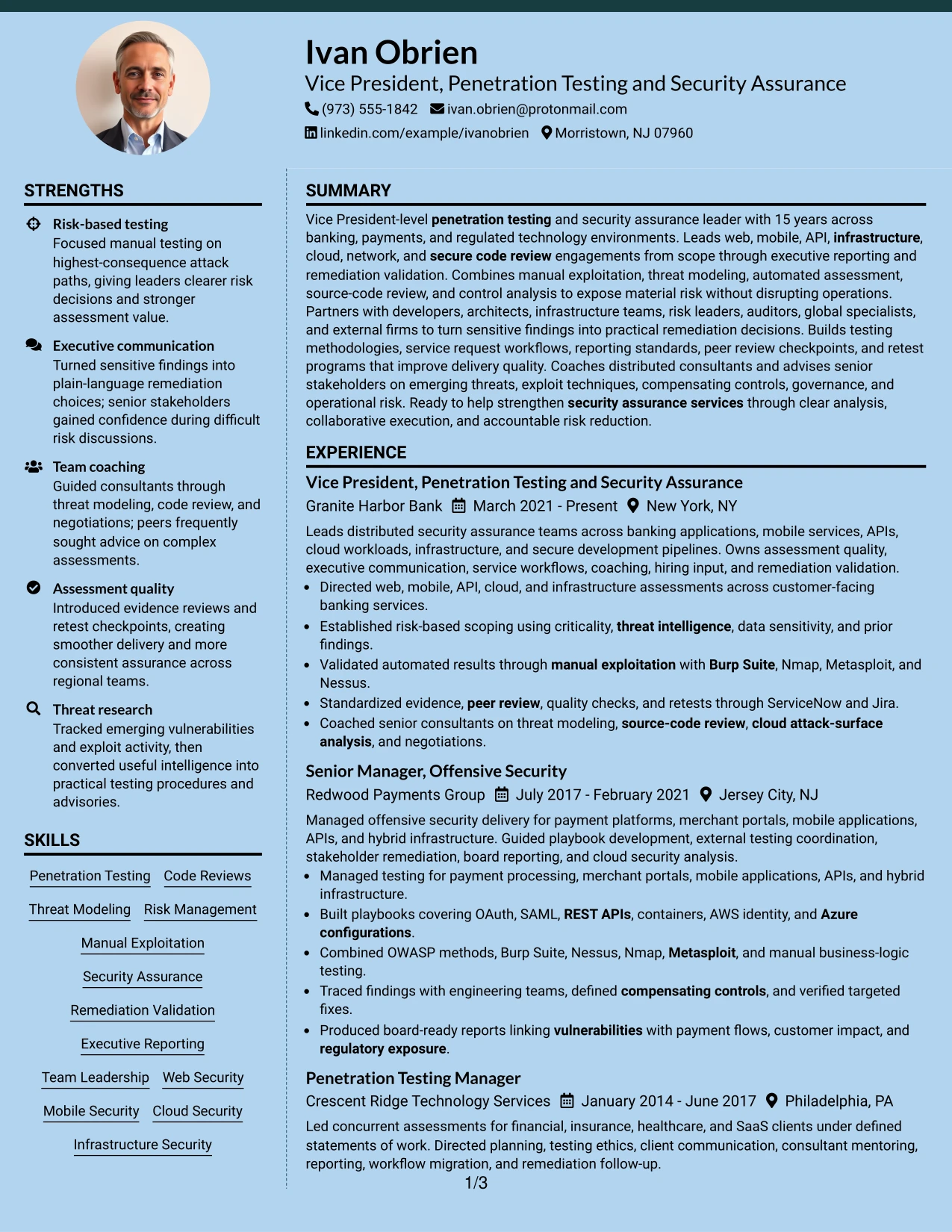
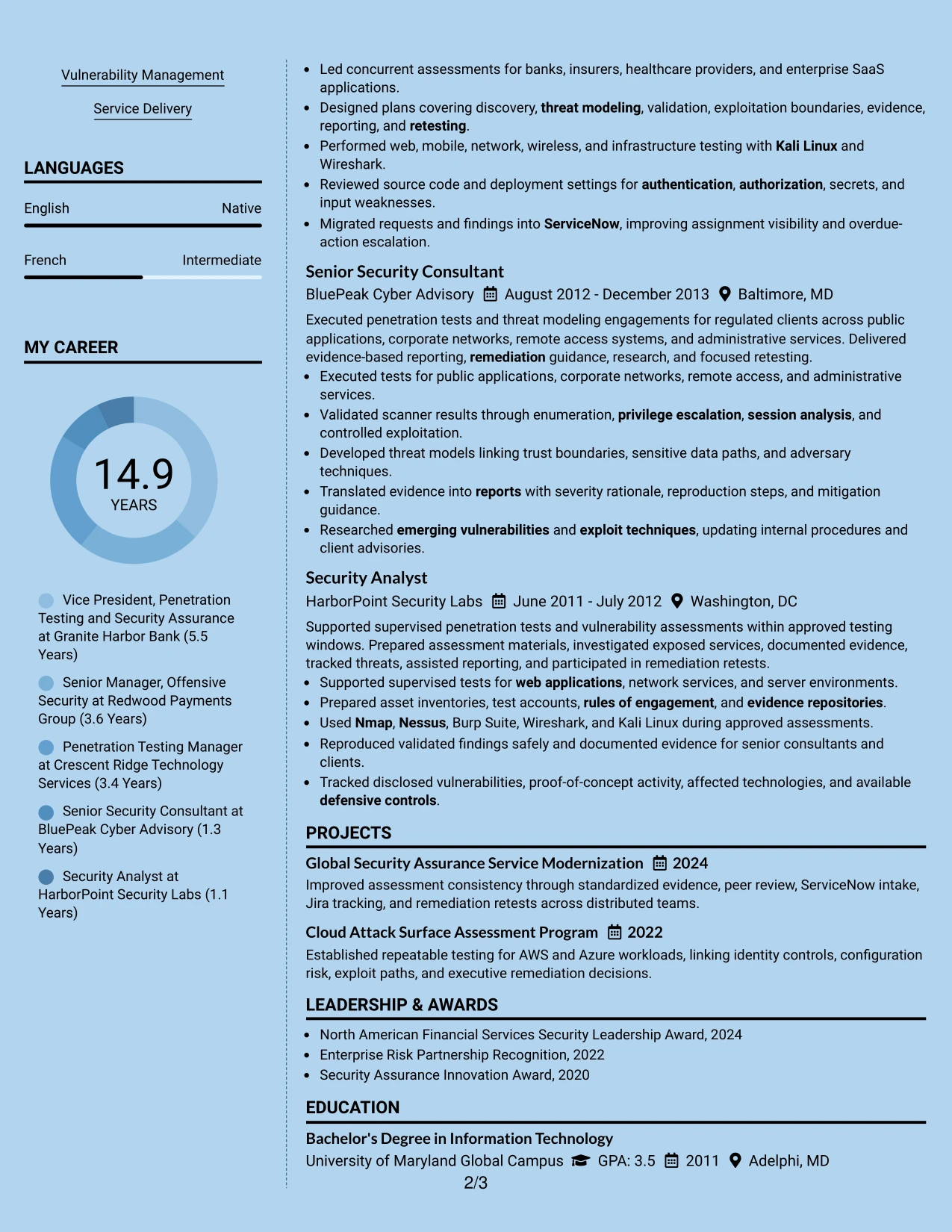
Evidence receives the strongest visual position in the Modern Full Background Two Column Format. The resume should lead with the scope of assessments, the quality of findings, and the decisions supported by remediation guidance, while the full-page treatment remains restrained enough for comfortable reading.
A two-column structure can place detailed experience and projects in the primary area and reserve the secondary area for skills, certifications, and affiliations. For this document, that division helps connect manual exploitation, automated scanning, threat intelligence, and executive reporting to the broader security posture.
Why the Modern Full Background Two Column Format Works for a Resume
- The full-page visual treatment gives the document a unified, current appearance.
- A wider experience area keeps assessment evidence and outcomes prominent.
- The secondary column can organize tools, credentials, and professional activities.
- The format supports concise links between vulnerabilities, controls, and business risk.
- Two-column grouping makes technical breadth easier to review at a glance.
- Projects can add proof of service modernization and cloud assessment methods.
- Strong contrast and spacing are essential to preserve readability and ATS usability.
Best For
- Resumes where assessment evidence should remain the main visual focus
- Professionals presenting technical findings in relation to business and operational risk
- Applications that benefit from a unified modern page treatment
- Documents separating detailed work history from tools and certifications
- Candidates with projects that demonstrate new assurance services or methods
- Digital PDF submissions where contrast and spacing can be controlled
- Readers who want a quick view of evidence volume before reviewing supporting skills
#10 Dark Mode Two Column Format Resume Example
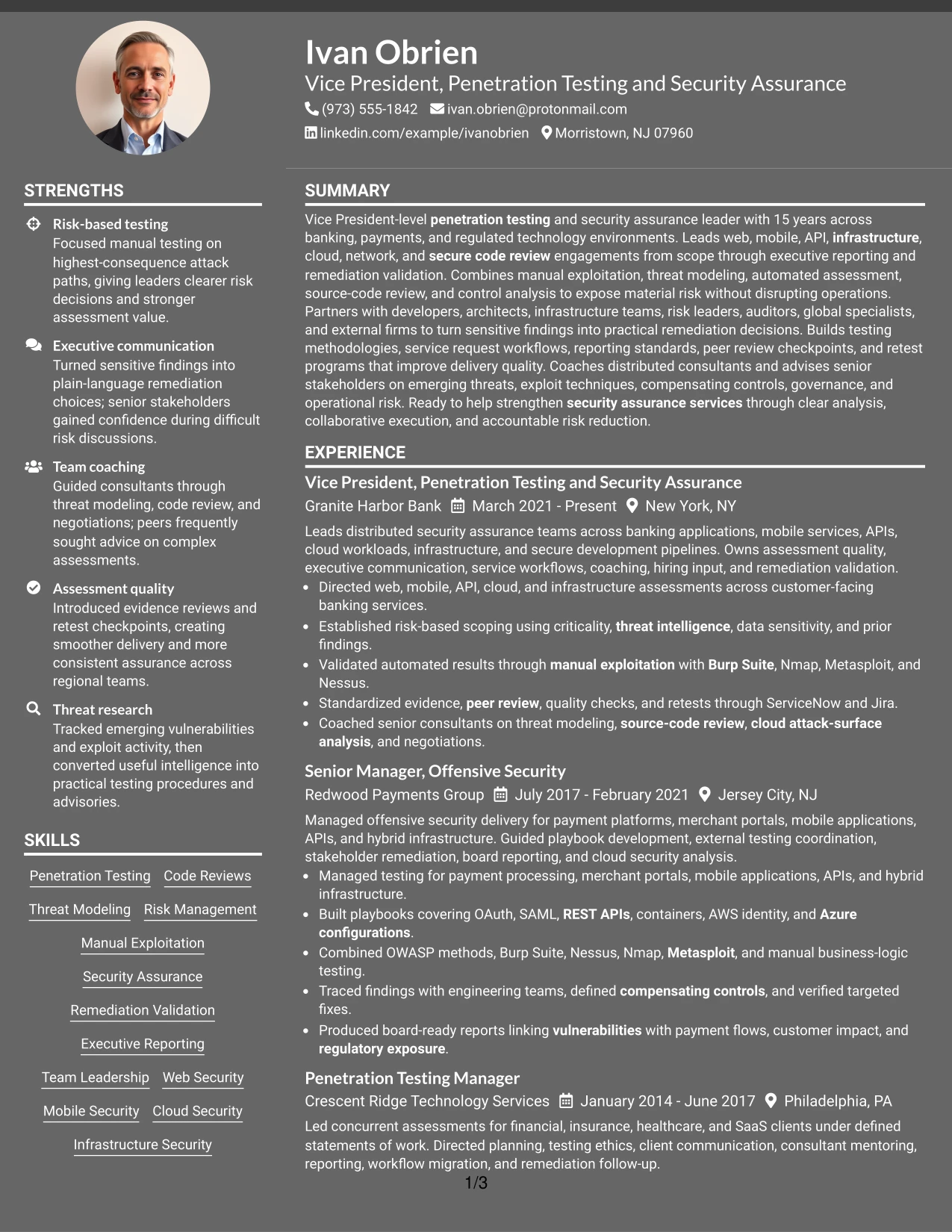
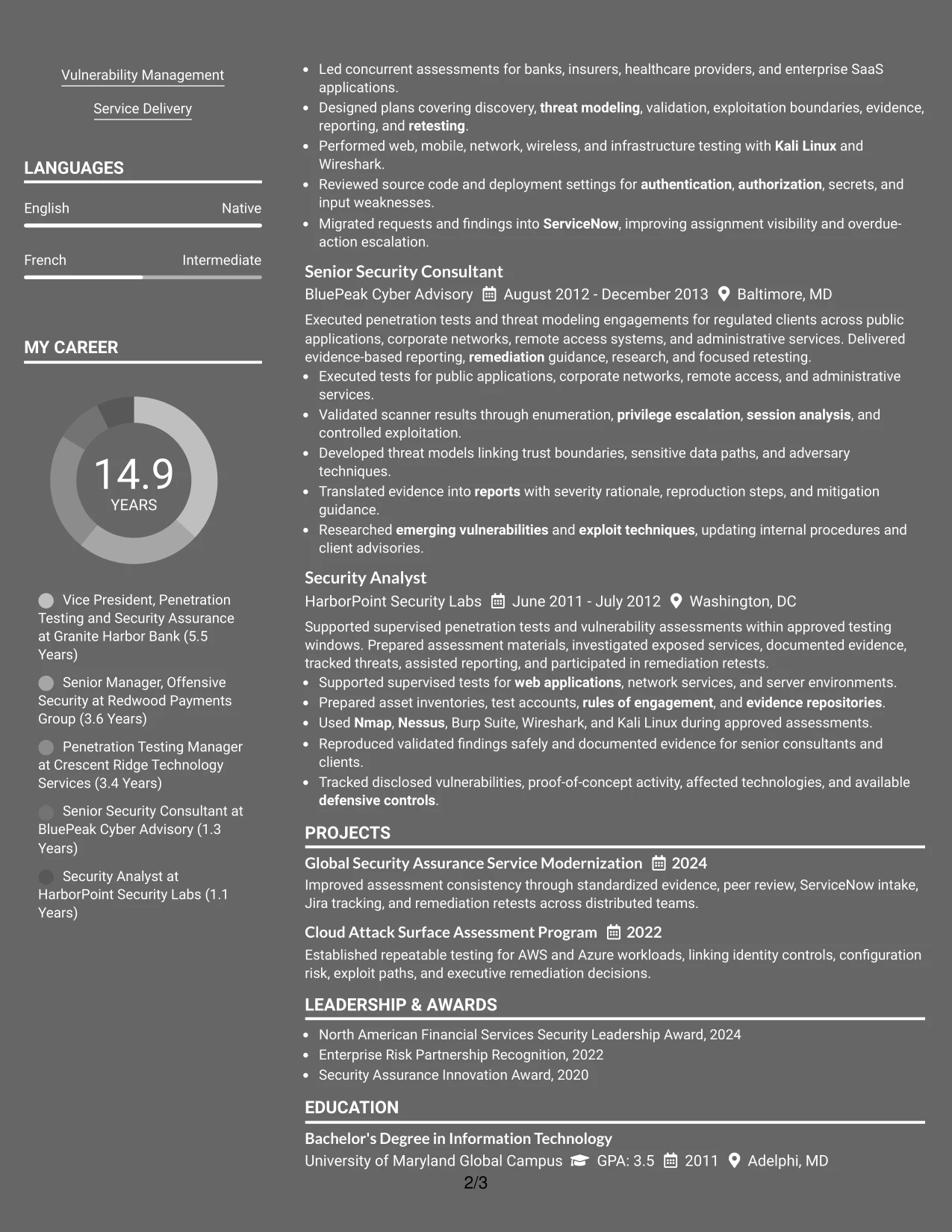
Content is balanced between a strong primary experience area and a supporting qualification area in the Dark Mode Two Column Format. Because dark styling can affect contrast and printing, text size, color contrast, and ATS-readable text should remain priorities throughout the document.
The layout can present Ivan Obrien's leadership scope, technical assessment work, projects, certifications, and tools without making the page feel crowded. Detailed bullets belong in the main column, while the secondary area can reinforce keywords such as threat modeling, secure code review, cloud security, and remediation validation.
Why the Dark Mode Two Column Format Works for a Resume
- A balanced structure keeps leadership evidence and technical qualifications visible together.
- The dark visual treatment can create a distinct presentation for digital review.
- High contrast is necessary so experience bullets remain readable and accessible.
- A secondary area can group skills, tools, certifications, and affiliations efficiently.
- The main column gives space to explain assessment scope and stakeholder outcomes.
- The format can distinguish projects from employment history without adding long text blocks.
- A text-based source and careful export help preserve ATS access and print usability.
Best For
- Digital applications where a distinctive but organized presentation is appropriate
- Professionals combining senior leadership evidence with deep technical qualifications
- Resumes needing separate areas for detailed experience and supporting keywords
- Applications where cloud, code review, and remediation work must be easy to locate
- Candidates submitting a carefully tested PDF with strong contrast and selectable text
- Documents that use projects and certifications to reinforce strategic impact
- Readers who prefer a bold visual structure with balanced information density
#11 Dark Mode Box Header Format Resume Example
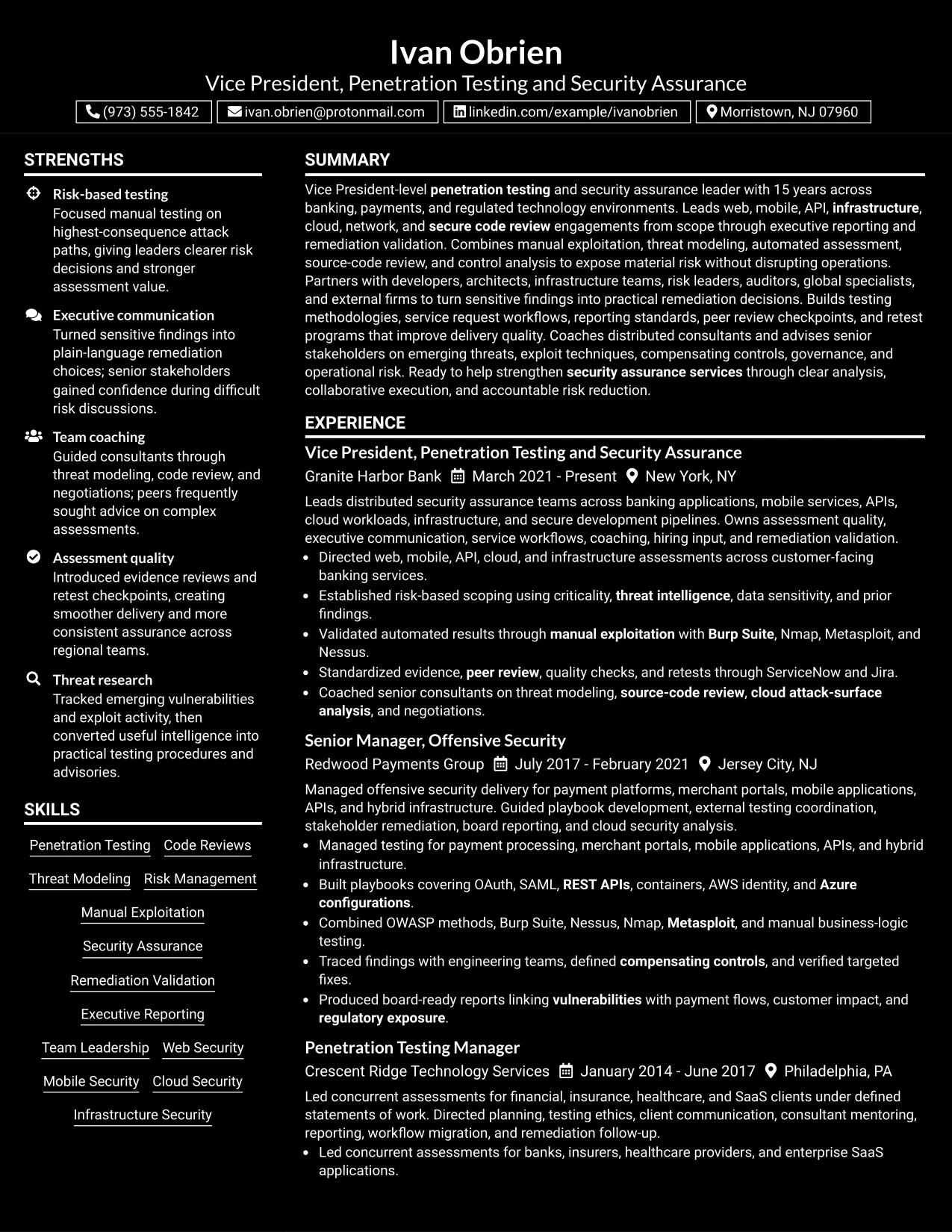
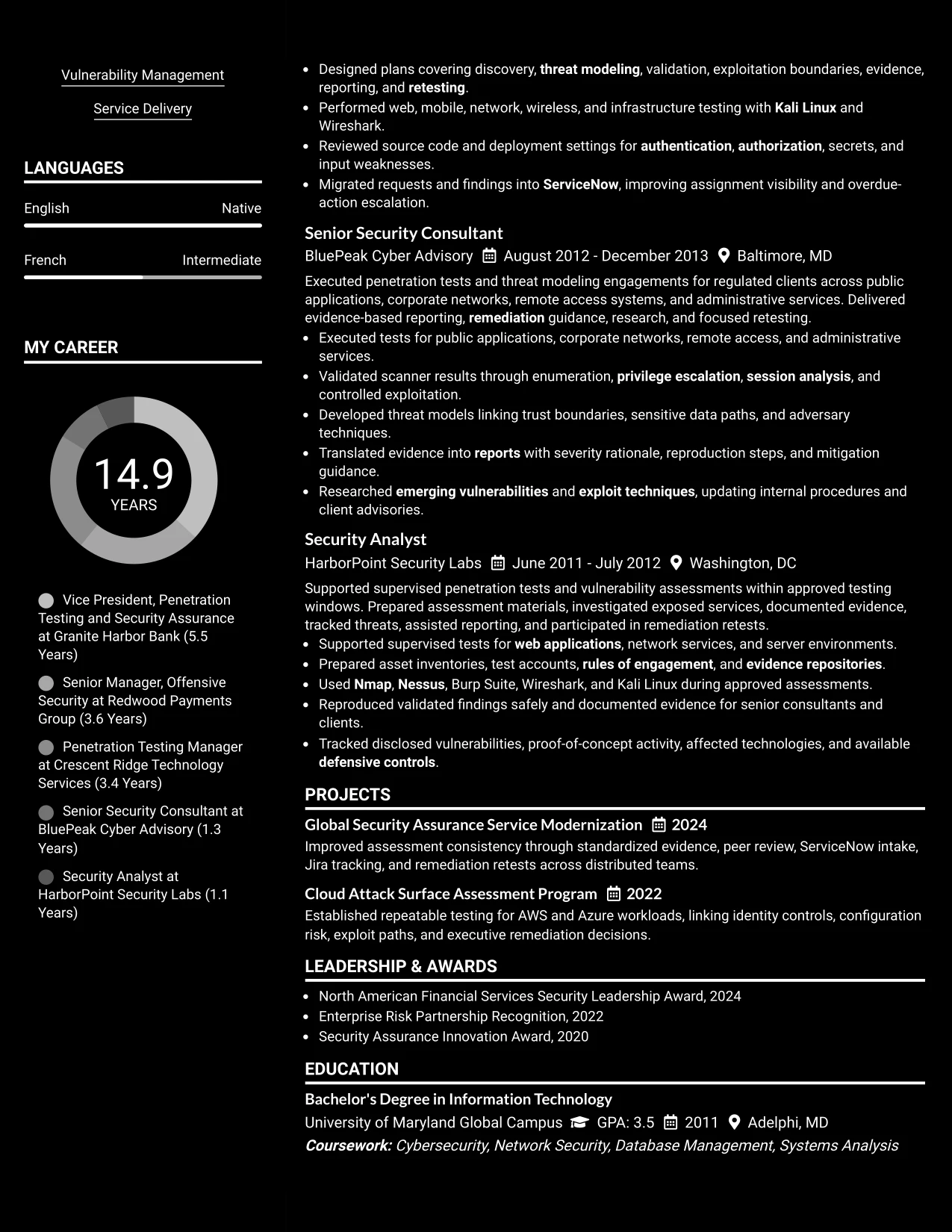
For a digital application that benefits from a clear visual introduction, the Dark Mode Box Header Format can place the professional identity, target role, and contact details in a defined header before presenting the resume in one readable column. The header should support orientation, while the content below supplies the evidence needed for review.
The single-column structure gives each role room for focused bullets about assessment execution, manual and automated testing, threat research, reporting, and remediation. Boxed headings can separate experience, skills, certifications, projects, and education while keeping the document's technical message direct.
Why the Dark Mode Box Header Format Works for a Resume
- A defined header helps readers identify the target role and contact details immediately.
- The single-column body gives detailed experience a consistent reading path.
- Boxed headings can make certifications, projects, and skills easy to locate.
- The design supports focused bullets about testing, reporting, and remediation.
- A strong contrast system can create visual distinction while preserving readability.
- The format works well when the resume needs a clear digital presentation.
- Selectable text, accessible contrast, and predictable section labels protect ATS usability.
Best For
- Digital applications that need a clear target-role header
- Professionals presenting detailed assessment work in one readable sequence
- Resumes using boxed headings to separate experience, projects, and credentials
- Applications where technical reporting and remediation evidence need full-width space
- Candidates seeking a distinctive presentation without a multi-column reading path
- PDF submissions that can preserve contrast, selectable text, and clear hierarchy
- Readers who want contact details and role alignment visible before detailed evidence
#12 Elegant Full Background Two Column Format Resume Example
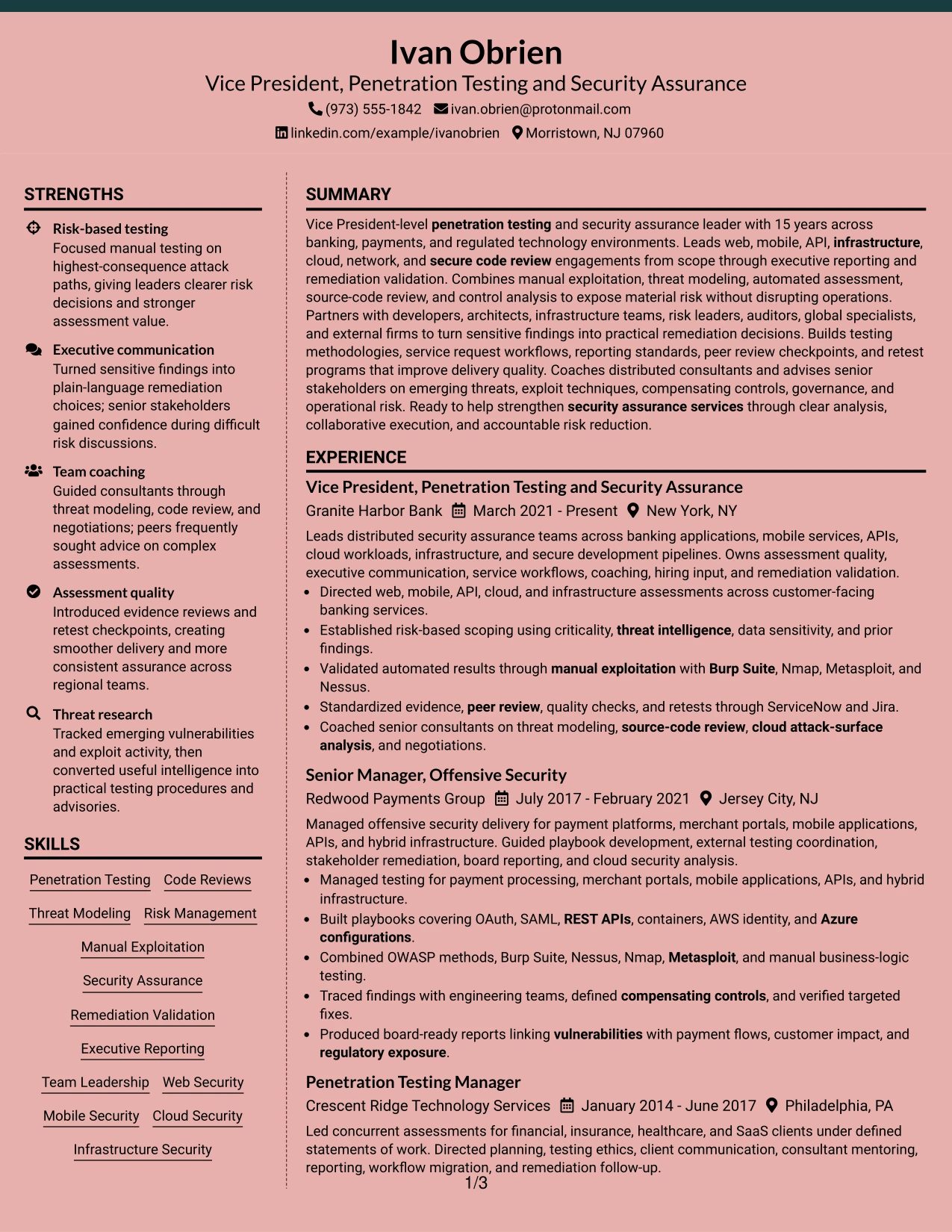
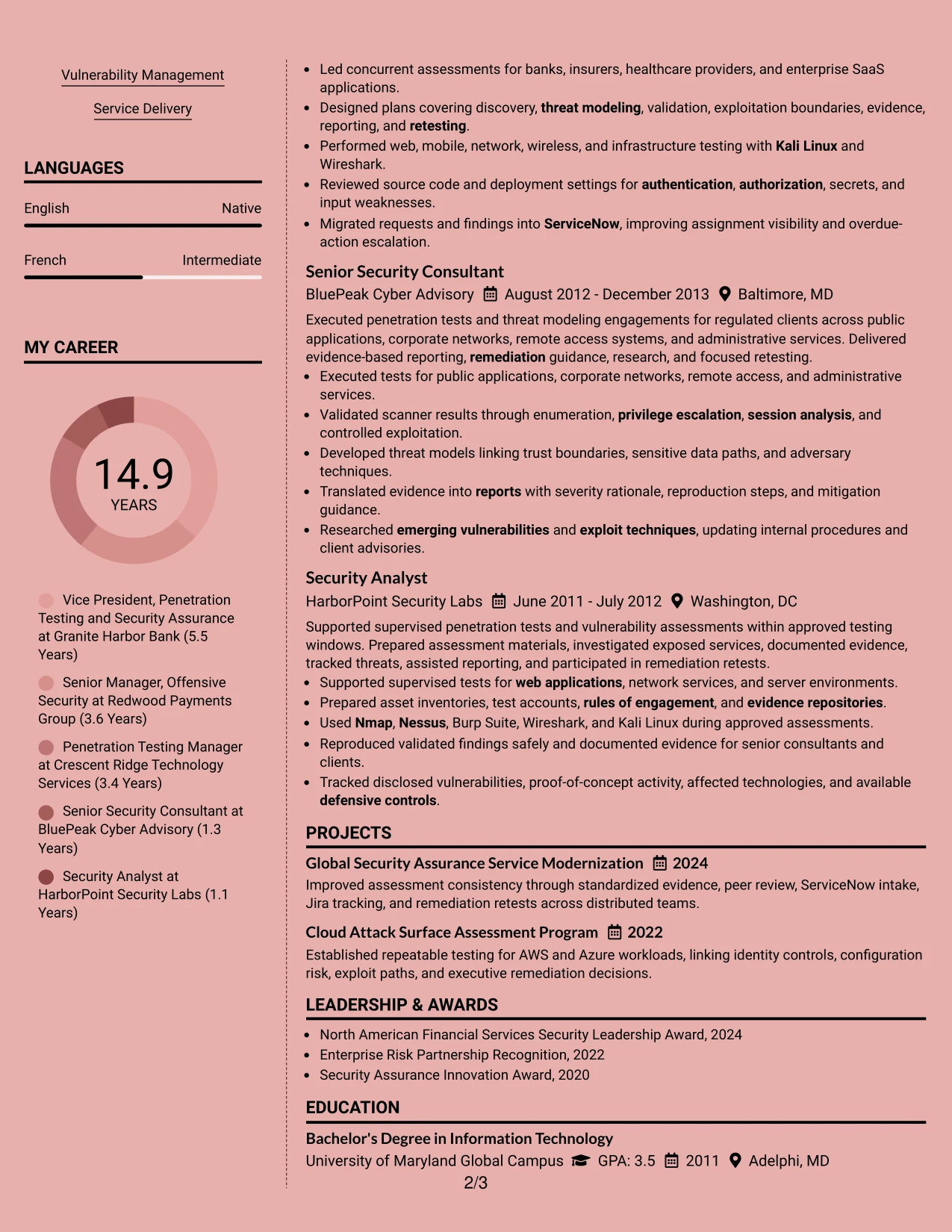
A restrained visual hierarchy gives this resume a polished executive presence while keeping the content easy to locate. Two columns separate high-value details such as skills, certifications, and tools from the main experience record, allowing the reader to move from role alignment to supporting evidence.
The structure gives the Vice President, Penetration Testing and Security Assurance profile room to show assessment leadership, threat modeling, secure code review, cloud security, and executive reporting. Clear work-history bullets carry the strongest evidence, while keywords such as Burp Suite, AWS, Azure, ServiceNow, and remediation validation remain visible for ATS review.
#12 Why the Elegant Full Background Two Column Format Works for a Resume
- The two-column hierarchy separates core experience from supporting qualifications.
- A prominent summary quickly establishes penetration testing and security assurance scope.
- Experience bullets show progression from supervised assessments to distributed team leadership.
- Skills and tools are grouped so recruiters can verify technical coverage quickly.
- Certifications such as CISSP, OSCP, AWS Certified Security – Specialty, and GWAPT receive clear placement.
- Keywords for cloud, mobile, API, infrastructure, and secure code review remain easy to scan.
- The format balances executive-level communication with detailed technical evidence.
#12 Best For
- Resumes that need a polished two-column hierarchy without sacrificing ATS-readable text.
- Professionals who must present technical skills beside a substantial work history.
- Applications where certifications, tools, and methods need fast visibility.
- Senior security resumes that combine leadership evidence with hands-on assessment detail.
- Candidates targeting regulated environments where risk, controls, and remediation belong near experience.
- Documents that benefit from a clear separation between career evidence and supporting qualifications.
- Resume reviews that reward a refined visual structure and strong keyword coverage.
#13 Creative Two Tone Format Resume Example
The Creative Two Tone Format uses one continuous column with a controlled color change to distinguish major resume sections. That structure keeps the reading path simple while giving the summary, experience, skills, certifications, and education enough visual separation for quick review.
For a Penetration Tester, VP application, the format supports a direct evidence sequence: leadership scope first, assessment methods next, and tools and credentials after that. Bullets can connect manual exploitation, automated scanning, reporting, and remediation work to the keywords used in the target role without creating a crowded page.
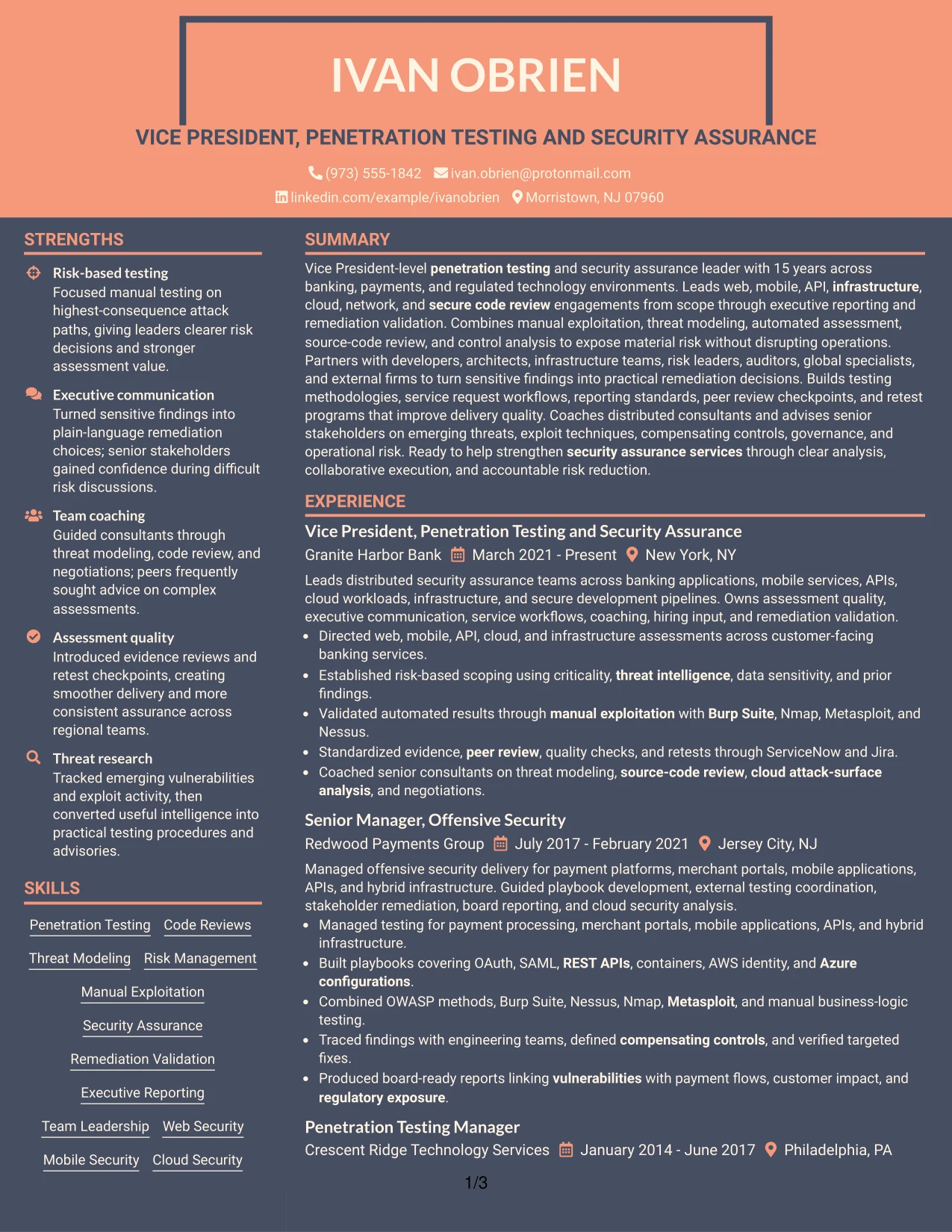
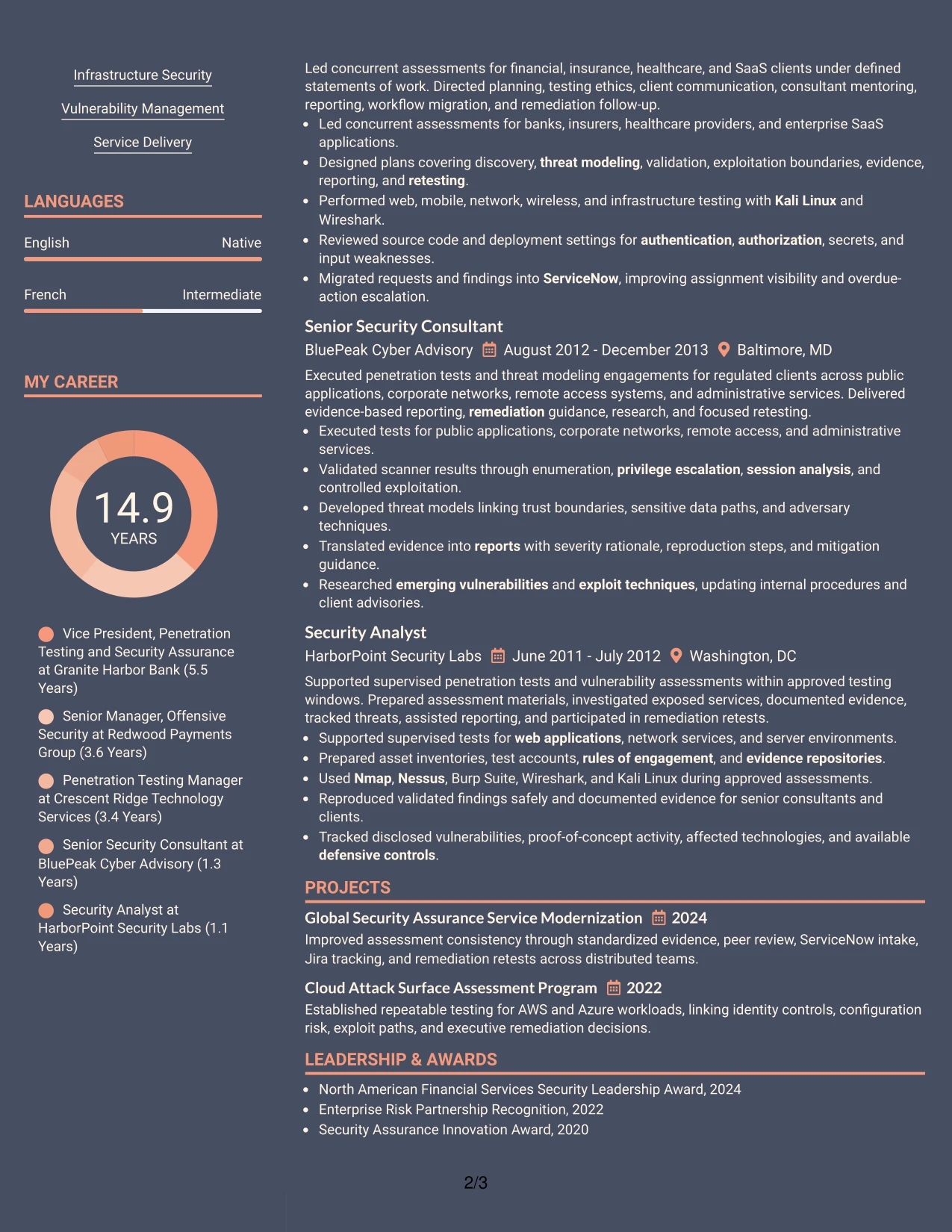
#13 Why the Creative Two Tone Format Works for a Resume
- A single reading column supports reliable ATS parsing.
- Color changes distinguish sections without hiding important text.
- The summary can connect leadership scope with technical assessment depth.
- Short bullets make web, mobile, API, cloud, and infrastructure coverage easy to verify.
- Tools such as Nmap, Metasploit, Nessus, and Kali Linux remain in a predictable skills area.
- Certifications and education follow the experience record in a familiar order.
- The format adds visual interest while preserving a practical recruiter scan.
#13 Best For
- One-column resumes that need visual distinction between sections without complex navigation.
- Applications where ATS compatibility and a clear top-to-bottom reading path are priorities.
- Technical professionals presenting a mix of leadership, testing methods, and tool knowledge.
- Resumes with several assessment domains that need consistent bullet formatting.
- Candidates who want skills and credentials to support, rather than compete with, experience.
- Review processes where recruiters scan section labels before reading individual achievements.
- Documents that need a modest creative treatment while retaining conventional resume structure.
#14 Minimal Header Format Resume Example
Readers can move from the centered contact header to the summary, experience, skills, and credentials without changing columns or searching for key details. The restrained entry point gives the professional summary immediate importance and keeps the rest of the resume focused on evidence.
This format suits a substantial record of penetration testing leadership because it leaves the main column available for detailed bullets. Scope, threat modeling, source-code review, assessment quality, stakeholder reporting, certifications, projects, and technical tools can appear in a logical sequence without competing side panels.
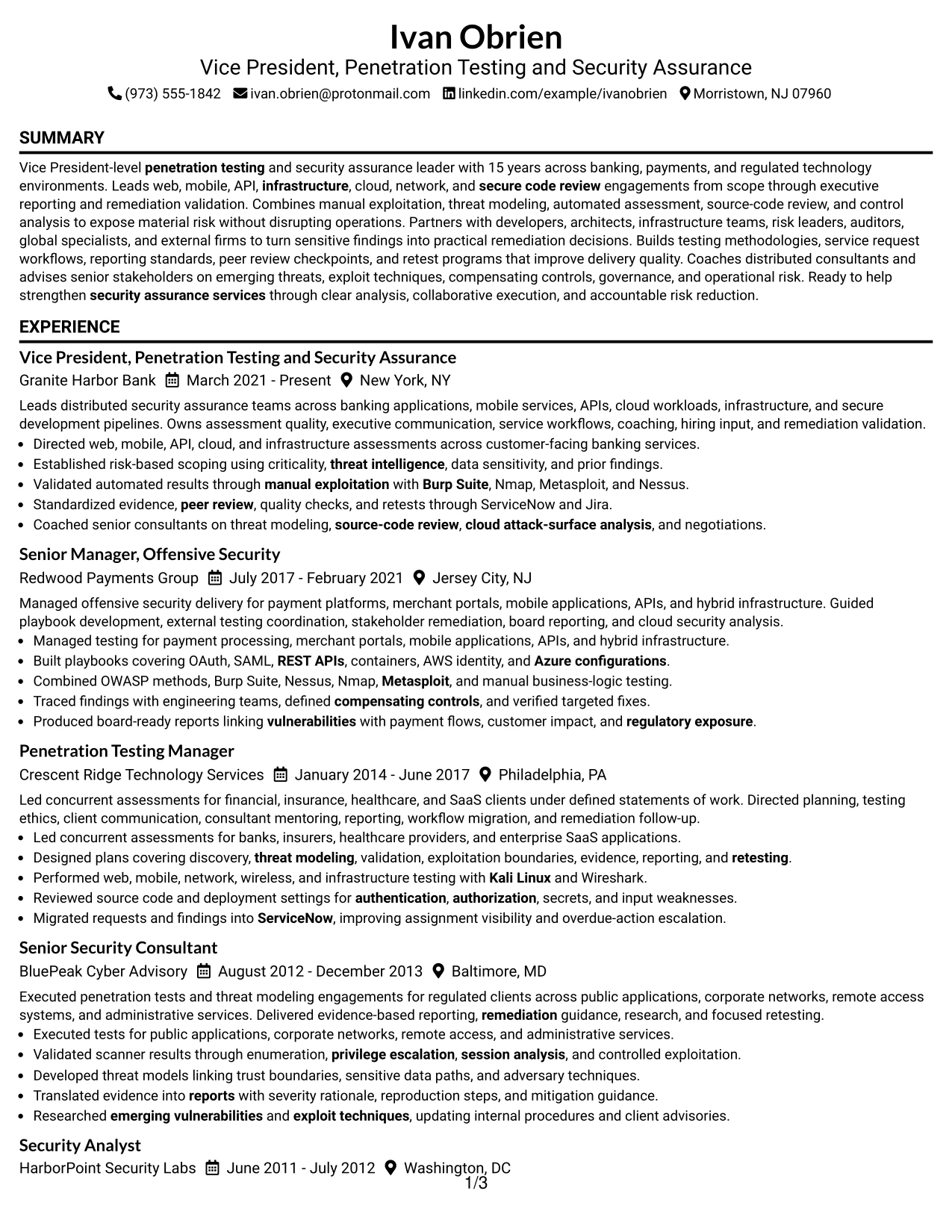
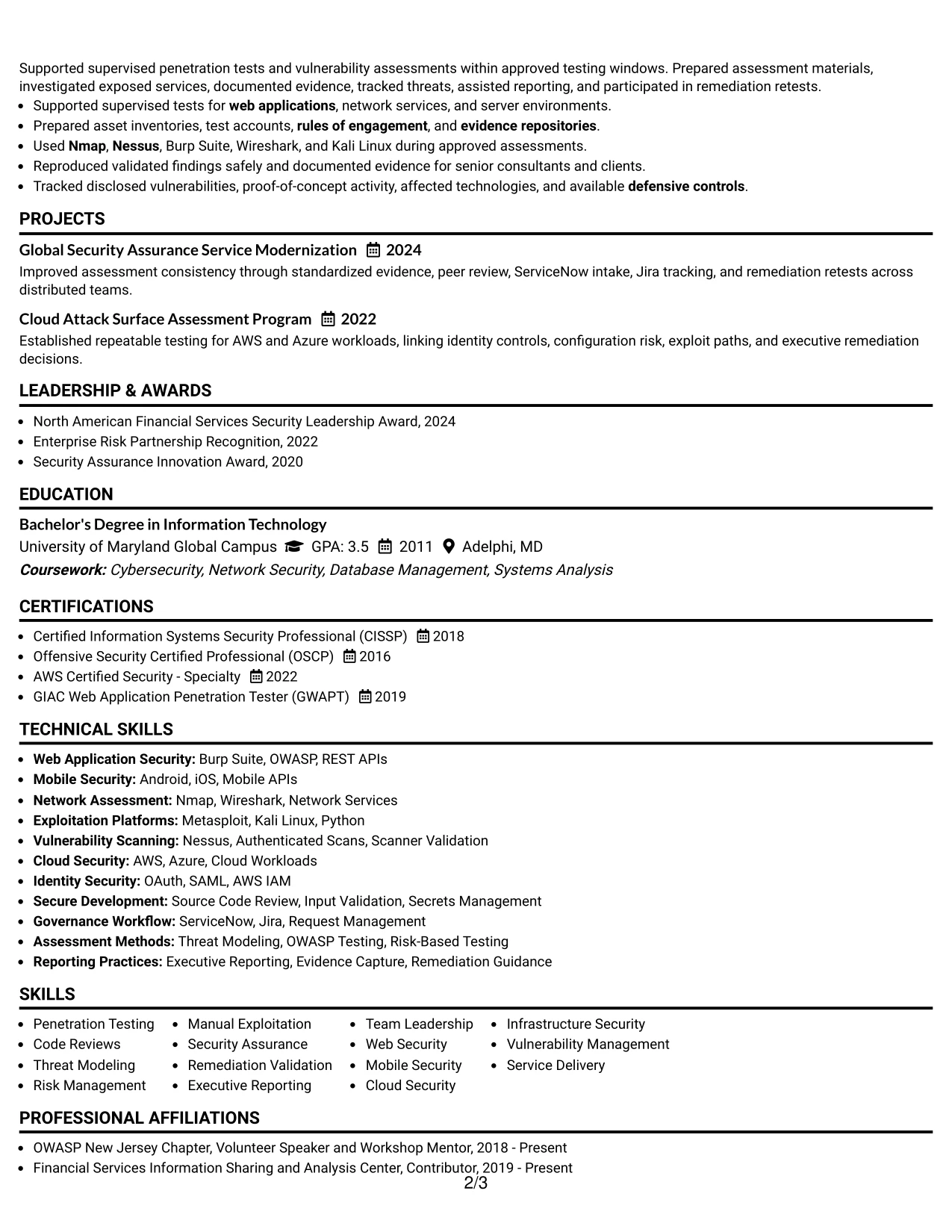
#14 Why the Minimal Header Format Works for a Resume
- The simple header keeps contact information and the target role easy to identify.
- A full-width summary can establish senior scope before detailed employment entries.
- One column gives complex assessment work enough horizontal space for clear bullets.
- Project entries can show service modernization and cloud attack-surface work without fragmentation.
- Skills remain searchable because they are not compressed into narrow side content.
- Certifications and education can be placed after experience in a familiar review order.
- The uncluttered presentation helps technical evidence remain the visual priority.
#14 Best For
- Resumes with a high volume of detailed experience bullets and project evidence.
- Applications where uninterrupted reading space matters more than decorative elements.
- Professionals who need to show several testing domains in full, readable lines.
- Documents that combine employment history with certifications, awards, and leadership activities.
- ATS-focused submissions using standard section order and clear text hierarchy.
- Senior candidates whose scope is best explained through a substantial summary and work record.
- Resume reviewers who prefer a quiet layout with minimal visual competition.
#15 Plain One Column with Shaded Labels Format Resume Example
Risk-based testing, manual exploitation, and remediation validation receive priority because they show how the resume addresses the target role's core work. Shaded labels then make sections such as Experience, Skills, Certifications, Projects, and Education easy to identify without interrupting the evidence.
The plain one-column design gives each achievement room to explain scope and method. It can present leadership of distributed teams alongside Burp Suite, Nmap, Metasploit, Nessus, AWS, Azure, ServiceNow, and Jira, helping both ATS systems and human reviewers connect keywords to actual assessment responsibilities.
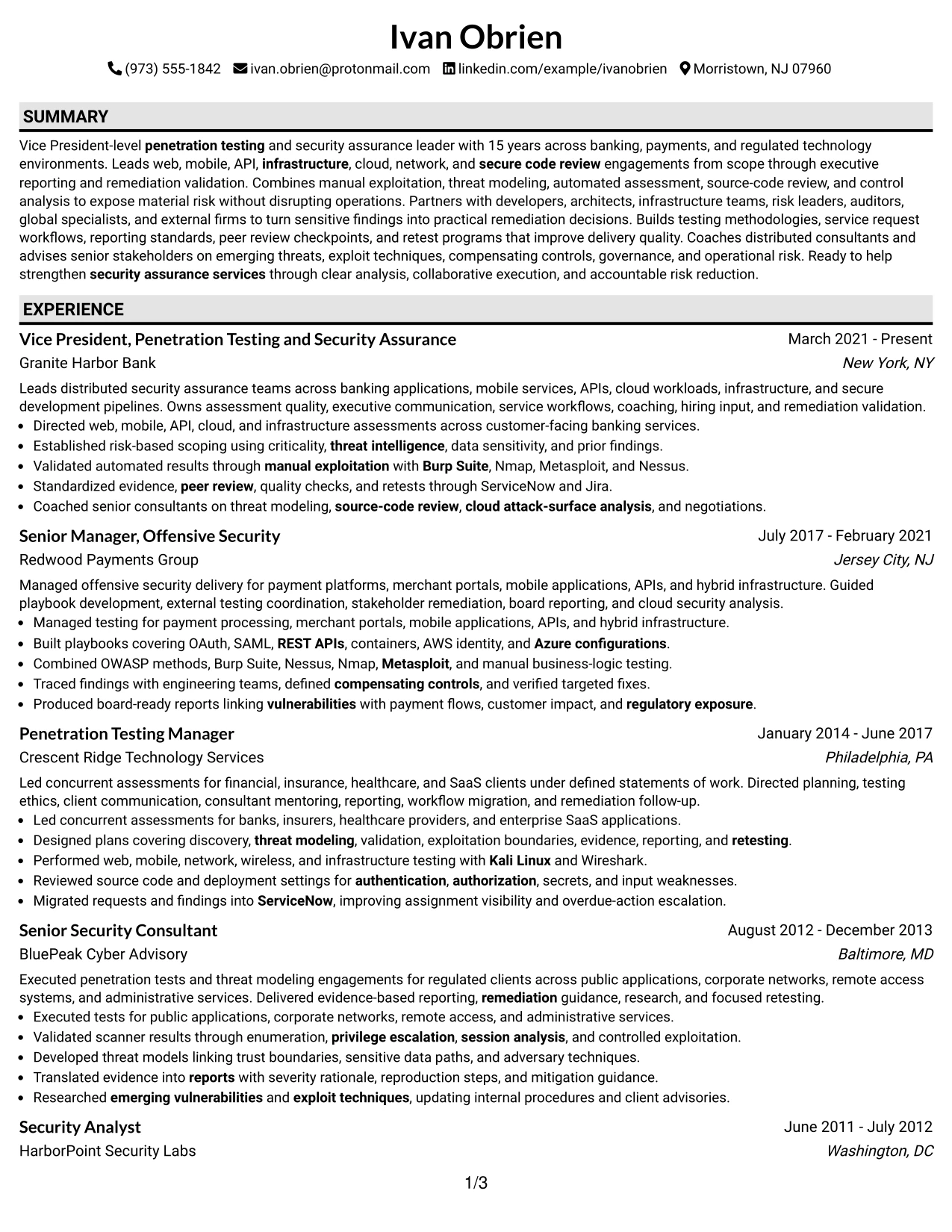
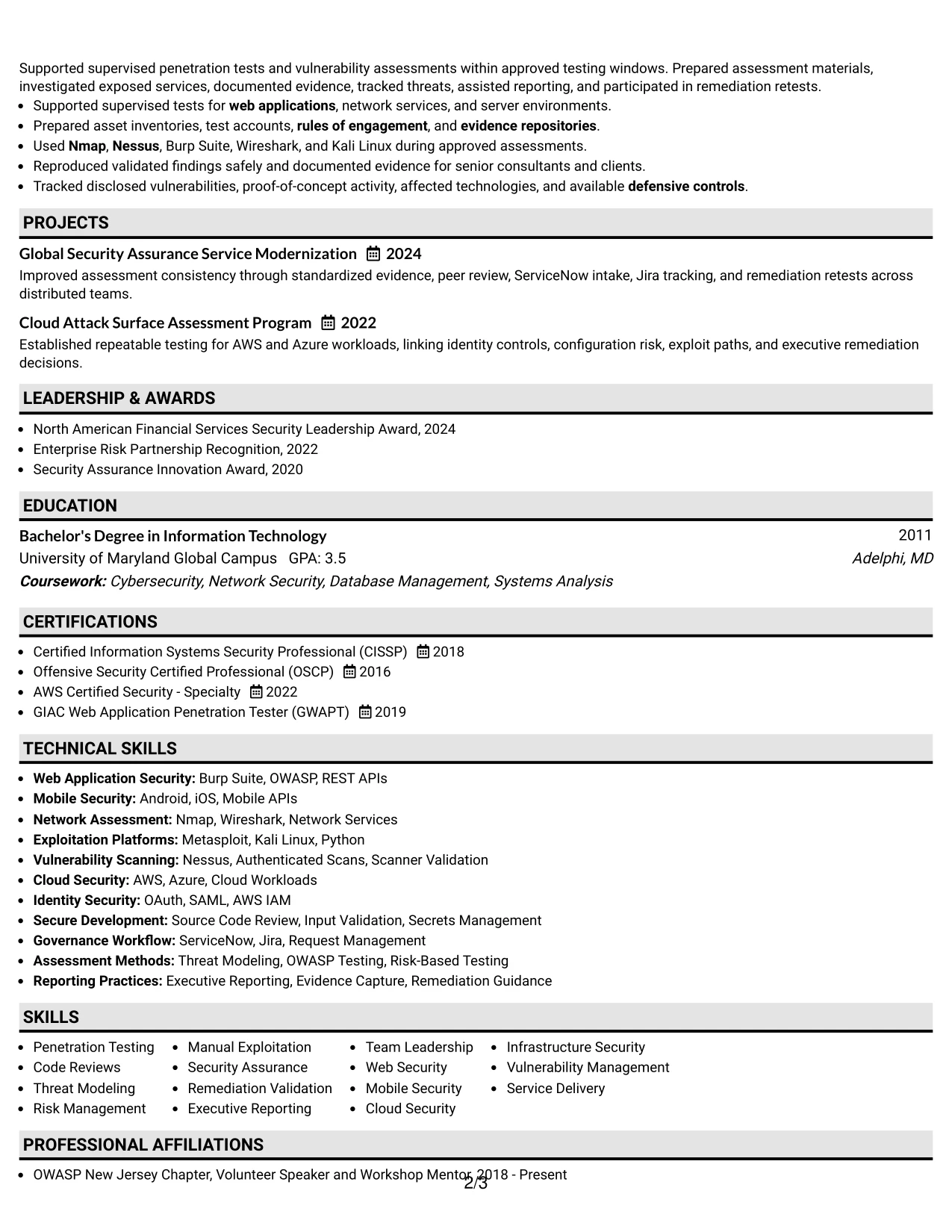
#15 Why the Plain One Column with Shaded Labels Format Works for a Resume
- The section labels create strong landmarks for fast resume review.
- Evidence-led bullets can explain assessment scope, testing methods, and stakeholder results.
- A single column reduces the risk that ATS tools will read content out of order.
- Technical tools appear beside relevant experience rather than as unsupported keyword lists.
- Leadership, coaching, and executive reporting can stand alongside hands-on testing evidence.
- Certifications and awards remain visible without competing with the main work history.
- The plain treatment supports credibility for banking and other regulated environments.
#15 Best For
- Resumes where documented testing evidence should lead the reader's review.
- Applications requiring dependable ATS section recognition and conventional text order.
- Professionals who need to connect tools with the assessments where they were used.
- Security resumes combining technical findings, remediation guidance, and governance work.
- Documents that benefit from clear labels for projects, certifications, and activities.
- Candidates presenting both individual assessment work and responsibility for team quality.
- Review settings where factual clarity is more important than decorative styling.
#16 Text/Fang Style Resume Example
Content is balanced through generous text space and a consistent one-column sequence, giving each section a clear role in the application. The reader can follow the summary into experience, projects, skills, certifications, education, and leadership activities without a competing side structure.
This makes the format useful for a practical application to a senior penetration testing role. Detailed bullets can cover web, mobile, API, cloud, network, and infrastructure assessments, while separate project and certification entries show service modernization, cloud security, CISSP, OSCP, AWS security, and GWAPT credentials.
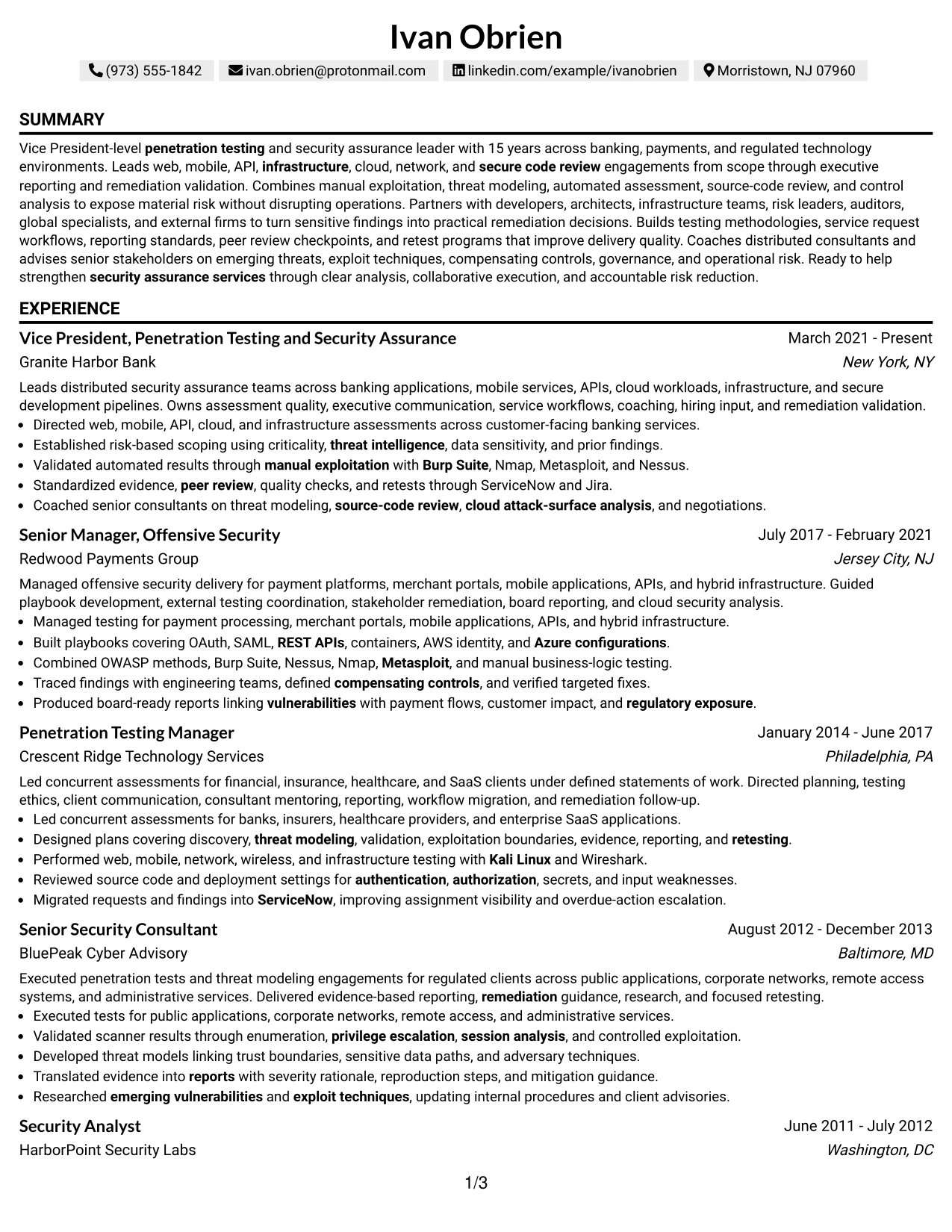
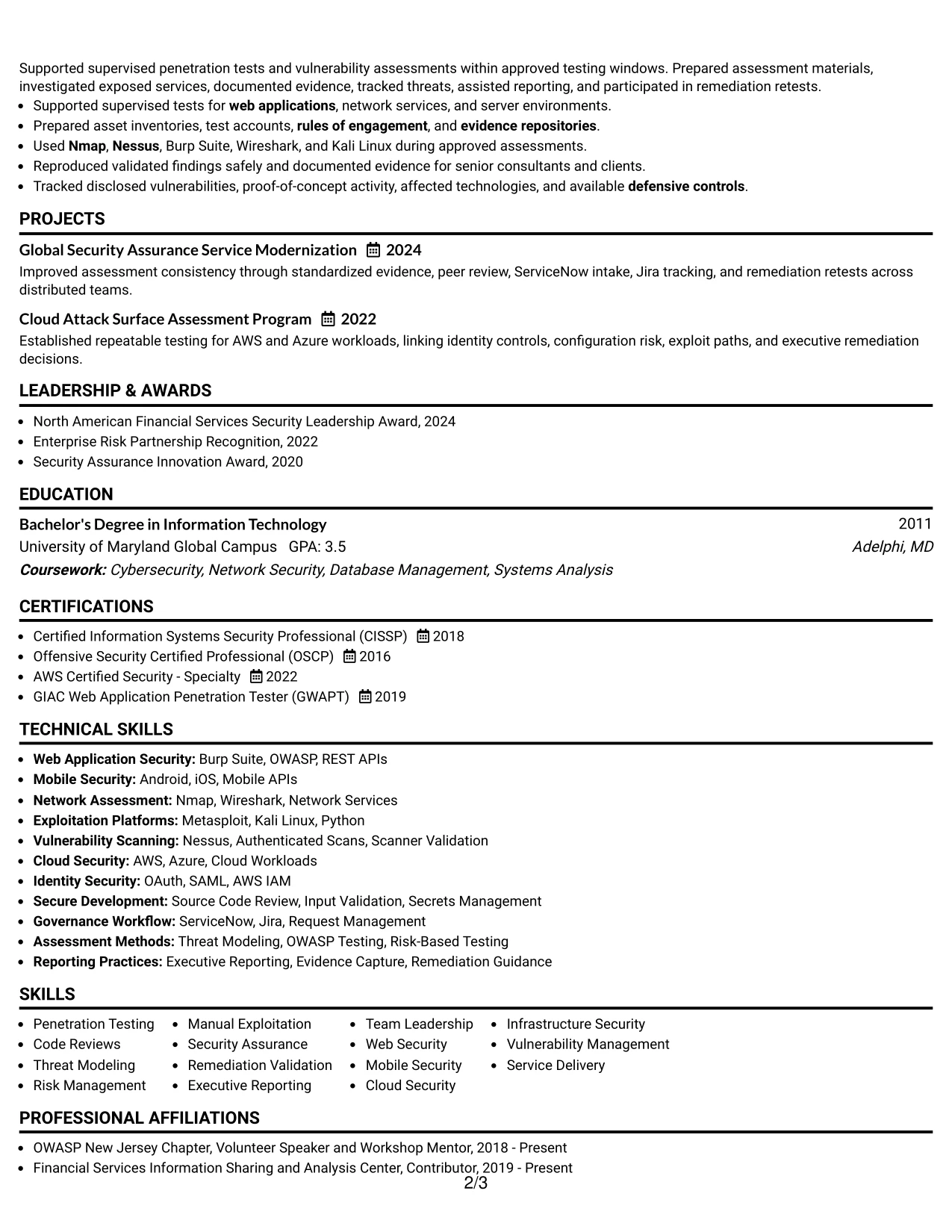
#16 Why the Text/Fang Style Works for a Resume
- The open text structure accommodates detailed professional history.
- A continuous column keeps technical terms in a dependable reading order.
- Separate project entries can explain modernization and cloud assessment programs.
- Experience bullets have room to distinguish manual testing from automated assessment.
- Skills and certifications can be reviewed without squeezing the employment record.
- Leadership activities add professional context after the core qualifications.
- The format works well when evidence volume is more important than visual complexity.
#16 Best For
- Applications that require a detailed account of assessment planning, execution, and reporting.
- Professionals whose projects deserve space alongside employment history.
- Resumes combining technical testing with coaching, research, and service improvement.
- Submissions where a straightforward text sequence supports both ATS review and human reading.
- Candidates who need room for multiple certifications and specialized security methods.
- Roles that value documented work across web, mobile, API, cloud, and infrastructure environments.
- Resume versions built for careful review rather than rapid visual browsing alone.
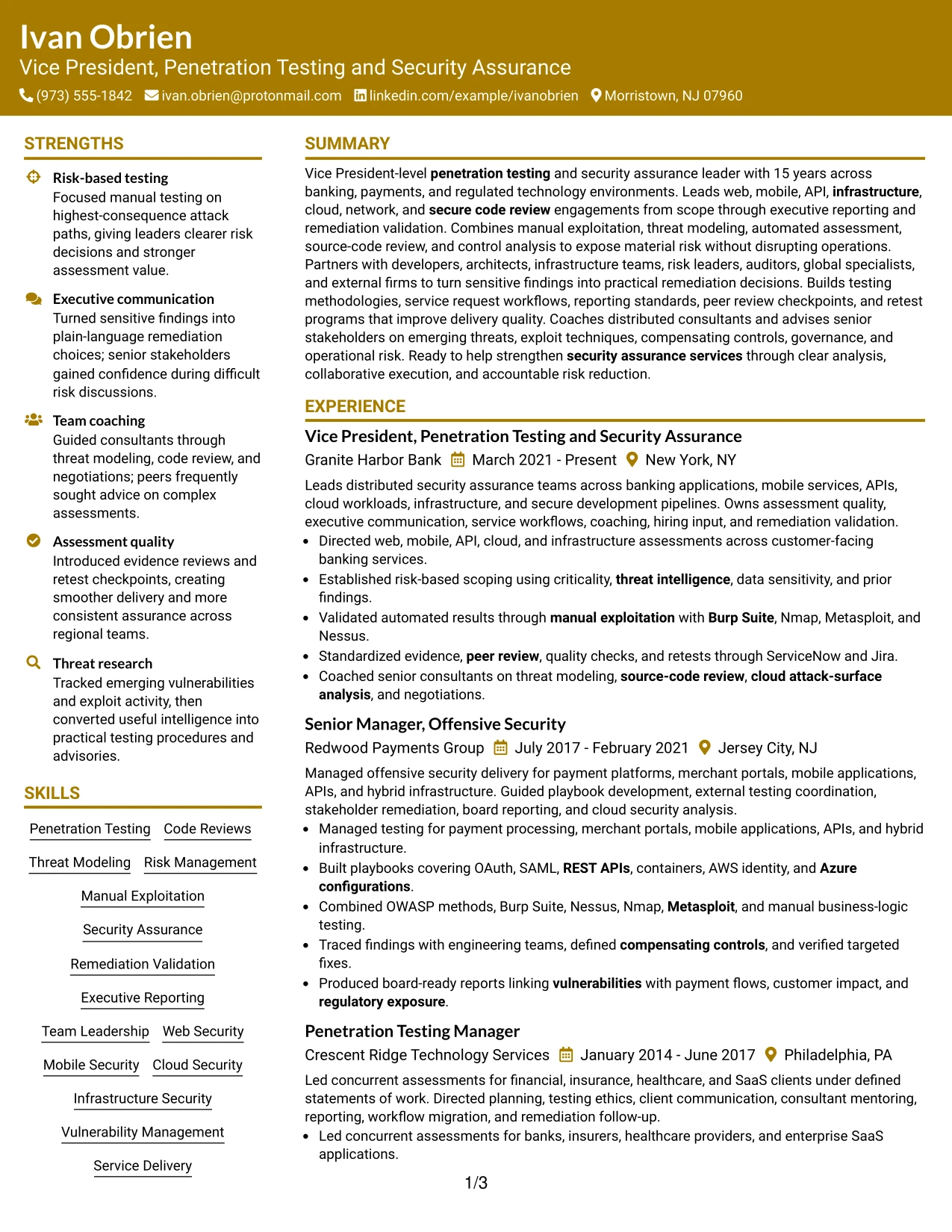
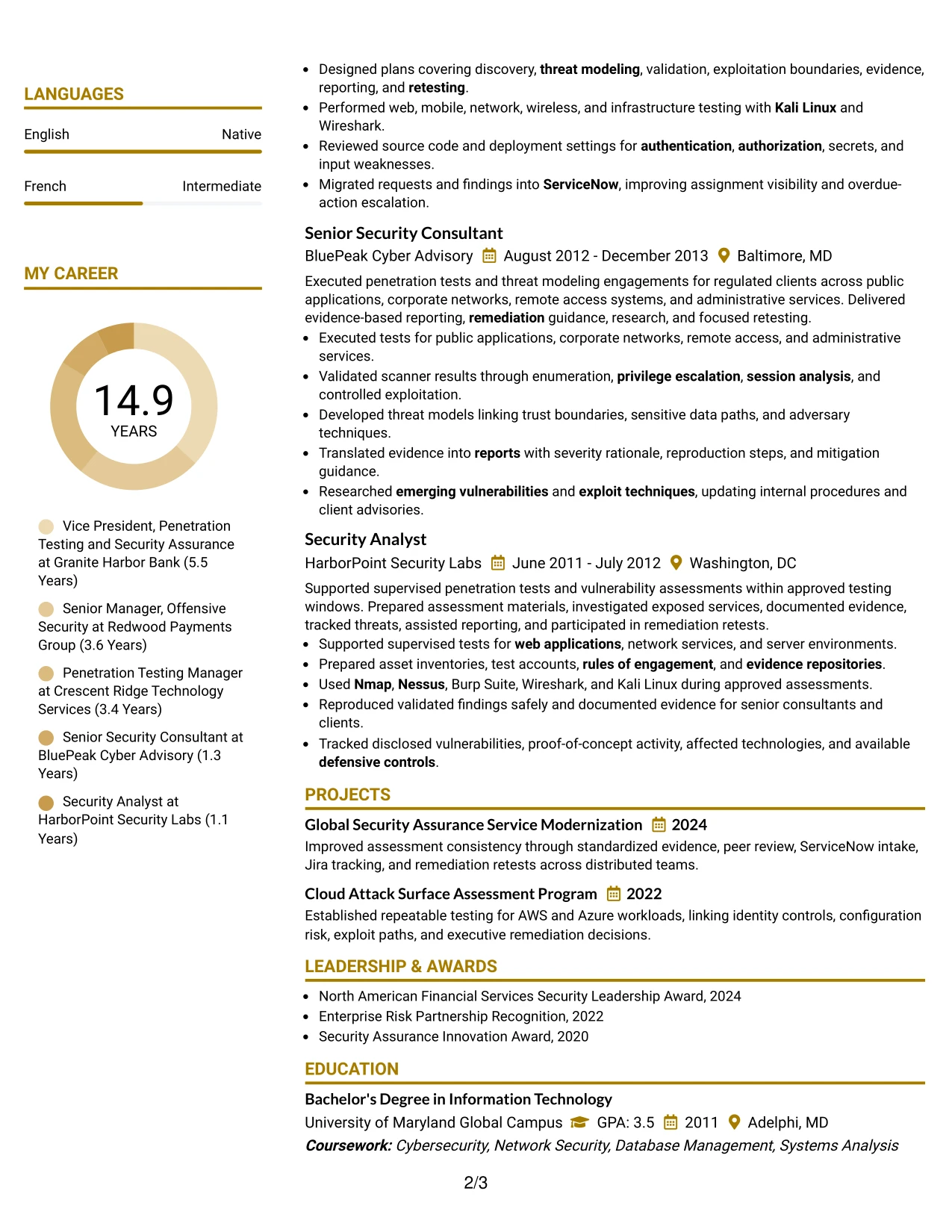
#17 Bold Color Header Professional Format Resume Example
For a senior application, a strong header can establish the target function and professional identity before the reader reaches the work history. The rest of the page should remain controlled, using the color accent to guide attention while keeping experience bullets, skills, certifications, and projects readable.
The format fits a resume that must show both strategic influence and technical credibility. A focused summary can lead into evidence of risk-based scoping, manual exploitation, source-code review, threat research, executive reporting, team coaching, and service workflow improvement for Northbridge Financial Services.
#17 Why the Bold Color Header Professional Format Works for a Resume
- The header creates a clear entry point for the target role and professional summary.
- A restrained accent helps important section boundaries stand out.
- The main body can carry detailed evidence without relying on visual effects.
- Leadership and technical testing can be presented as complementary qualifications.
- Keywords for security assurance, cloud, APIs, and remediation remain easy to locate.
- Projects and awards can reinforce innovation and enterprise risk partnership.
- The professional treatment suits applications where executive presence matters.
#17 Best For
- Applications that benefit from a confident first impression and a disciplined body layout.
- Senior professionals presenting both enterprise influence and hands-on technical depth.
- Resumes where a strong header should identify the role before the evidence begins.
- Candidates with projects, awards, and leadership activities that need clear supporting sections.
- Documents requiring visible keywords without turning the page into a dense skills grid.
- Security assurance submissions that pair strategic initiatives with assessment delivery.
- Reviewers who value a professional accent but still expect conventional resume mechanics.
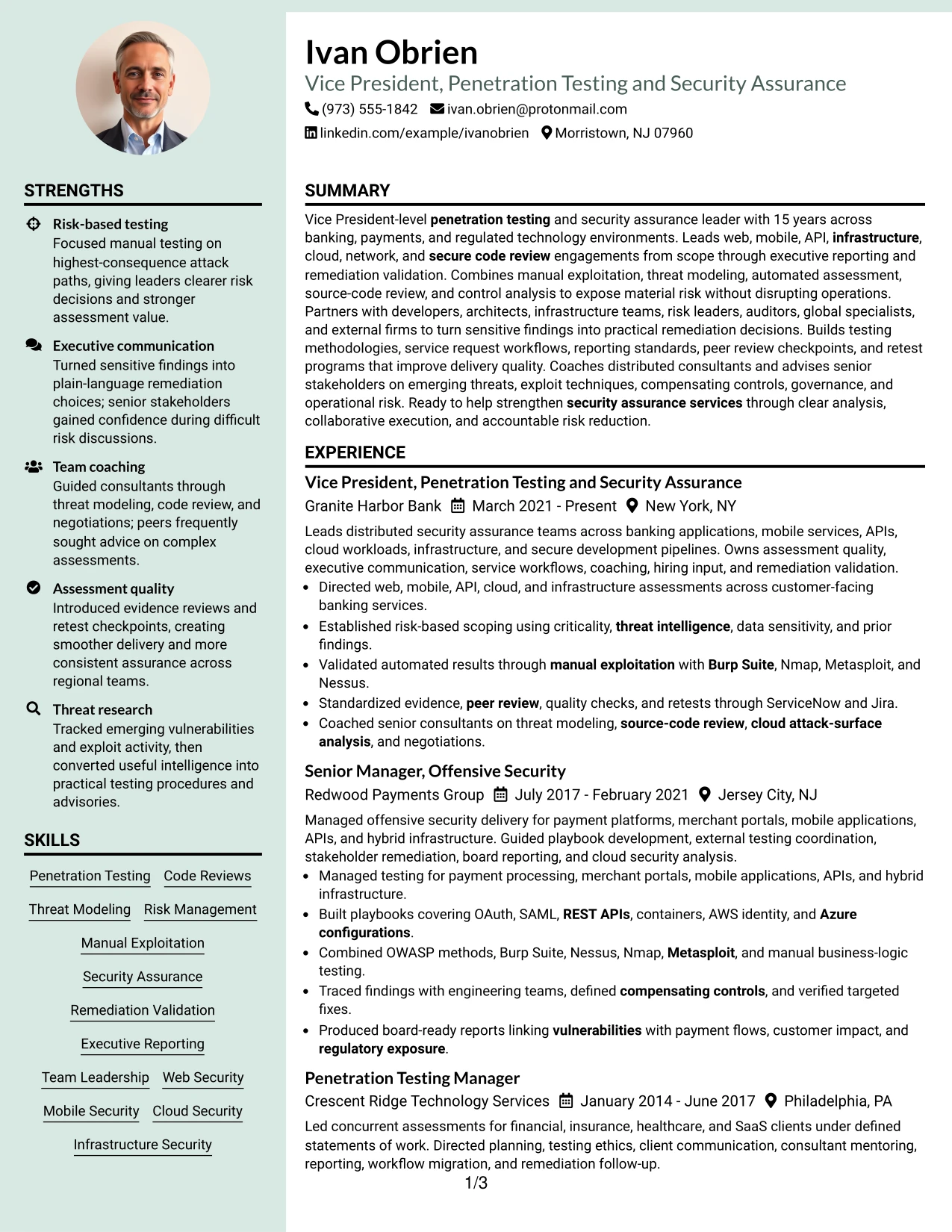
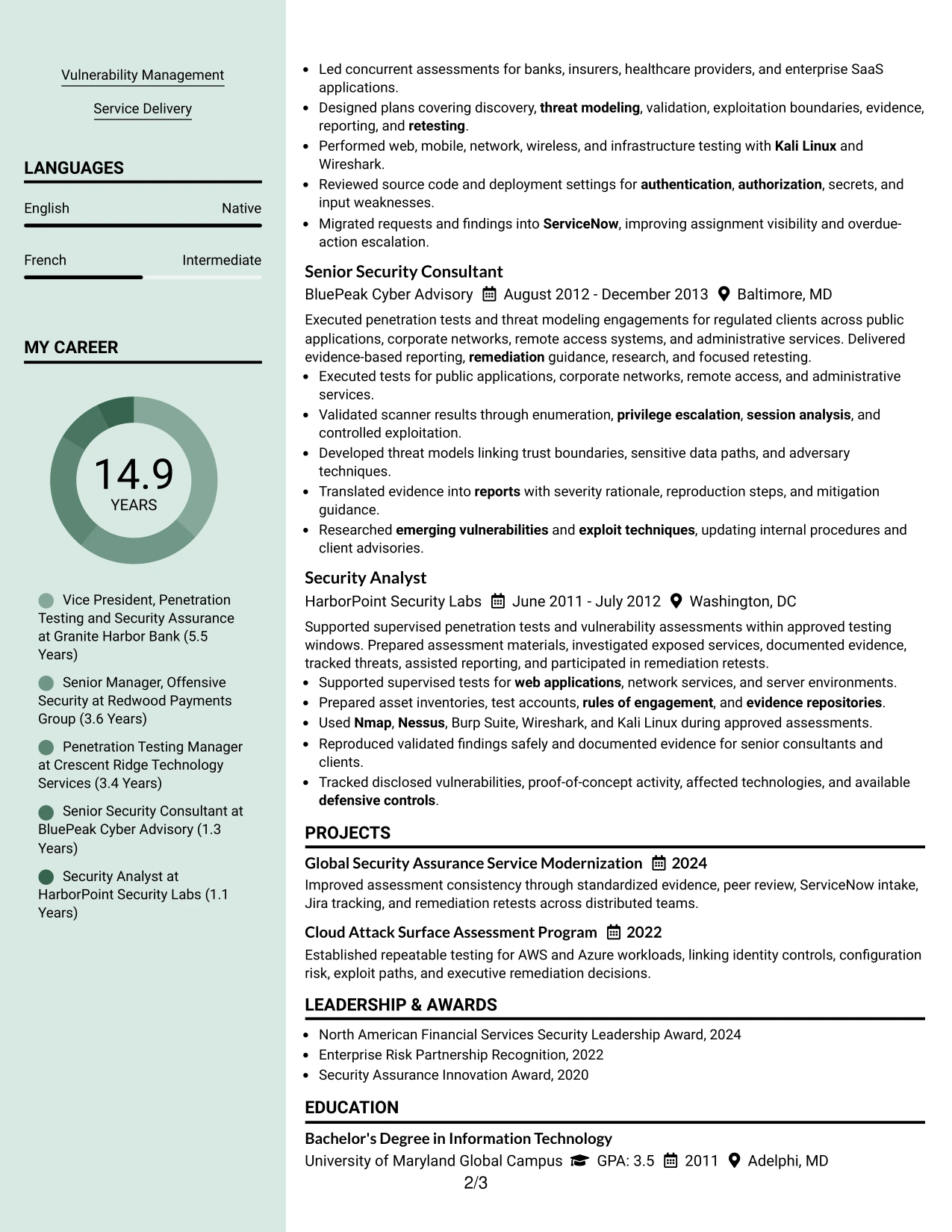
#18 Photo Header Color Sidebar Format Resume Example
A restrained color sidebar and photo header create a distinct visual identity, while the main content should preserve a clear sequence for experience, skills, projects, certifications, and education. The visual elements work best when they support recognition without taking attention away from assessment evidence.
For this profile, the main column can carry leadership of banking and payments assessments, while the sidebar surfaces certifications, tools, and focus areas. The arrangement helps the reader connect penetration testing, cloud security, secure code review, threat modeling, and remediation validation with the Vice President-level scope.
#18 Why the Photo Header Color Sidebar Format Works for a Resume
- The photo header gives the document a recognizable personal presentation where appropriate.
- A sidebar can hold certifications, selected tools, and concise skills without interrupting experience bullets.
- The main content area supports detailed evidence about assessments and leadership.
- Color helps distinguish supporting qualifications from the central career record.
- The layout can show both regulated-industry experience and technical breadth.
- Projects and awards can reinforce innovation and security assurance leadership.
- The format is most effective when the visual treatment remains secondary to readable resume content.
#18 Best For
- Applications where a personal visual identity is accepted and useful for recognition.
- Professionals who want supporting credentials separated from detailed experience evidence.
- Resumes that need a sidebar for certifications, tools, and focused capability labels.
- Candidates presenting a blend of executive responsibility and hands-on security assessment work.
- Documents where color can guide navigation across a substantial professional record.
- Roles that value a polished presentation alongside clear technical and leadership evidence.
- Resume contexts with enough content to benefit from a distinct main column and supporting panel.
#19 Top Left Header Color Accent Format Resume Example
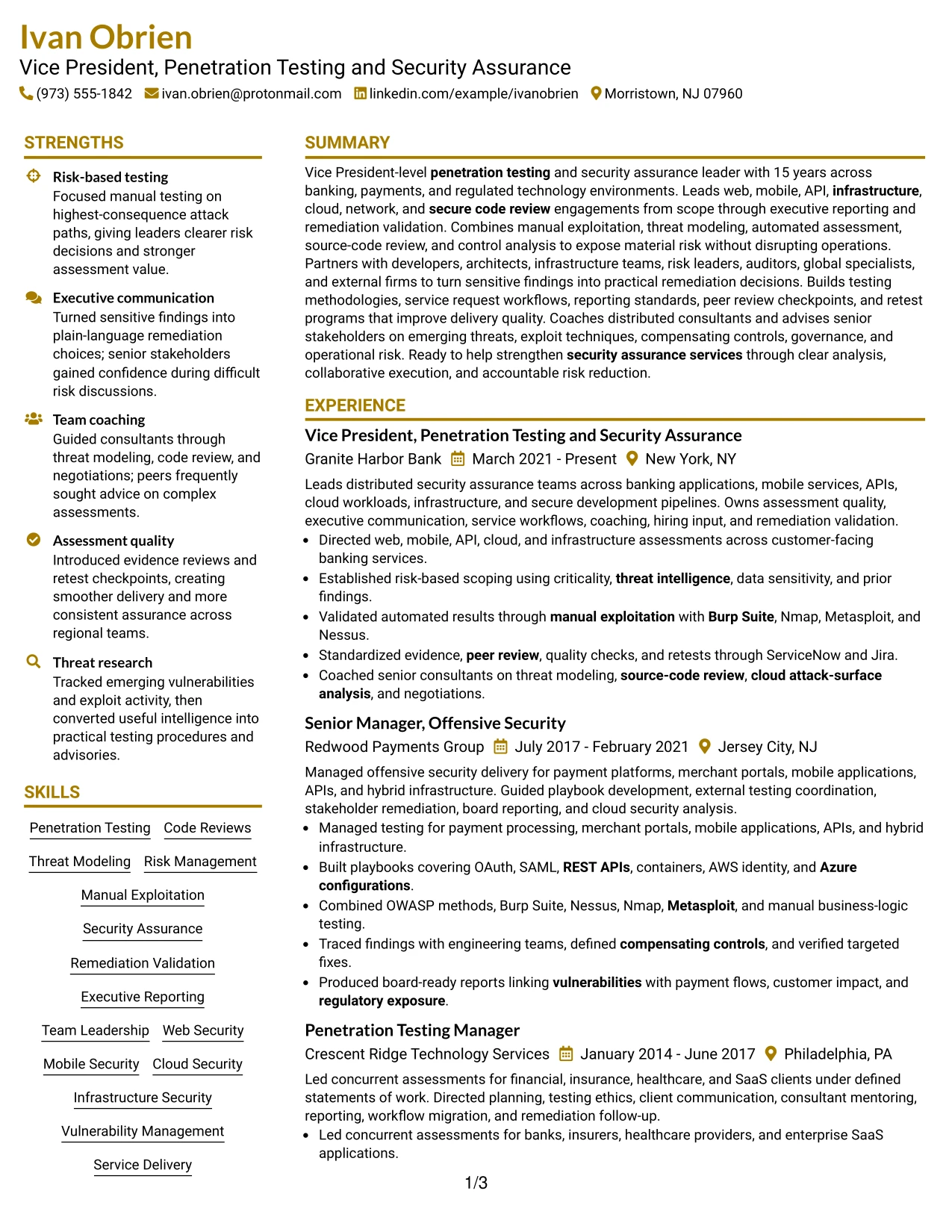
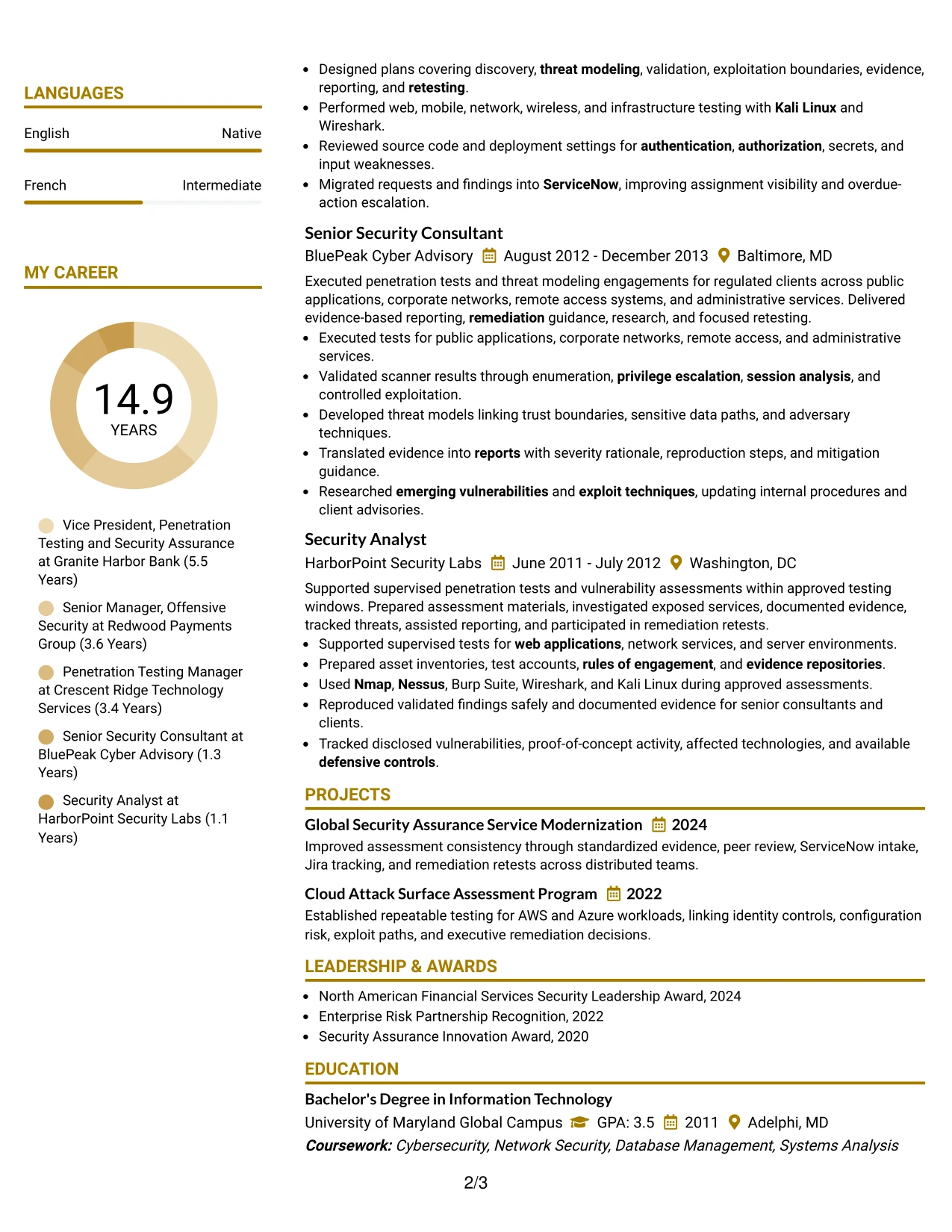
The Top Left Header Color Accent Format establishes the professional identity at the upper left, then moves through the resume in a familiar single-column order. A limited accent can separate the header and section labels while leaving the body available for readable bullets and ATS-friendly keywords.
That sequence works well for a penetration testing and security assurance resume with broad technical coverage. It allows experience to lead, followed by skills, tools, projects, certifications, education, and activities, so evidence of assessment delivery and enterprise risk communication remains connected to the relevant terms.
#19 Why the Top Left Header Color Accent Format Works for a Resume
- The top-left entry point supports fast identification of the candidate's role and contact details.
- One-column organization keeps sections in a dependable ATS reading order.
- A modest accent makes headings visible without overpowering the content.
- Experience bullets can show both assessment execution and service improvement.
- Tools and methods can be grouped after the work record for quick verification.
- Projects and certifications extend the evidence without creating a complicated page structure.
- The format supports a professional presentation with limited visual distraction.
#19 Best For
- One-column submissions that need a clear upper-left starting point for review.
- Applications where consistent section order is important for ATS and recruiter scanning.
- Professionals with broad technical coverage that should remain in one readable stream.
- Resumes pairing assessment delivery with workflow, reporting, and governance improvements.
- Candidates who prefer a controlled color accent rather than a highly graphic design.
- Documents that need room for projects and certifications after detailed experience.
- Review processes that move quickly from role identification to evidence and keywords.
#20 Centered Header Classic Two Column Format Resume Example
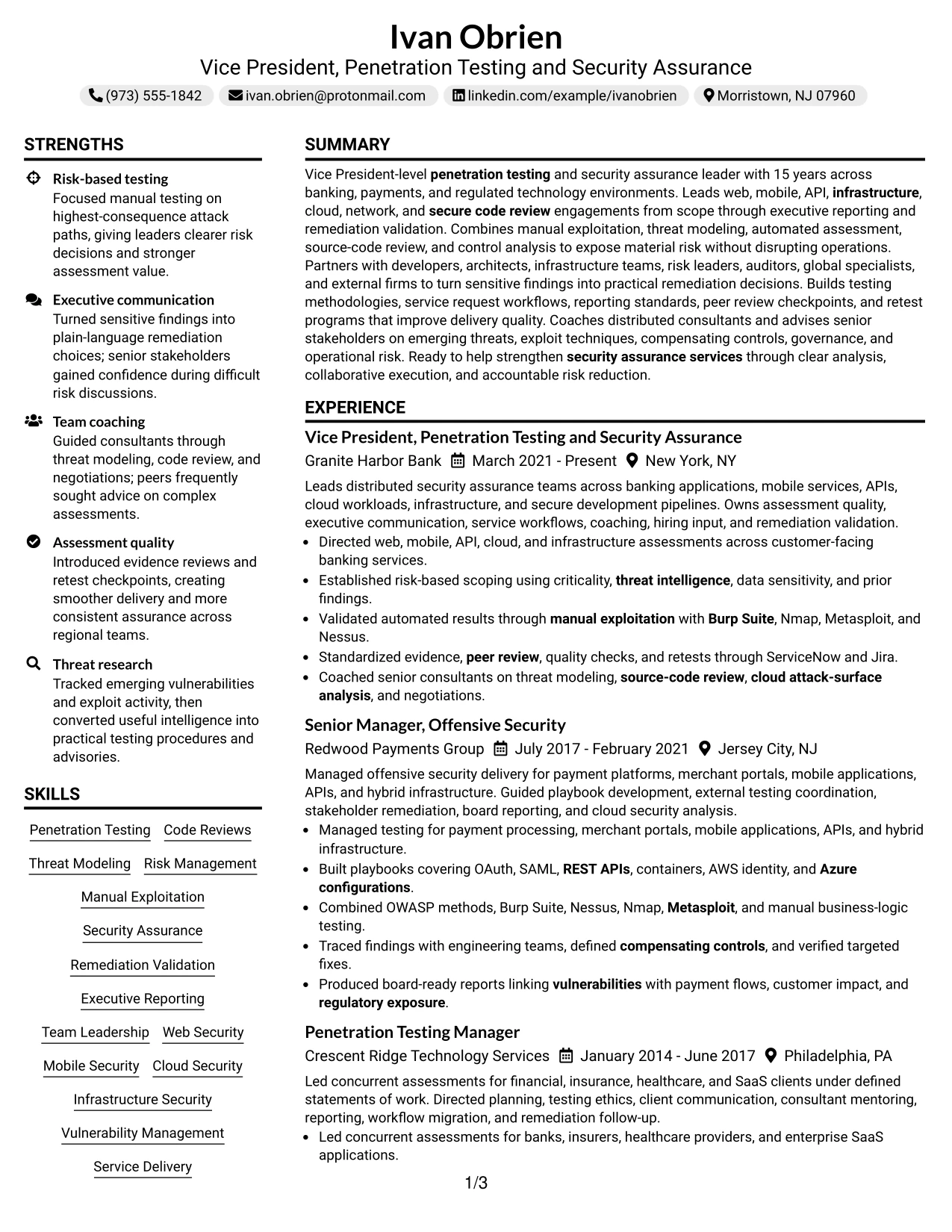
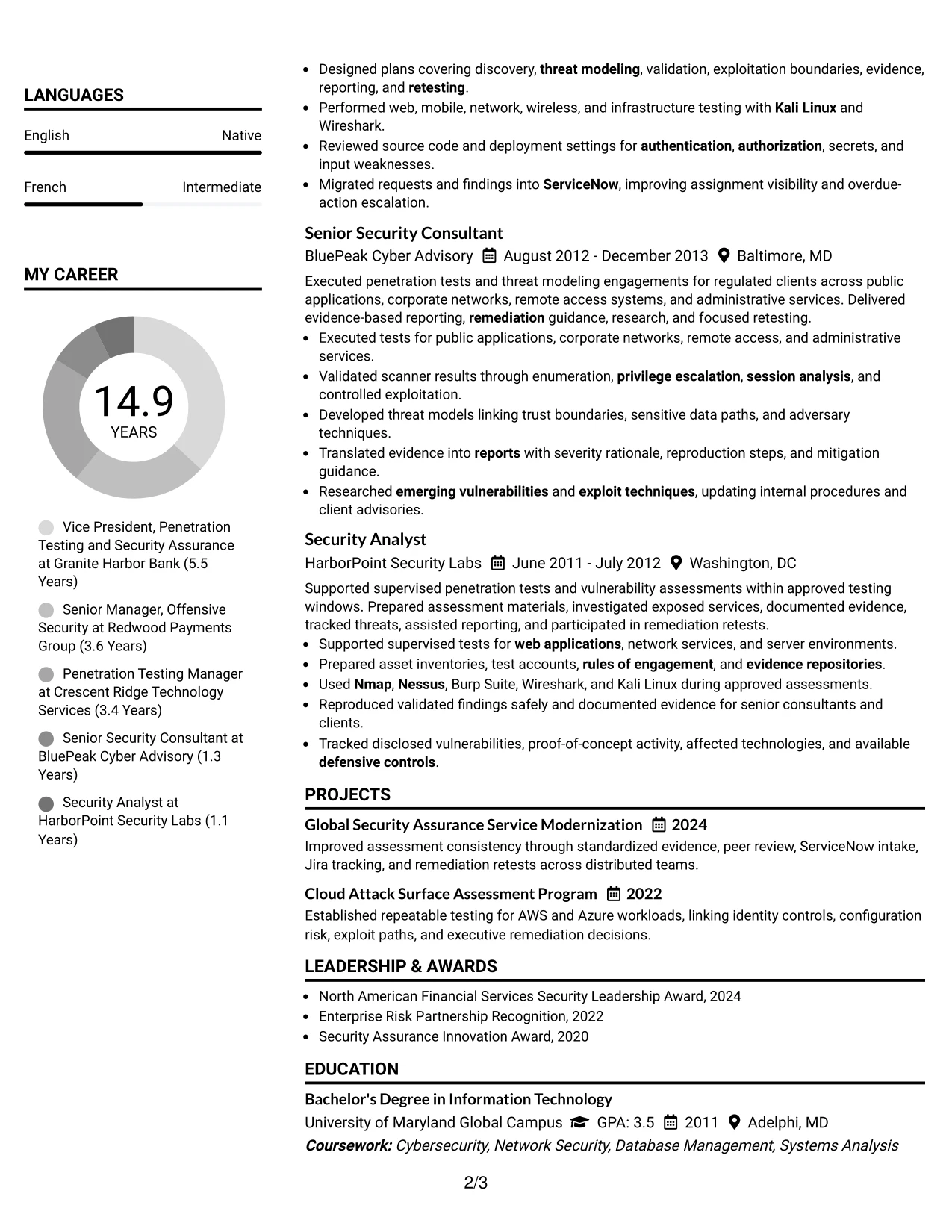
Readers can begin with the centered header, move into the summary, and then scan the two columns for experience, skills, certifications, projects, and education. This navigation pattern is useful when a resume contains substantial technical detail but still needs a compact way to display supporting qualifications.
Ivan Obrien's resume content fits that structure because the employment record carries extensive assessment evidence, while a secondary column can surface tools, credentials, awards, and leadership activities. Bullets can remain focused on scope, methods, findings, reporting, and remediation rather than repeating keyword lists.
#20 Why the Centered Header Classic Two Column Format Works for a Resume
- The centered header gives the document a balanced and formal starting point.
- Two columns allow supporting qualifications to remain visible beside experience.
- Classic bullet treatment makes assessment responsibilities easy to scan.
- Technical tools can be grouped without displacing leadership and results.
- Projects and awards can provide additional evidence in a compact area.
- The summary can bridge executive responsibility and hands-on security testing.
- The structure suits a resume with a broad record and many relevant credentials.
#20 Best For
- Resumes with extensive experience that need a compact supporting-information area.
- Applications where a formal centered header suits the level of responsibility presented.
- Professionals balancing detailed work history with tools, certifications, and activities.
- Documents that use bullets to separate assessment scope, methods, and communication work.
- Candidates whose projects and awards should remain visible during a rapid scan.
- Security resumes that need to show breadth without making every section full width.
- Reviewers comfortable with a conventional two-column arrangement and clear bullet evidence.
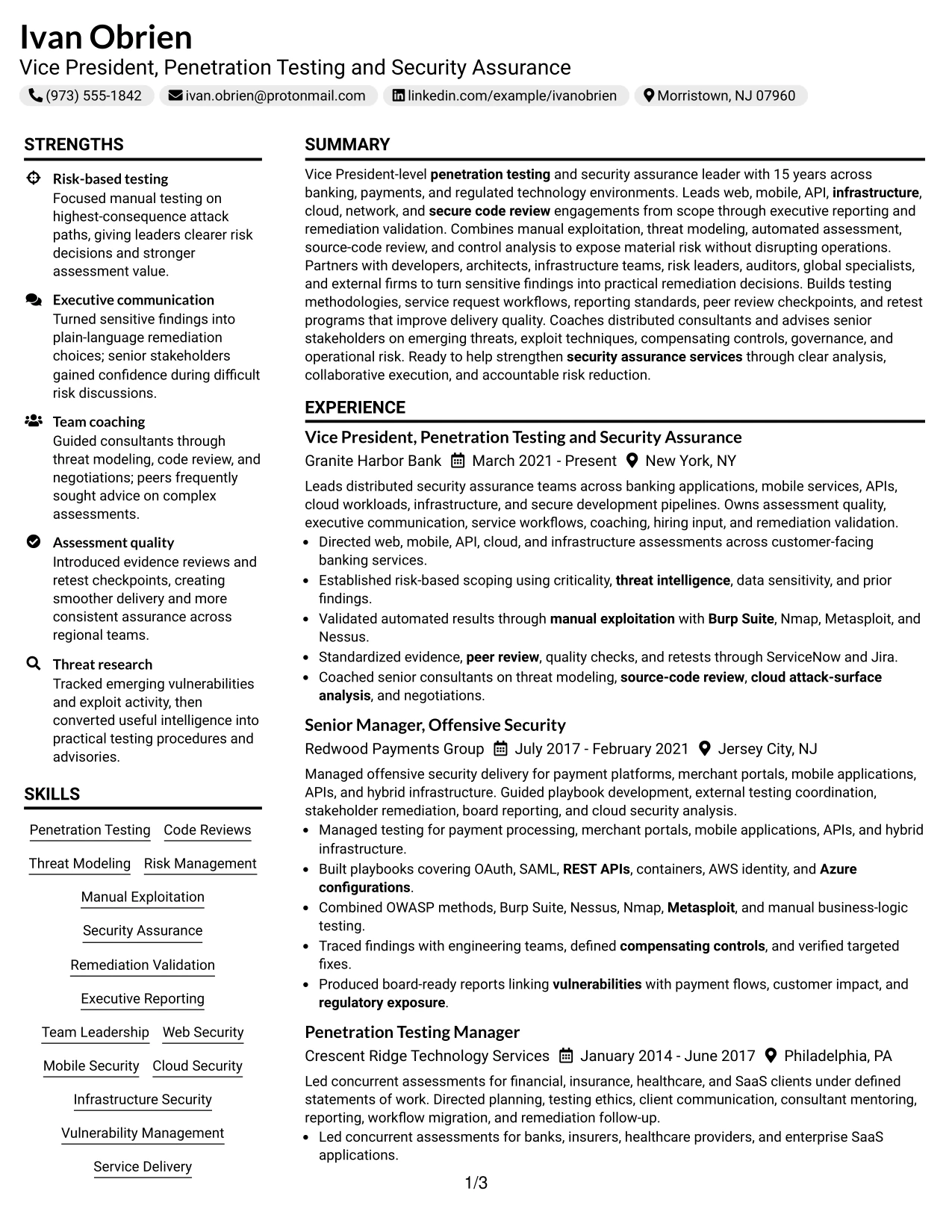
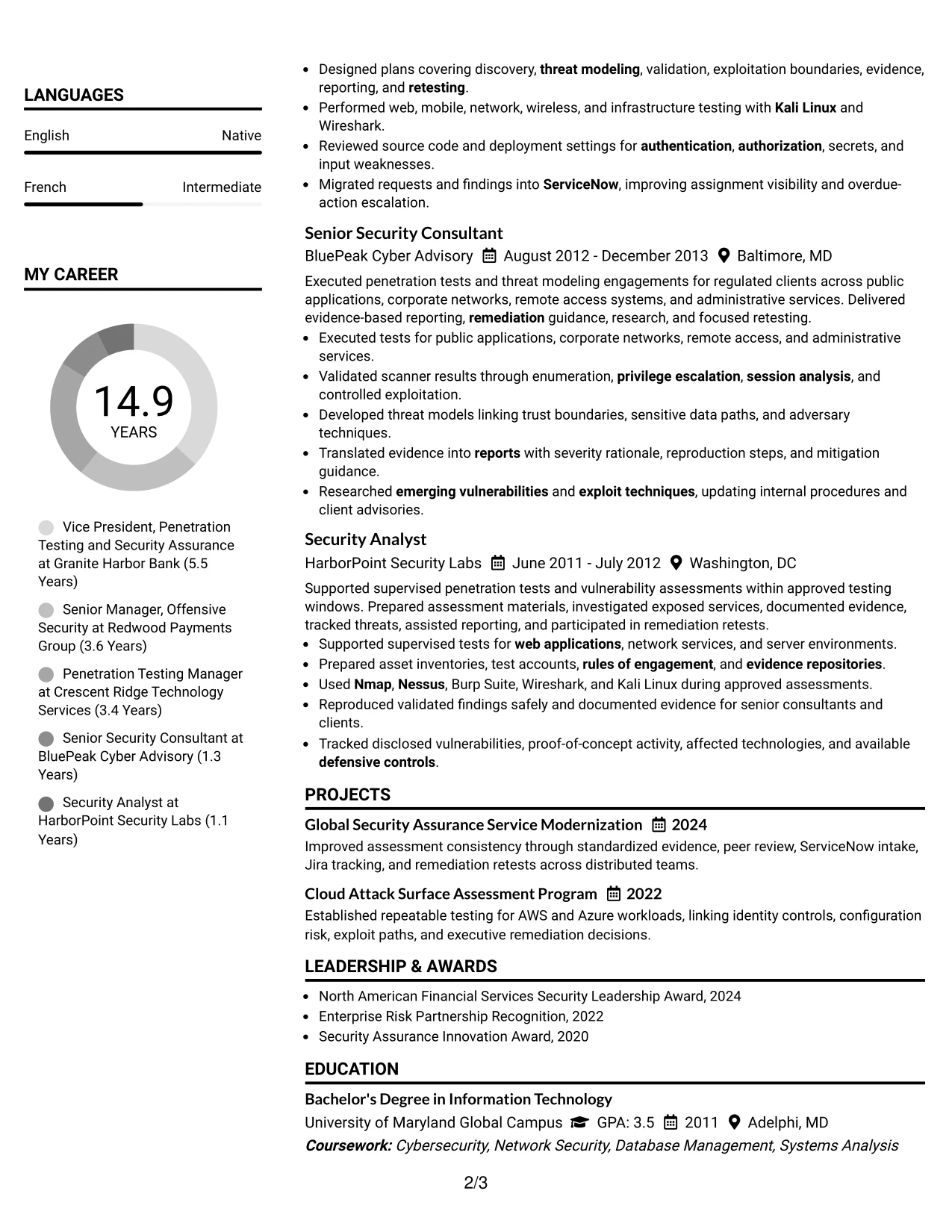
#21 Left Aligned Header Clean Two Column Format Resume Example
Validated findings, remediation guidance, and leadership evidence receive priority in this clean two-column arrangement. The left-aligned header creates a direct starting point, while the columns let the main work record and supporting qualifications remain visible at the same time.
The format can show how penetration testing work moves from scoping and exploitation to executive reporting and retesting. A focused experience column carries banking, payments, cloud, mobile, API, and infrastructure assessments; the companion column organizes skills, certifications, projects, awards, and professional activities.
#21 Why the Left Aligned Header Clean Two Column Format Works for a Resume
- The left-aligned header begins the review with direct, familiar navigation.
- A clean column split keeps evidence and supporting qualifications distinct.
- Bullets can prioritize validated findings, controls, and remediation actions.
- The layout supports both technical detail and leadership responsibilities.
- Certifications and tools can be scanned without interrupting the employment timeline.
- Projects and awards add proof of service improvement and security assurance innovation.
- The design remains professional while giving a broad resume efficient structure.
#21 Best For
- Applications where remediation evidence should appear prominently in the work record.
- Professionals who need separate spaces for experience and supporting technical qualifications.
- Resumes covering several environments, including banking, payments, cloud, and infrastructure.
- Candidates presenting findings, controls, reporting, and retesting as connected work.
- Documents where certifications and tools must be visible without a long skills block.
- Security assurance submissions that include both delivery responsibility and improvement programs.
- Reviewers seeking a clean two-column format with direct evidence near the top.
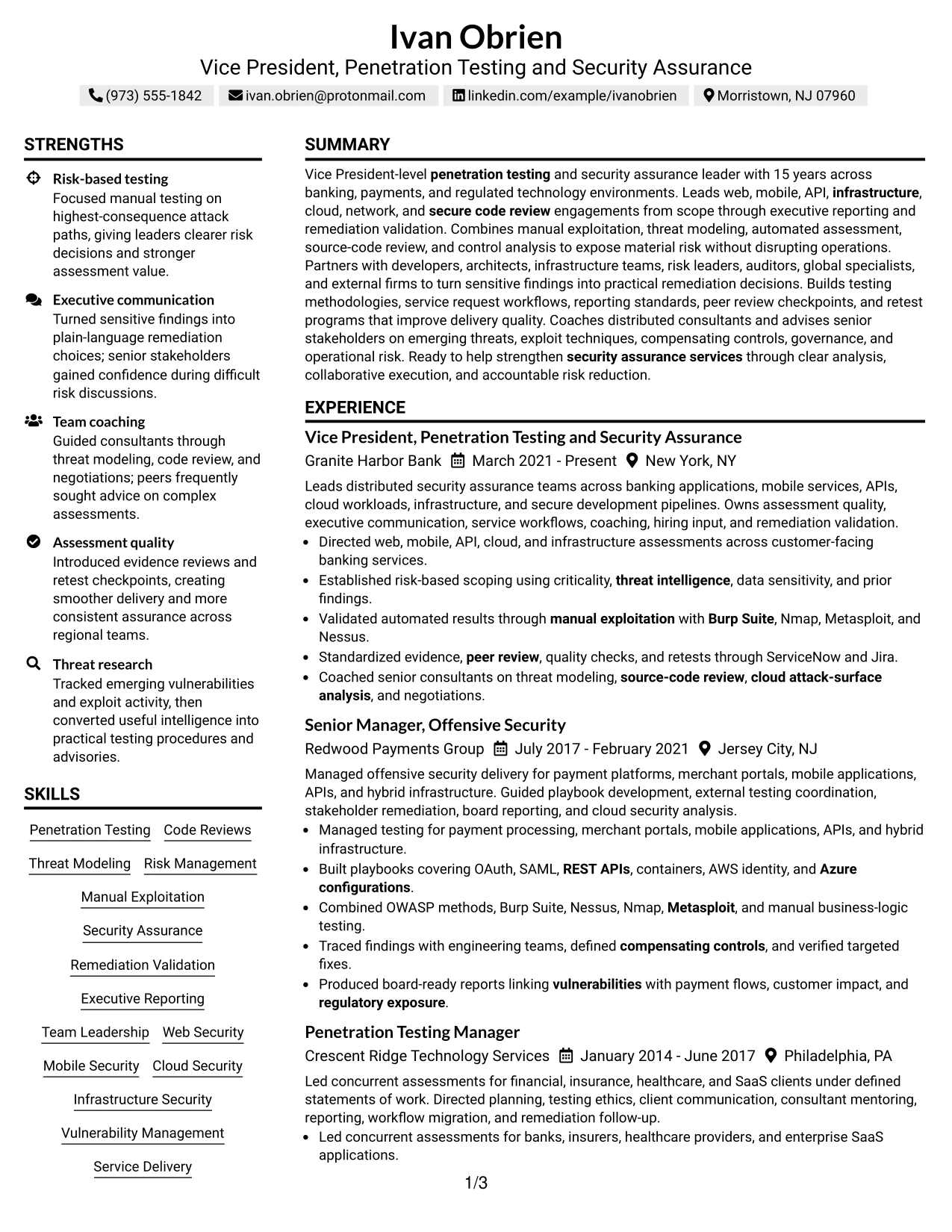
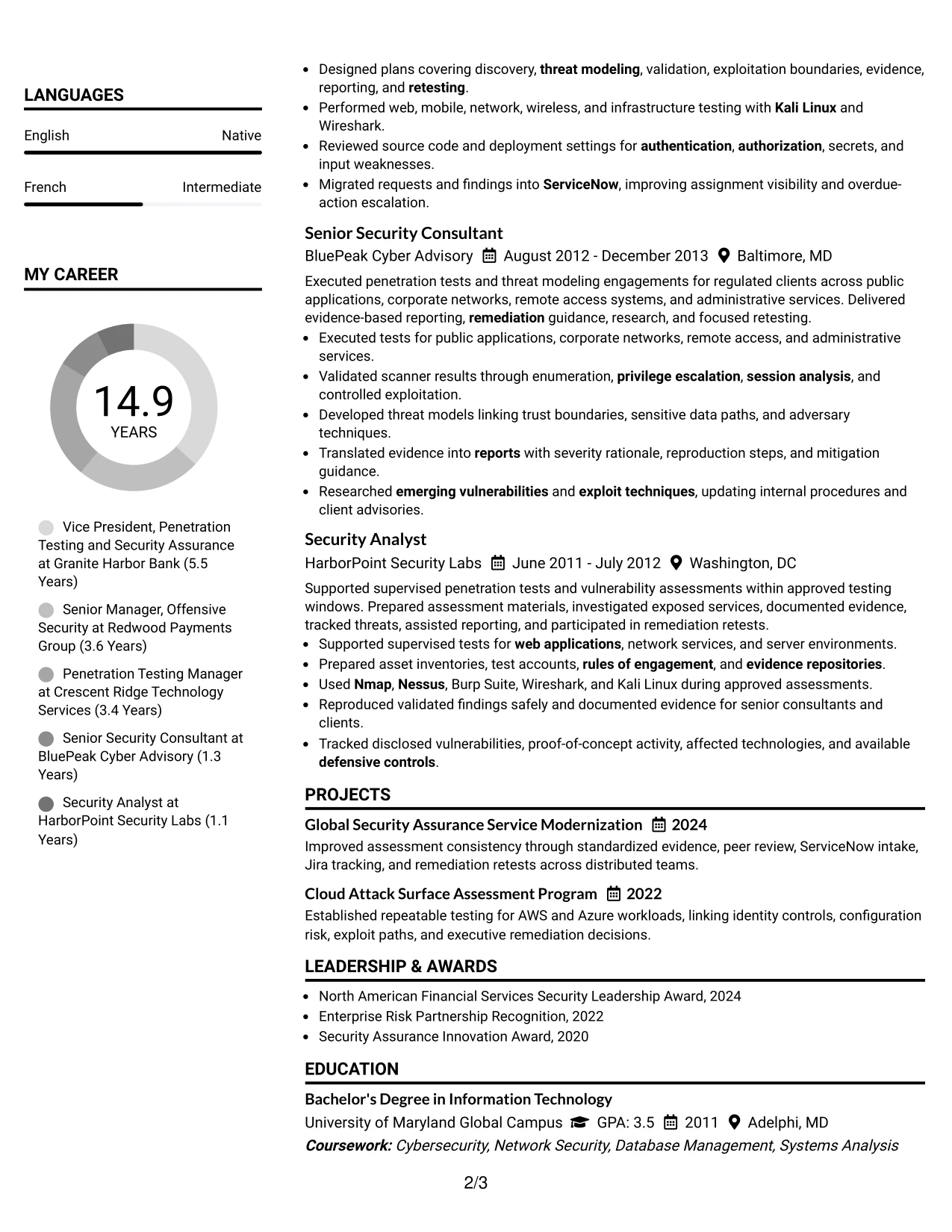
#22 Simple Two Column Format Resume Example
Content is balanced between a substantial experience column and a compact area for skills, certifications, projects, and education. The simple two-column structure prevents supporting details from crowding the main record while keeping the full application practical to review.
For a Vice President, Penetration Testing and Security Assurance resume, this balance supports both application readiness and technical depth. The main section can explain risk-based assessments, manual exploitation, team leadership, and stakeholder reporting, while the secondary section reinforces tools, credentials, awards, and security assurance initiatives.
#22 Why the Simple Two Column Format Works for a Resume
- The balanced columns create a practical division between experience and qualifications.
- A simple structure supports quick review without decorative distractions.
- The main column can carry detailed bullets about testing, reporting, and remediation.
- A supporting column keeps tools and certifications available at a glance.
- Projects can show process improvement and cloud assessment work beyond employment entries.
- The layout accommodates leadership, technical methods, and professional activities together.
- Its straightforward presentation works for both ATS preparation and human scanning.
#22 Best For
- Applications that need a balanced presentation of career evidence and supporting details.
- Professionals combining extensive experience with a focused list of technical capabilities.
- Resumes where projects, certifications, and education should remain visible beside employment.
- Candidates showing both risk reduction work and responsibility for assessment delivery.
- Documents that benefit from a compact skills area without sacrificing readable bullets.
- Security roles requiring clear coverage of tools, testing methods, and stakeholder work.
- Review settings where a simple, adaptable two-column structure supports efficient decisions.
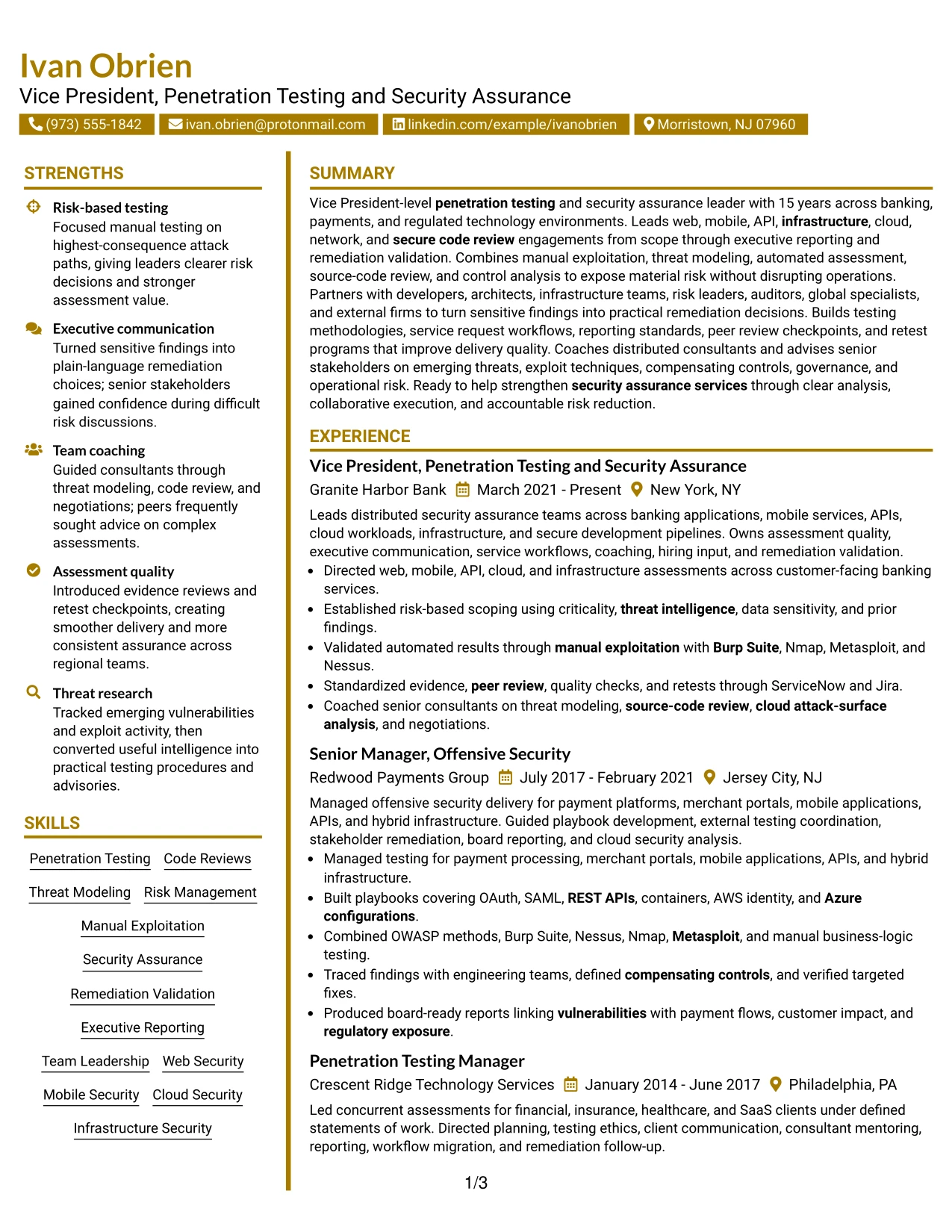
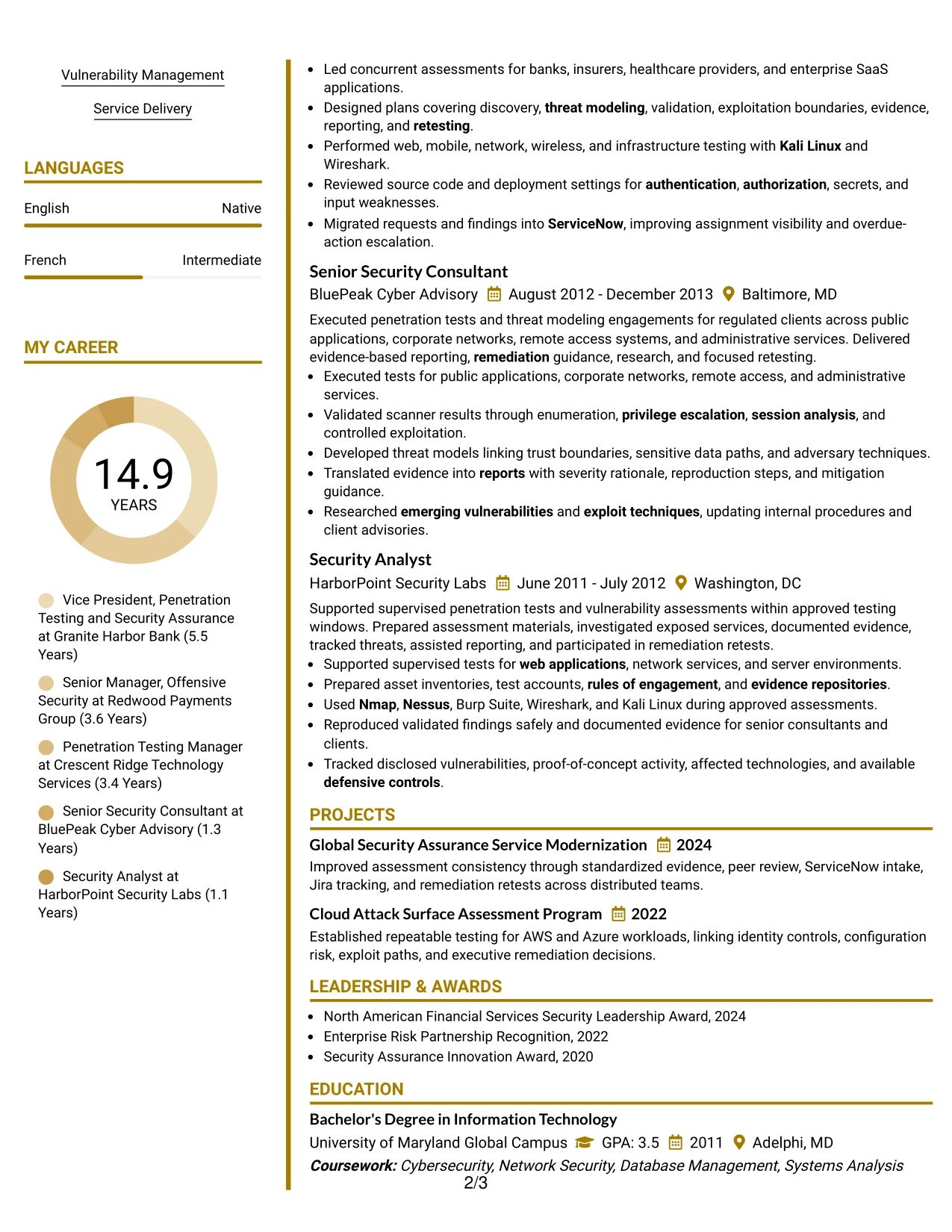
#23 Accent Divider Modern Two Column Format
For a Vice President penetration testing resume, a two-column structure can place contact details, certifications, tools, and core skills beside the main career record. Accent dividers help separate leadership scope from assessment evidence while keeping the page easy to scan.
The main column can present the professional summary, experience, projects, education, and awards in a clear sequence. A narrower support column gives technical keywords such as Burp Suite, Nmap, AWS, Azure, threat modeling, and remediation validation a distinct location without competing with achievement bullets.
Why the Accent Divider Modern Two Column Format Works for a Resume
- Two columns separate career evidence from supporting qualifications.
- Accent dividers create visible boundaries between resume sections.
- The format gives certifications and technical tools a compact home.
- Experience bullets remain prominent in the main reading area.
- A clear hierarchy supports quick review of leadership and testing scope.
- Keywords can be grouped without repeating them throughout the resume.
- The structure presents complex security assurance work in a controlled visual system.
Best For
- Resumes that need a distinct area for certifications, tools, and core skills.
- Professionals presenting both leadership responsibility and hands-on assessment work.
- Applications where a compact two-column structure improves page balance.
- Documents with substantial keyword coverage across cloud, mobile, API, and infrastructure security.
- Readers who need to compare technical capabilities with career progression.
- Resumes that benefit from visual separation without adding decorative clutter.
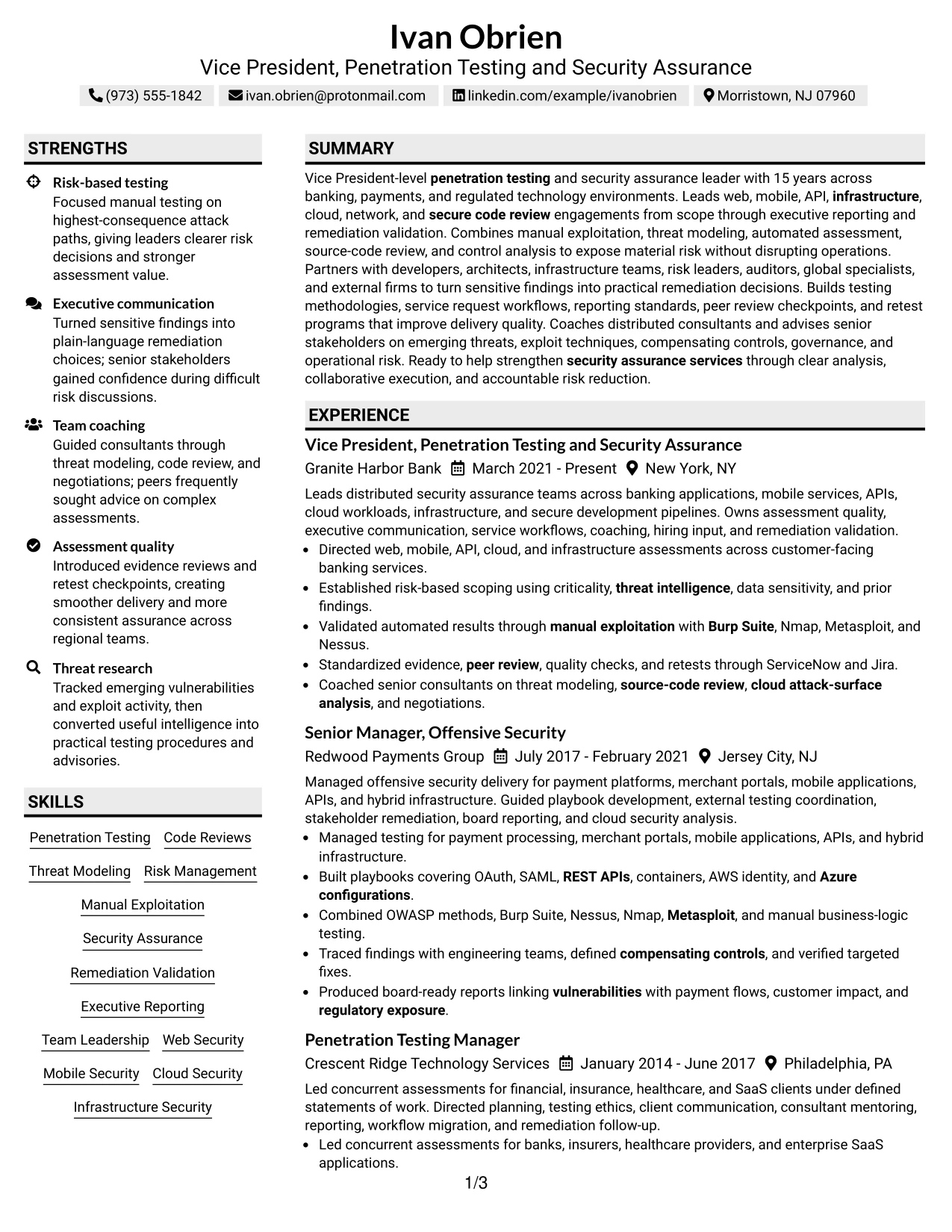
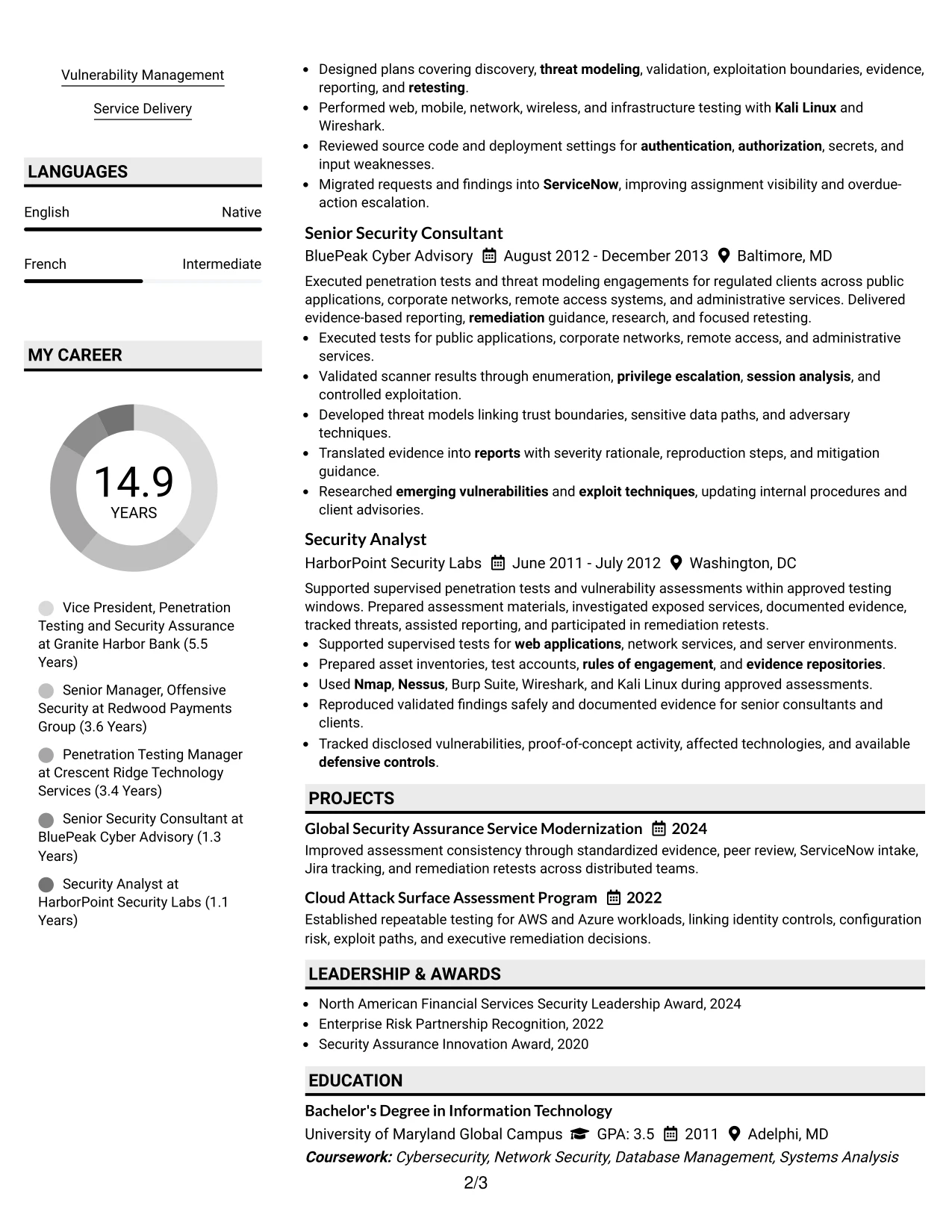
#24 Shaded Labels Clean Two Column Format
A restrained visual hierarchy helps reviewers connect the resume to a Vice President penetration testing role before they read every detail. Shaded labels identify sections such as Experience, Skills, Certifications, and Education, while the two-column arrangement keeps related information close together.
The primary column can emphasize assessment leadership, risk-based scoping, executive reporting, and remediation work. The secondary column can group tools, credentials, cloud platforms, and security methods so the resume aligns clearly with requirements for web, mobile, infrastructure, and cloud testing.
Why the Shaded Labels Clean Two Column Format Works for a Resume
- Shaded labels make major resume sections easy to locate.
- The format connects role requirements with matching experience evidence.
- A two-column design supports clear grouping of tools and credentials.
- Clean spacing keeps technical content readable despite a broad skill set.
- The main column gives leadership and assessment outcomes suitable emphasis.
- Labels help reviewers move from summary to experience without confusion.
- The design supports a polished presentation for regulated financial services work.
Best For
- Applications that call for direct alignment between role requirements and resume sections.
- Professionals combining security assurance leadership with detailed technical coverage.
- Resumes that must show cloud, API, mobile, and infrastructure experience together.
- Readers who prefer labeled content blocks and predictable navigation.
- Documents where a supporting column can hold certifications and technical methods.
- Candidates presenting cross-functional work with developers, risk leaders, and audit partners.
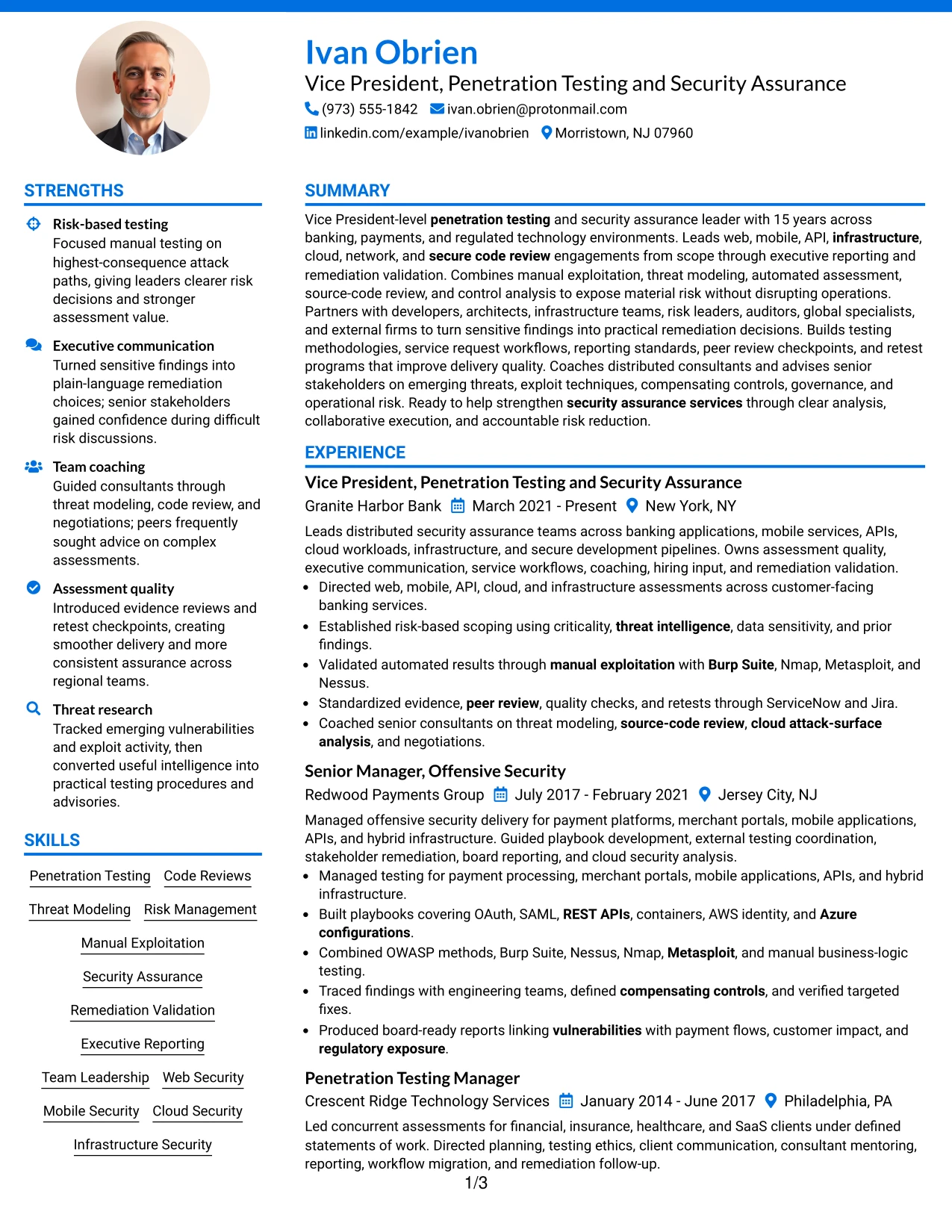
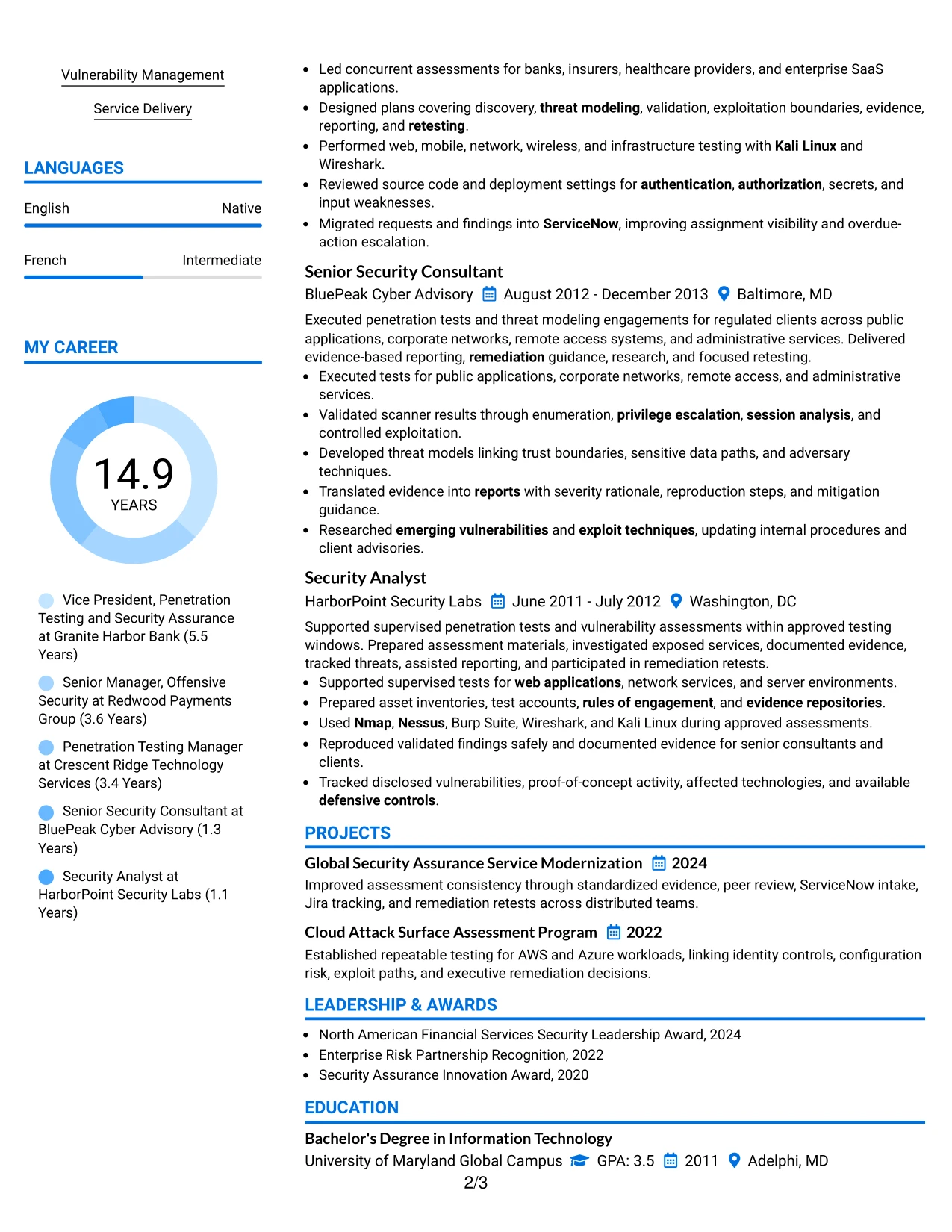
#25 Photo Header Color Accent International Format
The Photo Header Color Accent International Format places the contact area and professional identity at the top, followed by a single-column sequence of summary, experience, skills, education, and certifications. Color accents can distinguish these sections while keeping the reading order straightforward.
For this resume, the opening summary can establish Vice President-level security assurance scope before the experience section supplies proof. Detailed bullets can then show web, mobile, API, cloud, and infrastructure testing, supported by credentials such as CISSP, OSCP, AWS Certified Security, and GWAPT.
Why the Photo Header Color Accent International Format Works for a Resume
- A single column gives the career story a clear top-to-bottom order.
- The header provides immediate access to contact and professional details.
- Color accents distinguish sections without interrupting resume scanning.
- The summary can establish senior scope before detailed experience bullets.
- Certifications remain easy to find near the supporting qualifications.
- The format accommodates a wide range of technical keywords in one flow.
- A visible photo can support a profile-oriented presentation when appropriate for the application.
Best For
- Resumes where a strong header should establish professional identity immediately.
- Applications that permit a visible photo as part of the document presentation.
- Professionals who want one continuous reading path from summary through certifications.
- Documents with a broad technical record that benefits from section color cues.
- International applications where contact details and credentials need early visibility.
- Resumes pairing senior security assurance scope with extensive testing methods.
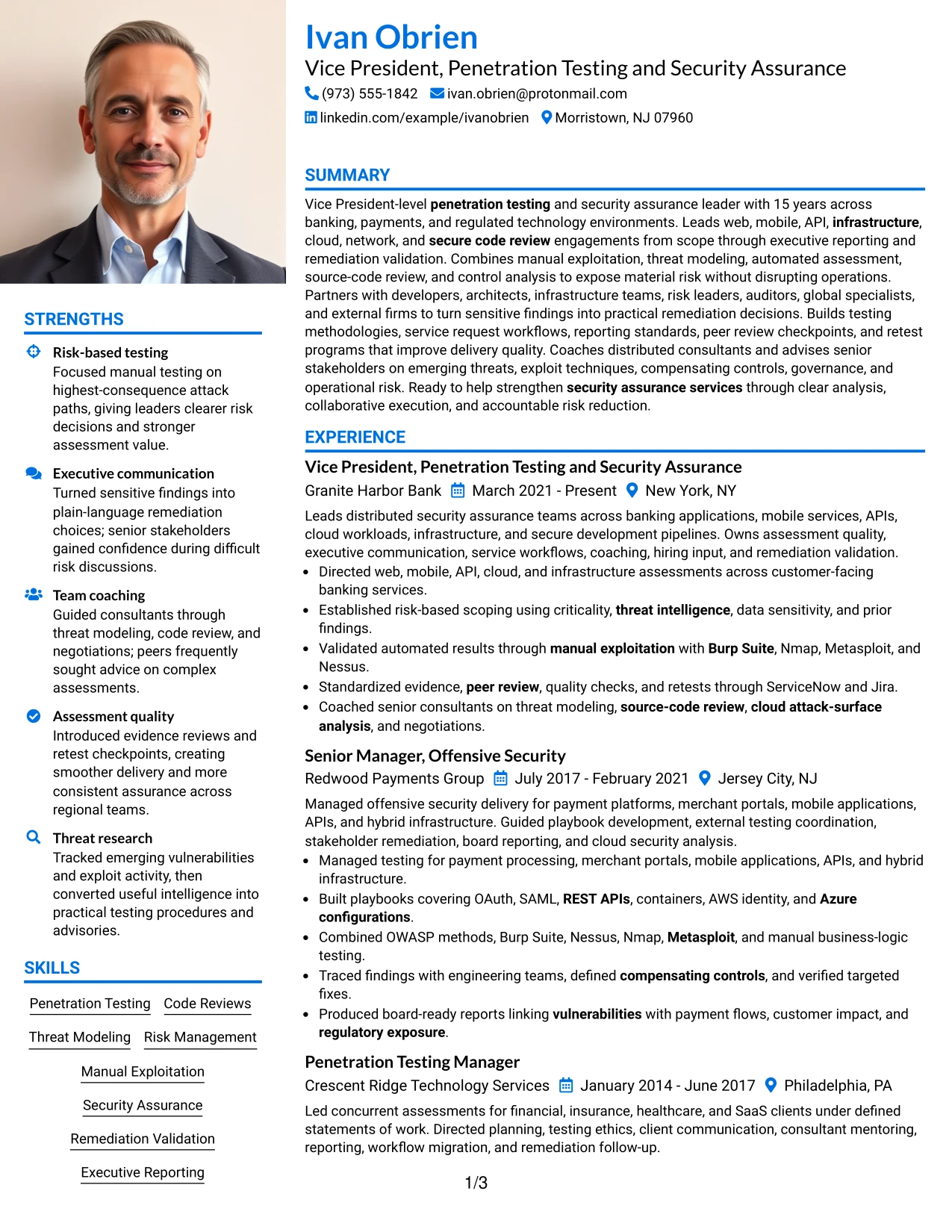
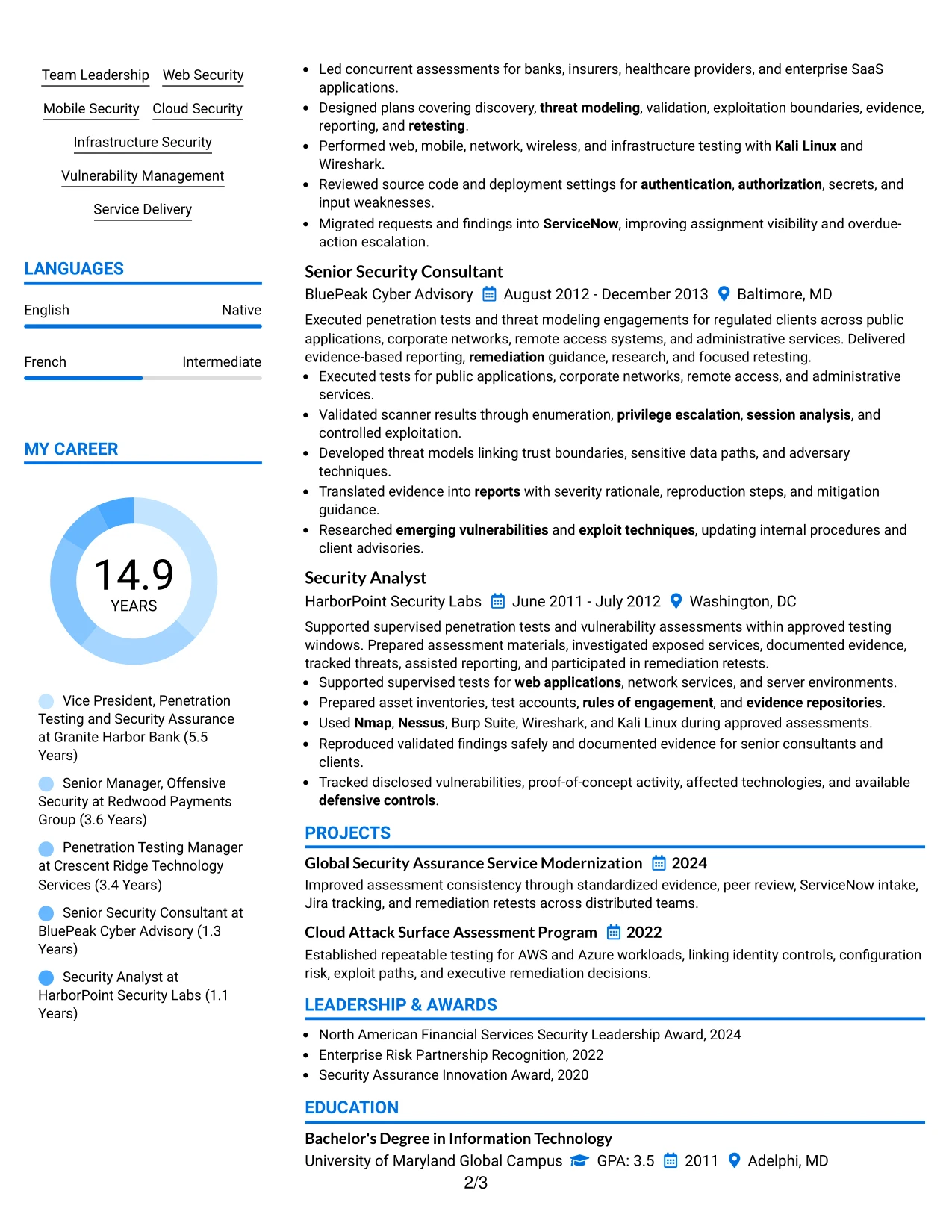
#26 Large Profile Photo International Two Column Format
Readers can move from the prominent profile header into a concise summary, then compare the main experience record with supporting skills and credentials in the adjacent column. This navigation pattern gives a long security career room to show both progression and technical breadth.
The larger profile area creates a strong entry point, while the two-column body can hold certifications, tools, projects, and affiliations beside the work history. Experience bullets should carry the greatest weight, showing team leadership, manual exploitation, threat modeling, reporting, and remediation validation.
Why the Large Profile Photo International Two Column Format Works for a Resume
- The prominent header gives the document a clear starting point.
- Two columns allow extensive supporting content without breaking the career sequence.
- The main column can carry detailed experience bullets and leadership evidence.
- The secondary column can organize certifications, tools, projects, and affiliations.
- A larger profile area creates strong visual recognition at the top.
- The structure supports a substantial record without requiring every detail in one column.
- A visible photo may suit applications that request or accept profile imagery.
Best For
- Resumes with extensive experience, credentials, projects, and professional activities.
- Professionals who need to show career progression beside a large technical toolkit.
- Applications where a prominent profile area is suitable for the document context.
- Documents that must accommodate evidence from banking, payments, and regulated environments.
- Readers who review a detailed work history alongside compact supporting information.
- Resumes where two-column capacity prevents certifications and tools from crowding experience.
#27 One Column Format with Photo
The strongest evidence should appear early: the summary, Vice President-level experience, assessment scope, and results. A single-column page with a photo can then carry that evidence in a direct sequence, making it simple to follow responsibility from current leadership through earlier security roles.
Each role can use focused bullets for testing methods, stakeholder advice, workflow improvement, and team coaching. Skills, certifications, projects, and education can follow in clearly labeled sections, allowing tools such as Burp Suite, Nessus, AWS, Azure, ServiceNow, and Jira to reinforce the experience record.
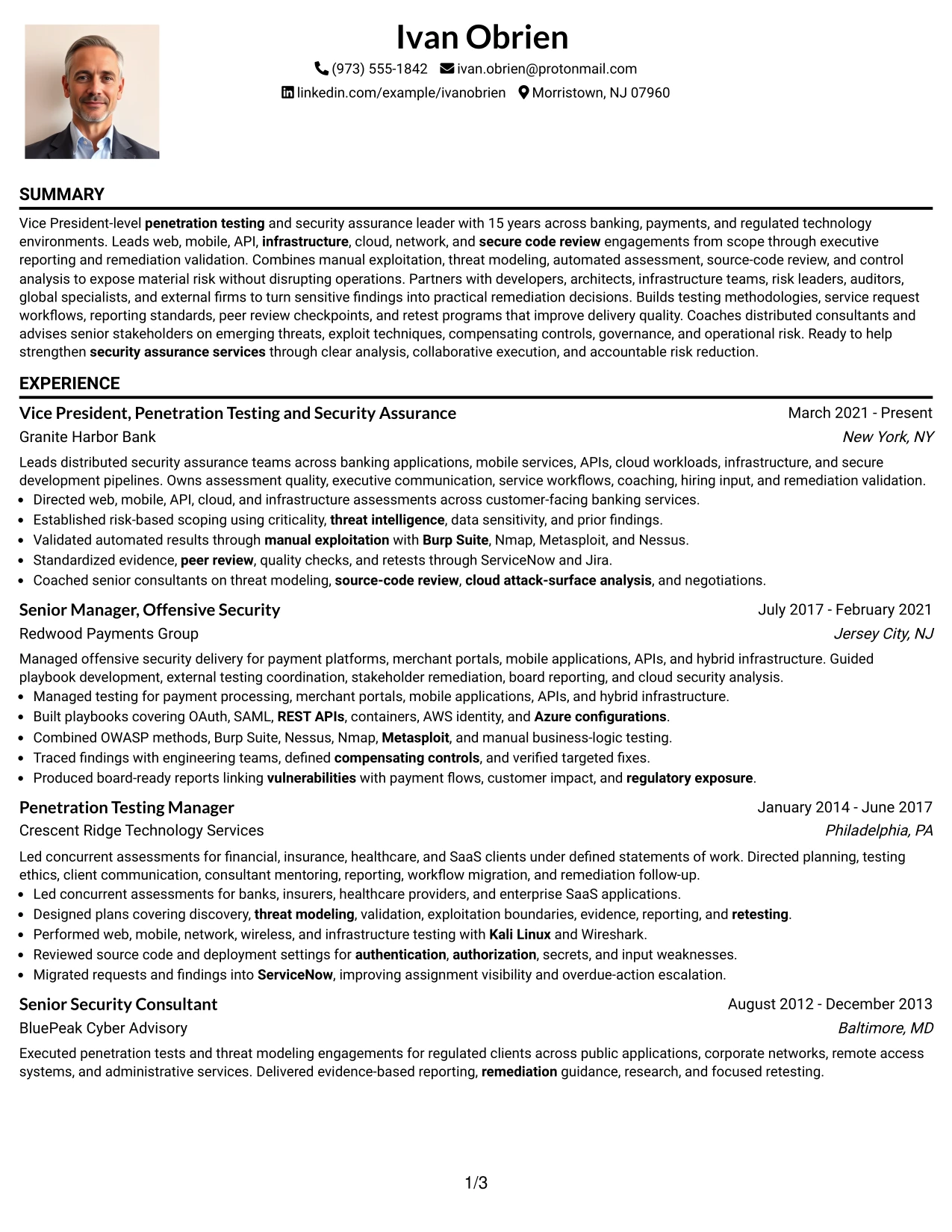
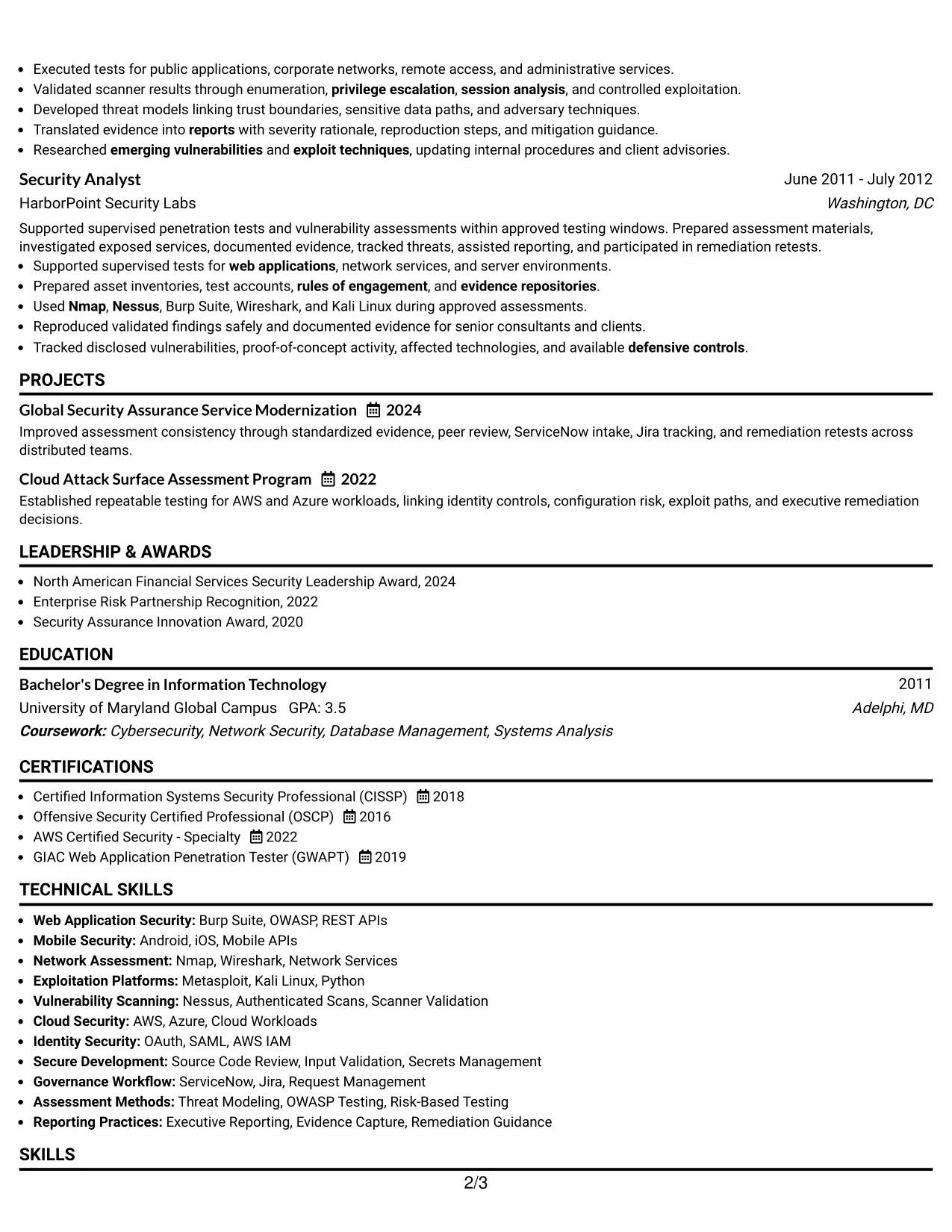
Why the One Column Format with Photo Works for a Resume
- The single column gives achievement evidence maximum reading continuity.
- The opening summary can quickly establish scope, leadership, and technical range.
- Experience bullets remain aligned and easy to compare across roles.
- A visible photo creates a defined focal point in the header when suitable.
- Skills and certifications can reinforce evidence rather than compete with it.
- The format supports a logical sequence from current work to earlier roles.
- Clear section labels help preserve ATS-friendly text order in the body.
Best For
- Resumes that rely on a strong sequence of evidence from summary through experience.
- Professionals whose testing scope and leadership record should remain the central focus.
- Applications where a visible photo is accepted and the header needs a clear focal point.
- Documents with detailed role bullets that benefit from uninterrupted line-by-line review.
- Readers evaluating progression from hands-on assessment to team leadership.
- Resumes that need technical tools to support, rather than overshadow, work history.
#28 One Column Format with Photo Right
Balanced distribution keeps the contact area and photo to one side while the resume text carries the professional story in a steady vertical path. This arrangement can preserve visual interest without interrupting the evidence needed for a senior penetration testing application.
The main text area can lead with the summary, followed by experience, projects, skills, certifications, and education. Right-side placement leaves the assessment record available for detailed bullets on cloud security, secure code review, emerging threats, executive reporting, and control analysis.
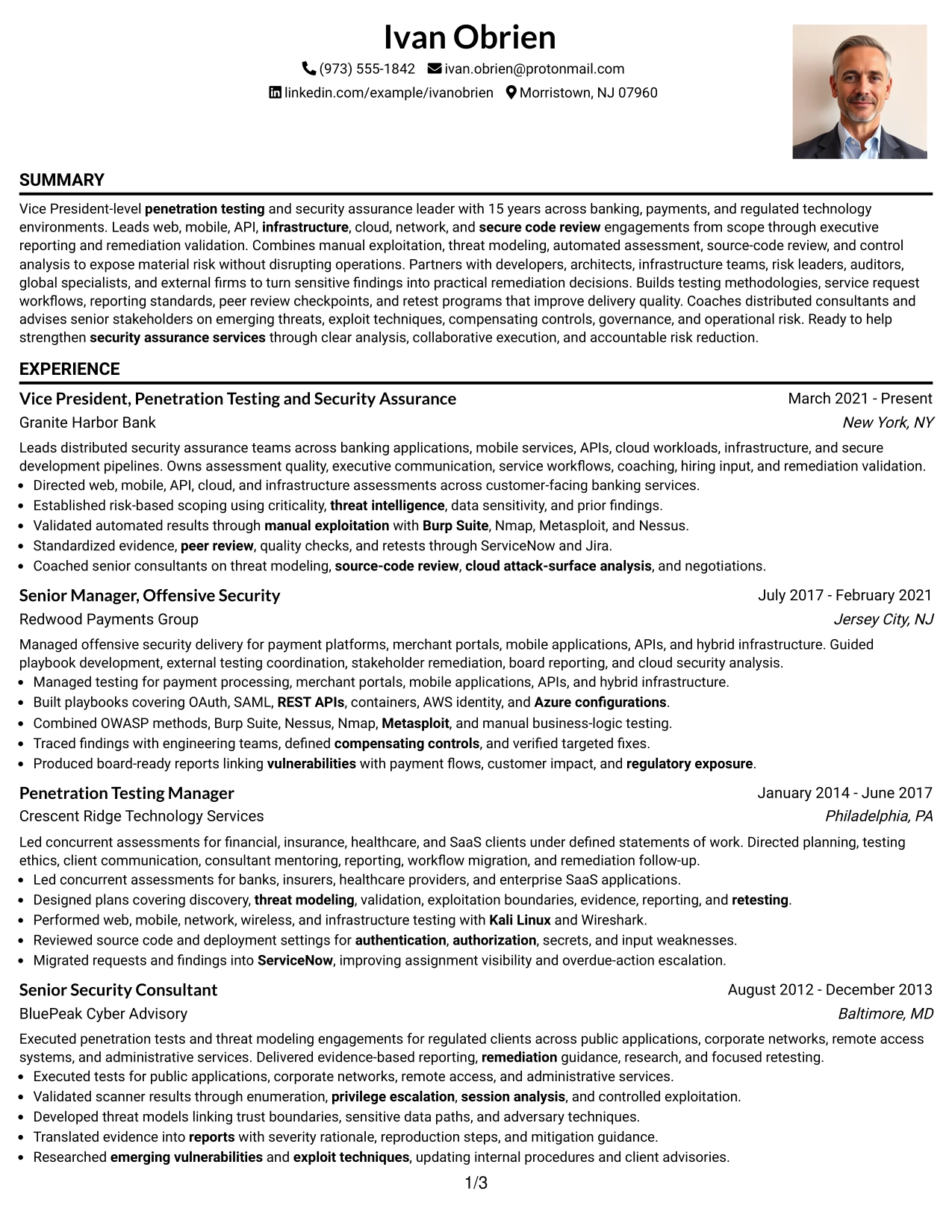
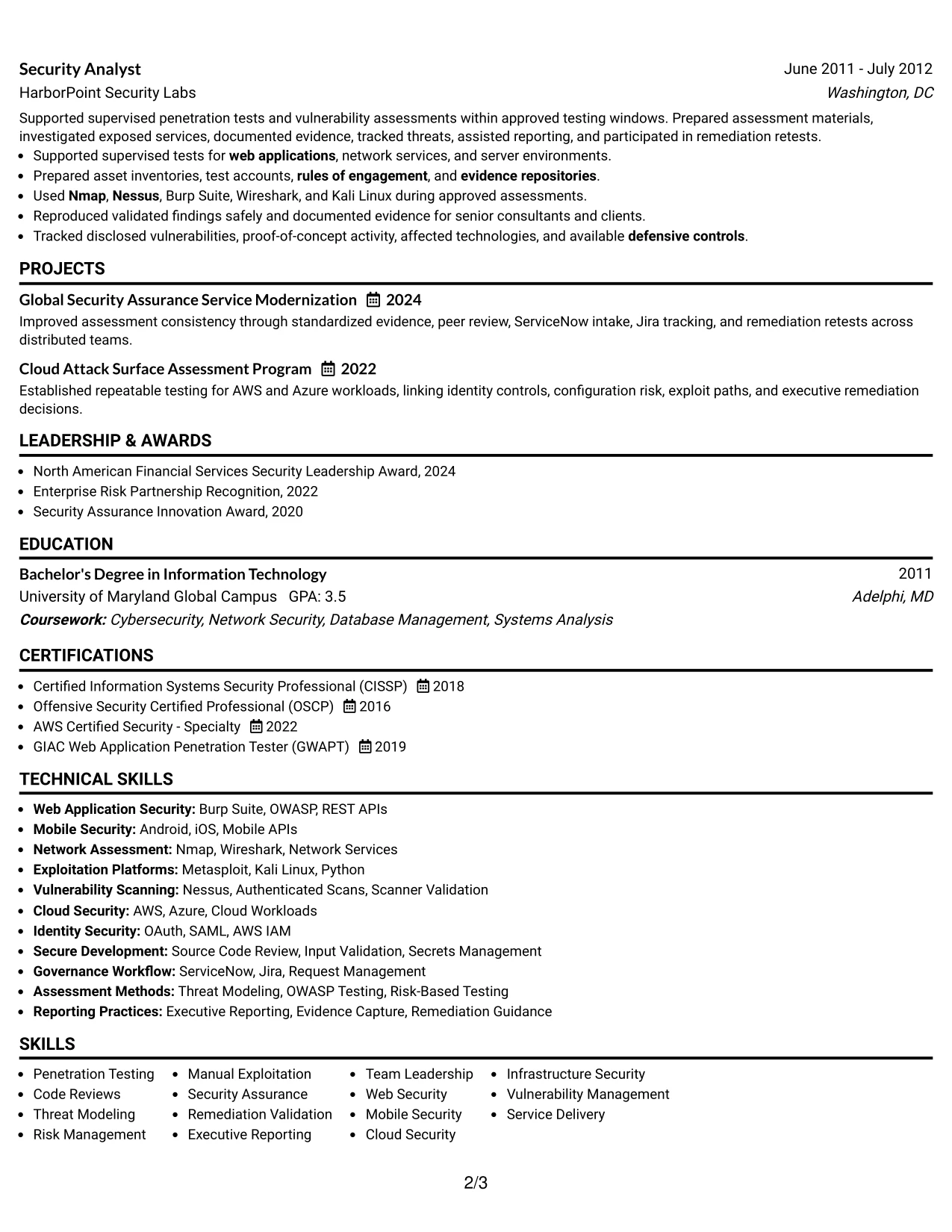
Why the One Column Format with Photo Right Works for a Resume
- Right-side header placement keeps the main text path open for evidence.
- A single column supports consistent review of dates, roles, and achievement bullets.
- The design balances visual identity with a substantial technical record.
- The summary and current role can receive attention before supporting sections.
- Projects and certifications can follow the career history without side-column crowding.
- The arrangement suits resumes that need both personality and disciplined structure.
- A visible photo can work when the application context supports it.
Best For
- Applications where a right-positioned photo keeps the primary evidence area clear.
- Resumes with a detailed experience section and a long supporting skills list.
- Professionals presenting technical work in a steady, chronological reading path.
- Documents that need room for projects, certifications, awards, and affiliations.
- Readers who prefer the main career record to remain visually dominant.
- Resumes balancing a personal header treatment with formal security assurance content.
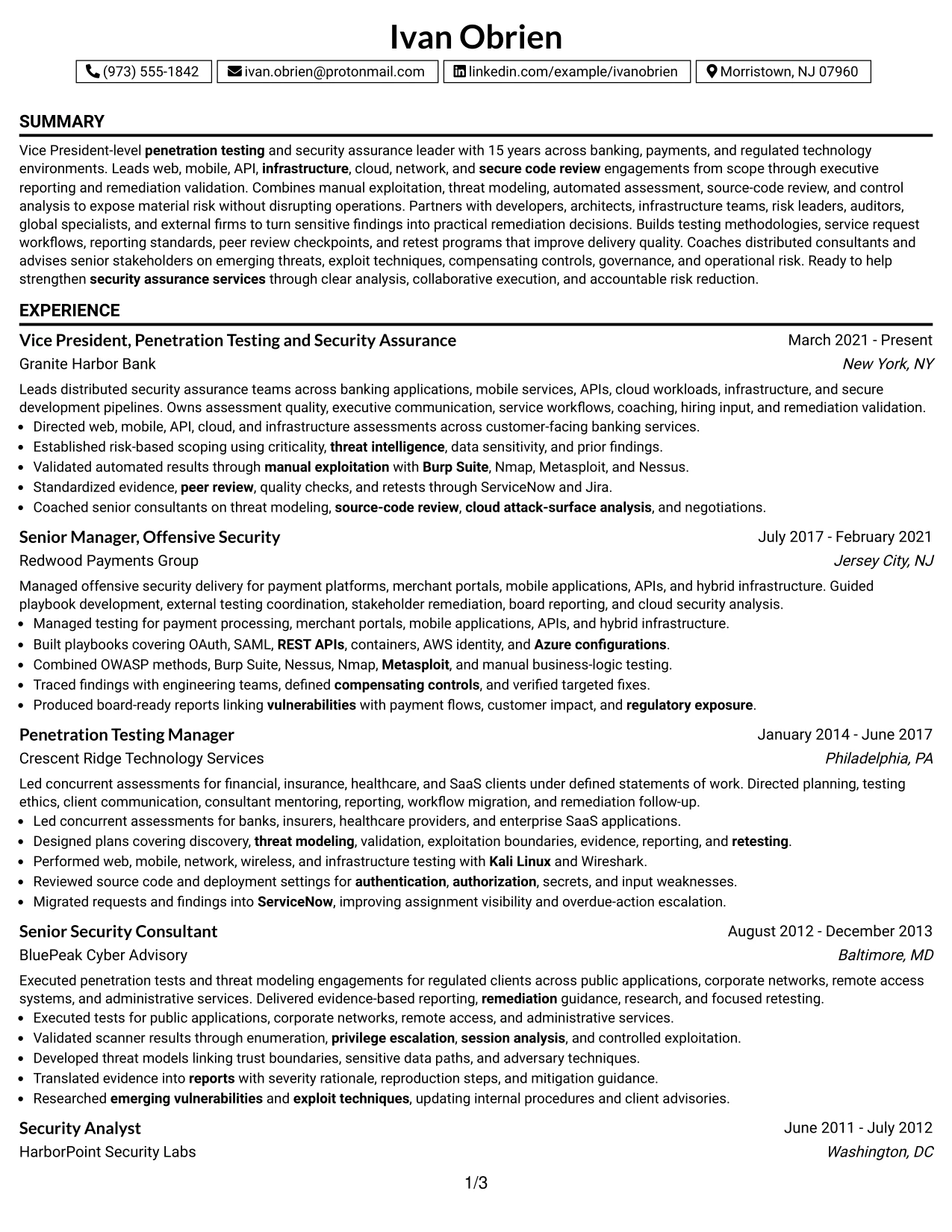
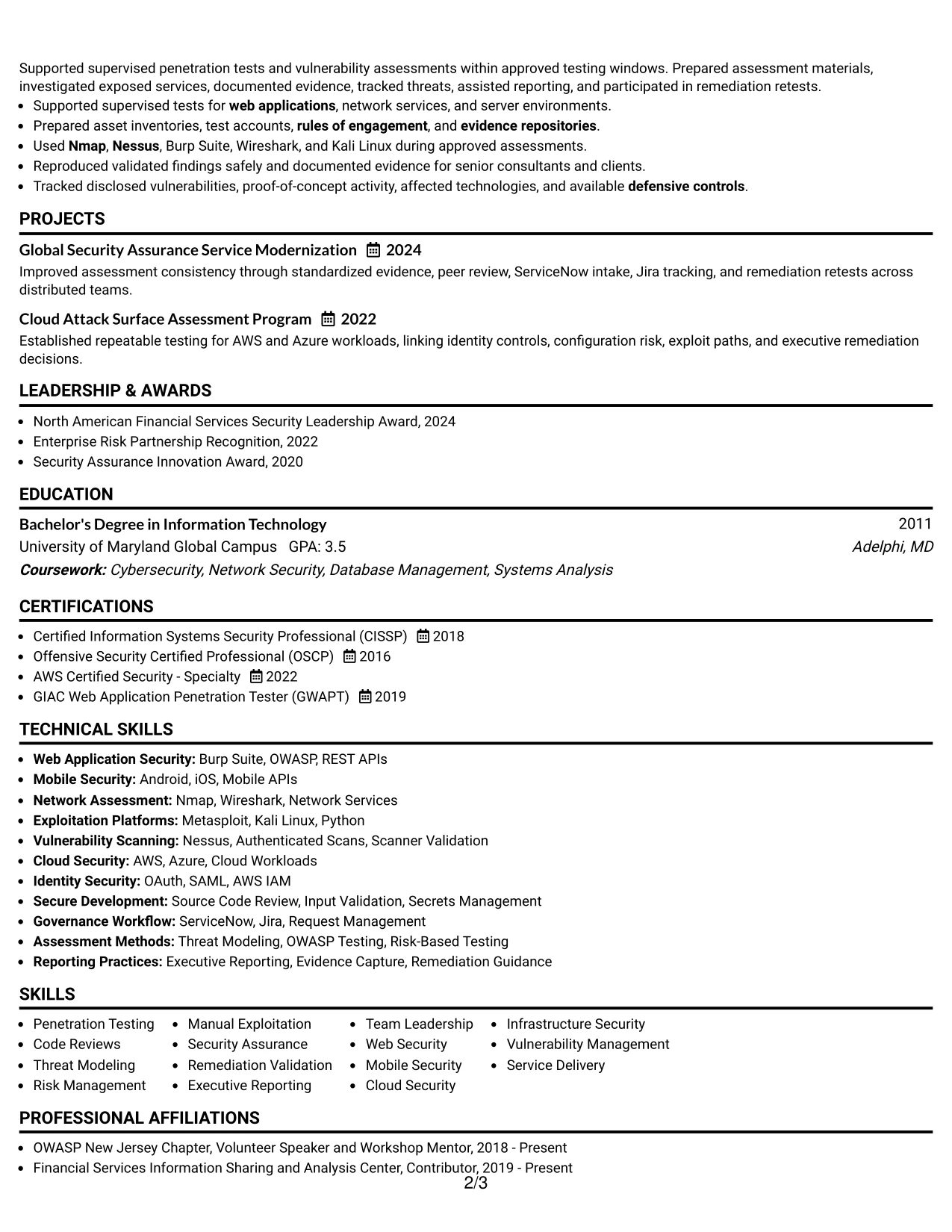
#29 One Column Boxed Contact Header Format
For an application requiring quick contact and role identification, a boxed header gives essential details a defined starting point before the resume moves into summary and experience. The one-column structure then keeps the full record in a consistent order.
A strong opening can connect penetration testing leadership with banking, payments, and regulated technology experience. Subsequent sections can present assessment bullets, projects, certifications, technical skills, and education without forcing the reader to switch between columns.
Why the One Column Boxed Contact Header Format Works for a Resume
- The boxed header separates contact details from career evidence.
- A single column keeps dates, employers, and bullets in one predictable path.
- The format gives the target role clear visibility near the top.
- Detailed testing scope can be presented without side-column compression.
- Projects and certifications remain easy to review after experience.
- The structure supports straightforward ATS text order.
- A compact header preserves space for substantive achievement bullets.
Best For
- Applications that need contact details and target role clearly grouped at the top.
- Resumes where chronological experience should remain the dominant visual element.
- Professionals with substantial assessment bullets and supporting credentials.
- Documents intended for straightforward digital review and text extraction.
- Readers who value predictable movement through summary, experience, and skills.
- Candidates who want a defined header without a multi-column page.
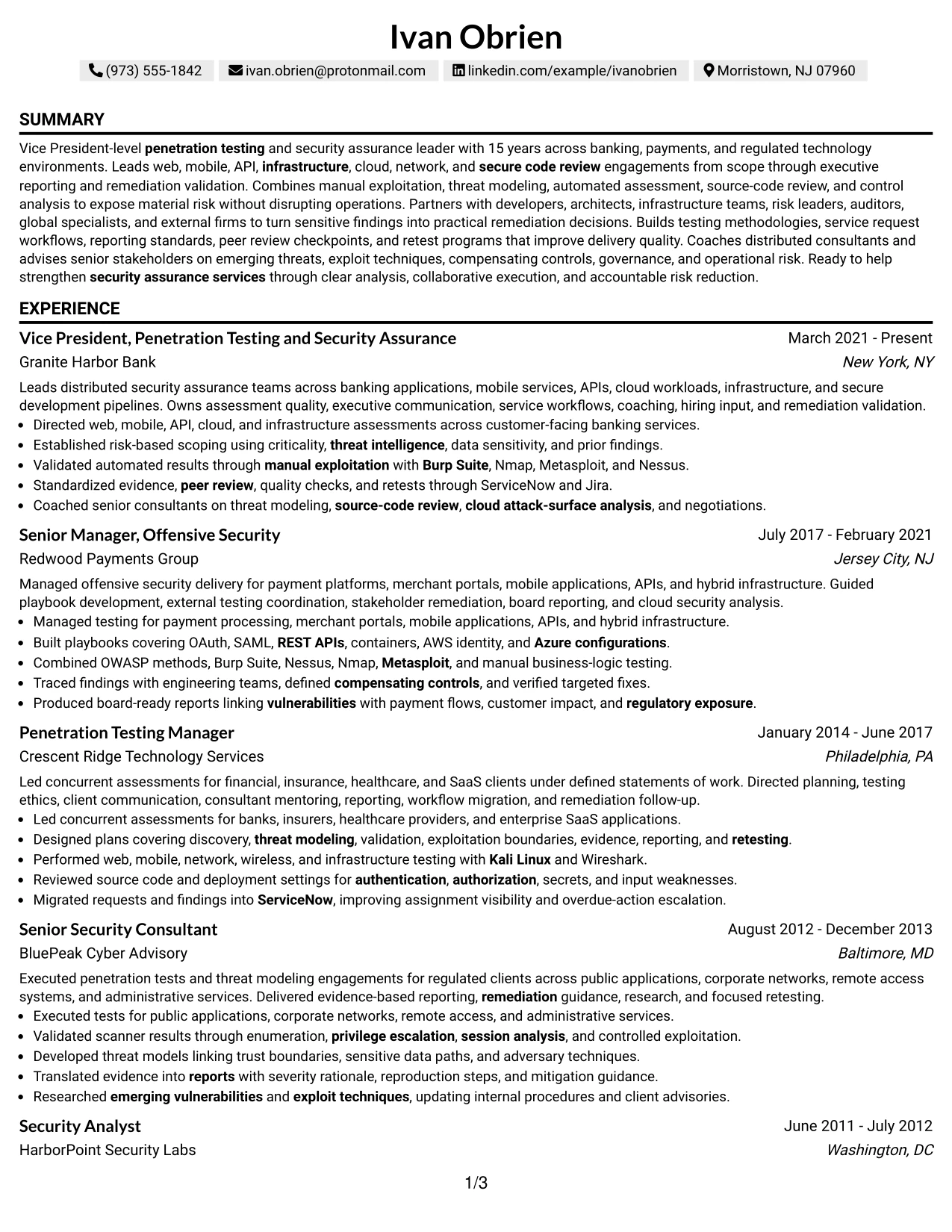
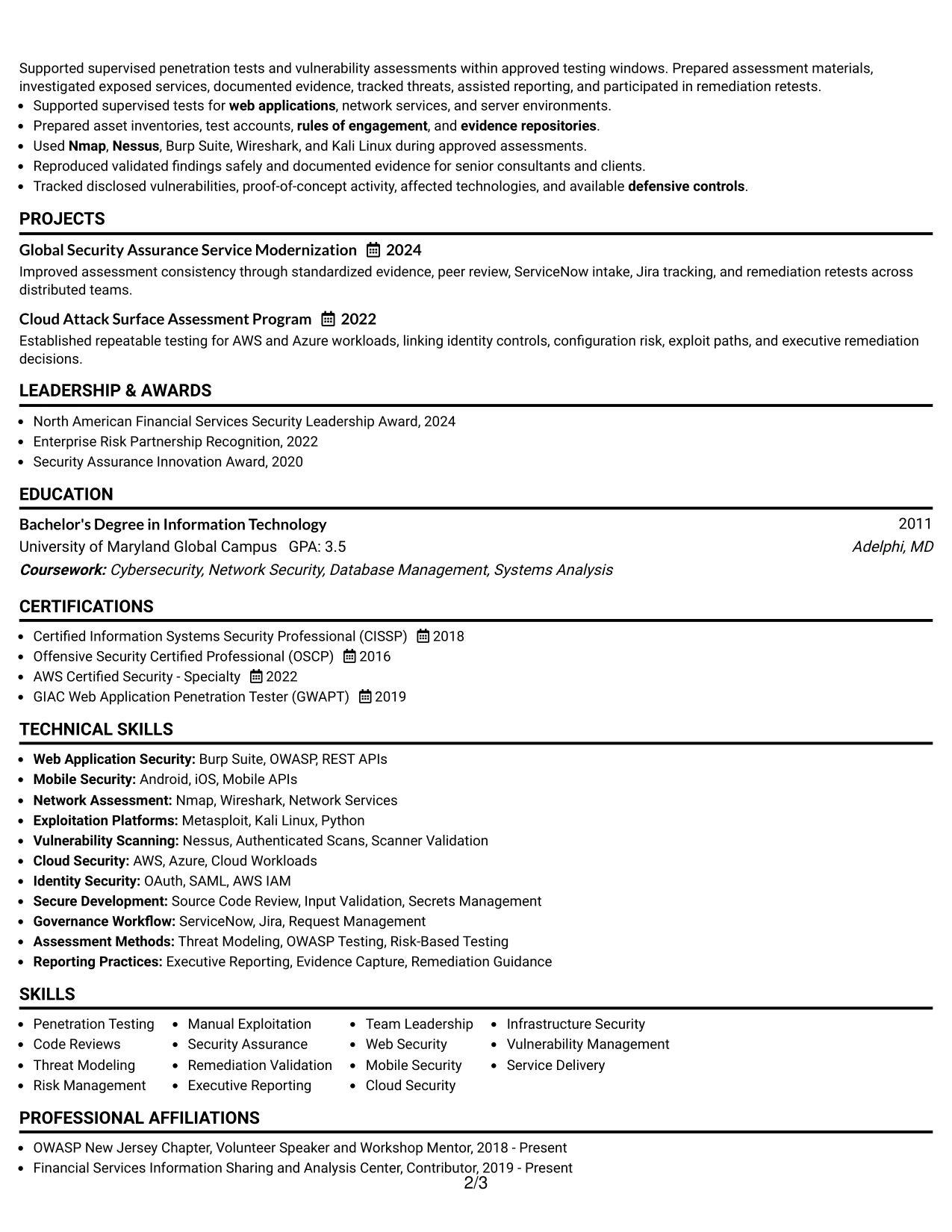
#30 One Column Shaded Contact Header Format
A restrained shaded header gives the resume a professional first impression while keeping attention on role alignment and evidence. The single-column sequence can connect the target Penetration Tester, VP position with experience in banking, payments, security assurance, and regulated technology.
The resume can move from summary to leadership experience, then to skills, certifications, projects, education, and activities. Shaded labels make sections easier to locate, while bullets show manual assessment, code review, threat modeling, stakeholder advice, and remediation validation.
Why the One Column Shaded Contact Header Format Works for a Resume
- The shaded header gives the target role immediate context.
- A single column makes role progression simple to verify.
- Section labels help reviewers locate skills, certifications, and projects.
- The design keeps leadership evidence connected to technical assessment work.
- Bullets can map directly to testing, reporting, and remediation requirements.
- The restrained styling suits regulated and governance-focused environments.
- Consistent spacing supports both human review and structured text parsing.
Best For
- Applications where direct alignment to the posted role should be visible at once.
- Professionals combining executive communication with hands-on security assurance.
- Resumes that need a calm visual treatment for regulated business settings.
- Documents with several supporting sections after a substantial experience record.
- Readers comparing role requirements with clearly labeled evidence.
- Candidates presenting testing, governance, and remediation work in one continuous format.
#31 Boxed Contact Header with Job Title Format
The Boxed Contact Header with Job Title Format places the intended role beside essential contact information, then uses a clear one-column sequence for the rest of the resume. This structure makes the document's purpose apparent before the reviewer reaches the detailed career record.
A focused summary can introduce leadership across web, mobile, API, cloud, network, and infrastructure assessments. Experience bullets can then substantiate that scope with risk-based testing, automated-result validation, executive reporting, workflow design, coaching, and secure code review.
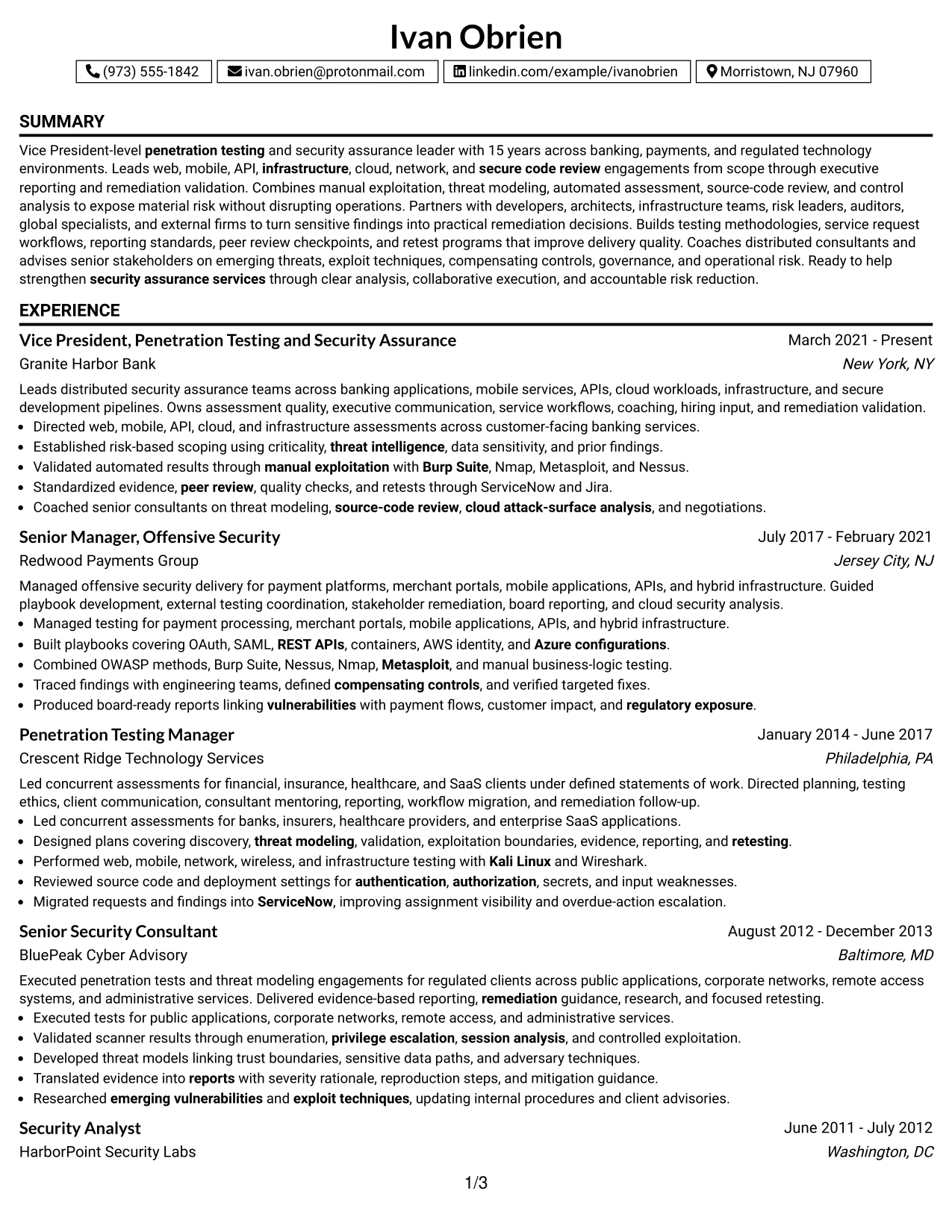
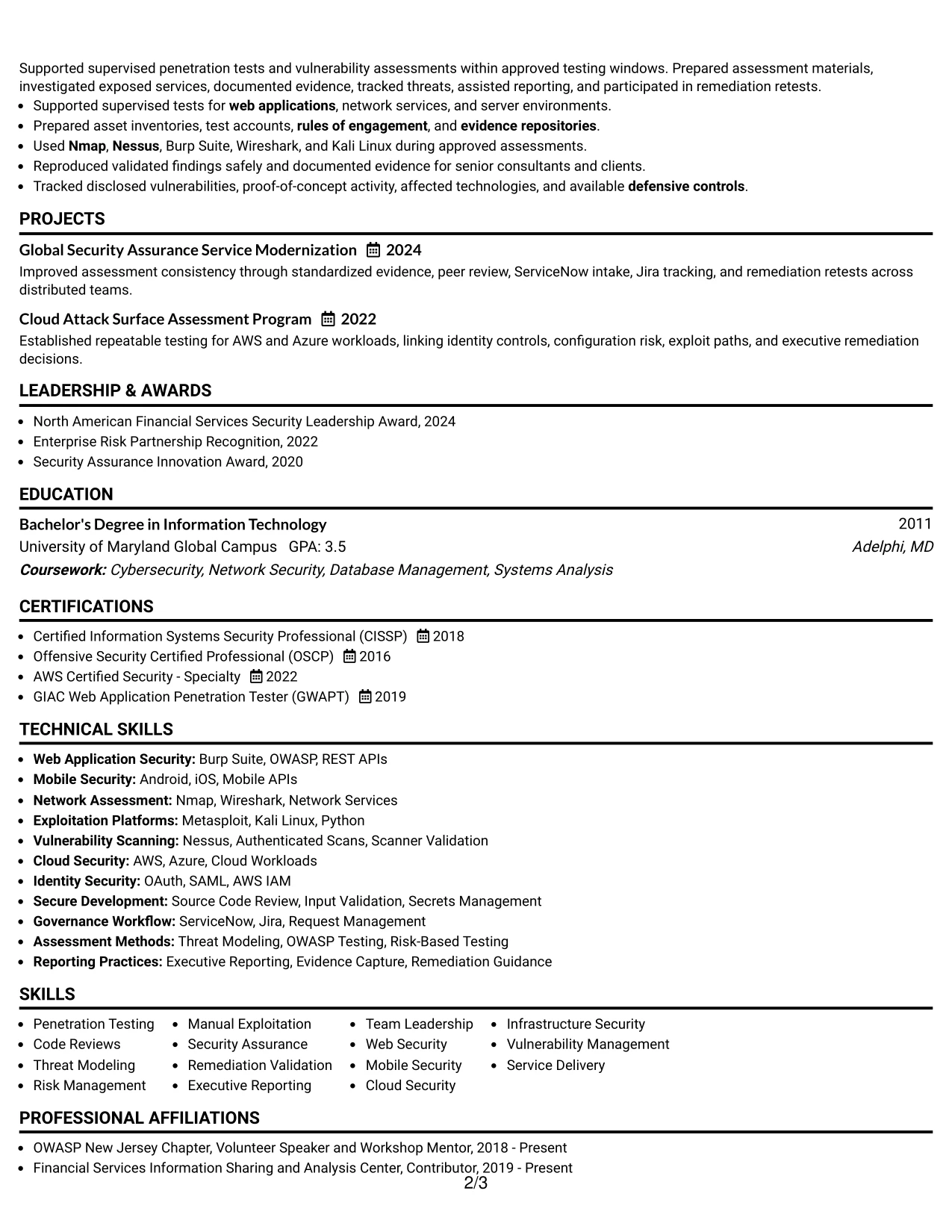
Why the Boxed Contact Header with Job Title Format Works for a Resume
- The job title is visible before the detailed resume content begins.
- A boxed contact area creates a firm boundary around essential information.
- One-column reading keeps career progression and dates easy to follow.
- The summary can frame broad testing scope in a compact opening section.
- Bullets provide space for both technical evidence and leadership contributions.
- Skills and credentials can be reviewed after the work history without visual detours.
- The layout supports a direct connection between title, scope, and qualifications.
Best For
- Resumes where the intended position should be unmistakable in the header.
- Professionals presenting broad assessment coverage across several technology areas.
- Documents that need a strong title block before a chronological career record.
- Applications requiring both hands-on testing detail and leadership evidence.
- Readers scanning for role scope, tools, certifications, and measurable responsibility.
- Resumes that benefit from a compact contact area and an orderly body.
#32 Plain Professional Layout with Job Title & Shaded Labels
Readers can begin with the job title and summary, move through the experience record, and finish with skills, certifications, projects, education, and affiliations. Shaded labels provide reliable signposts in this plain professional structure, which is useful when the resume contains a large volume of technical and leadership evidence.
The experience section should carry the most detail, including assessment planning, manual exploitation, source-code review, cloud security, threat research, service workflows, and remediation validation. Supporting sections can then reinforce the record with CISSP, OSCP, AWS Certified Security, GWAPT, and relevant tools.
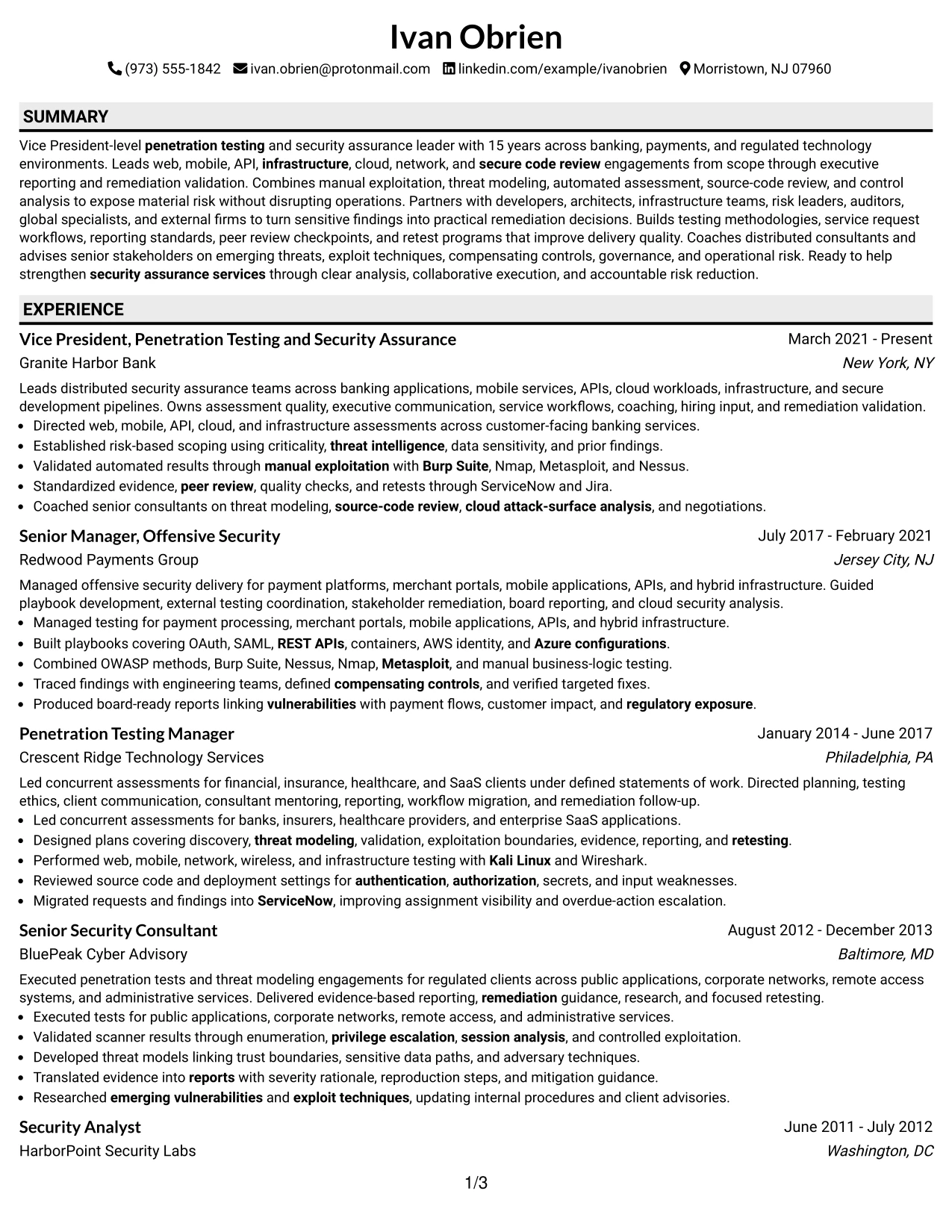
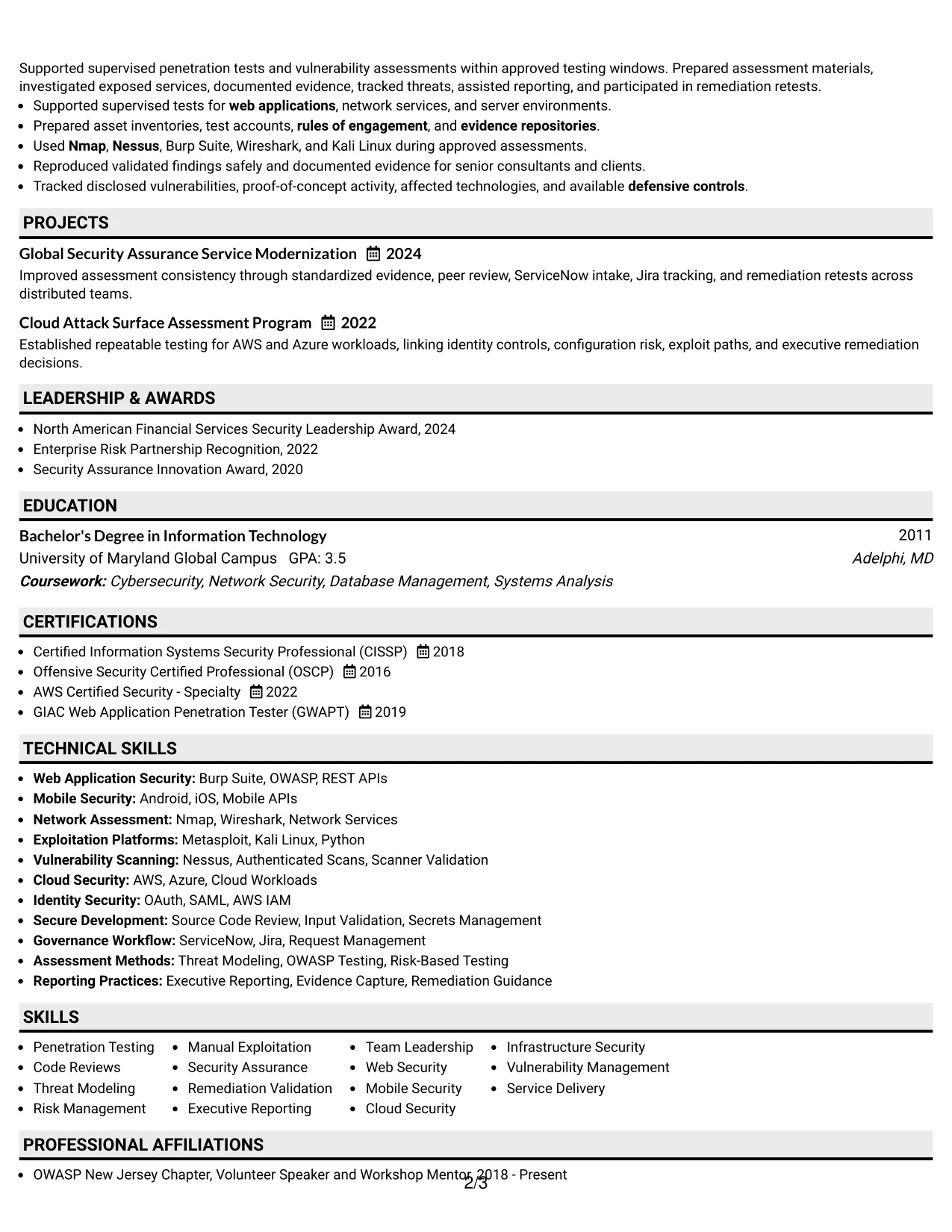
Why the Plain Professional Layout with Job Title & Shaded Labels Works for a Resume
- Clear navigation helps reviewers move through a high-volume resume.
- The job title establishes context before the professional summary.
- Shaded labels separate experience from skills, credentials, and projects.
- The plain treatment keeps detailed bullets readable over several sections.
- A single column supports consistent review of dates and role progression.
- Technical keywords can appear naturally within evidence and supporting lists.
- The structure suits resumes that must balance depth with easy navigation.
Best For
- Resumes with extensive content across experience, certifications, projects, and affiliations.
- Professionals whose evidence needs a calm layout rather than strong visual decoration.
- Applications where reviewers may scan several technical sections in sequence.
- Documents combining manual testing, code review, cloud security, and governance work.
- Readers who need clear labels while reviewing a substantial career history.
- Candidates who want the job title and supporting qualifications visible without a two-column design.
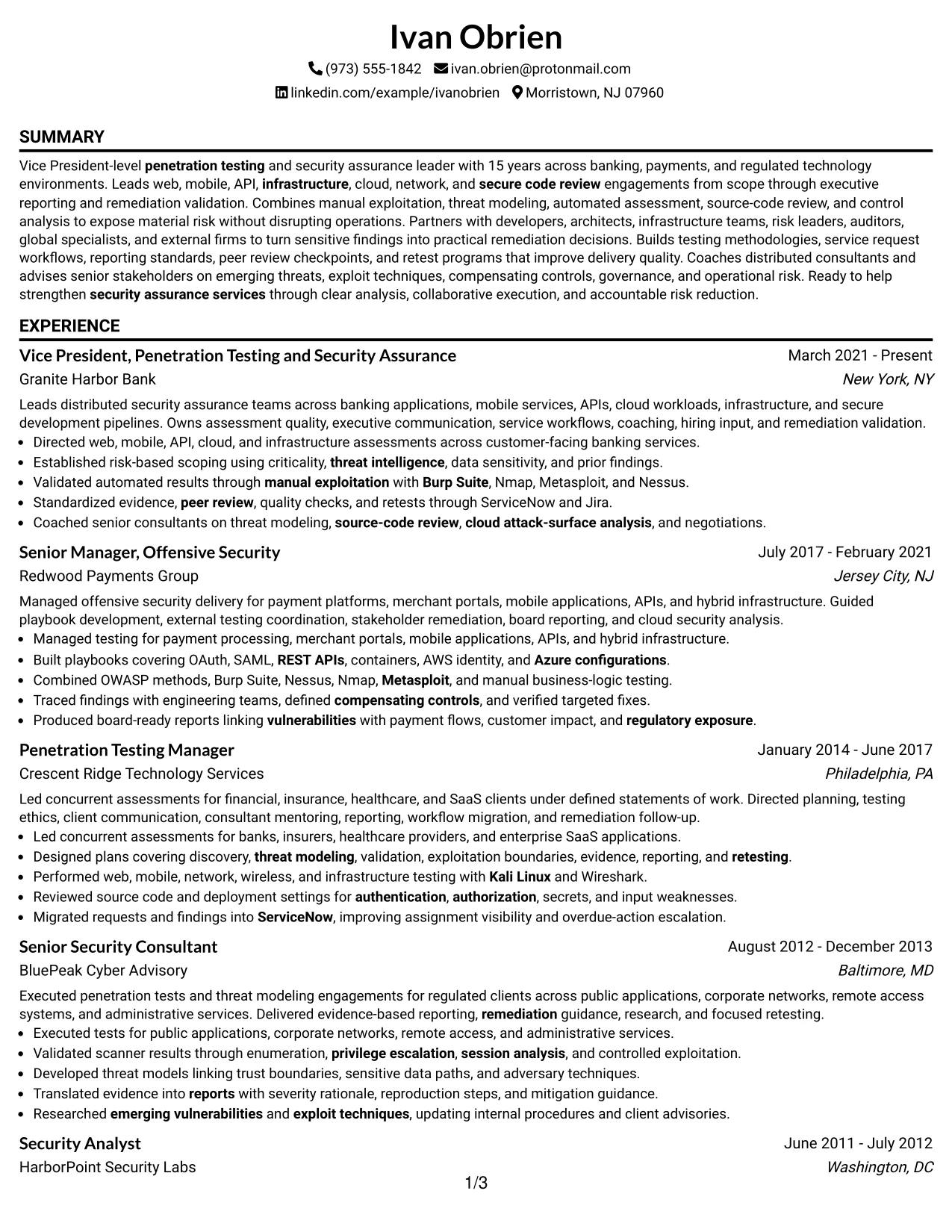
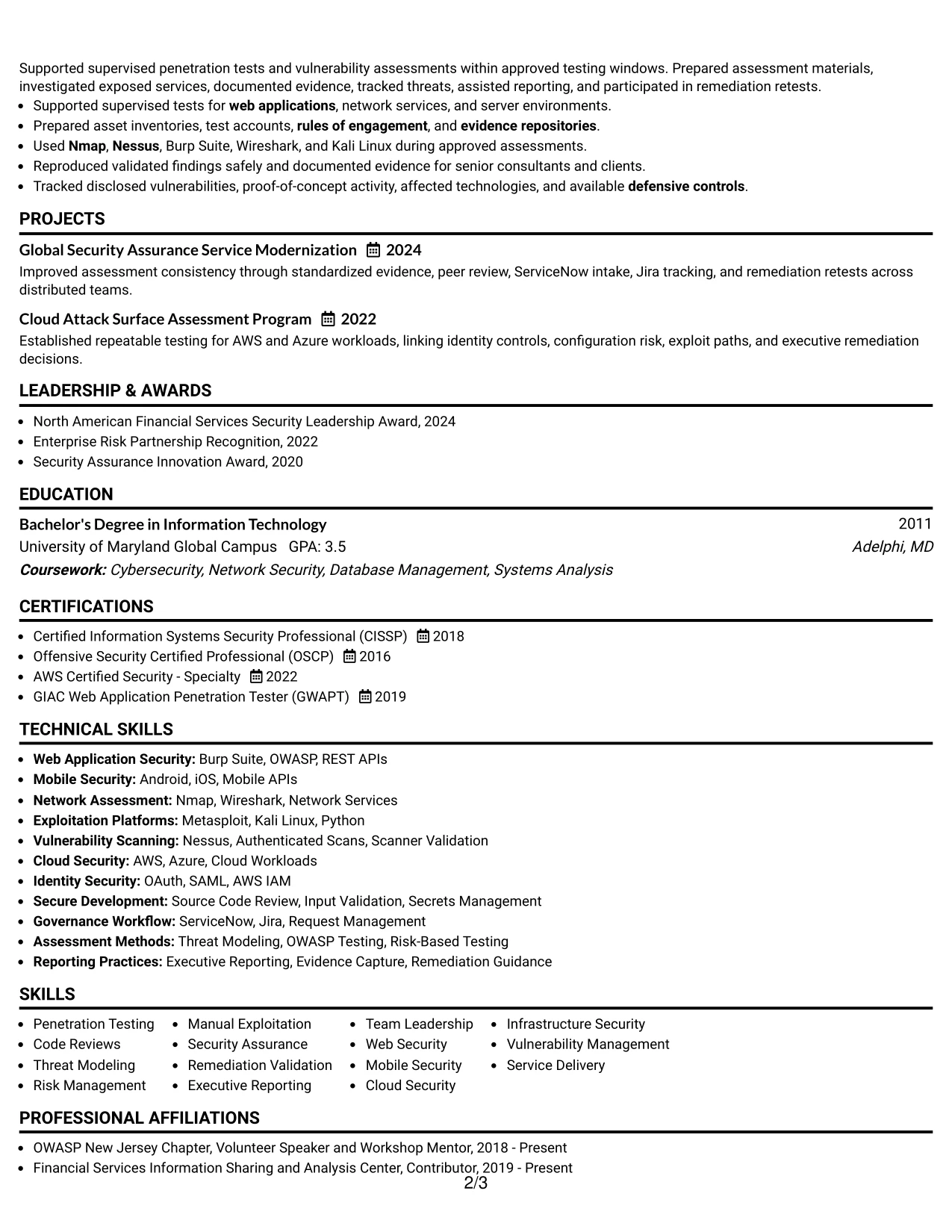
#33 Classic One Column Resume Format
The most persuasive evidence belongs at the center of this classic structure: assessment leadership, complex testing scope, stakeholder influence, and delivery quality. A conventional one-column sequence lets each role develop through concise bullets without visual elements competing for attention.
The resume can proceed from summary to experience, then skills, certifications, projects, education, awards, and affiliations. That order supports a complete account of penetration testing, secure code review, threat modeling, executive reporting, team coaching, and risk-based remediation work.
Why the Classic One Column Resume Format Works for a Resume
- A conventional structure puts experience evidence first and keeps it easy to compare.
- One-column alignment supports reliable review of roles, dates, and bullets.
- The format gives senior responsibilities room to stand on their own.
- Skills and certifications remain accessible without distracting from work history.
- The sequence works well for both detailed human review and ATS parsing.
- Classic section order helps readers find education, projects, awards, and affiliations.
- The restrained presentation keeps attention on scope, methods, and outcomes.
Best For
- Resumes that depend on career evidence more than decorative presentation.
- Professionals with a clear progression through consulting, management, and executive roles.
- Applications where ATS parsing and conventional section order are important.
- Documents requiring detailed bullets for testing, reporting, coaching, and remediation.
- Readers who want familiar navigation through experience and credentials.
- Candidates presenting a complete record of security assurance work in a dependable format.
Why Build Your Penetration Tester, VP Resume with ResumeInMinutes
ResumeInMinutes helps security professionals turn complex assessment work, technical tools, leadership responsibilities, and risk decisions into a structured resume that is easy to review and tailor.
- Professional resume formats
- ATS-friendly section structure
- Targeted security keywords
- Clear skills and tools presentation
- Free PDF resume previews
- Resume customization support
Use the guide to emphasize assessment scope, control analysis, emerging threat research, service improvements, cross-functional collaboration, and the practical results of remediation work in a Penetration Tester, VP resume.
See Also
- 33 Associate Penetration Tester Resume Templates with Example 2026 (ATS-Optimized)
- 33 Entry-Level Penetration Tester Resume Templates with Example 2026 (ATS-Optimized)
- 33 Junior Penetration Tester Resume Templates with Example 2026 (ATS-Optimized)
- 33 Lead Penetration Tester Resume Templates with Example 2026 (ATS-Optimized)
- 33 Penetration Tester Intern Resume Templates with Example 2026 (ATS-Optimized)
- 33 Penetration Tester Resume Templates with Example 2026 (ATS-Optimized)
- 33 Senior IT Penetration Tester Resume Templates with Example 2026 (ATS-Optimized)
- 33 Senior Penetration Tester Resume Templates with Example 2026 (ATS-Optimized)
- 30+ Penetration Tester, VP Cover Letter Templates with Example 2026
- 30+ Associate Penetration Tester Cover Letter Templates with Example 2026
Frequently Asked Questions
Are these Penetration Tester, VP resume templates ATS-friendly?
Yes. The templates use readable headings, structured sections, and relevant terms such as penetration testing, manual assessment, threat modeling, cloud security, remediation, and executive reporting.
Are these various resumes?
No. This guide presents one Penetration Tester, VP resume example in distinct formats and design styles.
What should a Penetration Tester, VP resume include?
Include a focused summary, leadership experience, assessment scope, technical skills, tools, threat modeling, code review, remediation validation, certifications, education, and clear evidence of risk communication.
Can I download the resume templates as PDFs?
Yes. Each resume design offers a free PDF download so you can review the structure and choose a suitable format.
Which resume style is best for a Penetration Tester, VP position?
A clean one-column or simple two-column layout is usually effective. It gives ATS software and senior reviewers a clear path through leadership scope, technical capabilities, assessment methods, and business-facing results.
How should a senior penetration testing leader show achievements?
Use concise bullets that state the assessment or assurance challenge, the action taken, and the result. Include evidence such as improved delivery quality, stronger remediation tracking, clearer risk decisions, or broader testing coverage when supported by your background.
Should I include penetration testing tools on my resume?
Yes. Include tools that you can use or discuss confidently, such as Burp Suite, Nmap, Metasploit, Nessus, Kali Linux, AWS, Azure, ServiceNow, or Jira, and connect them to relevant assessment or assurance work.
Can I customize these resume templates?
Yes. ResumeInMinutes allows you to adjust the resume text, section emphasis, format, design style, and PDF layout for your Penetration Tester, VP application.