30+ Purple Team Lead/Senior Vulnerability Assessment Analyst Cover Letter Templates with Example 2026
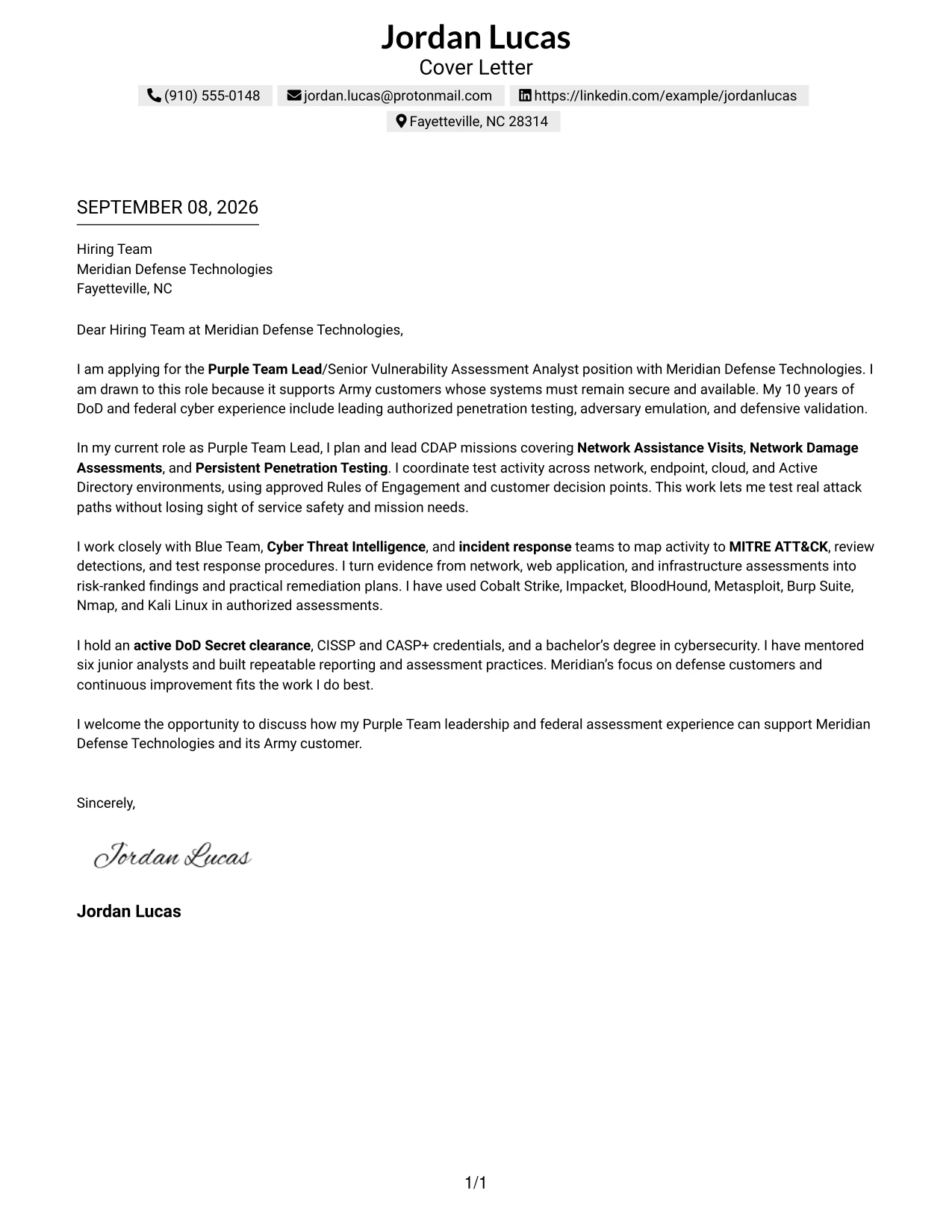
This practical guide helps you create a Purple Team Lead/Senior Vulnerability Assessment Analyst cover letter with a clear, persuasive message. You will learn how to connect your security assessment background to the role while showing sound judgment, mission awareness, and strong communication.
An effective letter for this position should do more than name penetration testing tools or repeat a work history. It should explain how you lead authorized testing, connect offensive activity with defensive validation, follow Rules of Engagement, and turn technical evidence into useful remediation guidance.
This guide includes one focused Purple Team Lead/Senior Vulnerability Assessment Analyst cover letter example, presented in 33 layouts. The examples show how to shape an opening paragraph, select evidence for the body, explain motivation and employer alignment, and close with professional confidence.
What Makes a Great Purple Team Lead/Senior Vulnerability Assessment Analyst Cover Letter in 2026
Strong cover letters for this role are specific, evidence-based, and aligned with the security mission. The most effective letters usually develop three connected ideas:
- Leadership of authorized Purple Team, penetration testing, or vulnerability assessment work
- Clear links between adversary emulation, defensive monitoring, detection, and response validation
- Careful communication with Blue Team, CTI, incident response, government stakeholders, and remediation owners
Rather than repeating a list of duties, a persuasive letter explains:
- Why the applicant is motivated by the organization's defense and cybersecurity mission
- How CDAP work, including NAV, NDA, or PPT activities, connects to the position
- How the applicant protects testing boundaries while producing practical risk and remediation guidance
Job-specific language may include Purple Team operations, authorized penetration testing, adversary emulation, CDAP, Rules of Engagement, MITRE ATT&CK, NIST Cybersecurity Framework, network and web application assessments, Active Directory, cloud and endpoint security, Blue Team collaboration, incident response validation, and active DoD Secret clearance when those details are accurate for the applicant.
The templates below show how one focused, professional cover letter can use different visual styles while keeping the message clear, credible, and suited to the employer's communication context.
The featured example follows a focused progression from role interest to relevant evidence, mission alignment, and a professional close, which readers can adapt while choosing a presentation suited to the employer and communication context.
#1 Cover Letter Example: Text/Fang Style
The Text/Fang Style gives the letter a clear one-column path from motivation to evidence to fit. Jordan Lucas’s opening connects interest in Meridian Defense Technologies with Army customer needs, then the body moves into CDAP leadership, defensive validation, and authorized testing. This order helps the reader understand both why the role matters and what the applicant can contribute.
A focused structure also keeps the closing persuasive rather than repetitive. The letter links work with Blue Team, Cyber Threat Intelligence, and incident response teams to practical outcomes such as stronger detections and remediation plans. It ends by connecting an active DoD Secret clearance, CISSP and CASP+ credentials, and analyst mentoring to Meridian’s mission.
Cover Letter Snapshot
- Opens with motivation for supporting Army customers and secure, available systems.
- Prioritizes CDAP missions, including NAV, NDA, and PPT activities.
- Shows collaboration with Blue Team, CTI, and incident response teams.
- Closes with clearance, credentials, mentoring, and employer fit.
Why This Cover Letter Works
- The first paragraph answers why the applicant wants this role, not only what experience they have.
- The body gives CDAP leadership a central place because it directly matches the position.
- Rules of Engagement and customer decision points show careful judgment during authorized testing.
- The letter explains how technical work supports detection, response, and recovery.
- Specific tools appear as supporting evidence rather than taking over the message.
- The closing combines qualifications with a clear reason Meridian is a strong fit.
- The one-column flow makes the letter easy to read from opening motivation through the request to connect.
Role-Aligned Cover Letter Keywords
- Purple Team Lead/Senior Vulnerability Assessment Analyst
- CDAP missions
- Network Assistance Visits
- Network Damage Assessments
- Persistent Penetration Testing
- MITRE ATT&CK
- active DoD Secret clearance
- defensive validation
#2 Cover Letter Example: Two Column Format
A recruiter can move through this letter in two clear paths: the main column carries motivation and proof, while the supporting column reinforces role alignment. That separation gives the opening, CDAP experience, defensive collaboration, and employer fit enough room without making the letter feel crowded. For this application, the format helps the reader compare the candidate’s evidence with Meridian’s needs as they review.
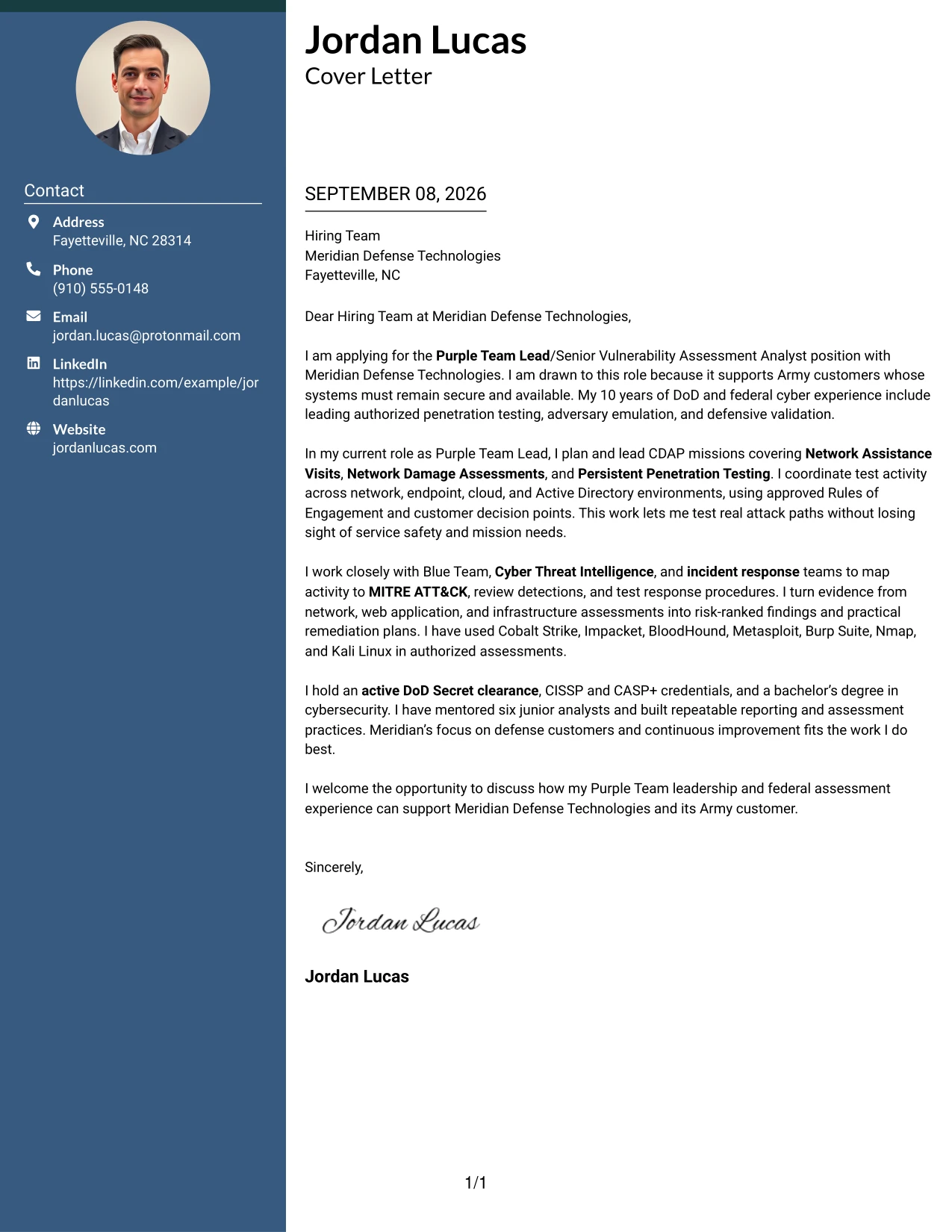
Why This Cover Letter Works
- The main reading path keeps the application story in a natural sequence.
- A supporting column can hold concise contact or qualification details without interrupting the argument.
- The format gives CDAP, NAV, NDA, and PPT evidence room to stand out.
- Short supporting content can reinforce the connection to Army and federal customers.
- The letter can show technical depth while keeping the motivation paragraph visible.
- Two-column organization works well when several fit points must be presented without adding more paragraphs.
- Clear separation helps the reader return to the strongest evidence during a second review.
Best For
- Applicants who need to present motivation and supporting qualifications side by side
- Letters with several evidence areas, such as testing, detection validation, and reporting
- Readers who compare a main message with concise supporting details
- Applications where employer fit should remain visible beside technical proof
- Candidates who want to organize a higher volume of relevant experience without long blocks of text
- Roles that require both operational depth and clear stakeholder communication
- Cover letters reviewed quickly but needing a useful second reading path
#3 Cover Letter Example: Photo Header Two Column Format
Evidence receives priority in this cover letter: the reader can quickly see CDAP leadership, authorized adversary emulation, and coordination with defensive teams before moving through the supporting details. The Photo Header Two Column Format places that evidence beside a strong visual header, creating a memorable first impression while preserving room for a focused persuasive message.
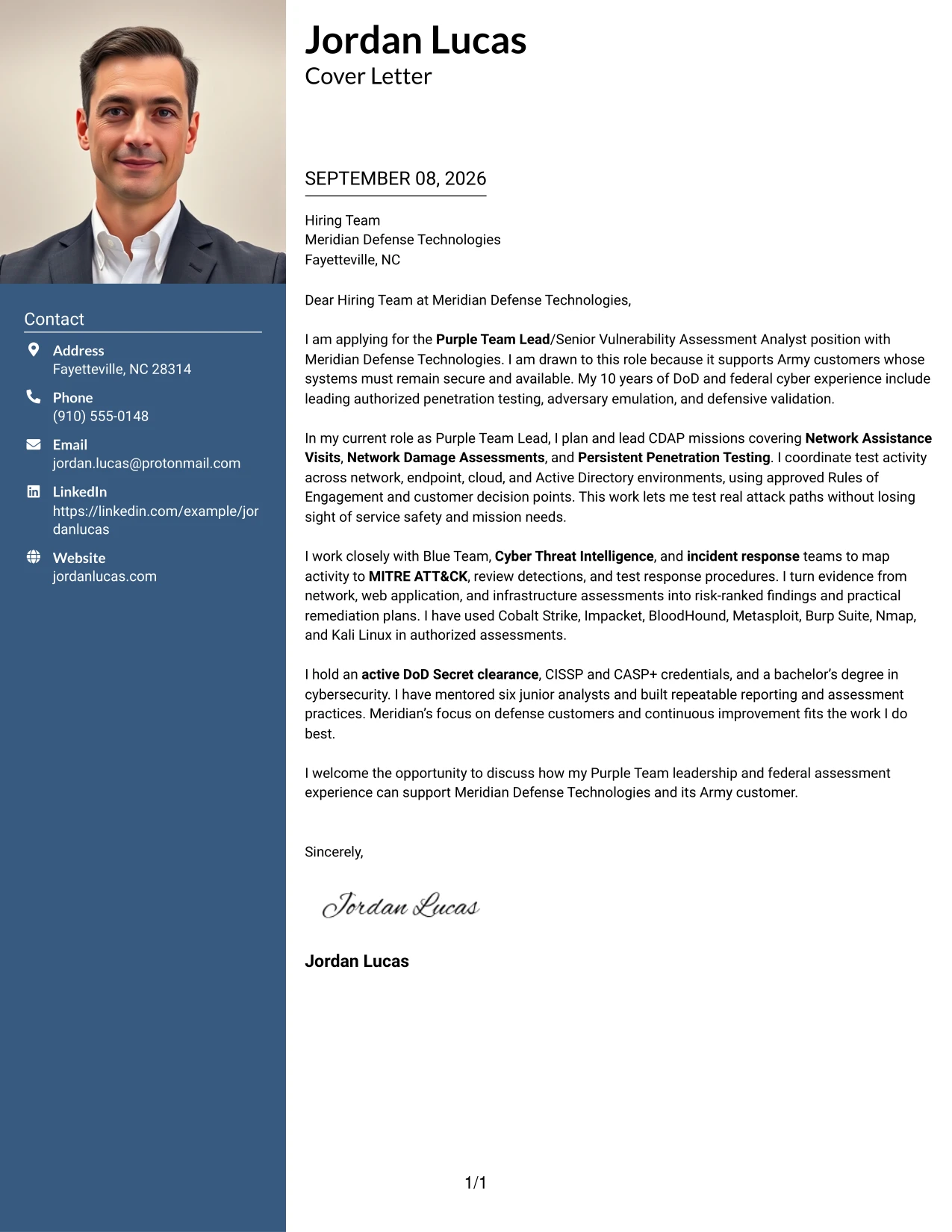
Why This Cover Letter Works
- The opening can lead with the most relevant evidence instead of a broad career summary.
- A two-column structure separates the persuasive narrative from supporting qualifications.
- The header creates a clear entry point before the reader reaches the technical detail.
- CDAP mission experience can be paired with the role’s direct responsibilities.
- Adversary emulation and defensive validation remain connected in the central argument.
- The letter can show both operational credibility and communication discipline.
- The format supports a polished presentation when visual identity matters to the application.
Best For
- Applicants whose strongest proof should appear near the top of the letter
- Applications where a visual header supports a polished first impression
- Letters that must balance detailed assessment evidence with a short persuasive narrative
- Candidates presenting both offensive testing and defensive validation experience
- Roles where collaboration with multiple security teams is central to the message
- Readers who benefit from separating core evidence from supporting qualifications
- Cover letters that need a memorable presentation while keeping the argument concise
#4 Cover Letter Example: Simple One Column Format
Balanced spacing gives this letter a calm, direct application experience. The Simple One Column Format lets the opening explain interest in Meridian and the body connect CDAP planning, authorized testing, and defensive validation to the position. Each point has room to land before the closing returns to employer fit and the opportunity to discuss the contribution.
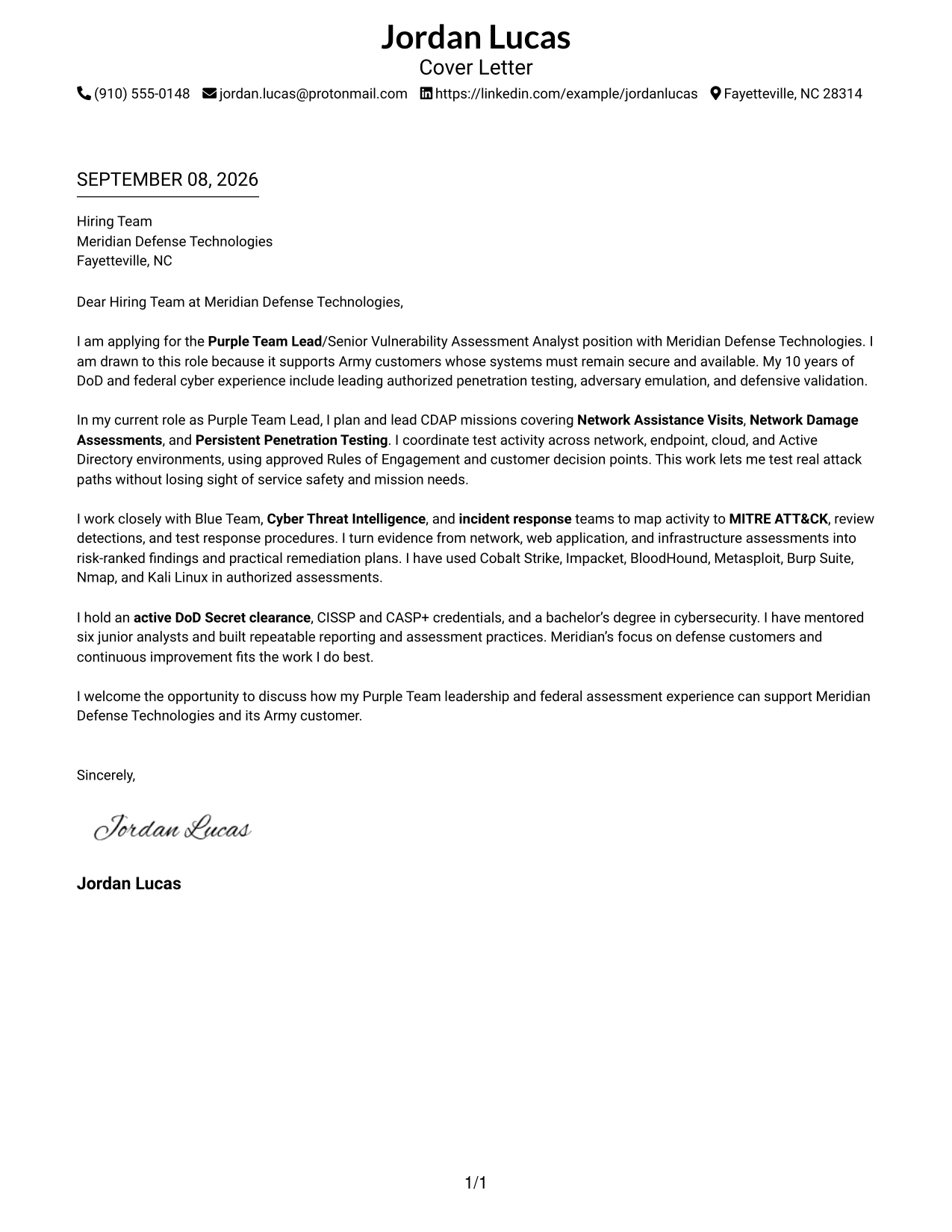
Why This Cover Letter Works
- The open spacing makes the applicant’s motivation easy to find.
- A single reading path keeps the argument in a familiar order.
- The letter can explain complex CDAP work without forcing several ideas into one dense block.
- Rules of Engagement and service safety receive attention because the format supports fuller explanation.
- The connection between findings and remediation remains clear from paragraph to paragraph.
- The closing has enough visual space to make the request to discuss fit feel intentional.
- This structure suits a formal application where clarity and restraint matter more than decoration.
Best For
- Formal applications that call for a direct and traditional letter structure
- Readers who prefer generous space between motivation, evidence, and closing
- Applications needing a careful explanation of authorized testing boundaries
- Candidates who want one uninterrupted path through a complex work history
- Roles where service safety and customer trust should receive clear attention
- Letters that must explain technical work in plain, well-separated paragraphs
- Hiring teams looking for a restrained presentation with strong readability
#5 Cover Letter Example: One Column Format with Photo
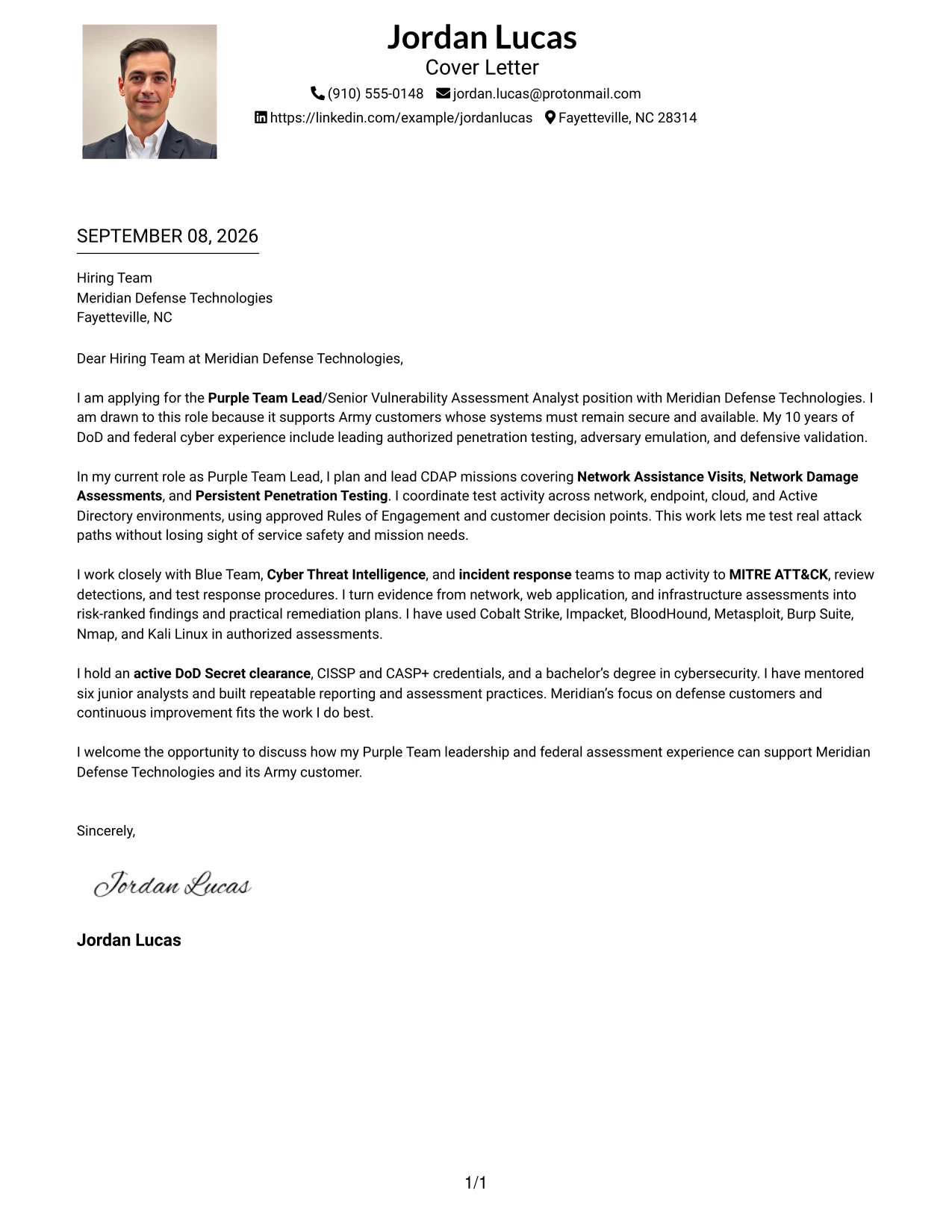
For an application that needs a polished personal introduction, this format places the written case for fit in one steady column and gives the header a strong visual presence. The letter can move from interest in Meridian to CDAP leadership, assessment evidence, and mentoring without breaking the persuasive thread. The photo should remain professional and secondary to the content, especially because the strongest case rests on authorized cyber operations and federal customer work.
Why This Cover Letter Works
- The one-column structure keeps the full argument easy to follow.
- A prominent header can introduce the applicant before the reader reaches the evidence.
- The letter has room to explain both motivation and technical contribution.
- CDAP, penetration testing, and response validation can be connected in a single narrative.
- The visual element adds personality without replacing proof of role alignment.
- The closing can return attention to Meridian’s Army customer mission and continuous improvement.
- The format works when a polished presentation should support, rather than compete with, clear writing.
Best For
- Applications where a polished personal introduction supports the written message
- Applicants who want one continuous narrative from motivation through closing
- Letters that combine mission interest, technical evidence, and mentoring experience
- Readers who value a clear personal presence before reviewing detailed qualifications
- Roles where the applicant must explain complex work in a compact but complete story
- Candidates seeking a formal presentation with a stronger visual opening
- Cover letters in which presentation should reinforce confidence and professionalism
#6 Cover Letter Example: One Column Format with Photo Right
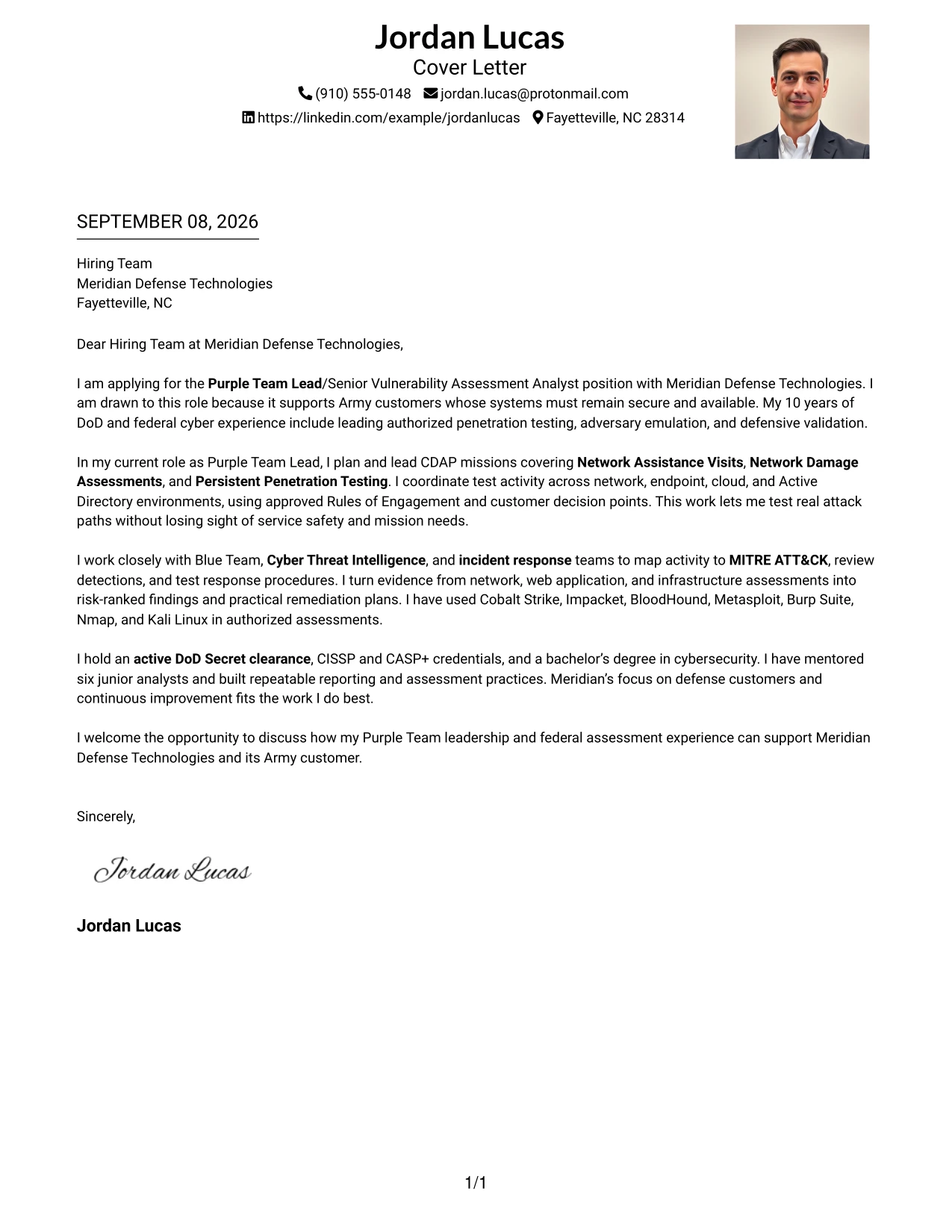
A restrained visual hierarchy keeps the written case first while placing the photo to the right as a supporting detail. That balance suits a letter that must show role alignment through CDAP planning, authorized adversary emulation, defensive validation, and analyst mentoring. The reader can follow one complete argument without the visual element interrupting the explanation of how this experience supports Meridian’s Army customer.
Why This Cover Letter Works
- The main text remains the primary source of evidence.
- Right-side visual placement adds distinction without dividing the written narrative.
- The letter can connect offensive testing to detection and response validation in sequence.
- A single column gives technical terms enough surrounding context to remain understandable.
- The format supports a confident tone while preserving a professional balance.
- The closing can emphasize both contribution to Meridian and interest in its defense mission.
- This approach is useful when role alignment should be unmistakable before visual detail is considered.
Best For
- Applications where written role alignment must remain more prominent than visual detail
- Applicants presenting a connected story about testing, validation, and mission support
- Readers who prefer one complete narrative with a secondary visual element
- Letters that need to explain technical terms within their surrounding context
- Roles requiring confidence, restraint, and clear communication with government stakeholders
- Candidates who want visual distinction without a split reading path
- Cover letters where the employer mission should remain the main focus
#7 Cover Letter Example: Simple Two Column Format
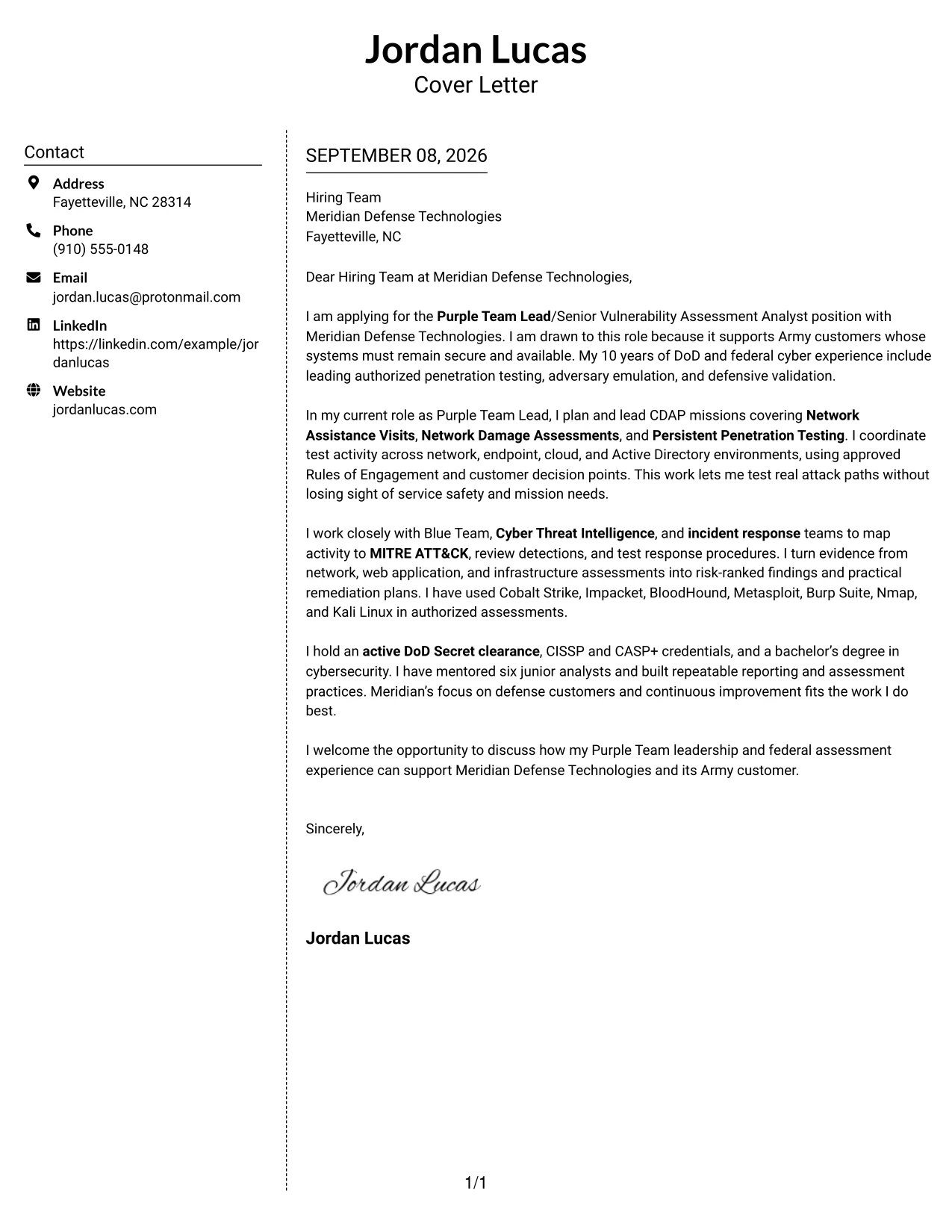
The Simple Two Column Format divides the letter into a primary message and concise supporting points, so motivation and evidence can work together without competing for attention. For this application, the main text can explain interest in Meridian and the Army mission, while the secondary area reinforces CDAP experience, defensive validation, credentials, and mentoring.
Why This Cover Letter Works
- The division creates a clear difference between the personal argument and supporting proof.
- Simple visual treatment keeps the focus on communication rather than decoration.
- A supporting area can reinforce credentials or clearance without interrupting the opening.
- The main column has room to explain why the work matters to the applicant.
- CDAP and defensive validation can be presented as connected but distinct evidence.
- The structure helps a reader find role-specific proof during a quick review.
- The format remains easy to adapt when the letter needs a small amount of additional supporting content.
Best For
- Applicants who want to separate personal motivation from supporting qualifications
- Letters with a main argument plus a short set of reinforcing facts
- Readers who scan for clearance, credentials, or mission evidence after reading the opening
- Applications needing clear distinction between narrative and supporting content
- Candidates who want two organized areas without a heavily designed appearance
- Roles where concise stakeholder communication is part of the employer’s expectations
- Cover letters that may need a small supporting panel but should remain straightforward
#8 Cover Letter Example: Stylish Two Column Designer Format
A reader can begin with the main narrative, then use the side panel to confirm the qualifications that support it. The Stylish Two Column Designer Format gives a larger evidence set a clear home while the central letter develops motivation, collaboration, and employer fit. Used carefully, the design helps organize technical depth without turning the application into a list of tools.

Why This Cover Letter Works
- The side panel gives supporting qualifications a stable place during review.
- The main narrative can focus on motivation and the value of defensive validation.
- A larger evidence set becomes easier to revisit without repeating it in every paragraph.
- The design supports a clear link between technical findings and stakeholder outcomes.
- The letter can show breadth across network, application, cloud, and endpoint assessments.
- Strong separation helps preserve a persuasive tone even when the applicant has substantial experience.
- The format is useful when organization matters as much as the amount of evidence presented.
Best For
- Applicants with a broad set of relevant qualifications to organize beside the main message
- Letters that need to show technical breadth without repeating the same evidence
- Readers who revisit supporting details while assessing employer fit
- Applications combining assessment scope, collaboration, and reporting responsibilities
- Candidates who want a designed presentation with a clear information hierarchy
- Roles where varied evidence must remain connected to one central motivation
- Cover letters that benefit from a dedicated space for concise supporting facts
#9 Cover Letter Example: Colored Two Column Format
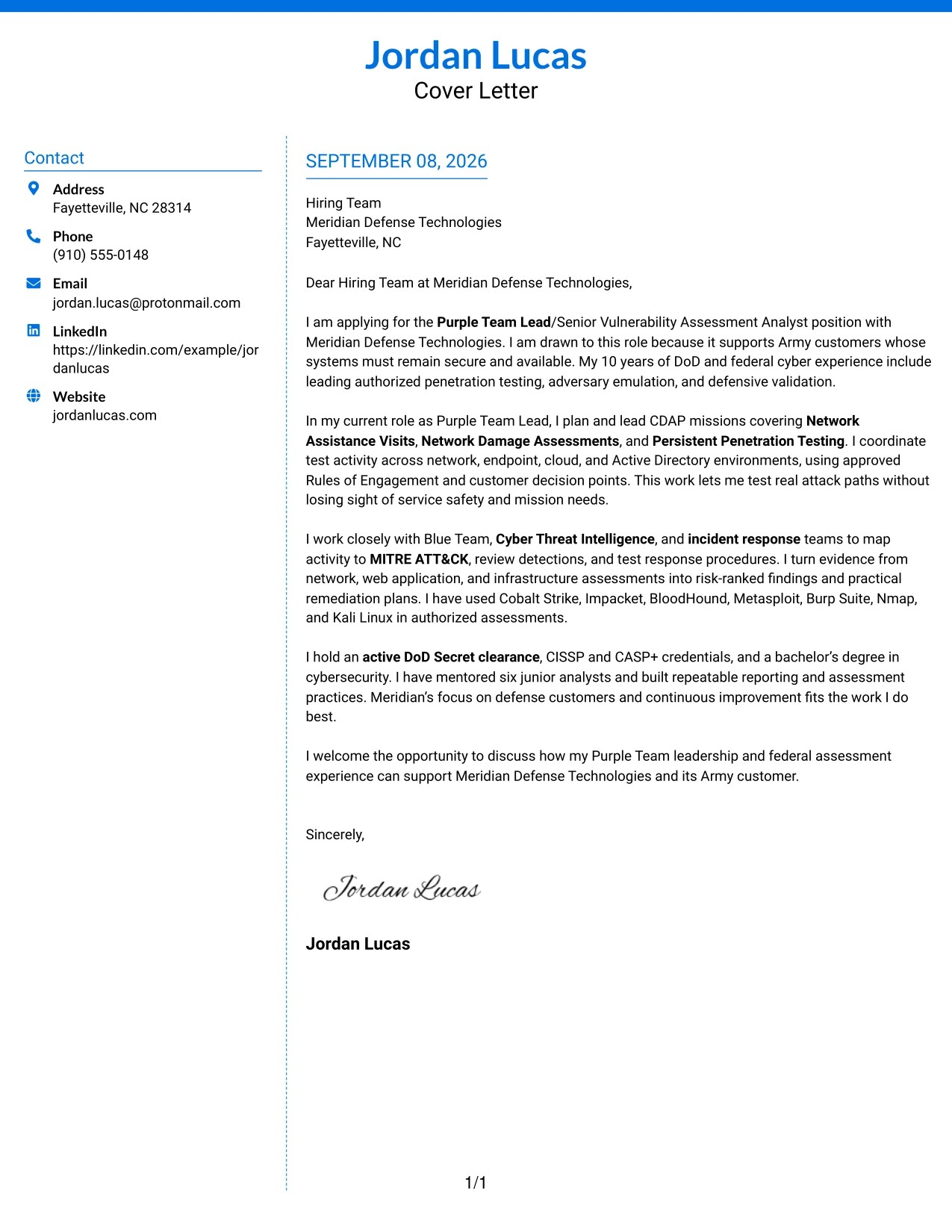
The most persuasive evidence should meet the reader early: this format can foreground CDAP leadership, authorized assessment work, and collaboration with defensive teams before the supporting details. The Colored Two Column Format uses visual contrast to separate the main argument from secondary information, helping the letter explain both technical contribution and careful adherence to Rules of Engagement.
Why This Cover Letter Works
- The main area can lead with evidence that directly matches the position.
- Color separation helps the reader distinguish argument from supporting information.
- The letter can show that offensive activity is paired with defensive validation.
- Rules of Engagement and DoD policy awareness remain visible as trust-building evidence.
- The format supports a concise explanation of findings, risk, and remediation.
- A separate area can reinforce credentials, clearance, or collaboration without diluting the central message.
- The result is a persuasive letter that uses presentation to clarify, not replace, substance.
Best For
- Applications where the strongest role evidence should be visible at the start
- Letters that need to distinguish core argument from supporting qualifications
- Candidates explaining how offensive activity improves defensive outcomes
- Readers who benefit from clear visual separation during a quick review
- Roles where rules, policy, and customer trust are important parts of the fit
- Applications that must connect findings and remediation in a compact narrative
- Cover letters using restrained color to guide attention toward the strongest proof
#10 Cover Letter Example: Creative Two Tone Format
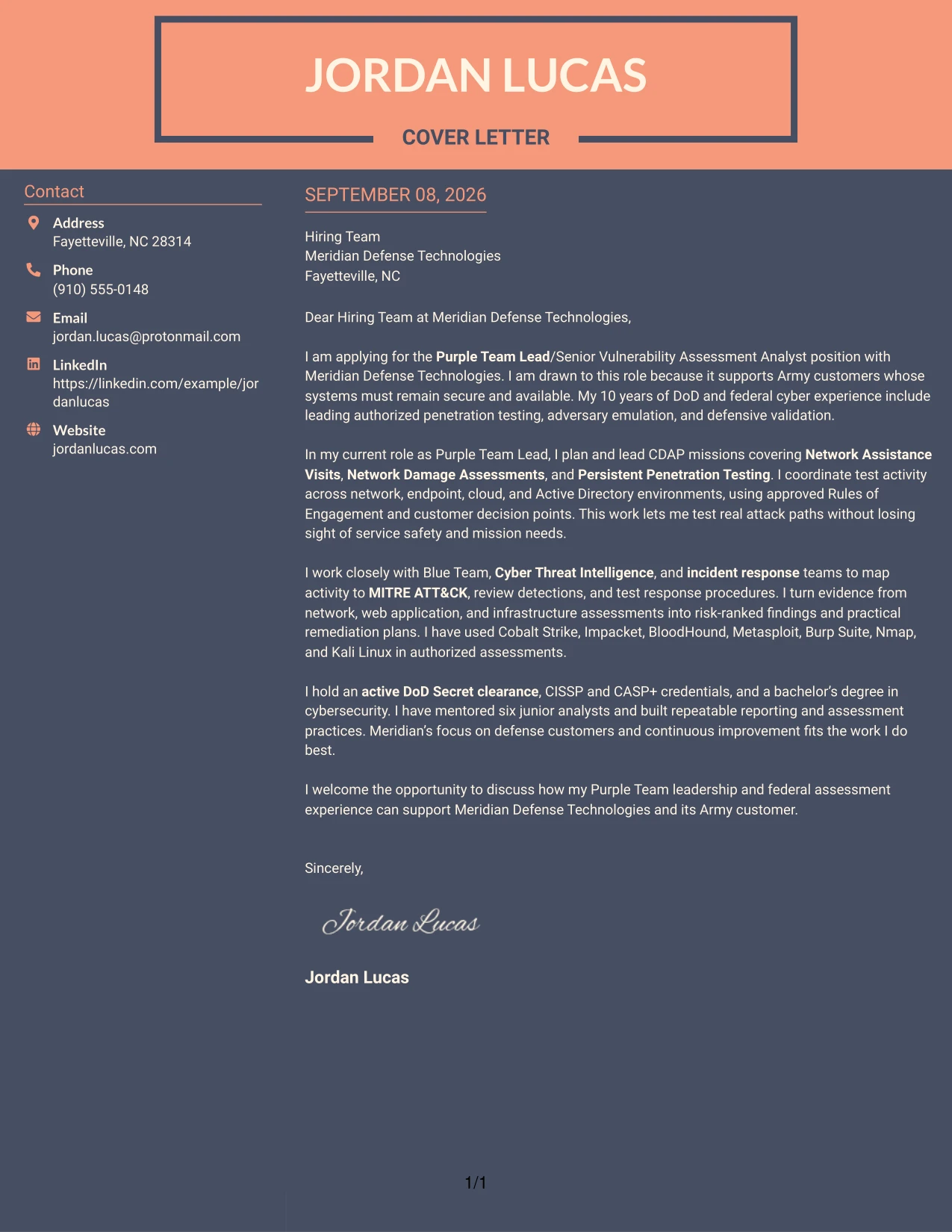
Balanced content distribution gives this letter a clear opening, a focused evidence section, and a purposeful close. The Creative Two Tone Format can use its visual contrast to distinguish motivation from qualifications while keeping the central story professional. Jordan Lucas’s letter would use that structure to connect federal cyber work, CDAP missions, defensive validation, and mentoring to Meridian’s defense mission.
Why This Cover Letter Works
- The two-tone treatment creates distinction without requiring a long or complicated letter.
- A balanced structure gives motivation and evidence similar importance.
- The letter can explain the applicant’s interest before presenting technical proof.
- CDAP work and collaboration with Blue Team, CTI, and incident response remain easy to connect.
- Mentoring adds a leadership dimension near the end of the argument.
- The closing can bring the visual and written structure back to employer fit.
- This format works when the application should feel individual while remaining credible and controlled.
Best For
- Applications seeking a distinctive presentation with a controlled professional tone
- Applicants who want motivation and qualifications to receive balanced attention
- Letters where leadership evidence should complement technical assessment experience
- Readers who appreciate visual separation but still expect a familiar argument
- Roles requiring both individual initiative and disciplined customer communication
- Candidates connecting mission interest, operational evidence, and mentoring in one page
- Cover letters that should feel personal without losing formal application standards
#11 Cover Letter Example: Modern Icon Format
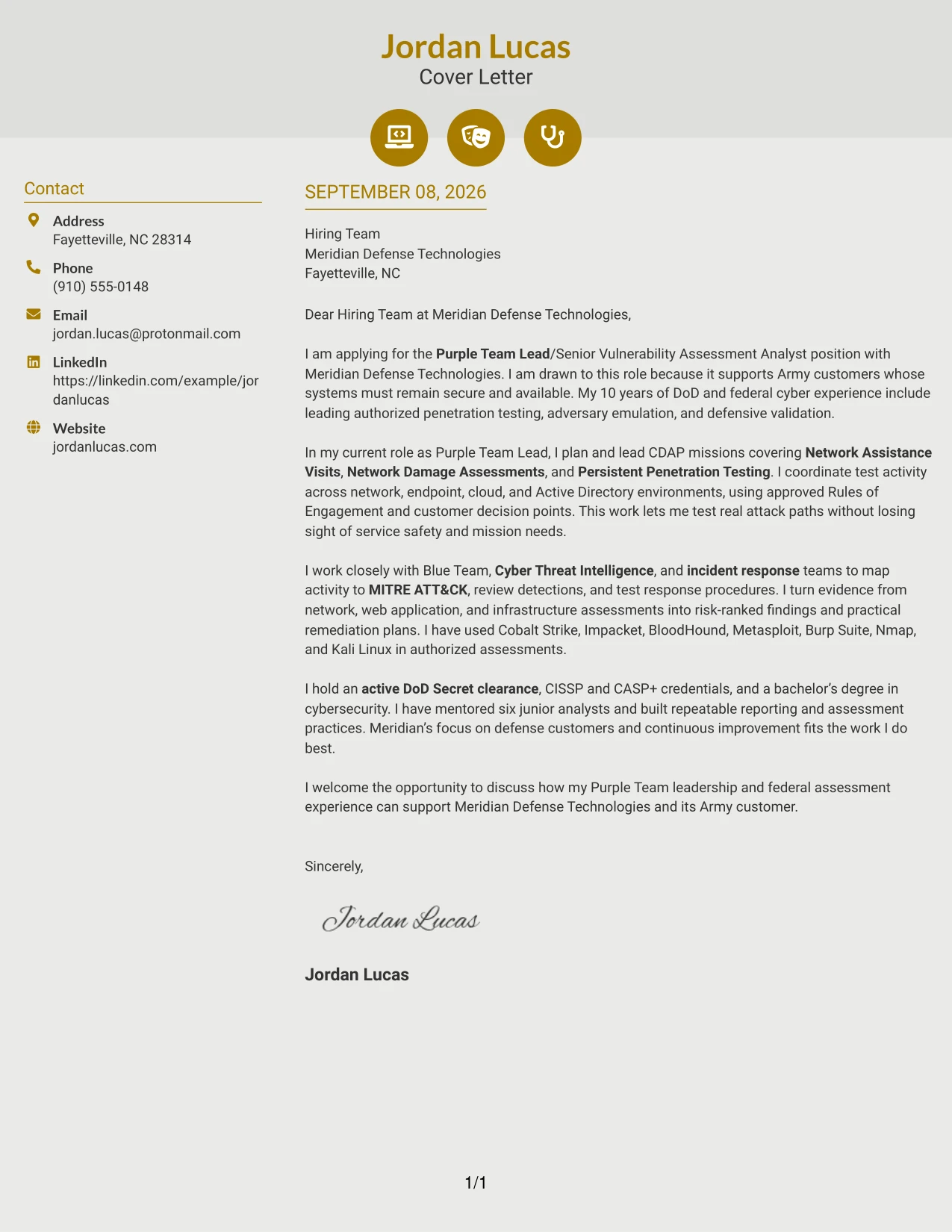
A practical application can benefit from small visual signals that help the reader find contact details, qualifications, and the main message quickly. The Modern Icon Format keeps the letter in one column while using restrained icons to guide attention. That makes room for a concise explanation of CDAP leadership, risk-ranked findings, defensive collaboration, and the reason this work fits Meridian’s Army customer mission.
Why This Cover Letter Works
- Icons can guide the reader without replacing the written explanation.
- The one-column structure preserves a complete and natural persuasive sequence.
- The opening can establish motivation before the letter moves into evidence.
- Visual markers make contact and supporting qualification details easier to locate.
- The body can connect technical findings with remediation and response validation.
- A clean hierarchy supports quick review while leaving room for credible detail.
- The format adds a modern touch without weakening the seriousness of federal cyber work.
Best For
- Applicants who want quick visual guidance within a single-column letter
- Applications where contact and qualification details should be easy to locate
- Readers reviewing a concise message with several connected evidence points
- Candidates explaining technical findings in a clear, compact narrative
- Roles where modern presentation should still support a formal communication style
- Letters that need fast navigation without a separate sidebar or complex layout
- Cover letters balancing visual polish with serious mission and customer context
#12 Cover Letter Example: Minimal Header Format
A restrained visual hierarchy keeps attention on the letter’s purpose: why the candidate wants the role, what relevant evidence they bring, and how that experience supports the employer’s mission. The Minimal Header Format gives a focused introduction, clear body paragraphs, and a direct closing, which suits a letter connecting Purple Team leadership, CDAP missions, defensive validation, and federal cybersecurity work to Meridian Defense Technologies’ Army support needs.

#12 Why the Minimal Header Format Works for a Cover Letter
- The simple header creates a professional first impression without competing with the message.
- The opening can connect interest in Meridian Defense Technologies with support for Army customers.
- A focused body makes CDAP, adversary emulation, and defensive validation easy to explain.
- Short paragraphs help the reader follow the movement from experience to employer fit.
- The format gives technical evidence room without making the letter feel like a tool inventory.
- A direct closing reinforces interest and invites a conversation about mission support.
- The restrained presentation suits a letter that must sound precise, credible, and dependable.
Best For
- Applicants who want the employer and role connection to appear quickly.
- Letters that need a focused opening, two evidence-based body paragraphs, and a concise close.
- Technical professionals explaining complex work in clear, reader-friendly language.
- Applications where federal or defense mission alignment should guide the narrative.
- Candidates who need to connect leadership experience with hands-on assessment work.
- Readers who value a quiet presentation with strong control over information order.
- Cover letters that balance technical credibility with a direct communication style.
#13 Cover Letter Example: Clean Two Column Sidebar Format
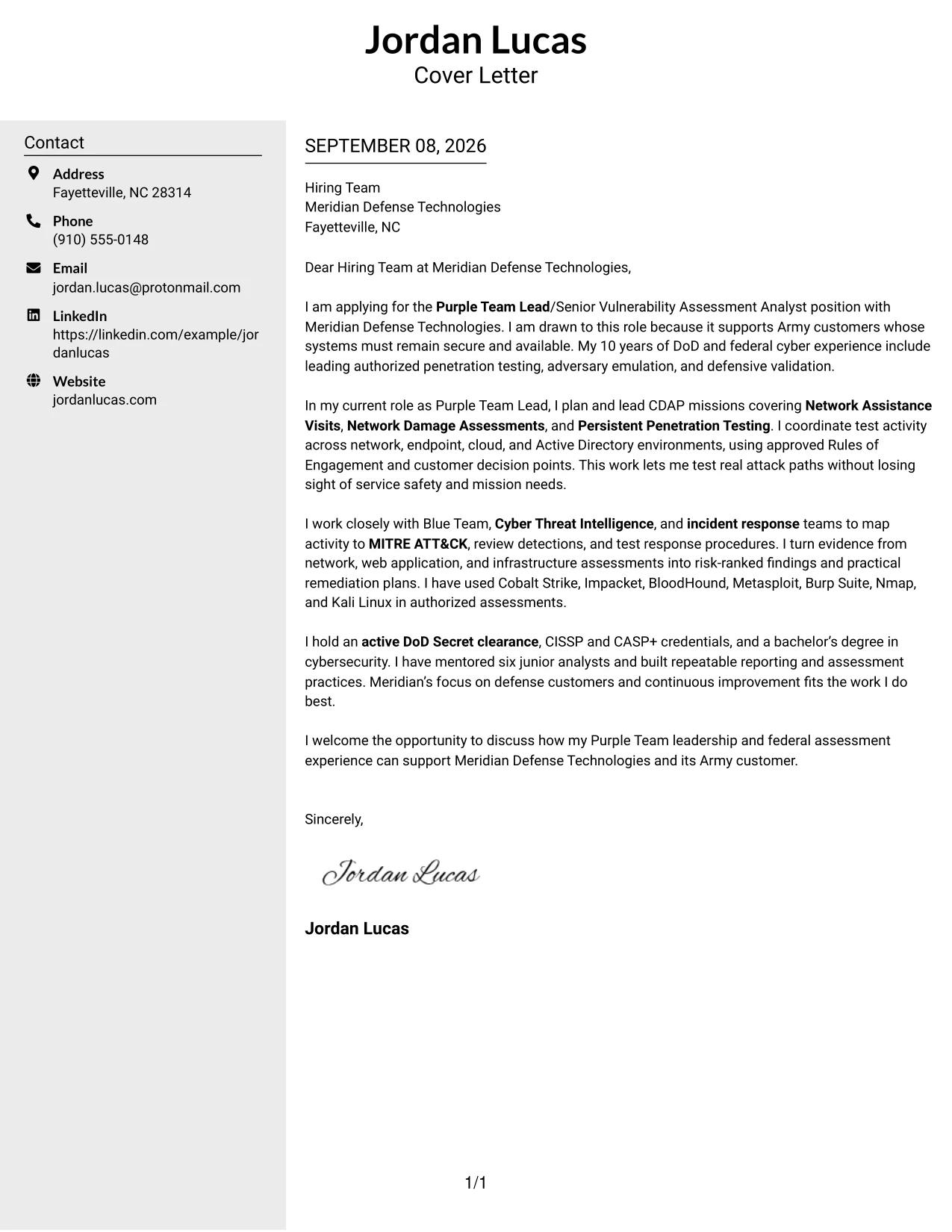
The format organizes the letter through a main message area and a supporting sidebar, allowing the reader to move from motivation and evidence to concise contact or application details. For this application, that structure can separate the central case for Purple Team leadership from supporting points such as an active DoD Secret clearance, CISSP, CASP+, and experience with federal cyber operations.
#13 Why the Clean Two Column Sidebar Format Works for a Cover Letter
- The main column can carry the persuasive story from interest to relevant experience.
- The sidebar creates a clear place for supporting credentials and contact information.
- Separate visual zones help the reader distinguish evidence from context.
- The layout can keep technical details available without interrupting the central argument.
- A structured middle section can explain collaboration with Blue Team, CTI, and incident response teams.
- The closing remains easy to find because the letter has a clear reading path.
- The format supports a polished application while keeping the communication practical.
Best For
- Applications with several supporting credentials that should remain visible beside the main message.
- Letters that combine leadership evidence with technical assessment experience.
- Readers who prefer a clear division between the narrative and supporting details.
- Candidates explaining work across network, web application, cloud, endpoint, and Active Directory environments.
- Applications where clearance and certifications support, but do not replace, the main argument.
- Cover letters that need organized presentation without long blocks of text.
- Professionals who want the reader to compare role needs with evidence at a glance.
#14 Cover Letter Example: Plain Two Column Format
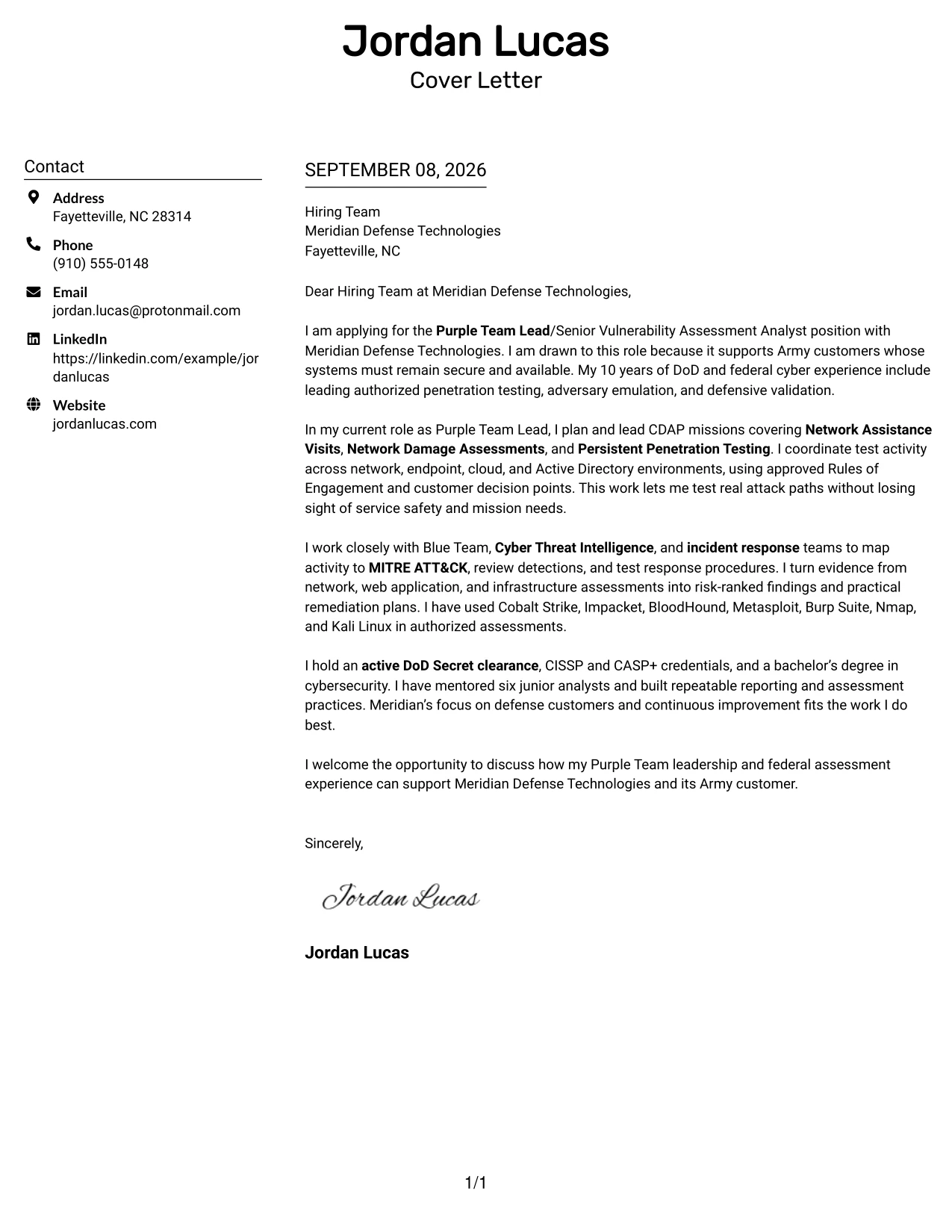
A recruiter can move through the main letter while using the second column as a quiet reference area for supporting details. The Plain Two Column Format is useful here because the letter contains substantial evidence, including CDAP planning, authorized penetration testing, MITRE ATT&CK mapping, remediation planning, and analyst mentoring, yet still needs a straightforward and readable message.
#14 Why the Plain Two Column Format Works for a Cover Letter
- The two columns help distribute a larger amount of relevant information.
- The main narrative can explain motivation and role fit in a natural sequence.
- The secondary area can reinforce credentials without taking over the letter.
- Separate areas make it easier to connect technical evidence with employer needs.
- The plain treatment keeps attention on the writing rather than decorative elements.
- The format supports a letter that covers several assessment environments without confusion.
- A clear closing can bring the two information areas back to one persuasive message.
Best For
- Letters with several distinct evidence areas that need careful distribution.
- Applicants connecting broad assessment experience to one target position.
- Applications that must explain both execution and collaboration responsibilities.
- Readers who need to review technical scope without losing the candidate’s motivation.
- Professionals presenting network, application, infrastructure, and defensive validation experience together.
- Cover letters where plain organization is more useful than strong visual emphasis.
- Messages that benefit from a separate place for credentials, methods, or supporting facts.
#15 Cover Letter Example: Modern Full Background Two Column Format
The strongest evidence should lead the reader toward a clear conclusion about readiness for the work. This format gives two areas enough room to present that evidence: one for the central application message and one for supporting proof such as adversary emulation, defensive validation, risk-ranked findings, and work across federal environments.
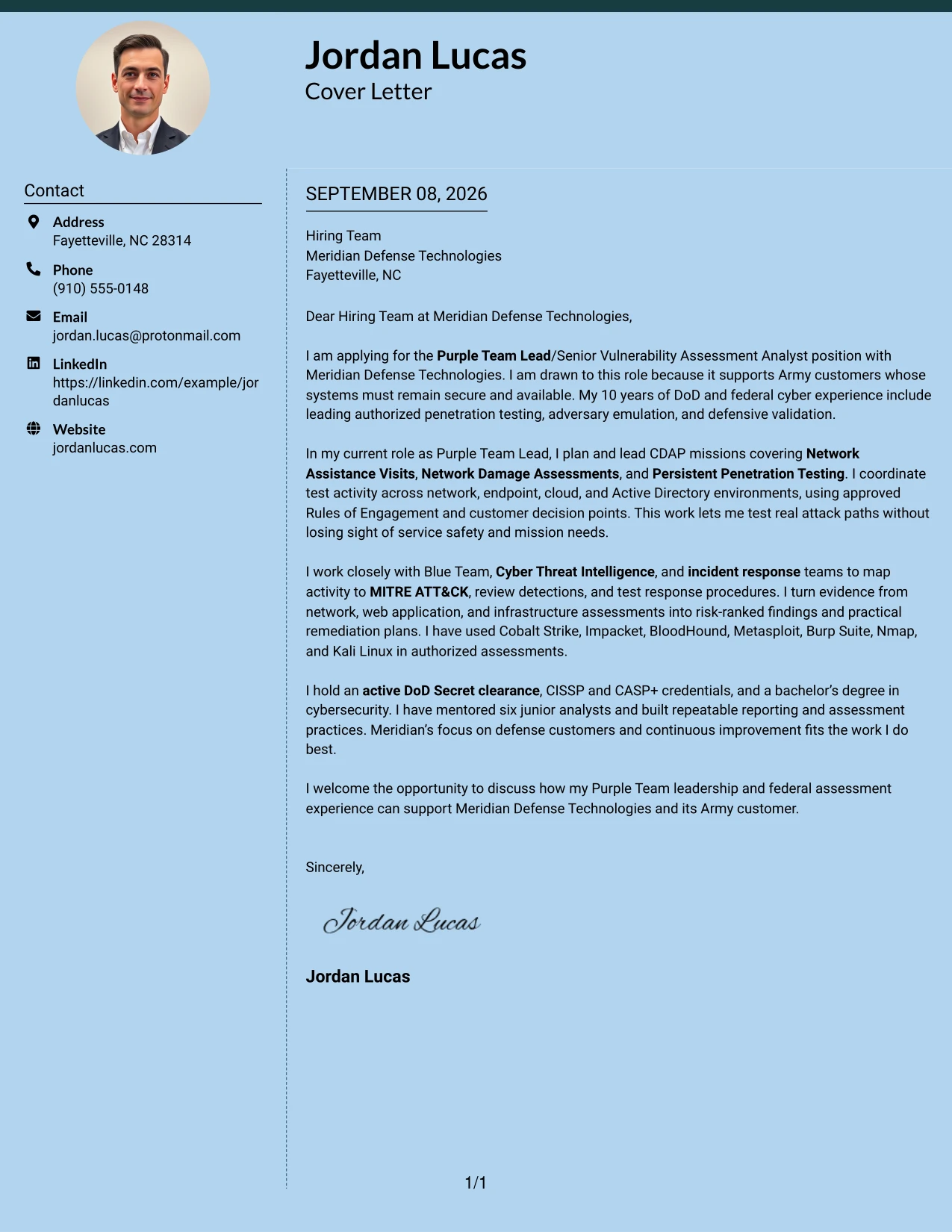
#15 Why the Modern Full Background Two Column Format Works for a Cover Letter
- The broad visual field can frame a confident but controlled professional message.
- Two content areas allow motivation and proof to remain distinct.
- The letter can prioritize leadership of Purple Team campaigns before listing supporting details.
- Evidence from authorized testing can be connected directly to detection and response outcomes.
- The structure helps present both technical depth and stakeholder communication.
- A defined closing area can leave the reader with a clear reason to continue the conversation.
- The format works when the application needs presence without losing professional clarity.
Best For
- Applications where the strongest assessment evidence should receive early attention.
- Candidates with a broad record that includes offensive testing and defensive collaboration.
- Letters that need to show technical range across several environments.
- Professionals presenting findings, remediation plans, and stakeholder communication as connected evidence.
- Applications where a confident visual frame supports a leadership-level message.
- Readers who benefit from a main argument supported by a separate evidence area.
- Cover letters that must show operational depth while remaining easy to review.
#16 Cover Letter Example: Dark Mode Two Column Format
Balanced content matters when a letter must show both technical capability and careful judgment. The Dark Mode Two Column Format can give the application a strong, contemporary presence while dividing the message between role motivation and supporting evidence, such as approved Rules of Engagement, detection validation, incident response coordination, and mentoring.

#16 Why the Dark Mode Two Column Format Works for a Cover Letter
- The contrast can create a confident presentation for a leadership-focused application.
- Two columns help balance the candidate’s motivation with proof of technical judgment.
- The letter can give approved testing boundaries the attention they deserve.
- Supporting details can show collaboration without crowding the main message.
- The structure keeps operational evidence connected to employer needs.
- A compact closing can restore focus after several detailed points.
- The format suits communication that is assured, disciplined, and mission-aware.
Best For
- Applications where a confident presentation should support a senior professional message.
- Letters that balance offensive testing with safety, scope, and service availability concerns.
- Candidates explaining how technical activity supports detection and response improvement.
- Applications with separate leadership, collaboration, and assessment evidence.
- Readers who need to see both practical execution and disciplined controls.
- Cover letters for roles that combine mission delivery with team development.
- Messages that need visual distinction while keeping the application information organized.
#17 Cover Letter Example: Dark Mode Box Header Format
A practical application review often begins with a quick question: can the letter show relevant fit without making the reader search for it? The Dark Mode Box Header Format answers by giving the opening and key message a defined visual frame, then using a single-column flow to explain Purple Team leadership, federal assessment experience, and interest in Meridian Defense Technologies.

#17 Why the Dark Mode Box Header Format Works for a Cover Letter
- The boxed header gives the role and application purpose a clear starting point.
- A single reading path supports a complete persuasive narrative.
- The letter can move naturally from employer interest to evidence and closing.
- The strong header helps the reader identify the application context quickly.
- Technical details remain connected to the reason they matter for the role.
- The format can make leadership, clearance, and federal experience feel intentional rather than scattered.
- A clear final paragraph leaves the reader with an easy next step.
Best For
- Applications that need the target role and employer connection to stand out immediately.
- Letters where a single, uninterrupted narrative is more useful than divided content.
- Candidates presenting a clear sequence from motivation to evidence to closing.
- Senior applications that need a firm visual starting point without a complex structure.
- Readers reviewing many applications and looking for an obvious communication path.
- Messages that combine technical scope with a direct explanation of employer fit.
- Cover letters where presentation should feel decisive and organized.
#18 Cover Letter Example: Elegant Full Background Two Column Format
A polished, measured visual impression can help a detailed application feel deliberate rather than crowded. The Elegant Full Background Two Column Format supports that balance by giving the letter space to explain interest in defense work, evidence from authorized assessments, collaboration with operational teams, and the practical value of repeatable Purple Team methods.
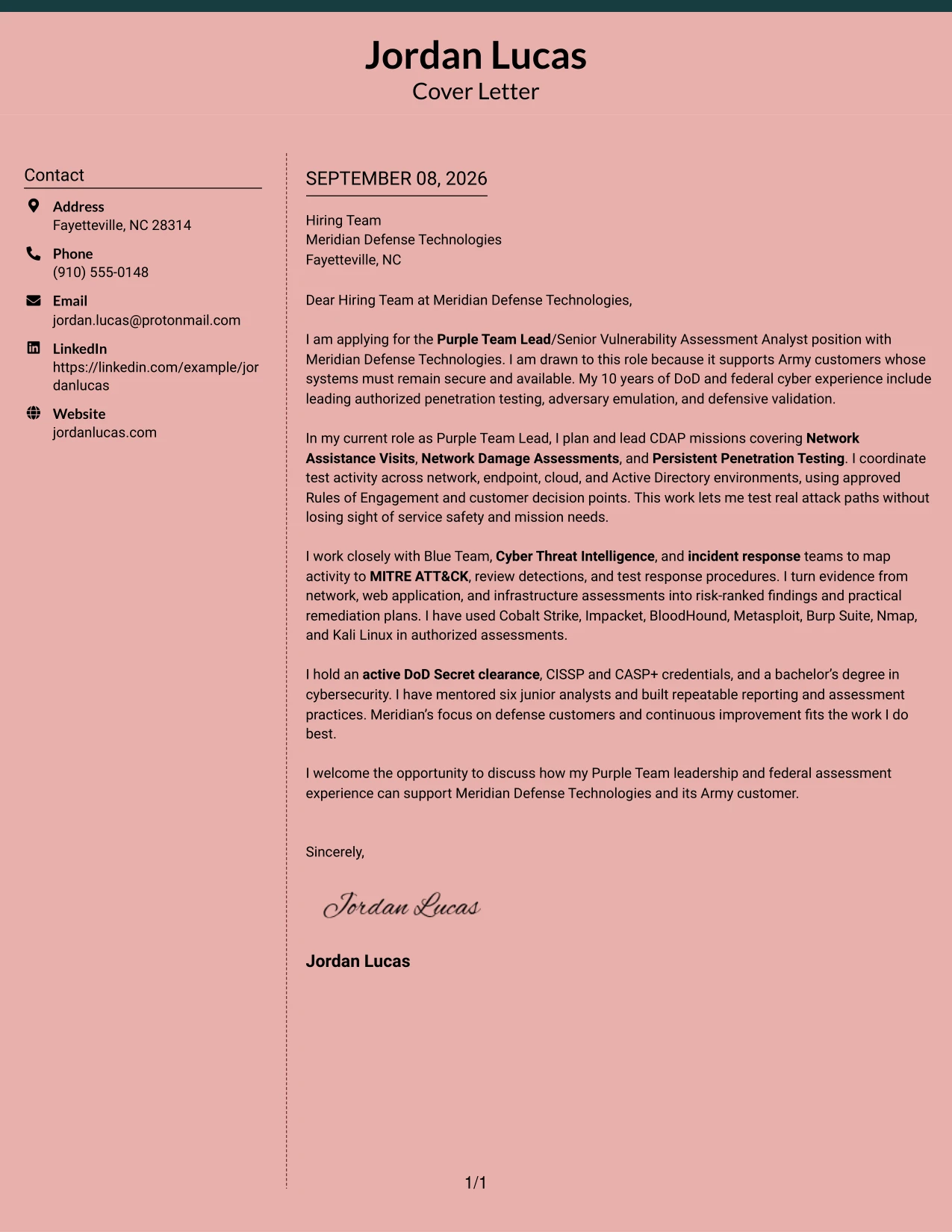
#18 Why the Elegant Full Background Two Column Format Works for a Cover Letter
- The refined structure supports a thoughtful explanation of motivation.
- Two columns can separate the main case from supporting proof without weakening either one.
- The letter can connect technical findings with practical remediation value.
- A balanced presentation suits communication with government and defense stakeholders.
- The format gives collaboration with Blue Team, CTI, and incident response teams a natural place.
- It can show leadership and technical depth without relying on a long list of claims.
- The closing can bring the message back to service, reliability, and employer fit.
Best For
- Applications that need a polished presentation for a mission-focused employer.
- Professionals combining technical assessment evidence with stakeholder communication.
- Letters that must explain why findings matter to remediation and operational resilience.
- Candidates with both leadership responsibility and hands-on testing experience.
- Readers who prefer balanced organization over dense, uninterrupted paragraphs.
- Applications where employer interest and technical credibility should receive equal weight.
- Cover letters presenting mature judgment, collaboration, and repeatable methods.
#19 Cover Letter Example: Plain One Column with Highlighted Date
The format creates a familiar letter structure, then uses a highlighted date to help the reader place the application in context. Its one-column flow keeps the message easy to follow as it moves from interest in the role to CDAP experience, collaboration with defensive teams, credentials, and a direct request for discussion.
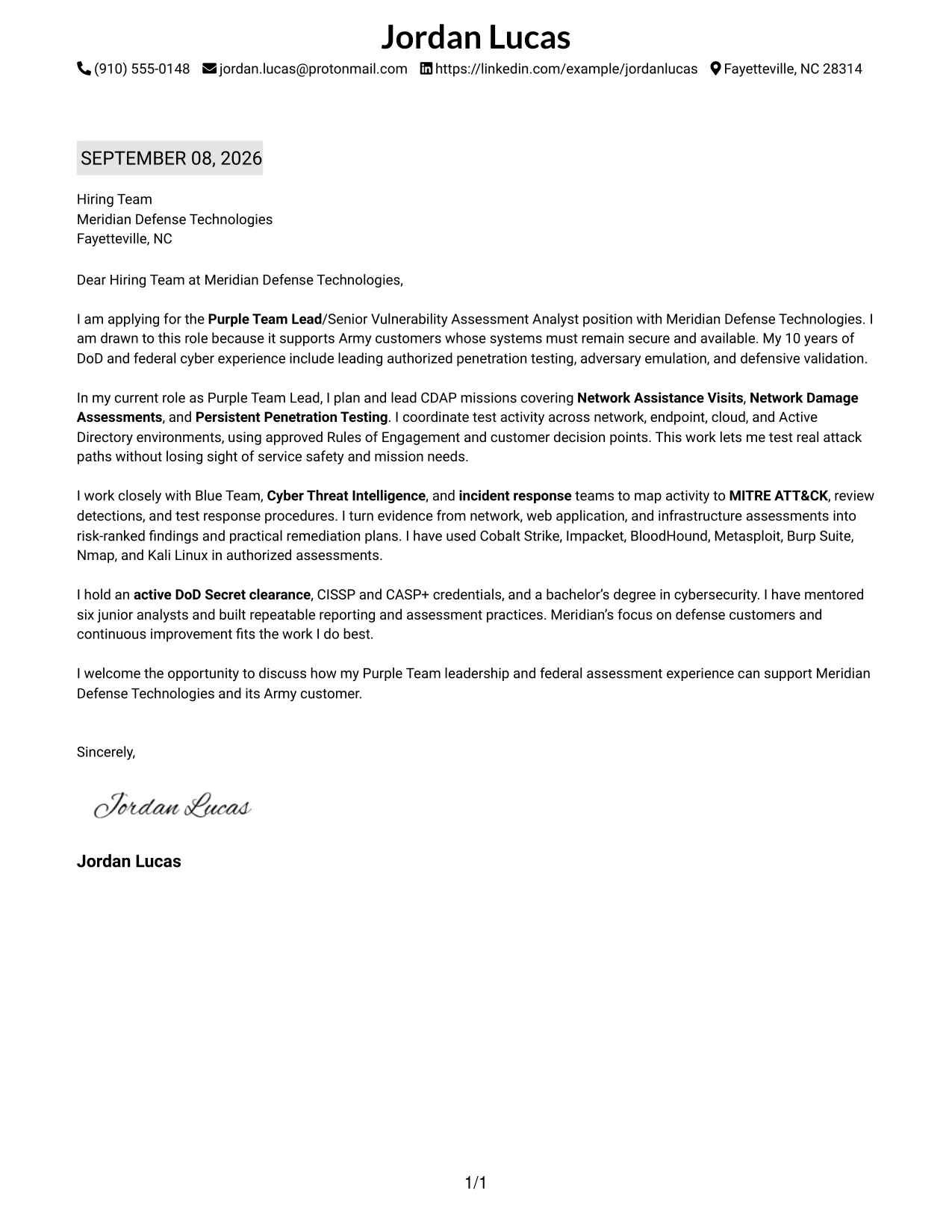
#19 Why the Plain One Column with Highlighted Date Works for a Cover Letter
- The familiar structure makes the letter easy to begin and review.
- The date receives useful emphasis without distracting from the argument.
- One-column reading keeps each paragraph in a clear persuasive order.
- The opening can state employer interest and relevant experience promptly.
- The body can explain technical work in connected, readable steps.
- The closing remains visible as the natural conclusion of the letter.
- The format supports a professional message that feels timely and dependable.
Best For
- Applications that benefit from a traditional letter sequence with a clear date marker.
- Candidates who want the reader to follow one continuous explanation.
- Letters connecting current experience to an immediate application purpose.
- Readers who prefer familiar organization and minimal visual interruption.
- Applications where timing or submission context deserves modest emphasis.
- Professionals explaining complex work through short, ordered paragraphs.
- Cover letters that need reliable readability across a broad range of review settings.
#20 Cover Letter Example: Bold Color Header Professional Format
Readers first encounter the application through the header and then move into the letter’s supporting case. In this format, the bold header establishes a confident entry point, while the single-column content can give full space to Jordan Lucas’s motivation, ten years of DoD and federal cyber experience, Purple Team leadership, and fit with Meridian Defense Technologies.

#20 Why the Bold Color Header Professional Format Works for a Cover Letter
- The header helps the application purpose register quickly.
- A single-column body gives the persuasive message room to develop.
- The letter can connect ten years of experience to the employer’s stated needs.
- The opening can establish interest before the body presents technical evidence.
- The format supports a confident tone without requiring complex navigation.
- A strong final paragraph can reinforce both availability and employer fit.
- The structure works well when the application needs professional presence and content depth.
Best For
- Applications where a prominent opening should guide the reader into substantial content.
- Professionals with enough relevant experience to need a fuller letter narrative.
- Letters that connect leadership, technical execution, and mission support in sequence.
- Candidates who want a strong first impression followed by detailed evidence.
- Readers reviewing applications that need a clear beginning and sustained content flow.
- Applications where the employer relationship should remain visible throughout the letter.
- Cover letters that require room for motivation, proof, credentials, and a purposeful close.
#21 Cover Letter Example: Photo Header Color Sidebar Format
The strongest evidence should remain central: leadership of authorized Purple Team operations, coordination with defensive stakeholders, and the ability to turn assessment results into remediation plans. A color sidebar and photo header add a personal introduction, while the letter’s text can still guide the reader from Meridian Defense Technologies’ mission to the candidate’s technical and leadership fit.
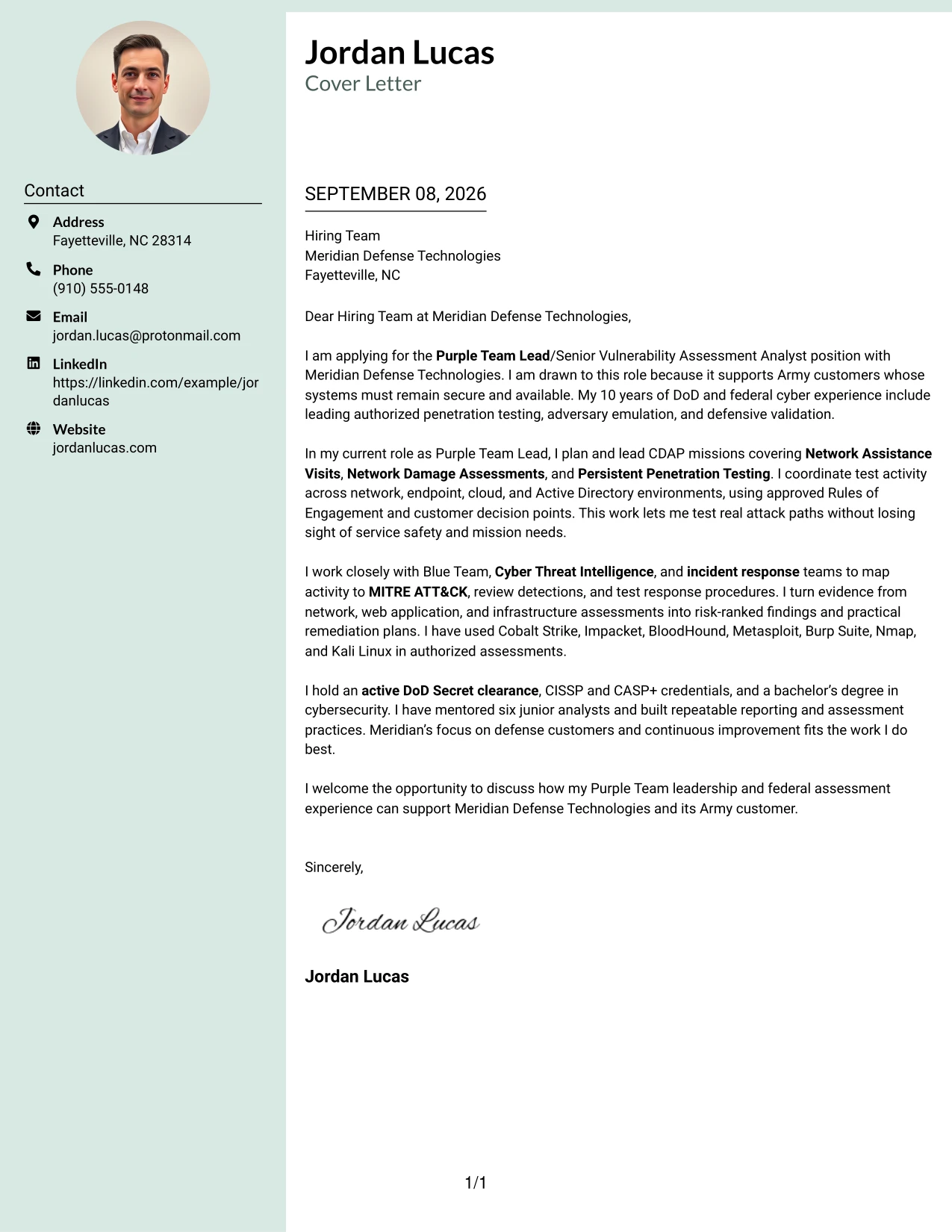
#21 Why the Photo Header Color Sidebar Format Works for a Cover Letter
- The header creates a personal first point of contact for the application.
- The color sidebar can separate contact details from the persuasive letter body.
- The main text can keep role motivation and technical evidence together.
- The format gives leadership experience a clear place near the start of the message.
- Supporting credentials can remain visible without interrupting the narrative.
- The letter can show both human communication and disciplined technical practice.
- A focused closing keeps the personal introduction connected to employer fit.
Best For
- Applications where a personal introduction supports the professional message.
- Candidates who want contact details and supporting information separated from the main letter.
- Letters balancing leadership evidence with a direct explanation of motivation.
- Applications where communication style is part of the employer’s review.
- Professionals presenting technical work alongside mentoring and stakeholder partnership.
- Readers who benefit from a clear visual distinction between context and argument.
- Cover letters that need a memorable introduction while preserving detailed evidence.
#22 Cover Letter Example: Top Left Header Color Accent Format
A well-balanced application gives the reader enough context to understand the candidate’s interest, then distributes evidence without letting any single detail dominate. The Top Left Header Color Accent Format supports that approach with a clear starting point and a controlled single-column flow for discussing Army support, defensive validation, assessment leadership, and Meridian Defense Technologies’ needs.
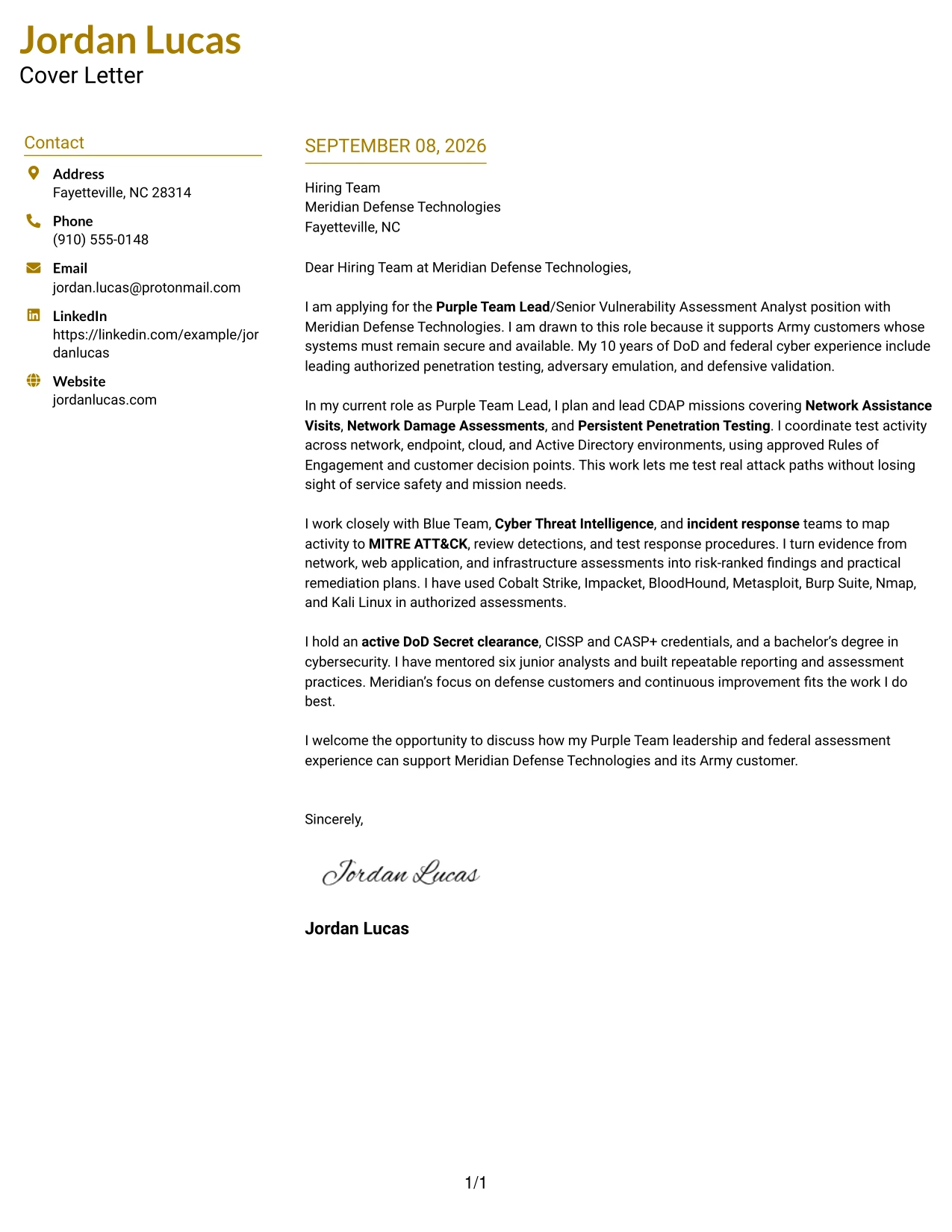
#22 Why the Top Left Header Color Accent Format Works for a Cover Letter
- The top-left starting point gives the letter a natural entry into the message.
- A restrained accent can guide attention without overpowering the content.
- The single-column flow keeps motivation, evidence, and closing connected.
- The format supports a clear explanation of Army and federal customer alignment.
- Technical methods can be presented as proof of fit rather than as isolated details.
- The closing can return to the employer’s mission and invite further discussion.
- The overall structure suits communication that is organized, calm, and purposeful.
Best For
- Applications that need a clear starting point and steady information flow.
- Letters connecting employer mission to evidence in a measured sequence.
- Candidates explaining technical work without allowing tools or methods to dominate.
- Applications where a modest visual accent supports a serious professional message.
- Readers who value clear paragraph order and controlled emphasis.
- Professionals combining assessment leadership with service-oriented motivation.
- Cover letters that need balanced space for interest, evidence, credentials, and closing.
#23 Centered Header Classic Two Column Format Cover Letter Example
For an application to Meridian Defense Technologies, a centered header can establish a calm, professional first impression while two columns organize the recipient details and letter content. The format gives the opening room to state motivation for supporting Army customers, then guides the reader toward CDAP leadership, defensive validation, and experience with authorized testing. Its balanced structure supports a clear close that connects the candidate’s background to Meridian’s mission.
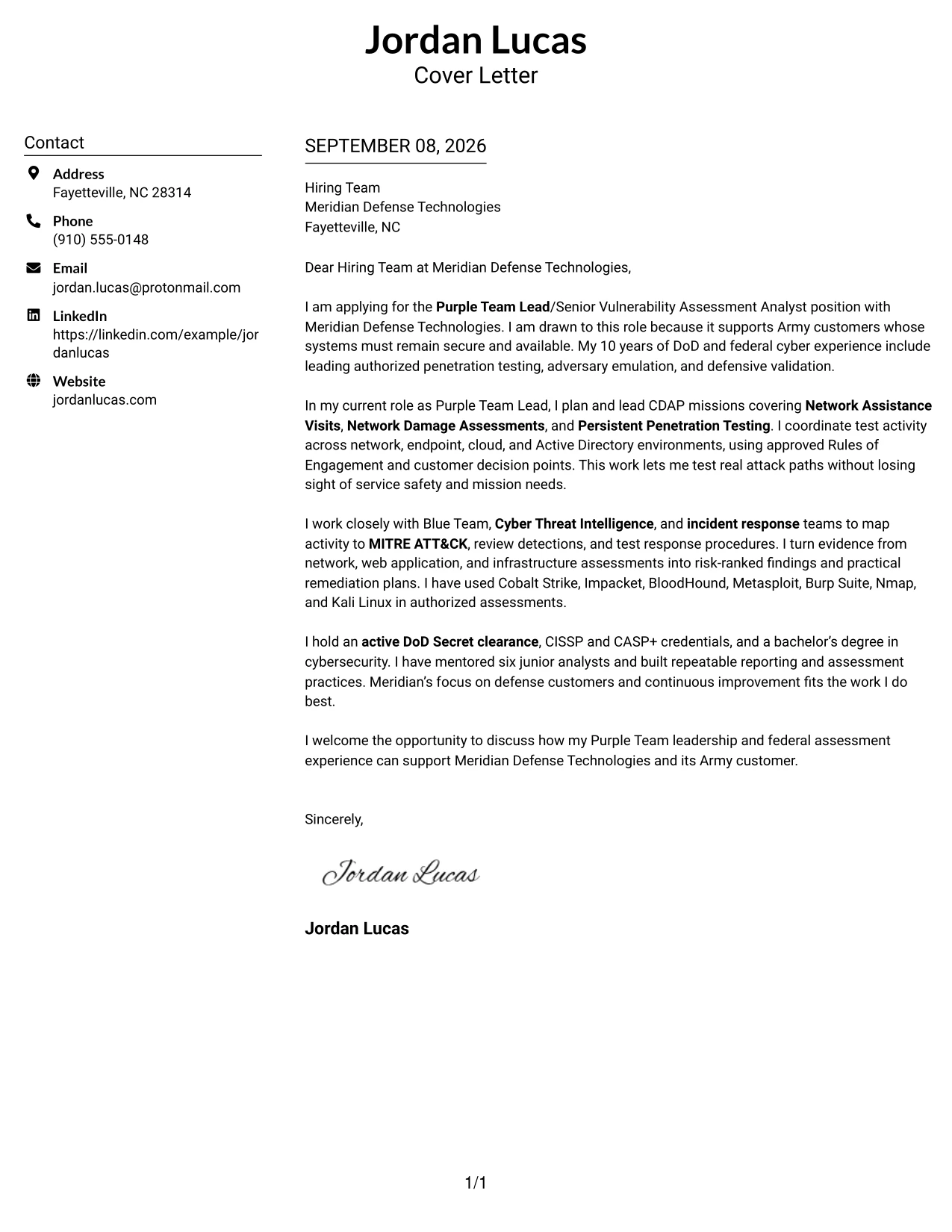
Why the Centered Header Classic Two Column Format Works for a Cover Letter
- A centered header makes contact details easy to locate before the reader begins the letter.
- Two columns create a clear visual separation between letter details and persuasive content.
- The opening can connect interest in Meridian’s Army support mission with relevant federal experience.
- The middle of the letter can present CDAP work as direct evidence of role alignment.
- Separate content areas help explain collaboration with Blue Team, CTI, and incident response teams.
- The structure supports a concise closing with a clear invitation to discuss fit.
- The restrained presentation suits a formal government-focused communication style.
Best For
- Readers who need contact and recipient details to be visible at a glance
- Applicants who want a balanced two-column presentation without crowded paragraphs
- Letters that must connect motivation with several related areas of experience
- Applications where a formal visual structure supports a government or defense audience
- Candidates presenting both leadership scope and hands-on assessment evidence
- Cover letters that benefit from clear separation between introduction, evidence, and closing
- Professionals who want an organized letter with a measured, traditional tone
#24 Left Aligned Header Clean Two Column Format Cover Letter Example
A restrained hierarchy lets the reader move from the sender and recipient details into the purpose of the application without visual distraction. In this cover letter, the clean two-column arrangement supports a direct case for the Purple Team Lead/Senior Vulnerability Assessment Analyst role: interest in Meridian’s defense mission, evidence from CDAP missions, and a clear explanation of how testing experience supports detection and response. The result feels focused and role-aware.
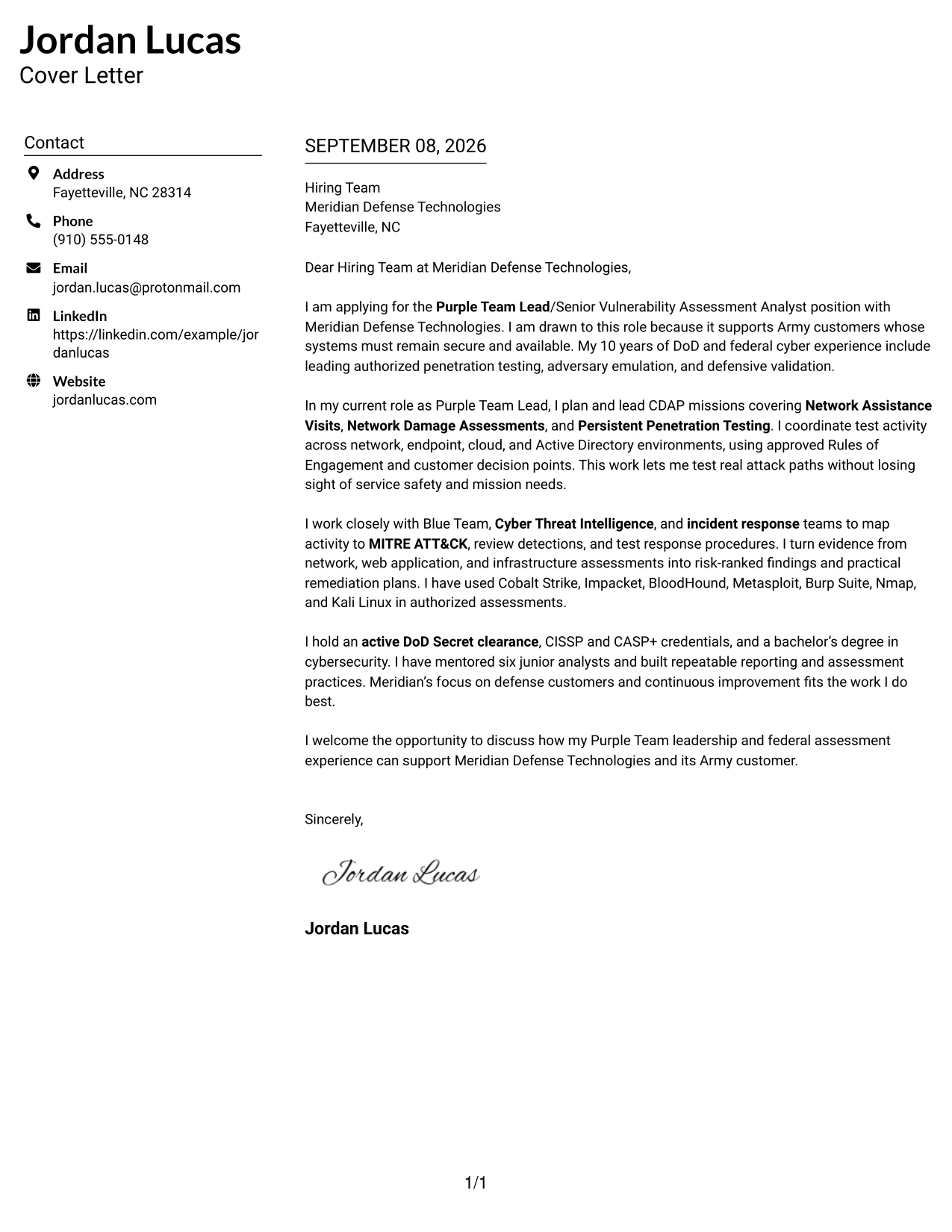
Why the Left Aligned Header Clean Two Column Format Works for a Cover Letter
- Left alignment creates a familiar reading path for a hiring team reviewing many applications.
- The clean header keeps attention on the letter’s message rather than decoration.
- The first paragraph can explain why the defense mission is personally and professionally relevant.
- The body can connect authorized adversary emulation to Meridian’s defensive validation needs.
- A separate content area makes collaboration with Blue Team and incident response easy to explain.
- The format supports a direct mention of the active DoD Secret clearance and relevant credentials.
- Its simple visual character matches a precise, dependable communication style.
Best For
- Applications that require an immediate, easy-to-follow reading path
- Candidates whose strongest case depends on close alignment with listed responsibilities
- Letters combining operational leadership with direct technical assessment experience
- Professional communication where a clean presentation reinforces careful judgment
- Applicants who need room to connect mission interest with practical evidence
- Two-column letters for readers who value structure but not heavy visual decoration
- Roles where collaboration and reliable communication should be visible in the letter
#25 Accent Divider Modern Two Column Format Cover Letter Example
The format name signals a clear division of information: an accent divider separates contact details and letter content while the two-column structure keeps the page easy to scan. That organization can help this application move from motivation to proof in a deliberate sequence. The letter can introduce interest in Meridian, highlight CDAP and adversary emulation experience, and finish with evidence of reporting, mentoring, and policy-aware testing.
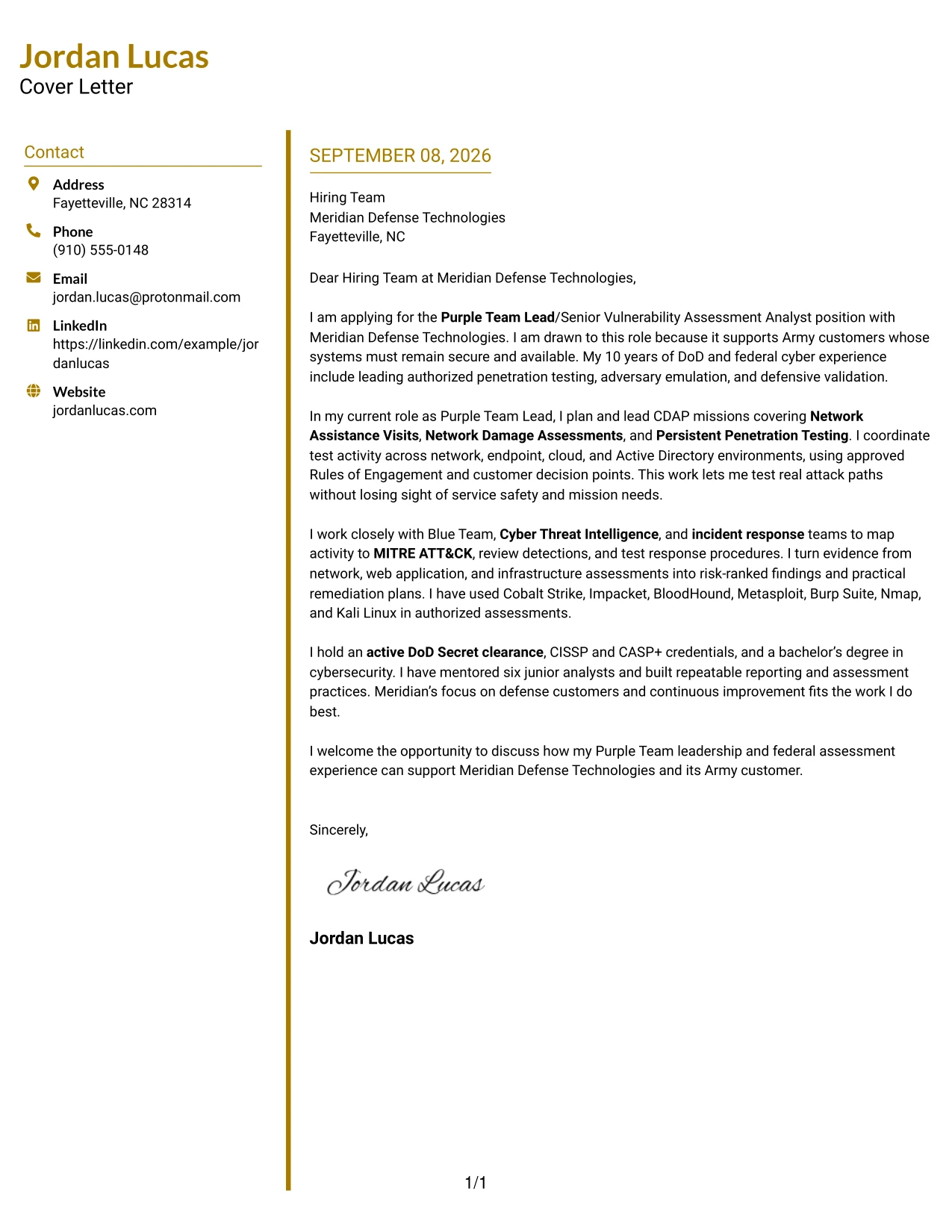
Why the Accent Divider Modern Two Column Format Works for a Cover Letter
- The divider gives the page a visible transition from introductory details to the letter’s argument.
- Two columns help the reader find the application purpose without losing the narrative flow.
- A focused opening can link Meridian’s Army contract to the candidate’s federal background.
- The body can group CDAP experience and Rules of Engagement as evidence of operational readiness.
- Additional space supports a concise explanation of MITRE ATT&CK mapping and remediation planning.
- The visual separation helps the closing feel distinct and purposeful.
- A modern accent can add energy while the content remains professional and controlled.
Best For
- Letters where the reader benefits from distinct visual zones
- Applications that need to present evidence in a clear progression
- Candidates balancing mission motivation with detailed operational examples
- Cover letters with several related qualifications that should not blend together
- Readers who prefer quick orientation before reviewing persuasive content
- Professional roles where a modern touch can support, but not replace, substance
- Applicants who want a structured page with visible transitions between ideas
#26 Shaded Labels Clean Two Column Format Cover Letter Example
Recruiters can move from labeled contact information to the greeting and then through the letter’s main evidence with little effort. The shaded labels provide quiet signposts, while the two-column format gives the application enough room to explain motivation, technical scope, and employer fit. For this role, the structure can make the connection between Purple Team leadership, defensive monitoring, and Meridian’s Army customer support especially clear.
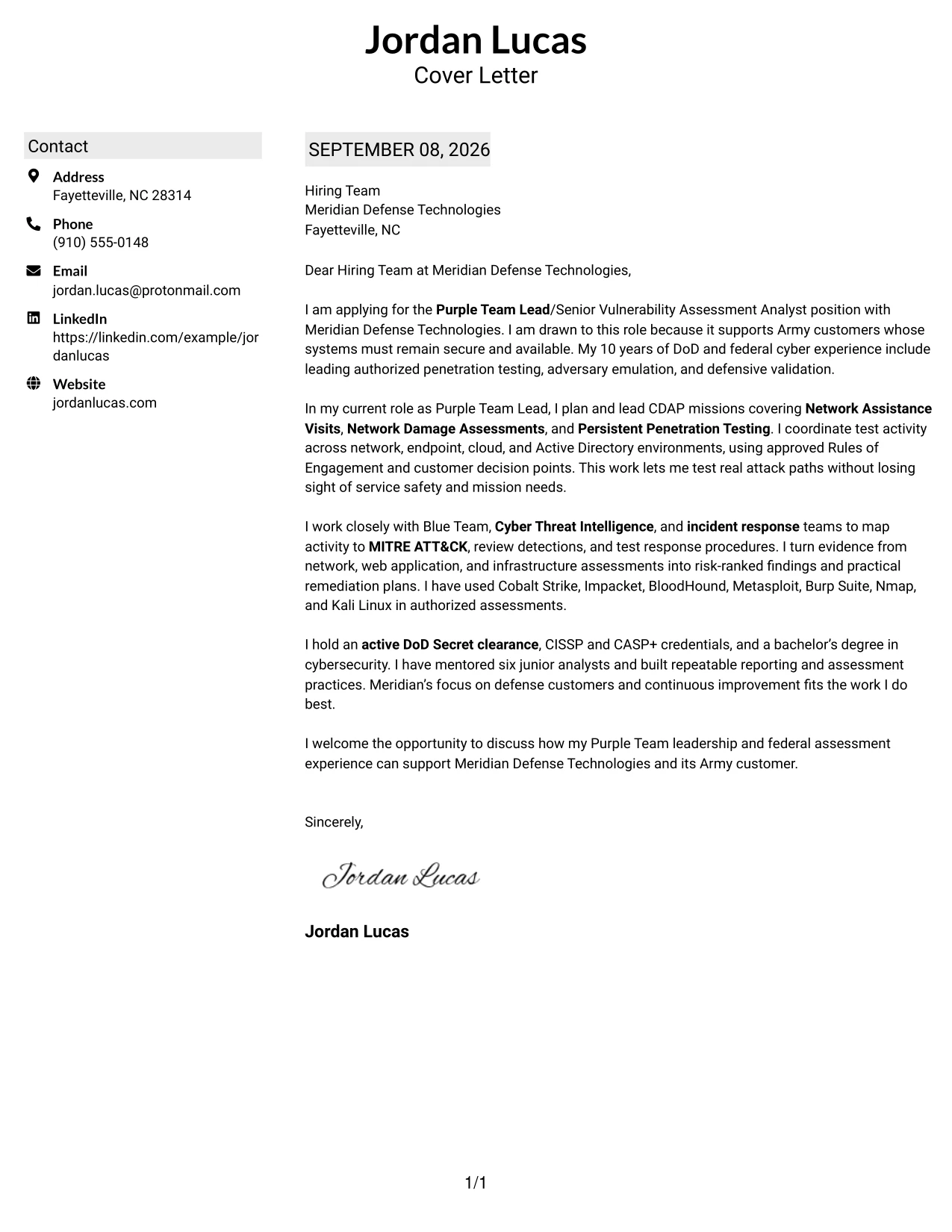
Why the Shaded Labels Clean Two Column Format Works for a Cover Letter
- Shaded labels help the reader identify key information without interrupting the letter’s tone.
- The two-column arrangement gives a long professional background a controlled visual shape.
- The opening can state interest in supporting systems that must remain secure and available.
- The body can explain leadership across network, endpoint, cloud, and Active Directory testing.
- Labels and spacing help preserve readability when the letter includes several tools or methods.
- The format supports a practical explanation of risk-ranked findings and remediation plans.
- A clean finish leaves space for a confident, employer-focused closing.
Best For
- Letters with several evidence areas that need clear visual signposts
- Applicants presenting broad assessment scope without creating dense blocks of text
- Applications where reader comfort matters as much as persuasive detail
- Professionals who need to explain technical work in a structured, accessible way
- Cover letters that connect multiple teams, methods, and outcomes
- Readers reviewing content in stages rather than reading every line at once
- Candidates seeking a polished layout for a substantial but focused application
#27 Photo Header Color Accent International Format Cover Letter Example
Evidence receives the leading role in this application: the letter should quickly show what the candidate has done, why it matters to Meridian, and how that experience supports Army customers. A single-column flow keeps the message unified, while the color accent and photo header add a more personal introduction. The strongest sequence is motivation, CDAP leadership, defensive validation, credentials, and a closing focused on contribution.
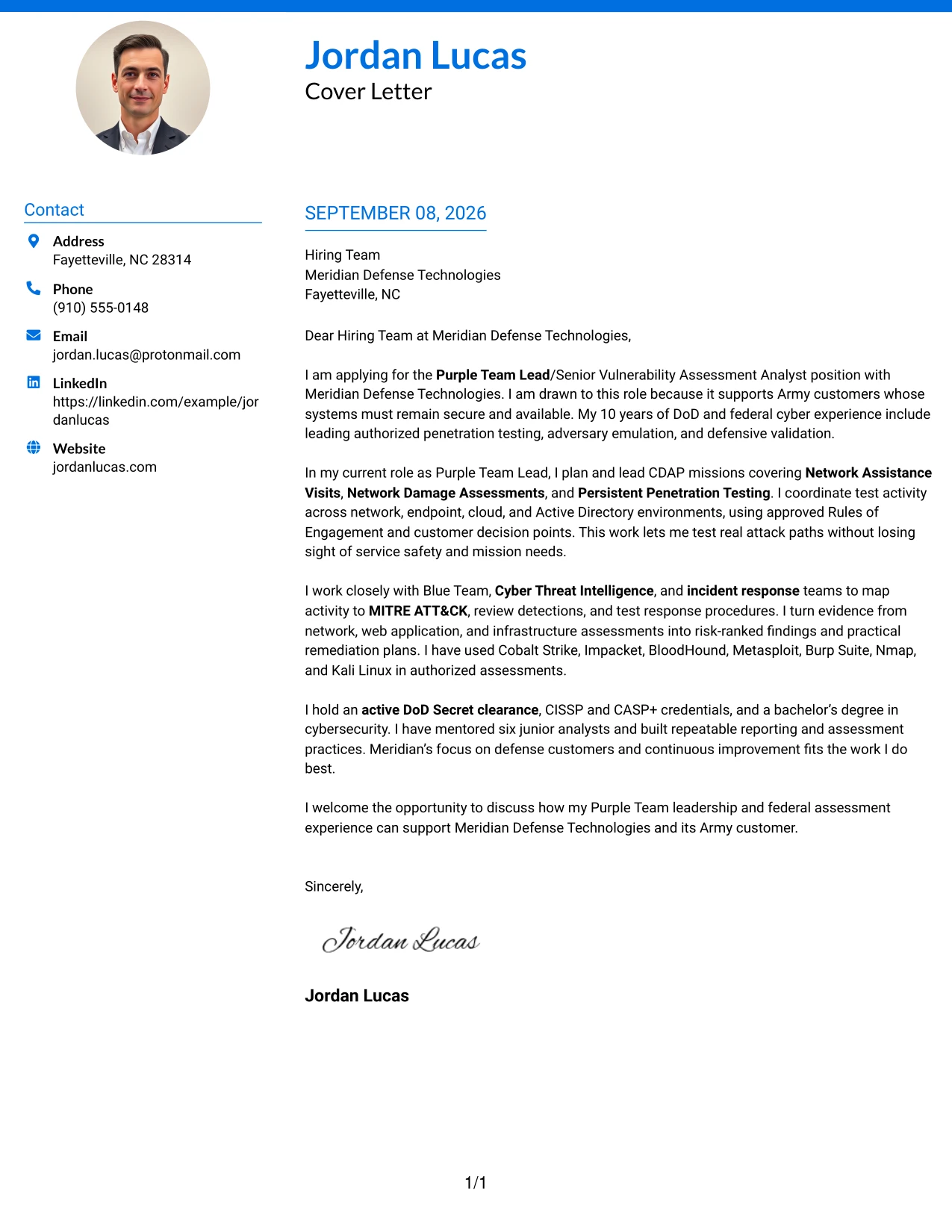
Why the Photo Header Color Accent International Format Works for a Cover Letter
- The single-column flow keeps the application’s reasoning continuous from opening to close.
- A photo header can create a more personal first impression when appropriate for the application context.
- Color accents help distinguish the introduction without competing with the letter’s evidence.
- The format gives CDAP leadership a prominent place early in the message.
- The body can show how offensive testing supports detection, response, and recovery validation.
- Credentials and clearance information can reinforce trust near the end of the letter.
- The closing can return to employer fit and the candidate’s interest in Meridian’s mission.
Best For
- Applications where a personal introduction is useful alongside strong evidence
- Single-column letters that need a continuous persuasive narrative
- Candidates whose experience should be introduced before detailed qualification points
- Roles where trust, mission connection, and professional presence matter
- Letters presenting a clear sequence from motivation to operational proof
- Applicants who want restrained color to support recognition of key sections
- Application settings that welcome a more individualized presentation
#28 Large Profile Photo International Two Column Format Cover Letter Example
Balanced space matters when a cover letter must feel personal without allowing presentation to overpower the argument. The large profile area creates a strong introduction, while the second column gives the letter room to connect motivation, operational evidence, and employer fit. For this application, the most effective balance places CDAP leadership and cross-team validation at the center, followed by credentials and a direct close.
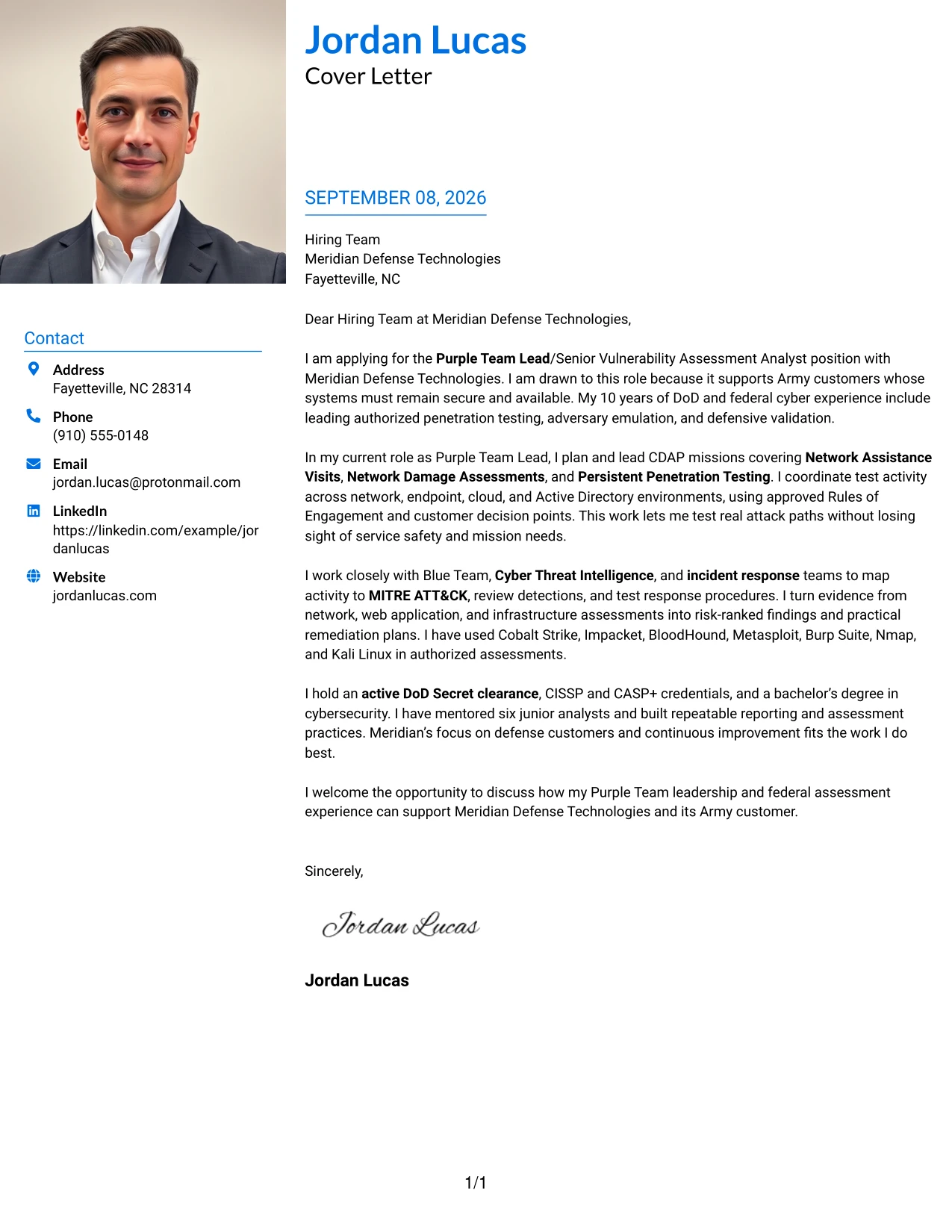
Why the Large Profile Photo International Two Column Format Works for a Cover Letter
- The two-column design separates personal introduction from the main persuasive message.
- A larger profile area can support a recognizable and approachable first impression when suitable.
- The content column gives important evidence room to develop in short, readable paragraphs.
- The opening can connect interest in Meridian with experience supporting defense customers.
- The body can show leadership of CDAP missions and collaboration with Blue Team personnel.
- The format allows credentials and mentoring experience to support the final fit statement.
- A direct closing keeps the visual presentation tied to a practical hiring conversation.
Best For
- Applications where personal presence should accompany detailed professional evidence
- Readers who prefer a distinct introduction beside a focused letter narrative
- Candidates with leadership experience that deserves central attention
- Letters connecting mission motivation, operational scope, and team influence
- Professional settings that support a more expressive but still controlled presentation
- Applications with enough evidence to benefit from separated content areas
- Applicants who want the closing to return clearly to employer needs
#29 One Column Boxed Contact Header Format Cover Letter Example
A practical application benefits from a compact header that makes the sender and recipient information immediately available before the reader enters the letter. The one-column flow then supports a direct narrative: interest in Meridian’s Army support work, experience leading authorized assessments, collaboration with defensive teams, and a clear statement of fit. A boxed contact area adds structure while keeping the persuasive message central.
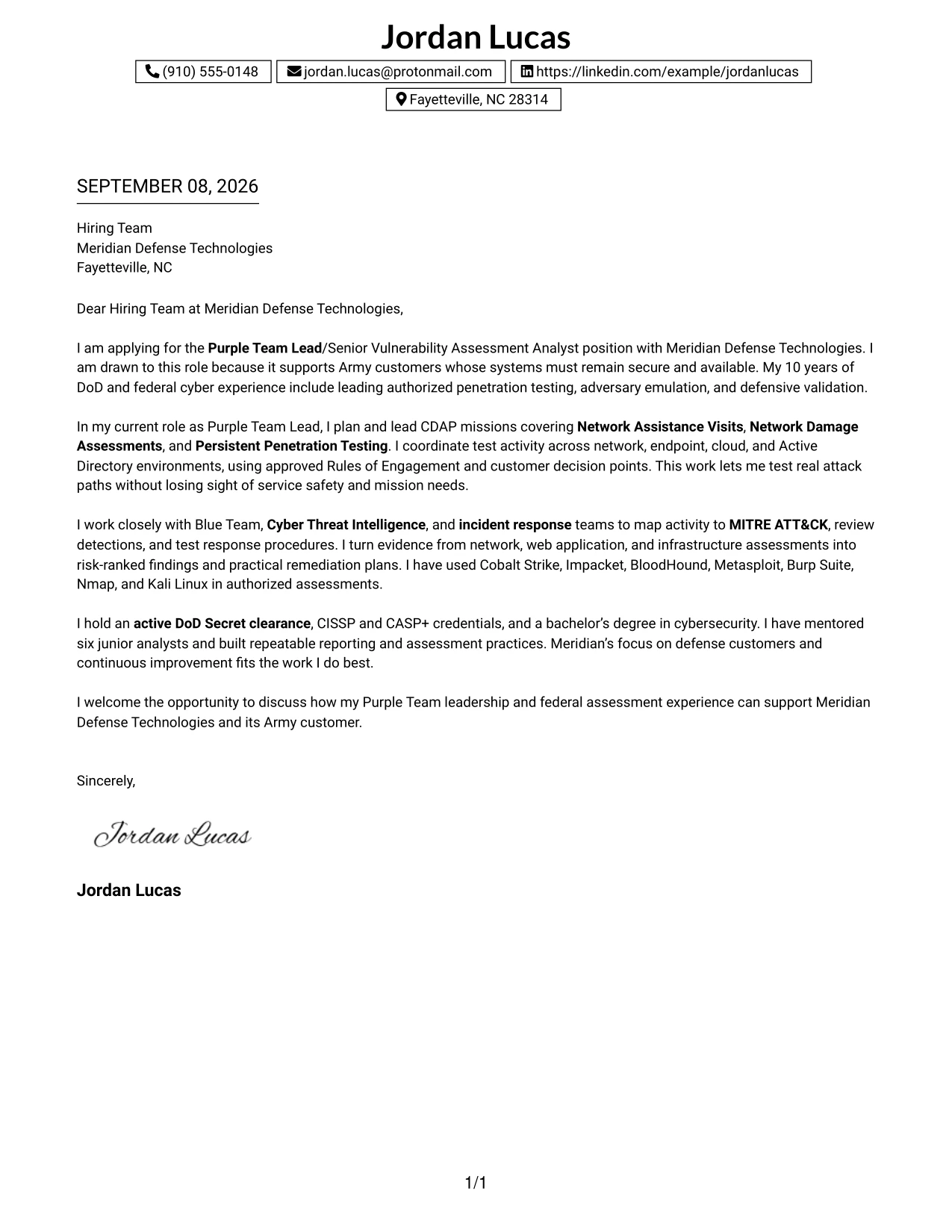
Why the One Column Boxed Contact Header Format Works for a Cover Letter
- The boxed header makes contact information easy to confirm at the start.
- A single column creates a natural path through the greeting, body, and closing.
- The opening can state both motivation and the scale of relevant DoD and federal experience.
- The body can explain CDAP missions without forcing the reader to move between content areas.
- A focused narrative makes collaboration with CTI and incident response teams easy to follow.
- The format supports a clear mention of credentials, clearance, and analyst mentoring.
- The closing can make a direct request for further discussion.
Best For
- Applications where straightforward reading is the main design priority
- Candidates who want all persuasive content to follow one continuous path
- Letters that need to explain a sequence of responsibilities in order
- Readers who value quick access to contact and recipient details
- Applicants presenting leadership, collaboration, and technical evidence together
- Professional settings where a compact header adds structure without decoration
- Cover letters that should feel direct, familiar, and easy to review
#30 One Column Shaded Contact Header Format Cover Letter Example
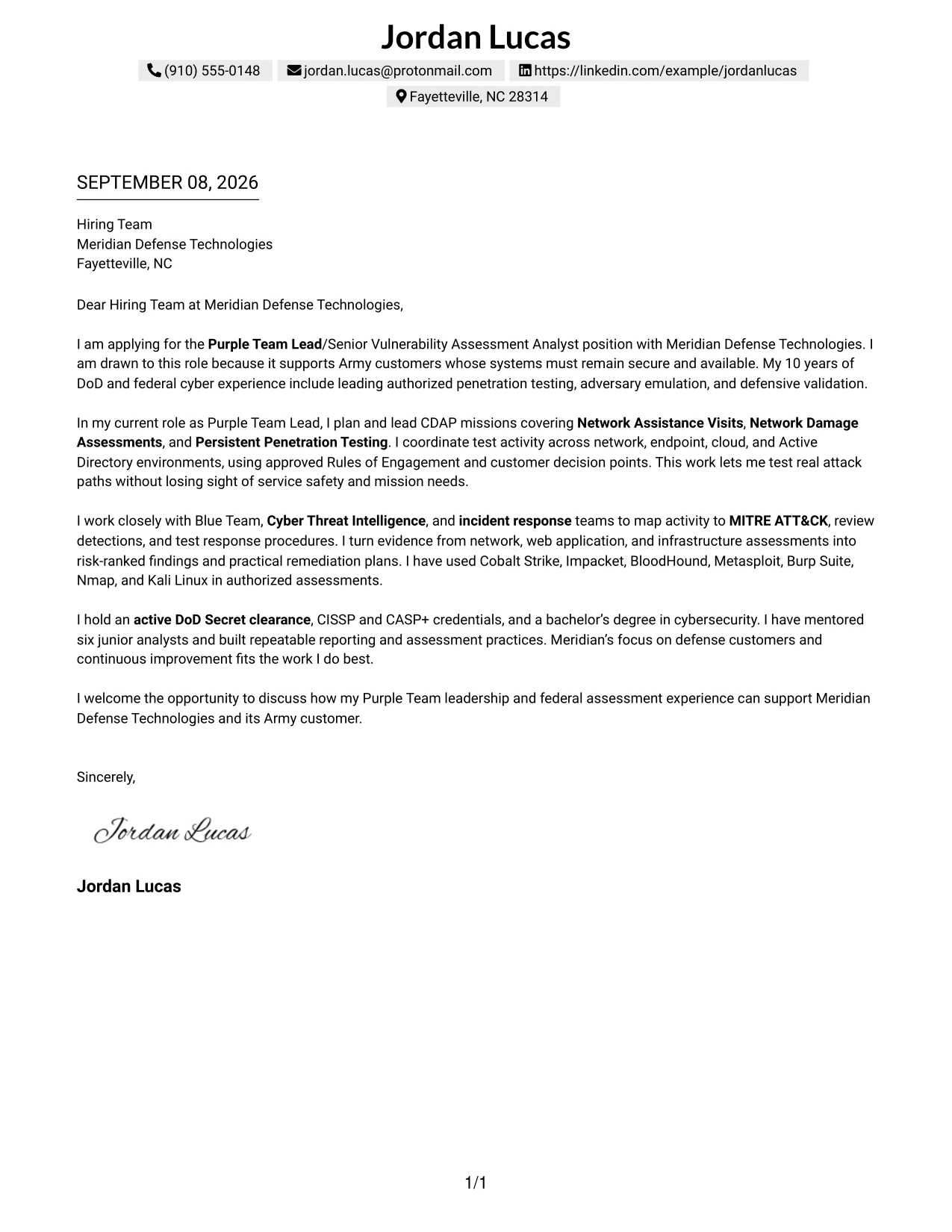
A soft shaded header gives the page a composed visual identity, while the one-column structure keeps the reader focused on the argument. The letter can begin with a clear reason for seeking the role, then use specific examples of CDAP planning, authorized adversary emulation, and defensive validation to show fit. The final paragraph can bring together clearance, credentials, mentoring, and interest in Meridian’s continued improvement.
Why the One Column Shaded Contact Header Format Works for a Cover Letter
- The shaded contact area separates essential details from the persuasive message.
- A one-column layout supports a steady, uninterrupted reading experience.
- The opening can show why Meridian’s defense mission is a meaningful fit.
- Specific CDAP examples give the body a strong foundation of relevant evidence.
- The letter can explain how findings become practical remediation plans for stakeholders.
- Credentials and mentoring add credibility without taking over the narrative.
- A composed closing can connect the candidate’s goals with Meridian’s improvement culture.
Best For
- Applications that need a calm, polished presentation from the first line
- Candidates who want role motivation to lead into evidence naturally
- Letters showing how technical findings support decisions and remediation
- Readers who prefer one clear path through a multi-part qualification story
- Professionals combining credentials with leadership and communication evidence
- Organizations where measured tone and continuous improvement are important
- Applicants seeking a refined layout without complex page structure
#31 Boxed Contact Header with Job Title Format Cover Letter Example
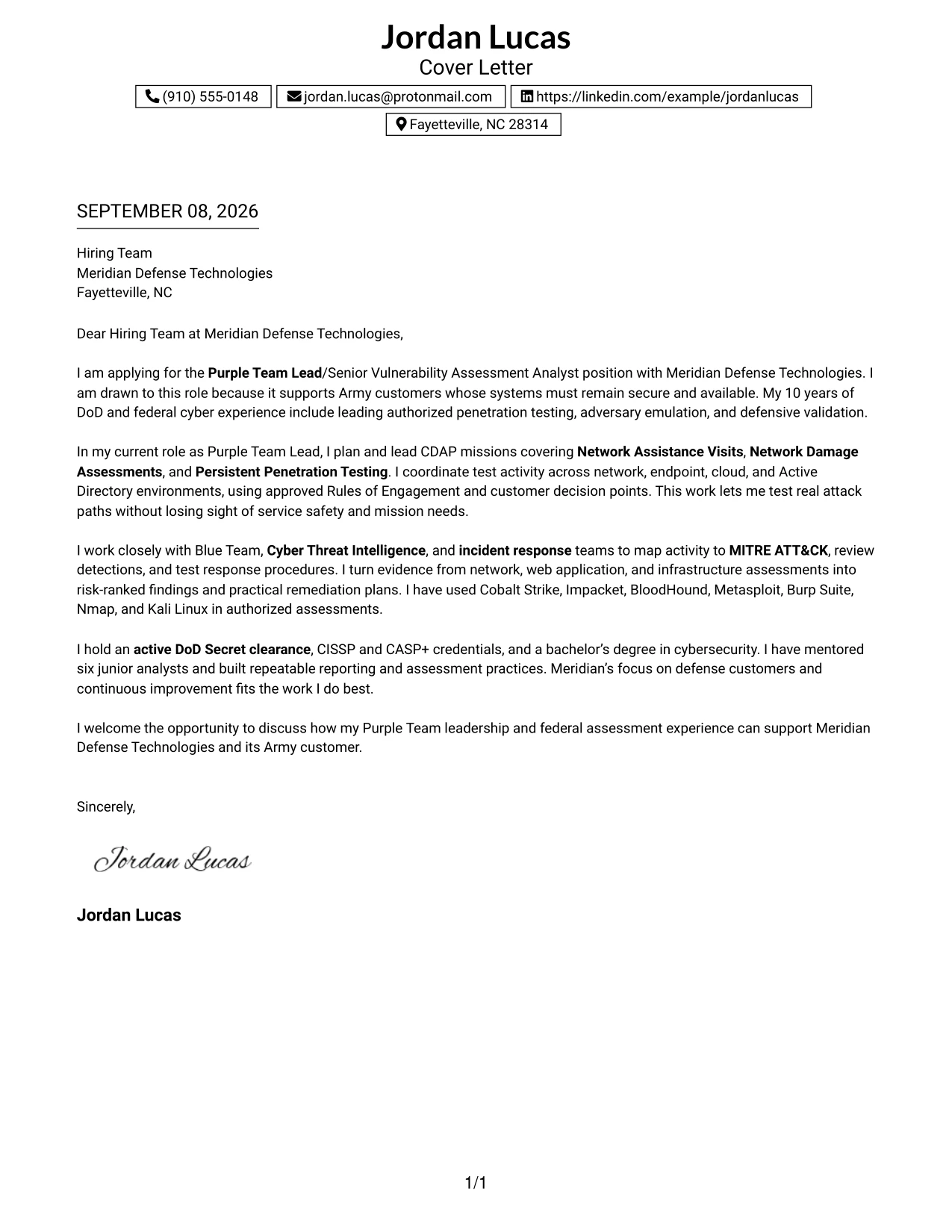
The boxed header and visible job title establish the application’s purpose before the body begins. That structure helps the letter move efficiently from the target role to the evidence that supports it: CDAP planning, penetration testing, defensive monitoring, and compliance with Rules of Engagement. Because the title is easy to identify, the remaining paragraphs can focus on motivation, proof, and a confident closing rather than repeating the application context.
Why the Boxed Contact Header with Job Title Format Works for a Cover Letter
- The job title gives the reader immediate context for the letter.
- The boxed header keeps sender and recipient details distinct from the main message.
- A single-column body supports a clear progression from interest to evidence.
- The structure makes CDAP, penetration testing, and defensive monitoring easy to connect.
- Rules of Engagement and policy awareness can appear as proof of disciplined execution.
- The format provides room for a concise explanation of mentoring and reporting strengths.
- A focused closing can reinforce readiness for Meridian’s Army customer work.
Best For
- Applications where the target position should be visible immediately
- Letters that must connect several responsibilities to one central role
- Candidates presenting operational evidence under a clearly named application purpose
- Readers who need quick orientation before reviewing detailed qualifications
- Professional communications where scope control and policy awareness matter
- Applicants combining technical delivery with mentoring and reporting strengths
- Cover letters that benefit from a strong start and a compact closing
#32 Plain Professional Layout with Job Title & Shaded Date Cover Letter Example
The reader can begin with the shaded date, confirm the job title, and then follow one uninterrupted column through the application. That plain structure is useful for a detailed but controlled case: motivation for Meridian’s defense work, experience leading CDAP missions, collaboration with defensive teams, and credentials that support trust. It allows the content to carry the persuasion while the date and title provide quiet orientation.

Why the Plain Professional Layout with Job Title & Shaded Date Works for a Cover Letter
- The shaded date gives the letter a clear point of reference.
- The visible job title prevents uncertainty about the application’s purpose.
- A plain one-column layout keeps attention on the written argument.
- The opening can establish interest in secure and available Army-supported systems.
- The body has room to explain leadership, testing scope, and defensive validation together.
- The format supports a measured discussion of clearance, certifications, and mentoring.
- A simple closing can leave the hiring team with a clear sense of fit.
Best For
- Applications that benefit from familiar business-letter conventions
- Candidates with enough evidence to need a steady, spacious reading path
- Letters where the job title should guide the reader from the outset
- Readers who prefer substance over strong visual effects
- Professionals explaining leadership and technical scope in connected paragraphs
- Applications requiring a formal tone and clear document orientation
- Cover letters that should remain useful when printed or reviewed quickly
#33 Two-Line Contact Header with Underlined Date Format Cover Letter Example
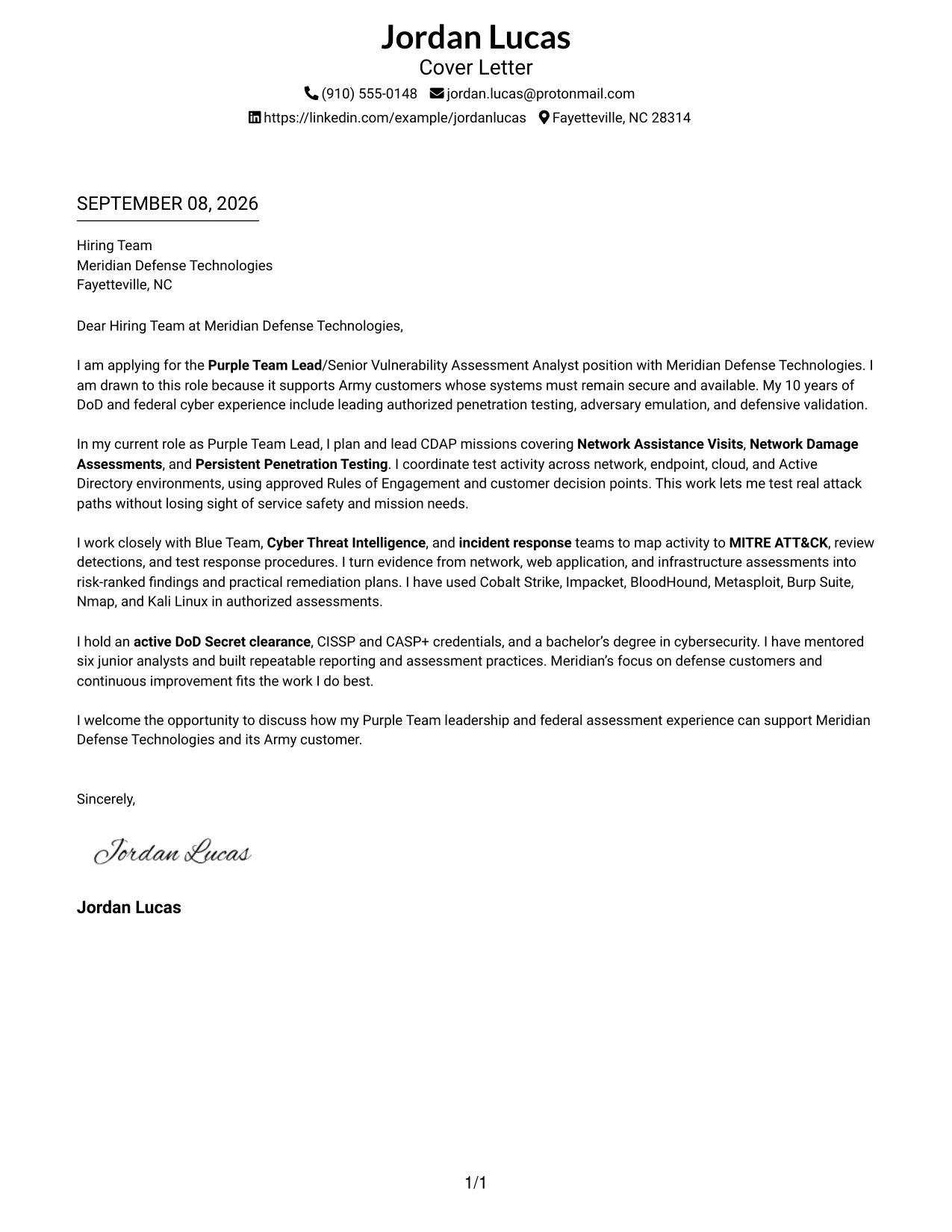
The application should lead with evidence that answers the employer’s central question: can the candidate connect authorized offensive testing with stronger defensive outcomes? A two-line contact header and underlined date keep the page orderly, leaving the single-column letter to present CDAP leadership, MITRE ATT&CK use, remediation planning, and collaboration with Blue Team and incident response. The closing can then turn that evidence into a direct statement of value for Meridian.
Why the Two-Line Contact Header with Underlined Date Format Works for a Cover Letter
- The two-line header presents contact details without taking much space from the letter.
- The underlined date gives the document a clear formal reference point.
- A single-column flow keeps the evidence connected from one paragraph to the next.
- The opening can answer the employer’s need for authorized and mission-aware testing.
- The body can prioritize CDAP leadership and defensive outcomes over general claims.
- MITRE ATT&CK, remediation planning, and team collaboration provide concrete support for fit.
- The closing can translate the evidence into a focused offer to help Meridian’s Army customer.
Best For
- Applications where evidence should appear before visual styling
- Candidates who need a compact header and generous room for written detail
- Letters connecting offensive activity to detection and response improvement
- Readers who want qualifications explained in a continuous sequence
- Professionals presenting mission-aware testing and practical remediation judgment
- Formal applications that benefit from a clear date and contact structure
- Applicants whose strongest case depends on specific collaboration evidence
Why Use ResumeInMinutes for a Purple Team Lead/Senior Vulnerability Assessment Analyst Cover Letter
ResumeInMinutes helps cybersecurity professionals shape a targeted cover letter without starting with a blank page. It supports a clear connection between the job description, the applicant's authorized assessment experience, and the value they can bring to a defense-focused team.
- Professional writing styles
- Clean, readable formatting
- Job-description-based customization
- Fast cover letter generation
- Professional PDF templates
- Focused application support
You can create a polished letter that presents Purple Team leadership, CDAP mission experience, defensive validation, technical reporting, mentoring, and employer alignment in a balanced and credible way.
See Also
- 33 Purple Team Lead/Senior Vulnerability Assessment Analyst Resume Templates with Example 2026 (ATS-Optimized)
- 33 Accounts Payable Analyst - Invoice Processing Resume Templates with Example 2026 (ATS-Optimized)
- 33 Accounts Payable Analyst Resume Templates with Example 2026 (ATS-Optimized)
- 33 All Source Intelligence Analyst - Intelligence Analysis Resume Templates with Example
- 7 Analyst/Associate: Equity Research - Telecommunication, Data Center and Tower Resume Templates with Example
- 33 Analyst - Cybersecurity Operations Resume Templates with Example 2026 (ATS-Optimized)
- 33 Analyst, Data Analytics Resume Templates with Example 2026 (ATS-Optimized)
- 7 Analyst, Demand Planning Salty Resume Templates with Example
- 30+ Accounts Payable Analyst Cover Letter Templates with Example 2026
- 30+ Analyst Cover Letter Templates with Example 2026
Frequently Asked Questions
Are these Purple Team Lead/Senior Vulnerability Assessment Analyst cover letter templates ATS-friendly?
Yes. The templates use clear formatting and support relevant language such as Purple Team operations, penetration testing, CDAP, adversary emulation, MITRE ATT&CK, Rules of Engagement, and defensive validation.
Are these 33 different cover letters?
No. The guide uses one Purple Team Lead/Senior Vulnerability Assessment Analyst cover letter example shown through different template styles and visual presentations.
Can I download the templates as PDFs?
Yes. Each style includes a free PDF download so you can review the presentation and choose a format that fits the employer and application context.
Which cover letter style works best for this cybersecurity role?
A clean, professional layout is usually the safest choice for a defense or federal cybersecurity application. Select a design that keeps the opening, evidence, technical language, and closing easy to read.
What should the opening paragraph cover?
Open by naming the exact Purple Team Lead/Senior Vulnerability Assessment Analyst position and stating why the mission interests you. Then connect your most relevant assessment or defensive validation experience to the employer's needs.
Should I include security tools in the cover letter?
Include tools only when they support a clear point about the work you performed. For example, Cobalt Strike, Impacket, BloodHound, Metasploit, Burp Suite, Nmap, and Kali Linux can be relevant when tied to authorized assessment activity and its results.
Can I customize these cover letter templates?
Yes. You can customize the cover letter text, layout, design style, and PDF format for your Purple Team Lead/Senior Vulnerability Assessment Analyst application.