
US English


7 Researcher - Frontier AI Safety Evaluations Resume Templates with Example
By Ria · Last Updated On October 17, 2026
Resume example — page 1

This guide shows you how to build a Researcher - Frontier AI Safety Evaluations resume that presents your evidence clearly and makes your research work easy to review. It explains how to organize relevant experience and choose a layout that supports a careful assessment of your qualifications.

Strong resumes for this role connect research questions to sound methods, useful tools, and clear results. Show how you design experiments, capture evidence, assess safeguards, and record limits or open questions.

Compare the example across 7 resume layouts to see how section order and page design affect readability. The guide also covers ATS-friendly headings, role-specific keywords, and concise bullets for evaluation work, including reproducible experiments, controlled access, and model version tracking.

What Makes a Great Researcher - Frontier AI Safety Evaluations Resume in 2026

A strong resume makes research, engineering, and evaluation work easy to verify. Use clear sections and focused bullets to show methods, tools, findings, and the limits of the evidence.

Use accurate terms such as Python, PyTorch, experimental design, AI safety evaluations, safeguard assessment, and reproducible research. Support each keyword with a specific example from your work.

Note: Resume examples are for educational purposes only. Use only information that accurately reflects your experience and qualifications. References to real organizations do not imply affiliation or endorsement.

#1 Simple One Column Format Resume Example

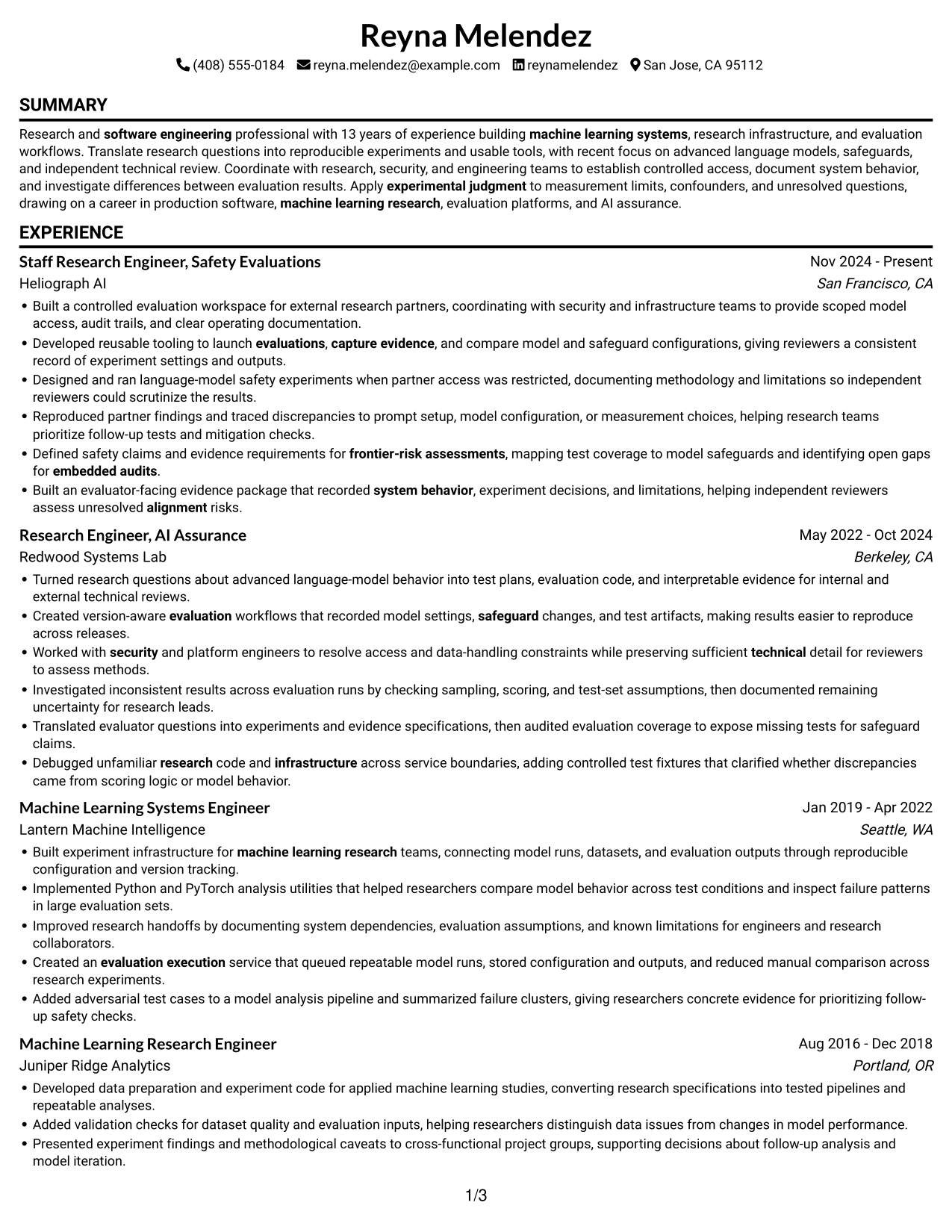
The Simple One Column Format keeps resume content in one vertical stream, a practical choice for readers who prefer a direct top-to-bottom review.
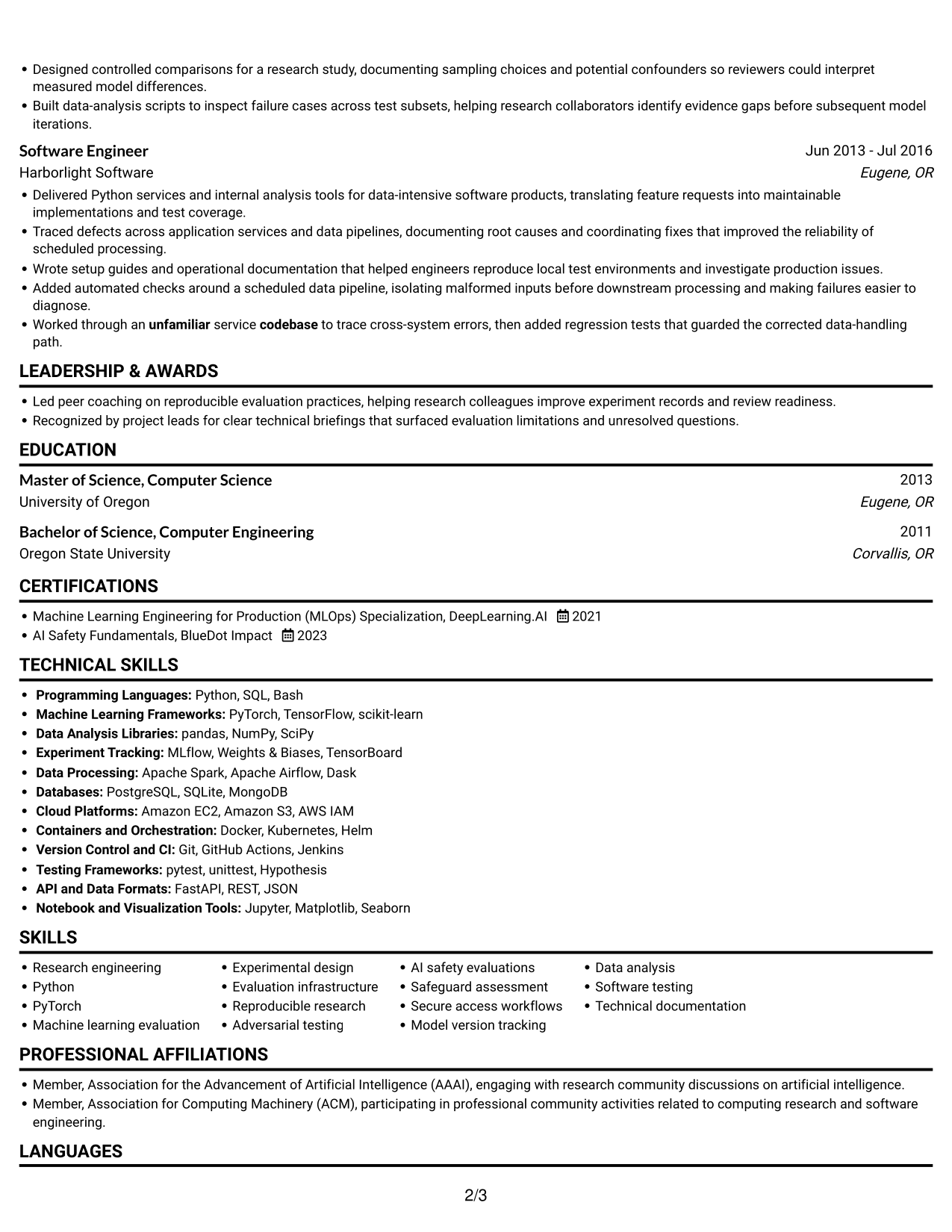
 
Resume example — page 1   Resume example — page 2

Why This Format Works

  • A single reading path lets reviewers follow experience without shifting between columns.
  • Experience entries can use the full body width for detailed evidence.
  • Skills, education, and certifications stay within the same vertical scan.

Best For

  • Top-to-bottom resume review
  • Detailed experience records
  • Skills, education, and credentials together
  • Text-first document preferences
  • Career progression across several roles

Resume Keywords

  • software engineering
  • Research engineering
  • machine learning systems
  • Experimental design
  • AI safety evaluations
  • Evaluation infrastructure
  • Defined safety claims and evidence requirements for frontier-risk assessments, mapping test coverage to model safeguards and identifying open gaps for embedded audits.
  • Developed reusable tooling to launch evaluations, capture evidence, and compare model and safeguard configurations, giving reviewers a consistent record of experiment settings and outputs.
  • Built an evaluator-facing evidence package that recorded system behavior, experiment decisions, and limitations, helping independent reviewers assess unresolved alignment risks.
  • Adversarial testing
  • Worked with security and platform engineers to resolve access and data-handling constraints while preserving sufficient technical detail for reviewers to assess methods.
  • Implemented Python and PyTorch analysis utilities that helped researchers compare model behavior across test conditions and inspect failure patterns in large evaluation sets.
  • evaluation execution
  • evidence requirements
  • frontier-risk assessments
See all keywords
 

#2 Simple Two Column Format Resume Example

The Simple Two Column Format arranges resume content across two columns, a useful option for readers who prefer distinct areas to scan.
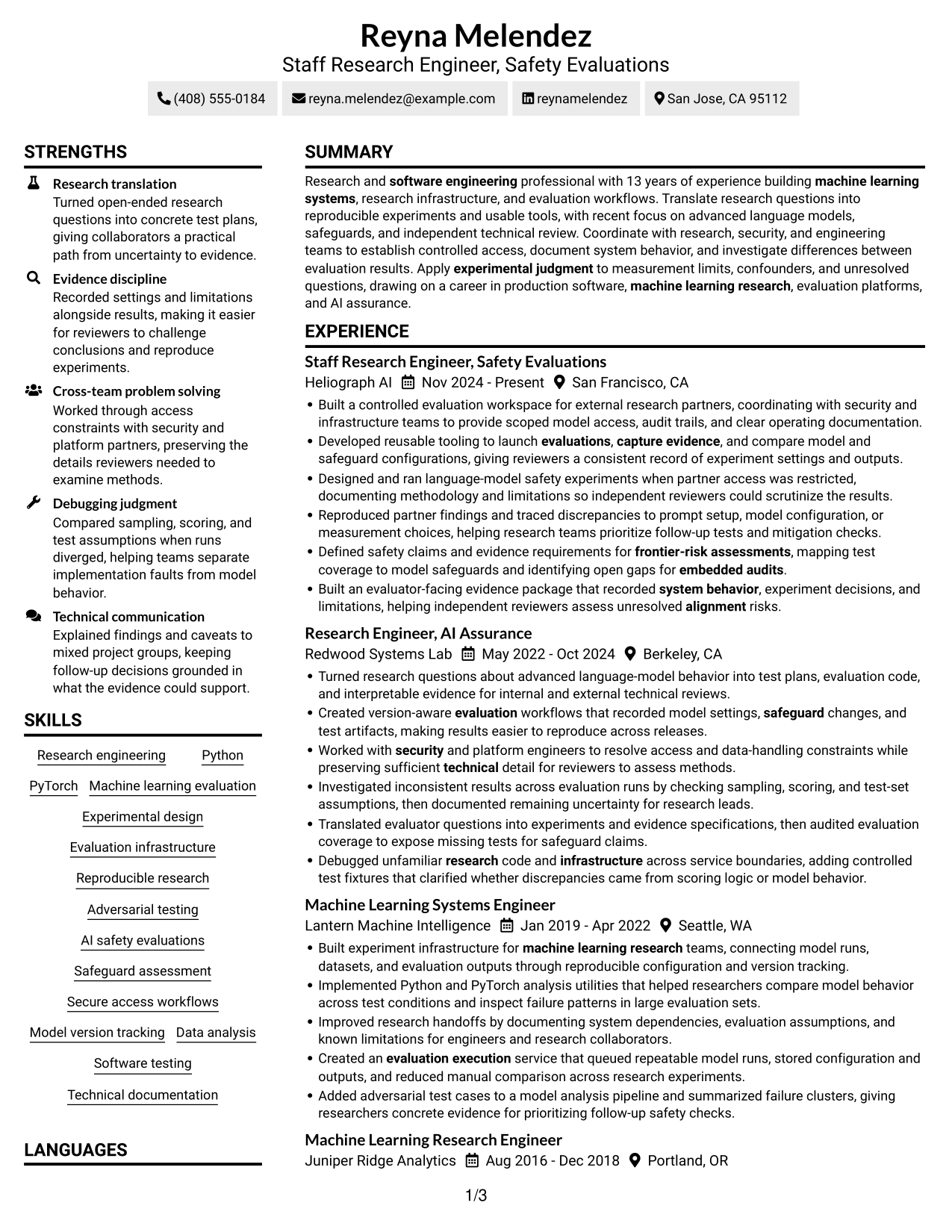
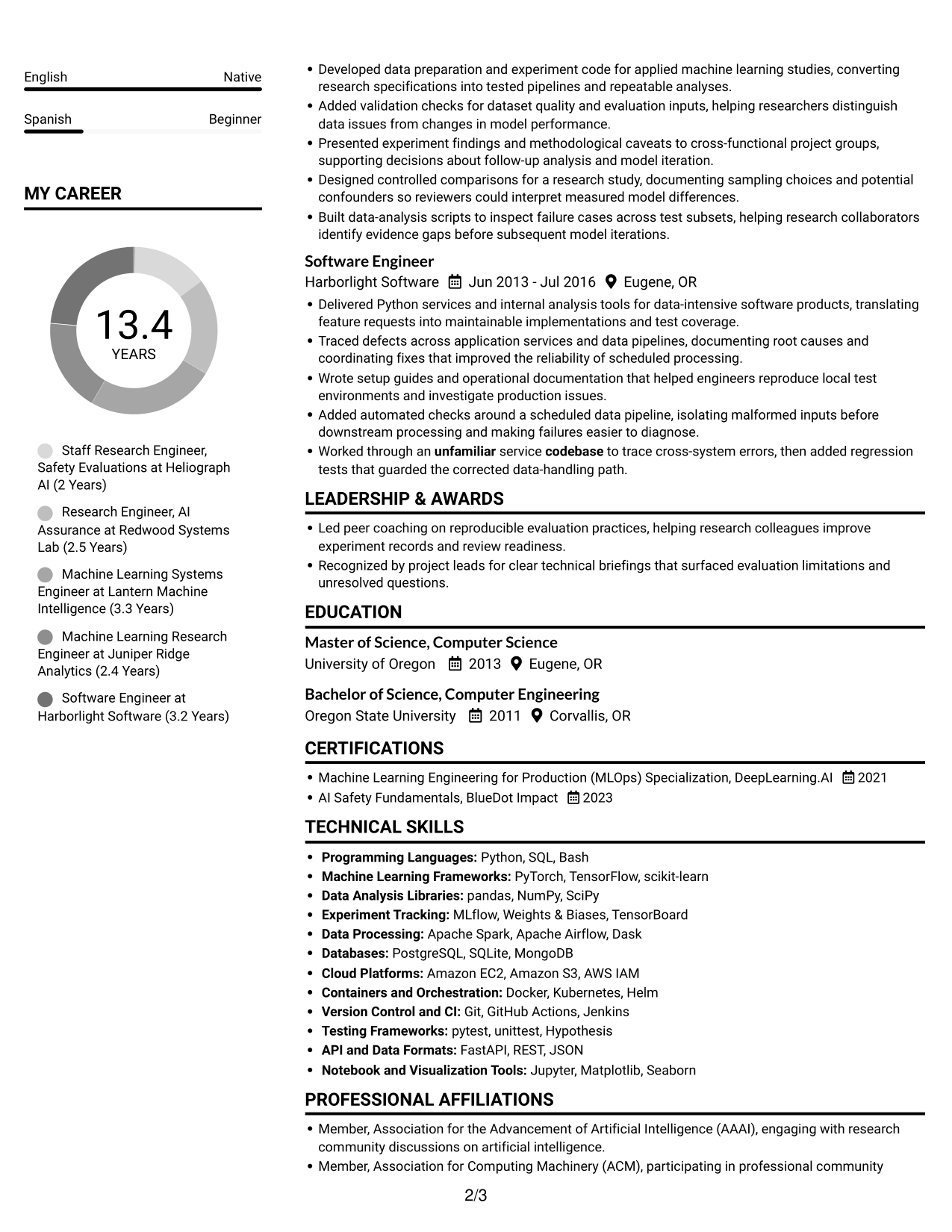
 
Resume example — page 1   Resume example — page 2

Why This Format Works

  • Two reading areas help reviewers locate experience and supporting sections separately.
  • Column structure gives skills and education distinct places in the resume.
  • Separate content areas help readers compare qualifications without scanning one long stream.

Best For

  • Two-area information organization
  • Distinct resume section groups
  • Readers comparing sections across columns
  • Substantial experience histories
  • Skills and education in one resume

#3 Plain One Column with Shaded Labels Resume Example

Plain One Column with Shaded Labels uses a single-column structure, which suits reviewers who want to follow resume sections in sequence.
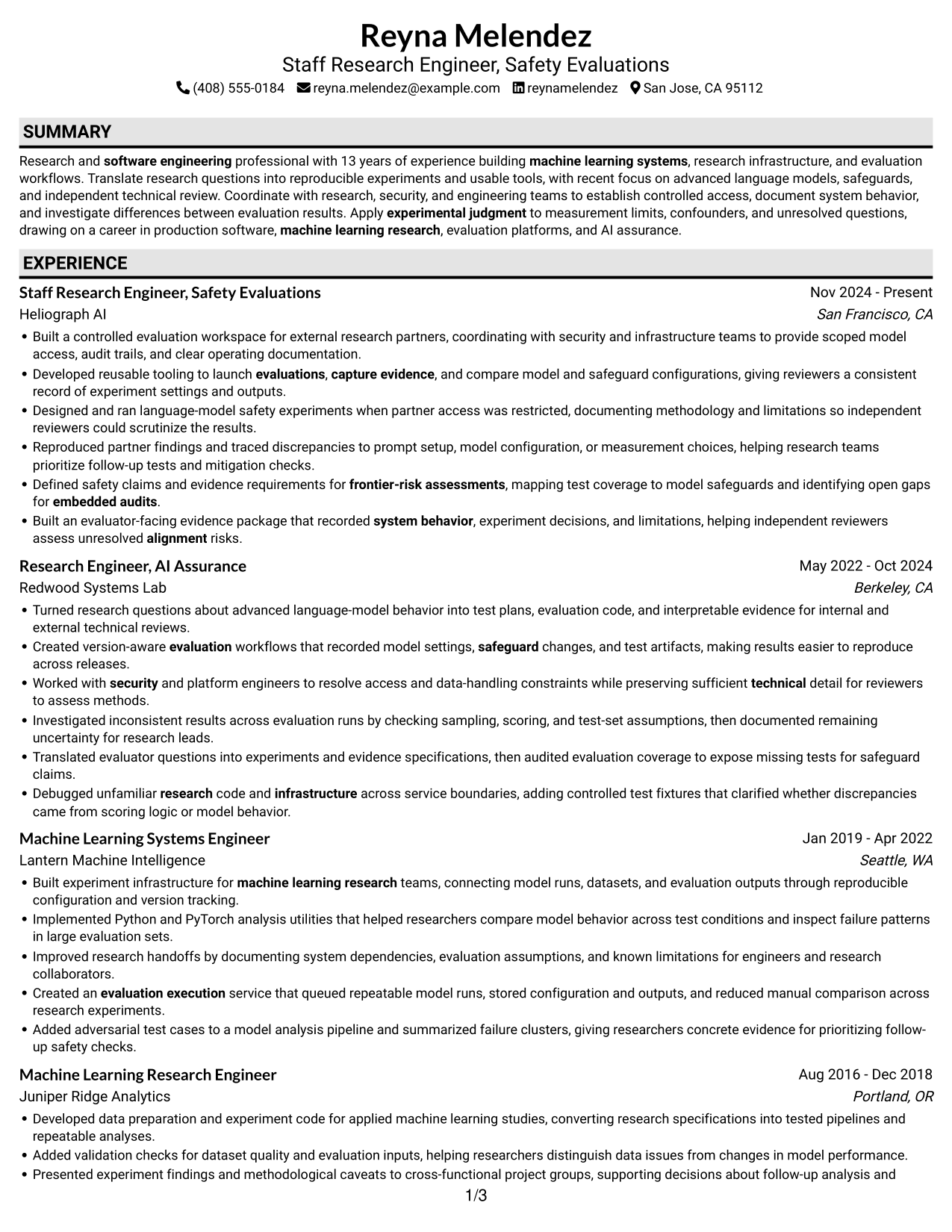
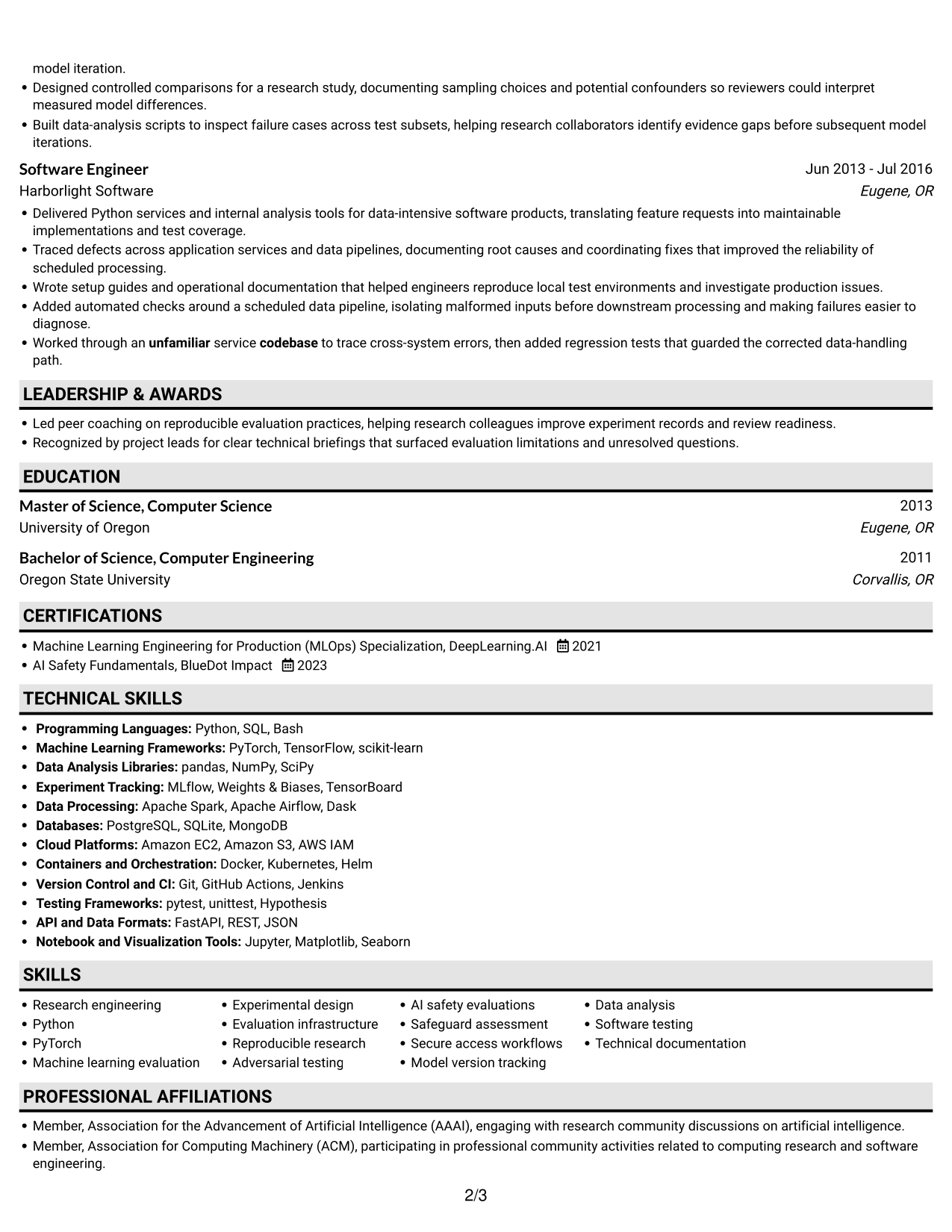
 
Resume example — page 1   Resume example — page 2

Why This Format Works

  • A continuous vertical order helps reviewers follow career progression across roles.
  • Full-width experience entries allow room for detailed results and context.
  • Education and credentials remain part of the same straightforward reading path.

Best For

  • Sequential career histories
  • Detailed achievement descriptions
  • Education beside work history
  • Resume content with several sections
  • Direct reading order
 

#4 One Column Format with Photo Right Resume Example

One Column Format with Photo Right combines a single-column resume with a photo, a suitable choice for readers who want a portrait with a direct content path.
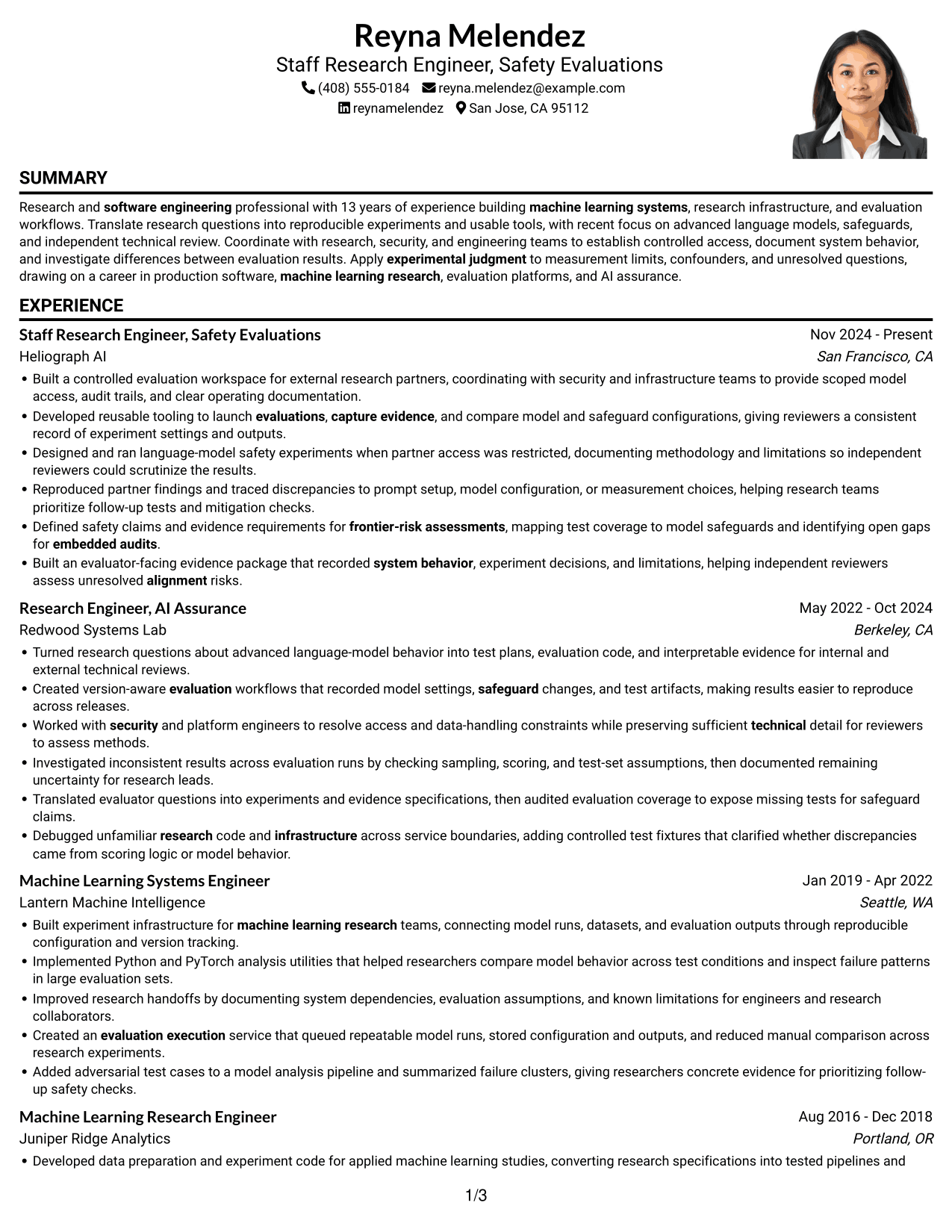
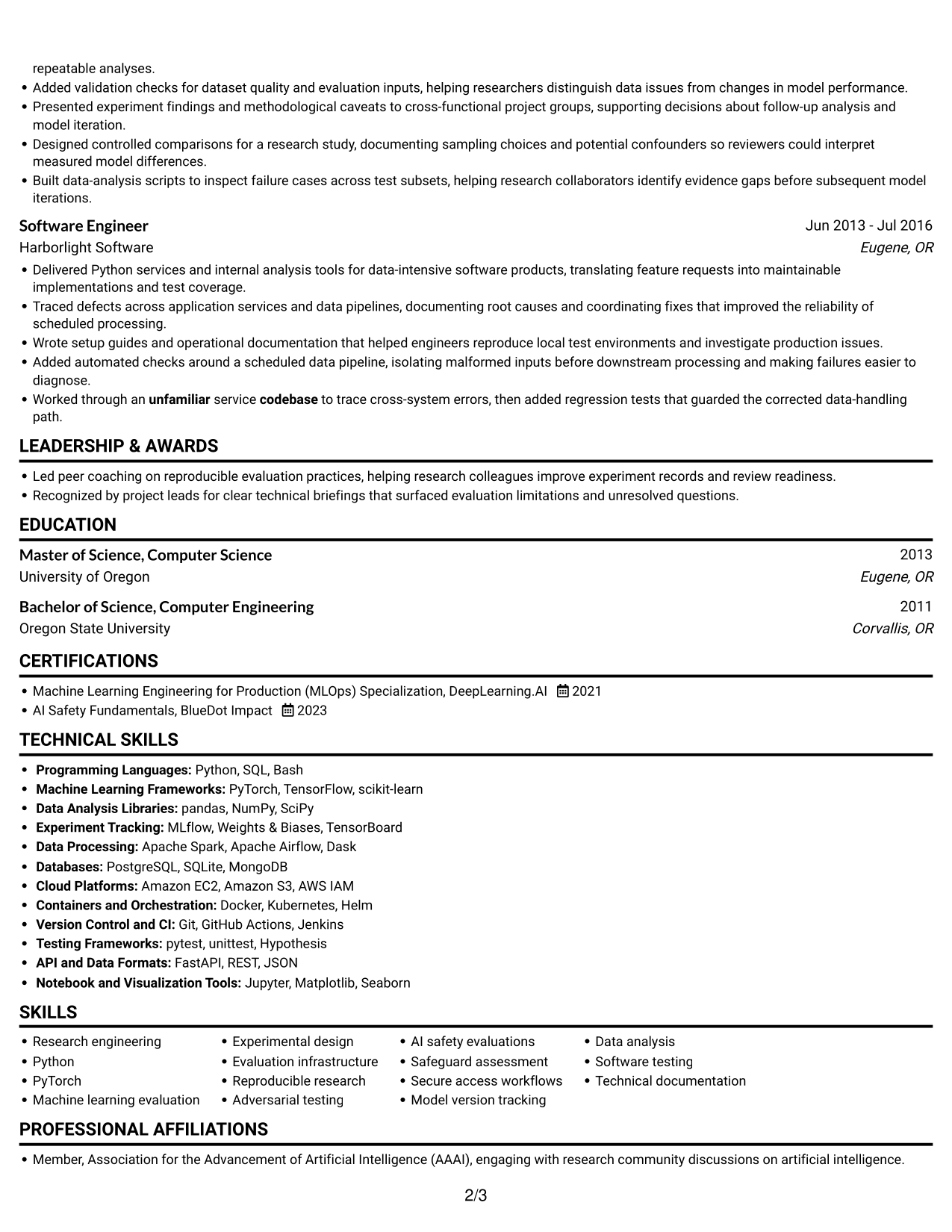
 
Resume example — page 1   Resume example — page 2

Why This Format Works

  • One vertical reading path keeps experience and education in a clear sequence.
  • The photo adds a visual identifier without changing the resume's content order.
  • Full-width text gives detailed experience entries room to remain readable.

Best For

  • Photo-inclusive resume preference
  • Single-path section review
  • Detailed work histories
  • Text with a visual identifier
  • Career records with several roles
 

#5 Clean Two Column Sidebar Format Resume Example

Clean Two Column Sidebar Format divides resume content across two columns, a practical choice for readers who like separate areas for information.
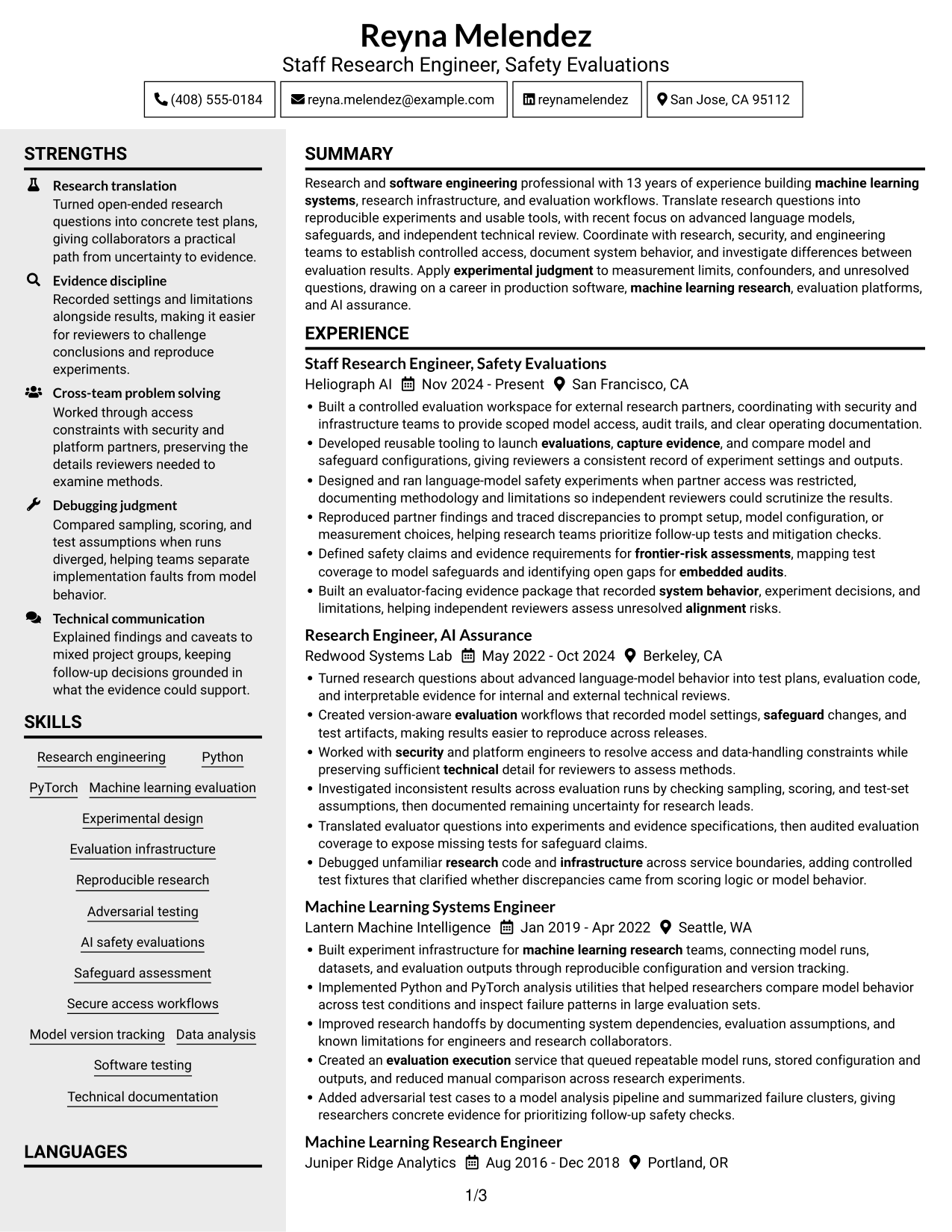
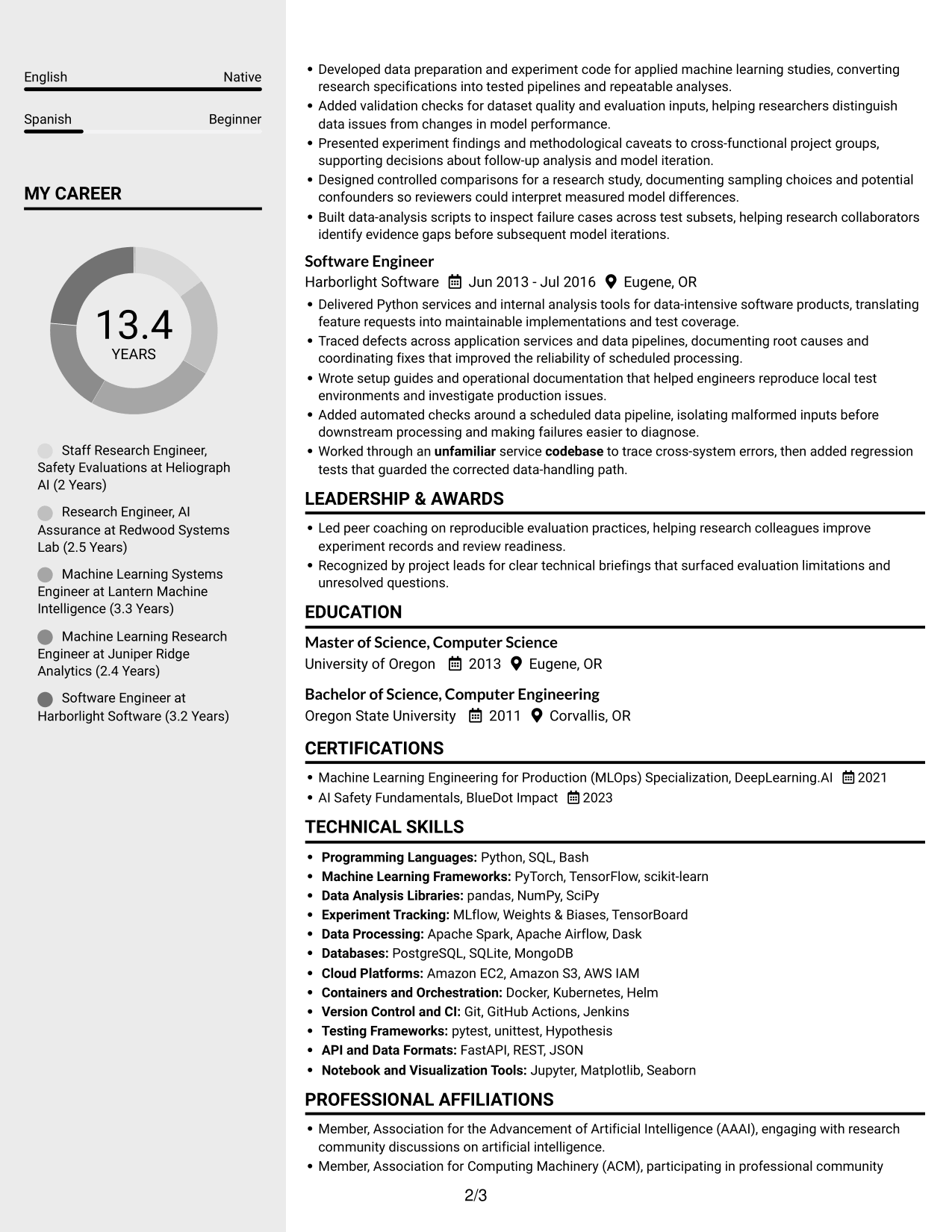
 
Resume example — page 1   Resume example — page 2

Why This Format Works

  • The two-column body gives reviewers distinct areas for career and qualification details.
  • Separate columns help readers locate skills and education during a focused review.
  • Experience can be scanned alongside other resume sections without one long vertical sequence.

Best For

  • Separate information areas
  • Resume reviews across section groups
  • Experience alongside qualifications
  • Multiple education and credential details
  • Readers who prefer two-column navigation


#6 Two Column Format Resume Example

Two Column Format presents resume content in two columns, offering readers a clear alternative to reviewing every section in one vertical list.
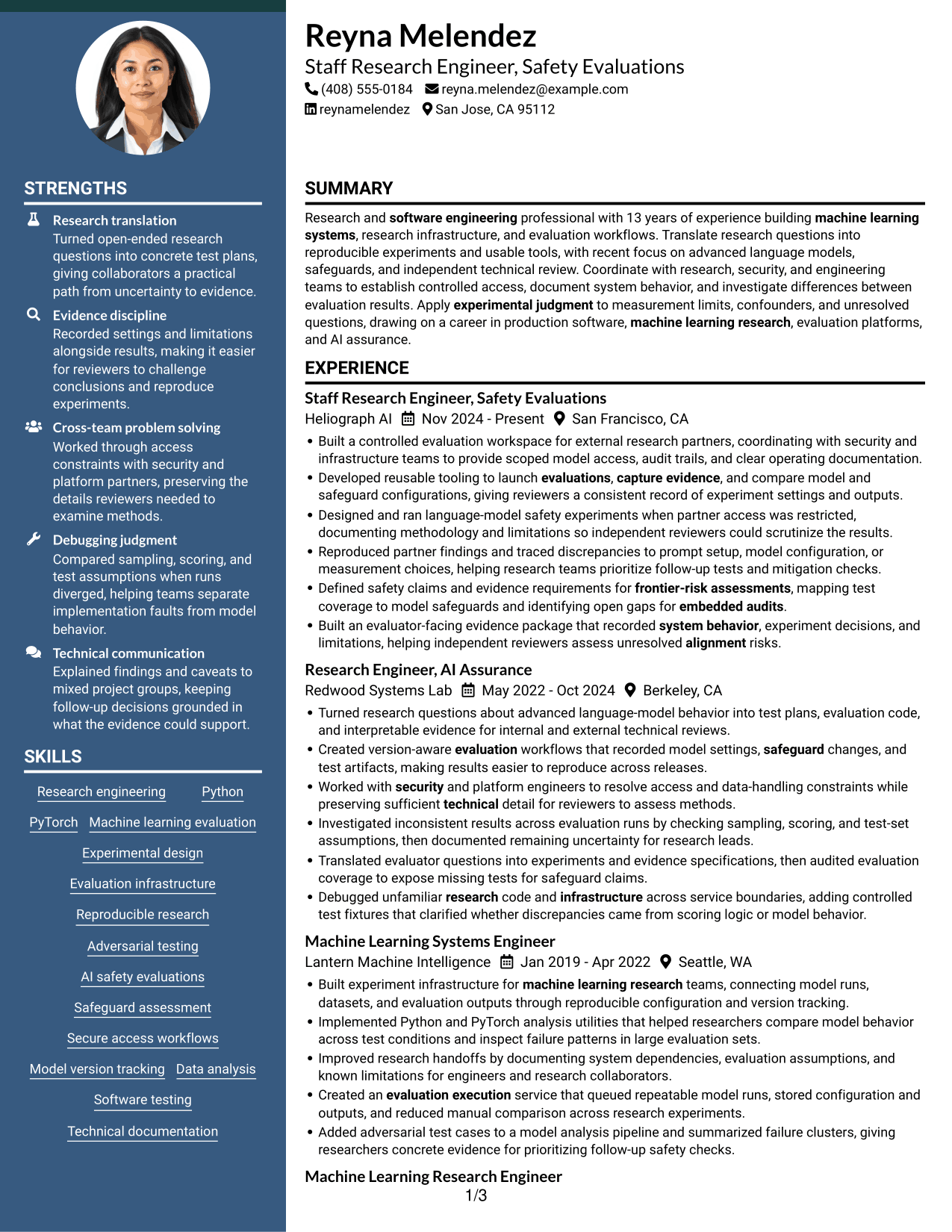
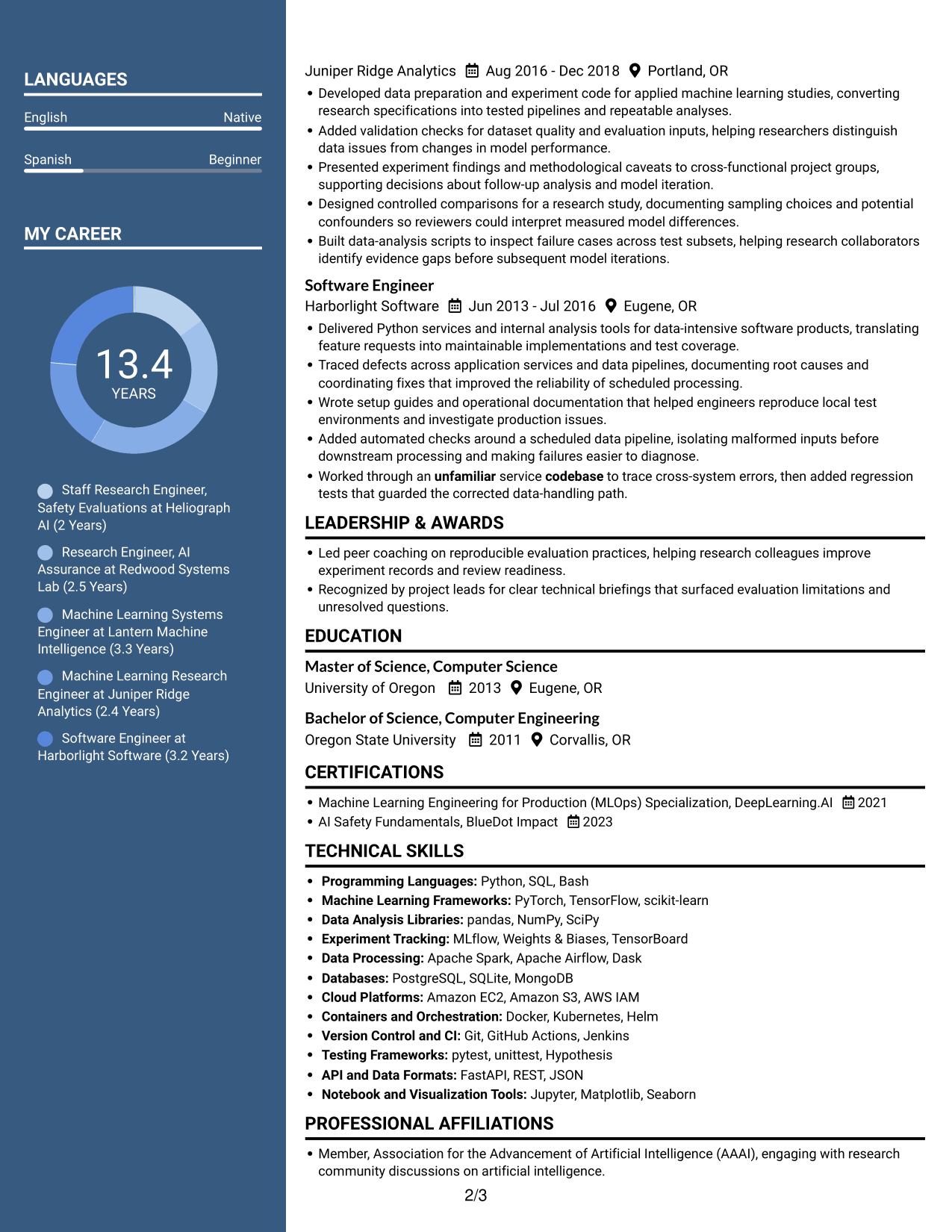
 
Resume example — page 1   Resume example — page 2

Why This Format Works

  • Two columns give experience, skills, and education separate areas for review.
  • The divided layout lets reviewers move between resume sections with less vertical scanning.
  • Career details and credentials can be reviewed as distinct parts of the document.

Best For

  • Two-column section navigation
  • Resumes with varied content
  • Experience and credentials in one document
  • Readers scanning distinct information areas
  • Multi-section career records
 

#7 Photo Header Two Column Format Resume Example

Photo Header Two Column Format combines a photo with a two-column resume body, giving readers a portrait and distinct areas for resume content.
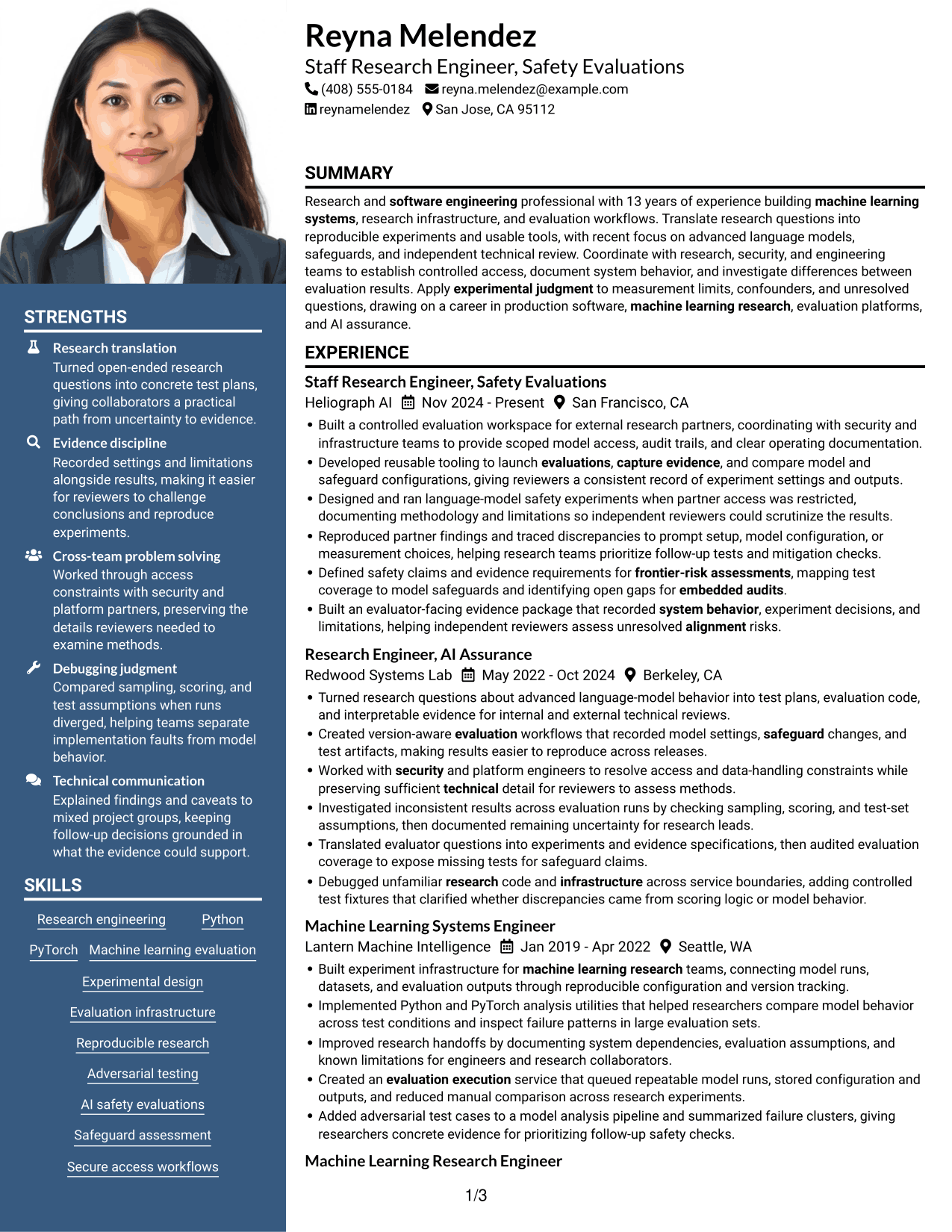
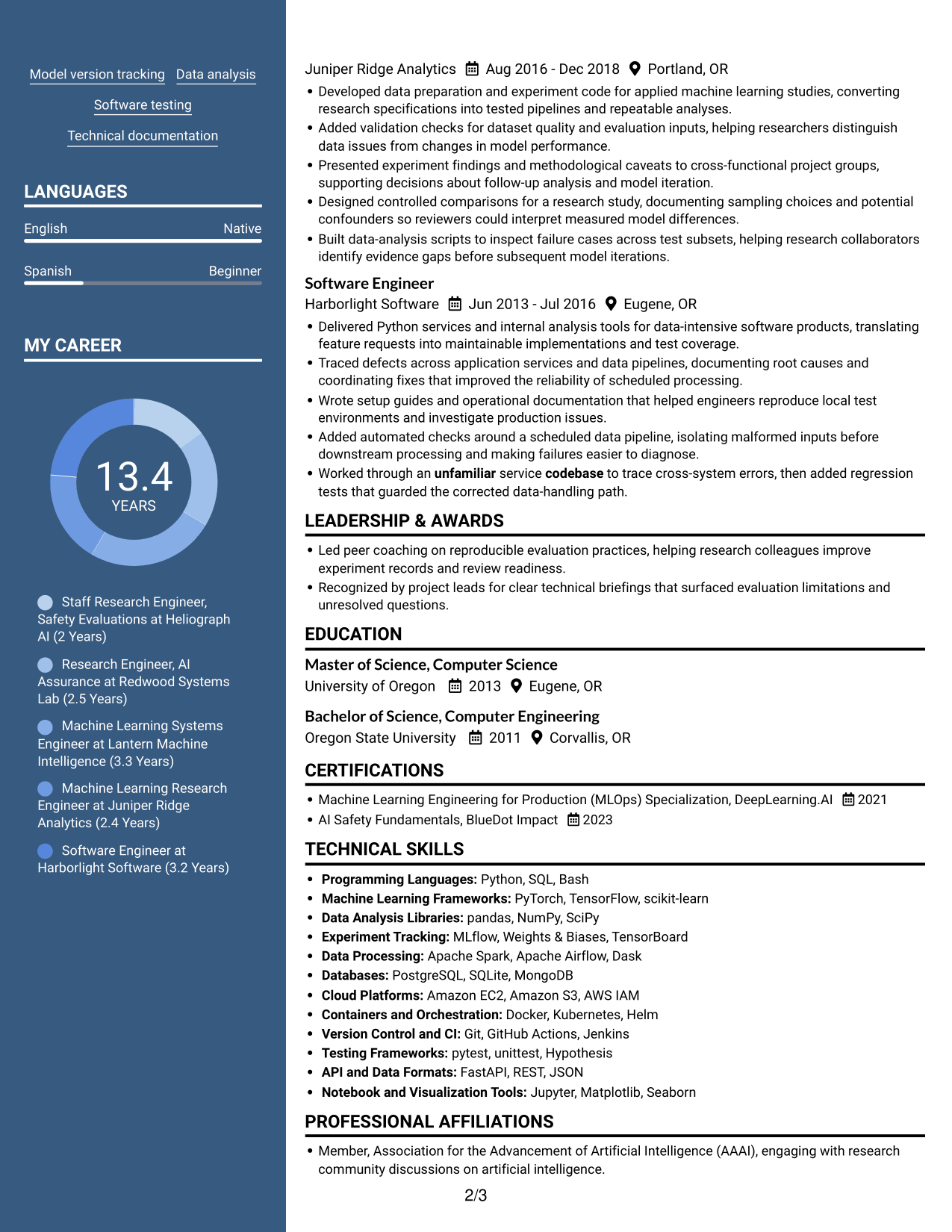
 
Resume example — page 1   Resume example — page 2

Why This Format Works

  • Two columns separate resume information into areas that reviewers can scan independently.
  • The photo adds a visual identifier while career details remain in the text areas.
  • Separate content groups help readers review experience, education, and skills.

Best For

  • Photo-inclusive resume preference
  • Two-column information grouping
  • Readers comparing resume sections
  • Multi-part qualification records
  • Text and portrait in one document


Why Build Your Researcher - Frontier AI Safety Evaluations Resume with ResumeInMinutes

ResumeInMinutes lets you compare resume image previews and open an example in the editor. Use the layout as a starting point, then organize your own evaluation work, technical skills, and research evidence for easy review.

  • ATS-friendly section structure
  • Clear experience and skills sections
  • Role-focused keyword guidance
  • Space for research tools and methods
  • Readable image previews
  • Resume customization in the editor

Keep the resume specific to frontier AI safety evaluations. Make it easy for reviewers to find your role in experiment design, evaluation tooling, evidence capture, and the analysis of model safeguards.


See Also


Frequently Asked Questions

Are these Researcher - Frontier AI Safety Evaluations resume templates ATS-friendly?

The examples use clear section headings and readable text. For stronger ATS alignment, use terms that match your real experience, such as experimental design, evaluation infrastructure, Python, PyTorch, safeguard assessment, and reproducible research.

What do the resume examples show?

The page presents one resume example in different layouts. The image previews help you compare how each layout arranges experience, skills, education, and other resume details.

What should a Researcher - Frontier AI Safety Evaluations resume include?

Include a focused summary, relevant experience, technical skills, education, and applicable certifications. Use bullets to explain research questions, experiment methods, evaluation tools, findings, and limitations. Add measurable results when you can support them.

How should I describe AI safety evaluation work?

State the evaluation goal, what you did, and what the evidence showed. Include relevant details such as model or safeguard configurations, test coverage, reproducibility, and remaining uncertainty when they are part of your work.

Which resume layout is best for this research role?

Choose a layout with clear headings and enough space for technical experience and skills. A simple, single-column layout is often easy for both people and applicant tracking systems to scan.

Should I include a photo on my resume?

For U.S. applications, a resume without a photo is generally the safer choice. Use a photo only when it is expected in your location or field.


ATS Score 97%

How we calculate this score

  • Keywords: 60% of the total. AI extracts keywords from your job description. If you do not provide one, a standard job description for the title matching your resume is used. This is not a match to a specific vacancy.
  • Text-based resume: 20%. The text resume assessed here receives 100 for this part.
  • Resume quality: 20%. We start at 100 and subtract points for issues found by our resume checks, down to a minimum of zero.
  • Keyword coverage = 100 × (confirmed matches + 0.8 × possible matches) ÷ total keywords, rounded and capped at 100. Possible matches still need checking. Saved generation audits use their saved keyword percentage.
  • Final score = 60% of keyword coverage + 20% of the text score + 20% of the quality score, rounded to a whole number. Without keywords, no overall ATS score is available.

What this score means

Our scores are estimates, not employer ratings. They may contain errors and do not guarantee accurate parsing, a ranking, an interview, or a job. Check your document against the employer’s requirements. You are responsible for relying on this score.

Terms and Conditions

Score weights: Keywords 60% · Text based resume 20% · Resume quality 20%

Keywords: 36 matched + 0 possible of 38 (95%) · Resume quality: 100%

Resume quality 100% · Weight 20% · Issues (0)

Details
  • ✓Name present: Reyna Melendez
  • ✓Email format: reyna.melendez@example.com
  • ✓Phone format: (408) 555-0184
  • ✓Experience 1: Job title: Staff Research Engineer, Safety Evaluations
  • ✓Experience 1: Company name: Heliograph AI
  • ✓Experience 1: Work location: San Francisco, CA
  • ✓Experience 1: Employment dates: Nov 2024 - Present
  • ✓Experience 1: Description or achievements: Present
  • ✓Experience 2: Job title: Research Engineer, AI Assurance
  • ✓Experience 2: Company name: Redwood Systems Lab
  • ✓Experience 2: Work location: Berkeley, CA
  • ✓Experience 2: Employment dates: May 2022 - Oct 2024
  • ✓Experience 2: Description or achievements: Present
  • ✓Experience 3: Job title: Machine Learning Systems Engineer
  • ✓Experience 3: Company name: Lantern Machine Intelligence
  • ✓Experience 3: Work location: Seattle, WA
  • ✓Experience 3: Employment dates: Jan 2019 - Apr 2022
  • ✓Experience 3: Description or achievements: Present
  • ✓Experience 4: Job title: Machine Learning Research Engineer
  • ✓Experience 4: Company name: Juniper Ridge Analytics
  • ✓Experience 4: Work location: Portland, OR
  • ✓Experience 4: Employment dates: Aug 2016 - Dec 2018
  • ✓Experience 4: Description or achievements: Present
  • ✓Experience 5: Job title: Software Engineer
  • ✓Experience 5: Company name: Harborlight Software
  • ✓Experience 5: Work location: Eugene, OR
  • ✓Experience 5: Employment dates: Jun 2013 - Jul 2016
  • ✓Experience 5: Description or achievements: Present
  • ✓No placeholder fields
  • ✓No repeated achievement bullets
  • ✓No empty bullets

No issues found by the current checks.

Text Based Resume 100% · Weight 20%

Parsed text
Reyna Melendez
(408) 555-0184
reyna.melendez@example.com
reynamelendez
San Jose, CA 95112
SUMMARY
Research and software engineering professional with 13 years of experience building machine learning systems, research infrastructure, and evaluation workflows. Translate research questions into reproducible experiments and usable tools, with recent focus on advanced language models, safeguards, and independent technical review. Coordinate with research, security, and engineering teams to establish controlled access, document system behavior, and investigate differences between evaluation results. Apply experimental judgment to measurement limits, confounders, and unresolved questions, drawing on a career in production software, machine learning research, evaluation platforms, and AI assurance.
EXPERIENCE
Staff Research Engineer, Safety Evaluations
Nov 2024 - Present
Heliograph AI
San Francisco, CA
Built a controlled evaluation workspace for external research partners, coordinating with security and infrastructure teams to provide scoped model access, audit trails, and clear operating documentation.
Developed reusable tooling to launch evaluations, capture evidence, and compare model and safeguard configurations, giving reviewers a consistent record of experiment settings and outputs.
Designed and ran language-model safety experiments when partner access was restricted, documenting methodology and limitations so independent reviewers could scrutinize the results.
Reproduced partner findings and traced discrepancies to prompt setup, model configuration, or measurement choices, helping research teams prioritize follow-up tests and mitigation checks.
Defined safety claims and evidence requirements for frontier-risk assessments, mapping test coverage to model safeguards and identifying open gaps for embedded audits.
Built an evaluator-facing evidence package that recorded system behavior, experiment decisions, and limitations, helping independent reviewers assess unresolved alignment risks.
Research Engineer, AI Assurance
May 2022 - Oct 2024
Redwood Systems Lab
Berkeley, CA
Turned research questions about advanced language-model behavior into test plans, evaluation code, and interpretable evidence for internal and external technical reviews.
Created version-aware evaluation workflows that recorded model settings, safeguard changes, and test artifacts, making results easier to reproduce across releases.
Worked with security and platform engineers to resolve access and data-handling constraints while preserving sufficient technical detail for reviewers to assess methods.
Investigated inconsistent results across evaluation runs by checking sampling, scoring, and test-set assumptions, then documented remaining uncertainty for research leads.
Translated evaluator questions into experiments and evidence specifications, then audited evaluation coverage to expose missing tests for safeguard claims.
Debugged unfamiliar research code and infrastructure across service boundaries, adding controlled test fixtures that clarified whether discrepancies came from scoring logic or model behavior.
Machine Learning Systems Engineer
Jan 2019 - Apr 2022
Lantern Machine Intelligence
Seattle, WA
Built experiment infrastructure for machine learning research teams, connecting model runs, datasets, and evaluation outputs through reproducible configuration and version tracking.
Implemented Python and PyTorch analysis utilities that helped researchers compare model behavior across test conditions and inspect failure patterns in large evaluation sets.
Improved research handoffs by documenting system dependencies, evaluation assumptions, and known limitations for engineers and research collaborators.
Created an evaluation execution service that queued repeatable model runs, stored configuration and outputs, and reduced manual comparison across research experiments.
Added adversarial test cases to a model analysis pipeline and summarized failure clusters, giving researchers concrete evidence for prioritizing follow-up safety checks.
Machine Learning Research Engineer
Aug 2016 - Dec 2018
Juniper Ridge Analytics
Portland, OR
Developed data preparation and experiment code for applied machine learning studies, converting research specifications into tested pipelines and repeatable analyses.
Added validation checks for dataset quality and evaluation inputs, helping researchers distinguish data issues from changes in model performance.
Presented experiment findings and methodological caveats to cross-functional project groups, supporting decisions about follow-up analysis and model iteration.
Designed controlled comparisons for a research study, documenting sampling choices and potential confounders so reviewers could interpret measured model differences.
Built data-analysis scripts to inspect failure cases across test subsets, helping research collaborators identify evidence gaps before subsequent model iterations.
Software Engineer
Jun 2013 - Jul 2016
Harborlight Software
Eugene, OR
Delivered Python services and internal analysis tools for data-intensive software products, translating feature requests into maintainable implementations and test coverage.
Traced defects across application services and data pipelines, documenting root causes and coordinating fixes that improved the reliability of scheduled processing.
Wrote setup guides and operational documentation that helped engineers reproduce local test environments and investigate production issues.
Added automated checks around a scheduled data pipeline, isolating malformed inputs before downstream processing and making failures easier to diagnose.
Worked through an unfamiliar service codebase to trace cross-system errors, then added regression tests that guarded the corrected data-handling path.
LEADERSHIP & AWARDS
Led peer coaching on reproducible evaluation practices, helping research colleagues improve experiment records and review readiness.
Recognized by project leads for clear technical briefings that surfaced evaluation limitations and unresolved questions.
EDUCATION
Master of Science, Computer Science
2013
University of Oregon
Eugene, OR
Bachelor of Science, Computer Engineering
2011
Oregon State University
Corvallis, OR
CERTIFICATIONS
Machine Learning Engineering for Production (MLOps) Specialization, DeepLearning.AI
2021
AI Safety Fundamentals, BlueDot Impact
2023
TECHNICAL SKILLS
Programming Languages: Python, SQL, Bash
Machine Learning Frameworks: PyTorch, TensorFlow, scikit-learn
Data Analysis Libraries: pandas, NumPy, SciPy
Experiment Tracking: MLflow, Weights & Biases, TensorBoard
Data Processing: Apache Spark, Apache Airflow, Dask
Databases: PostgreSQL, SQLite, MongoDB
Cloud Platforms: Amazon EC2, Amazon S3, AWS IAM
Containers and Orchestration: Docker, Kubernetes, Helm
Version Control and CI: Git, GitHub Actions, Jenkins
Testing Frameworks: pytest, unittest, Hypothesis
API and Data Formats: FastAPI, REST, JSON
Notebook and Visualization Tools: Jupyter, Matplotlib, Seaborn
SKILLS
Research engineering
Python
PyTorch
Machine learning evaluation
Experimental design
Evaluation infrastructure
Reproducible research
Adversarial testing
AI safety evaluations
Safeguard assessment
Secure access workflows
Model version tracking
Data analysis
Software testing
Technical documentation
PROFESSIONAL AFFILIATIONS
Member, Association for the Advancement of Artificial Intelligence (AAAI), engaging with research community discussions on artificial intelligence.
Member, Association for Computing Machinery (ACM), participating in professional community activities related to computing research and software engineering.
LANGUAGES
English (Native)
Spanish (Beginner)

Matched keywords (36)

  • software engineering
  • Research engineering
  • machine learning systems
  • Experimental design
  • AI safety evaluations
  • Evaluation infrastructure
  • Defined safety claims and evidence requirements for frontier-risk assessments, mapping test coverage to model safeguards and identifying open gaps for embedded audits.Original keyword in JD: Frontier AI risks
  • Developed reusable tooling to launch evaluations, capture evidence, and compare model and safeguard configurations, giving reviewers a consistent record of experiment settings and outputs.Original keyword in JD: Safeguard evaluation
  • Built an evaluator-facing evidence package that recorded system behavior, experiment decisions, and limitations, helping independent reviewers assess unresolved alignment risks.Original keyword in JD: Technical auditing
  • Adversarial testing
  • Worked with security and platform engineers to resolve access and data-handling constraints while preserving sufficient technical detail for reviewers to assess methods.Original keyword in JD: Security research
  • Implemented Python and PyTorch analysis utilities that helped researchers compare model behavior across test conditions and inspect failure patterns in large evaluation sets.Original keyword in JD: Research tools development
  • Implemented Python and PyTorch analysis utilities that helped researchers compare model behavior across test conditions and inspect failure patterns in large evaluation sets.Original keyword in JD: Complex data analysis
  • evaluation execution
  • Defined safety claims and evidence requirements for frontier-risk assessments, mapping test coverage to model safeguards and identifying open gaps for embedded audits.Original keyword in JD: Safety claim assessment
  • evidence requirements
  • Defined safety claims and evidence requirements for frontier-risk assessments, mapping test coverage to model safeguards and identifying open gaps for embedded audits.Original keyword in JD: Evaluation coverage analysis
  • frontier-risk assessments
  • embedded audits
  • Built a controlled evaluation workspace for external research partners, coordinating with security and infrastructure teams to provide scoped model access, audit trails, and clear operating documentation.Original keyword in JD: Secure assessment environments
  • Developed reusable tooling to launch evaluations, capture evidence, and compare model and safeguard configurations, giving reviewers a consistent record of experiment settings and outputs.Original keyword in JD: Audit workflows
  • Developed reusable tooling to launch evaluations, capture evidence, and compare model and safeguard configurations, giving reviewers a consistent record of experiment settings and outputs.Original keyword in JD: Evidence capture
  • Created version-aware evaluation workflows that recorded model settings, safeguard changes, and test artifacts, making results easier to reproduce across releases.Original keyword in JD: Model and safeguard version tracking
  • Reproduced partner findings and traced discrepancies to prompt setup, model configuration, or measurement choices, helping research teams prioritize follow-up tests and mitigation checks.Original keyword in JD: External finding reproduction
  • Reproduced partner findings and traced discrepancies to prompt setup, model configuration, or measurement choices, helping research teams prioritize follow-up tests and mitigation checks.Original keyword in JD: Evaluation discrepancy analysis
  • Reproduced partner findings and traced discrepancies to prompt setup, model configuration, or measurement choices, helping research teams prioritize follow-up tests and mitigation checks.Original keyword in JD: Mitigation assessment
  • Apply experimental judgment to measurement limits, confounders, and unresolved questions, drawing on a career in production software, machine learning research, evaluation platforms, and AI assurance.Original keyword in JD: Measurement judgment
  • Defined safety claims and evidence requirements for frontier-risk assessments, mapping test coverage to model safeguards and identifying open gaps for embedded audits.Original keyword in JD: Evidence gap identification
  • Technical documentation
  • Built an evaluator-facing evidence package that recorded system behavior, experiment decisions, and limitations, helping independent reviewers assess unresolved alignment risks.Original keyword in JD: System behavior analysis
  • Worked through an unfamiliar service codebase to trace cross-system errors, then added regression tests that guarded the corrected data-handling path.Original keyword in JD: Unfamiliar codebase navigation
  • Debugged unfamiliar research code and infrastructure across service boundaries, adding controlled test fixtures that clarified whether discrepancies came from scoring logic or model behavior.Original keyword in JD: Cross-system debugging
  • Translated evaluator questions into experiments and evidence specifications, then audited evaluation coverage to expose missing tests for safeguard claims.Original keyword in JD: Research needs translation
  • Built a controlled evaluation workspace for external research partners, coordinating with security and infrastructure teams to provide scoped model access, audit trails, and clear operating documentation.Original keyword in JD: Independent evaluator collaboration
  • Built experiment infrastructure for machine learning research teams, connecting model runs, datasets, and evaluation outputs through reproducible configuration and version tracking.Original keyword in JD: Research collaboration
  • alignment

Missing keywords (2)

  • Confounder identification
  • Technical communication

Possible matches (0)

No possible matches.

Disclaimer: All names, images, contact information, employment histories, achievements, security clearances, military credentials, and other qualifications shown in this content are fictional and used for illustrative purposes only. Any resemblance to actual persons, living or deceased, is purely coincidental.

Resume and cover-letter examples and recommendations in this article reflect general best practices and professional experience and are provided for guidance only. Results may vary based on role, industry, region, and hiring organization.

Content Accuracy and Verification: To the fullest extent permitted by applicable law, we do not represent or warrant that resume or cover-letter guidance, examples, recommendations, or related information are accurate, complete, current, error-free, or suitable for any particular purpose. You are responsible for independently reviewing and verifying the information before relying on it.

ATS and Cover-Letter Scores: ATS scores are estimates calculated using our own formula, informed by publicly available guidance on resume formatting and keyword matching. They are not scores issued or endorsed by an ATS provider or employer. Cover-letter scores are also our own assessments. Parsing, weighting, screening criteria, and results vary between systems, employers, job descriptions, and document formats. No score guarantees successful parsing, a particular ranking, an interview, or employment. Use scores as general guidance and independently check your documents against the employer’s requirements. To the fullest extent permitted by applicable law, we accept no liability for errors in scores or parsing, or losses arising from reliance on these assessments. Nothing in this notice excludes liability or limits consumer rights that cannot lawfully be excluded or limited.

Terms and Conditions
 
> JP 1 1
PDF Footer and Margins Setup
The margins are applied to the document, and the footer shows up in the preview and the PDF

Footer Font Settings

Are you applying for a specific job
so we can tailor your resume to it?
Are you applying for a specific job
so we can tailor your cover letter to it?

Your data stays private and is never used for training.Privacy Policy

Type your details as text to generate a personalized resume Type your details as text to generate a personalized cover letter
Website link found! Ready to create resume from:

Your data stays private and is never used for training.Privacy Policy

Drag the into the box to verify you're human.
Drop here

My Resumes

Displaying {number_of_files} files (out of {total_of_all_files} total)
Name File Type Last Modified: Description:

Rename File

Filename already exists!

Delete Files

Warning: This action is irreversible. Once you click submit, the files will be permanently deleted.

Heading text
Upload From Computer Upload
Select From Existing
LinkedIn
Drag & Drop files anywhere in this tab, or

Uploaded Files

Delete Name Last Updated Use This File
Select this to use the file for generating your resume and cover letter. Only one source—uploaded file, selected file, or LinkedIn text—can be used.

My Files

Resumes or cover letters you create will appear here. No files available yet.
Delete Name Last Updated Use This File
Select this to use the file for generating your resume and cover letter. Only one source—uploaded file, selected file, or LinkedIn text—can be used.

Add LinkedIn Profile PDF

You can download your LinkedIn profile as a PDF by opening linkedin.com in a web browser, clicking your profile photo, selecting the “More” or “Resources” button, and choosing “Save to PDF.” You can then attach the PDF using the Upload From Computer tab.

Paste Your LinkedIn Profile Text

If you have copied the LinkedIn profile text, paste it below. See how to copy your profile from LinkedIn

Select this to use the LinkedIn profile text for generating your resume and cover letter. Only one source—uploaded file, selected file, or LinkedIn text—can be used.

Try these controls

<
>


