7 Senior GPU Performance Software Engineer Resume Templates with Example
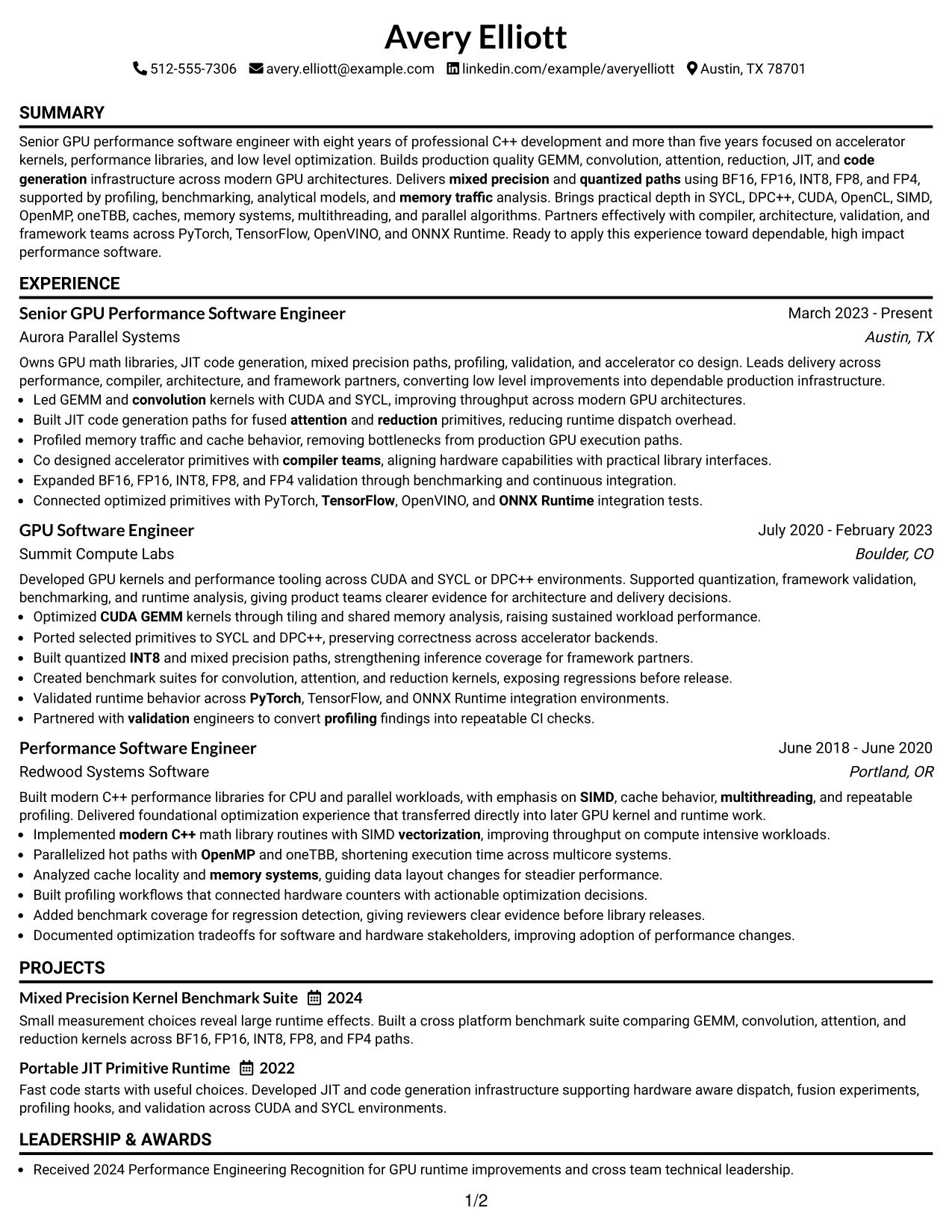
This practical guide shows you how to build a Senior GPU Performance Software Engineer resume that is clear, focused, and easy to review. You will learn how to organize technical evidence and compare professional resume formats.
Strong resumes for this role connect modern C++ and GPU kernel work with performance analysis, mixed precision, code generation, memory systems, and cross-team delivery. Use concise achievement bullets, clear section labels, and accurate keywords such as GEMM, convolution, attention, SYCL, CUDA, profiling, benchmarking, and quantization.
The complete resume example below is presented in 7 ATS-friendly resume layouts. Use the format notes and free PDF previews to choose a structure that fits your content and keeps the most important evidence easy to find.
What Makes a Great Senior GPU Performance Software Engineer Resume in 2026
A strong resume is focused, evidence-based, and easy to scan. It should show senior ownership, technical depth, and clear progression through concise sections and achievement bullets.
Match the role with grounded terms such as modern C++, GPU kernels, JIT code generation, mixed precision, profiling, memory traffic, benchmarking, CI, and deep learning runtimes.
The examples shown below are intentionally detailed to demonstrate a range of experiences, skills, accomplishments and relevant keywords. We prefer detailed resumes as they provide more context to the hiring managers and also help the ATS systems identify relevant qualifications and score your resume better for a match. But the length of a resume is an individual choice. If you want a one page resume, just keep the most relevant experience and information for the job. Note: Resume examples are for educational purposes only. Use only information that accurately reflects your experience and qualifications. References to real organizations do not imply affiliation or endorsement.
#1 Simple One Column Format Resume Example
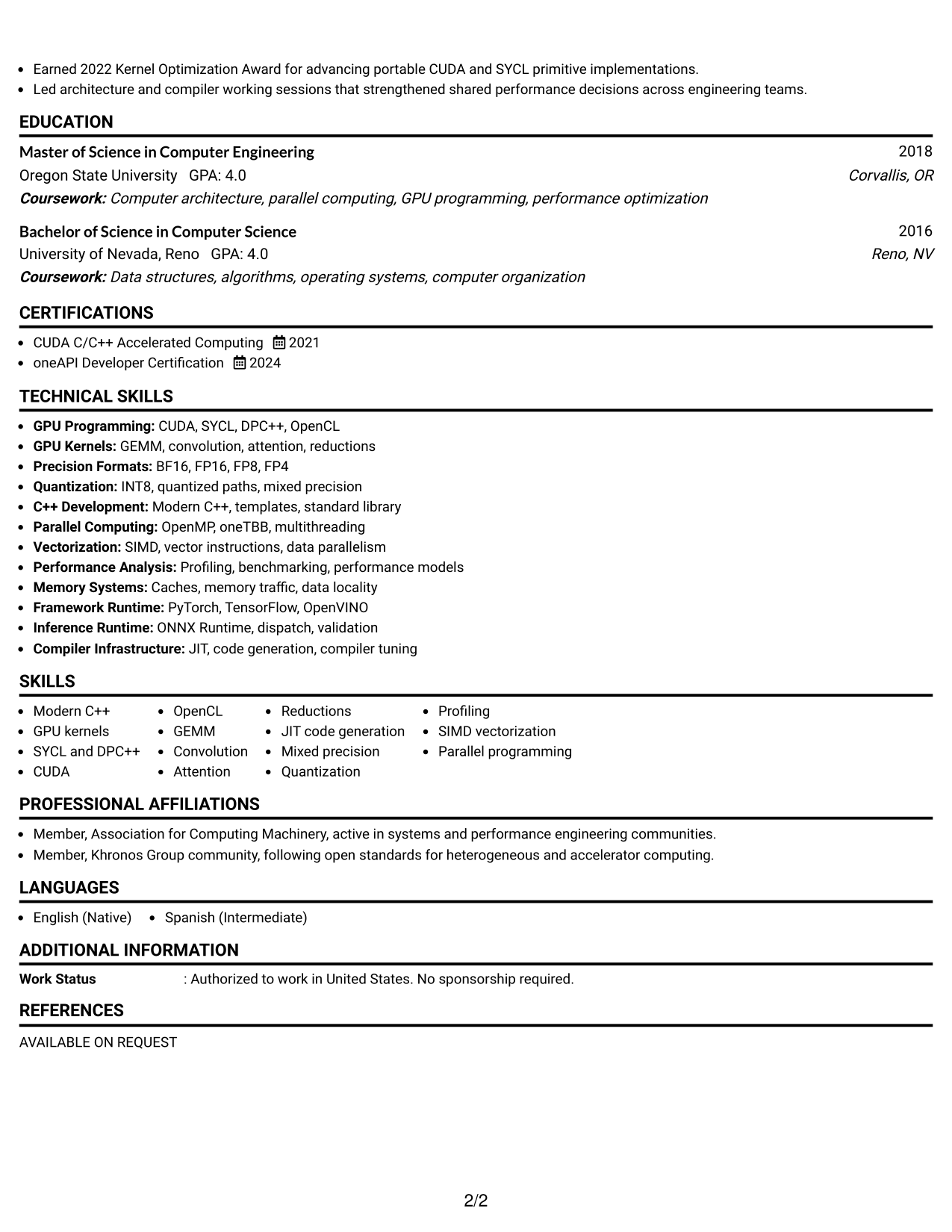
A direct one-column reading order helps recruiters scan each resume section from top to bottom without side-to-side jumps.
Why This Format Works
- Linear section order keeps career progression simple to follow during review.
- Full-width space gives experience and achievement bullets room to stay readable.
- Straightforward headings make skills, education, and credentials easy to locate.
Best For
- Dense technical experience
- Clear chronological progression
- Long achievement bullets
- Straightforward recruiter scanning
- Keyword-rich senior resumes
Resume Keywords
- Modern C++
- GPU kernels
- CUDA
- SYCL and DPC++
- GEMM
- Convolution
- Attention
- JIT code generation
- Mixed precision
- Quantization
- Profiling
- Benchmarking
- Memory traffic
- CI
- ONNX Runtime
#2 Plain One Column with Shaded Labels Resume Example
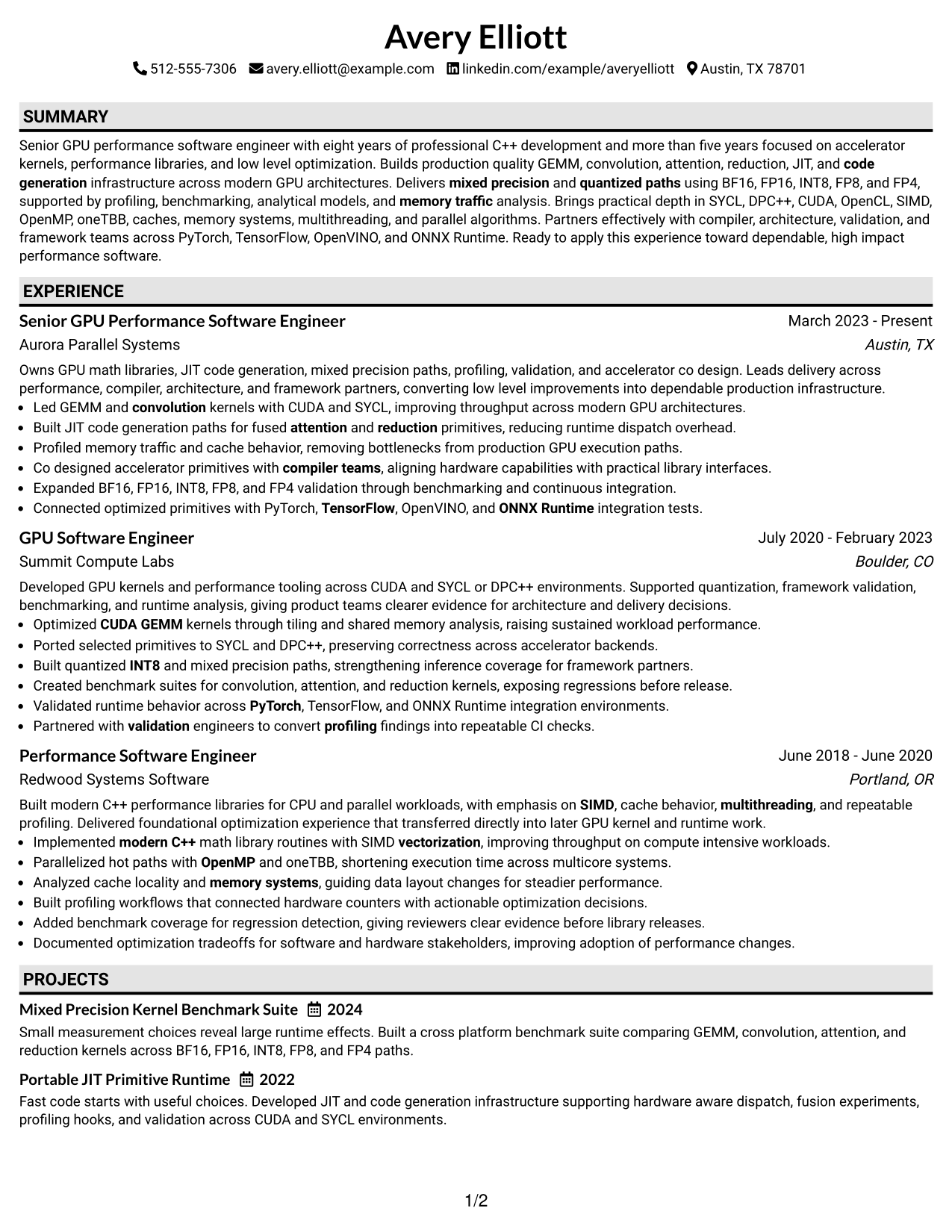
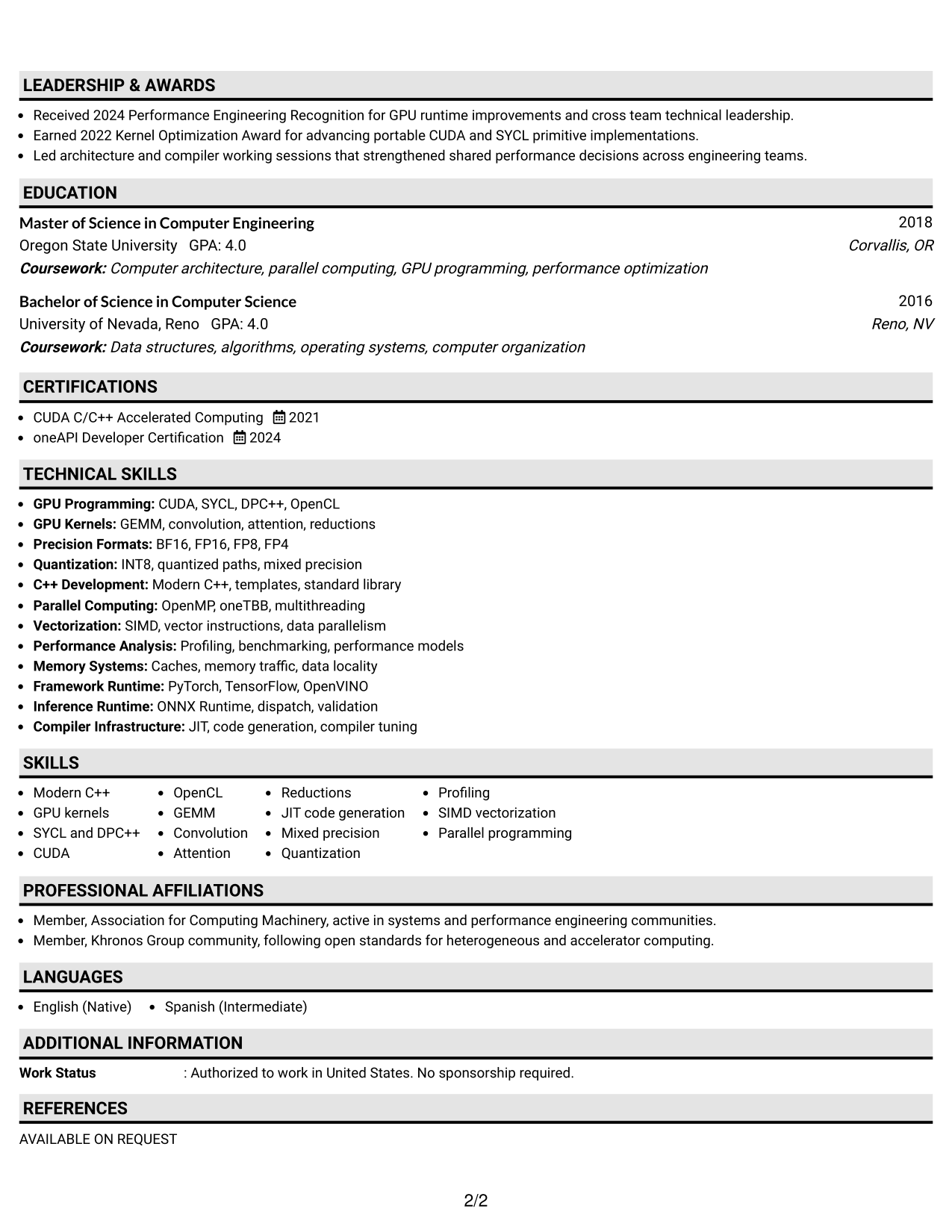
Shaded section labels break a one-column resume into clear stops, helping recruiters move quickly between major content areas.
Why This Format Works
- Shaded labels separate experience, skills, education, and credentials without changing reading order.
- One continuous column keeps detailed career history easy to trace.
- Visible section breaks help reviewers return to specific evidence after a first scan.
Best For
- Section-heavy resumes
- Fast return scanning
- Detailed career histories
- Readers who prefer strong labels
- Technical resumes with many credentials
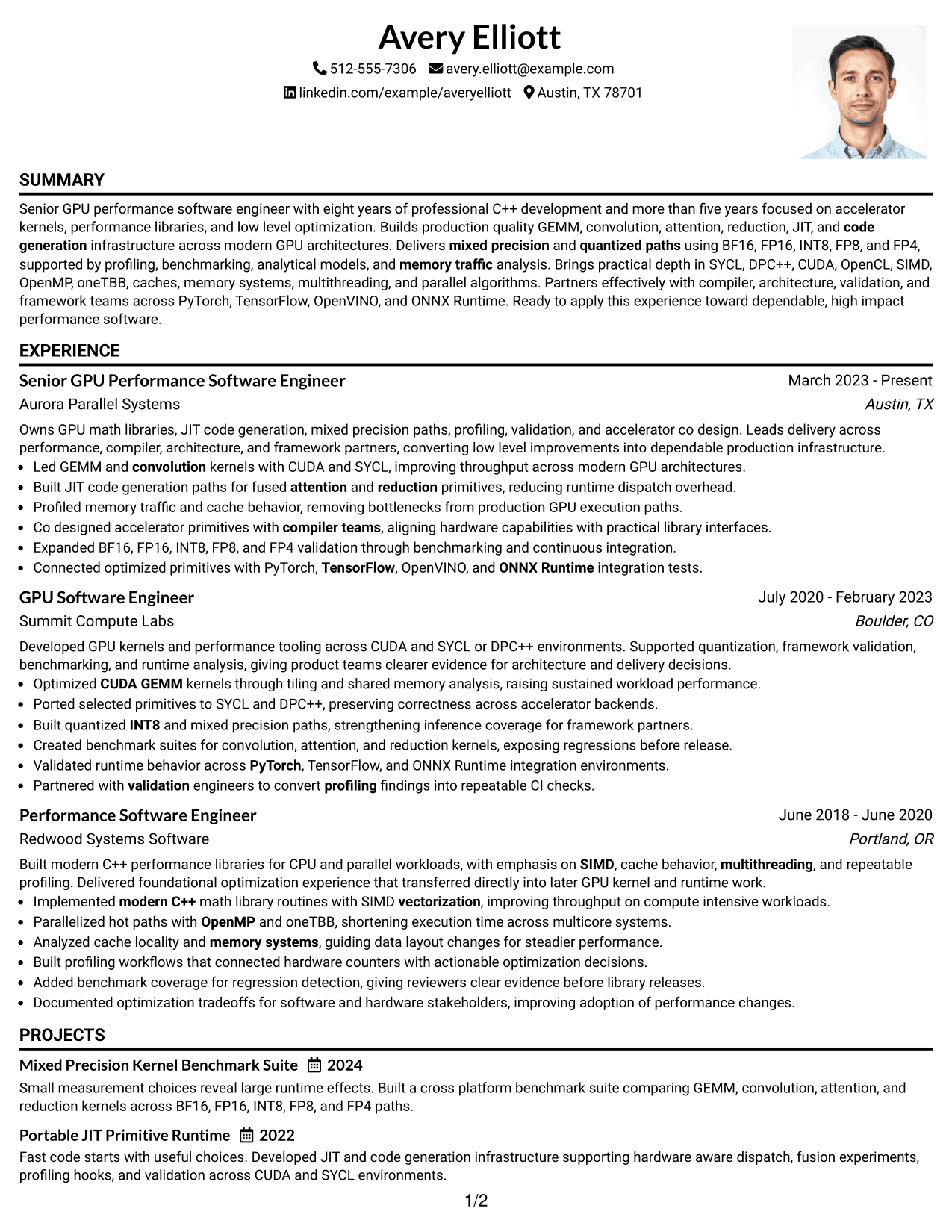
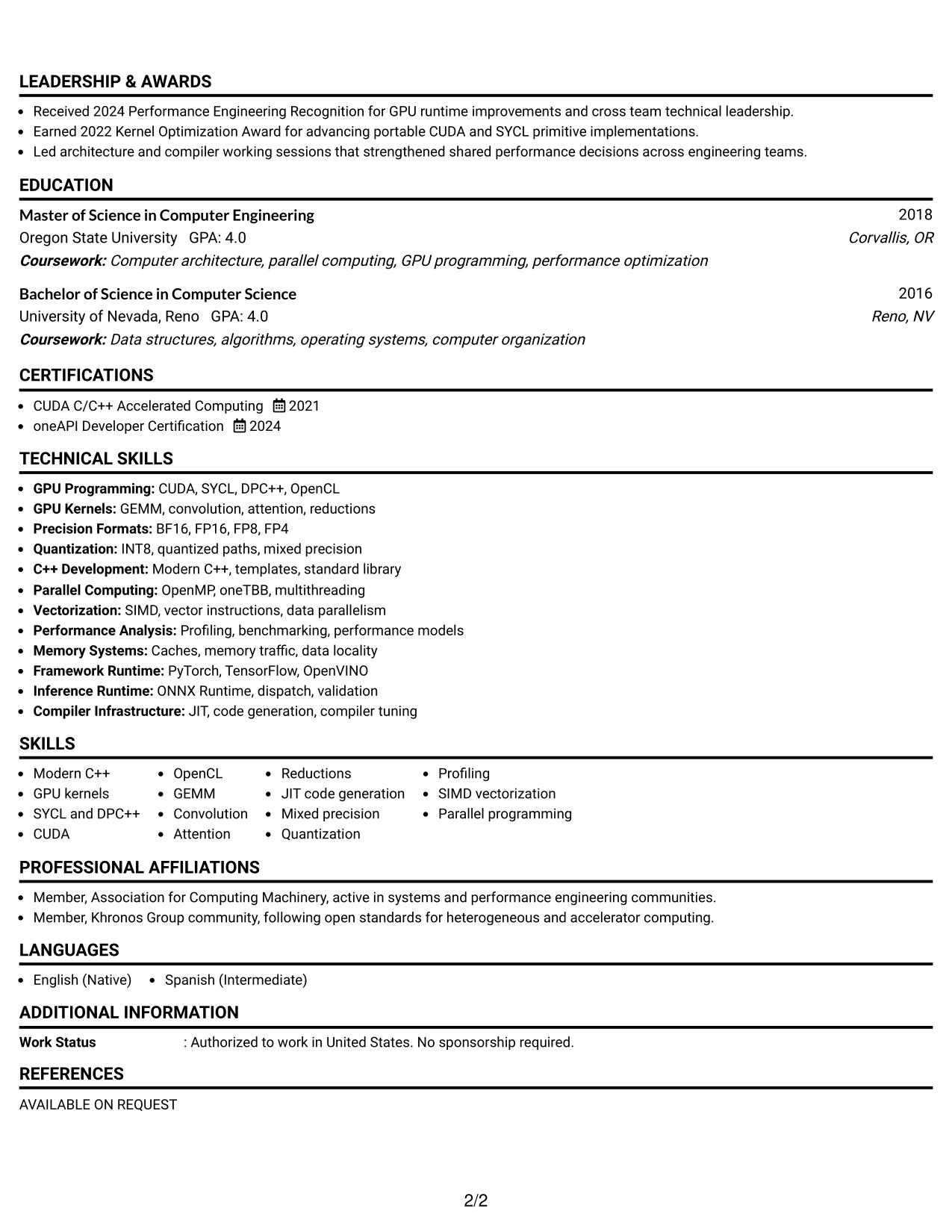
#3 One Column Format with Photo Right Resume Example
A right-side header photo adds personal identification while the one-column body keeps resume sections in a simple scan path.
Why This Format Works
- One-column body preserves a clear sequence for experience, skills, education, and credentials.
- Header photo stays separate from the evidence presented in the main resume body.
- Full-width sections provide comfortable space for senior experience and achievement detail.
Best For
- Markets where resume photos are customary
- Personal identification in the header
- Full-width experience detail
- Simple body reading order
- Senior technical career evidence
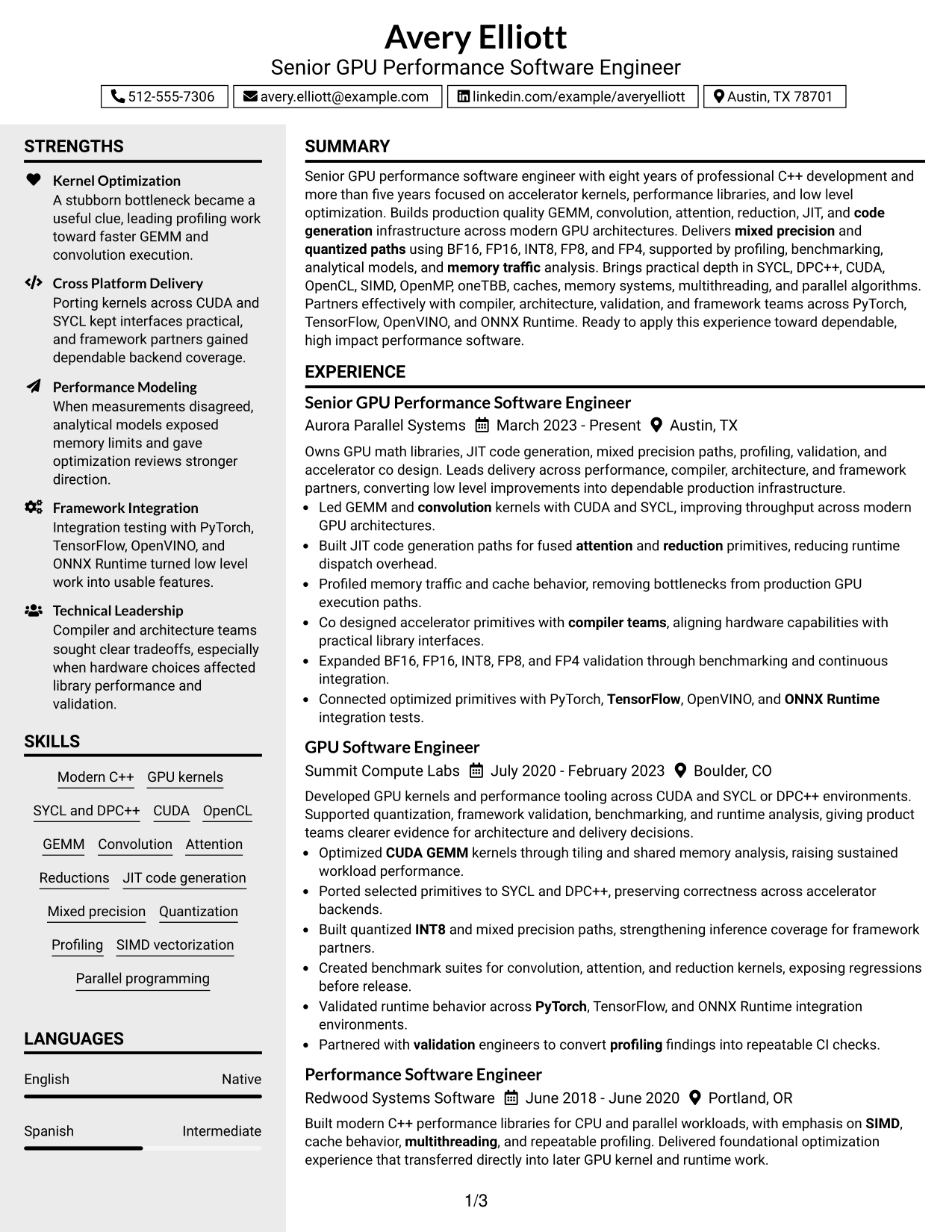
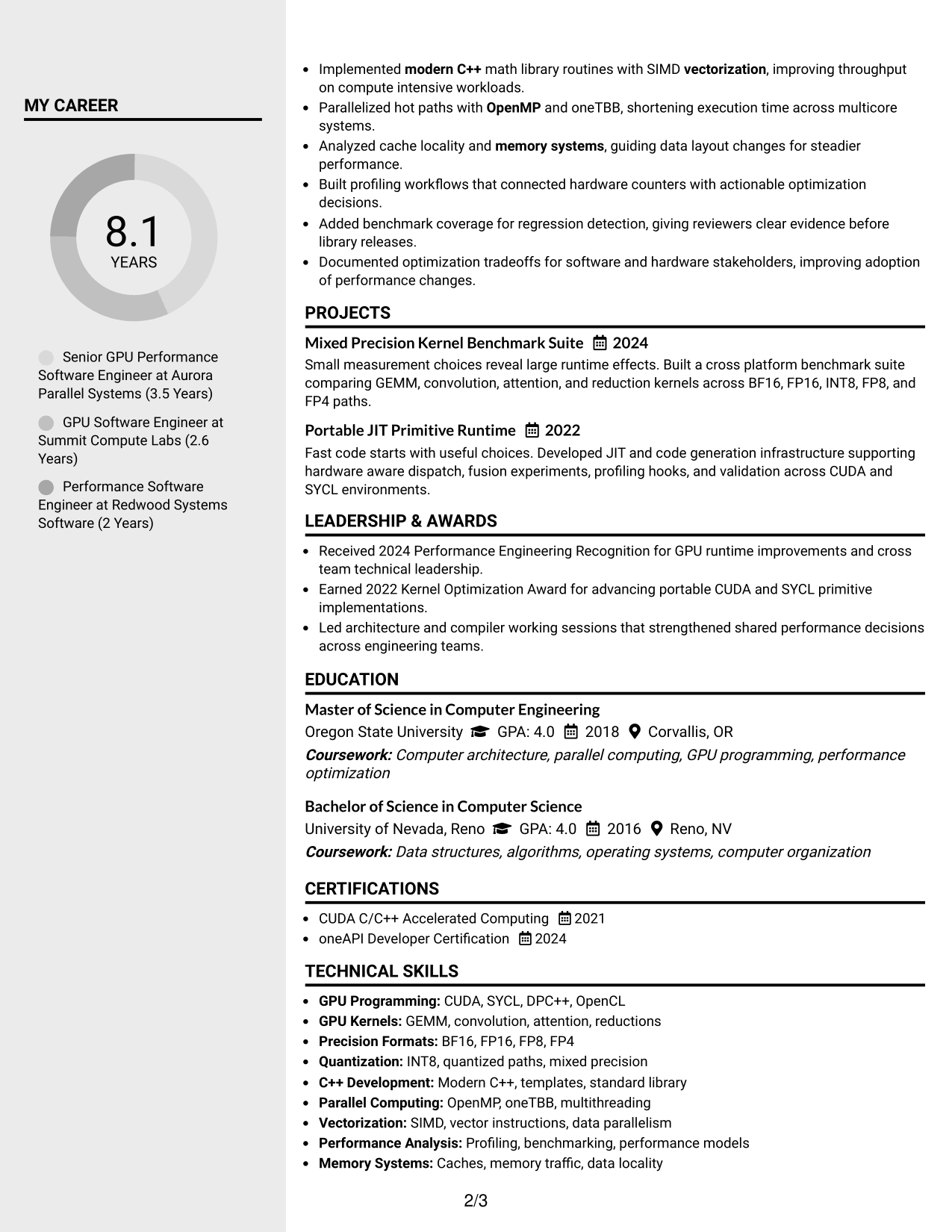
#4 Clean Two Column Sidebar Format Resume Example
A two-column body lets recruiters scan supporting information beside the main career narrative without losing section separation.
Why This Format Works
- Sidebar structure separates compact skills and credentials from longer experience content.
- Parallel columns reduce vertical crowding when the resume contains several supporting sections.
- Main content area keeps career progression and achievements distinct from quick-reference details.
Best For
- Compact supporting sections
- Visible skills grouping
- Balanced technical detail
- Career history plus quick references
- Readers comparing qualifications quickly
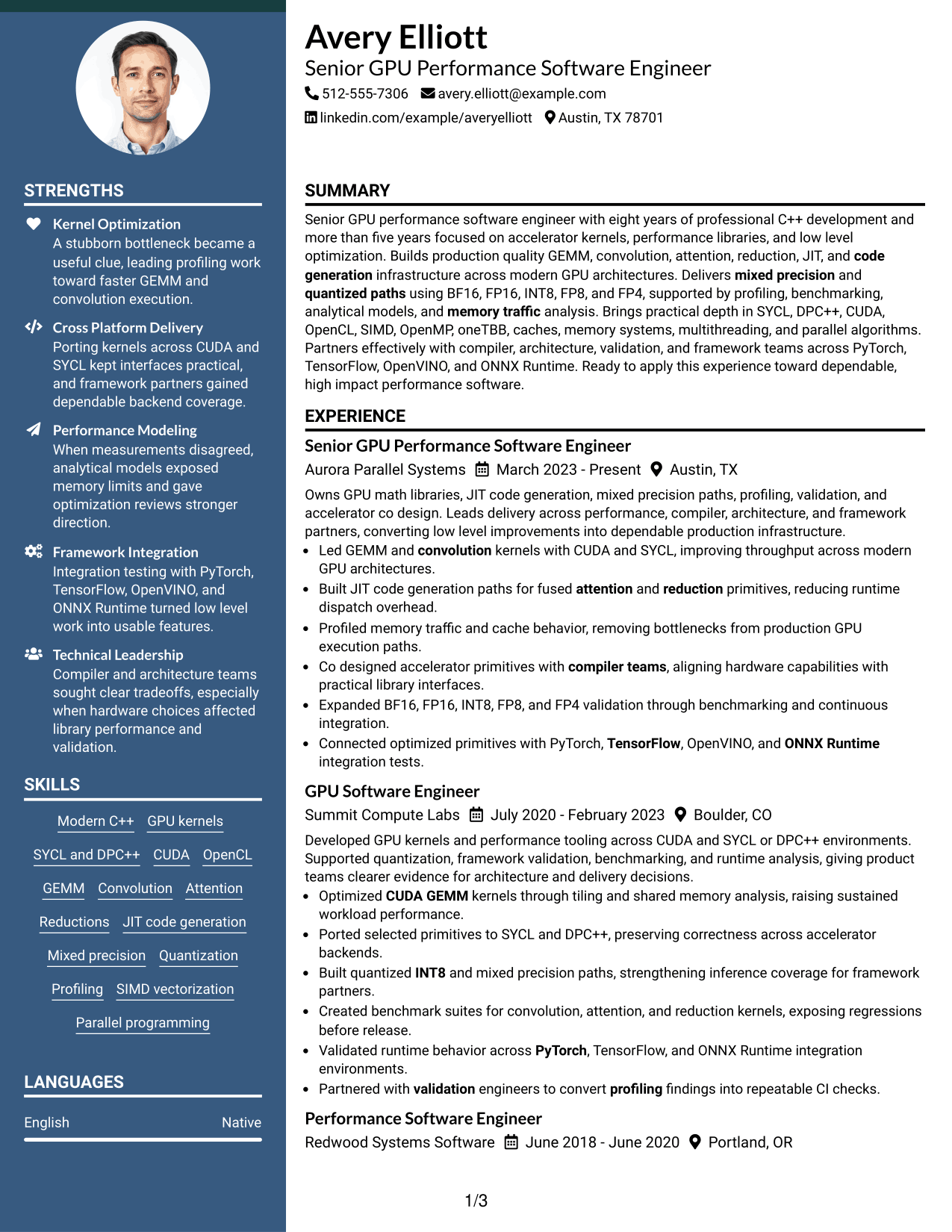
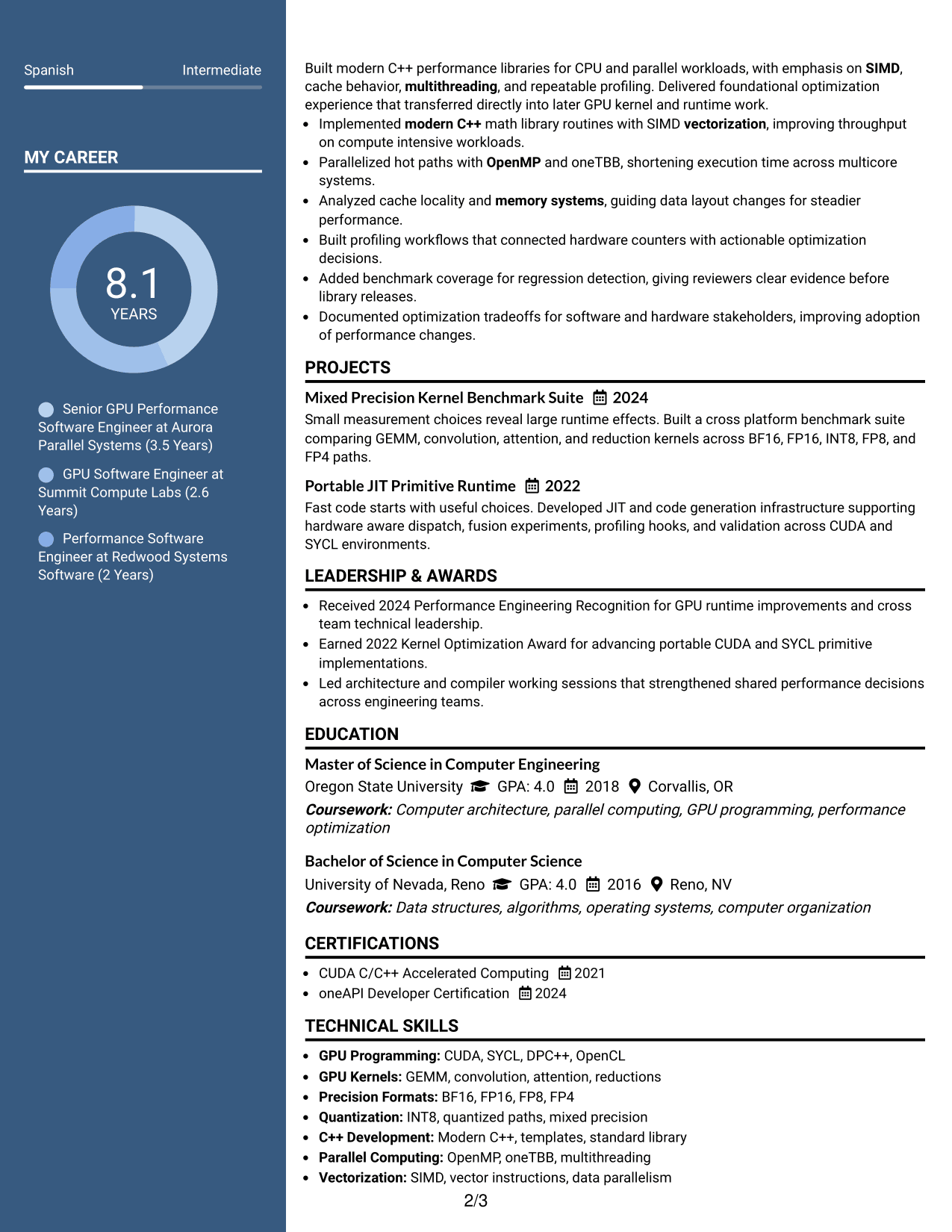
#5 Two Column Format Resume Example
Two balanced columns divide resume content into parallel areas, giving recruiters shorter visual paths through a detailed document.
Why This Format Works
- Parallel content areas make broad experience and supporting qualifications easier to compare.
- Shorter line lengths can improve readability across dense skills and credential sections.
- Two-column separation gives achievements and background information distinct visual zones.
Best For
- Broad qualification sets
- Compact visual scanning
- Mixed experience and project content
- Several supporting resume sections
- Readers reviewing dense information
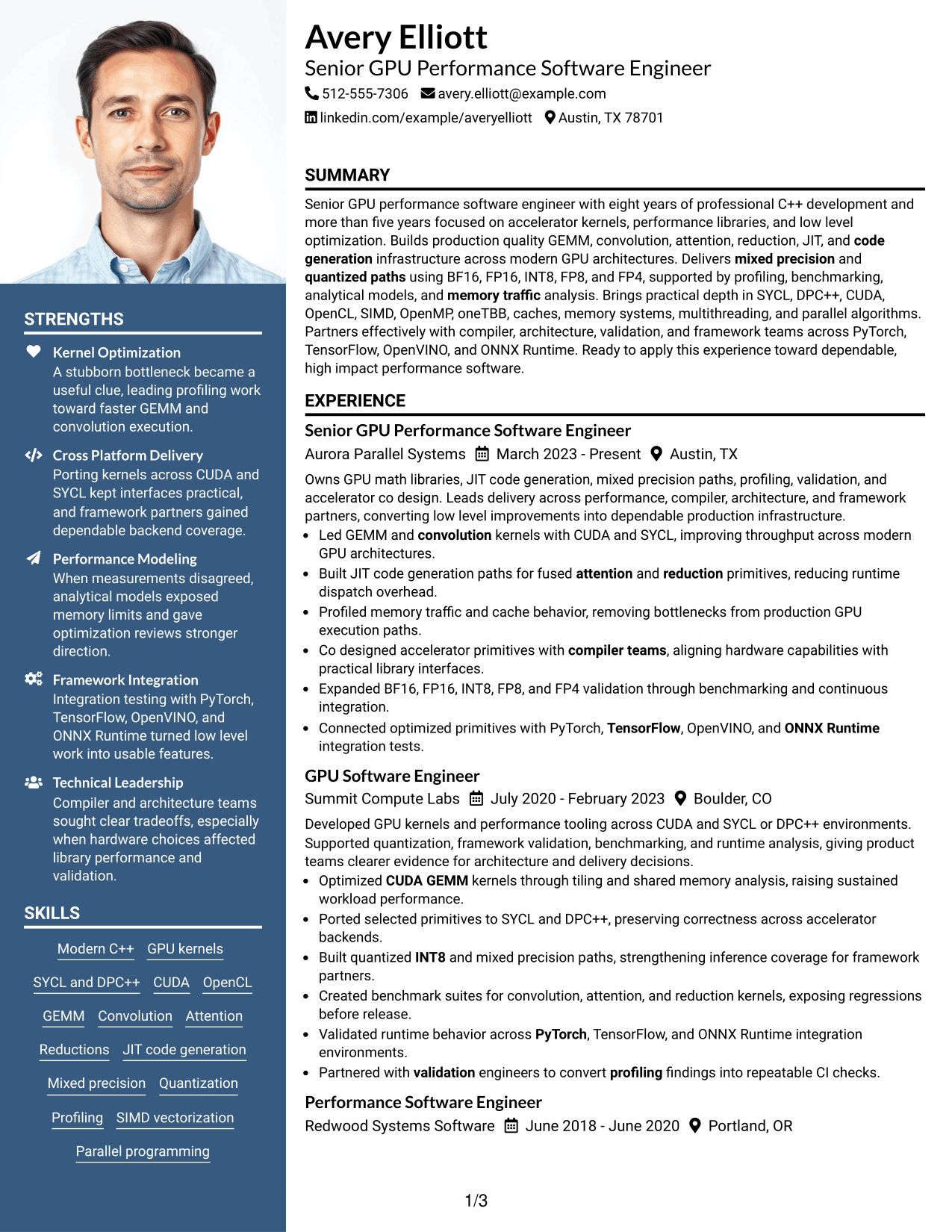
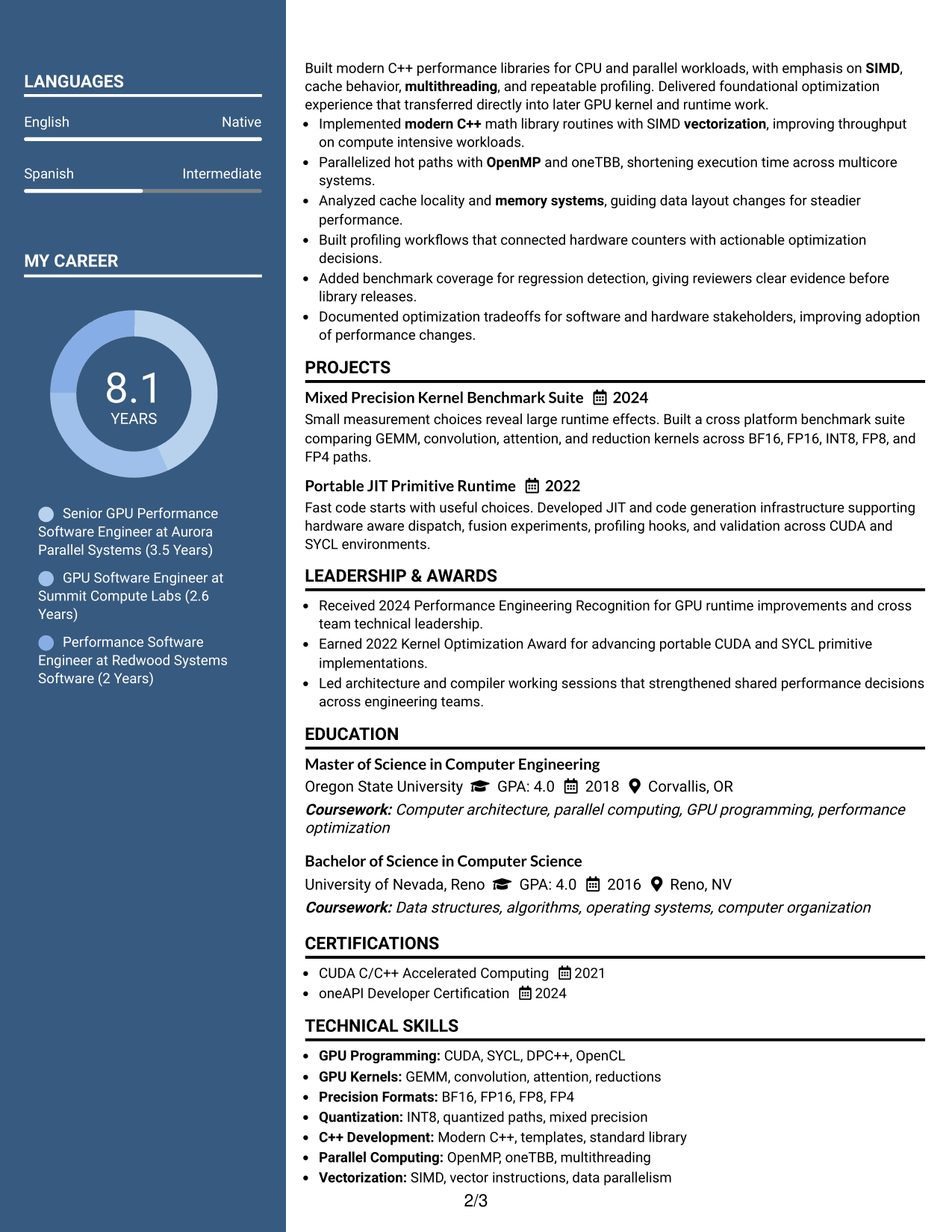
#6 Photo Header Two Column Format Resume Example
A photo header creates a clear identity area, while two body columns help recruiters navigate experience and supporting sections efficiently.
Why This Format Works
- Header photo identifies the person without replacing evidence in the resume body.
- Two columns give experience, skills, education, and credentials separate areas to scan.
- Column structure helps contain detailed senior content without forcing one long vertical flow.
Best For
- Regions where photos are expected
- Header-focused personal identification
- High information volume
- Parallel skills and experience review
- Technical resumes with supporting credentials
#7 Simple Two Column Format Resume Example
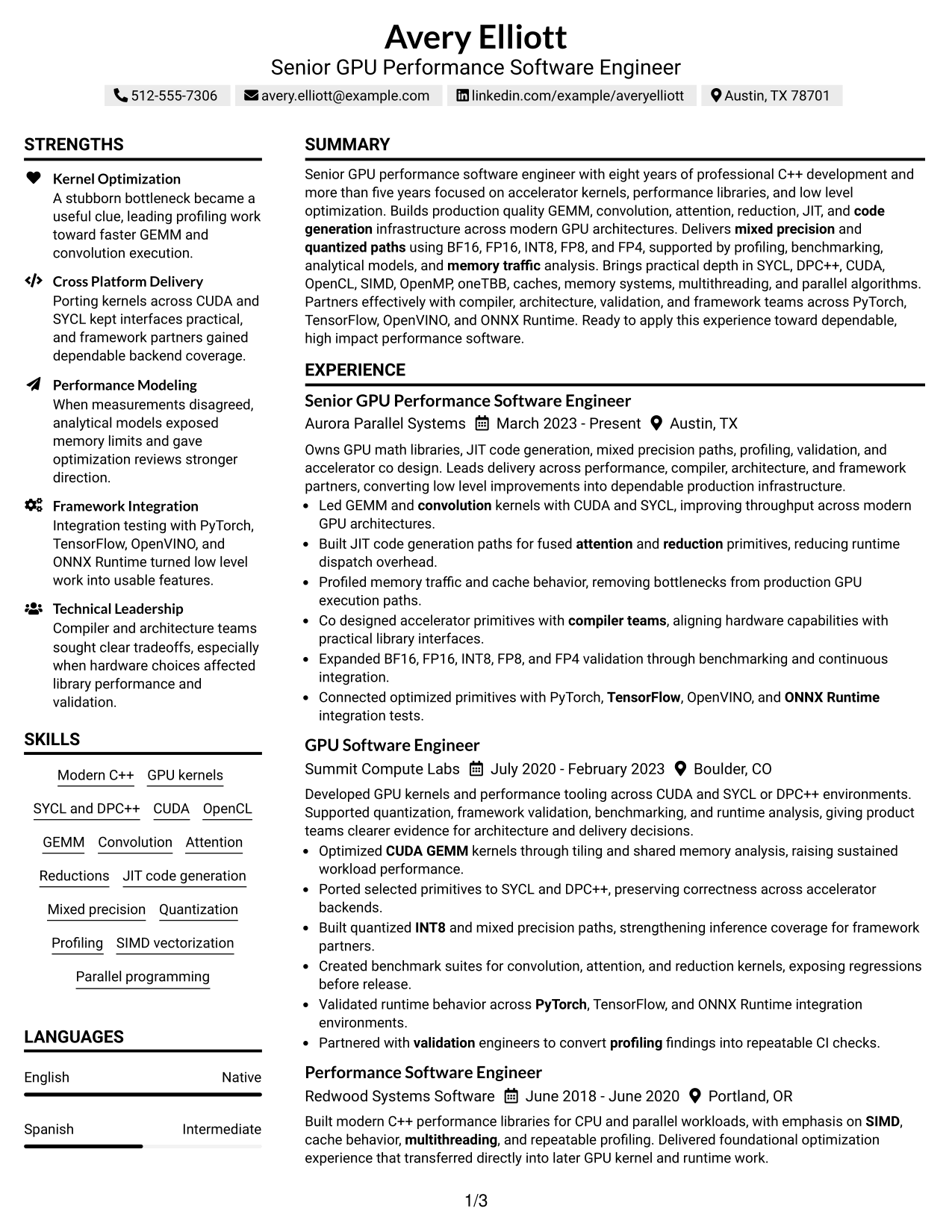
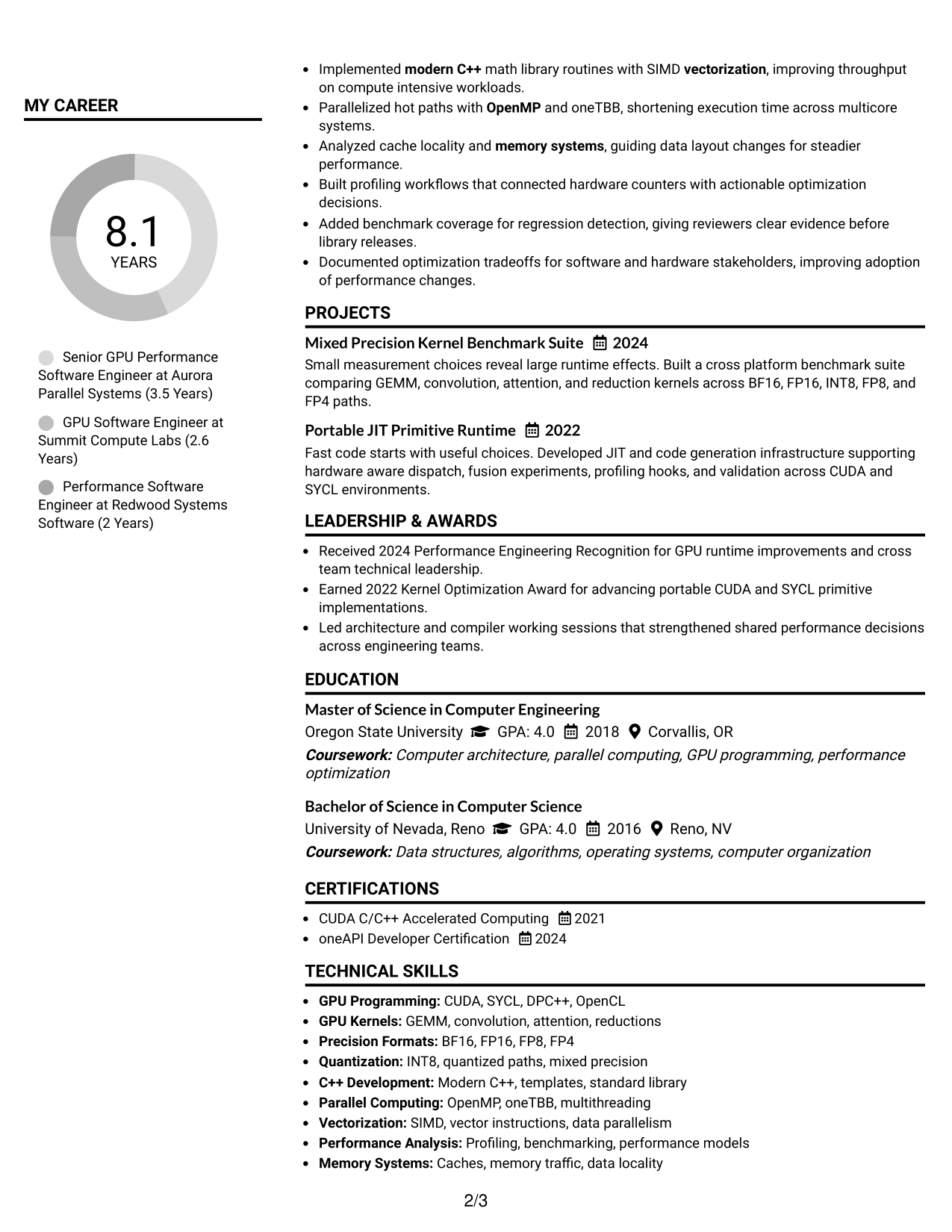
A simple two-column structure keeps supporting sections compact while giving recruiters a steady path through the resume's main evidence.
Why This Format Works
- Simple column boundaries keep major sections distinct without heavy visual decoration.
- Supporting information can stay compact while experience and achievements remain easy to review.
- Clear grouping helps recruiters separate career evidence from education and credentials.
Best For
- Low-decoration two-column layouts
- Compact skills and credentials
- Experience-led technical resumes
- Clear separation of supporting details
- Reviewers who prefer simple structure
Why Build Your Senior GPU Performance Software Engineer Resume with ResumeInMinutes
ResumeInMinutes helps you organize dense technical experience into clear sections for experience, skills, projects, education, certifications, and measurable results.
- ATS-friendly section structure
- Keyword-focused resume content
- Technical experience organization
- Projects and certifications support
- Free PDF resume previews
- Resume customization support
You can tailor the same resume for GPU performance work by adjusting section order, keyword focus, and achievement detail while keeping the underlying facts accurate.
See Also
- 33 Software Engineer, Performance Engineering Resume Templates with Example 2026 (ATS-Optimized)
- 33 Cloud Performance Engineer Resume Templates with Example 2026 (ATS-Optimized)
- 33 Thermal Systems Engineer For Performance Optimization (Modeling/Simulation) Resume Templates with Example 2026 (ATS-Optimized)
- 33 AI Fullstack Software Engineer-Intern Resume Templates with Example 2026 (ATS-Optimized)
- 33 AI Fullstack Software Engineer Resume Templates with Example 2026 (ATS-Optimized)
- 33 AI Platform & Integrations Software Engineer Resume Templates with Example 2026 (ATS-Optimized)
- 33 AI Software Engineer Intern Resume Templates with Example 2026 (ATS-Optimized)
- 33 Applied AI/ML Software Engineer Resume Templates with Example 2026 (ATS-Optimized)
- 30+ Software Engineer, Performance Engineering Cover Letter Templates with Example 2026
- 30+ Cloud Performance Engineer Cover Letter Templates with Example 2026
Frequently Asked Questions
Are these Senior GPU Performance Software Engineer resume templates ATS-friendly?
They use clear headings and standard resume sections that support ATS reading. Keep your wording accurate and use role-relevant terms such as modern C++, GPU kernels, profiling, benchmarking, and memory systems.
Are these different resumes?
No. The guide shows the same Senior GPU Performance Software Engineer resume in several visual formats so you can compare structure and presentation.
What should a Senior GPU Performance Software Engineer resume include?
Include a focused summary, relevant experience, technical skills, projects, education, certifications, and achievement bullets that show performance work, kernel optimization, validation, and cross-team delivery.
Which keywords are useful for this resume?
Useful grounded terms can include modern C++, CUDA, SYCL, DPC++, OpenCL, GEMM, convolution, attention, reductions, JIT, mixed precision, quantization, profiling, benchmarking, SIMD, and CI.
How should I write GPU performance achievement bullets?
Start with the action, name the performance problem or technical scope, explain what you changed, and add a measured result when you have verified numbers.
Should I include CPU optimization experience?
Yes, when it supports the role. Experience with SIMD, OpenMP, oneTBB, caches, memory systems, and profiling can strengthen the evidence behind low-level performance work.
Should I include a photo on my resume?
Include a photo only when it is customary or expected in the country or market where you apply. For many U.S. applications, a no-photo resume is the common choice.
Can I customize these resume templates?
Yes. You can adjust resume text, section order, visual style, and PDF output while keeping the content aligned with the Senior GPU Performance Software Engineer role.