33 Software Engineer, Cloud Interconnect Networking Resume Templates with Example 2026 (ATS-Optimized)
This guide shows you how to build a clear, focused Software Engineer, Cloud Interconnect Networking resume for technical review and ATS screening. You will learn how to organize evidence, select useful formats, and present complex networking work in a way that is easy to verify.
Strong resumes for this role connect software delivery with network results. Show how you designed or improved distributed systems, backend services, control-plane workflows, and customer interconnects. Support each claim with scope, reliability improvements, testing, troubleshooting results, or another measurable outcome when the evidence is available.
The examples below present one role-focused resume in 33 ATS-friendly layouts. Use the format notes to compare section order, bullet density, skills placement, and the way each design supports fast review without hiding important technical detail.
What Makes a Great Software Engineer, Cloud Interconnect Networking Resume in 2026
A strong resume for this position is evidence-first, keyword-aware, and built for technical scanning. The reader should see the target role, relevant systems knowledge, and proof of dependable delivery without searching through dense paragraphs.
- Open with a focused summary that connects software engineering, cloud interconnects, network architecture, and customer-facing problem solving.
- Write experience bullets around actions and outcomes, such as provisioning regional interconnects, improving rollback behavior, or preventing invalid configurations before deployment.
- Show the languages and interfaces used in production, including Go, C++, Python, Java, gRPC, and Protocol Buffers, only where the resume evidence supports them.
- Demonstrate network depth through TCP/IP, BGP, routing policy, network design, packet analysis, and troubleshooting of operating systems, hardware, or protocols.
- Make quality visible with failure-injection tests, integration testing, observability, resilient service design, clear documentation, and incident investigation.
Use job-relevant terms naturally across the summary, experience, skills, projects, and certifications sections. Useful keywords for this resume include cloud interconnects, distributed systems, backend services, network control planes, network architecture, network implementation, BGP, TCP/IP, gRPC, Protocol Buffers, Go, C++, Python, Java, failure testing, observability, technical documentation, and cross-functional delivery. Match the job description, but never add a skill that the document cannot support.
The resume examples below use an evidence-first approach so formatting supports role-specific clarity, ATS matching, and fast review for Software Engineer, Cloud Interconnect Networking positions.
#1 Simple One Column Format
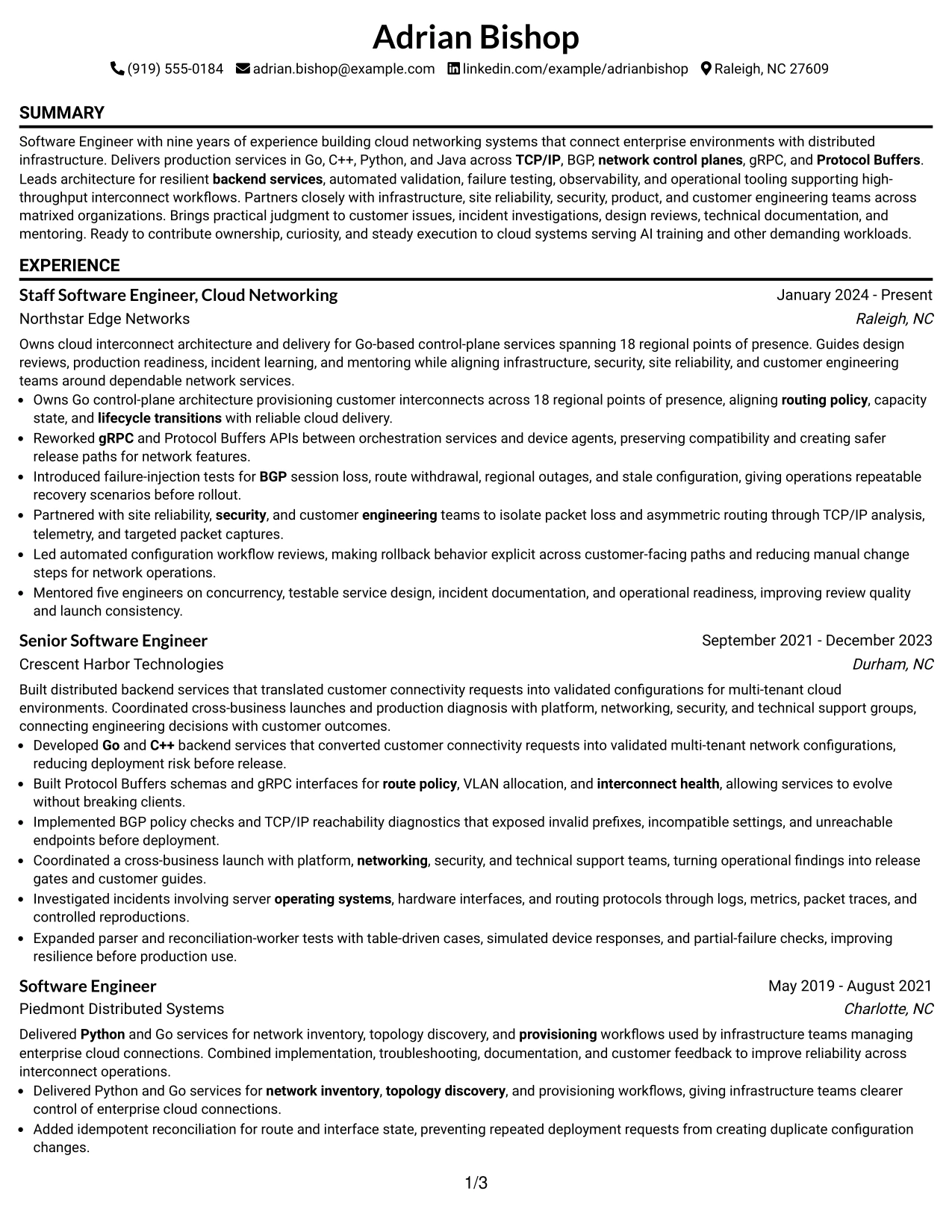
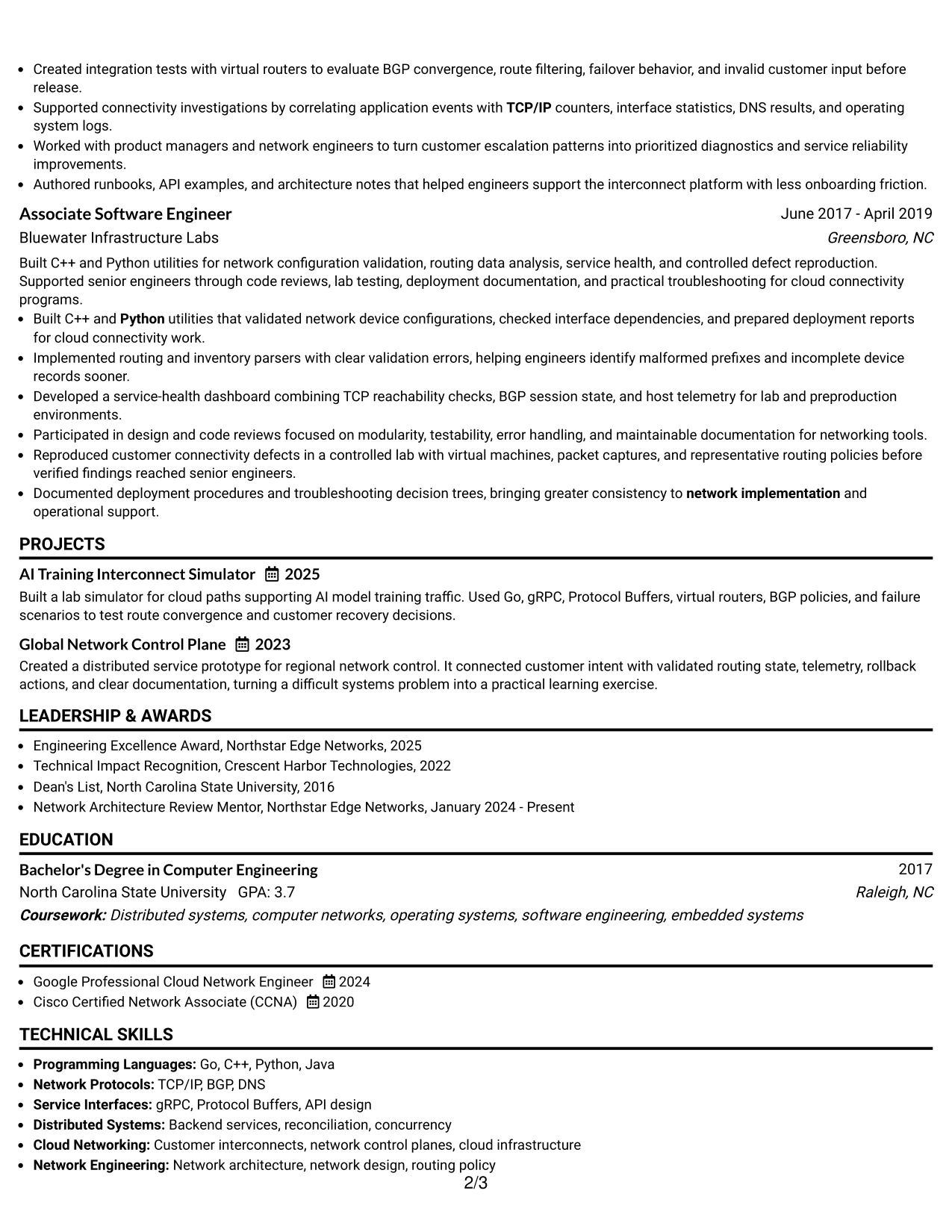
The Simple One Column Format places the resume content in one clear vertical path. Adrian Bishop’s contact details, summary, experience, education, certifications, projects, and skills can be reviewed in a logical order without side-panel distractions.
Use strong section headings and compact bullets to make nine years of cloud networking work easy to scan. The experience section can lead with Go control-plane architecture, BGP failure testing, gRPC and Protocol Buffers, and measurable scope such as 18 regional points of presence and mentoring five engineers.
Why the Simple One Column Format Works for a Resume
- A single reading path helps recruiters find the summary and most recent experience quickly.
- Standard section order supports reliable ATS parsing and human review.
- Full-width bullets give complex networking achievements enough room for useful detail.
- The layout keeps technical keywords close to the achievements that prove them.
- Projects can be added below experience without creating a crowded side column.
- Education and certifications remain visible without competing with work history.
- The restrained structure suits a resume that must present substantial evidence clearly.
Best For
- Resumes that need a direct top-to-bottom review path
- Detailed experience bullets with technical context
- ATS-focused applications using standard section headings
- Candidates presenting experience, projects, education, and certifications together
- Documents where measurable scope should remain close to each achievement
- Readers who prefer consistent full-width sections
- Applications that require clear separation between skills and work history
#2 Plain One Column with Shaded Labels
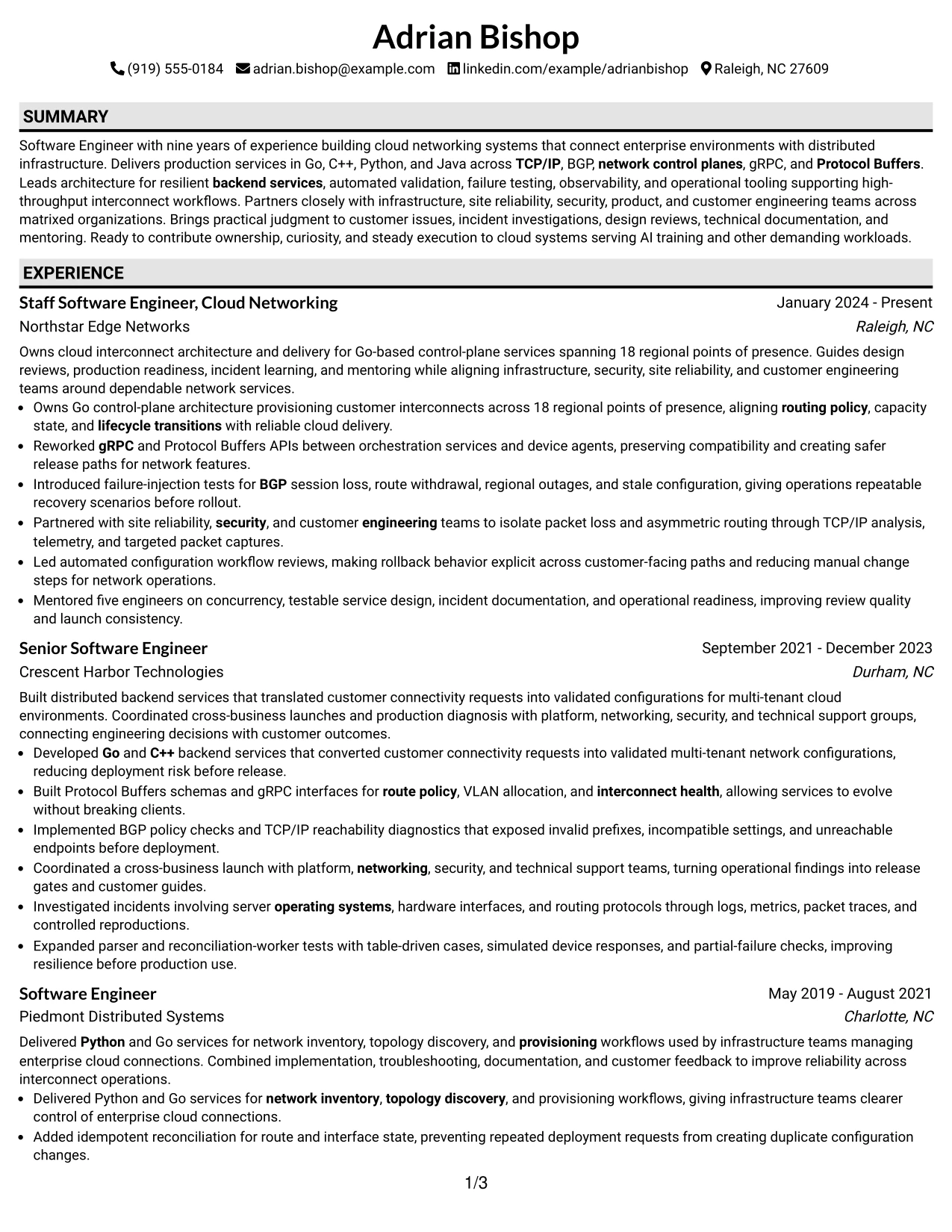
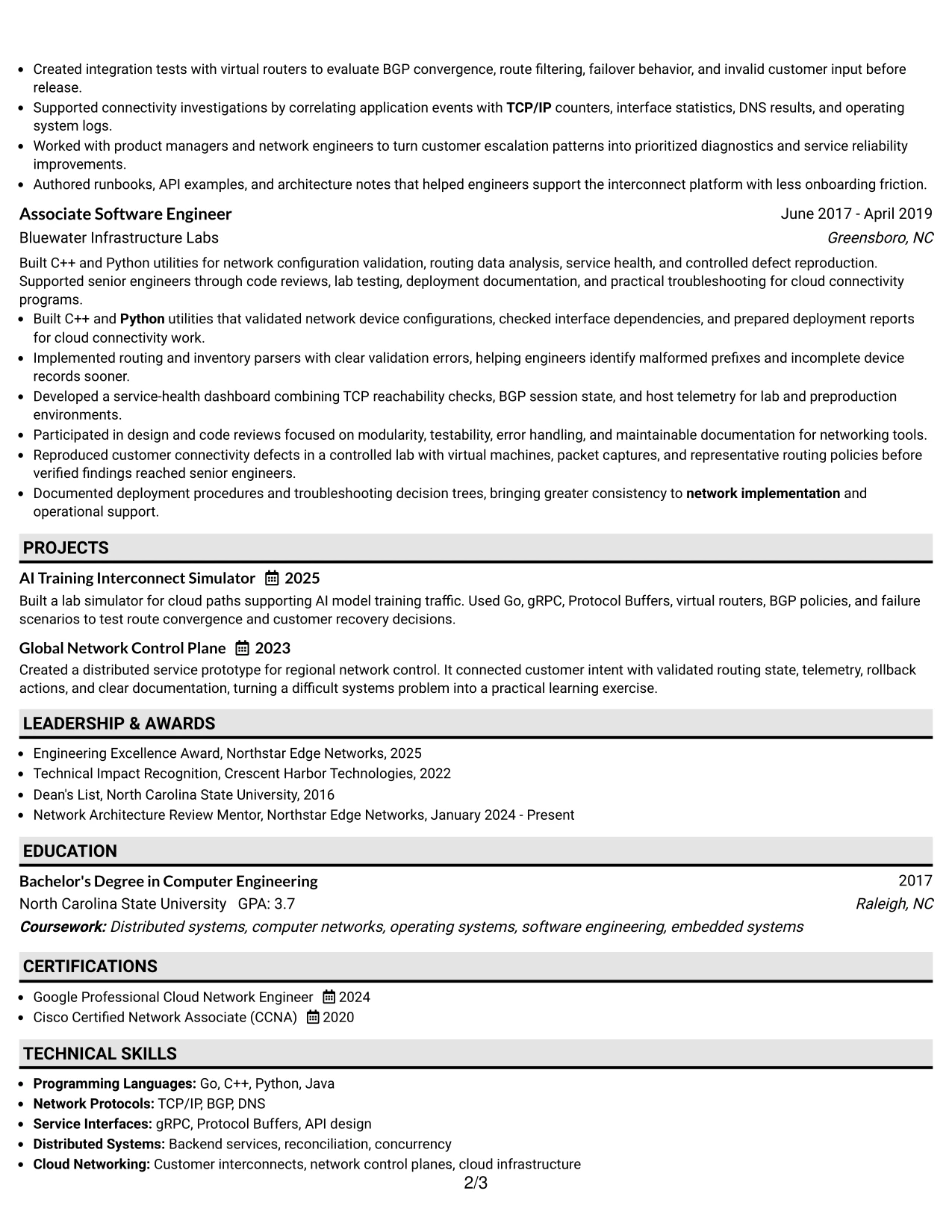
A recruiter moves down the page from the summary to experience, then to skills, projects, education, and certifications. Plain One Column with Shaded Labels uses visual labels to mark each transition while keeping every section in one ATS-friendly stream.
That structure supports a high content volume without splitting related details across columns. The resume can show distributed backend services, TCP/IP and BGP troubleshooting, testing methods, technical documentation, and the certifications that reinforce the target role.
Why the Plain One Column with Shaded Labels Works for a Resume
- Shaded labels make section boundaries visible during a fast review.
- One column reduces the risk that an ATS reads side content in the wrong order.
- Full-width bullets support complete explanations of technical work.
- A longer employment history can remain chronological and easy to follow.
- Skills can be grouped by language, protocol, service interface, and systems topic.
- Projects receive enough space to explain their purpose and technical approach.
- The plain treatment keeps attention on evidence rather than decoration.
Best For
- High-volume resumes with several technical sections
- Chronological work histories that need uninterrupted reading
- ATS submissions where predictable section order matters
- Applications combining experience bullets with project descriptions
- Readers who use labels to locate skills and certifications quickly
- Documents that need room for detailed troubleshooting evidence
- Candidates organizing many keywords into clear skill groups
#3 One Column Format with Photo Right
Evidence receives priority in the main column: recent cloud networking delivery, resilient backend services, routing diagnostics, and testing results appear before supporting details. One Column Format with Photo Right keeps that evidence in a full-width sequence while placing the photo to the side of the header.
The resume can use the summary to connect Go, C++, Python, Java, TCP/IP, BGP, and network control planes to the Software Engineer, Cloud Interconnect Networking role. The photo should remain secondary so it does not compete with achievements, projects, certifications, or ATS-readable text.
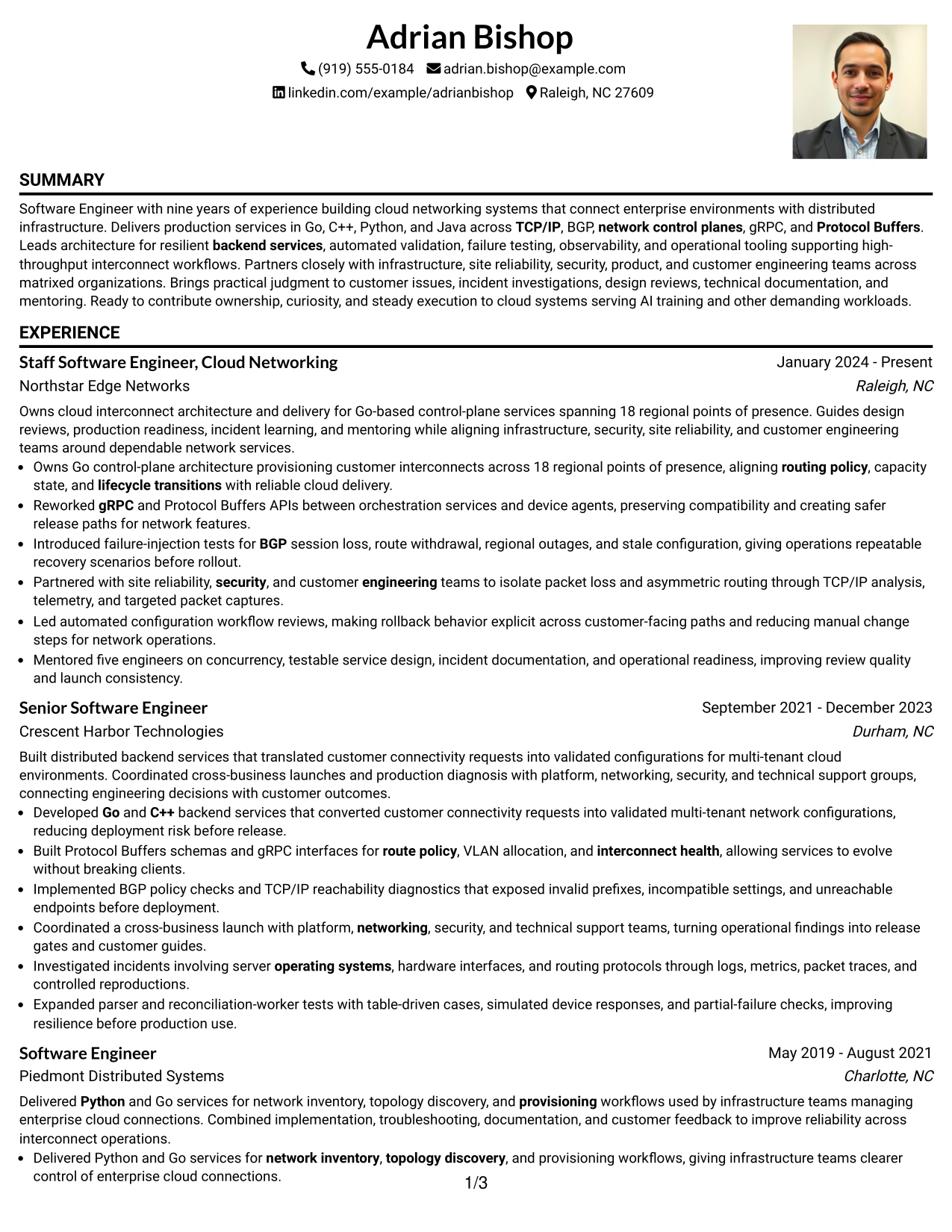
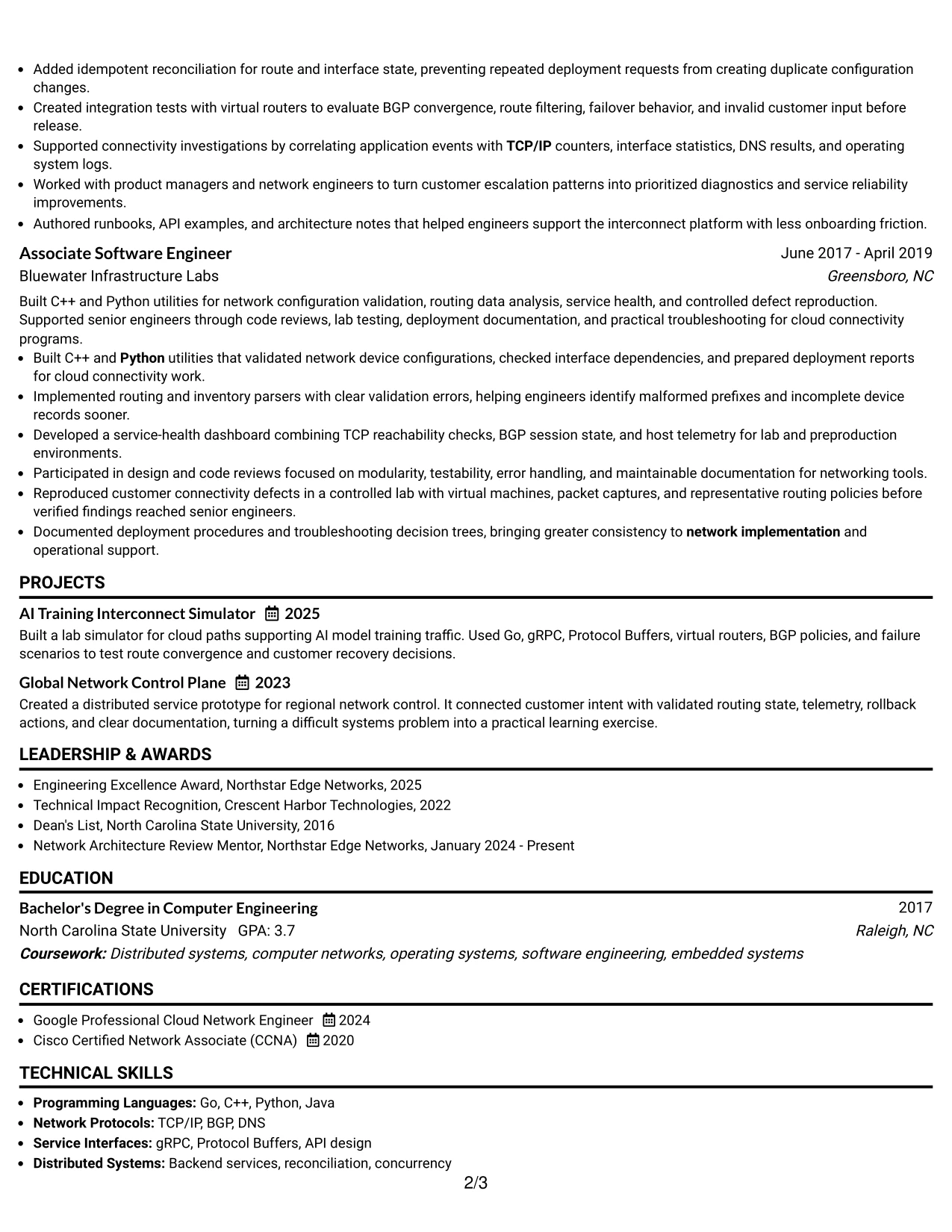
Why the One Column Format with Photo Right Works for a Resume
- The main column gives priority to recent and relevant evidence.
- A right-side photo creates a distinct header without interrupting the work-history sequence.
- Full-width bullets allow technical achievements to retain their context.
- The summary can connect the target role to the strongest networking capabilities.
- Projects can show practical use of Go, gRPC, Protocol Buffers, and virtual routers.
- Certifications and education stay in the same predictable reading flow.
- The photo remains visually separate from keywords and ATS-readable content.
Best For
- Applications where achievement evidence should dominate the page
- Resumes that need a distinct personal header with a photo
- Full-width technical bullets requiring space for cause and result
- Documents pairing a professional introduction with detailed projects
- Readers who review recent experience before supporting credentials
- Role-focused resumes that connect protocols to delivery outcomes
- Applications where the photo is appropriate for the submission context
#4 Clean Two Column Sidebar Format
Content is balanced between a main evidence area and a compact sidebar. Clean Two Column Sidebar Format can place experience and project results in the main column while reserving the sidebar for skills, certifications, education, and contact details.
For this target role, the main area can show interconnect provisioning, control-plane services, BGP recovery tests, and customer issue diagnosis. The sidebar provides a quick reference to Go, C++, Python, Java, gRPC, Protocol Buffers, Linux, and network design without weakening the achievement narrative.
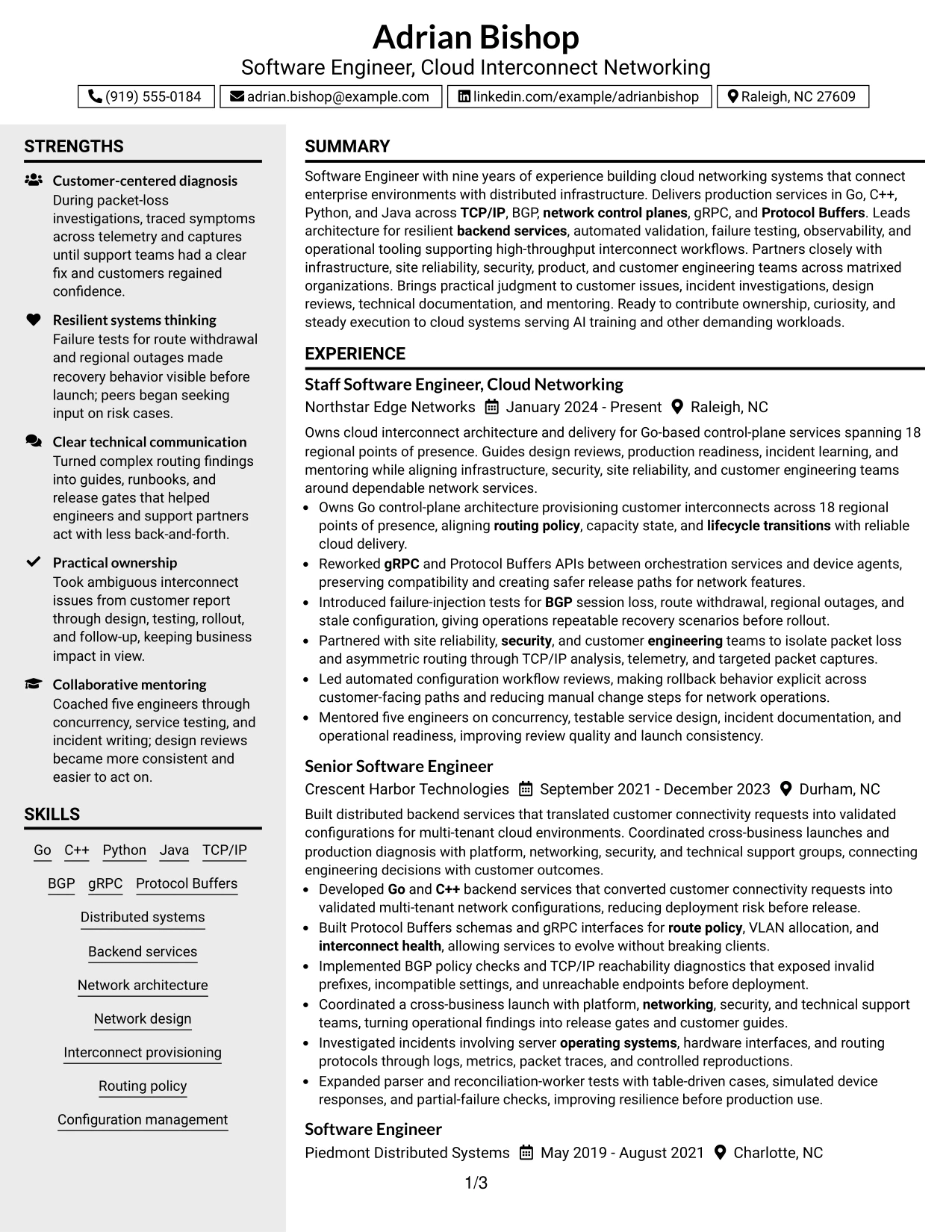
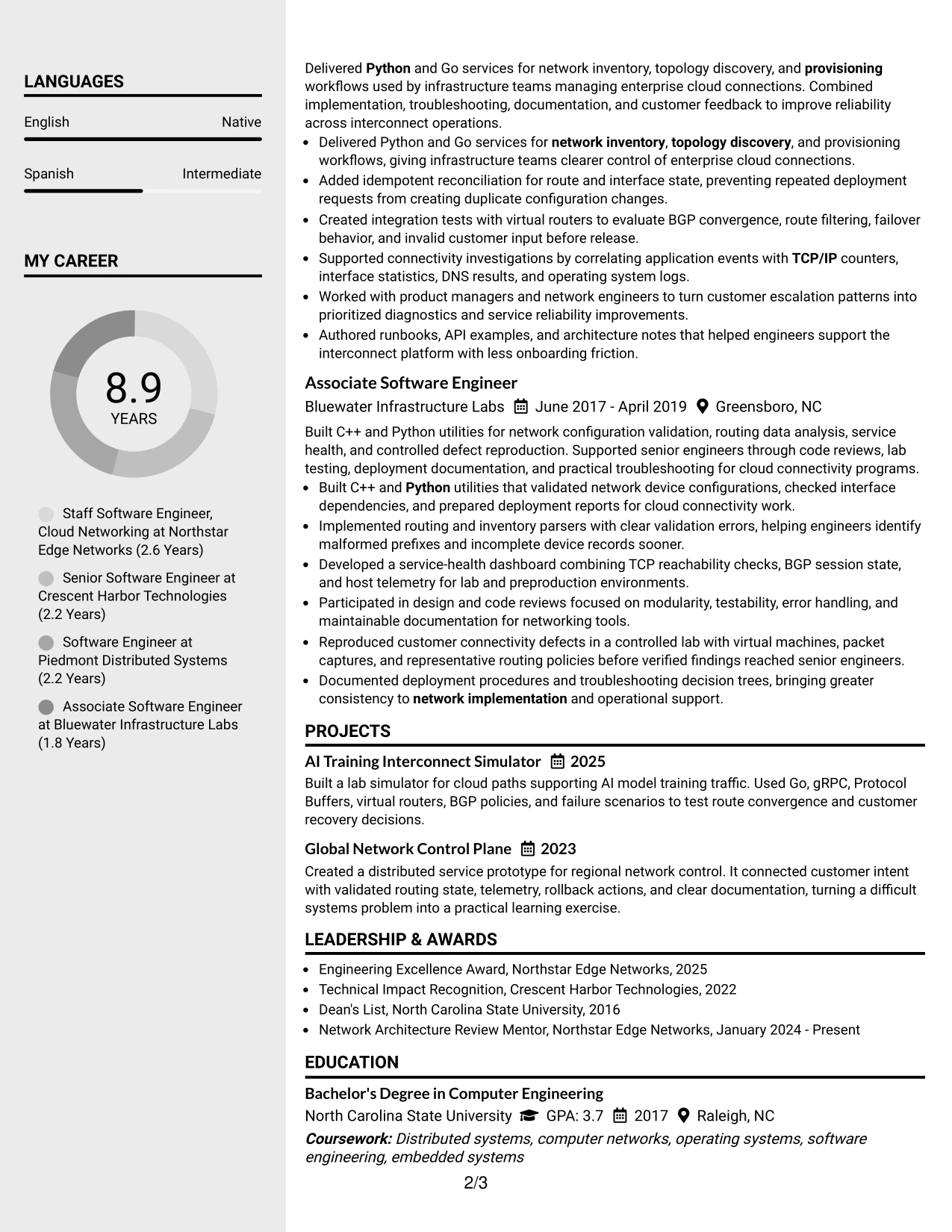
Why the Clean Two Column Sidebar Format Works for a Resume
- The main column protects space for detailed achievement bullets.
- A sidebar makes high-value skills visible during the first scan.
- Separate regions distinguish evidence from reference information.
- Experience can remain chronological while technical categories stay grouped.
- Certifications and education can be found without interrupting the work history.
- The layout supports a focused application for cloud interconnect networking.
- Clean spacing helps readers compare scope, tools, and results quickly.
Best For
- Applications that need achievements and technical references visible together
- Resumes with a substantial skills inventory beside a focused work history
- Readers who scan a sidebar before studying experience details
- Documents separating credentials from evidence without adding extra pages
- Technical applications where protocols and languages must be easy to locate
- Candidates showing projects while keeping employment history primary
- Submissions that benefit from compact organization with clear hierarchy
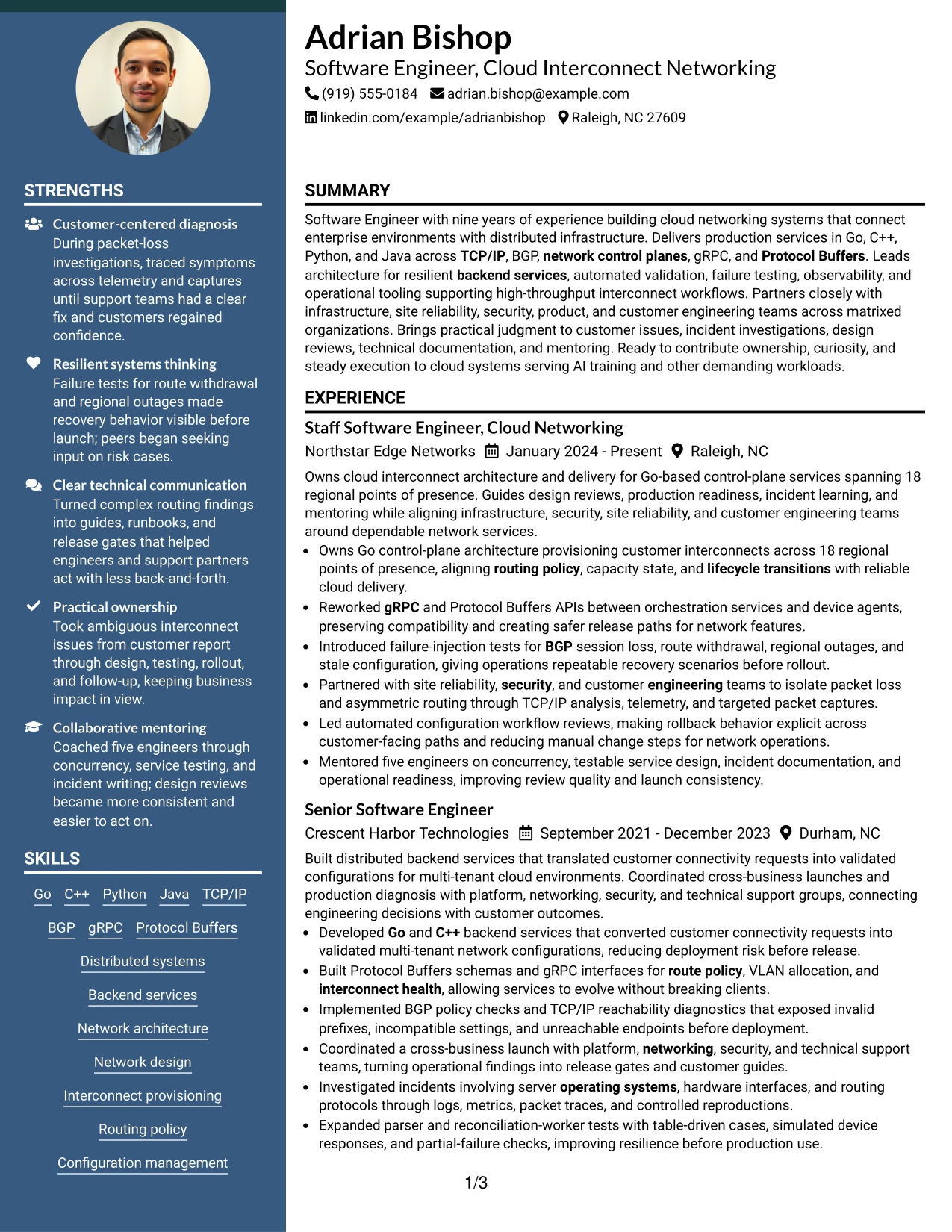
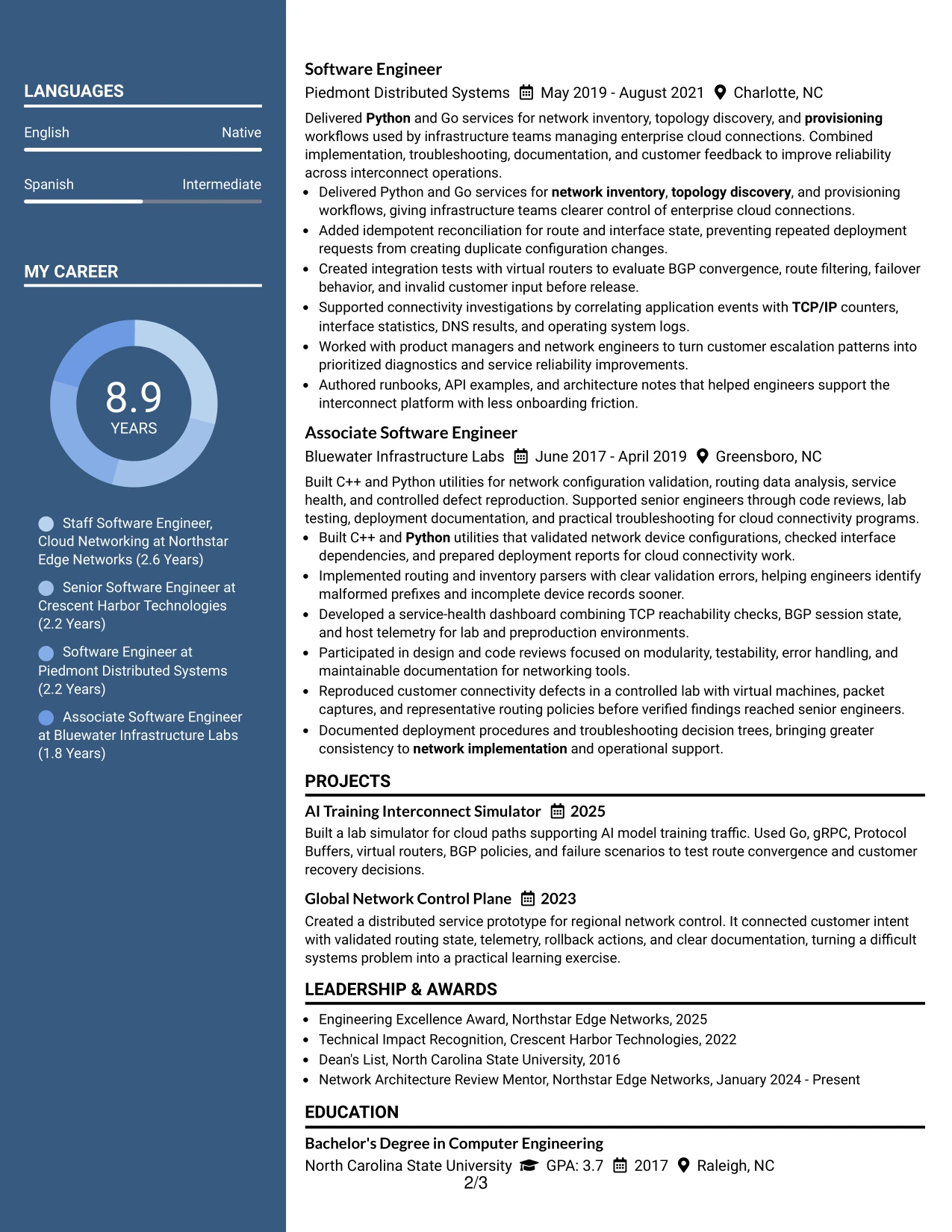
#5 Two Column Format
For a technical application with several evidence types, a Two Column Format gives the resume room to separate work history from supporting qualifications. The layout can present experience and projects on one side while organizing skills, certifications, education, and selected activities on the other.
That visual split fits a resume with substantial cloud networking detail. It keeps control-plane architecture, distributed systems, customer diagnosis, and failure testing prominent while making credentials such as the Google Professional Cloud Network Engineer certification easy to locate.
Why the Two Column Format Works for a Resume
- Two columns let the resume show evidence and qualifications at the same time.
- The main content area can carry detailed work and project bullets.
- A supporting column keeps languages, protocols, and certifications easy to find.
- The structure prevents a long skills list from pushing achievements too far down.
- Projects can reinforce experience without being confused with employment history.
- Education and awards remain visible in a compact supporting area.
- Clear grouping helps readers judge technical fit with less page movement.
Best For
- Applications with both deep experience evidence and broad technical qualifications
- Resumes that need projects visible beside employment history
- Readers comparing delivery results with languages and protocols
- Documents with certifications, awards, and education to preserve
- Technical profiles that benefit from distinct primary and supporting areas
- Applications where a dense skills inventory should not dominate the page
- Candidates presenting varied evidence without using a long single column
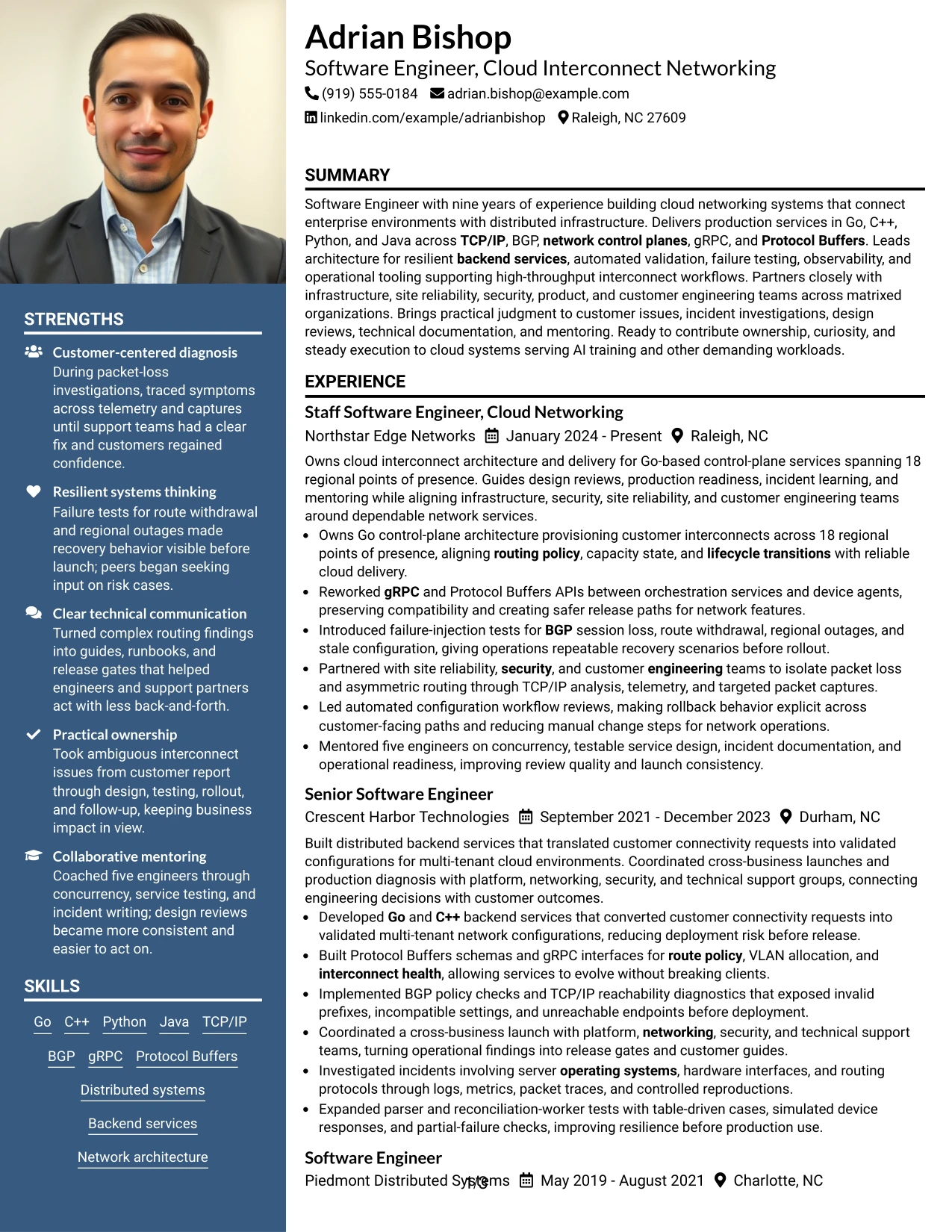
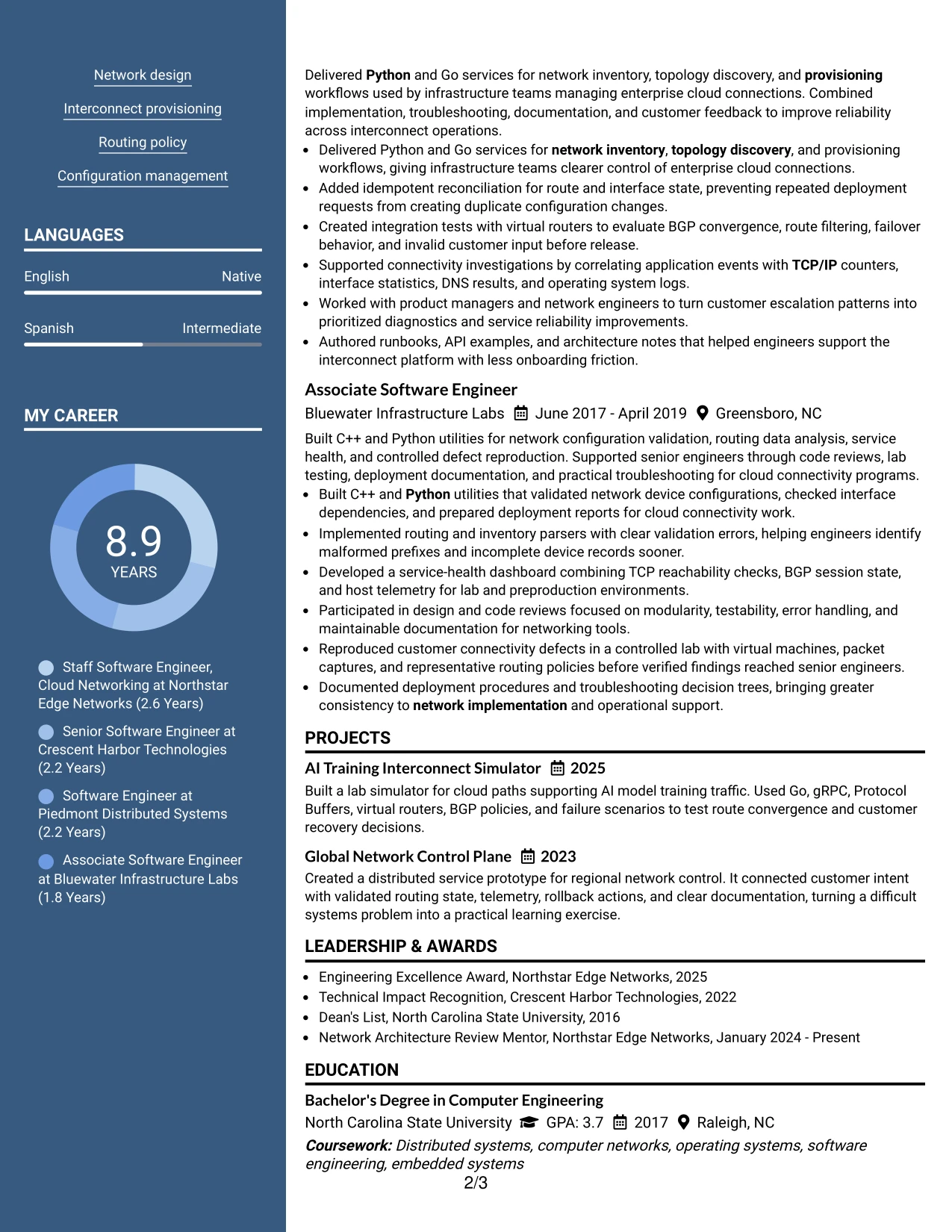
#6 Photo Header Two Column Format
A restrained visual hierarchy gives the contact header a strong starting point, followed by two organized content areas. Photo Header Two Column Format can place a photo beside the contact information while dividing detailed experience from compact skills and credentials.
The photo should support the header rather than replace resume evidence. The main area can lead with customer interconnect architecture, resilient services, BGP and TCP/IP troubleshooting, and cross-functional delivery; the second column can hold languages, certifications, education, and selected technical keywords.
Why the Photo Header Two Column Format Works for a Resume
- A clear header establishes identity and contact details immediately.
- The photo creates a defined visual entry point without taking space from the evidence columns.
- Two columns separate detailed achievements from compact reference information.
- The main column can show ownership, resilience, and customer issue resolution.
- A side column keeps certifications and technical keywords available during scanning.
- Projects can reinforce the central technical story without crowding the header.
- The hierarchy supports a polished resume when a photo is suitable for the application.
Best For
- Applications where a photo-supported header is appropriate
- Resumes needing a strong identity block above two information areas
- Documents separating detailed technical results from compact credentials
- Readers who scan contact details and core qualifications first
- Role-aligned resumes that connect systems evidence with relevant keywords
- Candidates balancing projects, certifications, and substantial experience
- Submissions where visual structure should support a polished presentation
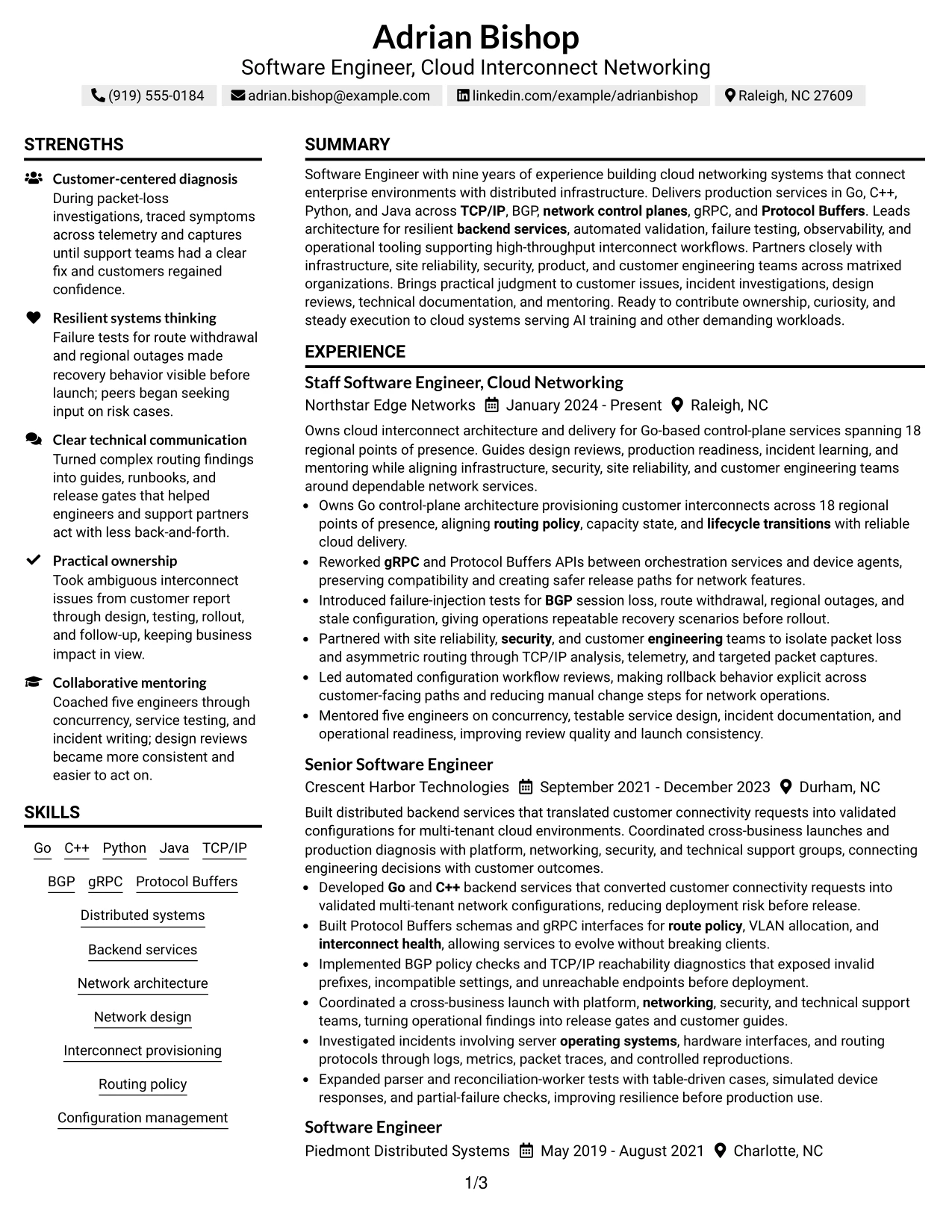
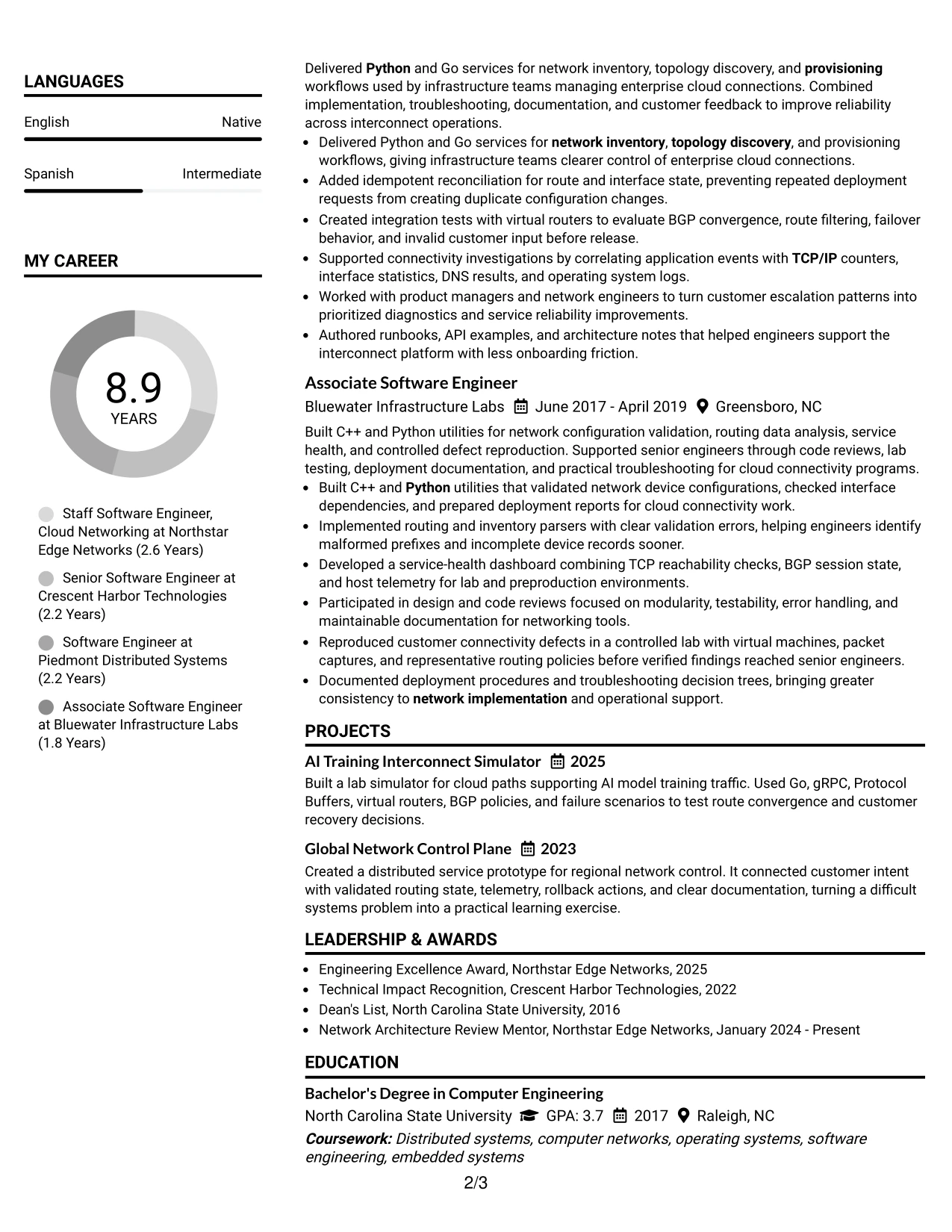
#7 Simple Two Column Format
Simple Two Column Format divides the resume into a primary evidence column and a supporting information column. The primary area can carry the summary, experience, and projects, while the supporting area groups skills, certifications, education, and activities in a consistent order.
This arrangement gives the Software Engineer, Cloud Interconnect Networking resume a practical balance. Detailed bullets can cover Go services, network control planes, distributed backend systems, packet analysis, observability, and mentoring while the second column keeps matching keywords easy to retrieve.
Why the Simple Two Column Format Works for a Resume
- A primary column gives achievements more emphasis than reference details.
- The supporting column creates a stable location for skills and credentials.
- Simple visual rules reduce distraction during recruiter scanning.
- Technical keywords remain close to the sections that explain their use.
- Projects can sit with experience or in a clearly separated supporting block.
- Education and certifications stay visible without taking over the page.
- The structure provides two levels of information without excessive styling.
Best For
- Resumes requiring a clear primary and supporting information hierarchy
- Applications where technical keywords must be easy to retrieve
- Documents combining detailed bullets with compact credentials
- Readers who want achievements first and qualifications close at hand
- Profiles with projects that need a defined place beside work history
- ATS-conscious layouts using simple columns and familiar headings
- Candidates seeking balanced presentation without decorative complexity
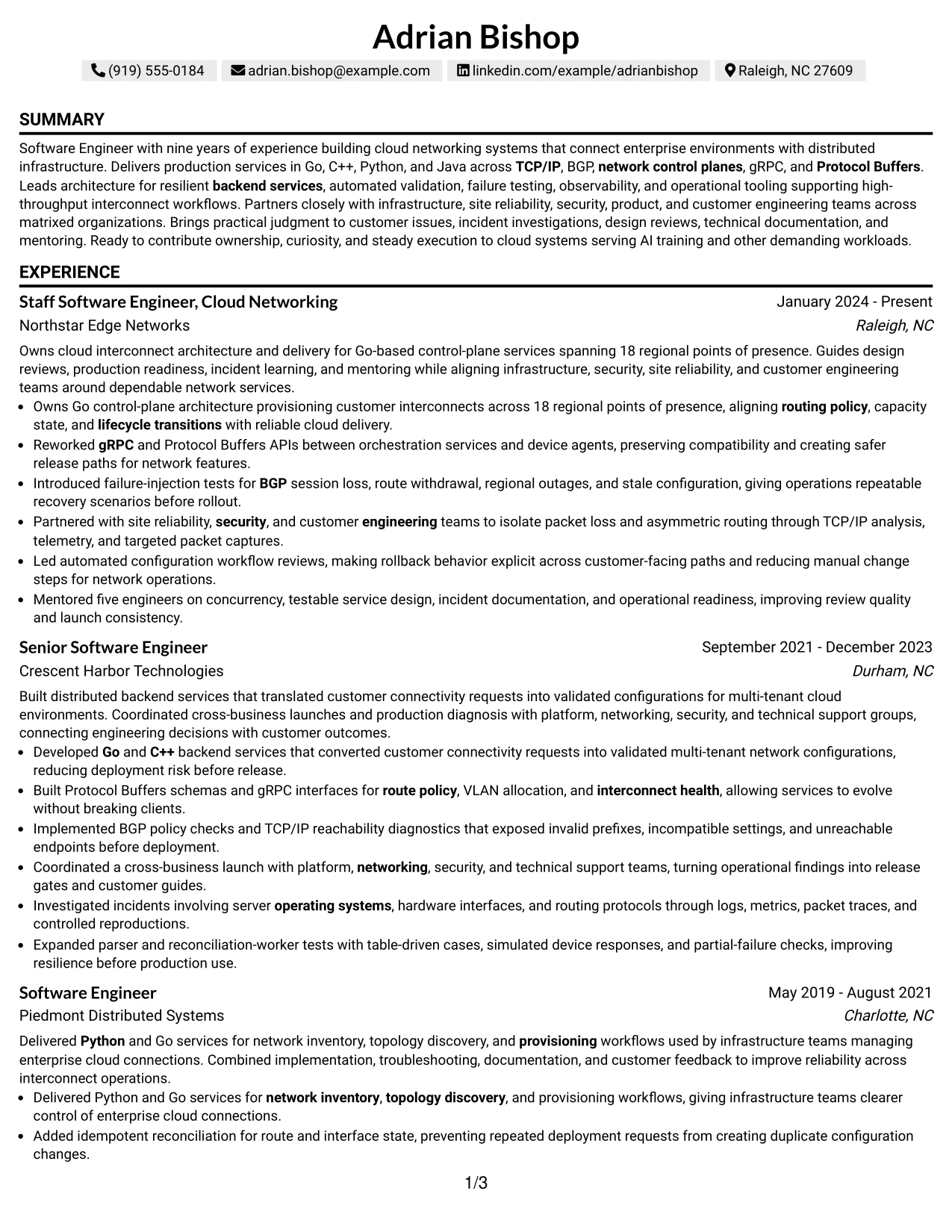
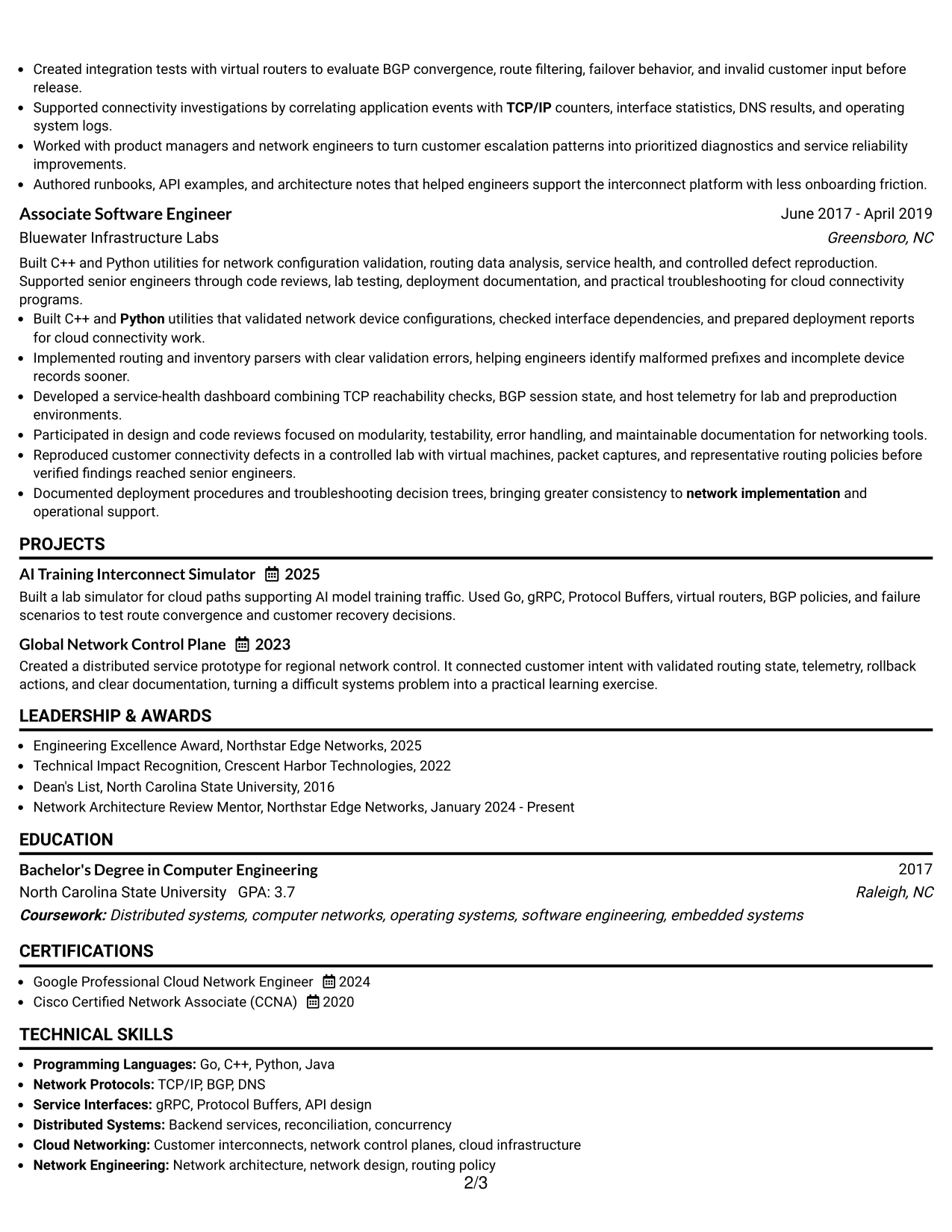
#8 Text/Fang Style
Readers move through the document in a steady text-first sequence, with each section carrying its own explanation. Text/Fang Style gives the resume enough width to describe complex work while keeping the summary, experience, projects, skills, education, and certifications in one connected flow.
That approach is useful when short bullets alone would hide the reasoning behind the result. The resume can explain how failure-injection tests exposed recovery behavior, how gRPC and Protocol Buffers supported compatible releases, and how packet captures helped isolate asymmetric routing.
Why the Text/Fang Style Works for a Resume
- A text-first flow gives readers context before they judge individual bullets.
- Full-width sections support precise explanations of technical decisions.
- The format can show both action and operational result in each achievement.
- Projects have room to describe systems, methods, and testing scenarios.
- Skills can follow the evidence instead of appearing as an unsupported list.
- The chronological experience section remains easy to trace.
- Clear prose helps technical reviewers understand specialized networking work.
Best For
- Resumes where technical decisions need brief supporting context
- Applications with detailed project and troubleshooting descriptions
- Readers who prefer connected prose over compressed side panels
- Documents showing how testing methods led to safer releases
- Profiles with several systems topics that need clear explanation
- Technical work histories that combine delivery, operations, and documentation
- Candidates whose strongest evidence depends on process as well as outcome
#9 One Column Boxed Contact Header Format
The strongest evidence should appear directly below a clearly defined contact header. One Column Boxed Contact Header Format separates contact details from the resume body, then gives full width to the summary, experience, projects, skills, education, and certifications.
That presentation makes the target role and technical value easy to identify before the detailed record begins. It can lead with distributed backend services, network design and troubleshooting, customer interconnects, resilient code, and the awards and certifications that support the record.
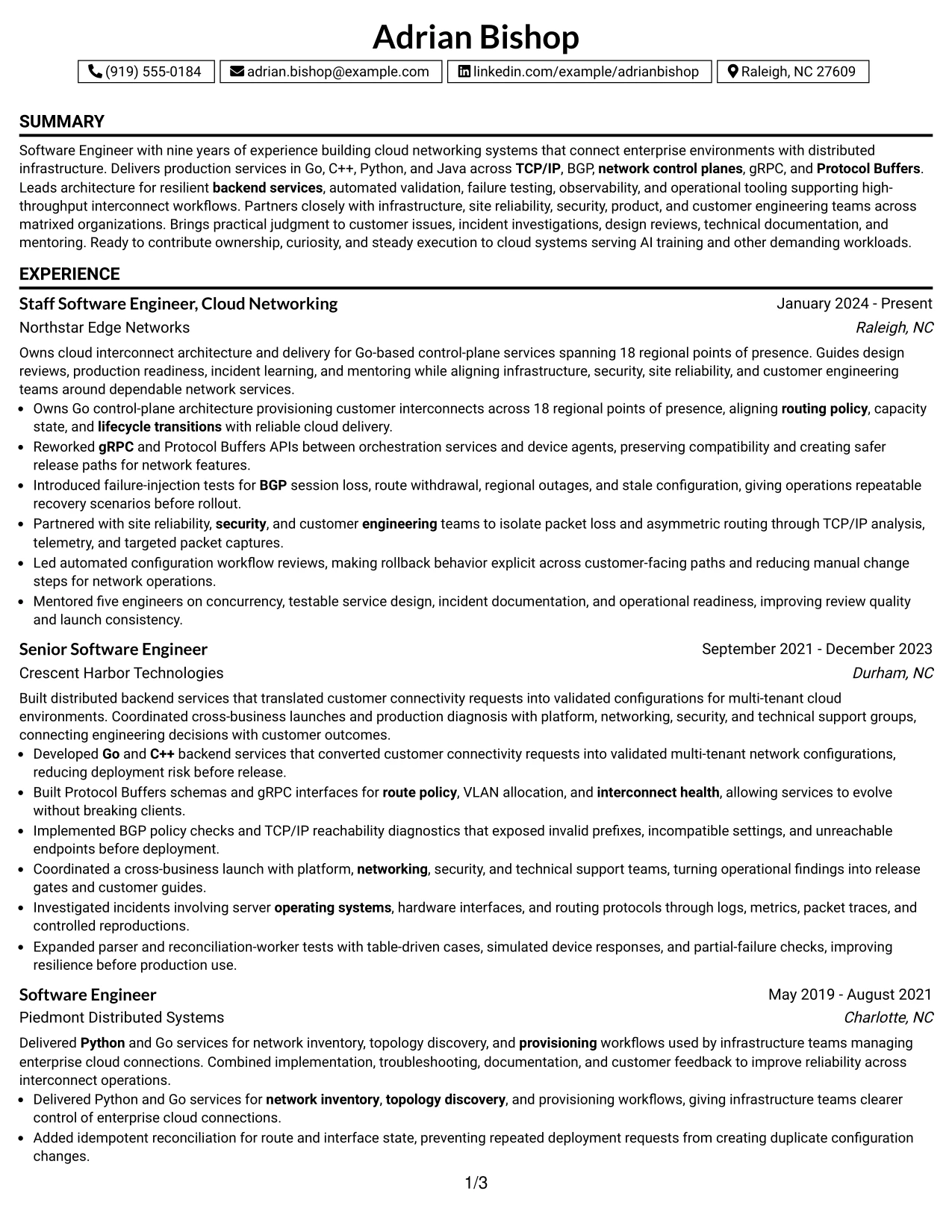
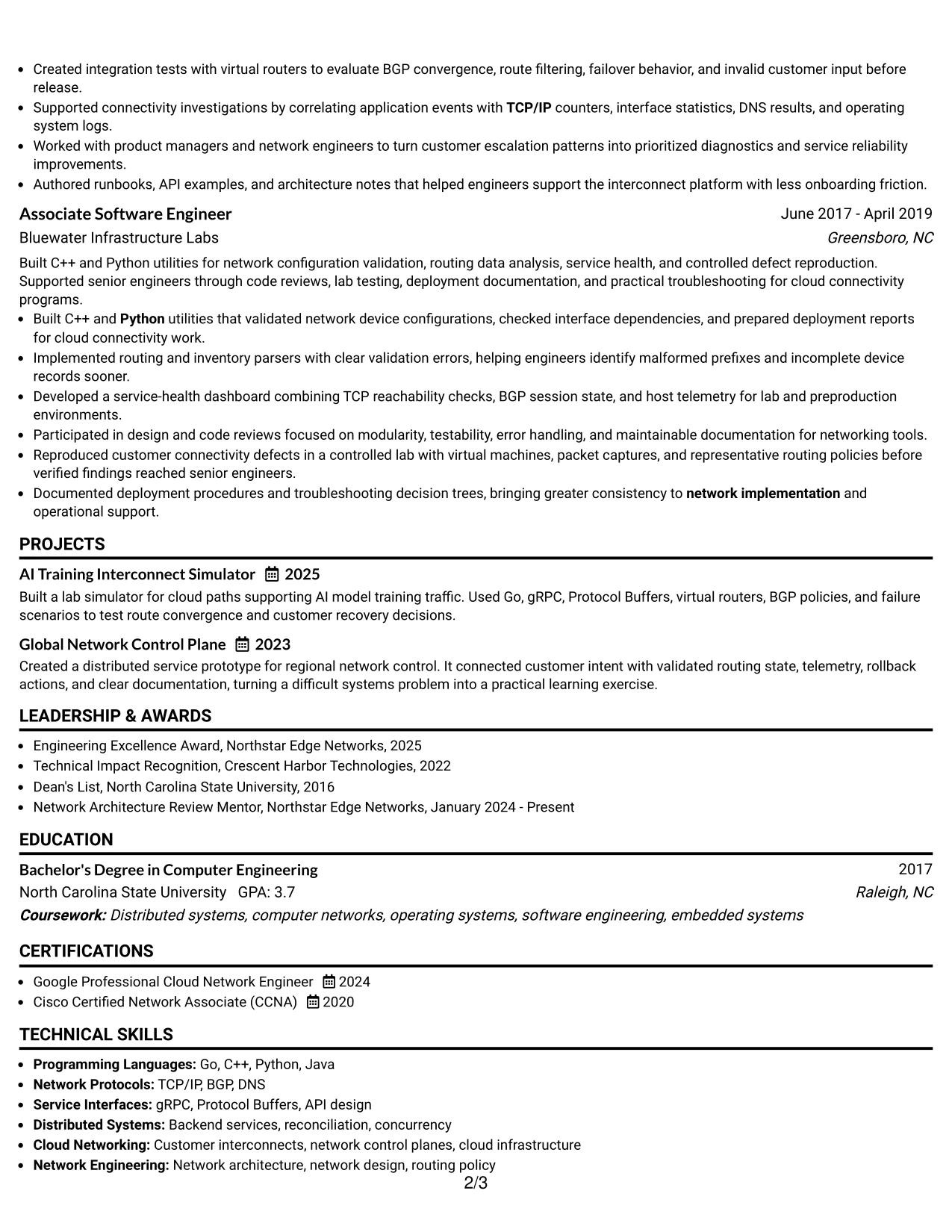
Why the One Column Boxed Contact Header Format Works for a Resume
- A boxed header makes contact details easy to locate without merging them into body text.
- The full-width body gives priority to evidence and measurable scope.
- The target role can appear clearly near the top of the document.
- Experience bullets retain space for tools, methods, and operational results.
- Projects can follow the work history in the same readable sequence.
- Certifications and education remain easy to scan at the end.
- The structure is simple enough for ATS processing and human review.
Best For
- Applications needing a strong separation between contact details and evidence
- Resumes where the target title should be visible at the top
- Full-width work histories with technical troubleshooting detail
- Documents that place projects directly after professional experience
- Readers who want a clear start point before reviewing qualifications
- ATS submissions using a conventional single-column body
- Candidates presenting awards and certifications without a sidebar
#10 Plain Two Column Format
Content is balanced between a main work-history area and a supporting qualification area, so the reader can compare experience with relevant credentials in one view. Plain Two Column Format keeps the visual treatment quiet while giving the resume a practical structure for a technical application.
The snapshot can surface the target role, nine years of experience, core languages and protocols, and the strongest systems evidence before the detailed sections. A focused keyword block then reinforces Software Engineer, Cloud Interconnect Networking, Go, C++, Python, Java, TCP/IP, BGP, gRPC, Protocol Buffers, distributed systems, and backend services.
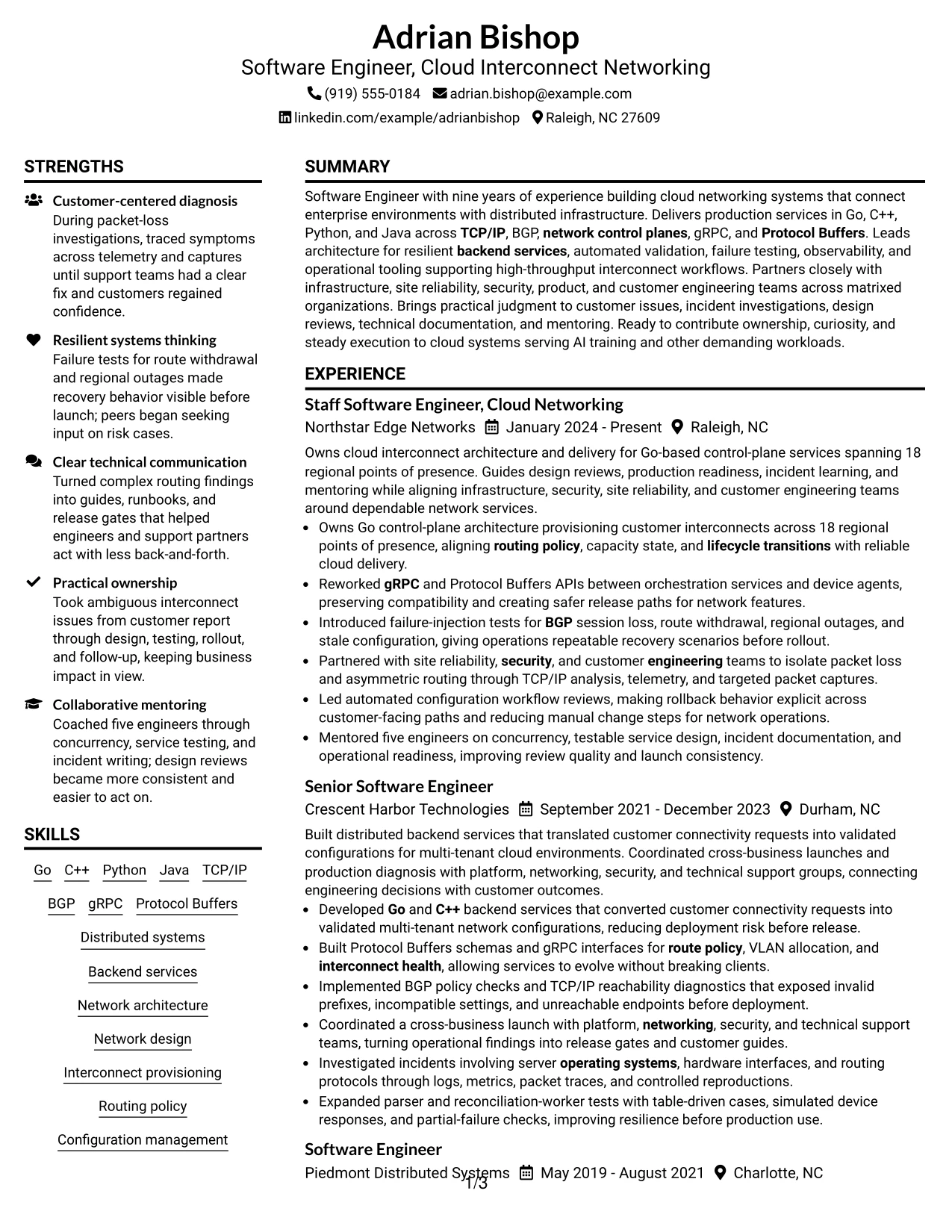
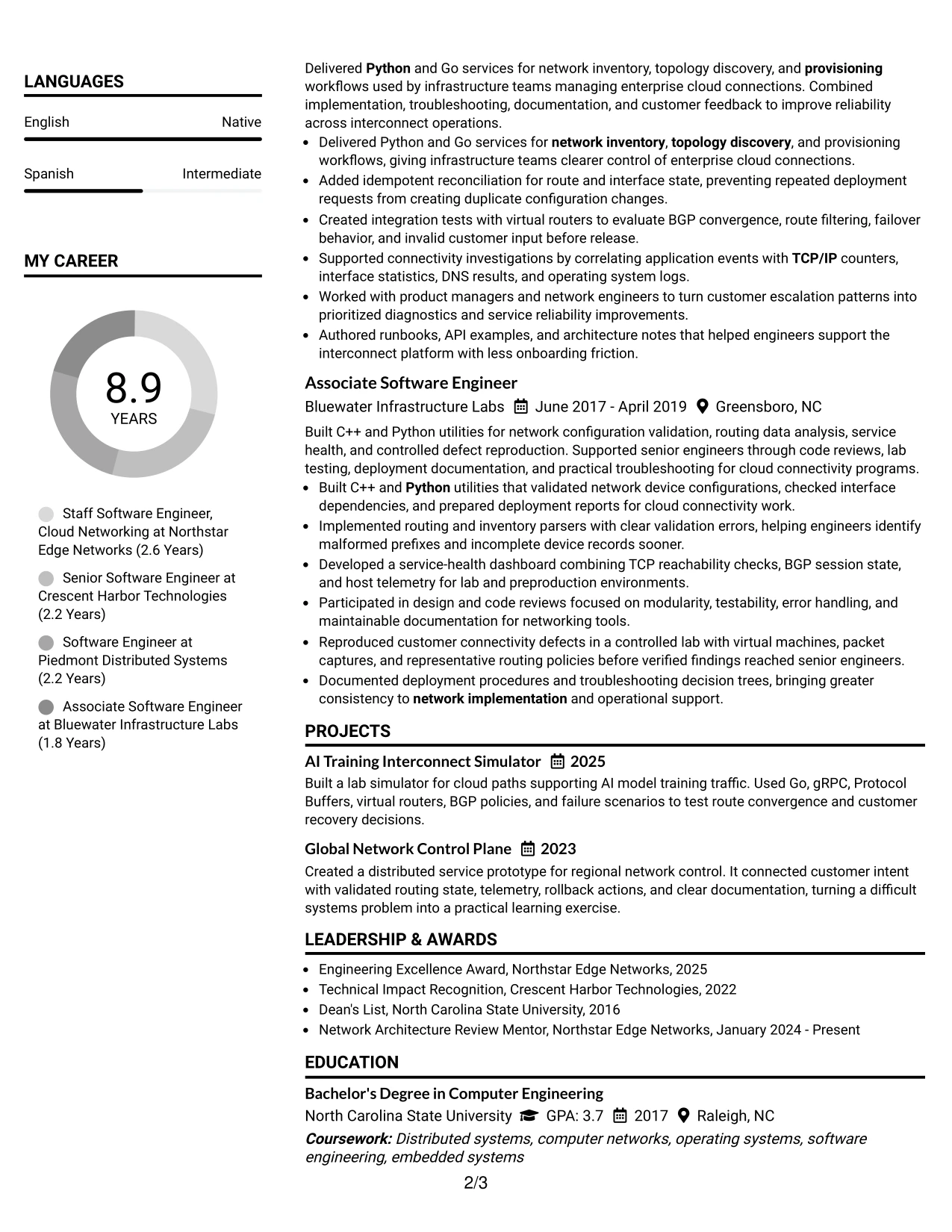
Resume Snapshot
- Software Engineer, Cloud Interconnect Networking
- Nine years of cloud networking and distributed systems experience
- Go, C++, Python, Java, TCP/IP, BGP, gRPC, and Protocol Buffers
- Control-plane architecture, interconnect provisioning, failure testing, and customer diagnosis
Why the Plain Two Column Format Works for a Resume
- Two balanced areas let the reader compare experience with qualifications quickly.
- The plain design keeps attention on evidence, keywords, and section order.
- A snapshot provides immediate context before the detailed work history.
- A keyword block supports focused review for the target role and ATS matching.
- Projects can add systems evidence without displacing core employment details.
- Education and certifications have a defined place in the supporting area.
- The layout suits a technical resume that must be thorough but easy to navigate.
Resume Keywords
- Software Engineer, Cloud Interconnect Networking
- Go, C++, Python, Java
- TCP/IP and BGP
- gRPC and Protocol Buffers
- Distributed systems and backend services
- Network design, implementation, and troubleshooting
- Failure testing, observability, and technical documentation
#11 Colored Two Column Format
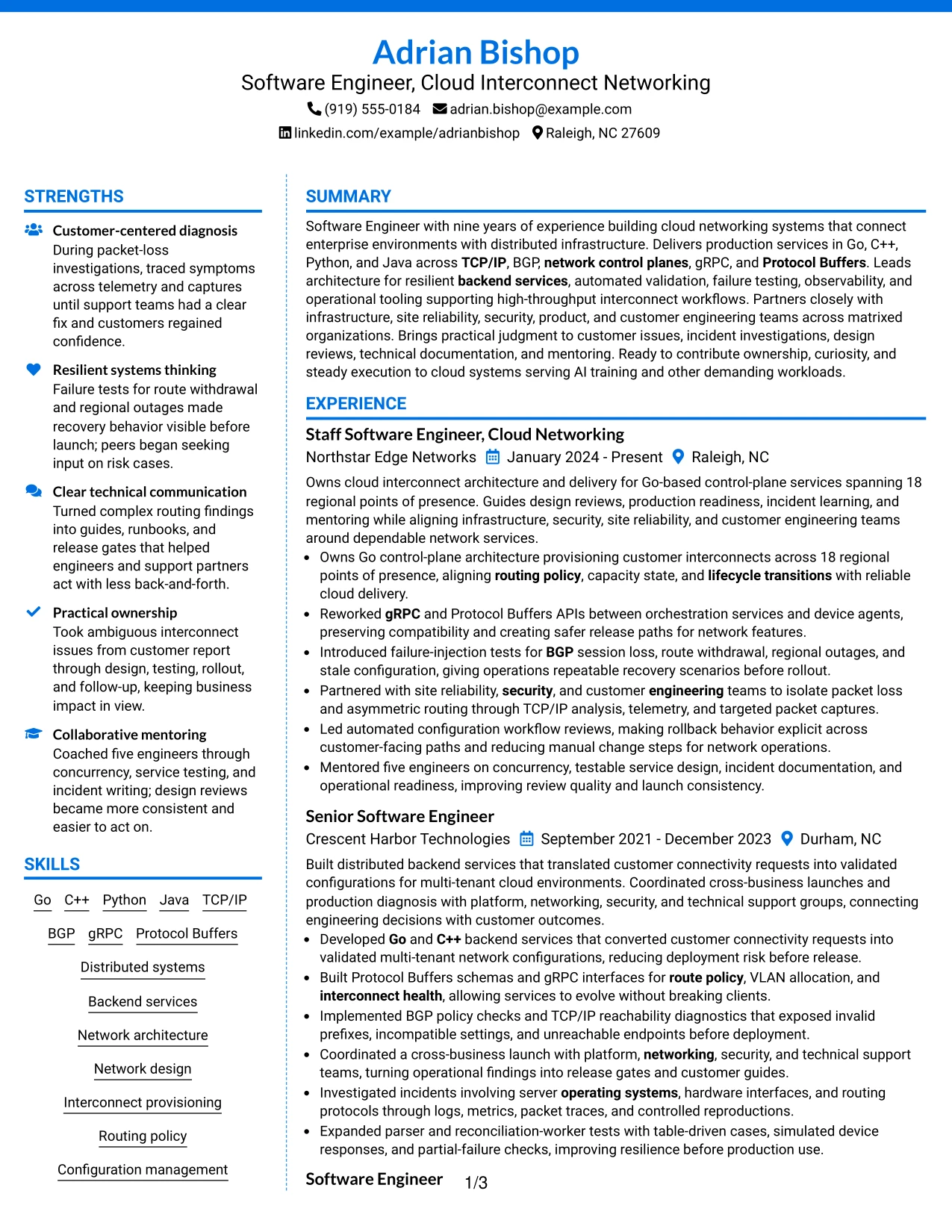
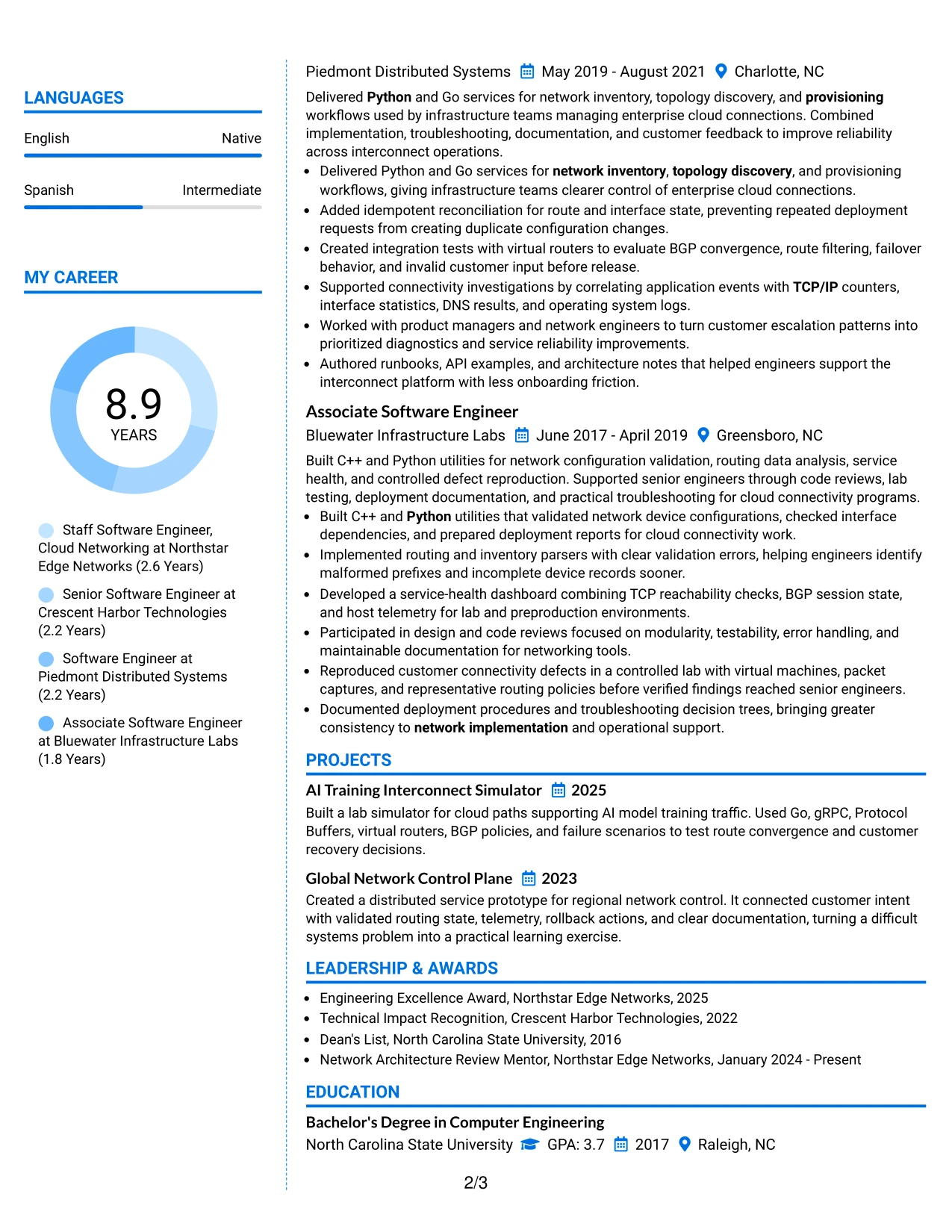
A controlled color hierarchy separates the main evidence column from supporting information without changing the resume’s professional focus. Colored Two Column Format can place experience and projects in the larger area while using the second column for skills, education, certifications, and awards.
The format fits a resume that must show both technical depth and clear organization. The main column can emphasize cloud interconnect architecture, resilient backend services, routing diagnostics, and cross-functional delivery; the supporting column can group Go, C++, Python, Java, Linux, packet analysis, and relevant credentials.
Why the Colored Two Column Format Works for a Resume
- Color helps distinguish primary evidence from supporting qualifications.
- The main column preserves room for detailed technical achievement bullets.
- A secondary column groups skills and credentials for fast retrieval.
- Consistent visual hierarchy keeps color from competing with resume content.
- Projects can strengthen the evidence column with focused technical examples.
- Certifications and awards remain visible in a compact supporting area.
- The format gives a polished structure while retaining clear resume mechanics.
Best For
- Applications that benefit from light visual separation between information groups
- Resumes pairing detailed achievements with a compact qualification panel
- Readers who use visual cues to move between experience and skills
- Documents where projects should reinforce the primary evidence column
- Technical profiles with several credentials to display efficiently
- Candidates wanting structure without a dense or heavily decorated page
- Submissions where polished presentation must still preserve readable hierarchy
#12 One Column Shaded Contact Header Format Resume Example
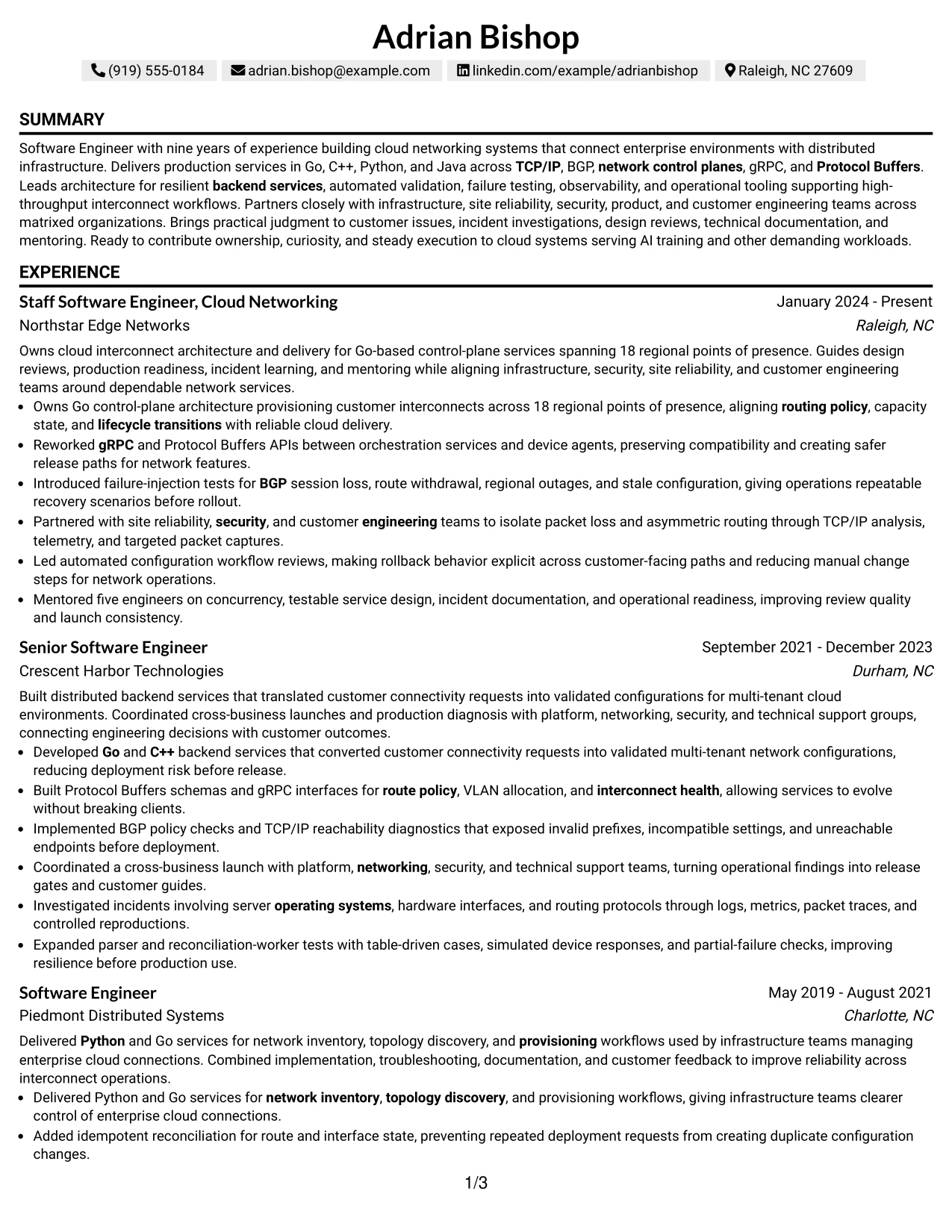
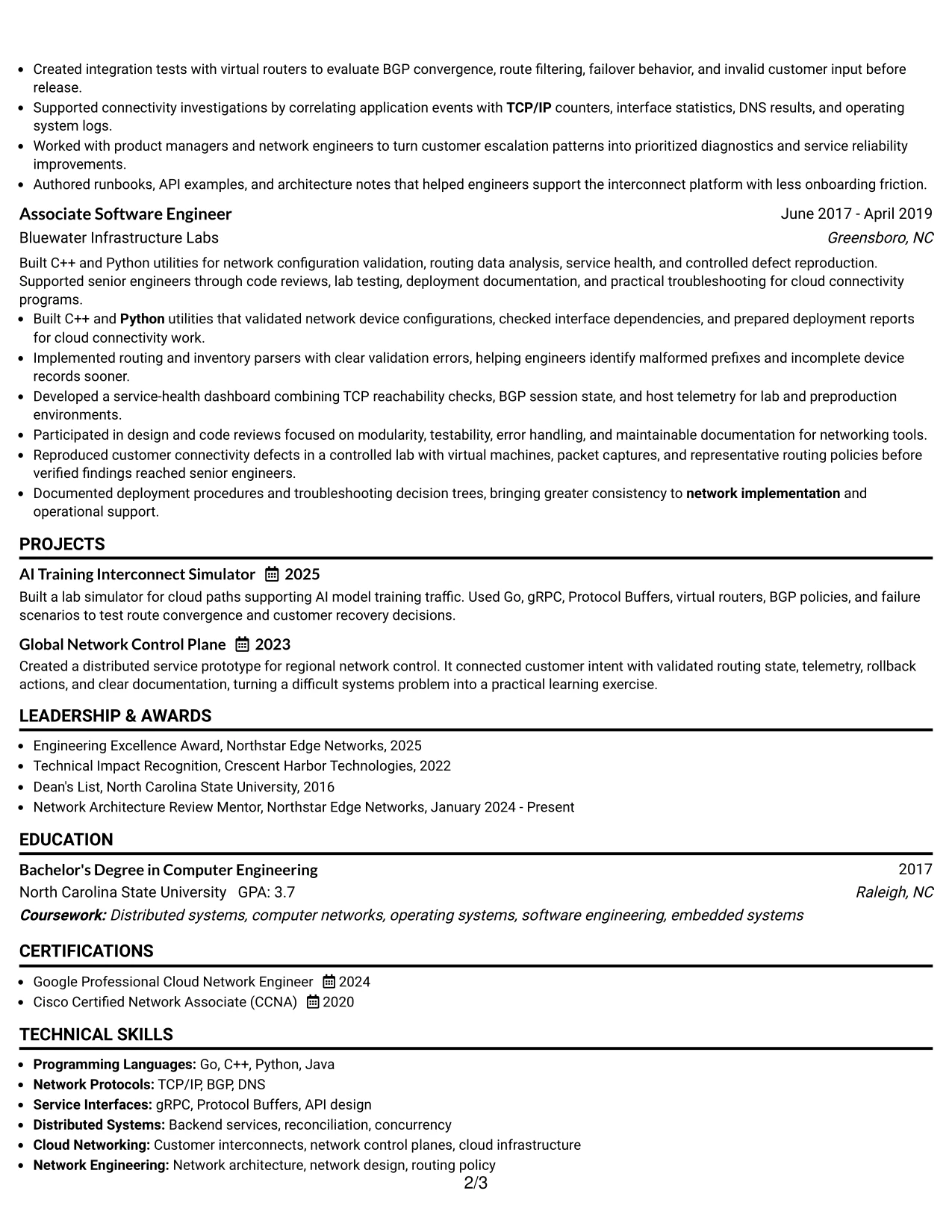
A restrained visual hierarchy puts the contact details and target role at the top, then lets the resume evidence carry the review. For a Software Engineer, Cloud Interconnect Networking resume, the shaded header can establish the role while the single column gives equal width to cloud networking experience, technical skills, education, projects, and certifications.
The strongest content should appear in short, results-focused bullets. Go control-plane architecture, BGP failure testing, gRPC and Protocol Buffers, TCP/IP troubleshooting, distributed systems, and customer interconnect work are easy to find without decorative elements competing for attention.
Why the One Column Shaded Contact Header Format Works for a Resume
- A single reading path supports fast recruiter scanning.
- The shaded contact area separates identity details from professional evidence.
- The target role is visible before the experience section begins.
- Full-width bullets provide room for technical context and measurable scope, including 18 regional points of presence.
- Clear section order supports ATS parsing for summary, experience, skills, education, projects, and certifications.
- The format keeps keywords such as Go, C++, Python, BGP, TCP/IP, gRPC, and Protocol Buffers in searchable text.
- A restrained presentation suits a resume that must show both technical depth and dependable operational judgment.
Best For
- Applicants who need a direct, one-column reading path for technical experience.
- Resumes where ATS-friendly section order is more important than visual complexity.
- Candidates with substantial project, certification, and education details to present below experience.
- Applications that require clear alignment between a target role and a technical summary.
- Readers who need to scan long achievement bullets without moving between columns.
- Documents that combine backend services, network protocols, testing methods, and operational practices.
- Professionals who want a calm visual frame around detailed evidence and keywords.
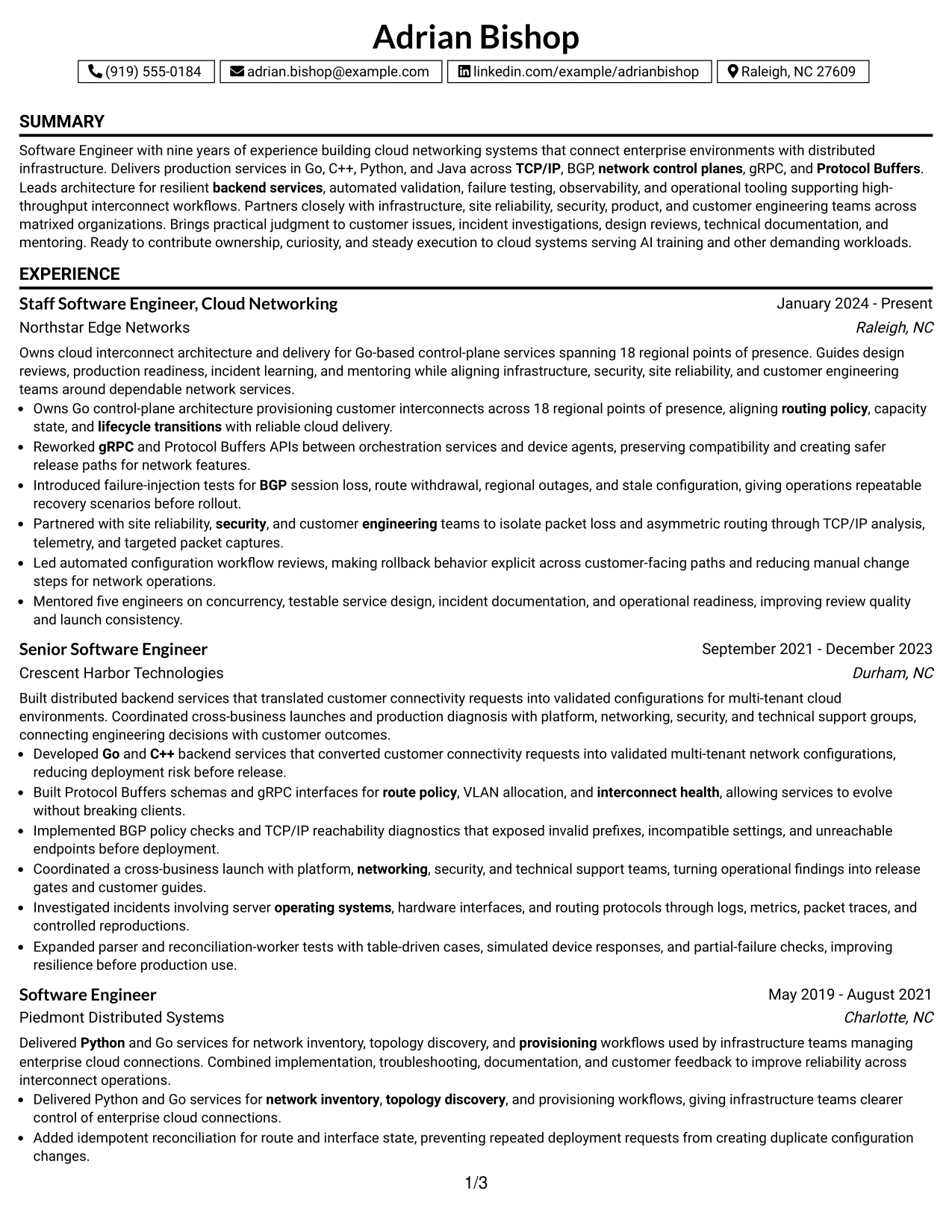
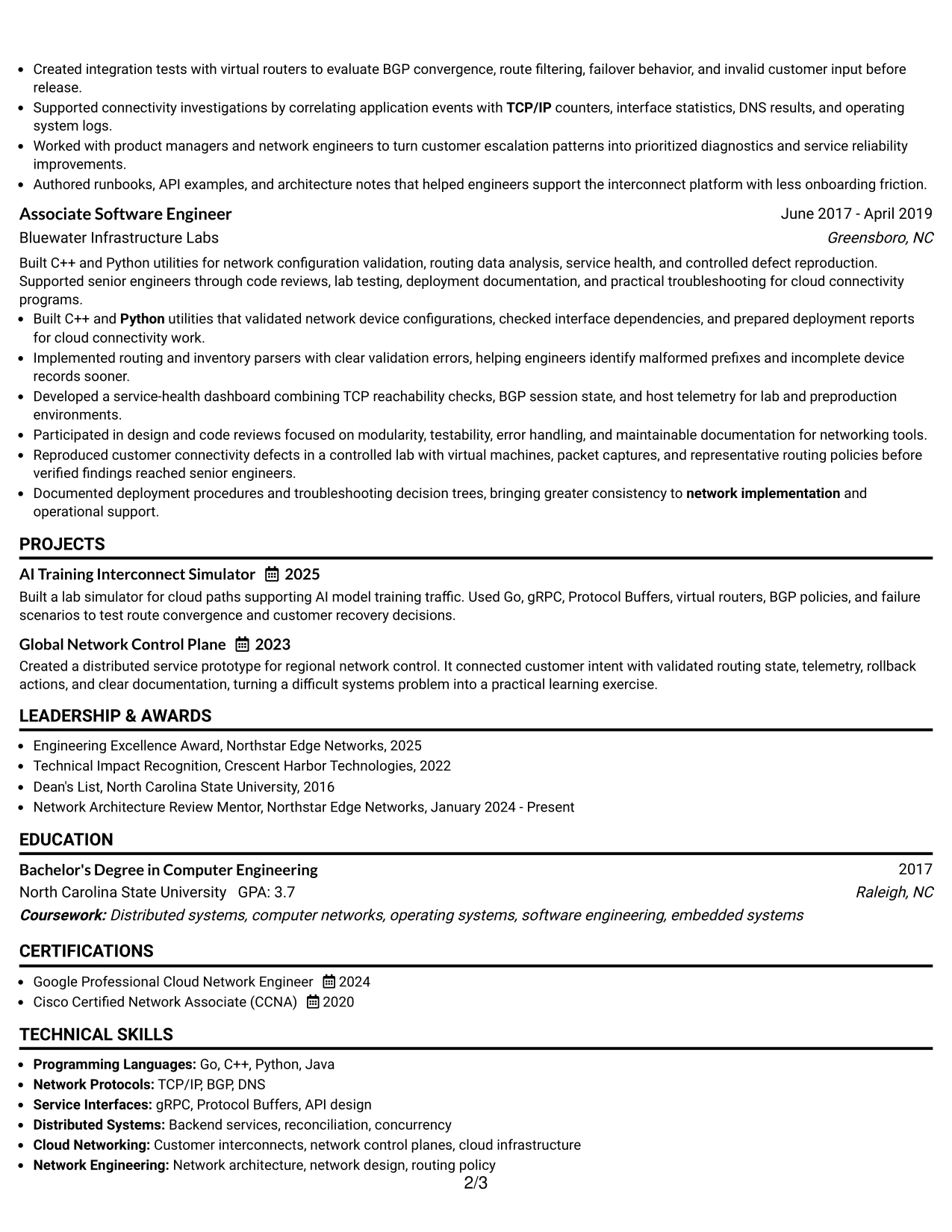
#13 Boxed Contact Header with Job Title Format Resume Example
The format starts with a boxed contact header that states the target role and creates a firm entry point for the review. The rest of the one-column resume can then move from the professional summary to experience, skills, projects, certifications, and education in a predictable sequence.
That structure works well when each section must reinforce the same technical direction. Bullets can connect customer interconnects, network control planes, distributed backend services, routing policy, automated validation, and incident investigation to the requirements for high-quality, testable, and resilient code.
Why the Boxed Contact Header with Job Title Format Works for a Resume
- The boxed header makes the target role immediately visible.
- A consistent one-column structure reduces visual interruptions during review.
- Section labels create clear boundaries between summary, experience, skills, and education.
- The layout gives achievement bullets enough width for technical terms and outcomes.
- The hierarchy supports ATS extraction when headings and details remain in normal text flow.
- Projects such as AI Training Interconnect Simulator can add focused evidence without obscuring employment history.
- The format balances a polished presentation with practical resume scanning.
Best For
- Resumes that need the target role stated clearly at the top.
- Candidates presenting several technical sections in a strict, easy-to-follow order.
- Applications where reviewers may compare the resume against requirements line by line.
- Documents with detailed experience bullets that benefit from full-page width.
- Professionals combining employment history with projects, certifications, and awards.
- ATS-conscious submissions that need visible headings and stable content sequence.
- Technical resumes that should look organized without relying on complex graphics.
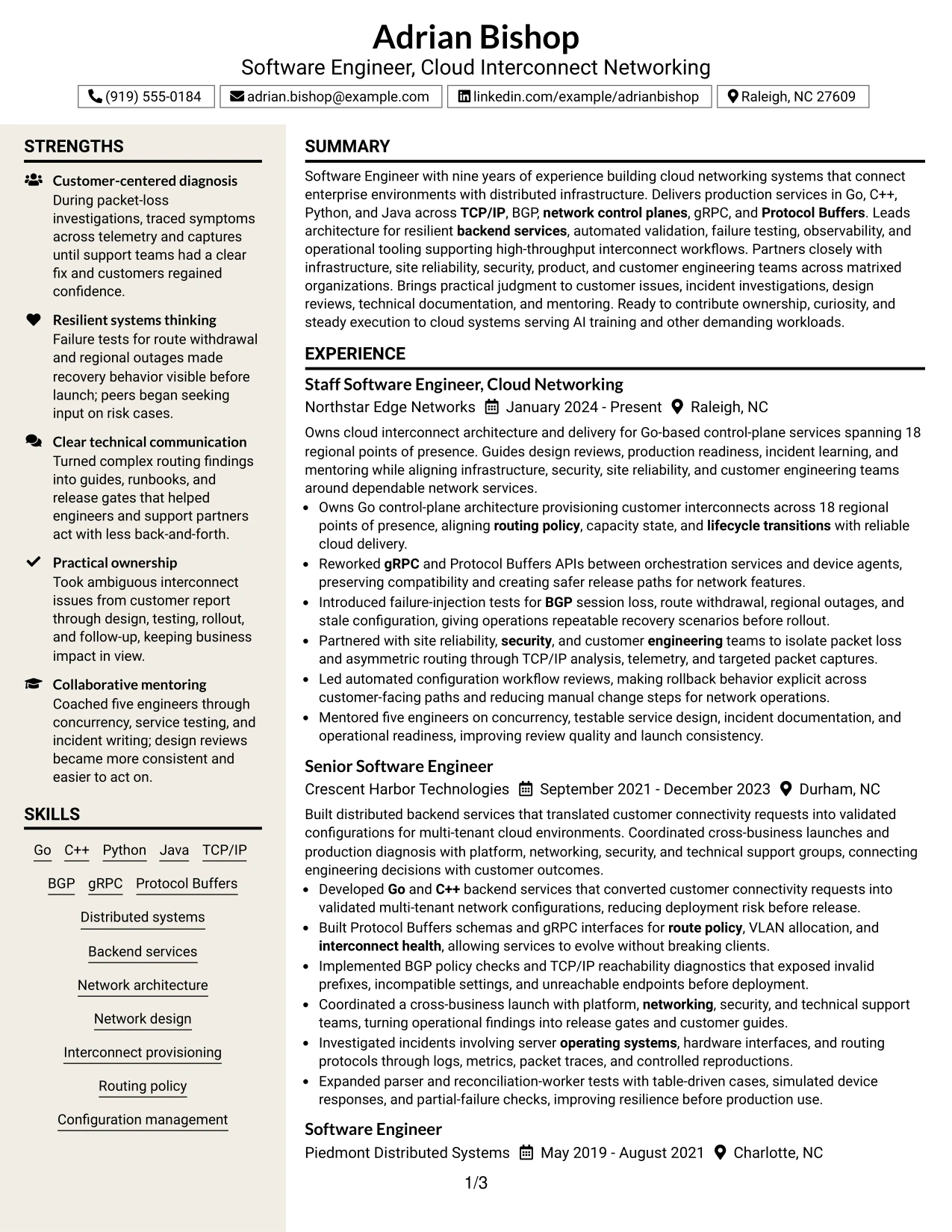
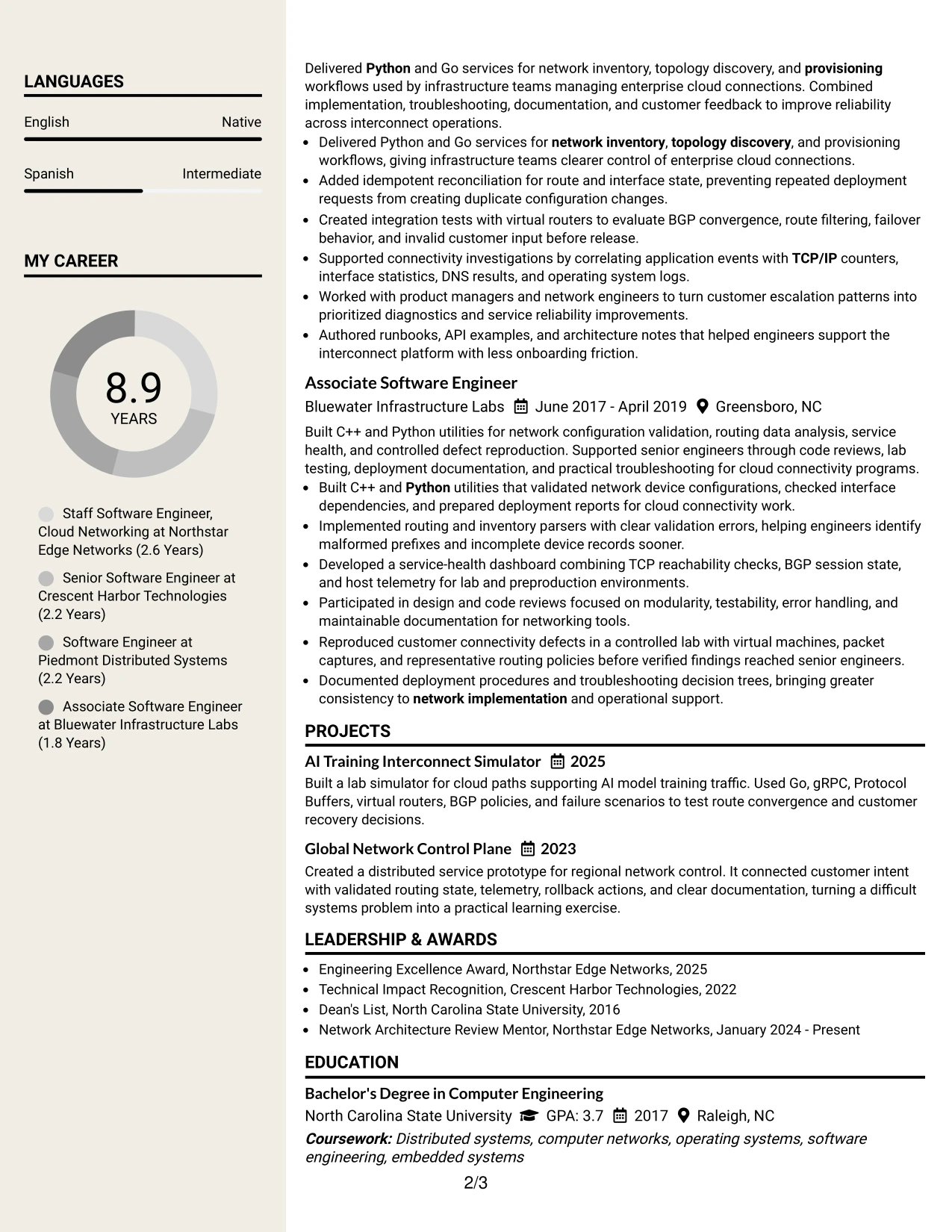
#14 Stylish Two Column Designer Format Resume Example
Recruiters can move through the main column for the professional summary and career evidence while using the sidebar for skills, certifications, education, and supporting details. That division helps a technically rich resume present both depth and quick-reference information without making the experience section feel compressed.
The main column should carry the strongest proof: 18 regional points of presence, resilient Go services, BGP recovery testing, routing diagnostics, and cross-functional delivery. The sidebar can reinforce those results with compact groups for TCP/IP, gRPC, Protocol Buffers, distributed systems, network design, and certifications.
Why the Stylish Two Column Designer Format Works for a Resume
- Two columns separate detailed evidence from fast-reference qualifications.
- The main column gives employment history enough space for accomplishment bullets.
- A sidebar can group skills, certifications, education, and languages for rapid review.
- The design supports a high content volume without creating one uninterrupted text block.
- Technical keywords remain easy to locate when grouped under descriptive labels.
- Projects can sit in the main content stream while supporting qualifications stay compact.
- The format suits a resume that must show architecture ownership, troubleshooting, testing, and collaboration together.
Best For
- Professionals with extensive experience and several supporting qualification groups.
- Resumes that need a compact skills and certification reference beside detailed work history.
- Applications where reviewers must assess both technical scope and implementation evidence quickly.
- Candidates with projects that deserve space without pushing core experience into a crowded page.
- Documents combining network protocols, programming languages, testing methods, and operations practices.
- Readers who prefer a visual distinction between achievement bullets and qualification lists.
- Technical resumes with enough content to benefit from deliberate information zoning.
#15 Modern Icon Format Resume Example
The evidence receives priority: the summary, experience bullets, projects, and technical skills should explain what was built, tested, and improved. Small visual markers can guide the eye between sections, but they should remain secondary to searchable text and clear achievement statements.
For this target role, the resume can lead with control-plane architecture, distributed backend services, network design, customer issue diagnosis, and failure testing. Specific tools and methods—Go, C++, Python, Java, gRPC, Protocol Buffers, packet captures, and observability—make the technical claims credible.
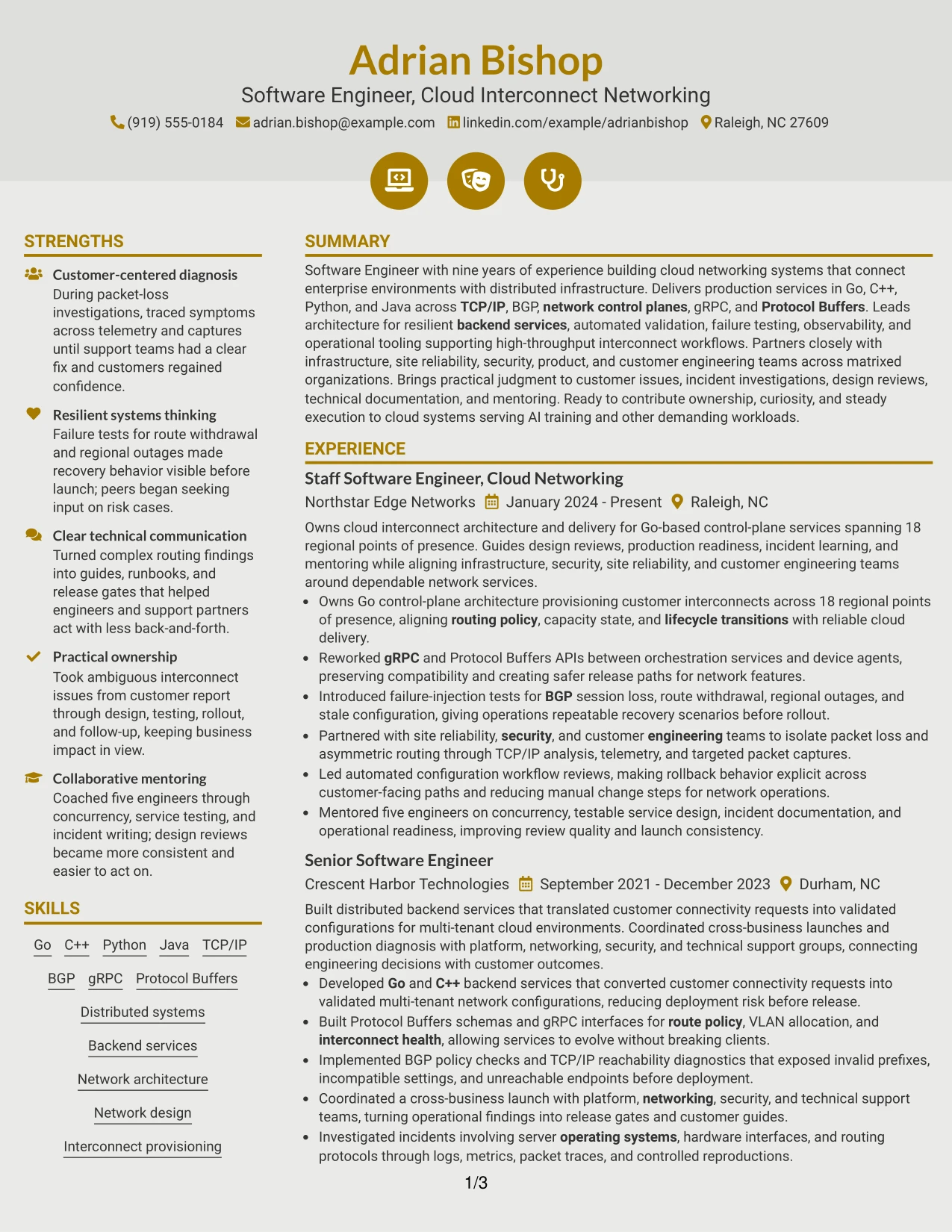
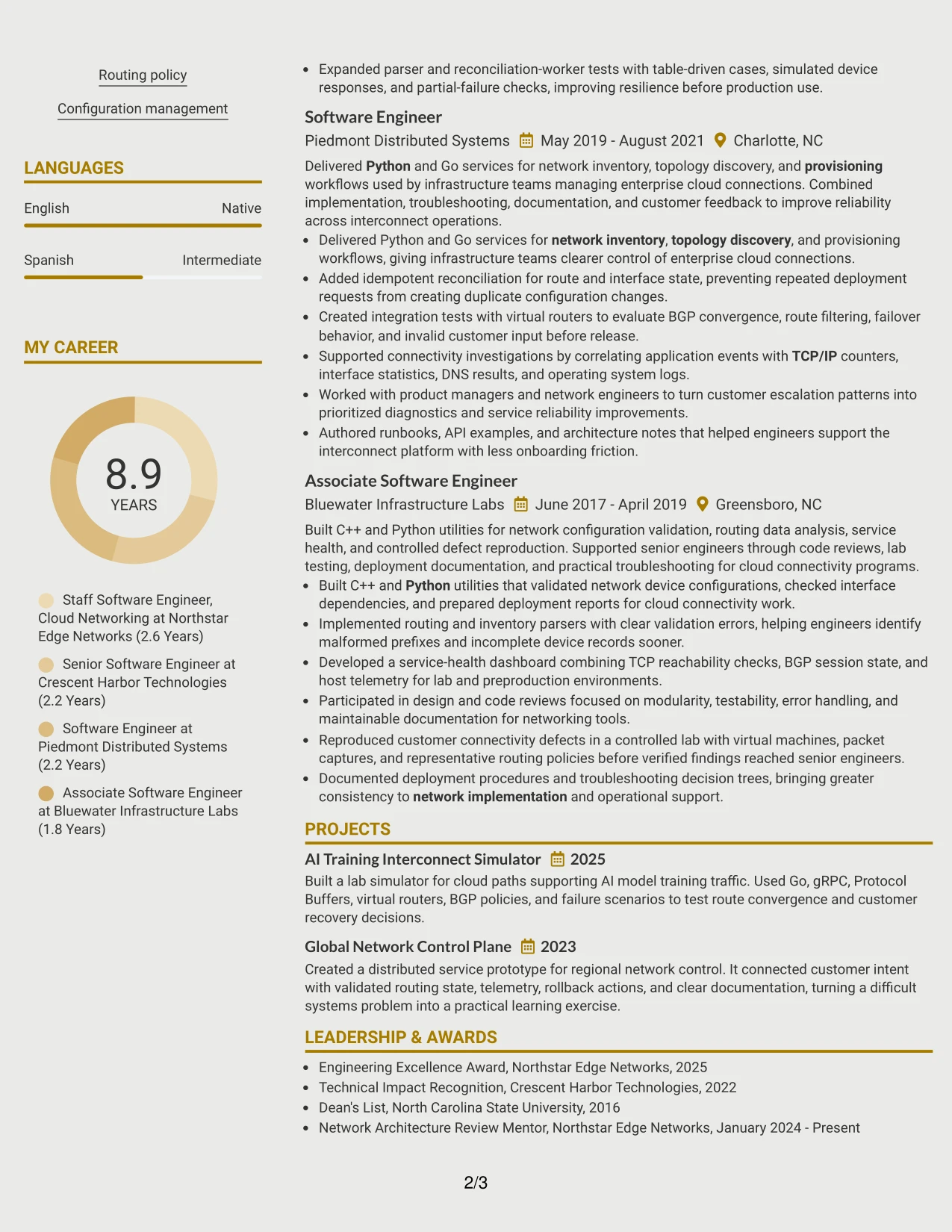
Why the Modern Icon Format Works for a Resume
- Evidence stays ahead of decoration in the review hierarchy.
- Simple section markers help readers locate experience, skills, projects, and certifications.
- Achievement bullets can show scope, technical decisions, and operational results.
- The format supports keyword visibility for Go, C++, Python, Java, TCP/IP, and BGP.
- A compact visual system can make a long technical resume easier to navigate.
- Projects provide an additional place to demonstrate distributed systems and AI training interconnect work.
- The layout presents testing, observability, documentation, and incident response as practical evidence.
Best For
- Resumes where project outcomes and technical methods need equal visibility.
- Candidates who want visual guidance without reducing the amount of evidence.
- Applications requiring a clear blend of programming, networking, and systems experience.
- Documents that use compact markers to distinguish several technical resume sections.
- Professionals with failure testing, integration testing, and troubleshooting examples to show.
- Readers who scan for tools first and then verify them in experience bullets.
- Technical profiles that benefit from a modern surface while keeping content ATS-readable.
#16 Plain Professional Layout with Job Title and Shaded Labels Resume Example
Content is balanced through a clear header, shaded section labels, and a full-width sequence of resume evidence. The treatment gives the target role a visible position while leaving enough room for detailed bullets about experience, projects, skills, certifications, education, and technical mentoring.
This application context calls for proof of reliable engineering practice. The resume should show well-factored services, testable code, resilient failure handling, network implementation, customer-related troubleshooting, and documentation. Each bullet should state the action and the technical result rather than list duties alone.
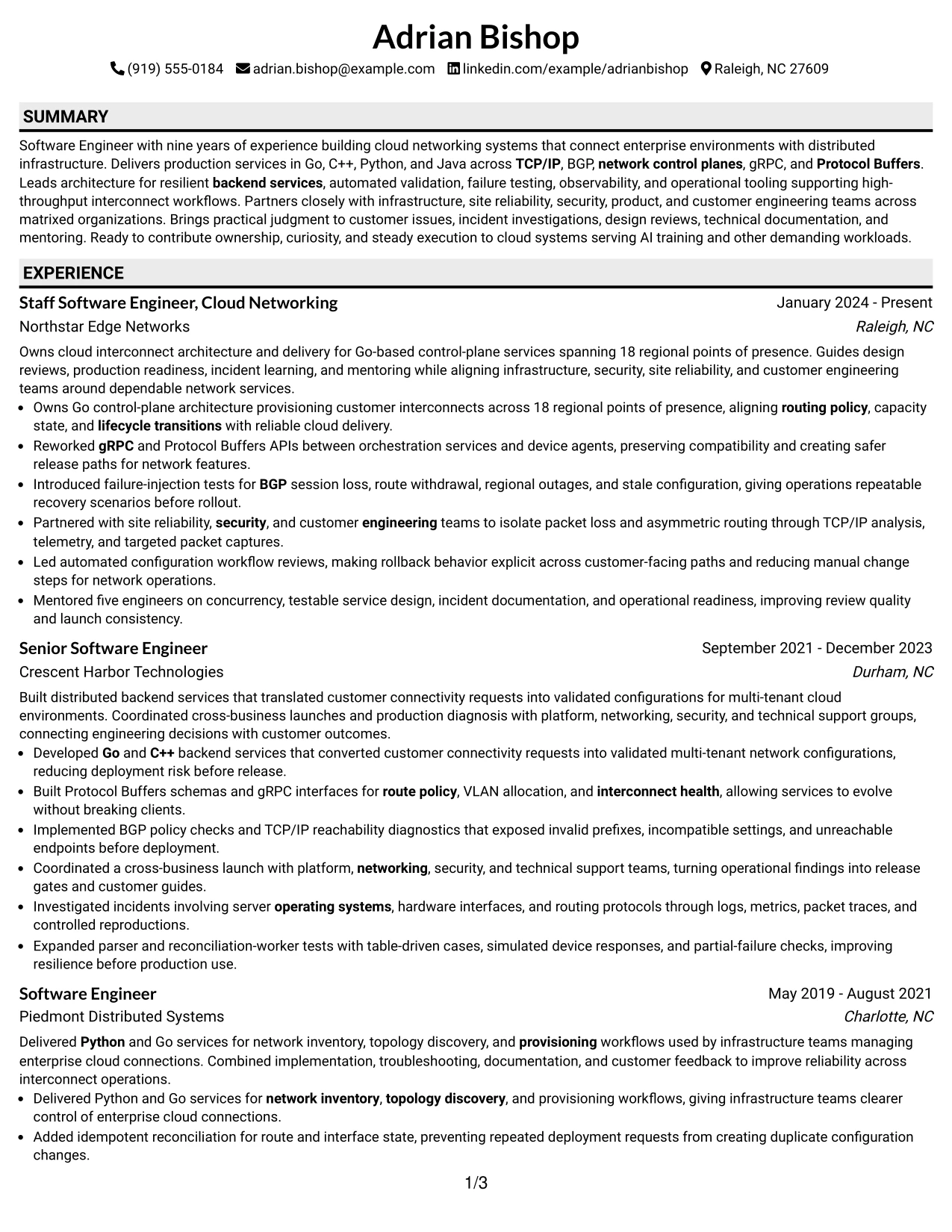
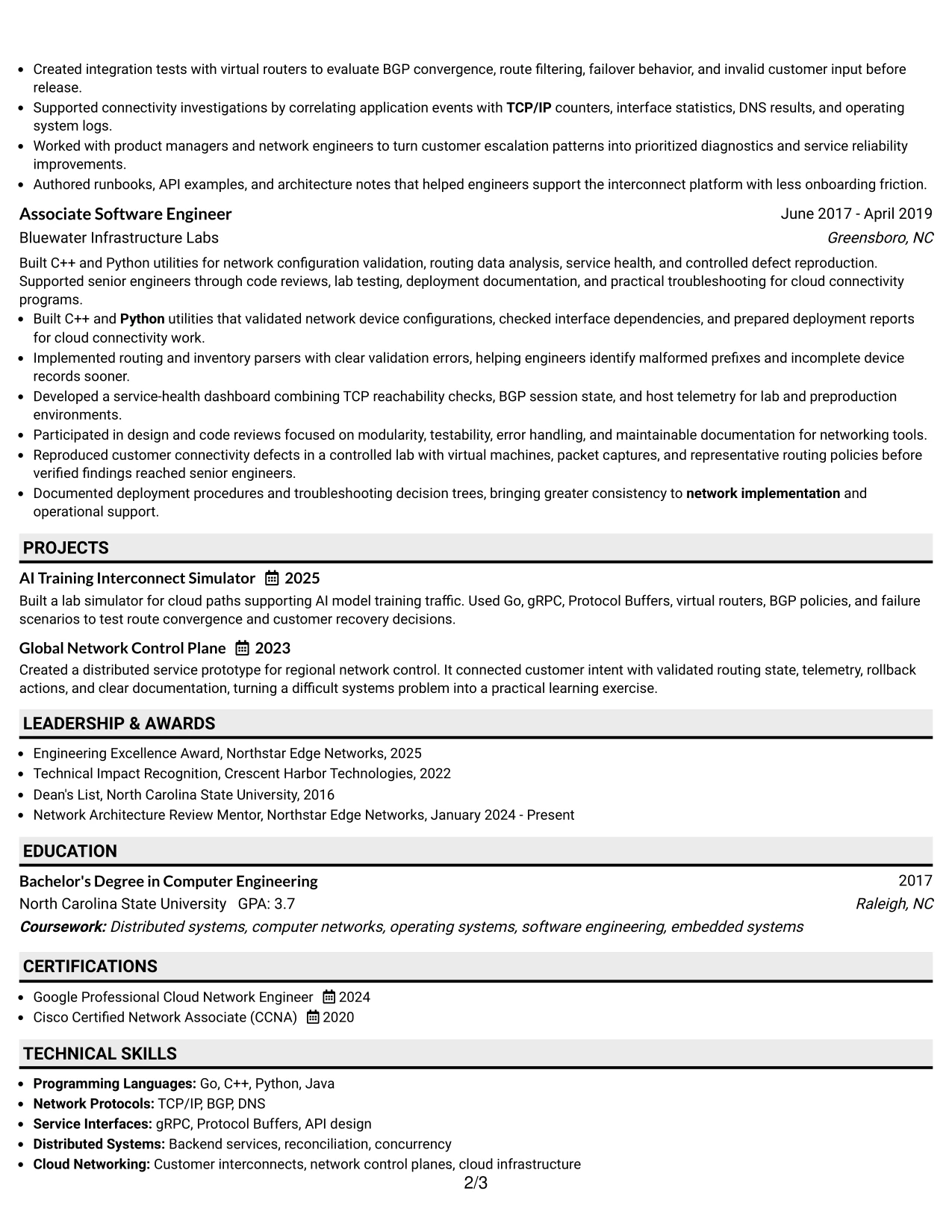
Why the Plain Professional Layout with Job Title and Shaded Labels Works for a Resume
- Shaded labels make each resume section easy to identify.
- The full-width layout supports complete achievement bullets and technical explanations.
- The job title provides direct alignment with the target role.
- A plain treatment keeps ATS-readable text at the center of the document.
- Experience can demonstrate design, implementation, troubleshooting, and operational ownership in order.
- Skills and certifications remain visible without overpowering the work history.
- The format is practical for applications that value quality, resilience, documentation, and clear structure.
Best For
- Applications where the resume must connect directly to a stated technical role.
- Professionals who need space to explain system design and troubleshooting decisions.
- Documents reviewed by both technical specialists and general recruiting teams.
- Candidates presenting a balanced mix of experience, projects, education, and certifications.
- Resumes that must emphasize reliable implementation rather than visual novelty.
- Applicants using clear labels to organize a broad set of networking and software qualifications.
- Technical submissions where plain formatting supports dependable ATS extraction.
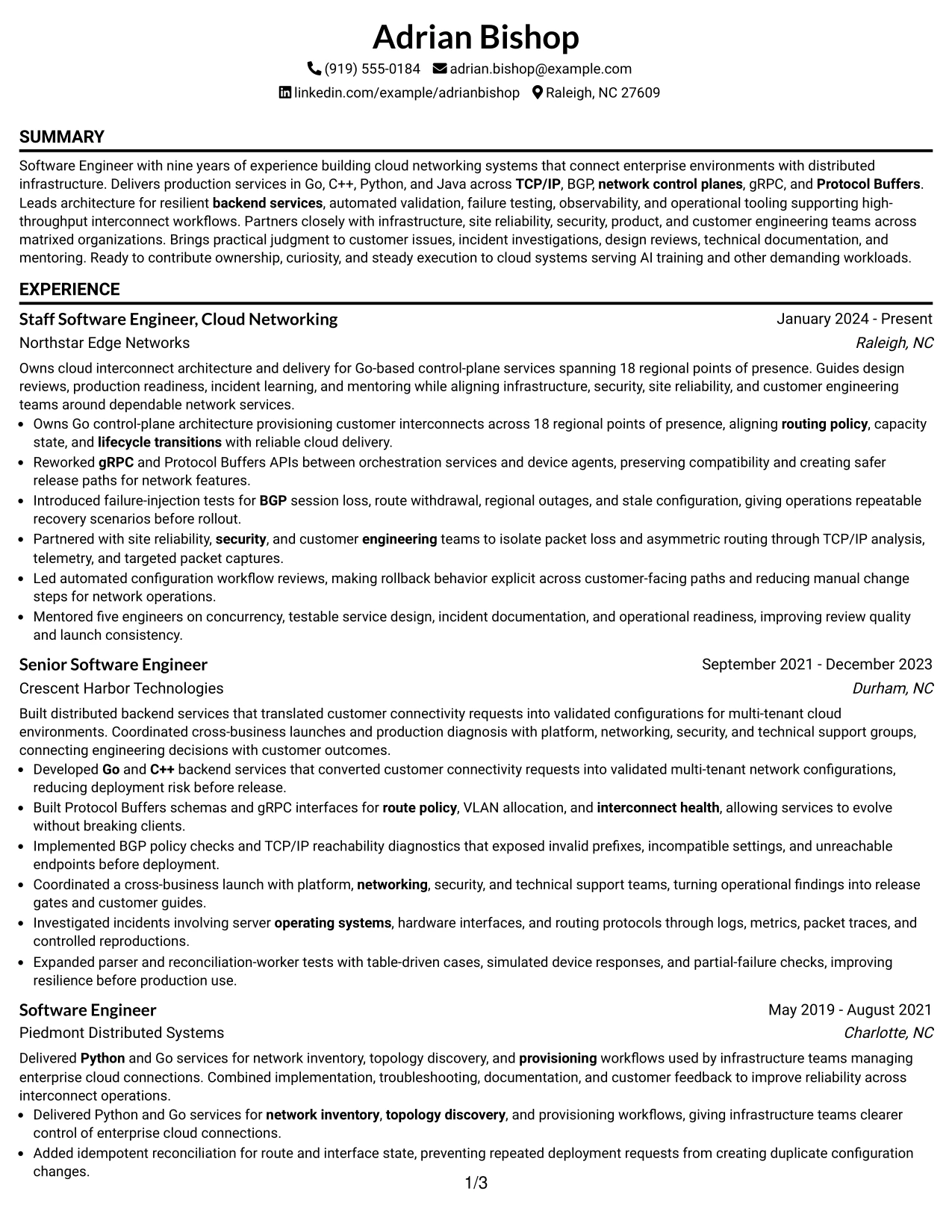
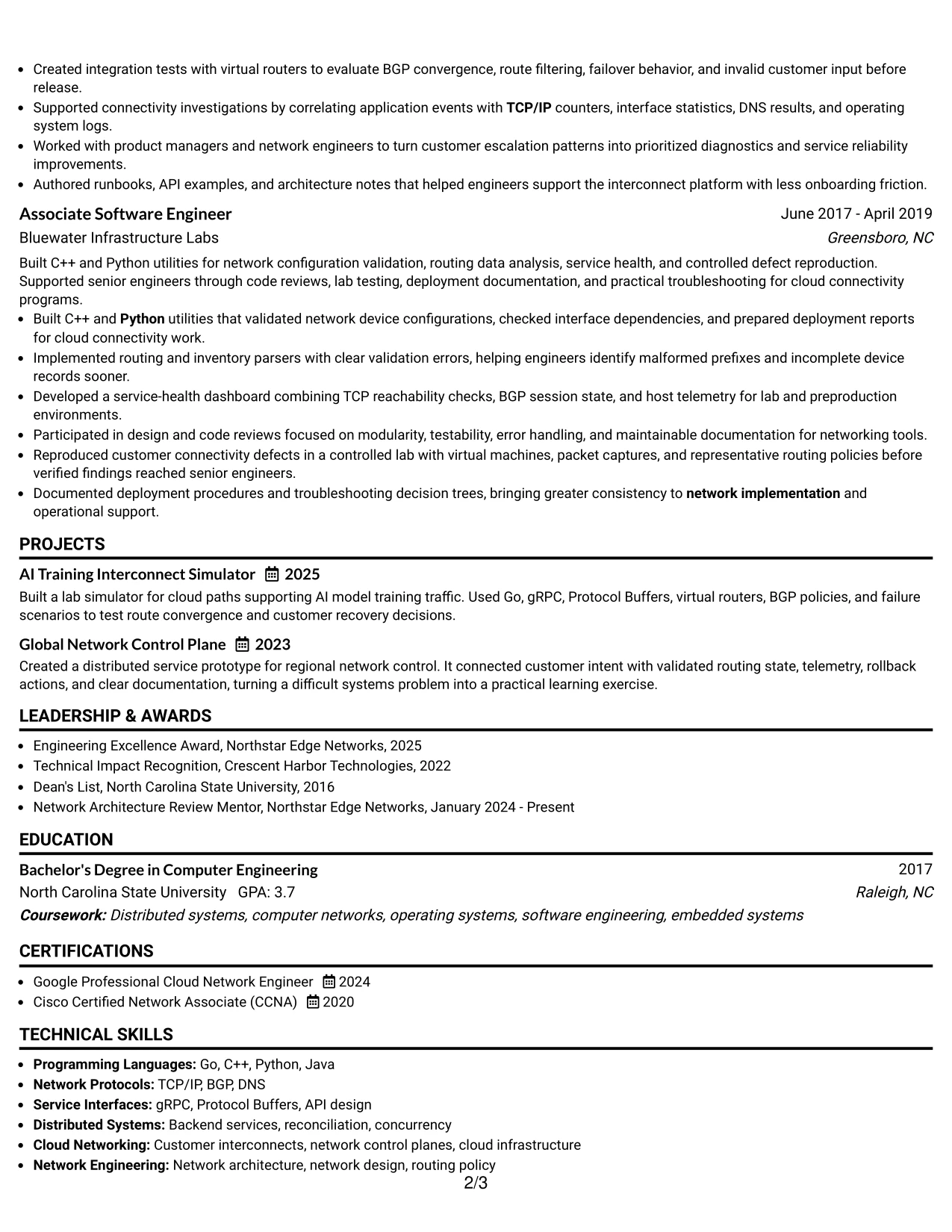
#17 Classic One Column Resume Format Resume Example
For a role focused on connecting customer networks to cloud infrastructure, a classic one-column page keeps the review practical. The reader can follow the summary, experience, projects, skills, certifications, and education from top to bottom without adjusting to a complex visual system.
That straightforward path gives each career stage room to show progression from network validation utilities to cloud interconnect architecture. Strong bullets can cover Go and C++ services, Python automation, BGP and TCP/IP diagnostics, gRPC interfaces, failure scenarios, and leadership across matrixed teams.
Why the Classic One Column Resume Format Works for a Resume
- The familiar structure supports quick review across hiring systems and human readers.
- A single column preserves the order of professional summary, experience, skills, and education.
- Career progression is easy to follow from associate engineering work to staff-level architecture ownership.
- Full-width bullets allow technical terms and supporting context to remain together.
- Projects and certifications can be added without competing with the main experience section.
- The format works well for measurable scope, including regional coverage and mentoring responsibility.
- Its restrained design keeps attention on skills, tools, results, and evidence.
Best For
- Applicants who want a familiar format for technical and cloud infrastructure roles.
- Resumes that need to show clear progression across several positions.
- Documents with substantial experience bullets that should not be split across narrow areas.
- Applications submitted through systems that favor simple, linear content order.
- Candidates combining professional history with projects, certifications, and education.
- Readers who want to verify technical keywords directly against work examples.
- Professionals whose strongest advantage is the depth and consistency of their evidence.
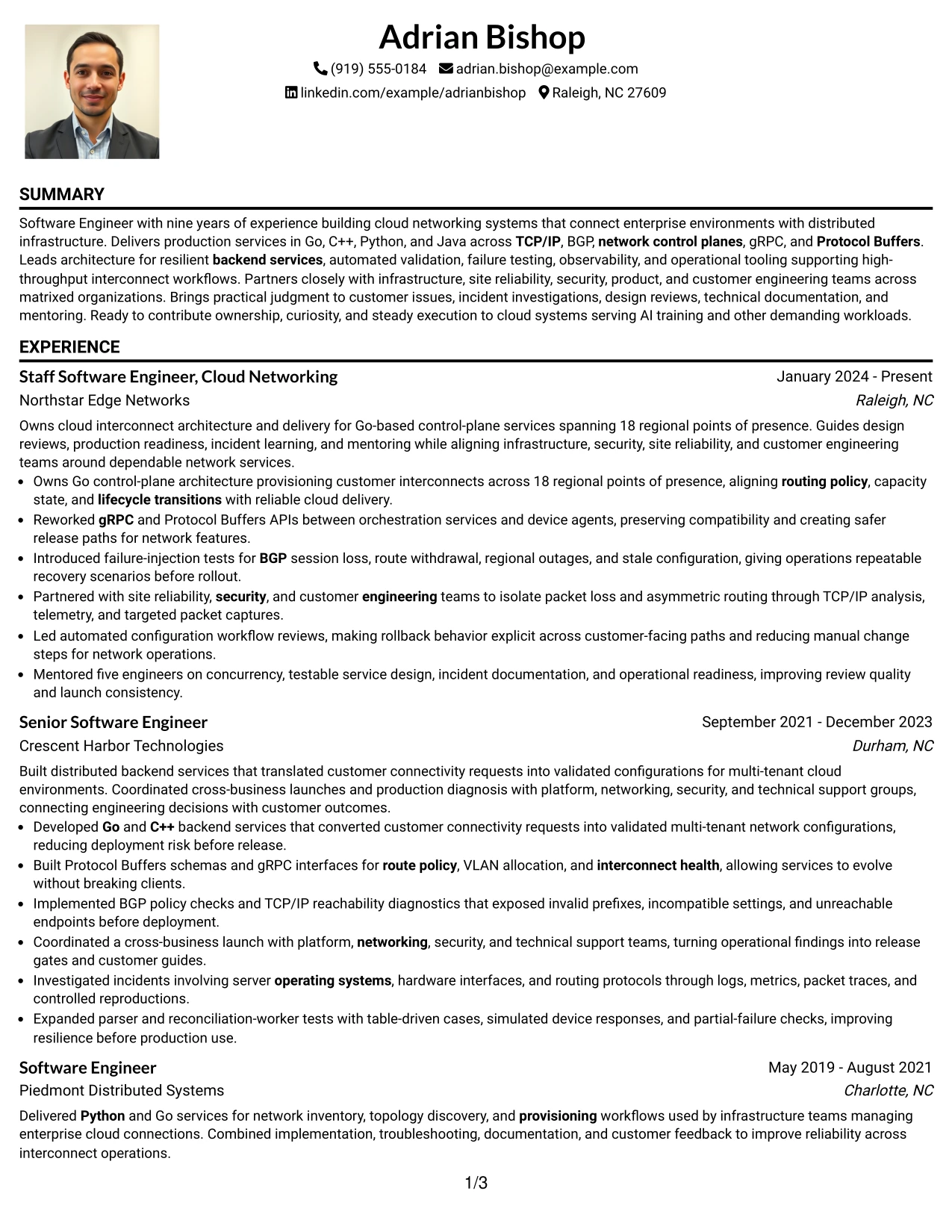
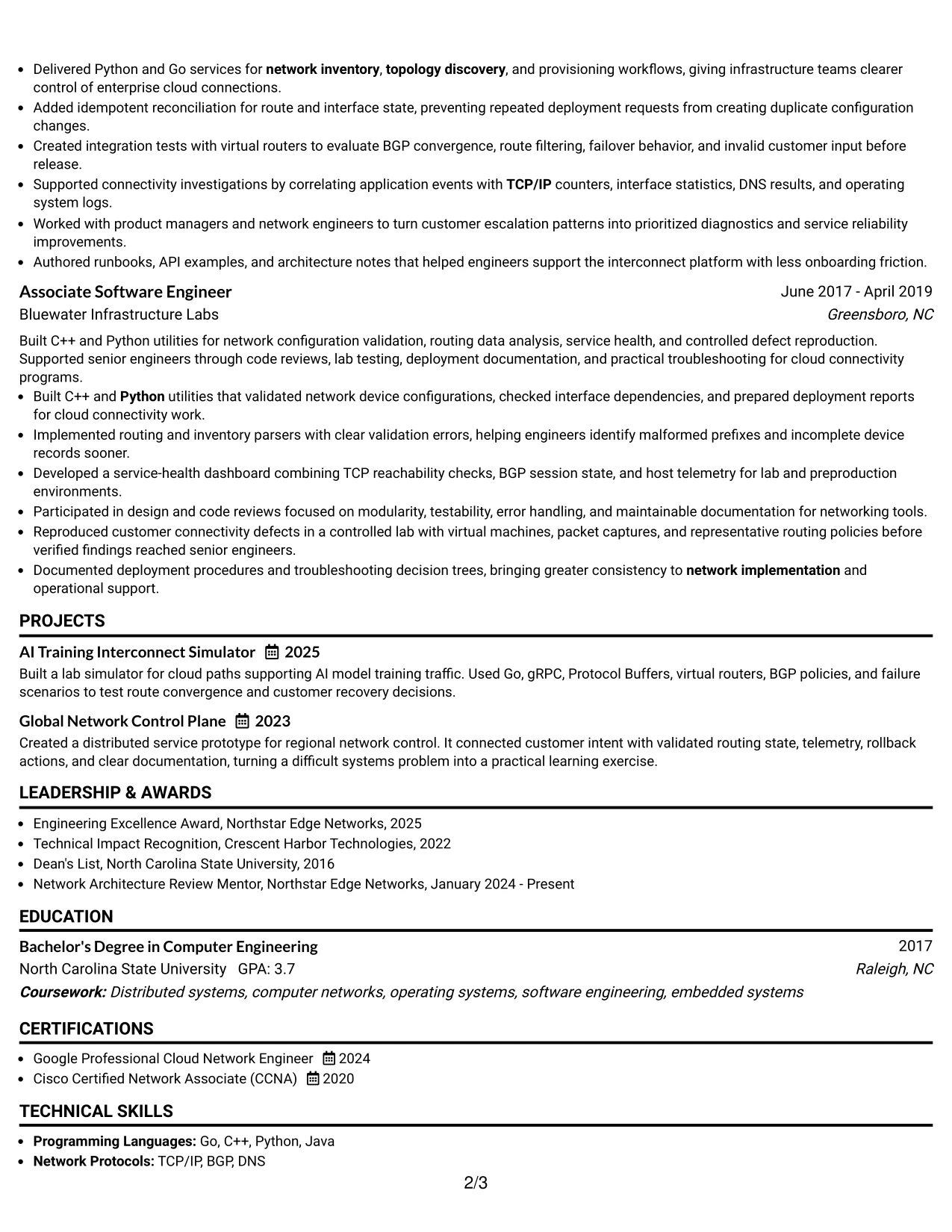
#18 One Column Format with Photo Resume Example
A clean one-column hierarchy keeps the role, summary, experience, skills, projects, certifications, and education easy to follow, while the photo can provide a personal visual identifier where local hiring norms and application rules support one. The image should remain secondary; the technical evidence must still lead the review.
For this resume, the strongest content includes cloud interconnect architecture, Go control-plane services, BGP recovery scenarios, distributed backend systems, customer issue diagnosis, and mentoring. A consistent sequence helps readers connect those results to the target role without searching across multiple content areas.
Why the One Column Format with Photo Works for a Resume
- A single column gives the resume a clear and familiar reading path.
- The photo can add a personal identifier when it is appropriate for the application context.
- Technical evidence remains central through experience bullets, projects, and skills.
- The format provides full width for details about routing, backend services, testing, and troubleshooting.
- A visible target role helps connect the summary to the rest of the document.
- Certifications and education can follow the evidence without creating a crowded sidebar.
- The restrained structure keeps the photo from replacing qualifications or measurable scope.
Best For
- Applications in regions or settings where including a photo is accepted and useful.
- Professionals who want a single-column structure with a more personal header.
- Resumes that need full-width space for detailed technical achievement bullets.
- Candidates aligning a visible target role with cloud networking experience.
- Documents that combine work history, projects, certifications, and education in one sequence.
- Readers who prefer a linear review of systems, protocols, tools, and results.
- Applicants who can use a photo without reducing ATS-readable text or technical evidence.
#19 Minimal Header Format Resume Example
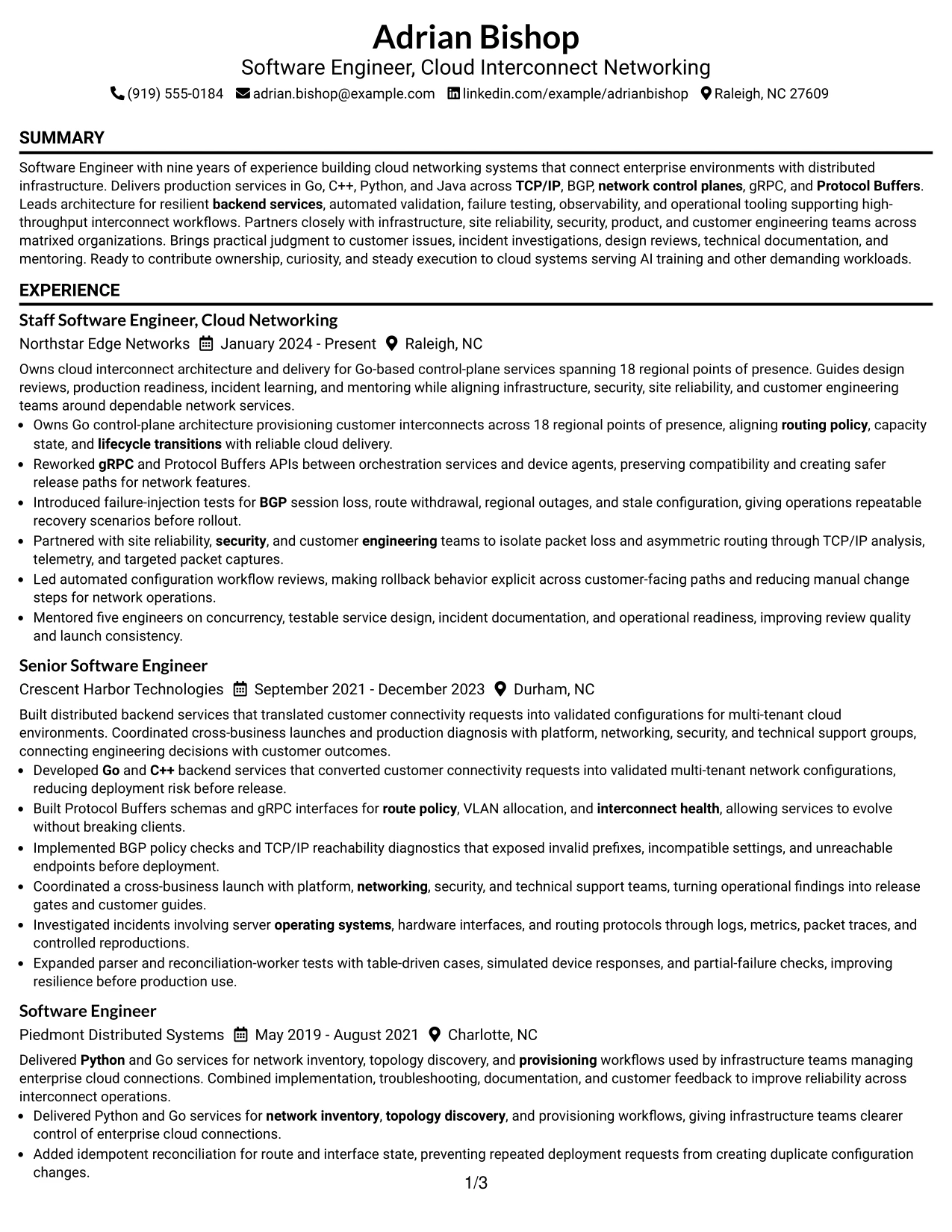
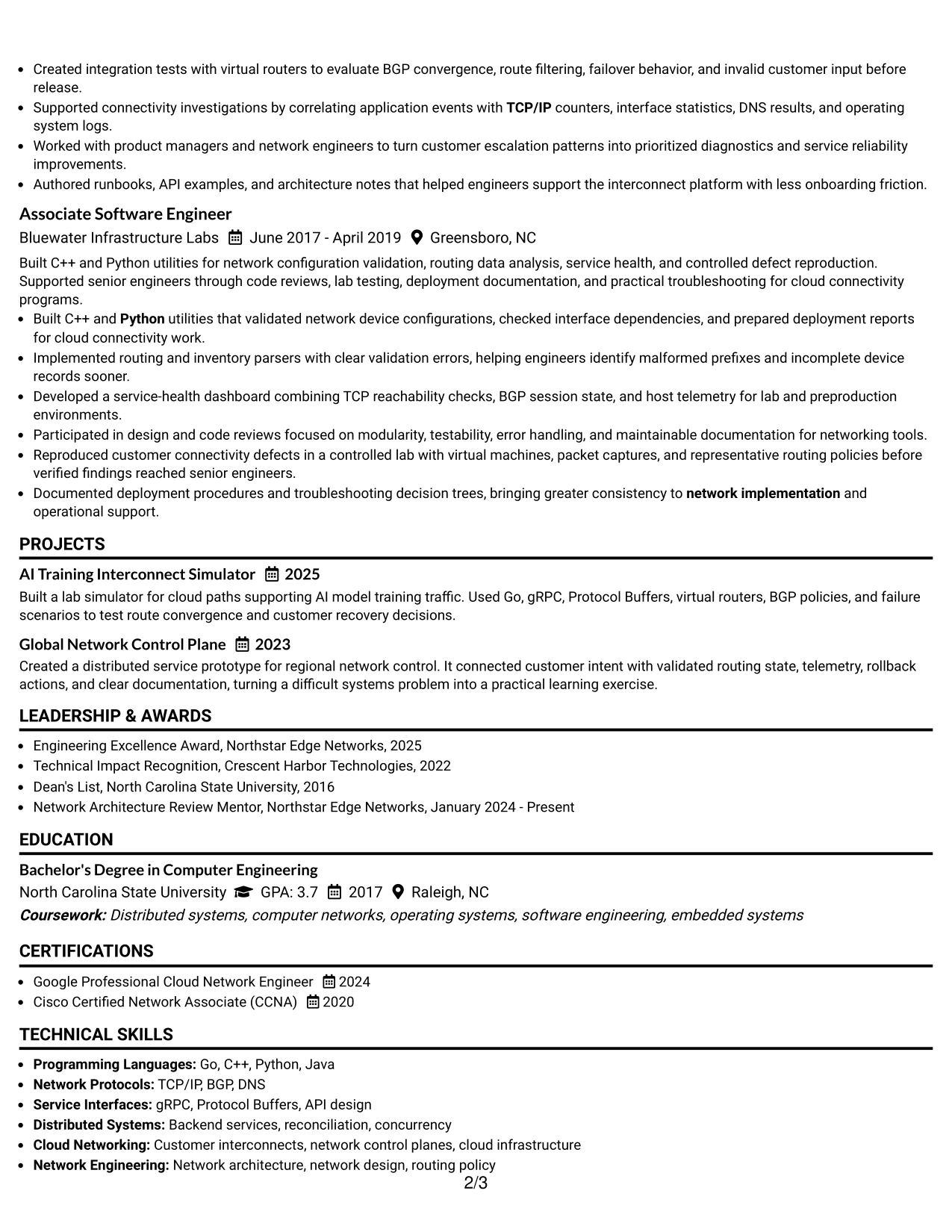
The format creates a compact entry point, then moves directly into the resume content. That structure helps a reviewer reach the summary and experience quickly while keeping contact details, the target role, and the most important technical direction visible without excess header space.
A minimal header is especially effective when the evidence is strong and specific. The resume can use the available space for 18 regional points of presence, resilient network services, gRPC and Protocol Buffers APIs, routing diagnostics, virtual-router testing, projects, certifications, and technical mentoring.
Why the Minimal Header Format Works for a Resume
- A compact header moves the reviewer quickly to qualifications.
- The one-column flow keeps experience and supporting sections in a stable order.
- Reduced header space leaves more room for achievement bullets.
- The target role and professional summary can establish alignment immediately.
- Technical keywords remain grouped in readable sections for ATS review.
- Projects and certifications fit naturally beneath the core work history.
- The minimal treatment keeps attention on scope, results, tools, and engineering judgment.
Best For
- Resumes where professional evidence should begin near the top of the page.
- Candidates needing more room for detailed experience without a large header.
- Applications that benefit from a clean, ATS-friendly content sequence.
- Professionals with technical projects and certifications to place after work history.
- Documents requiring quick access to programming languages and network protocols.
- Readers who prefer low-distraction formatting during an initial scan.
- Technical profiles whose strongest selling points are specific systems results and troubleshooting depth.
#20 Modern Full Background Two Column Format Resume Example
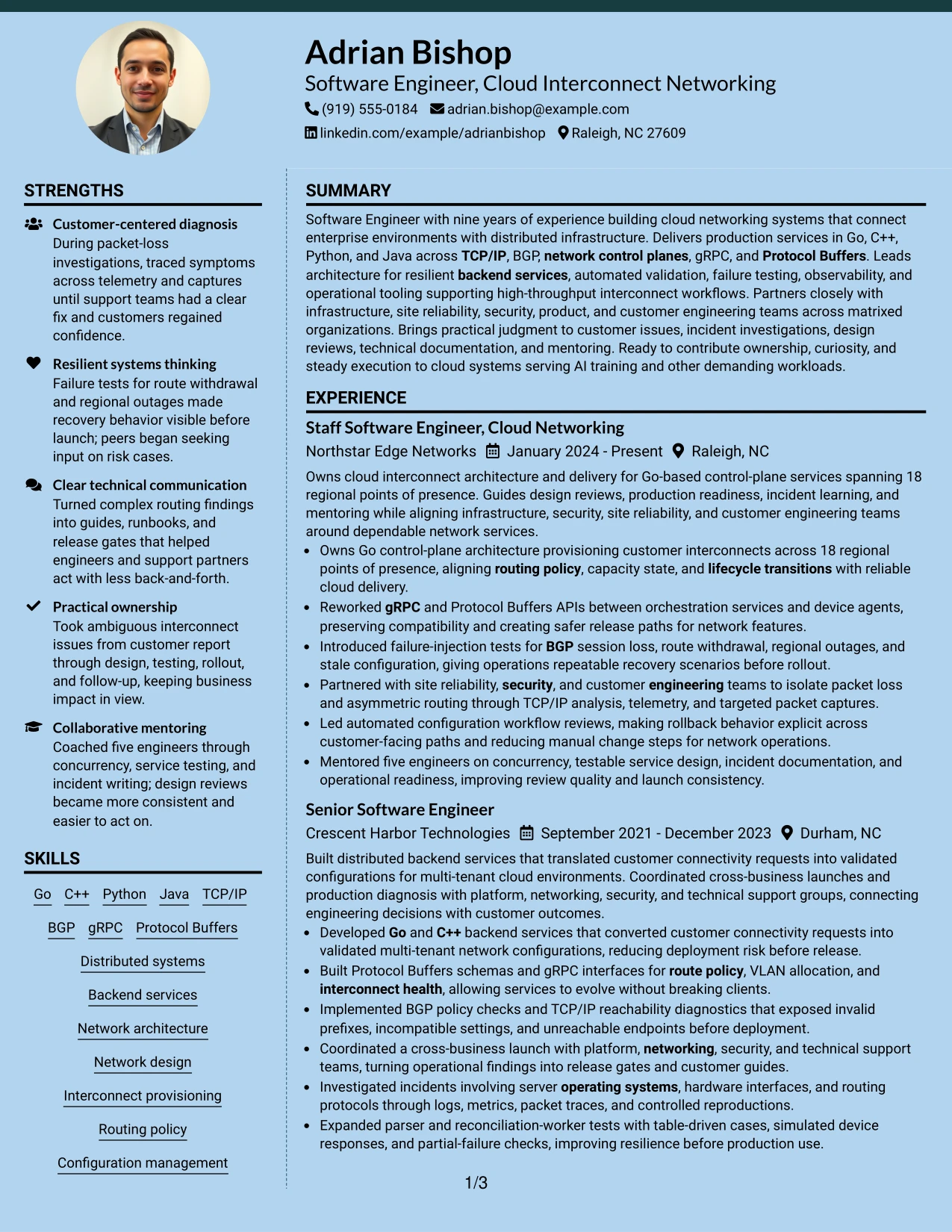
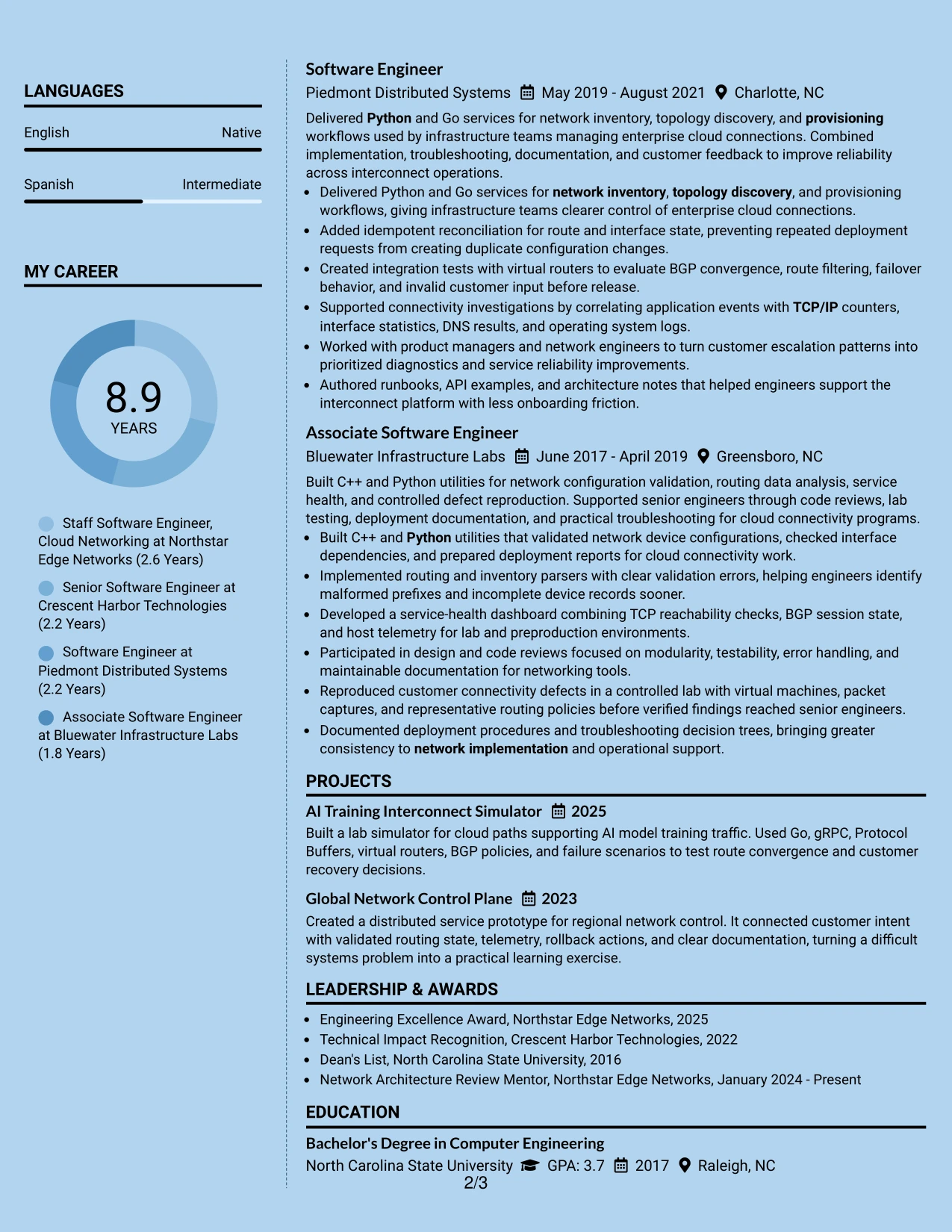
Readers can use the main column for the professional summary, experience, and project evidence, then move to the secondary column for skills, certifications, education, and supporting details. This navigation pattern helps a high-volume technical resume show breadth without forcing every qualification into the same visual stream.
The format should still preserve a clear evidence order. The main area can establish ownership of cloud interconnect architecture, routing policy, distributed systems, and customer diagnosis, while the supporting area reinforces Go, C++, Python, Java, TCP/IP, BGP, Linux, testing, and observability.
Why the Modern Full Background Two Column Format Works for a Resume
- Two information zones help readers switch between detailed evidence and quick-reference facts.
- The main column can carry complete experience bullets and project descriptions.
- The supporting column can group skills, certifications, education, and languages efficiently.
- A strong background treatment creates visual distinction without changing the content hierarchy.
- The format supports a broad technical profile with software, networking, and operations evidence.
- ATS value is preserved when key terms remain in selectable, clearly labeled text.
- The structure helps technical reviewers confirm tools and methods after reading the results.
Best For
- Professionals with enough qualifications to justify deliberate two-column organization.
- Resumes that must show detailed work history beside a dense technical skills inventory.
- Applications where projects and certifications need visibility without interrupting experience.
- Candidates presenting both software engineering evidence and network engineering knowledge.
- Documents reviewed by readers who alternate between achievement bullets and keyword lists.
- Technical profiles with supporting details such as languages, education, awards, and testing methods.
- Applicants who want a modern visual frame while preserving a logical review path.
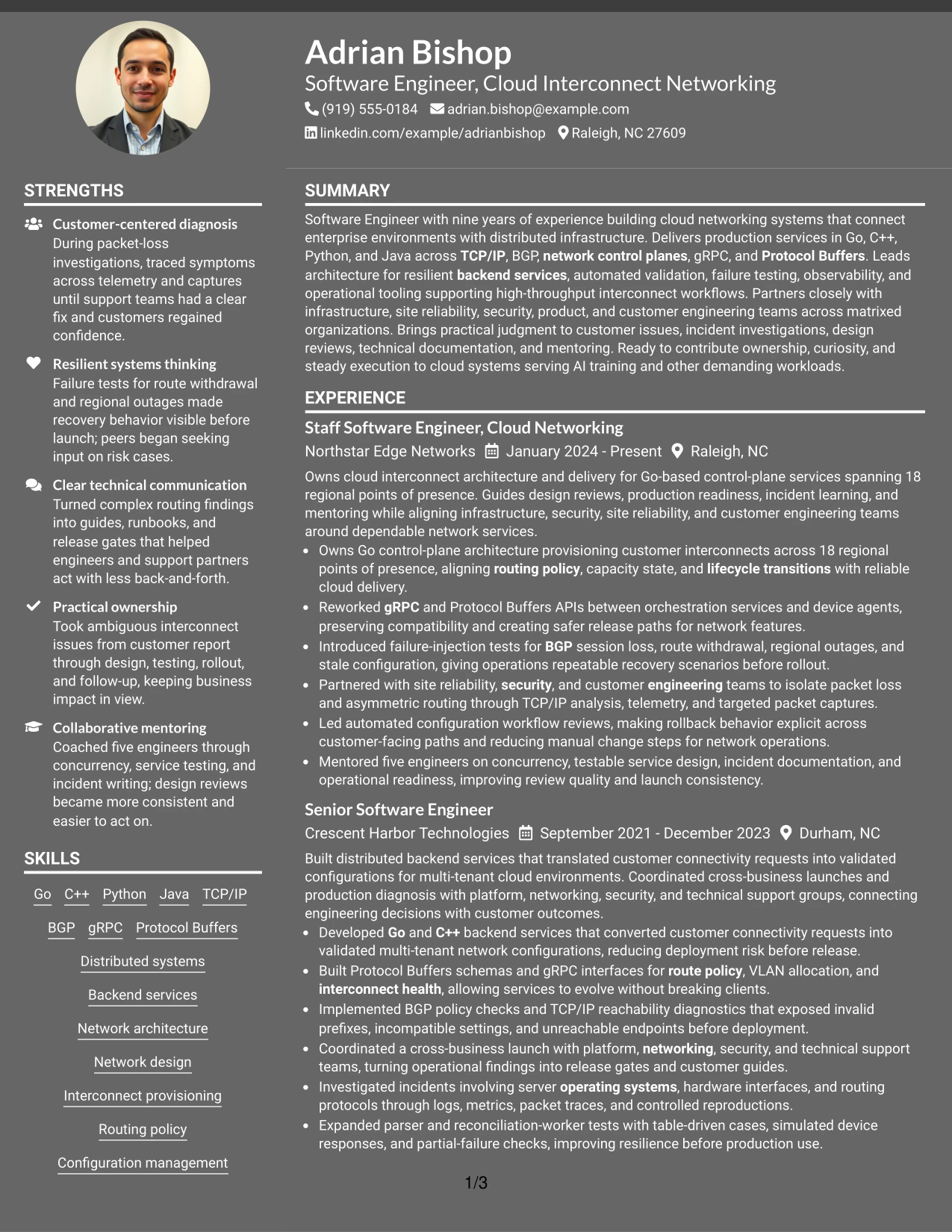
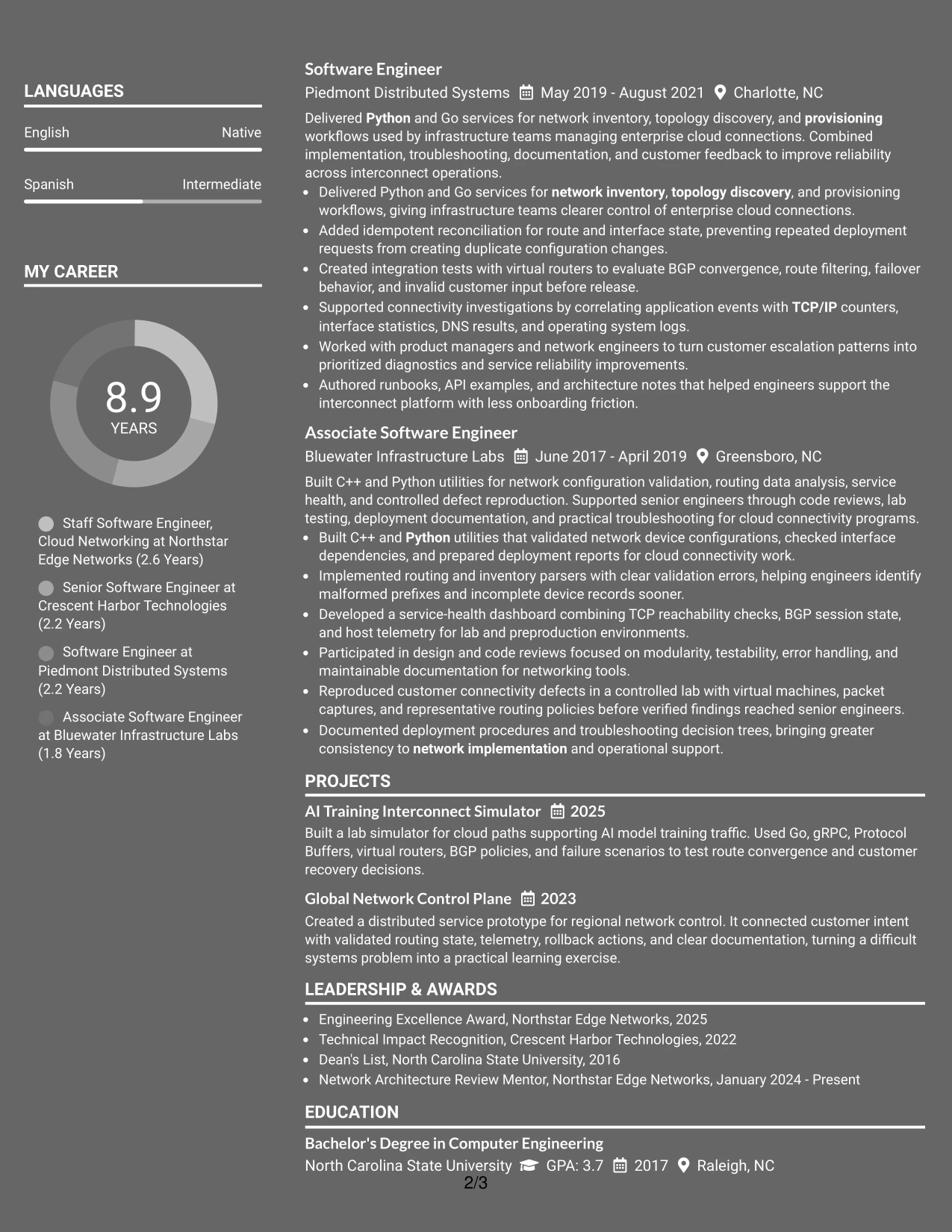
#21 Dark Mode Two Column Format Resume Example
The evidence should receive priority over the dark visual treatment. A two-column structure can place career achievements and projects in the wider area while grouping skills, certifications, education, and tools in a compact secondary area. Strong contrast and readable text remain essential for both screen review and document access.
The main evidence can show resilient backend services, control-plane architecture, automated validation, failure injection, packet analysis, and cross-functional delivery. The supporting column can reinforce the technical vocabulary used throughout the resume, including Go, C++, Python, Java, gRPC, Protocol Buffers, TCP/IP, BGP, Linux, and observability.
Why the Dark Mode Two Column Format Works for a Resume
- Two columns distinguish detailed achievement evidence from supporting qualifications.
- A dark treatment can create a strong visual identity when contrast remains accessible.
- The main area provides room for technical projects and experience bullets.
- The secondary area makes skills, certifications, and education easy to locate.
- The design supports evidence across software development, networking, and operations.
- Keywords remain useful when presented as readable text rather than decorative graphics.
- Failure testing, incident response, packet analysis, and documentation can appear as concrete proof of quality.
Best For
- Screen-first applications where a distinctive but organized presentation is appropriate.
- Candidates with substantial technical evidence and a separate skills inventory.
- Resumes that need to show projects and employment results in the primary reading area.
- Professionals who want supporting certifications and tools visible without crowding the main column.
- Applications where readability can be protected through strong contrast and clear labels.
- Technical profiles combining backend services, network protocols, testing, and operations.
- Applicants who can use a modern visual treatment while keeping ATS content selectable and structured.
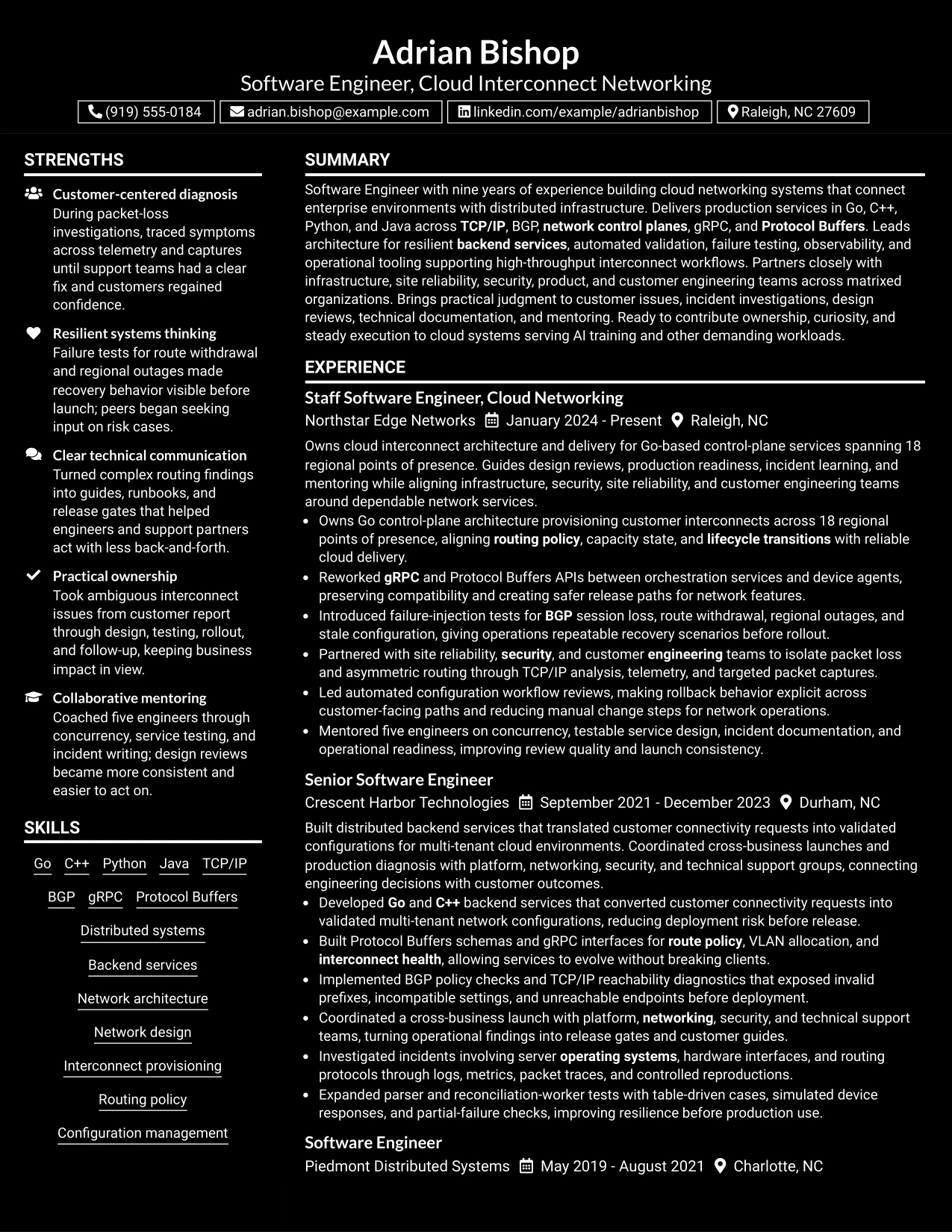
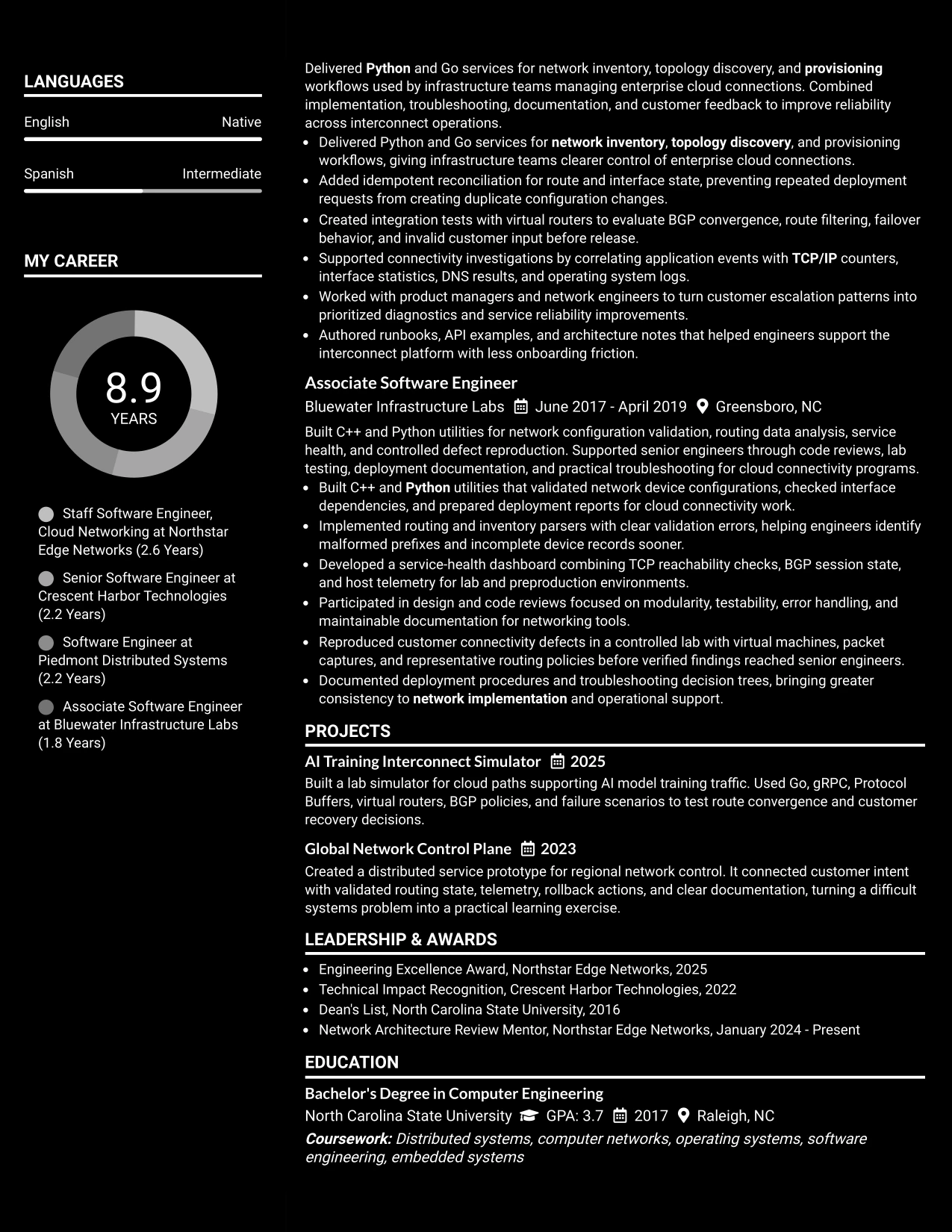
#22 Dark Mode Box Header Format Resume Example
Space is balanced through a defined box header and a single content column beneath it. The header can state the target role and contact details, while the body gives the summary, experience, projects, skills, certifications, and education a consistent route through the review.
This application-focused arrangement works when the resume must look distinctive but remain easy to assess. The body should emphasize reliable code, cloud infrastructure connections, BGP and TCP/IP troubleshooting, distributed backend services, technical documentation, and customer-related issue resolution.
Why the Dark Mode Box Header Format Works for a Resume
- The box header creates a clear starting point for the resume review.
- A single column keeps technical experience in a logical sequence.
- The dark treatment can add distinction while the boxed area contains visual emphasis.
- Full-width bullets support details about implementation, testing, and troubleshooting.
- The target role remains connected to the summary and later evidence.
- Skills, projects, certifications, and education can follow without competing sidebars.
- The format supports a polished application while preserving readable, ATS-relevant content.
Best For
- Applications that allow a distinctive header but still need straightforward content flow.
- Candidates who want the target role and contact details contained in one strong opening area.
- Resumes with detailed bullets covering network design, implementation, and troubleshooting.
- Professionals combining software systems evidence with certifications and project work.
- Documents that need a clear distinction between header information and resume sections.
- Readers who prefer one-column scanning with a stronger visual entry point.
- Technical applicants who can maintain readable contrast and standard text structure in a dark design.
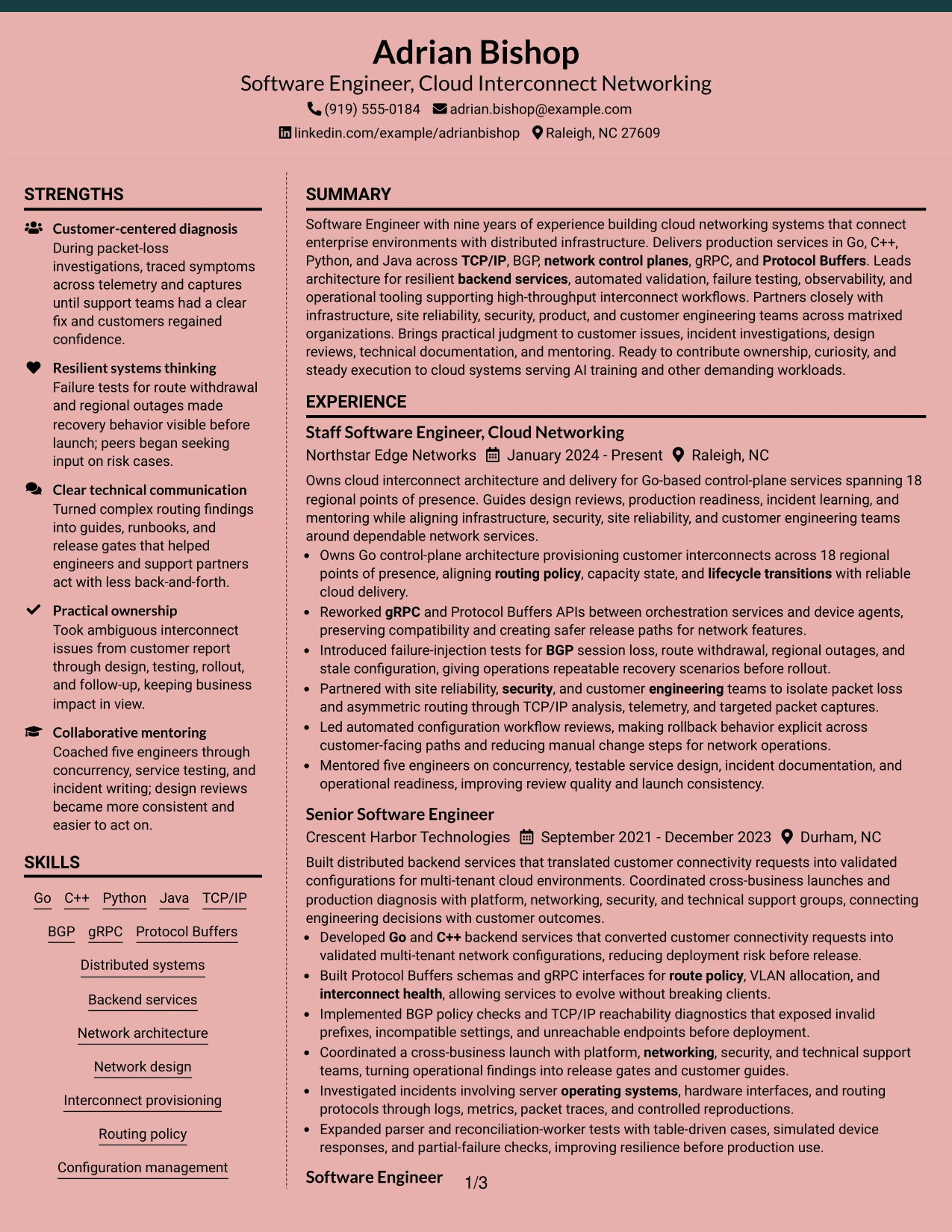
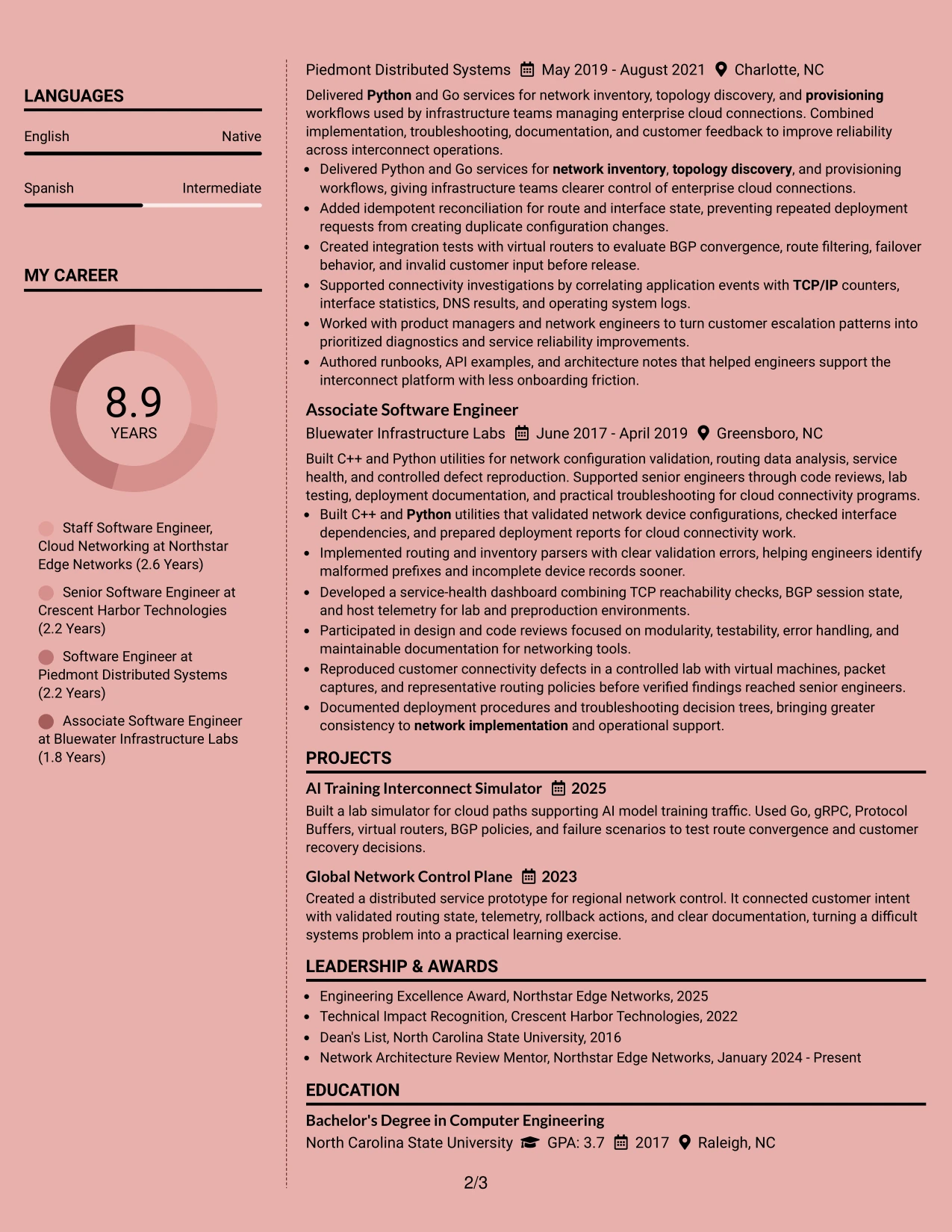
#23 Elegant Full Background Two Column Format Resume Example
For a cloud networking application, the Elegant Full Background Two Column Format creates a balanced path through the resume. A broad main column can carry the summary, experience, projects, and measurable results, while a narrower column groups skills, certifications, education, and contact details.
That structure gives a nine-year software engineering background enough room for technical evidence without making the page feel crowded. Go, C++, Python, Java, TCP/IP, BGP, gRPC, Protocol Buffers, distributed systems, and network control planes remain easy to find while detailed bullets show resilient delivery and troubleshooting work.
Why the Elegant Full Background Two Column Format Works for a Resume
- The two-column hierarchy separates detailed experience from quick-reference qualifications.
- A wide content area supports complete achievement bullets rather than short keyword fragments.
- A focused skills column makes technical terms easy to locate during a fast review.
- Projects such as AI Training Interconnect Simulator can add relevant evidence without interrupting work history.
- Education and certifications have clear supporting space below the skills group.
- The format gives failure testing, observability, and incident response enough context to show practical value.
- Strong section boundaries help readers move from summary to experience, projects, and credentials in a logical order.
Best For
- Resumes that need a clear split between detailed evidence and quick facts
- Technical profiles with both substantial experience bullets and broad skills lists
- Applications where certifications and education should remain visible beside work history
- Candidates presenting projects, tools, and accomplishments on one well-organized page
- Readers who need to scan networking keywords before reviewing technical depth
- Applications that benefit from a balanced, professional page with strong information grouping
- Resumes that combine architecture work, operational troubleshooting, and software delivery
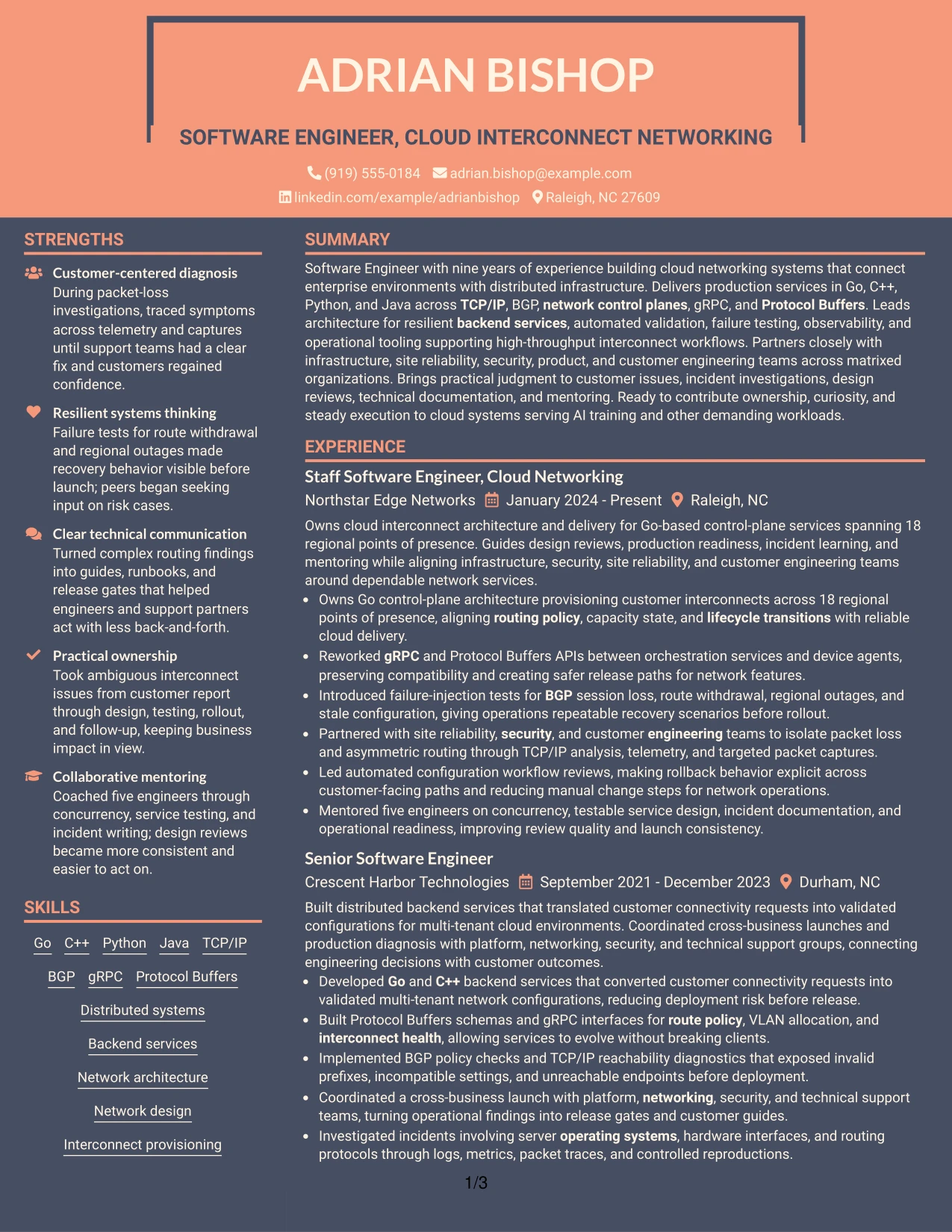
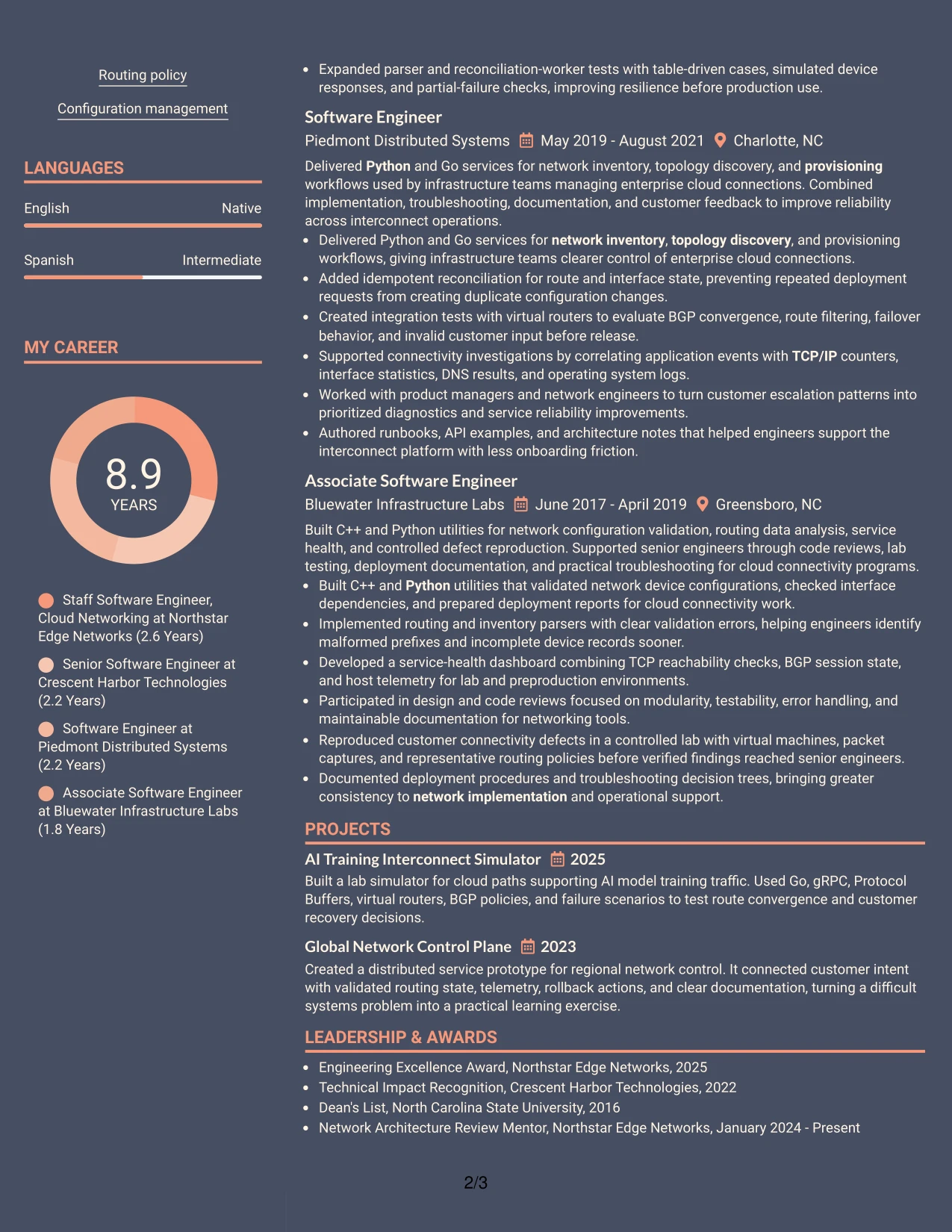
#24 Creative Two Tone Format Resume Example
A restrained visual hierarchy helps a technical resume feel distinctive while keeping its evidence easy to assess. The Creative Two Tone Format uses contrast to separate section labels from the content, so the reader can move quickly from the summary to cloud networking experience, projects, certifications, and skills.
For the Software Engineer, Cloud Interconnect Networking target, the resume can use the visual change to reinforce relevant terms without replacing substance. Bullets remain the proof: control-plane architecture, gRPC and Protocol Buffers APIs, BGP validation, packet analysis, and recovery testing.
Why the Creative Two Tone Format Works for a Resume
- Two visual tones distinguish headings from evidence without requiring long navigation.
- A single-column flow keeps experience bullets in a natural review order.
- Consistent labels give ATS-relevant sections familiar names such as Experience, Skills, and Education.
- Technical keywords appear in context instead of being isolated in a dense word list.
- Project entries can demonstrate distributed systems and AI training interconnect work.
- Achievement bullets can connect network troubleshooting to customer and operational outcomes.
- The design adds visual interest while preserving a direct, professional reading path.
Best For
- Technical resumes that need a modest visual distinction without sacrificing clarity
- Applications where one-column reading supports straightforward experience review
- Candidates whose strongest evidence comes from detailed project and work bullets
- Resumes aligning software delivery with network architecture and troubleshooting
- Profiles that need technical keywords presented in readable context
- Applications where consistent section labels support both ATS parsing and human scanning
- Documents that should look individual while remaining practical for cloud engineering review
#25 Bold Color Header Professional Format Resume Example
The Bold Color Header Professional Format places the resume's identity and section order at the top, then lets the experience record carry the review. This structure makes the target role, professional summary, and contact details clear before the reader reaches the detailed work history.
The remaining sections can follow a firm hierarchy: experience first, then projects, skills, certifications, and education. That order gives priority to evidence such as provisioning interconnects across 18 regional points of presence, improving release safety, and testing regional failure scenarios.
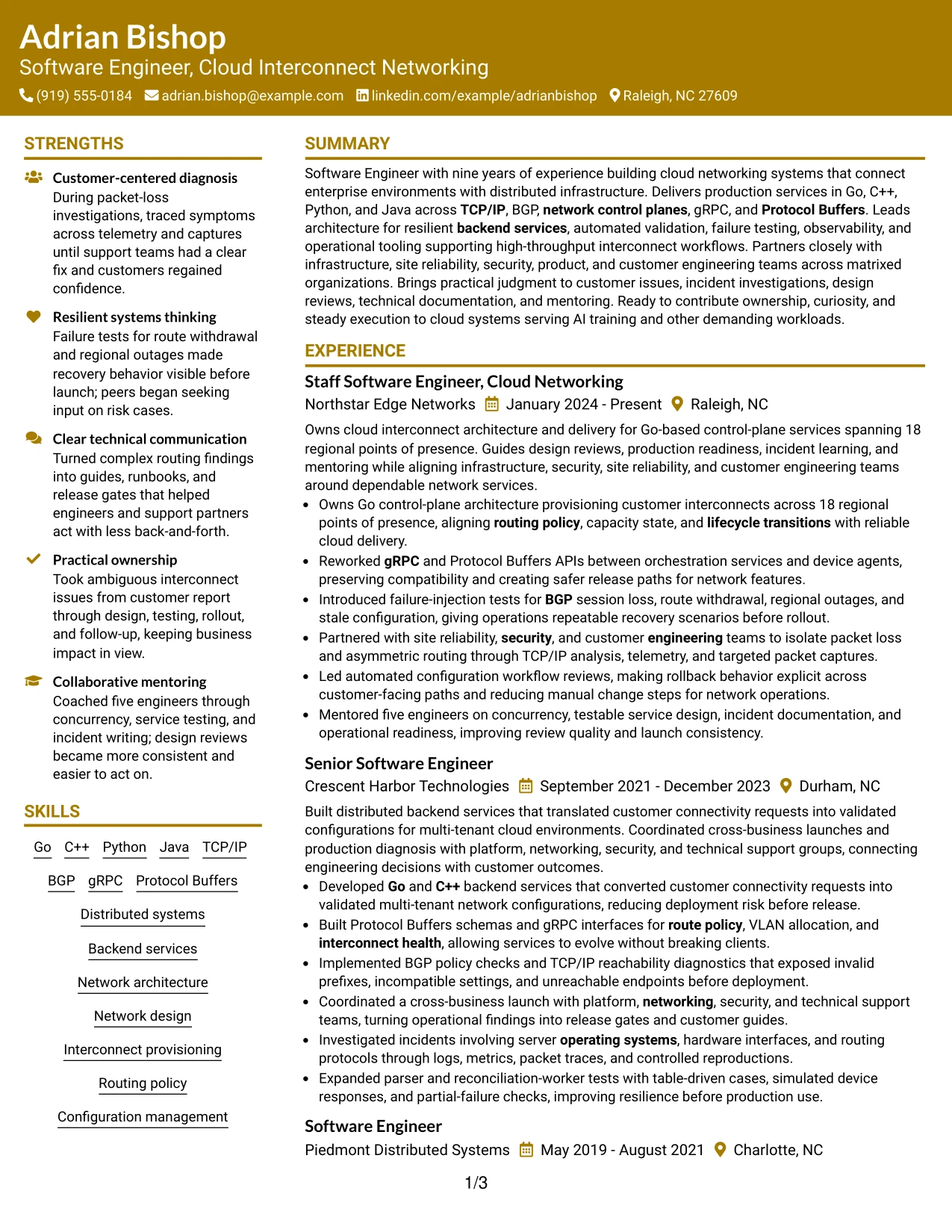
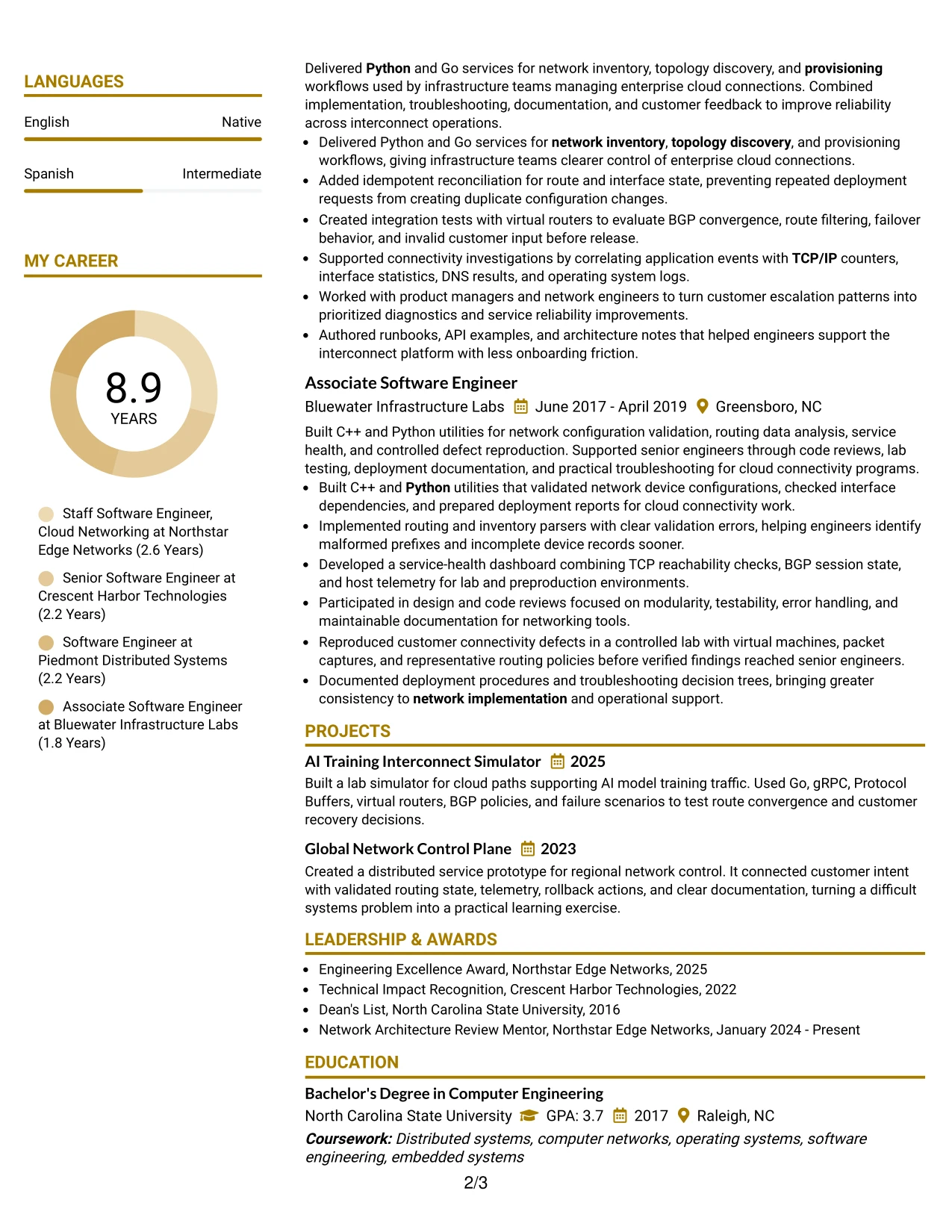
Why the Bold Color Header Professional Format Works for a Resume
- A strong header makes the target role and contact information immediately visible.
- A predictable one-column sequence supports quick scanning from summary to recent experience.
- Recent work receives priority, which helps reviewers assess current technical ownership.
- Bullets can lead with action and finish with evidence such as regional scope or recovery coverage.
- Skills remain available for keyword matching without competing with experience details.
- Projects and certifications add supporting proof after the main employment record.
- Clear section hierarchy reduces the risk that important networking or software terms are overlooked.
Best For
- Resumes where recent technical ownership should lead the review
- Applications requiring a strong first-screen header and direct contact details
- Candidates with a substantial employment record that benefits from chronological emphasis
- Documents that must present role keywords before deeper technical evidence
- Profiles combining production services, network design, and operational responsibility
- ATS-conscious resumes using conventional section order and readable text flow
- Applications where projects and certifications support, rather than compete with, experience
#26 Photo Header Color Sidebar Format Resume Example
Readers can begin with the header and sidebar for identity, contact details, skills, and credentials, then move into the main column for experience and projects. The Photo Header Color Sidebar Format supports that route while giving the resume a clear visual entry point.
The main content can hold detailed proof of cloud networking work, including Go control-plane services, route-policy validation, BGP diagnostics, and incident investigations. The sidebar can keep certifications, education, languages, and selected tools visible without taking space from achievement bullets.
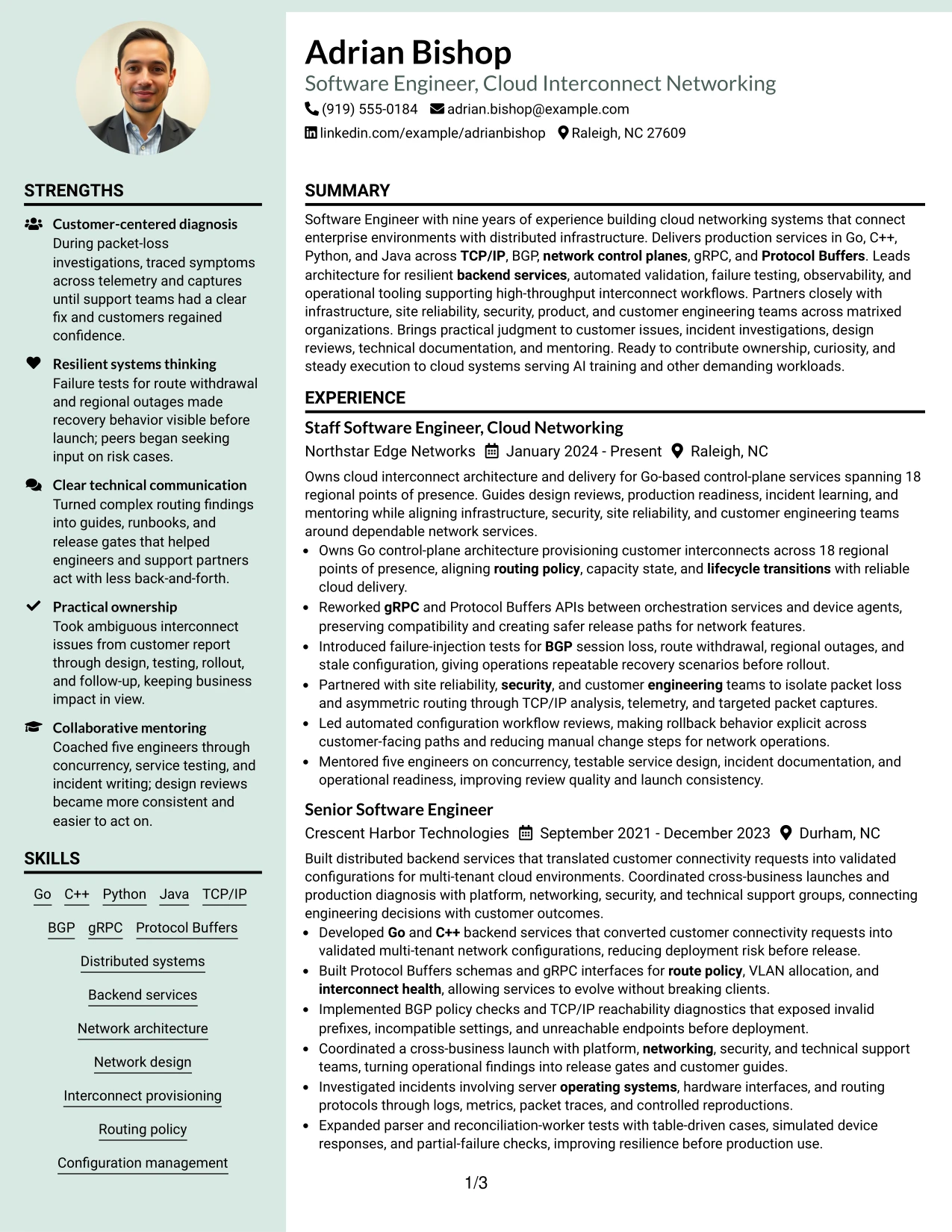
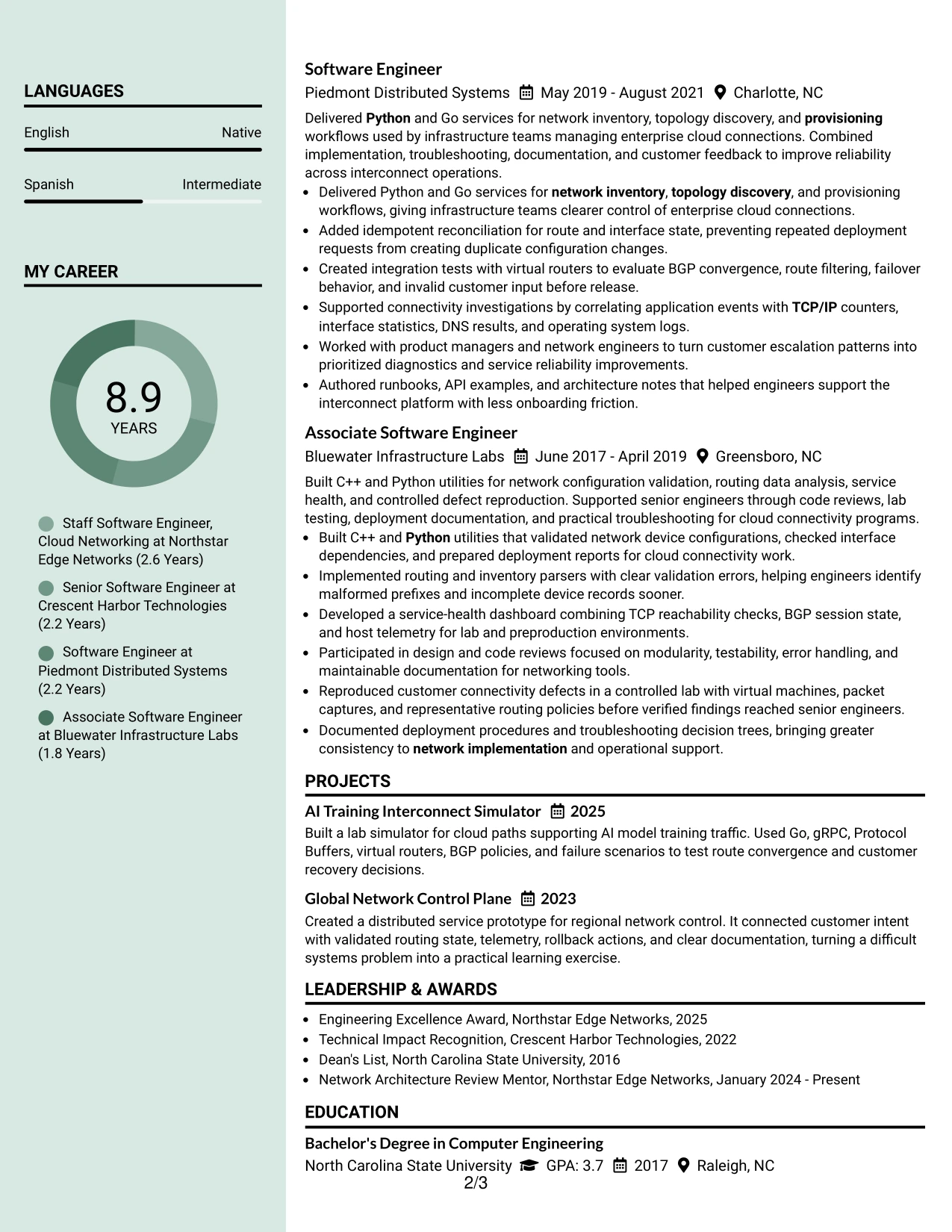
Why the Photo Header Color Sidebar Format Works for a Resume
- The header gives the document a clear starting point for identity and target-role information.
- A sidebar keeps skills, certifications, education, and languages available during the full review.
- The main column provides room for detailed experience and project descriptions.
- A professional photo can support the visual identity when appropriate for the application context.
- The separation prevents technical keywords from interrupting longer achievement bullets.
- Recent cloud networking work can remain prominent in the primary reading area.
- Projects and credentials can be grouped as supporting evidence rather than mixed into work history.
Best For
- Applications where a professional photo is appropriate and useful to the document context
- Resumes with a high volume of experience evidence and a separate credential set
- Candidates who need skills and certifications visible while readers review employment
- Profiles combining production networking, projects, languages, and technical education
- Documents that benefit from a clear main column and compact reference sidebar
- Applications where customer-facing troubleshooting and technical depth both need room
- Resumes that use a visual entry point without reducing space for substantive bullets
#27 Top Left Header Color Accent Format Resume Example
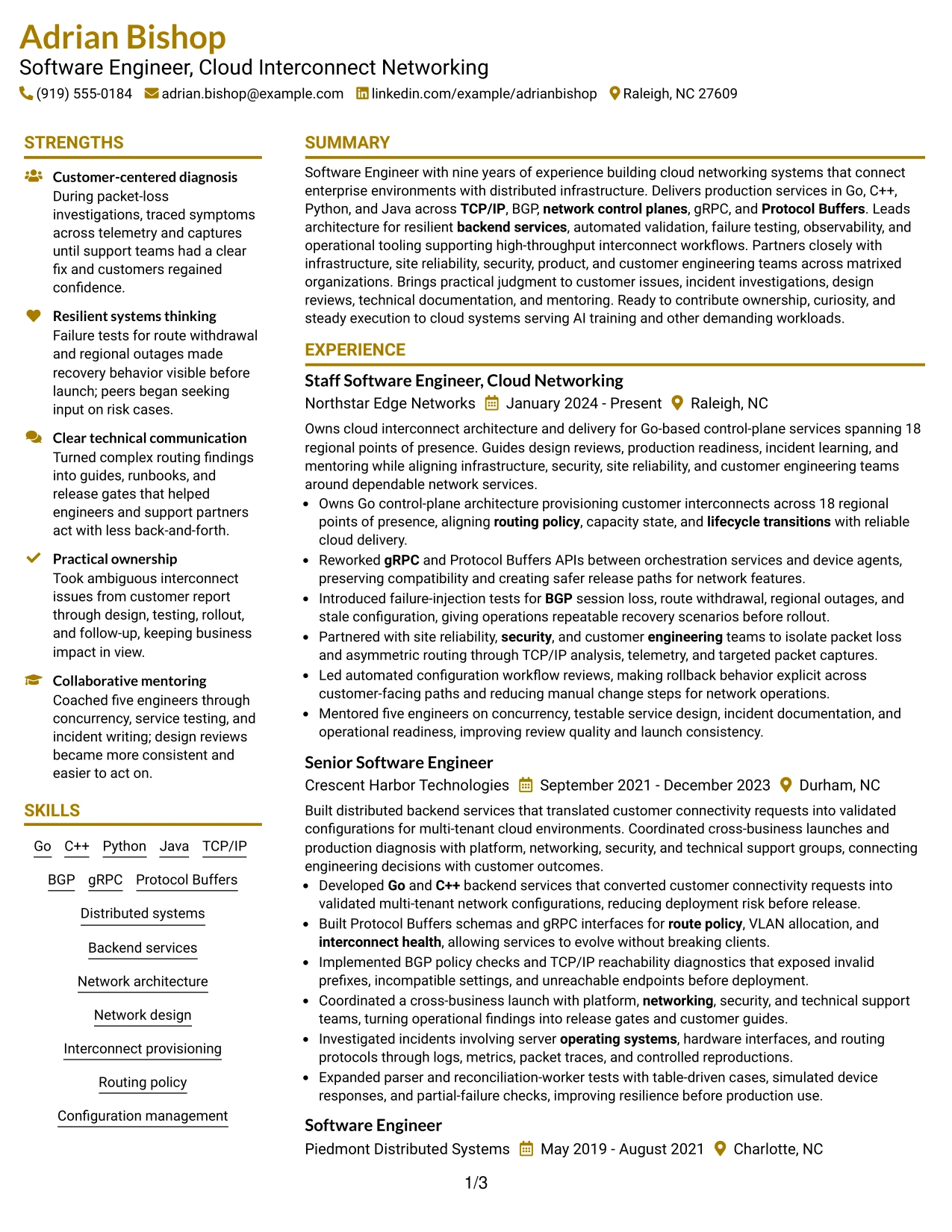
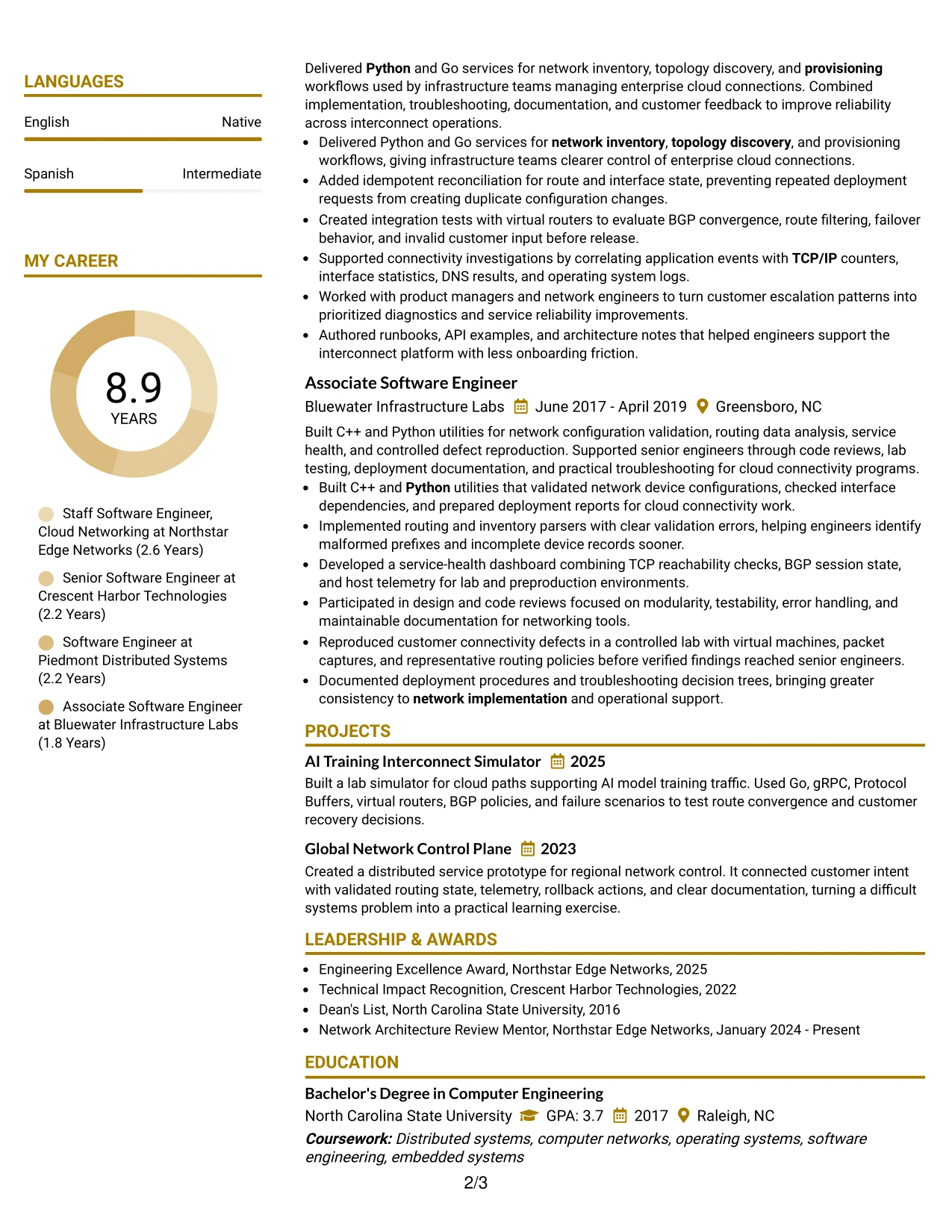
Failure testing, network troubleshooting, and resilient service delivery deserve priority in this resume because they show how the candidate handles production risk. The Top Left Header Color Accent Format places that evidence inside a compact structure where the summary and recent achievements can be found quickly.
A focused top section can identify the target role and strongest capabilities, followed by experience bullets that explain scope and results. Supporting sections then document Go, C++, Python, Java, TCP/IP, BGP, distributed systems, certifications, projects, and the Computer Engineering degree.
Why the Top Left Header Color Accent Format Works for a Resume
- The top-left entry point makes the target role and strongest qualifications easy to locate.
- Recent evidence can lead with failure testing, control-plane ownership, and network diagnosis.
- A compact one-column structure keeps bullets connected to their job context.
- Color accents distinguish sections without changing the familiar resume reading order.
- Technical skills can be grouped for keyword visibility and practical understanding.
- Projects provide additional evidence of BGP policies, virtual routers, and recovery decisions.
- Education and certifications complete the record without distracting from production results.
Best For
- Resumes that should lead with resilience, troubleshooting, and production evidence
- Applications where the strongest proof belongs near the top of the document
- Candidates presenting both software engineering results and network engineering knowledge
- Documents that need compact section separation with a conventional reading sequence
- Profiles where project work reinforces experience rather than serving as the main focus
- ATS-aware applications using familiar headings and clearly grouped technical terms
- Technical resumes that benefit from an accent while keeping evidence central
#28 Centered Header Classic Two Column Format Resume Example
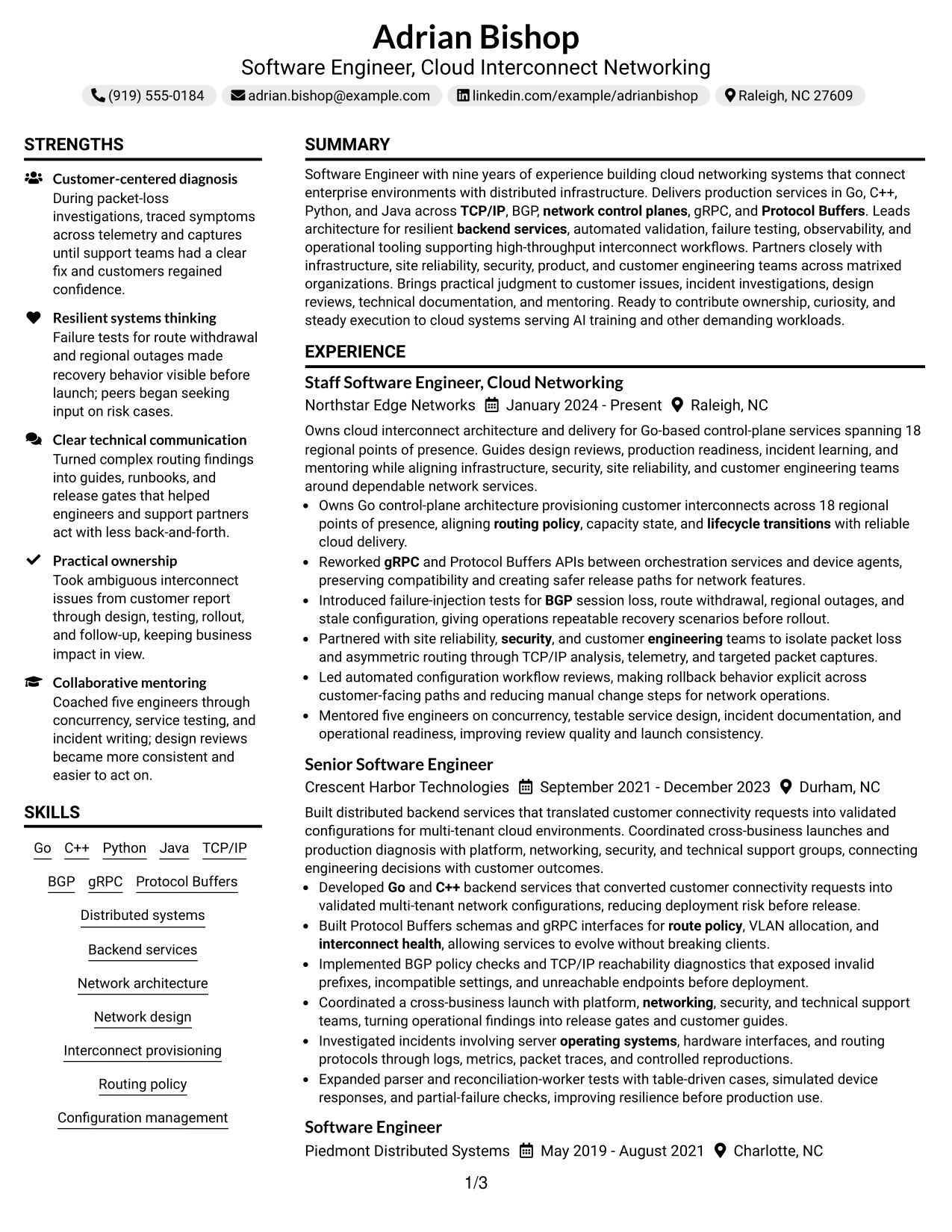
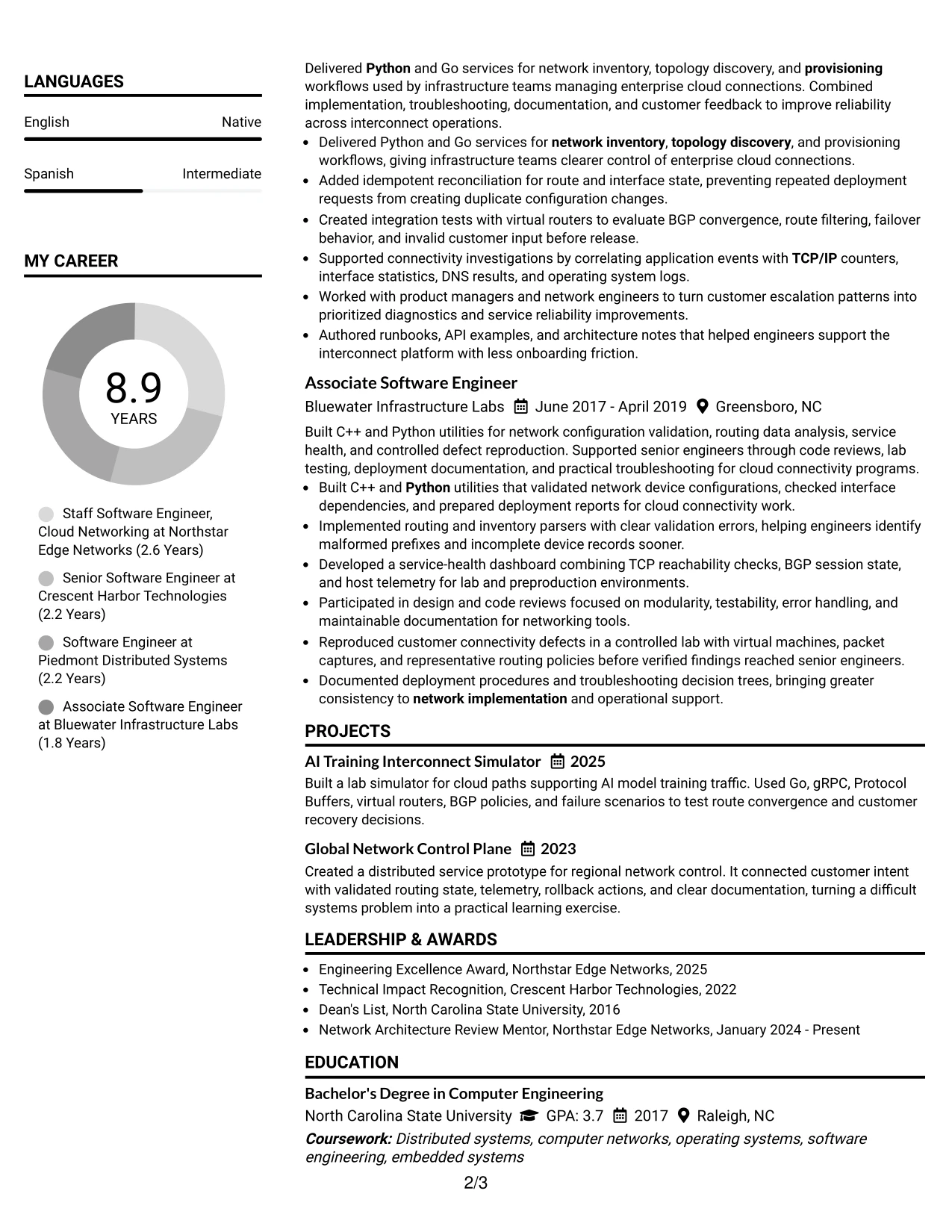
Content is balanced between a detailed experience column and a compact reference column, giving each major resume section a clear place. The Centered Header Classic Two Column Format creates a calm starting point, then divides work history from skills, education, certifications, and selected projects.
That balance suits a technical record with substantial detail. The main column can explain architecture decisions, API changes, diagnostics, and incident work, while the secondary column keeps Go, C++, Python, Java, TCP/IP, BGP, Linux, testing methods, and credentials easy to scan.
Why the Centered Header Classic Two Column Format Works for a Resume
- A centered header gives the resume a stable opening before the columns divide information.
- The main column supports full achievement bullets with technical and operational context.
- The secondary column makes skills, education, and certifications quick to reference.
- Classic bullets keep each contribution distinct and easy to compare across roles.
- Projects can fit beside employment details without forcing a long skills block into the main flow.
- The format supports both keyword review and deeper reading of distributed backend work.
- Balanced spacing helps a detailed technical history remain readable across multiple sections.
Best For
- Applications needing a traditional presentation with efficient two-column organization
- Resumes that must show detailed employment history beside a broad technical toolkit
- Candidates with credentials and projects that deserve persistent visibility
- Documents reviewed by readers who compare skills with experience side by side
- Profiles combining backend services, network protocols, testing, and operations
- Applications where centered identity information creates a formal first impression
- Technical resumes that need high information value without a dense single-column page
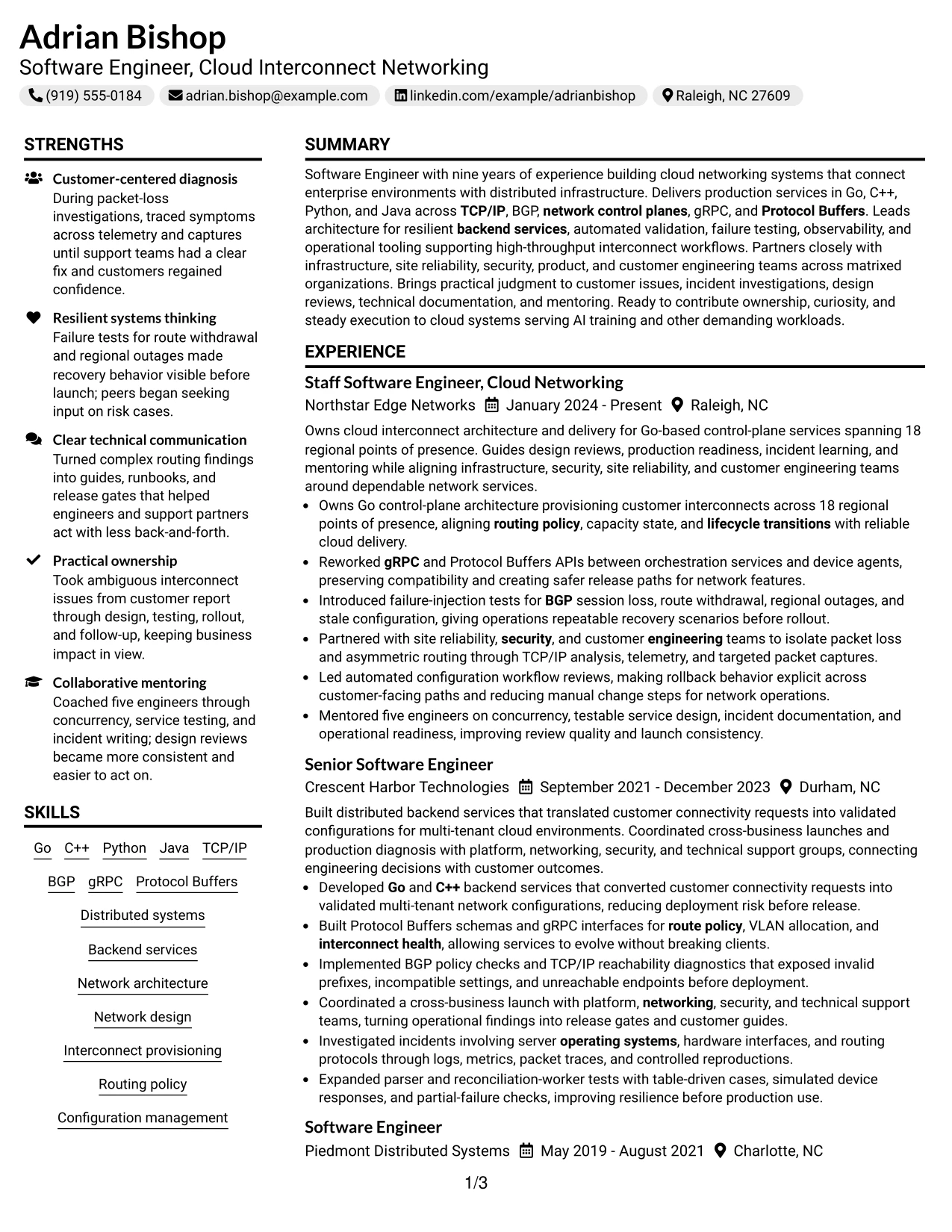
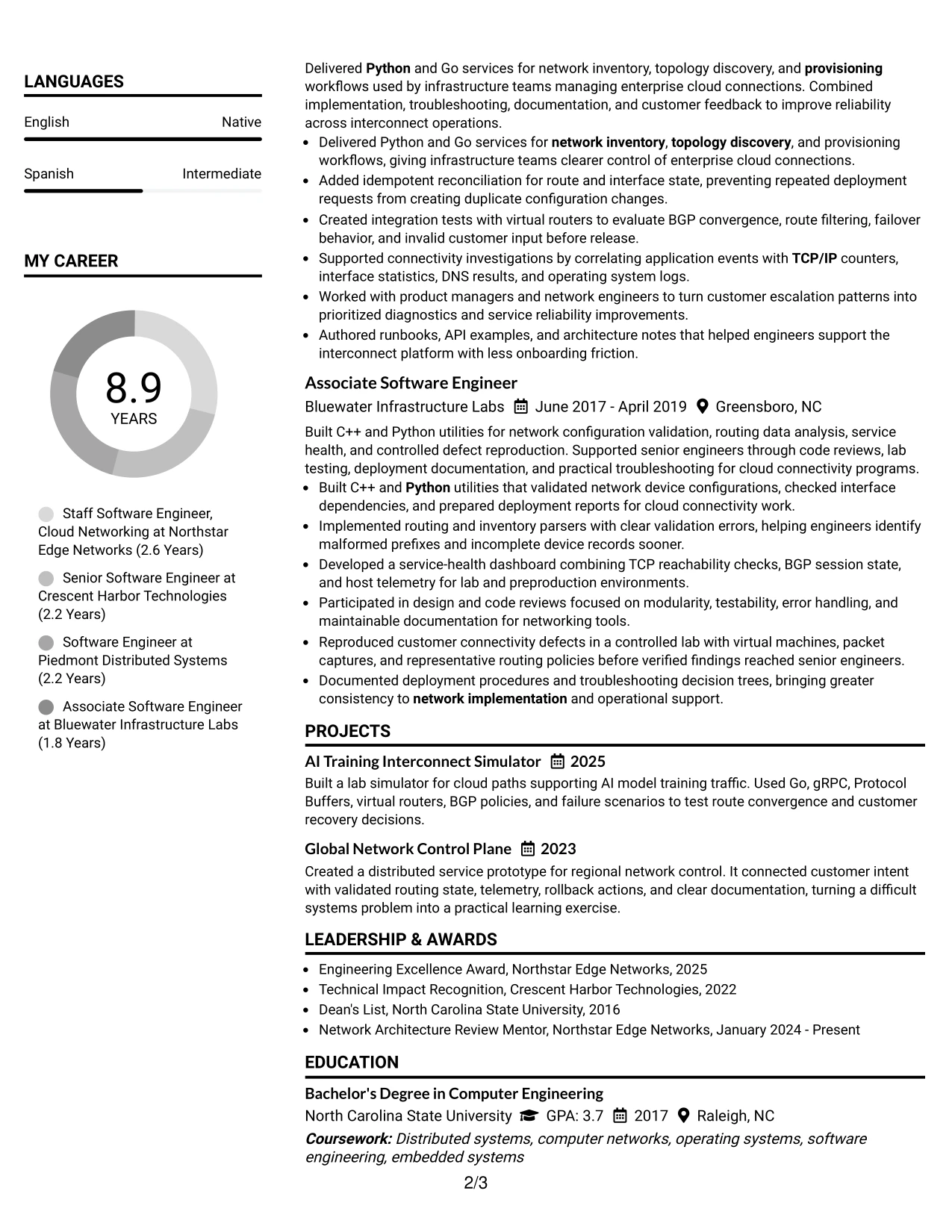
#29 Left Aligned Header Clean Two Column Format Resume Example
For a straightforward technical application, the Left Aligned Header Clean Two Column Format gives the resume a practical entry point and keeps information grouped by review purpose. The larger column can carry the summary, experience, and projects, while the smaller column presents skills, certifications, education, and supporting details.
This arrangement fits the target role because the resume must show both software delivery and network depth. Clear bullets can document interconnect provisioning, reconciliation, route policy, customer issue diagnosis, integration testing, observability, and technical documentation without burying the relevant keywords.
Why the Left Aligned Header Clean Two Column Format Works for a Resume
- A left-aligned header supports fast orientation and a natural top-to-bottom review.
- The main column gives experience bullets enough width for actions, tools, and outcomes.
- A secondary column keeps credentials and technical categories easy to revisit.
- Clean spacing helps readers distinguish roles, dates, projects, and skills.
- The format supports a strong mix of software, networking, and operational evidence.
- Keywords such as reconciliation, route policy, observability, and integration testing remain visible.
- A restrained structure keeps the resume professional while preserving useful content volume.
Best For
- Technical applications that need practical grouping without decorative complexity
- Candidates whose experience bullets require more width than a narrow column allows
- Resumes pairing cloud networking work with clearly categorized skills and credentials
- Readers who prefer left-to-right organization and familiar section placement
- Profiles showing implementation, troubleshooting, testing, and documentation together
- Applications where projects should extend the evidence without taking over the page
- Documents needing a clean visual system for dense but relevant technical information
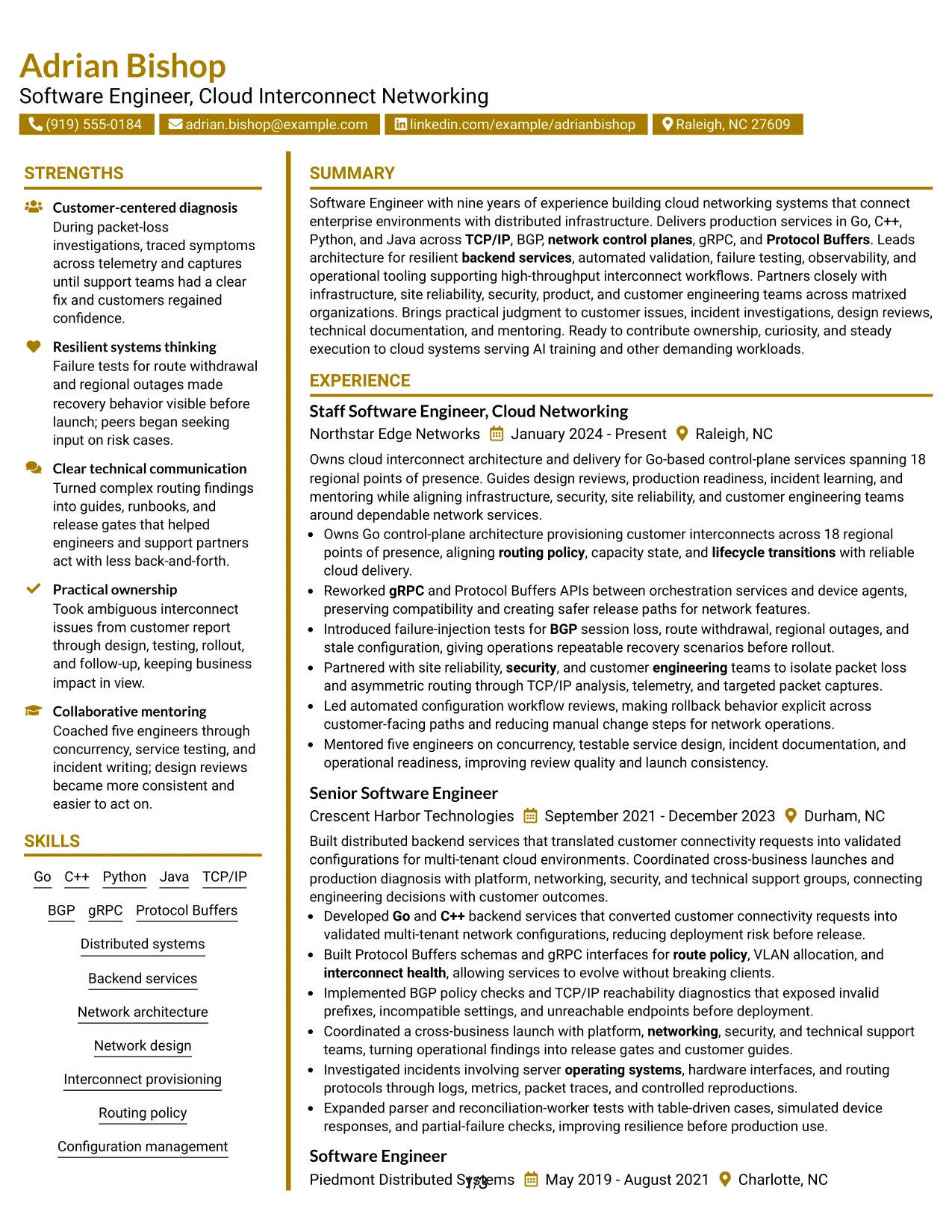
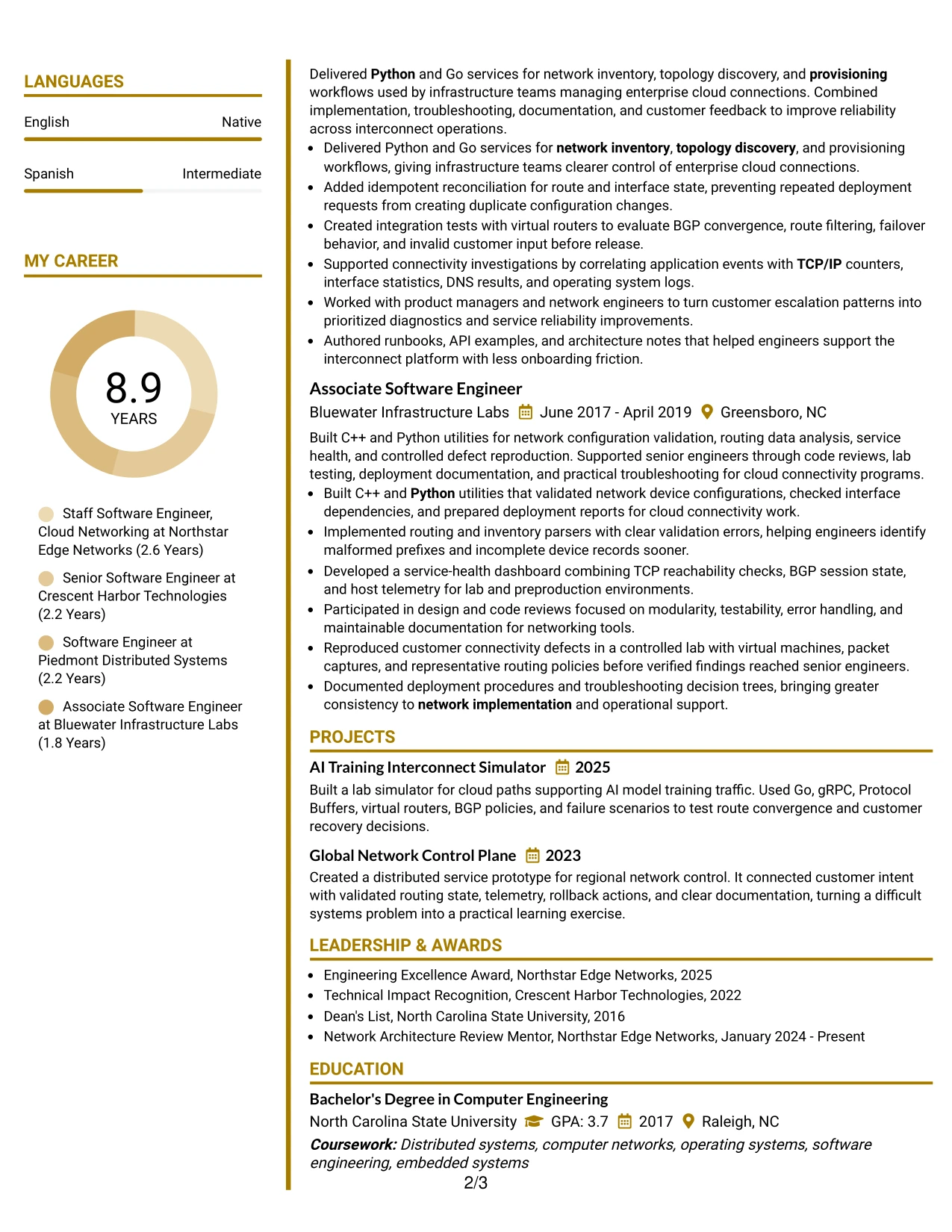
#30 Accent Divider Modern Two Column Format Resume Example
Clear dividers give a modern resume a restrained visual character while keeping the evidence in control. The Accent Divider Modern Two Column Format can separate experience and projects from skills, education, certifications, and other supporting sections without adding unnecessary visual noise.
The document remains centered on the target role's technical requirements. Recent bullets can show Go control-plane architecture, backward-compatible gRPC and Protocol Buffers APIs, BGP failure testing, packet analysis, and mentoring, while the supporting column reinforces the matching tools and credentials.
Why the Accent Divider Modern Two Column Format Works for a Resume
- Accent dividers mark section changes without disrupting the resume's evidence-first flow.
- Two columns separate detailed accomplishments from compact qualifications.
- Modern spacing helps technical terms remain readable rather than appearing as a dense block.
- Experience bullets can show ownership, scope, testing, and operational consequences.
- The skills area can reinforce Go, gRPC, Protocol Buffers, BGP, and network architecture.
- Projects and certifications add targeted support for cloud interconnect work.
- The layout gives a contemporary impression while retaining familiar resume mechanics.
Best For
- Technical applications seeking a modern look with disciplined section boundaries
- Resumes that need separate zones for achievement evidence and qualification keywords
- Candidates presenting current architecture ownership alongside practical delivery details
- Profiles where projects and certifications should reinforce a clearly defined role target
- Readers who value visual landmarks during a fast technical review
- Documents combining software interfaces, routing protocols, and operational readiness
- Applications that need contemporary presentation without sacrificing conventional structure
#31 Shaded Labels Clean Two Column Format Resume Example
The Shaded Labels Clean Two Column Format uses firm section labels to organize a technical resume into predictable review blocks. Experience and projects can occupy the primary column, while the secondary column groups skills, certifications, education, awards, and languages under clearly marked labels.
That structure supports ATS-conscious writing because each block has a recognizable purpose. It also gives detailed evidence room to explain distributed backend services, network design, customer troubleshooting, failure injection, observability, and documentation rather than reducing the record to isolated keywords.
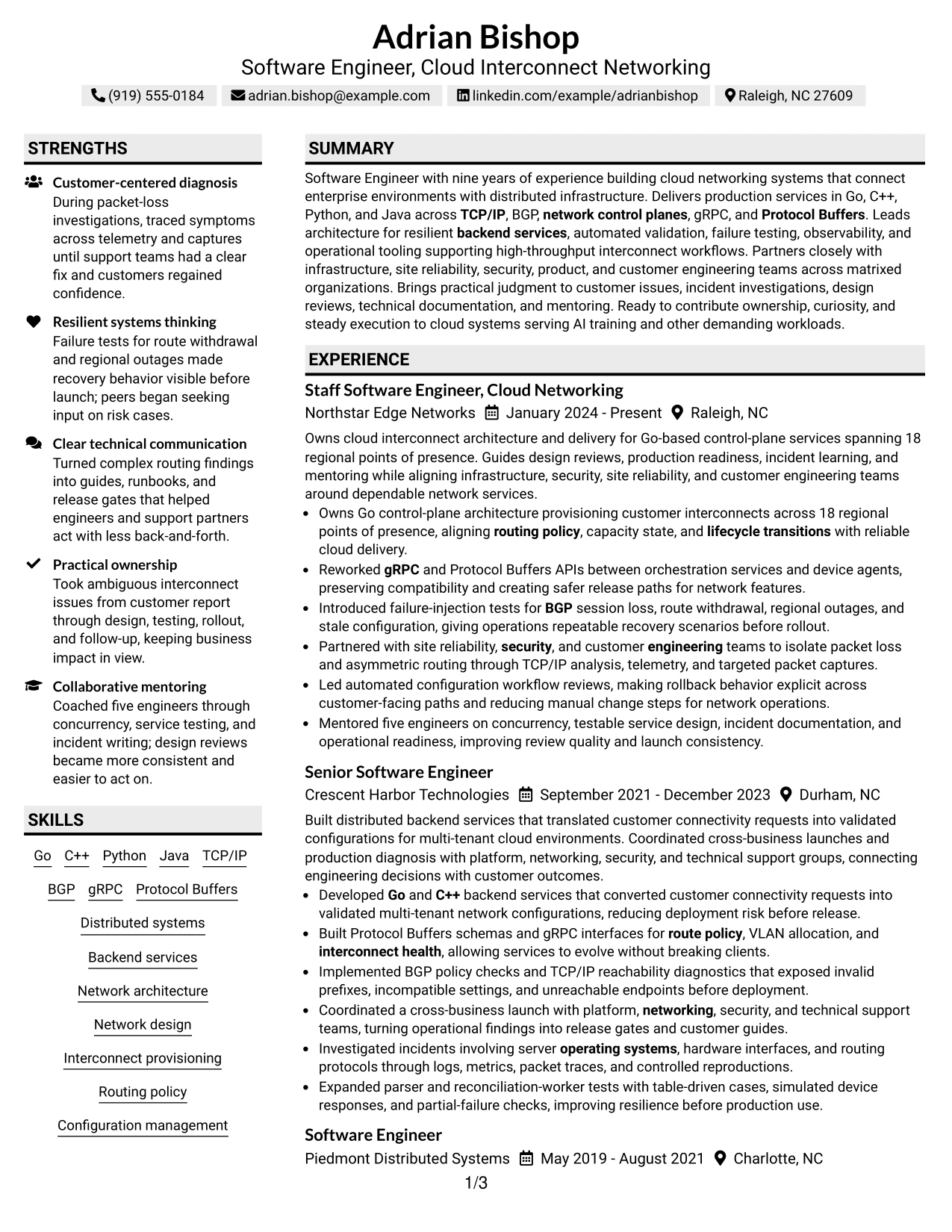
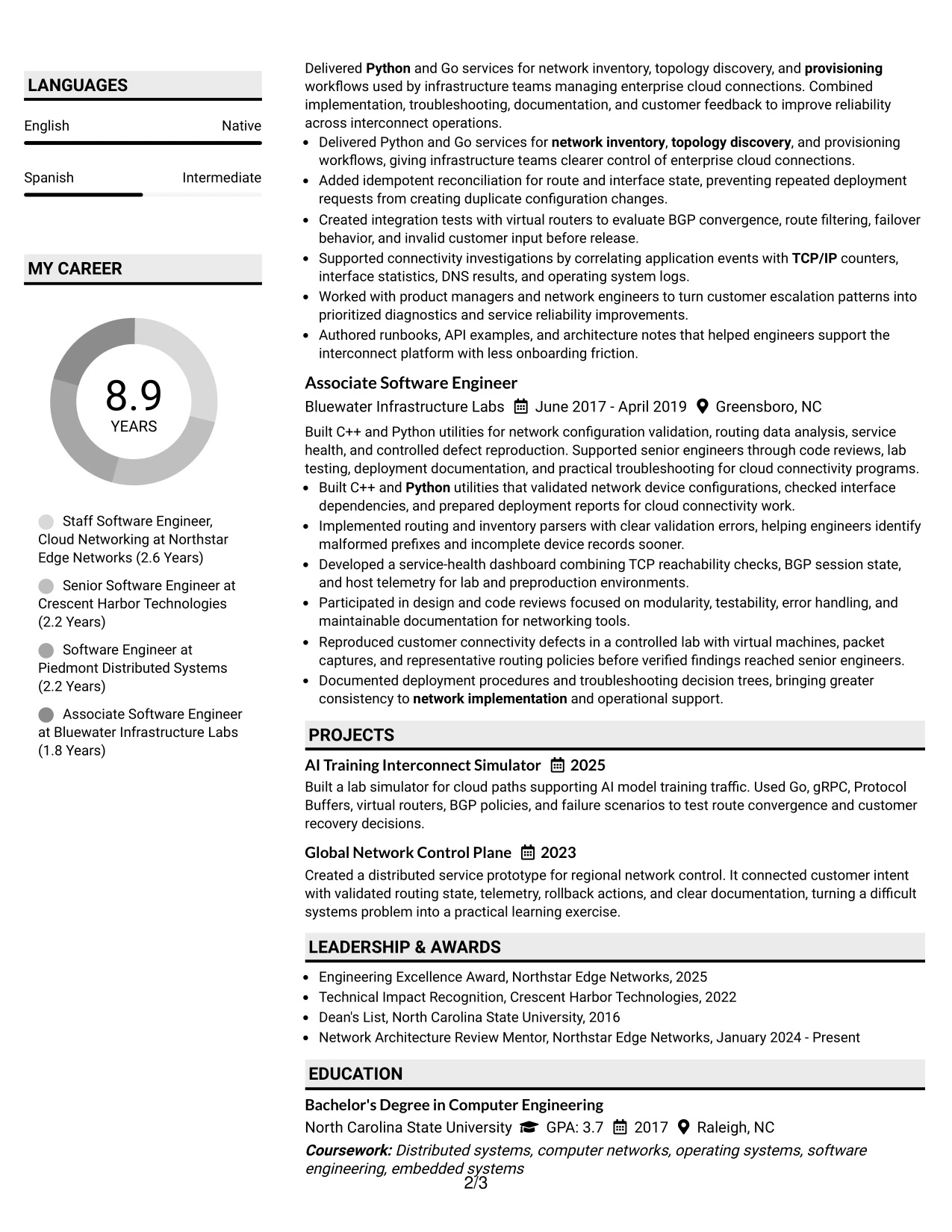
Why the Shaded Labels Clean Two Column Format Works for a Resume
- Shaded labels make major sections easy to identify during a quick scan.
- Two-column organization separates evidence-heavy content from supporting qualifications.
- Recognizable headings help ATS tools and readers interpret the resume structure.
- Bullets can preserve technical context around tools, protocols, and service outcomes.
- A dedicated skills area keeps role keywords visible without repeating them in every bullet.
- Projects and awards can add proof of technical impact in compact blocks.
- The clean format supports a detailed record while controlling visual density.
Best For
- ATS-conscious resumes that still need strong visual grouping for human readers
- Applications with many supporting sections such as certifications, awards, and languages
- Candidates whose work history requires detailed bullets and technical context
- Profiles that benefit from consistent labels across experience, projects, and skills
- Documents where a secondary column can hold credentials without reducing evidence space
- Readers scanning for network protocols, programming languages, and testing methods
- Technical applications that favor order, clarity, and efficient information retrieval
#32 Photo Header Color Accent International Format Resume Example
Readers can start with the header, photo, role title, and contact details, then follow the accent-led sections through experience, skills, projects, education, and certifications. The Photo Header Color Accent International Format creates a clear route through a broad professional record while leaving room for languages and cross-functional work.
For this resume, the main evidence remains technical: cloud interconnect architecture, Go and C++ services, TCP/IP and BGP troubleshooting, gRPC interfaces, failure testing, and distributed systems. A separate skills or language area can support international and cross-team readability without weakening the achievement bullets.
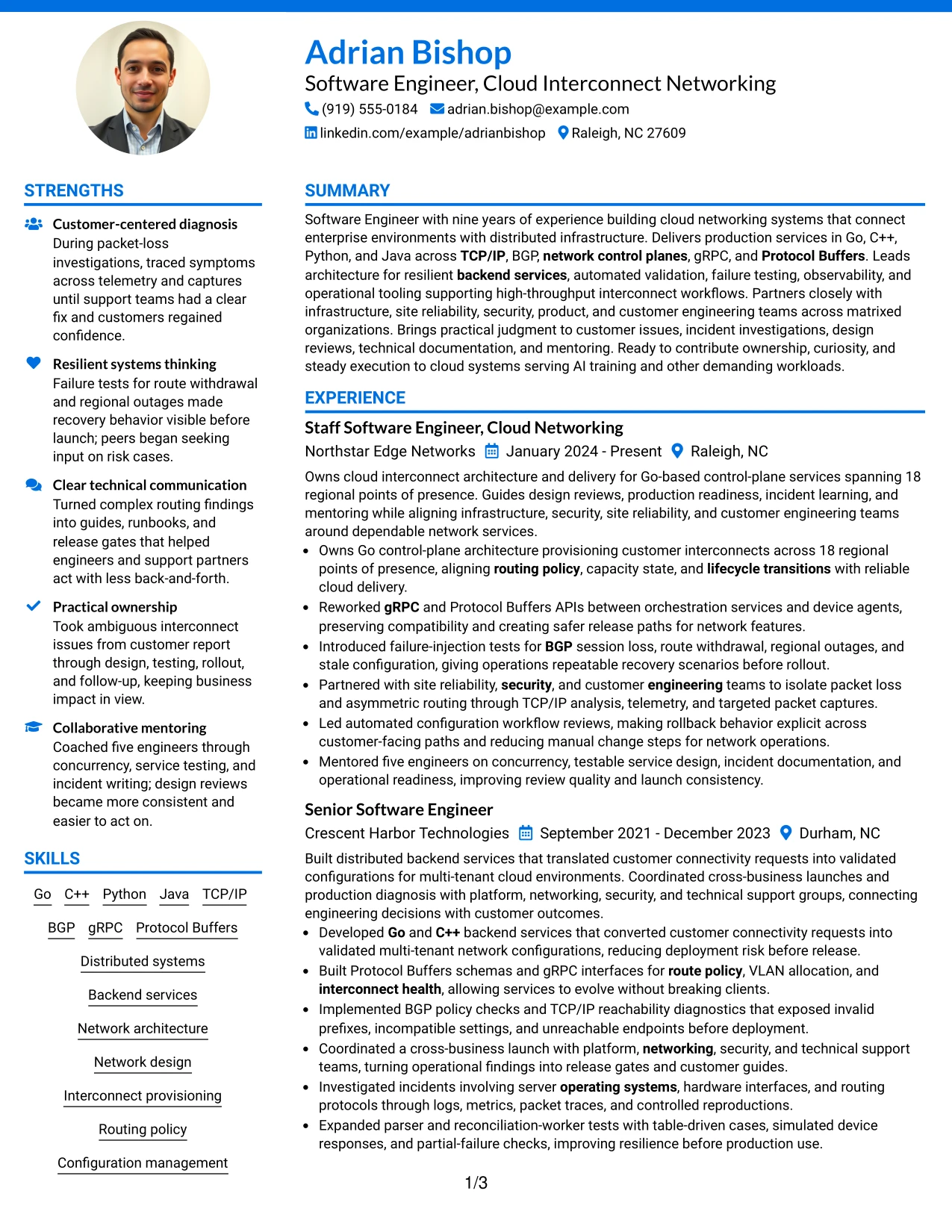
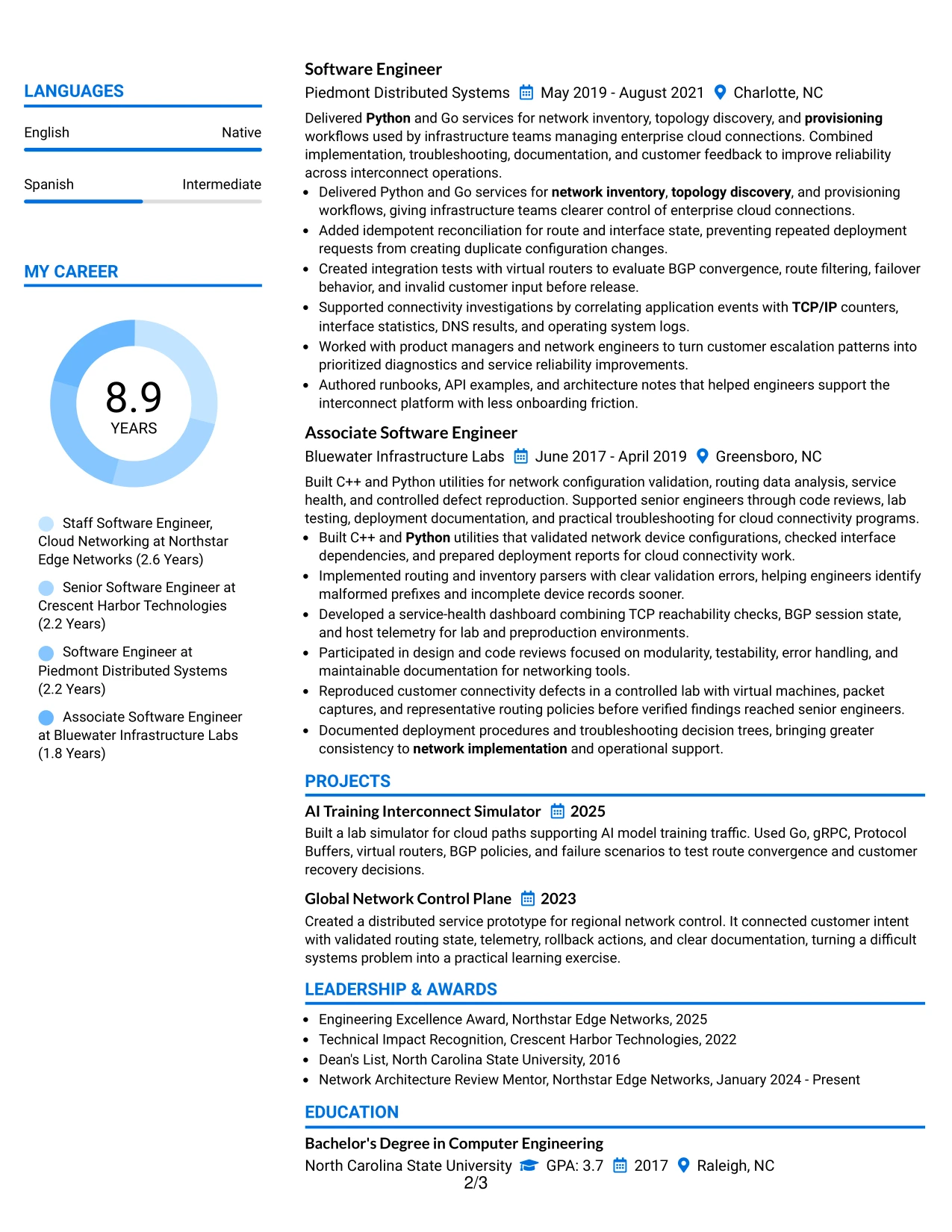
Why the Photo Header Color Accent International Format Works for a Resume
- The header and professional photo provide a clear visual starting point when appropriate for the application.
- Color accents help readers distinguish experience, skills, projects, and credentials.
- The format can keep English and Spanish language information easy to locate.
- A broad content structure supports both technical depth and cross-functional delivery evidence.
- Detailed bullets remain available for network incidents, API design, and resilience work.
- Certifications and education can appear as supporting proof without interrupting experience.
- The route through the document suits readers reviewing several qualification categories in sequence.
Best For
- Applications where a professional photo and language details fit the document context
- Resumes combining technical depth with work across infrastructure, security, and support teams
- Candidates with substantial experience, projects, credentials, and supporting activities
- Profiles needing visible language information alongside software and networking qualifications
- Documents where accent colors guide readers through a broad set of sections
- Applications that value both customer issue resolution and distributed systems evidence
- Technical resumes requiring a clear route through many qualification categories
#33 Large Profile Photo International Two Column Format Resume Example
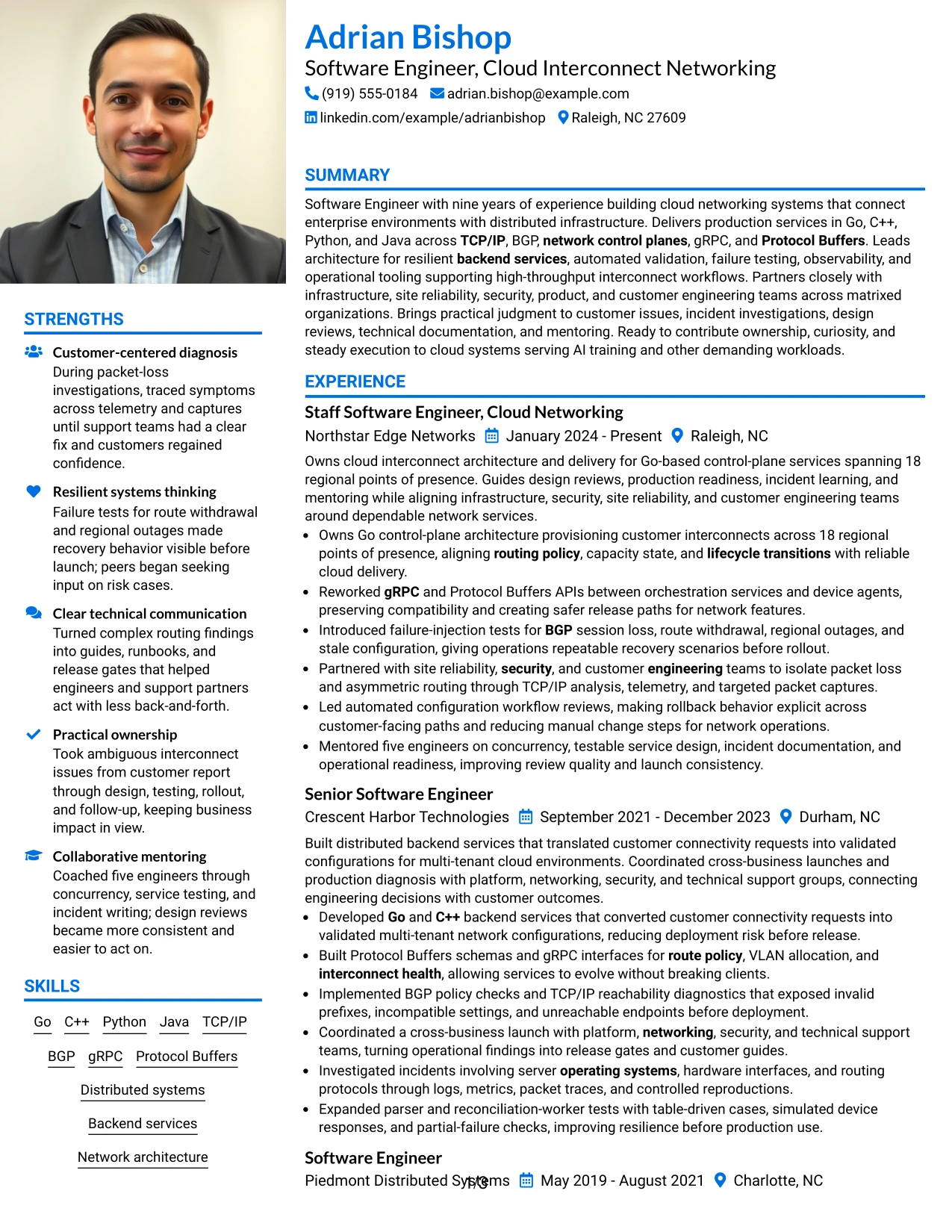
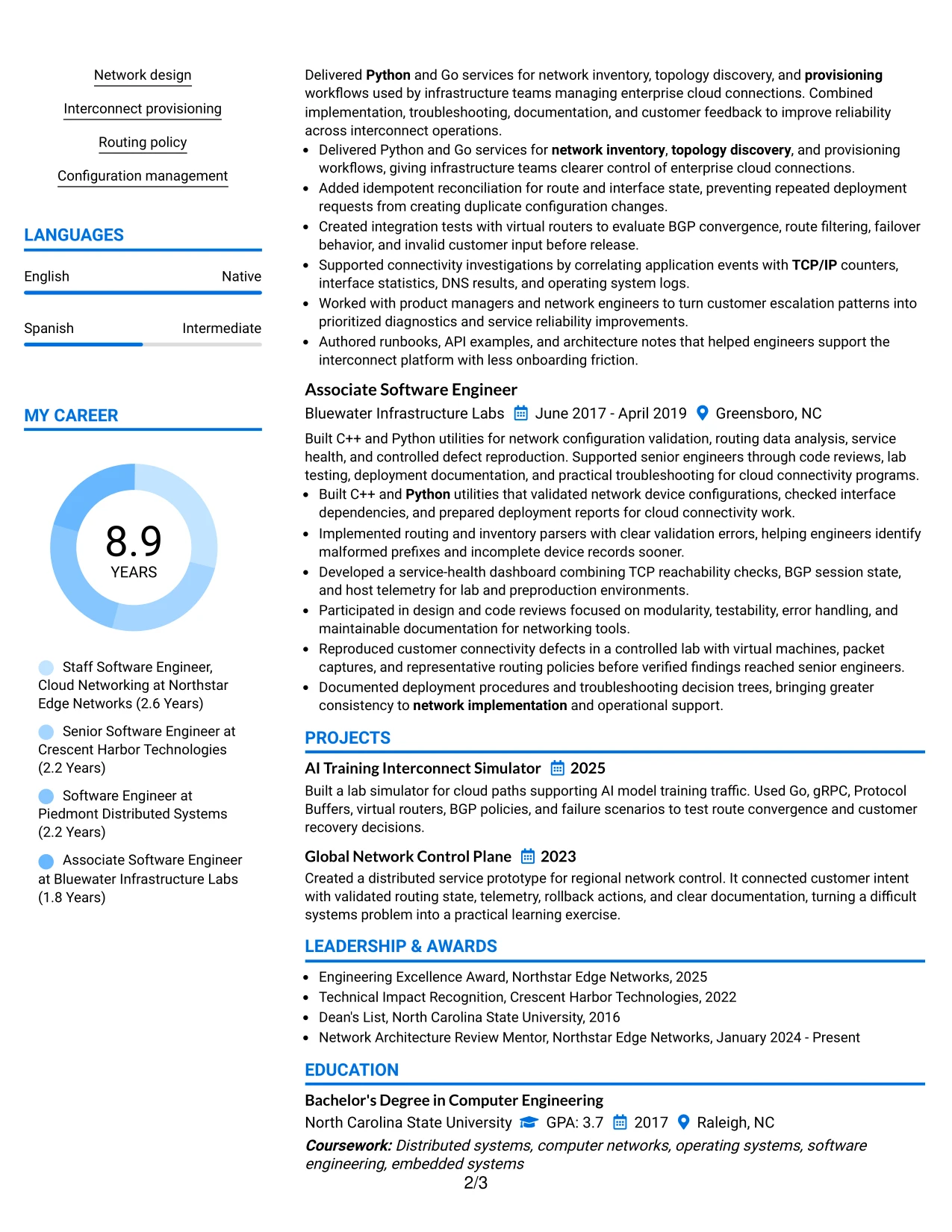
The strongest evidence should lead the review: cloud networking ownership, resilient backend services, and measurable scope such as interconnect provisioning across 18 regional points of presence. The Large Profile Photo International Two Column Format places that experience in a structured two-column resume while giving the header a prominent visual identity.
A broad main column can present the summary, employment history, projects, and achievement bullets. The secondary column can hold skills, certifications, education, languages, awards, and activities, keeping Go, BGP, TCP/IP, gRPC, Protocol Buffers, and network architecture visible throughout the review.
Why the Large Profile Photo International Two Column Format Works for a Resume
- Experience leads the review, so architecture ownership and delivery scope remain prominent.
- A large professional photo can support the header when appropriate for the application context.
- The two-column structure holds a high volume of technical and supporting content.
- The main column provides room for detailed bullets and project descriptions.
- The secondary column keeps languages, certifications, education, and activities easy to find.
- International and cross-functional details can sit beside, rather than inside, technical achievements.
- The layout supports a complete resume record without forcing every section into one narrow stream.
Best For
- Applications where a prominent professional photo is suitable for the document context
- Candidates with extensive evidence that needs a main column and reference column
- Profiles combining technical achievements with languages, activities, and certifications
- Resumes where employment history and project work should receive the greatest space
- Readers who need quick access to credentials while reviewing detailed architecture work
- Applications supporting a broad professional record with international presentation needs
- Technical documents that must show both high evidence volume and clear section separation
Why Build Your Software Engineer, Cloud Interconnect Networking Resume with ResumeInMinutes
ResumeInMinutes helps you turn technical work into a structured resume that is easy to scan, edit, and compare. Use the document to connect languages, protocols, system design, testing methods, projects, certifications, and measurable delivery evidence to the target role.
- ATS-friendly section structure
- Role-focused resume formats
- Keyword-focused content
- Skills and tools organization
- Project and achievement guidance
- Free PDF resume previews
Choose a layout that gives priority to technical evidence. A clear experience section can show control-plane ownership, distributed backend services, BGP validation, failure testing, customer diagnosis, and cross-functional launches while keeping the page readable for both ATS software and technical reviewers.
See Also
- 33 Senior Lead Software Engineer, DevOps (Cloud Operations Resilience Engineering) Resume Templates with Example 2026 (ATS-Optimized)
- 33 Infrastructure/Networking Engineer II Resume Templates with Example 2026 (ATS-Optimized)
- 33 Lead QA Automation Engineer (Python, Networking & AI-Assisted Testing) Resume Templates with Example
- 33 AI/ML Engineer Intern, Cloud & Developer Infra Resume Templates with Example 2026 (ATS-Optimized)
- 33 Applied AI Research Engineer - Production ML & Cloud Resume Templates with Example 2026 (ATS-Optimized)
- 33 Associate Cloud Engineer Resume Templates with Example 2026 (ATS-Optimized)
- 33 Azure Cloud Engineer Resume Templates with Example
- 33 Cloud DevOps Engineer Resume Templates with Example 2026 (ATS-Optimized)
- 30+ Software Engineer, Cloud Interconnect Networking Cover Letter Templates with Example 2026
- 30+ Senior Lead Software Engineer, DevOps (Cloud Operations Resilience Engineering) Cover Letter Templates with Example 2026
Frequently Asked Questions
Are these Software Engineer, Cloud Interconnect Networking resume templates ATS-friendly?
Yes. The formats use clear headings and readable section structures. Strengthen ATS matching with accurate terms such as Go, C++, Python, TCP/IP, BGP, gRPC, Protocol Buffers, distributed systems, network design, and network troubleshooting.
Are these 33 different resumes?
No. The guide presents one Software Engineer, Cloud Interconnect Networking resume example in different layouts and design themes. Compare the formats, then adapt the content and section order to your evidence.
What should a Software Engineer, Cloud Interconnect Networking resume include?
Include a targeted summary, technical skills, experience, education, projects, certifications, and measurable achievements. Highlight cloud interconnects, control-plane services, network protocols, backend systems, testing, observability, and customer issue resolution when supported by your work.
How should I describe cloud networking experience on my resume?
State what you built or changed, name the relevant system or protocol, and show the result. For example, describe interconnect provisioning, BGP policy checks, route convergence testing, API improvements, recovery scenarios, or regional scope without overstating the outcome.
Which resume style works best for this networking software role?
A clean one-column format is usually the safest choice because it supports ATS parsing and a logical review order. Use restrained design and enough white space so technical keywords, project scope, and achievement bullets remain easy to find.
How can I show quality and reliability in my resume bullets?
Point to evidence such as well-factored services, testable code, failure injection, integration testing, rollback design, observability, controlled reproductions, incident investigations, or documentation that improved operational readiness.
Should I include a photo on my resume?
For U.S. applications, a no-photo resume is generally the safer option. Use the available space for relevant skills, experience, projects, certifications, and results.
Can I customize these resume templates?
Yes. Adjust the resume text, section order, skills, project details, and layout for the Software Engineer, Cloud Interconnect Networking position. Keep every keyword and achievement accurate to your documented experience.