33 VP of Engineering - Python Resume Templates with Example 2026 (ATS-Optimized)
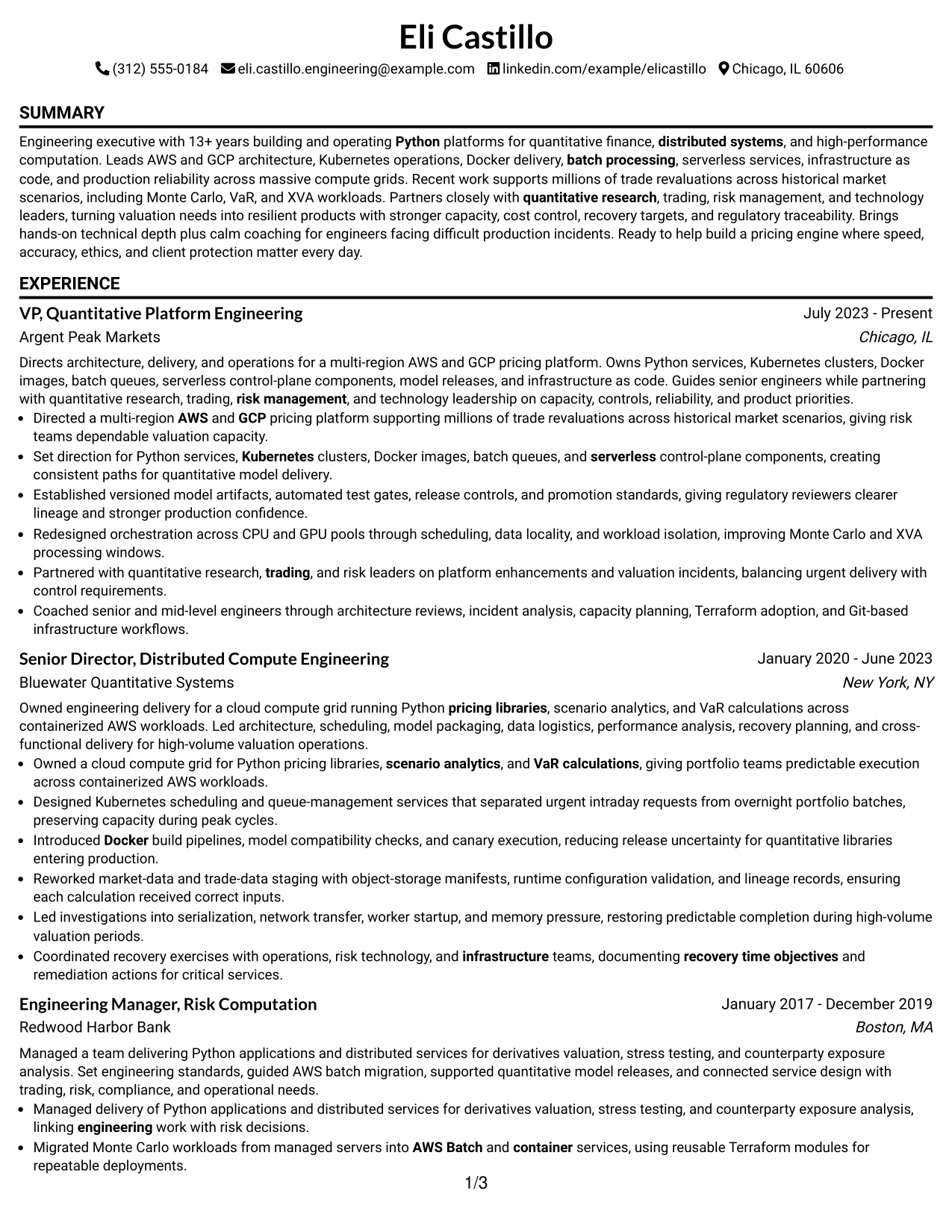
This guide shows you how to build a VP of Engineering - Python resume that is clear, focused, and easy to adapt. You will learn how to present technical leadership and operating responsibility so the value of your work is clear during a fast resume review.
Strong resumes for this role connect leadership scope to evidence: distributed platforms operated, pricing workloads supported, reliability improved, and engineers coached. The examples below are presented in 33 ATS-friendly layouts, giving you practical formats to compare while keeping the content structured for role-specific clarity.
The guidance focuses on Python engineering, AWS and GCP, Kubernetes, Docker, batch and serverless services, infrastructure as code, performance tuning, and financial pricing systems. It also explains how to show work with quantitative research, trading, and risk teams through concise bullets, relevant keywords, and measurable operational results.
What Makes a Great VP of Engineering - Python Resume in 2026
An effective resume for this role is evidence-first, technically precise, and built for rapid scanning. It should show that you can set architecture direction, run large-scale compute, manage delivery risk, and turn complex valuation needs into dependable production systems.
- Use a focused summary that names the target role and connects executive leadership with hands-on Python and cloud expertise.
- Write experience bullets around scope, action, and outcome. Show platforms operated, workloads supported, reliability gains, or control improvements.
- Group technical skills so an ATS and a technical reviewer can quickly find Python, AWS, GCP, Kubernetes, Docker, Terraform, batch processing, and serverless services.
- Show leadership through architecture reviews, incident analysis, capacity planning, engineering standards, coaching, and cross-functional decisions.
Role-specific keyword alignment may include massive-scale compute grids, Python, AWS, GCP, batch processing, Docker, Kubernetes, distributed systems, performance tuning, infrastructure as code, Monte Carlo simulation, VaR, XVA, pricing models, market data, trade data, model deployment, resource utilization, observability, high availability, and recovery time objectives. Use these terms only where the resume evidence supports them, then add context so the document remains credible to a technical reader.
The resume examples below use an evidence-first approach so formatting supports role-specific clarity, ATS matching, and fast review of Python architecture, cloud grid operations, pricing systems, reliability, and engineering leadership.
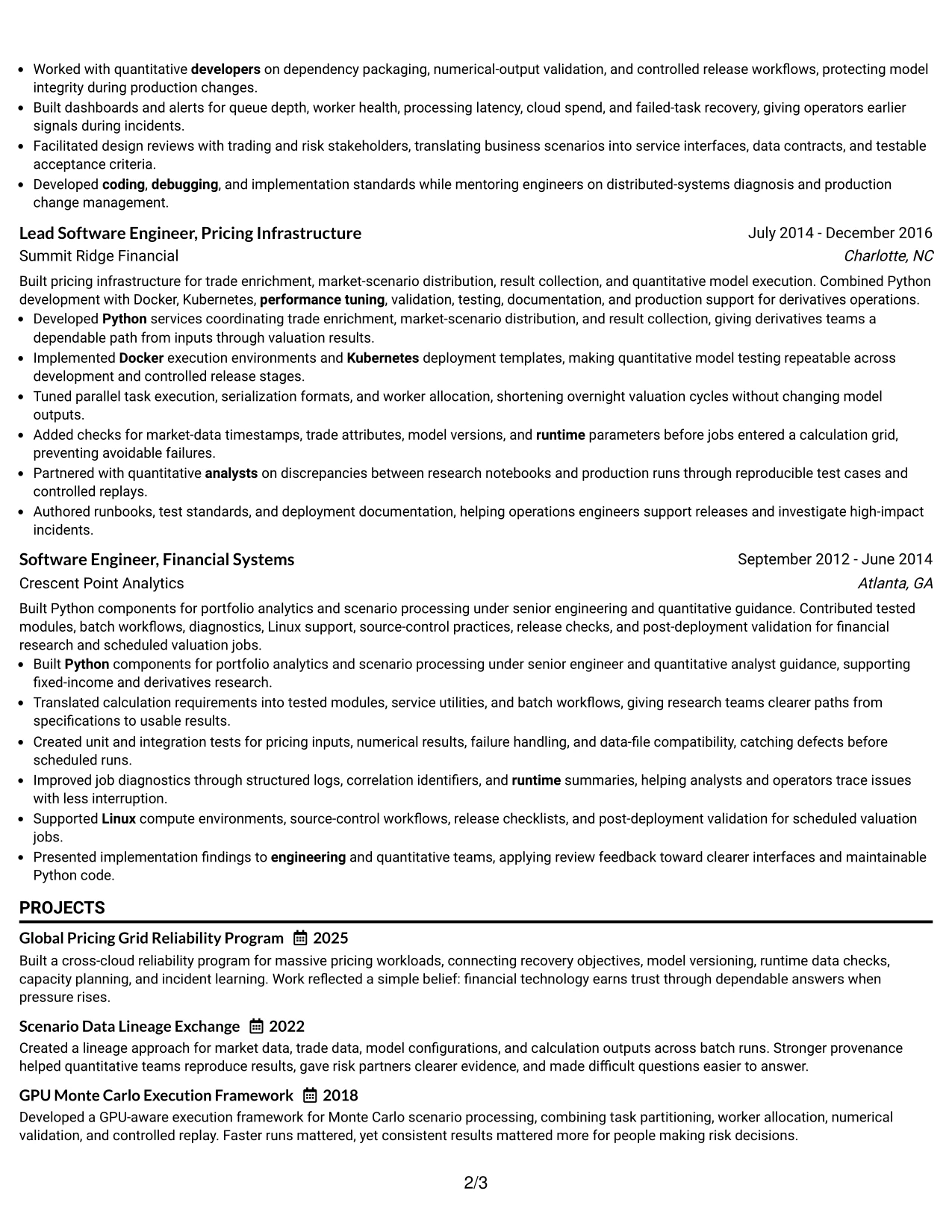
#1 Simple One Column Format Resume Example
Simple One Column Format places the resume in a direct sequence: contact details, summary, skills, experience, projects, education, certifications, and leadership. That order gives the reader one clear path through a senior Python engineering record.
Short headings and achievement-led bullets make the document easy to scan. The experience section can carry detailed evidence such as millions of trade revaluations, AWS and GCP platforms, Kubernetes operations, model-release controls, and recovery planning without competing side by side for attention.
Why the Simple One Column Format Works for a Resume
- One reading path supports fast recruiter scanning.
- Clear section hierarchy helps ATS tools identify standard resume content.
- Full-width bullets provide room for technical detail and measurable results.
- The summary can connect Python leadership with distributed compute experience.
- Skills and tools remain easy to find near the top of the document.
- Projects, education, and certifications fit naturally below professional experience.
- The format keeps evidence in context instead of splitting related achievements across columns.
Best For
- Resumes that need a straightforward top-to-bottom review path
- Senior profiles with several detailed experience entries
- Technical leadership resumes with long achievement bullets
- Applications where ATS parsing and standard section order matter
- Documents that must show skills, tools, and certifications without visual crowding
- Candidates who want projects and education to follow experience naturally
- Resume versions that need simple conversion across common file formats
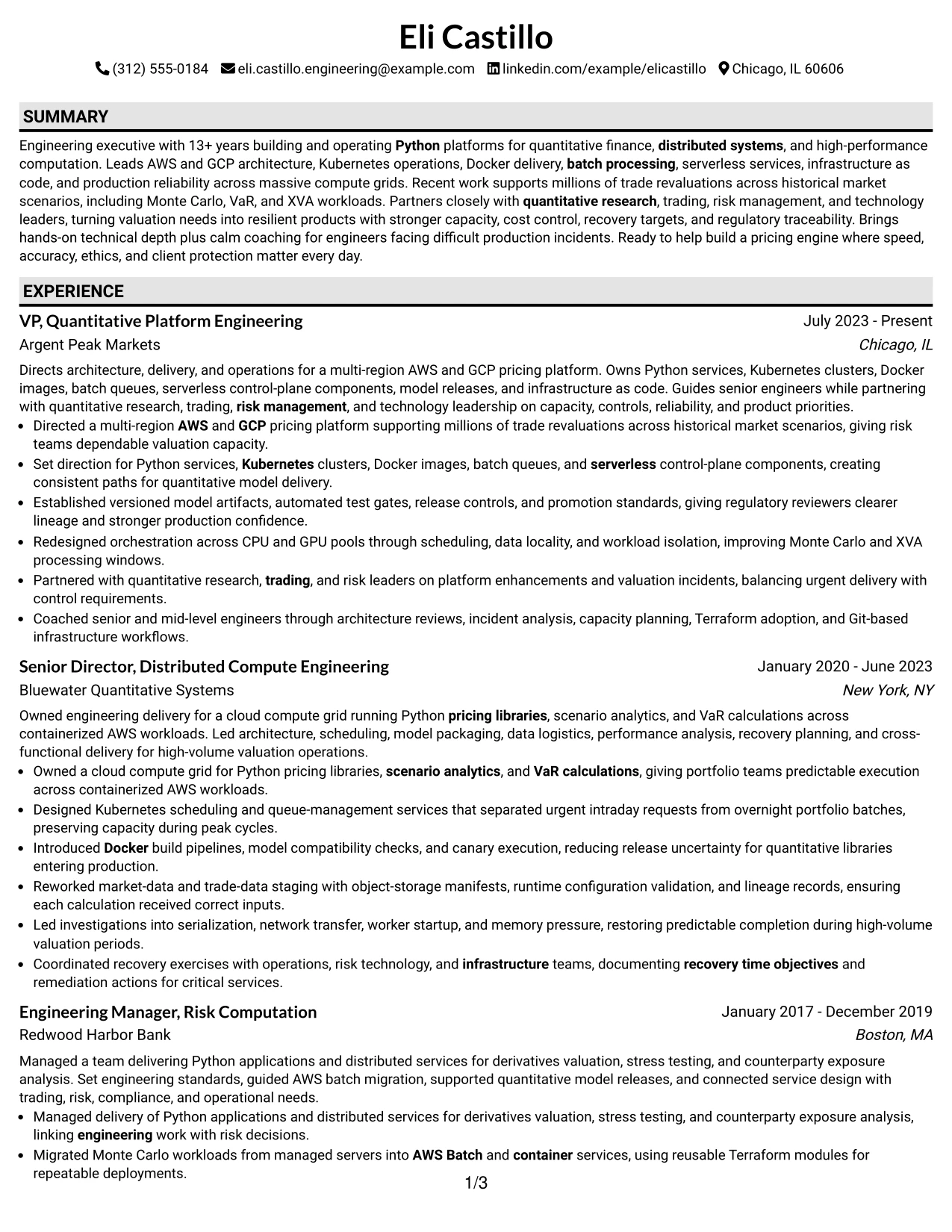
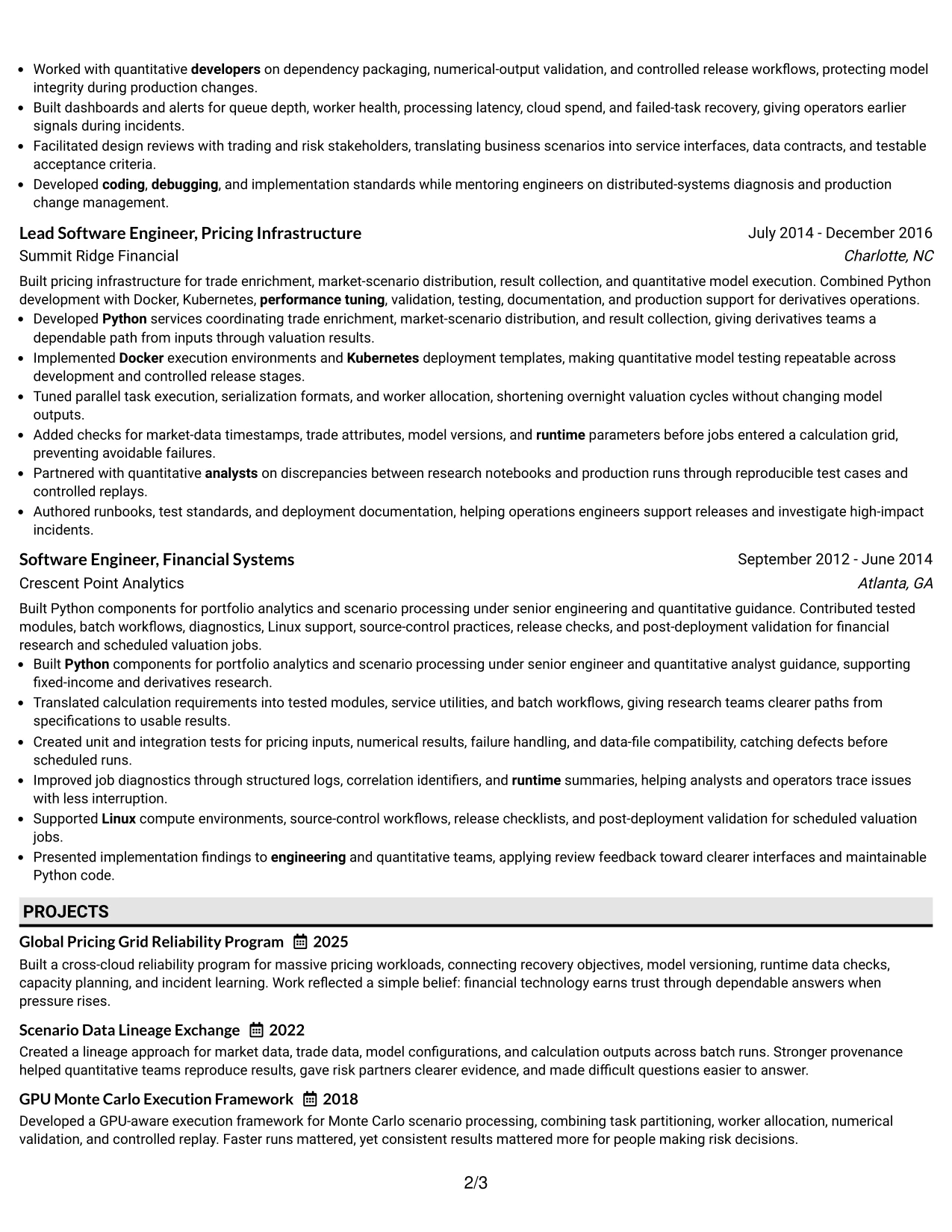
#2 Plain One Column with Shaded Labels Resume Example
Readers move from the summary into labeled sections, then through experience, skills, projects, education, and certifications. Shaded labels create visual signposts while the single column keeps every entry in the same reading stream.
This structure supports a high-content resume without making the evidence feel scattered. Detailed bullets can show Python services, AWS Batch, Docker, Kubernetes scheduling, market-data logistics, performance investigations, and recovery time objectives in a consistent format.
Why the Plain One Column with Shaded Labels Works for a Resume
- Shaded labels separate major sections without adding complex navigation.
- A single column keeps dates, employers, titles, and bullets aligned.
- The format gives substantial experience history enough vertical space.
- Standard labels improve recognition by ATS parsing systems.
- Technical keywords can appear in both the summary and dedicated skills section.
- Longer project descriptions remain readable below the work history.
- Consistent bullet treatment makes achievements easier to compare across roles.
Best For
- High-information resumes with several related technical capabilities
- Applications that require a complete work history in one stream
- Candidates who need strong section labels without decorative complexity
- Documents with detailed project, certification, and education entries
- Resume readers who compare dates and responsibilities line by line
- ATS-conscious applications using familiar headings and text flow
- Professionals presenting both architecture ownership and hands-on delivery
#3 One Column Format with Photo Right Resume Example
The strongest evidence receives priority at the start: the executive summary, core cloud and Python capabilities, and recent results from large-scale pricing platforms. A right-side photo area adds a personal visual element, while the main content remains a single readable column.
Experience bullets can then establish scope, technical ownership, and control discipline. Examples include millions of revaluations, CPU and GPU orchestration, model versioning, quantitative model deployment, and performance work across containerized workloads.
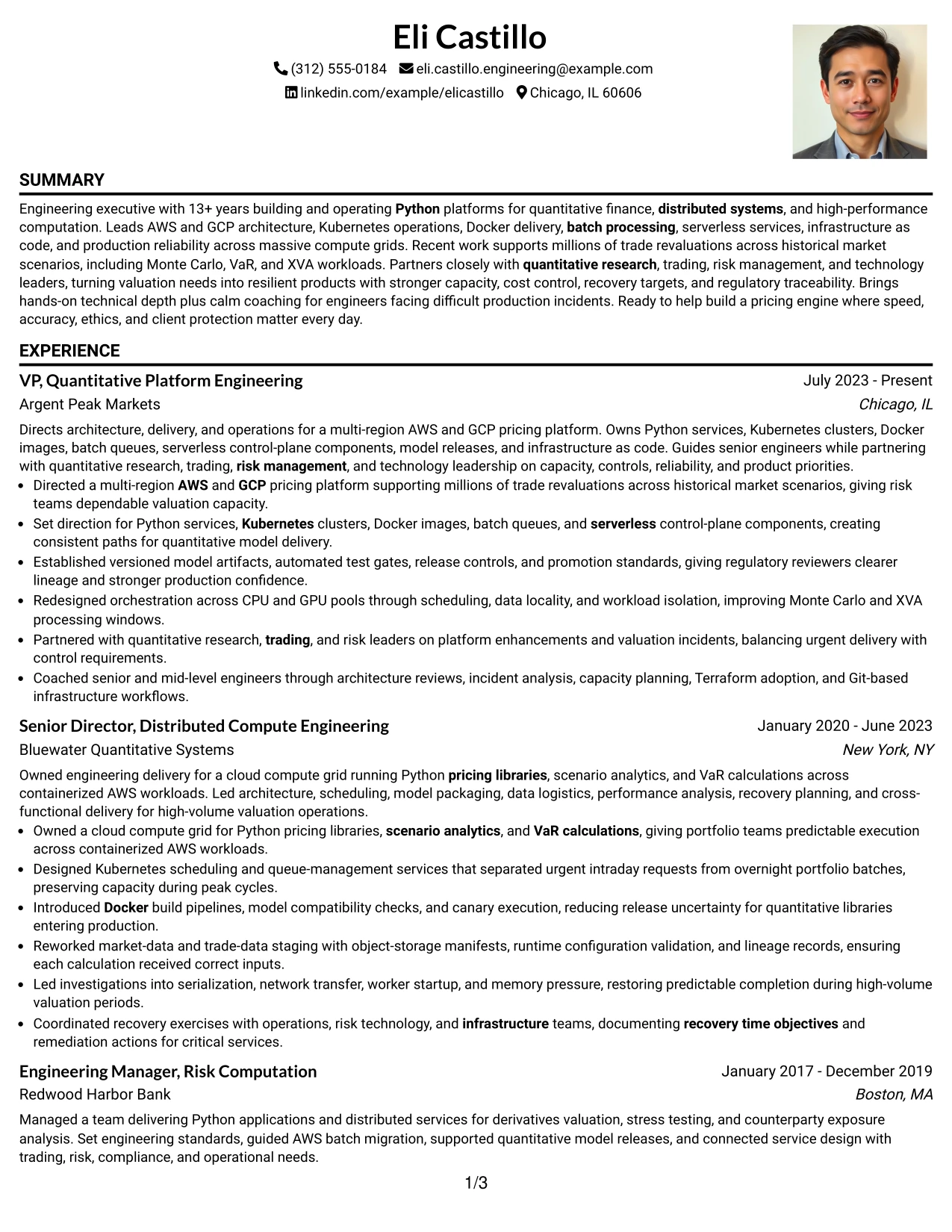
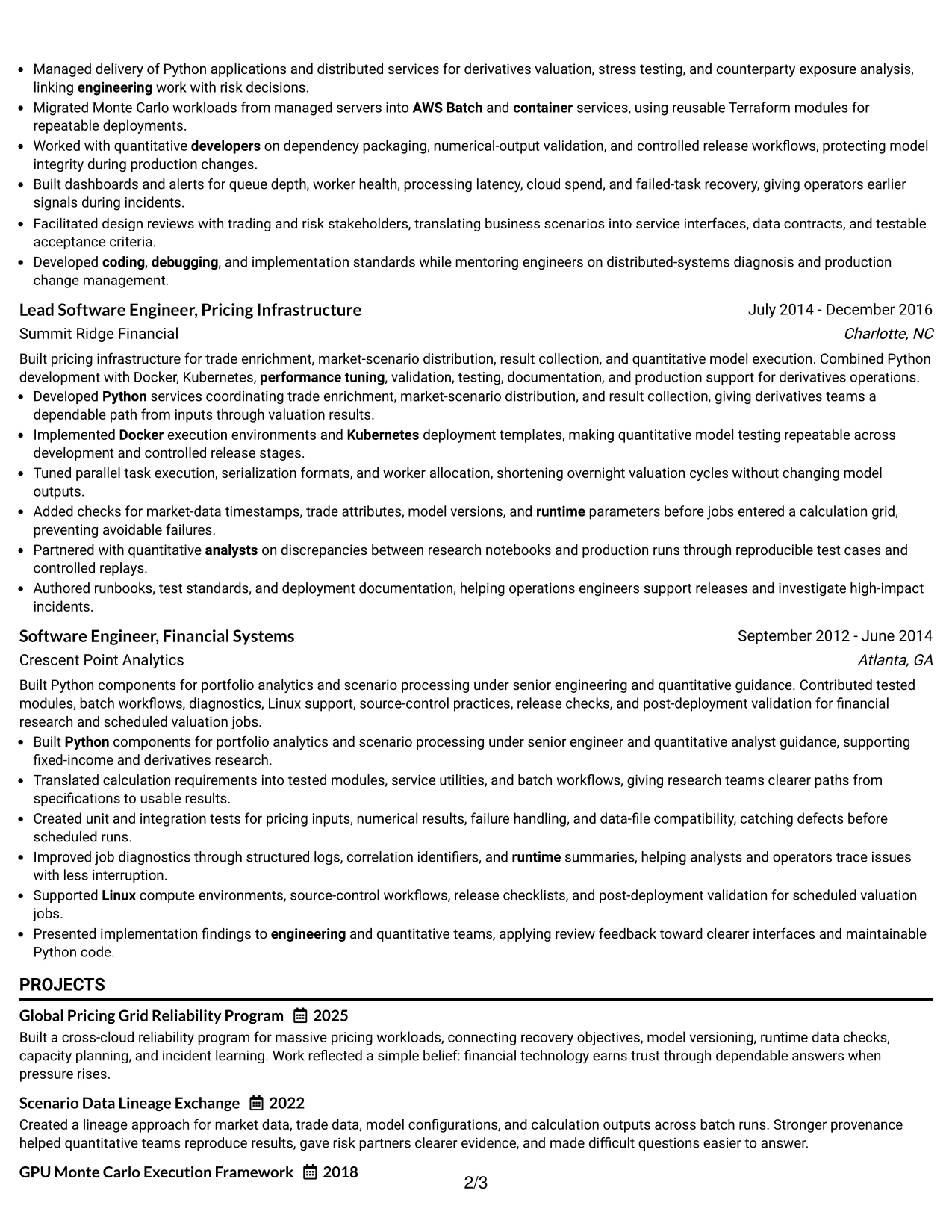
Why the One Column Format with Photo Right Works for a Resume
- Evidence appears in a predictable order from summary to career history.
- The right-side photo area is visually separate from ATS-readable text.
- Full-width bullets support complete statements about systems and results.
- Recent leadership scope can be emphasized before earlier technical roles.
- A dedicated skills area makes Python, AWS, GCP, and Kubernetes searchable.
- Projects can demonstrate specialized work beyond formal job descriptions.
- The layout balances personal presentation with detailed technical evidence.
Best For
- Applications where a polished personal introduction supports the document
- Resumes that need full-width space for complex achievement bullets
- Professionals combining executive scope with deep technical delivery
- Portfolio-oriented applications where projects deserve visible treatment
- Documents that benefit from separating visual identity from resume evidence
- Review settings where cloud architecture and operational results must stand out
- Candidates presenting a focused technical brand alongside substantial experience
#4 Clean Two Column Sidebar Format Resume Example
Content is balanced between a compact sidebar and a wider main column. The sidebar can hold contact details, skills, certifications, and education, while the main area carries the summary, experience, projects, and measurable results.
That division suits a practical application review: the reader can confirm core qualifications quickly, then assess leadership scope and technical evidence in the main column. Python, AWS, GCP, Terraform, distributed systems, and financial pricing work remain easy to locate.
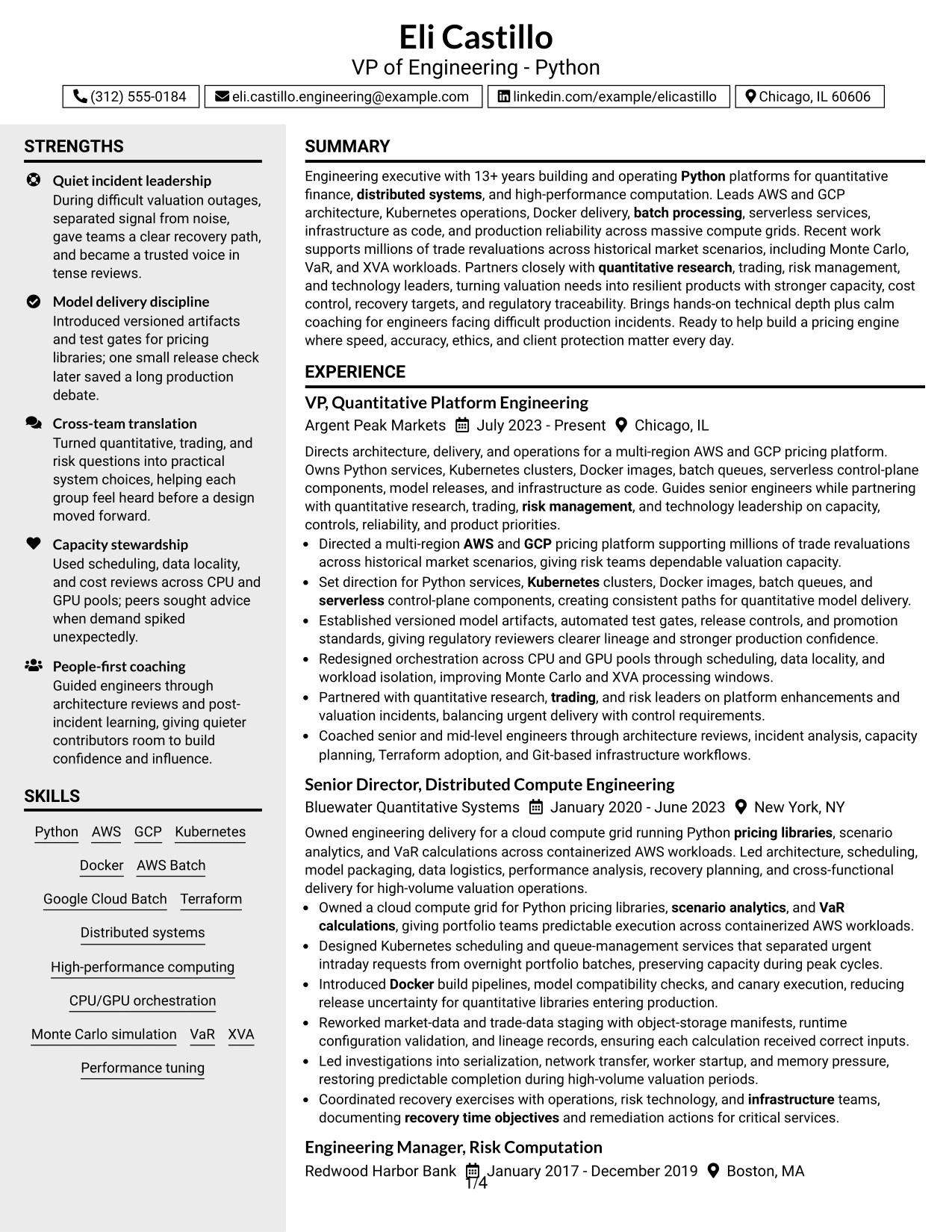
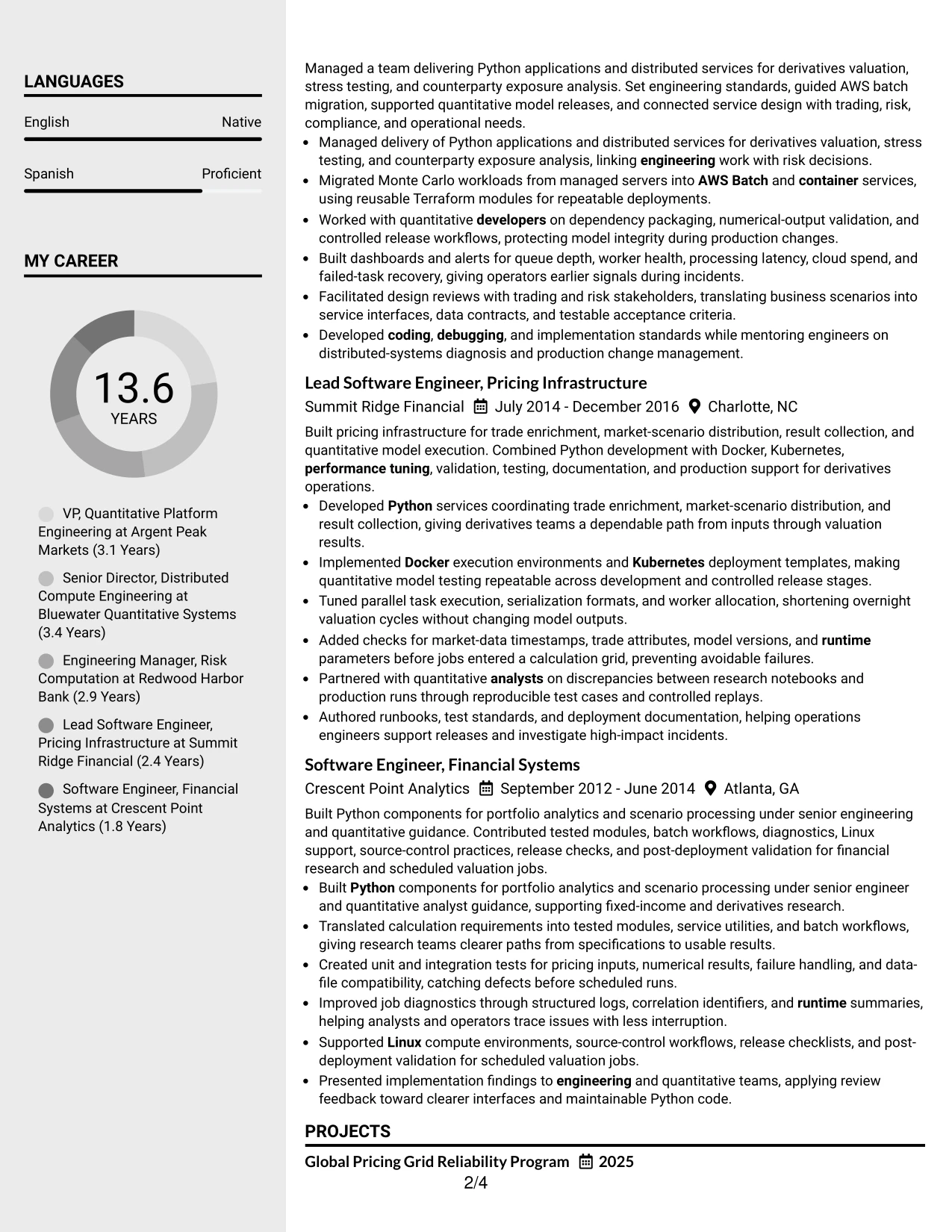
Why the Clean Two Column Sidebar Format Works for a Resume
- The sidebar creates a quick reference for skills and credentials.
- The wider column protects experience bullets from excessive compression.
- Separate areas help readers distinguish proof from supporting qualifications.
- The summary can frame the relationship between platform scale and business risk.
- Certifications and education stay visible without interrupting the career timeline.
- Projects can add targeted evidence for pricing-grid and reliability work.
- A restrained structure supports professional review across technical and financial settings.
Best For
- Applications needing quick access to credentials beside career evidence
- Resumes that separate supporting qualifications from detailed achievements
- Technical leaders with a broad skills inventory and substantial work history
- Review processes where certifications must remain visible during experience review
- Documents combining platform architecture, people leadership, and project proof
- Candidates who need sidebar organization without sacrificing bullet detail
- Use cases requiring a balanced presentation for both technical and business readers
#5 Two Column Format Resume Example
For a demanding technical application, a Two Column Format can show qualifications and career evidence at the same time. One column handles concise skills, tools, education, and certifications; the other gives experience and projects enough room for results.
The visual split is useful when the resume must connect architecture decisions to operational outcomes. It can place AWS, GCP, Python, Docker, Kubernetes, and infrastructure as code near bullets about pricing grids, model releases, cost control, and reliability.
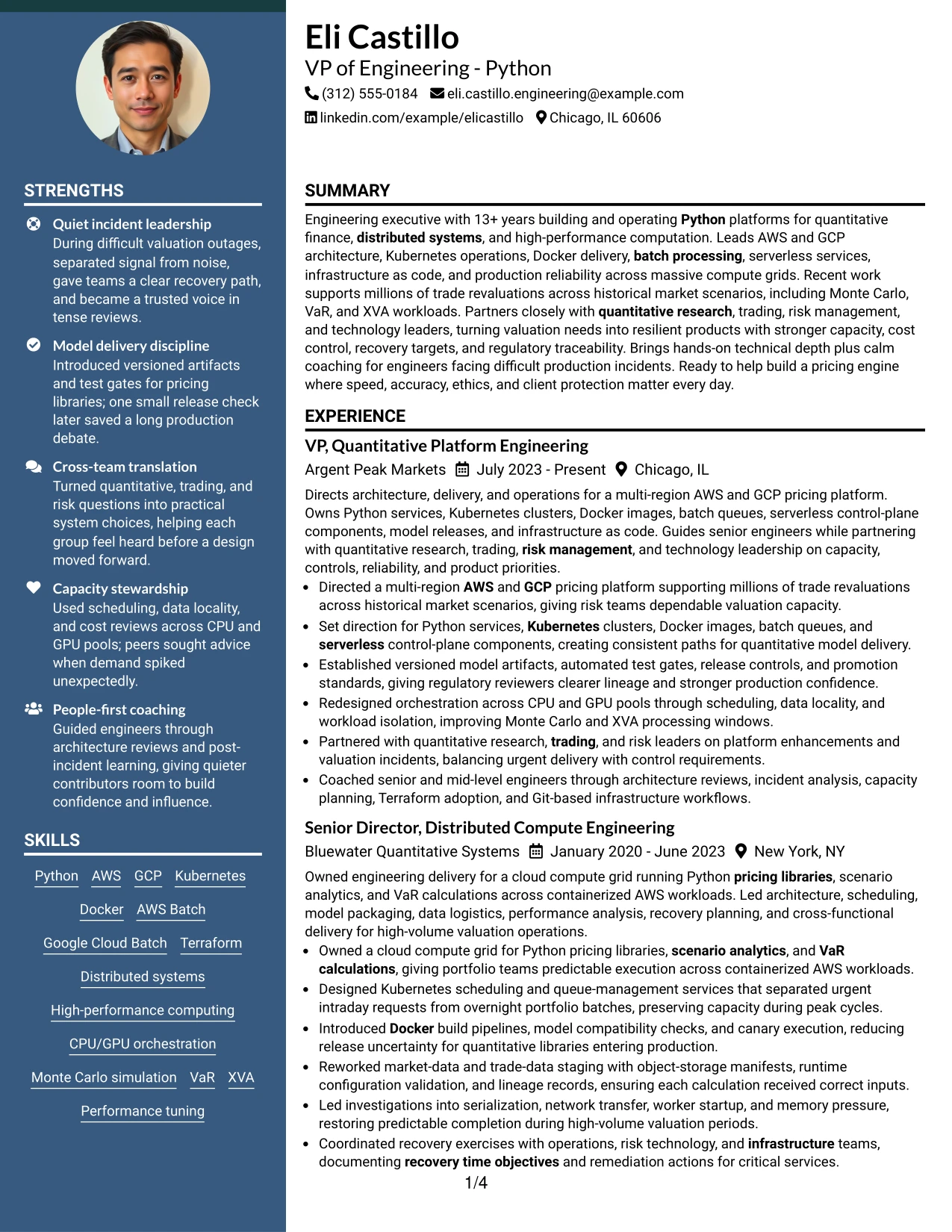
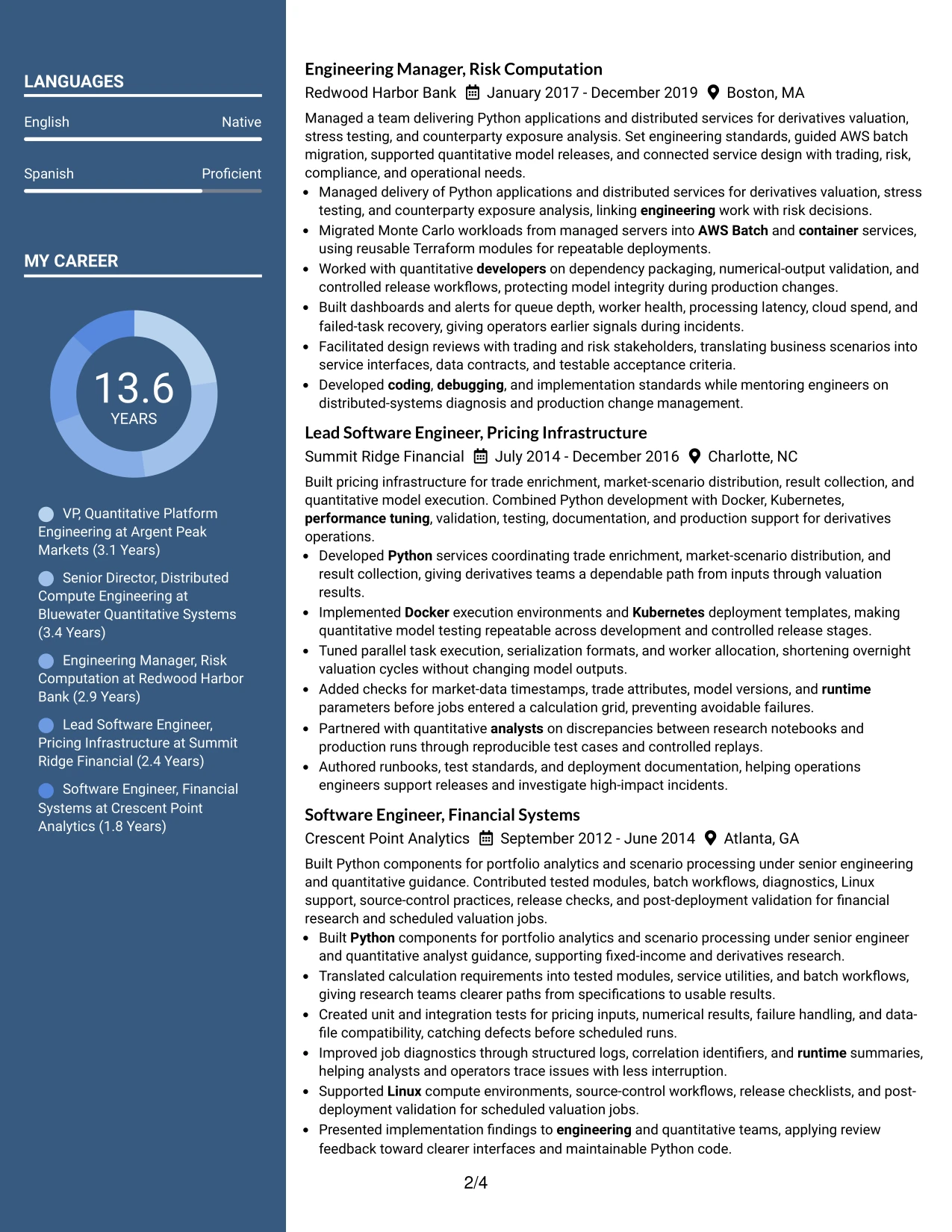
Why the Two Column Format Works for a Resume
- Parallel columns let readers confirm capabilities while reviewing experience.
- A dedicated skills area reduces the need to repeat tools in every bullet.
- The main column can preserve evidence about scale, ownership, and outcomes.
- Projects gain a clear place without displacing certifications or education.
- Short labels help organize cloud, batch, containers, and reliability knowledge.
- The design supports a strong executive summary followed by focused proof.
- Careful spacing keeps a broad technical profile readable rather than dense.
Best For
- Resumes that must show a skills inventory beside career progression
- Applications where technical keywords need early, visible placement
- Professionals with projects that reinforce their formal experience
- Documents balancing architecture ownership with hands-on engineering evidence
- Readers who need to compare tools and outcomes during one review
- Candidates with certifications or education that should remain prominent
- A visually organized presentation of broad cloud and distributed-computing work
#6 Photo Header Two Column Format Resume Example
A restrained visual hierarchy gives the contact header and professional identity clear definition before the reader reaches the two-column body. The photo header occupies a distinct area, while the columns divide concise qualifications from the evidence that proves them.
That arrangement can align a leadership profile with its operating record. The resume can connect Python architecture, cloud grids, Kubernetes, Docker, batch processing, model deployment, and recovery objectives to experience leading teams and production platforms.
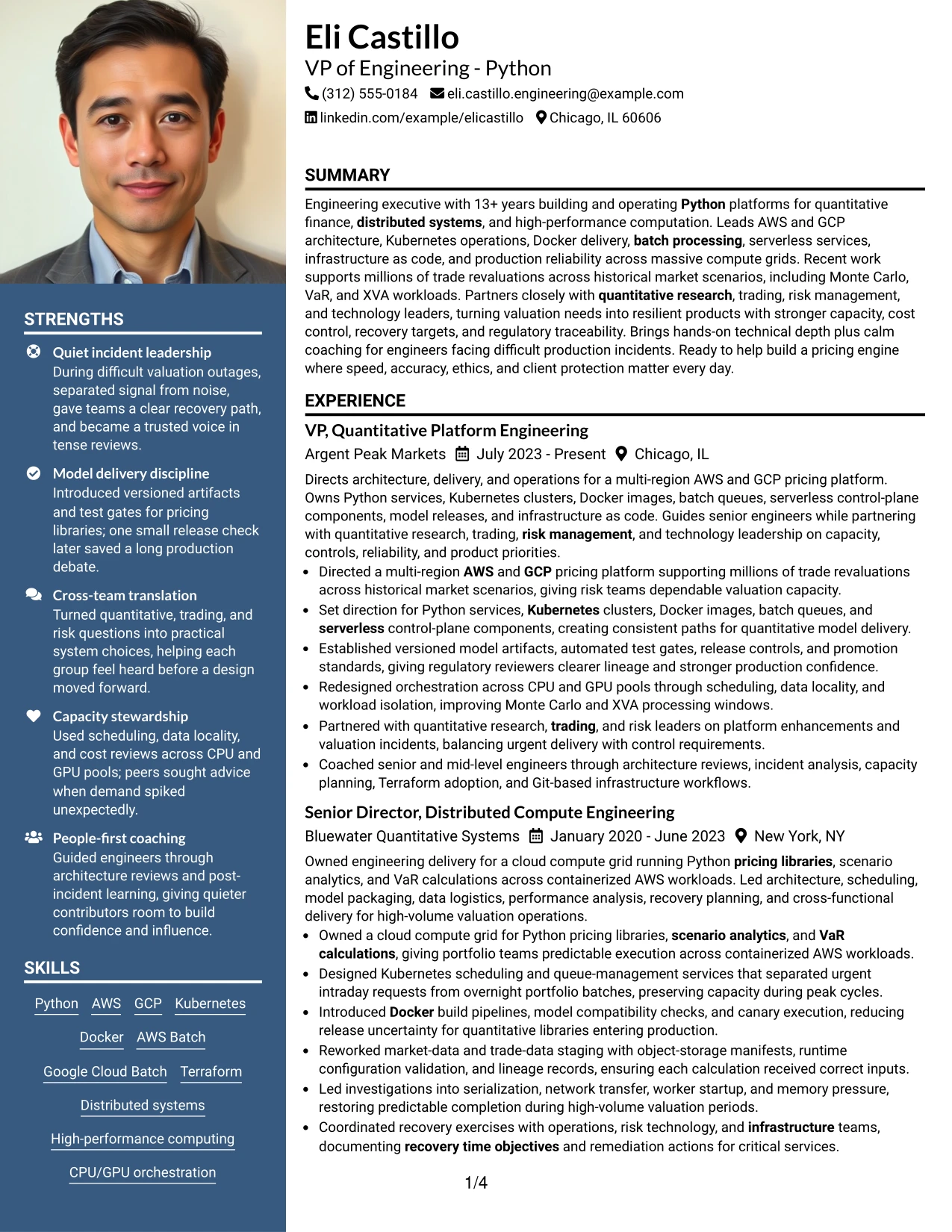
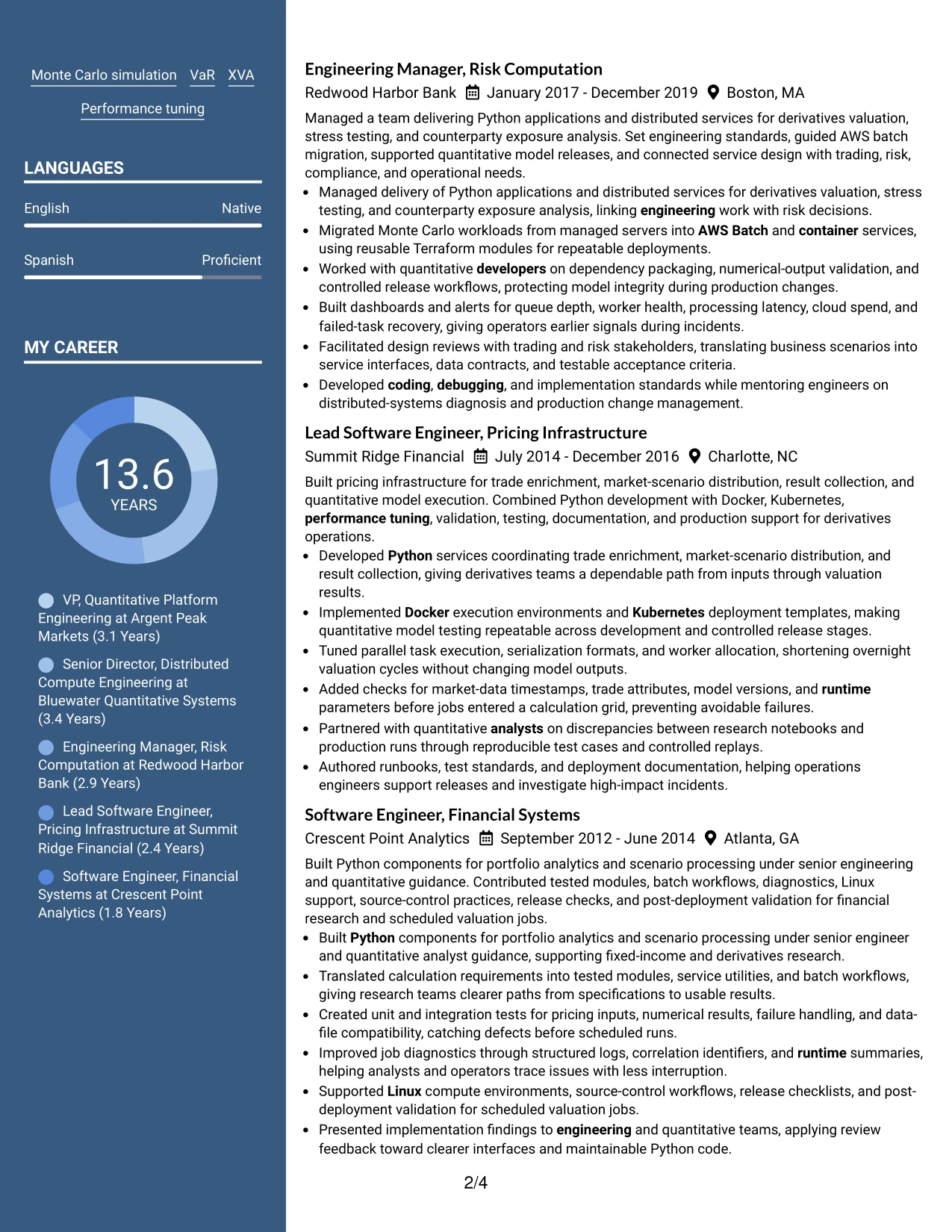
Why the Photo Header Two Column Format Works for a Resume
- A distinct header establishes identity before the detailed review begins.
- Two columns separate quick qualifications from substantial career evidence.
- The photo area remains apart from dates, headings, and ATS-readable content.
- The format gives leadership scope a clear place beside technical depth.
- Skills and certifications can be reviewed without losing the experience timeline.
- Projects can reinforce specialized platform work in a compact supporting area.
- Strong visual hierarchy helps the reader move from profile to proof.
Best For
- Applications where a defined personal header supports a leadership presentation
- Resumes pairing a concise qualification panel with detailed work evidence
- Professionals who want technical scope and team leadership visible together
- Documents that need a distinct header before a structured two-column review
- Portfolio-linked applications with projects supporting the main career record
- Review settings where cloud, reliability, and architecture strengths need quick access
- Candidates presenting a polished executive profile with operational proof
#7 Simple Two Column Format Resume Example
Simple Two Column Format divides the resume into a focused information panel and a broader evidence area. Skills, certifications, education, and contact details can stay compact, while the main column presents the summary, experience, projects, and results in order.
The format keeps a broad technical record under control. A reader can find Python, AWS, GCP, Kubernetes, Docker, Terraform, and high-performance computing quickly, then review bullets covering orchestration, data logistics, model releases, incidents, and team coaching.
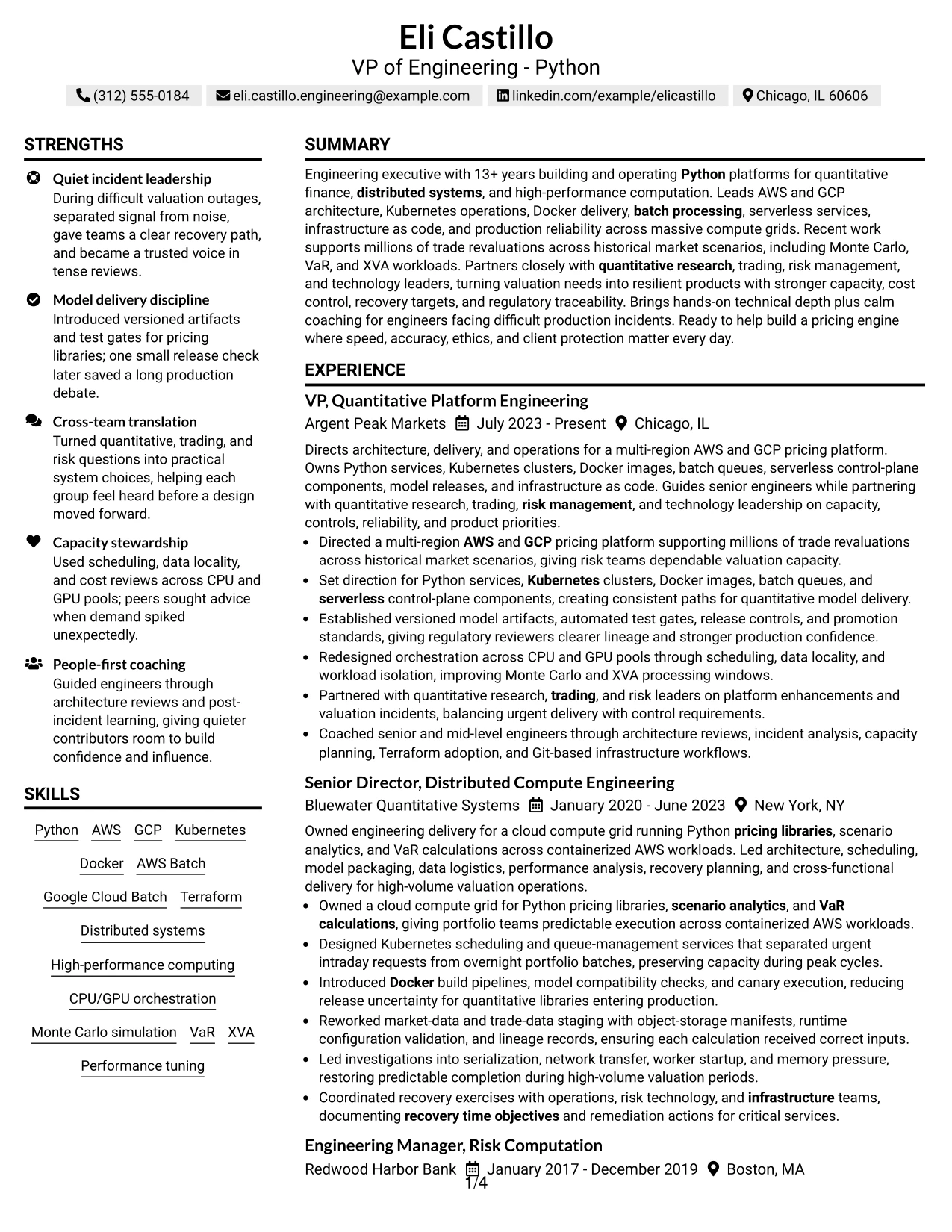
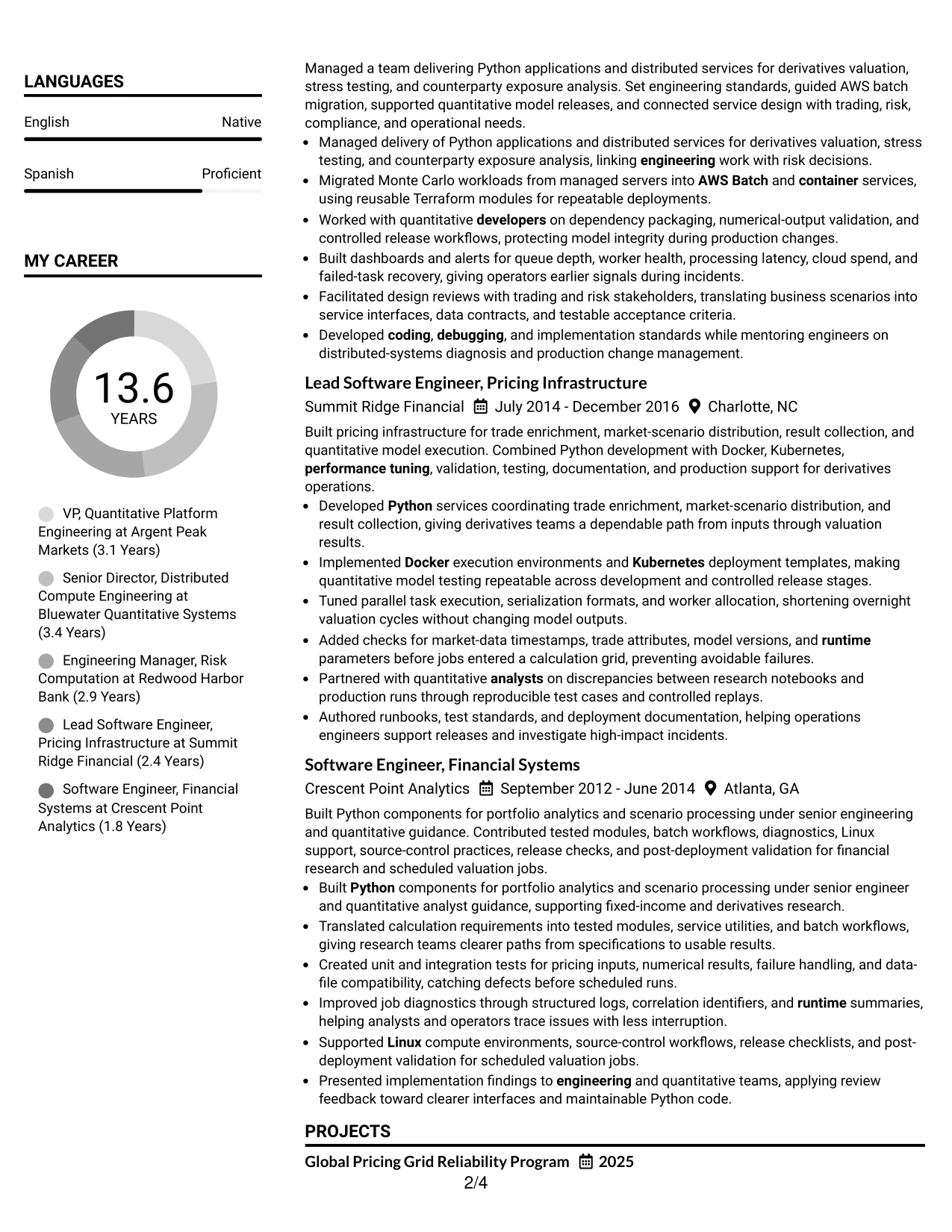
Why the Simple Two Column Format Works for a Resume
- A compact qualification panel speeds the first scan.
- The main column gives work history enough width for complete bullets.
- Simple section treatment supports familiar ATS headings and keywords.
- Technical tools can be grouped instead of scattered through the document.
- Experience remains the primary proof of scope and achievement.
- Projects add supporting evidence without overwhelming the career timeline.
- The structure provides organization while keeping visual elements restrained.
Best For
- Resumes needing a compact reference area beside the main career record
- Applications where experience should remain the dominant source of proof
- Broad technical profiles that benefit from grouped capabilities
- Documents requiring quick review of education and certifications
- Candidates who want two-column organization with minimal visual distraction
- Technical applications where project evidence supports, rather than replaces, experience
- Readers who need an efficient route from keywords to measurable achievements
#8 Text/Fang Style Resume Example
Readers move through a centered, text-led sequence with clear transitions between summary, skills, experience, projects, education, and certifications. The restrained presentation keeps attention on wording, dates, scope, and results rather than visual decoration.
That makes room for a detailed technical narrative without losing structure. Bullets can explain Python pricing libraries, AWS workloads, Kubernetes scheduling, Docker pipelines, market and trade data, numerical validation, and production recovery in plain, searchable language.
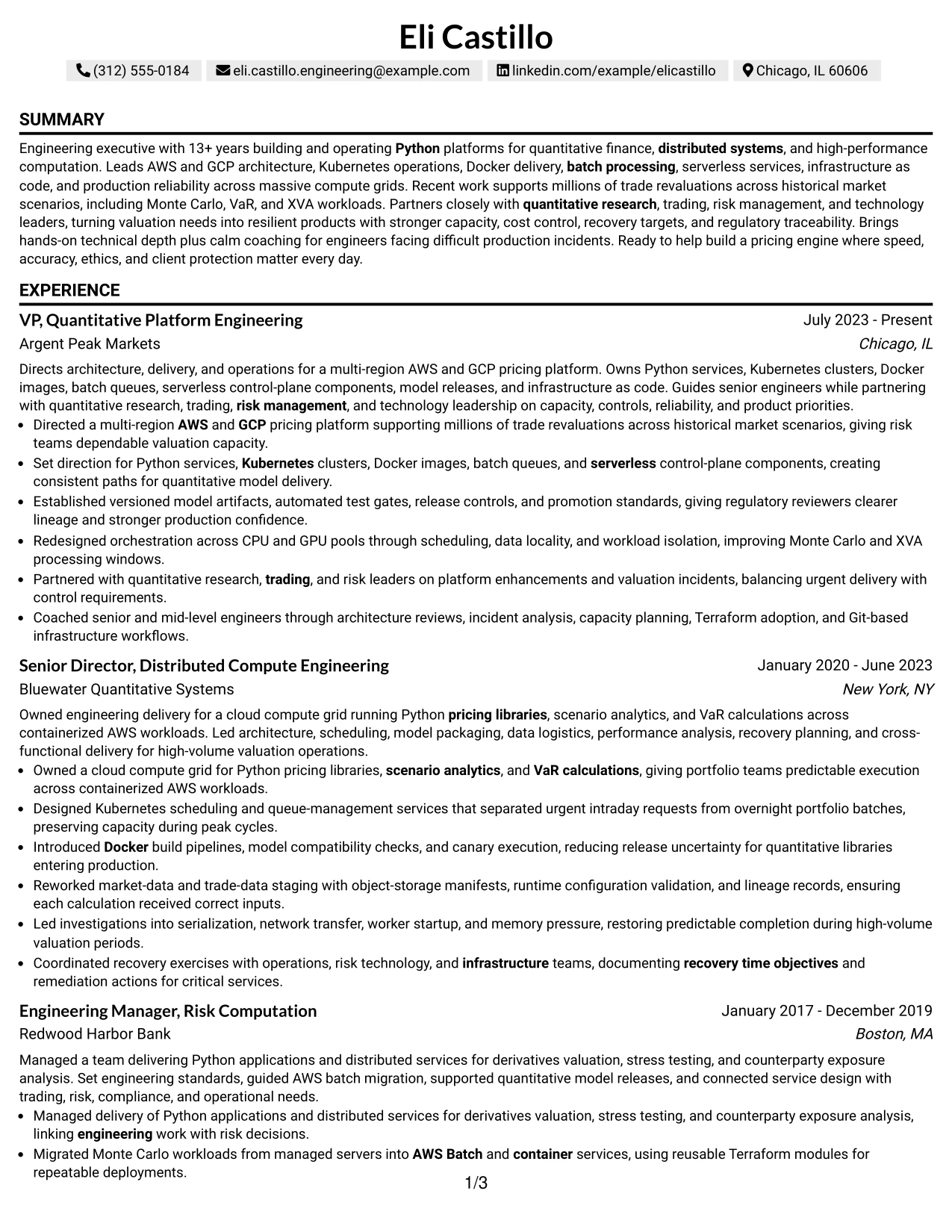
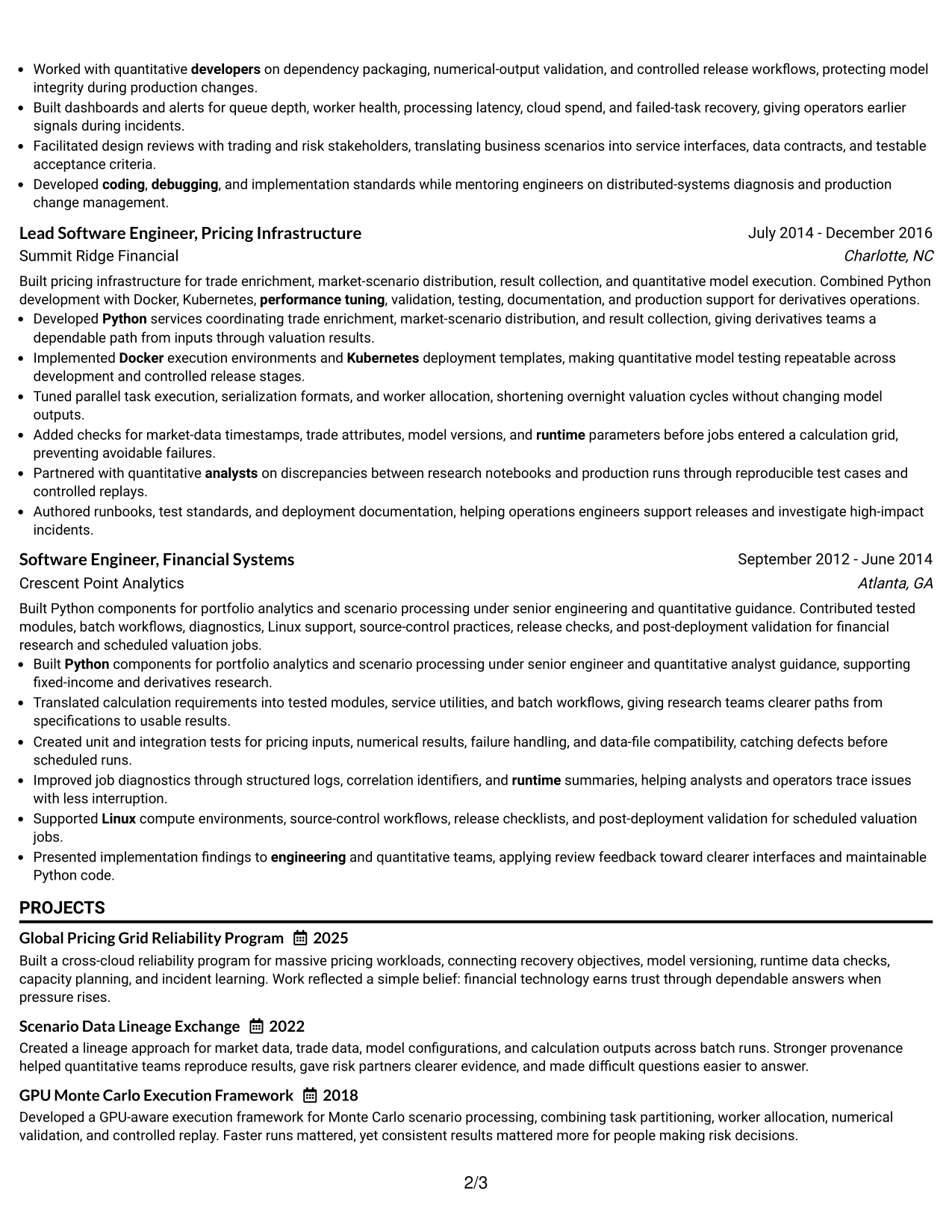
Why the Text/Fang Style Works for a Resume
- Text-led hierarchy keeps professional evidence at the center.
- A single column gives each achievement enough space to be understood.
- Searchable headings support ATS extraction and recruiter scanning.
- The format handles detailed technical language without crowded side panels.
- Projects can extend the story with focused platform examples.
- Education and certifications remain easy to locate at the end.
- Consistent text treatment supports clear comparison across multiple roles.
Best For
- Content-rich resumes where precise wording carries the presentation
- Applications reviewed through text extraction or ATS systems
- Professionals with technical achievements that need full context
- Documents requiring clear dates, titles, and employers in sequence
- Candidates whose projects provide meaningful evidence beyond job bullets
- Readers who prefer a calm, text-first review experience
- Resume versions that must remain readable when printed or converted
#9 One Column Boxed Contact Header Format Resume Example
Evidence leads the review, beginning with a focused summary and the most relevant technical strengths before the career timeline. A boxed contact header separates essential contact information from the resume body without taking space away from achievement bullets.
The single-column body is well suited to proof that needs context. It can show multi-region cloud ownership, millions of revaluations, AWS Batch migration, model compatibility checks, performance tuning, structured observability, and recovery exercises in a clear sequence.
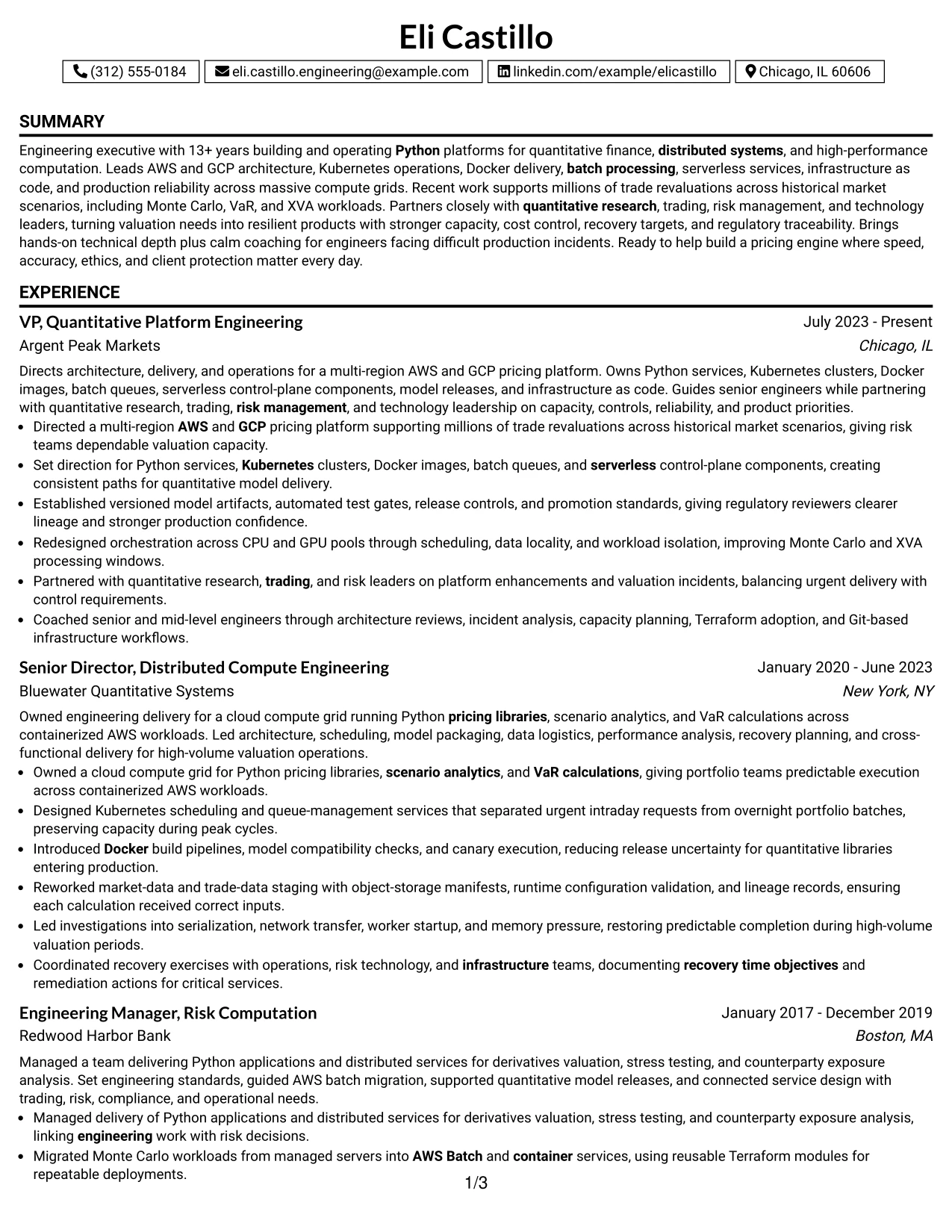
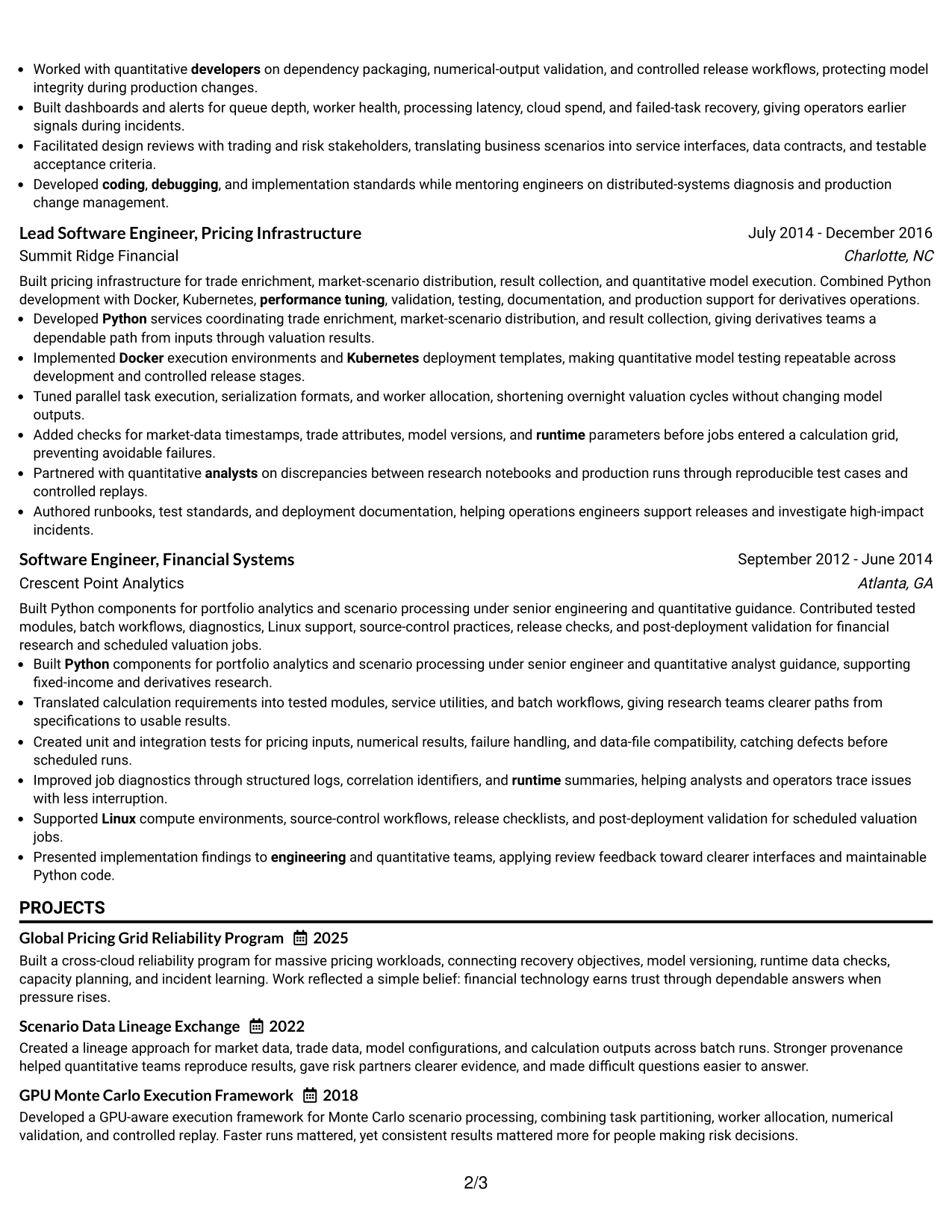
Why the One Column Boxed Contact Header Format Works for a Resume
- The boxed header makes contact details easy to confirm.
- A strong opening summary puts relevant evidence before older roles.
- Full-width bullets support technical explanations and measurable scope.
- The timeline remains simple for both ATS parsing and human review.
- Skills can mirror job-description terms without disrupting experience detail.
- Projects provide additional proof of reliability and data-lineage work.
- The format keeps visual distinction limited to the contact area.
Best For
- Applications that need contact details clearly separated from resume evidence
- Resumes leading with a targeted summary and high-value technical proof
- Professionals whose achievements require complete, full-width bullet statements
- ATS-sensitive submissions using a familiar single-column career timeline
- Documents with substantial cloud, performance, and reliability content
- Candidates adding projects to reinforce specialized platform experience
- Review workflows where contact information must be found immediately
#10 Plain Two Column Format Resume Example
Content is balanced between a concise qualification column and a detailed experience column. The arrangement helps the reader review the summary, skills, credentials, and career evidence without forcing every section into one long vertical stream.
For Eli Castillo, the format can surface the target role, cloud platforms, distributed-computing strengths, and selected achievements early. Experience bullets then provide proof through Python services, Kubernetes operations, Monte Carlo workloads, model versioning, and recovery time objectives.
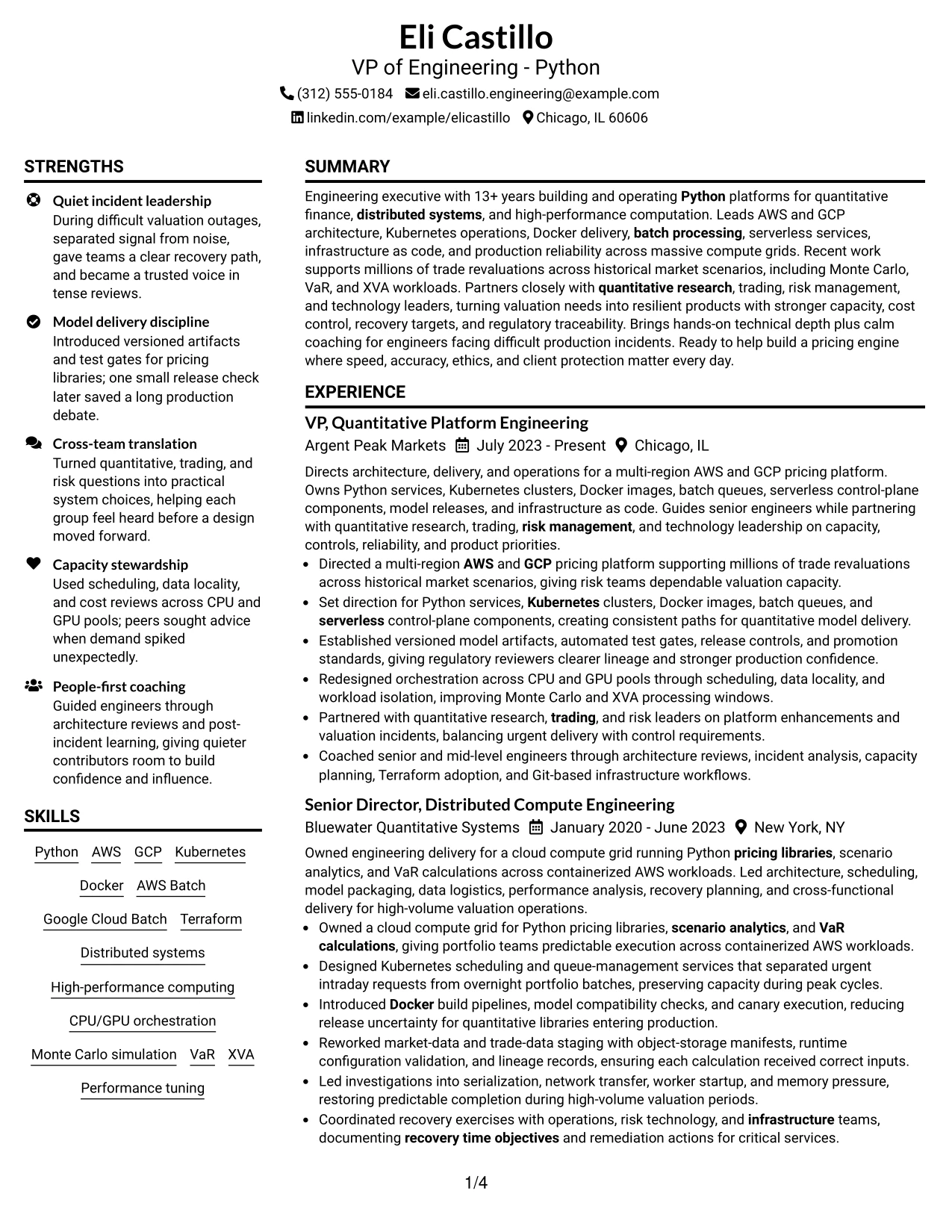
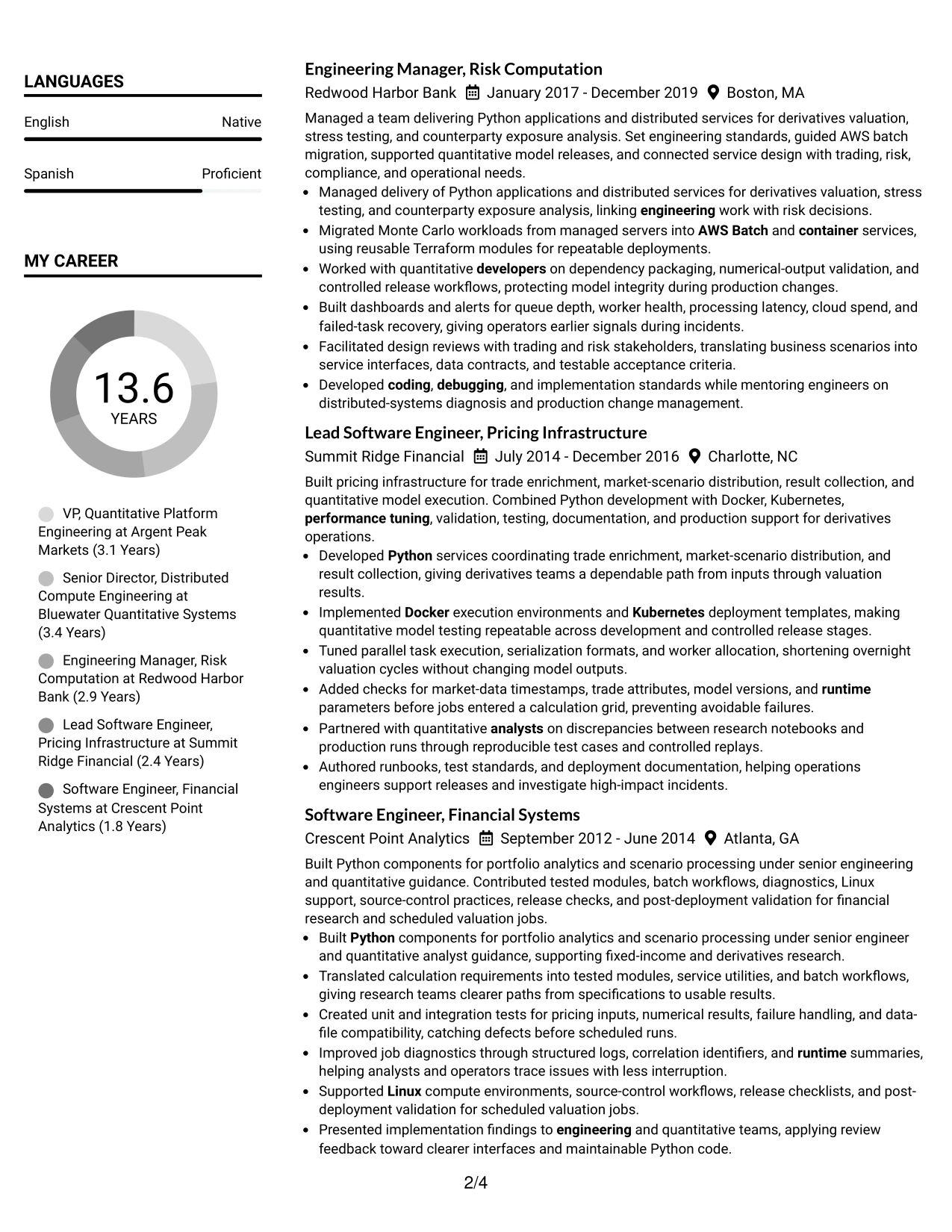
Resume Snapshot
- 13+ years building and operating Python platforms for quantitative finance
- AWS and GCP architecture across distributed pricing and compute platforms
- Kubernetes, Docker, batch processing, serverless services, and Terraform
- Monte Carlo, VaR, XVA, model deployment, and production reliability
Why the Plain Two Column Format Works for a Resume
- Two columns balance quick qualification review with detailed career evidence.
- A snapshot can summarize scope before the reader reaches individual roles.
- Plain styling keeps keywords readable and easy for ATS tools to process.
- Skills and certifications can sit beside, rather than below, experience.
- The experience column preserves bullets about scale, controls, and outcomes.
- Projects can add targeted proof without creating a long opening section.
- The structure supports fast comparison between job requirements and resume evidence.
Resume Keywords
- VP of Engineering - Python
- Python
- AWS
- GCP
- Kubernetes
- Docker
- AWS Batch
- Terraform
- distributed systems
- performance tuning
- Monte Carlo
- VaR
- XVA
- infrastructure as code
- recovery time objectives
#11 Colored Two Column Format Resume Example
For a practical application, a Colored Two Column Format can distinguish summary information from the evidence that supports it. A controlled color treatment gives the sidebar and section headings definition, while the wider column carries experience, projects, and measurable results.
The layout can align a senior Python platform record with the role's operating demands. Skills and credentials sit within quick reach, while the main content explains cloud-grid architecture, CPU and GPU orchestration, model delivery, data logistics, cost control, and resilient production operations.
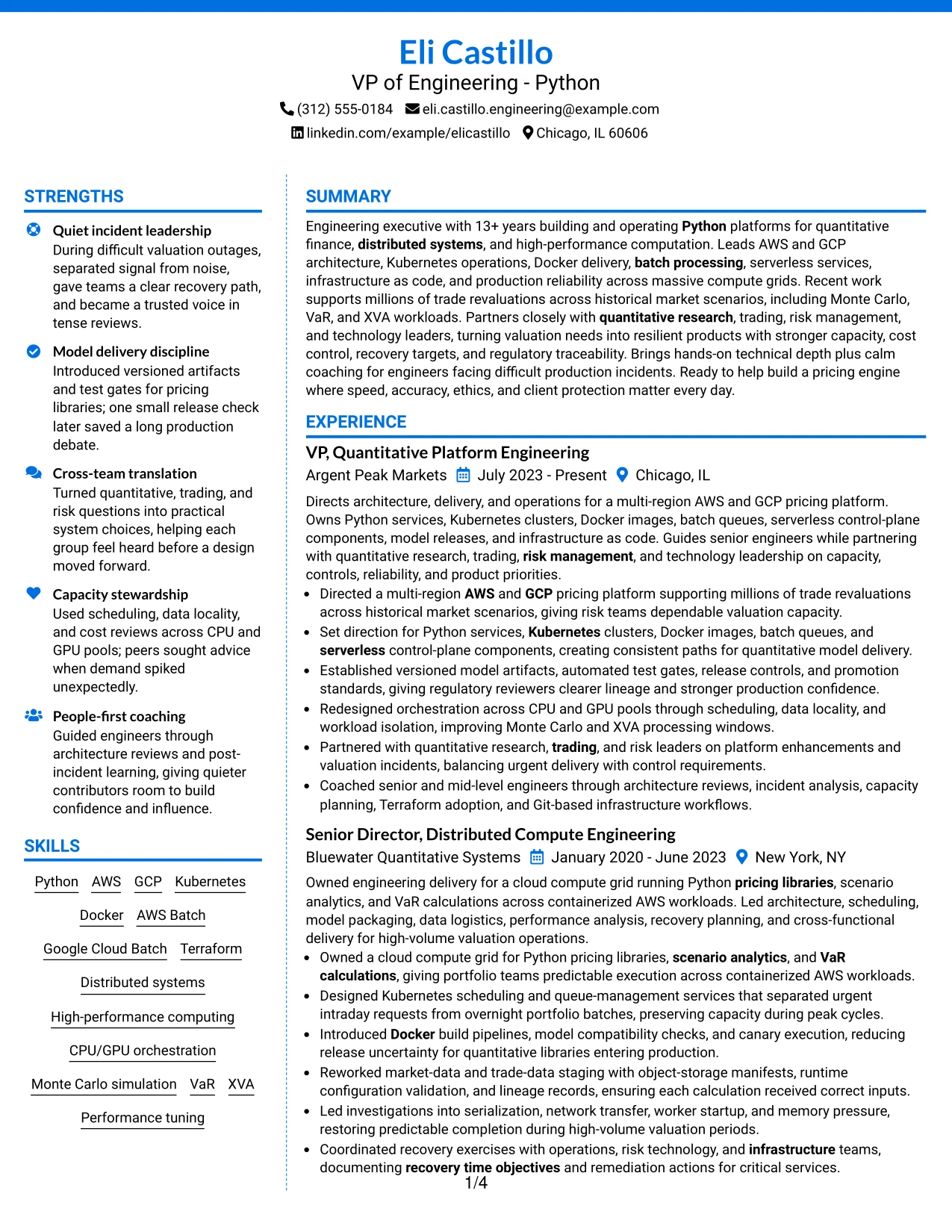
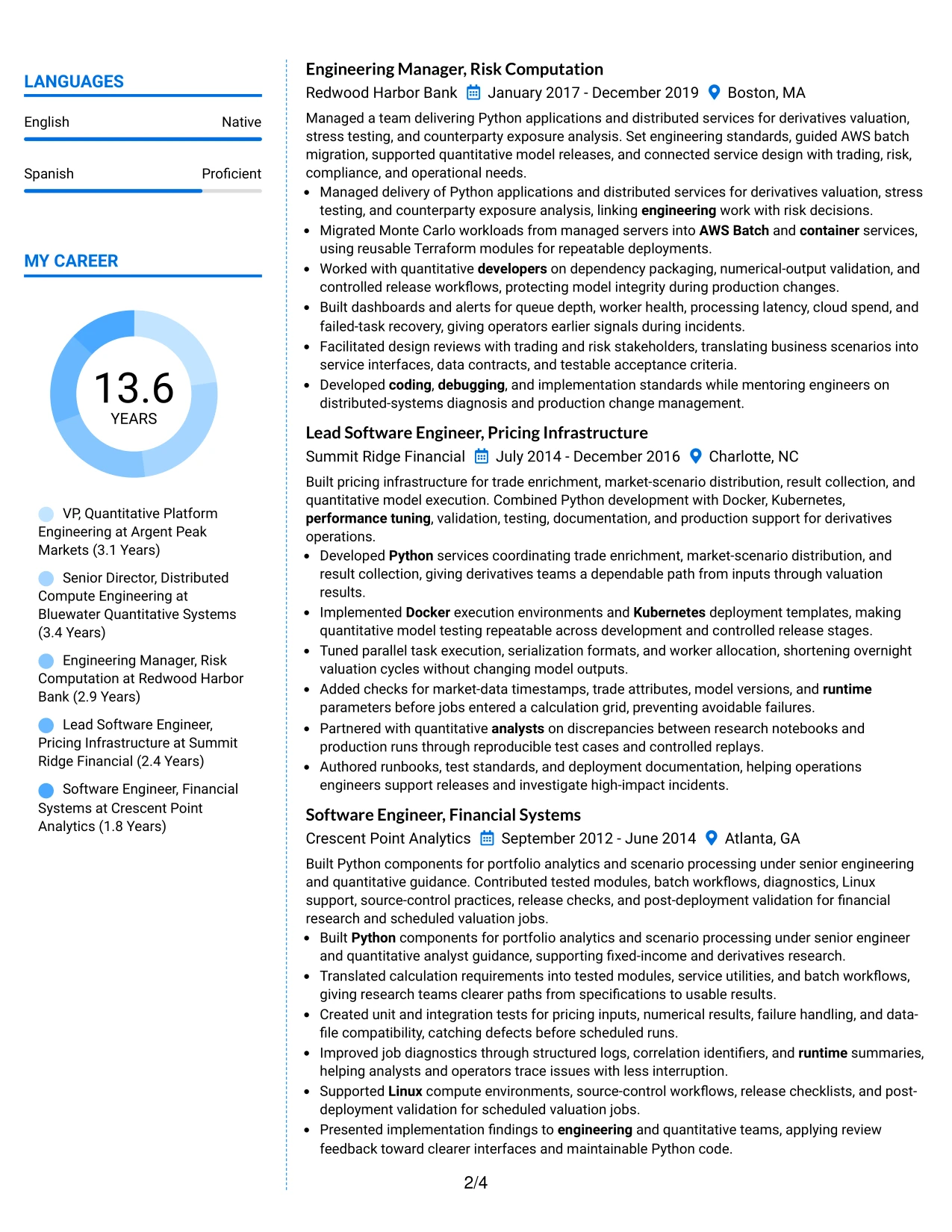
Why the Colored Two Column Format Works for a Resume
- Color creates clear separation between qualifications and career evidence.
- The main column keeps technical achievements readable and complete.
- A sidebar can surface skills, certifications, and education early.
- Section hierarchy helps the reader connect keywords to supporting proof.
- Projects can reinforce platform reliability, lineage, and compute performance.
- The format supports a strong summary without making the resume feel crowded.
- Controlled visual emphasis keeps attention on results rather than decoration.
Best For
- Applications where measured color improves navigation between resume sections
- Resumes pairing an early qualification summary with detailed technical evidence
- Professionals presenting broad cloud and platform capabilities in grouped form
- Documents that need projects and certifications visible beside work history
- Candidates whose results benefit from strong separation between proof and profile
- Review settings where readers compare role requirements with organized keywords
- Technical leadership resumes seeking structure without a heavily decorative design
#12 One Column Shaded Contact Header Format Resume Example
A restrained visual hierarchy puts the contact details and target role at the top, then moves directly into the summary, experience, skills, education, certifications, and projects. The single-column flow keeps the resume easy to follow while giving the VP of Engineering - Python profile room to show leadership scope and technical depth.
The shaded header creates a clear starting point without competing with the evidence below it. Short sections and achievement-focused bullets help readers find AWS, GCP, Python, Kubernetes, Docker, distributed systems, and millions of trade revaluations during a quick review.
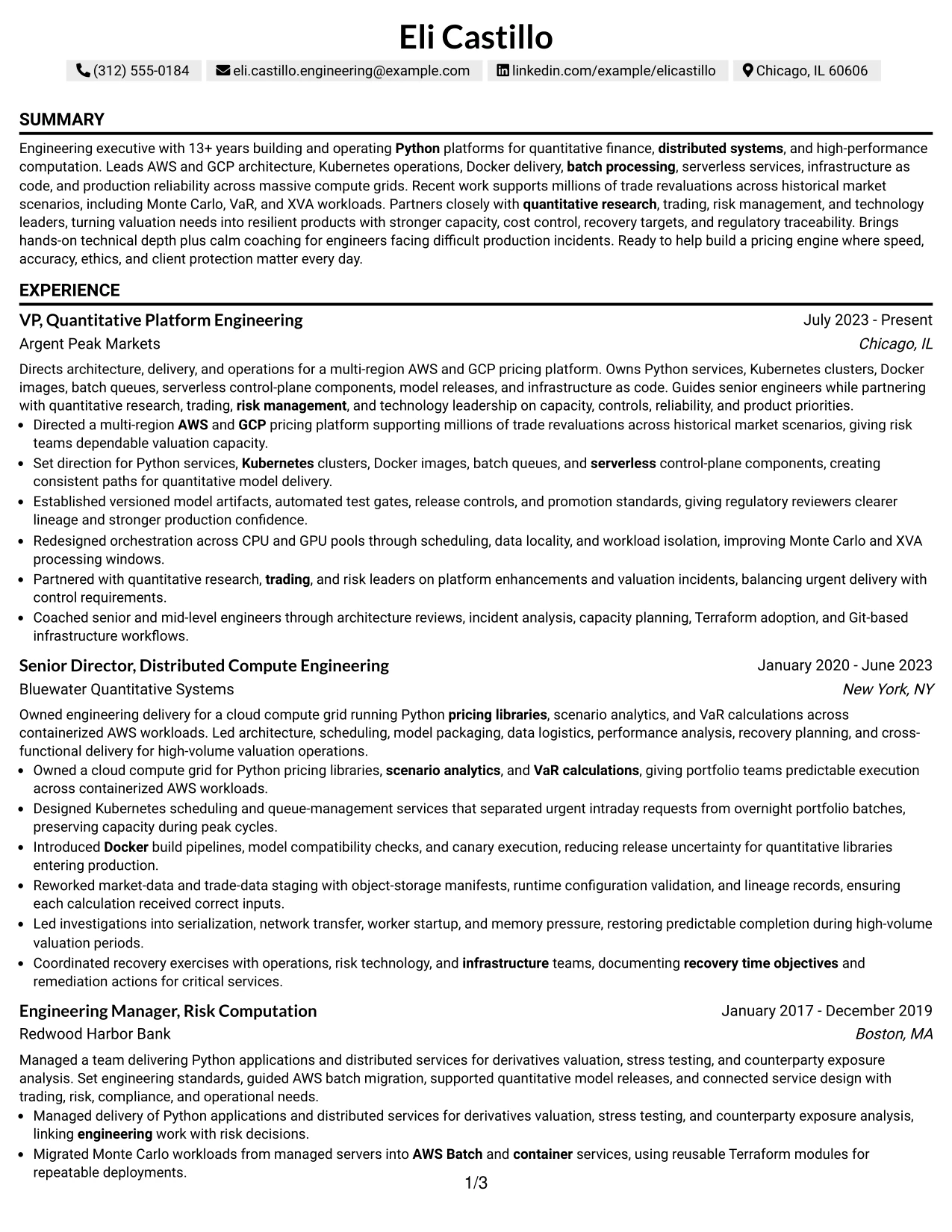
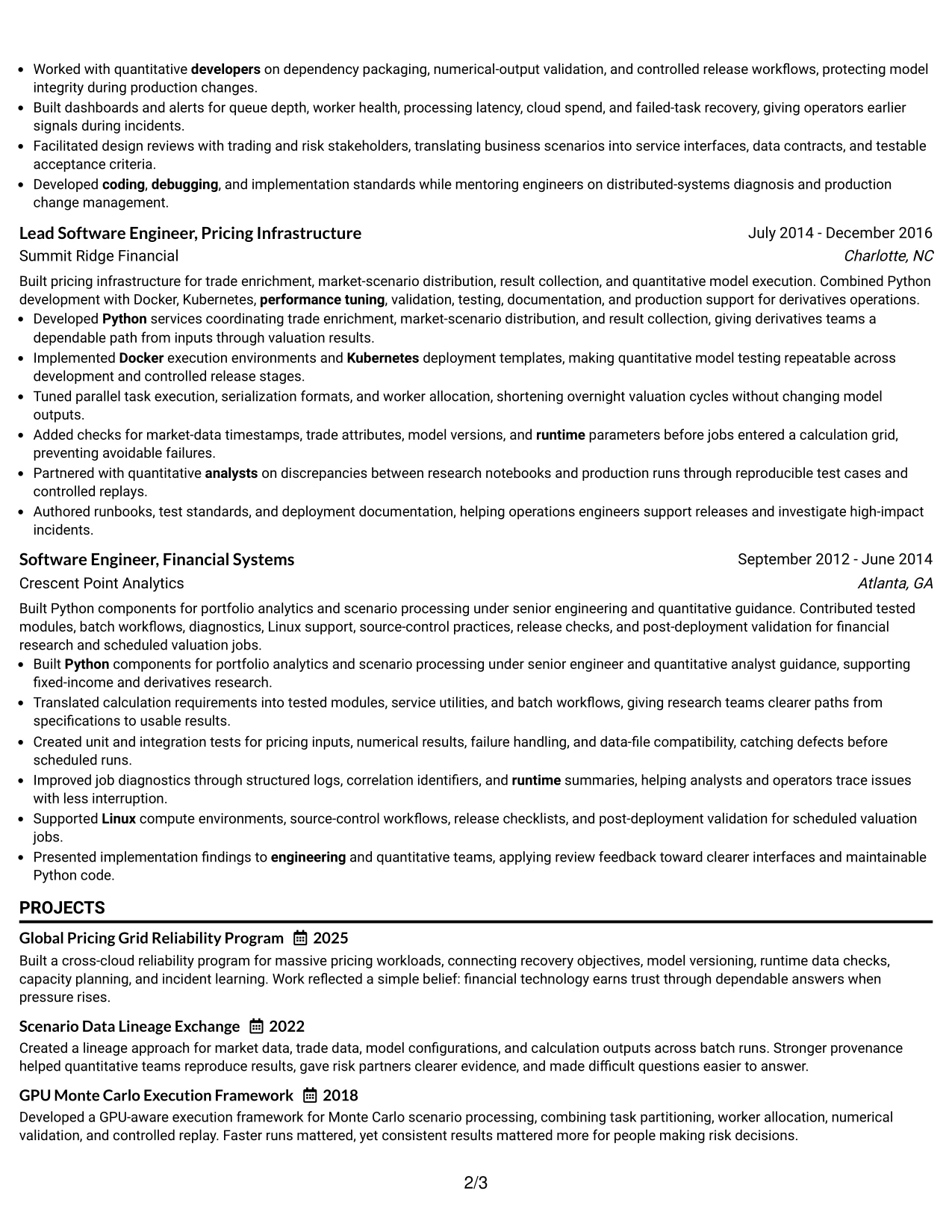
Why the One Column Shaded Contact Header Format Works for a Resume
- A single reading path supports fast recruiter scanning.
- The shaded contact header separates identity details from resume evidence.
- A clear job title near the top aligns the document with the target role.
- Experience bullets can show scope, technical ownership, and measurable results in order.
- Skills and tools remain visible without crowding the work history.
- The structure supports ATS parsing because content follows familiar resume sections.
- Projects, certifications, and education can appear as supporting proof after experience.
Best For
- Resumes that need a direct link between the target role and the opening summary.
- Professionals presenting broad leadership scope in a simple reading order.
- Applications where ATS-friendly section flow matters more than visual complexity.
- Technical resumes that must give equal visibility to cloud platforms and programming skills.
- Documents with substantial experience bullets and several supporting credentials.
- Readers who need to move from contact details to evidence without side-column navigation.
- Applications that benefit from a restrained header and strong content hierarchy.
#13 Boxed Contact Header with Job Title Format Resume Example
The Boxed Contact Header with Job Title Format places the candidate's contact information and target role inside a defined top block. Below that block, the resume uses standard sections for the summary, professional experience, skills, education, certifications, and projects.
That structure gives the reviewer an immediate label for the document before presenting detailed proof. Strong bullets can then connect Python platform leadership with AWS and GCP architecture, batch processing, Kubernetes operations, model deployment, performance tuning, and recovery time objectives.
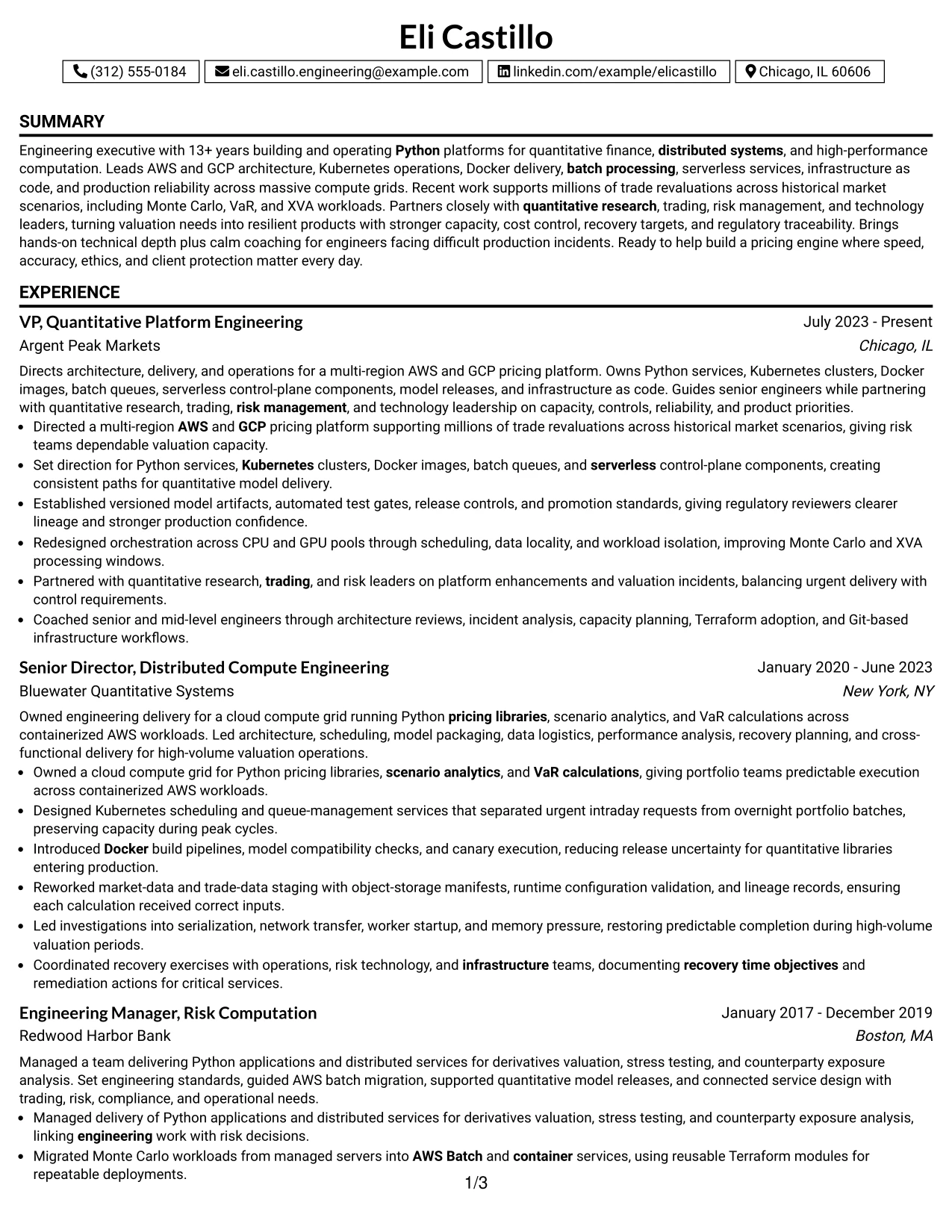
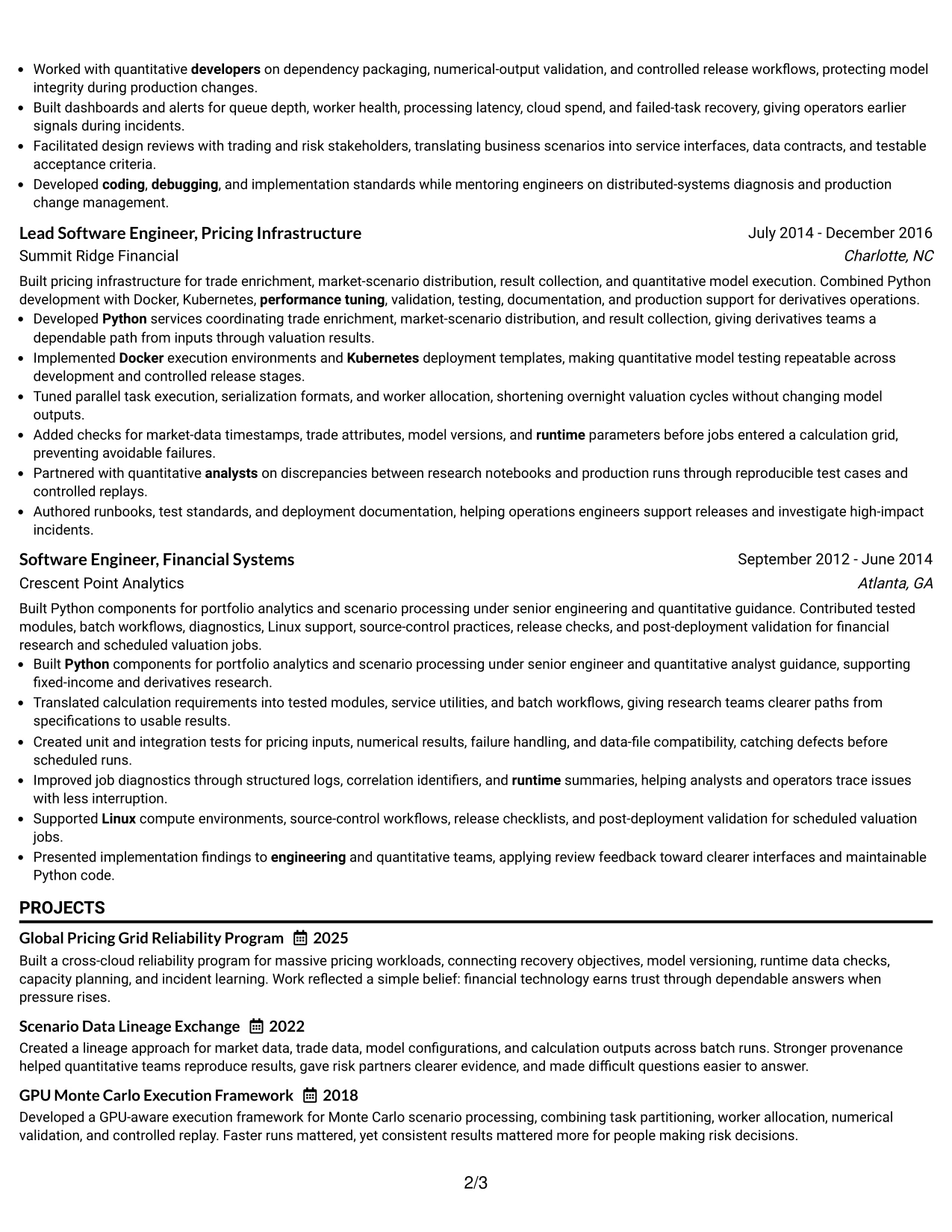
Why the Boxed Contact Header with Job Title Format Works for a Resume
- The boxed header gives the target position immediate visual priority.
- A defined top block makes contact details easy to locate.
- The one-column structure preserves a predictable ATS reading sequence.
- Job titles and employers can stand out through consistent section labels.
- Bullets remain wide enough for detailed technical achievements.
- The format supports a summary that connects leadership with hands-on engineering.
- Certifications and education can reinforce the qualifications without interrupting experience.
Best For
- Applications that need the target title to be unmistakable at first glance.
- Resumes with detailed bullets that benefit from full-width text.
- Candidates combining executive ownership with current technical involvement.
- Documents requiring a familiar structure for both software and financial technology review.
- Readers who prefer clear boxes and labels over decorative side panels.
- ATS-focused submissions with several cloud, container, and infrastructure keywords.
- Resumes that must balance a strong summary with a substantial career history.
#14 Stylish Two Column Designer Format Resume Example
Readers can begin with the main experience column while using the sidebar to confirm skills, certifications, education, and selected projects. This navigation separates detailed achievement bullets from supporting information without hiding either type of evidence.
The two-column design gives a long technical resume more usable structure. The main column can explain pricing-platform architecture, team leadership, production reliability, and performance work, while the sidebar reinforces Python, AWS, GCP, Terraform, Docker, Kubernetes, and quantitative finance terms.
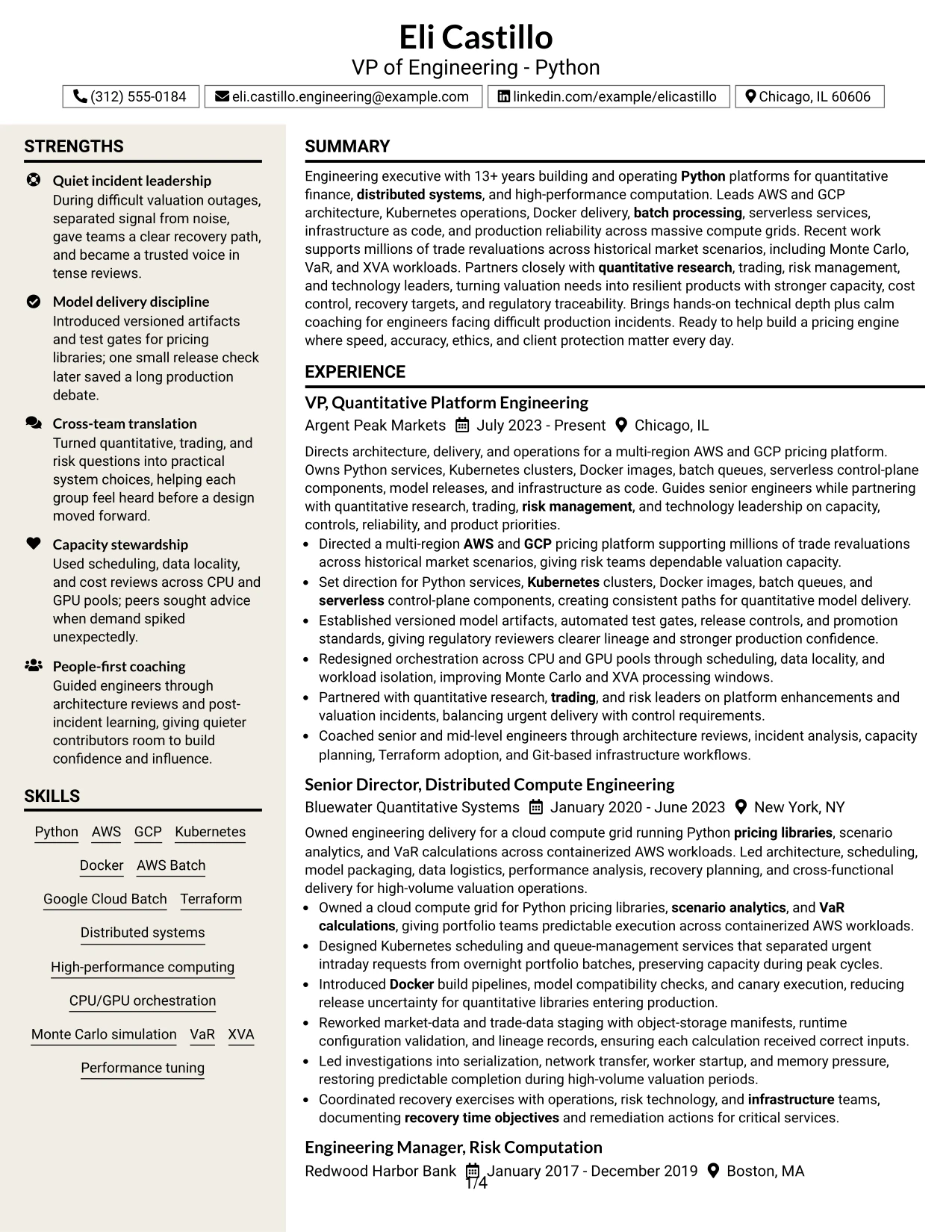
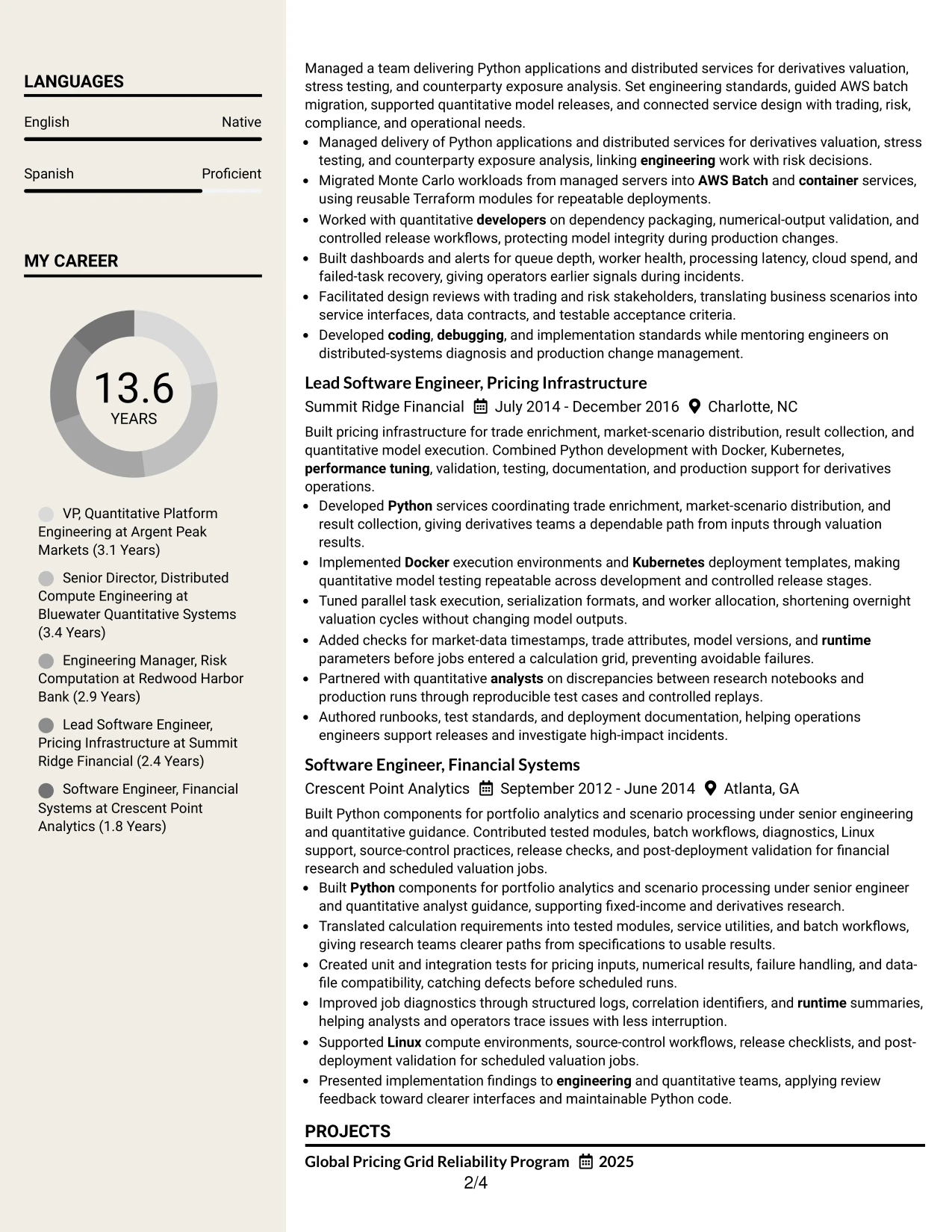
Why the Stylish Two Column Designer Format Works for a Resume
- Two columns divide detailed evidence from quick-reference qualifications.
- The main column has room for multiple leadership and engineering roles.
- A sidebar can surface high-value skills before the reader reaches every bullet.
- Projects provide a compact place for grid reliability and data lineage work.
- Certifications remain visible without taking space from professional experience.
- Distinct section areas help readers scan a large amount of career information.
- The format supports a strong balance between technical breadth and career chronology.
Best For
- Resumes with extensive experience that need a clear main-content and reference-content split.
- Professionals who want skills and certifications visible beside, not below, work history.
- Applications where project evidence adds depth to the employment record.
- Readers comfortable scanning a sidebar for tools and the main column for results.
- Technical leaders presenting both architecture decisions and team-development work.
- Documents with enough content to benefit from structured density rather than a long single stream.
- Applications where visual organization helps separate strategic scope from implementation detail.
#15 Modern Icon Format Resume Example
Evidence receives priority through compact sections marked by simple visual cues. The summary establishes scope, while experience bullets carry the strongest proof through platform ownership, team leadership, operational improvements, and technical delivery.
Icons help readers distinguish sections such as experience, skills, education, projects, and certifications, but the text remains the primary source of meaning. This supports a clear presentation of Python, distributed systems, cloud batch services, model versioning, performance tuning, and high availability.
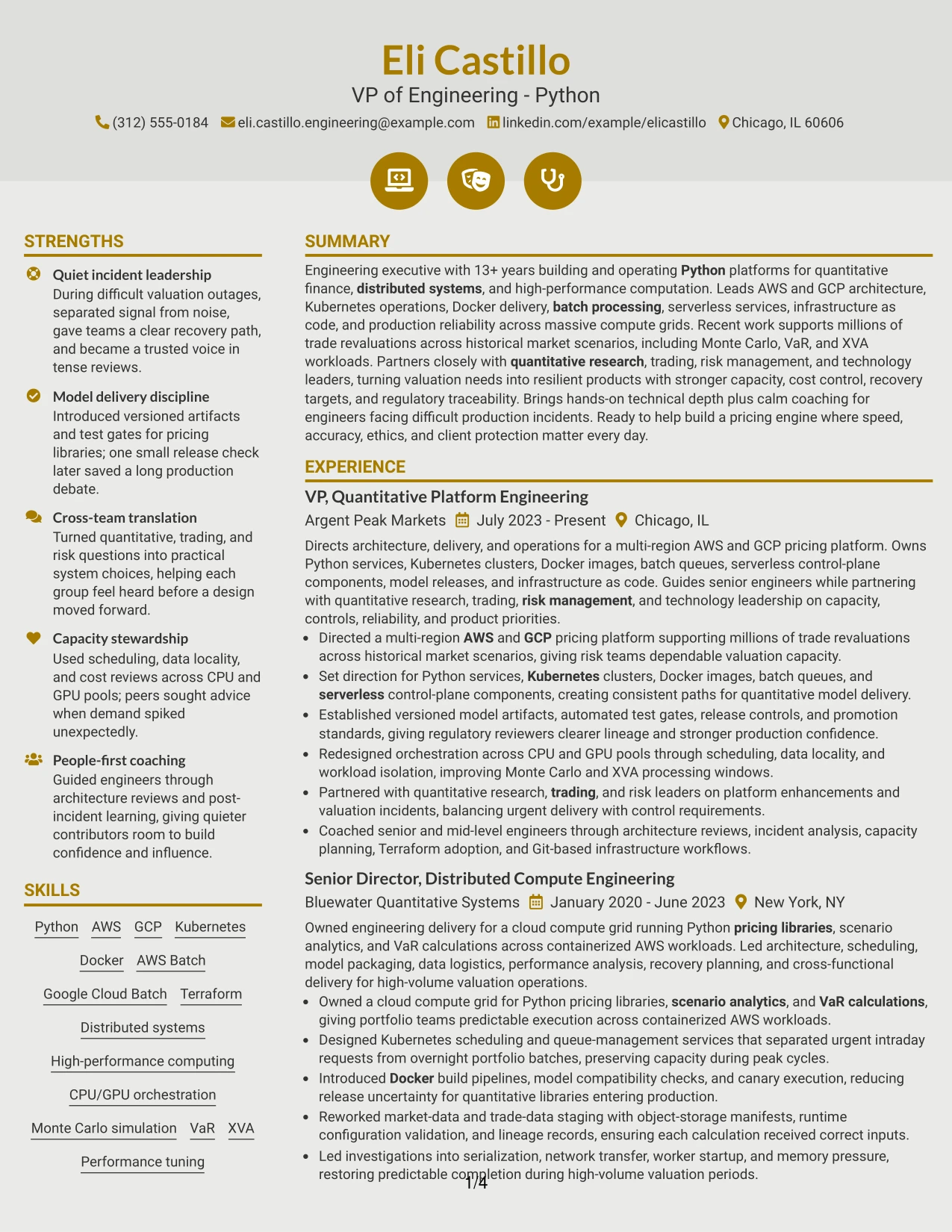
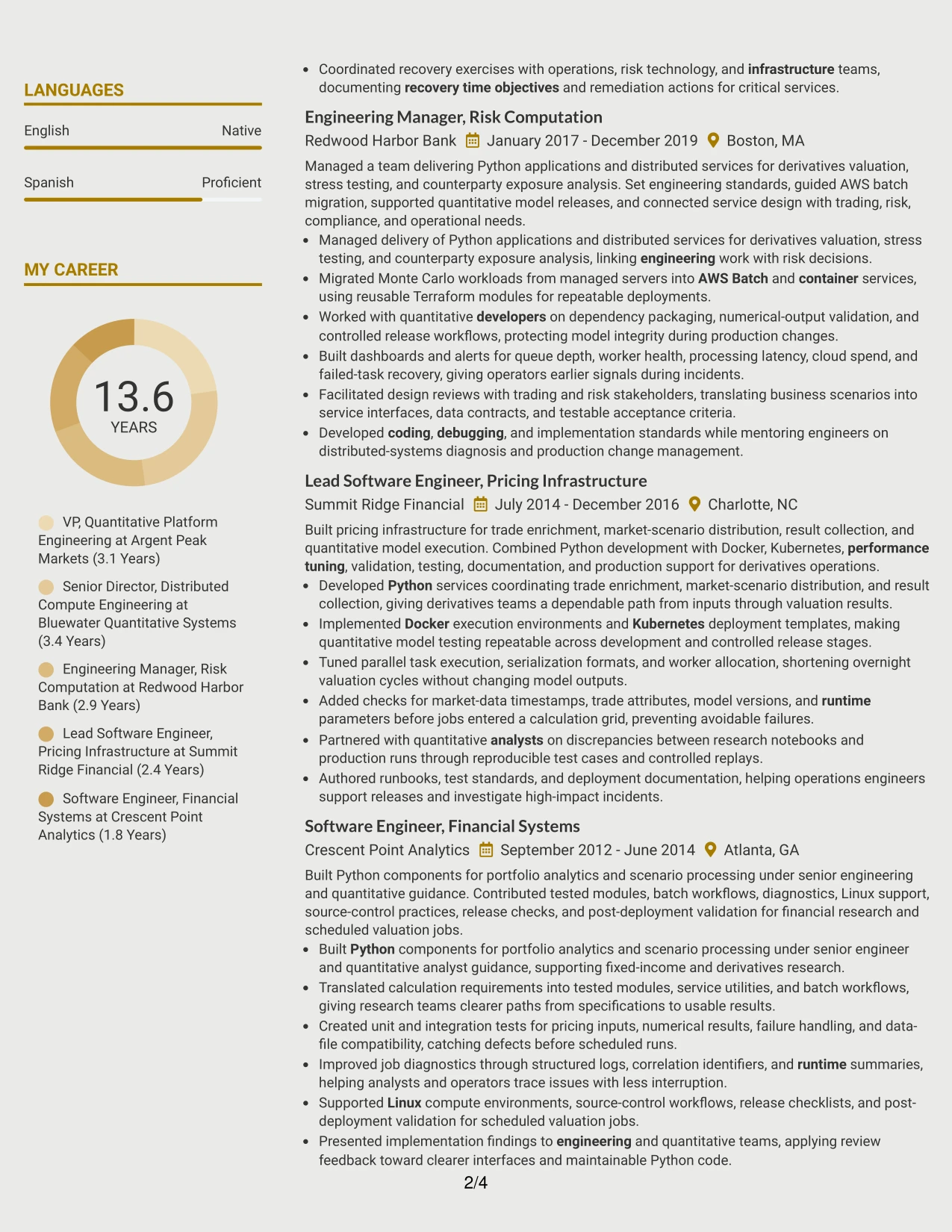
Why the Modern Icon Format Works for a Resume
- Visual cues help readers identify resume sections quickly.
- Achievement bullets remain the main evidence rather than decorative elements.
- A compact skills area can group Python, cloud, containers, and infrastructure as code.
- Projects can show applied work beyond formal job titles.
- Certifications and education gain clear markers without lengthy descriptions.
- The layout supports a modern technical profile while keeping information organized.
- Repeated section treatment creates a consistent path through complex experience.
Best For
- Resumes that need quick visual signposts across several technical sections.
- Professionals whose strongest proof comes from achievement-focused experience bullets.
- Applications with distinct projects, certifications, and technical skill groups.
- Readers who value modern presentation but still need text-led evidence.
- Technical profiles that combine platform operations, model delivery, and reliability work.
- Documents where compact markers can reduce the effort of locating supporting credentials.
- Applications seeking a contemporary layout without sacrificing resume section clarity.
#16 Plain Professional Layout with Job Title & Shaded Labels Resume Example
Content is balanced across a wide, single-column page, with shaded labels guiding the reader from the target title and summary to experience, skills, education, projects, and certifications. The restrained treatment leaves enough space for complete bullets without making the document feel crowded.
This format suits a practical application where accuracy and alignment must be clear. It can present AWS and GCP architecture, Kubernetes and Docker delivery, Python services, infrastructure as code, financial pricing models, and measurable operating outcomes in a straightforward sequence.
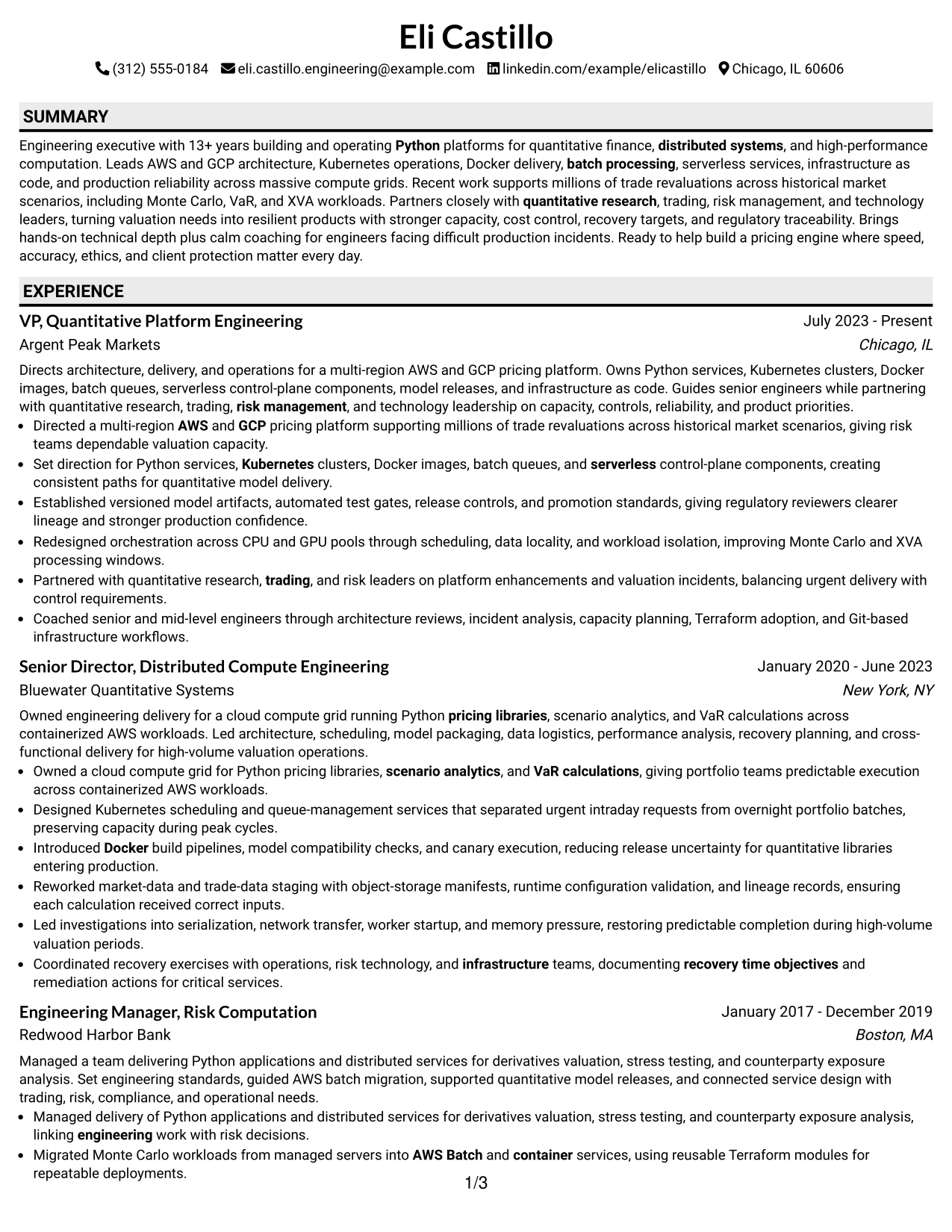
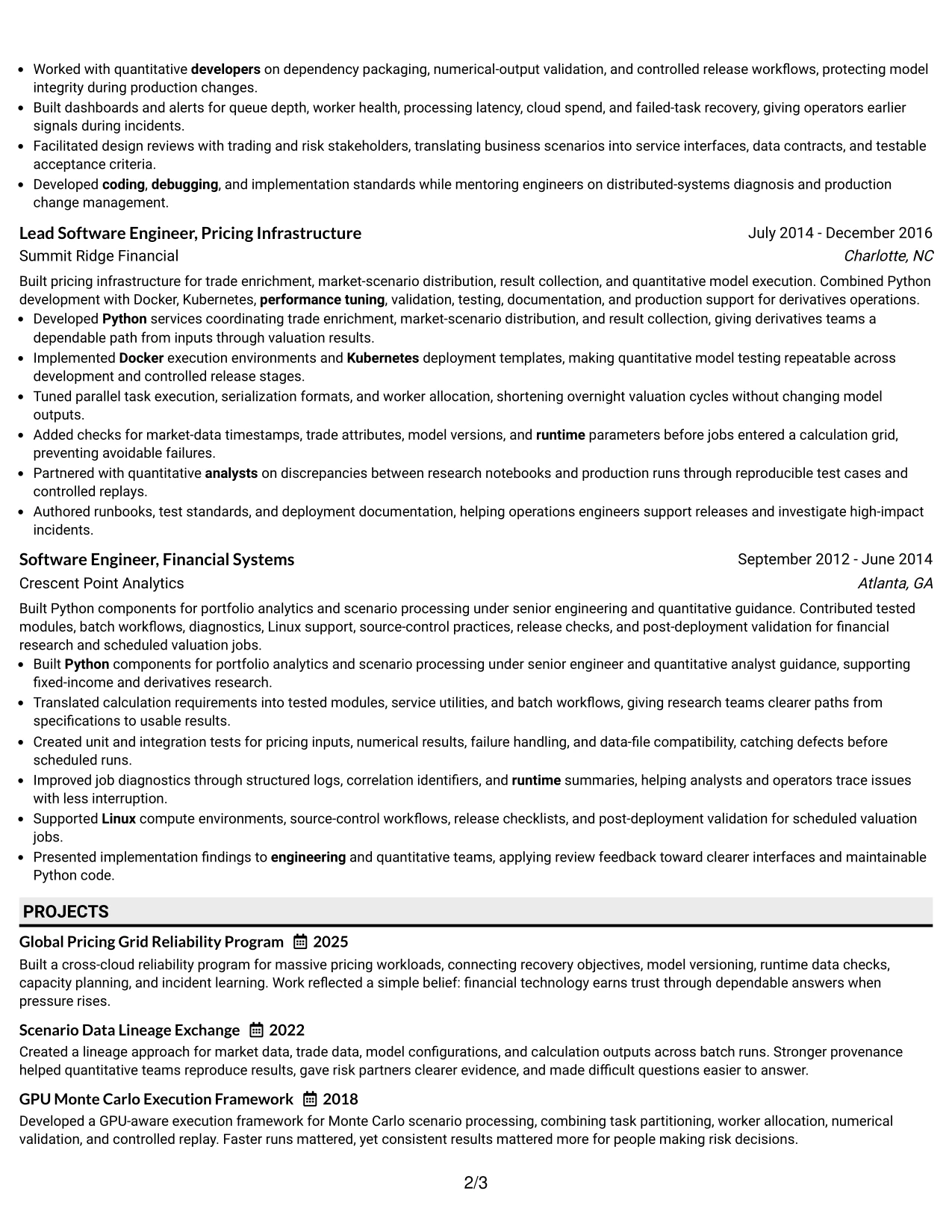
Why the Plain Professional Layout with Job Title & Shaded Labels Works for a Resume
- Shaded labels make each resume section easy to identify.
- The plain presentation keeps attention on responsibilities and outcomes.
- A prominent job title connects the summary to the application context.
- Full-width bullets allow complex systems work to be explained clearly.
- Skills can mirror important job requirements without overpowering experience.
- Education and certifications fit naturally into the lower section hierarchy.
- The format supports a professional review process where clarity matters more than decoration.
Best For
- Applications that call for a direct, businesslike presentation of technical leadership.
- Resumes needing enough width for detailed cloud and distributed-systems bullets.
- Professionals aligning a long record with a specific senior technology position.
- Reviews where section labels should make evidence easy to verify.
- Documents combining architecture, operations, coaching, and governance responsibilities.
- ATS-conscious submissions that benefit from familiar headings and linear content.
- Candidates who want strong role alignment without a visually elaborate design.
#17 Classic One Column Resume Format Resume Example
For a practical application, the classic one-column structure presents career history in a familiar order that supports both human review and ATS parsing. The reader can move from the summary to experience, skills, education, certifications, and projects without changing direction.
Its traditional presentation gives measurable results and technical responsibility the most room. The resume can show 13+ years of Python engineering, multi-region cloud platforms, millions of trade revaluations, Monte Carlo, VaR, XVA, and recovery planning through clear chronological evidence.
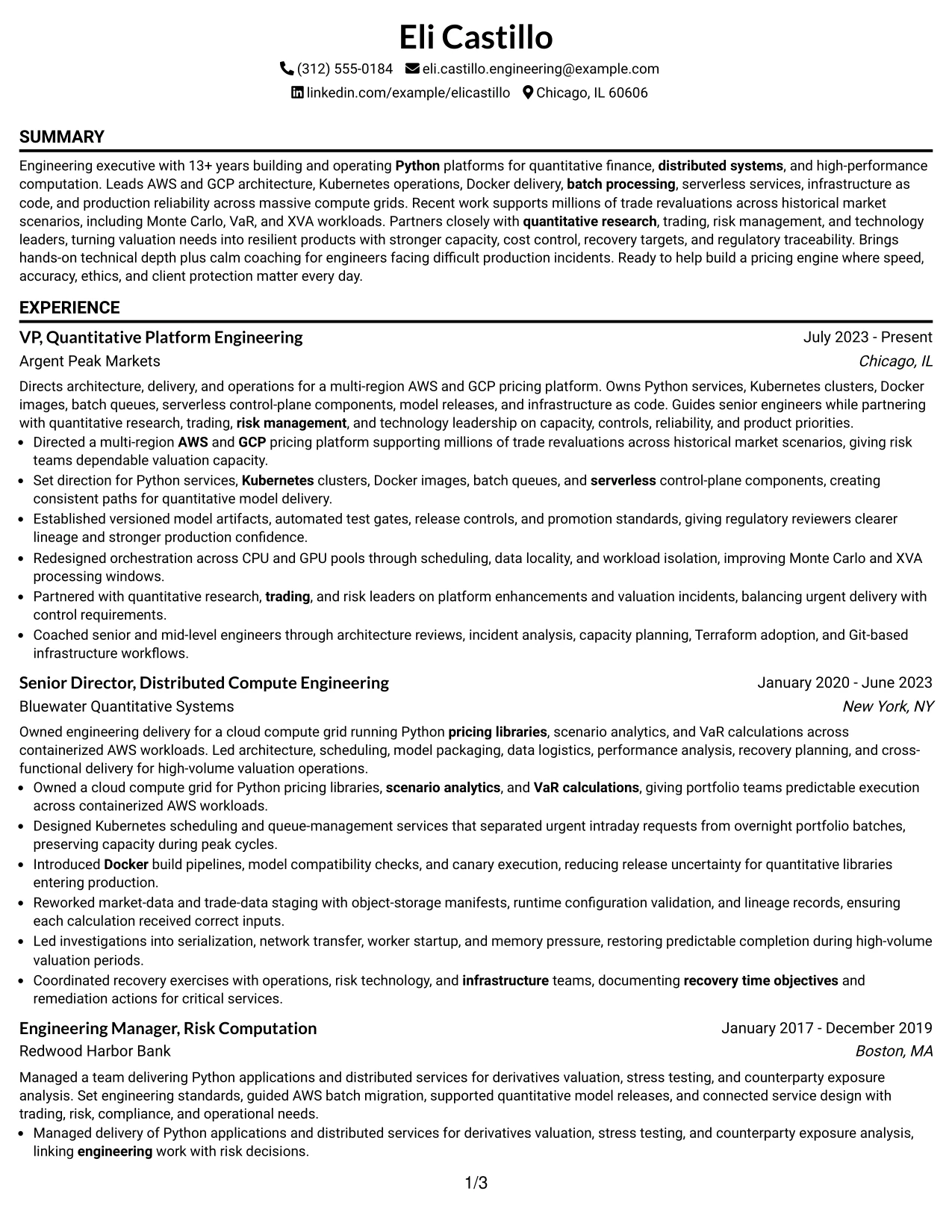
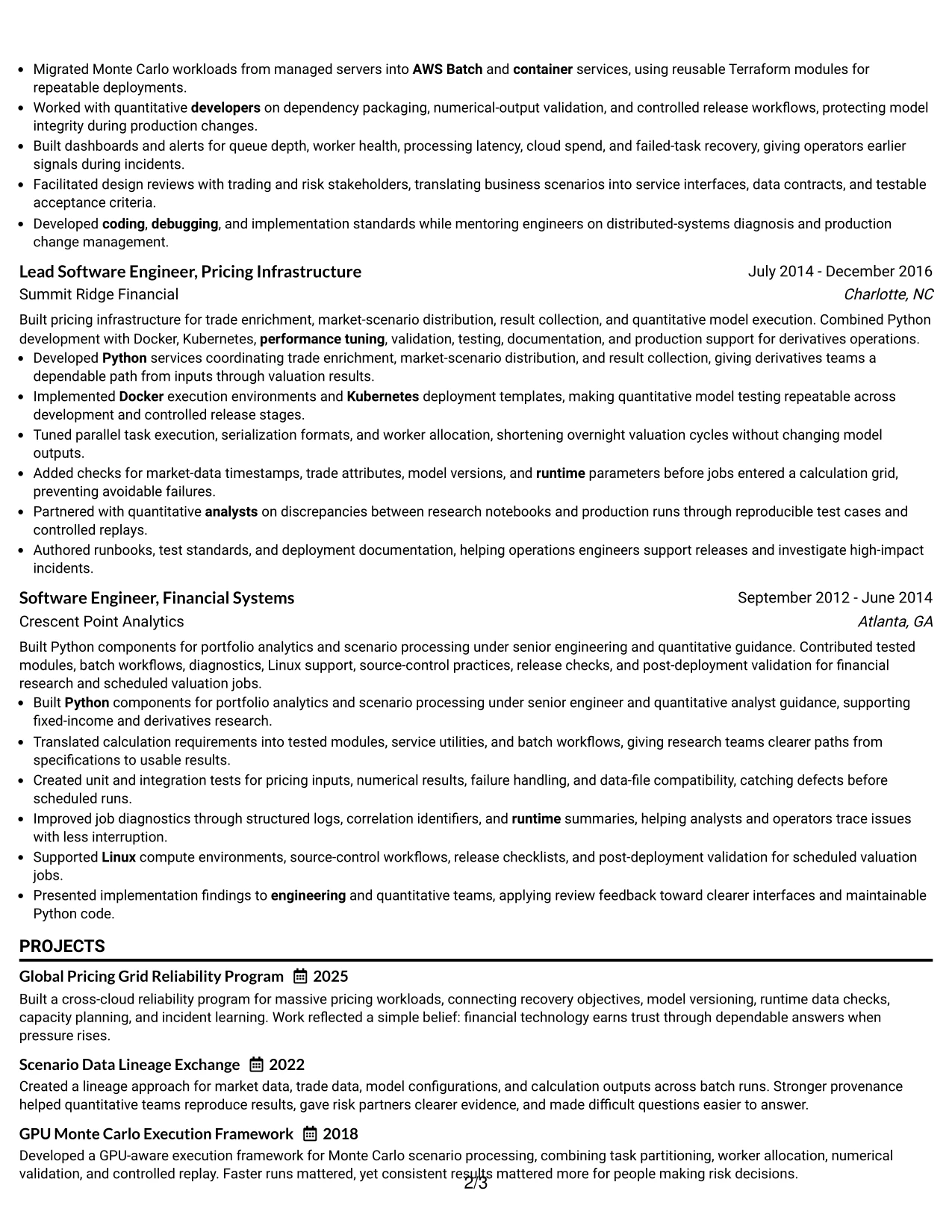
Why the Classic One Column Resume Format Works for a Resume
- A familiar structure reduces effort during a first review.
- Chronological experience makes career progression easy to verify.
- Full-width bullets support detailed technical and leadership achievements.
- Standard headings improve ATS recognition and keyword matching.
- Skills can reinforce the evidence already shown in professional experience.
- Education and certifications are easy to find in a conventional closing section.
- The format keeps attention on results, scope, and relevant responsibilities.
Best For
- Traditional application processes that favor familiar resume organization.
- Professionals with a steady record that benefits from clear chronology.
- ATS submissions requiring standard headings and predictable text order.
- Resumes where measurable platform scope should carry more weight than design effects.
- Technical leaders presenting both hands-on delivery and organizational responsibility.
- Applications that need detailed bullets to explain complex systems in plain sequence.
- Readers who want to verify experience, credentials, and projects with minimal navigation.
#18 One Column Format with Photo Resume Example
A restrained one-column hierarchy combines a prominent photo area with a direct path through the summary, experience, skills, education, projects, and certifications. The visual introduction is kept separate from the evidence so the document can still present technical qualifications in a logical order.
The format gives a personal first impression while preserving space for results-focused bullets. For this VP of Engineering - Python resume, the strongest content remains cloud architecture, Python platform ownership, Kubernetes operations, distributed compute, model deployment, and production reliability.
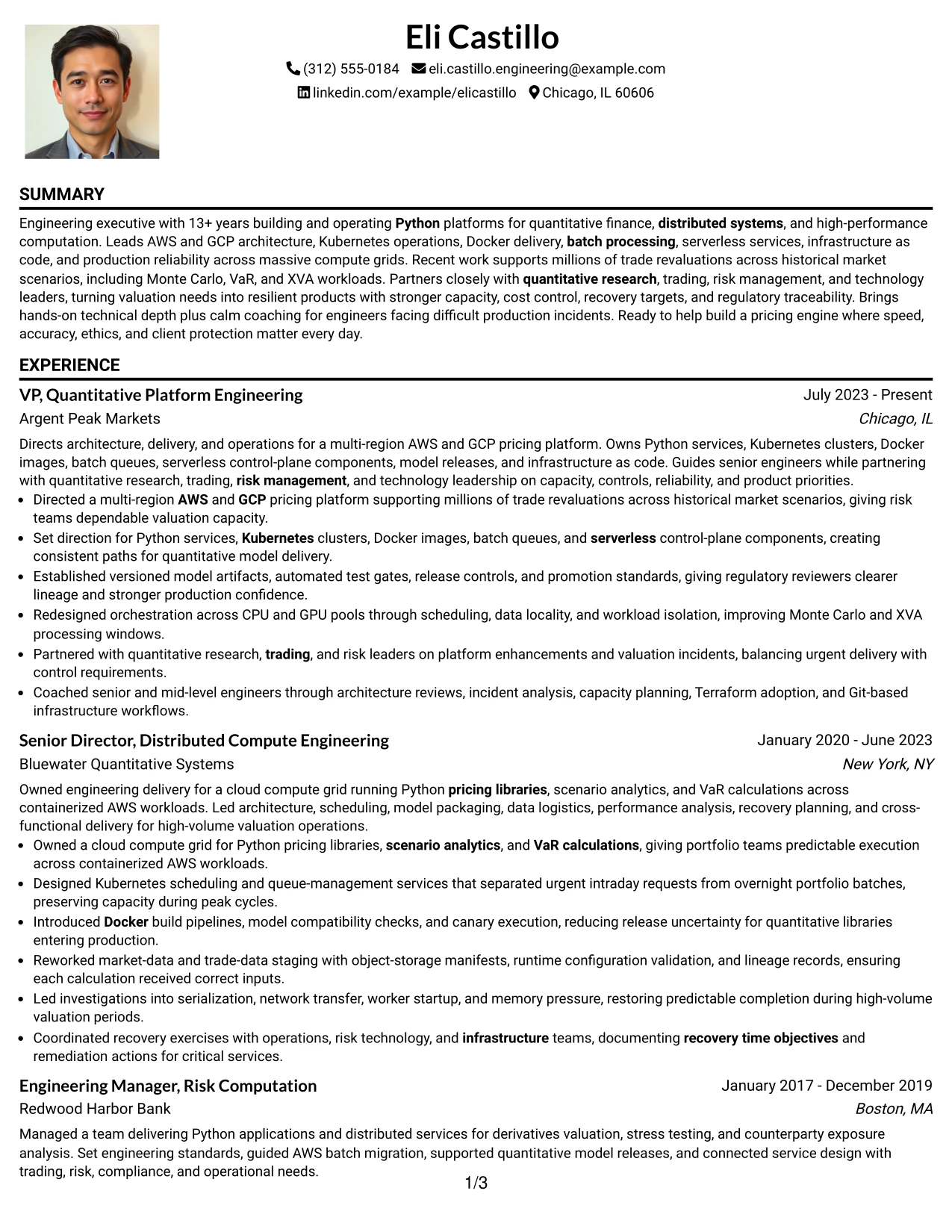
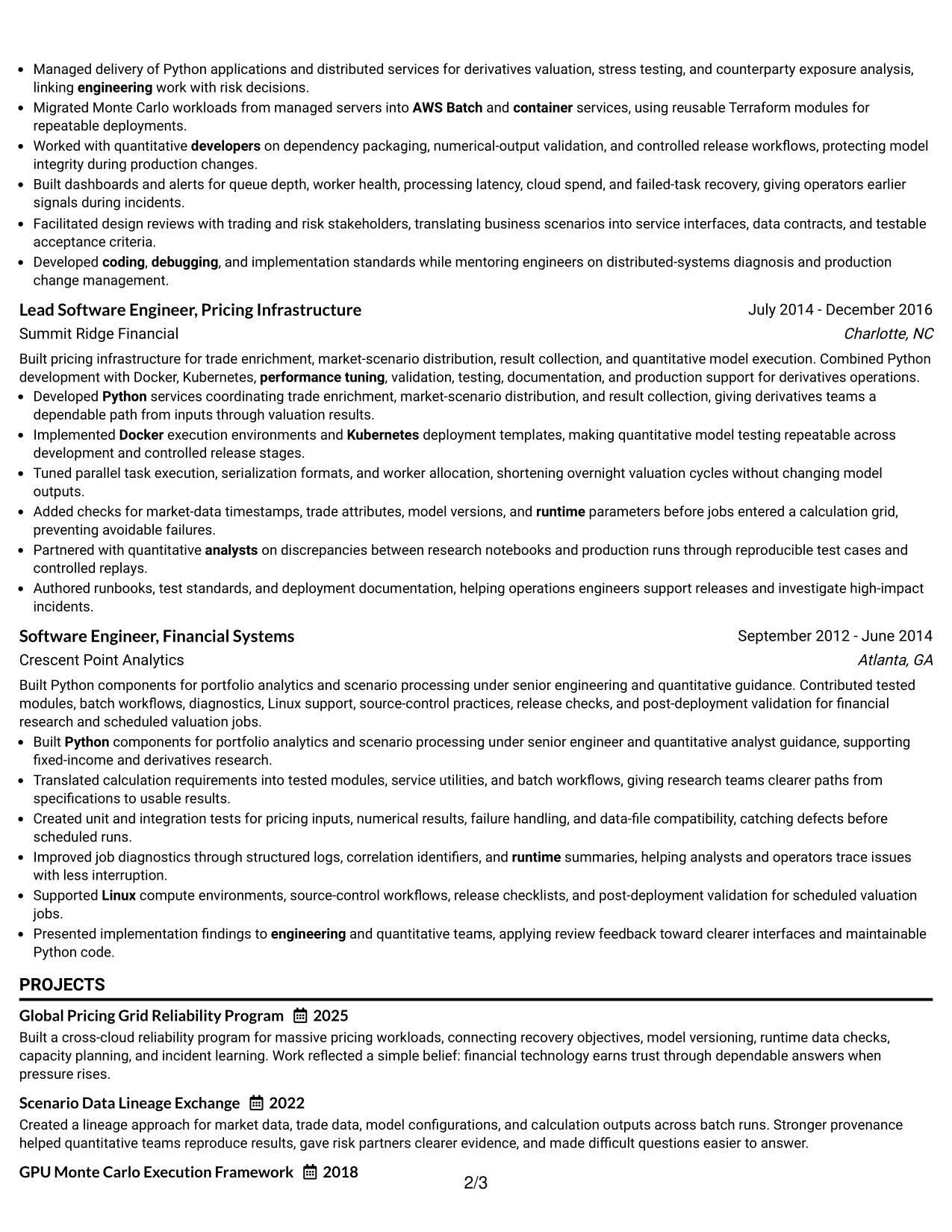
Why the One Column Format with Photo Works for a Resume
- The photo area gives the header a clear personal identity.
- A single content column keeps the resume easy to scan after the header.
- The target title can sit close to the contact details and summary.
- Full-width bullets allow leadership scope and technical evidence to remain readable.
- Skills and tools can be grouped without competing with the work history.
- Projects and certifications add supporting proof in a familiar sequence.
- The structure keeps visual personality separate from ATS-relevant resume content.
Best For
- Applications where a personal visual introduction is appropriate for the submission context.
- Professionals who want a single reading path after the opening identity block.
- Resumes with substantial experience that requires full-width achievement bullets.
- Candidates presenting a mix of executive leadership and hands-on technical depth.
- Documents that need clear separation between personal presentation and qualification evidence.
- Readers who prefer a conventional sequence for skills, experience, and credentials.
- Role-aligned resumes where cloud, Python, and reliability proof should remain central.
#19 Minimal Header Format Resume Example
The Minimal Header Format starts with only the information needed to identify the document, leaving the remaining page for the summary, work history, skills, education, projects, and certifications. Its structure removes visual noise and makes the section order immediately clear.
That economy benefits a senior technical resume with substantial evidence. Readers can focus on Python, AWS, GCP, Kubernetes, Docker, batch processing, infrastructure as code, quantitative pricing systems, and recovery objectives instead of working through unnecessary page elements.
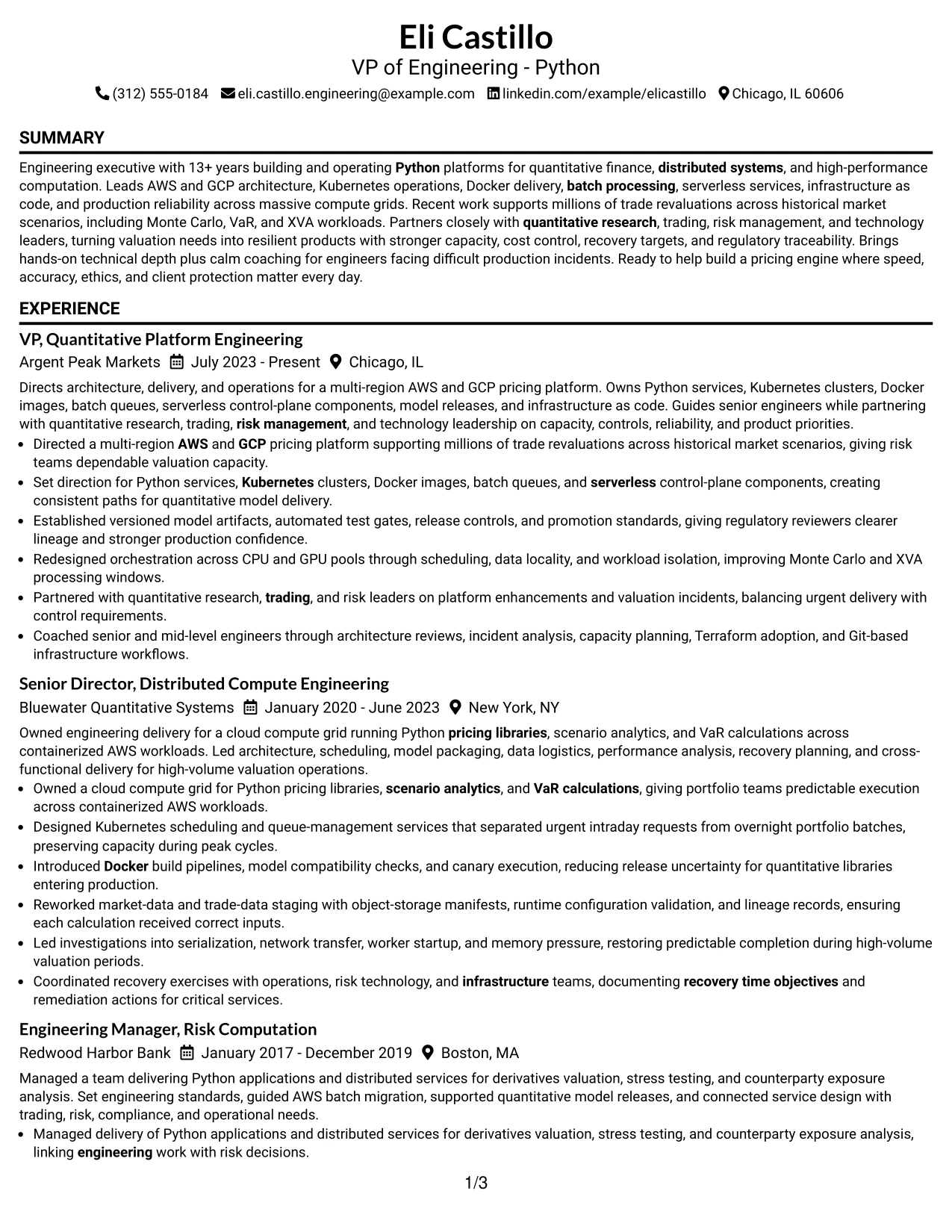
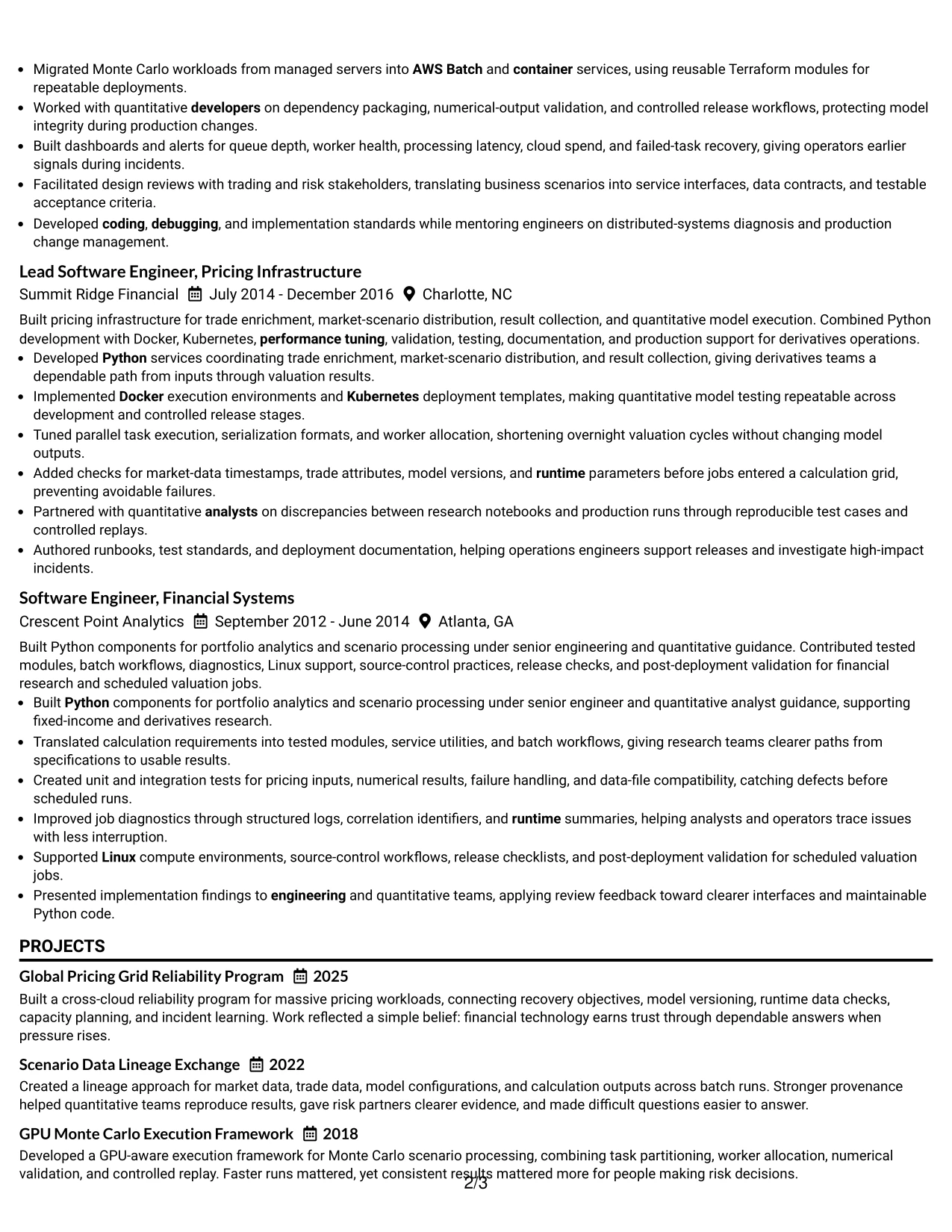
Why the Minimal Header Format Works for a Resume
- A small header preserves space for high-value experience evidence.
- Minimal presentation reduces distractions during a fast review.
- The single-column flow supports reliable ATS parsing.
- The summary can state role alignment without competing with graphics.
- Technical skills remain easy to locate and compare with job requirements.
- Experience bullets have room to show actions, scope, and outcomes.
- Projects and certifications can complete the document without visual overload.
Best For
- Senior resumes where experience deserves most of the available page space.
- ATS-driven applications that benefit from a clean, linear structure.
- Professionals with many technical keywords that need orderly presentation.
- Reviews where readers want to move quickly from identity to career evidence.
- Documents with detailed platform, reliability, and leadership accomplishments.
- Applications that favor a quiet format over decorative visual treatment.
- Candidates who need supporting projects and credentials without a crowded header.
#20 Modern Full Background Two Column Format Resume Example
Recruiters can follow the main column for the summary and professional experience while using the second column for skills, education, certifications, projects, and activities. Eli Castillo's resume benefits from this division because it holds extensive leadership evidence without burying the technical keyword groups.
A full background treatment gives the page a unified modern character, while the two-column structure controls content volume. The main area can detail multi-region pricing platforms and production results; the secondary area can reinforce Python, AWS, GCP, Terraform, Docker, Kubernetes, Monte Carlo, VaR, and XVA.
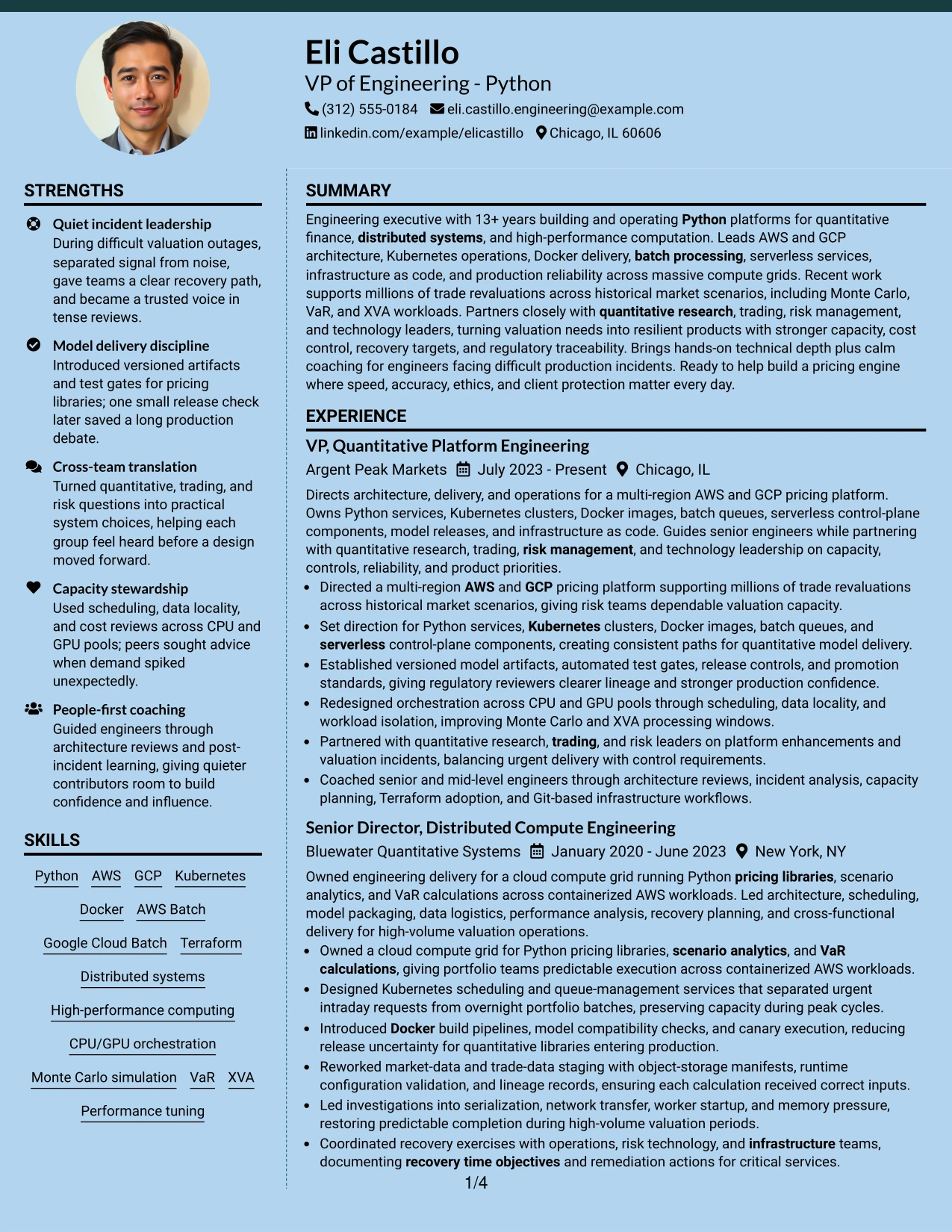
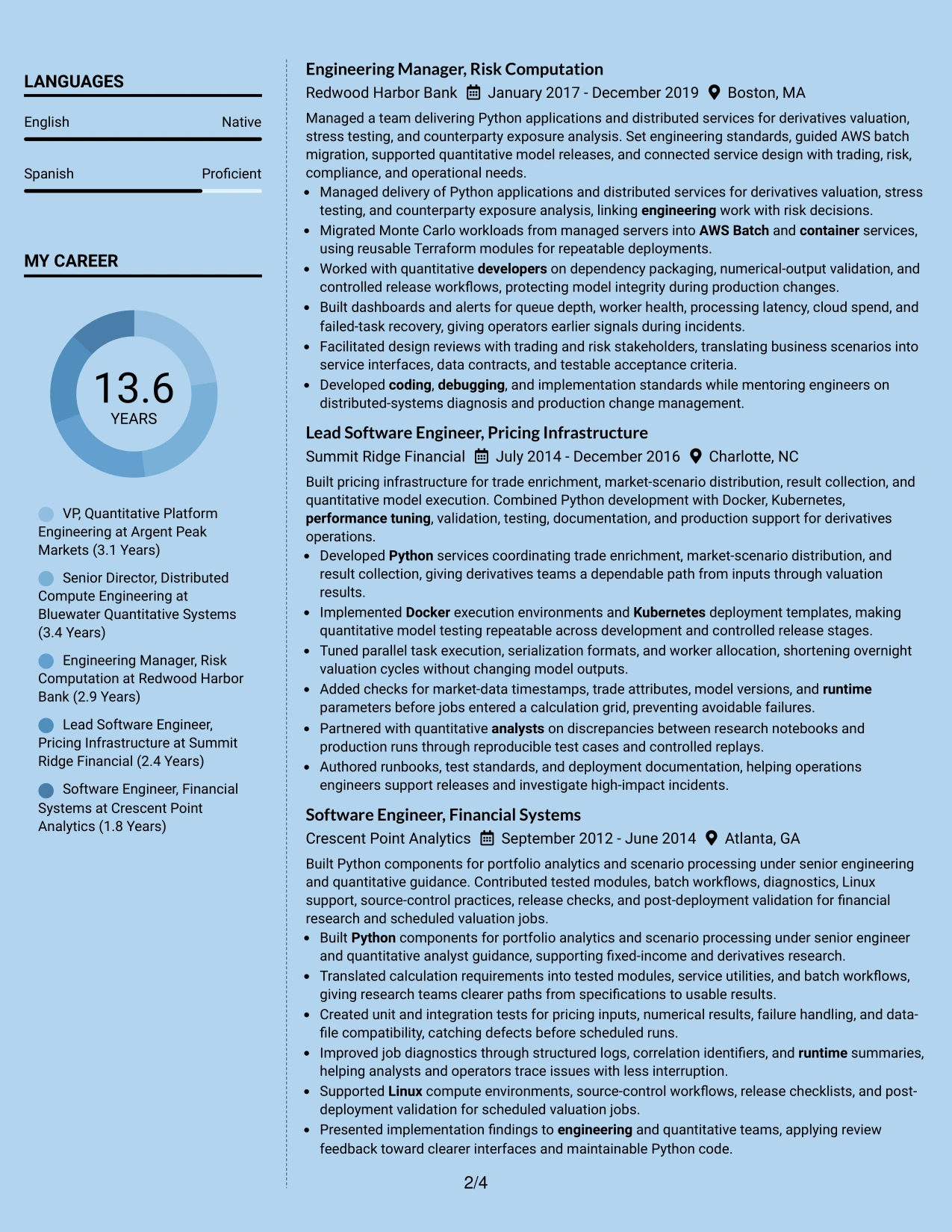
Why the Modern Full Background Two Column Format Works for a Resume
- The main column protects space for a substantial professional history.
- The secondary column keeps skills and credentials available during scanning.
- A unified background creates visual consistency across both content areas.
- Projects can provide focused evidence of reliability, lineage, and GPU execution.
- The layout handles a high volume of keywords without turning the experience section into a list.
- Education, certifications, and activities remain visible as supporting qualifications.
- Two-column navigation lets readers switch between career proof and quick-reference details.
Best For
- Experienced professionals whose work history needs a large primary content area.
- Resumes with many skills, certifications, projects, and activities to present together.
- Applications where quick-reference qualifications should stay beside career evidence.
- Technical leaders who need to show both platform scale and organizational influence.
- Readers comfortable using a modern sidebar to confirm tools and credentials.
- Documents requiring dense content but clear separation between evidence types.
- Applications where a unified visual field can support a polished senior-level presentation.
#21 Dark Mode Two Column Format Resume Example
Evidence comes first in the main column: leadership scope, platform ownership, technical decisions, and operational results. A secondary column can then organize skills, certifications, education, projects, and activities for quick confirmation.
The dark treatment creates strong contrast between section groups, while the two-column structure manages a detailed technical record. Clear text blocks can show Python services, AWS and GCP cloud work, Kubernetes, Docker, batch processing, model deployment, performance tuning, and high availability.
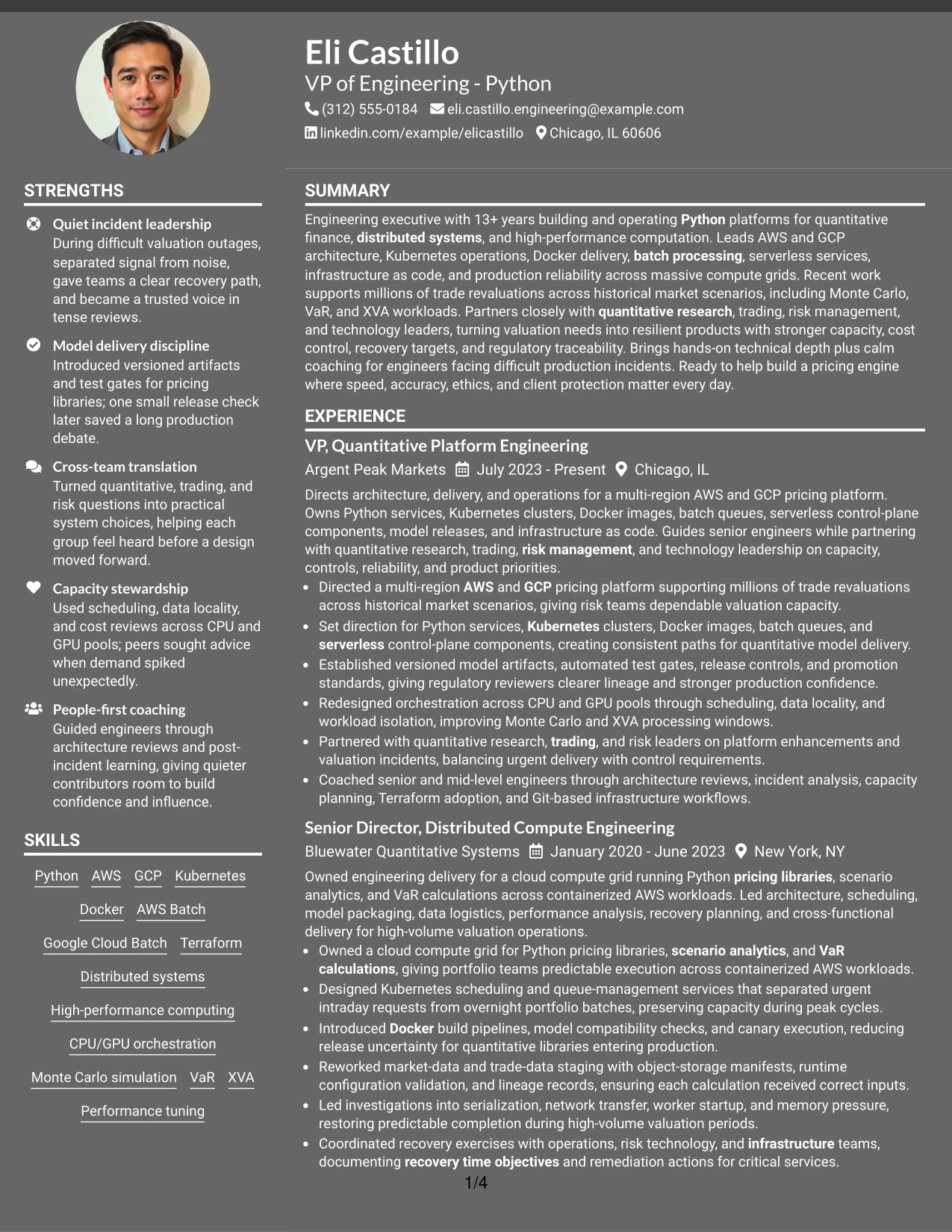
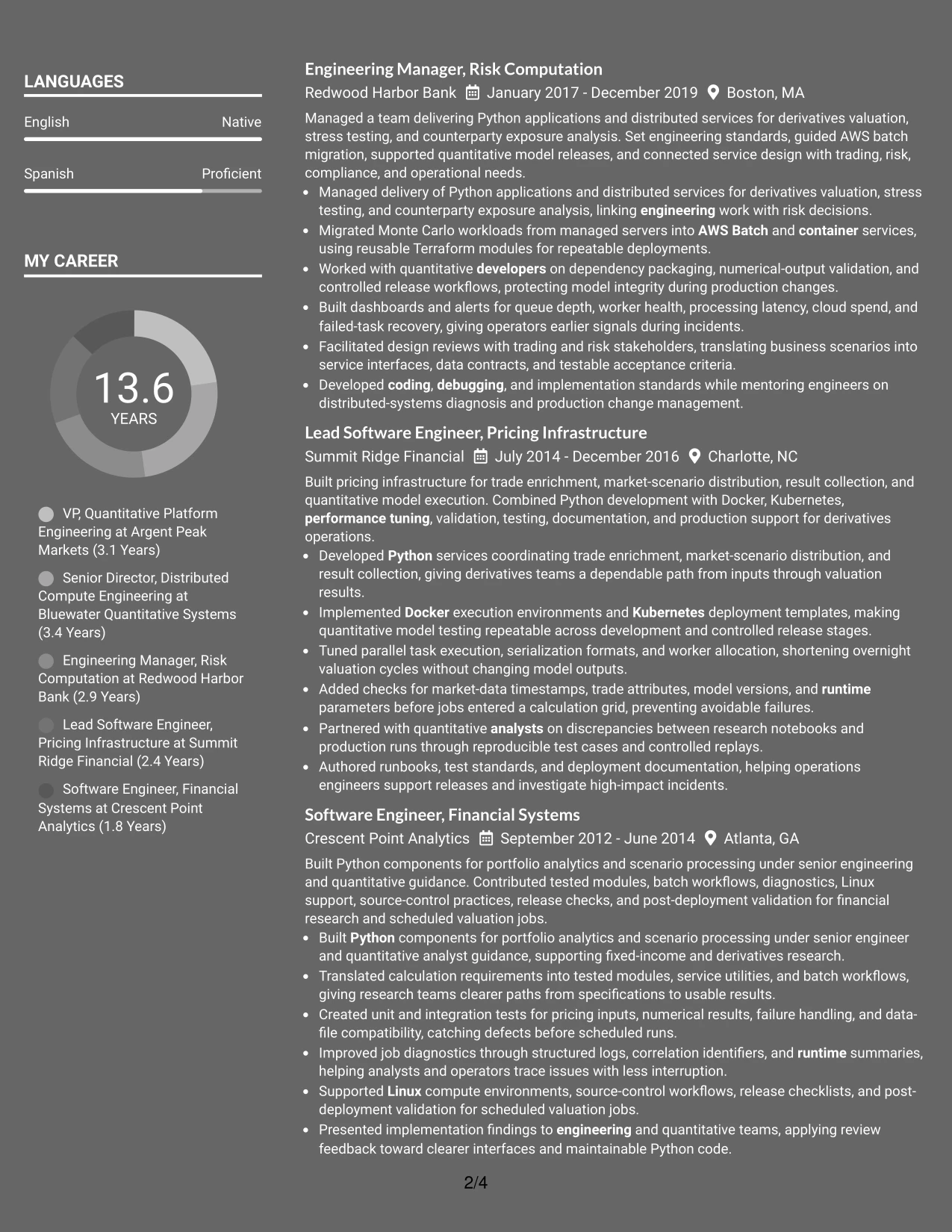
Why the Dark Mode Two Column Format Works for a Resume
- The main column gives achievement evidence the strongest reading position.
- A secondary column provides a compact index of skills and credentials.
- High contrast can separate sections when the page contains substantial content.
- Technical keywords remain grouped for fast qualification checks.
- Projects can show applied evidence that complements formal employment history.
- Certifications and education stay visible without interrupting career chronology.
- The format supports a distinctive presentation while retaining clear resume structure.
Best For
- Applications that permit a bold visual treatment for a technical leadership resume.
- Professionals needing a strong evidence column plus a compact qualification index.
- Documents with several cloud, container, and distributed-computing terms to organize.
- Readers who scan for results first and verify tools and credentials second.
- Resumes where projects demonstrate practical depth beyond standard job bullets.
- Candidates presenting reliability, performance, and model-delivery work together.
- Submissions that need high information density with clear separation between content groups.
#22 Dark Mode Box Header Format Resume Example
Content is balanced around a defined header box that identifies the target role and contact details, followed by a clean sequence of summary, experience, skills, projects, education, and certifications. The boxed start gives the page structure before the reader reaches the detailed evidence.
A dark visual treatment adds contrast, while the single-column body keeps technical achievements readable from top to bottom. This format can present massive-scale compute grids, Python pricing libraries, AWS Batch, Docker, Kubernetes, Terraform, performance tuning, and recovery time objectives with clear emphasis.
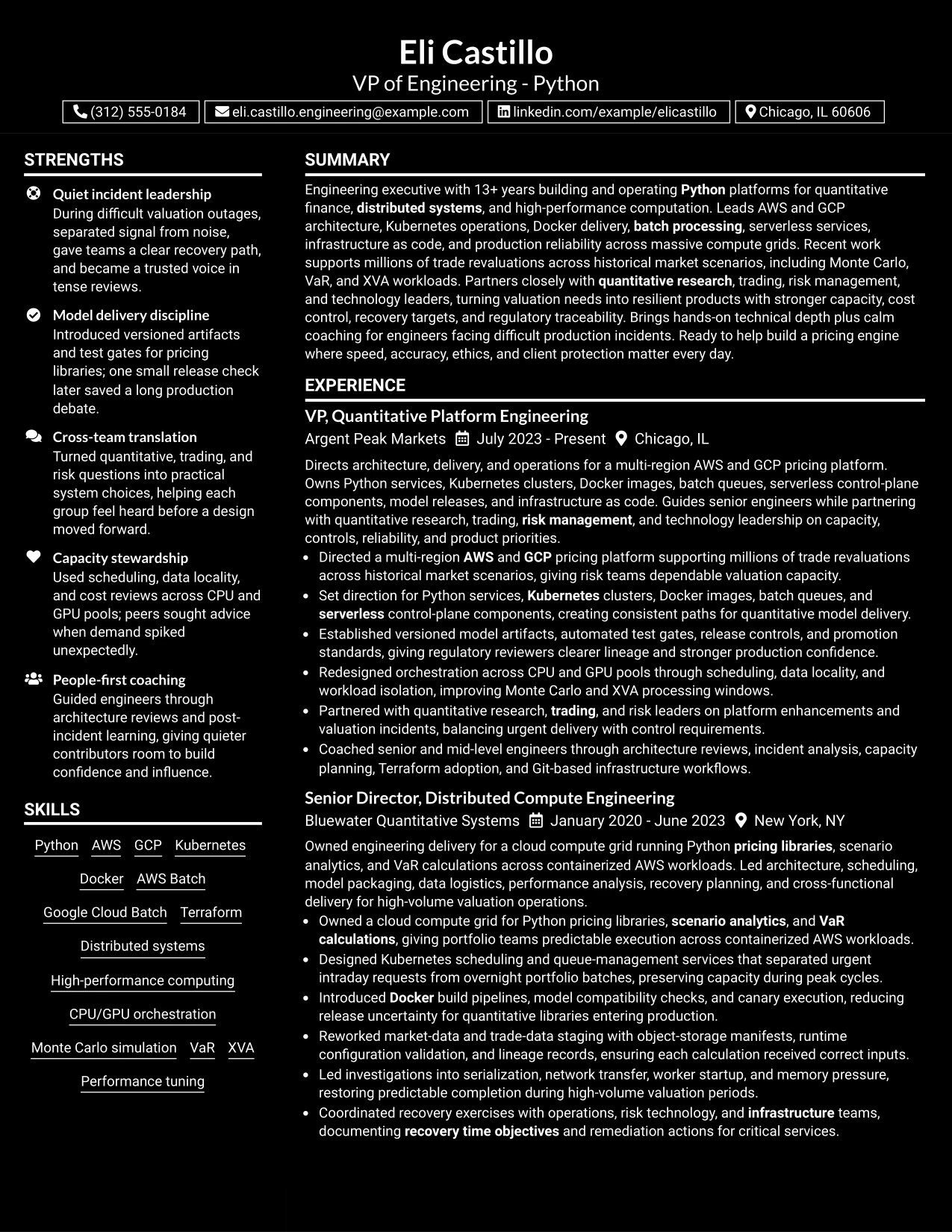
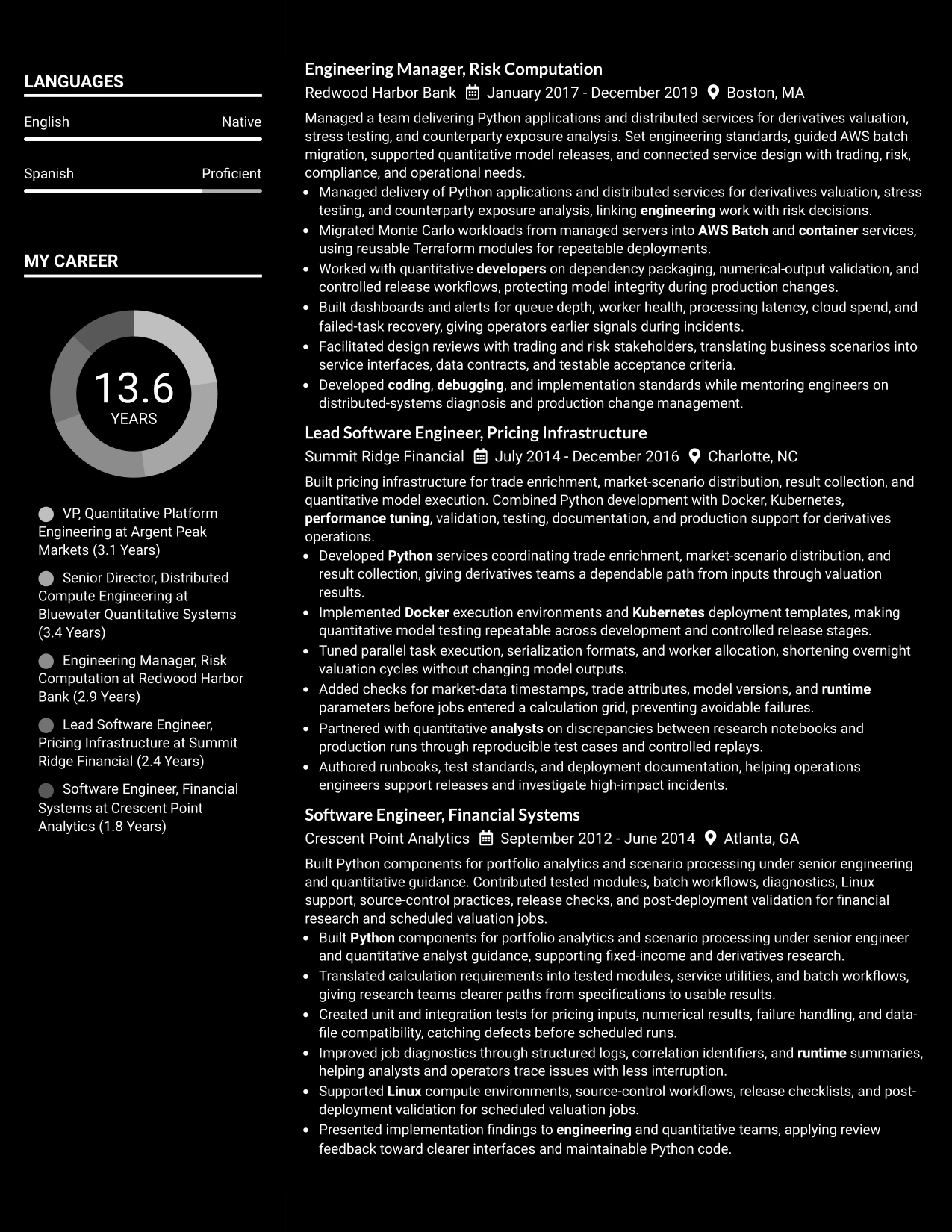
Why the Dark Mode Box Header Format Works for a Resume
- The box header gives the application context a defined starting point.
- A single-column body keeps the remaining content balanced and readable.
- Strong contrast helps separate the header from the resume evidence.
- Experience bullets can explain complex systems without narrow text blocks.
- Skills can be grouped under clear labels for quick technical review.
- Projects, education, and certifications fit into a controlled closing sequence.
- The format combines visual distinction with a straightforward review path.
Best For
- Applications where a distinctive header should still lead into conventional resume sections.
- Technical leaders who need full-width space for distributed-computing achievements.
- Documents with a clear target title and a substantial body of supporting evidence.
- Reviews where contrast helps separate identity information from professional history.
- Resumes combining platform architecture, production operations, and people leadership.
- ATS-conscious submissions that retain familiar text sections beneath a styled header.
- Candidates who want visual confidence without splitting the main career story into columns.
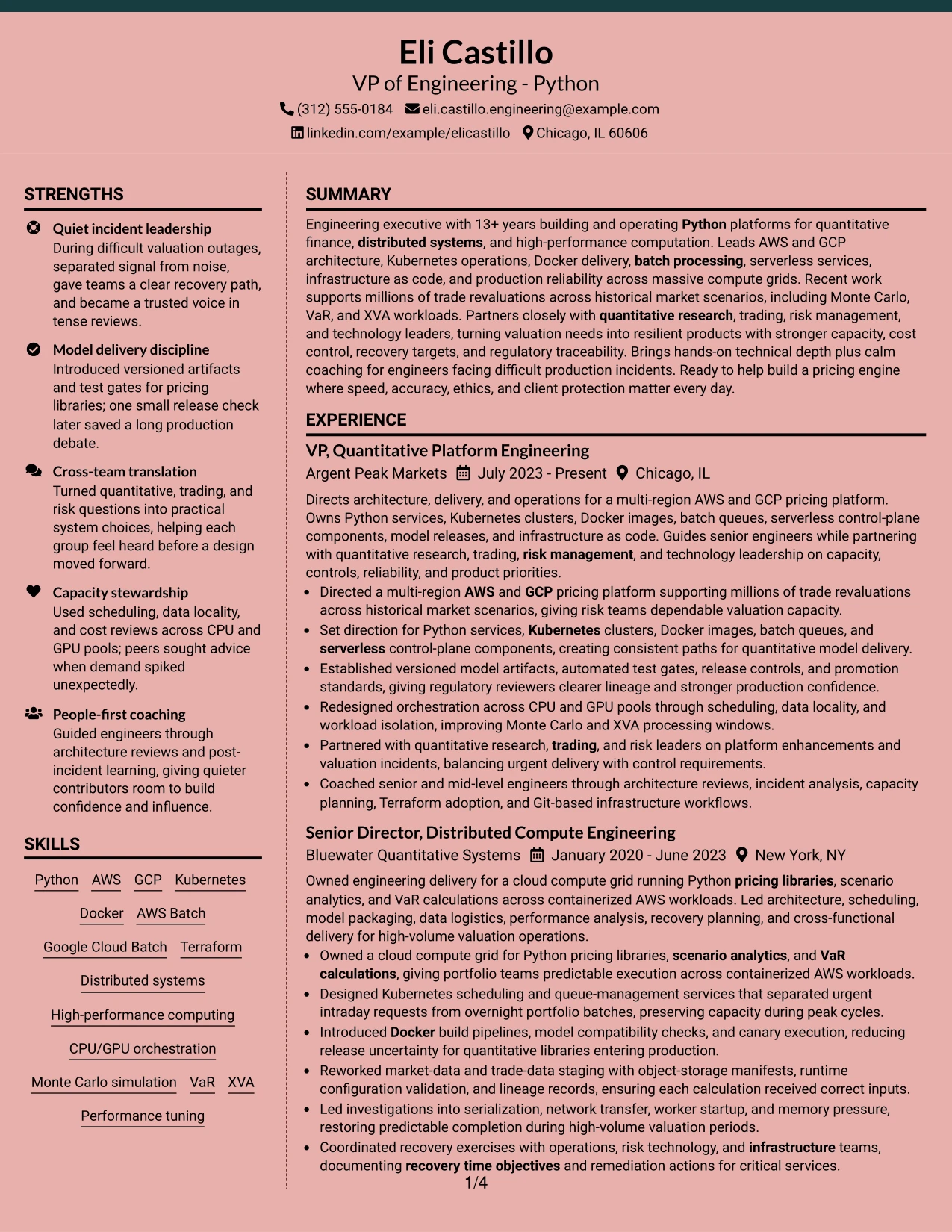
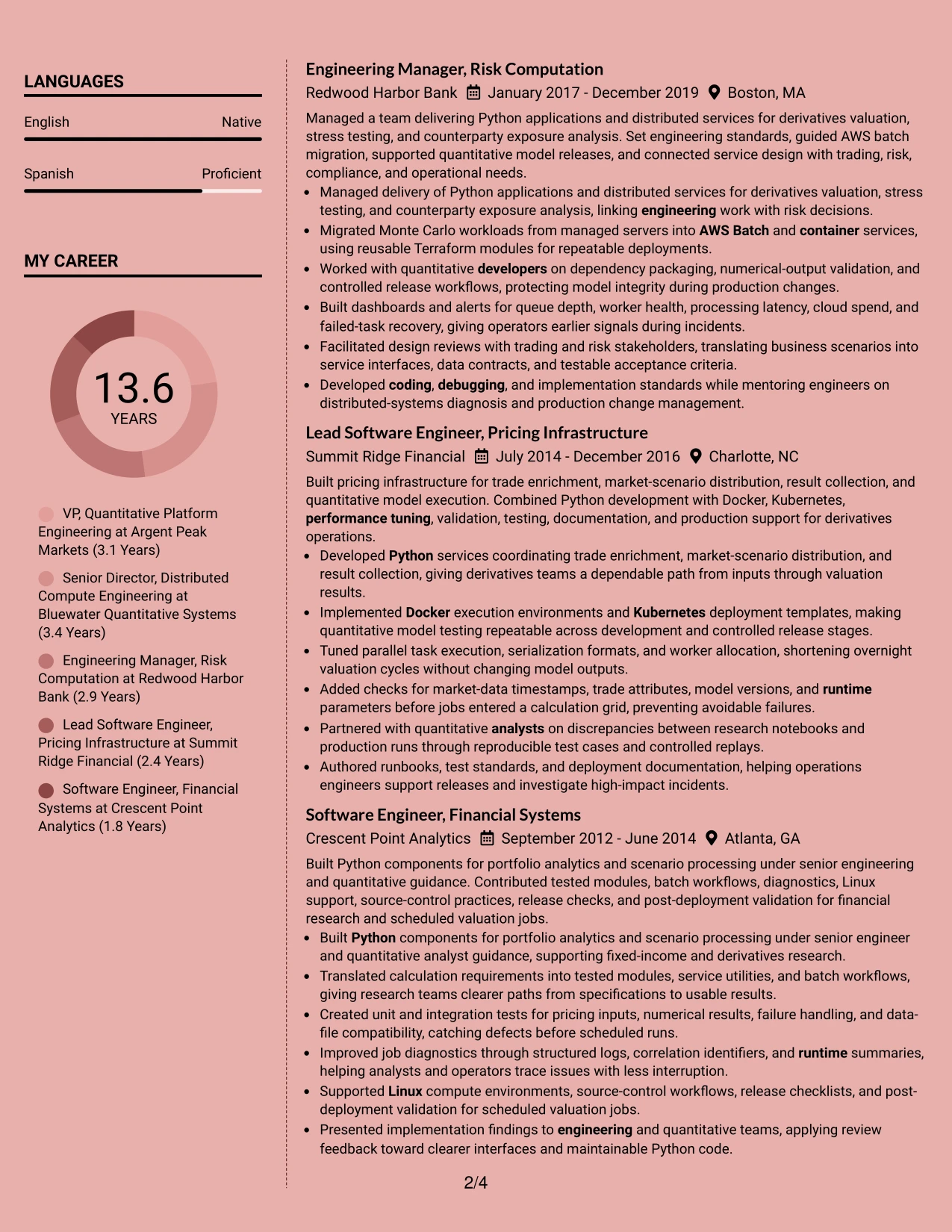
#23 Elegant Full Background Two Column Format Resume Example
For a VP of Engineering - Python application, this format gives leadership scope and technical depth separate but visible paths. A two-column structure can place contact details, certifications, education, and core skills beside a wider experience section with evidence such as millions of trade revaluations, Python platforms, and cloud architecture.
The full background treatment adds polish without replacing resume structure. Keep the main column focused on leadership results, distributed systems, pricing platforms, and reliability. Use the supporting column for AWS, GCP, Kubernetes, Docker, Terraform, Monte Carlo, VaR, and XVA keywords that improve both scanning and ATS matching.
#23 Why the Elegant Full Background Two Column Format Works for a Resume
- Separates executive scope from technical keywords without hiding either.
- Gives long experience sections a clear primary reading path.
- Creates a compact home for certifications, education, and skills.
- Makes cloud platforms and infrastructure-as-code terms easy to locate.
- Supports measurable evidence such as millions of trade revaluations.
- Uses consistent hierarchy for roles, dates, and achievement bullets.
- Retains a professional visual finish while keeping resume content central.
Best For
- Resumes that need a strong primary column for detailed experience.
- Candidates balancing executive leadership with hands-on technical depth.
- Applications where certifications and cloud keywords need a compact side area.
- Readers who prefer clear separation between evidence and supporting information.
- Two-column presentation when the experience record contains several roles.
- Technical resumes that must show both financial domain knowledge and platform ownership.
- Applications that benefit from a polished format without decorative clutter.
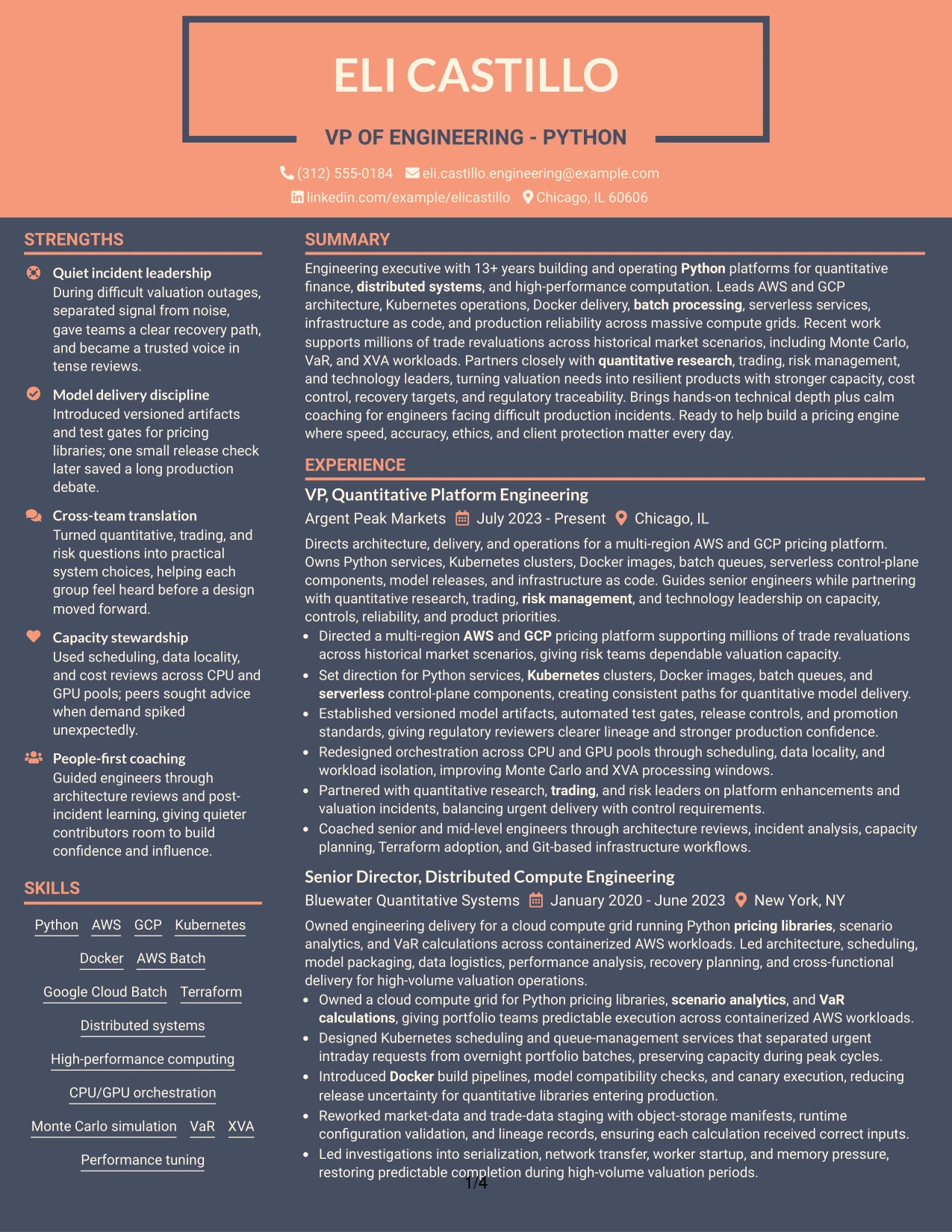
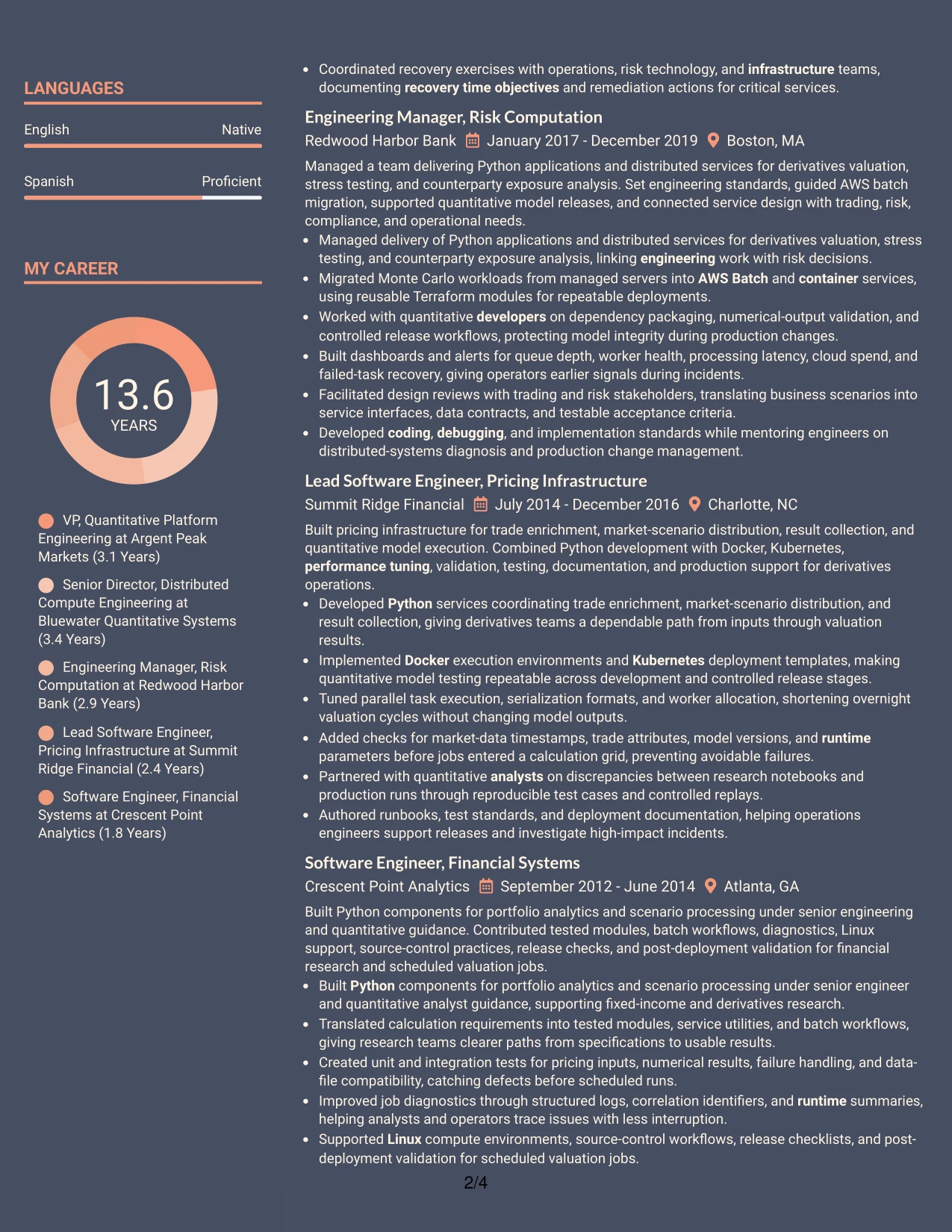
#24 Creative Two Tone Format Resume Example
A restrained visual hierarchy helps a technical executive resume feel distinctive while keeping the evidence easy to audit. The single-column flow can lead from the summary into platform leadership, pricing-grid delivery, model deployment, and reliability work before presenting education, certifications, and skills.
The two-tone treatment should support the target role rather than compete with it. Strong bullets connect Python, AWS, GCP, Docker, Kubernetes, and infrastructure as code to outcomes such as traceable releases, predictable valuation cycles, correct runtime data, and recovery planning.
#24 Why the Creative Two Tone Format Works for a Resume
- Keeps the full career story in one predictable reading sequence.
- Adds visual distinction without breaking section hierarchy.
- Lets each experience bullet connect a technical action to business value.
- Places role-specific keywords near the evidence that supports them.
- Works well for resumes combining platform engineering and financial modeling.
- Gives projects and certifications a clear place after core experience.
- Maintains a professional tone while avoiding a plain, undifferentiated page.
Best For
- Technical leadership resumes that need modest visual distinction.
- Applications where one-column reading is more important than dense sidebars.
- Candidates presenting a mix of architecture, operations, and people leadership.
- Resume content that benefits from a continuous chronology.
- Roles requiring both specialist terms and clear cross-team responsibilities.
- Documents where projects can reinforce experience without interrupting it.
- Readers who value a memorable design with disciplined information order.
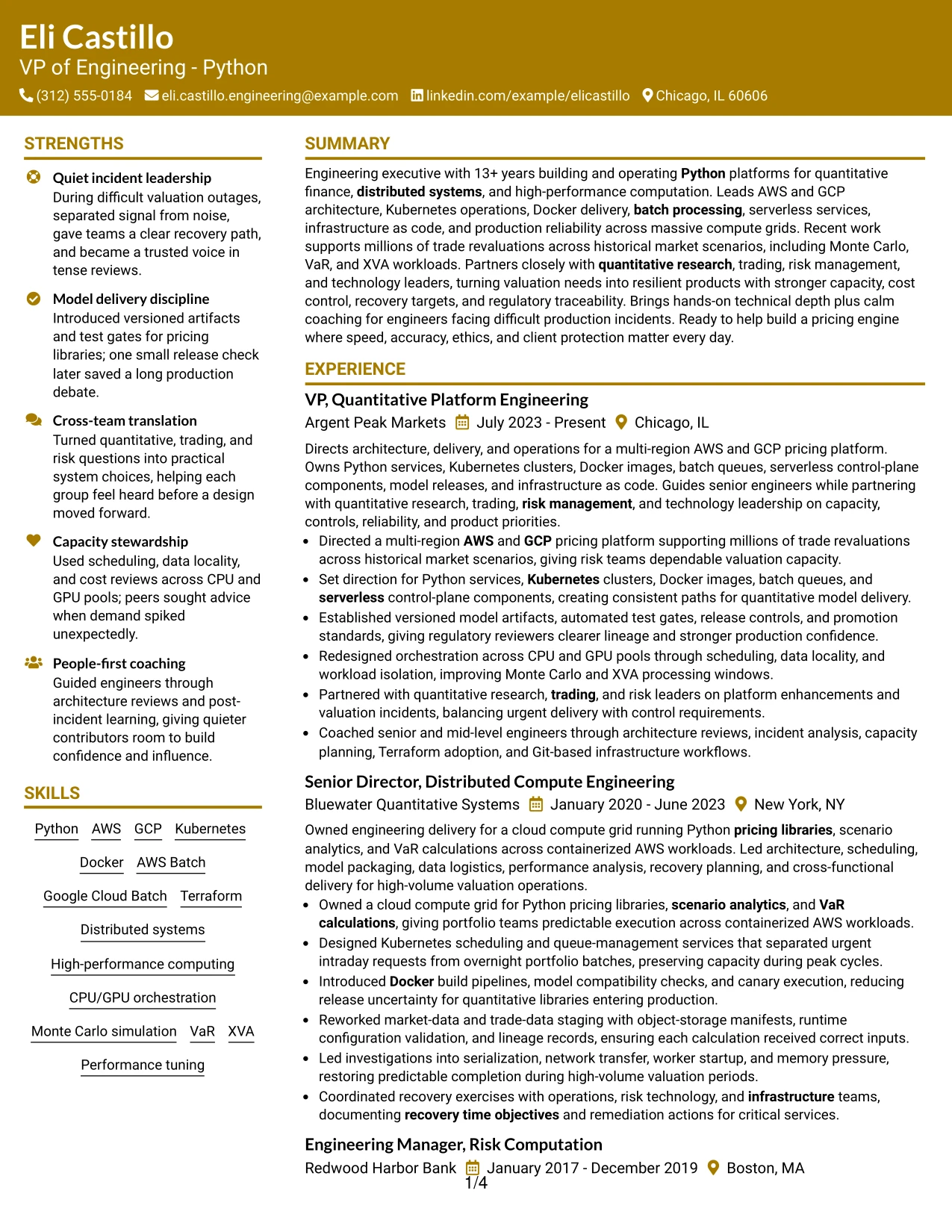
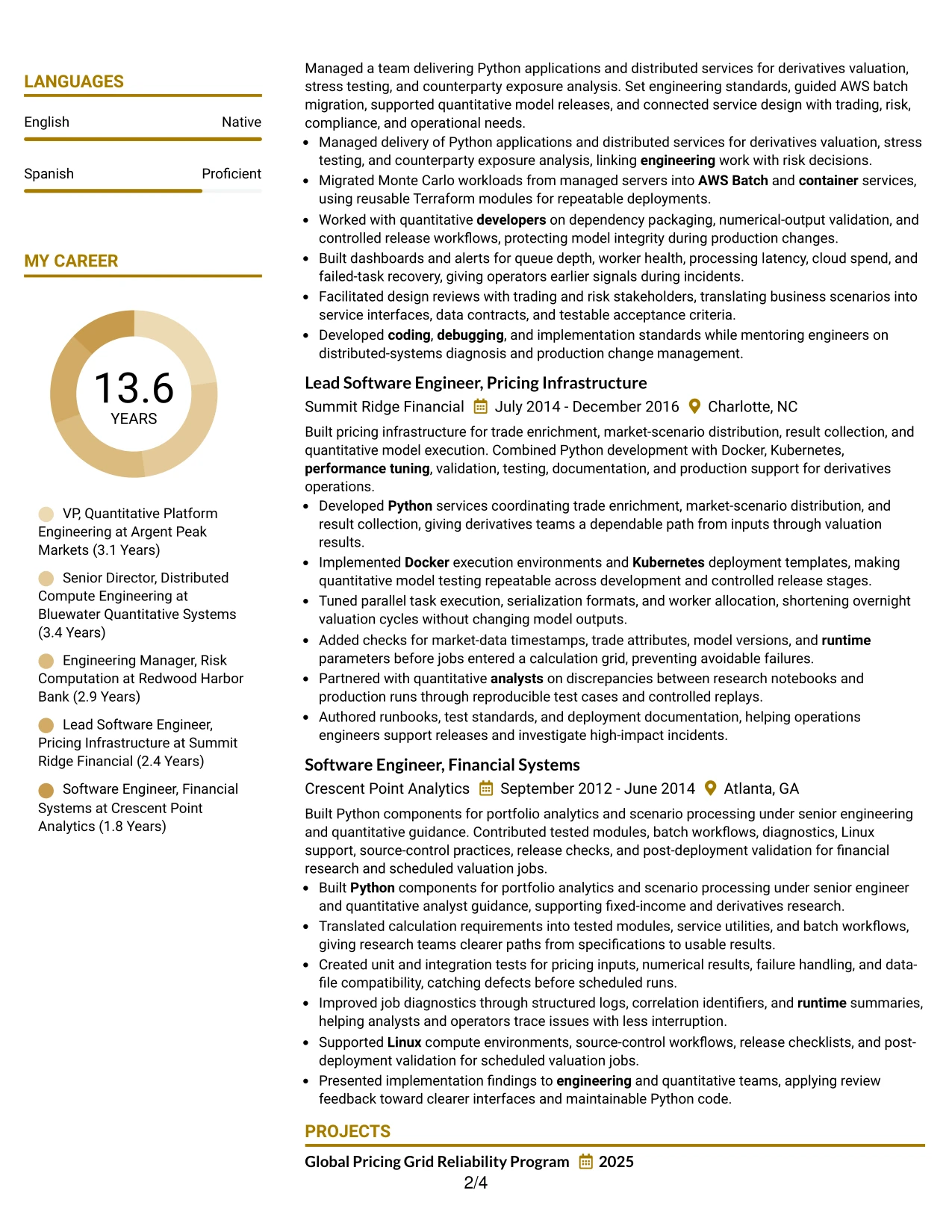
#25 Bold Color Header Professional Format Resume Example
The Bold Color Header Professional Format places the resume identity and target role at the front, then moves directly into a structured summary and experience record. That order makes the first scan efficient: leadership scope, cloud platforms, Python expertise, and pricing-grid results appear before supporting education and certifications.
A strong header can frame the document, but the content below must do the selling. Use concise bullets to show architecture decisions, Kubernetes and Docker delivery, AWS Batch, serverless services, performance tuning, model versioning, and recovery time objectives. These details give the VP of Engineering - Python target a credible evidence trail.
#25 Why the Bold Color Header Professional Format Works for a Resume
- Puts the target role and professional summary in an immediate scan zone.
- Creates a clear transition from identity to evidence.
- Supports ATS-friendly section labels and conventional chronology.
- Makes technical keywords visible without relying on visual effects alone.
- Gives leadership achievements room before secondary resume sections.
- Helps readers compare responsibilities and results across roles.
- Presents a confident structure for a senior technology application.
Best For
- Resumes needing an immediate, high-contrast entry point.
- Applications reviewed quickly for role title, summary, and core qualifications.
- Candidates with a substantial record of leadership achievements.
- Documents that need conventional sections beneath a distinctive header.
- Technical resumes where ATS-readable text must remain the foundation.
- Applications that place cloud, container, and Python evidence near the top.
- Readers who want strong orientation before reviewing detailed work history.
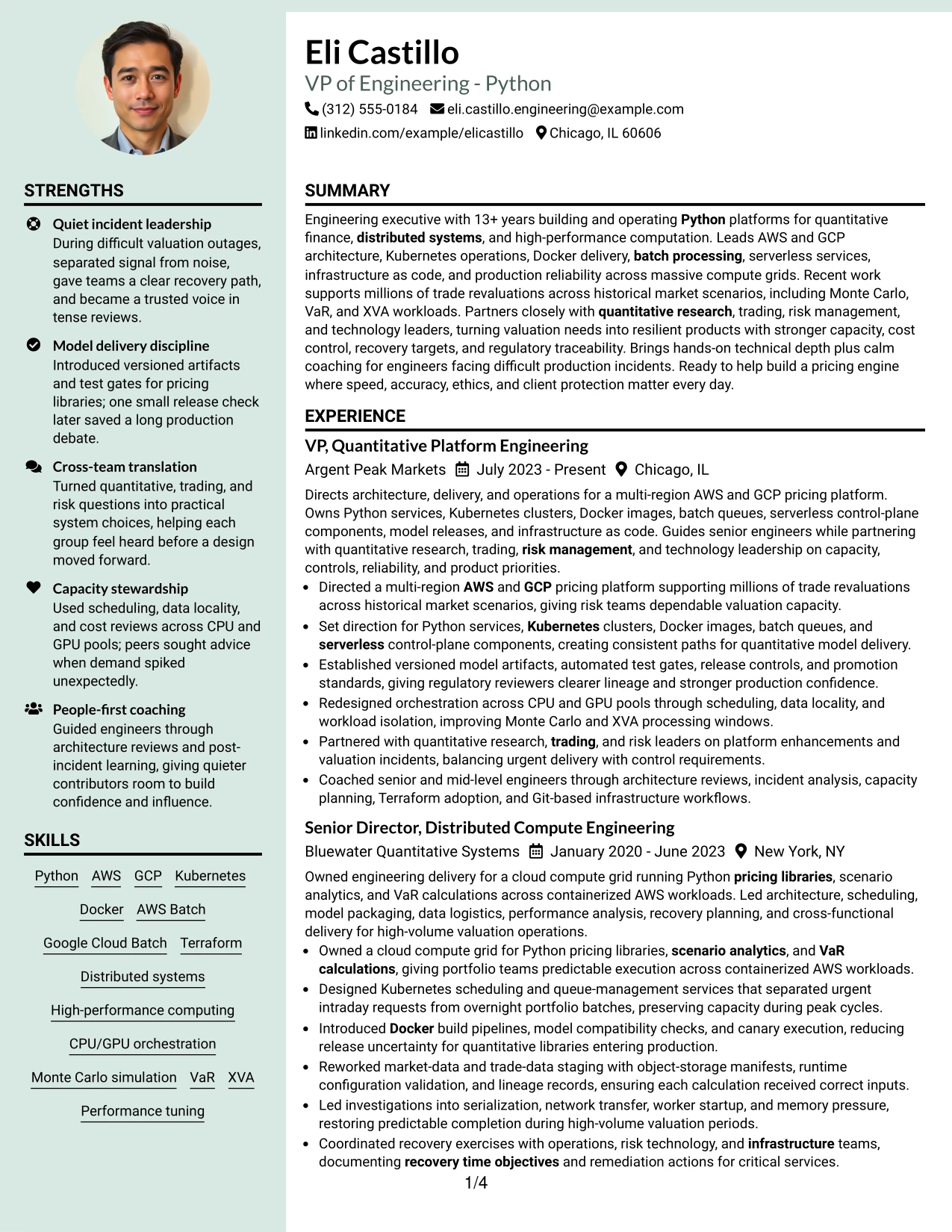
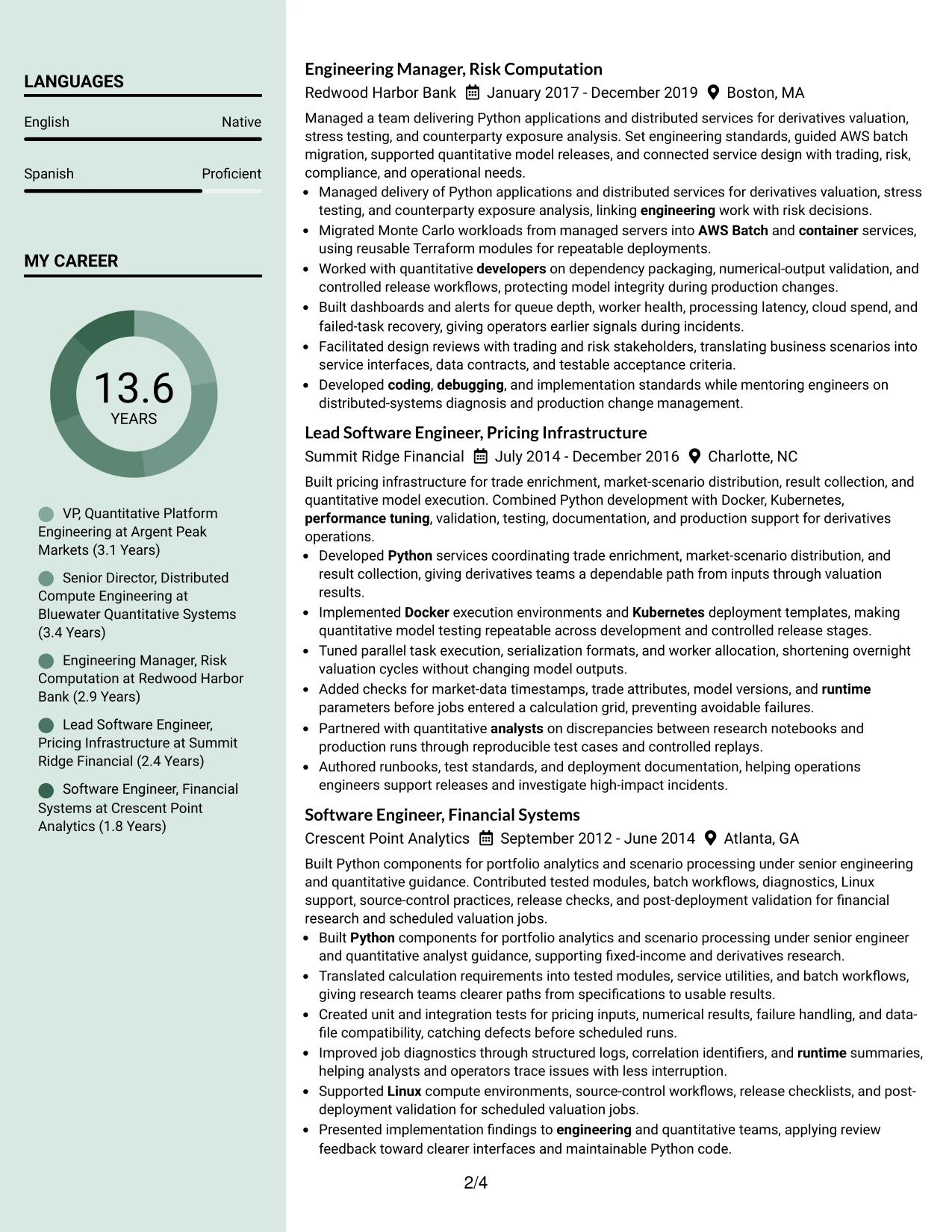
#26 Photo Header Color Sidebar Format Resume Example
Readers can move from the header and professional summary into a focused experience column, then use the color sidebar to confirm skills, certifications, and education. For this resume, that path keeps the pricing platform record prominent while making AWS, GCP, Python, Kubernetes, Docker, Terraform, and financial modeling easy to verify.
The photo header adds a personal visual element, but it should remain secondary to evidence. The main content should show millions of trade revaluations, model-release controls, cloud grid operations, data logistics, performance investigations, and recovery objectives. A concise sidebar prevents supporting details from interrupting those results.
#26 Why the Photo Header Color Sidebar Format Works for a Resume
- Guides the reader from identity to summary and then to detailed evidence.
- Uses the sidebar for compact information rather than long achievement bullets.
- Keeps a substantial experience history in the main reading area.
- Makes certifications and technical keywords available during the first scan.
- Allows a professional photo without allowing it to replace qualifications.
- Supports clear separation between platform results and supporting credentials.
- Works when visual identity is useful but resume evidence remains the priority.
Best For
- Applications where a professional photo is appropriate for the intended market.
- Resumes with extensive experience that needs a wide main content area.
- Candidates who want certifications and skills visible beside work history.
- Documents combining technical leadership with detailed operational evidence.
- Readers who scan a sidebar first for tools, credentials, and education.
- Roles where a personal visual identity supports, but does not lead, the presentation.
- Applications that need clear separation between core results and reference details.
#27 Top Left Header Color Accent Format Resume Example
The strongest evidence should arrive early: leadership of massive-scale compute grids, Python pricing platforms, AWS and GCP architecture, and production reliability. A top-left header then gives that evidence a clear starting point before the resume moves through experience, projects, education, certifications, and skills.
The color accent can mark section boundaries, while achievement bullets carry the credibility. Highlight orchestration across CPU and GPU pools, quantitative model deployment, market and trade data logistics, performance tuning, and controlled releases. Each term should sit near a specific responsibility or result rather than appear as an isolated keyword list.
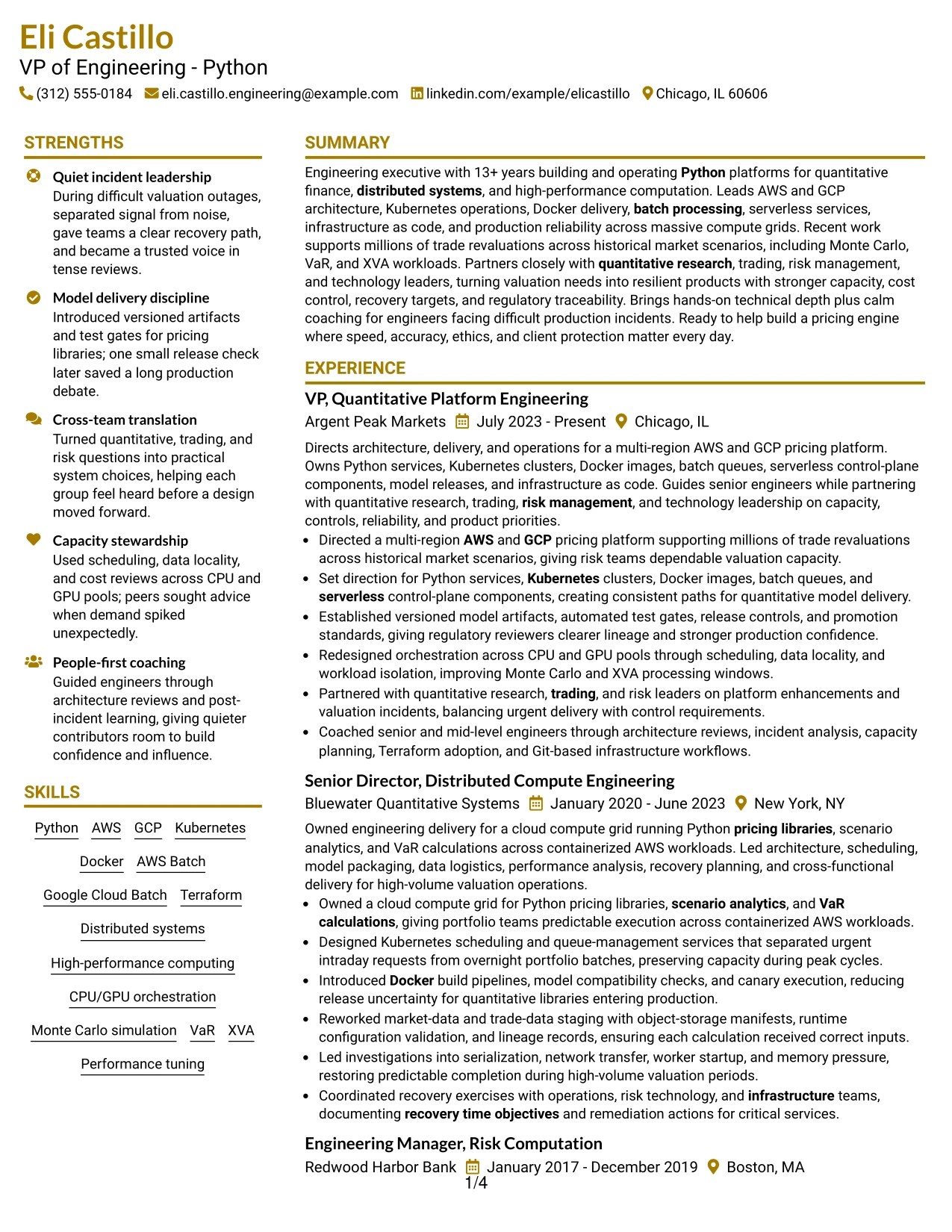
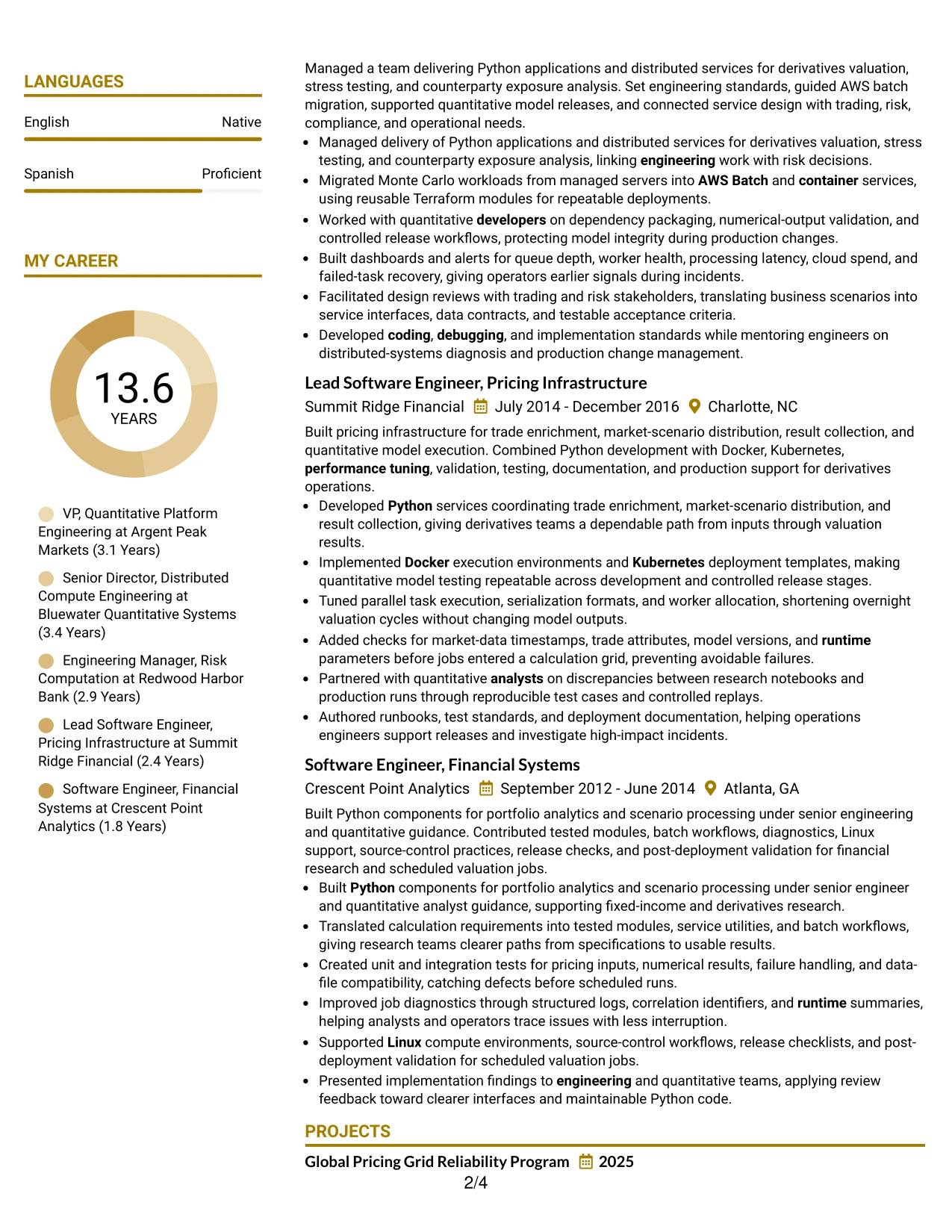
#27 Why the Top Left Header Color Accent Format Works for a Resume
- Places high-value qualifications near the first review point.
- Uses restrained accents to separate sections without crowding the page.
- Connects keywords to specific work evidence for stronger credibility.
- Gives projects a useful place to reinforce grid reliability and lineage.
- Supports a conventional chronology that is easy to verify.
- Makes technical leadership readable for both specialists and general reviewers.
- Keeps the visual system subordinate to measurable scope and responsibility.
Best For
- Resumes where early proof of scale should guide the first scan.
- Candidates whose strongest evidence combines architecture and operations.
- Applications requiring clear links between keywords and delivered systems.
- Documents that include projects supporting the main professional record.
- Readers who need to verify chronology without navigating complex design.
- Technical leadership applications with substantial cloud and reliability content.
- Presentations that benefit from a small visual accent around a serious evidence base.
#28 Centered Header Classic Two Column Format Resume Example
Balanced content distribution helps a senior resume remain detailed without making every section compete for attention. The centered header establishes the document identity, while two columns can place skills, certifications, education, and selected projects beside a broader experience narrative.
For a full-time VP of Engineering - Python application, the format supports both rapid scanning and careful review. Keep the main column for platform ownership, leadership decisions, and measurable scale. Use the secondary column for AWS, GCP, Kubernetes, Docker, Terraform, Monte Carlo, VaR, XVA, and related credentials.
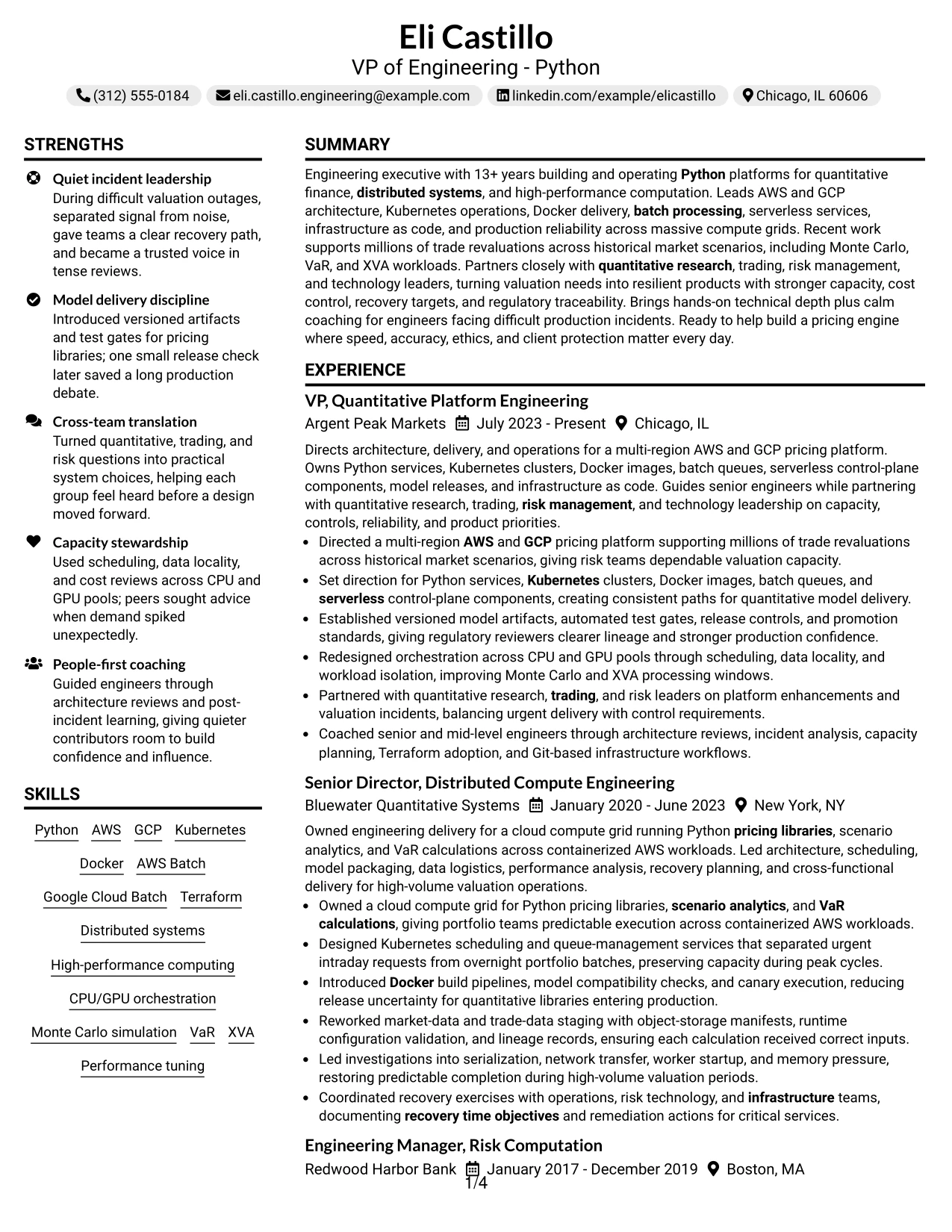
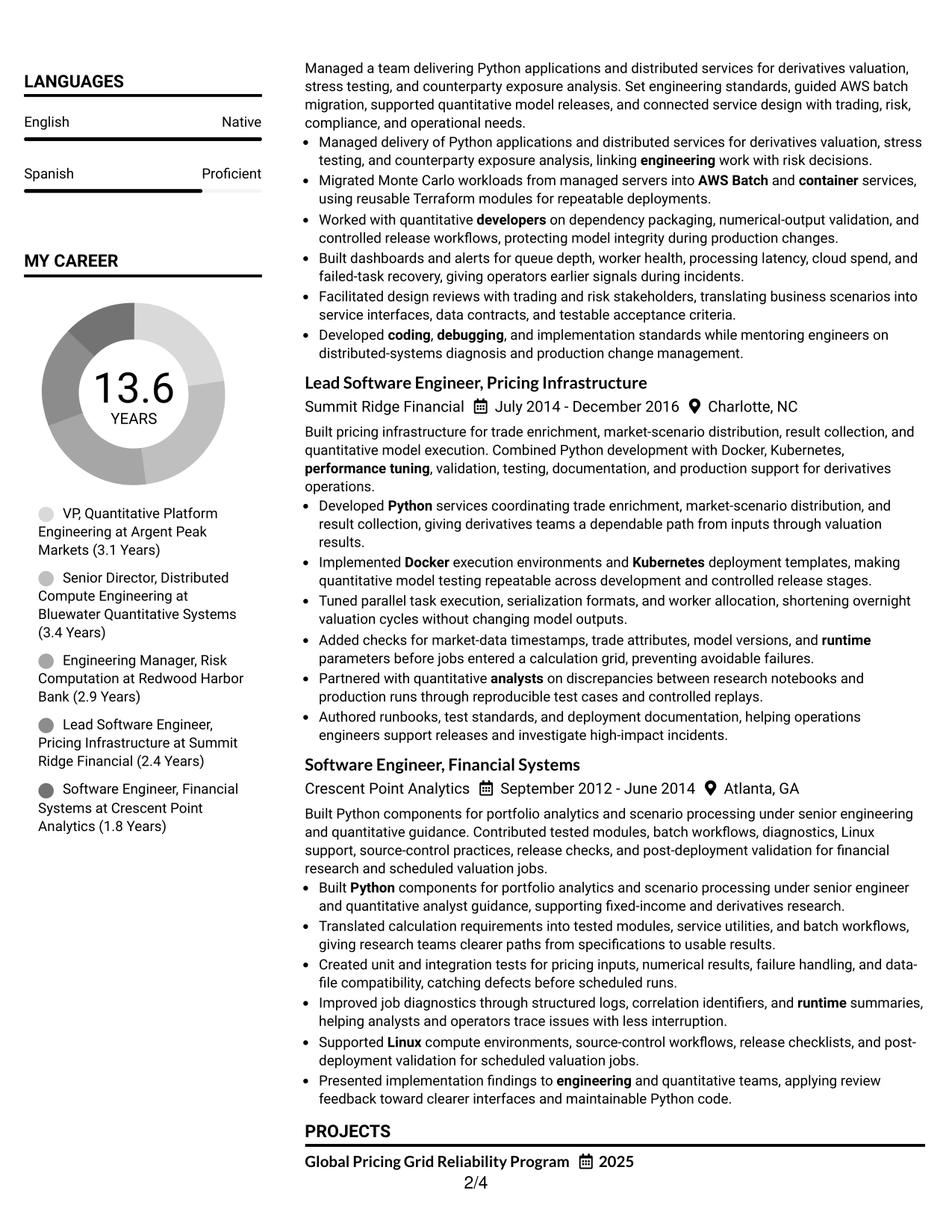
#28 Why the Centered Header Classic Two Column Format Works for a Resume
- Creates a stable focal point before the two-column content begins.
- Balances detailed experience with compact supporting sections.
- Keeps technical terms visible without forcing them into every bullet.
- Provides room for projects that demonstrate reliability and data lineage.
- Supports a classic presentation for senior technology roles.
- Makes education and certifications easy to confirm during a review.
- Preserves space for evidence while avoiding an overlong single stream.
Best For
- Senior resumes that need balanced treatment of experience and credentials.
- Applications where a centered identity block creates clear orientation.
- Candidates with projects that deserve visibility beside work history.
- Documents requiring a compact skills area and a detailed achievement area.
- Readers who prefer familiar chronology with efficient use of page width.
- Technical leadership applications combining cloud operations and financial systems.
- Resumes that need classic presentation with more capacity than one column allows.
#29 Left Aligned Header Clean Two Column Format Resume Example
A practical application benefits from quick access to both the career record and the qualification set. The left-aligned header starts that review naturally, while two columns separate detailed experience from skills, certifications, education, awards, and leadership activities.
This clean format gives the resume enough room to show architecture and delivery evidence without losing navigation. Use the experience side for Python services, pricing grids, model releases, orchestration, performance investigations, and recovery planning. Keep the companion side concise and keyword-rich for AWS, GCP, Docker, Kubernetes, Terraform, and financial pricing models.
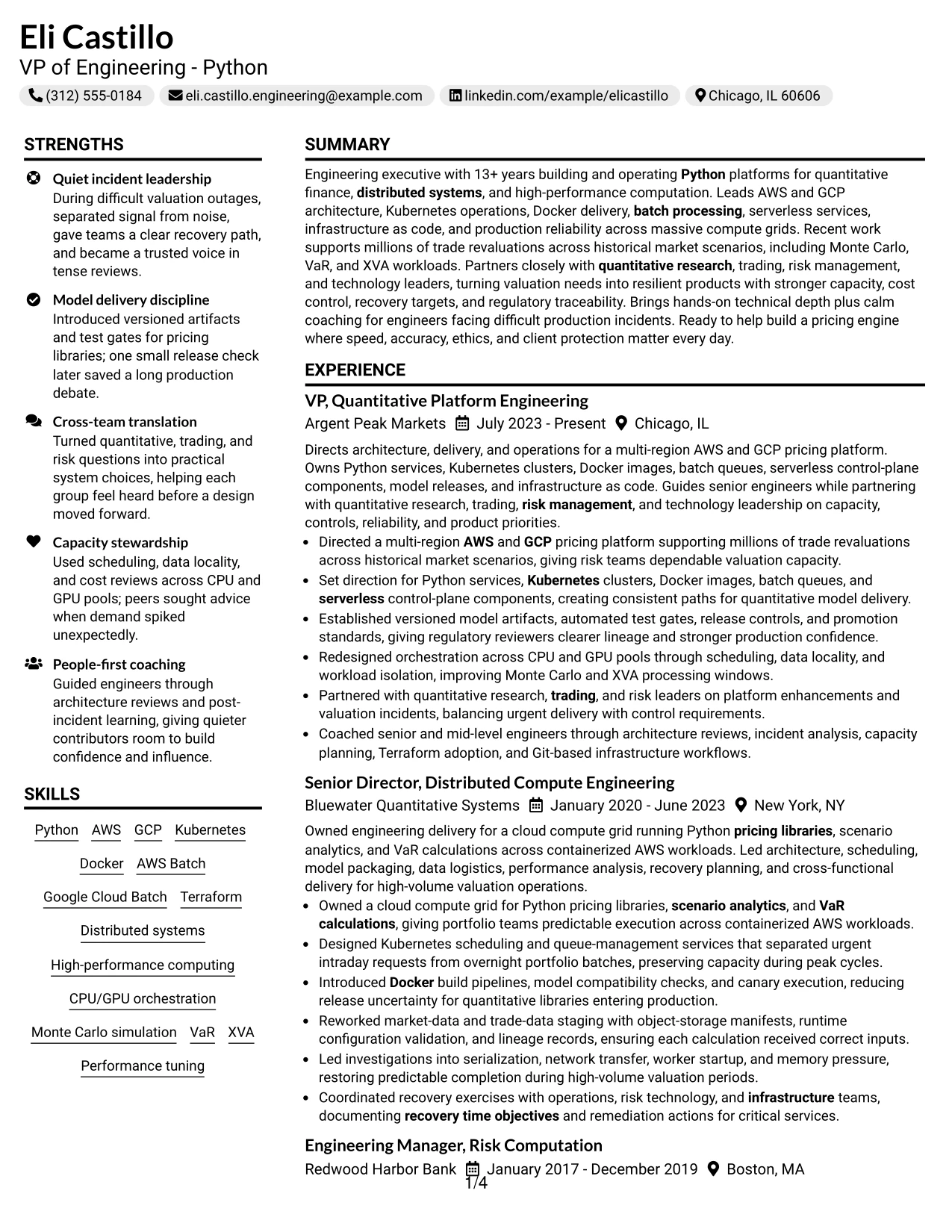
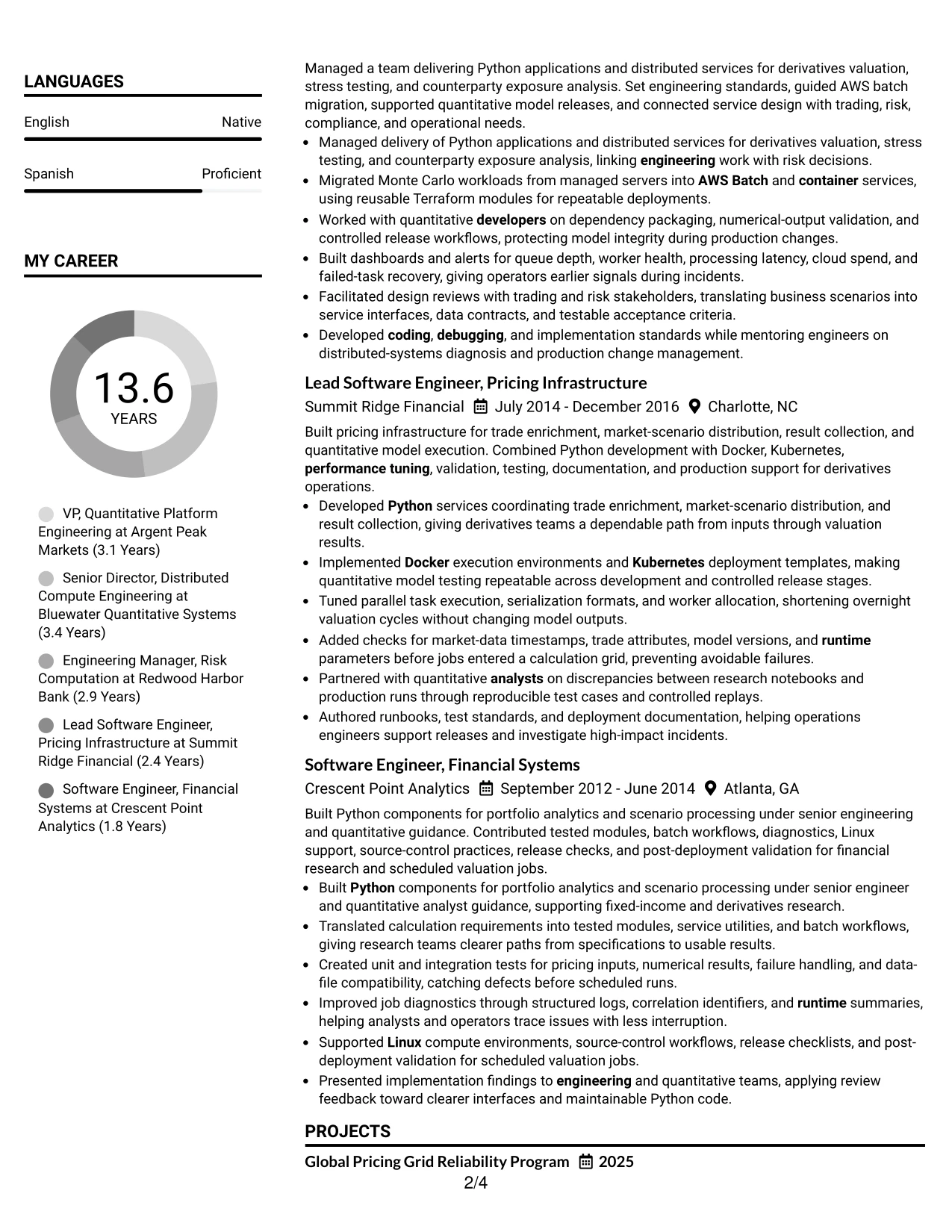
#29 Why the Left Aligned Header Clean Two Column Format Works for a Resume
- Matches the natural left-to-right movement of most resume reviews.
- Separates detailed bullets from concise qualification groups.
- Makes awards and leadership activities visible without leading the document.
- Supports a strong chronology for multiple progressive roles.
- Offers efficient space for technical keywords and certifications.
- Keeps the design clean when the content already carries substantial weight.
- Helps readers move between strategic scope and implementation detail.
Best For
- Applications needing efficient navigation across a long career record.
- Candidates with progressive responsibility across several engineering roles.
- Resumes that must show both detailed bullets and compact credentials.
- Documents where awards and leadership activities add supporting context.
- Readers who prefer left-aligned information and predictable scanning.
- Technical applications with many cloud, container, and pricing terms.
- Candidates seeking a clean two-column structure without visual excess.
#30 Accent Divider Modern Two Column Format Resume Example
A modern but restrained hierarchy gives the resume a clear professional impression: the header identifies the target, dividers separate major sections, and two columns distribute evidence without creating visual noise. The structure suits a senior technical record that must show platform ownership, people leadership, and operational control.
For Eli Castillo’s resume, the modern treatment can distinguish experience, projects, skills, and credentials while preserving a direct scan path. Use the main column for Python platform leadership, cloud grid architecture, model deployment, and reliability results. Use the supporting column for certifications, education, and focused keywords.
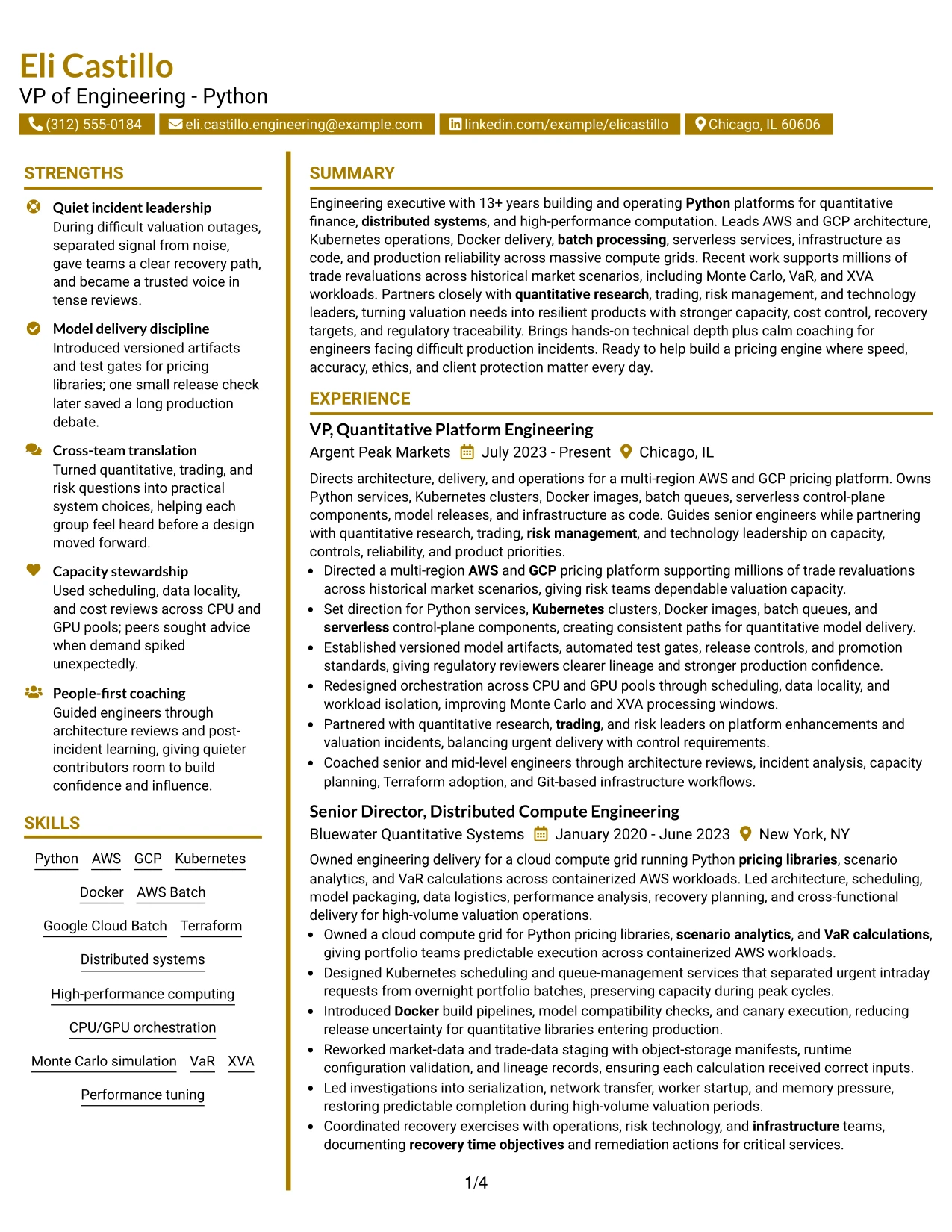
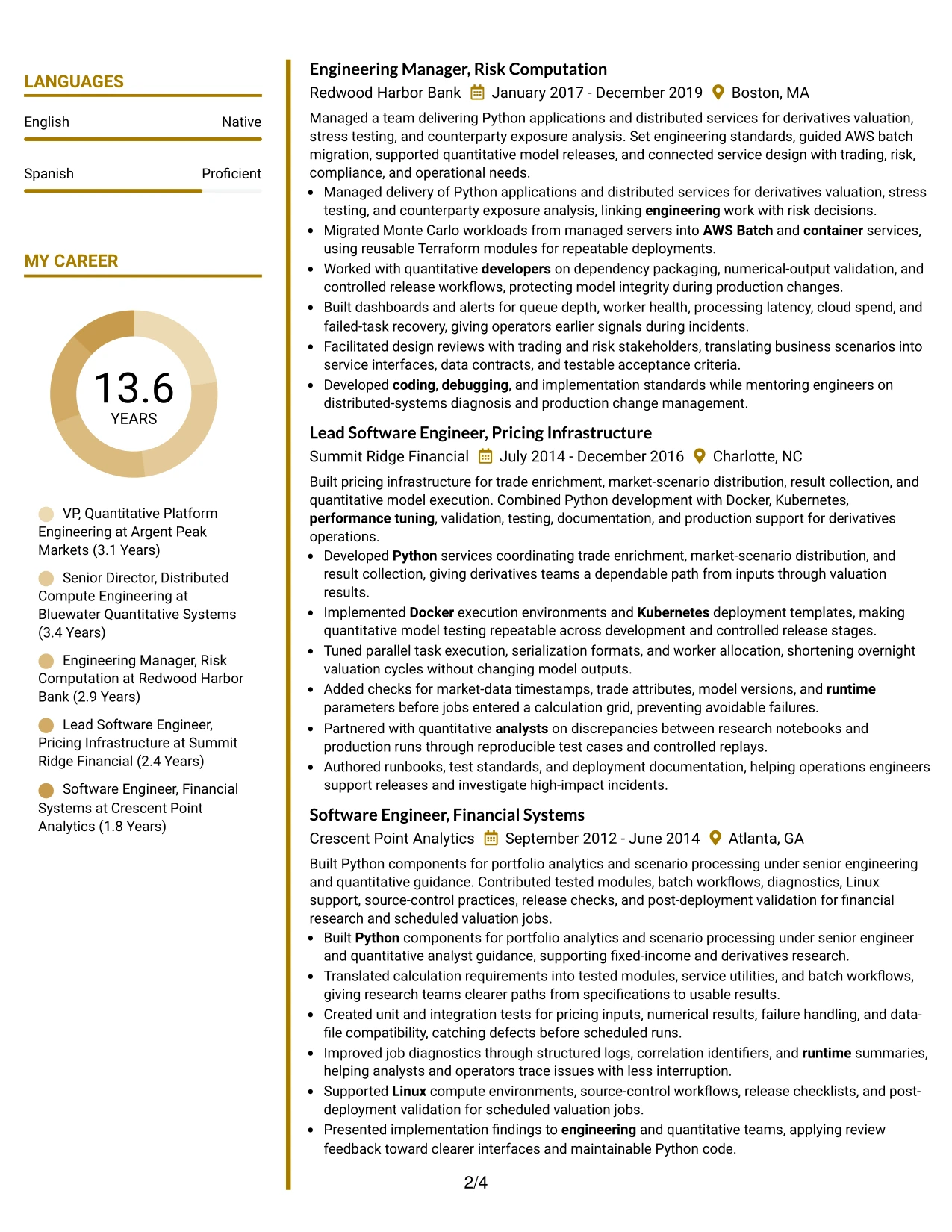
#30 Why the Accent Divider Modern Two Column Format Works for a Resume
- Uses dividers to create clear breaks between major resume sections.
- Provides a modern finish without weakening chronology or ATS-readable text.
- Lets leadership and technical evidence share the page without merging together.
- Gives projects a defined position as supporting proof.
- Keeps credentials accessible while protecting the main experience narrative.
- Works well when concise bullets need strong visual separation.
- Signals technical precision through order rather than excessive decoration.
Best For
- Modern technology resumes that still require disciplined structure.
- Candidates combining executive direction with hands-on architecture evidence.
- Applications where section dividers improve navigation across dense content.
- Documents that use projects as focused proof rather than a second work history.
- Readers who want a current visual style with familiar resume mechanics.
- Two-column layouts needing clear boundaries between evidence categories.
- Applications where concise, well-separated bullets are stronger than decorative elements.
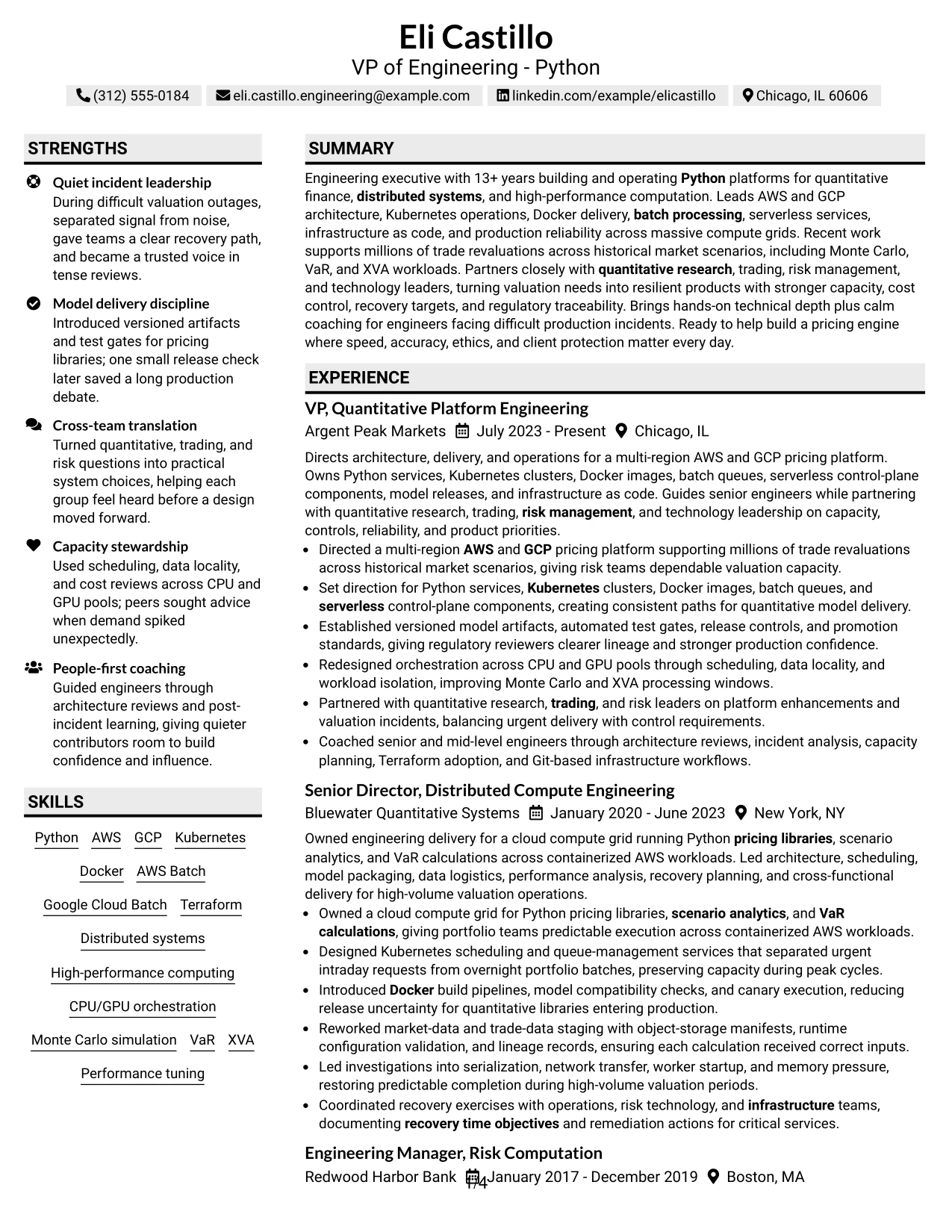
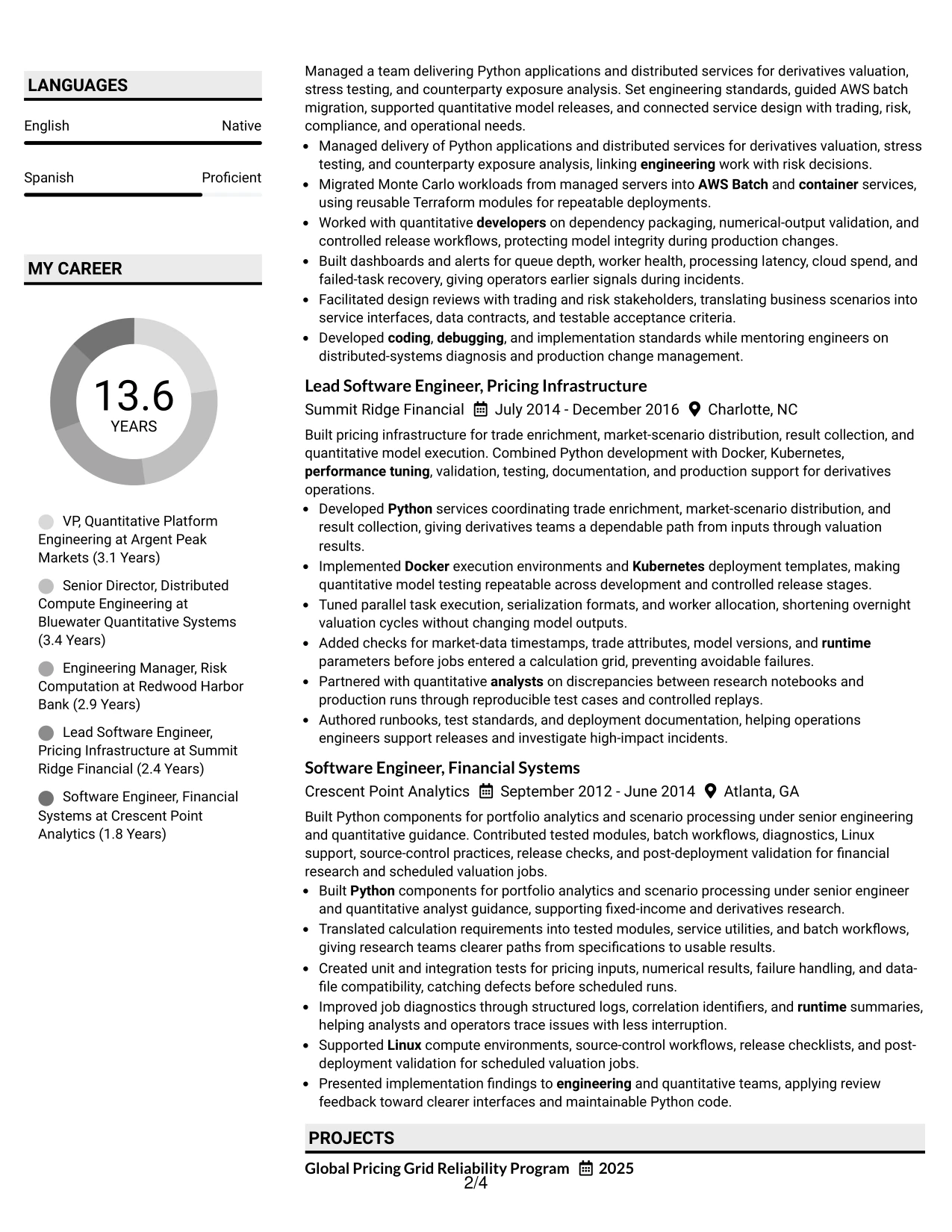
#31 Shaded Labels Clean Two Column Format Resume Example
Shaded labels organize the resume into dependable review zones: summary, experience, projects, skills, education, certifications, awards, and leadership. The two-column structure then gives detailed work evidence a larger area while grouping supporting qualifications in compact labeled blocks.
This arrangement is especially useful when the resume carries many related terms. Place Python, AWS, GCP, Kubernetes, Docker, Terraform, batch processing, serverless services, Monte Carlo, VaR, and XVA beside the roles where they are demonstrated. Clear labels also help ATS tools and human readers identify each section quickly.
#31 Why the Shaded Labels Clean Two Column Format Works for a Resume
- Makes each resume section easy to identify at a glance.
- Groups related credentials without burying them in the experience narrative.
- Supports ATS parsing through familiar labels and straightforward text.
- Allows detailed achievement bullets to remain in the wider column.
- Creates a consistent visual rhythm across roles and supporting sections.
- Helps readers locate projects, certifications, and skills during later review.
- Keeps a dense technical resume orderly and approachable.
Best For
- Resumes with many sections that need strong visual labeling.
- Candidates presenting a broad technical toolkit alongside leadership results.
- Applications where ATS clarity and human navigation matter equally.
- Documents that include projects, awards, activities, and certifications.
- Readers who review credentials by category rather than by chronology alone.
- Two-column pages with substantial evidence but limited room for repetition.
- Technical resumes that benefit from consistent blocks and predictable headings.
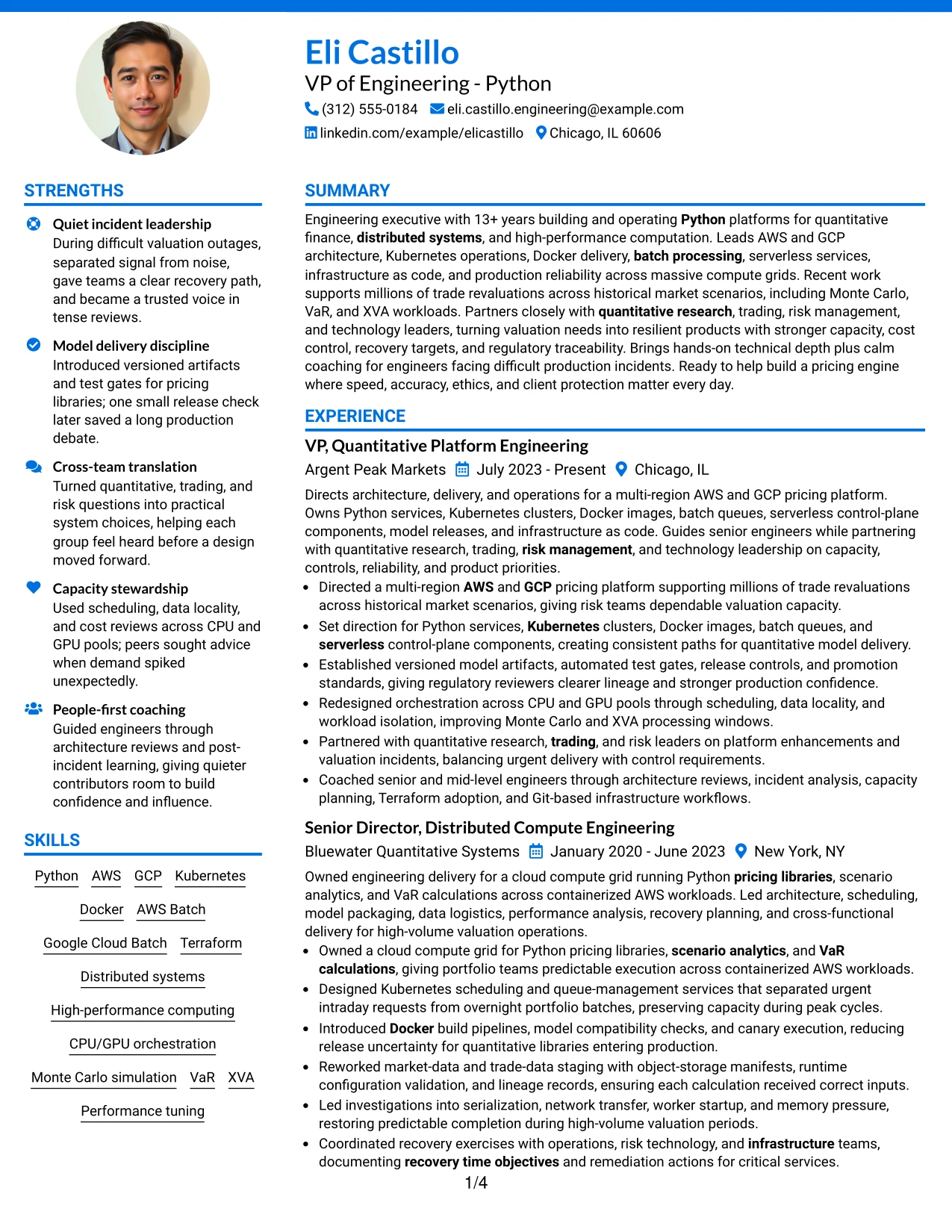
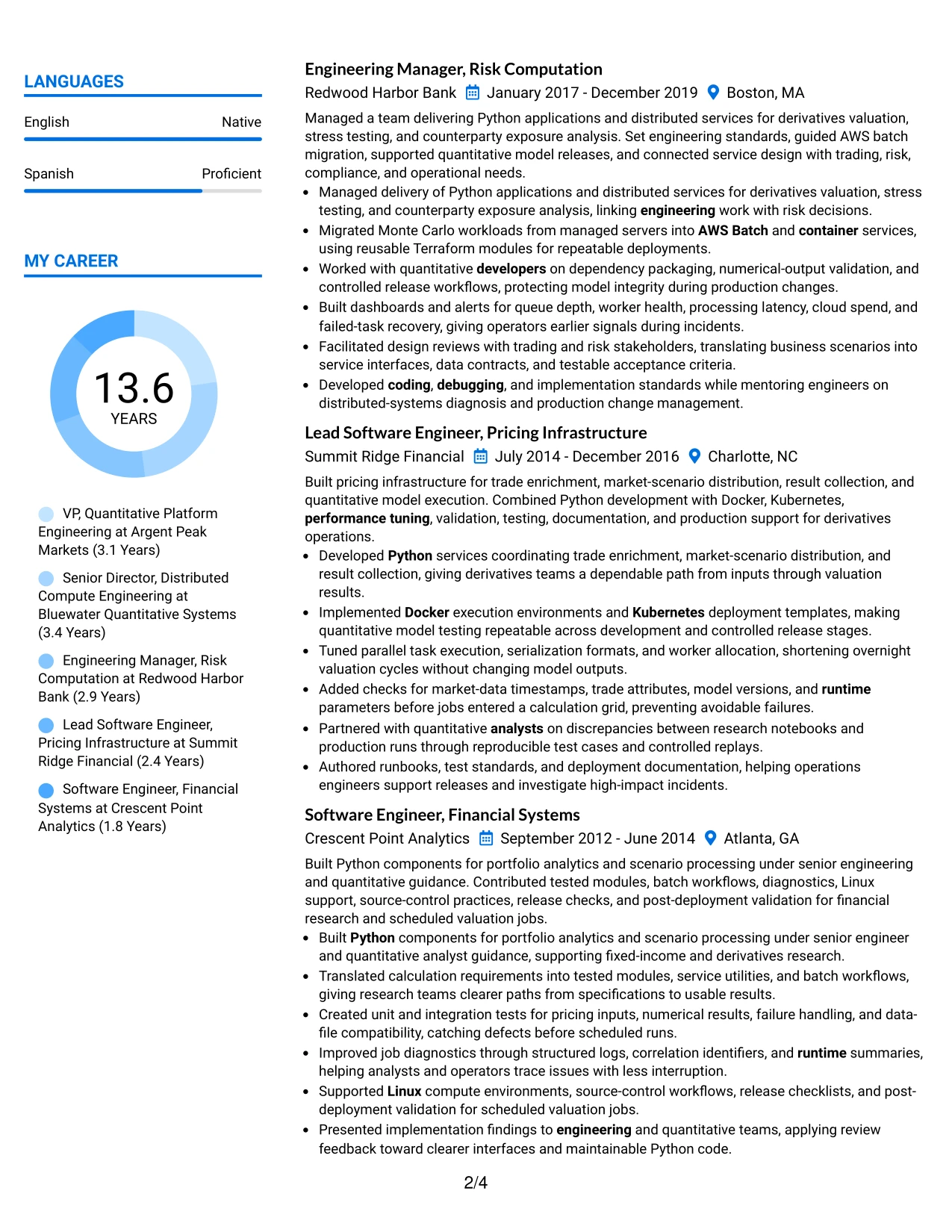
#32 Photo Header Color Accent International Format Resume Example
Readers can begin with the photo header and contact details, then follow the summary into experience and technical qualifications. The color accents help distinguish sections, while the single-column flow keeps a substantial record of cloud architecture, Python services, pricing models, and production reliability together.
The international presentation can include a photo as part of the document identity, but the qualification evidence must remain dominant. Lead with millions of trade revaluations, AWS and GCP operations, Kubernetes, Docker, model versioning, data logistics, and recovery time objectives. Supporting sections can then reinforce education, certifications, projects, and leadership activities.
#32 Why the Photo Header Color Accent International Format Works for a Resume
- Creates a clear identity area before the main qualification record.
- Supports a professional photo where the application context permits it.
- Keeps extensive experience in one continuous, readable column.
- Uses accents to distinguish sections without fragmenting technical evidence.
- Makes international credentials and professional activities easy to include.
- Allows cloud, pricing, and reliability terms to appear near supporting proof.
- Maintains a polished presentation while preserving conventional resume flow.
Best For
- Applications or markets where a professional photo is an accepted resume element.
- Candidates needing one-column space for a substantial experience history.
- Resumes that combine technical qualifications with international presentation needs.
- Documents including certifications, projects, awards, and professional activities.
- Readers who prefer a continuous path from summary through experience.
- Applications where color cues help separate dense technical sections.
- Candidates wanting personal identity included without reducing evidence space.
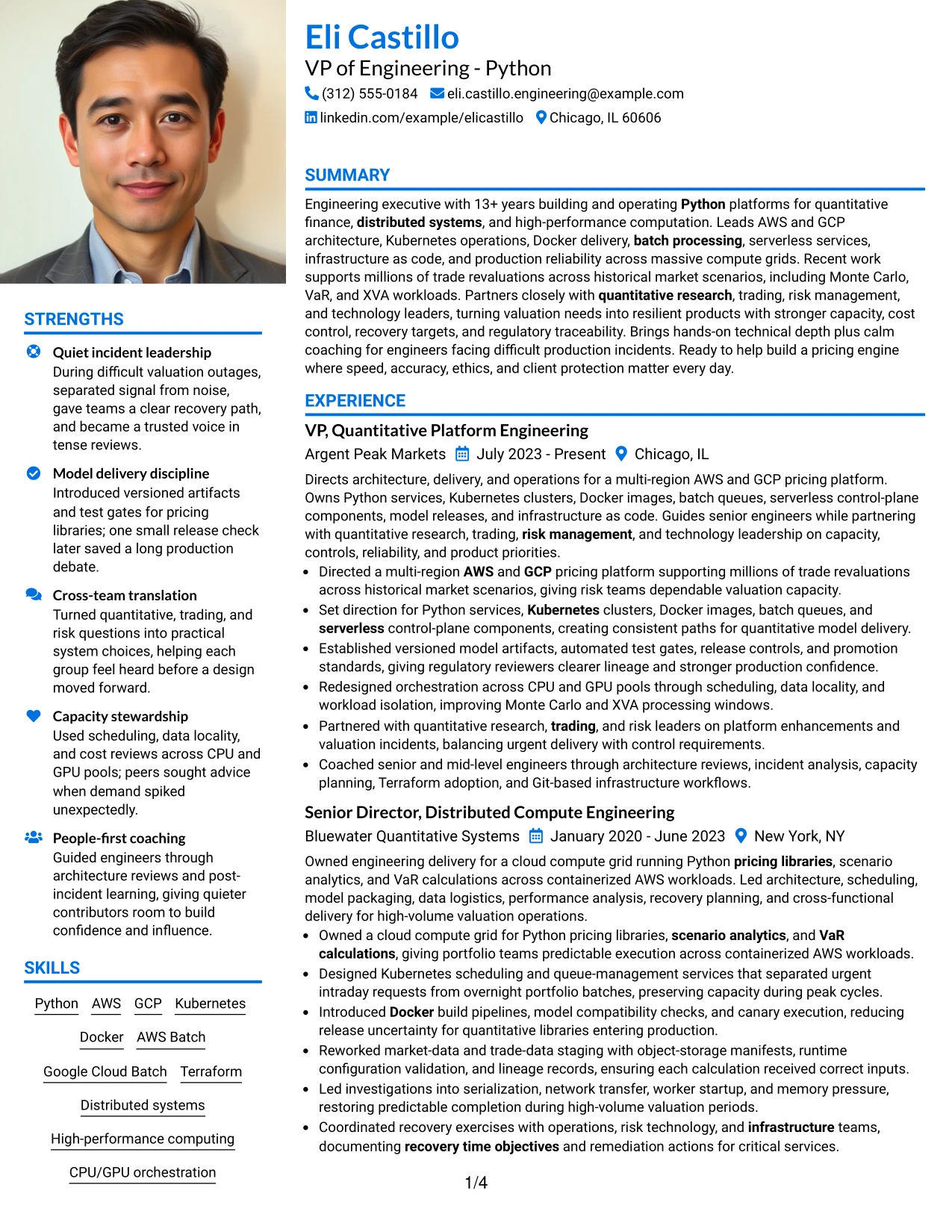
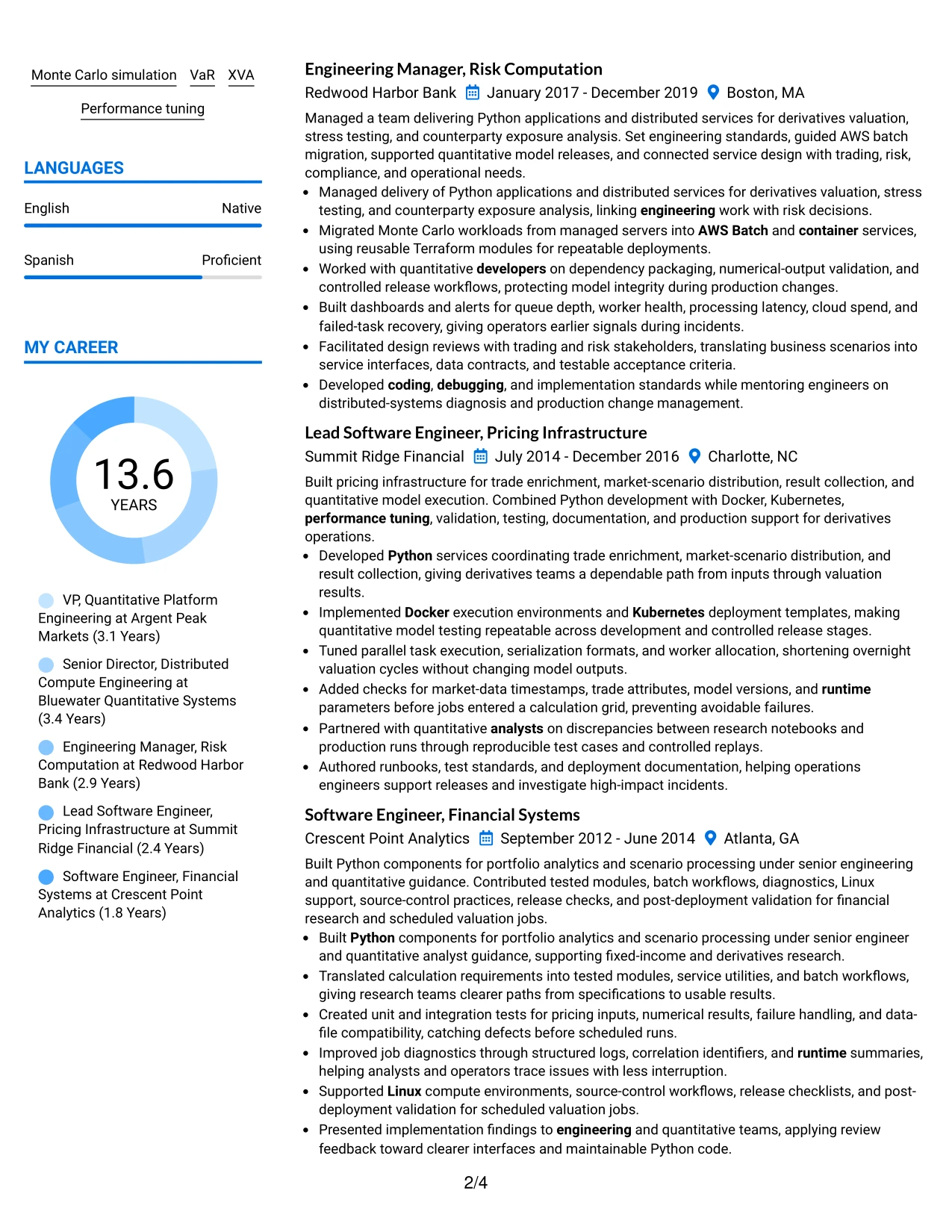
#33 Large Profile Photo International Two Column Format Resume Example
The most valuable evidence should lead the review: large-scale pricing platforms, Python expertise, cloud architecture, and reliability ownership. A two-column structure can then balance that experience against skills, certifications, education, projects, and professional activities while the large profile photo occupies a defined identity area.
For this VP of Engineering - Python resume, the profile element should never outweigh the record of results. Keep the primary column focused on millions of trade revaluations, CPU/GPU orchestration, model deployment, performance tuning, and recovery targets. Use the secondary column for AWS, GCP, Kubernetes, Docker, Terraform, Monte Carlo, VaR, and XVA terms.
#33 Why the Large Profile Photo International Two Column Format Works for a Resume
- Places the strongest qualifications before secondary visual details.
- Gives a large profile photo a defined area instead of letting it disrupt the page.
- Balances a detailed career record with compact credentials and keywords.
- Supports international presentation when personal identity is part of the context.
- Keeps scale, reliability, and technical leadership visible in the primary column.
- Creates room for projects and certifications without extending every section.
- Works best when the visual element is controlled and the evidence remains decisive.
Best For
- Applications where a large professional photo is appropriate and expected.
- Candidates whose resume must combine strong evidence with international presentation.
- Documents needing a wide primary column for complex leadership achievements.
- Readers who want skills and credentials available beside the main career record.
- Applications that use projects to confirm architecture and reliability experience.
- Technical leaders presenting both strategic scope and hands-on platform depth.
- Two-column resumes where identity, evidence, and supporting qualifications need distinct areas.
Why Build Your VP of Engineering - Python Resume with ResumeInMinutes
ResumeInMinutes helps you turn complex engineering scope into a structured resume that is simple to scan and practical to customize. Use the document to connect technical decisions with platform scale, production reliability, risk controls, and team leadership.
- ATS-friendly resume layouts
- Clear executive resume structure
- Role-specific keyword guidance
- Technical skills organization
- Achievement-focused bullet points
- Free PDF resume previews
The result is a resume that makes technical depth easy to verify. It gives reviewers a direct view of Python services, cloud platforms, compute orchestration, quantitative pricing workloads, operational controls, and the decisions that improved delivery and reliability.
See Also
- 33 VP/Director of Data & Intelligence Engineering Resume Templates with Example 2026 (ATS-Optimized)
- 33 VP of Engineering - Cybersecurity Resume Templates with Example 2026 (ATS-Optimized)
- 7 VP of Engineering Mechanical Design Resume Templates with Example
- 33 VP of Engineering - Mechanical Resume Templates with Example 2026 (ATS-Optimized)
- 33 VP of Engineering - PHP Resume Templates with Example 2026 (ATS-Optimized)
- 33 VP of Software Engineering Cloud-Native AI & Data Resume Templates with Example 2026 (ATS-Optimized)
- 33 VP Software Engineering, .NET Resume Templates with Example 2026 (ATS-Optimized)
- 33 VP/Sr. Director, Software Engineering - DevOps & SRE Resume Templates with Example 2026 (ATS-Optimized)
- 30+ VP of Engineering - Python Cover Letter Templates with Example 2026
- 30+ VP/Director of Data & Intelligence Engineering Cover Letter Templates with Example 2026
Frequently Asked Questions
Are these VP of Engineering - Python resume templates ATS-friendly?
Yes. The formats use readable headings and organized sections for keywords such as Python, AWS, GCP, Kubernetes, Docker, distributed systems, infrastructure as code, pricing models, and recovery time objectives.
Are these different resumes?
No. The guide presents one role-focused resume example across multiple layouts and design themes. The professional evidence remains the same while the visual structure changes.
What should a VP of Engineering - Python resume include?
Include a focused summary, leadership experience, technical skills, major platform or pricing projects, education, certifications, and achievement bullets that show scale, reliability, performance, cost, risk control, or team impact.
Can I download the resume templates as PDFs?
Yes. Each resume style provides a free PDF download so you can review the format and choose a structure that presents technical leadership and engineering results clearly.
Which resume style works best for this role?
A clean one-column format is usually the safest choice for ATS parsing and technical review. A restrained two-column layout can also work when it keeps experience, achievements, and skills easy to find.
How should I show large-scale compute experience?
State the platform scope and your responsibility, then explain the result. Strong bullets may cover trade revaluations, historical scenarios, CPU or GPU orchestration, queue design, model releases, performance tuning, recovery targets, or resource use when supported by your evidence.
Should I include certifications on this resume?
Yes, when they support the target role. AWS Certified Solutions Architect – Professional, Certified Kubernetes Administrator, and HashiCorp Certified: Terraform Associate are relevant examples when they are held by the candidate.
Can I customize these resume templates?
Yes. You can adjust the resume text, section order, layout, design style, and PDF format while keeping the content aligned with the VP of Engineering - Python role.