This interview guide is for educational and informational purposes only. It is designed to help readers prepare, but it does not guarantee any interview result, hiring decision, offer, or outcome. Interview questions, hiring criteria, and preferred answers can vary by employer, interviewer, industry, location, and time. All answers, examples, and explanations in this guide are suggested examples for interview preparation, not definitive answers or instructions for professional practice. They are based on research and judgment, are provided without warranties of any kind, and should be adapted to the question, role, and applicable laws and professional requirements. Diagrams are simplified illustrations intended to highlight the main concepts and their relationships; actual situations, systems, and practices may be more complex. Alternative approaches may be equally valid or better suited to a particular question, context, or interviewer. To the fullest extent permitted by applicable law, the contributors and publisher are not liable for decisions made, actions taken, or losses incurred based on this guide.
State Laws and Professional Responsibilities
Laws and requirements governing an occupation vary by state and jurisdiction. You are responsible for checking the current laws, licensing requirements, and scope-of-practice rules that apply to your location and role, and for ensuring that your answers and actions comply with them. Adapt examples in this guide to those requirements. This guide is not legal advice.
Identity, Image, and Privacy Notice
To respect individual privacy, some names, profile photographs, avatars, biographical details, and other identifying information displayed in this guide may be replaced with pseudonyms, licensed stock images, illustrative avatars, composite images, or representative descriptions. Unless a person is expressly identified as an actual contributor, a displayed name, image, or profile should not be understood as depicting or identifying a specific candidate, interviewer, employee, or other real individual. These representations are provided for editorial and illustrative purposes only and do not imply endorsement, employment, participation, or affiliation with this guide or any company mentioned in it. Any resemblance to an actual person is coincidental.
Company Notice
This guide is an independent educational resource and is not affiliated with, endorsed by, sponsored by, or approved by the company named in this guide. Company names identify reported interview experiences or the employer context of clearly labeled original practice exercises. Interview practices can change without notice, and inclusion of company-specific content does not mean these questions are official, complete, or guaranteed to be asked. To the fullest extent permitted by law, the author, contributors, and publisher are not responsible for outcomes related to use of this material.
Content Accuracy and Verification
To the fullest extent permitted by applicable law, we do not represent or warrant that interview guides, questions, answers, examples, or diagrams are accurate, complete, current, error-free, or suitable for any particular purpose. You are responsible for independently reviewing and verifying the information before relying on it.
Questions or comments?
Contact us for general questions, or share feedback, technical corrections, and comments with the community.
1. What is the difference between heat and work?Thermodynamics And Energy BalancesEasy
Short Interview Answer (30-60 seconds)
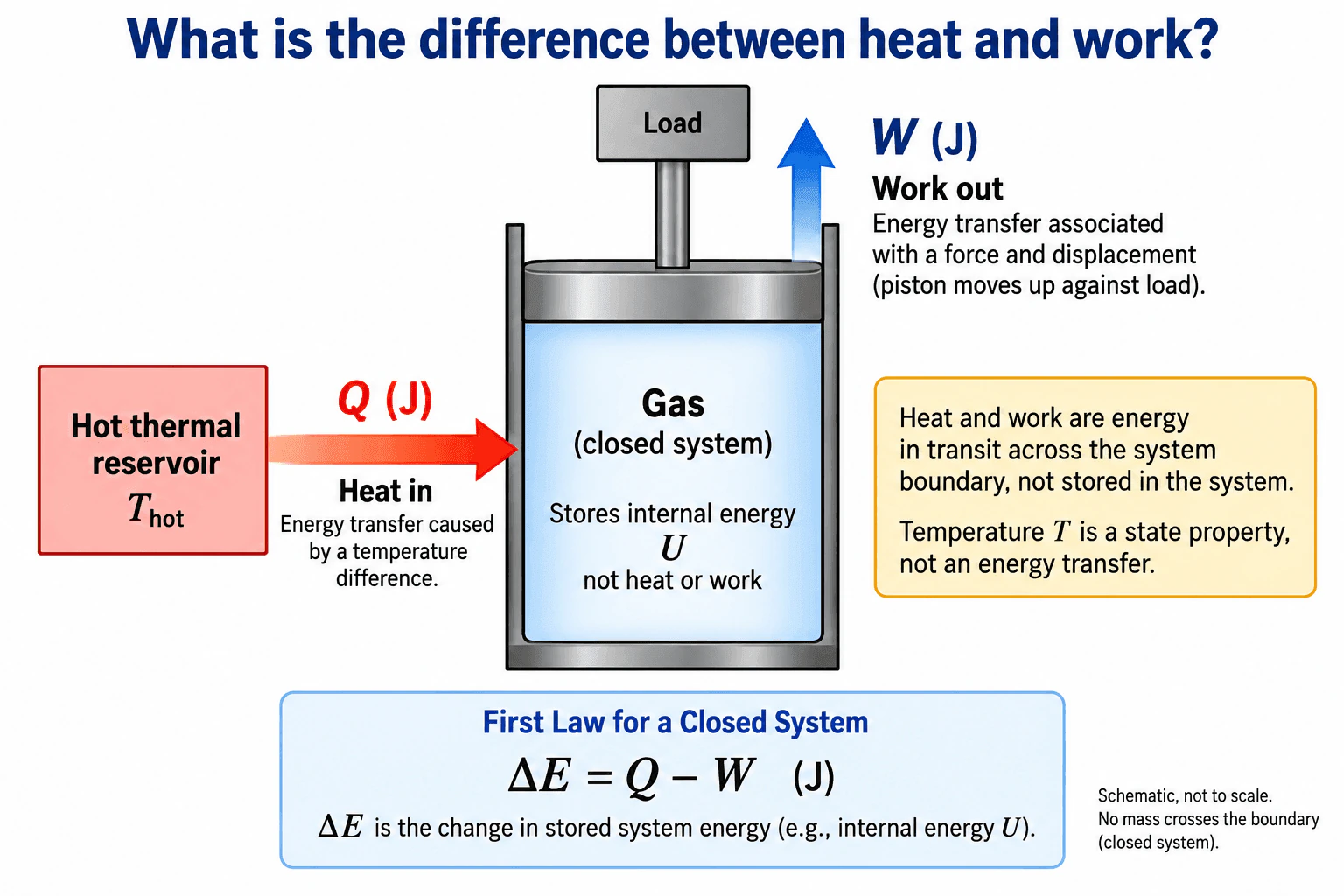
Heat and work are both energy transfers across a system boundary, but they occur for different reasons. Heat is energy transferred because of a temperature difference. Work is energy transferred through an organized interaction such as a force acting through a displacement. In the piston example, heat Q enters the gas because of a temperature difference, while work W leaves as the expanding gas raises the piston and load. The gas stores internal energy U, not heat or work. With heat into the system positive and work out positive, the closed system first law is ΔE = Q − W.
Detailed Explanation
Heat and work describe energy crossing a chosen system boundary. They are not thermodynamic properties stored inside the system. In the closed piston cylinder example, no mass crosses the boundary. Heat Q enters from a hotter thermal reservoir because a temperature difference exists. The gas expands and raises the piston and load, so work W leaves the system. The gas stores energy such as internal energy U.
Temperature T is a state property, not an energy transfer. Internal energy, enthalpy, and entropy are also state properties. Thermal power is the rate of heat transfer and has units of watts, while heat and work are energies and commonly have units of joules.
Using the sign convention shown in the diagram, heat entering the system is positive and work leaving the system is positive. The first law is therefore ΔE = Q − W. If changes in kinetic and potential energy are negligible, ΔE is primarily the change in internal energy.
Useful Questions to Ask the Interviewer
Should I use the convention that heat into the system and work out of the system are positive?
Should I treat the system as closed, with no mass crossing the boundary?
Can kinetic and potential energy changes be neglected?
How to Explain It in an Interview
Start by defining the system boundary. For a closed piston cylinder, mass remains inside, but energy can cross the boundary as heat or work.
Heat is energy transfer caused by a temperature difference. If the thermal reservoir is hotter than the gas, energy can enter the gas as heat Q.
Work is energy transfer associated with an organized interaction such as force acting through displacement. When the gas expands and lifts the piston and load, energy leaves the gas as work W.
The key distinction is that neither heat nor work is stored in the gas. Once energy is inside the system, it contributes to stored energy such as internal energy U. Temperature, internal energy, enthalpy, and entropy describe thermodynamic states, while heat and work describe transfers during a process.
For the sign convention in the diagram, the closed system energy balance is ΔE = Q − W. For a hypothetical check, if 100 J of heat enters and the gas performs 40 J of work, the stored system energy increases by 60 J, assuming no other energy transfers.
I would validate the result by confirming the system boundary, checking the heat and work directions, keeping units consistent, and stating any assumptions such as negligible kinetic and potential energy changes.
Why Interviewers Ask This
Interviewers want to see whether the candidate understands that heat and work are different modes of energy transfer across a system boundary rather than energy stored inside the system. They also want correct use of the first law, system boundaries, sign conventions, and thermodynamic properties.
Common interview mistakes
Common mistakes include calling heat a stored property, treating temperature as a form of energy, forgetting to define the system boundary, mixing heat and work sign conventions, confusing energy in joules with heat transfer rate in watts, and writing ΔE = Q − W without first stating the sign convention.
Interview tip
Lead with the simplest distinction: heat is energy transfer caused by a temperature difference, while work is energy transfer through an organized interaction such as force and displacement. Then use the piston example and state the sign convention before writing ΔE = Q − W.
Interviewer may ask next
How would you verify the energy balance for the piston example?
Define the closed system boundary around the gas, confirm that no mass crosses it, identify every heat and work interaction, choose and state the sign convention, and express all energy terms in consistent units. Then check that the change in stored energy equals Q − W. If kinetic and potential energy changes are neglected, state that assumption explicitly.
What changes if the piston cylinder becomes a control volume with mass flowing through it?
The analysis changes from a closed system balance to an open system energy balance. Energy can then cross the boundary with mass as well as through heat and work. Flowing mass can carry enthalpy and may also carry kinetic and potential energy, so those terms must be included when they are significant.
2. What is the difference between a closed system and an open system?Thermodynamics And Energy BalancesMedium
Short Interview Answer (30-60 seconds)
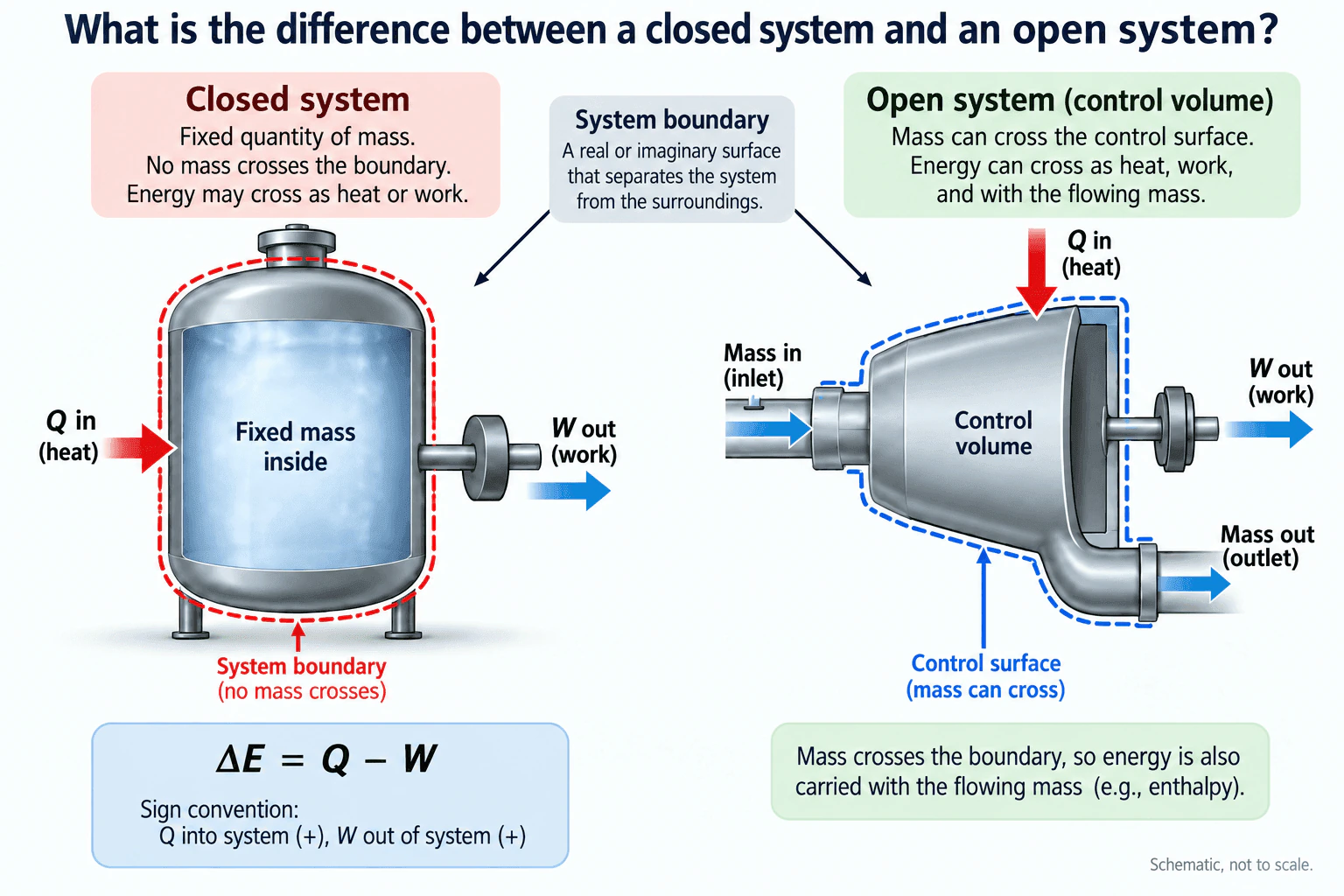
A closed system contains a fixed quantity of mass, so no mass crosses its boundary, although energy can cross as heat or work. An open system, also called a control volume, allows mass to cross its control surface through inlets and outlets. Energy can therefore cross an open system as heat, work, and energy carried by the flowing mass. The main distinction is whether mass crosses the selected boundary.
Detailed Explanation
A closed system and an open system are distinguished mainly by whether mass can cross the selected boundary. A closed system contains a fixed quantity of mass. An open system uses a control volume through which mass may enter or leave.
Useful Questions to Ask the Interviewer
Should I assume steady state operation or also discuss transient behavior?
Should I use the convention that heat into the system is positive and work out of the system is positive?
Would you like only the conceptual distinction or also the corresponding energy balances?
How to Explain It in an Interview
Start by defining the boundary. A system boundary is the real or imaginary surface that separates the system from its surroundings.
For a closed system, no mass crosses the boundary, so the amount of mass inside remains fixed. Energy may still cross as heat or work. Using the sign convention shown in the diagram, where heat into the system is positive and work out of the system is positive, the closed system first law can be written as ΔE = Q − W. Here, ΔE is the change in stored total energy of the system.
For an open system, usually described as a control volume, mass can cross the control surface through inlets and outlets. Energy may cross as heat and work, and it is also transported with the flowing mass. Enthalpy is commonly used for this flowing energy because it combines internal energy with the flow work required to move fluid across the control surface.
The classification is independent of whether the process is steady or transient. At steady state, conditions and stored quantities within the control volume do not change with time, even though mass and energy can continuously pass through it. During transient operation, stored mass or energy within the control volume may change with time.
A sealed vessel containing a fixed mass is a typical closed system. A turbine is commonly treated as an open system because fluid enters and leaves while shaft work may leave the control volume and heat may also cross its surface.
Heat is energy transferred because of a temperature difference. Temperature is a thermodynamic state property rather than an amount of transferred energy. Internal energy is stored microscopic energy within matter. Enthalpy is especially convenient for flowing streams. Entropy is a thermodynamic property used with the second law and is not itself a form of energy.
The final check is simple: determine whether mass crosses the selected boundary. If no mass crosses it, use a closed system model. If mass crosses it, use an open system control volume model.
Why Interviewers Ask This
Interviewers want to see whether you can define a physical system boundary correctly, determine whether mass crosses that boundary, and select the appropriate mass and energy balance. They are also checking whether you understand that heat and work can cross either type of boundary while flowing mass provides an additional mechanism for energy transfer in an open system.
Common interview mistakes
Common mistakes include assuming a closed system cannot exchange energy, confusing a rigid boundary with the definition of a closed system, forgetting the energy carried by flowing mass in an open system, and treating steady state as synonymous with a closed system. Another mistake is failing to define the selected boundary before writing the mass or energy balance.
Interview tip
Lead with the mass transfer distinction. State that a closed system contains fixed mass and allows no mass to cross its boundary, while an open system allows mass to cross its control surface. Then explain that heat and work can cross either type of boundary, and flowing mass also carries energy across an open system boundary.
Interviewer may ask next
Can an open system operate at steady state even though mass continuously enters and leaves?
Yes. Steady state means the properties and stored quantities within the control volume do not change with time. Mass may continuously enter and leave as long as there is no net accumulation of mass inside. For a control volume with no mass accumulation, the total mass flow rate entering equals the total mass flow rate leaving.
Can a closed system have a moving boundary?
Yes. Closed means that no mass crosses the system boundary, not that the boundary must remain fixed in space. A piston cylinder containing a fixed mass is a common example. The piston may move and produce boundary work while the same mass remains inside the system.
3. What is the first law of thermodynamics?Thermodynamics And Energy BalancesEasy
Short Interview Answer (30-60 seconds)
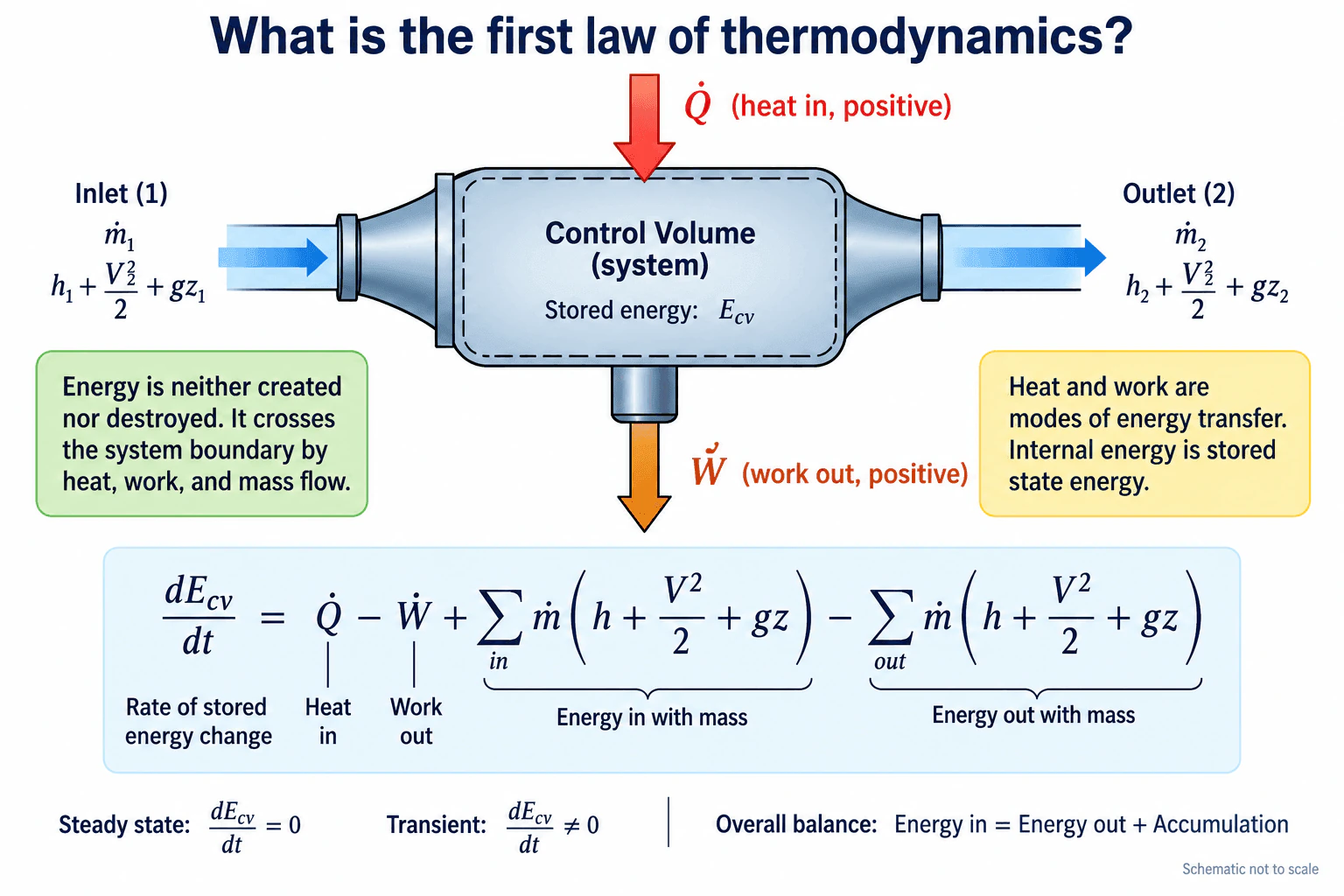
The first law of thermodynamics is conservation of energy. Energy cannot be created or destroyed. It can be stored within a system or transferred across its boundary by heat, work, and mass flow. For the control volume shown, heat entering is positive and work leaving is positive. The energy balance therefore accounts for stored energy change plus the enthalpy, kinetic energy, and potential energy carried by mass entering and leaving the control volume.
Detailed Explanation
The first law of thermodynamics states that total energy is conserved. For a thermal engineer, the first step is to define the system boundary and identify every way energy can cross that boundary or accumulate inside it.
For the control volume shown, use heat entering the control volume as positive and work leaving the control volume as positive. Mass entering or leaving also carries energy. The general rate balance is
Here, Ecv is the energy stored in the control volume. Q̇ is the heat transfer rate into it. Ẇ is the work transfer rate out of it. ṁ is mass flow rate. h is specific enthalpy. V²/2 is specific kinetic energy. gz is specific potential energy. In SI units, every term in the rate balance has units of watts.
Heat and work are modes of energy transfer across the boundary. They are not properties stored in the material. Internal energy is microscopic energy stored in the material. Enthalpy is especially useful for flowing fluids because it combines internal energy with flow work. Temperature describes thermal state and is not itself an amount of energy. Entropy is a thermodynamic property used with the second law and does not replace the first law energy balance. Thermal power is the rate of energy transfer, such as Q̇ measured in watts. Stored energy is the energy contained within the defined system or control volume.
As a concrete example, consider a flowing thermal device with one inlet and one outlet. Fluid enters carrying enthalpy, kinetic energy, and potential energy. Heat may enter through the boundary and shaft work may leave. The first law requires those transfers and flow energies to equal the energy leaving with the fluid plus any increase in stored energy.
At steady state, the stored energy does not change with time, so dEcv/dt = 0. Under transient conditions, dEcv/dt is not zero because energy is accumulating or being depleted. A useful independent check is the overall balance: energy entering equals energy leaving plus accumulation.
Useful Questions to Ask the Interviewer
Should I treat the system as a closed system or as a control volume with mass flow?
Should I assume steady state or include energy accumulation?
Can kinetic and potential energy changes be neglected, or should they remain in the balance?
How to Explain It in an Interview
Start by defining the physical boundary. I would say that the first law is conservation of energy, then identify the ways energy crosses that boundary. For a control volume, energy can cross through heat transfer, work transfer, and flowing mass.
Next, I would state the sign convention. In this case, heat entering is positive and work leaving is positive. Each mass stream carries enthalpy plus kinetic and potential energy, represented by h + V²/2 + gz.
I would then write the complete control volume energy balance before making any simplifications. This prevents terms from being removed without justification. If the process is steady, dEcv/dt becomes zero. If velocity and elevation changes are negligible, the kinetic and potential energy terms can also be neglected after stating those assumptions.
I would keep the units consistent and perform a conservation check by comparing energy entering with energy leaving plus accumulation. For a transient process, any imbalance changes the stored energy of the control volume.
I would also distinguish the key thermal terms. Heat and work describe energy crossing a boundary. Internal energy and enthalpy are thermodynamic properties. Temperature describes thermal state. Entropy is used with the second law. Thermal power is an energy transfer rate.
The conclusion is simple: the first law is the accounting rule that requires energy entering a defined system to equal energy leaving plus any change in stored energy.
Why Interviewers Ask This
Interviewers want to confirm that the candidate understands conservation of energy, can define a physical system boundary, can distinguish stored energy from energy transfer, and can apply a consistent heat and work sign convention to steady state and transient control volume problems.
Common interview mistakes
Common mistakes include using an inconsistent heat or work sign convention, confusing temperature with stored energy, treating heat as a stored property of the fluid, omitting the enthalpy carried by flowing mass, dropping kinetic or potential energy terms without stating why, assuming steady state when energy is actually accumulating, and mixing incompatible units in one balance.
Interview tip
State the system boundary and sign convention before writing the equation. Write the complete energy balance first, then simplify only after stating assumptions such as steady state operation or negligible kinetic and potential energy changes. Finish with a conservation check so the result is physically consistent.
Interviewer may ask next
How would you validate a simplified steady state energy balance?
First confirm that the operating conditions are sufficiently stable for stored energy change to be negligible. Check mass conservation at the control volume boundary, retain consistent units, and compare total energy entering with total energy leaving. If kinetic or potential energy terms were neglected, estimate their magnitude relative to the enthalpy, heat, and work terms. A significant residual can indicate a missing energy path, inconsistent measurements, incorrect property values, or an invalid assumption.
What changes if the control volume is transient instead of steady state?
The accumulation term can no longer be set to zero. The first law then balances heat, work, energy transported by mass, and the rate of change of energy stored inside the control volume. If energy enters faster than it leaves, Ecv increases. If energy leaves faster than it enters, Ecv decreases. The thermodynamic state can therefore change with time.
4. How would you estimate exergy destroyed from entropy generation?Thermodynamics And Energy BalancesHard
Short Interview Answer (30-60 seconds)
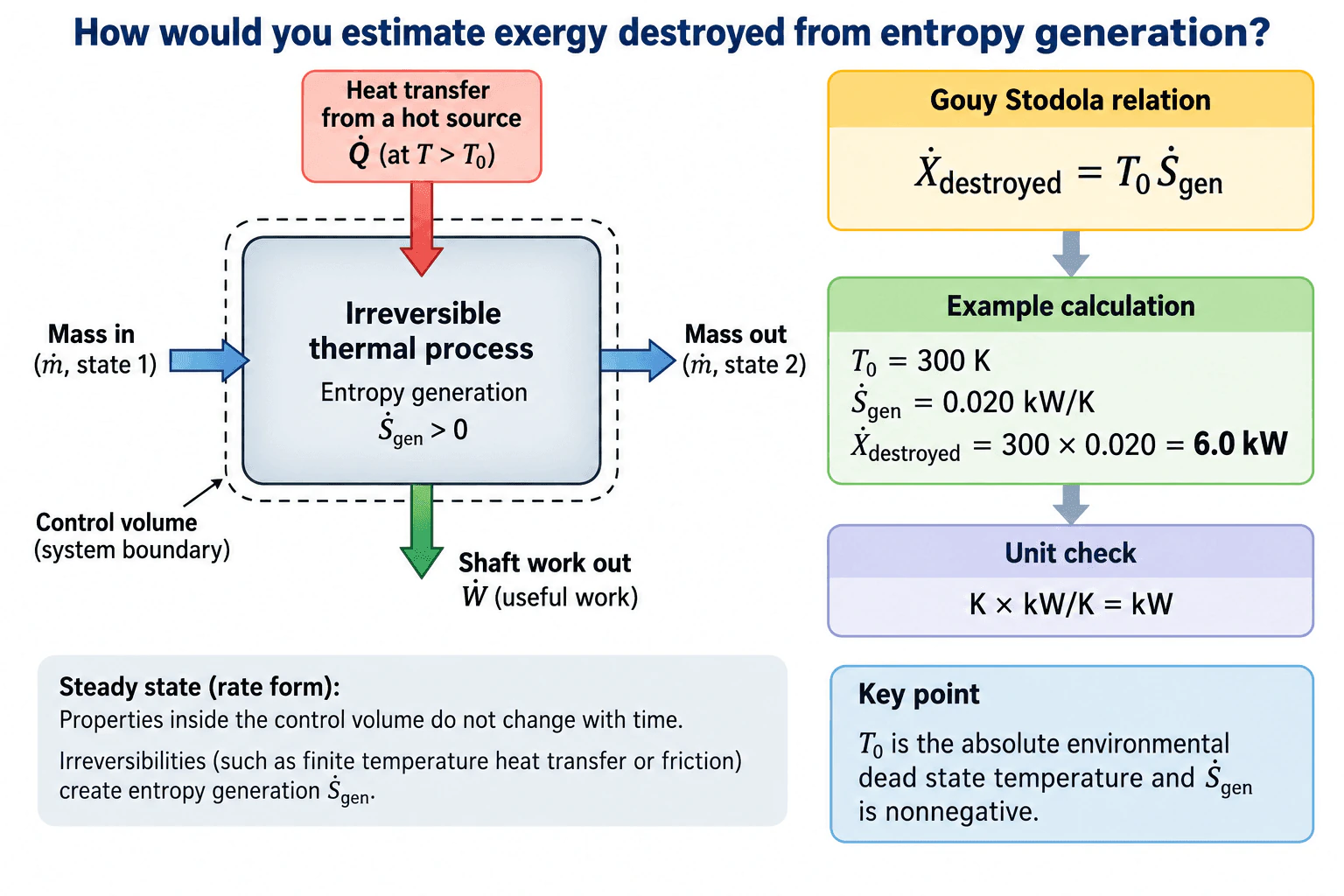
For an irreversible process, I would estimate the exergy destruction rate using the Gouy Stodola relation, Ẋdestroyed = T0 Ṡgen. Here, T0 is the absolute environmental dead state temperature in kelvin and Ṡgen is the entropy generation rate. For example, if T0 = 300 K and Ṡgen = 0.020 kW/K, then Ẋdestroyed = 300 × 0.020 = 6.0 kW. I would also verify that Ṡgen is nonnegative and that the units reduce to power.
Detailed Explanation
Exergy destruction is the useful work potential lost because of irreversibility. Once the entropy generation rate is known, the Gouy Stodola relation gives the exergy destruction rate directly:
Ẋdestroyed = T0 Ṡgen
Here, Ẋdestroyed is the exergy destruction rate, T0 is the absolute environmental dead state temperature in K, and Ṡgen is the entropy generation rate in kW/K. The relation applies to irreversibility occurring inside the selected system boundary.
Useful Questions to Ask the Interviewer
Should I treat the control volume as operating at steady state or under transient conditions?
What environmental dead state temperature T0 should I use?
Is Ṡgen already provided, or should I calculate it from an entropy balance using the heat and mass flows?
How to Explain It in an Interview
I would first define the control volume around the irreversible thermal process and state the operating condition. For the illustrated example, I assume steady state, so properties stored inside the control volume do not change with time. Mass enters at state 1 and leaves at state 2, heat enters from a hotter source with T > T0, and shaft work leaves the control volume.
The key second law quantity is the entropy generation rate Ṡgen. It represents entropy created by irreversibilities such as friction or heat transfer across a finite temperature difference. For an irreversible real process, Ṡgen > 0. At the reversible limit, Ṡgen = 0.
Once Ṡgen is known, I multiply it by the absolute environmental dead state temperature:
Ẋdestroyed = T0 Ṡgen
Using the hypothetical values shown, T0 = 300 K and Ṡgen = 0.020 kW/K:
Ẋdestroyed = 300 K × 0.020 kW/K = 6.0 kW
The dimensional check is K × kW/K = kW, so the result is a rate of lost work potential.
If Ṡgen is not given, I would obtain it from the entropy balance for the defined control volume using the appropriate mass entropy flows and heat transfer terms. I would use one consistent sign convention for heat, mass flow, and shaft work.
As an independent check, entropy generation must not be negative for a real process. If Ṡgen = 0, exergy destruction is zero. The estimate also depends directly on T0, so I would state that environmental reference temperature explicitly.
Why Interviewers Ask This
This tests whether the candidate can connect the second law, entropy generation, and exergy destruction while defining the environmental reference temperature, system boundary, operating condition, units, and assumptions correctly.
Common interview mistakes
Common mistakes are using temperature in degrees Celsius instead of absolute temperature in kelvin, using entropy instead of entropy generation, mixing total quantities with rate quantities, using inconsistent units, accepting a negative entropy generation result without investigating the balance, and applying the relation without defining the environmental dead state temperature or system boundary.
Interview tip
Start with Ẋdestroyed = T0 Ṡgen, define both symbols immediately, and explain that entropy generation measures irreversibility while exergy destruction measures the corresponding lost work potential. A short numerical substitution and the K × kW/K = kW unit check make the answer easy to verify.
Interviewer may ask next
What would you do if the calculated entropy generation were negative?
I would treat that as evidence that the entropy balance, sign convention, property data, heat transfer temperature, or measurement inputs need to be checked. For a real process, entropy generation must satisfy Ṡgen ≥ 0. A negative value would not represent physical irreversibility under the stated model.
How would the estimated exergy destruction change if the environmental temperature increased?
For the same entropy generation rate, the Gouy Stodola relation shows that exergy destruction increases directly with T0. For example, increasing T0 from 300 K to 310 K while keeping Ṡgen = 0.020 kW/K changes the estimate from 6.0 kW to 6.2 kW. That is why the environmental dead state temperature must be stated explicitly.
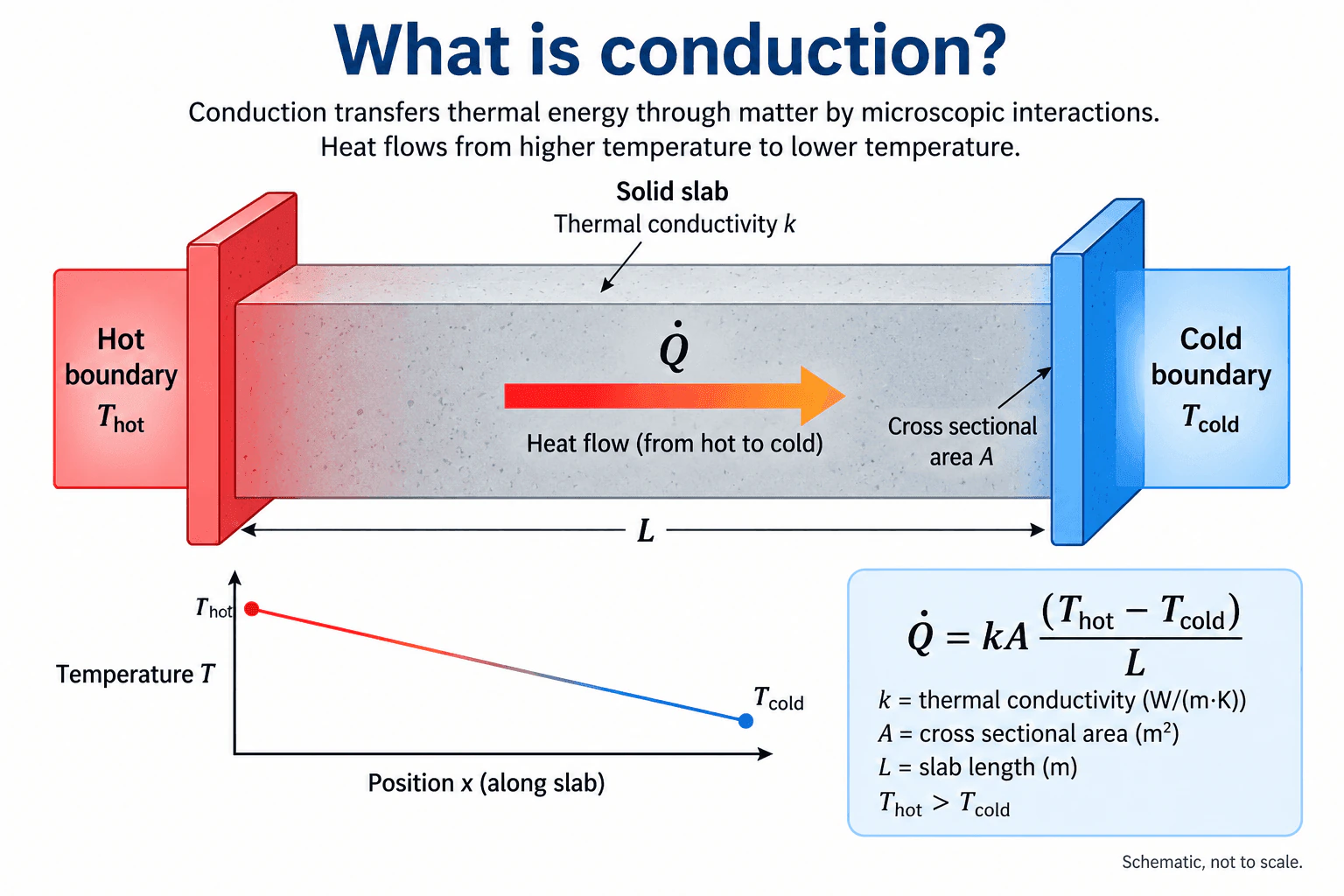
5. What is conduction?Conduction And Thermal ResistanceEasy
Short Interview Answer (30-60 seconds)
Conduction is the transfer of thermal energy through matter because of microscopic interactions within the material. Heat flows from a region at higher temperature toward a region at lower temperature. For a simple solid slab with steady one dimensional conduction, constant thermal conductivity, and no internal heat generation, Fourier law gives Q̇ = kA(T_hot − T_cold)/L. Here k is thermal conductivity, A is the cross sectional area normal to heat flow, and L is the conduction length.
Detailed Explanation
Conduction is heat transfer through a material caused by a temperature gradient. In a solid slab, thermal energy moves from the hotter boundary toward the colder boundary without bulk motion of the solid. The heat transfer rate depends on the material thermal conductivity, the area available for heat flow, the conduction length, and the temperature difference.
Useful Questions to Ask the Interviewer
Should I assume steady one dimensional conduction through a simple slab?
May I assume constant thermal conductivity and no internal heat generation?
Do you want the explanation using Fourier law and the slab temperature profile?
How to Explain It in an Interview
Physical Method: Consider a solid slab of length L and cross sectional area A. Let the hot boundary be at T_hot and the cold boundary be at T_cold, with T_hot greater than T_cold. Heat therefore flows from the hot side toward the cold side. For steady one dimensional conduction with constant k and no internal heat generation, Fourier law becomes Q̇ = kA(T_hot − T_cold)/L. Thermal conductivity k has units of W/(m·K) and describes how readily the material conducts heat.
Engineering Reasoning: The temperature decreases from T_hot to T_cold along the slab. Under the stated assumptions, the temperature profile is linear. A larger conductivity k, larger area A, or larger temperature difference increases the heat transfer rate. A larger conduction length L decreases the heat transfer rate for the same boundary temperatures.
The same slab can also be described by a thermal resistance R_th = L/(kA), which gives Q̇ = (T_hot − T_cold)/R_th. Conductivity is a material property, while thermal resistance depends on both the material and the geometry.
Assumptions And Checks: Define the geometry, heat flow direction, boundary temperatures, conductivity, and whether internal heat generation exists before applying the equation. The simple linear profile is appropriate when heat flow is effectively one dimensional, k is treated as constant, area is constant, and internal heat generation is absent. If conductivity varies significantly with temperature or direction, or if contact resistance, spreading resistance, or transient effects are important, a more detailed conduction model is required.
Why Interviewers Ask This
Interviewers want to confirm that the candidate understands the physical meaning of conduction, the direction of heat flow, the role of thermal conductivity, and the assumptions behind a basic Fourier law model.
Common interview mistakes
Common mistakes include reversing the heat flow direction, confusing thermal conductivity with thermal resistance, forgetting that area must be normal to heat flow, and applying the simple slab equation when conductivity varies strongly, heat generation exists, or heat flow is not effectively one dimensional.
Interview tip
Start with the physical definition and heat flow direction. Then introduce the simple solid slab, define k, A, L, T_hot, and T_cold, state the assumptions, and use Fourier law to connect the temperature difference to the heat transfer rate.
Interviewer may ask next
When is the linear temperature profile through the slab valid?
It is valid for steady one dimensional conduction through a constant area slab when thermal conductivity is treated as constant and there is no internal heat generation. Under those assumptions, the temperature decreases linearly from T_hot to T_cold.
What happens to the conduction heat transfer rate if the slab length doubles while everything else stays the same?
From Q̇ = kA(T_hot − T_cold)/L, doubling L makes the heat transfer rate one half of its original value when k, A, T_hot, and T_cold remain unchanged. Equivalently, the slab thermal resistance R_th = L/(kA) doubles.
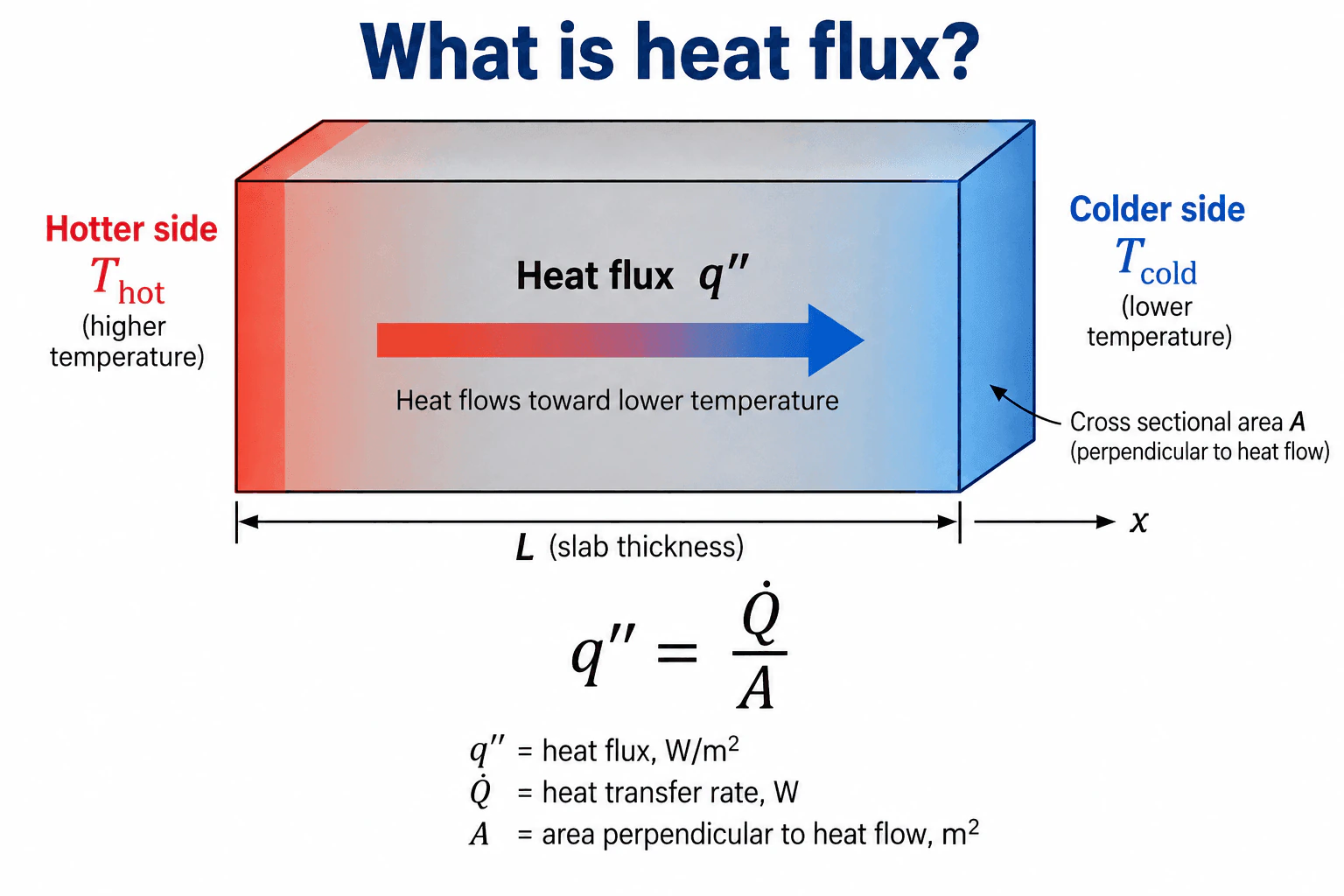
6. What is heat flux?Conduction And Thermal ResistanceEasy
Short Interview Answer (30-60 seconds)
Heat flux is the heat transfer rate per unit area. For an average heat flux normal to a surface, q'' = Q̇ / A, where q'' is heat flux in W/m², Q̇ is heat transfer rate in W, and A is the area perpendicular to the heat flow in m². In conduction through a slab, heat flows from the hotter side toward the colder side.
Detailed Explanation
Heat flux describes how much heat transfer rate passes through a given area. A total heat transfer rate by itself does not show how concentrated the thermal loading is, so dividing by area gives a quantity that can be compared across surfaces of different sizes.
Useful Questions to Ask the Interviewer
Are we discussing average heat flux over the surface or local heat flux at a specific location?
Is the heat transfer limited to conduction through the slab?
Should the heat flux be treated as steady or time dependent?
How to Explain It in an Interview
For a simple slab, first define the heat flow direction from the hotter face toward the colder face. The relevant area A is the cross sectional area perpendicular to that heat flow.
The average heat flux is
q'' = Q̇ / A
where q'' is heat flux in W/m², Q̇ is heat transfer rate in W, and A is area in m².
This means the same total heat transfer rate produces a larger heat flux when it passes through a smaller area. Heat flux therefore describes the intensity of heat transfer at a surface rather than only the total amount of heat transferred per unit time.
For conduction through the slab, the hotter side is at a higher temperature than the colder side, so heat flows toward the lower temperature. The heat flux direction follows that heat flow direction.
The equation q'' = Q̇ / A gives an average value when Q̇ is the total heat transfer rate through area A. If the heat transfer varies significantly across the surface, the local heat flux can vary with position, so one uniform value may not describe the entire surface accurately.
A quick dimensional check confirms the units. Dividing watts by square metres gives W/m². I would also confirm that the chosen area is perpendicular to the heat flow and that the sign or direction convention is stated consistently.
Why Interviewers Ask This
Interviewers want to confirm that the candidate understands heat flux as heat transfer rate normalized by area, can state the correct units, and can interpret the direction of conductive heat flow from a hotter region toward a colder region.
Common interview mistakes
Common mistakes include confusing heat flux with total heat transfer rate, using an area that is not perpendicular to the heat flow, omitting the W/m² units, and treating a spatially varying heat flux as though it were uniform over the entire surface.
Interview tip
Start with q'' = Q̇ / A, define every symbol and unit, then state that conductive heat flows from the hotter region toward the colder region. For this question, that gives a complete explanation without introducing unnecessary thermal resistance or transient analysis.
Interviewer may ask next
What is the difference between heat transfer rate and heat flux?
Heat transfer rate Q̇ is the total thermal energy transferred per unit time and has units of watts. Heat flux q'' is the heat transfer rate divided by the area perpendicular to the heat flow and has units of W/m². Heat flux therefore describes how concentrated the heat transfer is over a surface.
What happens to heat flux if the heat transfer rate stays constant but the area is cut in half?
From q'' = Q̇ / A, reducing the area to one half while keeping Q̇ constant makes the heat flux twice as large. The same total heat transfer rate is concentrated through a smaller area.
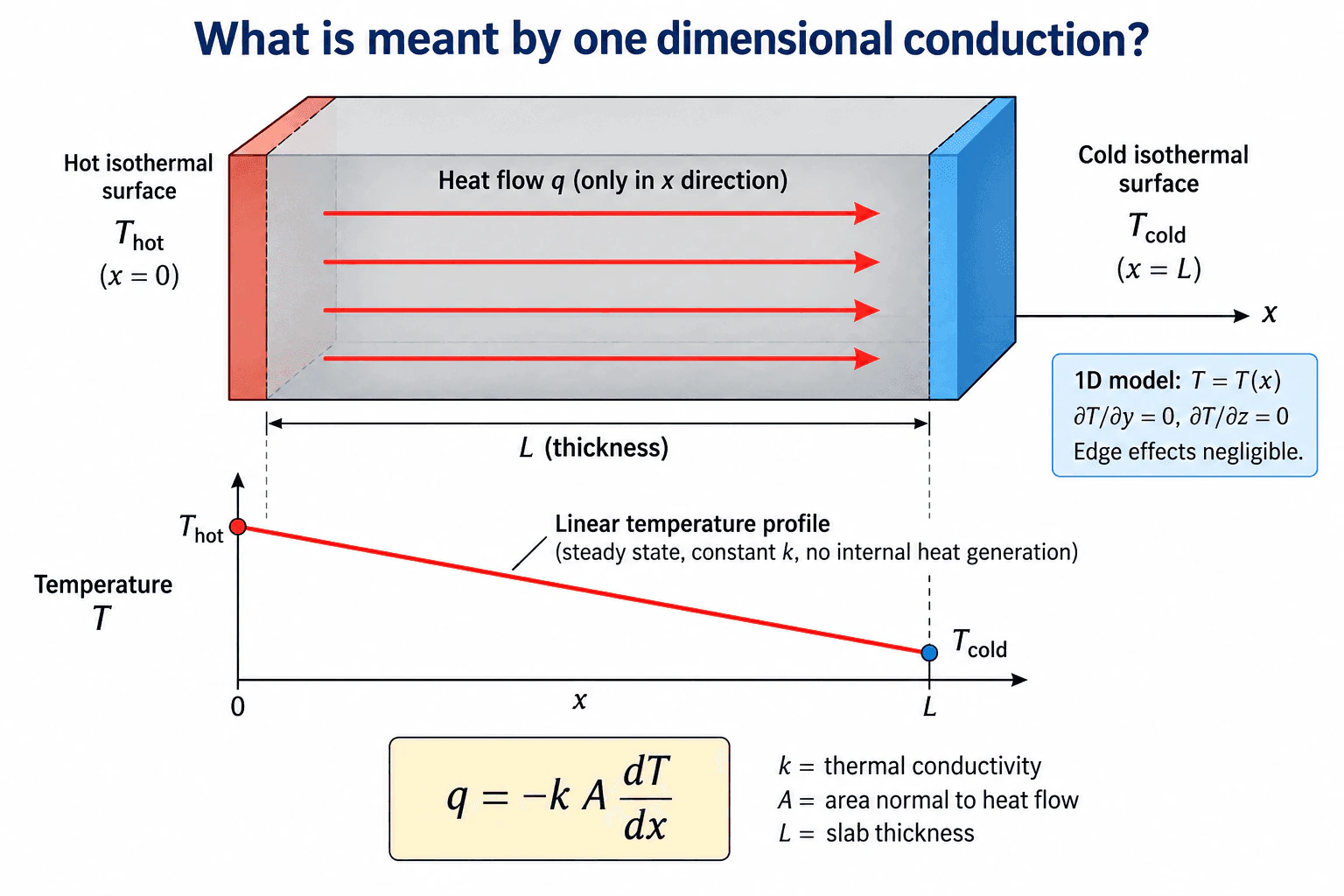
7. What is meant by one dimensional conduction?Conduction And Thermal ResistanceMedium
Short Interview Answer (30-60 seconds)
One dimensional conduction means that temperature varies significantly in only one spatial direction, so conduction is modeled along that coordinate alone. For a plane slab with heat flowing in the x direction, the temperature is written as T = T(x), while ∂T/∂y = 0 and ∂T/∂z = 0. Fourier law then becomes q = −kA dT/dx. The approximation is appropriate when lateral temperature variations and edge effects are negligible.
Detailed Explanation
One dimensional conduction is a heat conduction model in which temperature changes significantly along only one spatial coordinate. For a plane slab, if the dominant heat flow is in the x direction, the temperature field can be represented as T = T(x). Temperature gradients in the transverse directions are neglected, so ∂T/∂y = 0 and ∂T/∂z = 0.
Useful Questions to Ask the Interviewer
Should I assume steady state conduction through a plane slab?
May I assume constant thermal conductivity and no internal heat generation?
Can edge effects and lateral temperature gradients be neglected?
How to Explain It in an Interview
Physical Method
Define a slab of thickness L and cross sectional area A. Let the hot face at x = 0 have temperature T_hot and the cold face at x = L have temperature T_cold. If the boundary conditions are approximately uniform over each face and lateral variations are negligible, heat conduction can be modeled only along x.
The one dimensional assumption is:
T = T(x)
∂T/∂y = 0
∂T/∂z = 0
Fourier law for the total heat transfer rate is:
q = −kA dT/dx
where q is heat transfer rate in W, k is thermal conductivity in W per m K, A is the area normal to heat flow in m², and dT/dx is the temperature gradient in K per m. The negative sign shows that heat flows toward lower temperature.
Engineering Reasoning
For steady state conduction through a homogeneous plane slab with constant k and no internal heat generation, the temperature profile is linear. It decreases from T_hot at x = 0 to T_cold at x = L, matching the physical direction of heat flow shown in the diagram.
One dimensional does not mean the object itself has only one geometric dimension. It means that the temperature field and conductive heat flow can be represented using one spatial coordinate because changes in the other directions are negligible.
Assumptions And Checks
Check whether the boundary temperatures are approximately uniform, whether edge effects are small, and whether the material can reasonably be treated with the chosen conductivity model. Significant lateral gradients, anisotropy, spreading resistance, contact resistance, internal heat generation, or transient effects can require a more detailed model.
Validation can include comparison with measurements, a higher dimensional thermal model, or an analytical limiting case when such evidence is available. The conclusion is that one dimensional conduction is a justified simplification only when heat flow and temperature variation are dominated by one spatial direction.
Why Interviewers Ask This
Interviewers want to see whether the candidate can simplify a conduction problem using physically justified assumptions, identify the dominant direction of heat flow, define the temperature field, and apply Fourier law while recognizing the limits of the one dimensional model.
Common interview mistakes
Common mistakes include saying that the object itself is one dimensional, assuming a linear temperature profile without stating steady state, constant conductivity, and no internal heat generation, confusing thermal conductivity with thermal resistance, ignoring edge or lateral effects, and using Fourier law without defining the coordinate system and heat flow direction.
Interview tip
State the physical meaning first: temperature varies in only one spatial direction. Then define T = T(x), identify the heat flow direction, write q = −kA dT/dx, and finish by stating the assumptions that make the approximation valid.
Interviewer may ask next
How would you check whether a one dimensional conduction assumption is reasonable?
Check the geometry and boundary conditions for approximate uniformity, confirm that the dominant temperature gradient is along one coordinate, and assess whether edge effects or lateral gradients are small. Where practical, compare the prediction with measurements, an analytical reference, or a higher dimensional thermal model.
What changes if there is internal heat generation in the slab?
The problem can still be one dimensional if temperature varies only with x, but the temperature profile is generally no longer linear. The governing conduction equation must include the volumetric heat generation term, and the resulting temperature distribution depends on the boundary conditions and material properties.
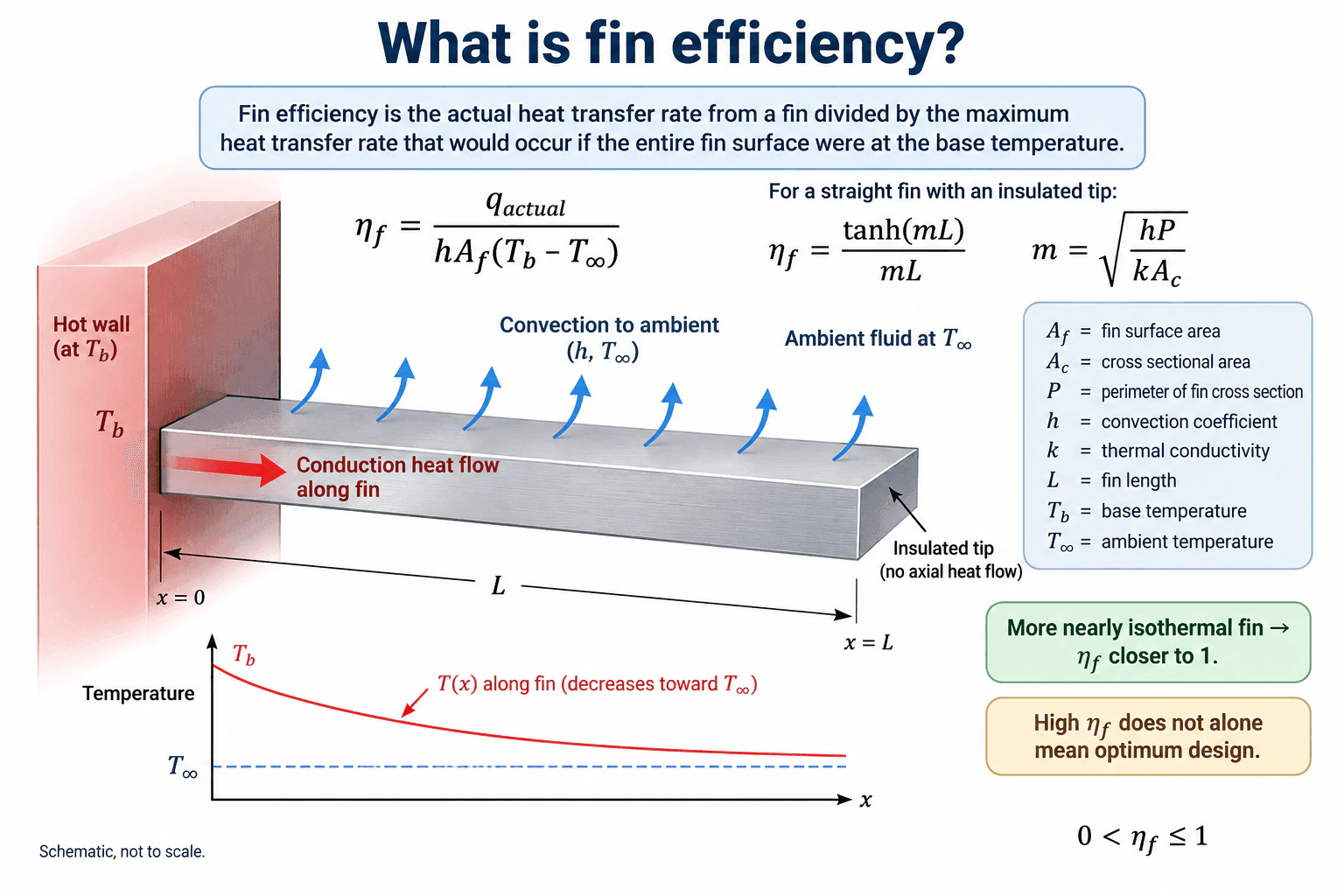
8. What is fin efficiency?Conduction And Thermal ResistanceHard
Short Interview Answer (30-60 seconds)
Fin efficiency is the ratio of the actual heat transfer from a fin to the maximum heat transfer that would occur if the entire fin surface were at the base temperature. It is written as ηf = qactual divided by hAf(Tb − T∞). For a straight fin of uniform cross section with an insulated tip, ηf = tanh(mL) divided by mL, where m = √(hP divided by kAc). A more nearly isothermal fin has an efficiency closer to 1.
Detailed Explanation
Fin efficiency measures how effectively the available fin surface transfers heat compared with an ideal fin whose entire surface remains at the base temperature.
Useful Questions to Ask the Interviewer
Should I assume a straight fin of uniform cross section with constant thermal conductivity?
Is the fin tip insulated, or should convection from the tip be included?
Should the convection coefficient h and ambient temperature T∞ be treated as uniform along the fin?
How to Explain It in an Interview
Consider a straight fin attached to a hot wall at base temperature Tb and exposed to ambient fluid at T∞. Heat conducts from the wall along the fin while convection removes heat from the fin surface. Because heat is continuously lost by convection, the fin temperature T(x) generally decreases from Tb toward T∞ as x increases from the base at x = 0 to the tip at x = L.
The maximum possible heat transfer would occur if every part of the fin surface stayed at Tb. That ideal rate is hAf(Tb − T∞), where h is the convection coefficient and Af is the fin surface area exposed to convection. Therefore,
ηf = qactual divided by hAf(Tb − T∞)
and 0 < ηf ≤ 1.
For the straight uniform fin shown with an insulated tip, the tip condition is no axial heat flow at x = L. Assuming steady one dimensional conduction, constant k and h, no internal heat generation, and uniform ambient temperature,
ηf = tanh(mL) divided by mL
where
m = √(hP divided by kAc)
Here P is the perimeter of the fin cross section exposed to convection, Ac is the cross sectional area, k is thermal conductivity, and L is fin length.
The limiting behavior provides a useful check. When mL is small, the fin stays more nearly isothermal and ηf approaches 1. When the temperature decreases more strongly along the fin, the average fin surface temperature is farther below Tb, so efficiency decreases.
A high fin efficiency does not by itself mean the design is optimal. A longer fin can have lower efficiency while still transferring more total heat because it provides more surface area. Fin efficiency should therefore be considered together with total heat transfer, geometry, thermal conductivity, and convection conditions.
Why Interviewers Ask This
Interviewers ask this to check whether a candidate understands why a fin is generally not at a uniform base temperature, how conduction along the fin interacts with convection from its surface, and how that temperature variation affects the useful heat transfer obtained from the fin.
Common interview mistakes
Common mistakes are defining fin efficiency as heat transfer enhancement instead of actual fin heat transfer divided by the ideal maximum, assuming the entire fin is actually at the base temperature, using the insulated tip equation when the real tip condition is different, confusing fin surface area Af with cross sectional area Ac, and assuming that a higher fin efficiency automatically means a better thermal design.
Interview tip
Start with the physical picture: conduction carries heat from the hot base along the fin while convection removes heat from its surface, so the fin temperature decreases toward the ambient temperature. Then define efficiency as actual heat transfer divided by the ideal heat transfer if the whole fin surface were at Tb. If the interviewer asks for the standard insulated tip equation, state its assumptions before using ηf = tanh(mL) divided by mL.
Interviewer may ask next
What assumptions are required for ηf = tanh(mL) divided by mL?
This expression applies to a straight fin of uniform cross section with an insulated tip under steady one dimensional conduction. It assumes constant thermal conductivity k, a uniform convection coefficient h, uniform ambient temperature T∞, and no internal heat generation. The insulated tip condition means no axial heat flow at x = L. If the tip convects, the cross section varies, material properties vary strongly with temperature, or radiation is important, the temperature solution and therefore the efficiency expression must be modified.
Can a fin with lower efficiency still transfer more total heat than a fin with higher efficiency?
Yes. Efficiency measures how closely the fin surface approaches the ideal condition of being entirely at the base temperature. A longer fin may have a lower average surface temperature and therefore a lower efficiency, yet its larger surface area can still produce greater total heat transfer. Fin efficiency should therefore be considered together with total heat transfer and fin geometry rather than used as the only design criterion.
9. What is forced convection?Convection And Fluid FlowEasy
Short Interview Answer (30-60 seconds)
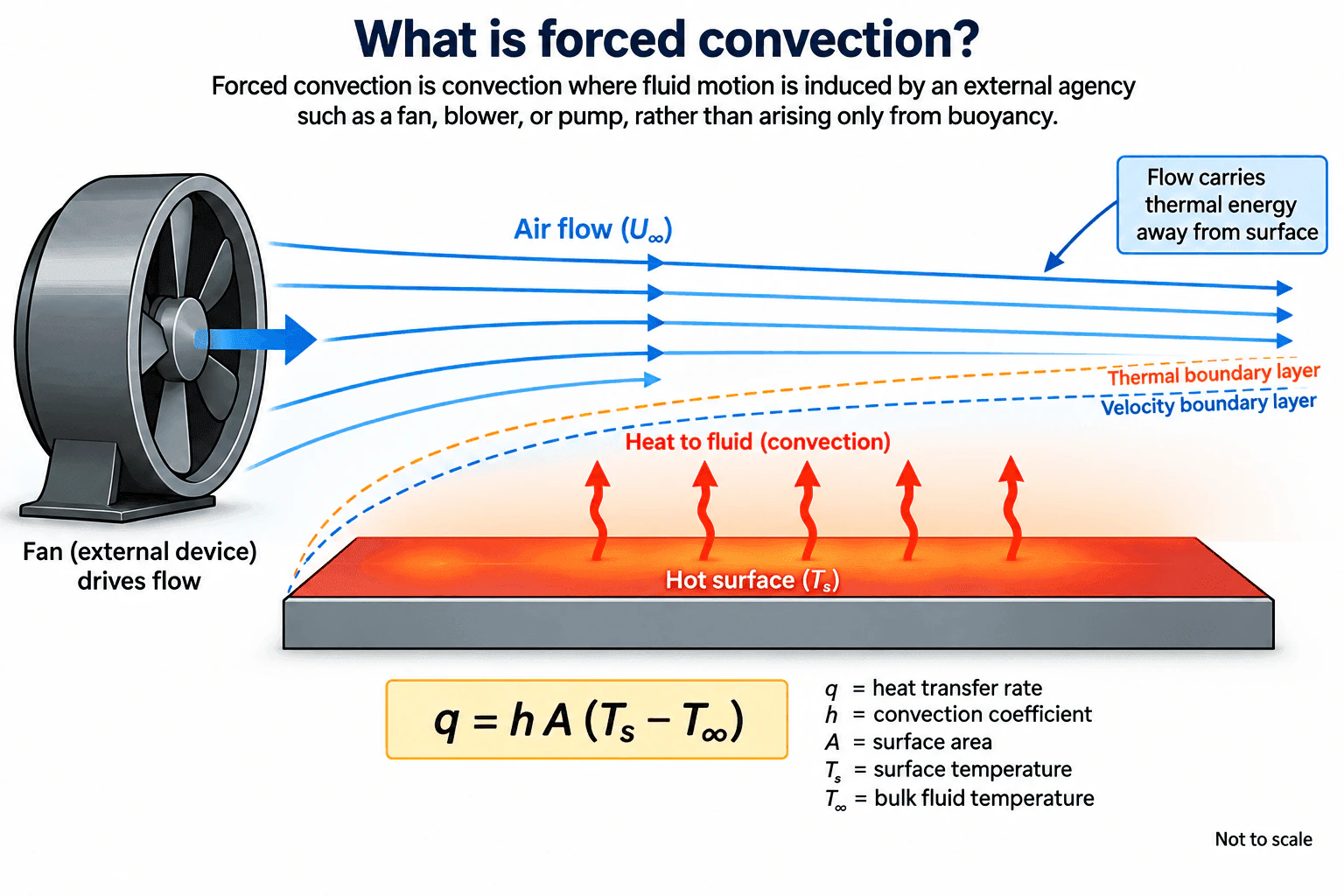
Forced convection is heat transfer between a surface and a moving fluid when an external device such as a fan, blower, or pump creates the fluid motion. In the example shown, a fan drives air across a hot surface. The moving air develops velocity and thermal boundary layers and carries thermal energy away from the surface. A common heat transfer relation is q = h A (Ts − T∞), where h is the convection coefficient.
Detailed Explanation
Forced convection occurs when an external device creates fluid motion past a surface. In the illustrated external flow case, a fan drives air from left to right across a hot horizontal surface. Heat moves from the hotter surface into the cooler air, and the moving air transports that thermal energy downstream.
The heat transfer rate can be written as q = h A (Ts − T∞), where q is the heat transfer rate, h is the convection coefficient, A is the surface area, Ts is the surface temperature, and T∞ is the bulk fluid temperature away from the surface.
Two boundary layers develop from the leading edge. The velocity boundary layer is the region where the surface changes the fluid velocity from zero at the wall toward the free stream value U∞. The thermal boundary layer is the region where the fluid temperature changes from the surface value toward the bulk fluid temperature. For the air conditions represented by the schematic, the thermal boundary layer is shown slightly thicker than the velocity boundary layer.
Useful Questions to Ask the Interviewer
Are we considering external flow over a surface or internal flow through a passage?
What fluid is being used, and can its properties be treated as approximately constant?
Are the surface temperature, bulk fluid temperature, and flow speed known?
How to Explain It in an Interview
Start with the physical cause. Forced convection requires externally driven fluid motion. A fan, blower, or pump supplies that motion. This distinguishes it from natural convection, where buoyancy caused by density differences drives the flow.
For the pictured case, a fan forces air across a hot surface. At the wall, the fluid satisfies the no slip condition, so a velocity boundary layer grows downstream. Because the surface and incoming air are at different temperatures, a thermal boundary layer also grows downstream. Heat passes from the hot surface into the air, and the moving flow carries that thermal energy away.
The basic heat transfer relation is q = h A (Ts − T∞). The temperature difference is the thermal driving force, while h represents the effectiveness of convection for the particular fluid, geometry, and flow condition. The value of h depends on factors such as fluid properties, flow speed, geometry, and flow regime.
For the air example in the diagram, the thermal boundary layer is slightly thicker than the velocity boundary layer. This is consistent with common air conditions where the Prandtl number is somewhat below one.
The drawing is schematic and not to scale. It represents external forced air flow over a heated surface and does not specify dimensions, temperatures, or velocity. For a quantitative calculation, I would first define the geometry, boundary conditions, fluid properties, and flow regime before choosing an appropriate convection correlation.
The key point is that forced convection uses externally driven fluid motion to transport thermal energy between a surface and a fluid.
Why Interviewers Ask This
Interviewers want to confirm that you understand how externally driven fluid motion produces convective heat transfer and that you can distinguish forced convection from buoyancy driven natural convection.
Common interview mistakes
Common mistakes are describing forced convection as buoyancy driven flow, forgetting that a fan or pump provides the fluid motion, confusing the bulk fluid temperature T∞ with the surface temperature Ts, or treating the convection coefficient h as a universal constant. Another mistake is selecting a heat transfer correlation without first checking the geometry, fluid properties, and flow regime.
Interview tip
Give the definition first, then use the fan over a hot surface example. Mention q = h A (Ts − T∞), explain that the external flow creates velocity and thermal boundary layers, and clearly distinguish forced convection from natural convection.
Interviewer may ask next
How would you validate a forced convection heat transfer calculation?
I would verify the geometry, boundary conditions, fluid properties, temperatures, and flow speed. Then I would confirm that the selected convection correlation applies to the relevant geometry and flow regime. I would check units and evaluate quantities such as Reynolds and Prandtl numbers when they are needed to establish correlation applicability. I would also check that the predicted heat transfer is consistent with the temperature difference and the overall energy balance. For real equipment, measured temperature or heat transfer data can provide an independent validation.
What usually happens if the fan speed increases?
Increasing fan speed usually increases the air velocity over the surface. This generally increases forced convection and raises the convection coefficient h, so the heat transfer rate can increase for the same surface area and temperature difference. The exact change depends on the fluid properties, geometry, and flow regime, so a suitable convection correlation is required for a quantitative prediction.
10. How do you determine whether natural convection or forced convection dominates?Convection And Fluid FlowHard
Short Interview Answer (30-60 seconds)
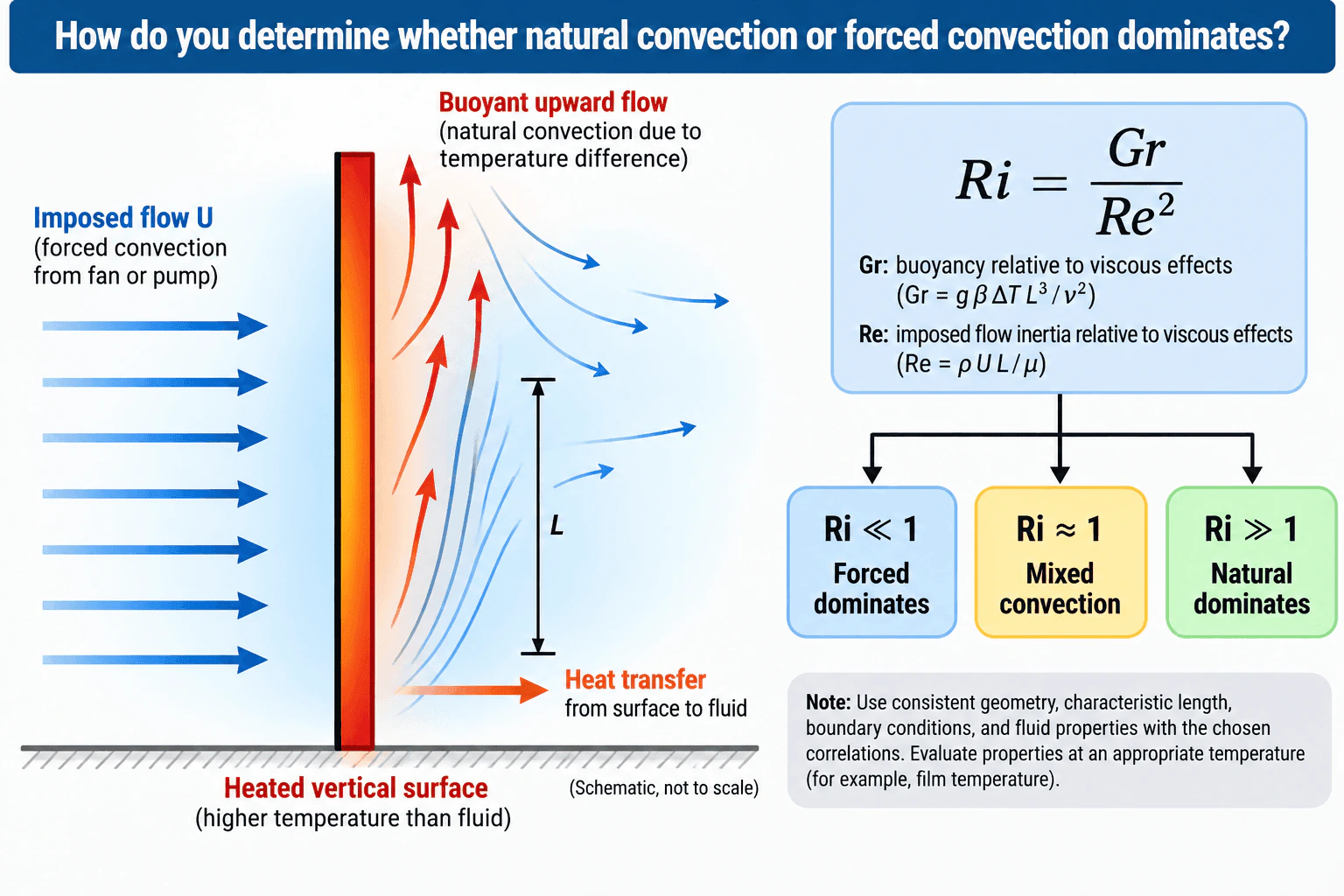
I compare buoyancy with the imposed flow using the Richardson number, Ri = Gr/Re². Gr measures buoyancy relative to viscous effects, while Re measures imposed flow inertia relative to viscous effects. If Ri ≪ 1, forced convection dominates. If Ri ≫ 1, natural convection dominates. If Ri is approximately 1, both mechanisms are important and I treat the problem as mixed convection. I calculate Gr and Re with consistent geometry, characteristic length, boundary conditions, and fluid properties.
Detailed Explanation
Natural convection is driven by density differences created by temperature differences. Forced convection is driven by an imposed velocity, such as flow produced by a fan or pump. The useful comparison is the Richardson number:
Ri = Gr/Re²
For the heated vertical surface shown, Gr = gβΔTL³/ν² and Re = ρUL/μ = UL/ν.
Here, g is gravitational acceleration, β is the volumetric thermal expansion coefficient, ΔT is the relevant surface to fluid temperature difference, L is the characteristic length, ν is kinematic viscosity, ρ is density, U is imposed velocity, and μ is dynamic viscosity.
Useful Questions to Ask the Interviewer
Is the flow internal or external, and what geometry and characteristic length should I use?
What imposed velocity, surface temperature, ambient fluid temperature, and fluid properties are given?
At what temperature should the fluid properties be evaluated for the intended correlation?
How to Explain It in an Interview
First, I define the physical boundary, geometry, gravity direction, temperatures, and whether there is an imposed flow. For an external heated vertical surface with imposed velocity U, I calculate Reynolds number using the characteristic length L appropriate to that geometry.
Next, I calculate Grashof number to represent the strength of buoyancy caused by the temperature difference. I then form Ri = Gr/Re².
If Ri ≪ 1, imposed flow inertia is much stronger than buoyancy, so forced convection dominates. If Ri ≫ 1, buoyancy is much stronger, so natural convection dominates. If Ri is approximately 1, neither mechanism should be neglected, so I treat the problem as mixed convection.
Flow direction also matters. On a heated vertical surface, buoyancy drives warmer fluid upward. An imposed flow may assist, oppose, or cross that buoyant motion, which can alter the boundary layer and the applicable convection correlation.
I keep geometry, characteristic length, boundary conditions, and fluid property evaluation consistent between Gr and Re. I also confirm that any selected correlation is valid for the actual geometry and flow regime. If a fan or pump produces the imposed flow, I verify that the assumed velocity is consistent with the actual operating point and system pressure loss.
Finally, I check limiting behavior. As U increases, Re increases and Ri decreases, so forced convection becomes more important. As U approaches zero, Ri increases and buoyancy becomes dominant. If Ri remains near unity, mixed convection is the appropriate conclusion.
Why Interviewers Ask This
Interviewers want to see whether the candidate can identify the competing buoyancy and imposed flow mechanisms, choose the correct dimensionless comparison, define the physical conditions consistently, and recognize when neither mechanism can be neglected.
Common interview mistakes
Common mistakes include using inconsistent characteristic lengths, evaluating fluid properties inconsistently, ignoring the direction of gravity relative to the imposed flow, treating Ri near 1 as purely natural or purely forced convection, applying a correlation outside its documented geometry or flow regime, and assuming a fan or pump velocity without checking pressure loss and the actual operating point.
Interview tip
State Ri = Gr/Re² early, explain physically what Gr and Re represent, and then give the three regimes: Ri ≪ 1 means forced convection dominates, Ri ≈ 1 means mixed convection, and Ri ≫ 1 means natural convection dominates. Then mention that geometry, characteristic length, fluid properties, boundary conditions, and flow direction must remain consistent.
Interviewer may ask next
How would you validate that your conclusion about the dominant convection mechanism is reasonable?
I would check the limiting behavior of Ri and verify that the Grashof and Reynolds number definitions use the correct geometry and characteristic length. I would confirm the fluid property evaluation temperature and the validity range of any selected convection correlation. For imposed flow, I would verify the actual velocity against measured data or the fan or pump operating point and system pressure loss. If Ri is near 1, I would use an appropriate mixed convection correlation or supporting experimental data because neither mechanism should be neglected.
What happens if the imposed flow velocity increases significantly?
Reynolds number increases in proportion to U when the other quantities remain unchanged, while Grashof number remains unchanged if temperature difference, geometry, gravity, and fluid properties stay constant. Because Ri = Gr/Re², increasing U reduces Ri strongly, moving the system toward forced convection dominance. The higher Reynolds number can also change the flow regime, so I would check the applicable convection correlation and pressure loss again.
More questions load as you scroll
Thermal Engineer Resume Examples
Explore the resume examples below to find the one that best matches your target Thermal Engineer role.
Disclaimer: This interview guide is for educational and informational purposes only. It is designed to help readers prepare, but it does not guarantee any interview result, hiring decision, offer, or outcome. Interview questions, hiring criteria, and preferred answers can vary by employer, interviewer, industry, location, and time. All answers, examples, and explanations in this guide are suggested examples for interview preparation, not definitive answers or instructions for professional practice. They are based on research and judgment, are provided without warranties of any kind, and should be adapted to the question, role, and applicable laws and professional requirements. Diagrams are simplified illustrations intended to highlight the main concepts and their relationships; actual situations, systems, and practices may be more complex. Alternative approaches may be equally valid or better suited to a particular question, context, or interviewer. To the fullest extent permitted by applicable law, the contributors and publisher are not liable for decisions made, actions taken, or losses incurred based on this guide.
State Laws and Professional Responsibilities: Laws and requirements governing an occupation vary by state and jurisdiction. You are responsible for checking the current laws, licensing requirements, and scope-of-practice rules that apply to your location and role, and for ensuring that your answers and actions comply with them. Adapt examples in this guide to those requirements. This guide is not legal advice.
Content Accuracy and Verification: To the fullest extent permitted by applicable law, we do not represent or warrant that interview guides, questions, answers, examples, or diagrams are accurate, complete, current, error-free, or suitable for any particular purpose. You are responsible for independently reviewing and verifying the information before relying on it.