This interview guide is for educational and informational purposes only. It is designed to help readers prepare, but it does not guarantee any interview result, hiring decision, offer, or outcome. Interview questions, hiring criteria, and preferred answers can vary by employer, interviewer, industry, location, and time. All answers, examples, and explanations in this guide are suggested examples for interview preparation, not definitive answers or instructions for professional practice. They are based on research and judgment, are provided without warranties of any kind, and should be adapted to the question, role, and applicable laws and professional requirements. Diagrams are simplified illustrations intended to highlight the main concepts and their relationships; actual situations, systems, and practices may be more complex. Alternative approaches may be equally valid or better suited to a particular question, context, or interviewer. To the fullest extent permitted by applicable law, the contributors and publisher are not liable for decisions made, actions taken, or losses incurred based on this guide.
State Laws and Professional Responsibilities
Laws and requirements governing an occupation vary by state and jurisdiction. You are responsible for checking the current laws, licensing requirements, and scope-of-practice rules that apply to your location and role, and for ensuring that your answers and actions comply with them. Adapt examples in this guide to those requirements. This guide is not legal advice.
Identity, Image, and Privacy Notice
To respect individual privacy, some names, profile photographs, avatars, biographical details, and other identifying information displayed in this guide may be replaced with pseudonyms, licensed stock images, illustrative avatars, composite images, or representative descriptions. Unless a person is expressly identified as an actual contributor, a displayed name, image, or profile should not be understood as depicting or identifying a specific candidate, interviewer, employee, or other real individual. These representations are provided for editorial and illustrative purposes only and do not imply endorsement, employment, participation, or affiliation with this guide or any company mentioned in it. Any resemblance to an actual person is coincidental.
Company Notice
This guide is an independent educational resource and is not affiliated with, endorsed by, sponsored by, or approved by the company named in this guide. Company names identify reported interview experiences or the employer context of clearly labeled original practice exercises. Interview practices can change without notice, and inclusion of company-specific content does not mean these questions are official, complete, or guaranteed to be asked. To the fullest extent permitted by law, the author, contributors, and publisher are not responsible for outcomes related to use of this material.
Content Accuracy and Verification
To the fullest extent permitted by applicable law, we do not represent or warrant that interview guides, questions, answers, examples, or diagrams are accurate, complete, current, error-free, or suitable for any particular purpose. You are responsible for independently reviewing and verifying the information before relying on it.
Questions or comments?
Contact us for general questions, or share feedback, technical corrections, and comments with the community.
11. How do you respond when a patient refuses a potentially life saving treatment for personal or cultural reasons?Ethics And Professional PracticeHard
i Question Details
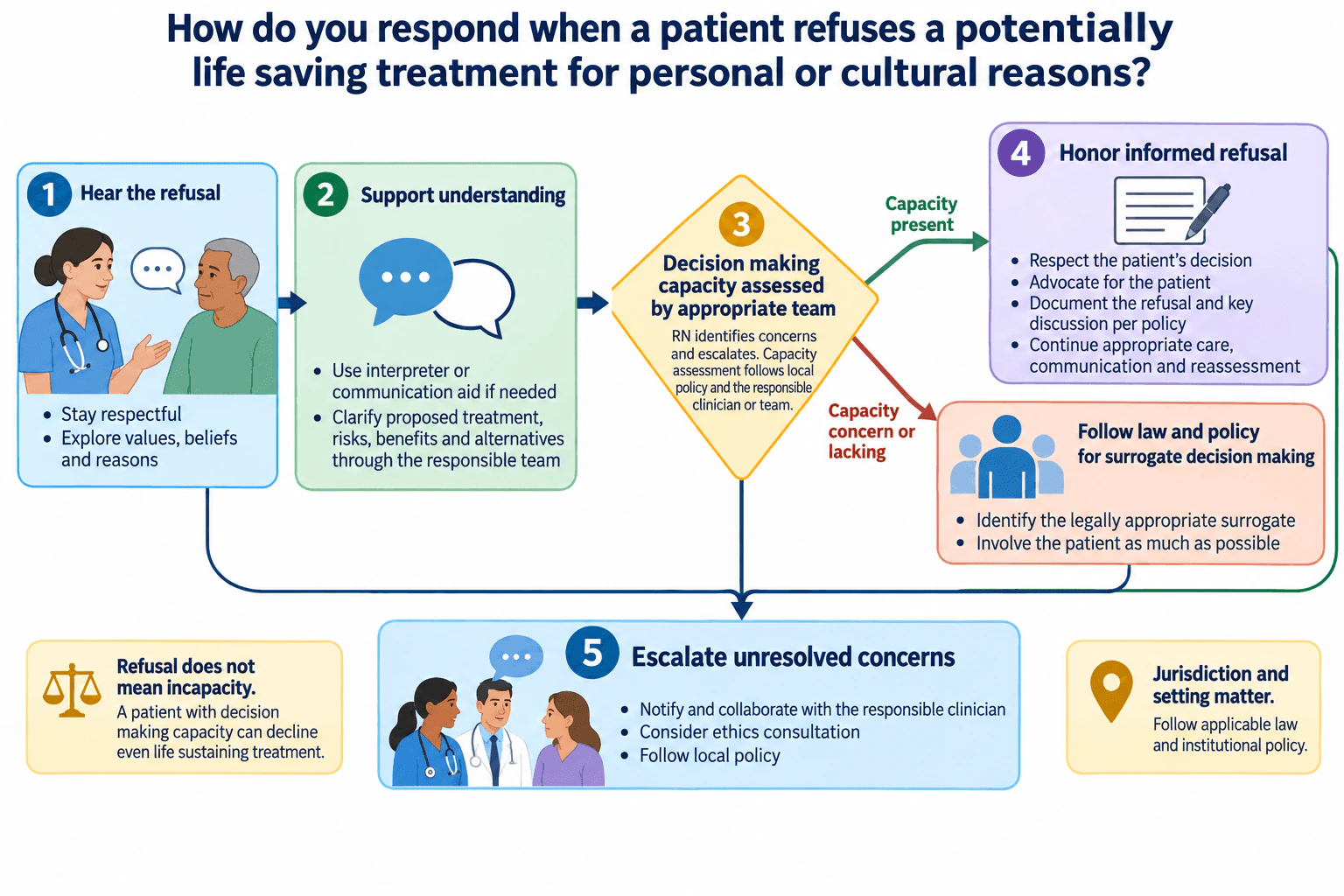
Explain assessment of decision making capacity by the appropriate team, support for informed refusal, respect for autonomy, communication, and ethics consultation when needed.
Short Interview Answer (30-60 seconds)
I would first listen respectfully and explore the patient’s reasons, values, beliefs, and understanding. I would support effective communication and collaborate with the responsible clinician or team so the patient understands the proposed treatment, benefits, risks, alternatives, and consequences of refusal. Refusal alone does not mean the patient lacks decision making capacity. If capacity is uncertain, I would identify and escalate the concern for assessment according to local law and policy. If the patient has capacity and the refusal is informed and voluntary, I would respect and advocate for that decision, document appropriately, continue suitable care and reassessment, and involve ethics consultation when unresolved conflict or uncertainty remains.
Detailed Explanation
A patient’s refusal of a potentially life saving treatment should be approached with respect, careful communication, advocacy, and attention to decision making capacity. The nurse should not pressure the patient or assume that a personal or cultural reason makes the patient incapable of deciding. The nurse supports understanding, identifies concerns, communicates with the responsible team, documents appropriately, and works within the applicable scope, law, and organizational policy.
Useful Questions to Ask the Interviewer
What care setting and jurisdiction should I assume for this scenario?
Has the patient’s decision making capacity already been assessed, or is there a current concern about capacity?
Are communication barriers, an advance directive, or an identified surrogate relevant to the situation?
How to Explain It in an Interview
Patient Rights and Preferences
I would begin by hearing the refusal respectfully and asking what is driving it. I would explore the patient’s values, cultural or personal beliefs, goals, concerns, and questions without arguing or judging. Refusal by itself does not establish incapacity.
I would support effective communication. If a language or communication barrier exists, I would use the appropriate interpreter or communication resources available in the setting. I would collaborate with the responsible clinician or team so the patient receives understandable information about the proposed treatment, expected benefits, material risks, alternatives, and likely consequences of refusing it.
Nursing Responsibilities
I would assess for concerns that could interfere with participation in decision making, such as confusion or difficulty understanding the discussion, while remaining within nursing scope. If capacity is in question, I would escalate that concern so the appropriate clinician or team can assess decision making capacity according to the applicable jurisdiction, setting, and policy.
If the patient has decision making capacity and the refusal is informed and voluntary, I would respect the decision and advocate for the patient. I would document the refusal, relevant communication, education, and notifications according to policy. I would continue appropriate nursing care, communication, monitoring, and reassessment rather than treating refusal of one intervention as refusal of all care.
Consultation and Follow Up
If the patient lacks decision making capacity, I would follow the applicable legal and institutional process for identifying the appropriate surrogate and continue involving the patient as much as possible. The surrogate process and decision standards vary by jurisdiction and policy.
If disagreement, uncertainty, or conflict remains, I would notify and collaborate with the responsible clinician and consider ethics consultation or another appropriate institutional resource. The goal is a transparent process that respects patient autonomy, supports informed decision making, and keeps the nurse within professional scope.
Why Interviewers Ask This
Interviewers are evaluating whether the nurse can balance patient autonomy, advocacy, informed decision making, safety, professional boundaries, communication, documentation, and appropriate escalation. They also want to see that the nurse does not equate refusal with incapacity and understands that capacity assessment, consent responsibilities, surrogate authority, and escalation processes depend on the clinical setting, jurisdiction, and applicable policy.
Common interview mistakes
Common mistakes include assuming that refusing recommended treatment proves incapacity, pressuring or shaming the patient, dismissing cultural or personal beliefs, failing to address communication barriers, presenting local consent or surrogate rules as universal, assuming the nurse independently determines legal authority or obtains every procedure consent, failing to escalate genuine capacity concerns, and stopping appropriate care simply because one treatment was refused.
Interview tip
Organize the answer around respectful listening, understanding, capacity concerns, informed refusal, nursing scope, documentation, continued care, and escalation. State clearly that disagreement with the clinical recommendation does not equal incapacity. Also distinguish independent nursing actions from responsibilities that belong to the responsible clinician, authorized surrogate, ethics service, or another process defined by local law and policy.
Interviewer may ask next
How would you verify that the refusal is truly informed?
I would confirm that the patient has received understandable information about the proposed treatment, expected benefits, material risks, alternatives, and likely consequences of refusing it. I would address communication barriers and use appropriate interpreter or communication resources when needed. I would ask the patient to explain their understanding in their own words, identify any concern about voluntariness or decision making capacity, communicate those concerns to the responsible clinician or team, and document the relevant education, response, and notifications according to policy.
What changes if the patient cannot demonstrate decision making capacity?
I would notify the responsible clinician or team and follow the applicable legal and institutional process for decision making when capacity is lacking. This may include reviewing an advance directive and identifying the legally appropriate surrogate according to the jurisdiction and policy. I would continue involving the patient as much as possible. The surrogate should make decisions using the patient’s known wishes and values when they are available, or the applicable decision standard when they are not. If the appropriate surrogate is unclear or significant disagreement persists, ethics consultation or another institutional resource may be appropriate.
12. How do you manage moral distress when the plan of care conflicts with your professional concerns?Ethics And Professional PracticeHard
i Question Details
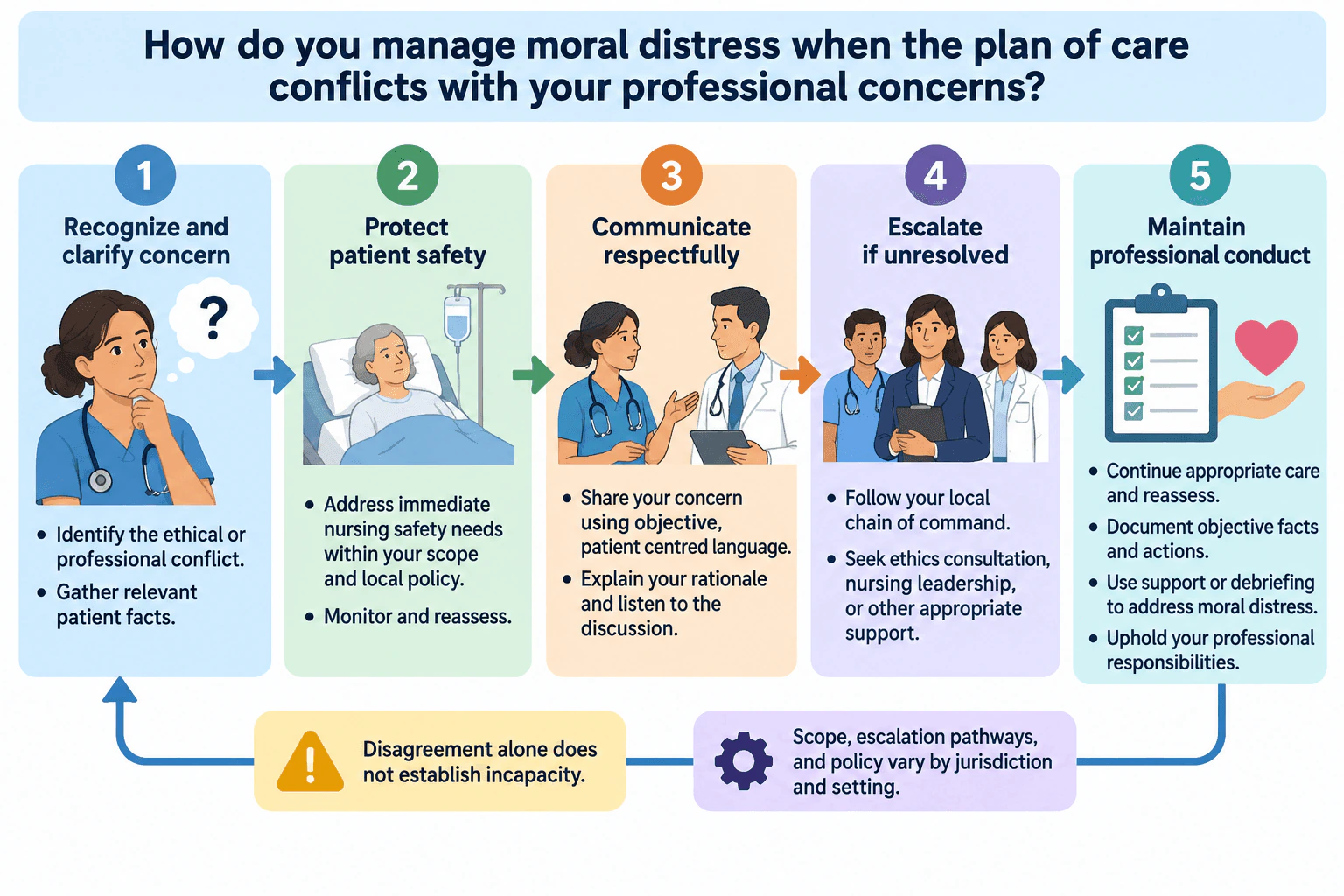
Explain how you identify the concern, protect patient safety, use respectful escalation, seek ethics or leadership support, and maintain professional conduct.
Short Interview Answer (30-60 seconds)
I identify and clarify the concern, gather the relevant patient facts, and address immediate nursing safety needs within my scope. I communicate the concern respectfully and objectively with the responsible team members and explain my rationale. If it remains unresolved, I follow the applicable chain of command and seek nursing leadership, ethics consultation, or another appropriate resource. I continue appropriate care and reassessment, document objective facts and actions, maintain professional conduct, and seek support or debriefing for the moral distress. aacn.org
Detailed Explanation
Moral distress can occur when a nurse believes an ethically appropriate action should be taken, or is uncertain about the ethically appropriate action, but constraints interfere with acting on that concern. I would respond by clarifying the concern, protecting the patient, communicating respectfully, escalating appropriately when needed, and maintaining professional conduct. Current AACN guidance supports recognizing moral distress, raising concerns, using skilled communication, and seeking ethical or professional support. aacn.org
Useful Questions to Ask the Interviewer
What ethics consultation or moral distress resources are available to nurses in this setting?
What escalation pathway should an RN use when an ethical or patient safety concern remains unresolved?
How does the organization support nurses after difficult ethical situations?
How to Explain It in an Interview
Professional Principle
I would first identify the specific ethical or professional conflict and gather the relevant patient facts. I would distinguish a patient safety concern, a scope concern, an ethical conflict, and a personal disagreement because they may require different responses. Disagreement alone does not establish that a patient lacks decision making capacity.
Patient Rights and Preferences
I would keep the patient's rights, preferences, goals, consent or refusal, dignity, and safety central to the discussion. I would not assume that the RN independently obtains every procedure consent or determines capacity in every situation. Nursing responsibilities depend on factors such as role, education, experience, setting, population, and lawful authority. nursingworld.org
Nursing Responsibilities
I would address immediate nursing safety needs within my scope, continue appropriate care, monitor the patient, and reassess. I would communicate my concern with objective, patient centered language, explain my rationale, and listen to the team's response. I would document relevant objective facts, communications, and nursing actions according to applicable requirements.
Consultation and Follow Up
If the concern remained unresolved, I would follow the local chain of command and seek nursing leadership, ethics consultation, or another appropriate resource. AACN recommends access to ethics resources, professional support, debriefing, and skilled communication when moral distress occurs. aacn.org I would continue appropriate care and reassessment while the concern is addressed, uphold professional responsibilities, and use peer, debriefing, employee assistance, or other appropriate professional support when moral distress persists.
Why Interviewers Ask This
Interviewers are evaluating whether the nurse can recognize a moral or professional conflict while continuing to protect the patient, communicate respectfully, advocate through appropriate channels, remain within nursing scope, document objectively, and seek help when concerns remain unresolved. They also want to see that the nurse does not equate disagreement with incapacity and understands that professional responsibilities and escalation processes depend on the jurisdiction and practice setting. aacn.org
Common interview mistakes
Common mistakes include treating professional disagreement as proof that a patient lacks capacity, focusing only on personal discomfort instead of identifying the specific concern, failing to address immediate nursing safety needs, bypassing respectful communication, assuming one escalation pathway applies in every setting, documenting opinions instead of objective facts, abandoning appropriate care while the concern is reviewed, or failing to seek support when moral distress persists.
Interview tip
Present a calm sequence that matches the clinical workflow: recognize and clarify the concern, protect patient safety, communicate respectfully, escalate if unresolved, then continue appropriate care, reassessment, objective documentation, professional conduct, and support for moral distress. Make clear that you advocate firmly while staying within RN scope and following the applicable jurisdiction, setting, and policy.
Interviewer may ask next
How would you verify that your response is appropriate before escalating the concern?
I would verify the relevant patient facts, current clinical information, my nursing scope and responsibilities, the applicable organizational policy, and the roles of the other professionals involved. I would clarify the concern with the responsible team member when appropriate and use current professional ethical guidance and available institutional resources rather than relying only on personal opinion. Because nursing scope depends on the practice context and lawful authority, I would confirm what applies in that jurisdiction and setting. nursingworld.org
What changes if the patient refuses a proposed care activity while the team believes it should proceed?
I would clarify the patient's expressed refusal, relevant clinical circumstances, understanding, and immediate safety needs without assuming that disagreement means incapacity. I would communicate the refusal and my concerns to the responsible team members, respect the applicable consent and capacity process, and involve nursing leadership, ethics consultation, or other appropriate professionals if the issue remained unresolved. I would continue appropriate care within my scope, reassess the patient, and document objective facts and actions. The exact responsibilities for consent and capacity depend on the jurisdiction, setting, procedure, professional roles, and applicable policy.
13. What is health literacy?Patient Communication And EducationEasy
Short Interview Answer (30-60 seconds)
Health literacy is a person's ability to find, understand, and use health information and services to make informed health decisions and take action. In nursing, I support health literacy by using clear language, considering language and accessibility needs, using qualified interpretation when needed, and checking understanding with methods such as teach back instead of assuming that agreement means understanding.
Detailed Explanation
Health literacy describes how well people can find, understand, and use health information and services to inform health related decisions and actions. Healthy People 2030 also recognizes organizational health literacy, which means health care organizations share responsibility for making information and services understandable and usable. odphp.health.gov
For a nurse, health literacy matters because information is useful only when the patient can understand and apply it. Language, existing knowledge, communication preferences, accessibility needs, and the complexity of the information can affect understanding. A nurse should not assume that a patient understands simply because the patient agrees or says yes.
Useful Questions to Ask the Interviewer
What patient education resources are available for different language and accessibility needs?
How does the organization support qualified interpretation for patients who need language assistance?
How is patient education and understanding documented in this setting?
How to Explain It in an Interview
Communication Goal
I would explain health information in clear, familiar language and explain unfamiliar clinical terms. My goal is not only for the patient to hear the information, but also to understand it well enough to use it in decisions and daily care.
Learning Needs
I would consider the patient's preferred language, existing knowledge, communication preferences, and accessibility needs. When language assistance is needed, I would use a qualified interpreter through available services and follow local policy.
Teaching and Communication
I would present the most important information in manageable parts, connect it to what the patient needs to know or do, invite questions, and involve the patient in shared decisions when appropriate.
Checking Understanding
I would use teach back when appropriate by asking the patient to explain important information or instructions in their own words. Teach back checks how clearly I communicated rather than testing the patient. AHRQ recommends asking patients to state in their own words what they need to know or do, then clarifying and checking again when misunderstanding is identified. ahrq.gov I would document the education provided, the patient's demonstrated understanding, and any follow up needs.
Why Interviewers Ask This
Interviewers want to assess whether the nurse understands that effective patient education involves more than simply providing information. The nurse should communicate clearly, consider language, health literacy, preferences, and accessibility, verify understanding, and support informed participation in care decisions.
Common interview mistakes
Common mistakes include using medical jargon without explanation, giving too much information at once, assuming that agreement proves understanding, overlooking language or accessibility needs, failing to use qualified interpretation when needed, and asking only whether the patient understands instead of checking understanding more directly.
Interview tip
Give a concise definition first, then connect it to nursing practice. Emphasize clear communication, individual patient needs, teach back, shared decisions, and documentation of education and understanding.
Interviewer may ask next
How would you verify that a patient understood your teaching?
I would use teach back when appropriate and ask the patient to explain the key information or actions in their own words. If the response reveals a misunderstanding, I would clarify the information using simpler language or a different explanation and check again. AHRQ specifically describes teach back as a way to confirm that information was explained clearly, not as a test of the patient. ahrq.gov I would document the education provided, the patient's demonstrated understanding, and any follow up needs.
How would your approach change if the patient had limited English proficiency?
I would continue using clear communication while arranging a qualified interpreter through available services and following local policy. I would speak directly to the patient, present information in manageable parts, use appropriate translated or accessible education materials when available, and use teach back with interpreter support to check understanding rather than assuming that basic conversation proves comprehension.
14. What is teach-back?Patient Communication And EducationEasy
Short Interview Answer (30-60 seconds)
Teach back is a method for checking whether I explained health information clearly. After teaching, I ask the patient or caregiver to explain the key information or next steps in their own words. I make it clear that I am checking my explanation, not testing them. If their response shows a misunderstanding, I clarify the information in a different way and check again. This is more reliable than simply asking whether the patient understands.
Detailed Explanation
Teach back is a health literacy and patient education method used to confirm understanding. The nurse explains important information clearly, then asks the patient or caregiver to describe the information or next steps in their own words. The goal is to identify communication gaps and correct them before they affect care. A patient saying yes or nodding does not by itself prove understanding.
Useful Questions to Ask the Interviewer
Would you like an example involving discharge education or medication instructions?
Would you like me to include how I would adapt teach back for a patient who needs language or accessibility support?
How to Explain It in an Interview
Communication Goal
I would explain that teach back checks the effectiveness of my communication rather than testing the patient. I would use plain language, focus on the most important information, avoid unfamiliar abbreviations, and create a respectful environment where the patient can identify anything that remains unclear.
Teaching and Communication
After explaining the information, I might say, "I want to make sure I explained this clearly. Can you tell me in your own words what you will do when you get home?" For a skill, an appropriate show me approach can help confirm that the patient understands the required steps.
I would also consider the patient's preferred language, health literacy, preferences, and accessibility needs. If language assistance is needed, I would use a qualified interpreter according to the care setting and continue speaking directly with the patient. I would still use teach back because interpretation alone does not confirm understanding.
Checking Understanding
I would listen for whether the patient can accurately explain the important information or next steps. If the response shows confusion or missing information, I would clarify the teaching using different words, break the information into smaller parts if helpful, and ask for teach back again. I would not treat memorized repetition as proof of understanding.
Once understanding has been checked, I would document the education provided, the patient's demonstrated understanding, and any relevant follow up education needs according to local documentation requirements.
Why Interviewers Ask This
Interviewers ask this question to assess whether a nurse understands how to verify patient comprehension rather than assuming that agreement means understanding. It also evaluates clear communication, health literacy awareness, patient education, appropriate use of qualified interpretation, and the ability to adapt teaching to language, preferences, and accessibility needs.
Common interview mistakes
Common mistakes include asking only whether the patient understands, treating teach back like a quiz, using unexplained medical jargon, assuming agreement or nodding proves comprehension, asking the patient merely to repeat memorized words, giving too much information at once, and failing to clarify and check again when a misunderstanding is identified.
Interview tip
Emphasize that teach back checks the clarity of the nurse's communication, not the intelligence or cooperation of the patient. A strong answer describes the cycle clearly: explain the information, ask the patient to describe it in their own words, clarify any misunderstanding, check again, and document relevant education and follow up needs.
Interviewer may ask next
How do you verify that teach back was successful?
I verify success by listening for whether the patient or caregiver can accurately explain the important information, decisions, or next steps in their own words. If a skill is involved, an appropriate demonstration may also help verify understanding. If important information is missing or incorrect, I explain it again using a different approach and repeat the check rather than assuming understanding.
How would your approach change if the patient had limited English proficiency?
I would use a qualified interpreter according to the care setting, communicate in clear language, and speak directly to the patient. I would still use teach back to confirm understanding because accurate interpretation does not by itself prove that the patient understood the information. I would also consider the patient's preferred language, health literacy, and accessibility needs when adapting the education.
15. Why is patient education important in nursing care?Patient Communication And EducationEasy
i Question Details
Explain how education supports understanding, participation, safety, self management, and informed decisions.
Short Interview Answer (30-60 seconds)
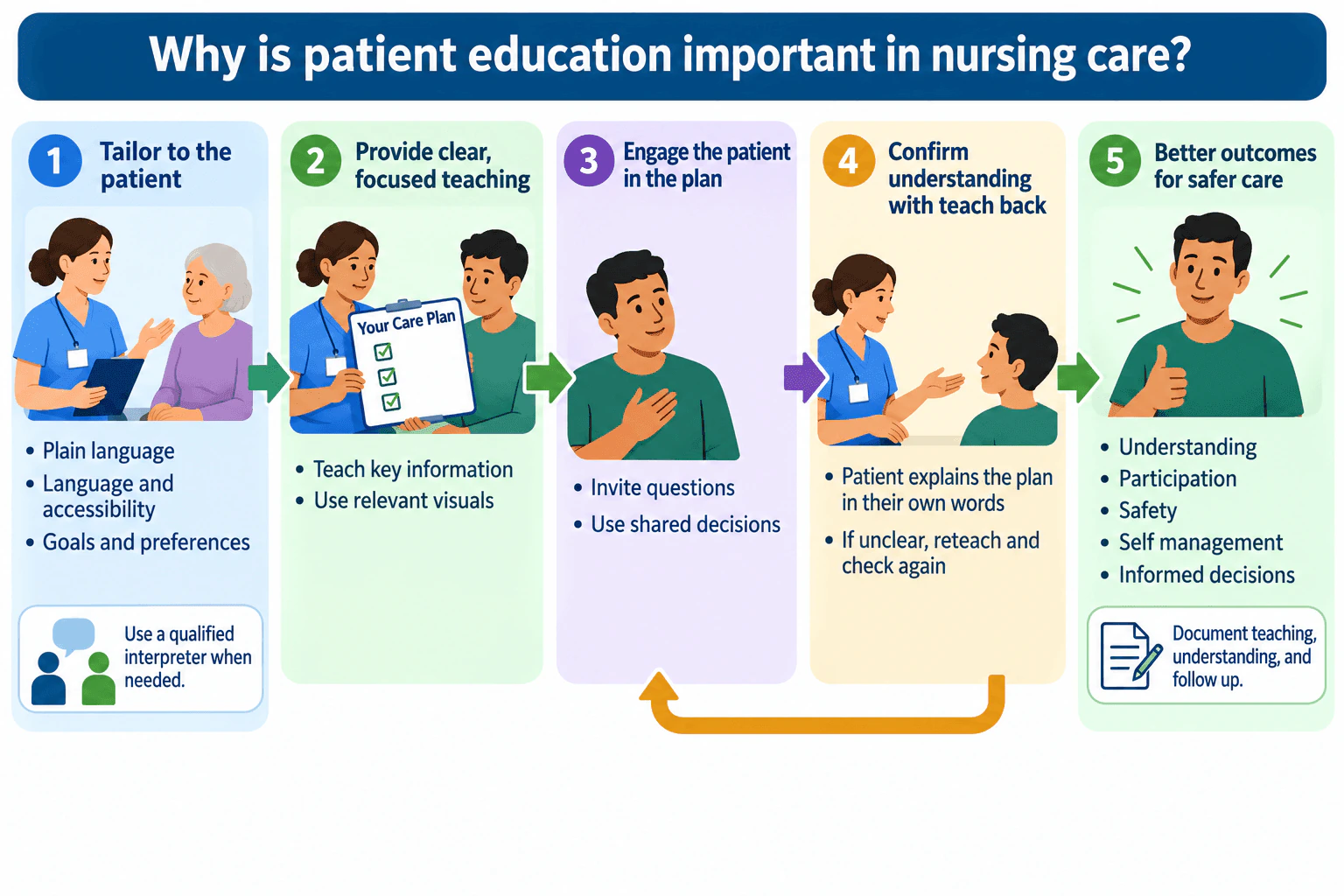
Patient education is important because it builds understanding, participation, safety, self management, and informed decision making. I would tailor communication to the patient, teach the key information in plain language, use relevant visuals when helpful, invite questions and shared decisions, use a qualified interpreter when needed, and confirm understanding with teach back. If understanding is incomplete, I would reteach and check again, then document the education and follow up needs.
Detailed Explanation
Patient education helps turn a care plan into information the patient can understand and use. It supports safer care by helping patients know what they need to do, participate in decisions, and manage their health after the encounter. AHRQ guidance supports simplifying communication, confirming understanding, encouraging patient participation, and supporting self management. ahrq.gov
Useful Questions to Ask the Interviewer
What types of patient education are most common in this role?
What interpreter and accessibility resources are available for patient teaching?
How is patient education and follow up documented in this setting?
How to Explain It in an Interview
Communication Goal
I would explain that patient education is important because it helps the patient understand the care plan and take an active role in care. The goal is not simply to provide information. It is to make information understandable and useful so the patient can participate safely and make informed decisions.
Learning Needs
I first tailor communication to the patient. I consider preferred language, accessibility needs, health literacy, goals, and preferences. I use plain language and focus on the key information the patient needs. When language assistance is needed, I use a qualified interpreter. Current HHS guidance describes qualified interpreters as individuals able to interpret effectively, accurately, and impartially using the vocabulary required for the situation. hhs.gov
Teaching and Communication
I teach the key information clearly and use relevant visuals when they help understanding. I invite questions and involve the patient in shared decisions. Shared decision making means the patient and care team work together while considering available evidence and the patient's values and preferences. ahrq.gov
Checking Understanding
I do not assume that agreement means understanding. I use teach back by asking the patient to explain the plan in their own words. AHRQ recommends teach back as a way to confirm that information was explained clearly. If understanding is incomplete, I explain the information differently and check again. ahrq.gov Finally, I document the teaching, the patient's understanding, and any follow up needs.
Why Interviewers Ask This
Interviewers want to know whether the nurse sees education as more than simply giving information. The question evaluates therapeutic communication, health literacy awareness, patient participation, safety, shared care planning, verification of understanding, and appropriate documentation.
Common interview mistakes
Common mistakes include using unfamiliar medical terms without explanation, giving too much information at once, overlooking language or accessibility needs, assuming that a patient who agrees has understood, failing to invite questions or shared decisions, skipping teach back, and failing to document teaching and follow up needs.
Interview tip
Use the same clear sequence shown in the final diagram: tailor communication to the patient, teach the key information, engage the patient in the plan, confirm understanding with teach back, reteach when needed, and connect education to understanding, participation, safety, self management, and informed decisions.
Interviewer may ask next
How would you verify that the patient understood your teaching?
I would use teach back by asking the patient to explain the important information or care plan in their own words. I would avoid relying on a yes or no question such as asking whether they understand. If the patient's explanation shows a gap, I would reteach the information using a different explanation or relevant visual and ask for teach back again. AHRQ specifically recommends this repeat cycle when misunderstanding is identified. ahrq.gov
How would your approach change if the patient needed language or accessibility support?
I would adapt the communication method to the patient's needs. I would use plain language, appropriate accessible materials or visuals, and a qualified interpreter when language assistance is needed. I would still speak directly to the patient, invite questions, respect their goals and preferences, and use teach back to verify understanding. HHS guidance supports qualified interpretation when needed for effective communication. hhs.gov
16. How do you tailor education for different levels of health literacy?Patient Communication And EducationMedium
i Question Details
Describe assessment of learning needs, plain language, appropriate materials, demonstration, teach back, and reinforcement.
Short Interview Answer (30-60 seconds)
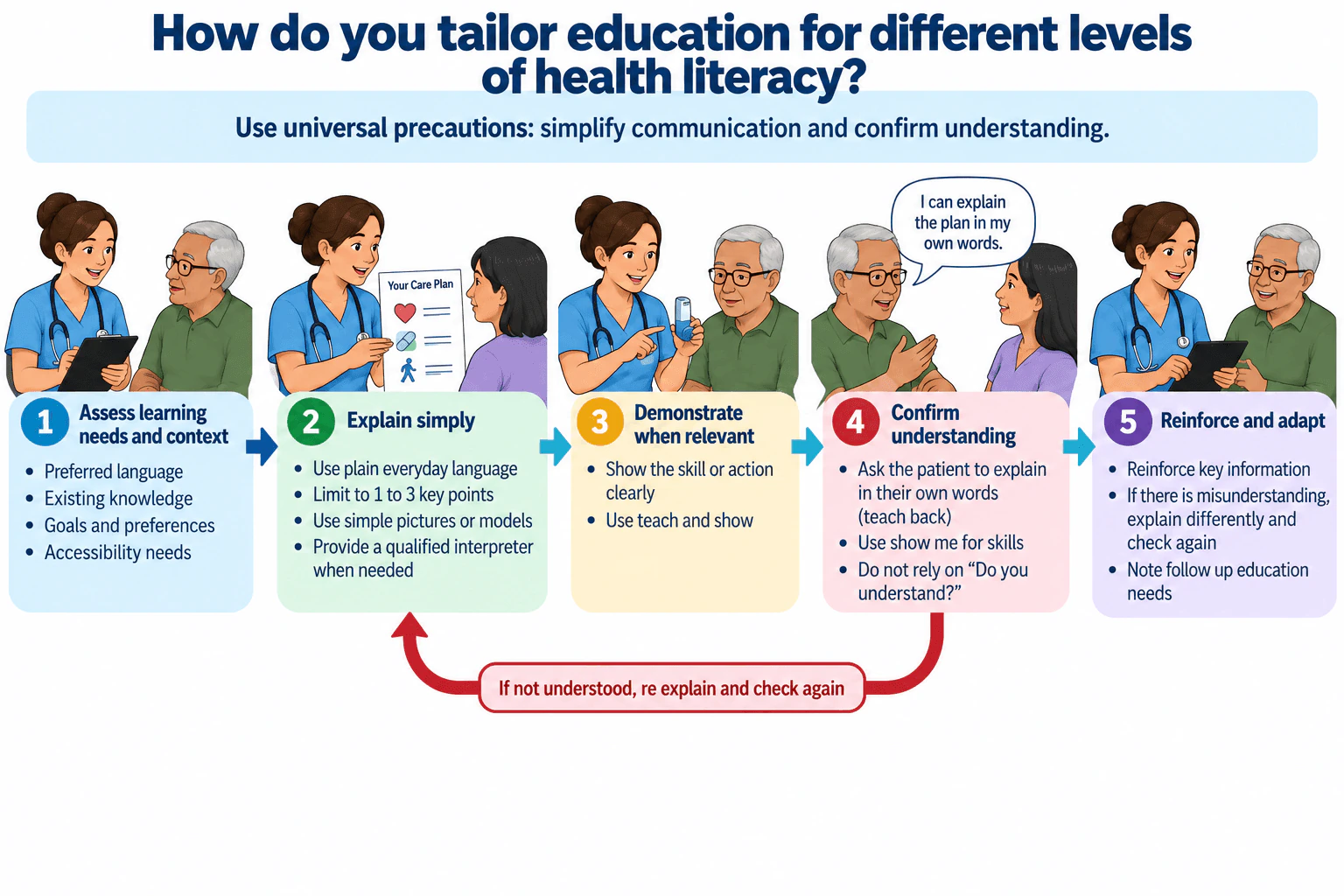
I start by assessing the patient's preferred language, existing knowledge, goals, preferences, and accessibility needs. I use plain everyday language, focus on one to three key points, and choose simple materials that support the patient's learning needs. I demonstrate skills when relevant and use a qualified interpreter when needed. Then I confirm understanding with teach back or show me rather than simply asking whether the patient understands. If there is a misunderstanding, I explain the information differently, check again, reinforce the key points, and identify follow up education needs.
Detailed Explanation
Health literacy can vary with the complexity of the information, the patient's prior knowledge, language, accessibility needs, stress, and the care situation. I use health literacy universal precautions by making communication as clear as possible for every patient and then adapting the teaching to the individual. I do not assume that agreement proves understanding.
Useful Questions to Ask the Interviewer
What interpreter and accessibility resources are available for patient education in this setting?
How is patient education and teach back documented here?
What written or visual education materials are available for nurses to use or adapt?
How to Explain It in an Interview
Learning Needs
I begin by assessing the patient's preferred language, existing knowledge, goals, preferences, and accessibility needs. This helps me select an appropriate teaching approach without assuming a literacy level from appearance, education, or agreement.
Teaching and Communication
I use plain everyday language and explain unfamiliar terms when they are necessary. I focus on one to three key points at a time. I can use simple pictures, models, or written materials when they support understanding. If language support is needed, I use a qualified interpreter. When the patient needs to perform a skill, I demonstrate the action clearly and use a show me approach when appropriate.
Checking Understanding
I verify understanding with teach back by asking the patient to explain the plan in their own words. I do not rely on a yes or no question such as "Do you understand?" because agreement alone does not demonstrate comprehension.
If teach back identifies a misunderstanding, I explain the information in a different way and check again. I then reinforce the most important information and document any remaining education or follow up needs.
Why Interviewers Ask This
Interviewers are assessing whether the nurse can recognize individual learning needs, communicate clearly without unnecessary jargon, choose appropriate teaching methods, verify actual understanding, and adapt education when the first explanation is not effective. They also want to see consideration of language, accessibility, patient preferences, qualified interpretation, reinforcement, and follow up.
Common interview mistakes
Common mistakes include assuming that education level predicts health literacy, using unexplained medical terminology, giving too much information at once, using materials that do not match language or accessibility needs, relying on unqualified interpretation when qualified interpretation is needed, asking only "Do you understand?", treating teach back as a test of the patient, and failing to explain differently and check again after a misunderstanding.
Interview tip
Use the same five step sequence shown in the diagram: assess learning needs and context, explain simply, demonstrate when relevant, confirm understanding, then reinforce and adapt. Emphasize that teach back checks how clearly the nurse explained the information rather than testing the patient.
Interviewer may ask next
How do you verify that the patient actually understood your teaching?
I use teach back by asking the patient to explain the important information or care plan in their own words. If the teaching involves a skill, I can use a show me approach. If the response shows a misunderstanding, I explain the information differently and check again rather than simply repeating the same wording.
How would your approach change if the patient preferred another language or had an accessibility need?
I would clarify the patient's preferred language and specific communication or accessibility needs, use qualified interpretation when needed, and select materials the patient can access and understand. I would still use plain language, demonstration when relevant, and teach back or show me to verify understanding, then adapt the teaching again if understanding remained incomplete.
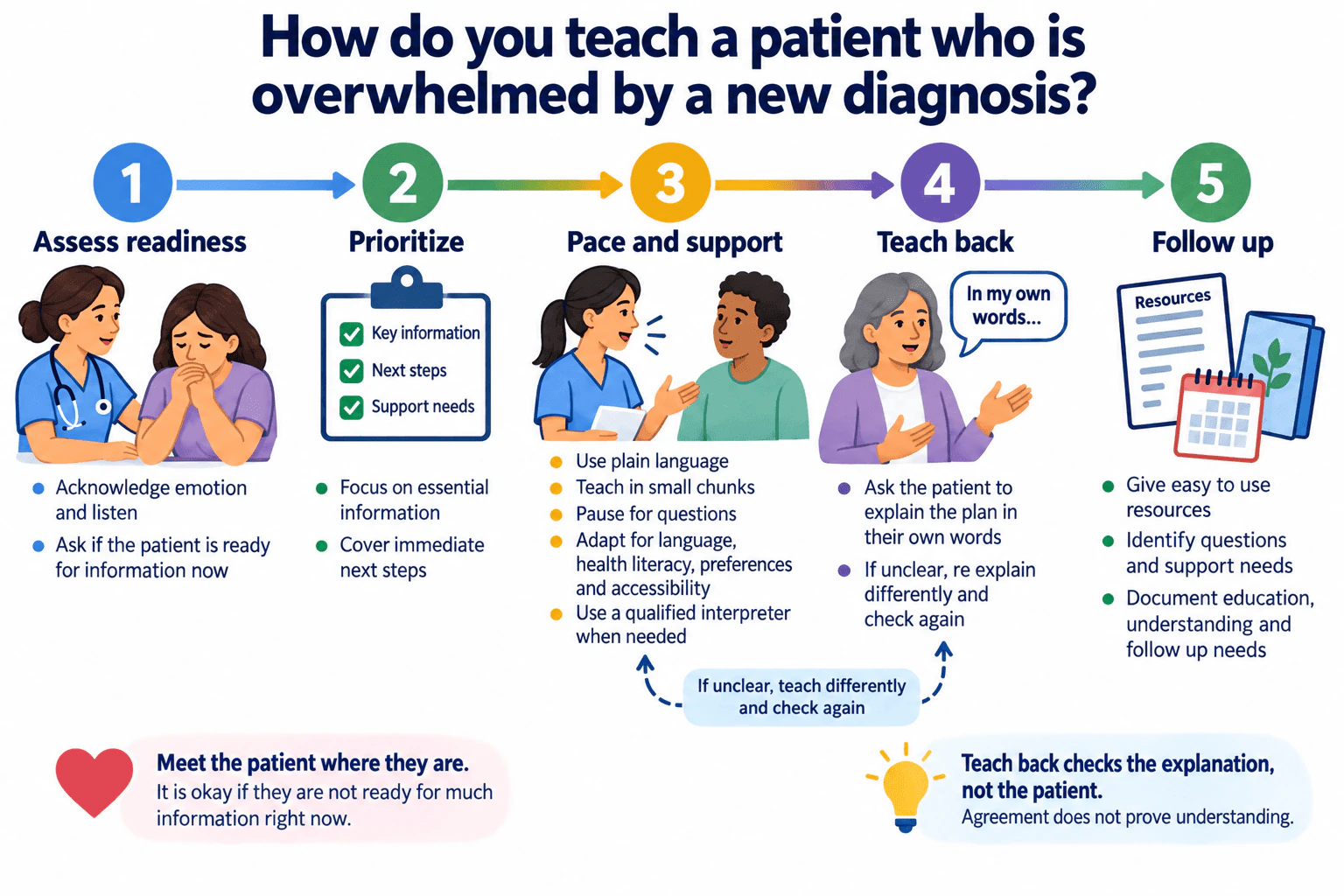
17. How do you teach a patient who is overwhelmed by a new diagnosis?Patient Communication And EducationMedium
i Question Details
Explain readiness assessment, prioritizing essential information, pacing, emotional support, teach back, and follow up resources.
Short Interview Answer (30-60 seconds)
I would first acknowledge the patient's emotions and ask whether they feel ready for information. I would focus on essential information and immediate next steps, then teach in small chunks using plain language and pauses for questions. I would adapt communication for language, health literacy, preferences, and accessibility needs and use a qualified interpreter when needed. I would use teach back by asking the patient to explain the plan in their own words. If anything is unclear, I would explain it differently and check again. I would finish by providing useful resources, identifying support needs, and documenting the education, understanding, and follow up plan.
Detailed Explanation
Teaching a patient who is overwhelmed by a new diagnosis is not about giving more information. It is about matching the timing, amount, and method of teaching to what the patient can use at that moment. The process is continuous: assess readiness, prioritize essential information, pace the teaching, check understanding, and arrange follow up.
Useful Questions to Ask the Interviewer
Is there a specific care setting or point in the patient's care that you want me to assume?
Should I include a support person if the patient wants that person involved?
Are there specific language or accessibility needs in the scenario?
How to Explain It in an Interview
Communication Goal
I would first acknowledge that a new diagnosis can be emotionally overwhelming and listen before starting detailed teaching. I would ask whether the patient feels ready to receive information. If the patient is not ready for much information, I would focus on what is essential now and return to additional teaching later.
Learning Needs
I would consider the patient's preferred language, health literacy, preferences, and accessibility needs. I would use plain language, place the most important information first, and break information into manageable chunks. Current CDC guidance supports organizing information around the audience, prioritizing the main message, and dividing content into logical chunks. cdc.gov If language assistance is needed, qualified interpretation should be used rather than relying on an unqualified person. HHS guidance requires meaningful language access for covered entities and describes qualified interpreters as an appropriate language assistance service. hhs.gov
Teaching and Communication
I would prioritize essential information and immediate next steps, teach in small segments, pause for questions, and adapt the explanation based on the patient's responses. I would avoid unexplained medical terminology and provide resources the patient can use later.
Checking Understanding
I would ask the patient to explain the plan in their own words rather than asking only whether they understand. AHRQ describes teach back as a way to confirm that information was explained clearly. If the patient's explanation shows a gap, I would explain the information again using a different approach and ask for another teach back. ahrq.gov I would then identify remaining questions and support needs and document the education provided, demonstrated understanding, and follow up needs.
Why Interviewers Ask This
Interviewers are assessing whether the nurse can combine therapeutic communication with effective patient education. The question tests judgment about emotional readiness, prioritization, health literacy, communication barriers, teach back, reassessment, and continuity of education.
Common interview mistakes
Common mistakes include giving too much information while the patient is overwhelmed, using unexplained medical terminology, assuming agreement proves understanding, asking only whether the patient understands, failing to adapt for language or accessibility needs, relying on an unqualified interpreter when qualified interpretation is needed, and ending teaching without reassessment, resources, documentation, or follow up.
Interview tip
Organize the answer as one continuous teaching process: acknowledge emotion and assess readiness, prioritize essential information, teach in manageable chunks, use teach back, then provide resources and arrange follow up. Emphasize that teach back evaluates how clearly the information was explained rather than testing the patient's intelligence or effort.
Interviewer may ask next
How do you verify that the patient actually understood the teaching?
I use teach back by asking the patient to explain the important information or next steps in their own words. I do not rely only on agreement because agreement does not demonstrate understanding. If the explanation reveals a gap, I rephrase the information, teach it another way, and ask the patient to explain it again. AHRQ describes this as checking whether information was communicated clearly and recommends explaining it differently and checking again when misunderstanding remains. ahrq.gov
What would you change if the patient remains too overwhelmed to continue teaching?
I would reduce the amount of information and focus on essential immediate information and next steps. I would continue therapeutic listening, address communication barriers within nursing scope, provide usable resources, and plan additional teaching when the patient is better able to engage. I would document what was taught, what understanding was demonstrated, what remains incomplete, and the follow up education needs.
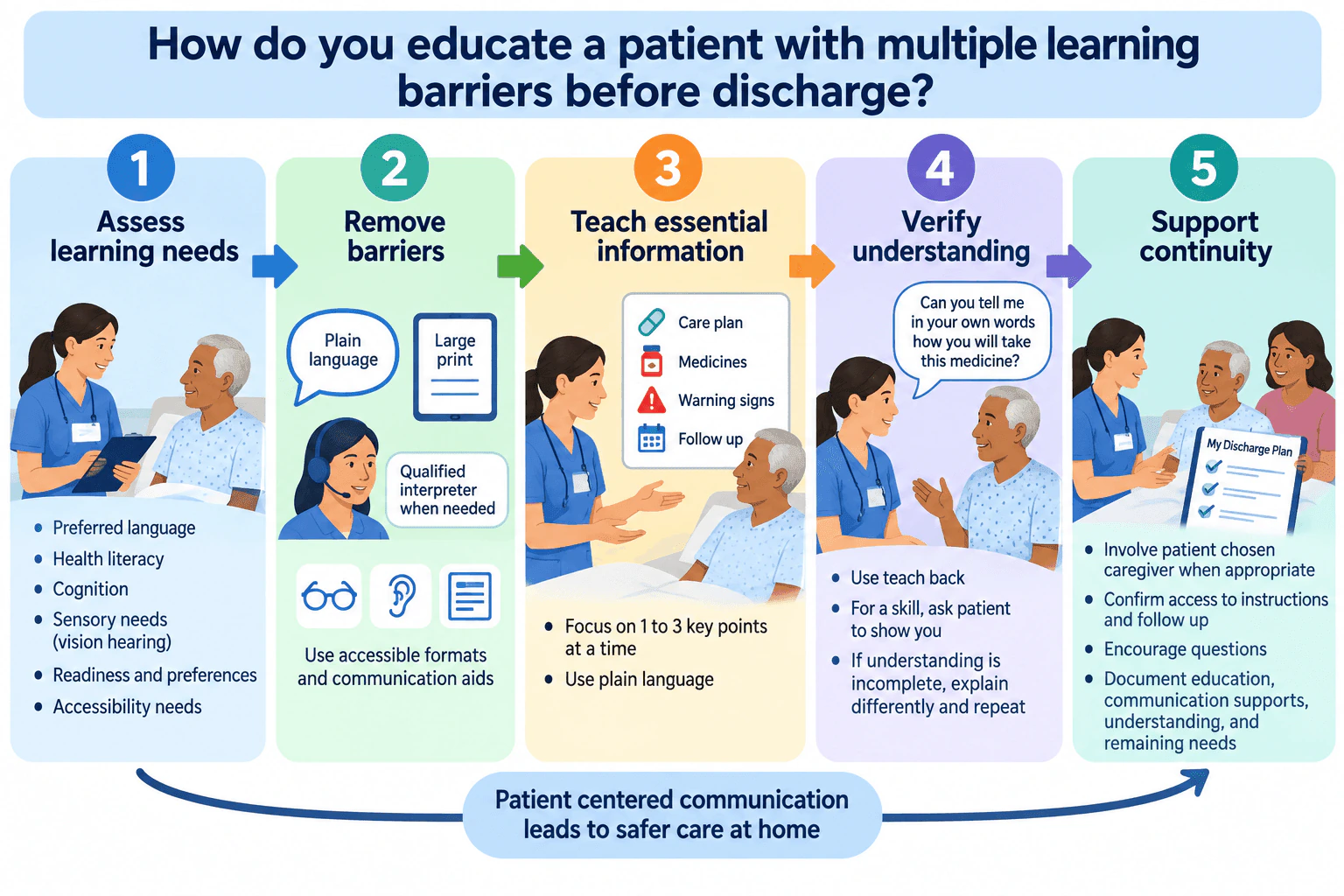
18. How do you educate a patient with multiple learning barriers before discharge?Patient Communication And EducationHard
i Question Details
Explain assessment of literacy, language, cognition, sensory needs, readiness, essential priorities, interpreter or accessibility resources, teach back, and continuity planning.
Short Interview Answer (30-60 seconds)
I would start by assessing preferred language, health literacy, cognition, sensory needs, readiness, preferences, and accessibility needs. I would address communication barriers first, using qualified interpretation or appropriate communication aids when needed. Then I would teach the essential discharge priorities in plain language, focusing on one to three key points at a time. I would use teach back and show me when appropriate to verify understanding, explain the information differently if understanding is incomplete, and check again. Finally, I would confirm access to instructions and follow up, involve the patient's chosen caregiver when appropriate, encourage questions, and document understanding and remaining needs.
Detailed Explanation
The goal is not simply to deliver discharge information. It is to make the information understandable, usable, and connected to a safe plan after discharge. I would assess learning barriers first, address communication and accessibility needs, teach the most important information in manageable pieces, verify understanding, and plan for continuity.
Useful Questions to Ask the Interviewer
What interpreter, accessibility, and patient education resources are available in this setting?
How is patient understanding of discharge education documented here?
How does the team communicate unresolved education or follow up needs after discharge?
How to Explain It in an Interview
Learning Needs
I would first assess preferred language, health literacy, cognition, vision and hearing needs, readiness to learn, preferences, accessibility needs, and what the patient already understands. I would not assume that agreement or a yes response proves understanding.
Teaching and Communication
I would address barriers before teaching. If language assistance is needed, I would use qualified interpretation. If the patient has a communication disability, I would use an effective aid or accessible format suited to the person's communication method and the complexity of the information. Current ADA guidance states that effective communication may require auxiliary aids and services and that the appropriate method depends on the nature, length, complexity, and context of the communication. ada.gov
I would then prioritize essential discharge information such as the care plan, ordered medicines, warning signs, and follow up. I would use plain, nonmedical language and focus on one to three key points at a time. AHRQ specifically recommends qualified interpreters, limiting content to one to three key points, and checking clarity with teach back. ahrq.gov
Checking Understanding
I would use teach back by asking the patient to explain the plan in their own words. For a skill, I would use show me when appropriate. Teach back checks how clearly the information was explained rather than testing the patient. If a misunderstanding appears, I would explain the information using a different approach and ask again. ahrq.gov
Continuity Planning
Before discharge, I would confirm that the patient can access the instructions and follow up plan, encourage questions, and involve the patient's chosen caregiver or support person when appropriate. Hospital discharge planning guidance emphasizes patient goals, treatment preferences, safe transition needs, and involvement of patients and caregivers or support persons in planning for care after discharge. cms.gov I would document the education provided, communication supports used, demonstrated understanding, and remaining education or follow up needs.
Why Interviewers Ask This
Interviewers are evaluating whether the nurse can recognize multiple barriers to learning, adapt communication to the patient's needs, prioritize essential discharge information, verify actual understanding, and support continuity of care. The question tests whether the nurse treats education as an interactive safety process rather than simply giving written instructions.
Common interview mistakes
Common mistakes include giving too much information at once, using unexplained medical terminology, assuming that agreement proves understanding, failing to assess language or sensory barriers, using an inappropriate interpreter, providing information in an inaccessible format, skipping teach back, repeating the same explanation when the patient remains confused, overlooking follow up access, and documenting education without identifying demonstrated understanding or remaining needs.
Interview tip
Organize the answer in the same sequence as the clinical reasoning: assess learning needs, remove barriers, teach essential information, verify understanding, and support continuity. Emphasize that teach back checks the clarity of the communication, not the patient's intelligence or memory, and finish with documentation and follow up.
Interviewer may ask next
How would you verify that the patient actually understands the discharge instructions?
I would use teach back rather than asking only whether the patient understands. I would ask the patient to explain the important parts of the plan in their own words, such as how they will take an ordered medicine, what warning signs require action, and what follow up is planned. For a skill, I would use show me when appropriate. If the response reveals a gap, I would explain the information using a different approach and verify understanding again. AHRQ recommends this cycle of clarification and repeat teach back when misunderstanding is identified. ahrq.gov
What would change if the patient also had limited English proficiency and significant hearing impairment?
I would address both communication barriers before relying on the discharge teaching. I would arrange qualified language assistance and determine an effective communication aid or accessible method for the hearing impairment based on the patient's communication method and the nature and complexity of the discussion. ADA guidance recognizes options such as qualified interpreters, assistive listening services, captioning, and accessible written information depending on the circumstances. ada.gov I would then teach the essential information in plain language, verify understanding with teach back or show me, and document the communication supports used, demonstrated understanding, and unresolved needs.
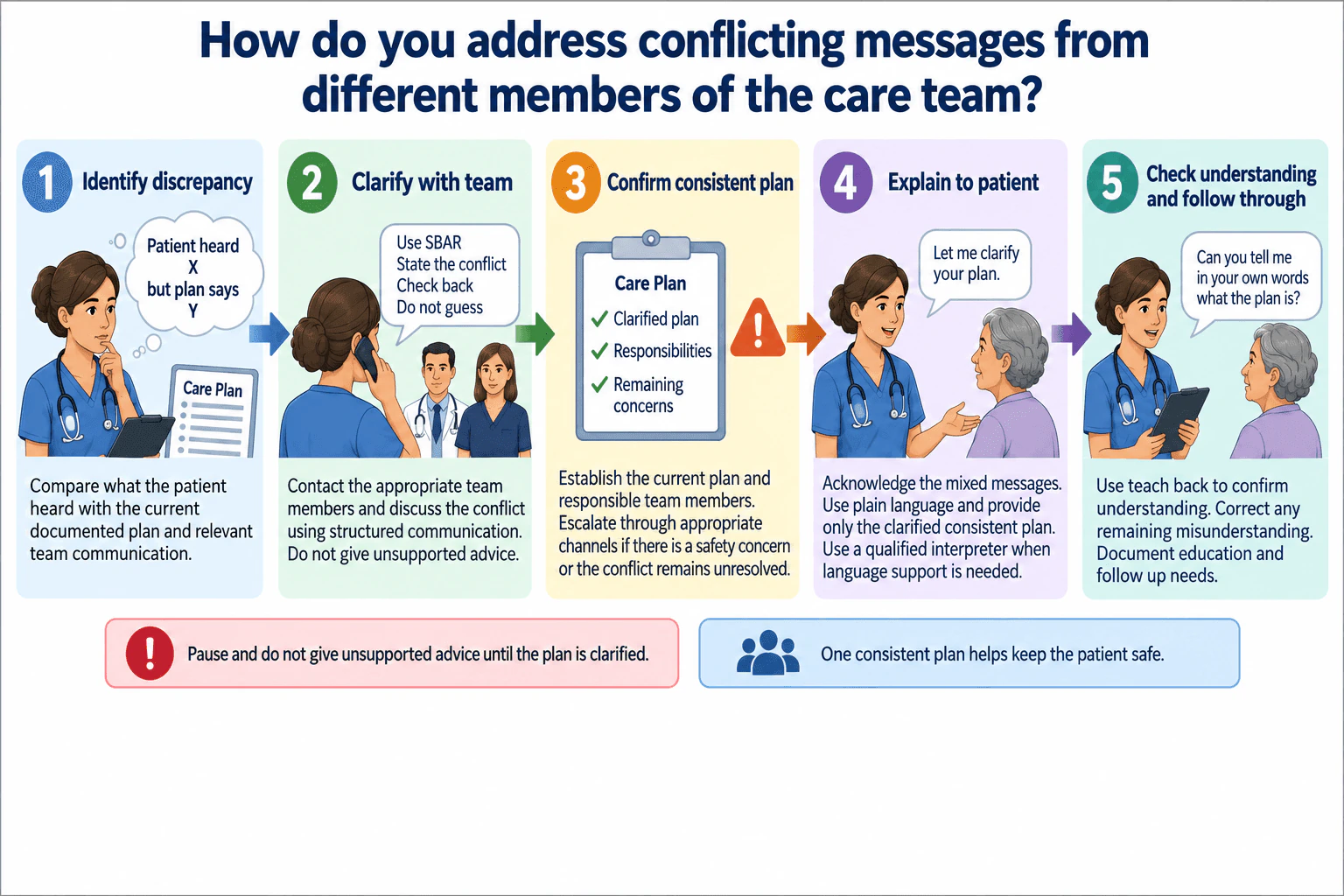
19. How do you address conflicting messages from different members of the care team?Patient Communication And EducationHard
i Question Details
Describe identifying the discrepancy, clarifying with the team, avoiding unsupported advice, providing a consistent plan, and checking patient understanding.
Short Interview Answer (30-60 seconds)
I identify the exact discrepancy, compare what the patient heard with the current documented plan, and clarify it with the appropriate care team members. I clearly state the conflict, use structured communication such as Situation, Background, Assessment, Recommendation or Request, and use check back to confirm the plan and responsibilities. I avoid guessing or giving unsupported advice, and I escalate if a safety concern remains unresolved. Once the plan is clarified, I explain it to the patient in plain language, use a qualified interpreter when needed, use teach back to confirm understanding, correct misunderstandings, and document the education and follow up needs.
Detailed Explanation
Conflicting messages can confuse the patient and create safety risks. My goal is to identify exactly what is inconsistent, clarify the current plan with the appropriate care team members, and then give the patient one accurate and consistent explanation. I would not choose between conflicting statements based on assumption or provide advice that has not been verified.
Useful Questions to Ask the Interviewer
What communication process does this organization use when members of the care team provide conflicting information?
How are unresolved safety concerns escalated and the clarified plan communicated across the team?
What interpreter and accessibility resources are available for patient education?
How to Explain It in an Interview
Communication Goal
I would first compare what the patient reports hearing with the current documented plan and relevant team communication. I would identify the exact discrepancy rather than assuming which message is correct.
Clarifying With the Team
I would contact the appropriate team members and clearly state the conflict. I can use Situation, Background, Assessment, Recommendation or Request to organize the communication. I would use check back to confirm the clarified plan, who is responsible for the next steps, and whether any concerns remain. I would not guess or give unsupported advice while the information is still uncertain. If the discrepancy creates a safety concern or remains unresolved, I would escalate through the appropriate clinical channel.
Teaching and Communication
After the plan is clarified, I would acknowledge the mixed messages without blaming another team member. I would explain only the clarified plan using plain language. I would consider the patient's language, health literacy, preferences, and accessibility needs. If language support is needed, I would use a qualified interpreter.
Checking Understanding
I would not rely on a simple yes response as proof of understanding. I would ask the patient to explain the plan in their own words using teach back. If the patient shows a misunderstanding, I would clarify the information and check understanding again. I would then document the education provided, the patient's demonstrated understanding, remaining concerns, and follow up needs so subsequent care is based on the same clarified plan.
Why Interviewers Ask This
Interviewers are assessing whether the nurse can recognize inconsistent communication, protect patient safety, clarify information with the appropriate care team members, avoid unsupported advice, remain within nursing scope, communicate a consistent plan, and verify patient understanding rather than assuming agreement means understanding.
Common interview mistakes
Common mistakes include assuming which conflicting message is correct, giving unsupported advice before clarification, failing to confirm the plan and responsibilities with the team, criticizing another team member in front of the patient, failing to escalate an unresolved safety concern, using unexplained abbreviations, assuming agreement proves understanding, failing to use qualified language support when needed, and failing to document education and follow up needs.
Interview tip
Present the answer as a clear safety sequence: identify the discrepancy, clarify it with the appropriate team members, use structured communication and check back, avoid guessing, escalate unresolved safety concerns, explain one consistent plan in plain language, use qualified interpretation when needed, use teach back, and document the result.
Interviewer may ask next
How would you verify that the conflicting messages have actually been resolved before teaching the patient?
I would confirm the current plan directly with the appropriate team member or members, compare it with the current documentation, clarify responsibilities and remaining concerns, and use check back to verify that I understood the agreed plan correctly. If information still conflicts or a safety concern remains, I would escalate rather than present an uncertain plan to the patient.
What would you change if the patient has limited English proficiency or another communication need?
I would use the same team clarification process, then adapt the patient communication to the patient's needs. If language support is needed, I would use a qualified interpreter. I would use plain language and appropriate accessibility supports, then use teach back to ask the patient to explain the clarified plan in their own words. I would correct misunderstandings and document the education and follow up needs.
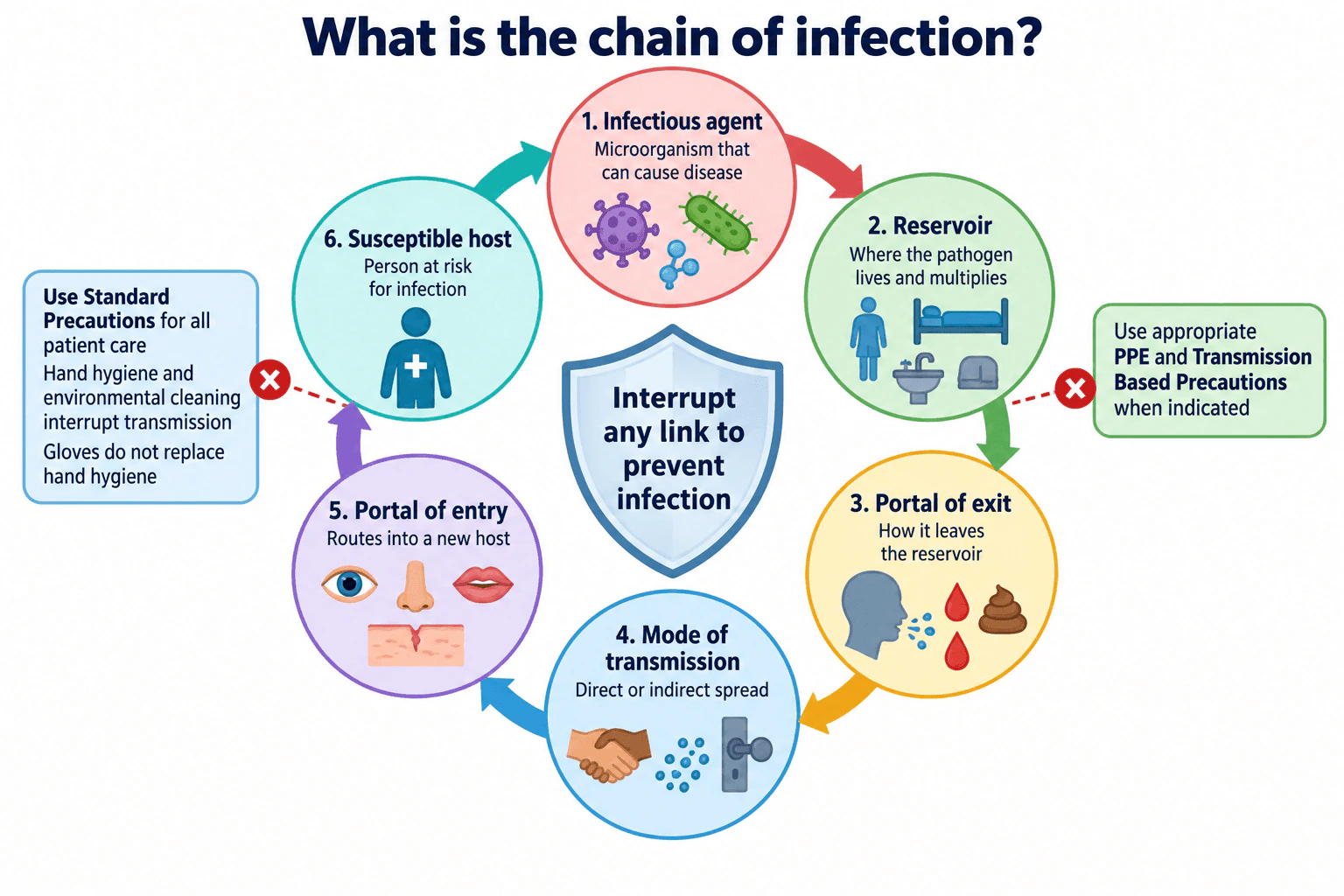
20. What is the chain of infection?Patient Safety And Infection PreventionEasy
i Question Details
Name the major links in the chain of infection and explain how nursing actions can interrupt transmission.
Short Interview Answer (30-60 seconds)
The chain of infection has six links: infectious agent, reservoir, portal of exit, mode of transmission, portal of entry, and susceptible host. Infection can be prevented when one or more links are interrupted. Nurses use Standard Precautions for all patient care, including hand hygiene and appropriate environmental cleaning. Personal protective equipment is selected according to anticipated exposure, and Transmission Based Precautions are added when indicated. Gloves do not replace hand hygiene.
Detailed Explanation
The chain of infection explains how an infectious agent can move from its source to another person. The six links are infectious agent, reservoir, portal of exit, mode of transmission, portal of entry, and susceptible host. The central infection prevention principle is that interrupting any link can reduce the opportunity for transmission.
An infectious agent is a microorganism capable of causing disease. A reservoir is where the organism can live and multiply. The portal of exit is the route by which it leaves the reservoir. The mode of transmission is how it moves to another person, including direct or indirect transmission. The portal of entry is the route into the new host. The susceptible host is a person who can become infected.
Useful Questions to Ask the Interviewer
Would you like me to give a clinical example of how a nurse can interrupt the chain?
Would you like me to relate the six links to Standard Precautions and Transmission Based Precautions?
How to Explain It in an Interview
Safety Principle
I would name the six links in order: infectious agent, reservoir, portal of exit, mode of transmission, portal of entry, and susceptible host. I would then explain that infection prevention focuses on interrupting one or more of these links.
Prevention Measures
Standard Precautions are used for all patient care. Hand hygiene and appropriate environmental cleaning can interrupt transmission. Personal protective equipment is selected according to the anticipated exposure, and Transmission Based Precautions are added when indicated for patients who require additional measures. Gloves do not replace hand hygiene.
For example, cleaning hands before and after appropriate patient care activities can interrupt the mode of transmission. Cleaning and disinfecting contaminated patient care equipment or environmental surfaces can reduce opportunities for indirect transmission. Appropriate personal protective equipment can create a barrier against anticipated exposure.
Nursing Reasoning
I would not assume that every care activity requires the same precautions. I would consider the expected exposure, the procedure being performed, the suspected or confirmed route of transmission, current infection prevention guidance, and applicable facility procedures. This connects the chain of infection to practical nursing actions while keeping Standard Precautions distinct from additional Transmission Based Precautions.
Why Interviewers Ask This
Interviewers are assessing whether the nurse understands how infection spreads and can connect the six links to practical infection prevention. A strong answer demonstrates correct sequencing, appropriate use of Standard Precautions, recognition that additional precautions depend on transmission risk, and the ability to explain how nursing actions interrupt transmission.
Common interview mistakes
Common mistakes include omitting or misordering one of the six links, assuming gloves replace hand hygiene, treating Standard Precautions and Transmission Based Precautions as the same thing, or assuming every patient and care activity requires identical personal protective equipment.
Interview tip
Name the six links in order and then state the practical nursing point: interrupting any link can help prevent infection. Connect the concept to one or two concrete actions, such as hand hygiene or environmental cleaning, and explain that additional precautions depend on the exposure and route of transmission.
Interviewer may ask next
How would you verify which precautions are appropriate for a particular patient or care activity?
I would identify the anticipated exposure, procedure, and suspected or confirmed route of transmission, then verify the required precautions against current infection prevention guidance and applicable facility procedures. Standard Precautions apply to all patient care, while additional Transmission Based Precautions are used when indicated.
How would your approach change if the patient required additional precautions because of a specific transmission route?
I would continue Standard Precautions and add the appropriate Transmission Based Precautions for the suspected or confirmed infectious agent and route. Depending on the situation and current guidance, this can affect personal protective equipment, patient placement, equipment handling, transport, and environmental measures.
More questions load as you scroll
Disclaimer: This interview guide is for educational and informational purposes only. It is designed to help readers prepare, but it does not guarantee any interview result, hiring decision, offer, or outcome. Interview questions, hiring criteria, and preferred answers can vary by employer, interviewer, industry, location, and time. All answers, examples, and explanations in this guide are suggested examples for interview preparation, not definitive answers or instructions for professional practice. They are based on research and judgment, are provided without warranties of any kind, and should be adapted to the question, role, and applicable laws and professional requirements. Diagrams are simplified illustrations intended to highlight the main concepts and their relationships; actual situations, systems, and practices may be more complex. Alternative approaches may be equally valid or better suited to a particular question, context, or interviewer. To the fullest extent permitted by applicable law, the contributors and publisher are not liable for decisions made, actions taken, or losses incurred based on this guide.
State Laws and Professional Responsibilities: Laws and requirements governing an occupation vary by state and jurisdiction. You are responsible for checking the current laws, licensing requirements, and scope-of-practice rules that apply to your location and role, and for ensuring that your answers and actions comply with them. Adapt examples in this guide to those requirements. This guide is not legal advice.
Content Accuracy and Verification: To the fullest extent permitted by applicable law, we do not represent or warrant that interview guides, questions, answers, examples, or diagrams are accurate, complete, current, error-free, or suitable for any particular purpose. You are responsible for independently reviewing and verifying the information before relying on it.