
US English


7 Assistant or Associate Professor - Engineering Education Resume Templates with Example
By Ria · Last Updated On October 15, 2026
Resume example — page 1

This practical guide shows you how to create an Assistant or Associate Professor - Engineering Education resume that clearly presents your academic work. You will learn how to organize your evidence and choose a format that supports quick review.

Build a clear record of discipline-based research, external research support, teaching, student mentorship, and scholarly work. Use concise experience bullets to show research methods and outcomes, and list relevant education and skills, such as mixed-methods research, advanced quantitative analysis, machine learning, and generative AI evaluation.

Compare the image previews across 7 layouts, then open an example in the editor to view or customize its format.

What Makes a Great Assistant or Associate Professor - Engineering Education Resume in 2026

Strong resumes make research, teaching, and mentorship easy to find. Clear headings and focused achievement bullets help readers understand the scope and value of your academic work.

Include relevant terms such as discipline-based engineering education research, learning assessment, external research funding, doctoral supervision, and peer-reviewed scholarship. Support each term with specific evidence from your work.

Note: Resume examples are for educational purposes only. Use only information that accurately reflects your experience and qualifications. References to real organizations do not imply affiliation or endorsement.

#1 Plain Two Column Format Resume Example

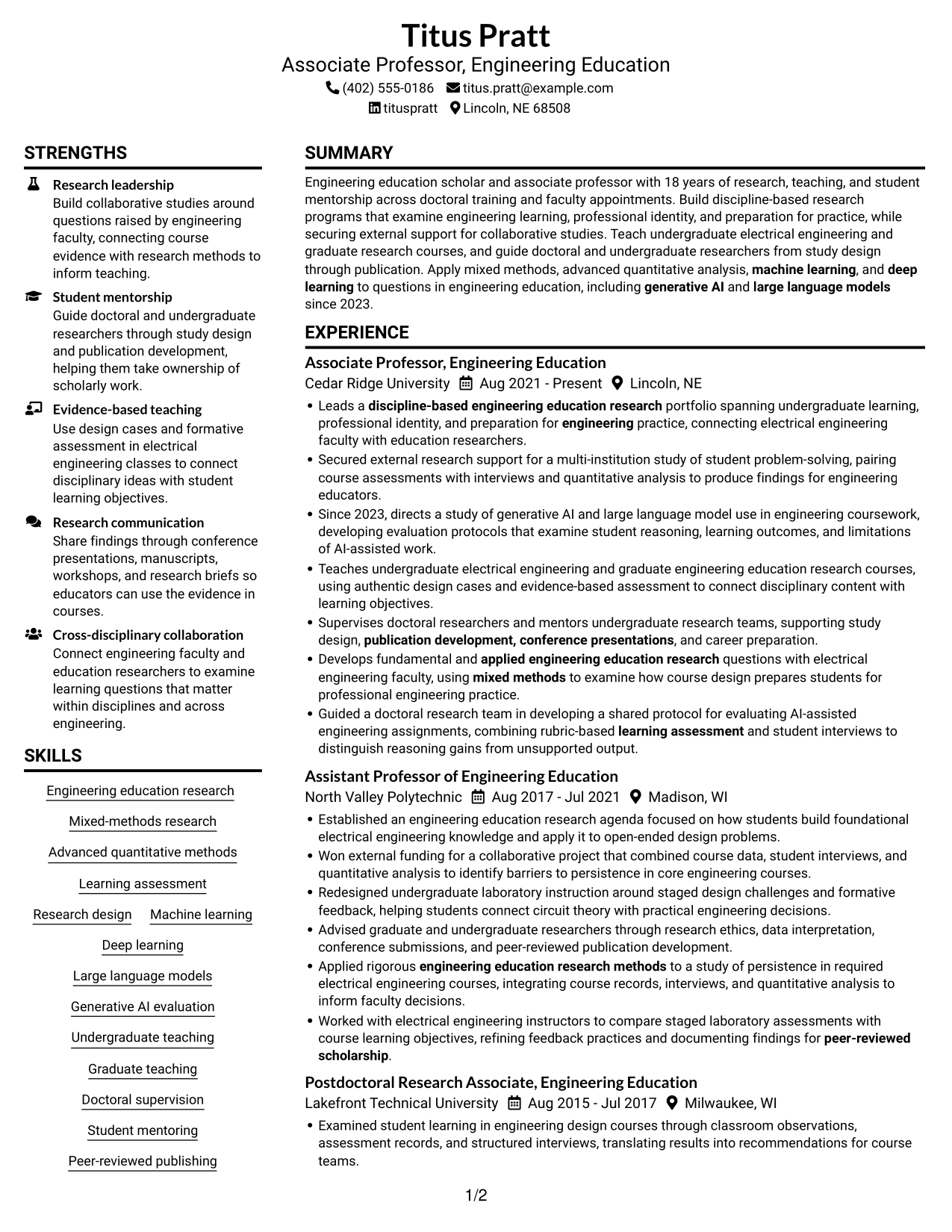
Plain Two Column Format places resume content in two columns, helping reviewers move quickly between academic experience and supporting sections.
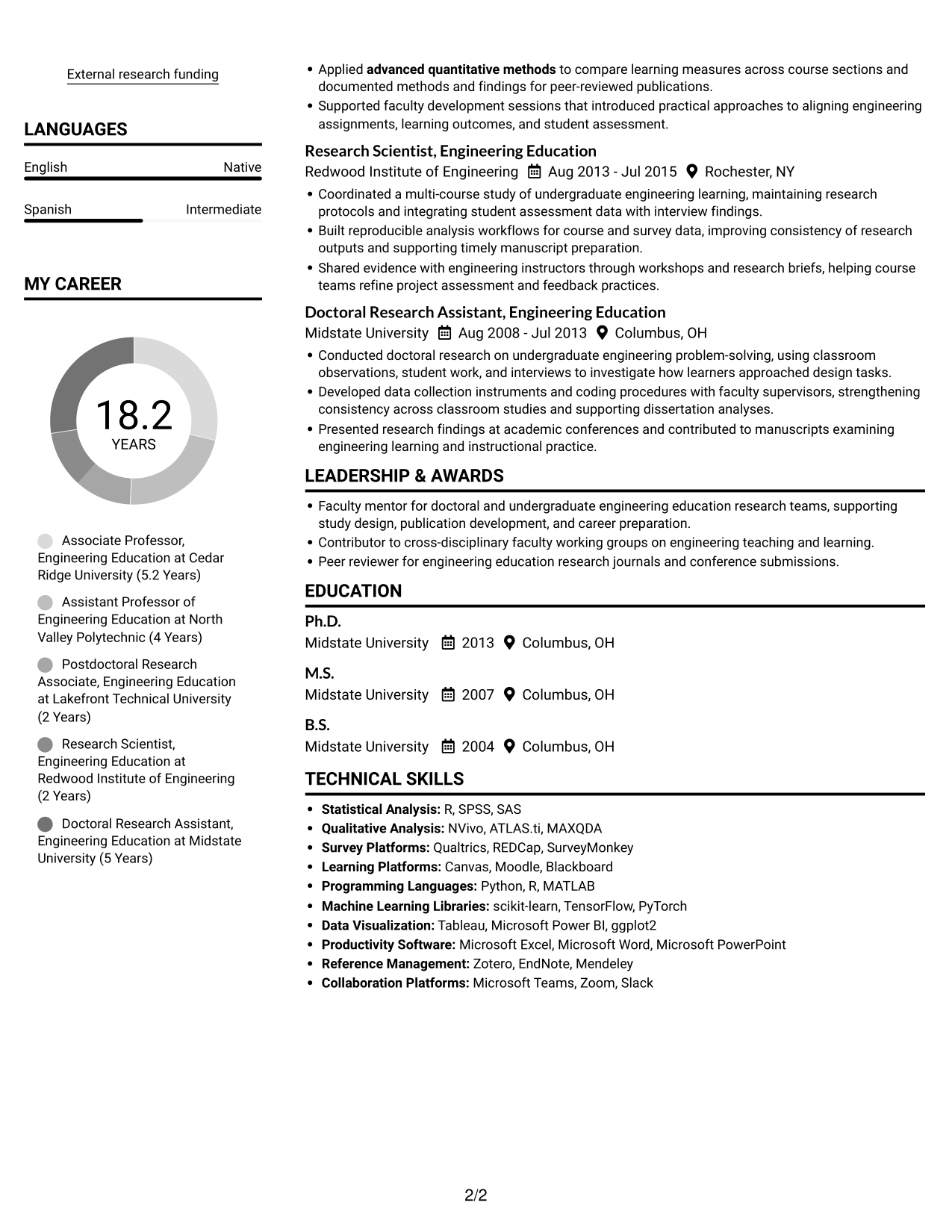
 
Resume example — page 1   Resume example — page 2

Resume Snapshot

  • 18 years of research, teaching, and student mentorship
  • Ph.D. in Engineering Education, plus M.S. and B.S. in Electrical Engineering
  • External research support and peer-reviewed scholarly work
  • Mixed methods, advanced quantitative analysis, and AI education research since 2023

Why This Format Works

  • Separate areas keep experience, education, and skills visible within one scan.
  • Career chronology remains distinct from research, teaching, and mentorship details.
  • Two reading areas let reviewers locate credentials without interrupting experience review.

Best For

  • Academic careers with several appointments
  • Research and teaching records together
  • Resumes with education and mentorship details
  • Readers comparing experience with supporting sections
  • Quick access to multiple resume sections

Resume Keywords

  • discipline-based engineering education research
  • External research funding
  • engineering education research methods
  • peer-reviewed scholarship
  • Leads a discipline-based engineering education research portfolio spanning undergraduate learning, professional identity, and preparation for engineering practice
  • publication development, conference presentations
  • Machine learning
  • Deep learning
  • Large language models
  • Generative AI
  • Advanced quantitative methods
  • Mixed-methods research
  • Learning assessment
  • Cross-disciplinary collaboration
  • Develops fundamental and applied engineering education research questions with electrical engineering faculty, using mixed methods to examine how course design prepares students for professional engineering practice.
 

#2 Simple One Column Format Resume Example

Simple One Column Format presents every section in one vertical path, making a long academic record easy to follow from role to role.
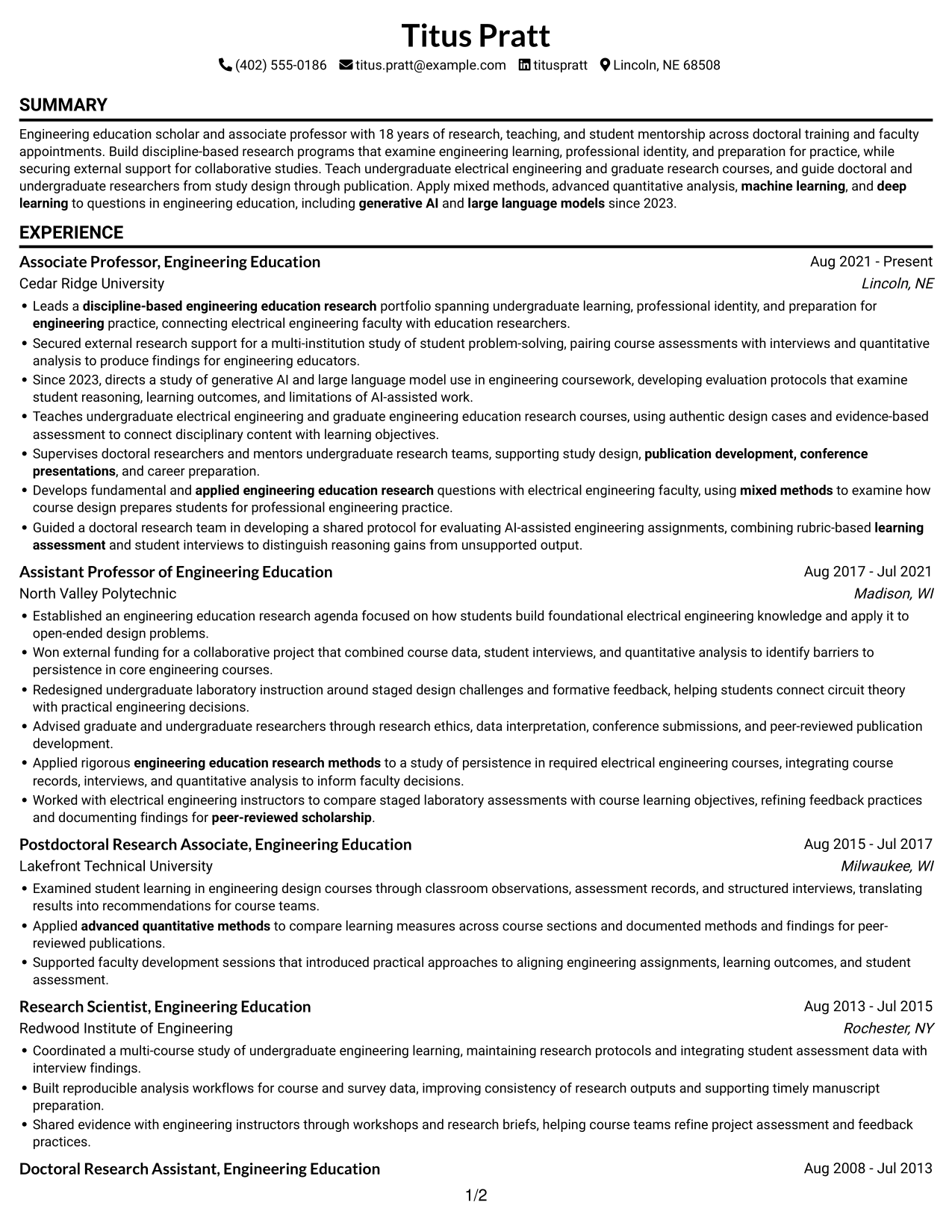
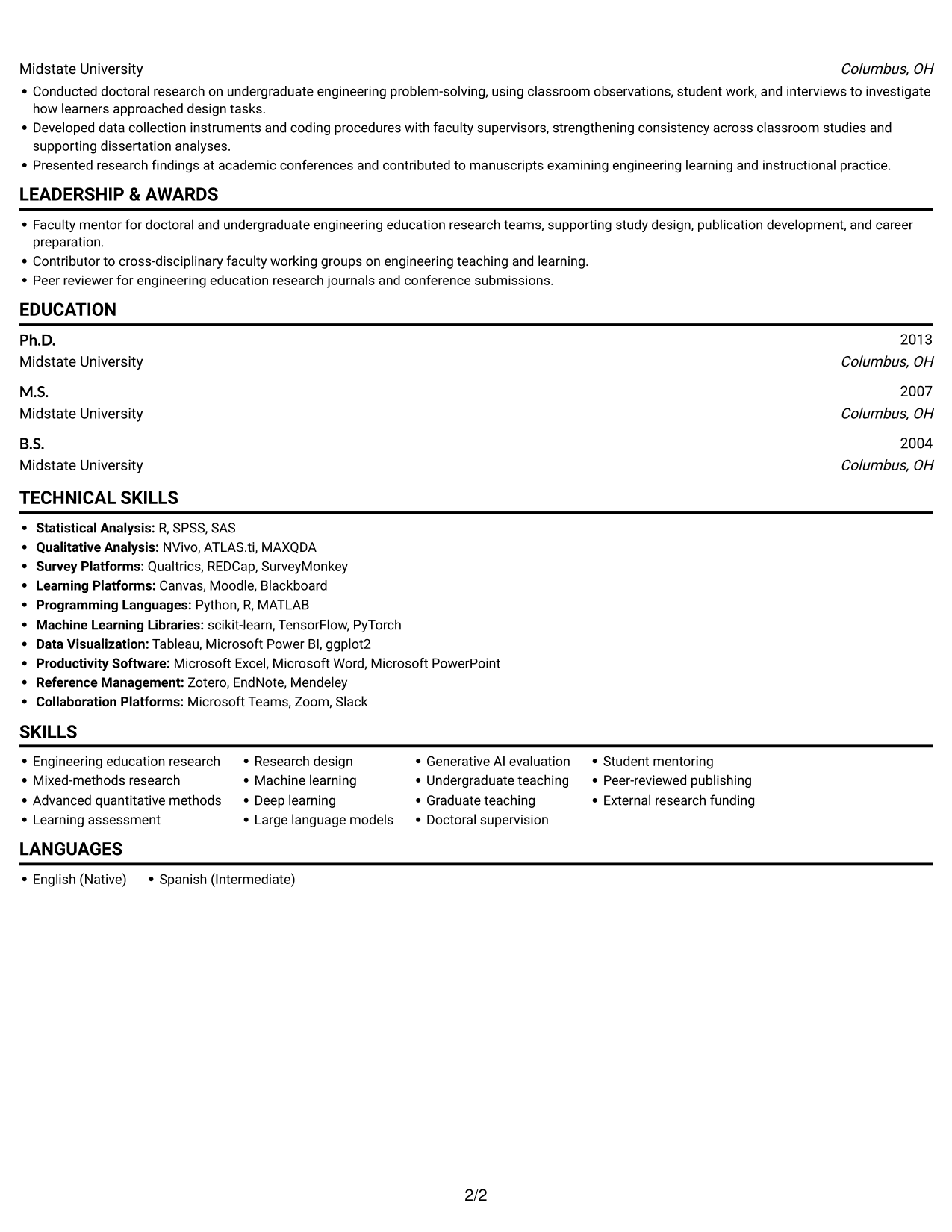
 
Resume example — page 1   Resume example — page 2

Why This Format Works

  • One vertical sequence makes career progression clear across multiple academic appointments.
  • Skills, education, and credentials stay in a familiar order for ATS review.
  • Continuous section flow helps readers connect research work with teaching history.

Best For

  • Long chronological work histories
  • ATS-focused applications
  • Role-by-role career records
  • Standard resume reading order
  • Detailed experience sections
 

#3 Clean Two Column Sidebar Format Resume Example

Clean Two Column Sidebar Format sets a sidebar beside the main resume content, so reviewers can move between concise supporting details and career history.
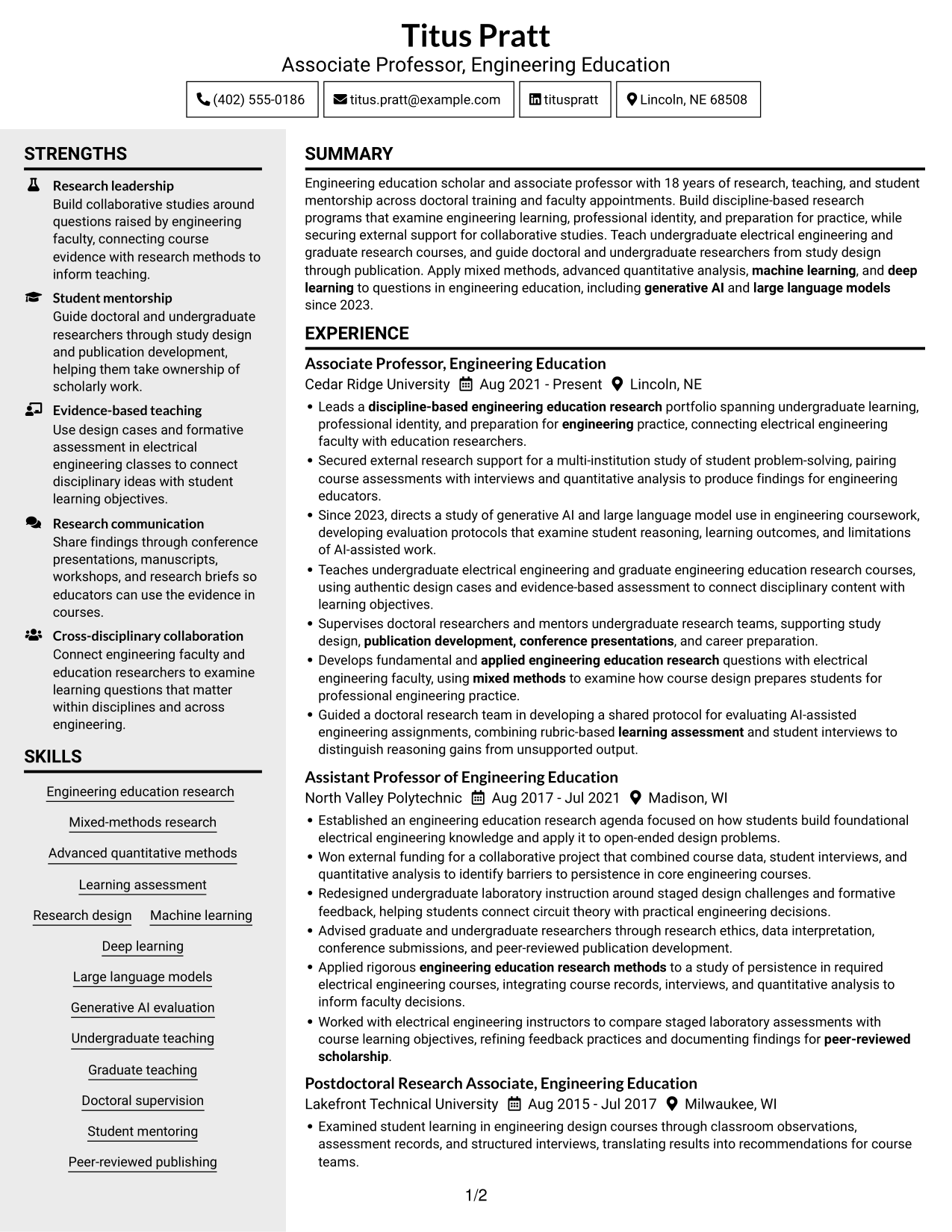
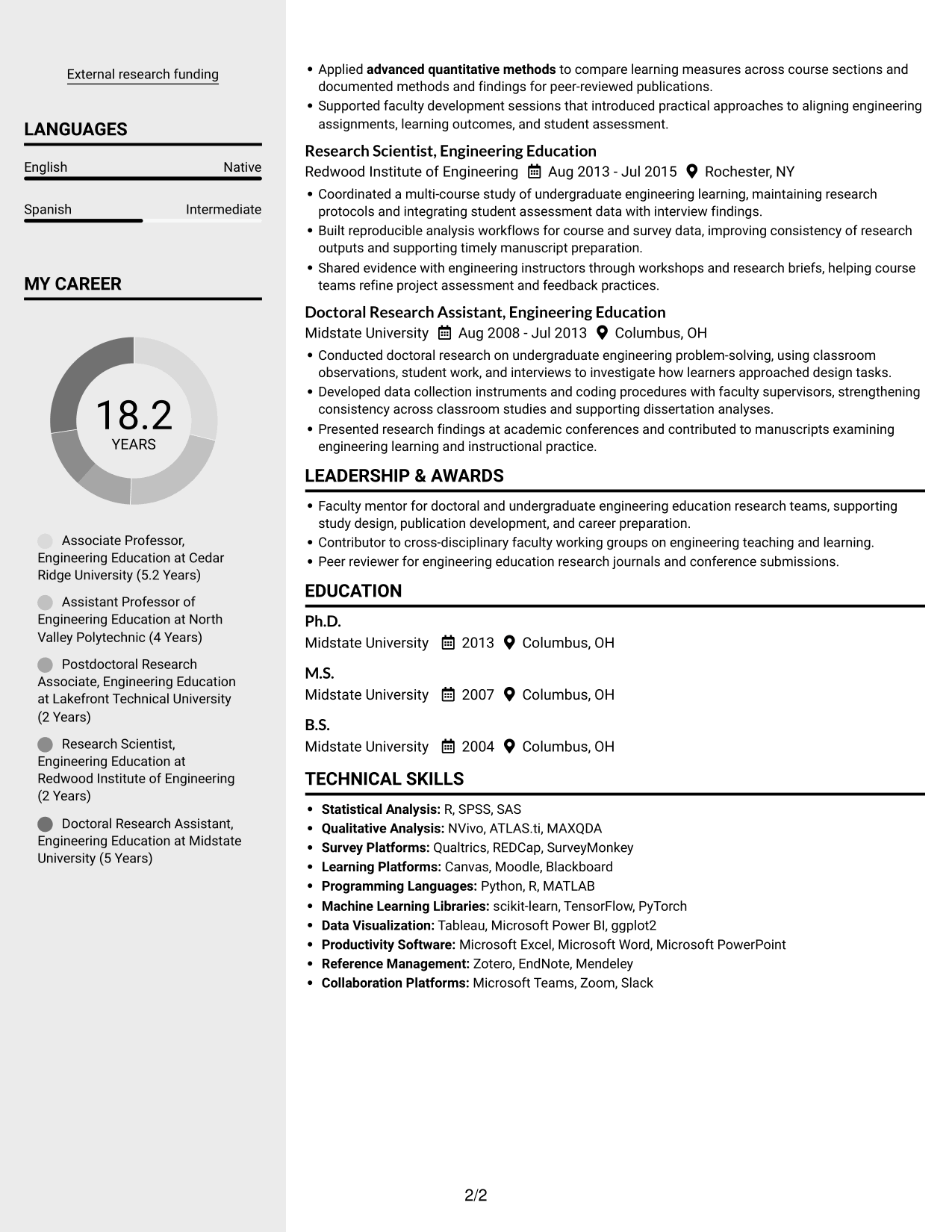
 
Resume example — page 1   Resume example — page 2

Why This Format Works

  • Sidebar space can hold concise skills and education beside the main experience record.
  • Distinct columns make it easier to find mentoring alongside research history.
  • Career progression stays visible while supporting sections remain easy to locate.

Best For

  • Career history with side details
  • Skills and education in a sidebar
  • Quick navigation across academic appointments
  • Detailed experience paired with concise sections
  • Resumes with several information areas
 

#4 Two Column Format Resume Example

Two Column Format divides resume information across two reading areas, giving reviewers a direct way to compare career history with supporting sections.
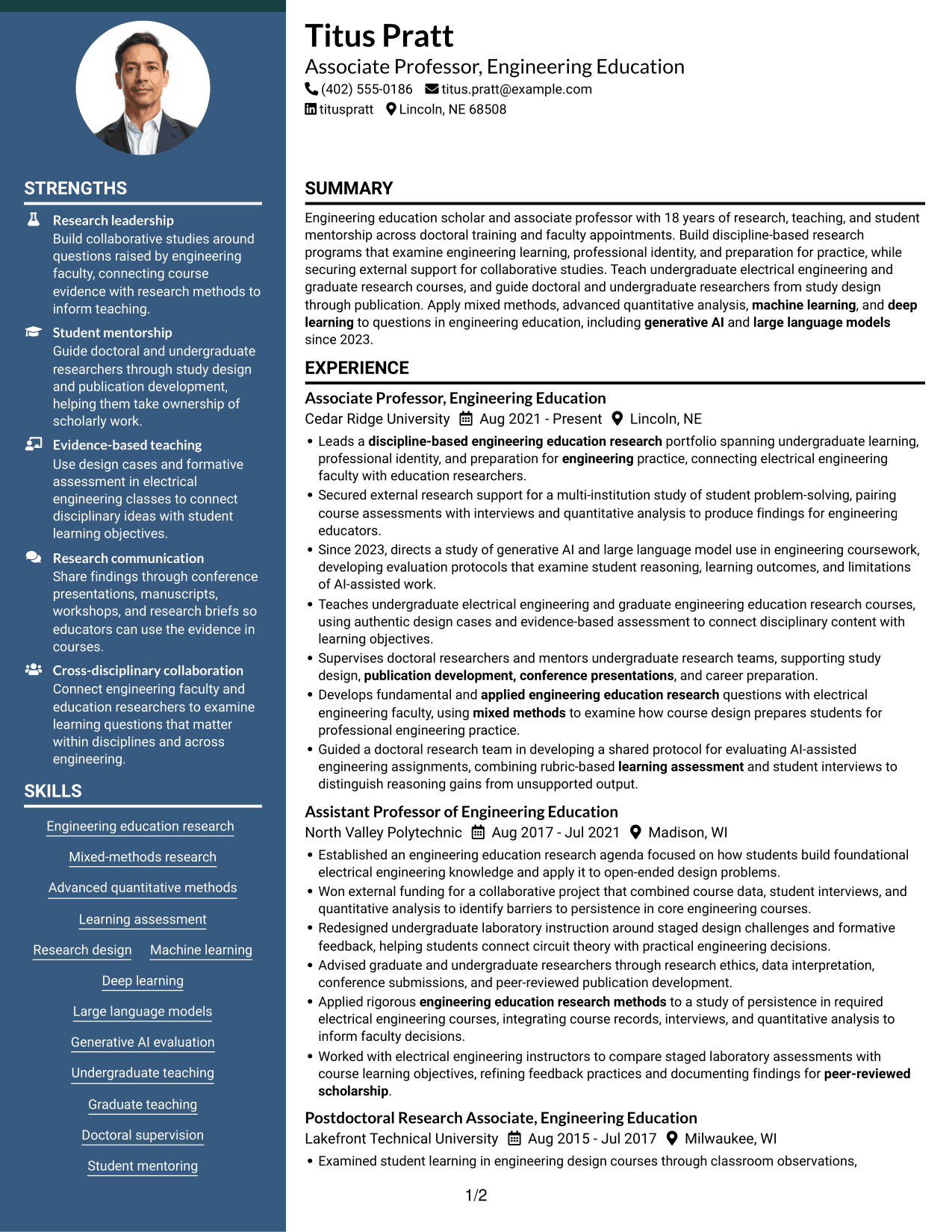
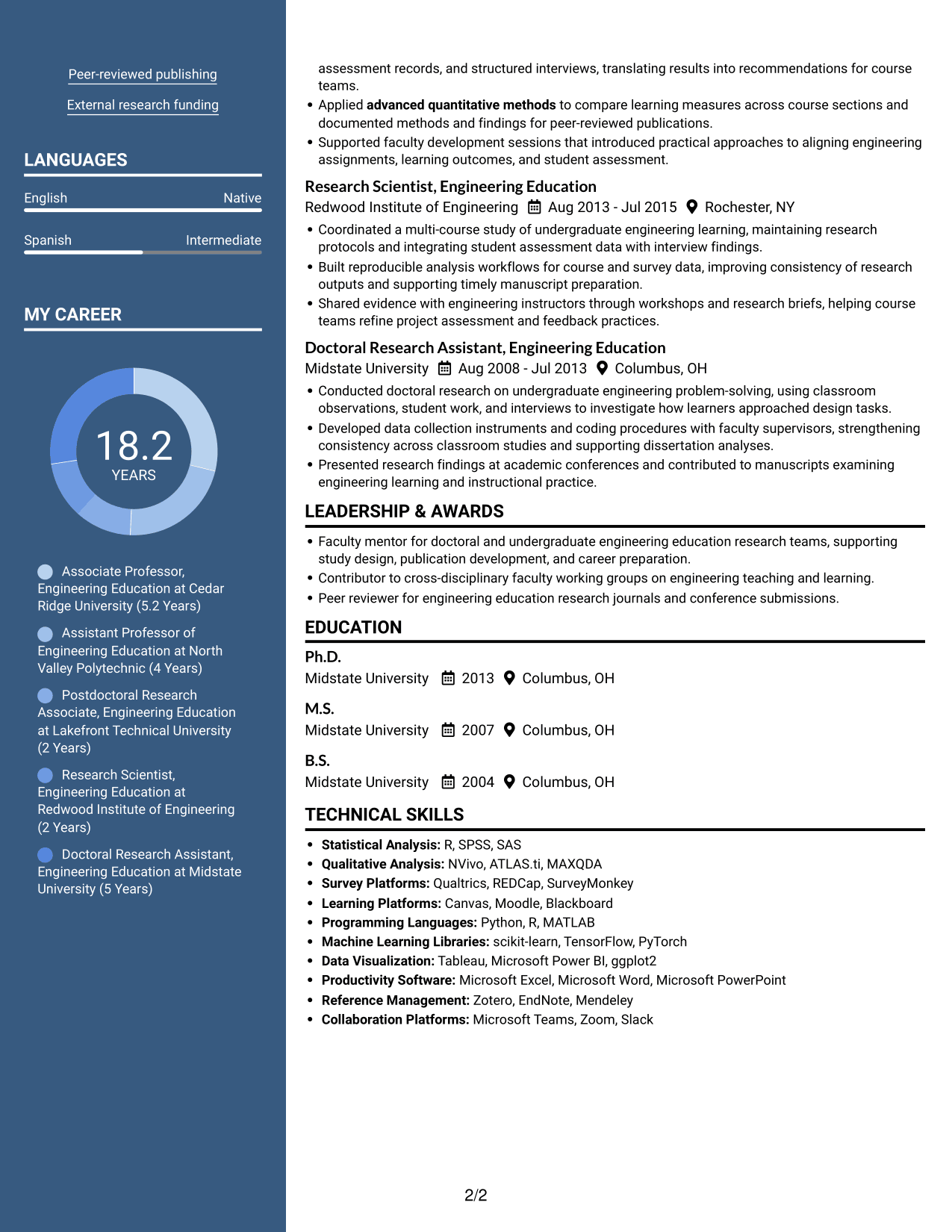
 
Resume example — page 1   Resume example — page 2

Why This Format Works

  • Two content areas separate successive appointments from education and mentoring details.
  • Readers can locate skills while retaining a clear view of research history.
  • Divided content helps balance extensive experience with supporting academic details.

Best For

  • Multi-appointment academic histories
  • Research records paired with teaching evidence
  • Separate access to skills and education
  • Experience-led review with supporting details
  • Resumes with several distinct sections


#5 Photo Header Two Column Format Resume Example

Photo Header Two Column Format pairs a portrait-led header with a two-column resume body, giving personal identification space while keeping career details easy to scan.
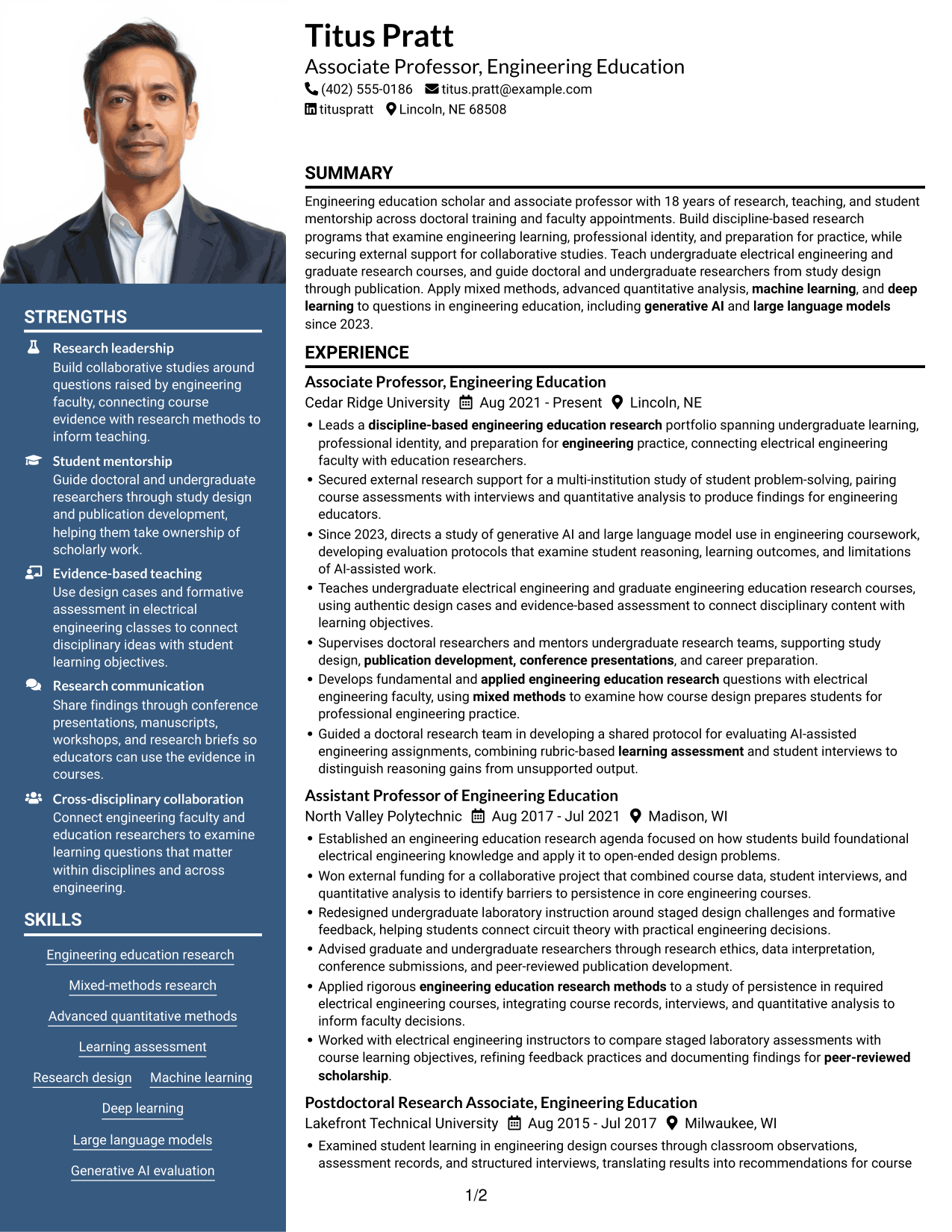
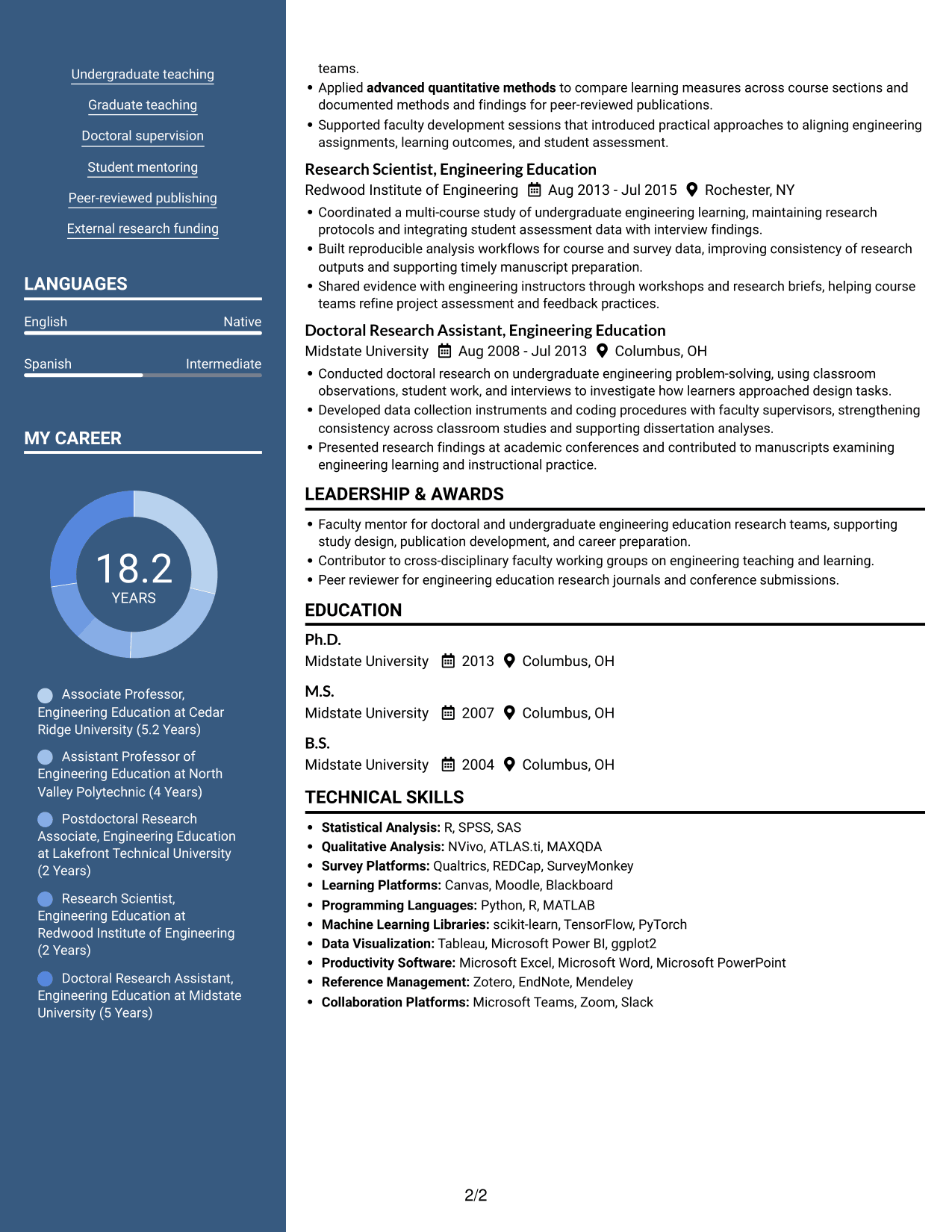
 
Resume example — page 1   Resume example — page 2

Why This Format Works

  • The portrait remains in the header, leaving the two-column body for resume sections.
  • Two body columns help reviewers distinguish career history from supporting sections.
  • Section content can stay divided while a substantial academic record remains readable.

Best For

  • Applications expecting a professional portrait
  • Two-column academic career histories
  • Resume bodies with several content areas
  • Career records paired with education and skills
  • Portrait-inclusive resume presentation
 

#6 Colored Two Column Format Resume Example

Colored Two Column Format uses two body columns to set career history apart from supporting resume sections, helping reviewers scan a broad academic record.
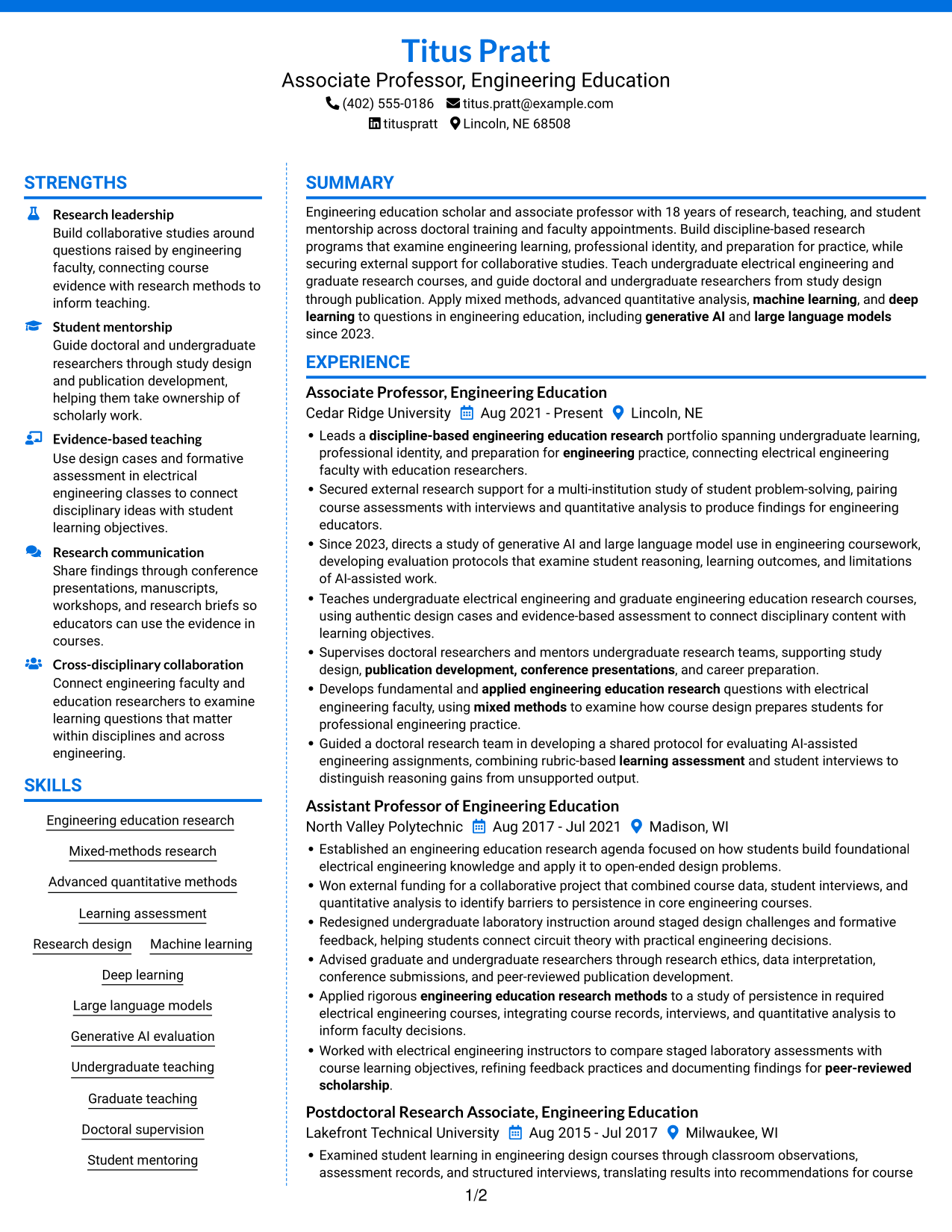
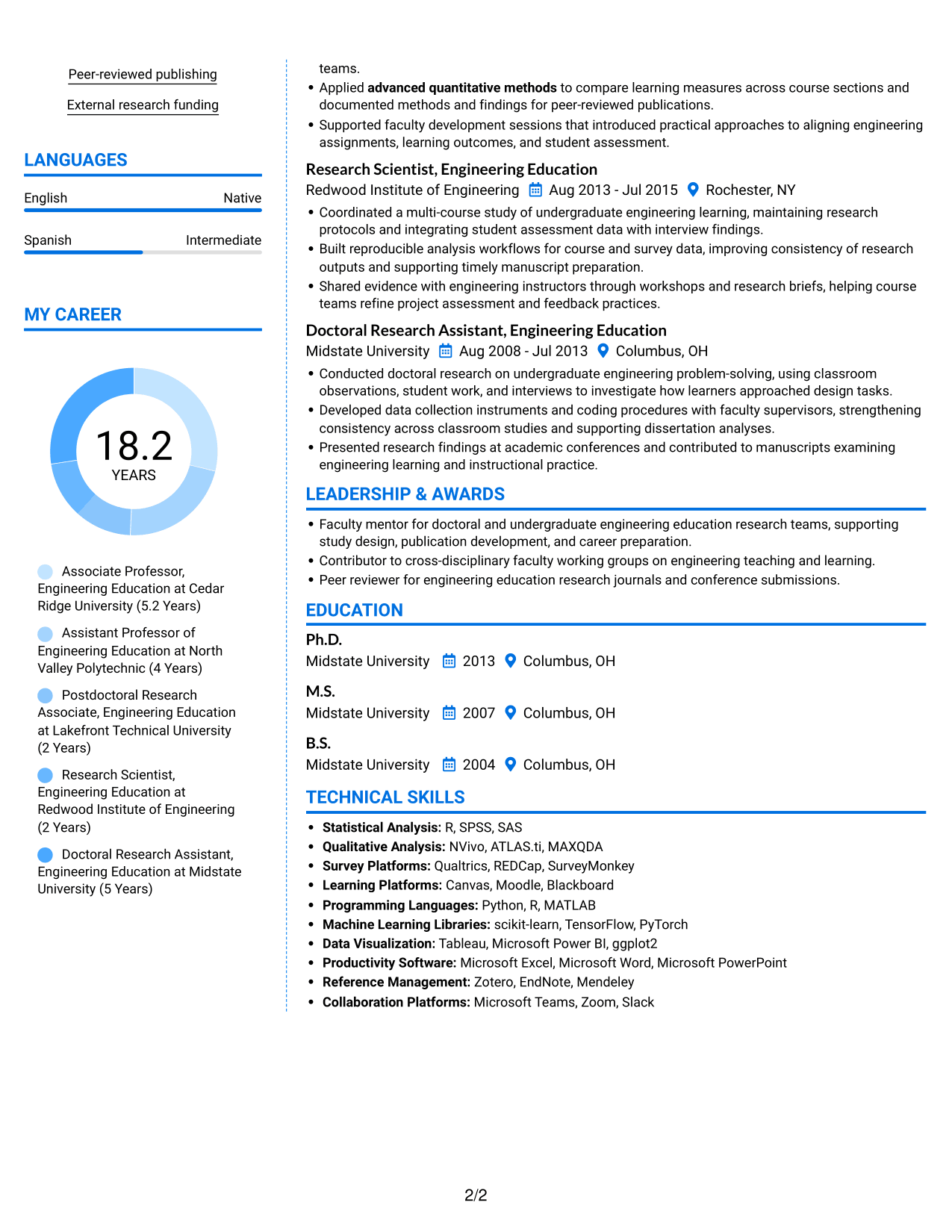
 
Resume example — page 1   Resume example — page 2

Why This Format Works

  • Paired columns give research experience and education distinct paths for review.
  • Supporting skills remain separate from the sequence of academic appointments.
  • Readers can move between teaching history and credentials without one long vertical list.

Best For

  • Broad academic career records
  • Research experience beside education
  • Skills separate from appointment history
  • Teaching and research records reviewed together
  • Multiple resume sections needing clear division
 

#7 Stylish Two Column Designer Format Resume Example

Stylish Two Column Designer Format arranges resume content in two columns, giving dense academic details a compact, clearly divided reading path.
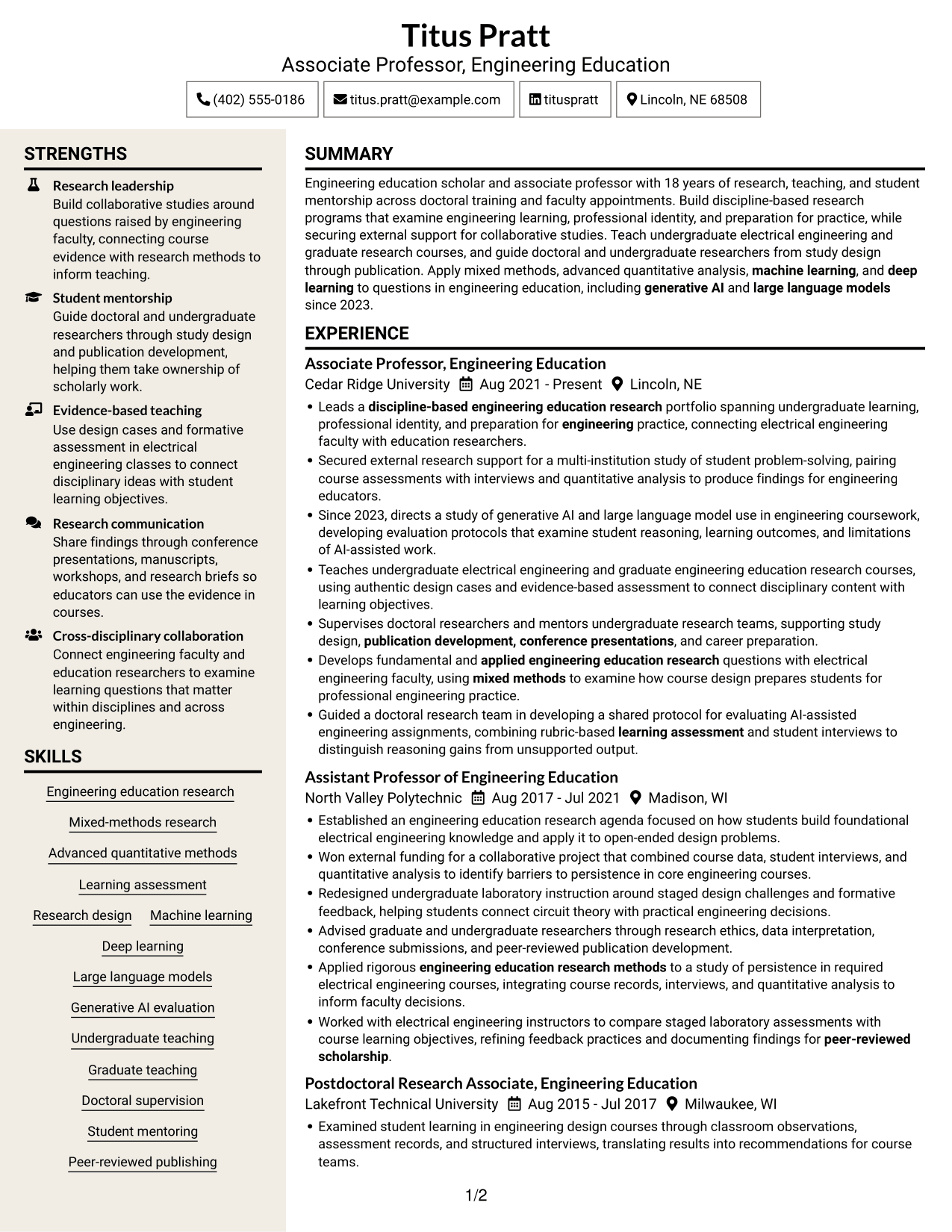
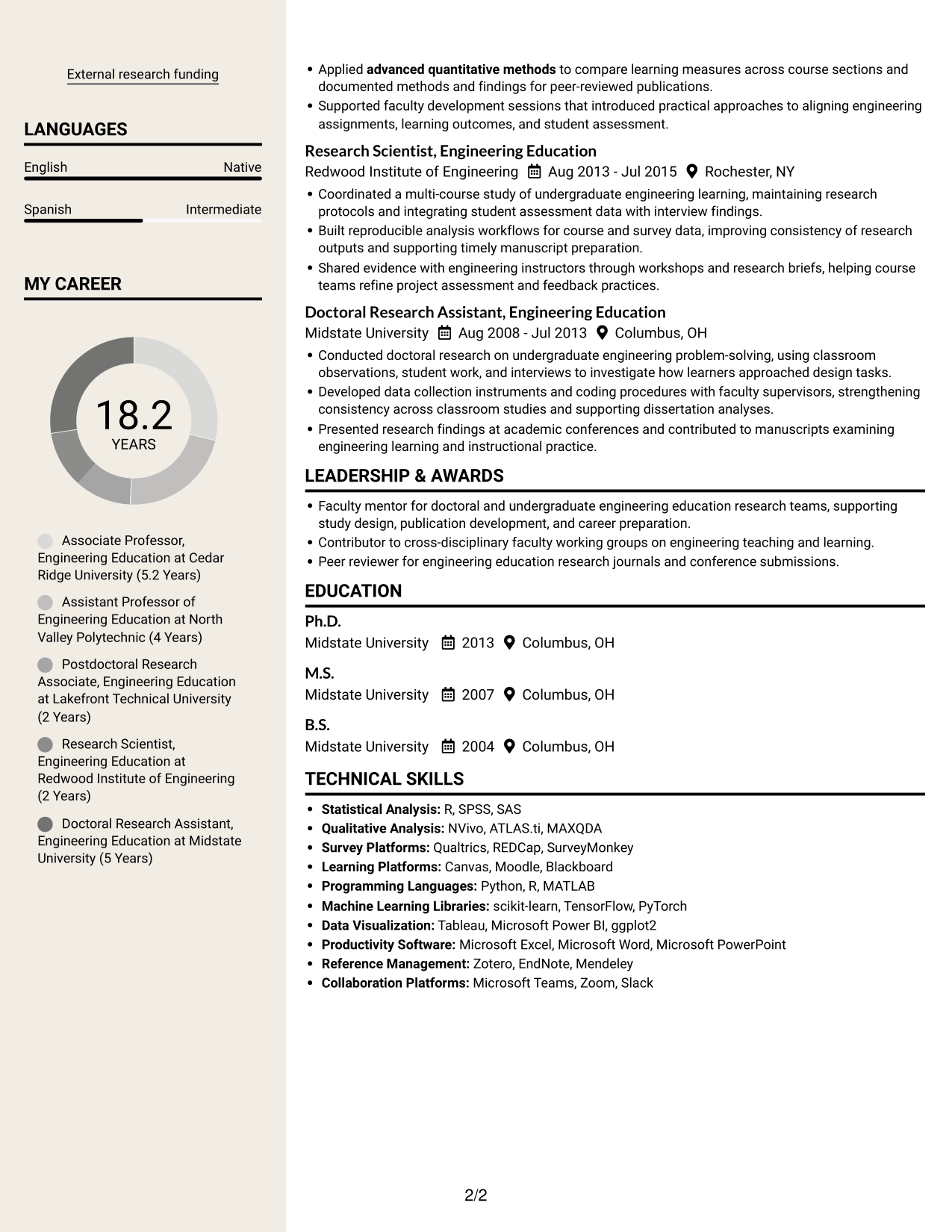
 
Resume example — page 1   Resume example — page 2

Why This Format Works

  • Two columns create a divided reading path for career history and supporting details.
  • Experience sections can remain easy to follow alongside education and mentoring.
  • Separate content areas help reviewers locate achievements within a broad academic record.

Best For

  • Dense academic career information
  • Career history with supporting details
  • Experience paired with education and mentoring
  • Resume sections needing separate reading areas
  • Research and teaching records in one document


Why Build Your Assistant or Associate Professor - Engineering Education Resume with ResumeInMinutes

ResumeInMinutes helps you organize your research, teaching, mentorship, and education into a resume that is easy to scan. Clear sections also make it easier to connect your experience with the needs of an engineering education faculty role.

  • Resume layouts to compare
  • Clear section structure
  • Space for research methods and keywords
  • Organized experience and achievement bullets
  • Image previews for format review
  • Examples you can open and customize in the editor

Use the examples to present your research program, scholarly contributions, teaching, and student guidance with focus. Choose a layout that makes your most relevant evidence easy to find.


See Also


Frequently Asked Questions

Are these Assistant or Associate Professor - Engineering Education resume templates ATS-friendly?

They use clear sections and readable headings. For stronger keyword alignment, describe your research methods, teaching, student supervision, funding, and scholarly work with accurate terms from your background.

Do the examples show different candidates?

No. The examples present one resume in different visual layouts. Compare the image previews, then open an example in the editor to view or customize it.

What should an Assistant or Associate Professor - Engineering Education resume include?

Include a focused summary, academic experience, education, research and teaching contributions, student mentorship, relevant skills, and scholarly activity. Add evidence of external research support when it is part of your record.

How should I describe engineering education research?

Name the research question, methods, and contribution. For example, describe how you used course assessments, interviews, or quantitative analysis to study engineering learning, then state how the findings informed teaching or scholarship.

Which resume format works well for this faculty role?

Choose a layout with clear headings and enough space for research, teaching, education, and mentorship. A simple structure helps readers scan academic experience and supports ATS review.

Should I include a photo on my resume?

For U.S. academic applications, a resume without a photo is usually a suitable choice. Follow any specific instructions provided for the application.


ATS Score 93%

How we calculate this score

  • Keywords: 60% of the total. AI extracts keywords from your job description. If you do not provide one, a standard job description for the title matching your resume is used. This is not a match to a specific vacancy.
  • Text-based resume: 20%. The text resume assessed here receives 100 for this part.
  • Resume quality: 20%. We start at 100 and subtract points for issues found by our resume checks, down to a minimum of zero.
  • Keyword coverage = 100 × (confirmed matches + 0.8 × possible matches) ÷ total keywords, rounded and capped at 100. Possible matches still need checking. Saved generation audits use their saved keyword percentage.
  • Final score = 60% of keyword coverage + 20% of the text score + 20% of the quality score, rounded to a whole number. Without keywords, no overall ATS score is available.

What this score means

Our scores are estimates, not employer ratings. They may contain errors and do not guarantee accurate parsing, a ranking, an interview, or a job. Check your document against the employer’s requirements. You are responsible for relying on this score.

Terms and Conditions

Score weights: Keywords 60% · Text based resume 20% · Resume quality 20%

Keywords: 15 matched + 10 possible of 26 (88%) · Resume quality: 100%

Resume quality 100% · Weight 20% · Issues (0)

Details
  • ✓Name present: Titus Pratt
  • ✓Email format: titus.pratt@example.com
  • ✓Phone format: (402) 555-0186
  • ✓Experience 1: Job title: Associate Professor, Engineering Education
  • ✓Experience 1: Company name: Cedar Ridge University
  • ✓Experience 1: Work location: Lincoln, NE
  • ✓Experience 1: Employment dates: Aug 2021 - Present
  • ✓Experience 1: Description or achievements: Present
  • ✓Experience 2: Job title: Assistant Professor of Engineering Education
  • ✓Experience 2: Company name: North Valley Polytechnic
  • ✓Experience 2: Work location: Madison, WI
  • ✓Experience 2: Employment dates: Aug 2017 - Jul 2021
  • ✓Experience 2: Description or achievements: Present
  • ✓Experience 3: Job title: Postdoctoral Research Associate, Engineering Education
  • ✓Experience 3: Company name: Lakefront Technical University
  • ✓Experience 3: Work location: Milwaukee, WI
  • ✓Experience 3: Employment dates: Aug 2015 - Jul 2017
  • ✓Experience 3: Description or achievements: Present
  • ✓Experience 4: Job title: Research Scientist, Engineering Education
  • ✓Experience 4: Company name: Redwood Institute of Engineering
  • ✓Experience 4: Work location: Rochester, NY
  • ✓Experience 4: Employment dates: Aug 2013 - Jul 2015
  • ✓Experience 4: Description or achievements: Present
  • ✓Experience 5: Job title: Doctoral Research Assistant, Engineering Education
  • ✓Experience 5: Company name: Midstate University
  • ✓Experience 5: Work location: Columbus, OH
  • ✓Experience 5: Employment dates: Aug 2008 - Jul 2013
  • ✓Experience 5: Description or achievements: Present
  • ✓No placeholder fields
  • ✓No repeated achievement bullets
  • ✓No empty bullets

No issues found by the current checks.

Text Based Resume 100% · Weight 20%

Parsed text
Titus Pratt
Associate Professor, Engineering Education
(402) 555-0186
tituspratt
titus.pratt@example.com
Lincoln, NE 68508
STRENGTHS
Research leadership
Build collaborative studies around questions raised by engineering faculty, connecting course evidence with research methods to inform teaching.
Student mentorship
Guide doctoral and undergraduate researchers through study design and publication development, helping them take ownership of scholarly work.
Evidence-based teaching
Use design cases and formative assessment in electrical engineering classes to connect disciplinary ideas with student learning objectives.
Research communication
Share findings through conference presentations, manuscripts, workshops, and research briefs so educators can use the evidence in courses.
Cross-disciplinary collaboration
Connect engineering faculty and education researchers to examine learning questions that matter within disciplines and across engineering.
SUMMARY
Engineering education scholar and associate professor with 18 years of research, teaching, and student mentorship across doctoral training and faculty appointments. Build discipline-based research programs that examine engineering learning, professional identity, and preparation for practice, while securing external support for collaborative studies. Teach undergraduate electrical engineering and graduate research courses, and guide doctoral and undergraduate researchers from study design through publication. Apply mixed methods, advanced quantitative analysis, machine learning, and deep learning to questions in engineering education, including generative AI and large language models since 2023.
EXPERIENCE
Associate Professor, Engineering Education
Cedar Ridge University
Aug 2021 - Present
Lincoln, NE
Leads a discipline-based engineering education research portfolio spanning undergraduate learning, professional identity, and preparation for engineering practice, connecting electrical engineering faculty with education researchers.
Secured external research support for a multi-institution study of student problem-solving, pairing course assessments with interviews and quantitative analysis to produce findings for engineering educators.
Since 2023, directs a study of generative AI and large language model use in engineering coursework, developing evaluation protocols that examine student reasoning, learning outcomes, and limitations of AI-assisted work.
Teaches undergraduate electrical engineering and graduate engineering education research courses, using authentic design cases and evidence-based assessment to connect disciplinary content with learning objectives.
Supervises doctoral researchers and mentors undergraduate research teams, supporting study design, publication development, conference presentations, and career preparation.
Develops fundamental and applied engineering education research questions with electrical engineering faculty, using mixed methods to examine how course design prepares students for professional engineering practice.
Guided a doctoral research team in developing a shared protocol for evaluating AI-assisted engineering assignments, combining rubric-based learning assessment and student interviews to distinguish reasoning gains from unsupported output.
Assistant Professor of Engineering Education
North Valley Polytechnic
Aug 2017 - Jul 2021
Madison, WI
Established an engineering education research agenda focused on how students build foundational electrical engineering knowledge and apply it to open-ended design problems.
Won external funding for a collaborative project that combined course data, student interviews, and quantitative analysis to identify barriers to persistence in core engineering courses.
Redesigned undergraduate laboratory instruction around staged design challenges and formative feedback, helping students connect circuit theory with practical engineering decisions.
Advised graduate and undergraduate researchers through research ethics, data interpretation, conference submissions, and peer-reviewed publication development.
Applied rigorous engineering education research methods to a study of persistence in required electrical engineering courses, integrating course records, interviews, and quantitative analysis to inform faculty decisions.
Worked with electrical engineering instructors to compare staged laboratory assessments with course learning objectives, refining feedback practices and documenting findings for peer-reviewed scholarship.
Postdoctoral Research Associate, Engineering Education
Lakefront Technical University
Aug 2015 - Jul 2017
Milwaukee, WI
Examined student learning in engineering design courses through classroom observations, assessment records, and structured interviews, translating results into recommendations for course teams.
Applied advanced quantitative methods to compare learning measures across course sections and documented methods and findings for peer-reviewed publications.
Supported faculty development sessions that introduced practical approaches to aligning engineering assignments, learning outcomes, and student assessment.
Research Scientist, Engineering Education
Redwood Institute of Engineering
Aug 2013 - Jul 2015
Rochester, NY
Coordinated a multi-course study of undergraduate engineering learning, maintaining research protocols and integrating student assessment data with interview findings.
Built reproducible analysis workflows for course and survey data, improving consistency of research outputs and supporting timely manuscript preparation.
Shared evidence with engineering instructors through workshops and research briefs, helping course teams refine project assessment and feedback practices.
Doctoral Research Assistant, Engineering Education
Midstate University
Aug 2008 - Jul 2013
Columbus, OH
Conducted doctoral research on undergraduate engineering problem-solving, using classroom observations, student work, and interviews to investigate how learners approached design tasks.
Developed data collection instruments and coding procedures with faculty supervisors, strengthening consistency across classroom studies and supporting dissertation analyses.
Presented research findings at academic conferences and contributed to manuscripts examining engineering learning and instructional practice.
SKILLS
Research design
Engineering education research
Advanced quantitative methods
External research funding
Peer-reviewed publishing
Mixed-methods research
Generative AI evaluation
Undergraduate teaching
Large language models
Learning assessment
Doctoral supervision
Student mentoring
Graduate teaching
Deep learning
Machine learning
LANGUAGES
English
Native
Spanish
Intermediate
MY CAREER
18.2Years
Associate Professor, Engineering Education at Cedar Ridge University (5.2 Years)
Assistant Professor of Engineering Education at North Valley Polytechnic (4 Years)
Postdoctoral Research Associate, Engineering Education at Lakefront Technical University (2 Years)
Research Scientist, Engineering Education at Redwood Institute of Engineering (2 Years)
Doctoral Research Assistant, Engineering Education at Midstate University (5 Years)
LEADERSHIP & AWARDS
Faculty mentor for doctoral and undergraduate engineering education research teams, supporting study design, publication development, and career preparation.
Contributor to cross-disciplinary faculty working groups on engineering teaching and learning.
Peer reviewer for engineering education research journals and conference submissions.
EDUCATION
Ph.D.
Midstate University
2013
Columbus, OH
M.S.
Midstate University
2007
Columbus, OH
B.S.
Midstate University
2004
Columbus, OH
TECHNICAL SKILLS
Statistical Analysis: R, SPSS, SAS
Qualitative Analysis: NVivo, ATLAS.ti, MAXQDA
Survey Platforms: Qualtrics, REDCap, SurveyMonkey
Learning Platforms: Canvas, Moodle, Blackboard
Programming Languages: Python, R, MATLAB
Machine Learning Libraries: scikit-learn, TensorFlow, PyTorch
Data Visualization: Tableau, Microsoft Power BI, ggplot2
Productivity Software: Microsoft Excel, Microsoft Word, Microsoft PowerPoint
Reference Management: Zotero, EndNote, Mendeley
Collaboration Platforms: Microsoft Teams, Zoom, Slack

Matched keywords (15)

  • discipline-based engineering education research
  • External research funding
  • engineering education research methods
  • peer-reviewed scholarship
  • Leads a discipline-based engineering education research portfolio spanning undergraduate learning, professional identity, and preparation for engineering practiceOriginal keyword in JD: Sustained research program
  • publication development, conference presentationsOriginal keyword in JD: Strong scholarly achievement
  • Machine learning
  • Deep learning
  • Large language models
  • Generative AI
  • Advanced quantitative methods
  • Mixed-methods research
  • Learning assessment
  • Cross-disciplinary collaboration
  • Develops fundamental and applied engineering education research questions with electrical engineering faculty, using mixed methods to examine how course design prepares students for professional engineering practice.Original keyword in JD: Fundamental and applied research

Missing keywords (1)

  • Effective teaching

Possible matches (10)

  • Engineering education research program80% credit: 3.08 percentage points of 3.85 possible.
  • Undergraduate engineering teaching80% credit: 3.08 percentage points of 3.85 possible.
  • Graduate engineering education teaching80% credit: 3.08 percentage points of 3.85 possible.
  • Doctoral research supervision80% credit: 3.08 percentage points of 3.85 possible.
  • Graduate student mentoring80% credit: 3.08 percentage points of 3.85 possible.
  • Undergraduate student mentoring80% credit: 3.08 percentage points of 3.85 possible.
  • Ph.D. or equivalent in engineering OR closely related field80% credit: 3.08 percentage points of 3.85 possible.
  • Bachelor's degree OR master's degree in an engineering discipline80% credit: 3.08 percentage points of 3.85 possible.
  • Engineering professional practice80% credit: 3.08 percentage points of 3.85 possible.
  • Engineering discipline-specific research80% credit: 3.08 percentage points of 3.85 possible.
Disclaimer: All names, images, contact information, employment histories, achievements, security clearances, military credentials, and other qualifications shown in this content are fictional and used for illustrative purposes only. Any resemblance to actual persons, living or deceased, is purely coincidental.

Resume and cover-letter examples and recommendations in this article reflect general best practices and professional experience and are provided for guidance only. Results may vary based on role, industry, region, and hiring organization.

Content Accuracy and Verification: To the fullest extent permitted by applicable law, we do not represent or warrant that resume or cover-letter guidance, examples, recommendations, or related information are accurate, complete, current, error-free, or suitable for any particular purpose. You are responsible for independently reviewing and verifying the information before relying on it.

ATS and Cover-Letter Scores: ATS scores are estimates calculated using our own formula, informed by publicly available guidance on resume formatting and keyword matching. They are not scores issued or endorsed by an ATS provider or employer. Cover-letter scores are also our own assessments. Parsing, weighting, screening criteria, and results vary between systems, employers, job descriptions, and document formats. No score guarantees successful parsing, a particular ranking, an interview, or employment. Use scores as general guidance and independently check your documents against the employer’s requirements. To the fullest extent permitted by applicable law, we accept no liability for errors in scores or parsing, or losses arising from reliance on these assessments. Nothing in this notice excludes liability or limits consumer rights that cannot lawfully be excluded or limited.

Terms and Conditions
 
> JP 1 1
PDF Footer and Margins Setup
The margins are applied to the document, and the footer shows up in the preview and the PDF

Footer Font Settings

Are you applying for a specific job
so we can tailor your resume to it?
Are you applying for a specific job
so we can tailor your cover letter to it?
Type your details as text to generate a personalized resume Type your details as text to generate a personalized cover letter
Website link found! Ready to create resume from:
Drag the into the box to verify you're human.
Drop here

My Resumes

Displaying {number_of_files} files (out of {total_of_all_files} total)
Name File Type Last Modified: Description:

Rename File

Filename already exists!

Delete Files

Warning: This action is irreversible. Once you click submit, the files will be permanently deleted.

Heading text
Upload From Computer Upload
Select From Existing
LinkedIn
Drag & Drop files anywhere in this tab, or

Uploaded Files

Delete Name Last Updated Use This File
Select this to use the file for generating your resume and cover letter. Only one source—uploaded file, selected file, or LinkedIn text—can be used.

My Files

Resumes or cover letters you create will appear here. No files available yet.
Delete Name Last Updated Use This File
Select this to use the file for generating your resume and cover letter. Only one source—uploaded file, selected file, or LinkedIn text—can be used.

Add LinkedIn Profile PDF

You can download your LinkedIn profile as a PDF by opening linkedin.com in a web browser, clicking your profile photo, selecting the “More” or “Resources” button, and choosing “Save to PDF.” You can then attach the PDF using the Upload From Computer tab.

Paste Your LinkedIn Profile Text

If you have copied the LinkedIn profile text, paste it below. See how to copy your profile from LinkedIn

Select this to use the LinkedIn profile text for generating your resume and cover letter. Only one source—uploaded file, selected file, or LinkedIn text—can be used.

Try these controls

<
>


