33 Cloud Architect Resume Templates with Example 2026 (ATS-Optimized)
This guide shows you how to build a clear, focused Cloud Architect resume that presents your value quickly and professionally. You will learn how to organize your experience, technical strengths, and certifications so the document is easy to adapt and review.
Effective Cloud Architect resumes connect architecture decisions to business and operational results. They give clear space to Azure, AWS, Oracle Cloud Infrastructure, IaaS, PaaS, SaaS, cloud security, governance, high availability, disaster recovery, and cost optimization when those areas match the target role.
The resume example on this page is presented in 33 ATS-friendly layouts. Use the format notes and free PDF previews to compare section hierarchy, skills placement, experience bullets, projects, education, and certifications.
What Makes a Great Cloud Architect Resume in 2026
Strong Cloud Architect resumes are focused, evidence-based, and easy to scan. They show how the candidate designs secure, scalable platforms, improves resilience, guides delivery, and supports reliable operations.
Use keywords such as Azure, AWS, Oracle Cloud Infrastructure, IaaS, PaaS, SaaS, cloud security, governance, infrastructure assessments, cost optimization, high availability, disaster recovery, business continuity, and technical leadership when they accurately reflect the resume.
The examples shown below are intentionally detailed to demonstrate a range of experiences, skills, accomplishments and relevant keywords. We prefer detailed resumes as they provide more context to the hiring managers and also help the ATS systems identify relevant qualifications and score your resume better for a match. But the length of a resume is an individual choice. If you want a one page resume, just keep the most relevant experience and information for the job.
#1 Simple One Column Format Resume Example
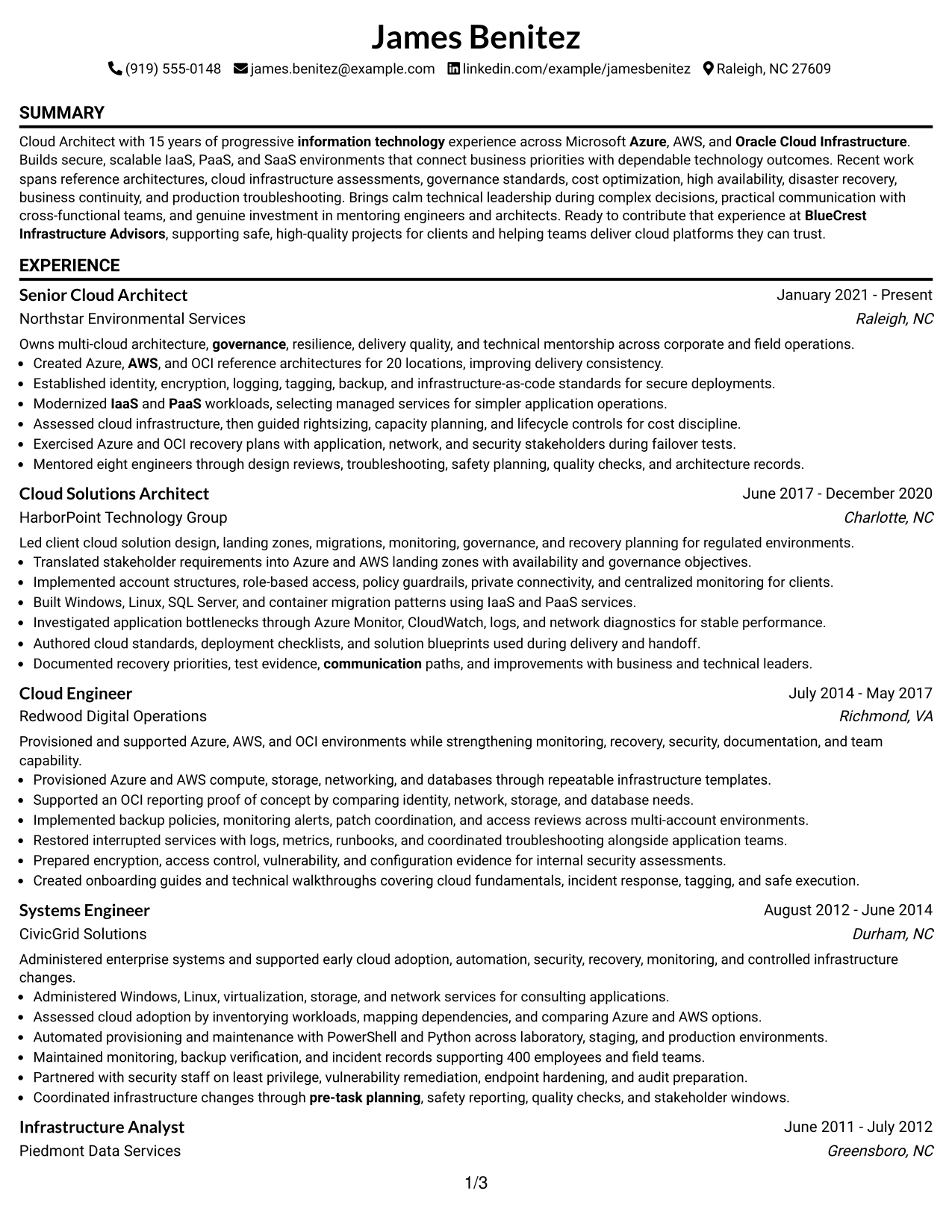
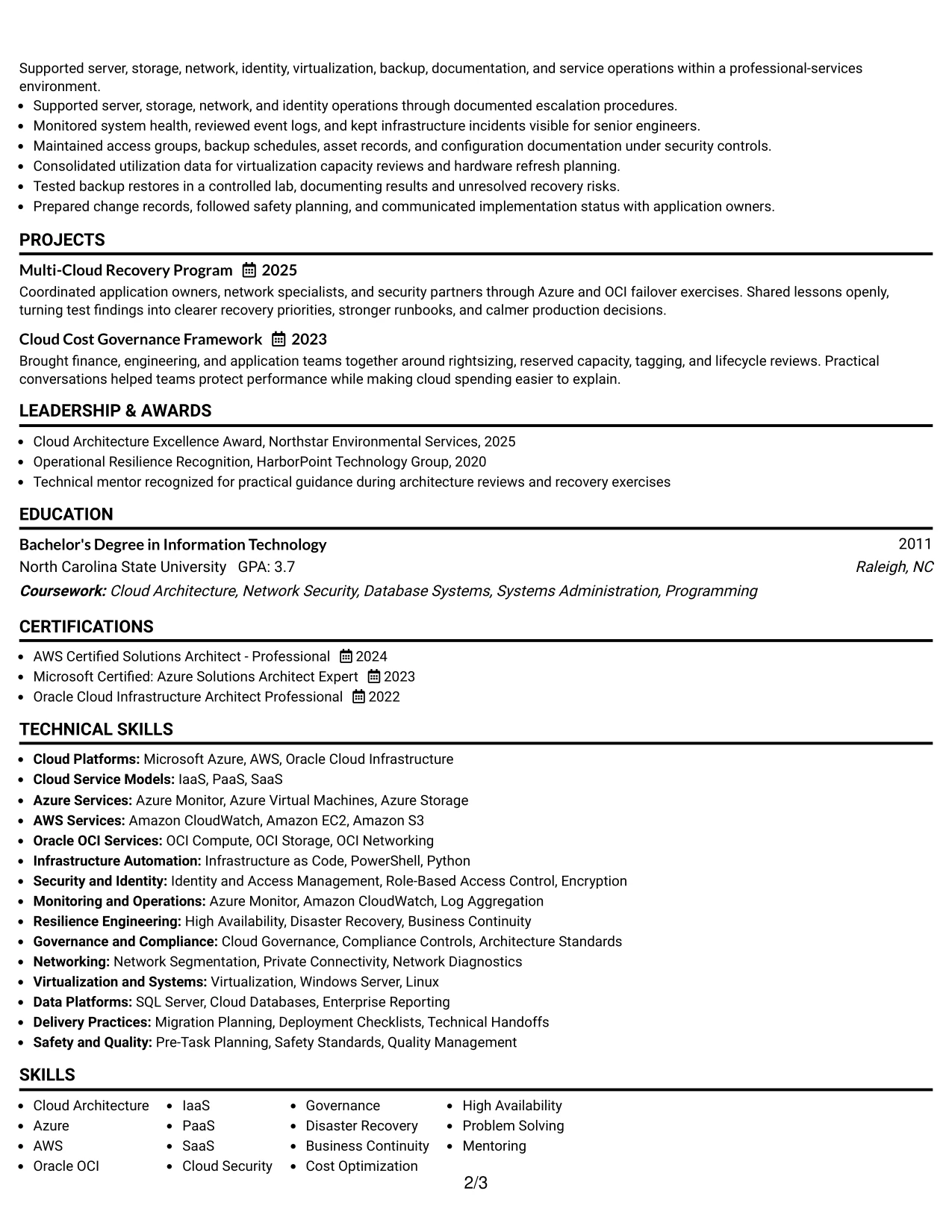
The Simple One Column Format presents the resume in a clear top-to-bottom order. A focused summary leads into experience, education, certifications, projects, and skills, so each section is easy to find.
For a Cloud Architect resume, this structure gives important terms such as Azure, AWS, Oracle Cloud Infrastructure, governance, and disaster recovery enough space to appear naturally. Strong bullets can show architecture ownership, 20+ business locations, recovery testing, cost discipline, and mentoring eight engineers without competing side by side with another column.
Why the Simple One Column Format Works for a Resume
- A single reading path supports quick recruiter scanning.
- The summary can establish Cloud Architect experience before the detailed work history.
- Full-width bullets leave room for technical context and measurable scope.
- Cloud platforms and service models remain easy for ATS software to parse.
- Experience can be ordered by relevance, with recent architecture work first.
- Certifications and education have clear space below the professional history.
- Projects can add evidence of recovery exercises and cost governance without crowding the page.
Best For
- Resumes that need a straightforward section hierarchy from summary through skills.
- Professionals who want every role and date to follow one consistent reading path.
- Applications where ATS parsing and plain text extraction are priorities.
- Work histories with detailed bullets that need full-width space.
- Documents that combine experience, projects, certifications, and education.
- Candidates who want architecture keywords to appear in both the summary and achievements.
- Resume reviews that favor familiar structure over decorative layout.
Resume Keywords
- Cloud Architect
- BlueCrest Infrastructure Advisors
- Bachelor's Degree
- information technology
- Azure
- AWS
- Oracle OCI
- Oracle Cloud Infrastructure
- IaaS
- PaaS
- SaaS
- Cloud Security
- Compliance
- governance
- Problem Solving
#2 Plain One Column with Shaded Labels Resume Example
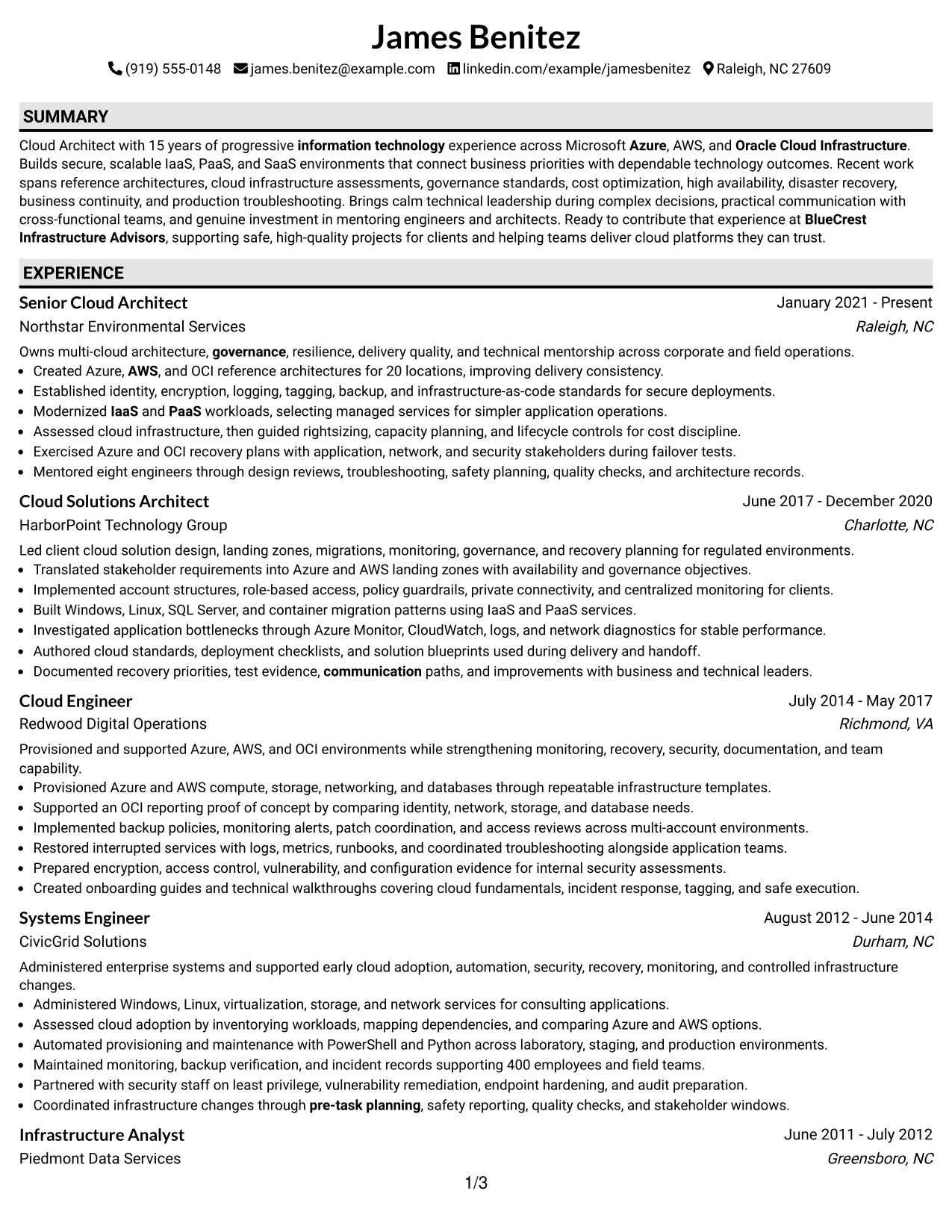
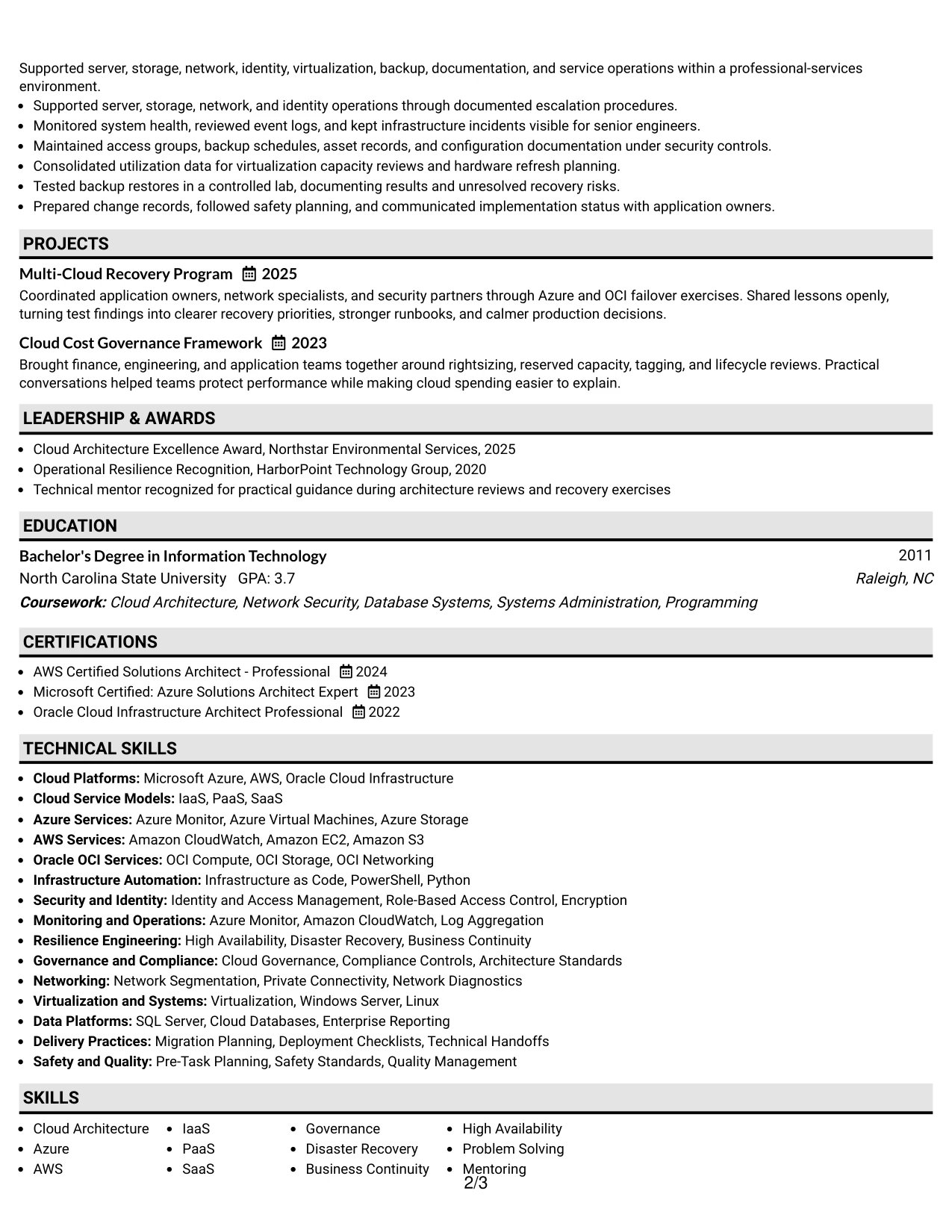
Readers move from the contact header to the summary, then through labeled resume sections in a steady vertical sequence. Shaded labels separate experience, projects, education, certifications, and skills without interrupting the review.
That simple navigation supports a substantial technical record. The resume can include multi-cloud architecture, IaaS, PaaS, SaaS, security, compliance, monitoring, and infrastructure automation while keeping each group distinct. Detailed bullets remain readable because the page does not divide the work history into narrow columns.
Why the Plain One Column with Shaded Labels Works for a Resume
- Shaded labels help readers locate major sections quickly.
- A full-width experience area accommodates complete achievement bullets.
- The format supports a longer career history without forcing dense side-by-side text.
- Consistent labels make skills, tools, and certifications easier to distinguish.
- ATS-friendly text flow keeps headings and keywords in a logical order.
- Projects can sit near experience and reinforce recovery or cost governance evidence.
- The restrained design keeps attention on scope, methods, and results.
Best For
- Resumes with several technical sections that benefit from clear visual labels.
- Applicants presenting a substantial employment history in one continuous column.
- Documents that need room for detailed infrastructure and operations bullets.
- ATS-conscious applications using standard section names and readable text.
- Professionals combining cloud platforms with security, governance, and resilience work.
- Resume readers who prefer predictable movement from one section to the next.
- Applications where projects and certifications need visible separation from experience.
#3 One Column Format with Photo Right Resume Example
Architecture evidence receives priority before the visual element. The resume opens with a focused summary and then gives the work history, projects, skills, education, and certifications a complete one-column reading area.
A photo placed to the right of the header can add a personal visual point without taking space from the technical content. The main body can emphasize Azure, AWS, OCI, architecture standards, recovery plans, cost optimization, and production troubleshooting through concise, evidence-based bullets.
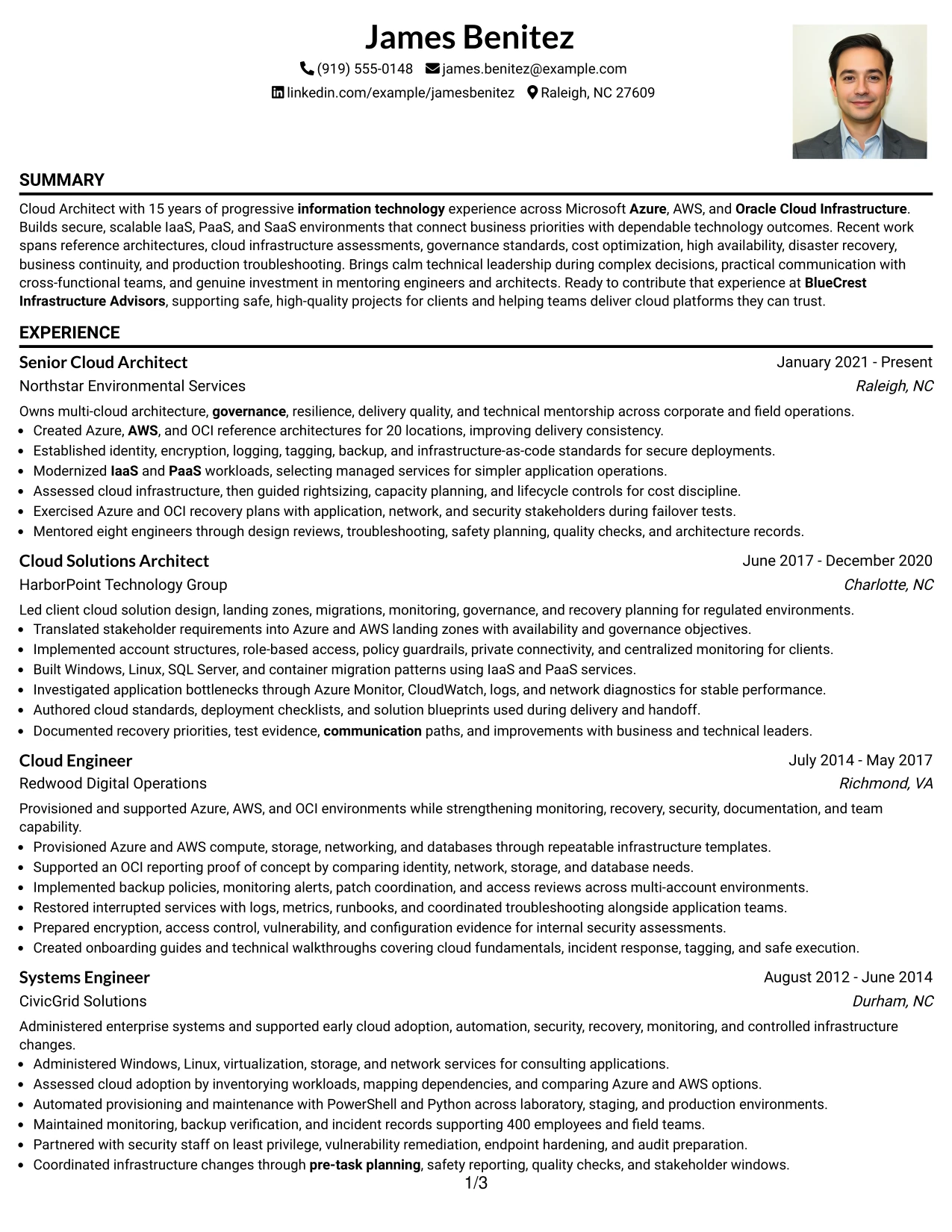
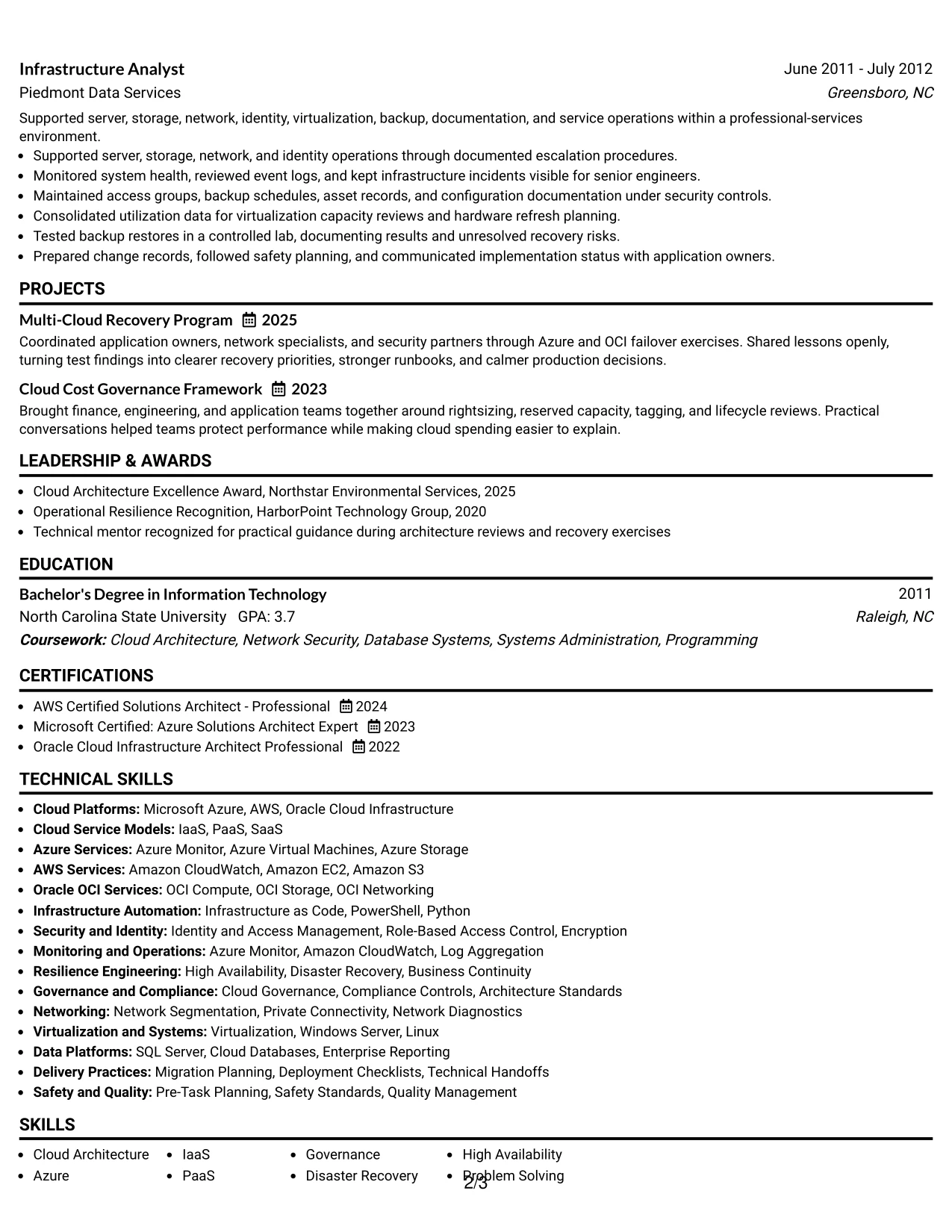
Why the One Column Format with Photo Right Works for a Resume
- The main content remains one column, which supports natural ATS reading.
- A right-side photo keeps the header visually distinct from experience details.
- Full-width bullets make technical evidence easier to review.
- The summary can connect multi-cloud scope with architecture outcomes.
- Skills can list platforms, service models, monitoring tools, and automation methods clearly.
- Certifications have room to support the stated cloud credentials.
- Projects can provide focused proof of recovery and cost governance work.
Best For
- Resumes where work evidence should remain the dominant visual priority.
- Candidates who want a personal header treatment while preserving a single-column body.
- Applications that require substantial technical bullets and clear dates.
- Documents pairing cloud architecture experience with a small project section.
- Professionals who need space for three cloud platforms and related service models.
- Resume layouts where certifications should remain visible after detailed experience.
- Readers who prefer evidence to appear in one uninterrupted content stream.
#4 Clean Two Column Sidebar Format Resume Example
Content is balanced between a broad main column and a compact sidebar. The main area can carry the summary, experience, and projects, while the sidebar groups skills, cloud platforms, certifications, and education for quick reference.
For a Cloud Architect resume, that distribution makes it possible to show detailed architecture bullets without allowing supporting qualifications to disappear at the end of the page. The sidebar also gives readers a fast view of Azure, AWS, OCI, security, governance, resilience, and automation.
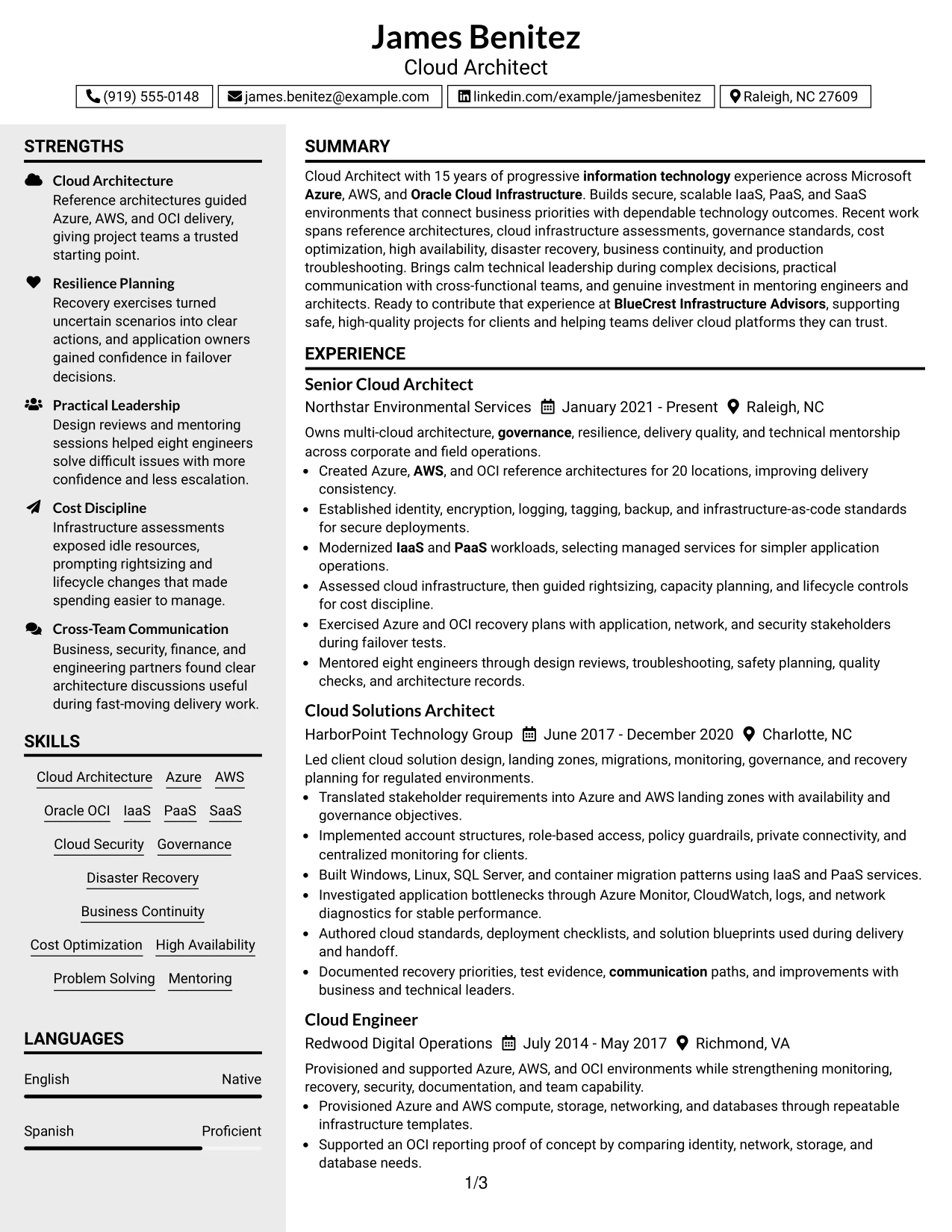
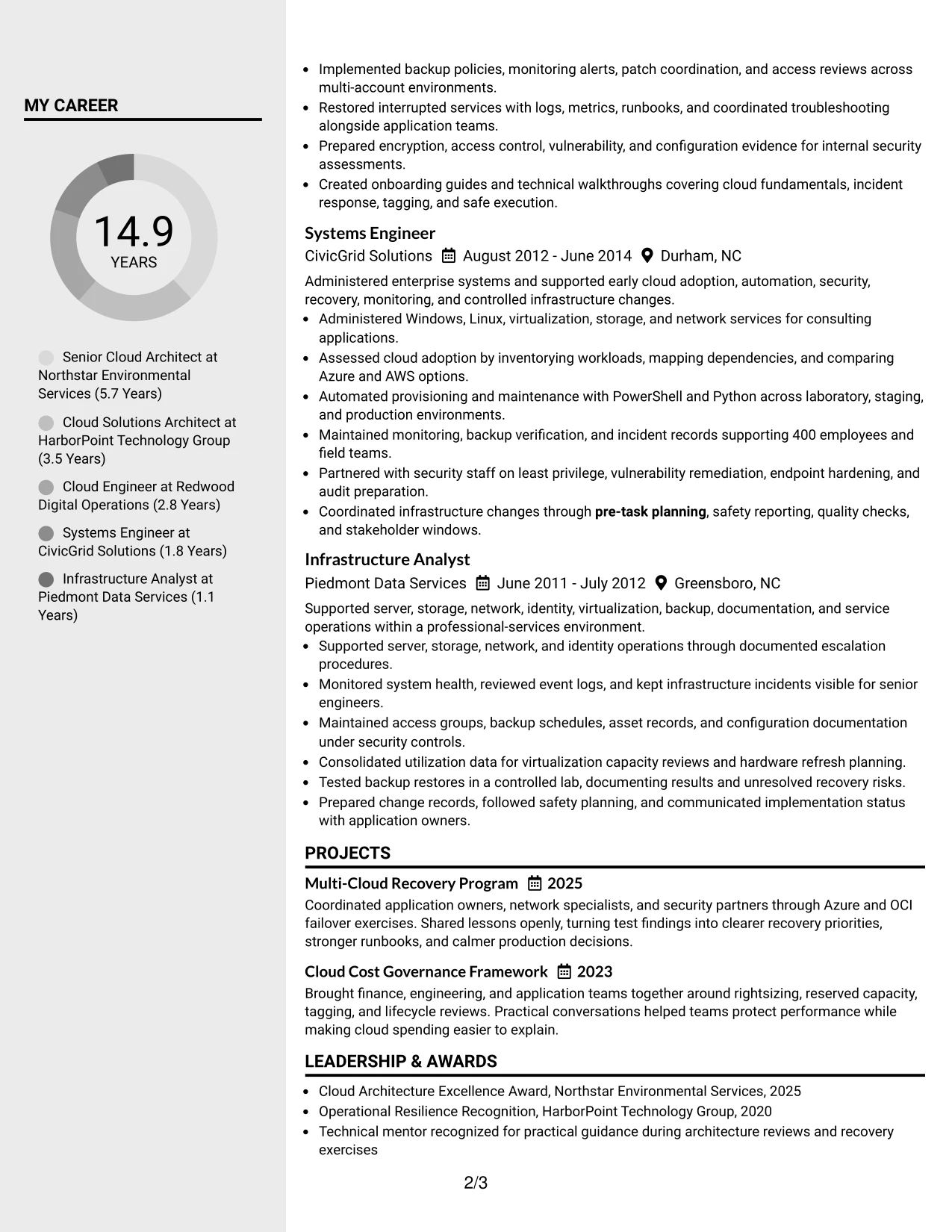
Why the Clean Two Column Sidebar Format Works for a Resume
- The main column protects space for achievement-focused experience bullets.
- The sidebar creates a quick reference area for skills and credentials.
- Projects can remain near the work history instead of being buried below it.
- Distinct zones help readers separate evidence from supporting qualifications.
- The layout can surface cloud platforms before a detailed technical review.
- Education and certifications remain visible without interrupting the career narrative.
- A restrained sidebar keeps the page organized without adding unnecessary decoration.
Best For
- Applications where detailed work history needs a larger primary column.
- Resumes that must show skills and credentials at a glance beside experience.
- Documents with projects that should stay close to related professional evidence.
- Reviewers who want to confirm platforms before reading every bullet.
- Candidates combining broad technical coverage with a focused achievement record.
- Layouts that need visible education and certifications without a long lower page.
- Resume presentations that benefit from clear separation between evidence and reference details.
#5 Two Column Format Resume Example
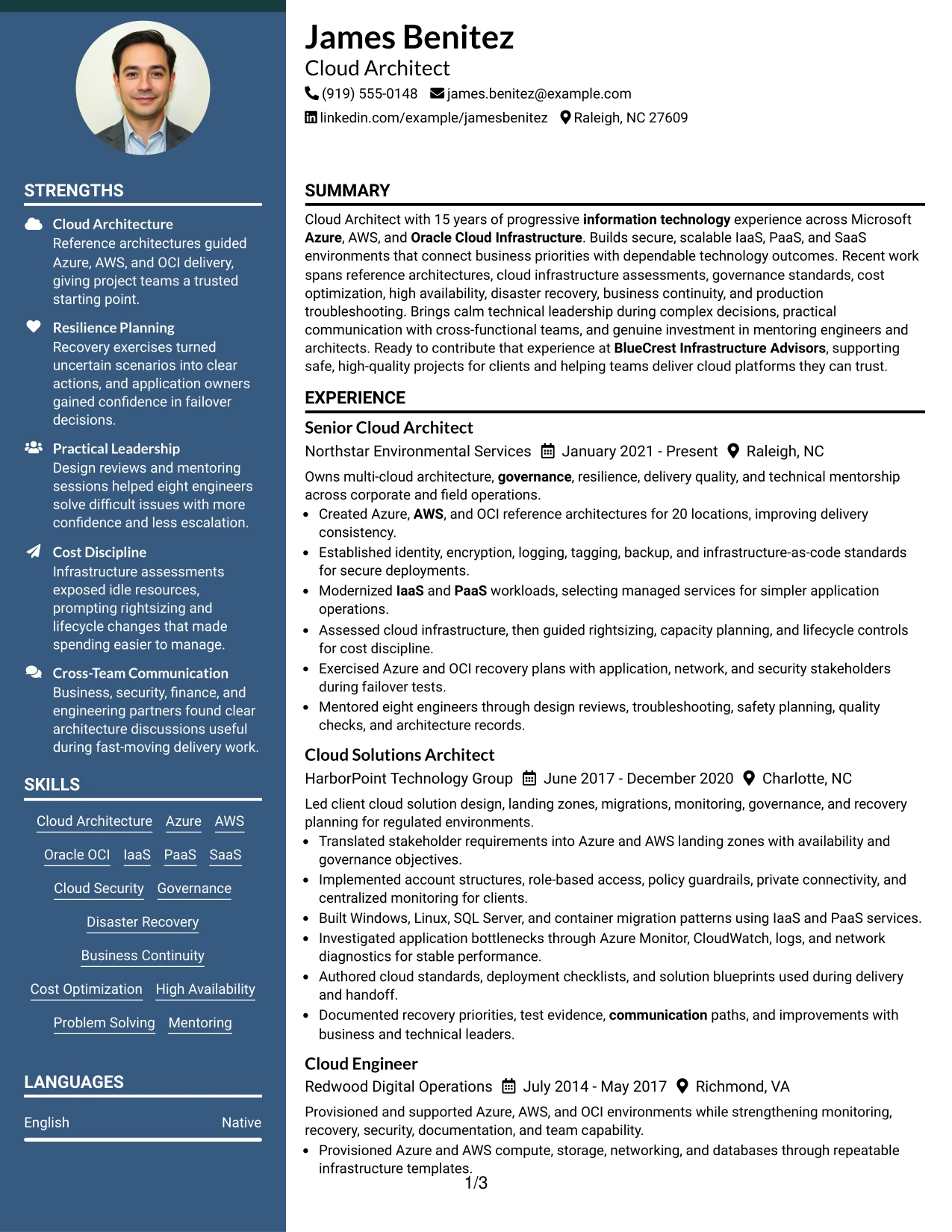
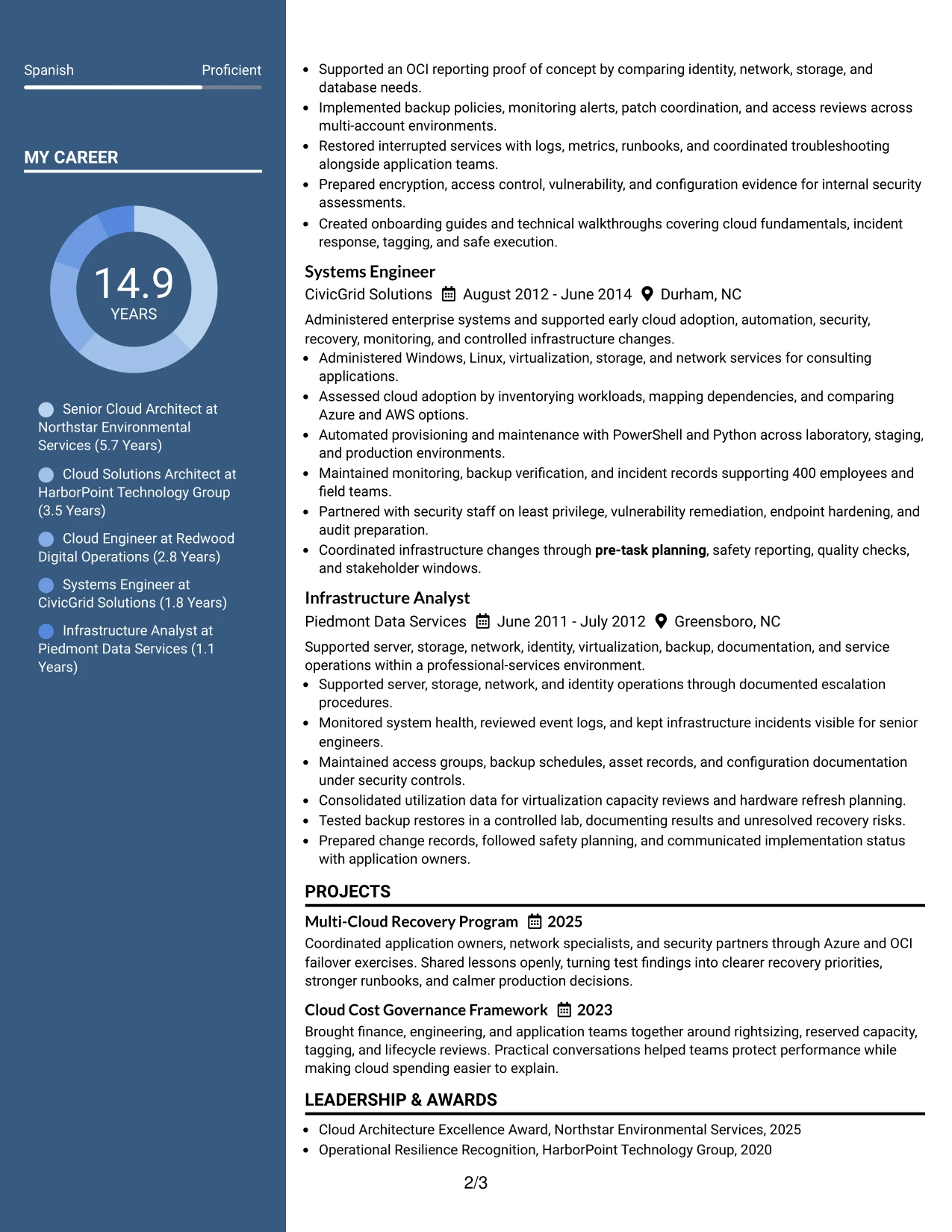
A practical application review often requires both detailed evidence and fast access to qualifications. The Two Column Format addresses both needs by placing experience and projects in one area while grouping skills, tools, education, and certifications in the other.
This arrangement suits a Cloud Architect resume with wide technical coverage. Readers can review reference architectures, landing zones, recovery planning, governance, and troubleshooting while checking the related cloud platforms, service models, monitoring tools, and automation capabilities nearby.
Why the Two Column Format Works for a Resume
- Parallel sections reduce the distance between experience and supporting skills.
- A dedicated area can organize Azure, AWS, OCI, IaaS, PaaS, and SaaS.
- The main column leaves room for bullets with methods and outcomes.
- Projects can strengthen the evidence without taking over the page.
- Certifications can be displayed where technical qualifications are easy to verify.
- The format helps a reader compare responsibilities with relevant tools.
- Clear grouping reduces repeated keywords inside every experience bullet.
Best For
- Resumes that must present broad technical coverage beside detailed experience.
- Applications where tools and certifications should be visible during the first review.
- Professionals with projects that add useful evidence beyond formal employment.
- Documents balancing architecture responsibilities with operational capabilities.
- Readers who compare cloud platforms, service models, and resilience skills together.
- Candidates needing a compact way to show education and credentials.
- Resume pages where organized density is more useful than a long single-column flow.
#6 Photo Header Two Column Format Resume Example
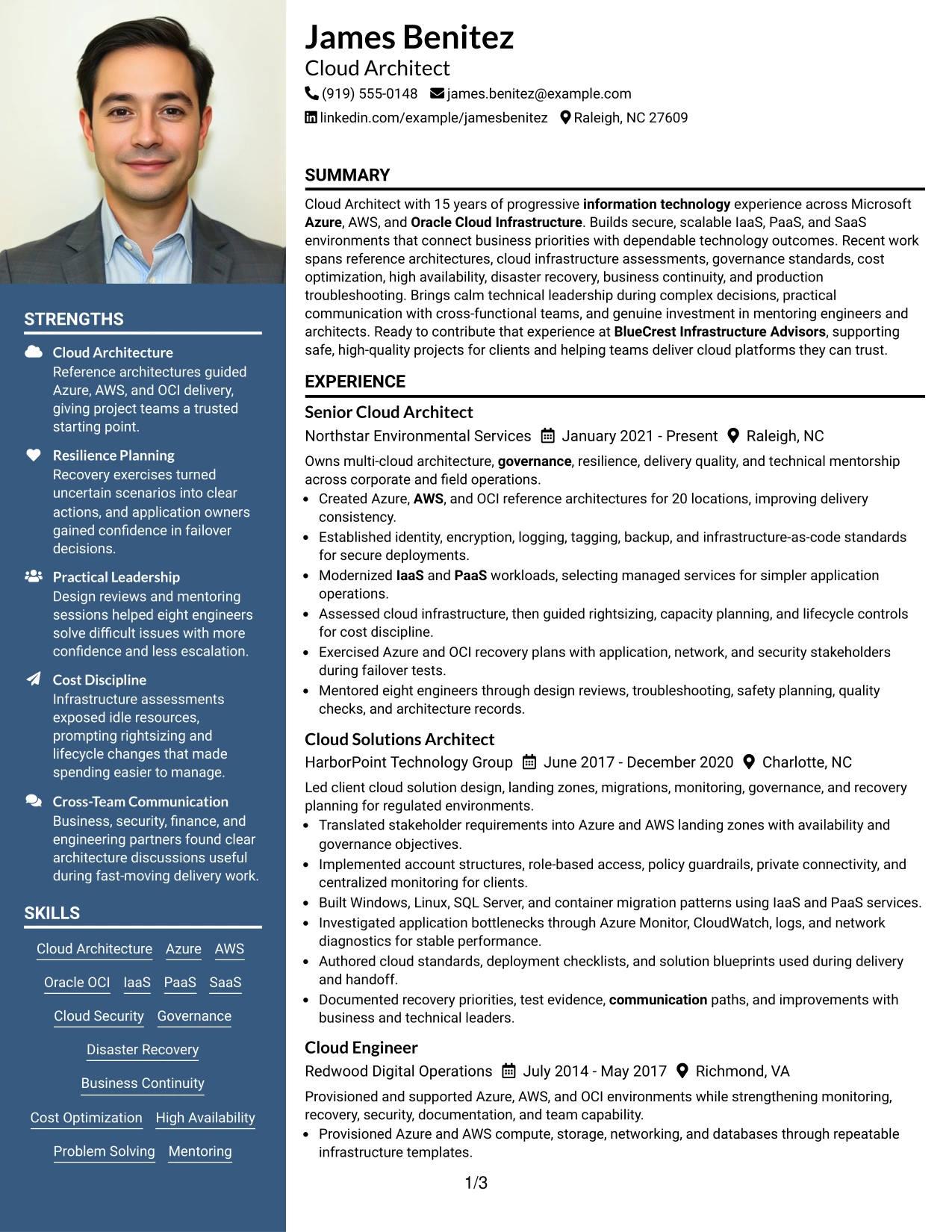
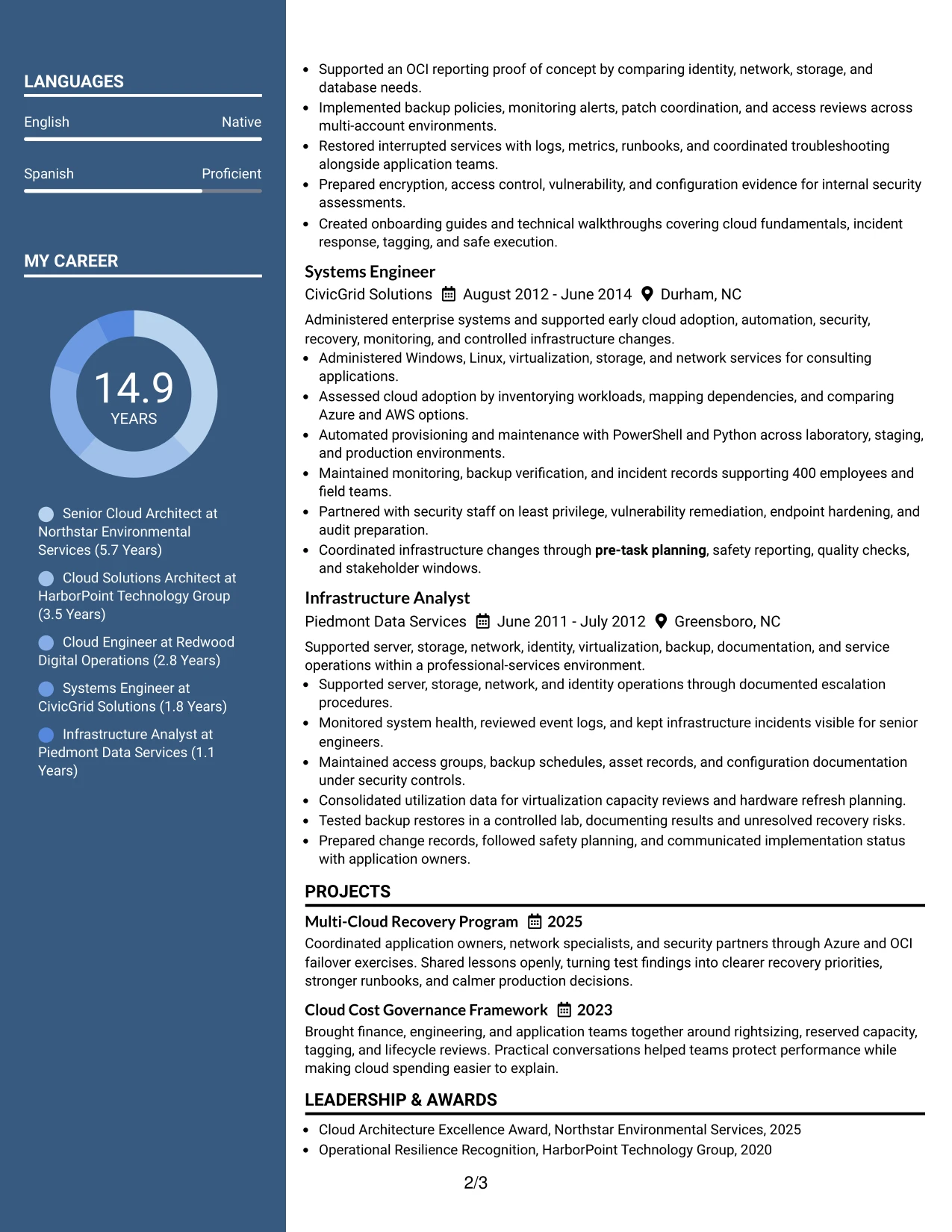
A restrained visual hierarchy keeps the header memorable while two columns distribute the resume content. The photo header can establish a clear identity area, and the body can separate career evidence from technical qualifications.
For this Cloud Architect resume, the main column can present progressive experience, architecture standards, recovery exercises, and cost governance. A companion column can organize Azure, AWS, OCI, security, monitoring, certifications, and education for quick comparison.
Why the Photo Header Two Column Format Works for a Resume
- The photo header creates a distinct top section without taking space from the body.
- Two columns separate achievement evidence from reference information.
- The main area supports bullets that explain architecture decisions and scope.
- A skills area can group platforms, service models, and operational tools.
- Certifications remain easy to locate during an initial qualification check.
- Projects can add focused proof without disrupting the employment timeline.
- The hierarchy gives the page a polished appearance while keeping sections identifiable.
Best For
- Resumes where a distinct personal header supports the intended presentation.
- Applications needing two clear zones for experience and technical qualifications.
- Documents that combine detailed cloud architecture evidence with many credentials.
- Readers who want to compare platforms and certifications while reviewing achievements.
- Candidates presenting projects as a focused complement to employment history.
- Professional profiles where a polished visual introduction fits the application setting.
- Layouts that need structured density without placing every section in one column.
#7 Simple Two Column Format Resume Example
The Simple Two Column Format uses a direct structure: one column carries the main resume story, while the other provides quick access to supporting details. Clear headings and compact bullet groups help readers move between experience, projects, skills, education, and certifications.
This approach can show the breadth of a Cloud Architect background without making the page feel crowded. Architecture ownership, cloud assessments, disaster recovery, high availability, troubleshooting, and mentoring remain central, while platforms and credentials are easy to confirm.
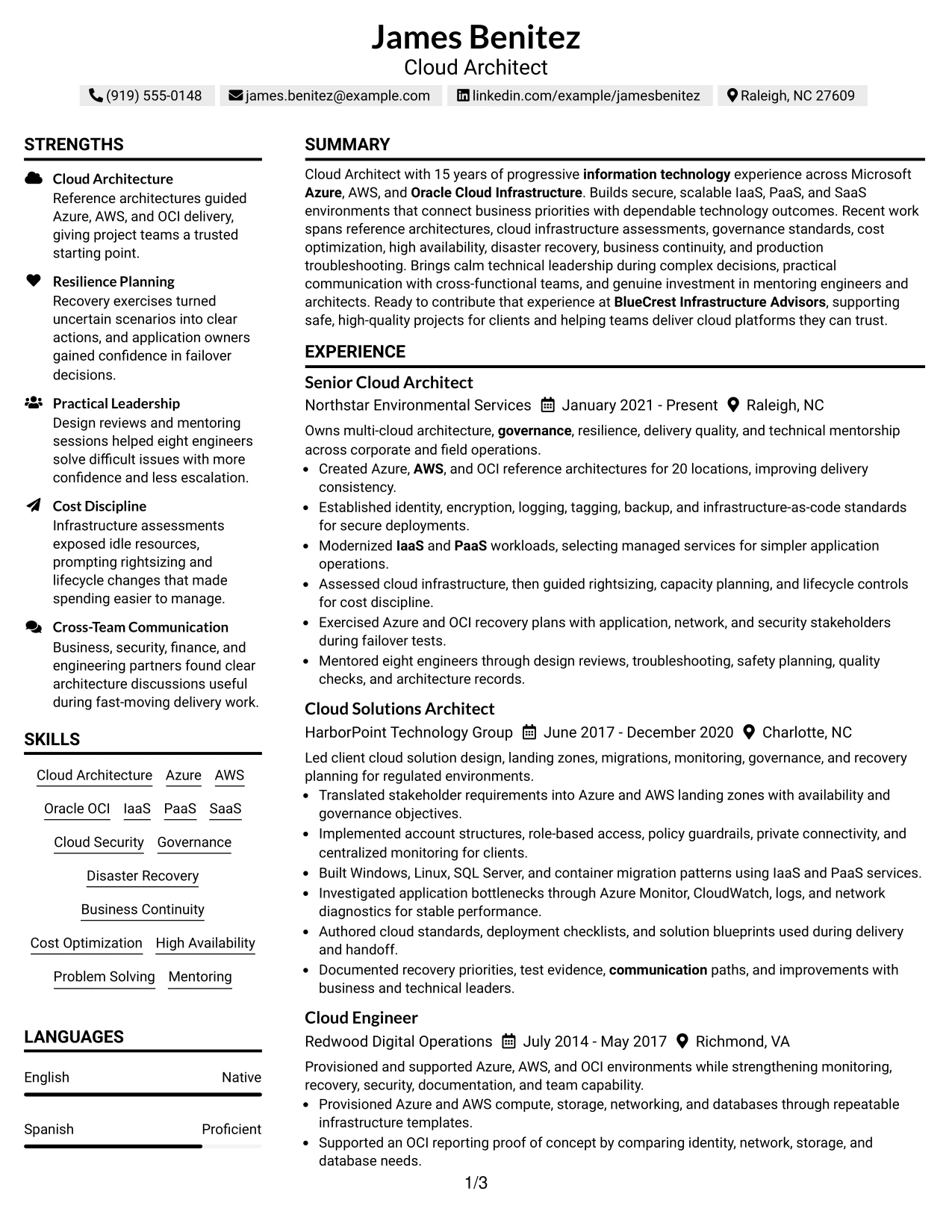
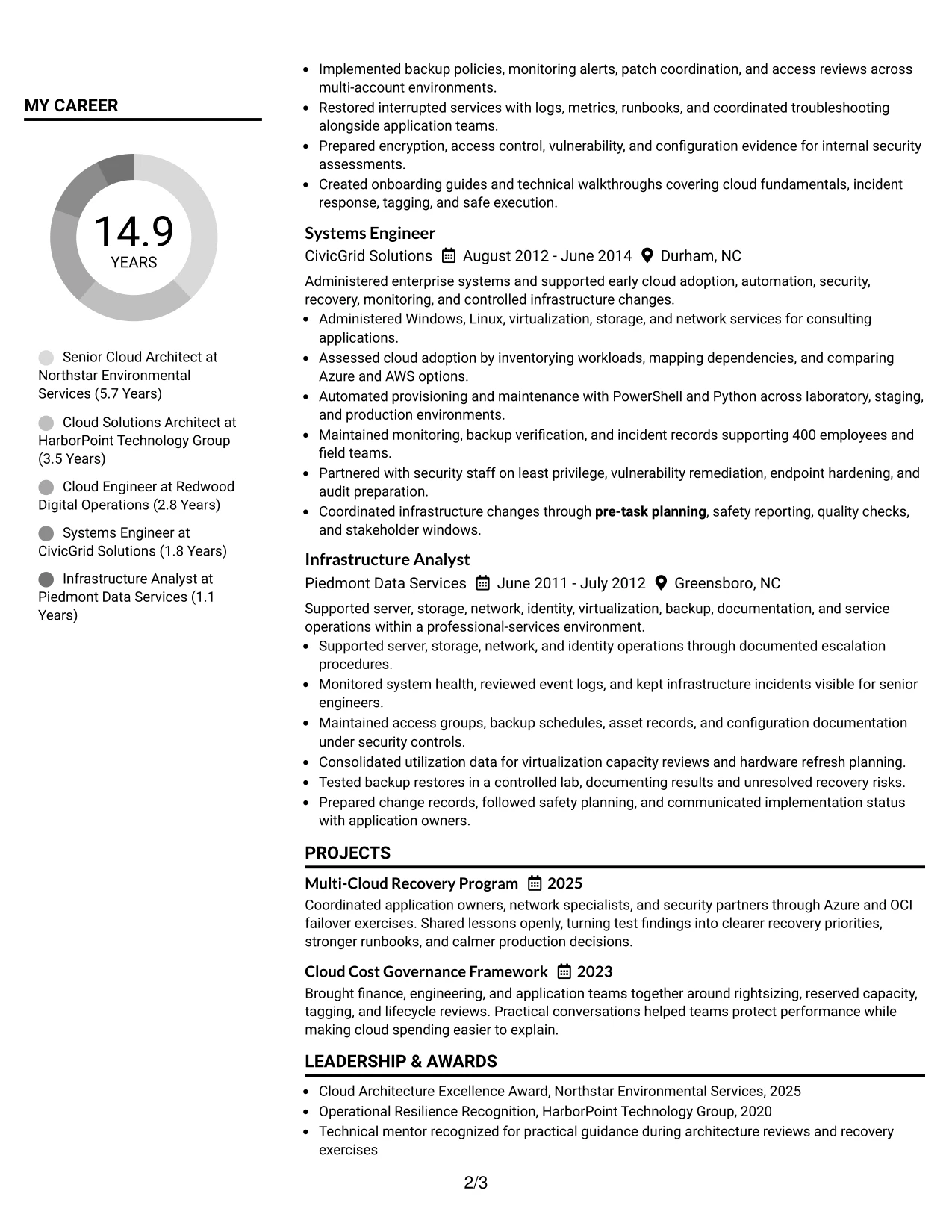
Why the Simple Two Column Format Works for a Resume
- A direct two-column structure makes the page easy to scan.
- The main column gives priority to experience and measurable scope.
- The secondary column can hold skills, education, and certifications together.
- Short bullet groups keep architecture evidence readable.
- Projects can be placed where they support the strongest related experience.
- Cloud platforms remain visible without repeating them in every section.
- Simple headings help both human readers and ATS tools interpret the content.
Best For
- Resumes seeking two-column organization without a complex visual treatment.
- Applications where experience should lead and qualifications should remain nearby.
- Professionals with several cloud platforms to present in a compact skills area.
- Documents that include both formal projects and a long work history.
- Readers who value quick movement between evidence and technical keywords.
- Candidates needing a clean place for education and certifications beside experience.
- Resume reviews where straightforward grouping matters more than visual effects.
#8 Text/Fang Style Resume Example
Readers can follow the Text/Fang Style from the professional summary through a continuous sequence of labeled sections. The single-column body gives each role, project, certification, and skill group enough horizontal space for clean text and complete bullets.
That extra room is valuable when the resume must carry substantial technical content. It can explain multi-cloud reference architectures, IaaS and PaaS modernization, security controls, monitoring, infrastructure as code, recovery testing, and cross-functional leadership without compressing the evidence into narrow blocks.
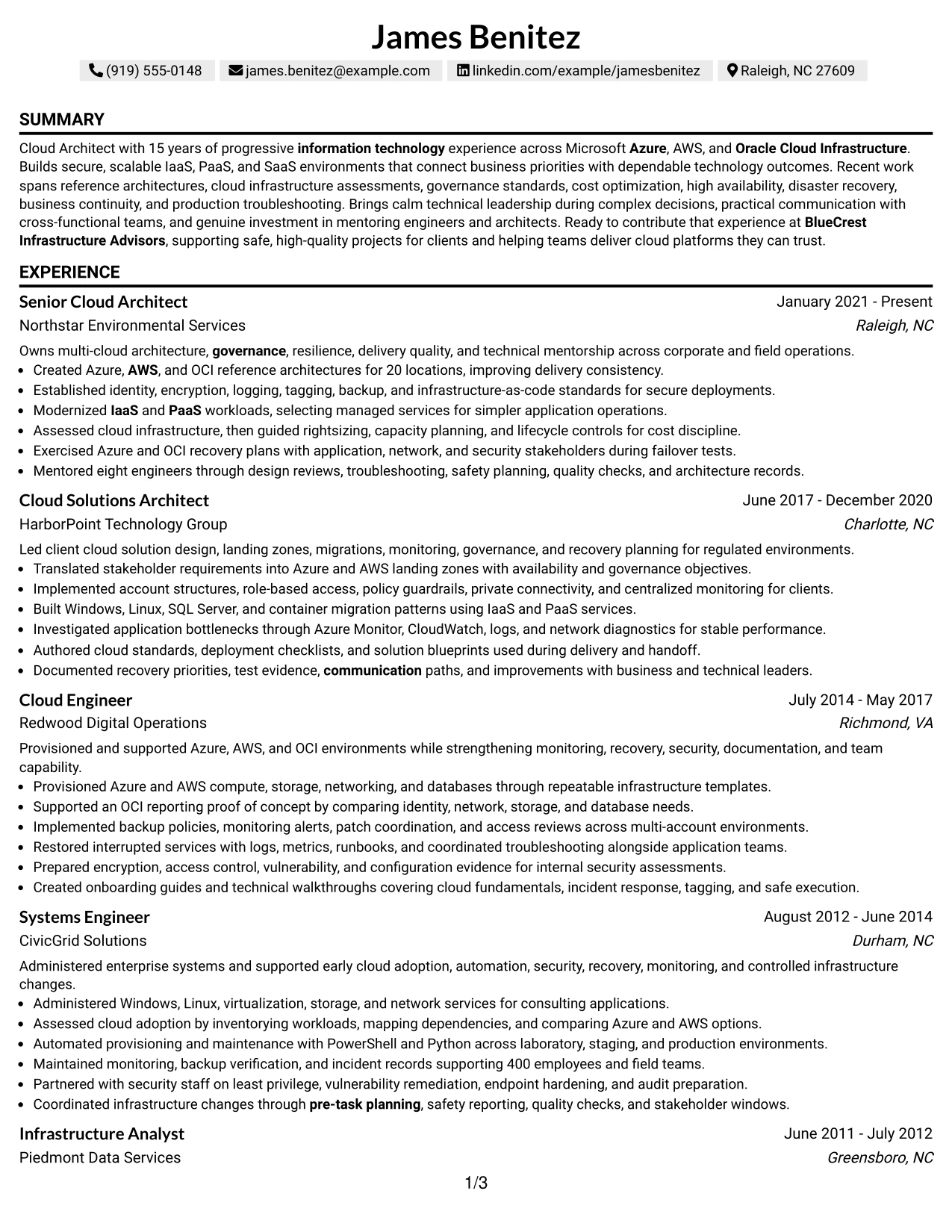
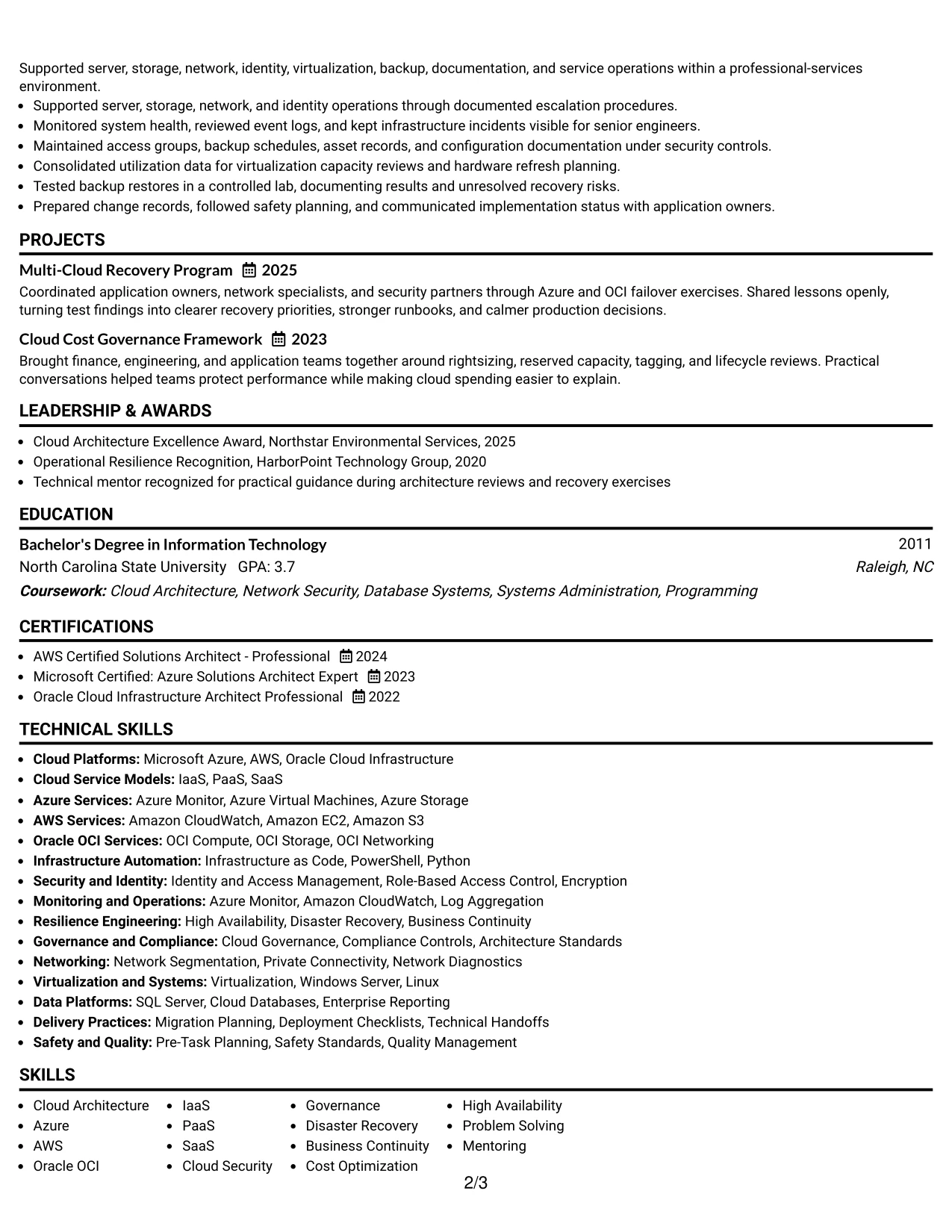
Why the Text/Fang Style Works for a Resume
- Continuous text flow makes a detailed work history easy to follow.
- The single column supports longer bullets with useful technical detail.
- Section labels distinguish experience, projects, skills, and certifications.
- ATS systems can read the content in a standard top-to-bottom order.
- The format provides space for both architecture strategy and operational work.
- Education can follow the core evidence without being reduced to a small sidebar.
- A text-led design keeps visual treatment secondary to qualifications and results.
Best For
- Resumes carrying extensive technical detail across several positions.
- Applications where complete bullets matter more than compact side-by-side presentation.
- Professionals documenting both architecture leadership and hands-on operations.
- Documents needing room for cloud security, monitoring, automation, and recovery terms.
- Readers who prefer a continuous review path through a substantial career record.
- Candidates with projects that require short explanations rather than title-only entries.
- ATS-focused submissions using familiar text flow and standard section order.
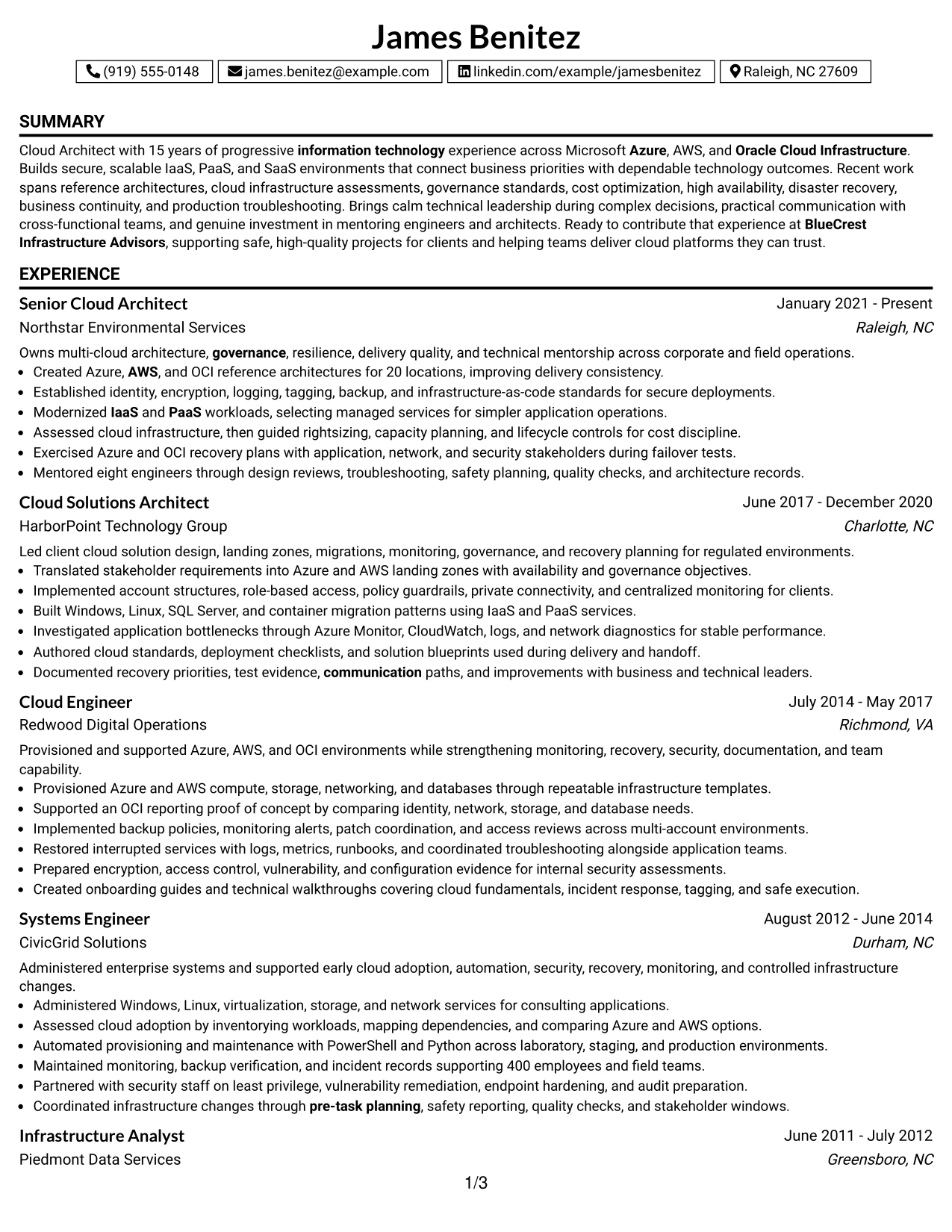
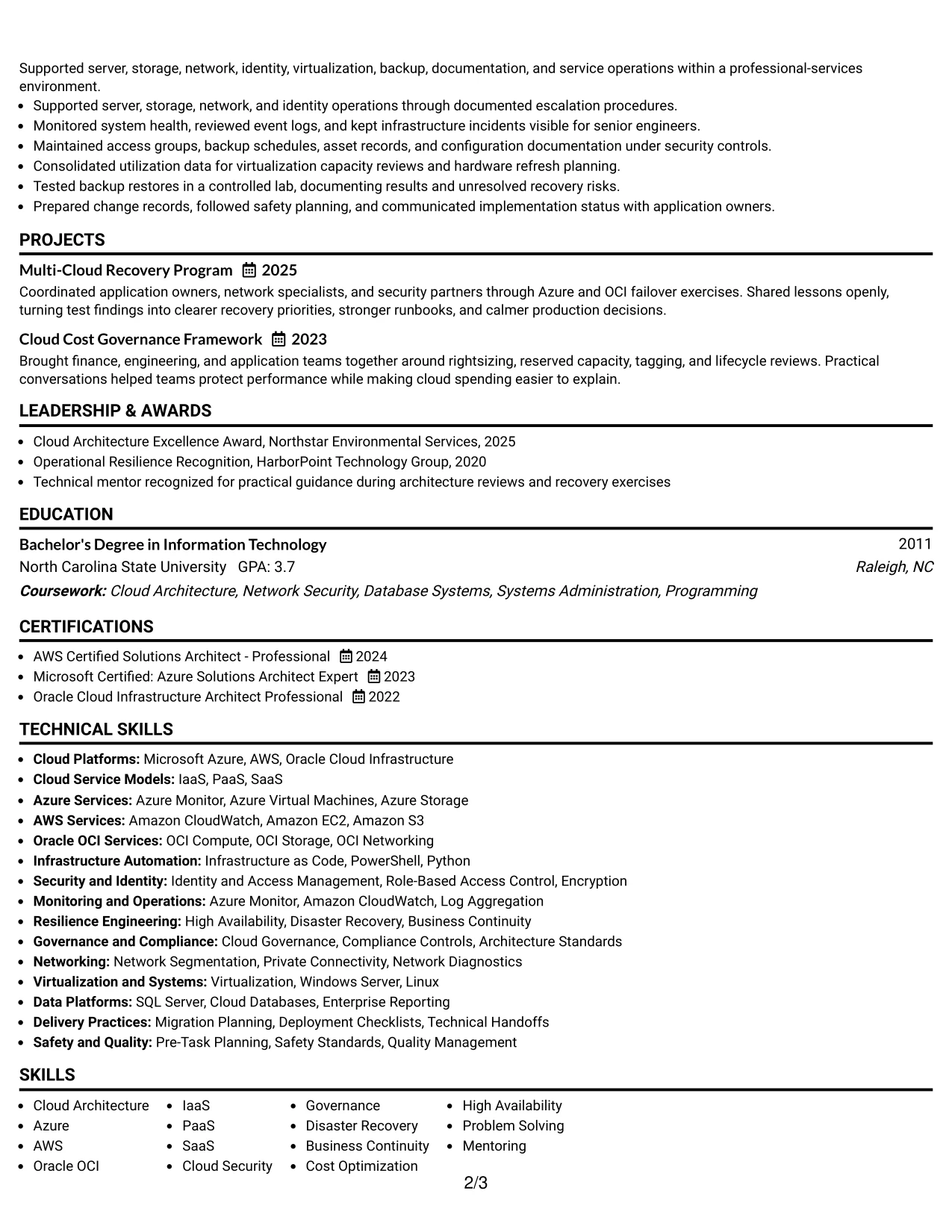
#9 One Column Boxed Contact Header Format Resume Example
The strongest evidence begins below a contained contact header. A boxed contact area separates essential details from the professional summary, allowing the resume to move quickly into cloud architecture scope, achievements, projects, skills, education, and certifications.
The one-column body gives each accomplishment a clear place. It can highlight 20 locations, eight mentees, 400 employees supported in earlier work, multi-cloud governance, failover exercises, cost controls, and technical troubleshooting while keeping the page easy to parse.
Why the One Column Boxed Contact Header Format Works for a Resume
- The contact box makes core contact details easy to verify.
- A full-width body gives evidence more room than a narrow column.
- The summary can connect the target role to the most relevant capabilities.
- Bullets can include scope, methods, and outcomes without visual crowding.
- Skills and tools remain in a standard section that supports ATS parsing.
- Projects can reinforce specialized evidence such as recovery and cost governance.
- The clear boundary between header and content improves page hierarchy.
Best For
- Resumes that need a strong separation between contact details and qualifications.
- Applications where a compact header should preserve maximum body space.
- Professionals presenting quantified scope across locations, teams, or supported users.
- Documents that rely on full-width bullets to explain complex technical work.
- Readers who want evidence to begin immediately after the summary.
- Candidates pairing certifications with a detailed cloud platform history.
- ATS-aware layouts that use a contained header but conventional resume sections.
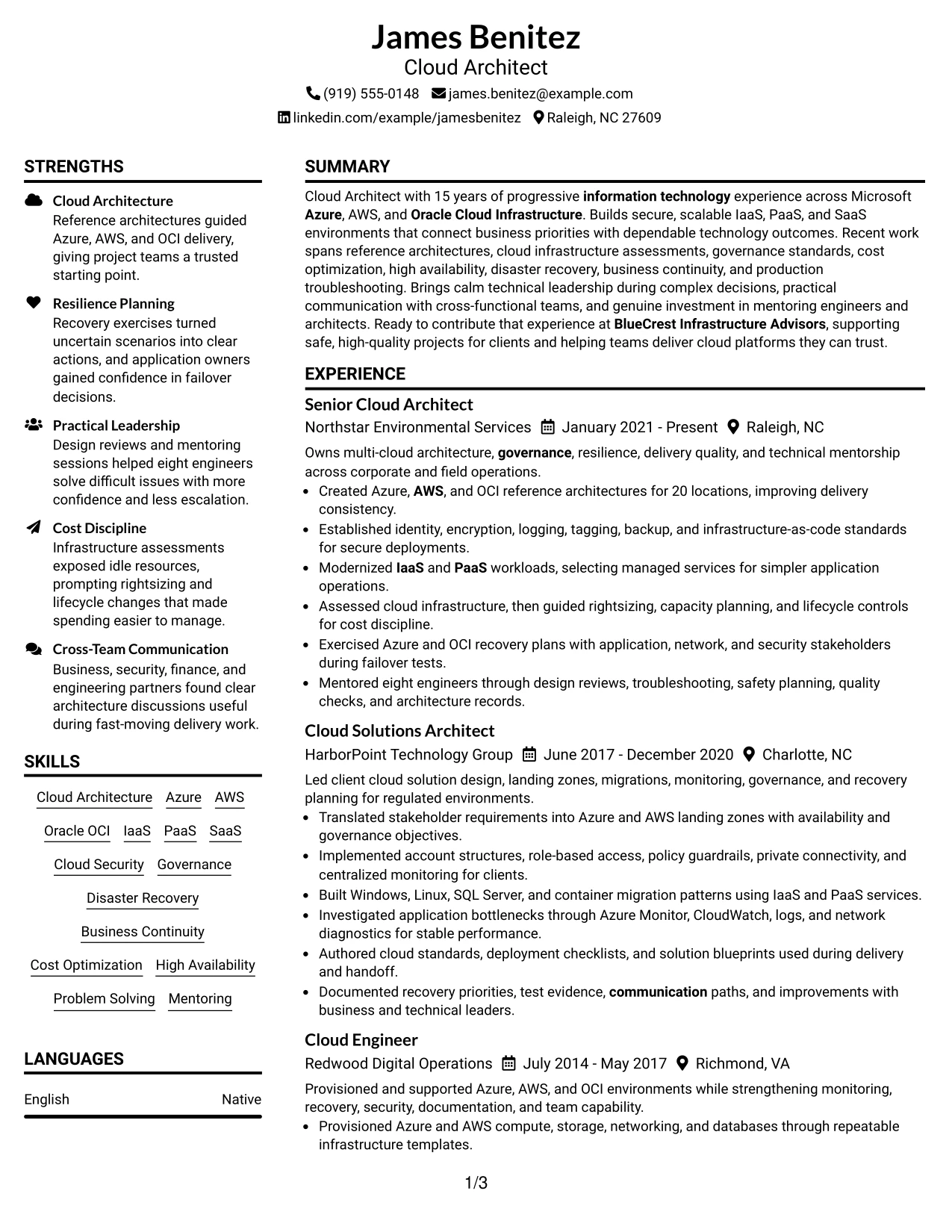
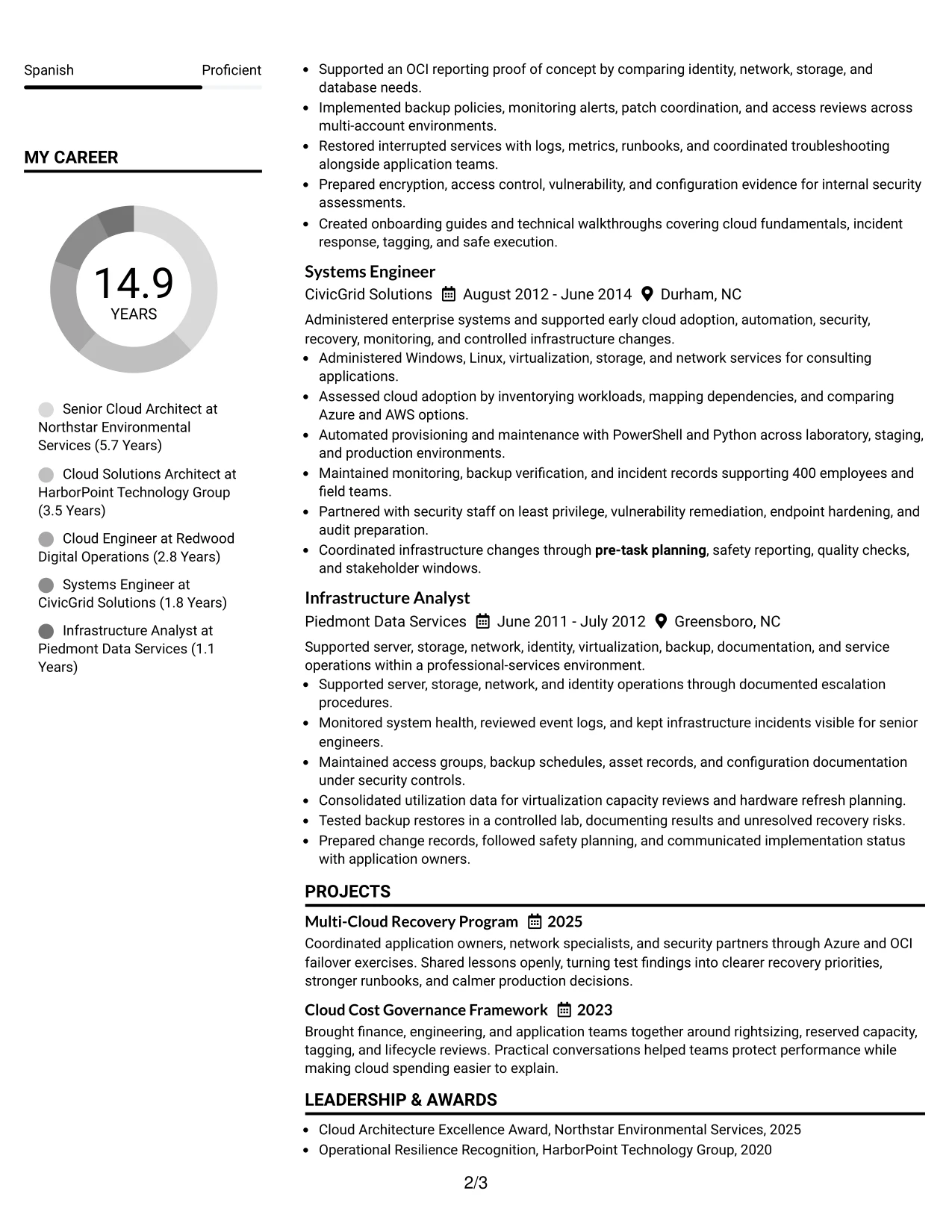
#10 Plain Two Column Format Resume Example
Balanced content distribution helps a reviewer confirm fit quickly, then examine the supporting detail. The Plain Two Column Format can place a concise resume snapshot and keyword-rich skills in one area while giving experience, projects, education, and certifications a clear companion area.
For James Benitez, the snapshot can point to 15 years of information technology experience, three cloud platforms, architecture standards, resilience planning, and technical leadership. A focused keyword section can reinforce Cloud Architect, Azure, AWS, Oracle OCI, cloud security, governance, high availability, and disaster recovery.
Resume Snapshot
- 15 years of progressive information technology experience
- Azure, AWS, and Oracle Cloud Infrastructure architecture
- Cloud security, compliance, governance, and cost optimization
- High availability, disaster recovery, business continuity, and mentoring
Why the Plain Two Column Format Works for a Resume
- Two balanced areas let a reviewer see summary evidence and career detail together.
- A snapshot gives the most relevant qualifications an early position.
- Keyword grouping strengthens alignment with the Cloud Architect requirements.
- The experience area can retain detailed bullets and project context.
- Education and certifications remain visible without overwhelming the summary.
- Plain styling supports ATS parsing and straightforward human review.
- The format reduces search time for platforms, resilience terms, and leadership evidence.
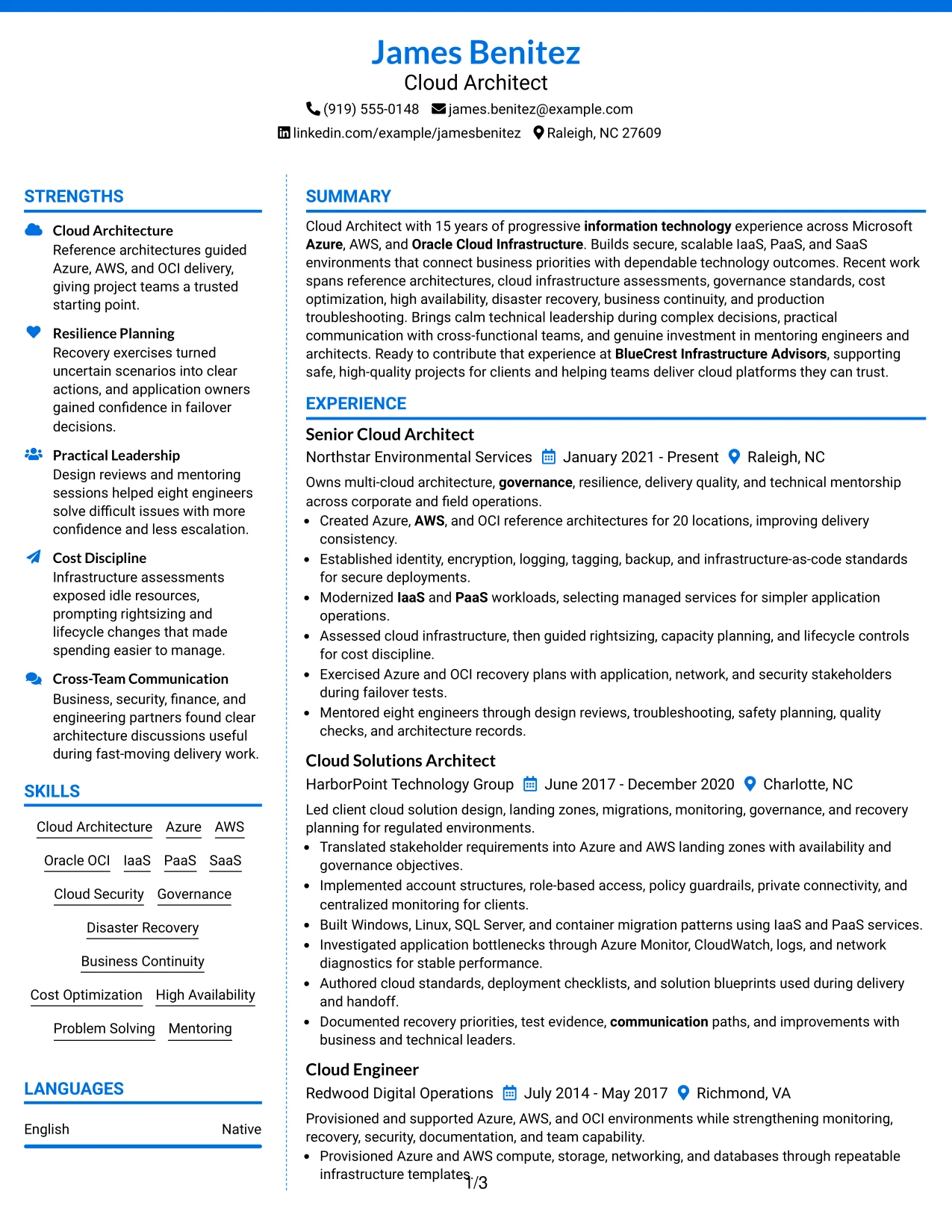
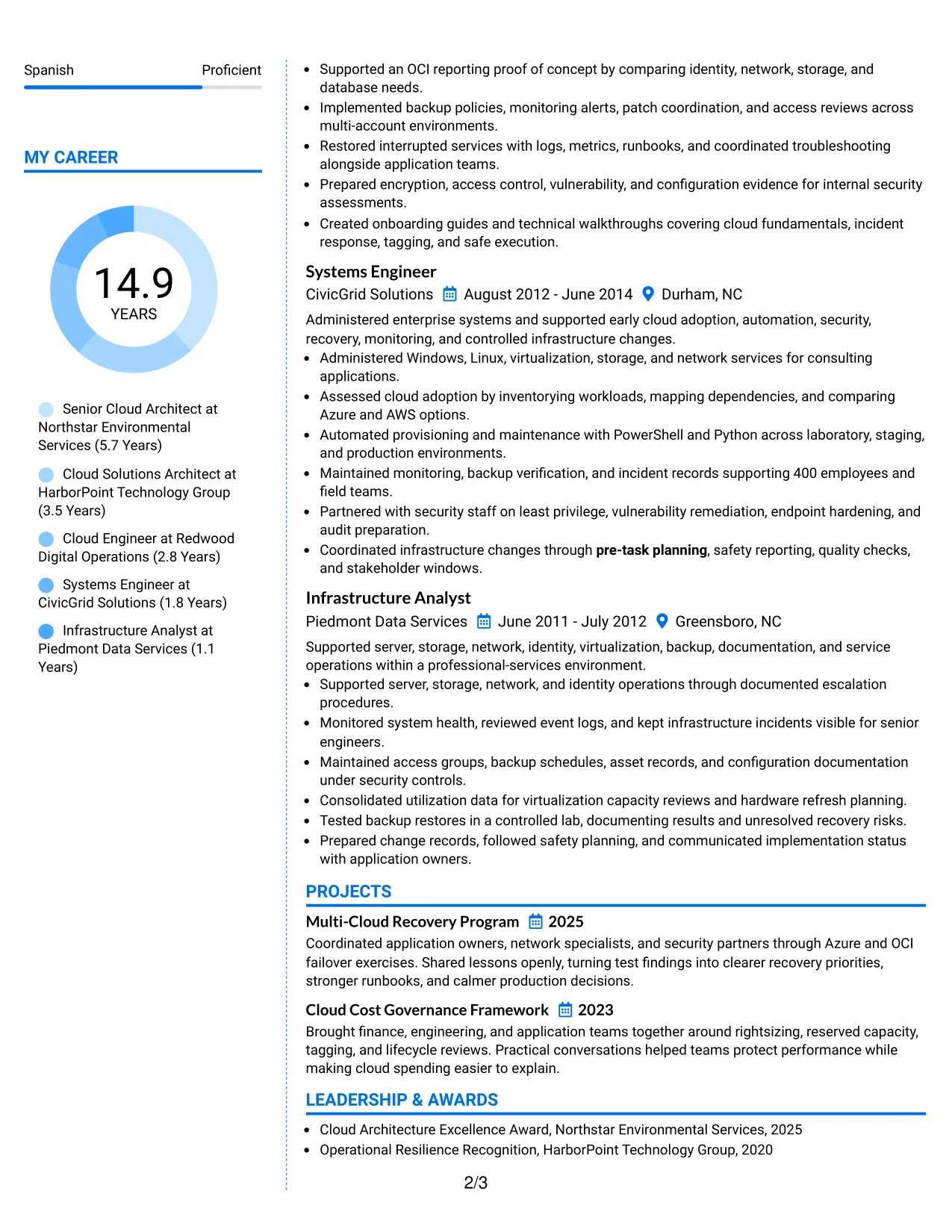
#11 Colored Two Column Format Resume Example
A practical application review benefits from clear visual separation without losing a professional tone. The Colored Two Column Format uses contrasting areas to distinguish the main experience record from supporting skills, tools, education, certifications, and projects.
The color treatment can guide attention while the content remains grounded in resume evidence. Detailed bullets can cover cloud design, standards, assessments, recovery planning, monitoring, troubleshooting, and mentoring, while the secondary area keeps the technical keyword set visible.
Why the Colored Two Column Format Works for a Resume
- Color can mark the difference between primary evidence and supporting details.
- The main column provides room for architecture achievements and scope.
- A secondary area can group cloud platforms, tools, and certifications.
- Visual grouping helps readers find keywords during a fast review.
- Projects can be separated from employment history while remaining easy to locate.
- The format supports a polished presentation without replacing standard resume sections.
- Consistent headings keep the document readable when printed or viewed digitally.
Best For
- Resumes that need visual distinction between experience and qualification groups.
- Applications where a polished color treatment supports, but does not replace, clear structure.
- Professionals presenting architecture achievements beside a broad technical toolkit.
- Documents that must keep certifications and education easy to find.
- Readers who benefit from visual cues during a rapid qualification review.
- Candidates with projects that should stand apart from the employment timeline.
- Resume presentations where organized contrast improves navigation across dense content.
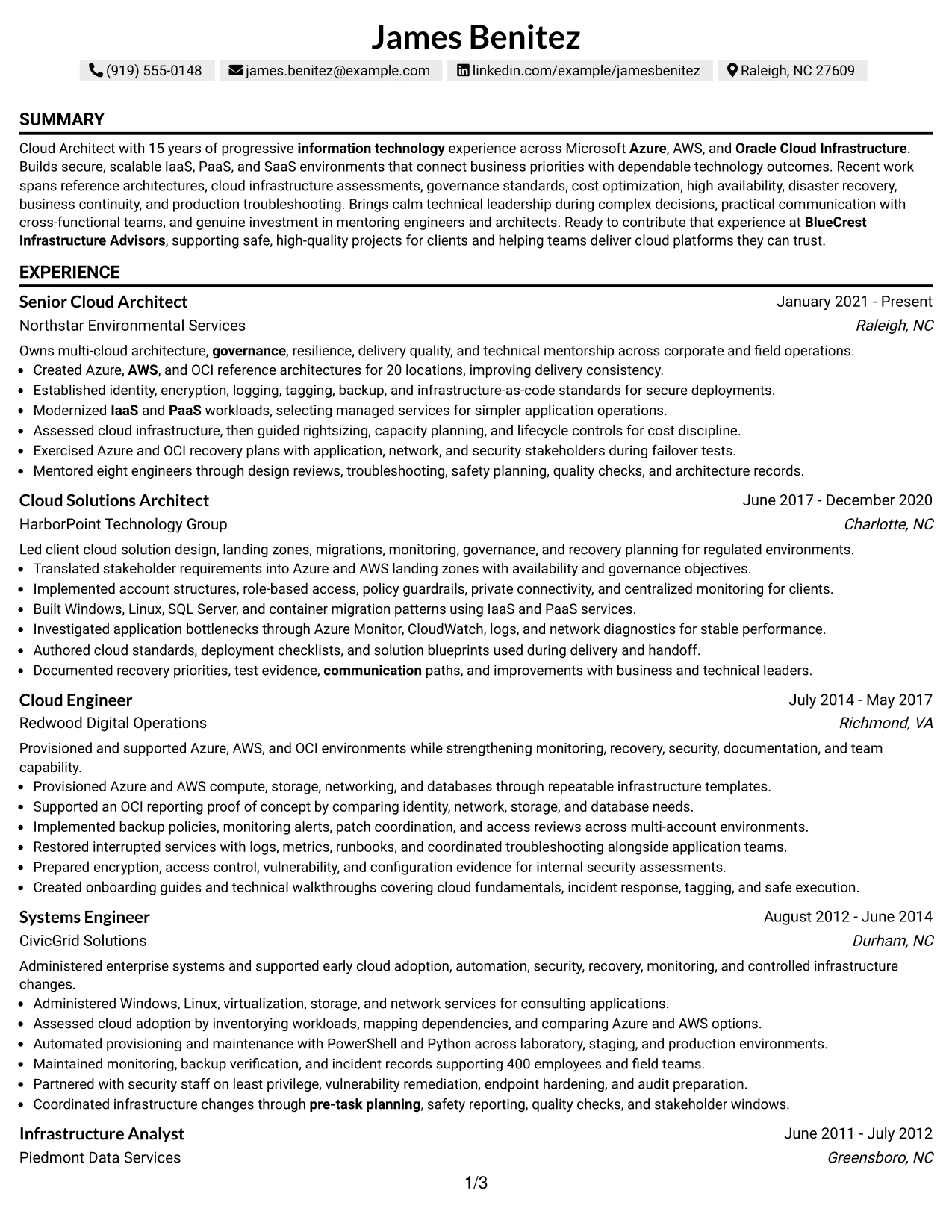
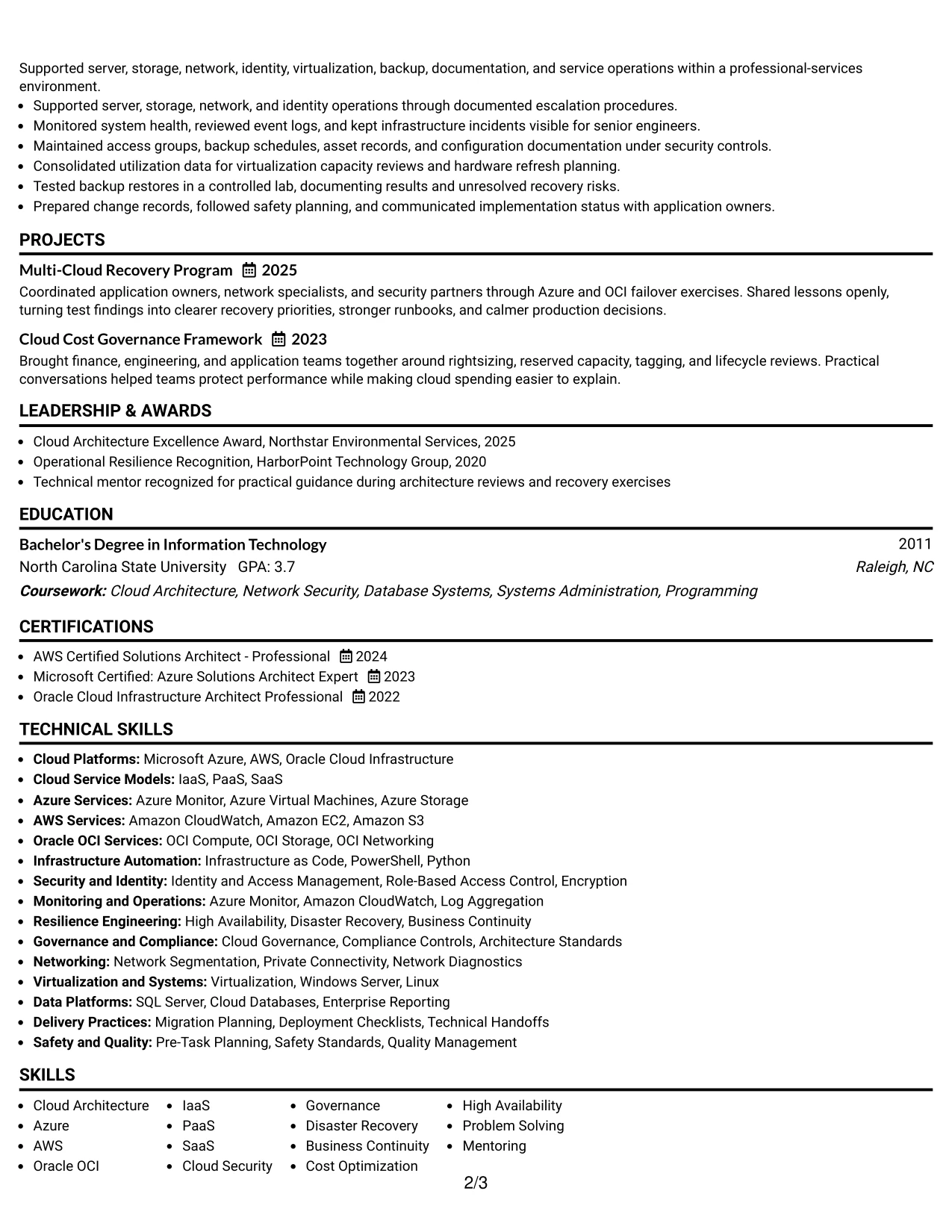
#12 One Column Shaded Contact Header Format Resume Example
A restrained visual hierarchy gives the resume a polished, professional impression before the reader reaches the detail. The shaded contact header separates essential contact information from the Cloud Architect title and summary.
A single content column keeps the professional summary, multi-cloud experience, certifications, education, projects, and skills in one reliable reading path. Clear section labels and achievement-focused bullets help surface Azure, AWS, OCI, governance, resilience, and cost optimization terms during review.
#12 Why This Format Works for a Resume
- The shaded header creates a clear starting point without distracting from the content.
- One column supports a natural top-to-bottom review on screen or paper.
- The job title appears near the contact details, reinforcing role alignment immediately.
- A focused summary can connect 15 years of information technology experience to the target Cloud Architect role.
- Short bullets make reference architectures, recovery exercises, standards, and mentoring easy to scan.
- Certifications and technical skills remain visible in a predictable section order.
- The simple structure supports both recruiter review and ATS parsing.
#12 Best For
- Cloud Architect applications that need immediate role alignment at the top of the page.
- Resumes with substantial experience that benefit from a single uninterrupted reading path.
- Multi-cloud backgrounds where Azure, AWS, and OCI need equal visibility.
- Documents that combine architecture standards with measurable evidence such as 20 locations and eight engineers.
- ATS-focused applications that require familiar headings and clean text flow.
- Technical resumes that include projects, certifications, education, and detailed skills.
- Readers who prefer restrained styling over decorative design.
#13 Boxed Contact Header with Job Title Format Resume Example
The boxed contact header organizes the name, contact details, and Cloud Architect title as a compact first block. It gives the reader an immediate reference point before the resume moves into the summary and supporting sections.
A clean one-column structure then places experience, projects, certifications, education, and skills in a familiar order. Shaded labels and concise bullets make governance, cloud security, disaster recovery, cost discipline, and technical leadership easy to locate.
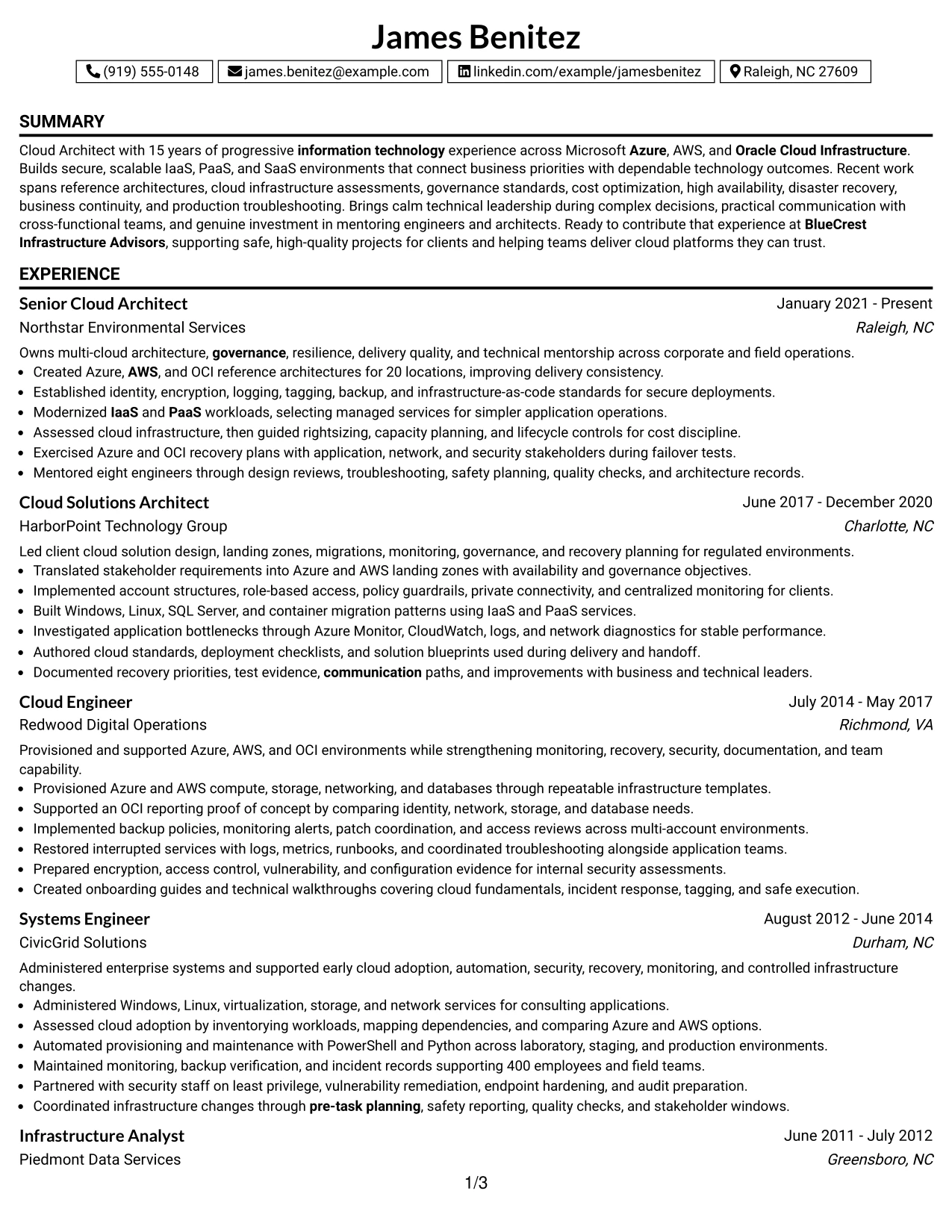
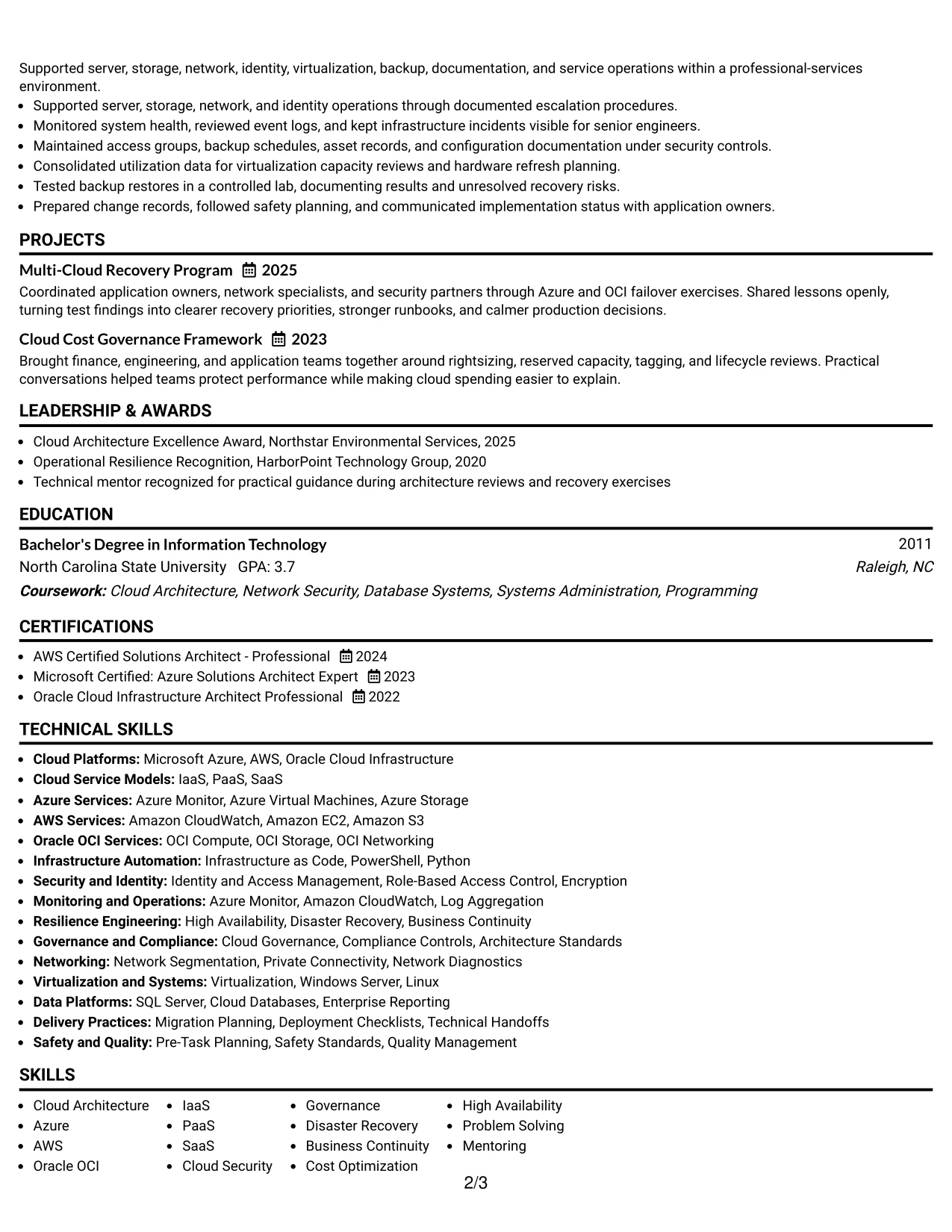
#13 Why This Format Works for a Resume
- The boxed header groups contact information without using valuable body space.
- The job title is prominent and directly supports the target role.
- A conventional section sequence helps readers find experience and credentials quickly.
- Bullets emphasize actions such as established, directed, designed, and mentored.
- The format gives certifications room to support the Azure, AWS, and OCI focus.
- Project entries can add evidence for recovery planning and cost governance.
- A clean text structure remains practical for ATS review and online applications.
#13 Best For
- Applications where the target title should be unmistakable in the first visual block.
- Resumes that need a compact contact area followed by detailed technical content.
- Cloud professionals presenting several certifications alongside long-term experience.
- Documents that rely on strong section labels to guide fast recruiter scanning.
- Applications requiring clear separation between summary, work history, projects, and credentials.
- Resumes with standards, governance, and recovery work that benefits from labeled evidence.
- Readers who want a structured design with modest visual emphasis.
#14 Stylish Two Column Designer Format Resume Example
Readers can move through the main experience column for career evidence while using the supporting column for skills, certifications, education, and contact details. That navigation separates detailed accomplishments from quick-reference information.
The two-column design accommodates substantial content without making every section feel equally dense. The main area can show architecture standards, infrastructure assessments, recovery tests, and mentoring, while the side area keeps Azure, AWS, OCI, IaaS, PaaS, and SaaS terms visible.
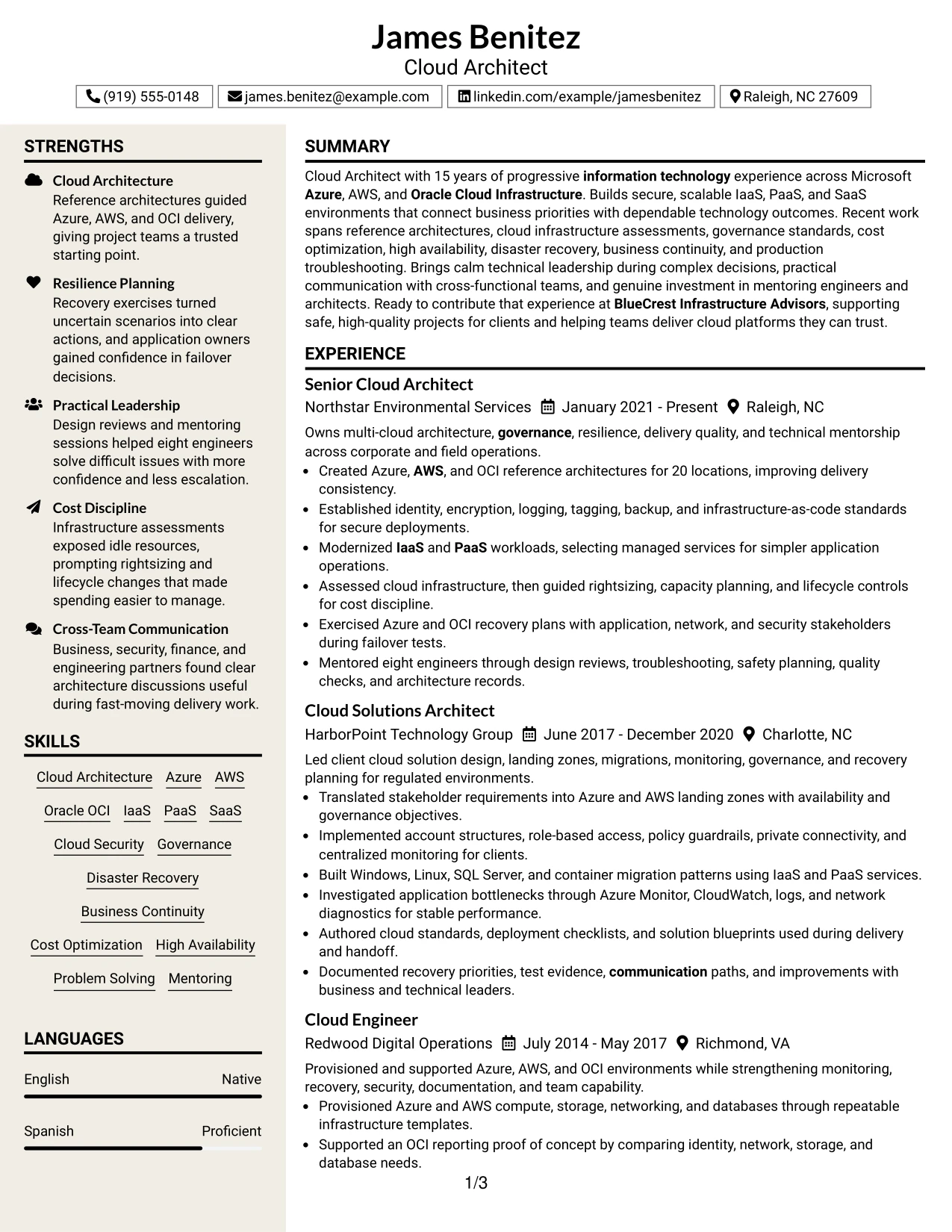
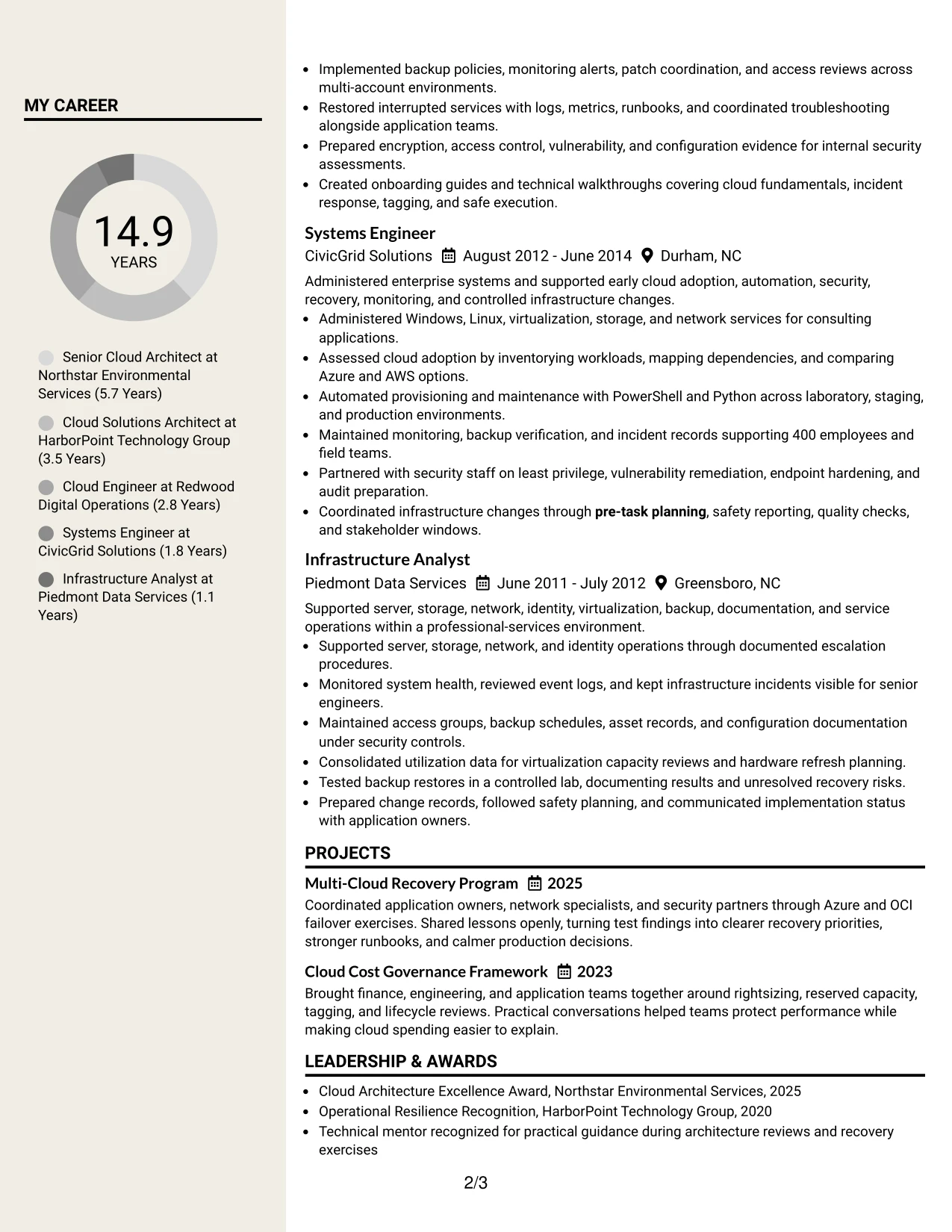
#14 Why This Format Works for a Resume
- Two columns divide detailed evidence from supporting credentials.
- The main column gives professional experience enough room for action-oriented bullets.
- A sidebar can hold technical skills without interrupting the work-history narrative.
- Projects add focused proof of recovery exercises and cost governance.
- Certifications remain easy to find beside the experience section.
- The arrangement supports a substantial record without requiring every item to use equal visual weight.
- Distinct section zones help readers return to key terms during a second review.
#14 Best For
- Resumes with broad technical content that needs a main narrative and a quick-reference area.
- Multi-cloud applications where platform names should remain visible while achievements receive fuller detail.
- Documents combining five positions with projects, certifications, skills, and education.
- Readers who scan the main column first and confirm credentials in a side column.
- Applications where architecture evidence must be balanced with governance and resilience terms.
- Technical professionals who want more content capacity than a narrow one-column page allows.
- Portfolios or online resume views where two-column navigation remains readable.
#15 Modern Icon Format Resume Example
Reference architectures, recovery exercises, cost governance, and mentoring receive priority because they show how cloud knowledge becomes dependable project outcomes. These evidence points give the resume substance beyond a list of platforms.
Modern icons support section recognition while concise text carries the professional proof. The resume can present Azure, AWS, OCI, governance, security, monitoring, and business continuity in a compact structure that keeps achievements and keywords easy to review.
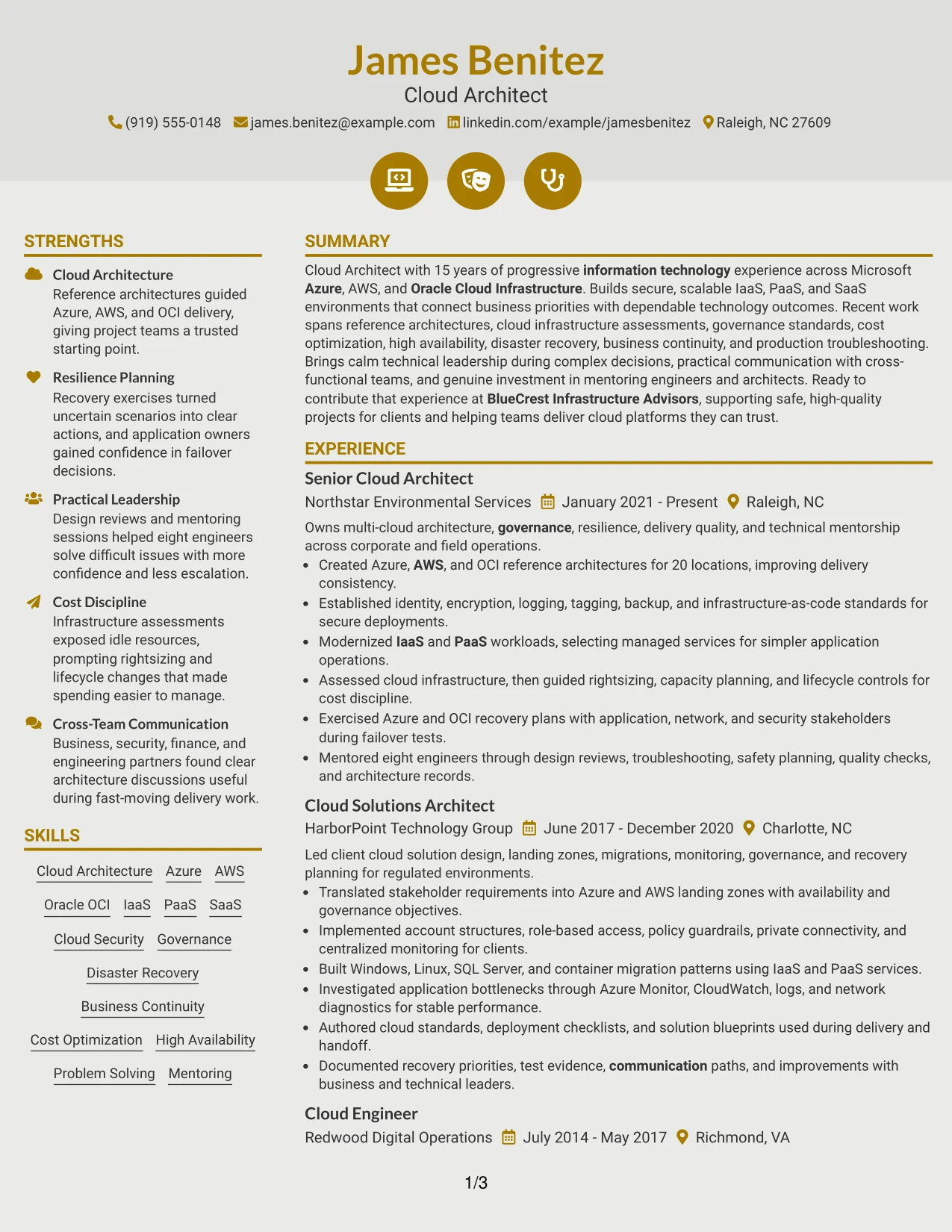
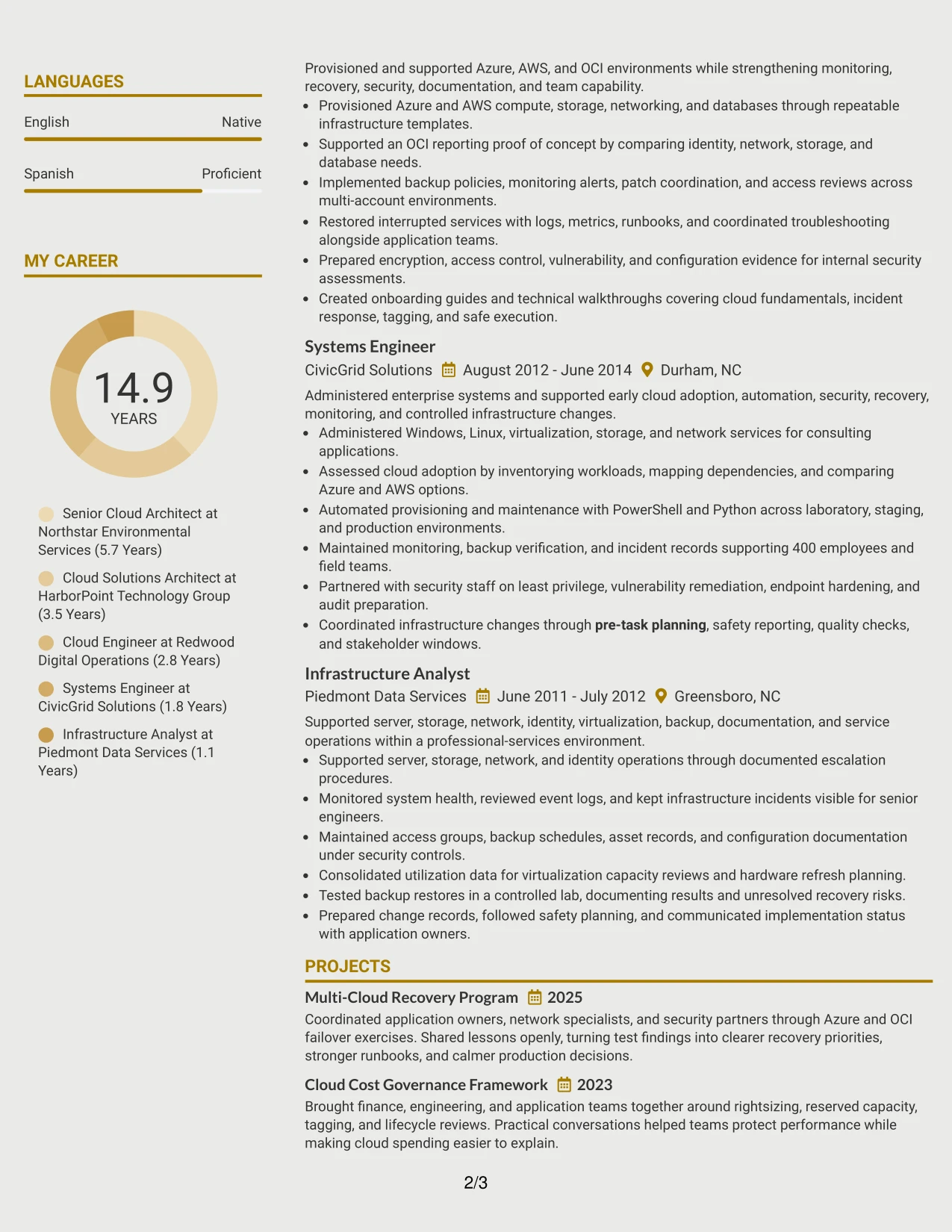
#15 Why This Format Works for a Resume
- Evidence-led sections show the value behind the technical vocabulary.
- Icons provide visual cues while the text remains the primary source of information.
- Achievement bullets can connect architecture decisions to delivery consistency and operational resilience.
- The design gives projects a clear place for recovery and cost governance examples.
- Skills can be grouped by platform, service model, security, and operations.
- Certifications reinforce the stated Azure, AWS, and OCI capability.
- The format keeps modern presentation compatible with concise resume writing.
#15 Best For
- Resumes that need to lead with architecture outcomes rather than a long skills inventory.
- Applications where projects provide useful evidence alongside employment history.
- Cloud professionals presenting platform knowledge through grouped technical categories.
- Documents that benefit from visual section cues without adding complex page structure.
- Readers who want to identify recovery, governance, and cost evidence quickly.
- Online resume presentations where recognizable icons can support navigation.
- Applications that still require clear text for ATS and keyword review.
#16 Plain Professional Layout with Job Title & Shaded Labels Resume Example
Content is balanced through generous separation between the contact area, summary, experience, and supporting sections. Shaded labels add just enough structure to distinguish each part without competing with the resume evidence.
The job title establishes direction, while the body presents progressive information technology experience through concise bullets. Education, certifications, projects, and skills complete the record with terms such as high availability, cloud security, infrastructure as code, and business continuity.
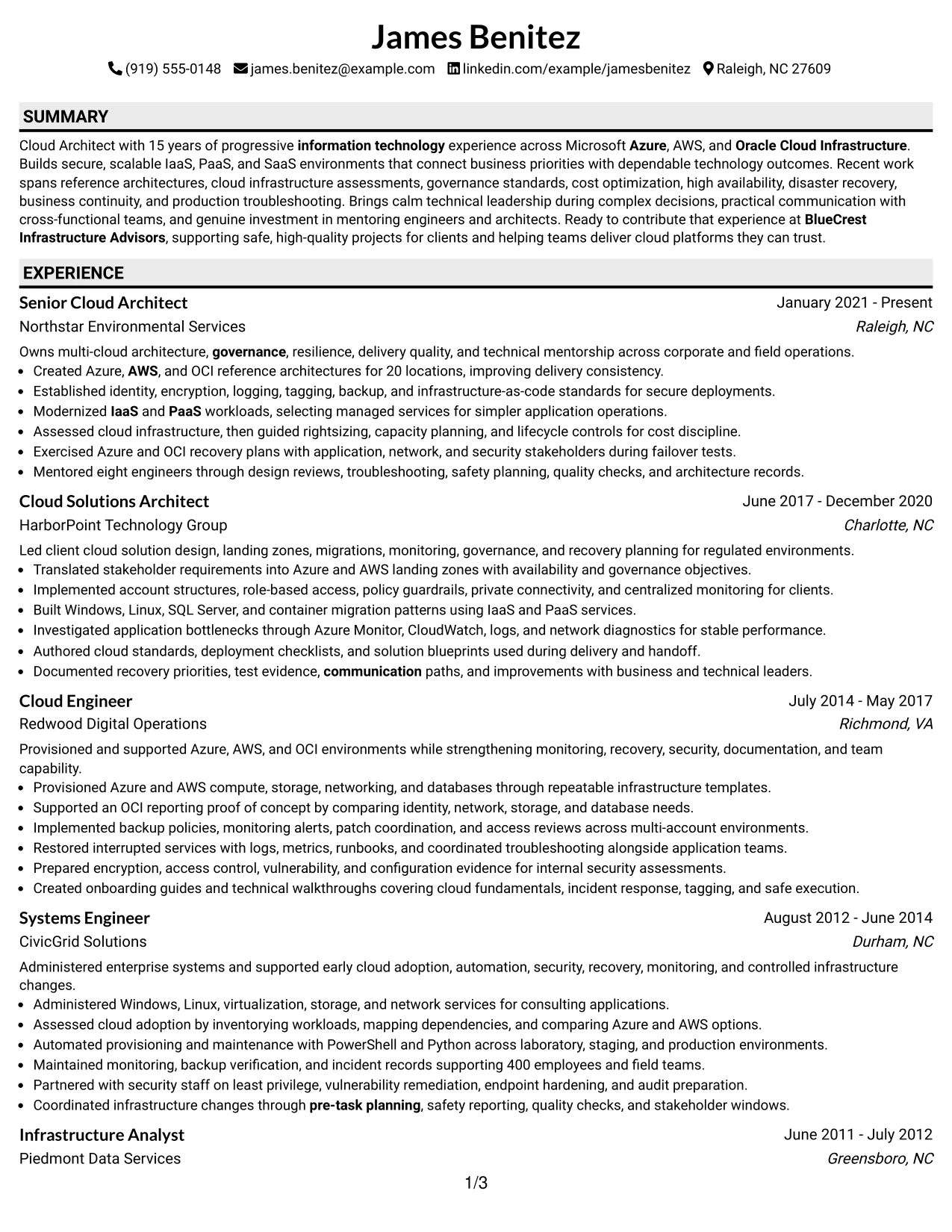
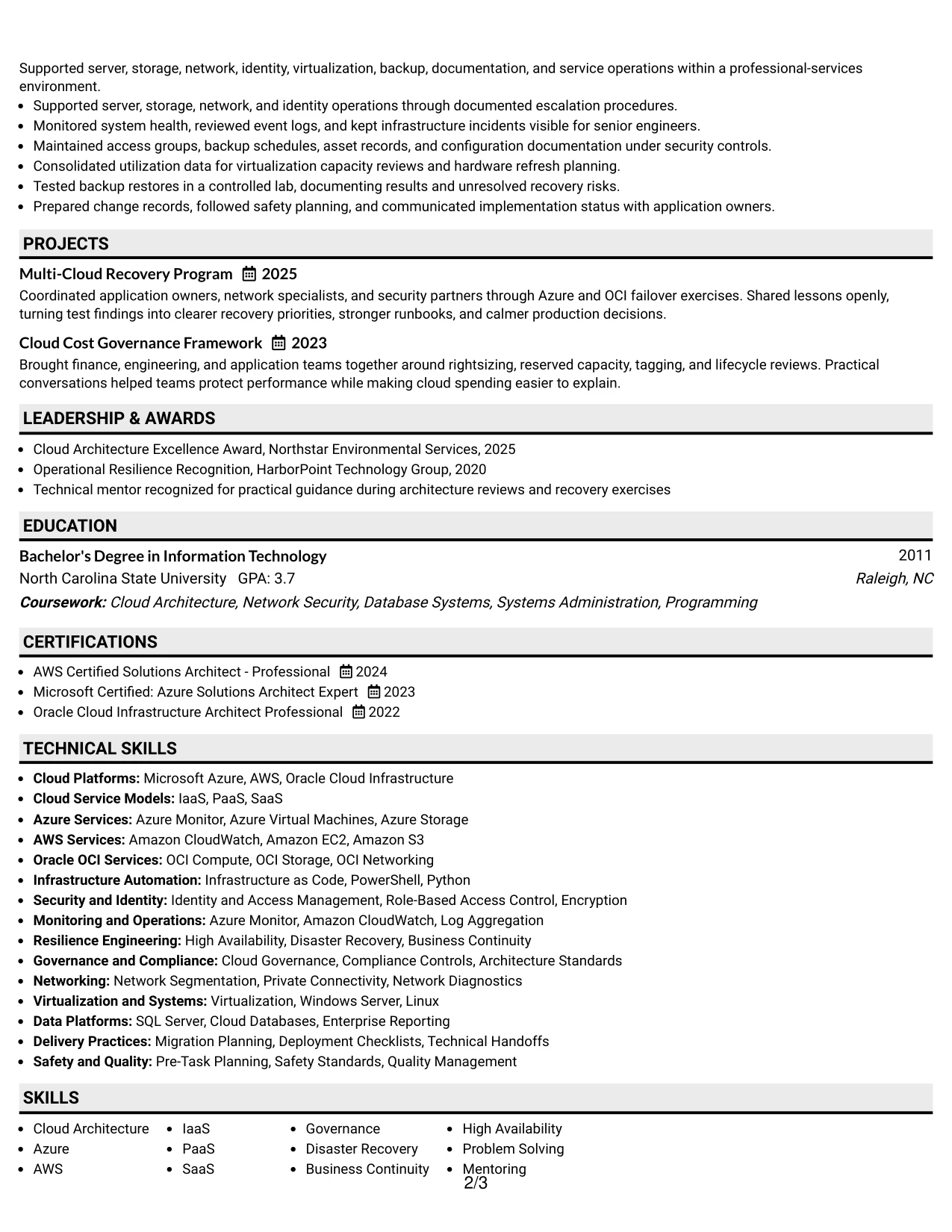
#16 Why This Format Works for a Resume
- Balanced spacing improves readability across a detailed work history.
- Shaded labels make section changes clear without creating visual clutter.
- The prominent job title helps connect the document to the Cloud Architect opening.
- Bullets show architecture, troubleshooting, governance, and mentoring as distinct contributions.
- Projects provide additional context for recovery testing and cost optimization.
- Certifications and education support the required technical foundation.
- The plain presentation works well when content must remain the central focus.
#16 Best For
- Applications that need a professional appearance with minimal visual distraction.
- Resumes where balanced spacing must support detailed experience without crowding.
- Documents that place a target title, summary, and evidence in a straightforward order.
- Cloud architecture applications requiring visible certifications and platform keywords.
- Readers who value strong labels and comfortable scanning over decorative elements.
- Resumes that include projects and skills but should retain a traditional professional feel.
- Online submissions where dependable text flow matters.
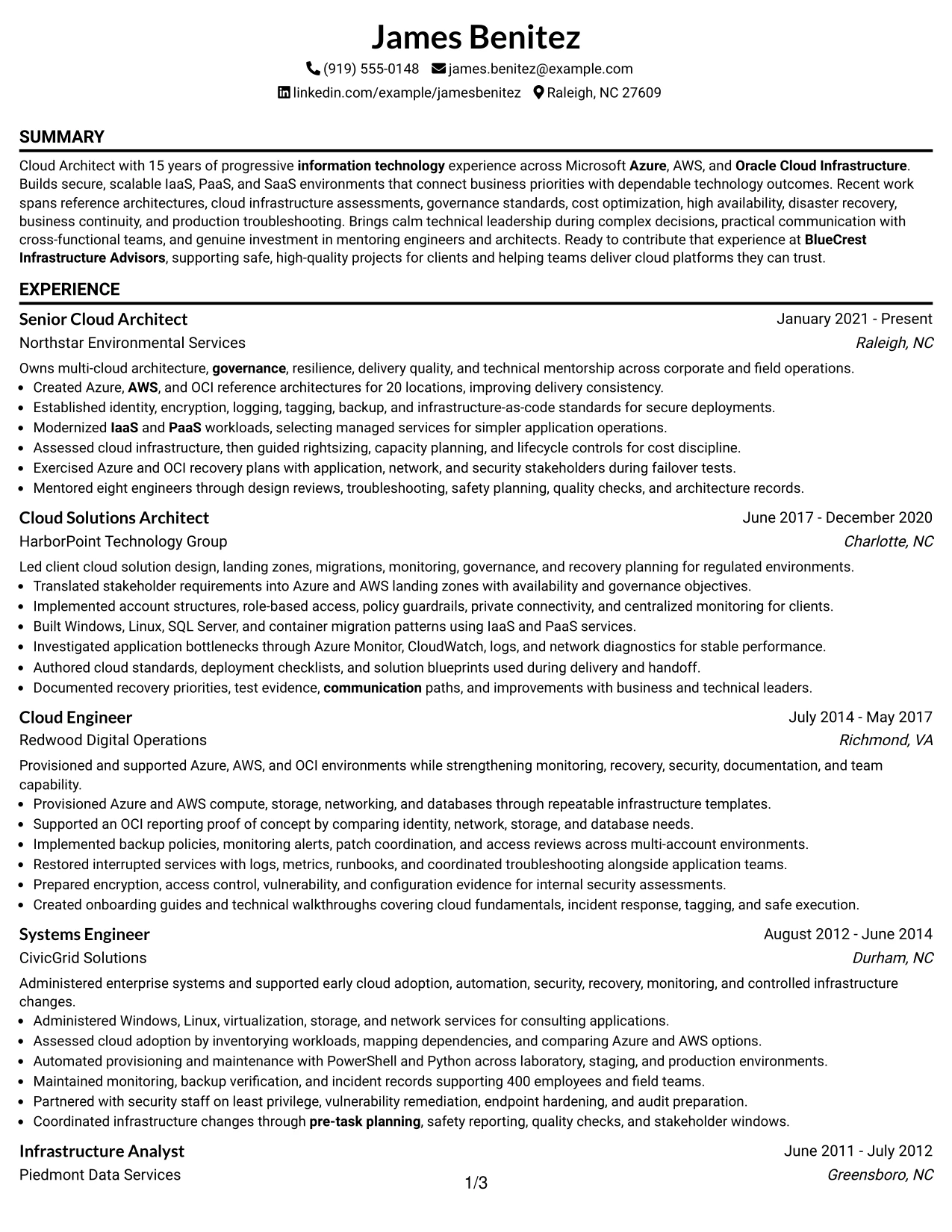
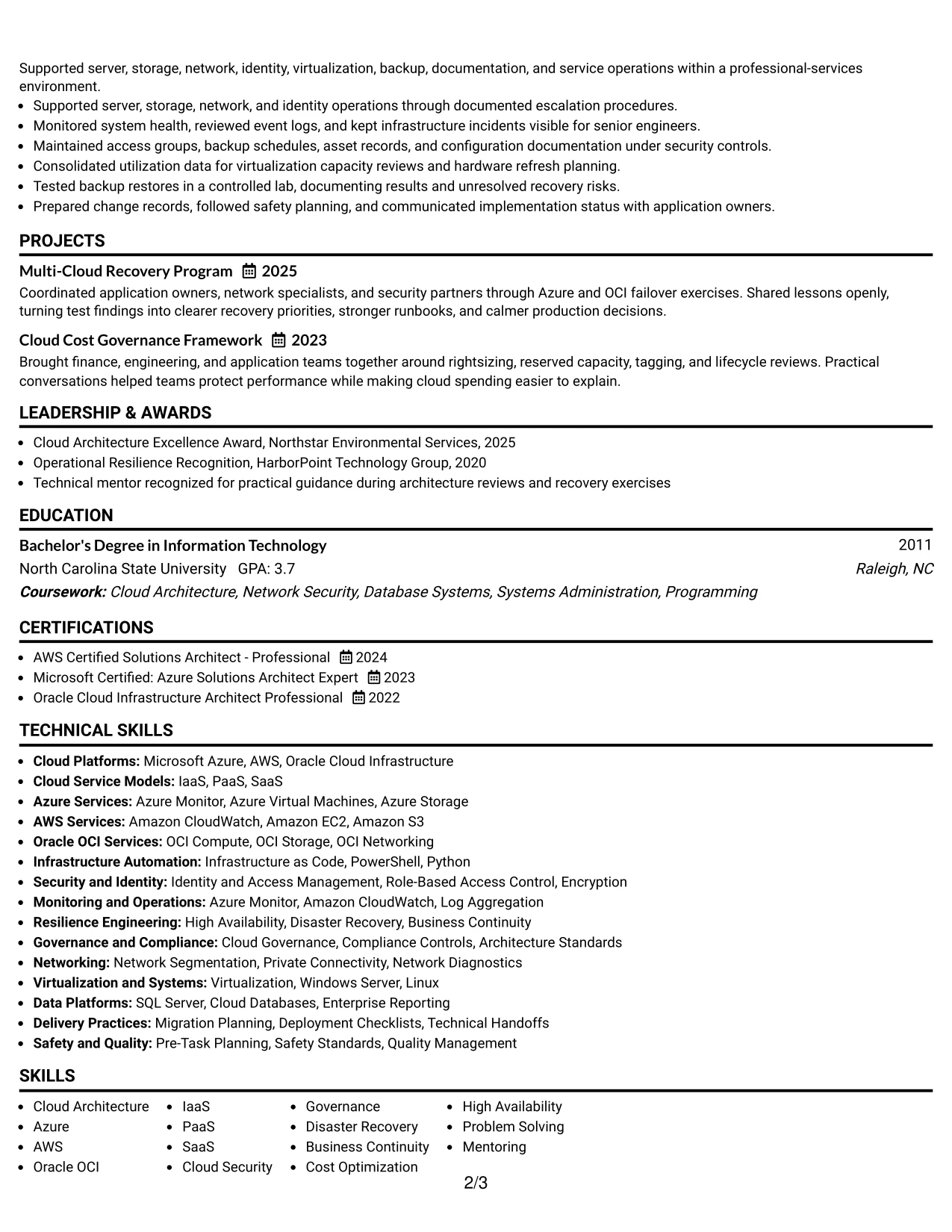
#17 Classic One Column Resume Format Resume Example
For a conventional application review, a classic one-column resume offers a dependable path from contact details to summary, experience, education, certifications, projects, and skills. The format keeps the document familiar and easy to print or upload.
Consistent headings let the strongest qualifications stand on their own: 15 years of progressive information technology experience, multi-cloud architecture, recovery planning, governance, and mentoring. Detailed bullets provide context without relying on design effects.
#17 Why This Format Works for a Resume
- A familiar structure reduces the effort required to find core qualifications.
- One column preserves a consistent reading order across every section.
- The summary can present the target role and strongest cloud architecture themes immediately.
- Chronological experience shows progression from infrastructure operations to senior architecture.
- Certifications directly reinforce the required Azure, AWS, and OCI focus.
- Projects and awards add supporting evidence without interrupting the career history.
- The format is practical for printed review, PDF sharing, and ATS processing.
#17 Best For
- Standard job applications that favor a familiar chronological resume structure.
- Candidates who want experience progression to carry the visual story.
- Documents requiring reliable printing, PDF conversion, and ATS processing.
- Cloud Architect applications with certifications that should follow the experience section clearly.
- Resumes where detailed bullets need full-width space for context and keywords.
- Readers who prefer traditional headings and predictable navigation.
- Applications that include projects, awards, education, and community leadership.
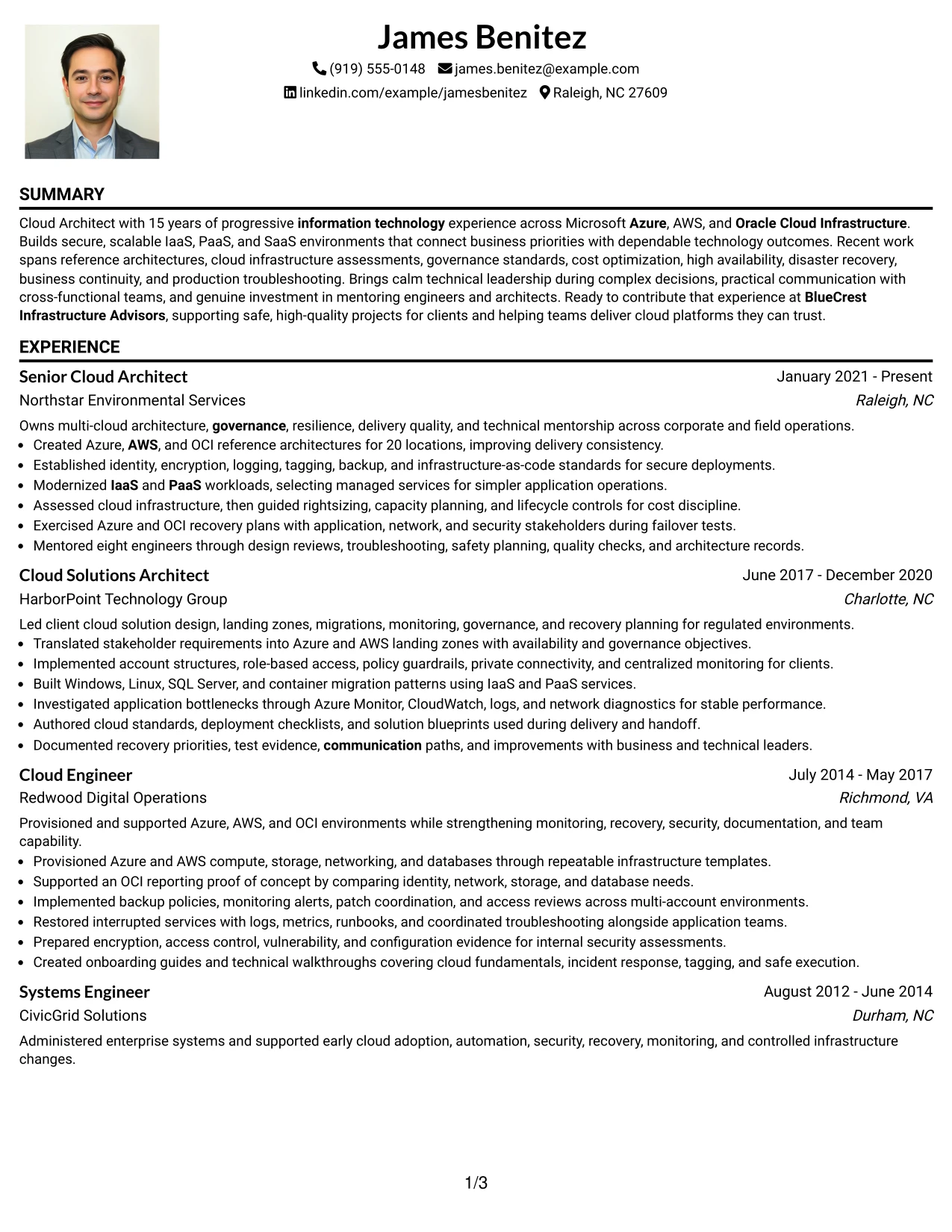
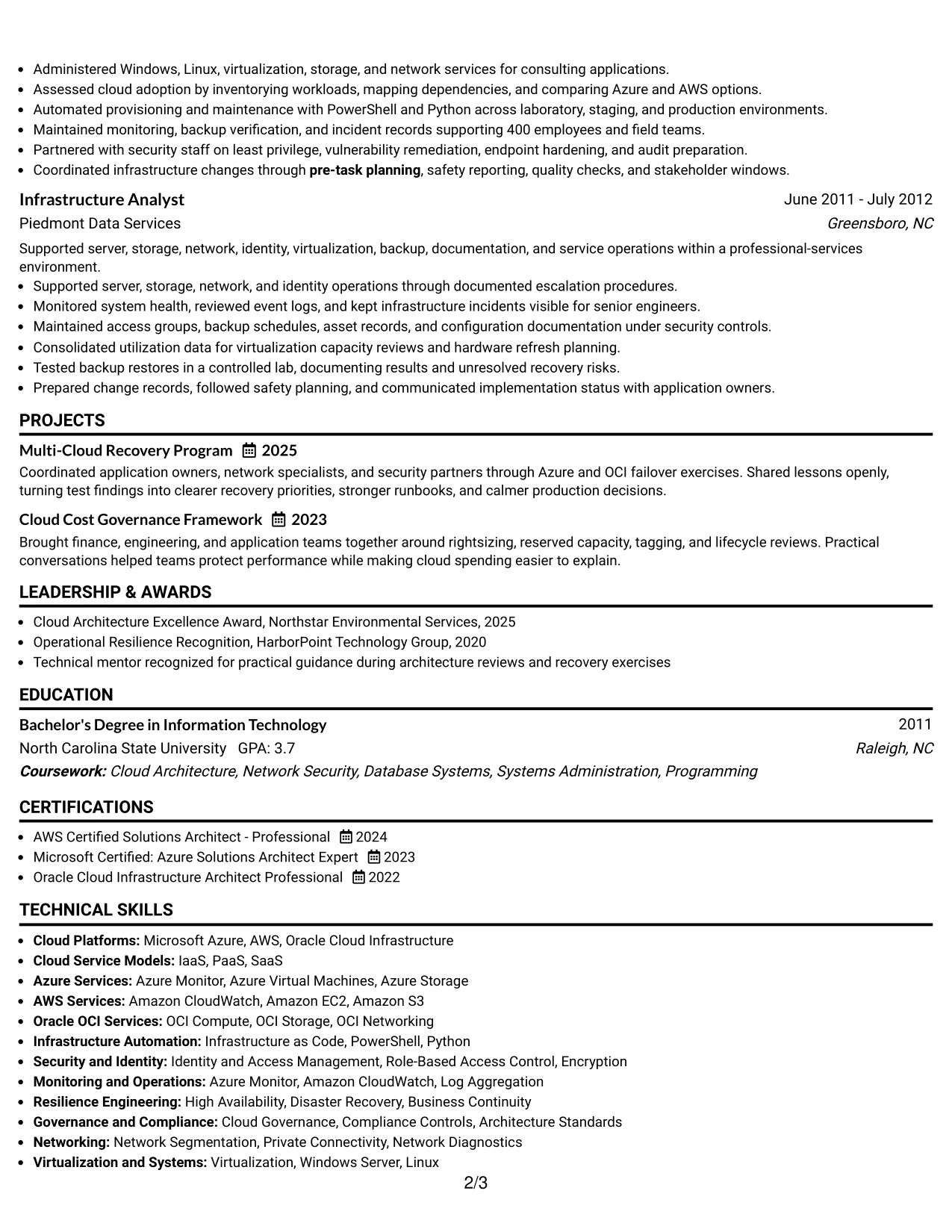
#18 One Column Format with Photo Resume Example
A restrained one-column hierarchy gives the resume a clear professional impression, while the optional photo area creates a recognizable personal touch where local application norms make it appropriate. The visual element remains secondary to the Cloud Architect title, summary, and qualifications.
The main content follows a focused sequence through experience, projects, certifications, education, and skills. Full-width bullets give space to reference architectures, cloud security, recovery tests, cost optimization, and mentoring while preserving a readable text structure.
#18 Why This Format Works for a Resume
- The one-column flow keeps the document easy to review from top to bottom.
- A photo can support personal recognition when it is suitable for the application context.
- The title and summary remain more important than the visual element.
- Full-width bullets allow complex architecture work to be explained clearly.
- Projects add evidence for multi-cloud recovery and cost governance.
- Certifications provide direct support for the role's preferred credentials.
- The layout can present technical depth without splitting experience across columns.
#18 Best For
- Applications in contexts where including a professional photo is customary and appropriate.
- Cloud Architect resumes that need a simple reading path for detailed experience.
- Documents where the visual identity should remain secondary to technical qualifications.
- Applications combining a substantial work history with projects and certifications.
- Readers who want full-width bullets for architecture, security, and resilience evidence.
- Online profiles or portfolios where a professional photo already supports recognition.
- Candidates who need a single-column structure with room for technical keywords.
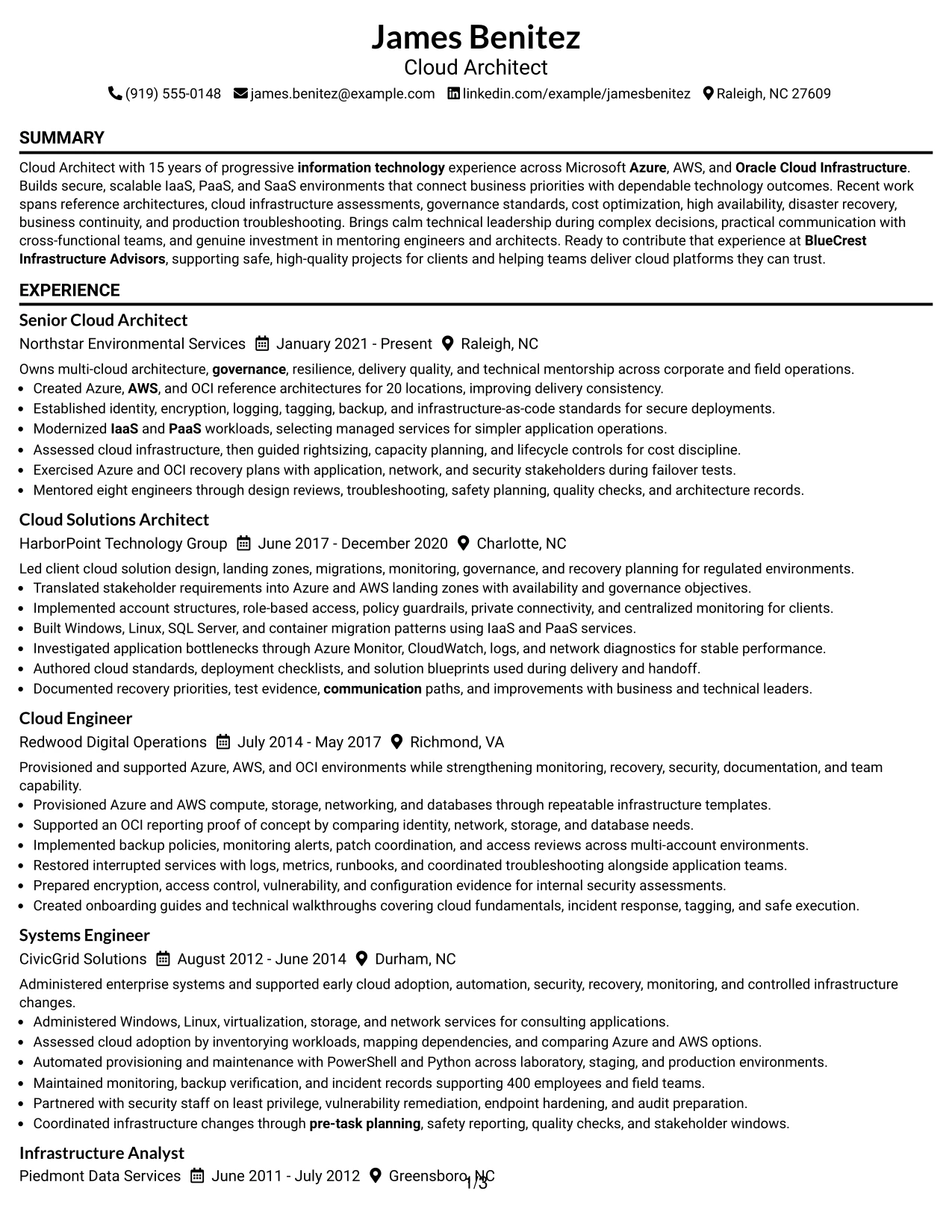
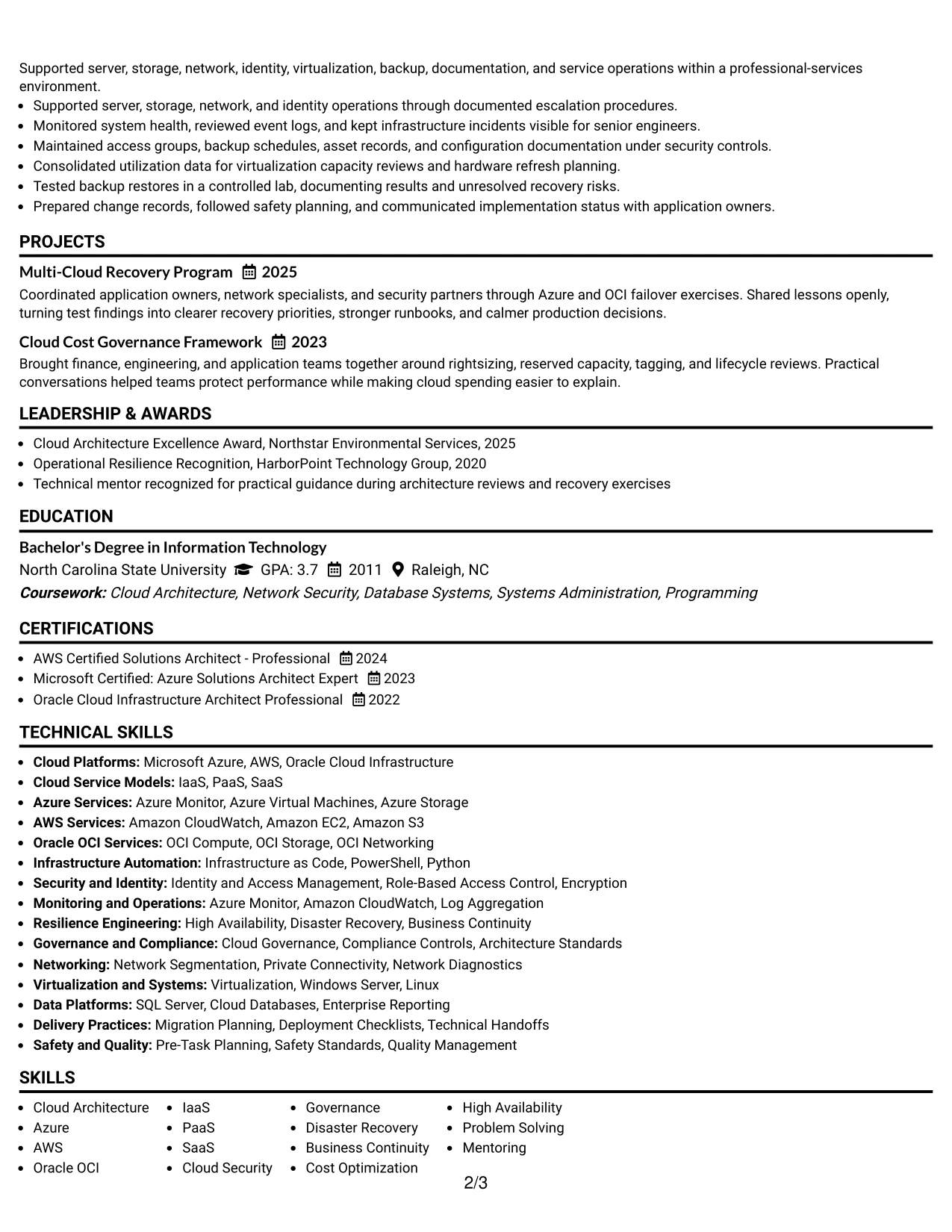
#19 Minimal Header Format Resume Example
The minimal header uses a quiet opening structure so the reader can reach the professional summary and experience with little visual interruption. Contact details remain available, but the page gives priority to the resume content.
A clean one-column sequence supports fast review of the target title, architecture achievements, technical skills, certifications, education, and projects. Familiar headings and concise bullets help important terms such as Azure, AWS, OCI, governance, and disaster recovery remain searchable.
#19 Why This Format Works for a Resume
- A restrained header leaves more attention for experience and qualifications.
- The one-column sequence supports quick top-to-bottom scanning.
- The target title and summary can align the document before detailed bullets begin.
- Simple headings make skills, certifications, and education easy to locate.
- Experience bullets carry the evidence instead of decorative elements.
- Projects can be reviewed as focused examples of recovery and cost governance.
- The minimal structure is well suited to ATS parsing and digital submission.
#19 Best For
- Applications where content clarity should take priority over visual styling.
- Resumes that need a quiet header and a strong, searchable summary.
- Documents with substantial experience that should begin quickly after contact details.
- Cloud applications requiring visible platform, governance, and resilience keywords.
- Readers who scan for section headings before reviewing individual bullets.
- Digital submissions where simple formatting helps preserve text during conversion.
- Professionals who prefer a clean, understated presentation.
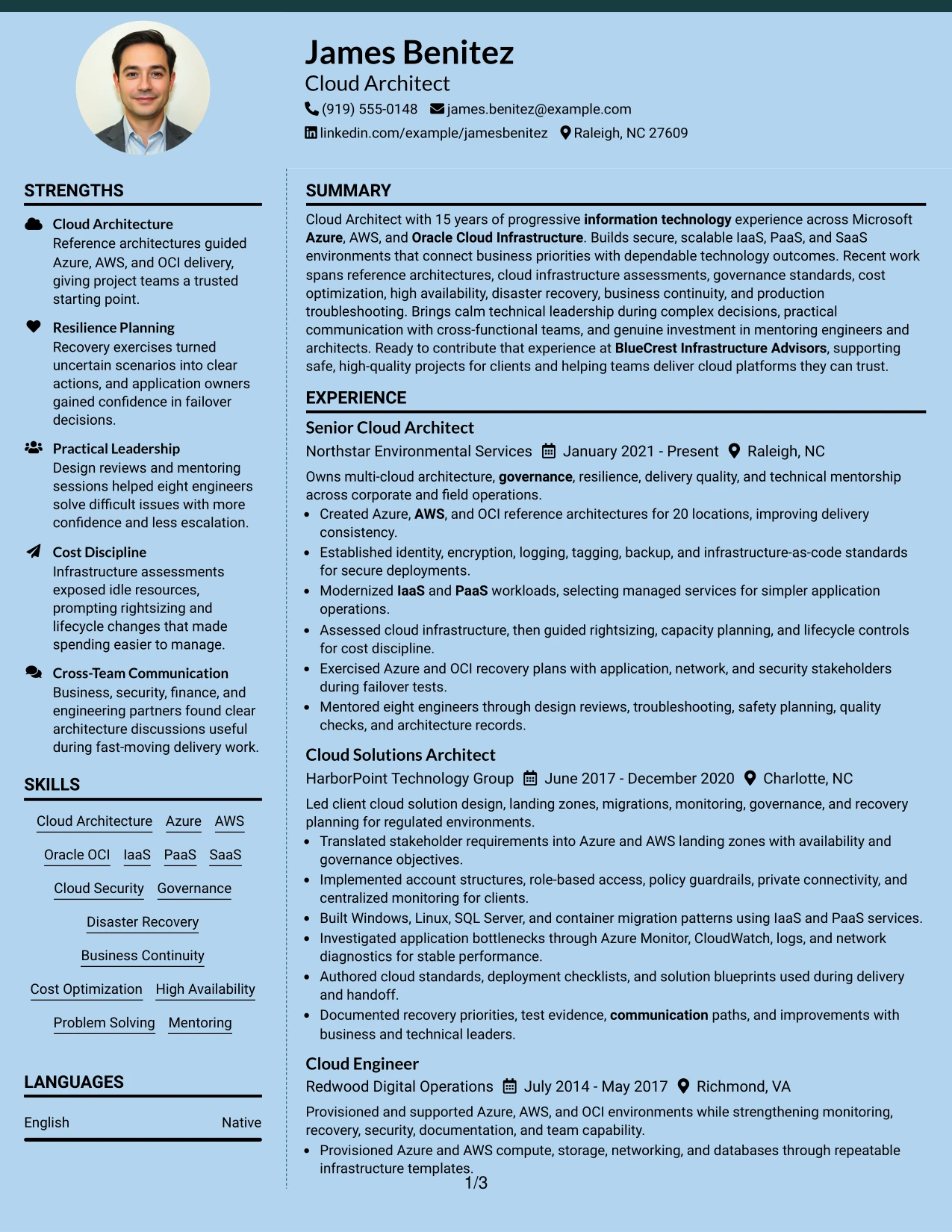
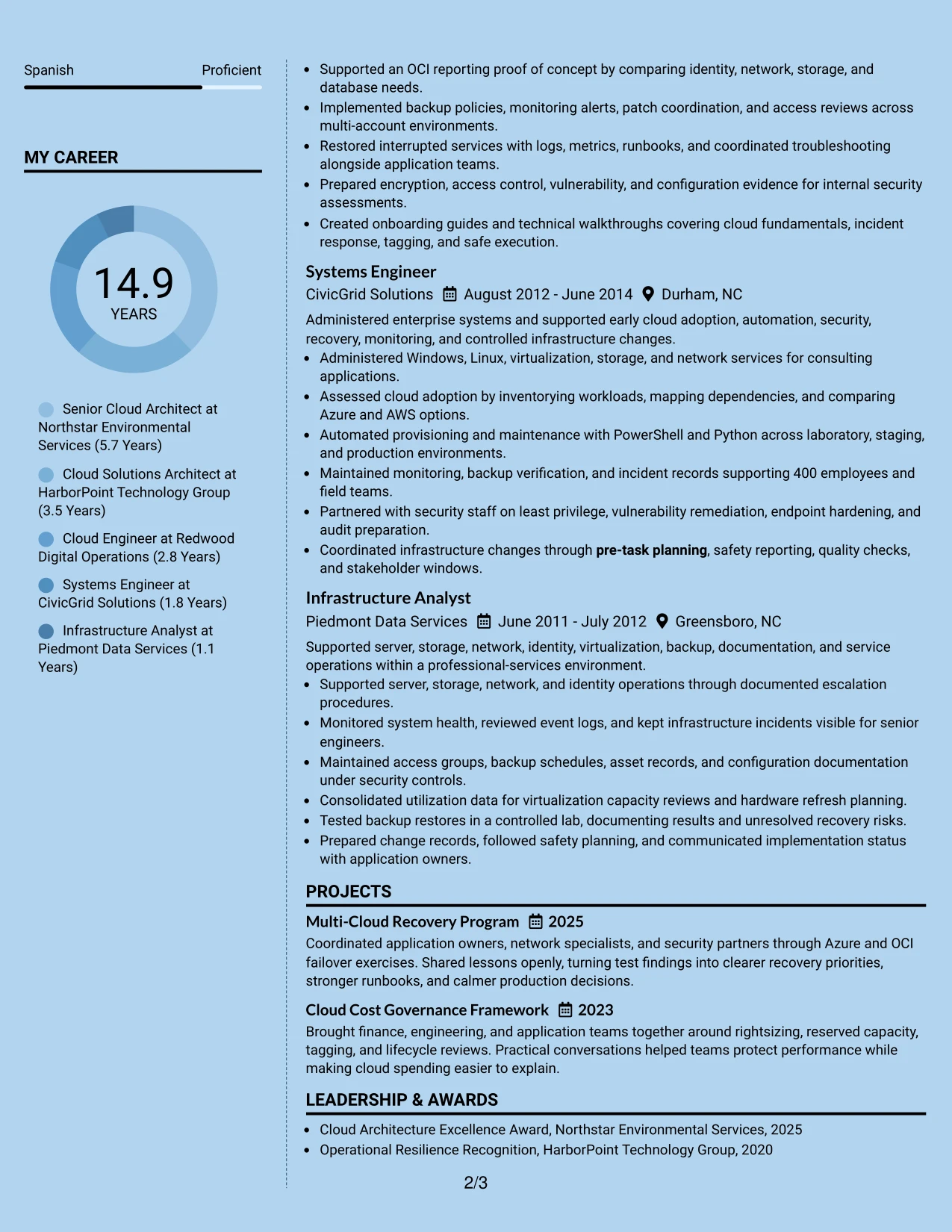
#20 Modern Full Background Two Column Format Resume Example
Readers can use the primary column for the career story and the secondary column for fast facts such as skills, certifications, education, and projects. That division helps a detailed resume stay navigable while preserving a strong modern presentation.
The full-background treatment creates a unified visual field, but the two-column hierarchy keeps the information organized. James Benitez's experience can show architecture standards, assessments, failover tests, and mentoring in the main area while the supporting column reinforces Azure, AWS, OCI, and professional credentials.
#20 Why This Format Works for a Resume
- Two-column navigation separates detailed work history from quick-reference content.
- The main area can carry longer achievement bullets without losing the page structure.
- A supporting column keeps certifications, skills, and education available during scanning.
- Projects can sit near the supporting information as concise evidence blocks.
- The modern background creates a cohesive presentation across the page.
- The design supports a high volume of technical terms without placing them in one dense list.
- Clear hierarchy helps readers move between evidence and qualification details.
#20 Best For
- Detailed resumes that need separate zones for career evidence and supporting facts.
- Multi-cloud applications where platform skills should remain visible beside experience.
- Documents containing five roles plus projects, certifications, education, and awards.
- Readers who alternate between achievement review and quick credential checks.
- Online portfolios or PDFs where a modern background can be rendered consistently.
- Applications that need room for governance, resilience, and infrastructure evidence.
- Professionals comfortable with a contemporary two-column presentation.
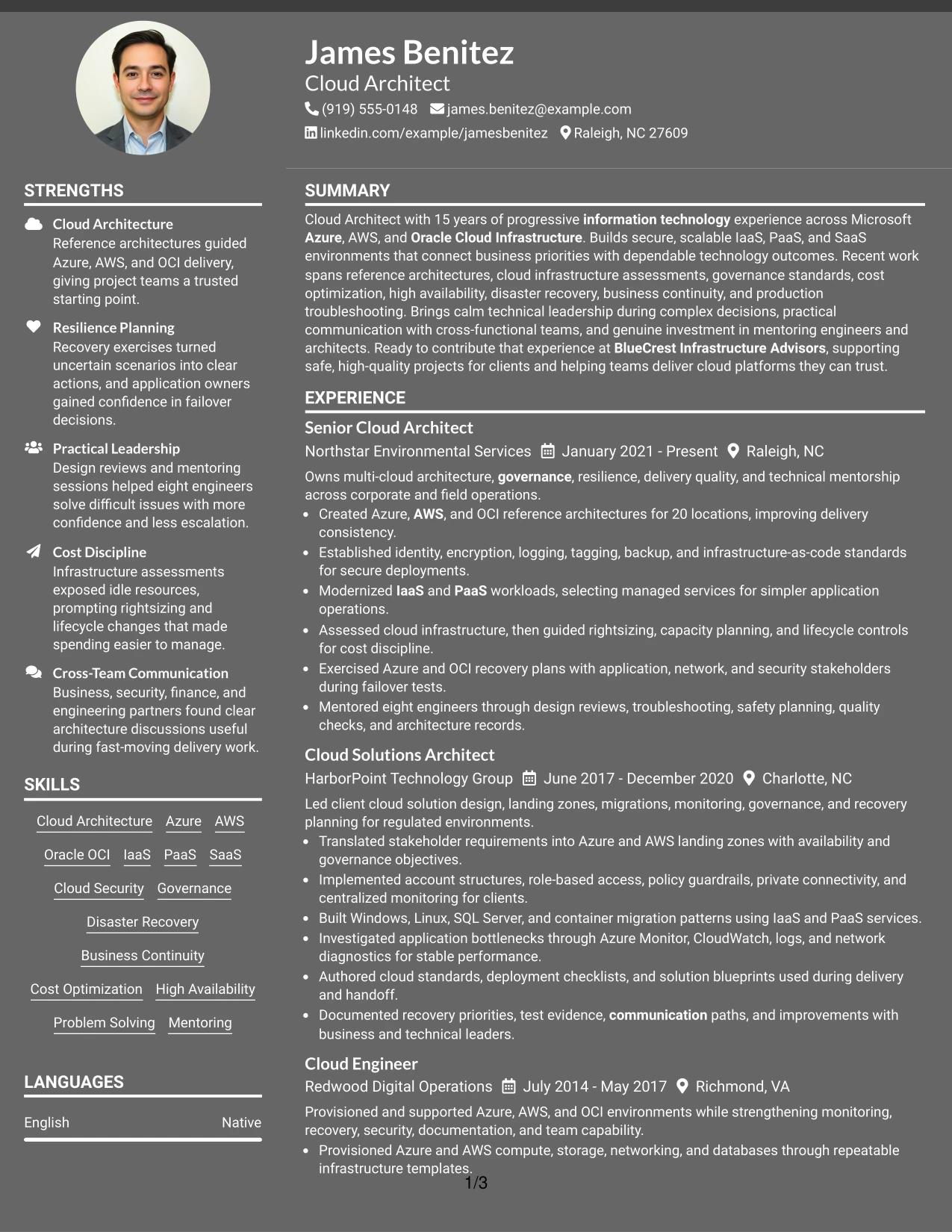
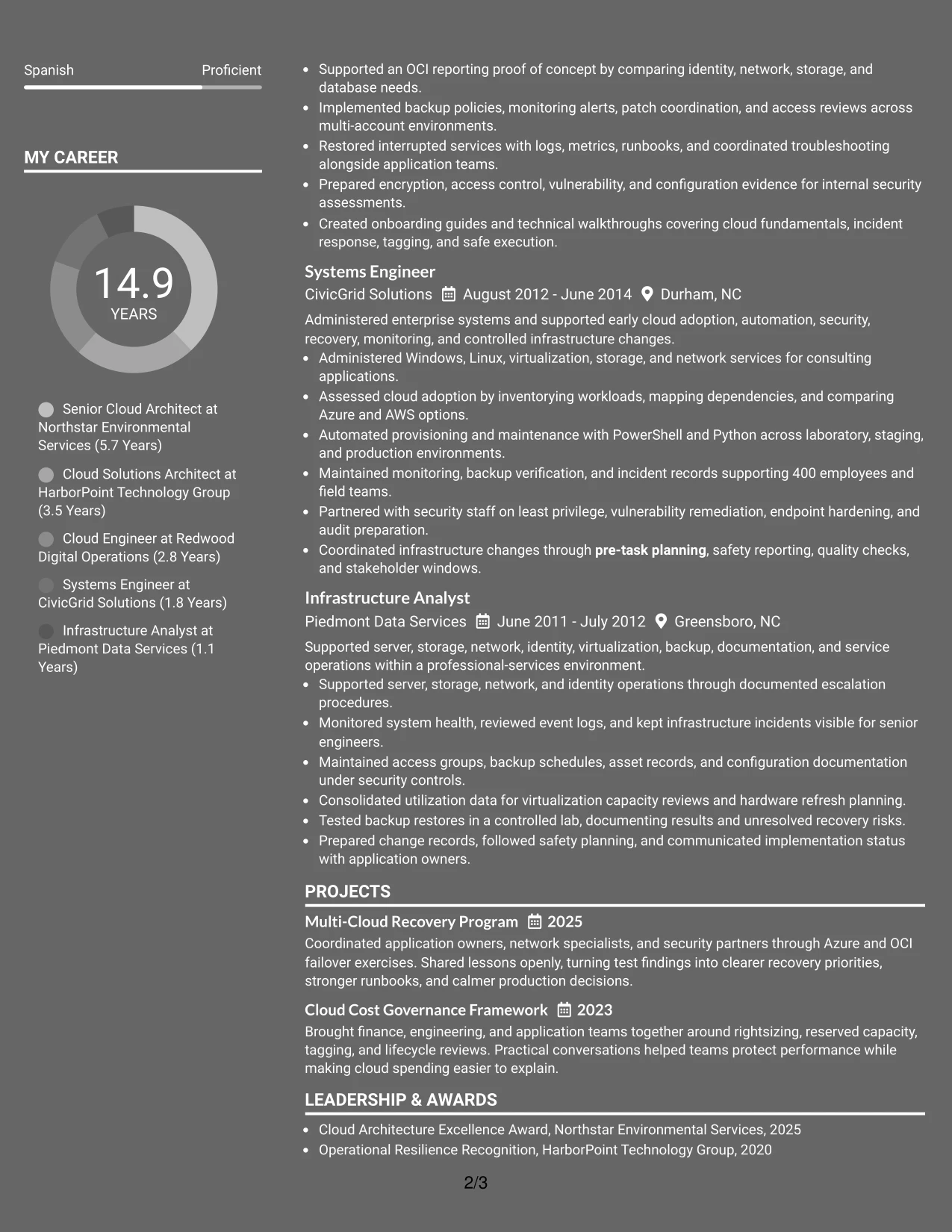
#21 Dark Mode Two Column Format Resume Example
Architecture outcomes receive priority in the main column, where recovery planning, governance standards, infrastructure assessments, and production troubleshooting can be supported with concise evidence. The secondary column keeps certifications, skills, education, and projects available for quick confirmation.
A dark mode treatment adds a distinctive visual character, while the two-column structure preserves information hierarchy. Strong contrast between headings and body text is important so Azure, AWS, OCI, cloud security, high availability, and business continuity remain easy to read.
#21 Why This Format Works for a Resume
- The main column gives outcome-focused experience the greatest space.
- A secondary column keeps technical terms and credentials easy to confirm.
- The design can highlight recovery tests, cost discipline, and delivery standards as evidence.
- Two columns allow skills to be grouped without weakening the work-history narrative.
- A dark presentation can make headings visually distinct when contrast is maintained.
- Projects add compact proof beyond the employment bullets.
- The format works best when accessibility and readable text contrast guide the final export.
#21 Best For
- Digital resumes where a distinctive dark presentation suits the application setting.
- Applications that need outcome evidence to lead while credentials stay in a side column.
- Cloud architecture documents with many platform, security, and resilience terms.
- Readers who review detailed achievements first and verify skills second.
- Online portfolios that can preserve strong text contrast across devices.
- Resumes using projects to reinforce recovery and cost governance evidence.
- Candidates willing to check PDF accessibility before submitting a dark design.
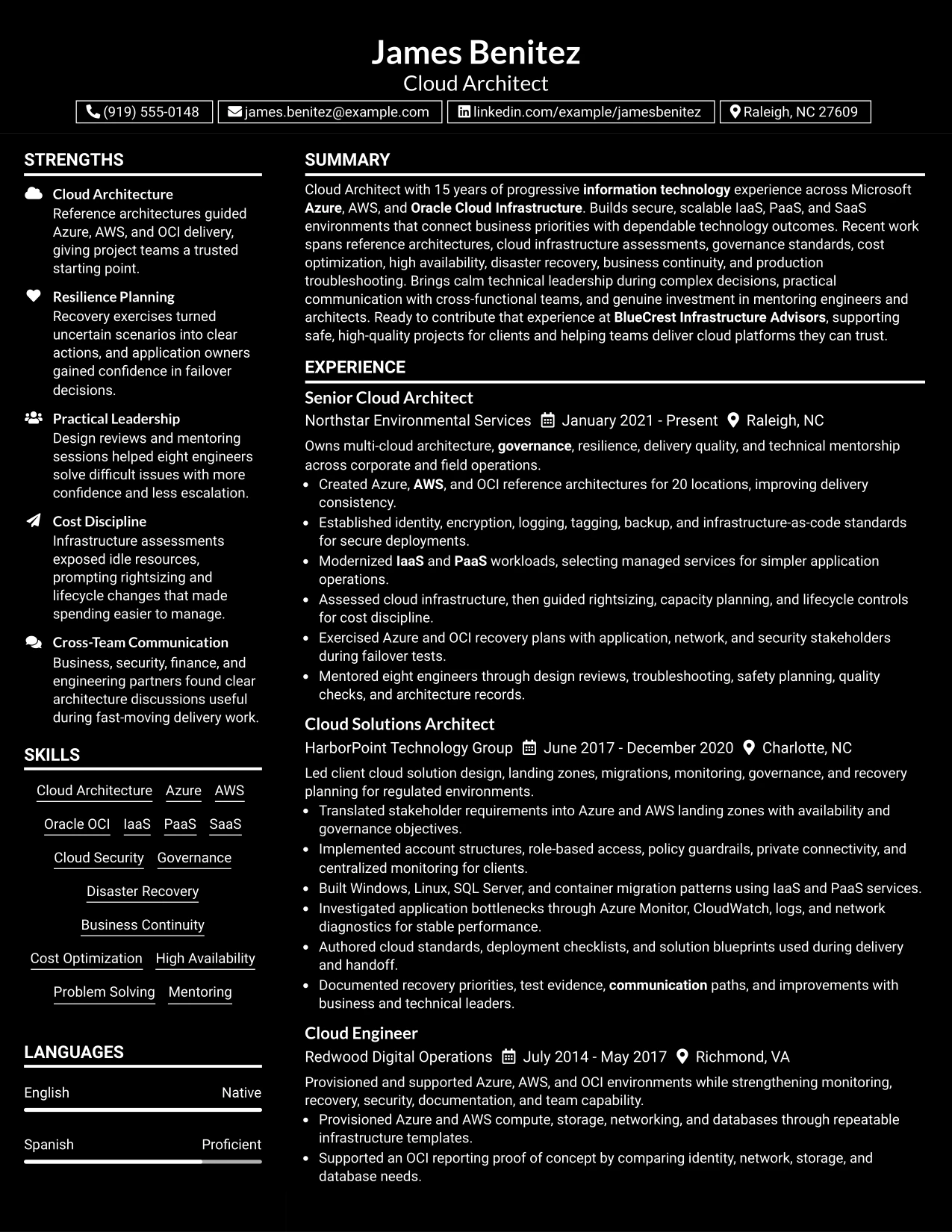
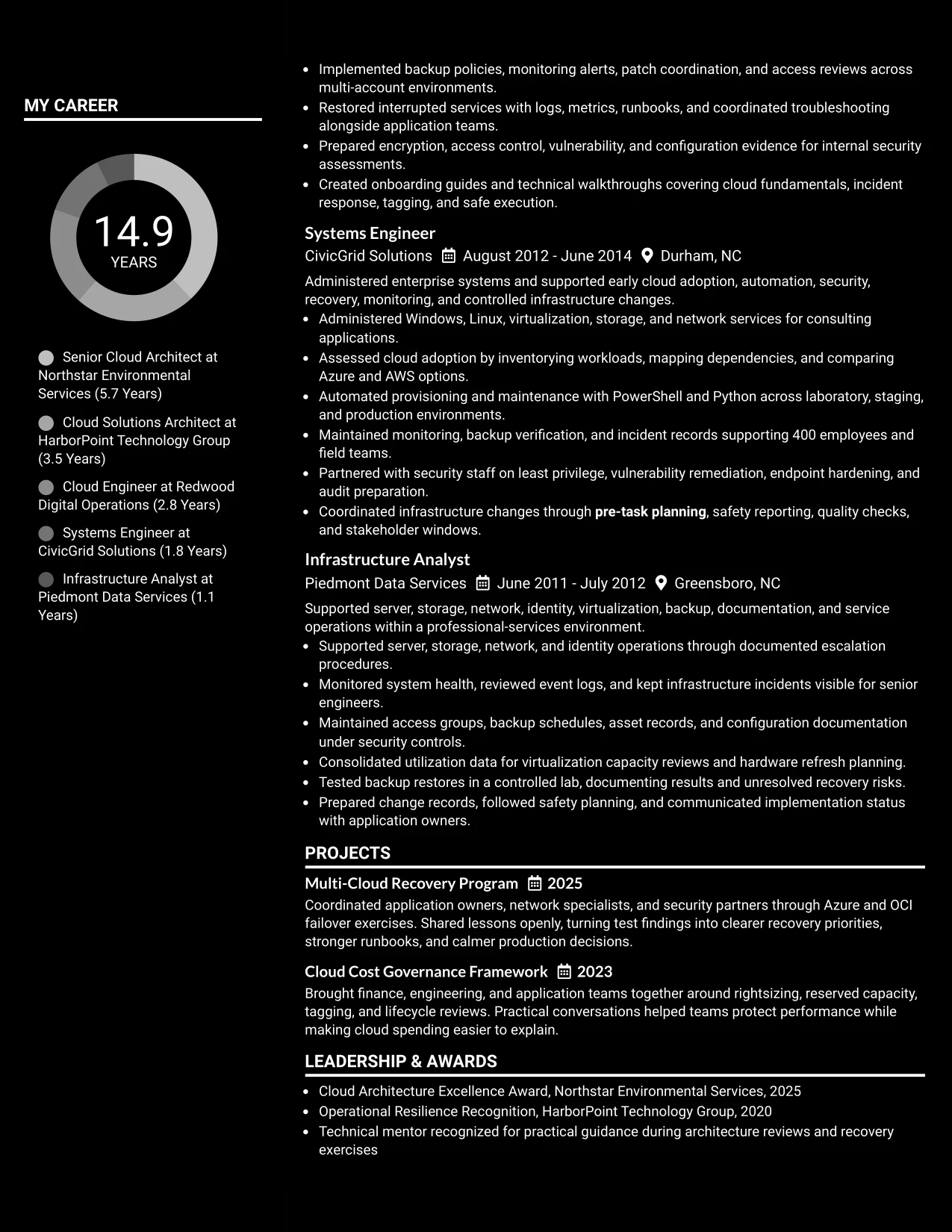
#22 Dark Mode Box Header Format Resume Example
Balanced spacing between the dark box header, summary, experience, and supporting sections keeps the page from feeling crowded. The header provides a strong visual anchor, while the body gives each qualification enough room to remain readable.
The one-column structure presents the Cloud Architect title, multi-cloud experience, projects, certifications, education, and skills in a stable sequence. Shaded or contrasting labels can guide review of governance, infrastructure as code, monitoring, disaster recovery, and technical leadership.
#22 Why This Format Works for a Resume
- The box header creates a clear boundary between contact details and resume content.
- Balanced spacing protects readability in a visually strong dark design.
- One column keeps experience and qualifications in a dependable order.
- The target title and summary establish role alignment before the detailed history.
- Bullets give architecture and troubleshooting evidence a clear place on the page.
- Projects, certifications, and skills remain easy to identify through labeled sections.
- Readable contrast and a clean export help preserve the document's usability.
#22 Best For
- Applications that need a strong header but a straightforward one-column information flow.
- Digital resumes where dark styling can be displayed with reliable contrast.
- Documents that combine detailed experience with clearly separated projects and credentials.
- Cloud Architect applications requiring visible platform and governance terminology.
- Readers who prefer balanced spacing over dense or highly decorative layouts.
- PDF submissions that can be checked for readable contrast before delivery.
- Professionals seeking a modern look while keeping resume sections conventional.
#23 Elegant Full Background Two Column Format Resume Example
For a Cloud Architect resume, a full background with two columns can make a substantial career record easier to review. The main column can carry the professional summary and progressive experience, while the secondary column groups Azure, AWS, Oracle Cloud Infrastructure, certifications, education, and leadership.
The design supports a clear visual path without reducing technical detail. Strong section labels and short bullets help readers find reference architectures, cloud security, disaster recovery, cost optimization, and measurable scope such as work across 20 locations and mentorship of eight engineers.
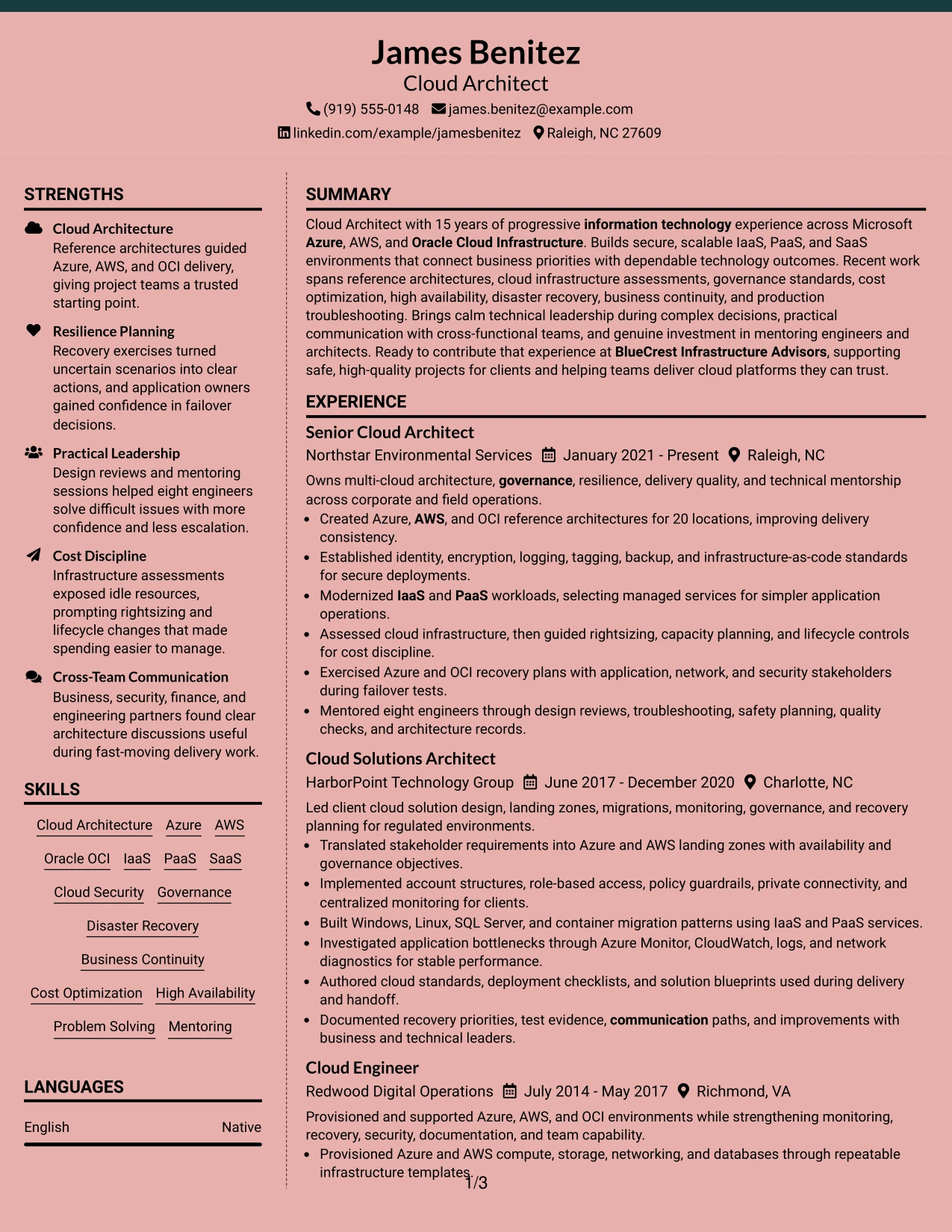
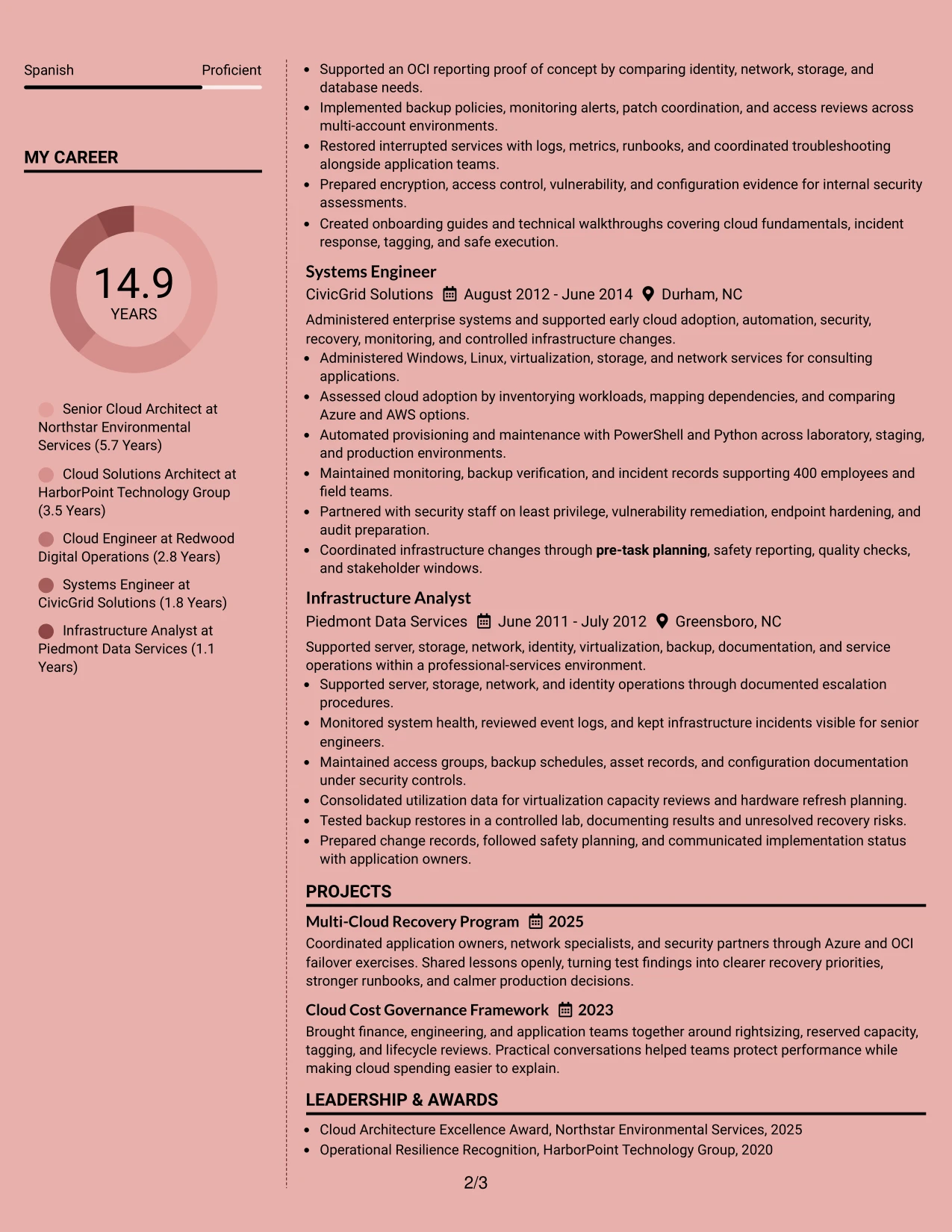
Why the Elegant Full Background Two Column Format Works for a Resume
- Two columns separate career evidence from supporting qualifications.
- The main content area gives five roles enough room for concise achievement bullets.
- A focused summary places 15 years of progressive information technology experience near the top.
- Skills can be grouped by platform, service model, security, governance, and resilience.
- Certifications remain easy to locate alongside education and professional affiliations.
- Short bullets improve scanning for Azure, AWS, OCI, IaaS, PaaS, and SaaS keywords.
- The structure leaves space for project results, awards, mentoring, and safety-conscious delivery practices.
Best For
- Resumes with extensive experience that need two clear content zones.
- Candidates who want career history to receive more space than supporting details.
- Applications that benefit from fast scanning of platforms, certifications, and skills.
- Technical resumes with many related keywords that need grouped organization.
- Documents combining experience, projects, education, awards, and affiliations.
- Readers who prefer a strong visual hierarchy over long uninterrupted text.
- Resume submissions that need both detailed evidence and a compact qualifications area.
#24 Creative Two Tone Format Resume Example
A restrained visual hierarchy gives this resume a polished first impression while keeping the content professional. The two-tone treatment can distinguish headings from body text, helping readers move from the Cloud Architect summary to experience, skills, certifications, and education.
The resume content remains evidence-led: reference architectures, governance standards, recovery exercises, infrastructure assessments, and mentorship appear as direct accomplishments. Clean contrast also helps important keywords such as cloud security, compliance, high availability, and business continuity stand out.
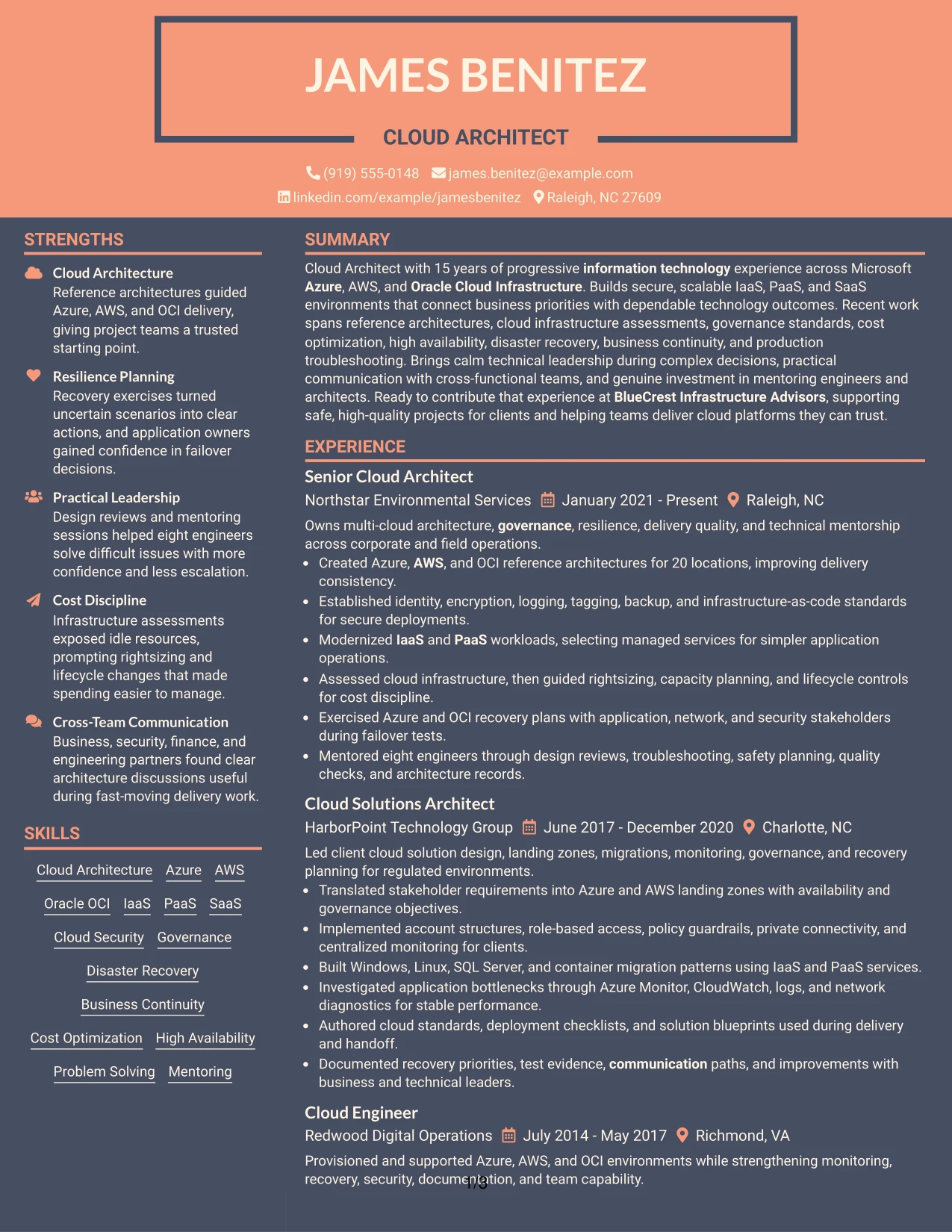
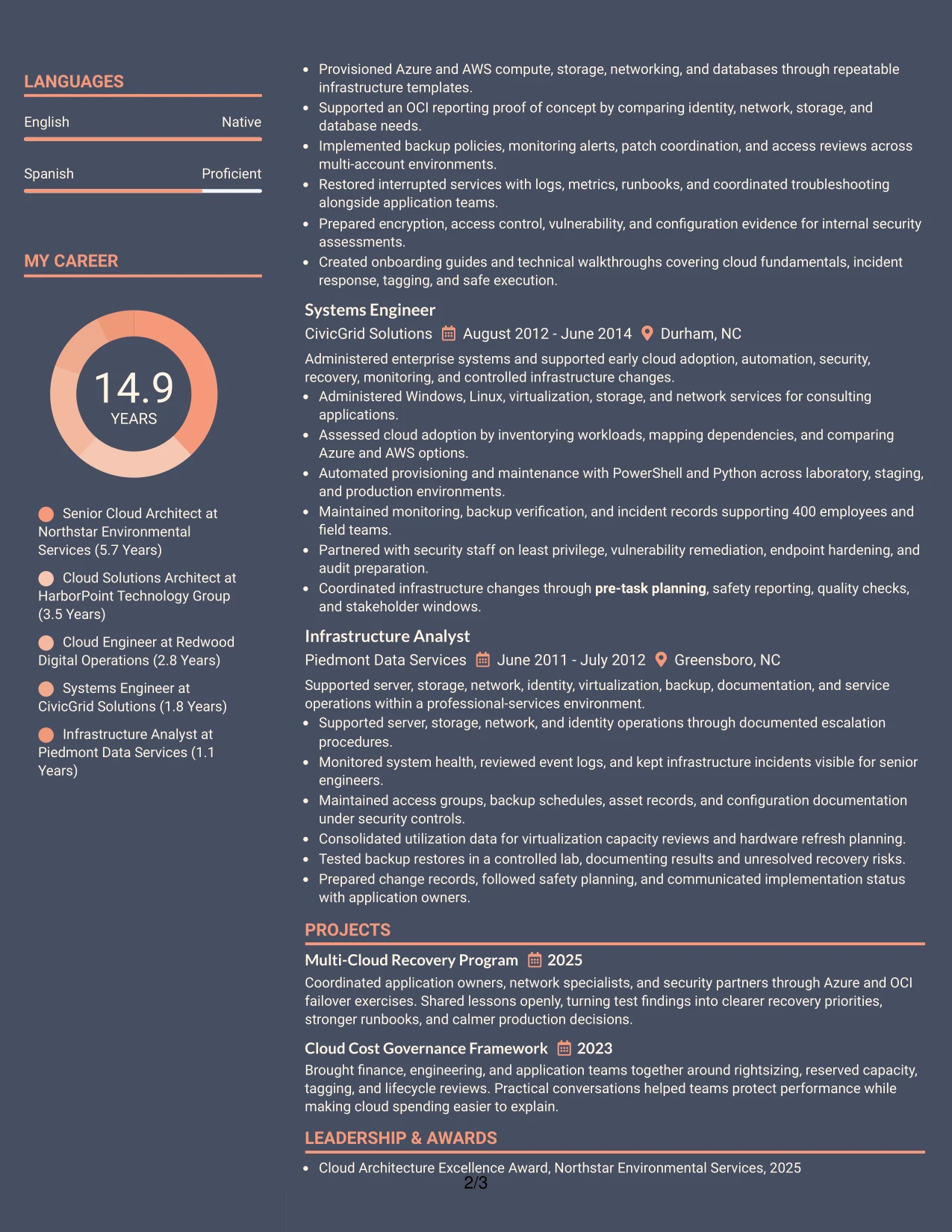
Why the Creative Two Tone Format Works for a Resume
- Two visual tones create separation without competing with the resume content.
- Clear contrast helps readers identify summary, experience, skills, and certification sections.
- Achievement bullets keep technical work specific and easy to verify.
- The format supports a focused skills section for Azure, AWS, OCI, PowerShell, and Python.
- Project entries can add evidence of recovery exercises and cost governance work.
- Consistent styling gives a long career history a controlled, cohesive presentation.
- The design can remain readable when reviewed quickly on screen or in print.
Best For
- Professionals who want a polished visual distinction without a crowded page.
- Resumes where section hierarchy should guide attention before decorative details.
- Applications that combine technical depth with a measured, professional presentation.
- Candidates presenting both platform expertise and cross-functional leadership evidence.
- Documents that need projects and awards to complement, not interrupt, experience.
- Readers who value clear contrast between headings, labels, and achievement bullets.
- Resume versions intended to feel distinctive while preserving straightforward scanning.
#25 Bold Color Header Professional Format Resume Example
The Bold Color Header Professional Format Resume Example uses a strong top section to establish the target role, professional summary, and contact details immediately. Below that entry point, orderly resume sections can present experience, skills, education, projects, certifications, and awards in a familiar sequence.
That structure is useful for a technical record with several cloud platforms and many governance terms. Direct bullets can show architecture ownership, 20 business locations, failover testing, cost controls, production troubleshooting, and mentorship while keeping the visual emphasis focused on the evidence.
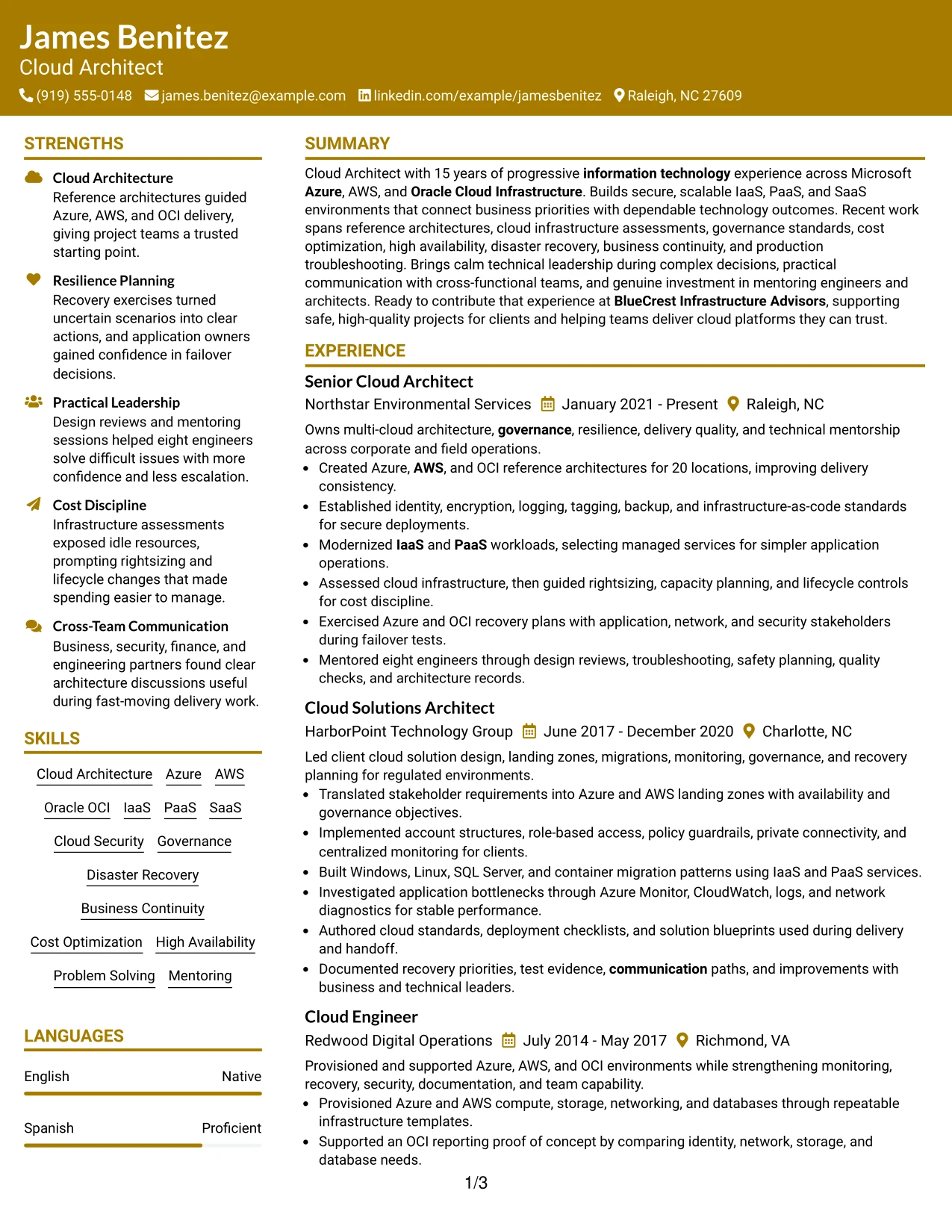
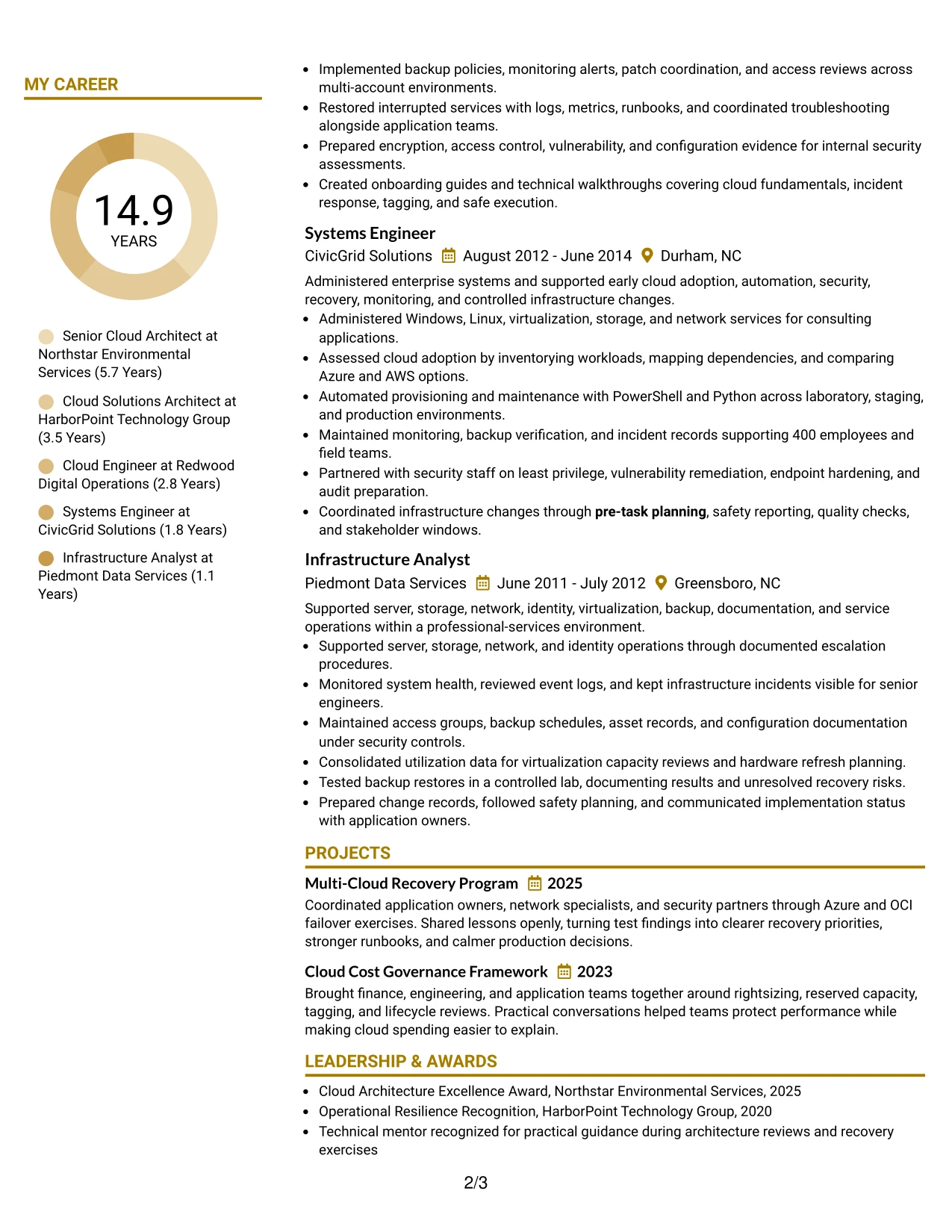
Why the Bold Color Header Professional Format Works for a Resume
- A prominent header identifies the target role before detailed content begins.
- A standard section sequence supports quick recruiter and ATS review.
- Experience bullets connect responsibilities to scope, decisions, and outcomes.
- The skills area can mirror job-description terms such as Azure, AWS, OCI, and governance.
- Certifications receive a visible place without displacing work history.
- Projects can reinforce recovery planning and cost optimization evidence.
- The format balances a confident top treatment with practical resume readability.
Best For
- Resumes that need the target role and value statement visible at first glance.
- Applications reviewed through a predictable top-to-bottom section order.
- Candidates with strong technical evidence that should remain central to the design.
- Documents needing a clear distinction between summary, skills, and experience.
- ATS-conscious submissions that use familiar headings and focused keyword placement.
- Professionals who want a confident header without complex page navigation.
- Resume versions that must present certifications and projects alongside a detailed history.
#26 Photo Header Color Sidebar Format Resume Example
Readers can start with the header and sidebar, then move into the summary and experience sections in the main content area. A professional photo may support personal recognition, while the written resume still carries the evidence through cloud architecture, governance, resilience, and technical leadership.
The sidebar can hold contact details, platform skills, certifications, languages, or education. The larger content area can explain five positions, two projects, recovery exercises, infrastructure assessments, and mentoring of eight engineers without forcing key achievements into overly short lines.
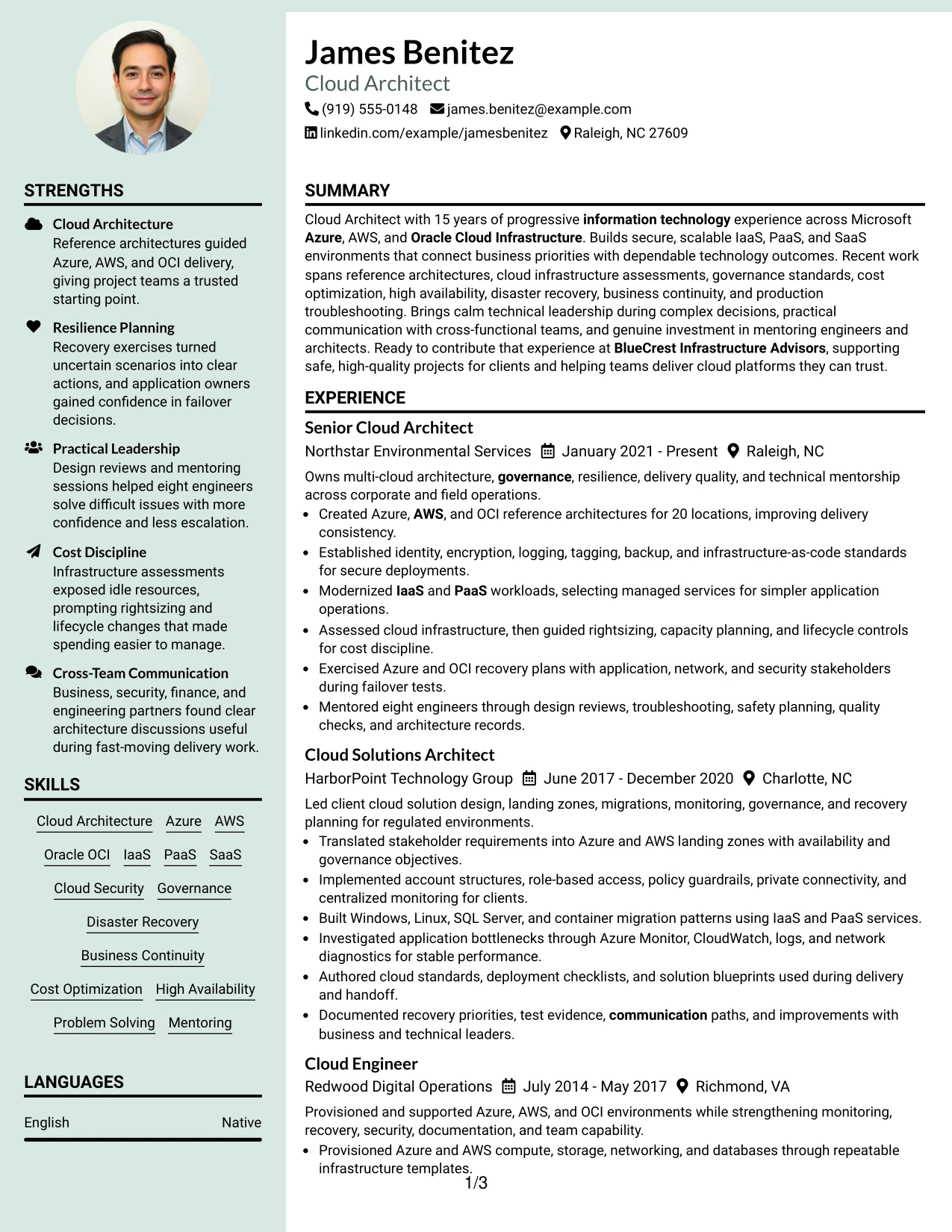
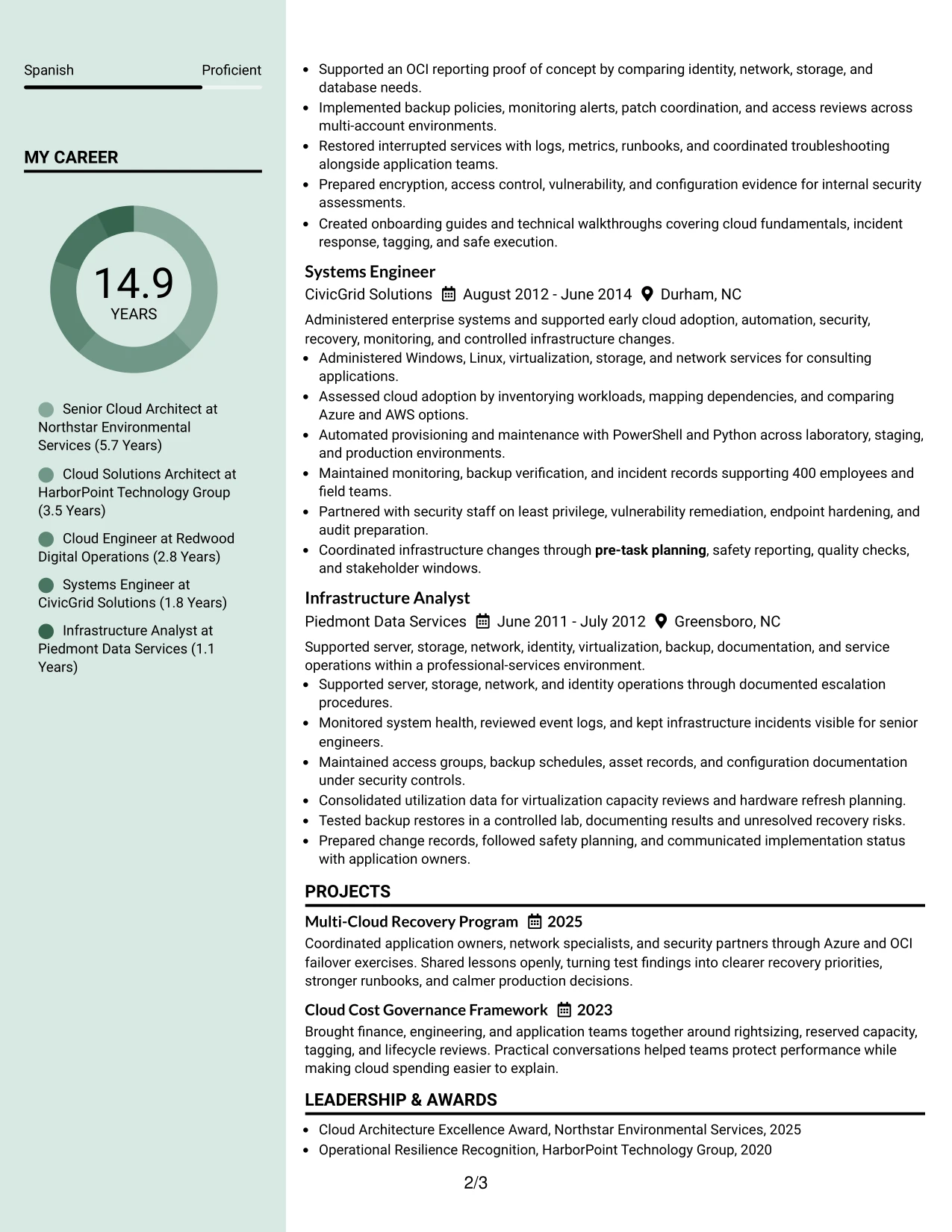
Why the Photo Header Color Sidebar Format Works for a Resume
- The header provides immediate identity and role context.
- A sidebar groups compact qualifications away from detailed work history.
- The main column gives achievement bullets room to explain technical decisions.
- The photo can add a personal visual element when appropriate for the application.
- Certifications and language information can remain visible without interrupting experience.
- Projects provide extra evidence for recovery planning and cost governance.
- The layout supports substantial content while preserving a clear reading path.
Best For
- Applications where a professional photo is suitable and adds useful recognition.
- Resumes with enough experience detail to benefit from a larger main content area.
- Candidates who need a sidebar for platforms, certifications, languages, and contact details.
- Documents combining technical achievements with projects and leadership activities.
- Readers who prefer supporting qualifications separated from the career timeline.
- Applications where content volume requires careful division between primary and secondary material.
- Professionals presenting both deep infrastructure work and visible mentoring evidence.
#27 Top Left Header Color Accent Format Resume Example
The strongest evidence should appear early: the professional summary, multi-cloud architecture scope, and recent accomplishments establish the resume's value before older roles. A top-left header then keeps the contact details and target role easy to identify without taking attention away from the content.
Color accents can guide the eye toward experience and skills, while concise bullets document architecture standards, cloud assessments, recovery tests, monitoring, security controls, and cost discipline. Certifications and education add supporting proof of the technical foundation.
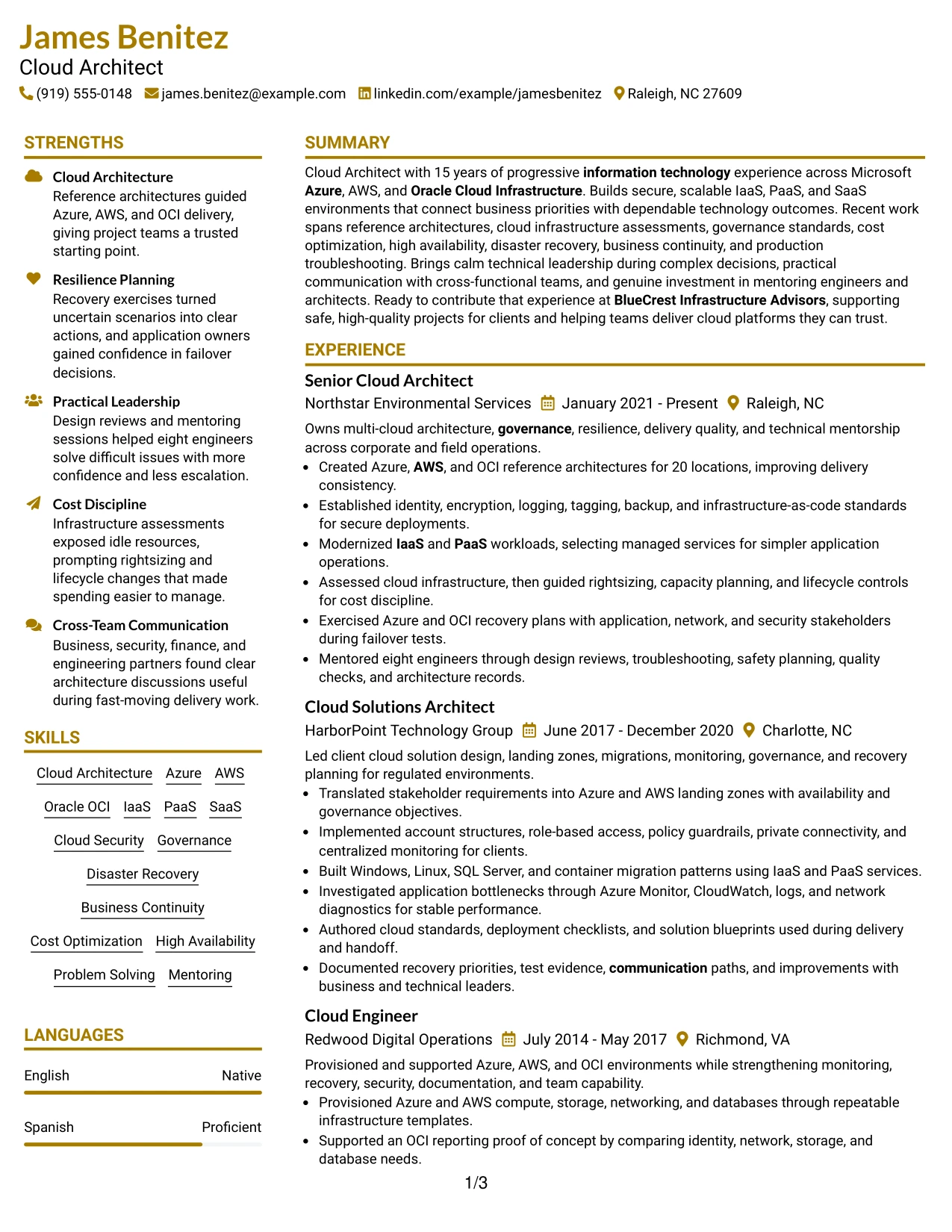
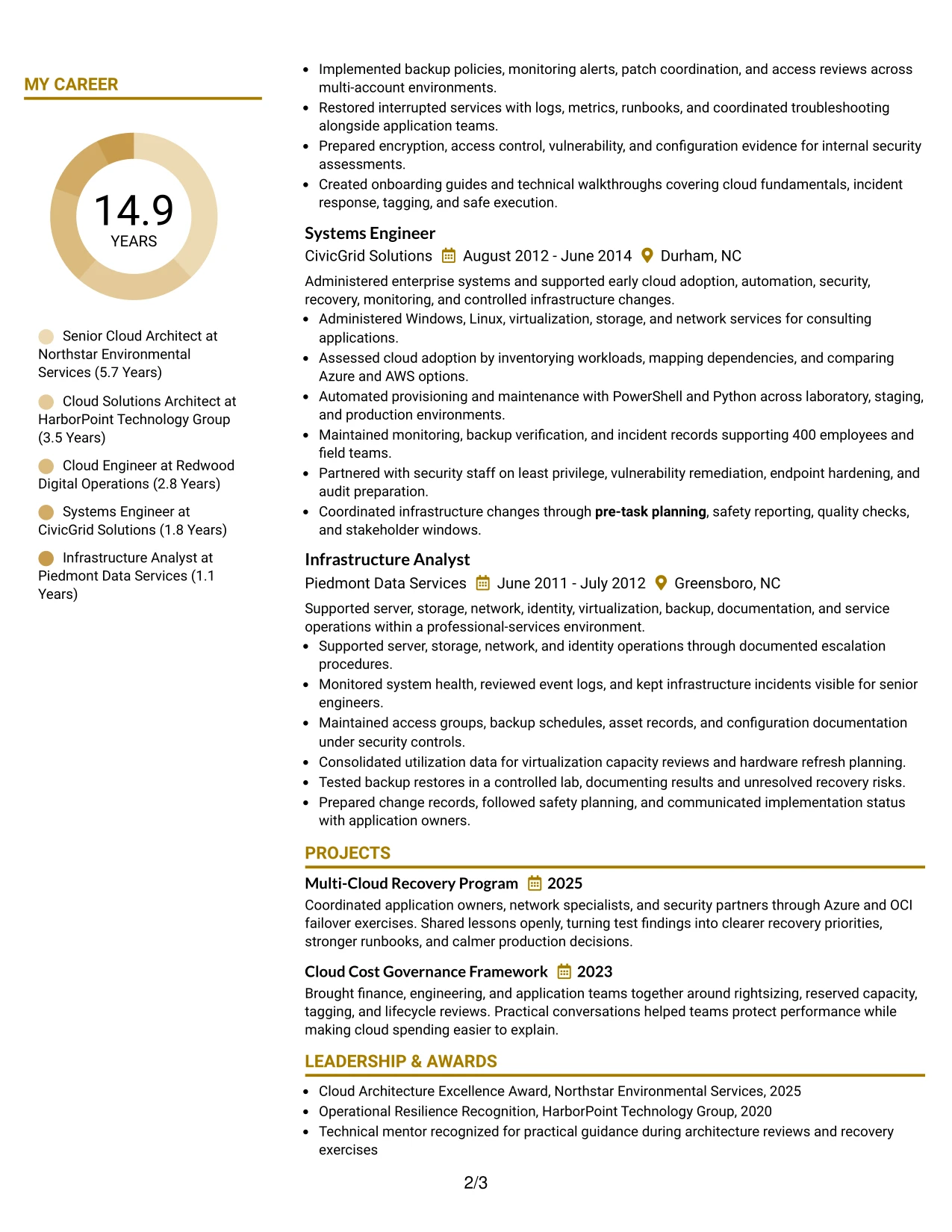
Why the Top Left Header Color Accent Format Works for a Resume
- Early placement gives recent architecture evidence priority.
- A compact header keeps contact information and the target role accessible.
- Accent color can distinguish sections without replacing clear text labels.
- Bullets make scope visible through 20 locations and mentorship of eight engineers.
- Skills organize the three cloud platforms and related service models.
- Certifications support the stated architecture credentials with dates.
- Older experience remains available as a clear progression into cloud architecture.
Best For
- Resumes that should lead with recent, high-value evidence.
- Applications where architecture scope needs to appear before supporting history.
- Candidates with measurable reach, such as locations covered or teams mentored.
- Documents that need a modest visual accent around an evidence-first structure.
- Technical submissions pairing a strong summary with detailed accomplishment bullets.
- Readers who want current qualifications before reviewing earlier positions.
- Resume layouts where certifications reinforce, rather than lead, the professional story.
#28 Centered Header Classic Two Column Format Resume Example
Balanced content distribution helps this resume serve both quick reviewers and readers who want detail. A centered header creates a calm entry point, while two columns divide the career record from skills, certifications, education, projects, and affiliations.
The classic structure gives each section a defined place. Experience bullets can explain cloud migrations, landing zones, governance, monitoring, recovery planning, and infrastructure automation; the supporting column can reinforce those claims with Azure, AWS, OCI, PowerShell, Python, and professional credentials.
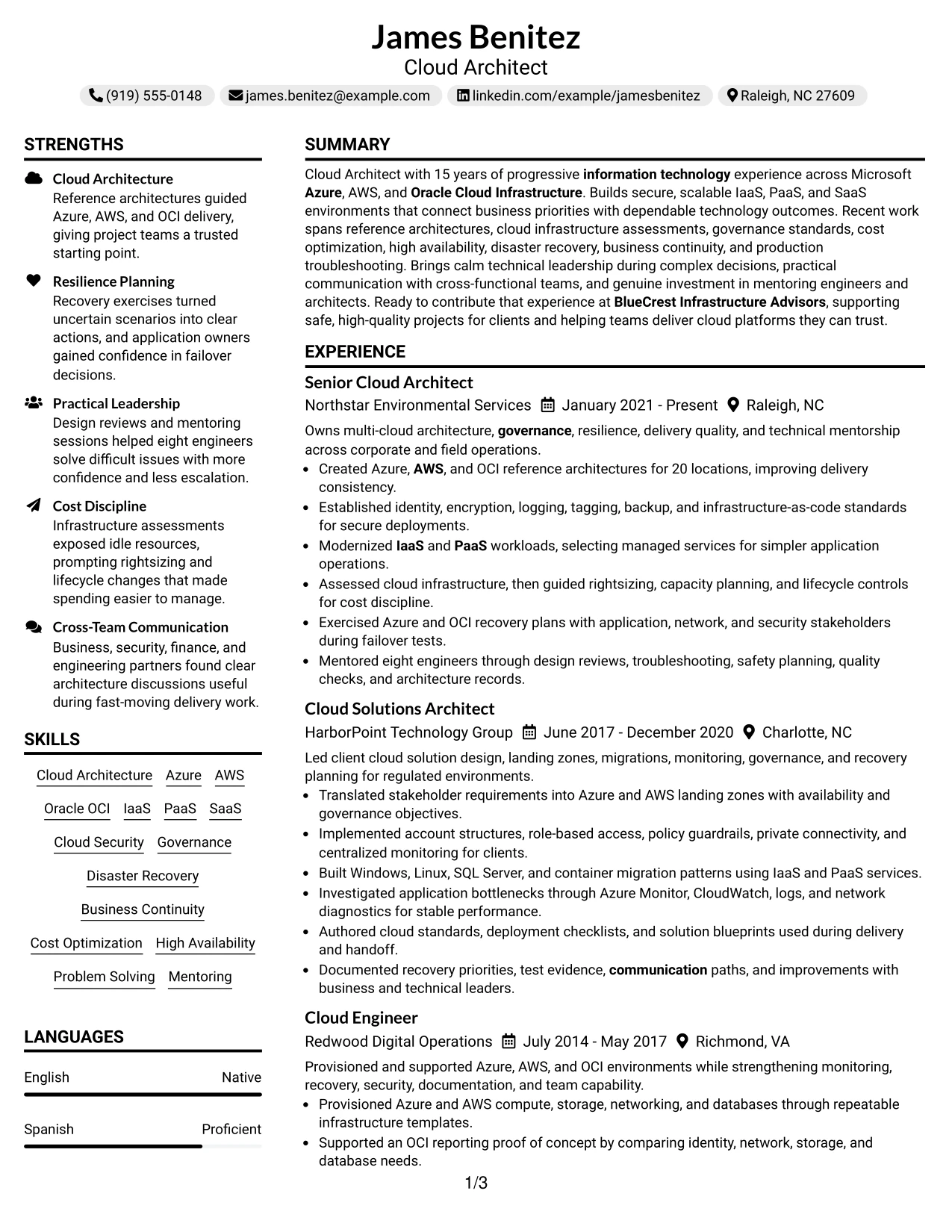
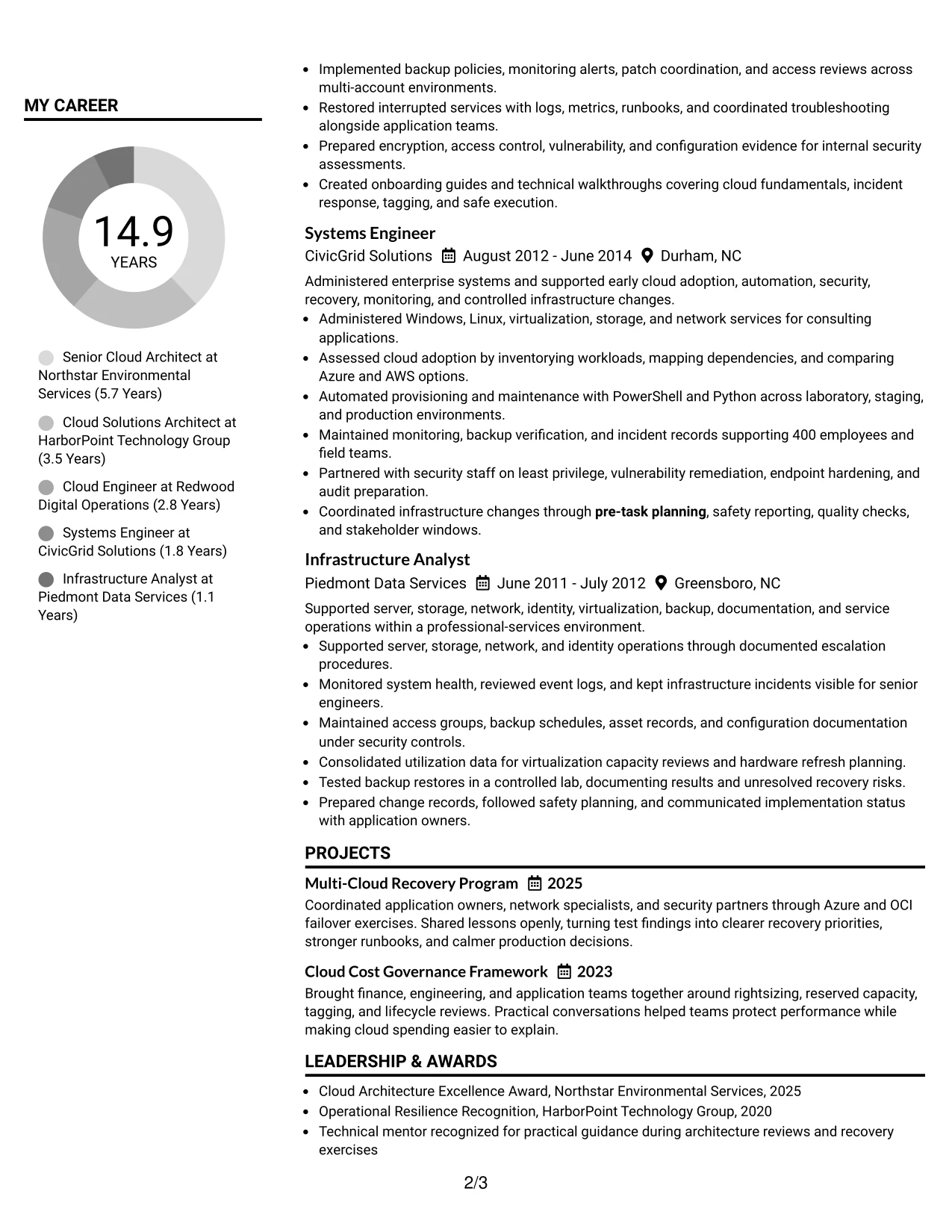
Why the Centered Header Classic Two Column Format Works for a Resume
- A centered header gives the document a balanced starting point.
- Two columns divide detailed evidence from compact qualification lists.
- Classic headings support familiar resume review and ATS interpretation.
- Bullets show progression from infrastructure operations to cloud architecture.
- The supporting column can group technical skills, certifications, education, and projects.
- The format accommodates both platform keywords and leadership evidence.
- Consistent spacing helps a long work history remain approachable.
Best For
- Resumes seeking a balanced presentation of career history and qualifications.
- Applications that need a classic structure with efficient use of page space.
- Candidates combining platform skills, certifications, education, and project evidence.
- Documents where a centered header creates a composed and neutral introduction.
- Technical histories that benefit from a separate column for supporting details.
- Readers who expect familiar resume sections and direct achievement bullets.
- Submissions that must present substantial content without a dense single-column block.
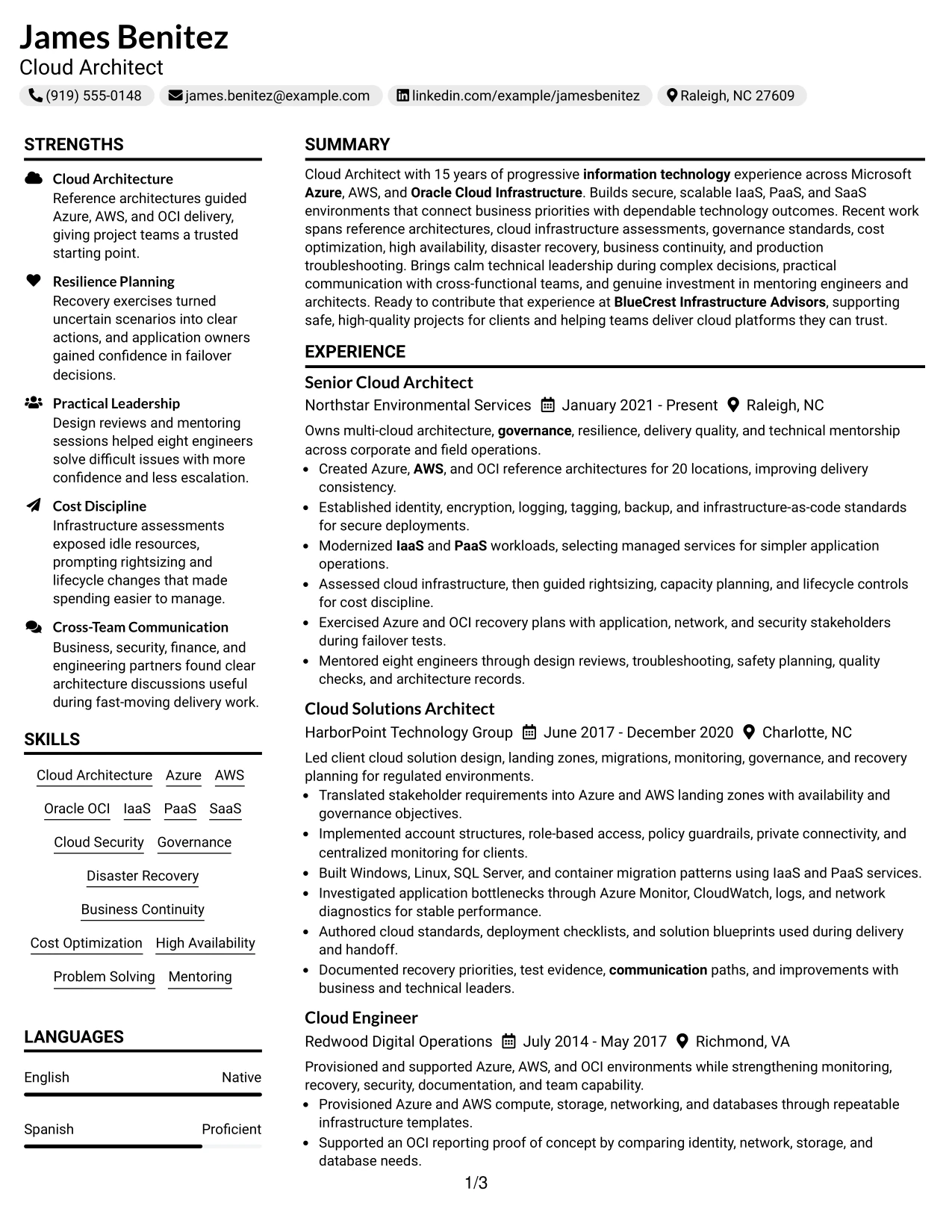
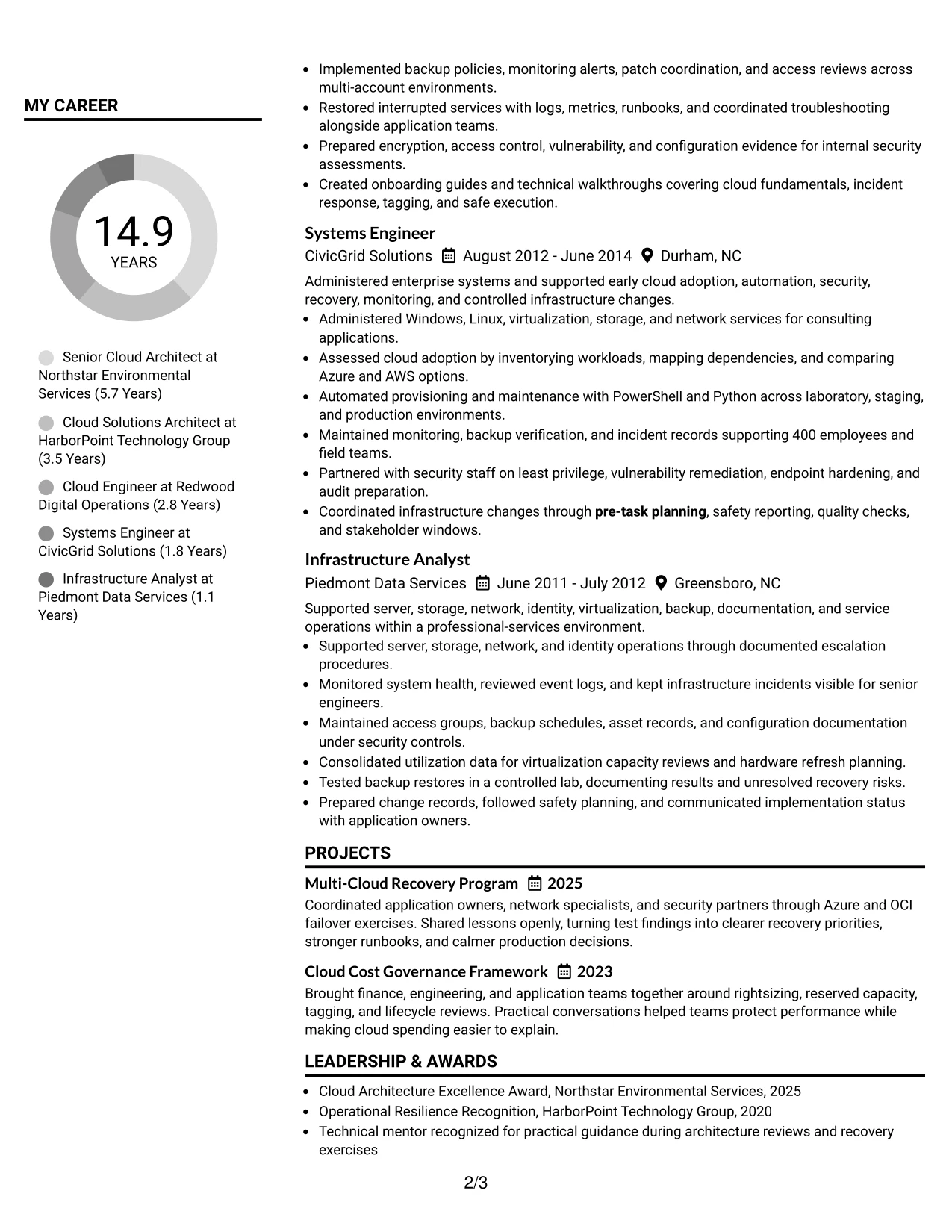
#29 Left Aligned Header Clean Two Column Format Resume Example
For an application that may be reviewed quickly, a left-aligned header creates an efficient starting point for contact details, the target role, and the summary. Two clean columns then give the work history a strong reading area while keeping skills, certifications, education, and projects easy to locate.
The visual simplicity supports precise technical writing. Readers can connect reference architectures and governance standards with recovery testing, monitoring, infrastructure assessments, cost controls, and team mentoring. White space around the sections helps measurable facts remain visible.
Why the Left Aligned Header Clean Two Column Format Works for a Resume
- Left alignment supports a natural top-to-bottom reading path.
- Two columns keep supporting qualifications close without crowding experience.
- Clean spacing improves visibility for architecture and operations bullets.
- The summary can state 15 years of progressive information technology experience clearly.
- Skills and certifications can be scanned separately from employment dates.
- Projects add focused evidence without breaking the main career timeline.
- The restrained structure works well for digital review and printed copies.
Best For
- Resumes designed for fast review from a clear left-aligned starting point.
- Candidates who want detailed experience paired with compact supporting sections.
- Applications where white space should protect the readability of technical bullets.
- Documents presenting architecture standards, recovery work, and cost controls together.
- Professionals who need projects and certifications visible but secondary to experience.
- Readers who prefer clean navigation without strong decorative elements.
- Resume copies intended to remain legible across screens, printouts, and file previews.
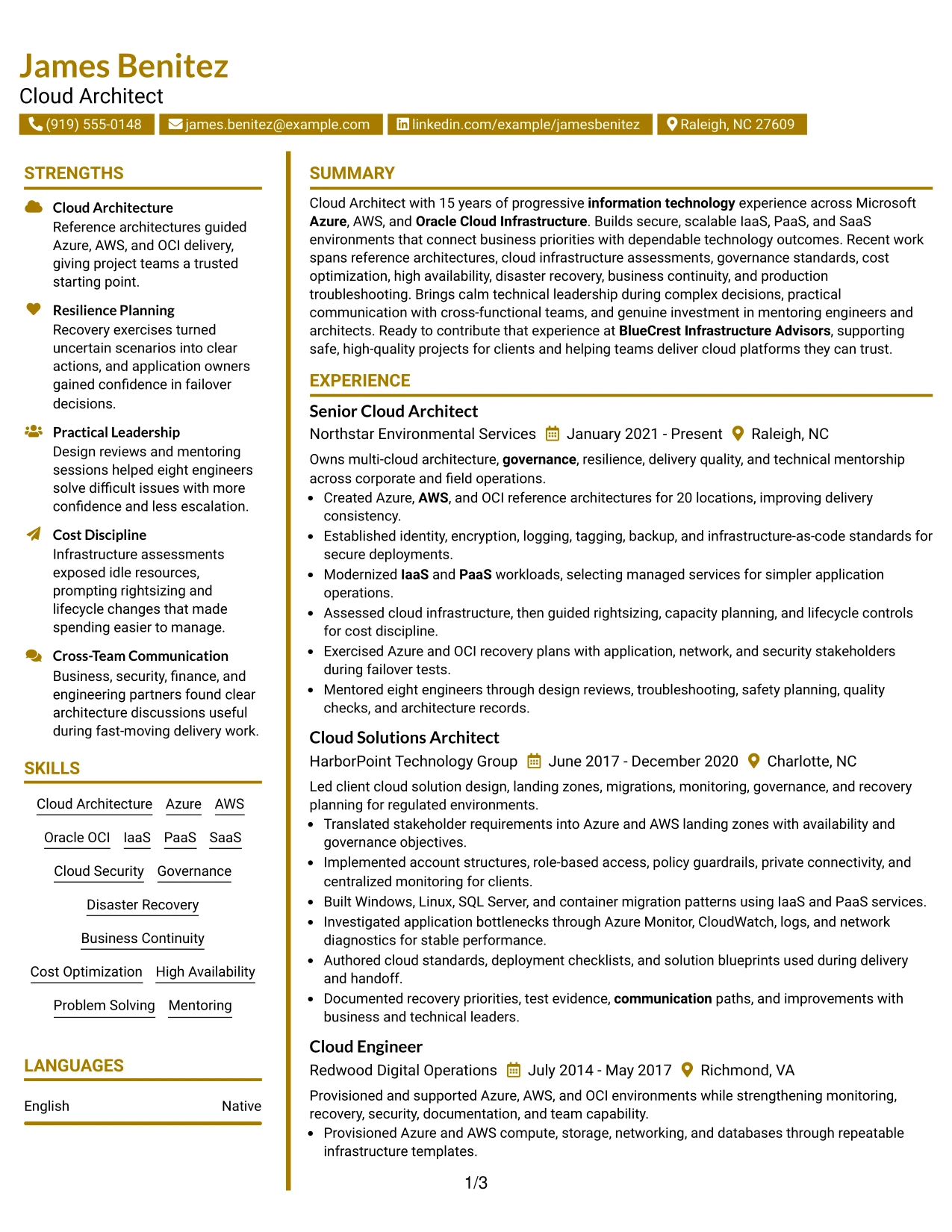
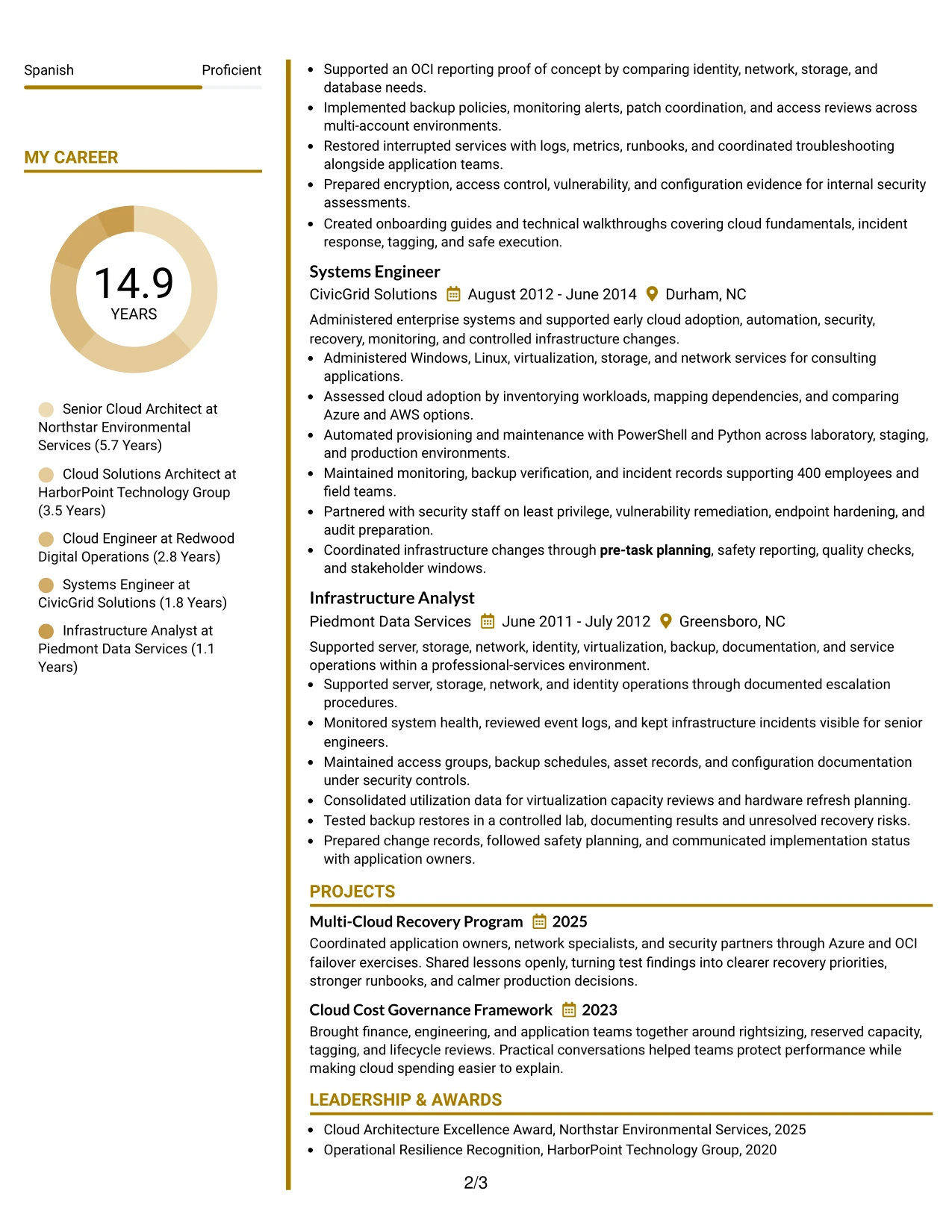
#30 Accent Divider Modern Two Column Format Resume Example
Modern visual cues give James Benitez's resume a focused, current presentation while keeping the content grounded in documented results. Accent dividers can separate the summary, career history, skills, projects, certifications, and education so readers can move through a broad technical record with less effort.
The two-column design supports role alignment by pairing cloud architecture evidence with the terms used in the target posting. Bullets can connect Azure, AWS, OCI, IaaS, PaaS, SaaS, governance, disaster recovery, and mentorship to practical work across business locations and client environments.
Why the Accent Divider Modern Two Column Format Works for a Resume
- Accent dividers create clear transitions between major resume sections.
- Two columns support both detailed achievements and compact keyword groups.
- The design makes multi-cloud experience visible without repeating the same terms excessively.
- Bullets show how architecture decisions supported security, resilience, and cost discipline.
- Projects provide focused examples beyond the employment timeline.
- Certifications reinforce alignment with the requested Azure, AWS, and OCI background.
- The modern structure remains useful for technical leadership and mentoring evidence.
Best For
- Resumes that need modern section separation without a highly decorative treatment.
- Applications matching several platform and architecture keywords in one document.
- Candidates presenting both strategic design work and hands-on operational evidence.
- Documents where projects should sit beside, rather than beneath, a long career history.
- Technical professionals who want a current layout with familiar resume mechanics.
- Readers who benefit from visual dividers between summary, experience, and qualifications.
- Submissions that need role alignment to remain visible across multiple content sections.
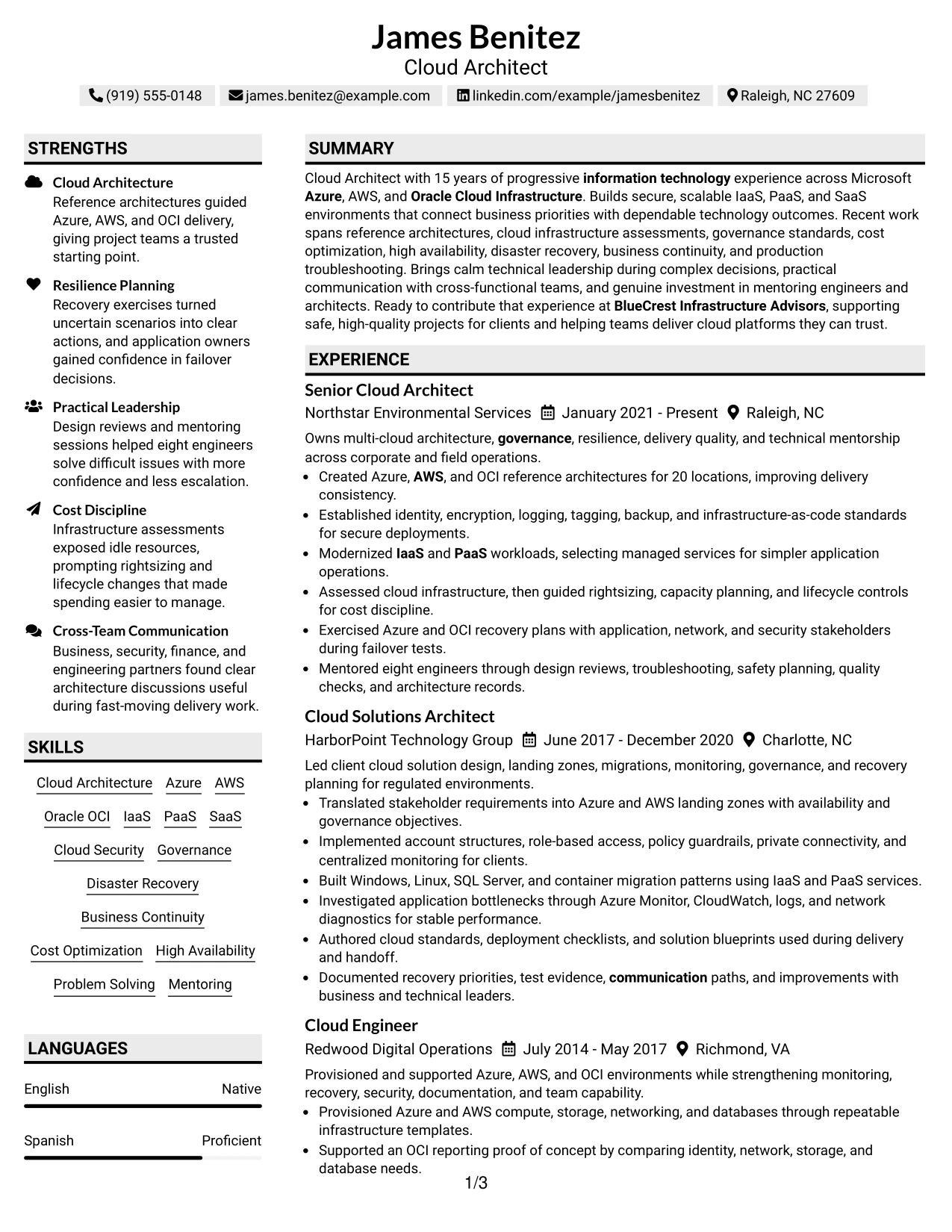
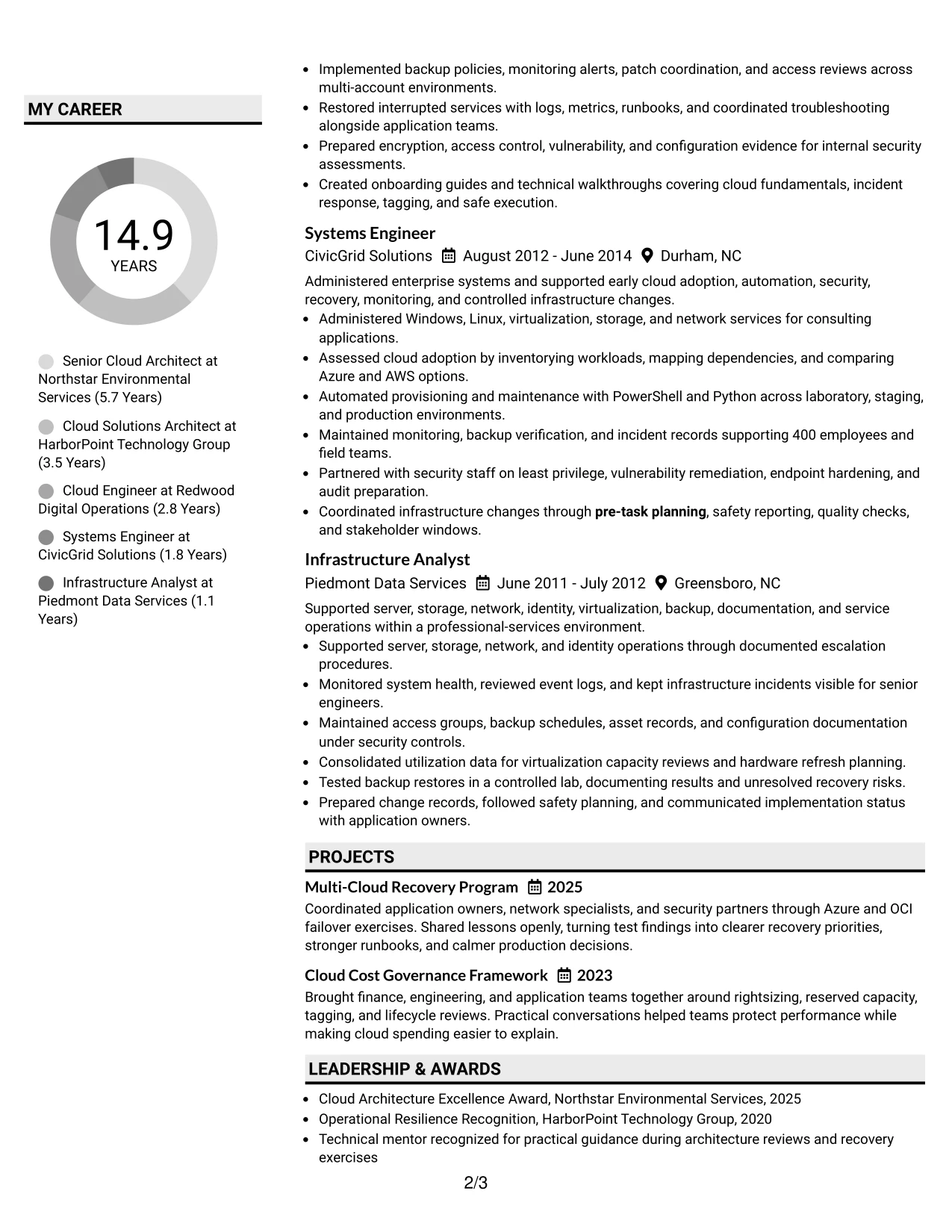
#31 Shaded Labels Clean Two Column Format Resume Example
Clear labels and a structured two-column arrangement make the resume easy to navigate from the professional summary through experience and supporting qualifications. Shaded labels can identify sections such as skills, certifications, education, projects, awards, and affiliations without relying on long introductory text.
The format suits a keyword-rich Cloud Architect resume because related terms can be grouped instead of scattered. Experience bullets then carry the proof: reference architectures, landing zones, cloud security, monitoring, failover testing, rightsizing, infrastructure as code, and mentorship.
Why the Shaded Labels Clean Two Column Format Works for a Resume
- Shaded labels make section boundaries visible during a quick scan.
- Two columns group high-volume skills while protecting experience space.
- Familiar headings support ATS parsing and human review.
- Keyword groups can cover platforms, service models, security, networking, and resilience.
- Achievement bullets provide context for each technical capability.
- Certifications and education remain easy to find in the supporting column.
- Projects and awards add credibility without competing with the work history.
Best For
- Resumes with many qualifications that need labeled, orderly grouping.
- ATS-aware applications using standard section names and readable text.
- Candidates who want skills organized by platform, service, and capability.
- Documents where experience bullets must remain the main source of evidence.
- Readers who scan shaded labels before deciding which sections to read closely.
- Technical histories combining certifications, projects, awards, and affiliations.
- Resume layouts that favor structured information over large visual features.
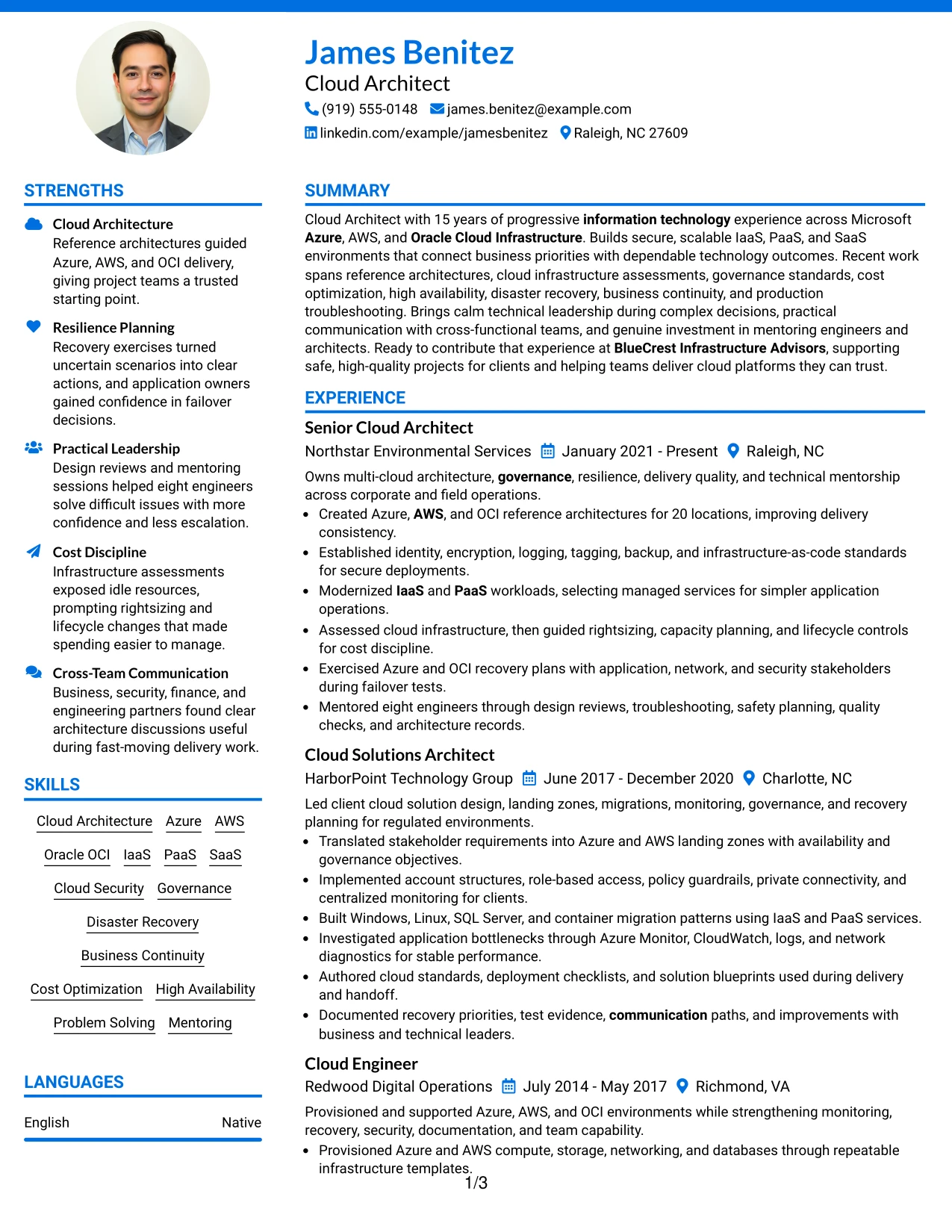
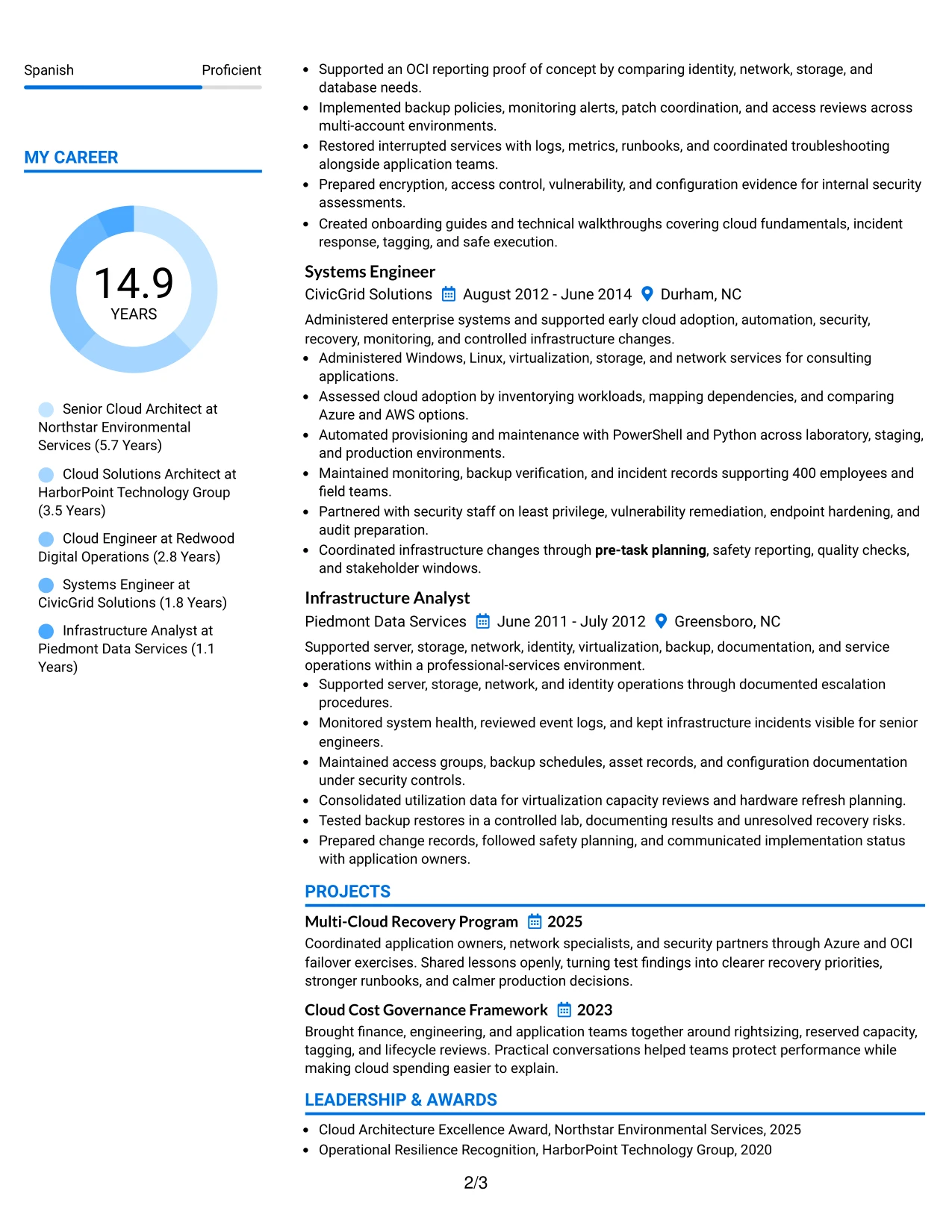
#32 Photo Header Color Accent International Format Resume Example
Readers can begin with the header, then follow the accent cues into the summary, experience, and qualifications. A professional photo may be appropriate for some application contexts, while the core resume evidence remains the multi-cloud architecture record, certifications, projects, and leadership activities.
The international presentation can give compact space to languages, affiliations, and credentials while the main content explains governance, high availability, disaster recovery, monitoring, cost optimization, and technical mentoring. Clear bullets preserve detail across five positions.
Why the Photo Header Color Accent International Format Works for a Resume
- The header establishes identity and role before the detailed sections begin.
- A professional photo can support recognition when local application norms allow it.
- Color accents guide readers through experience, skills, and credentials.
- The main content area can present five positions with focused achievement bullets.
- Languages and affiliations have a natural place among supporting qualifications.
- Certifications demonstrate current Azure, AWS, and OCI architecture knowledge.
- Projects add evidence of recovery exercises and cost governance beyond employment entries.
Best For
- Applications where a professional photo and international presentation are appropriate.
- Resumes that need room for languages, affiliations, and professional credentials.
- Candidates with a substantial career history and several supporting qualification groups.
- Documents using color cues to guide review without replacing written evidence.
- Applications where projects should strengthen the employment record.
- Readers who want identity, role, and qualifications organized near the top.
- Professionals presenting technical depth alongside cross-cultural or community involvement.
#33 Large Profile Photo International Two Column Format Resume Example
The most important evidence should remain prominent beside the profile area: the summary, cloud platform scope, architecture standards, resilience work, and leadership results. A large professional photo may provide a strong identity element, but the two-column resume must still give priority to readable accomplishments and searchable qualifications.
One column can carry the career timeline and project evidence, while the other organizes languages, skills, certifications, education, awards, and affiliations. This division presents a broad record that includes five roles, 20 business locations, failover exercises, cost governance, and mentorship of eight engineers.
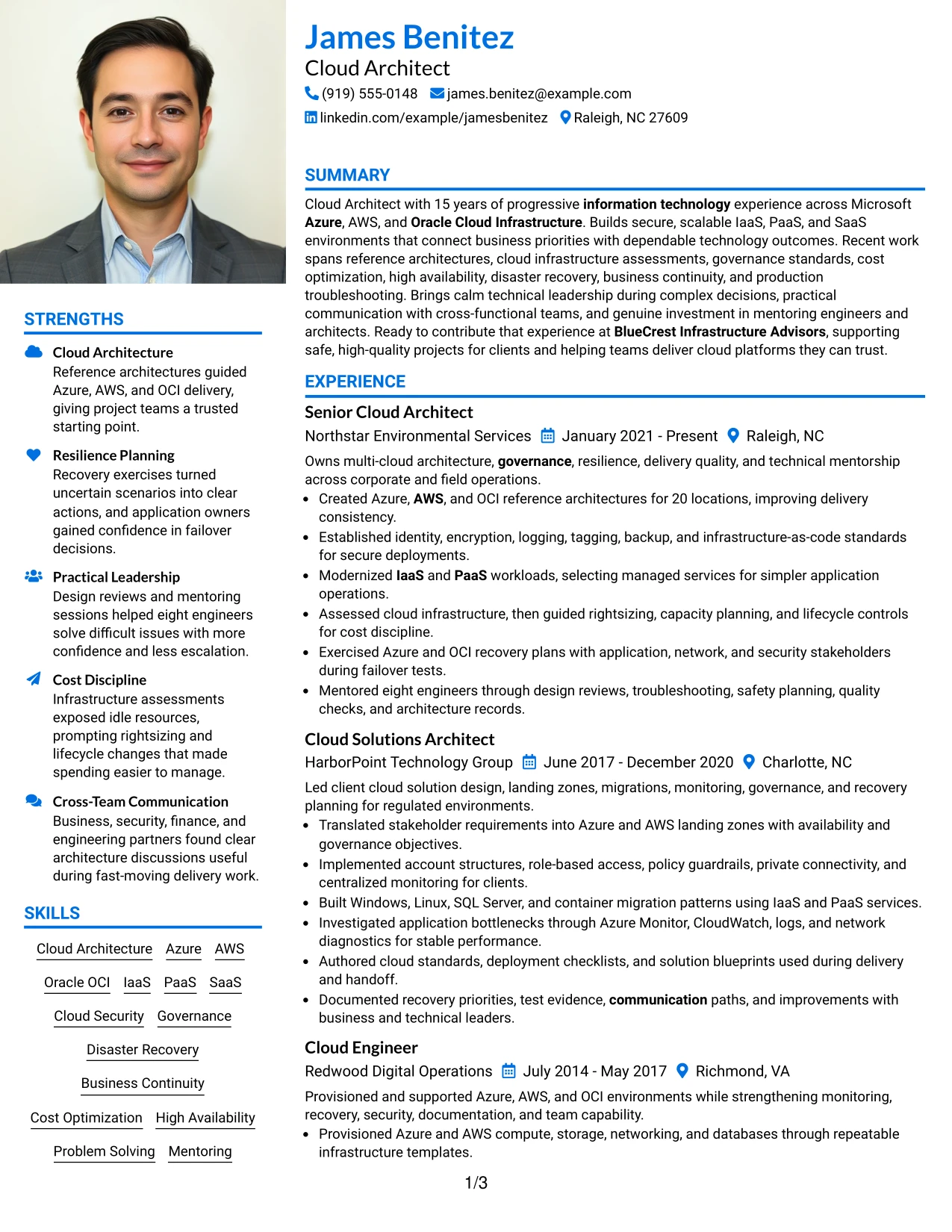
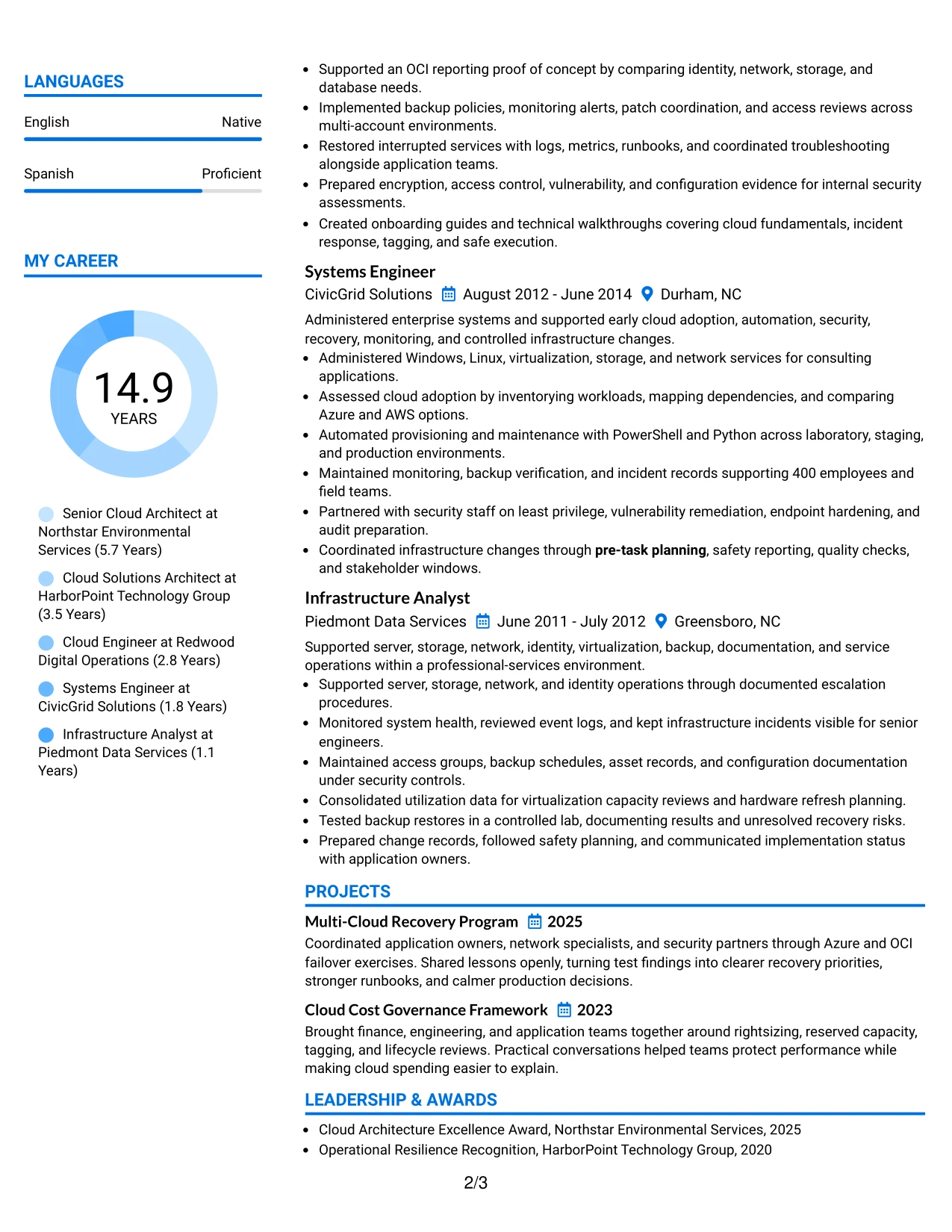
Why the Large Profile Photo International Two Column Format Works for a Resume
- The profile area creates a clear identity anchor at the start of the document.
- A large professional photo can suit applications where personal presentation matters.
- Two columns divide the career timeline from compact supporting evidence.
- The layout gives measurable scope such as 20 locations and eight engineers visibility.
- Skills and certifications can be grouped for quick technical verification.
- Projects make recovery and cost governance evidence easy to distinguish from employment.
- Languages, awards, and affiliations can be included without overwhelming the main history.
Best For
- Applications where a larger professional photo is suitable and useful for recognition.
- Resumes needing a distinct profile area plus a complete technical career record.
- Candidates with measurable scope that should remain visible beside supporting details.
- Documents combining five roles with projects, awards, languages, and affiliations.
- International or client-facing contexts where personal presentation is relevant.
- Readers who want a separate qualifications column beside detailed experience.
- Professionals balancing strong evidence volume with a clearly defined visual identity area.
Why Build Your Cloud Architect Resume with ResumeInMinutes
ResumeInMinutes helps professionals turn complex architecture work into a structured resume that is concise, readable, and aligned with the target position. The format makes it easier to present cloud platforms, service models, governance work, recovery planning, tools, certifications, and measurable outcomes in the right sections.
- ATS-friendly section structure
- Keyword-focused resume content
- Cloud skills organization
- Experience and achievement guidance
- Free PDF resume previews
- Resume customization support
Build a resume that gives appropriate emphasis to reference architectures, infrastructure assessments, cloud standards, monitoring, troubleshooting, migration planning, resilience exercises, mentoring, and professional certifications. Clear organization helps both ATS systems and human reviewers find the evidence they need.
See Also
- 33 Cloud Architect - Secure Cloud Migration Resume Templates with Example 2026 (ATS-Optimized)
- 33 Advisory Data Architect-Senior Manager Resume Templates with Example 2026 (ATS-Optimized)
- 33 AI/ML Solutions Architect Resume Templates with Example 2026 (ATS-Optimized)
- 33 AI Solutions Architect Resume Templates with Example 2026 (ATS-Optimized)
- 33 Architect-Associate Resume Templates with Example 2026 (ATS-Optimized)
- 33 Architect, Data Science Resume Templates with Example 2026 (ATS-Optimized)
- 33 Big Data Architect / Senior Developer Resume Templates with Example 2026 (ATS-Optimized)
- 7 Client Solution Architect Resume Templates with Example
- 30+ Cloud Architect Cover Letter Templates with Example 2026
- 30+ Advisory Data Architect-Senior Manager Cover Letter Templates with Example 2026
Frequently Asked Questions
Are these Cloud Architect resume templates ATS-friendly?
Yes. The templates use clean sections, readable headings, and space for relevant terms such as Azure, AWS, Oracle Cloud Infrastructure, cloud security, governance, disaster recovery, and high availability.
Are these 33 different resumes?
No. This guide presents one Cloud Architect resume example in different layouts and design themes. You can compare the formats and choose the structure that presents your evidence most clearly.
What should a Cloud Architect resume include?
Include a focused summary, cloud architecture skills, professional experience, measurable achievements, projects, education, certifications, and relevant tools. Highlight Azure, AWS, OCI, IaaS, PaaS, SaaS, security, governance, resilience, and cost work when supported by your background.
Can I download the resume templates as PDFs?
Yes. Each resume style provides a free PDF download so you can preview the format and select a layout that supports clear ATS parsing and professional review.
Which resume style is best for a Cloud Architect?
A clean one-column layout is usually the safest choice for ATS parsing and technical detail. A straightforward two-column design can also work when it keeps headings, skills, certifications, and experience easy to read.
How should I describe cloud architecture experience?
Use concise bullets that show the platform, architecture responsibility, action, and result. Mention reference architectures, standards, assessments, recovery testing, monitoring, cost controls, stakeholder collaboration, or mentoring when they are part of your experience.
Should I include cloud certifications on my resume?
Yes, if they are current and relevant. List the full certification name and date, including AWS Certified Solutions Architect, Microsoft Certified: Azure Solutions Architect Expert, or Oracle Cloud Infrastructure Architect credentials when applicable.
Can I customize these resume templates?
Yes. ResumeInMinutes allows you to update the resume text, section order, layout, design style, and PDF format for your Cloud Architect target role.