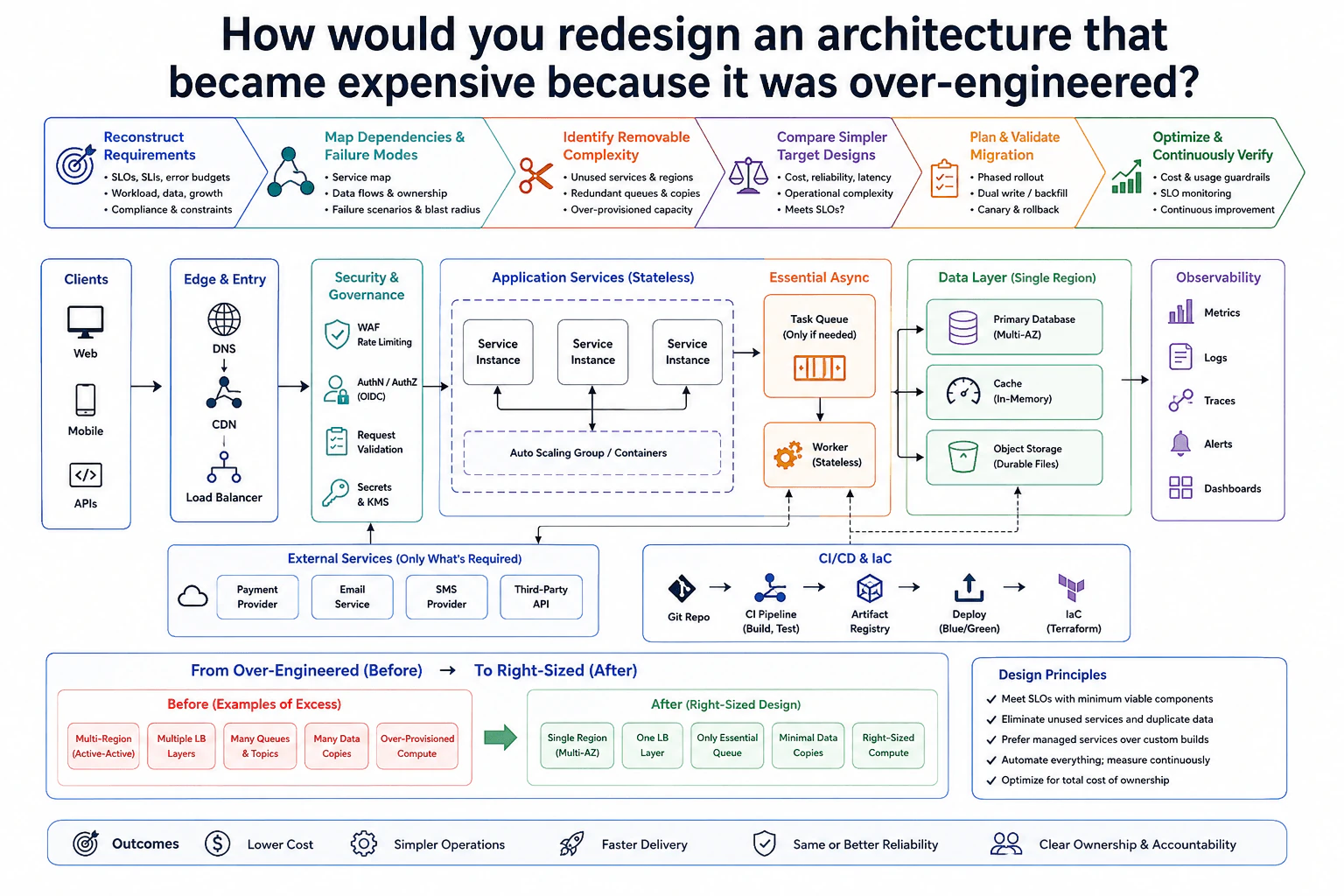
This interview guide is for educational and informational purposes only. It is designed to help readers prepare, but it does not guarantee any interview result, hiring decision, offer, or outcome. Interview questions, hiring criteria, and preferred answers can vary by employer, interviewer, industry, location, and time. All answers, examples, and explanations in this guide are suggested examples for interview preparation, not definitive answers or instructions for professional practice. They are based on research and judgment, are provided without warranties of any kind, and should be adapted to the question, role, and applicable laws and professional requirements. Diagrams are simplified illustrations intended to highlight the main concepts and their relationships; actual situations, systems, and practices may be more complex. Alternative approaches may be equally valid or better suited to a particular question, context, or interviewer. To the fullest extent permitted by applicable law, the contributors and publisher are not liable for decisions made, actions taken, or losses incurred based on this guide.
State Laws and Professional Responsibilities
Laws and requirements governing an occupation vary by state and jurisdiction. You are responsible for checking the current laws, licensing requirements, and scope-of-practice rules that apply to your location and role, and for ensuring that your answers and actions comply with them. Adapt examples in this guide to those requirements. This guide is not legal advice.
Identity, Image, and Privacy Notice
To respect individual privacy, some names, profile photographs, avatars, biographical details, and other identifying information displayed in this guide may be replaced with pseudonyms, licensed stock images, illustrative avatars, composite images, or representative descriptions. Unless a person is expressly identified as an actual contributor, a displayed name, image, or profile should not be understood as depicting or identifying a specific candidate, interviewer, employee, or other real individual. These representations are provided for editorial and illustrative purposes only and do not imply endorsement, employment, participation, or affiliation with this guide or any company mentioned in it. Any resemblance to an actual person is coincidental.
Company Notice
This guide is an independent educational resource and is not affiliated with, endorsed by, sponsored by, or approved by the company named in this guide. Company names identify reported interview experiences or the employer context of clearly labeled original practice exercises. Interview practices can change without notice, and inclusion of company-specific content does not mean these questions are official, complete, or guaranteed to be asked. To the fullest extent permitted by law, the author, contributors, and publisher are not responsible for outcomes related to use of this material.
Content Accuracy and Verification
To the fullest extent permitted by applicable law, we do not represent or warrant that interview guides, questions, answers, examples, or diagrams are accurate, complete, current, error-free, or suitable for any particular purpose. You are responsible for independently reviewing and verifying the information before relying on it.
Questions or comments?
Contact us for general questions, or share feedback, technical corrections, and comments with the community.
1. What is cloud architecture, and which qualities make a cloud design well architected?Cloud ArchitectureEasy
i Question Details
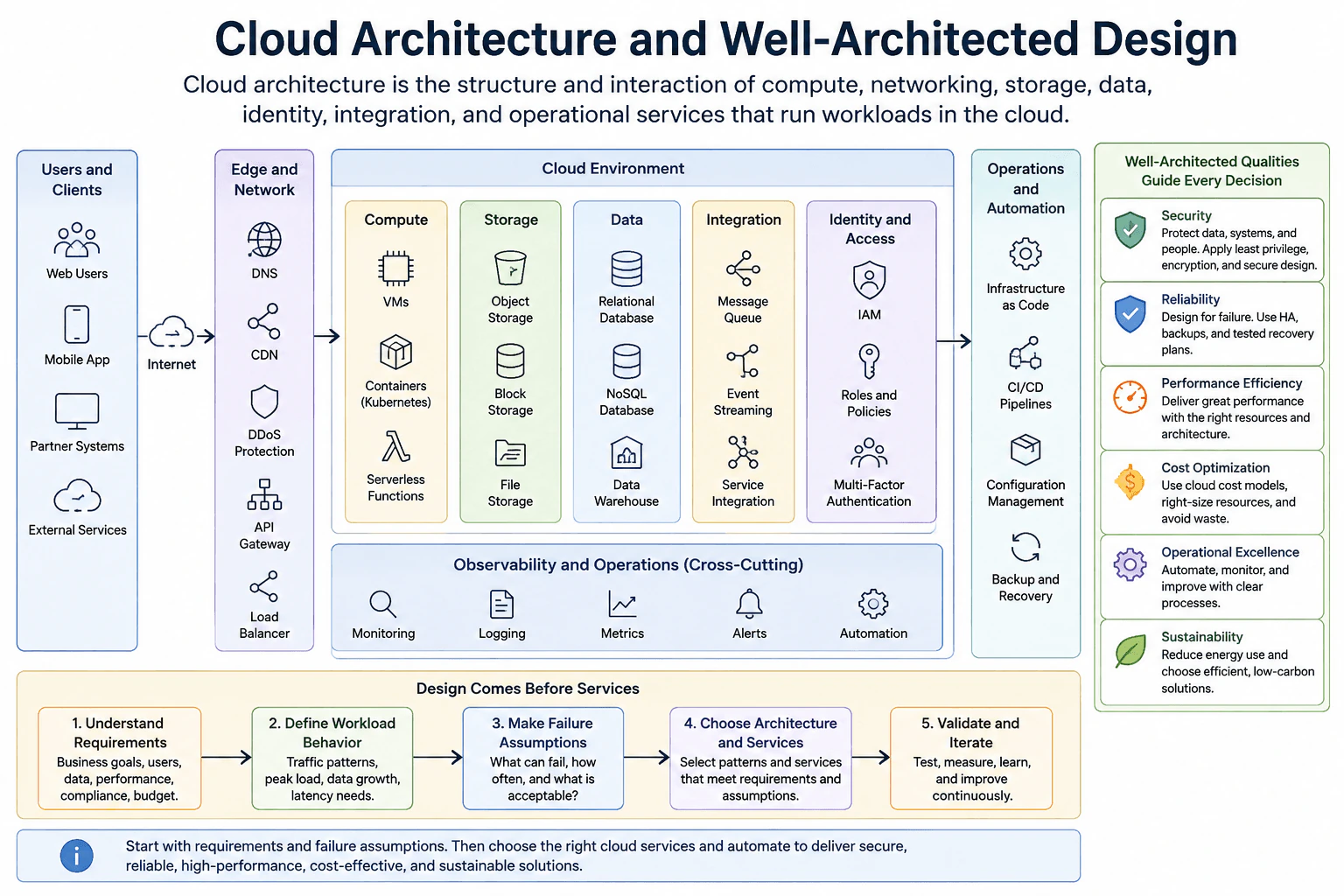
Define cloud architecture as the structure and interaction of compute, networking, storage, data, identity, integration, and operational services. Explain how security, reliability, performance, cost, operational excellence, and sustainability shape design decisions, and show why requirements and failure assumptions must come before choosing services.
Short Interview Answer (30-60 seconds)
At a high level, cloud architecture is how cloud services work together to run a workload. The main challenge is choosing a design that meets business needs and still handles failures well. I would explain it in three parts: start with requirements and failure assumptions, connect the main cloud building blocks, and judge every decision using well-architected qualities. Security, reliability, performance, cost, operational excellence, and sustainability guide the design. The trade-off is balancing these qualities instead of maximizing only one.
Detailed Explanation
Cloud architecture is the structure of the services that run a workload and how those services work together. A good design should meet business needs without choosing technology first. The difficult part is balancing many needs at once while also planning for failures. The diagram solves this by starting with requirements and workload behavior, defining failure assumptions, choosing the architecture and services, and then validating and improving the design. The same design is judged using security, reliability, performance, cost, operational excellence, and sustainability.
Useful Questions to Ask the Interviewer
What business goals, users, data needs, performance needs, compliance rules, and budget limits matter most?
What failures should the system be designed to handle?
How much downtime or recovery time is acceptable?
Which well-architected quality matters most when two goals conflict?
How to Explain It in an Interview
1. Start with requirements before services
I would start by saying that design comes before service selection. First, understand the business goals, users, data, performance needs, compliance needs, and budget. Then define workload behavior such as traffic patterns, peak load, data growth, and latency needs. After that, make failure assumptions by asking what can fail, how often it might fail, and what impact is acceptable. Only then should we choose architecture patterns and cloud services. The last step is to validate, measure, learn, and improve continuously.
2. Explain how users reach the cloud environment
The diagram starts with Web Users, Mobile App, Partner Systems, and External Services. They connect through the Internet to the Edge and Network area. That area includes DNS, CDN, DDoS Protection, API Gateway, and Load Balancer capabilities. These networking services help direct, protect, and distribute traffic before it reaches the Cloud Environment. The diagram does not require every edge service to be used in one fixed sequence. The exact choice depends on the workload requirements.
3. Explain the main cloud building blocks
Inside the Cloud Environment, Compute can use VMs, Containers, or Serverless Functions. Storage can use Object Storage, Block Storage, or File Storage. The Data area includes Relational Database, NoSQL Database, and Data Warehouse services. Integration includes Message Queue, Event Streaming, and Service Integration. Identity and Access includes IAM, Roles and Policies, and Multi-Factor Authentication. These are building blocks that interact according to the application design rather than one fixed request path.
4. Explain operations and automation
Observability and Operations are cross-cutting responsibilities inside the Cloud Environment. Monitoring, Logging, Metrics, and Alerts help teams understand system health and behavior. Automation helps teams repeat work consistently. The separate Operations and Automation area includes Infrastructure as Code, CI/CD Pipelines, Configuration Management, and Backup and Recovery. Together, these practices support deployment, operation, recovery, and continuous improvement.
5. Judge every decision using the six qualities
Security protects data, systems, and people through least privilege, encryption, and secure design. Reliability means designing for failure with high availability, backups, and tested recovery plans. Performance Efficiency means choosing resources that meet performance needs. Cost Optimization means right-sizing resources and avoiding waste. Operational Excellence means automating, monitoring, and improving processes. Sustainability means reducing energy use and choosing efficient solutions. A well-architected design balances these qualities against the requirements instead of optimizing only one.
Practical Complexity & Trade-offs
The benefit is that this approach makes technology choices follow real requirements. Designing for failure improves reliability, but high availability, backups, and recovery work can add cost. Monitoring and automation make operations easier to repeat, but they also need setup and maintenance. Strong security controls protect the system, but they may add extra steps. More resources can improve performance, but they can also increase cost and energy use. We accept these trade-offs because a well-architected design balances security, reliability, performance, cost, operational excellence, and sustainability based on what the workload actually needs.
Why Interviewers Ask This
Interviewers ask this question to see whether you think about architecture before naming cloud services. They want to know if you can connect business requirements, workload behavior, failure assumptions, and technical choices. They also want to see whether you understand the six well-architected qualities and can explain trade-offs clearly. The important skill is good engineering judgment, not memorizing a list of cloud products.
Interviewer may ask next
What would you change if reliability became the most important requirement for this architecture?
I would keep the same basic architecture, but reliability would have more weight in each design decision. I would first revisit the failure assumptions because they define what the system must survive and how much interruption is acceptable.
Then I would focus more strongly on the reliability controls already shown in the diagram. I would use high availability where the requirements justify it. Backup and Recovery would become especially important, and recovery plans should be tested rather than only documented. Monitoring, Logging, Metrics, and Alerts would help the team detect problems quickly. Infrastructure as Code and CI/CD Pipelines would help make deployment and recovery steps repeatable.
I would still evaluate Security, Performance Efficiency, Cost Optimization, Operational Excellence, and Sustainability. The main downside is cost and operational effort. More redundancy, monitoring, backup work, and recovery preparation can require additional resources, so the reliability target should match the real business need.
How would you approach the design if the business required a major reduction in cloud cost?
I would keep the same architecture and give more weight to Cost Optimization, but I would not cut resources blindly. I would return to the requirements first and confirm the performance and reliability levels that the workload actually needs.
Then I would use Monitoring and Metrics to understand resource usage. I would right-size resources, which means choosing capacity that matches the workload instead of keeping unnecessary spare capacity. Automation can also help reduce waste and keep configuration consistent. Sustainability supports the same direction because using resources efficiently can reduce both cost and energy use.
The other qualities still matter. Security controls must remain in place, reliability still needs appropriate backup and recovery, and performance must still meet its target. The main downside is that aggressive cost reduction can reduce spare capacity or reliability options. The goal is therefore to remove waste without breaking the agreed requirements.
2. When would you choose serverless functions, containers, or virtual machines for a new cloud workload?Cloud ArchitectureEasy
i Question Details
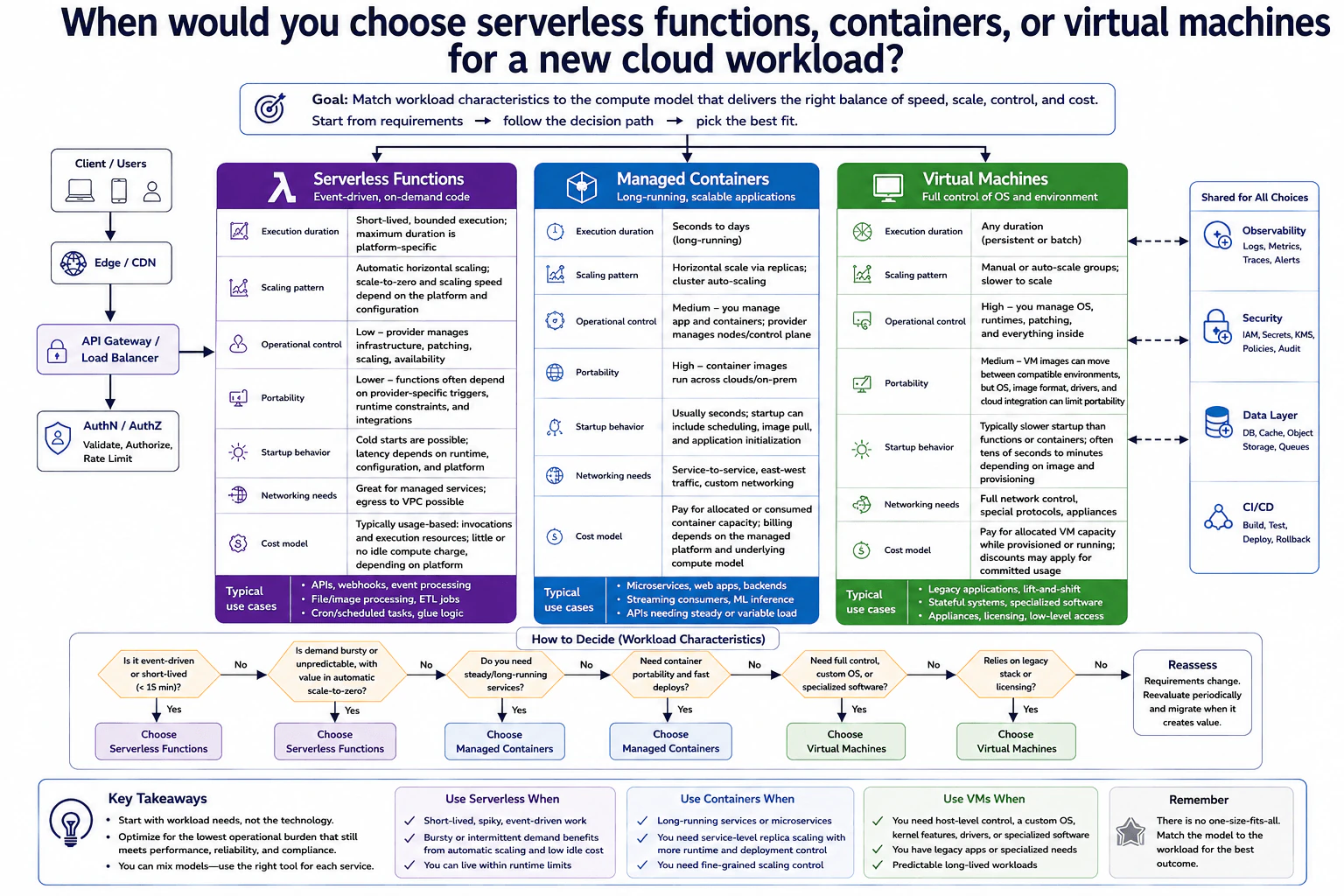
A product team is selecting compute for a new service. Compare serverless functions, managed containers, and virtual machines by execution duration, scaling pattern, operational control, portability, startup behavior, networking needs, and cost model, then explain which workload characteristics lead to each choice.
Short Interview Answer (30-60 seconds)
At a high level, I would choose the compute model by matching it to the workload. The main challenge is balancing execution time, scaling, control, portability, startup behavior, networking, and cost. I would compare three choices: serverless functions for short event-driven work, managed containers for long-running portable services, and virtual machines when host-level control matters. The trade-off is that managed options reduce operational work, while greater control usually means more responsibility for the team.
Detailed Explanation
The team needs to decide how a new cloud workload should run. No single compute model is best for every service. Short and unpredictable work has different needs from a service that runs all day. Some workloads also need special operating-system or networking control. The diagram compares three choices using execution duration, scaling, control, portability, startup behavior, networking, and cost. It then uses those workload characteristics to choose Serverless Functions, Managed Containers, or Virtual Machines while keeping common security and operational concerns around every option.
Useful Questions to Ask the Interviewer
Is the workload short-lived, long-running, or a mix of both?
Is traffic steady, bursty, or unpredictable?
Does the workload benefit from automatic scale-to-zero?
Do we need a custom OS, kernel features, drivers, or specialized software?
How important are portability and fast deployment?
Do we need special networking or low-level network control?
How to Explain It in an Interview
1. Start with workload characteristics
I would start with the workload, not a favorite technology. Client / Users enter through the Edge / CDN and API Gateway / Load Balancer. The design also shows AuthN / AuthZ with validation, authorization, and rate limiting. From there, I compare the workload against the three compute models.
2. Choose Serverless Functions for short, event-driven work
Serverless Functions fit short-lived tasks such as APIs, webhooks, event processing, file processing, ETL jobs, and scheduled tasks. Execution is bounded, and the maximum duration depends on the platform. Scaling is automatic, but scale-to-zero behavior and scaling speed depend on the platform and configuration. Operational control is low because the provider manages infrastructure, patching, scaling, and availability. Portability is lower because functions can depend on provider-specific triggers and runtime limits. Cold starts are possible. Networking is usually well suited to managed services, with VPC egress possible. Cost is typically based on invocations and execution resources, with little or no idle compute charge depending on the platform.
3. Choose Managed Containers for long-running services
Managed Containers fit long-running services, microservices, web applications, streaming consumers, ML inference, and APIs with steady or variable load. They scale horizontally by adding replicas. The platform manages nodes or the control plane, while the team manages the application and containers. Container images give high portability across compatible environments. Startup is usually seconds, although scheduling, image pulls, and application initialization add time. Containers also support service-to-service traffic, east-west traffic, and custom networking. Their cost depends on allocated or consumed container capacity and the underlying compute model.
4. Choose Virtual Machines when host-level control matters
Virtual Machines fit legacy applications, stateful systems, specialized software, appliances, licensing needs, and workloads requiring low-level access. They can run for any duration. The team manages the OS, runtime, patching, networking, and capacity. VM startup is typically slower than functions or containers and may take tens of seconds to minutes. Portability is medium because OS details, image formats, drivers, and cloud integrations can limit movement. VMs provide full network control and support special protocols. Cost is based on allocated VM capacity while provisioned or running, with possible committed-use discounts.
5. Finish with shared concerns and the decision path
All three choices still need Observability, Security, a Data Layer, and CI/CD. I would choose serverless for short or bursty event-driven work, containers for steady long-running services that need portability and deployment control, and VMs when host-level control or legacy requirements dominate. If the requirements change, I would reassess the choice instead of forcing one compute model to fit forever.
Practical Complexity & Trade-offs
The benefit of Serverless Functions is low operational work and automatic scaling for short or bursty tasks. The downside is lower portability, possible cold starts, and platform-specific limits. Managed Containers give a middle ground. They provide strong portability and more runtime control, but the team still manages application and container settings. Virtual Machines provide the most host-level control and support special or legacy needs. The downside is more patching, networking, capacity work, and slower startup. Cost also differs. Serverless is usually usage-based, while containers and VMs charge for allocated or consumed capacity.
Why Interviewers Ask This
Interviewers want to see whether you choose compute from workload needs instead of personal preference. They are testing your judgment about execution time, scaling, startup behavior, portability, networking, operational control, and cost. They also want you to explain trade-offs clearly. A strong answer shows that you understand when managed services reduce work and when extra control from containers or virtual machines is worth the added responsibility.
Interviewer may ask next
What would you change if the workload starts as bursty event-driven work but later becomes a steady long-running service?
I would reassess the compute choice and likely move the long-running part toward Managed Containers. Serverless Functions are a strong fit at the beginning when work is short-lived, event-driven, and unpredictable. Automatic scaling can handle bursts, and the team has little infrastructure to manage.
If the service later runs continuously with steady traffic, containers become more attractive. They support long-running services and give the team more control over the runtime and deployment. Container images also make the workload easier to move between compatible environments.
The surrounding design can stay the same. Client / Users can still enter through the Edge / CDN and API Gateway / Load Balancer. AuthN / AuthZ, Observability, Security, the Data Layer, and CI/CD still apply.
The main downside is additional operational responsibility. The team now manages container configuration and application resources instead of relying as heavily on the serverless platform.
When would you choose Virtual Machines instead of Managed Containers?
I would choose Virtual Machines when the workload needs host-level control that the managed container environment cannot provide. Examples from the diagram include a custom OS, kernel features, drivers, specialized software, legacy applications, appliances, or licensing requirements.
The surrounding architecture does not need to change. Client / Users still enter through the Edge / CDN and API Gateway / Load Balancer. AuthN / AuthZ remains part of the design. Observability, Security, the Data Layer, and CI/CD are still shared concerns.
The important difference is responsibility. With Virtual Machines, the team manages the OS, runtime, patching, networking, and capacity. Startup is also usually slower than with containers. VM images can move between compatible environments, but OS details, drivers, image formats, and cloud integrations can reduce portability.
The downside is higher operational effort. I would choose VMs only when that extra control solves a real workload requirement.
3. How would you decide between GKE Autopilot and GKE Standard for a managed Kubernetes workload?Cloud ArchitectureEasy
i Question Details
A team wants to run a containerized application on Google Kubernetes Engine. Explain how cluster administration, node control, workload constraints, pricing, security responsibility, and operational effort affect the choice between Autopilot and Standard mode.
Short Interview Answer (30-60 seconds)
At a high level, the goal is to choose the GKE mode that best fits the workload and the team. The main challenge is balancing lower operational effort against deeper node control. I would compare six areas, then explain when Autopilot fits and when Standard fits. Autopilot lets Google manage more of the node layer. Standard gives the team more infrastructure choices. Both keep the common GKE capabilities shown in the diagram. The trade-off is simplicity versus flexibility and control.
Detailed Explanation
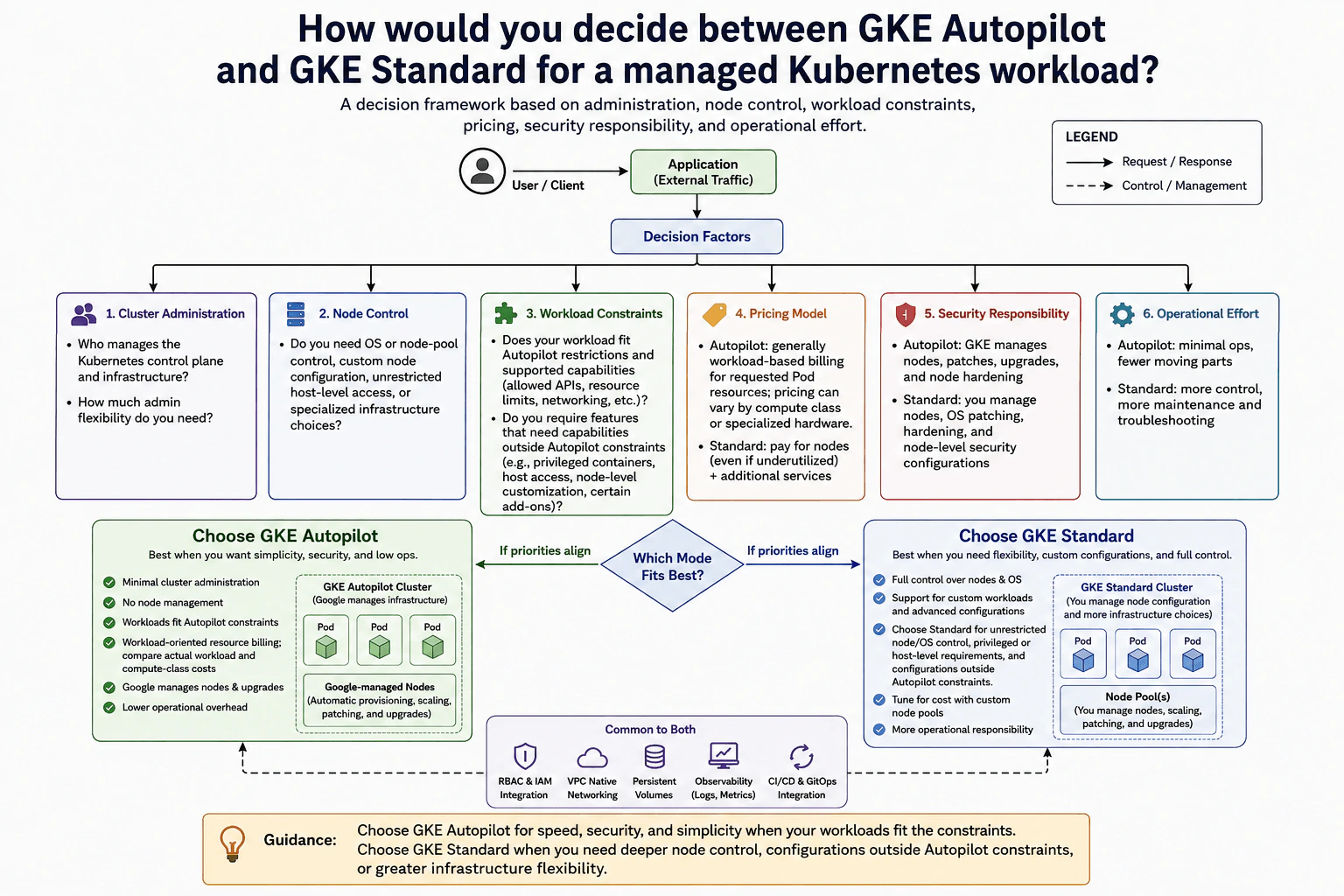
The goal is to choose the right GKE mode for one containerized application. Both choices can run the application, but they give the team different levels of control and daily work. The difficult part is deciding how much infrastructure the team wants Google to manage. The diagram handles this as a simple decision. It starts with the application, checks six important factors, and then branches to either GKE Autopilot or GKE Standard. The final choice depends on workload needs, cost preferences, security responsibility, and operational effort.
Useful Questions to Ask the Interviewer
Does the team need OS or node-pool control?
Does the workload need privileged or host-level capabilities?
Does the workload fit the supported Autopilot constraints?
Does the team prefer lower operations work or deeper control?
How important is node-level cost tuning?
How to Explain It in an Interview
1. Start with the decision factors
I would say that this is mainly a control-versus-simplicity decision. The diagram starts with the User / Client and the Application (External Traffic). From there, it moves into six Decision Factors.
Cluster Administration asks how much platform work the team wants to handle. Node Control asks whether the team needs OS control, node-pool control, custom node settings, unrestricted host access, or special infrastructure choices. These questions quickly show whether Autopilot gives enough freedom.
2. Check workload constraints and pricing
Next, I would check whether the workload fits Autopilot restrictions and supported capabilities. Some workloads may need privileged containers, host access, node-level customization, or add-ons outside those limits. In that case, Standard becomes the stronger choice.
Pricing also matters. Autopilot generally uses workload-based billing for requested Pod resources. The price can vary by compute class or specialized hardware. Standard charges for the nodes the team runs, even when some capacity is unused, plus other services. Standard gives more cost-tuning choices, but it also needs more management.
3. Compare security responsibility and operational effort
Then I would explain who manages the node layer. With Autopilot, Google manages nodes, patches, upgrades, and node hardening. This reduces the amount of infrastructure work for the team.
With Standard, the team manages nodes and more node-level security configuration. It also owns more OS patching, hardening, maintenance, and troubleshooting. That extra responsibility gives the team more control.
4. Explain when Autopilot is the better fit
I would choose GKE Autopilot when simplicity and low operational effort matter most. The diagram shows minimal cluster administration and no direct node management. Google handles automatic node provisioning, scaling, patching, and upgrades.
Autopilot works best when the application stays inside its workload constraints. It is also useful when the team wants workload-oriented resource billing and fewer moving parts to maintain.
5. Explain when Standard is the better fit
I would choose GKE Standard when the workload needs deeper node or OS control. The diagram shows customer-managed node pools and more infrastructure choices. It is the better fit for requirements outside Autopilot constraints or for advanced custom configurations.
Both modes still share RBAC & IAM Integration, VPC Native Networking, Persistent Volumes, Observability, and CI/CD & GitOps Integration. So the final trade-off is clear. Autopilot reduces operations work. Standard gives more flexibility and control.
Practical Complexity & Trade-offs
The benefit of GKE Autopilot is lower operational effort. Google manages the nodes, scaling, patching, upgrades, and more of the node security work. The downside is less freedom for workloads that need deeper host or node control. Autopilot pricing is also based more on requested workload resources, so the team should compare real workload costs. The benefit of GKE Standard is flexibility. The team gets more control over nodes, operating system choices, and advanced configurations. The downside is more maintenance, patching, hardening, troubleshooting, and cost tuning. The choice is mainly simplicity versus control.
Why Interviewers Ask This
Interviewers ask this to test cloud judgment, not product memorization. They want to see whether the candidate can compare two valid choices using workload needs, operational effort, security responsibility, cost, and control. A strong answer also shows that the candidate understands where the cloud provider manages infrastructure and where the customer takes more responsibility. Clear trade-off thinking matters more than choosing one mode every time.
Interviewer may ask next
What if the application later needs privileged access, host-level access, or deeper node control?
I would move the decision toward GKE Standard. The main parts affected are Node Control and Workload Constraints. Those requirements mean the application needs capabilities beyond the normal Autopilot operating model shown in the diagram.
The application itself does not need a different overall flow. The User / Client still reaches the Application, and the common GKE capabilities remain available. The main change is who controls the infrastructure underneath the Pods. With Standard, the team manages node pools and gets more freedom over node and OS configuration.
That keeps the workload requirements under the team's control. It also lets the team use configurations that do not fit Autopilot constraints. The downside is higher operational responsibility. The team now handles more node patching, hardening, scaling choices, maintenance, and troubleshooting.
What if the team is small and wants the fastest path to production with very little cluster maintenance?
I would favor GKE Autopilot. In this case, Cluster Administration and Operational Effort become the strongest decision factors. A small team usually benefits from giving more node-level work to Google instead of managing that work itself.
The diagram shows that Autopilot handles node provisioning, scaling, patching, and upgrades. The team can spend more time on the application and less time maintaining node pools. The workload still needs to fit Autopilot restrictions and supported capabilities. I would also compare the workload-based pricing with the cost of running Standard nodes before making the final choice.
The shared capabilities do not change. The team still has RBAC & IAM Integration, VPC Native Networking, Persistent Volumes, Observability, and CI/CD & GitOps Integration. The downside is less node-level flexibility if future requirements move outside Autopilot constraints.
4. What would you evaluate before moving a monolithic application from virtual machines to managed cloud services?Cloud ArchitectureEasy
i Question Details
A monolith currently runs on cloud virtual machines, has limited automated tests, and must begin a six-month modernization. Describe the first architecture decisions you would make around dependency discovery, data ownership, deployment risk, managed service selection, observability, and reversible migration stages.
Short Interview Answer (30-60 seconds)
At a high level, I would modernize the monolith in small, reversible steps instead of rebuilding everything at once. The main challenge is reducing deployment risk because automated test coverage is limited. I would first discover dependencies and data ownership, then choose managed services that fit performance, reliability, cost, and region needs. I would add strong observability before moving further. Each migration stage would have clear success checks and a rollback plan. The trade-off is temporary complexity for much lower migration risk.
Detailed Explanation
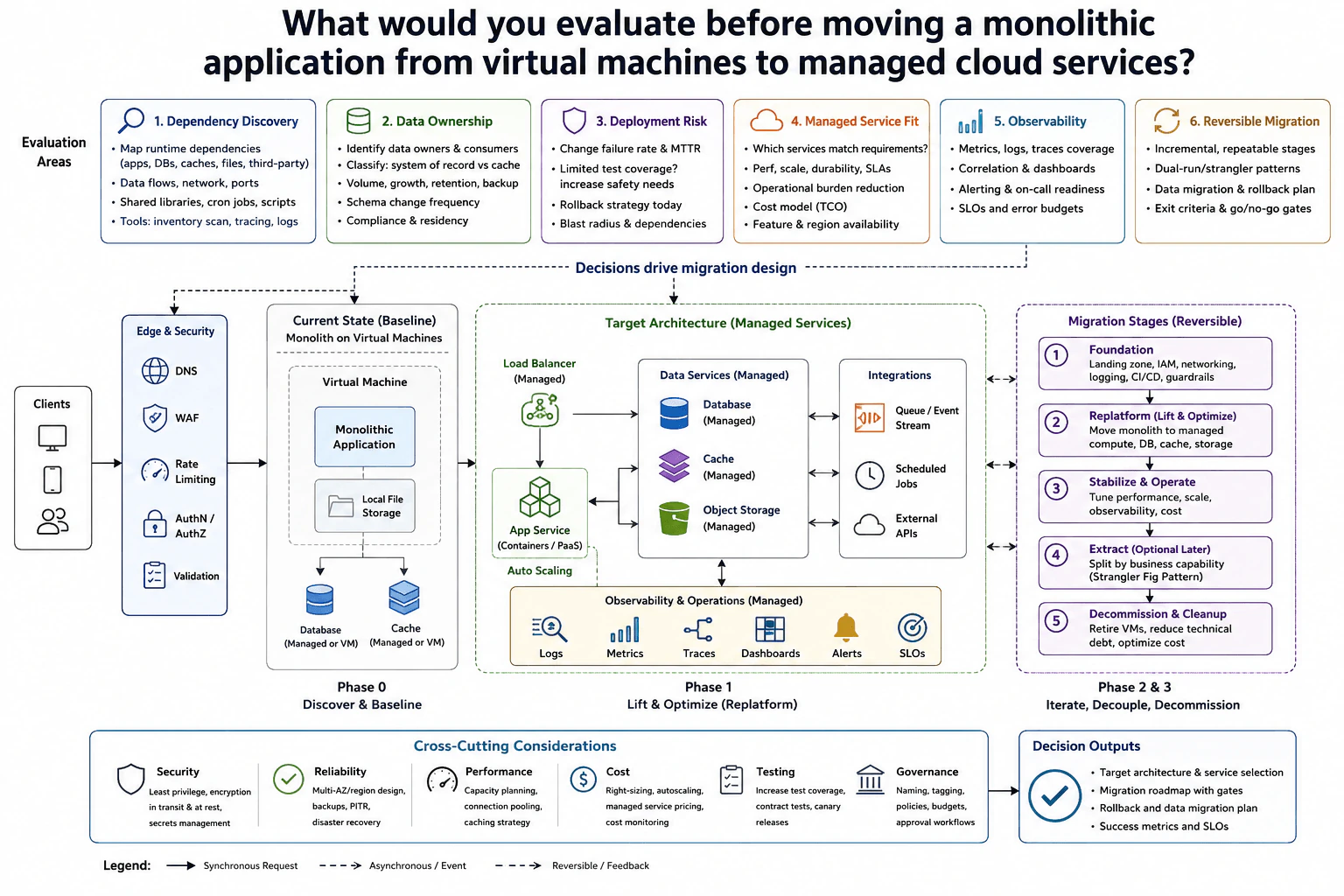
The goal is to move a working monolithic application from virtual machines to managed cloud services without creating a risky big-bang change. The hard part is that automated test coverage is limited, so a large migration could introduce problems that are difficult to detect quickly. I would first understand the existing application, its dependencies, and its data. Then I would choose managed services carefully, add strong monitoring, and move through reversible stages. The design keeps the current system as a baseline while gradually moving compute, data, and operations to managed services.
Useful Questions to Ask the Interviewer
Which parts of the monolith create the most operational work today?
Which data has the strictest security, residency, retention, or backup requirements?
What rollback time is acceptable after a failed release?
Which workloads must remain available throughout the migration?
Are there cost, quota, region, or service limitations we must follow?
How to Explain It in an Interview
1. Discover and baseline the current system
I would start by understanding the system before changing it. I would map application dependencies, database access, caches, files, third-party services, network ports, shared libraries, cron jobs, and scripts. I would also collect current logs, metrics, and traces.
The current request path is Clients to Edge & Security and then to the monolith on Virtual Machines. Edge & Security includes DNS, WAF, Rate Limiting, AuthN / AuthZ, and Validation. The monolith also uses Local File Storage, Database, and Cache. This baseline shows what must still work after each migration step.
2. Define data ownership before moving it
Next, I would identify data owners and consumers. I would separate the system of record from cached data and review growth, retention, backup, schema changes, compliance, and residency needs.
This tells us which data can move safely to managed Database, Cache, and Object Storage. I would create a data migration and rollback plan before changing ownership. That is important because application compute can often be rolled back more easily than data.
3. Choose managed services based on real requirements
I would not choose managed services only because they reduce server management. I would compare performance, scale, durability, service limits, SLAs, cost, operational burden, and feature or region availability.
The diagram's target uses a managed Load Balancer and an App Service using Containers / PaaS. Auto Scaling adjusts application capacity. Managed Database, Cache, and Object Storage replace suitable VM-managed or local data services. Queue / Event Stream, Scheduled Jobs, and External APIs remain explicit integrations.
4. Reduce deployment risk with observability and testing
Because test coverage is limited, I would add safety before increasing migration speed. Observability & Operations includes Logs, Metrics, Traces, Dashboards, Alerts, and SLOs. An SLO is a measurable reliability target for the service.
I would also increase test coverage and use contract tests and canary releases. These checks make it easier to compare the new path with the baseline and stop a migration stage when behavior gets worse.
5. Migrate in reversible stages
I would follow the five stages shown in the diagram: Foundation, Replatform, Stabilize & Operate, Extract, and Decommission & Cleanup. Foundation prepares the landing zone, IAM, networking, logging, CI/CD, and guardrails. Replatform moves the monolith to managed compute, database, cache, and storage.
After stabilization, extracting business capabilities is optional and can use the strangler pattern, where new pieces gradually replace parts of the monolith. Each stage needs clear go or no-go gates and a rollback plan. Only after the managed path is stable would I retire the old VMs. The main trade-off is temporary dual-running complexity, but it reduces blast radius and makes the six-month modernization safer.
Practical Complexity & Trade-offs
The benefit is lower operational work because managed services handle more infrastructure tasks. They can also make scaling, monitoring, backups, and routine operations easier. The downside is that managed services have quotas, service limits, cost differences, and possible vendor lock-in. They may also introduce new failure modes. Running old and new paths during migration adds temporary cost and complexity. We accept this because the application has limited automated tests. Small stages reduce the blast radius of a bad change. Security, reliability, performance, cost, testing, and governance must be checked throughout the migration.
Why Interviewers Ask This
Interviewers ask this to see whether you can modernize a real system without creating unnecessary risk. They want to hear how you discover dependencies, understand data ownership, compare managed service choices, and plan safe releases. They also look for judgment around observability, testing, rollback, security, cost, and operational readiness. The goal is to test architecture thinking, not whether you can name many cloud products.
Interviewer may ask next
What would you change if every migration stage had to support a fast rollback?
I would keep the same staged design, but I would make reversibility a hard release requirement. Before each stage, I would define exactly how traffic, application behavior, and data return to the previous working state.
For Replatform, I would keep the existing VM path available while introducing the managed App Service. The diagram already supports reversible migration and dual-run patterns. Canary releases can expose a small amount of change before a wider rollout. Logs, Metrics, Traces, Dashboards, Alerts, and SLOs would show whether the new path is healthy.
Data needs the most care. Before changing ownership, I would define the data migration and rollback plan. If old and new paths must run together temporarily, both paths must continue to use data safely during that window.
Every stage would have measurable go or no-go gates. A failed gate would stop the rollout and return to the previous working stage. The downside is more temporary cost and operational complexity.
What would you do if the team was not comfortable extracting services because automated test coverage was still limited?
I would delay service extraction and focus first on making the monolith safer to operate. The diagram already treats Extract as an optional later stage, so the migration does not depend on splitting the application immediately.
I would complete dependency discovery and establish the current baseline first. Then I would replatform the monolith to the managed App Service while keeping its application behavior mostly unchanged. Suitable data services could move carefully to managed Database, Cache, and Object Storage.
During Stabilize & Operate, I would increase automated test coverage and add contract tests, canary releases, Logs, Metrics, Traces, Dashboards, Alerts, and SLOs. These give the team better evidence that changes are safe.
Only after the managed monolith is stable would I consider extracting one business capability with the strangler pattern. The downside is that deeper application modernization happens later, but we avoid combining infrastructure migration with a large redesign.
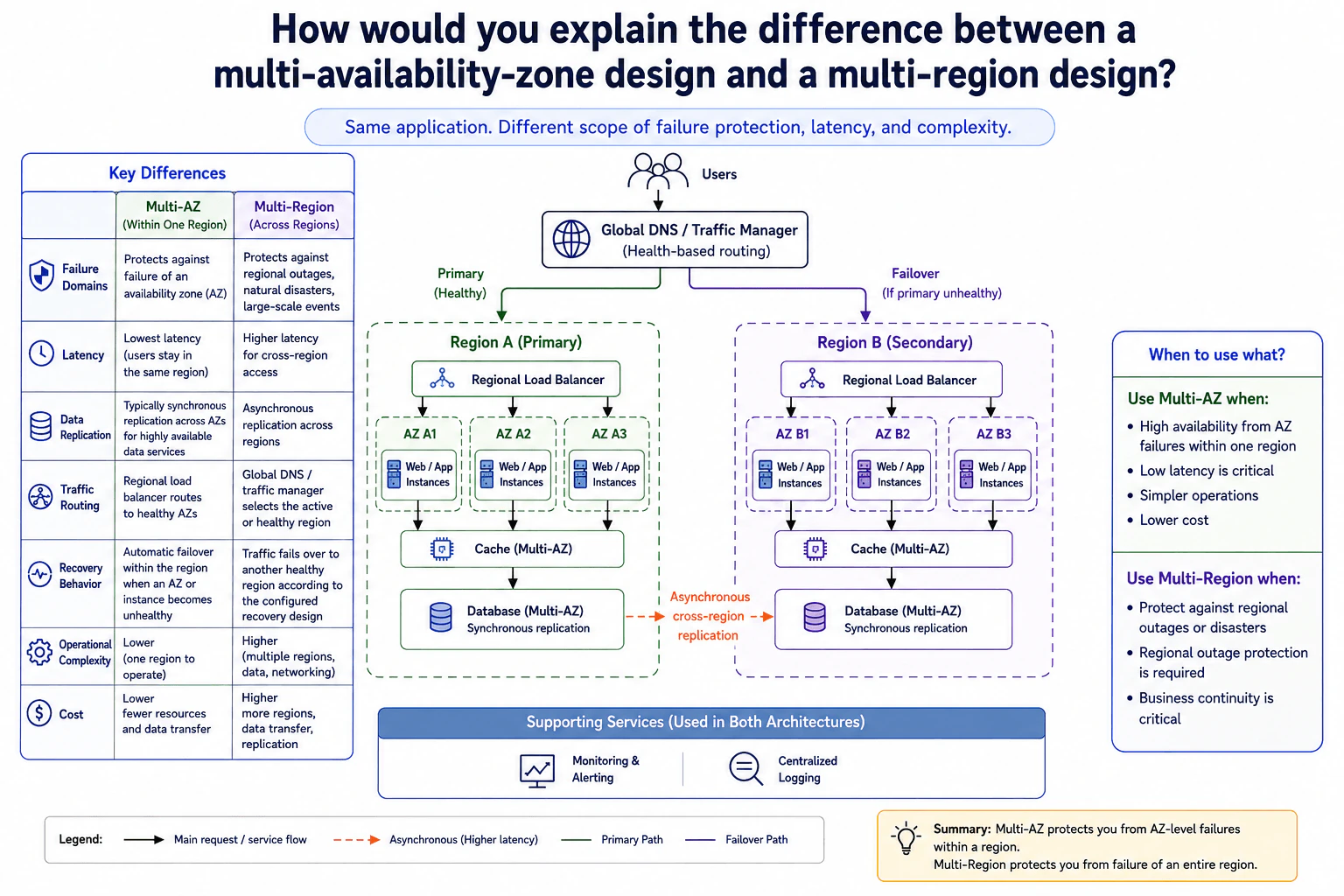
5. How would you explain the difference between a multi-availability-zone design and a multi-region design?Cloud ArchitectureEasy
i Question Details
Use a customer-facing web application as the workload. Compare failure domains, latency, data replication, traffic routing, recovery behavior, operational complexity, and cost for multi-zone and multi-region deployment, and identify the availability requirement that would justify each design.
Short Interview Answer (30-60 seconds)
At a high level, both designs keep a customer-facing web application available during failures. The main difference is the size of failure they protect against. I would compare resilience inside one region with resilience across regions. Multi-AZ spreads the application and data across availability zones with lower latency and simpler operations. Multi-region adds another region, global traffic routing, and asynchronous cross-region replication. The benefit is stronger regional outage protection, but the cost and operational complexity are higher.
Detailed Explanation
The goal is to keep a customer-facing web application available when part of the cloud environment fails. A multi-AZ design protects against availability-zone failures inside one region. A multi-region design also protects against losing an entire region. The difficult part is deciding how much failure protection the business actually needs. More protection requires more infrastructure, data replication, traffic routing, and operational work. The diagram compares the designs using failure domains, latency, data replication, traffic routing, recovery behavior, operational complexity, and cost.
Useful Questions to Ask the Interviewer
Does the application need to survive an availability-zone failure or an entire regional outage?
How much downtime can the business accept during a regional failure?
How important is low latency compared with regional outage protection?
How much extra cost and operational complexity can the team support?
How to Explain It in an Interview
1. Start with the failure boundary
The main difference is the size of failure each design handles. Multi-AZ stays inside one region and spreads the workload across several availability zones. If one zone becomes unhealthy, the application can continue using healthy zones in that region.
Multi-region adds another failure boundary. Region A is the primary region. Region B is the secondary region. This design is used when the application must also handle a regional outage or disaster.
2. Explain the normal request path
Users first reach the Global DNS / Traffic Manager. It uses health-based routing. During normal operation, traffic follows the primary path into Region A.
The Regional Load Balancer spreads requests across Web / App Instances in AZ A1, AZ A2, and AZ A3. The region also contains a Cache (Multi-AZ) and a Database (Multi-AZ). These components support availability across zones inside the region.
3. Explain data replication
For the Database (Multi-AZ), the diagram shows synchronous replication inside each region. The comparison also explains that highly available data services typically use synchronous replication across availability zones.
Across regions, the design uses asynchronous cross-region replication from the primary region toward the secondary region. The secondary copy is updated separately from the main request path. This avoids making normal requests wait for a cross-region data copy. The trade-off is that the secondary region may be slightly behind the primary region.
4. Explain regional failover
If Region A becomes unhealthy, the Global DNS / Traffic Manager can send traffic to Region B. Region B has its own Regional Load Balancer, Web / App Instances, Cache (Multi-AZ), and Database (Multi-AZ).
This provides protection from regional outages. Recovery follows the configured recovery design. The diagram does not claim instant failover or zero replication delay.
5. Finish with the trade-off
Multi-AZ usually gives lower latency, lower cost, and simpler operations. It is a good choice when protection from availability-zone failures inside one region meets the requirement.
Multi-region adds regional outage protection and stronger business continuity. The downside is more regions, more networking, more data transfer, and more operational work. Monitoring & Alerting and Centralized Logging support both designs.
Practical Complexity & Trade-offs
The benefit of Multi-AZ is strong availability while staying inside one region. Requests stay close to the application, so latency is lower. The design also needs fewer resources and is simpler to operate. The downside is that a full regional outage can still stop the application. Multi-region protects against that larger failure. A secondary region can receive traffic when the primary region is unhealthy. The downside is more infrastructure, cross-region data transfer, asynchronous replication, and more operational work. We accept that extra cost when the business needs regional outage protection or stronger business continuity.
Why Interviewers Ask This
The interviewer wants to see whether you understand failure boundaries and can choose the right level of resilience. They also want to hear how you think about latency, replication, traffic routing, recovery, operational work, and cost. A strong answer shows good judgment. You should not choose multi-region automatically. You should match the architecture to the availability requirement the business actually needs.
Interviewer may ask next
What would change if the business says the application must continue running after an entire region fails?
I would use the multi-region design shown in the diagram because one region is no longer enough. Region A would remain the primary region, and Region B would provide the regional recovery path.
Users would still enter through the Global DNS / Traffic Manager. During normal operation, it would send traffic to Region A. If Region A becomes unhealthy, health-based routing could send traffic to Region B. The secondary region already contains its own Regional Load Balancer, Web / App Instances, Cache (Multi-AZ), and Database (Multi-AZ).
The database would also use asynchronous cross-region replication from Region A toward Region B. This keeps data moving to the secondary region without making every normal request wait for a cross-region copy.
The main downside is greater cost and operational complexity. The team must operate two regions, handle cross-region data transfer, monitor both environments, and maintain the configured recovery process.
When would you choose Multi-AZ instead of Multi-Region for this application?
I would choose Multi-AZ when protection from availability-zone failures inside one region meets the business requirement. The application would stay in one region and use the Regional Load Balancer to spread requests across Web / App Instances in several availability zones.
The Cache (Multi-AZ) and Database (Multi-AZ) also support availability across zones. The diagram shows synchronous database replication inside the region, and the comparison notes that highly available data services typically use synchronous replication across availability zones. If one availability zone becomes unhealthy, the application can continue using healthy zones.
This design keeps latency lower because users stay within the same regional deployment. It also uses fewer resources and avoids the extra cross-region data transfer shown in the multi-region design.
The downside is the failure boundary. Multi-AZ does not protect against losing the entire region. If regional outage protection becomes a requirement, I would move to the multi-region design.
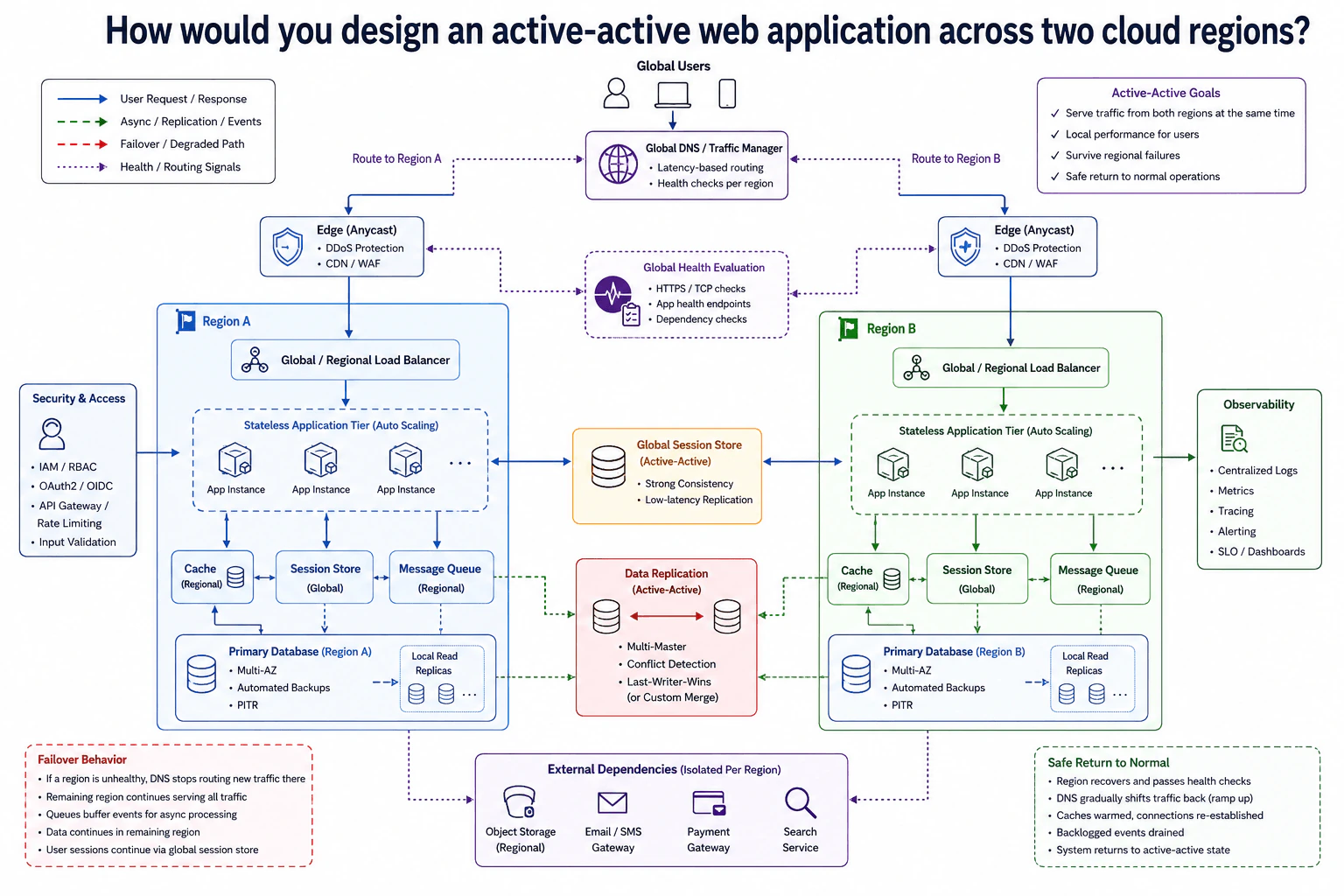
6. How would you design an active-active web application across two cloud regions?Cloud ArchitectureMedium
i Question Details
Design an internet-facing application that serves traffic from two regions at the same time. Include global routing, stateless compute, session handling, data replication, conflict behavior, regional health evaluation, dependency isolation, failover, and safe return to normal operation.
Short Interview Answer (30-60 seconds)
At a high level, I would run the same web application in two regions at the same time. The main challenge is keeping traffic, sessions, and data correct when one region has problems. I would explain the design in three parts: global routing, regional request processing, and cross-region data and recovery. Healthy traffic goes to either region. Stateless application instances scale independently. The main trade-off is that active-active operation improves availability, but cross-region replication and conflict handling add complexity.
Detailed Explanation
The goal is to serve users from two cloud regions at the same time. A user should normally reach a nearby healthy region. If one region fails, new traffic should move to the other region. The difficult part is keeping sessions, database writes, queues, and outside dependencies working safely during that change. The diagram solves this with global routing, matching regional application stacks, active-active session and data handling, health evaluation, regional dependency isolation, failover behavior, and a careful return to normal operation.
Useful Questions to Ask the Interviewer
Which application writes require strong consistency across regions?
Which writes can use conflict resolution such as Last-Writer-Wins or Custom Merge?
How quickly should traffic move after a regional health failure?
Which external dependencies must remain available during a regional outage?
How to Explain It in an Interview
1. Route users to healthy regions
I would start with Global Users reaching the Global DNS / Traffic Manager. It uses latency-based routing and health checks per region. Traffic then reaches the regional Edge layer, which provides DDoS Protection and CDN / WAF controls.
Global Health Evaluation checks HTTPS / TCP endpoints, application health endpoints, and dependencies. These health signals help the routing layer stop sending new traffic to an unhealthy region.
2. Process requests with stateless compute
Inside each region, traffic goes through the Global / Regional Load Balancer. It then reaches the Stateless Application Tier, which can Auto Scale horizontally. Because application instances are stateless, a request does not depend on one specific instance.
The diagram also shows Security & Access controls. These include IAM / RBAC, OAuth2 / OIDC, API Gateway / Rate Limiting, and Input Validation. Region A and Region B use the same main application pattern.
3. Handle sessions, cache, queues, and database reads
The application tiers use the Global Session Store in Active-Active mode. The diagram shows Strong Consistency and Low-Latency Replication for this shared session state. This helps a user keep a session when traffic moves between regions.
Each region also contains a Regional Cache, a Session Store marked Global, and a Regional Message Queue. Each Primary Database is Multi-AZ and has Automated Backups, PITR, and Local Read Replicas. The regional cache keeps common data close to the application. Local Read Replicas provide nearby read capacity.
4. Replicate writes and handle conflicts
The Data Replication layer is Active-Active and Multi-Master. Both regional databases participate in cross-region replication. The diagram also shows asynchronous replication and event paths for regional queues.
Concurrent writes can conflict. The design therefore uses Conflict Detection with Last-Writer-Wins or Custom Merge. The important point is that conflict behavior is defined instead of assuming simultaneous writes cannot happen.
External Dependencies are Isolated Per Region. They include Regional Object Storage, Email / SMS Gateway, Payment Gateway, and Search Service. This limits the chance that one regional dependency problem breaks both regions.
5. Fail over and return safely
If a region becomes unhealthy, DNS stops routing new traffic there. The remaining region continues serving traffic. Queues buffer events for later processing, data continues in the remaining region, and user sessions continue through the global session design.
When the failed region recovers, it must first pass health checks. DNS gradually shifts traffic back. Caches are warmed, connections are re-established, and backlogged events are drained. Observability uses Centralized Logs, Metrics, Tracing, Alerting, and SLO / Dashboards to watch the recovery. The main trade-off is better regional availability with more replication, conflict, and recovery complexity.
Practical Complexity & Trade-offs
The benefit is that both regions can serve users at the same time. This improves availability and can keep users close to a healthy region. Stateless application instances also make horizontal scaling easier. The downside is that shared state becomes harder. The Global Session Store needs strong consistency, while database writes may need Conflict Detection with Last-Writer-Wins or Custom Merge. Regional queues and isolated dependencies help contain failures, but they add more moving parts. Returning a recovered region also takes care because traffic, caches, connections, and queued work must be brought back gradually.
Why Interviewers Ask This
Interviewers ask this question to test whether you can design for a full regional failure, not only normal traffic. They want to see how you separate global routing, regional compute, sessions, and cross-region data. They also look for judgment around health checks, conflict handling, dependency isolation, failover, and safe recovery. A strong answer explains both the availability benefit and the extra operational complexity.
Interviewer may ask next
What would you change if every database write required strong consistency across both regions?
I would keep the same global routing, regional application tiers, health evaluation, queues, and isolated dependencies. The main change would be in the Data Replication path.
The current diagram allows Active-Active Multi-Master writes with Conflict Detection. If every write must be strongly consistent, I would not let two conflicting writes complete independently and resolve them later with Last-Writer-Wins or Custom Merge. The data layer would need the participating regions to agree on each protected write before reporting success.
The stateless application tiers could still serve traffic from both regions. The Global Session Store could also remain active-active as shown. The change is mainly about how database writes become final.
The downside is higher write latency because a write now depends on cross-region communication. A network problem between the regions could also stop those writes even when one application region is otherwise healthy.
How would the design behave if Region A failed while its Regional Message Queue still contained unprocessed events?
I would stop sending new user traffic to Region A after its health checks fail. The Global DNS / Traffic Manager would route new traffic to Region B, which would continue using its own Edge layer, load balancer, Stateless Application Tier, regional data components, and isolated dependencies.
The diagram uses Regional Message Queues to buffer events. I would therefore keep the unprocessed Region A events queued rather than treating them as completed. Region B continues handling new work while the failed region is unavailable.
After Region A recovers, it must pass the Global Health Evaluation before normal traffic returns. The Safe Return to Normal process then gradually shifts DNS traffic back. Caches are warmed, connections are re-established, and backlogged events are drained.
The downside is delayed background processing. Recovery also needs careful monitoring because draining a large backlog can put extra load on the returning region.
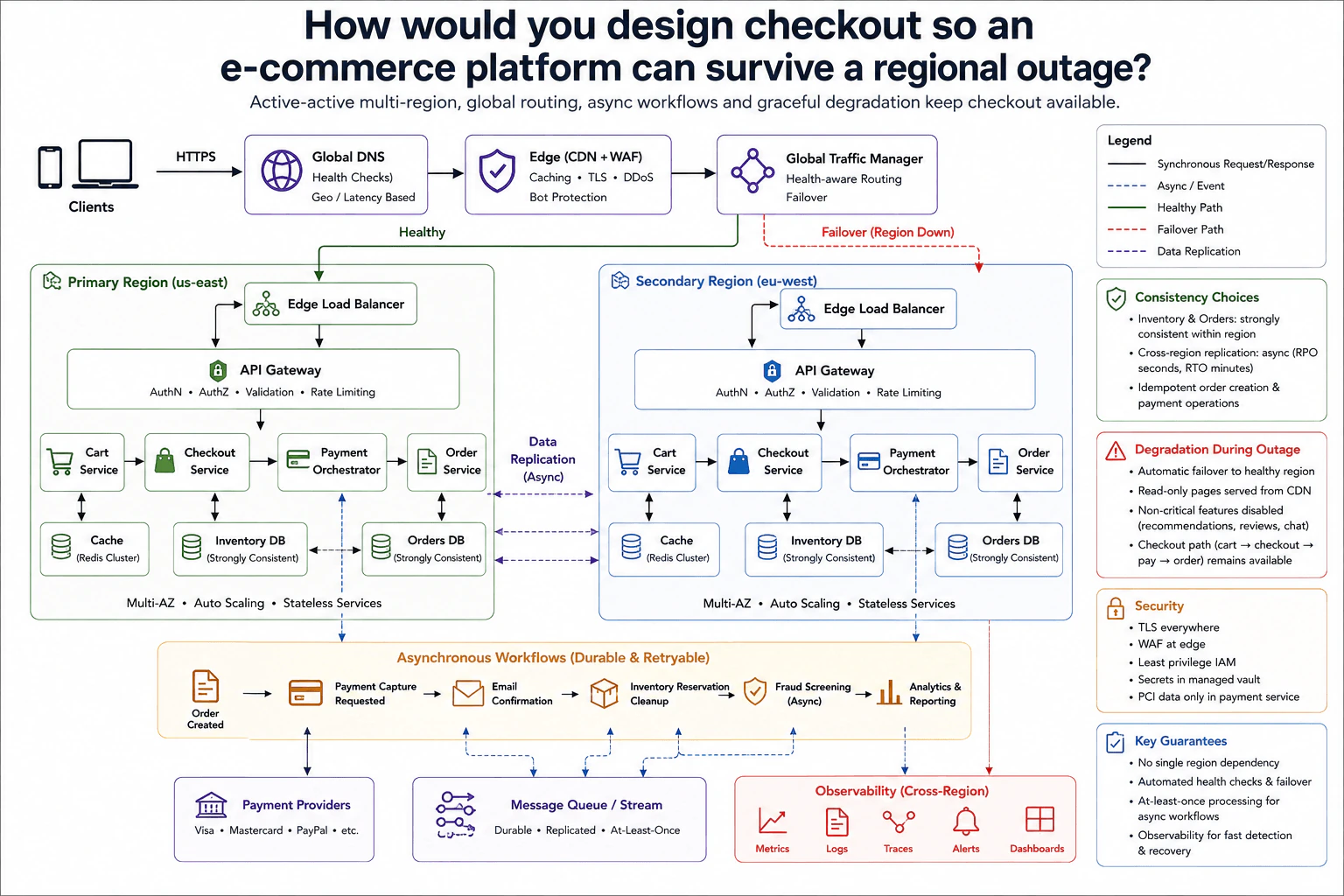
7. How would you design checkout so an e-commerce platform can survive a regional outage?Cloud ArchitectureMedium
i Question Details
A high-traffic checkout path must continue taking orders when its primary region fails. Show the placement of edge routing, application services, payment integration, inventory and order data, asynchronous work, and observability, and explain the consistency and degradation choices during failover.
Short Interview Answer (30-60 seconds)
At a high level, the goal is to keep checkout working when one region becomes unavailable. The main challenge is moving traffic without creating bad inventory, order, or payment results. I would explain the design in three parts: global routing, the regional checkout path, and durable background work. Health-aware routing sends requests to a healthy region, stateless services handle checkout, and replicated data supports failover. The trade-off is that asynchronous cross-region replication can leave the failover region slightly behind.
Detailed Explanation
The system must keep accepting customer orders even when one region becomes unavailable. That is difficult because checkout changes important information such as inventory, orders, and payments. Moving traffic is only part of the problem. We also need safe retries, durable background work, and enough replicated data for the other region to continue. The diagram solves this with global health-aware routing, two regional checkout stacks, asynchronous cross-region data replication, durable messaging, external payment providers, and cross-region observability.
Useful Questions to Ask the Interviewer
How much failover time is acceptable when a region becomes unhealthy?
How much recent order or inventory data can be temporarily behind in the other region?
Which non-critical features may be disabled during an outage?
Should both regions normally serve checkout traffic, or should one mainly receive failover traffic?
How to Explain It in an Interview
1. Start with global routing and edge protection
I would first keep regional failure handling outside the checkout services. Clients send HTTPS traffic to Global DNS. It uses health checks plus geographic or latency information. Traffic then passes through the Edge layer, which provides CDN caching, WAF protection, TLS, DDoS protection, and bot protection.
The Global Traffic Manager makes the regional routing decision. Its healthy path sends traffic to the Primary Region. If that region is down, the failover path sends traffic to the Secondary Region.
2. Explain the regional checkout path
Inside either region, traffic reaches an Edge Load Balancer and then the API Gateway. The gateway handles authentication, authorization, validation, and rate limiting. The request then moves through Cart Service, Checkout Service, Payment Orchestrator, and Order Service.
The services are stateless and run across multiple availability zones. They can also scale horizontally. This makes it easier for another service instance, availability zone, or region to handle new requests after a failure.
3. Keep inventory, orders, and payments correct
Each region has an Inventory DB and an Orders DB. The diagram marks both as strongly consistent within the region. In simple words, operations inside that region should see one correct order and inventory state instead of conflicting versions.
The Payment Orchestrator works with external Payment Providers. Order creation and payment operations are idempotent. That means a retry of the same logical operation should not create another order or another payment action. This is important because failover and network timeouts can cause requests to be sent again.
The Cache is local to each region and stores session or cart data. It helps performance, but the diagram does not treat it as the main source of order or inventory truth.
4. Replicate data across regions
Inventory and order data replicate asynchronously between the two regions. Asynchronous replication means the remote copy is updated after the local operation instead of making every checkout wait for a remote write.
The diagram calls out an RPO measured in seconds and an RTO measured in minutes. RPO describes how much very recent replicated data may be at risk. RTO describes how long recovery or failover may take. This means the design improves regional availability, but it does not promise zero replication delay or instant failover.
5. Move slower work into durable background processing
The diagram separates background work from the main checkout path. After an Order Created event, the asynchronous workflow includes Payment Capture Requested, Email Confirmation, Inventory Reservation Cleanup, Fraud Screening, and Analytics and Reporting.
A durable, replicated Message Queue or Stream carries asynchronous events. It provides at-least-once delivery, which means an event may be delivered again. Background processing therefore needs safe retry behavior. Keeping this work outside the main request avoids making checkout wait for email, cleanup, fraud processing, or analytics.
6. Explain outage behavior, security, and operations
During a regional outage, the Global Traffic Manager moves traffic to the healthy region. Read-only pages can continue from the CDN. Non-critical features such as recommendations, reviews, or chat can be disabled. The important cart-to-checkout-to-payment-to-order path remains the priority.
Security includes TLS, the WAF, least-privilege IAM, managed secrets, and keeping PCI-sensitive payment data inside the payment service boundary. Cross-region observability collects metrics, logs, traces, alerts, and dashboards. The main trade-off is that asynchronous cross-region replication keeps requests faster and regions more independent, but the failover region may briefly have slightly older data.
Practical Complexity & Trade-offs
The benefit is that one regional failure does not remove the whole checkout path. Health-aware routing, multiple availability zones, stateless services, a second region, and durable background work all help the platform keep operating. The downside is more complexity. Orders and inventory are strongly consistent inside a region, but cross-region replication is asynchronous, so the other region can be a little behind. Failover also takes some time instead of being instant. We accept that because making every checkout wait for a remote region would increase latency and make the two regions depend on each other more strongly.
Why Interviewers Ask This
Interviewers ask this to see whether you can balance availability with correctness. They want to know if you can route around a failed region, protect order and inventory updates, make payment retries safe, separate background work from the checkout request, and monitor the whole system. They also want to see whether you can explain the cost of asynchronous replication without claiming perfect availability or instant recovery.
Interviewer may ask next
What would you change if the business could not tolerate losing any completed order during a regional outage?
I would keep the same overall design, but I would strengthen the durability rule for the final order write. The current diagram uses asynchronous cross-region replication. That means a newly completed order can take a short time to reach the other region.
If losing any completed order is unacceptable, I would require the final success response to depend on durable confirmation outside the local failure domain. This change mainly affects the Orders DB path and possibly the inventory reservation state. The Payment Orchestrator would still use the same retry-safe behavior so repeated requests do not create another payment action.
The main downside is latency and availability. Checkout may need to wait for a remote confirmation. A cross-region network problem could then slow or block checkout even when the local region is healthy. Stronger durability therefore reduces the regional independence that makes the original failover design fast and resilient.
How would you prevent duplicate orders or payment actions when clients retry during regional failover?
I would keep the same services and rely on the idempotent order and payment behavior already shown in the diagram. Idempotent means that repeating the same logical operation does not create another result each time.
This matters when the Primary Region performs some work but the client never receives the response. The client may retry after traffic moves to the Secondary Region. Order creation must recognize the repeated operation instead of creating another order. The Payment Orchestrator must apply the same idea before performing another payment operation with the external Payment Providers.
The Message Queue or Stream also uses at-least-once delivery. That means background events can be delivered more than once. Consumers handling payment capture requests, email, inventory cleanup, fraud work, and analytics therefore need retry-safe processing where duplicates would cause harm.
The downside is extra state and logic for recognizing repeated work. That complexity is necessary because retries are normal during timeouts and failover.
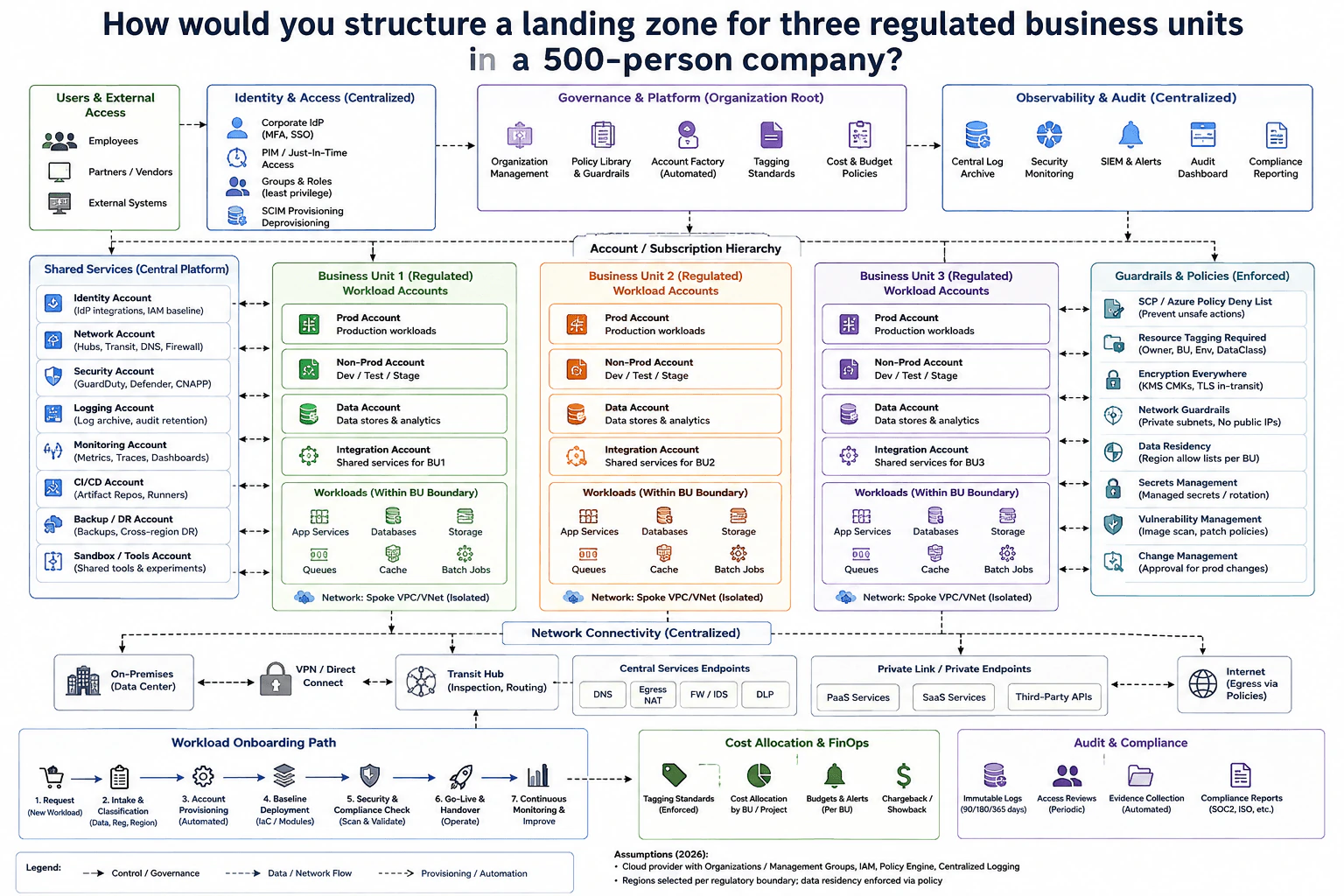
8. How would you structure a landing zone for three regulated business units in a 500-person company?Cloud ArchitectureMedium
i Question Details
Design the account or subscription hierarchy, shared services, identity model, network segmentation, policy guardrails, audit logging, cost allocation, and workload onboarding path for three business units that have separate regulatory boundaries but share a central platform team.
Short Interview Answer (30-60 seconds)
At a high level, I would build one central landing zone around three strongly isolated regulated business units. The main challenge is sharing identity, networking, security, logging, and automation without crossing regulatory boundaries. I would explain it in three parts: central governance, isolated business-unit accounts, and controlled workload onboarding. Each unit gets separate production, non-production, data, and integration accounts. Central guardrails enforce security and cost rules. The trade-off is stronger isolation with more accounts, policies, and platform-team responsibility.
Detailed Explanation
The goal is to let three regulated business units use one company cloud foundation without mixing their protected environments. Each unit needs a clear boundary for workloads, data, networks, and regulatory rules. At the same time, one central platform team should provide common identity, security, networking, logging, automation, and cost controls. The design handles this by putting shared controls above the business units, giving every unit separate workload accounts and isolated networks, and using one repeatable process to create, secure, connect, operate, and monitor new workloads.
Useful Questions to Ask the Interviewer
Does each business unit have different region or data-residency rules?
Which central services may be shared across regulatory boundaries?
How long must each business unit keep audit logs and evidence?
Should costs use chargeback, showback, or both?
How to Explain It in an Interview
1. Start with centralized identity and governance
I would keep identity and platform governance centralized. Access begins with employees, partners or vendors, and approved external systems. The Corporate IdP provides SSO and MFA. PIM or Just-In-Time Access limits privileged access. Groups and roles follow least privilege, while SCIM handles provisioning and deprovisioning.
At the organization root, the platform team manages Organization Management, the Policy Library & Guardrails, automated Account Factory, Tagging Standards, and Cost & Budget Policies. This gives every business unit the same controlled foundation.
2. Create separate regulated workload accounts
Each business unit gets separate Prod, Non-Prod, Data, and Integration accounts. Production workloads stay separate from development, test, and stage workloads. Data stores and analytics stay in the Data Account. The Integration Account contains shared services for that business unit.
Inside each business-unit boundary, workloads may include App Services, Databases, Storage, Queues, Cache, and Batch Jobs. Each unit also has its own isolated spoke VPC or VNet.
3. Keep shared platform services centralized
The central platform has Identity, Network, Security, Logging, Monitoring, CI/CD, Backup / DR, and Sandbox / Tools accounts. The Network Account provides hubs, transit, DNS, and firewall functions. The Logging Account holds the log archive and audit records. Monitoring provides metrics, traces, and dashboards. CI/CD provides artifact repositories and runners.
Central observability includes the Central Log Archive, Security Monitoring, SIEM & Alerts, Audit Dashboard, and Compliance Reporting.
4. Connect networks through controlled central paths
Each isolated spoke connects through the centralized network layer. The Transit Hub handles inspection and routing. Central Services Endpoints provide DNS, Egress NAT, FW / IDS, and DLP. Private Link / Private Endpoints connect approved PaaS Services, SaaS Services, and Third-Party APIs.
On-premises systems connect through VPN / Direct Connect. Internet traffic leaves through policy-controlled egress. This keeps connectivity centralized without removing business-unit isolation.
5. Enforce guardrails, onboarding, cost, and audit controls
The guardrail layer uses an SCP / Azure Policy Deny List to block unsafe actions. Required resource tags identify Owner, BU, Env, and DataClass. Encryption uses KMS CMKs for stored data and TLS in transit. Other controls include private subnets with no public IPs, region allow lists per BU, managed secrets and rotation, vulnerability management, and approval for production changes.
A workload follows seven steps: Request, Intake & Classification, Account Provisioning, Baseline Deployment, Security & Compliance Check, Go-Live & Handover, then Continuous Monitoring & Improve. Tagging supports cost allocation by BU or project, budgets and alerts per BU, and chargeback or showback.
Audit controls include Immutable Logs with the shown 90, 180, or 365-day retention options, periodic Access Reviews, automated Evidence Collection, and Compliance Reports. The benefit is repeatable control and strong regulatory separation. The downside is more accounts, policies, network rules, and central-platform work.
Practical Complexity & Trade-offs
The benefit is strong separation between the three regulated business units. A problem in one unit is less likely to cross into another unit. Central identity, logging, networking, guardrails, and onboarding also make the company more consistent. The downside is extra management. The platform team must operate more accounts, policies, network paths, access rules, and cost controls. Central networking and shared platform services also become important dependencies. Region allow lists can limit where some workloads run. We accept this extra work because regulatory isolation, audit evidence, cost ownership, repeatable security controls, and controlled onboarding are more important than having one simple shared environment.
Why Interviewers Ask This
Interviewers want to see whether you can balance central control with strong regulatory isolation. They are testing how you organize accounts, identity, networks, security, logging, cost ownership, and workload onboarding as one design. They also want to see whether you understand which services should be centralized and which must remain inside each business-unit boundary. A strong answer explains those choices and their operational cost clearly.
Interviewer may ask next
What would you change if one business unit required all of its protected data and audit logs to remain in one approved region?
I would keep the same landing-zone structure, but I would tighten the Data Residency controls for that business unit. Its Prod, Non-Prod, Data, and Integration accounts would remain inside the same regulated business-unit boundary.
The main change would be the Region allow lists per BU. The Policy Library & Guardrails would allow that unit to deploy only in its approved region. Account Factory and Baseline Deployment would apply that rule automatically when new accounts and workloads are created. Its Data Account, backups, and Immutable Logs would also have to remain within the permitted regional boundary.
The central platform team could still manage identity, policy, monitoring, and compliance processes. However, the protected data itself would stay where the regulation requires.
The downside is less flexibility. Some services or Backup / DR choices may be harder to use when the allowed region is restricted.
How would you handle a failure in the centralized network connectivity layer?
I would keep the same hub-and-spoke structure and focus recovery on the centralized network components. The business-unit account boundaries, IAM controls, encryption rules, and policy guardrails would still remain in place during the network problem.
The affected traffic would be traffic that depends on the Transit Hub or other central connectivity. This can include on-premises connections through VPN / Direct Connect, DNS, policy-controlled internet egress, FW / IDS inspection, DLP, and access through Private Link / Private Endpoints.
The Monitoring Account and SIEM & Alerts would help the platform team detect the problem. Recovery would restore routing and the required central network services without bypassing the security guardrails.
The main downside is dependency concentration. Central networking is easier to govern and inspect, but one central connectivity failure can affect more than one business unit at the same time.
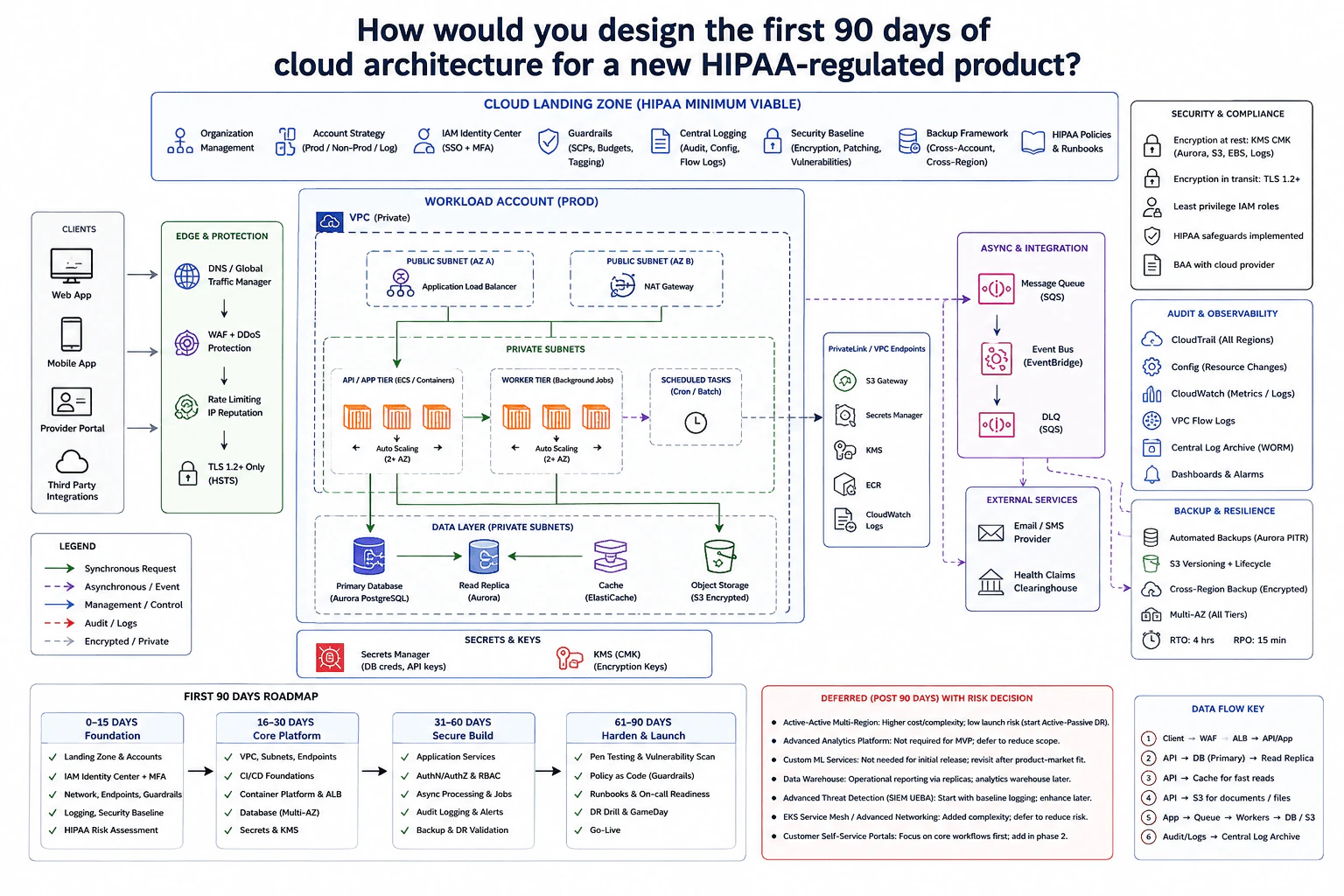
9. How would you design the first 90 days of cloud architecture for a new HIPAA-regulated product?Cloud ArchitectureHard
i Question Details
A company has signed a healthcare contract and must launch a compliant production workload in 90 days. Before designing technical controls, address the AWS Business Associate Addendum, HIPAA-eligible services, and the required risk analysis and risk-management process. Then design the minimum viable landing zone and application architecture, including identity, network boundaries, encryption, audit evidence, protected data, backups, resilience, deployment controls, and explicit deferrals.
Short Interview Answer (30-60 seconds)
Before any PHI is processed in AWS, I would confirm that the organization has executed the AWS Business Associate Addendum, restrict PHI processing, storage, and transmission to HIPAA-eligible services and supported features, and document an accurate risk analysis with a risk-management plan. Those are launch gates, not substitutes for technical controls. I would then build a minimum viable landing zone and protected production workload with private application and data tiers, encryption, least-privilege access, centralized audit logging, tested backups, multi-AZ resilience, and controlled deployments. Encryption alone does not remove the BAA or broader HIPAA obligations.
Detailed Explanation
The company needs to launch a healthcare product within 90 days while protecting electronic protected health information, or ePHI. Moving quickly does not change the legal and administrative prerequisites. Before AWS processes ePHI, I would confirm that the organization has executed the AWS Business Associate Addendum. I would inventory every ePHI data flow and allow ePHI only in AWS services and features currently listed as HIPAA-eligible. I would also ensure the covered entity or business associate has documented an accurate and thorough risk analysis and a risk-management plan that reduces identified risks to a reasonable and appropriate level. Encryption is an important safeguard, but it does not replace the BAA, eligible-service restriction, or the organization's HIPAA responsibilities.
The technical design then implements controls selected from that risk process. The diagram organizes the work in stages: establish a minimum viable cloud landing zone, place the application and data inside protected network boundaries, and add monitoring, audit evidence, backups, resilience, controlled deployments, and documented decisions about work that can safely wait.
Useful Questions to Ask the Interviewer
Has the AWS Business Associate Addendum been executed for the AWS account or organization that will handle ePHI?
Which systems and data flows create, receive, maintain, or transmit ePHI, and are all involved AWS services and features currently HIPAA-eligible?
Who owns the documented HIPAA risk analysis, risk-treatment decisions, and continuing risk-management process?
Which external healthcare systems and vendors must be connected at launch, and do the required business-associate agreements exist?
Are the shown RTO of four hours and RPO of 15 minutes acceptable?
Which compliance evidence must exist before production approval?
What retention, incident-response, breach-notification, and access-review requirements apply?
How to Explain It in an Interview
1. Complete the compliance gates and build the landing zone
I would treat the executed AWS BAA, verified HIPAA-eligible service inventory, and approved risk analysis and risk-management plan as production launch gates. I would record owners and evidence for each gate. I would then build the shared technical controls before deploying the product. Organization management and the account strategy separate production, non-production, and logging concerns. IAM Identity Center provides SSO and MFA. Guardrails cover SCPs, budgets, and tagging. Central logging collects audit, configuration, and flow logs. The security baseline includes encryption, patching, and vulnerability management. HIPAA policies and runbooks document how the environment is operated.
2. Protect the production request path
Web, mobile, and provider traffic enters through DNS or the global traffic manager. WAF and DDoS protection filter unwanted traffic. Rate limiting and IP reputation provide another layer of protection. TLS 1.2 or later protects data in transit. The Application Load Balancer then routes accepted traffic to the API and application tier running as ECS containers in private subnets.
3. Keep protected data inside private boundaries
The API and application tier scales across availability zones. The primary Aurora PostgreSQL database stores application data. An Aurora read replica supports read capacity. ElastiCache provides encrypted caching for fast reads. Encrypted S3 object storage holds documents or files. Secrets Manager protects database credentials and API keys. KMS customer-managed keys protect encryption keys. PrivateLink and VPC endpoints provide private access to supported cloud services.
4. Separate background work and integrations
Background work does not need to block the normal request path. The application can place work on the SQS message queue, and the worker tier processes it separately. Scheduled tasks handle cron or batch work. The asynchronous area also contains EventBridge and an SQS dead-letter queue for failed work. External integrations include an email or SMS provider and a health claims clearinghouse.
5. Make the launch auditable and recoverable
CloudTrail, Config, CloudWatch, VPC Flow Logs, dashboards, alarms, and the central WORM log archive provide operational and audit evidence. Automated Aurora backups, S3 versioning and lifecycle controls, and encrypted cross-region backups support recovery. The workload uses multiple availability zones. The diagram sets an RTO of four hours and an RPO of 15 minutes. CI/CD, policy as code, guardrails, vulnerability scanning, approvals, runbooks, a disaster-recovery drill, and a go-live step control production changes.
For the first 90 days, I would defer active-active multi-region, advanced analytics, custom ML, a data warehouse, advanced threat detection, EKS service mesh or advanced networking, and customer self-service portals. Each deferral should have a written reason, risk, owner, and later milestone.
Practical Complexity & Trade-offs
The benefit is that this plan treats HIPAA as an ongoing risk-management and operating responsibility rather than an encryption checklist. The AWS BAA, verified HIPAA-eligible service inventory, documented risk analysis, and risk-management plan establish the required compliance foundation. The benefit is that this design focuses the first 90 days on controls needed for a safe healthcare launch. Private networking, encryption, MFA, audit logs, backups, and multi-AZ deployment reduce important risks. The downside is that some stronger or more advanced capabilities are delayed. Active-active multi-region could reduce regional outage impact, but it adds significant cost and operational work. Advanced analytics, ML, a warehouse, advanced threat detection, service mesh features, and customer self-service also increase scope. We accept those limits only through explicit risk decisions with documented reasons and future milestones.
Why Interviewers Ask This
Interviewers want to see whether you understand that cloud security controls alone do not establish HIPAA compliance. A strong answer must identify the AWS BAA, the restriction of ePHI to HIPAA-eligible services and supported features, and the required risk-analysis and risk-management process before explaining the architecture. They are also testing your judgment about identity, network boundaries, encryption, audit evidence, protected data, backups, resilience, and what can safely be deferred during a 90-day launch.
Interviewer may ask next
What would you change if the business required much faster recovery from a complete primary-region outage?
I would keep the same basic architecture, but I would move the deferred multi-region capability into the launch scope. The current design uses encrypted cross-region backups and accepts an active-passive recovery approach. That matches the shown RTO of four hours and RPO of 15 minutes.
If those targets became much tighter, the second region would need more infrastructure and data ready before an incident occurs. Landing-zone guardrails, IAM controls, network rules, encryption settings, application configuration, logging, and deployment controls would need equivalent definitions there. Recovery tests would also need to prove that the new targets can actually be met.
I would not promise zero downtime or zero data loss unless the design and testing supported those guarantees. The main downside is greater cost and operational complexity. Multi-region systems create more deployment, data-management, networking, testing, monitoring, and incident-response work.
How would you handle failed background jobs without losing important healthcare work?
I would keep background processing separate from the normal API request path. The diagram already provides an SQS message queue, worker containers, EventBridge, and an SQS dead-letter queue. The application can place background work on the queue, and workers can process it without making the user wait for the whole job.
When work cannot be processed successfully, the dead-letter queue gives the team a separate place to inspect failed messages instead of silently losing them. CloudWatch metrics, logs, dashboards, and alarms can show that failures are building up. Central logging also keeps evidence useful for operational and compliance review.
The team should investigate the cause before processing failed work again. Because the diagram does not claim exactly-once delivery, I would not make that guarantee. The main downside is operational work. Engineers need monitoring, runbooks, and a safe process for reviewing and retrying failed jobs.
10. How would you redesign an architecture that became expensive because it was over-engineered?Cloud ArchitectureHard
i Question Details
A production system meets its reliability goals but uses more regions, managed services, queues, and data copies than its measured workload requires. Describe how you would reconstruct the original requirements, map dependencies and failure modes, identify removable complexity, compare simpler target designs, and migrate without reducing agreed service objectives.
Short Interview Answer (30-60 seconds)
At a high level, I would right-size the system around measured needs instead of old assumptions. The challenge is removing expensive complexity without reducing the agreed reliability goals. I would explain this in three parts: rebuild the real requirements, simplify the architecture, and migrate safely. The target uses one region with Multi-AZ protection, one load-balancer layer, stateless services, only essential queueing, fewer data copies, and right-sized compute. The trade-off is less geographic redundancy, but much lower cost and simpler operations.
Detailed Explanation
The system already meets its reliability goals, but it costs more than the measured workload justifies. The problem is to remove unnecessary regions, services, queues, data copies, and excess compute without weakening the promises made to users. The safest approach is to rebuild the original requirements from evidence, map dependencies and failure cases, compare simpler designs, and then migrate gradually. The diagram keeps the useful reliability, security, deployment, and monitoring controls while removing complexity that no longer earns its cost.
Useful Questions to Ask the Interviewer
Which SLOs, SLIs, and error budgets must remain unchanged?
What traffic, workload, data growth, and failure patterns do we measure today?
Which compliance or business constraints require specific redundancy?
Which regions, queues, services, and data copies are still actively needed?
How much temporary dual running is acceptable during migration?
How to Explain It in an Interview
1. Reconstruct the real requirements
I would start by rebuilding the requirements from current evidence. The diagram checks SLOs, SLIs, error budgets, workload, data growth, compliance, and other constraints.
Then I would map the service dependencies, data flows, ownership, and failure scenarios. I would also identify the blast radius, which means how much of the system one failure can affect. This helps separate protections that still matter from old design choices that no longer match the workload.
2. Find complexity that can be removed
Next, I would look for unused services and regions, redundant queues and data copies, and over-provisioned capacity. I would not remove something just because it is expensive.
I would compare simpler target designs using cost, reliability, latency, and operational complexity. The chosen design still has to meet the agreed SLOs. The diagram also prefers the simplest managed service that meets the need instead of keeping unnecessary custom complexity.
3. Explain the right-sized request path
Clients are Web, Mobile, and APIs. Requests enter through DNS, then CDN, then the Load Balancer. The Security & Governance layer applies WAF, Rate Limiting, AuthN / AuthZ with OIDC, Request Validation, and Secrets & KMS controls.
Requests then reach stateless Application Services. Several Service Instances run inside the Auto Scaling Group / Containers boundary. Stateless means a request does not depend on memory held by one specific service instance, so instances can scale or be replaced more easily.
The Data Layer stays in a Single Region. It contains the Primary Database with Multi-AZ protection, an in-memory Cache, and Object Storage for durable files. The simplified design keeps one load-balancer layer, minimal data copies, and right-sized compute instead of duplicating everything across regions.
4. Keep only essential background and external work
The Application Services can send work to the Task Queue when background processing is actually needed. The Task Queue passes that work to the stateless Worker. This keeps optional or slower work away from the main request path.
External Services are limited to what is required. The diagram shows a Payment Provider, Email Service, SMS Provider, and Third-Party API. Observability stays in place through Metrics, Logs, Traces, Alerts, and Dashboards so the team can see whether the simpler system still behaves correctly.
5. Migrate safely and verify continuously
I would migrate in phases rather than remove the old complexity all at once. The diagram uses phased rollout, dual write or backfill where needed, canary rollout, and rollback.
The CI/CD & IaC path uses a Git Repo, CI Pipeline for Build and Test, Artifact Registry, blue/green Deploy, and Terraform IaC. During the migration, I would watch SLOs and cost guardrails continuously. I would decommission unused regions, services, queues, and data copies only after the simpler path proves it meets the required objectives. The result should be lower cost, simpler operations, faster delivery, the same or better reliability, and clearer ownership.
Practical Complexity & Trade-offs
The benefit is lower cost and simpler operations. Fewer active regions, load-balancer layers, queues, services, data copies, and oversized compute mean fewer things to maintain. Stateless services also make scaling and replacement easier. The downside is that a simpler design may remove protection that once existed. For example, a Single Region design gives up extra regional redundancy, even though the diagram still keeps Multi-AZ protection. We accept that only when the measured workload and agreed SLOs do not require more. The same rule applies to queues and data copies. Keep them only when they protect a real requirement. The goal is minimum viable complexity, not minimum infrastructure.
Why Interviewers Ask This
Interviewers ask this to test engineering judgment. They want to know whether you can challenge old assumptions instead of keeping expensive architecture forever. They also want to see whether you can use measurements, understand dependencies and failure impact, compare simpler designs, and migrate carefully. A strong answer shows that cost reduction is not random deletion. It is controlled simplification that still protects the agreed service objectives.
Interviewer may ask next
What would you change if the business later required the system to survive a complete regional outage?
I would revisit the regional design because that new requirement is stronger than the one shown in the right-sized target. The current design uses a Single Region with Multi-AZ protection. Multi-AZ protects against failures inside the region, but the diagram does not show protection from losing the entire region.
I would keep the same basic request path, Security & Governance controls, stateless Application Services, Data Layer roles, Observability, CI/CD, and migration discipline. The main change would be adding only the extra regional protection needed to meet the new SLO. I would not automatically restore every queue, service, and data copy from the old over-engineered system.
I would introduce the change gradually and use the same canary, rollback, SLO monitoring, and cost guardrails. The downside is higher cost and more operational work. That extra complexity is justified only because surviving a complete regional outage has now become an explicit requirement.
How would you decide whether the Task Queue should remain in the simplified design?
I would keep the Task Queue only if there is real background work that benefits from it. The diagram labels the queue as "Only if needed," so it has to justify its cost and operational burden.
I would map which Application Services send work to the queue and what the stateless Worker does with that work. Then I would measure whether the queue keeps slower work away from the user-facing request path or protects the system during bursts. If it does, the queue still serves a useful purpose.
If the queue carries little useful work or only adds another unnecessary hop, I would remove that path during the phased migration. I would watch latency, errors, SLOs, and system load while doing so. The downside of removing it is that some work may return to the main request path, so the change is safe only if the measurements still meet the required objectives.
More questions load as you scroll
Cloud Engineer Resume Examples
Explore the resume examples below to find the one that best matches your target Cloud Engineer role.
Disclaimer: This interview guide is for educational and informational purposes only. It is designed to help readers prepare, but it does not guarantee any interview result, hiring decision, offer, or outcome. Interview questions, hiring criteria, and preferred answers can vary by employer, interviewer, industry, location, and time. All answers, examples, and explanations in this guide are suggested examples for interview preparation, not definitive answers or instructions for professional practice. They are based on research and judgment, are provided without warranties of any kind, and should be adapted to the question, role, and applicable laws and professional requirements. Diagrams are simplified illustrations intended to highlight the main concepts and their relationships; actual situations, systems, and practices may be more complex. Alternative approaches may be equally valid or better suited to a particular question, context, or interviewer. To the fullest extent permitted by applicable law, the contributors and publisher are not liable for decisions made, actions taken, or losses incurred based on this guide.
State Laws and Professional Responsibilities: Laws and requirements governing an occupation vary by state and jurisdiction. You are responsible for checking the current laws, licensing requirements, and scope-of-practice rules that apply to your location and role, and for ensuring that your answers and actions comply with them. Adapt examples in this guide to those requirements. This guide is not legal advice.
Content Accuracy and Verification: To the fullest extent permitted by applicable law, we do not represent or warrant that interview guides, questions, answers, examples, or diagrams are accurate, complete, current, error-free, or suitable for any particular purpose. You are responsible for independently reviewing and verifying the information before relying on it.