This interview guide is for educational and informational purposes only. It is designed to help readers prepare, but it does not guarantee any interview result, hiring decision, offer, or outcome. Interview questions, hiring criteria, and preferred answers can vary by employer, interviewer, industry, location, and time. All answers, examples, and explanations in this guide are suggested examples for interview preparation, not definitive answers or instructions for professional practice. They are based on research and judgment, are provided without warranties of any kind, and should be adapted to the question, role, and applicable laws and professional requirements. Diagrams are simplified illustrations intended to highlight the main concepts and their relationships; actual situations, systems, and practices may be more complex. Alternative approaches may be equally valid or better suited to a particular question, context, or interviewer. To the fullest extent permitted by applicable law, the contributors and publisher are not liable for decisions made, actions taken, or losses incurred based on this guide.
State Laws and Professional Responsibilities
Laws and requirements governing an occupation vary by state and jurisdiction. You are responsible for checking the current laws, licensing requirements, and scope-of-practice rules that apply to your location and role, and for ensuring that your answers and actions comply with them. Adapt examples in this guide to those requirements. This guide is not legal advice.
Identity, Image, and Privacy Notice
To respect individual privacy, some names, profile photographs, avatars, biographical details, and other identifying information displayed in this guide may be replaced with pseudonyms, licensed stock images, illustrative avatars, composite images, or representative descriptions. Unless a person is expressly identified as an actual contributor, a displayed name, image, or profile should not be understood as depicting or identifying a specific candidate, interviewer, employee, or other real individual. These representations are provided for editorial and illustrative purposes only and do not imply endorsement, employment, participation, or affiliation with this guide or any company mentioned in it. Any resemblance to an actual person is coincidental.
Company Notice
This guide is an independent educational resource and is not affiliated with, endorsed by, sponsored by, or approved by the company named in this guide. Company names identify reported interview experiences or the employer context of clearly labeled original practice exercises. Interview practices can change without notice, and inclusion of company-specific content does not mean these questions are official, complete, or guaranteed to be asked. To the fullest extent permitted by law, the author, contributors, and publisher are not responsible for outcomes related to use of this material.
Content Accuracy and Verification
To the fullest extent permitted by applicable law, we do not represent or warrant that interview guides, questions, answers, examples, or diagrams are accurate, complete, current, error-free, or suitable for any particular purpose. You are responsible for independently reviewing and verifying the information before relying on it.
Questions or comments?
Contact us for general questions, or share feedback, technical corrections, and comments with the community.
1. How would you design Netflix’s dynamic recommendation system after a member selects a viewing profile?NEWCloud ArchitectureEasyNetflix
i Question Details
The home experience must return personalized categories and titles for the selected profile. Define the request path, recommendation inputs, online serving components, storage and cache boundaries, refresh behavior, fallback results, experimentation hooks, and the ownership boundary between recommendation generation and page assembly. Explain how the design remains operable when a signal source or ranking dependency is unavailable.
Short Interview Answer (30-60 seconds)
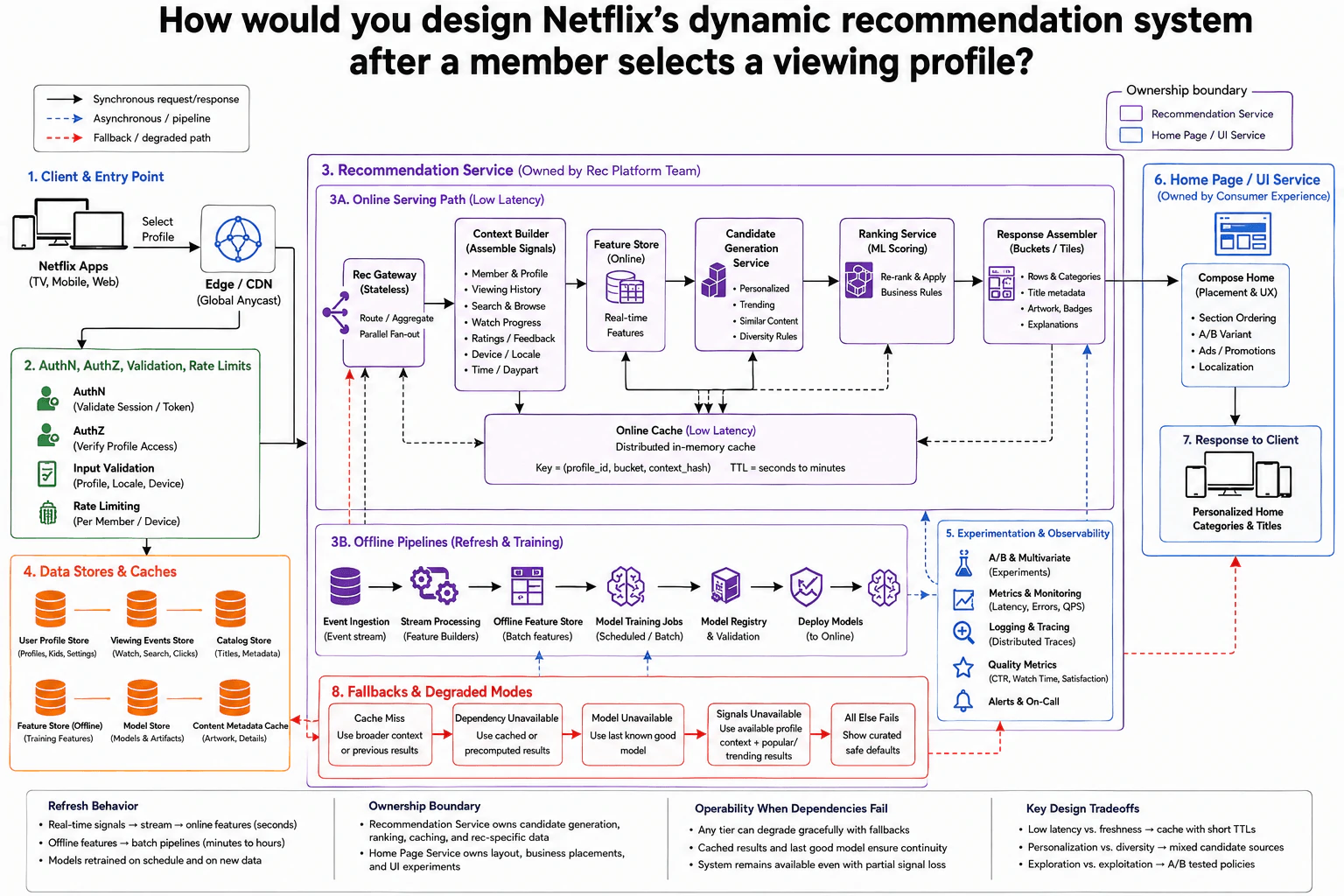
At a high level, the goal is to return a personalized home page after a member selects a viewing profile. The main challenge is keeping recommendations fast while signals, models, and metadata keep changing or sometimes fail. I would explain three flows: online recommendation serving, offline refresh and training, and fallbacks. The Recommendation Service chooses and ranks categories and titles. The Home Page / UI Service controls placement and presentation. The main trade-off is recommendation freshness versus low latency.
Detailed Explanation
The system must quickly show useful categories and titles for the selected viewing profile. The difficult part is that recommendations depend on changing information, such as viewing history, searches, watch progress, ratings, device, locale, and time of day. Models and other dependencies can also fail. The diagram handles this with a fast online serving path, a slower refresh and training path, and clear fallback choices. It also separates choosing recommendations from arranging the final home page.
Useful Questions to Ask the Interviewer
How quickly should new viewing or search activity affect recommendations?
Is returning older cached recommendations acceptable during a dependency failure?
Which decisions must belong to the Recommendation Service versus the Home Page / UI Service?
How to Explain It in an Interview
1. Start with the profile request
I would start when the member selects a profile in the Netflix Apps. The request first passes through the Edge / CDN. Then AuthN validates the session or token, AuthZ verifies profile access, Input Validation checks profile, locale, and device values, and Rate Limiting protects the system from excessive requests.
After these checks, the request enters the Recommendation Service through the stateless Rec Gateway. This gateway routes and aggregates the recommendation work and can fan out requests in parallel.
2. Build the recommendation online
The Context Builder gathers the signals needed for this request. It uses member and profile information, viewing history, search and browse activity, watch progress, ratings or feedback, device and locale, and time of day. The Feature Store (Online) provides real-time features.
Candidate Generation Service then finds possible titles from personalized, trending, similar-content, and diversity sources. The Ranking Service scores and re-ranks those candidates and applies business rules. The Online Cache is a distributed in-memory cache for low-latency results. Its key includes profile, bucket, and context information, and its short lifetime balances speed with freshness.
The supporting data layer includes the User Profile Store, Viewing Events Store, Catalog Store, Feature Store (Offline), Model Store, and Content Metadata Cache. These stores support profile data, behavior signals, catalog information, training features, models, and content details without turning the Online Cache into the main data store.
3. Assemble recommendations and build the home page
The Response Assembler converts ranked candidates into rows, categories, and tiles. It adds title metadata, artwork, badges, and explanations. This work still belongs to the Recommendation Service.
The result then goes to the Home Page / UI Service. Compose Home controls section ordering, A/B variants, ads or promotions, and localization. This ownership split is important. The Recommendation Service owns candidate generation, ranking, caching, and recommendation-specific data. The Home Page / UI Service owns layout, business placements, and UI experiments. It then returns the personalized home page to the client.
4. Refresh signals and models in the background
The offline path keeps the online system fresh. Event Ingestion receives the event stream. Stream Processing builds features, and the Offline Feature Store keeps batch features. Model Training Jobs create updated models. The Model Registry and validation step checks them before Deploy Models moves approved models to the online path.
Real-time signals can refresh online features within seconds. Offline features may refresh over minutes or hours. Models are retrained on a schedule and when new data is available.
5. Handle failures, experiments, and operations
The fallback path keeps the experience usable when dependencies fail. A cache miss can use broader context or previous results. If a dependency is unavailable, the Rec Gateway can use cached or precomputed results. If a model is unavailable, the service can use the last known good model. If signals are unavailable, it can use available profile context plus popular or trending results. If everything else fails, curated safe defaults remain available.
Experimentation & Observability runs beside the main flow. A/B and multivariate experiments test recommendation changes. Metrics & Monitoring, Logging & Tracing, Quality Metrics, and Alerts & On-Call help detect problems. The main trade-off is freshness versus latency. Short cache lifetimes improve freshness, but they require more recommendation work.
Practical Complexity & Trade-offs
The benefit is that the online path stays fast while slower training work happens separately. The Online Cache avoids repeating expensive recommendation work, but short cache lifetimes mean more frequent refreshes. Real-time features make results fresher, but they add dependencies that may fail. Cached results, precomputed results, the last known good model, popular or trending content, and safe defaults keep the home page usable during failures. The downside is that fallback results can be less personal. The ownership split also helps teams work independently, but the Recommendation Service and Home Page / UI Service need a clear contract between them.
Why Interviewers Ask This
Interviewers want to see whether you can divide a large recommendation system into clear flows. They are testing whether you understand fast online serving, caching, background model refresh, failure handling, experimentation, and service ownership. A strong answer shows good judgment about what must stay fast, what can update later, and how the system can still return useful results when recommendation signals or ranking dependencies fail.
Interviewer may ask next
What would you change if real-time viewing signals became unavailable for several minutes?
I would keep the same basic architecture and change how the online path builds its context. The Context Builder would continue using information that is still available, such as the selected profile, stored viewing history, device, locale, and other usable context. The Signals Unavailable fallback would use available profile context plus popular or trending results.
The Ranking Service could continue with the last known good model when the model is healthy. The Rec Gateway could also use cached or precomputed results when they are suitable. The Home Page / UI Service would therefore still receive recommendation rows instead of an error.
Metrics & Monitoring and Logging & Tracing should show that real-time signals are delayed. Alerts & On-Call can then notify operators. The main downside is weaker freshness and personalization. A member's newest watch or search activity may not affect recommendations until the signal path recovers.
How would you handle a ranking dependency failure without making the home page unavailable?
I would use the existing fallback path instead of waiting indefinitely for the failed dependency. The Rec Gateway can return cached or precomputed results when an internal recommendation dependency is unavailable. If the current model is unavailable, the system can use the last known good model.
When fresh signals cannot be used, the design also allows available profile context plus popular or trending results. If those choices fail too, curated safe defaults provide a final fallback. The Response Assembler can package whatever valid recommendation buckets remain, and the Home Page / UI Service can still handle ordering, experiments, promotions, localization, and presentation.
Metrics, logs, traces, quality measures, and alerts should record the failure so the on-call team can respond. The downside is lower recommendation quality during the incident, but the member still receives a usable home page.
2. How would you design a scheduler for ML training and batch-inference jobs?Cloud ArchitectureMediumNetflix
i Question Details
Design the control plane for training, batch inference, and lower-priority evaluation jobs. Define job, task, attempt, queue, tenant, worker, and resource identities; submission, status, cancellation, and retry APIs; CPU, memory, accelerator, storage, and network requirements; admission, placement, fairness, quotas, leases, checkpointing, crash recovery, output commit, tenant isolation, and operational signals.
Short Interview Answer (30-60 seconds)
At a high level, I would separate accepting ML jobs from running them on workers. The main challenge is sharing CPU, GPU, memory, storage, and network fairly while handling failures safely. I would explain three flows: admit and queue a job, schedule and run its tasks, then retry or commit the result. The control plane keeps durable state, workers use leases and heartbeats, and checkpoints support recovery. The trade-off is stronger fairness and safety at the cost of more scheduler complexity.
Detailed Explanation
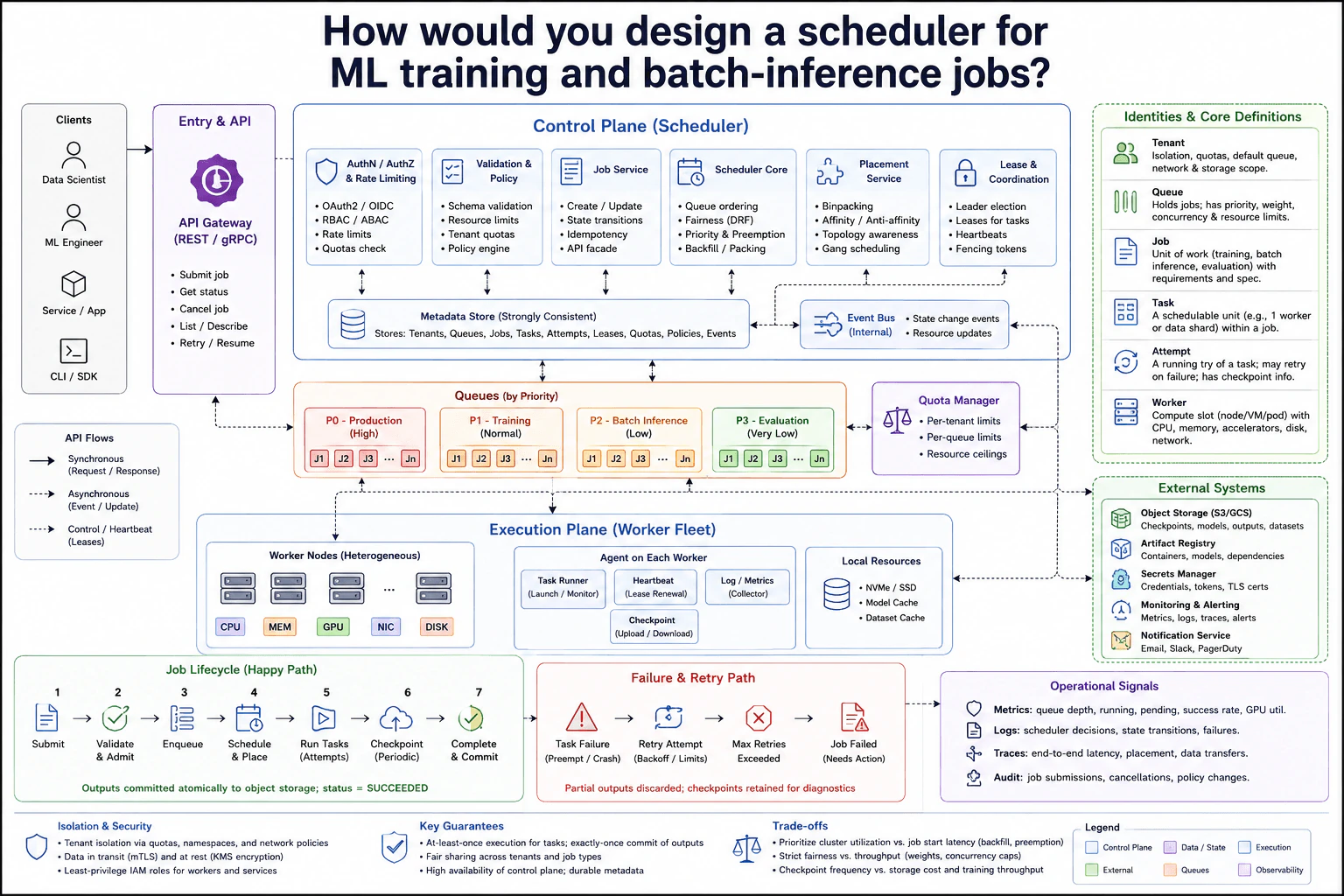
The goal is to accept machine-learning jobs and safely run their smaller tasks on a shared worker fleet. Training, batch inference, production, and evaluation work can have different priorities. The hard part is sharing limited CPU, memory, accelerators, storage, and network fairly while machines and tasks can fail. The diagram solves this through admission, priority queues, resource-aware placement, leased execution, checkpointing, retries, and safe output commit. Durable control-plane state also lets clients check status, cancel work, and resume or retry jobs.
Useful Questions to Ask the Interviewer
Which job types may preempt lower-priority work?
Are quotas mainly per tenant, per queue, or both?
How often should long training jobs checkpoint?
Which resources are usually scarce, especially accelerators?
How to Explain It in an Interview
1. Define the work and admit it safely
I would start by giving every important object a clear meaning. A Tenant is the isolation boundary. A Queue holds Jobs and has priority, weight, concurrency, and resource limits. A Job represents training, batch inference, or evaluation work. A Task is one schedulable part of a Job. An Attempt is one running try of a Task. A Worker is a compute slot. Resources are its CPU, memory, accelerator, disk or storage, and network capacity.
Clients use the API Gateway through REST or gRPC. They can submit jobs, get status, cancel jobs, list or describe them, and retry or resume work. AuthN and AuthZ check identity and permissions. Validation & Policy checks the request, resource limits, tenant quotas, and policy. The Job Service records state transitions in the strongly consistent Metadata Store.
2. Queue work and apply fairness
After admission, work enters a priority queue. The diagram shows P0 Production, P1 Training, P2 Batch Inference, and P3 Evaluation. Scheduler Core orders work using priority, preemption, backfill, packing, and DRF. DRF is a fairness method that limits how much of the most heavily used resource each tenant receives.
Quota Manager applies per-tenant limits, per-queue limits, and resource ceilings. The Event Bus carries state changes and resource updates in the background.
3. Place tasks and give workers ownership
Placement Service selects workers with enough CPU, memory, accelerator, storage, and network capacity. It also considers binpacking, affinity, anti-affinity, topology, and gang scheduling.
Lease & Coordination gives tasks limited-time leases. Workers renew them with heartbeats. Fencing tokens stop an old Attempt from continuing to act as the valid owner after its lease is replaced.
4. Execute, checkpoint, and commit outputs
Each worker Agent has a Task Runner, heartbeat handling, log and metric collection, and checkpoint upload or download. Workers can also use local NVMe or SSD, model cache, and dataset cache.
The happy path is submit, validate and admit, enqueue, schedule and place, run Attempts, checkpoint periodically, then complete and commit. Checkpoints, datasets, models, and outputs use Object Storage. Task execution is at least once because a failed Task may run again. Final output commit is exactly once, so retries do not publish multiple final results.
5. Recover failures and operate the system
If a Task crashes, is preempted, or loses its Worker, the scheduler can create another Attempt using retry backoff and limits. If the retry limit is exceeded, the Job becomes failed. Partial outputs are discarded, while checkpoints remain available for recovery or diagnosis.
Metrics cover queue depth, pending and running jobs, success rate, and GPU use. Logs record scheduler decisions and failures. Traces show end-to-end latency, placement, and data transfers. Audit records cover submissions, cancellations, and policy changes. Tenant isolation uses quotas, namespaces, network policies, encryption, and least-privilege access. The main trade-off is complexity versus stronger fairness, recovery, and correctness.
Practical Complexity & Trade-offs
The benefit is fair sharing across tenants and job types. Priority, DRF fairness, quotas, preemption, backfill, and packing help the fleet use limited resources well. The downside is more scheduler logic and more durable state to manage. Strict fairness can leave some capacity unused. Checkpointing makes long jobs easier to recover, but frequent checkpoints cost storage and can slow training. Leases and heartbeats detect lost workers, but they add control traffic. Exactly-once output commit protects final results, while Tasks may still execute more than once. We accept this complexity because retries, isolation, and safe results matter.
Why Interviewers Ask This
Interviewers ask this to see whether you can break a difficult scheduling problem into clear control-plane and worker flows. They want to understand how you model Jobs, Tasks, Attempts, Queues, Tenants, Workers, and resources. They also test your judgment about fairness, quotas, placement, leases, checkpointing, retries, tenant isolation, and safe output commit. The goal is not memorizing one scheduler. It is showing that you can explain why each control exists and what trade-off it creates.
Interviewer may ask next
How would the design change if GPUs became the main scarce resource and many tenants competed for them?
I would keep the same architecture, but make accelerator capacity the main scheduling constraint. Validation & Policy would still check each Job's requested resources, while Quota Manager would stop one tenant or queue from consuming every GPU.
Scheduler Core would continue using priority, DRF fairness, preemption, backfill, and packing. Placement Service would give more weight to accelerator type and available GPU capacity when choosing Workers. Training jobs could stay in P1, batch inference in P2, and lower-priority evaluation in P3. If policy allows it, higher-priority work could preempt lower-priority Attempts.
Checkpointing becomes especially important before preemption. A long training Attempt can restart from a saved checkpoint instead of repeating all completed work. Leases, heartbeats, and fencing tokens remain unchanged because they still control task ownership.
The downside is reduced placement freedom. A Worker may have free CPU and memory but still be unusable because it lacks the required accelerator. Strong fairness rules can also leave some GPU capacity idle while the scheduler protects tenant shares.
What happens if a worker crashes while a long training task is running?
I would use the existing lease, heartbeat, checkpoint, and retry path. The worker Agent renews its Task lease through heartbeats. If heartbeats stop and the lease is no longer valid, Lease & Coordination can treat that Attempt as lost.
Scheduler Core can then create another Attempt using the configured retry backoff and limits. Placement Service chooses a suitable Worker again. The new Attempt can download the latest checkpoint from Object Storage instead of starting the training job from the beginning.
Fencing tokens protect ownership during this change. If the old Worker comes back later, its old token must not let it act as the current Task owner. Partial outputs from the failed Attempt are discarded. Only the valid completion path performs the final output commit.
This means Task execution is at least once, because a Task can run again after failure. Final outputs still commit exactly once. The downside is lease tuning. Short leases detect failures faster, but they create more heartbeat traffic and can trigger retries during temporary network problems.
3. How would you design an advertising pacing system for a large-scale streaming platform?NEWCloud ArchitectureHardNetflix
i Question Details
Campaigns have budgets, flight dates, targeting constraints, and impression, click, or spend goals. Design the low-latency serving path and slower pacing-control loop; campaign and nested budget state; APIs, storage, caches, and event pipelines; adaptation to traffic changes; concurrency-safe overspend bounds; late, duplicate, and out-of-order events; configuration propagation; reconciliation; monitoring; and explicit failure behavior.
Short Interview Answer (30-60 seconds)
At a high level, the goal is to spend each advertising budget at the right pace while keeping ad decisions very fast. The hard part is controlling spend while traffic and delivery rates keep changing. I would split the design into three flows: the low-latency serving path, the background event pipeline, and the slower pacing-control loop. Atomic reservations limit overspend, while processed delivery data changes future pacing. The trade-off is keeping serving fast while using stronger checks where budget correctness matters.
Detailed Explanation
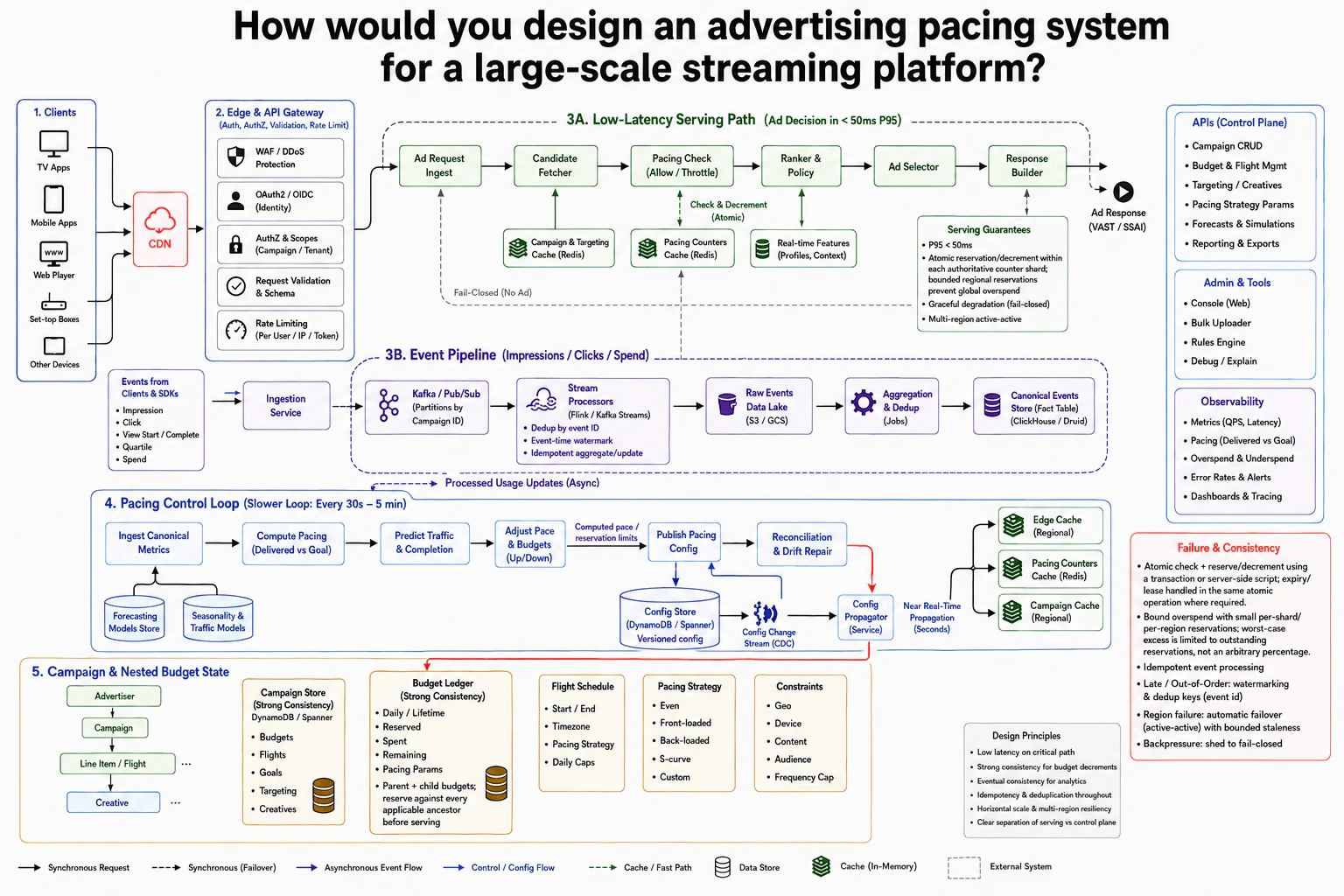
The system must decide when an ad can be served without spending a campaign budget too quickly. This is difficult because streaming traffic changes during the day, while many ad requests can arrive at the same time. Impression, click, and spend events also arrive after serving. Some events may be duplicated, late, or out of order. The diagram separates this problem into a fast serving path, a background event pipeline, and a slower pacing-control loop that adjusts future serving limits.
Useful Questions to Ask the Interviewer
Which goal matters most for each campaign: impressions, clicks, or spend?
How quickly should pacing react when traffic changes?
How much temporary overspend is acceptable?
Should the serving path return no ad when safe pacing state is unavailable?
How to Explain It in an Interview
1. Explain the low-latency serving path
I would keep the ad decision path short because it runs for every opportunity. Clients reach the CDN and then the Edge & API Gateway. The gateway handles WAF and DDoS protection, OAuth2/OIDC identity, AuthZ & Scopes, request validation, and rate limiting.
Ad Request Ingest sends the request to Candidate Fetcher. Candidate Fetcher reads Campaign & Targeting Cache. Pacing Check then allows or throttles each candidate. It performs an atomic check and decrement against Pacing Counters Cache. Ranker & Policy uses Real-time Features. Ad Selector chooses the ad, and Response Builder returns the Ad Response.
2. Protect campaign and nested budgets
The key correctness rule is that concurrent requests cannot freely spend the same budget. Budget Ledger keeps daily and lifetime amounts, reserved spend, spent spend, remaining spend, and pacing parameters. Parent and child budgets are reserved together before serving.
The hierarchy is Advertiser to Campaign to Line Item / Flight to Creative. Campaign Store keeps budgets, flights, goals, targeting, and creatives. Flight Schedule keeps start, end, timezone, pacing strategy, and daily caps. Constraints include geo, device, content, audience, and frequency cap.
3. Process delivery events in the background
Clients and SDKs send impression, click, view start or complete, quartile, and spend events to Ingestion Service. Kafka / Pub/Sub partitions the stream by Campaign ID. Stream Processors deduplicate by event ID, use an event-time watermark for late events, and make aggregate updates idempotent. That means processing the same event again does not incorrectly count it twice.
Raw Events Data Lake stores the raw events. Aggregation & Dedup produces processed results. Canonical Events Store keeps the processed fact data used by pacing.
4. Adjust pacing with the slower control loop
Ingest Canonical Metrics starts the pacing loop. Compute Pacing compares delivered results with the goal. Predict Traffic & Completion uses Forecasting Models Store and Seasonality & Traffic Models. Adjust Pace & Budgets raises or lowers the pace.
The computed pace and reservation limits go to Publish Pacing Config. Config Store keeps versioned config. Config Change Stream and Config Propagator send newer versions to Edge Cache, Pacing Counters Cache, and Campaign Cache. The path retries until updates are acknowledged.
5. Handle drift, failures, and operations
Reconciliation & Drift Repair checks pacing state against the strong-consistency Budget Ledger. Corrected state can return to Publish Pacing Config and be sent to serving caches again.
Serving fails closed when a safe reservation is unavailable, so the system can return no ad instead of spending without a bound. Small per-shard or per-region reservations limit worst-case overspend. Region failure uses active-active failover with bounded staleness. Backpressure sheds work toward the fail-closed path.
Observability tracks QPS, latency, delivered pacing versus goal, overspend, underspend, errors, alerts, dashboards, and tracing. The main trade-off is keeping the serving path fast while using stronger budget checks where financial correctness matters.
Practical Complexity & Trade-offs
The benefit is that normal ad decisions stay fast because targeting data, pacing counters, and real-time features are close to the serving path. The downside is that budget protection needs stronger coordination than ordinary cache reads. Small per-shard or per-region reservations reduce that cost, but they allow a small bounded amount of temporary overspend. The background event path also means pacing does not react instantly. Late events may affect a later pacing calculation. We accept this because serving must stay fast while spend still remains controlled. Failing closed protects budgets, but it can reduce ad delivery during failures.
Why Interviewers Ask This
The interviewer wants to see whether you can separate work that must be fast from work that can happen later. They also want to see how you protect money when many requests run at once. A strong answer shows good judgment around nested budgets, event correctness, changing traffic, configuration updates, failures, and monitoring without making every ad decision slow.
Interviewer may ask next
What would you change if the business required a much tighter overspend bound across regions?
I would keep the same design, but I would make each per-region or per-shard reservation smaller. A region could spend only the amount currently reserved for it. Pacing Check would still use Pacing Counters Cache, so the normal ad-serving path could remain fast.
Budget Ledger would continue storing reserved, spent, remaining, daily, and lifetime budget state. Parent and child budgets would still be reserved together. Reconciliation & Drift Repair would compare the serving state with that budget state and write corrections when needed. Corrected pacing limits would then return through Publish Pacing Config and the existing configuration path.
Smaller reservations reduce the amount several regions can temporarily spend without seeing each other's newest activity. The downside is more coordination. Regions need fresh reservations more often. If a safe reservation cannot be obtained, the existing fail-closed behavior applies. That campaign returns no ad rather than spending without a safe bound.
How would the system react if streaming traffic suddenly increased and a campaign started delivering much faster than expected?
I would let the slower Pacing Control Loop react to the traffic change instead of adding heavy forecasting work to every ad request. The event pipeline keeps receiving impression, click, and spend events. Stream Processors remove duplicates, handle event time, and make repeated aggregate updates safe.
Ingest Canonical Metrics feeds the pacing loop. Compute Pacing compares delivered results with the goal. Predict Traffic & Completion uses Forecasting Models Store and Seasonality & Traffic Models. Adjust Pace & Budgets can lower the pace when delivery is running ahead. The resulting pace and reservation limits go through Publish Pacing Config, Config Store, Config Change Stream, and Config Propagator to the serving caches.
Later requests then use the newer limits in Pacing Check. Atomic reservations still protect the budget while the control loop catches up. The downside is reaction time. The control loop is slower than individual requests, so bounded reservations are still needed during sudden spikes.
4. How would you keep staging and production behavior aligned for Netflix service releases?DevOpsEasyNetflix
i Question Details
A service is validated in staging but behaves differently after promotion. Explain the delivery contract for immutable artifacts, environment configuration, secrets, infrastructure versions, test data boundaries, dependency versions, feature controls, and release verification. Include how the pipeline detects meaningful drift without requiring production and staging to have identical scale or data.
Short Interview Answer (30-60 seconds)
I would build the service once and promote the same immutable OCI image digest from staging to production instead of rebuilding it. I would define one versioned delivery contract for configuration, secrets, infrastructure, dependencies, test data boundaries, feature controls, and release verification. Staging can have different scale, credentials, and data, but those differences must be explicit and allowed. Before promotion, the pipeline checks meaningful configuration, schema, dependency, infrastructure, behavior, and guarded data drift. Critical unexpected drift blocks promotion. After production deployment, golden signals and release checks verify the release, with rollback to the last known good artifact when needed.
Detailed Explanation
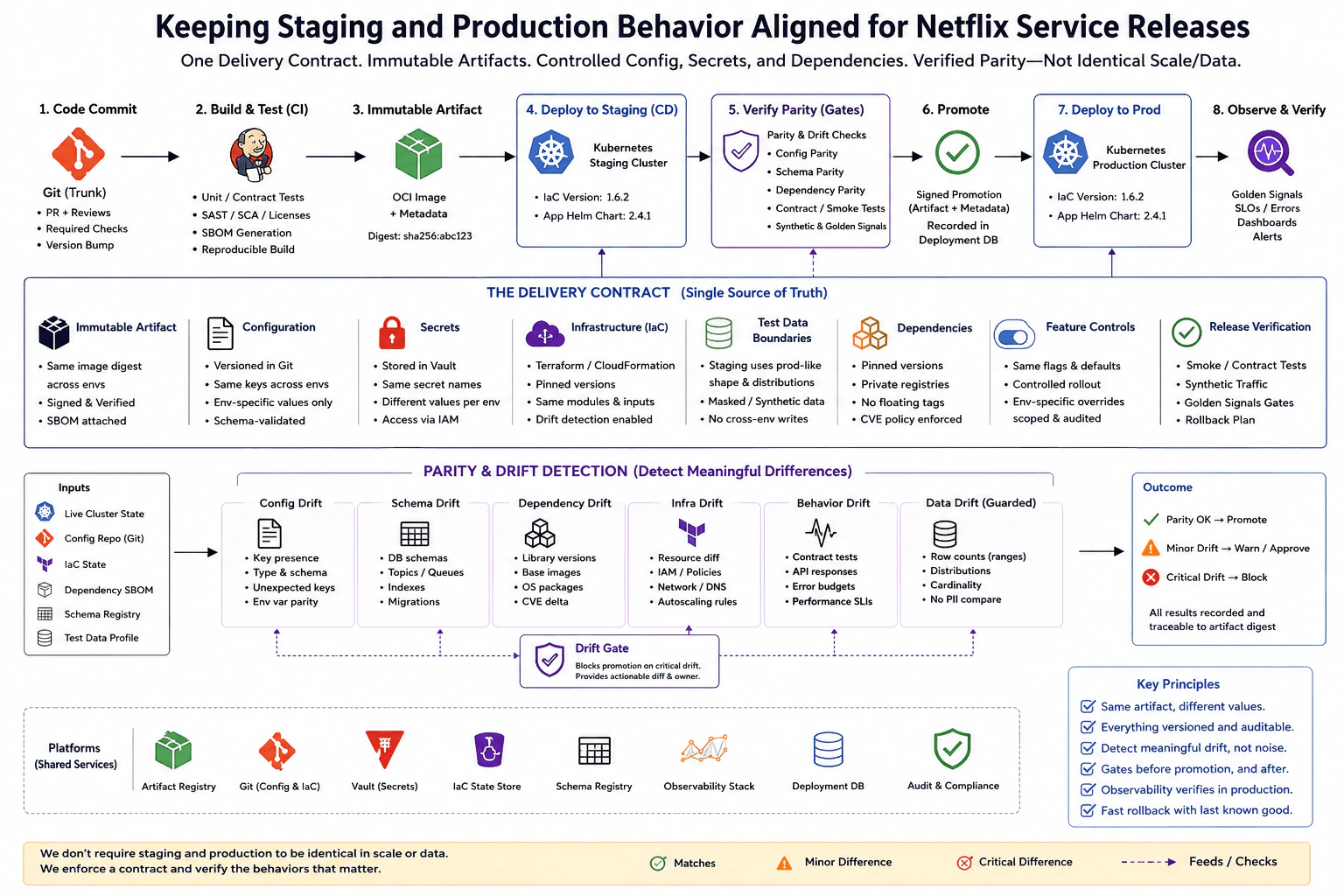
I would make staging and production follow one shared release agreement. The exact software package that passes testing should be the package that reaches production. Settings and private values can differ, but their names, expected shapes, and rules should stay controlled. Staging does not need the same number of machines or the same customer data. It needs realistic behavior and safe data. Before promotion, automated checks compare important differences. Expected differences are accepted. Serious unexpected differences stop the release. After deployment, service health is checked again so a bad release can be detected quickly.
Useful Questions to Ask the Interviewer
Which differences between staging and production are intentionally allowed?
Which configuration, dependency, infrastructure, and behavior checks must block promotion?
Which production signals define a successful release?
What rollback policy should be used when production verification fails?
How to Explain It in an Interview
I would start with the immutable artifact. CI builds and tests one OCI image, records its digest and metadata, attaches the software bill of materials, and performs security checks. That exact digest goes to the staging Kubernetes cluster and later to the production Kubernetes cluster. The production release is promoted, not rebuilt.
Next, I would define one versioned delivery contract. Configuration is versioned in Git. Both environments use the same required keys and schema, while approved environment specific values can differ. Secrets are stored in Vault. The secret names and access contract stay consistent, while the actual values remain separate and access is controlled through identity permissions. Infrastructure definitions use the same Terraform or CloudFormation modules and inputs with pinned versions. Dependency versions, base images, and external service versions are controlled. Floating versions are avoided and vulnerability policy is applied consistently.
Test data follows a separate boundary. Staging uses production like shapes and distributions with masked or synthetic data. It does not write into production data. Feature controls use the same flags and defaults, with approved environment overrides and controlled rollout rules.
Before promotion, the drift gate compares live cluster state, the configuration repository, infrastructure state, the dependency software bill of materials, the schema registry, and the test data profile. It checks configuration keys and types, database schemas, topics, queues, indexes, migrations, dependency versions, base images, operating system packages, infrastructure resources, identity policies, networking, autoscaling rules, contract tests, API responses, error budgets, performance objectives, and guarded data characteristics.
A known allowed difference can pass. A minor unexpected difference can require warning and approval. A critical unexpected difference blocks promotion. The approved promotion is signed, recorded with artifact metadata in the deployment database, and remains traceable to the image digest.
After production deployment, smoke tests, contract tests, synthetic traffic, golden signals, service objectives, errors, dashboards, and alerts verify the release. If production regresses, the rollback path restores the last known good immutable artifact.
Why Interviewers Ask This
Interviewers want to see whether I understand how to promote one tested release safely while controlling the differences between staging and production. They are testing my judgment around immutable artifacts, configuration, secrets, infrastructure definitions, dependency versions, test data, feature controls, drift detection, promotion gates, production verification, observability, and rollback.
Common interview mistakes
Common mistakes are rebuilding the application for production, treating a mutable image tag as the release identity, allowing unversioned configuration changes, using different dependency versions without approval, copying production secret values into staging, letting staging write to production data, assuming staging must have production scale, treating every difference as an error, ignoring schema and migration drift, allowing hidden feature flag differences, checking only repository files instead of observed runtime state, promoting despite critical unexpected drift, and assuming a successful deployment proves that the release is healthy.
Interview tip
Start by saying that the same immutable artifact is promoted, not rebuilt. Then explain the versioned delivery contract. Separate required behavioral parity from allowed differences such as scale, credentials, and data. Finish with drift gates, signed promotion, production golden signals, and rollback. This gives the interviewer a clear end to end release story.
Interviewer may ask next
What would you do if staging and production intentionally use different capacity and data but the drift gate reports differences?
I would classify the differences against the delivery contract instead of requiring identical environments. Capacity, traffic volume, credentials, and customer data can be approved environment differences. The pipeline should compare the properties that affect behavior, such as configuration schema, dependency versions, infrastructure policy, database schema, feature controls, data shape, contract responses, and service objectives. An expected difference can pass. A minor unexpected difference can require warning and approval. A critical unexpected difference blocks promotion. This matters because comparing every raw value creates noise, while ignoring differences can hide real release risk.
Why promote the same image digest instead of rebuilding the service for production?
Promoting the same image digest keeps the tested application artifact identical. A production rebuild could produce a different dependency set, base image, build result, or source state even when the intended source revision is unchanged. Using the tested digest removes that build variation from the promotion decision. Environment specific configuration and secret values are still loaded separately, so staging and production do not need to become identical. The tradeoff is that the artifact registry, signing evidence, metadata, and deployment records must be retained reliably for promotion, audit, and rollback.
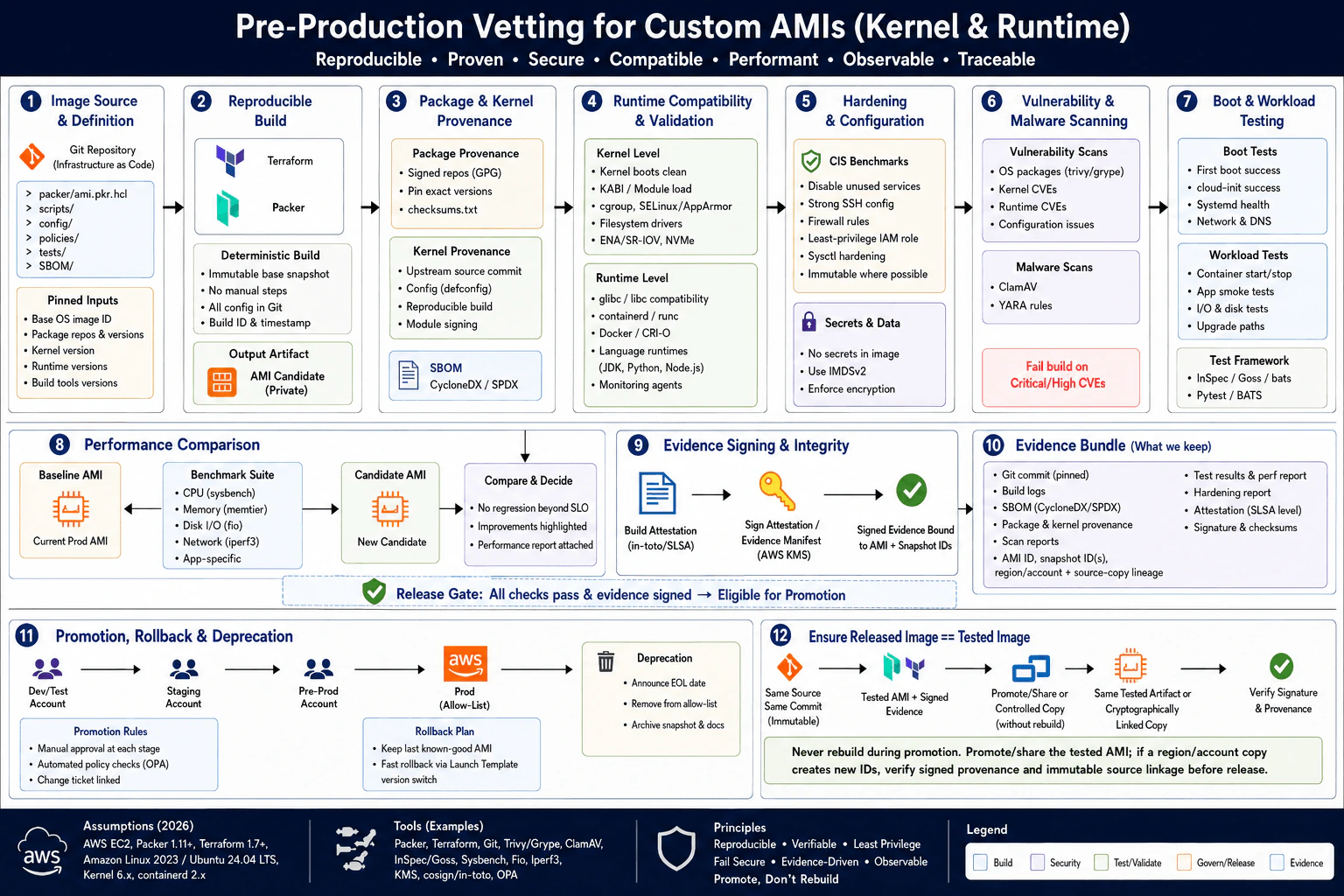
5. What pre-production vetting would you require for custom AMIs at the kernel and runtime levels?DevOpsMediumNetflix
i Question Details
Teams need custom machine images for cloud workloads. Define the image source, reproducible build, package and kernel provenance, runtime compatibility, hardening, vulnerability and malware checks, boot and workload tests, performance comparison, signing, promotion, rollback, deprecation, and evidence that a released image is the same version tested before production.
Short Interview Answer (30-60 seconds)
I would allow a custom AMI into production only after a reproducible build passes provenance, kernel, runtime, hardening, security, boot, workload, and performance checks. I would keep an immutable evidence bundle containing the source commit, build inputs, package and kernel records, AMI and snapshot identifiers, scan results, test results, and performance results. I would sign that evidence with AWS KMS. Promotion must reuse, share, or make a controlled copy of the tested AMI without rebuilding it. If a copy receives new identifiers, I would verify its signed provenance and immutable source linkage before release.
Detailed Explanation
A custom machine image should reach live systems only after we prove that it was built in a repeatable way, contains the expected software, starts correctly, runs the required workload, meets security rules, and performs close to the current approved image. I also want a permanent record of what was tested and what was released. That record lets us prove that production received the approved version, identify what changed, return quickly to the previous good version, and retire old images in a controlled way after teams stop using them.
Useful Questions to Ask the Interviewer
Which operating systems, processor types, and application runtimes must the image support?
Will images be shared between accounts, copied between regions, or both?
What security severity and performance regression limits should block promotion?
How to Explain It in an Interview
I would start with pinned inputs such as the Git commit, base operating system image, package repositories, package versions, kernel version, runtime versions, configuration, and build tool versions. I would use an automated Packer build with no manual changes and record the build identity, software inventory, checksums, package provenance, and kernel provenance.
Next I would validate kernel boot, required modules and drivers, module signing where required, storage and network support, system libraries, container runtime, language runtimes, cryptographic policy, and application dependencies. I would apply the approved hardening baseline, disable unnecessary services, avoid embedded secrets, use IMDSv2, and use least privilege identity.
Security gates would scan operating system packages, kernel issues, runtime dependencies, configuration, and malware. Critical findings would stop promotion according to policy.
I would then boot the candidate on representative instance types and test cloud initialization, system services, networking, DNS, containers, application startup, disk operations, upgrades, reboot, and recovery. I would compare CPU, memory, disk, network, latency, and throughput with the current production AMI and block unacceptable regressions.
Finally, I would store the AMI and snapshot identifiers, source commit, build logs, software inventory, provenance, scans, tests, performance report, attestations, signatures, and copy lineage. I would sign the evidence manifest with AWS KMS. I would promote or share the tested AMI without rebuilding it. A controlled region or account copy may receive new identifiers, so I would verify signed provenance and immutable source linkage before release. I would keep the previous known good AMI for rollback and later deprecate obsolete images through policy.
Why Interviewers Ask This
Interviewers ask this to see whether I treat a machine image as a controlled production artifact instead of only checking whether it boots. They are testing my understanding of reproducible builds, package and kernel provenance, runtime compatibility, security controls, workload validation, performance regression testing, evidence signing, gated promotion, rollback, and image lifecycle management. They also want to know whether I can prove that production received the artifact that passed testing rather than a newly rebuilt image.
Common interview mistakes
Common mistakes include checking only whether the instance boots, scanning packages while ignoring the kernel and runtime, allowing manual changes during image creation, using unpinned repositories or versions, skipping representative workload tests, and promoting an image without a performance comparison. Another serious mistake is rebuilding the image for each environment because that breaks the proof that production received what was tested. It is also incorrect to assume that AMI and snapshot identifiers must remain identical after a legitimate region or account copy. A copy can have new identifiers, so signed provenance and source lineage must be verified. I would also avoid saying that the AMI or EBS snapshot itself is natively signed when the control actually signs the associated evidence or attestation.
Interview tip
Explain the process as a sequence of gates. Start with immutable inputs and a reproducible build. Then cover provenance, kernel and runtime compatibility, hardening, security scans, boot and workload testing, performance comparison, signed evidence, and promotion. Finish with the most important release rule: promote the tested artifact rather than rebuilding it, verify provenance when a controlled copy creates new identifiers, and keep a known good AMI ready for rollback.
Interviewer may ask next
What would you do if the approved AMI must be copied to another AWS region and receives a new AMI identifier?
I would treat it as a controlled copy, not as a new build. I would record the destination AMI and snapshot identifiers and connect them to the tested source through immutable copy lineage and signed provenance evidence. Before production use, I would verify that evidence and confirm that no build step changed the operating system, packages, kernel, runtime, or configuration. This matters because AMI identifiers are regional and can change during a valid copy. The tradeoff is additional evidence management, but it preserves traceability without rebuilding the image.
How would you decide whether a performance change should block promotion of a custom AMI?
I would compare the candidate with the current production AMI using the same representative instance type, workload, test method, and operating conditions. I would measure the signals that matter to the workload, including CPU use, memory use, disk performance, network performance, latency, and throughput. Promotion would stop when a result crosses an agreed regression limit. This matters because a secure and compatible image can still cause production problems when a kernel, driver, library, or runtime change reduces performance. The main tradeoff is additional test time and cost in exchange for greater confidence before release.
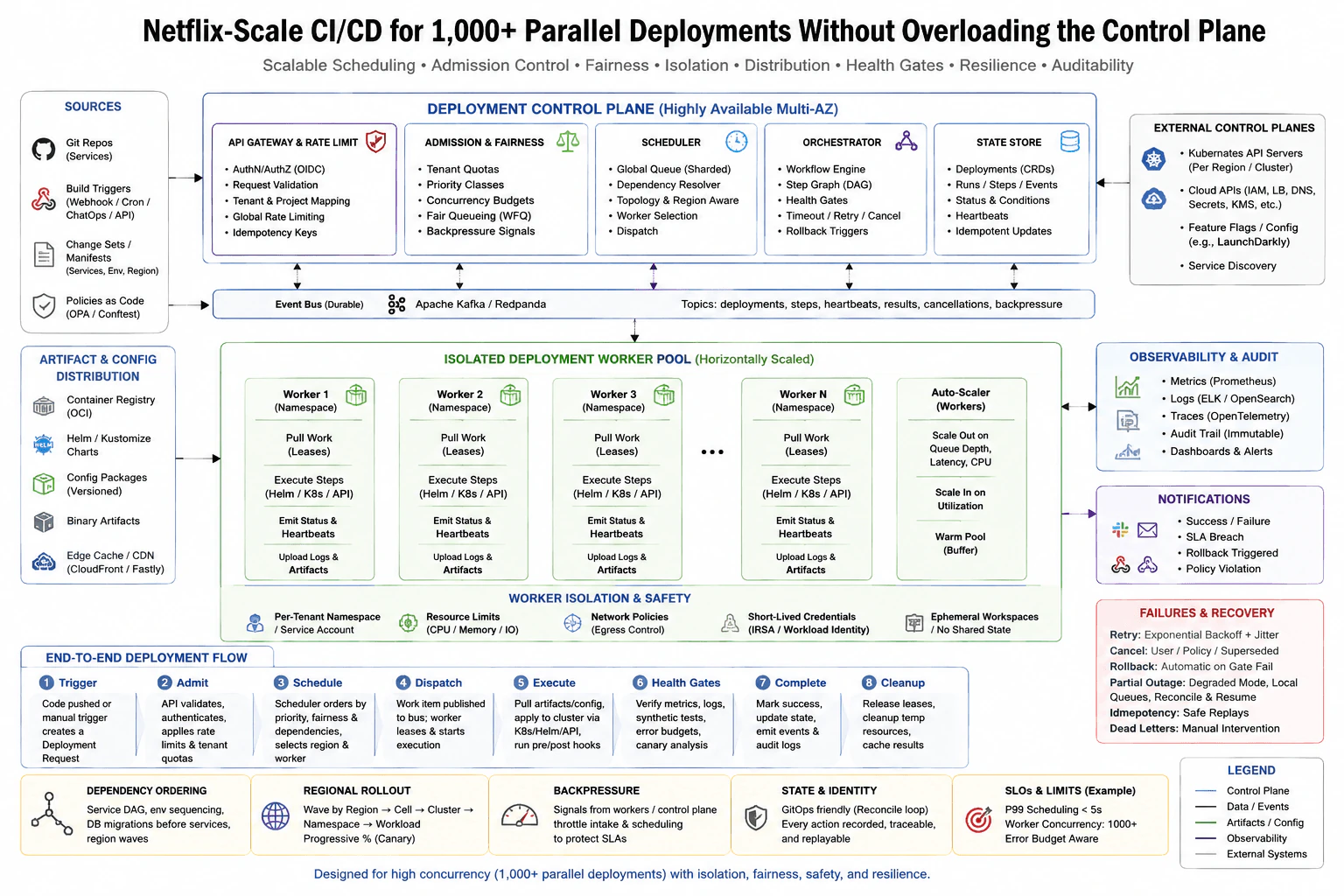
6. How would you design CI/CD for more than 1,000 parallel deployments without overloading the control plane?NEWDevOpsHardNetflix
i Question Details
Netflix pushes hundreds of builds daily, and deployment concurrency can exceed 1,000. Design scheduling, admission control, tenant fairness, isolated workers, artifact and configuration distribution, API rate limiting, dependency ordering, regional rollout, health gates, state tracking, retries, cancellation, backpressure, auditability, and recovery when the deployment control plane becomes partially unavailable.
Short Interview Answer (30-60 seconds)
I would keep the deployment control plane highly available and lightweight, then move execution to a horizontally scaled fleet of isolated workers. Requests enter through authenticated and rate limited APIs, pass admission and tenant fairness checks, and enter durable queues. The scheduler resolves dependencies and selects regions and workers. Workers pull leased work, fetch versioned artifacts and configuration, call Kubernetes or cloud APIs within explicit limits, and report heartbeats and results. Durable state, health gates, retries with jitter, cancellation, backpressure, audit events, and regional recovery let the platform handle more than 1,000 concurrent deployments safely.
Detailed Explanation
The main problem is not only running more than 1,000 deployments at the same time. The harder problem is keeping the central coordination service responsive while many teams, workers, regions, and external systems are active. I would make the central service decide which work may run, in what order, and where it should run. Separate workers would perform the heavy deployment work. The design must also share capacity fairly, limit request rates, distribute files efficiently, save progress durably, check health, support cancellation, and recover safely when part of the central service is unavailable.
Useful Questions to Ask the Interviewer
Is the 1,000 deployment target global or per region?
Do teams need separate concurrency quotas and priority classes?
Are Kubernetes clusters the main deployment targets?
What recovery, audit, and rollout requirements apply?
How to Explain It in an Interview
I would start with an API gateway that authenticates requests, validates them, maps each request to a tenant and project, applies global rate limits, and attaches an idempotency key. Admission control then checks tenant quotas, priority classes, concurrency budgets, and weighted fair queue rules. When capacity is saturated, it sends backpressure rather than accepting unlimited work.
Accepted requests enter a durable event bus. The scheduler orders work by priority, fairness, dependencies, topology, and region. The orchestrator manages the deployment step graph, regional rollout, health gates, timeouts, retries, cancellation, and rollback triggers. A highly available state store records deployments, runs, steps, events, status, conditions, and heartbeats with idempotent updates.
Execution happens in isolated workers rather than inside the control plane. Workers pull leased work, fetch versioned container images, Helm or Kustomize content, configuration packages, and binary artifacts, then call Kubernetes or cloud APIs through explicit limits. Workers emit heartbeats, status, logs, and results. The worker fleet scales from queue depth, latency, CPU use, and utilization. Per tenant namespaces or service accounts, resource limits, network policies, short lived credentials, and ephemeral workspaces reduce blast radius.
Regional rollout can progress by canary and controlled waves. Health gates check metrics, logs, synthetic tests, and error budgets before promotion. Failures retry with exponential backoff and jitter. Cancellation can come from a user, policy, or a superseding deployment. During a partial control plane outage, workers can finish safely leased work, durable queues retain events, healthy regions continue in degraded mode, and reconciliation resumes from durable state after recovery. Audit events and observability make every action traceable.
Why Interviewers Ask This
Interviewers ask this to see whether I can separate deployment coordination from deployment execution. They want to know if I understand admission control, tenant fairness, durable scheduling, worker isolation, artifact and configuration distribution, backpressure, API protection, regional rollout, health gates, durable state, safe retries, cancellation, auditability, and recovery from a partial control plane outage. The main judgment is whether I can support very high concurrency while protecting both the deployment control plane and the external Kubernetes and cloud control planes.
Common interview mistakes
A common mistake is letting the control plane execute deployment steps itself. That ties coordination capacity directly to deployment concurrency and makes overload more likely. Another mistake is using one global first come queue with no tenant quotas or fairness. Teams can then starve each other. Other mistakes include allowing unlimited calls to Kubernetes or cloud APIs, keeping deployment state only in worker memory, fetching every artifact repeatedly from a central source, retrying immediately without jitter, retrying operations without checking idempotency, ignoring dependency ordering, treating cancellation as an instant kill, and continuing to admit work when queues or external APIs are already saturated. High availability alone is also not enough. Durable state, leases, heartbeats, replay, reconciliation, failover, and manual handling for unrecoverable dead letters are still needed.
Interview tip
Explain the design as a separation between coordination and execution. Walk through trigger, admission, scheduling, dispatch, execution, health gates, completion, and cleanup. Then explain the overload controls: tenant quotas, fair queues, concurrency budgets, worker leases, external API limits, worker scaling, artifact caching, and backpressure. Finish with the failure story. State what happens to active workers, durable events, state, retries, cancellation, dead letters, regional failover, and reconciliation when part of the control plane becomes unavailable.
Interviewer may ask next
What happens if a worker loses contact with the control plane after starting a deployment step?
The worker should not assume the deployment step disappeared. Work is represented by a lease and durable deployment state. The worker can finish work that is already safely leased and retain its result until connectivity returns. If the lease expires, the control plane must inspect durable state and the observed target state before redispatching the step. Idempotency keys and reconciliation reduce the risk of duplicate effects. Heartbeats help detect a lost worker, but a missed heartbeat alone does not prove that the external deployment action failed. This matters because blindly repeating work after a network partition can create conflicting changes.
How would you increase throughput without overloading Kubernetes and cloud APIs?
I would scale the worker fleet independently while keeping explicit concurrency and request limits for each tenant, region, cluster, and external API. More workers increase execution capacity, but they must not create unlimited API concurrency. The scheduler and workers should respect concurrency budgets, queue depth, observed latency, and backpressure signals. Versioned artifact repositories, configuration stores, and edge caches should distribute common data so thousands of workers do not repeatedly load the same content from one central service. The tradeoff is that conservative limits reduce peak throughput, while aggressive limits increase throttling, retries, queue instability, and pressure on external control planes.
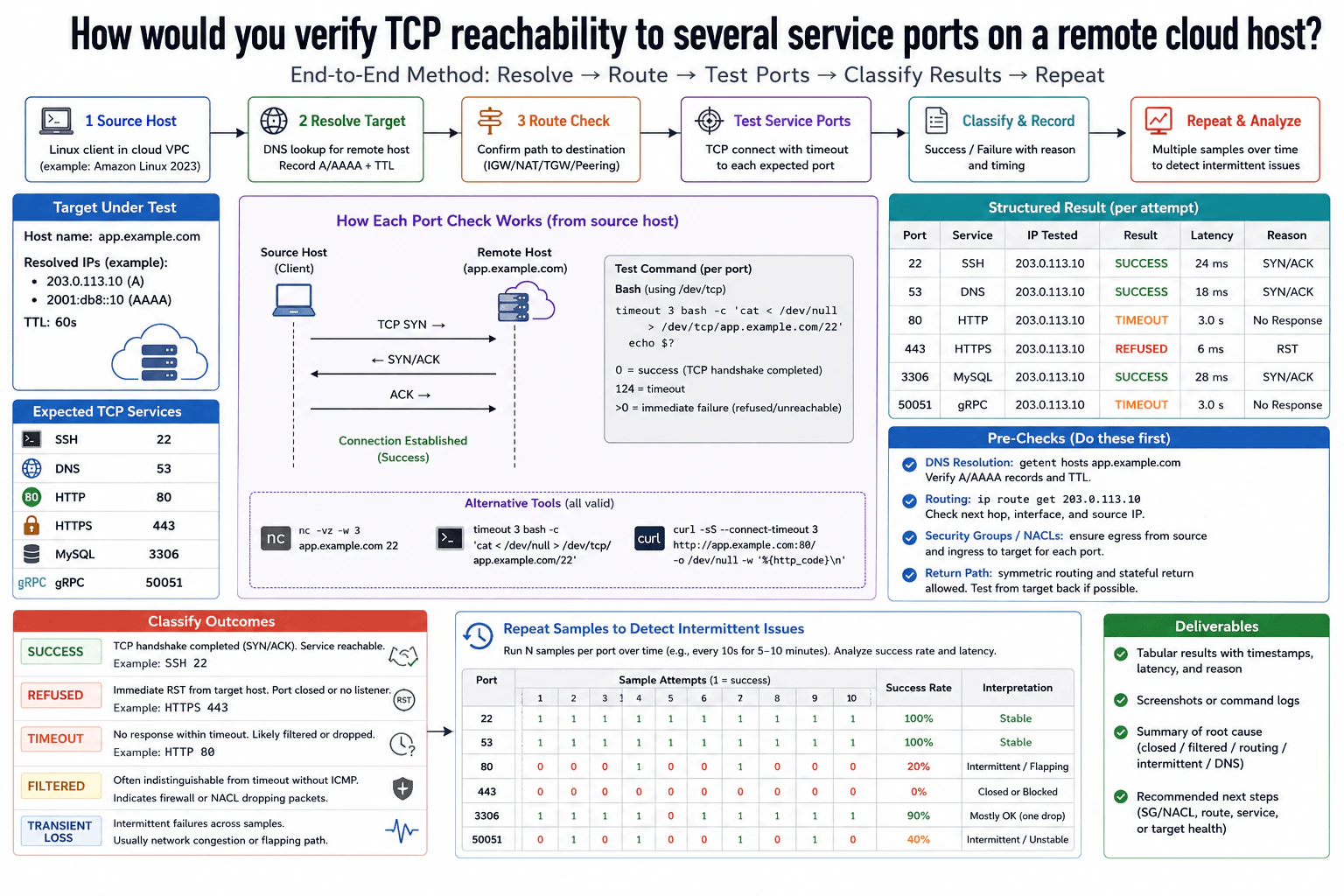
7. How would you verify TCP reachability to several service ports on a remote cloud host?NEWNetworkingEasyNetflix
i Question Details
The target exposes SSH, DNS, HTTP, HTTPS, MySQL, and gRPC on their expected TCP ports, and some checks fail intermittently. Define the source host, destination name and resolved addresses, connection timeout, per-port test, structured success or failure result, DNS and route checks, firewall and return-path evidence, and how repeated samples distinguish a closed port, filtered path, refusal, timeout, and transient loss.
Short Interview Answer (30-60 seconds)
At a high level, I would verify TCP reachability from one known cloud source host to every resolved destination address. The main challenge is telling a closed or refused port from a filtered path, a timeout, or intermittent loss. I would organize the check into DNS resolution, route and firewall checks, per-port TCP connection attempts, and repeated samples. I would record each attempt with the destination IP, port, timing, result, and reason so the evidence is easy to compare.
Detailed Explanation
The goal is to prove whether one cloud host can open TCP connections to the expected service ports on another host. Some ports may work while others fail only sometimes, so one test is not enough. The diagram uses one known Linux source host, resolves the target name, checks the route, tests every expected TCP port with a timeout, records each result, and repeats the tests. This lets us separate successful connections, active refusals, likely filtering, ordinary timeouts, and changing network problems without guessing from one failed attempt.
Useful Questions to Ask the Interviewer
Should I test every IPv4 and IPv6 address returned by DNS?
What connection timeout and sampling period should I use?
Can I inspect the source and destination firewall rules?
Can I test or inspect the return path from the remote host?
How to Explain It in an Interview
1. Define the source and resolve the target
I would start from one known source host. In the diagram, this is a Linux client inside a cloud VPC, with Amazon Linux 2023 shown as an example.
I would record its source IP and interface. Then I would resolve app.example.com and record every A and AAAA result plus the DNS TTL. The diagram shows example IPv4 and IPv6 addresses. Testing the resolved addresses separately prevents one working address from hiding another failing address.
2. Check the network path before testing ports
Next, I would check which route the source host will use. For IPv4, the diagram shows ip route get 203.0.113.10 as an example.
I would record the selected source IP, interface, and next hop. I would also review security groups, NACLs, and host firewall rules for the traffic direction. The return path matters too because the reply must be allowed back to the source.
3. Test each expected TCP service port
Then I would make a TCP connection attempt to each expected port. The diagram tests SSH 22, DNS 53 over TCP, HTTP 80, HTTPS 443, MySQL 3306, and gRPC 50051.
Each attempt needs a clear connection timeout. The diagram uses Bash /dev/tcp as the main example and also shows nc and curl for suitable checks. A successful TCP handshake means the listener is reachable. An immediate RST is a refusal. A closed port with no listener commonly produces that refusal, although an active firewall reject can also produce one.
4. Classify and record every attempt
I would record the port, service, destination IP, result, latency, and reason for every attempt. I would also keep command logs when useful.
A timeout means no useful reply arrived before the deadline. That alone does not prove the cause. A firewall drop, routing problem, unavailable host, or lost packets can look similar. A filtered path becomes more likely when the connection times out and firewall or NACL evidence shows that traffic is being dropped.
5. Repeat samples to find intermittent loss
Finally, I would repeat the same tests over time. Repeated SYN/ACK responses show a stable open port. Repeated immediate RST responses show stable refusal. Repeated no-response timeouts show a persistent no-reply condition.
Mixed successes and failures are different. They show that the path or service works at least sometimes, so I would investigate transient loss, congestion, a flapping path, changing filtering behavior, or target health. The downside is that repeated sampling takes longer, but it gives much stronger evidence than one connection attempt.
Practical Complexity & Trade-offs
The benefit is that this method separates different failure signals instead of calling every failed test unreachable. DNS tells us which addresses we are testing. The route check shows the path selected by the source. TCP tests show success, refusal, or no response. Firewall and return-path evidence help explain those results. The downside is that a timeout by itself cannot prove exactly where packets disappeared. Filtering, routing trouble, packet loss, or an unavailable host may look similar. Repeating the same test takes more time, but mixed results are strong evidence of an intermittent problem.
Why Interviewers Ask This
The interviewer wants to see whether you troubleshoot networking in a clear order. They are checking whether you define the exact source and destination, understand DNS and routing, test the correct TCP ports, and collect useful evidence. They also want to know whether you can separate a refusal from a timeout, recognize likely filtering, and use repeated samples to identify intermittent failures instead of guessing from one test.
Interviewer may ask next
What would you change if the target resolves to both IPv4 and IPv6 addresses, but failures happen only on IPv6?
I would keep the same testing flow, but I would separate the IPv4 and IPv6 results. The DNS step already returns A and AAAA records, so I would test each resolved address directly instead of relying only on the host name.
For the IPv6 address, I would record the source IPv6 address and interface. I would check the IPv6 route and then run the same TCP connection tests against ports 22, 53, 80, 443, 3306, and 50051. Each result would include its own timeout, latency, and reason.
If IPv4 remains stable while IPv6 repeatedly times out, I would focus on the IPv6 route, security rules, NACLs, host firewall, and return path. That keeps the investigation tied to the failing address family.
The downside is more test data because every service may need checks against several addresses. The benefit is that successful IPv4 connections cannot hide an IPv6-only problem.
How would you investigate a port that succeeds on some samples but times out on others?
I would treat that as an intermittent problem rather than a permanently closed port. I would keep the source host, destination IP, port, and timeout unchanged so every sample is comparable.
Then I would collect more samples over time. For each attempt, I would record the timestamp, result, and latency. I would compare failed samples with the selected route, security group and NACL rules, host firewall evidence, and any available return-path checks.
If some attempts complete the TCP handshake while others receive no response, the service is reachable at least part of the time. That means a permanently closed port is not a good explanation. I would investigate packet loss, congestion, a flapping path, changing filtering behavior, or target health.
I would not claim that TCP samples alone prove the exact cause. The downside is that longer sampling takes more time. The benefit is much stronger evidence about whether the failure is stable or transient.
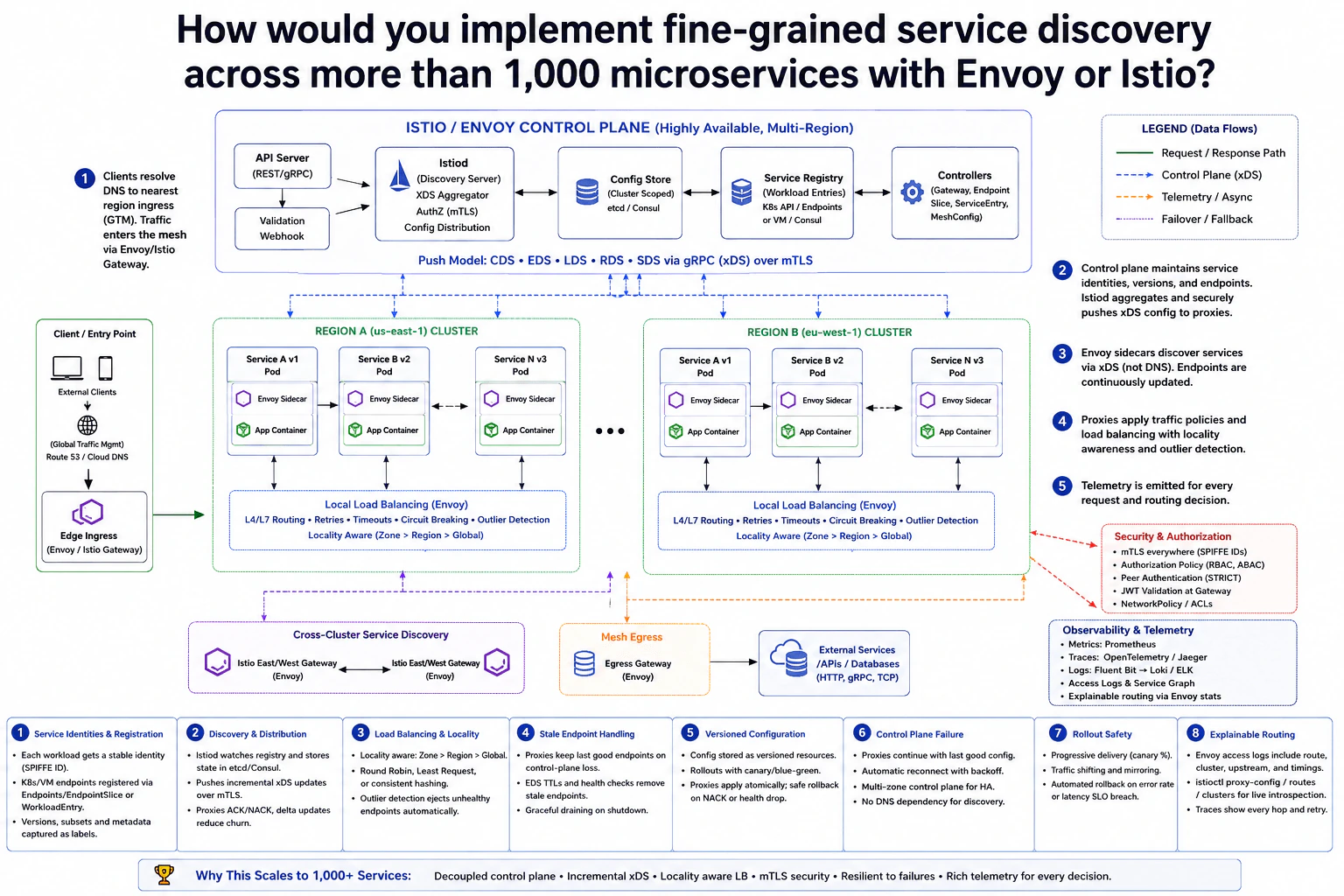
8. How would you implement fine-grained service discovery across more than 1,000 microservices with Envoy or Istio?NetworkingMediumNetflix
i Question Details
Define how service identities and endpoints are registered, discovered, distributed, and removed across clusters or regions. Cover control-plane and data-plane boundaries, DNS versus proxy discovery, locality and load-balancing policy, stale endpoint handling, versioned configuration, authorization, failure when the discovery control plane is unavailable, rollout safety, and telemetry that explains an individual routing decision.
Short Interview Answer (30-60 seconds)
At a high level, the goal is to let more than 1,000 services find healthy destinations across clusters and regions. The hard part is keeping identities, endpoints, routes, and policies current as workloads change. I would separate the design into registration, xDS distribution, and Envoy routing. Clients use DNS only to reach regional ingress. Inside the mesh, Envoy uses proxy discovery from Istiod. The trade-off is more control-plane complexity in exchange for safer routing, locality awareness, and detailed traffic control.
Detailed Explanation
The system must let thousands of services find each other even when workloads constantly start, stop, move, or fail. The difficult part is keeping every proxy aware of the right destinations without making normal requests depend on a central discovery server. The diagram solves this by separating management from traffic. Istiod and the service registry form the control plane. Envoy sidecars form the data plane. Configuration moves through xDS, while application requests move directly through Envoy proxies and gateways.
Useful Questions to Ask the Interviewer
Do services run across several clusters and regions?
Should requests normally stay inside the nearest zone or region?
How quickly must unhealthy or removed endpoints stop receiving traffic?
Which service-to-service authorization rules are required?
How long may proxies use older configuration during a control-plane outage?
How to Explain It in an Interview
1. Register service identities and endpoints
I would start with where discovery information comes from. Kubernetes services, pods, and endpoints are learned through the Kubernetes API. Workloads outside Kubernetes can be represented through workload entries or another registry such as Consul.
Controllers watch these sources and feed changes into Istiod. Each workload gets a stable SPIFFE-style identity. Istiod also handles certificates used for mTLS, which means services authenticate each other while traffic is encrypted.
2. Distribute versioned discovery through xDS
Next, Istiod sends discovery information to Envoy proxies through xDS over gRPC and mTLS. CDS describes clusters. EDS provides endpoints. LDS provides listeners. RDS provides routes. SDS provides security material.
The control plane sends incremental updates when possible, so a small endpoint change does not require a full configuration push. Configuration is versioned. Proxies acknowledge accepted updates and keep their last known good configuration when a bad update is rejected.
3. Keep service traffic in the Envoy data plane
Clients first use global DNS or traffic management to reach the nearest regional Edge Ingress. Inside the mesh, service-to-service discovery does not rely on DNS for every endpoint decision. Envoy already has the endpoint and route information received through xDS.
For each request, Envoy applies L4 or L7 routing, retries, timeouts, circuit breaking, and outlier detection. Locality-aware load balancing prefers nearby healthy endpoints. The diagram uses zone first, then region, then wider failover when needed. Policies can use round robin, least request, or consistent hashing where appropriate.
Cross-cluster requests can pass through Istio East/West Gateways. Traffic leaving the mesh can pass through the Egress Gateway to external APIs, databases, or other outside services.
4. Remove stale endpoints and enforce authorization
When an endpoint disappears or becomes unhealthy, registry changes reach Istiod and then Envoy through EDS updates. Health checks and configured endpoint TTL behavior can also remove stale endpoints. Outlier detection lets Envoy temporarily stop sending traffic to endpoints that are failing.
Authorization is based on workload identity. PeerAuthentication can require strict mTLS. AuthorizationPolicy can enforce RBAC or ABAC rules. Network policies and ACLs add another traffic boundary.
5. Handle control-plane failure, rollouts, and debugging
If Istiod becomes unavailable, normal requests do not automatically stop. Envoy continues with its last known good configuration. Local load balancing and outlier detection still work. The limitation is that new endpoint, route, identity, or policy changes cannot arrive until xDS reconnects.
Routing changes should be rolled out gradually. The diagram shows canary delivery, traffic shifting, mirroring, and automated rollback based on error rate or latency.
For one routing decision, I would inspect Envoy access logs, metrics, traces, and proxy configuration. Access logs can show the selected route, cluster, upstream endpoint, timings, and response flags. Traces can show retries and each service hop. Prometheus metrics, OpenTelemetry or Jaeger traces, and Loki or ELK logs provide the wider operational view. The main trade-off is extra mesh complexity in exchange for fine-grained control and better failure isolation.
Why Interviewers Ask This
Interviewers ask this to test whether you understand control-plane and data-plane separation at large scale. They want to see how you handle changing endpoints, multiple clusters, locality, authorization, stale information, safe configuration rollout, and discovery failures. They also want to know whether you can explain why Envoy uses xDS and how telemetry can explain one specific routing decision.
Interviewer may ask next
What happens if Istiod is unavailable for several minutes while endpoints are changing?
I would keep the same design and let Envoy continue using its last known good configuration. Normal application traffic does not pass through Istiod, so existing routes can continue working.
Envoy can still use its local endpoint list, retries, timeouts, circuit breaking, locality-aware load balancing, and outlier detection. That helps it avoid endpoints that are visibly failing even while the control plane is unavailable.
The main problem is freshness. If a new endpoint appears, an old endpoint is removed, or a routing policy changes, the proxy cannot receive that new xDS state until it reconnects. Health checks and outlier detection reduce the risk, but they do not replace fresh discovery data.
When Istiod returns, Envoy reconnects and receives current configuration again. I would monitor xDS connection state, configuration age, rejected updates, and proxy health. The downside is that availability is protected by temporarily accepting older discovery information.
How would you safely roll out a routing change across more than 1,000 services?
I would keep the versioned configuration model and avoid pushing an untested change everywhere at once. Istiod would still distribute the routing configuration through xDS, but I would begin with a small canary group.
The diagram supports progressive delivery. I can shift a small percentage of traffic to the new route or mirror traffic while normal requests still use the old route. During that stage, I would compare error rate, latency, retries, traces, and Envoy response flags.
Each proxy should accept only valid configuration. If an update is rejected, the proxy can keep its last known good configuration instead of replacing working state with a broken version.
If the canary stays healthy, I would expand the rollout gradually. If errors or latency rise, I would roll back to the previous version. The downside is that a gradual rollout takes longer than one global push, but it greatly reduces the impact of a bad routing change.
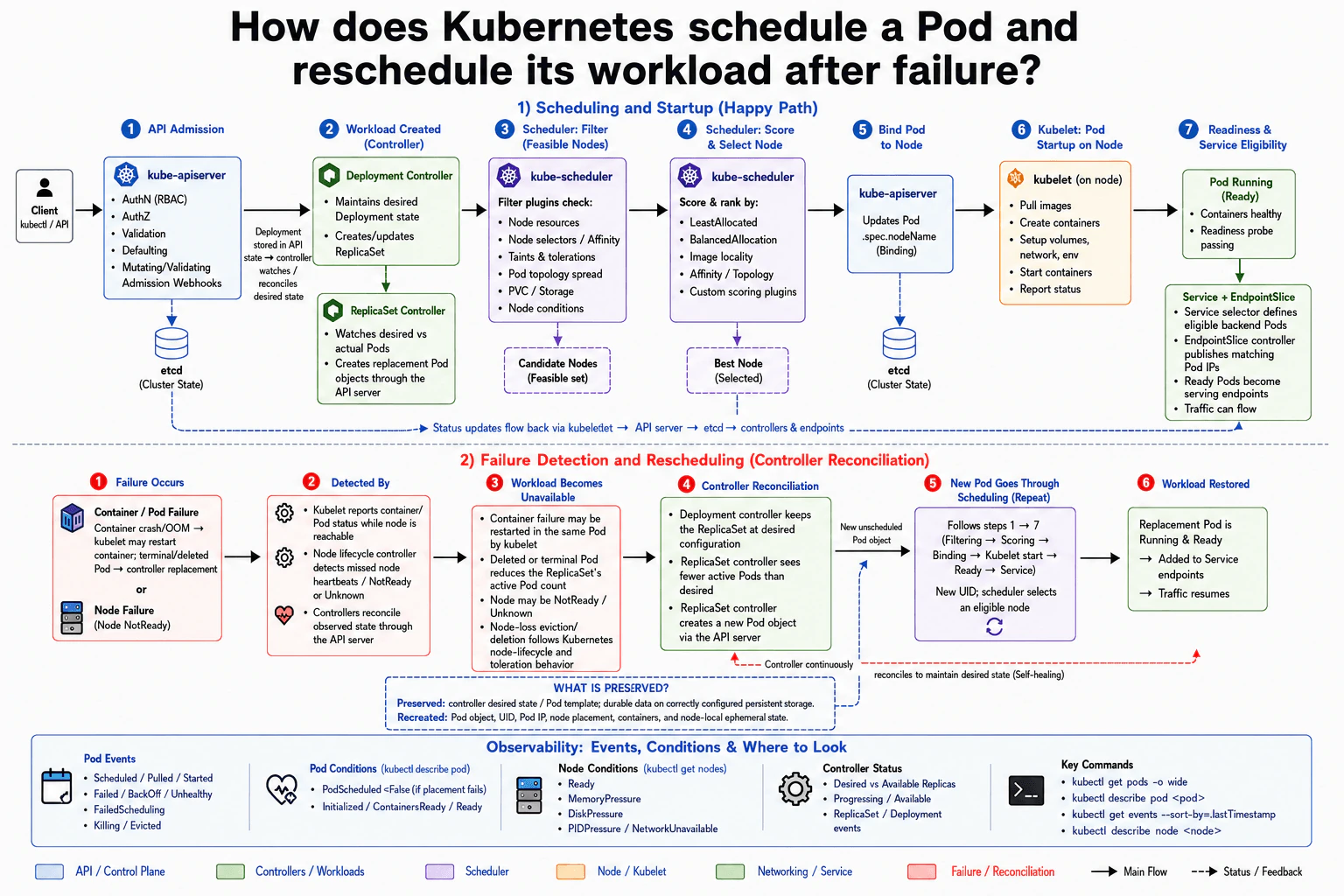
9. How does Kubernetes schedule a Pod and reschedule its workload after failure?Containers And KubernetesEasyNetflix
i Question Details
Use a controller-managed workload as the context. Trace the Pod from API admission through scheduler filtering and scoring, node assignment, kubelet startup, readiness, and Service eligibility. Then explain which controller creates a replacement after a Pod or node failure, what state is preserved, and which events and conditions show why placement or replacement did not complete.
Short Interview Answer (30-60 seconds)
At a high level, Kubernetes keeps a controller-managed workload at its desired number of Pods. The main challenge is choosing a valid node and recovering correctly when a Pod or node fails. I would explain this in two flows: normal scheduling and failure recovery. The scheduler filters and scores nodes, the kubelet starts the Pod, and readiness controls Service eligibility. After a managed Pod is lost, the ReplicaSet Controller creates a new Pod. The trade-off is that recovery takes time and Pod-local state is recreated.
Detailed Explanation
The goal is to keep the requested workload running even when a Pod or node fails. Kubernetes must first choose a node that can run each new Pod. It then starts the containers and decides when the Pod is ready for traffic. Failure recovery does not move the old Pod to another node. A controller creates a new Pod when the managed workload has fewer active Pods than desired. I would explain the design in three parts: normal scheduling, failure recovery, and the events and conditions used to diagnose problems.
Useful Questions to Ask the Interviewer
Should I use a Deployment managed through a ReplicaSet as the workload example?
Should I cover both container failure and complete node failure?
Should I explain what state is preserved when a replacement Pod is created?
How to Explain It in an Interview
1. Start with the controller-managed workload
I would use a Deployment as the workload example. The kube-apiserver performs authentication, authorization, validation, defaulting, and admission checks. The desired Deployment state is stored through the API server in etcd, which stores cluster state.
The Deployment Controller maintains the desired Deployment state. It creates or updates a ReplicaSet. The ReplicaSet Controller watches desired versus actual Pods and creates Pod objects through the API server when more active Pods are needed.
2. Explain scheduler filtering and scoring
A newly created Pod has no node assignment. The kube-scheduler first filters out nodes that cannot run it. The diagram checks node resources, node selectors and affinity, taints and tolerations, topology rules, storage needs, and node conditions.
The scheduler then scores the remaining candidate nodes. The diagram shows factors such as LeastAllocated, BalancedAllocation, image locality, affinity, topology, and configured scoring plugins. The scheduler selects the best node. The binding is recorded through the kube-apiserver by assigning the Pod to that node.
3. Explain kubelet startup and Service eligibility
The kubelet on the selected node watches for Pods assigned to that node. It pulls images, creates containers, prepares volumes, networking, and environment settings, and starts the containers. It also reports Pod status through the API server.
Running does not automatically mean ready for traffic. The readiness probe must pass. A Service selector identifies matching backend Pods. The EndpointSlice controller publishes matching Pod IPs, including their readiness information. When the Pod is ready, it can become a serving endpoint and traffic can flow.
4. Explain failure and replacement
A container crash or OOM does not always require a new Pod. The kubelet may restart that container inside the same Pod. If the managed Pod becomes terminal or is deleted, the ReplicaSet Controller can see fewer active Pods than desired.
For node failure, the node lifecycle controller detects missed node heartbeats and conditions such as NotReady or Unknown. Node-loss eviction or deletion follows Kubernetes node-lifecycle and toleration behavior. When the ReplicaSet has fewer active Pods than desired, the ReplicaSet Controller creates a new Pod object through the API server. The new Pod has a new UID and may receive a new Pod IP and node placement. It goes through filtering, scoring, binding, kubelet startup, readiness, and Service eligibility again.
5. Explain preserved state and troubleshooting
The controller desired state and Pod template remain. Durable data also remains when it is stored on correctly configured persistent storage. The replacement does not preserve the old Pod object, UID, Pod IP, node placement, containers, or node-local ephemeral state.
For troubleshooting, I would inspect Pod events for FailedScheduling and failure-related events. I would check PodScheduled, Initialized, ContainersReady, and Ready conditions. I would also inspect node conditions such as Ready, MemoryPressure, DiskPressure, PIDPressure, and NetworkUnavailable. These signals help explain why placement, startup, or replacement did not complete.
Practical Insights
The benefit is that Kubernetes keeps the desired workload running without manually choosing replacement nodes. Filtering removes nodes that cannot run the Pod, while scoring selects from the valid choices. Readiness also keeps traffic away from a Pod until it is ready. The downside is that recovery is not instant. A node failure must be detected, and a replacement Pod must be created, scheduled, started, and made ready. The new Pod gets a new identity and may get a different IP and node. Node-local temporary state is lost. Durable data survives only when it is stored on correctly configured persistent storage.
Why Interviewers Ask This
Interviewers ask this to see whether you understand how Kubernetes controllers, the scheduler, and kubelet work together. They want to know if you can separate a container restart from creating a replacement Pod. They also test whether you understand readiness, Service eligibility, node failure, preserved state, and how events and conditions help diagnose a Pod that was not placed or replaced successfully.
Interviewer may ask next
What happens if a container crashes with an OOM error, but the Pod and node are still healthy?
I would first separate this from full Pod replacement. If a container crashes while the Pod and node still exist, the kubelet may restart that container inside the same Pod, depending on the Pod's restart behavior. The ReplicaSet Controller does not need to create another Pod just because one container restarted.
The Pod keeps the same Pod object, UID, node assignment, and Pod IP because the Pod itself still exists. The failed container process is recreated, so memory and process-local state from that container are lost. Readiness is important during recovery. While the restarted container is not ready, the Pod should not serve normal Service traffic. Once its readiness probe passes again, it can become a serving endpoint.
I would inspect Pod events, container status, ContainersReady, and Ready. The downside is that repeated crashes can leave the Pod present but unable to serve traffic reliably.
How would you troubleshoot a replacement Pod that stays Pending and never gets scheduled?
I would start with the scheduler signals because a Pending replacement Pod has not completed node placement. First, I would inspect the Pod events and look for FailedScheduling. That event often explains which scheduling rule blocked placement.
Next, I would inspect the PodScheduled condition. If it is false, I would compare the Pod's requirements with the scheduler filters shown in the diagram. I would check available node resources, node selectors or affinity, taints and tolerations, topology rules, storage requirements, and node conditions.
I would also inspect node conditions such as Ready, MemoryPressure, DiskPressure, PIDPressure, and NetworkUnavailable. If no node passes filtering, scoring never has a valid candidate to choose. The Pod stays Pending until the cluster state or Pod requirements change. The downside is that scheduling itself cannot create suitable node capacity when none exists.
Cloud Engineer Resume Examples
Explore the resume examples below to find the one that best matches your target Cloud Engineer role.
Disclaimer: This interview guide is for educational and informational purposes only. It is designed to help readers prepare, but it does not guarantee any interview result, hiring decision, offer, or outcome. Interview questions, hiring criteria, and preferred answers can vary by employer, interviewer, industry, location, and time. All answers, examples, and explanations in this guide are suggested examples for interview preparation, not definitive answers or instructions for professional practice. They are based on research and judgment, are provided without warranties of any kind, and should be adapted to the question, role, and applicable laws and professional requirements. Diagrams are simplified illustrations intended to highlight the main concepts and their relationships; actual situations, systems, and practices may be more complex. Alternative approaches may be equally valid or better suited to a particular question, context, or interviewer. To the fullest extent permitted by applicable law, the contributors and publisher are not liable for decisions made, actions taken, or losses incurred based on this guide.
State Laws and Professional Responsibilities: Laws and requirements governing an occupation vary by state and jurisdiction. You are responsible for checking the current laws, licensing requirements, and scope-of-practice rules that apply to your location and role, and for ensuring that your answers and actions comply with them. Adapt examples in this guide to those requirements. This guide is not legal advice.
Company Notice: This guide is an independent educational resource and is not affiliated with, endorsed by, sponsored by, or approved by the company named in this guide. Company names identify reported interview experiences or the employer context of clearly labeled original practice exercises. Interview practices can change without notice, and inclusion of company-specific content does not mean these questions are official, complete, or guaranteed to be asked. To the fullest extent permitted by law, the author, contributors, and publisher are not responsible for outcomes related to use of this material.
Content Accuracy and Verification: To the fullest extent permitted by applicable law, we do not represent or warrant that interview guides, questions, answers, examples, or diagrams are accurate, complete, current, error-free, or suitable for any particular purpose. You are responsible for independently reviewing and verifying the information before relying on it.