This interview guide is for educational and informational purposes only. It is designed to help readers prepare, but it does not guarantee any interview result, hiring decision, offer, or outcome. Interview questions, hiring criteria, and preferred answers can vary by employer, interviewer, industry, location, and time. All answers, examples, and explanations in this guide are suggested examples for interview preparation, not definitive answers or instructions for professional practice. They are based on research and judgment, are provided without warranties of any kind, and should be adapted to the question, role, and applicable laws and professional requirements. Diagrams are simplified illustrations intended to highlight the main concepts and their relationships; actual situations, systems, and practices may be more complex. Alternative approaches may be equally valid or better suited to a particular question, context, or interviewer. To the fullest extent permitted by applicable law, the contributors and publisher are not liable for decisions made, actions taken, or losses incurred based on this guide.
State Laws and Professional Responsibilities
Laws and requirements governing an occupation vary by state and jurisdiction. You are responsible for checking the current laws, licensing requirements, and scope-of-practice rules that apply to your location and role, and for ensuring that your answers and actions comply with them. Adapt examples in this guide to those requirements. This guide is not legal advice.
Identity, Image, and Privacy Notice
To respect individual privacy, some names, profile photographs, avatars, biographical details, and other identifying information displayed in this guide may be replaced with pseudonyms, licensed stock images, illustrative avatars, composite images, or representative descriptions. Unless a person is expressly identified as an actual contributor, a displayed name, image, or profile should not be understood as depicting or identifying a specific candidate, interviewer, employee, or other real individual. These representations are provided for editorial and illustrative purposes only and do not imply endorsement, employment, participation, or affiliation with this guide or any company mentioned in it. Any resemblance to an actual person is coincidental.
Company Notice
This guide is an independent educational resource and is not affiliated with, endorsed by, sponsored by, or approved by the company named in this guide. Company names identify reported interview experiences or the employer context of clearly labeled original practice exercises. Interview practices can change without notice, and inclusion of company-specific content does not mean these questions are official, complete, or guaranteed to be asked. To the fullest extent permitted by law, the author, contributors, and publisher are not responsible for outcomes related to use of this material.
Content Accuracy and Verification
To the fullest extent permitted by applicable law, we do not represent or warrant that interview guides, questions, answers, examples, or diagrams are accurate, complete, current, error-free, or suitable for any particular purpose. You are responsible for independently reviewing and verifying the information before relying on it.
Questions or comments?
Contact us for general questions, or share feedback, technical corrections, and comments with the community.
1. Design an autocomplete service for a search engine.NEWCloud ArchitectureMediumMeta
i Question Details
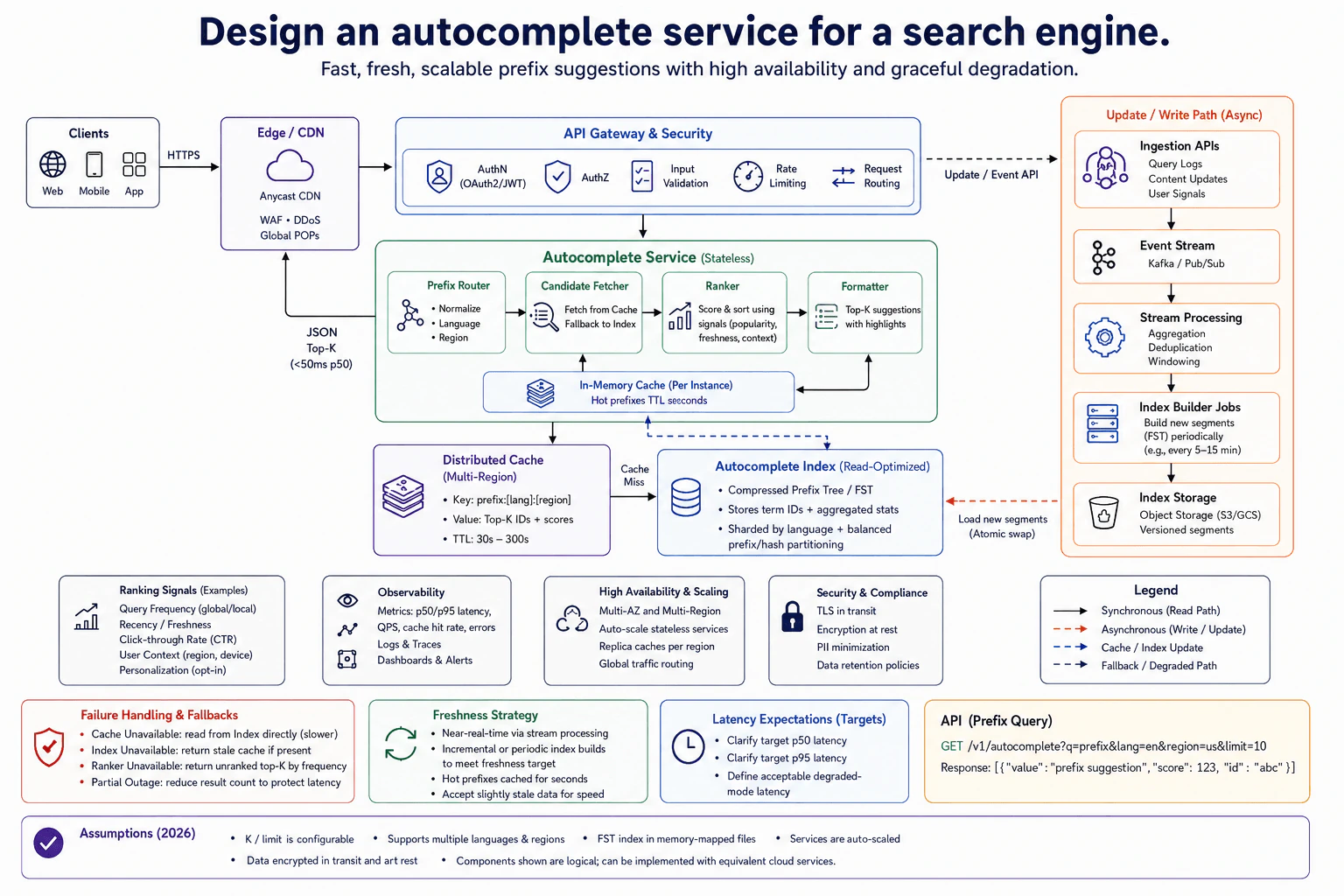
Define the prefix-query API, update path, ranking inputs, and latency expectations that must be clarified. Describe the indexing structure, cache placement, freshness strategy, sharding approach, and how the system behaves when ranking or index components are unavailable.
Short Interview Answer (30-60 seconds)
At a high level, this service returns useful search suggestions while a user types a prefix. The main challenge is keeping the read path very fast while suggestions stay reasonably fresh. I would explain two flows: the prefix-query read path and the background update path. Reads use local and distributed caches, then fall back to a read-optimized prefix index. Candidates are ranked and formatted before returning Top-K suggestions. The trade-off is faster reads in exchange for some accepted staleness.
Detailed Explanation
The goal is to show useful search suggestions while a person is still typing. The hard part is making each prefix lookup fast while also keeping suggestions fresh and relevant. The diagram separates this into a fast read path and a background update path. The read path uses caches, a prefix index, ranking, and formatting. The update path collects new signals and builds new index segments without blocking users. The design also includes fallback behavior so the service can still return useful results when a cache, index, or ranking component has problems.
Useful Questions to Ask the Interviewer
What target p50 latency should the prefix-query API meet?
What target p95 latency should it meet?
What latency is acceptable when part of the system is unavailable?
How fresh must trending queries and user signals become searchable?
Which languages and regions must the service support?
What range should the configurable result limit support?
How to Explain It in an Interview
1. Explain the prefix-query request
I would start with the user-facing path because it must feel instant while someone types. Clients send HTTPS requests through the Edge / CDN and then API Gateway & Security. That entry layer handles authentication, authorization, input validation, rate limiting, and request routing.
The request then enters the stateless Autocomplete Service. Prefix Router normalizes the prefix and applies language and region information. Candidate Fetcher obtains possible suggestions. Ranker orders those candidates. Formatter produces the final Top-K JSON response.
2. Explain cache and index lookup
I would use caching because many users repeatedly type the same popular prefixes. Each service instance has an In-Memory Cache for hot prefixes. The design also has a Multi-Region Distributed Cache with keys based on prefix, language, and region.
If the needed candidates are not available from cache, Candidate Fetcher falls back to the Autocomplete Index. The index is read optimized and uses a compressed Prefix Tree / FST. It stores term IDs and aggregated statistics. It is split using language plus balanced prefix or hash partitioning so one partition does not receive too much work.
3. Explain ranking and the API
The prefix API follows the shape GET /v1/autocomplete?q=prefix&lang=en®ion=us&limit=10. The limit is configurable. A response contains suggestion values, scores, and IDs.
Ranking can use query frequency, recency, click-through rate, user context, and opt-in personalization. The interviewer should still define the actual p50 and p95 latency targets. The design also asks for an acceptable response time when the system is operating with fallback behavior.
4. Explain the background update path
I would keep index updates away from the user request path. Ingestion APIs receive query logs, content updates, and user signals. These records move through the Event Stream into Stream Processing, which performs aggregation, deduplication, and windowing.
Index Builder Jobs create new FST segments periodically or incrementally to meet the required freshness. Versioned segments are stored in Index Storage. The serving index loads a new segment with an atomic swap, which means readers switch from the old complete version to the new complete version without seeing a partly built index.
5. Explain failures, scale, and trade-offs
The stateless service can scale across zones and regions. The diagram also uses replica caches, global traffic routing, TLS in transit, encryption at rest, PII minimization, rate limits, metrics, logs, traces, dashboards, and alerts.
If a cache is unavailable, the service can read from the index directly, which is slower. If the index is unavailable, it can return stale cached results when available. If Ranker is unavailable, it can return unranked Top-K suggestions using frequency. During a partial outage, it can return fewer results to protect latency. The main trade-off is simple: caching and background index updates make reads fast, but some suggestions can be slightly stale.
Practical Complexity & Trade-offs
The benefit is fast reads. Hot prefixes can come from the local cache or the Distributed Cache instead of reaching the Autocomplete Index every time. The FST also makes prefix lookup efficient. The downside is that cached data and periodically built index segments can be slightly old. We accept that because autocomplete usually values speed more than perfect freshness. Sharding helps spread index work, but partitions must stay balanced. Background index building protects the user path, but it adds more moving parts. Fallbacks improve availability, but suggestion quality can be lower during failures.
Why Interviewers Ask This
Interviewers want to see whether you can separate a very fast read path from slower background update work. They also test your judgment about caching, prefix indexing, ranking, sharding, freshness, and failure handling. A strong answer explains why each choice exists and what happens when a component fails. They also want to see whether you ask for latency and freshness targets instead of inventing guarantees.
Interviewer may ask next
What would you change if trending searches must appear in autocomplete much faster?
I would keep the same design, but I would make the background update path produce smaller index updates more often. The main parts affected are Stream Processing, Index Builder Jobs, Index Storage, and the Autocomplete Index.
Stream Processing already receives query logs and other signals through the Event Stream. I would use those existing signals to create fresher aggregated statistics. Index Builder Jobs could build smaller incremental FST segments more frequently instead of waiting for larger periodic builds. The new segments would still be versioned in Index Storage.
The serving side would still load a complete new segment using the atomic-swap approach shown in the diagram. That keeps readers from seeing a partly built index. The prefix-query path would stay the same, including the caches, Candidate Fetcher, Ranker, and Formatter.
The downside is more background processing and more frequent index loading. Cache entries may also need to expire sooner, which can increase cache misses.
How should the service behave if the Ranker becomes unavailable during heavy traffic?
I would keep serving suggestions and temporarily remove advanced ranking from the critical path. Candidate Fetcher can still obtain candidates from the caches or the Autocomplete Index. The diagram already defines this fallback.
Instead of using the normal Ranker logic, the service can return an unranked Top-K list using frequency. Formatter still creates the JSON response, so clients do not need a different API. This keeps autocomplete available even though personalization, freshness weighting, and other ranking signals are temporarily missing.
I would use the existing Observability components to record Ranker errors and latency. Alerts can tell operators that the component is unhealthy. If the wider system is under pressure, the service can also reduce the number of returned suggestions to protect response time.
The downside is lower suggestion quality. Users may receive more generic suggestions until the Ranker recovers.
2. Build an automated network-design framework.NEWDevOpsEasyMeta
i Question Details
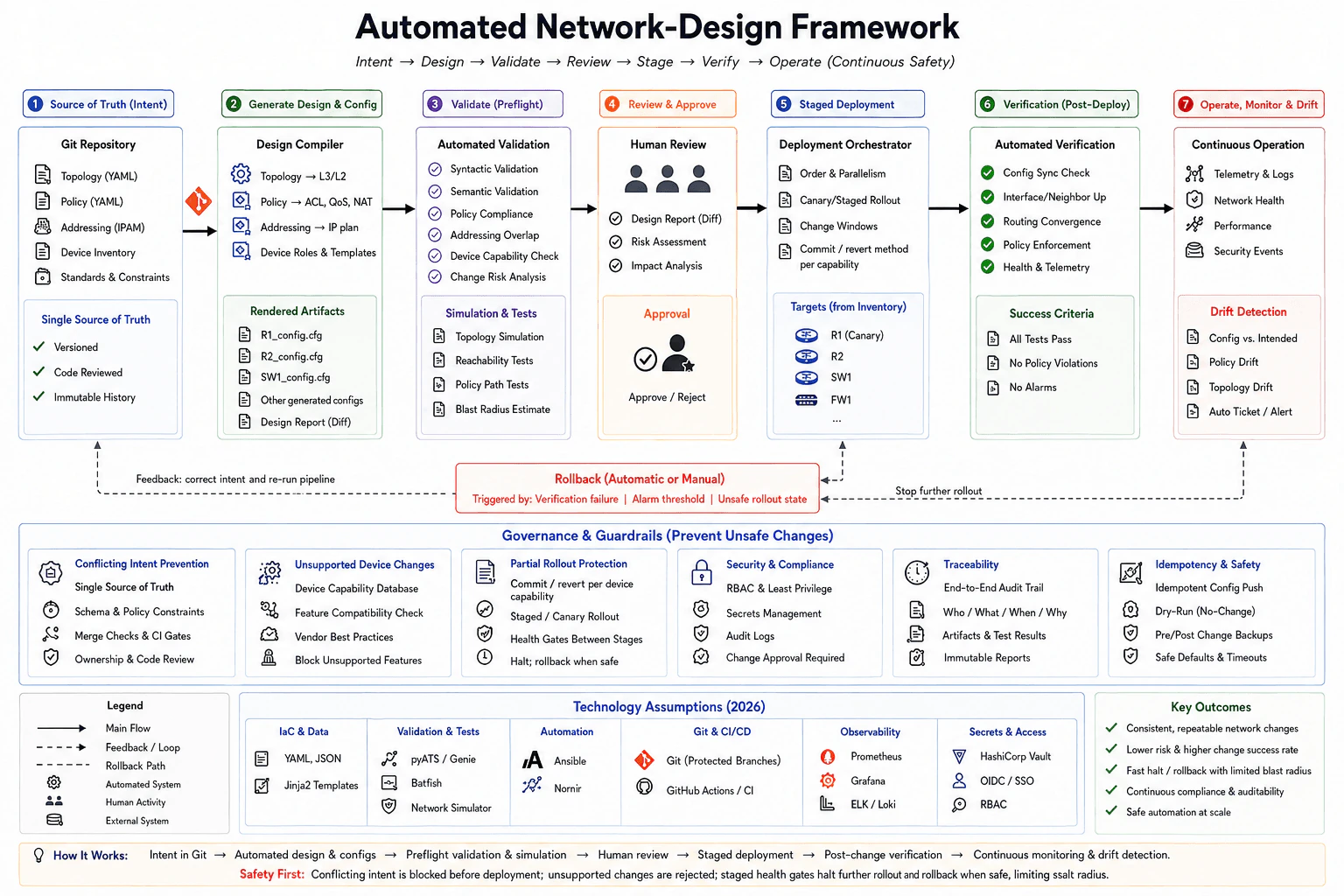
Define the source of truth for intended topology and policy, generated configurations, validation, review, staged deployment, verification, rollback, and drift detection. Explain how the framework prevents conflicting intent, unsupported device changes, and partial rollout from creating an unsafe network state.
Short Interview Answer (30-60 seconds)
I would keep topology, policy, addressing, inventory, and constraints in one versioned Git source of truth. A design compiler generates device configurations. Automated checks validate syntax, policy, addressing, dependencies, device capabilities, reachability, and blast radius. A human reviews the diff, risk, and impact before approval. The deployment controller starts with a canary or small batch and uses health gates before continuing. If verification fails, it stops further rollout and uses the supported revert method when safe. Continuous drift detection compares the live network with intended state and sends corrections back through the same reviewed workflow.
Detailed Explanation
The goal is to make network changes repeatable and safe. I would keep the intended network design in one controlled repository. Automation turns that intent into device configurations. Before anything changes, the framework checks the result for mistakes, conflicts, and unsupported behavior. A person reviews the proposed change and its impact. Deployment starts on a small part of the network. The system checks whether that part is healthy before continuing. If something goes wrong, it stops and recovers where recovery is supported. It also keeps checking that the live network still matches the intended design.
Useful Questions to Ask the Interviewer
Which device vendors and operating systems must the framework support?
Do all target devices provide a safe commit or revert capability?
Which health signals should block promotion to the next rollout stage?
Should detected drift create only an alert, or also create a proposed correction?
How to Explain It in an Interview
I would use Git as the source of truth. It stores topology, policy, addressing data, device inventory, and design constraints. Protected branches, schema checks, policy checks, ownership rules, and code review help prevent conflicting intent from being accepted.
A design compiler converts approved intent into device specific configuration artifacts. Templates such as Jinja2 can render those artifacts, but the important rule is that generated output comes from versioned intent and inventory. The validation stage checks syntax, semantics, policy compliance, address overlap, dependencies, device capability, change risk, reachability, and expected blast radius. Tools such as Batfish, pyATS, or a network simulator can provide extra preflight evidence when they fit the environment.
A network engineer then reviews the configuration diff, risk assessment, impact analysis, test results, and rollout plan. Deployment begins only after approval. An orchestrator such as Ansible or Nornir can control order and parallelism, respect the change window, and start with a canary or small batch. It must use the commit or revert behavior actually supported by each device.
Health gates check reachability, interface state, neighbor relationships, routing convergence, policy enforcement, telemetry, and alarms. A failed gate stops further rollout. If the affected device supports a safe revert, the controller can roll it back automatically or an operator can perform recovery. The framework must not assume that every device provides transactional rollback.
After deployment, verification compares intended and observed behavior. Continuous monitoring detects configuration, policy, and topology drift. Drift should normally create an alert or proposed correction that returns through the reviewed Git workflow instead of silently changing production. Least privilege access, secrets management, audit logs, change history, and stored test results provide traceability.
Why Interviewers Ask This
Interviewers ask this to see whether I can turn network intent into a controlled production workflow. They want to know whether I understand source control, generated configuration, validation, approval, device capability checks, staged rollout, verification, rollback, drift detection, access control, and auditability. The key judgment is whether I can automate changes while preventing conflicting intent, unsupported device changes, and partial rollout failures from affecting a large part of the network.
Common interview mistakes
Common mistakes are treating generated configuration as the source of truth instead of the original intent, allowing direct production edits outside the workflow, checking syntax but not policy or device capability, deploying to every device at once, assuming every device supports transactional rollback, and continuing rollout after a health gate fails. Another mistake is checking only configuration text after deployment. The framework should also verify operational behavior such as interfaces, neighbors, routing convergence, policy enforcement, telemetry, and alarms. Automatically repairing every detected drift without review can also overwrite a legitimate emergency change.
Interview tip
Explain the framework as one safety chain. Start with trusted intent, then generation, validation, review, staged rollout, verification, recovery, and drift detection. For each stage, say what unsafe condition it blocks. Emphasize that rollout stops when a health gate fails and that rollback depends on the real capability of the target device.
Interviewer may ask next
What happens if a device fails during a staged rollout and does not support a reliable revert operation?
I would stop promotion to every later stage immediately. The failed device should receive no further automated change, and the controller should record exactly what was applied. Recovery then follows the method supported by that device, which may require loading a known good configuration, an operator action, or a controlled roll forward change. This matters because rollback is not a universal network device guarantee. The health gate still protects the wider network by stopping expansion of the change and limiting blast radius.
Would you automatically repair every configuration drift that the framework detects?
No. I would normally create an alert or a proposed correction and send it through the same validation and approval workflow. Automatic repair is reasonable only for narrowly defined cases where intended state, impact, permissions, and recovery behavior are well understood. This matters because an unexpected difference may represent emergency operator work, a device limitation, or incorrect intent. Requiring review is slower, but it reduces the chance that drift automation overwrites a legitimate production change.
3. Design a scalable CI/CD pipeline for a team of 5,000 engineers committing code daily.DevOpsMediumMeta
i Question Details
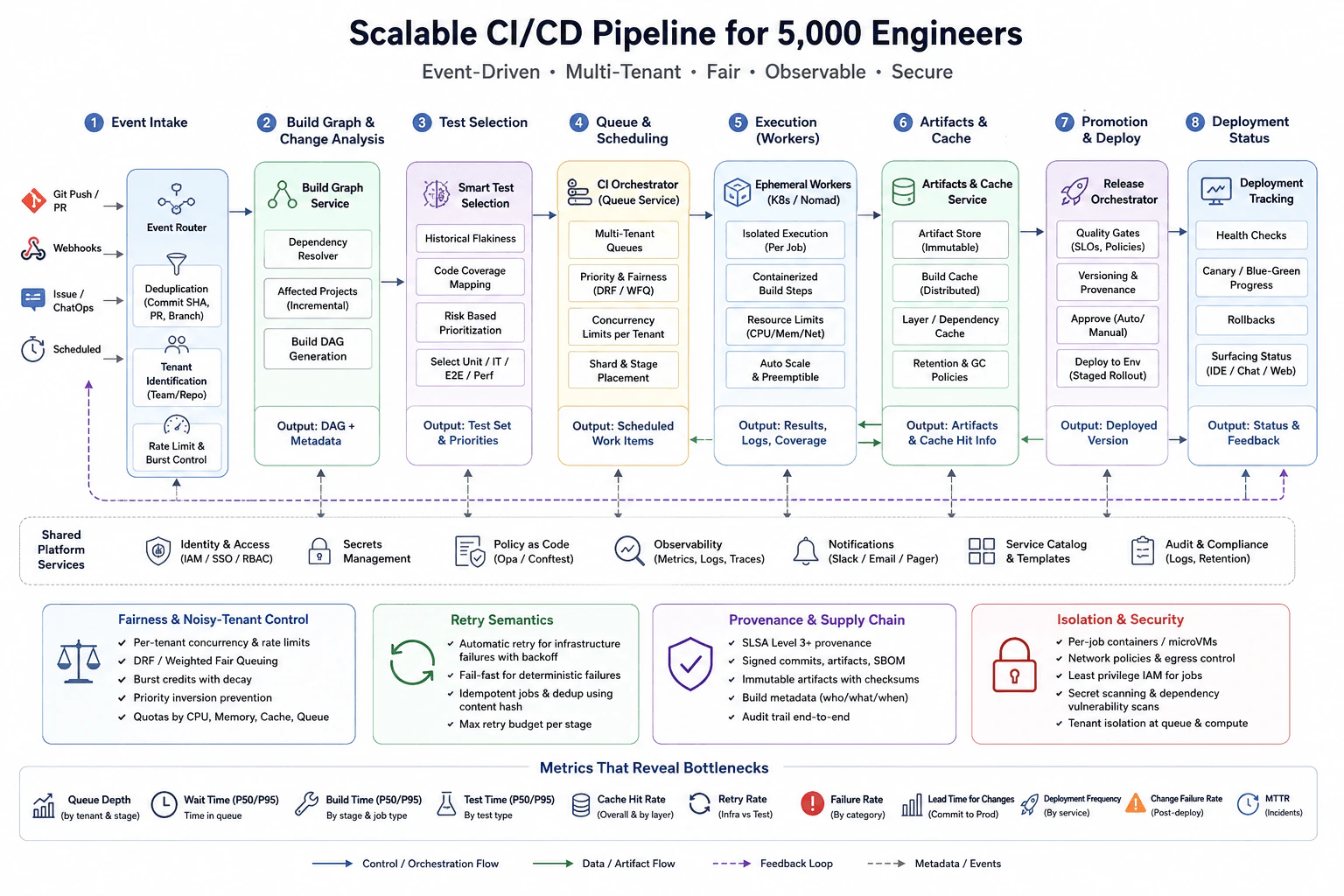
Cover event intake, build graph creation, test selection, worker scheduling, artifact storage, cache reuse, isolation, promotion, and deployment status. Explain fairness, noisy-tenant control, retry semantics, provenance, and the metrics that reveal queue or feedback-time bottlenecks.
Short Interview Answer (30-60 seconds)
I would build an event driven, multi tenant CI/CD platform with separate stages for intake, build graph analysis, test selection, fair scheduling, isolated execution, artifact and cache management, promotion, and deployment tracking. Each repository event is deduplicated and mapped to a tenant. The build graph finds affected projects, and test selection runs the tests needed for the change. Work enters fair queues with tenant limits, then runs on autoscaled ephemeral workers. Successful outputs become immutable artifacts with provenance. The same artifact is promoted through controlled environments. Queue depth, wait time, build time, test time, cache hit rate, retries, failures, lead time, deployment frequency, change failure rate, and MTTR reveal where feedback is slowing down.
Detailed Explanation
The goal is to let thousands of engineers send changes every day without one busy team slowing everyone else down. A change should enter quickly, find only the work affected by that change, run the useful checks, and receive shared computing capacity fairly. Successful results should be saved once and reused safely as they move toward production. The system should also show engineers what is happening and give operators clear measurements when work starts waiting too long, tests become slow, or deployment results take too long to return.
Useful Questions to Ask the Interviewer
How many repositories and changes per day should the platform support?
Are builds mostly independent services, or is there a large shared code base?
What feedback time should developers normally receive?
Which deployments require manual approval?
Should workers run on Kubernetes, Nomad, or another approved execution platform?
How to Explain It in an Interview
I would split the platform into eight stages. Git pushes, pull requests, webhooks, scheduled events, and approved automation events enter an event router. Intake deduplicates repeated events, identifies the team and repository, and applies rate limits and burst control.
A build graph service resolves dependencies, finds affected projects, and creates a build DAG. Smart test selection uses historical test behavior, coverage information, and risk to select useful unit, integration, end to end, and performance tests.
Selected work enters multi tenant queues. Weighted fair queuing or dominant resource fairness gives teams a fair share. Per tenant limits control concurrency, CPU, memory, cache use, and queue size. Burst credits can absorb short spikes without allowing a noisy tenant to consume the platform.
The scheduler sends jobs to autoscaled ephemeral workers. Each job runs in an isolated container or microVM with resource and network limits. Jobs use least privilege identity and short lived secrets. Network policy, dependency scanning, and security checks reduce risk.
Build outputs go to an immutable artifact store. Distributed build and dependency caches reuse content addressed results when inputs match. Retention and garbage collection limit storage growth. The platform records signed commits, artifact digests, SBOM data, checksums, and build provenance.
Transient infrastructure failures retry with backoff and a bounded retry budget. Deterministic failures fail fast. Idempotent jobs and stable work identifiers prevent duplicate side effects.
A release orchestrator applies quality gates, policy checks, approvals, version checks, and provenance checks. It promotes the same immutable artifact through environments instead of rebuilding it. Deployment can use staged rollout, canary, or blue green techniques. Health checks, rollback status, and deployment progress are surfaced to engineers.
I would watch queue depth, P50 and P95 wait time, build time, test time, cache hit rate, retry rate, failure rate, lead time, deployment frequency, change failure rate, and MTTR. High wait time points to scheduling or capacity pressure. High test time points to slow tests. Low cache hit rate points to poor reuse.
Why Interviewers Ask This
Interviewers ask this to test whether I can design a CI/CD platform for very high developer volume without creating one large shared bottleneck. They want to see how I handle event intake, dependency analysis, selective testing, fair scheduling, isolated execution, artifact reuse, safe promotion, deployment feedback, failure recovery, provenance, security, and observability. They also want to know whether I can find queue pressure and developer feedback delays from measurements instead of guessing.
Common interview mistakes
A common mistake is to place every build in one FIFO queue because a large team can then dominate worker capacity. Another mistake is to rebuild the application for each environment instead of promoting the same immutable artifact. Running every test for every commit can also create unnecessary feedback delay when dependency and coverage data can safely narrow the test set. Unlimited retries can create a retry storm, while retrying deterministic failures only wastes capacity. Other mistakes include weak tenant isolation, shared long lived credentials, mutable artifact references without digest tracking, caches without content based keys, missing provenance, and monitoring worker CPU while ignoring queue depth and wait time.
Interview tip
Explain the design as one flow from commit to deployment status. Spend extra time on the parts that become difficult at 5,000 engineers: fair queues, tenant quotas, selective testing, autoscaled isolated workers, correct cache reuse, immutable artifact promotion, bounded retries, provenance, and feedback time metrics. Connect each design choice to the bottleneck or failure it prevents.
Interviewer may ask next
What happens if one large repository suddenly creates thousands of build jobs and starts delaying every other team?
I would prevent that tenant from consuming the whole platform by enforcing per tenant concurrency, queue, CPU, memory, and cache limits. Weighted fair queuing or dominant resource fairness keeps worker capacity available to other tenants during the burst. Rate limits and controlled burst credits can absorb short spikes. Explicit priority rules can raise selected urgent jobs without allowing normal work to starve. This matters because autoscaling adds capacity but does not create fairness by itself. The main tradeoff is that strict quotas can leave some resources unused when other tenants are quiet, so limits should allow controlled borrowing or burst capacity.
How would you reduce developer feedback time if P95 queue wait becomes the largest part of the pipeline?
I would treat high P95 queue wait as a scheduling or capacity bottleneck first. I would break the metric down by tenant, stage, job type, and worker pool, then compare arrival rate, queue depth, worker utilization, autoscaling lag, quota pressure, and job duration. If workers arrive too slowly, I would keep more warm capacity or tune autoscaling. If one tenant dominates demand, I would adjust fairness and quotas. If long jobs block short jobs, I would use separate scheduling classes or worker pools. The main tradeoff is cost because lower queue wait usually requires more capacity to be ready before demand arrives.
4. Design a global software-deployment system for hundreds of thousands of servers.DevOpsHardMeta
i Question Details
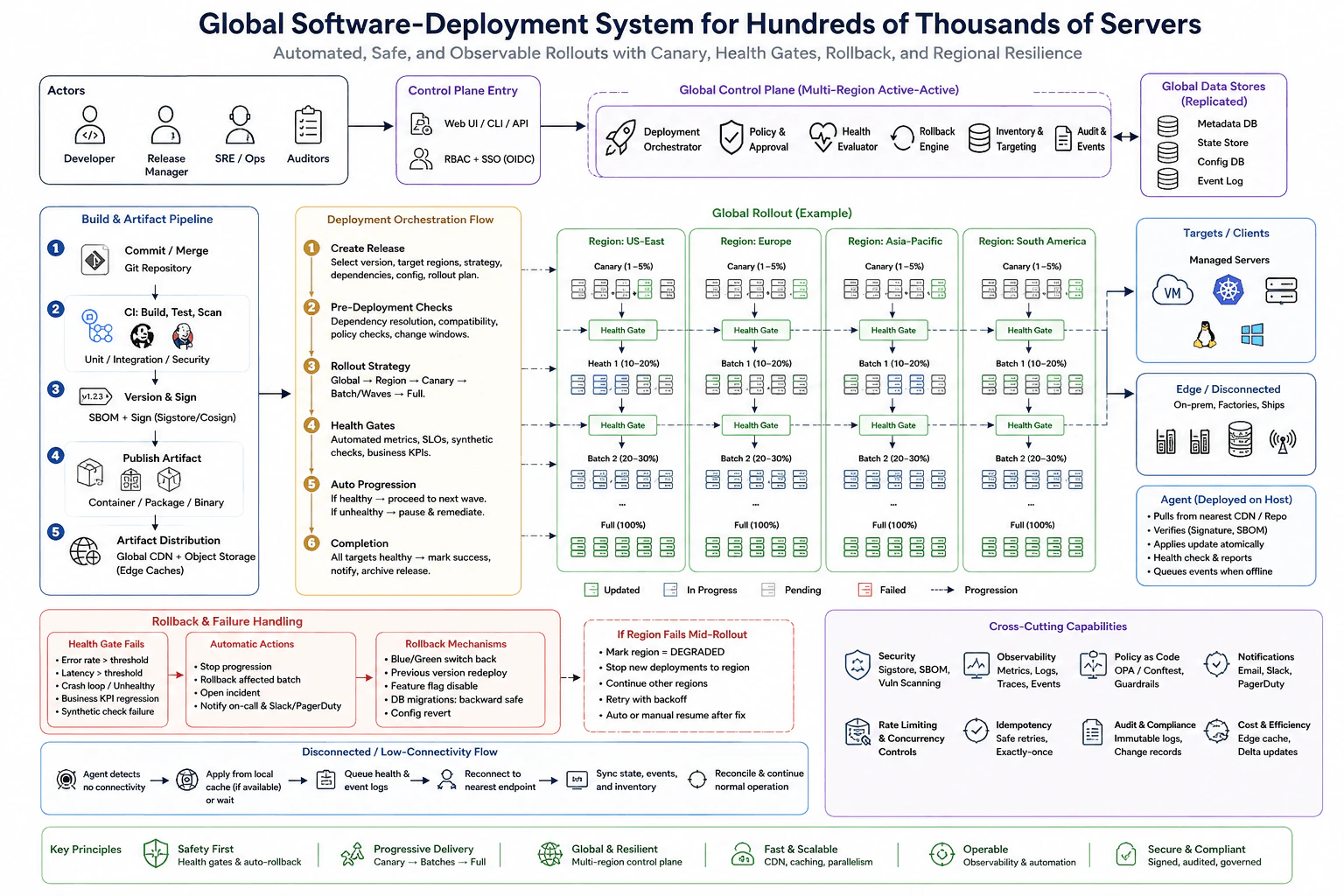
Deploy new versions worldwide with minimal downtime. Cover artifact distribution, regional and canary stages, dependency checks, health gates, rollback, control-plane availability, disconnected hosts, and how the system proceeds when a region fails mid-rollout.
Short Interview Answer (30-60 seconds)
I would use a highly available global control plane that creates one signed and immutable release, distributes it through global storage and regional caches, and rolls it out progressively. Each region starts with a small canary group, passes health gates, then moves through larger batches until the region is complete. Host agents pull the approved artifact, verify it, and report health and state. If a gate fails, I stop progression and roll back the affected batch. If one region fails, I isolate it and continue healthy regions. Disconnected hosts use cached approved content when possible and reconcile state after reconnecting.
Detailed Explanation
The goal is to update a very large number of computers around the world without causing a large outage. I would not change every computer at once. I would prepare one trusted release, send it close to each location, test it on a small group first, and expand only when the results stay healthy. Each location can move independently, so one broken location does not stop every healthy location. Computers with poor connections can wait or use a trusted local copy, then report their state after they reconnect. This keeps failures small and recovery predictable.
Useful Questions to Ask the Interviewer
How quickly must a worldwide release finish?
Can different regions progress independently?
What health signals should stop a rollout?
How long may disconnected hosts remain offline?
Are database changes required to remain compatible with the previous application version?
How to Explain It in an Interview
I would start with a global control plane running across multiple active regions. Users enter through an authenticated API, command line interface, or user interface. The control plane contains the deployment orchestrator, policy and approval checks, health evaluator, rollback engine, targeting inventory, and audit events. Replicated metadata, deployment state, configuration, and event stores keep rollout decisions available if one control plane region fails.
The build pipeline starts from a committed or merged change. Continuous integration runs build, test, and security checks. It creates one immutable version, records its software bill of materials, signs it, and publishes the package, binary, or container artifact to global object storage and content delivery caches. Deployment promotes this exact artifact rather than rebuilding it for each region.
Before rollout, the orchestrator checks dependencies, compatibility, policy, capacity, quotas, and change windows. The strategy progresses from global planning to a region, then to a canary, then to controlled batches, and finally to the full regional fleet. Each region starts with roughly 1 to 5 percent of its servers. A healthy canary advances to a first batch of roughly 10 to 20 percent, then a second batch of roughly 20 to 30 percent, and finally to 100 percent.
At every stage, automated health gates evaluate error rate, latency, crashes, availability, synthetic checks, service objectives, and business signals. Healthy stages progress automatically. An unhealthy stage pauses progression and triggers remediation or rollback.
Agents on hosts pull from a nearby content delivery endpoint or regional cache, verify the signature and software bill of materials, apply the approved version atomically when the target platform supports atomic replacement, run local health checks, and report status. Deployment actions use idempotent behavior so a safe retry does not create a second logical deployment.
If a health gate fails, progression stops and the affected batch rolls back to the previous known good version. A feature flag can disable risky behavior quickly. Database changes must remain backward compatible or have a safe reverse plan.
If one region fails during rollout, the control plane marks that region degraded and stops new deployment work there. Healthy regions continue. The failed region retries with backoff or waits for manual recovery. After repair, rollout can resume automatically under policy or after manual approval.
A disconnected host detects the loss of connectivity. It can apply an already approved artifact from a trusted local cache when policy allows, or wait. It queues health and event records while offline. After reconnecting to the nearest endpoint, it synchronizes state, events, and inventory, then reconciles with desired state before normal operation continues.
Why Interviewers Ask This
Interviewers ask this question to test whether a candidate can design safe software delivery at very large scale. They want to see how the candidate separates the control plane from the machines being updated, distributes immutable artifacts efficiently, limits blast radius with canaries and regional waves, evaluates health before moving forward, handles partial failures, keeps the control plane available, supports disconnected machines, and performs predictable rollback without stopping healthy regions.
Common interview mistakes
A common mistake is pushing a new release to the entire fleet at once. That creates a very large blast radius. Another mistake is rebuilding an artifact separately for each region instead of promoting the same immutable artifact. Candidates also forget dependency and compatibility checks before rollout, or they treat a single metric as proof that a release is healthy. Other mistakes include making every region depend on one control plane location, allowing one failed region to block healthy regions, assuming disconnected hosts can always contact the control plane, retrying deployment actions without idempotency, and claiming rollback is safe when database changes are not compatible with the previous application version.
Interview tip
Explain the rollout as a sequence. Start with one immutable signed artifact and a highly available global control plane. Then describe prechecks, canary exposure, health gates, controlled regional batches, full rollout, and completion. After the normal path, explain three failures clearly: a bad release, a failed region, and a disconnected host. Emphasize that healthy regions keep moving while a failed region is isolated, and that rollback depends on a previous known good version plus compatible data changes.
Interviewer may ask next
What happens if a region loses contact with the global control plane halfway through its rollout?
I would stop new progression in that region and keep its last known safe deployment state. Agents that are already running continue serving traffic. They may use approved cached artifacts only under a policy that allows local operation, and they queue health and event records while connectivity is unavailable. The control plane marks the region degraded and continues rollout in other healthy regions. When connectivity returns, the region synchronizes state, events, and inventory. The controller then compares desired state with observed state, reruns required health checks, and either resumes from a safe wave or requires manual approval. This limits blast radius and avoids guessing about partially completed work.
How would you make the rollout faster without giving up safety?
I would increase safe parallelism rather than remove health gates. Independent healthy regions can progress at the same time, and each region can use controlled batches whose size grows after successful health checks. Global object storage, regional caches, and nearby content delivery endpoints reduce artifact transfer time and avoid repeatedly sending the same large artifact across long network paths. The main tradeoff is blast radius. Larger batches and more concurrent regions finish faster, but a bad release can affect more servers before detection. I would tie batch size and concurrency to service risk, fleet capacity, health confidence, and the available error budget.
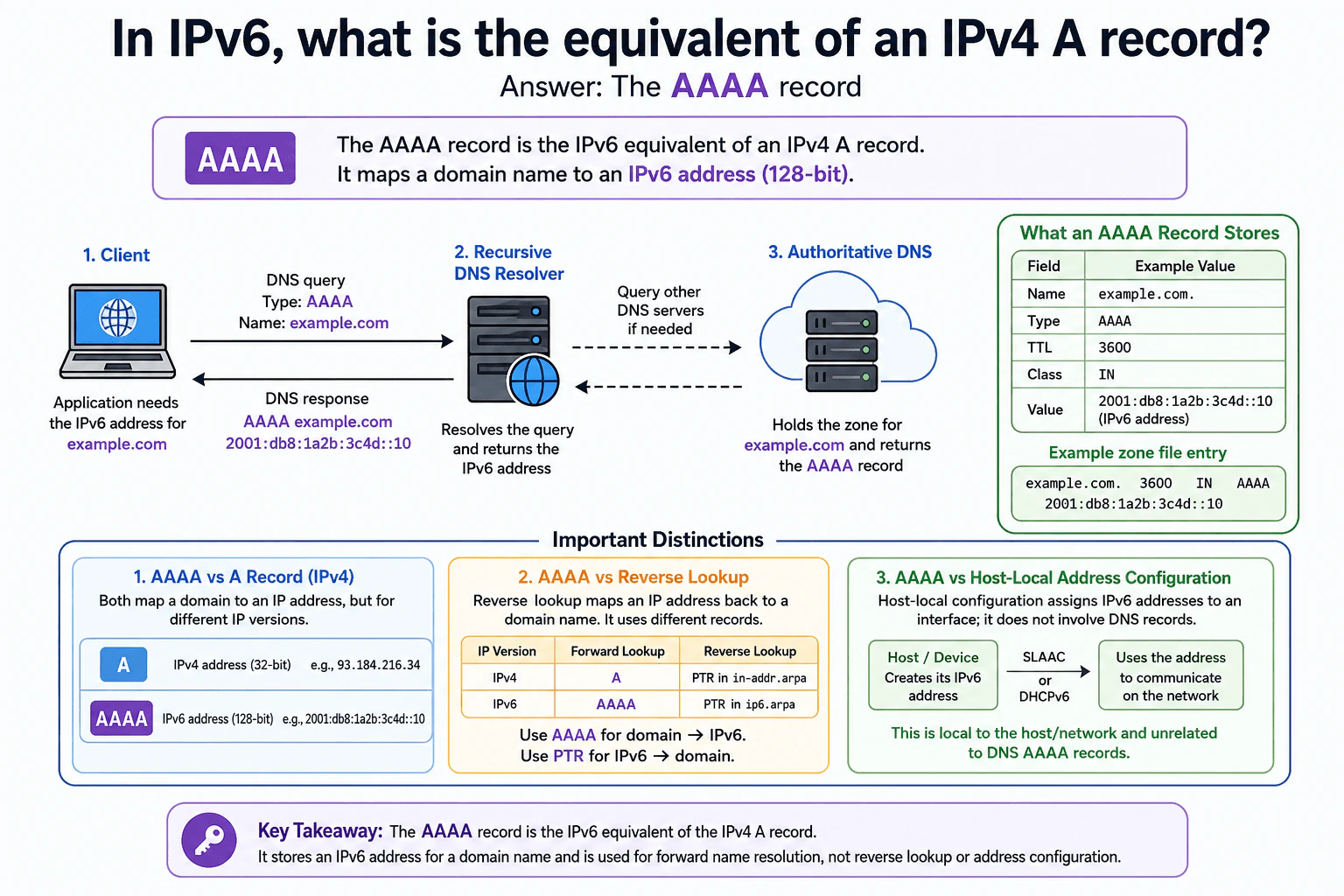
5. In IPv6, what is the equivalent of an IPv4 A record?NetworkingEasyMeta
i Question Details
Name the DNS record type and explain what value it stores. Distinguish the record from reverse lookup and from host-local address configuration.
Short Interview Answer (30-60 seconds)
At a high level, the IPv6 equivalent of an IPv4 A record is an AAAA record. The main point is knowing what the record represents and what it does not do. I would explain the forward DNS lookup, then contrast it with reverse lookup and local address configuration. An AAAA record maps a domain name to a 128-bit IPv6 address. PTR records handle reverse lookup. SLAAC or DHCPv6 can configure an IPv6 address on a host.
Detailed Explanation
The goal is to understand how a name, such as example.com, can point to an IPv6 address. The important part is separating three different jobs. One job finds an IPv6 address from a domain name. Another job starts with an IP address and finds a name. A third job gives an IPv6 address to a device on a network. The diagram separates these jobs so they are not confused. The main answer is the AAAA record, which stores the IPv6 address used for forward name resolution.
Useful Questions to Ask the Interviewer
Should I also explain how an AAAA record differs from an IPv4 A record?
Would you like me to contrast forward DNS with IPv6 reverse lookup?
Should I also explain why SLAAC and DHCPv6 are separate from DNS?
How to Explain It in an Interview
1. Start with the direct answer
I would say that the IPv6 equivalent of an IPv4 A record is an AAAA record. An A record maps a domain name to a 32-bit IPv4 address. An AAAA record performs the same basic job for IPv6. It maps a domain name to a 128-bit IPv6 address.
For example, the diagram shows example.com with an AAAA value of 2001:db8:1a2b:3c4d::10. That value is the IPv6 address returned for the name.
2. Explain the forward DNS lookup
For the normal lookup, the Client needs the IPv6 address for example.com. It sends a DNS query for record type AAAA to the Recursive DNS Resolver.
The resolver resolves the query and, if needed, queries other DNS servers. The Authoritative DNS holds the zone for example.com and returns the AAAA record. The Recursive DNS Resolver then returns the IPv6 address to the Client. This is forward name resolution because the lookup goes from a name to an address.
3. Explain what the AAAA record stores
The record contains an IPv6 address as its value. The example shown is 2001:db8:1a2b:3c4d::10. The diagram also shows normal DNS fields such as the name, type, TTL, and class.
The key field for this question is the value. Type AAAA tells DNS that this value is an IPv6 address. In comparison, type A stores an IPv4 address.
4. Separate AAAA from reverse lookup
I would then make clear that an AAAA record is not a reverse lookup record. Reverse lookup starts with an IP address and tries to find a domain name.
For IPv6, reverse lookup uses a PTR record in the ip6.arpa domain. So the directions are different. AAAA means domain name to IPv6 address. PTR means IPv6 address back to a name.
5. Separate DNS from host-local configuration
Finally, I would separate DNS from assigning an IPv6 address to a device. SLAAC or DHCPv6 can configure an IPv6 address on a host or interface. That is host-local network configuration, not a DNS AAAA lookup.
A local hosts file can also provide a local name-to-address mapping. These mechanisms do not replace an AAAA record in DNS. The useful interview distinction is simple: AAAA handles forward DNS for IPv6, PTR handles reverse lookup, and SLAAC or DHCPv6 handles host address configuration.
Practical Complexity & Trade-offs
The benefit of an AAAA record is that IPv6 uses the same familiar DNS idea as IPv4. Applications can ask for a domain name and receive an IPv6 address. The main thing to remember is that several related features have different jobs. AAAA is for name-to-IPv6 lookup. PTR is for the opposite direction, from an IPv6 address to a name. SLAAC and DHCPv6 configure addresses on hosts. A local hosts file can also map names locally. Mixing these jobs together is the main source of confusion, so keeping the direction and purpose of each mechanism clear makes the answer much easier.
Why Interviewers Ask This
Interviewers ask this to check whether you understand basic IPv6 DNS concepts instead of only memorizing record names. They want to see whether you know that AAAA stores an IPv6 address for forward name resolution. They may also check whether you can separate that job from PTR reverse lookup and from host address configuration using SLAAC or DHCPv6.
Interviewer may ask next
How is an IPv6 reverse DNS lookup different from an AAAA lookup?
An IPv6 reverse lookup uses a PTR record, not an AAAA record. The main difference is the direction of the lookup. An AAAA lookup starts with a domain name, such as example.com, and returns an IPv6 address such as 2001:db8:1a2b:3c4d::10.
A reverse lookup starts with the IPv6 address and tries to find a name associated with that address. For IPv6, this reverse DNS information uses PTR records under the ip6.arpa domain.
The Recursive DNS Resolver can perform either type of DNS lookup, but the requested records are different. AAAA means name to IPv6 address. PTR means IPv6 address to name.
The downside of confusing them is that you may inspect or configure the wrong DNS record. A correct AAAA record does not automatically mean that reverse DNS is configured, because the PTR record is separate.
How are SLAAC and DHCPv6 different from an AAAA DNS record?
SLAAC and DHCPv6 configure IPv6 addresses on a host. They do not perform the same job as an AAAA DNS record. SLAAC lets the host create its IPv6 address using information from the local network. DHCPv6 can assign an IPv6 address and other configuration.
An AAAA record has a different purpose. It is DNS data that maps a domain name to an IPv6 address. A Client can ask a Recursive DNS Resolver for that record and receive the IPv6 address associated with the name.
The diagram therefore separates host-local address configuration from DNS. A device can have a valid IPv6 address even when no DNS AAAA record points to it. Likewise, an AAAA record is not the mechanism that assigns an address to the device.
The downside is extra operational work because address configuration and DNS information are separate concerns.
6. What is the difference between TLS 1.2 and TLS 1.3?NetworkingMediumMeta
i Question Details
Compare handshake flow, round trips, cipher-suite negotiation, key exchange, forward secrecy expectations, removed legacy features, session resumption, and operational compatibility. Explain the implications for latency and security without treating a version number alone as proof of safety.
Short Interview Answer (30-60 seconds)
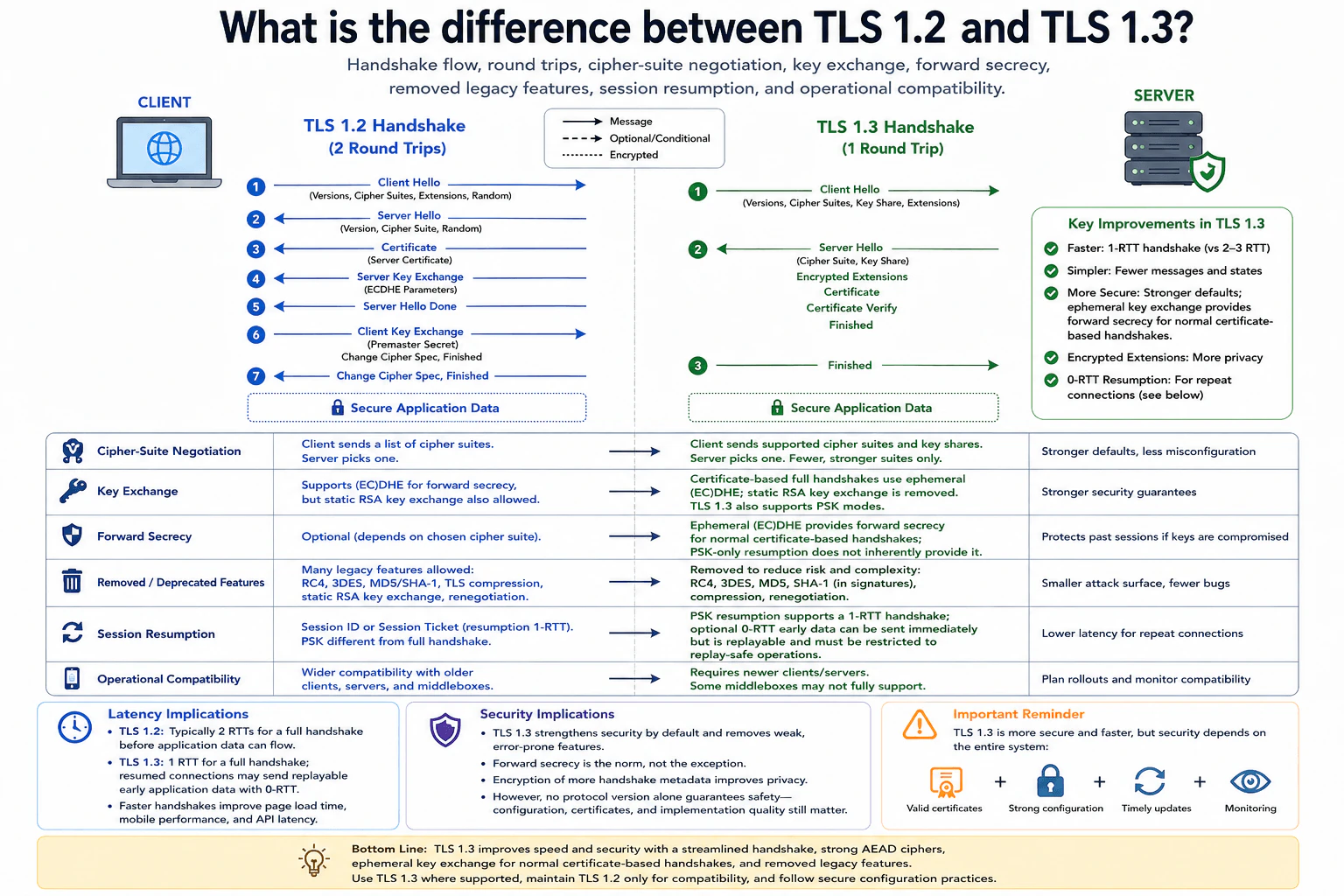
At a high level, TLS 1.3 keeps the same goal as TLS 1.2 but makes connection setup faster and removes many older choices. The main challenge is balancing lower latency with strong security and real-world compatibility. I would compare the handshake, key exchange, cipher choices, and session resumption. TLS 1.3 normally needs one round trip instead of two, uses stronger defaults, and removes legacy features. The trade-off is that older clients, servers, or middleboxes may still require TLS 1.2.
Detailed Explanation
The goal is to understand how two generations of secure connections differ when a client connects to a server. Both protect information while it travels across a network. The newer design tries to start secure communication with fewer back-and-forth messages. It also removes many older choices that were harder to use safely. The important point is not simply that a newer number is better. I would compare how each connection starts, how secrets are created, what older features disappear, how repeat connections work, and what compatibility problems can remain.
Useful Questions to Ask the Interviewer
Should I focus on a normal first connection, resumed connections, or both?
Should I discuss compatibility with older clients and network devices?
Do you want me to explain the security risk of TLS 1.3 0-RTT early data?
How to Explain It in an Interview
1. Start with the handshake and round trips
I would begin with the biggest visible difference: TLS 1.3 needs fewer message exchanges.
A typical TLS 1.2 full handshake takes two round trips before secure application data can flow. The client sends Client Hello. The server replies with Server Hello, Certificate, Server Key Exchange, and Server Hello Done. The client then sends its key-exchange information and Finished messages. The server finishes the handshake afterward.
TLS 1.3 normally completes a full handshake in one round trip. The Client Hello already includes a key share. The server can therefore return its key share, encrypted extensions, certificate information, and Finished message immediately.
2. Compare cipher suites and key exchange
Next, I would explain that TLS 1.3 removes many old cryptographic choices.
TLS 1.2 supports several key-exchange methods. Ephemeral ECDHE can provide forward secrecy, but older static RSA key exchange is also possible. Forward secrecy means that stealing a long-term key later does not reveal older protected sessions.
For normal certificate-based TLS 1.3 handshakes, ephemeral ECDHE is used. Static RSA key exchange is removed. TLS 1.3 also supports PSK modes for resumed connections.
Cipher-suite negotiation is simpler in TLS 1.3. The client offers supported cipher suites, and the server selects one. TLS 1.3 keeps a smaller set of modern authenticated-encryption choices.
3. Explain forward secrecy and removed features
I would then show why TLS 1.3 has safer defaults.
TLS 1.2 can provide forward secrecy, but it depends on the selected key exchange. TLS 1.3 certificate-based handshakes use ephemeral key exchange, so forward secrecy is the normal case. A PSK-only resumed mode does not inherently provide the same property.
TLS 1.3 also removes older features such as RC4, 3DES, MD5, SHA-1 signatures, TLS compression, static RSA key exchange, and renegotiation. Removing these choices reduces complexity and the chance of unsafe configuration.
4. Explain session resumption and 0-RTT
For repeat connections, both versions can avoid repeating the entire original handshake.
TLS 1.2 can resume using a Session ID or Session Ticket. The diagram shows this as a one-round-trip resumed connection.
TLS 1.3 uses PSK-based resumption. It can also allow optional 0-RTT early application data. This data can be sent immediately, but it can be replayed. Applications should therefore restrict 0-RTT to operations that are safe to repeat.
5. Finish with compatibility and security
The benefit of TLS 1.3 is lower connection latency and fewer old security features. The downside is operational compatibility. Older clients, servers, and some middleboxes may not fully support it, so deployments may need TLS 1.2 during migration.
I would finish by saying that the protocol version alone never proves a system is safe. Valid certificates, strong configuration, timely updates, and monitoring still matter.
Practical Complexity & Trade-offs
The benefit is that TLS 1.3 normally starts a secure connection faster. A full handshake needs one round trip instead of the two shown for TLS 1.2. It also removes many older cryptographic choices, which makes unsafe setup less likely. The downside is compatibility. Some older clients, servers, and middleboxes may still need TLS 1.2. TLS 1.3 can also send 0-RTT early data on resumed connections, but that data can be replayed. We accept these trade-offs because TLS 1.3 gives better defaults while still requiring careful configuration, valid certificates, updates, and monitoring.
Why Interviewers Ask This
Interviewers ask this to see whether you understand more than protocol version numbers. They want to know if you can explain handshake latency, key exchange, forward secrecy, cipher choices, session resumption, and compatibility in simple terms. They also want to see good security judgment. A strong answer explains why TLS 1.3 has safer defaults while recognizing that configuration, certificates, software updates, and operational support still matter.
Interviewer may ask next
What would you do if some older clients cannot connect using TLS 1.3?
I would keep TLS 1.3 as the preferred version, but temporarily allow TLS 1.2 for clients that still need it. This changes the operational compatibility part of the diagram, not the basic handshake behavior of either protocol.
I would make sure the TLS 1.2 configuration uses strong cipher choices and avoids older weak features. I would also monitor which clients still negotiate TLS 1.2. That tells us whether the compatibility requirement is still real or can be removed later.
Newer clients can continue using the faster TLS 1.3 one-round-trip handshake. Older clients get a controlled fallback instead of being completely blocked.
The main downside is that supporting two protocol versions creates more configuration and testing work. It also keeps some TLS 1.2 risk and complexity alive. I would therefore treat TLS 1.2 support as a compatibility measure rather than assuming both versions are equally desirable.
When would you disable TLS 1.3 0-RTT even though it reduces latency?
I would disable 0-RTT when an application request is not safe to replay. In TLS 1.3, 0-RTT lets a resumed client send early application data immediately. The server may receive the same early data more than once because replay protection is limited at the protocol level.
For a harmless read, that may be acceptable. For an action such as creating something, changing account state, or performing another operation that should happen only once, I would avoid 0-RTT unless the application has a separate replay-safe design.
The normal TLS 1.3 resumed handshake can still be used without accepting early application data. This keeps the same TLS 1.3 architecture while removing the risky fast path.
The downside is slightly higher latency because the client waits for handshake confirmation before sending application data. I would accept that delay when correctness is more important than saving the extra wait.
7. Explain containerization.Containers And KubernetesEasyMeta
i Question Details
Explain how a container runtime uses Linux namespaces for isolation and cgroups for resource accounting and control. Cover the shared host-kernel boundary, process identity, filesystem view, networking, user mapping, and what isolation a container does not provide by itself.
Short Interview Answer (30-60 seconds)
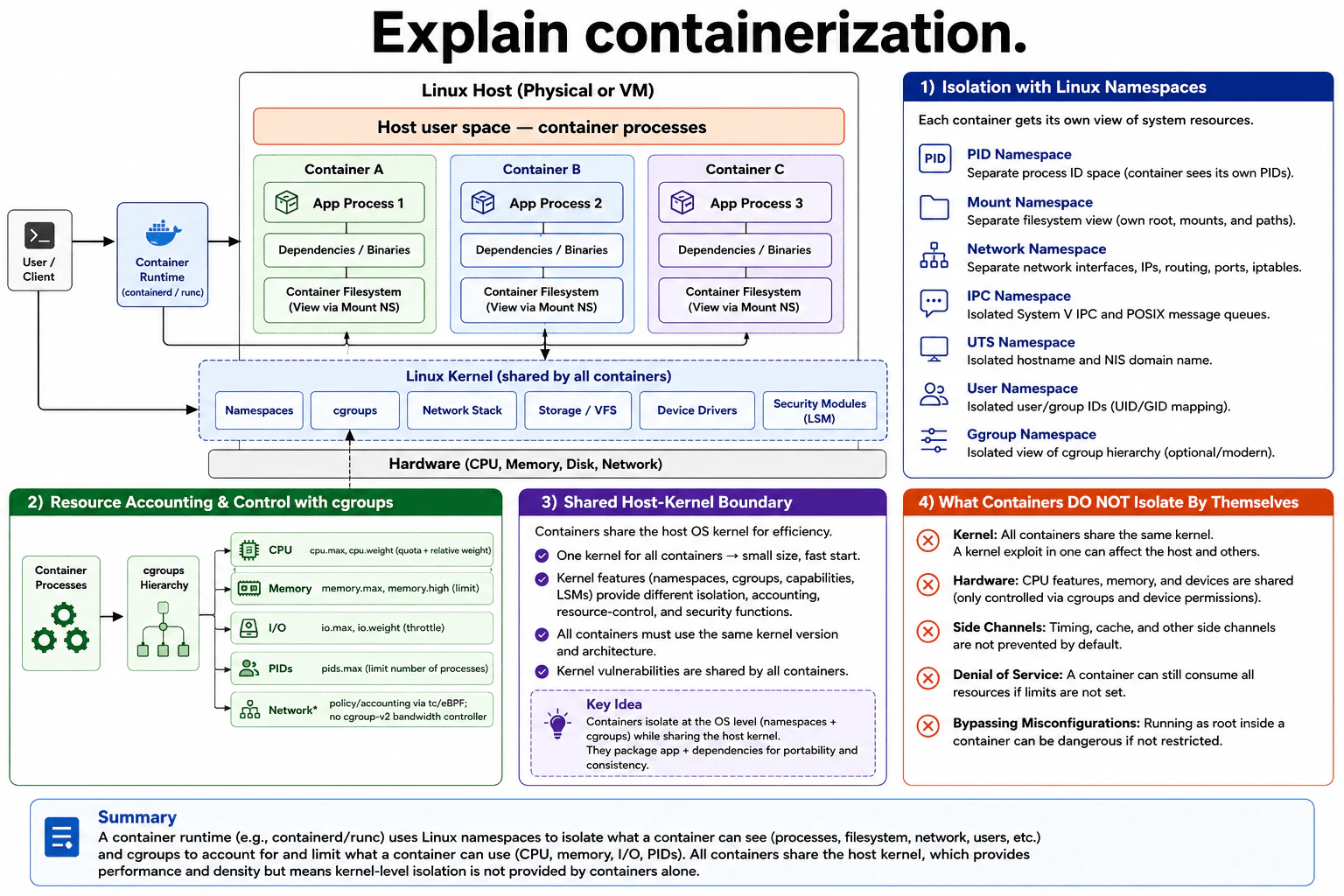
At a high level, containerization runs applications in isolated environments while still sharing the host Linux kernel. The main challenge is separating what each container can see and controlling what resources it can use. I would explain it in three parts: Linux namespaces provide isolated views, cgroups account for and control resources, and the shared kernel defines the security boundary. This makes containers lightweight and fast, but they do not provide complete kernel-level isolation.
Detailed Explanation
Containerization lets several applications run on one Linux host while giving each application its own controlled view of the system. The hard part is that containers are not separate virtual machines. Their processes still use the same Linux kernel. The diagram explains this with three main ideas. Linux namespaces control what each container can see. cgroups measure and control resource use. The shared host kernel makes containers lightweight, but it also creates an important security boundary that containers cannot remove by themselves.
Useful Questions to Ask the Interviewer
Should I focus on Linux containers and the container runtime boundary?
Should I explain both namespace isolation and cgroup resource controls?
Should I also cover the security limits of sharing one host kernel?
How to Explain It in an Interview
1. Start with the container runtime
I would start by saying that a container is not a virtual machine. The Container Runtime, such as containerd/runc in the diagram, starts container processes on the Linux host. Container A, Container B, and Container C each have an application process, dependencies, binaries, and a container filesystem view. Those processes still execute through the same host Linux kernel.
2. Explain isolation with Linux namespaces
Namespaces control what a container can see. A PID Namespace gives the container its own process-ID view. A Mount Namespace gives it a separate filesystem and mount view. A Network Namespace gives it separate network interfaces, IP addresses, routes, ports, and related networking state.
The diagram also shows IPC, UTS, User, and Cgroup namespaces. IPC separates certain process communication resources. UTS separates the hostname and domain name. A User Namespace can map container user and group IDs to different IDs outside the container. A Cgroup Namespace gives the container an isolated view of its cgroup hierarchy.
3. Explain resource accounting and control with cgroups
Namespaces mainly control visibility. cgroups control resource use. The runtime places container processes into a cgroup hierarchy and applies resource rules.
For CPU, the diagram shows cpu.max and cpu.weight. Memory uses controls such as memory.max and memory.high. I/O can use io.max and io.weight. pids.max limits the number of processes. For networking, the diagram notes that policy or accounting can use tc or eBPF because cgroup v2 does not provide a direct bandwidth controller.
4. Explain the shared host-kernel boundary
All containers share the Linux Kernel. They therefore rely on the same kernel scheduler, memory manager, VFS, network stack, device drivers, and security modules. This shared kernel is why containers are small and start quickly.
The downside is that the kernel is also a shared security boundary. Containers use the kernel version and architecture supplied by the host. A kernel vulnerability can therefore affect the host and other containers.
5. Explain what containers do not isolate by themselves
Containers do not create separate hardware or separate kernels. CPU features, memory, devices, and other physical resources are shared. Timing and cache side channels are not automatically prevented.
Resource exhaustion is also possible when cgroup limits are missing. Running as root inside a poorly restricted container can be dangerous. So namespaces, cgroups, capabilities, and Linux security modules provide different kinds of isolation and control, but containers alone do not provide complete kernel-level security.
Practical Insights
The benefit is that containers are lightweight because they share one Linux kernel. Namespaces still give each container separate views of processes, filesystems, networking, hostnames, and users. cgroups can measure and control CPU, memory, I/O, and process usage. The downside is that the kernel and physical hardware remain shared. A kernel problem may therefore affect more than one container. Missing resource limits can also let one container use too much CPU, memory, or other host resources. We accept this trade-off because containers provide useful isolation with much less overhead than giving every workload its own operating-system kernel.
Why Interviewers Ask This
Interviewers ask this to see whether you understand what a container really is. They want you to separate namespace isolation from cgroup resource control and explain why the host kernel is still shared. A strong answer also shows that you understand the security boundary and do not confuse a container with a virtual machine. The goal is good technical judgment, not memorizing commands.
Interviewer may ask next
What happens if a container has no CPU or memory limits?
The container can still have namespace isolation, but cgroups would not be enforcing the CPU or memory limits shown in the diagram. Its processes could then compete much more aggressively for shared host resources. The shared-kernel design does not automatically reserve a fair amount of CPU or memory for every container.
I would keep the same Container Runtime and Linux Kernel design. I would change the cgroup configuration for that container. For CPU, I could use cpu.max and cpu.weight. For memory, I could use memory.max or memory.high. I could also use pids.max to stop uncontrolled process creation.
These controls protect the host and the other containers from resource exhaustion. They also make resource usage easier to measure. The downside is that the limits must be chosen carefully. Limits that are too low can slow the application or cause failures during normal traffic spikes.
Does running as root inside a container make the process root on the host?
No, not automatically. Root inside a container does not always mean unrestricted root access on the host. The result depends on the container's user mapping and security configuration. The diagram shows a User Namespace, which can map container user and group IDs to different IDs outside the container.
I would keep the same architecture and use that namespace boundary carefully. UID 0 inside the container can be mapped to a less privileged host UID. The shared Linux kernel can also apply capabilities and Linux Security Modules to restrict what the process may do.
However, the container still shares the host kernel. A dangerous configuration, excessive privileges, or a kernel vulnerability can still create serious risk. The main downside is that container isolation should not be treated as a complete security boundary for highly privileged or untrusted workloads.
Cloud Engineer Resume Examples
Explore the resume examples below to find the one that best matches your target Cloud Engineer role.
Disclaimer: This interview guide is for educational and informational purposes only. It is designed to help readers prepare, but it does not guarantee any interview result, hiring decision, offer, or outcome. Interview questions, hiring criteria, and preferred answers can vary by employer, interviewer, industry, location, and time. All answers, examples, and explanations in this guide are suggested examples for interview preparation, not definitive answers or instructions for professional practice. They are based on research and judgment, are provided without warranties of any kind, and should be adapted to the question, role, and applicable laws and professional requirements. Diagrams are simplified illustrations intended to highlight the main concepts and their relationships; actual situations, systems, and practices may be more complex. Alternative approaches may be equally valid or better suited to a particular question, context, or interviewer. To the fullest extent permitted by applicable law, the contributors and publisher are not liable for decisions made, actions taken, or losses incurred based on this guide.
State Laws and Professional Responsibilities: Laws and requirements governing an occupation vary by state and jurisdiction. You are responsible for checking the current laws, licensing requirements, and scope-of-practice rules that apply to your location and role, and for ensuring that your answers and actions comply with them. Adapt examples in this guide to those requirements. This guide is not legal advice.
Company Notice: This guide is an independent educational resource and is not affiliated with, endorsed by, sponsored by, or approved by the company named in this guide. Company names identify reported interview experiences or the employer context of clearly labeled original practice exercises. Interview practices can change without notice, and inclusion of company-specific content does not mean these questions are official, complete, or guaranteed to be asked. To the fullest extent permitted by law, the author, contributors, and publisher are not responsible for outcomes related to use of this material.
Content Accuracy and Verification: To the fullest extent permitted by applicable law, we do not represent or warrant that interview guides, questions, answers, examples, or diagrams are accurate, complete, current, error-free, or suitable for any particular purpose. You are responsible for independently reviewing and verifying the information before relying on it.