This interview guide is for educational and informational purposes only. It is designed to help readers prepare, but it does not guarantee any interview result, hiring decision, offer, or outcome. Interview questions, hiring criteria, and preferred answers can vary by employer, interviewer, industry, location, and time. All answers, examples, and explanations in this guide are suggested examples for interview preparation, not definitive answers or instructions for professional practice. They are based on research and judgment, are provided without warranties of any kind, and should be adapted to the question, role, and applicable laws and professional requirements. Diagrams are simplified illustrations intended to highlight the main concepts and their relationships; actual situations, systems, and practices may be more complex. Alternative approaches may be equally valid or better suited to a particular question, context, or interviewer. To the fullest extent permitted by applicable law, the contributors and publisher are not liable for decisions made, actions taken, or losses incurred based on this guide.
State Laws and Professional Responsibilities
Laws and requirements governing an occupation vary by state and jurisdiction. You are responsible for checking the current laws, licensing requirements, and scope-of-practice rules that apply to your location and role, and for ensuring that your answers and actions comply with them. Adapt examples in this guide to those requirements. This guide is not legal advice.
Identity, Image, and Privacy Notice
To respect individual privacy, some names, profile photographs, avatars, biographical details, and other identifying information displayed in this guide may be replaced with pseudonyms, licensed stock images, illustrative avatars, composite images, or representative descriptions. Unless a person is expressly identified as an actual contributor, a displayed name, image, or profile should not be understood as depicting or identifying a specific candidate, interviewer, employee, or other real individual. These representations are provided for editorial and illustrative purposes only and do not imply endorsement, employment, participation, or affiliation with this guide or any company mentioned in it. Any resemblance to an actual person is coincidental.
Company Notice
This guide is an independent educational resource and is not affiliated with, endorsed by, sponsored by, or approved by the company named in this guide. Company names identify reported interview experiences or the employer context of clearly labeled original practice exercises. Interview practices can change without notice, and inclusion of company-specific content does not mean these questions are official, complete, or guaranteed to be asked. To the fullest extent permitted by law, the author, contributors, and publisher are not responsible for outcomes related to use of this material.
Content Accuracy and Verification
To the fullest extent permitted by applicable law, we do not represent or warrant that interview guides, questions, answers, examples, or diagrams are accurate, complete, current, error-free, or suitable for any particular purpose. You are responsible for independently reviewing and verifying the information before relying on it.
Questions or comments?
Contact us for general questions, or share feedback, technical corrections, and comments with the community.
61. How do RTO and RPO guide a disaster-recovery design?Reliability And Disaster RecoveryEasy
i Question Details
A business has several workload tiers but has not yet assigned recovery targets. Explain how you would elicit the maximum acceptable outage and data loss for each tier, map those values to RTO and RPO, identify dependencies and recovery order, and reject a design choice until its restore and replication behavior has been tested against the approved targets.
Short Interview Answer (30-60 seconds)
At a high level, RTO tells me how long each workload can be unavailable, while RPO tells me how much data the business can afford to lose. The main challenge is choosing recovery methods that can actually meet those limits. I would organize the design around workload tiers, dependency order, and testing. Critical workloads need stronger replication and faster failover, while lower tiers can use slower recovery methods. I only approve the design after repeatable tests prove that every tier meets its RTO and RPO.
Detailed Explanation
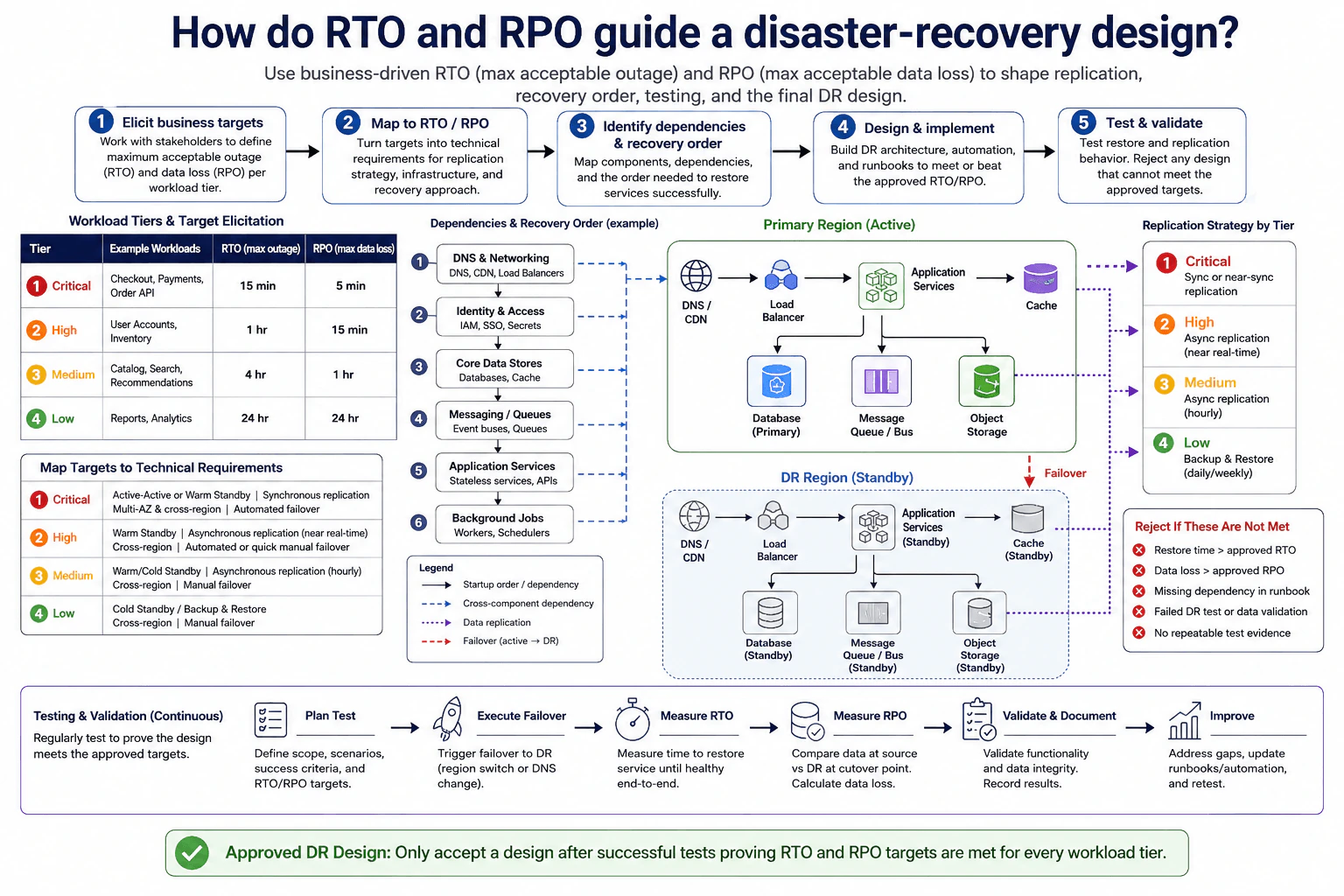
The goal is to decide how quickly each workload must return after a disaster and how much recent data the business can afford to lose. Different workloads have different business impact, so they should not all use the same recovery design. The hard part is turning those business limits into recovery methods that can actually meet them. The diagram organizes this into setting targets, mapping each tier to a recovery approach, restoring dependencies in the correct order, and proving the result through restore and replication tests.
Useful Questions to Ask the Interviewer
Which workloads cause the greatest business impact when unavailable?
What is the maximum acceptable outage for each workload tier?
What is the maximum acceptable data loss for each workload tier?
Which services depend on other services during recovery?
Who approves the RTO and RPO targets?
How to Explain It in an Interview
1. Elicit business targets
I would start with business impact rather than choosing infrastructure first. For each workload tier, I ask how long the workload may be unavailable and how much recent data may be lost.
The outage limit becomes the RTO, or recovery time objective. The data-loss limit becomes the RPO, or recovery point objective. These targets should be approved before the recovery design is accepted.
2. Map RTO and RPO to recovery methods
Next, I map each tier to a recovery method that can meet its targets. In the diagram, the Critical tier has an RTO of 15 minutes and an RPO of 5 minutes. It uses Active-Active or Warm Standby, synchronous replication, cross-region protection, and automated failover.
The High tier uses Warm Standby with near-real-time asynchronous replication. The Medium tier can use Warm or Cold Standby with hourly asynchronous replication and manual failover. The Low tier can use Cold Standby with Backup and Restore because its RTO and RPO are both 24 hours.
3. Recover dependencies in the correct order
I would then identify which services must recover before others can work. The diagram starts with DNS & Networking, then Identity & Access, Core Data Stores, Messaging / Queues, Application Services, and finally Background Jobs.
This order matters because an application cannot recover correctly if its networking, identity, data, or messaging dependencies are still unavailable.
4. Use the Primary Region and DR Region correctly
During normal operation, the Primary Region is active. DNS / CDN sends traffic to the Load Balancer, which sends requests to Application Services. Those services use the Cache, Database, Message Queue / Bus, and Object Storage.
The DR Region contains standby versions of these important components. Replication moves required data toward the standby region according to the workload tier. During a disaster, failover moves operation from the active Primary Region to the DR Region.
5. Test and reject designs that miss the targets
I would never approve the design only because the architecture looks reasonable. I would plan a test, execute failover, measure RTO, measure RPO, validate functionality and data integrity, record the results, and improve any weak area.
If restore time is greater than the approved RTO, I reject the design. I also reject it if data loss is greater than the approved RPO, a dependency is missing from the runbook, the DR test or data validation fails, or there is no repeatable test evidence. RTO and RPO are therefore measurable acceptance criteria, not just planning numbers.
Practical Complexity & Trade-offs
The benefit is that each workload gets recovery protection based on its real business importance. Critical workloads recover faster and allow less data loss. The downside is that tighter targets usually need more standby capacity, faster replication, more automation, and more testing. Lower tiers can use cheaper methods such as hourly replication or Backup and Restore because the business accepts longer outages or more data loss. Synchronous replication can reduce possible data loss, but it needs stronger coordination between locations. I would accept any recovery method only after repeated tests show that its restore time and measured data loss stay within the approved targets.
Why Interviewers Ask This
Interviewers want to see whether you can turn business needs into measurable recovery targets. They also want to know whether you understand workload tiers, dependency order, replication choices, failover, and restore testing. The most important point is judgment. A strong candidate does not choose a disaster-recovery pattern first and hope it works. The candidate proves that the selected design meets the approved RTO and RPO before accepting it.
Interviewer may ask next
What would you change if the Critical tier needed a much smaller RPO while its RTO stayed at 15 minutes?
I would keep the same overall design, but I would make the Critical tier's replication requirements stricter. A much smaller RPO means the business can tolerate less data loss, so slower asynchronous replication would not be acceptable for Critical data.
I would focus on the synchronous replication approach already shown for the Critical tier. I would also verify every Critical data dependency, including the Database and any required Object Storage or messaging state. Protecting only one datastore would not be enough if another required component could lose more data than the approved RPO.
The recovery order would stay the same because the dependencies have not changed. DNS & Networking still comes first, followed by Identity & Access, Core Data Stores, Messaging / Queues, Application Services, and Background Jobs.
Then I would test the design with known writes before failover. I would compare the Primary Region and DR Region data at the cutover point and measure actual data loss. I would approve the design only if repeated tests stay inside the new RPO. The downside is more replication cost and operational complexity.
What would you do if a failover test restores the Critical workload in 20 minutes but its approved RTO is 15 minutes?
I would reject the current design because the measured restore time is greater than the approved RTO. The diagram treats testing as an acceptance gate, so a design does not pass simply because recovery eventually works.
I would use the test results to find which recovery step consumed too much time. I would check DNS & Networking, Identity & Access, Core Data Stores, Messaging / Queues, Application Services, and Background Jobs in the same dependency order shown in the diagram. I would also review the failover automation and runbook steps.
Then I would change the slow part of the design. A Critical component might need a warmer standby state or more automation if startup work is taking too long. After making the change, I would repeat the same failover test and measure the time until the service is healthy end to end.
I would approve the design only after repeatable tests finish within 15 minutes and the RPO test also passes. The downside is additional standby capacity, automation work, and testing effort.
62. How would you choose between synchronous and asynchronous replication?Reliability And Disaster RecoveryEasy
i Question Details
Compare the two replication modes for a stateful cloud service. Address write latency, distance, consistency, replication lag, availability during network partitions, data-loss exposure, failover eligibility, and the measurements needed to show that the selected mode meets an approved RPO.
Short Interview Answer (30-60 seconds)
At a high level, the goal is to copy important state safely without making every write unnecessarily slow. The main choice is when the system can tell the client that a write succeeded. I would compare the synchronous path, the asynchronous path, and the RPO checks. Synchronous replication waits for required remote durability, so writes are safer but slower. Asynchronous replication acknowledges the local durable commit sooner, but the remote Replica may lag and recent data can be lost.
Detailed Explanation
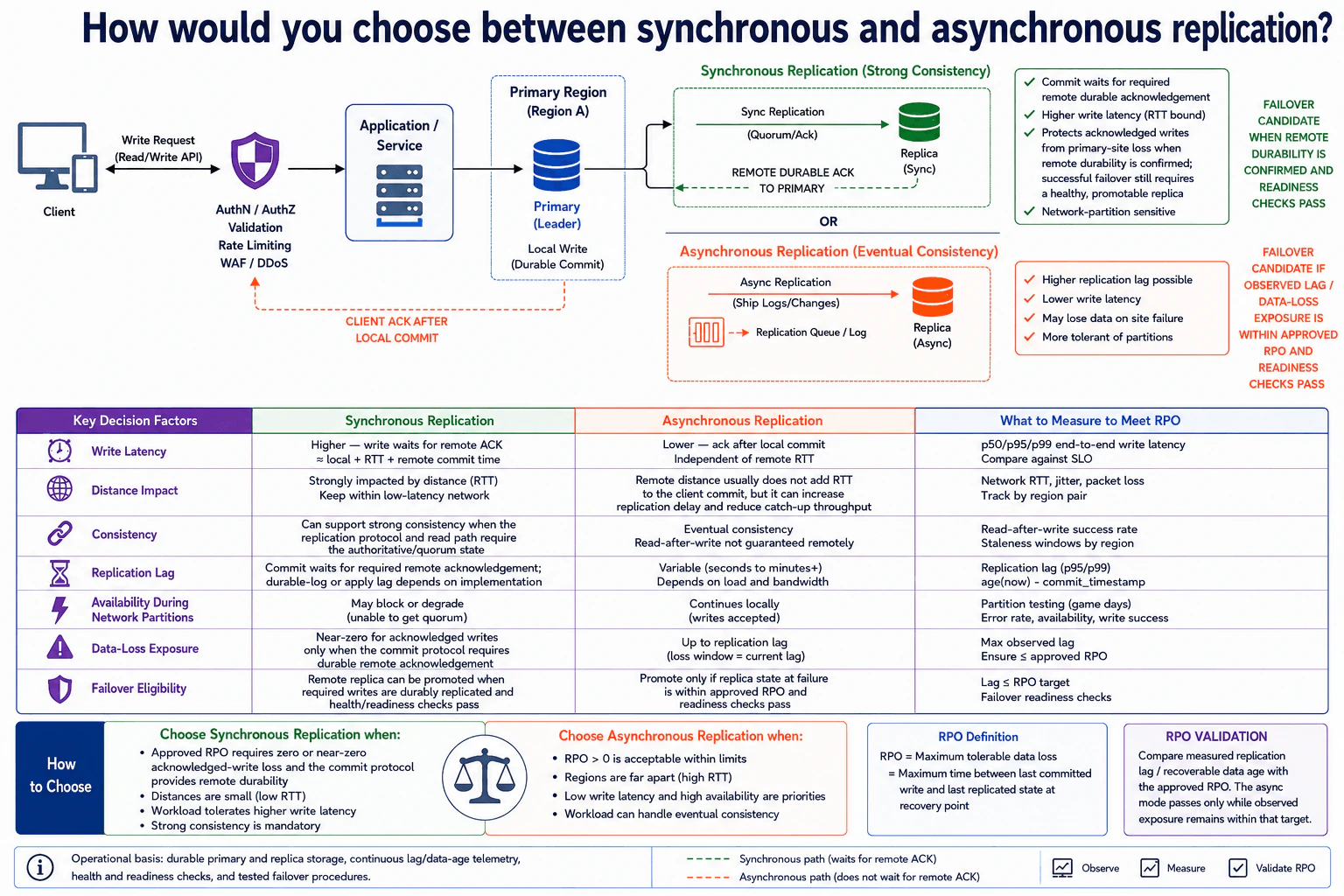
The goal is to keep important data safe while giving users a reasonable write response time. The hard part is deciding when the system can report success. Waiting for another location gives better protection, but distance makes each write slower. Returning success after the local durable write is faster, but the remote copy can fall behind. The diagram compares these choices through the write path, network failures, failover rules, and measurements that show whether possible data loss stays inside the approved recovery limit.
Useful Questions to Ask the Interviewer
What RPO, or maximum acceptable data-loss window, has been approved?
How far apart are the Primary and Replica locations?
Can writes pause during a network partition, or must the Primary keep accepting them?
Must every acknowledged write survive loss of the Primary location?
How to Explain It in an Interview
1. Explain the common write path
I would start with the path both choices share. The Client sends a write through the Read/Write API. AuthN / AuthZ, validation, rate limiting, and WAF / DDoS controls check and protect the request. The Application / Service then sends the write to the Primary, which is the leader. The Primary makes the local write durable before the replication mode changes what happens next.
2. Explain synchronous replication
For synchronous replication, the Primary sends the required data to the Replica (Sync). It waits for the required remote durable acknowledgement before the write can complete under this mode. The diagram shows this as Sync Replication with Quorum/Ack and a REMOTE DURABLE ACK TO PRIMARY.
The benefit is stronger protection for acknowledged writes. The downside is higher write latency because network round-trip time and remote commit time are on the write path. Distance therefore matters. During a network partition, writes may block or slow down if the required remote acknowledgement cannot be obtained.
Synchronous replication can support strong consistency when the protocol and read path use the required current state. Replication alone does not automatically guarantee every possible consistency behavior.
3. Explain asynchronous replication
For asynchronous replication, the Primary can acknowledge the Client after the local durable commit. The diagram shows this as CLIENT ACK AFTER LOCAL COMMIT. The Primary separately ships log changes through the Replication Queue / Log to the Replica (Async).
The benefit is lower write latency because the Client does not wait for the remote Replica. The Primary can also continue accepting local writes during some network partitions. The downside is replication lag, which means the Replica may be behind. Greater distance can increase this delay and slow catch-up.
If the Primary location fails, acknowledged writes that had not reached the Replica may be lost. The possible loss window is therefore related to the observed replication lag or recoverable data age.
4. Connect replication mode to failover
I would not treat either Replica as automatically safe to promote. For synchronous replication, required writes must be durably replicated and the Replica must pass health and readiness checks. For asynchronous replication, the Replica state at the time of failure must be within the approved RPO and readiness checks must pass.
This separates availability from data safety. A reachable Replica is not automatically a valid failover target if promotion would lose more data than the business allows.
5. Prove the selected mode meets the RPO
Finally, I would measure instead of assuming. RPO means the maximum amount of recent data the business can tolerate losing. The diagram tracks p50, p95, and p99 write latency, network RTT, jitter, packet loss, replication lag, recoverable data age, write success, errors, and availability.
For asynchronous replication, measured lag or recoverable data age must stay within the approved RPO. I would also test network partitions and failover readiness. The main trade-off is simple. Synchronous replication gives stronger acknowledged-write protection but adds latency and partition sensitivity. Asynchronous replication gives faster writes and better local write availability but accepts a larger possible data-loss window.
Practical Complexity & Trade-offs
The benefit of synchronous replication is stronger protection for writes already reported as successful. The downside is that the Primary waits for the required remote acknowledgement, so distance increases write latency. A network problem can also block or slow writes. The benefit of asynchronous replication is faster acknowledgement because the Primary waits only for its local durable commit. It can keep accepting local writes during some network partitions. The downside is replication lag. If the Primary location fails, recent writes may be missing from the Replica. This is acceptable only when measured data-loss exposure stays within the approved RPO.
Why Interviewers Ask This
The interviewer wants to see whether you can make a reliability decision from business needs instead of repeating a simple rule. You should connect write latency, distance, consistency, replication lag, network failures, data-loss risk, failover, and RPO. They also want to see whether you understand that a reachable Replica is not automatically safe to promote. A strong answer uses measurements and failure testing to prove the choice.
Interviewer may ask next
What would you change if the approved RPO became zero or near zero for acknowledged writes?
I would favor the synchronous path for writes that must meet that requirement. The important change is when the Primary can report success. It must wait until the required remote durability condition is satisfied instead of acknowledging only the local durable commit.
That changes the latency trade-off. Network RTT and remote commit time now sit directly on the Client write path. If the locations are far apart, writes become slower. A network partition can also block or reduce writes when the required remote acknowledgement cannot be obtained.
I would keep the same Client, Application / Service, Primary, and Replica (Sync) shown in the diagram. I would monitor write latency, network RTT, write success, and remote durability. Before failover, the Replica must also pass health and readiness checks.
The main downside is higher write latency and lower write availability when the remote path is unhealthy.
What would you do if the regions were far apart and low write latency became the highest priority?
I would choose the asynchronous path if the approved RPO allows some recent data loss. The Primary would make the local write durable and return the Client acknowledgement without waiting for the distant Replica. The log changes would then move through the Replication Queue / Log to the Replica (Async).
This keeps remote RTT out of the normal Client commit time. Distance can still increase replication delay and reduce catch-up speed, so I would continuously measure replication lag and recoverable data age. Those measurements must remain within the approved RPO.
If the Primary location fails, I would not promote the Replica only because it is reachable. I would check whether its state at failure is within the approved RPO and whether its readiness checks pass.
The main downside is that writes acknowledged shortly before the failure may not exist on the Replica.
63. How does recovery differ for stateless and stateful services?Reliability And Disaster RecoveryEasy
i Question Details
A web tier is stateless, while its database, object data, and message state are durable dependencies. Explain what can be recreated from configuration, what must be restored or failed over, the recovery sequence, configuration and secret dependencies, data-consistency checks, and how the complete user path is verified.
Short Interview Answer (30-60 seconds)
At a high level, stateless services are rebuilt, while stateful services must recover their durable data. The main challenge is restoring correct data before users return. I would explain recovery in three parts: recover durable state, recreate the stateless application tier, and verify the full user path. Configuration makes stateless recovery faster, while replication and backups protect stateful dependencies. The trade-off is that faster recovery needs more replication, automation, monitoring, testing, and operational work.
Detailed Explanation
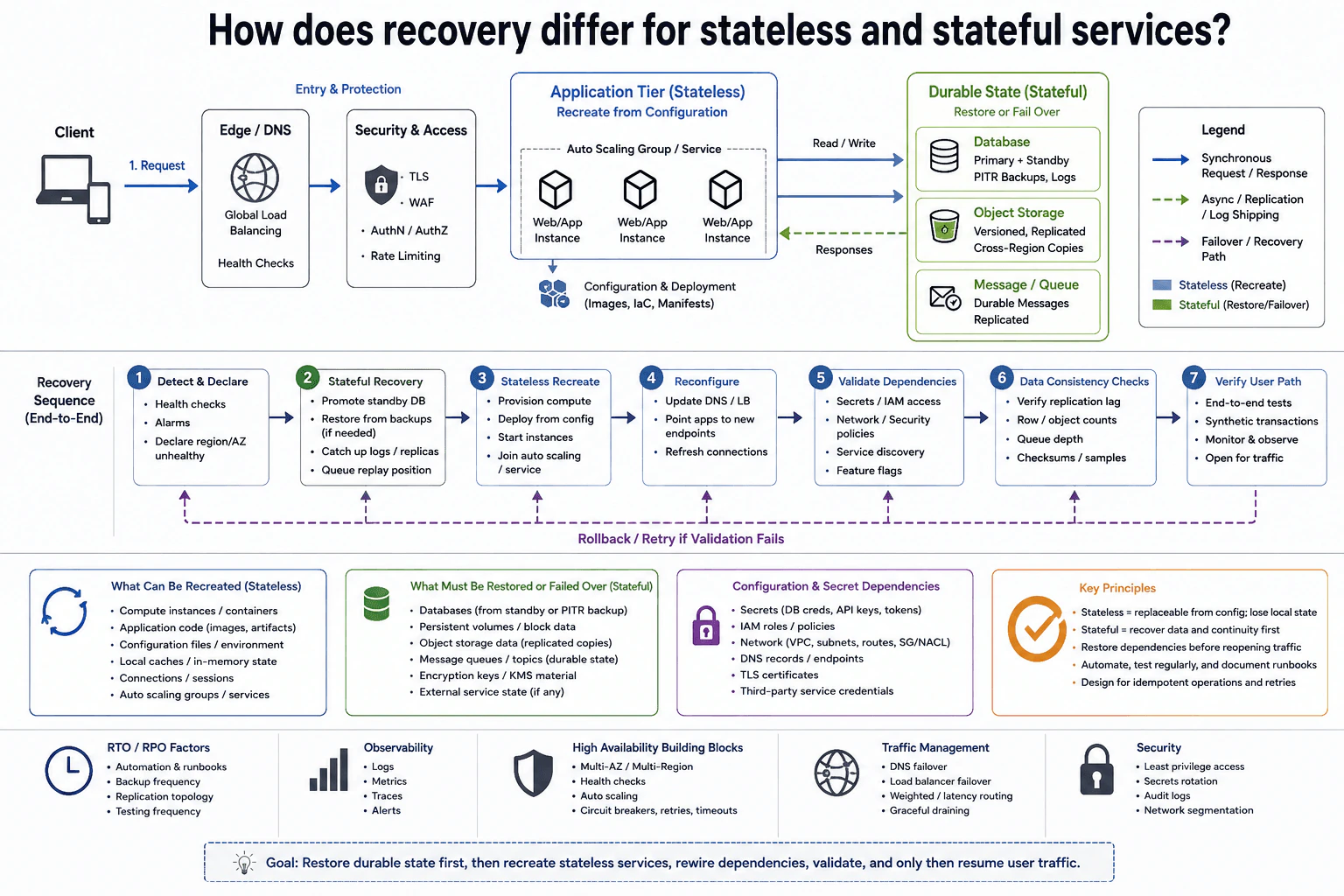
The goal is to recover the application after a serious failure without losing or corrupting important data. The web application is stateless, so its instances can be replaced from configuration. The harder part is the database, object storage, message state, and other durable data because they must survive the failure. The diagram solves this in a clear order. It detects the outage, recovers durable state, recreates the application tier, reconnects dependencies, checks the recovered data, and tests the complete user path before reopening traffic.
Useful Questions to Ask the Interviewer
What recovery time objective, or RTO, do we need?
What recovery point objective, or RPO, can the business accept?
Are we recovering from an availability-zone failure or a whole-region failure?
Which user actions must work before traffic is reopened?
How to Explain It in an Interview
1. Separate replaceable services from durable state
I would first separate what can be recreated from what must be recovered. The Application Tier is stateless. Web/App Instances, containers, application images, configuration, Auto Scaling Groups or Services, local caches, connections, and sessions can be recreated. Local in-memory data can be lost because it is not the durable source of business state.
The Database, Object Storage, Message / Queue, persistent volumes, and other durable state need a healthy copy. External service state may also need recovery if the application depends on it.
2. Detect the failure and recover state first
Recovery starts with Detect & Declare. Health checks and alarms show that a region or availability zone is unhealthy and trigger the recovery decision.
Stateful Recovery comes next. The Database can promote its standby or restore from PITR backups and logs. PITR means restoring to a chosen point in time. Object Storage uses versioned or replicated copies. Message / Queue recovery uses durable messages, replicated state, and the correct replay position. This state comes first because the application should not serve users with missing or incorrect data.
3. Recreate the stateless Application Tier
After durable state is usable, I would provision compute and recreate the Web/App Instances from Configuration & Deployment. That includes images, infrastructure configuration, manifests, and environment settings. The instances then join the Auto Scaling Group or Service.
Edge / DNS and Global Load Balancing direct requests toward the recovered environment. Security & Access still applies TLS, WAF protection, authentication, authorization, and rate limiting.
4. Reconfigure and validate dependencies
Next I would update DNS or load-balancer endpoints, point applications to the recovered stateful services, and refresh connections. I would also validate database credentials, API keys, tokens, IAM roles and policies, network rules, service discovery, feature flags, DNS records, TLS certificates, encryption keys, and other required credentials.
Traffic management may use DNS failover, load-balancer failover, weighted or latency routing, and graceful draining. These changes must match the recovered environment.
5. Check data and verify the complete user path
Before opening traffic, I would run Data Consistency Checks. I would inspect replication lag, row or object counts, queue depth, checksums, and sample records. If validation fails, the recovery path rolls back or retries.
Finally, I would Verify User Path with end-to-end tests and synthetic transactions. I would test authentication, reads, writes, file operations, messaging, and critical business flows. Logs, metrics, traces, and alerts confirm the recovered system is healthy. Only then would I open normal user traffic.
Practical Complexity & Trade-offs
The benefit is that stateless recovery can be fast because application instances come from configuration. Stateful recovery takes more care because the data must survive and remain correct. Replication can reduce recovery time, but it needs extra copies and more operational work. Backups protect against larger failures, but restoring them can take longer. Multi-AZ or multi-region designs improve availability, but they cost more and require regular testing. Automation and runbooks make recovery more repeatable. The downside is added complexity. Faster RTO and smaller RPO usually require more replication, monitoring, automation, and recovery testing before a disaster happens.
Why Interviewers Ask This
Interviewers want to see whether you understand the difference between replacing compute and recovering data. They also want to see whether you choose a safe dependency order, handle configuration and secrets, check recovered data, and verify real user actions before reopening traffic. A strong answer shows practical judgment about backups, replication, failover, recovery objectives, monitoring, security, and testing instead of only naming disaster recovery tools.
Interviewer may ask next
What would change if the business required a much shorter recovery time for a regional failure?
I would keep the same recovery sequence, but I would prepare more of the recovery environment before the failure happens. The biggest change would be around the stateful dependencies because they usually take the longest to recover.
For the Database, I would depend more on a ready standby and replication instead of waiting for a backup restore. Object Storage would need current replicated copies in the recovery region. Message / Queue state would also need durable replicated data and a known replay position. The stateless Application Tier is already easier because Web/App Instances can be recreated from Configuration & Deployment.
I would automate health-based failover decisions, DNS or load-balancer changes, dependency validation, and end-to-end tests. Logs, metrics, traces, and alerts would help operators confirm recovery quickly.
The downside is higher cost and more operational work. Keeping recovery resources and replicated state ready across regions also requires frequent testing so the standby path does not become stale.
What would you do if the recovered Database or Message / Queue failed the data-consistency checks?
I would not open normal user traffic yet. The diagram puts Data Consistency Checks before Verify User Path and before traffic is opened.
For the Database, I would inspect replication lag, row counts, checksums, and sample records. If the selected copy is incomplete, I would use the appropriate standby, PITR backup, or logs and repeat the recovery. For Message / Queue, I would check queue depth, durable messages, and the replay position. I would correct the recovered state before allowing normal processing to continue.
The stateless Application Tier can remain recreated, but it should not be considered ready for users while its durable dependencies are wrong. After the data checks pass, I would repeat end-to-end tests and synthetic transactions. I would also watch logs, metrics, traces, and alerts.
The downside is a longer recovery time, but that is safer than reopening traffic with missing, duplicated, or incorrect durable state.
64. How would you design AWS disaster recovery for a four-hour RTO and a fifteen-minute RPO?Reliability And Disaster RecoveryEasy
i Question Details
A business application runs in one AWS region and has an approved four-hour recovery-time objective and fifteen-minute recovery-point objective. Choose an appropriate recovery pattern and show backups or replication, infrastructure readiness, DNS or traffic switching, dependency recovery order, failover authorization, data verification, failback, and recurring tests that prove both objectives.
Short Interview Answer (30-60 seconds)
At a high level, the goal is to recover the application in another AWS region within four hours while keeping possible data loss within fifteen minutes. The main challenge is keeping the DR region ready without running a second full-size production environment. I would explain the design in three parts: continuous data protection, controlled regional failover, and safe failback. The diagram uses an active primary region and a warm standby region. The trade-off is extra cost and operational work for faster recovery.
Detailed Explanation
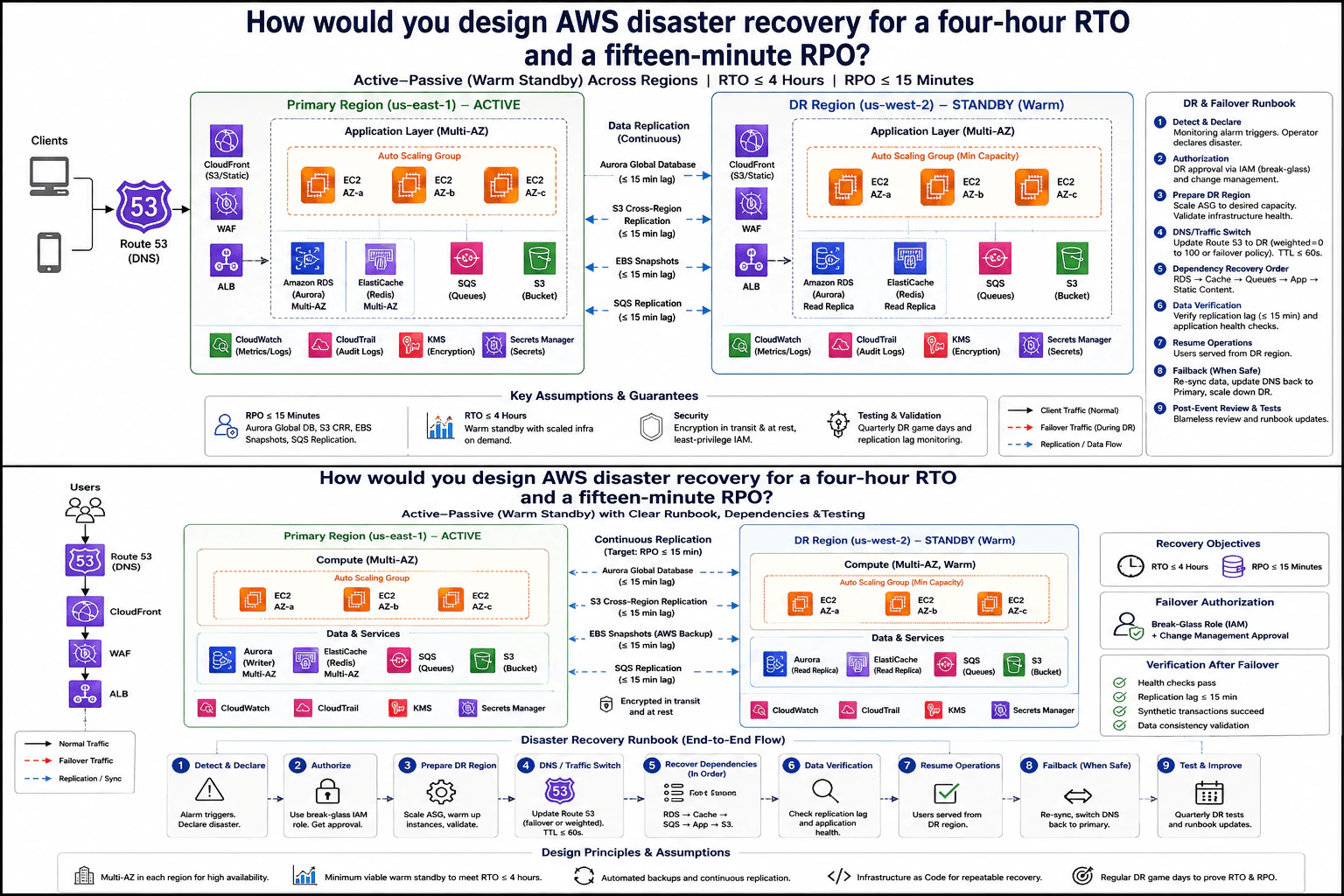
The business needs the application to recover if its main AWS region becomes unavailable. Service must return within four hours, and the recovered data should be no more than fifteen minutes behind the approved recovery point. The difficult part is keeping another region ready without paying for a second full-size production environment. The diagram uses an active primary region and a smaller warm standby region. It continuously protects data, keeps infrastructure ready, requires approval before failover, recovers dependencies in order, switches traffic, verifies the recovered system, and later fails back safely.
Useful Questions to Ask the Interviewer
Who is allowed to authorize a regional failover?
Which dependencies must be healthy before application traffic resumes?
How will we measure the four-hour RTO during each DR exercise?
How will we prove that each protected data path meets the fifteen-minute RPO?
How to Explain It in an Interview
1. Keep the warm standby ready
I would start by preparing the second region before a disaster happens. The primary region is active, while the DR region runs with minimum warm capacity.
The user path goes through Route 53, CloudFront, WAF, and the ALB before reaching the application layer. EC2 instances run in an Auto Scaling Group across multiple Availability Zones. The application also uses Amazon RDS with Aurora, ElastiCache Redis, SQS queues, and S3. CloudWatch, CloudTrail, KMS, and Secrets Manager support monitoring, audit, encryption, and secret storage in both regions.
2. Protect data for the fifteen-minute RPO
Next, I would continuously protect the data needed for recovery. The diagram shows Aurora Global Database replication, S3 Cross-Region Replication, EBS snapshots, and an SQS replication path between regions.
These paths are monitored against the fifteen-minute RPO. That target means up to fifteen minutes of recent changes may be lost after a disaster. It does not mean zero data loss. The SQS path shown in the diagram would need application or automation support because Amazon SQS does not provide native cross-region queue replication by itself.
3. Detect, authorize, and prepare failover
When monitoring raises an alarm, an operator first declares the disaster. The diagram does not make a regional failover automatic from the alarm alone.
The runbook requires approval through a break-glass IAM role and change management. After approval, the team prepares the DR region by scaling the Auto Scaling Group, warming the application, and checking that the required infrastructure is ready. This keeps responsibility clear during an emergency.
4. Recover dependencies and switch traffic
I would recover dependencies before sending users to the standby region. The diagram shows the order as RDS, cache, queues, application, and then static content.
After those dependencies are ready, Route 53 changes the routing toward the DR region. The diagram shows failover or weighted routing with a 60-second DNS TTL. DNS changes still take time to reach clients, so the TTL should not be treated as a guarantee that every client switches within exactly sixty seconds.
5. Verify recovery, fail back, and test it repeatedly
Before declaring recovery complete, the team checks application health, replication lag, and data consistency. It also runs synthetic transactions, which are test requests that prove the application works end to end.
When the primary region is safe again, data is re-synchronized before Route 53 sends traffic back. The DR environment can then return to minimum capacity. Quarterly DR game days, replication-lag monitoring, and post-event reviews measure the real RTO and RPO and keep the runbook current.
Practical Complexity & Trade-offs
The benefit is faster recovery because the second region already has infrastructure and protected data. A warm standby can run at smaller capacity, so it costs less than keeping two full production regions active. The downside is that the business still pays for duplicate regional resources and must maintain replication, monitoring, security, and recovery automation. The fifteen-minute RPO also allows some recent data loss. Failover needs approval, scaling, dependency recovery, DNS switching, and validation. Regular DR game days add work, but they are necessary because a recovery plan is only trustworthy when the team measures and proves that it can meet the four-hour RTO and fifteen-minute RPO.
Why Interviewers Ask This
Interviewers want to see whether you can turn RTO and RPO targets into a practical disaster recovery design. They also want to see whether you separate normal multi-AZ availability from regional recovery. A strong answer shows judgment about data protection, warm infrastructure, dependency order, failover ownership, DNS switching, verification, failback, and testing. The goal is not memorizing AWS service names. It is showing that you can build and prove a recovery plan.
Interviewer may ask next
What would you change if the business reduced the RTO from four hours to thirty minutes?
I would keep the same active-primary and warm-standby design, but I would keep much more capacity ready in the DR region. The biggest change is reducing work that currently happens after failover approval.
The DR Auto Scaling Group would start with more EC2 capacity. Route 53, CloudFront, WAF, ALB, Aurora, ElastiCache Redis, SQS, S3, CloudWatch, CloudTrail, KMS, and Secrets Manager would still follow the same design. I would automate more of the scaling, dependency checks, traffic switching, and validation so those steps finish quickly after approval.
I would also run recovery exercises often enough to prove the thirty-minute target. Each test would measure detection, authorization, preparation, dependency recovery, DNS switching, and validation separately.
The main downside is cost. More standby capacity costs more, and tighter automation requires more engineering and more frequent testing.
How would you prove during a DR test that both the four-hour RTO and fifteen-minute RPO are actually being met?
I would measure both objectives during the quarterly DR game day shown in the diagram. For RTO, I would start timing when the simulated disaster is declared. I would record authorization, DR preparation, dependency recovery, Route 53 switching, and application validation. The exercise passes only if the DR application becomes usable within four hours.
For RPO, I would create timestamped test data before the simulated failure. After recovery, I would compare the newest successfully recovered data with the failure time. I would also inspect the monitored replication or backup status for Aurora, S3, EBS snapshots, and the diagram's SQS recovery path. The measured recovery point must stay within fifteen minutes.
Finally, I would run health checks, synthetic transactions, and data-consistency checks. The downside is that realistic DR testing takes time and coordination, but without measured exercises the RTO and RPO are only planned targets.
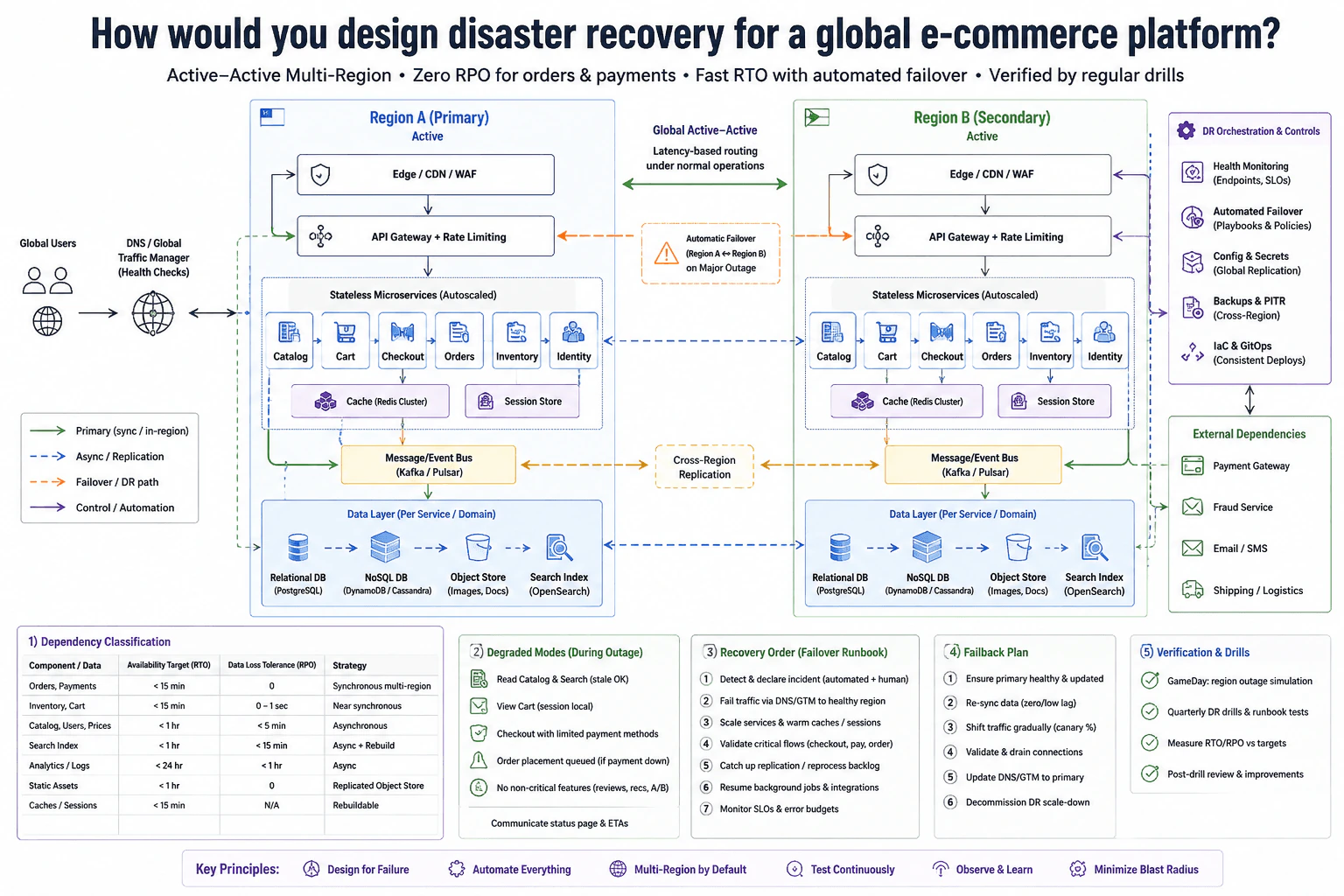
65. How would you design disaster recovery for a global e-commerce platform?Reliability And Disaster RecoveryMedium
i Question Details
The platform includes catalog, cart, checkout, orders, inventory, payments, and customer identity across regions. Classify each dependency by availability and data-loss tolerance, design replication and traffic failover, define degraded modes, preserve order and payment correctness, specify recovery order and failback, and show how drills verify the approved targets.
Short Interview Answer (30-60 seconds)
At a high level, the goal is to keep global shopping working when a region fails. The hardest part is protecting orders and payments without losing committed data. I would explain the design in three parts: normal active-active traffic, regional failover, and safe recovery. DNS and health checks send users to healthy regions. Critical data uses synchronous multi-region protection, while less critical data accepts some delay. The trade-off is higher cost and coordination for stronger recovery targets.
Detailed Explanation
The platform must keep customers shopping even when a major region becomes unavailable. The difficult part is that different parts of the system need different levels of protection. Losing an order or payment is much more serious than showing an older catalog or search result for a short time. The diagram solves this with two active regions, health-based traffic routing, different recovery targets for each dependency, cross-region replication, simpler operating modes during failures, and a controlled recovery and failback process that is tested through regular drills.
Useful Questions to Ask the Interviewer
Which customer flows must continue during a full regional outage?
Are the shown RTO and RPO targets already approved by the business?
Which features may show older data or become temporarily limited?
How often should regional failover and recovery drills run?
How to Explain It in an Interview
1. Start with the dependency targets
I would first classify each dependency by recovery time and acceptable data loss. Orders and Payments have an RTO below 15 minutes and an RPO of 0. RPO means how much committed data may be lost. Inventory and Cart also recover within 15 minutes, but may accept 0 to 1 second of data loss. Catalog, Users, and Prices have an RTO below one hour and RPO below five minutes. Search Index has an RTO below one hour and RPO below 15 minutes. Analytics and Logs can recover within 24 hours and may lose less than one hour. Static Assets recover within one hour with RPO 0. Caches and Sessions recover within 15 minutes and are rebuildable.
2. Explain normal active-active traffic
Global Users first reach DNS and the Global Traffic Manager. Health checks help route traffic toward healthy regions. Region A and Region B are both active during normal operation. Each region contains Edge/CDN/WAF, an API Gateway with rate limiting, and autoscaled stateless microservices for Catalog, Cart, Checkout, Orders, Inventory, Payments, and Identity. Each region also contains a Cache, Session Store, Message/Event Bus, and a per-service data layer.
3. Explain replication and data protection
The data layer includes Relational DB, NoSQL DB, Object Store, and Search Index components. Orders and Payments use synchronous multi-region protection because their RPO is 0. Inventory and Cart use near-synchronous protection because a very small data-loss window is allowed. Catalog, Users, and Prices use asynchronous replication. Search Index can be rebuilt as well as replicated asynchronously. Static Assets use replicated object storage. Cross-Region Replication also connects the Message/Event Bus between regions for background events.
4. Explain failover and simpler operating modes
If a major regional outage is detected, Automatic Failover redirects traffic from the failed region toward the healthy one. DR Orchestration & Controls uses Health Monitoring, Automated Failover playbooks, Config & Secrets, Backups & PITR, and IaC & GitOps. During an outage, Catalog and Search may become read-only with stale data. Customers can still view a local cart. Checkout may offer limited payment methods. Order placement may be queued when payments are down. Non-critical features such as reviews, recommendations, and A/B tests can be disabled. The platform should also communicate status and expected recovery times.
5. Explain recovery, failback, and drills
The failover runbook first detects and declares the incident. DNS or the Global Traffic Manager sends traffic to the healthy region. Services scale, caches and sessions warm, and critical checkout, payment, and order flows are validated. Replication catches up before background jobs and integrations resume. SLOs and error budgets are then monitored. For failback, the primary must be healthy and updated. Data is re-synchronized to zero or low lag, traffic moves back gradually, connections are validated and drained, and DNS or the Global Traffic Manager is updated. GameDays, quarterly DR drills, RTO and RPO measurements, and post-drill reviews verify that the approved recovery targets really work.
Practical Complexity & Trade-offs
The benefit is strong protection from a regional outage. Customers can continue using the platform because both regions are active and traffic can move to the healthy side. Orders and payments get the strongest data protection because losing them would be costly. The downside is more infrastructure and more coordination. Synchronous multi-region protection can also add delay because critical writes need stronger cross-region agreement. Less critical data uses weaker recovery targets to reduce that cost. Caches, sessions, search, and analytics can be rebuilt or accept some delay. We accept this because their temporary loss is less serious than losing a confirmed order or payment.
Why Interviewers Ask This
Interviewers ask this to see whether you can connect technical recovery choices to business impact. They want to know if you understand RTO, RPO, regional failover, replication, simpler operating modes, and safe failback. They also want to see whether you protect orders and payments more carefully than search or analytics. A strong answer shows that disaster recovery is not only backup infrastructure. It also needs runbooks, health checks, drills, measurements, and recovery validation.
Interviewer may ask next
What would you change if synchronous multi-region protection made order and payment writes too slow?
I would keep the same two-region architecture, but I would first make the new business trade-off explicit. The current diagram gives Orders and Payments an RPO of 0 through synchronous multi-region protection. If we remove that protection, we must also stop promising zero data loss.
Those services could move to a near-synchronous or asynchronous strategy, but the surviving region might then be slightly behind during a sudden outage. Before accepting new writes after failover, the recovery runbook should identify the latest safe transaction state. Any uncertain payment or order should remain pending until its final state is known. A retry must not turn an unknown payment into a second successful charge.
DNS, health checks, stateless services, the Message/Event Bus, and the failover flow can remain the same. DR drills should measure the new RPO and test uncertain transactions. The benefit is lower write latency. The downside is a small but real data-loss window.
How should the platform behave if the Payment Gateway fails while both regions remain healthy?
I would keep both application regions active because this is an external dependency failure, not a regional outage. DNS and the Global Traffic Manager should continue sending users to healthy Region A and Region B services.
The Checkout path should use the simpler operating behavior shown in the diagram. If another supported payment method is available, Checkout can offer that method. If payment cannot complete, Order placement can be queued instead of being marked as successfully paid. The key correctness rule is that an unconfirmed payment must never become a confirmed order only because a request was retried.
Health Monitoring should alert the team about the Payment Gateway problem. Other healthy features such as Catalog, Search, Cart, and Identity can continue operating. When the gateway recovers, queued work can continue through the normal flow. The downside is reduced checkout capability while the external payment service is unavailable.
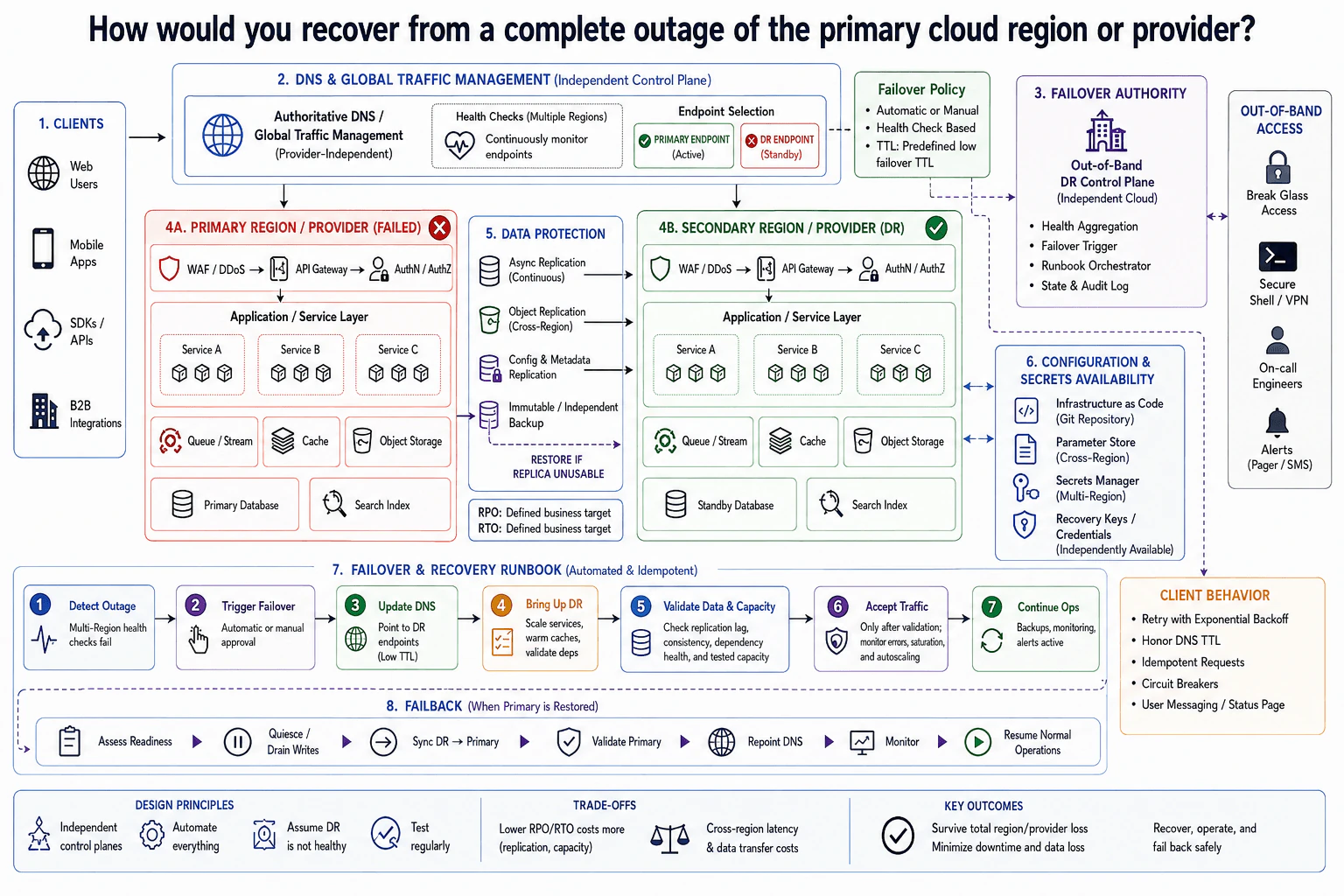
66. How would you recover from a complete outage of the primary cloud region or provider?Reliability And Disaster RecoveryMedium
i Question Details
A critical workload loses its primary compute, network control plane, and managed dependencies. Design the secondary environment, independent access and DNS, data replication or restore, configuration and secret availability, failover trigger and authority, dependency recovery sequence, capacity validation, client behavior, and failback without assuming the secondary is already healthy.
Short Interview Answer (30-60 seconds)
At a high level, the goal is to keep a critical workload running after the entire primary region or provider fails. The hard part is recovering without assuming the DR environment is already healthy. I would explain three flows: independent traffic failover, safe secondary recovery, and controlled failback. Provider-independent DNS selects the validated DR endpoint, while replicated data, backups, configuration, secrets, and out-of-band recovery controls support restoration. The main trade-off is higher replication, capacity, and cross-region transfer cost.
Detailed Explanation
The system must recover a critical workload after the whole primary cloud environment becomes unavailable. Compute, networking, and managed dependencies may all disappear together. The difficult part is that the secondary environment cannot simply be assumed to work. We must prove that its data, services, dependencies, and capacity are ready before users reach it. The diagram organizes recovery around independent traffic control, a secondary DR environment, protected data and configuration, separate recovery authority, a tested recovery sequence, safe client behavior, and a careful return to the primary environment.
Useful Questions to Ask the Interviewer
What business RPO and RTO targets must we meet?
Can the secondary environment run in a different provider?
Should failover be automatic, manual, or require approval?
How much standby capacity should exist before a disaster?
How to Explain It in an Interview
1. Keep traffic control independent
I would start by making recovery independent from the failed provider. Clients use provider-independent Authoritative DNS and Global Traffic Management. Health Checks from multiple regions continuously watch the endpoints. Under normal conditions, Endpoint Selection chooses the PRIMARY ENDPOINT. After failover is declared, it selects the DR ENDPOINT. A predefined low failover TTL helps clients learn the new DNS answer sooner.
2. Recover the secondary environment before using it
The SECONDARY REGION / PROVIDER contains the same main workload layers. It has WAF / DDoS protection, API Gateway, AuthN / AuthZ, Application / Service Layer, Queue / Stream, Cache, Object Storage, Standby Database, and Search Index. I would not assume these components are healthy. The runbook brings up DR services, scales them, warms caches where needed, and validates dependencies before traffic is accepted.
3. Protect data, configuration, secrets, and access
During normal operation, Async Replication, Object Replication, and Config & Metadata Replication flow from primary to secondary. Replication can be slightly behind, so the business defines its required RPO. An Immutable / Independent Backup provides another recovery path. Immutable means the backup cannot be changed after creation. If the replica is unusable, the backup can restore the secondary data.
Recovery also needs Infrastructure as Code, a cross-region Parameter Store, a multi-region Secrets Manager, and independently available Recovery Keys / Credentials. The Out-of-Band DR Control Plane performs health aggregation, failover triggering, runbook control, and audit logging. Engineers retain separate Break Glass Access, Secure Shell / VPN access, and alerts.
4. Validate before accepting traffic
The recovery runbook follows a strict order. Detect the outage, trigger failover, update DNS, and bring up DR. Next, Validate Data & Capacity by checking replication lag, consistency, dependency health, and tested capacity. Only after those checks pass should DR Accept Traffic. Continue Ops then watches backups, monitoring, alerts, autoscaling, and errors.
5. Make clients safe during recovery
Clients retry with exponential backoff instead of retrying continuously. They honor DNS TTL values and use idempotent requests, meaning a safe retry does not repeat the business action. Circuit breakers stop repeated calls to unhealthy dependencies. User messaging or a status page explains temporary service problems.
6. Fail back in a controlled way
When the primary returns, I would not immediately redirect users. First assess readiness and quiesce or drain writes. Then sync data from DR to Primary and validate the recovered primary. After that, repoint DNS, monitor the system, and resume normal operations. Lower RPO and RTO targets cost more because they require more replication and capacity. Cross-region latency and data-transfer cost are the other main trade-offs.
Practical Complexity & Trade-offs
The benefit is that the workload can survive losing an entire region or provider. Independent traffic and recovery controls also prevent the failed cloud from blocking the recovery process. The downside is cost. Lower RPO and RTO targets need more replication, more standby capacity, and more frequent testing. Cross-region replication also adds network delay and data-transfer charges. Keeping backups, secrets, recovery credentials, and recovery tools available in another failure domain adds more operational work. We accept this extra cost because a critical workload needs a tested recovery path, not just a backup environment that might work.
Why Interviewers Ask This
Interviewers ask this to test whether you understand disaster recovery beyond normal high availability. They want to see how you handle a complete failure domain, independent access, data protection, recovery authority, dependency order, capacity checks, client behavior, and failback. They also want realistic judgment about RPO, RTO, testing, and cost. A strong answer never assumes the secondary environment is healthy or promises instant recovery and zero data loss.
Interviewer may ask next
What would you change if the secondary environment had only a small amount of standby capacity before the outage?
I would keep the same architecture, but the Bring Up DR and Validate Data & Capacity steps would become more important. The secondary environment would still need its network, security controls, configuration, secrets, data copies, and recovery access before a disaster. Application and worker capacity could remain smaller during normal operation.
After failover is declared, the runbook would scale the DR services before opening them to users. The capacity check must prove that the environment can safely handle the traffic we plan to send. I would not redirect all clients only because the DNS change is ready.
Client exponential backoff and circuit breakers also help during this period. They reduce extra pressure while capacity grows. Monitoring then watches errors and autoscaling after traffic starts.
The downside is a longer RTO. Smaller standby capacity saves money during normal operation, but recovery needs more scaling work before DR can safely accept production traffic.
What would you do if the Standby Database was corrupted or too far behind when failover started?
I would not use the Standby Database until it passes validation. The diagram already provides a second recovery path through the Immutable / Independent Backup.
During Validate Data & Capacity, I would check replication lag and consistency. If the Standby Database fails those checks, the recovery process would follow RESTORE IF REPLICA UNUSABLE. The independent backup would restore the required data into the secondary environment. Normal production traffic would remain closed until the restored data, dependencies, and capacity pass validation.
After those checks succeed, the runbook can continue to Accept Traffic. Client retries with exponential backoff, circuit breakers, alerts, and user messaging help while recovery takes longer.
The downside is a worse RTO and possibly a worse RPO. Restoring from backup takes more time, and changes made after the latest usable recovery point may not be available.
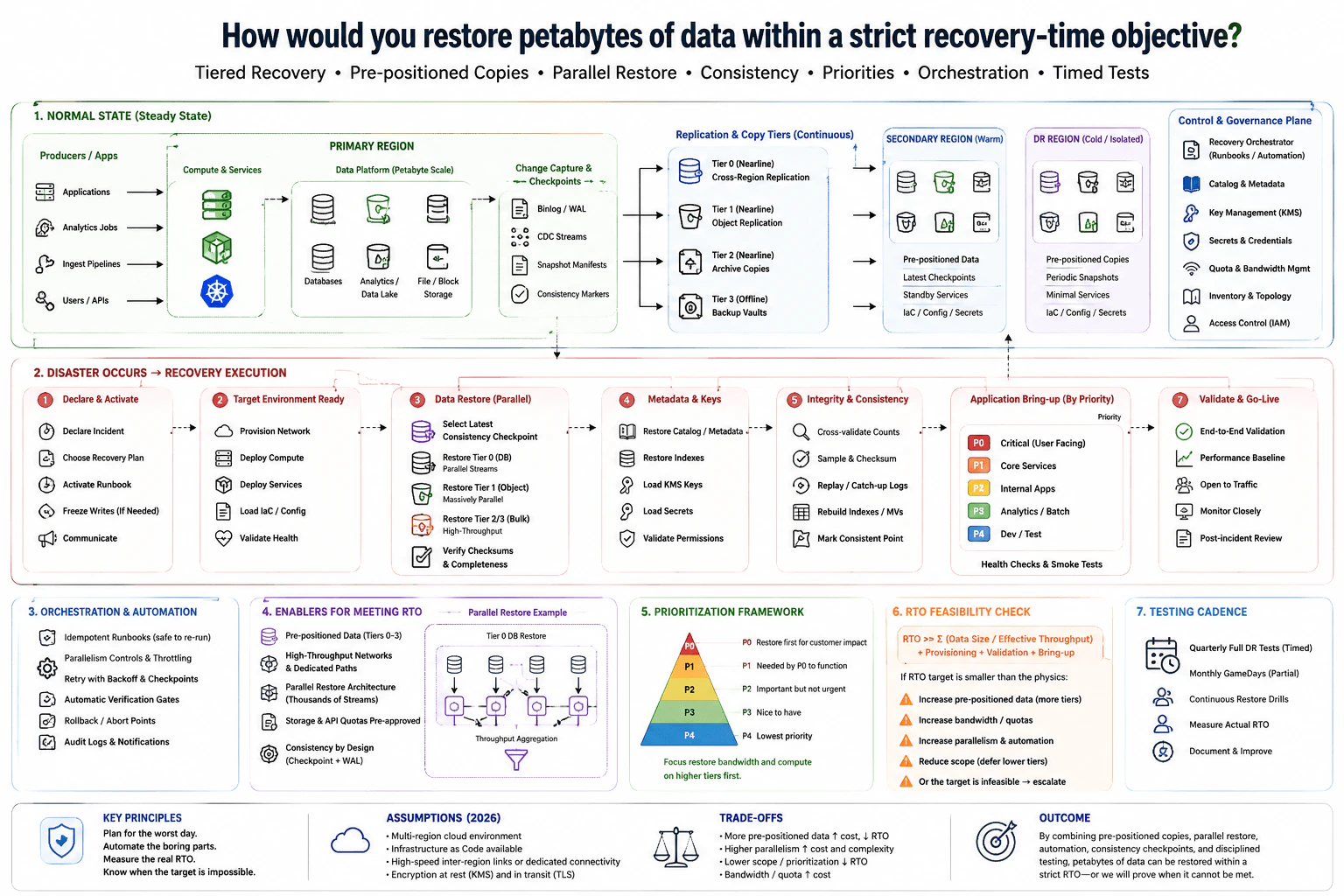
67. How would you restore petabytes of data within a strict recovery-time objective?Reliability And Disaster RecoveryHard
i Question Details
A data platform holds petabytes across database, object, and analytical storage, and leadership has approved an RTO that a full serial restore may not meet. Design tiered recovery, pre-positioned replicas or copies, parallel restore, metadata and key availability, bandwidth and quota planning, consistency checkpoints, prioritized datasets, application restart order, and recurring timed tests; identify when the target is infeasible rather than hiding the gap.
Short Interview Answer (30-60 seconds)
At a high level, the goal is to recover petabytes of important data before the approved recovery deadline. The main challenge is that a full serial restore may be too slow. I would organize recovery around pre-positioned copies, massively parallel restore, and a controlled application restart. I would restore the highest-priority datasets first, verify consistency, then open traffic. The trade-off is higher cost and operational complexity in exchange for a shorter and more predictable recovery time.
Detailed Explanation
The platform holds petabytes across databases, object storage, and analytical storage. After a major failure, restoring every byte through one serial path may take longer than leadership allows. The diagram solves this by doing important work before the disaster. It keeps recovery copies in other regions, prepares metadata and keys, and plans enough network capacity. During recovery, many restore streams run together. Critical datasets and applications return first. Lower-priority work can wait. The final recovery time is measured instead of assumed.
Useful Questions to Ask the Interviewer
What is the approved RTO for the platform?
Which datasets and applications must return first?
Which recovery point should be used after a disaster?
What secondary and DR regions are already prepared?
What bandwidth, storage API quotas, and account limits are available?
How to Explain It in an Interview
1. Prepare recovery before the disaster
I would start by reducing how much work remains after failure. The primary region produces Binlog or WAL records, CDC streams, snapshot manifests, and consistency markers. Recovery data is kept in tiers. Tier 0 uses cross-region replication. Tier 1 uses object replication. Tier 2 keeps archive copies. Tier 3 uses backup vaults. The secondary region is warm with pre-positioned data and standby services. The colder DR region keeps periodic copies and minimal services.
2. Declare the incident and prepare the target
When the disaster is declared, the Recovery Orchestrator chooses the recovery plan and activates the runbook. Writes can be frozen when needed. The target environment then provisions network, compute, services, and IaC or configuration. Health checks confirm that the target is ready. The Control and Governance Plane provides the catalog and metadata, KMS keys, secrets and credentials, quota information, inventory, topology, and access control.
3. Restore petabytes in parallel
The main speed improvement is parallel restore. The system first selects the latest consistent checkpoint. Tier 0 database data uses parallel streams. Tier 1 object data is restored massively in parallel. Tier 2 and Tier 3 bulk data use high-throughput paths. Parallelism controls and throttling prevent the restore from exceeding shared limits. Retries use backoff and checkpoints. Rollback or abort points provide a safe way to stop or retry work. Bandwidth and quotas must be planned before the disaster.
4. Restore metadata and prove consistency
The restored bytes are not useful until their supporting information is available. The system restores the catalog, metadata, indexes, KMS keys, secrets, and permissions. It then cross-validates counts, samples checksums, replays or catches up logs, and rebuilds indexes or materialized views. Only after these checks does it mark a consistent point. This keeps applications from starting against incomplete or mismatched data.
5. Restart applications by business priority
Recovery capacity should go to the highest-value services first. P0 critical user-facing services start first. P1 core services follow. P2 internal applications come next. P3 analytics and batch workloads can wait. P4 development and test workloads are last. Every stage uses health checks and smoke tests. End-to-end validation and a performance baseline happen before traffic opens. Monitoring stays active while the platform stabilizes.
6. Prove whether the RTO is possible
I would never hide an impossible recovery target. The diagram estimates recovery time from data size divided by effective transfer rate, then adds provisioning, validation, and application bring-up time. If that exceeds the RTO, we can pre-position more data, add bandwidth or quotas, increase parallelism, or reduce recovery scope. If those changes still cannot meet the target, I would report the gap. Quarterly timed full DR tests, monthly partial game days, continuous restore drills, and measured actual RTO keep the plan honest.
Practical Complexity & Trade-offs
The benefit is faster recovery because important data already exists near the recovery target, and many restore streams can run at once. The downside is cost. More pre-positioned data, standby services, network capacity, and automation all cost money. More parallelism also needs careful throttling because bandwidth and provider quotas are limited. Prioritizing P0 and P1 data can shorten the time until critical services return, but lower-priority datasets stay unavailable longer. We accept these costs because a petabyte-scale serial restore may miss the RTO. If measured limits still exceed the target, the correct decision is to report that the RTO is infeasible.
Why Interviewers Ask This
Interviewers want to see whether you can turn a huge recovery problem into clear recovery stages. They are testing whether you prepare before failure, understand real transfer limits, protect consistency, restore dependencies in the right order, prioritize business-critical data, and verify recovery with timed tests. They also want to see whether you will challenge an impossible RTO instead of promising a recovery time that the system cannot physically achieve.
Interviewer may ask next
What would you change if leadership cut the approved RTO in half?
I would keep the same basic architecture, but move more recovery work out of the disaster window. The first change would be increasing pre-positioned data in the secondary and DR regions. More important datasets should use the faster Tier 0 and Tier 1 recovery paths so less data must be transferred after the incident begins.
I would also increase parallel restore capacity and confirm that network bandwidth, storage API quotas, and account limits can support the higher load. The Recovery Orchestrator would still select a consistent checkpoint. Metadata, KMS keys, secrets, indexes, and permissions would still be restored before dependent applications start. I would not remove those correctness checks just to report a smaller number.
Finally, I would run a timed full DR test. If provisioning, transfer, validation, and application bring-up still exceed the new RTO, I would reduce recovery scope to higher-priority tiers or report that the new target is infeasible. The downside is higher standby cost, more reserved capacity, and more operational complexity.
What would you do if the recovery region had much less bandwidth than the restore plan expected?
I would keep the same recovery design, but change how the available bandwidth is allocated. The restore process should protect capacity for P0 and P1 datasets first. Parallelism controls would reduce lower-priority restore work so many workers do not overload the network or storage APIs.
Pre-positioned Tier 0 and Tier 1 copies become especially valuable in this failure because they reduce the amount of data that must cross the limited link. Retries with backoff and checkpoints let interrupted restore work continue without restarting everything. P2, P3, and P4 data can wait while critical datasets, metadata, keys, and applications are restored and validated.
I would then recalculate the achievable recovery time using the lower effective transfer rate. If the result exceeds the approved RTO even after prioritization, the Recovery Orchestrator cannot make the physical limit disappear. I would report the gap and consider more pre-positioned copies or additional network capacity. The downside is that lower-priority services remain unavailable longer.
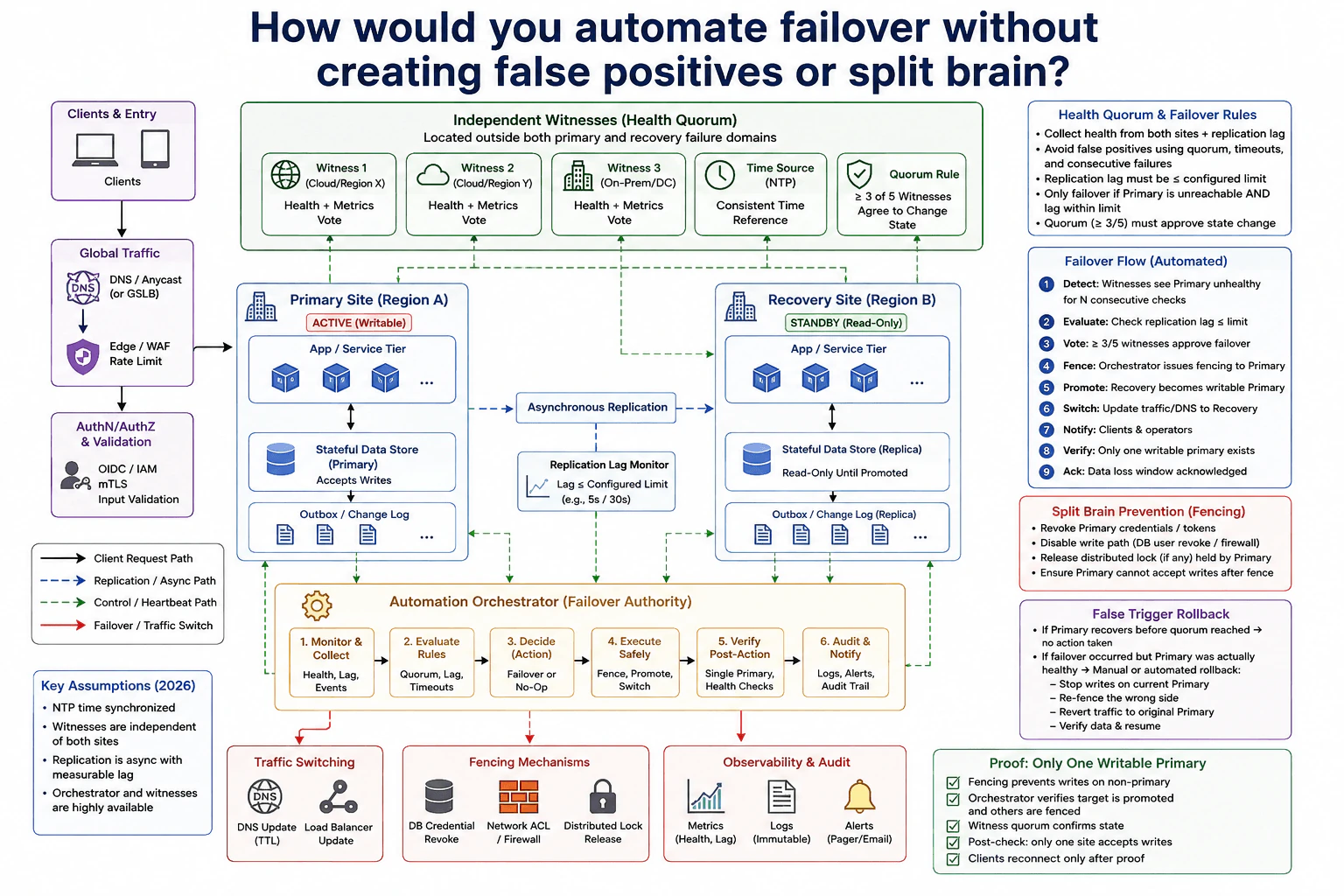
68. How would you automate failover without creating false positives or split brain?Reliability And Disaster RecoveryHard
i Question Details
A stateful service has primary and recovery sites connected by asynchronous replication. Design health quorum, independent witnesses, replication-lag limits, fencing, failover authority, idempotent automation, traffic switching, data-loss acknowledgment, rollback of a false trigger, and proof that only one writable primary exists before clients reconnect.
Short Interview Answer (30-60 seconds)
At a high level, I would automate failover only when several independent checks agree that the Primary is really unavailable. The main challenge is avoiding a false trigger while also preventing both sites from accepting writes. I would divide the design into detection and approval, fenced promotion, and traffic recovery. Independent witnesses form a quorum, replication lag must stay within the allowed limit, and the old Primary is fenced before Recovery becomes writable. Clients reconnect only after the system proves that one writable Primary exists. The trade-off is slightly slower failover for much safer behavior.
Detailed Explanation
The goal is to keep a stateful service running when the Primary Site fails, without accidentally creating two writable copies. That is difficult because a network problem can make a healthy Primary look unavailable. The Recovery Site can also be slightly behind because replication is asynchronous. The design handles this by collecting health signals from independent places, requiring quorum before acting, checking replication lag, fencing the old Primary, promoting Recovery, switching traffic, and proving that only one site can accept writes before clients reconnect.
Useful Questions to Ask the Interviewer
What replication-lag limit is acceptable before failover?
How much possible data loss can the business accept?
Which failures may trigger automatic failover, and which need operator approval?
How quickly must traffic move to the Recovery Site?
How to Explain It in an Interview
1. Detect a real failure before acting
I would not fail over because one monitor reports a problem. Both sites report application, database, resource, network, and replication health.
Independent Witnesses are outside the Primary and Recovery failure domains. They use quorum, timeouts, and consecutive failures so one bad monitor or one broken network path cannot easily trigger failover. The Automation Orchestrator acts only when the required health decision is satisfied.
2. Check replication and the possible data-loss window
Before promotion, the Automation Orchestrator checks the Replication Lag Monitor. Replication lag means the Recovery copy may be slightly behind the Primary.
The lag must stay within the configured limit. Because replication is asynchronous, the newest writes may still be missing after failover. The acceptable data-loss window must therefore be acknowledged before the change when policy requires it.
3. Fence the old Primary before Recovery becomes writable
The strongest split-brain rule is that only one site may own writes. Before Recovery is promoted, the old Primary is fenced so it cannot accept new writes.
The diagram shows fencing through database credential revocation, network ACL or firewall blocking, and removal of a distributed write lock or token. Only after this protection succeeds may the Recovery Stateful Data Store become writable.
4. Make the automation safe to run again
The Automation Orchestrator follows clear stages: Monitor & Collect, Evaluate Rules, Decide, Execute Safely, Verify Post-Action, and Audit & Notify. Each action should be safe if the same step is retried.
This is idempotent behavior, which means repeating the same automation step does not create a second promotion or conflicting state. Metrics, logs, alerts, and the audit trail record each important action.
5. Switch traffic only after proving a single writer
After Recovery is promoted, Traffic Switching updates DNS or the load balancer. Clients should not reconnect only because promotion was requested.
The system first verifies that the old Primary is fenced, Recovery is the intended writable site, quorum agrees with the state, and only one site accepts writes. Then traffic moves to Recovery and clients reconnect.
If the trigger was false, the rollback path first stops writes on the current writer. It verifies the original Primary and the data, establishes single-writer ownership again, then returns traffic only after the original Primary is safely restored as the sole writable site. The trade-off is a little more recovery time and control-plane complexity in exchange for much stronger protection against false positives and split brain.
Practical Complexity & Trade-offs
The benefit is much safer failover. One bad health check cannot immediately move the service. Independent witnesses, quorum, timeouts, and repeated checks reduce false alarms. Fencing also prevents split brain because the old Primary loses write access before Recovery is promoted. The downside is that these checks make failover slower. Asynchronous replication also means Recovery can be slightly behind, so some recent writes may be lost within the accepted limit. DNS or load-balancer changes can add more delay. The fencing, monitoring, audit, and rollback logic also make the control plane harder to operate.
Why Interviewers Ask This
Interviewers ask this to see whether you understand that failover is more than checking whether a server is alive. They want to test your judgment around false alarms, quorum, asynchronous replication, fencing, and write ownership. They also want to see whether you can explain safe automation, traffic switching, data-loss limits, verification, and rollback without claiming instant recovery or zero data loss.
Interviewer may ask next
What would you change if the business could not accept any data loss during failover?
I would keep the same basic control flow, but I would make promotion more restrictive. The current design uses asynchronous replication, so Recovery can be behind the Primary. That means this architecture cannot honestly promise zero data loss during an uncertain failure.
The Health Quorum would still decide whether the Primary appears unavailable. The Replication Lag Monitor would still report how far Recovery is behind. However, the Automation Orchestrator would stop before promotion unless the required data state could be proven safe.
Fencing would still happen before any new writer is allowed. Traffic Switching would also wait until the system proves that the chosen site has the required data and is the only writer.
The main downside is availability. If the system cannot prove that no committed writes would be lost, write service may remain unavailable longer instead of failing over quickly.
What happens if failover completes and you later discover that the original Primary was actually healthy?
I would use the False Trigger Rollback path, but I would not immediately send traffic back. The first goal is still to keep exactly one writable Primary.
If Recovery is currently writable, the rollback process first stops writes there. The system then verifies the original Primary, checks the data state, and establishes clear write ownership again. The original Primary must become the sole writable site before client traffic returns to it.
After that, Traffic Switching can update DNS or the load balancer back to the original site. Normal replication resumes only after the roles are clear and the data has been checked. Metrics, logs, alerts, and the audit trail record the rollback steps.
The downside is that rollback takes time. It must be slower than a simple traffic flip because preventing two writers is more important than restoring the old topology quickly.
69. What is cloud elasticity, and how does it affect both performance and cost?Performance And Cost OptimizationEasy
i Question Details
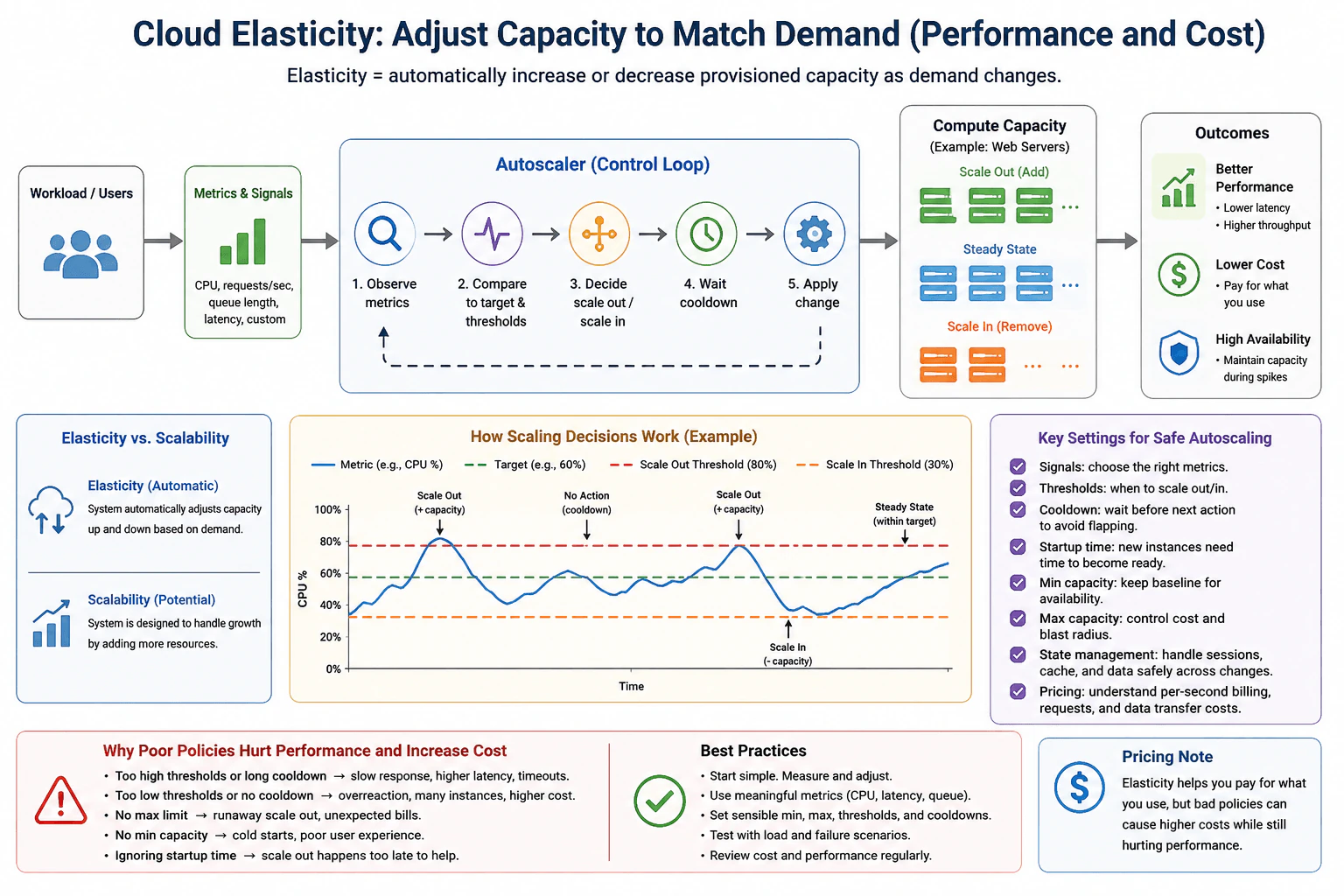
Define elasticity as adjusting provisioned capacity as demand changes and distinguish it from scalability. Explain the signals, thresholds, cooldowns, startup time, minimum and maximum capacity, state management, and pricing considerations behind safe autoscaling, including how poor policies can increase cost while still harming performance.
Short Interview Answer (30-60 seconds)
I would first measure demand, latency, errors, queue depth, and resource use, then set autoscaling so provisioned capacity can grow when demand rises and shrink when demand falls. That is elasticity. Scalability is the broader ability of a system to handle more load, while elasticity is the dynamic adjustment of capacity. Good policies can lower latency, maintain useful capacity during spikes, and remove idle capacity later. Poor thresholds, cooldowns, startup assumptions, or limits can cause slow scaling, instability, and unnecessary cost.
Detailed Explanation
The practical goal is to match cloud capacity to the work arriving at the system. When demand grows, we add enough capacity before users see slow responses or errors. When demand falls, we remove unused capacity so we are not paying for resources that do little work. The challenge is timing. If we react too late, performance suffers. If we react too often or too aggressively, cost can rise. Safe signals, thresholds, cooldowns, startup planning, capacity limits, state handling, and pricing awareness keep both goals balanced.
Useful Questions to Ask the Interviewer
Which workload signal matters most for this service, such as request volume, response time, queue depth, CPU use, or a custom metric?
What user experience target should the scaling policy protect?
How long does new capacity take to become ready?
What are the minimum and maximum capacity limits?
Which pricing model and billing units apply to the resources being scaled?
How to Explain It in an Interview
Cloud elasticity means adjusting provisioned capacity as demand changes. A service can add capacity when demand rises and remove capacity when demand falls. This is different from scalability. Scalability means the system is designed to handle growth. Elasticity describes the dynamic movement up and down within the capacity the system can use.
I would start with evidence. Useful signals can include CPU utilization, request rate, queue length, latency, and custom application metrics. The right signal depends on what becomes saturated first. For example, CPU may be useful when request work is compute heavy, while queue depth may be more useful when incoming work waits for workers. I would capture a baseline from production metrics and use representative load tests before changing the policy.
The autoscaler works as a control loop. It observes metrics, compares them with a target or threshold, decides whether to scale out or scale in, and applies the capacity change. A cooldown or stabilization period keeps the system from reacting again too quickly. New capacity may also need startup time before it can serve traffic, so the policy must react early enough to cover that delay. A minimum capacity keeps a safe baseline available. A maximum capacity limits runaway growth and helps control blast radius and spend.
State also matters. If user sessions, cache entries, or other important data live only inside one instance, removing that instance can lose state or interrupt work. A safer design keeps shared state in an appropriate external store or uses a clear transfer strategy so instances can be added and removed safely.
Pricing changes the cost result. Elasticity can reduce waste because idle capacity can be removed, but savings are not automatic. The real effect depends on the billing unit, usage based charges, commitments, instance or service pricing, requests, storage, and data transfer. I would compare actual cost and utilization before and after the policy change instead of inventing a savings percentage.
Poor policies can hurt both performance and cost. A threshold that is too high, a cooldown that is too long, or ignored startup time can make scale out happen too late, causing high latency, queue growth, timeouts, or errors. A threshold that is too low or a policy that reacts to short spikes can add too much capacity and create unnecessary cost. Missing maximum limits can allow runaway scale out. Missing minimum capacity can leave too little ready capacity for sudden demand. Good elasticity can also help maintain service capacity during spikes, but it does not guarantee availability by itself.
After tuning, I would run the same representative workload again and compare latency percentiles, throughput, errors, CPU or other saturation signals, queue depth, capacity, utilization, and cost for the same measurement boundary. I would verify correct application behavior and check whether the bottleneck moved to a database, network service, storage system, queue, or another dependency. Then I would monitor the same signals after deployment and adjust the policy from measured evidence.
Technical Approach
Define the workload and success metrics. Choose the user visible performance target and the cost boundary that will be measured.
Capture a baseline. Record demand, latency percentiles, throughput, errors, utilization, queue depth, current capacity, and relevant cost data.
Choose the scaling signal. Use the metric that best represents real saturation or demand for this workload.
Set the policy. Define scale out and scale in thresholds or a target, cooldown behavior, startup allowance, minimum capacity, and maximum capacity.
Check state behavior. Confirm that adding or removing instances does not lose sessions, cache state, or important work.
Test with representative demand. Include normal load, spikes, and falling demand so both scale out and scale in behavior are observed.
Compare results. Use the same workload and measurement boundary to compare latency, errors, throughput, utilization, capacity, and cost.
Check other dependencies. Confirm that scaling the compute layer did not move saturation to a database, queue, network path, or storage service.
Deploy carefully and keep monitoring the same metrics. Adjust only from measured evidence.
Practical Insights
There is no useful algorithmic time complexity for this question. The practical cost comes from extra cloud capacity, startup work, monitoring, and the control actions used to add or remove resources. More capacity can reduce saturation and latency, but it also increases spend. Less capacity can reduce spend, but removing too much can create queues, errors, or slow responses. Frequent scaling can add operational churn. State storage, requests, data transfer, and dependent services can also add cost, so the measurement boundary should include the resources affected by each scaling action.
Why Interviewers Ask This
Interviewers ask this to see whether I understand how changing cloud capacity with demand affects both user experience and spend. They want to hear how I choose useful signals, set safe thresholds and limits, account for cooldown and startup time, handle state safely, and verify the result with performance and cost metrics instead of assuming that autoscaling is automatically efficient.
Common interview mistakes
Common mistakes include treating elasticity and scalability as the same idea, choosing a metric that does not represent the real bottleneck, scaling from averages while tail latency or queue depth is failing, setting thresholds without considering startup time, using a cooldown that is too short or too long, reacting to brief spikes, forgetting minimum and maximum capacity, storing important state only inside removable instances, assuming more instances always improve throughput, ignoring database or network saturation, comparing cost with different workloads, and claiming savings without measured billing data.
Interview tip
Explain elasticity as a feedback loop. Start with demand and measurable signals, then describe the target or threshold, the scale out or scale in decision, the capacity change, cooldown behavior, startup delay, and the result for users and cost. Clearly separate elasticity from scalability. Finish by explaining how poor policies can create both slow performance and higher spend, and say that you would verify the policy with the same representative workload before and after the change.
Interviewer may ask next
What if average CPU looks healthy, but users still see high latency during traffic spikes?
I would not assume the system has enough capacity from average CPU alone. For this web service, I would inspect latency percentiles, request rate, queue depth, error rate, CPU, and dependency timing over the same traffic window. A short burst can create queueing or saturate a database, network path, worker pool, or another dependency while average CPU still looks normal. I would choose the scaling signal that tracks the real bottleneck and test it with representative spikes. The tradeoff is that a more sensitive signal can react faster, but it can also scale too often if thresholds and cooldowns are poorly chosen.
How would you tune elasticity if new instances take several minutes to become ready?
I would include that startup delay in the scaling policy instead of waiting for the service to become overloaded. For this workload, I would use a signal and threshold that give enough lead time, keep a safe minimum capacity, and consider a larger or earlier scale out step when evidence shows demand can rise faster than new capacity becomes ready. I would test the same load pattern and compare latency, errors, queue depth, ready capacity, utilization, and cost. The tradeoff is that extra baseline or earlier capacity can cost more, but it can protect performance while slow startup capacity is becoming ready.
70. How do Reserved Instances, Savings Plans, and Spot capacity differ?Performance And Cost OptimizationEasy
i Question Details
Compare the pricing commitment, service or instance flexibility, interruption risk, utilization requirement, and accounting boundary of these AWS options. Use a steady baseline service and a fault-tolerant batch workload as examples, and identify the utilization and interruption evidence needed before selecting each option.
Short Interview Answer (30-60 seconds)
I would choose from measured workload behavior first. For stable baseline EC2 usage, Reserved Instances can fit when the instance requirements are predictable. Savings Plans fit steady compute spending when I need more flexibility. Spot capacity has no long term commitment and fits fault tolerant work that can handle interruption and restart. Before choosing, I would review about 30 to 90 days of usage, expected infrastructure changes, account boundaries, and whether the workload can recover safely from a Spot interruption.
Detailed Explanation
The practical decision starts with how steady the workload is, how much its infrastructure may change, and whether the work can safely stop and restart. A service that runs every day may justify a longer spending commitment because its baseline demand is predictable. A batch job that can retry may use spare capacity instead. Before choosing, I would examine recent usage, planned changes, who owns the cost, and what happens during an interruption. This helps avoid paying for unused commitments while keeping important services reliable.
Useful Questions to Ask the Interviewer
Is the baseline service stable every day, or does its usage change often?
Are instance families, sizes, operating systems, tenancy choices, or Regions expected to change?
Can the batch workload checkpoint, retry, and restart after a two minute interruption notice?
Which AWS account purchases the commitment, and should eligible discounts be shared with other accounts?
How to Explain It in an Interview
I would start with measured utilization and workload stability. For the steady baseline service shown in the diagram, I would review about 30 to 90 days of hourly usage by instance family and Region. I would look at average utilization, p95 utilization, idle periods, and whether the service runs every day. I would commit only to the part of demand that is consistently present.
Reserved Instances are mainly an EC2 billing discount for matching usage. They usually use a one year or three year term, with payment choices such as no upfront, partial upfront, or all upfront. Regional Reserved Instances do not reserve capacity. Zonal Reserved Instances can also reserve matching capacity in one Availability Zone. Reserved Instances therefore fit predictable EC2 usage when instance requirements are fairly stable. Their flexibility is lower than a Compute Savings Plan because matching depends on characteristics such as instance family, Region, operating system, tenancy, and size, although some size flexibility can apply within an instance family. Using a Reserved Instance does not create a Spot style interruption mechanism.
Savings Plans also use a one year or three year commitment, but the commitment is based on a consistent amount of compute spending per hour rather than a specific instance configuration. A Compute Savings Plan is more flexible because qualifying usage can move across EC2 instance families, sizes, operating systems, tenancy choices, and Regions. It can also apply to eligible Fargate and Lambda usage. This fits a workload with steady compute spending when the exact infrastructure may change. Savings Plans do not reserve EC2 capacity and do not create Spot style interruptions. The main cost risk is paying for committed spend that is not fully used.
Spot capacity is different because there is no one year or three year spending commitment. It uses spare EC2 capacity at a discount, but AWS can interrupt the capacity when it is needed elsewhere. The workload therefore needs to tolerate interruption, checkpoint useful progress when appropriate, retry safely, and relaunch on available capacity. The fault tolerant batch example in the diagram fits this model because jobs can return to the queue or restart and continue producing output.
For utilization evidence, I would examine hourly usage patterns, average utilization, p95 utilization, idle periods, and whether the baseline runs every day. For stability evidence, I would check how often instance families, sizes, and Regions change and whether migrations are planned. For Spot, I would verify interruption tolerance by testing checkpoint behavior, retries, idempotent processing, and restart behavior. I would also compare the expected commitment with the measured baseline so I do not commit to usage that may disappear.
The accounting boundary matters too. The purchasing account owns the Reserved Instance or Savings Plan commitment. When discount sharing is enabled in AWS Organizations, eligible benefits can apply to qualifying usage in other accounts in the organization. Spot has no long term spending commitment to share. Its cost follows the Spot usage that actually runs.
My practical rule is simple. I would use Reserved Instances for fixed and predictable EC2 needs, Savings Plans for steady compute spending when flexibility matters, and Spot capacity for interruptible, cost sensitive, scalable work. I would make the final choice from measured usage, expected change, account ownership, and tested interruption behavior rather than assuming one option is always cheapest.
Technical Approach
Collect about 30 to 90 days of hourly usage for the steady baseline service.
Group the evidence by instance family, Region, and account.
Review average utilization, p95 utilization, idle periods, and whether the service runs every day.
Ask how often instance families, sizes, operating systems, tenancy choices, and Regions are expected to change.
For stable EC2 requirements, evaluate a Reserved Instance against the measured baseline. Remember that Regional Reserved Instances provide a billing discount while Zonal Reserved Instances can also reserve matching capacity in one Availability Zone.
For steady compute spending with changing infrastructure, evaluate a Compute Savings Plan because it provides broader flexibility across eligible compute usage.
For the fault tolerant batch workload, test interruption recovery. Verify checkpointing, retries, idempotent processing, and relaunch behavior before using Spot capacity.
Confirm which account owns each commitment and whether AWS Organizations discount sharing is enabled for eligible accounts.
Compare expected commitment use with actual measured demand and avoid committing beyond the defensible baseline.
Continue monitoring utilization, unused commitment, Spot interruptions, retries, queue behavior, and successful batch completion after the choice is deployed.
Practical Insights
The main cost is financial and operational rather than algorithmic. Reserved Instances and Savings Plans require a long term commitment, so unused commitment can waste money. Savings Plans provide more compute flexibility than Reserved Instances, but they still require steady committed spending. Spot has no long term commitment, but the workload needs interruption recovery, retry logic, monitoring, and testing. That adds engineering and operational work. The safest approach is to commit only to a measured steady baseline and keep uncertain or interruptible demand flexible.
Why Interviewers Ask This
Interviewers want to see whether I can match an AWS pricing option to real workload evidence instead of choosing only by the largest possible discount. They are testing whether I understand commitment length, compute flexibility, interruption behavior, utilization, account boundaries, and the difference between a steady baseline service and work that can safely restart.
Common interview mistakes
A common mistake is choosing the largest possible discount without measuring actual utilization. Another is buying too much Reserved Instance or Savings Plan commitment from a short traffic sample and then paying for unused commitment. Candidates also sometimes say that every Reserved Instance reserves capacity. Regional Reserved Instances do not reserve capacity, while Zonal Reserved Instances can reserve matching capacity in one Availability Zone. Another mistake is treating Savings Plans as interruptible capacity. They are billing commitments and do not create Spot style interruptions. For Spot, a major mistake is using it for work that cannot checkpoint, retry, or restart safely. It is also easy to ignore account ownership and AWS Organizations discount sharing when estimating where benefits will apply.
Interview tip
Start with the workload instead of the discount. Say that you first measure the steady baseline, then check how much infrastructure flexibility is needed, then test interruption tolerance. Map those facts to Reserved Instances, Savings Plans, or Spot. Mention the account boundary and the risk of an underused commitment. This shows that the decision is based on evidence rather than a pricing table.
Interviewer may ask next
What if average utilization looks high, but the steady baseline service has large idle periods every night?
I would not size the commitment from the average alone. For the steady baseline service, I would inspect about 30 to 90 days of hourly usage and identify the demand that stays present through both busy and quiet periods. Large nightly idle periods can mean that a commitment based on daytime average usage will be underused. I would commit only to the defensible baseline and leave uncertain demand flexible. The tradeoff is that a smaller commitment may give up some savings, but it reduces the risk of paying for unused committed spend.
How would your choice change if the batch workload grows quickly but Spot interruptions become frequent?
I would keep the decision tied to the fault tolerant batch workload and its measured recovery behavior. I would track interruption frequency, retry volume, queue delay, completion time, and successful output. If frequent interruptions cause excessive retries or prevent jobs from meeting their completion goal, I would reduce dependence on the affected Spot capacity and use a more stable capacity mix while continuing to use Spot where recovery remains effective. The tradeoff is higher compute cost in exchange for more predictable completion. I would keep the checkpoint and retry design because Spot capacity can still be useful when suitable capacity is available.
More questions load as you scroll
Disclaimer: This interview guide is for educational and informational purposes only. It is designed to help readers prepare, but it does not guarantee any interview result, hiring decision, offer, or outcome. Interview questions, hiring criteria, and preferred answers can vary by employer, interviewer, industry, location, and time. All answers, examples, and explanations in this guide are suggested examples for interview preparation, not definitive answers or instructions for professional practice. They are based on research and judgment, are provided without warranties of any kind, and should be adapted to the question, role, and applicable laws and professional requirements. Diagrams are simplified illustrations intended to highlight the main concepts and their relationships; actual situations, systems, and practices may be more complex. Alternative approaches may be equally valid or better suited to a particular question, context, or interviewer. To the fullest extent permitted by applicable law, the contributors and publisher are not liable for decisions made, actions taken, or losses incurred based on this guide.
State Laws and Professional Responsibilities: Laws and requirements governing an occupation vary by state and jurisdiction. You are responsible for checking the current laws, licensing requirements, and scope-of-practice rules that apply to your location and role, and for ensuring that your answers and actions comply with them. Adapt examples in this guide to those requirements. This guide is not legal advice.
Content Accuracy and Verification: To the fullest extent permitted by applicable law, we do not represent or warrant that interview guides, questions, answers, examples, or diagrams are accurate, complete, current, error-free, or suitable for any particular purpose. You are responsible for independently reviewing and verifying the information before relying on it.