This interview guide is for educational and informational purposes only. It is designed to help readers prepare, but it does not guarantee any interview result, hiring decision, offer, or outcome. Interview questions, hiring criteria, and preferred answers can vary by employer, interviewer, industry, location, and time. All answers, examples, and explanations in this guide are suggested examples for interview preparation, not definitive answers or instructions for professional practice. They are based on research and judgment, are provided without warranties of any kind, and should be adapted to the question, role, and applicable laws and professional requirements. Diagrams are simplified illustrations intended to highlight the main concepts and their relationships; actual situations, systems, and practices may be more complex. Alternative approaches may be equally valid or better suited to a particular question, context, or interviewer. To the fullest extent permitted by applicable law, the contributors and publisher are not liable for decisions made, actions taken, or losses incurred based on this guide.
State Laws and Professional Responsibilities
Laws and requirements governing an occupation vary by state and jurisdiction. You are responsible for checking the current laws, licensing requirements, and scope-of-practice rules that apply to your location and role, and for ensuring that your answers and actions comply with them. Adapt examples in this guide to those requirements. This guide is not legal advice.
Identity, Image, and Privacy Notice
To respect individual privacy, some names, profile photographs, avatars, biographical details, and other identifying information displayed in this guide may be replaced with pseudonyms, licensed stock images, illustrative avatars, composite images, or representative descriptions. Unless a person is expressly identified as an actual contributor, a displayed name, image, or profile should not be understood as depicting or identifying a specific candidate, interviewer, employee, or other real individual. These representations are provided for editorial and illustrative purposes only and do not imply endorsement, employment, participation, or affiliation with this guide or any company mentioned in it. Any resemblance to an actual person is coincidental.
Company Notice
This guide is an independent educational resource and is not affiliated with, endorsed by, sponsored by, or approved by the company named in this guide. Company names identify reported interview experiences or the employer context of clearly labeled original practice exercises. Interview practices can change without notice, and inclusion of company-specific content does not mean these questions are official, complete, or guaranteed to be asked. To the fullest extent permitted by law, the author, contributors, and publisher are not responsible for outcomes related to use of this material.
Content Accuracy and Verification
To the fullest extent permitted by applicable law, we do not represent or warrant that interview guides, questions, answers, examples, or diagrams are accurate, complete, current, error-free, or suitable for any particular purpose. You are responsible for independently reviewing and verifying the information before relying on it.
Questions or comments?
Contact us for general questions, or share feedback, technical corrections, and comments with the community.
11. How would you integrate an acquired company that uses a different cloud and account structure?Cloud ArchitectureHard
i Question Details
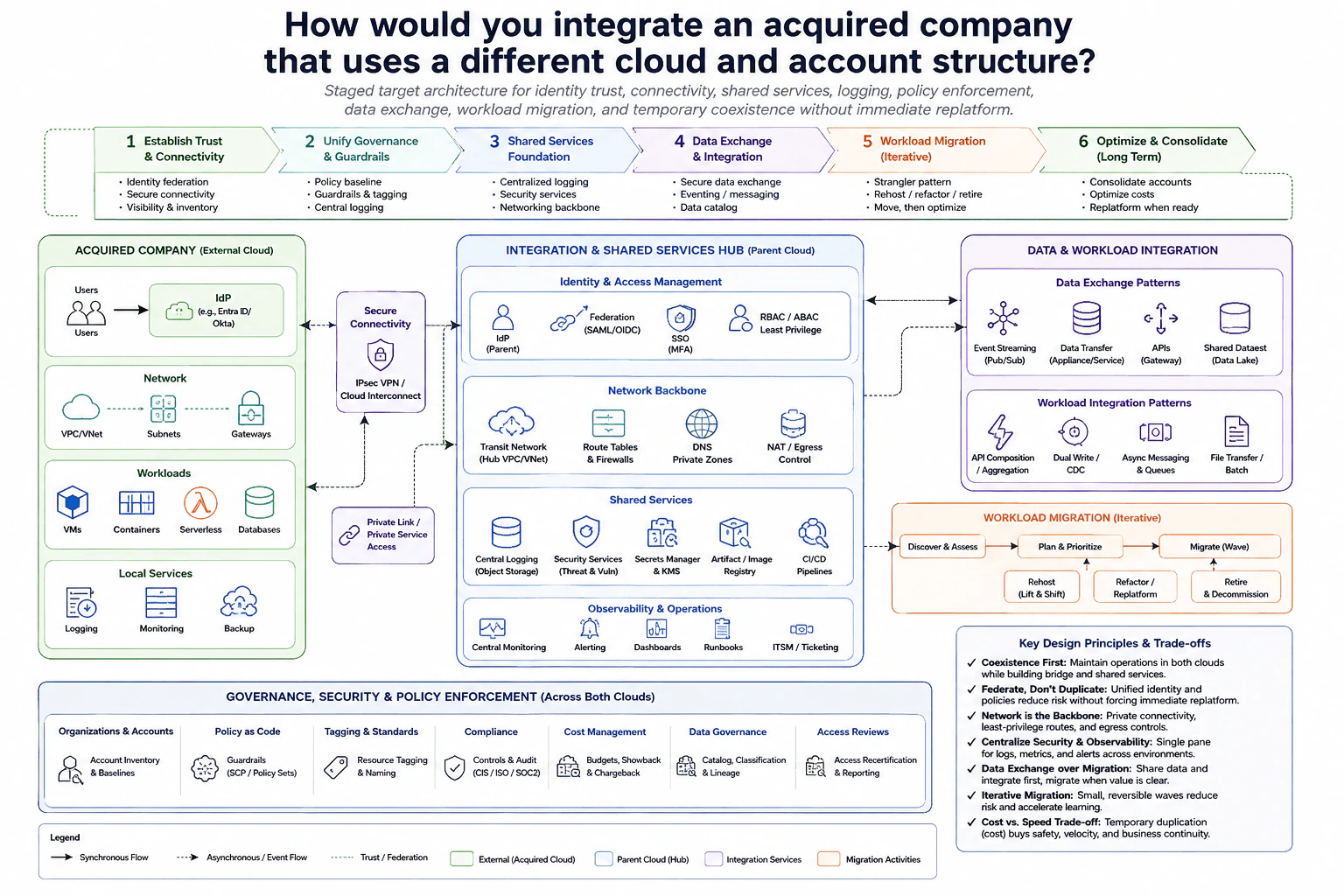
The parent company and an acquired business use different cloud providers, identity systems, network models, and governance conventions. Design a staged target architecture for identity trust, connectivity, shared services, logging, policy enforcement, data exchange, workload migration, and temporary coexistence without forcing an immediate replatform.
Short Interview Answer (30-60 seconds)
At a high level, I would integrate the two companies without forcing an immediate cloud migration. The main challenge is creating shared trust, networking, security, governance, and visibility while both environments keep running. I would organize the work into three parts: establish the cross-cloud foundation, integrate shared services and data, then migrate workloads in small waves. The trade-off is temporary duplication and extra cost, but that reduces migration risk and protects business continuity.
Detailed Explanation
The goal is to let the parent company and acquired company work together safely while they still use different clouds. Their users, networks, security rules, account structures, and operating practices may be different. Moving everything at once would create unnecessary risk. The diagram therefore starts with trust, connectivity, and common controls. It then adds shared services and controlled data exchange. Workloads move later in small waves, while both environments can continue operating during the transition.
Useful Questions to Ask the Interviewer
Which workloads must stay in the acquired cloud for now?
Which users need access across both companies?
What data is allowed to cross cloud boundaries?
Which security and compliance controls must apply across both clouds?
Which workloads should move first, and which can remain where they are?
How to Explain It in an Interview
1. Establish trust and secure connectivity
I would first connect the two companies without merging their environments. The acquired company keeps its local IdP. The parent IdP connects through Federation using SAML or OIDC. SSO with MFA handles sign-in, while RBAC or ABAC applies least-privilege access.
For networking, Secure Connectivity uses an IPsec VPN or Cloud Interconnect. The parent Network Backbone provides the Transit Network, Route Tables and Firewalls, DNS Private Zones, and NAT or Egress Control. Private Link or Private Service Access can provide private service connectivity where needed.
2. Create shared services and common operations
Next, I would build the Integration & Shared Services Hub in the parent cloud. Shared Services include Central Logging, Security Services, Secrets Manager and KMS, Artifact or Image Registry, and CI/CD Pipelines.
Observability & Operations adds Central Monitoring, Alerting, Dashboards, Runbooks, and ITSM or Ticketing. The acquired company can keep its local Logging, Monitoring, and Backup while this shared operating layer is introduced.
3. Apply governance across both clouds
I would apply common guardrails without making both clouds identical. The governance layer covers Organizations and Accounts, Policy as Code, Tagging and Standards, Compliance, Cost Management, Data Governance, and Access Reviews.
This follows the diagram's Federate, Don't Duplicate principle. Identity and policy are unified where useful, while each cloud can keep provider-specific account and service structures during coexistence.
4. Exchange data and integrate workloads
For cross-cloud data, the diagram supports Event Streaming, Data Transfer, APIs, and a Shared Dataset. These patterns allow systems to exchange information before their workloads move.
The Workload Integration Patterns include API Composition or Aggregation, Dual Write or CDC, Async Messaging and Queues, and File Transfer or Batch. Data Governance provides catalog, classification, and lineage for shared data.
5. Migrate iteratively and consolidate later
I would move workloads through Discover & Assess, Plan & Prioritize, and then Migrate in waves. Each workload can be Rehosted, Refactored or Replatformed, or Retired and Decommissioned.
The main idea is coexistence first. Small, reversible waves reduce risk and accelerate learning. Over time, the company can consolidate accounts, optimize costs, and replatform only where it adds clear value. The downside is temporary duplication, which costs more but protects business continuity.
Practical Complexity & Trade-offs
The benefit is that both companies can keep operating while integration happens step by step. Shared identity, networking, logging, security, governance, and policy give the parent company common control without forcing every workload to move. The downside is temporary duplication. Running two cloud environments means more cost, more operating work, and more systems to watch. Private connectivity and shared services also require setup and maintenance. We accept this because small migration waves are safer than one large move. The diagram also favors managed services and automation where useful, which can lower long-term work after the transition.
Why Interviewers Ask This
Interviewers use this question to test whether you can manage a large cloud integration without creating unnecessary business risk. They want to see whether you separate identity, networking, governance, shared services, data exchange, operations, and migration concerns. They also want good judgment about temporary coexistence. A strong answer shows that you can establish common controls first, move workloads gradually, and explain the cost-versus-risk trade-off clearly.
Interviewer may ask next
What would you change if several acquired workloads cannot be migrated for two years?
I would keep the same architecture, but I would treat coexistence as a longer-term operating model instead of a short migration phase. The acquired workloads would remain inside the External Cloud with their existing VPC or VNet, compute, containers, serverless services, databases, and local services.
The Integration & Shared Services Hub would become even more important. Federation would continue connecting the local IdP with the parent IdP. Secure Connectivity would remain the network bridge. Central Logging, Central Monitoring, Security Services, and the governance controls would give the parent company visibility and common guardrails.
Data Exchange Patterns would let the two environments work together without moving applications. APIs, Event Streaming, Data Transfer, or a Shared Dataset could be selected based on each workload's needs.
The main downside is cost and operational complexity. Both cloud environments must stay supported for longer, so duplicate tooling, connectivity, and operating processes may remain in place.
How would you handle a workload that must share data across both clouds before it can migrate?
I would keep the workload where it is and use one of the Data Exchange Patterns already shown in the diagram. The choice depends on how the two systems need to exchange information.
For controlled service access, APIs through a gateway can expose an interface. Event Streaming can carry events between systems. Data Transfer can move larger data sets through an appliance or service. A Shared Dataset can provide approved common data. The Workload Integration layer also shows Dual Write or CDC, Async Messaging and Queues, API Composition or Aggregation, and File Transfer or Batch.
The same identity, network, logging, security, and governance controls still apply. Data Governance provides catalog, classification, and lineage for shared information.
The downside is extra integration complexity. These temporary cross-cloud data paths must be operated until the workload is migrated, replatformed, or retired.
12. What is CI/CD, and what problem does it solve in cloud delivery?DevOpsEasy
i Question Details
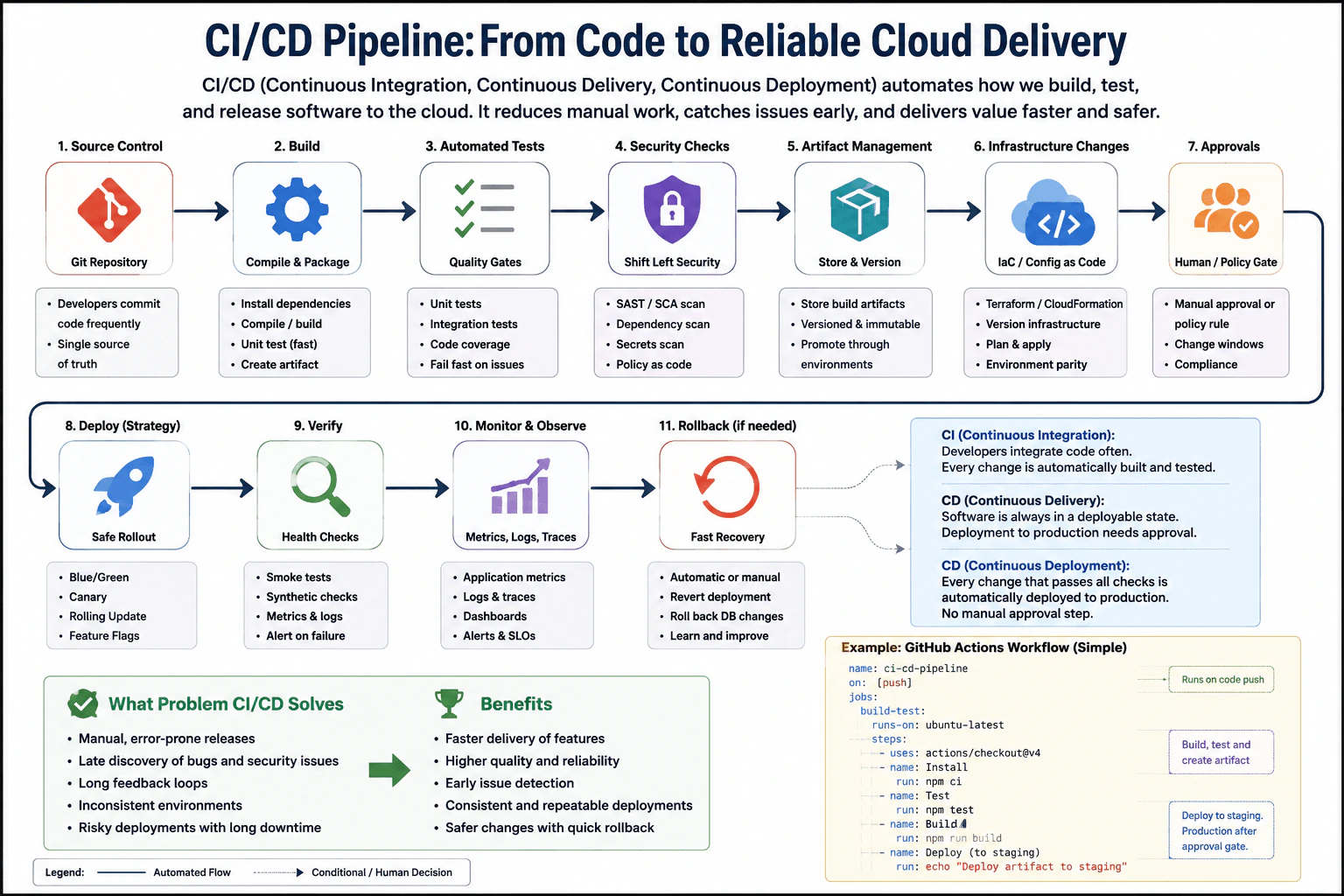
Define continuous integration, continuous delivery, and continuous deployment. Explain how source control, automated builds, tests, security checks, artifact management, infrastructure changes, approvals, deployment strategies, verification, and rollback form a cloud delivery pipeline, and distinguish delivery from automatic production deployment.
Short Interview Answer (30-60 seconds)
CI CD automates the path from a code change to a safe cloud release. Continuous integration means developers merge changes often and each change is built, tested, and checked early. Continuous delivery means a passing change is kept ready for release, while production can still require approval. Continuous deployment goes one step further and sends every passing change to production automatically. This solves slow manual releases, late defect discovery, inconsistent delivery, and risky large changes.
This question asks how a team moves a software change from a developer to live users in a safe and repeatable way. It asks how the team checks the change, stores the tested result, prepares the needed cloud resources, decides whether someone must approve the release, sends the change out carefully, checks that it works, and recovers if something goes wrong. It also asks you to explain the difference between keeping a change ready to release and releasing every successful change automatically.
Useful Questions to Ask the Interviewer
Does your team require a human approval before production, or does every passing change go to production automatically?
Which checks must pass before a release, such as tests, security scans, or policy checks?
Do you promote the same stored artifact through environments, or rebuild it for each environment?
How to Explain It in an Interview
CI means continuous integration. Developers commit changes often to a shared source repository. A pipeline runner takes each change and performs an automated build, tests, and security checks. These checks catch problems early and give fast feedback before the change reaches users.
After the checks pass, the pipeline creates and stores a versioned immutable artifact. An artifact is the exact packaged output that will be promoted through environments. Promoting the same tested artifact is safer than rebuilding different output for staging and production.
The next part is continuous delivery. Infrastructure changes can be prepared with tools such as Terraform or CloudFormation. The pipeline can run policy checks and then stop at an approval gate before production. At this point, the application is deployable, but a human or policy decision may still control when production changes happen.
A release can use blue green, canary, rolling update, or feature flags to reduce risk. After deployment, health checks, smoke tests, metrics, logs, traces, alerts, and service objectives help verify that the new version is healthy.
If verification fails, the recovery path can restore the last known good application version or revert a compatible infrastructure change. Database rollback needs extra care because data changes are not always safely reversible.
Continuous deployment removes the manual production approval step. After all automated checks and policies pass, the change goes to production automatically. The main benefit of CI CD is smaller, repeatable, observable releases with faster feedback and a clear recovery path.
Code
name: ci-cd-pipeline
on: [push]
jobs:
build-test:
runs-on: ubuntu-latest
steps:
# Read the repository content
- uses: actions/checkout@v4
# Install exact project dependencies from the lock file
- name: Install
run: npm ci
# Run the automated test suite
- name: Test
run: npm test
# Build the application output
- name: Build
run: npm run build
# Demonstrate delivery to staging without a remote mutation
- name: Deploy to staging
run: echo"Deploy artifact to staging"
Why Interviewers Ask This
Interviewers ask this to check whether you understand the complete path from a code change to a safe cloud release. They want to see whether you can connect source control, automated checks, stored build output, infrastructure changes, approval decisions, safe release methods, health verification, monitoring, and recovery. They also want to confirm that you know the important difference between continuous delivery and continuous deployment.
Common interview mistakes
A common mistake is saying continuous delivery and continuous deployment are the same. Continuous delivery can stop before production for approval, while continuous deployment releases automatically after the required automated checks pass. Another mistake is rebuilding the application separately for each environment instead of promoting the same tested artifact. Teams also create risk when they skip security checks, treat infrastructure changes as unrelated work, deploy without health verification, or have no clear rollback path. A retry is also different from a rollback. A retry runs an operation again, while a rollback restores a previous known good state.
Interview tip
Explain the flow in order. Start with source control, then build, tests, security, artifact storage, infrastructure changes, approval, deployment, verification, monitoring, and rollback. Finish by clearly stating that continuous delivery can wait for production approval, while continuous deployment releases automatically after all required automated checks and policies pass.
Interviewer may ask next
What should happen if the deployment completes but the new version fails health checks?
The release should be treated as unhealthy and further promotion should stop. The exact behavior is post deployment verification followed by recovery. The team can route traffic back to the last known good application version or revert a compatible infrastructure change, then investigate metrics, logs, and traces. Database changes need special care because they may not be safely reversible. This matters because a deployment command can succeed even when the application itself is not healthy.
When would you choose continuous delivery instead of continuous deployment?
I would choose continuous delivery when production needs an explicit approval or controlled release time. The pipeline can still build, test, scan, store the artifact, prepare infrastructure changes, and verify lower environments automatically, but production waits at the approval gate. This gives more control for compliance, business coordination, or higher risk systems. The tradeoff is slower release speed compared with continuous deployment, which sends every passing change to production automatically.
13. What stages would you include in a basic cloud CI/CD pipeline?DevOpsEasy
i Question Details
Describe a pipeline that takes an application change from source control to production. Cover build reproducibility, automated tests, artifact creation, security checks, environment promotion, deployment, verification, approval where needed, and rollback evidence.
Short Interview Answer (30-60 seconds)
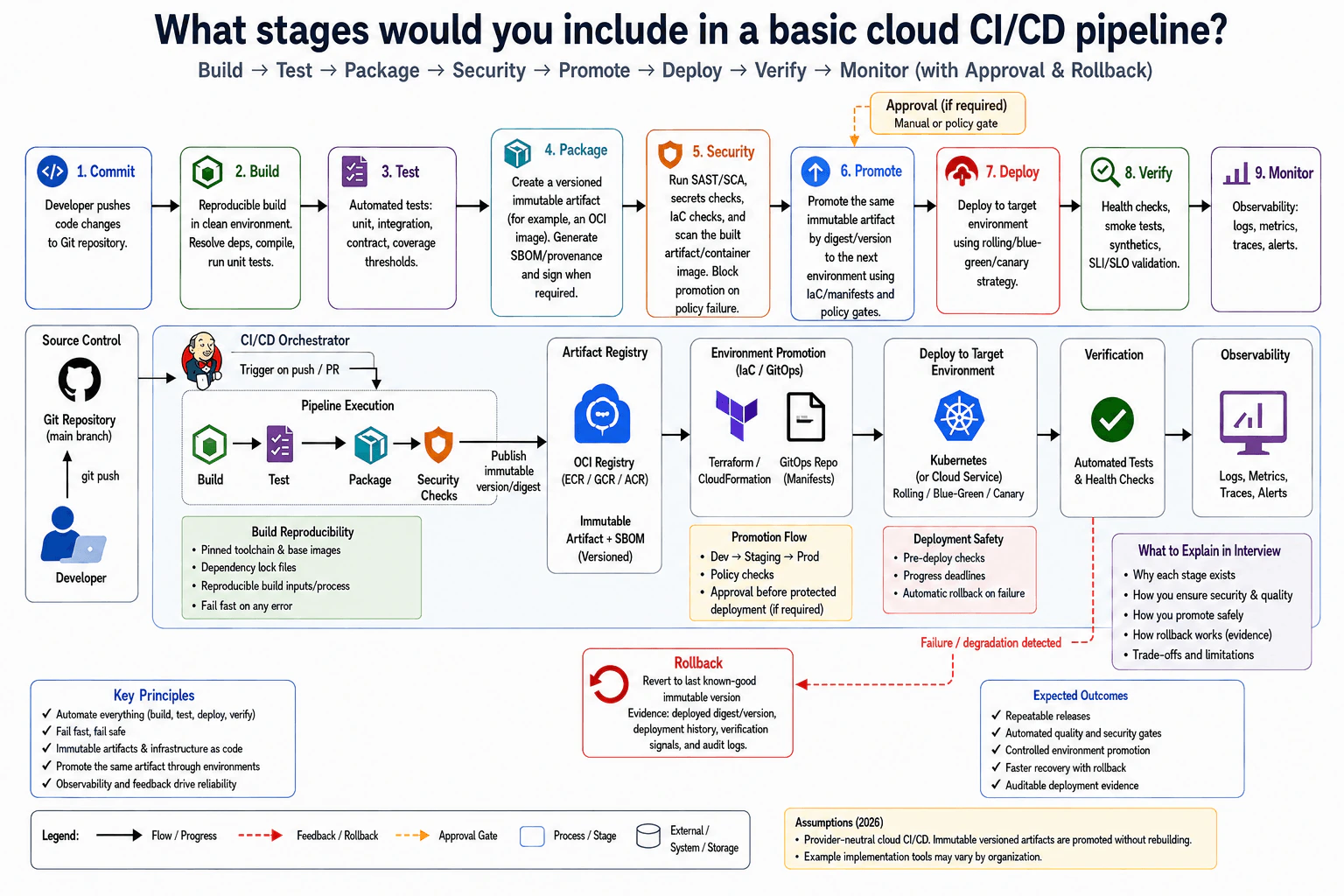
I would use a pipeline that moves through commit, reproducible build, automated tests, package creation, security checks, promotion, deployment, verification, and monitoring. I would create one versioned immutable artifact and promote that same artifact through environments instead of rebuilding it. For a protected production deployment, I would use a manual or policy approval when required. After deployment, health checks and observability confirm the release. If verification fails or production degrades, I would redeploy the last known good immutable version and keep the deployed version, verification signals, deployment history, and audit logs as rollback evidence.
Detailed Explanation
A basic delivery pipeline should move a code change through a clear set of checks before it reaches real users. First, the system creates the application in a repeatable way. It then checks that the application behaves correctly, creates one saved release package, checks that package for security problems, and moves the same package toward production. Before an important release, a person or company rule may approve it. After release, the system checks whether the application is healthy. If the new release causes problems, the team returns to the last known good release.
Useful Questions to Ask the Interviewer
Do production deployments require manual approval, or can a policy approve them automatically?
Are we deploying containers, another package type, or both?
Which environments should the same release artifact pass through before production?
Which verification signals should cause a rollback?
How to Explain It in an Interview
I would start with source control. A commit or pull request triggers the CI/CD orchestrator. The build runs in a controlled environment with pinned toolchains, pinned base images, and dependency lock files. This makes the build inputs and process reproducible.
Next, I run automated tests such as unit, integration, and contract tests. If these checks fail, the pipeline stops. I then create one versioned immutable artifact, such as an OCI container image. When required, I also generate software bill of materials and provenance information and sign the artifact.
Security checks should cover the relevant layers. Examples include source analysis, dependency analysis, secret checks, infrastructure configuration checks, and scanning the built artifact. A policy failure blocks further promotion.
After the checks pass, the immutable artifact is published to an artifact registry using a version or digest. The important rule is to promote that same artifact through development, staging, and production. I do not rebuild it for each environment because a rebuild could produce different bits from the version that was tested.
Infrastructure as code or deployment manifests define the target environment. A protected deployment can require manual or policy approval before production deployment proceeds. Deployment can use rolling, blue green, or canary delivery depending on the application and risk.
After deployment, I use health checks, automated verification, smoke tests, synthetic checks, and service objectives where appropriate. Logs, metrics, traces, and alerts provide ongoing evidence. If verification fails or production degrades, the rollback path redeploys the last known good immutable version. A deployment controller may perform that rollback automatically when reliable failure criteria are configured. I keep the deployed digest or version, deployment history, verification signals, and audit logs so recovery is traceable.
Why Interviewers Ask This
Interviewers ask this to see whether I understand the complete path from a source change to a safe production release. They want to know whether I can separate build, testing, artifact storage, security checks, environment promotion, deployment, verification, observability, approval, and recovery responsibilities. They also want to see whether I understand why the same immutable artifact should move through environments and what evidence is needed for a safe rollback.
Common interview mistakes
A common mistake is rebuilding the application separately for staging and production instead of promoting the same immutable artifact. Another mistake is treating a successful build as proof that the application is safe to release. Tests, security checks, deployment verification, and runtime observability answer different questions. Teams can also place approval after production deployment, which is too late to act as a deployment gate. Another mistake is treating every pipeline failure as a rollback. A build, test, package, or security failure should normally stop the pipeline because the new version has not been deployed. Rollback is relevant after deployment when verification or production signals show a problem. Finally, using only a mutable tag can lose evidence of the exact deployed artifact. An immutable version or digest, deployment history, verification signals, and audit logs provide stronger rollback evidence.
Interview tip
Explain the pipeline as one forward flow and state the purpose of each stage. Emphasize three ideas: build once and promote the same immutable artifact, block unsafe changes before deployment, and use verification plus recorded deployment evidence to make rollback safe and traceable.
Interviewer may ask next
What should happen if a security check fails before the application is deployed?
The pipeline should stop before promotion to the protected environment or deployment. This is a failure before deployment, so there is normally nothing to roll back because the new version has not replaced a running production version. The team should correct the issue, rerun the required build or checks as appropriate, and continue only after the security and policy gates pass. This matters because retry and rollback solve different problems. Retry continues a failed delivery attempt. Rollback restores a previously deployed version after a bad deployment.
Why should the same immutable artifact be promoted instead of rebuilding it for each environment?
I would promote the same immutable artifact because it keeps the production bits identical to the bits that passed earlier tests and security checks. The artifact can be identified by an immutable version or digest while environment specific configuration is supplied separately. Rebuilding for production can create different output because dependencies, base images, build tools, or external inputs may have changed. The tradeoff is that teams need disciplined artifact storage, version tracking, and configuration separation, but that discipline gives stronger release traceability and rollback evidence.
14. What is the difference between continuous delivery and continuous deployment?DevOpsEasy
i Question Details
Explain where the production decision occurs in each practice, what automation is shared, how approvals and risk controls differ, and how you would choose between them for a cloud service with regulated and non-regulated environments.
Short Interview Answer (30-60 seconds)
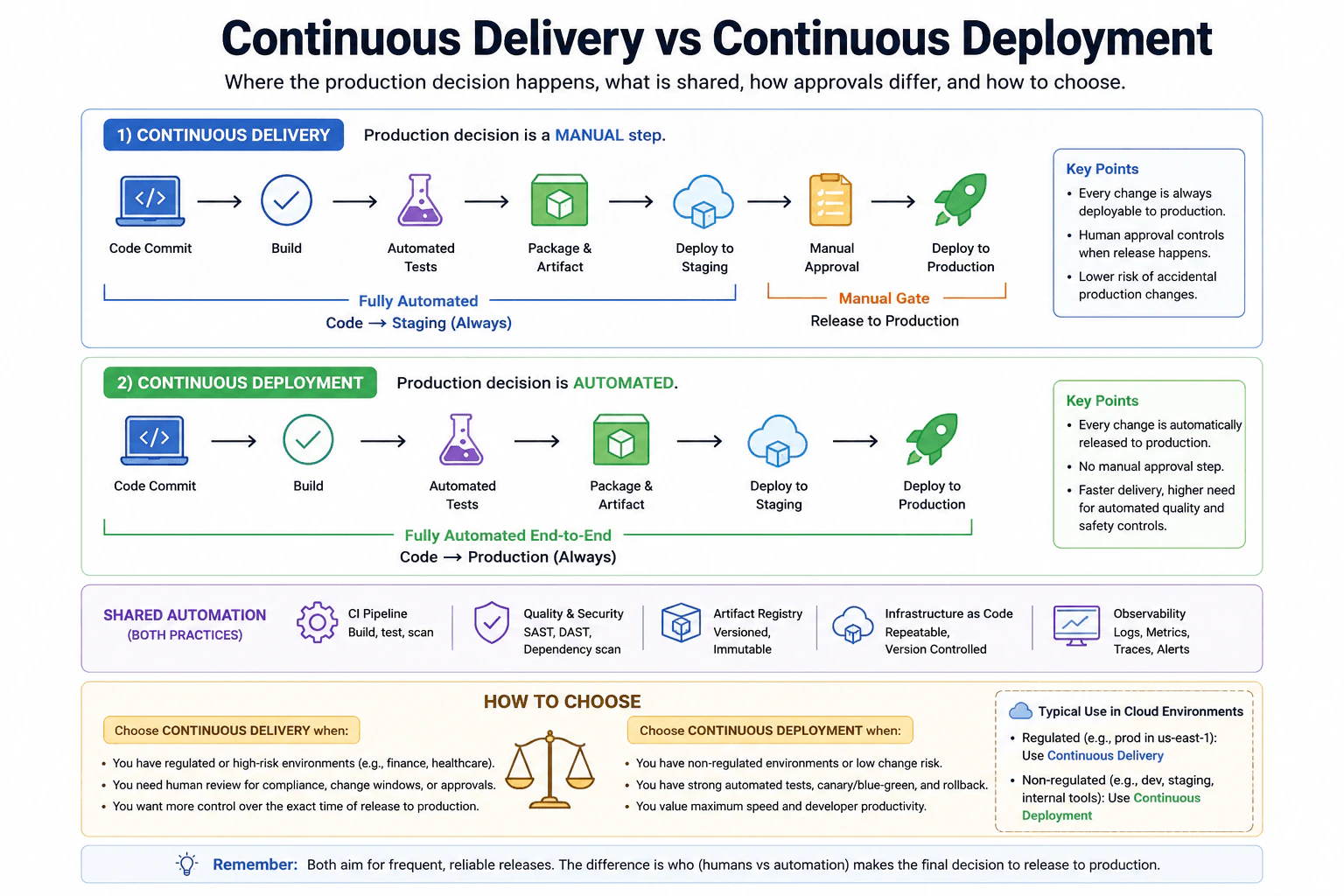
Continuous delivery keeps every change ready for production, but a person makes the final production release decision. Continuous deployment removes that manual production decision, so a change that passes the required automated checks can move to production automatically. Both can share build, test, security, packaging, artifact, infrastructure, and observability automation. I would normally keep manual approval for regulated or higher risk production environments and use continuous deployment where risk is lower and automated safeguards are strong.
Detailed Explanation
Continuous delivery and continuous deployment both help teams release software often and safely. The main difference is who decides when a ready change goes live. With continuous delivery, the work can move through checking and preparation automatically, but a person approves the final move into production. With continuous deployment, that final move happens automatically after all required checks pass. For a cloud service, I would use more human control where rules or business risk require it, and more automation where changes are lower risk and safety checks are strong.
Useful Questions to Ask the Interviewer
Which production environments have regulatory or approval requirements?
What automated tests, quality checks, and security checks must pass before production?
Does the service already support canary releases, blue green releases, feature flags, monitoring, and automatic rollback?
How to Explain It in an Interview
Both practices share most of the same automation. A developer commits code. The pipeline builds it, runs automated tests, performs quality and security checks, creates a versioned immutable artifact, and deploys that artifact to staging. Infrastructure as code can keep environments repeatable and version controlled. Observability through logs, metrics, traces, and alerts helps teams detect problems after deployment.
With continuous delivery, the change reaches a state where it is ready for production, but production still has a manual gate. A person or approved change process decides when the artifact is released. This is useful when production changes need compliance review, a change window, release notes, or another human approval. The extra gate gives more control over release timing and lowers the chance of an accidental production release, but a ready change can wait for approval.
With continuous deployment, there is no manual approval in the normal production path. A change that passes all required automated checks is automatically deployed to production. This gives faster feedback and higher release frequency, but it depends more heavily on reliable tests, security checks, monitoring, canary or blue green rollout methods, feature flags, and a fast rollback path.
For a cloud service with regulated and non regulated environments, I would apply policy by environment. Regulated or higher risk production can use continuous delivery with manual approval. Development, staging, internal services, or lower risk production services can use continuous deployment when automated controls are mature. Both approaches should promote the same tested immutable artifact rather than rebuilding a different production artifact.
Why Interviewers Ask This
Interviewers ask this to check whether I understand where automation stops before production, who makes the final production release decision, and how risk affects that choice. They also want to see whether I can choose sensible controls for regulated and non regulated cloud environments instead of assuming every service should use the same release process.
Common interview mistakes
A common mistake is saying that continuous delivery means deployment is manual from the beginning. Most of the pipeline can still be automated. The important manual step is the final production release decision. Another mistake is saying continuous deployment has no controls. It should have strong automated tests, quality checks, security checks, monitoring, progressive rollout, and rollback. Teams also sometimes rebuild the application for production instead of promoting the same tested immutable artifact. Another mistake is using one release policy for every environment even when regulated and non regulated environments have different risk requirements.
Interview tip
Start with the production decision. Say that continuous delivery keeps a human approval before production, while continuous deployment makes that production step automatic after required checks pass. Then explain that both can share the same pipeline and finish with the regulated versus non regulated environment example.
Interviewer may ask next
What happens in continuous deployment if a change passes the pipeline but fails after reaching production?
The production automation should detect the failure through health checks, logs, metrics, traces, alerts, or other monitoring and use the defined recovery path. That can mean stopping a canary rollout, rolling back to the previous known good version, or disabling the new behavior with a feature flag. This matters because continuous deployment removes the manual production gate, so production detection and recovery controls must be strong. Automatic deployment does not mean every production change is guaranteed to be safe.
Can one cloud service use continuous delivery for regulated production and continuous deployment for non regulated environments?
Yes. The service can use one shared build, test, quality, security, packaging, artifact, infrastructure, and observability process while applying different release policies by environment. Regulated production can require manual approval before the tested artifact is promoted. Development, staging, internal environments, or lower risk production can allow automatic promotion after required checks pass. The benefit is consistent automation and artifact handling. The tradeoff is that environment policies must prevent an automatic path from bypassing a required regulated approval.
15. Why should the same immutable artifact be promoted through environments?DevOpsEasy
i Question Details
A team currently rebuilds application packages separately in development, test, and production. Explain the reliability and supply-chain risks of that approach and describe how versioned artifacts, provenance, environment configuration, and promotion records create a safer release path.
Short Interview Answer (30-60 seconds)
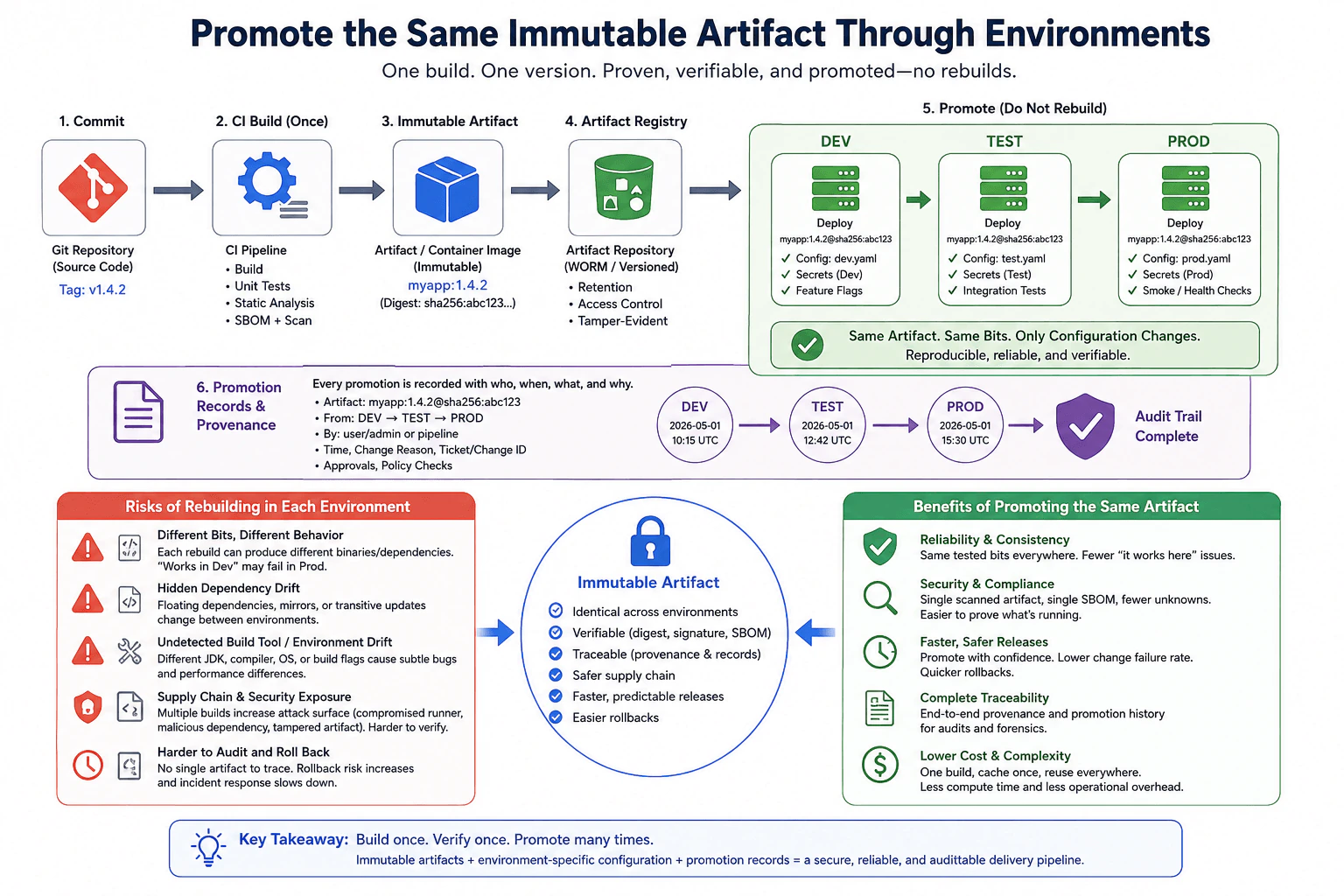
I would build the application once, create one versioned immutable artifact, verify it, store it in a protected artifact repository, and promote that exact artifact through development, test, and production. Rebuilding in each environment can create different bits because dependencies, build tools, inputs, or settings can change. It also adds more opportunities for supply chain compromise. Environment configuration and secrets should be supplied separately during deployment. Every promotion should also be recorded so we can trace exactly what version moved, who approved it, when it moved, and where it went.
Detailed Explanation
The safest release path is to build the application once and move that exact package through every environment. If development, test, and production each create a new package, the result can change because dependencies, tools, settings, or other build inputs may be different. Then the package tested earlier may not be the package that reaches production. Building once removes that source of uncertainty. Each environment can still use its own configuration, secrets, feature settings, and connection values without changing the application package itself.
Useful Questions to Ask the Interviewer
Is the artifact repository protected so an existing version cannot be silently replaced?
How are configuration and secrets supplied separately for development, test, and production?
What information is stored in each promotion record and who can approve promotion to production?
How to Explain It in an Interview
I would start with one source commit and run the build once in CI. The pipeline builds the application, runs unit tests, performs static analysis, creates an SBOM, and performs the required security checks. The result is a versioned artifact such as myapp:1.4.2. I would identify its exact contents with a digest and store it in an immutable or protected artifact repository with retention and access controls.
The same artifact is then promoted to development, test, and production without rebuilding it. Development receives development configuration and secrets. Test receives test configuration and secrets. Production receives production configuration and secrets. Feature settings can also vary. These environment values remain outside the artifact, so the application bits stay identical.
This improves reliability because production runs the same application bits that were already tested. It also reduces supply chain exposure because there are fewer build operations that can introduce changed dependencies, compromised tools, unexpected inputs, or hidden variations.
Provenance records show where the artifact came from and how it was built. The digest, SBOM, scan results, build records, and signatures help verify its identity and history. Promotion records then capture the artifact version, source environment, destination environment, approver, time, change reason, and verification result.
If production has a problem, rollback can redeploy a previously known good immutable artifact instead of rebuilding old source code. The main limitation is that a correct artifact can still fail because of bad environment configuration, secrets, infrastructure, or runtime conditions. Those inputs need their own controls and validation.
Why Interviewers Ask This
Interviewers ask this to check whether I understand reliable software delivery, artifact integrity, supply chain risk, environment separation, release traceability, and rollback. They want to see whether I understand why rebuilding in every environment can change the application bits and why promoting one verified artifact gives stronger evidence about what actually reached production.
Common interview mistakes
A common mistake is rebuilding the application separately for every environment and assuming every build will be identical. Another mistake is using a mutable artifact version that can be replaced after testing. Teams may also place production configuration or secrets inside the artifact, which breaks the separation between application bits and environment values. Other mistakes include trusting only a version label without verifying the digest, losing provenance or SBOM evidence, allowing weak artifact repository access controls, skipping promotion records, and rebuilding old source during rollback instead of redeploying a known good artifact.
Interview tip
Start with the rule that the application should be built once, verified once, and then promoted unchanged. Explain that this keeps the tested bits identical to the production bits and reduces supply chain exposure from repeated builds. Then explain that configuration and secrets remain separate for each environment. Finish with provenance, promotion records, and rollback because those points show production awareness.
Interviewer may ask next
What should happen if the artifact passes testing but a vulnerability is discovered before production promotion?
I would block promotion of that artifact rather than modify or rebuild it inside the production stage. The existing artifact should remain immutable so its digest, provenance, SBOM, scan evidence, and prior test results still refer to the same contents. If the vulnerability requires a code or dependency change, the team should make a new source change and create a new versioned artifact through the normal CI and verification process. This matters because replacing the existing artifact would break the evidence chain. The tradeoff is that the release may take longer, but the artifact history stays trustworthy.
What is the main tradeoff of keeping environment configuration outside the immutable artifact?
The same artifact becomes reusable across environments, but configuration becomes a separate production dependency that must be controlled carefully. Values such as endpoints, secrets, feature settings, and connection information are supplied during deployment instead of being built into the application package. This matters because development, test, and production can run identical application bits while still using their own environment values. The tradeoff is additional configuration management, validation, access control, and audit work. A bad production configuration can still cause failure even when the artifact itself is correct.
16. What release gates would you add before a cloud deployment reaches production?DevOpsEasy
i Question Details
Describe gates for a normal service release, including test results, policy checks, vulnerability findings, infrastructure plan review, change authorization, deployment health, and post-release monitoring. Explain which gates should block automatically and which require human judgment.
Short Interview Answer (30-60 seconds)
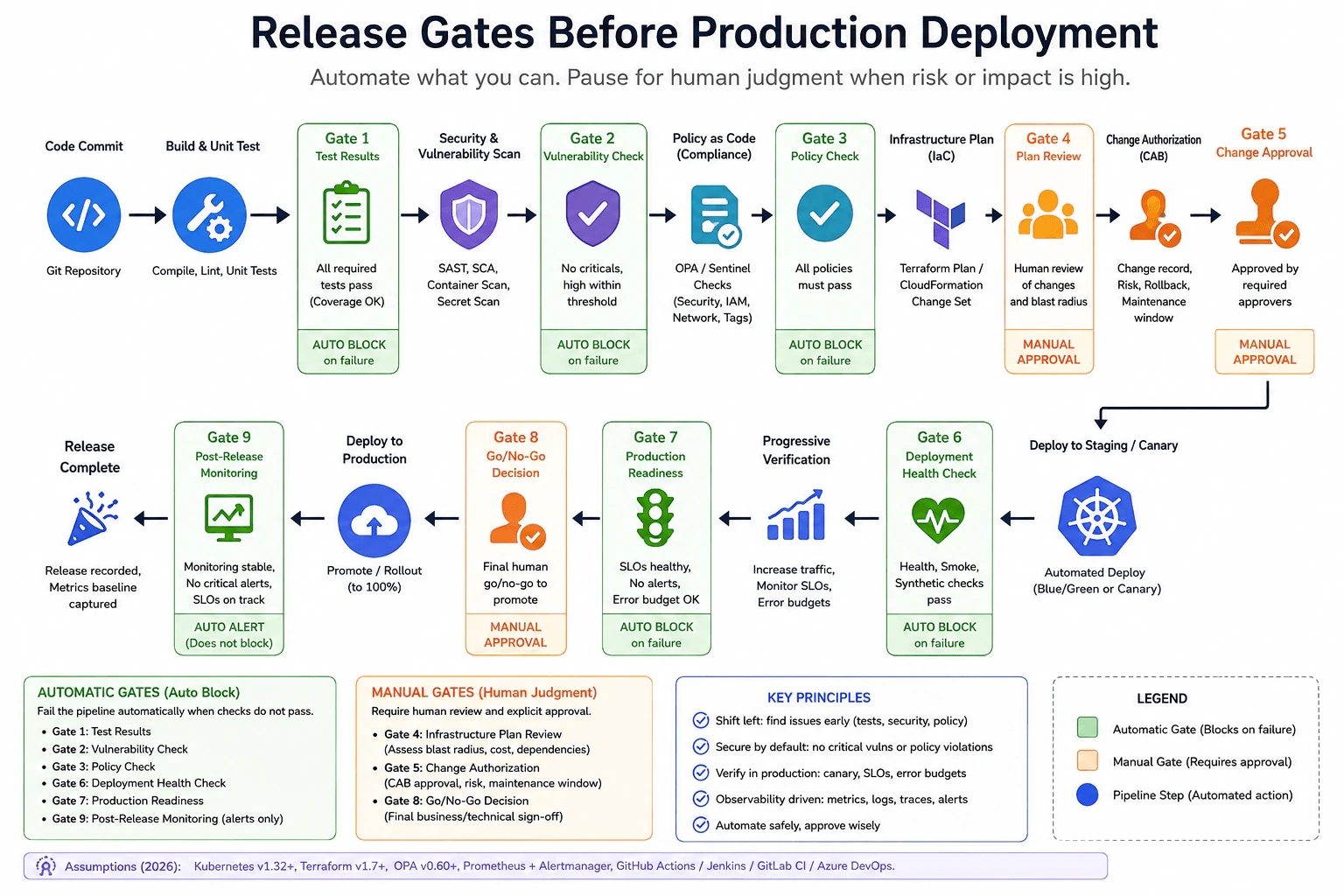
I would automatically block a release when required tests fail, serious vulnerability findings exceed the accepted threshold, mandatory policy checks fail, deployment health checks fail, or production readiness signals are unhealthy. I would use human approval for infrastructure plan review, change authorization, and the final go or no go decision because those steps need context about blast radius and business risk. I would deploy to staging or a canary, increase traffic gradually, watch SLOs and the error budget, and only promote to full production when the release stays healthy. After release, monitoring should alert quickly and trigger mitigation or rollback when needed.
Detailed Explanation
A safe release should pass several checkpoints before the new version reaches all users. Some checkpoints can make a clear yes or no decision from measured results. Others need a person to understand the size of the change and its possible effect on customers. I would check that the software works, known security problems stay within the accepted limit, required company rules are satisfied, planned infrastructure changes are understood, and the target environment is healthy. I would then release gradually, watch the service closely, and stop promotion or reverse the release if serious problems appear.
Useful Questions to Ask the Interviewer
What level of vulnerability finding should automatically stop a release?
Does the team require formal change approval for every production release or only for higher risk changes?
Does the production platform support canary or blue green deployment and automatic rollback?
How to Explain It in an Interview
I would build the release as a sequence of automatic checks, human decisions, and progressive verification. First, the build must pass required unit tests and any required coverage rule. A failed required test stops the pipeline automatically.
Next, I would run security checks such as static analysis, dependency scanning, container scanning, and secret scanning. Critical findings, or high severity findings above the accepted threshold, automatically block the release. Mandatory policy checks should also run automatically. For example, policy as code can check security controls, identity settings, network rules, tags, and other required configuration. A failed mandatory policy stops the pipeline.
Before changing infrastructure, I would generate an infrastructure plan, such as a Terraform plan or CloudFormation change set. A person should review important resource changes, dependencies, rollback options, and blast radius. Change authorization also needs human judgment because risk, maintenance timing, and business impact cannot always be reduced to a simple technical threshold.
After approval, I would deploy to a staging or canary environment. Automated health, smoke, and synthetic checks should block further progress if the deployment is unhealthy. I would then increase traffic progressively while watching SLOs, alerts, and the error budget. If those production readiness signals fail, promotion stops automatically.
Before full production promotion, I would keep a final human go or no go decision for releases where business or technical risk justifies it. After full promotion, post release monitoring continues. Stable SLOs and no critical alerts indicate a healthy release. Post release monitoring is mainly an alert and mitigation control because it cannot block a deployment that has already reached production.
Why Interviewers Ask This
Interviewers ask this to see whether I can design a safe release process instead of treating deployment as one automatic push. They want to know whether I can separate checks with clear pass or fail rules from decisions that need human judgment. They also want evidence that I understand testing, security, policy, infrastructure changes, approvals, deployment health, progressive verification, production readiness, monitoring, and rollback decisions.
Common interview mistakes
A common mistake is making every gate manual, which slows delivery without adding useful judgment. The opposite mistake is automating decisions that depend on business impact or blast radius. Another mistake is allowing vulnerability or policy results to be informational when the organization has defined blocking thresholds. Teams also sometimes review an infrastructure plan without considering rollback, dependencies, or unexpected resource replacement. Another error is treating a successful deployment command as proof that the service is healthy. Health checks, SLO signals, alerts, and progressive traffic verification are still needed. Post release monitoring should not be described as a gate that can prevent production deployment because production has already been reached.
Interview tip
Explain the gates in release order and clearly say which ones block automatically and which ones require human judgment. Automatic gates work best for objective rules with clear thresholds. Human gates are most useful where risk, blast radius, timing, or business context matters. Finish by describing staging or canary deployment, progressive verification, production readiness, rollback, and post release monitoring.
Interviewer may ask next
What would you do if the canary passes basic health checks but starts consuming the service error budget quickly?
I would stop further traffic promotion automatically because the production readiness gate has failed. Basic health checks only show that the service is running and responding. The error budget shows whether the release is causing enough reliability loss to threaten the SLO. I would keep the blast radius small, investigate the new release, and either roll back or mitigate the problem before continuing. The tradeoff is that strict thresholds can stop a release for a temporary issue, so the thresholds and observation window should be defined before deployment.
Why not automate the infrastructure plan review and final release approval completely?
I would automate every deterministic check around those decisions, but I would keep human judgment where the consequences depend on context. A policy engine can detect forbidden settings, and an infrastructure plan can show the intended resource changes, but those tools may not know whether replacing a shared database, changing a network path, or performing maintenance at that moment creates unacceptable business risk. Human review adds context about blast radius, dependencies, timing, and rollback. The tradeoff is slower delivery, so manual approval should be reserved for decisions where that judgment adds real value.
17. How would you keep environment-specific configuration out of application artifacts?DevOpsEasy
i Question Details
A service must use different endpoints, feature settings, and resource identifiers in development, staging, and production. Explain how configuration should be stored, injected, validated, versioned, and separated from secrets while keeping the built artifact identical.
Short Interview Answer (30-60 seconds)
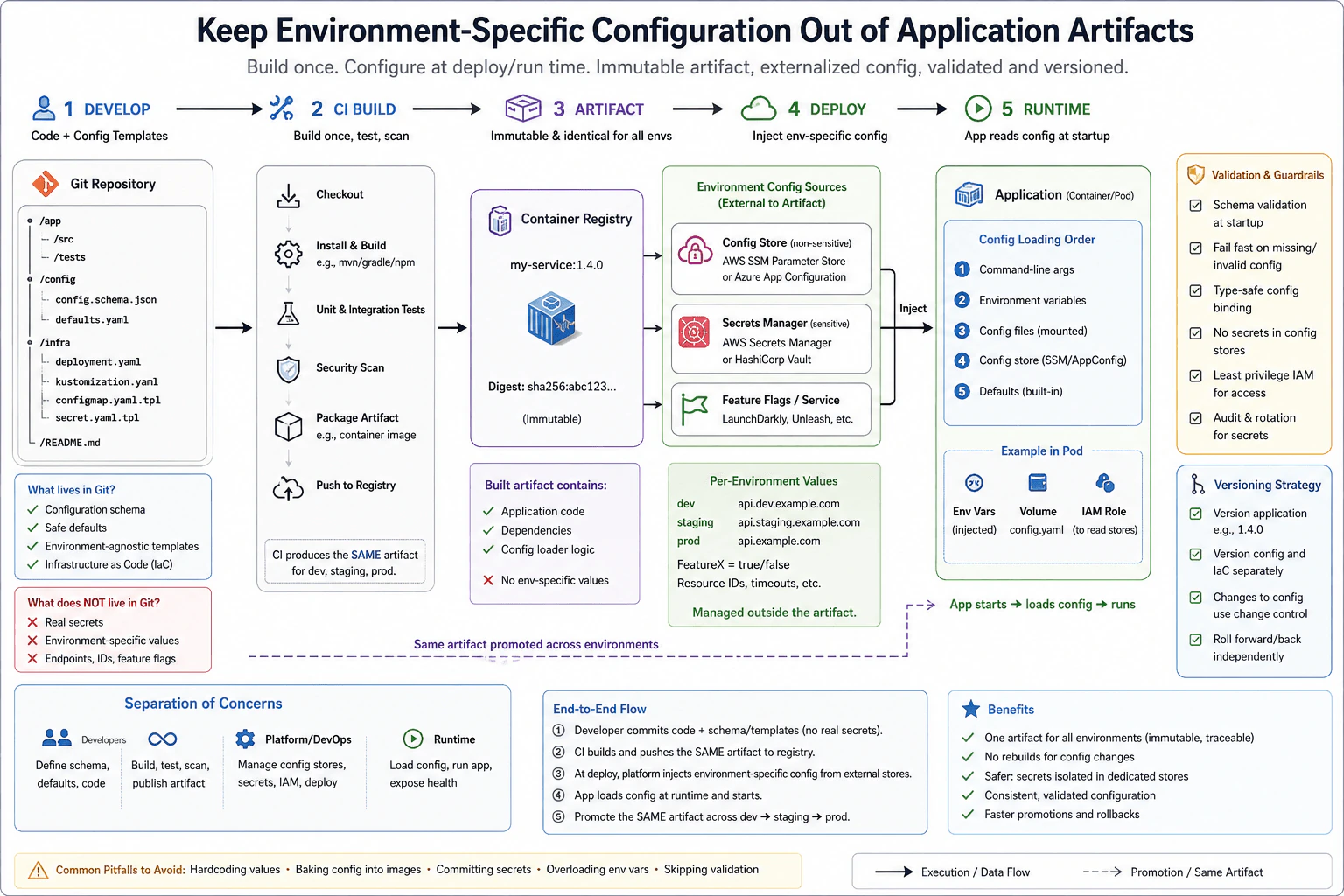
I would build the application once and use the exact same immutable artifact in development, staging, and production. Environment specific endpoints, feature settings, and resource identifiers would stay outside the artifact in managed configuration sources. The deployment platform would inject or expose those values at runtime. Sensitive values would come from a separate secrets manager through least privilege identity. The application would validate required values at startup and fail fast when they are missing or invalid. I would version application, configuration, and infrastructure changes separately so configuration can be reviewed and rolled back without rebuilding the application.
Detailed Explanation
I would keep the built application exactly the same in every environment. Development, staging, and production may need different service addresses, feature settings, and resource names, but those values should live outside the built package. The deployment process gives the application the correct values when it starts. Sensitive information such as passwords and keys should be stored separately with stronger access controls. The application should check the supplied values before it begins normal work. This makes releases more predictable because the same tested package moves through every environment.
Useful Questions to Ask the Interviewer
Which managed configuration service and secrets manager does the platform already use?
Should configuration be loaded only when the application starts, or may selected settings change while it is running?
What approval, audit, and rollback process is required for production configuration changes?
How to Explain It in an Interview
I would keep source control environment agnostic. Git can contain application code, tests, configuration schemas, safe defaults, and infrastructure or deployment templates. It should not contain real secrets or environment specific endpoint, feature, or resource values.
The CI pipeline checks out the code, installs dependencies, runs tests and security checks, packages one container image, and pushes it to the registry. That exact image and digest are promoted through development, staging, and production. I would not rebuild the image for each environment.
Environment specific non sensitive values can live in a managed configuration store such as AWS Systems Manager Parameter Store or AWS AppConfig. Sensitive values such as passwords, API keys, and signing keys belong in a separate secrets manager such as AWS Secrets Manager, Azure Key Vault, or HashiCorp Vault. Workload identity or another least privilege identity should control access.
At deployment or startup, the platform makes configuration available to the application. The diagram uses this loading order: command line arguments first, then environment variables, then mounted configuration files, then the managed configuration store, then built in safe defaults. The exact application must define and document this precedence.
The application validates the configuration schema, required values, types, and allowed values before serving traffic. Missing or invalid required configuration should make startup fail fast. Configuration and infrastructure changes should be versioned separately from the application, reviewed through change control, audited, and independently rolled forward or back.
Why Interviewers Ask This
Interviewers ask this to see whether I understand the boundary between the application artifact and the environment where it runs. They want to know whether I can build one immutable artifact, promote that same artifact through development, staging, and production, and provide different configuration safely at runtime. They also evaluate whether I separate normal configuration from secrets, validate values before the service starts, control configuration changes, use least privilege access, and provide an independent rollback path.
Common interview mistakes
Common mistakes include creating a different image for each environment, hardcoding production endpoints or resource identifiers, baking environment configuration into the image, committing real secrets to Git, and placing secrets in the normal configuration store instead of a dedicated secrets manager. Another mistake is allowing the service to start when required configuration is missing or invalid. Teams also create risk when configuration changes are not versioned, reviewed, audited, or reversible. An unclear loading precedence is another problem because one configuration source can unexpectedly override another. Overloading environment variables with every possible setting can also make configuration difficult to manage.
Interview tip
Start with the practical rule: build once and configure at runtime. Then explain the boundaries in order. Git contains code, schemas, safe defaults, and environment agnostic templates. CI produces one immutable artifact. The same artifact is promoted through every environment. External configuration supplies environment specific values. A separate secrets manager supplies sensitive values. The application validates configuration before serving traffic. Finally, explain that application, configuration, and infrastructure versions have separate change and rollback paths.
Interviewer may ask next
What should happen if required runtime configuration is missing or invalid when the service starts?
The service should fail fast before it begins serving normal traffic. The application should validate required fields, expected types, formats, and allowed values as configuration is loaded. If validation fails, startup should return a clear error and the instance should remain unavailable. This matters because silently using an incorrect default can connect the service to the wrong dependency or enable unsafe behavior. The tradeoff is that strict validation can reduce availability when configuration is wrong, but it is usually safer than running with unknown or invalid settings.
When would you reload configuration while the application is running instead of restarting it?
I would reload configuration while the application is running only for values that the application and configuration system explicitly support changing safely. Feature settings are a common example. Connection details or values used to initialize long lived resources may still require a controlled restart. Runtime reload makes some changes faster and avoids rebuilding the artifact, but it adds complexity because the application must validate updates and handle partial failures and concurrent access safely. The configuration should still remain external, separately versioned, auditable, and reversible.
18. How would you avoid rebuilding all services for every change in a 15-service monorepo?DevOpsMedium
i Question Details
A monorepo contains 15 independently deployable services, but every commit triggers all builds and tests. Design change detection, dependency awareness, shared-library handling, caching, parallel execution, artifact versioning, and a safe fallback when impact cannot be determined.
Short Interview Answer (30-60 seconds)
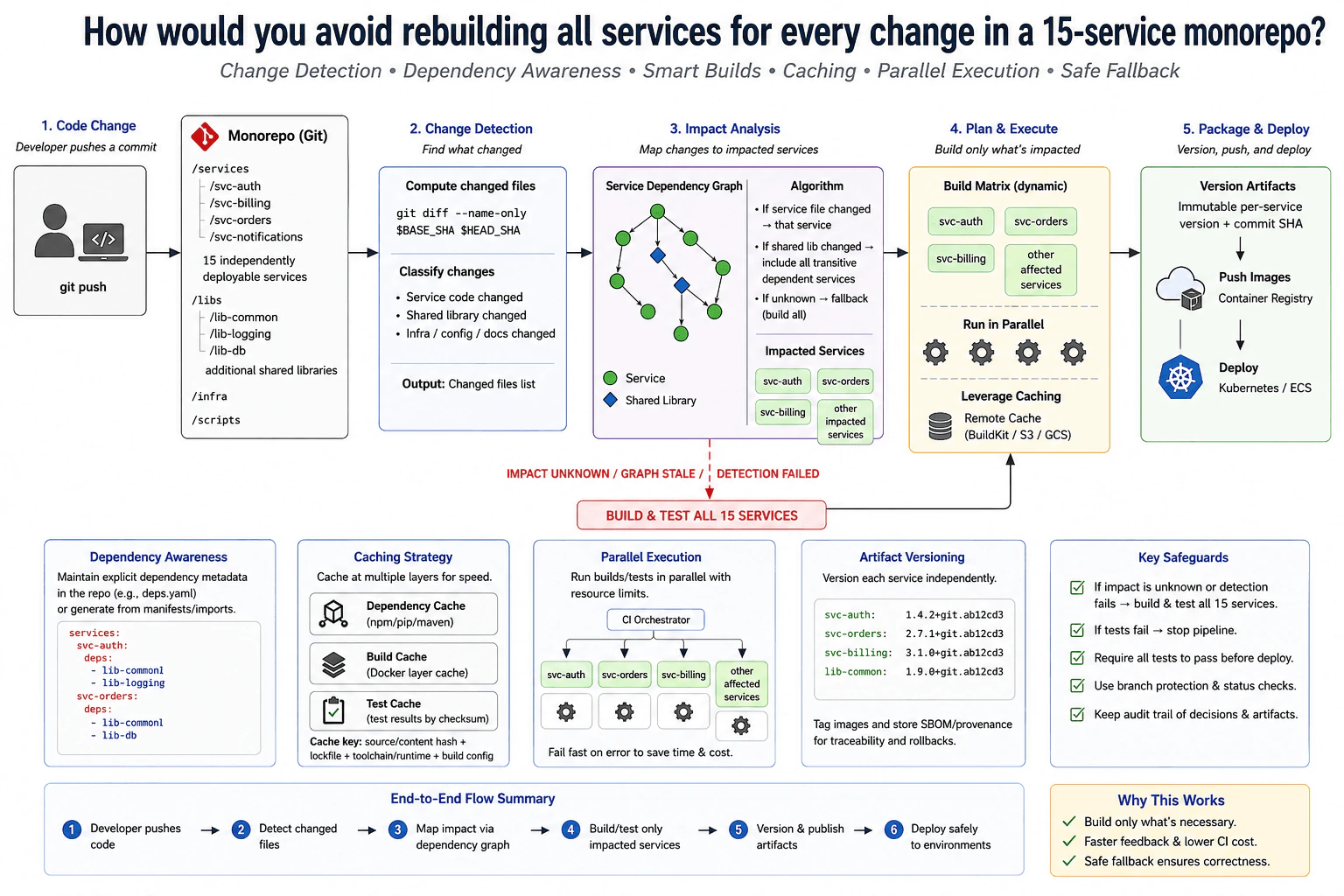
I would first detect which files changed, then map those files to services and shared libraries. I would use a dependency graph to expand that into the complete affected service set, including transitive dependents of a changed shared library. Only those services would build and test, with independent jobs running in parallel and deterministic caches reused when their inputs still match. Each successful build would produce an immutable service artifact tied to the commit SHA. If change detection or dependency analysis is unknown or stale, I would safely build and test all 15 services.
Detailed Explanation
The goal is to stop doing work that a change does not need while still keeping every service safe. First, compare the base commit with the current commit and list the changed files. Then classify those files as service code, shared library code, infrastructure, configuration, documentation, or scripts. A service change normally affects that service. A shared library change can affect several services, including services that depend on it indirectly. Only the complete affected set should build and test. If the system cannot determine the impact with confidence, it should build and test all 15 services.
Useful Questions to Ask the Interviewer
How are dependencies between services and shared libraries recorded today?
Can each service be built, tested, versioned, and deployed independently?
How should infrastructure, configuration, documentation, and script changes affect the impacted set?
What should the pipeline do if dependency information is missing or stale?
How to Explain It in an Interview
I would start with Git change detection. The CI system compares a base SHA with the current head SHA and produces the changed file list. Those paths are classified into service code, shared libraries, infrastructure, configuration, documentation, and scripts.
Next, I would use explicit dependency metadata from the repository or generate the dependency graph from manifests and imports. If one service changes, that service enters the impacted set. If a shared library changes, I would include every transitive dependent service. This avoids missing a service that depends on the library through another shared component.
The CI orchestrator would then create a dynamic build matrix containing only the impacted services. Independent builds and tests would run in parallel with resource limits. I would use dependency caches, build caches, and test caches where appropriate. Cache keys must include all material inputs, such as the source content hash, dependency lockfile, toolchain or runtime version, and relevant build configuration. This prevents stale outputs from being reused when an important input changes.
Each successful service build would create an immutable artifact with its own service version plus the commit SHA. Container images would be published to a registry. I would also retain traceability data such as the component name, commit SHA, dependencies, software bill of materials, provenance, and test or scan results. Deployment should consume the already built artifact instead of rebuilding the source.
The key safety rule is the fallback. If impact analysis is unknown, the dependency graph is stale, or detection fails, the pipeline builds and tests all 15 services. If tests fail, deployment stops. Branch protection, status checks, and an audit trail of impact decisions and artifacts provide additional safeguards.
Why Interviewers Ask This
Interviewers ask this to see whether you can make CI faster without making it unsafe. They want to test change detection, dependency awareness, shared library impact, caching, parallel execution, immutable artifact handling, and failure behavior. They also want to see whether you know when optimization must stop and the pipeline must choose correctness by building and testing all services.
Common interview mistakes
One common mistake is looking only at changed service folders and ignoring shared libraries. Another is including only direct dependents instead of transitive dependents. A third mistake is using cache keys that ignore the lockfile, runtime, toolchain, or build configuration, which can reuse stale results. Teams also sometimes rebuild source during deployment instead of promoting the immutable artifact created by CI. The most dangerous mistake is treating an unknown impact result as no impact. Unknown impact must trigger the full build and test fallback.
Interview tip
Explain the flow in order. Start with changed files, then dependency analysis, then the impacted set, parallel builds and tests, deterministic caching, immutable artifacts, and finally the safe fallback. Emphasize that the optimization is allowed only when the pipeline can prove which services are affected.
Interviewer may ask next
What would you do if the dependency graph is missing, stale, or cannot determine whether a shared library affects a service?
I would build and test all 15 services. An unknown impact result is unsafe because a stale dependency graph could cause the pipeline to skip a service that should have been tested. The exact fallback is therefore a full build and test run. It costs more CI time and compute for that commit, but it protects correctness.
How would you make caching fast without allowing stale build or test results to be reused?
I would make the cache key include every material input to the cached result. In this design that includes the source content hash, dependency lockfile, toolchain or runtime version, and relevant build configuration. A cached result is reused only when those inputs match. More precise keys can reduce the cache hit rate, but they make builds more reproducible and greatly reduce the risk of using stale output.
19. How would you protect secrets used by a cloud deployment pipeline?DevOpsMedium
i Question Details
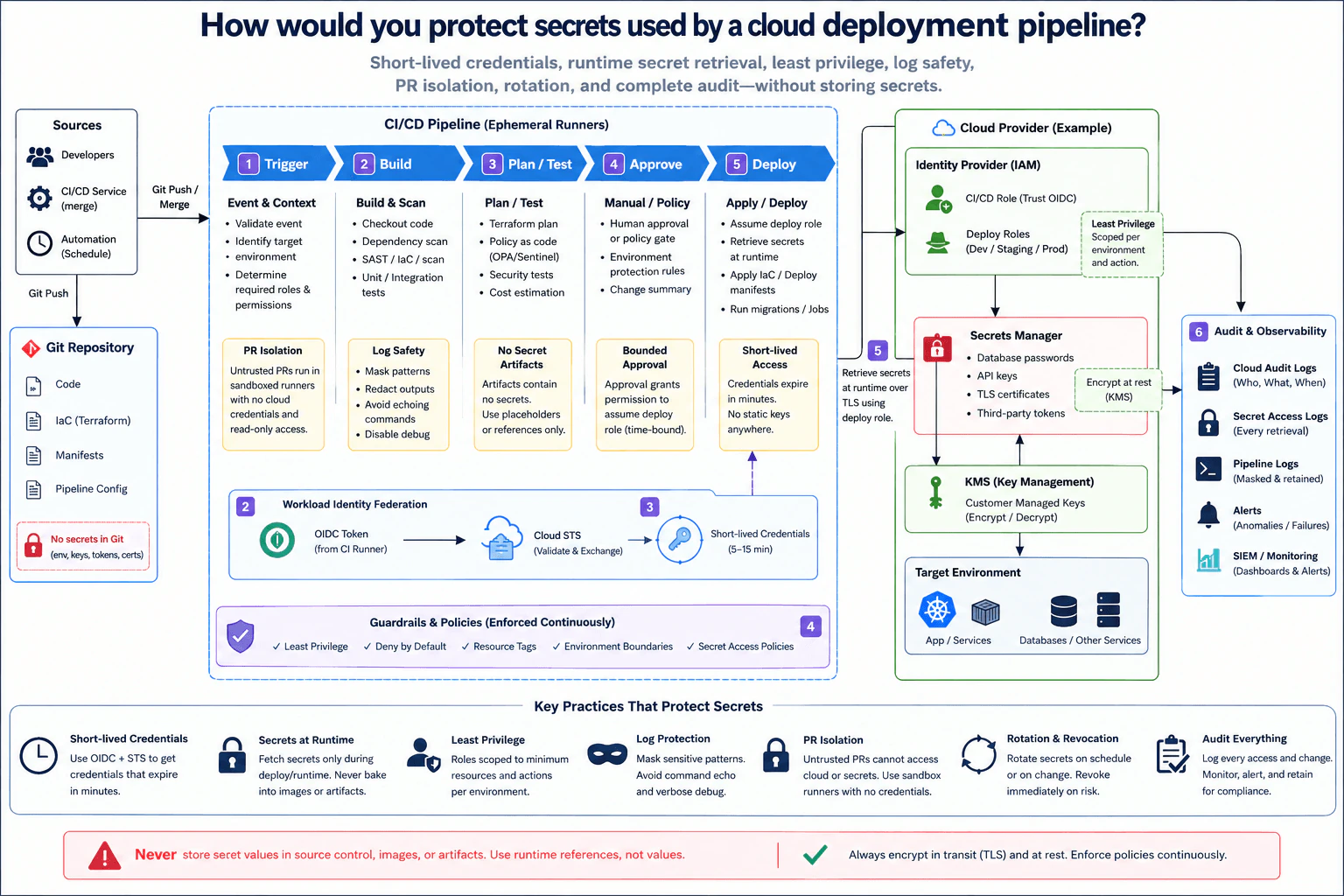
A pipeline deploys infrastructure and applications to several environments. Explain how it should obtain short-lived credentials, retrieve secrets at runtime, restrict scope, prevent log exposure, isolate untrusted pull requests, rotate access, and record every use without storing secret values in source control or artifacts.
Short Interview Answer (30-60 seconds)
I would keep secret values out of source control and artifacts. The pipeline would use workload identity federation with OIDC to obtain short lived cloud credentials for a narrowly scoped deployment role. During deployment, the runner would retrieve only the required secrets from the secrets manager over TLS. I would mask sensitive output, isolate untrusted pull requests from cloud credentials, rotate and revoke access, encrypt secrets at rest with KMS, and record identity and secret access events without recording secret values.
Detailed Explanation
The goal is to let the deployment system use sensitive information without leaving copies where people or later jobs can find them. The system should receive temporary permission only when it needs to deploy. It should fetch sensitive values only while the deployment is running. Each environment should have separate permissions. Work from untrusted code should not receive sensitive values. Output should hide sensitive information. Access should expire or be removed when needed. Every use should leave a record showing who used access, what was accessed, when it happened, where it happened, and whether it succeeded.
Useful Questions to Ask the Interviewer
Are development, staging, and production separated by different cloud accounts or permission boundaries?
Does the CI system support OIDC workload identity federation?
Which secrets manager and key management service are already approved?
Can untrusted pull requests run pipeline jobs before approval?
How to Explain It in an Interview
I would start by removing long lived cloud credentials from the pipeline. An ephemeral CI runner presents an OIDC token to the cloud identity service. The identity service validates the token and its trust policy, then returns short lived credentials for the exact deployment role. Development, staging, and production should use separate roles with minimum permissions for their resources and actions.
The deploy stage uses those credentials to retrieve required values from the secrets manager at runtime over TLS. Secret values should not be committed to Git, baked into images, or written into artifacts. The secrets manager keeps the sensitive values centrally, while KMS protects them at rest. The deployment process should keep retrieved values only for the required runtime scope.
Logs need their own protection. I would mask known secret patterns, avoid commands that echo sensitive values, disable unnecessary debug output, and redact sensitive command results. Untrusted pull requests should run in sandboxed runners with no cloud credentials or secrets and only read only repository access when repository access is required.
Production deployment should also use approval and policy controls. Approval can grant permission to assume the production deployment role for the approved operation. Roles should be limited by environment, resource, and action. Secret access policies should deny broad wildcard access. Credentials should expire quickly. Secrets should rotate on a defined schedule or after a security event, with old access revoked.
Finally, I would send cloud identity events, secret retrieval events, pipeline activity, and deployment activity to the audit and monitoring system. Audit records should capture who, what, when, where, and success or failure, but never the secret value itself. Alerts and monitoring can then detect unusual access or failures.
Why Interviewers Ask This
Interviewers ask this to see whether I understand workload identity, secret handling, least privilege, environment isolation, safe pipeline logging, access rotation, and auditing. They also want to know whether I can separate trusted deployment work from untrusted pull request work and design the pipeline so secret values are never stored in source control or deployment artifacts.
Common interview mistakes
Common mistakes include storing long lived cloud keys in pipeline settings, committing secret files to Git, baking secrets into container images, writing secrets into deployment artifacts, sharing one powerful role across every environment, allowing untrusted pull requests to receive deployment credentials, printing environment variables or command output that contains secrets, enabling verbose debug logging around secret operations, giving wildcard permissions to the secrets store, failing to rotate or revoke old access, and recording secret values inside audit logs. Another mistake is assuming encryption alone provides least privilege. Encryption protects stored data, while identity and access policies decide who may retrieve it.
Interview tip
Explain the controls in execution order. Start with OIDC and short lived credentials, then runtime secret retrieval, least privilege, log protection, pull request isolation, approval, rotation, and auditing. Make the central rule explicit: secret values should not live in source control or artifacts, and audit records should describe secret use without containing the secret itself.
Interviewer may ask next
What should happen if an untrusted pull request needs to run integration tests that normally use cloud secrets?
It should not receive the production or deployment secrets. I would run the pull request in an isolated runner with no cloud deployment credentials and use test data, mocks, or a separate low privilege test environment when integration access is necessary. The exact behavior being protected is the trust boundary around untrusted code. Code from an untrusted pull request can execute arbitrary commands, so exposing a secret to that job can allow the code to read or transmit it. The tradeoff is that some tests may need a separate trusted stage after review or approval, but that is safer than exposing deployment access before the code is trusted.
What is the tradeoff between very short credential lifetimes and longer deployment credentials?
I would keep credentials short lived but long enough for the expected deployment operation. A shorter lifetime reduces the useful window if credentials are stolen, but credentials that expire during a long deployment can cause failures. The exact behavior is temporary role access obtained through workload identity federation. For longer jobs, I would use the platform supported credential renewal mechanism or obtain a new authorized session rather than storing a permanent key. I would also keep the role narrowly scoped so credential lifetime and permission scope both limit the possible blast radius.
20. How would you design a secure delivery pipeline for many independently released microservices?DevOpsHard
i Question Details
Design a pipeline platform for dozens of services and several teams. Cover reusable pipeline templates, isolated build execution, dependency and image provenance, signed artifacts, policy enforcement, environment-specific authorization, progressive rollout, rollback, auditability, and how teams can extend the platform without bypassing controls.
Short Interview Answer (30-60 seconds)
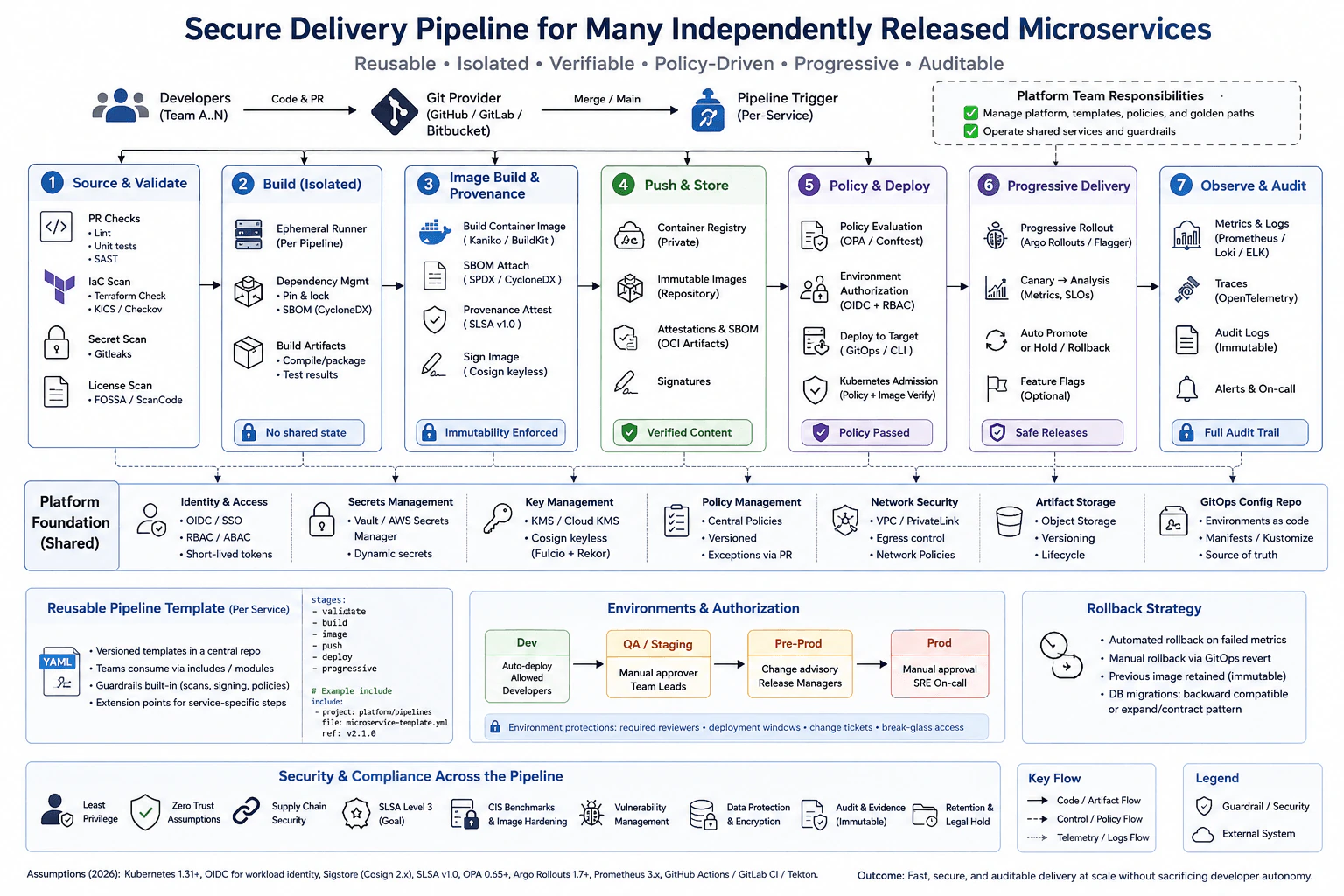
I would give every service a versioned reusable pipeline template and run each build on its own ephemeral runner. The pipeline validates the change, scans dependencies and secrets, creates the container image, attaches an SBOM and provenance, signs the image, and stores immutable content in a private registry. Policy checks and environment specific authorization then control deployment. GitOps promotes the same verified artifact through environments. Production uses progressive rollout with metrics based promotion, hold, or rollback. Shared identity, secrets, key management, policy, audit logging, and approved extension points keep teams independent while preserving central guardrails.
Detailed Explanation
I would build one shared delivery system that lets each service release on its own while keeping the important safety rules in one place. Every service follows the same trusted path for checking changes, building software, storing the finished result, approving releases, watching production, and recording who changed what. Teams can add approved service specific steps, but they cannot remove required safety checks. The finished result moves through development, testing, and production environments instead of being rebuilt each time. This makes releases easier to trace, repeat, stop, or reverse when something goes wrong.
Useful Questions to Ask the Interviewer
How many services and engineering teams must the platform support?
Which environments require human approval before deployment?
Is Kubernetes the standard deployment target for every service?
Which security or compliance policies must block a release?
Which rollout metrics should automatically stop or reverse a production release?
How to Explain It in an Interview
I would organize the platform as one trusted path with seven stages: source validation, isolated build, image and provenance creation, immutable storage, policy and deployment control, progressive delivery, and observation with audit.
Each service starts from a versioned reusable pipeline template stored in Git. A team pins the template version and can add only approved includes, modules, or service specific steps. Required scans, signing, policy checks, and authorization remain controlled by the platform team.
Pull requests run linting, unit tests, static security checks, infrastructure checks, secret scanning, dependency checks, license checks, and SBOM generation. Each pipeline uses an ephemeral runner with no shared build state. Dependencies are pinned and locked where practical.
The image stage builds the OCI container image, creates an SBOM, records provenance, and signs the image with Cosign using short lived workload identity. The private registry stores immutable images, attestations, SBOMs, and signatures. Deployment references the immutable image digest so the exact verified artifact is promoted instead of rebuilt.
Before deployment, policy evaluation can use OPA or Conftest to require a valid signature, approved base image, acceptable vulnerability level, license compliance, SBOM presence, provenance, and environment rules. Kubernetes admission policy provides another enforcement point at the cluster boundary.
Authorization changes by environment. Development may allow automatic deployment by developers. QA or staging can require team lead approval. Preproduction can require release manager approval. Production can require an authorized SRE or another designated approver. OIDC federation, SSO, RBAC, short lived credentials, secrets management, and key management provide least privilege access.
GitOps keeps environment configuration and manifests in a configuration repository that acts as the desired state source of truth. Progressive delivery can use Argo Rollouts or Flagger. A canary receives limited traffic while metrics, logs, and service objectives are evaluated. Healthy results allow promotion. Unhealthy results cause a hold or automated rollback.
Rollback returns GitOps desired state to the previous immutable image. The previous artifact remains available in the registry. Database migrations must be backward compatible, commonly by using an expand then contract pattern, because application rollback cannot safely undo an incompatible database change automatically.
Central metrics, logs, traces, build metadata, deployment events, signatures, and immutable audit records connect a production release back to its source commit, build, artifact, approvals, and policy decisions. The main tradeoff is more platform complexity and some release latency. I would offset that cost with reusable templates, strong defaults, clear golden paths, and controlled extension points.
Why Interviewers Ask This
Interviewers ask this question to see whether I can design a delivery platform that scales across many services and teams without weakening security. They want to see clear separation between source control, isolated build execution, artifact storage, policy enforcement, deployment control, authorization, observability, and audit responsibilities. They also test whether I understand reusable templates, immutable artifacts, provenance, signing, least privilege access, progressive delivery, rollback, and controlled extension points that give teams flexibility without allowing them to bypass mandatory controls.
Common interview mistakes
A common mistake is rebuilding an image for every environment instead of promoting the same verified digest. Another is storing long lived cloud credentials or signing keys inside CI secrets. Teams also sometimes run scanners but fail to make policy violations block deployment. Other mistakes include relying only on branch permissions for production authorization, allowing teams to copy shared templates and remove guardrails, using mutable image tags as the release identity, losing the link between the image, SBOM, provenance, and signature, skipping Kubernetes admission checks, and treating a retry as a rollback. A safe rollback must restore a known desired state and must account for database compatibility.
Interview tip
Explain the design as a chain of trust. Start with reusable templates and isolated builds. Then show how one immutable artifact gains an SBOM, provenance, and a signature. Next explain registry storage, policy enforcement, environment authorization, GitOps promotion, progressive rollout, rollback, and auditability. Finish by explaining that teams get approved extension points while mandatory controls stay under platform ownership.
Interviewer may ask next
What happens if the canary passes deployment checks but production metrics become unhealthy after traffic starts moving to it?
I would stop promotion and return the GitOps desired state to the previous known good immutable image. The progressive delivery controller evaluates defined metrics and service objectives while traffic moves to the canary. If a threshold fails, the new version should not receive more traffic. The previous image must still exist in the registry and remain verifiable. The rollback is recorded as another desired state change, so it remains auditable. Database migrations are the important limitation. They must remain backward compatible so the older application version can still operate safely after the application rollback.
How can service teams customize the pipeline without gaining a way to bypass security controls?
I would expose approved extension points inside versioned shared templates instead of giving each service complete control over the pipeline. Teams can add service specific tests, build logic, or approved modules, but mandatory scanning, provenance, signing, policy evaluation, authorization, and deployment controls remain outside those extension points. Template changes require review and versioning. Artifact and deployment policy also checks the final result independently, so changing a service step cannot remove the final enforcement layer. The tradeoff is less unrestricted flexibility, but teams gain a supported path that is easier to operate, secure, and audit.
More questions load as you scroll
Disclaimer: This interview guide is for educational and informational purposes only. It is designed to help readers prepare, but it does not guarantee any interview result, hiring decision, offer, or outcome. Interview questions, hiring criteria, and preferred answers can vary by employer, interviewer, industry, location, and time. All answers, examples, and explanations in this guide are suggested examples for interview preparation, not definitive answers or instructions for professional practice. They are based on research and judgment, are provided without warranties of any kind, and should be adapted to the question, role, and applicable laws and professional requirements. Diagrams are simplified illustrations intended to highlight the main concepts and their relationships; actual situations, systems, and practices may be more complex. Alternative approaches may be equally valid or better suited to a particular question, context, or interviewer. To the fullest extent permitted by applicable law, the contributors and publisher are not liable for decisions made, actions taken, or losses incurred based on this guide.
State Laws and Professional Responsibilities: Laws and requirements governing an occupation vary by state and jurisdiction. You are responsible for checking the current laws, licensing requirements, and scope-of-practice rules that apply to your location and role, and for ensuring that your answers and actions comply with them. Adapt examples in this guide to those requirements. This guide is not legal advice.
Content Accuracy and Verification: To the fullest extent permitted by applicable law, we do not represent or warrant that interview guides, questions, answers, examples, or diagrams are accurate, complete, current, error-free, or suitable for any particular purpose. You are responsible for independently reviewing and verifying the information before relying on it.