This interview guide is for educational and informational purposes only. It is designed to help readers prepare, but it does not guarantee any interview result, hiring decision, offer, or outcome. Interview questions, hiring criteria, and preferred answers can vary by employer, interviewer, industry, location, and time. All answers, examples, and explanations in this guide are suggested examples for interview preparation, not definitive answers or instructions for professional practice. They are based on research and judgment, are provided without warranties of any kind, and should be adapted to the question, role, and applicable laws and professional requirements. Diagrams are simplified illustrations intended to highlight the main concepts and their relationships; actual situations, systems, and practices may be more complex. Alternative approaches may be equally valid or better suited to a particular question, context, or interviewer. To the fullest extent permitted by applicable law, the contributors and publisher are not liable for decisions made, actions taken, or losses incurred based on this guide.
State Laws and Professional Responsibilities
Laws and requirements governing an occupation vary by state and jurisdiction. You are responsible for checking the current laws, licensing requirements, and scope-of-practice rules that apply to your location and role, and for ensuring that your answers and actions comply with them. Adapt examples in this guide to those requirements. This guide is not legal advice.
Identity, Image, and Privacy Notice
To respect individual privacy, some names, profile photographs, avatars, biographical details, and other identifying information displayed in this guide may be replaced with pseudonyms, licensed stock images, illustrative avatars, composite images, or representative descriptions. Unless a person is expressly identified as an actual contributor, a displayed name, image, or profile should not be understood as depicting or identifying a specific candidate, interviewer, employee, or other real individual. These representations are provided for editorial and illustrative purposes only and do not imply endorsement, employment, participation, or affiliation with this guide or any company mentioned in it. Any resemblance to an actual person is coincidental.
Company Notice
This guide is an independent educational resource and is not affiliated with, endorsed by, sponsored by, or approved by the company named in this guide. Company names identify reported interview experiences or the employer context of clearly labeled original practice exercises. Interview practices can change without notice, and inclusion of company-specific content does not mean these questions are official, complete, or guaranteed to be asked. To the fullest extent permitted by law, the author, contributors, and publisher are not responsible for outcomes related to use of this material.
Content Accuracy and Verification
To the fullest extent permitted by applicable law, we do not represent or warrant that interview guides, questions, answers, examples, or diagrams are accurate, complete, current, error-free, or suitable for any particular purpose. You are responsible for independently reviewing and verifying the information before relying on it.
Questions or comments?
Contact us for general questions, or share feedback, technical corrections, and comments with the community.
21. How would you recover safely from a Terraform apply that changed only part of the intended infrastructure?DevOpsHard
i Question Details
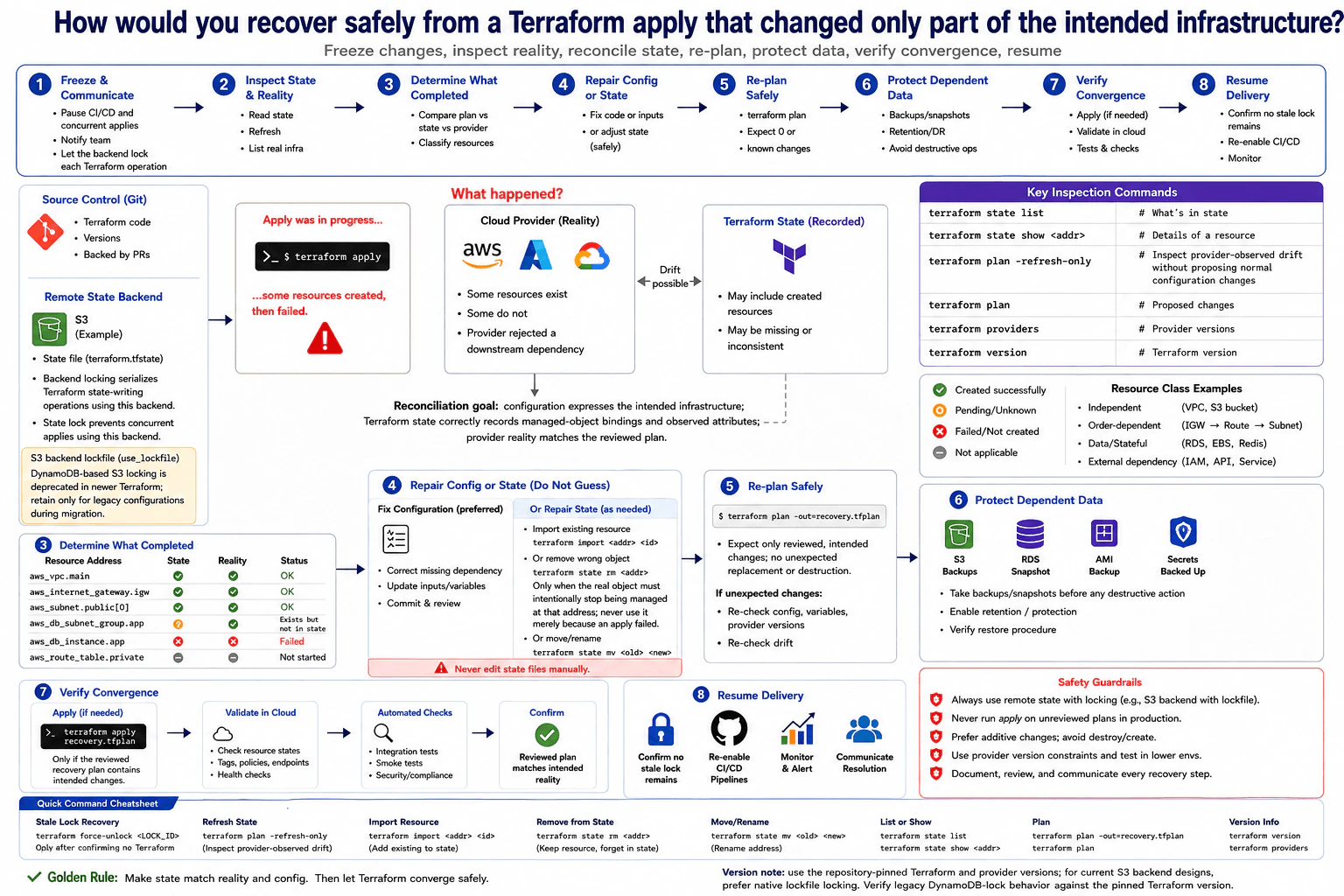
A production apply creates some resources and then fails because a downstream dependency is rejected. Explain how you would freeze concurrent changes, inspect state and provider reality, determine which operations completed, repair configuration or state without guessing, re-plan, protect dependent data, and verify convergence before resuming delivery.
Short Interview Answer (30-60 seconds)
I would first pause CI and any concurrent Terraform applies for that state boundary. Then I would compare Terraform state with the real provider resources and identify exactly what succeeded, failed, or exists outside state. I would repair configuration first and change state only when evidence proves the binding is wrong. Next I would create and review a saved recovery plan, protect important data before any risky change, apply only the reviewed plan if changes are needed, verify the cloud resources and tests, confirm no stale lock remains, and then resume delivery.
Detailed Explanation
My first goal is to stop the situation from changing while I investigate it. Some requested infrastructure may already exist, while other parts may not. I should not simply repeat the same action because that could create more problems or remove something useful. I pause other delivery work first. Then I compare what the automation recorded with what actually exists. I identify each completed, missing, failed, or uncertain item. I correct the intended setup only after I understand the difference. Before any risky change, I protect important data. I resume normal delivery only after the environment matches the reviewed intention.
Useful Questions to Ask the Interviewer
Is this production environment using remote Terraform state with locking?
Are there stateful resources whose data must be protected before any replacement or removal?
Which Terraform and provider versions are pinned in the repository?
How to Explain It in an Interview
I would start by pausing CI and any concurrent Terraform applies that use this state boundary. Backend locking serializes Terraform operations that write the same state, but pausing delivery also prevents another pipeline from changing the environment while I investigate.
Next I would inspect Terraform state and provider reality separately. I would list and inspect the recorded resources, use a refresh only plan to observe provider changes, and check the cloud provider for resources that were actually created. I would classify each resource as completed, failed, missing, or uncertain. Configuration expresses the intended infrastructure. Terraform state records managed object bindings and observed attributes. The provider shows what really exists.
I would prefer repairing configuration, inputs, dependencies, permissions, or provider settings. I would change state only when evidence proves the resource binding is wrong. If a real resource exists and Terraform should manage it, I can import it into the correct address. I would remove a resource from state only when it should intentionally stop being managed at that address. I would use a state move when the resource address changed. I would never edit the state file manually.
Then I would create a saved recovery plan and review every proposed change. I would reject unexpected replacement or destruction. Before any destructive action, I would take required snapshots or backups, enable appropriate protection, and verify the restore procedure. If the reviewed plan contains intended changes, I would apply that saved plan. Finally I would validate provider resource status, health checks, integration tests, smoke tests, and security checks. I would confirm that no stale lock remains, then reenable CI, monitor the environment, and communicate the resolution. I would use the Terraform and provider versions pinned by the repository. For a current S3 backend design, I would prefer native S3 lockfile locking and treat older DynamoDB based locking as legacy behavior that depends on the pinned Terraform version.
Why Interviewers Ask This
Interviewers ask this to test whether I understand Terraform state, provider reality, partial failure, locking, safe recovery, and production risk. They want to see whether I contain concurrent changes first, investigate what actually completed, avoid guessing about state, protect important data, review the next plan carefully, and prove convergence before normal delivery resumes.
Common interview mistakes
Common mistakes are immediately running apply again, assuming Terraform state alone proves what exists in the provider, manually editing the state file, removing a resource from state merely because an apply failed, importing a resource without confirming its identity, accepting unexpected replacement or destruction in the next plan, skipping backups for stateful resources, treating backend locking as a complete delivery freeze, and using force unlock without first proving that no active Terraform operation owns the lock. Another mistake is assuming unpinned Terraform or provider behavior during recovery instead of using the repository pinned versions.
Interview tip
Explain the recovery as containment, observation, reconciliation, controlled change, and verification. Emphasize that you do not guess about state. Say what evidence you would collect before using import, state removal, state movement, or another apply. Finish by explaining how you prove that the reviewed intention, Terraform state, and provider reality agree before CI resumes.
Interviewer may ask next
What would you do if Terraform state does not contain a resource that the failed apply actually created?
I would first verify the real resource identity and confirm that the current configuration intends Terraform to manage that exact object. If that is true, I would import the existing resource into the correct Terraform address instead of creating another copy. I would then create a new plan and inspect it for unexpected changes. This matters because importing the wrong object creates an incorrect state binding. The tradeoff is that import can restore management without recreating the resource, but it requires careful identity and configuration checks.
When would you use Terraform force unlock during this recovery?
I would use force unlock only after confirming that the lock is stale and no Terraform operation still owns it. Normal Terraform operations release their backend lock automatically when they finish. A crashed runner or interrupted operation can leave a stale lock. This matters because forcing an unlock while another operation is active can allow concurrent state writes and make the incident worse. The tradeoff is that force unlock can restore progress after a stale lock, but using it without evidence can damage state safety.
22. What is a cloud virtual network such as a VPC or VNet, and which boundaries does it create?NetworkingEasy
i Question Details
Define a cloud virtual network and explain its address space, subnets, route tables, gateways, security controls, DNS, and private connectivity. Distinguish logical network isolation from account or subscription isolation, and describe the minimum design decisions needed before deploying a private three-tier workload.
Short Interview Answer (30-60 seconds)
At a high level, a VPC or VNet gives cloud resources a private network that you control. The main challenge is deciding which traffic may enter, leave, or stay private. I would explain it in three parts: address space and subnets, routing and gateways, then security and private connectivity. In this design, Internet traffic reaches the public load balancer, while the application and database tiers stay private. The trade-off is stronger network control with more routing and security configuration.
Detailed Explanation
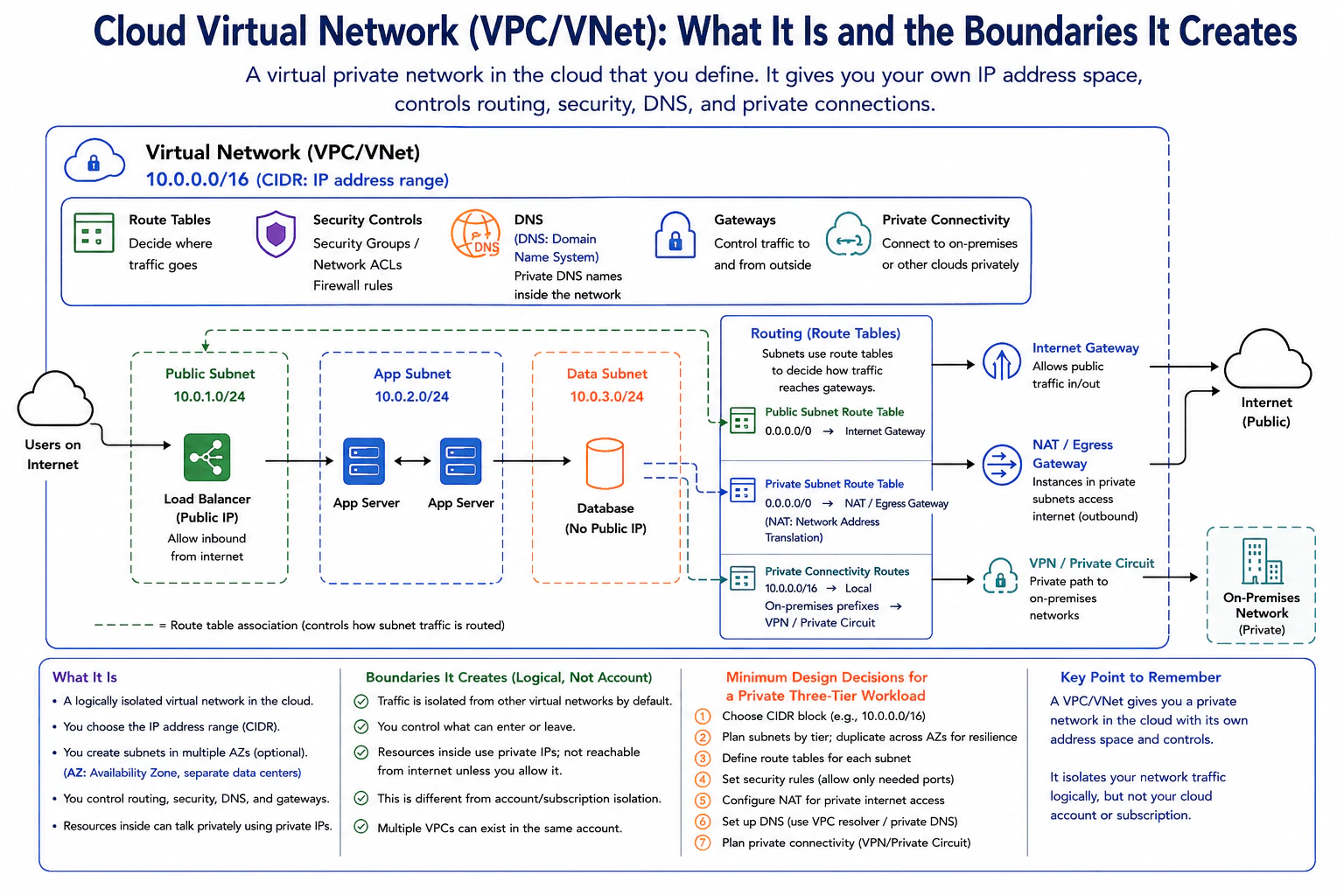
The goal is to create a private network area for a three-tier cloud workload. We need to decide which resources can receive Internet traffic and which resources should stay private. We also need clear rules for traffic leaving the network or reaching an on-premises network. The diagram organizes this into public, application, and data subnets. It then shows how route tables, gateways, security controls, DNS, and private connectivity control communication. Finally, it shows that network isolation is different from account or subscription isolation.
Useful Questions to Ask the Interviewer
Do the private application or data resources need outbound Internet access?
Does the workload need private connectivity to an on-premises network?
Should each tier be duplicated across availability zones for resilience?
How to Explain It in an Interview
1. Explain the virtual network boundary
I would start by saying that a VPC or VNet is a logically isolated cloud network. In this diagram, its address space is 10.0.0.0/16. CIDR is the notation used to describe that IP address range.
This boundary isolates network traffic from other virtual networks by default. It does not create a separate cloud account or subscription. Account or subscription boundaries separately control things such as identity, billing, and resource ownership.
2. Divide the address space into subnets
Next, I would split the network into smaller subnet ranges. The Public Subnet is 10.0.1.0/24 and contains the Load Balancer with a public IP. The App Subnet is 10.0.2.0/24 and contains the App Servers. The Data Subnet is 10.0.3.0/24 and contains the Database with no public IP.
The normal application path is Users on Internet → Load Balancer → App Server → Database. This keeps the database away from direct Internet access.
3. Explain route tables and gateways
Route tables decide where subnet traffic is sent. The Public Subnet Route Table has a default route, 0.0.0.0/0, toward the Internet Gateway. The Internet Gateway provides the public path between the virtual network and the Internet.
The Private Subnet Route Table sends its default route toward the NAT / Egress Gateway. NAT means Network Address Translation. It lets private resources make outbound Internet connections without giving those resources public IP addresses.
Private Connectivity Routes keep 10.0.0.0/16 traffic local. Traffic for on-premises prefixes goes through the VPN / Private Circuit.
4. Explain security and DNS
Routing decides where traffic can go. Security controls decide whether that traffic is allowed. The diagram shows Security Groups, Network ACLs, and optional firewall rules.
The network also provides private DNS names. DNS means Domain Name System. It lets internal resources use names instead of remembering private IP addresses.
5. Finish with the minimum design decisions
Before deployment, I would choose the CIDR block and subnet layout. I would plan subnets by tier and duplicate them across availability zones when resilience is needed. Then I would define route tables, add the required gateways, set security rules, configure private DNS, and decide whether private on-premises connectivity is needed.
The benefit is clear control over network paths and exposure. The downside is that routes, gateways, and security rules must be planned carefully.
Practical Complexity & Trade-offs
The benefit is that each tier has a clear network role. The public load balancer can receive Internet traffic, while the App Subnet and Data Subnet stay private. The NAT / Egress Gateway can give private resources outbound Internet access without assigning them public IP addresses. The VPN / Private Circuit can provide a private path to an on-premises network. The downside is more setup. CIDR ranges, subnet routes, gateways, DNS, and security rules must work together. A wrong route can block traffic, while an overly broad security rule can allow more access than intended.
Why Interviewers Ask This
Interviewers ask this to see whether you understand cloud network boundaries instead of only memorizing the words VPC or VNet. They want to know if you can divide an address range, separate public and private resources, explain route tables and gateways, apply security controls, and distinguish network isolation from account or subscription isolation. They also want to see clear design judgment.
Interviewer may ask next
What would you change if the private application and data tiers were not allowed to access the public Internet?
I would keep the same VPC/VNet and subnet layout, but I would remove the public Internet path for those private tiers. In the diagram, the Private Subnet Route Table sends 0.0.0.0/0 toward the NAT / Egress Gateway. That route is what allows outbound Internet access from private resources.
If that access is not allowed, the private route table should no longer send a default route toward the NAT / Egress Gateway. Traffic inside 10.0.0.0/16 can still use the local route, so the application tier can still communicate with the private database. Approved on-premises traffic can still use the VPN / Private Circuit through the Private Connectivity Routes.
Security Groups, Network ACLs, and firewall rules should still allow only the required traffic. The main downside is that private resources can no longer directly reach public Internet destinations through the NAT / Egress Gateway.
How would this design work if on-premises systems needed private access to resources inside the VPC or VNet?
I would keep the same basic design and use the existing VPN / Private Circuit. The on-premises network would communicate through that private path instead of using the public Internet. The diagram's Private Connectivity Routes send on-premises prefixes toward the VPN / Private Circuit.
Resources inside 10.0.0.0/16 still use the local route for communication within the virtual network. The Database can remain in the Data Subnet with no public IP. Private connectivity does not require making it public.
Security Groups, Network ACLs, and any firewall rules should allow only the traffic the approved on-premises systems need. Private DNS can also provide internal names where needed. The main downside is additional routing and security configuration. The cloud and on-premises sides must use compatible routes and access rules.
23. What makes a cloud subnet public or private?NetworkingEasy
i Question Details
In a virtual network, describe how route tables, an internet gateway, public addressing, NAT, and firewall rules affect whether resources can receive internet-initiated traffic or only start outbound connections. Distinguish subnet routing from the security controls on individual workloads.
Short Interview Answer (30-60 seconds)
At a high level, a subnet is public or private mainly because of its routing. The key question is whether Internet traffic can reach a workload directly or whether that workload can only start outbound connections. I would explain this through the public path, the private NAT path, and the security controls. A public subnet routes through an Internet Gateway. A private subnet can route outbound traffic through NAT. Security Groups and Network ACLs still decide which traffic is allowed.
Detailed Explanation
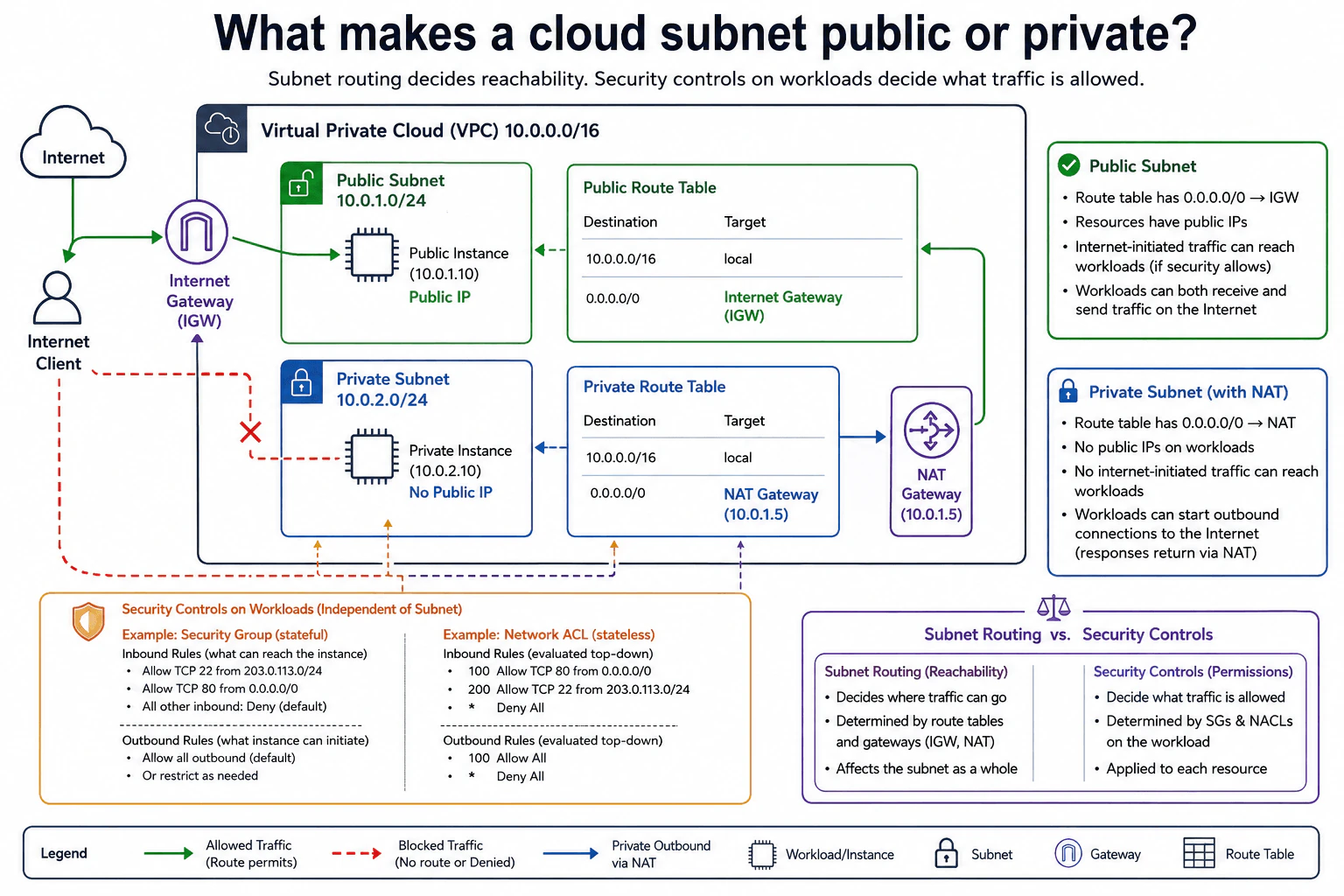
The goal is to control how workloads inside a cloud network communicate with the Internet. Some workloads need to accept connections started by Internet users. Other workloads should stay private and only start connections outward when needed. The important idea is that having a network path is different from allowing traffic on that path. The diagram explains this with a public subnet, a private subnet, an Internet Gateway, NAT, route tables, public addressing, Security Groups, and Network ACLs.
Useful Questions to Ask the Interviewer
Should any workload accept connections started directly from the Internet?
Do private workloads need outbound Internet access?
Which inbound ports and source networks should be allowed?
How to Explain It in an Interview
1. Start with subnet routing
I would first separate reachability from permission. A route table decides where packets can go. A firewall rule decides whether those packets are allowed.
The VPC in the diagram is 10.0.0.0/16. Both route tables keep traffic for that VPC on the local route. Their default Internet routes are different.
2. Explain the public subnet path
The Public Subnet is 10.0.1.0/24. Its route table sends 0.0.0.0/0 to the Internet Gateway, or IGW. That route is what makes the subnet public from a routing point of view.
The public instance is 10.0.1.10 and also has a public IP. Internet-initiated traffic can reach that workload when its security controls allow the connection. Return traffic can go back through the Internet Gateway.
A route to the IGW alone does not make every workload directly reachable. The workload also needs suitable public addressing and allowed security rules.
3. Explain the private subnet and NAT path
The Private Subnet is 10.0.2.0/24. Its instance is 10.0.2.10 and has no public IP. Its default route sends 0.0.0.0/0 to the NAT Gateway at 10.0.1.5.
This lets the private workload start an outbound Internet connection. The response comes back through NAT. An Internet client cannot use this NAT path to start a new unsolicited connection directly to the private instance.
4. Separate routing from security controls
Routing creates reachability. Security controls decide which traffic may use that reachability.
The diagram shows a stateful Security Group. Its example allows TCP 22 from 203.0.113.0/24 and TCP 80 from 0.0.0.0/0. Other inbound traffic is denied unless another rule allows it. Stateful means return traffic for an allowed connection is automatically tracked.
The diagram also shows a stateless Network ACL. A Network ACL applies at the subnet boundary. Stateless means inbound and outbound directions are checked separately, so rules must allow the required traffic in both directions.
5. State the practical rule
A public subnet has a route to an Internet Gateway. An Internet-facing workload also needs public addressing and security rules that permit the traffic. A private subnet can instead send Internet-bound traffic to NAT. That gives workloads outbound Internet access without letting the Internet start new connections through NAT. The key trade-off is that routing and security are separate controls, so both must be configured correctly.
Practical Complexity & Trade-offs
The benefit is clear separation between Internet-facing and private workloads. A public subnet can provide a direct Internet path through the Internet Gateway, while security rules still control what is accepted. A private subnet can avoid direct Internet-initiated access and still use NAT for outbound connections. The downside is more configuration. Route tables, public addresses, Security Groups, and Network ACLs must all match the intended traffic. A correct route does not automatically make traffic safe. A permissive firewall rule also cannot create a network path that does not exist.
Why Interviewers Ask This
Interviewers ask this to see whether you understand the difference between network reachability and traffic permission. They want to know if you can trace inbound and outbound traffic through route tables, an Internet Gateway, NAT, and public addressing. They also want to see whether you understand the different roles of Security Groups and Network ACLs, and why a private workload can reach the Internet without accepting new Internet-initiated connections.
Interviewer may ask next
What would change if the private workload must accept connections directly from the Internet?
I would change the network path used by that workload. In the current diagram, the Private Subnet sends its default Internet route to the NAT Gateway, and the workload has no public IP. NAT is used for connections that the private workload starts. It does not provide a path for an Internet client to start a new unsolicited connection to that instance.
For direct Internet-initiated access, the workload would need the public-style path shown in the diagram. Its subnet would need a default route to the Internet Gateway. The workload would also need suitable public addressing. Finally, its Security Group and subnet Network ACL would need to permit only the required traffic.
The important point is that routing, addressing, and security must all line up. The downside is greater Internet exposure, so inbound permissions should be kept as narrow as possible.
Why is a Security Group not enough to make a private subnet public?
A Security Group controls permission. It does not create a route to the Internet. In the diagram, subnet reachability comes from the route table and its gateway target.
The Public Subnet has a default route of 0.0.0.0/0 to the Internet Gateway. The public workload also has a public IP. Its Security Group can then decide which incoming connections are allowed, such as TCP 80 from anywhere or TCP 22 from the shown source network.
The Private Subnet is different. Its default route points to the NAT Gateway, and its workload has no public IP. Even if its Security Group allowed broad inbound traffic, an Internet client would still not get a direct unsolicited connection path through NAT to that private workload.
This separation adds configuration, but it gives clear control over both reachability and permission.
24. How do security groups and network ACLs differ in a cloud virtual network?NetworkingEasy
i Question Details
Compare stateful instance or interface-level security groups with stateless subnet-level network ACLs. Use inbound HTTPS from the internet to a public load balancer and return traffic as the example, and explain evaluation scope, rule direction, default behavior, and where each control belongs.
Short Interview Answer (30-60 seconds)
At a high level, Security Groups and Network ACLs protect different network boundaries. The main challenge is return traffic because Security Groups are stateful, while Network ACLs are stateless. I would explain the inbound HTTPS path, the return path, and then compare their rules. Security Groups protect ENIs such as load balancers and instances. Network ACLs protect subnets. Security Groups use allow rules, while Network ACLs can allow or deny traffic and must handle both directions explicitly.
Detailed Explanation
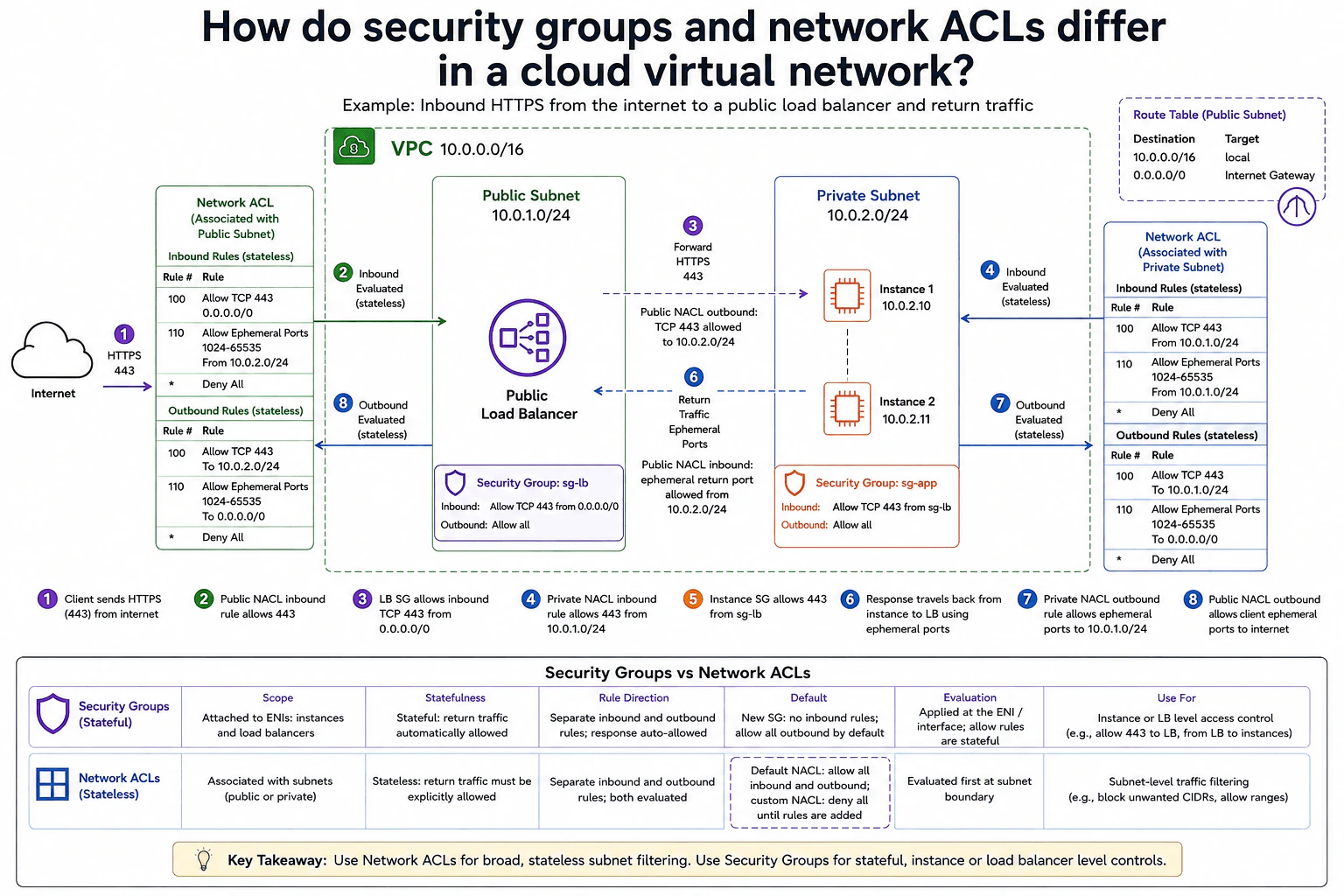
The goal is to control which network traffic can enter and leave each part of the virtual network. The important difference is how the two controls handle a connection after its first packet is allowed. One control remembers the connection. The other checks every direction separately. The diagram uses an HTTPS request from the Internet to a Public Load Balancer, followed by traffic to application instances in a Private Subnet. I would explain the incoming request first, then the response path, and finally compare rule behavior and where each control belongs.
Useful Questions to Ask the Interviewer
Should I trace both the Internet-to-load-balancer connection and the load-balancer-to-instance connection?
Should I explain the default behavior of new Security Groups and both default and custom Network ACLs?
Should I include how ordered Network ACL rules and ephemeral return ports affect the flow?
How to Explain It in an Interview
1. Start with where each control belongs
I would start by separating their scope. A Security Group is attached to an ENI, which is a network interface used by a load balancer or instance. A Network ACL is associated with a subnet.
That means Security Groups give fine-grained control around workloads. Network ACLs give broader filtering at the subnet boundary.
2. Trace the inbound HTTPS request
The client sends HTTPS traffic on TCP port 443 from the Internet. The Public Subnet Network ACL allows inbound TCP 443 from 0.0.0.0/0. Its rules are checked by rule number, starting with the lowest number, and the first matching rule wins.
The request reaches the Public Load Balancer. Its Security Group, sg-lb, allows inbound TCP 443 from 0.0.0.0/0. Security Groups have allow rules only. Traffic that does not match an allow rule is denied.
The load balancer then connects to the application instances on TCP 443. The Public Subnet Network ACL allows TCP 443 toward 10.0.2.0/24. The Private Subnet Network ACL allows TCP 443 from 10.0.1.0/24. The application Security Group, sg-app, allows TCP 443 from sg-lb.
3. Trace the return traffic
Security Groups are stateful. This means response traffic for an allowed connection is automatically permitted by the Security Group state. You do not need a separate reverse rule for that response.
Network ACLs are stateless. They do not remember the earlier request. The Private Subnet Network ACL must therefore allow the response toward the Public Subnet. The Public Subnet Network ACL must separately allow the matching ephemeral return port from 10.0.2.0/24.
For the response from the Public Load Balancer back to the Internet client, the Public Subnet Network ACL also needs the required outbound ephemeral-port rule.
4. Compare rule direction and default behavior
Both controls have inbound and outbound directions. Security Group rules are evaluated together as allow rules, and state tracks permitted connections. Network ACLs support both allow and deny rules, and each direction is evaluated independently.
A new Security Group has no inbound rules and allows all outbound traffic by default. A default Network ACL allows all inbound and outbound traffic. A custom Network ACL denies traffic until rules are added.
5. Explain when to use each control
I would use Security Groups as the main workload-level control because they are stateful and attach directly to ENIs. I would use Network ACLs for broad subnet-level filtering, such as blocking unwanted address ranges. Using both gives two layers of protection. The downside is that stateless Network ACLs require careful rules for both request and return traffic.
Practical Complexity & Trade-offs
The benefit is that the two controls protect different layers. Security Groups give precise access control around load balancers and instances. Their stateful behavior also makes normal request and response traffic easier to manage. Network ACLs add a broader filter around a whole subnet and can contain both allow and deny rules. The downside is that Network ACLs are stateless. You must think about both traffic directions and the needed return ports. Their ordered rules also require care because the first matching rule decides the result. Using both gives stronger layered filtering, but it creates more rules to maintain.
Why Interviewers Ask This
Interviewers ask this question to see whether you can reason about real cloud traffic instead of only memorizing definitions. They want to know if you understand network boundaries, packet direction, stateful versus stateless behavior, and rule evaluation. They also want to see whether you can choose Security Groups for interface-level control and Network ACLs for broader subnet-level filtering.
Interviewer may ask next
What happens if the Network ACL does not allow the ephemeral ports needed for return traffic?
The request can succeed in one direction, but the response can be blocked when it crosses a subnet boundary. I would keep the same architecture and trace the connection that created the return traffic.
For the load-balancer-to-instance connection, the instance sends its response toward the Public Load Balancer. The Private Subnet Network ACL must allow the required outbound return traffic. The Public Subnet Network ACL must also allow the matching ephemeral port inbound from 10.0.2.0/24.
The Security Groups behave differently. Because they are stateful, they automatically allow return traffic for a connection that was already permitted. They do not need a separate reverse rule for that response.
If the required Network ACL rule is missing, the packets are dropped even when both Security Groups are correct. The downside of stateless filtering is that both directions must be planned and tested carefully.
When would you use a Network ACL in addition to Security Groups?
I would keep Security Groups as the main access control for the Public Load Balancer and the application instances. Then I would add Network ACLs when I need a broader rule at the subnet boundary.
For example, the diagram places one Network ACL around the Public Subnet and another around the Private Subnet. That lets the network apply subnet-wide allow or deny rules before traffic reaches the ENI-level Security Groups.
The two controls solve different problems. Security Groups are stateful and use allow rules around interfaces. Network ACLs are stateless, support both allow and deny rules, and check inbound and outbound traffic separately. Their numbered rules are evaluated from the lowest number upward until a match is found.
The benefit is another filtering layer. The downside is more configuration work because the Network ACL rules must also cover the required return paths.
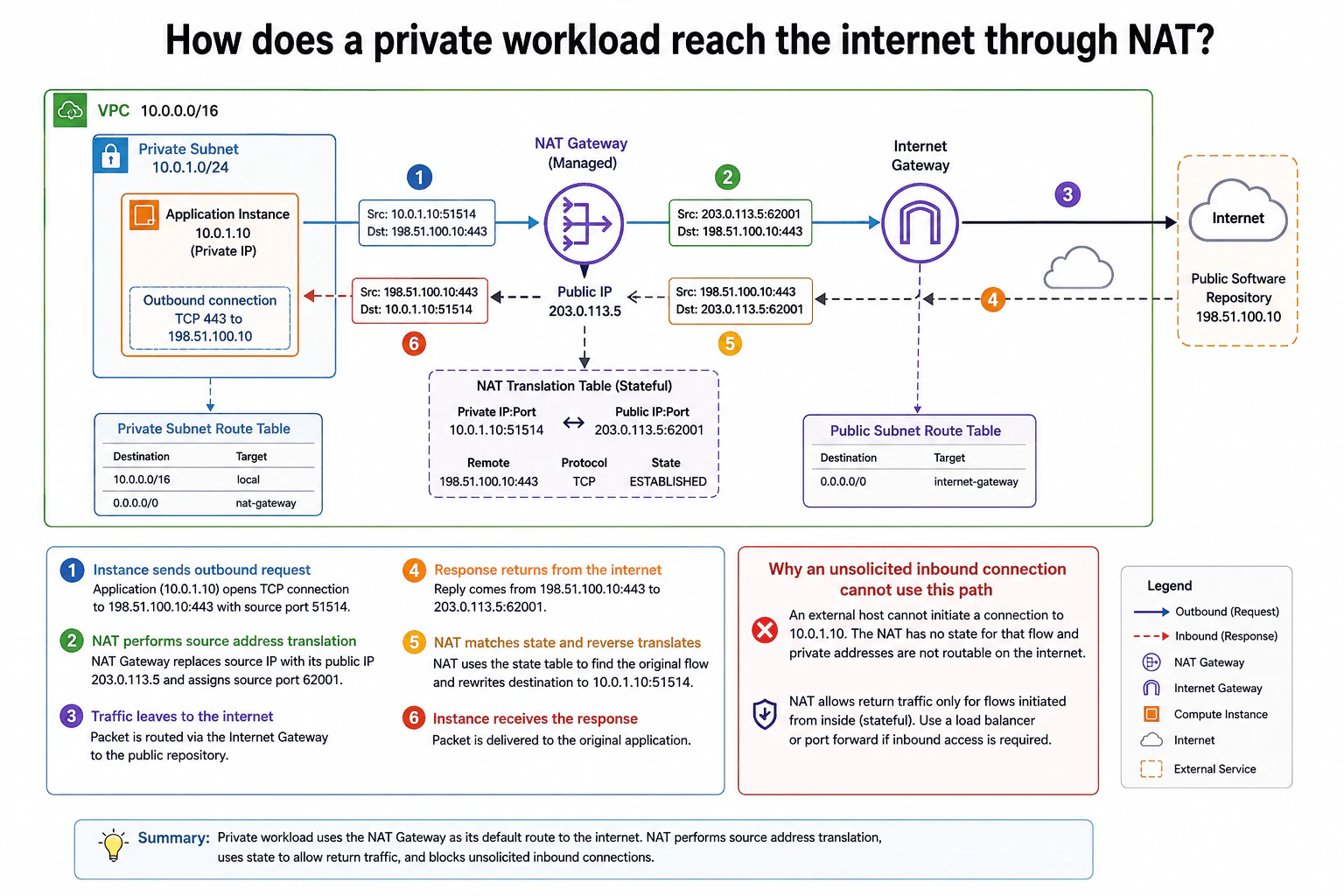
25. How does a private workload reach the internet through NAT?NetworkingEasy
i Question Details
Trace an outbound TCP connection from a private application instance to a public software repository and the return path. Include source address translation, route-table decisions, the public gateway, stateful filtering, and why an unsolicited inbound connection cannot use the same path.
Short Interview Answer (30-60 seconds)
At a high level, the private application needs outbound internet access without accepting new inbound connections. The main challenge is translating its private address while keeping the return path tied to the original TCP flow. I would explain the outbound route, the NAT translation, and the return path. The instance sends traffic to the NAT Gateway, which uses its public IP and keeps connection state. Replies are translated back to the instance. The trade-off is that unsolicited inbound traffic cannot use the same path.
Detailed Explanation
The goal is to let a private application connect to a public software repository without giving the application its own public internet address. The important part is keeping the outgoing connection and its reply tied together. The diagram solves this with routing, address translation, and saved connection state. Traffic first leaves the private subnet through the NAT Gateway. It then reaches the Internet Gateway and the public repository. The reply follows the saved NAT state back to the original application. A new connection started from the internet does not have that state, so it cannot use the same path.
Useful Questions to Ask the Interviewer
Should we assume the NAT Gateway already has the public IP shown in the diagram?
Should we focus only on the normal TCP flow and unsolicited inbound traffic?
How to Explain It in an Interview
1. Start with the private application and its route
I would start with the Application Instance at 10.0.1.10. It sits inside the Private Subnet 10.0.1.0/24 and has only a private IP.
The application opens a TCP connection to the Public Software Repository at 198.51.100.10:443. Its source is 10.0.1.10:51514. The Private Subnet Route Table keeps traffic for 10.0.0.0/16 local. Its default route, 0.0.0.0/0, sends other traffic to the NAT Gateway.
2. Explain source address translation at the NAT Gateway
Next, the NAT Gateway changes the source before the packet reaches the internet. This is source address translation, or SNAT. It means the private source address and port are replaced with the NAT Gateway's public address and translated port.
The diagram changes 10.0.1.10:51514 to 203.0.113.5:62001. The destination stays 198.51.100.10:443. The NAT Gateway also records this mapping in the NAT Translation Table. That state connects the translated public address and port with the original private connection.
3. Follow the packet through the public gateway
The translated packet continues toward the Internet Gateway. The Public Subnet Route Table shown in the diagram has 0.0.0.0/0 pointing to the Internet Gateway.
The packet then leaves the VPC and reaches the Public Software Repository. From the repository's point of view, the TCP connection comes from 203.0.113.5:62001, not directly from 10.0.1.10:51514.
4. Trace the response back to the application
For the return path, the repository sends its TCP response from 198.51.100.10:443 to 203.0.113.5:62001. The response returns through the Internet Gateway toward the NAT Gateway.
The NAT Gateway checks its saved state and finds the matching entry. It reverses the translation, changing the destination back to 10.0.1.10:51514. The response is then delivered to the Application Instance that started the connection.
5. Explain why unsolicited inbound traffic cannot use this path
The key security point is that the NAT Gateway is stateful. This means it remembers connections that were started from the private side and allows matching return traffic.
If an external host starts a new connection toward 203.0.113.5, that new flow has no matching entry in the NAT Translation Table. The NAT Gateway therefore has no saved mapping that sends it to 10.0.1.10. The private address is also not directly routable on the public internet. This design gives the private workload outbound internet access while blocking unsolicited inbound connections through the same NAT path.
Practical Complexity & Trade-offs
The benefit is that the Application Instance can reach the Public Software Repository without having its own public IP. The NAT Gateway replaces the private source address and remembers the connection so the response can return correctly. Its saved state also stops an outside host from starting a new connection through the same NAT path. The downside is that this path is designed for connections started from the private side. It is not a general inbound entry point. Routing must also be correct. The Private Subnet Route Table must send internet traffic to the NAT Gateway, and the public-side route must lead toward the Internet Gateway.
Why Interviewers Ask This
Interviewers ask this to see whether you can trace a packet instead of only naming networking components. They want to know if you understand route-table decisions, source address translation, the Internet Gateway, and stateful return traffic. They also want you to explain the important security difference between a response to an existing outbound connection and a completely new inbound connection.
Interviewer may ask next
What happens if the Public Software Repository tries to start a new TCP connection back to the private Application Instance?
It cannot use the existing NAT path as a new inbound connection. The NAT Gateway only has state for connections that were started from the private side. In the diagram, it knows that 203.0.113.5:62001 maps to 10.0.1.10:51514 for the existing TCP connection to 198.51.100.10:443.
A completely new inbound TCP connection is a different flow. It does not match that saved NAT Translation Table entry. The NAT Gateway therefore has no existing mapping that tells it to translate the packet and send it to 10.0.1.10.
The original outbound connection still works normally. Responses that belong to that connection can return through the Internet Gateway, match the NAT state, be reverse translated, and reach the Application Instance. The downside is that this NAT design does not provide general inbound access. A different inbound path is required when outside systems must start connections.
What happens if the Private Subnet Route Table does not have its 0.0.0.0/0 route to the NAT Gateway?
The Application Instance would not reach the Public Software Repository through the path shown in the diagram. The Private Subnet Route Table makes the routing decision before the NAT Gateway can translate the packet. Traffic for 10.0.0.0/16 stays local, while other destinations depend on the 0.0.0.0/0 route to the NAT Gateway.
If that default route is missing, traffic for 198.51.100.10:443 does not reach the NAT Gateway through this design. The source is therefore not translated from 10.0.1.10:51514 to 203.0.113.5:62001, and the NAT Translation Table does not gain the matching connection state.
Because the outbound flow never reaches the NAT Gateway correctly, the expected return path also cannot work. This shows that NAT alone is not enough. The route-table decision must first send the packet to the NAT Gateway. The downside is that one incorrect route can break outbound internet connectivity even when the NAT Gateway itself is available.
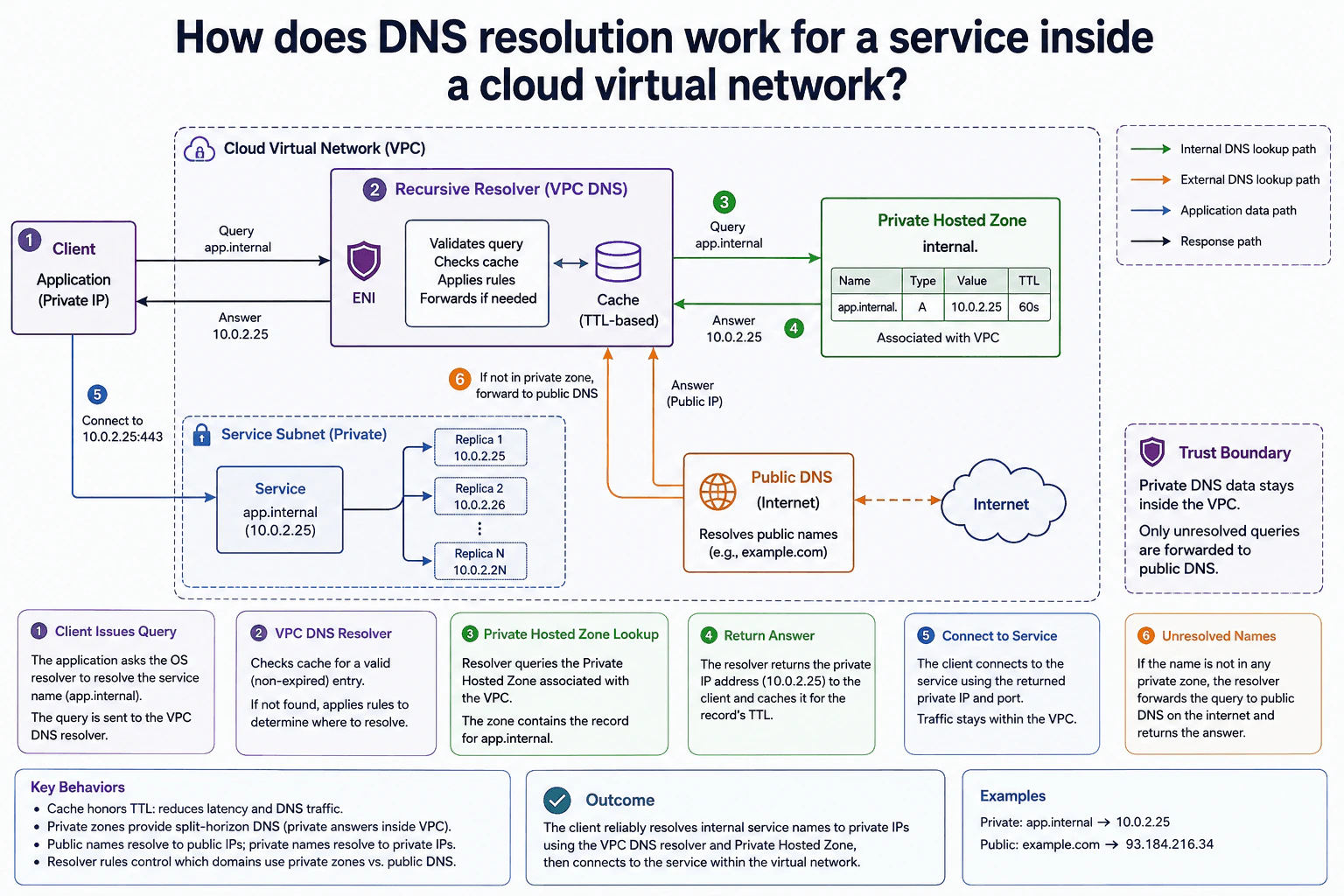
26. How does DNS resolution work for a service inside a cloud virtual network?NetworkingEasy
i Question Details
Trace a private application resolving an internal service name and then connecting to the returned private address. Explain the resolver path, private hosted zone or equivalent, record selection, caching, split-horizon behavior, and the trust boundary between private and public DNS.
Short Interview Answer (30-60 seconds)
At a high level, the goal is to turn an internal service name into a private IP address. The main challenge is keeping private DNS separate from public DNS while making repeated lookups fast. I would explain the resolver lookup, the private-zone answer, and the service connection. The VPC DNS Resolver checks cached results and the Private Hosted Zone, returns 10.0.2.25, and the client connects to 10.0.2.25:443. The trade-off is that cached answers remain usable until their TTL expires.
Detailed Explanation
The application knows the internal service name, but it needs an address before it can connect. The important part is making sure an internal name returns a private address without exposing private DNS data to public DNS. The design handles this in two stages. First, the application resolves app.internal through the cloud virtual network's DNS resolver. Then it uses the returned private address to connect to the service. Caching makes repeated lookups faster. Split-horizon DNS keeps private and public answers on the correct side of the trust boundary.
Useful Questions to Ask the Interviewer
Should app.internal resolve only from inside this cloud virtual network?
How quickly must clients see a changed service IP after a DNS update?
Should names missing from private zones be allowed to use public DNS?
How to Explain It in an Interview
1. Start with the client's DNS query
I would start with the private application asking for app.internal. The application's OS resolver sends the DNS query to the Recursive Resolver, labeled VPC DNS in the diagram. This resolver sits inside the Cloud Virtual Network boundary. Its job is to decide where the name should be resolved and return the answer to the client.
2. Check cached DNS results
The fast path is a valid cached answer. The VPC DNS Resolver keeps DNS results in its TTL-based cache. TTL means time to live, which tells the resolver how long an answer may be reused. If a cached app.internal answer is still valid, the resolver can return it without another zone lookup. The diagram also notes that clients may cache DNS answers according to their OS or library behavior and the TTL.
3. Look in the Private Hosted Zone
If the resolver needs a fresh answer, it checks the Private Hosted Zone associated with the VPC. It looks for the matching record for app.internal. The diagram shows an A record, which maps a name to an IP address. That record maps app.internal to private address 10.0.2.25 and has a 60-second TTL. The resolver returns 10.0.2.25 to the client and can cache that answer for the TTL.
This is the split-horizon behavior shown in the diagram. Internal names can receive private answers inside the VPC, while public names use public DNS. The same naming system can therefore give private and public clients different answers when separate private and public records exist. Private hosted-zone data stays inside the VPC trust boundary.
4. Connect to the returned private address
DNS resolution only finds the destination. It does not carry the application's service traffic. After receiving 10.0.2.25, the client connects to 10.0.2.25:443 using the application data path shown in the diagram. That connection reaches the internal Service in the private Service Subnet. The diagram also shows multiple service replicas behind that service, while the DNS answer shown to the client is 10.0.2.25.
5. Use public DNS only when private resolution has no answer
If the name is not in a private zone, the resolver applies its rules and can forward the lookup to Public DNS on the Internet. Public DNS resolves public names and returns a public IP answer. The diagram gives example.com as an example and shows 93.184.216.34 in its example box. That answer returns through the resolver to the client.
The trust boundary is important. Private hosted-zone records are not sent to public DNS. Only names that need the public path are forwarded outside. The benefit is clear separation between private and public naming. The downside is caching. An older DNS answer may remain usable until its TTL expires.
Practical Complexity & Trade-offs
The benefit is that private service names stay private and resolve to private IP addresses inside the cloud virtual network. Caching also makes repeated DNS lookups faster and reduces DNS traffic. The downside is that a cached answer can remain until its TTL expires, even after the record changes. A shorter TTL lets clients learn changes sooner, but it creates more DNS lookups. Split-horizon DNS also needs careful rules because private names and public names can follow different paths. Public DNS is used only when the resolver's private rules do not provide the needed answer.
Why Interviewers Ask This
Interviewers ask this to see whether you understand that DNS lookup and the later service connection are separate steps. They also want to know whether you can trace a request through a resolver, cache, and private DNS zone. A strong answer shows good judgment about TTL caching, record lookup, split-horizon DNS, private versus public trust boundaries, and why an internal service should normally resolve to a private address.
Interviewer may ask next
What would you change if the service IP changed often and clients needed to discover the new address quickly?
I would keep the same design, but I would change the TTL of the app.internal record. In the diagram, the Private Hosted Zone record has a 60-second TTL, and the resolver keeps answers in its TTL-based cache. Clients may also cache answers according to their OS or library behavior. That means an older address can remain in use until the relevant cached entry expires.
If faster changes are required, I would use a shorter TTL for the private DNS record. After the old cached entry expires, the VPC DNS Resolver checks the Private Hosted Zone again and receives the current private address. The client then uses that returned address for its next connection.
The trust boundary stays the same. app.internal still resolves through private DNS inside the VPC. The main downside is more DNS traffic because shorter TTL values cause fresh lookups more often.
What happens if public DNS is unavailable while an application is resolving names?
Private names can still resolve if the VPC DNS Resolver, its valid cache, and the Private Hosted Zone are working. For app.internal, the normal path stays inside the cloud virtual network. The resolver can return a valid cached answer or query the Private Hosted Zone and receive 10.0.2.25. That lookup does not need the Public DNS path shown in the diagram.
The result is different for a name that has no private-zone answer and must use public DNS. The resolver applies its rules and forwards that lookup to Public DNS on the Internet. If Public DNS cannot return an answer, that public lookup cannot complete through the shown path, so the client does not receive the public IP it needs.
The benefit of this separation is that a public DNS problem does not automatically break private hosted-zone lookups. The downside is that applications depending on public names may still fail.
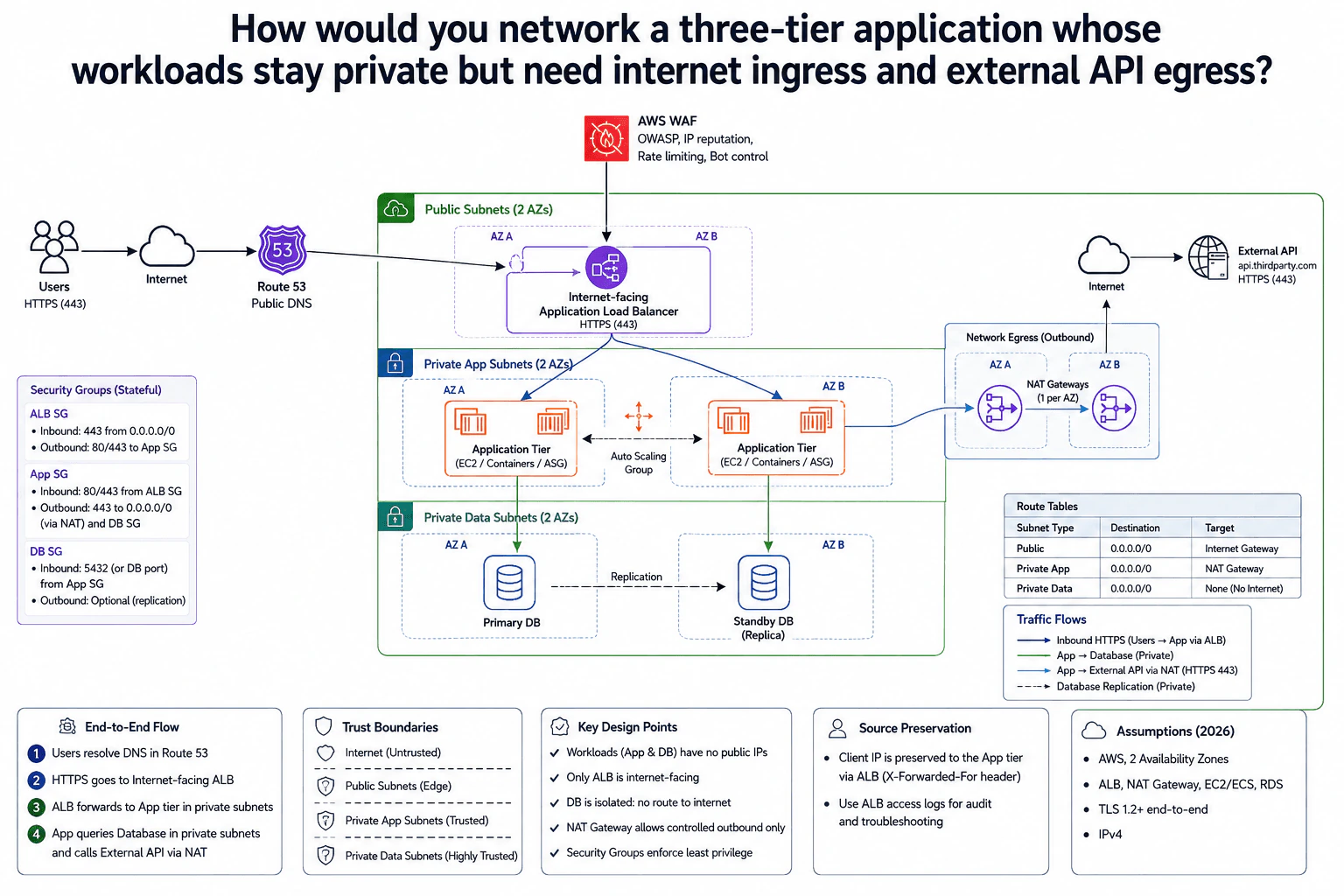
27. How would you network a three-tier application whose workloads stay private but need internet ingress and external API egress?NetworkingMedium
i Question Details
Design the path for inbound HTTPS from users to a public entry point, then to private application and database tiers, plus outbound HTTPS from the application tier to a third-party API. Include subnets, routes, load balancing, NAT, DNS, security rules, source preservation, and trust boundaries.
Short Interview Answer (30-60 seconds)
At a high level, the goal is to keep the Application Tier and database private while still serving internet users. The main challenge is allowing safe inbound HTTPS and controlled outbound API calls without giving workloads public IPs. I would explain this in three flows: users enter through Route 53 and the internet-facing Application Load Balancer, the application reaches the private database, and outbound HTTPS leaves through NAT Gateways. The trade-off is more network cost and setup for stronger isolation and multi-AZ resilience.
Detailed Explanation
The goal is to let people use the application from the internet without exposing the Application Tier or database directly. The difficult part is that traffic must cross several trust boundaries safely. User requests need a public entry point. The Application Tier also needs outbound access to a third-party API. The database should have no route to the internet. The diagram solves this by separating Public Subnets, Private App Subnets, and Private Data Subnets across two Availability Zones. Inbound traffic and outbound traffic then use different controlled paths.
Useful Questions to Ask the Interviewer
Should users connect only through HTTPS on port 443?
Does the Application Tier need outbound HTTPS to any external API or only approved destinations?
Which database port should the Application Tier use?
Is multi-AZ availability required for every tier?
How to Explain It in an Interview
1. Start with the trust boundaries
I would first separate internet-facing resources from private workloads. The internet-facing Application Load Balancer sits in the Public Subnets across two Availability Zones. The Application Tier runs in Private App Subnets. The Primary DB and Standby DB stay in Private Data Subnets. The Application Tier and database workloads have no public IPs. This creates clear Internet, Public Subnet, Private App Subnet, and Private Data Subnet trust boundaries.
2. Trace the inbound HTTPS path
For inbound traffic, users send HTTPS on port 443. Route 53 provides public DNS and directs users to the internet-facing Application Load Balancer. AWS WAF protects this public entry point with controls such as request filtering, rate limiting, IP reputation checks, and bot control. The ALB then forwards allowed traffic to the Application Tier in the private app subnets. The ALB SG accepts inbound port 443. The App SG accepts application traffic only from the ALB SG. The Application Tier receives the original client address through the ALB X-Forwarded-For header.
3. Trace application-to-database traffic
The Application Tier sends database traffic directly to the private database tier. This traffic stays inside the private network. The DB SG allows port 5432, or the selected database port, only from the App SG. The Primary DB replicates to the Standby DB in the second Availability Zone. The Private Data Subnets have no default internet route. This keeps the database isolated from direct internet access.
4. Trace external API egress
For outbound calls, the Application Tier sends HTTPS on port 443 toward a NAT Gateway. The design has NAT Gateways per Availability Zone. The Private App route sends 0.0.0.0/0 to NAT. NAT then sends the connection through the internet to the third-party API. The application workloads still have no public IPs. Return packets follow the existing stateful connection back through NAT to the Application Tier.
5. Explain routes, security, and trade-offs
The Public route table sends 0.0.0.0/0 to the Internet Gateway. The Private App route sends 0.0.0.0/0 to the NAT Gateway. The Private Data tier has no internet default route. Security groups add stateful filtering between tiers. The benefit is strong isolation with required internet connectivity. The downside is extra cost and operational work from the ALB, NAT Gateways, multiple subnets, routing, WAF, and multi-AZ design.
Practical Complexity & Trade-offs
The benefit is that the Application Tier and database stay private. Only the internet-facing Application Load Balancer accepts inbound internet traffic. The database has no route to the internet, which reduces its exposure. Using two Availability Zones also avoids putting everything in one failure area. The downside is more cost and setup work. The ALB and NAT Gateways add managed-service cost. Multiple subnets, route tables, and security groups also need careful configuration. A wrong route or security rule can break traffic even when the application is healthy. We accept this extra complexity because it gives clearer trust boundaries, controlled egress, and stronger isolation.
Why Interviewers Ask This
Interviewers use this question to see whether you can trace network traffic from start to finish. They want to know if you understand public and private subnets, DNS, load balancing, NAT, routing, and security groups. They also test security judgment. A strong answer explains why private workloads need no public IPs, how trust boundaries are protected, how source information reaches the application, and what trade-offs come with the design.
Interviewer may ask next
What would you change if the third-party API required an allowlist of fixed source IP addresses?
I would keep the same basic design, but I would make the NAT Gateway egress addresses the stable public identities used by the third-party API. The Application Tier would still stay in the Private App Subnets and would still send outbound HTTPS through NAT. The third party would allow the public addresses used by the NAT Gateways instead of allowing individual application instances or containers.
This keeps scaling simple because Application Tier workloads can be replaced or added without changing the external allowlist. The private app route would still send 0.0.0.0/0 toward the NAT Gateway. HTTPS responses would return through the same stateful connection.
The important change is operational. Every NAT Gateway address that can send traffic to the third party must be included in the allowlist. The downside is that the external dependency now relies on those egress addresses staying stable and correctly configured across both Availability Zones.
What happens if one Availability Zone becomes unavailable?
I would keep the multi-AZ structure shown in the diagram and use the healthy Availability Zone to continue serving traffic. The internet-facing Application Load Balancer spans both Availability Zones, so it can direct requests to healthy Application Tier capacity. The Application Tier is also shown with an Auto Scaling Group, so application capacity can be maintained or replaced when needed.
For the database, the diagram has a Primary DB and a Standby DB in separate Availability Zones. That provides another database copy when one zone has a problem. The outbound path also has NAT Gateways per Availability Zone, so normal egress does not depend on one shared NAT Gateway.
This design reduces the effect of a zone failure, but it does not promise zero interruption. Application capacity may temporarily be lower, and database recovery or a role change may briefly affect requests. The downside is higher cost and more multi-AZ operational complexity.
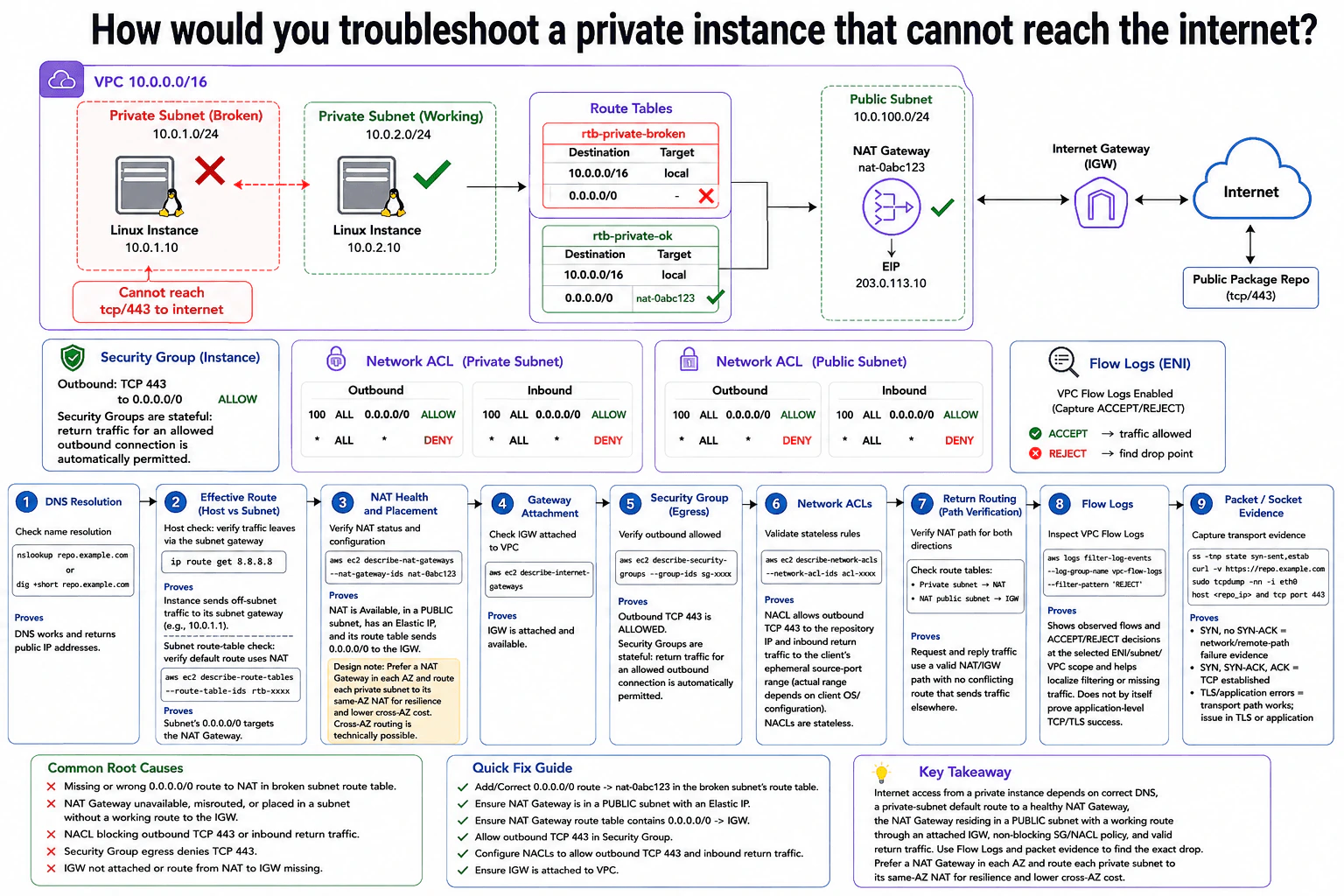
28. How would you troubleshoot a private instance that cannot reach the internet?NetworkingMedium
i Question Details
A Linux instance in a private subnet cannot establish TCP 443 connections to a public package repository, while another subnet works. Walk through DNS, effective routes, NAT health and placement, gateway attachment, security groups, network ACLs, return routing, flow logs, and packet or socket evidence, stating what each check proves.
Short Interview Answer (30-60 seconds)
At a high level, I would trace one TCP 443 connection from the failing private instance to the public package repository. The main challenge is finding exactly where that path breaks. I would check DNS and effective routes first, then NAT and Internet Gateway connectivity, then Security Groups, Network ACLs, and return routing. Finally, I would use VPC Flow Logs and packet evidence. I would also compare every step with the working subnet because that quickly narrows the difference.
Detailed Explanation
The goal is to find why one private Linux instance cannot reach a public package repository while another subnet works. I would follow one connection from the instance toward the internet and check each place where it could stop. The working subnet is useful because it gives me a known-good path for comparison. I would start with name resolution and routing. Then I would check the NAT Gateway and Internet Gateway. After that, I would verify the security rules, return path, Flow Logs, and packet evidence.
Useful Questions to Ask the Interviewer
Does the repository name resolve successfully on the failing instance?
Does the working subnet use the same NAT Gateway or a different NAT Gateway?
Were any route table, Security Group, or Network ACL rules changed recently?
Do VPC Flow Logs show ACCEPT or REJECT records for the failing connection?
How to Explain It in an Interview
1. Check DNS resolution
I would first prove that the instance can resolve the package repository name. I can use nslookup or dig. A successful lookup gives me the public repository IP to test. If DNS fails, I would solve name resolution before troubleshooting TCP 443.
2. Check the host route and private subnet route
Next, I would separate the Linux route from the cloud route. ip route get <repo_ip> shows whether Linux sends off-subnet traffic toward its subnet gateway. It does not prove that the VPC route uses NAT. I would then inspect the private subnet route table. Its 0.0.0.0/0 route should target the intended NAT Gateway. I would compare this with the working subnet's route table.
3. Verify NAT and Internet Gateway connectivity
The NAT Gateway should be Available and located in a public subnet. A public NAT Gateway needs an Elastic IP. Its public subnet must have 0.0.0.0/0 routed to the Internet Gateway, and that Internet Gateway must be attached to the VPC. A same-AZ NAT Gateway is preferred for resilience and lower cross-AZ cost, but cross-AZ routing can still work.
4. Check Security Groups, Network ACLs, and return routing
The instance Security Group must allow outbound TCP 443. Security Groups are stateful, so reply traffic for that allowed connection is automatically permitted. Network ACLs are stateless. They must allow outbound TCP 443 and inbound return traffic to the client's ephemeral source-port range. I would also confirm that the private subnet sends its default route to the intended NAT and that the NAT public subnet sends its default route to the Internet Gateway.
5. Use Flow Logs and packet evidence
If the configuration looks correct, I would inspect VPC Flow Logs. ACCEPT and REJECT records help show whether traffic is observed and where filtering may occur. Flow Logs do not prove that TCP or TLS completed. I would then use ss, curl -v, and tcpdump -nn -i eth0 host <repo_ip> and tcp port 443. Repeated SYN packets without a SYN-ACK suggest a network or remote-path problem. SYN, SYN-ACK, and ACK prove TCP is established. A later TLS error means the network path works, but TLS or application negotiation failed.
Practical Complexity & Trade-offs
The benefit of this troubleshooting order is that each check proves one small part of the connection. Comparing the broken subnet with the working subnet can make the failure much easier to find. Security Groups are simpler for return traffic because they are stateful. Network ACLs need more care because they are stateless. A NAT Gateway in each Availability Zone improves resilience and can reduce cross-AZ traffic costs. The downside is that more NAT Gateways cost more. Flow Logs help locate filtering, but packet evidence is still needed to understand whether TCP and TLS actually succeed.
Why Interviewers Ask This
Interviewers want to see whether you can troubleshoot a cloud network in a clear order instead of guessing. They are checking your understanding of DNS, route tables, NAT, Internet Gateways, Security Groups, Network ACLs, and return traffic. They also want to see whether you can use Flow Logs and packet evidence to prove where a connection fails and explain what each check tells you.
Interviewer may ask next
What would change if the failing private subnet routed through a NAT Gateway in another Availability Zone?
I would not treat the different Availability Zone as an automatic failure because cross-AZ routing to a NAT Gateway can work. I would first verify that the private subnet's 0.0.0.0/0 route points to that NAT Gateway. Then I would confirm that the NAT Gateway is Available, has an Elastic IP, and is in a public subnet whose 0.0.0.0/0 route points to the Internet Gateway.
I would also verify that the Internet Gateway is attached to the VPC and that the Security Group and Network ACL rules allow the outbound request and return traffic. Flow Logs and packet evidence would confirm whether packets actually follow that path.
For the normal production design, I would prefer a NAT Gateway in each Availability Zone and route each private subnet to its same-AZ NAT. This improves resilience and reduces unnecessary cross-AZ traffic. The downside is the extra NAT Gateway cost.
What would you do if VPC Flow Logs show ACCEPT, but curl still cannot complete the HTTPS connection?
I would move from network-policy evidence to socket and packet evidence. An ACCEPT Flow Log record means the observed traffic was allowed at the logged network scope. It does not prove that the remote server answered, that the TCP handshake completed, or that TLS succeeded.
I would run curl -v to see exactly where the connection stops. I would also use ss and tcpdump -nn -i eth0 host <repo_ip> and tcp port 443. If I see repeated SYN packets without a SYN-ACK, I would investigate the NAT path, return routing, or the remote side. If I see SYN, SYN-ACK, and ACK, TCP is established.
If the error happens after the TCP handshake, the network transport path is working. I would then focus on the TLS or application error reported by curl -v. The downside is that packet analysis requires more detailed evidence and careful interpretation.
29. How would you connect cloud and acquired networks that have overlapping CIDR ranges?NetworkingHard
i Question Details
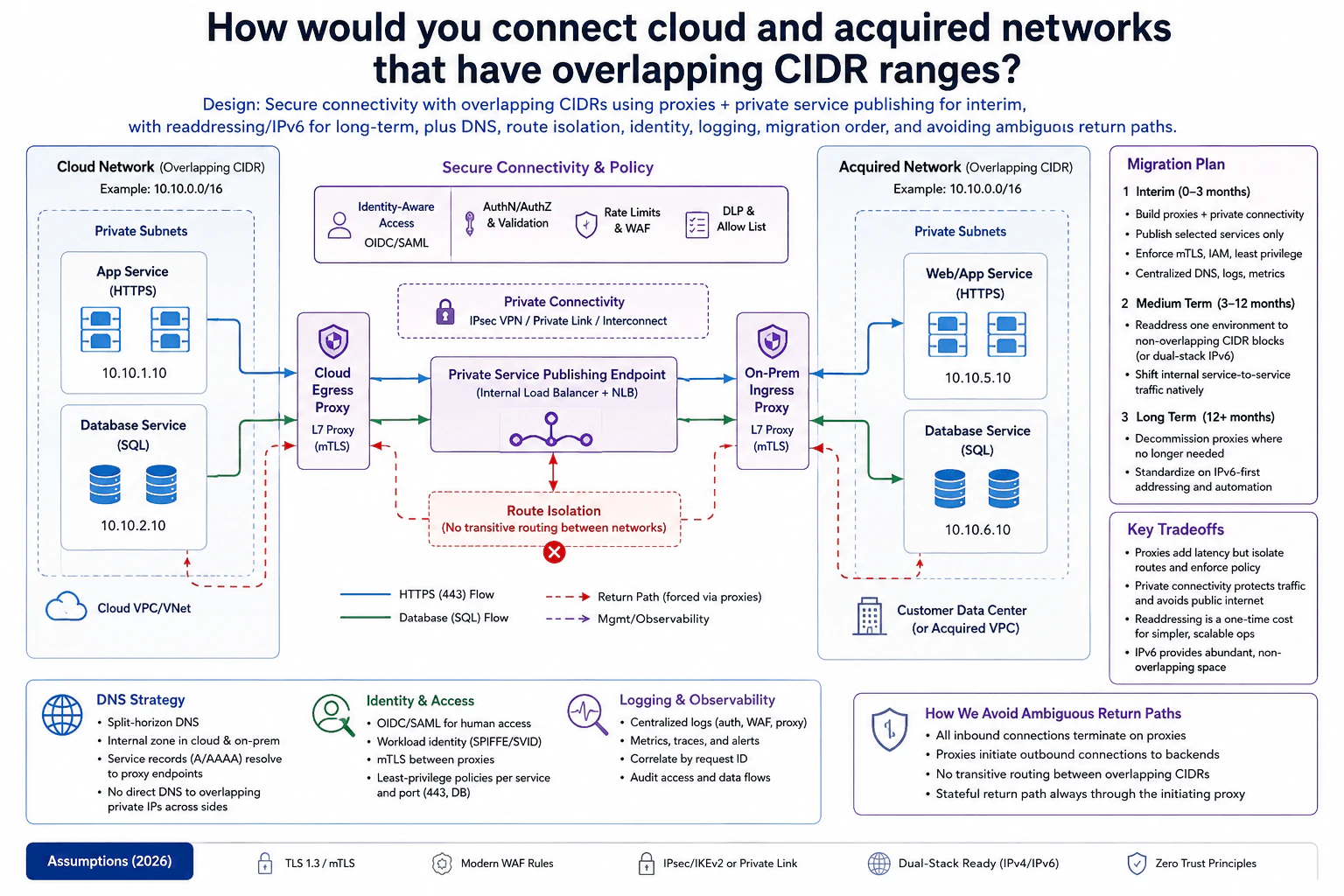
Two organizations must exchange selected HTTPS and database flows, but their private IPv4 ranges overlap. Design an interim and long-term solution using options such as application proxies, private service publishing, translation, readdressing, or IPv6. Include DNS, route isolation, identity, logging, migration order, and how you avoid ambiguous return paths.
Short Interview Answer (30-60 seconds)
At a high level, I would connect the two organizations without directly routing their overlapping private addresses. The main challenge is avoiding ambiguous routes while still allowing selected HTTPS and database flows. I would explain the solution in three parts: controlled proxy connectivity, DNS and security controls, and migration. Traffic crosses through L7 proxies, a Private Service Publishing Endpoint, and private connectivity. The downside is extra proxy latency and operational work until readdressing or IPv6 removes the overlap.
Detailed Explanation
The two organizations need selected applications and databases to communicate, but both networks use overlapping private IPv4 addresses. A destination address can therefore mean different machines on each side. Direct routing would be unsafe because routers could not reliably decide which network owns that address. The diagram solves this by keeping the networks isolated and making proxies the controlled crossing point. DNS sends approved service names to proxy endpoints. Private connectivity carries the approved traffic. Readdressing or IPv6 removes the overlap later.
Useful Questions to Ask the Interviewer
Which HTTPS services and database ports must cross the boundary?
Which organization initiates each required connection?
Can either environment move to non-overlapping CIDR ranges?
Can both environments support dual-stack IPv4 and IPv6?
How to Explain It in an Interview
1. Keep the overlapping networks isolated
I would start by keeping the Cloud Network and Acquired Network as separate routing domains. The diagram shows no transitive routing between them. Both sides can use the overlapping 10.10.0.0/16 range without exchanging direct routes for those addresses. This prevents an application from accidentally sending traffic toward the wrong copy of an overlapping address.
2. Send approved flows through the proxy path
For the HTTPS path, the Cloud App Service sends traffic to the Cloud Egress Proxy. That L7 proxy forwards the connection through the Private Service Publishing Endpoint, private connectivity, and the On-Prem Ingress Proxy. The ingress proxy then connects to the acquired Web/App Service. The database flow uses the same controlled boundary for approved SQL traffic. The proxies use mTLS, meaning both proxy endpoints authenticate each other with certificates. Responses return through the stateful proxy path instead of using a direct overlapping route.
3. Use private connectivity and service publishing
The middle of the design provides private connectivity using options shown as IPsec VPN, Private Link, or Interconnect. The Private Service Publishing Endpoint exposes only the services that are meant to cross the boundary. This keeps the two address spaces isolated while still giving applications a reachable service endpoint. It also avoids making the acquired network a transit path for the cloud network, or the reverse.
4. Control DNS, identity, and access
Split-horizon DNS gives internal clients the correct view of a service name. A or AAAA records resolve to proxy endpoints instead of remote overlapping private addresses. Human access uses OIDC or SAML. Workload identity can use SPIFFE or SVID. Least-privilege rules allow only required services and ports. Rate limits, WAF controls, validation, DLP, and allow lists provide additional policy checks shown in the diagram.
5. Log the boundary and migrate in stages
Centralized logs collect authentication, WAF, and proxy records. Metrics, traces, alerts, request IDs, and audit records help operators follow cross-network activity. The interim phase builds proxies and private connectivity first. The medium-term phase readdresses one environment or introduces dual-stack IPv6. Native service-to-service traffic can then move away from the proxy boundary where safe. In the long term, proxies that are no longer needed can be removed. The main trade-off is temporary latency and operational complexity in exchange for predictable routing and strong isolation.
Practical Complexity & Trade-offs
The benefit is that overlapping networks never need direct routes to each other. Proxies create a clear place to control identity, mTLS, allowed services, ports, and logging. Private connectivity also keeps selected traffic on controlled network paths instead of exposing it publicly. The downside is that each cross-network request takes an extra proxy path, which adds some latency and more components to operate. Readdressing gives a simpler long-term network, but changing addresses takes planning and migration work. IPv6 gives a much larger non-overlapping address space, but applications and networks must support it. The interim complexity is accepted because it keeps routing predictable.
Why Interviewers Ask This
The interviewer wants to see whether you recognize that overlapping CIDRs create a routing problem, not just a firewall problem. They also want to see whether you can expose only required services, keep return paths predictable, apply identity controls, and plan a safe migration. A strong answer shows judgment about temporary proxy-based connectivity while still working toward a simpler long-term design with non-overlapping addresses or IPv6.
Interviewer may ask next
What would you change if neither organization could readdress its IPv4 network for several years?
I would keep the same proxy-based boundary for longer. The Cloud Network and Acquired Network would still remain separate routing domains, with no direct route exchange for their overlapping CIDRs.
Approved applications would continue using split-horizon DNS. Service records would resolve to proxy endpoints instead of remote private application addresses. HTTPS and database connections would enter through the local L7 proxy, cross the private connectivity path, and terminate at the proxy on the other side before reaching the target service. Stateful proxy connections would keep the return path predictable.
Because the proxies would remain important for several years, I would place more operational attention on their health checks, capacity, certificate management, logs, metrics, traces, and alerts. Least-privilege rules would continue limiting which services and ports can cross the boundary.
I would also prepare dual-stack IPv6 where possible. The downside is that the extra proxy hop, latency, certificate work, and operational complexity remain part of the environment for much longer.
How would you prevent an ambiguous or asymmetric return path when both sides use overlapping addresses?
I would make the proxy layer own every cross-network connection. A workload would not directly send traffic to a remote overlapping private address. It would connect to its local proxy endpoint instead.
The Cloud Egress Proxy creates a separate connection across the Private Service Publishing Endpoint and private connectivity. The On-Prem Ingress Proxy then creates another connection to the destination service. The response returns to the proxy that opened that local connection. From there, it follows the controlled proxy path back toward the original caller.
I would also keep the routing domains isolated and avoid transitive routing between the networks. Split-horizon DNS would return proxy endpoints rather than remote overlapping private IP addresses. Those two controls remove the opportunity for a host or router to choose between ambiguous direct routes.
The downside is that the proxy layer becomes part of every cross-network flow. Its health, capacity, certificates, and monitoring therefore become important operational dependencies.
30. How would you design secure inter-region network paths for a multi-region application?NetworkingHard
i Question Details
Application tiers in two regions exchange replication and control traffic while each region also serves users. Define the private or encrypted transport, routing domains, DNS and global traffic management, firewall policy, failure detection, asymmetric-path prevention, bandwidth planning, and behavior during a regional partition.
Short Interview Answer (30-60 seconds)
At a high level, the goal is to let both regions serve users while keeping cross-region traffic secure. The hard part is moving replication and control traffic safely while handling failures and avoiding asymmetric network paths. I would explain three flows: user traffic, private inter-region traffic, and regional failover. Global DNS steers users, BGP routes the private link, and strict network policy limits access. The trade-off is better isolation and resilience with more routing, security, and operational complexity.
Detailed Explanation
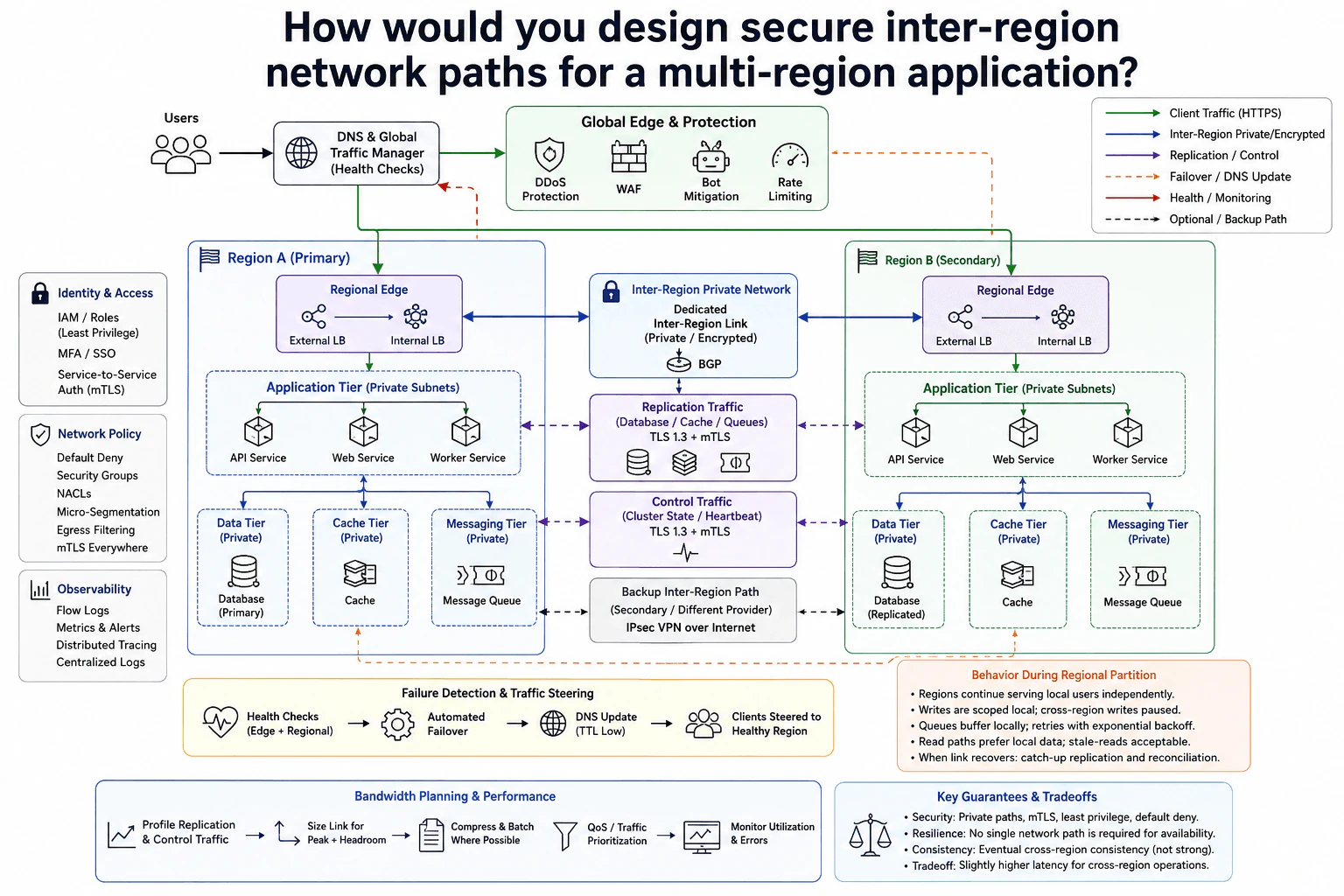
The application runs in two regions, and each region can serve users. The difficult part is keeping traffic secure between those regions while still surviving link or regional failures. User requests, replication traffic, and control traffic have different needs, so the diagram keeps those paths separate. The normal cross-region path is private or encrypted. An optional IPsec VPN provides another path. Health checks and global traffic steering move users away from an unhealthy region. During a regional partition, each region keeps serving local users while cross-region work is limited.
Useful Questions to Ask the Interviewer
How much replication and control traffic should the inter-region link carry?
How quickly should users move away from an unhealthy region?
Are stale local reads acceptable during a regional partition?
Which cross-region writes may pause if the regions lose connectivity?
How to Explain It in an Interview
1. Explain the user traffic path
I would start with how a user reaches a healthy region. Users reach DNS & Global Traffic Manager, which uses health checks to help choose where traffic should go. Traffic then passes through Global Edge & Protection, including DDoS protection, WAF, bot mitigation, and rate limiting.
The selected region receives HTTPS traffic through its Regional Edge. The External LB passes traffic toward the Internal LB. Requests then enter the Application Tier in private subnets.
2. Keep regional workloads private and tightly controlled
Each region contains API Service, Web Service, and Worker Service. They use private Data Tier, Cache Tier, and Messaging Tier components.
Access follows least privilege. The diagram shows IAM or roles, MFA or SSO, security groups, NACLs, micro-segmentation, egress filtering, and service-to-service mTLS. Network policy starts with default deny and allows only required communication.
3. Use a private or encrypted inter-region path
The main cross-region path is the Inter-Region Private Network. It uses a dedicated private or encrypted inter-region link with BGP for routing. Replication traffic covers database, cache, and queue traffic. Control traffic carries cluster state and heartbeat messages.
Both traffic types use TLS 1.3 plus mTLS. Routing policy should keep the forward and return path consistent for a flow, which avoids problems with stateful firewalls caused by asymmetric routing. The optional Backup Inter-Region Path uses an IPsec VPN over the Internet through a secondary or different provider.
4. Detect failures and steer traffic
Edge and regional health checks detect failures. Automated failover updates DNS so clients can be steered toward a healthy region. This is not instant because DNS changes need time to reach clients.
Observability uses flow logs, metrics and alerts, distributed tracing, and centralized logs. These signals help operators find link, routing, and application failures.
5. Plan for partitions and bandwidth
During a regional partition, both regions continue serving local users independently. Cross-region writes pause, queues buffer local work, and retries use exponential backoff. Reads prefer local data, so stale reads may occur. When connectivity returns, replication catches up and the regions reconcile their data.
Capacity planning starts by measuring replication and control traffic. The link is sized for peak traffic plus headroom. Compression, batching, QoS or traffic prioritization, and utilization monitoring help protect important traffic. The benefit is strong isolation and resilience. The downside is more routing, security, and recovery complexity.
Practical Complexity & Trade-offs
The benefit is that both regions can serve users while sensitive cross-region traffic stays on private or encrypted paths. Strict network rules also reduce what a compromised service can reach. The backup IPsec VPN gives another possible path if the main link fails. The downside is more complexity. BGP routing, DNS failover, firewalls, certificates, health checks, and monitoring all need careful operation. During a partition, local reads may be slightly old and cross-region writes may pause. We accept that because the design lets each region continue serving local users instead of depending on one working inter-region path.
Why Interviewers Ask This
Interviewers want to see whether you can connect routing, security, DNS, failure handling, and capacity planning into one practical design. They also want to know whether you understand that user traffic, replication traffic, and control traffic have different needs. A strong answer explains safe paths, symmetric routing, regional failover, partition behavior, and trade-offs without promising instant recovery or perfect availability.
Interviewer may ask next
What would you change if the application could not tolerate stale reads during a regional partition?
I would keep the same network architecture, but I would change what the application is allowed to do during the partition. The current design lets each region prefer local data. That keeps the service available, but one region may temporarily read data that is behind the other region.
If stale reads are not allowed, an operation that needs the newest cross-region data cannot safely continue when both inter-region paths are unavailable. The dedicated private or encrypted link remains the normal path, and the optional IPsec VPN remains the backup path. Health checks and observability still detect the failure. If neither path can provide the required communication, those freshness-sensitive reads should wait or fail instead of returning possibly old data.
The main downside is lower availability. Some users may see blocked operations during a partition, but the system avoids returning data that violates the stronger freshness requirement.
What would you do if replication traffic became larger than the inter-region link could handle?
I would keep the same architecture and first protect the most important traffic. The diagram already separates replication traffic from control traffic and includes bandwidth planning, compression, batching, QoS or traffic prioritization, and monitoring.
I would use utilization and error metrics to confirm that the link is becoming overloaded. Control traffic, including heartbeat and cluster-state messages, should receive enough priority to remain reliable. Replication traffic can use compression and batching where supported. The link should then be resized from measured peak demand plus reasonable headroom.
Queues can buffer local work while replication is behind, and retries should use exponential backoff so they do not make congestion worse. The main downside is that delayed replication can make the regions differ for longer. Adding more inter-region capacity can also increase cost.
More questions load as you scroll
Disclaimer: This interview guide is for educational and informational purposes only. It is designed to help readers prepare, but it does not guarantee any interview result, hiring decision, offer, or outcome. Interview questions, hiring criteria, and preferred answers can vary by employer, interviewer, industry, location, and time. All answers, examples, and explanations in this guide are suggested examples for interview preparation, not definitive answers or instructions for professional practice. They are based on research and judgment, are provided without warranties of any kind, and should be adapted to the question, role, and applicable laws and professional requirements. Diagrams are simplified illustrations intended to highlight the main concepts and their relationships; actual situations, systems, and practices may be more complex. Alternative approaches may be equally valid or better suited to a particular question, context, or interviewer. To the fullest extent permitted by applicable law, the contributors and publisher are not liable for decisions made, actions taken, or losses incurred based on this guide.
State Laws and Professional Responsibilities: Laws and requirements governing an occupation vary by state and jurisdiction. You are responsible for checking the current laws, licensing requirements, and scope-of-practice rules that apply to your location and role, and for ensuring that your answers and actions comply with them. Adapt examples in this guide to those requirements. This guide is not legal advice.
Content Accuracy and Verification: To the fullest extent permitted by applicable law, we do not represent or warrant that interview guides, questions, answers, examples, or diagrams are accurate, complete, current, error-free, or suitable for any particular purpose. You are responsible for independently reviewing and verifying the information before relying on it.