143 Cloud Engineer Interview Questions & Answers

90 top • 9 Amazon • 3 Apple • 9 Google • 7 Meta • 8 Microsoft • 9 Netflix • 8 NVIDIA

Cloud Engineer icon

Questions with Detailed ExplanationsWith Detailed Explanations

(Last Updated: September 3, 2026)

31. What is the cloud shared responsibility model, and how does it change across IaaS, PaaS, and SaaS?SecurityEasy

Question Details

Define the provider's responsibility for security of the cloud and the customer's responsibility for security in the cloud. Compare responsibility for facilities, hardware, networking, operating systems, identities, applications, configuration, and data across IaaS, PaaS, and SaaS, and explain how to resolve a control that appears to fall between teams.

Short Interview Answer (30-60 seconds)

The provider secures the cloud infrastructure, while the customer secures what they configure, access, deploy, and store. In IaaS the customer manages more layers, including the operating system. PaaS shifts the OS and runtime toward the provider. SaaS shifts even more responsibility, but identity, configuration, access, and data still require customer control.

Detailed Explanation

The shared responsibility model explains which security jobs belong to the cloud company and which belong to the customer. The cloud company protects the buildings, physical machines, and core systems that make the service work. The customer protects the people who can use the service, the choices made inside it, and the information placed there. The exact split changes depending on what is being purchased. With more managed services, the cloud company handles more technical layers, but the customer still has important duties and must confirm who owns unclear controls.

Useful Questions to Ask the Interviewer
  1. Should I explain this using a specific cloud provider, or keep the comparison provider-neutral?
  2. Should I focus only on the technical boundary, or also include organizational ownership when a control is shared between teams?
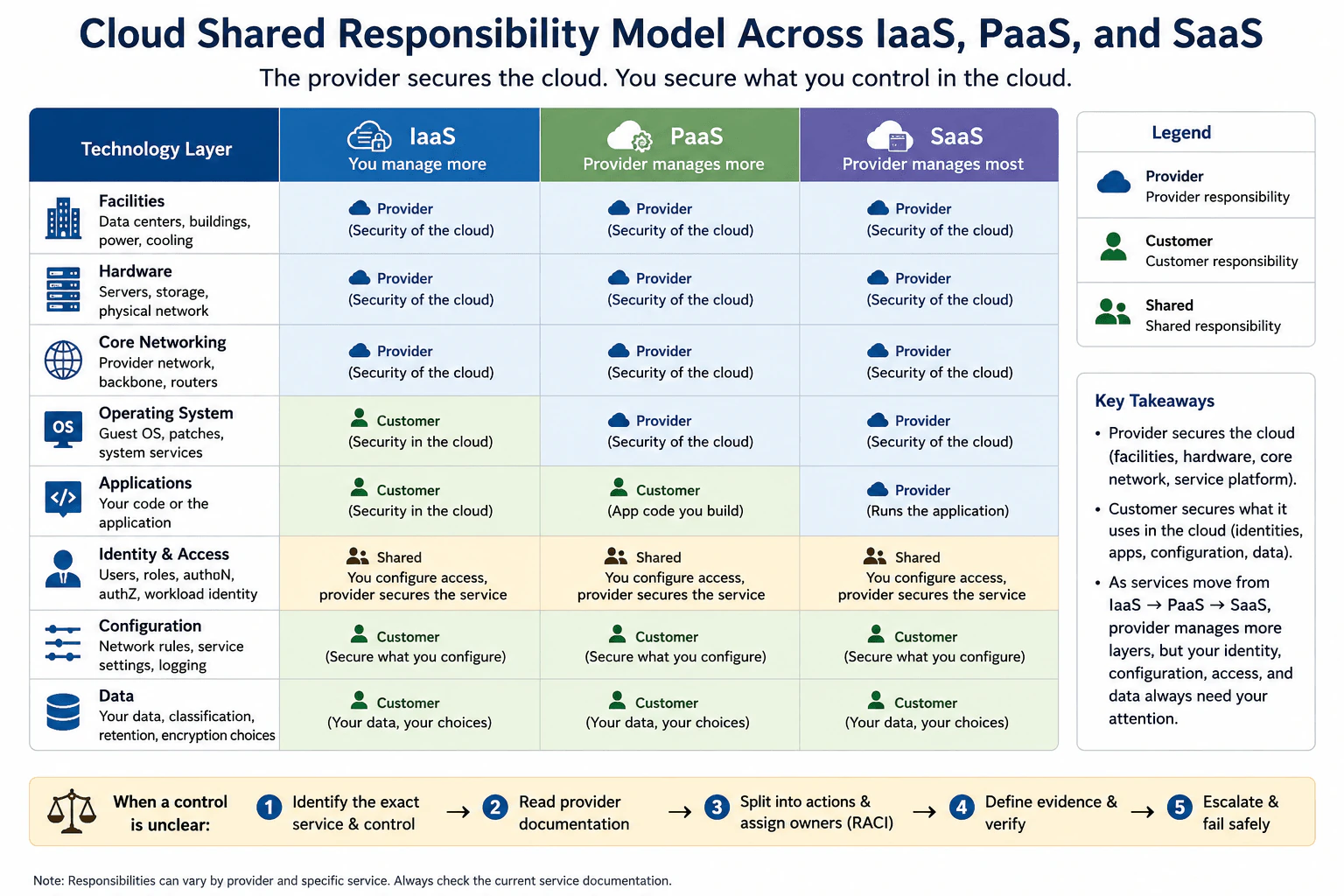
What is the cloud shared responsibility model, and how does it change across IaaS, PaaS, and SaaS? diagram
How to Explain It in an Interview

The practical rule is: the provider is responsible for security of the cloud, while the customer is responsible for security in the cloud. The exact boundary depends on the service model and the specific cloud service.

Security of the cloud means the provider protects the physical facilities, physical servers, storage hardware, core networking infrastructure, virtualization layer, and managed service components that the provider operates. The customer normally cannot directly administer these layers and relies on the provider's documented security controls, service commitments, certifications, and operational processes.

Security in the cloud means the customer protects the resources, identities, configurations, applications, and information it controls. This commonly includes organization policies, account or subscription controls, human identities, workload identities, authorization, customer-configurable network boundaries, applications, customer-managed operating systems, managed-service settings, encryption choices, secrets, logging configuration, and customer data.

Authentication answers, 'Who are you?' Authorization answers, 'What are you allowed to do?' The customer should use a reviewed identity service, least privilege, strong role assignments, and phishing-resistant MFA where appropriate for human access. Workloads should preferably use managed workload identity or short-lived federated credentials instead of long-lived cloud keys embedded in code or configuration.

In IaaS, or Infrastructure as a Service, the customer receives the most infrastructure-level control and therefore usually carries the most operational security responsibility. The provider manages facilities, physical hardware, physical networking, and typically the virtualization layer. The customer normally manages the guest operating system, OS patching and hardening, applications, host configuration, identities and permissions, workload credentials, customer-configurable virtual networking and firewall rules, encryption options, monitoring configuration, and data. For example, if a customer-managed virtual machine remains vulnerable because its guest operating system was not patched, that is normally a customer responsibility.

In PaaS, or Platform as a Service, more of the technology stack is managed by the provider. The provider usually manages the underlying infrastructure, operating system, runtime platform, and platform-level patching. The customer still manages application code, application dependencies where exposed to the customer, identities, authorization, workload access, secrets, customer-configurable network exposure, service settings, logging choices, and customer data. A managed platform does not automatically make insecure application logic, excessive permissions, exposed endpoints, vulnerable dependencies, or unsafe configuration secure.

In SaaS, or Software as a Service, the provider generally manages the infrastructure, operating systems, application platform, and SaaS application itself. The customer still has important responsibilities for user lifecycle, authentication settings, MFA, roles and permissions, tenant configuration, sharing settings, integrations, API credentials, data classification, retention choices, and how users handle information. The provider operating the SaaS application does not remove the customer's responsibility to prevent excessive access, unsafe sharing, or insecure tenant configuration.

A provider-neutral comparison is:

  • Facilities: provider responsibility in IaaS, PaaS, and SaaS.
  • Physical hardware: provider responsibility in IaaS, PaaS, and SaaS.
  • Core provider networking: provider responsibility in IaaS, PaaS, and SaaS.
  • Guest operating system: usually customer responsibility in IaaS; usually provider responsibility in PaaS and SaaS.
  • Application: usually customer responsibility in IaaS; customer-developed application code remains the customer's responsibility in PaaS; the provider operates the SaaS application in SaaS.
  • Human and workload identity: responsibility is shared at the service boundary. The provider secures the identity platform it operates, while the customer must correctly configure users, roles, workload identities, federation, MFA, and access policies available to it.
  • Service configuration: the customer is responsible for securely configuring the controls the provider exposes, while the provider is responsible for the security of the managed control plane and service implementation it operates.
  • Customer data: the customer remains responsible for deciding what data is stored, how it is classified, who may access it, and which available protection settings are required. The provider is responsible for protecting the service and infrastructure mechanisms it operates.

Some controls are shared rather than belonging entirely to one side. Encryption is a good example. A provider may encrypt managed storage infrastructure and operate the cryptographic service, while the customer decides whether stronger or customer-controlled key options are required, who may use those keys, what data may be stored, and whether application-level encryption is necessary. Networking is also commonly shared: the provider protects the underlying network fabric, while the customer configures virtual networks, routes, security groups, private endpoints, ingress rules, egress controls, and exposed services when those capabilities are available.

The exact boundary must be checked for the specific provider and service because IaaS, PaaS, and SaaS are useful categories, not universal guarantees. One managed service may expose controls that another provider operates completely differently. A team should never copy a security assumption from one cloud service or provider to another without verification.

When a control appears to fall between teams, do not guess. First identify the exact service and the exact control. Read the provider's current shared-responsibility and service-specific security documentation. Break the control into concrete actions. Then assign each customer-side action to a named owner. A RACI model can help: Responsible identifies who performs the work, Accountable identifies who owns the result, Consulted identifies people whose input is required, and Informed identifies people who must be kept aware.

Next, define evidence that proves the control is operating correctly. Evidence might include configuration review, policy evaluation, access review, audit logs, automated checks, security tests, or documented provider assurance. Logs should not contain secrets, private keys, tokens, or other sensitive authentication material. If the provider boundary or internal ownership remains unclear, escalate to the appropriate security, platform, or service owner before deployment.

Safe failure behavior matters. If a security control required for production has no confirmed owner or cannot be verified, the safer action is to block or delay the risky deployment instead of assuming another team is handling it. Record the decision, ownership, expected evidence, and remediation path so the gap can be tracked and resolved.

The main tradeoff is control versus operational responsibility. IaaS gives the customer more flexibility but also more patching, hardening, monitoring, and maintenance work. PaaS reduces infrastructure administration but still requires secure application design, dependency management, identity controls, and correct service configuration. SaaS reduces technical administration the most, but identity governance, authorization, integrations, tenant configuration, and data governance remain critical customer responsibilities.

Technical Approach
  1. Identify the exact cloud provider, service, and service model.
  2. Separate provider-operated layers from customer-controlled layers.
  3. Map facilities, hardware, core networking, operating systems, identities, applications, configuration, and data to the correct owner.
  4. For a shared control, split it into provider-side and customer-side actions instead of assigning the entire control to one party.
  5. Confirm the boundary using current provider and service-specific documentation.
  6. Assign each customer-side action to a named internal owner.
  7. Define evidence such as configuration checks, policy results, access reviews, audit logs, or security tests.
  8. If ownership or evidence remains unclear, escalate and fail safely rather than allowing an important control to remain unowned.
Practical Insights

There is no meaningful algorithmic time or memory complexity for this question. The important costs are operational and maintenance costs. IaaS usually creates the most customer work because the customer manages operating systems, patching, hardening, applications, and more network controls. PaaS reduces infrastructure maintenance but still requires secure applications, dependencies, identities, configuration, monitoring, and data protection. SaaS usually has the lowest infrastructure administration cost, but the customer still needs ongoing identity governance, access reviews, tenant configuration review, integration security, audit monitoring, and data governance. More managed services reduce some operational work but require careful understanding of provider-specific responsibility boundaries.

Why Interviewers Ask This

Interviewers want to know whether the candidate understands that moving to the cloud does not transfer all security responsibility to the provider. They are evaluating whether the candidate can identify who owns a security control at each service layer, distinguish provider-managed infrastructure from customer-managed configuration and data, recognize how responsibility changes across IaaS, PaaS, and SaaS, and resolve ambiguous controls through documented ownership, service documentation, policy, verification, and escalation instead of making assumptions.

Common interview mistakes

A common mistake is saying that the cloud provider is responsible for all security because the workload is hosted in the cloud. Another is treating the responsibility boundary as identical for every cloud service or provider. Candidates may incorrectly say that SaaS removes customer responsibility, forget identity and data responsibilities, or confuse authentication with authorization. It is also wrong to assume that provider-managed encryption automatically satisfies every customer encryption requirement. Another mistake is assigning a shared control entirely to one side instead of separating provider and customer duties. Finally, leaving an ambiguous control without a named owner or verification evidence is dangerous; ownership should be confirmed, documented, tested, and escalated when unclear.

Interview tip

Start with the simple rule: 'The provider secures the cloud; the customer secures what it controls in the cloud.' Then compare IaaS, PaaS, and SaaS from facilities up to data. Explain that responsibility shifts toward the provider as the service becomes more managed, but customer identity, authorization, configuration, access decisions, and data governance remain important. Finish by explaining how you verify and assign ownership for a shared or unclear control.
Interviewer may ask next
If a managed cloud service is encrypted by default, is encryption completely the provider's responsibility?

No. Encryption is often a shared control. The provider may implement and operate encryption for the managed service and underlying infrastructure, while the customer still decides what data may be stored, who may access it, which available encryption options should be enabled, whether customer-controlled keys are required, and who is authorized to use those keys. The customer must also protect identities and permissions that can access or decrypt the data. The exact division of responsibility must be verified in the documentation for that specific provider and service.

What should you do when the provider, platform team, and application team each think another team owns a security control?

Treat the control as unresolved rather than assuming it is covered. Define the exact service and control, check the provider's service-specific responsibility documentation, and divide the control into concrete provider-side and customer-side actions. Assign every customer-side action to a named owner, define evidence showing the control works, and verify it through configuration review, policy checks, access reviews, logs, or testing. If ownership still cannot be confirmed, escalate it to the appropriate security or platform authority and fail safely by preventing the risky deployment until the required responsibility is clear.

32. What problem does an IAM permissions boundary solve?SecurityEasy

Question Details

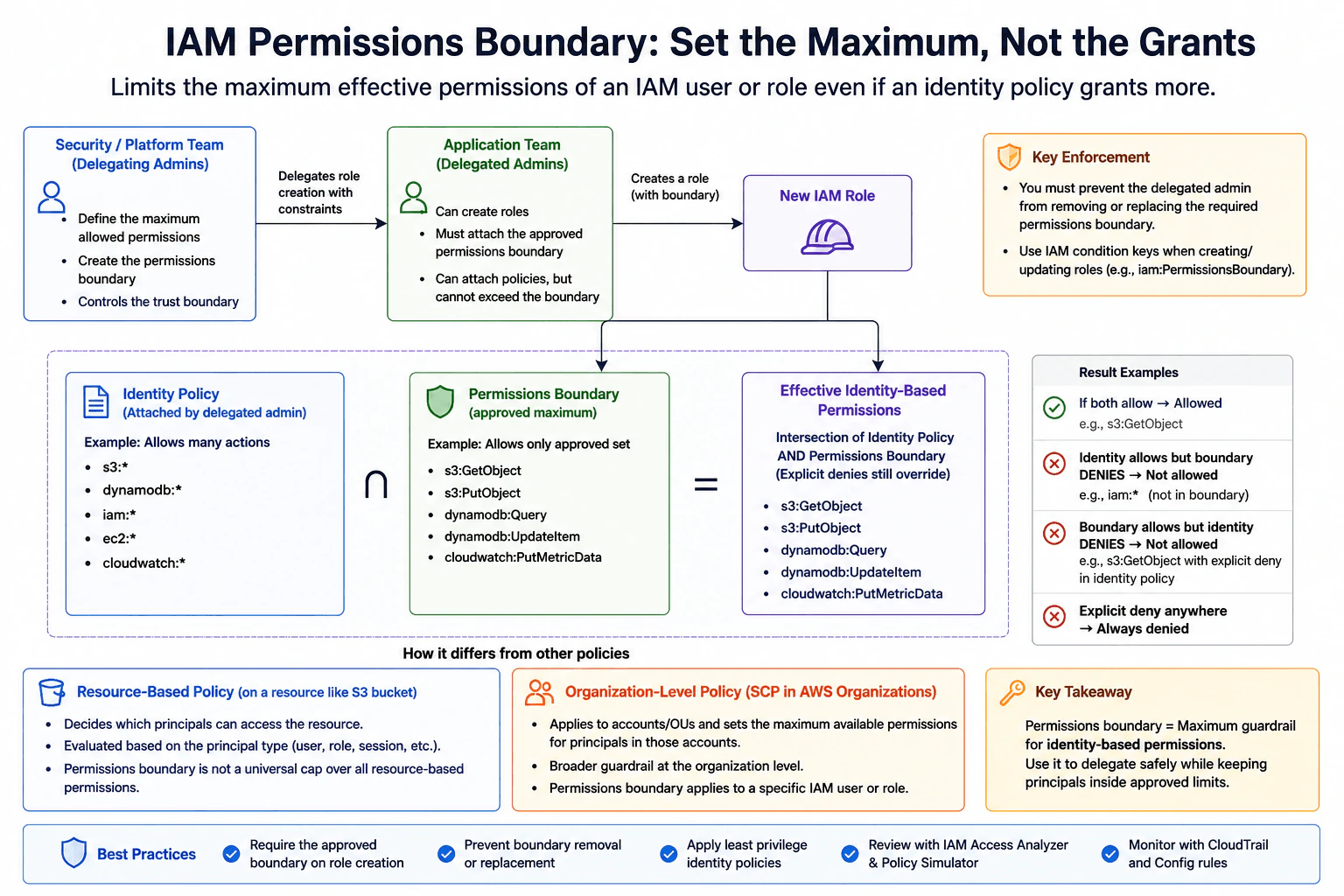
Explain how a permissions boundary limits the maximum effective permissions of an IAM user or role even when an identity policy grants more. Contrast it with a resource policy and an organization-level policy, and use delegated role creation as the example trust boundary.

Short Interview Answer (30-60 seconds)

A permissions boundary sets the maximum permissions an IAM user or role can receive through identity-based policies. If an identity policy grants more than the boundary allows, the extra permissions are ineffective. It is especially useful when delegating IAM role creation while keeping new roles inside an approved security limit.

Detailed Explanation

A permissions boundary is a safety limit for what a person or system can be allowed to do after permissions are assigned. It is useful when a central security team lets another team create roles but does not want that team to give those roles unlimited power. The delegated team may choose permissions needed for its work, but those permissions must stay inside the approved limit. This creates a clear trust boundary: the central team controls the maximum allowed access, while the delegated team manages day-to-day permissions for its own workloads.

Useful Questions to Ask the Interviewer
  1. Are we discussing AWS IAM users and roles within an AWS account?
  2. Should delegated administrators be required to attach a specific permissions boundary when they create roles?
  3. Are AWS Organizations service control policies also being used as broader organization-level guardrails?
What problem does an IAM permissions boundary solve? diagram
How to Explain It in an Interview

The practical use of a permissions boundary is safe delegation. I use it when another team is allowed to create or manage IAM users or roles, but I do not want that team to make those identities more powerful than a centrally approved maximum.

An identity-based policy grants permissions to an IAM user or role. A permissions boundary does not grant permissions. Instead, for permissions obtained through identity-based policies, AWS evaluates what the identity policy allows and what the permissions boundary allows. The effective permission must be allowed by both.

A simple way to express this is:

Effective identity-based permissions = identity policy permissions intersected with permissions boundary permissions.

For example, suppose the platform team delegates IAM role creation to an application team. The application team creates a role and attaches an identity policy allowing Amazon S3, Amazon DynamoDB, and broad IAM administration. The required permissions boundary allows only the approved S3 and DynamoDB actions. The IAM administration permissions from that identity policy are therefore not effective because the boundary does not allow them.

The trust boundary is not complete merely because a boundary policy exists. The delegated administrator must also be prevented from avoiding the control. The platform team should require the approved boundary when roles are created, for example by restricting role-creation permissions using the IAM permissions-boundary condition mechanisms, and should prevent the delegated administrator from removing or replacing the required boundary with an unauthorized one. Otherwise, delegated role creation could become a privilege-escalation path.

A permissions boundary is different from a resource-based policy. A resource-based policy is attached to a resource, such as an S3 bucket, and specifies which principals may access that resource. Resource-based permissions participate in AWS policy evaluation differently depending on whether the principal is an IAM user, IAM role, role session, or other principal. Therefore, a permissions boundary should not be described as a universal ceiling over every permission that can come from every resource-based policy. Applicable explicit denies still take precedence, and the exact result depends on AWS IAM policy-evaluation rules.

A permissions boundary is also different from an AWS Organizations service control policy, or SCP. An SCP is an organization-level guardrail that limits the maximum permissions available to principals in affected member accounts or organizational units. It applies at a broader organizational scope. A permissions boundary is attached to an individual IAM user or role and is therefore useful for controlling a specific delegated-administration trust boundary inside an account.

A layered design can use both controls. SCPs can enforce broad organization-wide limits. Permissions boundaries can constrain selected IAM users and roles. Identity policies can then grant only the permissions each workload actually requires. Applicable explicit denies continue to override allows.

The main tradeoff is operational complexity. Boundaries improve delegation safety, but security teams must design, version, review, test, and maintain them. They must also protect the mechanism that attaches and changes boundaries. I would verify the complete authorization path with IAM policy review, IAM policy simulation where appropriate, controlled deployment tests, and CloudTrail auditing rather than assuming the boundary alone prevents every privilege-escalation path.

Technical Approach
  1. Define the maximum permissions that delegated users or roles are allowed to receive through identity-based policies.
  2. Create an approved permissions-boundary policy containing that maximum.
  3. Allow delegated administrators to create roles only when the required boundary is attached.
  4. Prevent delegated administrators from removing the boundary or replacing it with an unauthorized broader boundary.
  5. Let workload teams attach narrower identity policies within that ceiling.
  6. Evaluate applicable resource-based policies, session policies, SCPs, trust policies, and explicit denies separately because the boundary is only one part of AWS authorization.
  7. Verify effective access through policy review, controlled tests, policy simulation where appropriate, and CloudTrail auditing.
Practical Insights

There is no application algorithm whose time or memory complexity needs analysis. IAM performs authorization in the AWS control and data paths. The important cost is operational: teams must design, review, test, version, and maintain the boundary policies. Troubleshooting can also become harder because effective authorization may depend on identity policies, permissions boundaries, resource-based policies, session policies, SCPs, trust policies, and explicit denies.

Why Interviewers Ask This

Interviewers want to know whether the candidate understands how to delegate IAM administration without creating an easy privilege-escalation path. A strong answer explains that a permissions boundary is a maximum permission guardrail for a specific IAM user or role, does not grant permissions by itself, and is different from resource-based policies and AWS Organizations service control policies.

Common interview mistakes

A common mistake is saying that a permissions boundary grants permissions. It does not; another applicable policy must grant the action. Another mistake is saying that the boundary is a universal maximum over every resource-based policy permission. Resource-based policies follow AWS policy-evaluation rules that depend on the principal type, so that statement is too broad. Candidates also confuse permissions boundaries with SCPs: an SCP is an organization-level guardrail, while a boundary is attached to a specific IAM user or role. A serious delegated-administration mistake is allowing the delegated administrator to omit, remove, or replace the required boundary. Finally, relying on a boundary alone while ignoring trust policies, resource policies, session policies, SCPs, explicit denies, or other privilege-escalation paths creates an incomplete security design.

Interview tip

Use delegated role creation as the example. Say that the application team may choose the role's needed permissions, but the security team controls the maximum through the permissions boundary. Then state that the boundary does not grant access, contrast it with a resource policy and an SCP, and mention that the delegated administrator must not be able to bypass or remove the boundary.

Interviewer may ask next
What happens if an identity policy allows an action but the permissions boundary does not allow it?

For permissions that depend on the intersection of the identity-based policy and the permissions boundary, the action is not allowed. Both must allow the action for that identity-based permission to be effective. An applicable explicit deny also overrides an allow.

Why not use only an AWS Organizations service control policy instead of a permissions boundary for delegated role creation?

An SCP is a broader organization-level guardrail. It limits the maximum permissions available to principals in affected member accounts or organizational units. A permissions boundary is attached to a specific IAM user or role, so it provides a more targeted ceiling for delegated IAM administration. A mature design can use both: SCPs for broad organizational limits and permissions boundaries for specific delegated-role trust boundaries.

33. How would you grant an EC2 workload least-privilege access to S3 and DynamoDB?SecurityEasy

Question Details

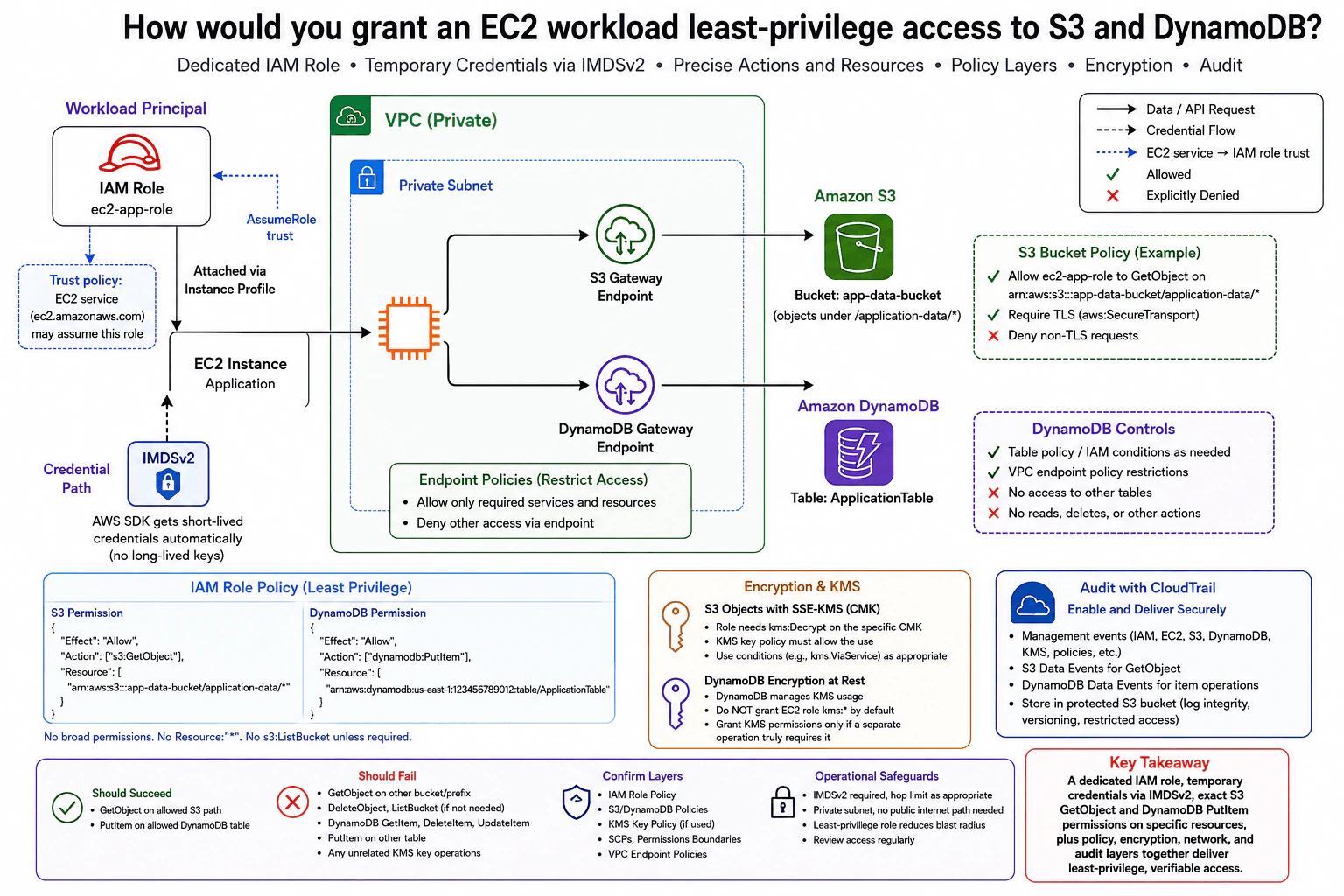
An EC2 application must read objects from one named S3 bucket and write items to one DynamoDB table. Define the workload principal, temporary credential path, allowed actions and resource scope, bucket or table policy interaction, encryption-key permissions, network boundary, and audit evidence, without using long-lived access keys.

Short Interview Answer (30-60 seconds)

I would attach a dedicated IAM role to the EC2 instance, use temporary credentials from IMDSv2, allow only s3:GetObject on the required objects and dynamodb:PutItem on the required table, and then restrict KMS, resource policies, network paths, and CloudTrail auditing accordingly.

Detailed Explanation

The application needs permission to read files from one storage location and save records into one database table. I would give the server its own trusted identity instead of storing permanent passwords or access keys inside the application. That identity would receive only the two permissions the application actually needs. I would also limit exactly which storage and database resources it can reach, account for encryption permissions, restrict the network path where practical, and record access activity so operators can prove what happened and investigate unexpected behavior later.

Useful Questions to Ask the Interviewer
  1. What is the exact S3 bucket and object prefix, if access should be limited to only part of the bucket?
  2. Does the DynamoDB workload need only PutItem, or also UpdateItem, GetItem, BatchWriteItem, or transactions?
  3. Are the S3 objects encrypted with SSE-S3, an AWS managed KMS key, or a customer-managed KMS key?
  4. Does the EC2 workload need to reach S3 and DynamoDB without using a NAT gateway or public internet path?
  5. Are there existing bucket policies, service control policies, permission boundaries, KMS key policies, or VPC endpoint policies that must remain in place?
How would you grant an EC2 workload least-privilege access to S3 and DynamoDB? diagram
How to Explain It in an Interview

I would create one dedicated IAM role for this EC2 workload. IAM is AWS Identity and Access Management. The IAM role is the workload principal, meaning it is the AWS identity used when the application calls S3 or DynamoDB.

I would configure the role's trust policy so the EC2 service can assume the role and attach it to the EC2 instance through an instance profile. I would not create or store an IAM user's long-lived access key and secret key on the server, in source control, in environment files, or in application configuration.

The AWS SDK on EC2 can automatically obtain short-lived role credentials through the EC2 Instance Metadata Service. I would require IMDSv2, which uses a session-oriented metadata request flow and reduces exposure to several metadata-request attack patterns. IMDSv2 is an additional protection, not a substitute for fixing SSRF or isolating untrusted processes. The temporary credentials rotate automatically.

Authentication and authorization are different. Authentication answers, 'Which AWS identity is making this request?' Authorization answers, 'What may that identity do?' The EC2 role provides the workload identity, while its IAM permissions and other applicable AWS policies determine the allowed actions.

For S3, I would grant only s3:GetObject on the exact objects the application must read. If the application requires every object in one bucket, the resource can be arn:aws:s3:::example-bucket/*. If it needs only one prefix, I would narrow the ARN further, for example arn:aws:s3:::example-bucket/application-data/*. I would not grant s3:* or access to all buckets. I also would not add s3:ListBucket unless the application truly needs to list object names.

For DynamoDB, I would grant only dynamodb:PutItem on the exact table ARN, for example arn:aws:dynamodb:us-east-1:123456789012:table/ApplicationTable. I would not grant dynamodb:* or Resource:"*". If the application later needs another API such as UpdateItem or BatchWriteItem, I would add only that action after confirming the requirement.

The role policy is not the only authorization layer. An S3 bucket policy can further restrict or explicitly deny the workload. I would review the bucket policy and preserve controls such as denying non-TLS requests or limiting access to the expected principal or network path. An explicit Deny in an applicable bucket policy, service control policy, permissions boundary, session policy, or VPC endpoint policy can override an Allow in the role policy.

For DynamoDB, I would also check applicable organization service control policies, permissions boundaries, session policies, and VPC endpoint policies. I would not weaken one of those broader security controls simply to make the application succeed.

Encryption requires separate reasoning. If an S3 object uses SSE-S3, the role does not need a KMS permission to decrypt it. If it uses SSE-KMS with a customer-managed KMS key, the workload normally needs kms:Decrypt on that specific key in addition to s3:GetObject, and the KMS key policy must permit that use through the AWS authorization model. I would scope the permission to the exact key and use appropriate conditions, such as kms:ViaService or an encryption-context condition, when they safely match the design.

For DynamoDB encryption at rest, ordinary application item operations such as PutItem are performed through DynamoDB. I would not automatically grant the EC2 workload direct kms:* permissions merely because the table uses a customer-managed KMS key. Instead, I would verify that the DynamoDB table and its KMS key configuration are valid and grant direct KMS permissions to the workload only if a separate operation actually requires them. This avoids adding unnecessary cryptographic privileges.

For the network boundary, I would normally place the EC2 instance in a private subnet when it does not require direct inbound internet access. I can use an S3 gateway VPC endpoint and a DynamoDB gateway VPC endpoint so traffic to these AWS services does not require a NAT gateway or public internet path. I would restrict the endpoint policies to the required services and resources where practical. Network controls reduce exposure, but they do not replace IAM authorization.

I would require IMDSv2 on the instance and set the metadata hop limit appropriately for the actual workload architecture. I would avoid exposing instance metadata to untrusted processes or containers. If an attacker gains code execution with the application's privileges, that attacker may be able to use the same temporary role credentials, so minimizing the role's permissions is what limits the blast radius.

For audit evidence, I would use AWS CloudTrail. Management events provide evidence for changes to IAM roles, policies, instance profiles, bucket policies, and related configuration. For S3 object operations such as GetObject, I would enable the required CloudTrail data events because object-level access is a data-plane operation. If item-level DynamoDB audit evidence is required, I would enable the appropriate DynamoDB data-event coverage for the table as well. Audit logs should be delivered to a protected location with tightly controlled modification and deletion permissions. I would never log temporary credentials or sensitive object contents.

I would verify the design with both positive and negative tests. From the EC2 workload, reading an allowed S3 object and writing an item to the allowed DynamoDB table should succeed. Reading another bucket or unauthorized prefix, deleting an S3 object, reading or deleting DynamoDB items, writing to another table, and using an unrelated KMS key should fail unless one of those operations was explicitly required. Safe failure means returning a clear authorization error without exposing credentials, tokens, sensitive data, or internal secrets.

The main tradeoff is operational simplicity versus blast radius. Broad policies are faster to create, but they expose more resources if the workload is compromised. Narrow policies require a better understanding of the application's real API calls and may need controlled updates when features change. I would start narrow, investigate denied calls instead of automatically allowing them, manage changes through reviewed infrastructure as code, and periodically review the role for unused permissions.

Technical Approach
  1. Identify the exact EC2 workload, S3 bucket or prefix, DynamoDB table, encryption configuration, and required API operations.
  2. Create a dedicated IAM role whose trust policy allows the EC2 service to assume it.
  3. Attach the role to the EC2 instance through an instance profile and require IMDSv2 so the AWS SDK obtains rotating temporary credentials.
  4. Grant only s3:GetObject on the required S3 object ARN or prefix.
  5. Grant only dynamodb:PutItem on the required DynamoDB table ARN.
  6. Add kms:Decrypt only when the required S3 objects use a customer-managed KMS key and that permission is actually necessary.
  7. Do not automatically grant the EC2 workload KMS permissions merely because DynamoDB uses encrypted storage; verify the exact KMS requirement first.
  8. Review the S3 bucket policy, KMS key policy, service control policies, permissions boundaries, session policies, and VPC endpoint policies for additional restrictions or explicit denies.
  9. Keep the EC2 workload on private networking where appropriate and use S3 and DynamoDB gateway VPC endpoints to avoid unnecessary public internet paths.
  10. Configure CloudTrail management and required data-event auditing, protect the audit destination, and avoid recording secrets.
  11. Test every required operation and multiple prohibited operations to prove least privilege.
  12. Review denied calls and unused permissions over time, making changes through normal infrastructure-as-code review.
Practical Insights

Using an IAM role adds almost no meaningful application time or memory cost because AWS SDKs retrieve and refresh temporary credentials automatically. S3 and DynamoDB gateway VPC endpoints do not require the workload to use a NAT path for those services, although their policies add configuration to maintain. CloudTrail data events can increase logging volume and cost when many object or item operations are recorded. The main maintenance cost is keeping the policy synchronized with real application needs while avoiding unnecessary permissions.

Why Interviewers Ask This

This question checks whether the candidate understands AWS workload identity, temporary credentials, IAM authorization, resource-level least privilege, S3 and DynamoDB policy interaction, KMS permissions, network boundaries, and audit evidence. It also tests whether the candidate can separate authentication from authorization and avoid long-lived access keys while designing multiple independent security layers.

Common interview mistakes

Common mistakes include storing long-lived AWS access keys on the instance; attaching AdministratorAccess or broad s3:* and dynamodb:* permissions; using Resource:"*" when exact resource ARNs are available; granting s3:ListBucket when only GetObject is needed; forgetting that explicit Deny statements can override role permissions; granting kms:* instead of narrowly scoped KMS access; assuming every encrypted S3 object requires direct KMS permission even when SSE-S3 is used; granting the EC2 workload unnecessary KMS permissions merely because DynamoDB encryption at rest uses KMS; treating a VPC endpoint as a replacement for IAM; leaving IMDSv1 enabled without a reason; assuming IMDSv2 completely solves SSRF; enabling only CloudTrail management events while expecting them to show every object or item operation; logging temporary credentials during failures; and testing only successful operations instead of proving that unauthorized operations are denied.

Interview tip

Lead with the core design: dedicated EC2 IAM role, instance profile, temporary credentials, and exact resource-level permissions. Then explain S3, DynamoDB, KMS, policy interaction, VPC endpoints, CloudTrail, and negative tests. Explicitly separate authentication from authorization and show how each layer reduces the workload's blast radius.

Interviewer may ask next
What changes if the S3 objects are encrypted with a customer-managed KMS key?

The EC2 role still needs s3:GetObject on the required object ARN, but it normally also needs kms:Decrypt on the exact customer-managed KMS key. The KMS key policy must permit that use through the applicable AWS authorization model. I would avoid kms:* and Resource:"*" and use appropriate conditions such as kms:ViaService or a matching encryption context when they fit the design. If the object instead uses SSE-S3, no separate KMS decrypt permission is required.

How would you prove that the role cannot access any other S3 bucket or DynamoDB table?

I would verify both the effective policies and the real behavior. I would inspect the IAM role policy, S3 bucket policy, service control policies, permissions boundary, relevant KMS key policy, and VPC endpoint policies. Then I would test from the EC2 workload identity. GetObject on the allowed S3 path and PutItem on the allowed table should succeed. Access to another bucket or prefix, another table, S3 deletion, DynamoDB reads or deletes, and unrelated KMS operations should fail unless explicitly required. I would retain the appropriate CloudTrail management and data-event evidence so another reviewer can independently confirm the results.

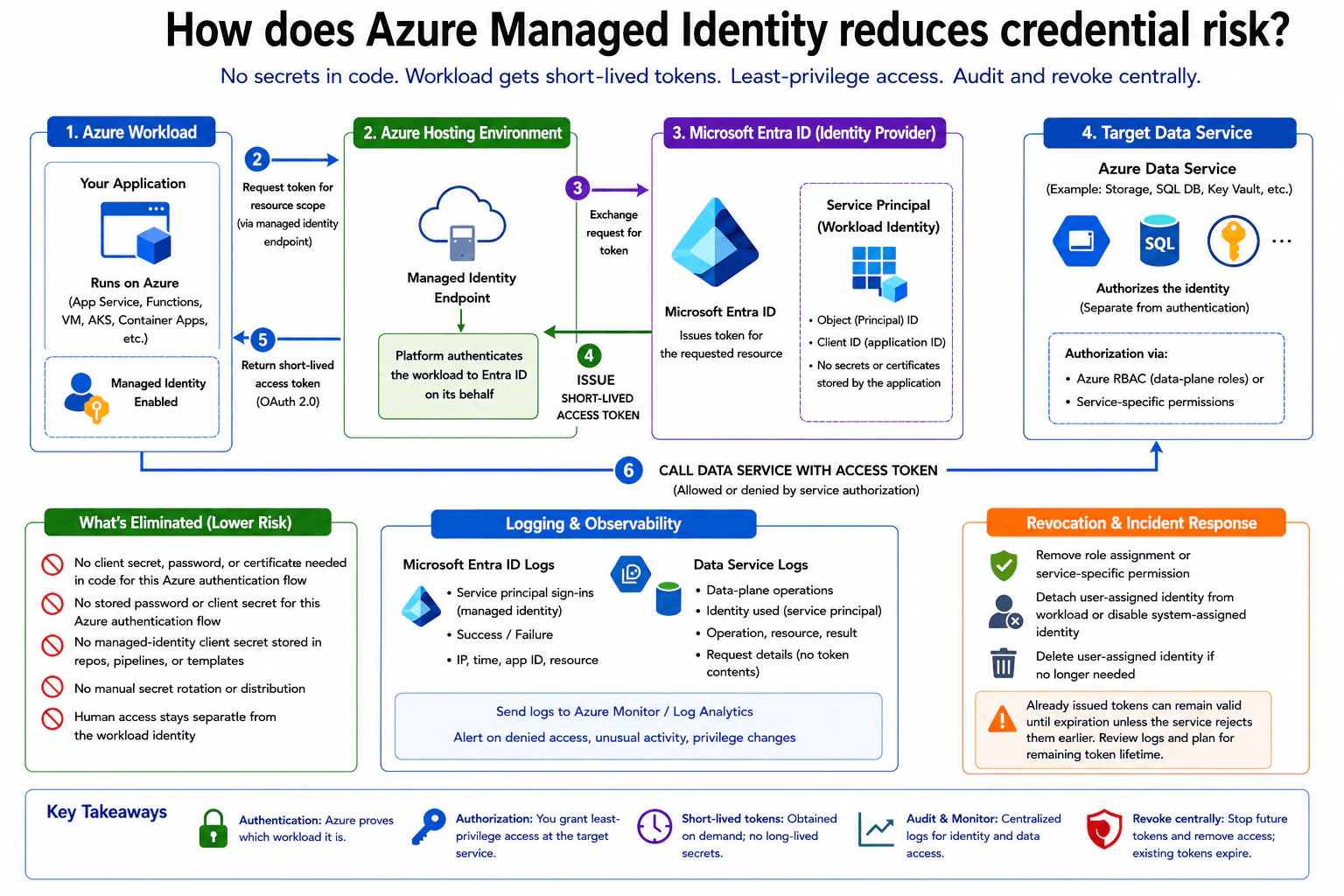
34. How does Azure Managed Identity reduce credential risk?SecurityEasy

Question Details

An Azure-hosted application needs to call a managed data service. Explain how the workload obtains a short-lived token, how the service principal is represented, where authorization is granted, what code or configuration no longer stores, and how token use is logged and revoked.

Short Interview Answer (30-60 seconds)

Azure Managed Identity lets an Azure workload authenticate without storing client secrets, passwords, or certificates. Azure represents the workload with a Microsoft Entra service principal, issues short-lived access tokens, and lets administrators grant least-privilege access at the target service and revoke future access centrally.

Detailed Explanation

Azure Managed Identity reduces the chance that an application password or key will be copied, leaked, committed to source code, or forgotten during rotation. Instead of keeping a permanent secret, the application asks Azure for temporary proof that it is the approved application. Azure checks which application is making the request and gives it temporary access for the intended service. Administrators separately decide what that application may do. They can review activity, remove permissions, or turn off or remove the application identity without editing passwords inside the application.

Useful Questions to Ask the Interviewer
  1. Is the workload using a system-assigned managed identity or a user-assigned managed identity?
  2. Which Azure managed data service must the workload access, and does it support Microsoft Entra authentication?
  3. What exact read or write operations should the workload be allowed to perform?
  4. Which Azure service hosts the application, such as App Service, Functions, Virtual Machines, AKS, or Container Apps?
  5. What audit logging and alerting requirements apply to this workload?
How does Azure Managed Identity reduce credential risk? diagram
How to Explain It in an Interview

The practical decision is to use Azure Managed Identity instead of placing a client secret, password, connection-string credential, or application certificate in source code, environment variables, configuration files, deployment templates, CI/CD variables, or another location that the workload must manage solely to authenticate to Azure.

Authentication and authorization are separate. Authentication answers, "Which workload is this?" Authorization answers, "What is this workload allowed to do?"

For authentication, Azure gives the hosted workload a managed identity backed by Microsoft Entra ID. A system-assigned managed identity is tied to one Azure resource. When it is enabled, Azure creates a corresponding service principal in the Microsoft Entra tenant. Its lifecycle is tied to that Azure resource, so disabling the system-assigned identity or deleting the resource removes that managed identity. A user-assigned managed identity is a separate Azure resource with its own Microsoft Entra service principal and lifecycle, and it can be assigned to multiple supported Azure resources.

The Microsoft Entra service principal is the tenant-side representation of the workload identity. It has identifiers such as an object or principal ID, and a user-assigned managed identity also has a client ID that can be used to select that identity when a workload has more than one available identity. The application does not receive a reusable client secret for this service principal.

At runtime, the application normally uses an Azure Identity SDK credential such as ManagedIdentityCredential or, when appropriate, DefaultAzureCredential. The SDK communicates with the managed identity endpoint provided by the Azure hosting platform. The exact endpoint mechanism depends on the hosting service. The platform establishes which hosted workload is making the request and obtains an OAuth 2.0 access token from Microsoft Entra ID for the requested target resource or scope. The application receives a short-lived access token, while the SDK normally caches and refreshes tokens as needed. The application never has to store or rotate the underlying platform credential used to establish the managed identity.

Authorization is granted separately at the destination. For a service that supports Azure RBAC, an administrator assigns the managed identity an appropriate least-privilege data-plane role at the narrowest practical scope, such as an individual resource instead of an entire subscription. Some Azure services use additional or service-specific permission models, so the exact authorization mechanism must match the target service. Creating or attaching a managed identity by itself does not automatically grant permission to read or modify application data.

This reduces credential risk because there is no long-lived application secret for developers to copy, accidentally commit, expose in logs, distribute between environments, or rotate manually. It also separates human identity from workload identity. Engineers should use their own reviewed human accounts, with appropriate MFA and privileged-access controls, rather than sharing the workload's managed identity for interactive administration.

Managed Identity does not remove every security requirement. The workload should still have only the permissions it needs. Encryption, target-service configuration, platform hardening, application security, and network controls such as private endpoints or firewalls should still be used when required. Managed Identity proves workload identity; it does not by itself restrict which network paths can reach the service or make an over-privileged application safe.

For auditability, Microsoft Entra can provide managed-identity service-principal sign-in information, while the target Azure service can record the actual data-plane operations when its diagnostic or audit logging is enabled. Logs should capture the identity, target resource, operation, result, and useful request context without recording access-token contents or other sensitive material. Azure Monitor or the organization's logging platform can alert on denied requests, unusual operations, unexpected target resources, or privilege changes.

For revocation, administrators can remove the target role assignment or service-specific permission. They can also disable a system-assigned managed identity on its Azure resource, detach a user-assigned identity from a workload, or delete the user-assigned managed identity when it is no longer needed. Removing authorization stops future authorized operations after the permission change takes effect. Removing or disabling the managed identity prevents the workload from obtaining new tokens through that identity. However, an access token that was already issued can normally remain valid until it expires unless the target service has an additional mechanism that rejects it sooner. During an incident, remove permissions or identity access immediately, review Microsoft Entra and target-service logs, and account for the remaining lifetime of tokens that may already have been issued.

The main tradeoff is that Managed Identity depends on Azure hosting support and Microsoft Entra authentication support at the destination. It greatly reduces secret-management risk, but authorization, logging, network protection, application security, and incident response still need to be designed correctly.

Technical Approach
  1. Enable a system-assigned managed identity on the Azure workload, or attach an appropriate user-assigned managed identity.
  2. Identify the Microsoft Entra service principal representing that managed identity.
  3. At the target data service, grant only the required data-plane role or service-specific permission at the narrowest practical scope.
  4. In application code, use the supported Azure Identity SDK credential instead of a client secret, password, or certificate.
  5. Request an access token for the target service and let the SDK cache and refresh short-lived tokens.
  6. Enable Microsoft Entra sign-in visibility and target-service diagnostic or audit logging without recording token contents.
  7. Test both permitted and denied operations to verify least privilege.
  8. For revocation or incident response, remove authorization and, when necessary, disable or detach the managed identity or delete the user-assigned identity, while remembering that already issued tokens can remain valid until they expire.
Practical Insights

The application adds very little processing work because the Azure SDK obtains and caches tokens automatically. Token acquisition adds a small dependency on the Azure identity platform, but cached tokens avoid requesting a new token for every data operation. There is no long-lived application secret to distribute or rotate, so operational and maintenance work is lower. Administrators still must manage identity ownership, role assignments, logging, and periodic permission reviews. Sharing one user-assigned identity across several workloads can reduce the number of identities to manage, but it can increase the impact of excessive permissions. Separate identities improve isolation but create more identity objects and role assignments to maintain.

Why Interviewers Ask This

Interviewers want to see whether the candidate understands how Azure Managed Identity replaces stored application credentials with a platform-managed workload identity. A strong answer separates authentication from authorization, explains the Microsoft Entra service principal behind the identity, identifies where permissions are granted, describes short-lived token acquisition and logging, and recognizes that removing permissions or disabling the identity does not necessarily invalidate an access token that was already issued.

Common interview mistakes

Common mistakes include assuming that enabling a managed identity automatically grants access to the target service; assigning a broad subscription-level role when a resource-level data role is enough; confusing the managed identity with a human user account; storing a client secret anyway even though Managed Identity is supported; granting control-plane permissions when the application only needs data-plane access; logging access-token contents; assuming Managed Identity automatically provides network isolation; sharing one highly privileged user-assigned identity across unrelated workloads; failing to enable target-service audit logs; failing to select the intended user-assigned identity when multiple identities are attached; and assuming that removing a role or disabling an identity instantly invalidates every access token that was already issued.

Interview tip

Explain the flow in four steps: Azure represents the workload with a managed identity and Microsoft Entra service principal, the workload obtains a short-lived token without storing a secret, the target service separately authorizes that identity with least privilege, and administrators audit and revoke access centrally. Mention that already issued tokens can remain valid until they expire.

Interviewer may ask next
What is the difference between a system-assigned and a user-assigned managed identity?

A system-assigned managed identity belongs to one Azure resource and shares that resource's lifecycle. Azure creates its Microsoft Entra service principal when the identity is enabled, and disabling the identity or deleting the Azure resource removes that managed identity. A user-assigned managed identity is a separate Azure resource with its own lifecycle and Microsoft Entra service principal. It can be attached to multiple supported workloads. System-assigned identity gives simple one-resource isolation, while user-assigned identity is useful when several resources intentionally need the same identity or when the identity must survive replacement of a compute resource.

If an administrator removes the managed identity's role assignment, is access revoked immediately?

The permission change must first take effect in the authorization system, so there can be propagation delay. After that, operations that require the removed permission should be denied. However, an access token that was already issued can remain valid until its expiration unless the target service has another mechanism that rejects it earlier. During an incident, remove the role assignment immediately and, when necessary, disable or detach the managed identity or delete the user-assigned identity to stop future token acquisition. Then review Microsoft Entra and target-service logs and account for the remaining lifetime of existing tokens.

35. How do Azure Policy and Azure RBAC serve different security purposes?SecurityEasy

Question Details

Use a storage-account requirement for secure transfer as the example. Explain how Azure Policy evaluates or enforces resource configuration while Azure RBAC controls which principals can perform actions, and describe how both controls combine without treating one as a replacement for the other.

Short Interview Answer (30-60 seconds)

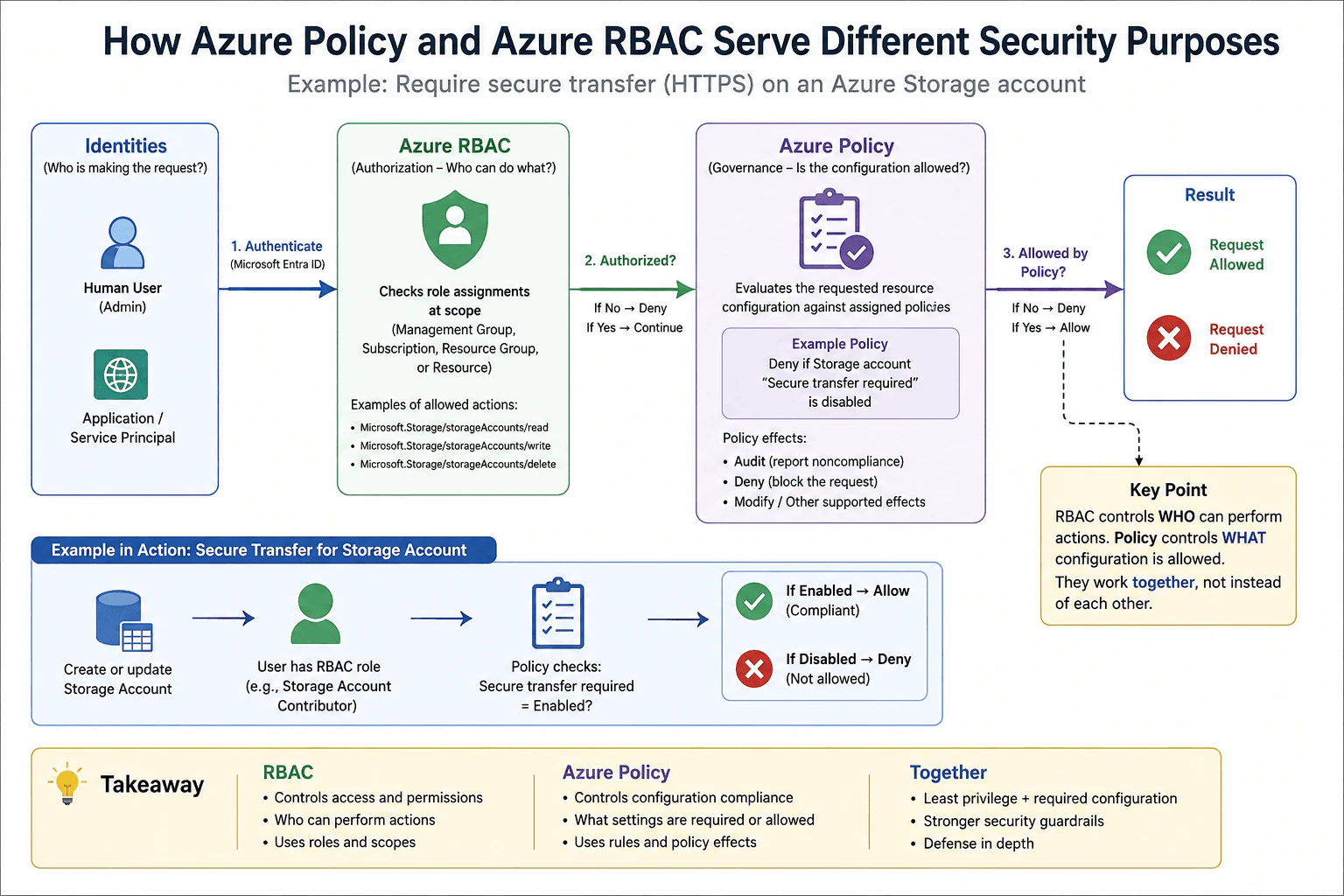
Azure RBAC controls who is authorized to perform actions, while Azure Policy controls whether resource configurations are allowed or compliant. For example, RBAC may let an engineer update a storage account, but Policy can still prevent an update that disables secure transfer.

Detailed Explanation

The question is asking about two different kinds of protection. One protection checks whether something has been set up according to required safety rules. The other decides which people or applications are allowed to make changes. Imagine a storage service that must always use a protected connection when information moves across a network. One control checks that this protection is turned on. The other control decides who may create, view, change, or remove the storage service. Good protection needs both controls because they solve different problems.

Useful Questions to Ask the Interviewer
  1. Should I explain both preventive and reporting behavior for the storage-account requirement?
  2. Should I include how permissions and policies can be applied at different Azure scopes?
How do Azure Policy and Azure RBAC serve different security purposes? diagram
How to Explain It in an Interview

Azure Policy is a governance and resource-configuration control. It evaluates Azure resources against policy definitions assigned at a scope. Depending on the selected policy effect and what the resource provider supports, Azure Policy can report noncompliance, deny a noncompliant create or update request, modify supported properties, or support remediation for certain policy scenarios.

For this example, an organization can assign a policy requiring Azure Storage accounts to have secure transfer enabled. Secure transfer required causes the storage account to accept requests only over secure connections such as HTTPS. A suitable deny policy can reject a create or update request that would leave that required storage-account setting disabled.

Azure RBAC, or role-based access control, is an authorization control. It answers a different question: which authenticated principal may perform which Azure actions at a particular scope? A principal can be a user, group, service principal, or managed identity. Azure RBAC role assignments can apply at scopes such as a management group, subscription, resource group, or individual resource. Roles can authorize management-plane operations and, where applicable, data-plane operations through the permissions defined by the role.

Authentication and authorization are different. Authentication establishes who the principal is, commonly through Microsoft Entra ID. Authorization determines what that authenticated principal is allowed to do. Azure RBAC is one of Azure's main authorization mechanisms. For human administrative access, use least privilege, reviewed assignments, and strong MFA such as phishing-resistant methods where appropriate. For workloads, prefer managed identities or other short-lived identity mechanisms instead of embedding long-lived credentials.

Using the storage-account example, assume an engineer has an Azure RBAC role that permits updating storage accounts. RBAC can authorize the engineer to submit that management operation. However, that permission does not guarantee that every requested configuration is acceptable. If an applicable Azure Policy with a deny effect requires secure transfer and the engineer submits an update that would disable it, the request can be denied because the configuration violates the policy.

The reverse is equally important. A storage account can fully comply with the secure-transfer policy, but that compliance does not give a user, application, or workload permission to manage the account. The principal still needs the required authorization. Azure Policy is therefore not an access-control replacement for Azure RBAC.

A useful interview rule is: Azure RBAC controls who can perform an action; Azure Policy controls whether the resulting or requested resource configuration is allowed or compliant. They address different risks and should be used together.

For least privilege, give human and workload identities only the permissions they require and use the narrowest practical scope. At the governance layer, assign the secure-transfer policy at the scope that covers the required storage accounts, such as a management group, subscription, or resource group. Policy exemptions should be justified, reviewed, documented, limited in scope, and monitored rather than used as a routine bypass.

Verification should test both controls independently. First, verify that an identity without the required RBAC permission cannot perform the management operation. Second, verify that an authorized identity cannot successfully create or update a storage account into a configuration prohibited by the applicable deny policy. Use Azure Policy compliance information to identify noncompliant resources, review Azure RBAC assignments regularly, and use Azure Activity Log and appropriate monitoring data to investigate management operations and governance events. Logs should not contain credentials, tokens, or secrets.

The main tradeoff is enforcement strength versus operational risk. An audit policy helps discover noncompliant resources without blocking deployments, which is useful during rollout and validation. A deny policy provides a stronger preventive guardrail but can block legitimate deployments if the policy is incorrect, too broad, or introduced without testing. RBAC has a similar operational balance: permissions that are too broad increase security risk, while permissions that are too narrow can prevent required work. Both controls need clear ownership, testing, monitoring, exception handling, and periodic review.

Technical Approach
  1. Identify the required resource configuration, such as requiring secure transfer on Azure Storage accounts.
  2. Define or select an Azure Policy that evaluates that setting.
  3. Start with an audit effect when rollout impact is uncertain, then use deny when preventive enforcement is validated and required.
  4. Assign the policy at the appropriate management group, subscription, or resource-group scope.
  5. Separately identify the human and workload principals that need to manage the resources.
  6. Assign the minimum required Azure RBAC roles at the narrowest practical scopes.
  7. Test authorization by verifying that an unauthorized principal cannot perform the operation.
  8. Test governance independently by verifying that an authorized principal still cannot create or update a resource into a configuration prohibited by the deny policy.
  9. Monitor Policy compliance, RBAC assignments, exemptions, and management activity, and review them periodically.
Practical Insights

There is no meaningful coding time or memory complexity for this question. The important costs are operational and maintenance costs. More policy assignments, exemptions, identities, roles, and scopes create more governance work. Broad policies can affect many deployments, and broad RBAC assignments can increase security exposure. Maintenance is easier when policies are reusable, scopes are planned carefully, permissions follow least privilege, exemptions are limited, and both access assignments and compliance results are reviewed regularly.

Why Interviewers Ask This

Interviewers want to confirm that the candidate understands the difference between configuration governance and access authorization in Azure. A strong answer should show that Azure Policy evaluates or enforces resource configuration requirements, while Azure RBAC applies least-privilege permissions to identities. The candidate should also understand that these controls are complementary: permission to modify a resource does not guarantee a secure configuration, and policy compliance does not grant an identity permission to perform an action.

Common interview mistakes

A common mistake is saying Azure Policy and Azure RBAC do the same job. Another is assuming an RBAC role can guarantee that a storage account has secure transfer enabled. RBAC authorizes actions but does not by itself enforce every required resource property. The opposite mistake is assuming Policy grants access; policy compliance never grants an identity management permission. Candidates also sometimes confuse authentication with authorization, assign overly broad RBAC roles, apply policies too broadly without testing, rely on audit when prevention is required, or enable deny before checking the effect on legitimate deployments. Another mistake is treating Policy compliance as proof that the entire workload is secure. Azure Policy evaluates the requirements that are actually defined and assigned; it does not replace identity security, network controls, encryption design, monitoring, or other required protections.

Interview tip

Use the simple phrase "RBAC controls who; Policy controls configuration." Then use the storage-account example: RBAC may authorize an engineer to update the account, but Policy can still deny an update that disables secure transfer. Finish by stating clearly that the two controls complement rather than replace each other.

Interviewer may ask next
What happens if a user has Azure RBAC permission to update a storage account, but an assigned Azure Policy denies configurations without secure transfer?

The RBAC permission can authorize the principal to attempt the storage-account update, but it does not override the applicable Policy requirement. If the requested resource configuration violates a deny policy requiring secure transfer, Azure can reject the create or update operation even though the principal otherwise has permission to perform that resource action. This demonstrates the separation of responsibilities: RBAC governs authorization, while Policy governs allowed or compliant resource configuration.

When would you use an audit policy instead of a deny policy for the secure-transfer requirement?

Use audit when introducing the requirement, discovering existing noncompliant resources, validating the policy logic, or measuring deployment impact before enforcement. Audit reports noncompliance without blocking the request. Use deny when the requirement has been validated and the organization is ready to prevent noncompliant creates or updates. A practical rollout can start with audit, resolve legitimate exceptions and compatibility issues, establish ownership and monitoring, and then move to deny where preventive enforcement is required.

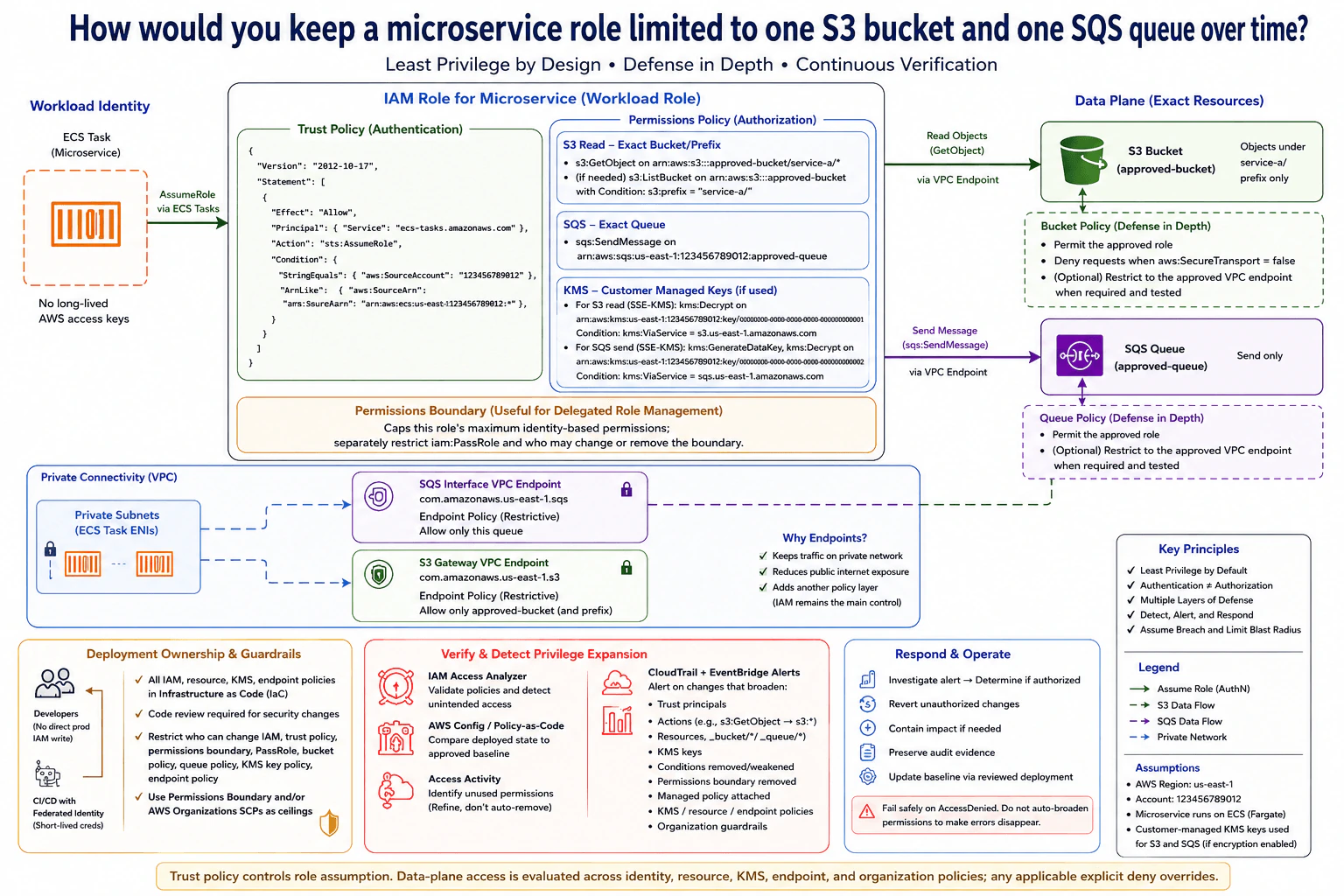
36. How would you keep a microservice role limited to one S3 bucket and one SQS queue over time?SecurityMedium

Question Details

A microservice may read one bucket and send messages to one queue. Define the role trust policy, exact resource actions, conditions, encryption-key access, network endpoints, deployment ownership, access analysis, and detection that alerts when later changes broaden the role beyond its intended scope.

Short Interview Answer (30-60 seconds)

I would use a dedicated workload role with tightly scoped trust, exact S3 read and SQS send permissions, minimal KMS access, and private endpoints where required. I would manage it through reviewed infrastructure as code and continuously detect any change that broadens its trust, actions, resources, keys, or conditions.

Detailed Explanation

This question asks how to give one small application only the access it truly needs and keep that access narrow as the system changes. The application should be able to read from one approved storage place and send work to one approved waiting line, but nothing else. The design must also control who can change those permissions, protect locked data, limit the paths used to reach it, record important changes, check for accidental expansion, and alert the owning team when a later update gives the application more power than intended.

Useful Questions to Ask the Interviewer
  1. Where does the microservice run: ECS, EKS, Lambda, EC2, or another AWS compute service?
  2. Does it need to read every object in the bucket, or only objects under a specific prefix?
  3. Does it need only sqs:SendMessage, or does it also need another queue operation such as sqs:GetQueueAttributes?
  4. Are the S3 objects and SQS queue protected with AWS-managed keys or customer-managed KMS keys?
  5. Must S3 and SQS traffic stay on private VPC connectivity through VPC endpoints?
  6. Which team or deployment role is allowed to change IAM, bucket, queue, KMS, and endpoint policies?
  7. Is AWS Organizations available for organization-level permission guardrails?
How would you keep a microservice role limited to one S3 bucket and one SQS queue over time? diagram
How to Explain It in an Interview

I would solve this in two layers: make the permission boundary narrow today, then continuously prove that it has not become wider later.

1. Give the microservice its own workload identity

I would create a dedicated IAM role for this microservice. I would not share the role with unrelated services and I would not store long-lived AWS access keys in application configuration.

Authentication answers, "Who is this workload?" The role trust policy controls authentication by defining who may assume the role. Authorization answers, "What may this workload do after it has credentials?" The role's permission policies control that separately.

The exact trust policy must match the runtime. I would not use a broad account principal simply because the runtime was not specified. For example, if the interviewer says the service runs as an ECS task, the role would trust the ECS tasks service principal, ecs-tasks.amazonaws.com, for sts:AssumeRole. I would also use appropriate confused-deputy protections such as aws:SourceAccount and the supported ECS aws:SourceArn pattern. If the service runs on EKS or Lambda, I would use that platform's supported workload identity mechanism and its correct trust relationship instead. The important rule is that only the intended workload path can obtain the role credentials.

Human administrators should use separate reviewed administrative identities. They should not routinely assume the application role. Human access should use the organization's identity service and strong MFA, preferably phishing-resistant MFA for privileged administration where supported.

2. Allow only the exact S3 operations that are required

If the service only reads objects, I would allow s3:GetObject on the required object ARN pattern, for example the exact bucket or, preferably, the smallest required prefix such as arn:aws:s3:::approved-bucket/service-a/*.

I would not grant s3:*.

If the application must list objects, I would separately allow s3:ListBucket on the bucket ARN, because ListBucket is a bucket-level operation. I would constrain that permission with an s3:prefix condition so the workload can list only the required prefix. If listing is not required, I would omit s3:ListBucket completely.

If the application needs version-specific reads, I would add s3:GetObjectVersion only when that behavior is actually required. I would not add it by default.

3. Allow only the exact SQS operation

If the service only publishes messages, I would allow only sqs:SendMessage on the exact queue ARN.

I would not grant sqs:*, wildcard queue resources, receive permissions, delete permissions, queue-management permissions, or permissions for other queues unless the application genuinely needs them.

If the application needs an additional operation such as sqs:GetQueueAttributes, I would add that operation explicitly rather than broadening the policy to all SQS actions.

4. Treat KMS authorization as a separate permission boundary

Access to S3 or SQS does not automatically grant access to a customer-managed KMS key.

If S3 objects use SSE-KMS with a customer-managed key and the application must read those encrypted objects, the workload commonly needs kms:Decrypt on that exact KMS key. I would not grant kms:* or Resource: "*".

If the SQS queue uses a customer-managed KMS key, an SQS producer commonly needs kms:GenerateDataKey and kms:Decrypt on the queue's exact KMS key so SQS can perform the encrypted message workflow on the producer's behalf. I would grant only the permissions required by the selected encryption configuration.

Where appropriate, I would further constrain KMS permissions with conditions such as kms:ViaService so the key can be used through the intended AWS service rather than as a general-purpose decryption key. For S3 encryption-context restrictions, I would ensure the condition matches the actual S3 encryption configuration, including whether S3 Bucket Keys are enabled, because that can affect the encryption context used by KMS.

The KMS key policy must also permit the intended authorization path. An IAM allow alone is not enough if the key policy does not allow IAM-based delegation or otherwise authorize the principal.

If AWS-managed service keys are used instead of customer-managed keys, I would not invent customer-managed KMS permissions that the application does not need.

5. Use network controls as defense in depth

IAM remains the main authorization boundary. A private network path does not replace IAM.

If the microservice runs inside a VPC and private AWS service access is required, I would normally use an S3 gateway VPC endpoint for S3 and an SQS interface VPC endpoint for SQS. The SQS interface endpoint also requires the normal security-group and DNS configuration appropriate for the workload.

I would make endpoint policies restrictive so those endpoints expose only the intended services and resources where the service supports that policy scope.

If the requirement is that the bucket or queue must be reachable only through an approved VPC endpoint, I can also add carefully designed resource-policy conditions such as aws:SourceVpce. I would test these policies before enforcement because a strict endpoint condition can intentionally block access paths used by administrators, automation, or AWS services unless exceptions are designed explicitly.

For S3, bucket policies can provide another defensive layer around the approved role, secure transport, and approved network path. For SQS, the queue resource policy can similarly restrict who may send to the queue and, when required, which endpoint path is accepted.

The effective authorization is the result of all applicable IAM, resource, KMS, endpoint, organization, and explicit-deny controls. I would never claim that one endpoint policy alone guarantees least privilege.

6. Make deployment ownership part of the security boundary

I would define the role, trust policy, IAM permissions, bucket policy, queue policy, KMS policy, VPC endpoint policies, monitoring, and alerts in reviewed infrastructure as code.

The production deployment role should be allowed to make only the changes it needs. Human developers should not normally have unrestricted direct production IAM write access.

I would protect not only iam:PutRolePolicy and managed-policy attachment operations, but also privilege-sensitive capabilities such as changing the trust policy, changing or removing a permissions boundary, editing resource policies, changing KMS key policies, and using iam:PassRole. iam:PassRole matters because allowing a person or deployment system to pass a more privileged role to another AWS service can create a privilege-escalation path even if they cannot directly assume that role.

Pull requests that change security-sensitive policy files should require review by the appropriate platform or security owner. CI/CD should use short-lived federated credentials rather than stored long-lived AWS keys.

7. Put a maximum-permission ceiling around delegated changes when useful

If teams are allowed to modify the application's inline or attached policies, I would consider a permissions boundary that defines the maximum permissions the workload role may ever receive. That helps prevent a delegated administrator from accidentally turning a narrow role into an administrator role.

If AWS Organizations is available, service control policies can provide an additional organization or account-level permission ceiling. An SCP does not grant application permissions; it only limits what permissions identities in member accounts can ultimately exercise. The workload still needs its own least-privilege IAM policy.

I would also control who can modify or remove these guardrails. A boundary is not useful if the same uncontrolled principal can simply detach it.

8. Analyze whether the policies expose more access than intended

I would use IAM Access Analyzer as part of both deployment and ongoing review.

Policy validation can flag syntax problems, security warnings, and policy patterns that deserve review before deployment. Access analyzers can identify unintended external or internal access depending on the analyzer configuration and supported resource type.

I would also use access activity carefully to identify permissions that appear unused. That is useful for least-privilege refinement, but I would not automatically delete a permission simply because it has not been observed recently. Rare recovery paths, monthly jobs, or exceptional operations may still legitimately need it.

Static analysis is not complete protection. It complements, rather than replaces, reviewed ownership, explicit permission ceilings, runtime telemetry, and change detection.

9. Detect every important way the role can become broader

I would record relevant AWS control-plane activity with CloudTrail and route high-value change events to EventBridge, the organization's SIEM, or another monitoring pipeline.

I would monitor changes such as:

  1. UpdateAssumeRolePolicy broadening the role's trusted principal or weakening trust conditions.
  2. PutRolePolicy adding or changing an inline policy.
  3. AttachRolePolicy attaching an unexpected managed policy.
  4. Creation of a new managed-policy version followed by making that version the default.
  5. Removal or replacement of a permissions boundary.
  6. Bucket-policy changes that add another principal, resource path, or network path.
  7. SQS queue-policy changes that permit another sender or broader access.
  8. KMS key-policy or grant changes that add another key-use path.
  9. VPC endpoint-policy changes that broaden reachable resources.
  10. Organization guardrail changes that remove an intended permission ceiling.

The detection logic should evaluate meaning, not only file hashes. For example, the team should alert if a policy changes from s3:GetObject to s3:*, from one exact queue ARN to *, from one trusted workload principal to a broader principal, from one KMS key to every key, or if an important restrictive condition disappears.

AWS Config rules, custom policy-as-code checks, infrastructure drift detection, or an equivalent continuous compliance system can compare deployed configuration with the approved baseline. I would use more than one signal because no single scanner or service catches every authorization mistake.

10. Protect the monitoring path itself

The same unreviewed principal that can broaden the role should not also be able to silently disable the monitoring that detects the change.

I would separate ownership of audit logs and alert destinations where practical. Logs should contain the event, actor, affected policy or resource, result, and correlation information needed for investigation, but they should not include credentials, secret values, S3 object contents, or SQS message bodies.

11. Fail safely when the permissions are too narrow

If the service receives AccessDenied, I would fail only the affected operation, emit a useful operational signal without sensitive payloads, and investigate whether the requested action was expected.

I would never make the application's fallback behavior request administrator credentials, attach a broader policy automatically, or change a wildcard permission simply to make the error disappear.

If the access is legitimately required, the owner should update the infrastructure definition through the normal review process, deploy it, and update the approved security baseline.

12. Respond when privilege expansion is detected

An alert should lead to a defined response: identify who or what made the change, determine whether it was authorized, compare the resulting effective permissions with the approved boundary, and revert unauthorized expansion. If credentials or the workload may have been compromised, I would also contain the workload, invalidate or replace affected access paths as appropriate, preserve audit evidence, and investigate activity performed while the broader permission existed.

The main tradeoff is maintenance. Exact ARNs, prefixes, KMS keys, endpoint policies, deployment controls, and detection rules require more work than wildcard permissions. I accept that cost because it reduces blast radius and makes privilege expansion visible and reviewable over time.

Key Insight / Why This Solution Works
  1. Identify the actual compute runtime and create a dedicated workload role for only this microservice.
  2. Restrict the trust policy to the runtime's exact supported workload identity mechanism and add appropriate confused-deputy conditions where supported.
  3. Allow only the required S3 read actions on the exact bucket objects or smallest required prefix.
  4. Add s3:ListBucket only when listing is required and constrain it with s3:prefix.
  5. Allow only the required SQS action, normally sqs:SendMessage, on the exact queue ARN.
  6. Determine whether customer-managed KMS keys are used and grant only the required operations on the exact keys, with service-use conditions where appropriate.
  7. Add S3 and SQS VPC endpoints and restrictive endpoint or resource policies when private network access is required.
  8. Store IAM, resource, KMS, endpoint, monitoring, and guardrail configuration in reviewed infrastructure as code.
  9. Restrict who can change the role, its trust, its permissions boundary, iam:PassRole, resource policies, KMS policies, and endpoint policies.
  10. Validate policies before deployment and use IAM Access Analyzer and other policy-as-code checks to identify unintended access.
  11. Record policy and identity changes with CloudTrail and continuously compare deployed configuration with the approved baseline.
  12. Alert on broader principals, wildcard actions or resources, additional buckets, queues, or keys, removed conditions, unexpected managed policies, or weakened guardrails.
  13. Investigate every privilege-expansion alert, revert unauthorized changes, preserve audit evidence, and update the baseline only through reviewed deployment.
Why Interviewers Ask This

This question tests whether the candidate can create least-privilege AWS access and keep it least-privileged after deployment. A strong answer separates authentication from authorization, defines a narrowly scoped role trust policy, scopes S3, SQS, and KMS permissions correctly, uses network controls only as defense in depth, protects deployment ownership, analyzes effective access, and detects later privilege expansion across IAM, resource policies, encryption-key policies, and endpoint policies.

Common interview mistakes

Common mistakes include granting s3:*, sqs:*, kms:*, or Resource: "*"; allowing broad principals to assume the workload role; using long-lived AWS keys instead of workload identity; giving s3:ListBucket when listing is unnecessary; forgetting that s3:ListBucket uses the bucket ARN while s3:GetObject uses object ARNs; forgetting to constrain listing with s3:prefix; granting SQS receive or administrative actions to a send-only producer; assuming S3 or SQS permissions automatically authorize a customer-managed KMS key; granting KMS access to every key; forgetting the KMS key policy; treating a VPC endpoint as a replacement for IAM; applying aws:SourceVpce restrictions without testing required operational or AWS-service access paths; ignoring iam:PassRole as a privilege-escalation path; allowing the same uncontrolled principal to broaden permissions and remove the permissions boundary; protecting only the role policy while ignoring trust, bucket, queue, KMS, endpoint, and organization-policy changes; relying on a single scanner as complete protection; logging sensitive object or message contents; and automatically widening permissions whenever the application receives AccessDenied.

Interview tip

Present the answer as three layers: restrict, reinforce, and verify. First define the workload trust and exact S3, SQS, and KMS permissions. Then add network, deployment, and permission-ceiling guardrails. Finish with Access Analyzer, CloudTrail, configuration drift checks, and explicit alerts for any change that broadens principals, actions, resources, keys, or conditions.

Interviewer may ask next
What exactly would you alert on to detect that the role has become more permissive?

I would monitor CloudTrail-backed changes to the role trust policy, inline policies, attached managed policies, permissions boundary, S3 bucket policy, SQS queue policy, KMS key policy or grants, VPC endpoint policies, and relevant organization guardrails. High-signal conditions include a new trusted principal, wildcard action, wildcard resource, additional bucket or queue ARN, additional KMS key, removal of s3:prefix or other restrictive conditions, attachment of an unexpected managed policy, a new managed-policy version becoming default, removal of the permissions boundary, or a network-policy change that opens another access path. I would combine event-driven alerts with AWS Config, drift detection, or policy-as-code checks so both individual changes and the resulting deployed state are evaluated.

Would you use a permissions boundary or an AWS Organizations service control policy to prevent later privilege expansion?

I would use them as additional permission ceilings when the ownership model supports them, but neither replaces the workload's own least-privilege policy. A permissions boundary is useful when a delegated team may edit the role because it limits the maximum identity-based permissions that role can receive. An AWS Organizations service control policy provides a broader organization or account-level ceiling; it does not grant permissions by itself. I would still keep the workload policy scoped to the exact S3 bucket or prefix, exact SQS queue, required KMS keys, actions, and conditions. I would also restrict and monitor who can remove or weaken the boundary or organization guardrail, because a ceiling is ineffective if the same uncontrolled actor can simply disable it.

37. How would a three-person security team govern 40 AWS accounts?SecurityMedium

Question Details

Design a scalable control model for 40 accounts. Include organization structure, identity federation, delegated administration, baseline policies, centralized logs, configuration and vulnerability findings, account vending, exception handling, remediation ownership, and controls that do not require the security team to approve every normal deployment.

Short Interview Answer (30-60 seconds)

I would use AWS Organizations with risk-based OUs, IAM Identity Center, preventive guardrails, centralized logs and security findings, delegated administration, and automated account vending. Security defines reusable controls; workload teams deploy independently inside those boundaries, while exceptions are scoped, documented, time-limited, monitored, and reviewed.

Detailed Explanation

A three-person security group cannot safely check every change made across forty separate cloud environments. The design therefore needs simple rules that apply automatically, one trusted way for people to sign in, one protected place to keep important activity records, and clear ownership when something goes wrong. New environments should start with the same protections already enabled. Normal work should continue without waiting for manual permission. Special cases should have a documented reason, an owner, and an end date. The goal is strong protection through repeatable automation while letting product teams continue everyday work quickly.

Useful Questions to Ask the Interviewer
  1. Are the 40 accounts already part of one AWS Organization, or are we designing the organization structure from scratch?
  2. Do application teams own their accounts and workload remediation, or is there also a central cloud platform team?
  3. Which compliance, data-residency, or regulatory requirements must the organization satisfy?
  4. Is there an existing corporate identity provider that should federate into AWS?
  5. Which AWS Regions are approved, and are workloads intentionally multi-Region?
  6. How quickly must critical security findings be remediated, and who owns escalation when teams miss that target?
How would a three-person security team govern 40 AWS accounts? diagram
How to Explain It in an Interview

I would make the three-person security team the designers and maintainers of the security control plane, not the approval desk for forty accounts.

1. Organize accounts around risk and responsibility

I would place the accounts under AWS Organizations and group them into Organizational Units, or OUs. An OU is a logical group of AWS accounts that can share organization-level controls.

A practical structure could include Security, Infrastructure, Production, Non-Production, Sandbox, and Suspended OUs. I would keep dedicated security tooling and log archive accounts so application administrators cannot control the systems that independently monitor them or store their audit evidence.

The AWS Organizations management account would be tightly restricted and used only for organization-level administrative and billing tasks that require it. I would not run normal application workloads there.

2. Centralize human authentication and keep authorization separate

Authentication proves who a person is. Authorization decides what that authenticated person may do.

For workforce access, I would use AWS IAM Identity Center and federate it with the company's existing identity provider when one exists. Users receive temporary AWS credentials through their sessions instead of permanent IAM user access keys. I would require strong MFA and prefer phishing-resistant MFA, such as FIDO2 security keys or passkeys, when supported by the organization's identity system.

I would map reviewed corporate groups to IAM Identity Center permission sets such as ReadOnly, Developer, Operations, and narrowly controlled Administrator or break-glass access. Permission assignments would follow least privilege, and privileged access would be separately reviewed, logged, and time-limited where the corporate identity and access process supports that model.

Workloads would not reuse human credentials. AWS workloads would use IAM roles and service-specific workload identities to obtain temporary credentials. External CI/CD systems would preferably federate to AWS with a supported mechanism such as OpenID Connect instead of storing long-lived AWS access keys.

Application secrets that cannot be replaced by workload identity would be stored in an appropriate managed service such as AWS Secrets Manager or Systems Manager Parameter Store, with least-privilege access and suitable KMS encryption controls.

3. Apply a small set of preventive organization guardrails

I would use Service Control Policies, or SCPs, to define permission boundaries for member accounts. An SCP does not grant an IAM principal permission. It limits the maximum permissions available to principals in affected member accounts and OUs.

I would reserve SCPs for high-value organization-wide boundaries. Examples include preventing member accounts from leaving the organization, restricting unauthorized changes to protected security controls, limiting use of unapproved AWS Regions when the business has an approved Region policy, and denying specific dangerous actions that have no legitimate use in a governed OU.

I would test SCP changes carefully before broad rollout because an incorrect explicit deny can disrupt workloads across many accounts. I would also remember that SCPs are not a replacement for IAM policies, resource policies, permission boundaries, or service-specific authorization controls.

4. Centralize audit logs in a protected log archive account

I would configure an organization trail in AWS CloudTrail so supported management activity across organization accounts is captured centrally. The trail would deliver logs to a dedicated log archive account with tightly scoped access, encryption, retention controls, and protections against unauthorized deletion or modification.

CloudTrail management events provide broad control-plane audit coverage, but not every possible data-plane operation is included automatically. I would enable relevant CloudTrail data events selectively for high-risk services and workloads when the audit requirement justifies the additional event volume and cost.

Other useful telemetry, such as selected AWS Config data, security findings, VPC Flow Logs, DNS-related logs, load balancer logs, and application audit logs, would be centralized or aggregated according to the organization's detection and retention requirements.

The important trust boundary is that administrators of a workload account should not be able to erase the independent evidence used to investigate that account.

5. Centralize configuration, threat, posture, and vulnerability visibility

I would enable AWS Config in the governed accounts and required Regions and use centralized aggregation to review configuration state and compliance information.

For threat detection, I would designate a security account as delegated administrator for Amazon GuardDuty. I would similarly use delegated administration for supported organization-integrated services such as AWS Security Hub and Amazon Inspector where they are part of the control model.

GuardDuty provides threat-detection findings from supported AWS data sources. Security Hub can aggregate and normalize supported security findings and evaluate supported security standards and controls. Inspector provides vulnerability-management capabilities for supported resource types. These services have different purposes, so I would not treat one as a replacement for the others.

No scanner or managed security service is complete protection. Findings need asset context, severity, accountable ownership, validation, remediation targets, and escalation.

6. Automate account vending and security baselines

New accounts should be created through an approved automated process rather than manually assembled. AWS Control Tower Account Factory is one AWS-native option. An organization can also implement account provisioning through its own controlled infrastructure-as-code and AWS Organizations workflow.

Every new account should automatically join the correct OU and receive the required baseline. Depending on the organization, that baseline can include workforce identity integration, CloudTrail coverage, AWS Config recording, security-service enrollment, approved networking patterns, monitoring, required metadata or tags, account contacts, and integration with the organization's incident and finding-routing systems.

The provisioning process should fail safely. If a required baseline cannot be applied or verified, the account should not silently be marked ready for production. The automation should record the failure without logging credentials or secrets, notify the responsible platform owner, and require the baseline problem to be corrected before normal production onboarding completes.

7. Let application teams deploy normally inside pre-approved boundaries

Security should not approve each normal deployment. Instead, the organization should establish reusable boundaries that ordinary deployments automatically inherit.

Application teams can deploy through their CI/CD systems using short-lived workload credentials and account-scoped deployment roles. Authorization policies, SCPs, infrastructure-as-code checks, artifact controls, and cloud configuration checks enforce the required boundaries without putting a human security reviewer in every release path.

Security owns the organization-wide security policies, detection standards, identity guardrails, security-service configuration, and exception model. A cloud platform team, when one exists, can own shared cloud foundations. Application teams own the security and remediation of their workload resources inside those foundations.

For software supply-chain risk, deployment platforms should use controlled source repositories, protected CI identities, reviewed dependencies, trusted artifact registries, immutable artifact references for production, and provenance or signing controls where required by the organization's risk model. Untrusted build inputs, pull-request metadata, webhook payloads, configuration, and serialized data should be treated as hostile. Automation should use constrained parsers and explicit schemas and should never interpolate untrusted values directly into shell commands, file paths, URLs, or deployment commands where that could create command injection, path traversal, unsafe parsing, or SSRF exposure.

8. Use a formal, time-limited exception process

Some workloads will legitimately need exceptions. I would not manage those through informal chat messages, undocumented role changes, or permanent one-off permissions.

Each exception should record the exact control being bypassed or modified, business justification, affected account or resources, accountable owner, reviewer, compensating controls, monitoring requirements, approval evidence, expiration date, and re-review conditions.

Where practical, the exception should be represented in policy or configuration so its scope is machine-readable and auditable. Expired exceptions should trigger automated review or return to the standard control instead of silently becoming permanent.

For example, if an account needs access to an otherwise restricted Region, I would prefer a narrowly scoped OU or policy condition designed for that approved requirement rather than disabling the Region guardrail for all forty accounts.

9. Make remediation ownership explicit

Centralized visibility without distributed ownership would create an impossible remediation queue for three security engineers.

Every account should have an engineering or business owner in authoritative account metadata. Findings should be routed automatically to that owner using account identifiers and trusted metadata, with severity-based remediation targets and escalation rules.

Application teams fix workload-specific vulnerabilities and configuration problems. The platform team fixes shared infrastructure issues. Security owns organization-wide policy, detection engineering, cross-account investigations, risk acceptance, escalation standards, and validation of high-risk remediation when needed.

For automated remediation, I would automatically change only well-understood conditions with a small and known blast radius, clear authorization, idempotent behavior where possible, and a tested recovery path. High-impact or ambiguous findings should create a ticket or incident instead of triggering potentially destructive automation.

10. Protect network and data boundaries explicitly

Account isolation does not automatically mean network isolation. Connections created through Transit Gateway, VPC peering, PrivateLink, shared VPC patterns, internet gateways, load balancers, API endpoints, or cross-account resource policies must have explicit ownership and approved security patterns.

I would restrict unnecessary public exposure and use centrally defined network patterns where that reduces risk without blocking legitimate applications. Network controls should be layered with identity and resource authorization rather than treated as the only security boundary.

Sensitive data should use appropriate encryption in transit and encryption at rest. AWS KMS key policies and grants are authorization controls, so they must follow least privilege. Encryption does not protect data if an overly broad identity or key policy already permits an attacker or unauthorized principal to decrypt it.

Certificates should be issued and renewed through controlled certificate-management processes, such as AWS Certificate Manager where appropriate, instead of being manually copied between systems.

11. Measure coverage and drift

For forty accounts, I would continuously verify that required controls are actually present everywhere they are expected.

I would track whether each account and required Region has expected CloudTrail, AWS Config, GuardDuty, Security Hub, Inspector, identity integration, ownership metadata, and baseline policies. I would also track critical findings, overdue remediation, privileged-access assignments, exception inventory, exception expiration, and accounts that drift from their required configuration.

An important operational rule is that security coverage must be measurable. A control that works correctly in thirty-nine accounts but silently disappears from the fortieth is a governance failure.

12. Define response and recovery responsibilities before an incident

For high-severity findings, the security team should have a documented cross-account response path. Security needs enough delegated or emergency access to investigate while keeping that access narrow, strongly authenticated, and fully logged.

Response procedures should define who can isolate a resource, revoke a compromised role session where supported, rotate or disable exposed credentials, preserve logs and evidence, contact the workload owner, and restore service safely. The design should favor containment actions with understood blast radius instead of broad organization-wide shutdown commands.

Main tradeoff

More centralized prevention reduces risky freedom but can also block legitimate engineering work. More local freedom improves team autonomy but increases inconsistent security and drift. I would centralize controls that protect organization-wide trust boundaries, identity, auditability, and high-impact risk, while delegating routine application configuration, deployment, and remediation to the teams closest to the workloads.

That operating model lets three security engineers govern forty AWS accounts by maintaining reusable guardrails, automation, visibility, ownership, and escalation instead of manually approving normal deployments.

Technical Approach
  1. Inventory the 40 accounts, their owners, workloads, Regions, and risk levels.
  2. Place them under AWS Organizations and separate them into risk-based OUs.
  3. Restrict use of the management account and establish dedicated security tooling and log archive accounts.
  4. Federate workforce access through IAM Identity Center and the corporate identity provider, with strong MFA, temporary sessions, reviewed permission sets, and least privilege.
  5. Use IAM roles or federated workload identity for applications and CI/CD instead of embedded long-lived AWS keys.
  6. Apply a small, tested set of high-value SCP guardrails to appropriate OUs.
  7. Centralize CloudTrail and other required audit evidence in a protected archive.
  8. Aggregate AWS Config information and centrally administer supported services such as GuardDuty, Security Hub, and Inspector.
  9. Automate account vending so every new account receives and verifies its security baseline before production use.
  10. Let application teams deploy independently inside these guardrails.
  11. Route findings automatically to named account owners with severity-based remediation and escalation targets.
  12. Manage exceptions as narrow, documented, monitored, time-limited deviations with compensating controls.
  13. Continuously verify security-service enrollment and detect configuration drift.
  14. Maintain tested cross-account incident-response and recovery procedures.
Practical Insights

The main cost is operational rather than algorithmic. The team must first build organization structure, identity integration, logging, security-service administration, account provisioning, routing, and policy automation. After that, adding more accounts should require much less manual work because the same controls are reused. Centralized logs and services such as AWS Config, GuardDuty, Security Hub, Inspector, CloudTrail data events, and log storage can create ongoing AWS charges. The amount depends on enabled features, Regions, resource counts, event volume, retention, and service pricing. Policy and automation maintenance also takes time. A poorly tested organization-wide policy can affect many accounts at once, so changes need staged testing and rollback planning. Memory complexity is not meaningfully relevant to this architecture question.

Why Interviewers Ask This

The interviewer is testing whether the candidate can design AWS security governance that scales without turning a small security team into a manual approval bottleneck. A strong answer should show judgment about AWS Organizations, account isolation, centralized identity, preventive and detective controls, delegated administration, protected audit logs, automated account vending, exception management, remediation ownership, and the balance between strong organization-wide guardrails and engineering autonomy.

Common interview mistakes

Common mistakes include running normal workloads in the AWS Organizations management account; treating one shared account as a substitute for multi-account isolation; giving engineers permanent administrator access or long-lived access keys; confusing authentication with authorization; allowing workloads or CI systems to reuse human credentials; assuming an SCP grants permissions instead of limiting the permissions available in member accounts; creating broad SCP denies without staged testing; assuming an SCP replaces IAM and resource policies; allowing workload administrators to delete independent audit evidence; assuming CloudTrail automatically records every possible data-plane event; enabling GuardDuty, Config, Security Hub, or Inspector inconsistently across required accounts or Regions; treating Security Hub, GuardDuty, and Inspector as interchangeable; centralizing findings without assigning remediation owners; making three security engineers responsible for fixing every application issue; requiring security approval for each normal deployment; creating accounts manually without verifying a baseline; keeping permanent exceptions with no owner or expiration; assuming account boundaries automatically provide network isolation; treating encryption as sufficient while KMS authorization remains overly broad; logging secrets or credentials; trusting one scanner as complete protection; parsing untrusted CI or webhook data without validation; interpolating hostile input into commands, file paths, or URLs; and automatically remediating high-impact findings without understanding authorization, blast radius, safe failure, and recovery behavior.

Interview tip

Present this as an operating model rather than a list of AWS services. Start with the key decision: the three-person security team owns reusable guardrails, visibility, identity standards, exceptions, and escalation, while workload teams own normal deployment and workload remediation. Then walk through Organizations and OUs, federation, SCPs, protected logging, delegated security services, account vending, finding ownership, exception handling, and continuous coverage checks.

Interviewer may ask next
How would you handle a production team that needs an action blocked by an organization-wide SCP?

I would first determine whether the SCP was applied too broadly or whether the production workload has a legitimate exceptional requirement. If the exception is valid, I would change the smallest possible scope rather than weakening the organization-wide boundary. That may mean placing the account in a specifically governed OU or using an appropriate policy condition when the AWS action supports the required condition context. The exception would record the exact control deviation, business justification, affected account or resources, accountable owner, compensating controls, monitoring, approver, and expiration date. I would test the policy change in a safe scope before broader use and automatically bring the exception back for review before it expires.

What would you automate first if the three-person security team inherited 40 inconsistent AWS accounts?

I would first establish an authoritative inventory of accounts, owners, Regions, and critical workloads. Then I would make human access and auditability consistent: bring accounts under the governed AWS Organization where feasible, protect the management account, establish federated access through IAM Identity Center, and verify organization-wide CloudTrail delivery to a protected log archive. Next I would establish centralized configuration and security visibility with AWS Config and the required delegated security services. Only after I understand existing workloads would I introduce broader SCP guardrails. I would then automate finding routing, baseline verification, exception tracking, and future account vending. This sequence reduces the risk of breaking production with organization-wide controls before the current environment is understood.

38. How would you respond when an unknown AWS account assumes a production role four minutes ago?SecurityHard

Question Details

A detection shows a cross-account AssumeRole event into production from an account not recognized by the on-call engineer. Define the immediate evidence to preserve, trust-policy and session analysis, credential and action containment, resource-impact review, organization and identity checks, communication, safe restoration, and the control change that prevents recurrence without destroying attribution.

Short Interview Answer (30-60 seconds)

I would preserve the evidence, identify the exact caller and STS session, block further unauthorized role assumptions, handle already issued credentials separately, trace the session's actions, verify the source account, review resource impact and persistence, remediate the trust path, and restore access only after validation.

Detailed Explanation

An outside account has just gained access to an important production environment, and nobody on duty recognizes it. I would assume the access may be dangerous until I can prove it is expected. My first goals are to save the evidence, understand exactly who gained access, prevent more access without hiding what happened, and check whether anything important was changed, copied, or damaged. I would avoid broad emergency actions that could break production or remove useful clues. After the immediate danger is controlled, I would confirm whether the access was legitimate, fix the reason it happened, and carefully restore normal access.

Useful Questions to Ask the Interviewer
  1. Is the source AWS account present in our AWS Organizations structure, approved account inventory, vendor records, acquisition records, or partner list?
  2. Do we have organization-level CloudTrail, centralized security logging, AWS Config, GuardDuty, Security Hub, or SIEM data available?
  3. Is the affected role used by critical automation or production workloads that could fail if its trust or active sessions are changed?
  4. Does the detection contain only the AssumeRole event, or do we already have actions performed by the resulting role session?
  5. Is there an established incident-response or break-glass procedure for changing production IAM controls?
How would you respond when an unknown AWS account assumes a production role four minutes ago? diagram
How to Explain It in an Interview

I would handle this as an active identity incident with five priorities: preserve evidence, understand the trust path, contain access, determine impact, and restore safely.

1. Preserve evidence before making broad changes

I would immediately preserve the CloudTrail AssumeRole event and surrounding records. Important evidence includes the event time, event ID, recipient account, role ARN, caller identity, principal ID, source account where it can be established, role session name, source IP address, user agent, request parameters, response information identifying the assumed-role session, MFA-related context when present, source identity when present, and session tags when used.

I would also preserve the detection record, relevant GuardDuty or SIEM findings, AWS Config history, identity-provider logs when federation is involved, organization-level CloudTrail records, and relevant infrastructure deployment history. I would record the timeline in UTC so evidence from different systems can be correlated consistently.

I would not begin by deleting the role, rewriting logging configuration, or making unrelated credential changes. Those actions can interrupt production and make investigation harder.

2. Determine how the caller was authorized

Authentication and authorization are separate. The caller first authenticated to AWS using an identity or temporary session. The production role's trust relationship then had to allow the sts:AssumeRole request, while the caller also needed the required permission path.

I would inspect the role's current trust policy and its recent history. I would determine whether it trusts:

  • a specific external IAM principal,
  • an AWS account principal,
  • organization-owned accounts,
  • a federated identity provider,
  • an AWS service principal,
  • or a broader condition-based trust path.

I would review relevant conditions such as aws:PrincipalOrgID, aws:PrincipalArn, sts:ExternalId, sts:SourceIdentity requirements, MFA-related conditions where appropriate, and controls governing session tags.

If the trust policy names an external account rather than a specific principal, I would investigate which identities in that account can exercise the delegated trust. Broad account-level trust can create a much larger authorization surface than a narrowly selected principal.

3. Identify the resulting STS session

A successful AssumeRole call means AWS STS issued temporary role credentials. I would identify the assumed-role session ARN, role session name, principal ID, source identity if present, session tags, session duration, and expected expiration time.

These session attributes are critical because later CloudTrail events generated by the temporary credentials can be correlated to the same assumed-role session.

I would also determine whether role chaining was involved. AWS limits a role session created through role chaining to a maximum duration of one hour, which may affect the containment timeline.

4. Contain additional unauthorized assumptions

If the source account or principal cannot immediately be validated, I would prevent additional unauthorized sessions using the smallest reversible control that safely closes the trust path.

The preferred response is normally to narrow the role trust policy so the suspicious principal or account can no longer assume the role while preserving required production principals. If an existing organization-level incident control, such as an appropriately scoped service control policy, is available, I could use it when its scope and production consequences are understood.

I would not delete the role simply to stop access. Deleting a production role can create an outage, removes a useful object from the normal investigation workflow, and does not substitute for investigating credentials that were already issued.

5. Treat already issued STS credentials separately

Changing the role's trust policy prevents future AssumeRole calls through that removed trust path, but it does not by itself invalidate temporary credentials that were already issued.

For an IAM role, AWS supports revoking role sessions by adding a policy that denies requests from role credentials issued before a specified time. I would use the supported session-revocation mechanism when existing suspicious sessions must be invalidated and after understanding the effect on legitimate sessions.

This is an important production tradeoff. Revoking existing role sessions can interrupt legitimate applications, deployments, or operators that are using credentials issued before the cutoff. I would therefore coordinate with the service owner and incident commander while still prioritizing immediate containment of an actively harmful session.

6. Trace everything the suspicious session did

I would search CloudTrail from the AssumeRole event forward using the assumed-role session identifiers. I would include management events and relevant data events when those data-event categories were enabled.

I would specifically review actions involving:

  • IAM roles, policies, users, access keys, identity providers, and trust relationships,
  • additional AssumeRole calls,
  • CloudTrail, AWS Config, GuardDuty, Security Hub, logging destinations, and event-routing changes,
  • Secrets Manager and Systems Manager Parameter Store access,
  • AWS KMS key use or policy changes,
  • S3 object operations when S3 data events or other appropriate access logs are available,
  • EC2, Lambda, ECS, EKS, databases, and deployment systems,
  • VPC, security group, route, endpoint, or resource-policy changes,
  • snapshots, backups, images, exports, and copies,
  • and destructive or privilege-escalating operations.

Denied API calls also matter. They can reveal attempted actions even when AWS authorization prevented them.

7. Calculate the session's effective permissions

I would not assume that the role's attached policies alone describe the blast radius.

I would review the relevant identity-based policies, permissions boundary if one exists, session policy if one was supplied, applicable AWS Organizations service control policies, and relevant resource-based policies. I would also consider service-specific authorization behavior.

This distinction matters because an apparent Allow can still be restricted by an applicable explicit Deny or permissions ceiling. Conversely, resource-based policies can create access paths that may not be obvious from only the role's attached policies.

The result gives me two useful views: what the session was theoretically capable of doing and what CloudTrail or service logs show it actually attempted or completed.

8. Verify whether the account is actually unauthorized

I would not rely on the on-call engineer's memory as the final identity check.

I would compare the AWS account ID with authoritative sources such as AWS Organizations, Control Tower or account-vending records when used, the organization's cloud account inventory, vendor records, approved partner integrations, merger or acquisition records, and the responsible service team's documentation.

If the account belongs to our AWS Organization, this may be unauthorized internal cross-account access rather than an unknown external attacker. If it is outside the organization, I would identify its approved business and technical owner before restoring any trust.

I would not treat RoleSessionName, session tags, or other caller-controlled descriptive values as sufficient proof of identity. They are useful attribution signals only when combined with trustworthy identity and logging context.

9. Determine whether the trust relationship was recently changed

I would find out whether the access resulted from a long-standing overly broad trust policy or from a recent unauthorized modification.

I would inspect CloudTrail for IAM actions such as UpdateAssumeRolePolicy and review AWS Config history when the relevant resource configuration is recorded. If someone recently changed the trust policy, I would investigate the identity and session responsible for that change because the modification may represent an earlier stage of the compromise.

If the role is managed through Terraform, CloudFormation, CDK, or another infrastructure-as-code process, I would compare the live configuration with the approved source and deployment history to identify drift. I would not blindly redeploy configuration before understanding the incident and the production effects of that deployment.

10. Look for persistence and exposed reusable credentials

If the suspicious session had sufficient privilege, I would look for persistence mechanisms such as newly created or modified IAM roles, users, access keys, login profiles, identity providers, trust policies, Lambda functions, EventBridge rules, Systems Manager automation, instance profiles, resource policies, CI/CD identities, or other durable execution paths.

If the session successfully accessed reusable secrets, private keys, signing credentials, certificates, API credentials, or similar sensitive material, I would treat the affected credential as potentially exposed and revoke or rotate it according to the relevant service's incident procedure.

I would not rotate every credential in the account without evidence or a justified blast-radius assessment. Uncontrolled mass rotation can cause significant outages and make incident recovery harder.

11. Review resource and data impact

I would build a list of resources touched by the session and classify each observed operation as read, write, privilege change, destructive action, credential access, persistence, or attempted action.

For possible data exposure, I would use the logging actually available: CloudTrail data events, S3 access logs where configured, database audit logs, KMS events, application logs, or other service-specific telemetry.

If required data-level logging was not enabled, I would state the limitation clearly. I would not claim that no data was read merely because no management event shows a read.

For integrity verification, I would compare affected infrastructure and workloads with known-good approved configuration, deployment history, artifact provenance, service state, and checksums or signatures where they are meaningful. I would not treat the absence of a security alert as proof that nothing changed.

12. Communicate through the incident-response process

I would open or escalate the security incident immediately and establish the appropriate incident owner or incident commander. I would involve the production service owner, cloud security or IAM owner, and any other responders required by the organization's incident plan.

My updates would contain verified facts: when the AssumeRole event occurred, which production account and role were affected, what containment has been applied, which actions are confirmed, what remains unknown, whether production is affected, and what decision is needed next.

I would avoid copying secrets, temporary credentials, tokens, or unnecessary sensitive identifiers into tickets or chat systems.

If another organization or vendor must be contacted, I would use independently verified contact information rather than information supplied through the suspicious session.

13. Restore access only after verification

I would restore the cross-account path only after the source principal and business requirement are independently verified, suspicious sessions are no longer usable, persistence has been removed, affected resources have been reviewed, and the intended access model is understood.

The restored trust relationship should identify the narrowest practical principal and use meaningful conditions where appropriate.

For third-party services that support the pattern, sts:ExternalId helps mitigate the confused-deputy problem. For identities belonging to accounts in our AWS Organization, aws:PrincipalOrgID can add an organization boundary, although it is not a substitute for selecting least-privilege principals.

Where the identity workflow supports it, I would require and preserve source identity so activity can be traced back through role assumptions.

I would then test both sides of the authorization decision: an approved principal should successfully obtain the intended access, while an unapproved external principal should be denied. I would also verify that required production automation still works.

14. Prevent recurrence without destroying attribution

The permanent fix should make unauthorized cross-account assumptions difficult while keeping individual sessions traceable.

I would narrow trust policies to explicitly approved principals and appropriate organization boundaries, use short-lived STS sessions instead of shared long-lived credentials, preserve sts:SourceIdentity where supported, use controlled role session naming or session tags where useful, centralize CloudTrail, alert on unexpected cross-account AssumeRole activity, monitor trust-policy changes, and continuously compare sensitive IAM configuration with approved infrastructure-as-code or policy baselines.

I would avoid solving the problem by putting many people or workloads behind one shared credential or an unnecessarily generic intermediary identity. That may simplify access but destroys attribution. Federated short-lived sessions with reliable identity context and centralized audit logs provide a stronger security model.

Key tradeoff

The main tradeoff is containment speed versus production continuity. An active attacker must be stopped quickly, but deleting a widely used role or revoking every legitimate session can turn the security incident into a major outage. I would therefore preserve the evidence, close the unauthorized trust path immediately, identify and revoke dangerous existing sessions as necessary, and use the narrowest reversible control that safely contains the threat.

Technical Approach
  1. Preserve the AssumeRole alert, CloudTrail evidence, AWS Config history, identity logs, and incident timeline.
  2. Extract the caller identity, account context, target role, session name, principal ID, source identity, tags, source IP, user agent, and resulting session identifiers.
  3. Inspect the current trust policy and recent trust-policy changes.
  4. Verify the source account against AWS Organizations and approved internal or third-party inventories.
  5. Remove or deny the unauthorized trust path using the narrowest reversible control.
  6. Treat already issued STS credentials separately and revoke affected role sessions when necessary after assessing legitimate production impact.
  7. Trace every subsequent API action associated with the suspicious assumed-role session and any downstream role assumptions.
  8. Determine effective permissions from identity policies, permissions boundaries, session policies, SCPs, resource-based policies, and relevant service rules.
  9. Review resource changes, possible data access, persistence, logging changes, and exposure of reusable credentials.
  10. Coordinate incident ownership and communicate verified facts.
  11. Remove persistence and rotate only credentials that are actually or reasonably suspected to be exposed.
  12. Restore only independently verified access with a narrower trust relationship.
  13. Test both approved and denied access paths.
  14. Add continuous monitoring, trust-policy drift detection, organization boundaries where appropriate, short-lived credentials, and reliable session attribution.
Practical Insights

The investigation cost mainly depends on how many CloudTrail and service events the session produced and how many AWS services the role could access. Four minutes may produce only a few events, or a highly privileged automated session could perform many actions quickly. The larger cost is operational: changing trust policies or revoking existing role sessions can interrupt legitimate production workloads. Good centralized logging, consistent source identity, narrow trust policies, and infrastructure configuration history reduce investigation time and ongoing maintenance cost. Memory and compute usage for log searches are normally secondary to the completeness of the available audit data and the operational risk of containment.

Why Interviewers Ask This

This tests whether the candidate can respond safely to a live AWS identity incident without destroying evidence or causing unnecessary production damage. The interviewer is evaluating knowledge of cross-account AssumeRole behavior, IAM role trust policies, temporary STS credentials, CloudTrail attribution, containment of future and existing sessions, AWS Organizations controls, effective-permission analysis, resource-impact investigation, incident communication, least privilege, and safe restoration.

Common interview mistakes

Common mistakes are deleting the role immediately instead of preserving and investigating it; assuming a trust-policy change automatically invalidates credentials that STS already issued; reviewing only the AssumeRole event instead of the resulting session's activity; trusting RoleSessionName or tags as proof of identity; inspecting only attached IAM policies while ignoring session policies, permissions boundaries, SCPs, resource policies, and service-specific authorization; claiming no data was accessed when the required data-event logging was not enabled; revoking every legitimate production session without assessing availability impact; rotating every credential without evidence; failing to investigate who changed the trust policy; restoring broad account-level trust after containment; contacting an external party through unverified contact information; and replacing attributable short-lived sessions with shared long-lived credentials.

Interview tip

Explain the incident as a timeline: preserve evidence, identify the caller and issued session, understand why the trust policy authorized it, close the unauthorized trust path, handle existing STS credentials separately, trace actions and blast radius, verify the source account, remove persistence, restore narrowly, and improve prevention. Explicitly state that changing a role trust policy does not by itself invalidate temporary credentials already issued by STS.

Interviewer may ask next
What would you do if the production role is used by critical automation and revoking all active sessions could cause an outage?

I would immediately close the unauthorized trust path so no additional suspicious sessions can be issued, then identify the suspicious session and legitimate users of the role. If the suspicious credentials are active or capable of serious damage, containment takes priority and I would use the supported role-session revocation mechanism while coordinating with the incident commander and service owner. Legitimate workloads may need to obtain fresh authorized sessions after the cutoff. If the risk allows a narrower containment method, I would use it, but I would not leave an active hostile session usable only to avoid an outage. After recovery, I would separate unrelated workloads into narrower roles so one containment action does not disrupt every consumer.

How would you prevent another unknown external AWS account from assuming the role while still keeping cross-account sessions attributable?

I would narrow the trust relationship to explicitly approved principals rather than broad external-account access, add an organization condition such as aws:PrincipalOrgID for organization-owned access where appropriate, and use sts:ExternalId for supported third-party confused-deputy protection. I would keep access short-lived through STS and preserve attribution with sts:SourceIdentity where supported, controlled role session names, useful session tags, and centralized CloudTrail. I would also monitor UpdateAssumeRolePolicy and other sensitive IAM changes, alert on unexpected cross-account AssumeRole events, and continuously compare production trust policies with approved policy or infrastructure-as-code baselines.

39. How would you find and close shared-responsibility gaps in a multi-cloud environment?SecurityHard

Question Details

The organization runs managed compute, databases, and Kubernetes services across AWS, Azure, and Google Cloud. Build a method to map provider and customer responsibilities for identity, configuration, patching, data, logging, resilience, and incident response, then turn gaps into owned controls and verifiable evidence rather than a generic checklist.

Short Interview Answer (30-60 seconds)

I map responsibility per provider, service, and security domain, then turn every customer-owned or shared item into an owned control with enforcement and evidence. I prioritize high-risk gaps, automate policy and monitoring where practical, test the controls, and keep the map current as cloud services change.

Detailed Explanation

A multi-cloud company uses services from several outside companies, but those companies do not protect everything for you. Some protections belong to the service company, while others still belong to your organization. The important job is to identify exactly who must protect each part, find anything that nobody clearly owns, and fix those missing areas. I would create one clear map for every important service, give each organization-owned task to a responsible team, require proof that the protection works, and regularly check that nothing becomes uncovered when systems, services, or responsibilities change.

Useful Questions to Ask the Interviewer
  1. Which AWS, Azure, and Google Cloud managed compute, database, and Kubernetes services are in scope?
  2. Is there already a central identity provider and organization-wide policy system, or should I include those in the design assumptions?
  3. Are there regulatory, contractual, recovery, logging-retention, or evidence requirements that change control priorities?
  4. Are cloud accounts, subscriptions, and projects centrally governed, or can individual teams create and configure them independently?
  5. Does the organization already have a central security operations or incident-response team that should own cross-cloud detection and escalation?
How would you find and close shared-responsibility gaps in a multi-cloud environment? diagram
How to Explain It in an Interview

I would treat this as a responsibility-mapping and control-verification problem, not as a checklist exercise.

First, I would inventory the exact services in use. The unit of analysis must be specific enough to expose the boundary. For managed Kubernetes, for example, I would distinguish the provider-managed control plane from worker infrastructure, managed node pools, workload containers, cluster configuration, identities, secrets, networks, and customer data. I would do the same for managed databases and managed compute. I would not assume that AWS, Azure, and Google Cloud divide responsibilities in exactly the same way.

Second, I would create a responsibility matrix for each service across identity, configuration, patching, data protection, logging, resilience, and incident response. For every row, I would classify the responsibility as provider-owned, customer-owned, or shared. Shared means both parties have separate obligations; it does not mean the customer can assume the provider covers the whole area.

For identity, I would separate authentication from authorization. Authentication proves who a human or workload is. Authorization determines what that identity may do. Human administrators should use centrally reviewed identity, least-privilege roles, and phishing-resistant MFA where supported and appropriate. Workloads should use short-lived federated credentials or managed workload identity instead of embedded long-lived cloud keys. I would review privileged, cross-account, cross-subscription, cross-project, and cross-cloud access separately because these paths can create gaps between environments.

For configuration, I would identify customer-controlled settings such as public exposure, network rules, encryption options, logging, backup settings, Kubernetes admission controls, and service-specific security features. I would define secure baselines as policy and enforce them at the organization, account, subscription, project, cluster, deployment, or resource layer where supported. Preventive controls should block unsafe configurations when denying the change is operationally safe. Detective controls should identify drift or conditions that cannot safely be blocked in advance.

For patching, I would map the exact managed-service boundary. The provider may patch physical infrastructure, host systems, or a managed control plane while the customer may still own guest operating systems, worker nodes, node images, container images, dependencies, or application runtimes. I would record the patch owner, expected update window, supported-version policy, exception process, and evidence that updates occurred. I would never transfer one provider's patching guarantee to another provider or to a different service merely because the services look similar.

For data, I would identify who owns classification, access control, encryption configuration, key-management choices, backup policy, retention, deletion, replication, and recovery testing. Provider-side encryption of underlying infrastructure does not replace customer responsibility for controlling who can read or modify the data. I would verify data-plane permissions independently from cloud control-plane permissions and ensure that logs and evidence systems do not contain secrets unnecessarily.

For logging, I would require relevant administrative, identity, Kubernetes, database, network, and security events to reach protected central storage or a central security-monitoring platform. Logs should have defined retention, access control, integrity protection where appropriate, and monitoring coverage. Evidence should prove not only that logging is configured but also that expected events actually arrive. A successful test event reaching the central system is stronger evidence than a setting that merely says logging is enabled.

For resilience, I would separate infrastructure availability promised by the provider from customer-owned architecture and recovery obligations. The customer may still be responsible for zone or region selection, replicas, backups, restore procedures, application failover, dependency recovery, and recovery testing. I would connect each recovery requirement to an owner and tested procedure instead of assuming that a managed service is automatically resilient enough for the business requirement.

For incident response, I would document where provider responsibility stops and customer response begins. I would define who detects the event, who investigates cloud-control-plane and workload evidence, who contains access, who revokes or rotates credentials, who contacts the provider, who preserves evidence, and who restores service. Safe failure matters: if a critical identity or policy validation cannot complete, privileged changes should fail closed where operationally appropriate. Availability-sensitive paths should use a documented fallback or break-glass process with strong authorization, logging, and later review rather than an improvised bypass.

Third, I would convert every customer-owned or shared responsibility into a control record. Each record should contain the cloud and service boundary, the threat being reduced, the required control, accountable owner, implementation point, evidence source, verification frequency, exception process, and incident-response action. This exposes gaps such as a responsibility with no owner, an owner with no implemented control, a control with no evidence, stale evidence, or evidence that nobody reviews.

Fourth, I would prioritize gaps by threat and business impact. Examples of conditions worth investigating include unrestricted privileged access, embedded credentials, unintended public data exposure, missing audit logs, unpatched customer-managed runtimes, disabled or failing backups, untested restores, unsupported Kubernetes versions, or controls that differ silently between clouds. I would not declare a vulnerability merely because a responsibility exists; I would verify the actual configuration, exposure, threat path, and evidence first.

Fifth, I would automate where automation improves consistency. Organization policies, infrastructure-as-code checks, Kubernetes admission policy, cloud configuration rules, identity reviews, artifact scanning, dependency scanning, signature or provenance verification, and centralized logging can provide preventive or detective coverage. Software supply-chain controls should verify artifact provenance and dependency risk, but no scanner, signature, or policy engine alone proves that an artifact is safe. Configuration files, artifacts, webhooks, and serialized data processed by automation should be treated as untrusted input and validated with constrained parsers and explicit schemas. Any automation that accepts URLs, paths, command arguments, archive contents, or other attacker-influenced input should also be designed to prevent SSRF, path traversal, unsafe extraction, command injection, and related parser or execution risks.

Sixth, I would verify controls with evidence. I would test representative cases such as whether an unauthorized administrator is denied, whether a workload receives only its intended permissions, whether prohibited public exposure is blocked or detected, whether audit events reach central logging, whether a backup can actually be restored, and whether a policy violation produces an actionable alert. Verification should test prevention, detection, and response paths instead of only showing that a policy document or configuration exists.

Finally, I would keep the responsibility map alive. Managed services, provider defaults, supported versions, organization structures, deployment patterns, and provider responsibility statements change. I would review the map when a new service is introduced, a platform version changes, a provider changes a service boundary, an incident exposes a missed assumption, ownership changes, or an exception is granted. The goal is a traceable chain from responsibility to threat, control, owner, evidence, verification, and response. That makes shared-responsibility gaps visible, owned, and verifiable across all three clouds.

Technical Approach
  1. Inventory the exact AWS, Azure, and Google Cloud services, including managed compute, databases, Kubernetes control planes, worker infrastructure, workloads, identities, network boundaries, data stores, and logging paths.
  2. For each service, document provider-owned, customer-owned, and shared responsibilities for identity, configuration, patching, data, logging, resilience, and incident response.
  3. Separate organization policy, account or subscription controls, cloud control planes, data planes, human identity, workload identity, network boundaries, runtimes, and customer data so similar-looking services are not treated as equivalent.
  4. Convert every customer-owned or shared responsibility into a control record with a threat, accountable owner, enforcement point, evidence source, verification frequency, exception process, and response action.
  5. Detect gaps such as no owner, no implemented control, no evidence, stale evidence, conflicting responsibility assumptions, or undocumented cloud-specific exceptions.
  6. Prioritize verified gaps by likelihood, business impact, privilege, exposure, data sensitivity, recoverability, and possible cross-cloud blast radius.
  7. Implement preventive controls where safe, including least privilege, phishing-resistant MFA where appropriate, workload identity, organization policy, secure configuration baselines, network restrictions, and deployment policy.
  8. Add detective controls for conditions that cannot safely be prevented, including configuration drift, suspicious identity activity, missing logs, unsupported versions, backup failures, and policy exceptions.
  9. Centralize useful evidence without logging secrets, then test representative denial, logging, restore, identity, and incident-response scenarios.
  10. Revalidate the responsibility map whenever services, provider guarantees, versions, configurations, ownership, exceptions, or incident lessons change.
Practical Insights

The main cost is operational rather than computational. The number of responsibility records grows with the number of cloud services and security areas being reviewed, so a large environment can create many records and evidence checks. Central policy and automation reduce repeated manual work, but cloud-specific differences still require maintenance. Centralized logs and evidence can create storage, retention, and processing costs. Strong preventive policies also require exception handling and testing so they do not block valid work. The approach scales best when common security outcomes are standardized centrally while each provider-specific responsibility, implementation, and evidence source remains explicit.

Why Interviewers Ask This

This question tests whether the candidate understands that managed cloud services do not remove customer security responsibilities. The interviewer wants to see whether the candidate can identify responsibility boundaries across AWS, Azure, and Google Cloud, distinguish provider-owned, customer-owned, and shared duties, translate those duties into concrete controls, assign ownership, collect evidence, prioritize risk, and verify controls continuously rather than relying on a generic checklist.

Common interview mistakes

A common mistake is creating one generic shared-responsibility checklist for all clouds. Similar services can leave different responsibilities with the customer. Another mistake is writing "shared" without identifying each party's exact obligation. Teams also confuse authentication with authorization, assume managed services remove patching or recovery responsibilities, or treat encryption as proof that data access is safe. Other failures include long-lived workload keys, excessive administrator privileges, weak MFA for sensitive human access, policies without enforcement, logs that are enabled but never verified, backups that are never restored, evidence with no owner, and exceptions that become permanent. It is also a mistake to trust configuration, artifacts, webhooks, paths, URLs, archives, or serialized input merely because they originate from an internal pipeline. Finally, scanners, policy engines, signatures, and provider security features should not be described as complete protection; their coverage, limitations, and failure behavior must be understood and tested.

Interview tip

Present the answer as a clear chain: map the exact provider/customer boundary, identify the threat, assign an owner, implement the control, collect evidence, verify it, and define the response. Emphasize that you standardize security outcomes across clouds but verify each provider's responsibility boundary and implementation separately.

Interviewer may ask next
How would you handle a responsibility that is shared differently across AWS, Azure, and Google Cloud?

I would keep one common security objective but create separate provider-specific responsibility and implementation records. For example, the objective might be to keep a managed Kubernetes platform and its workloads patched, but the provider may patch the managed control plane while the customer remains responsible for worker nodes, node images, containers, or application dependencies depending on the service and configuration. I would document each provider boundary from the applicable service responsibility information, assign the remaining customer obligations, implement provider-appropriate controls, and collect evidence separately. I would never mark the objective complete merely because one cloud's managed service covers more of the responsibility than another.

What would you do if a critical control cannot be standardized across all three clouds?

I would standardize the required security outcome instead of forcing an identical technical mechanism. Each cloud can use a different native control if it provides equivalent protection and verifiable evidence. I would define minimum acceptance criteria, document the implementation difference, test each control, and centralize reporting so the organization can see whether the outcome is met. If one cloud cannot meet the required outcome, I would record the residual risk, assign an accountable owner, add compensating controls where possible, give the exception an explicit review or expiration date, and restrict or redesign the workload if the remaining risk is unacceptable.

40. What is Kubernetes, and what problem does it solve for containerized cloud workloads?Containers And KubernetesEasy

Question Details

Define Kubernetes as a declarative container-orchestration platform. Explain desired state, scheduling, service discovery, scaling, rollout, self-healing, and configuration management, then distinguish what Kubernetes provides from what the underlying cloud infrastructure and application still must provide.

Short Interview Answer (30-60 seconds)

At a high level, Kubernetes helps teams run containerized applications reliably at scale. The main challenge is keeping the running system matched to the desired state when workloads change or failures happen. I would explain it through desired state, cluster control, and workload automation. Kubernetes handles scheduling, service discovery, scaling, rollouts, self-healing, and configuration management. The trade-off is that Kubernetes handles orchestration, while the infrastructure provider and application team still own important parts of the system.

Detailed Explanation

The goal is to make running many containers easier and more reliable. Instead of manually deciding where every container should run, the team describes the result it wants. Kubernetes then keeps checking whether the running system matches that goal. The difficult part is handling changes such as more traffic, application updates, and failures without constant manual work. The diagram organizes the answer into the desired state, the Kubernetes Cluster that maintains it, and the responsibilities that still belong to the infrastructure provider and application team.

Useful Questions to Ask the Interviewer
  1. Are we discussing a self-managed or cloud-hosted Kubernetes cluster?
  2. Should scaling happen manually, automatically, or both?
  3. What kinds of application failures should Kubernetes recover from automatically?
What is Kubernetes, and what problem does it solve for containerized cloud workloads? diagram
How to Explain It in an Interview
1. Start with the desired state

A simple way to explain Kubernetes is that you tell it the result you want. You describe which applications should run, how many replicas you need, what resources they need, and how users should reach them.

Kubernetes keeps comparing that desired state with the actual state. When they differ, Kubernetes works to make the running system match the requested state.

2. Explain how the control plane manages the cluster

Users or automation tools such as kubectl and CI/CD send requests to the API Server. The API Server is the front door for Kubernetes API requests.

The Scheduler chooses suitable worker nodes for Pods. The Controller Manager runs controllers that keep checking whether the desired state has been reached. The API Server reads and writes cluster state in etcd, which is the key-value store for cluster data.

The Scheduler and Controller Manager work through the API Server. They are not shown accessing etcd directly.

3. Explain how worker nodes run containers

Worker nodes are where application Pods actually run. A Pod contains one or more containers.

The kubelet on each worker node makes sure its assigned containers are running. Kube-proxy manages network rules used by Services. The container runtime, such as containerd or CRI-O, runs the containers themselves.

The Scheduler chooses a suitable node. The worker node then performs the actual container work.

4. Explain networking and automation

A Service gives Pods a stable network endpoint. CoreDNS resolves Service names, so applications can find Services by name instead of tracking changing Pod addresses. A LoadBalancer Service type can expose external traffic when the surrounding infrastructure supports it.

Kubernetes also automates common operations. It schedules Pods, supports service discovery, scales workloads manually or automatically, performs declarative rollouts, and supports rollback to a previous version. It restarts failed containers, replaces unhealthy Pods, and can reschedule work onto healthy nodes. ConfigMaps and Secrets provide Kubernetes interfaces for configuration and sensitive data.

5. Finish with responsibility boundaries

Kubernetes orchestrates containers, but it does not provide everything. The cloud or infrastructure layer still provides compute, networking, storage, worker operating systems, container runtimes, availability zones, regions, and physical infrastructure.

The application team still provides container images, application code, configuration and secret content, persistent-data design and backups, domain names, TLS certificates, and monitoring, logging, and alerting rules. The main trade-off is clear responsibility separation. Kubernetes removes much manual orchestration work, but the infrastructure and application still need to be designed and operated correctly.

Practical Insights

The benefit is that Kubernetes removes much of the manual work involved in running containers. It can place Pods on suitable nodes, keep the requested workload running, provide stable Services, scale workloads, perform updates, and recover from common failures. The downside is that Kubernetes does not own every layer. The infrastructure provider still supplies compute, networking, storage, worker operating systems, container runtimes, regions, and physical hardware. The application team still owns its code, images, data design, backups, certificates, configuration content, and monitoring rules. This separation gives strong automation, but teams must still understand which layer is responsible for each problem.

Why Interviewers Ask This

Interviewers ask this question to see whether you understand Kubernetes as more than a tool for starting containers. They want to know if you can explain desired state, scheduling, networking, scaling, rollouts, self-healing, and configuration in simple words. They also want to see whether you understand the responsibility boundary between Kubernetes, the infrastructure provider, and the application team instead of assuming Kubernetes solves every operational problem.

Interviewer may ask next
What happens in this design if a worker node becomes unhealthy?

Kubernetes keeps trying to maintain the desired state. If Pods can no longer run correctly on one worker node, the control plane works toward replacing that lost workload on healthy capacity. The Controller Manager keeps checking whether the actual state matches the requested state. When a replacement Pod needs placement, the Scheduler chooses a suitable worker node. The kubelet on that node then makes sure the assigned containers are running.

Services help during this change because clients use a stable network endpoint instead of depending on one Pod address. CoreDNS continues resolving Service names while individual Pods may change.

The important limit is infrastructure capacity. Kubernetes can schedule replacement Pods only when healthy worker capacity is available. The infrastructure provider still supplies the worker machines, networking, storage, operating systems, and container runtimes. The downside is that Kubernetes can recover workloads only within the healthy resources the infrastructure layer provides.

How would this Kubernetes design handle a sudden increase in application traffic?

I would use the scaling behavior already shown in the diagram. Kubernetes can increase workload replicas manually or automatically based on CPU, memory, or custom metrics when the required metrics are available. The Scheduler then places the new Pods onto suitable worker nodes. Each node's kubelet makes sure its assigned containers are running.

The Service keeps a stable endpoint while the number and location of Pods change. CoreDNS continues resolving the Service name, so clients do not need to know individual Pod addresses. A LoadBalancer Service type can expose external traffic when the surrounding infrastructure supports it.

The important boundary is worker capacity. Kubernetes can request and schedule more Pods, but the infrastructure provider must supply enough compute, networking, and other resources. The downside is that increasing replica count does not help when the available worker nodes have no room for those additional Pods.

More questions load as you scroll

Disclaimer: This interview guide is for educational and informational purposes only. It is designed to help readers prepare, but it does not guarantee any interview result, hiring decision, offer, or outcome. Interview questions, hiring criteria, and preferred answers can vary by employer, interviewer, industry, location, and time. The examples and explanations reflect the authors' research and judgment, are provided without warranties of any kind, and should not be treated as the only correct approach. Diagrams are simplified illustrations intended to highlight the main components and their interactions; actual systems and implementations may be more complex. Alternative approaches may be equally valid or better suited to a particular question, context, or interviewer. To the fullest extent permitted by applicable law, the author, contributors, and publisher are not liable for decisions made, actions taken, or losses incurred based on this guide.

Content Accuracy and Verification: To the fullest extent permitted by applicable law, we do not represent or warrant that interview guides, questions, answers, examples, or diagrams are accurate, complete, current, error-free, or suitable for any particular purpose. You are responsible for independently reviewing and verifying the information before relying on it.