7 Cybersecurity Intern - Cybersecurity Research and Operations Resume Templates with Example
This guide shows you how to create a clear, focused resume for a Cybersecurity Intern - Cybersecurity Research and Operations role. You will learn how to organize relevant evidence and choose a format that helps reviewers find it quickly.
A strong resume connects research and lab work to the role's needs. Use concise bullets to show how you applied adversary emulation, cyber threat intelligence, cyber forensics, operational technology, or secure system design.
The example is presented in 7 layouts. Compare the PNG image previews to see how each format arranges experience, education, skills, tools, certifications, and research evidence, then open an example in the editor to customize it.
What Makes a Great Cybersecurity Intern - Cybersecurity Research and Operations Resume in 2026
A strong resume uses clear sections and direct bullets to connect research, lab work, education, and technical skills to cybersecurity operations. Put the most relevant evidence where a reviewer can find it quickly.
Use accurate keywords such as MITRE ATT&CK, NIST SP 800-82, Python, Wireshark, Zeek, Ghidra, and Autopsy where they match your work. Describe what you tested, analyzed, or documented, and include measurable results when you have them.
Note: Resume examples are for educational purposes only. Use only information that accurately reflects your experience and qualifications. References to real organizations do not imply affiliation or endorsement.
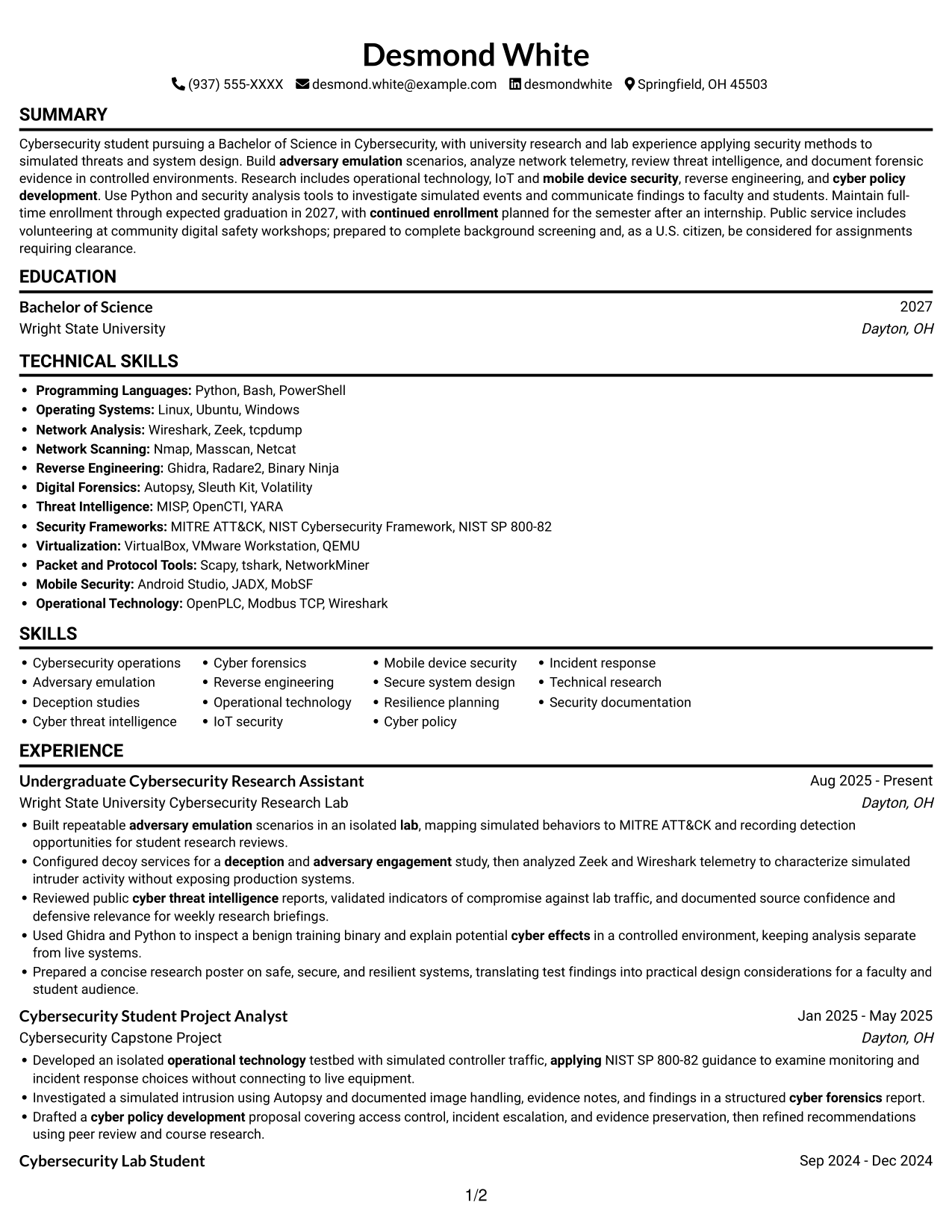
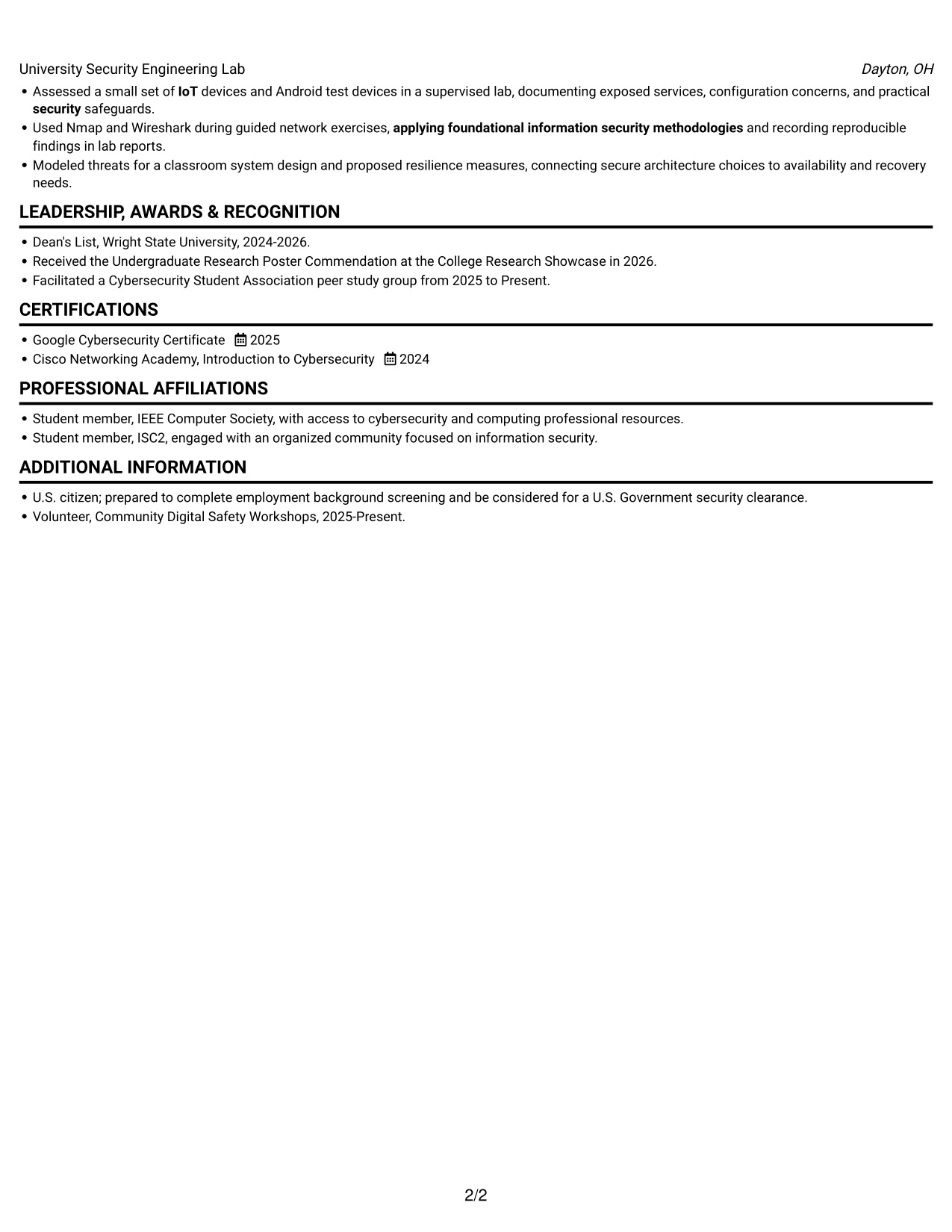
#1 Simple One Column Format Resume Example
Simple One Column Format keeps the resume in one vertical reading path, helping reviewers follow sections in sequence.
Why This Format Works
- Experience entries can be read in sequence, making career progression easier to follow.
- Skills and tools remain part of the same clear reading path.
- Education and certifications fit into the section order for direct review.
Best For
- Top-to-bottom resume review
- Full-width experience descriptions
- Chronological work histories
- Research-heavy evidence bullets
- Section-by-section scanning
Resume Keywords
- information security
- continued enrollment planned for the semester after an internship
- applying foundational information security methodologies
- mapping simulated behaviors to MITRE ATT&CK
- Use Python and security analysis tools to investigate simulated events
- Dean's List, Wright State University, 2024-2026.
- adversary emulation
- Deception
- adversary engagement
- cyber effects
- reverse engineering
- Cyber forensics
- Cyber threat intelligence
- Developed an isolated operational technology testbed with simulated controller traffic, applying NIST SP 800-82 guidance to examine monitoring and incident response choices without connecting to live equipment.
- Assessed a small set of IoT devices and Android test devices in a supervised lab, documenting exposed services, configuration concerns, and practical security safeguards.
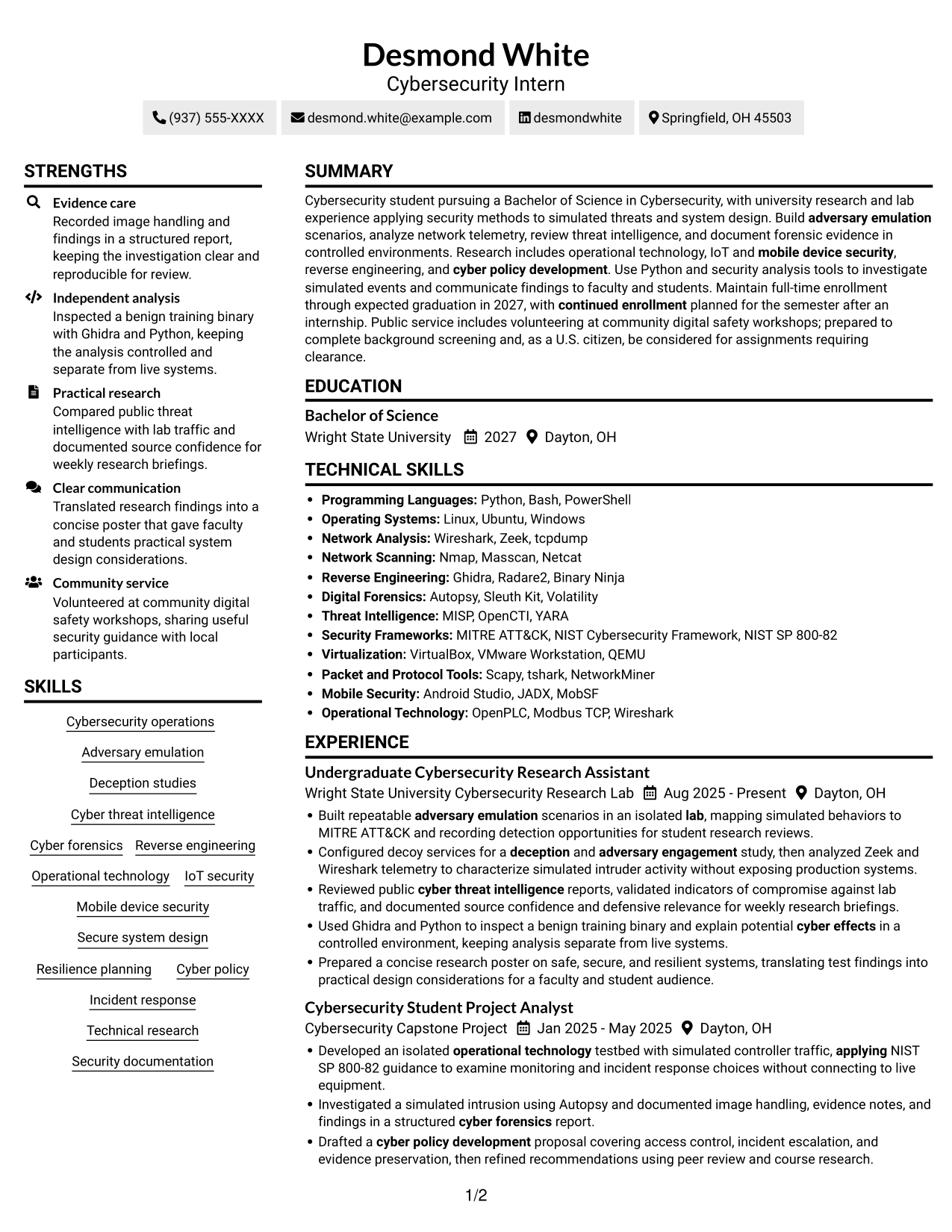
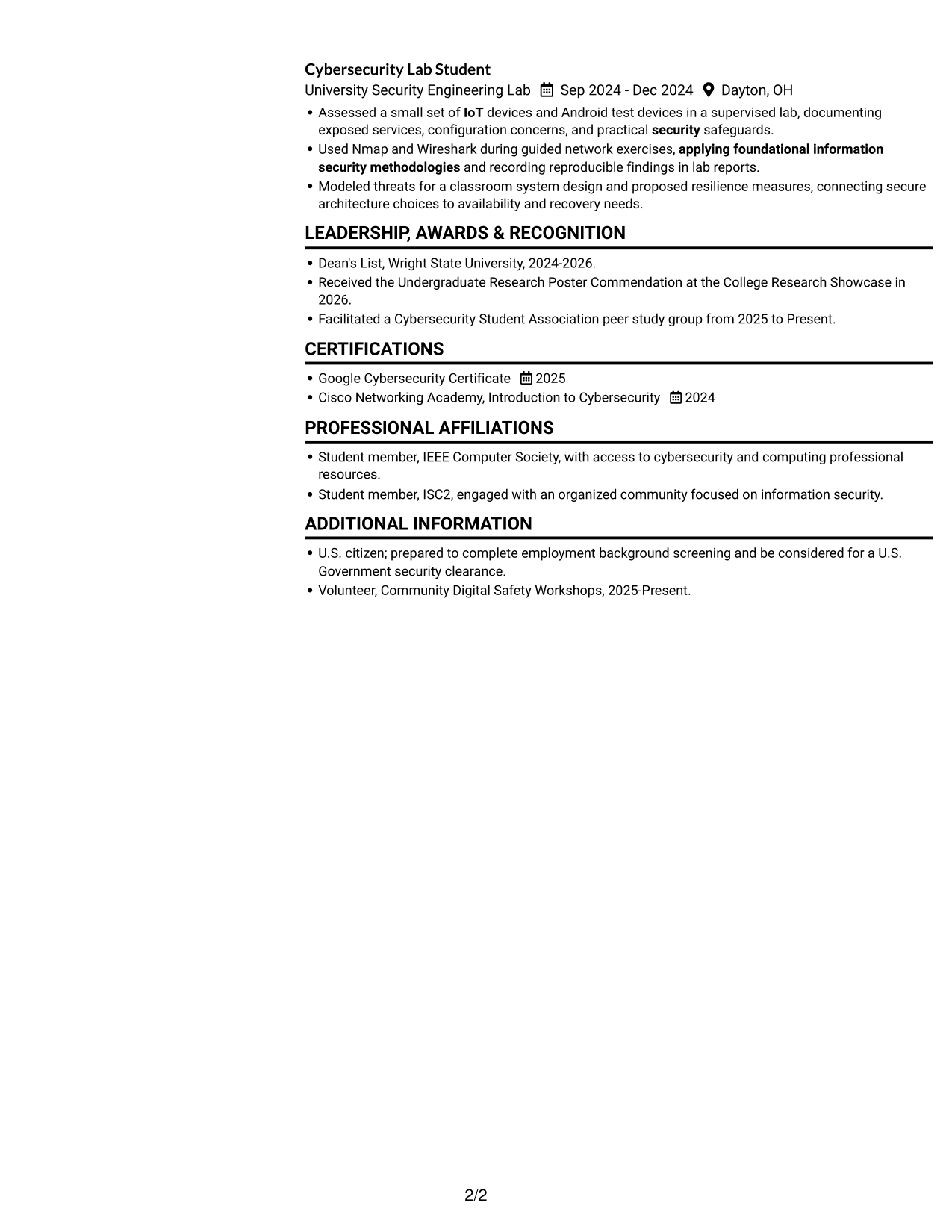
#2 Simple Two Column Format Resume Example
Simple Two Column Format places resume content in two columns, giving reviewers separate areas to scan.
Why This Format Works
- Separate columns let reviewers move between experience and supporting sections without scanning one long list.
- Skills and education are easier to locate apart from dense experience details.
- Distinct reading areas help preserve context across varied research and lab entries.
Best For
- Resumes with varied section types
- Separate skills and education review
- Long experience entries
- Research and lab evidence
- Readers who scan by section
#3 Plain One Column with Shaded Labels Resume Example
Plain One Column with Shaded Labels uses a single reading path, keeping resume sections in a clear sequence.
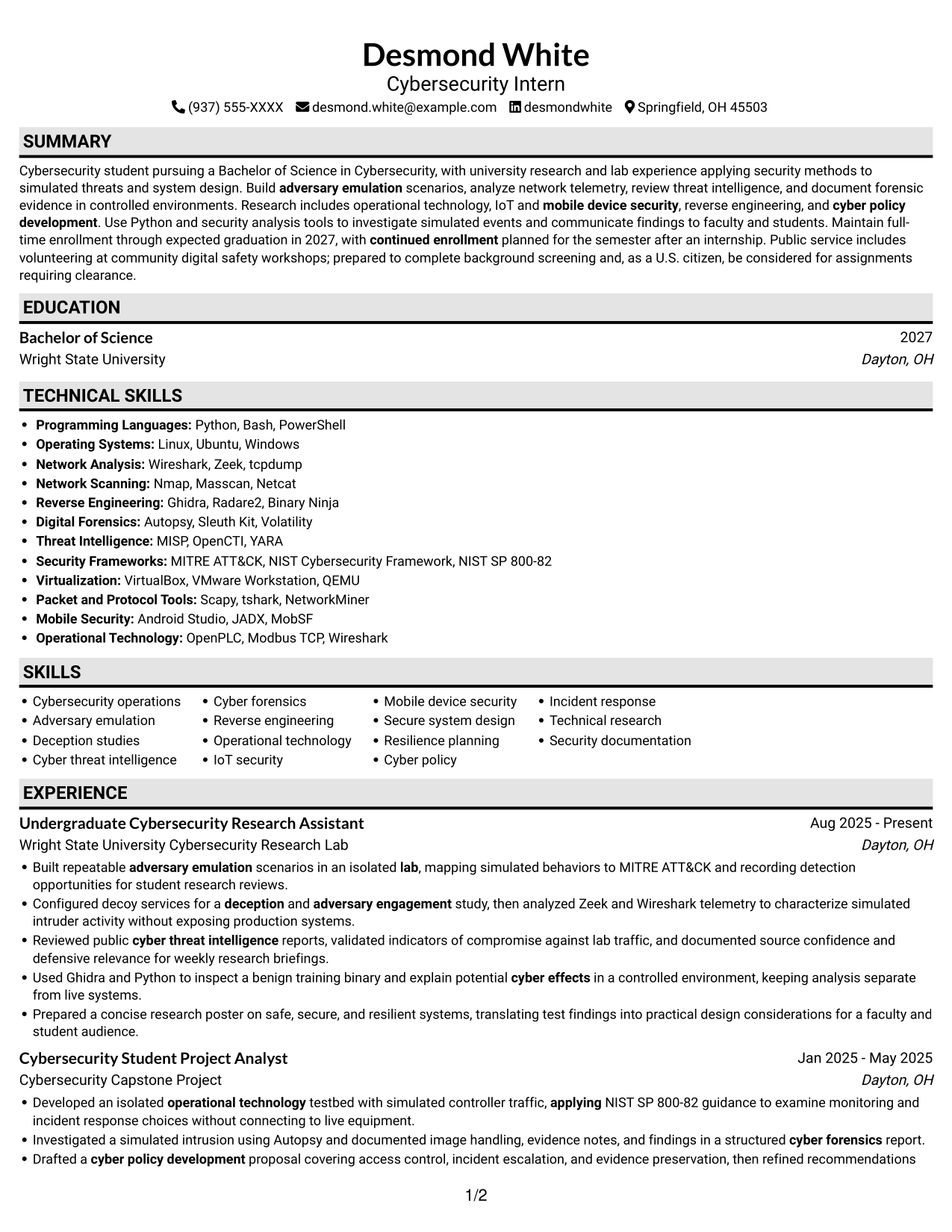
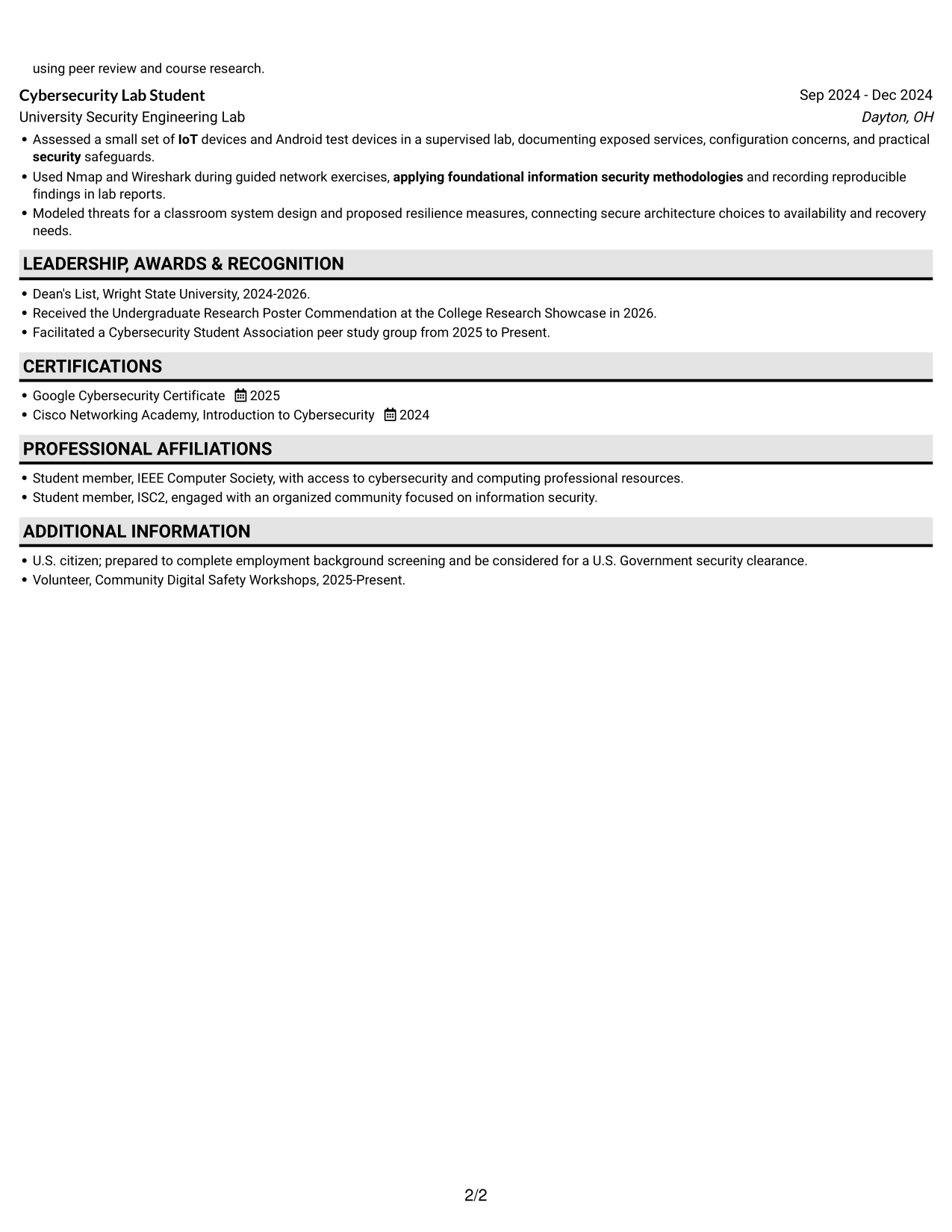
Why This Format Works
- Readers can move from experience to credentials using one consistent section sequence.
- Full-width text gives research descriptions room to retain their context.
- Skills remain within the same scan path as education and career history.
Best For
- Continuous resume reading
- Full-width research summaries
- Sequential experience review
- Clear section-by-section navigation
- Detailed education and credential records
#4 One Column Format with Photo Right Resume Example
One Column Format with Photo Right pairs a right-side photo with a single-column resume body for a direct reading sequence.
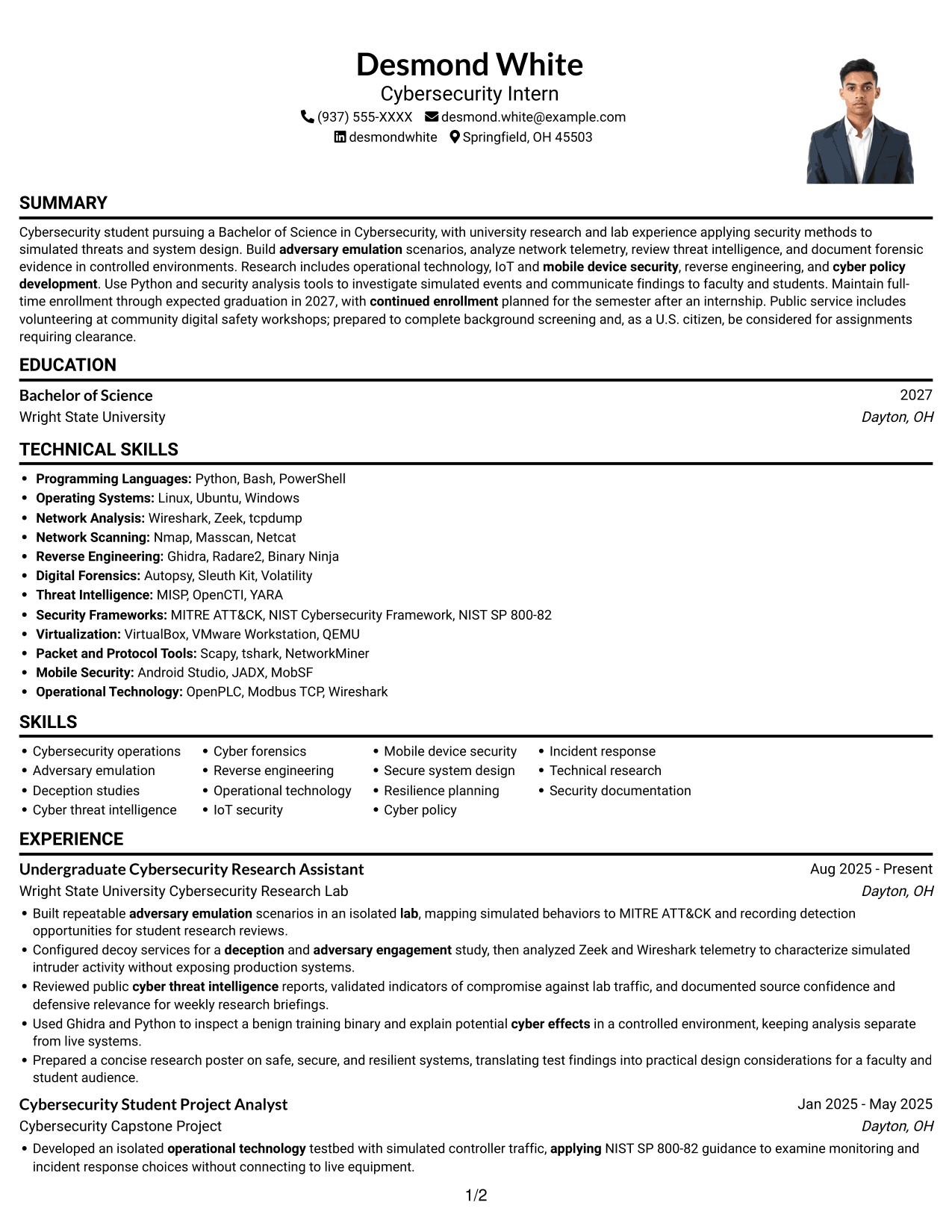
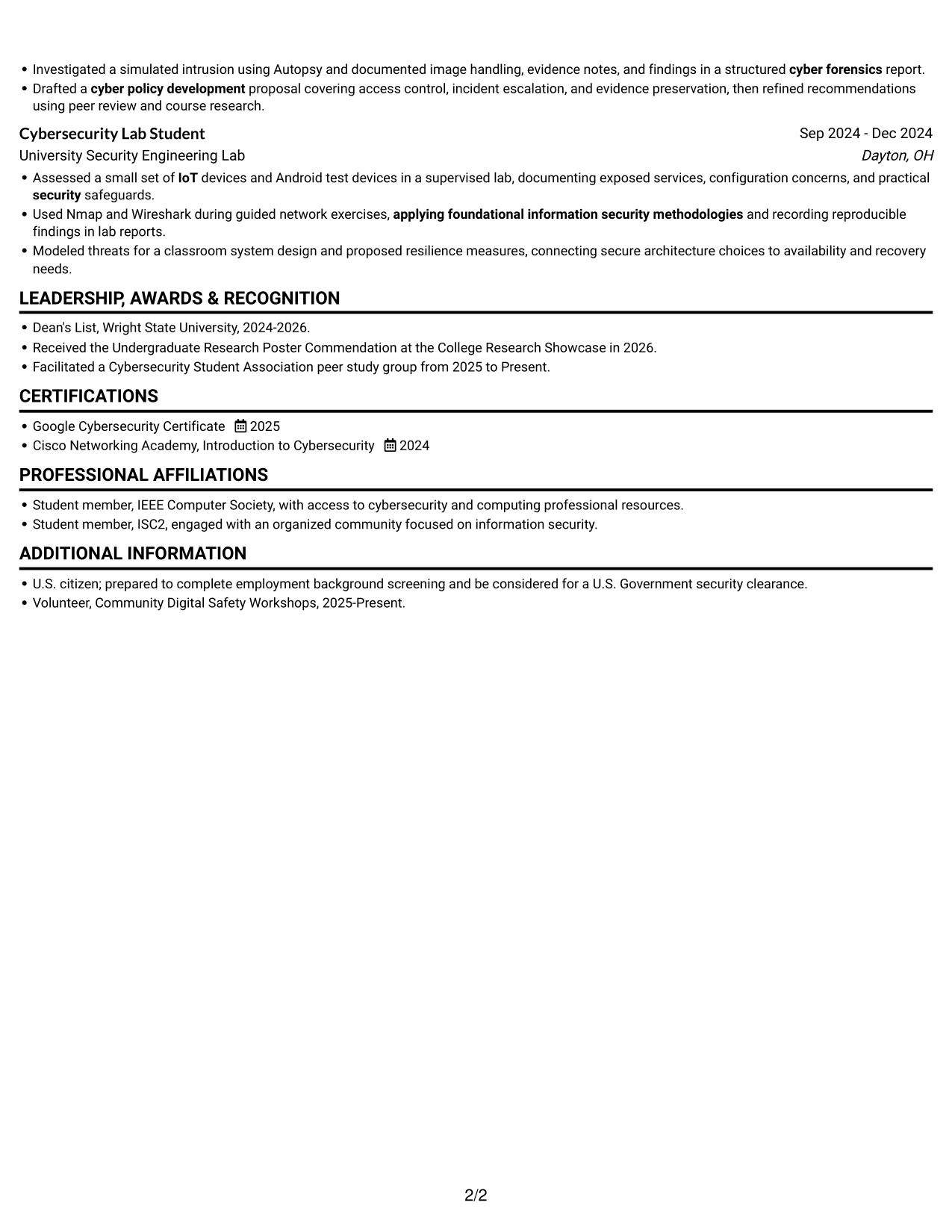
Why This Format Works
- One-column text keeps career history and education in a direct reading sequence.
- Experience details have a full-width reading path rather than sharing body columns.
- The photo sits apart from the resume text, leaving the content in one column.
Best For
- Resume layouts with a portrait
- One-column reading preference
- Long research descriptions
- Chronological experience records
- Direct access to education and credentials
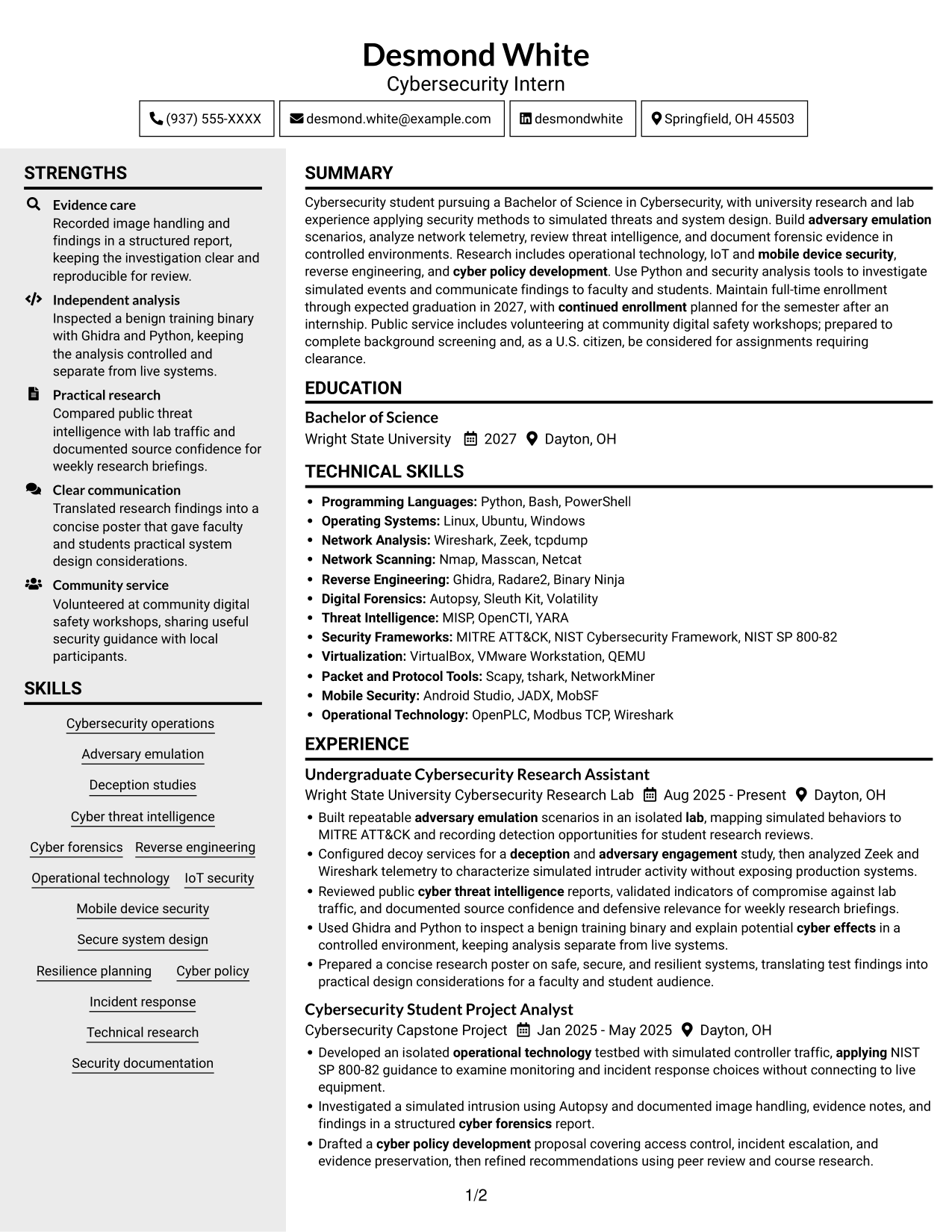
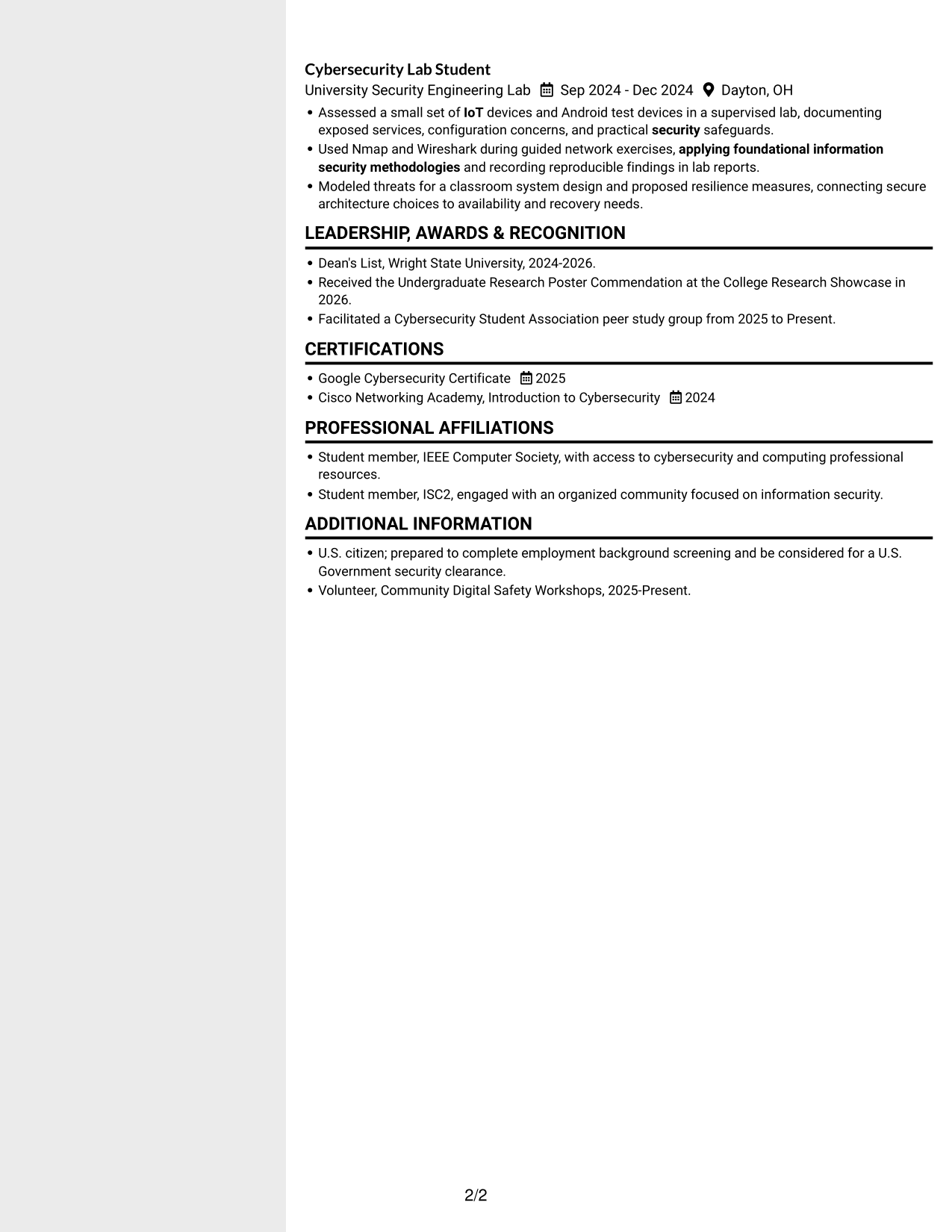
#5 Clean Two Column Sidebar Format Resume Example
Clean Two Column Sidebar Format separates resume content into two columns, making distinct areas available for review.
Why This Format Works
- Two distinct columns let readers locate supporting sections without losing the experience sequence.
- Career history can keep its own reading space apart from other resume details.
- Separate content areas help reviewers move between skills, education, and experience.
Best For
- Grouped resume sections
- Experience with supporting qualifications
- Section-based navigation
- Resumes with varied evidence types
- Review by content area
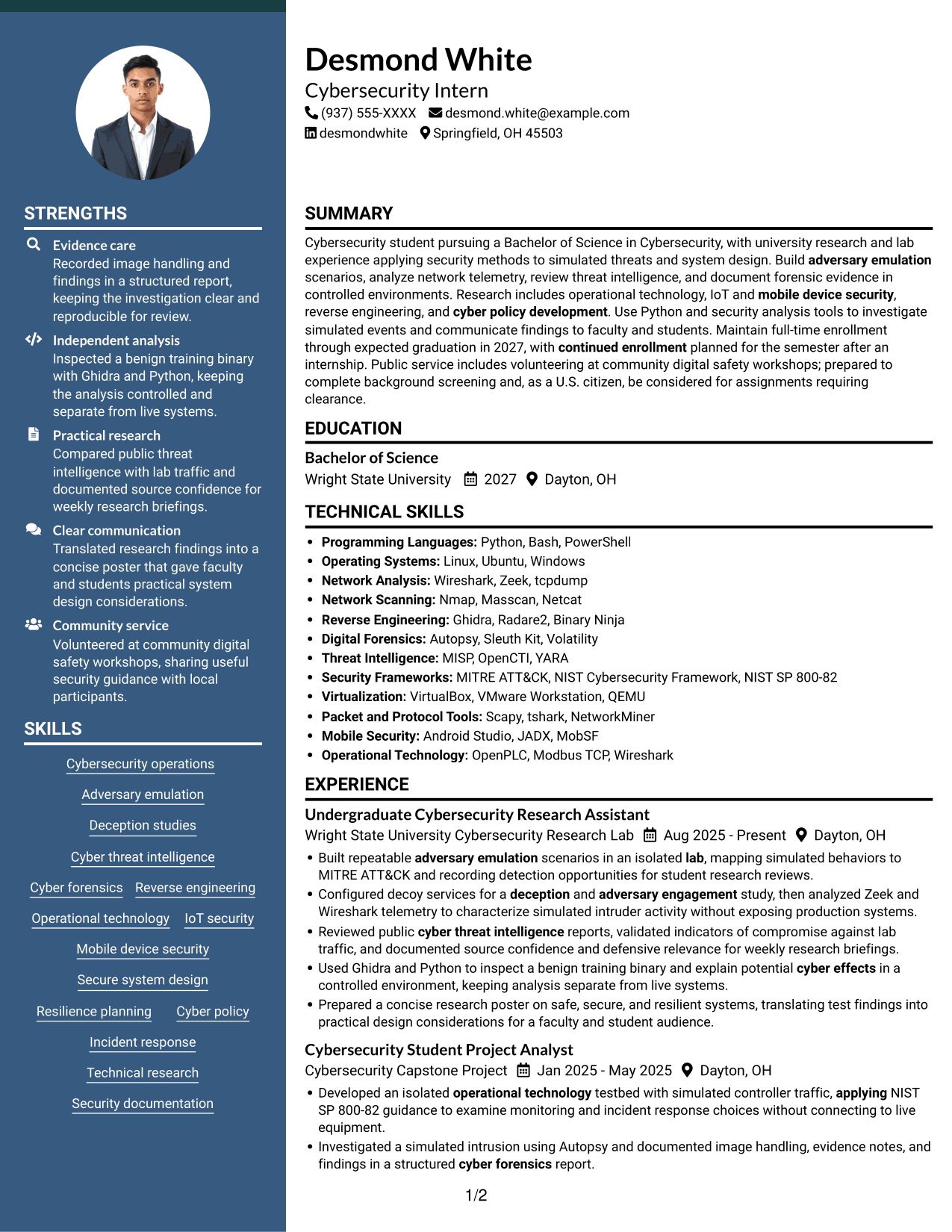
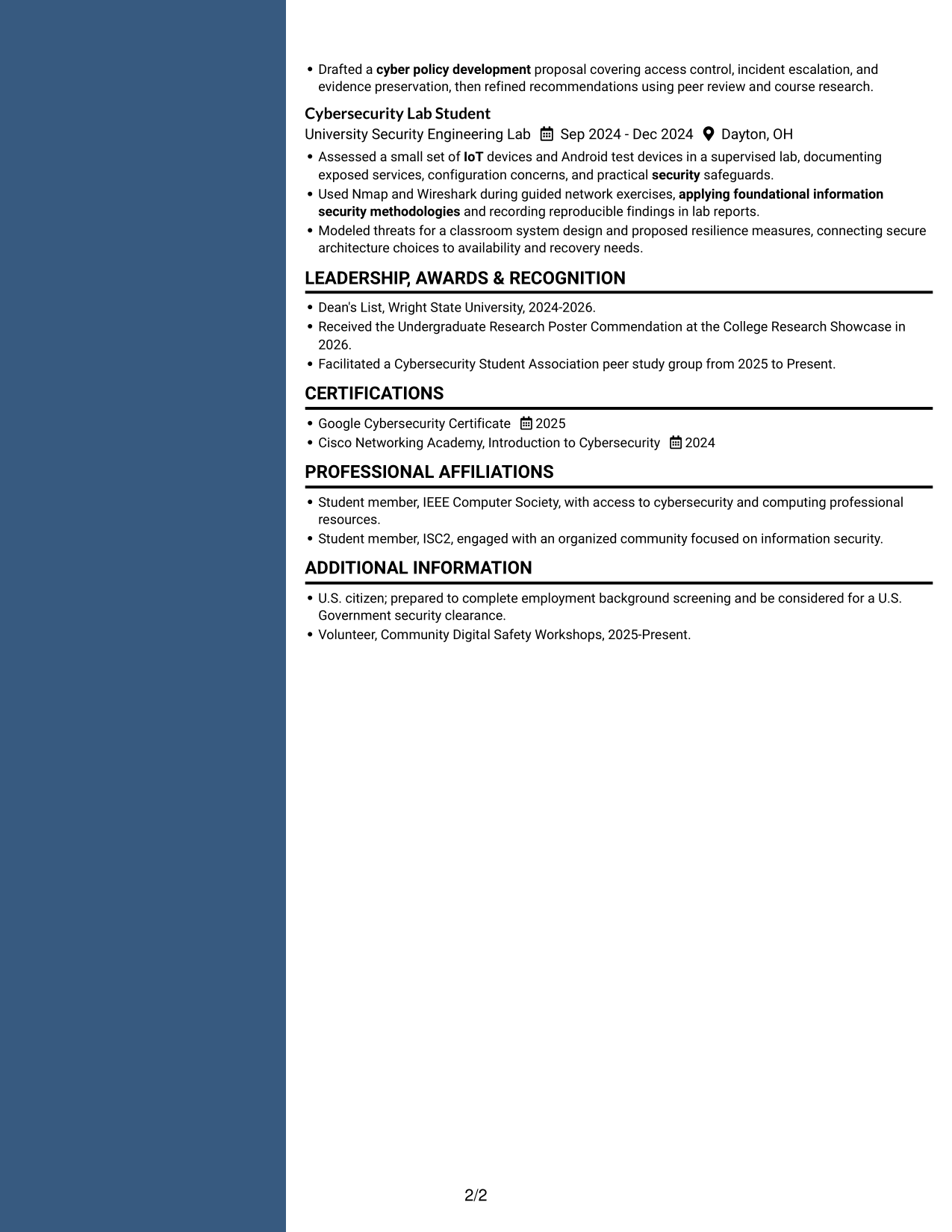
#6 Two Column Format Resume Example
Two Column Format gives resume sections two reading areas, offering a clear way to scan different parts of the document.
Why This Format Works
- Two columns give experience and supporting sections separate places in the resume.
- Readers can scan education and credentials without moving through every work entry.
- Distinct columns keep career history readable alongside a broad set of qualifications.
Best For
- Parallel review of resume sections
- Career histories with detailed bullets
- Multiple education and credential entries
- Resumes with several evidence types
- Readers who scan separate content areas
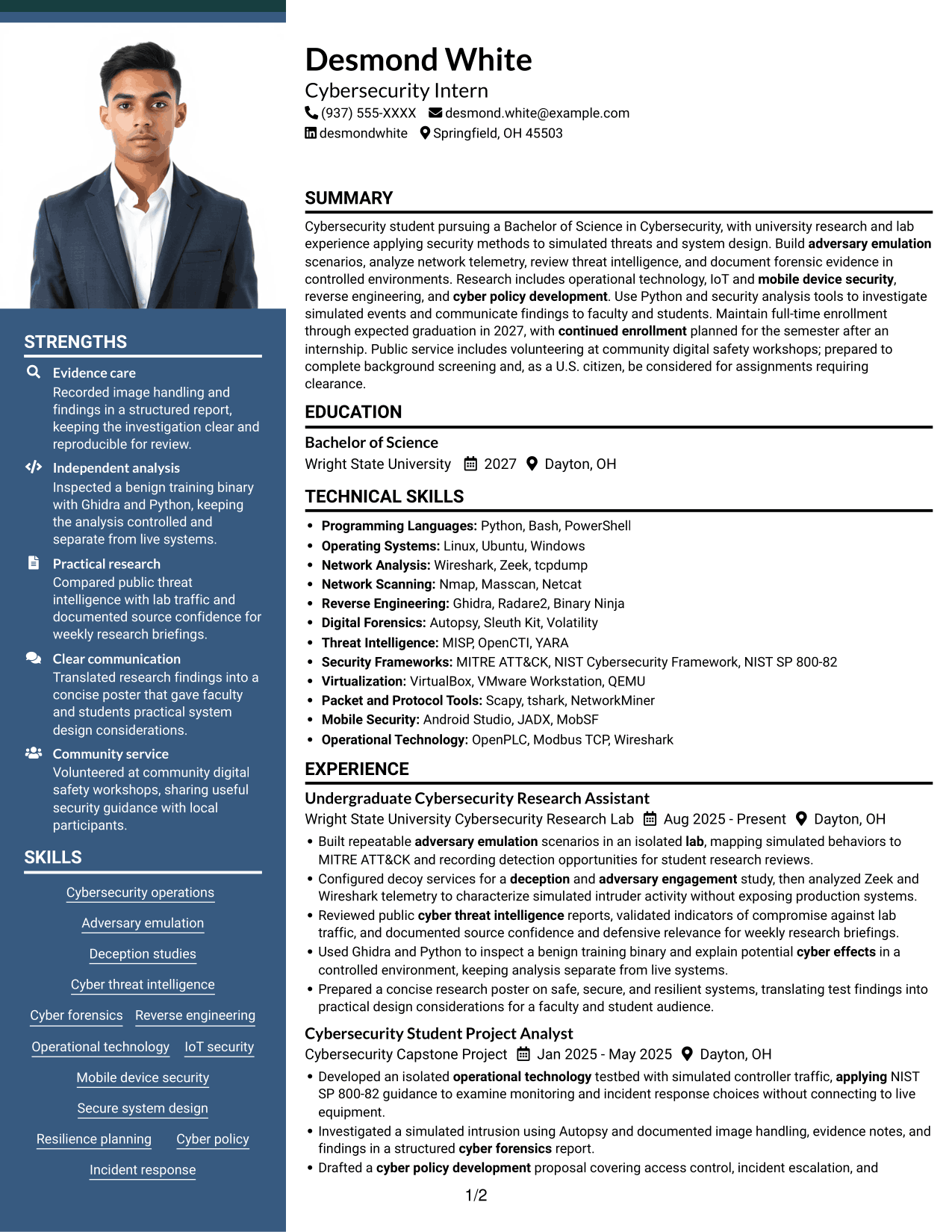
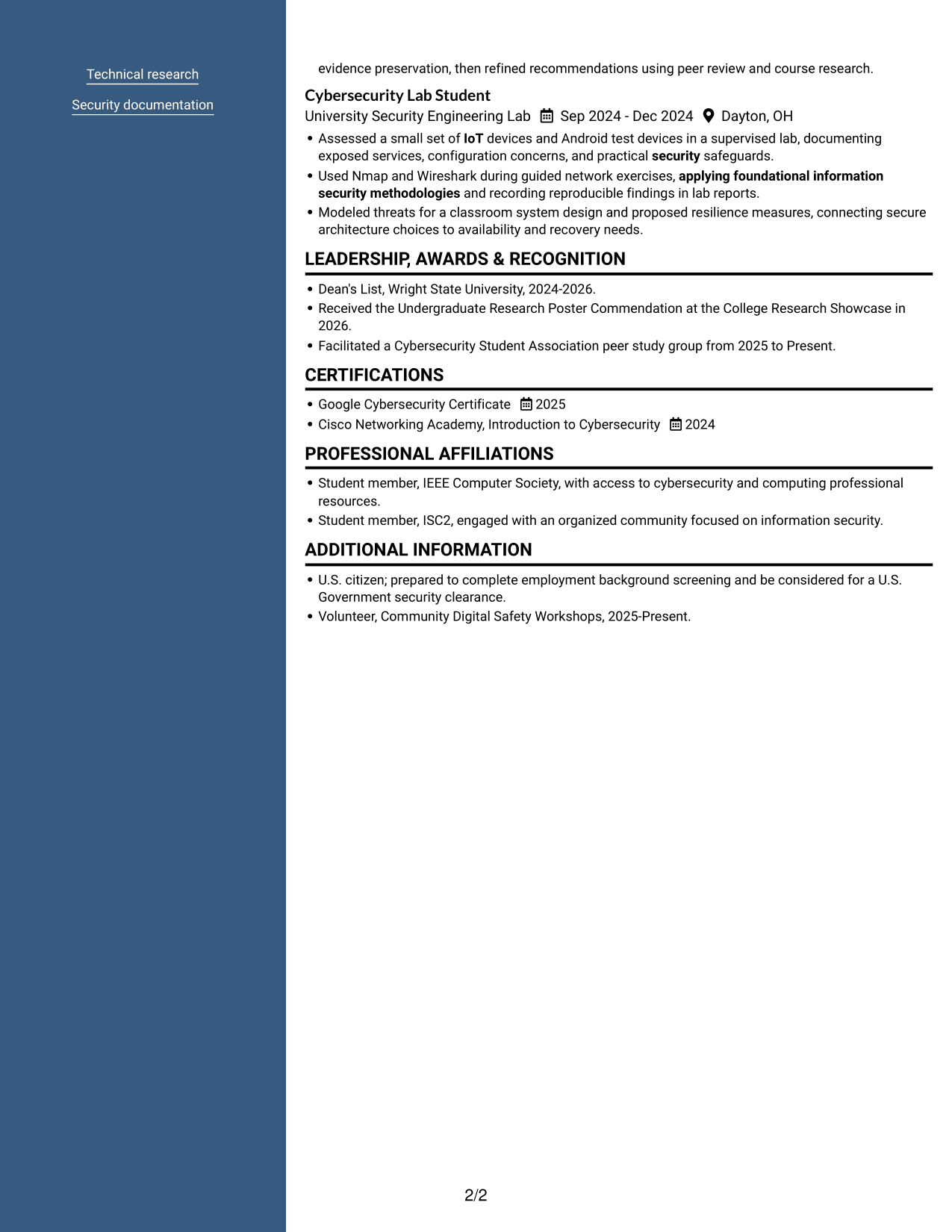
#7 Photo Header Two Column Format Resume Example
Photo Header Two Column Format places a photo in the header above a two-column body, combining a visible portrait with separated resume sections.
Why This Format Works
- Two body columns make it easier to find education and skills beyond experience details.
- Separate reading areas keep career history distinct from supporting resume sections.
- Education and credentials can be located without tracing every experience entry.
Best For
- Photo-led resume headers
- Two-column section navigation
- Multiple experience entries
- Skills and education review
- Resume readers who prefer separated content areas
Why Build Your Cybersecurity Intern - Cybersecurity Research and Operations Resume with ResumeInMinutes
ResumeInMinutes helps you arrange relevant coursework, research, lab experience, tools, and certifications in a resume that is easy to scan and edit. Keep each section focused on evidence that supports the Cybersecurity Intern - Cybersecurity Research and Operations role.
- Clear resume layouts
- ATS-friendly section structure
- Relevant keyword guidance
- Organized experience and skills
- PNG image previews
- Examples you can open in the editor
Use the previews to compare how each design presents skills, education, research, and experience. Then open an example in the editor and adapt the structure to your own verified qualifications.
See Also
- 33 Analyst - Cybersecurity Operations Resume Templates with Example 2026 (ATS-Optimized)
- 7 Cybersecurity Intern - Cyber Operations and Resilient Systems Resume Templates with Example
- 33 Principal Engineer – Aircraft Cybersecurity Operations Resume Templates with Example 2026 (ATS-Optimized)
- 33 AI-Powered Cybersecurity Product Engineer Resume Templates with Example 2026 (ATS-Optimized)
- 33 Associate Cybersecurity Engineer Resume Templates with Example 2026 (ATS-Optimized)
- 33 Chief Technology Officer - Cybersecurity Resume Templates with Example 2026 (ATS-Optimized)
- 7 Cyber Systems Engineer Intern - Offensive Cybersecurity and Automation Resume Templates with Example
- 33 Cybersecurity Analyst Intern - Hands-on Security Resume Templates with Example 2026 (ATS-Optimized)
- 7 Cybersecurity Intern - Cybersecurity Research and Operations Cover Letter Templates with Example
- 30+ Analyst - Cybersecurity Operations Cover Letter Templates with Example 2026
Frequently Asked Questions
Are these Cybersecurity Intern - Cybersecurity Research and Operations resume templates ATS-friendly?
They use clear headings and familiar resume sections to support scanning and parsing. Include role-relevant terms such as adversary emulation, cyber forensics, threat intelligence, Python, and MITRE ATT&CK only when they accurately describe your skills or work.
Are the examples different resumes?
No. The page shows one resume example in several visual layouts. Compare the PNG previews to see how the same information can be arranged, then open an example in the editor.
What should a Cybersecurity Intern - Cybersecurity Research and Operations resume include?
Include a focused summary, education, relevant research or lab experience, technical skills, tools, and certifications. Use concise bullets to explain your methods, findings, documentation, and outcomes.
Which resume layout works well for this cybersecurity internship?
A clean, simple layout with clear headings can make technical skills and evidence easier to review. Choose a format that keeps experience, education, and relevant tools easy to find.
How can I show cybersecurity experience gained in a lab or research project?
Name the controlled setting, describe the method or tool you used, and state what you analyzed or documented. For example, explain how you mapped simulated behavior to MITRE ATT&CK or reviewed network telemetry, if that reflects your work.
Should I include a photo on my resume?
For U.S. applications, a resume without a photo is generally the safer choice. Use a photo only when it is customary or expected in your country, region, or field.