
7 Equipment Development Engineer - Wafer Bonding Resume Templates with Example
This guide shows you how to create an Equipment Development Engineer - Wafer Bonding resume that makes your technical contribution clear. Learn how to organize evidence, show the results of equipment work, and compare professional resume formats.
Strong resumes connect equipment requirements and hands-on engineering work to outcomes such as improved overlay, stable bond-wave behavior, reliability, and manufacturing readiness. Use focused bullets and measurable evidence where available, and make relevant skills easy to find, including hybrid bonding, precision alignment, DOE, Python, MATLAB, and SECS/GEM.
The example is presented in 7 resume layouts. The guide explains how to choose a readable format and arrange experience, technical skills, education, and certifications so reviewers can scan your qualifications.
What Makes a Great Equipment Development Engineer - Wafer Bonding Resume in 2026
A strong resume makes equipment scope, engineering decisions, and business results easy to see. Clear section headings and focused experience bullets help reviewers find the evidence quickly.
Use accurate terms for wafer bonding, alignment and overlay, equipment qualification, supplier development, and troubleshooting. Support claims with specific test methods, tools, and measured results when available.
Note: Resume examples are for educational purposes only. Use only information that accurately reflects your experience and qualifications. References to real organizations do not imply affiliation or endorsement.
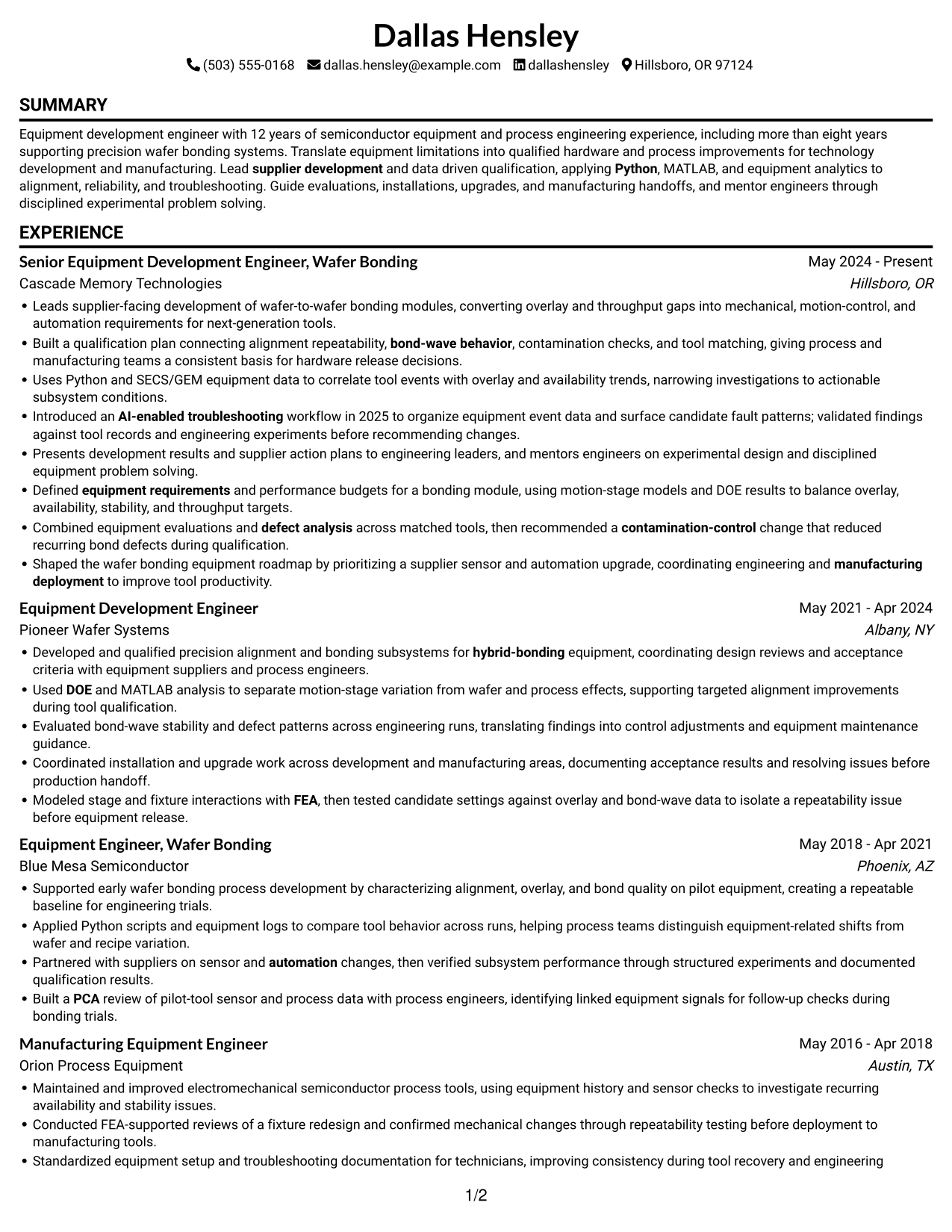
#1 Simple One Column Format Resume Example
A single-column body keeps the resume sections in one reading path, which suits a straightforward review.
Why This Format Works
- One reading path helps reviewers follow experience from recent roles to earlier work.
- Full-width bullets leave room for measurable results and the context behind them.
- Skills, education, and certification sections remain easy to locate in sequence.
Best For
- Chronological career histories
- Detailed achievement bullets
- Resumes with several experience sections
- Skills and education in one sequence
- Single-path recruiter review
Resume Keywords
- hybrid-bonding
- Equipment qualification
- equipment troubleshooting
- equipment requirements
- supplier development
- Equipment reliability
- bond-wave behavior
- tool matching
- contamination-control
- defect analysis
- motion-control
- manufacturing deployment
- equipment evaluations
- AI-enabled troubleshooting
- automation
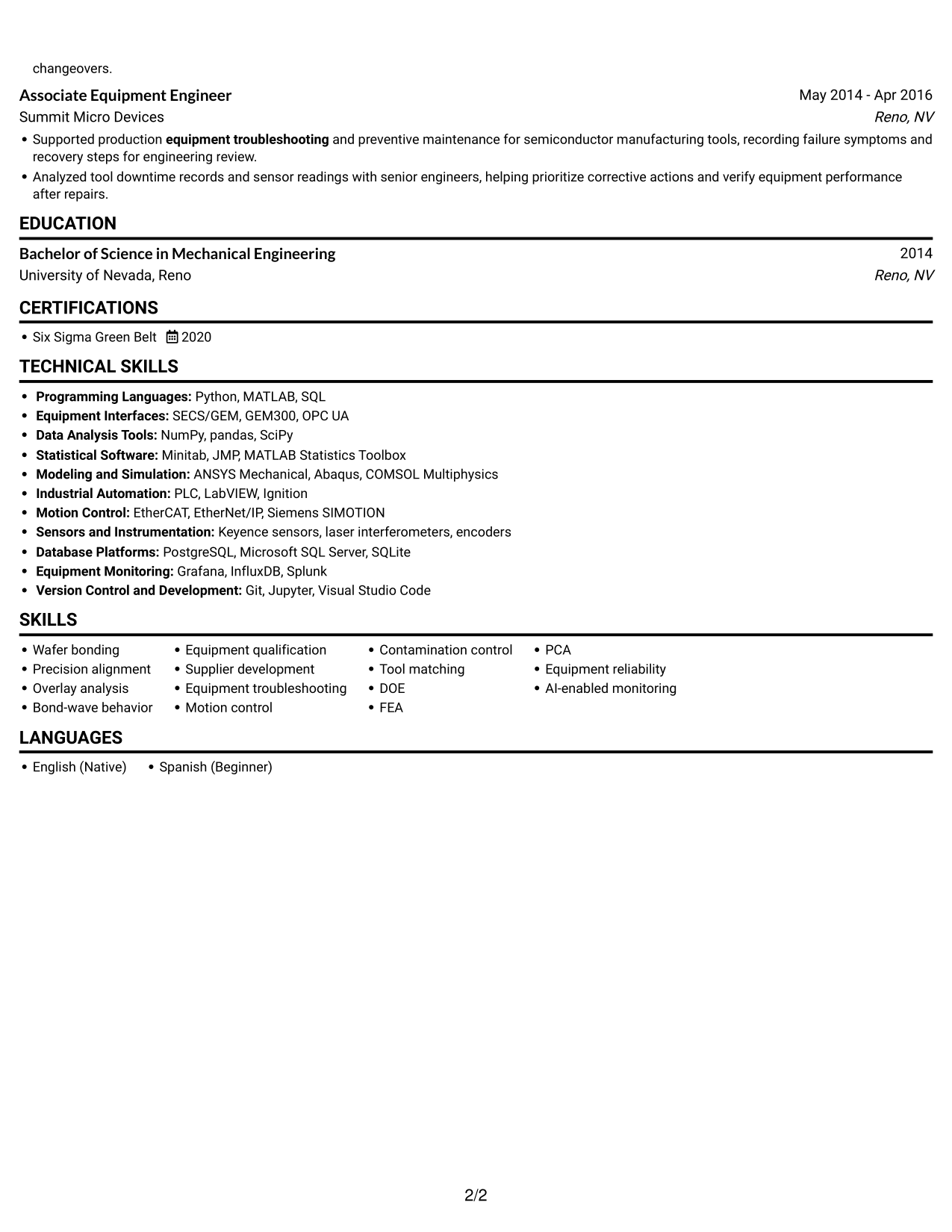
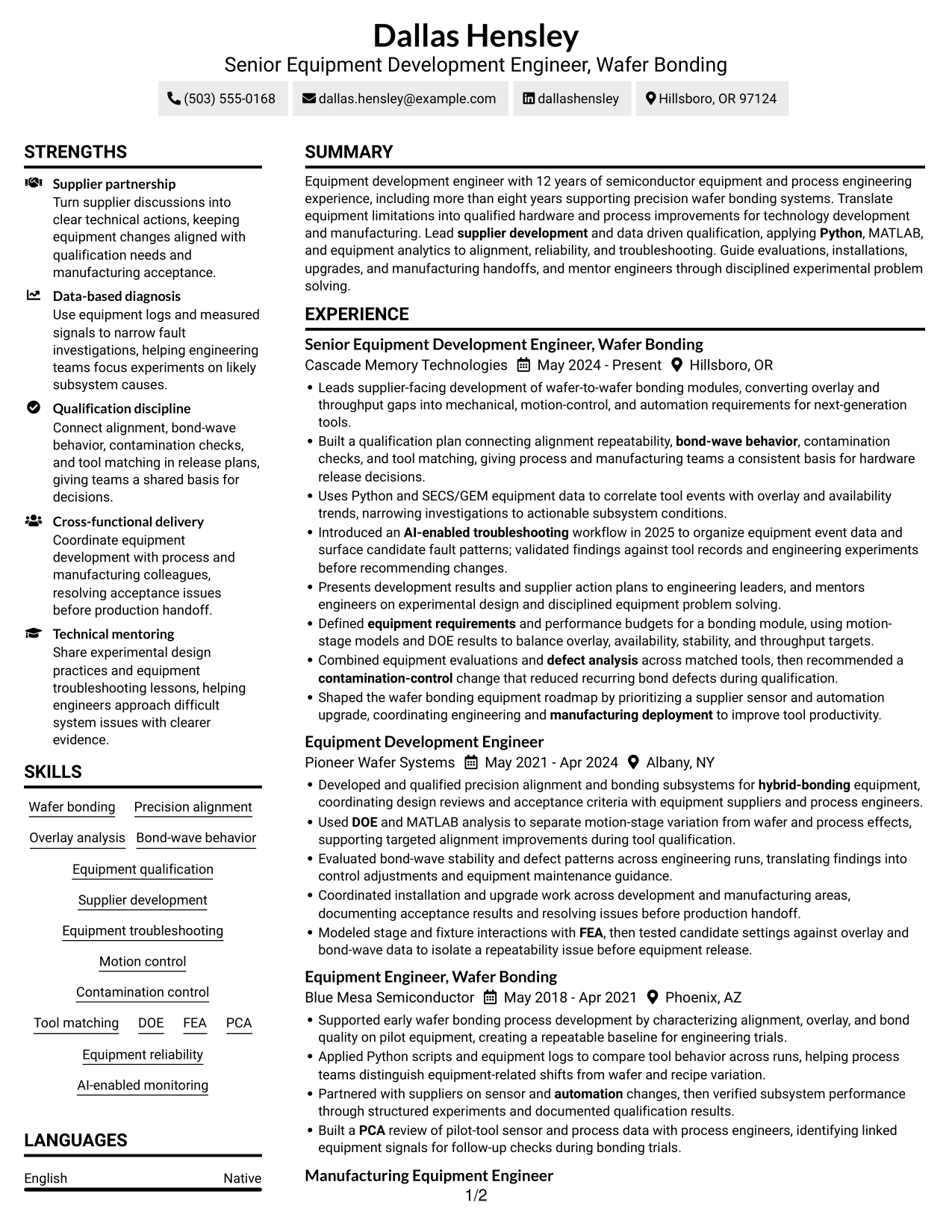
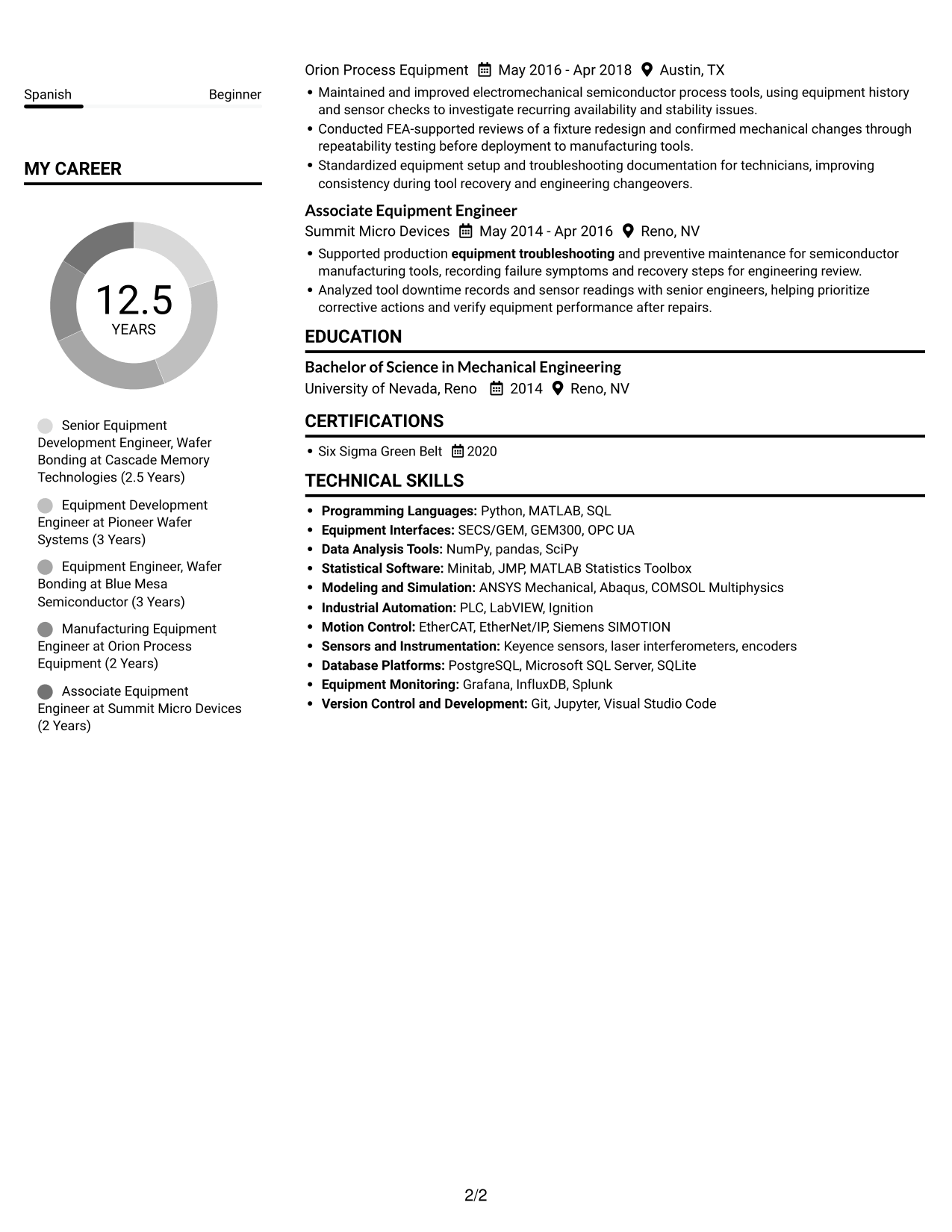
#2 Simple Two Column Format Resume Example
Two body columns group resume content into separate areas, helping readers scan different sections with ease.
Why This Format Works
- Separate content areas let reviewers scan supporting details alongside the experience record.
- Shorter text blocks help technical achievement bullets stay easy to follow.
- Grouped sections give skills, education, and credentials clear entry points.
Best For
- Resumes with several section types
- Skills and experience reviewed side by side
- Technical achievements with supporting details
- Readers who scan by section
- Credentials paired with work history
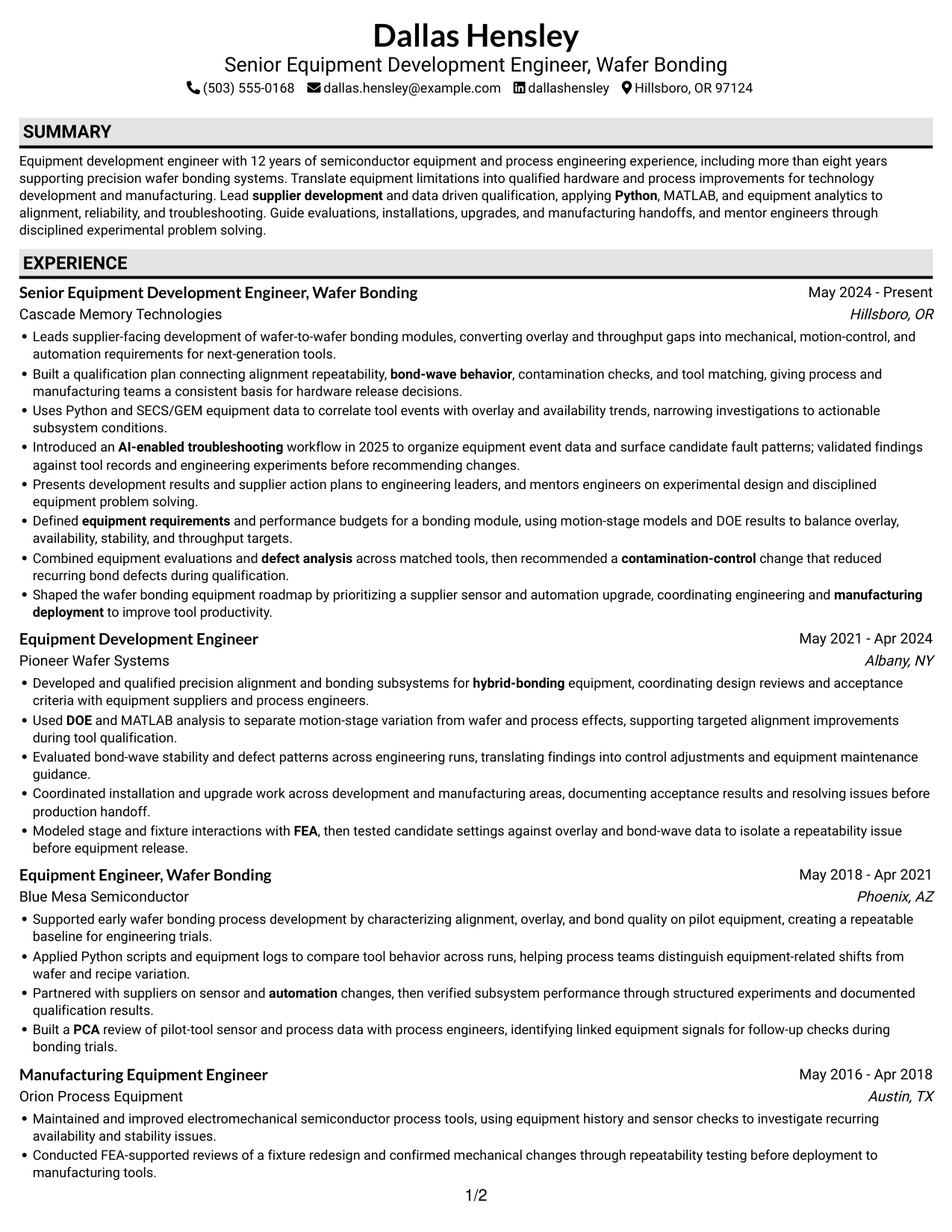
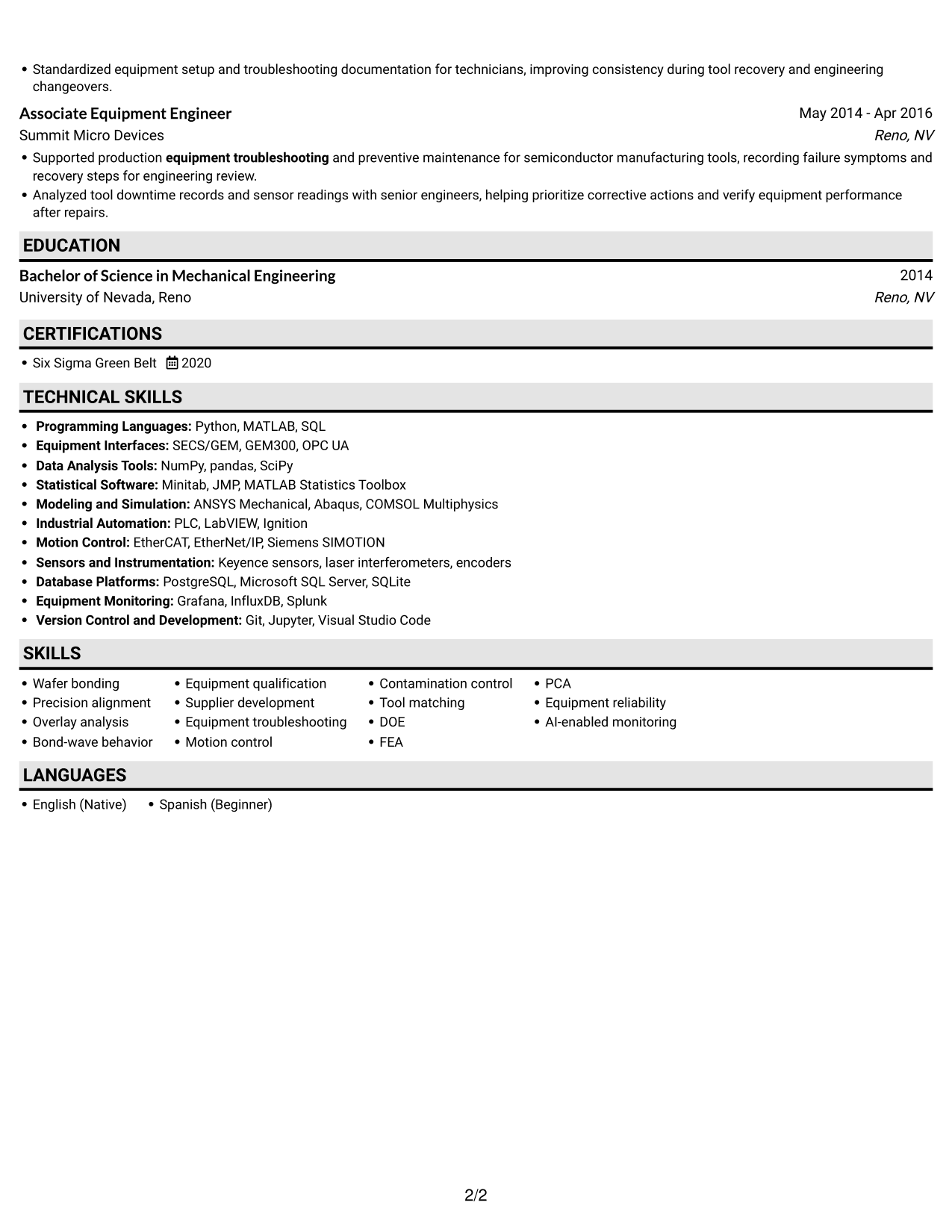
#3 Plain One Column with Shaded Labels Resume Example
Shaded section labels mark the start of each area, while the single-column body keeps the resume easy to follow.
Why This Format Works
- Shaded labels distinguish sections without interrupting the experience timeline.
- Continuous body text lets reviewers follow role progression in order.
- Full-width bullets preserve context around measurable results and qualifications.
Best For
- Clearly marked resume sections
- Chronological work histories
- Achievement bullets needing context
- Education and certification details
- Straightforward section-by-section review
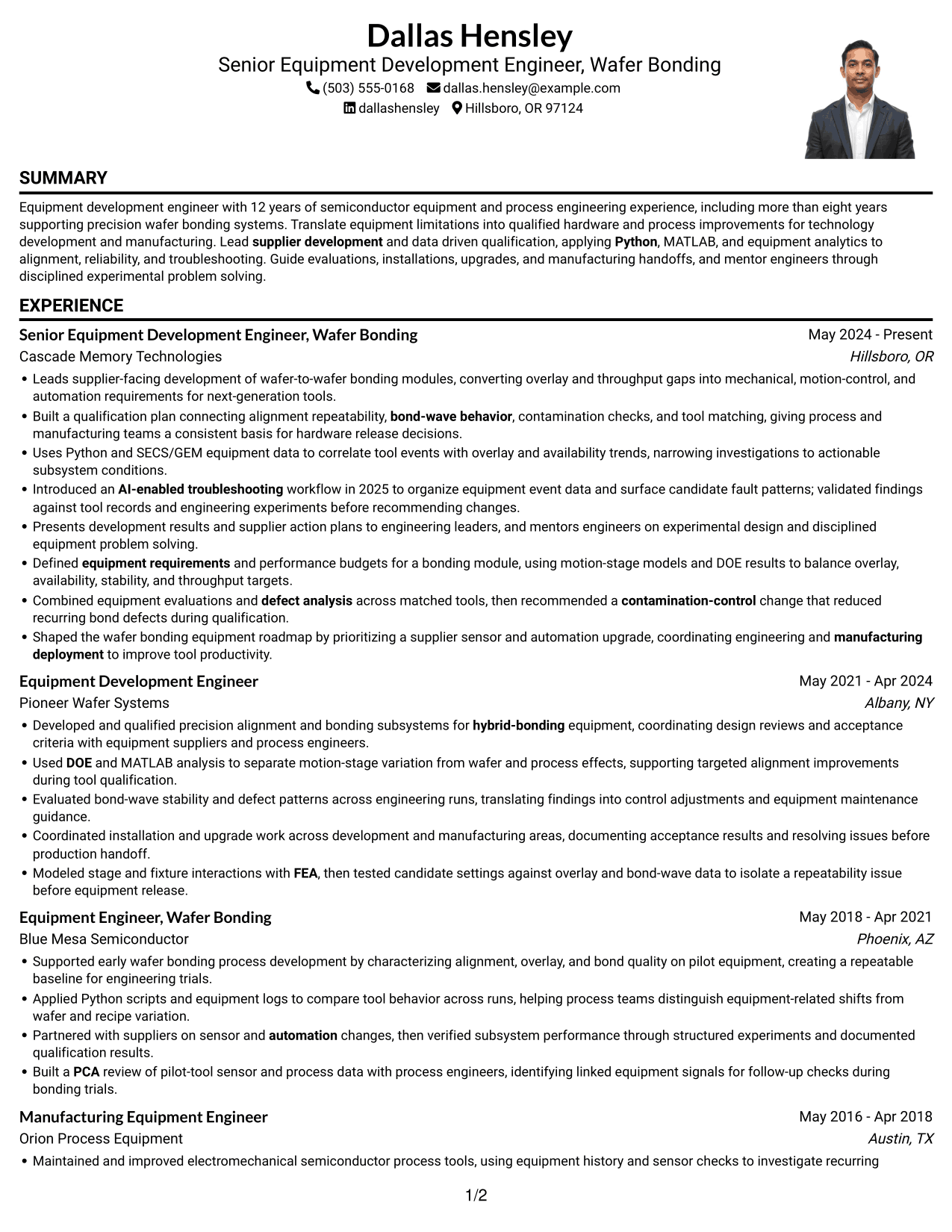
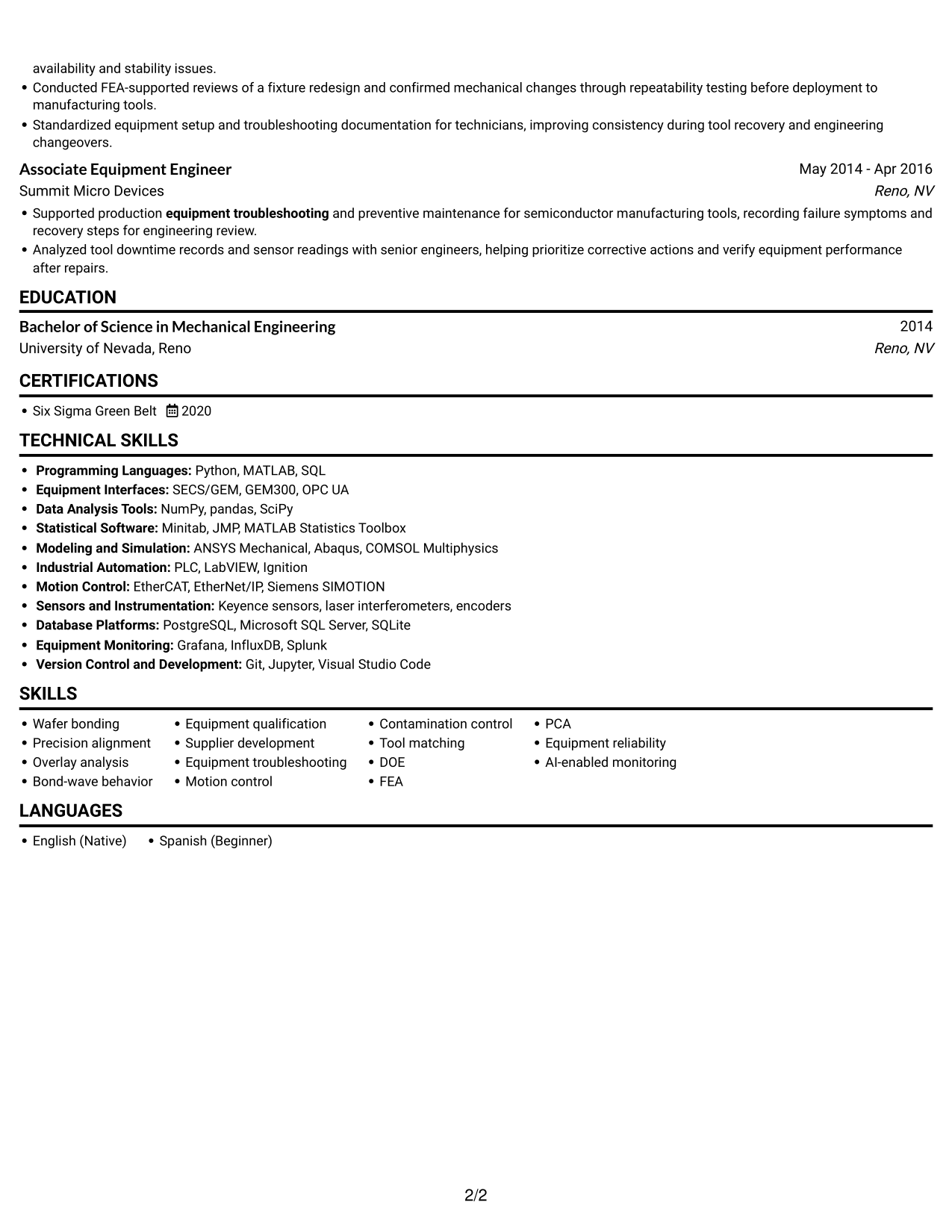
#4 One Column Format with Photo Right Resume Example
A right-side portrait adds a personal image, while the one-column body keeps resume content in sequence.
Why This Format Works
- The right-side portrait adds a visible personal image without splitting the resume body.
- Single-column sections let reviewers follow experience and education in a steady sequence.
- Unbroken text width supports achievement bullets with complete context.
Best For
- Resumes that include a portrait
- Sequential work histories
- Achievement bullets with full context
- Education alongside professional experience
- Readers who prefer one-column text
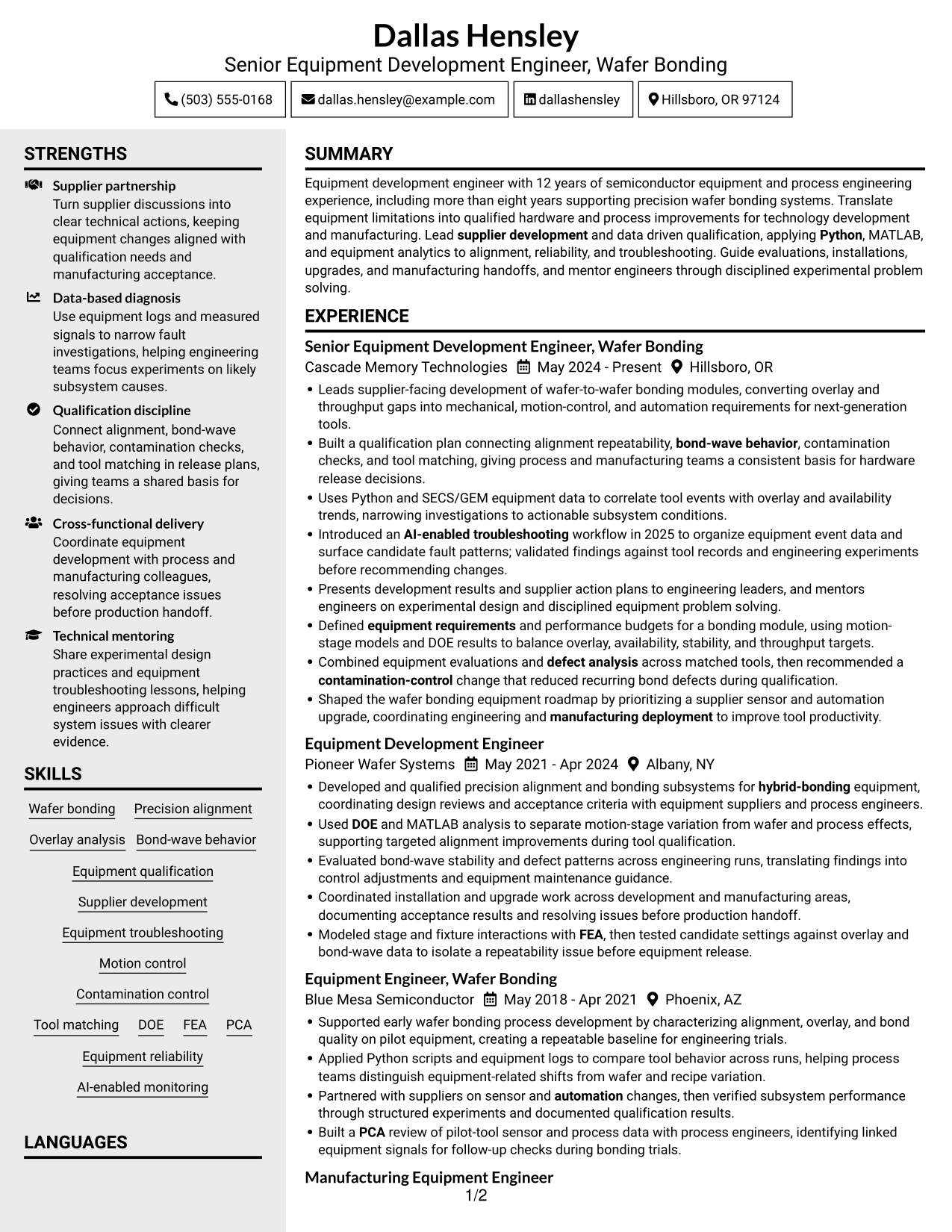
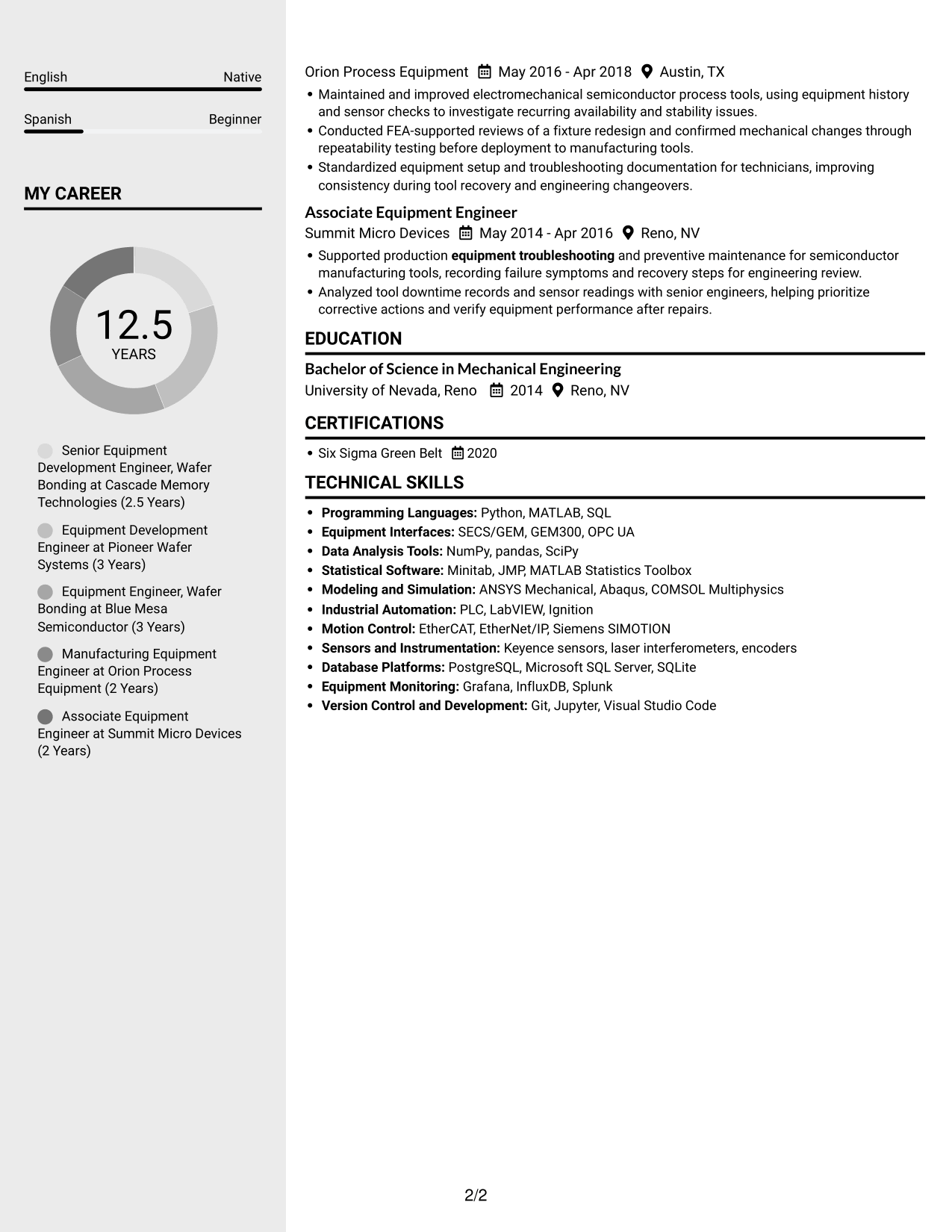
#5 Clean Two Column Sidebar Format Resume Example
A sidebar divides the resume into two columns, giving readers a clear way to scan grouped content.
Why This Format Works
- The sidebar gives supporting resume details a separate area from the main content.
- Two-column reading order helps reviewers move between grouped sections and work history.
- Section separation makes skills and credentials easier to locate.
Best For
- Supporting details beside work history
- Resumes with distinct content groups
- Skills and credentials easy to locate
- Readers comparing multiple resume sections
- Work histories with supporting qualifications
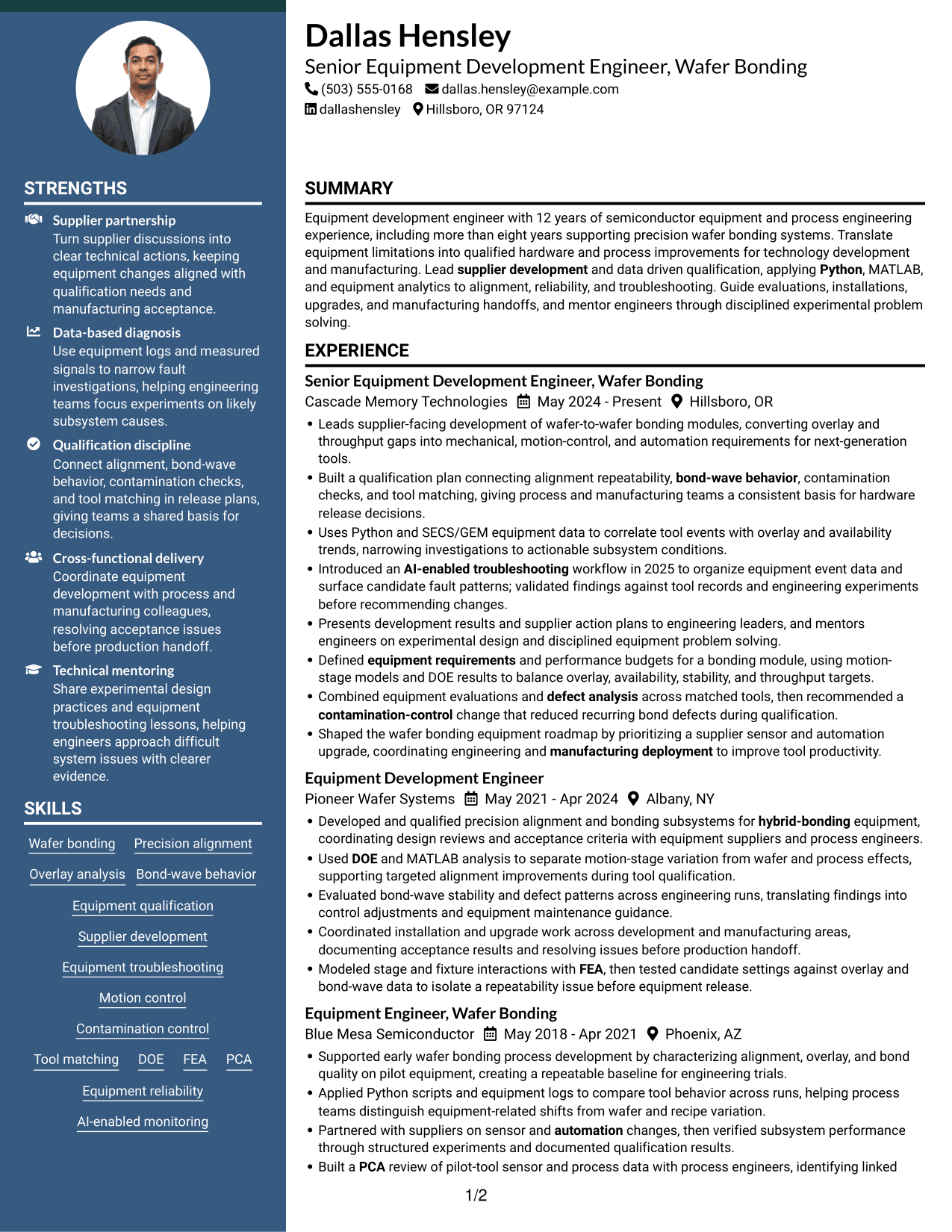
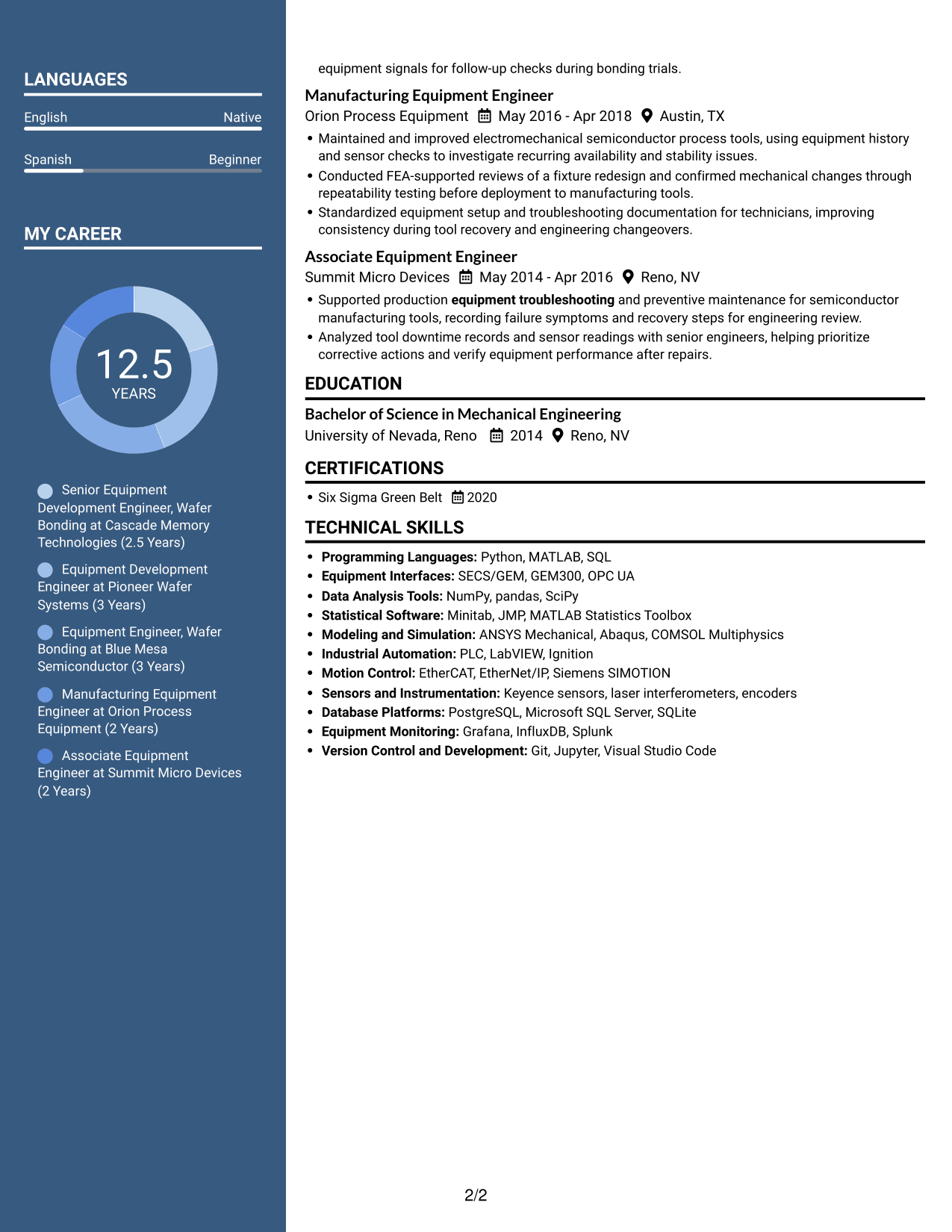
#6 Two Column Format Resume Example
The two-column body places resume information in parallel areas, a useful choice for readers who scan by section.
Why This Format Works
- Separate columns let reviewers scan supporting details alongside the experience record.
- Shorter text blocks help technical achievement bullets stay easy to follow.
- Grouped sections give skills, education, and credentials clear entry points.
Best For
- Resume content with several section types
- Paired review of skills and experience
- Achievement bullets alongside supporting details
- Readers who scan by section
- Technical qualifications and education
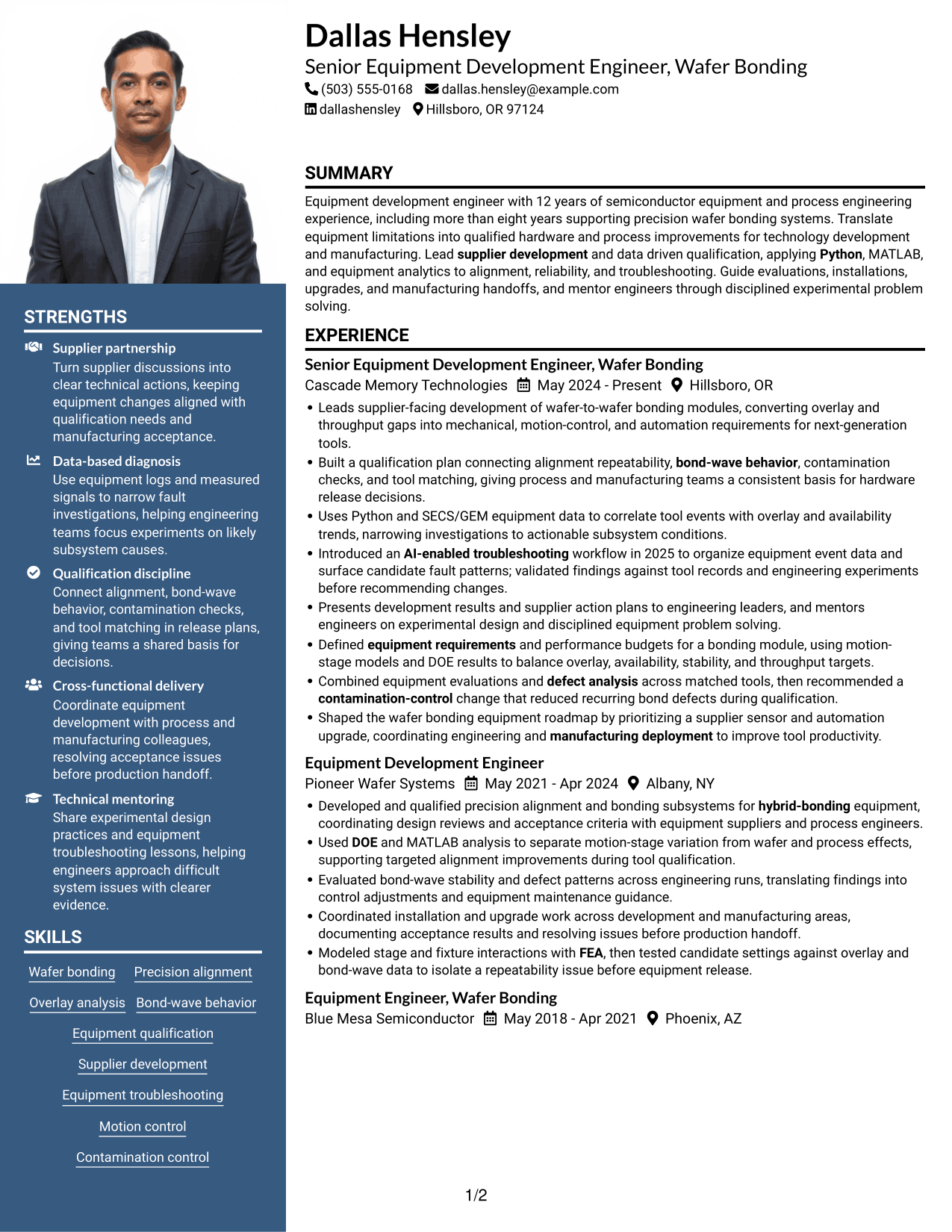
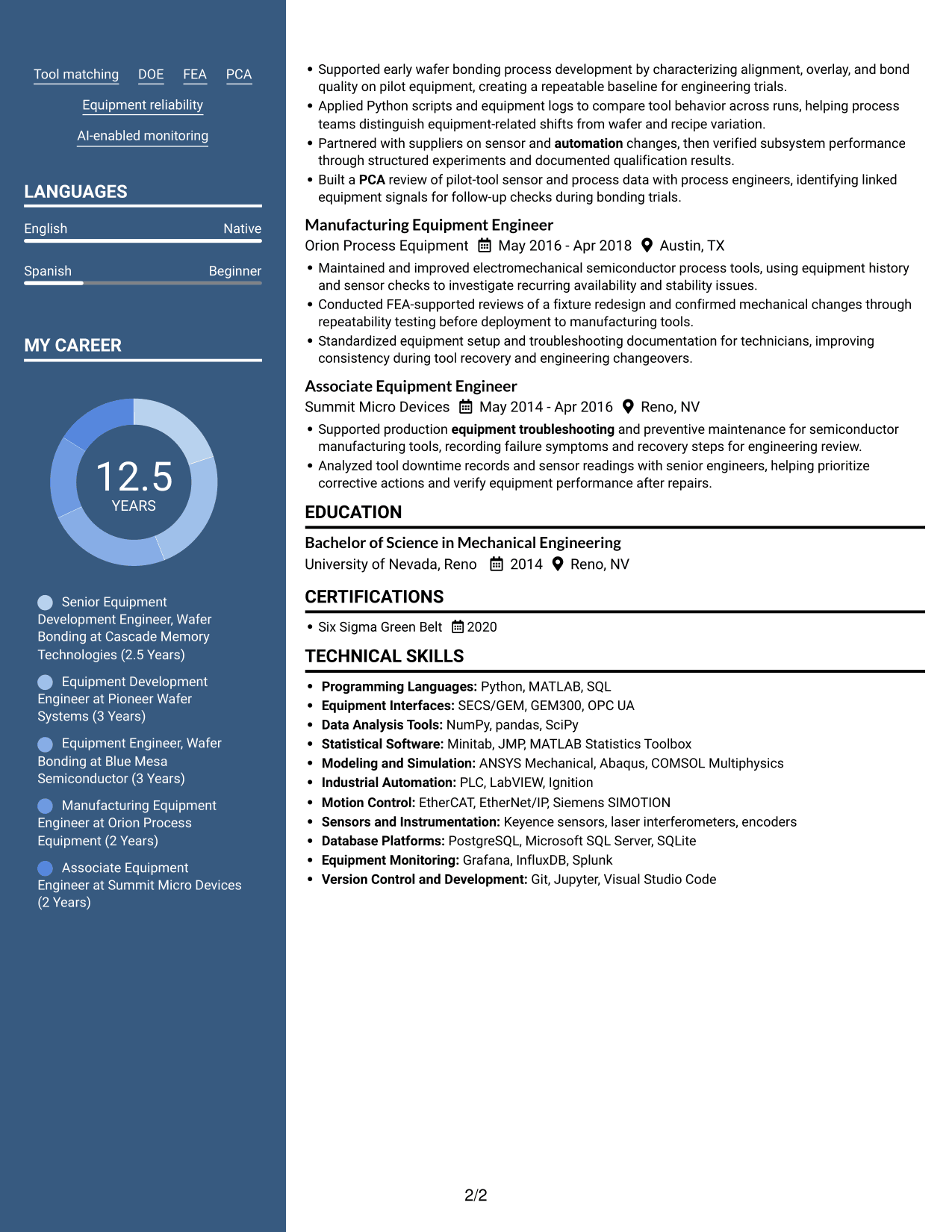
#7 Photo Header Two Column Format Resume Example
A header portrait pairs with a two-column body, combining a visible photo with grouped resume content.
Why This Format Works
- The header portrait provides a clear visual point of identification.
- Two-column body areas help reviewers move among experience, skills, and credentials.
- Grouped content keeps education and work history distinct during a scan.
Best For
- Resumes that include a header portrait
- Grouped sections for quick review
- Work history with separate supporting details
- Skills and credentials alongside experience
- Readers who prefer a visual header
Why Build Your Equipment Development Engineer - Wafer Bonding Resume with ResumeInMinutes
ResumeInMinutes lets you view resume examples and open a format in the editor to customize it. Choose a layout that keeps technical experience, skills, and results clear and easy to scan.
- ATS-friendly section structure
- Clear experience and skills sections
- Space for measurable achievements
- Technical keyword organization
- Professional resume previews
- Editor customization
Keep the content focused on equipment development and wafer bonding. Show how your requirements, experiments, supplier work, and qualification decisions supported reliable equipment and manufacturing handoffs.
See Also
- 33 Entry-Level Biomedical Equipment Engineer Resume Templates with Example 2026 (ATS-Optimized)
- 7 Positions Equipment Engineer - OTTAVA Resume Templates with Example
- 7 Senior Principal Process Engineer - DP Aseptic Biotherapeutic Filling Equipment Resume Templates with Example
- 33 Brake System Development Engineer Resume Templates with Example 2026 (ATS-Optimized)
- 7 Development Engineer (GTO/SC) Co-Op Resume Templates with Example
- 7 Development Engineer (GTO/SC) Intern Resume Templates with Example
- 7 Development Engineer Resume Templates with Example
- 33 Entry Level Civil Engineer (Land Development) Resume Templates with Example 2026
- 7 Equipment Development Engineer - Wafer Bonding Cover Letter Templates with Example
- 30+ Entry-Level Biomedical Equipment Engineer Cover Letter Templates with Example 2026
Frequently Asked Questions
Are these Equipment Development Engineer - Wafer Bonding resume templates ATS-friendly?
The layouts use readable headings and clear sections. For strong ATS alignment, include relevant terms only when they match your experience, such as hybrid bonding, precision alignment, equipment qualification, DOE, FEA, Python, and SECS/GEM.
What is shown in the resume examples?
The examples show the same resume content in different visual layouts. You can compare the previews and open a format in the editor to customize it.
What should an Equipment Development Engineer - Wafer Bonding resume include?
Include a focused summary, relevant experience, technical skills, education, and certifications. Describe equipment requirements, experiments, qualification work, supplier coordination, and results with clear, specific bullets.
How can I show equipment development results?
State the equipment issue or goal, explain the action you took, and give the verified result. Examples may include changes to overlay, repeatability, availability, stability, defects, or throughput when you can support the claim with data.
Which skills and tools should I list?
Prioritize the skills that match your work, such as wafer bonding, alignment and overlay, motion control, equipment qualification, DOE, FEA, Python, MATLAB, and SECS/GEM. Add other tools only when you have used them and can discuss that work.
Should I include a photo on my resume?
For U.S. applications, a resume without a photo is usually the safer choice. Use a photo only when it is expected for the location or application.




