33 IT Cloud Engineer Resume Templates with Example 2026 (ATS-Optimized)
This guide shows you how to build an IT Cloud Engineer resume that is clear, focused, and easy to adapt. It explains how to organize infrastructure evidence and compare professional formats, with the document presented in 33 layouts.
A strong resume for this role connects cloud operations with reliable service delivery. It should make Windows Server administration, AWS and Azure work, identity platforms, migration planning, automation, monitoring, backup, and change governance easy to verify.
The examples below demonstrate ATS-friendly section order, concise achievement bullets, role-specific keywords, and evidence such as server scale, user coverage, staged cutovers, scripting, dashboards, restore testing, and operational reporting. Use these format notes to present technical depth without making the resume difficult to scan.
What Makes a Great IT Cloud Engineer Resume in 2026
Effective IT Cloud Engineer resumes are keyword-focused, evidence-based, and structured for rapid review. The goal is to show how technical work supports availability, security, recovery, compliance, and controlled change.
- Open with a focused summary that identifies cloud infrastructure strengths and the operating environments you support.
- Use experience bullets to show scope, such as server estates, user populations, migration waves, maintenance programs, or service ownership.
- List relevant platforms and tools clearly, including Windows Server, Linux, AWS, Azure, GCP, Active Directory, Azure AD, Okta, Nutanix, and Rubrik.
- Show automation and observability work with PowerShell, Python, Bash, Prometheus, Grafana, Splunk, dashboards, alerts, and on-call playbooks.
- Include measurable evidence where available, such as 240 servers, more than 3,000 users, 185 workloads, or environments supporting more than 120 servers.
Resume content should use scannable sections rather than long narrative blocks. Role-specific keywords may include patching SLAs, vulnerability remediation, IAM, SSO/MFA, Azure AD Connect, data-center migrations, DNS, ClearPass, certificates, backup and disaster recovery, infrastructure as code, RFC/CAB governance, CMDB, SLOs, and rollback planning. Match these terms to the evidence shown in the experience, skills, projects, and certifications sections.
The resume examples below use an evidence-first approach for an IT Cloud Engineer resume, so formatting supports role-specific clarity, ATS matching, and fast review of infrastructure scope, technical keywords, measurable achievements, and operational results.
#1 Simple One Column Format Resume Example
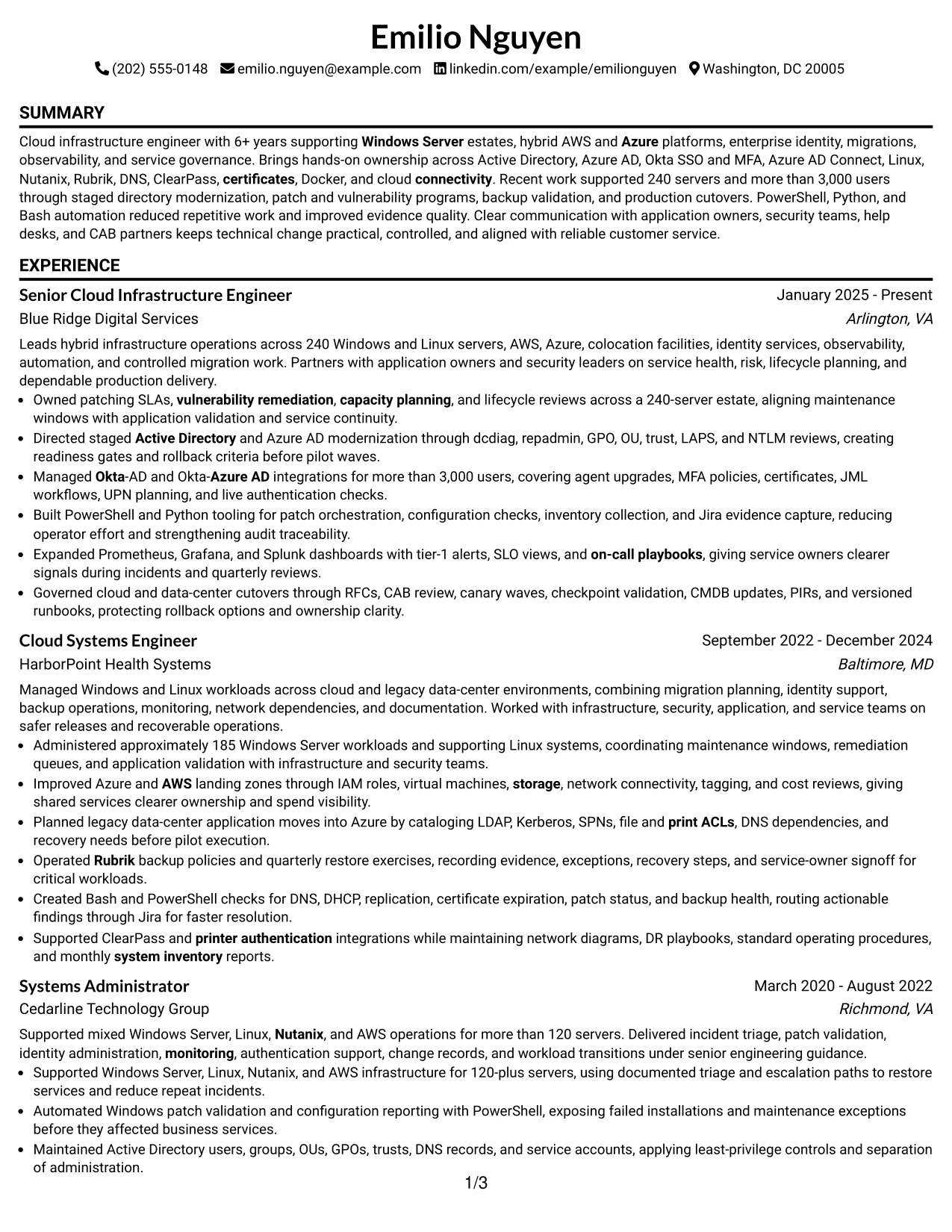
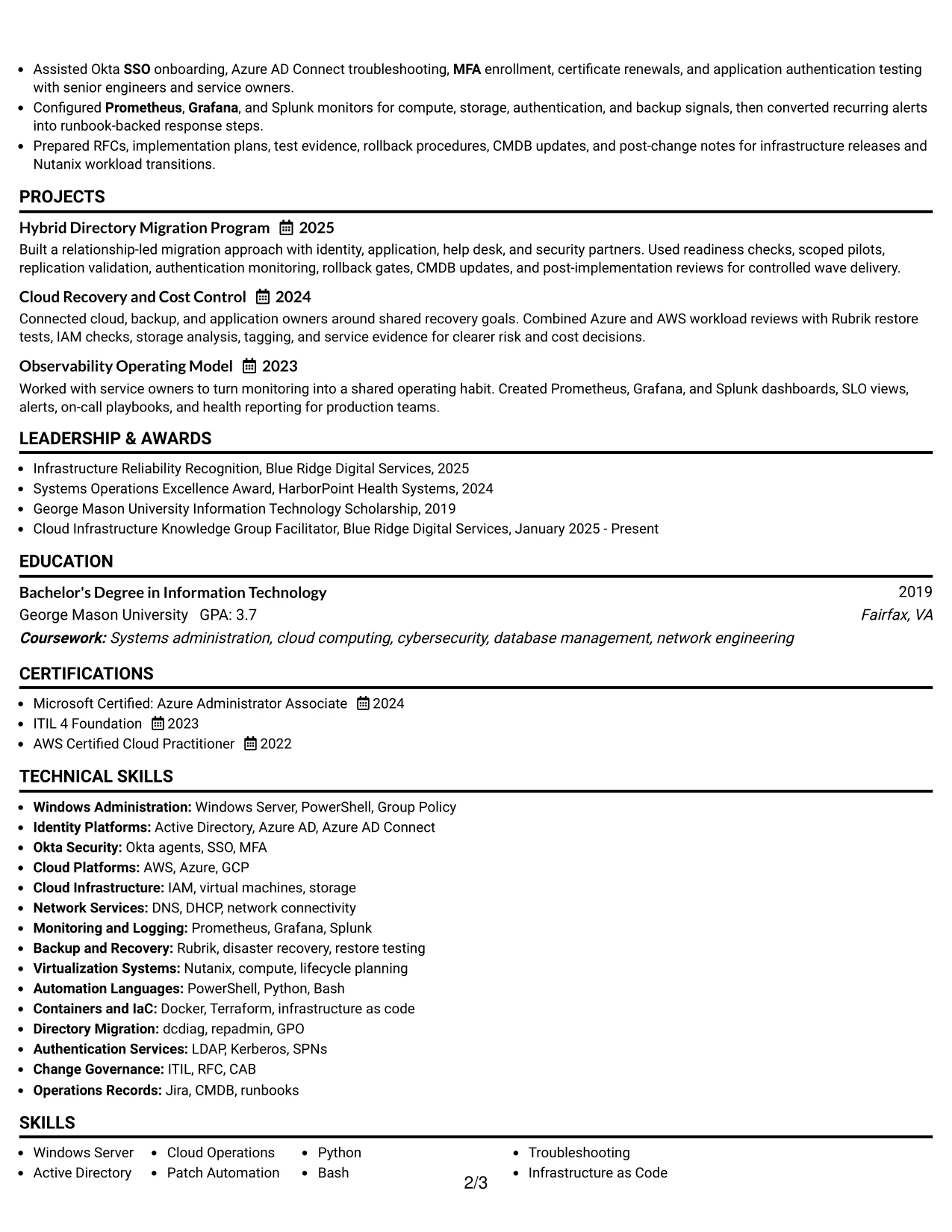
Simple One Column Format gives the resume a direct reading order. The summary leads into experience, projects, education, certifications, and skills without side panels competing for attention. That structure helps readers connect Emilio Nguyen’s 6+ years of cloud infrastructure work with specific evidence, including support for 240 servers and more than 3,000 users.
A single content path also supports clear ATS parsing. Short sections, standard headings, and achievement-focused bullets make terms such as Windows Server, Active Directory, Okta, Azure, AWS, PowerShell, and Prometheus easy to identify. Dates, employers, certifications, and measurable scope remain visible during a quick resume review.
Why the Simple One Column Format Works for a Resume
- Creates one predictable path from the professional summary to detailed experience.
- Gives measurable scope, such as 240 servers and 3,000 users, enough room to stand out.
- Keeps technical keywords close to the achievements that demonstrate them.
- Supports ATS parsing with standard section order and readable text blocks.
- Allows migration, identity, monitoring, automation, and recovery work to receive separate bullets.
- Makes education and certifications easy to find after the experience section.
- Works well when the resume must remain focused, searchable, and easy to print.
Best For
- Resumes that need a highly predictable scan from summary through skills and experience.
- Candidates presenting several technical platforms without splitting evidence across narrow panels.
- Applications where ATS-friendly section order is a priority.
- Professional histories with multiple employers and detailed achievement bullets.
- Documents that need room for projects, certifications, and education below experience.
- Readers comparing dates, role titles, tools, and measurable scope quickly.
- Resume versions that may be exported to PDF or reviewed as plain text.
#2 Plain One Column with Shaded Labels Resume Example
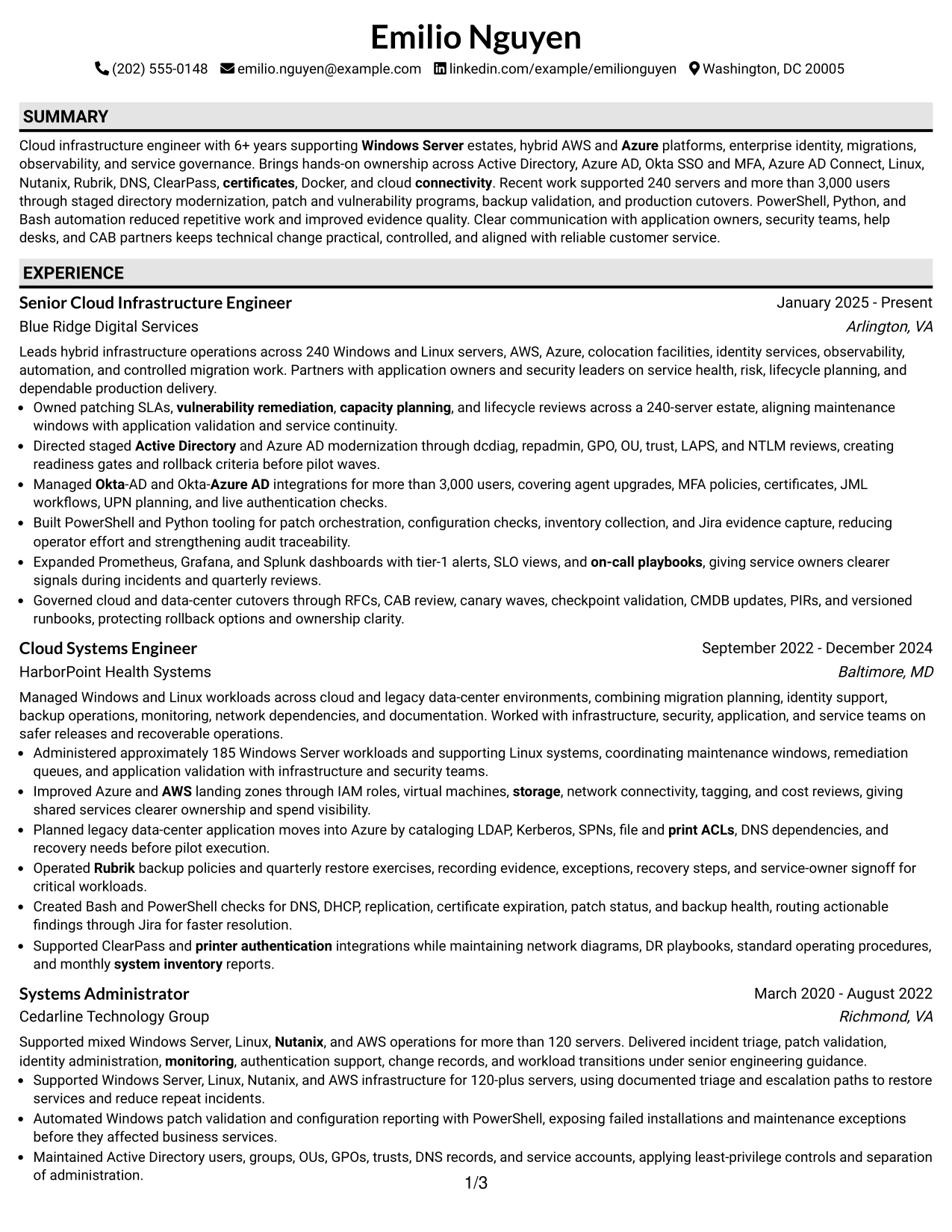
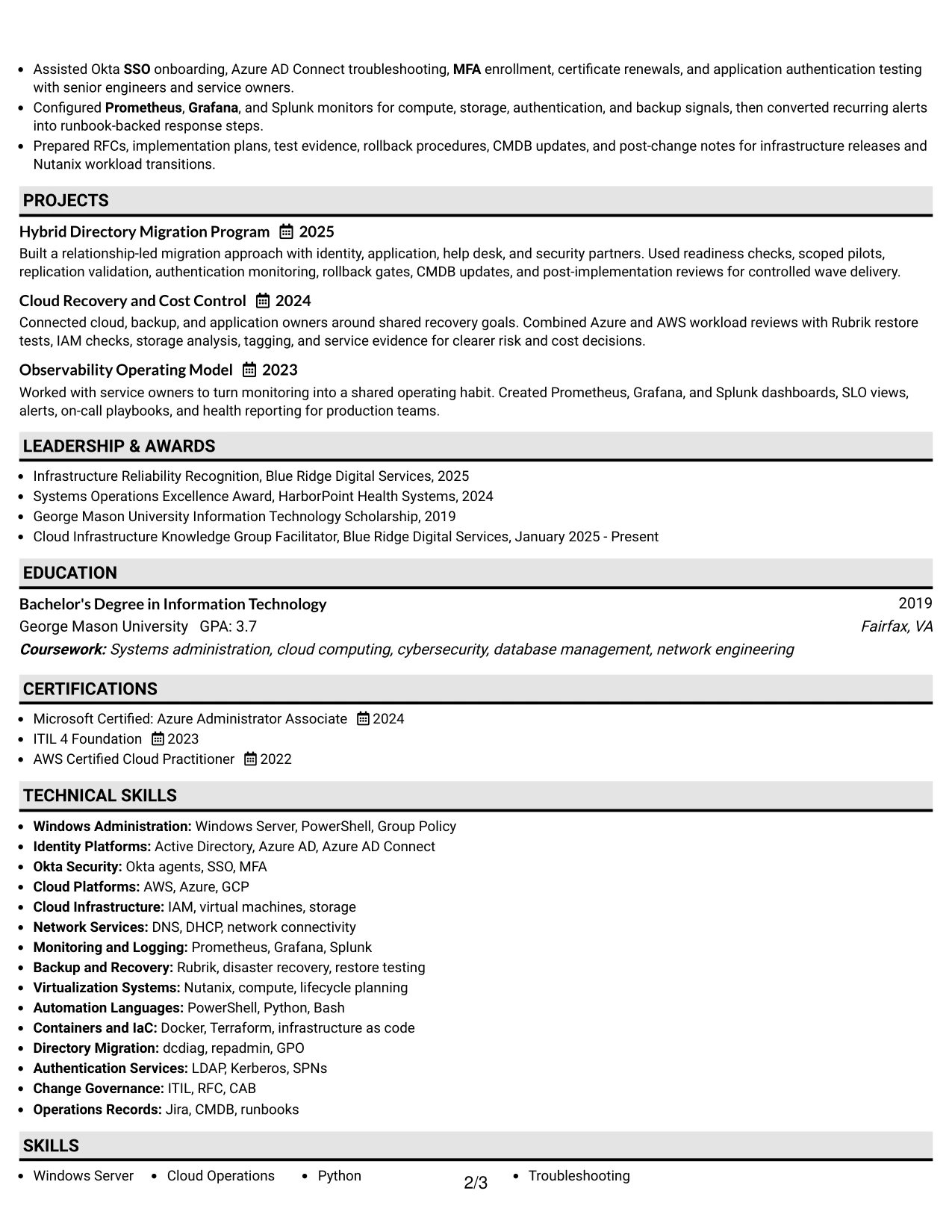
A recruiter or resume reviewer can move from the summary to experience, projects, education, certifications, and skills in a steady vertical sequence. Plain One Column with Shaded Labels adds light visual markers to distinguish those sections without interrupting the evidence. The result gives substantial technical content a clear route through the page.
The format is well suited to a resume with broad infrastructure coverage. Bullets can show Windows and Linux administration, cloud landing-zone work, directory modernization, Rubrik restore testing, monitoring, and scripting while shaded labels separate categories. Standard wording and prominent keywords also help automated systems identify the document’s qualifications.
Why the Plain One Column with Shaded Labels Works for a Resume
- Separates major resume sections with simple visual labels rather than complex design elements.
- Handles a high volume of experience bullets in a consistent vertical structure.
- Keeps role dates, employers, and achievements in an order that supports fast comparison.
- Makes cloud, identity, backup, monitoring, and automation terms easy to locate.
- Provides enough space for project descriptions without creating a crowded sidebar.
- Maintains a text-first structure that is practical for ATS review.
- Uses visual emphasis to guide scanning while keeping results and responsibilities central.
Best For
- Resumes with many technical keywords that need clear grouping by section.
- Candidates whose work history includes detailed bullets across several infrastructure domains.
- Applications where a plain, text-forward structure supports reliable ATS extraction.
- Documents that must show projects, certifications, and education without compressing experience.
- Readers who prefer visible section cues during a fast vertical review.
- Resume content that benefits from consistent spacing between roles and achievement bullets.
- Versions that need to remain readable when converted between document formats.
#3 One Column Format with Photo Right Resume Example
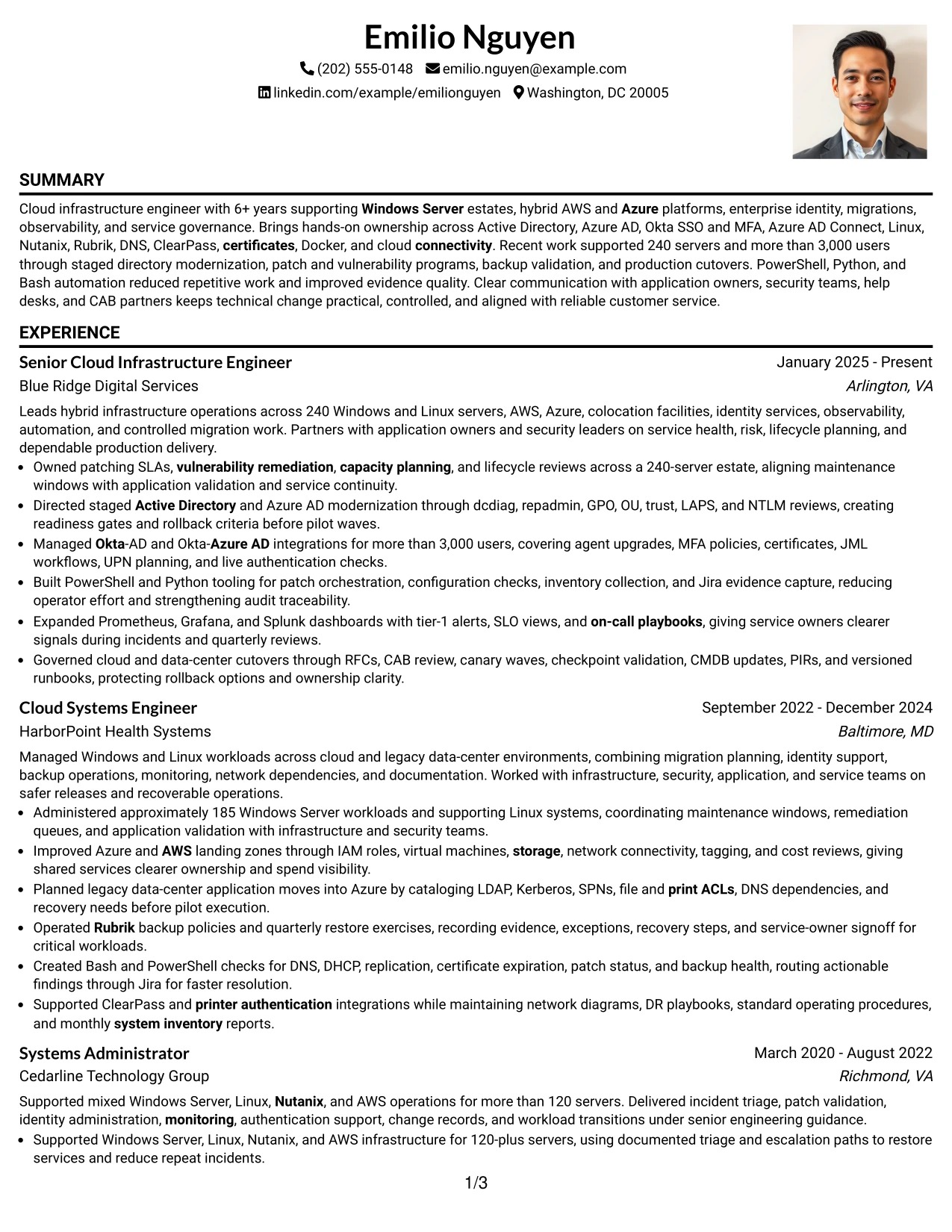
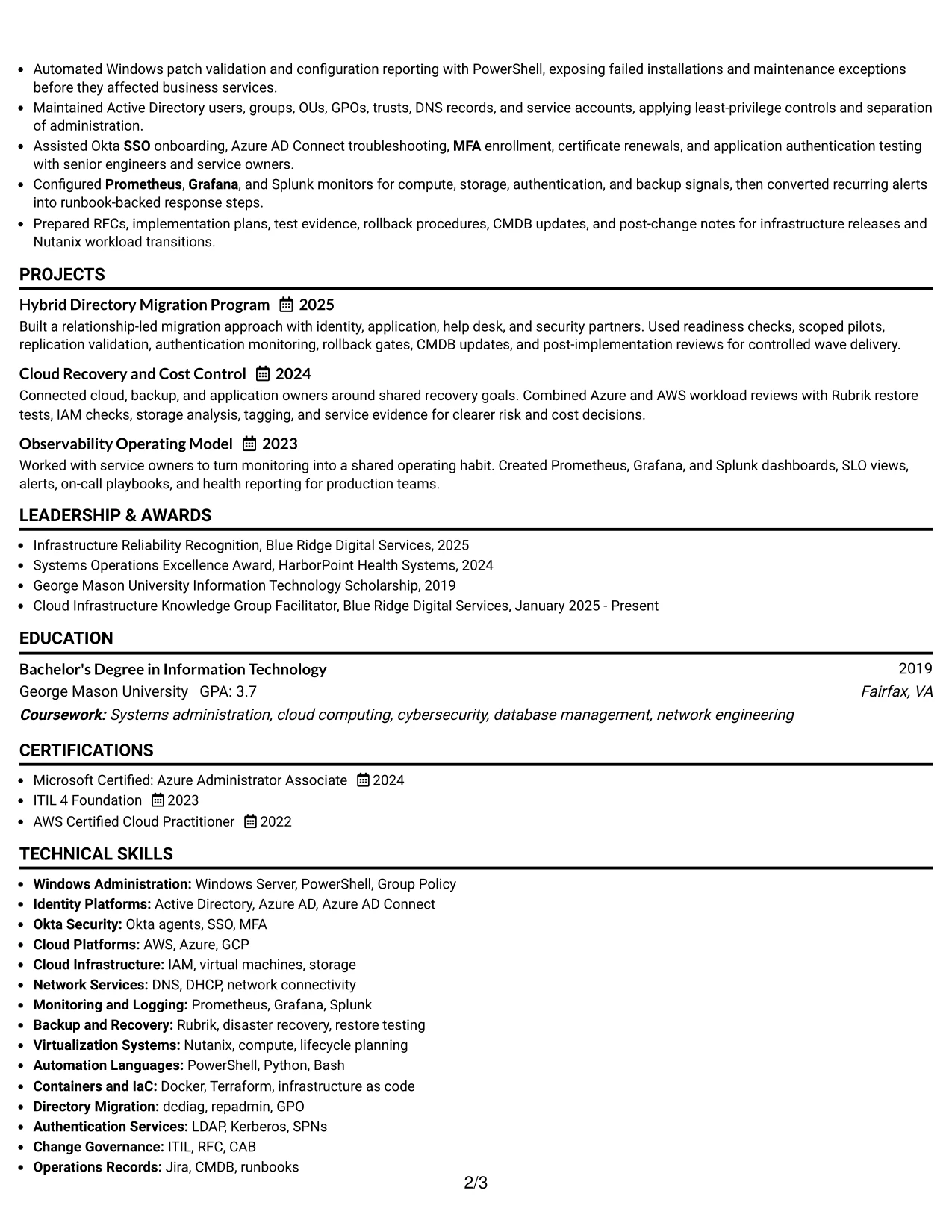
The strongest evidence appears early: more than six years of cloud infrastructure experience, responsibility for 240 servers, and identity support for more than 3,000 users. One Column Format with Photo Right keeps that evidence in a single readable stream, while the right-side photo area adds a defined point of visual balance without replacing substantive resume content.
Experience bullets can then document directory modernization, Okta integrations, cloud operations, backup validation, monitoring, and automation in full sentences. A clear hierarchy helps both human reviewers and ATS tools distinguish the summary, employment history, projects, skills, certifications, and education.
Why the One Column Format with Photo Right Works for a Resume
- Places high-value scope and technical evidence in the main reading column.
- Keeps employment history and project details in a continuous, easy-to-follow sequence.
- Uses the right-side photo area as a controlled visual element rather than a content substitute.
- Leaves room for detailed bullets about identity, cloud, migration, and recovery work.
- Supports standard resume headings that ATS tools can recognize.
- Makes certifications and skills easy to locate after the core experience.
- Balances visual presentation with evidence-led content.
Best For
- Resumes where a defined visual area is useful alongside a strong evidence column.
- Candidates who need to present detailed technical achievements without using a sidebar for core content.
- Applications that benefit from a polished presentation while retaining standard section order.
- Work histories with substantial migration, identity, and cloud operations detail.
- Documents where projects can reinforce experience without displacing the employment section.
- Readers who scan the main column first for scope, tools, and measurable results.
- Resume versions that combine presentation needs with ATS-conscious text structure.
#4 Clean Two Column Sidebar Format Resume Example
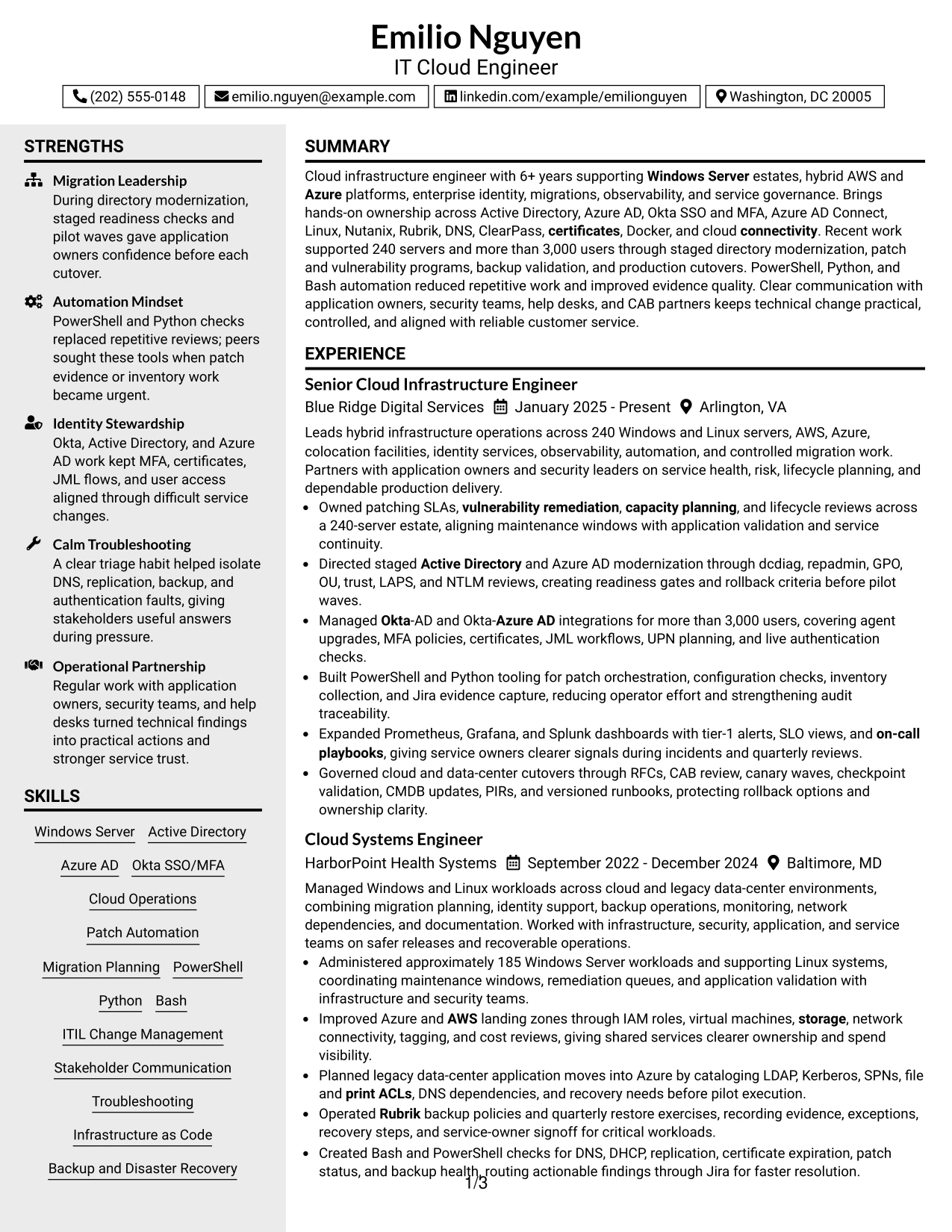
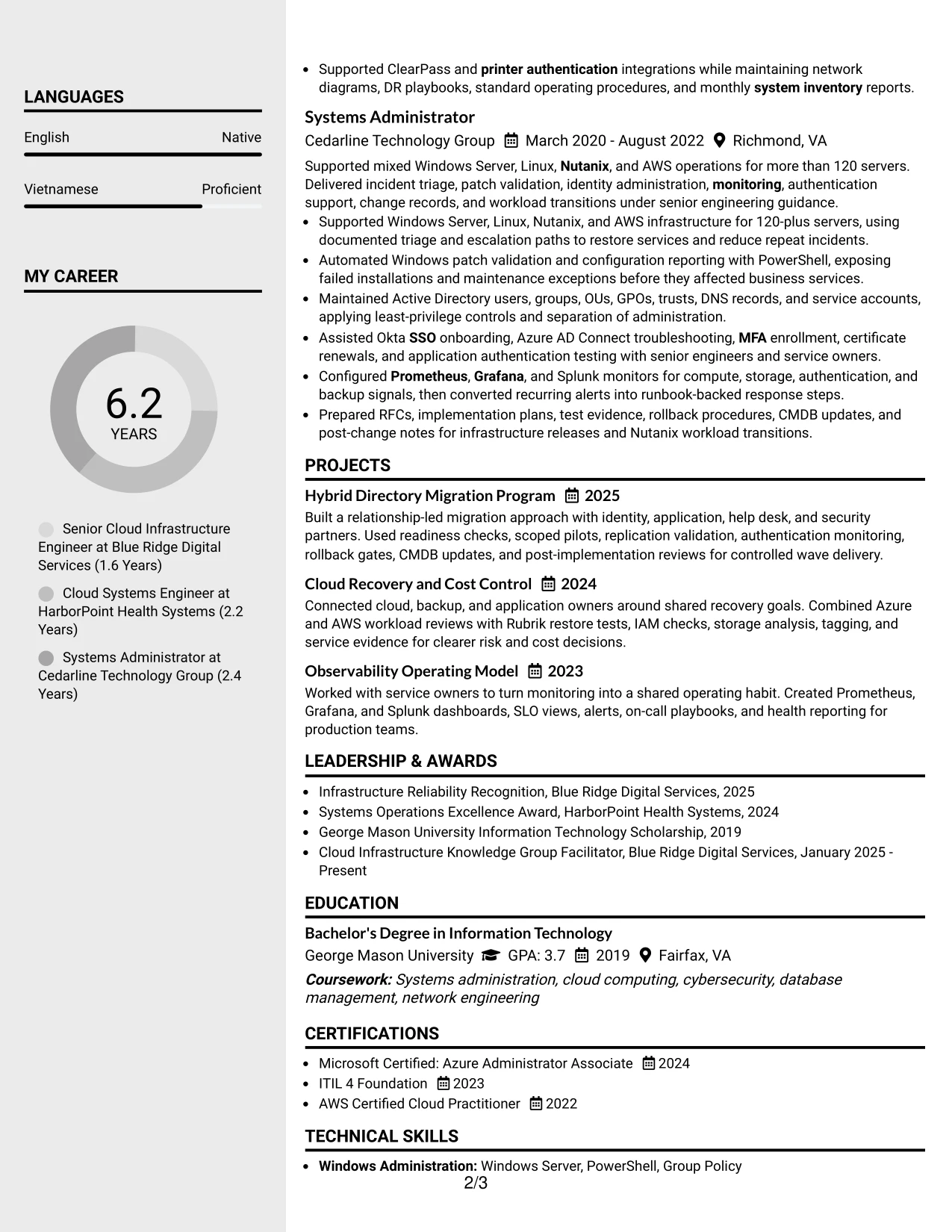
Space is balanced between a focused sidebar and a wider evidence area. The sidebar can hold contact details, skills, certifications, and selected tools, while the main column carries the summary, experience, and projects. This division helps the resume present a wide technical scope without reducing every achievement to a short phrase.
The main column gives room to explain staged Active Directory modernization, cloud and data-center cutovers, backup testing, monitoring, and scripting. The sidebar supports fast keyword recognition for Windows Server, Azure, AWS, Okta, PowerShell, Python, Bash, and ITIL while the work history provides proof of use.
Why the Clean Two Column Sidebar Format Works for a Resume
- Separates quick-reference qualifications from detailed employment evidence.
- Gives the main column room for complete achievement bullets and project descriptions.
- Makes certifications, skills, and core tools available during an initial scan.
- Supports a clear distinction between responsibilities and measurable operating scope.
- Helps organize both cloud platforms and infrastructure services without a long keyword block.
- Keeps migration and governance evidence in the wider reading area.
- Creates a practical structure for reviewing technical fit in an application context.
Best For
- Resumes that must show a broad toolset while protecting space for detailed achievements.
- Applications where reviewers need quick access to certifications and core skills.
- Candidates presenting both hands-on operations and structured migration or governance work.
- Documents that benefit from a separate reference area for platforms, tools, and methods.
- Readers who scan a sidebar first and then verify evidence in the main column.
- Resume versions with projects that need more explanation than a short skills list allows.
- Technical histories where organization matters as much as keyword coverage.
#5 Two Column Format Resume Example
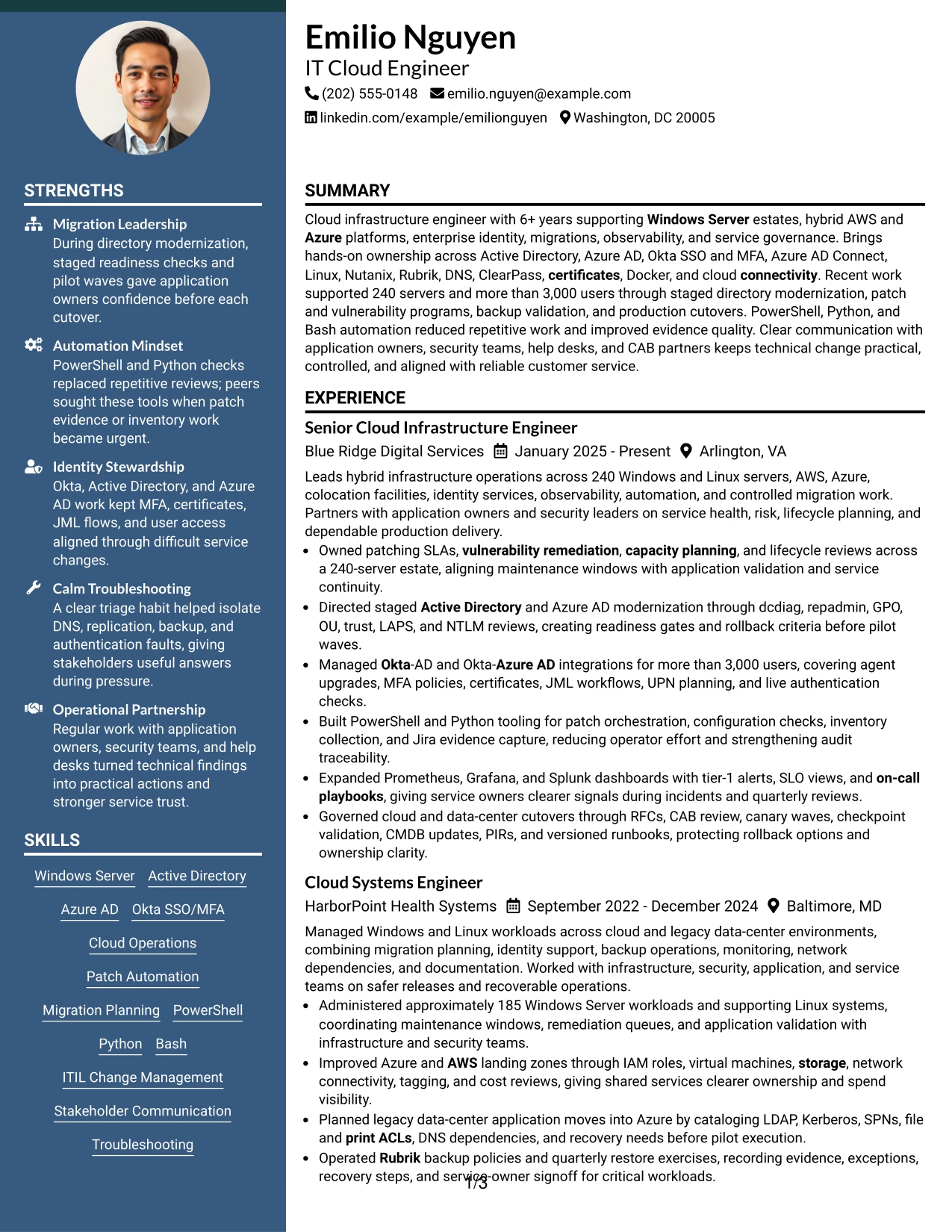
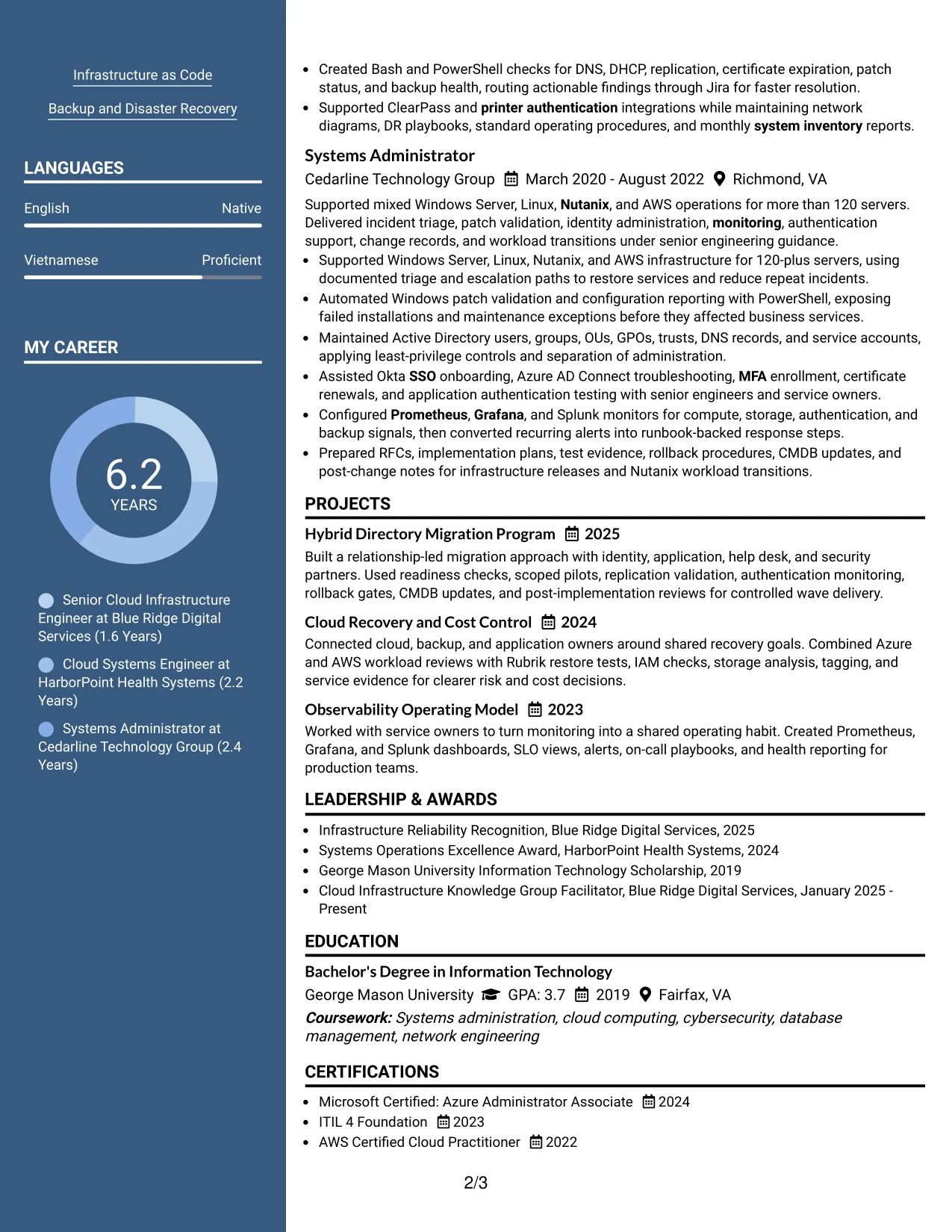
For an IT Cloud Engineer application, a Two Column Format can place fast-reference information beside the deeper work history. Skills, certifications, and selected technical areas can occupy one column, while the other explains server operations, identity integrations, migrations, observability, and automation. This gives the reader both a quick qualification view and supporting evidence.
The format also helps maintain visual balance across a long professional history. Project entries such as Hybrid Directory Migration Program, Cloud Recovery and Cost Control, and Observability Operating Model can reinforce the experience section without overwhelming it. Consistent bullets keep tools tied to outcomes and operating responsibilities.
Why the Two Column Format Works for a Resume
- Provides immediate access to core skills while preserving a detailed experience column.
- Supports a balanced presentation of technical breadth and achievement evidence.
- Gives projects a visible place without hiding the primary employment history.
- Groups platforms such as AWS, Azure, GCP, and Nutanix for quick review.
- Keeps certifications and education distinct from dense operational bullets.
- Allows monitoring, backup, identity, and automation evidence to remain specific.
- Creates a professional structure for applications that require both breadth and depth.
Best For
- Applications where technical breadth must be visible before detailed experience is read.
- Resumes combining a substantial work history with several relevant projects.
- Candidates who need to show platforms, methods, and certifications in parallel.
- Documents where a two-part structure improves comparison of skills and evidence.
- Readers who want a concise qualification view followed by operational detail.
- Resume versions that include cloud, identity, recovery, and observability work.
- Professional documents that need visual balance without sacrificing achievement bullets.
#6 Photo Header Two Column Format Resume Example
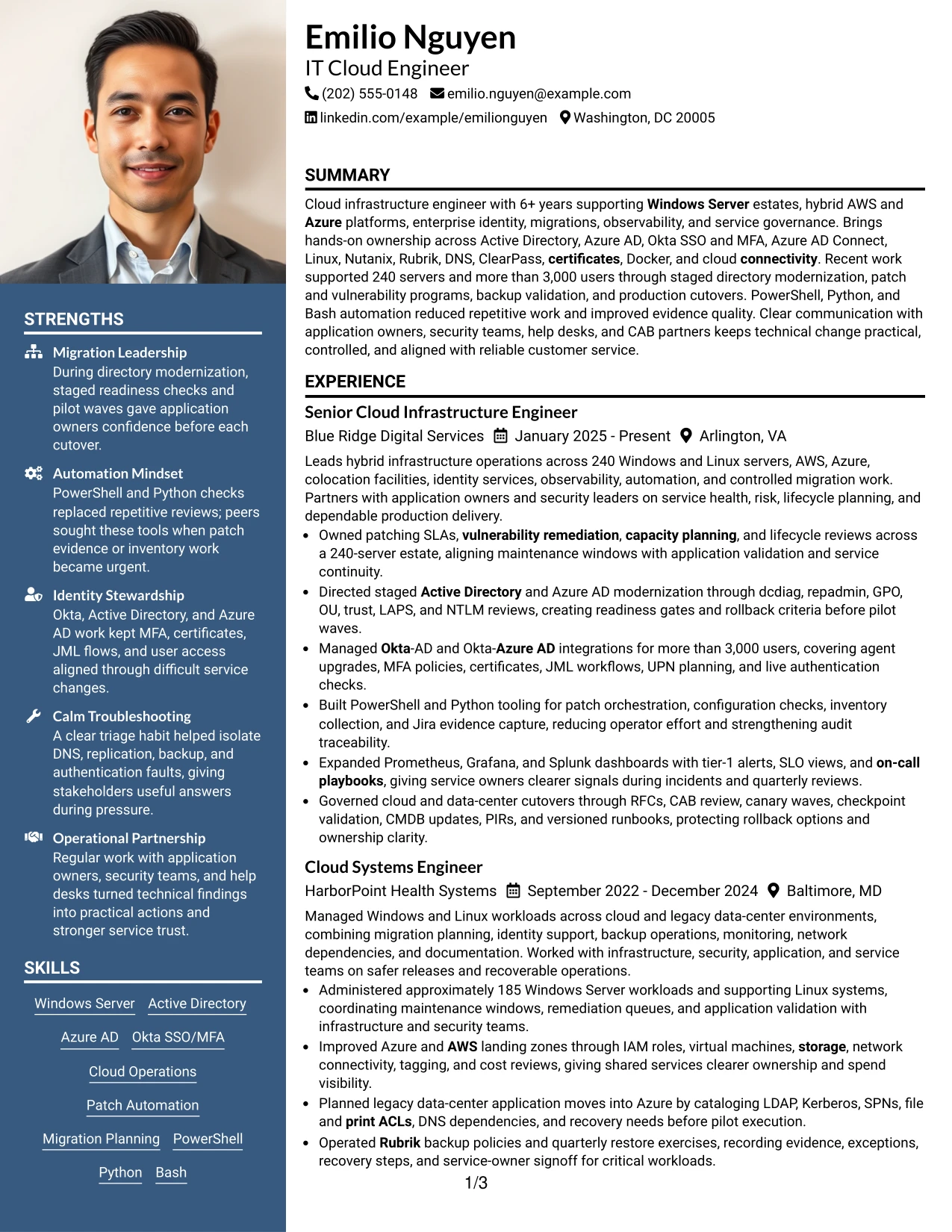
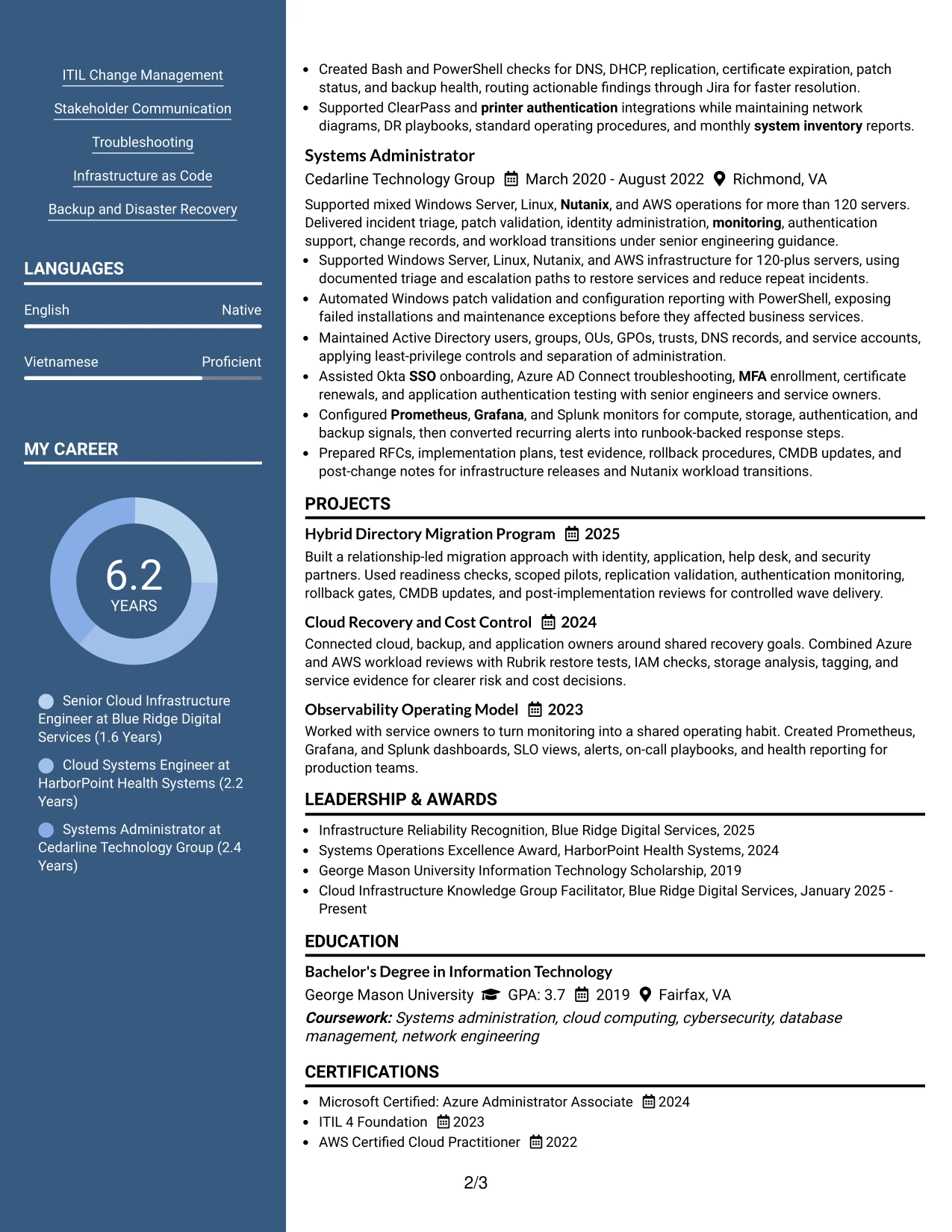
The visual hierarchy is restrained: a prominent header establishes the document, and two columns divide quick-reference qualifications from detailed evidence. Photo Header Two Column Format can present a polished first impression while keeping the resume’s central value in its content: 240-server operations, directory modernization, cloud migrations, and automation across PowerShell, Python, and Bash.
A concise qualification column can surface skills and certifications, while the broader column carries role history and projects. That structure supports alignment with the IT Cloud Engineer requirements without forcing every keyword into the summary. The strongest terms remain connected to documented work, such as Okta–AD integrations, Prometheus and Grafana dashboards, Rubrik restores, and ITIL governance.
Why the Photo Header Two Column Format Works for a Resume
- Creates a strong header hierarchy before the reader reaches detailed work history.
- Uses two columns to distinguish quick-reference qualifications from evidence-rich sections.
- Allows a photo area to support presentation while the resume remains achievement-led.
- Makes certifications and technical platforms visible without expanding the main narrative.
- Gives projects and experience enough room for migration and operations detail.
- Connects keywords to documented tools and responsibilities rather than isolated lists.
- Supports a polished application document with clear role alignment.
Best For
- Applications where a polished header supports the document’s presentation needs.
- Candidates who want quick-reference skills beside detailed infrastructure achievements.
- Resumes that combine technical certifications with substantial project evidence.
- Documents where two columns improve the relationship between qualifications and work history.
- Readers evaluating cloud, identity, monitoring, and recovery alignment at different scan speeds.
- Professional histories that need a visible skills area without shrinking experience bullets.
- Resume versions that use a strong header while preserving clear, searchable content.
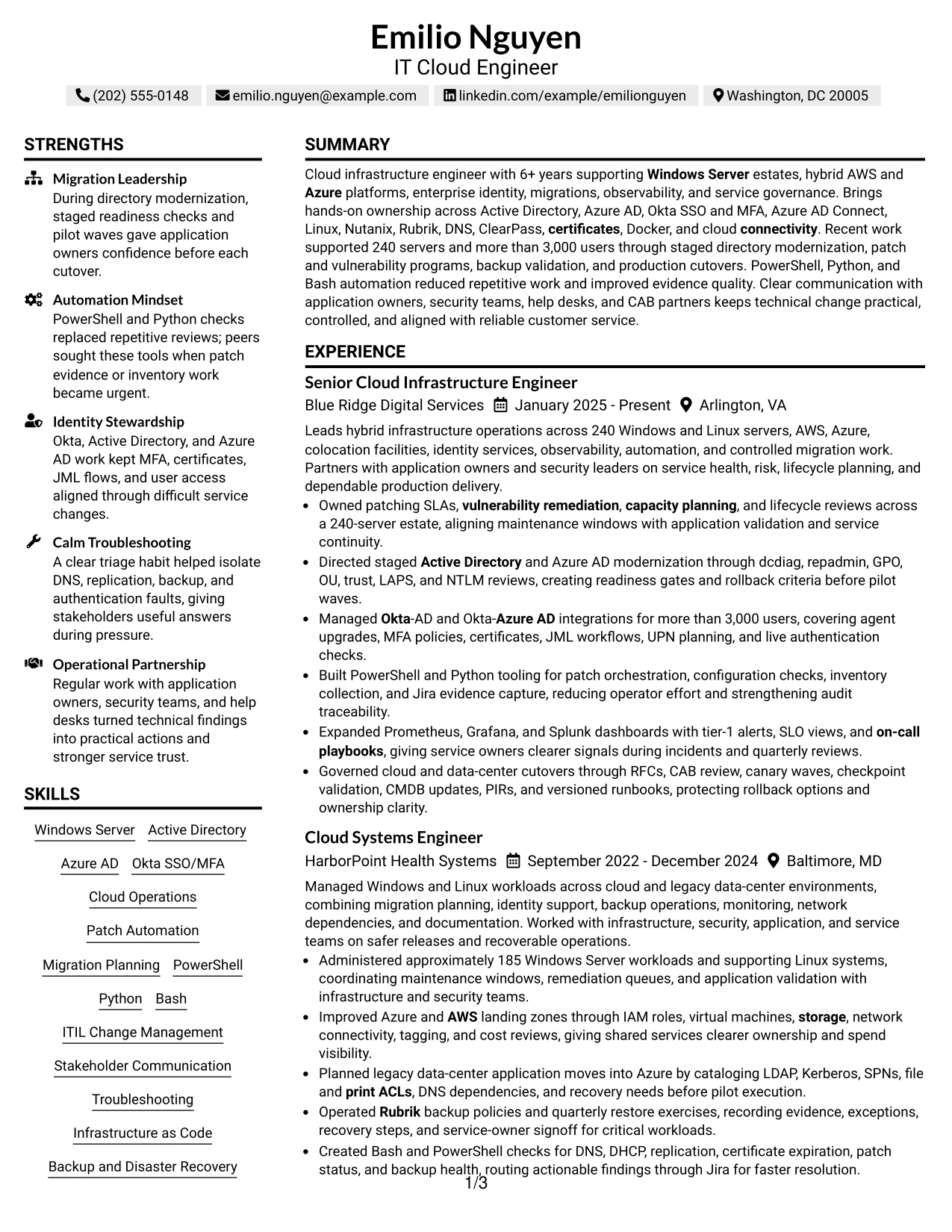
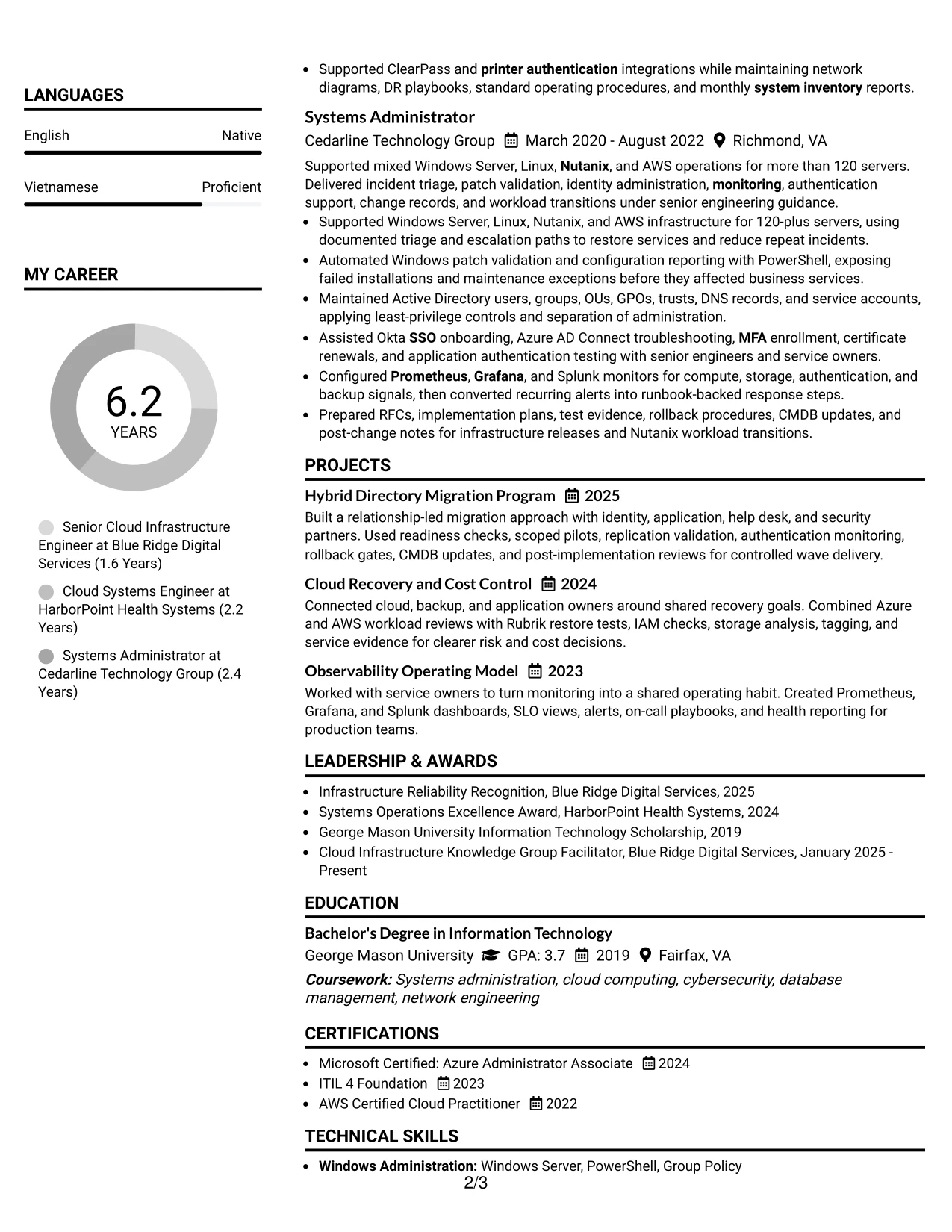
#7 Simple Two Column Format Resume Example
Simple Two Column Format organizes the resume into two practical reading zones. One area can carry contact details, skills, certifications, and selected tools; the other can focus on the summary, experience, projects, and education. The uncomplicated structure keeps the document easy to scan while allowing the technical content to remain specific.
The experience column can show staged directory work, cloud landing-zone improvements, monitoring dashboards, restore exercises, and change governance. The supporting column highlights Windows Server, Azure, AWS, GCP, Okta, PowerShell, Python, Bash, Terraform, and ITIL. This pairing gives keywords context without crowding the achievement bullets.
Why the Simple Two Column Format Works for a Resume
- Creates a clear division between supporting qualifications and primary experience.
- Keeps the design straightforward so technical evidence remains the main focus.
- Allows a dedicated skills area to surface platforms and scripting languages quickly.
- Gives experience bullets room to show scope, process, and operational results.
- Supports project, certification, and education details without extending every section.
- Helps reviewers connect keywords in one column with proof in the other.
- Offers a practical structure for both human scanning and text extraction.
Best For
- Resumes that need two clear zones without elaborate visual treatment.
- Candidates combining broad infrastructure skills with detailed role-based evidence.
- Applications where a fast skills scan should lead to verified accomplishments.
- Documents that include projects, certifications, education, and several technical platforms.
- Readers who prefer short reference content beside a fuller professional history.
- Work histories where migration, monitoring, and automation bullets need adequate width.
- Resume versions that must stay organized when the content spans multiple pages.
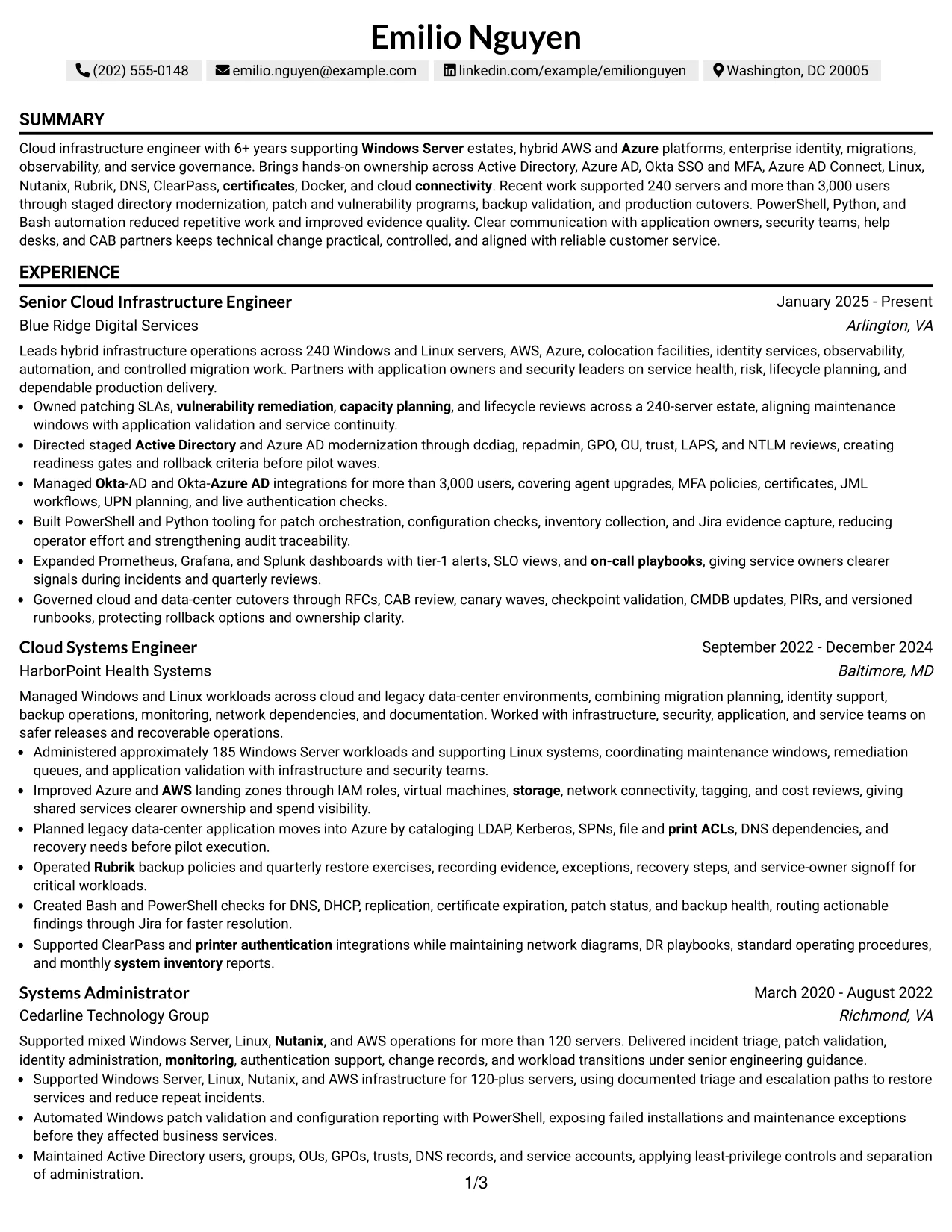
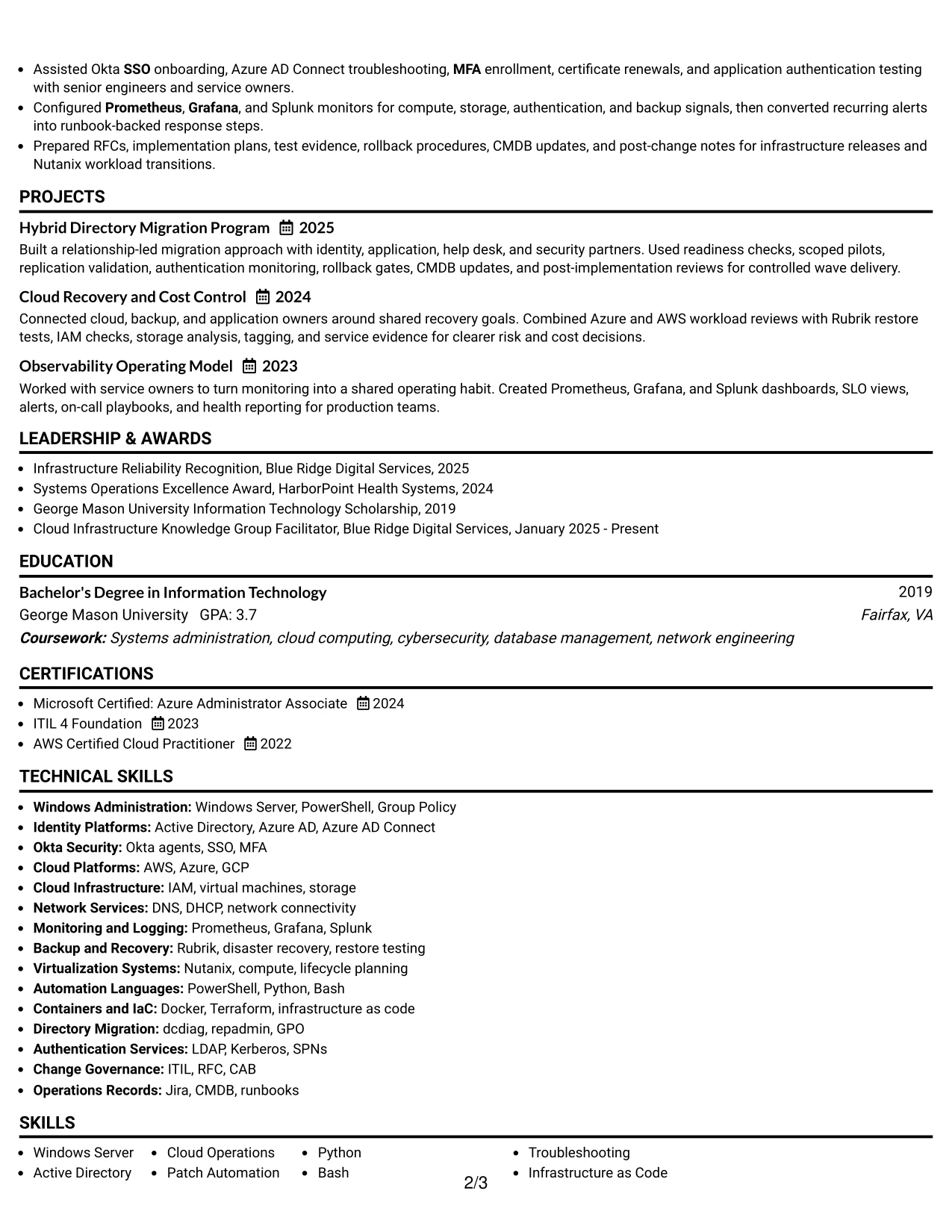
#8 Text/Fang Style Resume Example
Readers move through Text/Fang Style in a clear text-first sequence, with each section building on the last. The summary establishes cloud infrastructure scope, followed by experience bullets, projects, education, certifications, and skills. That flow suits a resume where the strength comes from documented operations rather than decorative elements.
Longer technical content can remain readable when each bullet carries one main achievement. The resume can explain Active Directory readiness checks, Okta lifecycle work, Azure and AWS operations, Rubrik recovery testing, Prometheus and Grafana observability, and PowerShell or Python automation. Consistent labels also make ATS terms easier to recognize.
Why the Text/Fang Style Works for a Resume
- Prioritizes readable text and a stable section sequence.
- Handles detailed bullets without relying on visual panels to explain relationships.
- Keeps tools and platforms close to the work that demonstrates their use.
- Provides room for projects that extend the evidence beyond job descriptions.
- Supports clear comparison of employers, dates, titles, and responsibilities.
- Makes certifications, education, and skills easy to locate in a text-led review.
- Fits resumes where content depth and ATS clarity are more important than decoration.
Best For
- Resumes with extensive technical content that needs uninterrupted reading space.
- Candidates whose strongest proof appears in detailed achievement bullets.
- Applications where plain text structure and ATS readability are essential.
- Documents that explain complex identity, migration, and recovery work in sequence.
- Readers who prefer section labels and paragraphs over compact visual modules.
- Professional histories with projects that require short but complete descriptions.
- Resume versions that may be read on different screens or converted to plain text.
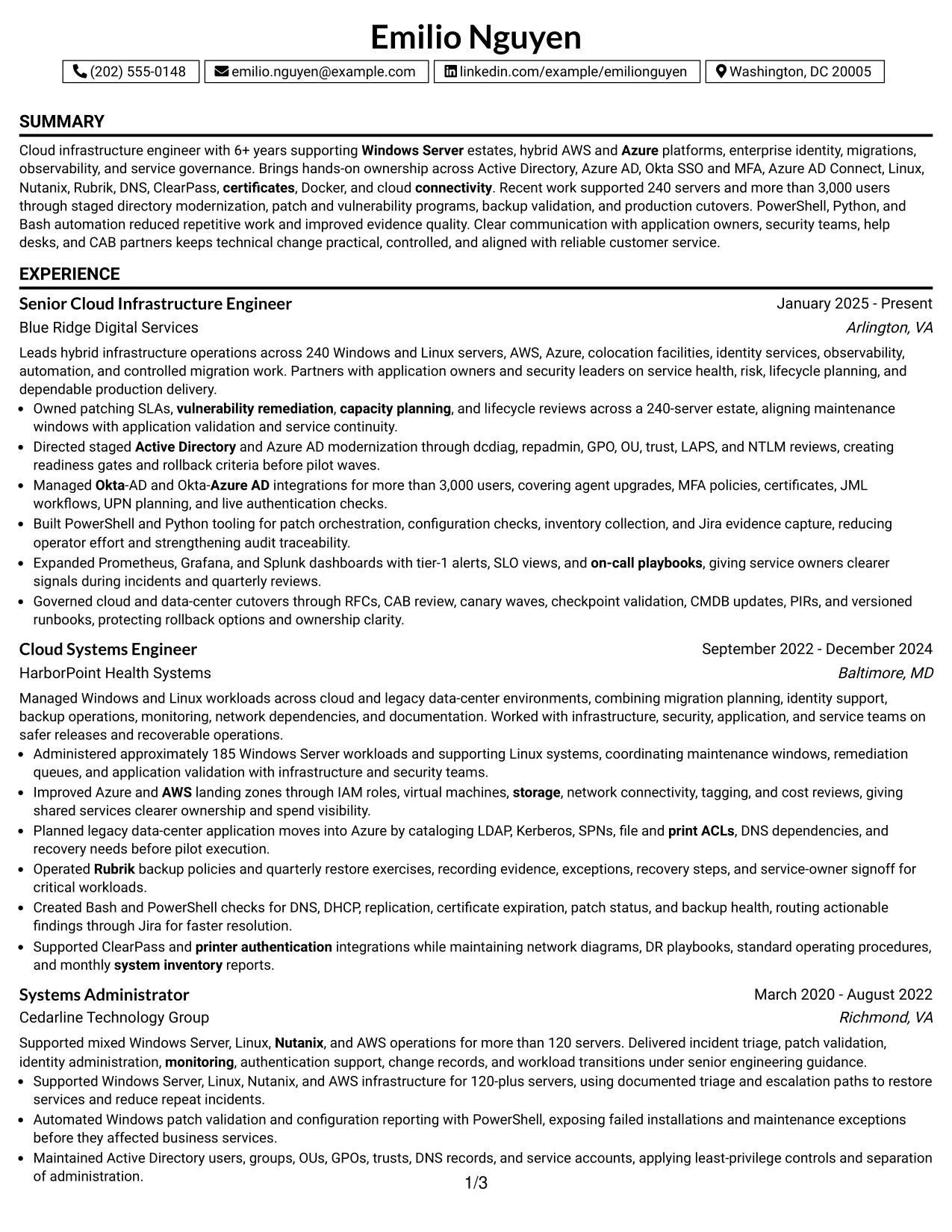
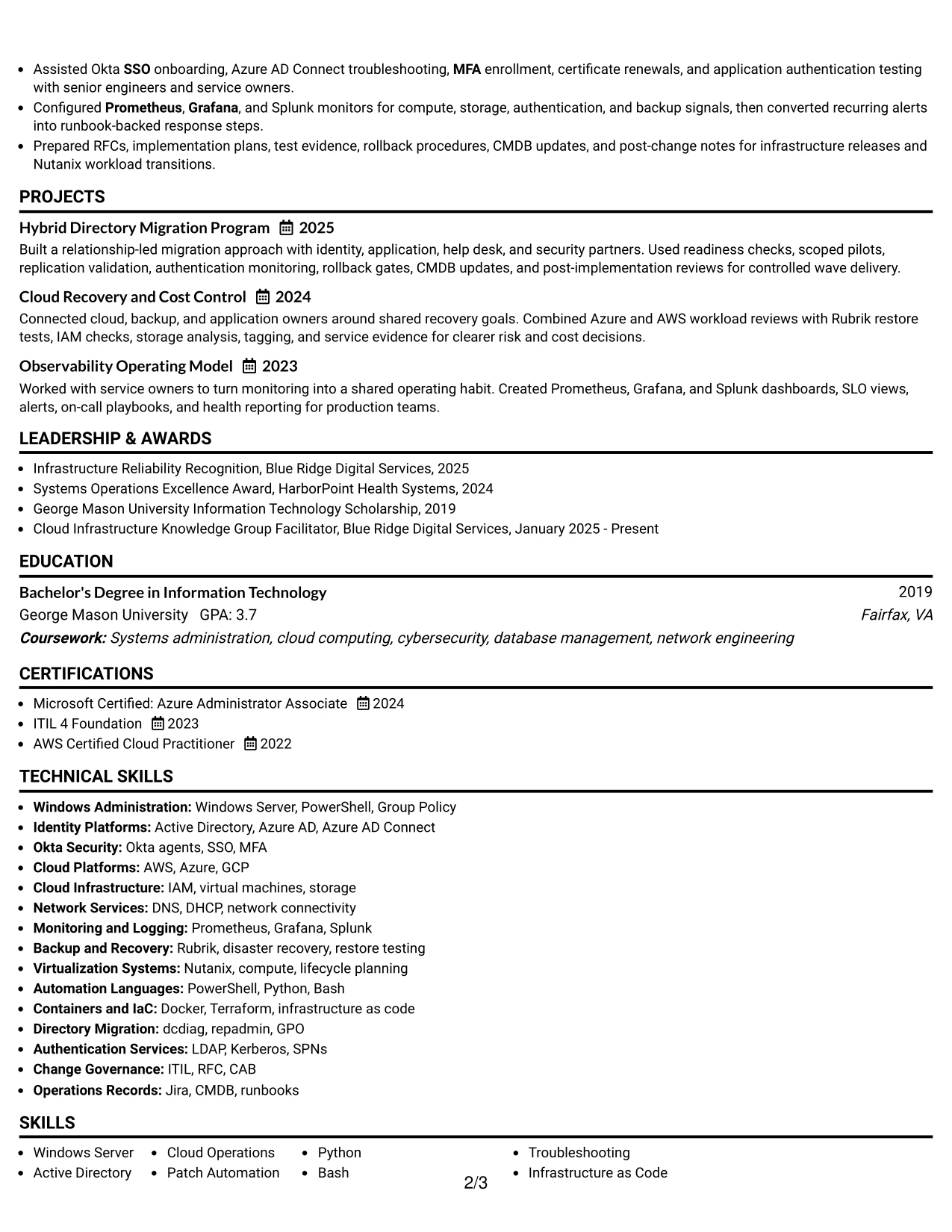
#9 One Column Boxed Contact Header Format Resume Example
The evidence begins with a clear professional summary and continues through the most relevant work: 240-server operations, more than 3,000-user identity services, staged directory modernization, cloud migration, and automation. One Column Boxed Contact Header Format places contact details in a defined header while reserving the full page width for proof of capability.
That full-width structure is useful for bullets with several technical dependencies. It can show how dcdiag and repadmin supported readiness, how Okta integrations covered MFA and certificates, and how dashboards, Rubrik restore exercises, Jira records, and CMDB updates supported reliable operations. Standard section headings preserve searchability.
Why the One Column Boxed Contact Header Format Works for a Resume
- Gives the contact information a distinct starting point without taking space from evidence.
- Uses the full content width for detailed technical achievement bullets.
- Highlights measurable scope before the reader reaches the complete work history.
- Supports clear explanations of dependencies across identity, cloud, and network services.
- Keeps projects, certifications, and skills in a straightforward sequence.
- Makes ATS-relevant terms visible in standard, text-friendly sections.
- Works well when the resume must communicate both technical depth and document control.
Best For
- Resumes where contact details need clear separation from professional evidence.
- Candidates with long bullets that benefit from full-width text.
- Applications requiring detailed descriptions of migrations, integrations, or recovery work.
- Documents that must show scope and technical dependencies without narrow columns.
- Readers who start with summary evidence and then review role history in order.
- Resume versions where standard headings and searchable text are important.
- Professional histories that need a strong top section without a separate sidebar.
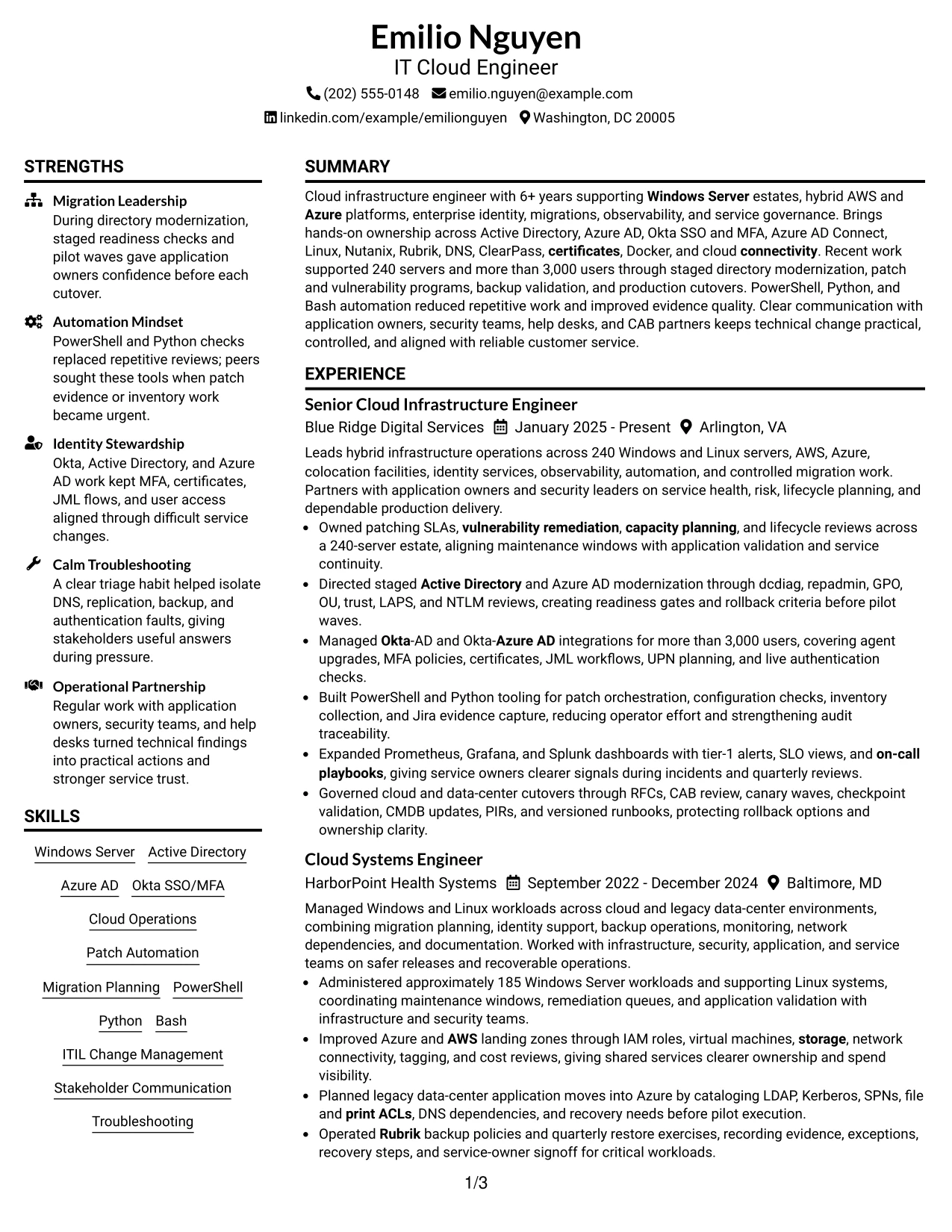
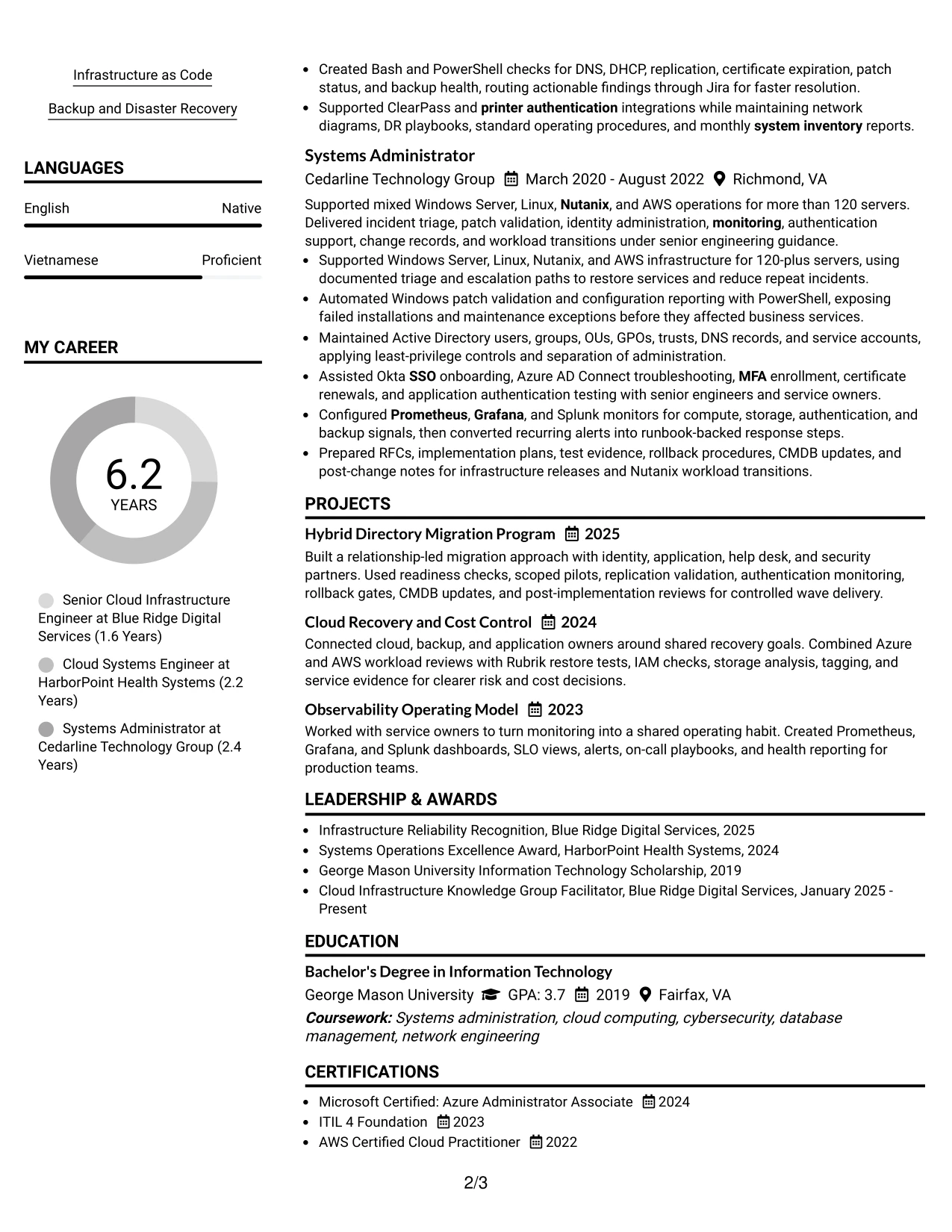
#10 Plain Two Column Format Resume Example
Space is distributed between a concise qualifications area and a broader evidence area. Plain Two Column Format can place skills, certifications, and selected tools beside the summary, experience, projects, and education. For Emilio Nguyen, that balance keeps the IT Cloud Engineer target visible while preserving detail about hybrid operations, identity, migrations, and service governance.
A compact Resume Snapshot can surface the most decision-relevant facts before the reader reviews every bullet. The keyword section then reinforces terms supported by the document, including Windows Server, Active Directory, Azure AD, Okta SSO/MFA, AWS, Azure, PowerShell, Python, Rubrik, Prometheus, Grafana, and ITIL change management.
Resume Snapshot
- 6+ years supporting Windows Server, hybrid cloud, identity, migration, and observability operations.
- Current scope includes 240 Windows and Linux servers across Azure, AWS, and colocation facilities.
- Managed Okta–AD and Okta–Azure AD integrations for more than 3,000 users.
- Certifications include Microsoft Certified: Azure Administrator Associate, ITIL 4 Foundation, and AWS Certified Cloud Practitioner.
Why the Plain Two Column Format Works for a Resume
- Balances quick qualification facts with detailed professional evidence.
- Makes the target role and high-value scope easy to identify early.
- Gives the snapshot a defined place without replacing the experience section.
- Supports a compact keyword area with terms grounded in the work history.
- Keeps projects, education, and certifications visible in a controlled structure.
- Helps readers compare platforms, methods, and documented responsibilities.
- Maintains a plain presentation that supports reliable scanning and ATS review.
Resume Keywords
- IT Cloud Engineer
- Windows Server
- Active Directory
- Azure AD
- Okta SSO/MFA
- AWS
- Azure
- PowerShell
- Python
- Rubrik
- Prometheus
- Grafana
- ITIL change management
#11 Colored Two Column Format Resume Example
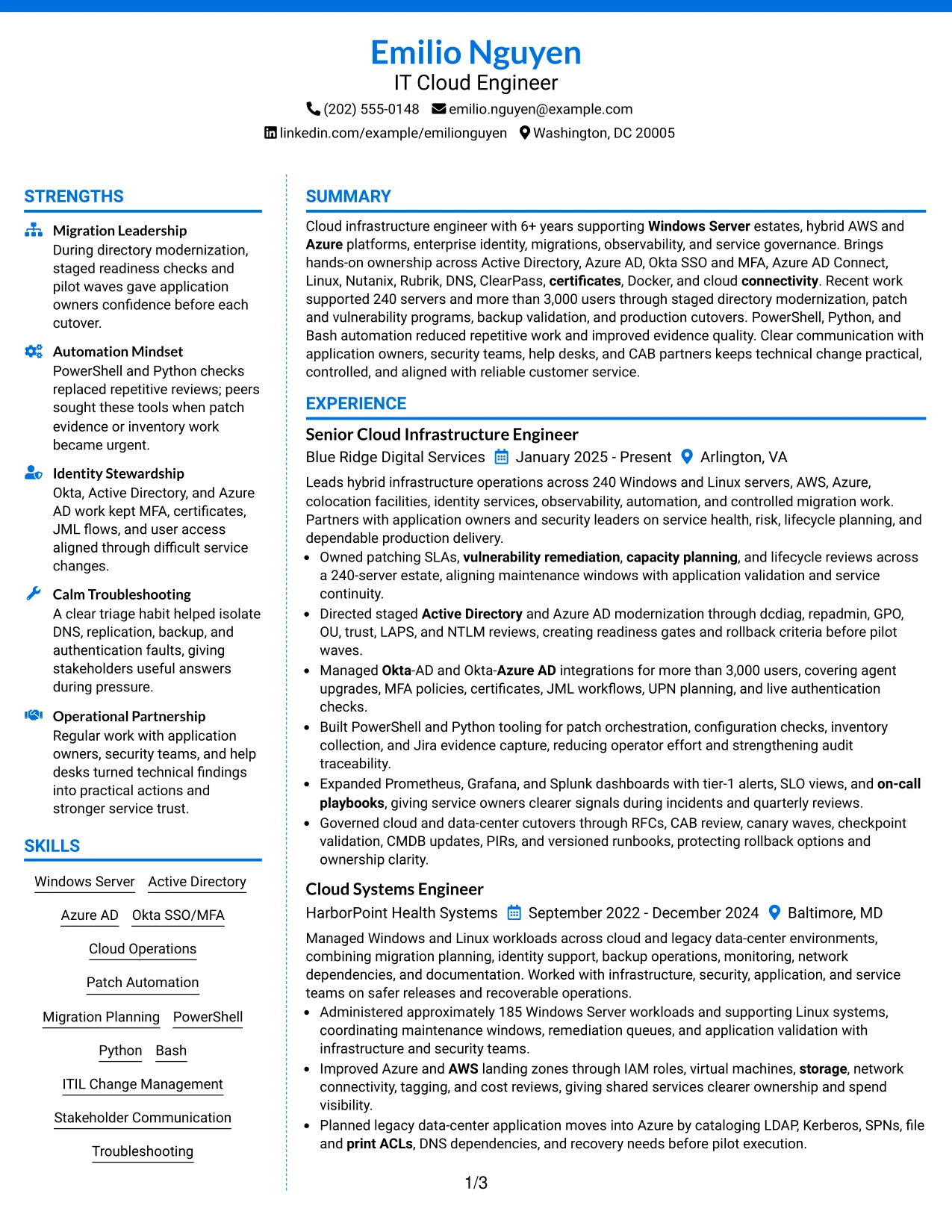
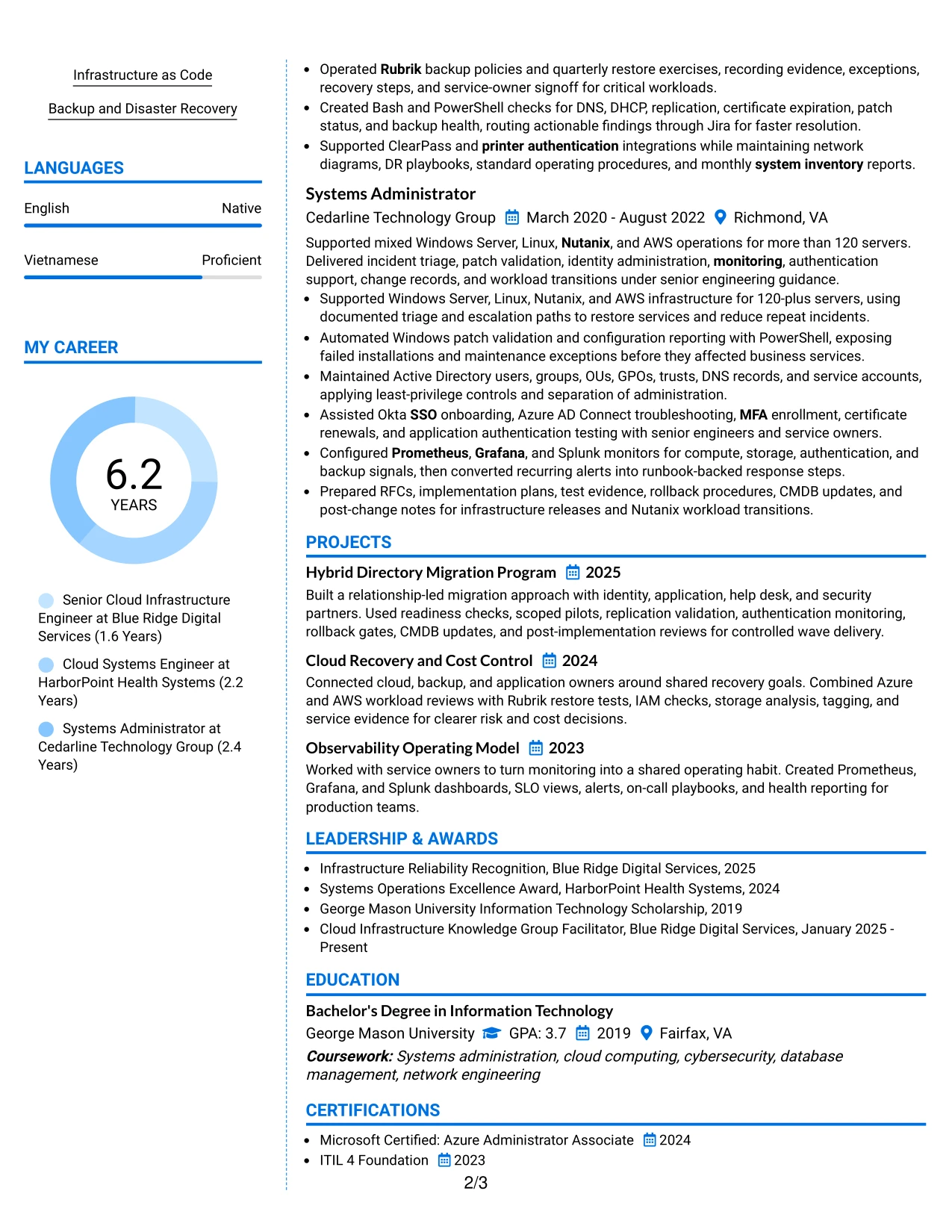
For an application that combines broad cloud requirements with detailed infrastructure evidence, Colored Two Column Format can separate quick-reference content from the main work history. A restrained color treatment helps distinguish skills, certifications, and contact details, while the larger column explains server administration, identity integrations, migrations, observability, backup, and automation.
The format supports a clear relationship between role alignment and proof. Keywords such as AWS, Azure, GCP, IAM, Nutanix, Rubrik, Sectigo, ClearPass, Docker, Terraform, PowerShell, Python, Bash, Prometheus, Grafana, and Splunk can appear in the reference area, while experience bullets show how those capabilities were applied.
Why the Colored Two Column Format Works for a Resume
- Uses restrained color to distinguish supporting information from primary experience.
- Makes a broad technical toolkit visible without turning the resume into a keyword wall.
- Gives the main column room for migration, operations, and governance achievements.
- Helps reviewers connect role requirements with specific evidence in the work history.
- Keeps certifications and education accessible without interrupting experience flow.
- Supports projects that demonstrate recovery, cost control, and observability practices.
- Adds visual structure while preserving a practical two-column reading order.
Best For
- Applications where light color cues improve navigation across a broad technical resume.
- Candidates who need to present many platforms beside detailed operational evidence.
- Documents aligning cloud, identity, backup, networking, and monitoring requirements.
- Readers who want a quick reference panel before reviewing role-specific achievements.
- Resume versions with projects and certifications that need visible but secondary placement.
- Professional histories where visual grouping can clarify complex technical coverage.
- Applications that benefit from presentation polish while keeping content easy to scan.
#12 One Column Shaded Contact Header Format Resume Example
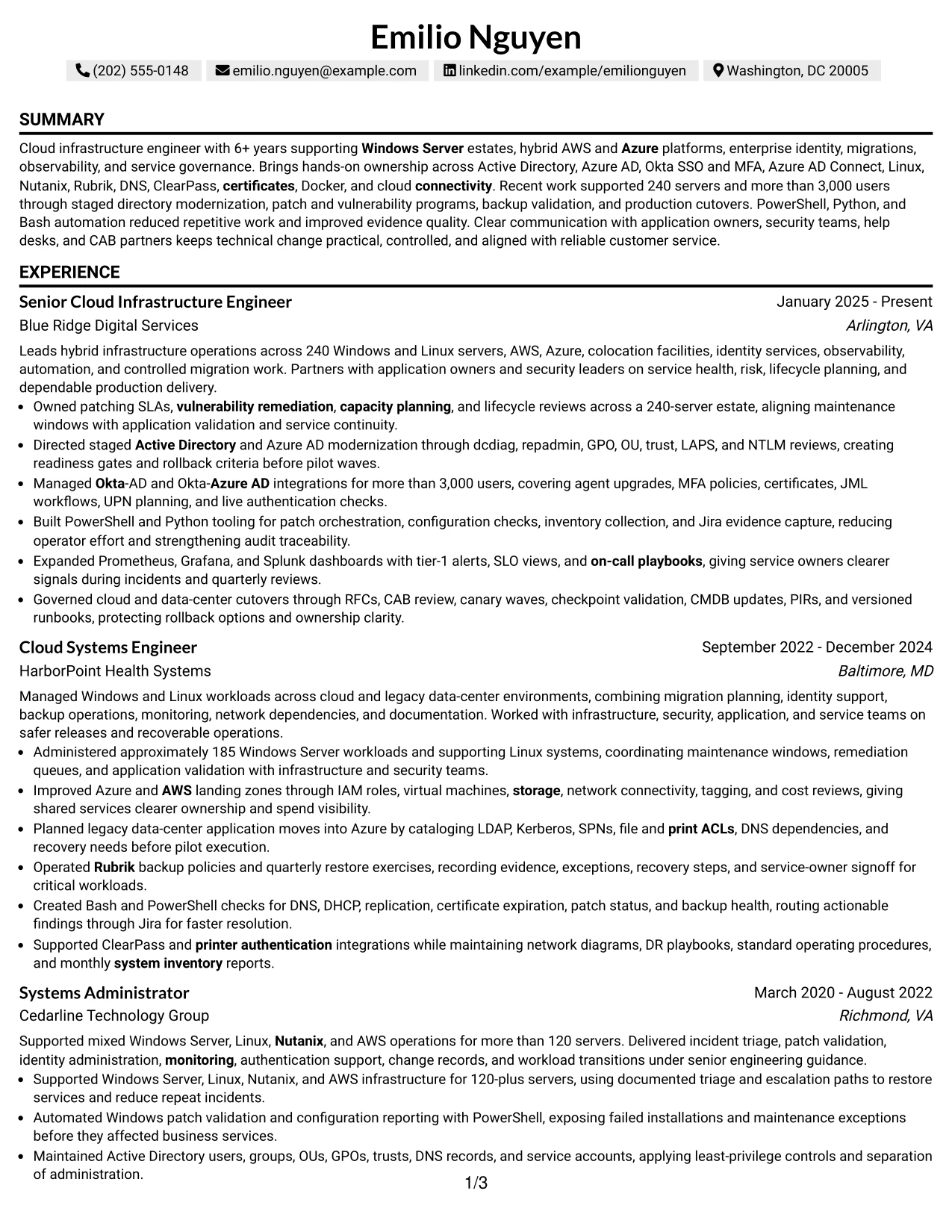
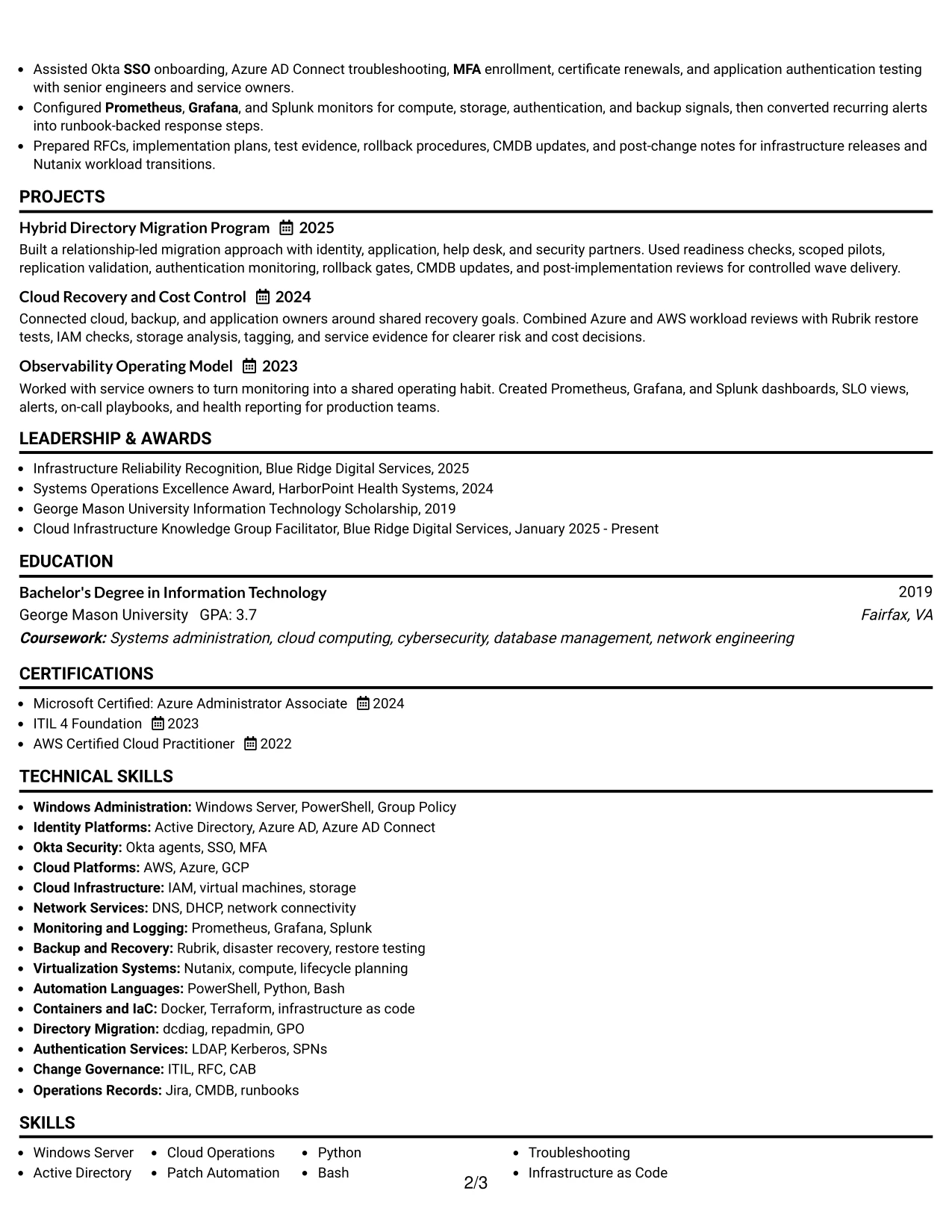
A restrained visual hierarchy puts the contact details and IT Cloud Engineer title in a clear shaded header, then gives each resume section a consistent full-width path. That structure supports quick review of Windows Server administration, cloud operations, identity platforms, migration work, automation, and certifications.
The single-column flow keeps important keywords in a predictable order for ATS parsing. Strong bullets can show the scale of the work, including a 240-server estate, more than 3,000 users, staged directory modernization, and PowerShell and Python automation.
Why the One Column Shaded Contact Header Format Works for a Resume
- A centered contact header makes the target role visible without taking space from the resume body.
- One reading path helps ATS tools and recruiters locate experience, skills, education, and certifications.
- Shaded labels separate technical areas such as cloud platforms, identity, monitoring, and backup.
- Full-width bullets provide room for tools, methods, and measurable scope in each achievement.
- The format supports clear keyword placement for Windows Server, Active Directory, Azure, AWS, Okta, and PowerShell.
- A consistent hierarchy makes migration governance, observability, and recovery work easy to compare.
- The balanced presentation adds polish while keeping the evidence practical and readable.
Best For
- Resumes that need one uninterrupted reading path from summary through certifications.
- Applications where ATS parsing and predictable section order are priorities.
- Technical profiles with several related platforms that benefit from full-width skill and experience sections.
- Candidates who need room to explain operational scope, governance steps, and measurable service evidence.
- Roles reviewed quickly by readers who need the target title and core keywords near the top.
- Documents that combine detailed experience with education, certifications, awards, and activities.
- Applications that benefit from a polished header without complex visual navigation.
#13 Boxed Contact Header with Job Title Format Resume Example
The Boxed Contact Header with Job Title Format groups contact information and the IT Cloud Engineer title in a distinct top panel before moving into neatly labeled resume sections. Its structure gives experience, projects, skills, education, and certifications clear boundaries.
That organization is useful when a reviewer must connect job requirements to evidence quickly. Bullets can place Active Directory modernization, Okta integrations, cloud landing zones, Rubrik restore testing, monitoring, and automation beside the keywords that support each claim.
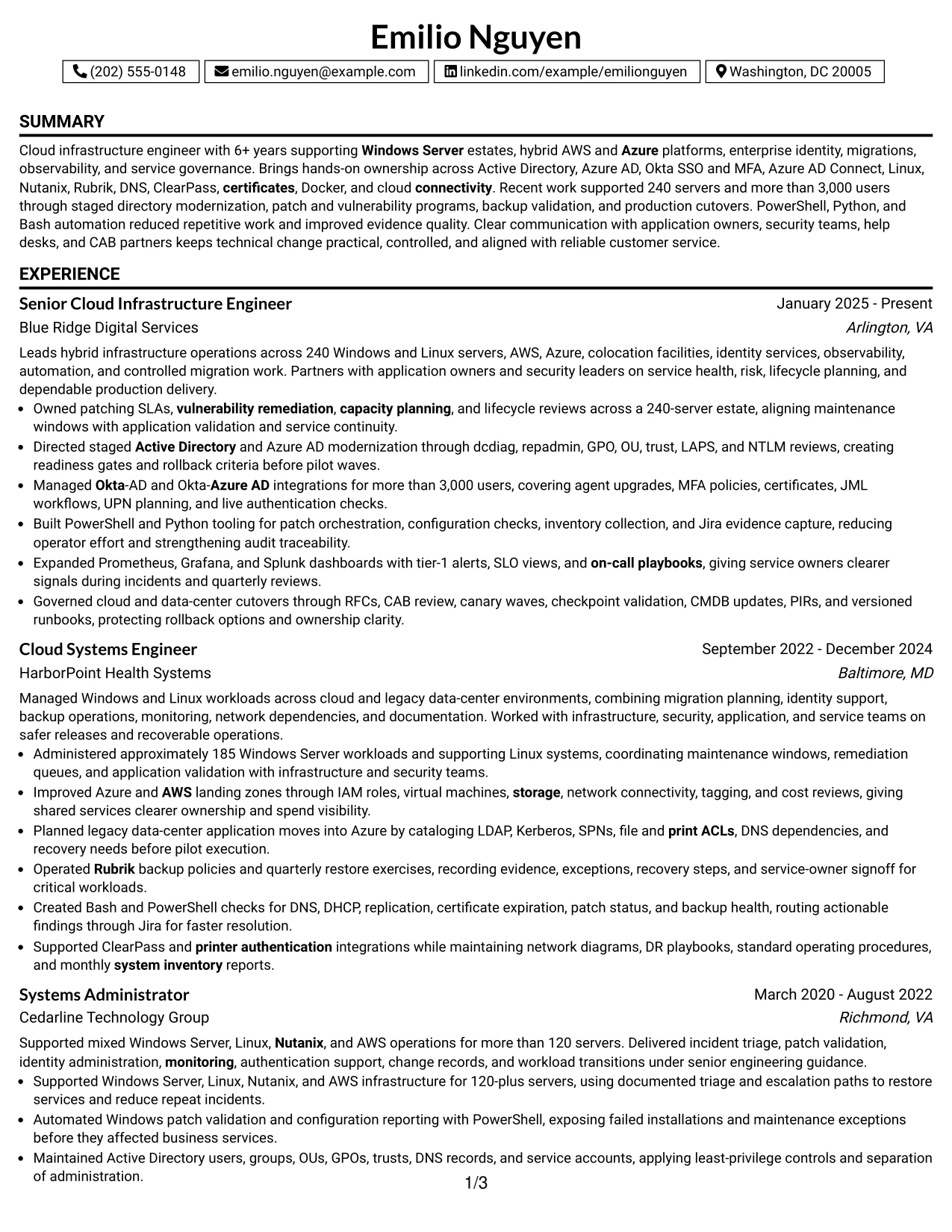
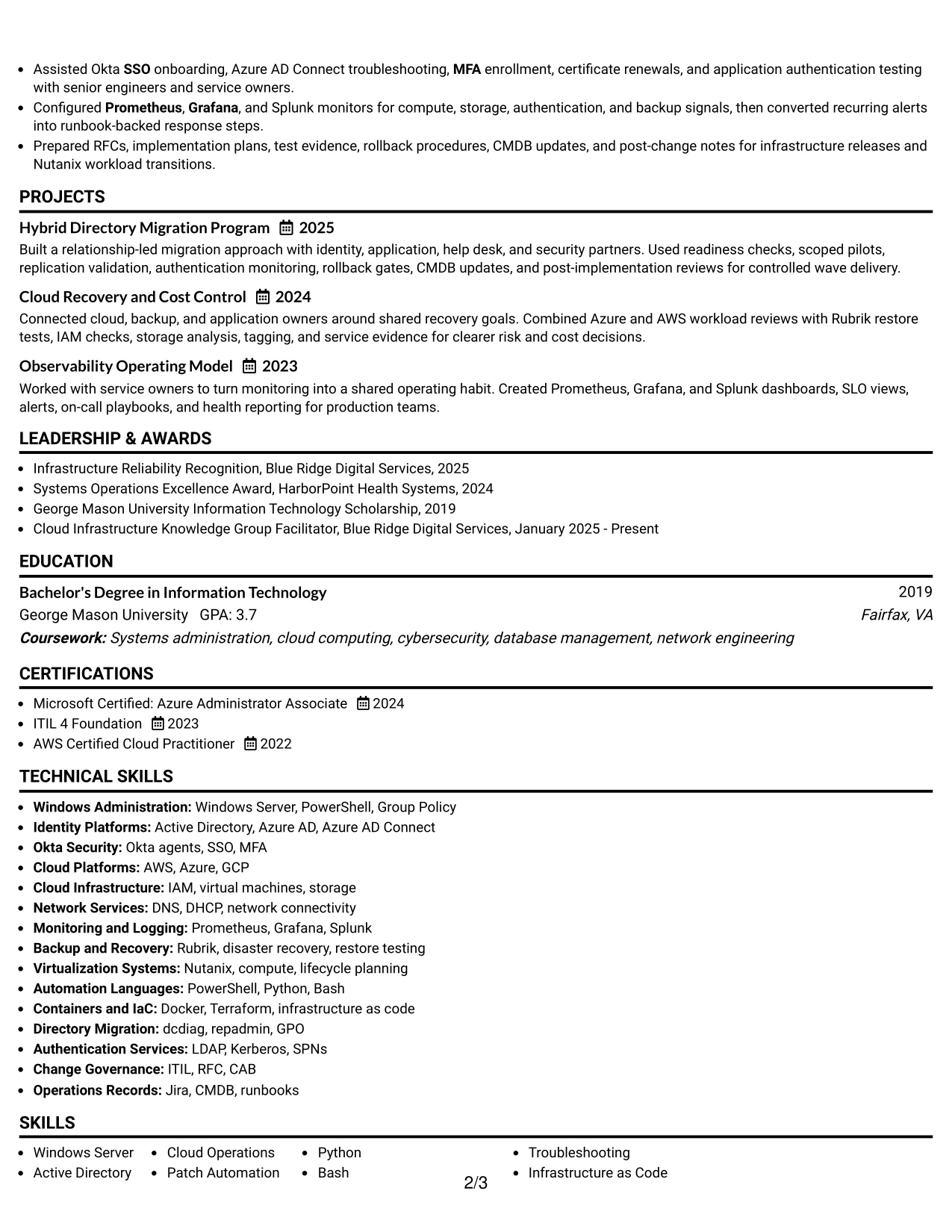
Why the Boxed Contact Header with Job Title Format Works for a Resume
- The boxed header establishes the target role before the reader reaches detailed content.
- Separated sections reduce visual searching across experience, skills, projects, and certifications.
- A single column keeps ATS reading order straightforward.
- Shaded labels make technical categories easy to distinguish during a fast review.
- The format gives achievement bullets enough width for tools, scope, and delivery methods.
- Keywords can appear naturally in the summary, experience bullets, and dedicated skills area.
- The formal structure supports a resume that must show both hands-on work and change governance.
Best For
- Resumes that need a strong title block followed by clearly separated content areas.
- Applications where reviewers compare required technologies against experience bullets.
- Technical documents with multiple project examples that need visible section boundaries.
- Candidates who want a formal presentation without a multi-column reading order.
- Roles where cloud, identity, backup, monitoring, and automation evidence must remain distinct.
- Resumes that include both detailed employment history and a focused certification section.
- Applications requiring a clean document structure that remains easy to scan and parse.
#14 Stylish Two Column Designer Format Resume Example
A recruiter can move through the main column for the summary and experience while using the sidebar for skills, certifications, education, and supporting details. That navigation makes the document useful for a broad technical record without forcing every item into one long sequence.
The two-column design creates room for cloud platforms, identity systems, monitoring tools, automation languages, and governance keywords alongside detailed bullets. Main-column evidence can then focus on 240-server operations, directory migration gates, authentication support, and controlled cutovers.
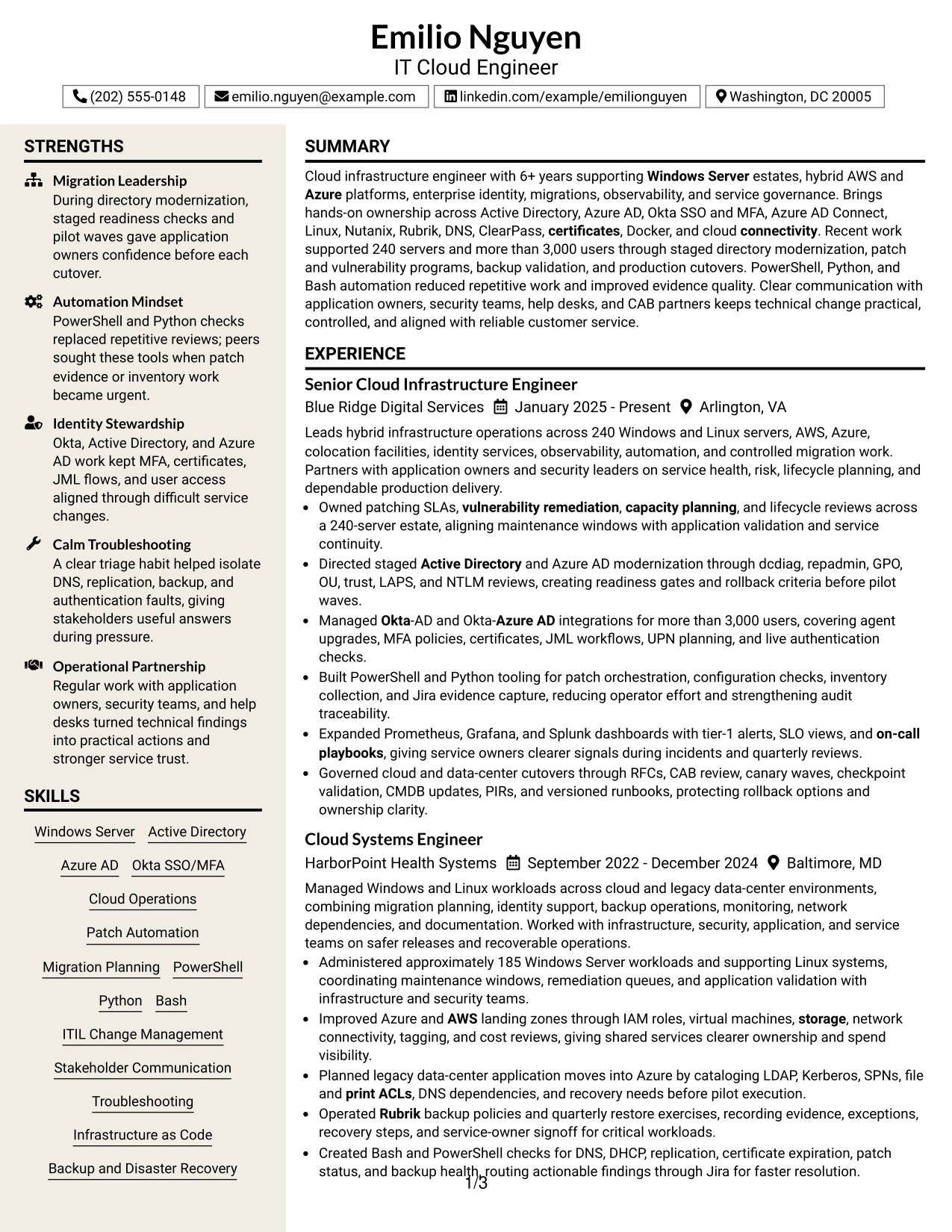
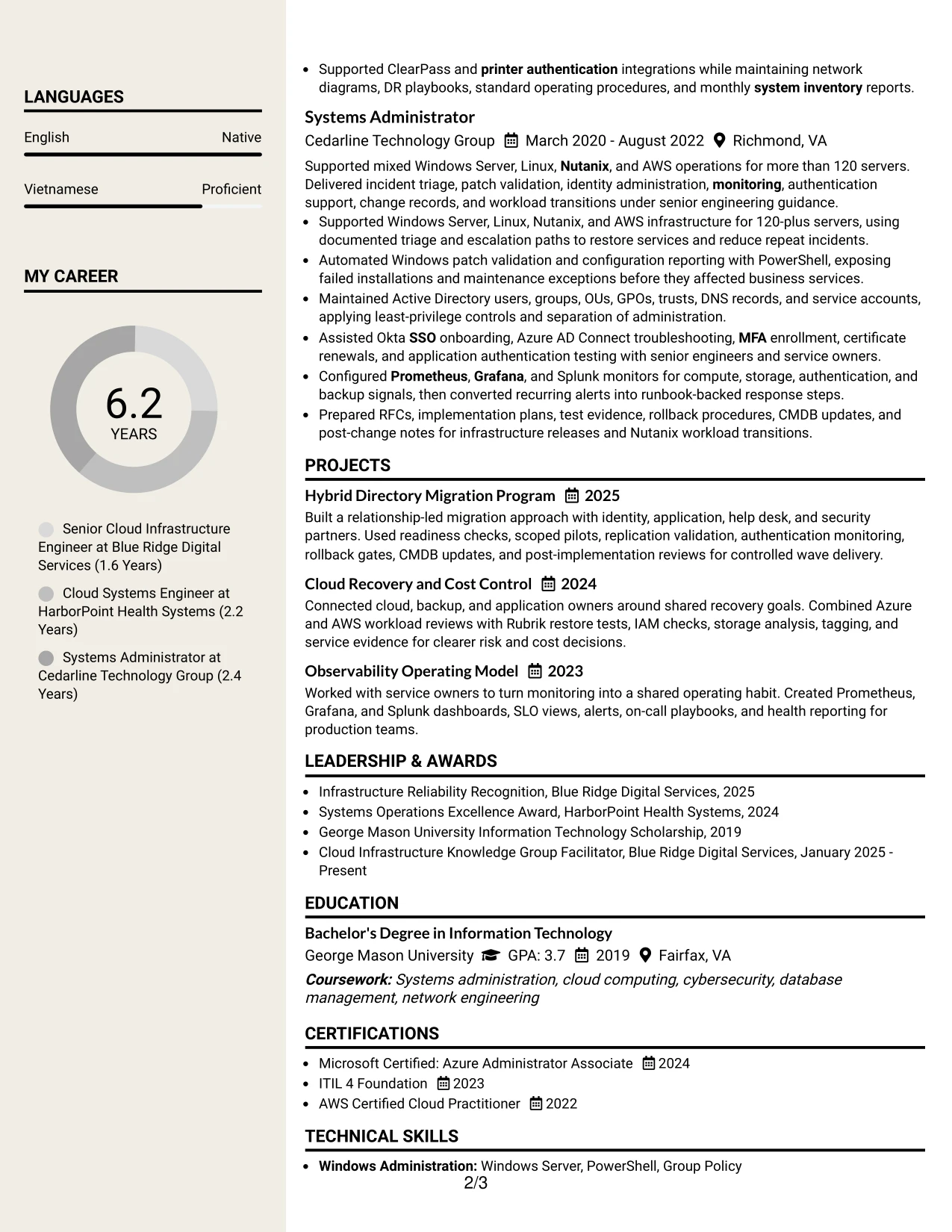
Why the Stylish Two Column Designer Format Works for a Resume
- The main column gives professional experience the strongest visual weight.
- A sidebar holds compact information such as skills, certifications, education, and tools.
- Two zones help readers separate evidence from reference keywords.
- The layout accommodates a substantial technical inventory without repeating it in every bullet.
- Experience bullets can remain focused on actions, scope, controls, and outcomes.
- Distinct sections help surface cloud, identity, observability, and recovery capabilities quickly.
- Careful spacing keeps a dense technical resume more approachable during a first review.
Best For
- Resumes with a large skills inventory that should remain visible without interrupting experience.
- Applications where a sidebar can carry certifications, education, and tools as quick reference.
- Candidates presenting several projects alongside a detailed employment history.
- Technical profiles that need to show both platform breadth and implementation evidence.
- Documents reviewed on screen where clear separation between core content and supporting facts helps.
- Applications that benefit from compact keywords paired with fuller achievement bullets.
- Resumes with enough content to justify two columns but still requiring a clear reading order.
#15 Modern Icon Format Resume Example
Evidence receives priority through concise experience bullets that connect infrastructure actions with scope, controls, and service outcomes. The Modern Icon Format uses visual markers to guide the eye, while the resume content remains centered on cloud operations, identity, migrations, monitoring, and automation.
The format works well when each section must communicate quickly. Measurable details such as 240 servers, 3,000 users, more than 185 workloads, and 120-plus servers can stand beside specific tools including Prometheus, Grafana, Splunk, PowerShell, Python, Bash, and Rubrik.
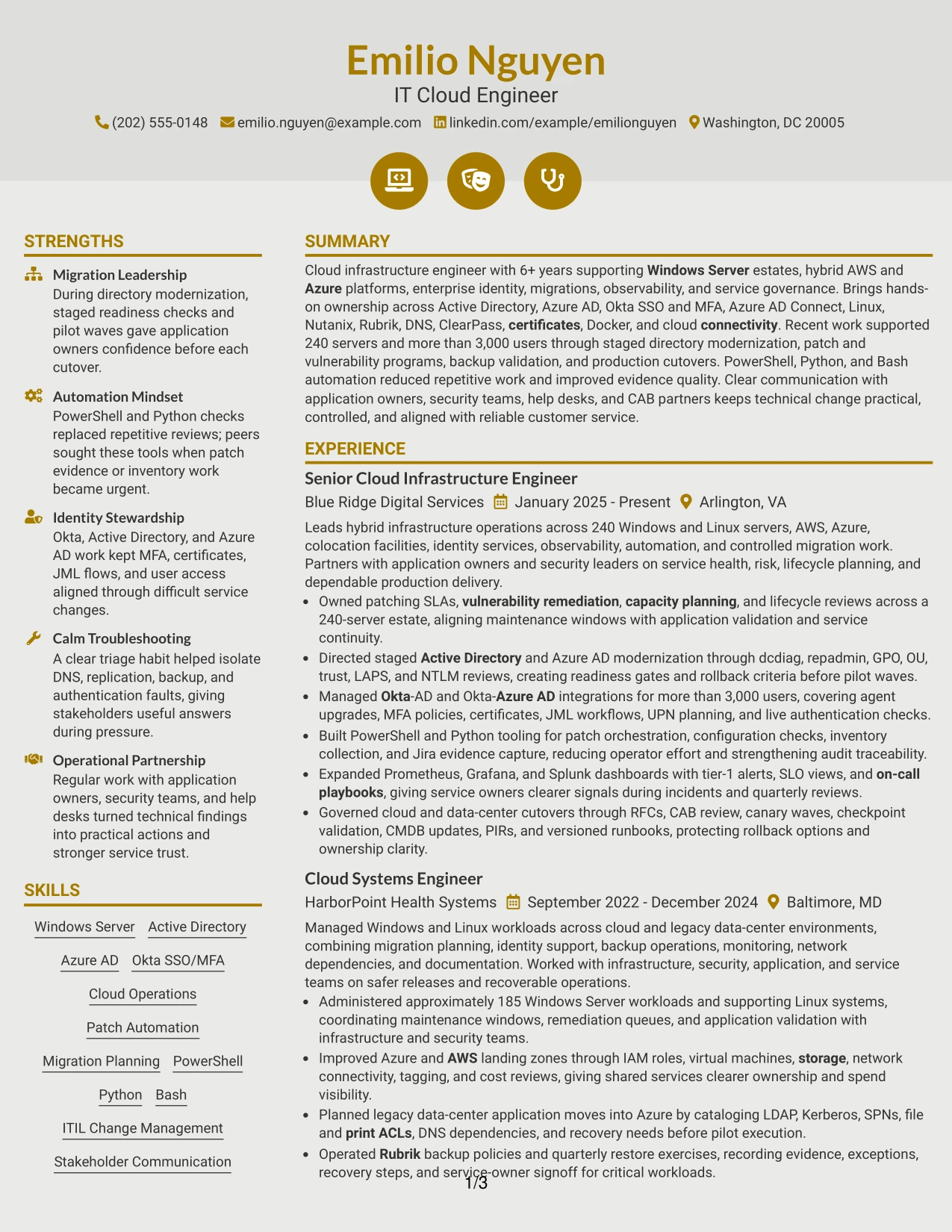
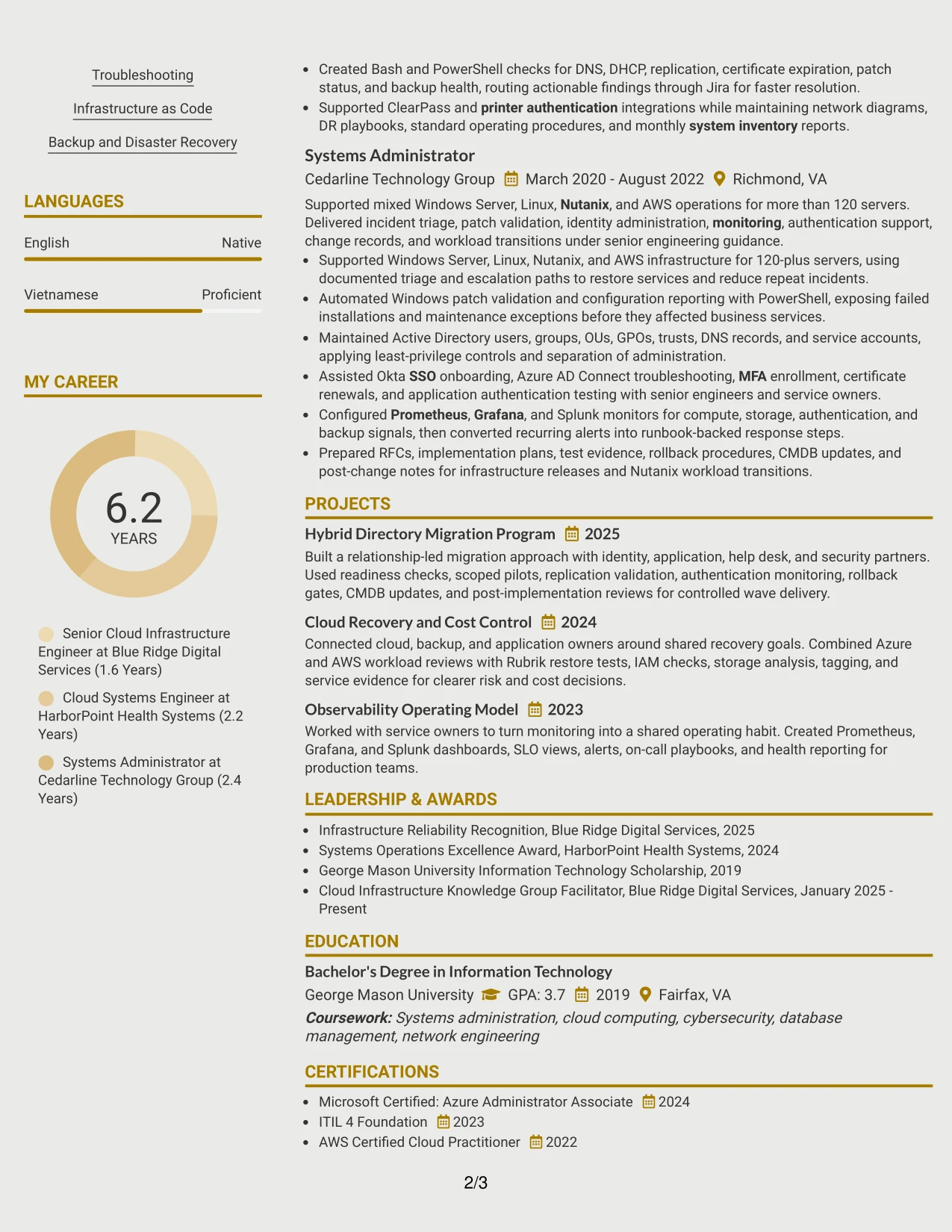
Why the Modern Icon Format Works for a Resume
- Icons create quick visual anchors for sections without replacing written evidence.
- Short bullets can lead with the action, then explain scope, tools, and operational value.
- The format makes measurable infrastructure scale easy to notice.
- Technical keywords remain available in standard text for ATS review.
- Visual markers help distinguish experience, skills, projects, education, and certifications.
- The design supports evidence from both daily operations and structured migration programs.
- Consistent spacing keeps a tool-rich resume from feeling disorganized.
Best For
- Resumes where measurable scope should stand out during a fast technical review.
- Applications that combine platform administration with automation and migration evidence.
- Candidates who want visual navigation while keeping keywords in readable text.
- Documents featuring several monitoring, identity, cloud, and recovery technologies.
- Roles where short achievement bullets need to show both method and operational result.
- Applications that include projects and awards without allowing them to overshadow experience.
- Resumes suited to digital review with clear section markers and compact evidence.
#16 Plain Professional Layout with Job Title & Shaded Labels Resume Example
Content is balanced through a simple full-width structure, with the job title established at the top and shaded labels dividing each major resume section. The result gives detailed infrastructure work enough room while keeping the page calm and easy to review.
This application-focused layout can present the summary, experience, projects, skills, certifications, and education in a direct sequence. It supports evidence such as patch and vulnerability ownership, cloud landing-zone improvements, backup testing, directory migration planning, and ITIL change governance.
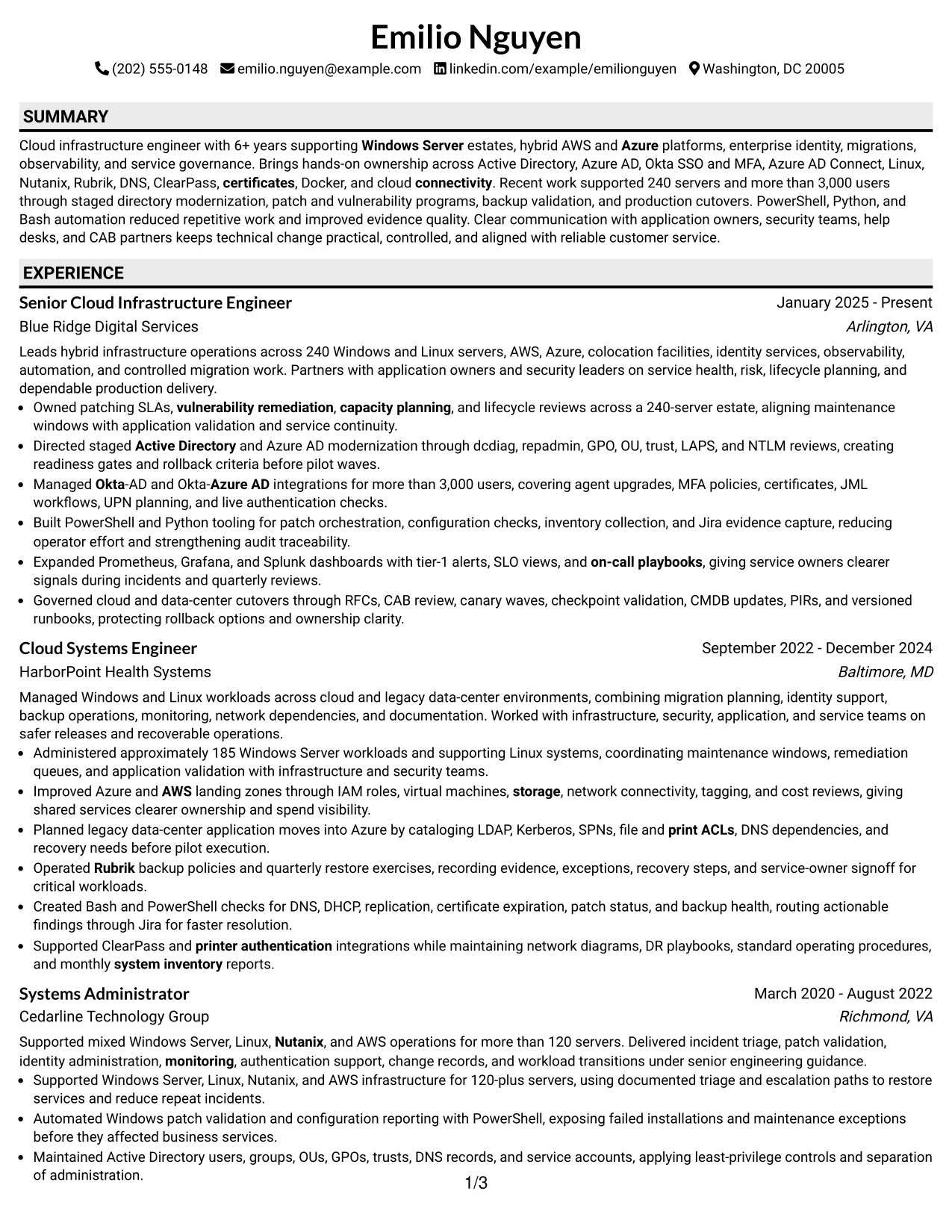
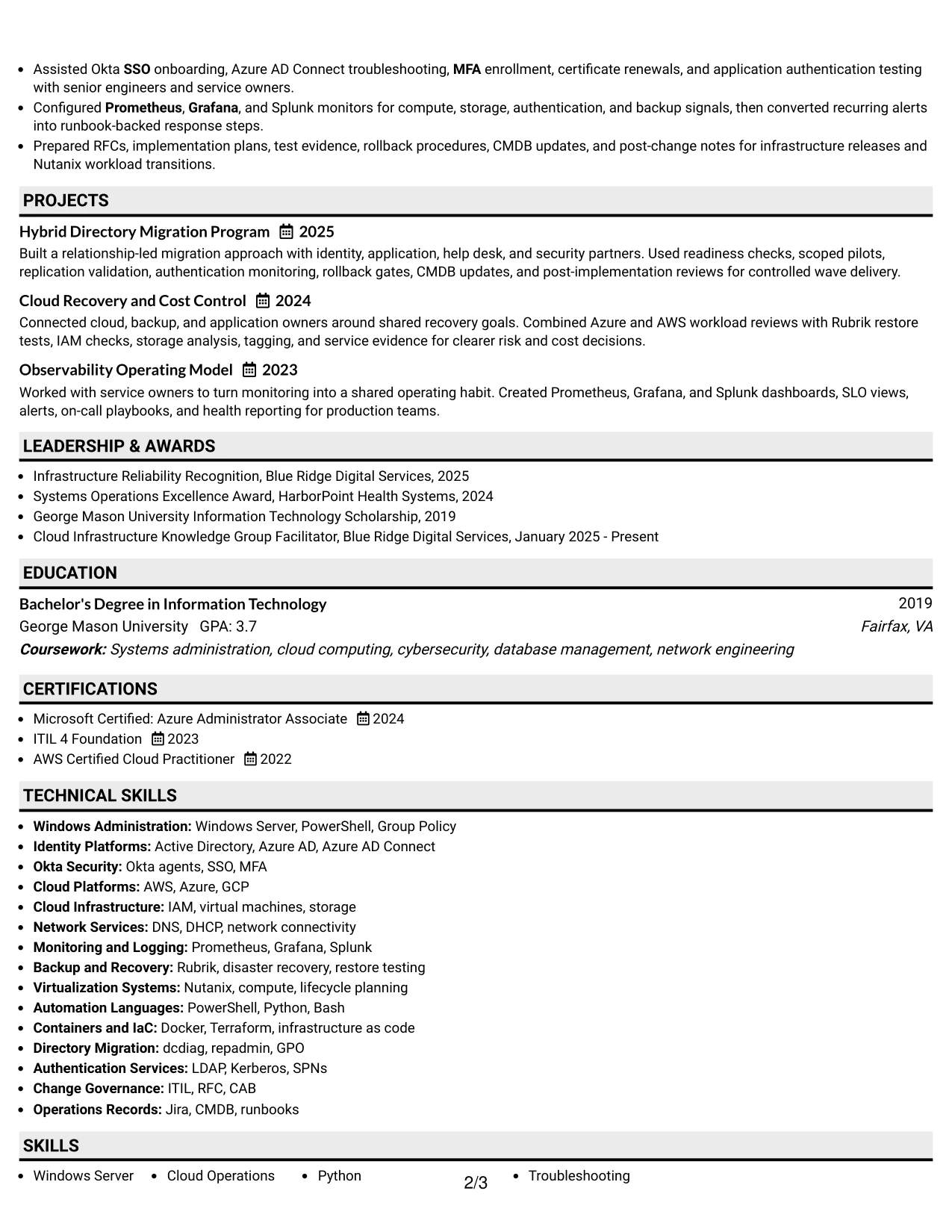
Why the Plain Professional Layout with Job Title & Shaded Labels Works for a Resume
- A direct sequence helps readers understand the professional profile before reviewing detail.
- Shaded labels separate sections without adding distracting decoration.
- Full-width space supports complete achievement bullets and technical context.
- The job title aligns the document with the intended IT Cloud Engineer application.
- Standard headings improve ATS recognition and recruiter navigation.
- The structure gives projects and certifications a clear place without weakening experience hierarchy.
- A professional visual balance works for technical roles that require both operations and governance evidence.
Best For
- Applications needing a straightforward resume that places the target title near the top.
- Candidates who must explain complex infrastructure work in complete, readable bullets.
- Documents reviewed by technical and nontechnical stakeholders using standard section names.
- Resumes combining operational delivery, migration planning, projects, and certifications.
- Roles where ATS-friendly sequencing matters more than decorative design.
- Applications that need room for cloud, identity, backup, networking, and automation keywords.
- Professionals seeking a measured presentation for structured technical review.
#17 Classic One Column Resume Format Resume Example
For an application that depends on familiar resume conventions, a classic one-column structure keeps the review process direct. The reader can move from the summary to experience, projects, skills, education, certifications, and additional achievements without learning a new visual system.
That simplicity lets the evidence carry the document. Detailed bullets can show administration across Windows and Linux, AWS and Azure operations, identity integrations, Nutanix and Rubrik work, observability, scripting, and controlled changes supported by RFCs, CAB review, and rollback plans.
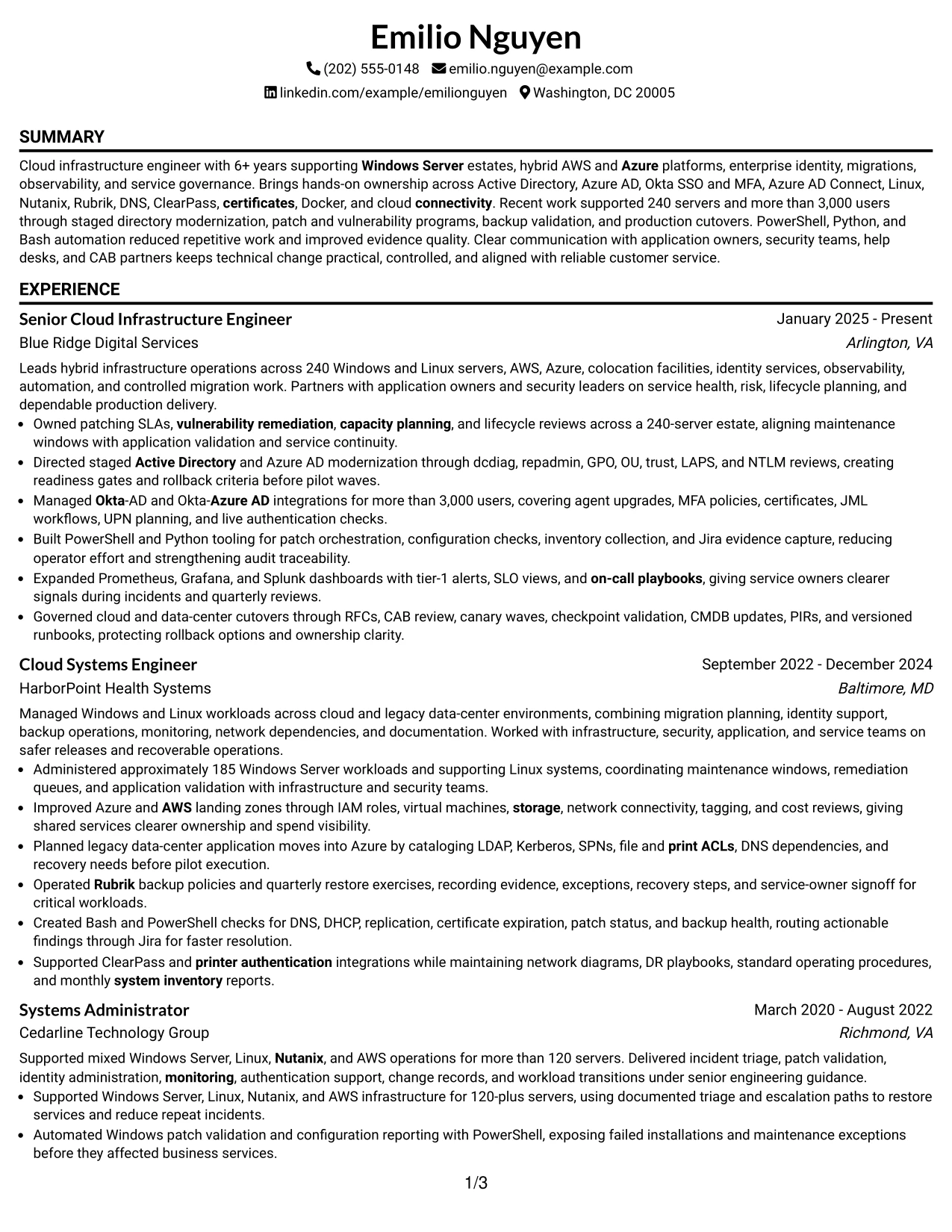
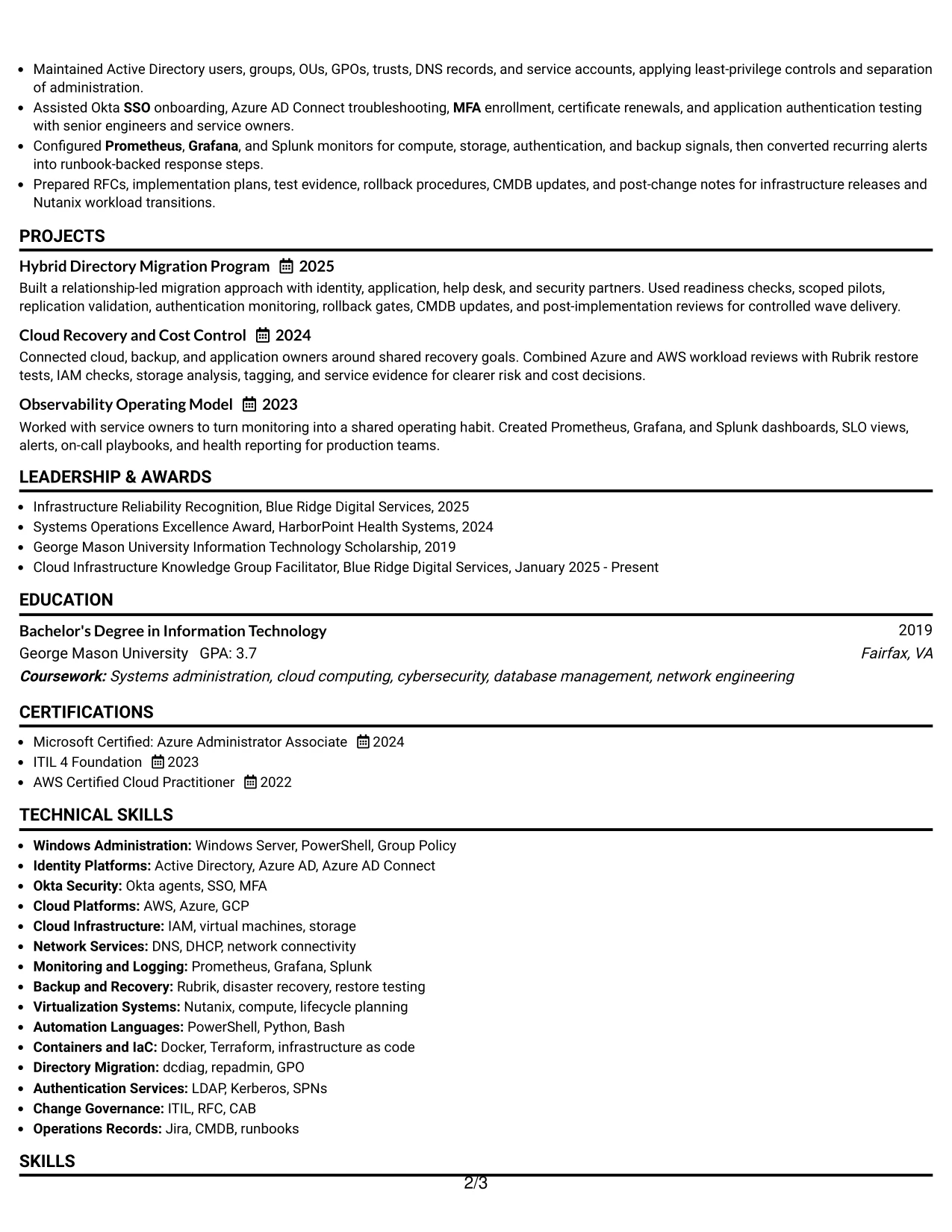
Why the Classic One Column Resume Format Works for a Resume
- Conventional section order helps recruiters locate information immediately.
- One column creates a reliable ATS reading sequence.
- Full-width bullets give technical accomplishments room to remain specific.
- The format supports clear dates, employers, titles, education, and certifications.
- A familiar design keeps attention on scope, tools, and measurable evidence.
- Skills and project sections can reinforce experience without competing with it.
- The restrained presentation is suitable when credibility and readability matter most.
Best For
- Applications that favor a familiar resume structure with minimal visual interpretation.
- Candidates with a detailed work history that needs uninterrupted chronological presentation.
- Documents requiring strong ATS compatibility and standard section recognition.
- Technical profiles that must connect cloud platforms to identity, backup, and monitoring evidence.
- Resumes where projects, awards, and certifications should follow experience in a clear order.
- Applications reviewed across different devices or document systems.
- Professionals who want the evidence and keywords to define the presentation.
#18 One Column Format with Photo Resume Example
A restrained visual hierarchy keeps the contact area, optional photo, and IT Cloud Engineer title distinct from the one-column resume content. The main flow still gives priority to experience, projects, skills, education, and certifications, so the visual element does not replace technical evidence.
The format can support a polished application when personal presentation is appropriate for the submission context. Clear bullets remain central, showing hybrid infrastructure operations, identity modernization, cloud migration planning, recovery testing, monitoring, and automation across a documented 6+ year background.
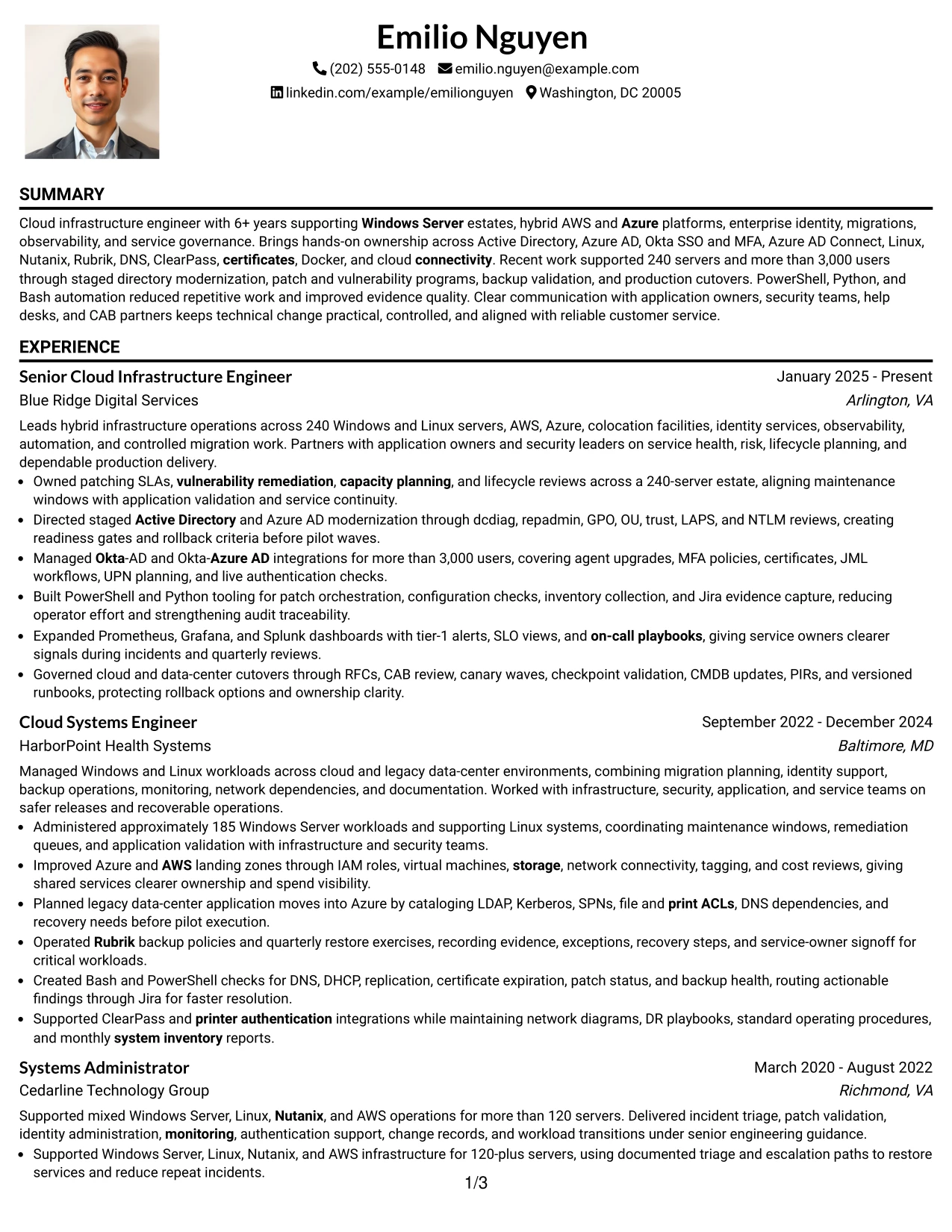
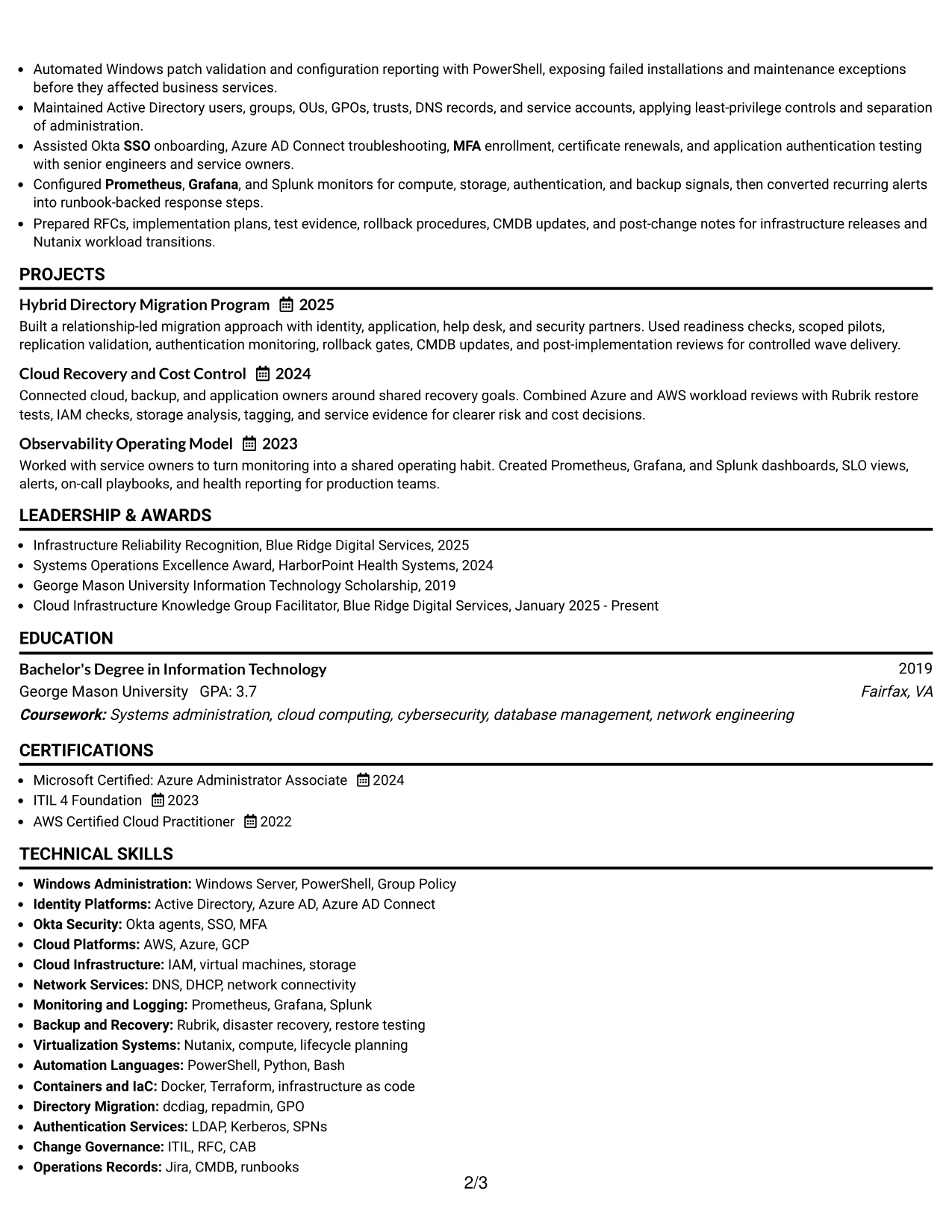
Why the One Column Format with Photo Works for a Resume
- A single reading path keeps the photo and contact area from interrupting resume evidence.
- The target title remains visible before the detailed experience section.
- Full-width bullets provide space for technical tools and measurable scope.
- Standard sections preserve ATS-friendly content order beneath the visual header.
- The format can present professional identity while keeping skills and certifications easy to find.
- Projects and awards can be added without creating a crowded sidebar.
- It works best when the submission context accepts a photo and values a polished personal presentation.
Best For
- Applications where a photo is accepted and a polished personal presentation is useful.
- Resumes that need one clear path through detailed technical experience.
- Candidates balancing a visual header with substantial cloud, identity, and migration evidence.
- Documents where full-width bullets must explain tools, controls, and operational scope.
- Applications that include projects and certifications but should keep experience dominant.
- Digital profiles reviewed in contexts where the photo has a clear professional purpose.
- Candidates who want visual distinction without using a multi-column information structure.
#19 Minimal Header Format Resume Example
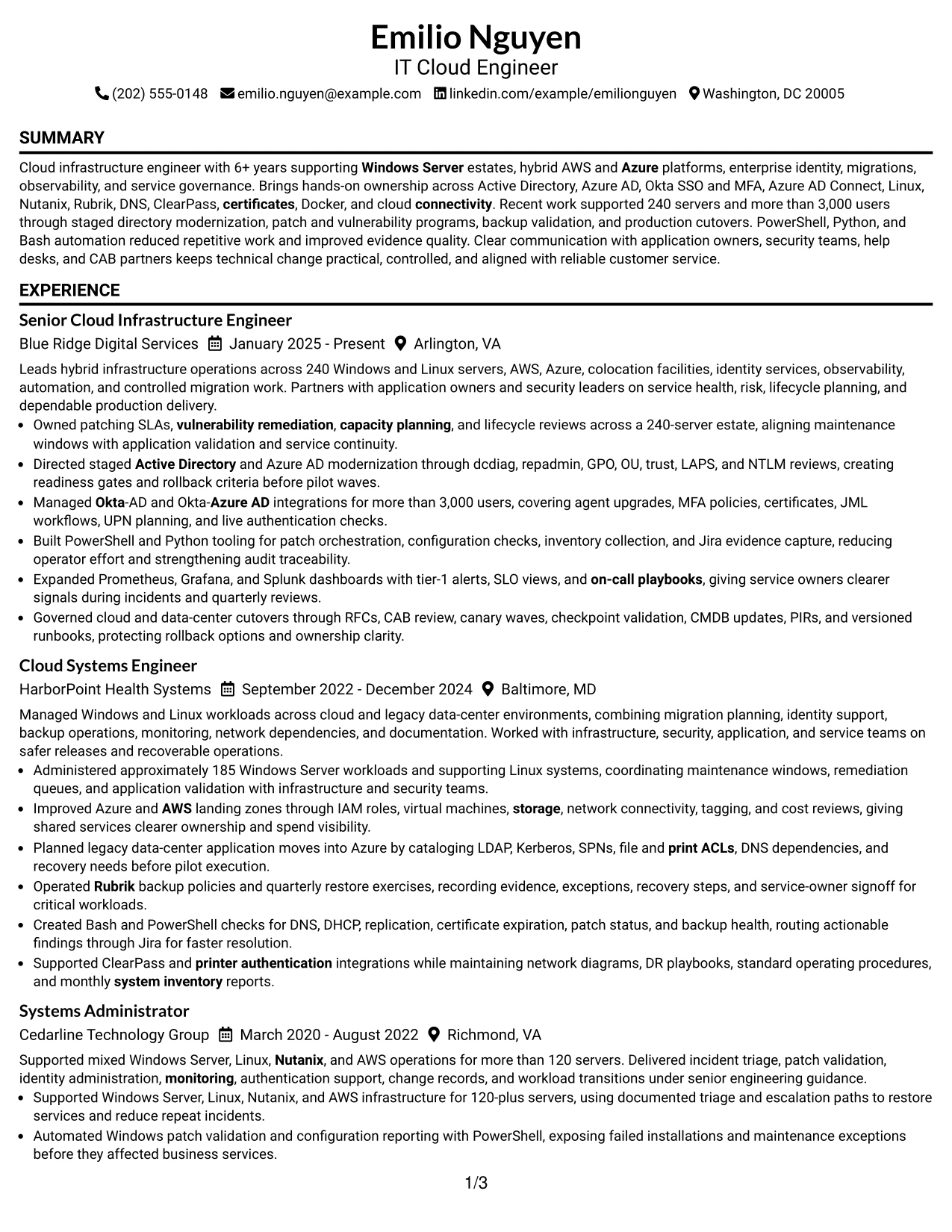
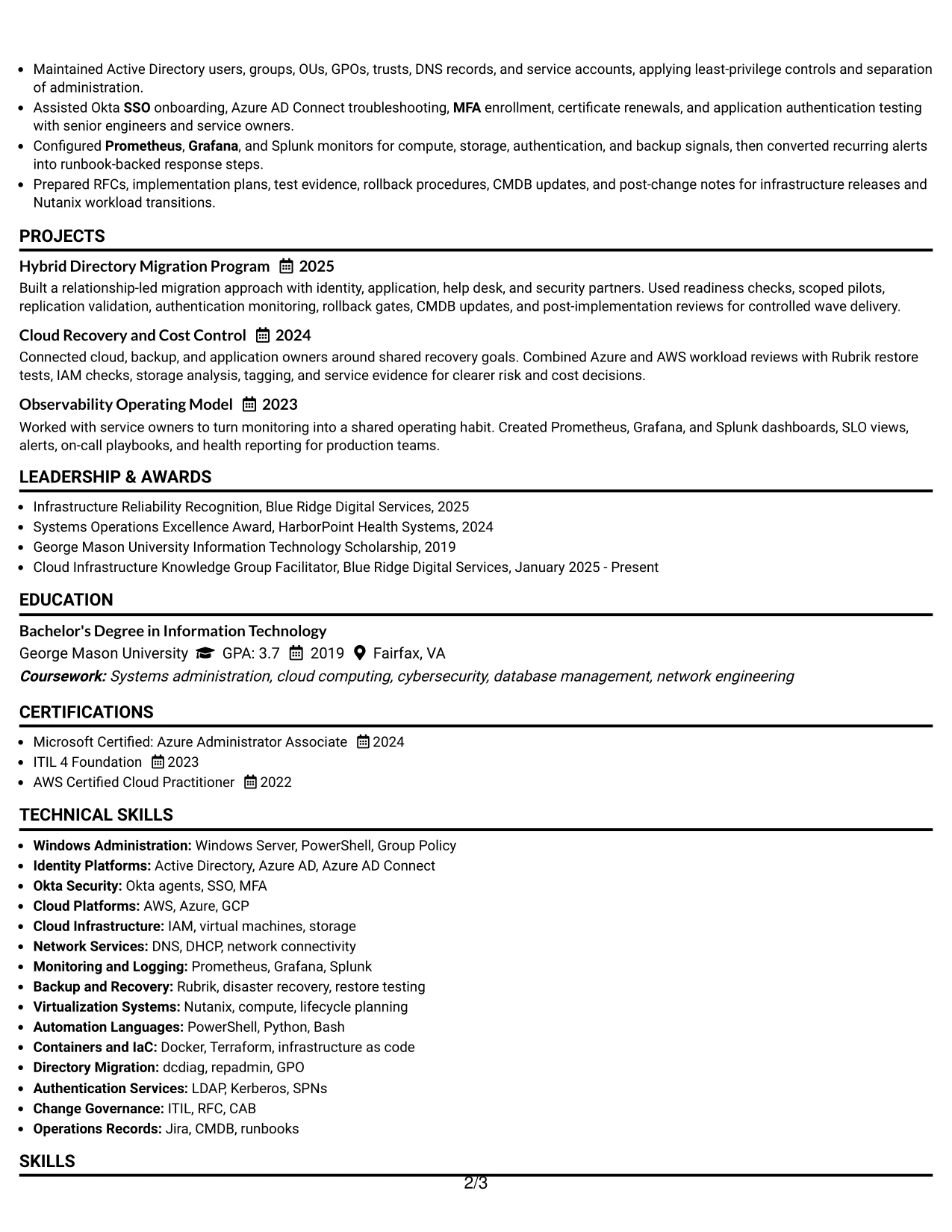
The Minimal Header Format creates a compact starting point for the resume, then lets the section hierarchy carry the review. Experience, projects, skills, education, and certifications appear in a simple sequence that makes the document easy to scan from top to bottom.
This structure is effective when the resume must communicate technical breadth without visual clutter. The content can highlight Windows Server, AWS and Azure, Active Directory, Okta, monitoring, Rubrik, Nutanix, PowerShell, Python, Bash, and ITIL-aligned delivery in a disciplined order.
Why the Minimal Header Format Works for a Resume
- A compact header preserves space for substantive experience content.
- Simple section headings support quick recruiter scanning and ATS parsing.
- The one-column sequence keeps dates, employers, and titles easy to follow.
- Minimal styling prevents technical keywords from being hidden in visual elements.
- Bullets can connect tools to actions, scope, and service outcomes.
- Projects and certifications remain visible without adding competing design features.
- The format gives a clean presentation to a resume with broad platform coverage.
Best For
- Resumes where space should favor experience bullets over decorative header elements.
- Applications requiring a simple structure that parses cleanly across systems.
- Candidates with broad technical skills who need an orderly way to present them.
- Documents reviewed quickly for cloud, identity, monitoring, and automation keywords.
- Applications that include supporting projects but should keep the professional history central.
- Resumes needing clear chronological navigation without a sidebar.
- Professionals who prefer a quiet layout that lets evidence establish credibility.
#20 Modern Full Background Two Column Format Resume Example
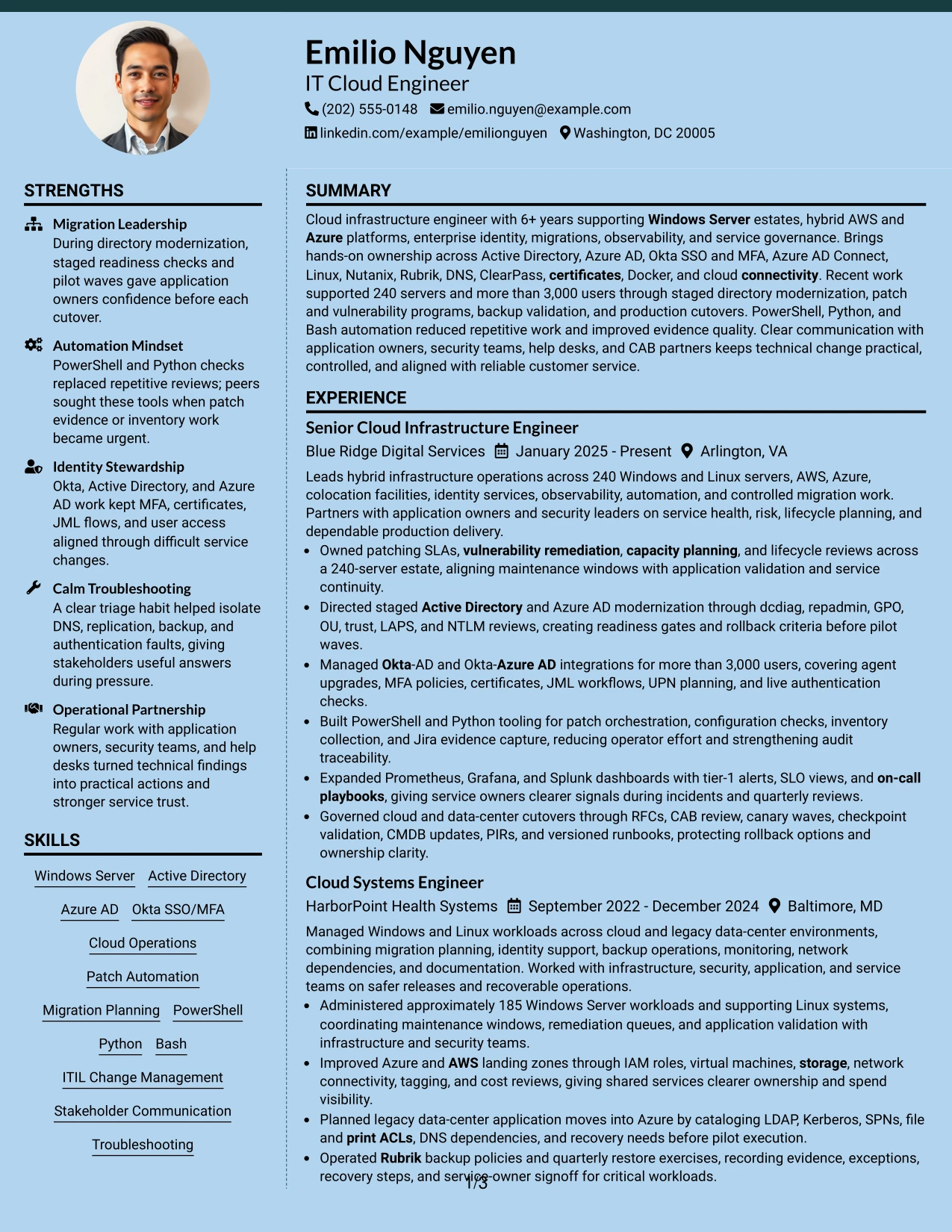
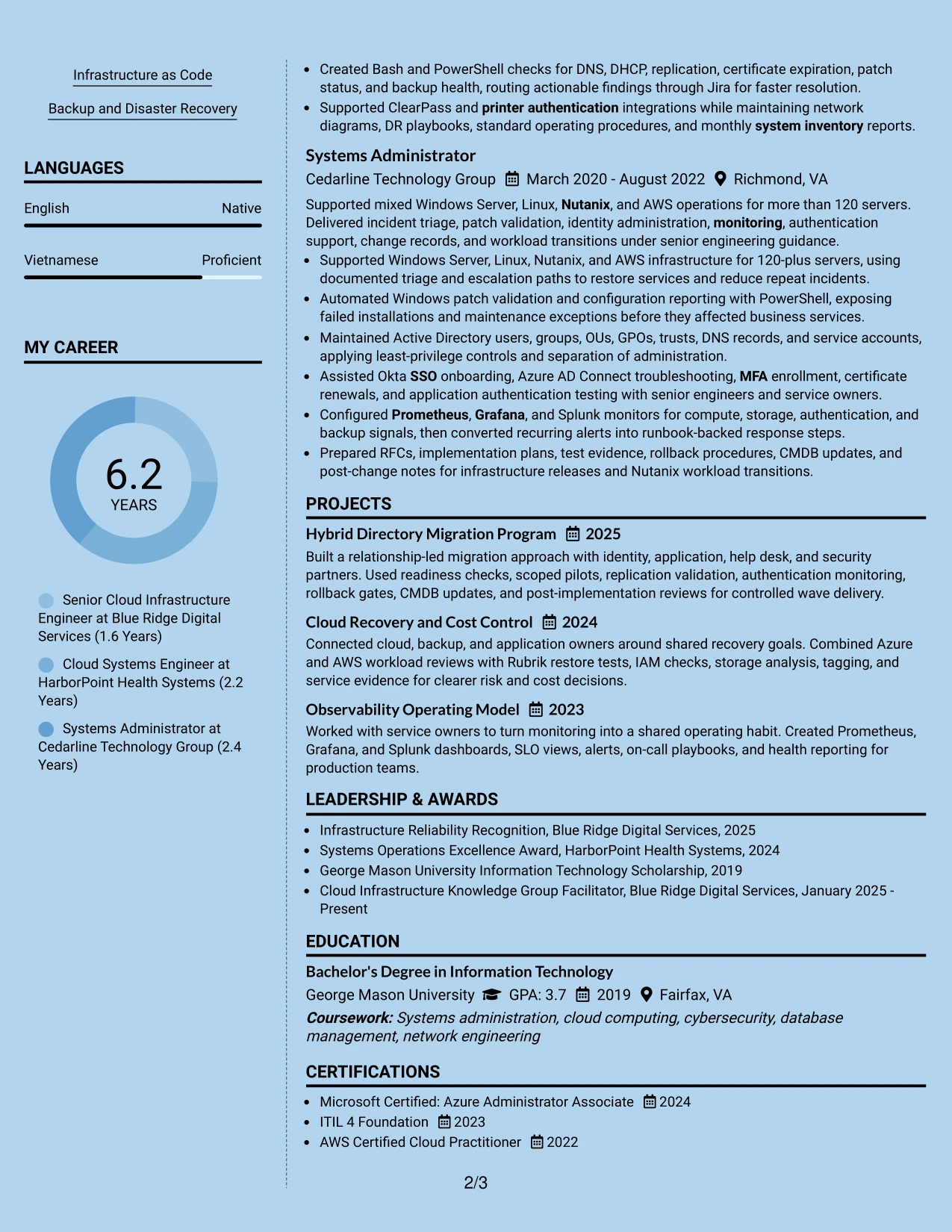
A recruiter can begin with the main column for the summary and experience, then use the secondary column to confirm skills, certifications, education, projects, and supporting details. That navigation helps connect Emilio Nguyen's detailed delivery record with the technologies and governance practices required for the target role.
The two-column structure supports substantial content without making every section compete for the same space. Core bullets can show 240-server operations, 3,000-user identity support, cloud and data-center cutovers, observability coverage, automation, backup validation, and CMDB-driven change records.
Why the Modern Full Background Two Column Format Works for a Resume
- The main column gives high-value experience evidence a clear primary position.
- The secondary column keeps skills, certifications, projects, and education available at a glance.
- A full visual treatment creates a unified presentation across both content areas.
- Two-column navigation helps readers compare role requirements with supporting keywords.
- The design accommodates detailed bullets without pushing reference information too far down.
- Projects can reinforce migration, recovery, and observability evidence beside employment history.
- Consistent hierarchy keeps a content-rich resume organized during digital review.
Best For
- Resumes with enough experience and supporting material to justify two coordinated columns.
- Applications where a sidebar can summarize platforms, certifications, and project themes.
- Candidates presenting both detailed achievements and a broad technical keyword set.
- Documents reviewed on screen by readers who need quick movement between evidence and references.
- Applications that combine cloud operations with identity, migration, recovery, and governance work.
- Resumes that need visual distinction while preserving a clear primary reading path.
- Profiles where projects and certifications add context to a substantial employment record.
#21 Dark Mode Two Column Format Resume Example
Evidence leads the review: the main column can present infrastructure achievements, while the companion column surfaces the skills, certifications, and project themes that validate them. The Dark Mode Two Column Format uses strong contrast to create visual separation without changing the resume's factual hierarchy.
Detailed content can show staged Active Directory work, Okta–Azure AD integrations, AWS and Azure landing zones, Rubrik restore exercises, monitoring dashboards, and scripting. Compact supporting areas can carry keywords such as Nutanix, Docker, Terraform, DNS, ClearPass, Jira, and CMDB.
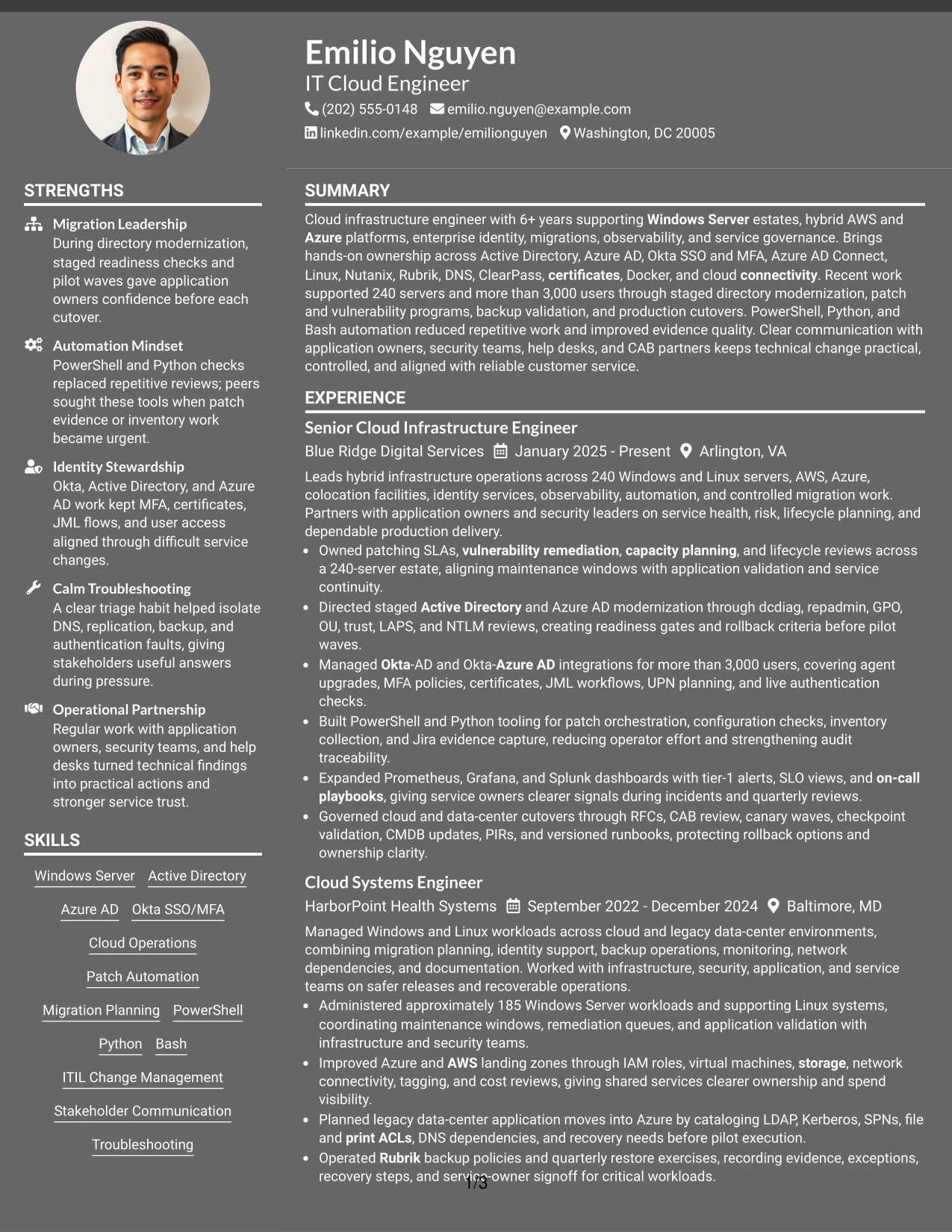
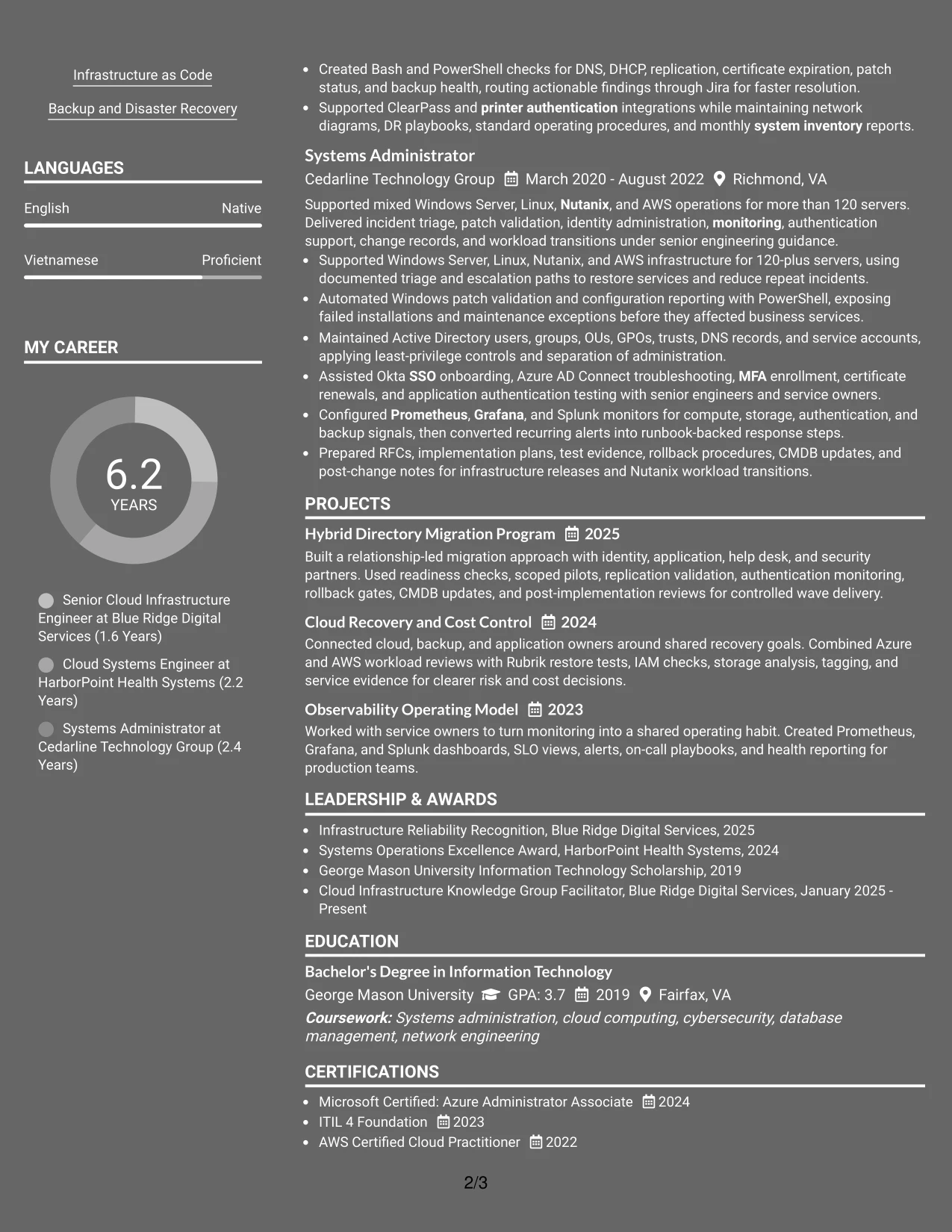
Why the Dark Mode Two Column Format Works for a Resume
- High contrast creates clear boundaries between primary evidence and supporting information.
- The main column can prioritize achievement bullets over decorative elements.
- A secondary column keeps technical keywords visible for rapid comparison.
- Two-column structure supports a substantial mix of platforms, tools, projects, and certifications.
- Concise labels help readers identify identity, cloud, monitoring, backup, and automation capabilities.
- The format can make recurring evidence patterns easier to spot across roles.
- Readable contrast and spacing remain essential so the dark treatment does not reduce scanability.
Best For
- Digital resumes where strong contrast can improve visual wayfinding between two content areas.
- Applications with detailed experience plus a broad supporting technology inventory.
- Candidates who need project and certification information visible beside core achievements.
- Documents where evidence types such as migration, monitoring, recovery, and automation should be easy to distinguish.
- Technical profiles reviewed on screen rather than primarily in monochrome print.
- Applications that benefit from a distinctive presentation while retaining structured resume sections.
- Resumes with enough content to use a sidebar without reducing bullet clarity.
#22 Dark Mode Box Header Format Resume Example
Content is balanced between a strong boxed header and a readable one-column body, giving the IT Cloud Engineer title and contact details clear prominence before the resume evidence begins. Dark styling adds separation, while the section sequence keeps experience, projects, skills, education, and certifications easy to follow.
The format is practical for an application that needs technical depth in a controlled presentation. It can showcase patch and vulnerability programs, directory readiness checks, cloud migration work, SLO dashboards, backup testing, automation, and ITIL governance without fragmenting the narrative across columns.
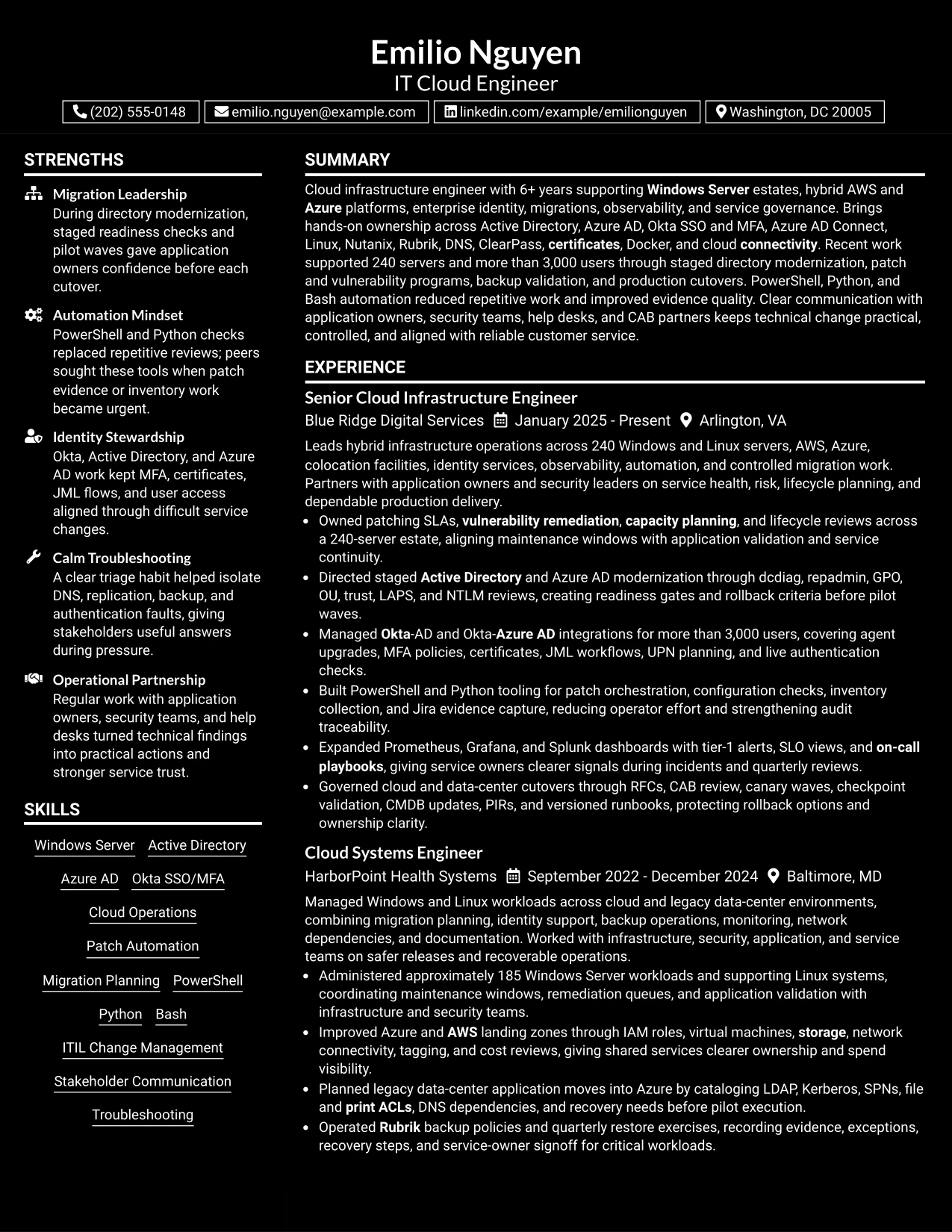
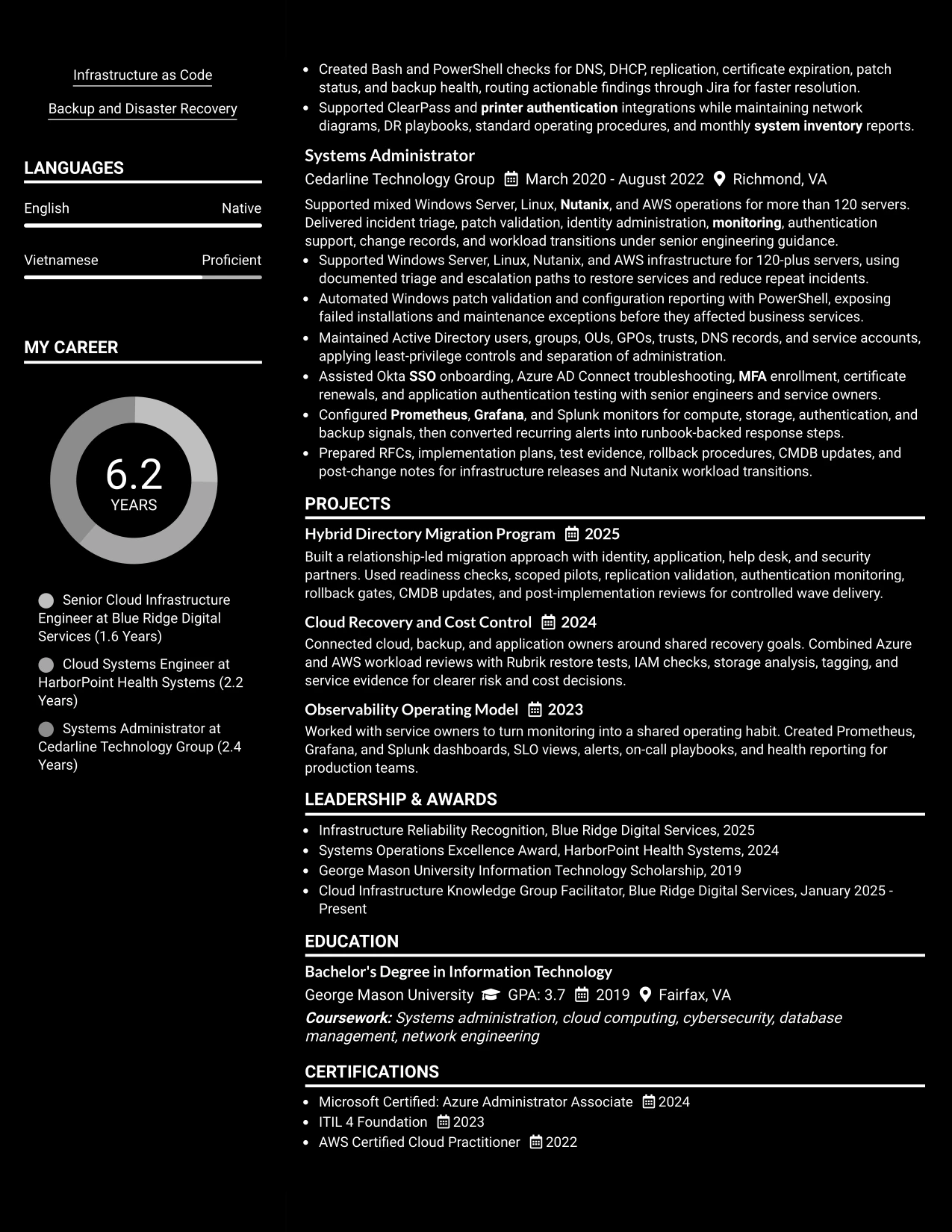
Why the Dark Mode Box Header Format Works for a Resume
- The boxed header gives the target title and contact details a defined starting point.
- A one-column body keeps the resume order familiar and ATS-friendly.
- Contrast separates labels from content while preserving a direct reading path.
- Full-width bullets allow detailed infrastructure evidence to remain complete.
- The format supports clear transitions between experience, projects, skills, and certifications.
- A strong header adds visual identity without requiring a complex sidebar.
- Careful text contrast and spacing keep the dark treatment professional and accessible.
Best For
- Applications that need a distinctive header with a conventional one-column body.
- Resumes where technical achievements require full-width space for context and tools.
- Candidates presenting migration, cloud operations, monitoring, backup, and governance evidence together.
- Digital submissions where a dark visual treatment can remain crisp and readable.
- Documents that need a prominent target title followed by standard resume sections.
- Applications combining detailed experience with projects, certifications, awards, and activities.
- Professionals seeking visual distinction without sacrificing ATS-friendly organization.
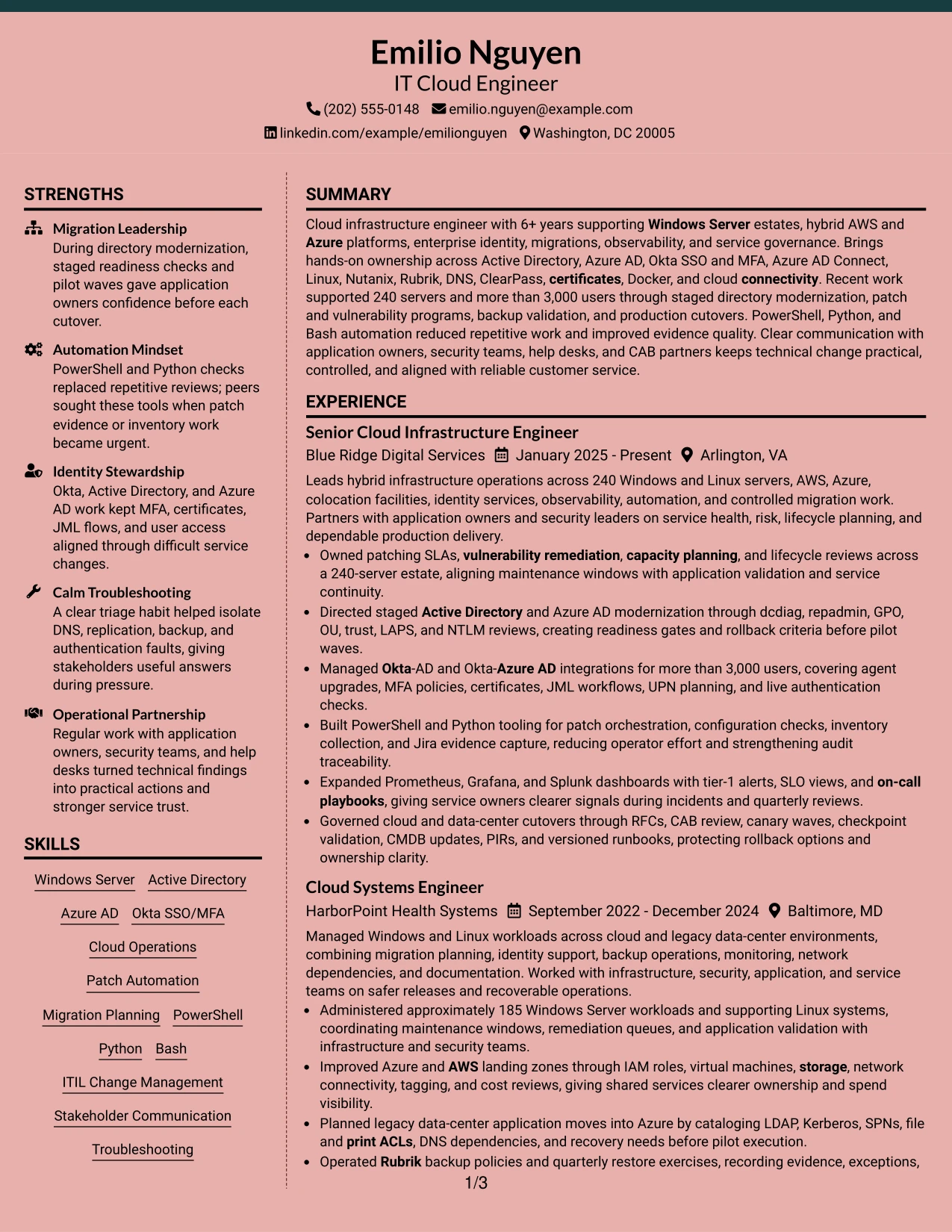
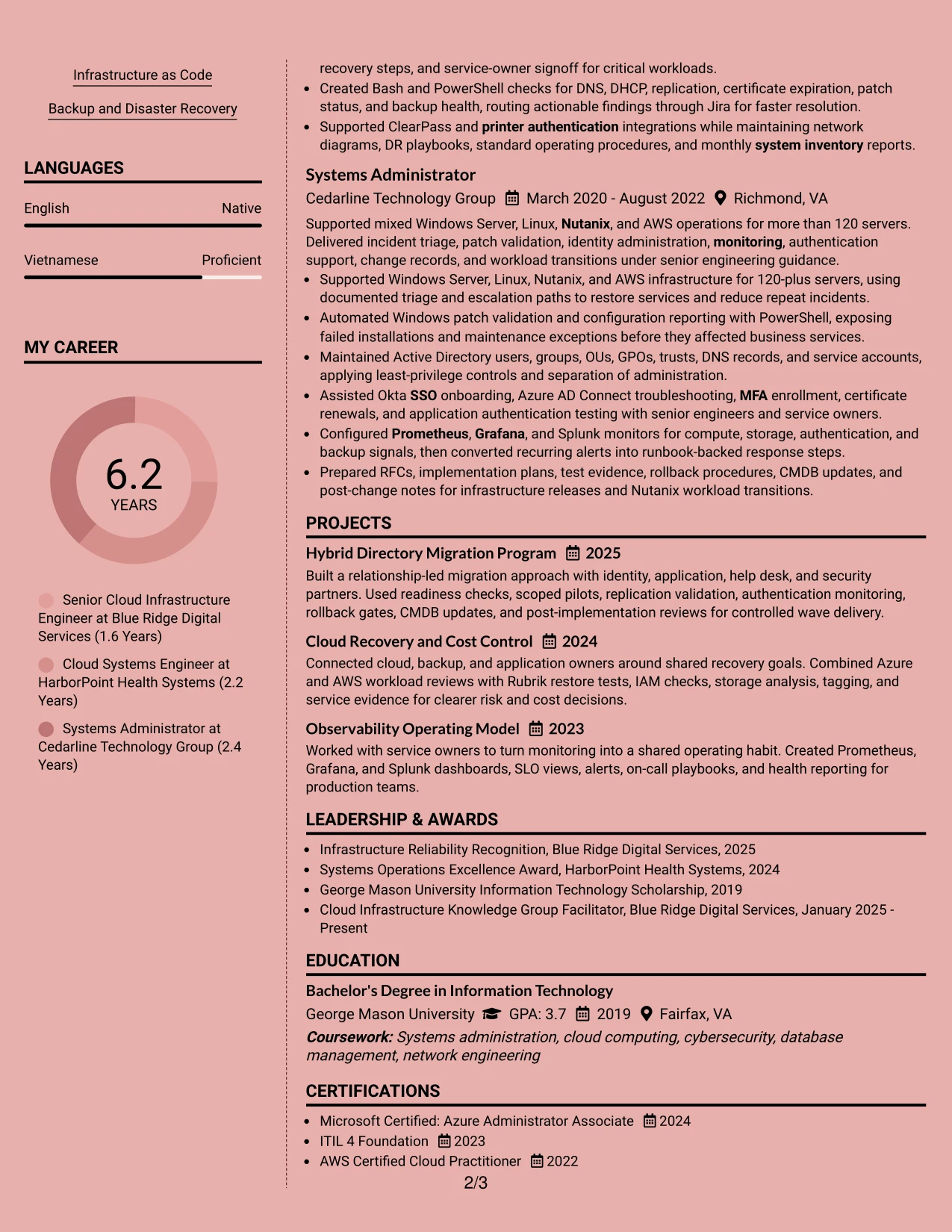
#23 Elegant Full Background Two Column Format Resume Example
For an IT Cloud Engineer resume, this format supports a practical review need: showing broad infrastructure ownership without making the page feel crowded. Two columns can place contact details, certifications, and technical skills beside a clear career history, while the main area gives space to Windows Server, cloud operations, identity work, and migration results.
The resume should lead with a focused summary, then move into experience bullets that connect tools to outcomes. Details such as 240 servers, more than 3,000 users, PowerShell automation, Prometheus and Grafana dashboards, and Rubrik restore testing provide evidence that is easy to locate. A restrained structure also helps ATS parsing when headings and keywords remain standard.
Why the Elegant Full Background Two Column Format Works for a Resume
- Two columns separate supporting details from the main employment record.
- The summary can establish experience across AWS, Azure, Windows Server, and identity platforms.
- Short skill groupings make technical keywords easier to scan.
- Experience bullets can pair infrastructure tools with measurable scope, such as 240 servers and 3,000 users.
- Certifications and education remain visible without taking attention from recent accomplishments.
- Migration, monitoring, backup, and change-governance evidence can be organized into distinct resume sections.
- Standard headings and readable text support both ATS review and human scanning.
Best For
- Resumes that need two-column organization for skills, certifications, and experience.
- Candidates presenting a wide range of cloud, identity, monitoring, and infrastructure tools.
- Applications where recent achievements need more space than contact details and education.
- Technical resumes that benefit from clear separation between supporting information and achievement bullets.
- Professionals who want measurable operating scope to stand out during a quick review.
- ATS-conscious applications using conventional headings and searchable terminology.
- Resumes that combine cloud migration, automation, recovery, and governance evidence.
- A polished presentation for an IT Cloud Engineer application without sacrificing detail.
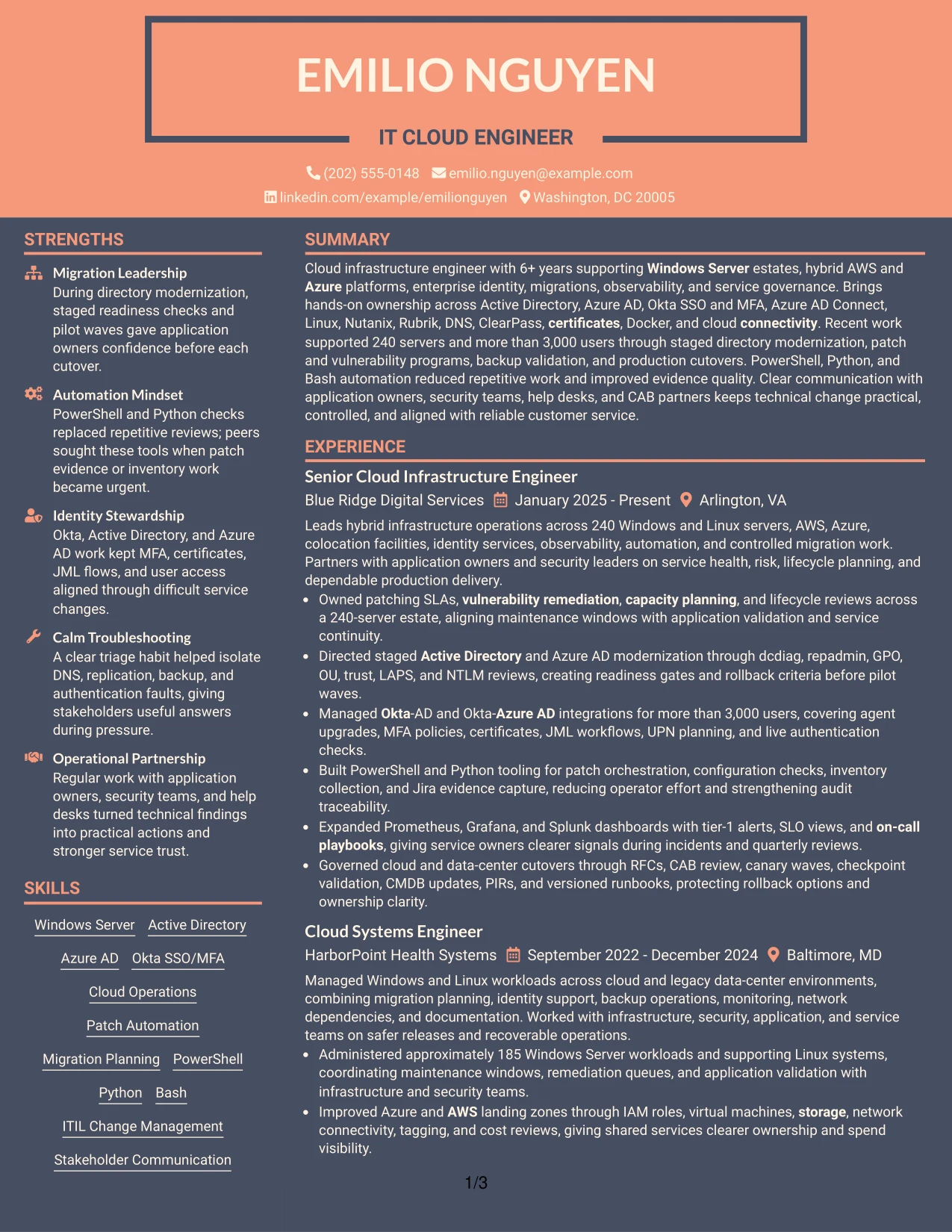
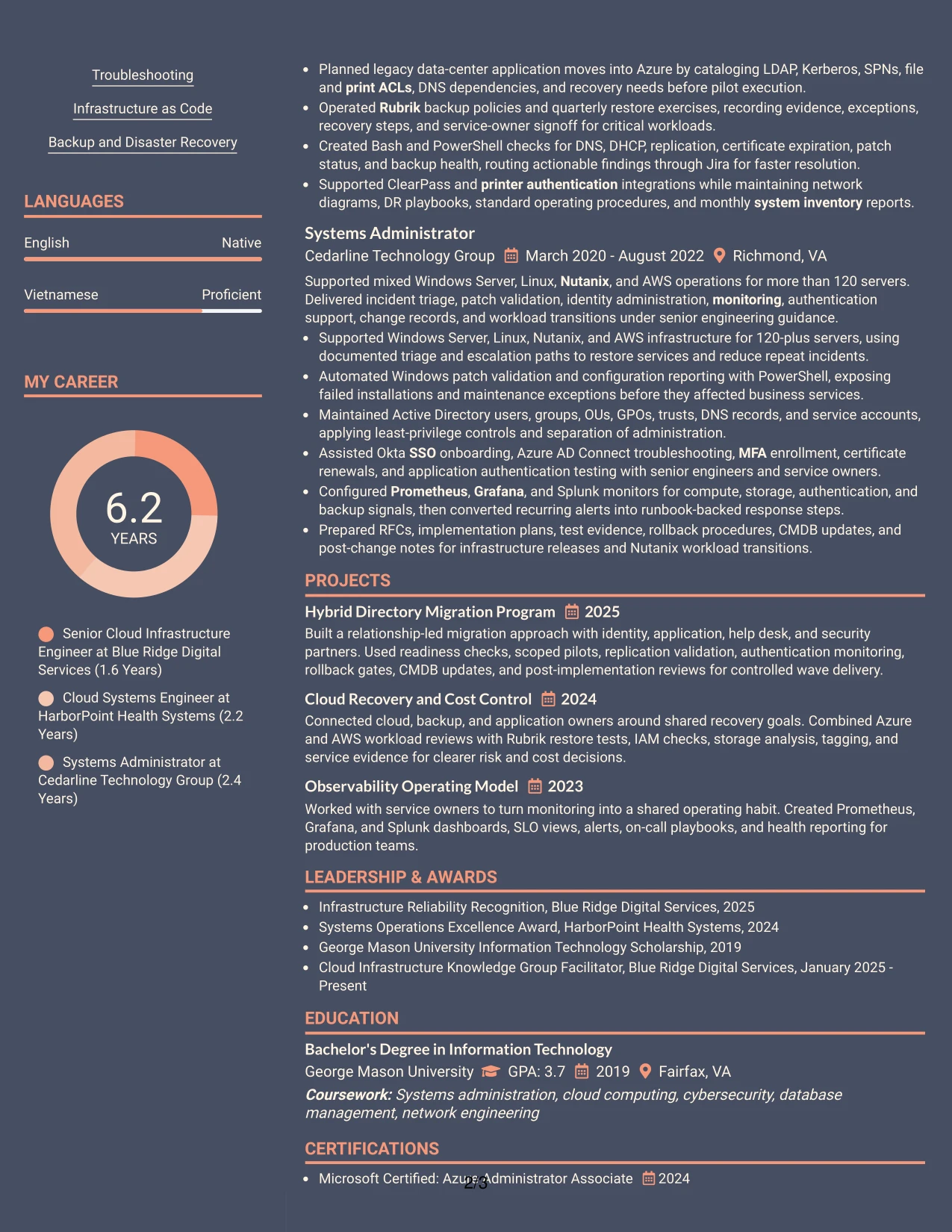
#24 Creative Two Tone Format Resume Example
A restrained visual hierarchy gives this resume a clear professional impression while allowing key technical themes to remain distinct. A two-tone treatment can separate the summary, skills, certifications, and employment history without replacing the standard section order expected in an IT Cloud Engineer resume.
The strongest content remains evidence-led: administration of 240 servers, Okta integrations for more than 3,000 users, staged directory modernization, and automation with PowerShell and Python. The visual contrast should support those facts, not compete with them. Standard labels and concise bullets preserve readability for ATS tools and technical reviewers.
Why the Creative Two Tone Format Works for a Resume
- Color contrast creates clear boundaries between resume sections.
- The design can emphasize the professional summary without enlarging it excessively.
- Technical skills remain grouped and searchable rather than scattered across the page.
- Bullets can show both platform knowledge and operating scale.
- The employment section has room for migration, identity, monitoring, and recovery evidence.
- A controlled color treatment adds distinction while preserving a professional tone.
- Consistent headings help readers compare experience against the target role requirements.
Best For
- Technical resumes that need visual distinction without a highly decorative layout.
- Applications where cloud, identity, and automation themes should be easy to separate.
- Candidates with varied infrastructure experience who need strong section boundaries.
- Readers who prefer a clear visual path from summary to skills to employment history.
- Resumes that combine technical keywords with governance and stakeholder-facing work.
- A focused presentation of measurable infrastructure scope and controlled change delivery.
- ATS-aware submissions that still benefit from modest visual branding.
- An IT Cloud Engineer resume requiring professional contrast and precise information grouping.
#25 Bold Color Header Professional Format Resume Example
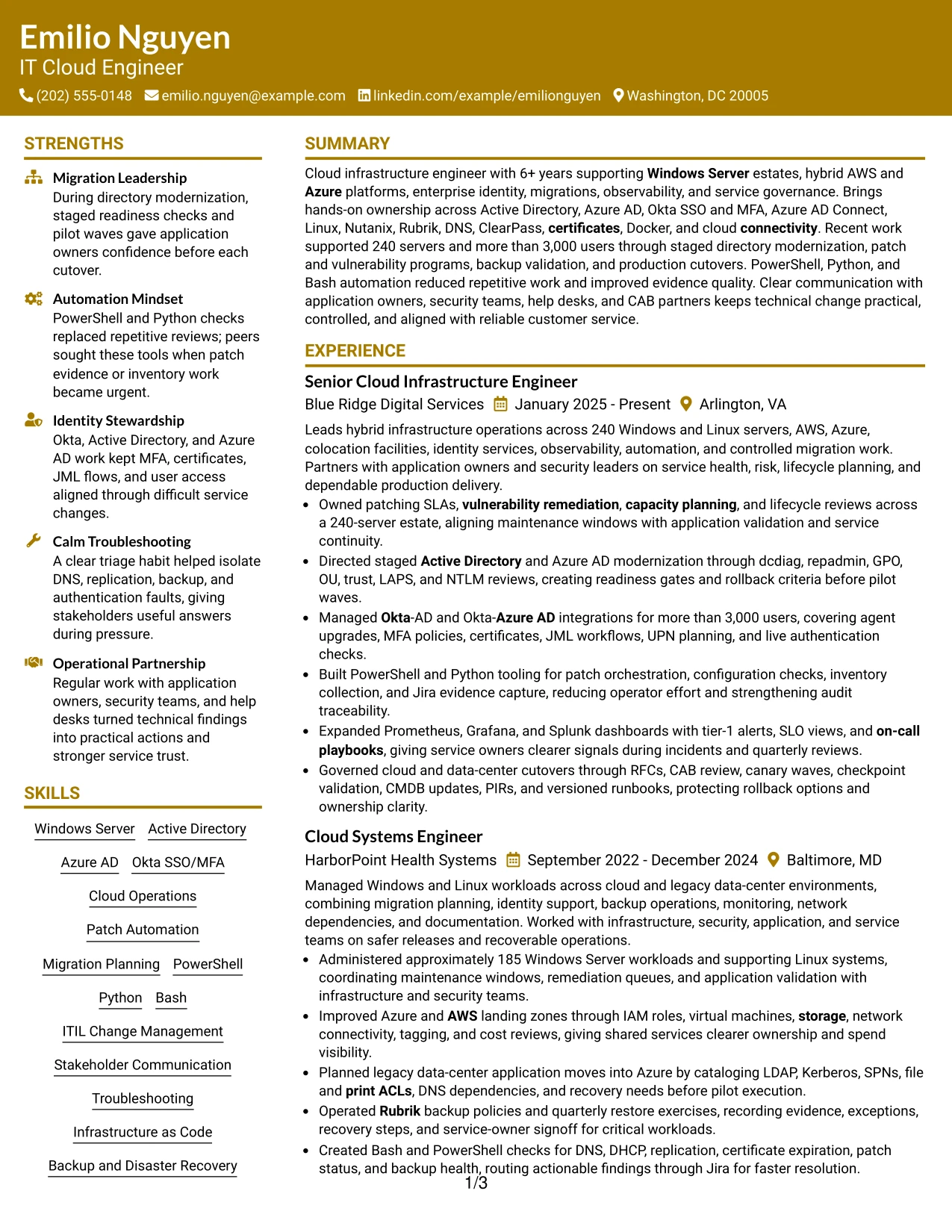
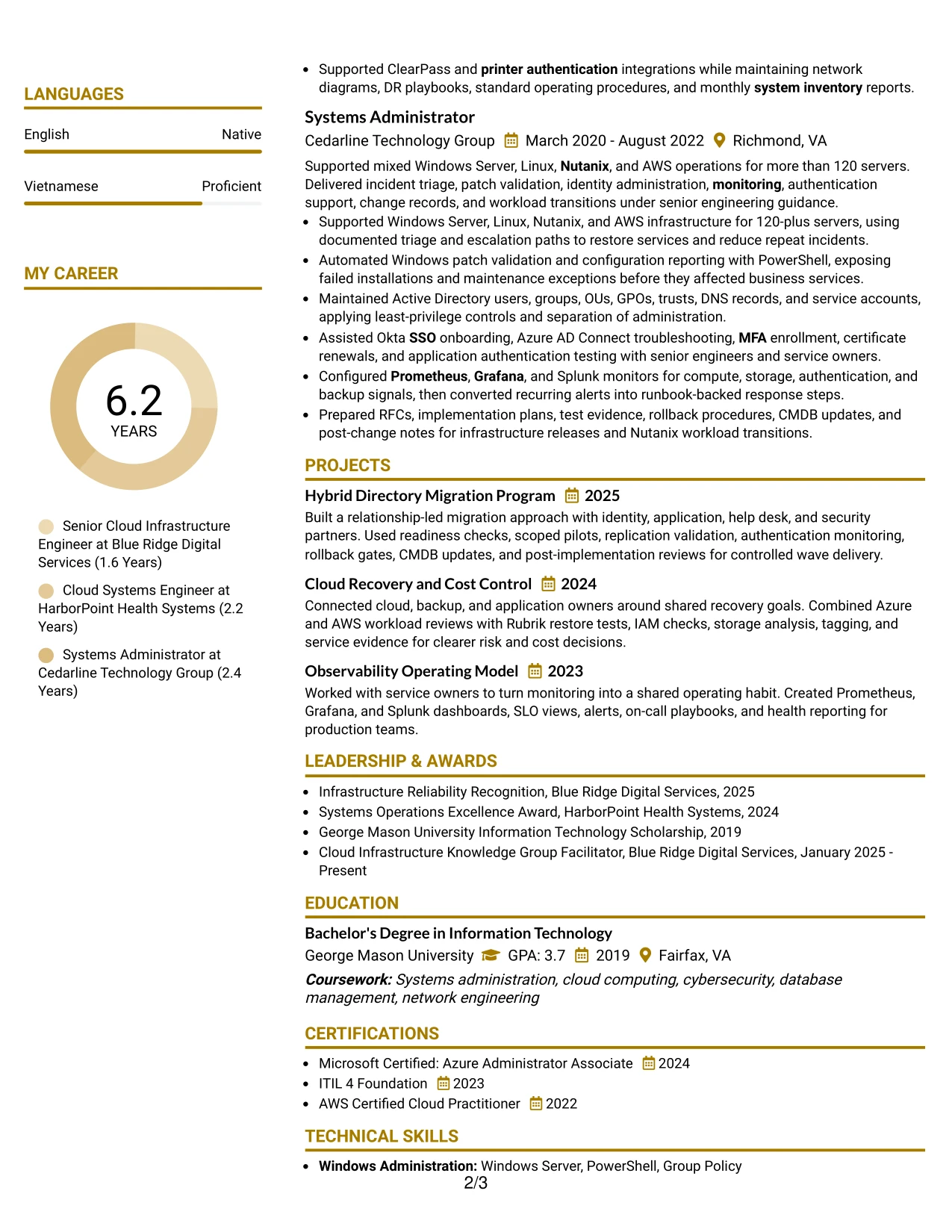
The Bold Color Header Professional Format places the format name at the start of a conventional resume structure, with a strong header followed by a focused summary and clearly labeled sections. That organization gives immediate context before the reviewer reaches detailed bullets about cloud platforms, identity services, automation, and operational governance.
A strong header should lead into evidence rather than decoration. The resume can use the summary for the six-plus years of experience, then use reverse-chronological bullets to show ownership of 240 servers, directory modernization, Okta administration, dashboards, backup testing, and cutover controls. Standard section labels keep the information accessible to ATS systems.
Why the Bold Color Header Professional Format Works for a Resume
- A prominent header makes the target role and contact information easy to identify.
- The summary gives context before the reviewer reaches detailed technical bullets.
- Reverse-chronological experience presents progression and recent ownership clearly.
- Skills can capture exact terms such as Azure AD, Nutanix, Rubrik, and Terraform.
- Achievement bullets show scope, tools, controls, and service outcomes together.
- Certifications support the cloud and ITIL qualifications listed in the profile.
- Conventional section order improves ATS extraction and fast recruiter scanning.
Best For
- Resumes that need immediate role and contact visibility at the top of the page.
- Candidates whose recent experience should receive clear priority over older details.
- Technical applications with many exact platform and governance keywords.
- Professionals who want a strong first section followed by conventional resume navigation.
- Documents that must balance a bold presentation with ATS-readable structure.
- Applications where certifications and measurable operating scope reinforce credibility.
- Resumes built around concise achievement bullets rather than long narrative blocks.
- An IT Cloud Engineer resume needing strong scan-and-structure discipline.
#26 Photo Header Color Sidebar Format Resume Example
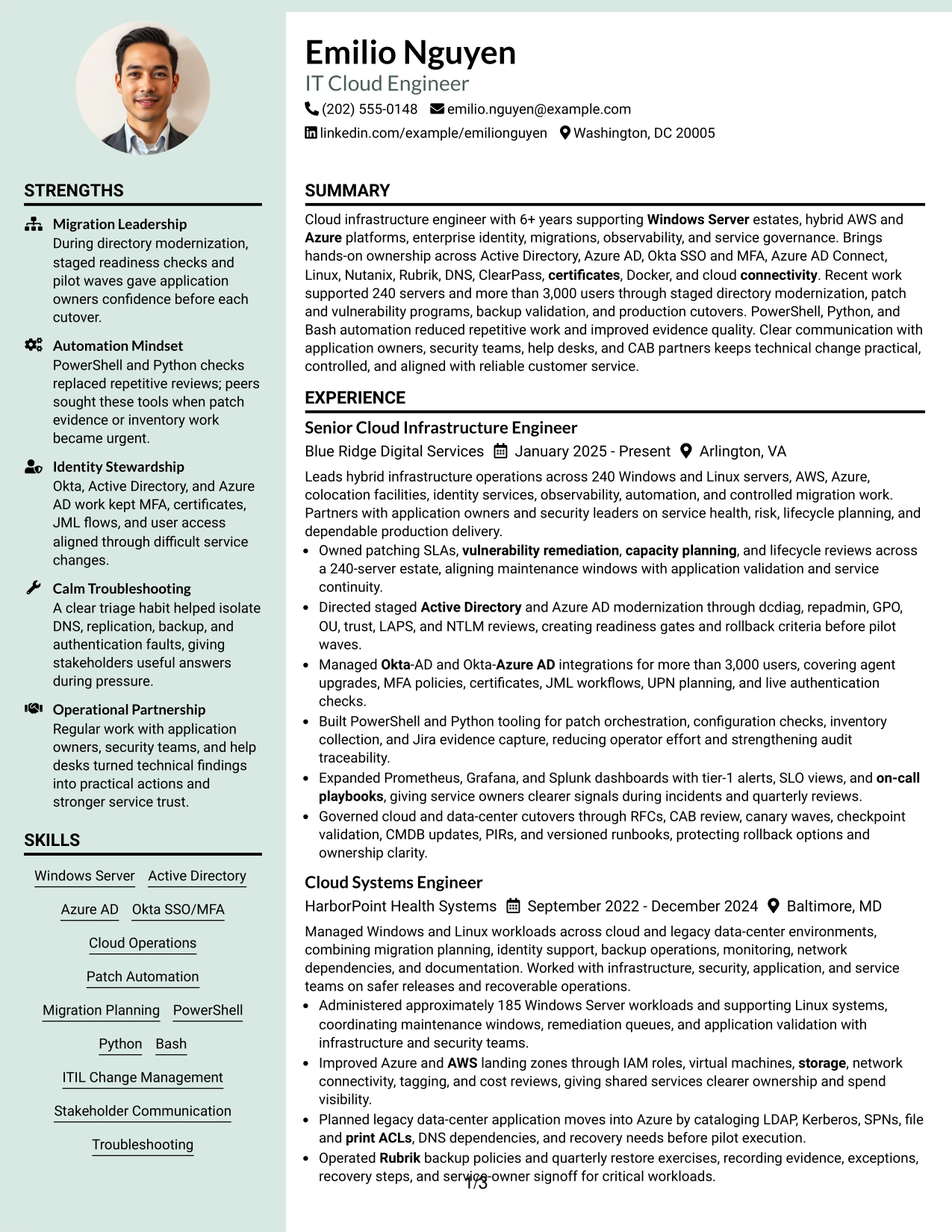
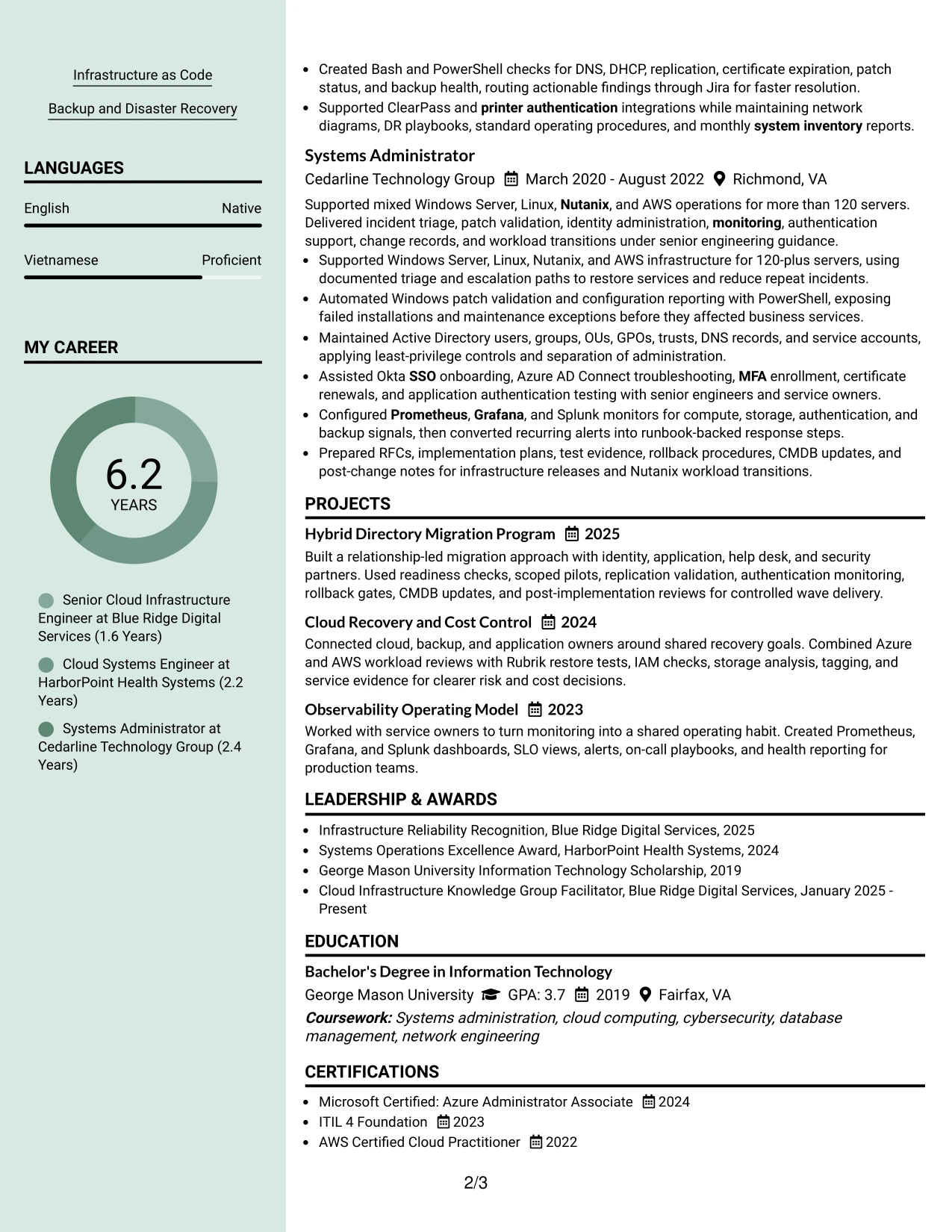
Readers can move from the header to the summary, then through the color sidebar and into the main experience record. This path works well when the resume must show both a broad technical toolkit and detailed operating evidence. The sidebar can hold skills, certifications, and contact details, while the main column carries infrastructure ownership and migration achievements.
The main content should stay selective even when the background is substantial. Bullets can highlight 240 Windows and Linux servers, more than 3,000 supported users, cloud landing-zone work, identity integrations, monitoring, and Rubrik recovery exercises. A clear hierarchy keeps the photo and color treatment secondary to the resume evidence.
Why the Photo Header Color Sidebar Format Works for a Resume
- The header gives the reviewer a clear starting point for the document.
- A sidebar can hold dense technical categories without interrupting the experience narrative.
- The main column provides room for detailed infrastructure and migration bullets.
- A photo can support a consistent personal presentation when appropriate for the application.
- Color blocks help distinguish skills, certifications, and contact information.
- Measurable scope remains visible in the primary reading path.
- Standard section labels and concise bullets preserve resume usability.
Best For
- Resumes with a large technical skills inventory that needs a dedicated sidebar.
- Candidates who want detailed experience to remain in the main reading column.
- Applications where a photo is appropriate within the employer or regional context.
- Professionals combining cloud platforms, identity services, monitoring, and recovery work.
- Documents that need to present substantial content without using long paragraphs.
- Resumes where certifications and tools should remain visible during an experience review.
- A visually confident presentation for an IT Cloud Engineer application.
- Readers who benefit from a guided path through summary, skills, and evidence.
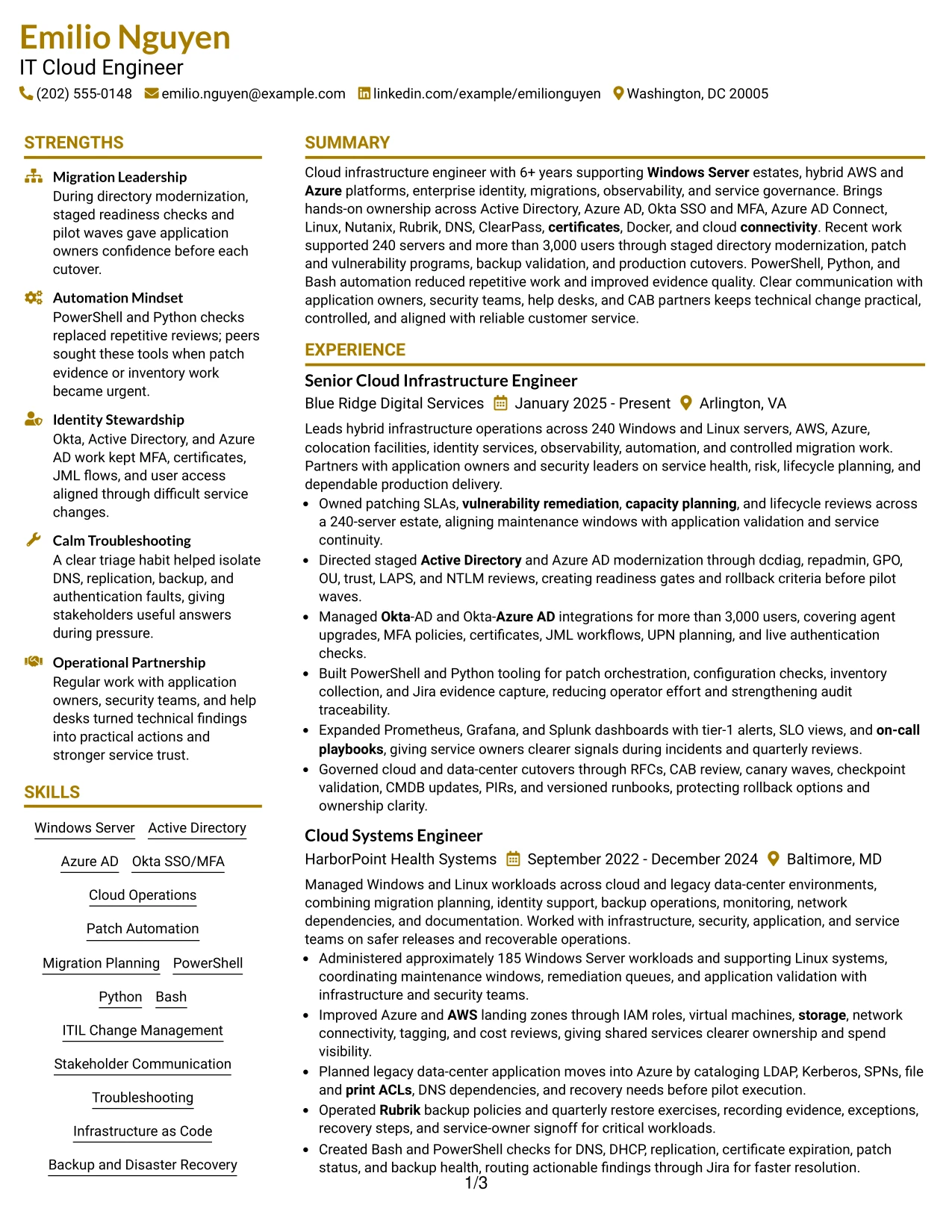
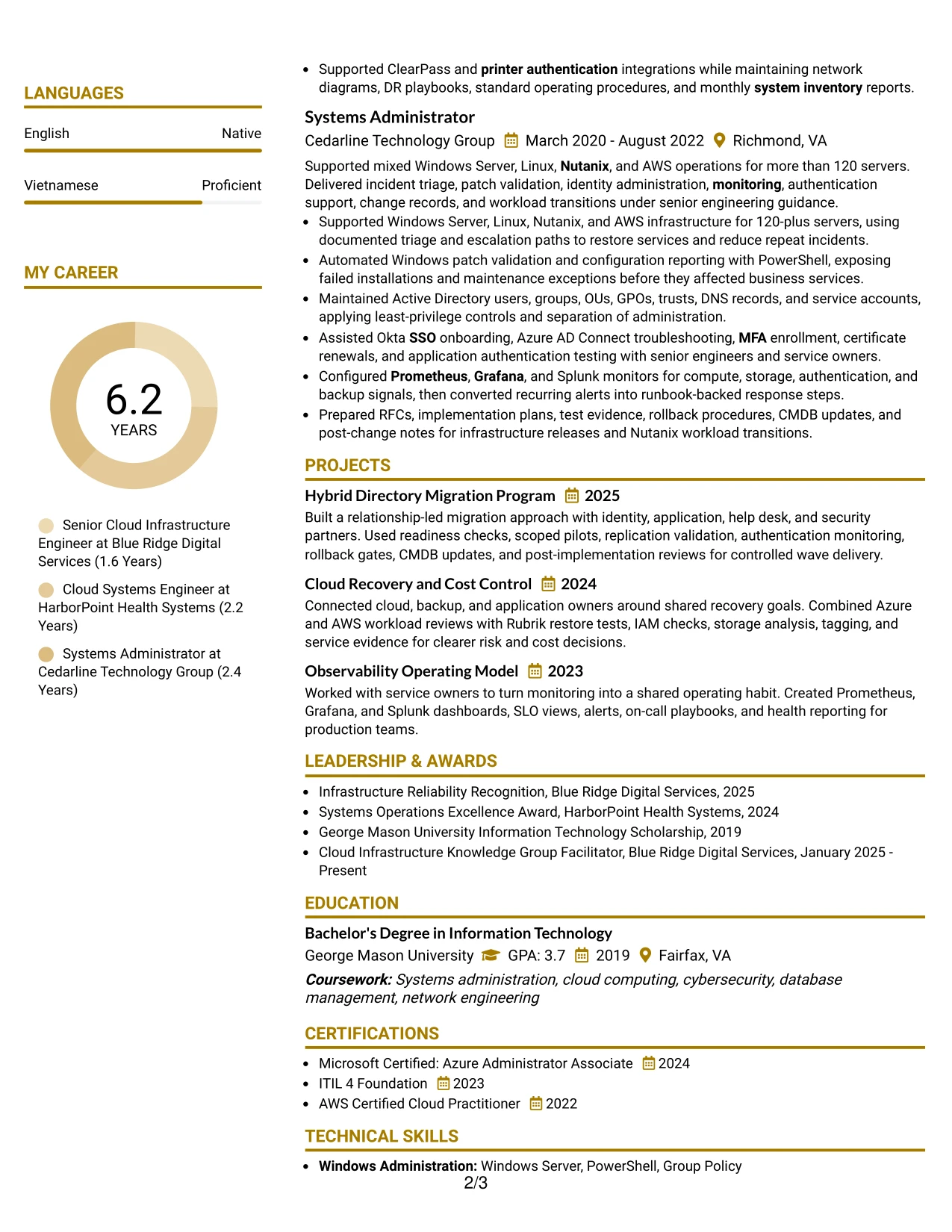
#27 Top Left Header Color Accent Format Resume Example
The evidence receiving priority is the resume's measurable infrastructure work: ownership of 240 servers, identity administration for more than 3,000 users, staged directory modernization, and automation that improved audit traceability. A top-left header can introduce that evidence quickly, then direct the reader into a single-column record of experience, skills, projects, education, and certifications.
Each bullet should make the relationship between action and result easy to understand. The resume can connect Prometheus and Grafana dashboards to SLO views, Rubrik to restore exercises, and PowerShell, Python, and Bash to repeatable operations. A limited color accent keeps attention on these facts while standard keywords support ATS matching.
Why the Top Left Header Color Accent Format Works for a Resume
- The top-left header gives immediate visibility to the target role and contact details.
- A single-column structure supports a natural top-to-bottom review.
- Achievement bullets can prioritize scope, ownership, and operational results.
- Technical keywords remain close to the evidence that demonstrates them.
- Projects can add context for migration, recovery, and observability work.
- Education and certifications fit into the hierarchy without weakening experience focus.
- A modest accent improves visual navigation while preserving ATS-friendly text flow.
Best For
- Resumes where measurable infrastructure evidence should appear early and clearly.
- Candidates with strong platform, automation, and governance achievements to document.
- Single-column applications requiring simple reading on screens and mobile devices.
- Professionals who want projects to reinforce, rather than repeat, employment history.
- Technical submissions that depend on exact ATS terms and concise supporting bullets.
- Documents emphasizing server scale, user scope, migration controls, and recovery evidence.
- Applications where a small visual accent is useful but content must remain central.
- An IT Cloud Engineer resume built around verifiable operating results.
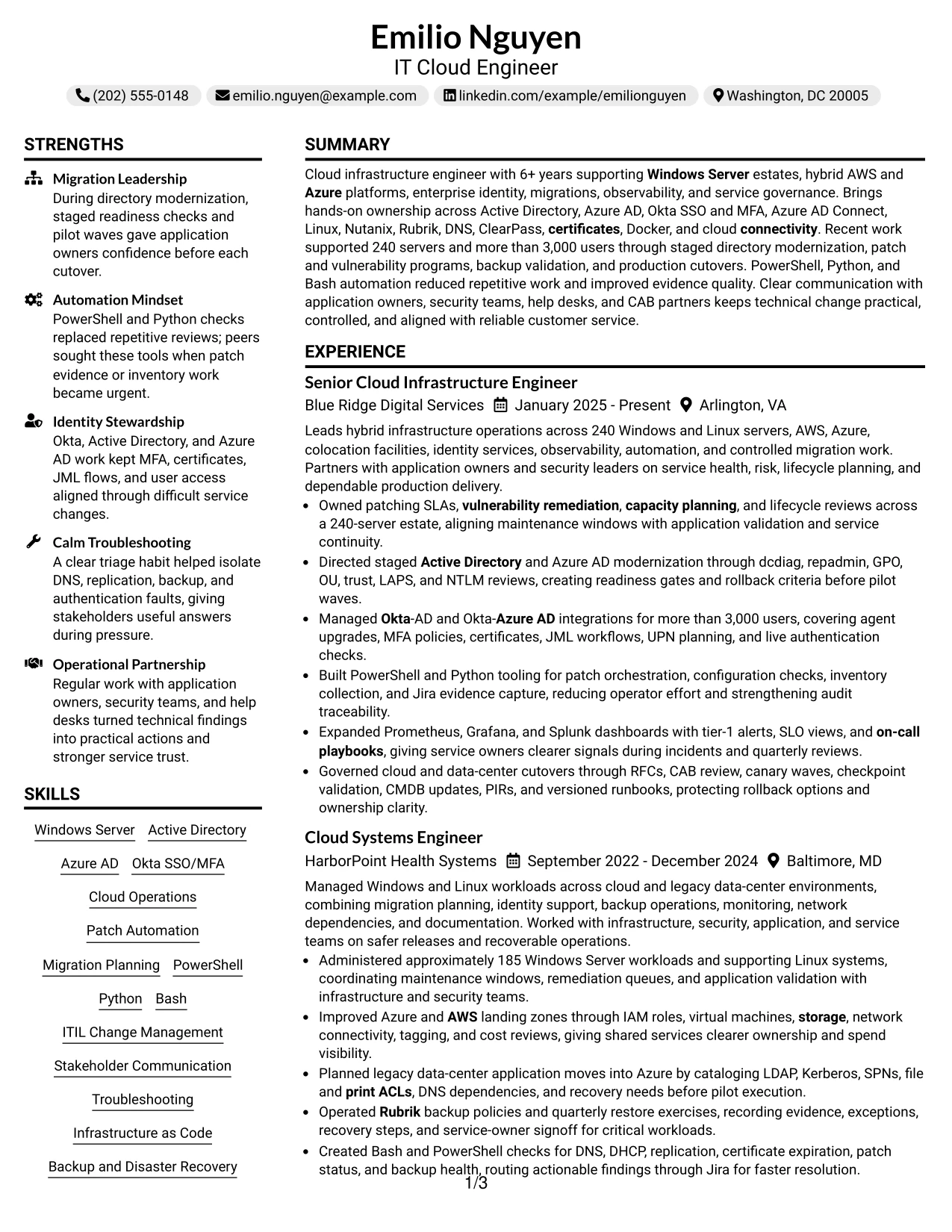
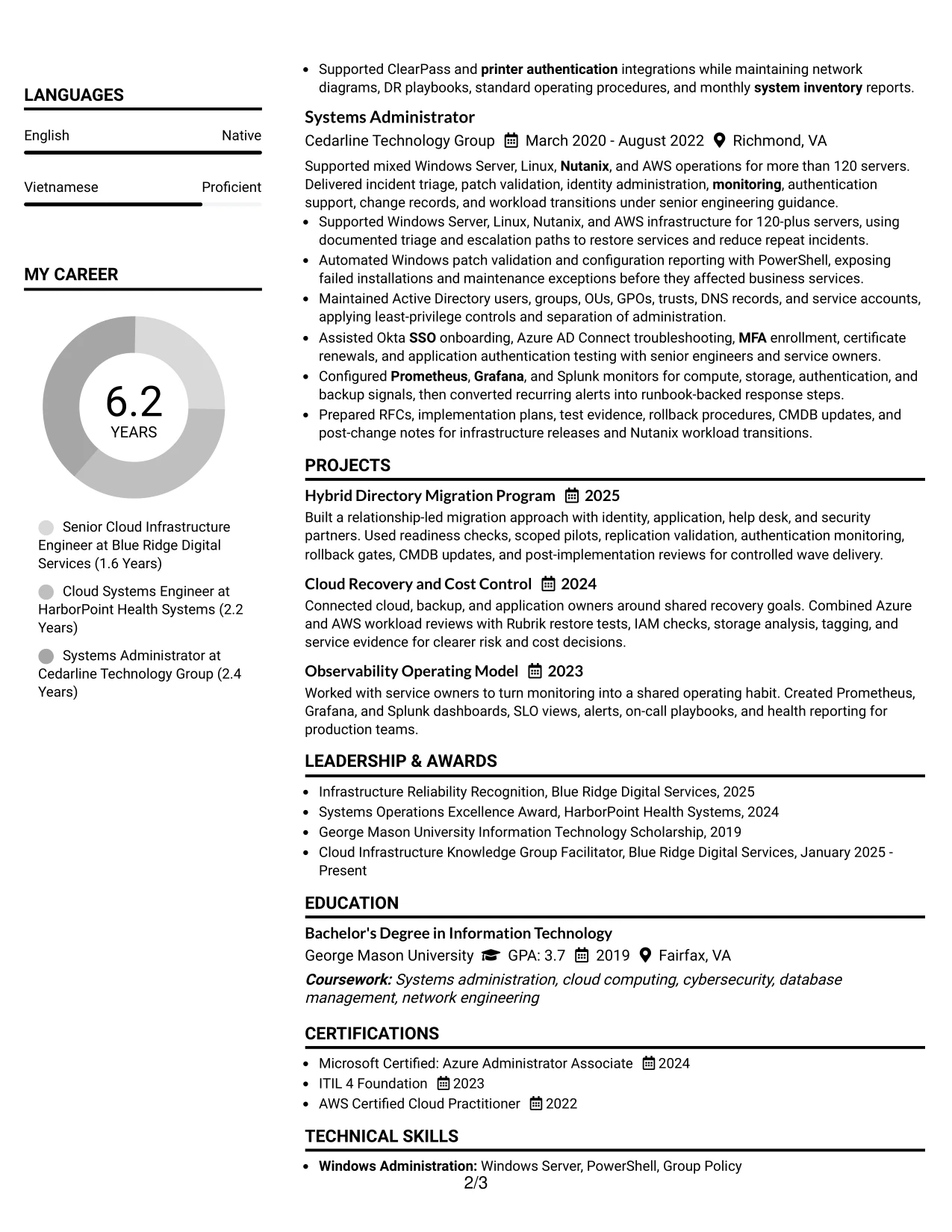
#28 Centered Header Classic Two Column Format Resume Example
Content is balanced between a centered identity block and two organized columns, allowing the resume to present both technical breadth and detailed experience. Supporting sections such as skills, certifications, education, and projects can occupy one side, while the other preserves space for achievement bullets and employment history.
This structure suits a practical review of the IT Cloud Engineer profile. The reader can find Windows Server, AWS, Azure, GCP, Okta, monitoring, automation, and recovery terms quickly, then verify them in bullets describing 240 servers, directory migration gates, cloud cutovers, and quarterly restore exercises. Centered alignment adds polish without changing the evidence hierarchy.
Why the Centered Header Classic Two Column Format Works for a Resume
- A centered header creates a clear visual entry point without using extra narrative.
- Two columns distribute skills and supporting sections beside detailed experience.
- The format can show both broad platform coverage and specific operational proof.
- Bullet structure keeps migration and change-management work easy to compare.
- Projects provide additional evidence for recovery, cost control, and observability.
- Certifications and education remain accessible during a technical review.
- Classic headings and consistent spacing support ATS parsing and human readability.
Best For
- Applications that need a balanced presentation of supporting details and experience.
- Candidates with multiple projects that strengthen the core employment record.
- Resumes combining cloud operations with identity, monitoring, backup, and governance work.
- Readers who prefer a centered introduction followed by orderly two-column navigation.
- Documents where technical breadth must be visible without creating a long skills list.
- Professionals presenting both hands-on delivery and structured change practices.
- Screen-based resume reviews that benefit from compact but readable organization.
- An IT Cloud Engineer application requiring balanced space for scope and evidence.
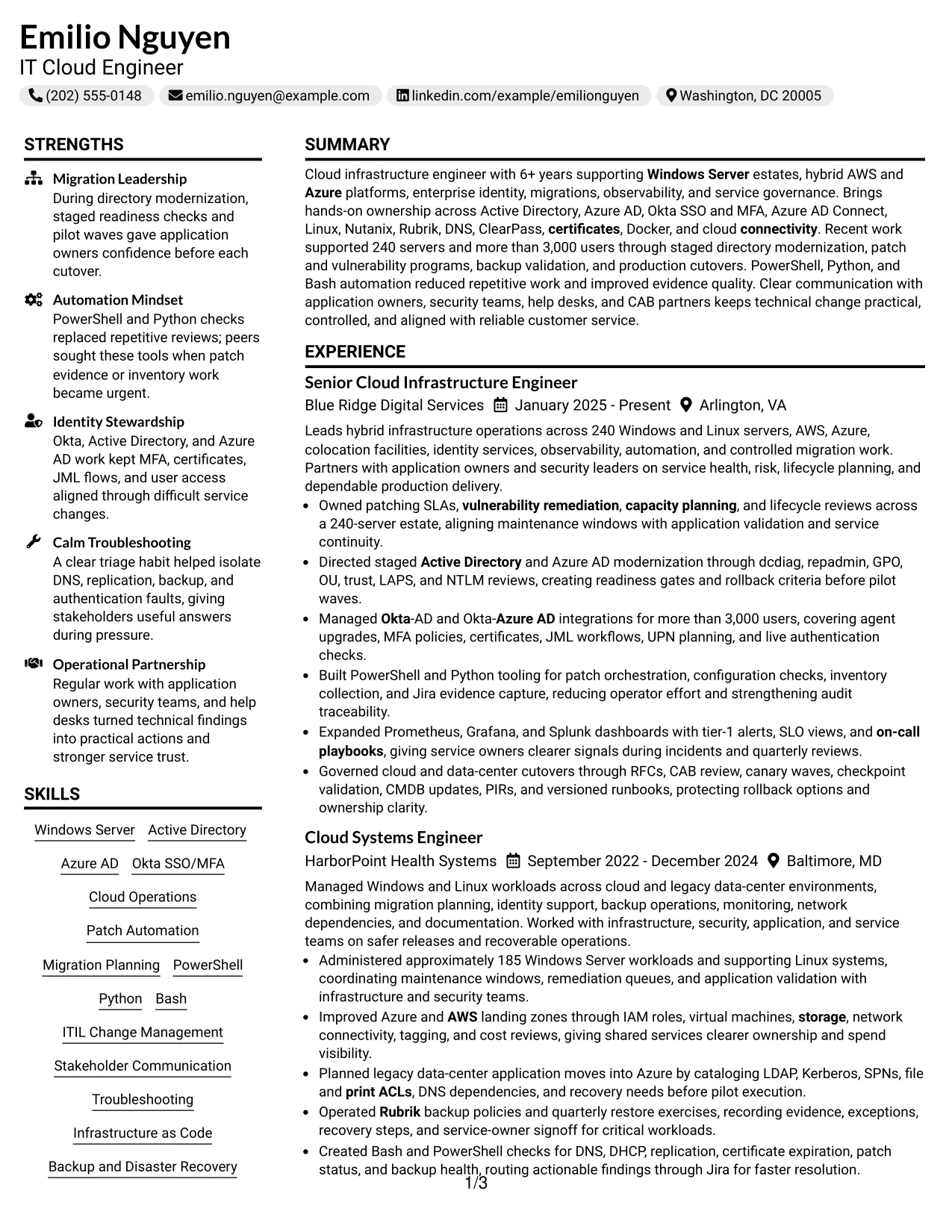
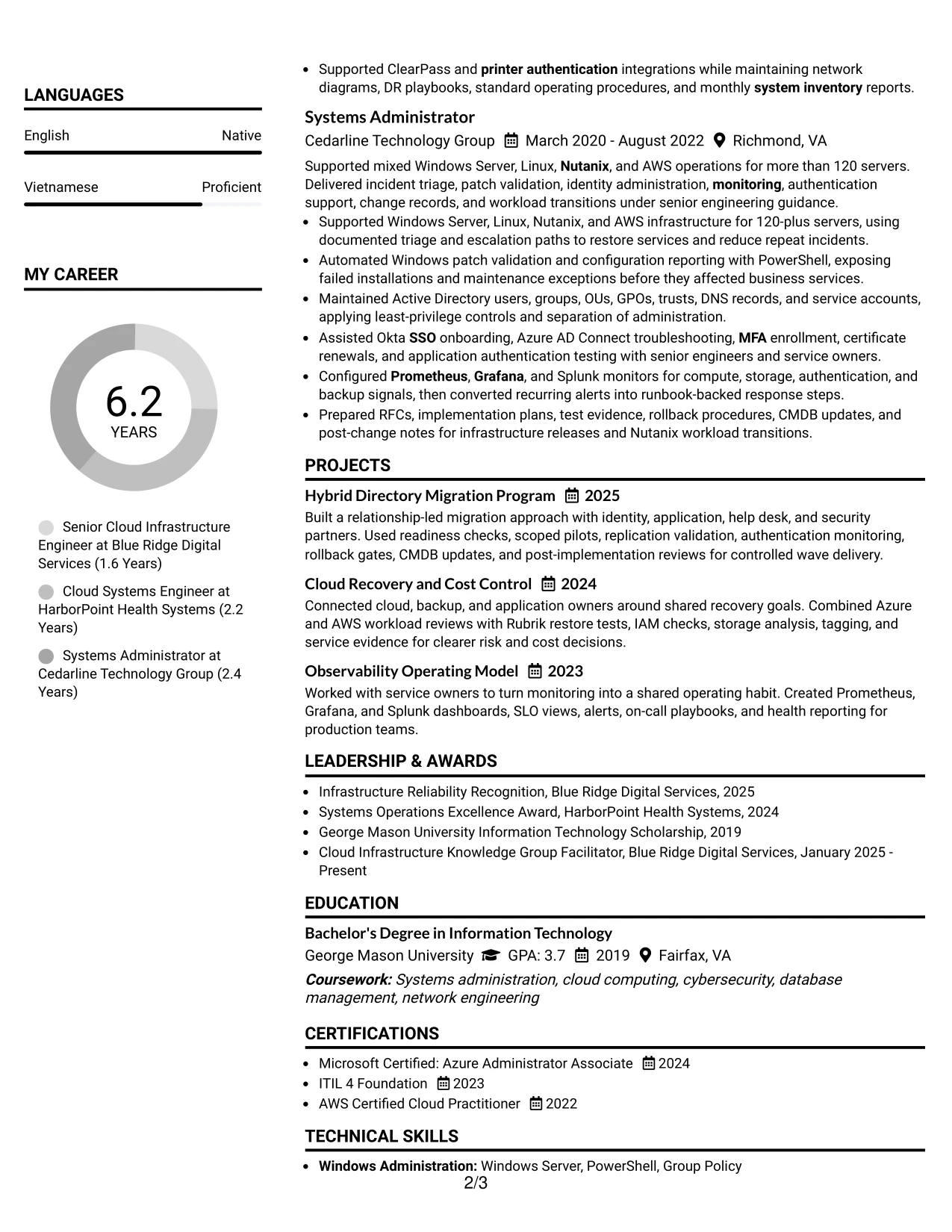
#29 Left Aligned Header Clean Two Column Format Resume Example
For a practical application, this format makes a detailed infrastructure resume easier to review from the first line. A left-aligned header supports quick identification of the target role, while two columns organize skills, certifications, education, and projects beside the career record.
The main experience area can carry concise bullets on patching SLAs, Active Directory and Azure AD modernization, Okta SSO and MFA, cloud landing zones, monitoring, and backup posture. Supporting sections can reinforce the story with Microsoft Azure Administrator Associate, ITIL 4 Foundation, AWS Certified Cloud Practitioner, and relevant project evidence. Clean spacing keeps the page readable without reducing technical depth.
Why the Left Aligned Header Clean Two Column Format Works for a Resume
- The left-aligned header supports fast identification during an application review.
- Two columns keep supporting qualifications close to the employment record.
- Clean spacing helps technical bullets remain readable at normal screen size.
- The format can present certifications without burying recent achievements.
- Projects add targeted context for migration, recovery, and observability programs.
- Skills can be grouped by platform, identity, automation, and operations.
- Standard text structure supports ATS review and consistent keyword recognition.
Best For
- Applications needing a direct, familiar header and efficient two-column layout.
- Candidates who want certifications and projects visible beside detailed employment history.
- Technical resumes with many related platforms that need orderly grouping.
- Professionals presenting both operational ownership and controlled migration work.
- Readers reviewing documents on screen who need strong alignment and spacing.
- Submissions where exact cloud, identity, automation, and monitoring terms matter.
- Resumes that should feel polished without adding decorative complexity.
- An IT Cloud Engineer resume designed for quick, practical comparison.
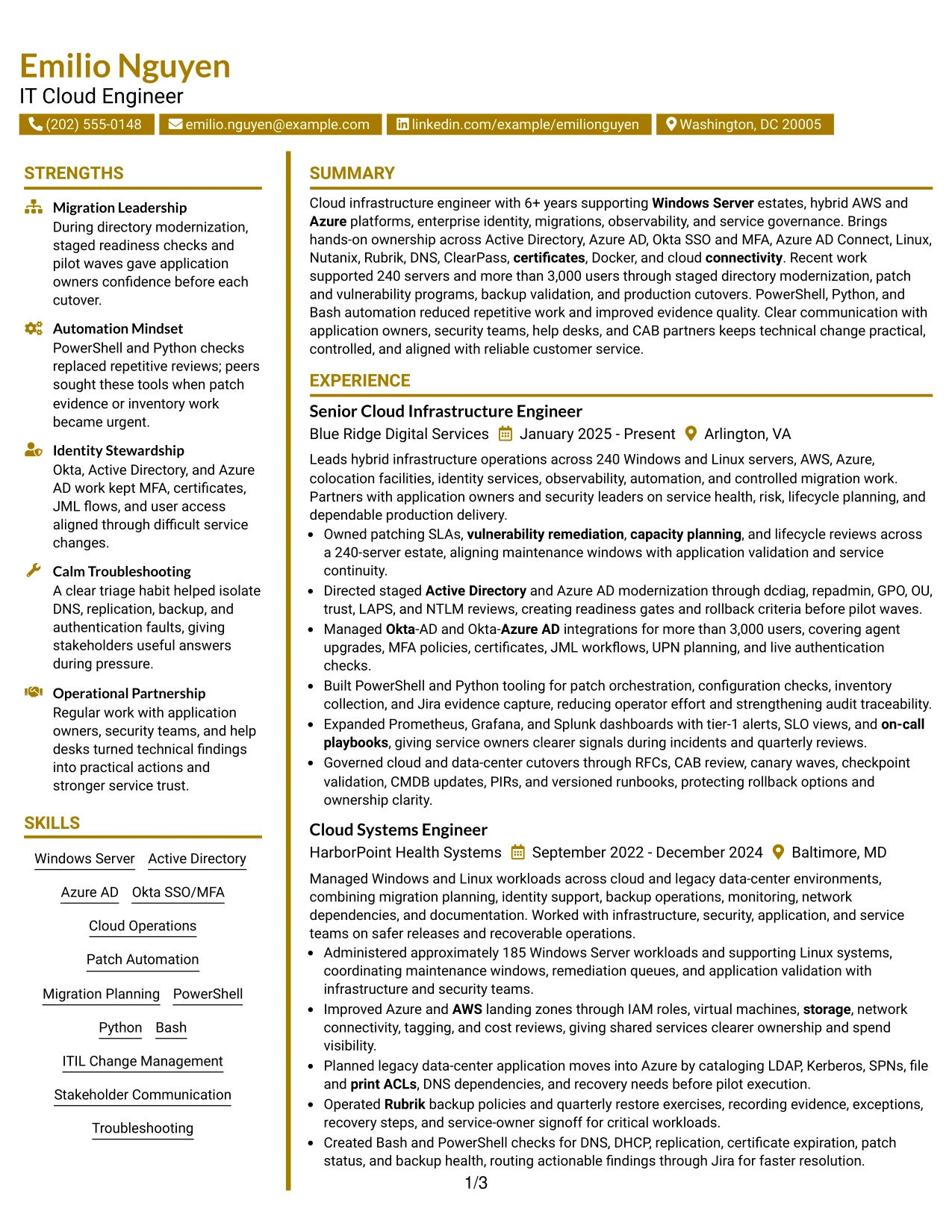
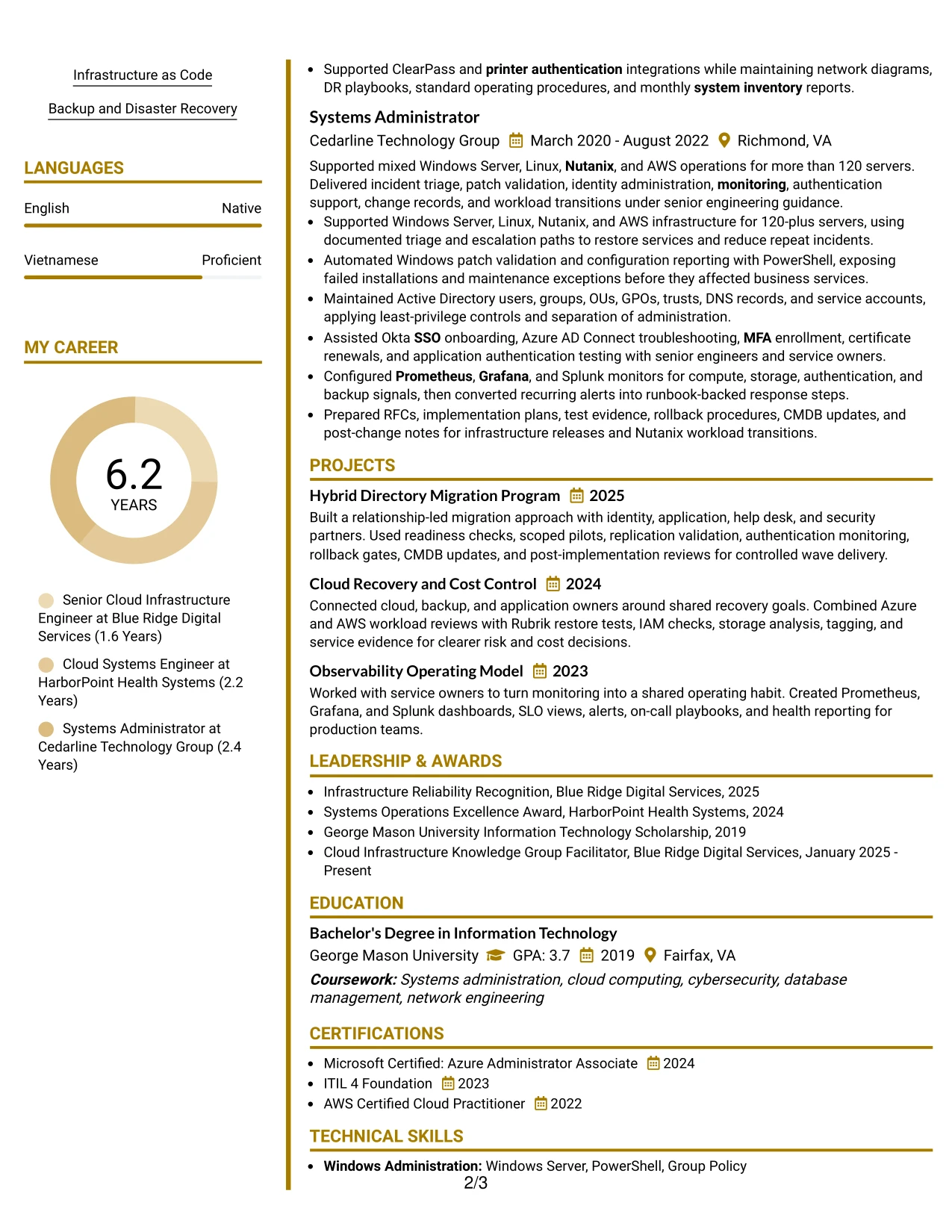
#30 Accent Divider Modern Two Column Format Resume Example
A restrained visual hierarchy gives the resume a modern, controlled impression. Accent dividers can guide the eye between the summary, skills, experience, projects, and credentials while two columns preserve room for both technical breadth and detailed accomplishment bullets.
The content should remain grounded in evidence from the resume: 240-server operations, Okta and directory modernization, staged migrations, Prometheus and Grafana observability, PowerShell and Python tooling, and governed cutovers. The divider system helps separate these themes so the reader can understand scope, methods, and outcomes without searching through dense text.
Why the Accent Divider Modern Two Column Format Works for a Resume
- Dividers create visible boundaries between related resume sections.
- Two columns support a compact presentation of skills, projects, and credentials.
- Modern spacing can highlight recent experience without making older roles disappear.
- Bullets can distinguish technical action from governance and documentation evidence.
- The format accommodates both platform keywords and measurable operating scope.
- Projects can extend the evidence base without duplicating every employment bullet.
- A controlled visual system remains compatible with a professional technical application.
Best For
- Resumes that need modern section separation while retaining a serious professional tone.
- Candidates presenting several evidence types, including operations, projects, and certifications.
- Applications where cloud, identity, observability, and migration themes need distinct visual paths.
- Professionals who want two-column efficiency without a crowded appearance.
- Documents that benefit from clear boundaries between hands-on work and governance.
- Readers comparing recent accomplishments with supporting technical qualifications.
- A polished IT Cloud Engineer resume with precise organization and moderate visual character.
- ATS-conscious applications using familiar headings beneath a modern layout.
#31 Shaded Labels Clean Two Column Format Resume Example
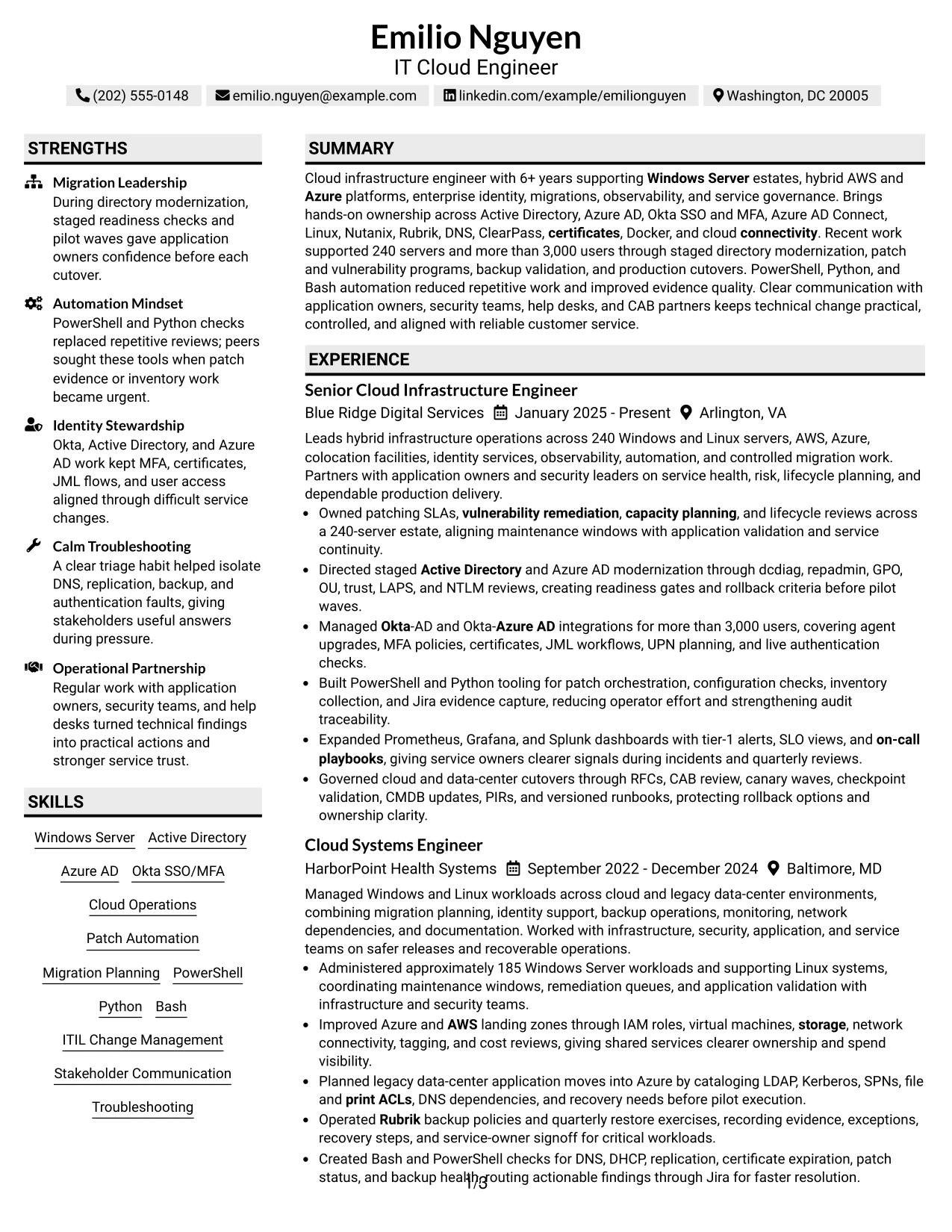
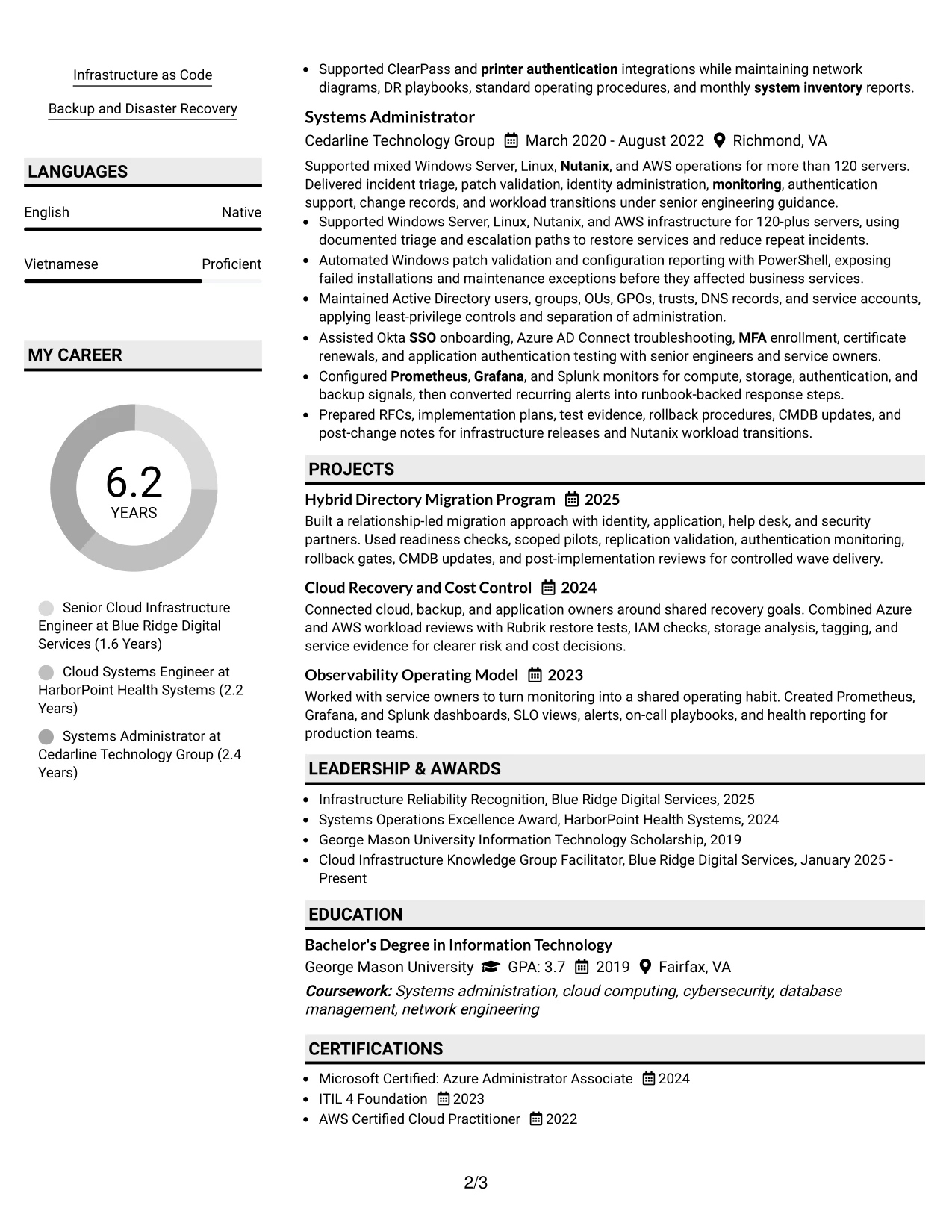
The Shaded Labels Clean Two Column Format starts with clear section structure: a summary, labeled skills, experience, projects, education, and certifications. Shaded labels can make those categories easy to locate, while the two-column arrangement keeps supporting information available without taking space from the most important work history.
A strong resume hierarchy should place recent accomplishments first and use grouped labels for technical terms. Windows Server, Active Directory, Azure AD, Okta, AWS, Azure, GCP, Rubrik, Nutanix, PowerShell, Python, Bash, and Prometheus can be connected to bullets that show administration, migration, automation, monitoring, and recovery evidence.
Why the Shaded Labels Clean Two Column Format Works for a Resume
- Shaded labels help readers locate each resume section quickly.
- Two columns make a broad technical inventory easier to manage.
- Recent experience can receive the largest share of page space.
- Grouped skills improve keyword recognition without creating a random list.
- Bullets can show tools, scope, controls, and results in a consistent pattern.
- Projects and certifications remain visible as supporting evidence.
- Clean labels and standard headings support ATS extraction and human review.
Best For
- Resumes with many technical categories that require clear labels and grouping.
- Candidates who need to keep skills visible while giving experience priority.
- Applications where cloud, identity, automation, and recovery terms must be found quickly.
- Professionals combining employment history with focused project evidence.
- Readers who prefer a structured two-column page with strong section cues.
- Documents that need compact organization without sacrificing achievement detail.
- ATS-aware submissions using familiar section names and plain searchable text.
- An IT Cloud Engineer resume requiring efficient scan-and-structure control.
#32 Photo Header Color Accent International Format Resume Example
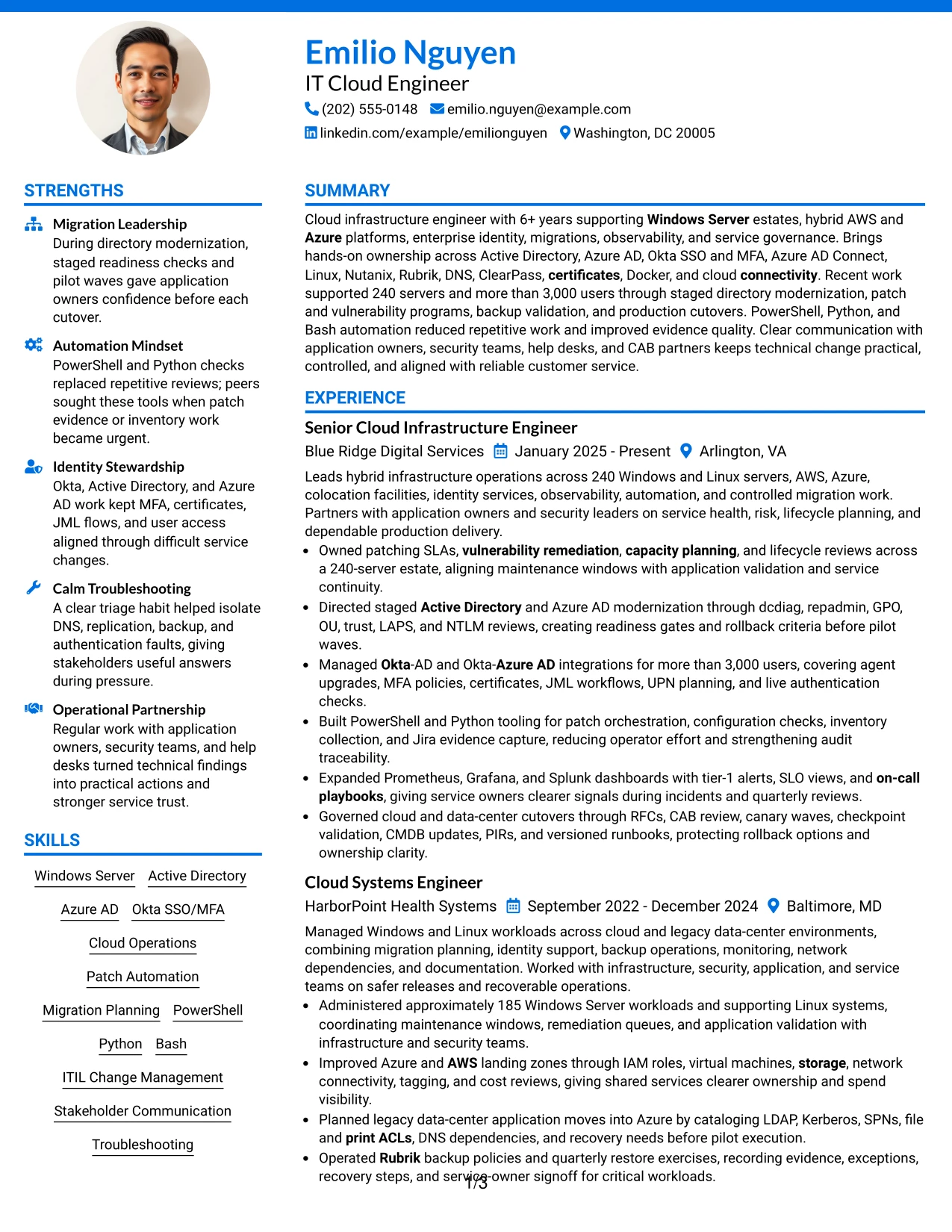
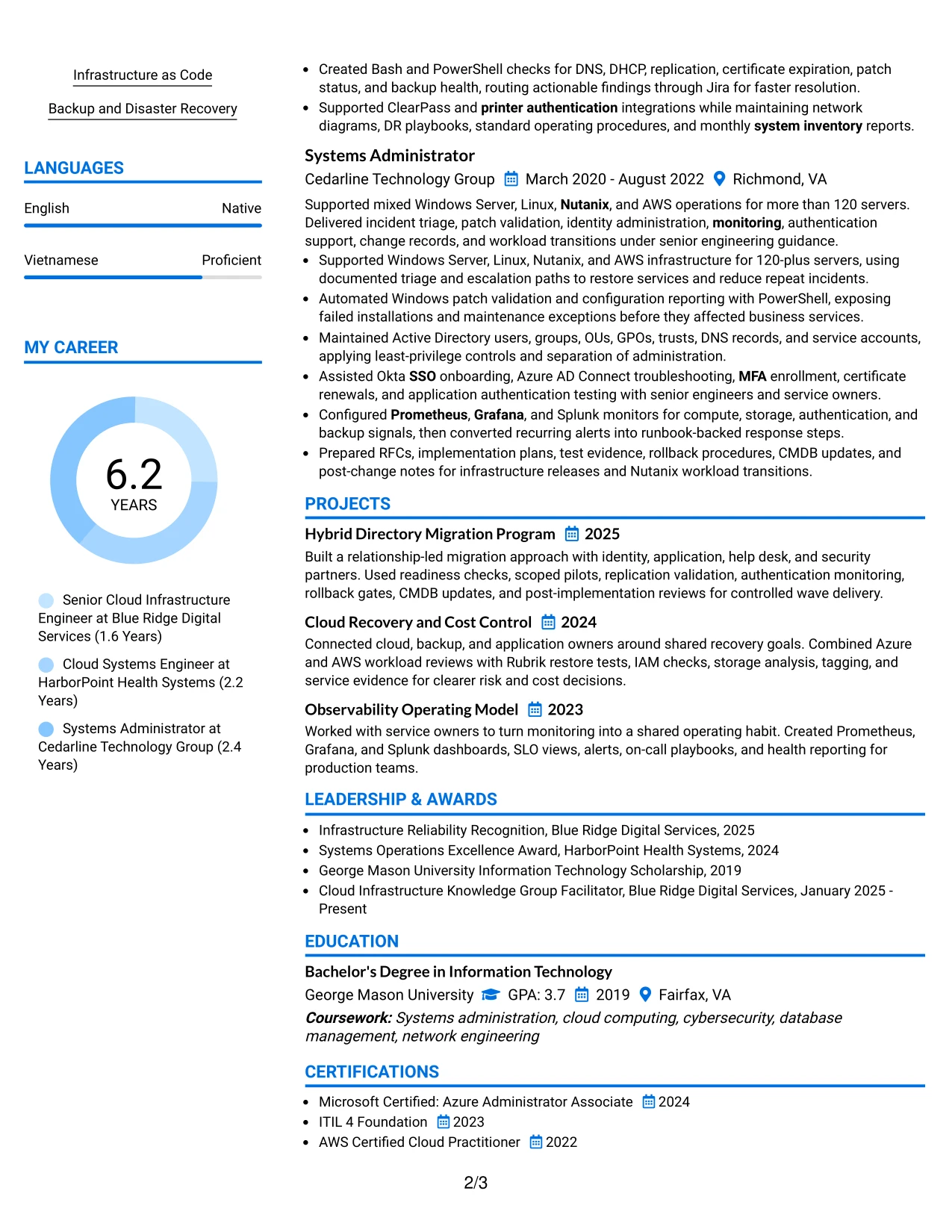
Readers can move from the header and photo to a concise summary, then through the accent sections and detailed experience record. This path can support a substantial resume with cloud platforms, identity services, automation, migrations, projects, certifications, and leadership activities, while the photo and color treatment establish a consistent personal presentation when appropriate.
The page should still prioritize evidence over visual elements. The experience section can show 240-server operations, Okta integrations for more than 3,000 users, Azure and AWS work, Rubrik restore testing, and monitoring with Prometheus, Grafana, and Splunk. Clear section labels make the content usable across varied application settings and support reliable keyword review.
Why the Photo Header Color Accent International Format Works for a Resume
- The header gives readers a clear starting point for a detailed document.
- A photo can support personal presentation when it fits the application context.
- Color accents help separate summary, skills, experience, and credentials.
- The format can accommodate substantial technical and project content.
- Experience bullets keep measurable scope visible beneath the visual header.
- Certifications and activities can add context without interrupting the main record.
- Consistent labels make a globally readable resume easier to navigate.
Best For
- Resumes with substantial technical content across experience, projects, and credentials.
- Candidates applying in contexts where a photo is acceptable and useful.
- Professionals who want clear visual sections around cloud and infrastructure evidence.
- Applications requiring both detailed keywords and an approachable personal presentation.
- Documents that combine operational delivery with leadership or mentoring activities.
- Readers who benefit from a guided route through a high-volume resume.
- Technical applications where monitoring, identity, migration, and recovery work all matter.
- An IT Cloud Engineer resume needing content volume with organized visual cues.
#33 Large Profile Photo International Two Column Format Resume Example
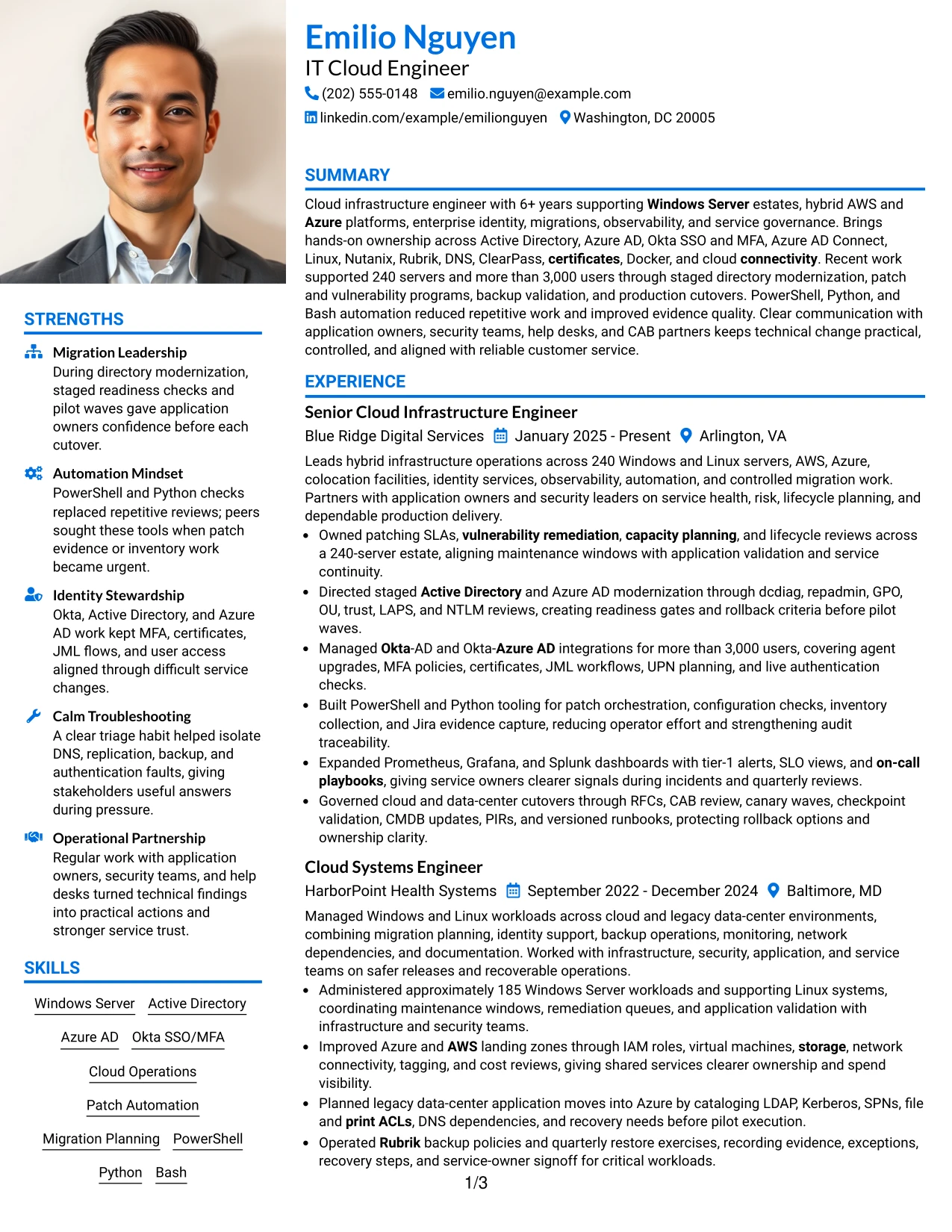
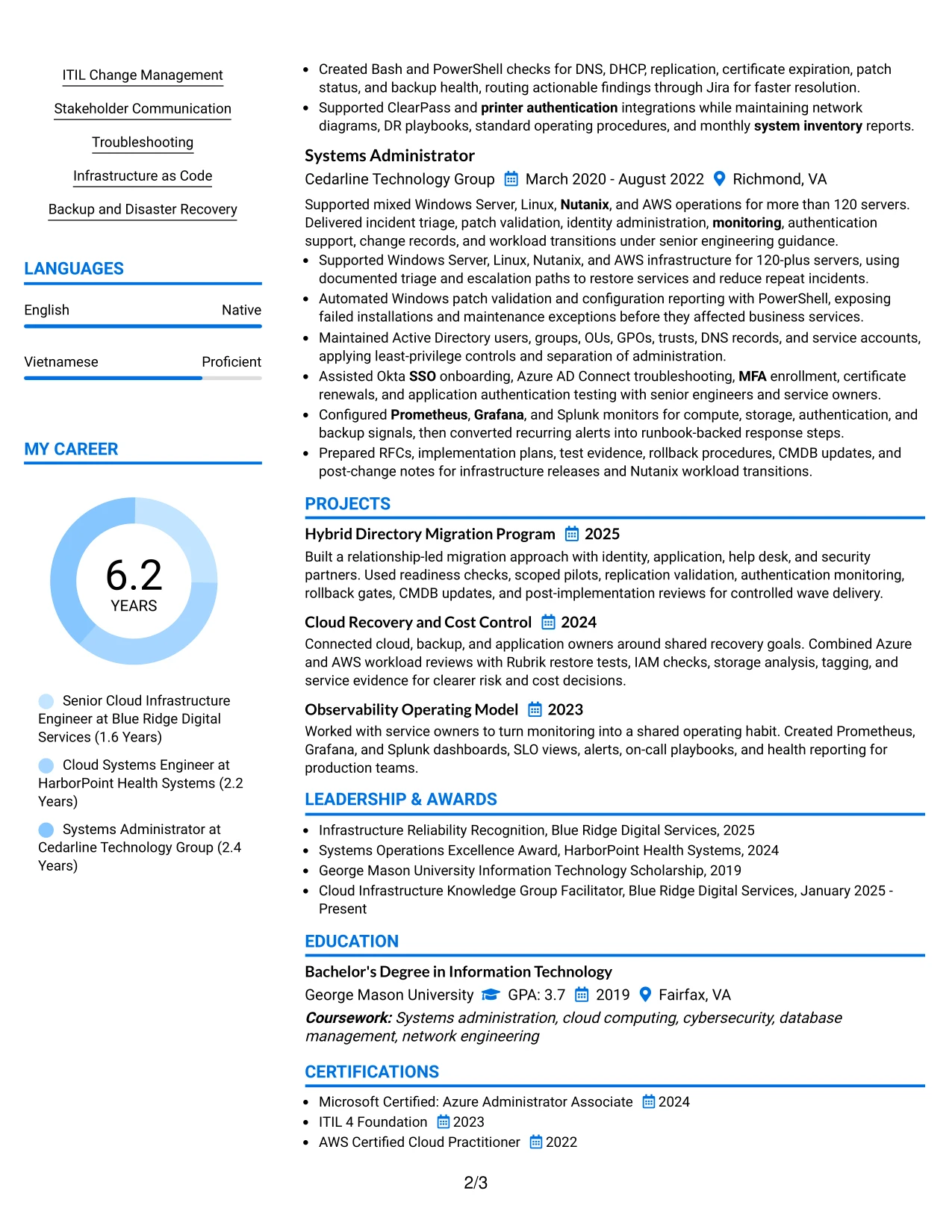
The evidence receiving priority should remain the professional summary and achievement record, even when a large profile photo occupies prominent header space. Two columns can then divide technical skills, certifications, projects, and activities from detailed employment bullets, giving the resume a clear balance between personal presentation and professional proof.
The strongest evidence includes administration across 240 Windows and Linux servers, identity support for more than 3,000 users, staged Active Directory modernization, cloud migration planning, PowerShell and Python automation, and quarterly Rubrik restore exercises. The large photo should not reduce the space needed for standard headings, readable bullets, or ATS-relevant keywords.
Why the Large Profile Photo International Two Column Format Works for a Resume
- The evidence-led hierarchy keeps experience more important than the large visual header.
- Two columns organize high-volume technical content into manageable groups.
- A profile photo can support presentation in application contexts where it is expected.
- The main experience area can retain detailed bullets and measurable scope.
- Skills and certifications remain visible without interrupting the career record.
- Projects can reinforce migration, recovery, and observability capabilities.
- Standard labels and searchable text protect resume usability and ATS review.
Best For
- Applications where a profile photo is accepted within the relevant regional context.
- Resumes with high content volume across employment, projects, skills, and credentials.
- Candidates who need detailed infrastructure evidence beside a strong personal header.
- Professionals combining cloud operations, identity, automation, and recovery experience.
- Two-column documents that must show both technical breadth and measurable scope.
- Readers who want supporting qualifications separated from the main achievement record.
- Applications where personal presentation matters but standard resume structure must remain.
- An IT Cloud Engineer resume requiring prominent evidence within an international layout.
Why Build Your IT Cloud Engineer Resume with ResumeInMinutes
ResumeInMinutes helps you translate infrastructure operations into a structured resume that is easy to scan and customize. The format supports clear connections between platforms, responsibilities, controls, and measurable service outcomes.
- ATS-friendly section structure
- Cloud infrastructure keyword guidance
- Achievement-focused experience bullets
- Skills and tools organization
- Free PDF resume previews
- Resume customization support
The examples help you present Windows and Linux administration, AWS and Azure operations, identity integration, migration governance, automation, monitoring, backup validation, and documentation as a coherent professional record. You can then adjust emphasis to match the requirements of the IT Cloud Engineer position.
See Also
- 33 AI/ML Engineer Intern, Cloud & Developer Infra Resume Templates with Example 2026 (ATS-Optimized)
- 33 Applied AI Research Engineer - Production ML & Cloud Resume Templates with Example 2026 (ATS-Optimized)
- 33 Associate Cloud Engineer Resume Templates with Example 2026 (ATS-Optimized)
- 33 Azure Cloud Engineer Resume Templates with Example
- 33 Cloud DevOps Engineer Resume Templates with Example 2026 (ATS-Optimized)
- 33 Cloud Engineer, AWS Resume Templates with Example 2026 (ATS-Optimized)
- 33 Cloud Engineer (Azure, Entra ID) - Contract-to-hire, Hybrid Resume Templates with Example 2026 (ATS-Optimized)
- 33 Cloud Engineer - Cloud Native Infrastructure Resume Templates with Example 2026 (ATS-Optimized)
- 30+ IT Cloud Engineer Cover Letter Templates with Example 2026
- 30+ AI/ML Engineer Intern, Cloud & Developer Infra Cover Letter Templates with Example 2026
Frequently Asked Questions
Are these IT Cloud Engineer resume templates ATS-friendly?
Yes. They use readable headings, standard resume sections, and relevant terms such as Windows Server, AWS, Azure, Active Directory, Okta, PowerShell, monitoring, migrations, and backup recovery.
Are these different resumes?
No. The guide presents one IT Cloud Engineer resume example in multiple layouts and design themes, allowing you to compare presentation while keeping the content focused on the target role.
What should an IT Cloud Engineer resume include?
Include a targeted summary, technical skills, professional experience, education, certifications, projects, and measurable evidence of cloud operations, server administration, identity work, automation, monitoring, migrations, backup, or change governance.
Which keywords matter for an IT Cloud Engineer resume?
Useful keywords include Windows Server, AWS, Azure, GCP, IAM, Active Directory, Azure AD, Okta SSO/MFA, PowerShell, Python, Bash, Nutanix, Rubrik, DNS, Prometheus, Grafana, Splunk, ITIL, Jira, CMDB, and infrastructure as code.
How can I show impact in cloud infrastructure experience?
State the environment or service scope first, then explain the action and result. Use supported figures such as server counts, user populations, workload volumes, migration stages, monitoring coverage, maintenance outcomes, or recovery evidence when those figures are accurate.
Should I include certifications on an IT Cloud Engineer resume?
Yes. Relevant certifications can strengthen the resume when they are listed with the credential and year, such as Microsoft Certified: Azure Administrator Associate, ITIL 4 Foundation, or AWS Certified Cloud Practitioner.
Should I include a photo on my resume?
Include a photo only when it is customary or required in your country, region, or industry. For U.S. applications, a no-photo resume is generally the safer choice.
Can I customize these resume templates?
Yes. You can adjust the resume text, section emphasis, layout, design style, and PDF format to present your IT Cloud Engineer experience and the keywords that match a specific role.