7 Registered Nurse - Critical Care Float Resume Templates with Example
This guide shows you how to create a clear, focused Registered Nurse - Critical Care Float resume. It explains how to present your clinical evidence and choose a layout that supports quick review.
For this role, connect critical care float coverage with focused patient assessment, hemodynamic monitoring, ventilator management, medication titration, and safe handoffs. Use concise experience bullets, and include relevant licensure, certifications, and clinical tools where they apply.
Compare the resume example presented in 7 layouts, then open an example in the editor to review and customize its structure.
What Makes a Great Registered Nurse - Critical Care Float Resume in 2026
A strong resume makes critical care judgment, adaptability across units, and continuity of care easy to see. Use clear sections and focused bullets to show the scope of your clinical work.
Include relevant terms such as Trauma Intensive Care Unit (TICU), intensive care, cardiology, emergency nursing, hemodynamic monitoring, and ventilator management. Pair each keyword with accurate evidence from your experience.
Note: Resume examples are for educational purposes only. Use only information that accurately reflects your experience and qualifications. References to real organizations do not imply affiliation or endorsement.
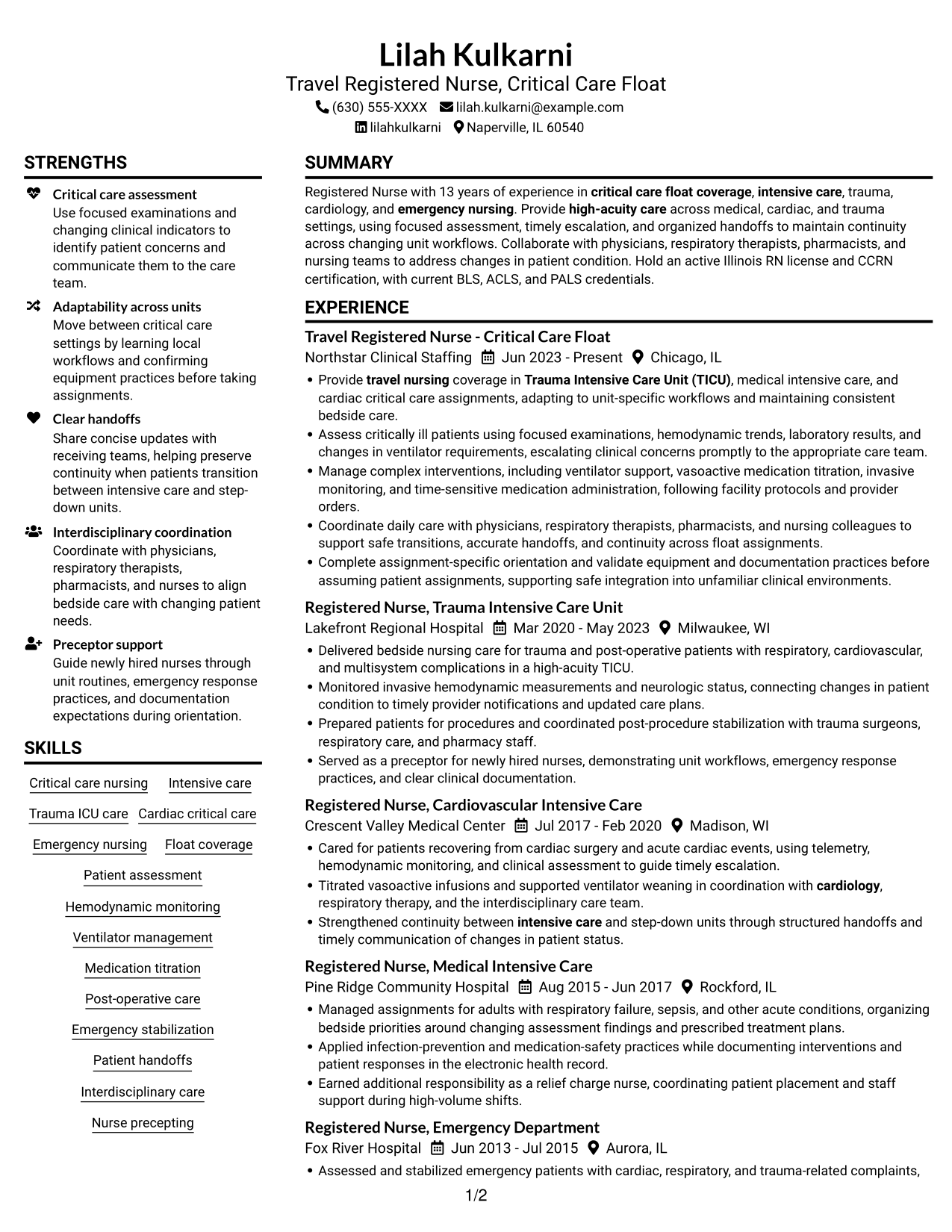
#1 Plain Two Column Format Resume Example
The Plain Two Column Format uses two body columns, giving a detailed clinical record a clearly divided reading path.
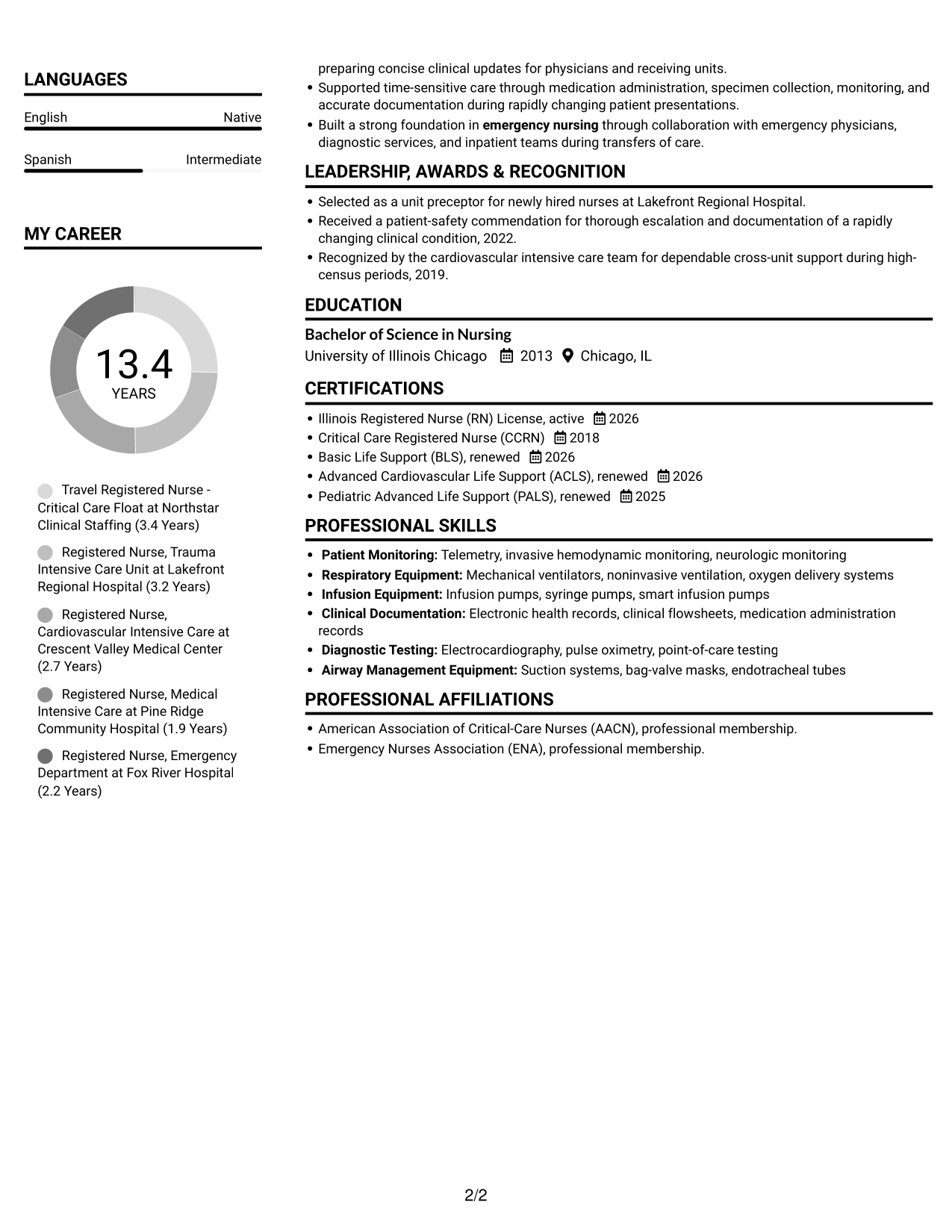
Resume Snapshot
- 13 years of experience across emergency, intensive care, cardiology, trauma, and critical care float nursing.
- Travel coverage includes Trauma Intensive Care Unit, medical intensive care, and cardiac critical care assignments.
- Active Illinois RN license, CCRN certification, and current BLS, ACLS, and PALS credentials.
- Bachelor of Science in Nursing from University of Illinois Chicago, with experience across five hospital roles.
Why This Format Works
- Two body columns give experience and supporting sections distinct, scan-friendly areas.
- Reviewers can locate education and credentials without reading every experience entry.
- The divided layout suits a record with several clinical roles and detailed credentials.
Best For
- Dense clinical career histories
- Experience and credentials in one resume
- Two-area resume reading
- Quick section lookup
- Travel nursing applications
Resume Keywords
- Illinois Registered Nurse (RN) License, active
- CCRN
- Critical care nursing
- intensive care
- Trauma Intensive Care Unit
- cardiology
- Emergency nursing
- critical care float coverage
- Provide high-acuity care across medical, cardiac, and trauma settings
- travel nursing
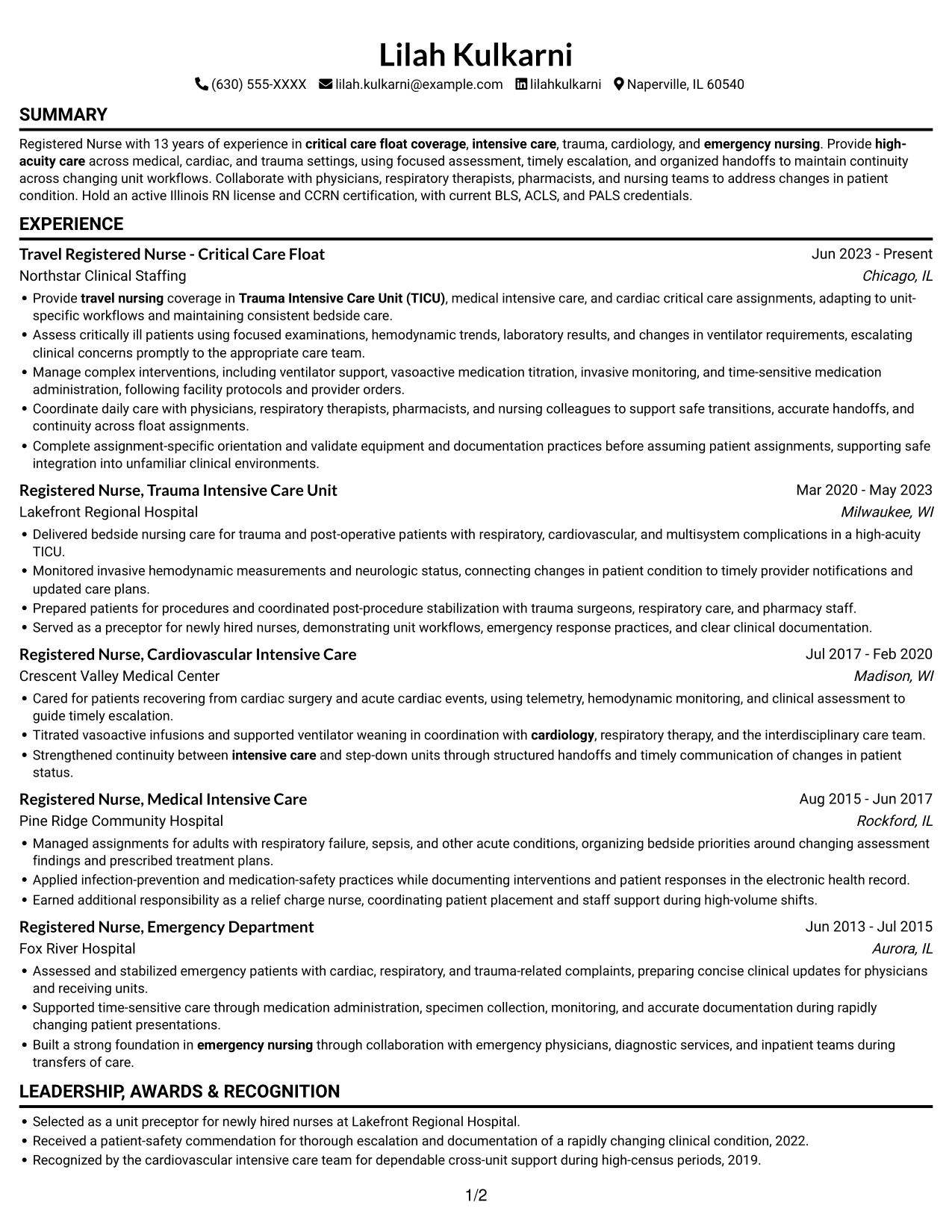
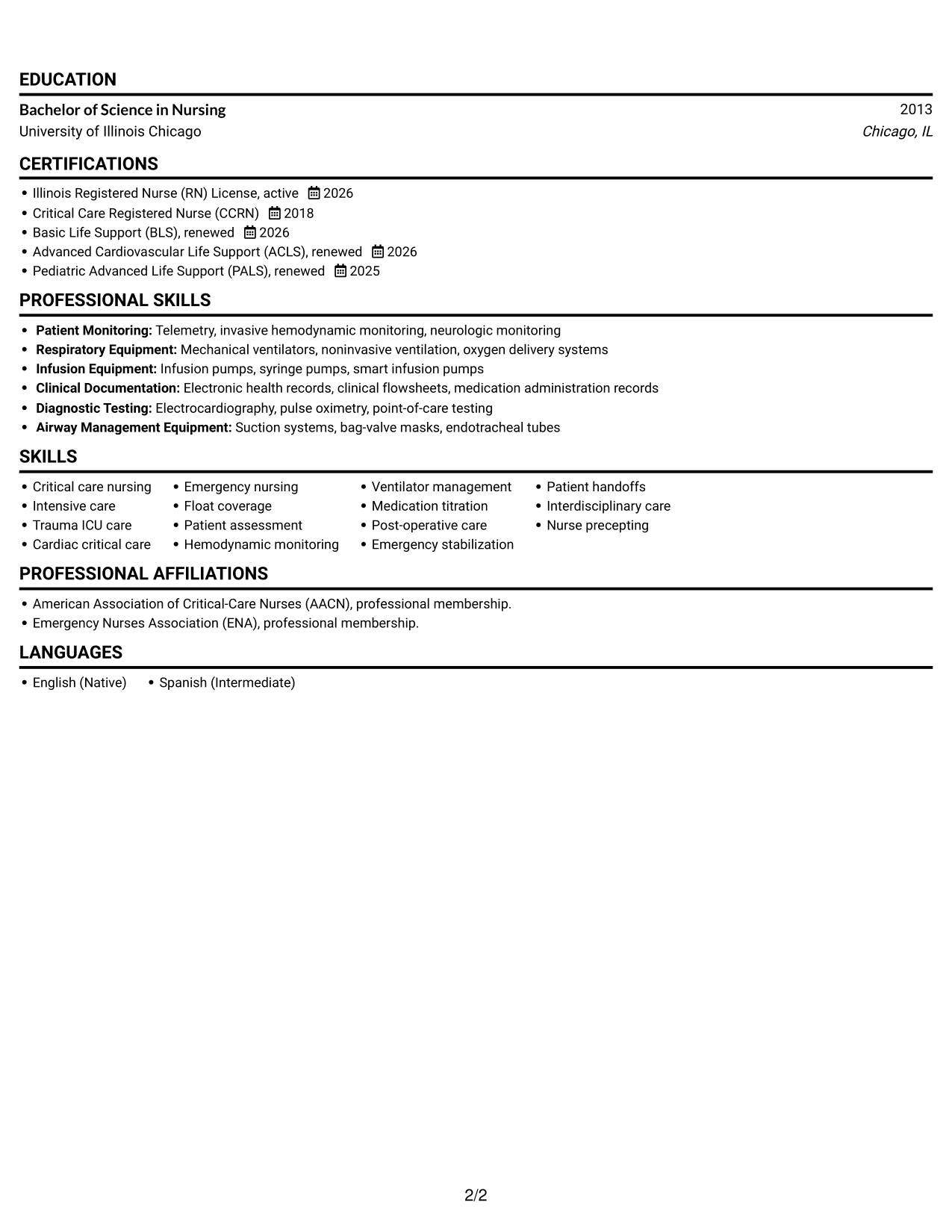
#2 Simple One Column Format Resume Example
The Simple One Column Format keeps the resume in a top-to-bottom sequence, which suits a straightforward review of clinical experience.
Why This Format Works
- One reading path helps reviewers follow progression across emergency and critical care roles.
- Full-width lines keep experience bullets from splitting across body columns.
- Education, skills, and credentials remain part of one consistent section sequence.
Best For
- Linear career histories
- Chronological experience review
- Full-width role descriptions
- Single-path resume reading
- Detailed education and credential records
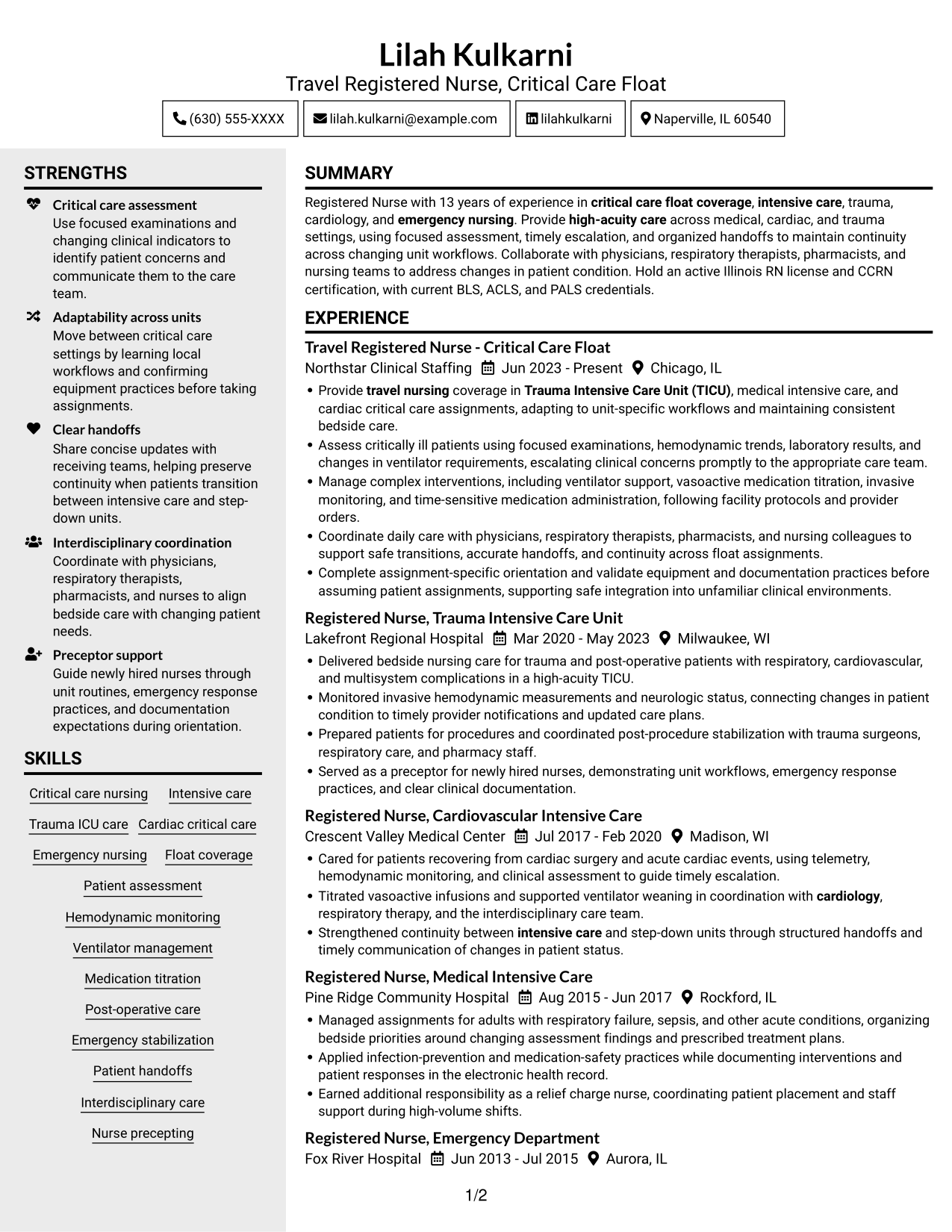
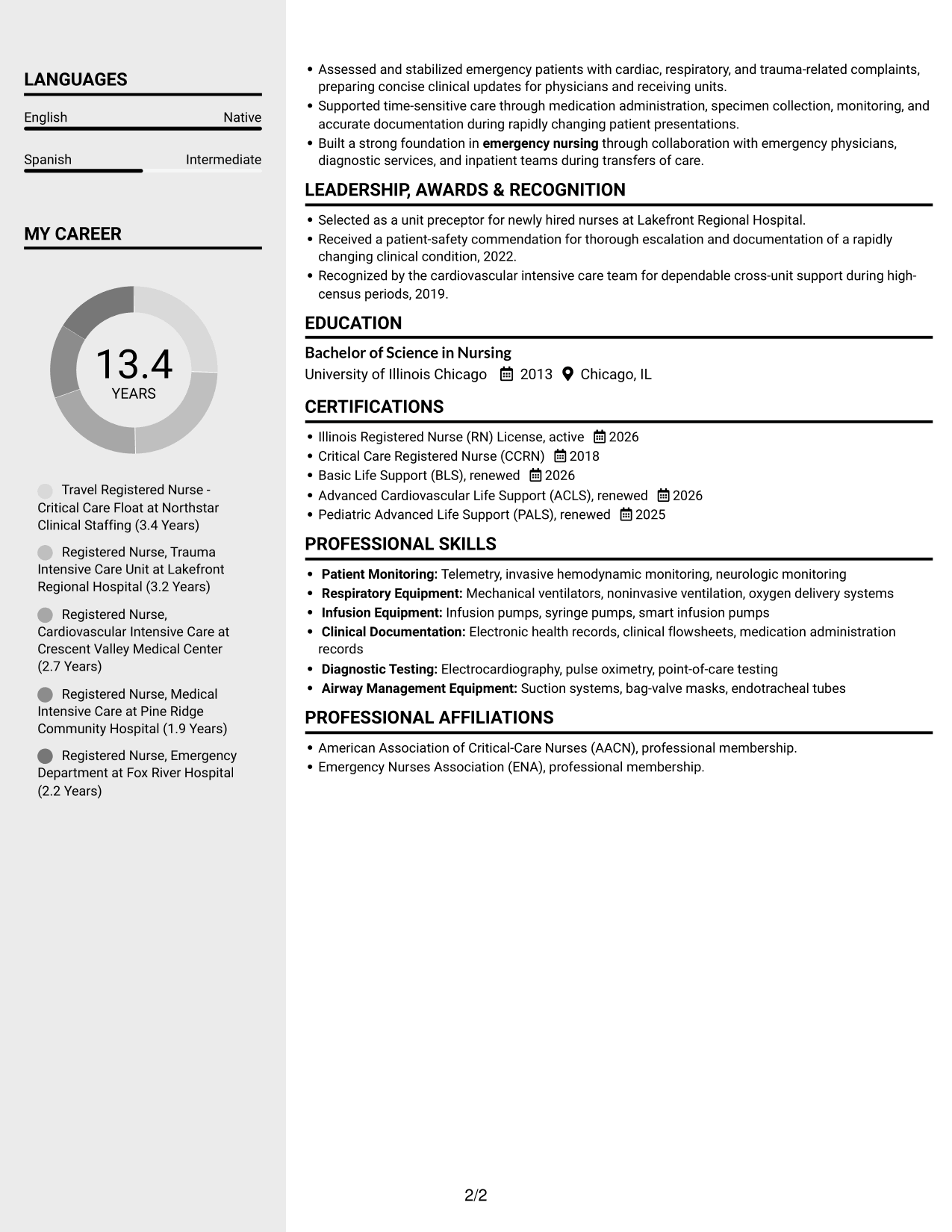
#3 Clean Two Column Sidebar Format Resume Example
The Clean Two Column Sidebar Format places the resume body in two columns, giving reviewers a clear way to browse its clinical record.
Why This Format Works
- Two columns let recruiters move between clinical experience and supporting resume sections.
- Separate reading areas help skills and education stand apart from dated role details.
- Grouped content suits a resume covering several care settings and credentials.
Best For
- Parallel section browsing
- Experience with supporting qualifications
- Fast section location
- Clinical roles across settings
- Compact evidence organization
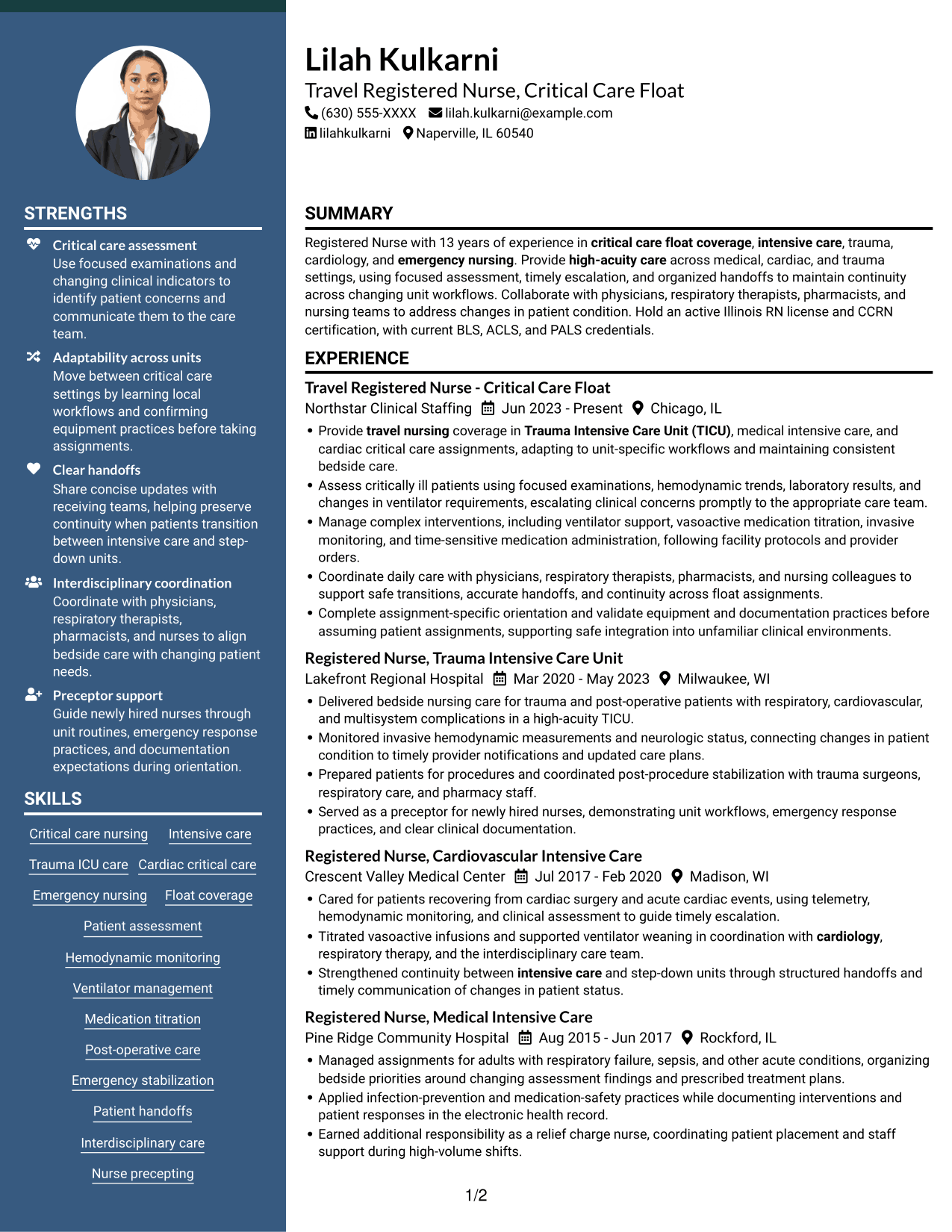
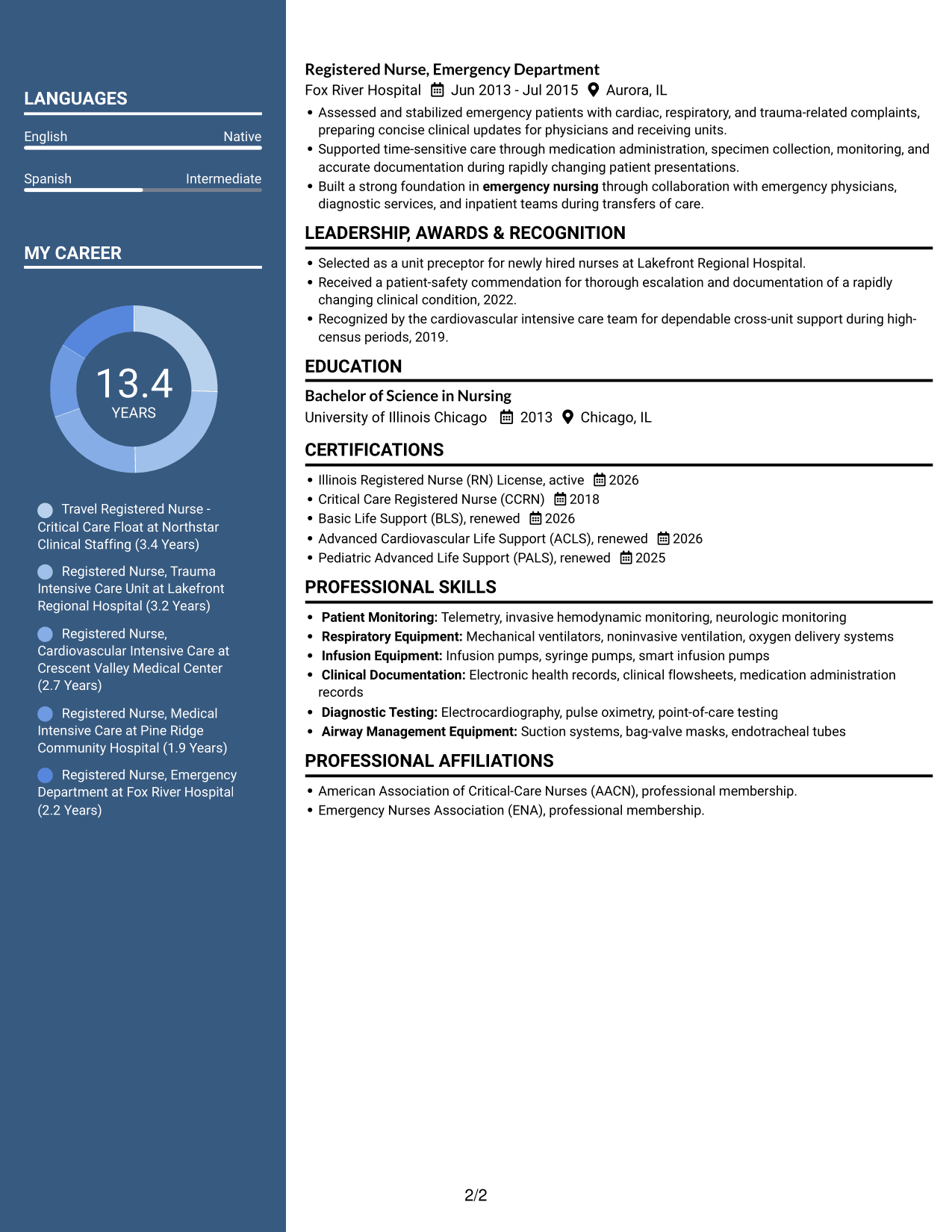
#4 Two Column Format Resume Example
The Two Column Format splits the resume body into two reading areas, a practical choice for presenting a broad clinical record.
Why This Format Works
- Paired columns let reviewers scan role history and supporting qualifications as distinct content groups.
- Career details across multiple hospitals remain easy to review in a two-part body.
- Education and credentials can be found without tracing every clinical bullet.
Best For
- Balanced two-area reading
- Career history with credentials
- Multi-role experience records
- Section-by-section review
- Travel nursing applications
#5 Photo Header Two Column Format Resume Example
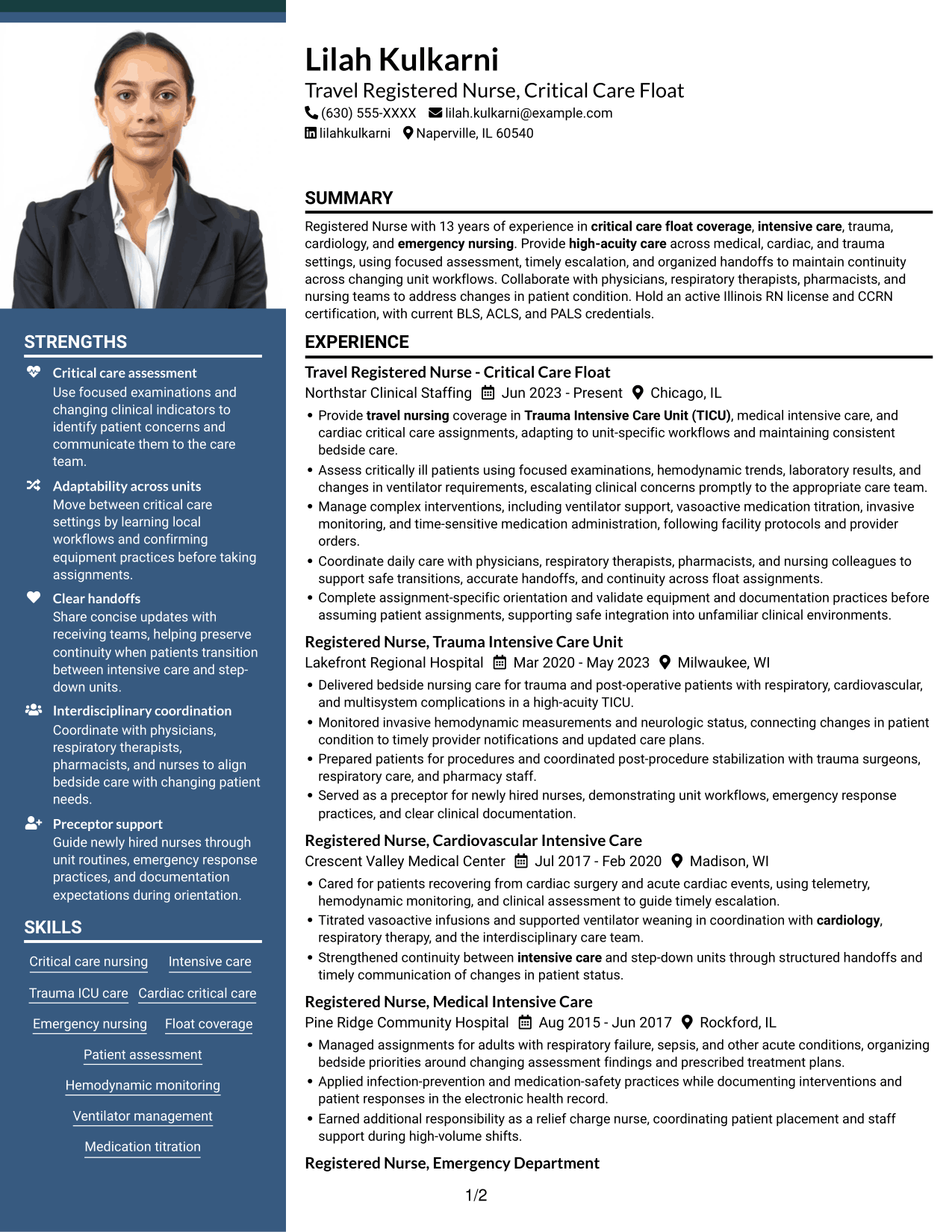
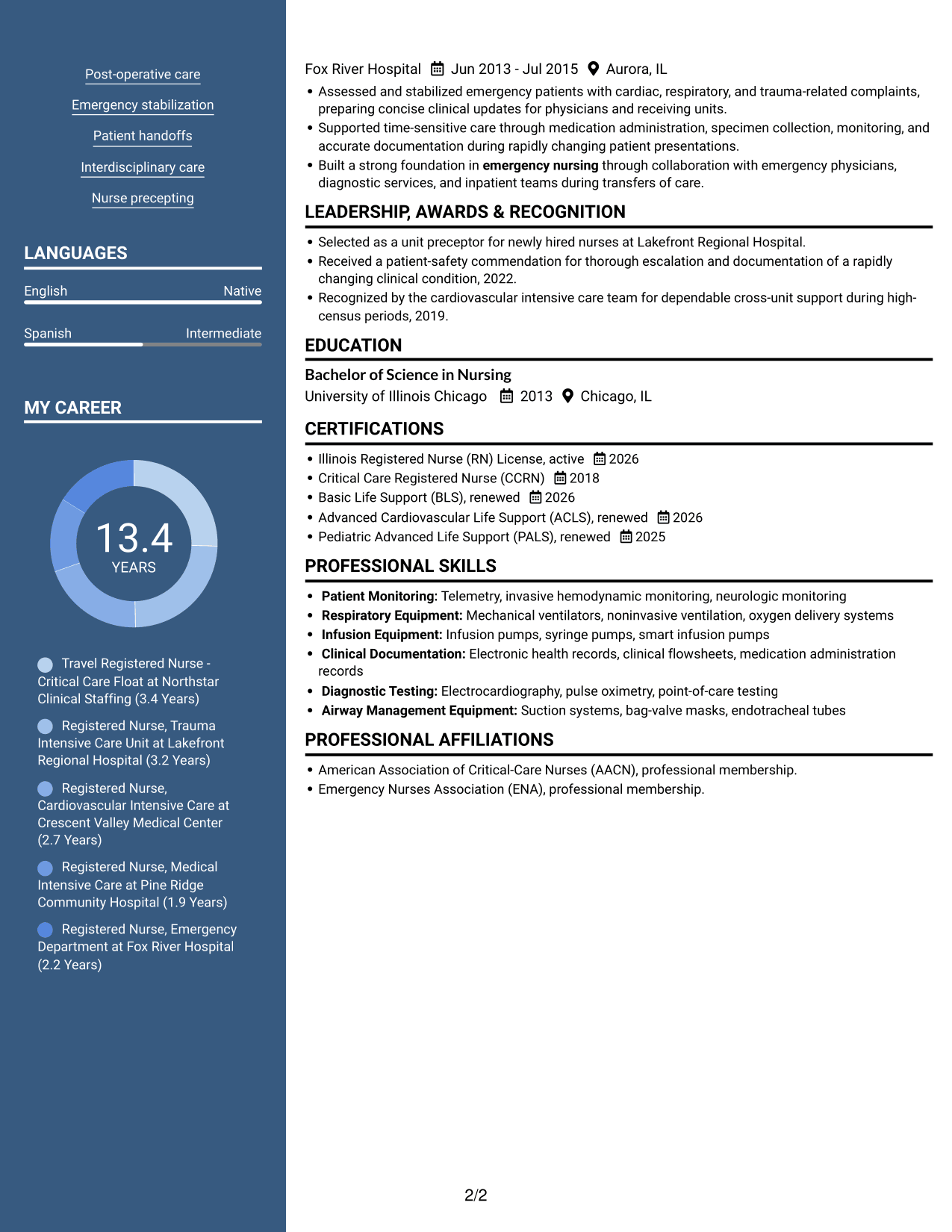
The Photo Header Two Column Format pairs a header photo with a two-column body, offering a visual identifier alongside organized resume sections.
Why This Format Works
- Two columns create separate reading areas for clinical experience and supporting resume sections.
- The header photo adds a visual identifier without changing the body's section order.
- Reviewers can scan career history and credentials as distinct parts of the record.
Best For
- Photo-forward header preference
- Two-column section browsing
- Visual identity in the header
- Clinical history with credentials
- Travel assignment resumes
#6 Colored Two Column Format Resume Example
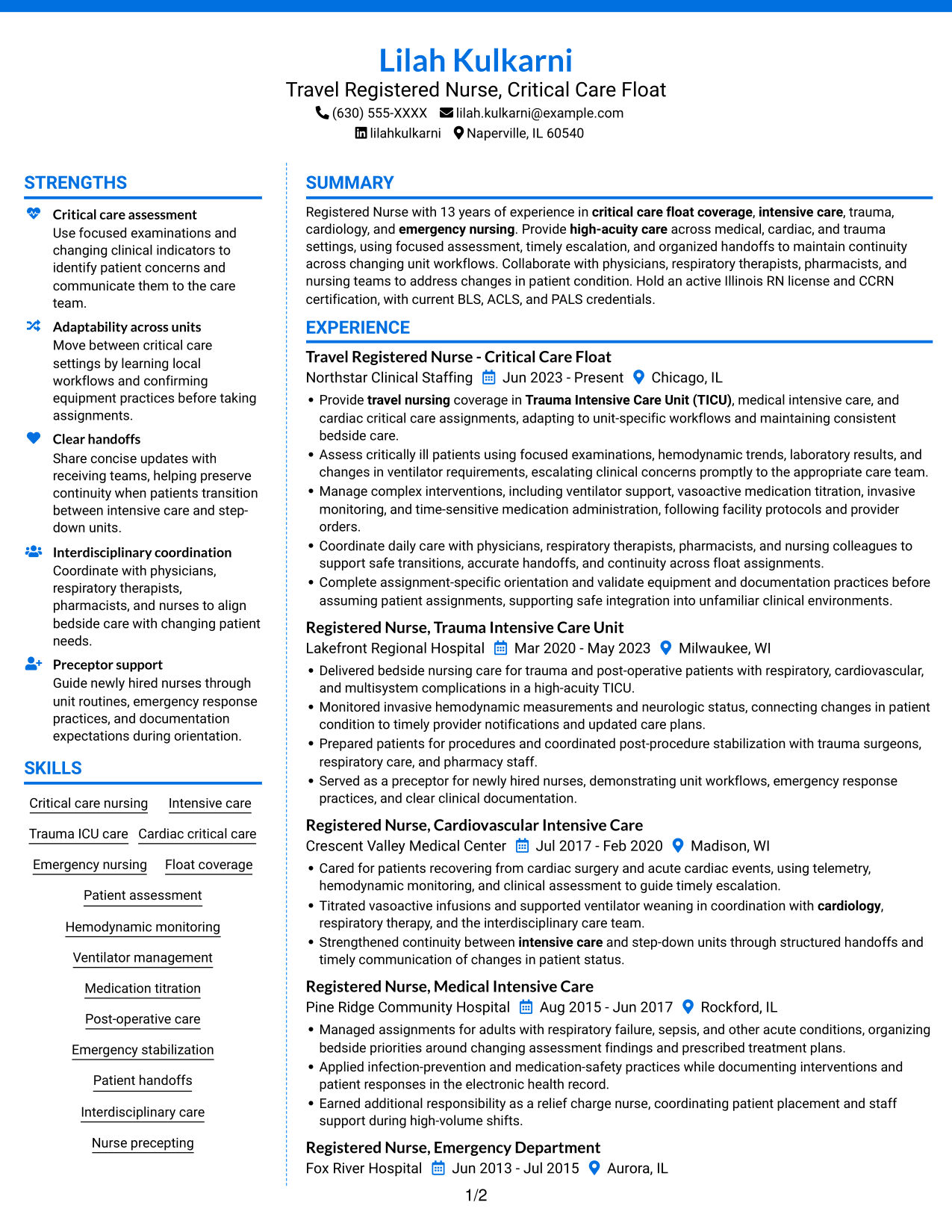
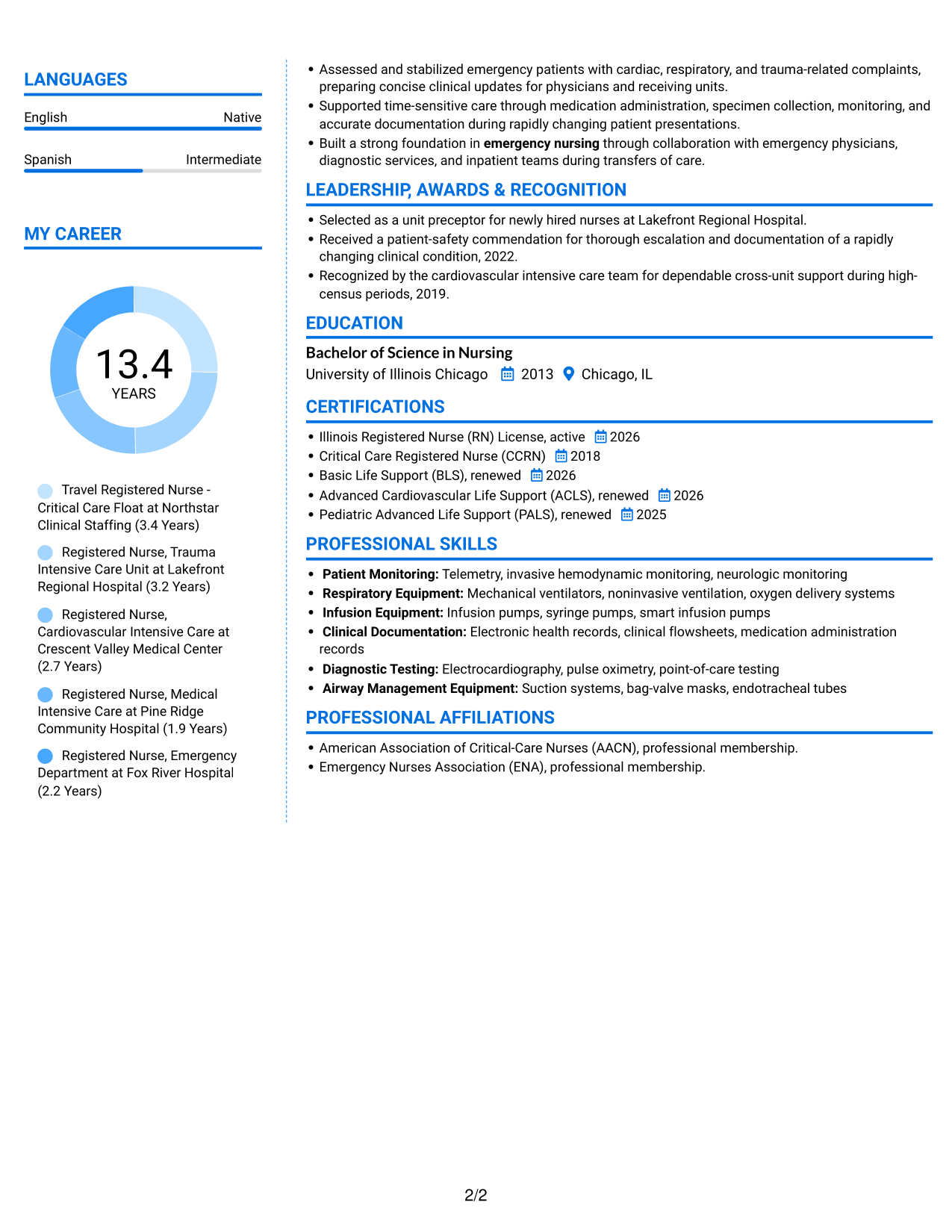
The Colored Two Column Format uses two body columns, a useful option for readers who prefer a divided view of resume information.
Why This Format Works
- Two-column reading lets reviewers move between experience and other resume sections.
- Distinct content areas help locate skills without searching through every role description.
- Education and credentials stay easy to identify in a resume with several clinical roles.
Best For
- Separated resume content
- Two-column scanning
- Multi-section clinical records
- Credential and education review
- Experience across care settings
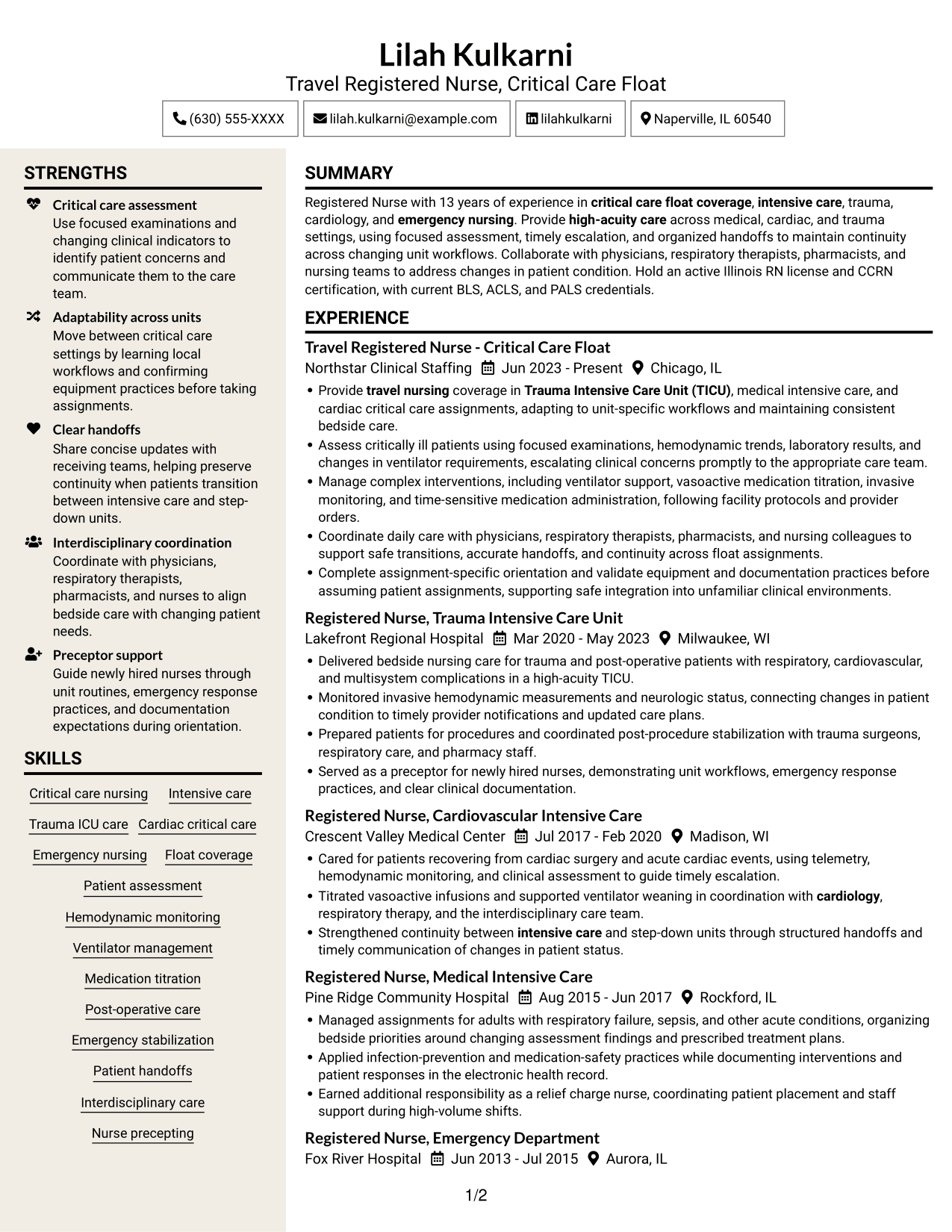
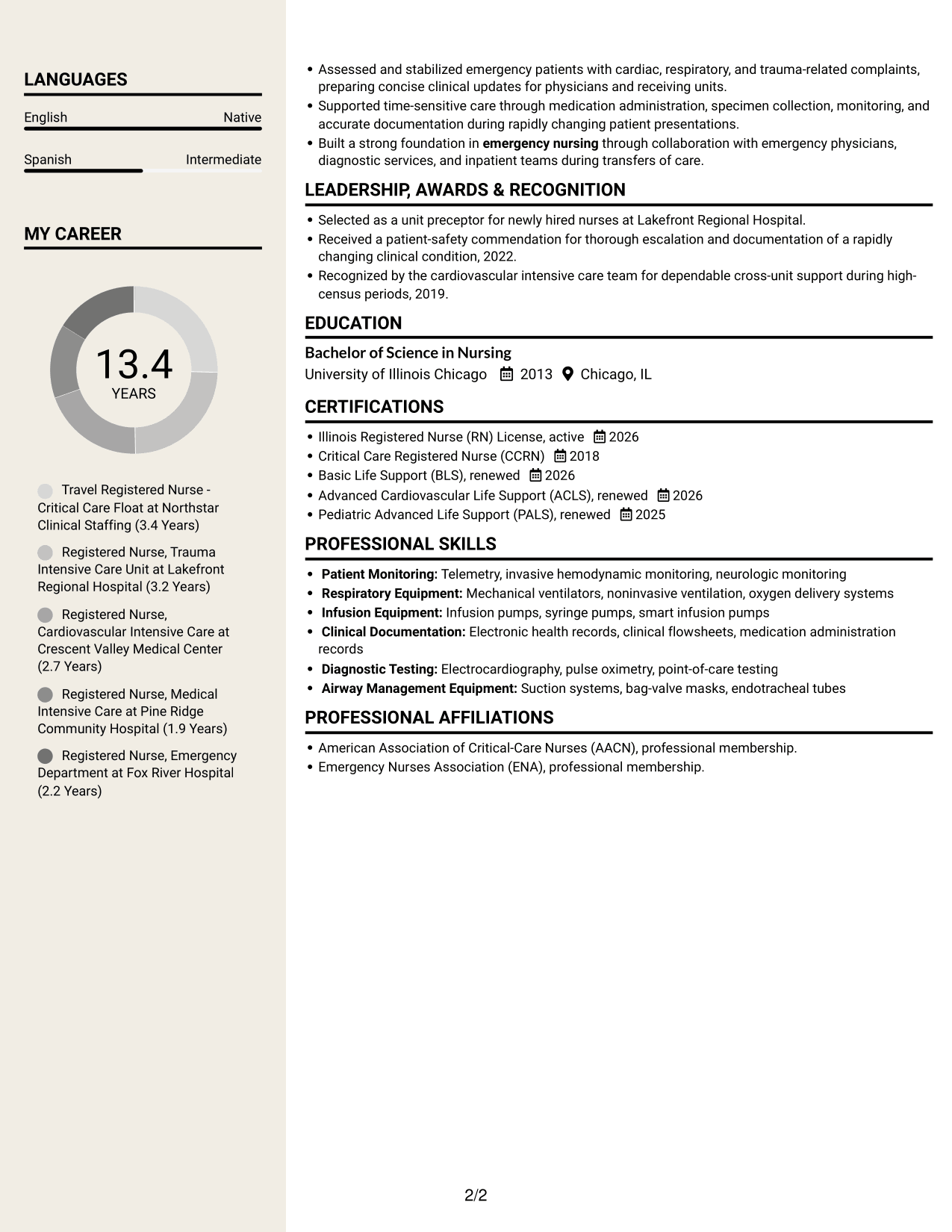
#7 Stylish Two Column Designer Format Resume Example
The Stylish Two Column Designer Format arranges the resume in two body columns, suiting readers who want to browse career details in separate areas.
Why This Format Works
- Two columns offer an alternate route through experience and supporting career details.
- Section areas help readers find education and credentials alongside a broad clinical record.
- Reviewers can scan skill information without treating every role as the same content.
Best For
- Two-column information grouping
- Section-based resume review
- Detailed clinical histories
- Skills and education sections
- Travel role applications
Why Build Your Registered Nurse - Critical Care Float Resume with ResumeInMinutes
ResumeInMinutes helps you organize clinical experience, skills, credentials, and tools in a clear resume. Review the image previews and open an example in the editor to see its structure.
- Resume layouts to compare
- Clear section structure
- Role-focused keyword guidance
- Organized clinical experience
- Skills and credentials presentation
- Resume customization support
Keep your resume specific to critical care float work. Give priority to relevant patient-care responsibilities, clinical skills, credentials, and measurable results when you have them.
See Also
- 33 Advanced Practice Registered Nurse (APRN) - Critical Care Resume Templates with Example 2026
- 33 Registered Nurse Educator - Critical Care Resume Templates with Example 2026 (ATS-Optimized)
- 7 Registered Nurse II/III - Adult Critical Care Resume Templates with Example
- 33 Home Care Registered Nurse Resume Templates with Example 2026 (ATS-Optimized)
- 33 Home Care Registered Nurse RN Resume Templates with Example 2026 (ATS-Optimized)
- 7 Neonatal Intensive Care Unit Registered Nurse Resume Templates with Example
- 33 Pediatric Intensive Care Unit (PICU) Registered Nurse Resume Templates with Example 2026 (ATS-Optimized)
- 7 Registered Nurse 1 - Long-Term Care Resume Templates with Example
- 7 Registered Nurse - Critical Care Float Cover Letter Templates with Example
- 30+ Advanced Practice Registered Nurse (APRN) - Critical Care Cover Letter Templates with Example 2026
Frequently Asked Questions
Are these Registered Nurse - Critical Care Float resume templates ATS-friendly?
They use readable headings and clear sections to support scanning. Include accurate role terms such as critical care, intensive care, TICU, hemodynamic monitoring, and ventilator management in the right sections of your resume.
Do the examples show different resume layouts?
Yes. The image previews show the same resume example in distinct layouts, so you can compare how its sections are arranged.
What should a Registered Nurse - Critical Care Float resume include?
Include a focused summary, clinical experience, education, relevant skills, RN licensure, and certifications. Add clinical tools and patient-care achievements when they are accurate and relevant.
Which resume style works well for critical care float roles?
Choose a layout with clear headings and easy-to-scan experience bullets. A simple structure helps readers find your clinical settings, responsibilities, skills, and credentials.
How can I show experience across different critical care units?
List each unit or care setting clearly, then use concise bullets to describe relevant patient needs, clinical responsibilities, teamwork, and safe transitions of care. Include only experience that reflects your own work.
Should I include a photo on my resume?
For U.S. applications, a resume without a photo is usually the safer choice. Follow local guidance if you are applying in a region where photos are customary.