US English


7 Senior Director, Product Development - Intelligent Transportation Systems Resume Templates with Example
By Ria · Last Updated On October 25, 2026
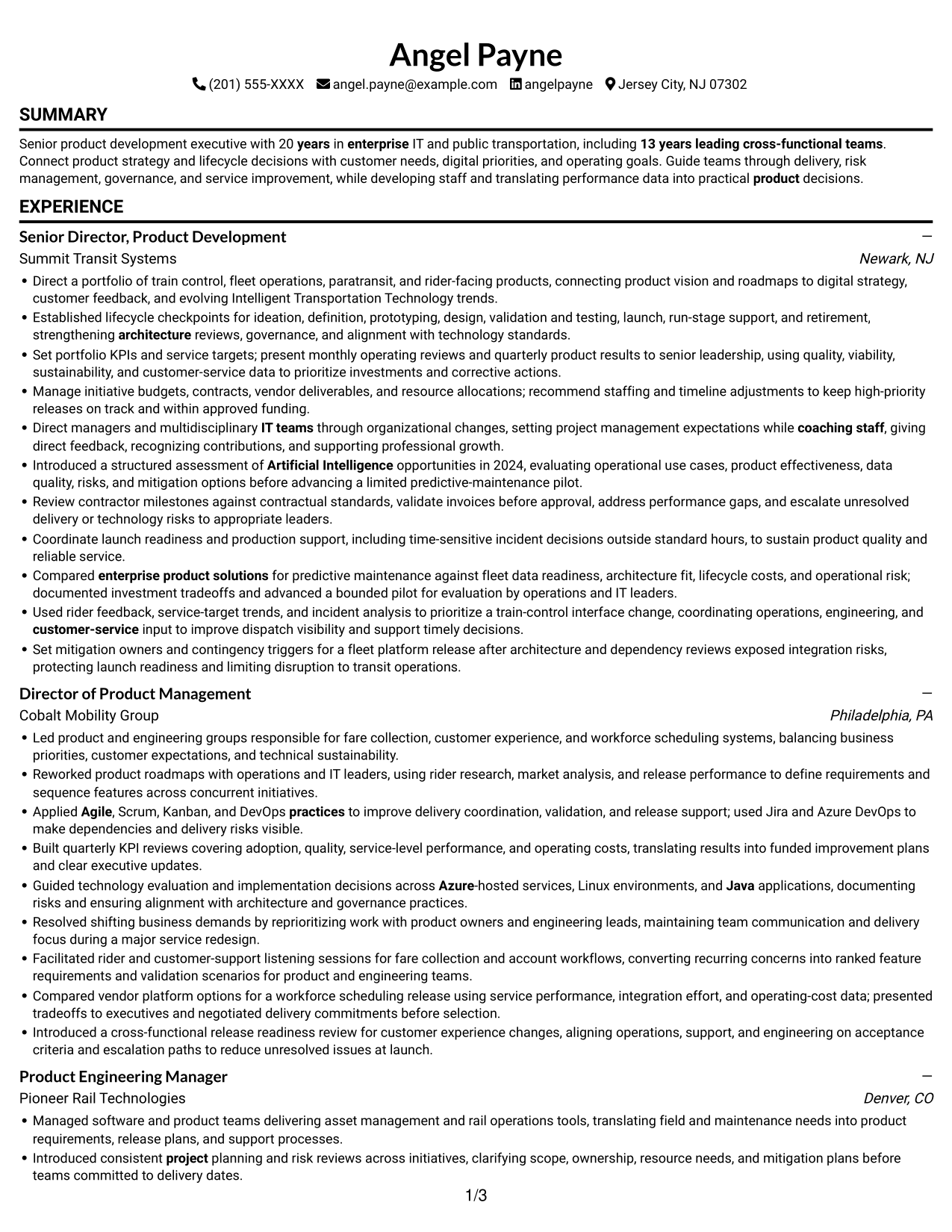
Resume example — page 1

This guide shows you how to build a resume for the Senior Director, Product Development - Intelligent Transportation Systems role. You will learn how to present product leadership clearly and choose a layout that helps readers find your strongest evidence.

An effective resume connects product vision and lifecycle leadership with customer needs, service goals, and business results. Clear sections and focused bullet points help show how you guide teams, budgets, risks, and delivery across complex transportation products.

The same resume example appears in 7 layouts, shown as image previews. Compare how each design presents experience, skills, education, certifications, and measurable results, then open an example in the editor to customize it.

What Makes a Great Senior Director, Product Development - Intelligent Transportation Systems Resume in 2026

A strong resume makes product strategy, lifecycle ownership, cross-functional leadership, and transportation technology work easy to find. Use clear headings and concise bullets to show decisions, scope, and results.

Include relevant terms such as Intelligent Transportation Technology, product roadmaps, KPIs, governance, risk mitigation, Agile, and vendor oversight. Support them with specific evidence, such as lifecycle improvements, investment decisions, or team development.

Note: Resume examples are for educational purposes only. Use only information that accurately reflects your experience and qualifications. References to real organizations do not imply affiliation or endorsement.

#1 Simple One Column Format Resume Example

The single-column layout gives the resume one clear reading path, a practical choice for reviewers who prefer to move through sections in sequence.
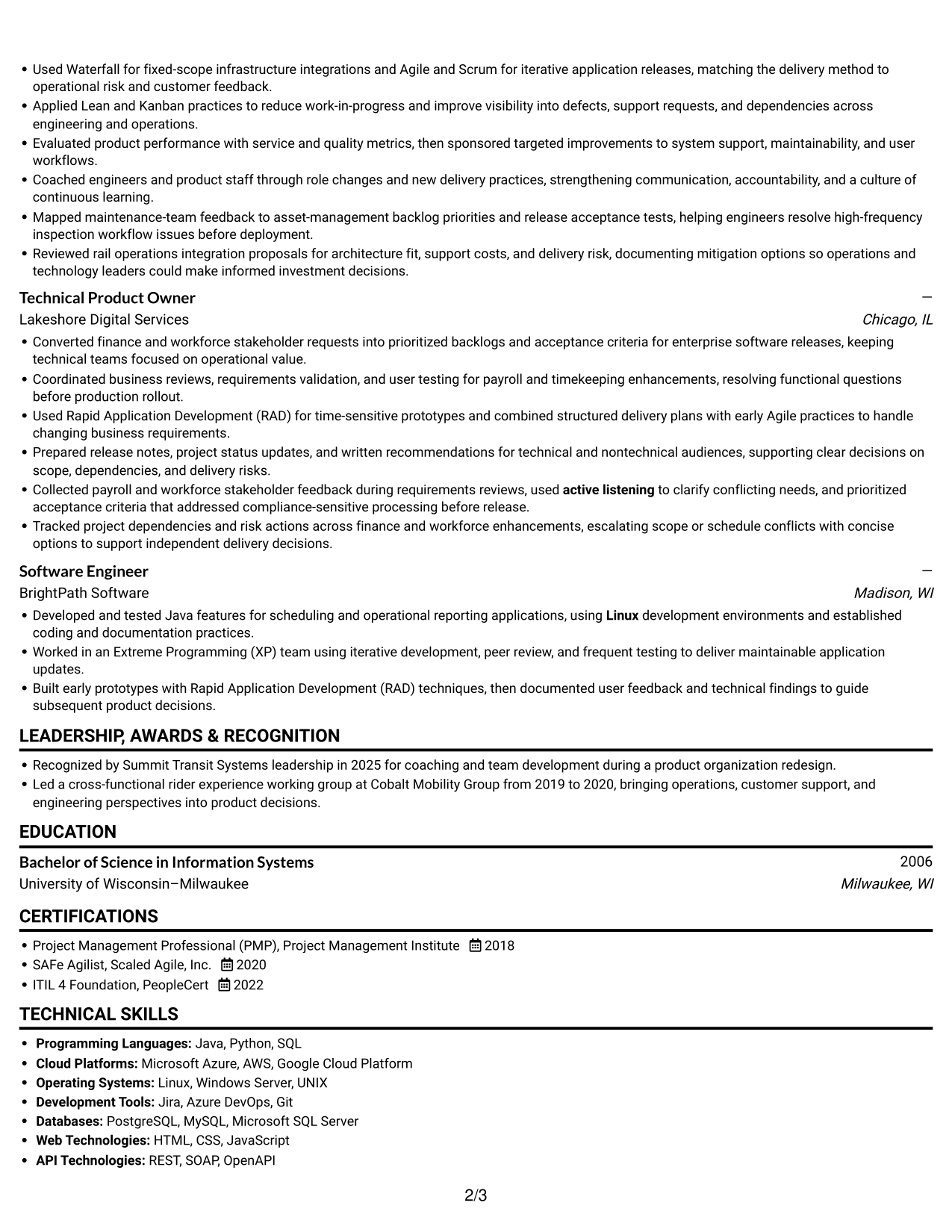
 
Resume example — page 1   Resume example — page 2

Why This Format Works

  • A single reading path lets reviewers follow career progression without switching between columns.
  • Section breaks keep experience, education, and certifications distinct during a focused review.
  • Full-width text gives detailed achievement bullets room to retain useful context.

Best For

  • Single-path recruiter review
  • Detailed experience bullets
  • Full-width text preference
  • Career progression review
  • Education and credential details

Resume Keywords

  • Bachelor of Science in Information Systems
  • 20 years in enterprise IT and public transportation
  • 13 years leading cross-functional teams
  • Senior Director, Product Development
  • Product lifecycle management
  • enterprise product solutions
  • Direct managers and multidisciplinary IT teams through organizational changes
  • Introduced consistent project planning and risk reviews across initiatives
  • Agile
  • define requirements and sequence features across concurrent initiatives
  • Digital strategy alignment
  • Set portfolio KPIs and service targets
  • Manage initiative budgets, contracts, vendor deliverables, and resource allocations
  • evaluating operational use cases, product effectiveness, data quality, risks, and mitigation options
  • strengthening architecture reviews, governance, and alignment with technology standards
See all keywords
 

#2 Simple Two Column Format Resume Example

The two-column arrangement sets resume information in parallel areas, helping reviewers scan career history and supporting details in a compact format.
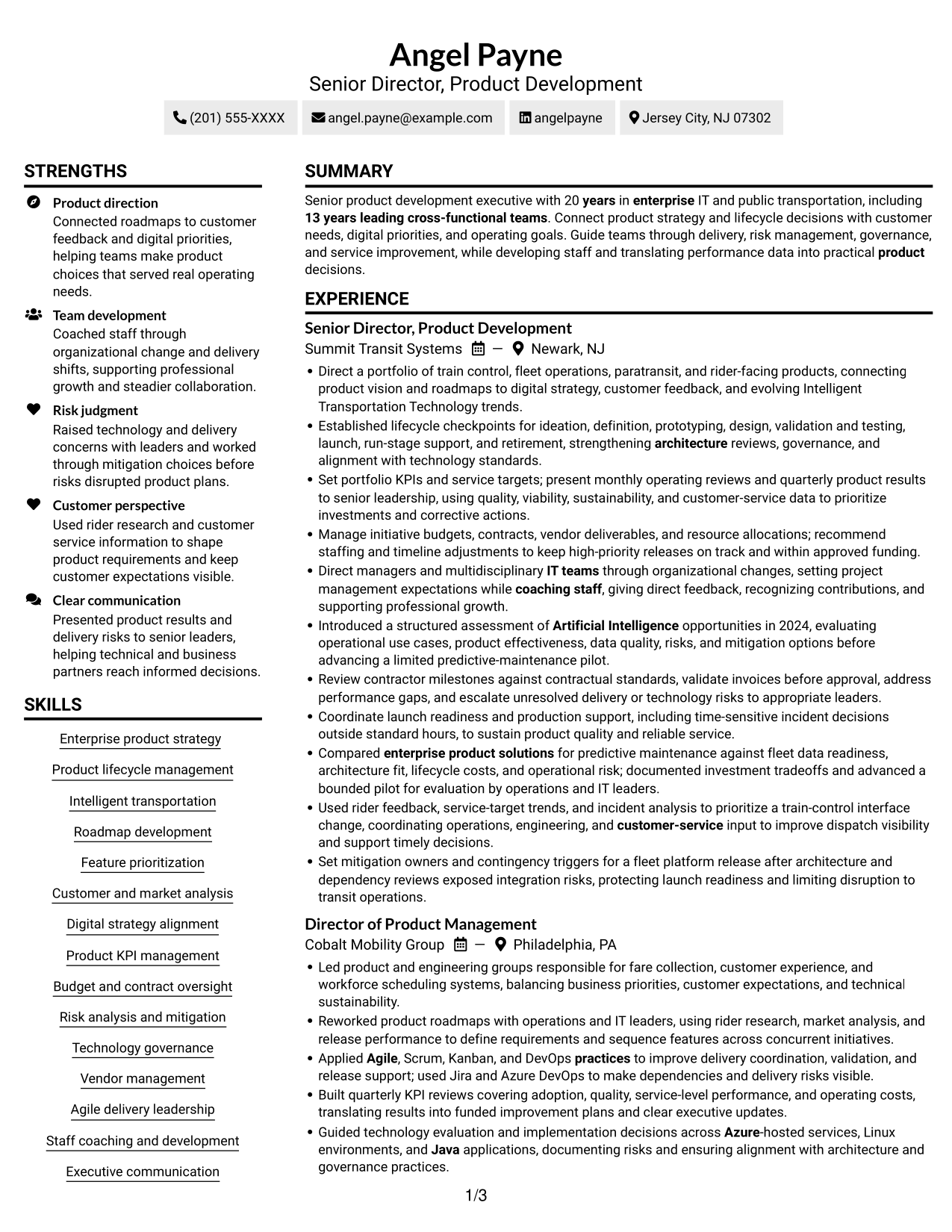
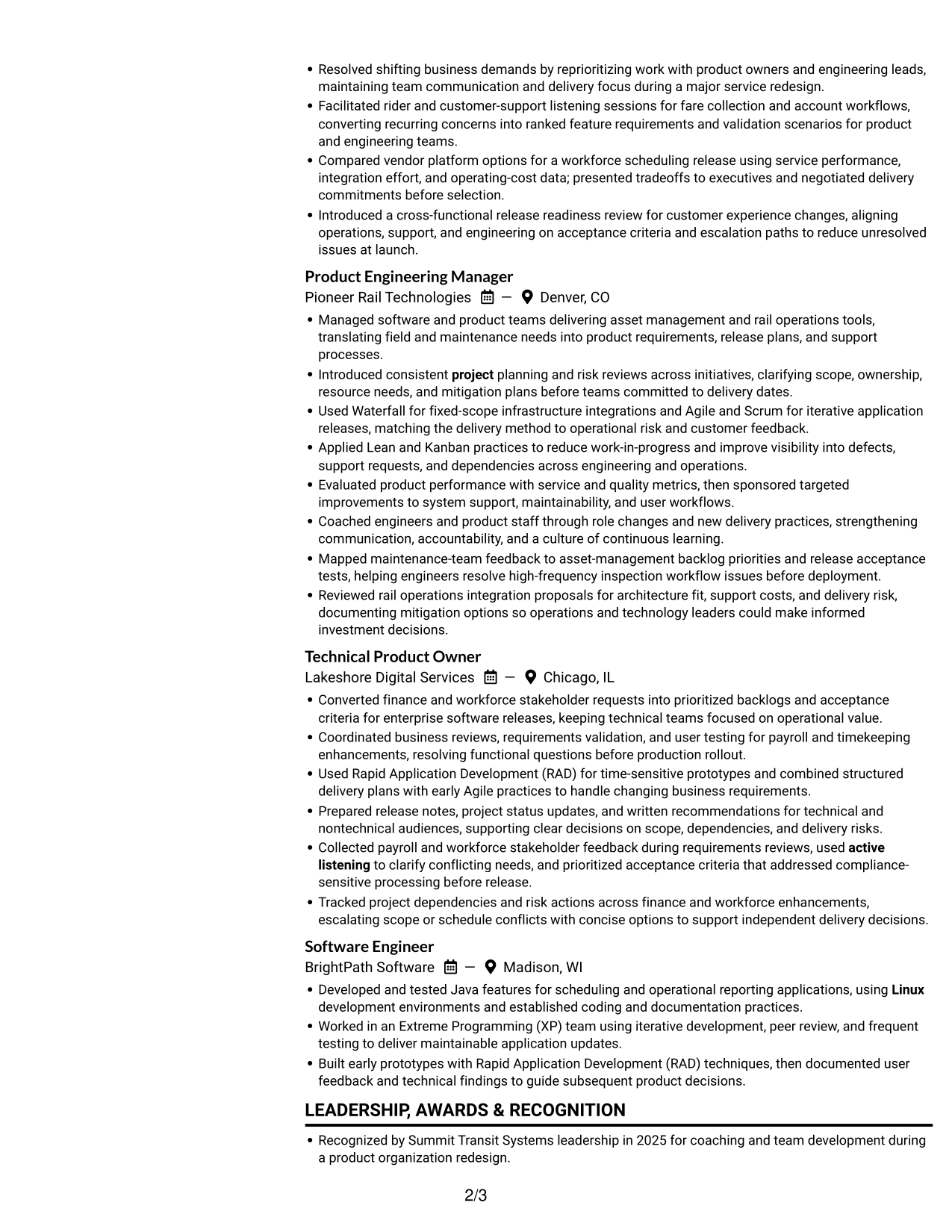
 
Resume example — page 1   Resume example — page 2

Why This Format Works

  • Parallel content areas help reviewers locate experience and supporting sections with less backtracking.
  • Separate reading zones keep skills and credentials easy to find.
  • Compact text grouping can keep a broad career history navigable.

Best For

  • Parallel-section scanning
  • Experience with supporting sections
  • Compact resume content
  • Quick comparison of career details
  • Bulleted information lists

#3 Plain One Column with Shaded Labels Resume Example

The one-column body keeps the resume on a direct reading path, a useful choice when reviewers should move through its sections in sequence.
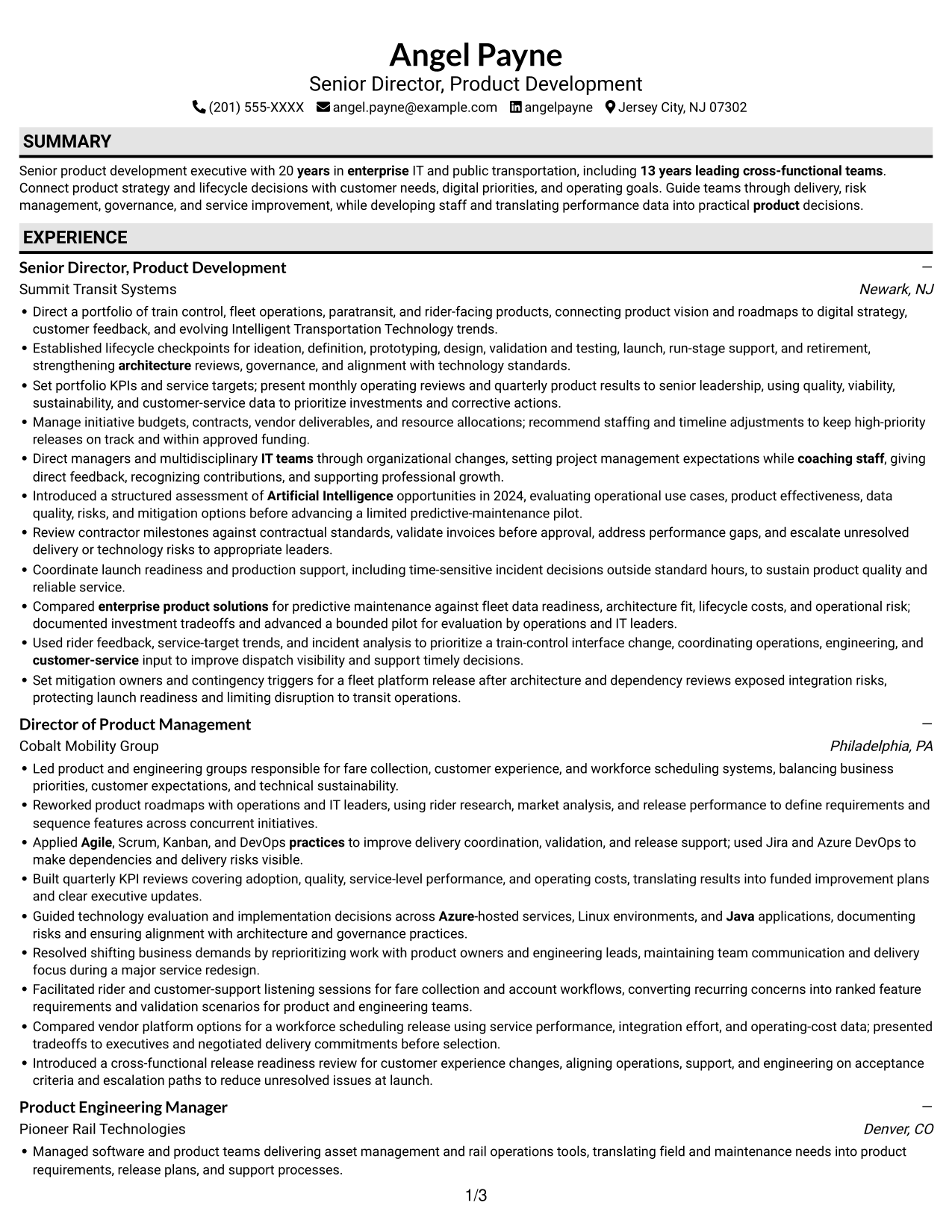
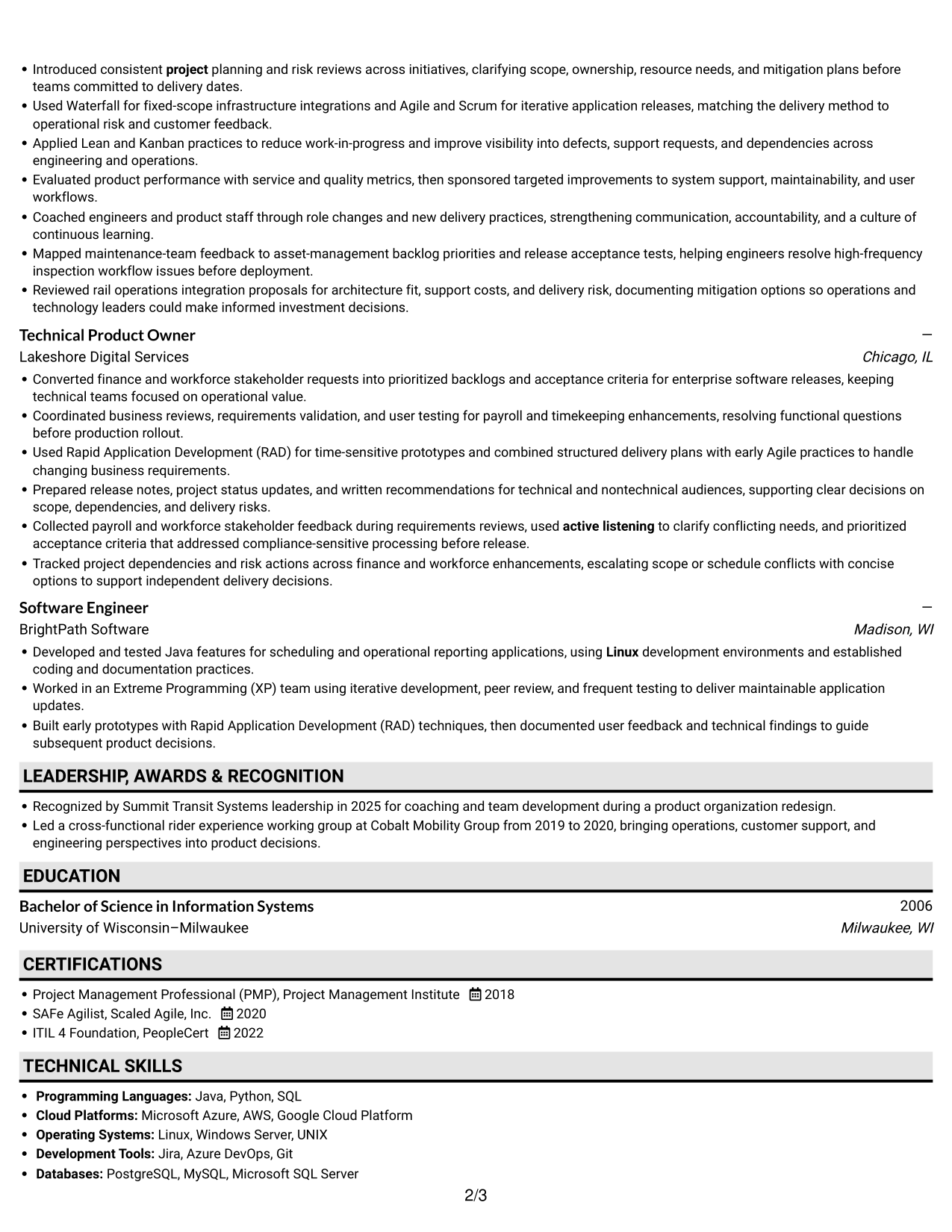
 
Resume example — page 1   Resume example — page 2

Why This Format Works

  • A continuous path helps reviewers follow role changes across the experience section.
  • Distinct sections let reviewers check education and certifications without interrupting that sequence.
  • Single-column text gives achievement bullets a consistent line of sight.

Best For

  • Sequential career-history review
  • Consistent section-to-section reading
  • Achievement-focused bullet lists
  • Education and certification review
  • Direct recruiter scanning
 

#4 One Column Format with Photo Right Resume Example

This one-column resume includes a photo while keeping the text on a direct reading path, for readers who prefer a portrait alongside professional details.
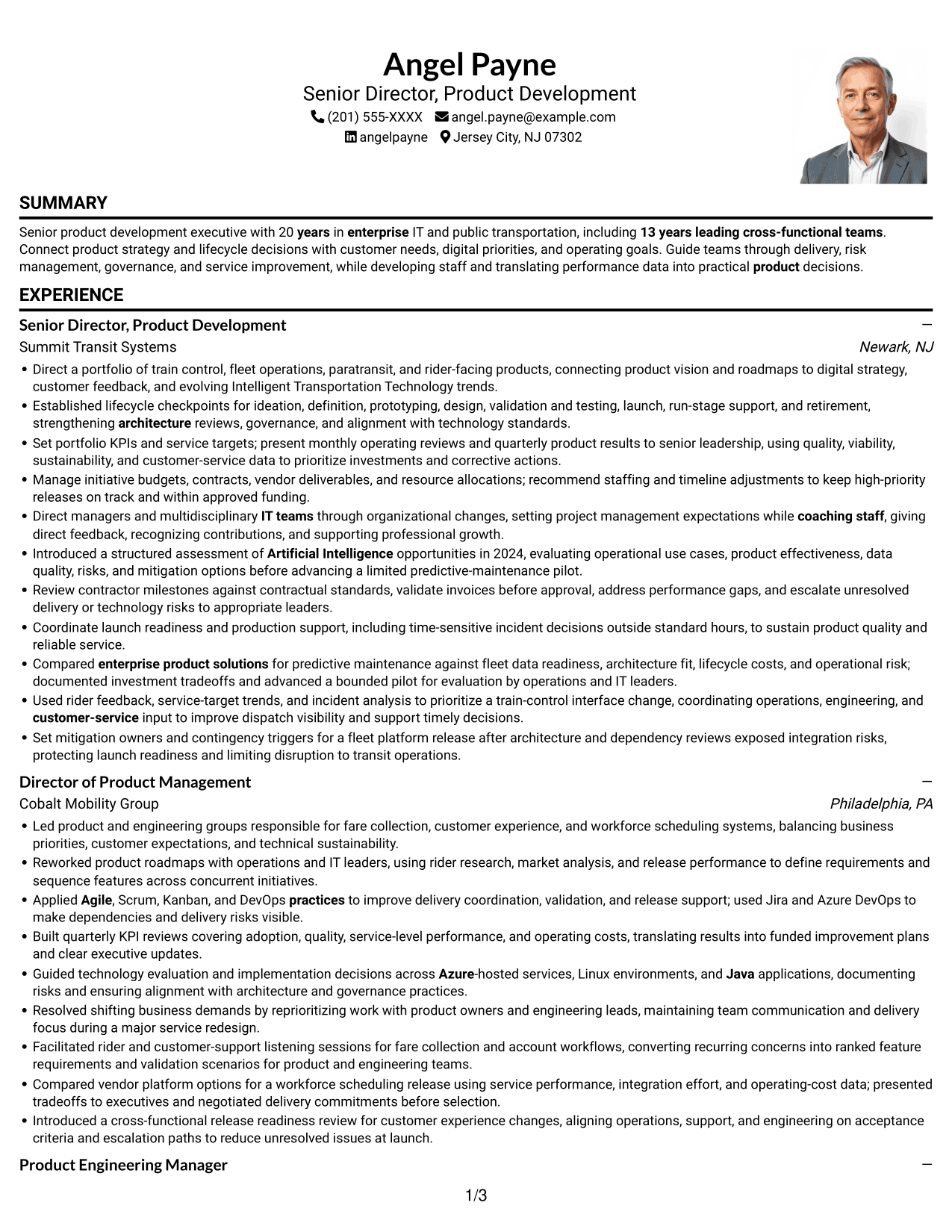
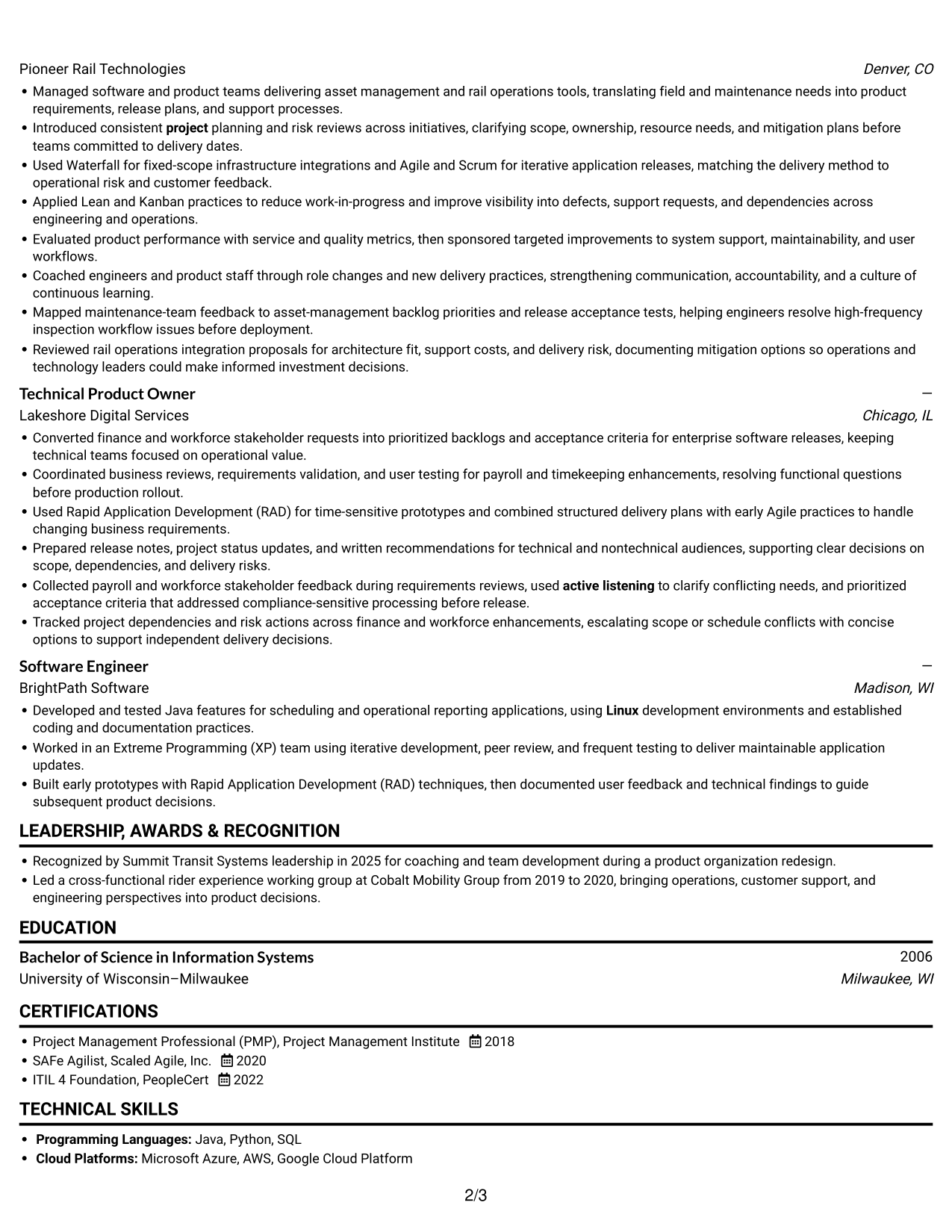
 
Resume example — page 1   Resume example — page 2

Why This Format Works

  • The single body column keeps experience and education in one steady reading sequence.
  • Section boundaries help reviewers move between achievements, skills, and credentials.
  • The portrait remains a visual element while resume text presents the qualifications.

Best For

  • Portrait-included resume preference
  • One-column reading order
  • Continuous career-history review
  • Detailed achievement bullets
  • Education and credentials alongside experience
 

#5 Clean Two Column Sidebar Format Resume Example

The two-column layout creates parallel content areas, a practical choice when reviewers want to scan career history and supporting details together.
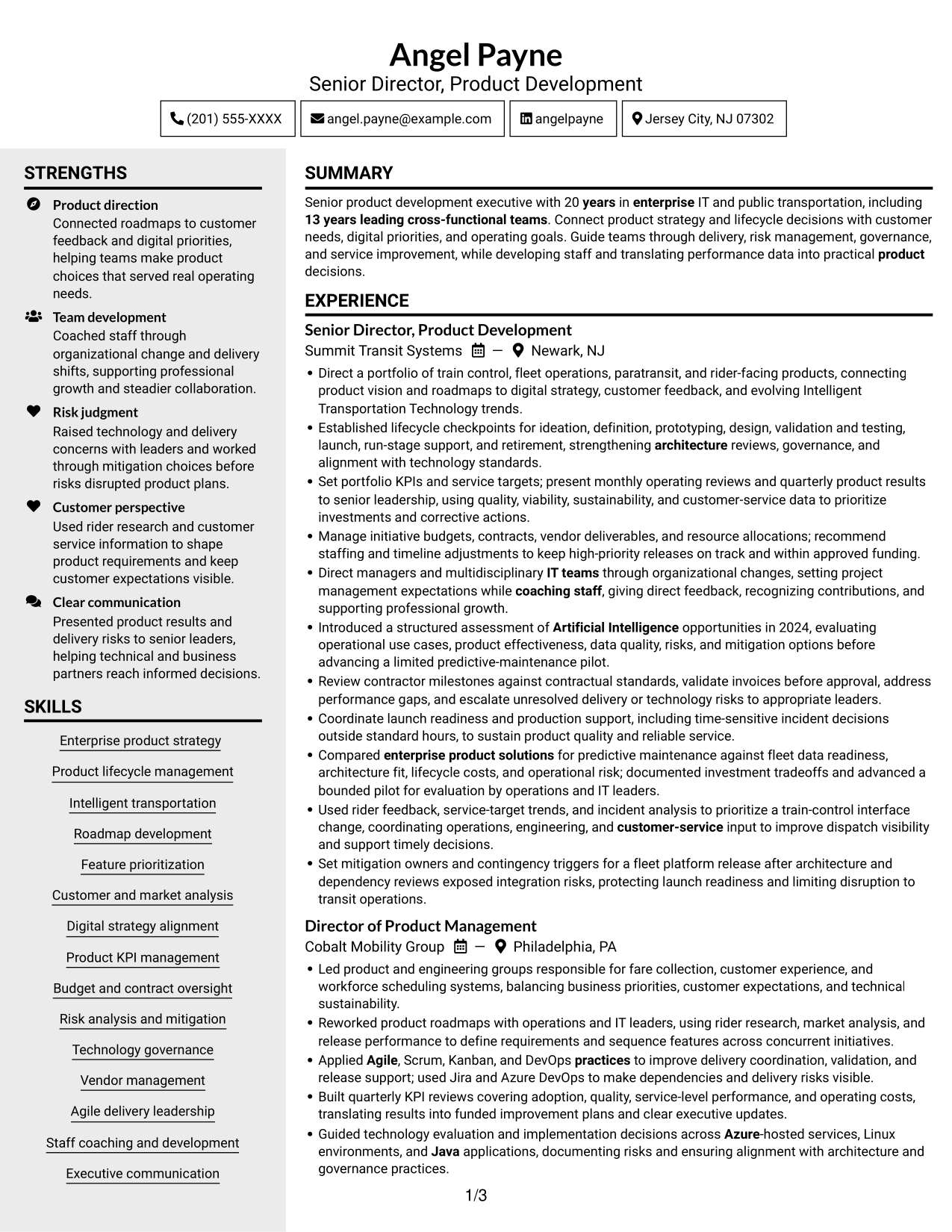
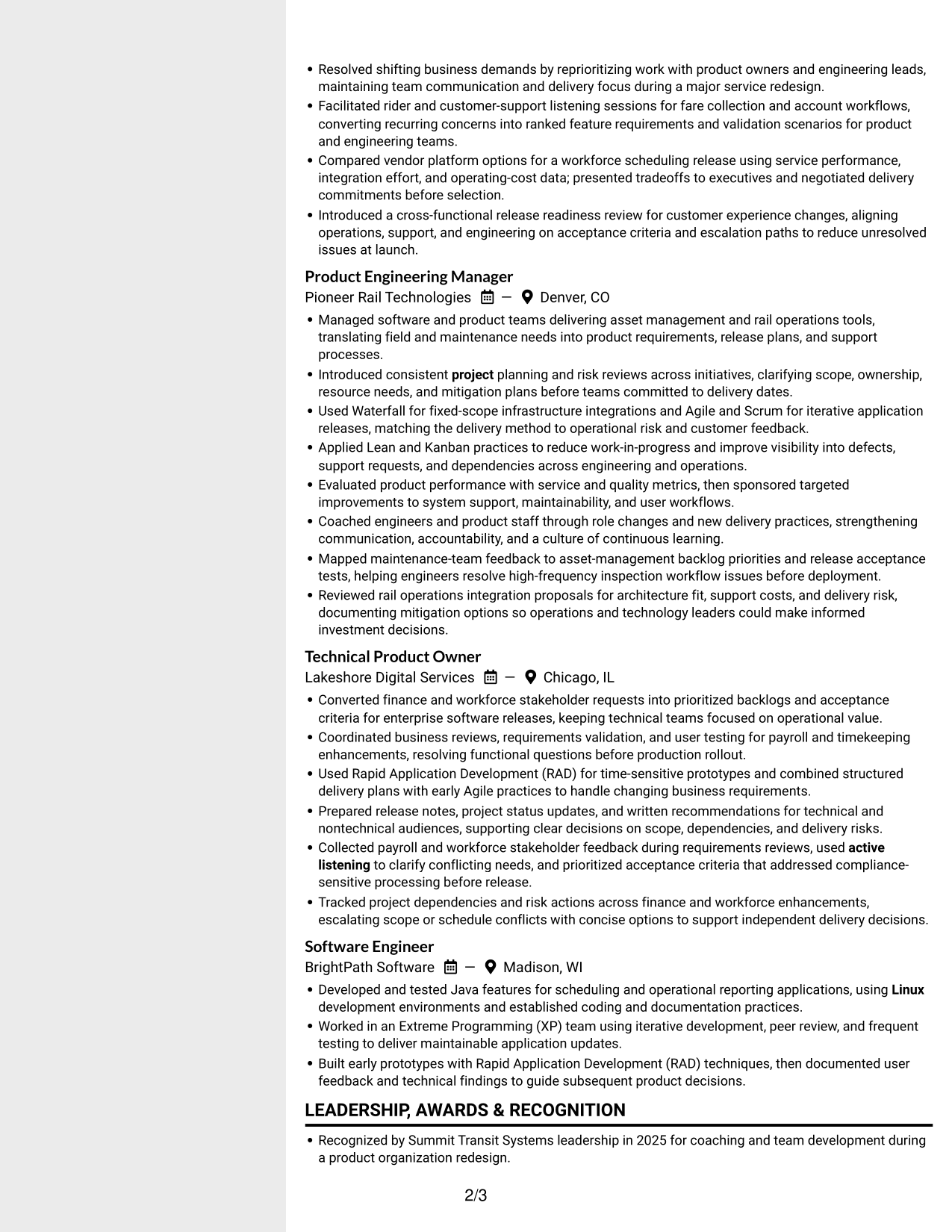
 
Resume example — page 1   Resume example — page 2

Why This Format Works

  • Parallel areas give experience and supporting resume sections distinct visual space.
  • Reviewers can move between career history and credentials without a long page-wide scan.
  • Skills and education entries are easy to locate among fuller experience details.

Best For

  • Parallel content review
  • Career history with supporting details
  • Compact skills and education sections
  • Resume information in clear groups
  • Side-by-side section scanning


#6 Two Column Format Resume Example

A two-column body offers a side-by-side reading structure, helping reviewers compare career history with other resume sections.
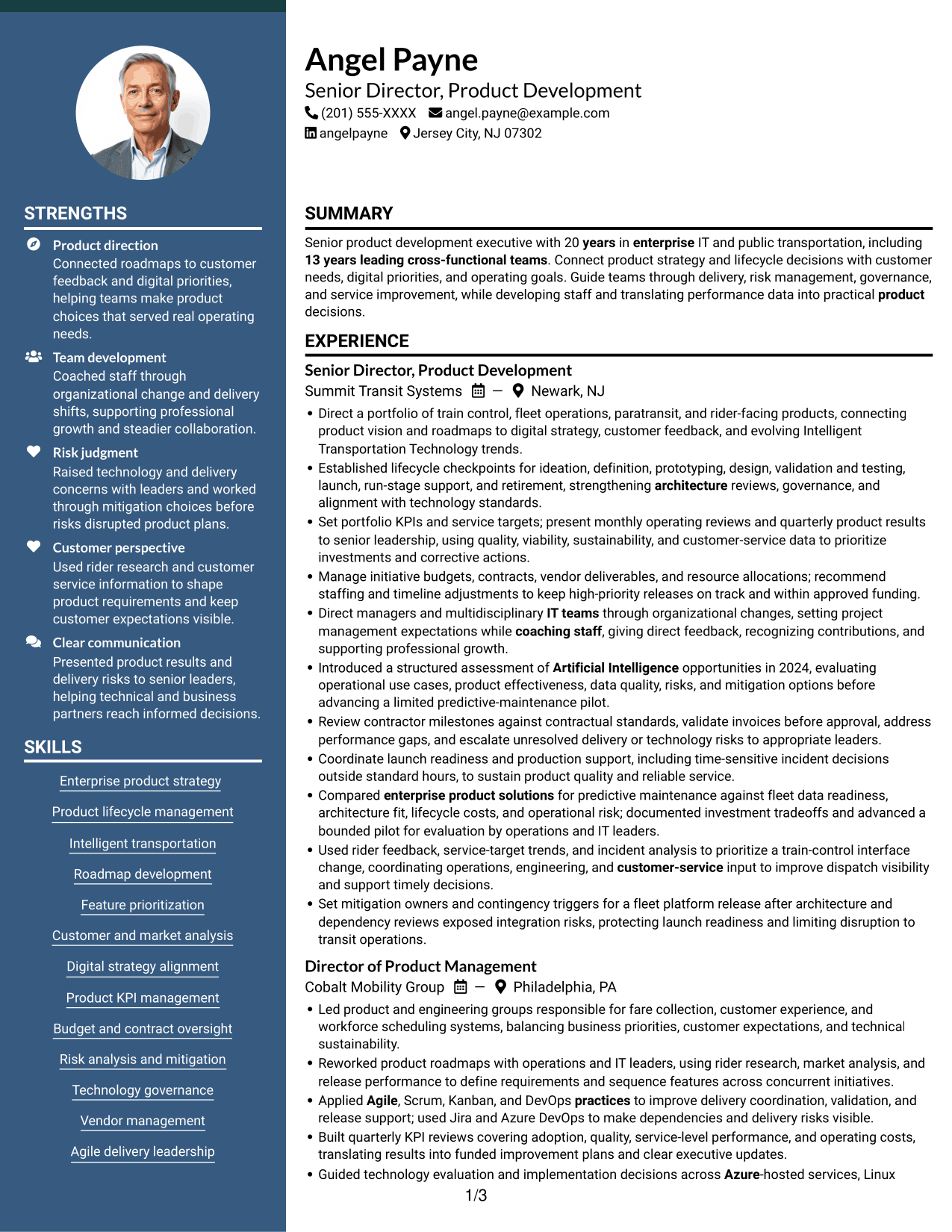
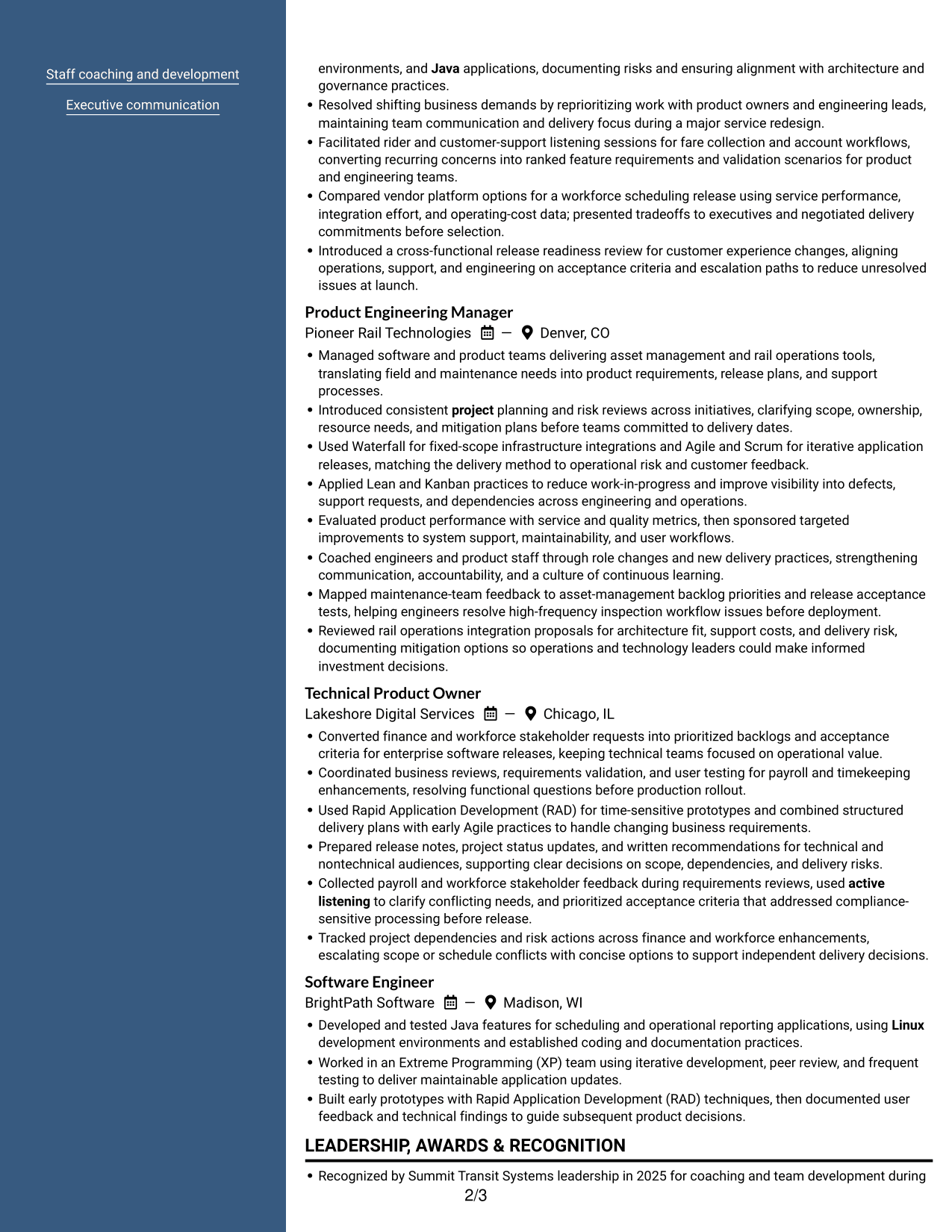
 
Resume example — page 1   Resume example — page 2

Why This Format Works

  • Two reading zones make a varied set of resume sections easier to navigate.
  • Career history can be reviewed alongside compact supporting information.
  • Divided text areas reduce the need to search through one long text stream.

Best For

  • Side-by-side resume reading
  • Career history with supporting sections
  • Varied resume content
  • Compact supporting information
  • Shorter text blocks
 

#7 Photo Header Two Column Format Resume Example

A two-column body paired with a photo offers a distinct visual presentation while keeping resume information in parallel reading areas.
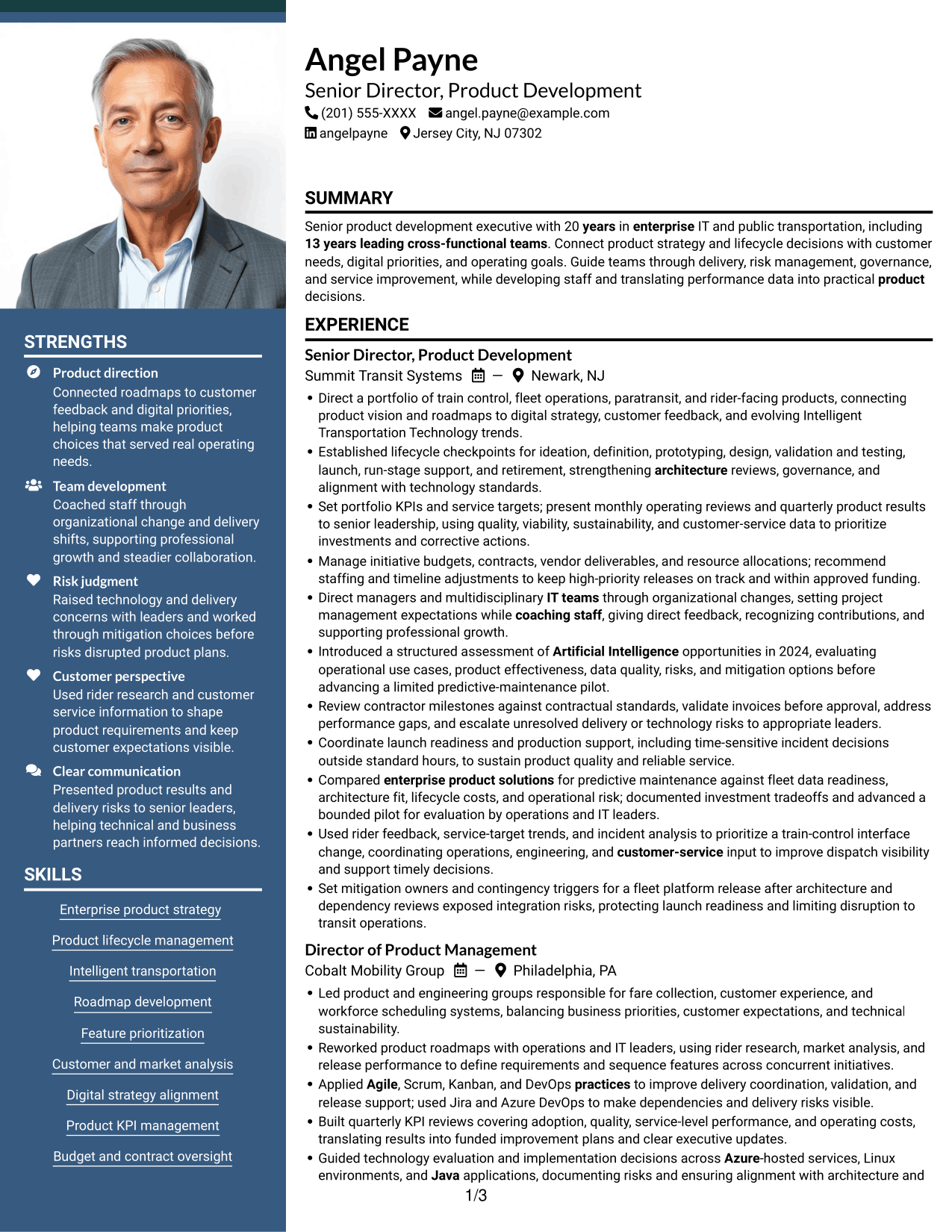
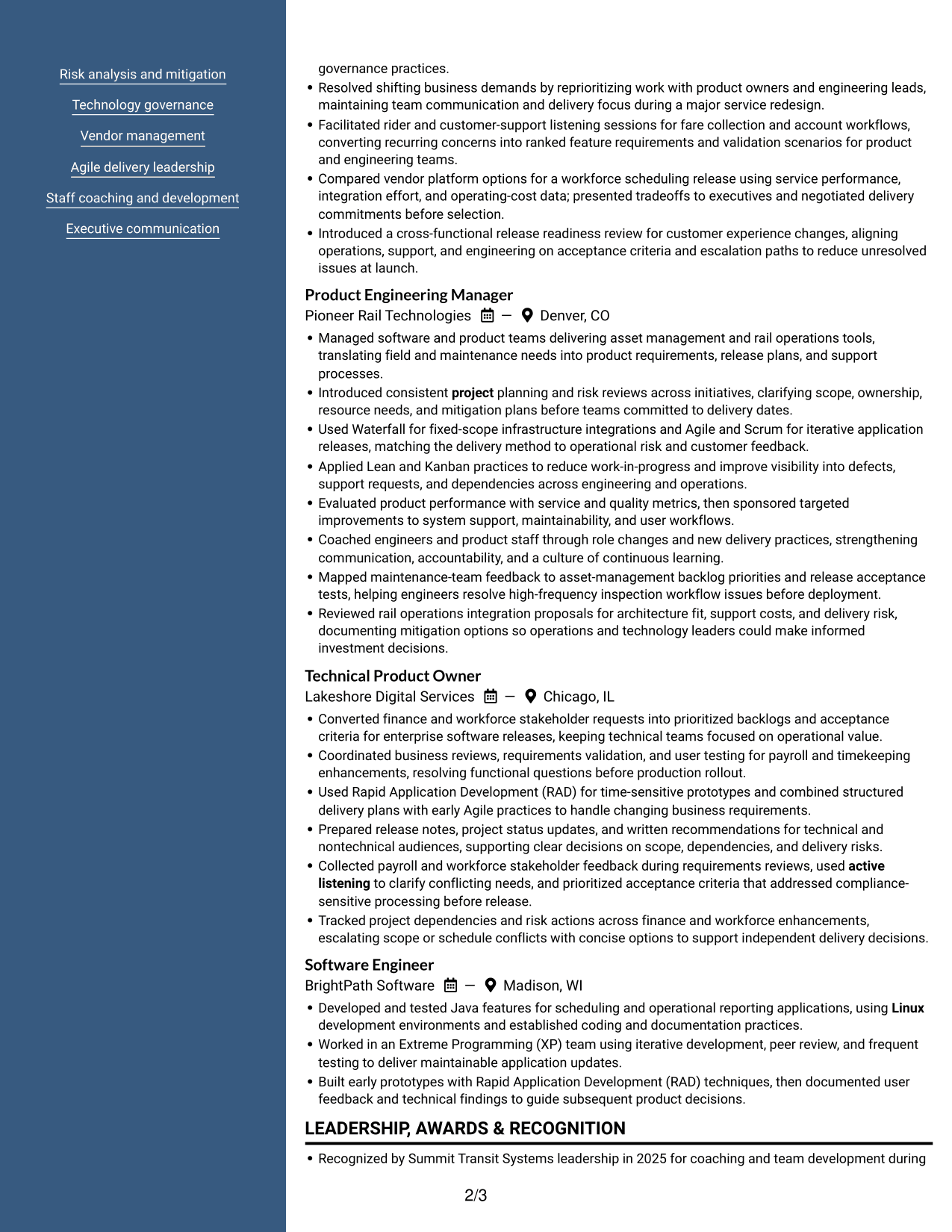
 
Resume example — page 1   Resume example — page 2

Why This Format Works

  • Parallel text areas help reviewers scan career history and related resume sections.
  • Separate reading zones keep credentials visible during an experience review.
  • The photo adds a visual element, while the resume text presents qualifications.

Best For

  • Photo-included resume preference
  • Parallel section scanning
  • Career history with related details
  • Credentials alongside experience
  • Compact resume information


Why Build Your Senior Director, Product Development - Intelligent Transportation Systems Resume with ResumeInMinutes

ResumeInMinutes lets you review resume examples as image previews and open a layout in the editor. Use the examples to compare section order and visual style, then adapt your resume content to highlight relevant leadership and product results.

  • Professional resume layouts
  • Clear section structure
  • ATS-ready content organization
  • Skills and experience sections
  • Image previews for comparison
  • Editor access to customize an example

Keep the focus on the work this role calls for: product roadmaps, lifecycle decisions, performance measures, technology governance, risk management, and team leadership. Use concise bullets to connect your actions with results and service needs.


See Also


Frequently Asked Questions

Are these Senior Director, Product Development - Intelligent Transportation Systems resume templates ATS-friendly?

The examples use clear sections and readable headings to support scanning. Use relevant terms in context, such as product lifecycle management, Intelligent Transportation Technology, KPIs, governance, and risk mitigation, and keep your experience details accurate.

Do the examples show different resumes or different designs?

They show the same resume example in different layouts and design styles. Compare the image previews to see which structure makes your experience easiest to scan, then open an example in the editor.

What should a Senior Director, Product Development - Intelligent Transportation Systems resume include?

Include a focused summary, relevant experience, skills, education, and certifications. Use experience bullets to show product strategy, lifecycle oversight, cross-functional leadership, budgets, KPIs, risk decisions, and results related to transportation products.

Which resume layout works well for this role?

Choose a layout with familiar headings and enough space for leadership scope, key decisions, and measurable outcomes. A simple structure can help recruiters scan details about product portfolios, teams, governance, and delivery.

How can I show product leadership and technical expertise together?

Describe the product or portfolio, the decision or action you led, and the result. Add relevant technical methods and tools, such as Agile, Scrum, Azure, Linux, or Java, where they support the example.

Should I include a photo on my resume?

Include a photo only if it is customary or expected in your country, region, or industry. For U.S. applications, a resume without a photo is generally the safer choice.

ATS Score 80%

How we calculate this score

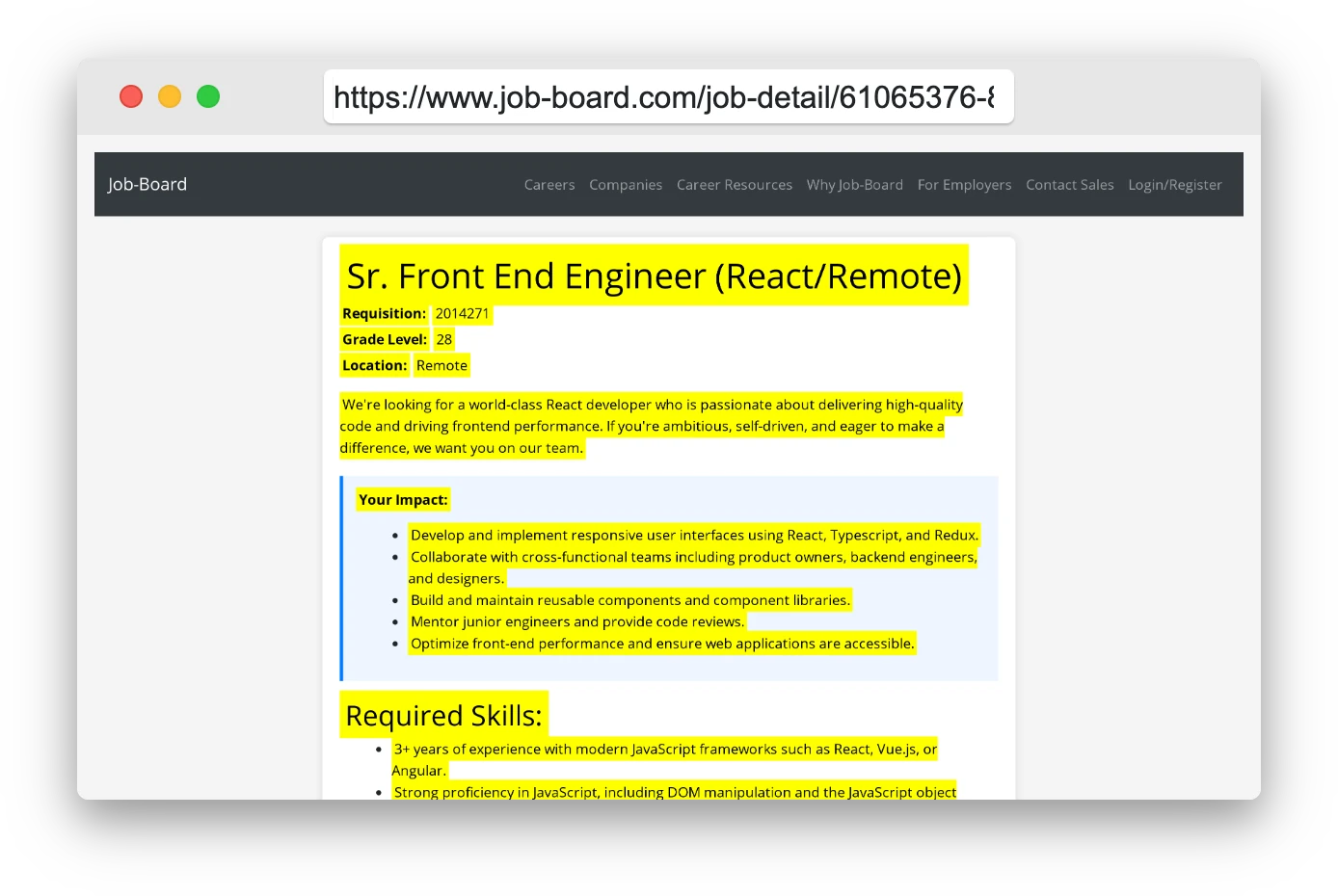
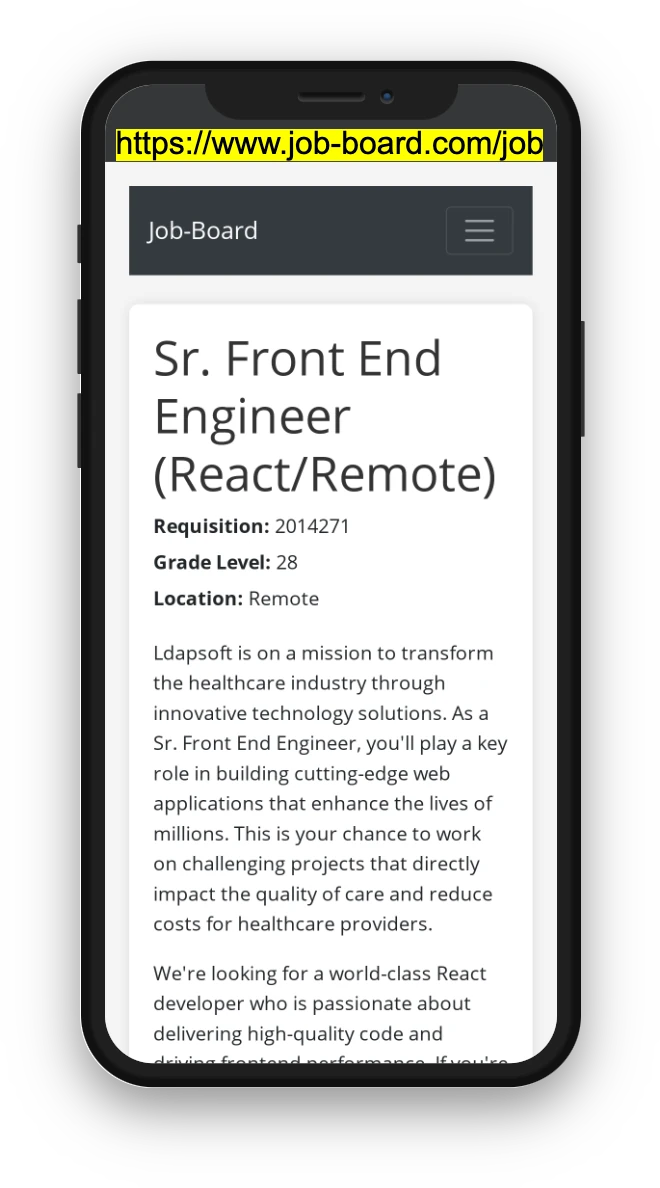
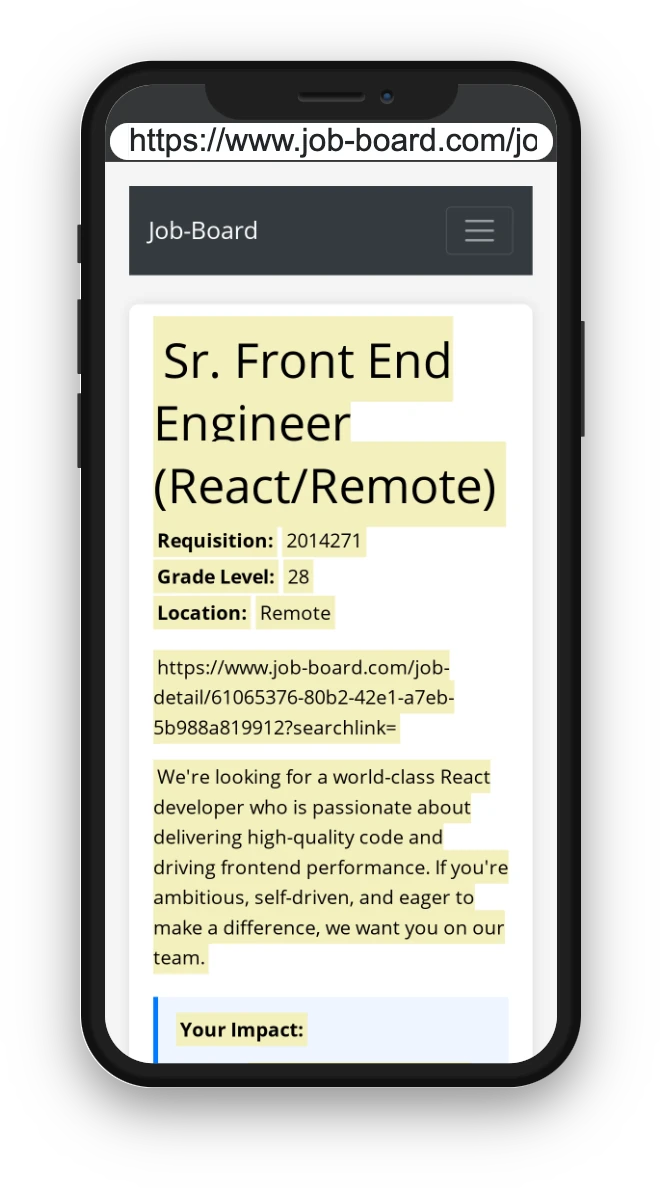
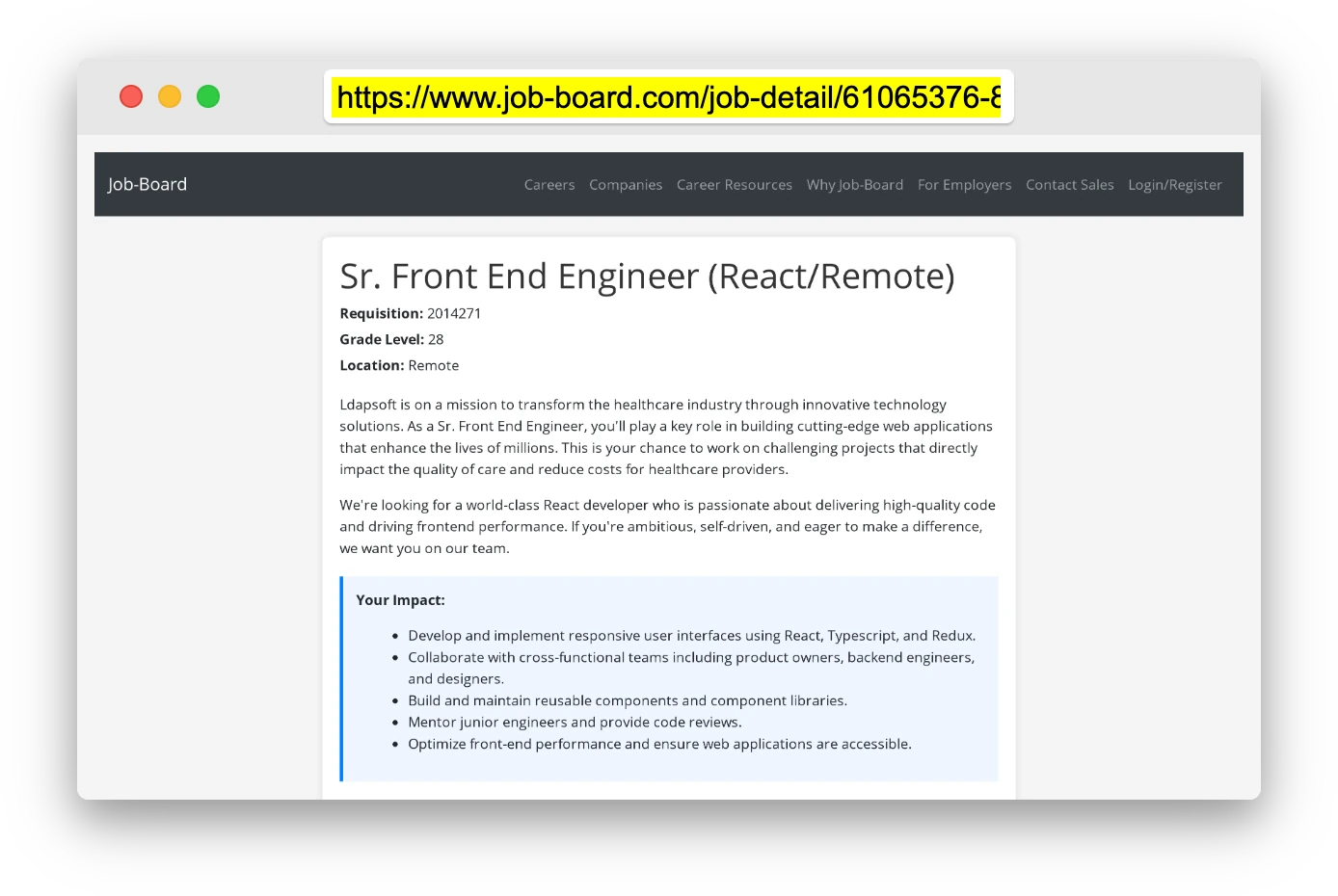
  • Keywords: 60% of the total. AI extracts keywords from your job description. If you do not provide one, a standard job description for the title matching your resume is used. This is not a match to a specific vacancy.
  • Text-based resume: 20%. The text resume assessed here receives 100 for this part.
  • Resume quality: 20%. We start at 100 and subtract points for issues found by our resume checks, down to a minimum of zero.
  • Keyword coverage = round(100 × confirmed matches ÷ total keywords). Exact matches and supported equivalents verified by AI receive full credit; unsupported keywords receive none. Live text checks use the saved equivalents and do not request a new AI review. Without keywords, no overall ATS score is available.
  • Final score = 60% of keyword coverage + 20% of the text score + 20% of the quality score, rounded to a whole number. Without keywords, no overall ATS score is available.

What this score means

Our scores are estimates, not employer ratings. They may contain errors and do not guarantee accurate parsing, a ranking, an interview, or a job. Check your document against the employer’s requirements. You are responsible for relying on this score.

Terms and Conditions

Score weights: Keywords 60% · Text based resume 20% · Resume quality 20%

Keyword coverage: 27 of 36 (75%) · Resume quality: 75%

Resume quality 75% · Weight 20% · Issues (5)

Details
  • ✓Name present: Angel Payne
  • ✓Email format: angel.payne@example.com
  • ✓Phone format: (201) 555-XXXX
  • ✓Experience 1: Job title: Senior Director, Product Development
  • ✓Experience 1: Company name: Summit Transit Systems
  • ✓Experience 1: Work location: Newark, NJ
  • ✗Experience 1: Employment dates: —
  • ✓Experience 1: Description or achievements: Present
  • ✓Experience 2: Job title: Director of Product Management
  • ✓Experience 2: Company name: Cobalt Mobility Group
  • ✓Experience 2: Work location: Philadelphia, PA
  • ✗Experience 2: Employment dates: —
  • ✓Experience 2: Description or achievements: Present
  • ✓Experience 3: Job title: Product Engineering Manager
  • ✓Experience 3: Company name: Pioneer Rail Technologies
  • ✓Experience 3: Work location: Denver, CO
  • ✗Experience 3: Employment dates: —
  • ✓Experience 3: Description or achievements: Present
  • ✓Experience 4: Job title: Technical Product Owner
  • ✓Experience 4: Company name: Lakeshore Digital Services
  • ✓Experience 4: Work location: Chicago, IL
  • ✗Experience 4: Employment dates: —
  • ✓Experience 4: Description or achievements: Present
  • ✓Experience 5: Job title: Software Engineer
  • ✓Experience 5: Company name: BrightPath Software
  • ✓Experience 5: Work location: Madison, WI
  • ✗Experience 5: Employment dates: —
  • ✓Experience 5: Description or achievements: Present
  • ✓No placeholder fields
  • ✓No repeated achievement bullets
  • ✓No empty bullets

Experience 1: Senior Director, Product Development: Add a start year and an end year (or Present).

Experience 2: Director of Product Management: Add a start year and an end year (or Present).

Experience 3: Product Engineering Manager: Add a start year and an end year (or Present).

Experience 4: Technical Product Owner: Add a start year and an end year (or Present).

Experience 5: Software Engineer: Add a start year and an end year (or Present).

Expand details to review the checks.

Text Based Resume 100% · Weight 20%

Parsed text
Angel Payne
(201) 555-XXXX
angel.payne@example.com
angelpayne
Jersey City, NJ 07302
SUMMARY
Senior product development executive with 20 years in enterprise IT and public transportation, including 13 years leading cross-functional teams. Connect product strategy and lifecycle decisions with customer needs, digital priorities, and operating goals. Guide teams through delivery, risk management, governance, and service improvement, while developing staff and translating performance data into practical product decisions.
EXPERIENCE
Senior Director, Product Development
—
Summit Transit Systems
Newark, NJ
Direct a portfolio of train control, fleet operations, paratransit, and rider-facing products, connecting product vision and roadmaps to digital strategy, customer feedback, and evolving Intelligent Transportation Technology trends.
Established lifecycle checkpoints for ideation, definition, prototyping, design, validation and testing, launch, run-stage support, and retirement, strengthening architecture reviews, governance, and alignment with technology standards.
Set portfolio KPIs and service targets; present monthly operating reviews and quarterly product results to senior leadership, using quality, viability, sustainability, and customer-service data to prioritize investments and corrective actions.
Manage initiative budgets, contracts, vendor deliverables, and resource allocations; recommend staffing and timeline adjustments to keep high-priority releases on track and within approved funding.
Direct managers and multidisciplinary IT teams through organizational changes, setting project management expectations while coaching staff, giving direct feedback, recognizing contributions, and supporting professional growth.
Introduced a structured assessment of Artificial Intelligence opportunities in 2024, evaluating operational use cases, product effectiveness, data quality, risks, and mitigation options before advancing a limited predictive-maintenance pilot.
Review contractor milestones against contractual standards, validate invoices before approval, address performance gaps, and escalate unresolved delivery or technology risks to appropriate leaders.
Coordinate launch readiness and production support, including time-sensitive incident decisions outside standard hours, to sustain product quality and reliable service.
Compared enterprise product solutions for predictive maintenance against fleet data readiness, architecture fit, lifecycle costs, and operational risk; documented investment tradeoffs and advanced a bounded pilot for evaluation by operations and IT leaders.
Used rider feedback, service-target trends, and incident analysis to prioritize a train-control interface change, coordinating operations, engineering, and customer-service input to improve dispatch visibility and support timely decisions.
Set mitigation owners and contingency triggers for a fleet platform release after architecture and dependency reviews exposed integration risks, protecting launch readiness and limiting disruption to transit operations.
Director of Product Management
—
Cobalt Mobility Group
Philadelphia, PA
Led product and engineering groups responsible for fare collection, customer experience, and workforce scheduling systems, balancing business priorities, customer expectations, and technical sustainability.
Reworked product roadmaps with operations and IT leaders, using rider research, market analysis, and release performance to define requirements and sequence features across concurrent initiatives.
Applied Agile, Scrum, Kanban, and DevOps practices to improve delivery coordination, validation, and release support; used Jira and Azure DevOps to make dependencies and delivery risks visible.
Built quarterly KPI reviews covering adoption, quality, service-level performance, and operating costs, translating results into funded improvement plans and clear executive updates.
Guided technology evaluation and implementation decisions across Azure-hosted services, Linux environments, and Java applications, documenting risks and ensuring alignment with architecture and governance practices.
Resolved shifting business demands by reprioritizing work with product owners and engineering leads, maintaining team communication and delivery focus during a major service redesign.
Facilitated rider and customer-support listening sessions for fare collection and account workflows, converting recurring concerns into ranked feature requirements and validation scenarios for product and engineering teams.
Compared vendor platform options for a workforce scheduling release using service performance, integration effort, and operating-cost data; presented tradeoffs to executives and negotiated delivery commitments before selection.
Introduced a cross-functional release readiness review for customer experience changes, aligning operations, support, and engineering on acceptance criteria and escalation paths to reduce unresolved issues at launch.
Product Engineering Manager
—
Pioneer Rail Technologies
Denver, CO
Managed software and product teams delivering asset management and rail operations tools, translating field and maintenance needs into product requirements, release plans, and support processes.
Introduced consistent project planning and risk reviews across initiatives, clarifying scope, ownership, resource needs, and mitigation plans before teams committed to delivery dates.
Used Waterfall for fixed-scope infrastructure integrations and Agile and Scrum for iterative application releases, matching the delivery method to operational risk and customer feedback.
Applied Lean and Kanban practices to reduce work-in-progress and improve visibility into defects, support requests, and dependencies across engineering and operations.
Evaluated product performance with service and quality metrics, then sponsored targeted improvements to system support, maintainability, and user workflows.
Coached engineers and product staff through role changes and new delivery practices, strengthening communication, accountability, and a culture of continuous learning.
Mapped maintenance-team feedback to asset-management backlog priorities and release acceptance tests, helping engineers resolve high-frequency inspection workflow issues before deployment.
Reviewed rail operations integration proposals for architecture fit, support costs, and delivery risk, documenting mitigation options so operations and technology leaders could make informed investment decisions.
Technical Product Owner
—
Lakeshore Digital Services
Chicago, IL
Converted finance and workforce stakeholder requests into prioritized backlogs and acceptance criteria for enterprise software releases, keeping technical teams focused on operational value.
Coordinated business reviews, requirements validation, and user testing for payroll and timekeeping enhancements, resolving functional questions before production rollout.
Used Rapid Application Development (RAD) for time-sensitive prototypes and combined structured delivery plans with early Agile practices to handle changing business requirements.
Prepared release notes, project status updates, and written recommendations for technical and nontechnical audiences, supporting clear decisions on scope, dependencies, and delivery risks.
Collected payroll and workforce stakeholder feedback during requirements reviews, used active listening to clarify conflicting needs, and prioritized acceptance criteria that addressed compliance-sensitive processing before release.
Tracked project dependencies and risk actions across finance and workforce enhancements, escalating scope or schedule conflicts with concise options to support independent delivery decisions.
Software Engineer
—
BrightPath Software
Madison, WI
Developed and tested Java features for scheduling and operational reporting applications, using Linux development environments and established coding and documentation practices.
Worked in an Extreme Programming (XP) team using iterative development, peer review, and frequent testing to deliver maintainable application updates.
Built early prototypes with Rapid Application Development (RAD) techniques, then documented user feedback and technical findings to guide subsequent product decisions.
LEADERSHIP, AWARDS & RECOGNITION
Recognized by Summit Transit Systems leadership in 2025 for coaching and team development during a product organization redesign.
Led a cross-functional rider experience working group at Cobalt Mobility Group from 2019 to 2020, bringing operations, customer support, and engineering perspectives into product decisions.
EDUCATION
Bachelor of Science in Information Systems
2006
University of Wisconsin–Milwaukee
Milwaukee, WI
CERTIFICATIONS
Project Management Professional (PMP), Project Management Institute
2018
SAFe Agilist, Scaled Agile, Inc.
2020
ITIL 4 Foundation, PeopleCert
2022
TECHNICAL SKILLS
Programming Languages: Java, Python, SQL
Cloud Platforms: Microsoft Azure, AWS, Google Cloud Platform
Operating Systems: Linux, Windows Server, UNIX
Development Tools: Jira, Azure DevOps, Git
Databases: PostgreSQL, MySQL, Microsoft SQL Server
Web Technologies: HTML, CSS, JavaScript
API Technologies: REST, SOAP, OpenAPI
Testing Tools: JUnit, Selenium, Postman
Monitoring Platforms: Azure Monitor, Prometheus, Grafana
Data and Reporting: Power BI, Tableau, Microsoft Excel
Containers and Deployment: Docker, Kubernetes, Jenkins
SKILLS
Enterprise product strategy
Product lifecycle management
Intelligent transportation
Roadmap development
Feature prioritization
Customer and market analysis
Digital strategy alignment
Product KPI management
Budget and contract oversight
Risk analysis and mitigation
Technology governance
Vendor management
Agile delivery leadership
Staff coaching and development
Executive communication
PROFESSIONAL AFFILIATIONS
Member, Association for Computing Machinery (ACM), professional community for computing and software development.
Member, Institute of Electrical and Electronics Engineers (IEEE), professional community for technology and engineering.

Matched keywords (27)

  • Bachelor of Science in Information SystemsOriginal keyword in JD: Bachelor's degree in arts, sciences, or a related field OR equivalent education and experience
  • 20 years in enterprise IT and public transportationOriginal keyword in JD: 10+ years of relevant experience
  • 13 years leading cross-functional teamsOriginal keyword in JD: 5+ years of supervisory or management experience
  • Senior Director, Product DevelopmentOriginal keyword in JD: Enterprise product development
  • Product lifecycle management
  • enterprise product solutions
  • Direct managers and multidisciplinary IT teams through organizational changesOriginal keyword in JD: Cross-functional IT leadership
  • Introduced consistent project planning and risk reviews across initiativesOriginal keyword in JD: Project and initiative management
  • AgileOriginal keyword in JD: Software engineering methodologies: Waterfall OR Agile OR Scrum OR DevOps OR Extreme Programming (XP) OR Kanban OR Lean OR Rapid Application Development (RAD)
  • define requirements and sequence features across concurrent initiativesOriginal keyword in JD: Product requirements and feature prioritization
  • Digital strategy alignment
  • Set portfolio KPIs and service targetsOriginal keyword in JD: Product KPIs and performance measurement
  • Manage initiative budgets, contracts, vendor deliverables, and resource allocationsOriginal keyword in JD: Budget, contract, and resource management
  • evaluating operational use cases, product effectiveness, data quality, risks, and mitigation optionsOriginal keyword in JD: Product risk analysis and mitigation
  • strengthening architecture reviews, governance, and alignment with technology standardsOriginal keyword in JD: Technology architecture and governance
  • Compared enterprise product solutions for predictive maintenance against fleet data readiness, architecture fit, lifecycle costs, and operational risk; documented investment tradeoffsOriginal keyword in JD: Technology evaluation and investment analysis
  • Introduced a structured assessment of Artificial Intelligence opportunitiesOriginal keyword in JD: Artificial Intelligence opportunity assessment
  • Direct managers and multidisciplinary IT teams through organizational changesOriginal keyword in JD: Change leadership
  • coaching staff, giving direct feedback, recognizing contributions, and supporting professional growthOriginal keyword in JD: Staff coaching and professional development
  • Applied Agile, Scrum, Kanban, and DevOps practicesOriginal keyword in JD: Project management practices
  • presented tradeoffs to executives and negotiated delivery commitmentsOriginal keyword in JD: Executive communication and negotiation
  • translating performance data into practical product decisionsOriginal keyword in JD: Data-informed decision-making
  • customer-service
  • active listening
  • Java
  • Azure
  • Linux

Missing keywords (9)

  • Intelligent Transportation Systems
  • Product vision, strategy, and roadmaps
  • Customer needs and market analysis
  • Product evaluation, selection, and implementation
  • Product quality and sustainability
  • Contractor and vendor oversight
  • Stakeholder relationship management
  • Critical thinking and problem-solving
  • Prioritization and independent judgment
Disclaimer: All names, images, contact information, employment histories, achievements, security clearances, military credentials, and other qualifications shown in this content are fictional and used for illustrative purposes only. Any resemblance to actual persons, living or deceased, is purely coincidental.

Resume and cover-letter examples and recommendations in this article reflect general best practices and professional experience and are provided for guidance only. Results may vary based on role, industry, region, and hiring organization.

Content Accuracy and Verification: To the fullest extent permitted by applicable law, we do not represent or warrant that resume or cover-letter guidance, examples, recommendations, or related information are accurate, complete, current, error-free, or suitable for any particular purpose. You are responsible for independently reviewing and verifying the information before relying on it.

ATS and Cover-Letter Scores: ATS scores are estimates calculated using our own formula, informed by publicly available guidance on resume formatting and keyword matching. They are not scores issued or endorsed by an ATS provider or employer. Cover-letter scores are also our own assessments. Parsing, weighting, screening criteria, and results vary between systems, employers, job descriptions, and document formats. No score guarantees successful parsing, a particular ranking, an interview, or employment. Use scores as general guidance and independently check your documents against the employer’s requirements. To the fullest extent permitted by applicable law, we accept no liability for errors in scores or parsing, or losses arising from reliance on these assessments. Nothing in this notice excludes liability or limits consumer rights that cannot lawfully be excluded or limited.

Terms and Conditions
 
> JP 1 1
PDF Footer and Margins Setup
The margins are applied to the document, and the footer shows up in the preview and the PDF

Footer Font Settings

Are you applying for a specific job
so we can tailor your resume to it?
Are you applying for a specific job
so we can tailor your cover letter to it?

Your data stays private and is never used for training.Privacy Policy

Type your details as text to generate a personalized resume Type your details as text to generate a personalized cover letter
Website link found! Ready to create resume from:

Your data stays private and is never used for training.Privacy Policy

Drag the into the box to verify you're human.
Drop here

My Resumes

Displaying {number_of_files} files (out of {total_of_all_files} total)
Name File Type Last Modified: Description:

Rename File

Filename already exists!

Delete Files

Warning: This action is irreversible. Once you click submit, the files will be permanently deleted.

Heading text
Upload From Computer Upload
Select From Existing
LinkedIn
Drag & Drop files anywhere in this tab, or

Uploaded Files

Delete Name Last Updated Use This File
Select this to use the file for generating your resume and cover letter. Only one source—uploaded file, selected file, or LinkedIn text—can be used.

My Files

Resumes or cover letters you create will appear here. No files available yet.
Delete Name Last Updated Use This File
Select this to use the file for generating your resume and cover letter. Only one source—uploaded file, selected file, or LinkedIn text—can be used.

Add LinkedIn Profile PDF

You can download your LinkedIn profile as a PDF by opening linkedin.com in a web browser, clicking your profile photo, selecting the “More” or “Resources” button, and choosing “Save to PDF.” You can then attach the PDF using the Upload From Computer tab.

Paste Your LinkedIn Profile Text

If you have copied the LinkedIn profile text, paste it below. See how to copy your profile from LinkedIn

Select this to use the LinkedIn profile text for generating your resume and cover letter. Only one source—uploaded file, selected file, or LinkedIn text—can be used.

Try these controls

<
>