
US English


7 Senior Life Sciences Analyst - AI Model Training Resume Templates with Example
By Ria · Last Updated On October 15, 2026
Resume example — page 1

This guide shows you how to create a clear, focused resume for a Senior Life Sciences Analyst - AI Model Training role. You will learn how to present relevant evidence and compare professional resume formats.

Strong resumes connect life sciences knowledge with model evaluation work. Show how you assess clinical and regulatory content, score and rank responses, design evaluation rubrics, and use preference data to find model weaknesses.

The same resume example is presented in 7 layouts, so you can compare the image previews and choose a format that suits your content. The guidance also covers ATS-readable headings, concise achievement bullets, and technical skills such as SQL and Python.

What Makes a Great Senior Life Sciences Analyst - AI Model Training Resume in 2026

A strong resume makes model evaluation, life sciences data work, and results easy to find. Use clear sections and concise bullets to show how your work supports better model quality and reliable data.

Include relevant terms such as LLM response assessment, clinical and regulatory content review, preference ranking, red-team testing, SQL, Python, and structured publishing. Support each skill with accurate examples from your work.

Note: Resume examples are for educational purposes only. Use only information that accurately reflects your experience and qualifications. References to real organizations do not imply affiliation or endorsement.

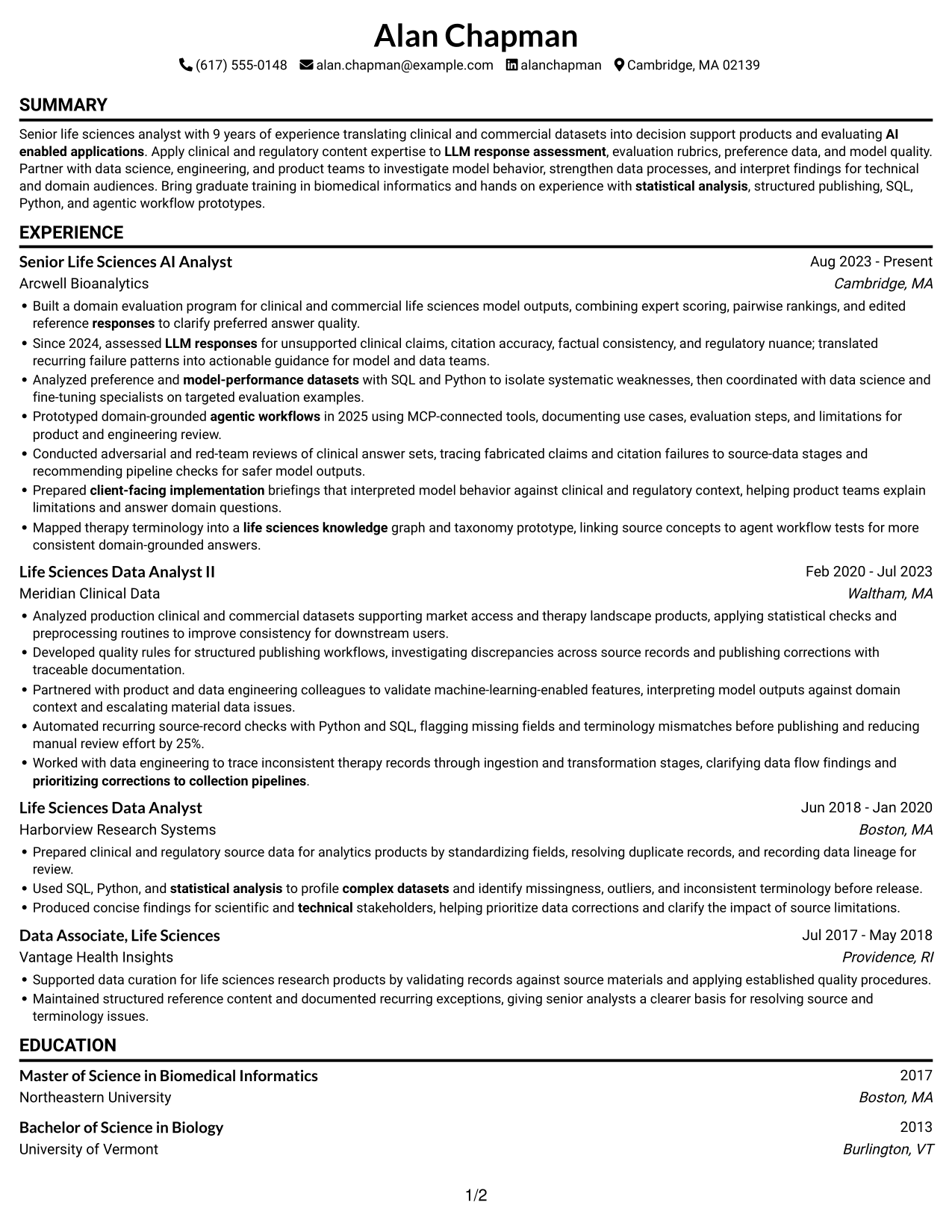
#1 Simple One Column Format Resume Example

Simple One Column Format places resume sections in one vertical reading path, making career history, skills, and education easy to follow in sequence.
 
Resume example — page 1   Resume example — page 2

Why This Format Works

  • Career progression stays in one reading path from earlier roles to current work.
  • Skills and education remain part of the same straightforward section sequence.
  • Reviewers can move through detailed experience entries without switching between columns.

Best For

  • Sequential work-history review
  • Single-path section reading
  • Resumes with detailed experience entries
  • Skills and education in one view
  • Straightforward section navigation

Resume Keywords

  • Life sciences datasets
  • AI enabled applications
  • LLM response assessment
  • Evaluation rubric design
  • combining expert scoring, pairwise rankings, and edited reference responses to clarify preferred answer quality
  • assessed LLM responses for unsupported clinical claims, citation accuracy, factual consistency, and regulatory nuance
  • combining expert scoring, pairwise rankings, and edited reference responses
  • edited reference responses to clarify preferred answer quality
  • Analyzed preference and model-performance datasets with SQL and Python to isolate systematic weaknesses
  • Citation review
  • trace inconsistent therapy records through ingestion and transformation stages
  • prioritizing corrections to collection pipelines
  • client-facing implementation
  • statistical analysis
  • profile complex datasets and identify missingness, outliers, and inconsistent terminology
See all keywords
 

#2 Simple Two Column Format Resume Example

Simple Two Column Format places resume content in two side-by-side areas, giving reviewers another way to scan distinct sections.
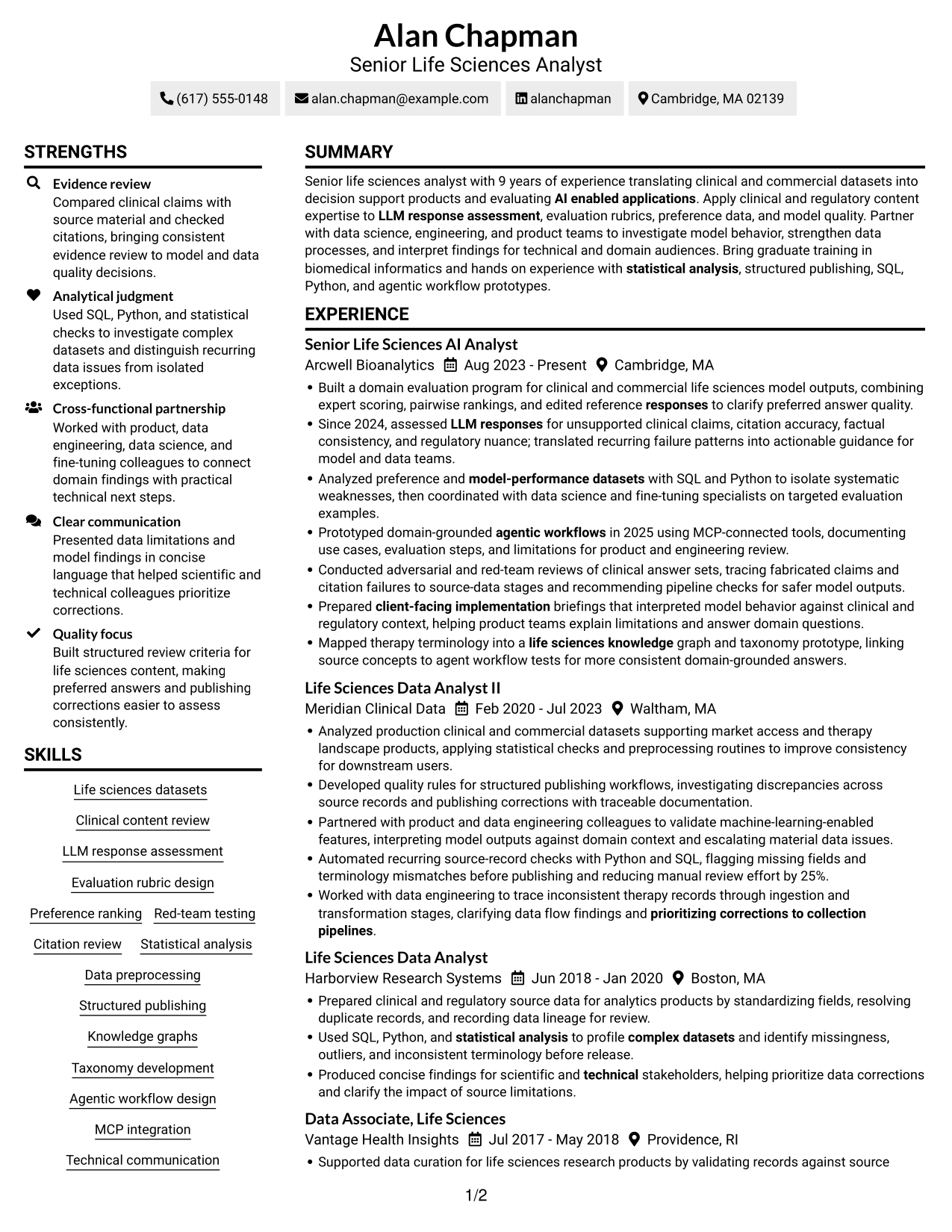
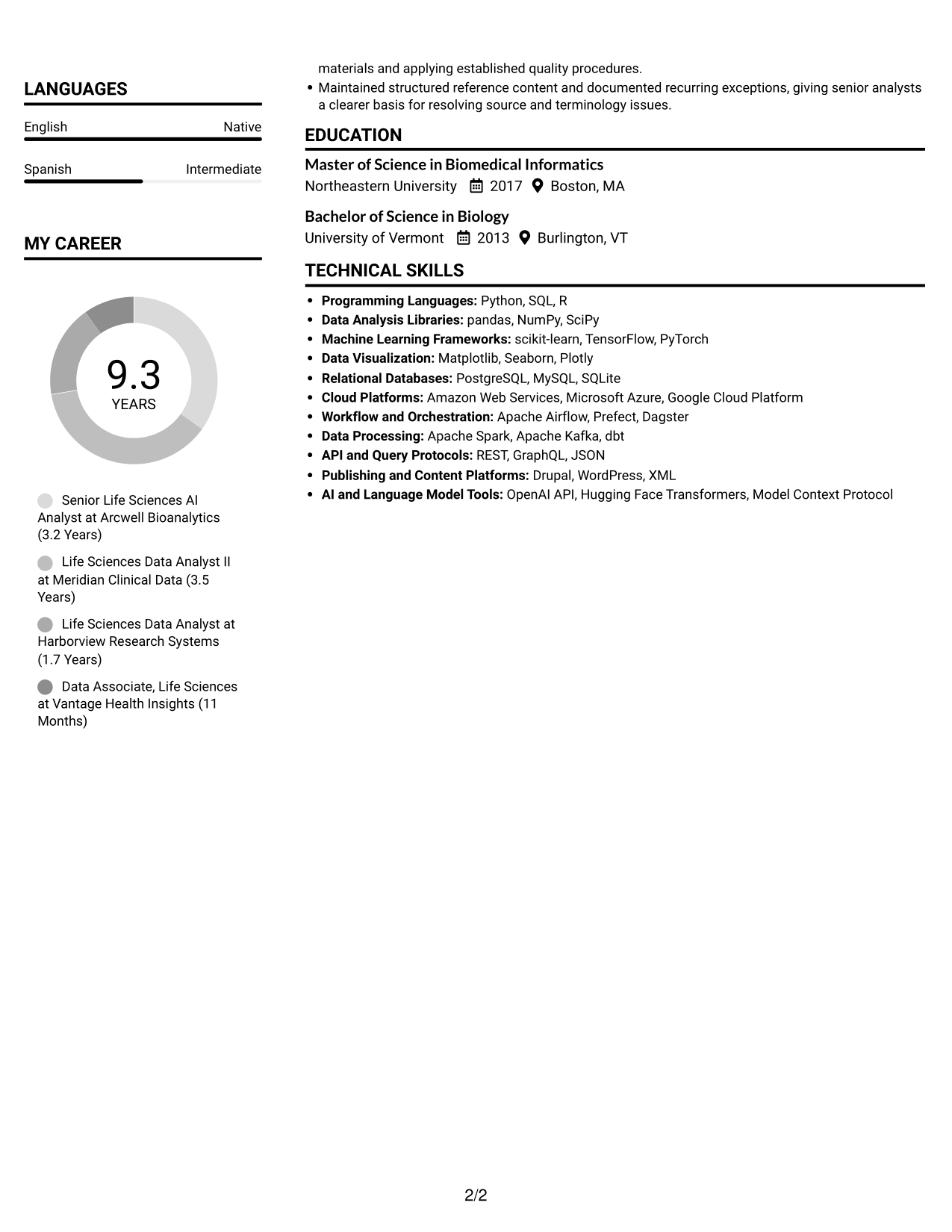
 
Resume example — page 1   Resume example — page 2

Why This Format Works

  • Two content areas give experience and supporting sections separate visual space.
  • Reviewers can scan distinct areas instead of moving through every section in one path.
  • The side-by-side structure offers room for skills, education, and work history.

Best For

  • Side-by-side section organization
  • Resumes balancing experience and credentials
  • Quick review of distinct content areas
  • Skills and education beside work history
  • Compact resume reading

#3 Plain One Column with Shaded Labels Resume Example

Plain One Column with Shaded Labels keeps resume content in one vertical path, which supports a steady review of each section.
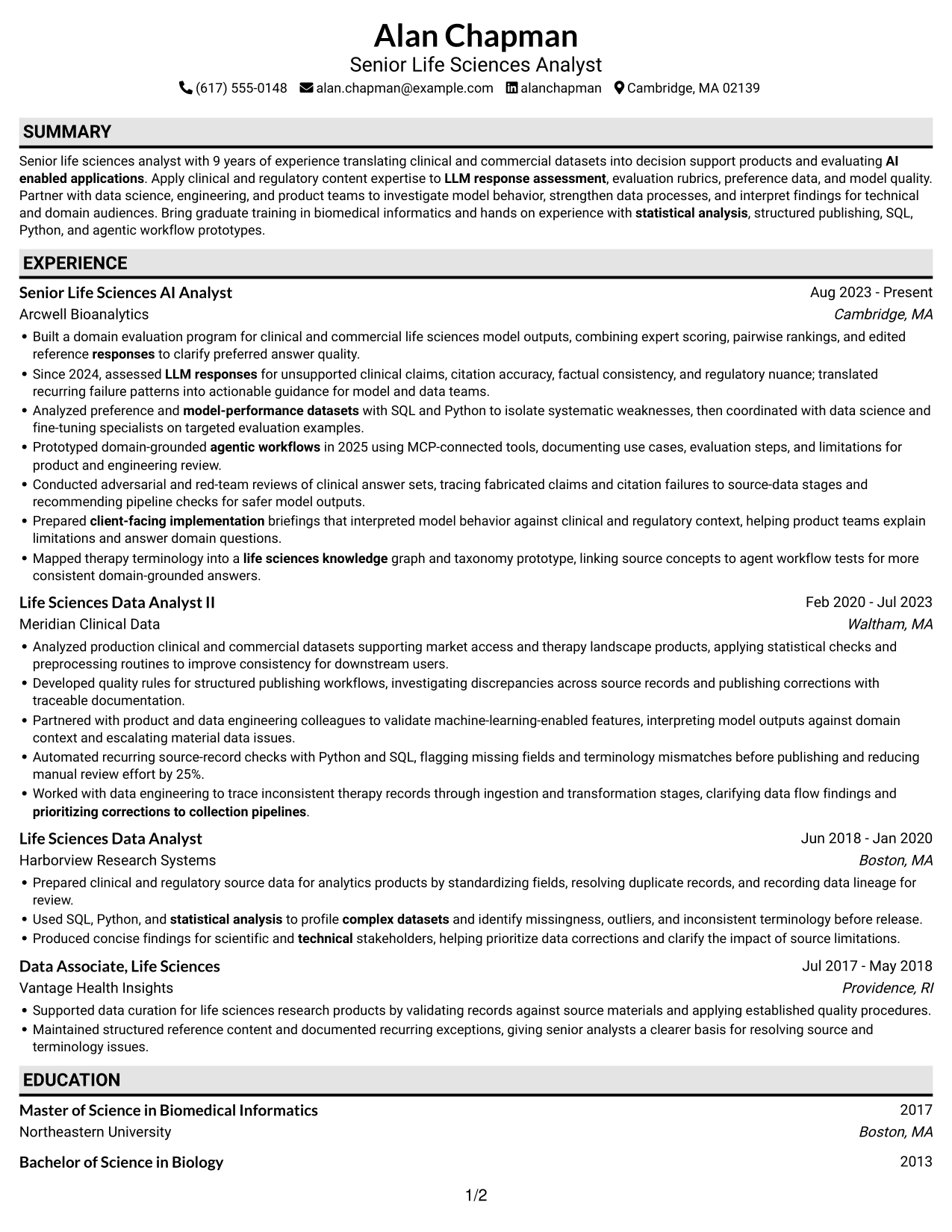
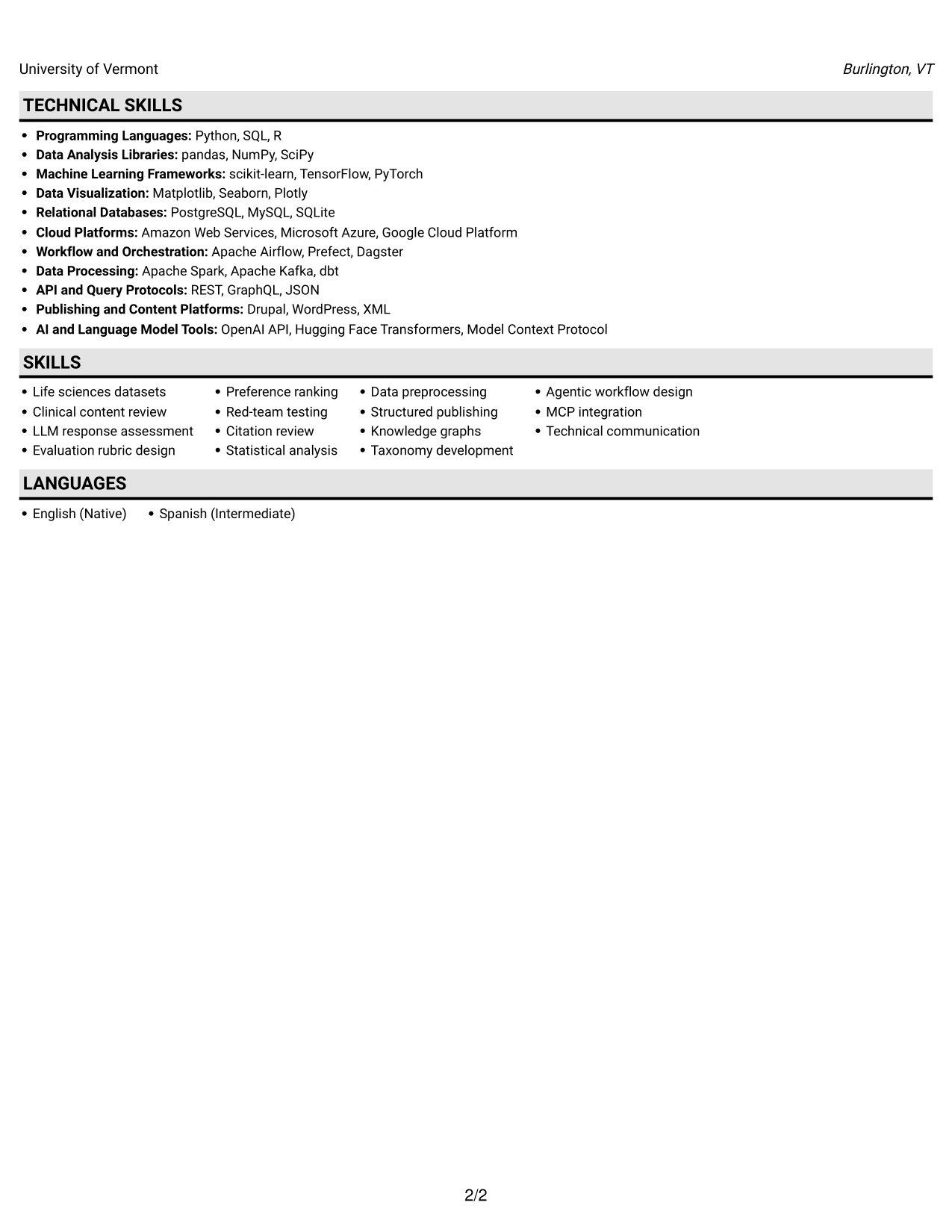
 
Resume example — page 1   Resume example — page 2

Why This Format Works

  • The single-column sequence lets reviewers follow roles in their listed order.
  • Skills and education can be reviewed within the same vertical reading path.
  • Work history remains easy to follow without moving between content columns.

Best For

  • One-path resume reading
  • Chronological work-history review
  • Resumes with full experience details
  • Skills and education in sequence
  • Simple section-by-section review
 

#4 One Column Format with Photo Right Resume Example

One Column Format with Photo Right pairs a single content column with a photo, while keeping resume sections in a clear reading sequence.
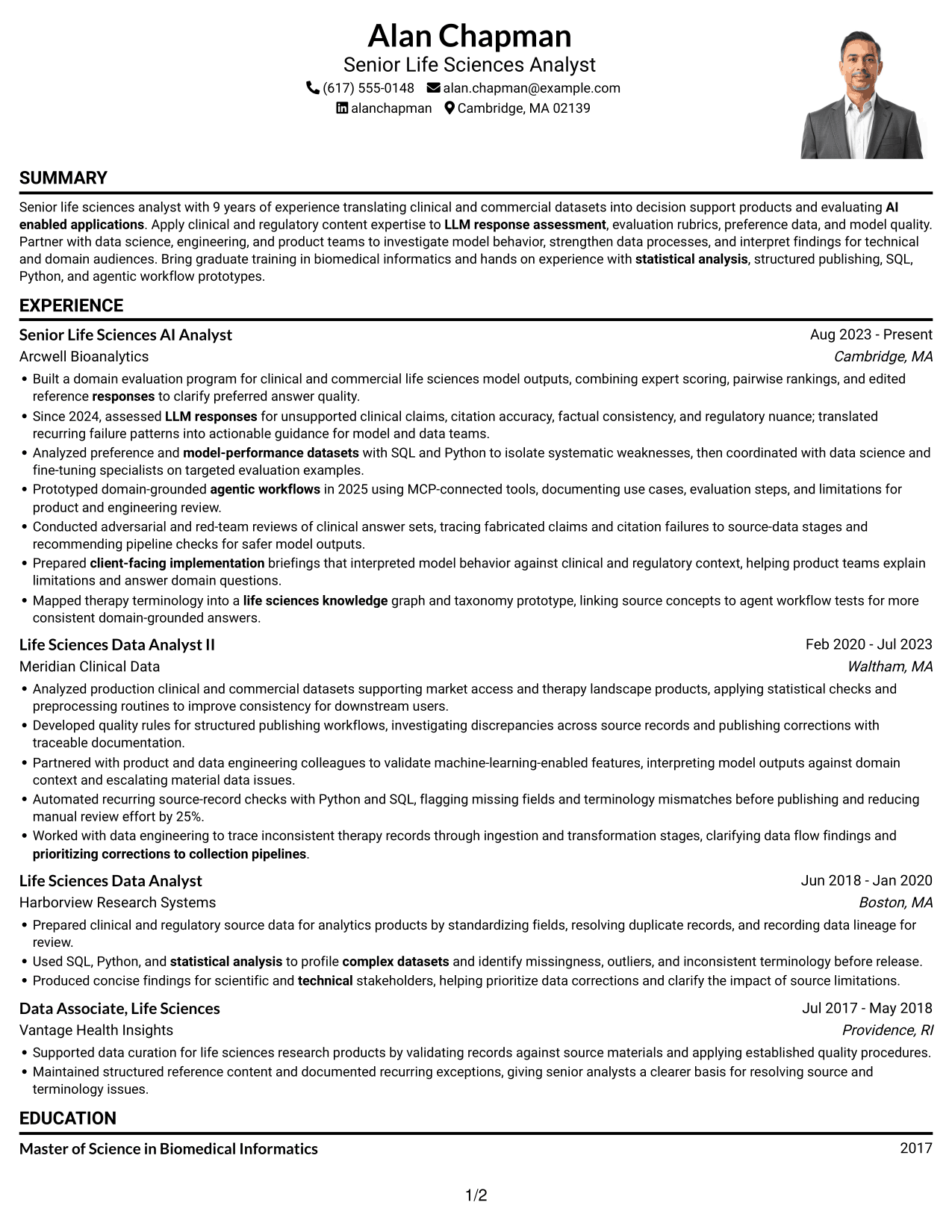
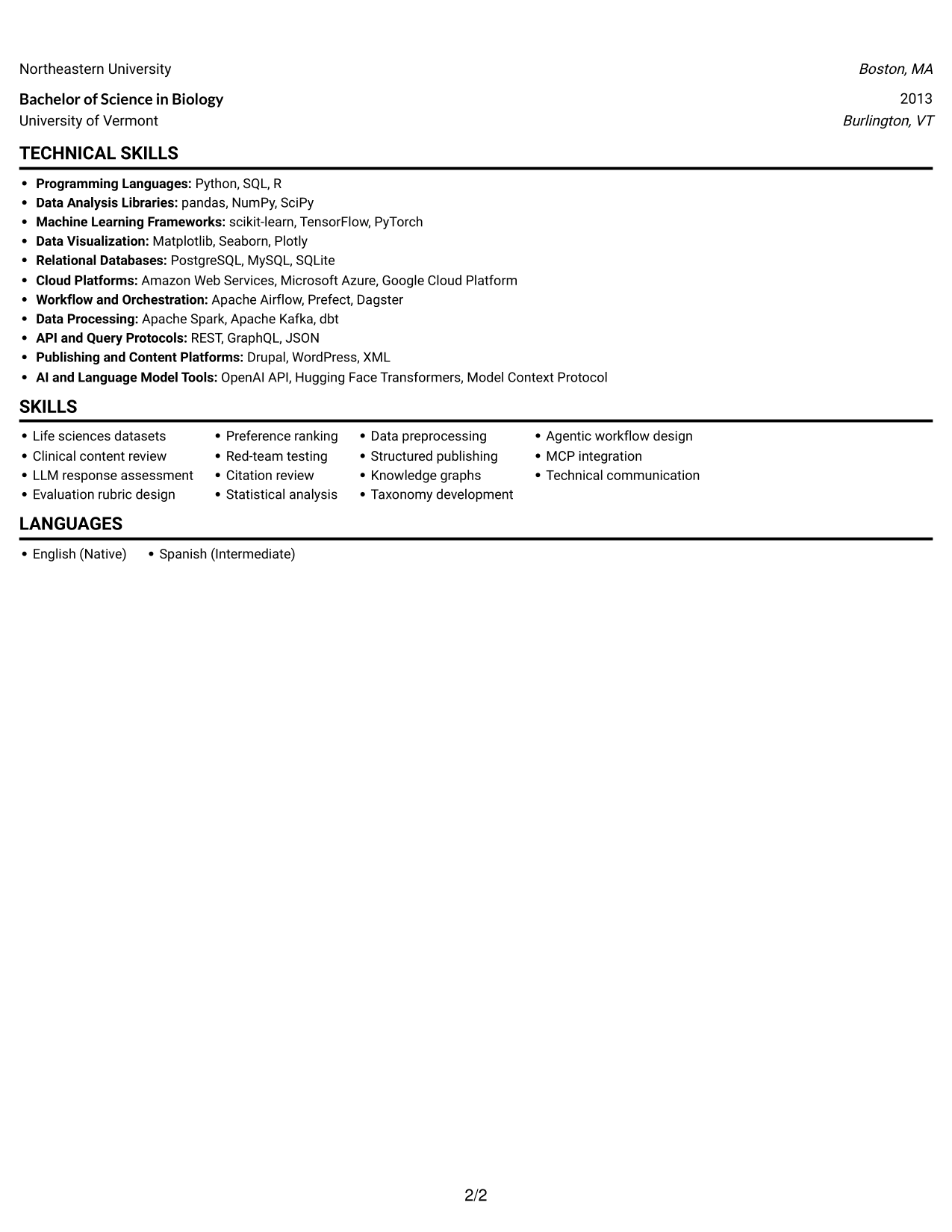
 
Resume example — page 1   Resume example — page 2

Why This Format Works

  • The single content column keeps career history in a clear reading order.
  • Skills, education, and experience remain easy to review in sequence.
  • A photo adds a portrait while the resume content stays in one column.

Best For

  • One-column section reading
  • Resume requests that call for a photo
  • Chronological experience review
  • Detailed work-history entries
  • Skills and education in sequence
 

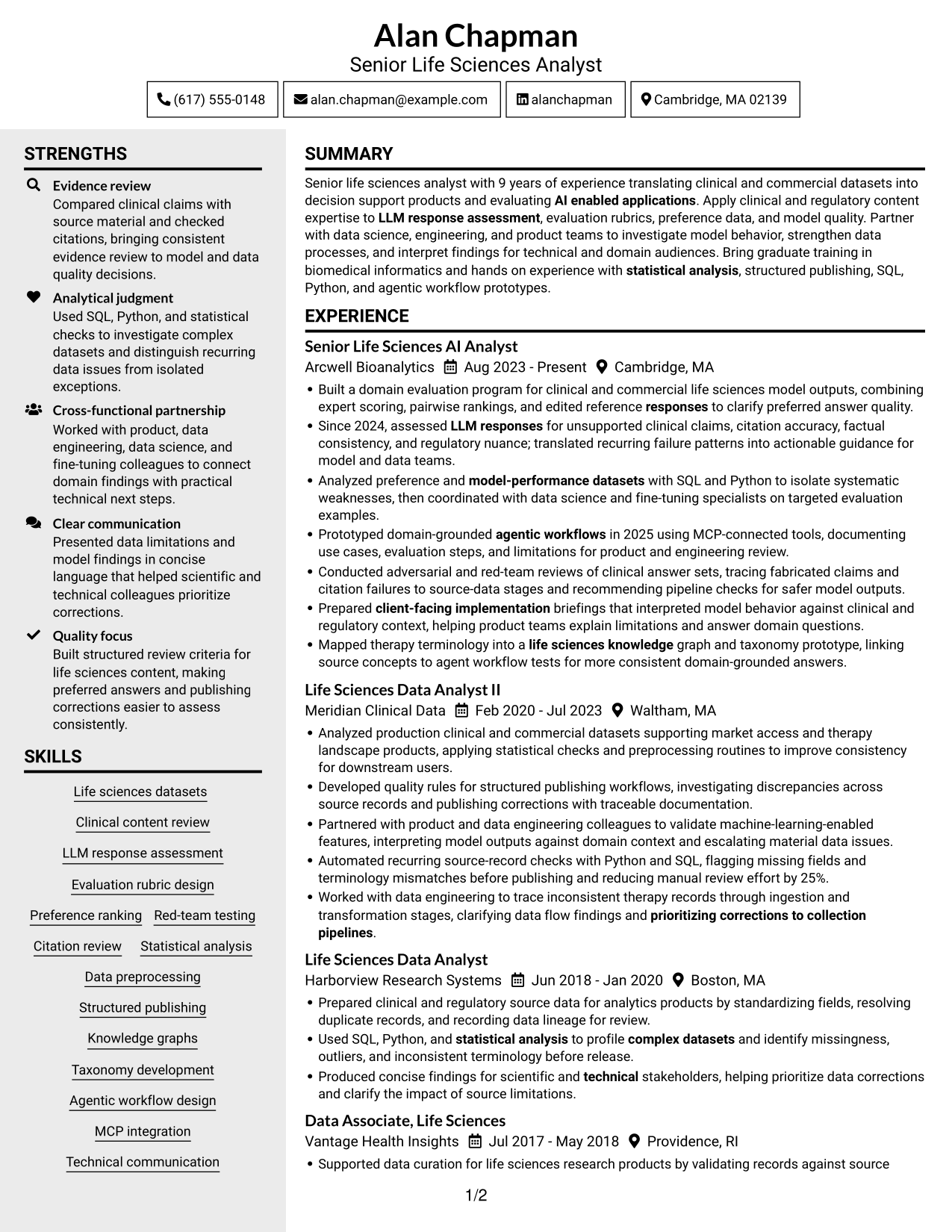
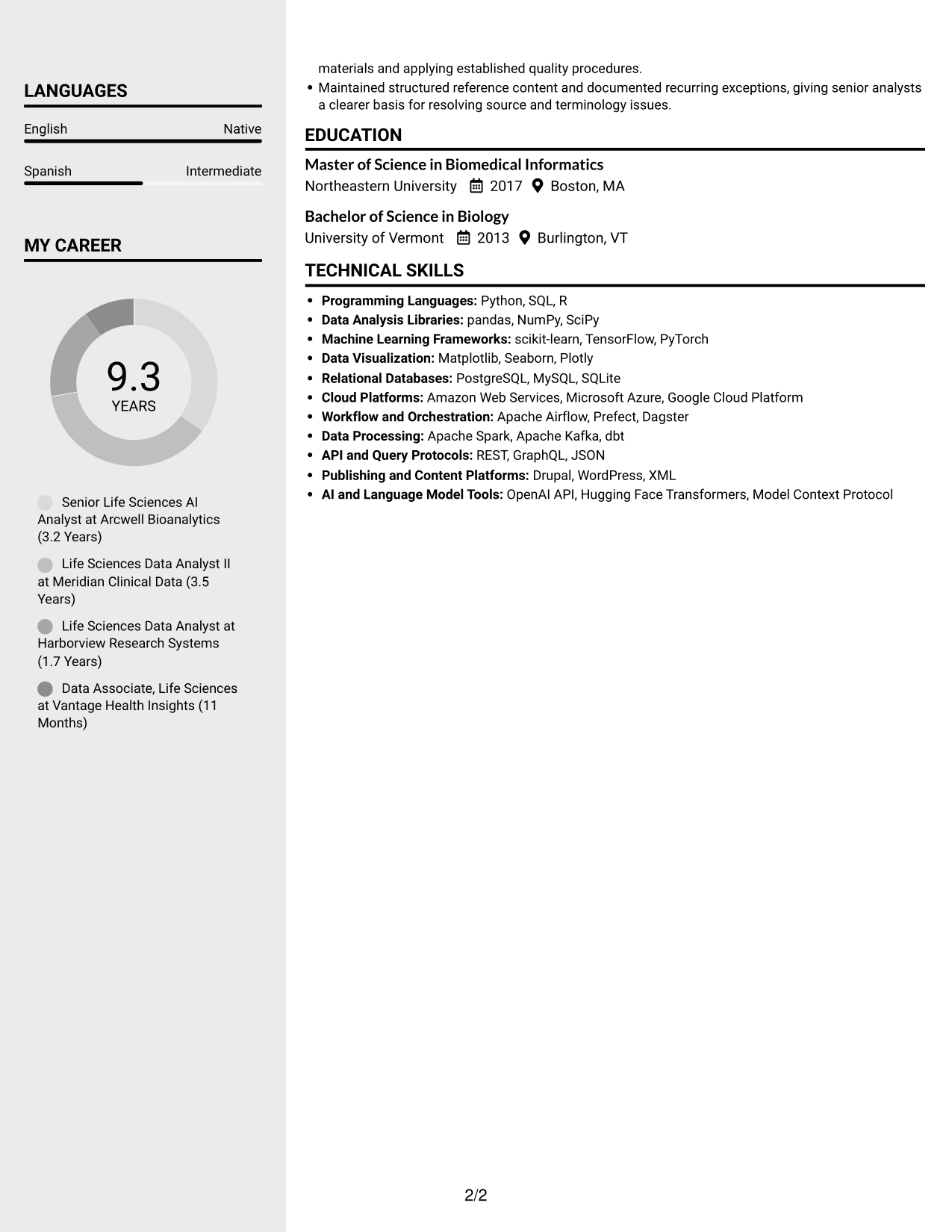
#5 Clean Two Column Sidebar Format Resume Example

Clean Two Column Sidebar Format uses two side-by-side content areas, helping reviewers scan resume sections without following one long column.
 
Resume example — page 1   Resume example — page 2

Why This Format Works

  • Side-by-side areas give resume sections distinct places in the reading layout.
  • Reviewers can scan skills and education without leaving the two-column structure.
  • Career history remains visible as part of the same organized page.

Best For

  • Two-area resume organization
  • Quick section scanning
  • Resumes with several supporting sections
  • Skills and education alongside experience
  • Compact content review


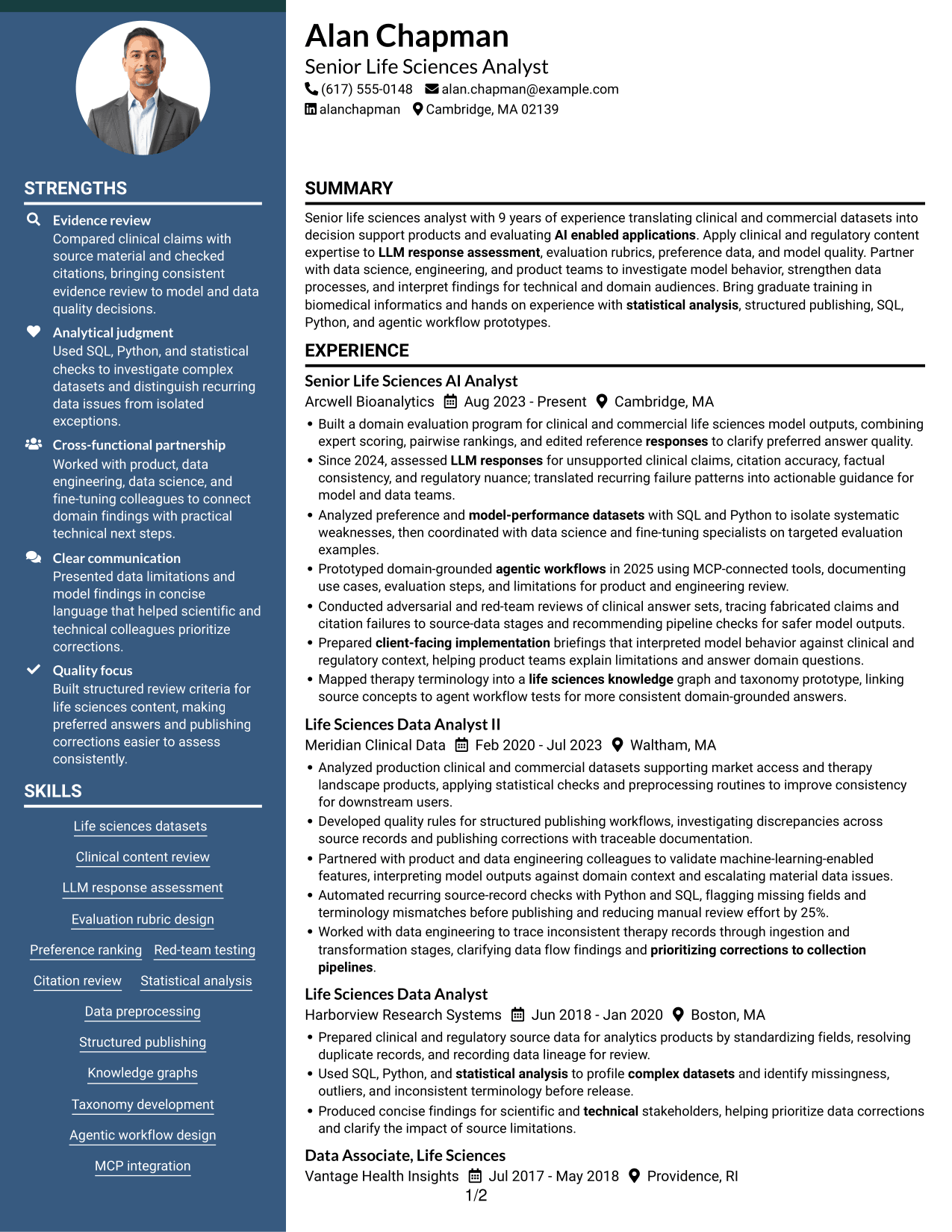
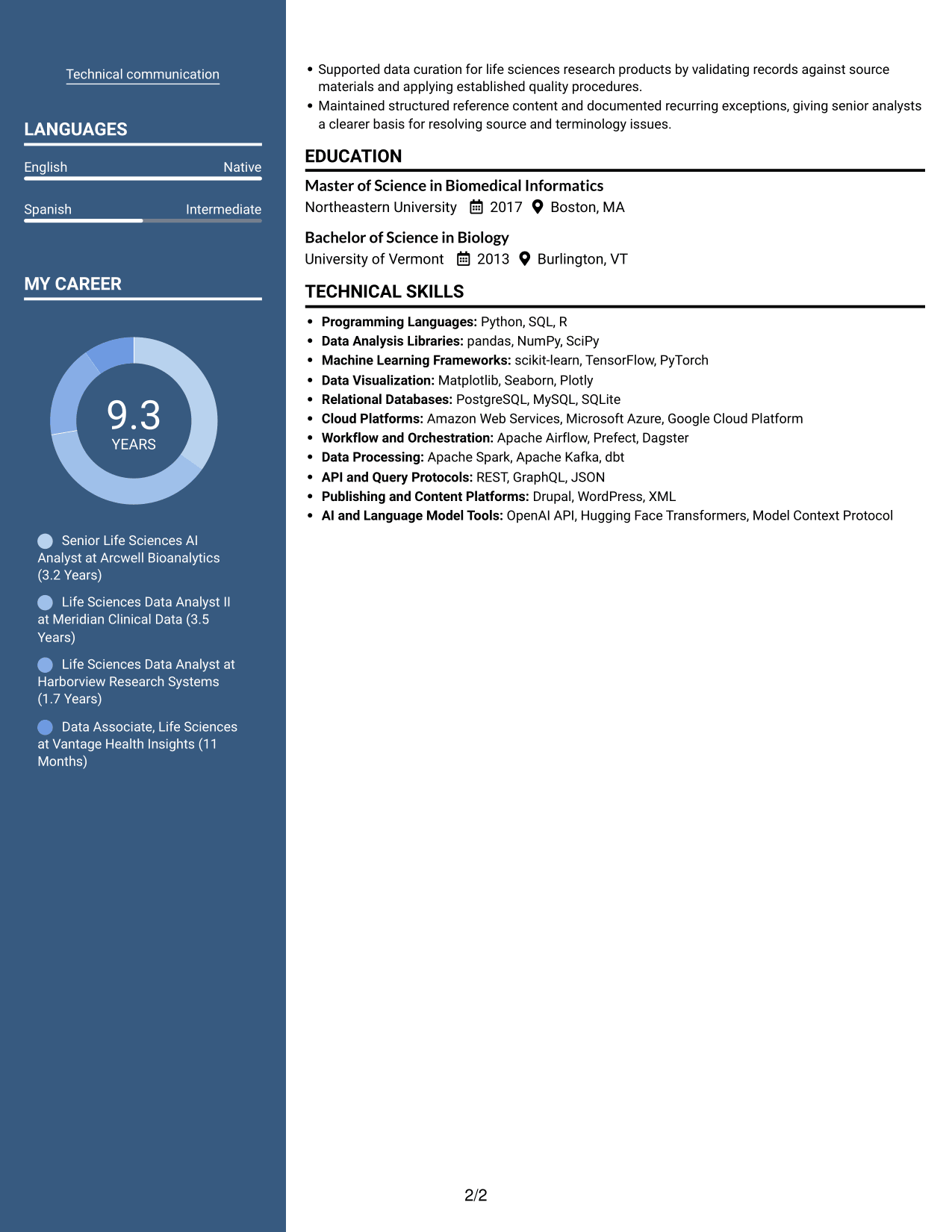
#6 Two Column Format Resume Example

Two Column Format divides resume content across two side-by-side areas, offering a clear alternative to a single vertical sequence.
 
Resume example — page 1   Resume example — page 2

Why This Format Works

  • Two areas create separate spaces for the resume's main content groups.
  • The layout supports scanning experience and qualifications across distinct columns.
  • Skills and education can be reviewed without following a single long content path.

Best For

  • Side-by-side content review
  • Resumes with varied section content
  • Experience and qualification scanning
  • Skills and education in separate areas
  • Alternative to one-column reading
 

#7 Photo Header Two Column Format Resume Example

Photo Header Two Column Format combines two content columns with a photo, offering side-by-side section reading with a portrait included.
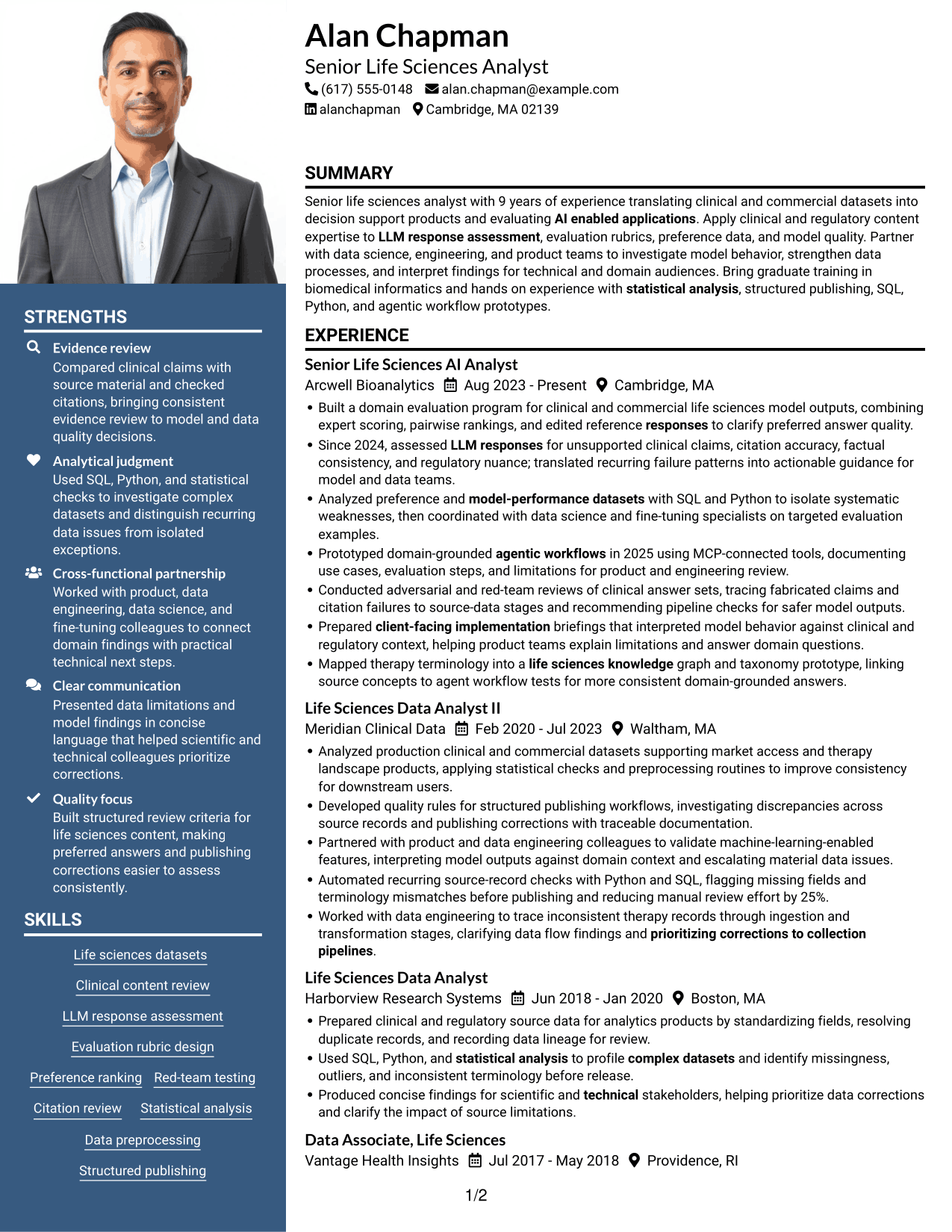
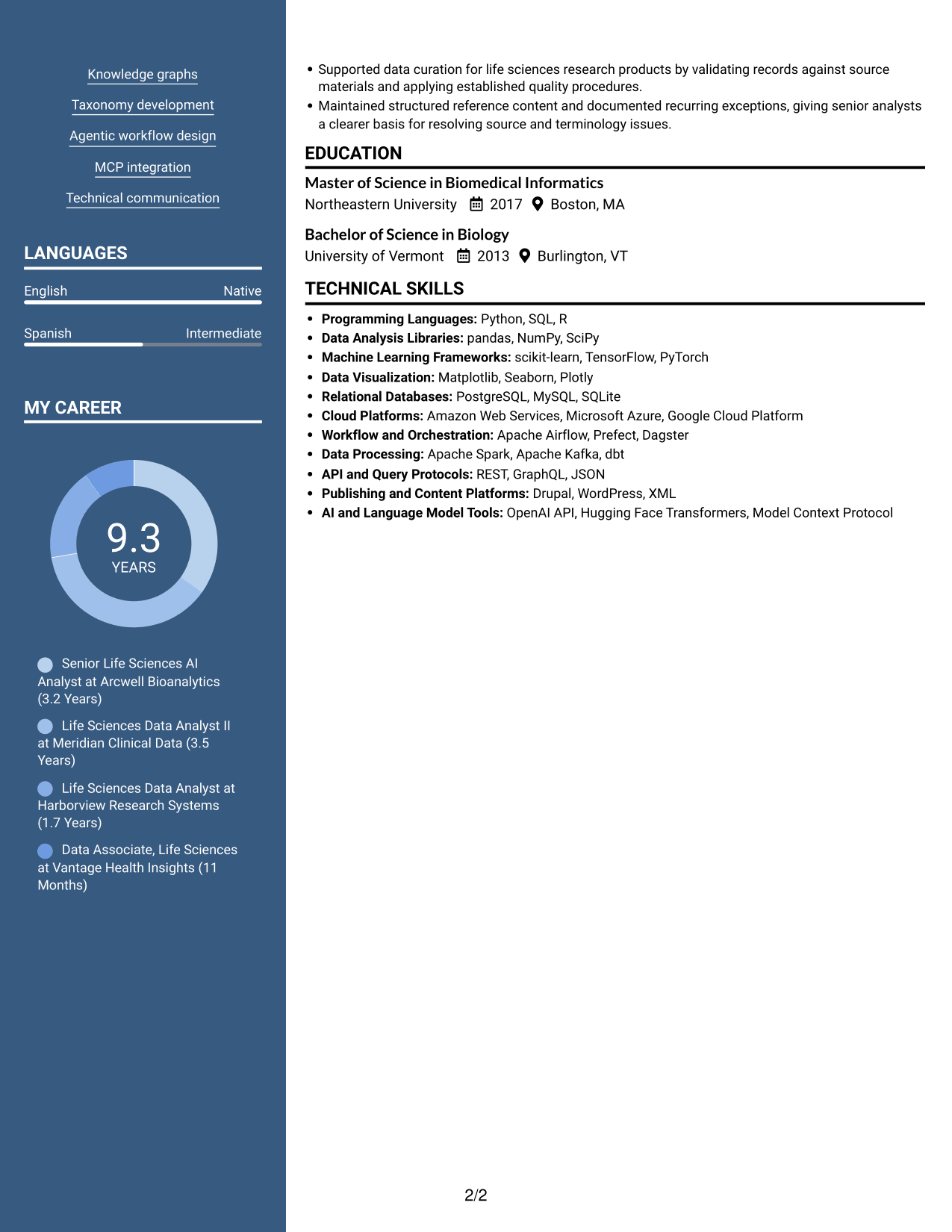
 
Resume example — page 1   Resume example — page 2

Why This Format Works

  • The two-column structure gives resume content separate areas for review.
  • Experience and supporting sections can be scanned across the side-by-side layout.
  • A photo includes a portrait without changing the two-column content structure.

Best For

  • Two-column resume reading
  • Resume requests that call for a photo
  • Side-by-side section review
  • Resumes with varied content groups
  • Experience and supporting details


Why Build Your Senior Life Sciences Analyst - AI Model Training Resume with ResumeInMinutes

Compare resume image previews, then open an example in the editor to review its layout and customize it. Keep the content focused on your own skills, work, education, and measurable results.

  • Image previews for layout comparison
  • Clear resume section structure
  • ATS keyword guidance
  • Skills and experience organization
  • Space for measurable achievements
  • Examples you can open in the editor

For this role, give priority to clinical and regulatory review, evaluation criteria, data analysis, and clear communication with technical teams. Use bullets to explain your part in each result.


See Also


Frequently Asked Questions

Are these Senior Life Sciences Analyst - AI Model Training resume examples ATS-friendly?

The layouts use clear sections and readable headings. For better ATS scanning, use standard section names and include relevant terms such as LLM response assessment, evaluation rubrics, clinical content review, SQL, and Python where they accurately describe your experience.

How can I compare the resume examples?

Review the image previews to compare the layouts. Use the editor link to open an example and review its structure.

What should a Senior Life Sciences Analyst - AI Model Training resume include?

Include a focused summary, relevant experience, education, technical skills, and projects or certifications when applicable. Use experience bullets to show response evaluation, preference data analysis, data quality work, and results.

Which resume layout works well for this role?

A simple layout with clear headings helps readers find technical skills and relevant work quickly. A one-column format can make dense information easy to scan, while a two-column format can work if the text remains clear and well organized.

How should I describe LLM evaluation work?

Explain what you reviewed, which criteria you used, and how you shared findings. When accurate, mention checks for unsupported claims, citation accuracy, factual consistency, regulatory nuance, or recurring model weaknesses.

Should I include a photo on my resume?

For U.S. applications, a resume without a photo is generally the safer choice. Keep the focus on relevant skills, experience, and results.


ATS Score 94%

How we calculate this score

  • Keywords: 60% of the total. AI extracts keywords from your job description. If you do not provide one, a standard job description for the title matching your resume is used. This is not a match to a specific vacancy.
  • Text-based resume: 20%. The text resume assessed here receives 100 for this part.
  • Resume quality: 20%. We start at 100 and subtract points for issues found by our resume checks, down to a minimum of zero.
  • Keyword coverage = 100 × (confirmed matches + 0.8 × possible matches) ÷ total keywords, rounded and capped at 100. Possible matches still need checking. Saved generation audits use their saved keyword percentage.
  • Final score = 60% of keyword coverage + 20% of the text score + 20% of the quality score, rounded to a whole number. Without keywords, no overall ATS score is available.

What this score means

Our scores are estimates, not employer ratings. They may contain errors and do not guarantee accurate parsing, a ranking, an interview, or a job. Check your document against the employer’s requirements. You are responsible for relying on this score.

Terms and Conditions

Score weights: Keywords 60% · Text based resume 20% · Resume quality 20%

Keywords: 25 matched + 6 possible of 33 (90%) · Resume quality: 100%

Resume quality 100% · Weight 20% · Issues (0)

Details
  • ✓Name present: Alan Chapman
  • ✓Email format: alan.chapman@example.com
  • ✓Phone format: (617) 555-0148
  • ✓Experience 1: Job title: Senior Life Sciences AI Analyst
  • ✓Experience 1: Company name: Arcwell Bioanalytics
  • ✓Experience 1: Work location: Cambridge, MA
  • ✓Experience 1: Employment dates: Aug 2023 - Present
  • ✓Experience 1: Description or achievements: Present
  • ✓Experience 2: Job title: Life Sciences Data Analyst II
  • ✓Experience 2: Company name: Meridian Clinical Data
  • ✓Experience 2: Work location: Waltham, MA
  • ✓Experience 2: Employment dates: Feb 2020 - Jul 2023
  • ✓Experience 2: Description or achievements: Present
  • ✓Experience 3: Job title: Life Sciences Data Analyst
  • ✓Experience 3: Company name: Harborview Research Systems
  • ✓Experience 3: Work location: Boston, MA
  • ✓Experience 3: Employment dates: Jun 2018 - Jan 2020
  • ✓Experience 3: Description or achievements: Present
  • ✓Experience 4: Job title: Data Associate, Life Sciences
  • ✓Experience 4: Company name: Vantage Health Insights
  • ✓Experience 4: Work location: Providence, RI
  • ✓Experience 4: Employment dates: Jul 2017 - May 2018
  • ✓Experience 4: Description or achievements: Present
  • ✓No placeholder fields
  • ✓No repeated achievement bullets
  • ✓No empty bullets

No issues found by the current checks.

Text Based Resume 100% · Weight 20%

Parsed text
Alan Chapman
(617) 555-0148
alan.chapman@example.com
alanchapman
Cambridge, MA 02139
SUMMARY
Senior life sciences analyst with 9 years of experience translating clinical and commercial datasets into decision support products and evaluating AI enabled applications. Apply clinical and regulatory content expertise to LLM response assessment, evaluation rubrics, preference data, and model quality. Partner with data science, engineering, and product teams to investigate model behavior, strengthen data processes, and interpret findings for technical and domain audiences. Bring graduate training in biomedical informatics and hands on experience with statistical analysis, structured publishing, SQL, Python, and agentic workflow prototypes.
EXPERIENCE
Senior Life Sciences AI Analyst
Aug 2023 - Present
Arcwell Bioanalytics
Cambridge, MA
Built a domain evaluation program for clinical and commercial life sciences model outputs, combining expert scoring, pairwise rankings, and edited reference responses to clarify preferred answer quality.
Since 2024, assessed LLM responses for unsupported clinical claims, citation accuracy, factual consistency, and regulatory nuance; translated recurring failure patterns into actionable guidance for model and data teams.
Analyzed preference and model-performance datasets with SQL and Python to isolate systematic weaknesses, then coordinated with data science and fine-tuning specialists on targeted evaluation examples.
Prototyped domain-grounded agentic workflows in 2025 using MCP-connected tools, documenting use cases, evaluation steps, and limitations for product and engineering review.
Conducted adversarial and red-team reviews of clinical answer sets, tracing fabricated claims and citation failures to source-data stages and recommending pipeline checks for safer model outputs.
Prepared client-facing implementation briefings that interpreted model behavior against clinical and regulatory context, helping product teams explain limitations and answer domain questions.
Mapped therapy terminology into a life sciences knowledge graph and taxonomy prototype, linking source concepts to agent workflow tests for more consistent domain-grounded answers.
Life Sciences Data Analyst II
Feb 2020 - Jul 2023
Meridian Clinical Data
Waltham, MA
Analyzed production clinical and commercial datasets supporting market access and therapy landscape products, applying statistical checks and preprocessing routines to improve consistency for downstream users.
Developed quality rules for structured publishing workflows, investigating discrepancies across source records and publishing corrections with traceable documentation.
Partnered with product and data engineering colleagues to validate machine-learning-enabled features, interpreting model outputs against domain context and escalating material data issues.
Automated recurring source-record checks with Python and SQL, flagging missing fields and terminology mismatches before publishing and reducing manual review effort by 25%.
Worked with data engineering to trace inconsistent therapy records through ingestion and transformation stages, clarifying data flow findings and prioritizing corrections to collection pipelines.
Life Sciences Data Analyst
Jun 2018 - Jan 2020
Harborview Research Systems
Boston, MA
Prepared clinical and regulatory source data for analytics products by standardizing fields, resolving duplicate records, and recording data lineage for review.
Used SQL, Python, and statistical analysis to profile complex datasets and identify missingness, outliers, and inconsistent terminology before release.
Produced concise findings for scientific and technical stakeholders, helping prioritize data corrections and clarify the impact of source limitations.
Data Associate, Life Sciences
Jul 2017 - May 2018
Vantage Health Insights
Providence, RI
Supported data curation for life sciences research products by validating records against source materials and applying established quality procedures.
Maintained structured reference content and documented recurring exceptions, giving senior analysts a clearer basis for resolving source and terminology issues.
EDUCATION
Master of Science in Biomedical Informatics
2017
Northeastern University
Boston, MA
Bachelor of Science in Biology
2013
University of Vermont
Burlington, VT
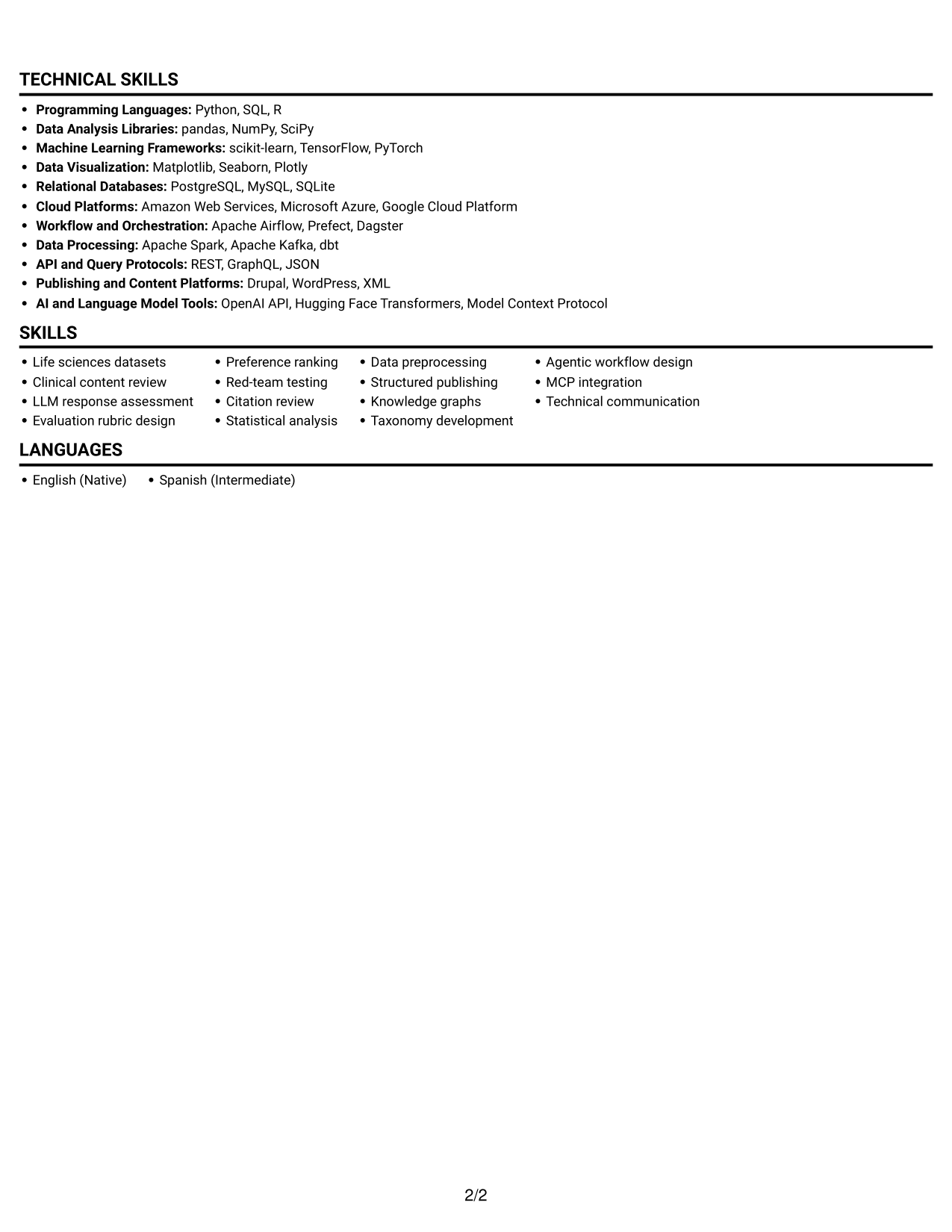
TECHNICAL SKILLS
Programming Languages: Python, SQL, R
Data Analysis Libraries: pandas, NumPy, SciPy
Machine Learning Frameworks: scikit-learn, TensorFlow, PyTorch
Data Visualization: Matplotlib, Seaborn, Plotly
Relational Databases: PostgreSQL, MySQL, SQLite
Cloud Platforms: Amazon Web Services, Microsoft Azure, Google Cloud Platform
Workflow and Orchestration: Apache Airflow, Prefect, Dagster
Data Processing: Apache Spark, Apache Kafka, dbt
API and Query Protocols: REST, GraphQL, JSON
Publishing and Content Platforms: Drupal, WordPress, XML
AI and Language Model Tools: OpenAI API, Hugging Face Transformers, Model Context Protocol
SKILLS
Life sciences datasets
Clinical content review
LLM response assessment
Evaluation rubric design
Preference ranking
Red-team testing
Citation review
Statistical analysis
Data preprocessing
Structured publishing
Knowledge graphs
Taxonomy development
Agentic workflow design
MCP integration
Technical communication
LANGUAGES
English (Native)
Spanish (Intermediate)

Matched keywords (25)

  • Life sciences datasets
  • AI enabled applications
  • LLM response assessment
  • Evaluation rubric design
  • combining expert scoring, pairwise rankings, and edited reference responses to clarify preferred answer qualityOriginal keyword in JD: Preference criteria
  • assessed LLM responses for unsupported clinical claims, citation accuracy, factual consistency, and regulatory nuanceOriginal keyword in JD: Clinical reasoning
  • combining expert scoring, pairwise rankings, and edited reference responsesOriginal keyword in JD: Response scoring and ranking
  • edited reference responses to clarify preferred answer qualityOriginal keyword in JD: Reference response editing
  • Analyzed preference and model-performance datasets with SQL and Python to isolate systematic weaknessesOriginal keyword in JD: Preference data analysis
  • Analyzed preference and model-performance datasets with SQL and Python to isolate systematic weaknessesOriginal keyword in JD: Model performance analysis
  • Citation review
  • assessed LLM responses for unsupported clinical claims, citation accuracy, factual consistency, and regulatory nuanceOriginal keyword in JD: Regulatory error detection
  • trace inconsistent therapy records through ingestion and transformation stagesOriginal keyword in JD: Data flow analysis
  • prioritizing corrections to collection pipelinesOriginal keyword in JD: Data collection pipelines
  • client-facing implementation
  • statistical analysis
  • profile complex datasets and identify missingness, outliers, and inconsistent terminologyOriginal keyword in JD: Complex dataset analysis
  • Automated recurring source-record checks with Python and SQLOriginal keyword in JD: Automation concepts
  • Produced concise findings for scientific and technical stakeholdersOriginal keyword in JD: Technical and nontechnical communication
  • Knowledge graphs
  • Mapped therapy terminology into a life sciences knowledge graph and taxonomy prototypeOriginal keyword in JD: Taxonomies
  • agentic workflows
  • LLM responsesOriginal keyword in JD: Generative AI
  • MCPOriginal keyword in JD: Model Context Protocol (MCP)
  • Prototyped domain-grounded agentic workflows in 2025 using MCP-connected tools, documenting use cases, evaluation steps, and limitations for product and engineering reviewOriginal keyword in JD: Fast-moving product development

Missing keywords (2)

  • Independent problem-solving
  • Software development lifecycle

Possible matches (6)

  • Clinical and regulatory content evaluation80% credit: 2.42 percentage points of 3.03 possible.
  • Factual accuracy80% credit: 2.42 percentage points of 3.03 possible.
  • Adversarial and red-team testing80% credit: 2.42 percentage points of 3.03 possible.
  • Data cleaning and preprocessing80% credit: 2.42 percentage points of 3.03 possible.
  • Structured publishing platforms80% credit: 2.42 percentage points of 3.03 possible.
  • Graduate degree in life sciences OR medical sciences OR computer science OR equivalent professional experience80% credit: 2.42 percentage points of 3.03 possible.
Disclaimer: All names, images, contact information, employment histories, achievements, security clearances, military credentials, and other qualifications shown in this content are fictional and used for illustrative purposes only. Any resemblance to actual persons, living or deceased, is purely coincidental.

Resume and cover-letter examples and recommendations in this article reflect general best practices and professional experience and are provided for guidance only. Results may vary based on role, industry, region, and hiring organization.

Content Accuracy and Verification: To the fullest extent permitted by applicable law, we do not represent or warrant that resume or cover-letter guidance, examples, recommendations, or related information are accurate, complete, current, error-free, or suitable for any particular purpose. You are responsible for independently reviewing and verifying the information before relying on it.

ATS and Cover-Letter Scores: ATS scores are estimates calculated using our own formula, informed by publicly available guidance on resume formatting and keyword matching. They are not scores issued or endorsed by an ATS provider or employer. Cover-letter scores are also our own assessments. Parsing, weighting, screening criteria, and results vary between systems, employers, job descriptions, and document formats. No score guarantees successful parsing, a particular ranking, an interview, or employment. Use scores as general guidance and independently check your documents against the employer’s requirements. To the fullest extent permitted by applicable law, we accept no liability for errors in scores or parsing, or losses arising from reliance on these assessments. Nothing in this notice excludes liability or limits consumer rights that cannot lawfully be excluded or limited.

Terms and Conditions
 
> JP 1 1
PDF Footer and Margins Setup
The margins are applied to the document, and the footer shows up in the preview and the PDF

Footer Font Settings

Are you applying for a specific job
so we can tailor your resume to it?
Are you applying for a specific job
so we can tailor your cover letter to it?
Type your details as text to generate a personalized resume Type your details as text to generate a personalized cover letter
Website link found! Ready to create resume from:
Drag the into the box to verify you're human.
Drop here

My Resumes

Displaying {number_of_files} files (out of {total_of_all_files} total)
Name File Type Last Modified: Description:

Rename File

Filename already exists!

Delete Files

Warning: This action is irreversible. Once you click submit, the files will be permanently deleted.

Heading text
Upload From Computer Upload
Select From Existing
LinkedIn
Drag & Drop files anywhere in this tab, or

Uploaded Files

Delete Name Last Updated Use This File
Select this to use the file for generating your resume and cover letter. Only one source—uploaded file, selected file, or LinkedIn text—can be used.

My Files

Resumes or cover letters you create will appear here. No files available yet.
Delete Name Last Updated Use This File
Select this to use the file for generating your resume and cover letter. Only one source—uploaded file, selected file, or LinkedIn text—can be used.

Add LinkedIn Profile PDF

You can download your LinkedIn profile as a PDF by opening linkedin.com in a web browser, clicking your profile photo, selecting the “More” or “Resources” button, and choosing “Save to PDF.” You can then attach the PDF using the Upload From Computer tab.

Paste Your LinkedIn Profile Text

If you have copied the LinkedIn profile text, paste it below. See how to copy your profile from LinkedIn

Select this to use the LinkedIn profile text for generating your resume and cover letter. Only one source—uploaded file, selected file, or LinkedIn text—can be used.

Try these controls

<
>


