7 Senior Solutions Architect - RFID and Vision Resume Templates with Example
This guide shows you how to build a Senior Solutions Architect - RFID and Vision resume that presents your solution design work clearly. You will learn how to organize relevant evidence and make your technical value easy to review.
Strong resumes connect customer and operational needs to practical architecture decisions. Use focused experience bullets to show work with passive UHF RFID, machine vision, fixed industrial scanning, system integration, and measurable business value.
The example is presented in 7 resume layouts. Compare the PNG image previews to see how each layout handles experience, technical skills, education, training, and other relevant sections.
What Makes a Great Senior Solutions Architect - RFID and Vision Resume in 2026
A strong resume puts customer-facing architecture, solution ownership, and delivery results in clear sections. Short bullets help reviewers quickly see how you connect technical design to warehouse, manufacturing, and supply chain needs.
Use relevant terms such as passive UHF RFID, site surveys, read-zone design, machine vision, WMS, ERP, MES, and ROI modeling where they match your background. Add concrete evidence, such as pilot work, system integrations, business cases, and delivery handoffs.
Note: Resume examples are for educational purposes only. Use only information that accurately reflects your experience and qualifications. References to real organizations do not imply affiliation or endorsement.
#1 Simple One Column Format Resume Example
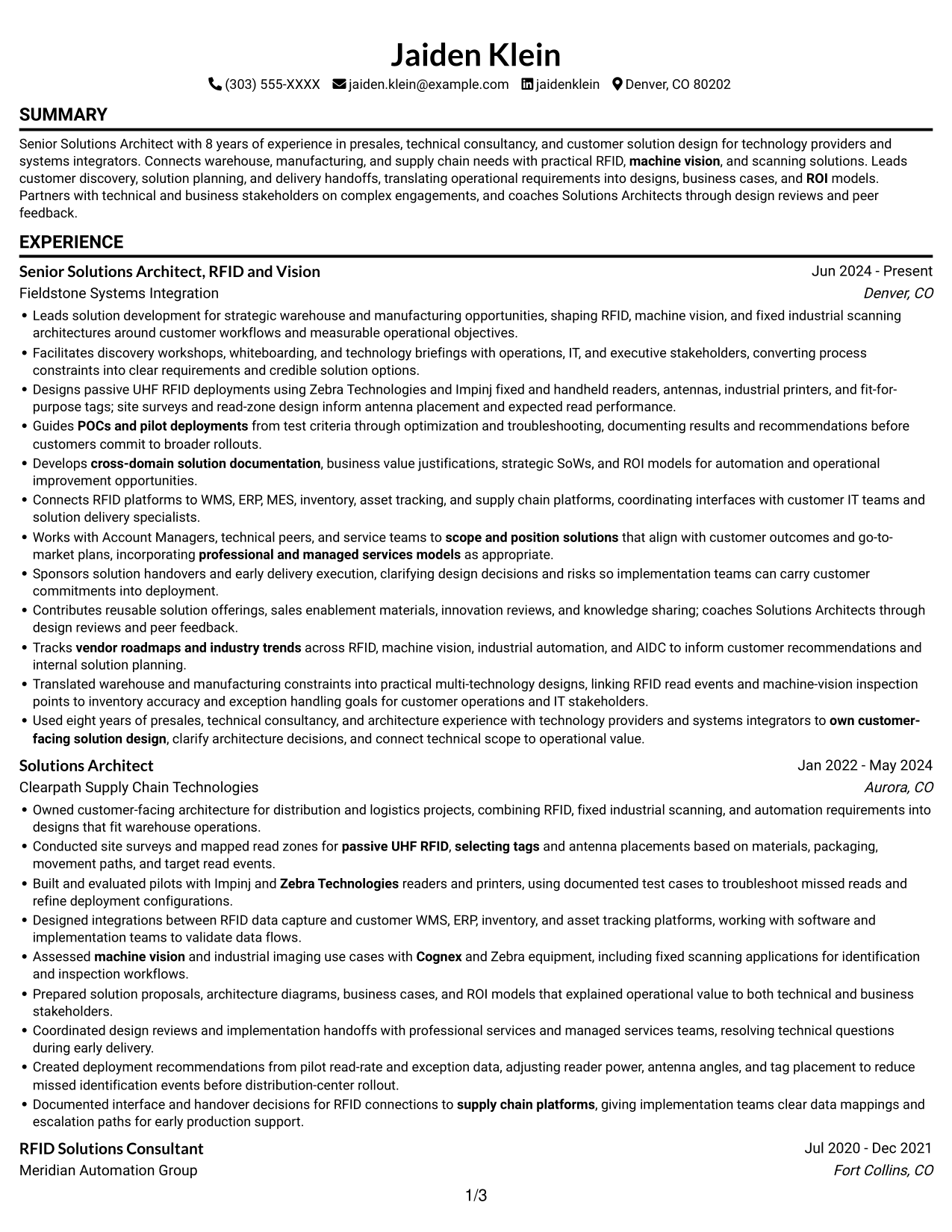
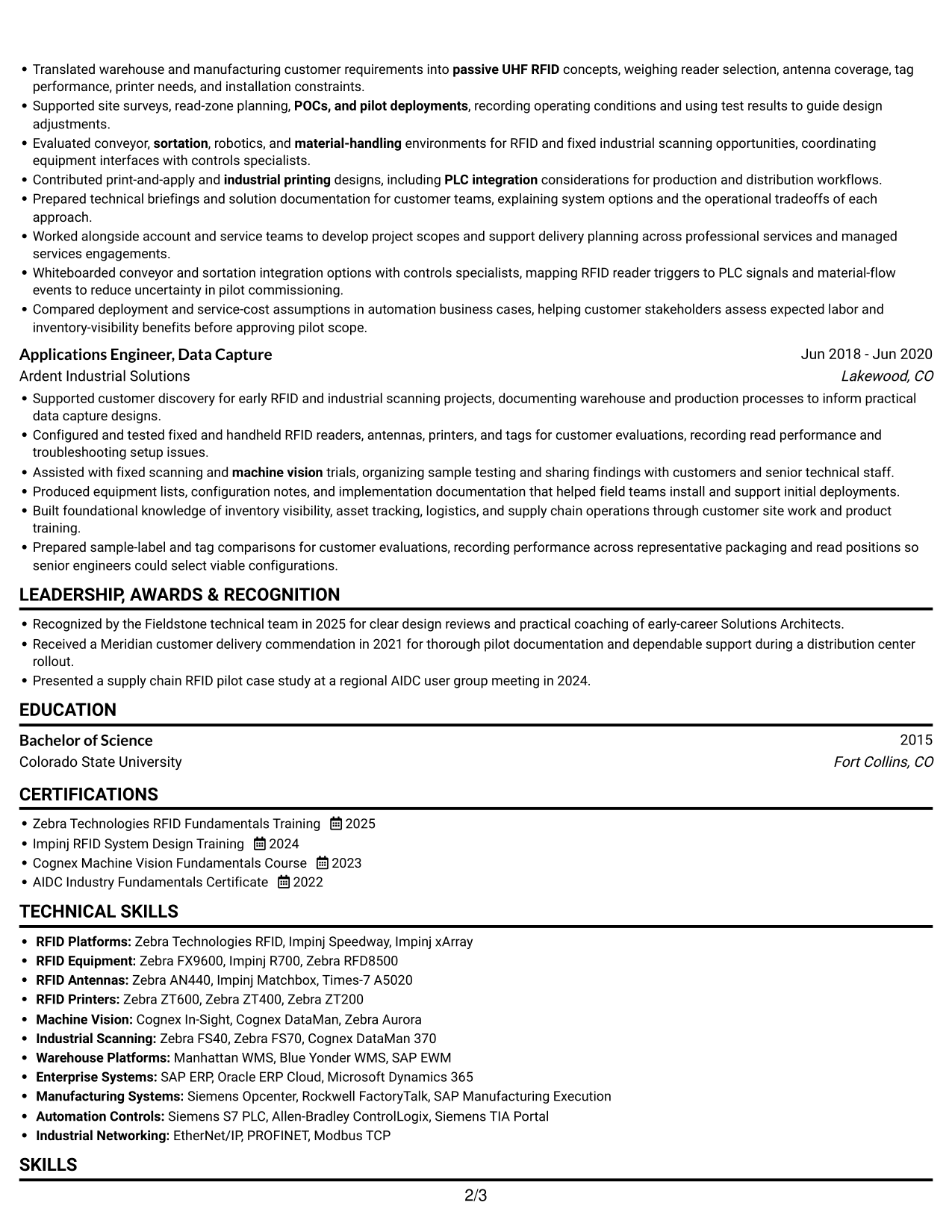
A single-column layout keeps the resume in one reading path, which helps reviewers follow career history from recent roles to earlier work.
Why This Format Works
- One vertical reading path helps reviewers follow roles from recent positions to earlier work.
- Experience bullets stay with each role, keeping achievements tied to their time and context.
- ATS and recruiters can scan sections in one vertical order without switching columns.
Best For
- Chronological career histories
- ATS-readable section sequences
- Detailed experience bullets
- Resumes with several supporting sections
- Readers who prefer a single reading path
Resume Keywords
- Used eight years of presales, technical consultancy, and architecture experience with technology providers and systems integrators
- own customer-facing solution design
- passive UHF RFID
- Zebra Technologies and Impinj fixed and handheld readers
- RFID Antennas
- RFID Printers
- selecting tags
- machine vision
- ROI
- professional and managed services models
- Facilitates discovery workshops
- whiteboarding
- technology briefings
- scope and position solutions
- cross-domain solution documentation
#2 Simple Two Column Format Resume Example
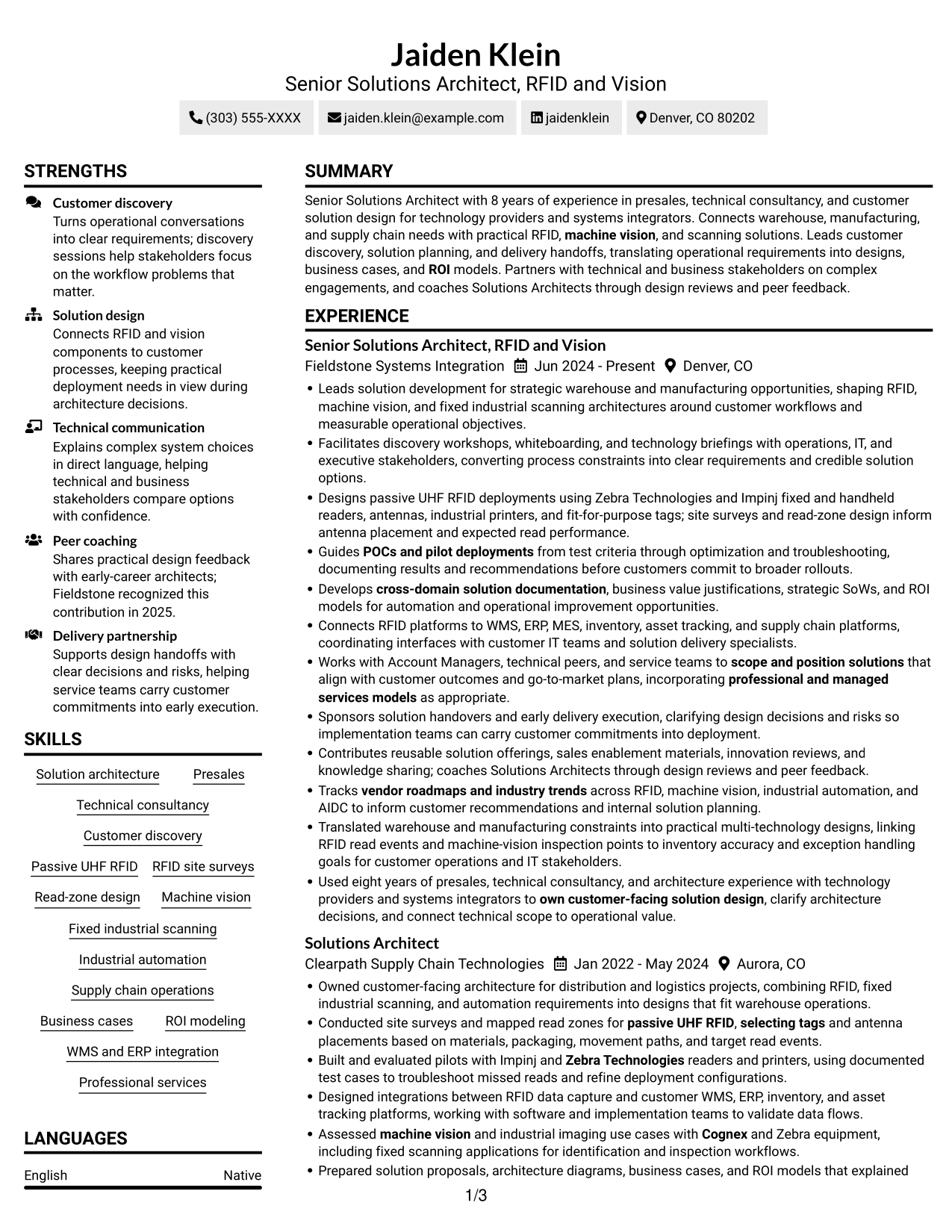
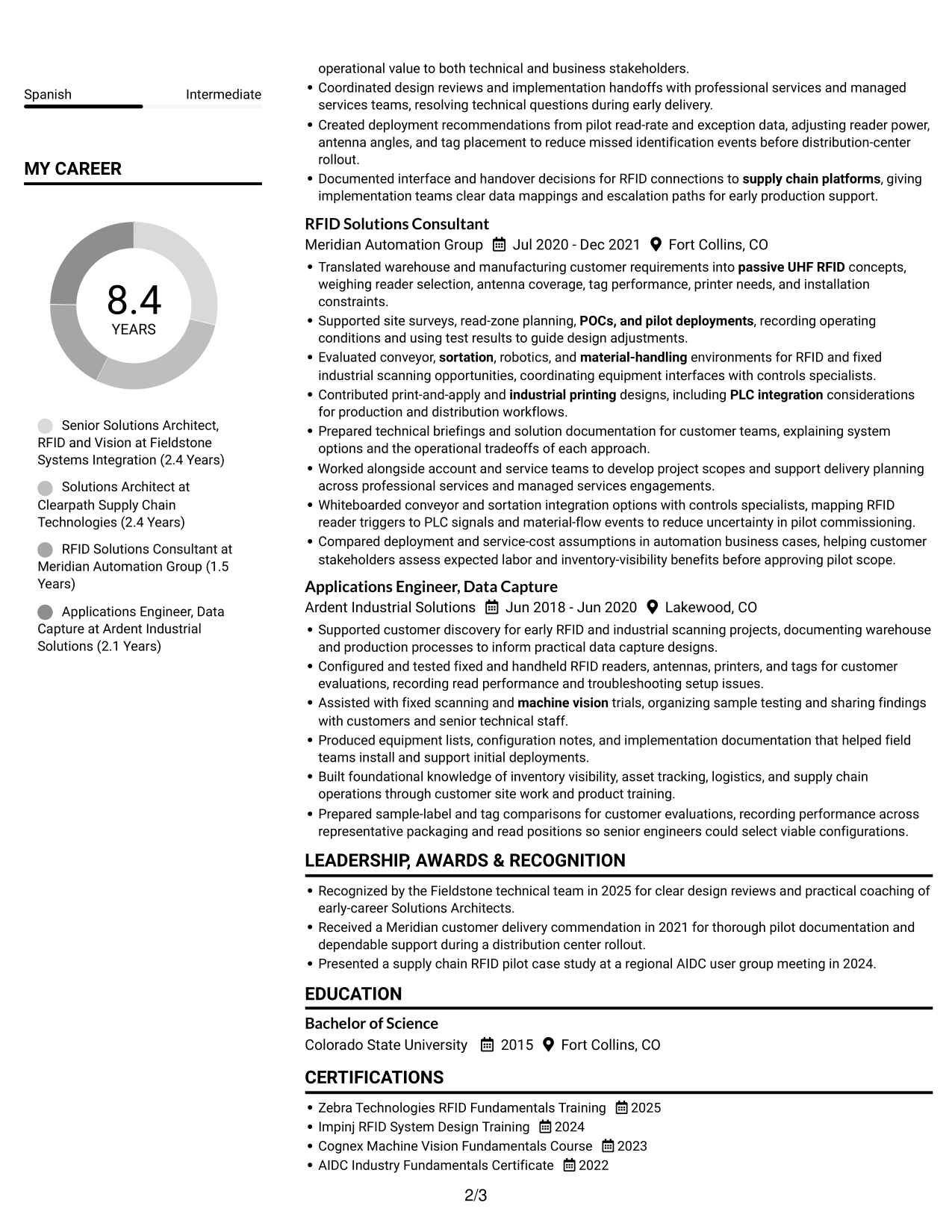
Two columns give reviewers distinct areas to scan, making it easier to compare career history with supporting resume details.
Why This Format Works
- Two columns let reviewers compare career history and supporting sections at a glance.
- Skills and education can occupy a separate reading area from role details.
- Parallel areas give the resume a clear route for returning to key sections.
Best For
- Career history with supporting details
- Resumes with distinct content groups
- Readers comparing information across columns
- Skills and credentials in separate areas
- Compact content organization
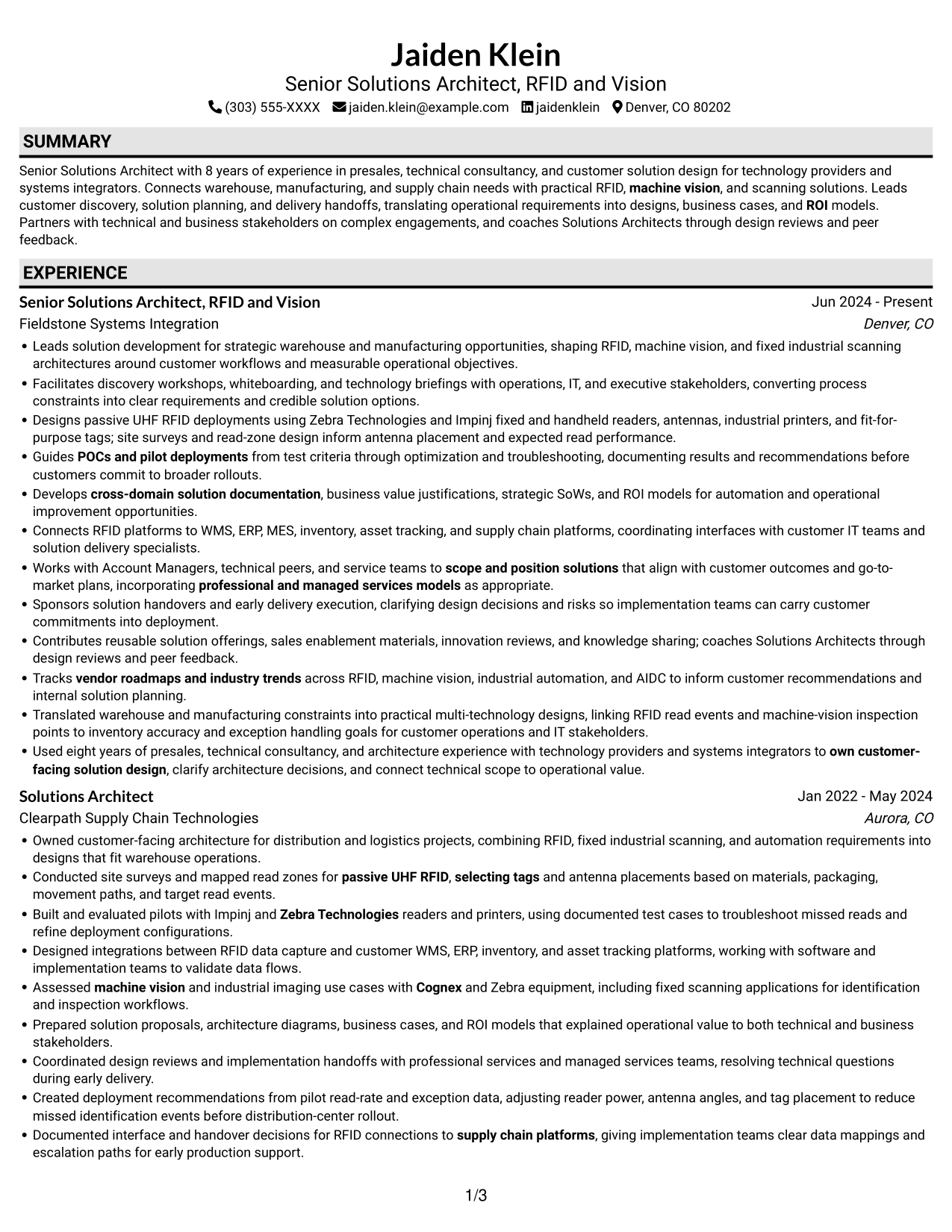
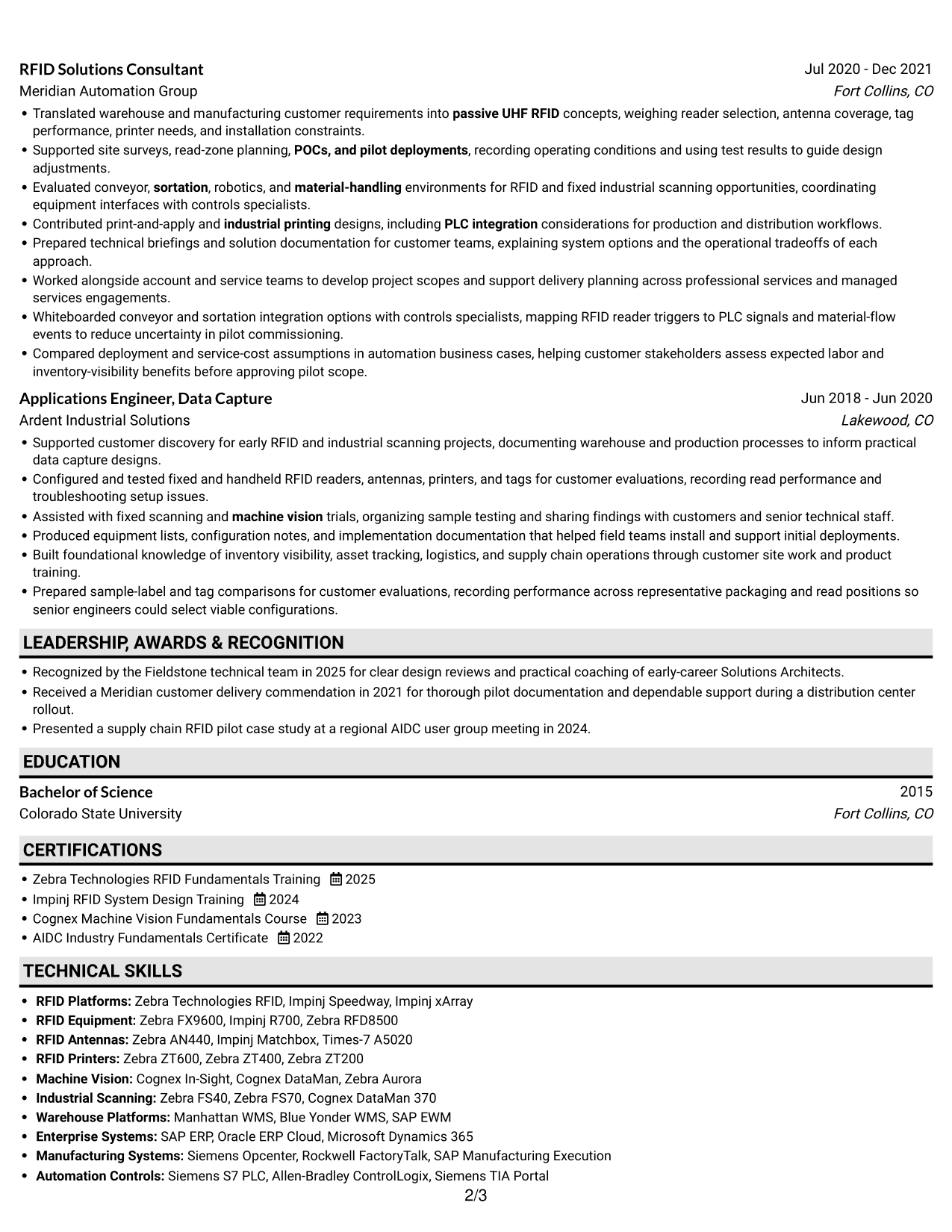
#3 Plain One Column with Shaded Labels Resume Example
The one-column format presents sections in a straightforward sequence, helping reviewers move through the resume without switching between areas.
Why This Format Works
- Single-column reading keeps role history in order, helping reviewers trace career progression.
- Without parallel columns, skills, education, and credentials appear in a shared reading sequence.
- ATS tools can follow the same vertical section order as human reviewers.
Best For
- Chronological work histories
- One continuous reading order
- Resumes with several section types
- ATS-focused section structure
- Readers who prefer linear review
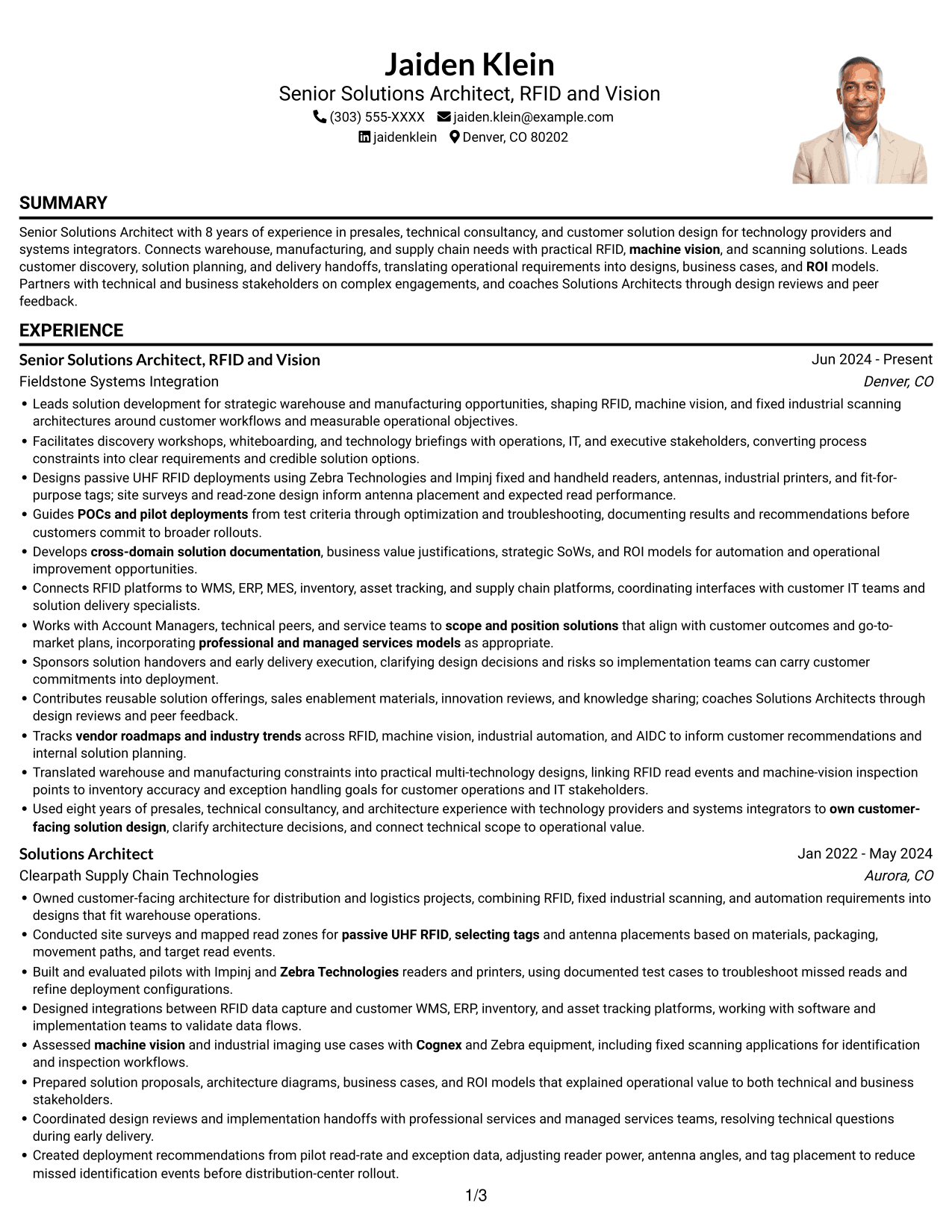
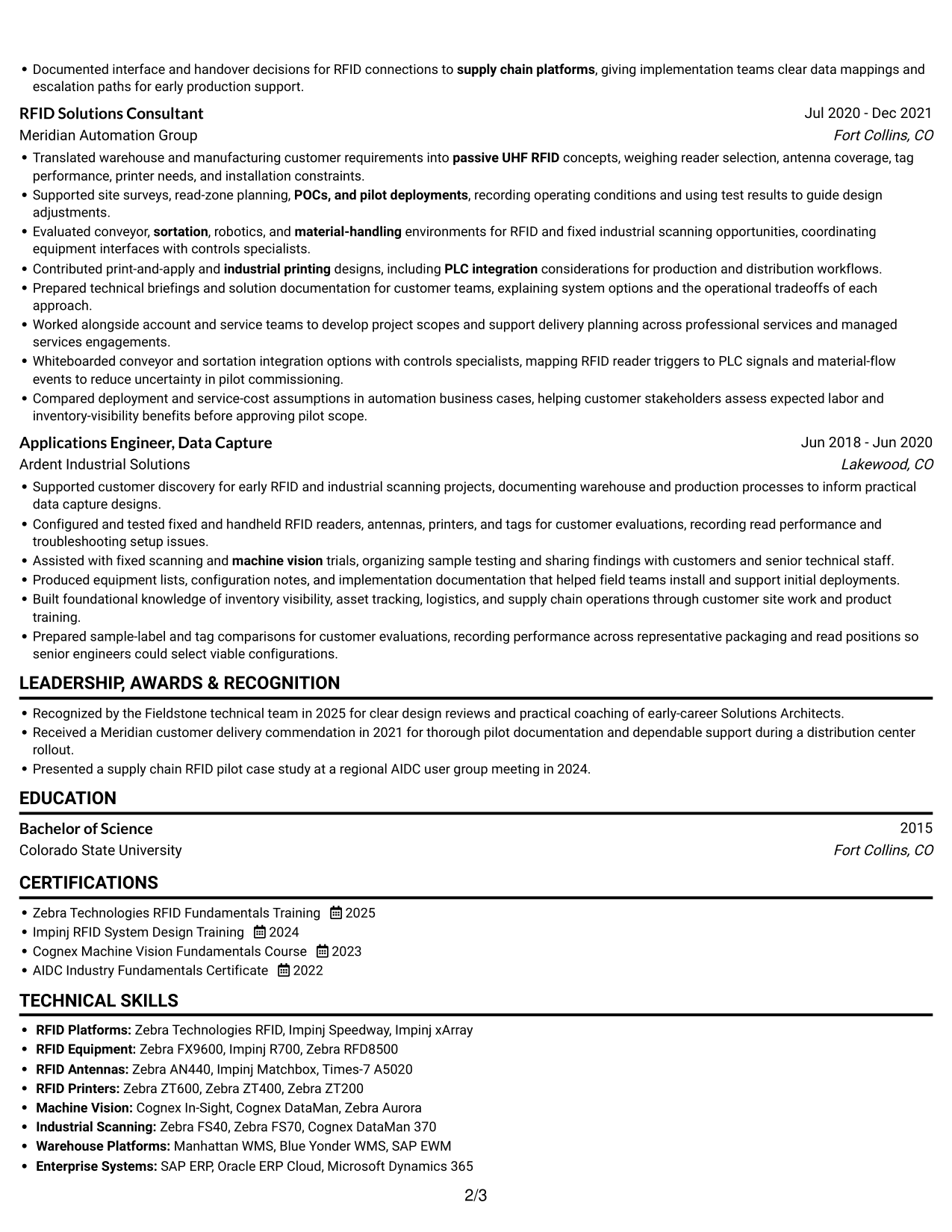
#4 One Column Format with Photo Right Resume Example
A portrait accompanies the one-column body, offering a visual reference while keeping the resume's sections in a straightforward reading order.
Why This Format Works
- The portrait adds a visual reference, while the body stays in one column.
- Reviewers can follow experience bullets in role order without crossing columns.
- Education and credentials remain in the same reading sequence as work history.
Best For
- Portrait-inclusive resume preferences
- Single-column section flow
- Chronological experience records
- Resumes with detailed role history
- Readers who prefer a visual profile
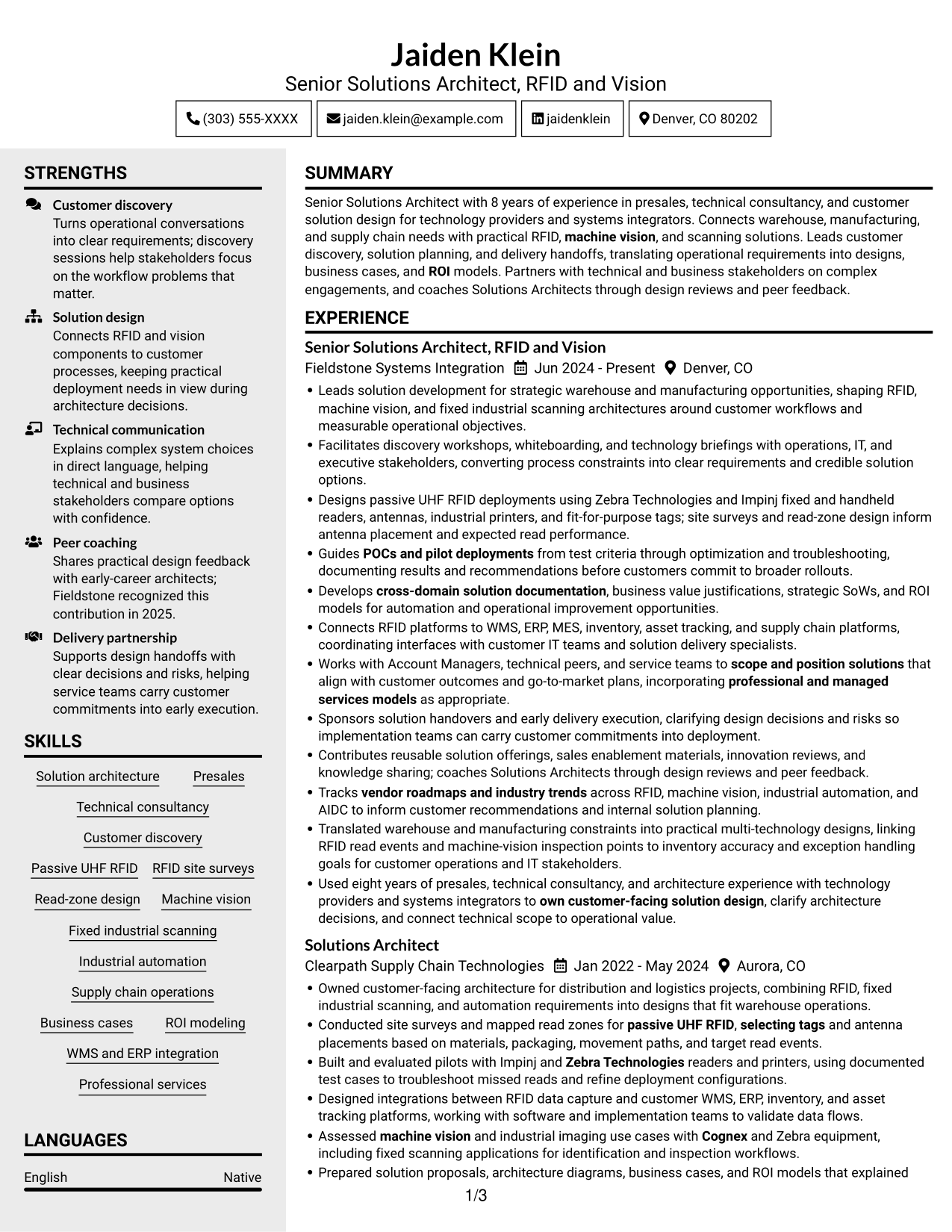
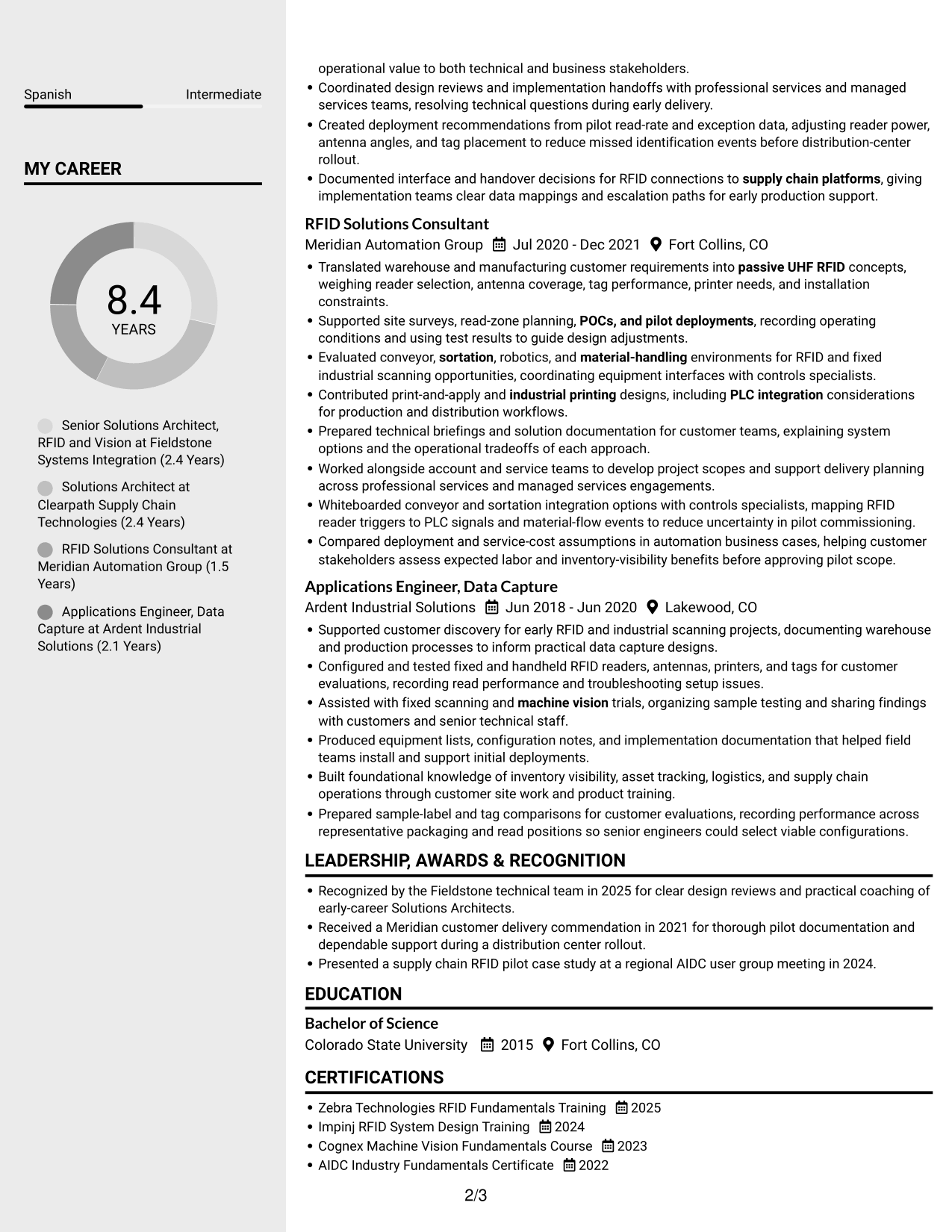
#5 Clean Two Column Sidebar Format Resume Example
Two columns create separate reading areas, giving reviewers a clear way to scan career information and supporting resume sections.
Why This Format Works
- Distinct content areas help reviewers move between career history and supporting details.
- The two-column organization gives technical skills and credentials a separate place to scan.
- A clear reading order helps readers return to education and awards during review.
Best For
- Side-by-side content organization
- Career histories with supporting sections
- Resumes with several information categories
- Readers scanning distinct content groups
- Skills and credentials in parallel areas
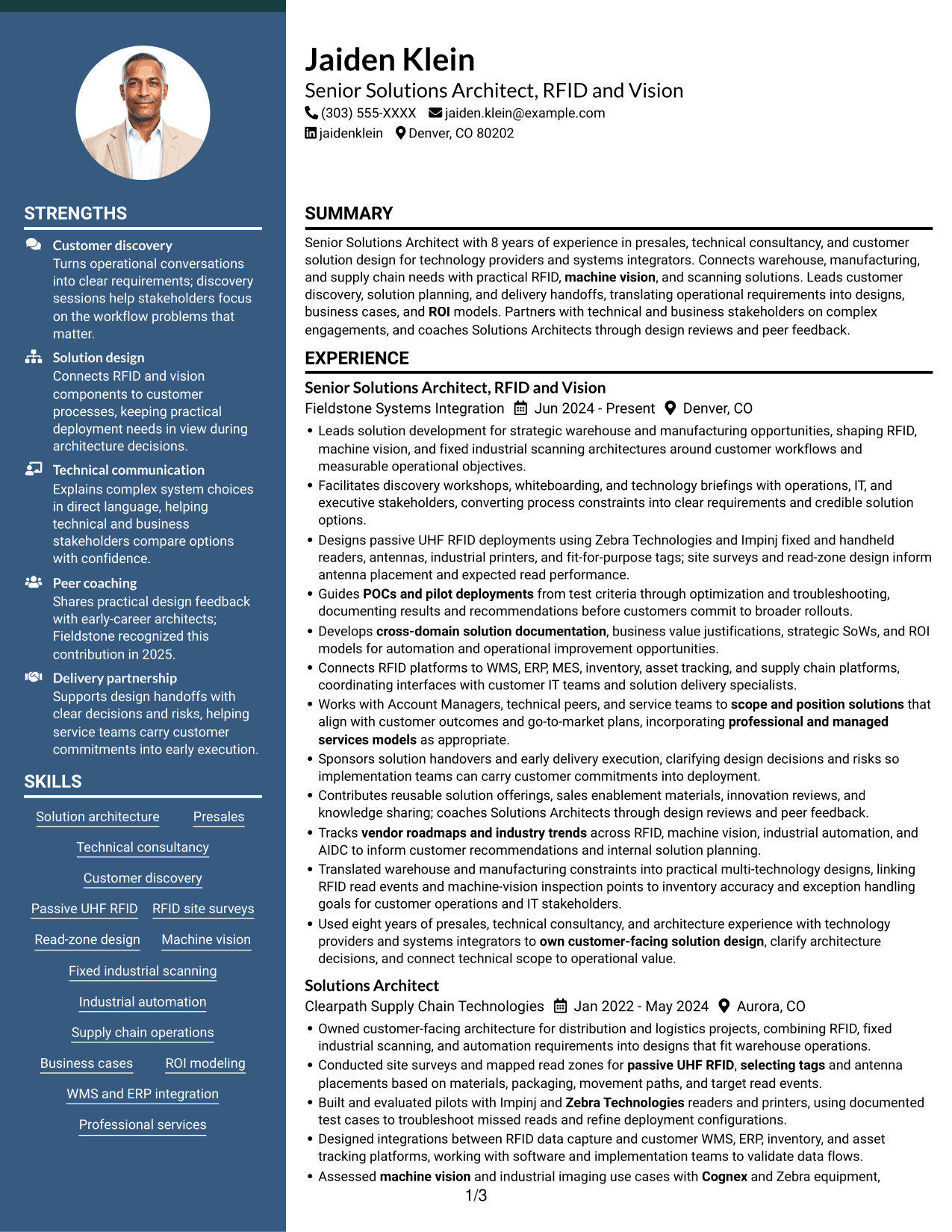
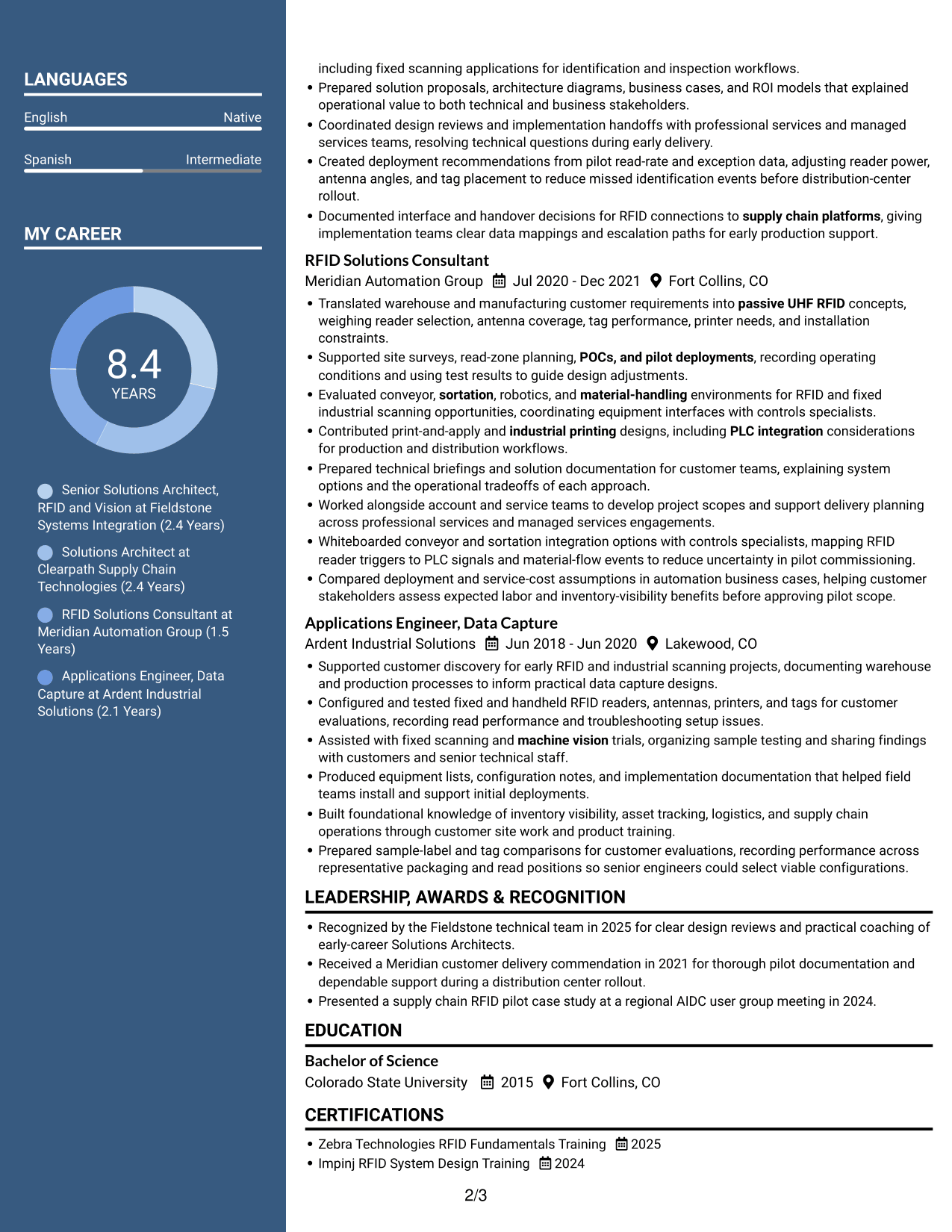
#6 Two Column Format Resume Example
The two-column layout places resume content in parallel areas, helping reviewers move between career details and related sections.
Why This Format Works
- Parallel columns keep supporting details close to career history for cross-checking.
- Separate areas help reviewers locate skills and credentials without rereading every role.
- A defined reading order keeps experience and education easy to revisit.
Best For
- Parallel content grouping
- Career history with supporting sections
- Readers who scan across columns
- Resumes with several information categories
- Content needing compact organization
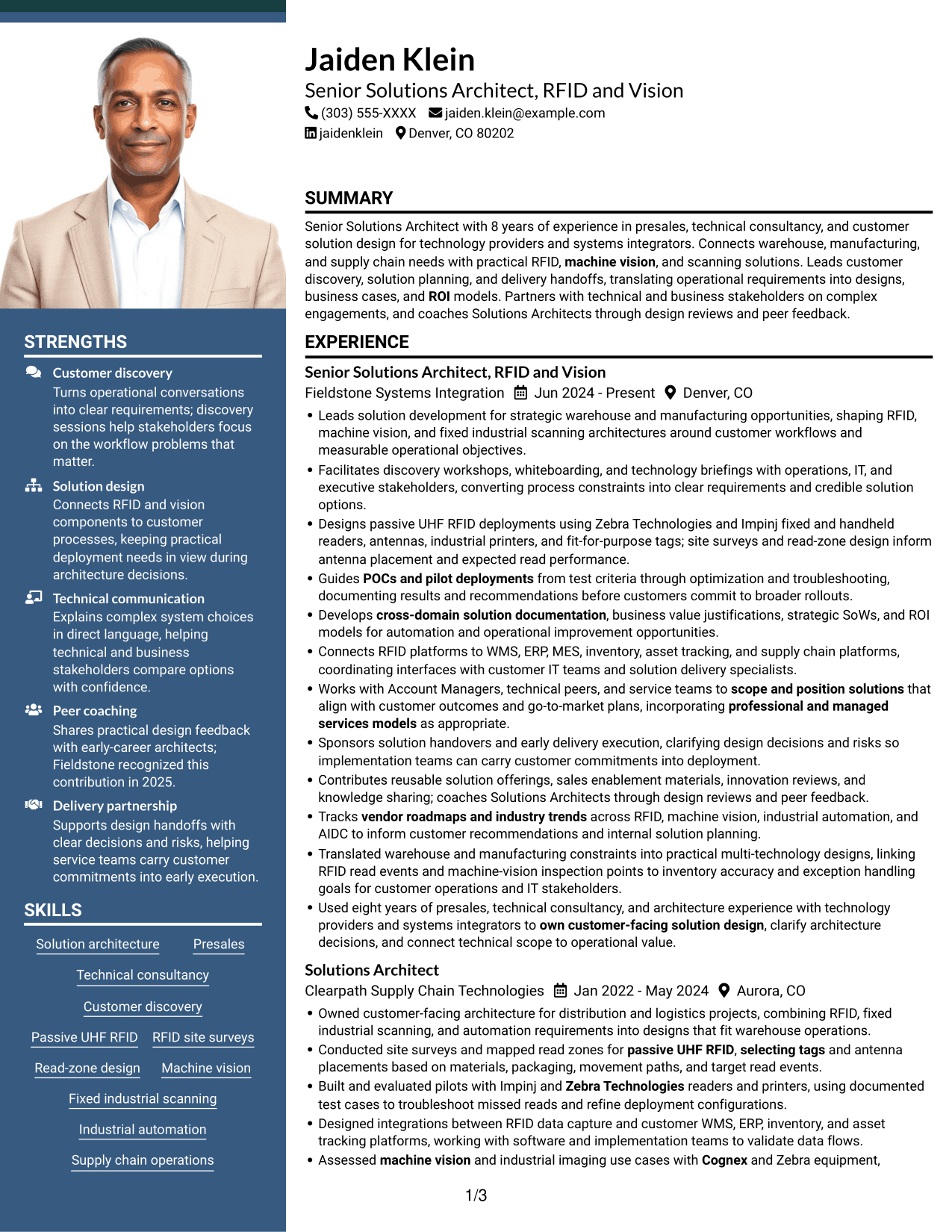
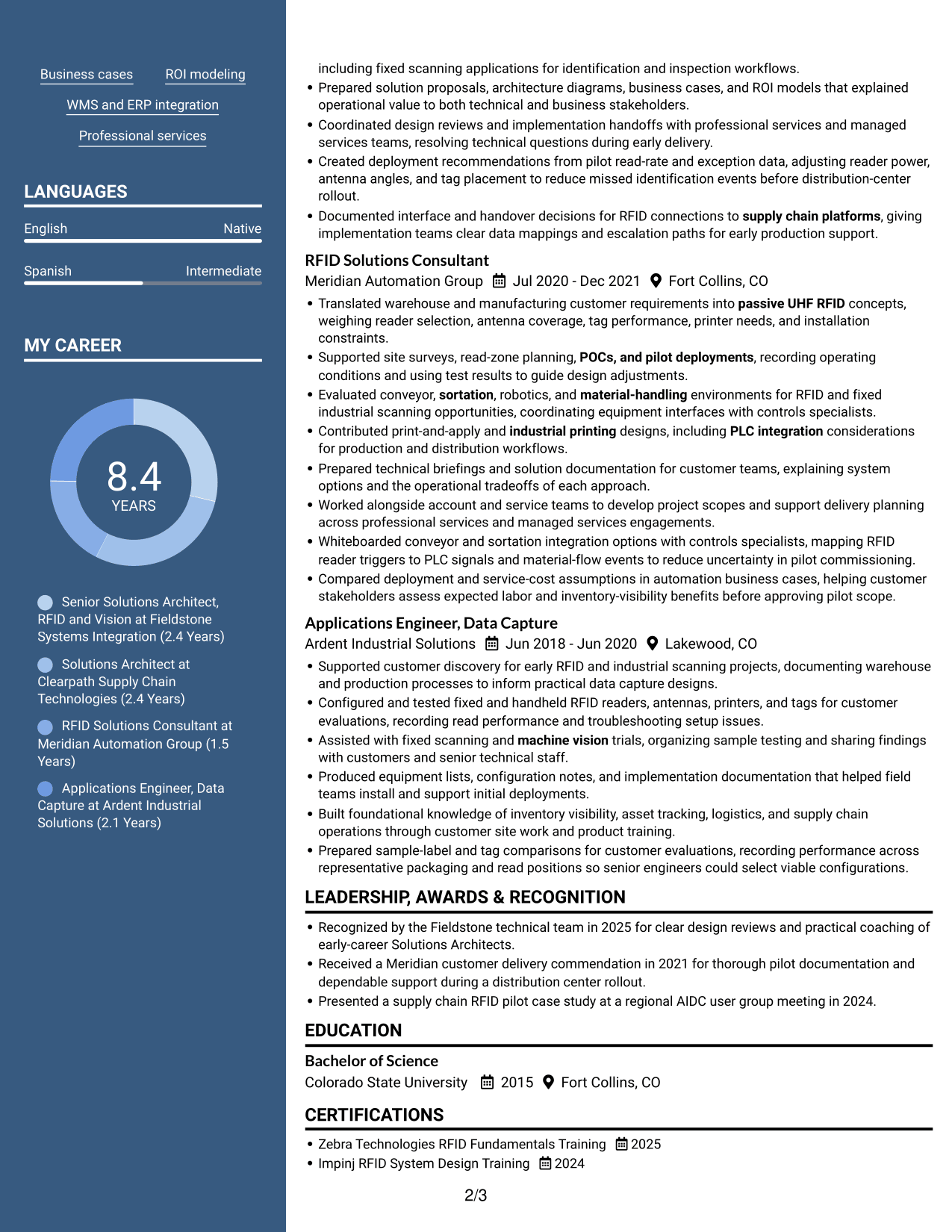
#7 Photo Header Two Column Format Resume Example
A portrait sits within a two-column layout, giving the resume a visual reference while keeping career and supporting content organized in parallel.
Why This Format Works
- Two-column organization lets reviewers scan career details and supporting sections in parallel.
- The portrait adds a visual reference without changing the resume's section order.
- Separate reading areas make education and credentials easy to find during review.
Best For
- Portrait-inclusive resume preferences
- Two-column content grouping
- Readers scanning career and supporting details
- Parallel section navigation
- Resumes with multiple supporting sections
Why Build Your Senior Solutions Architect - RFID and Vision Resume with ResumeInMinutes
ResumeInMinutes helps you organize architecture experience, technical skills, and supporting evidence in a resume that is easy to review and customize. Use the image previews to compare layouts, then open an example in the editor to make it your own.
- Clear resume section structure
- ATS-aware headings and keywords
- Technical skills organization
- Experience bullets focused on evidence
- Support for relevant training and certifications
- Resume customization in the editor
Focus each version on the role by giving relevant space to RFID design, machine vision, industrial scanning, integrations, pilot results, and business value. Keep the details accurate and easy for both technical and business readers to scan.
See Also
- 7 Senior Solutions Architect - RFID and AIDC Resume Templates with Example
- 7 Agentic Solution Architect Resume Templates with Example
- 7 AI Application Solutions Architect - Generative AI Resume Templates with Example
- 7 AI Engineering Solutions Architect Resume Templates with Example
- 33 AI/ML Solutions Architect Resume Templates with Example 2026 (ATS-Optimized)
- 33 AI Solutions Architect Resume Templates with Example 2026 (ATS-Optimized)
- 7 Associate AI Solution Architect - Enterprise GenAI Resume Templates with Example
- 7 AWS Cloud Solutions Architect Resume Templates with Example
- 7 Senior Solutions Architect - RFID and Vision Cover Letter Templates with Example
- 7 Senior Solutions Architect - RFID and AIDC Cover Letter Templates with Example
Frequently Asked Questions
Are these Senior Solutions Architect - RFID and Vision resume templates ATS-friendly?
The layouts use recognizable sections and readable headings. For stronger keyword alignment, include relevant terms such as passive UHF RFID, machine vision, fixed industrial scanning, WMS, ERP, MES, and ROI modeling when they accurately reflect your experience.
What do the resume examples show?
They show one resume example in different layouts and design styles. The PNG previews let you compare how each option presents experience, skills, and other resume sections.
What should a Senior Solutions Architect - RFID and Vision resume include?
Include a focused summary, relevant experience, technical skills, education, and applicable training or certifications. Describe solution design, discovery, RFID deployments, integrations, pilot work, ROI models, and delivery handoffs with clear, accurate examples.
Which resume layout works well for this role?
A simple layout with clear headings and a logical experience section makes technical work easier to review. Choose a design that gives enough room for architecture results and relevant technical skills without crowding the page.
How can I show the value of RFID or vision work?
Explain the operational need, your design or implementation contribution, and the result. Where available, include accurate measures such as read performance, fewer missed identification events, improved inventory visibility, or ROI estimates.
Should I include a photo on my resume?
Include a photo only if it is customary or expected in your country, region, or industry. For U.S. applications, a no-photo resume is generally the safer choice.