48 top • 14 Boeing • 6 Bosch • 2 Caterpillar • 9 Ford • 6 GE Aerospace • 4 Honeywell • 8 John Deere • 3 Lockheed Martin • 3 Rolls-Royce • 2 Siemens Energy • 4 Tesla
Questions with Detailed ExplanationsWith Detailed Explanations
This interview guide is for educational and informational purposes only. It is designed to help readers prepare, but it does not guarantee any interview result, hiring decision, offer, or outcome. Interview questions, hiring criteria, and preferred answers can vary by employer, interviewer, industry, location, and time. All answers, examples, and explanations in this guide are suggested examples for interview preparation, not definitive answers or instructions for professional practice. They are based on research and judgment, are provided without warranties of any kind, and should be adapted to the question, role, and applicable laws and professional requirements. Diagrams are simplified illustrations intended to highlight the main concepts and their relationships; actual situations, systems, and practices may be more complex. Alternative approaches may be equally valid or better suited to a particular question, context, or interviewer. To the fullest extent permitted by applicable law, the contributors and publisher are not liable for decisions made, actions taken, or losses incurred based on this guide.
State Laws and Professional Responsibilities
Laws and requirements governing an occupation vary by state and jurisdiction. You are responsible for checking the current laws, licensing requirements, and scope-of-practice rules that apply to your location and role, and for ensuring that your answers and actions comply with them. Adapt examples in this guide to those requirements. This guide is not legal advice.
Identity, Image, and Privacy Notice
To respect individual privacy, some names, profile photographs, avatars, biographical details, and other identifying information displayed in this guide may be replaced with pseudonyms, licensed stock images, illustrative avatars, composite images, or representative descriptions. Unless a person is expressly identified as an actual contributor, a displayed name, image, or profile should not be understood as depicting or identifying a specific candidate, interviewer, employee, or other real individual. These representations are provided for editorial and illustrative purposes only and do not imply endorsement, employment, participation, or affiliation with this guide or any company mentioned in it. Any resemblance to an actual person is coincidental.
Company Notice
This guide is an independent educational resource and is not affiliated with, endorsed by, sponsored by, or approved by the company named in this guide. Company names identify reported interview experiences or the employer context of clearly labeled original practice exercises. Interview practices can change without notice, and inclusion of company-specific content does not mean these questions are official, complete, or guaranteed to be asked. To the fullest extent permitted by law, the author, contributors, and publisher are not responsible for outcomes related to use of this material.
Content Accuracy and Verification
To the fullest extent permitted by applicable law, we do not represent or warrant that interview guides, questions, answers, examples, or diagrams are accurate, complete, current, error-free, or suitable for any particular purpose. You are responsible for independently reviewing and verifying the information before relying on it.
Questions or comments?
Contact us for general questions, or share feedback, technical corrections, and comments with the community.
31. What is FMEA, and what problem does it solve?Safety And Design RiskEasy
i Question Details
Explain the structured identification of potential failure modes, effects and causes so design or process risk can be reduced before failure occurs.
Short Interview Answer (30-60 seconds)
FMEA, or Failure Mode and Effects Analysis, is a structured and proactive method for asking what could fail, what would happen if it failed, why it could fail, and what action should reduce the risk. In a mechanical design, I start with the required function, identify credible failure modes, determine their effects and causes, choose risk reduction actions, and then review the remaining risk. The problem FMEA solves is finding and reducing design or process risk before failures reach testing, production, or users.
Detailed Explanation
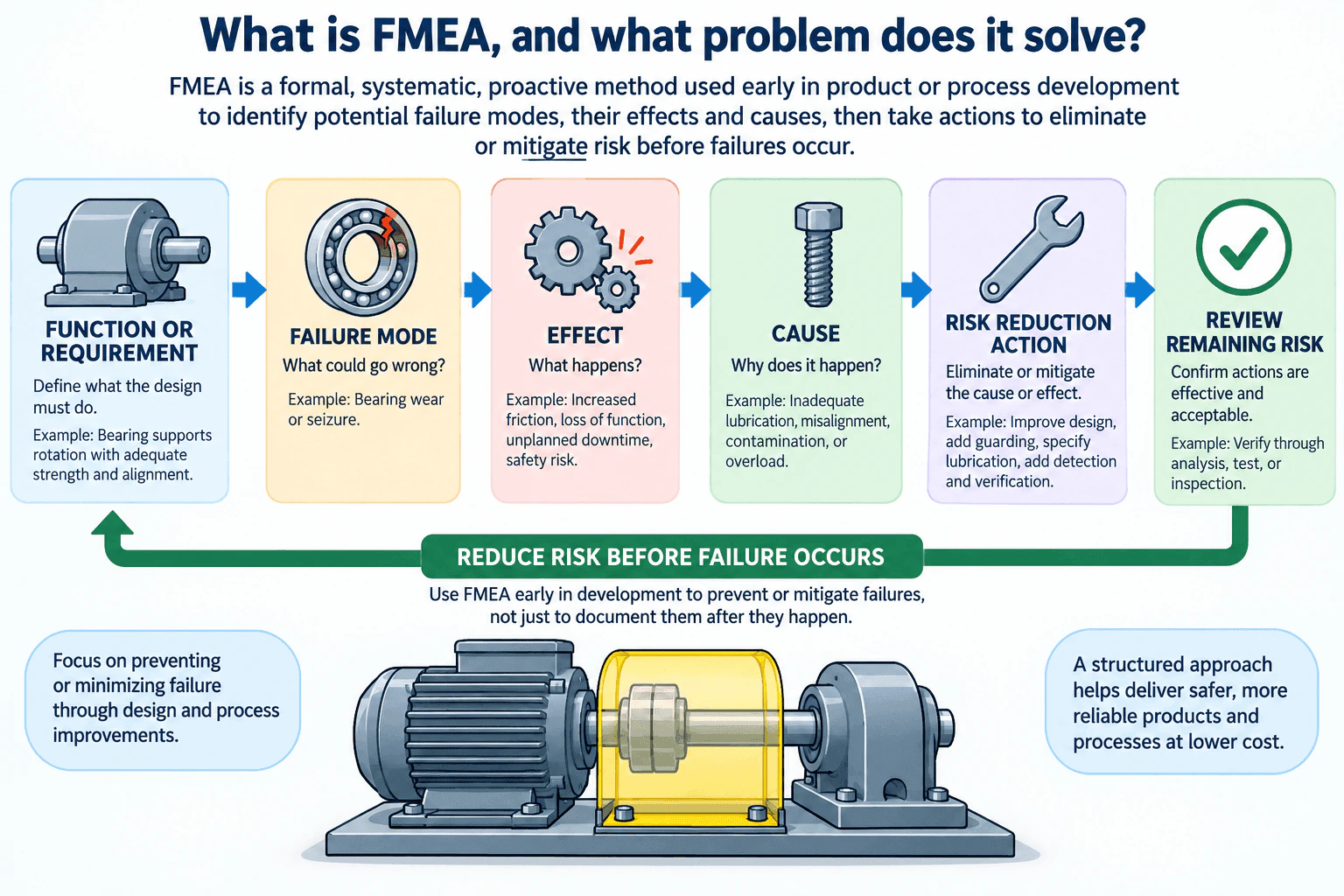
FMEA is a structured way to think about failure before it occurs. The core reasoning path is: define the function or requirement, identify a possible failure mode, determine its effect, identify credible causes, select a risk reduction action, and review the remaining risk.
A simple mechanical example is a bearing that must support rotation with adequate strength and alignment. A possible failure mode is wear or seizure. Effects could include increased friction, loss of function, unplanned downtime, or a safety consequence. Credible causes might include inadequate lubrication, misalignment, contamination, or overload. The response could include a design change, guarding where exposure exists, a specified lubrication method, added detection, inspection, or verification testing. After the action, the remaining risk still needs to be reviewed rather than assuming the problem is solved.
FMEA supports design risk management, but it does not replace a complete machinery safety assessment. Where safety is involved, I would also identify the hazard, exposed person, operating mode, stored energy, moving parts, pinch points, pressure, sharp edges, and applicable jurisdiction. Risk reduction should prioritize prevention through design and the hierarchy of controls. Guards, safe isolation, credible fault conditions, and residual risk should be verified when relevant.
Useful Questions to Ask the Interviewer
Are we discussing design FMEA, process FMEA, or a general FMEA example?
Is there a specific product, operating condition, or failure consequence you want me to use?
Should I focus only on the FMEA logic, or also connect it to the wider machinery risk assessment?
How to Explain It in an Interview
I would explain FMEA as a proactive chain of reasoning rather than simply a risk table.
First, define what the component or process is required to do. That creates the reference for recognizing failure.
Second, identify the failure mode by asking what could go wrong. For a bearing, that could be wear or seizure.
Third, identify the effect. I would ask what happens to the machine, process, or exposed person if that failure occurs. Effects might include increased friction, loss of function, downtime, or a safety consequence.
Fourth, identify credible causes such as inadequate lubrication, misalignment, contamination, or overload. This matters because the action should address the cause or reduce the consequence rather than simply document the failure.
Fifth, select a risk reduction action. Depending on the issue, that could mean changing the design, adding a guard, specifying lubrication, adding detection, or defining verification.
Finally, review the remaining risk and verify that the action actually works through appropriate analysis, testing, or inspection. I would also check whether hazards such as moving parts, pinch points, stored energy, or pressure require controls outside the FMEA itself.
The value of FMEA is that it moves failure thinking earlier in development, when changes are usually easier to make. It gives the team a traceable way to connect requirements, potential failures, effects, causes, actions, and verification. Its limitation is that the result depends on identifying credible failure modes and causes, so engineering judgment, evidence, testing, and broader safety assessment are still necessary.
Why Interviewers Ask This
Interviewers want to know whether I understand how to identify potential failures systematically before they occur, connect each failure mode to its effect and cause, select meaningful design actions, and verify the remaining risk instead of reacting only after failure.
Common interview mistakes
Common mistakes include treating FMEA as paperwork completed after the design is finished, confusing a failure mode with its cause or effect, listing vague causes that do not lead to engineering action, assuming that an action automatically makes the risk acceptable, and using FMEA as a substitute for a complete machinery safety assessment. Another mistake is focusing only on a numerical priority value while overlooking a severe or safety critical consequence that deserves attention.
Interview tip
Explain FMEA as a connected reasoning sequence: requirement, failure mode, effect, cause, action, and remaining risk. A short mechanical example such as bearing wear makes the method concrete. Emphasize that the goal is prevention before failure occurs and that actions must be verified rather than merely recorded.
Interviewer may ask next
How would you verify that an FMEA risk reduction action actually worked?
I would define evidence that directly tests the intended action. Depending on the action, that could include engineering analysis, inspection, functional testing, durability testing, guard verification, or checking safe isolation. I would then review whether the original failure mode, cause, and effect changed as expected and document the remaining risk. I would not claim success simply because an action was listed in the FMEA.
What changes if the failure mode can expose an operator to a serious machinery hazard?
I would not rely on FMEA alone. I would identify the hazard, exposed person, operating mode, stored energy, credible faults, and applicable jurisdiction, then use the hierarchy of controls to prioritize prevention through design. Relevant measures could include eliminating the hazard, reducing exposure, machine guarding, interlocking where appropriate, and safe isolation. After implementing controls, I would verify their effectiveness and evaluate the residual risk.
32. What is the difference between DFMEA and PFMEA?Safety And Design RiskEasy
i Question Details
Distinguish design-related risks in function, material or geometry from manufacturing-process risks in operations, equipment and assembly.
Short Interview Answer (30-60 seconds)
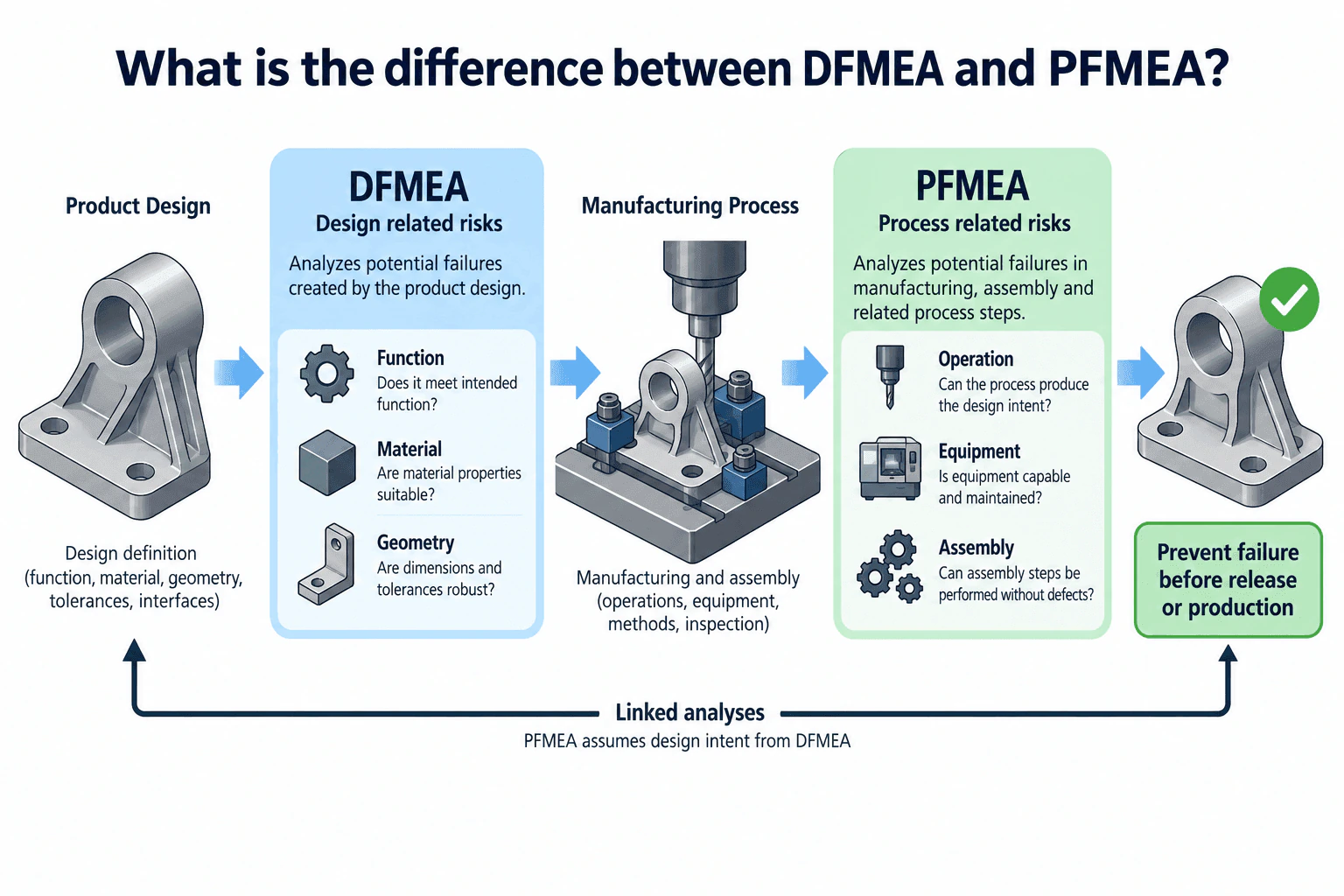
DFMEA focuses on potential failures caused by the product design. It asks whether the intended function, material properties, geometry, tolerances, and interfaces are robust. PFMEA focuses on potential failures caused by manufacturing and assembly. It asks whether operations, equipment, methods, inspection, and assembly steps can consistently build the design intent. The analyses are linked because PFMEA starts with the design intent established by DFMEA.
Detailed Explanation
DFMEA and PFMEA use the same failure mode and effect thinking, but they look at different sources of risk.
DFMEA is design focused. It examines potential failures created by the product definition. In practice, that means looking at function, material, geometry, tolerances, and interfaces and asking whether the design itself could fail to do what it is intended to do.
PFMEA is process focused. It examines potential failures created while making or assembling the product. In practice, that means looking at manufacturing and assembly operations, equipment, methods, inspection, and assembly steps and asking whether the process can consistently produce the intended design.
The key relationship is that PFMEA assumes design intent from DFMEA. DFMEA defines what the product must do and what characteristics matter. PFMEA then checks whether production can achieve that intent repeatedly and without defects. Together, they help prevent failure before release or production.
Useful Questions to Ask the Interviewer
Are we discussing risk in the product design itself or risk in the manufacturing and assembly process?
Which product characteristics are functionally critical in this example?
Is the main concern design robustness or process capability?
How to Explain It in an Interview
I would explain it by separating the source of the risk.
For DFMEA, I focus on the design definition. I ask whether the part will meet its intended function and whether the chosen material, geometry, tolerances, and interfaces are appropriate. A DFMEA failure mode comes from the design itself. For example, a bracket may have geometry that is too weak for its intended function, material that is not suitable, or tolerances that are not robust.
For PFMEA, I focus on the manufacturing and assembly process. I ask whether operations, equipment, methods, inspection, and assembly steps can reliably produce the part defined by the design. A PFMEA failure mode comes from how the part is made. For example, the design may be correct, but a machining operation may not hold the required tolerance, equipment may not be capable, or an assembly step may create defects.
The two analyses are linked. DFMEA defines the design intent, and PFMEA checks whether the process can produce that intent consistently. A simple example is a critical hole location on a bracket. In DFMEA, I would ask whether that location and tolerance are right for function. In PFMEA, I would ask whether the machining, fixturing, and inspection process can repeatedly achieve it.
So the difference is design related risk versus process related risk, and both are used together to prevent failures before release or production.
Why Interviewers Ask This
Interviewers want to see whether I can distinguish design risk from manufacturing process risk and explain how both analyses work together. They are checking whether I understand the source of the failure mode, how design intent flows into production planning, and how engineers prevent failure before release or production.
Common interview mistakes
A common mistake is treating DFMEA and PFMEA as the same activity. Another mistake is placing a manufacturing problem into DFMEA when the design itself is acceptable, or placing an inherently weak material or unsuitable geometry into PFMEA when the risk originates in the design. People also miss the link between them by doing PFMEA without first understanding the design intent and critical characteristics defined by DFMEA.
Interview tip
Use one simple test in your answer: ask where the failure mode originates. If it originates in function, material, geometry, tolerances, or interfaces, it belongs in DFMEA. If it originates in operations, equipment, methods, inspection, or assembly, it belongs in PFMEA. Then mention that PFMEA assumes design intent from DFMEA.
Interviewer may ask next
How would you validate that DFMEA and PFMEA stay aligned?
I would start by identifying the critical product requirements defined in DFMEA and then trace them into the relevant process steps in PFMEA. If DFMEA identifies a functionally important feature, PFMEA should show how the manufacturing and inspection process will achieve and verify it. I would also review whether process controls address the same failure modes that matter to product performance. This validation confirms that the process supports the design intent rather than operating independently from it.
What would you do if PFMEA shows that the current process cannot reliably hold a required tolerance?
I would treat that as a process related risk first and document it in PFMEA at the affected operation. Then I would work with the design team to check whether the tolerance is truly required for function or whether the design can be changed. If the tolerance is functionally necessary, the process may need better fixturing, equipment capability, inspection, or method changes. If the tolerance is tighter than needed, the design may be relaxed. The tradeoff is maintaining product function while creating a process that can produce the design consistently.
33. How should severity, occurrence and detection information be used in FMEA?Safety And Design RiskMedium
i Question Details
Use the ratings to prioritize risk-reduction actions while avoiding the mistake of treating a single calculated score as a substitute for engineering judgment about severe hazards.
Short Interview Answer (30-60 seconds)
I would use severity, occurrence and detection together to prioritize risk reduction. Severity describes the consequence of the effect, occurrence describes the likelihood of the cause, and detection describes how effectively current controls can detect the cause or failure before the effect reaches use. If the chosen FMEA method uses RPN, then RPN = S × O × D can be one prioritization input, but I would not use it alone. A severe effect still deserves explicit engineering attention. After actions, I would update the ratings, reprioritize using the chosen FMEA method, and document the residual risk and rationale.
Detailed Explanation
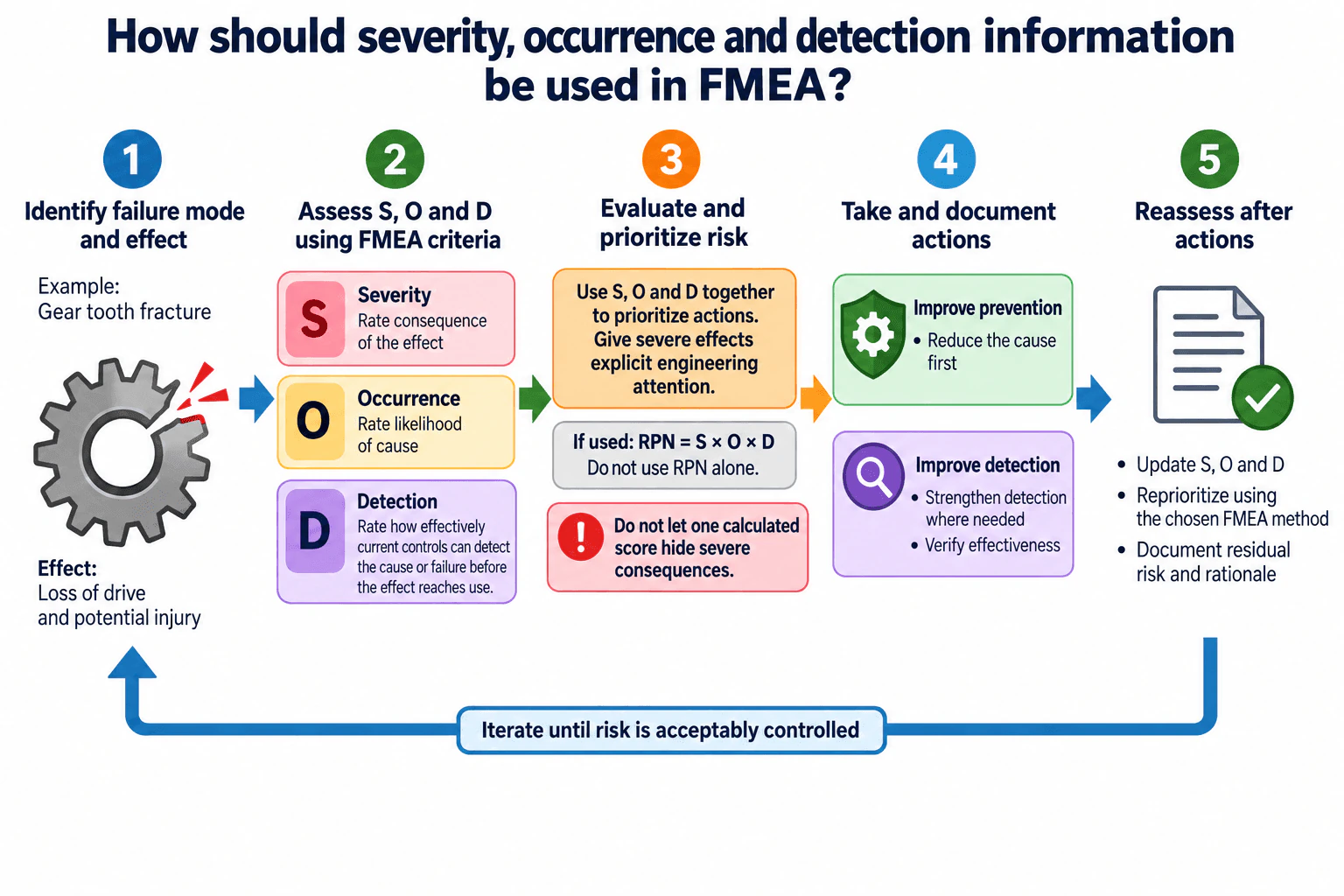
FMEA ratings are decision inputs. Severity tells me how serious the failure effect is, occurrence tells me how likely the cause is, and detection tells me how effectively current controls can detect the cause or failure before the effect reaches use. I use those ratings together to prioritize risk reduction while giving severe effects explicit engineering attention even when a combined score appears moderate.
Useful Questions to Ask the Interviewer
Which FMEA method and rating criteria should I use for severity, occurrence and detection?
Does the organization use RPN, another prioritization method, or both?
What failure effect, operating condition and existing controls are in scope?
How to Explain It in an Interview
I would start with the failure mode and its effect. For example, a hypothetical gear tooth fracture could lead to loss of drive and possible injury. I would then rate severity, occurrence and detection using the defined FMEA criteria rather than inventing my own scales.
Severity is the consequence of the effect. Occurrence represents the likelihood of the cause. Detection represents how effectively current controls can detect the cause or failure before the effect reaches use.
I would then use S, O and D together to prioritize actions. If the selected FMEA method uses RPN, I can calculate RPN = S × O × D as one prioritization input. I would not let RPN become the sole decision rule because different rating combinations can produce the same product, and a severe consequence can still require focused engineering action.
My first preference is prevention. I would reduce the cause where practical through a design or process change. I would strengthen detection controls where needed and then verify that the actions are effective.
After implementing actions, I would reassess the relevant S, O and D ratings using the same criteria. I would then reprioritize the failure mode using the chosen FMEA method and document the residual risk and engineering rationale. If the remaining risk is not acceptably controlled, I would loop back to additional risk reduction.
The key point is that the ratings structure engineering judgment. They help prioritize action consistently, but they do not replace judgment about severe consequences, credible failure mechanisms, control effectiveness and remaining risk.
Why Interviewers Ask This
Interviewers want to see whether I understand that severity, occurrence and detection are engineering inputs for prioritizing risk reduction, not just numbers to multiply. They are testing whether I can recognize severe effects, choose effective prevention and detection actions, reassess risk after those actions, and apply engineering judgment instead of allowing one calculated score to determine the decision.
Common interview mistakes
Common mistakes include treating RPN as the only decision rule, assuming a moderate combined score makes a severe effect unimportant, changing ratings without evidence that the associated risk has changed, relying on detection instead of reducing the cause where prevention is practical, using inconsistent rating criteria, and failing to reassess and document residual risk after actions.
Interview tip
Define severity, occurrence and detection in plain language first. Then explain that you use all three to prioritize actions, explicitly call out severe consequences, prefer reducing the cause first, strengthen detection where needed, verify action effectiveness, and reassess the ratings. Mention RPN only as an optional prioritization input when the selected FMEA method uses it, not as a substitute for engineering judgment.
Interviewer may ask next
What would you do if two failure modes have the same RPN but very different severity ratings?
I would not treat them as equivalent simply because their products are equal. I would examine the individual severity, occurrence and detection ratings, the nature of each failure effect, the exposed person or system, and the available prevention controls. A failure mode with a severe consequence deserves explicit engineering attention even if another combination of ratings produces the same RPN. I would prioritize according to the defined FMEA method and document the engineering rationale.
How would your approach change if a design action reduces occurrence but does not change severity?
I would keep the severity rating tied to the consequence of the failure effect unless the design action actually changes that consequence. I would reassess occurrence based on evidence that the cause is less likely, and reassess detection only if the detection controls changed. I would then reprioritize the risk using the chosen FMEA method, verify the action effectiveness, and document the remaining risk and rationale.
34. How would you identify hazards for a mechanical product across its operating modes?Safety And Design RiskMedium
i Question Details
Consider normal use, startup, shutdown, maintenance, transport, foreseeable misuse and fault states, then identify exposed people, energy sources and hazardous outcomes.
Short Interview Answer (30-60 seconds)
I would review the product mode by mode, including normal use, startup, shutdown, maintenance, transport, foreseeable misuse, and credible fault states. For each mode I would identify who can be exposed, the hazardous features and energy sources present, and the harmful outcomes that could result. I would then assess the risks and apply the hierarchy of controls, preferring elimination, substitution, and engineering controls such as guarding. For maintenance I would control stored or residual energy through safe isolation and verify isolation before work. Finally, I would verify guarding, check credible faults, document residual risk, confirm the applicable jurisdiction, and reassess whenever the design changes.
Detailed Explanation
I would treat each operating mode as a different exposure condition rather than assuming that a product acceptable during normal operation is acceptable in every condition. For each mode, I would establish the product boundary and trace four things together: who can be exposed, what hazardous feature or energy source is present, how exposure can occur, and what harmful outcome is credible.
Useful Questions to Ask the Interviewer
Which operating modes, users, maintainers, transport activities, foreseeable misuse cases, and fault states are in scope?
Which jurisdiction and workplace environment should I use when determining applicable safety requirements?
Are there known energy sources, service tasks, previous incidents, or fault conditions that deserve particular attention?
How to Explain It in an Interview
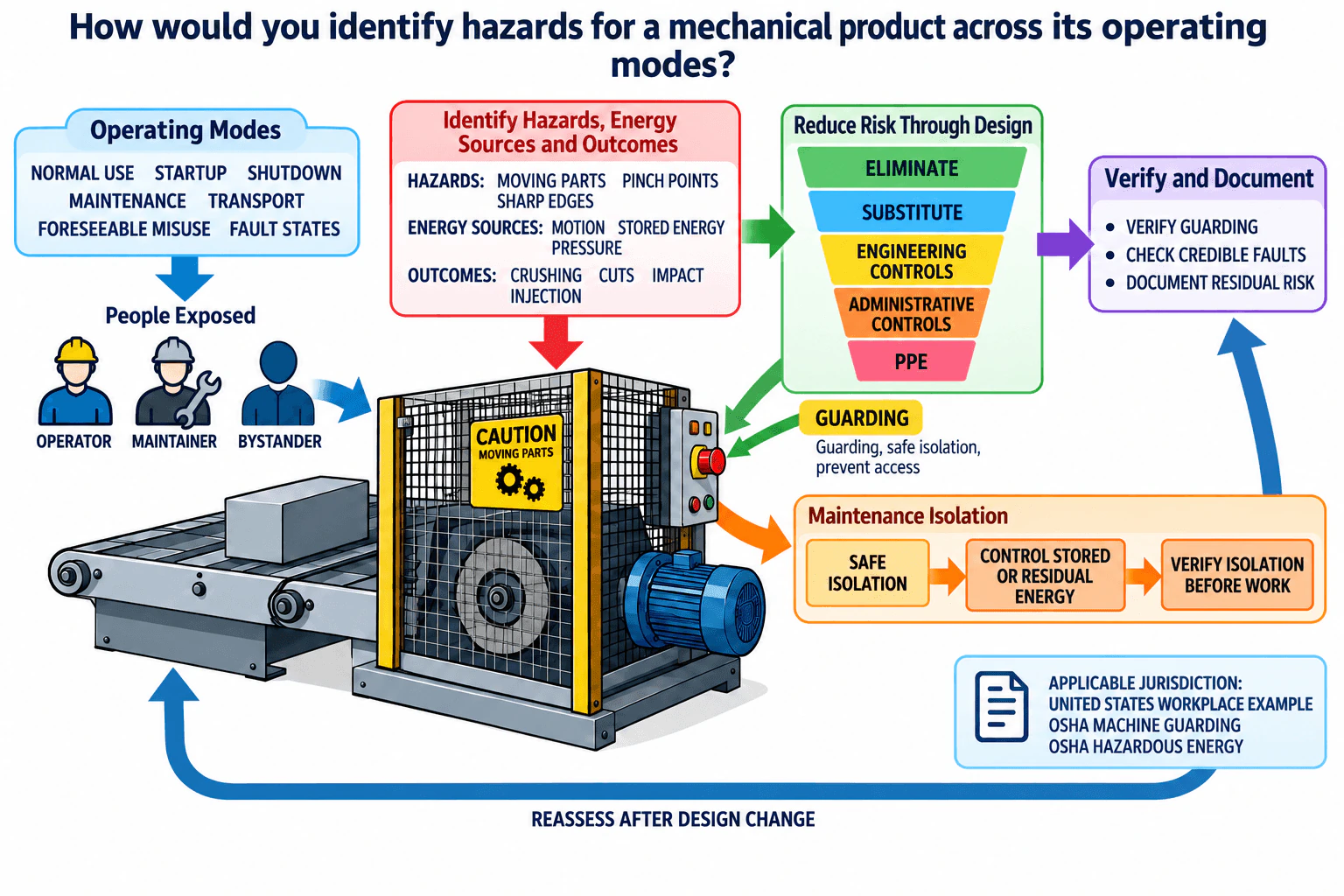
I would start by listing the operating modes: normal use, startup, shutdown, maintenance, transport, foreseeable misuse, and credible fault states. For each mode I would identify exposed people such as the operator, maintainer, or bystander.
Next I would identify hazards and energy sources. For the machine example, hazards include moving parts, pinch points, and sharp edges. Energy sources can include motion, stored energy, and pressure. I would connect these to credible outcomes such as crushing, cuts, impact, or fluid injection. That creates a traceable relationship between operating mode, exposed person, hazard, energy source, and consequence.
I would then perform a risk assessment to determine which combinations need the most attention and apply the hierarchy of controls. I would first ask whether the hazard can be eliminated. If not, I would consider substitution, then engineering controls. Guarding is an engineering control that can prevent access to hazardous moving parts. Administrative controls and personal protective equipment come later because they rely more heavily on human action.
Maintenance needs separate analysis because stopping the machine does not prove that all hazardous energy is gone. I would define safe isolation, control stored or residual energy, and verify isolation before work begins.
After implementing controls, I would verify the guarding, check credible fault states, and document residual risk. I would also establish the applicable jurisdiction before treating any requirement as mandatory. For a United States workplace example, machine guarding and hazardous energy requirements may apply.
Finally, I would reassess the hazards after a design change because a new geometry, control, access requirement, or operating condition can create a new exposure path. The objective is a documented, prevention focused risk reduction process rather than a claim of zero risk.
Why Interviewers Ask This
Interviewers want to see whether I can identify hazards systematically across the complete use of a product, connect exposed people and energy sources to credible harmful outcomes, prioritize prevention through risk assessment and the hierarchy of controls, and verify that guarding, isolation, credible faults, and residual risk are addressed within the applicable jurisdiction.
Common interview mistakes
Common mistakes include reviewing only normal operation, overlooking maintainers and bystanders, treating shutdown as proof that stored energy is gone, listing hazards without connecting them to exposed people and harmful outcomes, relying on warnings or personal protective equipment before considering design controls, assuming a guard resolves every credible fault, ignoring foreseeable misuse, failing to define the applicable jurisdiction, and treating a structural safety factor as a substitute for a complete safety assessment.
Interview tip
Organize the answer as one traceable chain: operating mode, exposed person, hazard and energy source, harmful outcome, risk reduction, verification, and residual risk. Use one concrete example such as a guarded rotating machine with maintenance isolation to show the method without inventing test results or claiming that the product is completely safe.
Interviewer may ask next
How would you validate that the proposed risk controls are effective?
I would define verification evidence for each control before accepting it. For guarding, I would check that access to the hazardous moving area is prevented under the intended operating conditions and credible fault states. For maintenance isolation, I would confirm that hazardous energy sources are identified and isolated, stored or residual energy is controlled, and isolation is verified before work. I would also review foreseeable misuse, document residual risk, and repeat the assessment if testing or a design change reveals another exposure path.
What would change if maintenance required frequent access to the hazardous area?
Frequent access would increase the importance of reducing the hazard through the design instead of relying mainly on procedures. I would first reconsider whether the hazardous motion or energy can be eliminated or reduced during the maintenance task. I would then evaluate engineering controls that permit necessary access while preventing hazardous exposure, together with a practical safe isolation method for work that requires hazardous energy to be controlled. I would reassess the resulting risk, verify the controls, and document any remaining residual risk and operating limitations.
35. How would you design a mechanical system to avoid a single-point hazardous failure?Safety And Design RiskHard
i Question Details
Identify functions whose loss is hazardous, map single components or interfaces that can cause that loss, then apply fail-safe behavior, redundancy, containment or monitored degradation as appropriate.
Short Interview Answer (30-60 seconds)
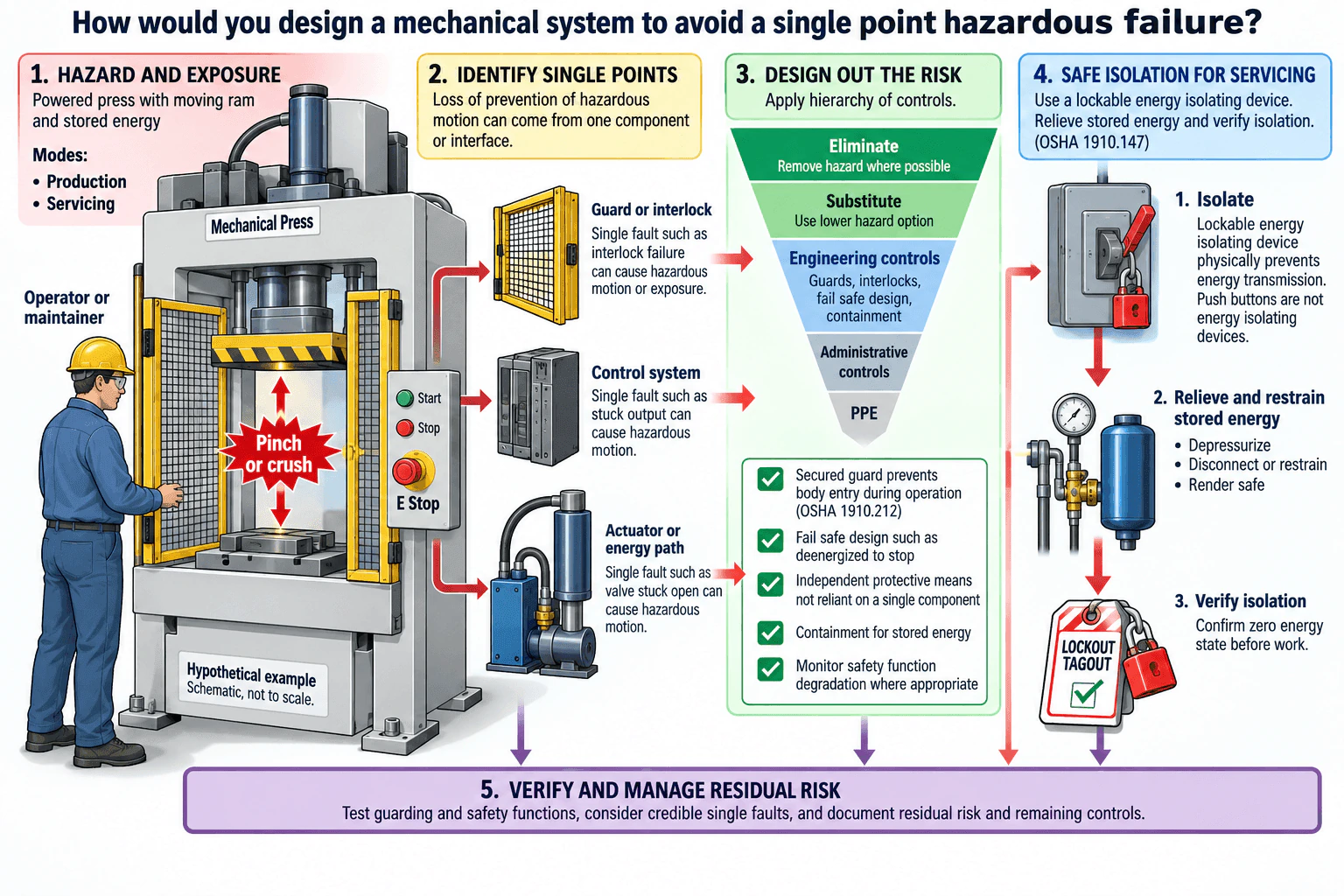
I would first define the hazardous function, exposed person, operating mode, energy sources, and applicable jurisdiction. For a powered press, I would consider an operator or maintainer exposed to ram motion, pinch or crush hazards, and stored energy during production and servicing. I would then identify single components or interfaces whose failure could create hazardous motion, such as a guard interlock, control output, valve, or actuator energy path. I would apply the hierarchy of controls, design fail safe behavior where practical, add independent protective means so one credible fault cannot defeat protection, contain or control stored energy, provide safe isolation for servicing, and verify credible faults before documenting residual risk.
Detailed Explanation
A single point hazardous failure exists when one component, interface, or control failure can remove a necessary protective function and expose someone to unacceptable harm. The objective is therefore not simply to make individual parts stronger. It is to prevent one credible fault from directly creating uncontrolled hazardous motion or exposure.
Useful Questions to Ask the Interviewer
What hazardous motion or stored energy can injure the operator or maintainer, and during which operating modes?
Which jurisdiction and machine safety requirements apply to production and servicing?
Which single component or interface failures should be treated as credible in the risk assessment?
How to Explain It in an Interview
Engineering Method
I would begin by defining the hazard boundary. For the hypothetical powered press in the design, the exposed people are an operator during production and a maintainer during servicing. The important hazards are ram motion, pinch or crush exposure, and stored energy.
Next, I would map each required protective function to the components and interfaces that provide it. A single failure could occur in a guard or interlock, a control output, or a valve or actuator energy path. For each one, I would ask whether that single fault could allow hazardous motion or exposure.
I would then apply the hierarchy of controls. Elimination or substitution comes first where practical. Engineering controls can include secured machine guarding, interlocks, fail safe behavior such as deenergizing to stop where that produces a safe state, independent protective means that do not depend on the same single component, containment or restraint of stored energy, and monitoring of safety function degradation where appropriate.
For servicing, I would provide a suitable lockable energy isolating device, isolate hazardous energy, relieve, disconnect, restrain, or otherwise render stored energy safe, and verify isolation before work begins. A normal stop push button is a control device, not an energy isolating device.
Assumptions And Checks
I would not assume redundancy automatically removes the hazard. I would check whether supposedly independent protective paths share a controller, power source, mechanical element, sensor interface, or other dependency that could defeat both protections.
Design Reasoning
Finally, I would verify guards and safety functions against credible faults, check safe isolation and stored energy control, confirm protection is not bypassed during verification, and document residual risk and remaining controls. Evidence would come from traceable design review, inspection, functional testing, and applicable risk assessment records rather than invented results.
Why Interviewers Ask This
Interviewers want to see whether I can identify hazardous functions, trace credible component and interface failures to hazardous outcomes, and reduce risk through prevention, fail safe behavior, independent protection, safe isolation, verification, and residual risk management rather than relying on one protective component.
Common interview mistakes
Common mistakes include treating a structural safety factor as the complete safety assessment, relying on one interlock or controller as the only protective path, adding redundancy without checking shared dependencies, confusing a stop push button with an energy isolating device, ignoring retained pressure or other stored energy, considering production hazards but not servicing hazards, bypassing protection during verification, and declaring the system safe without evaluating credible faults and residual risk.
Interview tip
Anchor the answer to one concrete hazardous function. State who is exposed, when exposure occurs, and which single failures could create the hazardous state. Then explain how the hierarchy of controls, fail safe behavior, independent protection, stored energy control, safe isolation, and verification prevent one credible fault from becoming a hazardous event.
Interviewer may ask next
How would you verify that the design really tolerates a single credible fault?
I would create a traceable list of required safety functions and credible single faults, then verify each fault without defeating the protective system. For the press example, I would examine faults such as loss of an interlock function, an unsafe control output, or an actuator energy path remaining active. Verification would include design review, inspection, controlled functional testing, confirmation of the intended safe state, and documentation of residual risk. I would also check common dependencies because two protective devices are not truly independent if one shared controller, power source, interface, or mechanical element can disable both.
What would change if significant hydraulic or pneumatic energy remained after electrical power was isolated?
Electrical isolation alone would not establish a safe state. I would identify every hazardous energy source and provide appropriate isolation for each one. Stored pressure and mechanical energy would be relieved, disconnected, restrained, or otherwise rendered safe as appropriate. Before servicing, the isolation and safe energy state would be verified. If hazardous energy can reaccumulate or cannot be completely dissipated, the design would require suitable restraint or continued control of that energy, followed by verification and documentation of the remaining residual risk.
36. A DFMEA rated a failure mode low risk, but it later caused a serious field issue. How would you review it?Safety And Design RiskHard
i Question Details
Reconstruct the original assumptions and scoring, compare them with field evidence, identify missing causes or controls, update the risk analysis and drive corrective design and verification actions.
Short Interview Answer (30-60 seconds)
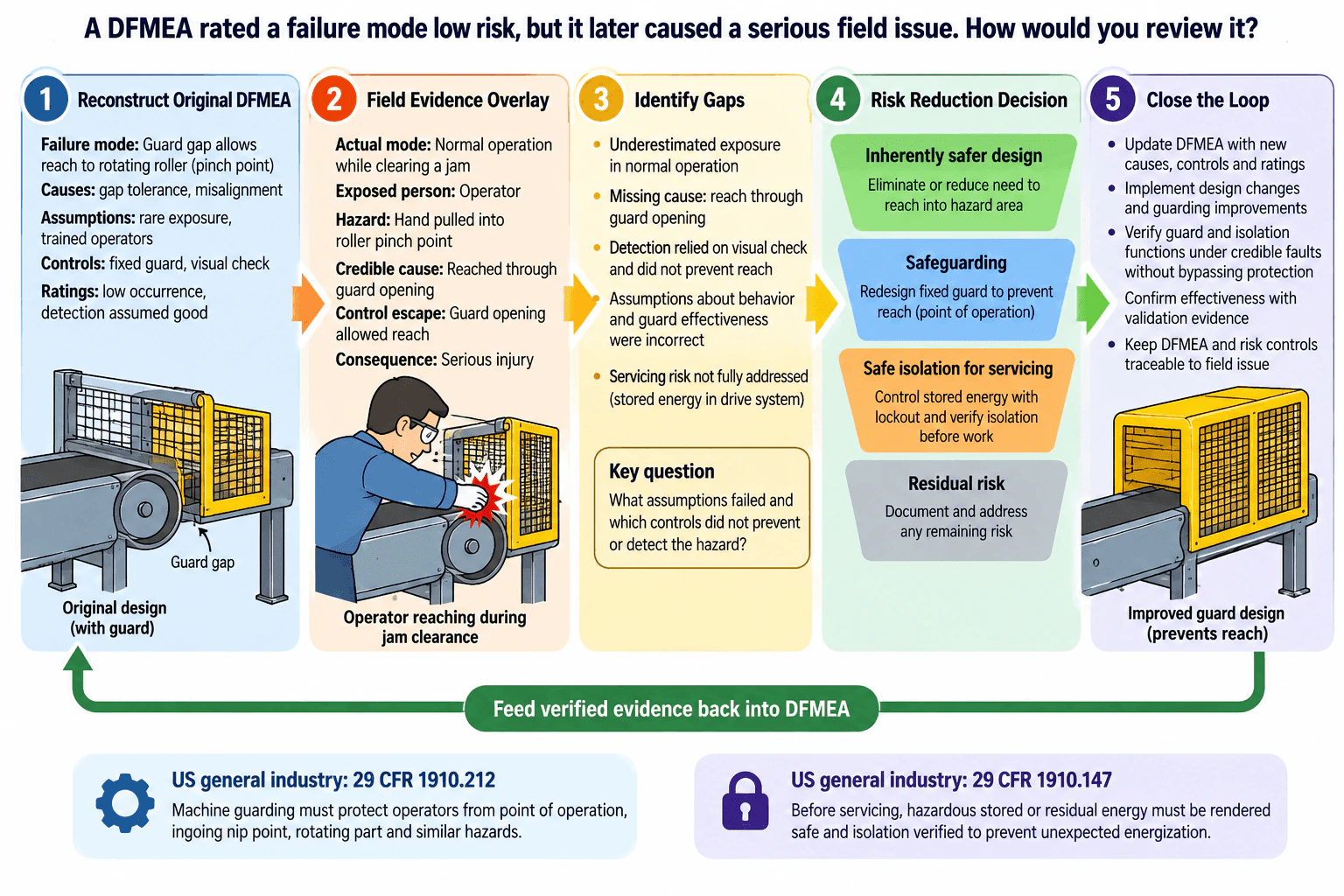
I would reopen the DFMEA and reconstruct why the failure mode was originally rated low risk, including the assumed operating mode, exposed person, causes, controls, occurrence, and detection basis. Then I would compare those assumptions with the field evidence and identify what was missing or incorrect. In this case, the guard opening allowed an operator clearing a jam to reach a roller pinch point, and servicing also introduces stored energy risk. I would prioritize inherently safer design, stronger guarding, and safe isolation, then update the DFMEA and verify the revised controls under credible conditions before closing the action.
Detailed Explanation
A serious field issue means the original risk model did not represent actual use well enough. I would not simply change a DFMEA rating. I would reconstruct the original analysis, compare every important assumption with traceable field evidence, identify why the controls did not prevent or detect the hazard, then drive corrective design and verification actions.
Useful Questions to Ask the Interviewer
What field evidence is available, such as incident details, returned hardware, photographs, operating conditions, or service records?
Did the event occur during normal operation, jam clearing, servicing, or another operating mode?
Which jurisdiction and machine safety requirements apply to the equipment and location?
How to Explain It in an Interview
I would begin by reconstructing the original DFMEA entry and the evidence that supported it. For the illustrated case, the failure mode is a guard gap that permits reach to a rotating roller pinch point. The original assumptions included rare exposure and trained operators. The listed controls were a fixed guard and visual check, with low occurrence and good detection assumed.
Next, I would overlay the field evidence. The actual event occurred during normal operation while clearing a jam. The exposed person was the operator, the hazard was the roller pinch point, and the guard opening allowed reach into it. That tells me the original exposure assumption and the assumed effectiveness of the guard were incorrect. It also shows that relying on a visual check did not prevent access to the hazard.
I would then identify the gaps in the analysis. These include underestimated exposure during normal operation, the missing cause of reaching through the guard opening, an ineffective detection assumption, and servicing risk associated with stored energy in the drive system. I would update the failure causes, controls, occurrence basis, detection basis, and any effect or severity description that the field evidence shows was incorrect.
The corrective action would follow the hierarchy of controls. First, I would look for an inherently safer design that eliminates or reduces the need to reach into the hazardous area. If the hazard remains, I would redesign the fixed guard so the point of operation cannot be reached. For servicing, I would control stored energy with safe isolation and verify isolation before work begins. In United States general industry, 29 CFR 1910.212 may apply to machine guarding and 29 CFR 1910.147 may apply to hazardous energy control, depending on the actual equipment, task, and jurisdiction.
Finally, I would verify the revised guard and isolation functions under defined operating conditions and credible faults without bypassing protection. I would document any residual risk, update the DFMEA with the revised causes, controls, ratings, and actions, and keep the verification evidence traceable to the field issue. I would close the action only after the design change is implemented and its effectiveness is demonstrated.
Why Interviewers Ask This
Interviewers want to see whether I treat DFMEA as a living engineering risk analysis rather than a static score. They are evaluating whether I can reconstruct the original assumptions and ratings, compare them with field evidence, identify missing causes or ineffective controls, apply the hierarchy of controls, and connect corrective design actions to verification and residual risk.
Common interview mistakes
Common mistakes are changing only the DFMEA score without reconstructing the original assumptions, failing to identify the actual exposed person and operating mode, treating operator behavior or training as the primary control, confusing detection with prevention, overlooking stored energy during servicing, assuming a fixed guard is effective without checking whether the hazard can still be reached, ignoring credible faults, and closing the action before corrective design effectiveness has been verified.
Interview tip
Explain the review as one evidence driven loop: reconstruct the original DFMEA, overlay the field evidence, identify failed assumptions and missing controls, reduce the risk through design and safeguarding, verify the revised controls, then update the DFMEA and residual risk. Clearly distinguish known field facts from assumptions that still need confirmation.
Interviewer may ask next
What if the original occurrence and detection ratings were reasonable based on the information available at the time?
I would still update the DFMEA because the field event is new evidence. I would determine whether the issue came from a previously unknown cause, an operating mode that was not considered, an incorrect exposure assumption, an ineffective prevention control, or a verification method that did not represent actual use. I would document what changed in the evidence, revise the analysis accordingly, and define corrective design or verification actions. The goal is risk reduction and learning, not assigning blame for the earlier rating.
What if eliminating the hazard through redesign is not immediately feasible?
I would continue down the hierarchy of controls and reduce the risk through feasible engineering measures. For this example, that could include a redesigned fixed guard that prevents reach to the pinch point and safe isolation that controls stored energy during servicing. I would verify those controls under credible operating and fault conditions, document the remaining residual risk, and use procedures or training only as supporting measures rather than substitutes for feasible engineering controls.
37. What is a configuration baseline?Engineering Changes And ConfigurationEasy
Short Interview Answer (30-60 seconds)
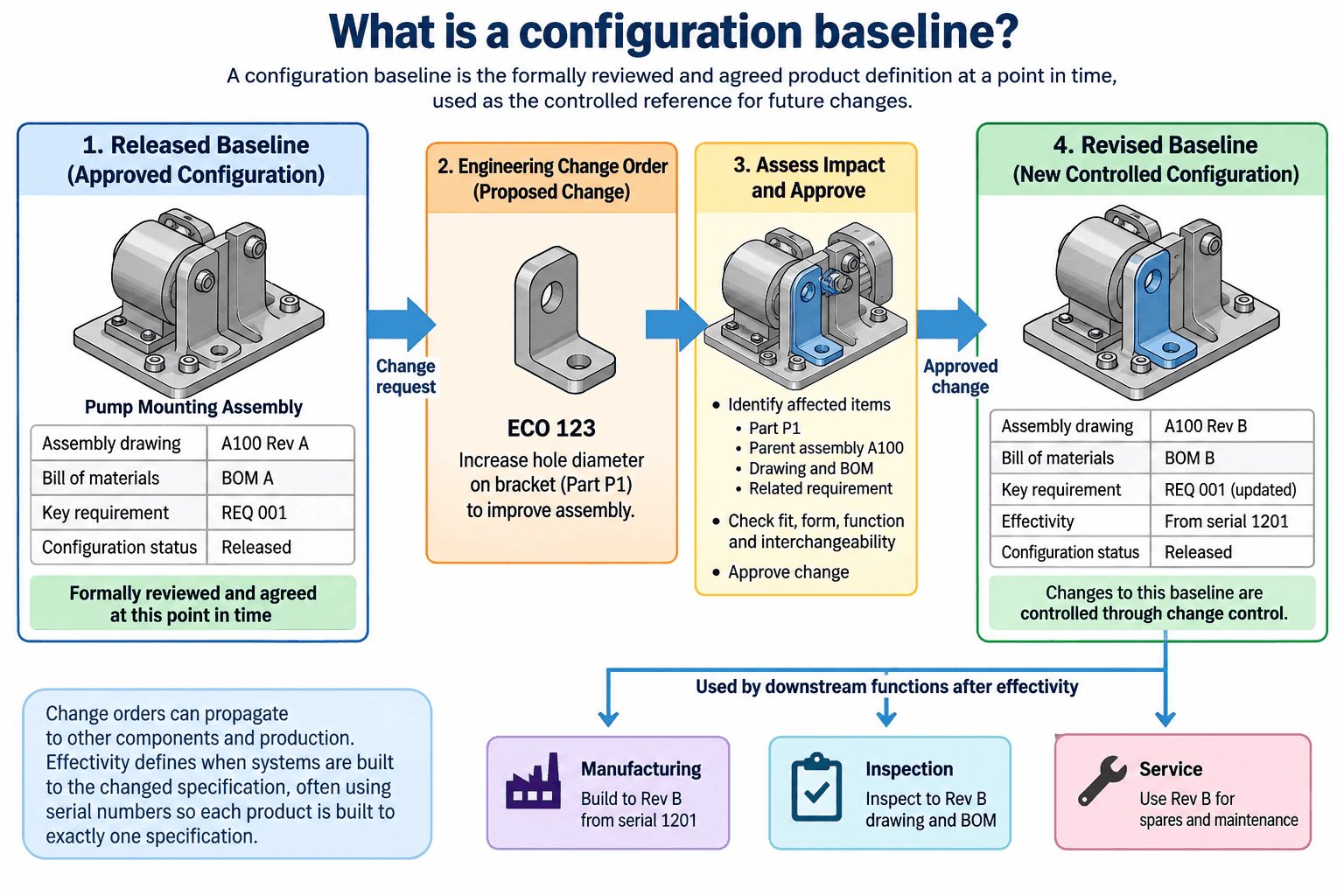
A configuration baseline is the formally reviewed and agreed product definition at a specific point in time. It is the controlled reference for future changes. For a mechanical product, the baseline can include released drawings, the bill of materials, requirements, part definitions, and revision status. If a change is proposed, the affected items are identified and reviewed through formal change control. Once approved, the revised product definition is released as a new baseline with defined effectivity.
Detailed Explanation
A configuration baseline is a controlled snapshot of the formally reviewed and agreed product definition at a specific point in time. It establishes exactly which released drawings, parts, assemblies, requirements, bill of materials records, and revisions define the product. Future changes are evaluated against that released baseline and are introduced through controlled approval rather than by independently changing released information.
Useful Questions to Ask the Interviewer
What product information does your organization include in a released baseline?
How is effectivity defined for approved engineering changes?
Which functions participate in approving and releasing configuration changes?
How to Explain It in an Interview
I would explain a baseline with a simple mechanical example. Assume a pump mounting assembly is released using assembly drawing A100 Rev A, BOM A, requirement REQ 001, and the associated controlled part definitions. Those released records form the current configuration baseline.
A configuration is the defined combination of approved product elements. A revision identifies an approved change level of a controlled item. The bill of materials identifies the parts and assemblies required for the product. Effectivity defines which physical units or production range use a particular approved configuration.
Suppose engineering change order ECO 123 proposes increasing the hole diameter on bracket P1 to improve assembly. I would identify the affected bracket, parent assembly A100, drawing, bill of materials, and related requirement before approving the change.
The team would then assess fit, form, function, and interchangeability. Depending on the product, the review could also consider supplier stock, existing tooling, inspection methods, spare parts, and service implications. I would use traceable evidence for those checks rather than assume the impacts are acceptable.
If the change is approved, the controlled records are revised. In this hypothetical example, assembly drawing A100 becomes Rev B, the bill of materials becomes BOM B, requirement REQ 001 is updated, and effectivity begins with serial 1201. These values are examples, not measured results.
The revised released definition becomes the new baseline. Manufacturing builds to Rev B from the stated effectivity, inspection verifies against the approved Rev B drawing and BOM, and service uses the correct approved revision for spares and maintenance.
The key point is that a baseline is not simply the newest CAD file. It is the approved, traceable product definition used as the reference for controlled change. Revision control records what changed, the engineering change order records the proposed and approved change, and effectivity identifies where the approved configuration applies.
Why Interviewers Ask This
Interviewers want to know whether I understand how an approved product definition is controlled, how engineering changes affect related parts and documents, and how revision control and effectivity keep manufacturing, inspection, and service aligned with the approved configuration.
Common interview mistakes
Common mistakes include treating the newest CAD model as the baseline without confirming release status, changing a drawing without tracing affected parts and assemblies, revising a part without checking the bill of materials, ignoring effectivity, assuming interchangeability without evaluating fit, form, and function, and failing to communicate the approved revision to manufacturing, inspection, or service.
Interview tip
Define the baseline first, then use one concrete mechanical example that shows the sequence from released configuration to engineering change order, impact assessment, approval, revision, effectivity, and the new released baseline. Emphasize controlled product definition and traceability rather than simple document storage.
Interviewer may ask next
How would you verify that an approved configuration change was implemented correctly?
I would trace the approved engineering change order to every affected controlled item, confirm the intended drawing and part revisions, verify that the bill of materials and linked requirements were updated, check the stated effectivity, and confirm that manufacturing, inspection, and service are using the approved revision. I would also review available verification evidence rather than assuming that release alone proves successful implementation.
What changes if the old and new bracket revisions are not interchangeable?
The configuration controls become more important because the two revisions cannot be substituted freely. The change review would need to define effectivity, identify affected assemblies and inventory, consider supplier stock, tooling, inspection, and service consequences, and clearly distinguish which product units require each revision. The released baseline and related records must prevent the wrong bracket revision from being used.
38. What is an engineering change order used for?Engineering Changes And ConfigurationEasy
i Question Details
Explain how a controlled change updates the released product definition while recording what changes, why, approvals, effectivity and affected items.
Short Interview Answer (30-60 seconds)
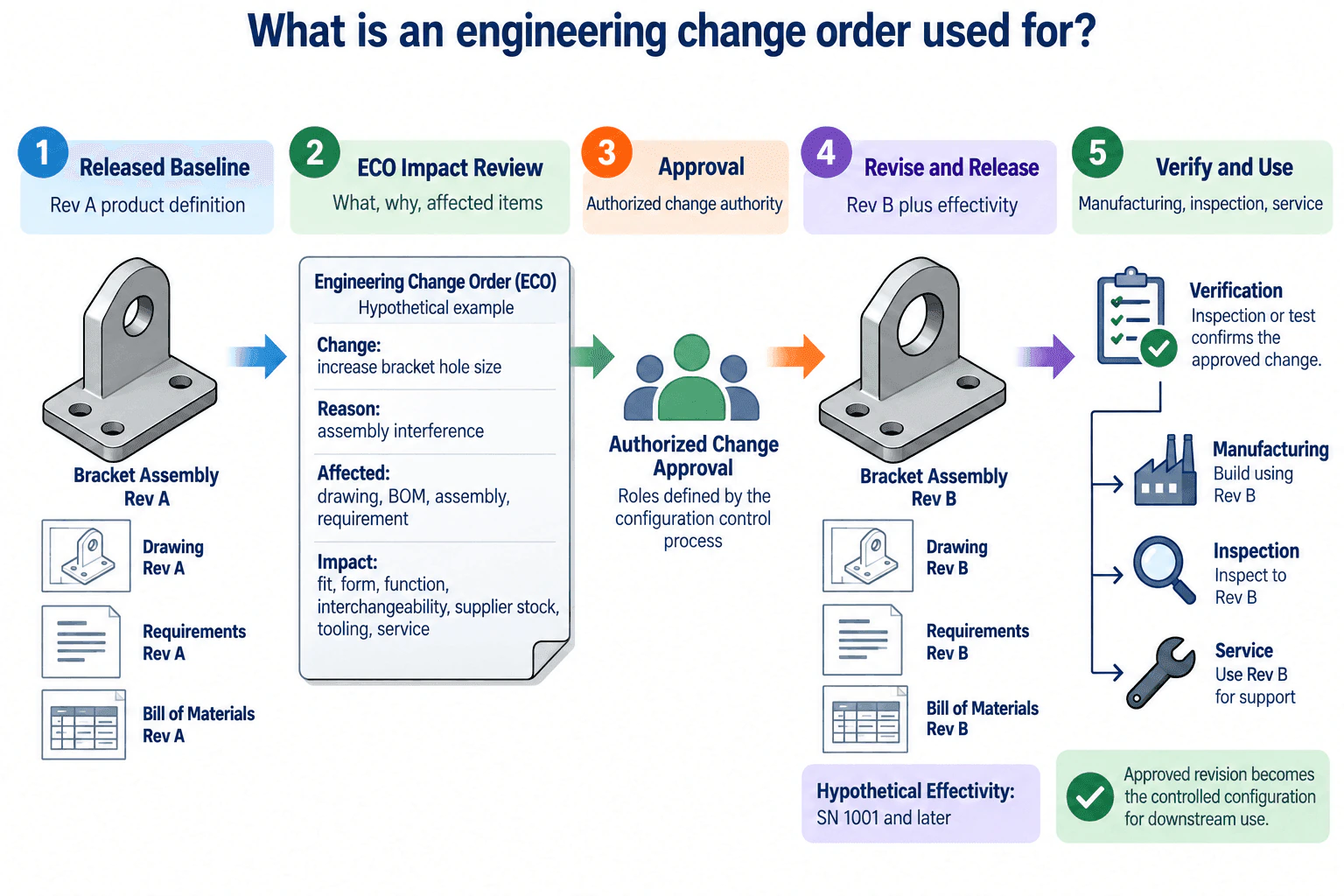
An engineering change order is used to control a change to an already released product definition. It records what is changing, why the change is needed, which parts, assemblies, drawings, requirements, and bill of materials entries are affected, who authorizes the change, and when the new revision becomes effective. After approval, the affected configuration is revised and released, then verification confirms the approved change and downstream teams use the correct revision.
Detailed Explanation
An engineering change order, or ECO, provides a controlled and traceable way to change a released product definition. It links the reason for the change to the affected configuration items, impact assessment, authorized approval, revised product definition, effectivity, verification evidence, and downstream use of the approved revision.
Useful Questions to Ask the Interviewer
Is the product definition already released, or is the design still unreleased?
Which parts, assemblies, drawings, requirements, and bill of materials entries are affected?
How is effectivity defined for this product, such as by serial number, production date, or another controlled rule?
How to Explain It in an Interview
I would start with the released baseline and identify the controlled product definition at its current revision. For a mechanical product, that can include the assembly, individual parts, drawings, requirements, and bill of materials.
Next, I would document what is changing and why. As a hypothetical example consistent with the diagram, suppose a bracket hole must be increased because of assembly interference. The ECO would identify the affected drawing, bill of materials, assembly, and requirement.
Before approval, I would assess the change impact. Important checks include fit, form, function, interchangeability, supplier stock, tooling, manufacturing, inspection, and service implications. These are impact questions to evaluate, not assumed successful results.
The change then goes to the authorized change authority defined by the configuration control process. I would not assume that every organization uses the same approval roles.
After approval, the controlled definition is revised and released, for example from Rev A to Rev B. Effectivity defines where the new revision applies. A clearly hypothetical example is SN 1001 and later.
Finally, appropriate inspection or test evidence confirms the approved change. Manufacturing builds to Rev B, inspection checks to Rev B, and service uses Rev B where the defined effectivity applies. The approved revision then becomes the controlled configuration for downstream use.
The main purpose of an ECO is therefore not simply to edit a drawing. It is to maintain configuration control and traceability from the released baseline through impact review, approval, revision, effectivity, verification, and downstream use.
Why Interviewers Ask This
Interviewers want to know whether I understand how a mechanical design change is controlled after a product definition has been released. They are evaluating whether I can identify affected configuration items, assess change impact, support authorized approval, manage revision and effectivity, and verify that manufacturing, inspection, and service use the approved product definition.
Common interview mistakes
Common mistakes include changing a drawing without identifying the complete affected configuration, failing to update related bill of materials or requirements, assuming approval roles instead of following the defined configuration control process, releasing a new revision without clear effectivity, overlooking interchangeability or supplier and tooling impacts, and failing to verify that manufacturing, inspection, and service are using the approved revision.
Interview tip
Frame the ECO as a configuration control process rather than simple document editing. Start with the released baseline, explain what changes and why, identify affected items, describe impact review and authorized approval, state how revision and effectivity are controlled, and finish with verification and downstream use of the approved configuration. Clearly label example values such as SN 1001 and later as hypothetical unless they are supplied facts.
Interviewer may ask next
How would you validate an engineering change before it is released for production use?
I would confirm the affected configuration items and the acceptance criteria, then use appropriate inspection, test, fit checks, or other engineering evidence to verify the approved change. I would compare the results with the defined requirements and confirm that the released revision matches what was actually verified. I would also check that manufacturing, inspection, and service receive the correct approved revision and effectivity information.
What changes if Rev B is not interchangeable with existing Rev A stock?
The ECO must explicitly address the lack of interchangeability and define how Rev A and Rev B are controlled. I would assess supplier and internal stock, assembly compatibility, tooling, service spares, and any required rework or disposition. Effectivity becomes especially important because manufacturing, inspection, and service must know which revision applies to which units and must prevent incompatible revisions from being mixed unintentionally.
39. How do you assess the impact of a proposed engineering change?Engineering Changes And ConfigurationMedium
i Question Details
Identify affected parts, assemblies, interfaces, requirements, drawings, tooling, suppliers, inventory, tests and service documentation before approval.
Short Interview Answer (30-60 seconds)
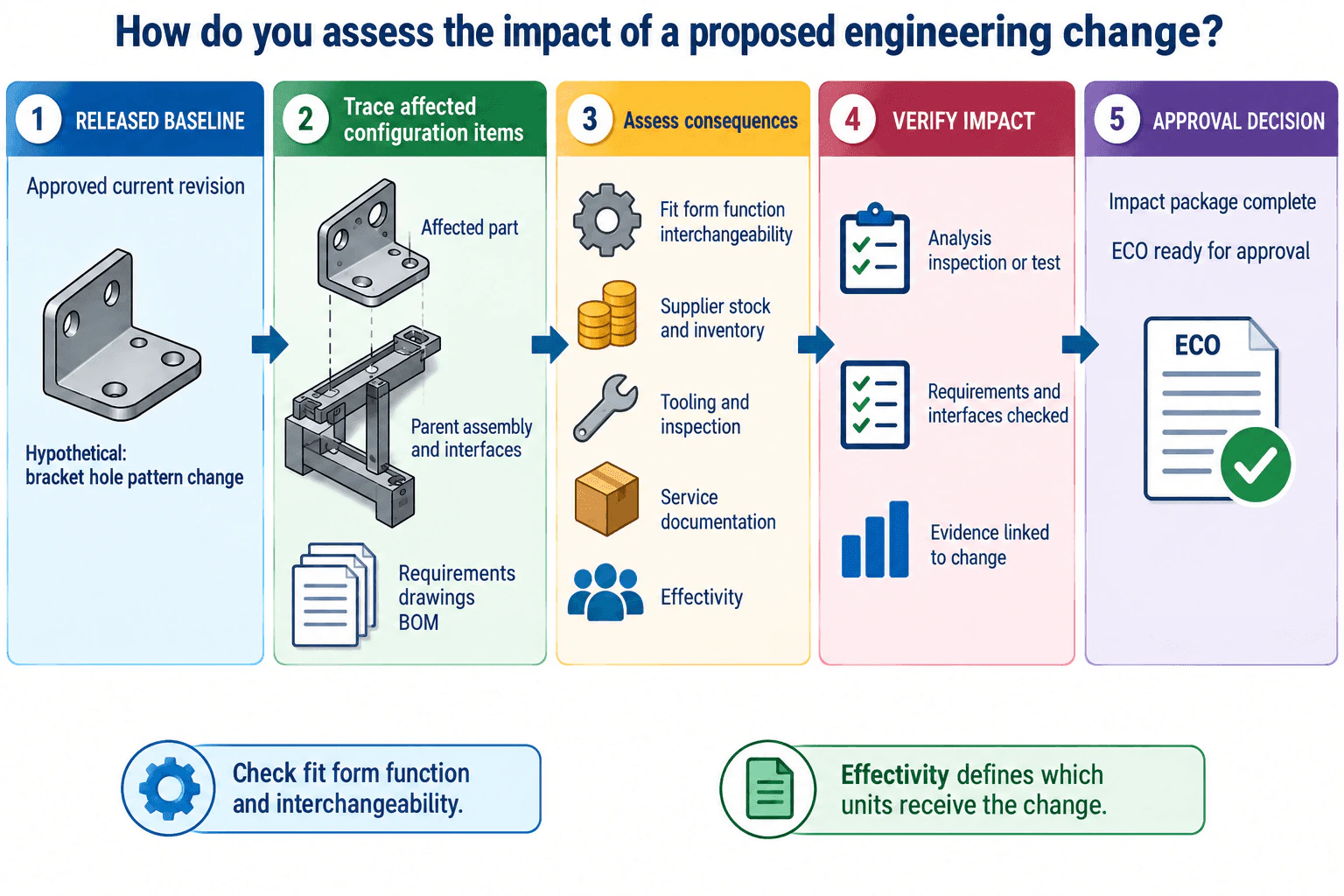
I start with the released baseline and trace the proposed change through the affected part, parent assemblies, interfaces, requirements, drawings, and bill of materials. Then I assess fit, form, function, interchangeability, supplier stock, inventory, tooling, inspection, service documentation, and effectivity. I define the analysis, inspection, or testing needed to verify the impact, link that evidence to the change, and only then consider the engineering change order ready for approval.
Detailed Explanation
I treat a proposed engineering change as a controlled change to the released product definition, not simply an edit to one drawing. I first establish the approved current revision, then trace what depends on the changed item so the full impact is understood before approval.
Useful Questions to Ask the Interviewer
What is the currently released configuration, and which part or requirement is proposed to change?
Which product variants, serial ranges, lots, suppliers, or service configurations could be affected?
What verification evidence is required before the change can be approved?
How to Explain It in an Interview
I would begin with the released baseline because it defines the approved configuration I am changing. For a hypothetical bracket hole pattern change, I would identify the bracket as the affected part and trace its parent assembly, mating features, interfaces, requirements, drawings, and bill of materials.
Next, I would assess the consequences. I would check fit, form, function, and interchangeability to determine whether the revised part still satisfies its intended requirements and interfaces and whether old and new versions can be substituted without unintended effects. I would also review supplier stock and internal inventory so incompatible revisions are not mixed.
I would check tooling and inspection because a geometric change may affect fixtures, gauges, manufacturing instructions, inspection methods, or acceptance criteria. I would also review service documentation, spare parts, and maintenance information when existing units are already in use.
I would define effectivity so the organization knows exactly which configuration units receive the change. Depending on the product and configuration system, effectivity may be expressed by serial number, lot, build applicability, or another controlled rule. This prevents ambiguity between the existing and revised configurations.
Before approval, I would define the evidence needed to verify the impact. Depending on the change, that may include engineering analysis, dimensional inspection, assembly checks, or testing. I would confirm that affected requirements and interfaces have been checked and that the resulting evidence is traceable to the change record.
The engineering change order is ready for approval only when the impact package is complete, affected configuration items are identified, effectivity is defined, and the required verification evidence supports the proposed change. After approval, revision control must communicate the approved configuration so manufacturing, inspection, suppliers, and service functions use the correct revision.
Why Interviewers Ask This
Interviewers want to see whether I can evaluate a proposed change against the released baseline, trace every affected configuration item, identify technical and downstream consequences, define effectivity, and support an approval decision with traceable verification evidence rather than treating the change as an isolated drawing revision.
Common interview mistakes
Common mistakes include changing only the drawing without tracing the bill of materials and parent assemblies, overlooking mating interfaces, assuming interchangeability without checking fit, form, and function, ignoring supplier stock or existing inventory, failing to define effectivity, forgetting tooling or inspection impacts, omitting service documentation, and moving toward approval without traceable verification evidence.
Interview tip
Use one concrete example and walk from the released baseline to the approval decision. Clearly separate the engineering checks you perform from inputs provided by manufacturing, quality, suppliers, service, or other stakeholders. Emphasize traceability, effectivity, and verification evidence rather than presenting change control as a paperwork exercise.
Interviewer may ask next
What would you do if the available verification evidence is not sufficient to approve the change?
I would identify the specific uncertainty that remains and keep the change from moving to approval until it is addressed. I would define the additional analysis, inspection, assembly check, or test needed, link the resulting evidence to the change record, and reassess any affected requirements, interfaces, and configuration impacts before recommending approval.
How would your assessment change if existing inventory cannot be reworked to the new revision?
I would treat interchangeability and effectivity as major configuration decisions. I would determine whether the existing and revised parts can coexist, whether separate part numbers or configuration controls are required, and which serial numbers, lots, or other applicable units receive each revision. I would also coordinate the disposition of existing stock with the responsible manufacturing, supply, quality, and service teams so incompatible material is not installed or issued.
40. How do you manage revisions so manufacturing never builds the wrong version?Engineering Changes And ConfigurationMedium
i Question Details
Release through the controlled system, eliminate side files, communicate effectivity, and verify that suppliers and production reference the same approved baseline.
Short Interview Answer (30-60 seconds)
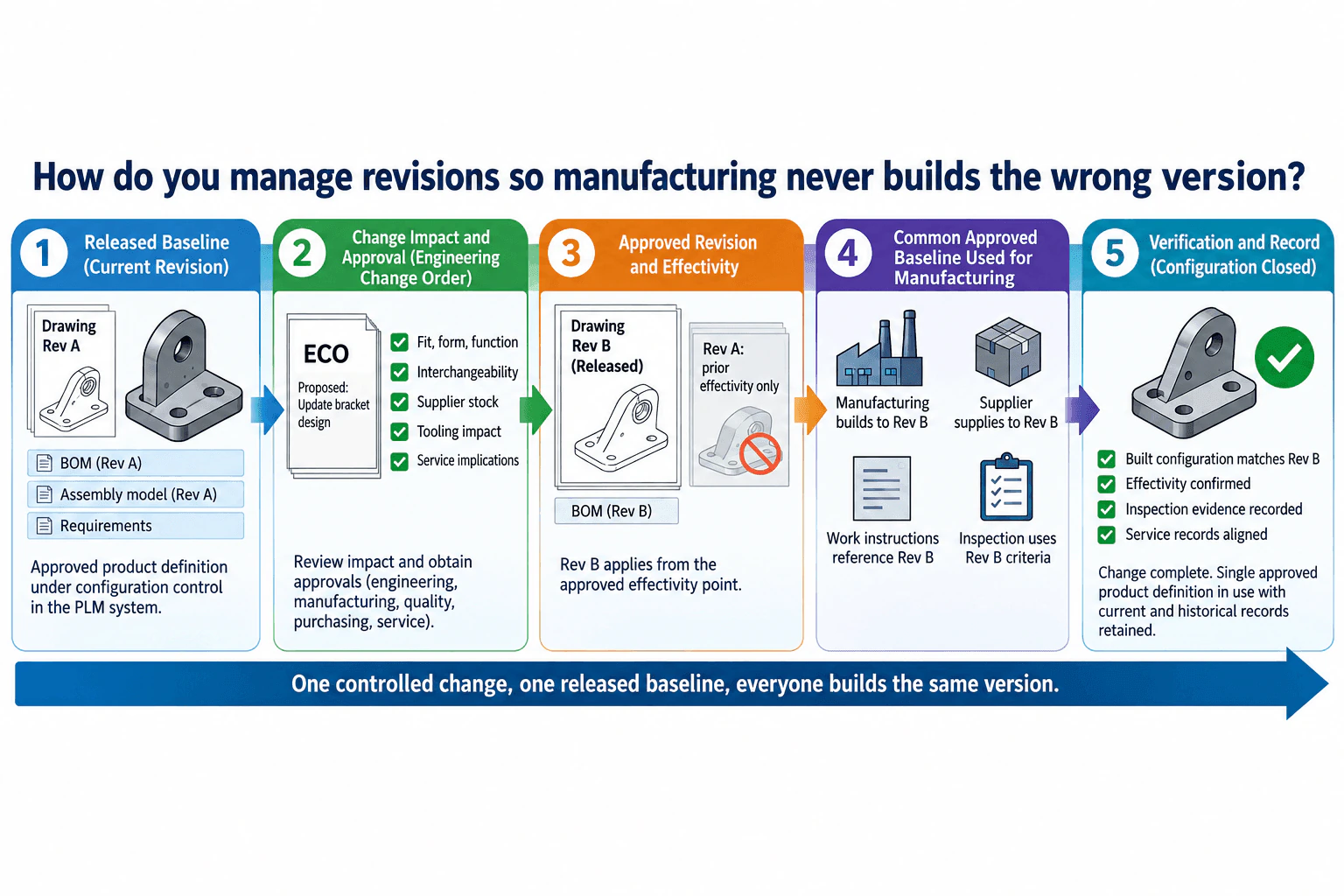
I keep one released baseline in the controlled system and never let manufacturing build from uncontrolled side files. When a change is needed, I raise an engineering change order, identify every affected drawing, model, bill of materials item, requirement, assembly, supplier item, tool, and service record, then review fit, form, function, interchangeability, supplier stock, tooling, and service implications before approval. Once approved, I release the new revision with a defined effectivity point. Manufacturing, suppliers, work instructions, and inspection then reference that same approved baseline. Finally, I verify the built configuration, confirm effectivity, record inspection evidence, and align service records.
Detailed Explanation
I treat the released product definition as the controlled baseline for manufacturing. For a hypothetical bracket change, Rev A remains the released baseline until an approved engineering change order releases Rev B. I do not rely on emailed drawings, local copies, or other uncontrolled files.
Useful Questions to Ask the Interviewer
What controlled system owns released drawings, models, bill of materials data, and change history?
How is effectivity communicated to manufacturing, suppliers, inspection, and service?
Are there existing parts, supplier stock, tooling, or fielded units that must remain compatible?
How to Explain It in an Interview
First, I identify the released baseline and the complete change impact. I trace the affected part through its drawing, model, bill of materials, parent assemblies, requirements, supplier records, work instructions, inspection criteria, tooling, and service information.
Next, I evaluate fit, form, function, interchangeability, supplier stock, tooling impact, and service implications. The engineering change order records the proposed change and provides the controlled approval path. Engineering owns the technical definition, while manufacturing, quality, purchasing, suppliers, and service provide impact input when their areas are affected.
I release Rev B only after the required approvals are complete. The release includes a defined effectivity point so everyone knows when Rev B applies. Rev A is not automatically invalid everywhere. It may still apply to units or material covered by prior effectivity.
Then I make sure manufacturing and suppliers use the same released Rev B definition. The bill of materials, drawing, work instructions, and inspection criteria must reference the approved revision. This prevents engineering from using Rev B while a supplier or production area continues from an uncontrolled Rev A copy.
Finally, I verify the actual built configuration against Rev B, confirm effectivity, record inspection evidence, and align service records. If the physical product or controlled records do not match the released baseline, I treat that as a configuration control issue and do not close the change until it is resolved.
The objective is one controlled change, one approved baseline for the applicable effectivity, and traceable evidence that the product was built and inspected to that definition.
Why Interviewers Ask This
Interviewers want to see whether I understand controlled product definition, revision control, engineering change approval, bill of materials alignment, effectivity, and configuration verification. The key judgment is whether I can prevent one approved design change from creating mixed configurations across engineering, suppliers, manufacturing, inspection, and service.
Common interview mistakes
Common mistakes include releasing a drawing without updating the bill of materials, allowing local or emailed copies to become unofficial build sources, changing a part without checking parent assemblies and requirements, ignoring supplier stock or tooling impact, assuming every previous revision becomes invalid immediately, failing to define effectivity, and closing the change before verifying the actual built configuration.
Interview tip
Use one concrete revision example and trace it from the released baseline through impact review, engineering change approval, effectivity, manufacturing use, supplier use, inspection, and final configuration verification. Emphasize that preventing the wrong build is a controlled product definition problem, not just a drawing revision task.
Interviewer may ask next
How would you validate that the new revision is actually being used in production?
I would compare the active production documentation, released drawing, bill of materials, work instructions, and inspection criteria against the approved revision and effectivity. I would also verify the physical built configuration and retain traceable inspection evidence. If the controlled records or physical product do not match the released baseline, I would keep the change open until the discrepancy is resolved.
What changes if existing supplier stock cannot be discarded when Rev B is released?
I would evaluate interchangeability and define effectivity that states where Rev A material may still be consumed and where Rev B is mandatory. The engineering change record, bill of materials, purchasing controls, supplier communication, production instructions, inspection criteria, and service information would all need to reflect that controlled transition.
More questions load as you scroll
Disclaimer: This interview guide is for educational and informational purposes only. It is designed to help readers prepare, but it does not guarantee any interview result, hiring decision, offer, or outcome. Interview questions, hiring criteria, and preferred answers can vary by employer, interviewer, industry, location, and time. All answers, examples, and explanations in this guide are suggested examples for interview preparation, not definitive answers or instructions for professional practice. They are based on research and judgment, are provided without warranties of any kind, and should be adapted to the question, role, and applicable laws and professional requirements. Diagrams are simplified illustrations intended to highlight the main concepts and their relationships; actual situations, systems, and practices may be more complex. Alternative approaches may be equally valid or better suited to a particular question, context, or interviewer. To the fullest extent permitted by applicable law, the contributors and publisher are not liable for decisions made, actions taken, or losses incurred based on this guide.
State Laws and Professional Responsibilities: Laws and requirements governing an occupation vary by state and jurisdiction. You are responsible for checking the current laws, licensing requirements, and scope-of-practice rules that apply to your location and role, and for ensuring that your answers and actions comply with them. Adapt examples in this guide to those requirements. This guide is not legal advice.
Content Accuracy and Verification: To the fullest extent permitted by applicable law, we do not represent or warrant that interview guides, questions, answers, examples, or diagrams are accurate, complete, current, error-free, or suitable for any particular purpose. You are responsible for independently reviewing and verifying the information before relying on it.