Google Java Developer Interview Questions & Answers

google icon

Questions with Detailed ExplanationsWith Detailed Explanations

(Last Updated: August 28, 2026)

31. How would you design an API to merge multiple sorted streams?API DesignHardGoogle

Question Details

Design an API to merge multiple sorted streams into one sorted stream, even when the underlying stream types differ.

Short Interview Answer (30-60 seconds)

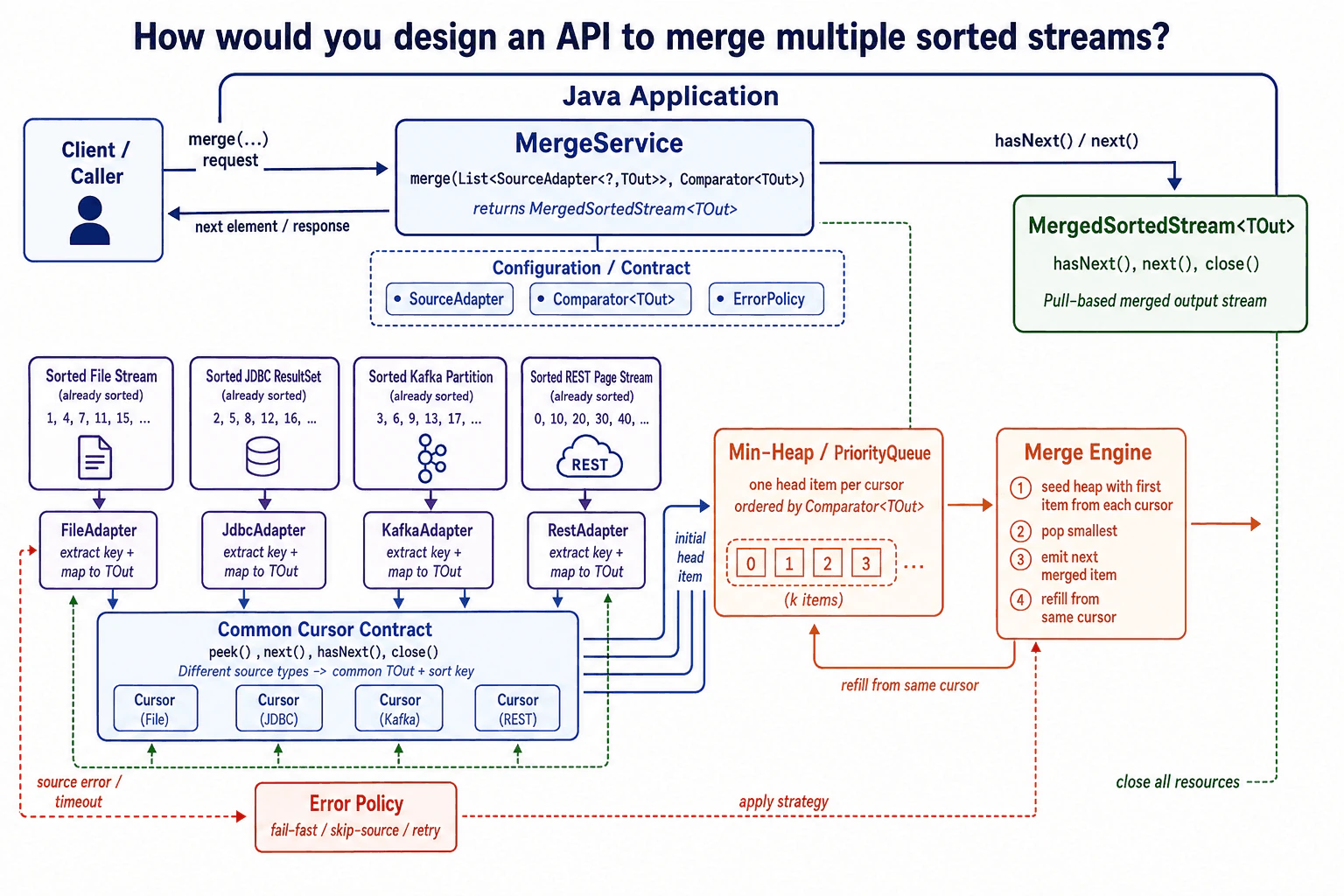
At a high level, I would expose one MergeService that accepts different sorted sources through SourceAdapter implementations plus a Comparator<TOut>. Each adapter converts its source into the Common Cursor Contract. The Merge Engine keeps one head item per cursor in a Min-Heap, removes the smallest item, emits it through MergedSortedStream<TOut>, and refills only the cursor that produced it. The caller consumes the result lazily with hasNext() and next(). I would also make failure handling explicit with ErrorPolicy and close every source resource. The trade-off is extra abstraction for better extensibility and bounded merge memory.

Detailed Explanation

We need to combine several already ordered sources into one ordered result. The difficult part is that the sources do not all look the same. One may be a file, another may be a database result, Kafka partition, or REST page stream. We want the caller to use one simple result without understanding those differences. We also do not want to load every item into memory first. The design in the diagram solves this by converting every source to one common cursor shape, then choosing the smallest available value as the caller asks for more data.

Useful Questions to Ask the Interviewer
  • Are all input sources guaranteed to already be sorted?
  • Should Comparator<TOut> define the common ordering across every source?
  • Should the merged result be lazy and pull-based?
  • What should happen if one source fails or times out?
How would you design an API to merge multiple sorted streams? diagram
How to Explain It in an Interview
1. Start with the MergeService contract

I would begin with MergeService because it is the main API boundary. The diagram shows merge(List<SourceAdapter<?,TOut>>, Comparator<TOut>). The caller gives it the source adapters and the Comparator<TOut> that defines the final sort order. MergeService returns MergedSortedStream<TOut>. That result is pull-based, so the caller asks for values as needed instead of receiving one fully materialized collection. The configuration also includes SourceAdapter, Comparator<TOut>, and ErrorPolicy, which keeps the key design choices explicit.

2. Hide source differences behind adapters

Each underlying source has its own adapter. The diagram shows FileAdapter, JdbcAdapter, KafkaAdapter, and RestAdapter for a Sorted File Stream, Sorted JDBC ResultSet, Sorted Kafka Partition, and Sorted REST Page Stream. Each adapter extracts the sort key and maps its source value to TOut. This prevents the Merge Engine from containing file, JDBC, Kafka, or REST-specific code. The adapters expose the same Common Cursor Contract, so the rest of the algorithm works with one abstraction.

3. Use one Common Cursor Contract

The Common Cursor Contract provides peek(), next(), hasNext(), and close(). The diagram shows separate File, JDBC, Kafka, and REST cursors behind this common contract. Conceptually, each cursor represents one already-sorted input. The important rule is that all values become a common TOut representation and follow the same Comparator<TOut> ordering. This lets the merge logic treat every source in exactly the same way while still allowing each adapter to own its source-specific reading behavior.

4. Seed the Min-Heap with one head item per cursor

The Min-Heap, or PriorityQueue, holds one current head item from each active cursor. It is ordered by Comparator<TOut>. The Merge Engine first seeds the heap with the first available item from every cursor. Because each source is already sorted, the smallest value across all sources must be one of these current head items. We therefore do not need to load or sort every item again. The heap only needs about one active entry for each source.

5. Perform the k-way merge lazily

When the caller needs another value, the Merge Engine pops the smallest item from the Min-Heap and emits that item through MergedSortedStream<TOut>. It then advances only the same cursor that supplied that item. If that cursor still has another value, its new head goes back into the heap. The other cursors stay where they are. This pop, emit, refill, and reinsert cycle continues until no cursor has data left. That is the key k-way merge behavior shown in the diagram.

6. Return results through MergedSortedStream<TOut>

MergedSortedStream<TOut> exposes hasNext(), next(), and close(). The caller first creates the merged stream through MergeService, then consumes it through this pull-based interface. Each next() request causes the merge state to produce the next globally ordered item. This keeps memory usage controlled because the API does not build the complete merged output before returning it. It also works naturally with sources whose complete size may not be known in advance.

7. Handle failures and close resources

The diagram routes a source error or timeout to Error Policy. The shown strategies are fail-fast, skip-source, and retry. Fail-fast protects completeness by stopping when a source cannot continue. Skip-source favors availability but can produce an incomplete merged result. Retry may recover a temporary problem, but it can increase latency. The chosen strategy is applied to the Merge Engine. Finally, close() must trigger the close-all-resources path so every cursor, adapter, and underlying source resource is released when processing finishes or the caller stops early.

Why Interviewers Ask This

Interviewers use this question to test API boundaries and algorithmic judgment together. They want to see whether you recognize a k-way merge and use a PriorityQueue instead of loading and sorting everything again. They also look for a clean abstraction that hides different source types, correct lazy-stream behavior, explicit resource cleanup, and sensible failure handling. A strong answer explains why each component exists and clearly states the trade-offs without changing the core design.

Interviewer may ask next
What changes if we need to merge thousands of sorted streams at the same time?

I would keep the same MergeService, SourceAdapter, Common Cursor Contract, Min-Heap, Merge Engine, and MergedSortedStream<TOut> design. The k-way merge still works because the heap keeps only one current head item per active cursor. With k sources, each emitted item still needs roughly O(log k) heap work. The bigger concern becomes the cost of keeping thousands of source cursors open. File handles, JDBC results, Kafka-backed cursors, and REST-backed cursors can each consume external resources. I would therefore make the adapters responsible for respecting the limits of their own source types while keeping the common cursor behavior unchanged. Comparator<TOut> still defines the global order, and only the cursor that supplied the smallest item advances. The caller still receives the same pull-based MergedSortedStream<TOut>. The main downside is that a very large k increases both heap work and the number of live external resources, even though the merge does not hold every input item in memory.

How would you handle a source that fails or times out during the merge?

I would use the Error Policy already shown in the diagram. A source error or timeout flows to Error Policy, and the selected strategy is applied to the Merge Engine. With fail-fast, the merge stops instead of silently returning a result that is missing part of the input. With skip-source, the failed source is removed and the remaining cursors continue, but the output can be incomplete. With retry, the design attempts to recover the affected source before continuing, which may help with temporary failures but can increase response time. The SourceAdapter, Common Cursor Contract, Comparator<TOut>, Min-Heap, and pull-based MergedSortedStream<TOut> do not otherwise change. Whatever policy is chosen, close() must still release all remaining cursors and underlying source resources when the merge ends or is abandoned. The main trade-off is completeness versus availability and latency, so I would make the policy an explicit configuration decision rather than hiding it inside an adapter.

32. Tell me about a time when someone struggled to fit in on a culturally diverse team and how you helped.BehavioralMediumGoogle

Question Details

Describe a time when someone found it challenging to fit in a culturally diverse environment. Explain how you helped them get through the situation, whether you treated it as a team issue or an individual issue, and what the outcome was.

Interview tip:

Use STAR to structure your answer: briefly explain the Situation and Task, make Action the most detailed part, and finish with the Result. For example, describe a situation where a teammate from a different cultural background was having difficulty participating in discussions, how you understood the problem without making assumptions, what you changed in your own communication and team practices, and how those actions helped the person contribute more comfortably.

Situation

During a previous Java project, a developer who had recently joined our team was having difficulty participating in technical discussions. Our team had people from several cultural backgrounds, and our meetings were often fast and informal. I noticed that this developer rarely spoke during meetings even though their written comments on Java code reviews were thoughtful and technically strong.

Task

I wanted to help the developer contribute comfortably without treating them as the problem. I saw part of the situation as an individual communication challenge, but I also believed our team process was making participation harder for people who needed more time to understand a discussion or prepare their thoughts.

Action

I first spoke with the developer privately and asked how the team discussions were working for them. I listened instead of assuming the reason. They explained that rapid conversations, interruptions, and unfamiliar expressions made it difficult to enter a discussion at the right moment. I asked what would make participation easier, and they said having topics before meetings and more space to finish a point would help. I started sharing technical questions and design topics before meetings when I was leading them. During discussions, I also made a conscious effort not to interrupt and gave people time to complete their thoughts. When we discussed changes to our Java services, I sometimes asked for written comments before making a decision so everyone could contribute in a format that worked for them. I also encouraged the wider team to use clear language and avoid unnecessary expressions that could be confusing across cultures. I did not present these changes as special treatment for one person. I explained that clearer communication would help the whole team make better technical decisions. I continued checking with the developer privately to make sure the changes were actually helping rather than assuming they were successful.

Result

The developer gradually became more comfortable speaking during technical discussions and started sharing ideas earlier instead of only through code reviews. The team also became more deliberate about giving people space to contribute, which made our discussions clearer for everyone. I learned that helping someone fit into a diverse team is not only about asking that person to adapt. Sometimes the team needs to adjust its communication habits so different working and communication styles can succeed.

Why Interviewers Ask This

Interviewers ask this question to understand how a candidate works with people from different cultural and communication backgrounds. A strong answer shows empathy, good judgment, inclusive communication, and the ability to recognize when a team process should change instead of placing all responsibility on one individual.

Interviewer may ask next
Why did you treat this as both an individual and a team issue?

I treated it as both because the developer had specific communication needs, but the team environment was also contributing to the difficulty. The private conversation helped me understand what the developer needed, while changing meeting habits addressed the broader process that could affect other people as well.

What would you do differently if you faced a similar situation now?

I would establish clearer communication practices earlier instead of waiting until I noticed someone struggling. For example, I would share important discussion topics before meetings, make space for written input, and encourage people to finish their thoughts without interruption from the start of the project.

33. Tell me about a time you worked with teammates who had different work styles.BehavioralMediumGoogle

Question Details

Describe a time when you worked with team members with different work styles and how you handled it.

Interview tip:

Use STAR to structure your answer: briefly explain the Situation and Task, make Action the most detailed part, and finish with the Result. For example, describe a project where teammates had different ways of planning, communicating, and completing Java development work, how you understood those differences, created a shared way of working, kept communication clear, and helped the team deliver reliably.

Situation

In my last role, I worked on a Java service with teammates who had very different work styles. One teammate preferred detailed planning before writing code. Another liked to start quickly and adjust while working. I usually preferred a clear plan with enough flexibility to change it when we learned something new. These differences started to create confusion about task ownership, design decisions, and when work was ready for review.

Task

I was responsible for completing my part of the service while also working closely with the team on shared interfaces and code reviews. I wanted us to keep the strengths of each work style without letting the differences slow down collaboration or create unnecessary conflict.

Action

I first spoke with the teammates individually so I could understand how each person worked best instead of assuming that one approach was correct. I learned that the teammate who preferred detailed planning wanted to reduce rework, while the teammate who moved quickly wanted to avoid spending too much time discussing details that might change. I suggested that we agree on a small amount of planning before development. For each shared change, we wrote down the goal, important API decisions, dependencies, and basic acceptance criteria. After that, each developer could choose how to organize the implementation. I also suggested short check ins when a change affected another person's work, rather than adding more meetings for everything. During code reviews, I focused comments on correctness, maintainability, and agreed team standards instead of personal coding preferences. When there were different opinions, I asked each person to explain the reason behind the approach and connected the decision back to the needs of the service. I also adjusted my own communication. I gave more design context to the teammate who preferred planning and shared smaller updates earlier with the teammate who preferred faster iteration. This helped both teammates get the information they needed without forcing everyone to work in exactly the same way.

Result

The team developed a clearer working rhythm and we had fewer misunderstandings around shared changes. People still used different personal work styles, but our important decisions and handoffs became more predictable. I learned that good collaboration does not require everyone to work the same way. It requires clear expectations, respect for different approaches, and enough shared structure to keep the team aligned.

Why Interviewers Ask This

Interviewers ask this question to understand whether a candidate can collaborate with people who plan, communicate, and execute work differently. A strong answer shows adaptability, respect, clear communication, practical judgment, and the ability to create team alignment without forcing everyone into one personal working style.

Interviewer may ask next
How did you handle it when teammates still disagreed about how to approach the work?

I asked each person to explain the reason behind the preferred approach and then brought the discussion back to shared goals such as correctness, maintainability, delivery risk, and impact on other parts of the Java service. That kept the conversation focused on the work instead of personal preference. If both approaches were reasonable, I supported the option that best matched our agreed standards and current project needs.

What would you do differently if you faced a similar situation now?

I would establish the shared working expectations earlier. I would discuss communication preferences, review expectations, ownership, and important decision points near the start of the project. That would make differences visible before they caused confusion while still allowing each teammate to use the personal work style that helps them perform well.

34. Tell me about a time you advocated for a teammate so they could fit in at work.BehavioralMediumGoogle

Question Details

Describe a time when you advocated for a teammate, what you did to help them fit in, and the outcome.

Interview tip:

Use STAR to structure your answer: briefly explain the Situation and Task, make Action the most detailed part, and finish with the Result. For example, describe a time when a teammate was having difficulty joining team discussions, how you understood what was making participation difficult, what you personally did to make collaboration more inclusive, how you communicated with the team, and how your actions helped the teammate become more comfortable and involved.

Situation

In my last role, a new Java developer joined our team during an active project. The developer was technically capable, but I noticed they rarely spoke during design discussions and often waited until after meetings to ask questions privately. This made it harder for them to contribute ideas and understand some of the team habits that were not written down.

Task

I wanted to help the developer participate comfortably without making them feel singled out. My responsibility was not to speak for them, but to remove unnecessary barriers so they had a fair chance to contribute and become part of the team.

Action

I first spoke with the developer privately and asked how the onboarding experience was going. I listened rather than assuming what the problem was. They explained that discussions moved quickly and that several team conventions were unfamiliar to them. I started sharing meeting context and relevant design notes before discussions so they had time to review the topic. During meetings, when I knew they had worked on a related Java component, I created a natural opening by asking for their view instead of answering on their behalf. I also suggested that our team document several unwritten development practices, including code review expectations and common service patterns, because those details would help any new teammate. When conversations became too fast or relied on unexplained internal terms, I asked clarifying questions myself. This made clarification feel like a normal team behavior rather than something only the new developer needed. I continued checking in privately and adjusted my support based on what they said was useful.

Result

Over time, the developer became more comfortable speaking during technical discussions and started contributing ideas directly during design and code review conversations. The written team guidance also made onboarding clearer for other people. I learned that advocating for someone does not mean speaking for them. It means listening, removing barriers, and creating an environment where they can represent themselves confidently.

Why Interviewers Ask This

Interviewers ask this question to understand whether a candidate notices when teammates are being excluded or struggling to participate and whether they take thoughtful action to improve inclusion. A strong answer shows empathy, good judgment, respectful communication, and the ability to help another person succeed without taking away their independence.

Interviewer may ask next
How did you make sure your support did not make the teammate feel singled out?

I asked the teammate privately what would actually help before taking action. I also focused on changes that benefited the whole team, such as sharing context before meetings and documenting team practices. When I invited their input, I did it naturally because they had relevant experience, not because I wanted to publicly identify them as someone who needed help.

What would you do differently if you faced a similar situation now?

I would introduce clearer onboarding practices earlier instead of waiting until I noticed someone struggling. I would make written team conventions, meeting context, and opportunities for questions part of the normal onboarding process. I would still speak privately with the teammate because individual needs can be different, but I would try to remove common barriers before they become a problem.

35. If people on your team felt overwhelmed, how would you respond as a manager?BehavioralMediumGoogle

Question Details

Explain how you would approach a team that feels overwhelmed and find workable solutions as a manager.

Interview tip:

Use STAR to structure your answer: briefly explain the Situation and Task, make Action the most detailed part, and finish with the Result. For example, describe a time when your team was struggling with too much work, how you understood the causes, clarified priorities, adjusted the workload, communicated with stakeholders, supported the team, and helped everyone return to a manageable and productive pace.

Situation

In my last role, I worked on a Java application where several urgent requests arrived while the team was already handling planned development and production support. People started feeling overwhelmed because priorities were changing and everyone was trying to handle too many tasks at once.

Task

I needed to help the team regain control of the workload while still protecting the most important business and customer needs. I also wanted to make sure people felt comfortable speaking openly about capacity instead of quietly working longer hours.

Action

I first spoke with the team and asked each person what was consuming their time, where they were blocked, and which commitments were creating the most pressure. I listened before proposing changes because I wanted to understand whether the problem was workload, unclear priorities, technical issues, or a combination of them. I then reviewed our work with the team and separated critical production issues from work that could reasonably wait. For the Java application, we kept attention on reliability problems and the changes needed for the nearest commitment, while lower priority enhancements were moved back. I made ownership clearer so that people were not duplicating work or feeling responsible for everything. I also broke larger tasks into smaller pieces so progress was easier to see and discuss. Where someone was carrying too much support work, I redistributed tasks based on experience and available capacity. I communicated the revised priorities and tradeoffs to stakeholders early rather than asking the team to absorb every request. I explained what we could complete reliably and what needed more time. After that, I kept checking with the team during our regular conversations to see whether the workload was becoming manageable and adjusted assignments when needed.

Result

The team became more focused because people understood what mattered most and what could wait. The pressure became more manageable, communication improved, and we were able to continue delivering important work without treating constant overload as normal. I learned that when a team feels overwhelmed, a manager should not simply ask people to work harder. I should understand the real source of the pressure, make priorities explicit, remove unnecessary work, and create an environment where people can raise capacity concerns early.

Why Interviewers Ask This

Interviewers ask this question to understand how a manager responds when team capacity and expectations are out of balance. They want to see whether the candidate listens to people, identifies the real causes of overload, makes clear priority decisions, communicates tradeoffs, protects sustainable working practices, and still takes responsibility for important outcomes. A strong answer shows practical leadership rather than simply pushing the team to do more.

Interviewer may ask next
How did you decide which work should be delayed?

I looked at business impact, production risk, dependencies, and the nearest commitments. I discussed those priorities with the team so we understood the technical impact, then I communicated the tradeoffs to stakeholders. I wanted the decision to be based on importance and risk rather than on which request was raised most loudly.

What would you do if the team still felt overwhelmed after you changed the priorities?

I would revisit the workload with the team and look for deeper causes such as repeated production issues, too much support work, unclear ownership, or unrealistic commitments. I would remove or delay more work where possible, address technical problems that were creating repeated effort, and raise the capacity issue with stakeholders rather than expecting the team to absorb it silently.

36. Tell me about a time when a teammate took credit for your team's work.BehavioralMediumGoogle

Question Details

Describe a situation where due credit was not given in a team presentation, how you would approach it, and how you would handle repeated behavior.

Interview tip:

Use STAR to structure your answer: briefly explain the Situation and Task, make Action the most detailed part, and finish with the Result. For example, describe a team presentation where one teammate presented shared Java development work as their own, explain how you addressed the issue privately and calmly, clarified each person's contribution, protected the working relationship, and set clearer expectations for future presentations and repeated behavior.

Situation

In my last role, my team worked together on an important Java service improvement. I handled part of the backend implementation and testing, while other teammates contributed to design, review, and related changes. During a presentation to stakeholders, one teammate described most of the work as if they had completed it themselves and did not mention the rest of the team's contributions.

Task

I wanted to make sure the team received fair credit without creating unnecessary conflict. My responsibility was also to protect our working relationship because we still needed to collaborate closely on the same codebase.

Action

I did not challenge the teammate during the presentation because I felt a public argument would distract from the work and could make the situation worse. After the meeting, I spoke with the teammate privately. I explained what I had observed and gave specific examples of work that had been presented without recognizing the people who contributed. I focused on the impact rather than accusing them of bad intent. I explained that clear ownership matters because it builds trust and helps stakeholders know who has context about different parts of the system. I also asked for their view in case there had been a misunderstanding. We agreed that in future presentations we would identify the main contributors when discussing design, implementation, testing, and review work. I also suggested that the person presenting confirm contribution details with the team before important meetings. If the same behavior happened repeatedly after that conversation, I would document the specific examples, speak with the teammate again, and then involve our manager if needed. I would keep the discussion focused on fair recognition and team effectiveness rather than making it personal.

Result

The teammate understood my concern and acknowledged the team's contributions in later discussions. Our next presentations were clearer about who worked on each area, and the team continued working together effectively. I learned that credit issues are best handled early, privately, and with specific facts. I also learned that setting clear expectations before presentations can prevent the same problem from happening again.

Why Interviewers Ask This

Interviewers ask this question to understand how a candidate handles conflict, fairness, and recognition without damaging teamwork. A strong answer shows that the candidate can stay professional, communicate directly, protect team relationships, and escalate repeated behavior only when appropriate.

Interviewer may ask next
Why did you choose to speak with the teammate privately instead of correcting them during the presentation?

I wanted to solve the problem without embarrassing the teammate or distracting stakeholders from the presentation. A private conversation gave us room to discuss the facts calmly and understand whether the behavior was intentional or simply a communication mistake.

What would you do if the teammate continued taking credit after your conversation?

I would address it directly again using specific examples and remind them of the expectations we had agreed on. If the behavior continued, I would involve our manager and explain the pattern factually. My goal would be to protect fair recognition and team trust, not to punish the teammate.

37. How would you react if you could not handle multiple tasks and needed to make amends?BehavioralMediumGoogle

Question Details

Describe how you would respond when you are not able to handle multiple tasks, including how you would make amends and recover the situation.

Interview tip:

Use STAR to structure your answer: briefly explain the Situation and Task, make Action the most detailed part, and finish with the Result. For example, describe a time when several important tasks competed for your attention, you realized you could not complete everything as expected, communicated the problem early, accepted responsibility, agreed on priorities, repaired any impact, and changed how you planned your work afterward.

Situation

In my last role, I was working on several Java development tasks at the same time. I had a production issue to investigate, a feature that was already in progress, and a code review that another developer needed from me. I initially believed I could handle all of them without changing the plan, but I soon realized that I had taken on too much and one of my commitments was at risk.

Task

My responsibility was to protect the most important work, communicate the risk clearly, and make amends for the commitment I was no longer able to meet as originally planned. I also wanted to recover the situation without simply passing my unfinished work to someone else.

Action

I first reviewed the tasks based on user impact, urgency, and whether another person was blocked by me. The production issue had the highest impact, so I made that my first priority. I then spoke with my manager and the developer waiting for my review. I explained that I had misjudged my capacity and took responsibility instead of blaming the workload. I shared what was complete, what still needed work, and which commitment would be delayed. For the code review, I made amends by finishing the most important review comments as soon as the production issue was stable and by giving the developer clear context so they could continue useful work in the meantime. For the feature, I broke the remaining work into smaller pieces and agreed on a more realistic order with my manager. After the immediate problem was resolved, I changed how I planned similar weeks. I started checking dependencies and deadlines before accepting additional work, and I raised conflicts earlier when two important tasks required the same time.

Result

The team was able to focus on the production issue first, and the other work continued with clear expectations instead of becoming a surprise delay. I repaired the commitments by communicating directly, completing the work I still owned, and helping affected teammates move forward. I learned that handling multiple tasks well does not mean saying yes to everything. It means recognizing limits early, setting priorities clearly, and taking responsibility when my planning affects someone else.

Why Interviewers Ask This

Interviewers ask this question to understand how a candidate responds when workload exceeds capacity and a commitment is missed. They want to see whether the candidate can prioritize important work, communicate problems early, accept responsibility, repair the impact on others, and improve future planning instead of hiding the issue or shifting blame.

Interviewer may ask next
Why did you choose the production issue as your first priority?

I chose it first because it was already affecting a running system, while the other tasks could be reordered with communication. I compared the impact and urgency of each task before deciding. I also confirmed the priority with my manager so the team had the same understanding.

What would you do differently if the same situation happened again?

I would raise the capacity conflict earlier. In that situation, I waited too long because I thought I could still finish everything. Now I would review deadlines, dependencies, and expected effort before accepting another important task, and I would ask for a priority decision as soon as I saw that two commitments were competing for the same time.

38. What is your biggest disappointment, and why do you think it happened?BehavioralMediumGoogle

Question Details

Explain your biggest disappointment, why you believe it happened, and what you learned from it.

Interview tip:

Use STAR to structure your answer: briefly explain the Situation and Task, make Action the most detailed part, and finish with the Result. For example, describe a project where an important release did not meet expectations, explain why your planning or communication contributed to the disappointment, show how you took ownership, worked with the team to correct the problem, and explain what you learned.

Situation

In my last role, I worked on a Java service that supported an important application release. I was confident in the technical implementation, but after the release we found several issues that should have been identified earlier. The release was delayed while we corrected them. That was one of my biggest professional disappointments because I had expected my work to help the team deliver smoothly.

Task

I was responsible for implementing part of the service and making sure my changes were ready for integration. I also needed to raise risks early if I saw anything that could affect the release. Looking back, I realized that I had focused too much on completing my own code and not enough on validating how it behaved with the surrounding components.

Action

I first reviewed the problems with the team instead of treating them only as isolated defects. I found that some assumptions I had made about input data and service behavior were different from what the integrated system actually provided. I took ownership of those gaps. I fixed the Java code, added tests for the cases we had missed, and worked with the engineers responsible for the connected services to verify the full request flow. I also shared what I had learned with the team. The main reason I believed the disappointment happened was that I had treated implementation completion as the main sign of readiness. I had not spent enough time confirming integration assumptions and asking for feedback early. After that experience, I changed my approach. For later work, I discussed interfaces earlier, tested integration paths sooner, and raised uncertain assumptions during development instead of waiting until the release stage.

Result

We corrected the issues and completed the release with a more reliable service. More importantly, I learned that strong engineering is not only about writing correct code in isolation. It also requires early communication, checking assumptions, and understanding how my work fits into the larger system. That disappointment changed how I prepare my work for production and made me more careful about identifying risks before they become release problems.

Why Interviewers Ask This

Interviewers ask this question to understand how a candidate responds to setbacks, takes responsibility, and learns from mistakes. A strong answer shows self awareness, practical judgment, ownership, and a clear change in behavior rather than blaming other people or circumstances.

Interviewer may ask next
What would you do differently if you faced the same situation today?

I would validate integration assumptions much earlier. I would review the service contract with the engineers working on connected components, test realistic request flows before the release stage, and raise any unclear behavior as soon as I notice it. That would reduce the chance of finding important problems late.

How did this experience change the way you work with your team?

It made me communicate uncertainty earlier instead of trying to resolve everything alone. I now share assumptions during development, ask for feedback when a change affects another component, and make integration testing part of my normal definition of readiness rather than something I consider only near release.

39. Tell me about a time you went above and beyond to help someone.BehavioralMediumGoogle

Question Details

Describe a specific situation where you went above and beyond to help someone and what changed as a result.

Interview tip:

Use STAR to structure your answer: briefly explain the Situation and Task, make Action the most detailed part, and finish with the Result. For example, describe a time when a teammate was struggling with a difficult technical problem, explain your own responsibility, show how you made time to understand the issue, worked with the person instead of simply taking over, shared useful knowledge, and helped them reach a reliable solution while still protecting your own commitments.

Situation

In my last role, a teammate was working on a Java service change and was having trouble understanding why some requests behaved differently between the local environment and our shared test environment. The issue was slowing their work, and they had already spent a lot of time checking the application logic without finding the cause.

Task

I was responsible for a different part of the same release, so fixing their issue was not part of my assigned work. However, I knew their change was important for the team to complete the release smoothly. I wanted to help them find the root cause while also making sure they understood the debugging process and could handle a similar problem independently later.

Action

I first checked my own priorities and completed the most urgent part of my work so I could give them focused time without creating another blocker. Then I sat with them and asked them to walk me through what they had already tested. Instead of taking control of the problem, I helped them compare the application configuration, request logs, and runtime behavior between the two environments. We noticed that the code path depended on a configuration value that was different in the shared environment. I showed them how I normally trace configuration from the application startup through the relevant Java component so we could confirm the actual value being used at runtime. After we found the mismatch, I helped them correct the configuration and test the service again. I also explained why checking environment differences early can save time when the same code behaves differently across environments. Before we finished, I shared a simple debugging approach they could reuse: reproduce the issue, compare inputs and configuration, follow the request through the logs, isolate one difference at a time, and verify the fix with the same failing case. I then returned to my own work and made sure my commitments for the release were still covered.

Result

The teammate was able to complete the change and move forward without the issue blocking the release. More importantly, they understood why the problem happened and had a clearer process for investigating similar issues later. I learned that going above and beyond is most useful when I do more than solve the immediate problem. Helping someone understand the reasoning behind the solution can make the whole team stronger.

Why Interviewers Ask This

Interviewers ask this question to understand whether a candidate is willing to help others beyond their assigned responsibilities while still using good judgment about priorities. A strong answer shows empathy, ownership, collaboration, practical decision making, and an effort to help another person become more effective rather than simply doing the work for them.

Interviewer may ask next
Why did you choose to guide your teammate instead of fixing the issue yourself?

I wanted to solve the immediate problem, but I also wanted my teammate to understand how we found the cause. If I had simply fixed it for them, they might have faced the same difficulty again. By working through the configuration, logs, and runtime behavior together, I could help them build a debugging process they could reuse independently.

How did you make sure helping your teammate did not affect your own responsibilities?

I checked my priorities before I started helping and completed the most urgent part of my own work first. I then gave my teammate focused time instead of switching back and forth repeatedly. After we confirmed the fix, I returned to my assigned work and made sure my release commitments were still covered.

40. How would you tackle a situation where everything feels like a P0?BehavioralMediumGoogle

Question Details

Explain how you would handle being overwhelmed when everything appears urgent and must be treated as P0.

Interview tip:

Use STAR to structure your answer: briefly explain the Situation and Task, make Action the most detailed part, and finish with the Result. For example, describe a production incident where several problems appeared critical at the same time, explain how you separated real user impact from noise, identified dependencies, assigned clear priorities, communicated decisions, stabilized the most important service first, and reviewed the process afterward.

Situation

In my last role, we had a production incident where several alerts appeared within a short period. Multiple Java services were showing failures, and different teams considered their issue a P0. Some problems were direct failures, while others were symptoms caused by shared dependencies. Treating every alert as equally urgent would have spread our attention too thin and slowed recovery.

Task

I needed to help the team determine what was actually causing the largest user impact, establish a clear order of work, and keep everyone aligned while we restored the system safely. My responsibility was not simply to react to the loudest alert. I needed to create enough structure so that we could make good decisions under pressure.

Action

I first gathered the available facts instead of accepting every P0 label at face value. I checked which user flows were failing, which services were healthy, when each failure started, and whether several alerts shared the same dependency. I then grouped related symptoms together. That helped us see that some service errors were consequences of a deeper problem rather than separate incidents. I proposed that we prioritize based on user impact, dependency depth, and the risk of making the situation worse. I communicated that reasoning clearly so everyone understood why one issue would be handled before another. I kept one shared incident channel for decisions and updates so people were not working from different assumptions. I focused on the Java service that was blocking an important user flow and reviewed its logs, request failures, thread activity, and calls to downstream services. We found that requests were waiting on an unhealthy dependency and were consuming application resources. I worked with the team to reduce pressure on that dependency and stabilize the affected service before investigating lower impact alerts. At the same time, I made sure other team members owned clearly separated checks so we could investigate in parallel without duplicating work. As new information arrived, I reassessed the priority order instead of treating the first plan as fixed. Once the main user flow was stable, we moved through the remaining issues according to impact and dependency relationships.

Result

We restored the most important user flow in a controlled way and avoided wasting time treating every symptom as an independent emergency. The team also had a clearer understanding of why the issues were being handled in that order. After the incident, I learned that when everything appears to be P0, the most useful response is to create a shared definition of impact, identify the dependency chain, communicate the priority logic, and keep reassessing as facts change.

Why Interviewers Ask This

Interviewers ask this question to understand how a candidate makes decisions under pressure when priorities are unclear. A strong answer shows that the candidate can separate urgency from actual impact, use evidence to prioritize work, communicate tradeoffs, coordinate people effectively, and stay flexible as new information appears.

Interviewer may ask next
How did you handle someone who still believed their issue should remain the top priority?

I focused the discussion on shared evidence instead of personal opinions. I explained the current user impact, the dependency relationship between the issues, and what would happen if we delayed the higher impact problem. I also made sure their issue had an owner and was not being ignored. That helped turn the discussion from whose problem was more important into what sequence would restore the system most safely.

What would you do differently if the same situation happened again?

I would establish the prioritization framework even earlier. I would quickly classify issues by user impact, dependency depth, and recovery risk, then publish that order in the shared incident channel. I would also assign investigation owners immediately so that important checks could happen in parallel while one person maintained the overall incident view.

More questions load as you scroll

Disclaimer: This interview guide is for educational and informational purposes only. It is designed to help readers prepare, but it does not guarantee any interview result, hiring decision, offer, or outcome. Interview questions, hiring criteria, and preferred answers can vary by employer, interviewer, industry, location, and time. The examples and explanations reflect the authors' research and judgment, are provided without warranties of any kind, and should not be treated as the only correct approach. Diagrams are simplified illustrations intended to highlight the main components and their interactions; actual systems and implementations may be more complex. Alternative approaches may be equally valid or better suited to a particular question, context, or interviewer. To the fullest extent permitted by applicable law, the author, contributors, and publisher are not liable for decisions made, actions taken, or losses incurred based on this guide.

Company Notice: This guide is an independent educational resource and is not affiliated with, endorsed by, sponsored by, or approved by the company named in this guide. Company names are used only to identify interview experiences commonly reported by candidates. Interview practices can change without notice, and inclusion of company-specific content does not mean these questions are official, complete, or guaranteed to be asked. To the fullest extent permitted by law, the author, contributors, and publisher are not responsible for outcomes related to use of this material.