This interview guide is for educational and informational purposes only. It is designed to help readers prepare, but it does not guarantee any interview result, hiring decision, offer, or outcome. Interview questions, hiring criteria, and preferred answers can vary by employer, interviewer, industry, location, and time. All answers, examples, and explanations in this guide are suggested examples for interview preparation, not definitive answers or instructions for professional practice. They are based on research and judgment, are provided without warranties of any kind, and should be adapted to the question, role, and applicable laws and professional requirements. Diagrams are simplified illustrations intended to highlight the main concepts and their relationships; actual situations, systems, and practices may be more complex. Alternative approaches may be equally valid or better suited to a particular question, context, or interviewer. To the fullest extent permitted by applicable law, the contributors and publisher are not liable for decisions made, actions taken, or losses incurred based on this guide.
State Laws and Professional Responsibilities
Laws and requirements governing an occupation vary by state and jurisdiction. You are responsible for checking the current laws, licensing requirements, and scope-of-practice rules that apply to your location and role, and for ensuring that your answers and actions comply with them. Adapt examples in this guide to those requirements. This guide is not legal advice.
Identity, Image, and Privacy Notice
To respect individual privacy, some names, profile photographs, avatars, biographical details, and other identifying information displayed in this guide may be replaced with pseudonyms, licensed stock images, illustrative avatars, composite images, or representative descriptions. Unless a person is expressly identified as an actual contributor, a displayed name, image, or profile should not be understood as depicting or identifying a specific candidate, interviewer, employee, or other real individual. These representations are provided for editorial and illustrative purposes only and do not imply endorsement, employment, participation, or affiliation with this guide or any company mentioned in it. Any resemblance to an actual person is coincidental.
Company Notice
This guide is an independent educational resource and is not affiliated with, endorsed by, sponsored by, or approved by the company named in this guide. Company names identify reported interview experiences or the employer context of clearly labeled original practice exercises. Interview practices can change without notice, and inclusion of company-specific content does not mean these questions are official, complete, or guaranteed to be asked. To the fullest extent permitted by law, the author, contributors, and publisher are not responsible for outcomes related to use of this material.
Content Accuracy and Verification
To the fullest extent permitted by applicable law, we do not represent or warrant that interview guides, questions, answers, examples, or diagrams are accurate, complete, current, error-free, or suitable for any particular purpose. You are responsible for independently reviewing and verifying the information before relying on it.
Questions or comments?
Contact us for general questions, or share feedback, technical corrections, and comments with the community.
21. Java API says if you override the equals method, you should override hashCode too. Why?API DesignMediumNetflix
i Question Details
Explain the contract between equals and hashCode, why it matters for collections, and how violating it breaks API behavior.
Short Interview Answer (30-60 seconds)
At a high level, I would explain that equals() defines when two Java objects are logically the same, while hashCode() helps a hash-based collection decide which bucket to search. If equals(x, y) is true, x and y must return the same hash code. HashMap and HashSet use the hash first to narrow the search, then equals() to confirm the match. If this contract is broken, lookups, removals, and duplicate prevention can fail. The trade-off is that equality-related fields should remain consistent while objects are stored.
Detailed Explanation
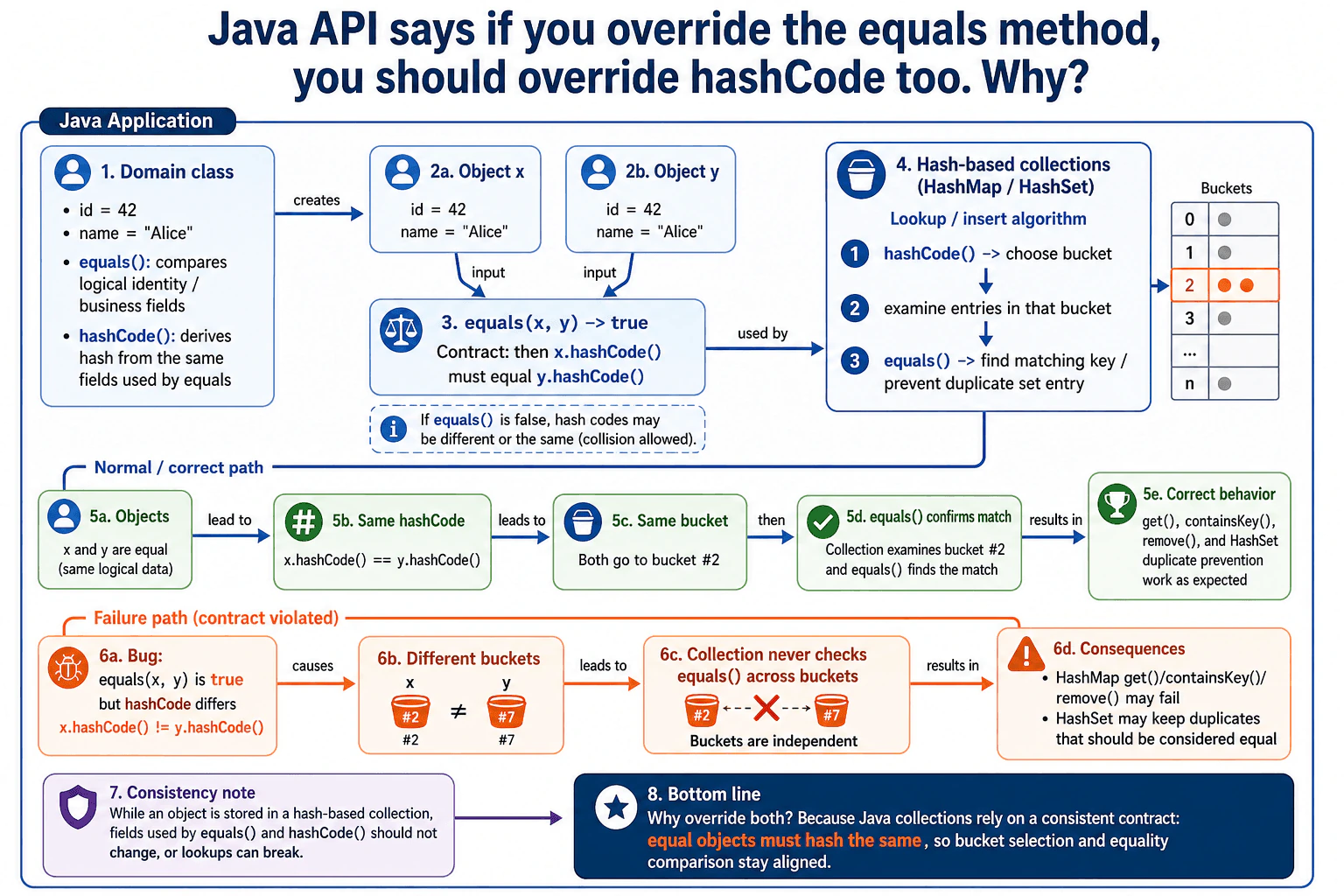
This question is about keeping two ways of working with objects consistent. Imagine two objects that represent the same real thing. Java needs one rule to decide that they are the same. It also needs another value to help a collection decide where to look for them. The important goal is that these two ideas agree. Otherwise, a collection may search one place while an equal object is stored somewhere else. I would explain the normal behavior first, then use the diagram's failure example to show what breaks when the rules disagree.
Useful Questions to Ask the Interviewer
Should I focus mainly on HashMap and HashSet behavior?
Should I also explain what happens when equality fields change after insertion?
How to Explain It in an Interview
1. Start with the domain class
I would start with the domain class in the diagram. It has fields such as id = 42 and name = "Alice". Its equals() method compares the fields that define logical identity. Its hashCode() method derives its hash from the same fields used by equals().
The diagram then creates two objects, x and y. Both contain the same logical data. When we compare them, equals(x, y) returns true. That gives us the important contract: if two objects are equal, x.hashCode() must equal y.hashCode().
The reverse rule does not apply. If equals() is false, the hash codes may be different or may still be the same. Two unequal objects having the same hash code is a collision, and collisions are allowed.
2. Explain how HashMap and HashSet use both methods
The next step is the hash-based collection. The diagram uses HashMap and HashSet.
The collection uses hashCode() to determine the bucket where it should look. A bucket is the area that holds possible matching entries. The collection examines entries in that bucket and then uses equals() to find the exact matching key or to prevent an equal entry from being added twice to a HashSet.
So hashCode() narrows the search. equals() makes the final equality decision. A hash code is therefore not a unique identity value.
3. Walk through the correct path
In the normal path, x and y are logically equal. Because the contract is respected, both objects return the same hash code. In the example shown, both therefore reach bucket #2.
The collection examines bucket #2 and calls equals(). The equality check finds the matching object. As a result, operations such as get(), containsKey(), and remove() work as expected. HashSet can also prevent an entry that is equal to one already stored.
This is why the two methods must stay consistent.
4. Explain the contract violation
The failure path starts when equals(x, y) is true but x and y return different hash codes. This already violates the Java contract.
In the failure example shown in the diagram, the different hashes place x in bucket #2 and y in bucket #7. Different hash codes are not guaranteed to produce different buckets, but they can do so. When that happens, the collection searches only the bucket selected for the lookup and does not compare entries in unrelated buckets with equals().
An equal object in another bucket can therefore be missed. HashMap.get(), containsKey(), or remove() may fail to find an equal key. A HashSet may also keep entries that should have been treated as duplicates.
5. Keep equality fields stable while stored
The diagram also shows a consistency rule. While an object is stored inside a hash-based collection, fields used by equals() and hashCode() should not change in a way that changes equality or hashing.
If those fields change, the object's current hash may lead a later lookup toward a different bucket from the one used during insertion. The object is not automatically moved to that new bucket. A lookup can therefore miss it even though the object is still stored in the collection.
This is why immutable keys, or at least stable equality fields, are safer.
6. Finish with the main design rule
My final point would be simple: equal objects must hash the same. Java's hash-based collections depend on bucket selection from hashing and exact comparison through equals() staying consistent. Overriding equals() without a compatible hashCode() breaks that relationship and can make normal collection operations behave incorrectly.
Practical Complexity & Trade-offs
The benefit of using both methods is efficient lookup with correct equality behavior. hashCode() narrows the search to a bucket, and equals() checks the actual candidate entries. This avoids comparing every stored object. The downside is that developers must keep both methods consistent. If equals() says two objects are equal but their hash codes differ, a hash-based collection can search the wrong bucket and miss a match. Collisions are still allowed because unequal objects may share one hash code. There is also a practical issue with mutable objects. Changing fields used by equality and hashing after insertion can break later lookups. We accept these rules because they let HashMap and HashSet combine fast bucket-based searching with precise logical equality.
Why Interviewers Ask This
Interviewers ask this to check whether you understand Java object equality beyond memorizing method names. They want to see if you can connect the equals() and hashCode() contract to real HashMap and HashSet behavior. They also test whether you understand collisions, bucket lookup, failure cases, and mutable keys. A strong answer shows that you can explain both the Java contract and its practical collection consequences clearly.
Interviewer may ask next
What happens if fields used by equals() and hashCode() change after an object is inserted into a HashMap or HashSet?
The object can become difficult or impossible to find through normal lookup. The affected flow is the consistency path shown at the bottom of the diagram. When the object was inserted, its hash determined the bucket used for storage. If a field used by equals() and hashCode() later changes, the object's new hash may direct a lookup toward a different bucket. The stored entry is not automatically moved when the field changes. A later get(), containsKey(), remove(), or HashSet lookup may therefore search another bucket and miss the entry. Correctness is maintained by keeping equality-related fields stable while the object is stored. A common design choice is to use immutable key fields. The downside is reduced flexibility because those identity fields cannot freely change. If the logical identity must change, a safer approach is to remove the object before changing it and then insert it again using its new state.
Can two unequal objects have the same hashCode(), and what does the collection do then?
Yes. Two unequal objects may have the same hash code. The diagram explicitly notes that collisions are allowed. The affected flow is the HashMap and HashSet lookup sequence. hashCode() is not a uniqueness guarantee. Its job is to help group possible candidates into a bucket. If two different objects produce hashes that lead to the same bucket, the collection examines the entries in that bucket and then calls equals() to determine whether a candidate is the exact logical match. If equals() returns false, the objects remain distinct even though they share a hash code or bucket. Correctness is therefore maintained by the equality check after bucket selection. The main downside of many collisions is performance because more candidates must be examined. The contract requires equal objects to have equal hash codes. It does not require unequal objects to always have different hash codes.
22. Describe a project you worked on from scratch.BehavioralMediumNetflix
i Question Details
Describe a project you started from zero, your ownership, the key decisions you made, and the result.
Interview tip:
Use STAR to structure your answer: briefly explain the Situation and Task, make Action the most detailed part, and finish with the Result. For example, describe a project you started from zero, the responsibility you owned, the key technical and product decisions you made, how you worked with others, and the result you achieved.
Situation
In my last role, I worked on a new internal service that needed to collect application events, store them reliably, and provide a simple API for other teams to retrieve recent event data. There was no existing service to extend, so we had to start with the requirements and build the solution from the beginning.
Task
I was responsible for the Java backend design and implementation. My goal was to turn the initial requirements into a maintainable service, choose a practical architecture, define the API and data model, and make sure the service could handle failures without losing important data.
Action
I first spoke with the teams that would use the service and converted their needs into a small set of clear API operations and data requirements. I kept the first version focused on the main use case instead of adding features that were not yet needed. I designed the service with Spring Boot and separated the API, business logic, and persistence responsibilities so each part could change independently. I defined simple request and response models and added validation at the API boundary so invalid data was rejected early. For storage, I chose a relational database because the event structure was well defined and the team already had strong operational experience with that technology. I also thought through failure cases before implementation. I added clear exception handling, database transaction boundaries where consistency mattered, and logging that included useful request context without exposing sensitive data. I wrote unit tests for the business rules and integration tests for the API and database behavior. As the service took shape, I reviewed the API contract and implementation choices with other developers and adjusted the design when their feedback exposed cases I had missed. I also documented the main decisions and operating behavior so another developer could support the service without depending on me.
Result
We delivered a working service that the requesting teams could integrate with and that was straightforward for our team to maintain. Starting with a small scope and clear boundaries helped us avoid unnecessary complexity while still handling the important reliability cases. I learned that building from scratch is not mainly about choosing technologies. It is about clarifying the real need, making deliberate tradeoffs, validating decisions early, and leaving the system understandable for the people who will maintain it.
Why Interviewers Ask This
Interviewers ask this question to understand whether a candidate can take ownership when there is no existing solution to follow. A strong answer shows that the candidate can clarify requirements, make sensible technical decisions, manage scope, collaborate with others, think about reliability and maintainability, and carry a project from an initial idea to a usable result.
Interviewer may ask next
What was the most important design decision you made on that project?
The most important decision was keeping the first version small and separating the API, business logic, and persistence responsibilities. That gave us clear boundaries without adding unnecessary architectural complexity. It also made testing and future changes easier because each part had a focused responsibility.
What would you do differently if you started the project again?
I would involve the teams consuming the API even earlier with a small example contract before implementing the full endpoints. We did review the contract during development, but earlier examples could have exposed a few edge cases sooner and reduced small adjustments later.
23. How did you lead people as a tech lead in the project you mentioned?BehavioralMediumNetflix
i Question Details
Describe how you led people as a tech lead, how you influenced decisions, and how you kept the project moving.
Interview tip:
Use STAR to structure your answer: briefly explain the Situation and Task, make Action the most detailed part, and finish with the Result. For example, describe a project where you guided developers through technical decisions, gave people clear ownership, resolved disagreements through discussion and evidence, removed blockers, and kept the team focused on delivering a reliable result.
Situation
In my last role, I was the tech lead for a Java service that was being changed to support a new business workflow. Several developers were working on different parts of the service, and some important design decisions were still open. The team needed technical direction, but I also wanted each developer to understand the reasoning and have real ownership of their work.
Task
My responsibility was to guide the technical work, help the developers make good decisions, and keep the project moving without becoming the person who made every decision alone. I needed to make sure the team agreed on the main design, understood dependencies between tasks, and raised risks early enough for us to handle them.
Action
I started by breaking the work into clear areas and discussing the boundaries with the team. I gave developers ownership of specific parts based on their experience and interests, while making sure everyone understood how their part connected to the overall Java service. For important design choices, I asked the developer closest to the problem to explain the options first. I then helped the team compare the choices using simple criteria such as maintainability, failure handling, testing, and impact on existing code. When there was disagreement, I did not decide based on seniority. I asked for concrete examples and, when needed, suggested a small proof of concept so we could learn from evidence. I also held short technical check ins to surface blockers and dependencies. If someone was stuck, I worked with that person to understand the problem and connect them with the right teammate instead of taking the task away. I reviewed critical code and design changes, but I explained the reason behind my feedback so the developer could make the final change with confidence. I also kept the wider team informed when a technical decision affected scope or sequence, which helped us adjust priorities before the issue became a delivery problem.
Result
The team reached agreement on the main design and moved through the implementation with fewer unresolved dependencies. Developers had clear ownership and were able to make more decisions independently as the work progressed. We completed the project with a maintainable solution and without needing a late redesign. I learned that leading as a tech lead is less about giving instructions and more about creating clarity, helping people make strong decisions, and removing obstacles so the whole team can succeed.
Why Interviewers Ask This
Interviewers ask this question to understand whether a candidate can lead through influence rather than authority. A strong answer shows that the candidate can give technical direction, delegate ownership, handle disagreement, communicate decisions, remove blockers, and help other developers succeed while still taking responsibility for delivery.
Interviewer may ask next
How did you handle it when a developer disagreed with your technical direction?
I asked the developer to explain the concern and the alternative they preferred. We compared both choices using maintainability, failure handling, testing, and impact on existing code. When the answer was still unclear, I suggested a small proof of concept so we could use evidence instead of opinion. That helped us reach a decision while keeping the developer involved in the process.
What would you do differently if you led a similar project today?
I would identify cross team dependencies even earlier and make ownership of those dependencies more explicit. The project moved well, but some coordination happened only after developers reached the affected areas. Making those connections visible at the start would help the team resolve questions sooner and give developers even more independence.
24. Tell me about a time you had to give constructive feedback to a teammate or cross-functional partner.BehavioralHardNetflix
i Question Details
Describe a real situation where you gave difficult feedback, how you framed it, and what changed afterward.
Interview tip:
Use STAR to structure your answer: briefly explain the Situation and Task, make Action the most detailed part, and finish with the Result. For example, describe a situation where you needed to give difficult feedback about a teammate's approach, explain how you framed the concern respectfully with specific examples, listened to their perspective, agreed on a better way of working, and improved the collaboration afterward.
Situation
In my last role, I was working with another developer on a Java service that handled requests from several internal systems. During code reviews, I noticed that the developer was repeatedly adding business logic directly inside controller classes. The code worked, but it made the controllers difficult to understand and would make future testing and maintenance harder. I wanted to address the pattern without making the feedback feel personal.
Task
I needed to give clear constructive feedback and help us agree on a better structure. My goal was not simply to get the current code changed. I wanted us to improve the design while keeping a good working relationship and making sure the developer understood why the change mattered.
Action
I first made sure my concern was based on specific examples rather than a personal preference. I reviewed the relevant code and identified places where request handling, validation, and business rules were mixed together. Instead of leaving a long critical comment in the code review, I asked the developer for a short conversation because I felt the context would be easier to explain directly. I started by acknowledging that the implementation met the functional requirement. Then I explained that my concern was about maintainability, not whether the developer could write working code. I showed one controller and explained how moving the business rules into a service class would make the controller easier to read and allow the business logic to be tested independently. I also asked how they had arrived at the current design. They explained that they were trying to finish the feature quickly and had expected to refactor it later. That helped me understand the reasoning instead of assuming the approach was careless. We agreed to refactor the most important logic before merging and to keep the controller focused on handling the request and response. I helped with part of the refactoring and reviewed the updated tests so the feedback felt collaborative rather than like an instruction from one developer to another. In later reviews, I also made a point of recognizing when the structure was clearer so the conversation was not only about problems.
Result
The developer updated the code, and the final structure was easier to understand and test. More importantly, our later code reviews became more open because we had established that technical feedback could be direct without becoming personal. I learned that constructive feedback works best when I use specific examples, explain the impact, listen to the other person's reasoning, and work with them on the solution instead of only pointing out what I think is wrong.
Why Interviewers Ask This
Interviewers ask this question to understand whether a candidate can handle difficult professional conversations without damaging trust. A strong answer shows that the candidate can give specific and respectful feedback, explain why a concern matters, listen to another perspective, collaborate on a solution, and improve the working relationship rather than simply proving a technical point.
Interviewer may ask next
How did you handle the possibility that your teammate might disagree with your feedback?
I treated the discussion as a design conversation rather than assuming my approach was automatically correct. I asked the developer to explain why they had chosen the controller based design and listened to the time pressure they were dealing with. Then I focused on the concrete maintenance and testing impact. That made it easier for us to evaluate the options together and agree on a change without turning the discussion into a personal disagreement.
What would you do differently if you had to give similar feedback now?
I would still use specific examples and discuss sensitive feedback directly, but I would raise a repeated design pattern even earlier. In this situation, I waited until I saw the issue in several places before discussing it. Addressing the pattern after the first clear example could reduce rework while still giving the other developer enough context to understand why the change matters.
25. Tell me about a time you received critical feedback.BehavioralHardNetflix
i Question Details
Describe a time you received tough feedback, how you reacted, what you changed, and the impact of that change.
Interview tip:
Use STAR to structure your answer: briefly explain the Situation and Task, make Action the most detailed part, and finish with the Result. For example, describe a time you received tough feedback about your technical work, how you listened without becoming defensive, clarified the concern, changed your approach, communicated with the team, and showed that the feedback improved both your work and your judgment.
Situation
In my last role, I was working on a Java service that handled an important business workflow. During a code review, a senior engineer gave me critical feedback that my implementation was too complex. The code worked, but I had added several layers of abstraction that made the main flow harder to understand.
Task
I was responsible for completing the feature and making sure the code was reliable and maintainable. I also needed to respond professionally to the feedback instead of defending my original design just because I had already spent time on it.
Action
I first asked the reviewer to walk me through the parts that were difficult to follow. I listened carefully and wrote down the specific concerns. I realized the main issue was not whether the code was technically correct. The issue was that future developers would need more effort to understand and change it. I reviewed the design again and separated what was truly required from what I had added for possible future needs. I removed unnecessary interfaces and helper layers, simplified the main service flow, and kept abstractions only where they solved a current problem. I then asked the reviewer to look at the revised approach before I completed the changes. I also explained what I had changed and why, so we could confirm that I understood the feedback correctly. After that experience, I started asking myself during implementation whether each abstraction made the current code clearer or only made the design look more flexible.
Result
The revised code was easier for the team to review and maintain, and the feature moved forward without the earlier design concerns. More importantly, I learned to treat critical feedback as information about the quality of my work rather than as a personal criticism. Since then, I have been more willing to simplify my own designs and ask for feedback earlier when I am making important technical decisions.
Why Interviewers Ask This
Interviewers ask this question to understand how a candidate reacts when their work is challenged. A strong answer shows maturity, openness to learning, good communication, and the ability to turn difficult feedback into a practical improvement instead of becoming defensive or ignoring the concern.
Interviewer may ask next
What was the hardest part of receiving that feedback?
The hardest part was accepting that code I had spent significant effort designing was more complicated than it needed to be. I handled that by focusing on the reviewer's specific concerns and asking whether the design helped the team maintain the service. That made it easier to separate my attachment to the implementation from what was best for the codebase.
What would you do differently if you faced a similar situation now?
I would ask for feedback earlier, especially when I am introducing several abstractions or making a design that affects how other developers will work with the code. An early design discussion can reveal unnecessary complexity before much implementation work is done, which makes changes easier and improves collaboration.
26. Describe your experience collaborating with non-technical roles, such as Product Managers.BehavioralMediumNetflix
i Question Details
Explain how you work with non-technical partners, how you align on scope and tradeoffs, and what the outcome was.
Interview tip:
Use STAR to structure your answer: briefly explain the Situation and Task, make Action the most detailed part, and finish with the Result. For example, describe a realistic project where you worked closely with a Product Manager, clarified the user need, aligned on scope and technical tradeoffs, communicated constraints in simple language, and reached a practical decision that led to a reliable result.
Situation
In my last role, I worked on a Java service that supported a new product feature. The Product Manager understood the customer need well, but some of the requested behavior would have required significant changes to an existing service and data flow. We needed to agree on what was essential for the first release without losing the main value of the feature.
Task
My responsibility was to explain the technical constraints clearly, understand which product requirements mattered most, and help the Product Manager and engineering team agree on a scope that we could implement safely. I also needed to make sure we were making a product decision together instead of simply rejecting requirements because they were technically difficult.
Action
I first asked the Product Manager to walk me through the user problem and the expected behavior from the user perspective. This helped me separate the core need from implementation details. I then reviewed the existing Java service and identified which parts could support the request with small changes and which parts would require a larger redesign. Instead of using technical language, I explained the choices in terms of impact. I described what we could deliver with the current design, what additional behavior would add complexity, and what risks that complexity could create for reliability and future maintenance. I proposed a smaller first version that preserved the most important user flow while keeping the service changes simple. I also explained which capabilities could be added later if product feedback showed they were valuable. The Product Manager raised concerns about whether the smaller scope would still solve the customer problem, so we reviewed the user flow together and adjusted one part of the proposal to cover an important edge case. I documented the agreed behavior and reviewed it with the engineering team so that product expectations and technical implementation stayed aligned during development.
Result
We reached agreement on a scope that met the main product need and was practical for the existing Java service. The implementation moved forward without confusion about requirements, and the Product Manager had a clear understanding of the technical tradeoffs behind the decision. I learned that strong collaboration with non technical partners is not about simplifying every technical detail. It is about connecting technical choices to user impact, asking questions early, and making tradeoffs together.
Why Interviewers Ask This
Interviewers ask this question to understand whether a Java Developer can work effectively with people who have different expertise. A strong answer shows that the candidate can listen to product needs, explain technical constraints in clear language, discuss scope and tradeoffs without becoming defensive, and help the team reach decisions that balance user value with engineering quality.
Interviewer may ask next
How did you handle the Product Manager's concern about reducing the original scope?
I did not treat the concern as resistance. I asked which user behavior they believed would be lost and reviewed that flow with them. We found one important edge case that my first proposal did not cover, so I adjusted the design to support it while keeping the larger redesign out of the first release. That helped us reach a decision based on the user need instead of defending our original positions.
What would you do differently in a similar situation now?
I would bring the Product Manager into the technical discovery a little earlier. In this project, I reviewed some of the service constraints before discussing the detailed user flow with them. Now I would start with the user problem first, then evaluate the technical options with that context. That would make it easier to identify useful tradeoffs sooner and reduce unnecessary analysis.
27. Why are you looking for a new job at this moment?BehavioralMediumNetflix
i Question Details
Explain your motivation for changing roles now and what you are looking for in the next opportunity.
Interview tip:
Use STAR to structure your answer: briefly explain the Situation and Task, make Action the most detailed part, and finish with the Result. For example, describe a point in your career when you realized you were ready for broader Java engineering challenges, how you evaluated what you wanted next, how you handled your current responsibilities professionally, and why this opportunity fits your next step.
Situation
In my last role, I reached a point where I had become comfortable with the systems and responsibilities I was handling. I was still learning, but I wanted my next step to expose me to larger engineering challenges, stronger technical discussions, and systems where reliability and scale matter more.
Task
My goal was to decide whether changing roles was the right step instead of leaving simply because another opportunity appeared. I wanted to be clear about what I was looking for while continuing to support my current team and responsibilities professionally.
Action
I first looked at the parts of my work that gave me the most energy. I enjoyed designing Java services, improving existing code, investigating production problems, and working with other engineers on technical decisions. I also thought about the skills I wanted to strengthen, especially designing reliable services, making thoughtful tradeoffs, and taking more ownership from design through production support. Based on that, I decided to look for a role where I could work on more complex systems and contribute to decisions with a larger user and business impact. I have been selective because I do not want to move only for a new title. I want a role where the engineering problems, expectations, and team environment will help me grow while allowing me to contribute the Java and backend experience I already have. That is why I am interested in this opportunity at Netflix. The technical scale and level of engineering ownership make it relevant to what I want to do next.
Result
This process gave me a clear reason for making a change now. I am not trying to leave because of one negative event. I am looking for the next level of technical challenge and ownership, and I have a much clearer understanding of the kind of environment where I can contribute and continue growing.
Why Interviewers Ask This
Interviewers ask this question to understand whether the candidate is making a thoughtful career move and whether the new role matches what the candidate actually wants. A strong answer shows positive motivation, professional judgment, realistic expectations, and a clear connection between the candidate's experience and the opportunity.
Interviewer may ask next
What are you specifically looking for in your next Java Developer role?
I am looking for a role where I can work on complex backend systems, take meaningful ownership, and participate in technical decisions instead of only implementing isolated tasks. I also want to work with engineers who challenge each other's ideas constructively because that will help me improve while letting me contribute my existing Java experience.
Why do you feel now is the right time to make this change?
I feel the timing is right because I have learned a lot from my current responsibilities and have become clear about the areas where I want to grow next. Rather than waiting until I feel completely stagnant, I want to move while I am still performing well and can bring useful experience into a role with broader technical challenges and ownership.
28. Why are you interested in Netflix?BehavioralMediumNetflix
i Question Details
Explain why Netflix is appealing to you, what you know about the work, and how it matches your goals.
Interview tip:
Use STAR to structure your answer: briefly explain the Situation and Task, make Action the most detailed part, and finish with the Result. For example, describe a previous Java project that showed you how much you enjoy solving reliability and scale problems, explain the responsibilities you found most meaningful, and connect those interests to the kind of engineering work and ownership that attract you to Netflix.
Situation
In my last role, I worked on a Java service that supported an important customer facing workflow. As usage grew, I became more interested in the engineering problems behind reliable services, especially how teams design systems that stay responsive when traffic changes and failures happen.
Task
My responsibility was not only to deliver application changes, but also to understand how those changes affected reliability and maintainability. That experience helped me identify the kind of work I want to continue doing as a Java Developer.
Action
I started taking more ownership of the service beyond the code for individual features. I reviewed request flows, improved error handling, investigated production issues, and worked with teammates to make changes safer to operate. I also spent more time understanding why architectural decisions were made instead of treating them as fixed rules. I found that I enjoyed environments where engineers are expected to understand the wider system, make thoughtful decisions, communicate tradeoffs clearly, and take responsibility for the results. That is a major reason Netflix interests me. The opportunity to work on software used at very large scale, while having meaningful engineering ownership, matches the direction I want for my career. I am especially interested in applying my Java experience to backend systems where reliability, performance, and simple design matter.
Result
That project clarified what motivates me professionally. I learned that I do my best work when I can combine hands on Java development with deeper system thinking and ownership. Netflix appeals to me because the role aligns with those goals and would give me the opportunity to keep growing while contributing to challenging production systems.
Why Interviewers Ask This
Interviewers ask this question to understand whether the candidate has a thoughtful reason for choosing Netflix and whether the role matches the candidate's professional goals. A strong answer shows genuine interest in the work, realistic expectations about engineering responsibility, and a clear connection between the candidate's Java experience and the problems they want to solve.
Interviewer may ask next
What part of Netflix engineering work interests you most?
I am most interested in backend systems where reliability, performance, and clear design decisions matter. My previous project showed me that I enjoy looking beyond a single feature and understanding how a Java service behaves as part of a larger production system.
How does Netflix fit your long term career goals?
I want to become a stronger engineer who can own important backend services from design through production operation. The experience in my last role showed me that I enjoy that responsibility, so I am looking for an environment where I can deepen my Java skills, improve my system design judgment, and contribute to complex production systems.
Give a concise self-introduction that highlights your background, current role, core strengths, and why you are a fit for the Netflix role.
Interview tip:
Use STAR to structure your answer: briefly explain the Situation and Task, make Action the most detailed part, and finish with the Result. For example, describe your Java development background, the responsibilities you have taken in recent roles, the strengths you bring to backend engineering, how you work with others to build reliable services, and why those experiences make you a strong fit for the Netflix role.
Situation
In my current role as a Java Developer, I build and improve backend applications and services. In this work, I have focused on writing reliable Java code, working with APIs and databases, and supporting applications that need to remain stable as requirements change.
Task
My responsibility has been to turn business needs into clean and maintainable backend solutions while working closely with other engineers. I also try to understand the reason behind a requirement so I can make better technical decisions instead of only completing the requested code change.
Action
In this role, I usually start by understanding the expected behavior and the important failure cases. I then break the problem into small parts, design clear interfaces, and keep the Java code simple enough for other engineers to understand and maintain. I pay attention to error handling, testing, database access, and service boundaries because these areas often affect reliability. When I see a design risk or unclear requirement, I discuss it early with the team and explain the tradeoffs in simple terms. I also review feedback carefully and adjust my approach when another solution better serves the product. These habits have helped me become someone who focuses not only on writing code, but also on ownership, communication, and long term quality.
Result
This approach has helped me contribute reliable changes, work effectively with my teammates, and build stronger judgment about backend engineering. I believe that combination of Java experience, ownership, practical problem solving, and collaboration is a strong fit for the Netflix role, where engineers are expected to make thoughtful decisions and take responsibility for the systems they build.
Why Interviewers Ask This
Interviewers ask for a brief self introduction to understand whether the candidate can communicate their background, strengths, and relevance to the role clearly and quickly. A strong answer shows self awareness, professional focus, and a clear connection between the candidate's Java experience and what they can contribute in the role.
Interviewer may ask next
Which strength from your Java development experience would help you most in this role?
I would say practical backend problem solving. I try to understand the expected behavior, failure cases, and tradeoffs before I start coding. That helps me make decisions that support reliability and maintainability instead of focusing only on getting a feature working.
What are you hoping to develop further in your next role?
I want to deepen my experience with large scale backend systems and continue improving my technical judgment. I also want to take more ownership of decisions that affect service reliability, design, and long term maintainability while learning from engineers who have experience operating systems at significant scale.
30. Netflix Culture Memo: How do you feel about it, and how do you relate to it?BehavioralMediumNetflix
i Question Details
Explain how you respond to the Netflix culture memo, which principles you connect with, and how they show up in your work.
Interview tip:
Use STAR to structure your answer: briefly explain the Situation and Task, make Action the most detailed part, and finish with the Result. For example, describe a realistic project where you used judgment, shared concerns openly, took ownership of an important technical decision, and balanced freedom with responsibility to deliver a reliable result.
Situation
In my last role, I worked on a Java service that needed a significant change before an upcoming release. The team had freedom to choose the implementation, but the change affected reliability and several other developers depended on the service. That experience relates strongly to what I understand from the Netflix Culture Memo, especially the ideas of judgment, candor, and taking responsibility rather than waiting for detailed rules.
Task
I was responsible for designing and implementing the change while making sure the team understood the risks. My goal was not only to finish my code. I also needed to make a sound technical decision, communicate it clearly, and help the team move forward without creating unnecessary process.
Action
I first reviewed the existing Java flow and identified where the proposed approach could create a failure path under partial service outages. Instead of quietly implementing what had initially been discussed, I raised the concern directly with the team and explained the tradeoff in simple terms. I proposed a smaller design that kept the important behavior but reduced the number of dependencies involved in the request path. I wrote a short technical note with the main options, the risks of each option, and my recommendation. I asked other developers to challenge my reasoning because I wanted the best decision, not simply approval of my idea. After we agreed on the approach, I took ownership of the implementation, added tests for normal and failure cases, and worked with the team during review to address concerns quickly. I did not need a manager to define every step. I used the freedom I had, but I treated that freedom as a responsibility to make the impact visible and protect the quality of the service. That is the part of the Netflix culture that I relate to most. I value direct feedback and high autonomy when they are combined with good judgment and accountability.
Result
We completed the change with a simpler and more reliable design, and the team had a clear understanding of why we chose it. The experience reinforced for me that autonomy works best when people share information openly, invite disagreement, and take responsibility for the consequences of their decisions. That is why the principles in the Netflix Culture Memo are appealing to me. They match how I try to work as an engineer.
Why Interviewers Ask This
Interviewers ask this question to understand whether the candidate is comfortable with a culture that emphasizes judgment, candor, autonomy, responsibility, and direct feedback. A strong answer shows that the candidate understands these principles in practical terms and can explain how they influence real decisions and behavior at work.
Interviewer may ask next
How did you handle it when other developers challenged your proposed design?
I treated the disagreement as useful information rather than something I needed to win. I asked them to explain the failure cases or maintenance concerns they saw, compared those concerns with my reasoning, and changed parts of the design where their feedback improved it. My goal was to reach the strongest decision for the service, not to protect my original proposal.
What would you do if you had high autonomy but were unsure about an important decision?
I would still take ownership, but I would not confuse autonomy with making decisions alone. I would gather the relevant facts, explain the options and risks clearly, and ask experienced teammates for focused feedback. I would then make or support a decision based on the best available information and remain accountable for the outcome.
More questions load as you scroll
Disclaimer: This interview guide is for educational and informational purposes only. It is designed to help readers prepare, but it does not guarantee any interview result, hiring decision, offer, or outcome. Interview questions, hiring criteria, and preferred answers can vary by employer, interviewer, industry, location, and time. All answers, examples, and explanations in this guide are suggested examples for interview preparation, not definitive answers or instructions for professional practice. They are based on research and judgment, are provided without warranties of any kind, and should be adapted to the question, role, and applicable laws and professional requirements. Diagrams are simplified illustrations intended to highlight the main concepts and their relationships; actual situations, systems, and practices may be more complex. Alternative approaches may be equally valid or better suited to a particular question, context, or interviewer. To the fullest extent permitted by applicable law, the contributors and publisher are not liable for decisions made, actions taken, or losses incurred based on this guide.
State Laws and Professional Responsibilities: Laws and requirements governing an occupation vary by state and jurisdiction. You are responsible for checking the current laws, licensing requirements, and scope-of-practice rules that apply to your location and role, and for ensuring that your answers and actions comply with them. Adapt examples in this guide to those requirements. This guide is not legal advice.
Company Notice: This guide is an independent educational resource and is not affiliated with, endorsed by, sponsored by, or approved by the company named in this guide. Company names identify reported interview experiences or the employer context of clearly labeled original practice exercises. Interview practices can change without notice, and inclusion of company-specific content does not mean these questions are official, complete, or guaranteed to be asked. To the fullest extent permitted by law, the author, contributors, and publisher are not responsible for outcomes related to use of this material.
Content Accuracy and Verification: To the fullest extent permitted by applicable law, we do not represent or warrant that interview guides, questions, answers, examples, or diagrams are accurate, complete, current, error-free, or suitable for any particular purpose. You are responsible for independently reviewing and verifying the information before relying on it.