This interview guide is for educational and informational purposes only. It is designed to help readers prepare, but it does not guarantee any interview result, hiring decision, offer, or outcome. Interview questions, hiring criteria, and preferred answers can vary by employer, interviewer, industry, location, and time. All answers, examples, and explanations in this guide are suggested examples for interview preparation, not definitive answers or instructions for professional practice. They are based on research and judgment, are provided without warranties of any kind, and should be adapted to the question, role, and applicable laws and professional requirements. Diagrams are simplified illustrations intended to highlight the main concepts and their relationships; actual situations, systems, and practices may be more complex. Alternative approaches may be equally valid or better suited to a particular question, context, or interviewer. To the fullest extent permitted by applicable law, the contributors and publisher are not liable for decisions made, actions taken, or losses incurred based on this guide.
State Laws and Professional Responsibilities
Laws and requirements governing an occupation vary by state and jurisdiction. You are responsible for checking the current laws, licensing requirements, and scope-of-practice rules that apply to your location and role, and for ensuring that your answers and actions comply with them. Adapt examples in this guide to those requirements. This guide is not legal advice.
Identity, Image, and Privacy Notice
To respect individual privacy, some names, profile photographs, avatars, biographical details, and other identifying information displayed in this guide may be replaced with pseudonyms, licensed stock images, illustrative avatars, composite images, or representative descriptions. Unless a person is expressly identified as an actual contributor, a displayed name, image, or profile should not be understood as depicting or identifying a specific candidate, interviewer, employee, or other real individual. These representations are provided for editorial and illustrative purposes only and do not imply endorsement, employment, participation, or affiliation with this guide or any company mentioned in it. Any resemblance to an actual person is coincidental.
Company Notice
This guide is an independent educational resource and is not affiliated with, endorsed by, sponsored by, or approved by the company named in this guide. Company names identify reported interview experiences or the employer context of clearly labeled original practice exercises. Interview practices can change without notice, and inclusion of company-specific content does not mean these questions are official, complete, or guaranteed to be asked. To the fullest extent permitted by law, the author, contributors, and publisher are not responsible for outcomes related to use of this material.
Content Accuracy and Verification
To the fullest extent permitted by applicable law, we do not represent or warrant that interview guides, questions, answers, examples, or diagrams are accurate, complete, current, error-free, or suitable for any particular purpose. You are responsible for independently reviewing and verifying the information before relying on it.
Questions or comments?
Contact us for general questions, or share feedback, technical corrections, and comments with the community.
1. How would you assess an ED patient whose recent care took place outside the available health record?Clinical KnowledgeEasyKaiser Permanente
i Question Details
Original practice question for this employer context, not a reported employer interview question. Explain the relevant ED nursing judgment and identify information or authority you would need. Do not assume an internal employer protocol.
Short Interview Answer (30-60 seconds)
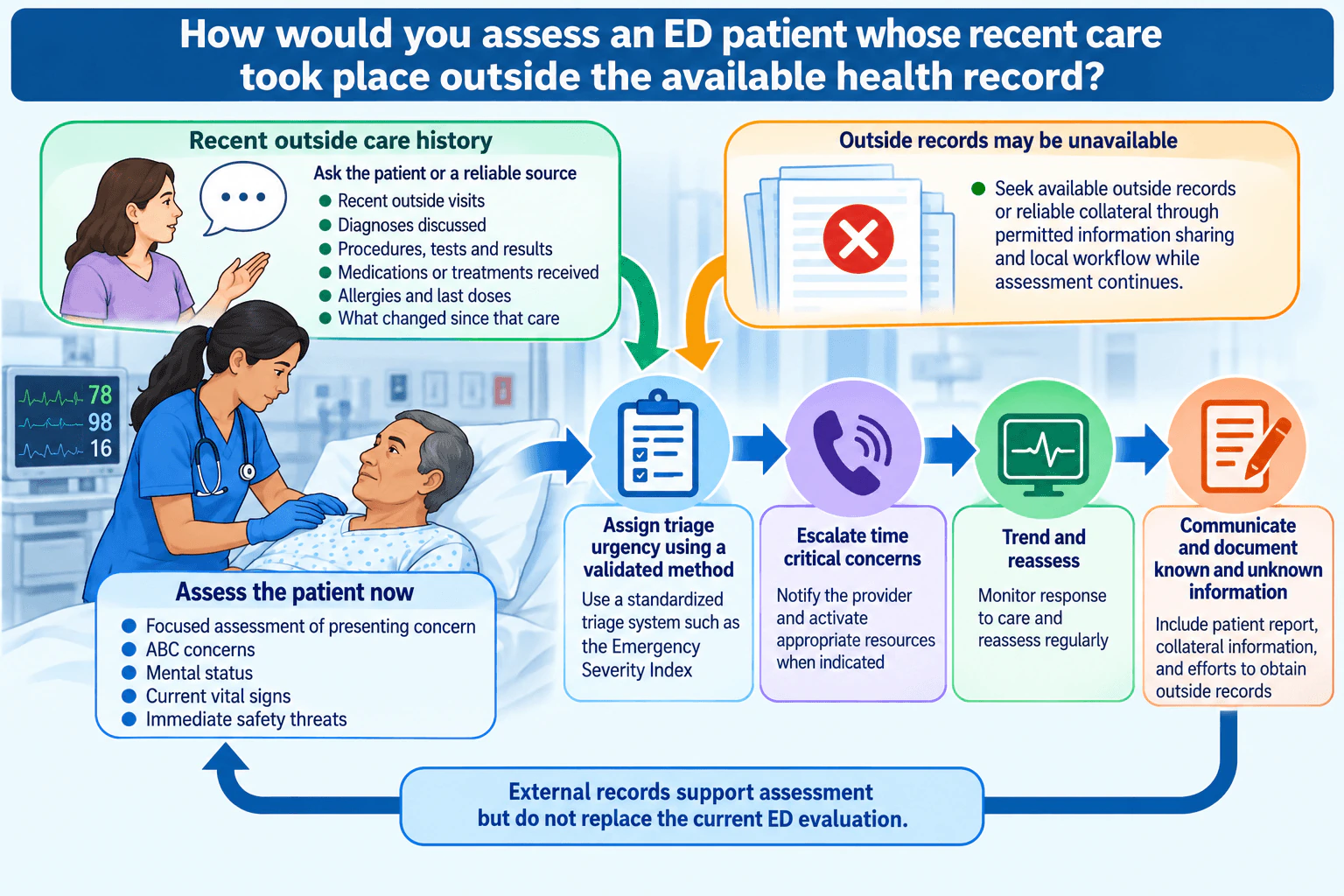
I would assess the patient in front of me first and would not delay the current ED evaluation while waiting for outside records. I would complete a focused assessment, identify airway, breathing, circulation, mental status, vital sign, and immediate safety concerns, and assign acuity with an applicable validated triage method such as the Emergency Severity Index. I would obtain a targeted history of the recent outside care, seek available records or reliable collateral through permitted information sharing and local workflow, and clearly distinguish reported information from verified information. I would escalate time critical concerns, trend findings, reassess, communicate, and document throughout.
Detailed Explanation
The key principle is that missing outside records create an information gap, not a reason to postpone assessment. The current presentation remains the primary basis for triage and nursing priorities. Outside history and records provide supporting information that can refine the assessment, but they do not replace it.
Useful Questions to Ask the Interviewer
What validated triage method does this emergency department use?
What approved processes are available for obtaining outside records or reliable collateral?
What is the expected escalation pathway when the current assessment suggests an immediate threat?
How to Explain It in an Interview
Start with the current patient
I would begin with a focused assessment of the presenting concern and identify immediate airway, breathing, circulation, mental status, vital sign, and safety concerns. I would use the department's validated triage method to determine acuity. Emergency Severity Index, when used locally, is an acuity tool rather than a diagnosis or an order of arrival system.
Gather the outside care history
While continuing the current assessment, I would ask the patient or another reliable source about the recent outside care. I would clarify recent outside visits, diagnoses communicated to the patient, tests and procedures, medications or treatments received, allergies and last doses, and what has changed since that care. I would distinguish information reported by the patient or collateral source from information that has been independently verified.
Address the information gap
If records are not immediately available, I would not guess at missing results, diagnoses, or treatments. I would use permitted information sharing and the local workflow to seek relevant outside records or reliable collateral while the current assessment continues. The absence of those records should not delay recognition or escalation of a time critical problem.
Prioritize, reassess, and communicate
I would assign triage urgency from the current presentation and available verified information. If I identify a time critical concern, I would promptly notify the appropriate clinician and activate appropriate resources according to local policy and my nursing scope. I would trend symptoms and vital signs, reassess as the patient's condition evolves, and update priorities when findings change.
I would document the patient's report, verified information, unresolved gaps, efforts to obtain outside information, reassessment findings, communication, and escalation. My goal is to make safe decisions from what is known now while actively reducing uncertainty.
Why Interviewers Ask This
This question evaluates whether the nurse can prioritize the patient's current condition when the available health record is incomplete, gather useful information about recent outside care without inventing missing findings, apply triage appropriately, recognize time critical concerns, reassess, communicate uncertainty, and document safely.
Common interview mistakes
Waiting for outside records before assessing the current patient, treating Emergency Severity Index as a diagnosis, assuming priority is determined by order of arrival, treating unverified outside information as confirmed fact, inventing missing test results or treatments, failing to reassess while information is being obtained, or failing to document what is known and unknown.
Interview tip
Keep the answer centered on the patient in front of you. State clearly that the current assessment and validated triage determine immediate priorities, while outside history and records are supporting inputs. Separate reported information from verified information and explain how you would escalate, reassess, communicate, and document uncertainty.
Interviewer may ask next
How would you verify information about the patient's recent outside care?
I would first clarify exactly what the patient or a reliable collateral source reports, including where and when care occurred and what they remember about diagnoses, tests, procedures, medications, and treatments. I would then seek relevant records through permitted information sharing and the organization's approved workflow. I would clearly distinguish reported information from independently verified information in communication and documentation, and I would continue the current clinical assessment while verification is underway.
What would you do if the patient's condition worsened while you were still trying to obtain the outside records?
I would immediately reprioritize based on the new clinical findings. I would repeat the focused assessment and relevant vital signs, recognize any new time critical concern, notify the appropriate clinician, and activate available emergency resources according to local policy and nursing scope. I would not wait for the outside records before escalating care. After the immediate concern was addressed, I would continue reassessment and update communication and documentation with the changed condition and any new verified information.
2. How would you distinguish current assessment findings from an old problem list?Clinical KnowledgeEasyKaiser Permanente
i Question Details
Original practice question for this employer context, not a reported employer interview question. Explain the relevant ED nursing judgment and identify information or authority you would need. Do not assume an internal employer protocol.
Short Interview Answer (30-60 seconds)
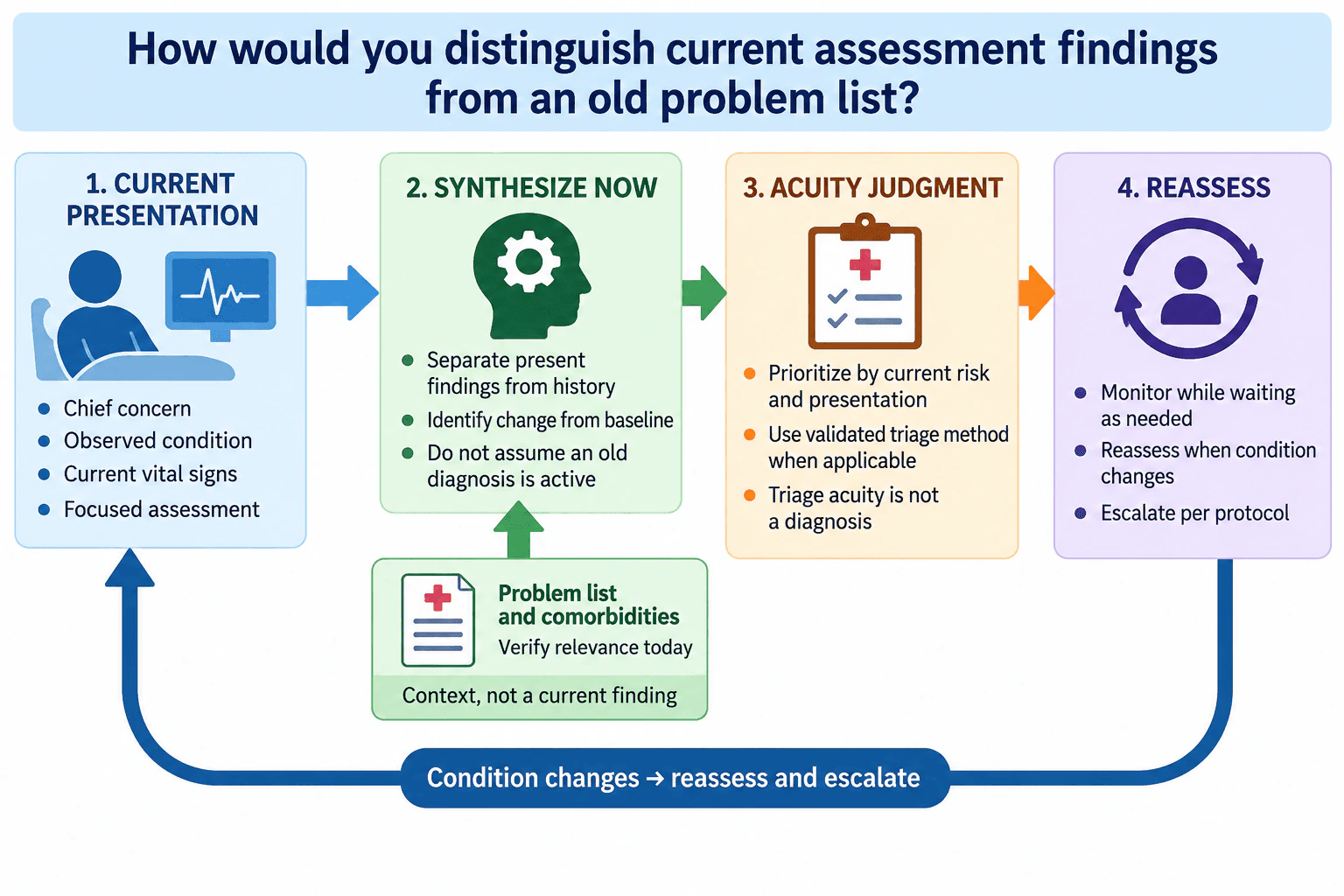
I would treat the problem list as clinical context, not as today's assessment. I would first establish the patient's current chief concern, observed condition, vital signs, focused assessment findings, and change from baseline. Then I would compare those findings with the history and verify whether older conditions are still relevant rather than assuming they are active. Triage acuity should reflect current risk and presentation using the validated triage method required locally. If the patient is waiting, I would continue reassessment and escalate according to protocol if the condition changes.
Detailed Explanation
The key distinction is that current assessment findings describe what is happening with the patient now, while an old problem list contains previously documented conditions that may or may not remain active or relevant. The emergency nurse should synthesize both without allowing historical diagnoses to override the present assessment.
Useful Questions to Ask the Interviewer
Which validated triage method does this emergency department use for routine triage?
What sources should nurses use to verify whether a historical problem remains active or clinically relevant?
What is the local process for reassessment and escalation when a waiting patient's condition changes?
How to Explain It in an Interview
Current presentation
I would begin with information I can establish now: the chief concern, observed condition, current vital signs, focused assessment findings, and any reported or observed change from baseline. These findings describe the present clinical state and should drive immediate nursing priorities.
Historical context
I would review the problem list and relevant history because chronic or previous conditions can affect risk and interpretation. A problem list can contain current diagnoses as well as past diagnoses relevant to care, so I would not assume that every entry represents an active explanation for today's presentation. cms.gov
Verification
If the status of a historical problem matters to care and is unclear, I would compare it with the current assessment and review available recent documentation, medication history, and patient or caregiver information when appropriate. If diagnostic status remains unclear and affects care, I would seek clarification from the treating clinician rather than independently declaring the diagnosis active or resolved.
Acuity judgment
I would prioritize the patient from today's presentation and the validated triage method used by the facility. Current ACEP and ENA guidance describes emergency department triage as rapid evaluation of patient acuity and supports use of a scientifically validated triage scale such as the Emergency Severity Index. ena.org Triage acuity is a prioritization judgment, not a diagnosis and not simply the patient's place in arrival order.
Reassessment
The assessment is not static. If the patient remains in the waiting process, I would monitor and reassess according to local policy. A meaningful change in symptoms, vital signs, appearance, mental status, or other assessment findings would prompt renewed acuity judgment and appropriate escalation. This keeps the current presentation, rather than an old problem list, at the center of emergency nursing decisions.
Why Interviewers Ask This
This question evaluates whether the nurse can distinguish direct current assessment data from historical information, avoid anchoring on an old diagnosis, recognize changes from baseline, judge urgency from the present presentation, and know when verification, reassessment, or escalation is needed.
Common interview mistakes
Common mistakes include treating an old problem list as proof of the patient's current condition, anchoring on a previous diagnosis before completing a present assessment, ignoring changes from baseline, assigning urgency from diagnosis alone, confusing triage acuity with a diagnosis, prioritizing solely by order of arrival, and failing to reassess when the patient's condition changes.
Interview tip
Structure the answer as current presentation, historical context, verification, acuity judgment, and reassessment. Make it explicit that current findings drive urgency while the problem list provides context that must be checked for present relevance.
Interviewer may ask next
How would you verify whether an old problem on the chart is still clinically relevant?
I would compare the historical entry with the patient's current report and assessment, review available recent clinical documentation and medications, and clarify uncertain diagnostic status with the treating clinician when it affects care. I would document the current nursing findings accurately rather than independently declaring an old diagnosis active or resolved.
What would you do if the patient's condition changed while waiting after the initial triage assessment?
I would perform a prompt reassessment focused on the new or worsening findings, repeat relevant vital signs and focused observations, reconsider the patient's acuity using the validated local triage process, and escalate according to emergency department protocol when the change indicates greater urgency. The updated current assessment would take priority over the earlier snapshot.
3. What would you look for in a patient with sepsis?Clinical KnowledgeMediumKaiser Permanente
i Question Details
Explain the assessment findings and vital sign trends you would recognize as concerning for sepsis, how you would reassess acuity, and when you would escalate concerns within the emergency nursing role.
Short Interview Answer (30-60 seconds)
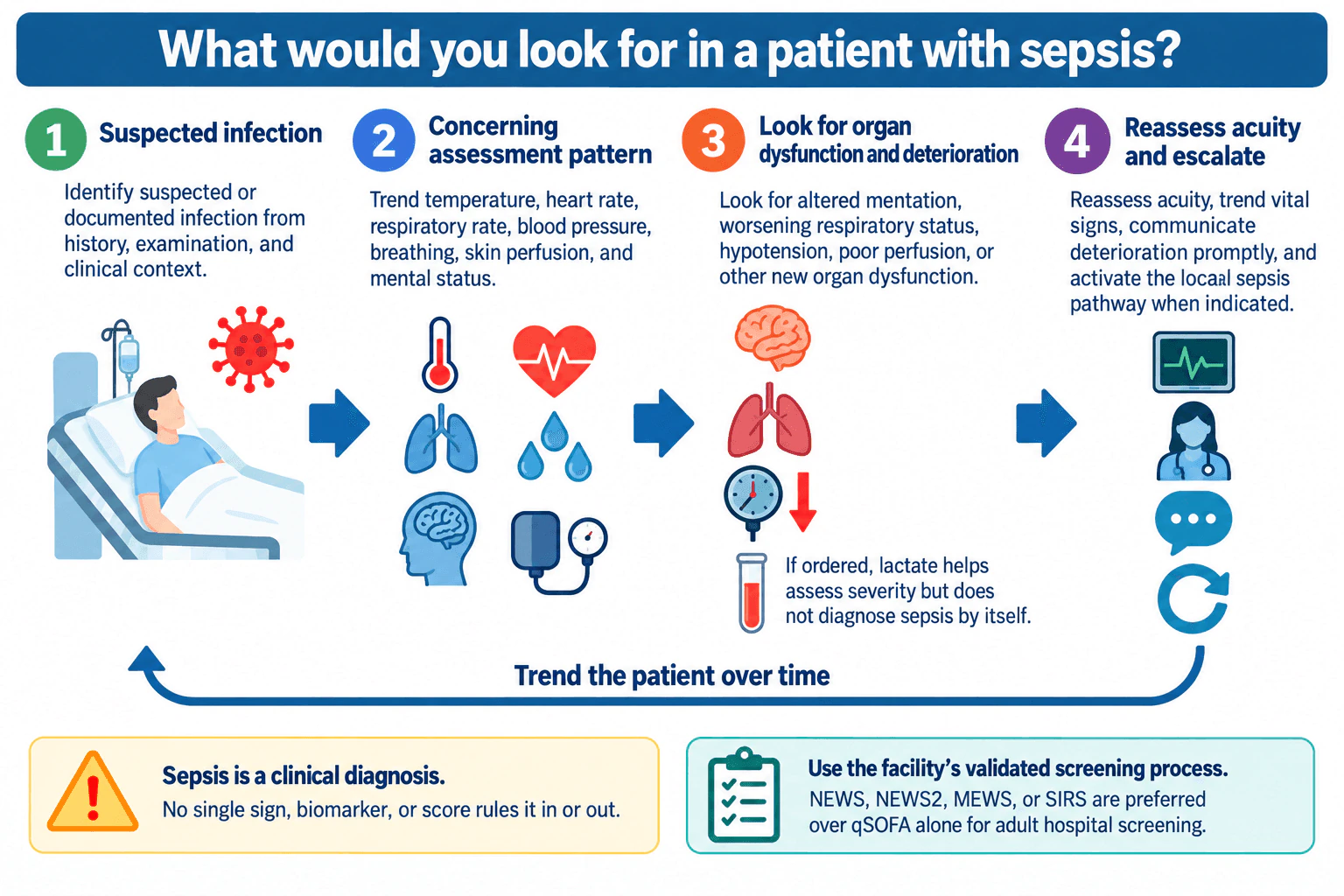
I would first look for suspected or documented infection, then trend the whole clinical picture, including temperature, heart rate, respiratory rate, blood pressure, breathing, skin perfusion, and mental status. Concerning findings include altered mentation, worsening respiratory status, hypotension, poor perfusion, or other new organ dysfunction. CDC lists confusion or disorientation, clammy or sweaty skin, fever or feeling very cold, high heart rate or weak pulse, and shortness of breath among possible sepsis findings. cdc.gov I would reassess acuity frequently, communicate deterioration promptly, and use the facility's validated sepsis screening and escalation process rather than relying on one sign, biomarker, or score.
Detailed Explanation
Sepsis assessment is about recognizing a concerning pattern over time. I would not diagnose sepsis from one abnormal vital sign. I would combine evidence of suspected or documented infection with serial vital signs, focused assessment findings, perfusion, mental status, respiratory status, and signs of new organ dysfunction. Current 2026 adult guidance states that sepsis is a clinical diagnosis and should not be ruled in or ruled out using a single biomarker or diagnostic test. sccm.org
Useful Questions to Ask the Interviewer
Which validated sepsis screening process does your emergency department use?
What is the expected nursing escalation pathway after a positive screen or clinical deterioration?
Which actions may the emergency nurse initiate under standing protocols before additional orders are obtained?
How to Explain It in an Interview
Clinical Priorities
I would begin by determining whether there is suspected or documented infection and then assess for physiologic deterioration. I would trend temperature, heart rate, respiratory rate, blood pressure, breathing, skin perfusion, and mental status rather than treating any single value as diagnostic. CDC identifies possible sepsis findings that include confusion or disorientation, clammy or sweaty skin, fever or feeling very cold, high heart rate or weak pulse, and shortness of breath. cdc.gov
Assessment Factors
I would look closely for new organ dysfunction or worsening perfusion, including altered mentation, worsening respiratory status, hypotension, or poor peripheral perfusion. If lactate is ordered under an applicable protocol or by an authorized clinician, I would obtain and trend it as directed, recognizing that lactate can help assess severity but does not diagnose sepsis by itself. The 2026 Surviving Sepsis Campaign suggests measuring blood lactate in adults with possible, probable, or definite sepsis or septic shock. sccm.org
For adult hospital screening, current guidance recommends NEWS, NEWS2, MEWS, or SIRS over qSOFA when a single screening tool is used. sccm.org The screening result supports recognition and escalation but does not replace clinical assessment.
Care Rationale
Because sepsis can evolve quickly, I would repeatedly reassess acuity and serial vital signs, perform focused reassessment, document changes, and promptly communicate deterioration. I would activate the local sepsis pathway when indicated and carry out nursing or protocol authorized actions within my scope while obtaining additional orders when required. The key is recognizing the trend early and escalating before further organ dysfunction develops.
Why Interviewers Ask This
This question tests whether the nurse recognizes sepsis as an evolving emergency, connects infection with changing physiology and organ dysfunction, interprets trends rather than isolated vital signs, and knows when reassessment and escalation are necessary. It also evaluates whether the nurse stays within the emergency nursing role by recognizing deterioration, communicating concerns, using authorized protocols, and avoiding unsupported conclusions from a single score or laboratory result.
Common interview mistakes
Common mistakes include treating one fever, heart rate, blood pressure, lactate value, or screening score as diagnostic; waiting for hypotension before becoming concerned; overlooking mental status, respiratory, or perfusion changes; failing to compare serial vital signs; assuming triage acuity is the diagnosis; delaying reassessment while the patient is waiting; and initiating treatments that require an order or protocol without appropriate authorization.
Interview tip
Organize the response as infection context, concerning trends, organ dysfunction, then reassessment and escalation. Emphasize that you are looking for an evolving pattern rather than one threshold, and clearly separate nursing assessment and escalation from treatments that depend on protocols or orders.
Interviewer may ask next
How would you verify that your concern for sepsis is becoming more or less urgent?
I would repeat a focused assessment and compare serial vital signs, mental status, respiratory status, and perfusion with the patient's earlier findings. I would review the facility's validated sepsis screening result and any ordered laboratory information in clinical context. I would not use one biomarker or score to confirm or exclude sepsis. Worsening organ dysfunction, hypotension, respiratory deterioration, altered mentation, or poor perfusion would increase urgency and prompt immediate communication and escalation. Current 2026 adult guidance states that sepsis should not be ruled in or ruled out using a single biomarker or diagnostic test. sccm.org
What if the patient's blood pressure is still normal but mental status and breathing are worsening?
I would not wait for hypotension. Worsening mental status or respiratory status can represent clinically important deterioration and possible organ dysfunction even before blood pressure falls. I would reassess the patient, repeat and trend vital signs, evaluate perfusion and breathing, increase the urgency of the assessment, promptly communicate the change, and activate the appropriate local escalation or sepsis pathway when indicated. The clinical pattern and trajectory matter more than waiting for a single late finding.
4. What does customer service mean as a nurse?Communication And DelegationMediumKaiser Permanente
i Question Details
Explain how respectful communication, listening, patient education, advocacy, confirmation of understanding, and coordination with the care team contribute to patient centered nursing service.
Short Interview Answer (30-60 seconds)
To me, customer service as a nurse means making sure every patient is treated with respect, listened to, informed, and supported while safety remains the priority. I would communicate clearly, acknowledge concerns, explain what is happening, advocate when something needs attention, and coordinate with the care team. I would confirm important understanding with teach back instead of simply asking whether the patient understands. If there is a language barrier, I would use qualified language assistance so the patient can participate meaningfully in care.
Detailed Explanation
Customer service in nursing means combining compassionate communication with safe professional care. In an emergency department, a patient may be frightened, uncomfortable, or frustrated by uncertainty. I cannot promise a particular wait time or outcome, but I can listen, communicate honestly, address concerns within my role, advocate appropriately, and make sure important information reaches the right team member.
Useful Questions to Ask the Interviewer
How does the emergency department support communication with patients and families when several urgent needs are competing for attention?
What language assistance resources are available for patients who need interpretation?
How to Explain It in an Interview
Respectful Communication
I would start by listening to the patient and identifying the concern instead of assuming I know what matters most to them. I would explain information in clear language, avoid unnecessary medical terminology, and give realistic updates. Good service does not mean agreeing to every request. It means acknowledging the concern, explaining what can be done, and keeping safety and clinical priorities clear.
Confirming Understanding
I would not mistake a yes response for comprehension. For important education or instructions, I would use teach back by asking the patient to explain the information in their own words. If there is a misunderstanding, I would explain it differently and check again. AHRQ specifically describes teach back as a method for checking how clearly information was communicated rather than testing the patient. ahrq.gov
Language, Consent, And Advocacy
If a patient has limited English proficiency, I would use qualified language assistance for important communication rather than depending on an unqualified person. Federal Section 1557 guidance requires covered entities to take reasonable steps to provide meaningful access for individuals with limited English proficiency and prohibits reliance on unqualified personnel when language assistance is being provided. hhs.gov I would communicate directly with the patient, allow questions, and support informed participation in decisions. I would also advocate when a concern, communication barrier, or change in condition needs escalation.
Competing Assignments And Delegation
For this interview answer, I am assuming bedside emergency nursing practice in California. If competing assignments make safe care difficult, I would communicate the risk and escalate through the appropriate clinical chain while making sure responsibility for urgent needs is clearly transferred. When delegating, I would consider the task, patient condition, the other person's lawful role and demonstrated competence, required supervision, and follow up. California guidance states that unlicensed assistive personnel in covered acute care settings may not perform assessment of patient condition or patient education concerning health problems, and California standards require the RN to delegate according to legal scope and competence and to supervise the care provided. rn.ca.gov NCSBN also emphasizes that delegation rules vary by jurisdiction and that licensed nurses must know the requirements where they practice. ncsbn.org
Overall, customer service as a nurse means respectful communication, reliable education, advocacy, confirmation of understanding, and coordinated care while maintaining clinical priorities, nursing scope, and patient safety.
Why Interviewers Ask This
Interviewers are evaluating whether the nurse understands that good service is more than being pleasant. It requires respectful communication, listening, education, advocacy, coordination, confirmation of understanding, and sound nursing judgment. They also want to know whether the nurse can respond professionally when patient expectations, language needs, competing assignments, or delegation issues make communication more difficult.
Common interview mistakes
Common mistakes include treating customer service as simply keeping everyone happy, interrupting before understanding the concern, using medical terminology without explanation, promising a wait time or outcome that cannot be guaranteed, assuming that agreement proves understanding, using unqualified language assistance for important communication, failing to escalate an unsafe workload, or delegating without considering scope, competence, supervision, and the patient's condition. In the California acute care context assumed here, assessment of patient condition and patient education concerning health problems must not be shifted to unlicensed assistive personnel. rn.ca.gov
Interview tip
Connect compassion with nursing judgment. Explain how you listen, communicate clearly, verify understanding, advocate for the patient, and coordinate with the team. Include how you would respond when language needs, competing assignments, or delegation pressures arise, while keeping patient safety and professional scope central.
Interviewer may ask next
How would you verify that a patient actually understood your explanation?
I would use teach back for important information. After explaining the plan in clear language, I would ask the patient to describe in their own words what they understand or what they will do next. If their response shows a misunderstanding, I would explain the information differently and check again. AHRQ advises that teach back is a check on how clearly the clinician explained the information, not a test of the patient. ahrq.gov
How would your approach change if the patient had limited English proficiency?
I would arrange qualified language assistance through the available clinical process and speak directly to the patient while the interpreter facilitates communication. I would use clear language, allow time for questions, and confirm important understanding with teach back when appropriate. I would not assume that conversational English is sufficient for complex health information or rely on an unqualified person for important interpretation. Federal Section 1557 guidance addresses meaningful access and qualified language assistance for covered entities. hhs.gov
5. Describe a time you did not follow an order or did something to stand up for a patient or client or questioned the doctor.Communication And DelegationMediumKaiser Permanente
i Question Details
Use a truthful example involving patient advocacy. Explain the concern you identified, how you communicated with the provider, how you stayed within your nursing role, what escalation was needed, the outcome, and what you learned.
Short Interview Answer (30-60 seconds)
I would use a real example in which an order or plan did not appear consistent with the patient's current condition. I would explain that I verified the order, reassessed the patient within my nursing role, and identified the specific finding that concerned me. I then contacted the provider, stated the concern clearly, shared the relevant information, and asked for clarification. If I still believed the patient could be at risk, I would use the appropriate escalation pathway while continuing necessary nursing care within my scope. I would finish with the outcome and what I learned about respectful advocacy, closed loop communication, and speaking up early when patient safety is involved.
Detailed Explanation
Patient advocacy means speaking up when available information suggests that proceeding without clarification could place a patient at risk. The goal is not to prove that a provider is wrong. The goal is to verify the situation, communicate clearly, remain within nursing scope, and help reach a safe plan. For this educational example, the jurisdiction is California, where registered nurse scope and responsibilities are governed by the Nursing Practice Act and applicable regulations.
Useful Questions to Ask the Interviewer
How does the emergency department support nurses who need to escalate an unresolved patient safety concern?
What communication practices are encouraged when nurses and providers have different concerns about a plan of care?
How are nurses supported in learning the local escalation process for urgent clinical concerns?
How to Explain It in an Interview
Nursing Priorities
Choose a true example in which you noticed a meaningful concern related to an order or plan of care. State what information made you pause. Explain that you verified the order, assessed the patient within your registered nurse responsibilities, reviewed the relevant available information, and identified the specific issue that required clarification.
Describe how you contacted the provider and communicated the concern respectfully. State the relevant findings, explain why they concerned you, and ask for clarification or reconsideration. Closed loop communication helps because the people involved confirm what was communicated and what will happen next.
If the concern remained unresolved and you still believed the patient could be at risk, explain that you used the appropriate clinical escalation pathway rather than silently proceeding or independently changing a treatment that required an order. Continue nursing actions that are authorized within your role and reassess the patient as clinically appropriate.
Patient Context
Include only facts that actually occurred. Explain the patient's relevant condition, the order or plan involved, and the finding that prompted your concern. Do not add findings, treatments, or outcomes that you do not remember.
If the patient or family needed language assistance, use qualified interpretation through the available clinical process. Do not assume that agreement means understanding. When education is relevant, use teach back to confirm that the patient can explain the important information in their own words.
Clinical Rationale
Finish with the outcome and what you learned. A strong conclusion explains that the experience reinforced early advocacy, concise communication, reassessment, and confirmation of who is responsible for the next action.
If competing assignments created a safety concern, explain that you requested assistance or escalated the workload concern. If a task was delegated, explain that the task had to match the other person's role, competence, jurisdiction requirements, and available supervision. Nursing assessment, clinical reasoning, nursing judgment, and critical decision making are not appropriate to delegate to assistive personnel.
Why Interviewers Ask This
Interviewers are evaluating whether you can recognize a potential patient safety concern, verify the relevant facts, communicate respectfully under pressure, advocate for the patient, remain within registered nurse scope, and escalate an unresolved concern appropriately. They also want to know whether you can collaborate with providers without either following an order unquestioningly or independently changing a treatment that requires provider authorization.
Common interview mistakes
Do not present the story as a confrontation with a physician. Do not say that you simply ignored an order, independently changed a treatment that required an order, or proceeded despite an unresolved safety concern without seeking clarification. Do not invent patient findings or outcomes. Avoid vague statements such as saying that you advocated for the patient without explaining what you noticed, what you verified, what you communicated, what response you received, and what happened next. Do not describe nursing assessment, clinical reasoning, nursing judgment, or critical decision making as tasks delegated to assistive personnel.
Interview tip
Use a true example with a clear sequence: concern, verification, communication, escalation when needed, outcome, and lesson. Keep the tone collaborative. Make clear that you questioned the situation because of specific patient information, communicated respectfully, stayed within your nursing role, and continued advocating until the concern and responsibility for the next step were clear.
Interviewer may ask next
How would you verify that your concern was valid before questioning an order?
I would confirm that I had the correct patient and order, review the relevant available clinical information, reassess the patient within my registered nurse scope, and identify exactly what did not fit. I would not assume that the order was wrong. I would communicate the specific concern and supporting information to the provider and ask for clarification. If the issue involved uncertainty about my authority or scope, I would use the applicable nurse practice law, regulations, clinical resources, and appropriate supervisory pathway rather than guessing.
What would you do if the patient's condition changed while the concern was still being resolved?
I would reassess the patient, address immediate nursing priorities within my authorized scope, and promptly communicate the change to the appropriate clinician. A meaningful change in condition can increase the urgency, so I would escalate according to the clinical situation rather than wait passively for the earlier discussion to finish. I would communicate the new findings clearly, confirm who is responsible for the next action, and continue appropriate reassessment and nursing care while the plan is being resolved.
6. How would you communicate unresolved follow up needs to the next care team?NEWDocumentation ComplianceHardKaiser Permanente
i Question Details
Original practice question for this employer context, not a reported employer interview question. Explain the relevant ED nursing judgment and identify information or authority you would need. Do not assume an internal employer protocol.
Short Interview Answer (30-60 seconds)
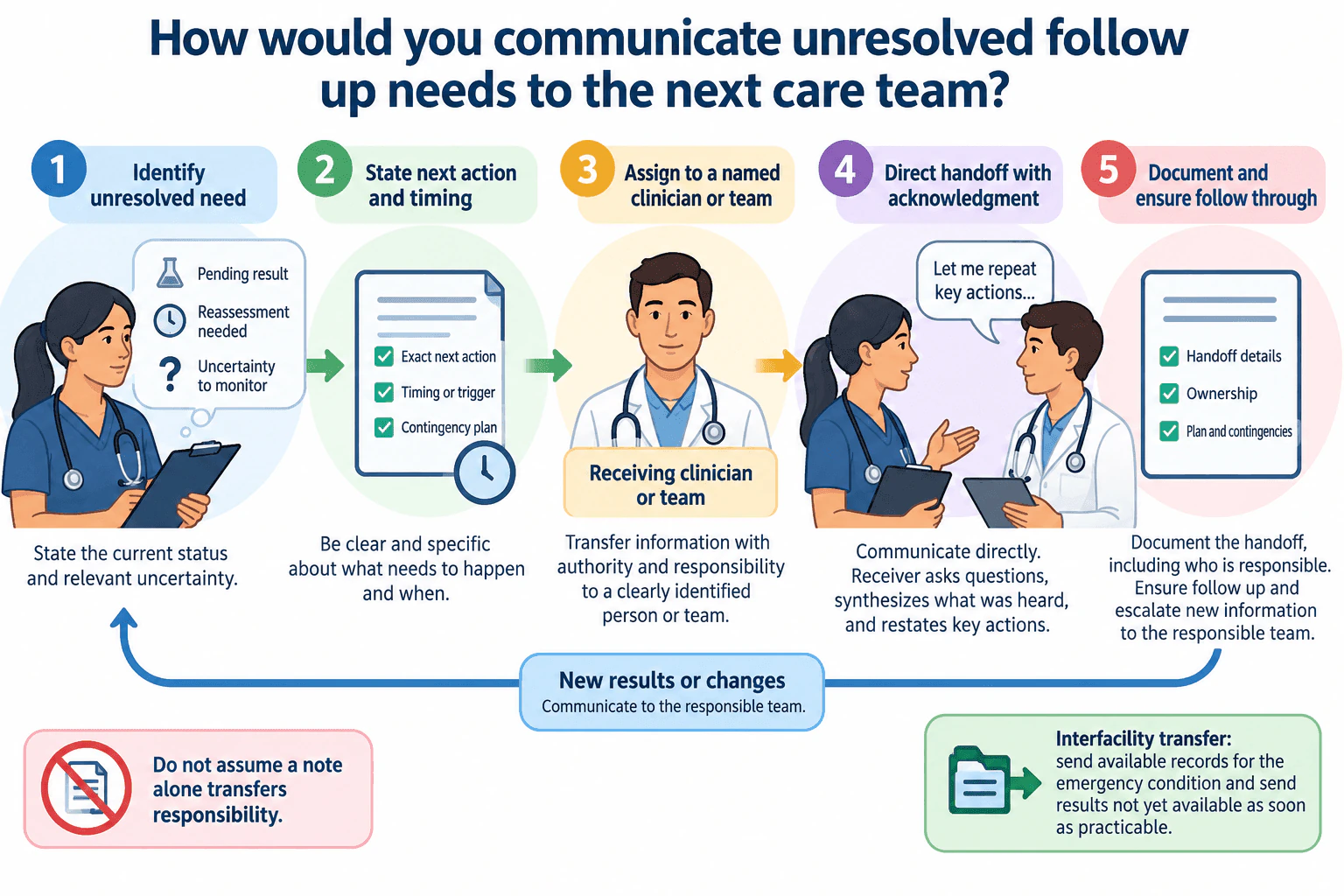
I would identify the unresolved need, explain the current status and any uncertainty, state the exact next action and timing, and hand responsibility to a clearly identified clinician or team. I would communicate directly when possible, confirm that the receiver understands and accepts the handoff, and give the receiver an opportunity to ask questions and restate key actions. I would then document the handoff objectively, including who received it and the follow up plan. If new results or changes appear afterward, I would promptly communicate them to the responsible team rather than assuming that an electronic note will be seen.
Useful Questions to Ask the Interviewer
What communication pathway is used here for pending results or unresolved needs during a change of care team?
How is responsibility for pending follow up documented and confirmed in this emergency department?
Who should be contacted if a clinically important result returns after the patient has transferred or left the department?
Detailed Explanation
How to Explain It in an Interview
I would treat an unresolved follow up need as an active responsibility that must be clearly transferred, not simply recorded in the chart.
First, I would identify exactly what remains unresolved. That could be a pending result, a reassessment that is still needed, or another uncertainty that requires monitoring. I would state the current status, what has already been done, and the relevant uncertainty without adding assumptions or charting care that was not performed.
Next, I would state the required action and timing. The receiving team should know what needs to happen, when it should happen, and what contingency requires escalation. I would identify the clinician or team accepting responsibility rather than using vague wording about who might follow up.
I would use direct communication when feasible. AHRQ describes a handoff as a transfer of information together with authority and responsibility. It also emphasizes acknowledgment by the receiver, an opportunity to ask questions, and synthesis or restatement of key actions. I would therefore confirm that the receiving clinician or team understands and accepts responsibility rather than assuming that documentation or an electronic message alone completes the transfer.
I would document the unresolved issue, relevant findings and actions, the communication, who received the handoff, the plan, and any contingency according to local policy. I would use appropriate communication channels and reasonable safeguards for protected health information. HIPAA permits providers to disclose protected health information for treatment and care coordination, including communication with another provider involved in the patient's care.
If a new result or clinical change becomes available after the handoff, I would communicate it promptly to the team that now holds responsibility. For an interfacility transfer governed by EMTALA, the transferring hospital sends available medical records related to the emergency condition with the transfer, and records not yet available are sent as soon as practicable afterward.
The goal is a closed communication loop: the unresolved need is identified, the next action and timing are explicit, responsibility is assigned and acknowledged, contingencies are communicated, and later information reaches the responsible team.
Why Interviewers Ask This
Interviewers are evaluating whether the nurse can maintain continuity of care when an issue is still pending. The key judgment is recognizing that documentation alone is not the same as transferring responsibility. A safe handoff identifies what remains unresolved, what must happen next, who is responsible, what uncertainty or contingency exists, and whether the receiving clinician or team has acknowledged the information.
Common interview mistakes
Common mistakes include documenting a pending issue without directly transferring responsibility, using vague language about who will follow up, omitting the required next action or timing, failing to confirm that the receiver understands and accepts responsibility, failing to communicate important new information that appears after the handoff, charting care that was not performed, or disclosing protected health information without appropriate safeguards.
Interview tip
Organize the answer around the same closed handoff loop shown in the diagram: identify the unresolved need, state the next action and timing, assign responsibility to a named clinician or team, obtain acknowledgment with questions and restatement of key actions, document the handoff, and communicate any later result or change to the responsible team.
Interviewer may ask next
How would you verify that the receiving team actually accepted responsibility for the unresolved follow up?
I would use an appropriate direct communication method and confirm that the receiving clinician or team understands the unresolved issue, the required next action, the timing, and any contingency. I would allow questions and ask for acknowledgment or a brief restatement of key actions when appropriate. I would then document the completed handoff according to local policy. I would not assume that entering a note or sending an electronic message alone proves that responsibility was accepted.
What would you do if an important result became available after the patient had already transferred to another facility?
I would promptly communicate the new result through the appropriate clinical channel to the receiving facility or responsible team and document that communication according to local policy. For an EMTALA interfacility transfer, records related to the emergency condition that were unavailable when the patient left, including later test results when relevant, are sent to the receiving facility as soon as practicable.
7. Tell us about a time you had a run-in with your coworker and how did you get through that?BehavioralEasyKaiser Permanente
i Question Details
Use a truthful nursing or clinical example. Describe the conflict, your judgment, how you communicated with the coworker, what actions you took, the outcome, and what you learned.
Interview tip:
Use STAR to structure your answer: briefly explain the Situation and Task, make Action the most detailed part, and finish with the Result. For example, describe a disagreement with a coworker during a busy emergency department shift, explain your responsibility to protect patient care while addressing the conflict, show how you listened, communicated calmly, clarified priorities, and worked with the coworker, and finish with how the relationship and teamwork improved.
Situation
During a busy emergency department shift, a coworker became frustrated with me because they felt I was not helping quickly enough with another patient care task. At that moment, I was reassessing one of my assigned patients after a change in the patient's condition, so our priorities did not look the same from each other's point of view.
Task
My responsibility was to continue safe care for my assigned patient while also addressing the disagreement before it affected teamwork. I wanted to understand my coworker's concern, explain what I was managing, and find a practical way for us to work together.
Action
I first completed the immediate reassessment that needed my attention. Once the situation was stable, I asked my coworker to speak briefly away from the patient care area. I kept my tone calm and asked them to explain what had frustrated them. I listened without interrupting because I wanted to understand the problem instead of becoming defensive. I then explained that I had been focused on a change in my patient's condition and was not intentionally avoiding the other task. I also acknowledged that I could have communicated my situation earlier. We agreed that when either of us was tied up with a higher priority patient need, we would say so directly and ask for specific help instead of assuming the other person was unwilling to assist. I then helped with the remaining work when I was able. I kept the discussion focused on patient care and teamwork rather than on who was right.
Result
The tension was resolved, and we were able to work together normally for the rest of the shift. I learned that many conflicts in a fast clinical environment come from incomplete communication rather than bad intentions. Since then, I have tried to explain competing priorities earlier and address concerns directly and respectfully before frustration builds.
Why Interviewers Ask This
Interviewers ask this question to understand how a nurse handles conflict under pressure while protecting patient care and professional relationships. A strong answer shows calm communication, accountability, sound judgment, respect for coworkers, and the ability to solve a disagreement without letting it interfere with teamwork.
Interviewer may ask next
What would you do differently if you faced the same situation again?
I would communicate my competing patient priority earlier. I would tell my coworker that I needed to finish an important reassessment first and give a clear idea of when I could help. That could prevent the coworker from feeling ignored and reduce frustration before it becomes a conflict.
How did you keep the disagreement from affecting patient care?
I did not stop an important patient reassessment to argue about the disagreement. I finished the immediate patient care responsibility first, then spoke with my coworker privately and calmly. By separating the urgent clinical need from the interpersonal issue, I could address both without allowing the conflict to distract us from patient care.
8. Tell me your weaknesses and strengthsNEWBehavioralMediumKaiser Permanente
i Question Details
Identify genuine professional strengths and one meaningful development area. Explain how they affect your nursing practice and what you are doing to continue improving without inventing qualifications or outcomes.
Interview tip:
Use STAR to structure your answer: briefly explain the Situation and Task, make Action the most detailed part, and finish with the Result. For example, describe a busy emergency department situation that shows strengths such as prioritization and clear communication, while honestly explaining one development area, the steps you took to improve it, and how that growth affected your practice.
Situation
During a busy emergency department shift, I was caring for several patients with different needs while coordinating with the rest of the care team. That type of situation reflects two of my main strengths, staying organized when priorities change and communicating clearly. It also highlighted a development area for me. Earlier in my practice, I sometimes tried to handle too many tasks myself instead of delegating appropriate work early.
Task
My responsibility was to keep my patients' care organized, recognize which needs required my immediate attention, communicate changes clearly, and use the team effectively. I also wanted to improve my delegation so that I could stay focused on the nursing responsibilities that needed my direct attention.
Action
I first reviewed the immediate priorities for each patient and organized my work around the most time sensitive needs. I kept the care team updated when priorities changed and made sure important information was communicated clearly rather than assuming someone else already knew it. For my development area, I became more deliberate about identifying tasks that another appropriate team member could safely handle. I gave clear instructions, confirmed that the person understood the request, and followed up instead of simply assuming the task was complete. I also paid attention to situations where I was holding onto work because I felt personally responsible for everything. That helped me recognize that good delegation is not giving away responsibility. It is using the team appropriately while I remain accountable for my nursing role and continue reassessing my patients. I have continued working on this by reflecting after busy shifts and asking myself whether I communicated early enough and used available team support effectively.
Result
I became more comfortable using the team while still maintaining ownership of my patients' care. My strengths in prioritization and communication became more useful because I was not trying to manage every task alone. I also learned that a meaningful weakness should be something I actively work on, so I continue to improve my delegation and communication as clinical situations change.
Why Interviewers Ask This
Interviewers ask this question to understand whether a candidate has realistic self awareness, can identify strengths that support emergency nursing, and can discuss a development area without avoiding responsibility. A strong answer shows reflection, practical improvement, and a willingness to keep learning while maintaining safe and collaborative nursing practice.
Interviewer may ask next
How have you worked on becoming more comfortable with delegation?
I started by being more intentional about deciding which responsibilities needed my direct nursing attention and which appropriate tasks could be shared with another team member. I give clear instructions, confirm understanding, and follow up afterward. That approach has helped me use the team more effectively while still maintaining responsibility for my patients and their changing priorities.
Which of your strengths is most important during a busy emergency department shift?
I think my ability to prioritize while communicating clearly is especially important. In the situation I described, I had to keep reassessing what needed attention first and make sure the team understood when priorities changed. Staying organized helped me act deliberately, and clear communication helped the team work together without relying on assumptions.
9. Basic questions like diversity, how did handle a situation within conflict, how you’ve resolved or come up a solution in a group setting conflictsBehavioralMediumKaiser Permanente
i Question Details
Use truthful examples involving diversity and group conflict. Explain the situation, your role, how you communicated with others, how you helped reach a solution, the outcome, and what you learned.
Interview tip:
Use STAR to structure your answer: briefly explain the Situation and Task, make Action the most detailed part, and finish with the Result. For example, describe a time when different perspectives created conflict in an emergency department team, explain your responsibility, show how you listened to each person, protected respectful communication, considered the needs of a patient from a different language background, helped the group agree on a safe approach, and explain what you learned.
Situation
In a previous emergency department role, our team was preparing an adult patient for discharge after the care plan had been set. The patient had limited English proficiency, and a family member offered to translate. During a busy period, a team member felt that using the family member would be the fastest way to complete the teaching. I was concerned that the patient needed a clear chance to understand the information directly through qualified language assistance. This created some disagreement within the group.
Task
My responsibility was to support clear patient communication while also keeping a respectful working relationship with the team. I needed to address the disagreement without making it personal and help us reach a practical solution that respected the patient and allowed the team to keep moving.
Action
I first listened to the team member and acknowledged the pressure we were under. I did not argue in front of the patient or criticize the other person. I explained calmly that my concern was not about slowing the team down. My concern was making sure the patient could understand the discharge information and ask questions in the language they were most comfortable using. I suggested that we use the available qualified interpreter service for the teaching. I also asked the team member to help me identify anything else that needed to be completed so we could work in parallel instead of treating the situation as a choice between communication and efficiency. Once the interpreter was available, I reviewed the nursing instructions with the patient, paused for questions, and checked the patient's understanding. I kept the family member involved as support while making sure the patient remained the center of the conversation. Afterward, I spoke briefly with the team member away from the bedside. I thanked them for working through the disagreement with me and explained that I valued their concern about patient flow. We agreed that when similar conflicts happen, we should first identify the shared goal and then discuss the safest practical way to reach it.
Result
We resolved the conflict professionally and completed the patient's education with qualified language assistance. The discussion also improved how the team member and I communicated during later busy situations because we were more willing to explain our concerns before assuming the other person was wrong. I learned that diversity can affect how patients understand and experience care, and that conflict is easier to solve when I listen first, keep the discussion respectful, and bring everyone back to the shared goal of clear and safe patient care.
Why Interviewers Ask This
Interviewers ask this question to understand how a candidate works with people who have different backgrounds, perspectives, and priorities. They are looking for respectful communication, active listening, sound judgment, teamwork, and the ability to resolve disagreement without losing focus on the patient. A strong answer shows that the candidate can speak up constructively, consider another person's viewpoint, and help a group reach a practical solution.
Interviewer may ask next
How did you handle the team member's resistance without making the conflict worse?
I started by acknowledging the pressure the team member was feeling instead of immediately challenging their position. I explained that we had the same goal of caring for the patient efficiently and that my concern was about clear communication. I then suggested a specific solution and offered to divide the remaining work so the interpreter process did not stop everything else. That kept the conversation focused on solving the problem instead of deciding who was right.
What would you do if you faced a similar disagreement now?
I would use the same basic approach, but I would identify the shared goal even earlier. I would listen to the other person's concern, explain my concern clearly, and separate the issue from the person. Then I would suggest a practical next step that respects the patient's communication needs and keeps the team working together. I would also follow up after the immediate situation so any tension does not carry into future teamwork.
10. Tell me about a time when you gave compassionate careNEWBehavioralHardKaiser Permanente
i Question Details
Use a truthful nursing or clinical example. Describe the patient need you recognized, how you showed compassion while maintaining safe care, how you communicated, the outcome, and what you learned.
Interview tip:
Use STAR to structure your answer: briefly explain the Situation and Task, make Action the most detailed part, and finish with the Result. For example, describe a patient who was frightened or overwhelmed in the emergency department, the need you recognized beyond the immediate clinical problem, how you listened and explained care in simple words, how you maintained safety and privacy, and how your approach affected the patient and your nursing practice.
Situation
During a busy emergency department shift, I cared for an anxious patient who was in pain and visibly frightened. The patient was having difficulty following what was happening and kept asking whether something serious was wrong. I could see that the emotional distress was making an already difficult experience harder.
Task
My responsibility was to provide safe nursing care while also helping the patient feel heard, respected, and informed. I wanted to reduce unnecessary fear without making promises about the diagnosis or taking attention away from the clinical evaluation.
Action
I first made sure the patient was comfortable enough to speak with me and that our conversation was as private as the setting allowed. I sat where the patient could see me clearly and asked what was worrying them most. Instead of interrupting or immediately giving more information, I listened and acknowledged that the uncertainty was frightening. I then explained, in simple words, what the care team was doing at that point and what the patient could expect next. I avoided guessing about results that were not yet available. I checked that the patient understood and encouraged questions. While continuing my nursing assessments, I watched for changes in the patient's condition and communicated relevant concerns to the rest of the care team. I also returned when I could to provide updates rather than leaving the patient unsure about what was happening. Those small actions helped me address the patient's emotional needs while keeping the clinical priorities in focus.
Result
The patient became calmer and was better able to participate in the conversation about care. The experience reinforced for me that compassion in emergency nursing is not separate from safe care. It can mean listening carefully, protecting dignity, explaining what is known, being honest about what is not yet known, and making sure a frightened patient does not feel ignored during a stressful situation.
Why Interviewers Ask This
Interviewers ask this question to understand whether a nurse can recognize emotional needs while still maintaining clinical priorities, professional boundaries, privacy, and clear communication. A strong answer shows that compassion is expressed through respectful listening, patient centered communication, safe judgment, and consistent attention to dignity.
Interviewer may ask next
Why did you choose to spend extra time listening when the emergency department was busy?
I felt that listening briefly was part of providing effective care, not something separate from it. The patient was frightened and having trouble processing information. By first understanding the main concern, I could give a clearer explanation and help the patient participate more effectively while I continued the necessary nursing care.
What did you learn from that experience about compassionate care?
I learned that compassion often comes through simple, deliberate actions. Listening without rushing, explaining what I know in clear words, being honest when information is still pending, protecting privacy, and returning with updates can make a difficult emergency department experience feel more respectful and manageable for the patient.
Emergency Department Nurse Resume Examples
Explore the resume examples below to find the one that best matches your target Emergency Department Nurse role.
New Graduate Emergency Department Nurse0-1 years; supervised transition to emergency nursing
Disclaimer: This interview guide is for educational and informational purposes only. It is designed to help readers prepare, but it does not guarantee any interview result, hiring decision, offer, or outcome. Interview questions, hiring criteria, and preferred answers can vary by employer, interviewer, industry, location, and time. All answers, examples, and explanations in this guide are suggested examples for interview preparation, not definitive answers or instructions for professional practice. They are based on research and judgment, are provided without warranties of any kind, and should be adapted to the question, role, and applicable laws and professional requirements. Diagrams are simplified illustrations intended to highlight the main concepts and their relationships; actual situations, systems, and practices may be more complex. Alternative approaches may be equally valid or better suited to a particular question, context, or interviewer. To the fullest extent permitted by applicable law, the contributors and publisher are not liable for decisions made, actions taken, or losses incurred based on this guide.
State Laws and Professional Responsibilities: Laws and requirements governing an occupation vary by state and jurisdiction. You are responsible for checking the current laws, licensing requirements, and scope-of-practice rules that apply to your location and role, and for ensuring that your answers and actions comply with them. Adapt examples in this guide to those requirements. This guide is not legal advice.
Company Notice: This guide is an independent educational resource and is not affiliated with, endorsed by, sponsored by, or approved by the company named in this guide. Company names identify reported interview experiences or the employer context of clearly labeled original practice exercises. Interview practices can change without notice, and inclusion of company-specific content does not mean these questions are official, complete, or guaranteed to be asked. To the fullest extent permitted by law, the author, contributors, and publisher are not responsible for outcomes related to use of this material.
Content Accuracy and Verification: To the fullest extent permitted by applicable law, we do not represent or warrant that interview guides, questions, answers, examples, or diagrams are accurate, complete, current, error-free, or suitable for any particular purpose. You are responsible for independently reviewing and verifying the information before relying on it.