This interview guide is for educational and informational purposes only. It is designed to help readers prepare, but it does not guarantee any interview result, hiring decision, offer, or outcome. Interview questions, hiring criteria, and preferred answers can vary by employer, interviewer, industry, location, and time. All answers, examples, and explanations in this guide are suggested examples for interview preparation, not definitive answers or instructions for professional practice. They are based on research and judgment, are provided without warranties of any kind, and should be adapted to the question, role, and applicable laws and professional requirements. Diagrams are simplified illustrations intended to highlight the main concepts and their relationships; actual situations, systems, and practices may be more complex. Alternative approaches may be equally valid or better suited to a particular question, context, or interviewer. To the fullest extent permitted by applicable law, the contributors and publisher are not liable for decisions made, actions taken, or losses incurred based on this guide.
State Laws and Professional Responsibilities
Laws and requirements governing an occupation vary by state and jurisdiction. You are responsible for checking the current laws, licensing requirements, and scope-of-practice rules that apply to your location and role, and for ensuring that your answers and actions comply with them. Adapt examples in this guide to those requirements. This guide is not legal advice.
Identity, Image, and Privacy Notice
To respect individual privacy, some names, profile photographs, avatars, biographical details, and other identifying information displayed in this guide may be replaced with pseudonyms, licensed stock images, illustrative avatars, composite images, or representative descriptions. Unless a person is expressly identified as an actual contributor, a displayed name, image, or profile should not be understood as depicting or identifying a specific candidate, interviewer, employee, or other real individual. These representations are provided for editorial and illustrative purposes only and do not imply endorsement, employment, participation, or affiliation with this guide or any company mentioned in it. Any resemblance to an actual person is coincidental.
Company Notice
This guide is an independent educational resource and is not affiliated with, endorsed by, sponsored by, or approved by the company named in this guide. Company names identify reported interview experiences or the employer context of clearly labeled original practice exercises. Interview practices can change without notice, and inclusion of company-specific content does not mean these questions are official, complete, or guaranteed to be asked. To the fullest extent permitted by law, the author, contributors, and publisher are not responsible for outcomes related to use of this material.
Content Accuracy and Verification
To the fullest extent permitted by applicable law, we do not represent or warrant that interview guides, questions, answers, examples, or diagrams are accurate, complete, current, error-free, or suitable for any particular purpose. You are responsible for independently reviewing and verifying the information before relying on it.
Questions or comments?
Contact us for general questions, or share feedback, technical corrections, and comments with the community.
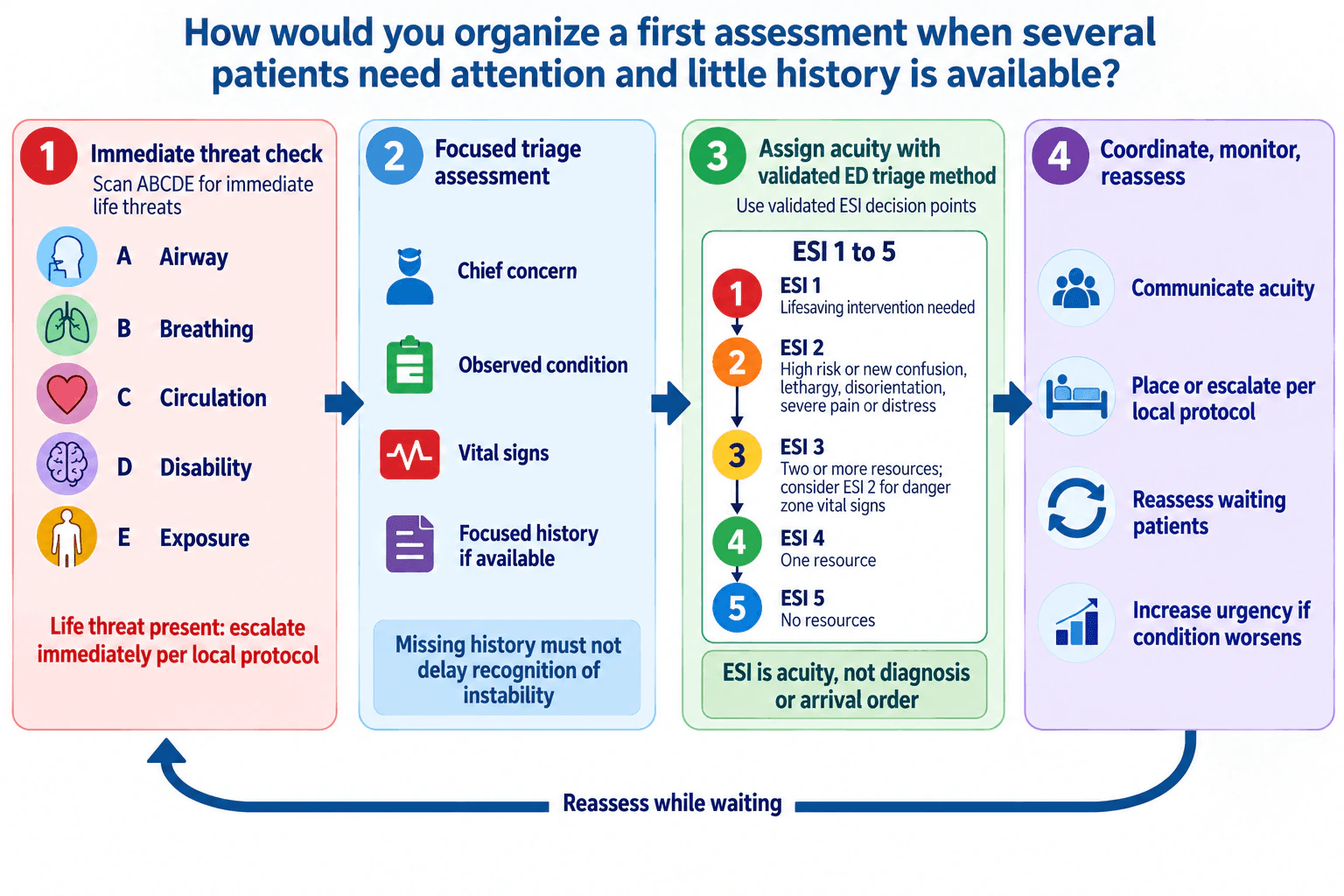
1. How would you organize a first assessment when several patients need attention and little history is available?NEWClinical KnowledgeEasyProvidence
i Question Details
Original practice question for this employer context, not a reported employer interview question. Explain the relevant ED nursing judgment and identify information or authority you would need. Do not assume an internal employer protocol.
Short Interview Answer (30-60 seconds)
I would start by looking for immediate threats using an ABCDE assessment and escalate any life threat right away according to local protocol. For patients without an immediately identified life threat, I would obtain the chief concern, observed condition, vital signs, and focused history if available. I would then assign acuity using a validated Emergency Severity Index process, not diagnosis or arrival order. I would communicate that priority, place or escalate care according to local processes, and reassess patients who are waiting because their condition and acuity can change.
Detailed Explanation
When several patients need attention and history is limited, the goal is not to complete a full assessment on one person before looking at the others. The goal is to identify who may be unstable, establish relative urgency with a validated triage method, and keep reassessing as new information appears.
Useful Questions to Ask the Interviewer
Which validated triage system does this emergency department use?
What local process should the nurse follow when a patient needs immediate escalation?
How is reassessment of patients who remain in the waiting area organized?
How to Explain It in an Interview
I would begin with a rapid scan for immediate threats using airway, breathing, circulation, disability, and exposure. If I identify a life threatening problem, I would escalate immediately and follow the department's local emergency process rather than delaying for a complete history.
For patients without an immediately identified life threat, I would collect the information that changes urgency most quickly: the chief concern, what I can directly observe, vital signs, and a focused history if it is available. Missing history would not prevent me from recognizing instability from current findings.
I would then apply the Emergency Severity Index decision points. ESI 1 identifies a patient needing a lifesaving intervention. ESI 2 identifies a high risk presentation or findings such as new confusion, lethargy, disorientation, or severe pain or distress. For patients who reach the resource decision point, ESI 3 generally reflects two or more expected resources, with danger zone vital signs prompting consideration of greater urgency based on clinical judgment. ESI 4 reflects one expected resource and ESI 5 reflects no expected resources. ESI is an acuity tool, not a diagnosis and not a rule that patients are seen in arrival order.
After assigning acuity, I would communicate the priority to the care team and place or escalate the patient according to local protocol and available nursing authority. Anyone who remains waiting requires reassessment because symptoms, vital signs, mental status, or overall appearance can change.
The key is to keep the first assessment structured but brief: recognize immediate threats first, gather enough focused information to determine urgency, use the department's validated triage method, communicate priority, and reassess rather than assuming the original acuity remains correct.
Why Interviewers Ask This
This question evaluates whether the nurse can rapidly recognize instability, prioritize several patients using a structured triage method, work safely when information is incomplete, communicate urgency, and continue reassessment rather than treating the initial triage decision as permanent.
Common interview mistakes
Common mistakes include prioritizing by arrival order, waiting for a complete history before recognizing an immediate threat, treating ESI as a diagnosis, assigning acuity from one isolated finding without considering the whole presentation, assuming the first triage level never changes, or describing an employer specific escalation process that has not been provided.
Interview tip
Describe your sequence clearly: immediate threat scan, focused triage information, validated acuity assignment, communication, and reassessment. State that local protocol determines the exact escalation pathway and that missing history does not justify inventing patient findings.
Interviewer may ask next
How would you verify that your initial priority decision remains appropriate while patients are waiting?
I would repeat a focused assessment and vital signs according to the patient's condition and local policy, compare the new findings with the initial presentation, and look for changes in airway, breathing, circulation, mental status, pain, appearance, or other concerning findings. If the patient worsens or new high risk information appears, I would reconsider the acuity, communicate the change promptly, and escalate according to local protocol rather than relying on the original triage level.
How would your approach change if one patient became confused and visibly more distressed while waiting?
I would reassess that patient immediately because new confusion and worsening distress can indicate increased risk. I would repeat a rapid ABCDE assessment, obtain updated vital signs and focused information as available, reconsider the patient's ESI level using the validated decision points, communicate the change in acuity, and escalate according to local protocol and available nursing authority.
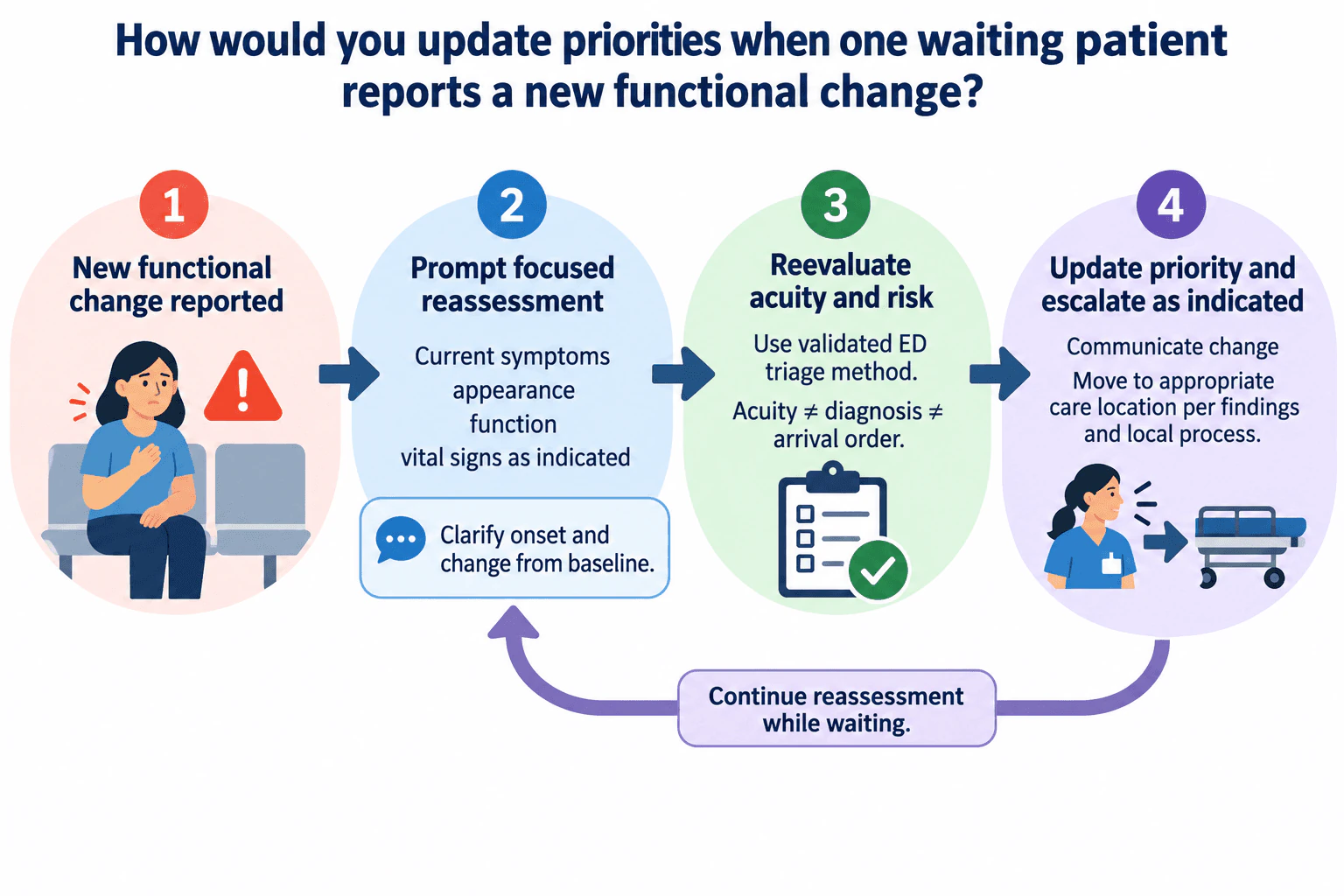
2. How would you update priorities when one waiting patient reports a new functional change?NEWClinical KnowledgeEasyProvidence
i Question Details
Original practice question for this employer context, not a reported employer interview question. Explain the relevant ED nursing judgment and identify information or authority you would need. Do not assume an internal employer protocol.
Short Interview Answer (30-60 seconds)
I would promptly reassess the patient because a new functional change may alter acuity. I would clarify the onset and change from baseline, assess current symptoms, appearance, function, and indicated vital signs, then use the department's validated triage method to reevaluate priority. Triage is about clinical urgency, not diagnosis or arrival order. If the new findings increase concern, I would communicate the change and escalate the patient to the appropriate care location under local policy. If the patient continues waiting, I would continue reassessment for further change.
Detailed Explanation
A waiting patient's priority is not fixed. A newly reported functional change is new clinical information, so the first step is a focused reassessment rather than simply keeping the original triage assignment.
Useful Questions to Ask the Interviewer
Which validated triage system does this emergency department use?
What is the local process for escalating a waiting patient whose condition changes?
Which actions can the triage nurse initiate independently or under approved protocols while the patient is waiting?
How to Explain It in an Interview
Clinical Priorities
I would first clarify exactly what changed, when it began, and how the patient's current function differs from baseline. I would then perform a focused reassessment based on the complaint, including current symptoms, general appearance, function, and vital signs when clinically indicated. I would not invent findings that were not provided.
Next, I would reevaluate the patient's acuity using the validated triage method used by the department, such as the Emergency Severity Index when applicable. Triage acuity represents clinical urgency. It is not a diagnosis, and it is not determined simply by who arrived first.
If the reassessment indicates increased urgency, I would communicate the change promptly and escalate the patient to the appropriate care location or clinician according to department policy, available resources, and my nursing authority. Protocol authorized actions would follow the applicable approved protocol, while actions requiring an order would be obtained from the appropriate clinician.
Assessment Factors
The important information includes the nature of the functional change, its onset and progression, the patient's baseline function, current symptoms, appearance, relevant focused assessment findings, and trends in vital signs when available. I would also watch for additional change while the patient remains in the waiting area.
Care Rationale
The key principle is that triage is dynamic. A patient's condition can evolve after the initial assessment, so new information can change clinical urgency. Reassessment helps identify deterioration and prevents the original triage decision from becoming outdated.
If the patient remains in the waiting area, I would continue reassessment and communicate any further change. I would document the new report, reassessment findings, change in priority when applicable, communication, and escalation according to local requirements.
Why Interviewers Ask This
This question evaluates whether the nurse recognizes that triage is dynamic. A strong answer shows that new information triggers reassessment, that priority is based on current acuity rather than diagnosis or arrival order, and that the nurse communicates and escalates meaningful changes without inventing patient findings or assuming authority that depends on local policy.
Common interview mistakes
Common mistakes include leaving the original triage priority unchanged without reassessment, treating the functional change as a diagnosis, prioritizing solely by arrival order, assuming that one reassuring finding rules out increased urgency, inventing missing symptoms or vital signs, and describing an employer specific escalation process without knowing the local policy.
Interview tip
Keep the answer centered on the same clinical sequence: recognize the new functional change, perform a focused reassessment, reevaluate acuity, communicate and escalate when indicated, then continue reassessment while the patient waits. State clearly that the exact triage tool, escalation pathway, and protocol authorized actions depend on the department.
Interviewer may ask next
What information would you verify before changing the patient's priority?
I would verify what function changed, when the change began, how it differs from baseline, whether it is progressing, the patient's current symptoms and appearance, relevant focused assessment findings, and indicated vital signs. I would then apply the department's validated triage method and verify the local escalation process rather than assuming an internal protocol.
What would you do if the patient developed another new change while still waiting?
I would reassess again because triage is dynamic. I would compare the new information with the previous assessment, reevaluate acuity using the department's validated triage method, communicate any increased concern, and escalate to the appropriate care location or clinician according to local policy and nursing authority. I would continue reassessment for as long as the patient remains in the waiting area.
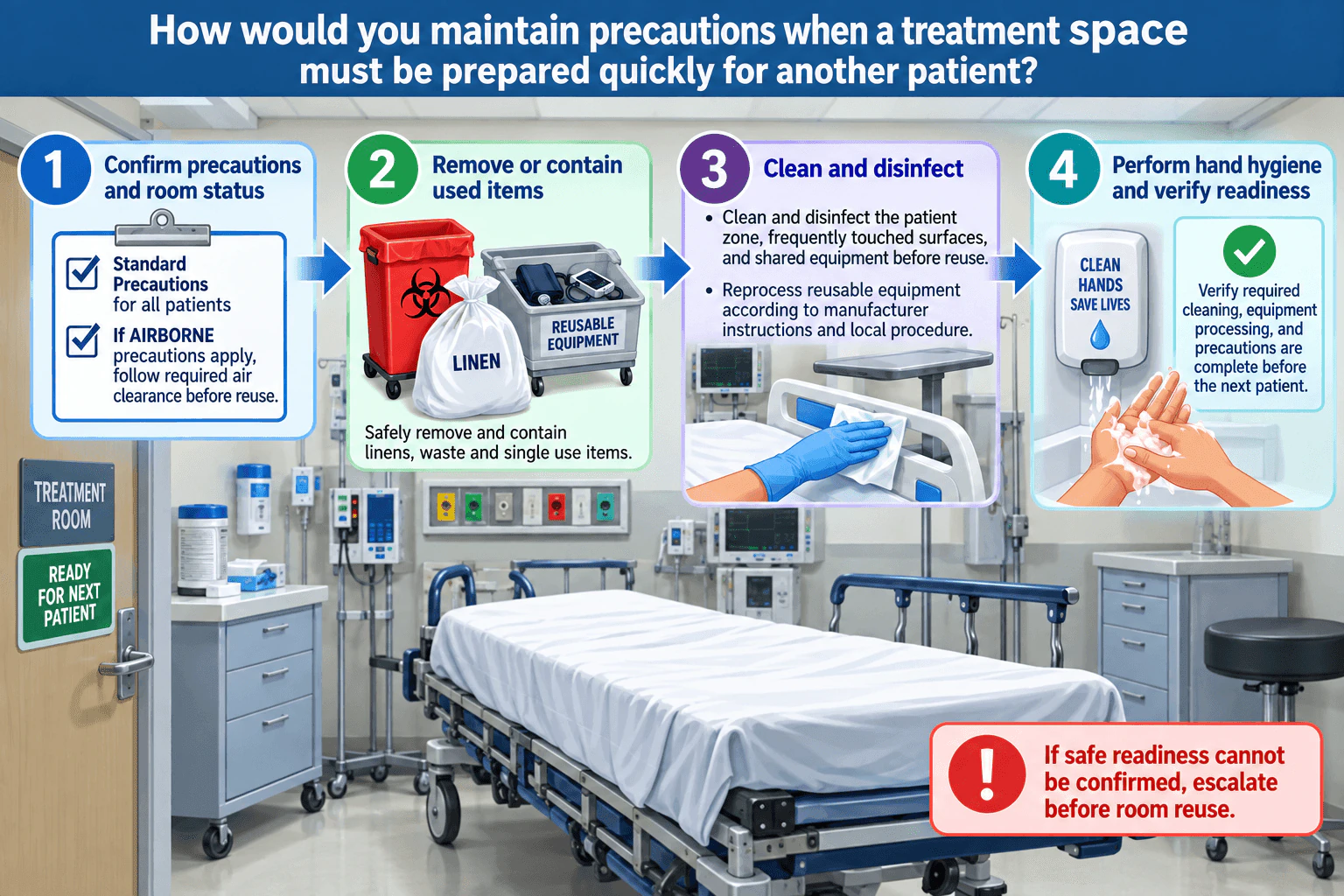
3. How would you maintain precautions when a treatment space must be prepared quickly for another patient?NEWPatient SafetyEasyProvidence
i Question Details
Original practice question for this employer context, not a reported employer interview question. Explain the relevant ED nursing judgment and identify information or authority you would need. Do not assume an internal employer protocol.
Short Interview Answer (30-60 seconds)
I would not let rapid turnover bypass infection precautions. I would confirm the room status and any required Standard Precautions or Transmission Based Precautions, safely contain used linens, waste, and single use items, and separate reusable equipment for appropriate reprocessing. I would coordinate cleaning and disinfection of the patient zone, frequently touched surfaces, and shared equipment, perform hand hygiene as indicated, and verify that all required precautions and processing are complete before the next patient enters. If I cannot confirm safe readiness, I would escalate before the room is reused.
Detailed Explanation
The key principle is that rapid room turnover should reduce unnecessary delay without removing required infection prevention steps. Standard Precautions apply to all patient care, while additional Transmission Based Precautions depend on the suspected or confirmed infection and clinical situation.
Useful Questions to Ask the Interviewer
How are room turnover responsibilities divided between nursing and environmental services in this emergency department?
What local process identifies when additional precautions or special room clearance requirements remain in effect?
How is completion of cleaning and equipment reprocessing communicated before a room is considered ready for another patient?
How to Explain It in an Interview
Confirm the precautions
I would begin by confirming the room status and the precautions that apply. Standard Precautions remain the foundation for all patient care. If Transmission Based Precautions are indicated, I would maintain them through turnover according to the infectious risk and applicable infection prevention requirements. If airborne precautions apply and room clearance is required, I would follow the applicable ventilation and infection prevention guidance rather than assuming one universal waiting time.
Contain contaminated items
I would safely remove or contain used linens, waste, and single use items without spreading contamination. Reusable equipment would remain separated from clean equipment until it has been appropriately reprocessed.
Clean and reprocess
I would coordinate cleaning and disinfection of the patient zone, frequently touched surfaces, and shared equipment. Reusable equipment would be reprocessed before another patient uses it according to manufacturer instructions and the local procedure. I would follow the assigned division of responsibilities rather than assuming that every cleaning task belongs to the nurse.
Verify readiness
I would perform hand hygiene as indicated and verify that required environmental cleaning, equipment processing, and applicable precautions are complete before considering the space ready. I would not rely only on how the room looks. If safe readiness cannot be confirmed, I would escalate through the appropriate local communication process and avoid treating the room as ready until the concern is resolved.
This approach protects the next patient while supporting efficient emergency department flow.
Why Interviewers Ask This
This question evaluates whether the nurse can balance rapid emergency department turnover with infection prevention and patient safety. A strong answer shows that urgency does not replace Standard Precautions, that additional precautions remain in effect when indicated, that contaminated items and reusable equipment are handled safely, and that the nurse verifies readiness rather than assuming the room is safe.
Common interview mistakes
Common mistakes include treating rapid turnover as permission to skip environmental cleaning, assuming Standard Precautions are unnecessary when no infection is known, removing additional precautions before their requirements are satisfied, mixing clean and contaminated reusable equipment, assuming a visually clean room is ready for use, applying one fixed airborne clearance time to every situation, or considering the room ready without confirming that assigned cleaning and reprocessing tasks are complete.
Interview tip
Describe the same sequence you would use in practice: confirm precautions, contain contaminated items, coordinate cleaning and equipment reprocessing, perform hand hygiene, verify readiness, and escalate if readiness cannot be confirmed. Emphasize that you would follow manufacturer instructions and applicable local infection prevention procedures rather than inventing an employer specific rule.
Interviewer may ask next
How would you verify that the treatment space is actually ready for the next patient?
I would verify that required environmental cleaning and disinfection have been completed, that shared reusable equipment has been appropriately reprocessed or replaced with clean equipment, that contaminated linens and waste have been removed or contained, and that applicable Transmission Based Precaution requirements have been satisfied. I would also confirm completion with the responsible team when duties are shared. If any required step cannot be verified, I would not assume the room is ready and would escalate before reuse.
What would change if the previous patient required airborne precautions?
I would maintain the additional precautions required for that infection and confirm the applicable room clearance requirements before another patient enters. The necessary clearance depends on factors such as the infectious agent, room ventilation, and applicable infection prevention guidance, so I would not use an arbitrary universal waiting time. Environmental cleaning, reusable equipment reprocessing, hand hygiene, and final readiness verification would still be completed before the room is considered ready.
4. How would you explain a change in priorities to a patient whose planned care has been delayed?NEWCommunication And DelegationMediumProvidence
i Question Details
Original practice question for this employer context, not a reported employer interview question. Explain the relevant ED nursing judgment and identify information or authority you would need. Do not assume an internal employer protocol.
Short Interview Answer (30-60 seconds)
I would acknowledge the delay, explain that emergency department priorities can change when more urgent clinical needs arise, and avoid discussing another patient's private information or promising a time I cannot guarantee. I would reassess the patient, explain what care can continue, and tell the patient what changes should be reported immediately. I would provide updates as information becomes available and use teach back when appropriate to confirm understanding. If communication assistance were needed, I would obtain qualified interpretation or another appropriate aid. If competing assignments threatened safe care, I would escalate the concern and clearly confirm responsibility for any reassigned or delegated work.
Detailed Explanation
A delay should be explained as a change in clinical priority, not as a sign that the patient's needs no longer matter. My first responsibility is to make sure the patient has not developed a more urgent need, then communicate what has changed, what is known, what is still uncertain, and what will happen next.
Useful Questions to Ask the Interviewer
What communication resources are available when a patient needs language assistance or another communication accommodation?
How are nurses expected to escalate competing assignments when workload may affect safe care?
What team roles are commonly available to assist with appropriate patient care tasks during periods of high demand?
How to Explain It in an Interview
Acknowledge and reassess
I would acknowledge the delay and the patient's concern without becoming defensive. I would reassess the patient because new symptoms or a change in condition could alter the priority again. Nursing assessment and nursing judgment remain the registered nurse's responsibility and are not delegated to assistive personnel.
Explain the priority clearly
I would explain in plain language that emergency department priorities can change according to clinical urgency and that an urgent need elsewhere may temporarily delay the planned care. I would not disclose another patient's information. I would explain what parts of the current plan can continue and avoid promising a specific time unless that timing is actually known.
Confirm understanding and support advocacy
I would invite questions and explain what symptoms or concerns the patient should report immediately. When appropriate, I would use teach back by asking the patient to describe the plan in their own words. A simple statement of agreement does not confirm understanding. If limited English proficiency or another communication barrier affects the discussion, I would use appropriate qualified interpretation or communication assistance so the patient can understand information, ask questions, and participate in decisions. If the plan changes in a way that requires a new treatment decision or consent discussion, I would make sure the appropriate clinician addresses that decision and that the patient's questions and concerns are heard.
Manage competing assignments safely
If competing patient needs made safe care difficult, I would notify the appropriate clinical leader and request assistance or redistribution of work. For delegation, I would consider the patient's condition, the task, the other person's competence, applicable jurisdiction and scope requirements, and the supervision needed. I would give clear directions and use closed loop communication so the receiving team member confirms the task and expected reporting. I would also verify that responsibility for ongoing care is clear.
Keep the patient informed
I would return with updates when new information becomes available, reassess as needed, and continue advocating for the patient's needs. The goal is for the patient to understand why priorities changed, what remains planned, what changes to report, and who is responsible for the next step.
Why Interviewers Ask This
Interviewers are evaluating whether the nurse can communicate an unexpected delay respectfully while continuing to protect patient safety. The response shows whether the nurse can recognize changing acuity, reassess the patient, advocate for needed care, set realistic expectations, confirm understanding, protect privacy, use appropriate communication assistance, and escalate workload concerns. It also demonstrates whether the nurse understands that delegation must account for patient context, staff competence, applicable nursing scope, and supervision, and that nursing assessment and judgment are not transferred to assistive personnel.
Common interview mistakes
Common mistakes include giving reassurance without reassessing the patient, blaming another patient for the delay, sharing private information, promising a specific time that is not known, assuming that agreement proves understanding, failing to obtain appropriate qualified interpretation or communication assistance when needed, failing to escalate an unsafe workload, transferring responsibility without confirmation, or delegating nursing assessment or judgment to assistive personnel.
Interview tip
Give a brief example of the words you would use with the patient, then connect those words to your nursing actions. A strong response shows empathy, reassessment, a clear explanation of changing clinical priority, teach back, realistic updates, appropriate communication assistance, escalation when workload threatens safety, and clear responsibility for any assigned or delegated task.
Interviewer may ask next
How would you verify that the patient understood your explanation?
I would use teach back when appropriate. After explaining the reason for the delay and the current plan in plain language, I would ask the patient to describe in their own words what they understand about the next steps and what changes they should report. If their response showed a misunderstanding, I would explain the information differently and check understanding again rather than treating a simple yes as proof of understanding.
What would you do if the patient reported new or worsening symptoms while waiting for the delayed care?
I would reassess the patient promptly rather than assuming the previous priority still applies. I would act within registered nursing scope and any applicable authorized protocol, escalate concerning findings to the appropriate clinician, and communicate the change so the patient's priority and plan can be reconsidered. I would explain the updated plan to the patient, confirm understanding, and continue reassessment based on the clinical situation.
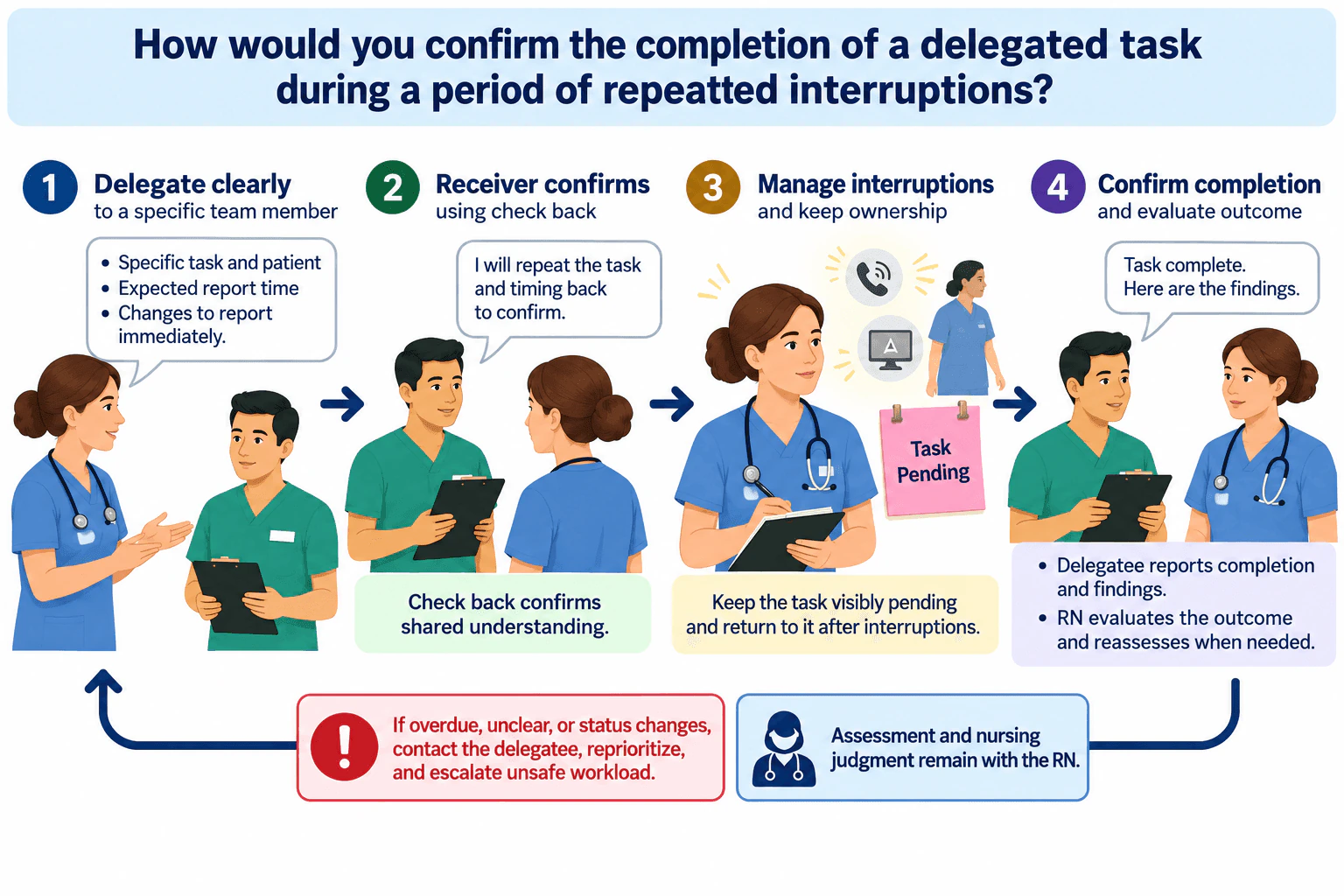
5. How would you confirm the completion of a delegated task during a period of repeated interruptions?NEWCommunication And DelegationMediumProvidence
i Question Details
Original practice question for this employer context, not a reported employer interview question. Explain the relevant ED nursing judgment and identify information or authority you would need. Do not assume an internal employer protocol.
Short Interview Answer (30-60 seconds)
I would use a closed loop process. I would clearly identify the task, patient, expected reporting time, and changes that require immediate notification, then have the receiving team member repeat the task and timing back so I can confirm understanding. During interruptions, I would keep the task visibly pending rather than rely on memory. I would close the loop only when the delegatee reports completion and relevant findings. I would evaluate the outcome, reassess the patient when needed, and follow up immediately if the task is overdue, unclear, or the patient's condition changes.
Detailed Explanation
The key is to treat delegation as an open responsibility until I have received and evaluated confirmation of completion. Repeated interruptions increase the risk that an unfinished task will be mistaken for a finished one, so I would use a deliberate closed loop process rather than rely on memory.
Useful Questions to Ask the Interviewer
What delegation and supervision rules apply to the staff role receiving the task in this setting?
What method does the department use to track delegated tasks that remain open during interruptions?
What escalation pathway should a nurse use when competing assignments make timely follow up unsafe?
How to Explain It in an Interview
Delegate Clearly
In this Washington emergency nursing context, I would first decide whether the task is appropriate to delegate under applicable nursing law and rules, the team member's competence, and the patient's clinical circumstances. I would identify the specific task and patient, when I expect the result to be reported, and which changes require immediate notification. I would not delegate assessment or acts requiring nursing judgment to assistive personnel.
Confirm Understanding
I would use check back communication. The receiving team member would repeat the task and timing back, and I would verify that the message was understood correctly before we separate. Agreement alone is not enough because I need confirmation that the assignment was received as intended.
Manage Interruptions Without Losing The Task
If I am interrupted, I would keep the delegated task visibly pending in the appropriate work tracking method rather than mentally marking it complete. I still retain responsibility for supervision and follow up. If workload or interruptions make safe follow up doubtful, I would reprioritize and escalate the workload through the appropriate clinical chain rather than allow responsibility to become unclear.
Confirm Completion And Evaluate The Result
I would close the loop when the delegatee reports that the task is complete and communicates the relevant findings. I would evaluate the outcome and determine whether the patient's condition requires my reassessment or another nursing action. If the task is overdue, the report is unclear, or the patient's status changes, I would contact the delegatee promptly and reassess the situation. Completion of the delegated activity does not transfer assessment or nursing judgment away from the registered nurse.
Why Interviewers Ask This
This question tests whether the nurse maintains accountability and situation awareness when interruptions compete for attention. Safe delegation requires selecting an appropriate task and competent person, communicating clear expectations, supervising and following up, and evaluating the result. It also tests whether the nurse recognizes that assessment and nursing judgment remain the responsibility of the registered nurse when those functions cannot be delegated.
Common interview mistakes
Common mistakes include assuming silence means the task was completed, accepting a vague statement such as done without receiving relevant findings, failing to specify when results should be reported, relying on memory during repeated interruptions, delegating assessment or an activity requiring nursing judgment to assistive personnel, failing to reassess when findings change the clinical picture, and allowing an unsafe workload to remain unaddressed.
Interview tip
Describe delegation as a complete loop rather than a single handoff. State what you communicate before the task, how you confirm that the receiver understood it, how you keep the task visibly pending during interruptions, what completion report you require, and how you evaluate the result. Also make clear that you would check applicable nursing rules, staff competence, and local policy rather than assume every task can be delegated in every setting.
Interviewer may ask next
What would you do if the delegatee says the task was completed but cannot clearly report the findings?
I would treat the communication loop as incomplete. I would clarify what was done and what was observed, then determine whether I need to reassess the patient myself. If the information remained unclear or suggested a change in condition, I would perform the nursing assessment required within my scope and take any needed escalation steps. I would not assume that the word completed proves an acceptable clinical outcome.
What would change if the patient's condition deteriorated while the delegated task was still pending?
The patient's changing condition would take priority. I would reassess the patient, reconsider whether the delegation remains appropriate, and give the delegatee updated direction or take the task back if nursing judgment is now required. I would communicate and escalate according to the patient's clinical needs and the available team resources. A task that was appropriate to delegate under stable circumstances may no longer be appropriate after the clinical context changes.
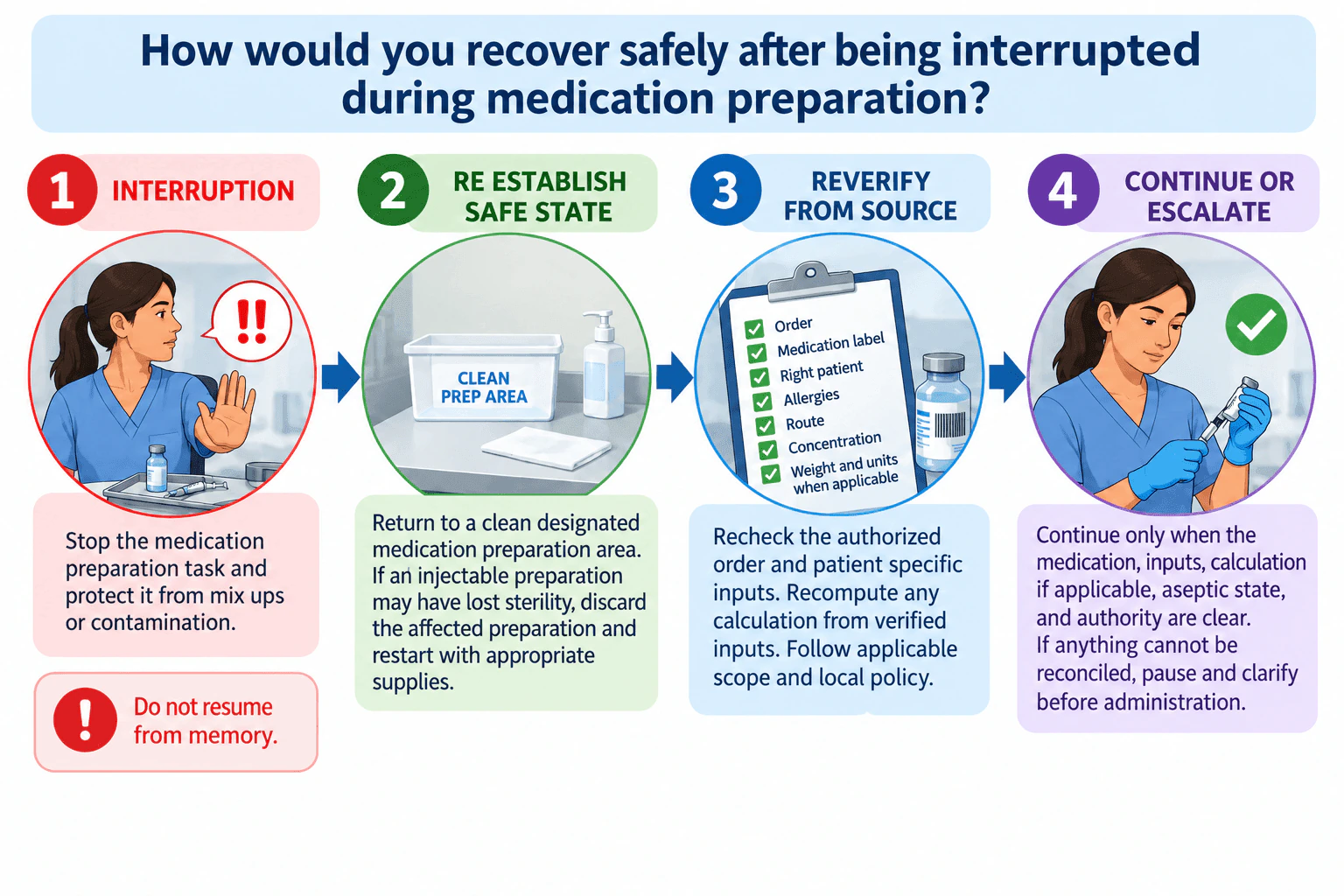
6. How would you recover safely after being interrupted during medication preparation?NEWMedication And ProceduresMediumProvidence
i Question Details
Original practice question for this employer context, not a reported employer interview question. Explain the relevant ED nursing judgment and identify information or authority you would need. Do not assume an internal employer protocol.
Short Interview Answer (30-60 seconds)
I would stop and restart from a known safe point rather than rely on memory. I would return to the authorized order and patient information, recheck the medication, patient, allergies, route, concentration, and any relevant weight or units, and recompute any calculation from verified inputs. I would also confirm that aseptic integrity was maintained. If an injectable preparation may have been compromised, I would discard the affected preparation and restart with appropriate supplies under applicable policy. I would proceed only when everything is reconciled and within my authority; otherwise, I would pause and clarify before administration.
Detailed Explanation
An interruption creates a risk that I may lose track of what has already been checked or completed. My safest response is to stop, protect the medication preparation from mix ups or contamination, and deliberately re establish a verified starting point instead of continuing from memory.
Useful Questions to Ask the Interviewer
What medication preparation and interruption recovery procedures does the organization expect nurses to follow?
Which medications or situations require an additional independent verification under local policy?
What documentation or escalation process is expected when a preparation must be discarded or an order cannot be reconciled?
How to Explain It in an Interview
Re Establish a Safe State
I would first stop the preparation task and keep the medication and supplies controlled so I do not accidentally continue from an uncertain point. I would return to a designated clean medication preparation area when appropriate. For injectable medications, aseptic technique is essential. If I could not establish that the affected preparation remained suitable for use because aseptic integrity may have been lost, I would discard that preparation and restart with appropriate supplies according to applicable policy.
Reverify From the Source
I would go back to the authorized order and the relevant patient information rather than rely on what I remember completing before the interruption. I would recheck the medication, patient, allergies, route, concentration, and any supplied weight and units that matter to the preparation. If a calculation is involved, I would recompute it from verified inputs rather than assume my previous arithmetic was correct.
Confirm Authority and Resolve Uncertainty
Before continuing, I would confirm that the preparation, required checks, and action are within my education, licensure, competence, authorized order, and applicable policy. I would not assume that an employer specific process or special verification requirement applies universally.
Continue or Escalate
I would resume preparation only after the medication information, any calculation, aseptic state, and authority to proceed are clear. If I found a discrepancy, could not verify an input, or was uncertain about whether the preparation remained safe, I would pause and obtain clarification or appropriate assistance before administration. The goal is to replace memory based continuation with a deliberate, traceable verification process.
Why Interviewers Ask This
This question evaluates whether the nurse recognizes interruption as a medication safety risk and can recover without relying on memory or assumptions. It also tests whether the nurse can distinguish independent nursing safety checks from actions that depend on an authorized order, medication specific requirements, competence, and local policy.
Common interview mistakes
Common mistakes include resuming from memory, assuming earlier checks were completed, failing to return to the authorized order, reusing an injectable preparation when aseptic integrity is uncertain, carrying forward an unverified calculation, overlooking relevant allergies or route information, and proceeding despite an unresolved discrepancy or unclear authority.
Interview tip
Describe a deliberate recovery sequence: stop, re establish a safe preparation state, reverify from the authorized source, recompute anything that depends on patient specific inputs, confirm aseptic integrity and authority, then continue only when every uncertainty is resolved. Avoid claiming a universal Providence procedure or an automatic rule that applies to every medication.
Interviewer may ask next
What would you verify before resuming medication preparation?
I would return to the authorized order and relevant patient information and verify the medication, patient, allergies, route, concentration, and any supplied weight or units needed for the preparation. If a calculation is involved, I would recompute it from those verified inputs. I would also confirm that the preparation remains appropriate to use, that aseptic integrity has been maintained when relevant, and that proceeding is within my competence, authority, and applicable policy.
What would change if the interruption occurred after you had already drawn up an injectable medication?
I would first determine whether I could confidently establish the identity of the preparation and that aseptic integrity had been maintained. I would not rely on memory to resolve uncertainty. If the preparation could not be reliably reconciled or may have been contaminated, I would not administer it. I would discard the affected preparation and restart with appropriate supplies according to applicable policy, then repeat the required verification before proceeding.
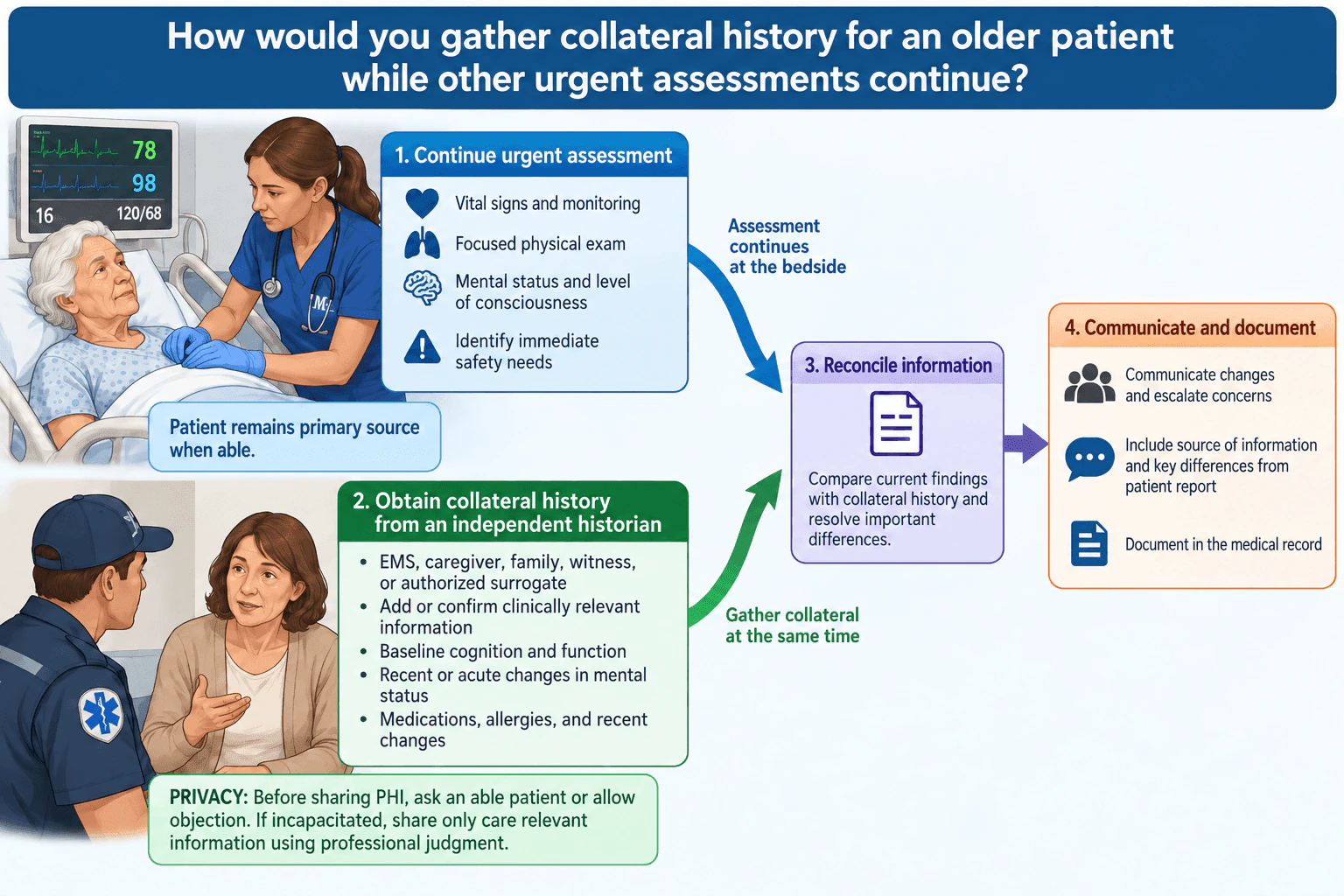
7. How would you gather collateral history for an older patient while other urgent assessments continue?NEWTrauma And Special PopulationsMediumProvidence
i Question Details
Original practice question for this employer context, not a reported employer interview question. Explain the relevant ED nursing judgment and identify information or authority you would need. Do not assume an internal employer protocol.
Short Interview Answer (30-60 seconds)
I would keep the urgent bedside assessment moving and gather collateral history at the same time. The patient remains my primary source when able, while EMS, a caregiver, family member, witness, or authorized surrogate may help establish baseline cognition and function, acute mental status changes, medications, allergies, and recent changes. I would compare that history with the current assessment, clarify important discrepancies, communicate safety concerns, and document the information source. If I need to share protected health information, I would consider the patient's capacity and preferences and limit disclosure to information relevant to the other person's involvement in care.
Detailed Explanation
The key is to treat collateral history and urgent assessment as parallel activities rather than stopping one to complete the other. The older patient remains the primary source whenever they can participate, but collateral information can establish the patient's usual baseline and explain whether the current presentation represents an acute change.
Useful Questions to Ask the Interviewer
Is the patient currently able to provide a reliable history and express preferences about who may receive information?
Is an independent historian such as EMS, a caregiver, family member, witness, or authorized surrogate available now?
Are prior records available to clarify baseline cognition, function, medications, or recent changes?
How to Explain It in an Interview
Nursing Priorities
I would continue the urgent bedside assessment first. That includes vital signs and monitoring, a focused physical assessment, mental status and level of consciousness, and immediate safety needs. I would not delay those activities while trying to obtain a complete history.
At the same time, I would obtain focused collateral history from an appropriate independent historian. The goal is not to replace the patient's account but to add clinically relevant context when the history is incomplete, uncertain, or affected by an acute condition.
Patient Context
I would ask about baseline cognition and function, whether confusion or behavior represents a recent change, medications and allergies, and recent medication changes. In older adults at risk for delirium, recent cognitive, physical, or behavioral changes may be reported by the patient, a carer, or a relative. nice.org.uk
Clinical Rationale
I would compare current findings with the collateral history and resolve important differences rather than assuming either source is automatically complete. If there is a clinically significant change or unresolved safety concern, I would communicate it promptly to the appropriate clinician. I would document who provided the information and note key differences from the patient's report.
I would also distinguish receiving information from sharing protected health information. A family member or caregiver can provide useful information to the care team. If the patient has decision making capacity and I need to disclose information, the patient may agree, have an opportunity to object, or circumstances may support a reasonable inference that the patient does not object. If the patient is incapacitated, relevant information may be shared when professional judgment supports that doing so is in the patient's best interest, and disclosure should be limited to information directly relevant to that person's involvement in care. hhs.gov
My overall sequence is continued urgent assessment, focused collateral history in parallel, reconciliation of important differences, communication of concerns, and clear documentation.
Why Interviewers Ask This
This question evaluates whether the nurse can maintain emergency assessment priorities while efficiently gathering context that may change interpretation of an older patient's presentation. It also tests recognition of baseline cognition and function, reconciliation of conflicting information, communication and documentation, and appropriate privacy judgment without assuming an employer specific protocol.
Common interview mistakes
Common mistakes include stopping urgent assessment to obtain a lengthy history, assuming confusion is the patient's normal baseline, treating collateral history as a replacement for the patient's own account when the patient can participate, failing to reconcile conflicting information, failing to document who supplied the history, and disclosing unrelated protected health information to family or caregivers.
Interview tip
Frame the answer as two coordinated activities happening at the same time: urgent assessment continues at the bedside while focused collateral history is gathered. Then explain what information you need, how you compare it with the patient's current findings, when you escalate discrepancies, and how privacy and documentation affect the process.
Interviewer may ask next
How would you verify collateral information if different sources give conflicting histories?
I would first identify which differences could affect immediate safety, assessment, or treatment. I would compare each account with the patient's current findings and available records, ask focused follow up questions, and distinguish confirmed information from reports that remain uncertain. I would communicate clinically important unresolved discrepancies to the appropriate clinician and document both the source and the conflicting information rather than presenting an uncertain detail as established fact.
What would change if the older patient became acutely confused and could no longer provide a reliable history?
I would continue urgent assessment and treat the acute mental status change as clinically significant rather than assuming it represents the patient's baseline. I would rely more heavily on collateral information about baseline cognition and function, recent changes, medications, allergies, and events leading to presentation. Recent changes that may indicate delirium can be reported by a carer or relative, and those changes warrant appropriate clinical assessment. nice.org.uk If the patient is incapacitated and disclosure of protected health information is needed, relevant information may be shared when professional judgment supports that doing so is in the patient's best interest, limited to what is directly relevant to the other person's involvement in care. hhs.gov
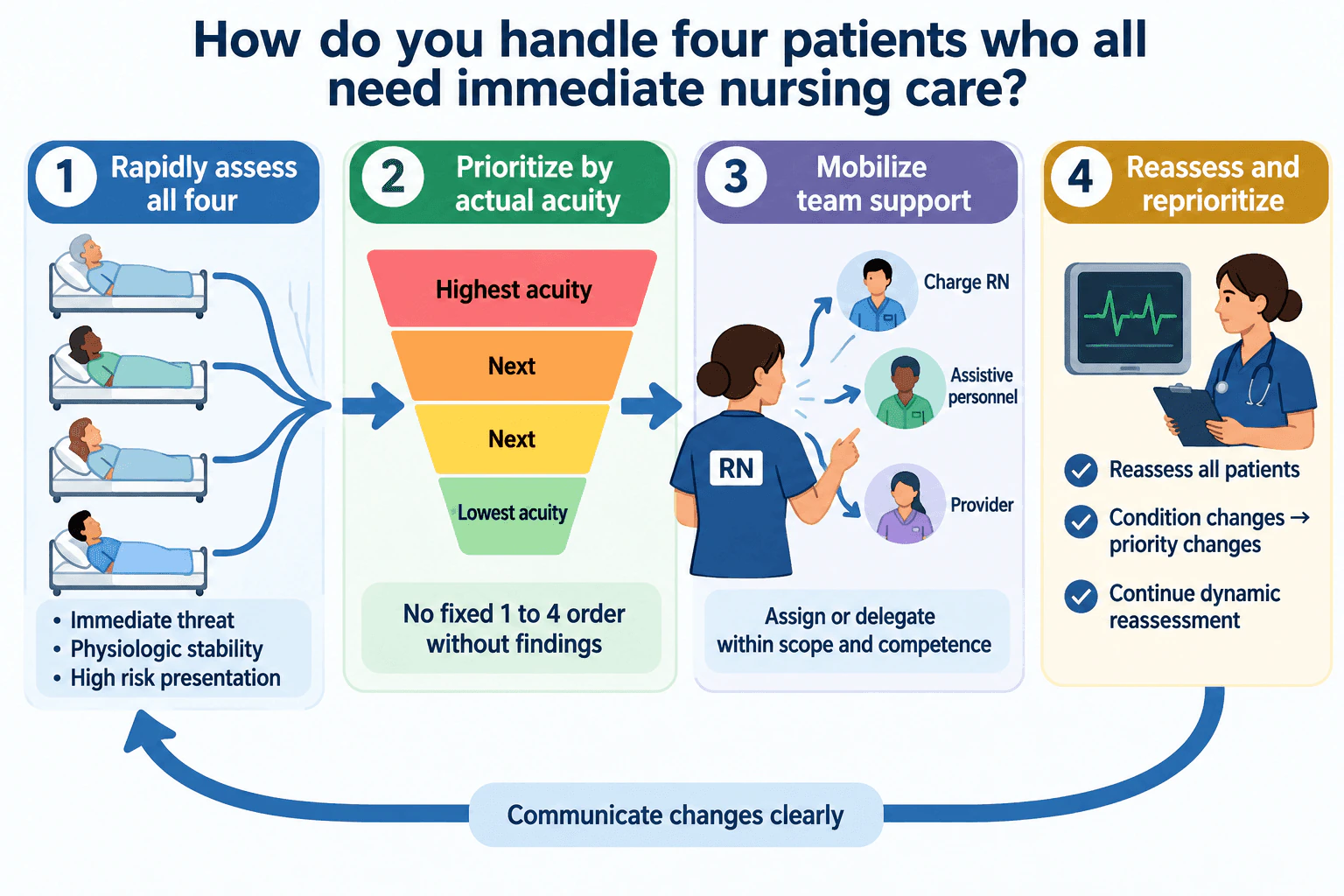
8. How do you handle four patients who all need immediate nursing care?NEWScenario BasedMediumProvidence
i Question Details
Explain how you obtain the missing acuity information, prioritize assessment, request team support, and reassess. No patient findings were supplied; do not invent a unique priority order.
Short Interview Answer (30-60 seconds)
I would rapidly assess all four patients because no findings have been provided, so I cannot safely create a fixed priority order. I would identify any immediate threat, physiologic instability, or high risk presentation, address the highest acuity patient first, and call for team support early. I would coordinate with the charge RN, assign or delegate appropriate tasks within scope and competence, involve the provider as needed, and keep reassessing all four patients. If a patient's condition changes, the priority changes, and I would communicate that change clearly to the team.
Detailed Explanation
The key is to prioritize by actual acuity, not by room number, arrival order, or an invented one through four sequence. Because no clinical findings are supplied, my first action is a rapid assessment of all four patients so I can identify who has the most immediate threat and who can safely wait while another patient receives attention.
Useful Questions to Ask the Interviewer
What assessment findings are available for each of the four patients?
What nursing and support staff are immediately available?
Are any emergency pathways or provider orders already active?
How to Explain It in an Interview
Immediate Actions
I would rapidly assess all four patients for immediate threats, physiologic stability, and high risk presentations. I would prioritize the patient with the highest actual acuity while recognizing that the information may change as I assess them. If a patient has a condition requiring an immediate lifesaving response, such as cardiac arrest, I would activate the appropriate emergency response and begin current population appropriate resuscitation without delaying indicated CPR for a routine sequential assessment.
I would mobilize help early rather than trying to manage four urgent patients alone. I would communicate with the charge RN, involve the provider when clinically needed, and assign or delegate appropriate tasks to available team members according to their role, demonstrated competence, applicable nursing law, and local policy. I would retain responsibility for nursing assessment, clinical prioritization, supervision, and evaluation of delegated care.
Risk Signals
The findings that move a patient toward the highest priority include an immediate threat, physiologic instability, rapid deterioration, or another high risk presentation. Because the scenario provides none of those findings, I would not claim that any specific patient is first before assessing them.
Decision Rationale
The priority is dynamic. After the first interventions and team assignments, I would reassess all four patients, review their responses, and reprioritize whenever a condition changes. I would communicate changes clearly using closed loop communication and give a concise handoff when responsibility transfers. Independent nursing actions include assessment, monitoring, communication, escalation, and reassessment within RN scope. Protocol authorized actions would be used only when applicable criteria and local policy permit them, while interventions requiring a provider order would be completed only when appropriately authorized.
Because no state or jurisdiction is supplied, I would not assume a specific nurse practice act or employer protocol. This approach keeps the highest acuity patient from being overlooked while maintaining surveillance and coordinated care for the other three patients.
Why Interviewers Ask This
This question evaluates whether I can safely manage competing demands without guessing which patient comes first. It tests rapid emergency assessment, recognition of instability, dynamic prioritization, appropriate escalation, teamwork, delegation, communication, and repeated reassessment when several patients need care at the same time.
Common interview mistakes
Common mistakes include inventing a fixed one through four priority order without patient findings, focusing on one patient before obtaining enough information about the others, prioritizing by arrival order instead of actual acuity, delaying help when several patients need urgent care, delegating nursing assessment or prioritization decisions inappropriately, assuming every intervention is independently authorized, and failing to reassess after the initial priorities are set.
Interview tip
Make the decision process explicit. Say that you first obtain the missing acuity information, identify the highest actual threat, mobilize team support, and then reassess all four patients. Avoid inventing diagnoses or findings. A strong answer also distinguishes your own nursing assessment and escalation responsibilities from protocol authorized actions, provider ordered care, and tasks that may be appropriately delegated.
Interviewer may ask next
How do you verify that your priority decision is still correct after the initial assessment?
I verify it through repeated reassessment rather than treating the first priority decision as permanent. I compare each patient's current condition with the earlier assessment, review physiologic stability and response to care, obtain updated information from team members, and immediately reprioritize if another patient develops a more urgent threat. I also communicate the change so everyone is working from the same current priority.
What changes if one of the four patients suddenly becomes unresponsive and pulseless?
That new finding immediately changes the priority. I would activate the appropriate emergency or code response and begin current population appropriate resuscitation without delaying indicated CPR for a routine sequential assessment. At the same time, I would use available team support so the other patients continue to receive observation and necessary care, then reassess and reprioritize the entire assignment as the situation evolves.
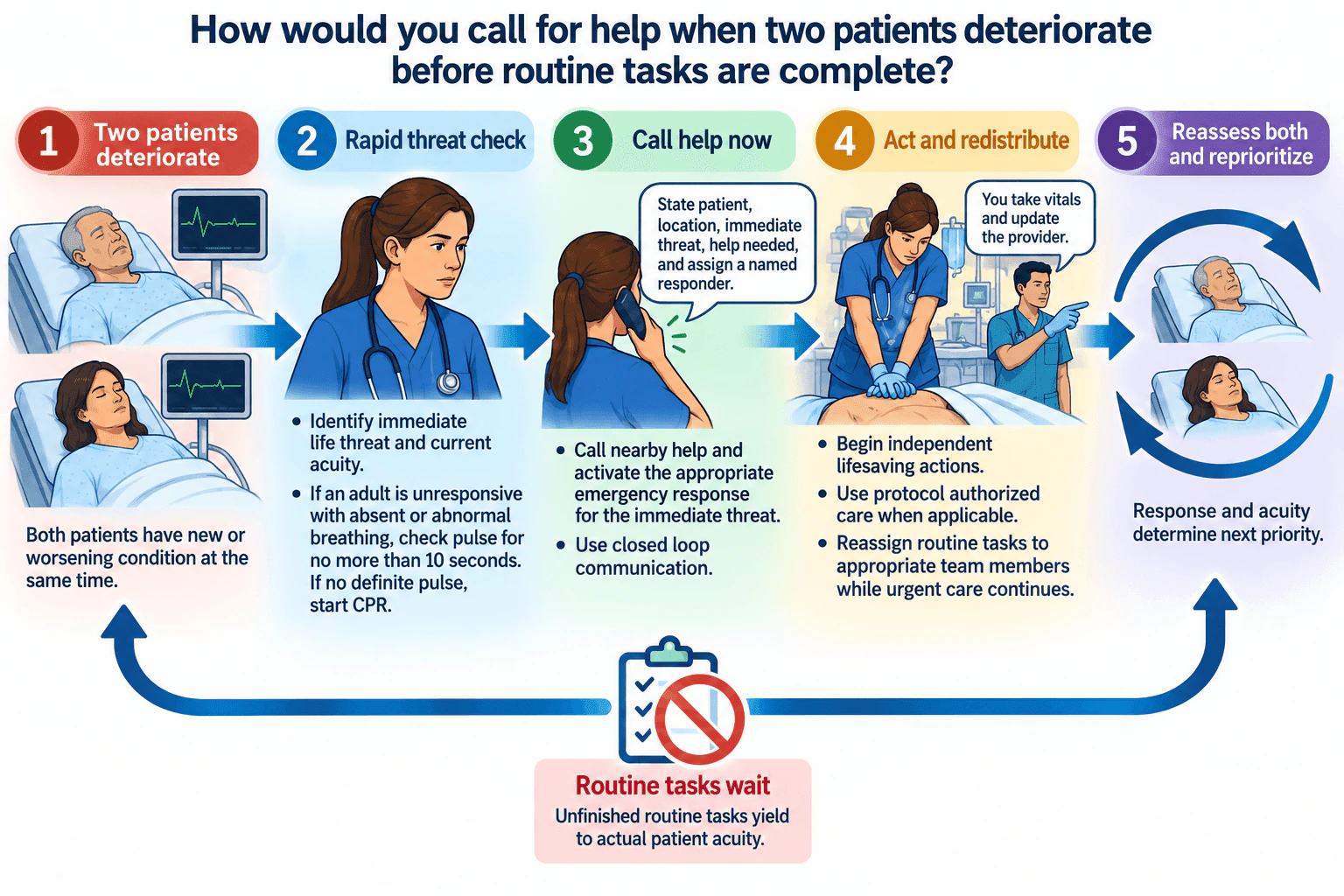
9. How would you call for help when two patients deteriorate before routine tasks are complete?NEWScenario BasedMediumProvidence
i Question Details
Original practice question for this employer context, not a reported employer interview question. Explain the relevant ED nursing judgment and identify information or authority you would need. Do not assume an internal employer protocol.
Short Interview Answer (30-60 seconds)
I would pause routine tasks, rapidly identify the immediate threats in both patients, and call nearby help while activating the appropriate emergency response. I would clearly state the patient, location, immediate threat, help needed, and assign specific responders using closed loop communication. While help is arriving, I would start appropriate nursing actions within my scope, use protocol authorized care when applicable, redistribute routine work to appropriate team members, and keep reassessing both patients because their relative priority can change.
Detailed Explanation
The key is to treat simultaneous deterioration as an acuity and resource problem. Routine tasks wait while I identify immediate threats, obtain help, continue indicated care, and repeatedly reassess both patients.
Useful Questions to Ask the Interviewer
What emergency response resources and escalation pathways are available in this department?
Which standing protocols or nurse initiated pathways may an ED nurse use before obtaining an individual order?
What patient population should I assume, such as adult, pediatric, or obstetric?
How to Explain It in an Interview
Immediate Actions
I would stop nonurgent routine tasks and quickly reassess both patients for the immediate threat and current acuity. I would not assume that the patient who deteriorated first remains the highest priority. I would call nearby help and activate the emergency response appropriate to the clinical threat without waiting to complete a full assessment before seeking assistance.
My communication would identify the patient, location, immediate threat, help needed, and the specific responder responsible for each task. I would use closed loop communication so the receiver acknowledges the assignment and I verify that the message was understood. For example, I might direct one appropriate team member to obtain updated vital signs and communicate changes to the provider or response team while another responder assists with the more urgent bedside action.
Nursing Priorities
While additional staff respond, I would begin independent nursing actions that are appropriate to the patient's condition and within my scope. I would use protocol authorized interventions when applicable and obtain orders or another professional's involvement when required. Routine work can be reassigned to team members whose role and competence support that work, while urgent care continues.
Safety Checks
If an adult is unresponsive with absent or abnormal breathing, I would follow current adult basic life support guidance. A healthcare professional checks breathing and pulse simultaneously for no more than 10 seconds. If no definite pulse is felt, CPR begins. I would not delay indicated CPR to complete an ABCDE assessment. Pediatric and obstetric patients require the appropriate population specific guidance rather than automatic application of the adult pathway.
Reassessment
After help arrives, I would continue reassessing both patients and change priorities according to their response and actual acuity. I would confirm that assigned actions occurred, communicate important changes promptly, and document relevant assessment, escalation, interventions, and patient response according to local requirements.
Why Interviewers Ask This
This question evaluates whether the nurse can recognize competing emergencies, place patient acuity above unfinished routine work, mobilize resources early, communicate responsibilities clearly, stay within nursing scope and local authorization, and repeatedly reassess priorities as patient conditions change.
Common interview mistakes
Common mistakes are finishing routine tasks before responding to deterioration, focusing on only one patient without reassessing the other, calling for help without stating the immediate threat or assigning responsibility, assuming an internal emergency pathway without confirming it, assigning work outside a team member's role or competence, delaying indicated lifesaving action while completing a full assessment, or failing to reprioritize after either patient's condition changes.
Interview tip
Explain the sequence clearly: pause routine work, identify the immediate threats, call appropriate help early, assign specific responsibilities with closed loop communication, begin authorized nursing care, and reassess both patients. Emphasize that actual acuity determines the next priority and that nursing scope, local protocols, and required orders determine which interventions you may initiate.
Interviewer may ask next
How would you verify that the help you requested was actually assigned and understood?
I would use closed loop communication. I would direct the request to a specific person, have that person acknowledge or repeat the assignment, and confirm that the message was understood correctly. I would also verify that critical actions were actually started rather than assuming that making the request completed the task.
What would change if one of the two deteriorating patients became unresponsive and had no definite pulse?
That patient would become an immediate resuscitation priority while I simultaneously summon additional resources so the second deteriorating patient still receives assessment and care. For an adult with absent or abnormal breathing and no definite pulse within 10 seconds, I would begin CPR and follow the current adult resuscitation pathway while another qualified clinician assumes responsibility for reassessing and supporting the second patient. For pediatric or obstetric patients, I would use the appropriate population specific guidance.
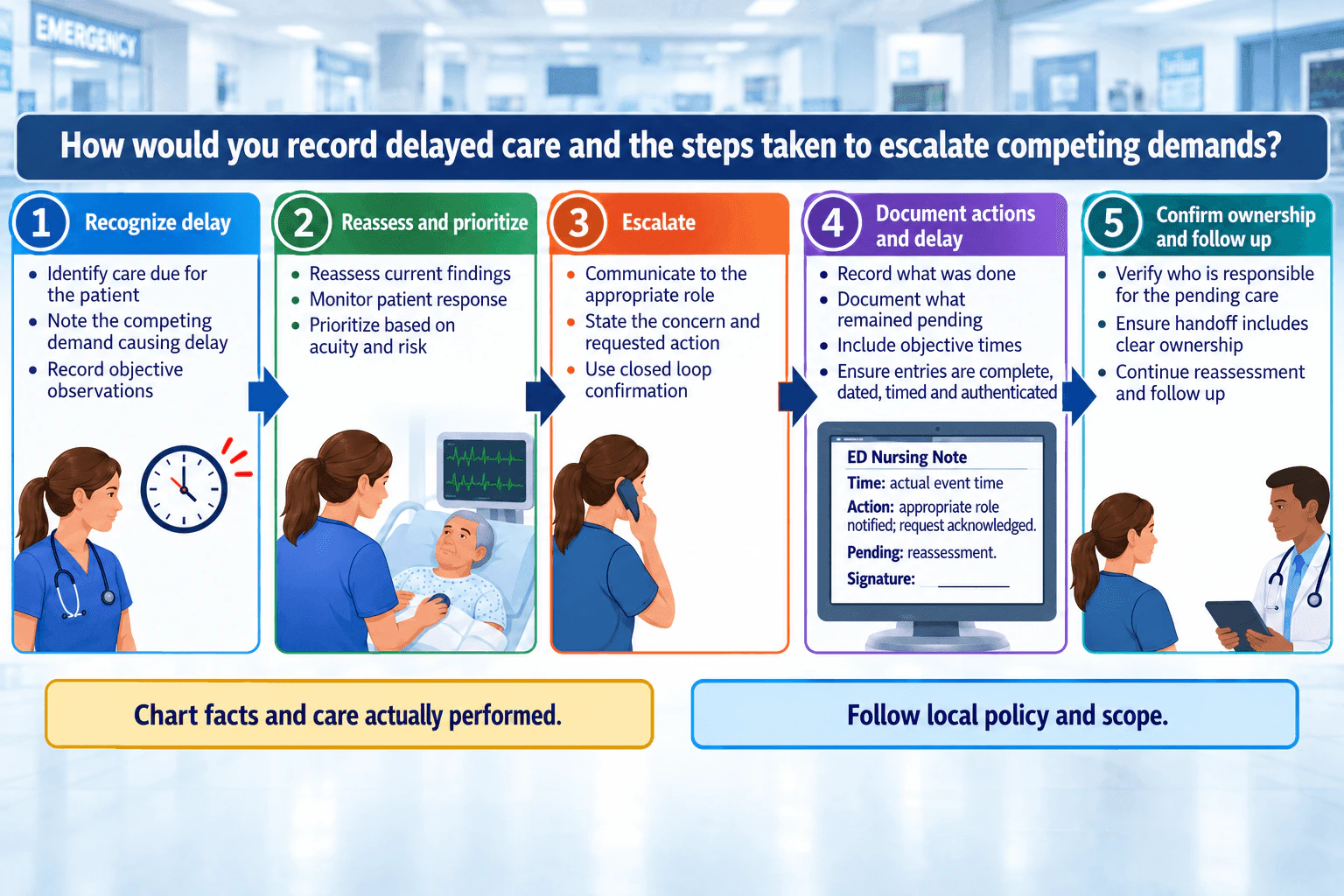
10. How would you record delayed care and the steps taken to escalate competing demands?NEWDocumentation ComplianceHardProvidence
i Question Details
Original practice question for this employer context, not a reported employer interview question. Explain the relevant ED nursing judgment and identify information or authority you would need. Do not assume an internal employer protocol.
Short Interview Answer (30-60 seconds)
I would chart an objective timeline of the delayed care. I would record what care was due, the competing demand, my reassessment findings, what I actually did, the actual event times, who I notified by appropriate role, the concern and requested action, the response received, and what remained pending. I would use closed loop communication, confirm who owns the follow up, and continue reassessment. I would not chart unperformed care, invent findings, or assume a specific internal escalation chain.
Detailed Explanation
The safest approach is to make the record show a clear sequence of what was due, why it was delayed, how the patient was reassessed, what actions and escalation actually occurred, and who owns the remaining care. The documentation should be factual, time based, and free of blame.
Useful Questions to Ask the Interviewer
What local escalation pathway should an ED nurse use when competing demands delay planned care?
What documentation standard does the organization use for recording delayed care and transfer of responsibility?
If EMTALA applies, which personnel are designated to perform the medical screening examination in this jurisdiction and facility?
How to Explain It in an Interview
Recognize The Delay
I would identify the care that was due and document the competing demand objectively. I would avoid assumptions about motives or blame and record only information relevant to the patient's care.
Reassess And Prioritize
I would reassess current findings, monitor the patient's response, and reprioritize according to acuity and risk. If the patient's condition changed, that new information could change the urgency of the pending care and the level of escalation.
Escalate
If the delay could affect safety, I would communicate with the appropriate role according to local policy, scope, and available authority. I would state the concern, relevant findings, and the action I am requesting. I would use closed loop communication so the request is acknowledged and responsibility is clear.
Document Actions And Delay
I would document what was actually performed, what remained pending, objective findings, the patient's response, and actual event times. I would record the notification and response without inventing an employer specific chain. Hospital medical records should be complete, dated, timed, and authenticated by the responsible person. I would never chart care that was not performed.
Confirm Ownership And Follow Up
If care remains pending, I would verify who is responsible for the next action and make that ownership clear during handoff. I would continue reassessment until the need is resolved or responsibility is clearly transferred.
Privacy And Scope
I would protect patient information and follow applicable privacy safeguards. If delayed care involves transfer or discharge, I would make sure relevant pending needs, education, and return precautions are communicated and documented as applicable. I would also distinguish routine triage from an EMTALA medical screening examination and verify who is authorized to perform that examination under applicable requirements and hospital governing documents.
Why Interviewers Ask This
Interviewers are assessing whether I can manage competing emergency demands without losing patient safety, communication, or documentation accountability. A strong answer shows that I reassess when care is delayed, prioritize by current risk, escalate through an appropriate role rather than assuming an employer specific chain, document objective facts and actual event times, and confirm responsibility for unresolved care during handoff.
Common interview mistakes
Common mistakes include documenting blame instead of objective facts, charting care that was not performed, omitting actual event times, failing to distinguish completed care from pending care, recording that someone was notified without confirming receipt when responsibility must transfer, inventing patient findings, disclosing unnecessary identifying information, assuming a particular employer escalation chain, or treating routine triage as automatically equivalent to an EMTALA medical screening examination.
Interview tip
Answer in the same chronological order as the clinical workflow: recognize the delay, reassess and prioritize, escalate, document actions and actual event times, then confirm ownership and continue follow up. This shows both patient safety judgment and documentation discipline without inventing facility policy.
Interviewer may ask next
How would you verify that your escalation was actually received?
I would use closed loop communication. I would direct the concern and requested action to the appropriate role, obtain acknowledgment or clarification, and verify who owns the next step. I would then document the actual communication time, the response, what remained pending, and any continued reassessment.
What would change if the patient's condition worsened while the delayed care was still pending?
I would immediately reassess and reprioritize based on the new clinical findings. I would escalate the change through the appropriate clinical pathway according to local policy, scope, and available authority, then document the new objective findings, actual event time, actions performed, communication, response, and continued reassessment. I would not invent a treatment, threshold, or patient finding that was not provided.
More questions load as you scroll
Emergency Department Nurse Resume Examples
Explore the resume examples below to find the one that best matches your target Emergency Department Nurse role.
New Graduate Emergency Department Nurse0-1 years; supervised transition to emergency nursing
Disclaimer: This interview guide is for educational and informational purposes only. It is designed to help readers prepare, but it does not guarantee any interview result, hiring decision, offer, or outcome. Interview questions, hiring criteria, and preferred answers can vary by employer, interviewer, industry, location, and time. All answers, examples, and explanations in this guide are suggested examples for interview preparation, not definitive answers or instructions for professional practice. They are based on research and judgment, are provided without warranties of any kind, and should be adapted to the question, role, and applicable laws and professional requirements. Diagrams are simplified illustrations intended to highlight the main concepts and their relationships; actual situations, systems, and practices may be more complex. Alternative approaches may be equally valid or better suited to a particular question, context, or interviewer. To the fullest extent permitted by applicable law, the contributors and publisher are not liable for decisions made, actions taken, or losses incurred based on this guide.
State Laws and Professional Responsibilities: Laws and requirements governing an occupation vary by state and jurisdiction. You are responsible for checking the current laws, licensing requirements, and scope-of-practice rules that apply to your location and role, and for ensuring that your answers and actions comply with them. Adapt examples in this guide to those requirements. This guide is not legal advice.
Company Notice: This guide is an independent educational resource and is not affiliated with, endorsed by, sponsored by, or approved by the company named in this guide. Company names identify reported interview experiences or the employer context of clearly labeled original practice exercises. Interview practices can change without notice, and inclusion of company-specific content does not mean these questions are official, complete, or guaranteed to be asked. To the fullest extent permitted by law, the author, contributors, and publisher are not responsible for outcomes related to use of this material.
Content Accuracy and Verification: To the fullest extent permitted by applicable law, we do not represent or warrant that interview guides, questions, answers, examples, or diagrams are accurate, complete, current, error-free, or suitable for any particular purpose. You are responsible for independently reviewing and verifying the information before relying on it.