This interview guide is for educational and informational purposes only. It is designed to help readers prepare, but it does not guarantee any interview result, hiring decision, offer, or outcome. Interview questions, hiring criteria, and preferred answers can vary by employer, interviewer, industry, location, and time. All answers, examples, and explanations in this guide are suggested examples for interview preparation, not definitive answers or instructions for professional practice. They are based on research and judgment, are provided without warranties of any kind, and should be adapted to the question, role, and applicable laws and professional requirements. Diagrams are simplified illustrations intended to highlight the main concepts and their relationships; actual situations, systems, and practices may be more complex. Alternative approaches may be equally valid or better suited to a particular question, context, or interviewer. To the fullest extent permitted by applicable law, the contributors and publisher are not liable for decisions made, actions taken, or losses incurred based on this guide.
State Laws and Professional Responsibilities
Laws and requirements governing an occupation vary by state and jurisdiction. You are responsible for checking the current laws, licensing requirements, and scope-of-practice rules that apply to your location and role, and for ensuring that your answers and actions comply with them. Adapt examples in this guide to those requirements. This guide is not legal advice.
Identity, Image, and Privacy Notice
To respect individual privacy, some names, profile photographs, avatars, biographical details, and other identifying information displayed in this guide may be replaced with pseudonyms, licensed stock images, illustrative avatars, composite images, or representative descriptions. Unless a person is expressly identified as an actual contributor, a displayed name, image, or profile should not be understood as depicting or identifying a specific candidate, interviewer, employee, or other real individual. These representations are provided for editorial and illustrative purposes only and do not imply endorsement, employment, participation, or affiliation with this guide or any company mentioned in it. Any resemblance to an actual person is coincidental.
Company Notice
This guide is an independent educational resource and is not affiliated with, endorsed by, sponsored by, or approved by the company named in this guide. Company names identify reported interview experiences or the employer context of clearly labeled original practice exercises. Interview practices can change without notice, and inclusion of company-specific content does not mean these questions are official, complete, or guaranteed to be asked. To the fullest extent permitted by law, the author, contributors, and publisher are not responsible for outcomes related to use of this material.
Content Accuracy and Verification
To the fullest extent permitted by applicable law, we do not represent or warrant that interview guides, questions, answers, examples, or diagrams are accurate, complete, current, error-free, or suitable for any particular purpose. You are responsible for independently reviewing and verifying the information before relying on it.
Questions or comments?
Contact us for general questions, or share feedback, technical corrections, and comments with the community.
31. Create an intelligent search autocomplete feature.System DesignMediumMicrosoft
i Question Details
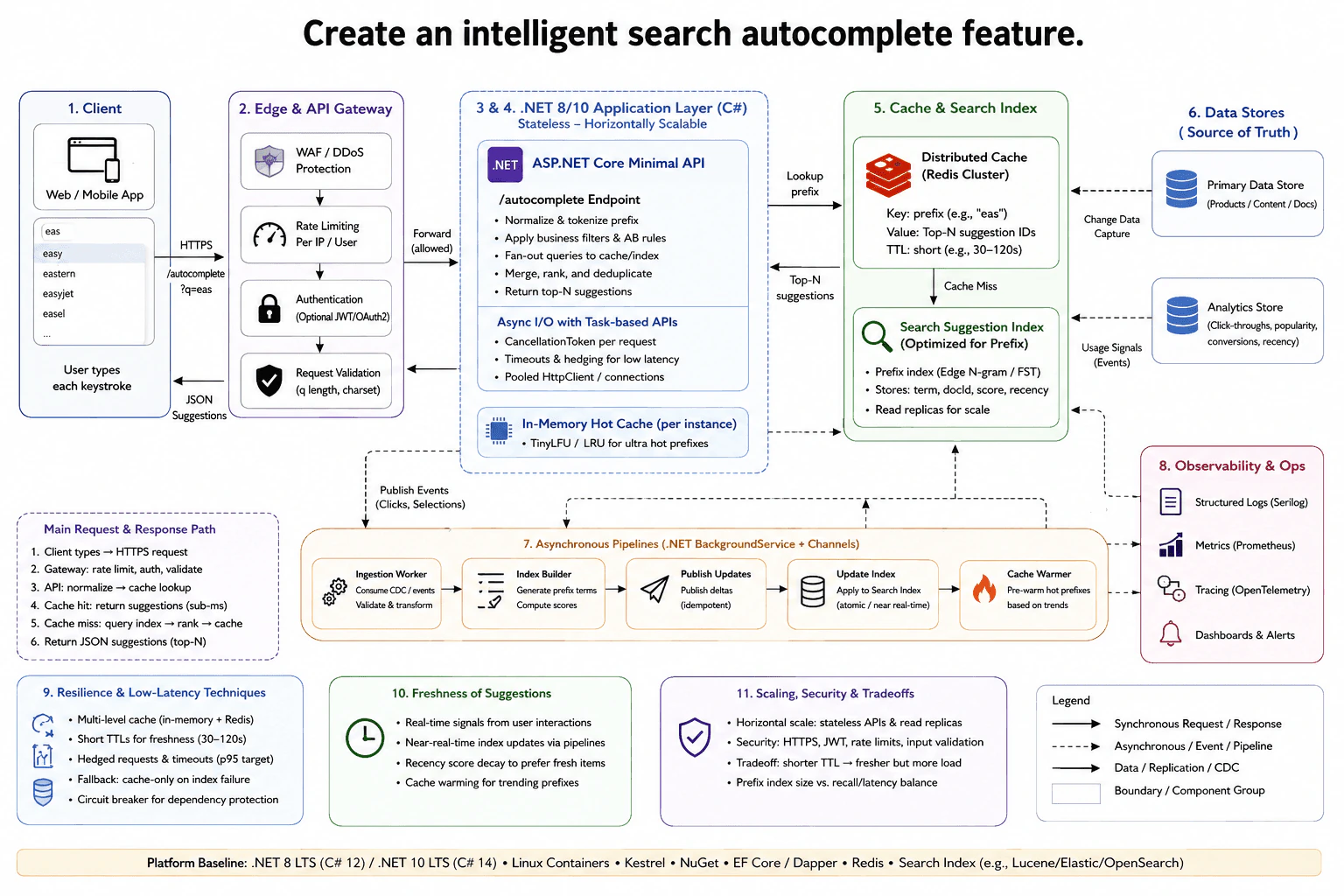
Design prefix-based autocomplete, including suggestion retrieval, freshness of suggestions, and the low-latency lookup path that serves each keystroke.
Short Interview Answer (30-60 seconds)
At a high level, this is a read-heavy autocomplete system that serves suggestions while the user types. The main challenge is keeping every keystroke lookup very fast while suggestions stay fresh and useful. I would explain it in three parts: the low-latency lookup path, the background freshness pipeline, and scaling and failure handling. The .NET service checks hot caches first, falls back to the prefix search index, ranks results, and returns top suggestions. Short cache TTLs improve freshness, but they create more backend work.
Detailed Explanation
The goal is to show useful search suggestions as someone types a prefix such as "eas". The difficult part is that this can happen on every keystroke, so the answer must come back quickly. Suggestions also need to change when products, content, popularity, or recent user behavior changes. The diagram solves this with a fast lookup path backed by several cache levels and a prefix search index. A separate background pipeline keeps the index and hot cache entries fresh without slowing the user request.
Useful Questions to Ask the Interviewer
How fresh do suggestions need to be after source data changes?
Should ranking use only popularity, or also recency and business rules?
Are personalized suggestions required, or are suggestions shared globally?
What should happen when the cache or search index is unavailable?
How to Explain It in an Interview
1. Start with the request entering the system
I would say that every keystroke can create a lookup request, so the edge must protect the service first. The web or mobile app sends an HTTPS autocomplete request. The Edge and API Gateway layer applies WAF and DDoS protection, per-IP or per-user rate limits, optional JWT or OAuth2 authentication, and request validation. Validation checks things such as query length and allowed characters. The allowed request is then forwarded to the stateless .NET application layer.
2. Explain the normal low-latency lookup path
The main thing I would optimize is the lookup path. The ASP.NET Core Minimal API normalizes and tokenizes the prefix, applies business filters or A/B rules, and fans out to the cache or index when needed. Each service instance has a tiny in-memory LRU or LFU hot cache for common prefixes. The shared Distributed Cache uses the prefix as its key and stores top suggestion IDs. On a cache hit, the service merges, ranks, deduplicates, and returns the top suggestions as JSON.
3. Explain the cache-miss path
If the Distributed Cache misses, the request goes to the Search Suggestion Index. That index is optimized for prefixes using an edge N-gram index or FST. It stores the term, document ID, score, and recency data. The service reads candidates, ranks them, updates the cache, and returns the JSON suggestions. Task-based asynchronous I/O lets .NET wait for network operations without holding a worker thread during the wait. A CancellationToken can stop work when the request is cancelled, while timeouts keep slow dependencies from holding the request too long.
4. Explain how suggestions stay fresh
Freshness work happens in the background so it does not block each keystroke. The Primary Data Store holds products, content, or documents. The Analytics Store provides click-through, popularity, conversion, and recency signals. Change data capture and usage events feed the asynchronous pipeline. The Ingestion Worker validates and transforms them. The Index Builder generates prefix terms and computes scores. Publish Updates sends idempotent deltas. Update Index applies them to the Search Suggestion Index, and Cache Warmer pre-warms hot prefixes based on trends.
5. Finish with scale, failures, and trade-offs
The .NET APIs are stateless, so more replicas can be added horizontally. The Search Suggestion Index can use read replicas, while multi-level caching reduces repeated reads. Short TTLs keep suggestions fresher, but they increase cache misses and backend load. Hedged requests, timeouts, and a circuit breaker protect the lookup path. If the search index fails, the diagram allows a cache-only fallback. Serilog logs, Prometheus metrics, OpenTelemetry tracing, dashboards, and alerts provide operational visibility. HTTPS, JWT where needed, rate limits, and input validation protect the service.
Engineering Considerations / Design Trade-offs
The benefit is that many keystrokes can be served from the in-memory cache or Redis instead of doing a full prefix search. This makes reads faster and reduces work on the Search Suggestion Index. The downside is freshness. A longer TTL gives more cache hits, but suggestions can stay old longer. A shorter TTL gives fresher results, but creates more cache misses and backend work. The background indexing pipeline also means source changes may take a short time to appear. Read replicas improve scale, but they add operational work. Hedged requests can reduce slow responses, but they also send extra requests.
Why Interviewers Ask This
Interviewers use this question to see whether you can separate a very fast read path from slower background work. They want to see good judgment around prefix search, multi-level caching, ranking, freshness, and failure handling. They also want to know whether you understand stateless .NET scaling, asynchronous I/O, and the trade-off between fresher suggestions and more backend load. Clear explanation matters as much as naming the components.
Interviewer may ask next
What would you change if new suggestions had to become visible within a few seconds?
I would keep the same basic design, but make the freshness path more aggressive. The Primary Data Store and Analytics Store would still provide change data and usage signals. The Ingestion Worker, Index Builder, Publish Updates, and Update Index stages would process those changes as soon as possible. Cache Warmer would refresh important prefixes after the index changes.
I would also shorten the Distributed Cache TTL for prefixes where freshness matters most. That reduces how long an older suggestion can remain cached. The Search Suggestion Index already stores recency data, so ranking can prefer newer items after the update arrives.
The low-latency request path would stay the same. The .NET service would still use the in-memory hot cache, Distributed Cache, and Search Suggestion Index in the same order.
The downside is extra work. Shorter TTLs create more cache misses, while faster index updates increase background processing and write activity.
How would the system behave if the Distributed Cache became unavailable?
I would keep the same architecture and use the failure controls already shown in the diagram. The .NET service still has its small per-instance In-Memory Hot Cache, so very common prefixes may continue to work without Redis. For other prefixes, the service can use the Search Suggestion Index instead of waiting indefinitely for the failed cache.
Timeouts keep the cache call from delaying every keystroke. A circuit breaker can temporarily stop repeated calls to the failing dependency. Requests that reach the search index can still fetch candidates, rank them, and return suggestions.
When the Distributed Cache recovers, normal lookups can populate entries again, and Cache Warmer can pre-warm hot prefixes. Serilog logs, Prometheus metrics, OpenTelemetry tracing, dashboards, and alerts help operators detect the problem.
The downside is higher load on the Search Suggestion Index and potentially slower responses until Redis recovers.
32. Why did you apply for this role?BehavioralMediumMicrosoft
i Question Details
Explain why this role fits your experience and what skills or projects make you a strong match for the work you would actually do.
Interview tip:
Use STAR to structure your answer: briefly explain the Situation and Task, make Action the most detailed part, and finish with the Result. For example, describe how your previous .NET development work prepared you for the responsibilities in this role, what parts of the work match your strengths, how you contributed to reliable software and team delivery, and why you want to continue growing in similar work.
Situation
In my last role, I worked as a .NET Developer on a business application that had to be reliable, easy to maintain, and responsive to changing requirements. I worked with C#, ASP.NET Core, APIs, databases, automated tests, and other developers throughout the delivery process.
Task
My responsibility was not only to write code. I needed to understand the business need, design a practical solution, work well with the team, review changes carefully, and make sure the software could be supported after release. That experience helped me understand the kind of .NET development work I enjoy and where I can contribute strongly.
Action
I applied for this role because the responsibilities closely match the work I have been building experience in. I enjoy taking a requirement, breaking it into smaller technical problems, and implementing a clear solution in C# and .NET. On that project, I built and maintained APIs, worked with database access, added validation and error handling, wrote tests, and investigated issues when the application did not behave as expected. I also worked closely with other developers and business partners because I learned that good software depends on clear communication as much as good code. I try to understand why a feature is needed before choosing an implementation, and I consider maintainability and reliability instead of only making the immediate change work. This role interests me because it would let me use those skills on meaningful software while also learning from engineers who work on larger and more complex systems.
Result
The project delivered a reliable solution that the team could maintain and support after release, and the experience showed me the value of understanding the business need before choosing a technical approach. I learned that strong .NET development requires ownership, collaboration, and attention to long term quality, not only writing code. That experience also confirmed that this type of work fits my strengths and is why I believe this role is a strong match for my experience and the direction in which I want to grow.
Why Interviewers Ask This
Interviewers ask this question to understand whether the candidate has a clear reason for choosing the role and whether their experience actually matches the work. A strong answer shows that the candidate understands the responsibilities, can connect relevant skills to those responsibilities, and has a genuine reason for wanting to continue growing as a .NET Developer.
Interviewer may ask next
Which part of your previous .NET experience would help you contribute most quickly in this role?
My experience building and maintaining APIs would help me contribute quickly. I am comfortable taking a requirement, understanding the data and validation rules, implementing the logic in C# and ASP.NET Core, connecting it to the database when needed, and testing the behavior. I also pay attention to error handling and maintainability, so I try to deliver code that the rest of the team can understand and support.
What are you hoping to learn or improve if you join this role?
I want to deepen my experience with larger .NET systems and learn how experienced teams make decisions around architecture, reliability, performance, and maintainability at greater scale. I already have practical experience delivering application features, and I want to build on that foundation by working on more complex problems while continuing to improve how I design, test, review, and support software.
33. Tell me about a time you learned something completely newBehavioralEasyMicrosoft
i Question Details
Describe a real learning story, including what was new, how you closed the gap, and what the result says about your growth mindset.
Interview tip:
Use STAR to structure your answer: briefly explain the Situation and Task, make Action the most detailed part, and finish with the Result. For example, describe a realistic project where you had to learn an unfamiliar technology, explain how you identified what you needed to learn, practiced it in a safe way, asked for help when needed, applied it to the real work, and used the result to show that you can adapt and keep growing.
Situation
In my last role, I joined a project where part of the application used event driven processing with Azure Service Bus. I had worked with normal HTTP APIs and background jobs before, but message based processing was completely new to me. I needed to understand concepts such as queues, message delivery, retries, and duplicate processing before I could make changes safely.
Task
I was responsible for adding a new processing step to the existing .NET service. My goal was not only to make the code work, but also to understand the messaging model well enough to avoid problems such as processing the same message twice or losing work when a temporary failure happened.
Action
I first broke the learning gap into small topics instead of trying to understand the whole system at once. I studied how Azure Service Bus queues worked and then traced one existing message from the producer through the queue to the .NET consumer. That gave me a concrete example to connect the new concepts to the code. I created a small local example where I sent messages, forced processing failures, and watched how retries behaved. I also reviewed the existing service with a teammate who had more experience with messaging. I asked specific questions about why the service used certain retry and duplicate handling patterns instead of only asking how to copy the code. After that, I implemented the new processing step in small changes. I made the handler safe to run again when the same message was delivered more than once, and I added clear logging so we could understand failures. Before completing the work, I tested both the normal path and failure cases and asked for a code review focused on the messaging behavior.
Result
I completed the change successfully and became comfortable working with the message based part of the system. More importantly, I learned that when something is completely new, I make faster progress by connecting the theory to one real example, experimenting with failure cases, and asking focused questions. That approach has helped me become more confident when I need to learn unfamiliar technology.
Why Interviewers Ask This
Interviewers ask this question to understand how you respond when your existing knowledge is not enough. They want to see curiosity, adaptability, ownership, and a practical learning process. A strong answer shows that you can identify a knowledge gap, learn independently, seek useful feedback, apply the new knowledge safely, and turn the experience into a repeatable way of learning.
Interviewer may ask next
Why did you create a small test example instead of learning only from the existing code?
I wanted a safe place where I could change one thing at a time and see the behavior clearly. The existing service had many parts working together, so it was harder to understand cause and effect. The small example helped me see retries and repeated message delivery directly before I changed production code.
What would you do differently the next time you need to learn a completely new technology?
I would use the same basic approach, but I would identify the most important failure cases even earlier. In this story, understanding retries and duplicate processing became especially important. Now I try to learn both the normal behavior and the failure behavior from the beginning because that gives me a more complete understanding of a new technology.
34. Describe your biggest failure and what you learnedBehavioralEasyMicrosoft
i Question Details
Tell one real failure story, focus on the mistake and recovery, and make the lesson concrete rather than generic.
Interview tip:
Use STAR to structure your answer: briefly explain the Situation and Task, make Action the most detailed part, and finish with the Result. For example, describe a real development mistake where you missed an important performance risk, took ownership when the issue appeared, investigated the root cause, worked with the team on a safe recovery, and changed your development process so the same mistake would be less likely to happen again.
Situation
In my last role, I worked on a .NET application that displayed data from several related database tables. I changed an Entity Framework Core query to support a new screen. The feature worked correctly in development, but after release the page became very slow under normal production usage. I had focused on functional testing and had not checked how many database queries the new code generated with realistic data.
Task
I was responsible for the change, so my first responsibility was to help restore acceptable performance and understand exactly what I had missed. I also wanted to make sure we fixed the development process, not only the immediate query.
Action
I told the team that my change was the likely source of the problem instead of waiting for someone else to identify it. I reviewed application logs and the generated SQL and found that the code was repeatedly loading related data inside a loop. This created many unnecessary database calls. I worked with another developer to review the safest correction, then changed the query so the required data was fetched efficiently in a controlled query. I tested the updated code with a larger and more realistic data set and compared the generated SQL before and after the change. I also checked that the fix did not change the expected results on the screen. After the immediate issue was resolved, I added performance checks to my normal review process for data access changes. I began inspecting generated SQL for important Entity Framework Core queries and testing them with realistic data before release. I also shared the failure and the lesson with the team so similar problems could be caught during code review.
Result
The corrected query restored the expected application performance, and the team was able to keep the feature in place. The most important lesson for me was that code can be functionally correct and still be a poor production solution. Since then, I treat database behavior and realistic data volume as part of correctness. I also learned to raise my own mistakes early because taking ownership makes recovery faster and gives the team a chance to improve the process.
Why Interviewers Ask This
Interviewers ask this question to see whether a candidate can admit a meaningful mistake, take responsibility, recover professionally, and turn the experience into a concrete improvement. A strong answer shows self awareness, technical judgment, ownership, communication, and evidence that the lesson changed how the candidate works.
Interviewer may ask next
What would you do differently if you were making the same change today?
I would inspect the generated SQL and test the query with realistic data before release. I would also include database performance in the code review discussion instead of checking only whether the feature returns the correct data. That would give me a better chance of finding repeated queries or inefficient data access before users are affected.
Why did you tell the team immediately that your change might be responsible?
I wanted the team to investigate the most likely cause quickly instead of losing time protecting my own work. I had made the change and understood its code path, so being open about it helped us focus the investigation. It also reinforced for me that ownership means being transparent when something goes wrong, not only taking credit when a change succeeds.
35. Which is your favourite Microsoft product and how can you improve it?BehavioralMediumMicrosoft
i Question Details
Name one Microsoft product, explain what it does well, and give one concrete improvement that shows product judgment rather than praise alone.
Interview tip:
Use STAR to structure your answer: briefly explain the Situation and Task, make Action the most detailed part, and finish with the Result. For example, describe how you used a Microsoft product in real development work, what you value about it, one user problem you noticed, the improvement you would make, why you chose that improvement, and how you would evaluate whether it helped users.
Situation
My favourite Microsoft product is Visual Studio. In my last role, I used it regularly while building and debugging .NET applications. I like it because the editor, debugger, testing tools, NuGet integration, and source control support bring most of my daily development work into one place.
Task
While using Visual Studio on larger .NET solutions, I noticed that developers can sometimes spend too much time understanding why startup, solution loading, or builds feel slow. My goal would be to make that problem easier to diagnose without expecting every developer to understand the internal behavior of the IDE.
Action
I would improve Visual Studio by adding a simple performance diagnostics view focused on the development experience itself. It would show which projects, extensions, analyzers, package operations, or build steps are taking the most time during solution loading and builds. I would keep the first view simple, with clear explanations such as which component is slow and what action the developer can consider. More detailed information could still be available for advanced users. I would also make the recommendations careful rather than automatically disabling features, because an analyzer or extension may be important to the team. I would first validate the idea with .NET developers who work on small and large solutions, identify the most common sources of confusion, and build the smallest useful version around those problems. I would then use developer feedback and observed changes in troubleshooting effort to decide what should be improved next.
Result
The result of this analysis was a concrete improvement proposal focused on a real developer problem instead of adding another feature without clear user value. It changed my view of the problem from simply noticing that Visual Studio could feel slow to identifying how clearer diagnostics could help developers understand the cause and choose an informed next action. I also learned that improving a mature product does not always require a large new feature. Sometimes the better improvement is giving users clearer information so they can use the existing product more effectively.
Why Interviewers Ask This
Interviewers ask this question to see whether the candidate can evaluate a familiar product with balanced judgment. A strong answer shows genuine product knowledge, identifies a meaningful user problem, proposes a practical improvement, explains the reasoning behind it, and considers how the idea could be validated instead of offering praise or criticism alone.
Interviewer may ask next
Why would you prioritize performance diagnostics over adding another development feature?
I would prioritize it because Visual Studio already has a broad set of development features, but those features are less valuable when developers cannot understand why their environment feels slow. Better diagnostics would help users make more effective use of the tools they already have. I would still validate that priority with developers before committing to a larger implementation.
How would you know whether your proposed improvement was successful?
I would look at whether developers can identify the source of solution loading or build performance problems more easily and whether the guidance helps them choose a useful next action. I would also collect feedback about whether the explanations are clear and whether the recommendations feel trustworthy. If developers still need to search through several tools or guess at the cause, I would simplify or improve the experience further.
36. Tell me about an incident where you learned from your past mistakes.BehavioralMediumMicrosoft
i Question Details
Choose one mistake, describe the context and consequences, and show how the lesson changed your future behavior.
Interview tip:
Use STAR to structure your answer: briefly explain the Situation and Task, make Action the most detailed part, and finish with the Result. For example, describe one mistake you made during a previous project, explain its consequences, show how you took responsibility and corrected it, and explain how the lesson changed the way you work on later projects.
Situation
In my last role, I worked on a .NET application that called an external service. I made a code change to improve how the application handled failed requests. I tested the normal success path carefully, but I did not test enough failure cases before the change moved forward. During later testing, we found that one error condition could cause the application to retry too aggressively and create unnecessary requests to the external service.
Task
I was responsible for the change, so I needed to correct the problem and understand why I had missed it. I also wanted to make sure I did not repeat the same mistake on future changes that involved external dependencies.
Action
I first took ownership of the issue instead of treating it as only a testing problem. I reviewed the code and reproduced the failure locally. I found that I had focused too much on the expected response and had not considered how repeated failures would affect the retry logic. I changed the implementation so retries happened only for appropriate temporary failures and stopped after a reasonable limit. I added tests for timeouts, service errors, and repeated failures so those cases were covered automatically. I also explained the mistake and the fix to the team so everyone understood the risk. After that experience, I changed my own development process. Before completing similar changes, I started listing the main success and failure paths and checking each one during development. I also began reviewing retry behavior, timeouts, logging, and dependency failures whenever my code communicated with another service. That simple habit helped me think beyond whether the code worked when everything was healthy.
Result
The corrected implementation handled the failure condition safely, and the added tests protected the behavior from future changes. More importantly, I learned that testing only the expected path can hide important reliability problems. Since then, I have treated failure scenarios as part of the design rather than something to consider after the code is finished. That mistake made me more careful about how my .NET services behave when their dependencies are unavailable or unreliable.
Why Interviewers Ask This
Interviewers ask this question to understand whether a candidate can recognize mistakes, take responsibility, learn from experience, and change future behavior. A strong answer shows self awareness, practical judgment, ownership, and evidence that the lesson became a lasting improvement rather than a one time correction.
Interviewer may ask next
What would you do differently if you were making the same type of change today?
I would identify the success and failure paths before writing the final implementation. For an external service call, I would specifically consider timeouts, temporary failures, repeated failures, retry limits, and logging. I would also add tests for those cases while developing the change instead of waiting until the main path was complete.
How did you make sure you actually changed your behavior after that mistake?
I made failure scenario review part of my normal development process. When I work with an external dependency now, I check how the application behaves when that dependency is slow, unavailable, or returns an error. I also add automated tests for the important failure paths. Making those steps part of my regular workflow helped turn the lesson into a consistent habit.
37. How would you disagree with your manager?BehavioralHardMicrosoft
i Question Details
Explain the respectful process you would use to challenge a manager’s view, including how you present evidence and commit once a decision is made.
Interview tip:
Use STAR to structure your answer: briefly explain the Situation and Task, make Action the most detailed part, and finish with the Result. For example, describe a time when you respectfully challenged your manager's technical view, gathered evidence, explained the risks and alternatives clearly, listened to their reasoning, and fully supported the final decision once it was made.
Situation
In my last role, my manager wanted our team to add an important business rule directly into an existing ASP.NET Core controller because it seemed like the fastest way to complete a change. I was concerned that putting more business logic in the controller would make the code harder to test and maintain because that controller already handled several responsibilities.
Task
I needed to raise my concern without turning the discussion into a personal disagreement. My goal was to help my manager make the decision with clear technical information while respecting that the final decision was theirs to make.
Action
I first made sure I understood why my manager preferred the controller approach. The main concern was delivery speed, so I did not simply say that the design was wrong. I reviewed the affected code and prepared a small alternative that moved the new business rule into a service class while keeping the controller focused on handling the request and response. I explained that this approach would make the rule easier to test with unit tests and reduce the chance that future changes would make the controller more complex. I also explained the extra work required, so I was presenting both the benefit and the cost instead of only defending my preference. During the discussion, I asked my manager to challenge my assumptions and listened carefully to the delivery concerns. We compared both approaches based on immediate effort, testability, maintenance, and risk. My manager decided that the service approach was worth the additional work. If the decision had gone the other way, I would still have committed to the chosen approach and helped make it as safe and maintainable as possible. Once the decision was made, I stopped debating it and focused on implementing the agreed design with the team.
Result
We completed the change with the business rule separated from the controller, and the logic was easier to test and review. More importantly, the discussion stayed respectful and focused on the work rather than on who was right. I learned that disagreeing with a manager works best when I first understand their goal, bring evidence and alternatives, explain tradeoffs clearly, and then fully support the final decision.
Why Interviewers Ask This
Interviewers ask this question to understand how a candidate handles disagreement with authority while remaining respectful and productive. A strong answer shows that the candidate can use evidence, listen to another point of view, discuss tradeoffs calmly, avoid making conflict personal, and commit to the final decision even when their preferred option is not selected.
Interviewer may ask next
What would you have done if your manager had rejected your service based approach?
I would have confirmed that I understood the final decision and then supported it. I would have implemented the controller approach carefully, added appropriate tests, and avoided continuing the same argument after the decision was made. If new evidence later showed a real maintenance or reliability problem, I would raise that new evidence separately rather than reopening the original disagreement based only on my preference.
How did you make sure your disagreement did not become personal?
I focused the discussion on the technical choices and the manager's delivery goal. I did not say that their idea was bad or that my design was better simply because I preferred it. I showed a concrete alternative, explained its benefits and costs, asked for their concerns, and listened before responding. That kept the conversation about testability, maintenance, effort, and risk instead of about either person's authority or opinion.
38. Tell me about an incident where you helped your teammate solve a problem with a new approach.BehavioralHardMicrosoft
i Question Details
Describe one teammate problem, the alternative approach you introduced, and how you helped the team adopt it successfully.
Interview tip:
Use STAR to structure your answer: briefly explain the Situation and Task, make Action the most detailed part, and finish with the Result. For example, describe a teammate who was struggling with a recurring technical problem, the different approach you suggested, how you worked with the teammate to test and understand it, how you helped the team adopt the solution, and what improved as a result.
Situation
In my last role, a teammate was working on a .NET API that sometimes became slow when it loaded a set of related records. The teammate had already tried changing timeout settings and adding retries, but the issue kept returning. I could see that more retries might hide the symptom without finding the real cause.
Task
I wanted to help my teammate identify the actual bottleneck and find an approach that would be reliable for the whole team. My responsibility was not to take the problem away from the teammate. I wanted us to solve it together so the teammate understood the reasoning and could use the same method again.
Action
I suggested that instead of changing more settings, we trace one slow request from the API down to the database and measure where the time was being spent. I paired with my teammate and added structured logging around the important request steps. We then inspected the SQL generated by Entity Framework Core. We found that the code was loading related data through many separate database queries. I explained that this pattern creates extra database work and can become expensive as more records are returned. I proposed a different approach using a focused projection so the query selected only the fields the API actually needed in one controlled database operation. I asked my teammate to implement the first version while I worked beside them and explained why each change mattered. We compared the old and new behavior with representative test data and confirmed that the new query removed the repeated database calls. After that, I helped the teammate explain the approach during our code review so the solution was not seen as something only I understood. We also shared the diagnostic steps with the rest of the team so other developers could use the same process before adding retries or increasing timeouts for similar problems.
Result
The API became consistently responsive for that scenario, and we fixed the underlying query problem instead of masking it with configuration changes. My teammate was also able to apply the same diagnostic approach independently on later work. I learned that helping someone solve a problem is more valuable when I explain the reasoning, let them participate in the solution, and make the useful approach easy for the wider team to adopt.
Why Interviewers Ask This
Interviewers ask this question to understand how a candidate supports teammates, introduces better ways of working, and influences others without simply taking over a problem. A strong answer shows collaboration, technical judgment, clear communication, respect for the teammate, and the ability to turn an individual solution into useful team knowledge.
Interviewer may ask next
Why did you choose to investigate the request instead of simply increasing the timeout or adding more retries?
I wanted to understand the cause before changing the system behavior. A larger timeout or more retries could make the symptom less visible while still leaving unnecessary database work in the application. Tracing the request gave us evidence about where the delay occurred, and that evidence led us to the repeated Entity Framework Core queries.
How did you make sure your teammate felt involved instead of feeling that you had taken over the problem?
I treated the work as a pairing exercise. I explained the diagnostic approach, asked my teammate to implement the revised query, and discussed the reason for each decision while we tested it together. I also encouraged the teammate to explain the solution during code review. That helped make the solution theirs as well as mine and gave them confidence to use the approach independently later.
39. Tell me about a time you influenced without authorityBehavioralEasyMicrosoft
i Question Details
Use one situation where you drove alignment without formal power, and explain the stakeholders, the approach, and the outcome.
Interview tip:
Use STAR to structure your answer: briefly explain the Situation and Task, make Action the most detailed part, and finish with the Result. For example, describe a situation where different stakeholders had competing priorities, you had no formal authority over them, and you used evidence, clear communication, active listening, and a shared goal to build agreement and move the work forward.
Situation
In my last role, I was working on a .NET application that depended on changes from several teams. Our developers wanted to simplify part of the service integration because the existing approach was difficult to maintain. Another team was concerned that changing the integration could affect their release plans, and the product team wanted to avoid any delay. I was not the manager of any of these groups, but I could see that we needed agreement before the work could move forward.
Task
My responsibility was to help the teams reach a practical decision that protected the release while also reducing the technical risk. I needed to influence people through communication and evidence rather than authority.
Action
I first spoke with the developers and the other team separately so I could understand their concerns instead of immediately pushing my preferred solution. I learned that the main concern was not the technical change itself. It was uncertainty about how the change would affect existing behavior and testing. I then prepared a simple comparison of the current approach and the proposed approach. I explained what would stay the same, what would change, and where the main risks were. I also created a small proof of concept in the .NET service so the discussion was based on something concrete instead of assumptions. During a joint meeting, I focused the conversation on our shared goal of delivering safely rather than on which team had the better idea. I invited the other team to challenge the proposal and asked what evidence they would need to feel comfortable. Based on their feedback, I suggested that we keep the external contract unchanged while improving the internal implementation. That reduced the impact on their work. I also proposed that we test the change together against the important integration scenarios before merging it. I kept the product team informed about the decision and the remaining risk so they understood why we were taking this approach.
Result
The teams agreed on the revised approach and we were able to move forward without requiring a management decision. The integration remained compatible for the other team while our service became easier to maintain. The experience taught me that influencing without authority works best when I understand each person's concern, make the tradeoffs visible, and connect the decision to a goal everyone already shares.
Why Interviewers Ask This
Interviewers ask this question to understand whether a candidate can create alignment when they cannot rely on title or formal power. A strong answer shows active listening, clear communication, practical judgment, respect for different priorities, and the ability to use evidence and shared goals to influence a decision.
Interviewer may ask next
How did you handle resistance from the other team?
I tried to understand the reason behind the resistance before defending my proposal. Their main concern was the risk to existing behavior and their release plan. Once I understood that, I changed the proposal so the external contract stayed the same and supported the idea with a proof of concept and joint testing. That made the discussion less about opinions and more about reducing specific risks.
What would you do differently if you faced a similar situation again?
I would involve the affected team even earlier. In this case, I first discussed the solution mainly with my own developers before bringing the other team into the conversation. It still worked, but earlier involvement could have exposed their concerns sooner and reduced the time needed to reach agreement.
40. Why Microsoft?BehavioralEasyMicrosoft
i Question Details
Answer with a concrete motivation for Microsoft, tying your background to Microsoft’s products, mission, or engineering style without sounding generic.
Interview tip:
Use STAR to structure your answer: briefly explain the Situation and Task, make Action the most detailed part, and finish with the Result. For example, describe how your experience building reliable .NET and Azure solutions shaped what you value in engineering, why Microsoft products and engineering practices match those values, and how you hope to contribute while continuing to grow.
Situation
In my last role, I worked on business applications built with .NET and Azure. I enjoyed solving problems where software had to be reliable, secure, and easy for other engineers to maintain. That experience made me think carefully about the kind of engineering environment where I want to continue growing.
Task
I wanted my next role to give me larger technical challenges while keeping me close to the .NET ecosystem that I know well. I also wanted to work somewhere that treats developer tools, cloud services, security, and customer impact as connected parts of engineering rather than separate concerns.
Action
I looked at what has motivated me most in my previous work. I enjoy designing clear APIs, improving application reliability, reviewing code with teammates, and using Azure services to build solutions that can grow safely. Those interests connect strongly with Microsoft because .NET, Azure, Visual Studio, GitHub, and many other Microsoft technologies are part of the environment in which I have developed as an engineer. I am also interested in Microsoft's focus on helping people and organizations achieve more. For me, that mission is practical because good platform engineering allows many other developers and businesses to solve their own problems. I want to contribute my experience with C sharp, ASP.NET Core, APIs, cloud services, testing, and production support while learning from engineers who build products used at very large scale. I also value an engineering culture where collaboration, design decisions, reliability, security, and continuous learning are important parts of the work.
Result
That is why Microsoft is a strong fit for what I want next. The role would let me contribute skills I already use as a .NET Developer while giving me the chance to work on broader problems and learn at a deeper scale. I believe that combination of contribution, learning, and meaningful product impact would keep me motivated for the long term.
Why Interviewers Ask This
Interviewers ask this question to understand whether the candidate has a specific and credible reason for choosing Microsoft rather than simply wanting any available role. A strong answer connects the candidate's experience, technical interests, values, and career goals with Microsoft's products, mission, and engineering environment.
Interviewer may ask next
Which part of Microsoft's engineering environment interests you most?
I am especially interested in the connection between .NET and Azure. In my previous work, I enjoyed building APIs and services with .NET and then thinking about deployment, security, monitoring, and reliability in the cloud. I would like to deepen that experience while working on systems where those decisions matter at a much larger scale.
What would you hope to learn if you joined Microsoft?
I would like to learn how experienced teams make design and reliability decisions for systems used at very large scale. I already have practical experience with .NET, Azure, APIs, testing, and production support, but I want to improve how I reason about architecture, operational risk, security, and long term maintainability. I would also want to learn from code reviews and design discussions while contributing my own experience to the team.
More questions load as you scroll
Disclaimer: This interview guide is for educational and informational purposes only. It is designed to help readers prepare, but it does not guarantee any interview result, hiring decision, offer, or outcome. Interview questions, hiring criteria, and preferred answers can vary by employer, interviewer, industry, location, and time. All answers, examples, and explanations in this guide are suggested examples for interview preparation, not definitive answers or instructions for professional practice. They are based on research and judgment, are provided without warranties of any kind, and should be adapted to the question, role, and applicable laws and professional requirements. Diagrams are simplified illustrations intended to highlight the main concepts and their relationships; actual situations, systems, and practices may be more complex. Alternative approaches may be equally valid or better suited to a particular question, context, or interviewer. To the fullest extent permitted by applicable law, the contributors and publisher are not liable for decisions made, actions taken, or losses incurred based on this guide.
State Laws and Professional Responsibilities: Laws and requirements governing an occupation vary by state and jurisdiction. You are responsible for checking the current laws, licensing requirements, and scope-of-practice rules that apply to your location and role, and for ensuring that your answers and actions comply with them. Adapt examples in this guide to those requirements. This guide is not legal advice.
Company Notice: This guide is an independent educational resource and is not affiliated with, endorsed by, sponsored by, or approved by the company named in this guide. Company names identify reported interview experiences or the employer context of clearly labeled original practice exercises. Interview practices can change without notice, and inclusion of company-specific content does not mean these questions are official, complete, or guaranteed to be asked. To the fullest extent permitted by law, the author, contributors, and publisher are not responsible for outcomes related to use of this material.
Content Accuracy and Verification: To the fullest extent permitted by applicable law, we do not represent or warrant that interview guides, questions, answers, examples, or diagrams are accurate, complete, current, error-free, or suitable for any particular purpose. You are responsible for independently reviewing and verifying the information before relying on it.