This interview guide is for educational and informational purposes only. It is designed to help readers prepare, but it does not guarantee any interview result, hiring decision, offer, or outcome. Interview questions, hiring criteria, and preferred answers can vary by employer, interviewer, industry, location, and time. All answers, examples, and explanations in this guide are suggested examples for interview preparation, not definitive answers or instructions for professional practice. They are based on research and judgment, are provided without warranties of any kind, and should be adapted to the question, role, and applicable laws and professional requirements. Diagrams are simplified illustrations intended to highlight the main concepts and their relationships; actual situations, systems, and practices may be more complex. Alternative approaches may be equally valid or better suited to a particular question, context, or interviewer. To the fullest extent permitted by applicable law, the contributors and publisher are not liable for decisions made, actions taken, or losses incurred based on this guide.
State Laws and Professional Responsibilities
Laws and requirements governing an occupation vary by state and jurisdiction. You are responsible for checking the current laws, licensing requirements, and scope-of-practice rules that apply to your location and role, and for ensuring that your answers and actions comply with them. Adapt examples in this guide to those requirements. This guide is not legal advice.
Identity, Image, and Privacy Notice
To respect individual privacy, some names, profile photographs, avatars, biographical details, and other identifying information displayed in this guide may be replaced with pseudonyms, licensed stock images, illustrative avatars, composite images, or representative descriptions. Unless a person is expressly identified as an actual contributor, a displayed name, image, or profile should not be understood as depicting or identifying a specific candidate, interviewer, employee, or other real individual. These representations are provided for editorial and illustrative purposes only and do not imply endorsement, employment, participation, or affiliation with this guide or any company mentioned in it. Any resemblance to an actual person is coincidental.
Company Notice
This guide is an independent educational resource and is not affiliated with, endorsed by, sponsored by, or approved by the company named in this guide. Company names identify reported interview experiences or the employer context of clearly labeled original practice exercises. Interview practices can change without notice, and inclusion of company-specific content does not mean these questions are official, complete, or guaranteed to be asked. To the fullest extent permitted by law, the author, contributors, and publisher are not responsible for outcomes related to use of this material.
Content Accuracy and Verification
To the fullest extent permitted by applicable law, we do not represent or warrant that interview guides, questions, answers, examples, or diagrams are accurate, complete, current, error-free, or suitable for any particular purpose. You are responsible for independently reviewing and verifying the information before relying on it.
Questions or comments?
Contact us for general questions, or share feedback, technical corrections, and comments with the community.
1. Why are you interested in the SICU?Critical Care FoundationsEasyNorthwell Health
Short Interview Answer (30-60 seconds)
I am interested in the SICU because I want to care for complex surgical patients who require close assessment, frequent reassessment, and strong interdisciplinary teamwork. What appeals to me is the opportunity to recognize meaningful changes, understand how the patient's overall physiology is responding, and communicate clearly with the care team and family. I also value a setting where nursing practice is grounded in evidence and where I can continue developing critical care competency while contributing thoughtful, safe bedside care.
Detailed Explanation
The Surgical Intensive Care Unit, or SICU, interests me because surgical critical care brings together close observation, clinical reasoning, teamwork, and repeated evaluation of how a critically ill patient is responding to care. The bedside RN contributes through assessment, nursing care planning, implementation, reassessment, communication, documentation, and collaboration within the registered nurse role. Northwell Health's current SICU RN description specifically includes physiologic assessment, psychosocial assessment, prioritization, reassessment, collaboration with physicians and other health team members, communication with families, and evaluation of patient outcomes. jobs.northwell.edu
Critical care nursing also requires more than watching monitors. A bedside value or monitor trend is one part of the clinical picture. The nurse assesses the patient, considers trends and context, recognizes important changes, and communicates those findings appropriately. AACN's 2025 Scope and Standards for Critical Care Nursing Practice describes the responsibilities and expected professional performance of registered nurses caring for critically ill and injured patients and identifies evidence based practice, role clarity, and interdisciplinary collaboration as important parts of critical care nursing. aacn.org
I would also distinguish RN licensure from role specific competency and specialty certification. The cited Northwell SICU position requires a current New York Registered Professional Nurse license, BLS, ACLS, and documented critical care competency. CCRN is a separate specialty certification with its own eligibility requirements, including an unencumbered RN or APRN license and qualifying critical care practice hours. It is not the same as RN licensure, and the cited Northwell SICU posting does not list CCRN as a requirement. jobs.northwell.edu
Useful Questions to Ask the Interviewer
What clinical competencies are emphasized during orientation for nurses entering this SICU?
How does the unit support continued development in surgical critical care nursing?
How do nurses, physicians, and other disciplines typically collaborate when a patient's condition changes?
How to Explain It in an Interview
Connect your interest to the work
I would explain that I am drawn to the combination of complex surgical care, continuous assessment, and frequent reassessment. I want to work in an environment where careful bedside observations and clear communication contribute directly to safe patient care.
Show realistic critical care reasoning
I would emphasize that critical care is not simply about technology. A monitor value is one piece of information. The nurse still has to assess the patient, consider trends and context, recognize concerning changes, and communicate findings appropriately. That responsibility for thoughtful reassessment is one of the aspects of SICU nursing that interests me most.
Emphasize teamwork and families
I would also mention collaboration. Surgical critical care involves coordinated work among nurses, physicians, and other professionals, while patients and families may need clear explanations and emotional support during an uncertain period. I value being part of that coordinated bedside approach.
Keep the motivation credible
I would avoid claiming experience or competencies that I have not established. Instead, I would describe my genuine interest in developing role specific critical care competency, using evidence to guide nursing practice, and becoming a dependable member of the SICU team. AACN describes evidence based practice as using current best evidence to support patient care decisions. aacn.org
Why Interviewers Ask This
Interviewers want to understand whether the candidate has a realistic reason for choosing surgical critical care and appreciates the judgment required in the role. SICU nurses assess and reassess patients, evaluate responses to care, collaborate with physicians and other team members, communicate with families, and document changes accurately. A strong answer shows genuine interest in those responsibilities rather than focusing only on the intensity or technology of the unit. jobs.northwell.edu
Common interview mistakes
Common mistakes include saying only that the SICU seems exciting, focusing mainly on machines or emergencies, overstating independent nursing authority, implying that every ICU nurse must hold specialty certification, or claiming critical care experience that has not been established. A stronger response connects interest in the SICU to assessment, reassessment, clinical reasoning, teamwork, patient and family communication, and continued development of role specific competency.
Interview tip
Give a specific professional reason for choosing surgical critical care, then connect it to what you hope to contribute and develop. Keep the answer centered on bedside RN responsibilities and genuine motivation rather than trying to demonstrate advanced practice authority or recite organ specific treatment details.
Interviewer may ask next
How would you verify that your understanding of the SICU RN role matches the position you are interviewing for?
I would review the current job description, required licensure, credentials, and documented competencies, then ask the interviewer about orientation and unit specific expectations. I would distinguish state RN licensure from employer defined critical care competency and from separate specialty certification. For the cited Northwell SICU position, the listed requirements include a current New York Registered Professional Nurse license, BLS, ACLS, and documented critical care competency. jobs.northwell.edu
Would your answer change if you were interviewing for an ICU that was not primarily surgical?
Yes. I would keep the same foundation of close assessment, reassessment, evidence based nursing, communication, and teamwork, but I would connect my interest to that unit's actual patient population and purpose rather than describing surgical care. Northwell Health's current critical care fellowship identifies several intensive care environments, including Medical ICU, Surgical ICU, Coronary Care Unit, Cardiothoracic ICU, and Neurosurgical ICU, which illustrates why the motivation should be tailored to the specific setting. jobs.northwell.edu
2. Give a head to toe assessment on a patient that you have just met.Assessment And Clinical JudgmentMediumNorthwell Health
Short Interview Answer (30-60 seconds)
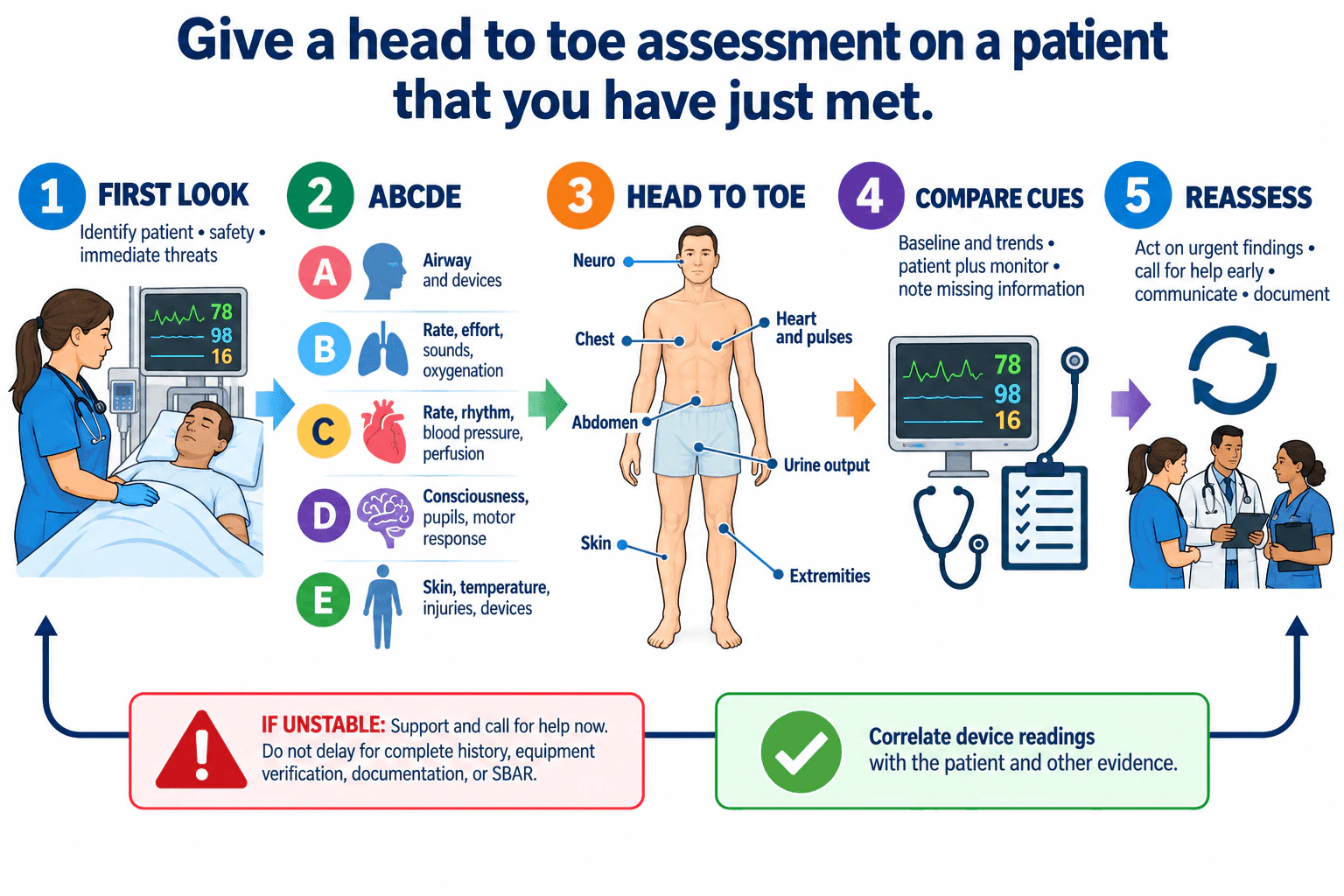
I would start with a rapid first look for safety and immediate threats, then assess Airway, Breathing, Circulation, Disability, and Exposure. Life threatening problems come before completing the rest of the examination. I would then assess neurologic status, chest, heart and pulses, abdomen, urine output when available, skin, and extremities. I would compare findings with baseline and trends, correlate monitor and device readings with the patient and other evidence, note anything still unknown, and reassess after interventions or changes. If the patient is unstable, I would call for appropriate help and support the patient immediately.
Detailed Explanation
For an adult bedside ICU RN interview in the United States, I would describe the assessment as systematic but guided by acuity. The first priority is recognizing instability, followed by a focused examination, comparison with baseline and trends, and repeated reassessment. The ABCDE approach supports treating life threatening problems before moving through the rest of the assessment, calling for appropriate help early, and reassessing the response to interventions. resus.org.uk
Useful Questions to Ask the Interviewer
How is the initial ICU assessment typically documented and communicated on this unit?
What resources are available when a bedside nurse identifies acute deterioration?
How are baseline findings and trends shared during handoff?
How to Explain It in an Interview
First Look
I would identify the patient when possible, check safety, form a rapid first impression, and look for immediate threats. If the patient appears unstable, I would call for appropriate help and begin support rather than waiting to finish the complete history, equipment verification, documentation, or SBAR.
ABCDE
I would assess Airway for patency and relevant devices. For Breathing, I would assess respiratory rate and effort, breath sounds, oxygenation, and any respiratory support. For Circulation, I would assess heart rate and rhythm, blood pressure, pulses, perfusion, and relevant lines or drains. For Disability, I would assess consciousness, pupils, and motor response. For Exposure, I would assess the skin, temperature, injuries, and devices while maintaining dignity. Life threatening findings are addressed as they are identified. resus.org.uk
Head to Toe
After immediate threats are addressed, I would continue through neurologic status, chest, heart and pulses, abdomen, urine output when available, skin, and extremities. I would separate direct observations from my interpretation and identify information that is still missing.
Compare Cues
I would compare the current findings with the patient's known baseline and recent trends. Monitor and device readings should be correlated with the patient and other evidence. If a reading conflicts with the bedside assessment, I would continue assessing the patient while verifying the signal, connections, sensor placement, and relevant equipment.
Reassess
I would reassess after interventions and whenever the patient's condition changes, communicate significant findings, and document the assessment and response. The nursing process is dynamic and iterative, with assessment and evaluation guiding continuing care. nursingworld.org
Why Interviewers Ask This
This question evaluates whether the nurse can combine a systematic physical assessment with ICU prioritization and clinical judgment. A strong answer shows that the nurse can recognize immediate threats, gather focused findings, compare them with baseline and trends, distinguish observations from interpretation, question conflicting monitor or device data, communicate concerns, and reassess the patient rather than treating assessment as a one time checklist.
Common interview mistakes
Common mistakes include treating the assessment as a memorized checklist, completing a full history before responding to instability, relying on a monitor reading without checking the patient, describing isolated findings without comparing them with baseline or trends, failing to identify missing information, and completing an intervention without reassessing its effect.
Interview tip
Present the assessment in the same sequence shown at the bedside: first look, ABCDE, focused head to toe assessment, comparison of clinical cues and trends, then reassessment, communication, and documentation. Make it clear that instability interrupts the routine sequence and triggers immediate support and escalation.
Interviewer may ask next
What would you do if a monitor or device reading did not match your bedside assessment?
I would assess the patient first and compare the reading with other clinical evidence. I would then verify signal quality, connections, sensor placement, and relevant equipment while continuing bedside observation. I would not dismiss either the patient findings or the device data without resolving the discrepancy. If the patient showed instability, I would call for appropriate help and provide support while verification continued.
How would your approach change if the patient suddenly became unstable during the head to toe assessment?
I would stop the routine sequence and return immediately to Airway, Breathing, Circulation, Disability, and Exposure, addressing life threatening problems as they were identified and calling for appropriate help early. I would not wait to complete the remaining examination, history, documentation, equipment verification, or SBAR before supporting an unstable patient. After intervention or stabilization, I would reassess the patient, communicate significant findings, and document the response.
3. What does safety mean to you? How do you ensure that a patient is safe?Patient Safety And Infection PreventionEasyNorthwell Health
Short Interview Answer (30-60 seconds)
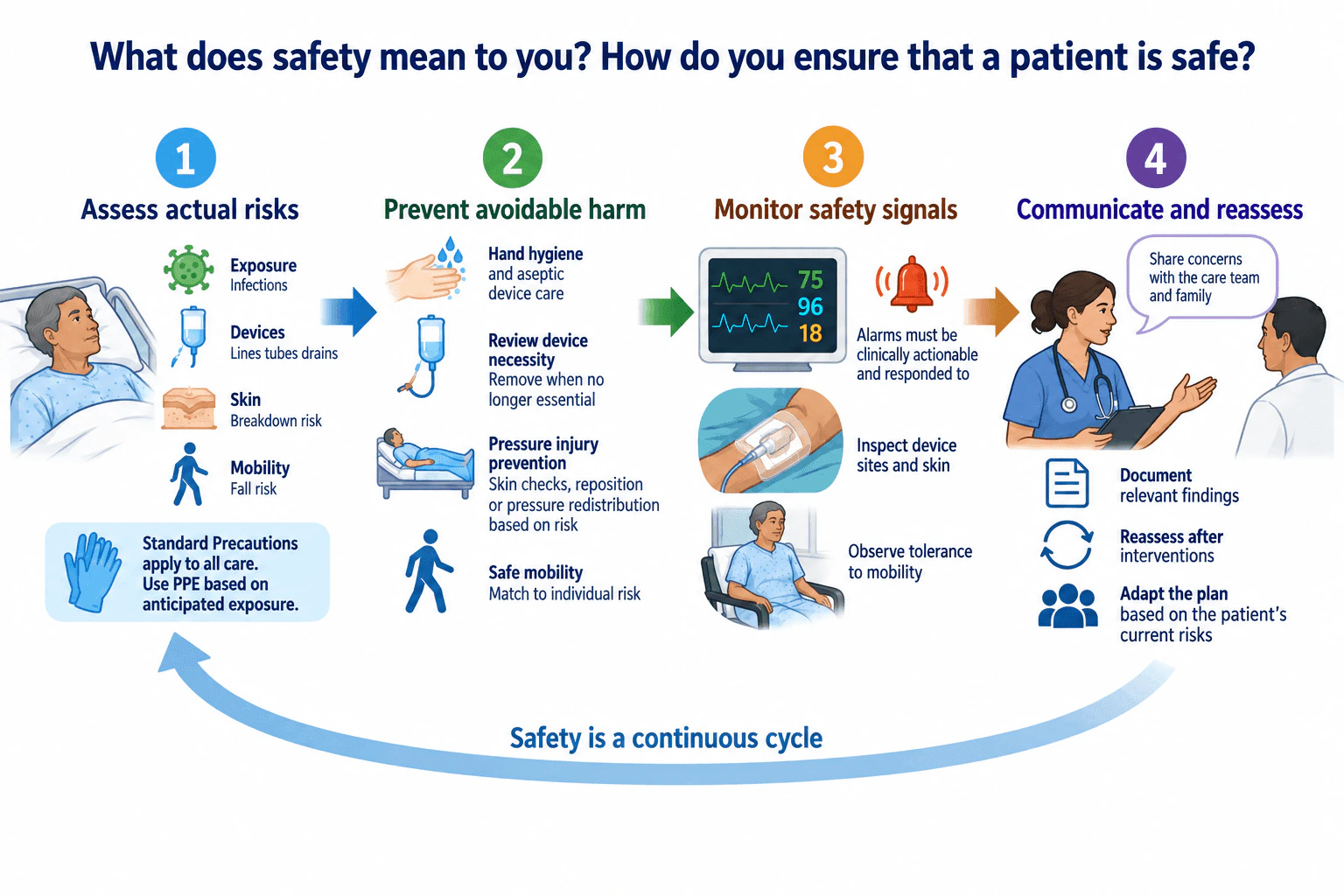
Safety means anticipating harm, acting on patient specific risks, and continuously checking whether the plan is working. I assess infection exposure, devices, skin, fall risk, mobility, and changes in condition. I use Standard Precautions, hand hygiene, appropriate personal protective equipment, aseptic device care, and review whether devices remain necessary. I individualize pressure injury prevention and safe mobility, respond to clinically important alarms, inspect device sites and skin, communicate concerns, document findings, and reassess after interventions.
Detailed Explanation
Safety means creating a continuous cycle of assessment, prevention, monitoring, communication, and reassessment so risks are identified early and the safety plan changes when the patient's condition changes. For this answer, I am describing adult bedside ICU nursing practice in the United States.
Useful Questions to Ask the Interviewer
How does the unit communicate patient specific safety risks during handoff and multidisciplinary rounds?
What resources support mobility, pressure injury prevention, and device related infection prevention in the ICU?
How are nurses expected to escalate safety concerns when a patient's condition or monitoring needs change?
How to Explain It in an Interview
Assess Actual Risks
I begin by identifying the risks that apply to the individual patient, including infection exposure, invasive devices, skin integrity, fall risk, mobility, and changes in condition. Standard Precautions apply to all patient care, while personal protective equipment is selected according to anticipated exposure. Hand hygiene is a core part of Standard Precautions. cdc.gov
Prevent Avoidable Harm
I use aseptic device care and review whether each invasive device is still necessary. For example, CDC guidance for urinary catheters recommends appropriate indications and leaving the catheter in place only as long as needed. cdc.gov I also assess skin risk and use pressure injury prevention measures such as skin assessment, repositioning, and pressure redistribution according to the patient's risk and tolerance. AHRQ guidance supports risk based pressure injury care planning rather than one identical plan for every patient. ahrq.gov Safe mobility is also individualized. AHRQ fall prevention guidance emphasizes formal risk assessment and a tailored prevention plan. ahrq.gov
Monitor Safety Signals
I monitor the patient and equipment for meaningful changes. I treat clinical alarms as information that requires assessment and an appropriate response rather than background noise. Joint Commission guidance identifies clinical alarm safety as a patient safety priority and emphasizes monitoring and responding to alarm signals. digitalassets.jointcommission.org I also inspect device sites and surrounding skin and observe the patient's tolerance to mobility and other safety interventions.
Communicate and Reassess
I communicate significant concerns to the appropriate care team members and involve the patient and family when appropriate. I document relevant findings, reassess after interventions, and adapt the safety plan when risks or the patient's condition change. That continuous reassessment is what keeps safety measures patient specific rather than automatic or static.
Why Interviewers Ask This
Interviewers are assessing whether the nurse views safety as an active cycle of assessment, prevention, monitoring, communication, and reassessment rather than as a single checklist. They want to hear patient specific judgment about infection exposure, device necessity, skin protection, mobility risk, alarm response, communication, documentation, and adaptation when the patient's condition changes.
Common interview mistakes
Common mistakes include describing safety only as fall prevention, assuming every patient needs the same precautions, focusing on alarms without assessing the patient, failing to review device necessity, overlooking skin around or beneath devices, using mobility interventions without considering individual risk or tolerance, and failing to communicate, document, or reassess after interventions.
Interview tip
Organize the answer as one continuous safety cycle: assess actual risks, prevent avoidable harm, monitor safety signals, then communicate and reassess. Use concrete ICU examples such as hand hygiene, device necessity, pressure injury prevention, safe mobility, and alarm response. Emphasize that interventions are matched to the patient's current risks and adjusted when those risks change.
Interviewer may ask next
How do you verify that your safety interventions are actually working?
I reassess the patient rather than assuming an intervention was effective. I inspect device sites and skin, review relevant monitoring and alarms, observe mobility tolerance, confirm that identified risks remain controlled, and document meaningful findings. I communicate unresolved concerns to the appropriate care team members. If the patient's condition changes or the intervention is not achieving its intended safety goal, I revise the plan and escalate through the appropriate clinical pathway.
How would your approach change if an ICU patient became weaker and less able to mobilize safely?
I would reassess fall risk, strength, cognition, lines and devices, skin risk, and the amount of assistance needed before further mobility. I would adjust the mobility plan to the patient's current tolerance and available assistance and increase attention to pressure injury prevention as immobility increases. I would continue monitoring skin and device sites, communicate the change to the care team, document the new findings and interventions, and reassess after positioning or mobility rather than continuing the previous plan unchanged.
4. How would be treat a Septic Patient and what vital signs would be monitor for?Sepsis And Multiorgan DysfunctionMediumNorthwell Health
Short Interview Answer (30-60 seconds)
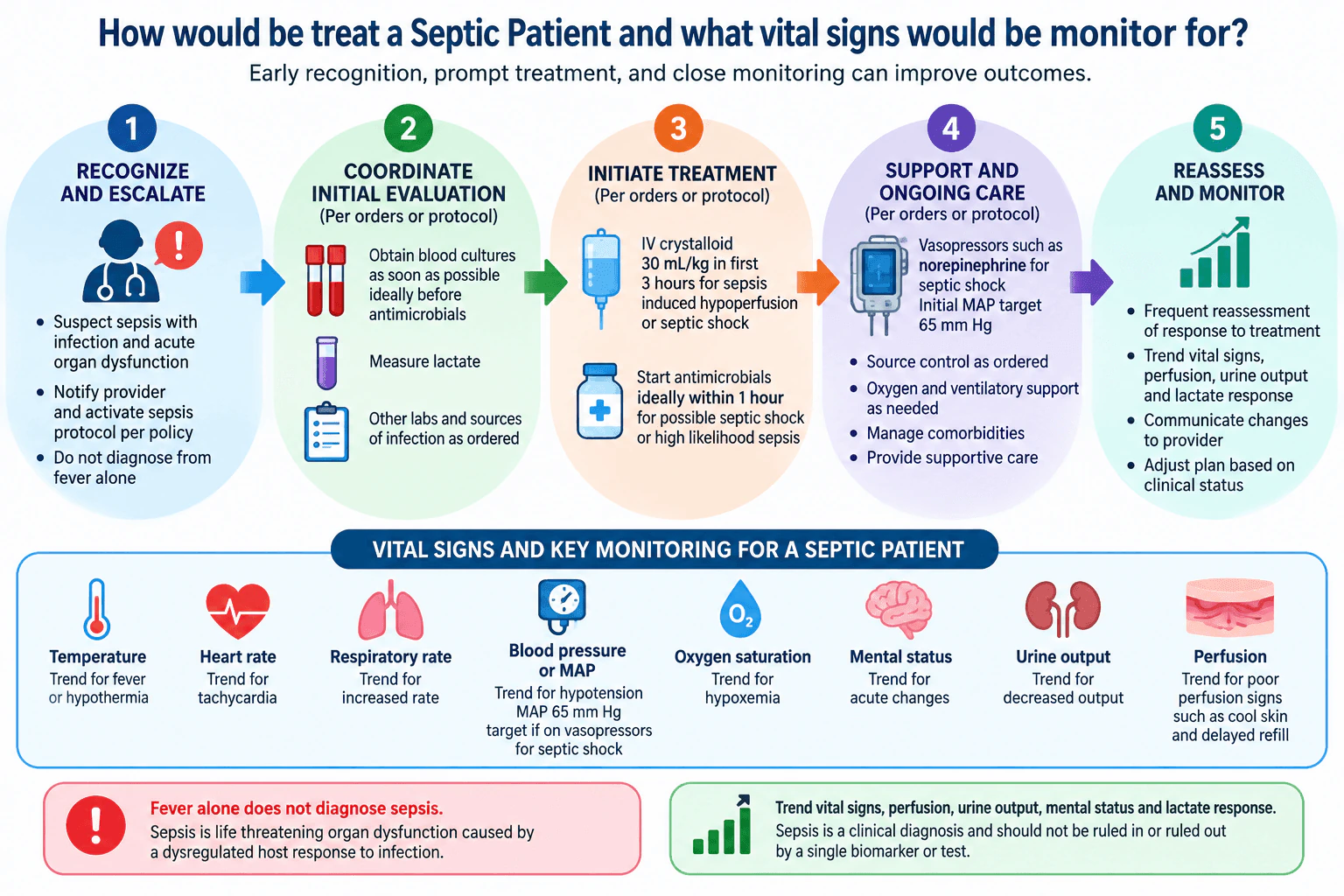
I would suspect sepsis when infection is accompanied by acute organ dysfunction and escalate promptly rather than waiting for complete diagnostic certainty. I would obtain ordered cultures and lactate, coordinate antimicrobials and fluid resuscitation as indicated, support oxygenation and source control, and assist with vasopressor therapy when ordered for septic shock. I would trend temperature, heart rate, respiratory rate, blood pressure and MAP, oxygen saturation, mental status, urine output, perfusion, and lactate response. Fever alone does not diagnose sepsis, so I would repeatedly reassess the whole clinical picture and communicate any deterioration.
Detailed Explanation
Sepsis is life threatening organ dysfunction caused by a dysregulated response to infection. The nursing priority is early recognition, timely escalation, coordinated treatment, and repeated assessment of whether perfusion and organ function are improving.
Useful Questions to Ask the Interviewer
Which sepsis screening and escalation pathway does your ICU use?
How are nurses expected to activate the sepsis response when they identify new organ dysfunction?
What resources are available for rapid reassessment and communication when a septic patient deteriorates?
How to Explain It in an Interview
Recognition and Escalation
I would look for suspected infection together with new organ dysfunction rather than diagnosing sepsis from fever alone. Concerning findings can include hypotension, tachycardia, increased respiratory rate, hypoxemia, altered mental status, reduced urine output, poor peripheral perfusion, or new bleeding and coagulation abnormalities. I would notify the responsible clinician and activate the appropriate local sepsis pathway when indicated.
Initial Evaluation and Treatment
I would obtain ordered blood cultures as soon as possible and ideally before antimicrobial therapy without delaying necessary treatment, and I would measure lactate. I would also coordinate other ordered laboratory testing and evaluation for the source of infection. For sepsis induced hypoperfusion or septic shock, current adult guidance suggests at least 30 mL/kg of IV crystalloid during the first 3 hours, with frequent ongoing reassessment to reduce the risk of both inadequate resuscitation and fluid overload.
For septic shock or probable or definite sepsis without shock, antimicrobials should be administered immediately, ideally within 1 hour of recognition. For possible sepsis without shock, I would support a rapid assessment of infectious and noninfectious causes and, if concern for infection persists, antimicrobial therapy within 3 hours from when sepsis was first suspected.
Support and Reassessment
If septic shock requires vasopressors, norepinephrine is recommended as the first line agent, with an initial MAP target of 65 mm Hg for most adults. These therapies are administered according to orders, protocols, and local scope. I would also support oxygenation and ventilation as needed and coordinate evaluation for source control.
I would frequently trend temperature, heart rate, respiratory rate, blood pressure and MAP, oxygen saturation, mental status, urine output, peripheral perfusion, and lactate response. I would also watch for worsening renal, respiratory, neurologic, hepatic, hematologic, or coagulation dysfunction because failure in one organ system can worsen others. If findings do not fit infection, I would continue evaluating for noninfectious causes rather than assuming all multiorgan deterioration is sepsis. Sepsis is a clinical diagnosis and should not be ruled in or ruled out using a single biomarker or test.
Why Interviewers Ask This
Interviewers are assessing whether the nurse can recognize sepsis as infection associated with acute organ dysfunction, escalate before diagnostic certainty is complete, coordinate time sensitive evaluation and treatment within nursing scope, distinguish infectious from noninfectious deterioration, and reassess the patient rather than relying on a single vital sign, screening score, or laboratory result.
Common interview mistakes
Common mistakes include treating fever alone as proof of sepsis, waiting for complete diagnostic certainty before escalating a deteriorating patient, delaying necessary treatment while obtaining cultures, using one screening score or biomarker as a definitive diagnosis, giving fluids without reassessing response and risk of overload, overlooking mental status or urine output changes, overlooking bleeding or coagulation abnormalities, assuming every multiorgan deterioration is infectious, and failing to communicate worsening perfusion or organ dysfunction.
Interview tip
Organize the answer as recognize, escalate, evaluate, treat, and reassess. Name the vital signs and organ perfusion indicators you would trend, then make it clear that the nurse coordinates ordered therapies and repeatedly evaluates the patient's response rather than treating a single number.
Interviewer may ask next
How would you verify whether the patient is responding to sepsis treatment?
I would compare serial findings rather than relying on one value. I would trend blood pressure and MAP, heart rate, respiratory rate, oxygen saturation, mental status, urine output, skin perfusion and capillary refill, and serial lactate when lactate is elevated or the patient has septic shock. I would also watch for improvement or deterioration in other organ function and report concerning trends promptly. Fluid therapy should be individualized after the initial bolus rather than continued only to normalize lactate.
What would change if infection were only possible and the patient had no shock?
I would still assess and escalate promptly, but I would rapidly evaluate both infectious and noninfectious causes rather than assuming every deterioration is sepsis. If concern for infection persists, current adult guidance supports antimicrobial therapy within 3 hours from when sepsis was first suspected. If the likelihood of infection becomes low and there is no shock, antimicrobials may be deferred while the patient continues to be closely monitored.
5. What would you do if a patient was unresponsive?Emergency Recognition And ResuscitationMediumNorthwell Health
Short Interview Answer (30-60 seconds)
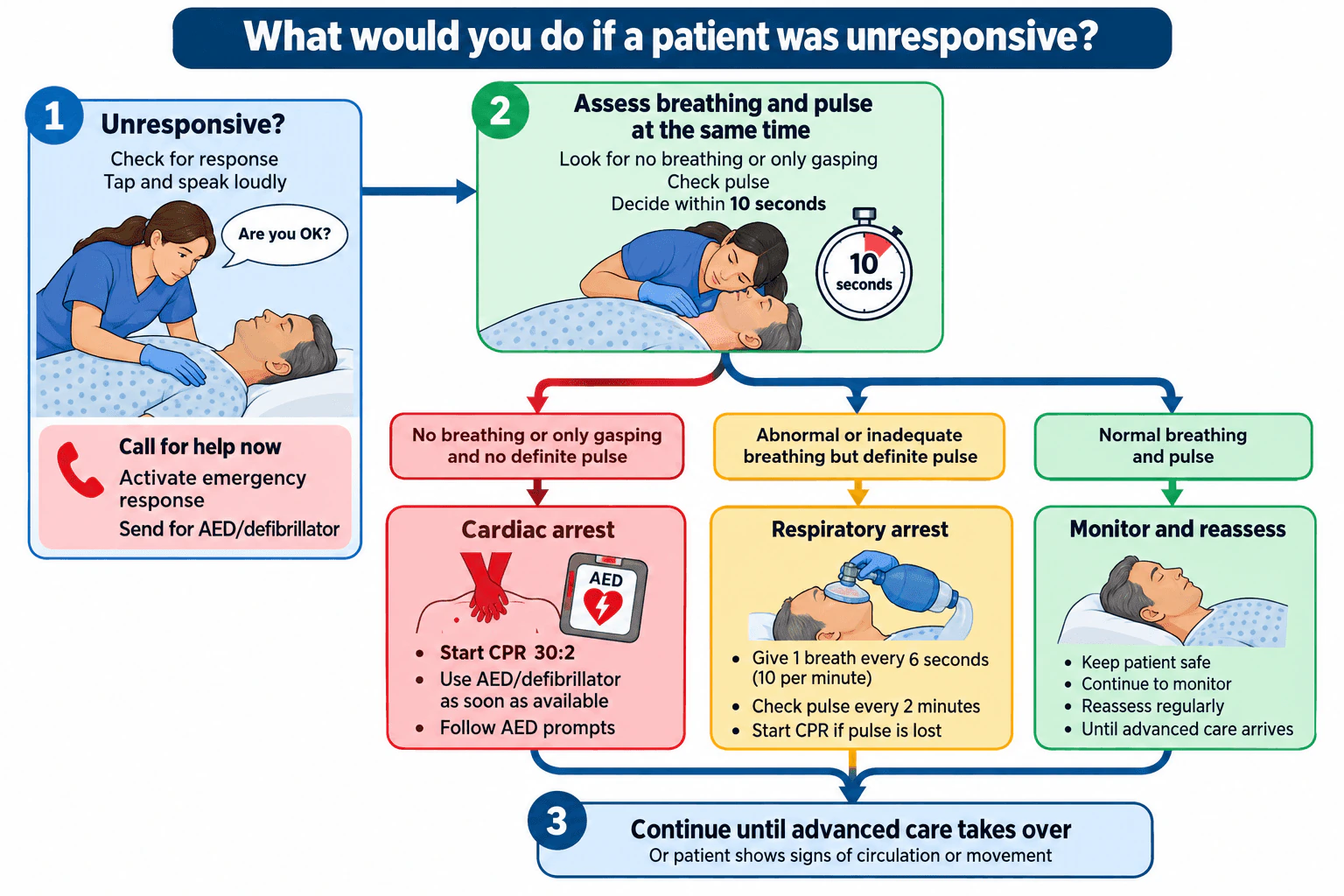
I would check responsiveness, call for help, activate the emergency response system, and send someone for the AED or defibrillator. I would assess breathing and pulse at the same time and decide within 10 seconds. With no breathing or only gasping and no definite pulse, I would begin CPR at 30:2 and use the AED or defibrillator as soon as available. With a definite pulse but inadequate breathing, I would give 1 breath every 6 seconds and recheck the pulse every 2 minutes. If breathing and pulse are normal, I would monitor and reassess until advanced care arrives.
Useful Questions to Ask the Interviewer
What emergency response system and resuscitation roles are used in this ICU?
Where are the nearest defibrillator and emergency airway supplies located?
Detailed Explanation
How to Explain It in an Interview
Clinical Principle
For an unresponsive adult patient, my priorities are rapid recognition, immediate activation of help, appropriate lifesaving action, and repeated reassessment. I would not delay treatment while waiting for a complete history or routine communication.
Nursing Priorities
I would first check for a response while calling for nearby help. I would activate the emergency response system and direct someone to obtain the automated external defibrillator or defibrillator.
I would then look for no breathing or only gasping while checking the pulse at the same time. I would make the pulse decision within 10 seconds.
If the patient has no breathing or only gasping and I cannot definitely feel a pulse, I would treat this as cardiac arrest. I would begin cardiopulmonary resuscitation using cycles of 30 compressions and 2 breaths and apply the AED or defibrillator as soon as it is available, following its prompts and the resuscitation team plan.
If there is a definite pulse but breathing is abnormal or inadequate, I would provide ventilatory support with 1 breath every 6 seconds, which is 10 breaths per minute. I would reassess the pulse every 2 minutes and begin CPR immediately if the pulse is lost.
If the patient has normal breathing and a pulse, I would keep the patient safe, continue close monitoring, and reassess while advanced care arrives.
Reassessment and Escalation
Throughout the response, I would communicate clearly with the team, confirm assigned actions through closed loop communication, and reassess for changes in breathing, pulse, and overall condition. Care would continue according to current adult resuscitation guidance, authorized protocols, and the responding advanced care team until they take over or the patient shows signs of circulation or movement.
Why Interviewers Ask This
Interviewers are evaluating whether I can recognize life threatening deterioration quickly, activate emergency resources without delaying lifesaving care, distinguish cardiac arrest from inadequate breathing with a definite pulse, begin the appropriate intervention within nursing scope and authorized protocols, and continue reassessment until advanced support arrives.
Common interview mistakes
Common mistakes include delaying emergency activation while completing a prolonged assessment, spending more than 10 seconds trying to confirm a pulse, treating gasping as normal breathing, failing to distinguish a definite pulse with inadequate breathing from cardiac arrest, delaying CPR when no definite pulse is felt, waiting too long to obtain or use the AED or defibrillator, and failing to reassess the pulse during ventilatory support.
Interview tip
Describe the response in the same order you would act: check responsiveness and activate help, assess breathing and pulse together within 10 seconds, choose the cardiac arrest or ventilatory support pathway, use the AED or defibrillator when indicated, and continue reassessment. This shows that emergency communication and lifesaving actions occur concurrently rather than sequentially.
Interviewer may ask next
How would you verify whether the patient is in cardiac arrest?
For an unresponsive adult, I would look for no breathing or only gasping while checking the pulse simultaneously. I would make the pulse decision within 10 seconds. If no definite pulse is felt and breathing is absent or only gasping, I would treat the patient as being in cardiac arrest and start CPR without further delay.
What would you do differently if the patient had a definite pulse but was not breathing adequately?
I would not perform chest compressions while a definite pulse remains present. I would provide ventilatory support with 1 breath every 6 seconds, or 10 breaths per minute, while monitoring the patient and checking the pulse every 2 minutes. If the pulse is lost, I would immediately transition to CPR and follow the cardiac arrest pathway.
6. Tell me which clinical rotation was the most meaningful to you during school?BehavioralEasyNorthwell Health
Interview tip:
Use STAR to structure your answer: briefly explain the Situation and Task, make Action the most detailed part, and finish with the Result. For example, describe a clinical rotation that had a strong effect on you, what responsibilities you had as a student, how you observed and reassessed patients, communicated with your preceptor and families, made careful decisions within your student role, and what the experience taught you about the nurse you wanted to become.
Situation
The most meaningful rotation for me was my adult intensive care rotation. It was the first time I saw how quickly a patient condition could change and how much careful observation, communication, and teamwork mattered. I was especially interested in how the nurses combined close patient assessment with calm communication for families who were often worried and overwhelmed.
Task
As a nursing student, my responsibility was to participate in patient care under my preceptor's supervision, stay within my student role, and learn how to recognize important changes. I wanted to understand not only what the nurse was doing, but also why repeated assessment and clear communication were so important in critical care.
Action
I prepared for each patient by reviewing the available clinical information with my preceptor and identifying what we needed to watch closely. At the bedside, I completed the assessments that were appropriate for me as a student and compared what I observed with earlier findings. When I noticed a change or had a concern, I brought it to my preceptor instead of making assumptions or acting beyond my role. I also watched how the nurse explained the plan to family members in simple language and gave them space to ask questions. When I had the opportunity, I practiced that same approach by listening carefully, answering only what I could appropriately address, and involving my preceptor when a question required more information. That rotation showed me that critical care nursing is not only about monitoring a very sick patient. It also requires repeated reassessment, early communication about concerns, teamwork, and attention to the patient and family as people.
Result
By the end of the rotation, I felt much more comfortable organizing an assessment, looking for changes over time, and communicating concerns clearly to the nurse supervising me. The experience confirmed that I was drawn to critical care because I valued the combination of close observation, clinical judgment, teamwork, and family communication. It also taught me to stay curious, speak up when something does not seem right, and always work within my level of responsibility.
Why Interviewers Ask This
Interviewers ask this question to understand which clinical experiences shaped the candidate's interests and professional values. A strong answer shows self awareness, a clear reason for choosing critical care, thoughtful learning from supervised clinical experience, and an understanding of the communication and judgment expected around critically ill patients.
Interviewer may ask next
What did that intensive care rotation teach you that you still carry into nursing practice?
It taught me to pay attention to changes over time instead of looking at one finding in isolation. I also learned the importance of communicating a concern early and clearly. As a student, I brought changes to my preceptor and asked questions when I did not understand the reasoning behind a decision. That habit of reassessing, communicating, and continuing to learn is something I would carry into critical care nursing.
Was there anything you found difficult during that rotation?
The hardest part was becoming comfortable in an environment where patients could be very ill and families were often anxious. At first, I worried about saying the wrong thing or overlooking an important change. I handled that by preparing carefully, staying close to my preceptor, asking focused questions, and being clear about the limits of my student role. Over time, I became more confident while still knowing when I needed guidance.
7. What are my educational goalsBehavioralEasyNorthwell Health
Interview tip:
Use STAR to structure your answer: briefly explain the Situation and Task, make Action the most detailed part, and finish with the Result. For example, describe how your educational goals support stronger critical care knowledge, better patient care, continued professional growth, and learning that you can apply at the bedside.
Situation
My educational goal is to keep building the knowledge needed for critical care nursing. Patients can change quickly, and I want my knowledge to keep growing with the responsibility of caring for them.
Task
My educational goal is to continue developing deeper critical care knowledge while becoming stronger in clinical judgment, patient reassessment, and communication with patients and families. I also want my learning to be practical so I can use it in everyday bedside care.
Action
I plan to continue learning through structured education, current nursing resources, and appropriate future workplace learning opportunities. I plan to focus on topics that directly affect critical care practice, then connect what I learn to realistic critical care situations. I plan to ask experienced nurses and other members of the care team questions when I want to understand the reasoning behind a decision. I also review areas where I feel less confident and make those areas a priority for further study. As I gain experience, I would like to pursue additional critical care education and professional development that match my future nursing role and future responsibilities. My goal is not simply to complete courses. I want to understand the material well enough to recognize changes in a patient, communicate concerns clearly, and explain important information to families in simple language.
Result
I expect this approach to help me become more intentional about learning and applying new knowledge in practice. My long term goal is to keep growing into a more knowledgeable and dependable critical care nurse with the goal of providing safe, thoughtful, and compassionate care.
Why Interviewers Ask This
Interviewers ask this question to understand whether a candidate is committed to continued learning and has realistic professional goals. A strong answer shows curiosity, self awareness, and a clear connection between education, stronger nursing judgment, and better patient care.
Interviewer may ask next
What area of critical care would you most like to learn more about?
I would like to deepen my knowledge of patient assessment and reassessment because small changes can be important in critical care. I want to become even better at connecting assessment findings with the overall clinical picture and communicating concerns clearly to the care team.
How would you balance continued education with your bedside responsibilities?
I would make learning part of a consistent routine rather than treating it as something separate from practice. I would use scheduled education, review important topics outside future patient care responsibilities, and learn from appropriate future bedside experiences and team discussions. I would always keep future patient responsibilities as the priority.
8. If I ask your manager how would she describe you?BehavioralMediumNorthwell Health
Interview tip:
Use STAR to structure your answer: briefly explain the Situation and Task, make Action the most detailed part, and finish with the Result. For example, describe a demanding ICU situation that shows how your manager would see you as calm, dependable, attentive to changes in patient condition, clear in your communication, and willing to take ownership and follow through.
Situation
A realistic example I would give is a demanding ICU shift where patient needs were changing and several priorities required close attention. My manager was present on the unit and could see how I worked when the pressure increased.
Task
My responsibility was to stay organized, reassess my patient carefully, communicate important changes promptly, keep the care team informed, and communicate clearly with the family while protecting patient confidentiality.
Action
I stayed calm and worked through the priorities in order of patient need. I reassessed the patient instead of relying only on earlier information because a critical care situation can change. When I identified a meaningful change, I communicated it promptly to the appropriate clinician and gave a clear summary of what I had observed. I followed through on the care plan within my nursing responsibilities and continued reassessment. I also kept the family informed in clear language about information I was able to share. I made sure my communication with the team was concise, documented relevant care, and asked for help when another set of hands was needed rather than allowing competing demands to delay an important task. I also checked back on delegated or coordinated tasks instead of assuming they were complete.
Result
The shift remained organized despite the competing priorities, and communication among the team and family stayed clear. In this example, my manager would see the calm approach, reliability, communication, and follow through that I would want my answer to demonstrate. I think she would describe me as someone who takes ownership, pays attention to changes, supports the team, and stays focused on safe patient care even during a busy shift.
Why Interviewers Ask This
Interviewers ask this question to understand how you are viewed by someone who has directly observed your work. A strong answer shows self awareness and supports your description with behaviors such as reliability, communication, sound judgment, teamwork, ownership, and openness to feedback.
Interviewer may ask next
What is one area your manager would say you are still working to improve?
She would probably say that I can sometimes try to handle too many competing tasks myself before asking for support. In this scenario, the shift would reinforce the value of recognizing workload early, communicating priorities, and asking the team for help before an important task could be delayed. I would be more deliberate about doing that while still taking responsibility for following through.
How would you make sure your communication stayed clear during that busy shift?
I would focus on the most important information first. I would reassess the patient, organize what had changed, and give the appropriate clinician a concise update rather than mixing urgent information with less important details. With the family, I would use simple language, stay within information I was able to share, and check that my explanation was understood. I would also document relevant care and follow up so communication did not stop after the first conversation.
9. What do you find the most difficult part of being a nurse?BehavioralMediumNorthwell Health
Interview tip:
Use STAR to structure your answer: briefly explain the Situation and Task, make Action the most detailed part, and finish with the Result. For example, describe a difficult moment when a critically ill patient's condition changed quickly, you had to stay focused on immediate care while supporting a worried family, you communicated clearly with the care team, and you learned how to balance clinical priorities with compassion.
Situation
The most difficult part of nursing for me is seeing patients and families go through frightening situations while I still need to stay calm and focused. A realistic ICU example would be caring for a patient whose condition changes suddenly while the family is at the bedside and becoming very worried.
Task
My responsibility in that situation would be to recognize the change, protect the patient's immediate safety, communicate the concern to the care team, and make sure the family was not left confused during a stressful moment.
Action
I would first focus on the patient and perform an immediate reassessment so I could clearly identify what had changed. I would communicate my findings promptly to the appropriate clinician and help the team organize the next priorities at the bedside. At the same time, I would speak to the family in simple and calm language. I would explain that the patient's condition had changed and that the team was actively evaluating the situation, without giving information that had not yet been confirmed. When I needed to stay focused on direct patient care, I would ask another available team member to help support the family so they still had a point of contact. Once the immediate situation was more stable, I would return to the family, answer the questions that were within my role, and make sure their concerns were shared with the rest of the care team. I would also document the patient's changes, my reassessments, and the communication that was relevant to the patient's care.
Result
In a situation like this, timely reassessment and communication would help the patient receive prompt attention from the care team while helping the family remain informed during a very stressful situation. This example shows why the emotional side of nursing can be difficult, especially when a patient's condition changes quickly. I have learned that I can acknowledge that difficulty without letting it interfere with my judgment. Staying organized, communicating clearly, and showing compassion help me continue providing safe and respectful care even during challenging moments.
Why Interviewers Ask This
Interviewers ask this question to understand how a nurse handles the emotional and professional challenges of patient care. A strong answer shows self awareness, sound judgment, resilience, compassion, and the ability to remain focused on patient needs during difficult situations.
Interviewer may ask next
How did you decide what to focus on first when the patient changed and the family was distressed?
In that type of situation, I would focus first on the patient's immediate condition because I would need accurate information before the team could respond effectively. I would reassess the patient and communicate the change promptly. I would still acknowledge the family and explain that we were actively evaluating the situation. When I needed to concentrate on bedside care, I would involve another available team member so the family continued to have support.
What did you learn about handling the emotional difficulty of situations like this?
I have learned that being compassionate does not mean carrying every difficult moment alone. I can recognize the emotional impact while still staying organized and focused on the patient. Clear communication with the team and the family helps me manage the situation professionally, and reflecting afterward helps me continue improving how I respond during similar events.
10. Share a moment that you made a difference in a patient's life?BehavioralHardNorthwell Health
Interview tip:
Use STAR to structure your answer: briefly explain the Situation and Task, make Action the most detailed part, and finish with the Result. For example, describe a time when you noticed an important physical or emotional need in a critically ill patient, took ownership of addressing it, communicated clearly with the patient, family, and care team, and helped the patient feel safer and more involved in care.
Situation
In an anonymous ICU scenario, I would care for a patient who had been through a serious illness and was becoming more alert as the condition improved. During my assessments, I noticed that the patient seemed frightened and overwhelmed. The patient had difficulty understanding what had happened and became anxious when care activities started.
Task
My responsibility was to provide safe nursing care while also helping the patient understand the situation and feel less afraid. I wanted the patient to feel that care was being done with them, not simply around them.
Action
I first completed my nursing assessment and made sure there was no new clinical change that needed immediate escalation. I then slowed down my communication. Before each care activity, I explained in simple words what I was going to do and why it was needed. I gave the patient time to respond and asked what was causing the most concern. The patient was worried about the unfamiliar ICU environment and about what would happen next. I listened without rushing the conversation and answered questions that were within my nursing role. When questions required the medical team, I wrote them down and made sure they were addressed during the next discussion. With the patient's permission, I also included the family in appropriate conversations so they could understand the plan and support the patient. I continued to reassess both the patient's clinical condition and level of distress throughout the shift. I also communicated the patient's concerns and preferred communication approach during handoff so the next nurse could continue the same support.
Result
The patient became calmer and more willing to participate in care and ask questions. The family also had a clearer understanding of how to support the patient. The lesson from this scenario was that making a difference is not always one dramatic intervention. Sometimes it comes from noticing fear, listening carefully, protecting the patient's voice, and making sure the person feels informed and respected during a very vulnerable time.
Why Interviewers Ask This
Interviewers ask this question to understand how a nurse recognizes patient needs beyond completing clinical tasks. A strong answer shows compassion, patient advocacy, sound judgment, communication, ownership, and the ability to make care more meaningful for a critically ill patient and family.
Interviewer may ask next
Why did you focus so much on communication with this patient?
I realized that the patient's fear was partly coming from not understanding what was happening. I still had to maintain my clinical priorities, but clear communication was something I could provide immediately. Explaining care in simple steps and giving the patient time to ask questions helped restore a sense of involvement and control.
What did you learn from that experience?
I learned that reassessment should include more than physical findings. A critically ill patient may also be dealing with fear, confusion, and loss of control. I now make a deliberate effort to notice those concerns, explain care clearly, involve the patient and family appropriately, and communicate important concerns to the rest of the care team.
More questions load as you scroll
Critical Care Nurse Resume Examples
Explore the resume examples below to find the one that best matches your target Critical Care Nurse role.
New Graduate Critical Care Nurse0-1 years; supervised transition to critical care
Disclaimer: This interview guide is for educational and informational purposes only. It is designed to help readers prepare, but it does not guarantee any interview result, hiring decision, offer, or outcome. Interview questions, hiring criteria, and preferred answers can vary by employer, interviewer, industry, location, and time. All answers, examples, and explanations in this guide are suggested examples for interview preparation, not definitive answers or instructions for professional practice. They are based on research and judgment, are provided without warranties of any kind, and should be adapted to the question, role, and applicable laws and professional requirements. Diagrams are simplified illustrations intended to highlight the main concepts and their relationships; actual situations, systems, and practices may be more complex. Alternative approaches may be equally valid or better suited to a particular question, context, or interviewer. To the fullest extent permitted by applicable law, the contributors and publisher are not liable for decisions made, actions taken, or losses incurred based on this guide.
State Laws and Professional Responsibilities: Laws and requirements governing an occupation vary by state and jurisdiction. You are responsible for checking the current laws, licensing requirements, and scope-of-practice rules that apply to your location and role, and for ensuring that your answers and actions comply with them. Adapt examples in this guide to those requirements. This guide is not legal advice.
Company Notice: This guide is an independent educational resource and is not affiliated with, endorsed by, sponsored by, or approved by the company named in this guide. Company names identify reported interview experiences or the employer context of clearly labeled original practice exercises. Interview practices can change without notice, and inclusion of company-specific content does not mean these questions are official, complete, or guaranteed to be asked. To the fullest extent permitted by law, the author, contributors, and publisher are not responsible for outcomes related to use of this material.
Content Accuracy and Verification: To the fullest extent permitted by applicable law, we do not represent or warrant that interview guides, questions, answers, examples, or diagrams are accurate, complete, current, error-free, or suitable for any particular purpose. You are responsible for independently reviewing and verifying the information before relying on it.